EP3392243A1 - Self-repairing polymers - Google Patents
Self-repairing polymers Download PDFInfo
- Publication number
- EP3392243A1 EP3392243A1 EP15910639.2A EP15910639A EP3392243A1 EP 3392243 A1 EP3392243 A1 EP 3392243A1 EP 15910639 A EP15910639 A EP 15910639A EP 3392243 A1 EP3392243 A1 EP 3392243A1
- Authority
- EP
- European Patent Office
- Prior art keywords
- polyols
- group
- compound
- polyol
- formula
- Prior art date
- Legal status (The legal status is an assumption and is not a legal conclusion. Google has not performed a legal analysis and makes no representation as to the accuracy of the status listed.)
- Withdrawn
Links
- 229920000642 polymer Polymers 0.000 title description 11
- 229920005862 polyol Polymers 0.000 claims abstract description 182
- 150000003077 polyols Chemical class 0.000 claims abstract description 154
- 239000004814 polyurethane Substances 0.000 claims abstract description 58
- 229920002635 polyurethane Polymers 0.000 claims abstract description 58
- 238000000034 method Methods 0.000 claims abstract description 39
- 239000011248 coating agent Substances 0.000 claims abstract description 34
- 238000000576 coating method Methods 0.000 claims abstract description 33
- 238000004519 manufacturing process Methods 0.000 claims abstract description 10
- 238000002360 preparation method Methods 0.000 claims abstract description 5
- 150000001875 compounds Chemical class 0.000 claims description 106
- -1 aliphatic polyols Chemical class 0.000 claims description 53
- 239000005056 polyisocyanate Substances 0.000 claims description 48
- 229920001228 polyisocyanate Polymers 0.000 claims description 48
- 239000000203 mixture Substances 0.000 claims description 45
- 125000002887 hydroxy group Chemical group [H]O* 0.000 claims description 41
- 239000004721 Polyphenylene oxide Substances 0.000 claims description 27
- 229920000570 polyether Polymers 0.000 claims description 27
- 239000003054 catalyst Substances 0.000 claims description 26
- ZMXDDKWLCZADIW-UHFFFAOYSA-N N,N-Dimethylformamide Chemical compound CN(C)C=O ZMXDDKWLCZADIW-UHFFFAOYSA-N 0.000 claims description 23
- 229910052739 hydrogen Inorganic materials 0.000 claims description 23
- 125000006273 (C1-C3) alkyl group Chemical group 0.000 claims description 19
- 229920005906 polyester polyol Polymers 0.000 claims description 19
- 238000006243 chemical reaction Methods 0.000 claims description 18
- 239000004417 polycarbonate Substances 0.000 claims description 16
- 239000011541 reaction mixture Substances 0.000 claims description 16
- ZMANZCXQSJIPKH-UHFFFAOYSA-N Triethylamine Chemical compound CCN(CC)CC ZMANZCXQSJIPKH-UHFFFAOYSA-N 0.000 claims description 15
- 239000003960 organic solvent Substances 0.000 claims description 15
- 229920000515 polycarbonate Polymers 0.000 claims description 15
- IMNIMPAHZVJRPE-UHFFFAOYSA-N triethylenediamine Chemical compound C1CN2CCN1CC2 IMNIMPAHZVJRPE-UHFFFAOYSA-N 0.000 claims description 15
- JUJWROOIHBZHMG-UHFFFAOYSA-N Pyridine Chemical compound C1=CC=NC=C1 JUJWROOIHBZHMG-UHFFFAOYSA-N 0.000 claims description 14
- 125000002496 methyl group Chemical group [H]C([H])([H])* 0.000 claims description 14
- 239000005057 Hexamethylene diisocyanate Substances 0.000 claims description 12
- RRAMGCGOFNQTLD-UHFFFAOYSA-N hexamethylene diisocyanate Chemical compound O=C=NCCCCCCN=C=O RRAMGCGOFNQTLD-UHFFFAOYSA-N 0.000 claims description 12
- 125000003545 alkoxy group Chemical group 0.000 claims description 11
- 125000000524 functional group Chemical group 0.000 claims description 10
- 229910052736 halogen Inorganic materials 0.000 claims description 10
- 150000002367 halogens Chemical class 0.000 claims description 10
- XZZXKVYTWCYOQX-UHFFFAOYSA-J octanoate;tin(4+) Chemical compound [Sn+4].CCCCCCCC([O-])=O.CCCCCCCC([O-])=O.CCCCCCCC([O-])=O.CCCCCCCC([O-])=O XZZXKVYTWCYOQX-UHFFFAOYSA-J 0.000 claims description 10
- 229920001610 polycaprolactone Polymers 0.000 claims description 10
- ATJFFYVFTNAWJD-UHFFFAOYSA-N Tin Chemical compound [Sn] ATJFFYVFTNAWJD-UHFFFAOYSA-N 0.000 claims description 9
- 125000005442 diisocyanate group Chemical group 0.000 claims description 9
- 125000001495 ethyl group Chemical group [H]C([H])([H])C([H])([H])* 0.000 claims description 9
- 125000001424 substituent group Chemical group 0.000 claims description 9
- IQPQWNKOIGAROB-UHFFFAOYSA-N isocyanate group Chemical group [N-]=C=O IQPQWNKOIGAROB-UHFFFAOYSA-N 0.000 claims description 8
- 230000005855 radiation Effects 0.000 claims description 8
- OEOIWYCWCDBOPA-UHFFFAOYSA-N 6-methyl-heptanoic acid Chemical compound CC(C)CCCCC(O)=O OEOIWYCWCDBOPA-UHFFFAOYSA-N 0.000 claims description 7
- DKPFZGUDAPQIHT-UHFFFAOYSA-N Butyl acetate Natural products CCCCOC(C)=O DKPFZGUDAPQIHT-UHFFFAOYSA-N 0.000 claims description 7
- UKLDJPRMSDWDSL-UHFFFAOYSA-L [dibutyl(dodecanoyloxy)stannyl] dodecanoate Chemical compound CCCCCCCCCCCC(=O)O[Sn](CCCC)(CCCC)OC(=O)CCCCCCCCCCC UKLDJPRMSDWDSL-UHFFFAOYSA-L 0.000 claims description 7
- 239000012975 dibutyltin dilaurate Substances 0.000 claims description 7
- FUZZWVXGSFPDMH-UHFFFAOYSA-N hexanoic acid Chemical compound CCCCCC(O)=O FUZZWVXGSFPDMH-UHFFFAOYSA-N 0.000 claims description 7
- NIMLQBUJDJZYEJ-UHFFFAOYSA-N isophorone diisocyanate Chemical compound CC1(C)CC(N=C=O)CC(C)(CN=C=O)C1 NIMLQBUJDJZYEJ-UHFFFAOYSA-N 0.000 claims description 7
- UMJSCPRVCHMLSP-UHFFFAOYSA-N pyridine Natural products COC1=CC=CN=C1 UMJSCPRVCHMLSP-UHFFFAOYSA-N 0.000 claims description 7
- GOOHAUXETOMSMM-UHFFFAOYSA-N Propylene oxide Chemical compound CC1CO1 GOOHAUXETOMSMM-UHFFFAOYSA-N 0.000 claims description 6
- 150000002596 lactones Chemical class 0.000 claims description 6
- VNMOIBZLSJDQEO-UHFFFAOYSA-N 1,10-diisocyanatodecane Chemical compound O=C=NCCCCCCCCCCN=C=O VNMOIBZLSJDQEO-UHFFFAOYSA-N 0.000 claims description 5
- GFNDFCFPJQPVQL-UHFFFAOYSA-N 1,12-diisocyanatododecane Chemical compound O=C=NCCCCCCCCCCCCN=C=O GFNDFCFPJQPVQL-UHFFFAOYSA-N 0.000 claims description 5
- OVBFMUAFNIIQAL-UHFFFAOYSA-N 1,4-diisocyanatobutane Chemical compound O=C=NCCCCN=C=O OVBFMUAFNIIQAL-UHFFFAOYSA-N 0.000 claims description 5
- QUPKOUOXSNGVLB-UHFFFAOYSA-N 1,8-diisocyanatooctane Chemical compound O=C=NCCCCCCCCN=C=O QUPKOUOXSNGVLB-UHFFFAOYSA-N 0.000 claims description 5
- IAYPIBMASNFSPL-UHFFFAOYSA-N Ethylene oxide Chemical compound C1CO1 IAYPIBMASNFSPL-UHFFFAOYSA-N 0.000 claims description 5
- 239000005058 Isophorone diisocyanate Substances 0.000 claims description 5
- SVYKKECYCPFKGB-UHFFFAOYSA-N N,N-dimethylcyclohexylamine Chemical compound CN(C)C1CCCCC1 SVYKKECYCPFKGB-UHFFFAOYSA-N 0.000 claims description 5
- UEEJHVSXFDXPFK-UHFFFAOYSA-N N-dimethylaminoethanol Chemical compound CN(C)CCO UEEJHVSXFDXPFK-UHFFFAOYSA-N 0.000 claims description 5
- OPKOKAMJFNKNAS-UHFFFAOYSA-N N-methylethanolamine Chemical compound CNCCO OPKOKAMJFNKNAS-UHFFFAOYSA-N 0.000 claims description 5
- GSEJCLTVZPLZKY-UHFFFAOYSA-N Triethanolamine Chemical compound OCCN(CCO)CCO GSEJCLTVZPLZKY-UHFFFAOYSA-N 0.000 claims description 5
- 229960002887 deanol Drugs 0.000 claims description 5
- 239000012972 dimethylethanolamine Substances 0.000 claims description 5
- 229920001223 polyethylene glycol Polymers 0.000 claims description 5
- RLEFZEWKMQQZOA-UHFFFAOYSA-M potassium;octanoate Chemical compound [K+].CCCCCCCC([O-])=O RLEFZEWKMQQZOA-UHFFFAOYSA-M 0.000 claims description 5
- 229920000151 polyglycol Polymers 0.000 claims description 4
- 239000010695 polyglycol Substances 0.000 claims description 4
- 229920001451 polypropylene glycol Polymers 0.000 claims description 4
- 150000002334 glycols Chemical class 0.000 claims description 3
- 229920000909 polytetrahydrofuran Polymers 0.000 claims description 3
- 125000004169 (C1-C6) alkyl group Chemical group 0.000 claims description 2
- ZYGHJZDHTFUPRJ-UHFFFAOYSA-N benzo-alpha-pyrone Natural products C1=CC=C2OC(=O)C=CC2=C1 ZYGHJZDHTFUPRJ-UHFFFAOYSA-N 0.000 abstract description 26
- 235000001671 coumarin Nutrition 0.000 abstract description 16
- 150000004775 coumarins Chemical class 0.000 abstract description 11
- GOLORTLGFDVFDW-UHFFFAOYSA-N 3-(1h-benzimidazol-2-yl)-7-(diethylamino)chromen-2-one Chemical compound C1=CC=C2NC(C3=CC4=CC=C(C=C4OC3=O)N(CC)CC)=NC2=C1 GOLORTLGFDVFDW-UHFFFAOYSA-N 0.000 abstract description 4
- YMWUJEATGCHHMB-UHFFFAOYSA-N Dichloromethane Chemical compound ClCCl YMWUJEATGCHHMB-UHFFFAOYSA-N 0.000 description 27
- 230000015572 biosynthetic process Effects 0.000 description 13
- OKKJLVBELUTLKV-UHFFFAOYSA-N Methanol Chemical compound OC OKKJLVBELUTLKV-UHFFFAOYSA-N 0.000 description 12
- 150000008064 anhydrides Chemical class 0.000 description 10
- 229960000956 coumarin Drugs 0.000 description 10
- 238000003786 synthesis reaction Methods 0.000 description 10
- CSCPPACGZOOCGX-UHFFFAOYSA-N Acetone Chemical compound CC(C)=O CSCPPACGZOOCGX-UHFFFAOYSA-N 0.000 description 9
- YXFVVABEGXRONW-UHFFFAOYSA-N Toluene Chemical compound CC1=CC=CC=C1 YXFVVABEGXRONW-UHFFFAOYSA-N 0.000 description 9
- 150000002148 esters Chemical class 0.000 description 9
- IAZDPXIOMUYVGZ-UHFFFAOYSA-N Dimethylsulphoxide Chemical compound CS(C)=O IAZDPXIOMUYVGZ-UHFFFAOYSA-N 0.000 description 8
- CSNNHWWHGAXBCP-UHFFFAOYSA-L Magnesium sulfate Chemical compound [Mg+2].[O-][S+2]([O-])([O-])[O-] CSNNHWWHGAXBCP-UHFFFAOYSA-L 0.000 description 8
- 239000002253 acid Substances 0.000 description 8
- 239000002904 solvent Substances 0.000 description 8
- CFNMUZCFSDMZPQ-GHXNOFRVSA-N 7-[(z)-3-methyl-4-(4-methyl-5-oxo-2h-furan-2-yl)but-2-enoxy]chromen-2-one Chemical compound C=1C=C2C=CC(=O)OC2=CC=1OC/C=C(/C)CC1OC(=O)C(C)=C1 CFNMUZCFSDMZPQ-GHXNOFRVSA-N 0.000 description 7
- 239000004970 Chain extender Substances 0.000 description 7
- 125000001931 aliphatic group Chemical group 0.000 description 7
- 125000004432 carbon atom Chemical group C* 0.000 description 7
- 239000000463 material Substances 0.000 description 7
- ZWEHNKRNPOVVGH-UHFFFAOYSA-N 2-Butanone Chemical compound CCC(C)=O ZWEHNKRNPOVVGH-UHFFFAOYSA-N 0.000 description 6
- OZJPLYNZGCXSJM-UHFFFAOYSA-N 5-valerolactone Chemical compound O=C1CCCCO1 OZJPLYNZGCXSJM-UHFFFAOYSA-N 0.000 description 6
- QTBSBXVTEAMEQO-UHFFFAOYSA-N Acetic acid Chemical compound CC(O)=O QTBSBXVTEAMEQO-UHFFFAOYSA-N 0.000 description 6
- WEVYAHXRMPXWCK-UHFFFAOYSA-N Acetonitrile Chemical compound CC#N WEVYAHXRMPXWCK-UHFFFAOYSA-N 0.000 description 6
- XEKOWRVHYACXOJ-UHFFFAOYSA-N Ethyl acetate Chemical compound CCOC(C)=O XEKOWRVHYACXOJ-UHFFFAOYSA-N 0.000 description 6
- 230000006378 damage Effects 0.000 description 6
- 238000006471 dimerization reaction Methods 0.000 description 6
- VLKZOEOYAKHREP-UHFFFAOYSA-N n-Hexane Chemical compound CCCCCC VLKZOEOYAKHREP-UHFFFAOYSA-N 0.000 description 6
- 239000000047 product Substances 0.000 description 6
- PAPBSGBWRJIAAV-UHFFFAOYSA-N ε-Caprolactone Chemical compound O=C1CCCCCO1 PAPBSGBWRJIAAV-UHFFFAOYSA-N 0.000 description 6
- 125000003118 aryl group Chemical group 0.000 description 5
- 239000003999 initiator Substances 0.000 description 5
- 238000011084 recovery Methods 0.000 description 5
- 230000008439 repair process Effects 0.000 description 5
- AMUBKBXGFDIMDJ-UHFFFAOYSA-N 3-heptyl-1,2-bis(9-isocyanatononyl)-4-pentylcyclohexane Chemical compound CCCCCCCC1C(CCCCC)CCC(CCCCCCCCCN=C=O)C1CCCCCCCCCN=C=O AMUBKBXGFDIMDJ-UHFFFAOYSA-N 0.000 description 4
- YEJRWHAVMIAJKC-UHFFFAOYSA-N 4-Butyrolactone Chemical compound O=C1CCCO1 YEJRWHAVMIAJKC-UHFFFAOYSA-N 0.000 description 4
- VHYFNPMBLIVWCW-UHFFFAOYSA-N 4-Dimethylaminopyridine Chemical compound CN(C)C1=CC=NC=C1 VHYFNPMBLIVWCW-UHFFFAOYSA-N 0.000 description 4
- 0 C*(*(C)C(Oc1c(*)c(*)c(C(*)=CC(O2)=O)c2c1*)=O)*(CO)CO Chemical compound C*(*(C)C(Oc1c(*)c(*)c(C(*)=CC(O2)=O)c2c1*)=O)*(CO)CO 0.000 description 4
- JVTAAEKCZFNVCJ-REOHCLBHSA-N L-Lactic acid Natural products C[C@H](O)C(O)=O JVTAAEKCZFNVCJ-REOHCLBHSA-N 0.000 description 4
- FXHOOIRPVKKKFG-UHFFFAOYSA-N N,N-Dimethylacetamide Chemical compound CN(C)C(C)=O FXHOOIRPVKKKFG-UHFFFAOYSA-N 0.000 description 4
- WYURNTSHIVDZCO-UHFFFAOYSA-N Tetrahydrofuran Chemical compound C1CCOC1 WYURNTSHIVDZCO-UHFFFAOYSA-N 0.000 description 4
- 238000002835 absorbance Methods 0.000 description 4
- JHIVVAPYMSGYDF-UHFFFAOYSA-N cyclohexanone Chemical compound O=C1CCCCC1 JHIVVAPYMSGYDF-UHFFFAOYSA-N 0.000 description 4
- 230000007547 defect Effects 0.000 description 4
- 239000000539 dimer Substances 0.000 description 4
- 150000002009 diols Chemical class 0.000 description 4
- 229910052943 magnesium sulfate Inorganic materials 0.000 description 4
- 239000000178 monomer Substances 0.000 description 4
- 239000011527 polyurethane coating Substances 0.000 description 4
- SCVFZCLFOSHCOH-UHFFFAOYSA-M potassium acetate Chemical compound [K+].CC([O-])=O SCVFZCLFOSHCOH-UHFFFAOYSA-M 0.000 description 4
- 230000008569 process Effects 0.000 description 4
- 230000002441 reversible effect Effects 0.000 description 4
- 238000003756 stirring Methods 0.000 description 4
- ATOUXIOKEJWULN-UHFFFAOYSA-N 1,6-diisocyanato-2,2,4-trimethylhexane Chemical compound O=C=NCCC(C)CC(C)(C)CN=C=O ATOUXIOKEJWULN-UHFFFAOYSA-N 0.000 description 3
- WJIOHMVWGVGWJW-UHFFFAOYSA-N 3-methyl-n-[4-[(3-methylpyrazole-1-carbonyl)amino]butyl]pyrazole-1-carboxamide Chemical compound N1=C(C)C=CN1C(=O)NCCCCNC(=O)N1N=C(C)C=C1 WJIOHMVWGVGWJW-UHFFFAOYSA-N 0.000 description 3
- UHOVQNZJYSORNB-UHFFFAOYSA-N Benzene Chemical compound C1=CC=CC=C1 UHOVQNZJYSORNB-UHFFFAOYSA-N 0.000 description 3
- QOSSAOTZNIDXMA-UHFFFAOYSA-N Dicylcohexylcarbodiimide Chemical compound C1CCCCC1N=C=NC1CCCCC1 QOSSAOTZNIDXMA-UHFFFAOYSA-N 0.000 description 3
- LYCAIKOWRPUZTN-UHFFFAOYSA-N Ethylene glycol Chemical compound OCCO LYCAIKOWRPUZTN-UHFFFAOYSA-N 0.000 description 3
- KAKZBPTYRLMSJV-UHFFFAOYSA-N butadiene group Chemical group C=CC=C KAKZBPTYRLMSJV-UHFFFAOYSA-N 0.000 description 3
- CDQSJQSWAWPGKG-UHFFFAOYSA-N butane-1,1-diol Chemical compound CCCC(O)O CDQSJQSWAWPGKG-UHFFFAOYSA-N 0.000 description 3
- WERYXYBDKMZEQL-UHFFFAOYSA-N butane-1,4-diol Chemical compound OCCCCO WERYXYBDKMZEQL-UHFFFAOYSA-N 0.000 description 3
- 229910052799 carbon Inorganic materials 0.000 description 3
- 125000005587 carbonate group Chemical group 0.000 description 3
- 238000012512 characterization method Methods 0.000 description 3
- 239000012971 dimethylpiperazine Substances 0.000 description 3
- 229920001971 elastomer Polymers 0.000 description 3
- 239000000806 elastomer Substances 0.000 description 3
- 238000001704 evaporation Methods 0.000 description 3
- 239000012634 fragment Substances 0.000 description 3
- 150000002430 hydrocarbons Chemical group 0.000 description 3
- 125000004435 hydrogen atom Chemical group [H]* 0.000 description 3
- 239000004922 lacquer Substances 0.000 description 3
- 239000010410 layer Substances 0.000 description 3
- PSGAAPLEWMOORI-PEINSRQWSA-N medroxyprogesterone acetate Chemical compound C([C@@]12C)CC(=O)C=C1[C@@H](C)C[C@@H]1[C@@H]2CC[C@]2(C)[C@@](OC(C)=O)(C(C)=O)CC[C@H]21 PSGAAPLEWMOORI-PEINSRQWSA-N 0.000 description 3
- 229910052751 metal Inorganic materials 0.000 description 3
- 239000002184 metal Substances 0.000 description 3
- 239000003973 paint Substances 0.000 description 3
- 229920002857 polybutadiene Polymers 0.000 description 3
- 239000004632 polycaprolactone Substances 0.000 description 3
- 125000006239 protecting group Chemical group 0.000 description 3
- 150000003254 radicals Chemical class 0.000 description 3
- 238000001228 spectrum Methods 0.000 description 3
- 238000010561 standard procedure Methods 0.000 description 3
- 239000002966 varnish Substances 0.000 description 3
- XLYOFNOQVPJJNP-UHFFFAOYSA-N water Substances O XLYOFNOQVPJJNP-UHFFFAOYSA-N 0.000 description 3
- PUPZLCDOIYMWBV-UHFFFAOYSA-N (+/-)-1,3-Butanediol Chemical compound CC(O)CCO PUPZLCDOIYMWBV-UHFFFAOYSA-N 0.000 description 2
- DNIAPMSPPWPWGF-GSVOUGTGSA-N (R)-(-)-Propylene glycol Chemical compound C[C@@H](O)CO DNIAPMSPPWPWGF-GSVOUGTGSA-N 0.000 description 2
- SCYULBFZEHDVBN-UHFFFAOYSA-N 1,1-Dichloroethane Chemical compound CC(Cl)Cl SCYULBFZEHDVBN-UHFFFAOYSA-N 0.000 description 2
- XSCLFFBWRKTMTE-UHFFFAOYSA-N 1,3-bis(isocyanatomethyl)cyclohexane Chemical compound O=C=NCC1CCCC(CN=C=O)C1 XSCLFFBWRKTMTE-UHFFFAOYSA-N 0.000 description 2
- RYHBNJHYFVUHQT-UHFFFAOYSA-N 1,4-Dioxane Chemical compound C1COCCO1 RYHBNJHYFVUHQT-UHFFFAOYSA-N 0.000 description 2
- ALQLPWJFHRMHIU-UHFFFAOYSA-N 1,4-diisocyanatobenzene Chemical compound O=C=NC1=CC=C(N=C=O)C=C1 ALQLPWJFHRMHIU-UHFFFAOYSA-N 0.000 description 2
- CDMDQYCEEKCBGR-UHFFFAOYSA-N 1,4-diisocyanatocyclohexane Chemical compound O=C=NC1CCC(N=C=O)CC1 CDMDQYCEEKCBGR-UHFFFAOYSA-N 0.000 description 2
- RXYPXQSKLGGKOL-UHFFFAOYSA-N 1,4-dimethylpiperazine Chemical compound CN1CCN(C)CC1 RXYPXQSKLGGKOL-UHFFFAOYSA-N 0.000 description 2
- 238000005160 1H NMR spectroscopy Methods 0.000 description 2
- WZEWDEAIHCUMKY-UHFFFAOYSA-N 2,2,5-trimethyl-1,3-dioxane-5-carboxylic acid Chemical compound CC1(C)OCC(C)(C(O)=O)CO1 WZEWDEAIHCUMKY-UHFFFAOYSA-N 0.000 description 2
- UPMLOUAZCHDJJD-UHFFFAOYSA-N 4,4'-Diphenylmethane Diisocyanate Chemical compound C1=CC(N=C=O)=CC=C1CC1=CC=C(N=C=O)C=C1 UPMLOUAZCHDJJD-UHFFFAOYSA-N 0.000 description 2
- MECBRMAYAIRLRB-UHFFFAOYSA-N 7-(2-hydroxyethoxy)-4-methylchromen-2-one Chemical compound C1=C(OCCO)C=CC2=C1OC(=O)C=C2C MECBRMAYAIRLRB-UHFFFAOYSA-N 0.000 description 2
- 238000004483 ATR-FTIR spectroscopy Methods 0.000 description 2
- SOGAXMICEFXMKE-UHFFFAOYSA-N Butylmethacrylate Chemical compound CCCCOC(=O)C(C)=C SOGAXMICEFXMKE-UHFFFAOYSA-N 0.000 description 2
- OKTJSMMVPCPJKN-UHFFFAOYSA-N Carbon Chemical compound [C] OKTJSMMVPCPJKN-UHFFFAOYSA-N 0.000 description 2
- 229930182843 D-Lactic acid Natural products 0.000 description 2
- JVTAAEKCZFNVCJ-UWTATZPHSA-N D-lactic acid Chemical compound C[C@@H](O)C(O)=O JVTAAEKCZFNVCJ-UWTATZPHSA-N 0.000 description 2
- IAZDPXIOMUYVGZ-WFGJKAKNSA-N Dimethyl sulfoxide Chemical compound [2H]C([2H])([2H])S(=O)C([2H])([2H])[2H] IAZDPXIOMUYVGZ-WFGJKAKNSA-N 0.000 description 2
- LFQSCWFLJHTTHZ-UHFFFAOYSA-N Ethanol Chemical compound CCO LFQSCWFLJHTTHZ-UHFFFAOYSA-N 0.000 description 2
- BAPJBEWLBFYGME-UHFFFAOYSA-N Methyl acrylate Chemical compound COC(=O)C=C BAPJBEWLBFYGME-UHFFFAOYSA-N 0.000 description 2
- 239000005062 Polybutadiene Substances 0.000 description 2
- ZLMJMSJWJFRBEC-UHFFFAOYSA-N Potassium Chemical compound [K] ZLMJMSJWJFRBEC-UHFFFAOYSA-N 0.000 description 2
- CDBYLPFSWZWCQE-UHFFFAOYSA-L Sodium Carbonate Chemical compound [Na+].[Na+].[O-]C([O-])=O CDBYLPFSWZWCQE-UHFFFAOYSA-L 0.000 description 2
- HCHKCACWOHOZIP-UHFFFAOYSA-N Zinc Chemical compound [Zn] HCHKCACWOHOZIP-UHFFFAOYSA-N 0.000 description 2
- WNLRTRBMVRJNCN-UHFFFAOYSA-N adipic acid Chemical compound OC(=O)CCCCC(O)=O WNLRTRBMVRJNCN-UHFFFAOYSA-N 0.000 description 2
- 125000000217 alkyl group Chemical group 0.000 description 2
- 238000005102 attenuated total reflection Methods 0.000 description 2
- 229910052797 bismuth Inorganic materials 0.000 description 2
- JCXGWMGPZLAOME-UHFFFAOYSA-N bismuth atom Chemical compound [Bi] JCXGWMGPZLAOME-UHFFFAOYSA-N 0.000 description 2
- 125000002837 carbocyclic group Chemical group 0.000 description 2
- 238000006482 condensation reaction Methods 0.000 description 2
- 238000004624 confocal microscopy Methods 0.000 description 2
- 150000004292 cyclic ethers Chemical class 0.000 description 2
- 125000001995 cyclobutyl group Chemical group [H]C1([H])C([H])([H])C([H])(*)C1([H])[H] 0.000 description 2
- 229940022769 d- lactic acid Drugs 0.000 description 2
- 230000007423 decrease Effects 0.000 description 2
- 238000005886 esterification reaction Methods 0.000 description 2
- 125000001033 ether group Chemical group 0.000 description 2
- 238000010438 heat treatment Methods 0.000 description 2
- 238000007373 indentation Methods 0.000 description 2
- QQVIHTHCMHWDBS-UHFFFAOYSA-N isophthalic acid Chemical compound OC(=O)C1=CC=CC(C(O)=O)=C1 QQVIHTHCMHWDBS-UHFFFAOYSA-N 0.000 description 2
- JVTAAEKCZFNVCJ-UHFFFAOYSA-N lactic acid Chemical compound CC(O)C(O)=O JVTAAEKCZFNVCJ-UHFFFAOYSA-N 0.000 description 2
- 235000019341 magnesium sulphate Nutrition 0.000 description 2
- QSHDDOUJBYECFT-UHFFFAOYSA-N mercury Chemical compound [Hg] QSHDDOUJBYECFT-UHFFFAOYSA-N 0.000 description 2
- 229910052753 mercury Inorganic materials 0.000 description 2
- DNIAPMSPPWPWGF-UHFFFAOYSA-N monopropylene glycol Natural products CC(O)CO DNIAPMSPPWPWGF-UHFFFAOYSA-N 0.000 description 2
- 125000001624 naphthyl group Chemical group 0.000 description 2
- 239000012074 organic phase Substances 0.000 description 2
- 125000001997 phenyl group Chemical group [H]C1=C([H])C([H])=C(*)C([H])=C1[H] 0.000 description 2
- 238000011907 photodimerization Methods 0.000 description 2
- 229920003023 plastic Polymers 0.000 description 2
- 239000004033 plastic Substances 0.000 description 2
- 229940068918 polyethylene glycol 400 Drugs 0.000 description 2
- 238000006116 polymerization reaction Methods 0.000 description 2
- 239000011591 potassium Substances 0.000 description 2
- 229910052700 potassium Inorganic materials 0.000 description 2
- 235000011056 potassium acetate Nutrition 0.000 description 2
- 235000013772 propylene glycol Nutrition 0.000 description 2
- 238000000425 proton nuclear magnetic resonance spectrum Methods 0.000 description 2
- 238000004611 spectroscopical analysis Methods 0.000 description 2
- 238000005507 spraying Methods 0.000 description 2
- 150000003512 tertiary amines Chemical class 0.000 description 2
- 238000012360 testing method Methods 0.000 description 2
- YLQBMQCUIZJEEH-UHFFFAOYSA-N tetrahydrofuran Natural products C=1C=COC=1 YLQBMQCUIZJEEH-UHFFFAOYSA-N 0.000 description 2
- 238000005809 transesterification reaction Methods 0.000 description 2
- JOYRKODLDBILNP-UHFFFAOYSA-N urethane group Chemical group NC(=O)OCC JOYRKODLDBILNP-UHFFFAOYSA-N 0.000 description 2
- 239000002023 wood Substances 0.000 description 2
- 229910052725 zinc Inorganic materials 0.000 description 2
- 239000011701 zinc Substances 0.000 description 2
- DNIAPMSPPWPWGF-VKHMYHEASA-N (+)-propylene glycol Chemical compound C[C@H](O)CO DNIAPMSPPWPWGF-VKHMYHEASA-N 0.000 description 1
- 229920002818 (Hydroxyethyl)methacrylate Polymers 0.000 description 1
- YPFDHNVEDLHUCE-UHFFFAOYSA-N 1,3-propanediol Substances OCCCO YPFDHNVEDLHUCE-UHFFFAOYSA-N 0.000 description 1
- SBJCUZQNHOLYMD-UHFFFAOYSA-N 1,5-Naphthalene diisocyanate Chemical compound C1=CC=C2C(N=C=O)=CC=CC2=C1N=C=O SBJCUZQNHOLYMD-UHFFFAOYSA-N 0.000 description 1
- VXNZUUAINFGPBY-UHFFFAOYSA-N 1-Butene Chemical group CCC=C VXNZUUAINFGPBY-UHFFFAOYSA-N 0.000 description 1
- YBYIRNPNPLQARY-UHFFFAOYSA-N 1H-indene Natural products C1=CC=C2CC=CC2=C1 YBYIRNPNPLQARY-UHFFFAOYSA-N 0.000 description 1
- HEWZVZIVELJPQZ-UHFFFAOYSA-N 2,2-dimethoxypropane Chemical compound COC(C)(C)OC HEWZVZIVELJPQZ-UHFFFAOYSA-N 0.000 description 1
- SMZOUWXMTYCWNB-UHFFFAOYSA-N 2-(2-methoxy-5-methylphenyl)ethanamine Chemical compound COC1=CC=C(C)C=C1CCN SMZOUWXMTYCWNB-UHFFFAOYSA-N 0.000 description 1
- NIXOWILDQLNWCW-UHFFFAOYSA-N 2-Propenoic acid Natural products OC(=O)C=C NIXOWILDQLNWCW-UHFFFAOYSA-N 0.000 description 1
- OMIGHNLMNHATMP-UHFFFAOYSA-N 2-hydroxyethyl prop-2-enoate Chemical class OCCOC(=O)C=C OMIGHNLMNHATMP-UHFFFAOYSA-N 0.000 description 1
- GNSFRPWPOGYVLO-UHFFFAOYSA-N 3-hydroxypropyl 2-methylprop-2-enoate Chemical class CC(=C)C(=O)OCCCO GNSFRPWPOGYVLO-UHFFFAOYSA-N 0.000 description 1
- QZPSOSOOLFHYRR-UHFFFAOYSA-N 3-hydroxypropyl prop-2-enoate Chemical class OCCCOC(=O)C=C QZPSOSOOLFHYRR-UHFFFAOYSA-N 0.000 description 1
- 229960000549 4-dimethylaminophenol Drugs 0.000 description 1
- YTWOQNGDMGJWFS-UHFFFAOYSA-N 5,7-bis(2-hydroxyethoxy)-4-methylchromen-2-one Chemical compound OCCOC1=C2C(=CC(OC2=CC(=C1)OCCO)=O)C YTWOQNGDMGJWFS-UHFFFAOYSA-N 0.000 description 1
- HBAQYPYDRFILMT-UHFFFAOYSA-N 8-[3-(1-cyclopropylpyrazol-4-yl)-1H-pyrazolo[4,3-d]pyrimidin-5-yl]-3-methyl-3,8-diazabicyclo[3.2.1]octan-2-one Chemical class C1(CC1)N1N=CC(=C1)C1=NNC2=C1N=C(N=C2)N1C2C(N(CC1CC2)C)=O HBAQYPYDRFILMT-UHFFFAOYSA-N 0.000 description 1
- 239000004215 Carbon black (E152) Substances 0.000 description 1
- 239000004971 Cross linker Substances 0.000 description 1
- PMPVIKIVABFJJI-UHFFFAOYSA-N Cyclobutane Chemical compound C1CCC1 PMPVIKIVABFJJI-UHFFFAOYSA-N 0.000 description 1
- OIFBSDVPJOWBCH-UHFFFAOYSA-N Diethyl carbonate Chemical compound CCOC(=O)OCC OIFBSDVPJOWBCH-UHFFFAOYSA-N 0.000 description 1
- VGGSQFUCUMXWEO-UHFFFAOYSA-N Ethene Chemical compound C=C VGGSQFUCUMXWEO-UHFFFAOYSA-N 0.000 description 1
- JIGUQPWFLRLWPJ-UHFFFAOYSA-N Ethyl acrylate Chemical compound CCOC(=O)C=C JIGUQPWFLRLWPJ-UHFFFAOYSA-N 0.000 description 1
- 239000005977 Ethylene Substances 0.000 description 1
- 206010073306 Exposure to radiation Diseases 0.000 description 1
- 238000005033 Fourier transform infrared spectroscopy Methods 0.000 description 1
- 244000068988 Glycine max Species 0.000 description 1
- 244000020551 Helianthus annuus Species 0.000 description 1
- WOBHKFSMXKNTIM-UHFFFAOYSA-N Hydroxyethyl methacrylate Chemical class CC(=C)C(=O)OCCO WOBHKFSMXKNTIM-UHFFFAOYSA-N 0.000 description 1
- CERQOIWHTDAKMF-UHFFFAOYSA-N Methacrylic acid Chemical compound CC(=C)C(O)=O CERQOIWHTDAKMF-UHFFFAOYSA-N 0.000 description 1
- VVQNEPGJFQJSBK-UHFFFAOYSA-N Methyl methacrylate Chemical compound COC(=O)C(C)=C VVQNEPGJFQJSBK-UHFFFAOYSA-N 0.000 description 1
- 229920002392 Novomer Polymers 0.000 description 1
- XBXFGOSIPGWNLZ-UHFFFAOYSA-N O=C1C=C(CC(C)(C)C1)C.N=C=O Chemical compound O=C1C=C(CC(C)(C)C1)C.N=C=O XBXFGOSIPGWNLZ-UHFFFAOYSA-N 0.000 description 1
- YGYAWVDWMABLBF-UHFFFAOYSA-N Phosgene Chemical compound ClC(Cl)=O YGYAWVDWMABLBF-UHFFFAOYSA-N 0.000 description 1
- 238000001069 Raman spectroscopy Methods 0.000 description 1
- FAPWRFPIFSIZLT-UHFFFAOYSA-M Sodium chloride Chemical class [Na+].[Cl-] FAPWRFPIFSIZLT-UHFFFAOYSA-M 0.000 description 1
- 235000019486 Sunflower oil Nutrition 0.000 description 1
- DHKHKXVYLBGOIT-UHFFFAOYSA-N acetaldehyde Diethyl Acetal Natural products CCOC(C)OCC DHKHKXVYLBGOIT-UHFFFAOYSA-N 0.000 description 1
- 150000001241 acetals Chemical class 0.000 description 1
- 238000007171 acid catalysis Methods 0.000 description 1
- 150000001252 acrylic acid derivatives Chemical class 0.000 description 1
- 150000001253 acrylic acids Chemical class 0.000 description 1
- 230000003213 activating effect Effects 0.000 description 1
- 230000004913 activation Effects 0.000 description 1
- 125000002015 acyclic group Chemical group 0.000 description 1
- 239000000654 additive Substances 0.000 description 1
- 230000000996 additive effect Effects 0.000 description 1
- 239000001361 adipic acid Substances 0.000 description 1
- 235000011037 adipic acid Nutrition 0.000 description 1
- 125000003158 alcohol group Chemical group 0.000 description 1
- 150000001298 alcohols Chemical class 0.000 description 1
- 125000002947 alkylene group Chemical group 0.000 description 1
- 150000001412 amines Chemical class 0.000 description 1
- 150000001491 aromatic compounds Chemical class 0.000 description 1
- 150000005840 aryl radicals Chemical group 0.000 description 1
- 239000010426 asphalt Substances 0.000 description 1
- 125000004429 atom Chemical group 0.000 description 1
- VEZXCJBBBCKRPI-UHFFFAOYSA-N beta-propiolactone Chemical compound O=C1CCO1 VEZXCJBBBCKRPI-UHFFFAOYSA-N 0.000 description 1
- 230000001588 bifunctional effect Effects 0.000 description 1
- IISBACLAFKSPIT-UHFFFAOYSA-N bisphenol A Chemical compound C=1C=C(O)C=CC=1C(C)(C)C1=CC=C(O)C=C1 IISBACLAFKSPIT-UHFFFAOYSA-N 0.000 description 1
- BMRWNKZVCUKKSR-UHFFFAOYSA-N butane-1,2-diol Chemical compound CCC(O)CO BMRWNKZVCUKKSR-UHFFFAOYSA-N 0.000 description 1
- OWBTYPJTUOEWEK-UHFFFAOYSA-N butane-2,3-diol Chemical compound CC(O)C(C)O OWBTYPJTUOEWEK-UHFFFAOYSA-N 0.000 description 1
- CQEYYJKEWSMYFG-UHFFFAOYSA-N butyl acrylate Chemical compound CCCCOC(=O)C=C CQEYYJKEWSMYFG-UHFFFAOYSA-N 0.000 description 1
- 229930188620 butyrolactone Natural products 0.000 description 1
- 239000000828 canola oil Substances 0.000 description 1
- 235000019519 canola oil Nutrition 0.000 description 1
- 239000004202 carbamide Substances 0.000 description 1
- 238000001460 carbon-13 nuclear magnetic resonance spectrum Methods 0.000 description 1
- 150000001732 carboxylic acid derivatives Chemical class 0.000 description 1
- 150000001735 carboxylic acids Chemical class 0.000 description 1
- 239000004359 castor oil Substances 0.000 description 1
- 235000019438 castor oil Nutrition 0.000 description 1
- 239000003153 chemical reaction reagent Substances 0.000 description 1
- 239000003795 chemical substances by application Substances 0.000 description 1
- 238000009833 condensation Methods 0.000 description 1
- 230000005494 condensation Effects 0.000 description 1
- 239000007859 condensation product Substances 0.000 description 1
- 239000004035 construction material Substances 0.000 description 1
- 229920001577 copolymer Polymers 0.000 description 1
- 238000007334 copolymerization reaction Methods 0.000 description 1
- 125000000332 coumarinyl group Chemical group O1C(=O)C(=CC2=CC=CC=C12)* 0.000 description 1
- 238000004132 cross linking Methods 0.000 description 1
- 239000013078 crystal Substances 0.000 description 1
- 125000004122 cyclic group Chemical group 0.000 description 1
- 238000006352 cycloaddition reaction Methods 0.000 description 1
- 125000000753 cycloalkyl group Chemical group 0.000 description 1
- 125000002993 cycloalkylene group Chemical group 0.000 description 1
- 125000004976 cyclobutylene group Chemical group 0.000 description 1
- 125000000582 cycloheptyl group Chemical group [H]C1([H])C([H])([H])C([H])([H])C([H])([H])C([H])(*)C([H])([H])C1([H])[H] 0.000 description 1
- 125000004977 cycloheptylene group Chemical group 0.000 description 1
- 125000000113 cyclohexyl group Chemical group [H]C1([H])C([H])([H])C([H])([H])C([H])(*)C([H])([H])C1([H])[H] 0.000 description 1
- 125000004956 cyclohexylene group Chemical group 0.000 description 1
- 125000000640 cyclooctyl group Chemical group [H]C1([H])C([H])([H])C([H])([H])C([H])([H])C([H])(*)C([H])([H])C([H])([H])C1([H])[H] 0.000 description 1
- 125000004978 cyclooctylene group Chemical group 0.000 description 1
- 125000001511 cyclopentyl group Chemical group [H]C1([H])C([H])([H])C([H])([H])C([H])(*)C1([H])[H] 0.000 description 1
- 125000004979 cyclopentylene group Chemical group 0.000 description 1
- 125000001559 cyclopropyl group Chemical group [H]C1([H])C([H])([H])C1([H])* 0.000 description 1
- 125000004980 cyclopropylene group Chemical group 0.000 description 1
- 238000001212 derivatisation Methods 0.000 description 1
- ROORDVPLFPIABK-UHFFFAOYSA-N diphenyl carbonate Chemical compound C=1C=CC=CC=1OC(=O)OC1=CC=CC=C1 ROORDVPLFPIABK-UHFFFAOYSA-N 0.000 description 1
- 239000006185 dispersion Substances 0.000 description 1
- 238000007590 electrostatic spraying Methods 0.000 description 1
- 231100000584 environmental toxicity Toxicity 0.000 description 1
- 125000004185 ester group Chemical group 0.000 description 1
- 150000002170 ethers Chemical class 0.000 description 1
- SUPCQIBBMFXVTL-UHFFFAOYSA-N ethyl 2-methylprop-2-enoate Chemical compound CCOC(=O)C(C)=C SUPCQIBBMFXVTL-UHFFFAOYSA-N 0.000 description 1
- ZEMPKEQAKRGZGQ-XOQCFJPHSA-N glycerol triricinoleate Natural products CCCCCC[C@@H](O)CC=CCCCCCCCC(=O)OC[C@@H](COC(=O)CCCCCCCC=CC[C@@H](O)CCCCCC)OC(=O)CCCCCCCC=CC[C@H](O)CCCCCC ZEMPKEQAKRGZGQ-XOQCFJPHSA-N 0.000 description 1
- VOZRXNHHFUQHIL-UHFFFAOYSA-N glycidyl methacrylate Chemical compound CC(=C)C(=O)OCC1CO1 VOZRXNHHFUQHIL-UHFFFAOYSA-N 0.000 description 1
- 150000004820 halides Chemical class 0.000 description 1
- 125000001475 halogen functional group Chemical group 0.000 description 1
- ACCCMOQWYVYDOT-UHFFFAOYSA-N hexane-1,1-diol Chemical compound CCCCCC(O)O ACCCMOQWYVYDOT-UHFFFAOYSA-N 0.000 description 1
- LNCPIMCVTKXXOY-UHFFFAOYSA-N hexyl 2-methylprop-2-enoate Chemical compound CCCCCCOC(=O)C(C)=C LNCPIMCVTKXXOY-UHFFFAOYSA-N 0.000 description 1
- LNMQRPPRQDGUDR-UHFFFAOYSA-N hexyl prop-2-enoate Chemical compound CCCCCCOC(=O)C=C LNMQRPPRQDGUDR-UHFFFAOYSA-N 0.000 description 1
- 229930195733 hydrocarbon Natural products 0.000 description 1
- 150000001261 hydroxy acids Chemical class 0.000 description 1
- 125000002768 hydroxyalkyl group Chemical group 0.000 description 1
- 125000003392 indanyl group Chemical group C1(CCC2=CC=CC=C12)* 0.000 description 1
- 125000003454 indenyl group Chemical group C1(C=CC2=CC=CC=C12)* 0.000 description 1
- 238000002329 infrared spectrum Methods 0.000 description 1
- 229910052500 inorganic mineral Inorganic materials 0.000 description 1
- 229940030980 inova Drugs 0.000 description 1
- 239000012948 isocyanate Substances 0.000 description 1
- 125000001449 isopropyl group Chemical group [H]C([H])([H])C([H])(*)C([H])([H])[H] 0.000 description 1
- 239000004310 lactic acid Substances 0.000 description 1
- 235000014655 lactic acid Nutrition 0.000 description 1
- JJTUDXZGHPGLLC-UHFFFAOYSA-N lactide Chemical compound CC1OC(=O)C(C)OC1=O JJTUDXZGHPGLLC-UHFFFAOYSA-N 0.000 description 1
- 239000011159 matrix material Substances 0.000 description 1
- 238000005259 measurement Methods 0.000 description 1
- 230000007246 mechanism Effects 0.000 description 1
- 239000003094 microcapsule Substances 0.000 description 1
- 239000011707 mineral Substances 0.000 description 1
- 235000010755 mineral Nutrition 0.000 description 1
- 125000002950 monocyclic group Chemical group 0.000 description 1
- PSHKMPUSSFXUIA-UHFFFAOYSA-N n,n-dimethylpyridin-2-amine Chemical compound CN(C)C1=CC=CC=N1 PSHKMPUSSFXUIA-UHFFFAOYSA-N 0.000 description 1
- 125000004108 n-butyl group Chemical group [H]C([H])([H])C([H])([H])C([H])([H])C([H])([H])* 0.000 description 1
- 125000000740 n-pentyl group Chemical group [H]C([H])([H])C([H])([H])C([H])([H])C([H])([H])C([H])([H])* 0.000 description 1
- 125000004123 n-propyl group Chemical group [H]C([H])([H])C([H])([H])C([H])([H])* 0.000 description 1
- SLCVBVWXLSEKPL-UHFFFAOYSA-N neopentyl glycol Chemical compound OCC(C)(C)CO SLCVBVWXLSEKPL-UHFFFAOYSA-N 0.000 description 1
- 239000003921 oil Substances 0.000 description 1
- 235000019198 oils Nutrition 0.000 description 1
- 230000003287 optical effect Effects 0.000 description 1
- KJIFKLIQANRMOU-UHFFFAOYSA-N oxidanium;4-methylbenzenesulfonate Chemical compound O.CC1=CC=C(S(O)(=O)=O)C=C1 KJIFKLIQANRMOU-UHFFFAOYSA-N 0.000 description 1
- RPQRDASANLAFCM-UHFFFAOYSA-N oxiran-2-ylmethyl prop-2-enoate Chemical compound C=CC(=O)OCC1CO1 RPQRDASANLAFCM-UHFFFAOYSA-N 0.000 description 1
- 238000010422 painting Methods 0.000 description 1
- PNJWIWWMYCMZRO-UHFFFAOYSA-N pent‐4‐en‐2‐one Natural products CC(=O)CC=C PNJWIWWMYCMZRO-UHFFFAOYSA-N 0.000 description 1
- ISWSIDIOOBJBQZ-UHFFFAOYSA-N phenol group Chemical group C1(=CC=CC=C1)O ISWSIDIOOBJBQZ-UHFFFAOYSA-N 0.000 description 1
- 239000006223 plastic coating Substances 0.000 description 1
- 229920001467 poly(styrenesulfonates) Polymers 0.000 description 1
- 229940085675 polyethylene glycol 800 Drugs 0.000 description 1
- 229920000166 polytrimethylene carbonate Polymers 0.000 description 1
- 239000002244 precipitate Substances 0.000 description 1
- 239000002243 precursor Substances 0.000 description 1
- 238000012545 processing Methods 0.000 description 1
- 229960000380 propiolactone Drugs 0.000 description 1
- NHARPDSAXCBDDR-UHFFFAOYSA-N propyl 2-methylprop-2-enoate Chemical compound CCCOC(=O)C(C)=C NHARPDSAXCBDDR-UHFFFAOYSA-N 0.000 description 1
- PNXMTCDJUBJHQJ-UHFFFAOYSA-N propyl prop-2-enoate Chemical compound CCCOC(=O)C=C PNXMTCDJUBJHQJ-UHFFFAOYSA-N 0.000 description 1
- 239000010453 quartz Substances 0.000 description 1
- 238000001953 recrystallisation Methods 0.000 description 1
- 230000009467 reduction Effects 0.000 description 1
- 239000011347 resin Substances 0.000 description 1
- 229920005989 resin Polymers 0.000 description 1
- 229920006395 saturated elastomer Polymers 0.000 description 1
- 229930195734 saturated hydrocarbon Natural products 0.000 description 1
- 238000006748 scratching Methods 0.000 description 1
- 230000002393 scratching effect Effects 0.000 description 1
- 238000007789 sealing Methods 0.000 description 1
- VYPSYNLAJGMNEJ-UHFFFAOYSA-N silicon dioxide Inorganic materials O=[Si]=O VYPSYNLAJGMNEJ-UHFFFAOYSA-N 0.000 description 1
- 239000002356 single layer Substances 0.000 description 1
- WBHQBSYUUJJSRZ-UHFFFAOYSA-M sodium bisulfate Chemical compound [Na+].OS([O-])(=O)=O WBHQBSYUUJJSRZ-UHFFFAOYSA-M 0.000 description 1
- 229910000342 sodium bisulfate Inorganic materials 0.000 description 1
- 229910000029 sodium carbonate Inorganic materials 0.000 description 1
- 239000007787 solid Substances 0.000 description 1
- 239000003549 soybean oil Substances 0.000 description 1
- 235000012424 soybean oil Nutrition 0.000 description 1
- 241000894007 species Species 0.000 description 1
- 230000007480 spreading Effects 0.000 description 1
- 238000003892 spreading Methods 0.000 description 1
- 239000000126 substance Substances 0.000 description 1
- 239000000758 substrate Substances 0.000 description 1
- 150000005846 sugar alcohols Polymers 0.000 description 1
- 239000002600 sunflower oil Substances 0.000 description 1
- 125000000999 tert-butyl group Chemical group [H]C([H])([H])C(*)(C([H])([H])[H])C([H])([H])[H] 0.000 description 1
- KSBAEPSJVUENNK-UHFFFAOYSA-L tin(ii) 2-ethylhexanoate Chemical compound [Sn+2].CCCCC(CC)C([O-])=O.CCCCC(CC)C([O-])=O KSBAEPSJVUENNK-UHFFFAOYSA-L 0.000 description 1
- RUELTTOHQODFPA-UHFFFAOYSA-N toluene 2,6-diisocyanate Chemical compound CC1=C(N=C=O)C=CC=C1N=C=O RUELTTOHQODFPA-UHFFFAOYSA-N 0.000 description 1
- 239000013638 trimer Substances 0.000 description 1
- 229930195735 unsaturated hydrocarbon Natural products 0.000 description 1
- 235000015112 vegetable and seed oil Nutrition 0.000 description 1
- 239000008158 vegetable oil Substances 0.000 description 1
- 239000008096 xylene Substances 0.000 description 1
Images

Classifications
-
- C—CHEMISTRY; METALLURGY
- C07—ORGANIC CHEMISTRY
- C07D—HETEROCYCLIC COMPOUNDS
- C07D311/00—Heterocyclic compounds containing six-membered rings having one oxygen atom as the only hetero atom, condensed with other rings
- C07D311/02—Heterocyclic compounds containing six-membered rings having one oxygen atom as the only hetero atom, condensed with other rings ortho- or peri-condensed with carbocyclic rings or ring systems
- C07D311/04—Benzo[b]pyrans, not hydrogenated in the carbocyclic ring
- C07D311/06—Benzo[b]pyrans, not hydrogenated in the carbocyclic ring with oxygen or sulfur atoms directly attached in position 2
- C07D311/08—Benzo[b]pyrans, not hydrogenated in the carbocyclic ring with oxygen or sulfur atoms directly attached in position 2 not hydrogenated in the hetero ring
- C07D311/16—Benzo[b]pyrans, not hydrogenated in the carbocyclic ring with oxygen or sulfur atoms directly attached in position 2 not hydrogenated in the hetero ring substituted in position 7
-
- C—CHEMISTRY; METALLURGY
- C08—ORGANIC MACROMOLECULAR COMPOUNDS; THEIR PREPARATION OR CHEMICAL WORKING-UP; COMPOSITIONS BASED THEREON
- C08G—MACROMOLECULAR COMPOUNDS OBTAINED OTHERWISE THAN BY REACTIONS ONLY INVOLVING UNSATURATED CARBON-TO-CARBON BONDS
- C08G18/00—Polymeric products of isocyanates or isothiocyanates
- C08G18/06—Polymeric products of isocyanates or isothiocyanates with compounds having active hydrogen
- C08G18/08—Processes
- C08G18/0838—Manufacture of polymers in the presence of non-reactive compounds
- C08G18/0842—Manufacture of polymers in the presence of non-reactive compounds in the presence of liquid diluents
- C08G18/0847—Manufacture of polymers in the presence of non-reactive compounds in the presence of liquid diluents in the presence of solvents for the polymers
- C08G18/0852—Manufacture of polymers in the presence of non-reactive compounds in the presence of liquid diluents in the presence of solvents for the polymers the solvents being organic
-
- C—CHEMISTRY; METALLURGY
- C08—ORGANIC MACROMOLECULAR COMPOUNDS; THEIR PREPARATION OR CHEMICAL WORKING-UP; COMPOSITIONS BASED THEREON
- C08G—MACROMOLECULAR COMPOUNDS OBTAINED OTHERWISE THAN BY REACTIONS ONLY INVOLVING UNSATURATED CARBON-TO-CARBON BONDS
- C08G18/00—Polymeric products of isocyanates or isothiocyanates
- C08G18/06—Polymeric products of isocyanates or isothiocyanates with compounds having active hydrogen
- C08G18/08—Processes
- C08G18/16—Catalysts
- C08G18/22—Catalysts containing metal compounds
- C08G18/24—Catalysts containing metal compounds of tin
- C08G18/244—Catalysts containing metal compounds of tin tin salts of carboxylic acids
-
- C—CHEMISTRY; METALLURGY
- C08—ORGANIC MACROMOLECULAR COMPOUNDS; THEIR PREPARATION OR CHEMICAL WORKING-UP; COMPOSITIONS BASED THEREON
- C08G—MACROMOLECULAR COMPOUNDS OBTAINED OTHERWISE THAN BY REACTIONS ONLY INVOLVING UNSATURATED CARBON-TO-CARBON BONDS
- C08G18/00—Polymeric products of isocyanates or isothiocyanates
- C08G18/06—Polymeric products of isocyanates or isothiocyanates with compounds having active hydrogen
- C08G18/28—Polymeric products of isocyanates or isothiocyanates with compounds having active hydrogen characterised by the compounds used containing active hydrogen
- C08G18/30—Low-molecular-weight compounds
- C08G18/32—Polyhydroxy compounds; Polyamines; Hydroxyamines
- C08G18/3203—Polyhydroxy compounds
- C08G18/3206—Polyhydroxy compounds aliphatic
-
- C—CHEMISTRY; METALLURGY
- C08—ORGANIC MACROMOLECULAR COMPOUNDS; THEIR PREPARATION OR CHEMICAL WORKING-UP; COMPOSITIONS BASED THEREON
- C08G—MACROMOLECULAR COMPOUNDS OBTAINED OTHERWISE THAN BY REACTIONS ONLY INVOLVING UNSATURATED CARBON-TO-CARBON BONDS
- C08G18/00—Polymeric products of isocyanates or isothiocyanates
- C08G18/06—Polymeric products of isocyanates or isothiocyanates with compounds having active hydrogen
- C08G18/28—Polymeric products of isocyanates or isothiocyanates with compounds having active hydrogen characterised by the compounds used containing active hydrogen
- C08G18/30—Low-molecular-weight compounds
- C08G18/32—Polyhydroxy compounds; Polyamines; Hydroxyamines
- C08G18/3203—Polyhydroxy compounds
- C08G18/3221—Polyhydroxy compounds hydroxylated esters of carboxylic acids other than higher fatty acids
-
- C—CHEMISTRY; METALLURGY
- C08—ORGANIC MACROMOLECULAR COMPOUNDS; THEIR PREPARATION OR CHEMICAL WORKING-UP; COMPOSITIONS BASED THEREON
- C08G—MACROMOLECULAR COMPOUNDS OBTAINED OTHERWISE THAN BY REACTIONS ONLY INVOLVING UNSATURATED CARBON-TO-CARBON BONDS
- C08G18/00—Polymeric products of isocyanates or isothiocyanates
- C08G18/06—Polymeric products of isocyanates or isothiocyanates with compounds having active hydrogen
- C08G18/28—Polymeric products of isocyanates or isothiocyanates with compounds having active hydrogen characterised by the compounds used containing active hydrogen
- C08G18/40—High-molecular-weight compounds
- C08G18/42—Polycondensates having carboxylic or carbonic ester groups in the main chain
- C08G18/4202—Two or more polyesters of different physical or chemical nature
-
- C—CHEMISTRY; METALLURGY
- C08—ORGANIC MACROMOLECULAR COMPOUNDS; THEIR PREPARATION OR CHEMICAL WORKING-UP; COMPOSITIONS BASED THEREON
- C08G—MACROMOLECULAR COMPOUNDS OBTAINED OTHERWISE THAN BY REACTIONS ONLY INVOLVING UNSATURATED CARBON-TO-CARBON BONDS
- C08G18/00—Polymeric products of isocyanates or isothiocyanates
- C08G18/06—Polymeric products of isocyanates or isothiocyanates with compounds having active hydrogen
- C08G18/28—Polymeric products of isocyanates or isothiocyanates with compounds having active hydrogen characterised by the compounds used containing active hydrogen
- C08G18/40—High-molecular-weight compounds
- C08G18/42—Polycondensates having carboxylic or carbonic ester groups in the main chain
- C08G18/4205—Polycondensates having carboxylic or carbonic ester groups in the main chain containing cyclic groups
- C08G18/4208—Polycondensates having carboxylic or carbonic ester groups in the main chain containing cyclic groups containing aromatic groups
-
- C—CHEMISTRY; METALLURGY
- C08—ORGANIC MACROMOLECULAR COMPOUNDS; THEIR PREPARATION OR CHEMICAL WORKING-UP; COMPOSITIONS BASED THEREON
- C08G—MACROMOLECULAR COMPOUNDS OBTAINED OTHERWISE THAN BY REACTIONS ONLY INVOLVING UNSATURATED CARBON-TO-CARBON BONDS
- C08G18/00—Polymeric products of isocyanates or isothiocyanates
- C08G18/06—Polymeric products of isocyanates or isothiocyanates with compounds having active hydrogen
- C08G18/28—Polymeric products of isocyanates or isothiocyanates with compounds having active hydrogen characterised by the compounds used containing active hydrogen
- C08G18/40—High-molecular-weight compounds
- C08G18/42—Polycondensates having carboxylic or carbonic ester groups in the main chain
- C08G18/4266—Polycondensates having carboxylic or carbonic ester groups in the main chain prepared from hydroxycarboxylic acids and/or lactones
- C08G18/4269—Lactones
- C08G18/4277—Caprolactone and/or substituted caprolactone
-
- C—CHEMISTRY; METALLURGY
- C08—ORGANIC MACROMOLECULAR COMPOUNDS; THEIR PREPARATION OR CHEMICAL WORKING-UP; COMPOSITIONS BASED THEREON
- C08G—MACROMOLECULAR COMPOUNDS OBTAINED OTHERWISE THAN BY REACTIONS ONLY INVOLVING UNSATURATED CARBON-TO-CARBON BONDS
- C08G18/00—Polymeric products of isocyanates or isothiocyanates
- C08G18/06—Polymeric products of isocyanates or isothiocyanates with compounds having active hydrogen
- C08G18/28—Polymeric products of isocyanates or isothiocyanates with compounds having active hydrogen characterised by the compounds used containing active hydrogen
- C08G18/65—Low-molecular-weight compounds having active hydrogen with high-molecular-weight compounds having active hydrogen
- C08G18/66—Compounds of groups C08G18/42, C08G18/48, or C08G18/52
- C08G18/6633—Compounds of group C08G18/42
- C08G18/6637—Compounds of group C08G18/42 with compounds of group C08G18/32 or polyamines of C08G18/38
- C08G18/664—Compounds of group C08G18/42 with compounds of group C08G18/32 or polyamines of C08G18/38 with compounds of group C08G18/3203
-
- C—CHEMISTRY; METALLURGY
- C08—ORGANIC MACROMOLECULAR COMPOUNDS; THEIR PREPARATION OR CHEMICAL WORKING-UP; COMPOSITIONS BASED THEREON
- C08G—MACROMOLECULAR COMPOUNDS OBTAINED OTHERWISE THAN BY REACTIONS ONLY INVOLVING UNSATURATED CARBON-TO-CARBON BONDS
- C08G18/00—Polymeric products of isocyanates or isothiocyanates
- C08G18/06—Polymeric products of isocyanates or isothiocyanates with compounds having active hydrogen
- C08G18/70—Polymeric products of isocyanates or isothiocyanates with compounds having active hydrogen characterised by the isocyanates or isothiocyanates used
- C08G18/72—Polyisocyanates or polyisothiocyanates
- C08G18/74—Polyisocyanates or polyisothiocyanates cyclic
- C08G18/75—Polyisocyanates or polyisothiocyanates cyclic cycloaliphatic
- C08G18/751—Polyisocyanates or polyisothiocyanates cyclic cycloaliphatic containing only one cycloaliphatic ring
- C08G18/752—Polyisocyanates or polyisothiocyanates cyclic cycloaliphatic containing only one cycloaliphatic ring containing at least one isocyanate or isothiocyanate group linked to the cycloaliphatic ring by means of an aliphatic group
- C08G18/753—Polyisocyanates or polyisothiocyanates cyclic cycloaliphatic containing only one cycloaliphatic ring containing at least one isocyanate or isothiocyanate group linked to the cycloaliphatic ring by means of an aliphatic group containing one isocyanate or isothiocyanate group linked to the cycloaliphatic ring by means of an aliphatic group having a primary carbon atom next to the isocyanate or isothiocyanate group
- C08G18/755—Polyisocyanates or polyisothiocyanates cyclic cycloaliphatic containing only one cycloaliphatic ring containing at least one isocyanate or isothiocyanate group linked to the cycloaliphatic ring by means of an aliphatic group containing one isocyanate or isothiocyanate group linked to the cycloaliphatic ring by means of an aliphatic group having a primary carbon atom next to the isocyanate or isothiocyanate group and at least one isocyanate or isothiocyanate group linked to a secondary carbon atom of the cycloaliphatic ring, e.g. isophorone diisocyanate
-
- C—CHEMISTRY; METALLURGY
- C08—ORGANIC MACROMOLECULAR COMPOUNDS; THEIR PREPARATION OR CHEMICAL WORKING-UP; COMPOSITIONS BASED THEREON
- C08G—MACROMOLECULAR COMPOUNDS OBTAINED OTHERWISE THAN BY REACTIONS ONLY INVOLVING UNSATURATED CARBON-TO-CARBON BONDS
- C08G63/00—Macromolecular compounds obtained by reactions forming a carboxylic ester link in the main chain of the macromolecule
- C08G63/02—Polyesters derived from hydroxycarboxylic acids or from polycarboxylic acids and polyhydroxy compounds
- C08G63/06—Polyesters derived from hydroxycarboxylic acids or from polycarboxylic acids and polyhydroxy compounds derived from hydroxycarboxylic acids
- C08G63/08—Lactones or lactides
-
- C—CHEMISTRY; METALLURGY
- C09—DYES; PAINTS; POLISHES; NATURAL RESINS; ADHESIVES; COMPOSITIONS NOT OTHERWISE PROVIDED FOR; APPLICATIONS OF MATERIALS NOT OTHERWISE PROVIDED FOR
- C09D—COATING COMPOSITIONS, e.g. PAINTS, VARNISHES OR LACQUERS; FILLING PASTES; CHEMICAL PAINT OR INK REMOVERS; INKS; CORRECTING FLUIDS; WOODSTAINS; PASTES OR SOLIDS FOR COLOURING OR PRINTING; USE OF MATERIALS THEREFOR
- C09D175/00—Coating compositions based on polyureas or polyurethanes; Coating compositions based on derivatives of such polymers
- C09D175/04—Polyurethanes
- C09D175/06—Polyurethanes from polyesters
Definitions
- the present invention relates to coumarins of formula (I), polyols and polyurethanes produced from said coumarin, as well as the method for producing said polyurethanes, the use thereof in the preparation of coating films and method thereof for repairing a damaged surface of said polyurethane.
- Self-repairing systems of polymeric materials that are based on the microencapsulation of a repair agent, application of an external stimulus, such as heat or light, and supramolecular chemistry, such as H bonding, are known in the state of the art.
- Microencapsulation is a system that has a high recovery percentage of the damaged polymer. However, it only enables the recovery to be carried out once, that is, if the same area is damaged again recovery is not possible.
- Other drawbacks of this system are the difficulty in ensuring that the contents of the microcapsules is capable of fully emerging to the exterior, the requirement of a catalyst in the polymer matrix, the high cost, the environmental toxicity, the stability and the processing of this type of material.
- Self-repair using supramolecular chemistry entails the drawback that it does not enable transparent polymers to be produced, transparency being an essential aspect in many applications of polymers.
- Self-repair by means of applying an external stimulus, such as light does not use catalysts. Therefore, it is a cost-effective system and does not harm the environment. Moreover, it enables transparent polymers to be produced.
- Said reversible dimerization takes place at wavelengths of about 350 nm or solar radiation, causing photodimerization [2+2] between two coumarins present in the polymeric structure giving rise to the formation of a cyclobutane ring, and the reverse reaction takes place at wavelengths lower than 260 nm, that is, photocleavage, and therefore, the two double bonds are regenerated again, giving rise to the initial coumarin, as shown in Scheme 1, wherein R represents the polymeric chain.
- This photodimerization-photocleavage enables the self-repair of the polymer in the damaged area since when the polymeric surface is damaged by mechanical stress, the weakest chemical bonds are those of the dimer, and therefore, these are the bonds that are cleaved.
- the previously cleaved bonds of the coumarins dimer Upon being irradiated with light with a wavelength lower than 260 nm, the previously cleaved bonds of the coumarins dimerize and give rise to the polymer repair.
- Document ES 2537618 A1 describes self-repairing polyurethanes comprising dihydroxylated coumarin derivatives, the structure of which is shown below.
- Polyurethane coatings comprising said dihydroxylated coumarin derivatives, which function as chain extenders, are highly reactive when irradiated, and therefore, have a high self-repair percentage, in addition to having the capacity to undergo multiple self-repair cycles, being transparent and having good mechanical performance.
- polyols from said derivative as a consequence of the generated trans-esterification reaction, coumarin molecules not bonded to the polyol chain and species with functionality 3 which ultimately led to a cross-linked polyurethane were obtained.
- polyurethanes formulated with coumarin of formula (I) according to the present invention as chain extenders give rise to photosensitive and self-repairing coatings that have the capacity to undergo multiple self-repair cycles, in addition to having good mechanical properties, particularly superior to those of a conventional coating.
- Said compounds of formula (I) can also act as polyol initiators, giving rise to high-tenacity elastomers.
- the invention relates to a compound of formula (I):
- the invention relates to a polyol (A) obtainable by reacting one or more compounds of formula (I) as defined in the first aspect, with one or more compounds (B) in the presence of a catalyst, wherein compound (B) comprises:
- the invention relates to a method for producing a polyurethane that comprises reacting a mixture comprising:
- the invention relates to a method for producing a polyurethane that comprises reacting a mixture comprising:
- the invention relates to a polyurethane obtainable by means of the method defined in the third and fourth aspects.
- the invention relates to the use of a polyurethane as defined in the fifth aspect in the preparation of a coating.
- the invention in a seventh aspect, relates to a method for repairing a coating as defined in the sixth aspect that comprises exposing said coating to light comprising a radiation with a wavelength comprised between 310 nm and 370 nm.
- alkyl relates to a radical with a linear or branched hydrocarbon chain consisting of carbon and hydrogen atoms, without unsaturations, having 1 to 6, preferably 1 to 3 carbon atoms, and that is bonded to the rest of the molecule by means of a single bond, for example, methyl, ethyl, n-propyl, i-propyl, n-butyl, t-butyl, n-pentyl, etc.
- alkoxyl as used herein relates to an alkyl radical, as defined above, bonded to the rest of the molecule by means of a -O- group, for example, methoxy, ethoxy, n-propoxy, isopropoxy, n-butoxy, t-butoxy.
- alkylene as used herein relates to a radical with a linear hydrocarbon chain consisting of carbon and hydrogen atoms, which has the number of carbon atoms indicated in each case and that is bonded at both ends to the rest of the molecule by means of single bonds, for example, ethylene (-CH2-CH2-), n-propylene (-CH2-CH2-CH2-), n-butylene (-CH2-CH2-CH2-), n-pentylene (-CH2-CH2-CH2-CH2-CH2-), etc.
- cycloalkyl as used herein relates to a saturated carbocyclic ring that has 3 to 8 carbon atoms, preferably 4 to 6 carbon atoms, for example, cyclopropyl, cyclobutyl, cyclopentyl, cyclohexyl, cycloheptyl and cyclooctyl.
- cycloalkylene as used herein relates to a saturated carbocyclic ring that has 3 to 8 carbon atoms, preferably 4 to 6 carbon atoms, and that is bonded to the rest of the molecule through two different carbon atoms by means of single bonds, for example, cyclopropylene, cyclobutylene, cyclopentylene, cyclohexylene, cycloheptylene and cyclooctylene.
- aryl as used herein relates to an aromatic hydrocarbon radical such as phenyl, naphthyl or anthracyl.
- the aryl radical may be optionally substituted by one or more substituents such as hydroxyl, halogen, alkyl and alkoxyl, as defined herein.
- halogen or "halo”, as used herein relates to -F, -CI, -Br and -I.
- hydroxyl or "hydroxy” relates to an -OH group.
- aliphatic as used herein relates to cyclic or acyclic, linear or branched, saturated or unsaturated hydrocarbon compounds, excluding aromatic compounds.
- aromatic as used herein relates to a mono- or polycyclic hydrocarbon comprising at least one unsaturated ring that meets Hückel's rule of aromaticity.
- aromatic rings are phenyl, indanyl, indenyl, naphthyl, phenenthryl and anthracyl.
- stereoisomer as used herein relates to compounds formed by the same atoms bonded by the same bond sequence but that have different three-dimensional structures that are not interchangeable, for example, isomers due to the presence of chiral centers (enantiomers, diastereomers and mixtures thereof including racemic mixtures) and isomers due to the presence of multiple bonds ( cis, trans and mixtures thereof).
- equivalent relates to the moles of compound per reactive units present in said compound. For example, one mole of diisocyanate equals to two equivalents of diisocyanate, whereas one mole of monoisocyanate equals to one equivalent of monoisocyanate.
- the invention relates to a coumarin derivative that is a compound of formula (I), as defined above.
- the invention is directed to a compound of formula (I), as defined above, wherein R 1 , R 2 , R 3 , R 4 , R 5 and R 6 are independently selected from the group consisting of H, C 1 -C 3 alkyl and C 1 -C 3 alkoxyl; Z is CH 2 or O; and n is a number selected from the group consisting of 1, 2, 3 and 4.
- the invention is directed to a compound of formula (I), as defined above, wherein R 1 is selected from the group consisting of H, C 1 -C 3 alkyl and C 1 -C 3 alkoxyl; preferably from the group consisting of H, C 1 -C 3 alkyl; even more preferably from the group consisting of H, methyl and ethyl; most preferably, R 1 is methyl.
- the invention is directed to a compound of formula (I), as defined above, wherein R 2 is selected from the group consisting of H, C 1 -C 3 alkyl and C 1 -C 3 alkoxyl; preferably from the group consisting of H, C 1 -C 3 alkyl; even more preferably from the group consisting of H, methyl and ethyl; most preferably, R 2 is H.
- the invention is directed to a compound of formula (I), as defined above, wherein R 3 is selected from the group consisting of H, C 1 -C 3 alkyl and C 1 -C 3 alkoxyl; preferably from the group consisting of H, C 1 -C 3 alkyl; even more preferably from the group consisting of H, methyl and ethyl; most preferably, R 3 is H.
- the invention is directed to a compound of formula (I), as defined above, wherein R 4 is selected from the group consisting of H, C 1 -C 3 alkyl and C 1 -C 3 alkoxyl; preferably from the group consisting of H, C 1 -C 3 alkyl; even more preferably from the group consisting of H, methyl and ethyl; most preferably, R 4 is H.
- the invention is directed to a compound of formula (I), as defined above, wherein R 5 is selected from the group consisting of H, C 1 -C 3 alkyl and C 1 -C 3 alkoxyl; preferably from the group consisting of H, C 1 -C 3 alkyl; even more preferably from the group consisting of H, methyl and ethyl; most preferably, R 5 is H.
- the invention is directed to a compound of formula (I), as defined above, wherein R 6 is selected from the group consisting of H, C 1 -C 3 alkyl and C 1 -C 3 alkoxyl; preferably from the group consisting of H, C 1 -C 3 alkyl; even more preferably from the group consisting of H, methyl and ethyl; most preferably, R 6 is methyl.
- the invention is directed to a compound of formula (I), as defined above, wherein Z is CH 2 .
- the invention is directed to a compound of formula (I), as defined above, wherein Z is O.
- the invention is directed to a compound of formula (I), as defined above, wherein n is a number selected from the group consisting of 1, 2 and 3; preferably from the group consisting of 1 and 2; most preferably, n is 2.
- the present invention is directed to a compound of formula (I) wherein Z is O and n is selected from the group consisting of 1 and 2.
- the present invention is directed to a compound of formula (I), as described above, wherein R 1 and R 6 are independently selected from the group consisting of H, methyl and ethyl, and R 2 , R 3 , R 4 and R 5 are H.
- the present invention is directed to a compound of formula (I), as described above, wherein R 1 and R 6 are methyl, R 2 , R 3 , R 4 and R 5 are H, and Z is O.
- the present invention is directed to a compound of formula (I), as described above, wherein R 1 and R 6 are methyl, R 2 , R 3 , R 4 and R 5 are H, Z is O and n is 2.
- the compound of formula (I) can be obtained by an esterification reaction between the acid (IV) or a precursor thereof, such as an anhydride or acid halide and the corresponding coumarin (III), as shown in Scheme 2, by methods known to those skilled in the art and described in Smith M.B. and March J. in March's Advanced Organic Chemistry Reactions, Mechanisms, and Structure, 6th Ed. John Wiley & Sons .
- the alcohol groups of the acid (IV) can be protected by alcohol protective groups (PG) known to those skilled in the art and described, for example, in P.G.M. and Greene T.W. in Protecting groups in Organic Synthesis, 4th Ed. Wiley-Interscience , and in Kocienski P.J. in Protecting Groups, 3rd Ed. Georg Thieme Verlag , as shown in Scheme 3.
- PG alcohol protective groups
- ethers including the formation of acetal
- silylated derivatives for example, ethers (including the formation of acetal) and silylated derivatives.
- the esterification reaction can be carried out starting with the acid (IV), preferably with its hydroxyl groups protected, by acid catalysis using methods known to those skilled in the art or it can also be carried out by activating the acid (IV), preferably with its hydroxyl groups protected, by forming the anhydride, for example in the presence of dimethylaminopyridine and subsequent reaction with coumarin (III).
- the method for obtaining the compound of formula (I) comprises the steps defined in Scheme 3, that is, protection of the hydroxyl groups of the acid (IV) to yield the acid (V) using standard methods, followed by activation of the acid (V) by forming the anhydride (VI) using standard methods, such as, for example, in the presence of dicyclohexylcarbodiimide (DDC) and reacting the anhydride (VI) with the coumarin (III) to yield the ester (VII) which, after deprotecting the hydroxyl groups using standard methods, yields the compound of formula (I).
- DDC dicyclohexylcarbodiimide
- the invention relates to a polyol (A) obtainable by a condensation reaction of one or more compounds of formula (I), as defined above, with one or more compounds (B) in the presence of a catalyst, wherein compound (B) comprises:
- hydroxy acids which comprise a carboxylic acid at one end and a hydroxyl group at the other end
- hydroxy esters which comprise an ester at one end and a hydroxyl group at the other end.
- this type of compound are L-lactic and D-lactic acid and the oligomers thereof from L-lactic and D-lactic acid or mixtures thereof.
- the compound (B) is a lactone; preferably selected from the group consisting of ⁇ -caprolactone, ⁇ -valerolactone, ⁇ -butyrolactone, and ⁇ -propiolactone; more preferably selected from the group consisting of ⁇ -caprolactone and ⁇ -valerolactone; most preferably, the lactone is ⁇ -caprolactone.
- the catalyst used can be a tertiary amine such as, for example, triethylamine, triethylenediamine, methylethanolamine, triethanolamine, dimethylethanolamine, pyridine, 1,4-diazabicyclo[2.2.2]octane, dimethylcyclohexylamine and dimethylpiperazine; organic derivatives of tin, mercury, lead, bismuth, zinc and potassium such as, for example, tin 2-ethylhexanoate (commonly referred to as tin octanoate), tin isooctanoate, dibutyltin dilaurate, potassium octanoate and potassium acetate.
- a tertiary amine such as, for example, triethylamine, triethylenediamine, methylethanolamine, triethanolamine, dimethylethanolamine, pyridine, 1,4-diazabicyclo[2.2.2]octane, dimethylcyclohex
- the catalyst is selected from the group consisting of tin octanoate, tin isooctanoate, dibutyltin dilaurate, triethylamine, triethylenediamine, methylethanolamine, triethanolamine, dimethylethanolamine, pyridine, 1,4-diazabicyclo[2.2.2]octane and dimethylcyclohexylamine; more preferably it is independently selected from the group consisting of tin octanoate, tin isooctanoate and dibutyltin dilaurate; most preferably, the catalyst is tin octanoate.
- reaction is carried out in the absence of solvent.
- the reaction is carried out in the presence of an aprotic organic solvent independently selected from the group consisting of dimethylformamide, butyl acetate, dimethyl sulfoxide, dimethylacetamide, tetrahydrofuran, dioxane, ethyl acetate, acetone, cyclohexanone, methyl ethyl ketone, acetonitrile, hexane, toluene, dichloromethane and mixtures thereof; more preferably, it is independently selected from the group consisting of dimethylformamide, butyl acetate, dimethylacetamide, dimethyl sulfoxide and mixtures thereof; most preferably, the aprotic organic solvent is dimethylformamide, butyl acetate, or mixtures thereof.
- an aprotic organic solvent independently selected from the group consisting of dimethylformamide, butyl acetate, dimethyl sulfoxide, dimethylacetamide, tetrahydrofuran, diox
- the reaction is carried out at a temperature comprised between 50 °C and 150 °C, more preferably between 70°C and 130 °C, most preferably between 90 °C and 110 °C.
- the invention is directed to a polyol (A) obtainable by reacting one or more compounds (B) and one or more compounds of formula (I), wherein the molar ratio of compounds (B) to compounds of formula (I) is comprised between 80:1 and 1:1, more preferably between 40:1 and 1.5:1.
- the invention is directed to a polyol (A) having an average molecular weight from 200 Dalton to 10,000 Dalton, preferably from 200 Dalton to 2000 Dalton.
- the polyol (A) is a compound of formula (II): wherein R 1 , R 2 , R 3 , R 4 , R 5 , R 6 , Z and n are as defined for the compound of formula (I), and o and p are independently selected from a number comprised between 0 and 40, provided that at least one of o and p is not zero.
- the polyurethanes are produced from three monomers: a relatively long-chain flexible polyol, which forms the soft segments of the polyurethane, a polyisocyanate, and a short-chain polyol, which is also referred to as a chain extender if it is bifunctional or cross-linker if it has a functionality greater than 2.
- a chain extender if it is bifunctional or cross-linker if it has a functionality greater than 2.
- the reaction of the polyisocyanate with the chain extender forms the hard segments of the polyurethane.
- the present invention relates to a method for producing a polyurethane comprising the coumarin derivative of formula (I) as defined above, wherein said method comprises reacting a mixture comprising:
- the method of the third aspect comprises reacting the mixture defined above, wherein both the polyol (A) and the compound of formula (I) are present.
- the ratio of equivalents of polyisocyanate (C) to the sum of equivalents of polyol (A), compound of formula (I) and polyol (D) in the reaction mixture is preferably comprised between 2:1 and 1:1.2.
- the method of the third aspect comprises reacting the mixture defined above, wherein the polyols of the mixture do not comprise the polyol (A) (that is, the compound of formula (I) and the polyol (D) are present) or wherein the polyols of the mixture do not comprise the compound of formula (I) (that is, the polyol (A) and the polyol (D) are present).
- the ratio of equivalents of polyisocyanate (C) to the sum of equivalents of either polyol (A) and polyol (D), or compound of formula (I) and polyol (D), in the reaction mixture is comprised between 2:1 and 1:1.2.
- the invention relates to a method for producing a polyurethane that comprises reacting a mixture comprising:
- polyisocyanate within the context of the present invention, should be construed as a compound comprising two or more, preferably two, aliphatic and/or aromatic, preferably aliphatic isocyanate groups.
- aliphatic polyisocyanates are hexamethylene diisocyanate (HDI), 2,2,4-trimethyl hexamethylene diisocyanate (TMDI), tetramethylene diisocyanate, octamethylene diisocyanate, decamethylene diisocyanate, dodecamethylene diisocyanate, tetradecamethylene diisocyanate, dimeryl diisocyanate (DDI), 1,1,6,6-tetrahydroperfluorohexamethylene diisocyanate (TFDI), isophorone diisocyanate (IPDI), 1,4-cyclohexane diisocyanate (CDI), 1,3-dicyclohexane diisocyanate, 1,2-dicyclohexane di
- aromatic polyisocyanates are 2,4- and 2,6-toluene diisocyanate (TDI), para-phenylene diisocyanate (PPDI), 4,4'-diphenylmethane diisocyanate and the 2,4' and 2,2' isomers thereof (MDI), tetramethyl xylene diisocyanate (TMXDI), 1,5-naphthalene diisocyanate (NDI), 1,3-bis(1-isocyanate-1-methylethyl)benzene, meta-xylylene diisocyanate and mixtures thereof.
- TDI 2,4- and 2,6-toluene diisocyanate
- PPDI para-phenylene diisocyanate
- MDI 4,4'-diphenylmethane diisocyanate and the 2,4' and 2,2' isomers thereof
- MDI tetramethyl xylene diisocyanate
- NDI 1,5-naphthalene diiso
- the polyisocyanate (C) is selected from the group consisting of linear or branched C 2 -C 20 -alkylene diisocyanate optionally substituted with 1 to 10 substituents independently selected from halogen, C 3 -Cs-cycloalkylene diisocyanate optionally substituted with 1 to 4 substituents independently selected from the group consisting of C 1 -C 3 alkyl and halogen, C 1 -C 6 -alkylen - C 3 -C 8 -cycloalkylene diisocyanate optionally substituted with 1 to 4 substituents independently selected from the group consisting of C 1 -C 3 alkyl and halogen, and C 3 -C 8 -cycloalkylen - C 1 -C 6 -alkylen - C 3 -C 8 -cycloalkylene diisocyanate optionally substituted with 1 to 4 substituents independently selected from the group consisting of C 1 -C 3 alkyl and halogen, and
- the polyol (D) with at least two hydroxyl groups relates to a compound that has at least two hydroxyl groups and is selected from the group consisting of polyester polyols, polyether polyols, aliphatic polyols (these also include polybutadiene polyols, wherein the aliphatic fragment is a chain from the polymerization of one or several butadiene groups), polycarbonate polyols, polyether carbonate polyol and polyols of natural origin as mentioned above.
- the polyol (D) is selected from the group consisting of polyester polyols, polyether polyols, aliphatic polyols (these also include polybutadiene polyols, wherein the aliphatic fragment is a chain from the polymerization of one or several butadiene groups), polycarbonate polyols and polyether carbonate polyols. More preferably, it is selected from the group consisting of polyester polyols and polyether polyols.
- the polyols have an average molecular weight comprised between 200 Dalton and 10,000 Dalton, preferably between 200 Dalton and 4000 Dalton; more preferably, such polyols are selected from the group consisting of polyester polyols and polyether polyols.
- the aliphatic polyols only comprise the terminal hydroxyl groups as functional groups.
- Preferred aliphatic polyols are diols such as 1,2-butanediol, 1,3-butanediol, 1,4-butanediol, 2,3-butanediol, 1,3-propanediol, 1,2-propanediol and mixtures thereof.
- the aliphatic polyols also include polybutadienes, wherein the aliphatic fragment is one or several butadiene groups.
- the polyether polyols comprise, in addition to the terminal hydroxyl groups, non-terminal ether groups.
- the polyether polyols include polyethylene glycols, polypropylene glycol, mixed polyglycols based on ethylene oxide and propylene oxide, polytetramethylene glycols and polytetrahydrofurans.
- the polyester polyols comprise, in addition to the terminal hydroxyl groups, non-terminal ester groups.
- the polyester polyols are produced by the condensation of diols and carboxylic acids, the anhydrides thereof and esters.
- Examples of polyester polyols are the condensation products based on ethylene glycol, 1,4-butylene glycol, 1,6-hexamethylene glycol or neopentyl glycol, with adipic acid or isophthalic acid.
- Polycaprolactones and (meth)acrylic polyols also belong to the group of polyester polyols.
- Polycaprolactones are obtained from the reaction between phosgene, aliphatic carbonates or aromatic carbonates, such as diphenyl carbonate or diethyl carbonate, with dihydric or polyhydric alcohols.
- Polycaprolactones are produced by the polyaddition of lactones such as, for example, ⁇ -caprolactone, with an initiator compound having reactive hydrogen atoms, such as water, alcohols, amines or bisphenol A.
- (Meth)acrylic polyols are produced by radical copolymerization of (a) monomers of (meth)acrylic acids or esters, such as acrylic acid, methyl acrylate, ethyl acrylate, propyl acrylate, butyl acrylate and hexyl acrylate, methacrylic acid, methyl methacrylate, ethyl methacrylate, propyl methacrylate, butyl methacrylate and hexyl methacrylate and (b) monomers of hydroxyalkyl (meth)acrylates, such as hydroxyethyl acrylates, hydroxyethyl methacrylates, hydroxypropyl acrylates, hydroxypropyl methacrylates, glycidyl acrylate and glycidyl methacrylate.
- monomers of (meth)acrylic acids or esters such as acrylic acid, methyl acrylate, ethyl acrylate, propyl acrylate, buty
- the polycarbonate polyols comprise, in addition to the hydroxyl groups, non-terminal carbonate groups.
- these polyols are hexanediol polycarbonate, butanediol polycarbonate, 1,2-propanediol polycarbonate and other diols and mixtures of diols such as, for example, Oxymer from Perstorp, Eternacoll from UBE, and Desmophen from Bayer.
- polyester polyols polycaprolactone polyols, (meth)acrylic polyols and polycarbonate polyols can also be used.
- Polyether carbonate polyols comprise, in addition to the terminal hydroxyl groups, carbonate groups and ether groups.
- Examples of polyether carbonate polyols are the polyether carbonate polyols produced from propylene oxide and carbon anhydride (CO 2 ) with an alternating or random structure, with different carbonate group contents within the structure thereof such as, for example, Converge from Novomer.
- the polyols of natural origin are those from vegetable oils.
- castor oil or the polyols produced by the derivatization of oils such as soybean, sunflower or canola oil may be mentioned.
- the polyol (D) with at least two hydroxyl groups is selected from the group consisting of polycaprolactones, polyethylene glycols, polypropylene glycols, mixed ethylene oxide and propylene oxide polyglycols, polytetramethylene glycols, polytetrahydrofurans and mixtures thereof, wherein the polyol (D) has an average molecular weight between 200 Dalton and 10,000 Dalton, preferably between 200 Dalton and 10,000 Dalton; preferably the polyol (D) is selected from the group consisting of polycaprolactones, polyethylene glycols, polypropylene glycols, mixed ethylene oxide and propylene oxide polyglycols and mixtures thereof, wherein the polyol (D) has an average molecular weight between 200 Dalton and 10,000 Dalton; most preferably, the polyol (D) is selected from the group consisting of polycaprolactones, polyethylene glycols and mixtures thereof, wherein the polyol (D) has an average molecular weight between 200
- the aprotic organic solvent is preferably an organic solvent selected from the group consisting of dimethylformamide, butyl acetate, dimethyl sulfoxide, dimethylacetamide, tetrahydrofuran, dioxane, ethyl acetate, acetone, cyclohexanone, methyl ethyl ketone, acetonitrile, hexane, toluene, dichloromethane and mixtures thereof; preferably, it is selected from the group consisting of dimethylformamide, butyl acetate, dimethylacetamide, dimethyl sulfoxide and mixtures thereof; most preferably, the aprotic organic solvent is dimethylformamide, butyl acetate, or mixtures thereof.
- the catalyst is a catalyst suitable for carrying out the reaction for forming the polyurethane, such as tertiary amines such as, for example, triethylamine, triethylenediamine, methylethanolamine, triethanolamine, dimethylethanolamine, pyridine, 1,4-diazabicyclo[2.2.2]octane, dimethylcyclohexylamine, dimethylpiperazine; organic derivatives of tin, mercury, lead, bismuth, zinc or potassium such as, for example, tin octanoate, tin isooctanoate, dibutyltin dilaurate, potassium octanoate and potassium acetate.
- tertiary amines such as, for example, triethylamine, triethylenediamine, methylethanolamine, triethanolamine, dimethylethanolamine, pyridine, 1,4-diazabicyclo[2.2.2]octane, dimethylcyclohexylamine, di
- the catalyst is selected from the group consisting of tin octanoate, tin isooctanoate, dibutyltin dilaurate, triethylamine, triethylenediamine, methylethanolamine, triethanolamine, dimethylethanolamine, pyridine, 1,4-diazabicyclo[2.2.2]octane, dimethylcyclohexylamine and potassium octanoate; more preferably it is selected from the group consisting of tin octanoate, tin isooctanoate, dibutyltin dilaurate and potassium octanoate; most preferably, the catalyst is tin octanoate.
- the catalyst is added in an amount comprised between 0.01% and 5% in moles with respect to the moles of polyisocyanate (C), preferably between 0.01% and 0.05% in moles with respect to the moles of polyisocyanate (C).
- the method for forming polyurethane preferably is carried out at a temperature comprised between 50 °C and 150 °C, more preferably 50 °C and 100 °C, most preferably between 65 °C and 85 °C.
- the formation of polyurethanes is carried out by stirring for a period of time no longer than 24 hours, preferably less than 12 hours, followed by heating at a temperature higher than room temperature, and no higher than 150°C, preferably lower than 100°C, most preferably between room temperature and 85 °C.
- the method according to the invention comprises reacting a mixture comprising one or more polyisocyanates (C) and one or more polyols (A).
- the method according to the invention comprises reacting a mixture comprising one or more polyisocyanates (C), one or more polyols (A) and one or more polyols (D).
- the method according to the invention comprises reacting a mixture comprising one or more polyisocyanates (C), one or more compounds of formula (I) and one or more polyols (D).
- the method according to the invention comprises reacting a mixture comprising one or more polyisocyanates (C), one or more compounds of formula (I) and one or more polyols (A).
- the method according to the invention comprises reacting a mixture comprising one or more polyisocyanates (C), one or more compounds of formula (I), one or more polyols (A) and one or more polyols (D).
- the ratio of equivalents of polyisocyanate (C) to the sum of equivalents of compound of formula (I), polyol (A) and polyol (D) in the reaction mixture is comprised between 2:1 and 1:1.2, preferably between 1.5:1 and 1:1.1, more preferably between 1.2:1 and 1:1.1, even more preferably 1.1:1 and 1:1.05, most preferably 1.05:1.
- the polyols present in the reaction mixture can be the compound of formula (I), polyol (A) and polyol (D), or it can be carried out in the absence of the compound of formula (I) (that is, the polyols present in the reaction mixture would be the polyol (A) and polyol (D)) or in the absence of the polyol (A) (that is, the polyols present in the reaction mixture would be the compound of formula (I) and the polyol (D)).
- the ratio of equivalents of polyisocyanate (C) to the sum of equivalents of polyol (A) and polyol (D) in the reaction mixture is comprised between 2:1 and 1.2:1, preferably between 1.5:1 and 1.1:1, more preferably between 1.2:1 and 1.1:1, even more preferably 1.1:1 and 1.05:1, most preferably 1.05:1.
- the ratio between the sum of the equivalents of polyol (A) and the equivalents of compound of formula (I) with respect to the equivalents of polyisocyanate (C) is comprised between 1% and 95%, preferably between 2% and 60%.
- the invention is directed to a method for producing polyurethanes as defined above comprising:
- the invention is directed to a method for producing polyurethanes as defined above comprising:
- the present invention relates to a polyurethane obtainable using the methods defined above.
- Another aspect relates to the use of said polyurethane in the preparation of a coating, preferably incorporated as a varnish and paint additive, preferably in varnishes and paints for plastic and metal substrates, more preferably in varnishes and paints for the automotive industry.
- the coating preferably has a thickness less than 150 ⁇ m, more preferably less than 140 ⁇ m, more preferably less than 130 ⁇ m, more preferably less than 120 ⁇ m, more preferably less than 110 ⁇ m, 100 ⁇ m, more preferably less than 90 ⁇ m, even more preferably less than 80 ⁇ m, even more preferably less than 70 ⁇ m, even more preferably less than 60 ⁇ m, even more preferably less than 50 ⁇ m, even more preferably less than 40 ⁇ m, even more preferably less than 30 ⁇ m, most preferably less than 20 ⁇ m.
- the coating agents comprising the polyurethanes according to the invention are suitable for all fields of use wherein painting and coating systems are used, in particular in those with high quality requirements of the surface and the resistance of the films, e.g., coating of surfaces mineral construction materials, varnishing and sealing of wood and materials derived from wood, coating of metal surfaces (metal coating), coating and lacquering of asphalt or bituminous coatings, coating and lacquering of plastic surfaces (plastic coating) as well as high-gloss lacquers, in particular for the automotive industry.
- the coating agents containing the polyurethanes according to the invention are commonly used in single-layer lacquers or in the transparent or cover layer (upper layer) of multi-layer structures.
- the application of the coating can be carried out by different spraying methods such as, for example, compressed air, direct or electrostatic spraying using spraying facilities with one or, if necessary, two components.
- spraying methods such as, for example, compressed air, direct or electrostatic spraying using spraying facilities with one or, if necessary, two components.
- lacquers and coating agents containing the above describe dispersions may be applied using different methods, such as by spreading, rollers or scrapers.
- Said polyurethane (coating) defined above incorporates coumarin fragments of formula (I) in the structure thereof conferring the self-repairing properties by photodimerization-photocleavage of the coumarin derivatives, and provides for obtaining multiple-recovery polymeric systems.
- the present invention relates to a method for repairing a coating that comprises polyurethane as defined above comprising exposing said coating to light that comprises radiation with a wavelength comprised between 310 nm and 370 nm, preferably between 340 nm and 360 nm, preferably for 120 minutes to 180 minutes.
- Said exposure to radiation comprising the defined wavelengths achieves the formation of dimers of the coumarin derivative and, therefore, the repair of the polyurethane.
- the exposure is carried out with light comprising radiation with wavelengths comprised between 330 nm and 370 nm; more preferably between 340 nm and 360 nm; most preferably at 350 ⁇ m.
- Repair of a coating must be understood as the reduction of the number or magnitude of defects present in said coating, wherein “defects” are meant as perceptible discontinuities when examining the coating at a magnification of x20. Examples of said defects are scratches and cracks.
- the repairing method comprises a prior step of exposing a coating comprising the polyurethane to light comprising a radiation with a wavelength comprised between 200 nm and 260 nm, preferably for 1 minute to 20 mins.
- the irradiation is carried out at wavelengths comprised between 200 nm and 260 nm; more preferably between 240 nm and 260 nm; most preferably at 254 ⁇ m.
- Said irradiation cleaves the dimers that were not cleaved when the polyurethane was damaged, and the dimers are subsequently formed again by the irradiation step defined above.
- the defects have a depth less than 70 ⁇ m, more preferably less than 65 ⁇ m, even more preferably less than 60 ⁇ m, even more preferably less than 55 ⁇ m, even more preferably less than 50 ⁇ m, even more preferably less than 45 ⁇ m, even more preferably less than 40 ⁇ m, even more preferably less than 35 ⁇ m, even more preferably less than 30 ⁇ m, even more preferably less than 25 ⁇ m, most preferably less than 20 ⁇ m.
- IR spectra were recorded by a Perkin-Elmer Spectrum One FT-IR spectrometer equipped with an ATR (attenuated total reflectance spectrometer). In order to carry out the measurement, 4 scans at a resolution of 4 cm -1 were carried out.
- the characterization of the thermal properties of the synthesized polyurethanes was carried out in a Mettler Toledo DSC822e calorimeter, recording the spectra at a heating rate of 10°C/min.
- UV-Visible spectroscopy Perkin Elmer Lambda 35 spectrometer
- Raman Renishaw inVia microscopic spectrophotometer were used.
- the film (coating) was made by evaporating a DMF solution on one face of a quartz cuvette. In the case of UV-Visible spectroscopy, it was recorded between 240 nm and 400 nm to quantify this photoreversibility.
- the mechanical properties were tested in a MTS Synergie 200 testing machine equipped with a 100 N load cell.
- the samples tested were 3.8 mm wide and 30 mm long.
- the test was carried out at a rate of 5 mm ⁇ min -1 .
- the damage of the coating is either carried out with the Erichsen 239-II scratcher, which allows for scratching with forces ranging from 1 to 20 N.
- This device has a tip with a diameter of 1 mm, which slides 2.2 cm over the coating at a speed of 0.02 m/s or by indentation. In this case, a tip with a diameter of 0.75 mm is used and a certain force is applied for a set time on the material.
- the damage created on the materials is evaluated using confocal microscopy.
- the equipment used is a 3D optical profilometer from SENSOFAR (PL ⁇ NEOX model), which allows measuring the roughness of the surface of the sample at micrometric and nanometric scale without the need of contact.
- the decanted dichloromethane is dried with anhydrous magnesium sulphate overnight.
- the MgSO 4 is filtered with a conical funnel and a pleated filter, and the dichloromethane is removed in the rotatory evaporator at atmospheric pressure. When everything has been distilled, it is dried in vacuo in the desiccator, yielding a beige-orange solid.
- anhydride 34 g (0,1mol) (330.37g/mol) is added and allowed to react for 9 hours at room temperature.
- the excess anhydride is destroyed by stirring the reaction overnight with 66 mL of a pyridine:water solution at a ratio of 1:1.
- the organic phase is extracted with NaHSO 4 (1M) (120.06 g/mol), subsequently with Na 2 CO 3 (105.99 g/mol) at 10%, and lastly with a saturated NaCl solution (58.44 g/mol).
- Example 3 Synthesis of polyurethane coating, compound of formula (I) as a polyol initiator
- 1.8 g of the polyol of example 2 is added to a 25 mL balloon with a mixture of linear polyols (0.3 g of butanediol) and polyester polyols (1.2 g of polycaprolactone 527 g/mol) and the corresponding aliphatic isocyanate (1.8 g isophorone diisocyanate).
- This mixture of components is dissolved in 20 mL of dichloroethane. 2 drops of SnOct 2 catalyst are added and the solution is stirred for 3 hours at 80°C, and subsequently, the product is deposited on a mold for evaporating the solvent.
- the mechanical traction properties of the produced product are 0.6 MPa of tensile strength and a modulus of 2 MPa, which are transformed into a tensile strength of 52 MPa and a modulus of 3 MPa after exposure to an ultraviolet light source that causes the dimerization process of the polyol of Example 2.
- the self-repair was quantified by indentation. By exerting a constant force for a specific period of time, damage was caused on the material. The depth of the damage before and after the application of a UV light source was quantified by confocal microscopy. In this way, the self-repair of the coating was assessed. Figures 3 and 4 show this property.
- 0.5 g of the coumarin of example 1 is added to a 25 mL balloon.
- This product is used with a mixture of linear and polyester polyols (0.4 g of butanediol and 2.1 g of polycaprolactone 527 g/mol) and the corresponding aliphatic diisocyanate (2.2 g of isophorone diisocyanate).
- This mixture of components is dissolved in 20 mL of dichloroethane. 2 drops of SnOct 2 catalyst are added and the solution is stirred for 3 hours at 80°C, and subsequently, the product is deposited on a mold for evaporating the solvent.
- the mechanical traction properties of the produced polyurethane are 17 MPa of tensile strength and a modulus of 127 MPa, which are transformed into a tensile strength of 54 MPa and a modulus of 338 MPa after exposure to an ultraviolet light source that causes the dimerization process.
Landscapes
- Chemical & Material Sciences (AREA)
- Organic Chemistry (AREA)
- Health & Medical Sciences (AREA)
- Chemical Kinetics & Catalysis (AREA)
- Medicinal Chemistry (AREA)
- Polymers & Plastics (AREA)
- Engineering & Computer Science (AREA)
- Life Sciences & Earth Sciences (AREA)
- Materials Engineering (AREA)
- Wood Science & Technology (AREA)
- Manufacturing & Machinery (AREA)
- Polyurethanes Or Polyureas (AREA)
Abstract
Description
- The present invention relates to coumarins of formula (I), polyols and polyurethanes produced from said coumarin, as well as the method for producing said polyurethanes, the use thereof in the preparation of coating films and method thereof for repairing a damaged surface of said polyurethane.
- Self-repairing systems of polymeric materials that are based on the microencapsulation of a repair agent, application of an external stimulus, such as heat or light, and supramolecular chemistry, such as H bonding, are known in the state of the art.
- Microencapsulation is a system that has a high recovery percentage of the damaged polymer. However, it only enables the recovery to be carried out once, that is, if the same area is damaged again recovery is not possible. Other drawbacks of this system are the difficulty in ensuring that the contents of the microcapsules is capable of fully emerging to the exterior, the requirement of a catalyst in the polymer matrix, the high cost, the environmental toxicity, the stability and the processing of this type of material.
- Self-repair using supramolecular chemistry entails the drawback that it does not enable transparent polymers to be produced, transparency being an essential aspect in many applications of polymers.
- Self-repair by means of applying an external stimulus, such as light (photochemical self-repair), does not use catalysts. Therefore, it is a cost-effective system and does not harm the environment. Moreover, it enables transparent polymers to be produced.
- Various photochemical polymer self-repair systems based on reversible photo-cross-linking reactions of chromophore groups have been described [Liu Y.-L. and Chuo T.-W., Polym Chem (2013), 4, 2194-2205; Froimowicz H. et al., Macromol Rapid Commun (2011), 32, 468-473; and Ghosh B. and Urban M.W., Science (2009), 323, 1458-1460]. Among the chromophore groups, the use of coumarins has been described due to their capacity to undergo a reversible dimerization [Ling J. et al., J Mater Chem (2011), 21, 18373-18380; Ling J. et al., Polymer (2012), 53, 2691-2698; and
CN1021535856 
- The reversibility of the photodimerisation-photocleavage reactions of the coumarins enables polymeric systems with multiple recovery to be produced, that is, the self-repair can take place as many times as necessary.
- In particular, Ling et al. describes [J Mater Chem (2011), 21, 18373-18380] the self-repair of polyurethanes by introducing a phenolic coumarin derivative as a lateral chain of the structure of a polyurethane produced from a hexamethylene diisocyanate trimer,
polyethylene glycol 400 and 7-hydroxyethoxy-4-methylcoumarin, the structure of which is shown below. However, the produced polyurethane has gelification problems, and therefore, it is difficult to apply it as a coating in the form of a film.
- In order to resolve the gelification problems, Ling et al. [Polym (2012), 53, 2691-2698] describes the use of dihydroxylated coumarins in the synthesis of self-repairing polyurethanes, such that the coumarin is integrated in the main chain of the polyurethane. It specifically describes a polyurethane produced from isophorone isocyanate,
polyethylene glycol 
- However, there is a need to have improved self-repairing polyurethanes with regards to mechanical properties, as well as the irradiation times required for the self-repair, and the efficiency of said self-repair.
- Document
ES 2537618 A1 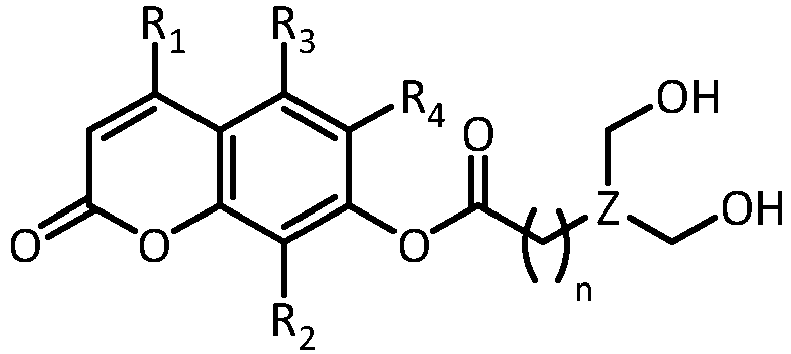
- Polyurethane coatings comprising said dihydroxylated coumarin derivatives, which function as chain extenders, are highly reactive when irradiated, and therefore, have a high self-repair percentage, in addition to having the capacity to undergo multiple self-repair cycles, being transparent and having good mechanical performance. With regards to producing polyols from said derivative, as a consequence of the generated trans-esterification reaction, coumarin molecules not bonded to the polyol chain and species with functionality 3 which ultimately led to a cross-linked polyurethane were obtained.
- Therefore, there is a need to have new coumarin derivatives, which in addition to acting as chain extenders generating photosensitive and self-repairing polyurethanes with good mechanical properties, particularly higher than those of a conventional coating (54 MPa of tensile strength) and capacity to undergo multiple self-repair cycles, enable polyols to be produced, that is, the coumarin derivative can act as a polyol initiator, preventing the transesterification reaction that was created when producing polyols with the previous coumarin derivative. In this case, photosensitive and self-repairing high-tenacity elastomers are created. There is also a need to have new polyol initiators, giving rise to photosensitive and self-repairing high-tenacity elastomers.
- Surprisingly, the inventors have discovered that polyurethanes formulated with coumarin of formula (I) according to the present invention as chain extenders give rise to photosensitive and self-repairing coatings that have the capacity to undergo multiple self-repair cycles, in addition to having good mechanical properties, particularly superior to those of a conventional coating. Said compounds of formula (I) can also act as polyol initiators, giving rise to high-tenacity elastomers.
- In a first aspect, the invention relates to a compound of formula (I):

- wherein R1, R2, R3, R4, R5 and R6 are independently selected from the group consisting of H, C1-C6 alkyl and C1-C6 alkoxyl;
- Z is CH2 or O; and n is a number selected from the group consisting of 1, 2, 3 and 4;
- In a second aspect, the invention relates to a polyol (A) obtainable by reacting one or more compounds of formula (I) as defined in the first aspect, with one or more compounds (B) in the presence of a catalyst, wherein compound (B) comprises:
- a) a functional group selected from -C(=O)-O- and -O-, and optionally at least one hydroxyl group, provided that when the functional group selected from -C(=O)-O- and -O- does not form part of a cycle, the hydroxyl groups must be present; or
- b) a functional group of the type -O-CH(CH3)--(C=O)- and at least one hydroxyl group.
- In a third aspect, the invention relates to a method for producing a polyurethane that comprises reacting a mixture comprising:
- one or more polyisocyanates (C) comprising at least two isocyanate groups,
- one or more polyols selected from the group consisting of a polyol (A) as defined in the second aspect and a compound of formula (I) as defined in the first aspect, or mixtures thereof, and
- optionally one or more polyols (D) with at least two hydroxyl groups selected from the group consisting of polyester polyols, polyether polyols, aliphatic polyols, polycarbonate polyols, polyether carbonate polyols and polyols of natural origin, in an aprotic organic solvent, in the presence of a catalyst,
- In a fourth aspect, the invention relates to a method for producing a polyurethane that comprises reacting a mixture comprising:
- one or more polyisocyanates (C) comprising at least two isocyanate groups,
- one or more polyols (D) with at least two hydroxyl groups selected from the group consisting of polyester polyols, polyether polyols, aliphatic polyols, polycarbonate polyols, polyether carbonate polyols and polyols of natural origin, and
- a compound of formula (I) as defined in the first aspect.
- In a fifth aspect, the invention relates to a polyurethane obtainable by means of the method defined in the third and fourth aspects.
- In a sixth aspect, the invention relates to the use of a polyurethane as defined in the fifth aspect in the preparation of a coating.
- In a seventh aspect, the invention relates to a method for repairing a coating as defined in the sixth aspect that comprises exposing said coating to light comprising a radiation with a wavelength comprised between 310 nm and 370 nm.
-
-
Figure 1 shows the decrease in absorbance when the polyurethane of example 3 is irradiated with a wavelength of 350 nm. -
Figure 2 shows the increase in absorbance when the polyurethane of example 3 is irradiated with a wavelength of 254 nm. -
Figure 3 shows the self-repair capacity of the polyurethane of example 3 after damaging said polyurethane. -
Figure 4 shows the self-repair capacity of the polyurethane of example 3 after 1 and 2 cycles of damage to said polyurethane. - Within the context of the present invention, the term "alkyl" relates to a radical with a linear or branched hydrocarbon chain consisting of carbon and hydrogen atoms, without unsaturations, having 1 to 6, preferably 1 to 3 carbon atoms, and that is bonded to the rest of the molecule by means of a single bond, for example, methyl, ethyl, n-propyl, i-propyl, n-butyl, t-butyl, n-pentyl, etc.
- The term "alkoxyl" as used herein relates to an alkyl radical, as defined above, bonded to the rest of the molecule by means of a -O- group, for example, methoxy, ethoxy, n-propoxy, isopropoxy, n-butoxy, t-butoxy.
- The term "alkylene" as used herein relates to a radical with a linear hydrocarbon chain consisting of carbon and hydrogen atoms, which has the number of carbon atoms indicated in each case and that is bonded at both ends to the rest of the molecule by means of single bonds, for example, ethylene (-CH2-CH2-), n-propylene (-CH2-CH2-CH2-), n-butylene (-CH2-CH2-CH2-CH2-), n-pentylene (-CH2-CH2-CH2-CH2-CH2-), etc.
- The term "cycloalkyl" as used herein relates to a saturated carbocyclic ring that has 3 to 8 carbon atoms, preferably 4 to 6 carbon atoms, for example, cyclopropyl, cyclobutyl, cyclopentyl, cyclohexyl, cycloheptyl and cyclooctyl.
- The term "cycloalkylene" as used herein relates to a saturated carbocyclic ring that has 3 to 8 carbon atoms, preferably 4 to 6 carbon atoms, and that is bonded to the rest of the molecule through two different carbon atoms by means of single bonds, for example, cyclopropylene, cyclobutylene, cyclopentylene, cyclohexylene, cycloheptylene and cyclooctylene.
- The term "aryl" as used herein relates to an aromatic hydrocarbon radical such as phenyl, naphthyl or anthracyl. The aryl radical may be optionally substituted by one or more substituents such as hydroxyl, halogen, alkyl and alkoxyl, as defined herein.
- The term "halogen" or "halo", as used herein relates to -F, -CI, -Br and -I.
- The term "hydroxyl" or "hydroxy" relates to an -OH group.
- The term "aliphatic" as used herein relates to cyclic or acyclic, linear or branched, saturated or unsaturated hydrocarbon compounds, excluding aromatic compounds.
- The term "aromatic" as used herein relates to a mono- or polycyclic hydrocarbon comprising at least one unsaturated ring that meets Hückel's rule of aromaticity. Examples of aromatic rings are phenyl, indanyl, indenyl, naphthyl, phenenthryl and anthracyl.
- The term "stereoisomer" as used herein relates to compounds formed by the same atoms bonded by the same bond sequence but that have different three-dimensional structures that are not interchangeable, for example, isomers due to the presence of chiral centers (enantiomers, diastereomers and mixtures thereof including racemic mixtures) and isomers due to the presence of multiple bonds (cis, trans and mixtures thereof).
- The term "equivalent", as used herein relates to the moles of compound per reactive units present in said compound. For example, one mole of diisocyanate equals to two equivalents of diisocyanate, whereas one mole of monoisocyanate equals to one equivalent of monoisocyanate.
- In the first aspect, the invention relates to a coumarin derivative that is a compound of formula (I), as defined above.
- In a particular embodiment, the invention is directed to a compound of formula (I), as defined above, wherein R1, R2, R3, R4, R5 and R6 are independently selected from the group consisting of H, C1-C3 alkyl and C1-C3 alkoxyl; Z is CH2 or O; and n is a number selected from the group consisting of 1, 2, 3 and 4.
- In another particular embodiment, the invention is directed to a compound of formula (I), as defined above, wherein R1 is selected from the group consisting of H, C1-C3 alkyl and C1-C3 alkoxyl; preferably from the group consisting of H, C1-C3 alkyl; even more preferably from the group consisting of H, methyl and ethyl; most preferably, R1 is methyl.
- In another particular embodiment, the invention is directed to a compound of formula (I), as defined above, wherein R2 is selected from the group consisting of H, C1-C3 alkyl and C1-C3 alkoxyl; preferably from the group consisting of H, C1-C3 alkyl; even more preferably from the group consisting of H, methyl and ethyl; most preferably, R2 is H.
- In another particular embodiment, the invention is directed to a compound of formula (I), as defined above, wherein R3 is selected from the group consisting of H, C1-C3 alkyl and C1-C3 alkoxyl; preferably from the group consisting of H, C1-C3 alkyl; even more preferably from the group consisting of H, methyl and ethyl; most preferably, R3 is H.
- In another particular embodiment, the invention is directed to a compound of formula (I), as defined above, wherein R4 is selected from the group consisting of H, C1-C3 alkyl and C1-C3 alkoxyl; preferably from the group consisting of H, C1-C3 alkyl; even more preferably from the group consisting of H, methyl and ethyl; most preferably, R4 is H.
- In another particular embodiment, the invention is directed to a compound of formula (I), as defined above, wherein R5 is selected from the group consisting of H, C1-C3 alkyl and C1-C3 alkoxyl; preferably from the group consisting of H, C1-C3 alkyl; even more preferably from the group consisting of H, methyl and ethyl; most preferably, R5 is H.
- In another particular embodiment, the invention is directed to a compound of formula (I), as defined above, wherein R6 is selected from the group consisting of H, C1-C3 alkyl and C1-C3 alkoxyl; preferably from the group consisting of H, C1-C3 alkyl; even more preferably from the group consisting of H, methyl and ethyl; most preferably, R6 is methyl.
- In another particular embodiment, the invention is directed to a compound of formula (I), as defined above, wherein Z is CH2.
- In another particular embodiment, the invention is directed to a compound of formula (I), as defined above, wherein Z is O.
- In another particular embodiment, the invention is directed to a compound of formula (I), as defined above, wherein n is a number selected from the group consisting of 1, 2 and 3; preferably from the group consisting of 1 and 2; most preferably, n is 2.
- In a preferred embodiment, the present invention is directed to a compound of formula (I) wherein Z is O and n is selected from the group consisting of 1 and 2.
- In another preferred embodiment, the present invention is directed to a compound of formula (I), as described above, wherein R1 and R6 are independently selected from the group consisting of H, methyl and ethyl, and R2, R3, R4 and R5 are H.
- In another preferred embodiment, the present invention is directed to a compound of formula (I), as described above, wherein R1 and R6 are methyl, R2, R3, R4 and R5 are H, and Z is O.
- In another preferred embodiment, the present invention is directed to a compound of formula (I), as described above, wherein R1 and R6 are methyl, R2, R3, R4 and R5 are H, Z is O and n is 2.
- The compound of formula (I) can be obtained by an esterification reaction between the acid (IV) or a precursor thereof, such as an anhydride or acid halide and the corresponding coumarin (III), as shown in Scheme 2, by methods known to those skilled in the art and described in Smith M.B. and March J. in March's Advanced Organic Chemistry Reactions, Mechanisms, and Structure, 6th Ed. John Wiley & Sons.

- The alcohol groups of the acid (IV) can be protected by alcohol protective groups (PG) known to those skilled in the art and described, for example, in P.G.M. and Greene T.W. in Protecting groups in Organic Synthesis, 4th Ed. Wiley-Interscience, and in Kocienski P.J. in Protecting Groups, 3rd Ed. Georg Thieme Verlag, as shown in Scheme 3. For example, ethers (including the formation of acetal) and silylated derivatives.
- The esterification reaction can be carried out starting with the acid (IV), preferably with its hydroxyl groups protected, by acid catalysis using methods known to those skilled in the art or it can also be carried out by activating the acid (IV), preferably with its hydroxyl groups protected, by forming the anhydride, for example in the presence of dimethylaminopyridine and subsequent reaction with coumarin (III).

- Preferably, the method for obtaining the compound of formula (I) comprises the steps defined in Scheme 3, that is, protection of the hydroxyl groups of the acid (IV) to yield the acid (V) using standard methods, followed by activation of the acid (V) by forming the anhydride (VI) using standard methods, such as, for example, in the presence of dicyclohexylcarbodiimide (DDC) and reacting the anhydride (VI) with the coumarin (III) to yield the ester (VII) which, after deprotecting the hydroxyl groups using standard methods, yields the compound of formula (I).
- In the second aspect, the invention relates to a polyol (A) obtainable by a condensation reaction of one or more compounds of formula (I), as defined above, with one or more compounds (B) in the presence of a catalyst, wherein compound (B) comprises:
- a) a functional group selected from -C(=O)-O- and -O- (which is involved in the condensation reaction to bond the hydroxyl groups of the compound (I)), and optionally at least one hydroxyl group, provided that when the functional group selected from -C(=O)-O- and -O- does not form part of a cycle, the hydroxyl group must be present; or
- b) a -O-CH(CH3)-(C=O)- functional group and at least one hydroxyl group. In an embodiment of the present invention, the compound (B) is a
- In another embodiment of the present invention, the compound (B) comprises a -C(=O)-O- group or a -O- group (which will be involved in the reaction to bind to one of the hydroxyl groups of the compound (I)), and a hydroxyl group. Examples of this type of compound are hydroxy acids, which comprise a carboxylic acid at one end and a hydroxyl group at the other end, and hydroxy esters, which comprise an ester at one end and a hydroxyl group at the other end.
- In another embodiment of the invention, the compound (B) comprises the -O-CH(CH3)-(C=O)- functional group present in the lactic acid and at least one hydroxyl group. Examples of this type of compound are L-lactic and D-lactic acid and the oligomers thereof from L-lactic and D-lactic acid or mixtures thereof.
- In a preferred embodiment of the invention, the compound (B) is a lactone; preferably selected from the group consisting of ε-caprolactone, δ-valerolactone, γ-butyrolactone, and β-propiolactone; more preferably selected from the group consisting of ε-caprolactone and δ-valerolactone; most preferably, the lactone is ε-caprolactone.
- The catalyst used can be a tertiary amine such as, for example, triethylamine, triethylenediamine, methylethanolamine, triethanolamine, dimethylethanolamine, pyridine, 1,4-diazabicyclo[2.2.2]octane, dimethylcyclohexylamine and dimethylpiperazine; organic derivatives of tin, mercury, lead, bismuth, zinc and potassium such as, for example, tin 2-ethylhexanoate (commonly referred to as tin octanoate), tin isooctanoate, dibutyltin dilaurate, potassium octanoate and potassium acetate. Preferably, the catalyst is selected from the group consisting of tin octanoate, tin isooctanoate, dibutyltin dilaurate, triethylamine, triethylenediamine, methylethanolamine, triethanolamine, dimethylethanolamine, pyridine, 1,4-diazabicyclo[2.2.2]octane and dimethylcyclohexylamine; more preferably it is independently selected from the group consisting of tin octanoate, tin isooctanoate and dibutyltin dilaurate; most preferably, the catalyst is tin octanoate.
- In a particular embodiment, the reaction is carried out in the absence of solvent.
- In another embodiment, the reaction is carried out in the presence of an aprotic organic solvent independently selected from the group consisting of dimethylformamide, butyl acetate, dimethyl sulfoxide, dimethylacetamide, tetrahydrofuran, dioxane, ethyl acetate, acetone, cyclohexanone, methyl ethyl ketone, acetonitrile, hexane, toluene, dichloromethane and mixtures thereof; more preferably, it is independently selected from the group consisting of dimethylformamide, butyl acetate, dimethylacetamide, dimethyl sulfoxide and mixtures thereof; most preferably, the aprotic organic solvent is dimethylformamide, butyl acetate, or mixtures thereof.
- Preferably, the reaction is carried out at a temperature comprised between 50 °C and 150 °C, more preferably between 70°C and 130 °C, most preferably between 90 °C and 110 °C.
- In a particular embodiment, the invention is directed to a polyol (A) obtainable by reacting one or more compounds (B) and one or more compounds of formula (I), wherein the molar ratio of compounds (B) to compounds of formula (I) is comprised between 80:1 and 1:1, more preferably between 40:1 and 1.5:1.
- In a particular embodiment, the invention is directed to a polyol (A) having an average molecular weight from 200 Dalton to 10,000 Dalton, preferably from 200 Dalton to 2000 Dalton.
- In another preferred embodiment, the polyol (A) is a compound of formula (II):

- In general, the polyurethanes are produced from three monomers: a relatively long-chain flexible polyol, which forms the soft segments of the polyurethane, a polyisocyanate, and a short-chain polyol, which is also referred to as a chain extender if it is bifunctional or cross-linker if it has a functionality greater than 2. The reaction of the polyisocyanate with the chain extender forms the hard segments of the polyurethane.
- In the third aspect, the present invention relates to a method for producing a polyurethane comprising the coumarin derivative of formula (I) as defined above, wherein said method comprises reacting a mixture comprising:
- one or more polyisocyanates (C) comprising at least two isocyanate groups,
- one or more polyols selected from the group consisting of a polyol (A) as defined above and a compound of formula (I) or mixtures thereof, and
- optionally one or more polyols (D) with at least two hydroxyl groups selected from the group consisting of polyester polyols, polyether polyols, aliphatic polyols, polycarbonate polyols, polyether carbonate polyols and polyols of natural origin,
- In a particular embodiment, the method of the third aspect comprises reacting the mixture defined above, wherein both the polyol (A) and the compound of formula (I) are present. In this particular embodiment, the ratio of equivalents of polyisocyanate (C) to the sum of equivalents of polyol (A), compound of formula (I) and polyol (D) in the reaction mixture is preferably comprised between 2:1 and 1:1.2.
- In another particular embodiment, the method of the third aspect comprises reacting the mixture defined above, wherein the polyols of the mixture do not comprise the polyol (A) (that is, the compound of formula (I) and the polyol (D) are present) or wherein the polyols of the mixture do not comprise the compound of formula (I) (that is, the polyol (A) and the polyol (D) are present). In these particular embodiments, the ratio of equivalents of polyisocyanate (C) to the sum of equivalents of either polyol (A) and polyol (D), or compound of formula (I) and polyol (D), in the reaction mixture is comprised between 2:1 and 1:1.2.
- In a fourth aspect, the invention relates to a method for producing a polyurethane that comprises reacting a mixture comprising:
- one or more polyisocyanates (C) comprising at least two isocyanate groups,
- one or more polyols (D) with at least two hydroxyl groups selected from the group consisting of polyester polyols, polyether polyols, aliphatic polyols, polycarbonate polyols, polyether carbonate polyols and polyols of natural origin, and
- a compound of formula (I) (which would act as a chain extender).
- The term "polyisocyanate", within the context of the present invention, should be construed as a compound comprising two or more, preferably two, aliphatic and/or aromatic, preferably aliphatic isocyanate groups. Examples of aliphatic polyisocyanates are hexamethylene diisocyanate (HDI), 2,2,4-trimethyl hexamethylene diisocyanate (TMDI), tetramethylene diisocyanate, octamethylene diisocyanate, decamethylene diisocyanate, dodecamethylene diisocyanate, tetradecamethylene diisocyanate, dimeryl diisocyanate (DDI), 1,1,6,6-tetrahydroperfluorohexamethylene diisocyanate (TFDI), isophorone diisocyanate (IPDI), 1,4-cyclohexane diisocyanate (CDI), 1,3-dicyclohexane diisocyanate, 1,2-dicyclohexane diisocyanate, 1,3-bis(isocyanatomethyl)cyclohexane (H6XDI), 4,4'-dicyclohexylmethane diisocyanate (H12MDI) and mixtures thereof. Examples of aromatic polyisocyanates are 2,4- and 2,6-toluene diisocyanate (TDI), para-phenylene diisocyanate (PPDI), 4,4'-diphenylmethane diisocyanate and the 2,4' and 2,2' isomers thereof (MDI), tetramethyl xylene diisocyanate (TMXDI), 1,5-naphthalene diisocyanate (NDI), 1,3-bis(1-isocyanate-1-methylethyl)benzene, meta-xylylene diisocyanate and mixtures thereof.
- In a preferred embodiment, the polyisocyanate (C) is selected from the group consisting of linear or branched C2-C20-alkylene diisocyanate optionally substituted with 1 to 10 substituents independently selected from halogen, C3-Cs-cycloalkylene diisocyanate optionally substituted with 1 to 4 substituents independently selected from the group consisting of C1-C3 alkyl and halogen, C1-C6-alkylen - C3-C8-cycloalkylene diisocyanate optionally substituted with 1 to 4 substituents independently selected from the group consisting of C1-C3 alkyl and halogen, and C3-C8-cycloalkylen - C1-C6-alkylen - C3-C8-cycloalkylene diisocyanate optionally substituted with 1 to 4 substituents independently selected from the group consisting of C1-C3 alkyl and halogen; preferably the polyisocyanate (C) is selected from the group consisting of hexamethylene diisocyanate (HDI), 2,2,4-trimethyl hexamethylene diisocyanate (TMDI), tetramethylene diisocyanate, octamethylene diisocyanate, decamethylene diisocyanate, dodecamethylene diisocyanate, tetradecamethylene diisocyanate, dimeryl diisocyanate (DDI), 1,1,6,6-tetrahydroperfluorohexamethylene diisocyanate (TFDI), isophorone diisocyanate (IPDI), 1,4-cyclohexane diisocyanate (CDI), 1,3-dicyclohexane diisocyanate, 1,2-dicyclohexane diisocyanate, 1,3-bis(isocyanatomethyl)cyclohexane (H6XDI), 4,4'-dicyclohexylmethane diisocyanate (H12MDI) and mixtures thereof; more preferably it is selected from the group consisting of hexamethylene diisocyanate (HDI), 2,2,4-trimethyl hexamethylene diisocyanate (TMDI), tetramethylene diisocyanate, octamethylene diisocyanate, decamethylene diisocyanate, dodecamethylene diisocyanate, tetradecamethylene diisocyanate; most preferably, the polyisocyanate is hexamethylene diisocyanate (HDI).
- The polyol (D) with at least two hydroxyl groups relates to a compound that has at least two hydroxyl groups and is selected from the group consisting of polyester polyols, polyether polyols, aliphatic polyols (these also include polybutadiene polyols, wherein the aliphatic fragment is a chain from the polymerization of one or several butadiene groups), polycarbonate polyols, polyether carbonate polyol and polyols of natural origin as mentioned above. Preferably, the polyol (D) is selected from the group consisting of polyester polyols, polyether polyols, aliphatic polyols (these also include polybutadiene polyols, wherein the aliphatic fragment is a chain from the polymerization of one or several butadiene groups), polycarbonate polyols and polyether carbonate polyols. More preferably, it is selected from the group consisting of polyester polyols and polyether polyols.
- Preferably, the polyols have an average molecular weight comprised between 200 Dalton and 10,000 Dalton, preferably between 200 Dalton and 4000 Dalton; more preferably, such polyols are selected from the group consisting of polyester polyols and polyether polyols.
- The aliphatic polyols only comprise the terminal hydroxyl groups as functional groups. Preferred aliphatic polyols are diols such as 1,2-butanediol, 1,3-butanediol, 1,4-butanediol, 2,3-butanediol, 1,3-propanediol, 1,2-propanediol and mixtures thereof. The aliphatic polyols also include polybutadienes, wherein the aliphatic fragment is one or several butadiene groups.
- The polyether polyols comprise, in addition to the terminal hydroxyl groups, non-terminal ether groups. The polyether polyols include polyethylene glycols, polypropylene glycol, mixed polyglycols based on ethylene oxide and propylene oxide, polytetramethylene glycols and polytetrahydrofurans.
- The polyester polyols comprise, in addition to the terminal hydroxyl groups, non-terminal ester groups. The polyester polyols are produced by the condensation of diols and carboxylic acids, the anhydrides thereof and esters. Examples of polyester polyols are the condensation products based on ethylene glycol, 1,4-butylene glycol, 1,6-hexamethylene glycol or neopentyl glycol, with adipic acid or isophthalic acid. Polycaprolactones and (meth)acrylic polyols also belong to the group of polyester polyols. Polycaprolactones are obtained from the reaction between phosgene, aliphatic carbonates or aromatic carbonates, such as diphenyl carbonate or diethyl carbonate, with dihydric or polyhydric alcohols. Polycaprolactones are produced by the polyaddition of lactones such as, for example, ε-caprolactone, with an initiator compound having reactive hydrogen atoms, such as water, alcohols, amines or bisphenol A. (Meth)acrylic polyols are produced by radical copolymerization of (a) monomers of (meth)acrylic acids or esters, such as acrylic acid, methyl acrylate, ethyl acrylate, propyl acrylate, butyl acrylate and hexyl acrylate, methacrylic acid, methyl methacrylate, ethyl methacrylate, propyl methacrylate, butyl methacrylate and hexyl methacrylate and (b) monomers of hydroxyalkyl (meth)acrylates, such as hydroxyethyl acrylates, hydroxyethyl methacrylates, hydroxypropyl acrylates, hydroxypropyl methacrylates, glycidyl acrylate and glycidyl methacrylate.
- The polycarbonate polyols comprise, in addition to the hydroxyl groups, non-terminal carbonate groups. Examples of these polyols are hexanediol polycarbonate, butanediol polycarbonate, 1,2-propanediol polycarbonate and other diols and mixtures of diols such as, for example, Oxymer from Perstorp, Eternacoll from UBE, and Desmophen from Bayer.
- Combinations of polyester polyols, polycaprolactone polyols, (meth)acrylic polyols and polycarbonate polyols can also be used.
- Polyether carbonate polyols comprise, in addition to the terminal hydroxyl groups, carbonate groups and ether groups. Examples of polyether carbonate polyols are the polyether carbonate polyols produced from propylene oxide and carbon anhydride (CO2) with an alternating or random structure, with different carbonate group contents within the structure thereof such as, for example, Converge from Novomer.
- The polyols of natural origin are those from vegetable oils. As examples, castor oil or the polyols produced by the derivatization of oils such as soybean, sunflower or canola oil may be mentioned.
- In a preferred embodiment, the polyol (D) with at least two hydroxyl groups is selected from the group consisting of polycaprolactones, polyethylene glycols, polypropylene glycols, mixed ethylene oxide and propylene oxide polyglycols, polytetramethylene glycols, polytetrahydrofurans and mixtures thereof, wherein the polyol (D) has an average molecular weight between 200 Dalton and 10,000 Dalton, preferably between 200 Dalton and 10,000 Dalton; preferably the polyol (D) is selected from the group consisting of polycaprolactones, polyethylene glycols, polypropylene glycols, mixed ethylene oxide and propylene oxide polyglycols and mixtures thereof, wherein the polyol (D) has an average molecular weight between 200 Dalton and 10,000 Dalton; most preferably, the polyol (D) is selected from the group consisting of polycaprolactones, polyethylene glycols and mixtures thereof, wherein the polyol (D) has an average molecular weight between 200 Dalton and 4000 Dalton.
- The aprotic organic solvent is preferably an organic solvent selected from the group consisting of dimethylformamide, butyl acetate, dimethyl sulfoxide, dimethylacetamide, tetrahydrofuran, dioxane, ethyl acetate, acetone, cyclohexanone, methyl ethyl ketone, acetonitrile, hexane, toluene, dichloromethane and mixtures thereof; preferably, it is selected from the group consisting of dimethylformamide, butyl acetate, dimethylacetamide, dimethyl sulfoxide and mixtures thereof; most preferably, the aprotic organic solvent is dimethylformamide, butyl acetate, or mixtures thereof.
- The catalyst is a catalyst suitable for carrying out the reaction for forming the polyurethane, such as tertiary amines such as, for example, triethylamine, triethylenediamine, methylethanolamine, triethanolamine, dimethylethanolamine, pyridine, 1,4-diazabicyclo[2.2.2]octane, dimethylcyclohexylamine, dimethylpiperazine; organic derivatives of tin, mercury, lead, bismuth, zinc or potassium such as, for example, tin octanoate, tin isooctanoate, dibutyltin dilaurate, potassium octanoate and potassium acetate.
- In a preferred embodiment, the catalyst is selected from the group consisting of tin octanoate, tin isooctanoate, dibutyltin dilaurate, triethylamine, triethylenediamine, methylethanolamine, triethanolamine, dimethylethanolamine, pyridine, 1,4-diazabicyclo[2.2.2]octane, dimethylcyclohexylamine and potassium octanoate; more preferably it is selected from the group consisting of tin octanoate, tin isooctanoate, dibutyltin dilaurate and potassium octanoate; most preferably, the catalyst is tin octanoate.
- Typically, the catalyst is added in an amount comprised between 0.01% and 5% in moles with respect to the moles of polyisocyanate (C), preferably between 0.01% and 0.05% in moles with respect to the moles of polyisocyanate (C).
- The method for forming polyurethane preferably is carried out at a temperature comprised between 50 °C and 150 °C, more preferably 50 °C and 100 °C, most preferably between 65 °C and 85 °C.
- Typically, the formation of polyurethanes is carried out by stirring for a period of time no longer than 24 hours, preferably less than 12 hours, followed by heating at a temperature higher than room temperature, and no higher than 150°C, preferably lower than 100°C, most preferably between room temperature and 85 °C.
- In a particular embodiment, the method according to the invention comprises reacting a mixture comprising one or more polyisocyanates (C) and one or more polyols (A).
- In another particular embodiment, the method according to the invention comprises reacting a mixture comprising one or more polyisocyanates (C), one or more polyols (A) and one or more polyols (D).
- In another particular embodiment, the method according to the invention comprises reacting a mixture comprising one or more polyisocyanates (C), one or more compounds of formula (I) and one or more polyols (D).
- In another particular embodiment, the method according to the invention comprises reacting a mixture comprising one or more polyisocyanates (C), one or more compounds of formula (I) and one or more polyols (A).
- In a preferred embodiment, the method according to the invention comprises reacting a mixture comprising one or more polyisocyanates (C), one or more compounds of formula (I), one or more polyols (A) and one or more polyols (D).
- In an embodiment of the method of the invention, the ratio of equivalents of polyisocyanate (C) to the sum of equivalents of compound of formula (I), polyol (A) and polyol (D) in the reaction mixture is comprised between 2:1 and 1:1.2, preferably between 1.5:1 and 1:1.1, more preferably between 1.2:1 and 1:1.1, even more preferably 1.1:1 and 1:1.05, most preferably 1.05:1. In the method of the invention, the polyols present in the reaction mixture can be the compound of formula (I), polyol (A) and polyol (D), or it can be carried out in the absence of the compound of formula (I) (that is, the polyols present in the reaction mixture would be the polyol (A) and polyol (D)) or in the absence of the polyol (A) (that is, the polyols present in the reaction mixture would be the compound of formula (I) and the polyol (D)).
- In another embodiment of the method of the invention, the ratio of equivalents of polyisocyanate (C) to the sum of equivalents of polyol (A) and polyol (D) in the reaction mixture is comprised between 2:1 and 1.2:1, preferably between 1.5:1 and 1.1:1, more preferably between 1.2:1 and 1.1:1, even more preferably 1.1:1 and 1.05:1, most preferably 1.05:1.
- In an embodiment of the method of the invention, the ratio between the sum of the equivalents of polyol (A) and the equivalents of compound of formula (I) with respect to the equivalents of polyisocyanate (C) is comprised between 1% and 95%, preferably between 2% and 60%.
- In a particular embodiment, the invention is directed to a method for producing polyurethanes as defined above comprising:
- reacting a mixture comprising a polyisocyanate (C) that comprises at least two isocyanate groups,
- a compound of formula (I) as defined above, and
- a compound of formula (II) (polyol (A)) as defined above,
- In a preferred embodiment, the invention is directed to a method for producing polyurethanes as defined above comprising:
- reacting a mixture comprising a polyisocyanate (C) selected from the group consisting of hexamethylene diisocyanate, isophorone diisocyanate, tetramethylene diisocyanate, octamethylene diisocyanate, decamethylene diisocyanate, dodecamethylene diisocyanate, and tetradecamethylene diisocyanate, preferably selected from the group consisting of hexamethylene diisocyanate and isophorone diisocyanate,
- a compound of formula (I) as defined above, and
- a compound of formula (II) (polyol (A)) as defined above, and
- optionally one or more polyols (D) with at least two hydroxyl groups selected from the group consisting of polyester polyols, polyether polyols, aliphatic polyols, polycarbonate polyols and polyether carbonate polyol, as defined above,
- In another aspect, the present invention relates to a polyurethane obtainable using the methods defined above.
- Another aspect relates to the use of said polyurethane in the preparation of a coating, preferably incorporated as a varnish and paint additive, preferably in varnishes and paints for plastic and metal substrates, more preferably in varnishes and paints for the automotive industry.
- The coating preferably has a thickness less than 150 µm, more preferably less than 140 µm, more preferably less than 130 µm, more preferably less than 120 µm, more preferably less than 110 µm, 100 µm, more preferably less than 90 µm, even more preferably less than 80 µm, even more preferably less than 70 µm, even more preferably less than 60 µm, even more preferably less than 50 µm, even more preferably less than 40 µm, even more preferably less than 30 µm, most preferably less than 20 µm.
- The coating agents comprising the polyurethanes according to the invention are suitable for all fields of use wherein painting and coating systems are used, in particular in those with high quality requirements of the surface and the resistance of the films, e.g., coating of surfaces mineral construction materials, varnishing and sealing of wood and materials derived from wood, coating of metal surfaces (metal coating), coating and lacquering of asphalt or bituminous coatings, coating and lacquering of plastic surfaces (plastic coating) as well as high-gloss lacquers, in particular for the automotive industry.
- The coating agents containing the polyurethanes according to the invention are commonly used in single-layer lacquers or in the transparent or cover layer (upper layer) of multi-layer structures.
- The application of the coating can be carried out by different spraying methods such as, for example, compressed air, direct or electrostatic spraying using spraying facilities with one or, if necessary, two components. However, the lacquers and coating agents containing the above describe dispersions may be applied using different methods, such as by spreading, rollers or scrapers.
- Said polyurethane (coating) defined above incorporates coumarin fragments of formula (I) in the structure thereof conferring the self-repairing properties by photodimerization-photocleavage of the coumarin derivatives, and provides for obtaining multiple-recovery polymeric systems.
- Therefore, in another aspect, the present invention relates to a method for repairing a coating that comprises polyurethane as defined above comprising exposing said coating to light that comprises radiation with a wavelength comprised between 310 nm and 370 nm, preferably between 340 nm and 360 nm, preferably for 120 minutes to 180 minutes.
- Said exposure to radiation comprising the defined wavelengths achieves the formation of dimers of the coumarin derivative and, therefore, the repair of the polyurethane.
- Preferably, the exposure is carried out with light comprising radiation with wavelengths comprised between 330 nm and 370 nm; more preferably between 340 nm and 360 nm; most preferably at 350 µm.
- "Repair of a coating" must be understood as the reduction of the number or magnitude of defects present in said coating, wherein "defects" are meant as perceptible discontinuities when examining the coating at a magnification of x20. Examples of said defects are scratches and cracks.
- In a more preferred embodiment, the repairing method comprises a prior step of exposing a coating comprising the polyurethane to light comprising a radiation with a wavelength comprised between 200 nm and 260 nm, preferably for 1 minute to 20 mins.
- Preferably, the irradiation is carried out at wavelengths comprised between 200 nm and 260 nm; more preferably between 240 nm and 260 nm; most preferably at 254 µm.
- Said irradiation cleaves the dimers that were not cleaved when the polyurethane was damaged, and the dimers are subsequently formed again by the irradiation step defined above.
- Preferably, the defects have a depth less than 70 µm, more preferably less than 65 µm, even more preferably less than 60 µm, even more preferably less than 55 µm, even more preferably less than 50 µm, even more preferably less than 45 µm, even more preferably less than 40 µm, even more preferably less than 35 µm, even more preferably less than 30 µm, even more preferably less than 25 µm, most preferably less than 20 µm.
- The following examples are merely illustrative and must not be construed as limiting of the invention.
- IR spectra were recorded by a Perkin-Elmer Spectrum One FT-IR spectrometer equipped with an ATR (attenuated total reflectance spectrometer). In order to carry out the measurement, 4 scans at a resolution of 4 cm-1 were carried out.
- The 1H and 13C NMR spectra were recorded at room temperature in a
Varian Inova 400 spectrometer (400MHz 1H and 100 MHz 13C). DMSO-d6 was used as a solvent. The spectra were referenced with the residual signal of the solvent [δ (ppm) 2.50 (1H) and 39.51 (13C)]. - The characterization of the thermal properties of the synthesized polyurethanes was carried out in a Mettler Toledo DSC822e calorimeter, recording the spectra at a heating rate of 10°C/min. In order to observe the photoreversibility of the cleaving-dimerization of the coumarin derivative comprised within the polyurethane coatings, UV-Visible spectroscopy (
Perkin Elmer Lambda 35 spectrometer) and a Raman Renishaw inVia microscopic spectrophotometer were used. The film (coating) was made by evaporating a DMF solution on one face of a quartz cuvette. In the case of UV-Visible spectroscopy, it was recorded between 240 nm and 400 nm to quantify this photoreversibility. - The mechanical properties were tested in a
MTS Synergie 200 testing machine equipped with a 100 N load cell. The samples tested were 3.8 mm wide and 30 mm long. The test was carried out at a rate of 5 mm·min-1. - The damage of the coating is either carried out with the Erichsen 239-II scratcher, which allows for scratching with forces ranging from 1 to 20 N. This device has a tip with a diameter of 1 mm, which slides 2.2 cm over the coating at a speed of 0.02 m/s or by indentation. In this case, a tip with a diameter of 0.75 mm is used and a certain force is applied for a set time on the material. Lastly, the damage created on the materials is evaluated using confocal microscopy.
- This study uses UV radiation to carry out the photodimerization and photocleavage reaction of the synthesized polyurethanes. It must be noted that two types of UV ovens were used:
- UVP 1000: irradiation at 254 nm and 365 nm
- UV DYMAX 2000-PC system: irradiation at 320-400 nm
- To quantify the self-repair, the equipment used is a 3D optical profilometer from SENSOFAR (PLµ NEOX model), which allows measuring the roughness of the surface of the sample at micrometric and nanometric scale without the need of contact.
-

- To a 500 mL round-bottom flask 50 g of 2,2-bis(methoxy)propionic (0.373 mol) (DMPA), 69 mL of 2,2-dimethoxypropane (0.569 mol) (DMP) and 3.55 g (0.0187 mol) of p-toluenesulphonic acid monohydrate were added. Subsequently, 250 mL of acetone (58.08 g/mol) were added and stirred at room temperature for 4 hrs. After this period of time, 18 mL of 2M NH3 in EtOH (0.036 mol) are added. A fine white precipitate appears. The reaction is placed in a rotatory evaporator and the solvent is removed at room temperature. Approximately 600 mL of dichloromethane (CH2Cl2) are added. This is extracted with water (3x120 mL).
- The decanted dichloromethane is dried with anhydrous magnesium sulphate overnight. On the following day, the MgSO4 is filtered with a conical funnel and a pleated filter, and the dichloromethane is removed in the rotatory evaporator at atmospheric pressure. When everything has been distilled, it is dried in vacuo in the desiccator, yielding a beige-orange solid.
-

- 44.6 grams of DMPA (0.256 mol) (174.1g/mol) are dissolved in 179 mL of dichloromethane (CH2Cl2) (84.93g/mol); 1.326 g/cm3), (40% w/v) with 26.49 g (0.128 mol) (2:1 stoichiometry) of N,N-dicyclohexylcarbodiimide (DCC) (206.4 g/mol) and allowed to stir for 48 hrs. at room temperature. Lastly, the DDC-urea complex is filtered in vacuo and the solvent is evaporated.
-

- 15.1 g of 7-hydroxyethoxy-4-methylcoumarin (0.07 mol) (HEOMC, 220.20 g/mol) (1.5 eq/OH) are added with 4.16g (0.03 mol) of 4-dimethylaminopyridine (DMAP, 122.17 g/mol, 0.2 eq/OH), which are dissolved in 138 mL of anhydrous pyridine (C5H5N; 79.10 g/mol; 0.978 g/cm3, 34 eq/OH), and subsequently, are diluted with 554 mL of dichloromethane (CH2Cl2; 84.93 g/mol; 1.326 g/cm; 96 eq/OH). Subsequently, the anhydride (DMPAA) 34 g (0,1mol) (330.37g/mol) is added and allowed to react for 9 hours at room temperature. The excess anhydride is destroyed by stirring the reaction overnight with 66 mL of a pyridine:water solution at a ratio of 1:1.
- Subsequently, the organic phase is extracted with NaHSO4 (1M) (120.06 g/mol), subsequently with Na2CO3 (105.99 g/mol) at 10%, and lastly with a saturated NaCl solution (58.44 g/mol).
- Lastly, the organic phase is dried with anhydrous magnesium sulphate (MgSO4; 120.37 g/mol) and subsequently filtered and the solvent is evaporated in the rotatory evaporator.
-

- 20.9 g (6.021 mmol) of the 2,2,5-trimethyl-[1,3]dioxane-5-yl)acetic acid 4-metylcoumarin-7-ethoxyl ester are dissolved in 200 mL of methanol (MeOH; 32.04 g/mol; 0.792 g/cm3). Subsequently, approximately 10 g of Dowex H+ resin are added, filtered and carefully washed with methanol. Methanol is evaporated in the rotatory evaporator to yield the desired compound (white crystals). The obtained product is purified by recrystallization in toluene.
- 1H-NMR (400 MHz, Cl3CD (7.26 ppm) ppm): 7.51 (d, 1H;J=8.8Hz), 6.87 (dd, 1H; J1=8.8Hz, J2=2.4Hz), 6.83 (d, 1H, J=2.4Hz), 6.15 (d, 1H, J=1.2Hz), 4.56 (t, 2H, J=4.8Hz), 4.27 (t, 2H, J=4.8Hz), 3.92 (d, 2H, J=11.2Hz), 3.74 (d, 2H,J=11.2Hz), 2.40 (d, 3H, J=1.2Hz), 1.08 (s, 3H).
-

- 15.5 g (136 mol) of ε-caprolactone and coumarin produced in example 1 (3 g, 8.92 mmol) are added inside the reaction balloon. Then, the tin octanoate (SnOct2) catalyst is added at a concentration of 0.1% with respect to the weight of the coumarin monomer (compound produced in Example 1). Once all the reagents are added, the reaction is heated to 120° for 24 hrs. under constant stirring. After this period of time, the formed polyol is dried in vacuo. The characterization is carried out by 1H-NMR spectra, determining an average molecular weight thereof of 2054 g/mol. Using this technique, it was possible to verify that a mixture of products had been produced; with a percentage of 66% for the disubstituted polyol and 44% for the monosubstituted polyol.
- 1H-NMR (400 MHz, Cl3CD (7.26 ppm) ppm): 7.51 (d, 1H; J=2.2Hz), 6.83 (d, 2H, J=1.1 Hz), 6.15 (d, 1H, J=1.2Hz), 4.56 (t, 2H, J=4.8Hz), 4.27 (t, 2H, J=4.8Hz), 4.03 (m, 26H), 3.65 (m, 4H), 2.39 (s, 3H), 2.29 (m, 29H), 1.63 (m, 59H), 1.37 (m, 29H) 1.24 (s, 1H), 1.21 (s, 2H).
- 1.8 g of the polyol of example 2 is added to a 25 mL balloon with a mixture of linear polyols (0.3 g of butanediol) and polyester polyols (1.2 g of polycaprolactone 527 g/mol) and the corresponding aliphatic isocyanate (1.8 g isophorone diisocyanate). This mixture of components is dissolved in 20 mL of dichloroethane. 2 drops of SnOct2 catalyst are added and the solution is stirred for 3 hours at 80°C, and subsequently, the product is deposited on a mold for evaporating the solvent.
- The mechanical traction properties of the produced product are 0.6 MPa of tensile strength and a modulus of 2 MPa, which are transformed into a tensile strength of 52 MPa and a modulus of 3 MPa after exposure to an ultraviolet light source that causes the dimerization process of the polyol of Example 2.
- To verify the photoreversibility of the compound, films of 2-5 µm were made for the subsequent characterization thereof using visible UV. The results are shown in
Figures 1 and 2 . As can be seen infigure 1 , when the film is irradiated at a wavelength of 350 nm, the absorbance decreases as a consequence of the dimerization process; that is, the double bond of the coumarin is cleaved, yielding a cyclobutane by the (2+2) cycloaddition reaction. When irradiated at 254 nm, it was observed that the absorbance increased (figure 2 ) due to the photocleavage process that was taking place in the compound. This is how the initial arrangement of the molecule is recovered. - The self-repair was quantified by indentation. By exerting a constant force for a specific period of time, damage was caused on the material. The depth of the damage before and after the application of a UV light source was quantified by confocal microscopy. In this way, the self-repair of the coating was assessed.
Figures 3 and 4 show this property. - FTIR-ATR: 3332 u(N-H), 2940 u(CH2), 2884 u(CH2), 1725 u(C=O), 1624 u(C=O (urethane groups)), 1551 δ(N-H) u(C-N), 1232 δ(N-H) u(C-N), 1158 u(CO-C).
- 0.5 g of the coumarin of example 1 is added to a 25 mL balloon. This product is used with a mixture of linear and polyester polyols (0.4 g of butanediol and 2.1 g of polycaprolactone 527 g/mol) and the corresponding aliphatic diisocyanate (2.2 g of isophorone diisocyanate). This mixture of components is dissolved in 20 mL of dichloroethane. 2 drops of SnOct2 catalyst are added and the solution is stirred for 3 hours at 80°C, and subsequently, the product is deposited on a mold for evaporating the solvent.
- The mechanical traction properties of the produced polyurethane are 17 MPa of tensile strength and a modulus of 127 MPa, which are transformed into a tensile strength of 54 MPa and a modulus of 338 MPa after exposure to an ultraviolet light source that causes the dimerization process.
- FTIR-ATR: 3350 u(N-H), 2918 u(CH2), 2809 u(CH2), 1703 u(C=O), 1590 u(C=O (urethane groups)), 1511 δ(N-H) u(C-N), 1225 δ(N-H) u(C-N), 1118 u(CO-C).
wherein the ratio between the sum of the equivalents of polyol (A) and the equivalents of compound of formula (I) with respect to the equivalents of polyisocyanate (C) is comprised between 1% and 95%.
in the presence of a catalyst,
wherein the ratio of equivalents of polyisocyanate (C) to the sum of equivalents of polyol (D) and compound of formula (I) in the reaction mixture is comprised between 2:1 and 1:1.2, and
wherein the ratio between the sum of the equivalents of polyol (D) and the equivalents of compound of formula (I) with respect to the equivalents of polyisocyanate (C) is comprised between 1% and 95%.
in the presence of a catalyst,
wherein the ratio of equivalents of polyisocyanate (C) to the sum of equivalents of polyol (A), compound of formula (I) and polyol (D) in the reaction mixture is comprised between 2:1 and 1:1.2, and
wherein the ratio between the sum of the equivalents of polyol (A) and the equivalents of compound of formula (I) with respect to the equivalents of polyisocyanate (C) is comprised between 1% and 95%, preferably between 2% and 60%.
in the presence of a catalyst,
wherein the ratio of equivalents of polyisocyanate (C) to the sum of equivalents of polyol (D) and compound of formula (I) in the reaction mixture is comprised between 2:1 and 1:1.2, and
wherein the ratio between the sum of the equivalents of polyol (D) and the equivalents of compound of formula (I) with respect to the equivalents of polyisocyanate (C) is comprised between 1% and 95%.
in the presence of a catalyst,
wherein the ratio of equivalents of polyisocyanate (C) to the equivalents of polyol (A) and compound of formula (I) in the reaction mixture is comprised between 2:1 and 1:1.2, preferably between 1.5:1 and 1:1.1, more preferably between 1.2:1 and 1:1.1, even more preferably between 1.1:1 and 1:1.05, most preferably 1.05:1, and wherein the ratio between the sum of the equivalents of polyol (A) and the equivalents of compound of formula (I) with respect to the equivalents of polyisocyanate (C) is comprised between 1% and 95%, preferably between 2% and 60%.
in the presence of a catalyst,
wherein the ratio of equivalents of polyisocyanate (C) to the equivalents of polyol (A), compound of formula (I) and polyol (D) in the reaction mixture is comprised between 2:1 and 1:1.2, preferably between 1.5:1 and 1:1.1, more preferably between 1.2:1 and 1:1.1, even more preferably between 1.1:1 and 1:1.05, most preferably 1.05:1, and wherein the ratio between the sum of the equivalents of polyol (A) and the equivalents of compound of formula (I) with respect to the equivalents of polyisocyanate (C) is comprised between 1% and 95%, preferably between 2% and 60%.
Claims (19)
- A compound of formula (I):
 wherein R1, R2, R3, R4, R5 and R6 are independently selected from the group consisting of H, C1-C6 alkyl and C1-C6 alkoxyl;Z is selected from the group consisting of CH2 and O; and n is a number selected from the group consisting of 1, 2, 3 and 4;or a stereoisomer thereof.
 - The compound of formula (I) according to claim 1, wherein Z is O, and n is selected from the group consisting of 1 and 2.
- The compound of formula (I) according to any of the previous claims, wherein R1 and R6 are independently selected from the group consisting of H, methyl and ethyl, and R2, R3, R4 and R5 are H.
- The compound of formula (I) according to any of the previous claims, wherein R1 and R6 are methyl, R2, R3, R4 and R5 are H, Z is O and n is 2.
- A polyol (A) obtainable by reaction of a compound of formula (I) as defined in any of claims 1 to 4, with a compound (B) in the presence of a catalyst, wherein the compound (B) comprises:a) a functional group selected from -C(=O)-O- and -O- and optionally a hydroxyl group, provided that when the functional group selected from - C(=O)-O- and -O- does not form part of a cycle, the hydroxyl group must be present; orb) a -O-CH(CH3)-(C=O)- functional group and at least one hydroxyl group.
- The polyol (A) according to claim 5, wherein the compound (B) comprises a functional group selected from -C(=O)-O- and -O- and optionally a hydroxyl group, provided that when the functional group selected from -C(=O)-O- and -O- does not form part of a cycle, the hydroxyl group must be present.
- The polyol (A) according to any of claims 5 or 6, wherein the compound (B) is a lactone.
- The polyol (A) according to any of claims 5 to 7, which is a compound of formula (II):

- A method for producing a polyurethane that comprises reacting a mixture comprising:- one or more polyisocyanates (C) comprising at least two isocyanate groups,- one or more polyols selected from the group consisting of a polyol (A) as defined in any of claims 5 to 8 and a compound of formula (I) as defined in any of claims 1 to 4 or mixtures thereof, and- optionally one or more polyols (D) with at least two hydroxyl groups selected from the group consisting of polyester polyols, polyether polyols, aliphatic polyols, polycarbonate polyols, polyether carbonate polyols and polyols of natural origin,in an aprotic organic solvent,
in the presence of a catalyst,
wherein the ratio of equivalents of polyisocyanate (C) to the sum of equivalents of polyol (A), compound of formula (I) and polyol (D) in the reaction mixture is comprised between 2:1 and 1:1.2, and
wherein the ratio between the sum of the equivalents of polyol (A) and the equivalents of compound of formula (I) with respect to the equivalents of polyisocyanate (C) is comprised between 1% and 95%. - A method for producing a polyurethane that comprises reacting a mixture comprising:- one or more polyisocyanates (C) comprising at least two isocyanate groups,- one or more polyols (D) with at least two hydroxyl groups selected from the group consisting of polyester polyols, polyether polyols, aliphatic polyols, polycarbonate polyols, polyether carbonate polyols and polyols of natural origin, and- a compound of formula (I) as defined in any of claims 1 to 4,in an aprotic organic solvent,
in the presence of a catalyst,
wherein the ratio of equivalents of polyisocyanate (C) to the sum of equivalents of polyol (D) and compound of formula (I) in the reaction mixture is comprised between 2:1 and 1:1.2, and
wherein the ratio between the sum of the equivalents of polyol (D) and the equivalents of compound of formula (I) with respect to the equivalents of polyisocyanate (C) is comprised between 1% and 95%. - The method according to any of claims 9 or 10, wherein the polyisocyanate (C) is selected from the group consisting of linear or branched C2-C20-alkylene diisocyanate optionally substituted with 1 to 10 substituents independently selected from halogens, C3-C8-cycloalkylene diisocyanate optionally substituted with 1 to 4 substituents independently selected from the group consisting of C1-C3 alkyl and halogen, C1-C6-alkylen - C3-C8-cycloalkylene diisocyanate optionally substituted with 1 to 4 substituents independently selected from the group consisting of C1-C3 alkyl and halogen, and C3-C8-cycloalkylen - C1-C6-alkylen - C3-C8-cycloalkylene diisocyanate optionally substituted with 1 to 4 substituents independently selected from the group consisting of C1-C3 alkyl and halogen.
- The method according to any of claims 9 to 11, wherein the polyol (D) is selected from the group consisting of polycaprolactones, polyethylene glycols, polypropylene glycols, mixed ethylene oxide and propylene oxide polyglycols, polytetramethylene glycols, and polytetrahydrofurans, and the polyol (D) has an average molecular weight between 200 Dalton and 10,000 Dalton.
- The method according to any of claims 9 to 12, wherein the catalyst is selected from the group consisting of tin octanoate, tin isooctanoate, dibutyltin dilaurate, triethylamine, triethylenediamine, methylethanolamine, triethanolamine, dimethylethanolamine, pyridine, 1,4-diazabicyclo[2.2.2]octane, dimethylcyclohexylamine and potassium octanoate.
- The method according to any of claims 9 to 13, wherein the aprotic organic solvent is selected from the group consisting of dimethylformamide, butyl acetate and mixtures thereof.
- The method according to any of claims 9 to 14 comprising:- reacting a mixture comprising a polyisocyanate (C) selected from the group consisting of hexamethylene diisocyanate, isophorone diisocyanate, tetramethylene diisocyanate, octamethylene diisocyanate, decamethylene diisocyanate, dodecamethylene diisocyanate, and tetradecamethylene diisocyanate,- a compound of formula (I) as defined in any of claims 1 to 4, and- a polyol (A) as defined in claim 8, and- optionally one or more polyols (D) with at least two hydroxyl groups selected from the group consisting of polyester polyols, polyether polyols, aliphatic polyols, polycarbonate polyols, polyether carbonate polyols and polyols of natural origin,in an aprotic organic solvent,
in the presence of a catalyst,
wherein the ratio of equivalents of polyisocyanate (C) to the equivalents of polyol (A), polyol (D) and compound of formula (I) in the reaction mixture is comprised between 2:1 and 1:1.2, and
wherein the ratio between the sum of the equivalents of polyol (A) and the equivalents of compound of formula (I) with respect to the equivalents of polyisocyanate (C) is comprised between 1% and 95%. - A polyurethane obtainable by the method defined in any of claims 9 to 15.
- Use of a polyurethane according to claim 16 in the preparation of a coating.
- A method for repairing a coating comprising a polyurethane as defined in claim 17, wherein the method comprises exposing said coating to light comprising a radiation with a wavelength comprised between 310 nm and 370 nm.
- The method for repairing according to claim 18 which further comprises exposing the damaged polyurethane surface to light comprising a radiation with a wavelength comprised between 240 nm and 260 nm before the exposure as defined in claim 18.
Applications Claiming Priority (1)
| Application Number | Priority Date | Filing Date | Title |
|---|---|---|---|
| PCT/ES2015/070920 WO2017103295A1 (en) | 2015-12-16 | 2015-12-16 | Self-repairing polymers |
Publications (2)
| Publication Number | Publication Date |
|---|---|
| EP3392243A1 true EP3392243A1 (en) | 2018-10-24 |
| EP3392243A4 EP3392243A4 (en) | 2019-11-13 |
Family
ID=59056532
Family Applications (1)
| Application Number | Title | Priority Date | Filing Date |
|---|---|---|---|
| EP15910639.2A Withdrawn EP3392243A4 (en) | 2015-12-16 | 2015-12-16 | SELF-REPARABLE POLYMERS |
Country Status (2)
| Country | Link |
|---|---|
| EP (1) | EP3392243A4 (en) |
| WO (1) | WO2017103295A1 (en) |
Cited By (2)
| Publication number | Priority date | Publication date | Assignee | Title |
|---|---|---|---|---|
| CN111471154A (en) * | 2020-05-11 | 2020-07-31 | 中国科学院深圳先进技术研究院 | A kind of light or heat-induced self-healing elastomer and its preparation method and application |
| US11708469B2 (en) | 2020-12-07 | 2023-07-25 | Saint-Gobain Performance Plastics Corporation | Composite film and methods of forming a composite film |
Families Citing this family (3)
| Publication number | Priority date | Publication date | Assignee | Title |
|---|---|---|---|---|
| EP3492457A1 (en) | 2017-12-01 | 2019-06-05 | Fundacion Gaiker | Coumarin derivatives, and polyols and polyurethanes containing them |
| CN114149537B (en) * | 2020-09-07 | 2022-12-30 | 安庆北化大科技园有限公司 | Disulfide synergistic photoresponse coumarin-based self-repairing material and preparation method thereof |
| CN114874410B (en) * | 2022-06-22 | 2023-08-22 | 广东工业大学 | Photoinitiated self-repairing shape memory polyurethane and preparation method and application thereof |
Family Cites Families (2)
| Publication number | Priority date | Publication date | Assignee | Title |
|---|---|---|---|---|
| CN102153856B (en) * | 2011-02-24 | 2014-02-12 | 中山大学 | A photoreversible self-healing polyurethane film and its preparation and repair method |
| ES2537618B1 (en) * | 2013-11-06 | 2016-04-05 | Fundacion Gaiker | Self-healing polyurethanes |
-
2015
- 2015-12-16 WO PCT/ES2015/070920 patent/WO2017103295A1/en not_active Ceased
- 2015-12-16 EP EP15910639.2A patent/EP3392243A4/en not_active Withdrawn
Cited By (4)
| Publication number | Priority date | Publication date | Assignee | Title |
|---|---|---|---|---|
| CN111471154A (en) * | 2020-05-11 | 2020-07-31 | 中国科学院深圳先进技术研究院 | A kind of light or heat-induced self-healing elastomer and its preparation method and application |
| CN111471154B (en) * | 2020-05-11 | 2022-05-10 | 中国科学院深圳先进技术研究院 | Light or heat initiated self-repairing elastomer and preparation method and application thereof |
| US11708469B2 (en) | 2020-12-07 | 2023-07-25 | Saint-Gobain Performance Plastics Corporation | Composite film and methods of forming a composite film |
| US12043715B2 (en) | 2020-12-07 | 2024-07-23 | Saint-Gobain Performance Plastics Corporation | Composite film and methods of forming a composite film |
Also Published As
| Publication number | Publication date |
|---|---|
| WO2017103295A1 (en) | 2017-06-22 |
| EP3392243A4 (en) | 2019-11-13 |
Similar Documents
| Publication | Publication Date | Title |
|---|---|---|
| JP6076478B2 (en) | Polyisocyanate composition and production method thereof, block polyisocyanate composition and production method thereof, resin composition, curable resin composition, and cured product | |
| CN102153856B (en) | A photoreversible self-healing polyurethane film and its preparation and repair method | |
| EP0217364B2 (en) | Paints and moulding compositions comprising polysiloxanes containing polyester groups | |
| JP6240151B2 (en) | Radiation curable (meth) acrylated compounds | |
| EP2831138B1 (en) | Radiation curable (meth)acrylated compounds | |
| RU2683281C2 (en) | Coatings with flexible hyperbranched polyols | |
| JP6370889B2 (en) | COATING MATERIAL COMPOSITION, LOW-CURABLE COATING PRODUCED THEREFROM AND METHOD OF USING THE SAME | |
| ES2537618B1 (en) | Self-healing polyurethanes | |
| TW202112890A (en) | Polyether polycarbonate diol and method for producing same | |
| EP2559718A1 (en) | Polycarbonate diol, process for producing same, and polyurethane and actinic-energy-ray-curable polymer composition both formed using same | |
| JP2020519712A (en) | Reactive UV absorber and its application | |
| Han et al. | Diisocyanate free and melt polycondensation preparation of bio-based unsaturated poly (ester-urethane) s and their properties as UV curable coating materials | |
| JP7142043B2 (en) | Polyisocyanate mixture, coating composition and coating film | |
| JPWO2018163953A1 (en) | Polyaspartic coating composition, coating film, and coated article | |
| WO2017103295A1 (en) | Self-repairing polymers | |
| Navarro et al. | A novel strategy to polyurethanes with improved mechanical properties by photoactivation of amidocoumarin moieties | |
| US4544725A (en) | Composition based on aliphatic polycarbonates which contain urethan groups and acrylic or metacrylic end groups, to be cross-linked in the presence of radicalic initiators | |
| Desroches et al. | Biobased cross-linked polyurethanes obtained from ester/amide pseudo-diols of fatty acid derivatives synthesized by thiol–ene coupling | |
| JP2011105886A (en) | Polyisocyanate composition and two-liquid type polyurethane composition | |
| EP3492457A1 (en) | Coumarin derivatives, and polyols and polyurethanes containing them | |
| CN109293879B (en) | Isocyanate composition, coating composition, coating film and coated article | |
| MXPA05010585A (en) | Polymeric crosslinkable compositions containing acetal amides. | |
| EP3168248B1 (en) | Curing method for polyurethanes | |
| JP6208988B2 (en) | Polyisocyanate composition, method for producing the same, and resin composition | |
| Noordover | Biobased step-growth polymers: chemistry, functionality and applicability |
Legal Events
| Date | Code | Title | Description |
|---|---|---|---|
| STAA | Information on the status of an ep patent application or granted ep patent |
Free format text: STATUS: THE INTERNATIONAL PUBLICATION HAS BEEN MADE |
|
| PUAI | Public reference made under article 153(3) epc to a published international application that has entered the european phase |
Free format text: ORIGINAL CODE: 0009012 |
|
| STAA | Information on the status of an ep patent application or granted ep patent |
Free format text: STATUS: REQUEST FOR EXAMINATION WAS MADE |
|
| 17P | Request for examination filed |
Effective date: 20180417 |
|
| AK | Designated contracting states |
Kind code of ref document: A1 Designated state(s): AL AT BE BG CH CY CZ DE DK EE ES FI FR GB GR HR HU IE IS IT LI LT LU LV MC MK MT NL NO PL PT RO RS SE SI SK SM TR |
|
| AX | Request for extension of the european patent |
Extension state: BA ME |
|
| DAV | Request for validation of the european patent (deleted) | ||
| DAX | Request for extension of the european patent (deleted) | ||
| A4 | Supplementary search report drawn up and despatched |
Effective date: 20191016 |
|
| RIC1 | Information provided on ipc code assigned before grant |
Ipc: C08L 75/04 20060101ALI20191010BHEP Ipc: C08G 18/32 20060101ALI20191010BHEP Ipc: C08L 75/08 20060101ALI20191010BHEP Ipc: C08G 18/75 20060101ALI20191010BHEP Ipc: C08G 18/08 20060101ALI20191010BHEP Ipc: C08G 63/08 20060101ALI20191010BHEP Ipc: C07D 311/16 20060101AFI20191010BHEP Ipc: C08G 18/24 20060101ALI20191010BHEP Ipc: C08G 18/66 20060101ALI20191010BHEP Ipc: C08G 18/42 20060101ALI20191010BHEP Ipc: C09D 175/06 20060101ALI20191010BHEP Ipc: C07C 1/20 20060101ALI20191010BHEP Ipc: C07C 15/24 20060101ALI20191010BHEP |
|
| GRAP | Despatch of communication of intention to grant a patent |
Free format text: ORIGINAL CODE: EPIDOSNIGR1 |
|
| STAA | Information on the status of an ep patent application or granted ep patent |
Free format text: STATUS: GRANT OF PATENT IS INTENDED |
|
| INTG | Intention to grant announced |
Effective date: 20201117 |
|
| STAA | Information on the status of an ep patent application or granted ep patent |
Free format text: STATUS: THE APPLICATION IS DEEMED TO BE WITHDRAWN |
|
| 18D | Application deemed to be withdrawn |
Effective date: 20210330 |