EP3392228A1 - Method for producing perfluoroalkylated compound - Google Patents
Method for producing perfluoroalkylated compound Download PDFInfo
- Publication number
- EP3392228A1 EP3392228A1 EP16875566.8A EP16875566A EP3392228A1 EP 3392228 A1 EP3392228 A1 EP 3392228A1 EP 16875566 A EP16875566 A EP 16875566A EP 3392228 A1 EP3392228 A1 EP 3392228A1
- Authority
- EP
- European Patent Office
- Prior art keywords
- group
- formula
- substituted
- nmr
- peroxide
- Prior art date
- Legal status (The legal status is an assumption and is not a legal conclusion. Google has not performed a legal analysis and makes no representation as to the accuracy of the status listed.)
- Withdrawn
Links
- 0 *CC=C*CCN(C(C(F)(F)F)=O)c1ccccc1 Chemical compound *CC=C*CCN(C(C(F)(F)F)=O)c1ccccc1 0.000 description 1
- UPWVIUAOQAKQJE-DUXPYHPUSA-N CC1=CCC(CC/C=C/CC(F)(F)F)C=C1 Chemical compound CC1=CCC(CC/C=C/CC(F)(F)F)C=C1 UPWVIUAOQAKQJE-DUXPYHPUSA-N 0.000 description 1
- VQSYXUWYKVSQTE-UHFFFAOYSA-N CCCCCOC1OC1c1ccccc1 Chemical compound CCCCCOC1OC1c1ccccc1 VQSYXUWYKVSQTE-UHFFFAOYSA-N 0.000 description 1
Classifications
-
- C—CHEMISTRY; METALLURGY
- C07—ORGANIC CHEMISTRY
- C07C—ACYCLIC OR CARBOCYCLIC COMPOUNDS
- C07C17/00—Preparation of halogenated hydrocarbons
- C07C17/26—Preparation of halogenated hydrocarbons by reactions involving an increase in the number of carbon atoms in the skeleton
- C07C17/263—Preparation of halogenated hydrocarbons by reactions involving an increase in the number of carbon atoms in the skeleton by condensation reactions
-
- B—PERFORMING OPERATIONS; TRANSPORTING
- B01—PHYSICAL OR CHEMICAL PROCESSES OR APPARATUS IN GENERAL
- B01J—CHEMICAL OR PHYSICAL PROCESSES, e.g. CATALYSIS OR COLLOID CHEMISTRY; THEIR RELEVANT APPARATUS
- B01J31/00—Catalysts comprising hydrides, coordination complexes or organic compounds
- B01J31/16—Catalysts comprising hydrides, coordination complexes or organic compounds containing coordination complexes
- B01J31/22—Organic complexes
-
- C—CHEMISTRY; METALLURGY
- C07—ORGANIC CHEMISTRY
- C07B—GENERAL METHODS OF ORGANIC CHEMISTRY; APPARATUS THEREFOR
- C07B39/00—Halogenation
-
- C—CHEMISTRY; METALLURGY
- C07—ORGANIC CHEMISTRY
- C07C—ACYCLIC OR CARBOCYCLIC COMPOUNDS
- C07C17/00—Preparation of halogenated hydrocarbons
- C07C17/26—Preparation of halogenated hydrocarbons by reactions involving an increase in the number of carbon atoms in the skeleton
- C07C17/263—Preparation of halogenated hydrocarbons by reactions involving an increase in the number of carbon atoms in the skeleton by condensation reactions
- C07C17/266—Preparation of halogenated hydrocarbons by reactions involving an increase in the number of carbon atoms in the skeleton by condensation reactions of hydrocarbons and halogenated hydrocarbons
-
- C—CHEMISTRY; METALLURGY
- C07—ORGANIC CHEMISTRY
- C07C—ACYCLIC OR CARBOCYCLIC COMPOUNDS
- C07C231/00—Preparation of carboxylic acid amides
- C07C231/10—Preparation of carboxylic acid amides from compounds not provided for in groups C07C231/02 - C07C231/08
-
- C—CHEMISTRY; METALLURGY
- C07—ORGANIC CHEMISTRY
- C07C—ACYCLIC OR CARBOCYCLIC COMPOUNDS
- C07C303/00—Preparation of esters or amides of sulfuric acids; Preparation of sulfonic acids or of their esters, halides, anhydrides or amides
- C07C303/36—Preparation of esters or amides of sulfuric acids; Preparation of sulfonic acids or of their esters, halides, anhydrides or amides of amides of sulfonic acids
- C07C303/40—Preparation of esters or amides of sulfuric acids; Preparation of sulfonic acids or of their esters, halides, anhydrides or amides of amides of sulfonic acids by reactions not involving the formation of sulfonamide groups
-
- C—CHEMISTRY; METALLURGY
- C07—ORGANIC CHEMISTRY
- C07C—ACYCLIC OR CARBOCYCLIC COMPOUNDS
- C07C41/00—Preparation of ethers; Preparation of compounds having groups, groups or groups
- C07C41/01—Preparation of ethers
- C07C41/18—Preparation of ethers by reactions not forming ether-oxygen bonds
- C07C41/30—Preparation of ethers by reactions not forming ether-oxygen bonds by increasing the number of carbon atoms, e.g. by oligomerisation
-
- C—CHEMISTRY; METALLURGY
- C07—ORGANIC CHEMISTRY
- C07C—ACYCLIC OR CARBOCYCLIC COMPOUNDS
- C07C45/00—Preparation of compounds having >C = O groups bound only to carbon or hydrogen atoms; Preparation of chelates of such compounds
- C07C45/61—Preparation of compounds having >C = O groups bound only to carbon or hydrogen atoms; Preparation of chelates of such compounds by reactions not involving the formation of >C = O groups
- C07C45/67—Preparation of compounds having >C = O groups bound only to carbon or hydrogen atoms; Preparation of chelates of such compounds by reactions not involving the formation of >C = O groups by isomerisation; by change of size of the carbon skeleton
- C07C45/68—Preparation of compounds having >C = O groups bound only to carbon or hydrogen atoms; Preparation of chelates of such compounds by reactions not involving the formation of >C = O groups by isomerisation; by change of size of the carbon skeleton by increase in the number of carbon atoms
-
- C—CHEMISTRY; METALLURGY
- C07—ORGANIC CHEMISTRY
- C07C—ACYCLIC OR CARBOCYCLIC COMPOUNDS
- C07C67/00—Preparation of carboxylic acid esters
- C07C67/28—Preparation of carboxylic acid esters by modifying the hydroxylic moiety of the ester, such modification not being an introduction of an ester group
- C07C67/293—Preparation of carboxylic acid esters by modifying the hydroxylic moiety of the ester, such modification not being an introduction of an ester group by isomerisation; by change of size of the carbon skeleton
-
- C—CHEMISTRY; METALLURGY
- C07—ORGANIC CHEMISTRY
- C07C—ACYCLIC OR CARBOCYCLIC COMPOUNDS
- C07C67/00—Preparation of carboxylic acid esters
- C07C67/30—Preparation of carboxylic acid esters by modifying the acid moiety of the ester, such modification not being an introduction of an ester group
- C07C67/333—Preparation of carboxylic acid esters by modifying the acid moiety of the ester, such modification not being an introduction of an ester group by isomerisation; by change of size of the carbon skeleton
- C07C67/343—Preparation of carboxylic acid esters by modifying the acid moiety of the ester, such modification not being an introduction of an ester group by isomerisation; by change of size of the carbon skeleton by increase in the number of carbon atoms
-
- C—CHEMISTRY; METALLURGY
- C07—ORGANIC CHEMISTRY
- C07D—HETEROCYCLIC COMPOUNDS
- C07D203/00—Heterocyclic compounds containing three-membered rings with one nitrogen atom as the only ring hetero atom
- C07D203/04—Heterocyclic compounds containing three-membered rings with one nitrogen atom as the only ring hetero atom not condensed with other rings
- C07D203/06—Heterocyclic compounds containing three-membered rings with one nitrogen atom as the only ring hetero atom not condensed with other rings having no double bonds between ring members or between ring members and non-ring members
- C07D203/22—Heterocyclic compounds containing three-membered rings with one nitrogen atom as the only ring hetero atom not condensed with other rings having no double bonds between ring members or between ring members and non-ring members with hetero atoms directly attached to the ring nitrogen atom
- C07D203/24—Sulfur atoms
-
- C—CHEMISTRY; METALLURGY
- C07—ORGANIC CHEMISTRY
- C07D—HETEROCYCLIC COMPOUNDS
- C07D207/00—Heterocyclic compounds containing five-membered rings not condensed with other rings, with one nitrogen atom as the only ring hetero atom
- C07D207/02—Heterocyclic compounds containing five-membered rings not condensed with other rings, with one nitrogen atom as the only ring hetero atom with only hydrogen or carbon atoms directly attached to the ring nitrogen atom
- C07D207/04—Heterocyclic compounds containing five-membered rings not condensed with other rings, with one nitrogen atom as the only ring hetero atom with only hydrogen or carbon atoms directly attached to the ring nitrogen atom having no double bonds between ring members or between ring members and non-ring members
- C07D207/08—Heterocyclic compounds containing five-membered rings not condensed with other rings, with one nitrogen atom as the only ring hetero atom with only hydrogen or carbon atoms directly attached to the ring nitrogen atom having no double bonds between ring members or between ring members and non-ring members with hydrocarbon radicals, substituted by hetero atoms, attached to ring carbon atoms
-
- C—CHEMISTRY; METALLURGY
- C07—ORGANIC CHEMISTRY
- C07D—HETEROCYCLIC COMPOUNDS
- C07D207/00—Heterocyclic compounds containing five-membered rings not condensed with other rings, with one nitrogen atom as the only ring hetero atom
- C07D207/02—Heterocyclic compounds containing five-membered rings not condensed with other rings, with one nitrogen atom as the only ring hetero atom with only hydrogen or carbon atoms directly attached to the ring nitrogen atom
- C07D207/44—Heterocyclic compounds containing five-membered rings not condensed with other rings, with one nitrogen atom as the only ring hetero atom with only hydrogen or carbon atoms directly attached to the ring nitrogen atom having three double bonds between ring members or between ring members and non-ring members
- C07D207/444—Heterocyclic compounds containing five-membered rings not condensed with other rings, with one nitrogen atom as the only ring hetero atom with only hydrogen or carbon atoms directly attached to the ring nitrogen atom having three double bonds between ring members or between ring members and non-ring members having two doubly-bound oxygen atoms directly attached in positions 2 and 5
-
- C—CHEMISTRY; METALLURGY
- C07—ORGANIC CHEMISTRY
- C07D—HETEROCYCLIC COMPOUNDS
- C07D209/00—Heterocyclic compounds containing five-membered rings, condensed with other rings, with one nitrogen atom as the only ring hetero atom
- C07D209/02—Heterocyclic compounds containing five-membered rings, condensed with other rings, with one nitrogen atom as the only ring hetero atom condensed with one carbocyclic ring
- C07D209/04—Indoles; Hydrogenated indoles
- C07D209/10—Indoles; Hydrogenated indoles with substituted hydrocarbon radicals attached to carbon atoms of the hetero ring
-
- C—CHEMISTRY; METALLURGY
- C07—ORGANIC CHEMISTRY
- C07D—HETEROCYCLIC COMPOUNDS
- C07D209/00—Heterocyclic compounds containing five-membered rings, condensed with other rings, with one nitrogen atom as the only ring hetero atom
- C07D209/02—Heterocyclic compounds containing five-membered rings, condensed with other rings, with one nitrogen atom as the only ring hetero atom condensed with one carbocyclic ring
- C07D209/04—Indoles; Hydrogenated indoles
- C07D209/30—Indoles; Hydrogenated indoles with hetero atoms or with carbon atoms having three bonds to hetero atoms with at the most one bond to halogen, directly attached to carbon atoms of the hetero ring
- C07D209/32—Oxygen atoms
- C07D209/34—Oxygen atoms in position 2
-
- C—CHEMISTRY; METALLURGY
- C07—ORGANIC CHEMISTRY
- C07D—HETEROCYCLIC COMPOUNDS
- C07D279/00—Heterocyclic compounds containing six-membered rings having one nitrogen atom and one sulfur atom as the only ring hetero atoms
- C07D279/02—1,2-Thiazines; Hydrogenated 1,2-thiazines
-
- C—CHEMISTRY; METALLURGY
- C07—ORGANIC CHEMISTRY
- C07C—ACYCLIC OR CARBOCYCLIC COMPOUNDS
- C07C2601/00—Systems containing only non-condensed rings
- C07C2601/12—Systems containing only non-condensed rings with a six-membered ring
- C07C2601/16—Systems containing only non-condensed rings with a six-membered ring the ring being unsaturated
-
- C—CHEMISTRY; METALLURGY
- C07—ORGANIC CHEMISTRY
- C07C—ACYCLIC OR CARBOCYCLIC COMPOUNDS
- C07C2602/00—Systems containing two condensed rings
- C07C2602/02—Systems containing two condensed rings the rings having only two atoms in common
- C07C2602/04—One of the condensed rings being a six-membered aromatic ring
- C07C2602/08—One of the condensed rings being a six-membered aromatic ring the other ring being five-membered, e.g. indane
-
- C—CHEMISTRY; METALLURGY
- C07—ORGANIC CHEMISTRY
- C07C—ACYCLIC OR CARBOCYCLIC COMPOUNDS
- C07C2602/00—Systems containing two condensed rings
- C07C2602/02—Systems containing two condensed rings the rings having only two atoms in common
- C07C2602/04—One of the condensed rings being a six-membered aromatic ring
- C07C2602/10—One of the condensed rings being a six-membered aromatic ring the other ring being six-membered, e.g. tetraline
-
- C—CHEMISTRY; METALLURGY
- C07—ORGANIC CHEMISTRY
- C07C—ACYCLIC OR CARBOCYCLIC COMPOUNDS
- C07C2603/00—Systems containing at least three condensed rings
- C07C2603/02—Ortho- or ortho- and peri-condensed systems
- C07C2603/04—Ortho- or ortho- and peri-condensed systems containing three rings
- C07C2603/22—Ortho- or ortho- and peri-condensed systems containing three rings containing only six-membered rings
- C07C2603/26—Phenanthrenes; Hydrogenated phenanthrenes
Definitions
- the present invention relates to a method for producing a perfluoroalkylated compound.
- a perfluoroalkyl group, particularly trifluoromethyl group, is known as an important functional group contained in agricultural chemicals, medicines, functional materials and the like, and a method for efficiently introducing it into various compounds is required.
- Examples of a compound having a structure in which a trifluoromethyl group is bonded to an sp 3 carbon atom include prosulfuron (a herbicide), fluralaner (an insecticide), tolprocarb (a microbiocide), 7-methoxy-2-methyl-3-(6,6,6-trifluorohexyl)-4(1H)-quinolone (an antimalarial drug; Non Patent Literature 1).
- Togni reagent II is an electrophilic trifluoromethylating reagent developed by Togni et al. It has been reported that when the reagent is used in the reaction with an olefin, a compound having a trifluoromethyl group introduced at allyl position is given (Non Patent Literature 2).
- Togni reagent II has such problems that it is expensive and at risk of explosion.
- Non Patent Literature 3 discloses that a perfluoroalkanoic anhydride (20 equivalents) was added to a urea-hydrogen peroxide complex (10 equivalents) in dichloromethane at 0°C over 10 minutes in the absence of a metal catalyst to produce a bis(perfluoroalkanoyl) peroxide in the system, and the resulting bis(perfluoroalkanoyl) peroxide was then reacted with an aromatic compound under the same temperature condition for 1 to 2 hours to obtain the corresponding perfluoroalkylated compound.
- This method has been applied to various heterocyclic rings and electron-rich aromatic rings, but the yields have remained at most 50% for the heterocyclic ring and at most 36% for the benzene ring. It has also been reported that a large excess of urea-hydrogen peroxide complex is required and the reaction does not proceed at room temperature.
- a perfluoroalkylated compound can be efficiently produced at low cost and safely.
- a first aspect of the present invention is a method for producing a perfluoroalkylated compound, comprising reacting a bis(perfluoroalkanoyl) peroxide with a compound having a carbon-carbon unsaturated bond and/or an aromatic ring having a hydrogen atom bonded thereto in the presence of a copper catalyst.
- Preferred examples of the bis(perfluoroalkanoyl) peroxide include a compound represented by formula (I): Rf-CO-OO-CO-Rf (I) wherein Rf represents a perfluoroalkyl group having 1 to 6 carbon atoms.
- a second aspect of the present invention is a method for producing a perfluoroalkylated compound represented by formula (IX), comprising reacting a bis(perfluoroalkanoyl) peroxide represented by formula (I) with a compound represented by formula (VIII) in the absence of a copper catalyst.
- a third aspect of the present invention is a method for producing a perfluoroalkylated compound represented by formula (VII), comprising a first step of reacting a perfluoroalkanoic anhydride represented by formula (X) with a urea-hydrogen peroxide complex at -60°C to 0°C, preferably -60°C to -10°C to produce a bis(perfluoroalkanoyl) peroxide represented by formula (I), and a second step of reacting the bis(perfluoroalkanoyl) peroxide with a compound represented by formula (VI) at 0°C to 100°C, preferably 10°C to 100°C to produce the perfluoroalkylated compound.
- a perfluoroalkylated compound represented by formula (VII) comprising a first step of reacting a perfluoroalkanoic anhydride represented by formula (X) with a urea-hydrogen peroxide complex at -60°C to 0
- a fourth aspect of the present invention is an aziridine derivative represented by formula (V-1).
- the aziridine derivative represented by formula (V-1) can be converted into various compounds, and therefore is useful as a pharmaceutical intermediate or the like.
- Examples of the perfluoroalkyl group having 1 to 6 carbon atoms represented by Rf in formula (I) include trifluoromethyl group, perfluoroethyl group, perfluoropropyl group, perfluoroisopropyl group, perfluorocyclopropyl group, perfluorobutyl group, perfluoroisobutyl group, perfluoro-sec-butyl group, perfluoro-tert-butyl group, perfluorocyclobutyl group, a perfluorocyclopropylmethyl group, perfluoropentyl group, perfluoro-1,1-dimethylpropyl group, perfluoro-1,2-dimethylpropyl group, perfluoroneopentyl group, perfluoro-1-methylbutyl group, perfluoro-2-methylbutyl group, perfluoro-3-methylbutyl group, a perfluorocyclobutylmethyl group, a perfluoro-2-cycl
- carbon-carbon unsaturated bond excludes any carbon-carbon double bond in an aromatic ring such as benzene ring, but includes any nonaromatic double or triple bond regardless of its conjugation with an aromatic ring, a carbonyl group, a carboxyl group or the like is present or not.
- Preferred examples of the compound having the carbon-carbon unsaturated bond include:
- Preferred examples of the compound having an aromatic ring having a hydrogen atom bonded thereto include a compound represented by formula (VI): Ar-H (VI) wherein Ar represents a substituted or unsubstituted aromatic group.
- the third aspect of the present invention uses a compound represented by formula (VI) as a substrate.
- the organic group represented by R 1 in formula (II) is not particularly limited, and includes a substituted or unsubstituted hydrocarbon group or heterocyclic group.
- the hydrocarbon group may contain a heteroatom such as an oxygen atom, a sulfur atom and a nitrogen atom as a chain member or in a side chain.
- hydrocarbon group examples include a C 1-20 -alkyl group (for example, a methyl group, an ethyl group, a propyl group, an isopropyl group, a butyl group, an isobutyl group, a sec-butyl group, a tert-butyl group, a pentyl group, an isopentyl group, a hexyl group, a heptyl group, an octyl group, a nonyl group, a decyl group, an undecyl group, a dodecyl group, a tridecyl group, a tetradecyl group, a pentadecyl group, a cyclopropyl group, a cyclobutyl group, a cyclopentyl group and a cyclohexyl group), an aryl group (for example, a phenyl group, a 1-nap
- the hydrocarbon group may be substituted with one or more substituents selected from a halogen atom (for example, a fluorine atom, a chlorine atom, a bromine atom and an iodine atom), a hydroxyl group, an amino group, a mono- or dialkylamino group, C 1-6 -alkoxy group (for example, a methoxy group, an ethoxy group and a propoxy group), an oxo group, a heterocyclic group and the like.
- a halogen atom for example, a fluorine atom, a chlorine atom, a bromine atom and an iodine atom
- a hydroxyl group for example, an amino group, a mono- or dialkylamino group, C 1-6 -alkoxy group (for example, a methoxy group, an ethoxy group and a propoxy group), an oxo group, a heterocyclic group and the like.
- Examples of the substituted C 1-20 -alkyl group include, but not limited thereto, -(CH 2 ) n -Hal wherein n represents an integer of 1 to 20, and Hal represents a halogen atom (for example, a fluorine atom, a chlorine atom and a bromine atom), -(CH 2 ) n -OH wherein n represents an integer of 1 to 20, and -(CH 2 ) n-2 -COCH 3 wherein n represents an integer of 1 to 20.
- Hal represents a halogen atom (for example, a fluorine atom, a chlorine atom and a bromine atom)
- -(CH 2 ) n -OH wherein n represents an integer of 1 to 20
- -(CH 2 ) n-2 -COCH 3 wherein n represents an integer of 1 to 20.
- heterocyclic group examples include an oxygen-containing heterocyclic group such as a furyl group.
- the hydrocarbon group or heterocyclic group may be substituted with one or more substituents selected from an aromatic group, an acyl group (for example, a C 1-6 -aliphatic acyl group such as a formyl group, an acetyl group, a propanoyl group, a butanoyl group, a pentanoyl group and a hexanoyl group; and an aroyl group such as a benzoyl group and a toluoyl group), an acyloxy group (for example, a C 1-6 -aliphatic acyloxy group such as a formyloxy group, an acetoxy group, a propanoyloxy group, a butanoyloxy group, a pentanoyloxy group and a hexanoyloxy group; and an aroyloxy group such as a benzoyloxy group and a toluoyloxy group), a hydroxyl group,
- Examples of the C 1-6 -alkyl group represented by R 2 , R 3 , R 5 , R 6 and R 7 in formulas (II), (III), (IV), (V), (V-1), (VIII) and (IX) include a methyl group, an ethyl group, a propyl group, an isopropyl group, a butyl group, an isobutyl group, a sec-butyl group, a tert-butyl group, a pentyl group, an isopentyl group, a hexyl group, a cyclopropyl group, a cyclobutyl group, a cyclopentyl group and a cyclohexyl group.
- the C 1-6 -alkyl group may be substituted with one or more substituents selected from a halogen atom (for example, a fluorine atom, a chlorine atom and a bromine atom), a hydroxyl group, an amino group, a mono- or dialkylamino group, C 1-6 -alkoxy group (for example, a methoxy group, an ethoxy group and a propoxy group), an oxo group, an aromatic group, a heterocyclic group and the like.
- a halogen atom for example, a fluorine atom, a chlorine atom and a bromine atom
- a hydroxyl group for example, an amino group, a mono- or dialkylamino group
- C 1-6 -alkoxy group for example, a methoxy group, an ethoxy group and a propoxy group
- an oxo group for example, an aromatic group, a heterocyclic group and the like.
- Examples of the substituent represented by R 4 in formulas (IV) and (V) include a 3,5-diphenylphenyl group, a 4-methoxyphenyl group, a 4-fluorophenyl group, a 4-ethoxycarbonylphenyl group, a piperidyl group, a mesyl group (Ms), a tosyl group (Ts), a trifluoromethanesulfonyl group (Tf), a 4-methoxybenzenesulfonyl group, a 4-fluorobenzenesulfonyl group, a 4-bromobenzenesulfonyl group and a 4-nitrobenzenesulfonyl group.
- R 3 , R 5 and R 6 preferably represents a hydrogen atom
- preferred examples of the substituted or unsubstituted C 1-6 -alkyl group represented by R 7 include a methyl group and a trifluoromethyl group
- preferred examples of the substituted or unsubstituted phenyl group include a phenyl group, a tolyl group, a 4-methoxyphenyl group, a 4-fluorophenyl group, a 4-bromophenyl group and a 4-nitrophenyl group.
- the chain member(s) forming a linking group represented by X 1 or X 2 in formula (IV), (V), (VIII) or (IX) may be selected from a carbon atom, a nitrogen atom, an oxygen atom and a sulfur atom, and preferably contains a carbon atom.
- the linking group may have a side chain comprising, for example, the above-mentioned substituted or unsubstituted C 1-6 -alkyl group, the side chain may have a spiro ring structure and a ring-fused structure such as a cycloalkane ring, a benzene ring and a heterocyclic ring.
- linking group examples include a substituted or unsubstituted alkylene group.
- the linking group represented by X 1 in formulas (IV) and (V) have 1 to 4 chain members, preferably 1 to 3 chain members.
- Examples of the aromatic group represented by Ar in formulas (VI), (VII), (VIII) and (IX) include an aromatic hydrocarbon group such as a phenyl group, a tolyl group and a naphthyl group; and an oxygen-containing heteroaromatic group such as a furyl group.
- the aromatic group may be substituted with one or more substituents selected from an aromatic group, an acyl group (for example, a C 1-6 -aliphatic acyl group such as a formyl group, an acetyl group, a propanoyl group, a butanoyl group, a pentanoyl group and a hexanoyl group; and an aroyl group such as a benzoyl group and a toluoyl group), an acyloxy group (for example, a C 1-6 -aliphatic acyloxy group such as a formyloxy group, an acetoxy group, a propanoyloxy group, a butanoyloxy group, a pentanoyloxy group and a hexanoyloxy group; and an aroyloxy group such as a benzoyloxy group and a toluoyloxy group), a hydroxyl group, a carboxyl group
- the method for producing a bis(perfluoroalkanoyl) peroxide is not particularly limited, and examples of the method include a method in which a perfluoroalkanoic anhydride is reacted with a peroxide such as hydrogen peroxide, a urea-hydrogen peroxide complex, a triphenylphosphine oxide- hydrogen peroxide complex, an amine oxide-hydrogen peroxide complex, tert-butyl peroxide and peracetic acid.
- a peroxide such as hydrogen peroxide, a urea-hydrogen peroxide complex, a triphenylphosphine oxide- hydrogen peroxide complex, an amine oxide-hydrogen peroxide complex, tert-butyl peroxide and peracetic acid.
- the bis(perfluoroalkanoyl) peroxide which has been preliminarily prepared by such a method and stored can be used, but from the viewpoint of simplification of the process and a good yield in the preparation stage, it is preferably produced in situ from an perfluoroalkanoic anhydride and a urea-hydrogen peroxide complex.
- Preferred examples of the bis(perfluoroalkanoyl) peroxide include a compound represented by formula (I): Rf-CO-OO-CO-Rf (I) wherein Rf represents a perfluoroalkyl group having 1 to 6 carbon atoms.
- the compound (I) is preferably obtained by reacting a perfluoroalkanoic anhydride represented by formula (X): Rf-CO-O-CO-Rf (X) wherein Rf is as defined above, with a urea-hydrogen peroxide complex.
- the reaction temperature is preferably -60°C to -10°C, more preferably -50°C to -30°C from the viewpoint of decomposition of the bis(perfluoroalkanoyl) peroxide.
- a perfluoroalkanoic anhydride represented by formula (X) is reacted with a urea-hydrogen peroxide complex at -60°C to -10°C, preferably -50°C to -20°C.
- the equivalent ratio of the perfluoroalkanoic anhydride represented by formula (X) to the urea-hydrogen peroxide complex is generally 3:1 to 20:1, preferably 4:1 to 10:1 and more preferably from 5:1 to 10:1.
- the equivalent ratio of the perfluoroalkanoic anhydride represented by formula (X) to a substrate is generally 20 to 3:1, preferably 10 to 6:1, and the equivalent ratio of the urea-hydrogen peroxide complex to the substrate is generally 5 to 1:1, preferably 3 to 1:1.
- the reaction can be conducted in a solvent or in the absence of a solvent.
- reaction solvent examples include a halogenated hydrocarbon-based solvent such as dichloromethane, chloroform, 1,2-dichloroethane, carbon tetrachloride, 1,1,2,2-tetrachloroethane; acetonitrile, dimethylsulfoxide, and N-methylpyrrolidone.
- a halogenated hydrocarbon-based solvent such as dichloromethane, chloroform, 1,2-dichloroethane, carbon tetrachloride, 1,1,2,2-tetrachloroethane
- acetonitrile dimethylsulfoxide
- N-methylpyrrolidone examples include a halogenated hydrocarbon-based solvent such as dichloromethane, chloroform, 1,2-dichloroethane, carbon tetrachloride, 1,1,2,2-tetrachloroethane; acetonitrile, dimethylsulfoxide, and N-methylpyrrolidone.
- a bis (perfluoroalkanoyl) peroxide is reacted with a compound having a carbon-carbon unsaturated bond and/or an aromatic ring having a hydrogen atom bonded thereto in the presence of a copper catalyst. In the absence of a copper catalyst, little target product is obtained and a side reaction also occurs.
- the copper catalyst is not particularly limited as long as it is a salt or a complex salt of a monovalent or divalent copper.
- the copper catalyst include a copper (I) halide (for example, copper (I) chloride, copper (I) bromide and copper (I) iodide), copper (II) halide (for example, copper (II) chloride, copper (II) bromide, copper (II) iodide), copper (I) acetate, copper (II) acetate, copper (I) 2-thiophenecarboxylate (CuTC), copper (II) trifluoromethanesulfonate and [Cu(CH 3 CN) 4 ]PF 6 (tetrakis(acetonitrile)copper(I) hexafluorophosphate), and preferably [Cu(CH 3 CN) 4 ]PF 6 .
- the amount of the copper catalyst to be used is generally 1 to 30 mol%, preferably 10 to 20 mol%.
- the reaction temperature in the reaction of the bis(perfluoroalkanoyl) peroxide with the substrate compound is generally -5°C to 100°C, preferably 0°C to 50°C, and the reaction time is generally 2 to 24 hours, preferably 2 to 4 hours.
- a bis(perfluoroalkanoyl) peroxide represented by formula (I) is reacted with a compound represented by formula (VIII) in the absence of a copper catalyst. Under the presence of the copper catalysis, only 21% of the target product is obtained and a side reaction also occurs.
- the reaction temperature in the reaction of the bis(perfluoroalkanoyl) peroxide with the substrate compound is generally -5°C to 100°C, preferably 0°C to 90°C, and the reaction time is generally 5 minutes to 48 hours, preferably 2 to 24 hours.
- the bis(perfluoroalkanoyl) peroxide represented by formula (I) produced in the first step is reacted with the compound represented by formula (VI) at 0°C to 100°C, preferably from 20°C to 90°C.
- This reaction can be conducted in the absence of a copper catalyst, but it is preferably conducted in the presence of the copper catalyst.
- the purification of the product obtained as described above can be conducted by a method commonly used such as column chromatography using silica gel or the like as a carrier; distillation; or a recrystallization method using hexane, chloroform, methanol, ethanol, dimethylsulfoxide or water or the mixed solvent thereof.
- a method commonly used such as column chromatography using silica gel or the like as a carrier; distillation; or a recrystallization method using hexane, chloroform, methanol, ethanol, dimethylsulfoxide or water or the mixed solvent thereof.
- the elution solvent for column chromatography include methanol, ethanol, chloroform, acetone, hexane, dichloromethane and ethyl acetate and a mixed solvent thereof.
- Example 2 The reaction was conducted in the same manner as in Example 1 (1) by using a substrate concentration of 1.0 M, a reaction time of 7 minutes and N-tosylallylamine as a substrate. As a result, trifluoromethylated aziridine was obtained at a high yield (87%) as shown below.
- the similar reaction is conducted by stirring 4 equivalents of TFAA and 1.2 equivalents of urea-hydrogen peroxide in 0.4 M dichloromethane at 0°C for 1 hour and 10 mol% of a copper catalyst and a substrate is then added thereto and is allowed to react at 0°C for 1 hour, the target product can be obtained at an equivalent yield (91%).
- the following compounds can be produced as the same manner as in Example 3 or 4 except that the type of substrate is changed.
- Rf represents a perfluoroalkyl group having 1 to 6 carbon atoms
- Ts represents a tosyl group
- Ms represents a methanesulfonyl group
- Tf represents a trifluoromethanesulfonyl group
- R represents a hydrogen atom or a substituent.
- the aziridine product synthesized in Example 4 can be derivatized into various trifluoromethylamines by ring-opening reaction with various nucleophilic reagents. Furthermore, tetrahydroharmine and a compound having a spiroindolone skeleton which are known as a physiologically active molecule such as a medicine can be synthesized by deprotection of the tosyl group of the tryptamine product followed by Pictet-Spengler reaction.
Landscapes
- Chemical & Material Sciences (AREA)
- Organic Chemistry (AREA)
- Chemical Kinetics & Catalysis (AREA)
- Inorganic Chemistry (AREA)
- Engineering & Computer Science (AREA)
- Materials Engineering (AREA)
- Organic Low-Molecular-Weight Compounds And Preparation Thereof (AREA)
- Catalysts (AREA)
- Nitrogen- Or Sulfur-Containing Heterocyclic Ring Compounds With Rings Of Six Or More Members (AREA)
- Pyrrole Compounds (AREA)
- Indole Compounds (AREA)
- Low-Molecular Organic Synthesis Reactions Using Catalysts (AREA)
Abstract
Description
- The present invention relates to a method for producing a perfluoroalkylated compound.
- A perfluoroalkyl group, particularly trifluoromethyl group, is known as an important functional group contained in agricultural chemicals, medicines, functional materials and the like, and a method for efficiently introducing it into various compounds is required.
- Many medicinal preparations comprising a compound having a structure in which a trifluoromethyl group is directly bonded to an aromatic ring such as a benzene ring are known, and include flufenamic acid (a nonsteroidal anti-inflammatory agent) and regorafenib (an antineoplastic drug).
- Examples of a compound having a structure in which a trifluoromethyl group is bonded to an sp3 carbon atom include prosulfuron (a herbicide), fluralaner (an insecticide), tolprocarb (a microbiocide), 7-methoxy-2-methyl-3-(6,6,6-trifluorohexyl)-4(1H)-quinolone (an antimalarial drug; Non Patent Literature 1).
- 1-Trifluoromethyl-1,2-benziodoxol-3(1H)-one (Togni reagent II) is an electrophilic trifluoromethylating reagent developed by Togni et al. It has been reported that when the reagent is used in the reaction with an olefin, a compound having a trifluoromethyl group introduced at allyl position is given (Non Patent Literature 2).
- However, Togni reagent II has such problems that it is expensive and at risk of explosion.
- Non Patent Literature 3 discloses that a perfluoroalkanoic anhydride (20 equivalents) was added to a urea-hydrogen peroxide complex (10 equivalents) in dichloromethane at 0°C over 10 minutes in the absence of a metal catalyst to produce a bis(perfluoroalkanoyl) peroxide in the system, and the resulting bis(perfluoroalkanoyl) peroxide was then reacted with an aromatic compound under the same temperature condition for 1 to 2 hours to obtain the corresponding perfluoroalkylated compound. This method has been applied to various heterocyclic rings and electron-rich aromatic rings, but the yields have remained at most 50% for the heterocyclic ring and at most 36% for the benzene ring. It has also been reported that a large excess of urea-hydrogen peroxide complex is required and the reaction does not proceed at room temperature.
-
- Non Patent Literature 1: R. W. Winter, et al., Exp Parasitol. 118, 487 (2008).
- Non Patent Literature 2: A. Togni, et al., Chem. Rev. 115, 650 (2014).
- Non Patent Literature 3: S. Braese, et al., RSC Adv. 5, 6255 (2015).
- The inventors conducted the reaction using tert-butylbenzene as a substrate according to the procedure described in the experimental section of Non Patent Literature 3, but the target product was obtained only at 26% (o-:m-:p- = 56:34:10) (in dichloromethane at 25°C for 3 h).
- It is an object to provide a method for efficiently producing a perfluoroalkylated compound at low cost and safely.
- The summary of the present invention is as follows:
- (1) A method for producing a perfluoroalkylated compound, comprising reacting a bis(perfluoroalkanoyl) peroxide with a compound having a carbon-carbon unsaturated bond and/or an aromatic ring having a hydrogen atom bonded thereto in the presence of a copper catalyst.
- (2) The method according to the above (1), wherein the bis(perfluoroalkanoyl) peroxide is produced from perfluoroalkanoic anhydride and a urea-hydrogen peroxide complex.
- (3) The method according to the above (1) or (2), wherein a bis(perfluoroalkanoyl) peroxide represented by formula (I):
Rf-CO-OO-CO-Rf (I)
wherein Rf represents a perfluoroalkyl group having 1 to 6 carbon atoms,
is reacted with a compound represented by formula (II):
R1-CH(R2)-C(R3)=CH2 (II)
wherein R1 represents an organic group, R2 and R3, which are the same or different, each represent a hydrogen atom or a substituted or unsubstituted C1-6-alkyl group,
to produce a perfluoroalkylated compound represented by formula (III):
R1-C(R2)=C(R3)-CH2-Rf (III)
wherein Rf, R1, R2 and R3 are as defined above. - (4) The method according to the above (1) or (2), wherein a bis(perfluoroalkanoyl) peroxide represented by formula (I):
Rf-CO-OO-CO-Rf (I)
wherein Rf represents a perfluoroalkyl group having 1 to 6 carbon atoms,
is reacted with a compound represented by formula (IV):
R4-NH-X1-C(R3)=CH(R5) (IV)
wherein R3 and R5, which are the same or different, each represent a hydrogen atom or a substituted or unsubstituted C1-6-alkyl group, R4 represents a substituent, X1 represents a linking group having 1 to 4 chain members, and R5 and X1 may be linked to form a 5- to 7-membered ring together with C(R3)=CH,
to produce a perfluoroalkylated compound represented by formula (V):
- (5) The method according to the above (1) or (2), wherein a bis(perfluoroalkanoyl) peroxide represented by formula (I):
Rf-CO-OO-CO-Rf (I)
wherein Rf represents a perfluoroalkyl group having 1 to 6 carbon atoms,
is reacted with a compound represented by formula (VI):
Ar-H (VI)
wherein Ar represents a substituted or unsubstituted aromatic group,
to produce a perfluoroalkylated compound represented by formula (VII):
Ar-Rf (VII)
wherein Rf and Ar are as defined above. - (6) The method according to any one of the above (1) to (5), wherein the copper catalyst is [Cu(CH3CN)4]PF6.
- (7) A method for producing a perfluoroalkylated compound represented by formula (IX):

comprising reacting a bis(perfluoroalkanoyl) peroxide represented by formula (I):
Rf-CO-OO-CO-Rf (I)
wherein Rf is as defined above,
with a compound represented by formula (VIII):
Ar-X2-C(R3)=CH2 (VIII)
wherein Ar represents a substituted or unsubstituted aromatic group, and X2 and R3 are as defined above,
in the absence of a copper catalyst. - (8) A method for producing a perfluoroalkylated compound,
comprising:- a first step of reacting a perfluoroalkanoic anhydride represented by formula (X):
Rf-CO-O-CO-Rf (X)
wherein Rf represents a perfluoroalkyl group having 1 to 6 carbon atoms, with a urea-hydrogen peroxide complex at -60°C to -10°C to produce a bis(perfluoroalkanoyl) peroxide represented by formula (I):
Rf-CO-OO-CO-Rf (I)
wherein Rf is as defined above, and - a second step of reacting the bis(perfluoroalkanoyl) peroxide with a compound represented by formula (VI):
Ar-H (VI)
wherein Ar represents a substituted or unsubstituted aromatic group, at 10°C to 100°C to produce a perfluoroalkylated compound represented by formula (VII):
Ar-Rf (VII)
wherein Rf and Ar are as defined above.
- a first step of reacting a perfluoroalkanoic anhydride represented by formula (X):
- (9) An aziridine derivative represented by formula (V-1):

- According to the present invention, a perfluoroalkylated compound can be efficiently produced at low cost and safely.
- A first aspect of the present invention is a method for producing a perfluoroalkylated compound, comprising reacting a bis(perfluoroalkanoyl) peroxide with a compound having a carbon-carbon unsaturated bond and/or an aromatic ring having a hydrogen atom bonded thereto in the presence of a copper catalyst.
- Preferred examples of the bis(perfluoroalkanoyl) peroxide include a compound represented by formula (I):
Rf-CO-OO-CO-Rf (I)
wherein Rf represents a perfluoroalkyl group having 1 to 6 carbon atoms. - A second aspect of the present invention is a method for producing a perfluoroalkylated compound represented by formula (IX), comprising reacting a bis(perfluoroalkanoyl) peroxide represented by formula (I) with a compound represented by formula (VIII) in the absence of a copper catalyst.
- A third aspect of the present invention is a method for producing a perfluoroalkylated compound represented by formula (VII), comprising a first step of reacting a perfluoroalkanoic anhydride represented by formula (X) with a urea-hydrogen peroxide complex at -60°C to 0°C, preferably -60°C to -10°C to produce a bis(perfluoroalkanoyl) peroxide represented by formula (I), and a second step of reacting the bis(perfluoroalkanoyl) peroxide with a compound represented by formula (VI) at 0°C to 100°C, preferably 10°C to 100°C to produce the perfluoroalkylated compound.
- A fourth aspect of the present invention is an aziridine derivative represented by formula (V-1). The aziridine derivative represented by formula (V-1) can be converted into various compounds, and therefore is useful as a pharmaceutical intermediate or the like.
- Examples of the perfluoroalkyl group having 1 to 6 carbon atoms represented by Rf in formula (I) include trifluoromethyl group, perfluoroethyl group, perfluoropropyl group, perfluoroisopropyl group, perfluorocyclopropyl group, perfluorobutyl group, perfluoroisobutyl group, perfluoro-sec-butyl group, perfluoro-tert-butyl group, perfluorocyclobutyl group, a perfluorocyclopropylmethyl group, perfluoropentyl group, perfluoro-1,1-dimethylpropyl group, perfluoro-1,2-dimethylpropyl group, perfluoroneopentyl group, perfluoro-1-methylbutyl group, perfluoro-2-methylbutyl group, perfluoro-3-methylbutyl group, a perfluorocyclobutylmethyl group, a perfluoro-2-cyclopropylethyl group, a perfluorocyclopentyl group, perfluorohexyl group, perfluoro-1-methylpentyl group, perfluoro-2-methylpentyl group, perfluoro-3-methylpentyl group, perfluoroisohexyl group, perfluoro-1,1-dimethylbutyl group, perfluoro-1,2-dimethylbutyl group, perfluoro-2,2-dimethylbutyl group, perfluoro-1,3-dimethylbutyl group, perfluoro-2,3-dimethylbutyl group, perfluoro-3,3-dimethylbutyl group, perfluoro-1-ethylbutyl group, perfluoro-2-ethylbutyl group, perfluoro-1,1,2-trimethylpropyl group, perfluoro-1,2,2-trimethylpropyl group, perfluoro-1-ethyl-1-methylpropyl group, perfluoro-1-ethyl-2-methylpropyl group or perfluorocyclohexyl group.
- In the first aspect of the present invention, the term "carbon-carbon unsaturated bond" excludes any carbon-carbon double bond in an aromatic ring such as benzene ring, but includes any nonaromatic double or triple bond regardless of its conjugation with an aromatic ring, a carbonyl group, a carboxyl group or the like is present or not.
- Preferred examples of the compound having the carbon-carbon unsaturated bond include:
- a compound represented by formula (II):
R1-CH(R2)-C(R3)=CH2 (II)
wherein R1 represents an organic group, R2 and R3, which are the same or different, each represent a hydrogen atom or a substituted or unsubstituted C1-6-alkyl group, and - a compound represented by formula (IV):
R4-NH-X1-C(R3)=CH(R5) (IV)
wherein R3 and R5, which are the same or different, each represent a hydrogen atom or a substituted or unsubstituted C1-6-alkyl group, R4 represents a substituent, X1 represents a linking group having 1 to 4 chain members, and R5 and X1 may be linked to form a 5- to 7-membered ring together with C(R3)=CH. - Preferred examples of the compound having an aromatic ring having a hydrogen atom bonded thereto include a compound represented by formula (VI):
Ar-H (VI)
wherein Ar represents a substituted or unsubstituted aromatic group. - When the compound used as a substrate in the first aspect of the invention has both a "carbon-carbon unsaturated bond" and an "aromatic ring having a hydrogen atom bonded thereto", the reaction with the former precedes.
- The second aspect of the present invention uses as a substrate a compound represented by formula (VIII):
Ar-X2-C(R)=CH2 (VIII)
wherein Ar is a substituted or unsubstituted aromatic group, X2 represents a linking group having 2 or 3 chain members, and R3 represents a hydrogen atom or a substituted or unsubstituted C1-6-alkyl group. - The third aspect of the present invention uses a compound represented by formula (VI) as a substrate.
- The organic group represented by R1 in formula (II) is not particularly limited, and includes a substituted or unsubstituted hydrocarbon group or heterocyclic group. The hydrocarbon group may contain a heteroatom such as an oxygen atom, a sulfur atom and a nitrogen atom as a chain member or in a side chain.
- Examples of the hydrocarbon group include a C1-20-alkyl group (for example, a methyl group, an ethyl group, a propyl group, an isopropyl group, a butyl group, an isobutyl group, a sec-butyl group, a tert-butyl group, a pentyl group, an isopentyl group, a hexyl group, a heptyl group, an octyl group, a nonyl group, a decyl group, an undecyl group, a dodecyl group, a tridecyl group, a tetradecyl group, a pentadecyl group, a cyclopropyl group, a cyclobutyl group, a cyclopentyl group and a cyclohexyl group), an aryl group (for example, a phenyl group, a 1-naphthyl group, a 2-naphthyl group and a tolyl group) and an aralkyl group (for example, a benzyl group and a phenethyl group). The hydrocarbon group may be substituted with one or more substituents selected from a halogen atom (for example, a fluorine atom, a chlorine atom, a bromine atom and an iodine atom), a hydroxyl group, an amino group, a mono- or dialkylamino group, C1-6-alkoxy group (for example, a methoxy group, an ethoxy group and a propoxy group), an oxo group, a heterocyclic group and the like.
- Examples of the substituted C1-20-alkyl group include, but not limited thereto, -(CH2)n-Hal wherein n represents an integer of 1 to 20, and Hal represents a halogen atom (for example, a fluorine atom, a chlorine atom and a bromine atom), -(CH2)n-OH wherein n represents an integer of 1 to 20, and -(CH2)n-2-COCH3 wherein n represents an integer of 1 to 20.
- Examples of the heterocyclic group include an oxygen-containing heterocyclic group such as a furyl group.
- The hydrocarbon group or heterocyclic group may be substituted with one or more substituents selected from an aromatic group, an acyl group (for example, a C1-6-aliphatic acyl group such as a formyl group, an acetyl group, a propanoyl group, a butanoyl group, a pentanoyl group and a hexanoyl group; and an aroyl group such as a benzoyl group and a toluoyl group), an acyloxy group (for example, a C1-6-aliphatic acyloxy group such as a formyloxy group, an acetoxy group, a propanoyloxy group, a butanoyloxy group, a pentanoyloxy group and a hexanoyloxy group; and an aroyloxy group such as a benzoyloxy group and a toluoyloxy group), a hydroxyl group, a carboxyl group, a halogen atom (such as a fluorine atom, a chlorine atom, a bromine atom and an iodine atom), a C1-6-alkoxy group (for example, a methoxy group, an ethoxy group and a propoxy group) and the like.
- Examples of the C1-6-alkyl group represented by R2, R3, R5, R6 and R7 in formulas (II), (III), (IV), (V), (V-1), (VIII) and (IX) include a methyl group, an ethyl group, a propyl group, an isopropyl group, a butyl group, an isobutyl group, a sec-butyl group, a tert-butyl group, a pentyl group, an isopentyl group, a hexyl group, a cyclopropyl group, a cyclobutyl group, a cyclopentyl group and a cyclohexyl group. The C1-6-alkyl group may be substituted with one or more substituents selected from a halogen atom (for example, a fluorine atom, a chlorine atom and a bromine atom), a hydroxyl group, an amino group, a mono- or dialkylamino group, C1-6-alkoxy group (for example, a methoxy group, an ethoxy group and a propoxy group), an oxo group, an aromatic group, a heterocyclic group and the like.
- Examples of the substituent represented by R4 in formulas (IV) and (V) include a 3,5-diphenylphenyl group, a 4-methoxyphenyl group, a 4-fluorophenyl group, a 4-ethoxycarbonylphenyl group, a piperidyl group, a mesyl group (Ms), a tosyl group (Ts), a trifluoromethanesulfonyl group (Tf), a 4-methoxybenzenesulfonyl group, a 4-fluorobenzenesulfonyl group, a 4-bromobenzenesulfonyl group and a 4-nitrobenzenesulfonyl group.
- In formula (V-1), R3, R5 and R6 preferably represents a hydrogen atom, preferred examples of the substituted or unsubstituted C1-6-alkyl group represented by R7 include a methyl group and a trifluoromethyl group, and preferred examples of the substituted or unsubstituted phenyl group include a phenyl group, a tolyl group, a 4-methoxyphenyl group, a 4-fluorophenyl group, a 4-bromophenyl group and a 4-nitrophenyl group.
- The chain member(s) forming a linking group represented by X1 or X2 in formula (IV), (V), (VIII) or (IX) may be selected from a carbon atom, a nitrogen atom, an oxygen atom and a sulfur atom, and preferably contains a carbon atom. The linking group may have a side chain comprising, for example, the above-mentioned substituted or unsubstituted C1-6-alkyl group, the side chain may have a spiro ring structure and a ring-fused structure such as a cycloalkane ring, a benzene ring and a heterocyclic ring. Preferred examples of the linking group include a substituted or unsubstituted alkylene group. The linking group represented by X1 in formulas (IV) and (V) have 1 to 4 chain members, preferably 1 to 3 chain members. In formulas (IV) and (V), R5 and X1 may be linked to form a 5- to 7-membered ring together with C(R3)=CH. Examples of the compound represented by formula (IV) when R5 and X1 is linked to form a 6-membered ring together with C(R3)=CH include a compound represented by formula (IV-1):
R4-NH-CH(R6)CH2CH2-C(R3)=CH(R5) (IV-1)
wherein R3 represents a hydrogen atom or a substituted or unsubstituted C1-6-alkyl group, R4 represents a substituent and R5 and R6 is linked to form a 6-membered ring. - Examples of the aromatic group represented by Ar in formulas (VI), (VII), (VIII) and (IX) include an aromatic hydrocarbon group such as a phenyl group, a tolyl group and a naphthyl group; and an oxygen-containing heteroaromatic group such as a furyl group.
- The aromatic group may be substituted with one or more substituents selected from an aromatic group, an acyl group (for example, a C1-6-aliphatic acyl group such as a formyl group, an acetyl group, a propanoyl group, a butanoyl group, a pentanoyl group and a hexanoyl group; and an aroyl group such as a benzoyl group and a toluoyl group), an acyloxy group (for example, a C1-6-aliphatic acyloxy group such as a formyloxy group, an acetoxy group, a propanoyloxy group, a butanoyloxy group, a pentanoyloxy group and a hexanoyloxy group; and an aroyloxy group such as a benzoyloxy group and a toluoyloxy group), a hydroxyl group, a carboxyl group, a halogen atom (for example, a fluorine atom, a chlorine atom, a bromine atom and an iodine atom), a C1-6-alkoxy group (for example, a methoxy group, an ethoxy group and a propoxy group) and the like.
- In the first and second aspects of the present invention, the method for producing a bis(perfluoroalkanoyl) peroxide is not particularly limited, and examples of the method include a method in which a perfluoroalkanoic anhydride is reacted with a peroxide such as hydrogen peroxide, a urea-hydrogen peroxide complex, a triphenylphosphine oxide- hydrogen peroxide complex, an amine oxide-hydrogen peroxide complex, tert-butyl peroxide and peracetic acid. The bis(perfluoroalkanoyl) peroxide which has been preliminarily prepared by such a method and stored can be used, but from the viewpoint of simplification of the process and a good yield in the preparation stage, it is preferably produced in situ from an perfluoroalkanoic anhydride and a urea-hydrogen peroxide complex.
- Preferred examples of the bis(perfluoroalkanoyl) peroxide include a compound represented by formula (I):
Rf-CO-OO-CO-Rf (I)
wherein Rf represents a perfluoroalkyl group having 1 to 6 carbon atoms.
The compound (I) is preferably obtained by reacting a perfluoroalkanoic anhydride represented by formula (X):
Rf-CO-O-CO-Rf (X)
wherein Rf is as defined above,
with a urea-hydrogen peroxide complex. At that time, the reaction temperature is preferably -60°C to -10°C, more preferably -50°C to -30°C from the viewpoint of decomposition of the bis(perfluoroalkanoyl) peroxide. - In the third aspect of the present invention, for the same reason as above, in the first step, a perfluoroalkanoic anhydride represented by formula (X) is reacted with a urea-hydrogen peroxide complex at -60°C to -10°C, preferably -50°C to -20°C.
- The equivalent ratio of the perfluoroalkanoic anhydride represented by formula (X) to the urea-hydrogen peroxide complex is generally 3:1 to 20:1, preferably 4:1 to 10:1 and more preferably from 5:1 to 10:1.
- The equivalent ratio of the perfluoroalkanoic anhydride represented by formula (X) to a substrate is generally 20 to 3:1, preferably 10 to 6:1, and the equivalent ratio of the urea-hydrogen peroxide complex to the substrate is generally 5 to 1:1, preferably 3 to 1:1.
- In the first, second and third aspects of the present invention, the reaction can be conducted in a solvent or in the absence of a solvent.
- Examples of the reaction solvent include a halogenated hydrocarbon-based solvent such as dichloromethane, chloroform, 1,2-dichloroethane, carbon tetrachloride, 1,1,2,2-tetrachloroethane; acetonitrile, dimethylsulfoxide, and N-methylpyrrolidone.
- In the first aspect of the present invention, a bis (perfluoroalkanoyl) peroxide is reacted with a compound having a carbon-carbon unsaturated bond and/or an aromatic ring having a hydrogen atom bonded thereto in the presence of a copper catalyst. In the absence of a copper catalyst, little target product is obtained and a side reaction also occurs.
- The copper catalyst is not particularly limited as long as it is a salt or a complex salt of a monovalent or divalent copper. Examples of the copper catalyst include a copper (I) halide (for example, copper (I) chloride, copper (I) bromide and copper (I) iodide), copper (II) halide (for example, copper (II) chloride, copper (II) bromide, copper (II) iodide), copper (I) acetate, copper (II) acetate, copper (I) 2-thiophenecarboxylate (CuTC), copper (II) trifluoromethanesulfonate and [Cu(CH3CN)4]PF6 (tetrakis(acetonitrile)copper(I) hexafluorophosphate), and preferably [Cu(CH3CN)4]PF6. The amount of the copper catalyst to be used is generally 1 to 30 mol%, preferably 10 to 20 mol%.
- In the first aspect of the present invention, the reaction temperature in the reaction of the bis(perfluoroalkanoyl) peroxide with the substrate compound is generally -5°C to 100°C, preferably 0°C to 50°C, and the reaction time is generally 2 to 24 hours, preferably 2 to 4 hours.
- In the second aspect of the present invention, a bis(perfluoroalkanoyl) peroxide represented by formula (I) is reacted with a compound represented by formula (VIII) in the absence of a copper catalyst. Under the presence of the copper catalysis, only 21% of the target product is obtained and a side reaction also occurs.
- In the second aspect of the present invention, the reaction temperature in the reaction of the bis(perfluoroalkanoyl) peroxide with the substrate compound is generally -5°C to 100°C, preferably 0°C to 90°C, and the reaction time is generally 5 minutes to 48 hours, preferably 2 to 24 hours.
- In the third aspect of the present invention, from the viewpoint of efficiently producing the target product, in the second step, the bis(perfluoroalkanoyl) peroxide represented by formula (I) produced in the first step is reacted with the compound represented by formula (VI) at 0°C to 100°C, preferably from 20°C to 90°C. This reaction can be conducted in the absence of a copper catalyst, but it is preferably conducted in the presence of the copper catalyst.
- When the nitrogen atom or the like in the product obtained by the above reaction is protected with a protecting group, deprotection can be conducted according to a conventional method if necessary.
- The purification of the product obtained as described above can be conducted by a method commonly used such as column chromatography using silica gel or the like as a carrier; distillation; or a recrystallization method using hexane, chloroform, methanol, ethanol, dimethylsulfoxide or water or the mixed solvent thereof. Examples of the elution solvent for column chromatography include methanol, ethanol, chloroform, acetone, hexane, dichloromethane and ethyl acetate and a mixed solvent thereof.
- The specification of the present application includes the contents described in the specification of Japanese Patent Application No.
2015-244124 - The present invention will be further described in detail by examples but is not to be limited by these examples.
-

- (1) To a suspension of a urea-hydrogen peroxide complex (23 mg, 0.24 mmol) in dichloromethane (0.5 mL) was slowly added trifluoroacetic anhydride (282 µL, 2.0 mmol) at - 40°C. After stirring at the same temperature for 1 hour, 4-pentenyl benzoate (1a) (32 mg, 0.2 mmol, concentration: 0.4 M) and [Cu(CH3CN)4]PF6 (8 mg, 0.02 mmol) were added. Then, the mixture was immediately warmed to 40°C and stirred for 3 hours. After dilution with 5 mL of ethyl acetate, the reaction was quenched with a saturated sodium thiosulfate aqueous solution followed by a saturated potassium carbonate aqueous solution. The aqueous layer was extracted with ethyl acetate three times. The combined organic phase was dried over sodium sulfate, and the solvent was evaporated. Flash column chromatography of the crude product on silica gel (ethyl acetate/hexane = 5/95) afforded the target compound as colorless oil (49 mg, 95% yield, E/Z ratio = 78/22).
- (2) The reaction was conducted in the same manner as in (1) except the amount of dichloromethane used was changed to 0.25 mL (substrate (1a) concentration: 0.2M) and the type of catalyst was changed. The results are shown in Table 1. Entry No.2 in Table 1 corresponds to the above (1).
- The results in Table 1 show that the copper catalyst, particularly [Cu(CH3CN)4]PF6 is excellent as a catalyst for introducing a trifluoromethyl group.
- On the other hand, when the reaction was conducted in the same manner as described above with no catalyst, little target compound was obtained as shown below.

- (3) The reaction was conducted as the same manner as in entry No.1 in Table 1 of the above (2) except that the amount of copper catalyst ([Cu(CH3CN)4]PF6) used in entry No. 1 in Table 1 of the above (2) was changed. The results are shown in Table 2. Entry No.2 in Table 2 corresponds to entry No.1 in Table 1.
- Even when the amount of catalyst was decreased, the target product was obtained with a good yield.
- (4) The reaction was conducted as the same manner in entry No.2 or entry No.4 in Table 2 of the above (3) except that the amounts of trifluoroacetic anhydride (TFAA) and dichloromethane used in entry No. 2 and entry No. 4 in Table 2 of the above (3) were changed. The results are shown in Table 3. Note that the amount of urea-hydrogen peroxide complex used in entry No. 3 in Table 3 was 1.5 equivalents. Entry No.1 and No.2 in Table 3 corresponds to entry No.2 and No.4 in Table 2, respectively.
- Unless stated below, various perfluoroalkylated compounds were synthesized using the conditions described in Example 1 (1). The results are shown in Table 4.
[Table 4] entry starting material product / Isolated yield (E/Z) a 1 
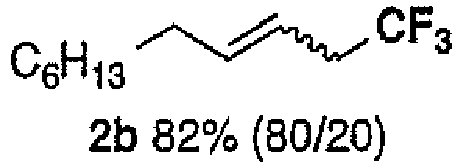
2b,c 

3 

4 

5 c,d 

6 c 

7 c 

8 Rf=CF3(2i) 90% (72/28) 9 Rf=C2F5(2i') 81% (72/28) 10 Rf=C3F7(2i") 72% (75/25) a: E/Z ratio was determined by 19F NMR analysis.
b: The reaction was conducted at a substrate concentration of 0.2 M in dichloromethane at 0°C.
c: 20 Mol% of the catalyst was used.
d: The crude product was treated with Et3N/SiO2 for hydrolysis. - The reaction was conducted in the same manner as in Example 1 (1) except that N-tosyl-N-(4-pentenyl)amine was used as a substrate. As a result, a trifluoromethylated nitrogen-containing heterocyclic compound was obtained in a good yield (82%) as shown below.

- The reaction was conducted in the same manner as in Example 1 (1) by using a substrate concentration of 1.0 M, a reaction time of 7 minutes and N-tosylallylamine as a substrate. As a result, trifluoromethylated aziridine was obtained at a high yield (87%) as shown below. When the similar reaction is conducted by stirring 4 equivalents of TFAA and 1.2 equivalents of urea-hydrogen peroxide in 0.4 M dichloromethane at 0°C for 1 hour and 10 mol% of a copper catalyst and a substrate is then added thereto and is allowed to react at 0°C for 1 hour, the target product can be obtained at an equivalent yield (91%).

- The following compounds can be produced as the same manner as in Example 3 or 4 except that the type of substrate is changed.

- a: In 1,2-dichloroethane as a solvent at a reaction temperature of 60°C
- b: Copper catalyst: 20 mol%
- c: Trifluoroacetic anhydride: 10 mol%
- In the above formulas, Rf represents a perfluoroalkyl group having 1 to 6 carbon atoms, Ts represents a tosyl group, Ms represents a methanesulfonyl group, Tf represents a trifluoromethanesulfonyl group, and R represents a hydrogen atom or a substituent.
- The aziridine product synthesized in Example 4 can be derivatized into various trifluoromethylamines by ring-opening reaction with various nucleophilic reagents. Furthermore, tetrahydroharmine and a compound having a spiroindolone skeleton which are known as a physiologically active molecule such as a medicine can be synthesized by deprotection of the tosyl group of the tryptamine product followed by Pictet-Spengler reaction.

-
- (1) The reaction was conducted under the same reaction conditions as in Example 1 except that the substrate used was tert-butylbenzene. The yield was determined by GCMS analysis.
- The results are shown in below.
[Table 5] 
Entry Cat. loading Yield (%) (o-/m-/p-) RSM (%) 1 20 mol % 62 (57/35/8) 33 2 10 mol % 52 (75/34/8) 45 3 none 20 (57/35/8) 77 4* none 63 (57/34/9) 34 *The reaction was conducted for 13 h. - The yield in the absence of a copper catalyst was 20% (o-:m-:p- = 57:35:8), whereas when the reaction was conducted in the presence of 20 mol% of a copper catalyst, the target product was obtained at a good yield of 62% (o-:m-:p- = 57:35:8). It was also found that when the reaction time was longer even in the absence of a copper catalyst, the target product was obtained at a yield equivalent to that in the presence of a copper catalyst. This shows that the reaction time can be reduced by using the copper catalyst.
-
- (2) The reaction was conducted in the absence of dicholoromethane, a solvent for entry No.2 in Table 5 of the above (1). As a result, the target product was obtained at a good yield of 69% (o-:m-:p- = 57:34:9) as shown below.
-
- (1) The reaction was conducted in the same manner as in Example 1 in the presence and absence of [Cu(CH3CN)4]PF6 by using 5-(p-tolyl)-1-pentene (concentration: 0.2 M) instead of 4-pentenyl benzoate. As a result, as shown below, intramolecular cyclization occurred simultaneously with perfluoroalkylation in the absence of a copper catalyst, and a trifluoromethylated cyclic compound 3c was obtained at a good yield.
-
- (2) Various perfluoroalkylated cyclic compounds as shown below were obtained by replacing 5-(p-tolyl)-1-pentene in the above (1) with other compounds having a terminal double bond together with an aromatic ring.
- a: Substrate concentration: 0.4 M
- b: Substrate concentration: 0.02 M
- c: In 1,2-dichloroethane as a solvent at a reaction temperature of 60°C
- d: Unprotected 2-allylaniline was used as a substrate.
- Among the compounds synthesized in the above Examples, compounds which are novel substances will be shown below for their compound names, structural formulas and physical properties.
-

- 1H NMR (400 MHz, CDCl3)
2.30-2.40 (overlap, 5H), 2.66 (m, 2H), 2.76 (m, 2H), 5.41 (E-isomer, dt, J = 15.4, 7.1 Hz; Z-isomer, overlap, 1H), 5.74 (E-isomer, dt, J = 15.4, 6.8 Hz, 1H; Z-isomer, overlap, 1H), 7.05-7.30 (overlap, 4H)
13C NMR (E-isomer; 100 MHz, CDCl3)
21.1, 34.5, 35.1, 37.5 (q, J = 28.9 Hz), 118.3 (q, J = 3.9 Hz), 126.2 (q, J = 276 Hz), 128.4 (2C), 129.2 (2C), 135.5, 137.6, 138.4
19F NMR (376 MHz, CDCl3)
E-isomer, -66.5 (t, 10.8 Hz); Z-isomer, -66.1 (t, 10.8 Hz) -

- 1H NMR (400 MHz, CDCl3)
1.20-1.43 (overlap, 12H), 1.56 (m, 2H), 2.04 (m, 2H), 2.13 (s, 3H), 2.42 (t, J = 7.4 Hz, 2H), 2.76 (E-isomer, m, 2H), 2.84 (Z-isomer, m, 2H), 5.36 (E-isomer, dtt, J = 15.2, 7.0, 1.5 Hz, 1H; Z-isomer, overlap, 1H), 5.68 (E-isomer, dt, J = 15.2, 7.1 Hz, 1H; Z-isomer, overlap, 1H)
13C NMR (E-isomer, 100 MHz, CDCl3)
24.0, 29.0, 29.1, 29.3, 29.5 (3C), 29.9, 32.4, 37.5 (q, J = 28.9 Hz), 43.9, 117.6 (q, J = 3.9 Hz), 126.2 (q, J = 276 Hz), 138.6, 209.5
19F NMR (376 MHz, CDCl3)
E-isomer, -66.6 (t, 10.8 Hz); Z-isomer, -66.1 (t, 10.8 Hz) -

- 1H NMR (400 MHz, CDCl3)
2.36 (E-isomer, m, 2H), 2.39 (Z-isomer, m, 2H), 2.72-2.88 (m, 2H), 3.79 (Z-isomer, t, J = 7.7 Hz, 2H), 3.83 (E-isomer, t, J = 7.2 Hz, 2H), 5.48 (E-isomer, dtt, J = 15.4, 7.0, 1.4 Hz, 1H), 5.54 (Z-isomer, dtt, J = 10.9, 7.4, 1.6 Hz, 1H), 5.67 (E-isomer, dt, J = 15.4, 7.0 Hz, 1H; Z-isomer, overlap, 1H), 7.18-7.24 (m, 2H), 7.40-7.49 (m, 3H)
13C NMR (E-isomer, 100 MHz, CDCl3)
30.3, 37.4 (q, J = 29.9 Hz), 50.8, 116.4 (q, J = 288 Hz), 121.0 (q, J = 2.9 Hz), 125.9 (q, J = 276 Hz), 128.5 (2C), 129.3 (2C), 129.6, 133.8, 138.9, 156.8 (q, J = 35.6 Hz)
19F NMR (376 MHz, CDCl3)
E-isomer, -67.2 (s, 3F), -66.5 (t, 11.6 Hz, 3F)
Z-isomer, -67.2 (s, 3F), -66.1 (t, 11.6 Hz, 3F) -

- 1H NMR (400 MHz, CDCl3)
1.57 (m, 2H), 2.06 (m, 2H), 2.43 (s, 3H), 2.68-2.85 (m, 2H), 2.90-2.98 (m, 2H), 4.35-4.53 (br, 1H), 5.34 (E-isomer, m, 1H), 5.41 (Z-isomer, m, 1H), 5.60 (E-isomer, dt, J = 15.4, 6.6 Hz, 1H;
Z-isomer, overlap, 1H), 7.31 (d, J = 8.1 Hz, 2H), 7.74 (d, J = 8.1 Hz, 2H)
13C NMR (E-isomer, 100 MHz, CDCl3)
21.6, 28.8, 29.4, 37.3 (q, J = 28.9 Hz), 42.5, 118.9 (q, J = 2.9 Hz), 126.0 (q, J = 276 Hz), 127.2 (2C), 129.8 (2C), 136.7, 137.0, 143.6
19F NMR (376 MHz, CDCl3)
E-isomer, -66.5 (t, 10.8 Hz); Z-isomer, -66.0 (t, 10.8 Hz) -

- 1H NMR (400 MHz, CDCl3)
1.56 (m, 2H), 2.07 (m, 2H), 2.43 (s, 3H), 2.62-2.83 (m, 2H), 2.90-2.96 (m, 2H), 4.70-4.76 (br, 1H), 5.34 (E-isomer, dt, J = 15.3, 7.2 Hz, 1H), 5.41 (Z-isomer, br, 1H), 5.60 (E-isomer, dt, J = 15.3, 6.9 Hz, 1H; Z-isomer, overlap, 1H), 7.31 (d, J = 8.4 Hz, 2H), 7.75 (d, J = 8.4 Hz, 2H)
13C NMR (E-isomer, 100 MHz, CDCl3) (The carbons of the perfluoroalkyl group could not be assigned because of low intensity of signals and their complex coupling.)
21.6, 28.9, 29.5, 34.5 (t, J = 22.2 Hz), 42.6, 117.9 (t, J = 3.9 Hz), 127.2 (2C), 129.8 (2C), 135.4, 137.2, 143.6
19F NMR (376 MHz, CDCl3)
E-isomer, -117.2 (m, 2F), -84.7 (m, 3F); Z-isomer, -116.9 (m, 2F) -84.8 (m, 3F) -

- 1H NMR (400 MHz, CDCl3)
1.57 (m, 2H), 2.06 (m, 2H), 2.42 (s, 3H), 2.65-2.87 (m, 2H), 2.88-2.98 (m, 2H), 4.92 (br, 1H), 5.34 (E-isomer, dt, J = 15.4, 7.1 Hz, 1H; Z-isomer, overlap, 1H), 5.60 (E-isomer, dt, J = 15.4, 6.9 Hz, 1H; Z-isomer, overlap, 1H), 7.30 (d, J = 8.1 Hz, 2H), 7.76 (d, J = 8.1 Hz, 2H)
13C NMR (E-isomer, 100 MHz, CDCl3) (The carbons of the perfluoroalkyl group could not be assigned because of low intensity of signals and their complex coupling.)
21.5, 28.8, 29.5, 34.5 (t, J = 22.2 Hz), 42.5, 117.7 (t, J = 4.9 Hz), 127.2 (2C), 129.8 (2C), 135.6, 137.4, 143.6
19F NMR (376 MHz, CDCl3)
E-isomer, -127.4 (m, 2F), -114.2 (m, 2F), -80.6 (m, 3F);
Z-isomer, -127.2 (m, 2F), -113.9 (m, 2F), -80.5 (m, 3F) -

- 1H NMR (400 MHz, CDCl3)
1.77-1.94 (m, 4H), 2.30-2.51 (m, 2H), 2.66-2.79 (m, 2H), 3.18 (m, 1H), 6.80-6.87 (m, 2H), 7.03 (dd, J = 9.4, 6.2 Hz, 1H)
13C NMR (100 MHz, CDCl3)
18.9, 27.7, 28.7, 32.5 (br), 40.8 (q, J = 27.0 Hz), 113.7 (d, J = 21.2 Hz), 114.8 (d, J = 20.2 Hz), 126.9 (q, J = 277 Hz), 130.9 (d, J = 7.7 Hz), 132.7 (d, J = 2.9 Hz), 140.5 (d, J = 6.7 Hz), 161.2 (d, J = 244 Hz)
19F NMR (376 MHz, CDCl3)
-63.8 (t, J = 11.6 Hz, 3F), -116.9 (m, 1F) -

- 1H NMR (400 MHz, CDCl3)
1.73-1.99 (m, 4H), 2.30-2.52 (m, 2H), 2.62-2.79 (m, 2H), 3.13-3.22 (m, 1H), 3.78 (s, 3H), 6.66 (d, J = 2.6 Hz, 1H), 6.72 (dd, J = 8.4, 2.6 Hz, 1H), 6.99 (d, J = 8.4 Hz, 1H)
13C NMR (100 MHz, CDCl3)
19.3, 27.8, 28.6, 32.6 (q, J = 1.9 Hz), 40.9 (q, J = 27.0 Hz), 55.4, 112.7, 113.5, 127.1 (q, J = 277 Hz), 129.3, 130.4, 139.8, 157.9
19F NMR (376 MHz, CDCl3)
-63.8 (t, 11.6 Hz) -

- 1H NMR (400 MHz, CDCl3)
1.73-2.01 (m, 4H), 2.20-2.49 (m, 5H), 2.63-2.80 (m, 2H), 3.21-3.34 (m, 1H), 6.90-6.99 (m, 3H)
13C NMR (100 MHz, CDCl3) (The carbons of the perfluoroalkyl group could not be assigned because of low intensity of signals and their complex coupling.)
19.2, 21.1, 28.4 (m), 28.9, 31.1 (br), 37.5 (t, J = 20.2 Hz), 127.4, 129.3, 129.5, 134.2, 135.8, 138.8
19F NMR (376 MHz, CDCl3)
-117.0 (m, 2F), -85.6 (m, 3F) -

- 1H NMR (400 MHz, CDCl3)
1.73-2.01 (m, 4H), 2.25-2.50 (m, 5H), 2.64-2.81 (m, 2H), 3.23-3.37 (m, 1H), 6.88-6.99 (m, 3H)
13C NMR (100 MHz, CDCl3) (The carbons of the perfluoroalkyl group could not be assigned because of low intensity of signals and their complex coupling.)
19.2, 21.2, 28.5 (m), 31.0 (br), 37.4 (t, J = 20.2 Hz), 127.4, 129.3, 129.5, 134.2, 135.8, 138.8 19F NMR (376 MHz, CDCl3)
-127.7 (m, 2F), -114.0 (m, 2F), -80.3 (m, 3F) -

- 1H NMR (400 MHz, CDCl3)
2.16 (d, J = 4.3 Hz, 1H), 2.16-2.40 (m, 2H), 2.45 (s, 3H), 2.75 (d, J = 7.0 Hz, 1H), 2.89-2.95 (m, 1H), 7.36 (d, J = 8.0 Hz, 2H), 7.82 (d, J = 8.0 Hz, 2H)
13C NMR (100 MHz, CDCl3)
21.8, 31.9, 32.0 (q, J = 3.9 Hz), 36.3 (q, J = 29.9 Hz), 125.3 (q, J = 277 Hz), 128.3 (2C), 129.9 (2C), 134.5, 145.2
19F NMR (376 MHz, CDCl3)
-65.3 (t, J = 10.1 Hz) -

- 1H NMR (400 MHz, CDCl3)
2.16 (d, J = 4.4 Hz, 1H), 2.18-2.34 (m, 2H), 2.73 (d, J = 6.9 Hz, 1H), 2.86-2.92 (m, 1H), 3.90 (s, 3H), 7.02 (d, J = 9.0 Hz, 2H), 7.87 (d, J = 9.0 Hz, 2H)
13C NMR (100 MHz, CDCl3)
31.9, 33.0 (q, J = 3.9 Hz), 36.3 (q, J = 29.9 Hz), 56.8, 114.5 (2C), 125.3 (q, J = 277 Hz), 128.8, 130.5 (2C), 164.1
19F NMR (376 MHz, CDCl3)
-65.3 (t, J = 10.1 Hz) -

- 1H NMR (400 MHz, CDCl3)
2.20 (d, J = 4.4 Hz, 1H), 2.23-2.32 (m, 2H), 2.79 (d, J = 7.0 Hz, 1H), 2.94-3.00 (m, 1H), 7.71 (d, J = 8.7 Hz, 2H), 7.81 (d, J = 8.7 Hz, 2H)
13C NMR (100 MHz, CDCl3)
32.0, 33.4 (q, J = 4.8 Hz), 36.3 (q, J = 29.9 Hz), 125.2 (q, J = 275 Hz), 129.4, 129.7 (2C), 132.6 (2C), 136.6
19F NMR (376 MHz, CDCl3)
-65.3 (t, J = 10.1 Hz) -

- 1H NMR (400 MHz, CDCl3)
2.20 (d, J = 4.4 Hz, 1H), 2.22-2.32 (m, 2H), 2.80 (d, J = 7.0 Hz, 1H), 2.92-2.98 (m, 1H), 7.21-7.27 (m, 2H), 7.95-8.00 (m, 2H)
13C NMR (100 MHz, CDCl3)
32.0, 33.4 (q, J = 3.9 Hz), 36.3 (q, J = 28.9 Hz), 116.7 (d, J = 23.1 Hz, 2C), 125.1 (q, J = 277 Hz), 131.1 (d, J = 9.6 Hz, 2C), 133.6, 156.7
19F NMR (376 MHz, CDCl3)
-65.3 (t, J = 10.1 Hz, 3H), -102.8 (m, 1H) -

- 1H NMR (400 MHz, CDCl3)
2.18 (d, J = 4.4 Hz, 1H), 2.21-2.50 (m, 2H), 2.72 (d, J = 7.1 Hz, 1H), 2.86-2.94 (m, 1H), 3.08 (s, 3H)
13C NMR (100 MHz, CDCl3)
30.5, 33.1 (q, J = 3.9 Hz), 36.3 (q, J = 28.9 Hz), 39.7, 125.5 (q, J = 277 Hz)
19F NMR (376 MHz, CDCl3)
-65.0 (t, J = 10.1 Hz) -
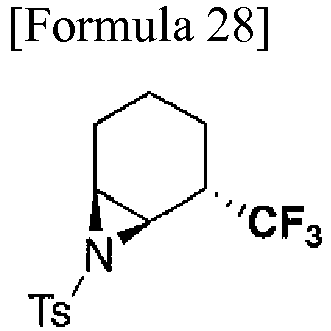
- 1H NMR (400 MHz, CDCl3)
1.11-1.40 (m, 2H), 1.50-1.60 (m, 1H), 1.65-1.80 (m, 2H), 1.99-2.10 (m, 1H), 2.28-2.41 (m, 1H), 2.45 (s, 3H), 2.97 (d, J = 7.0 Hz, 1H), 3.13 (m, 1H),7.35 (d, J = 8.1 Hz, 2H), 7.80 (d, J = 8.1 Hz, 2H)
13C NMR (100 MHz, CDCl3)
16.4, 20.5 (q, J = 1.9 Hz), 21.8, 22.6, 37.3 (q, J = 3.9 Hz), 39.1, 39.2 (q, J = 27.0 Hz), 126.8 (q, J = 279 Hz), 127.9 (2C), 129.9 (2C), 135.1, 144.8
19F NMR (376 MHz, CDCl3)
-72.0 (d, J = 10.1 Hz) -

- 1H NMR (400 MHz, CDCl3)
2.03-2.15 (m, 1H), 2.17 (d, J = 4.3 Hz, 1H), 2.29-2.43 (m, 1H), 2.46 (s, 3H), 2.76 (d, J = 6.9 Hz, 1H), 2.97-3.04 (m, 1H), 7.36 (d, J = 8.0 Hz, 2H), 7.83 (d, J = 8.0 Hz, 2H)
13C NMR (100 MHz, CDCl3) (The carbons of the perfluoroalkyl group could not be assigned because of low intensity of signals and their complex coupling.)
21.8, 32.2 (t, J = 5.8 Hz), 32.3, 33.5 (t, J = 22.2 Hz), 128.2 (2C), 130.0 (2C),134.5, 145.2
19F NMR (376 MHz, CDCl3)
-85.4 (m, 3F), -117.3 (m, 2F) -

- 1H NMR (400 MHz, CDCl3)
2.06-2.23 (m, 1H), 2.17 (d, J = 4.8 Hz, 1H), 2.30-2.42 (m, 1H), 2.46 (s, 3H), 2.76 (d, J = 7.0 Hz, 1H), 2.98-3.05 (m, 1H), 7.36 (d, J = 8.0 Hz, 2H), 7.83 (d, J = 8.0 Hz, 2H)
13C NMR (100 MHz, CDCl3) (The carbons of the perfluoroalkyl group could not be assigned because of low intensity of signals and their complex coupling.)
21.8, 32.1 (t, J = 4.8 Hz), 32.2, 33.6 (t, J = 21.2 Hz), 128.2 (2C), 129.9 (2C),134.5, 145.0
19F NMR (376 MHz, CDCl3)
-80.4 (m, 3F), -114.3 (m, 2F), -127.5 (m, 2F) -

- 1H NMR (400 MHz, CDCl3)
1.87-2.01 (overlap, 3H), 2.14 (m, 1H), 2.24 (m, 1H), 2.85 (overlap, 4H), 3.31 (m, 1H), 3.41 (m, 1H), 3.89 (m, 1H)
13C NMR (100 MHz, CDCl3)
24.6, 31.8 (q, J = 1.2 Hz), 35.0, 40.3 (q, J = 27.0 Hz), 48.8, 54.8 (q, J = 2.9 Hz), 125.6 (q, J = 277 Hz)
19F NMR (376 MHz, CDCl3)
-63.5 (t, J = 10.9 Hz) -

- 1H NMR (400 MHz, CDCl3)
0.91-1.42 (overlap, 6H), 1.63 (m, 1H), 1.80 (m, 2H), 2.21-2.35 (m, 2H), 2.36-2.43 (overlap, 4H), 2.80 (m, 1H), 3.27 (m, 1H), 4.15 (m, 1H), 7.28 (d, J = 8.2 Hz, 2H), 7.70 (d, J = 8.2 Hz, 2H)
13C NMR (100 MHz, CDCl3)
21.7, 25.1, 25.2, 29.4, 29.9, 37.8, 41.3 (q, J = 27.0 Hz), 42.9, 55.5 (q, J = 2.9 Hz), 66.0, 126.1 (q, J = 277 Hz), 127.2 (2C), 129.8 (2C), 139.4, 143.3
19F NMR (376 MHz, CDCl3)
-63.1 (t, J = 11.0 Hz)
(diastereomer)
1H NMR (400 MHz, CDCl3)
0.91-1.42 (overlap, 6H), 1.70 (m, 1H), 1.80 (overlap, 3H), 2.21-2.25 (m, 2H),245 (s, 3H), 2.55 (m, 1H), 2.88 (m, 1H), 3.77 (m, 1H), 7.35 (d, J = 7.8 Hz, 2H), 7.68 (overlap, 2H)
13C NMR (100 MHz, CDCl3)
21.7, 24.7, 25.4, 29.6, 32.8, 34.5, 41.2 (q, J = 27.0 Hz), 42.9, 55.1 (q, J = 2.9 Hz), 66.5, 126.1 (q, = J = 277 Hz), 128.0 (2C), 129.9 (2C), 132.9, 144.0
19F NMR (376 MHz, CDCl3)
-63.7 (t, J = 11.0 Hz) -

- 1H NMR (400 MHz, CDCl3)
2.38 (s, 3H), 2.44 (m, 1H), 2.76 (dd, J = 16.8, 3.3 Hz, 1H), 2.88-2.99 (overlap, 2H), 4.42 (m, 1H), 7.03 (m, 1H), 7.21 (overlap, 3H), 7.54 (d, J = 8.3 Hz, 2H), 7.62 (d, J = 8.6 Hz, 1H)
13C NMR (100 MHz, CDCl3)
21.7, 34.1 (q, J = 1.5 Hz), 40.7 (q, J = 26.9 Hz), 57.2 (q, J = 3.2 Hz), 118.3, 125.6, 125.6 (q, J =276 Hz), 127.3 (2C), 128.4, 130.1 (2C), 130.5, 132.7, 133.9, 139.6, 144.8
19F NMR (376 MHz, CDCl3)
-62.9 (t, J = 10.9 Hz) -

- 1H NMR (400 MHz, CDCl3)
2.32-2.61 (m, 2H), 2.41 (s, 3H), 3.31-3.36 (m, 1H), 3.73 (m, 1H), 4.08 (m, 1H), 4.76 (m, 1H), 7.06 (s, 1H), 7.26 (d, J = 8.2 Hz, 1 H), 7.74 (d, J = 8.2 Hz, 1H)
13C NMR (100 MHz, CDCl3) (The carbons of the perfluoroalkyl group could not be assigned because of low intensity of signals and their complex coupling.)
21.7, 31.1, 34.9 (t, J = 21.1 Hz), 45.3, 124.8, 129.4, 129.7, 135.0, 137.3, 143.8
19F NMR (376 MHz, CDCl3)
-85.4 (m, 3F), -116.6 (m, 2F) -

- 1H NMR (400 MHz, CDCl3)
2.40-2.64 (m, 2H), 2.41 (s, 3H), 3.33-3.38 (m, 1H), 3.73 (m, 1H), 4.07 (m, 1H), 4.70 (m, 1H), 7.06 (s, 1H), 7.27 (d, J = 8.0 Hz, 1H), 7.75 (d, J = 8.0 Hz, 1H)
13C NMR (100 MHz, CDCl3) (The carbons of the perfluoroalkyl group could not be assigned because of low intensity of signals and their complex coupling.)
21.7, 31.0, 34.9 (t, J = 21.1 Hz), 45.4, 124.8, 129.4, 129.7, 135.0, 137.3, 143.8
19F NMR (376 MHz, CDCl3)
-80.1 (m, 3F), -113.4 (m, 2F), -127.3 (m, 2F) -

- 1H NMR (400 MHz, CDCl3)
2.30-2.45 (m, 1H), 2.60-2.75 (m, 1H), 3.74-3.86 (m, 1H), 4.09 (dd, J = 11.6, 6.8 Hz, 1H), 4.51 (m, 1H), 7.25 (m, 1H), 7.31(dd, J = 8.7, 2.1 Hz, 1H), 8.73 (d, J = 8.7 Hz, 1H)
13C NMR (100 MHz, CDCl3)
35.1, 38.5 (q, J = 28.9 Hz), 54.0 (q, J = 1.9 Hz), 116.0 (q, J = 287 Hz), 119.2, 124.3, 126.0 (q, J = 277 Hz), 129.3, 131.6, 134.3, 140.0, 154.2 (q, J = 38.5 Hz)
19F NMR (376 MHz, CDCl3)
-64.6 (t, J = 10.1 Hz, 3F), -72.4 (s, 3F) -

- 1H NMR (400 MHz, CDCl3)
1.39 (t, J =7.1 Hz, 3H), 2.03-2.45 (m, 1H), 2.69-2.82 (m, 1H), 3.38 (m, 1H), 4.12 (m, 1H), 4.37 (q, J = 7.1 Hz, 2H), 4.54 (m, 1H), 7.92 (s, 1H), 8.04 (d, J = 8.5 Hz, 1H), 8.24 (d, J = 8.5 Hz, 1H)
13C NMR (100 MHz, CDCl3)
14.5, 35.0, 38.6 (q, J = 28.9 Hz), 54.0 (q, J = 1.9 Hz), 61.5, 115.9 (q, J = 288 Hz), 117.8, 125.3, 126.1 (q, J = 277 Hz), 128.5, 131.4, 132.8, 145.0, 154.5 (q, J = 38.5 Hz), 165.7
19F NMR (376 MHz, CDCl3)
-64.6 (t, J = 10.1 Hz, 3F), -72.5 (s, 3F) - All publications, patents and patent applications cited in the present specification are incorporated herein by reference in their entirety.
 |
| entry | catalyst | yield of 2a (%) a (E/Z) | recov. of 1a (%) a |
| 1 | [Cu(CH3CN)4]PF6 | 92 (78/22) | 5 |
| 2 b | [CU(CH3CN)4]PF6 | 95 (78/22) c | 4 |
| 3 | CuI | 23 (76/24) c | 48 |
| 4 | CuBr | 73 (77/23) | 49 |
| 5 | CuCl | 70 (76/24) | 20 |
| 6 | CuOAc | 82 (76/24) | 26 |
| 7 | CuTc | 34(76/24) | 18 |
| 8 | Cu(OAc)2 | 2 | 11 |
| 9 | FeCl2 | 1 | 70 |
| 10 | Fe(OAc)2 | 1 | 70 |
| 11 | Mn(OAc)2 | 76 |
| a: Yields and E/Z ratio were determined by 1H NMR analysis and 19F NMR analysis, respectively. b: The reaction was conducted at substrate (1a) concentration of 0.4 M in dichloromethane. c: Isolated yield. |
 |
| entry | catalyst loading | yield of 2a (%) (E/Z) | recov. of 1a (%) |
| 1 | 20 mol % | 96 (78/22) | n.d. |
| 2 | 10 mol % | 92 (78/22) | 5 |
| 3 | 5 mol % | 88 (78/22) | 19 |
| 4 | 1 mol % | 78 (77/23) | 20 |
 |
| entry | amount of TFAA (equiv) | cat. loading (mol %) | conc. (M) | yield of 2a (%) (E/Z) | recov. of 1a (%) |
| 1 | 10 | 10 | 0.2 | 92 (78/22) | 5 |
| 2 | 10 | 1 | 0.2 | 78 (77/23) | 20 |
| 3* | 10 | 1 | 0.2 | 75 (78/22) | 15 |
| 4 | 10 | 1 | 0.4 | 82 (78/22) | 17 |
| 5 | 10 | 10 | 0.4 | 95 (78/22) | 4 |
| 6 | 8 | 10 | 0.4 | 73 (78/22) | 2 |
| *1.5 equiv of urea·H2O2 was used. |


Claims (9)
- A method for producing a perfluoroalkylated compound, comprising reacting a bis(perfluoroalkanoyl) peroxide with a compound having a carbon-carbon unsaturated bond and/or an aromatic ring having a hydrogen atom bonded thereto in the presence of a copper catalyst.
- The method according to claim 1, wherein the bis(perfluoroalkanoyl) peroxide is produced from perfluoroalkanoic anhydride and a urea-hydrogen peroxide complex.
- The method according to claim 1 or 2, wherein a bis(perfluoroalkanoyl) peroxide represented by formula (I):
Rf-CO-OO-CO-Rf (I)
wherein Rf represents a perfluoroalkyl group having 1 to 6 carbon atoms,
is reacted with a compound represented by formula (II):
R1-CH(R2)-C(R3)=CH2 (II)
wherein R1 represents an organic group, R2 and R3, which are the same or different, each represent a hydrogen atom or a substituted or unsubstituted C1-6-alkyl group,
to produce a perfluoroalkylated compound represented by formula (III):
R1-C(R2)=C(R3)-CH2-Rf (III)
wherein Rf, R1, R2 and R3 are as defined above. - The method according to claim 1 or 2, wherein a bis(perfluoroalkanoyl) peroxide represented by formula (I):
Rf-CO-OO-CO-Rf (I)
wherein Rf represents a perfluoroalkyl group having 1 to 6 carbon atoms,
is reacted with a compound represented by formula (IV):
R4-NH-X1-C(R3)=CH(R5) (IV)
wherein R3 and R5, which are the same or different, each represent a hydrogen atom or a substituted or unsubstituted C1-6-alkyl group, R4 represents a substituent, X1 represents a linking group having 1 to 4 chain members, and R5 and X1 may be linked to form a 5- to 7-membered ring together with C(R3)=CH,
to produce a perfluoroalkylated compound represented by formula (V):
- The method according to claim 1 or 2, wherein a bis(perfluoroalkanoyl) peroxide represented by formula (I):
Rf-CO-OO-CO-Rf (I)
wherein Rf represents a perfluoroalkyl group having 1 to 6 carbon atoms,
is reacted with a compound represented by formula (VI):
Ar-H (VI)
wherein Ar represents a substituted or unsubstituted aromatic group,
to produce a perfluoroalkylated compound represented by formula (VII):
Ar-Rf (VII)
wherein Rf and Ar are as defined above. - The method according to any one of claims 1 to 5, wherein the copper catalyst is [Cu(CH3CN)4]PF6.
- A method for producing a perfluoroalkylated compound represented by formula (IX):

comprising reacting a bis(perfluoroalkanoyl) peroxide represented by formula (I):
Rf-CO-OO-CO-Rf (I)
wherein Rf is as defined above,
with a compound represented by formula (VIII):
Ar-X2-C(R3)=CH2 (VIII)
wherein Ar represents a substituted or unsubstituted aromatic group, and X2 and R3 are as defined above,
in the absence of a copper catalyst. - A method for producing a perfluoroalkylated compound,
comprising:a first step of reacting a perfluoroalkanoic anhydride represented by formula (X):
Rf-CO-O-CO-Rf (X)
wherein Rf represents a perfluoroalkyl group having 1 to 6 carbon atoms,
with a urea-hydrogen peroxide complex at -60°C to -10°C to produce a bis(perfluoroalkanoyl) peroxide represented by formula (I):
Rf-CO-OO-CO-Rf (I)
wherein Rf is as defined above, anda second step of reacting the bis(perfluoroalkanoyl) peroxide with a compound represented by formula (VI):
Ar-H (VI)
wherein Ar represents a substituted or unsubstituted aromatic group,
at 10°C to 100°C to produce a perfluoroalkylated compound represented by formula (VII):
Ar-Rf (VII)
wherein Rf and Ar are as defined above. - An aziridine derivative represented by formula (V-1):

Applications Claiming Priority (2)
| Application Number | Priority Date | Filing Date | Title |
|---|---|---|---|
| JP2015244124 | 2015-12-15 | ||
| PCT/JP2016/086837 WO2017104589A1 (en) | 2015-12-15 | 2016-12-12 | Method for producing perfluoroalkylated compound |
Publications (2)
| Publication Number | Publication Date |
|---|---|
| EP3392228A1 true EP3392228A1 (en) | 2018-10-24 |
| EP3392228A4 EP3392228A4 (en) | 2019-11-06 |
Family
ID=59056558
Family Applications (1)
| Application Number | Title | Priority Date | Filing Date |
|---|---|---|---|
| EP16875566.8A Withdrawn EP3392228A4 (en) | 2015-12-15 | 2016-12-12 | PROCESS FOR PRODUCING PERFLUOROALKYL COMPOUND |
Country Status (4)
| Country | Link |
|---|---|
| US (1) | US10995043B2 (en) |
| EP (1) | EP3392228A4 (en) |
| JP (1) | JP6836791B2 (en) |
| WO (1) | WO2017104589A1 (en) |
Cited By (1)
| Publication number | Priority date | Publication date | Assignee | Title |
|---|---|---|---|---|
| CN111518014A (en) * | 2020-04-28 | 2020-08-11 | 温州大学新材料与产业技术研究院 | Synthesis method of 2-azabicyclo [3.2.0] compound |
Families Citing this family (1)
| Publication number | Priority date | Publication date | Assignee | Title |
|---|---|---|---|---|
| CN108947886B (en) * | 2018-07-12 | 2021-05-18 | 江苏理工学院 | A kind of polychloromethyl substituted indoline compound and its synthesis method and application |
Family Cites Families (3)
| Publication number | Priority date | Publication date | Assignee | Title |
|---|---|---|---|---|
| JP5106048B2 (en) * | 2006-11-06 | 2012-12-26 | 東ソー株式会社 | Process for producing benzenes having a perfluoroalkyl group |
| JP5093798B2 (en) * | 2007-05-08 | 2012-12-12 | 東ソー株式会社 | Α, β-Unsaturated carbonyl compound having perfluoroalkyl group and process for producing the same |
| JP5424283B2 (en) * | 2012-08-10 | 2014-02-26 | 東ソー株式会社 | Method for producing α, β-unsaturated carbonyl compound having perfluoroalkyl group |
-
2016
- 2016-12-12 US US16/061,449 patent/US10995043B2/en not_active Expired - Fee Related
- 2016-12-12 JP JP2017556033A patent/JP6836791B2/en not_active Expired - Fee Related
- 2016-12-12 EP EP16875566.8A patent/EP3392228A4/en not_active Withdrawn
- 2016-12-12 WO PCT/JP2016/086837 patent/WO2017104589A1/en not_active Ceased
Cited By (1)
| Publication number | Priority date | Publication date | Assignee | Title |
|---|---|---|---|---|
| CN111518014A (en) * | 2020-04-28 | 2020-08-11 | 温州大学新材料与产业技术研究院 | Synthesis method of 2-azabicyclo [3.2.0] compound |
Also Published As
| Publication number | Publication date |
|---|---|
| JP6836791B2 (en) | 2021-03-03 |
| JPWO2017104589A1 (en) | 2018-11-01 |
| WO2017104589A1 (en) | 2017-06-22 |
| US20200277243A1 (en) | 2020-09-03 |
| US10995043B2 (en) | 2021-05-04 |
| EP3392228A4 (en) | 2019-11-06 |
Similar Documents
| Publication | Publication Date | Title |
|---|---|---|
| Tseng et al. | Synthesis of fused tetrahydro-β-carbolinequinoxalinones in 1-n-butyl-2, 3-dimethylimidazolium bis (trifluoromethylsulfonyl) imide ([bdmim][Tf2N]) and 1-n-butyl-2, 3-dimethylimidazolium perfluorobutylsulfonate ([bdmim][PFBuSO3]) ionic liquids | |
| Beukeaw et al. | Iodine/persulfate-promoted site-selective direct thiolation of quinolones and uracils | |
| KR102528106B1 (en) | Commercially viable synthesis of cantharidin and bioactive cantharidin derivatives | |
| Dannenberg et al. | Direct access to n-alkylsulfoximines from sulfides by a sequential imidation/oxidation procedure | |
| Zhao et al. | Cu-mediated oxidative trifluoromethylthiolation of arylboronic acids with (bpy) CuSCF3 | |
| Petko et al. | N-(2-bromotetrafluoroethyl) derivatives of five-membered nitrogen-containing heterocycles | |
| FI96201B (en) | Process for preparing new therapeutically useful retinoid | |
| JP6836791B2 (en) | Method for producing perfluoroalkylated compound | |
| EP1331222A1 (en) | Environment friendly reagents and process for halogenoalkylsulfinylation of organic compounds | |
| Brittain et al. | Pyrrole Studies XXVII. 1 Utilisation of 1-Methyl-2-pyrrolyl Lithium in the Synthesis of 1-Methyl-2-substituted Pyrroles | |
| JPH04112877A (en) | New cyanopyrazine derivative and production thereof | |
| Zhao et al. | Structure-dependent selective O-or C-trifluoroethylation of 1, 3-dicarbonyls by mesityl (2, 2, 2-trifluoroethyl) iodonium triflate | |
| US6215009B1 (en) | Manufacture of cycloalkenylpolyene esters | |
| LU84091A1 (en) | N-CARBAMOYL DERIVATIVES OF ISOTHIAZOLO- (5,4B) PYRIDINE ONE-3, THEIR PREPARATION METHOD AND THEIR USES AS BACTERICIDAL AND FUNGICIDAL AGENTS | |
| Zhu et al. | Photoredox catalyzed difluoro (phenylthio) methylation of 2, 3-allenoic acids with {difluoro (phenylthio) methyl} triphenylphosphonium triflate | |
| EP0342105A1 (en) | 2-Adamantyl-3-isothiazolin-4-ones, process for their preparation and their use as bactericides and fungicides | |
| Yuan et al. | Ammonium iodide-promoted unprecedented arylsulfonylation of quinone with sodium arylsulfinates | |
| EP0171320A1 (en) | Process for the preparation of unsaturated alpha-chlorinated compounds of two electroattractive groups in the beta position | |
| US6225505B1 (en) | Trifluoro methylthiomethyl benzene derivatives and process for production same | |
| CN107163062A (en) | A kind of sulphonyl lactone compound and preparation method thereof | |
| JP4318803B2 (en) | Method for producing bis (perfluoroalkylsulfonyl) methane | |
| Saegusa et al. | Bromocyclization of Unsaturated Thioester and Access to Functionalized Sulfur-heterocycles | |
| FR2692578A1 (en) | Indolizine derivatives, process for their preparation and use for the preparation of pharmacologically active aminoalkoxybenzenesulfonylindolizine compounds | |
| Kirsch et al. | Reductive dimerization of dithianylium salts and fluorodesulfuration: a new synthetic approach to tetrafluoroethylene substructures | |
| KR101006737B1 (en) | Method for preparing 2-sulfonyliminoindolin using a copper catalyst |
Legal Events
| Date | Code | Title | Description |
|---|---|---|---|
| STAA | Information on the status of an ep patent application or granted ep patent |
Free format text: STATUS: THE INTERNATIONAL PUBLICATION HAS BEEN MADE |
|
| PUAI | Public reference made under article 153(3) epc to a published international application that has entered the european phase |
Free format text: ORIGINAL CODE: 0009012 |
|
| STAA | Information on the status of an ep patent application or granted ep patent |
Free format text: STATUS: REQUEST FOR EXAMINATION WAS MADE |
|
| 17P | Request for examination filed |
Effective date: 20180605 |
|
| AK | Designated contracting states |
Kind code of ref document: A1 Designated state(s): AL AT BE BG CH CY CZ DE DK EE ES FI FR GB GR HR HU IE IS IT LI LT LU LV MC MK MT NL NO PL PT RO RS SE SI SK SM TR |
|
| AX | Request for extension of the european patent |
Extension state: BA ME |
|
| DAV | Request for validation of the european patent (deleted) | ||
| DAX | Request for extension of the european patent (deleted) | ||
| A4 | Supplementary search report drawn up and despatched |
Effective date: 20191004 |
|
| RIC1 | Information provided on ipc code assigned before grant |
Ipc: C07C 21/18 20060101ALI20190927BHEP Ipc: C07C 43/205 20060101ALI20190927BHEP Ipc: C07C 41/30 20060101ALI20190927BHEP Ipc: C07C 29/32 20060101ALI20190927BHEP Ipc: C07C 69/78 20060101ALI20190927BHEP Ipc: C07C 303/40 20060101ALI20190927BHEP Ipc: C07C 311/16 20060101ALI20190927BHEP Ipc: C07C 45/68 20060101ALI20190927BHEP Ipc: C07C 17/263 20060101ALI20190927BHEP Ipc: C07C 67/293 20060101ALI20190927BHEP Ipc: C07B 47/00 20060101ALI20190927BHEP Ipc: C07C 49/167 20060101ALI20190927BHEP Ipc: C07B 37/08 20060101ALI20190927BHEP Ipc: C07C 31/38 20060101ALI20190927BHEP Ipc: C07D 203/24 20060101ALI20190927BHEP Ipc: C07C 17/275 20060101ALI20190927BHEP Ipc: C07C 22/08 20060101ALI20190927BHEP Ipc: C07B 37/04 20060101AFI20190927BHEP Ipc: C07C 22/00 20060101ALI20190927BHEP |
|
| RIC1 | Information provided on ipc code assigned before grant |
Ipc: C07C 17/275 20060101ALI20230125BHEP Ipc: C07D 203/24 20060101ALI20230125BHEP Ipc: C07C 311/16 20060101ALI20230125BHEP Ipc: C07C 303/40 20060101ALI20230125BHEP Ipc: C07C 69/78 20060101ALI20230125BHEP Ipc: C07C 67/293 20060101ALI20230125BHEP Ipc: C07C 49/167 20060101ALI20230125BHEP Ipc: C07C 45/68 20060101ALI20230125BHEP Ipc: C07C 43/205 20060101ALI20230125BHEP Ipc: C07C 41/30 20060101ALI20230125BHEP Ipc: C07C 31/38 20060101ALI20230125BHEP Ipc: C07C 29/32 20060101ALI20230125BHEP Ipc: C07C 22/08 20060101ALI20230125BHEP Ipc: C07C 22/00 20060101ALI20230125BHEP Ipc: C07C 21/18 20060101ALI20230125BHEP Ipc: C07C 17/263 20060101ALI20230125BHEP Ipc: C07B 47/00 20060101ALI20230125BHEP Ipc: C07B 37/08 20060101ALI20230125BHEP Ipc: C07B 37/04 20060101AFI20230125BHEP |
|
| GRAP | Despatch of communication of intention to grant a patent |
Free format text: ORIGINAL CODE: EPIDOSNIGR1 |
|
| STAA | Information on the status of an ep patent application or granted ep patent |
Free format text: STATUS: GRANT OF PATENT IS INTENDED |
|
| INTG | Intention to grant announced |
Effective date: 20230307 |
|
| STAA | Information on the status of an ep patent application or granted ep patent |
Free format text: STATUS: THE APPLICATION IS DEEMED TO BE WITHDRAWN |
|
| 18D | Application deemed to be withdrawn |
Effective date: 20230718 |