EP3391888B1 - Medicine for treating influenza characterized by comprising combination of cap-dependent endonuclease inhibitor with anti-influenza drug - Google Patents
Medicine for treating influenza characterized by comprising combination of cap-dependent endonuclease inhibitor with anti-influenza drug Download PDFInfo
- Publication number
- EP3391888B1 EP3391888B1 EP16875668.2A EP16875668A EP3391888B1 EP 3391888 B1 EP3391888 B1 EP 3391888B1 EP 16875668 A EP16875668 A EP 16875668A EP 3391888 B1 EP3391888 B1 EP 3391888B1
- Authority
- EP
- European Patent Office
- Prior art keywords
- compound
- influenza
- mixture
- mmol
- iii
- Prior art date
- Legal status (The legal status is an assumption and is not a legal conclusion. Google has not performed a legal analysis and makes no representation as to the accuracy of the status listed.)
- Active
Links
Images

Classifications
-
- A—HUMAN NECESSITIES
- A61—MEDICAL OR VETERINARY SCIENCE; HYGIENE
- A61K—PREPARATIONS FOR MEDICAL, DENTAL OR TOILETRY PURPOSES
- A61K31/00—Medicinal preparations containing organic active ingredients
- A61K31/66—Phosphorus compounds
- A61K31/683—Diesters of a phosphorus acid with two hydroxy compounds, e.g. phosphatidylinositols
- A61K31/685—Diesters of a phosphorus acid with two hydroxy compounds, e.g. phosphatidylinositols one of the hydroxy compounds having nitrogen atoms, e.g. phosphatidylserine, lecithin
-
- A—HUMAN NECESSITIES
- A61—MEDICAL OR VETERINARY SCIENCE; HYGIENE
- A61K—PREPARATIONS FOR MEDICAL, DENTAL OR TOILETRY PURPOSES
- A61K31/00—Medicinal preparations containing organic active ingredients
- A61K31/33—Heterocyclic compounds
- A61K31/395—Heterocyclic compounds having nitrogen as a ring hetero atom, e.g. guanethidine or rifamycins
- A61K31/53—Heterocyclic compounds having nitrogen as a ring hetero atom, e.g. guanethidine or rifamycins having six-membered rings with three nitrogens as the only ring hetero atoms, e.g. chlorazanil, melamine
-
- A—HUMAN NECESSITIES
- A61—MEDICAL OR VETERINARY SCIENCE; HYGIENE
- A61K—PREPARATIONS FOR MEDICAL, DENTAL OR TOILETRY PURPOSES
- A61K45/00—Medicinal preparations containing active ingredients not provided for in groups A61K31/00 - A61K41/00
- A61K45/06—Mixtures of active ingredients without chemical characterisation, e.g. antiphlogistics and cardiaca
-
- A—HUMAN NECESSITIES
- A61—MEDICAL OR VETERINARY SCIENCE; HYGIENE
- A61K—PREPARATIONS FOR MEDICAL, DENTAL OR TOILETRY PURPOSES
- A61K31/00—Medicinal preparations containing organic active ingredients
- A61K31/13—Amines
-
- A—HUMAN NECESSITIES
- A61—MEDICAL OR VETERINARY SCIENCE; HYGIENE
- A61K—PREPARATIONS FOR MEDICAL, DENTAL OR TOILETRY PURPOSES
- A61K31/00—Medicinal preparations containing organic active ingredients
- A61K31/16—Amides, e.g. hydroxamic acids
-
- A—HUMAN NECESSITIES
- A61—MEDICAL OR VETERINARY SCIENCE; HYGIENE
- A61K—PREPARATIONS FOR MEDICAL, DENTAL OR TOILETRY PURPOSES
- A61K31/00—Medicinal preparations containing organic active ingredients
- A61K31/185—Acids; Anhydrides, halides or salts thereof, e.g. sulfur acids, imidic, hydrazonic or hydroximic acids
- A61K31/19—Carboxylic acids, e.g. valproic acid
- A61K31/195—Carboxylic acids, e.g. valproic acid having an amino group
- A61K31/196—Carboxylic acids, e.g. valproic acid having an amino group the amino group being directly attached to a ring, e.g. anthranilic acid, mefenamic acid, diclofenac, chlorambucil
-
- A—HUMAN NECESSITIES
- A61—MEDICAL OR VETERINARY SCIENCE; HYGIENE
- A61K—PREPARATIONS FOR MEDICAL, DENTAL OR TOILETRY PURPOSES
- A61K31/00—Medicinal preparations containing organic active ingredients
- A61K31/21—Esters, e.g. nitroglycerine, selenocyanates
- A61K31/215—Esters, e.g. nitroglycerine, selenocyanates of carboxylic acids
-
- A—HUMAN NECESSITIES
- A61—MEDICAL OR VETERINARY SCIENCE; HYGIENE
- A61K—PREPARATIONS FOR MEDICAL, DENTAL OR TOILETRY PURPOSES
- A61K31/00—Medicinal preparations containing organic active ingredients
- A61K31/33—Heterocyclic compounds
- A61K31/335—Heterocyclic compounds having oxygen as the only ring hetero atom, e.g. fungichromin
- A61K31/35—Heterocyclic compounds having oxygen as the only ring hetero atom, e.g. fungichromin having six-membered rings with one oxygen as the only ring hetero atom
- A61K31/351—Heterocyclic compounds having oxygen as the only ring hetero atom, e.g. fungichromin having six-membered rings with one oxygen as the only ring hetero atom not condensed with another ring
-
- A—HUMAN NECESSITIES
- A61—MEDICAL OR VETERINARY SCIENCE; HYGIENE
- A61K—PREPARATIONS FOR MEDICAL, DENTAL OR TOILETRY PURPOSES
- A61K31/00—Medicinal preparations containing organic active ingredients
- A61K31/33—Heterocyclic compounds
- A61K31/395—Heterocyclic compounds having nitrogen as a ring hetero atom, e.g. guanethidine or rifamycins
- A61K31/41—Heterocyclic compounds having nitrogen as a ring hetero atom, e.g. guanethidine or rifamycins having five-membered rings with two or more ring hetero atoms, at least one of which being nitrogen, e.g. tetrazole
- A61K31/425—Thiazoles
- A61K31/426—1,3-Thiazoles
-
- A—HUMAN NECESSITIES
- A61—MEDICAL OR VETERINARY SCIENCE; HYGIENE
- A61K—PREPARATIONS FOR MEDICAL, DENTAL OR TOILETRY PURPOSES
- A61K31/00—Medicinal preparations containing organic active ingredients
- A61K31/33—Heterocyclic compounds
- A61K31/395—Heterocyclic compounds having nitrogen as a ring hetero atom, e.g. guanethidine or rifamycins
- A61K31/495—Heterocyclic compounds having nitrogen as a ring hetero atom, e.g. guanethidine or rifamycins having six-membered rings with two or more nitrogen atoms as the only ring heteroatoms, e.g. piperazine or tetrazines
- A61K31/4965—Non-condensed pyrazines
-
- A—HUMAN NECESSITIES
- A61—MEDICAL OR VETERINARY SCIENCE; HYGIENE
- A61K—PREPARATIONS FOR MEDICAL, DENTAL OR TOILETRY PURPOSES
- A61K31/00—Medicinal preparations containing organic active ingredients
- A61K31/33—Heterocyclic compounds
- A61K31/395—Heterocyclic compounds having nitrogen as a ring hetero atom, e.g. guanethidine or rifamycins
- A61K31/495—Heterocyclic compounds having nitrogen as a ring hetero atom, e.g. guanethidine or rifamycins having six-membered rings with two or more nitrogen atoms as the only ring heteroatoms, e.g. piperazine or tetrazines
- A61K31/505—Pyrimidines; Hydrogenated pyrimidines, e.g. trimethoprim
- A61K31/506—Pyrimidines; Hydrogenated pyrimidines, e.g. trimethoprim not condensed and containing further heterocyclic rings
-
- A—HUMAN NECESSITIES
- A61—MEDICAL OR VETERINARY SCIENCE; HYGIENE
- A61K—PREPARATIONS FOR MEDICAL, DENTAL OR TOILETRY PURPOSES
- A61K31/00—Medicinal preparations containing organic active ingredients
- A61K31/33—Heterocyclic compounds
- A61K31/395—Heterocyclic compounds having nitrogen as a ring hetero atom, e.g. guanethidine or rifamycins
- A61K31/535—Heterocyclic compounds having nitrogen as a ring hetero atom, e.g. guanethidine or rifamycins having six-membered rings with at least one nitrogen and one oxygen as the ring hetero atoms, e.g. 1,2-oxazines
- A61K31/5375—1,4-Oxazines, e.g. morpholine
- A61K31/5383—1,4-Oxazines, e.g. morpholine ortho- or peri-condensed with heterocyclic ring systems
-
- A—HUMAN NECESSITIES
- A61—MEDICAL OR VETERINARY SCIENCE; HYGIENE
- A61K—PREPARATIONS FOR MEDICAL, DENTAL OR TOILETRY PURPOSES
- A61K31/00—Medicinal preparations containing organic active ingredients
- A61K31/33—Heterocyclic compounds
- A61K31/395—Heterocyclic compounds having nitrogen as a ring hetero atom, e.g. guanethidine or rifamycins
- A61K31/54—Heterocyclic compounds having nitrogen as a ring hetero atom, e.g. guanethidine or rifamycins having six-membered rings with at least one nitrogen and one sulfur as the ring hetero atoms, e.g. sulthiame
- A61K31/542—Heterocyclic compounds having nitrogen as a ring hetero atom, e.g. guanethidine or rifamycins having six-membered rings with at least one nitrogen and one sulfur as the ring hetero atoms, e.g. sulthiame ortho- or peri-condensed with heterocyclic ring systems
-
- A—HUMAN NECESSITIES
- A61—MEDICAL OR VETERINARY SCIENCE; HYGIENE
- A61K—PREPARATIONS FOR MEDICAL, DENTAL OR TOILETRY PURPOSES
- A61K31/00—Medicinal preparations containing organic active ingredients
- A61K31/66—Phosphorus compounds
- A61K31/661—Phosphorus acids or esters thereof not having P—C bonds, e.g. fosfosal, dichlorvos, malathion or mevinphos
-
- A—HUMAN NECESSITIES
- A61—MEDICAL OR VETERINARY SCIENCE; HYGIENE
- A61K—PREPARATIONS FOR MEDICAL, DENTAL OR TOILETRY PURPOSES
- A61K31/00—Medicinal preparations containing organic active ingredients
- A61K31/66—Phosphorus compounds
- A61K31/661—Phosphorus acids or esters thereof not having P—C bonds, e.g. fosfosal, dichlorvos, malathion or mevinphos
- A61K31/6615—Compounds having two or more esterified phosphorus acid groups, e.g. inositol triphosphate, phytic acid
-
- A—HUMAN NECESSITIES
- A61—MEDICAL OR VETERINARY SCIENCE; HYGIENE
- A61K—PREPARATIONS FOR MEDICAL, DENTAL OR TOILETRY PURPOSES
- A61K31/00—Medicinal preparations containing organic active ingredients
- A61K31/66—Phosphorus compounds
- A61K31/664—Amides of phosphorus acids
-
- A—HUMAN NECESSITIES
- A61—MEDICAL OR VETERINARY SCIENCE; HYGIENE
- A61K—PREPARATIONS FOR MEDICAL, DENTAL OR TOILETRY PURPOSES
- A61K31/00—Medicinal preparations containing organic active ingredients
- A61K31/70—Carbohydrates; Sugars; Derivatives thereof
- A61K31/7012—Compounds having a free or esterified carboxyl group attached, directly or through a carbon chain, to a carbon atom of the saccharide radical, e.g. glucuronic acid, neuraminic acid
-
- A—HUMAN NECESSITIES
- A61—MEDICAL OR VETERINARY SCIENCE; HYGIENE
- A61K—PREPARATIONS FOR MEDICAL, DENTAL OR TOILETRY PURPOSES
- A61K39/00—Medicinal preparations containing antigens or antibodies
- A61K39/395—Antibodies; Immunoglobulins; Immune serum, e.g. antilymphocytic serum
-
- A—HUMAN NECESSITIES
- A61—MEDICAL OR VETERINARY SCIENCE; HYGIENE
- A61K—PREPARATIONS FOR MEDICAL, DENTAL OR TOILETRY PURPOSES
- A61K39/00—Medicinal preparations containing antigens or antibodies
- A61K39/395—Antibodies; Immunoglobulins; Immune serum, e.g. antilymphocytic serum
- A61K39/39533—Antibodies; Immunoglobulins; Immune serum, e.g. antilymphocytic serum against materials from animals
- A61K39/3955—Antibodies; Immunoglobulins; Immune serum, e.g. antilymphocytic serum against materials from animals against proteinaceous materials, e.g. enzymes, hormones, lymphokines
-
- A—HUMAN NECESSITIES
- A61—MEDICAL OR VETERINARY SCIENCE; HYGIENE
- A61K—PREPARATIONS FOR MEDICAL, DENTAL OR TOILETRY PURPOSES
- A61K39/00—Medicinal preparations containing antigens or antibodies
- A61K39/395—Antibodies; Immunoglobulins; Immune serum, e.g. antilymphocytic serum
- A61K39/42—Antibodies; Immunoglobulins; Immune serum, e.g. antilymphocytic serum viral
-
- A—HUMAN NECESSITIES
- A61—MEDICAL OR VETERINARY SCIENCE; HYGIENE
- A61K—PREPARATIONS FOR MEDICAL, DENTAL OR TOILETRY PURPOSES
- A61K9/00—Medicinal preparations characterised by special physical form
- A61K9/0012—Galenical forms characterised by the site of application
- A61K9/0014—Skin, i.e. galenical aspects of topical compositions
-
- A—HUMAN NECESSITIES
- A61—MEDICAL OR VETERINARY SCIENCE; HYGIENE
- A61K—PREPARATIONS FOR MEDICAL, DENTAL OR TOILETRY PURPOSES
- A61K9/00—Medicinal preparations characterised by special physical form
- A61K9/0012—Galenical forms characterised by the site of application
- A61K9/0019—Injectable compositions; Intramuscular, intravenous, arterial, subcutaneous administration; Compositions to be administered through the skin in an invasive manner
-
- A—HUMAN NECESSITIES
- A61—MEDICAL OR VETERINARY SCIENCE; HYGIENE
- A61K—PREPARATIONS FOR MEDICAL, DENTAL OR TOILETRY PURPOSES
- A61K9/00—Medicinal preparations characterised by special physical form
- A61K9/0012—Galenical forms characterised by the site of application
- A61K9/0053—Mouth and digestive tract, i.e. intraoral and peroral administration
- A61K9/0056—Mouth soluble or dispersible forms; Suckable, eatable, chewable coherent forms; Forms rapidly disintegrating in the mouth; Lozenges; Lollipops; Bite capsules; Baked products; Baits or other oral forms for animals
-
- A—HUMAN NECESSITIES
- A61—MEDICAL OR VETERINARY SCIENCE; HYGIENE
- A61K—PREPARATIONS FOR MEDICAL, DENTAL OR TOILETRY PURPOSES
- A61K9/00—Medicinal preparations characterised by special physical form
- A61K9/0012—Galenical forms characterised by the site of application
- A61K9/007—Pulmonary tract; Aromatherapy
- A61K9/0073—Sprays or powders for inhalation; Aerolised or nebulised preparations generated by other means than thermal energy
- A61K9/0075—Sprays or powders for inhalation; Aerolised or nebulised preparations generated by other means than thermal energy for inhalation via a dry powder inhaler [DPI], e.g. comprising micronized drug mixed with lactose carrier particles
-
- A—HUMAN NECESSITIES
- A61—MEDICAL OR VETERINARY SCIENCE; HYGIENE
- A61K—PREPARATIONS FOR MEDICAL, DENTAL OR TOILETRY PURPOSES
- A61K9/00—Medicinal preparations characterised by special physical form
- A61K9/0087—Galenical forms not covered by A61K9/02 - A61K9/7023
- A61K9/0095—Drinks; Beverages; Syrups; Compositions for reconstitution thereof, e.g. powders or tablets to be dispersed in a glass of water; Veterinary drenches
-
- A—HUMAN NECESSITIES
- A61—MEDICAL OR VETERINARY SCIENCE; HYGIENE
- A61K—PREPARATIONS FOR MEDICAL, DENTAL OR TOILETRY PURPOSES
- A61K9/00—Medicinal preparations characterised by special physical form
- A61K9/06—Ointments; Bases therefor; Other semi-solid forms, e.g. creams, sticks, gels
-
- A—HUMAN NECESSITIES
- A61—MEDICAL OR VETERINARY SCIENCE; HYGIENE
- A61K—PREPARATIONS FOR MEDICAL, DENTAL OR TOILETRY PURPOSES
- A61K9/00—Medicinal preparations characterised by special physical form
- A61K9/14—Particulate form, e.g. powders, Processes for size reducing of pure drugs or the resulting products, Pure drug nanoparticles
- A61K9/16—Agglomerates; Granulates; Microbeadlets ; Microspheres; Pellets; Solid products obtained by spray drying, spray freeze drying, spray congealing,(multiple) emulsion solvent evaporation or extraction
- A61K9/1605—Excipients; Inactive ingredients
- A61K9/1617—Organic compounds, e.g. phospholipids, fats
- A61K9/1623—Sugars or sugar alcohols, e.g. lactose; Derivatives thereof; Homeopathic globules
-
- A—HUMAN NECESSITIES
- A61—MEDICAL OR VETERINARY SCIENCE; HYGIENE
- A61K—PREPARATIONS FOR MEDICAL, DENTAL OR TOILETRY PURPOSES
- A61K9/00—Medicinal preparations characterised by special physical form
- A61K9/20—Pills, tablets, discs, rods
- A61K9/2004—Excipients; Inactive ingredients
- A61K9/2013—Organic compounds, e.g. phospholipids, fats
- A61K9/2018—Sugars, or sugar alcohols, e.g. lactose, mannitol; Derivatives thereof, e.g. polysorbates
-
- A—HUMAN NECESSITIES
- A61—MEDICAL OR VETERINARY SCIENCE; HYGIENE
- A61K—PREPARATIONS FOR MEDICAL, DENTAL OR TOILETRY PURPOSES
- A61K9/00—Medicinal preparations characterised by special physical form
- A61K9/48—Preparations in capsules, e.g. of gelatin, of chocolate
- A61K9/4841—Filling excipients; Inactive ingredients
- A61K9/4858—Organic compounds
-
- A—HUMAN NECESSITIES
- A61—MEDICAL OR VETERINARY SCIENCE; HYGIENE
- A61K—PREPARATIONS FOR MEDICAL, DENTAL OR TOILETRY PURPOSES
- A61K9/00—Medicinal preparations characterised by special physical form
- A61K9/70—Web, sheet or filament bases ; Films; Fibres of the matrix type containing drug
- A61K9/7023—Transdermal patches and similar drug-containing composite devices, e.g. cataplasms
- A61K9/703—Transdermal patches and similar drug-containing composite devices, e.g. cataplasms characterised by shape or structure; Details concerning release liner or backing; Refillable patches; User-activated patches
- A61K9/7038—Transdermal patches of the drug-in-adhesive type, i.e. comprising drug in the skin-adhesive layer
-
- A—HUMAN NECESSITIES
- A61—MEDICAL OR VETERINARY SCIENCE; HYGIENE
- A61P—SPECIFIC THERAPEUTIC ACTIVITY OF CHEMICAL COMPOUNDS OR MEDICINAL PREPARATIONS
- A61P31/00—Antiinfectives, i.e. antibiotics, antiseptics, chemotherapeutics
- A61P31/12—Antivirals
- A61P31/14—Antivirals for RNA viruses
- A61P31/16—Antivirals for RNA viruses for influenza or rhinoviruses
-
- A—HUMAN NECESSITIES
- A61—MEDICAL OR VETERINARY SCIENCE; HYGIENE
- A61P—SPECIFIC THERAPEUTIC ACTIVITY OF CHEMICAL COMPOUNDS OR MEDICINAL PREPARATIONS
- A61P43/00—Drugs for specific purposes, not provided for in groups A61P1/00-A61P41/00
-
- C—CHEMISTRY; METALLURGY
- C07—ORGANIC CHEMISTRY
- C07K—PEPTIDES
- C07K16/00—Immunoglobulins [IG], e.g. monoclonal or polyclonal antibodies
- C07K16/08—Immunoglobulins [IG], e.g. monoclonal or polyclonal antibodies against material from viruses
- C07K16/10—RNA viruses
- C07K16/108—Orthomyxoviridae (F), e.g. influenza virus
-
- A—HUMAN NECESSITIES
- A61—MEDICAL OR VETERINARY SCIENCE; HYGIENE
- A61K—PREPARATIONS FOR MEDICAL, DENTAL OR TOILETRY PURPOSES
- A61K2300/00—Mixtures or combinations of active ingredients, wherein at least one active ingredient is fully defined in groups A61K31/00 - A61K41/00
-
- C—CHEMISTRY; METALLURGY
- C07—ORGANIC CHEMISTRY
- C07K—PEPTIDES
- C07K2317/00—Immunoglobulins specific features
- C07K2317/70—Immunoglobulins specific features characterized by effect upon binding to a cell or to an antigen
- C07K2317/76—Antagonist effect on antigen, e.g. neutralization or inhibition of binding
Definitions
- the present invention relates to a medicament for treating influenza, and a compound for use in the treatment or prevention of influenza as defined in the claims.
- Influenza is an acute respiratory infectious disease caused by infection with an influenza virus. In Japan, millions of influenza-like patients are reported every winter, and influenza is accompanied with high morbidity and mortality. Influenza is a particularly important disease in a high risk population such as baby and elderly, a complication rate with pneumonia is high in elderly, and death with influenza is occupied with elderly in many cases.
- Amantadine (trade name: Symmetrel) and Rimantadine (trade name: Flumadine) which inhibit the denucleation process of a virus
- Oseltamivir (trade name: Tamiflu)
- Zanamivir (trade name: Relenza)
- Peramivir (trade name: Rapiacta)
- Laninamivir (trade name: Inavir) which are neuraminidase inhibitors suppressing virus budding and release from a cell
- Favipiravir (trade name: Avigan) which inhibits RNA polymerase are known.
- Examples includes compounds having a neuraminidase inhibitory activity, compounds having a RNA-dependent RNA polymerase inhibitory activity, compounds having a M2 protein inhibitory activity, compounds having a PB2 Cap binding inhibitory activity, compounds having a HA maturation inhibitory activity, recombinant sialidases, compounds having a re-assemble inhibitory activity, compounds having a RNA interference activity, compounds having a receptor of hemagglutinin binding inhibitory activity, compounds having a membrane of HA fusion inhibitory activity, compounds having a NP nuclear translocation inhibitory activity, compounds having a cap-dependent endonuclease (CEN) inhibitory activity, compounds having a CXCR inhibitory activity, compounds having a CRM 1 inhibitory activity and an anti-HA antibody.
- CEN cap-dependent endonuclease
- Patent Document 1 and 2 describe compounds represented by formula: which have CEN inhibitory activity, and prodrugs thereof. But they neither disclose nor suggest any combination with other drugs.
- An object of the present invention is to provide a medicament useful for treating or preventing influenza which has strong anti-influenza virus activity and few side effects.
- the invention is defined in the appended claims.
- Japanese Patent Application No. 2015-090909 which was issued as Japanese Patent No. 5971830, on Aug. 17, 2016 ) describes compounds represented by formula: which have CEN inhibitory activity.
- Anti-influenza agents of six mechanisms are enumerated as drugs that can be used together with the above compounds. But no specific combinations are described, and it neither discloses nor suggests any combination effects.
- the present invention provides the following.
- the medicament of the present invention is useful as a treatment and/or prevention of particular strains in an influenza infection.
- the present invention is a medicament as set out in the appended claim 1, comprising (A) and (B), and a compound (A) used together with (B) as set out in the appended claim 2.
- the route of administration of the medicament of the present invention can be administered by either oral or parenteral methods and is not particularly limited to them.
- oral administration it can be administered by the usual manner in the form of solid preparations for internal use (e.g., tablets, powders, granules, capsules, pills, films), internal solutions (e.g., suspensions, emulsions, elixirs, syrups, limonade agents, alcoholic agents, fragrance solutions, extracts, decoctions, tinctures), and the like.
- the tablet may be sugar-coated tablets, film-coated tablets, enteric coated tablets, extended release tablets, troches, sublingual tablets, buccal tablets, chewable tablets or orally disintegrating tablets.
- the powders and granules may be dry syrups.
- the capsule may be soft capsule, microcapsules or sustained release capsules.
- any forms of injections, drops, external preparations e.g., eye drops, nasal drops, ear drops, aerosols, inhalants, lotions, infusions, coating agents, gargles, enemas, ointments, plasters, jellies, creams, patches, cataplasms, external powders, suppositories
- the injection may be emulsions such as O/W, W/O, O/W/O or W/O/W type.
- the effective amount of the compound used in the medicament of the present invention are mixed as necessary with various pharmaceutical additives such as excipients, binders, disintegrants, and/or lubricants suitable for the dosage form to give the pharmaceutical composition.
- the pharmaceutical composition can be used for children, the elderly, serious patients or surgery, by appropriately changing the effective amount of the compound used in the medicament of the present invention, the dosage form and/or various pharmaceutical additives.
- the pediatric pharmaceutical composition is preferably administered to patients aged under 12 years old or 15 years old.
- the pediatric pharmaceutical composition can also be administered to patients less than 27 days after birth, 28 days to 23 months after birth, 2 years old to 11 years old, 12 years old to 16 or 18 years old.
- the pharmaceutical composition for the elderly is preferably administered to patients over 65 years old.
- the dose of the medicament of the present invention can be appropriately selected on the basis of the clinically used dosage.
- the mixing ratio of (A) and (B) can be appropriately selected depending on the administration subject, administration route, target disease, symptom, combination, and the like. For example, when the subject to be administered is a human, 0.01 to 400 parts by weight of (B) may be used per 1 part by weight of (A).
- the medicament of the present invention is useful for symptoms and/or diseases induced by influenza virus. It is effective for the treatment, prevention and/or improvement of symptoms such as cold-like symptoms accompanied by fever, chills, headache, muscle pain, and/or general malaise, airway inflammation symptoms such as sore throat, nasal discharge, nasal congestion, cough, and/or sputum, gastrointestinal symptoms such as abdominal pain, vomiting, and/or diarrhea, and secondary infection such as acute encephalopathy and/or pneumonia.
- symptoms such as cold-like symptoms accompanied by fever, chills, headache, muscle pain, and/or general malaise
- airway inflammation symptoms such as sore throat, nasal discharge, nasal congestion, cough, and/or sputum
- gastrointestinal symptoms such as abdominal pain, vomiting, and/or diarrhea
- secondary infection such as acute encephalopathy and/or pneumonia.
- RT represents a retention time at LC/MS: liquid chromatography/mass spectrometry, and was measured under the following conditions.
- Compound 16 was obtained in the same manner as in the seventh and eighth steps in reference example 1.
- the obtained organic layer was washed with water and 8% aqueous solution of sodium hydrogen carbonate, dried over anhydrous sodium sulfate, and concentrated under reduced pressure.
- the obtained residue was dissolved in THF (5.5 L) and potassium carbonate (790 g, 5713 mmol) was added thereto.
- the mixture was warmed up to 50°C, benzyl bromide (240 ml, 2016 mmol) was added dropwise thereto, and the mixture was stirred at 60°C for 8.5 hours.
- To the mixture was added dropwise 2mol/L aqueous solution of hydrochloric acid under ice-water bath, and the mixture was stirred at room temperature for 10 minutes and extracted with ethyl acetate.
- Test Example 1 Measurement of cap-dependant endonuclease (CEN) inhibitory activity
- RNP was prepared from a virus particle using standard method (Reference Document: VIROLOGY(1976) 73, p327-338 OLGA M. ROCHOVANSKY ). Specifically, A/WSN/33 virus (1 x 10 3 PFU/mL, 200 ⁇ L) was inoculated in a 10 days old embryonated chicken egg. After incubation at 37°C for 2 days, the allantoic fluid of the chicken egg was recovered.
- a virus particle was purified by ultracentrifugation using 20% sucrose, solubilized using TritonX-100 and lysolecithin, and an RNP fraction (50-70% glycerol fraction) was collected by ultracentrifugation using a 30-70% glycerol density gradient, and was used as an enzyme solution (containing approximately 1 nM PB1 ⁇ PB2 ⁇ PA complex).
- An enzymatic reaction solution (2.5 ⁇ L) (composition: 53 mM Tris-hydrochloride (pH 7.8), 1 mM MgCl 2 , 1.25 mM dithiothreitol, 80 mM NaCl, 12.5% glycerol, enzyme solution 0.15 ⁇ L) was dispensed into a 384 ⁇ well plate made of polypropylene. Then, 0.5 ⁇ L of a test compound solution which had been serially diluted with dimethyl sulfoxide (DMSO) was added to the plate. As a positive control (PC) or a negative control (NC), 0.5 ⁇ L of DMSO was added to the plate respectively. Each plate was mixed well.
- DMSO dimethyl sulfoxide
- PC positive control
- NC negative control
- a substrate solution (1.4 nM substrate RNA, 0.05% Tween20) was added to initiate a reaction. After room temperature incubation for 60 minutes, 1 ⁇ L of the reaction solution was collected and added to 10 ⁇ L of a Hi-Di formamide solution (containing GeneScan 120 Liz Size Standard as a sizing marker: manufactured by Applied Biosystems (ABI)) in order to stop the reaction.
- a Hi-Di formamide solution containing GeneScan 120 Liz Size Standard as a sizing marker: manufactured by Applied Biosystems (ABI)
- the reaction was stopped in advance by adding EDTA (4.5 mM) before initiation of the reaction (all concentrations described above are final concentrations).
- the solution for which the reaction was stopped was heated at 85°C for 5 minutes, rapidly cooled on ice for 2 minutes, and analyzed with an ABI PRIZM 3730 genetic analyzer.
- a peak of the cap-dependent endonuclease product was quantitated by analysis software ABI Genemapper, a CEN reaction inhibition ratio (%) of a test compound was obtained by setting fluorescent intensities of PC and NC to be 0% inhibition and 100% inhibition, respectively, an IC 50 value was obtained using curve fitting software (XLfit2.0: Model 205 (manufactured by IDBS) etc.).
- FCS E-MEM 2% FCS E-MEM was used at the use of MDBK cells, and 0.5% BSA E-MEM was used at the use of MDCK cells.
- BSA E-MEM 0.5% BSA E-MEM was used at the use of MDCK cells.
- test sample was diluted with a culture medium to an appropriate concentration in advance, and then 2 to 5-fold serial dilution on a 96 well plate (50 pL/well) was prepared. Two plates, one for measuring anti-Flu activity and the another for measuring cytotoxity, were prepared. Each assay was performed triplicate for each drug.
- Trypsin was added to the cells to be a final concentration of 3 pg/mL only for measuring anti-Flu activity.
- An influenza virus was diluted with a culture medium to an appropriate concentration in advance, and each 50 pL/well was dispensed on a 96-well plate containing a test substance. Each 50 pL/well of a culture medium was dispensed on a plate containing a test substance for measuring cytotoxity.
- Each 100 pL/well of cells which had been adjusted to the appropriate cell number was dispensed on a 96 well plate containing a test sample.
- the cells in the 96-well plate which had been incubated for 3 days was observed visually under a microscope, and appearance of the cells, the presence or absence of a crystal of test substance were checked. The supernatant was removed so that the cells were not absorbed from the plate.
- WST-8 Kit was diluted 10-fold with a culture medium, and each 100 ⁇ L was dispensed into each well. After mixing with a plate mixer, cells were incubated in a CO2 incubator for 1 to 3 hours.
- each 10 pL/well of a 10% SDS solution was dispensed in order to inactivate a virus.
- the value was calculated using Microsoft Excel or a program having the equivalent calculation and processing ability, based on the following calculation equation.
- the parent compound of the compound represented by the formula (III-1) has high cap-dependent endonuclease (CEN) inhibitory activity and/or high CPE inhibitory effect, and can be a useful medicine as a therapeutic and/or prophylactic agent for symptoms and/or diseases induced by infection with influenza virus.
- CEN cap-dependent endonuclease
- a test sample was diluted with 0.5% BSA MEM containing 6 ⁇ g/mL trypsin to an appropriate concentration, and serial dilutions were prepared. After the viral attachment, the supernatants were removed and the cells were washed once to remove uninfected viruses. Fifty ⁇ L of 0.5% BSA MEM was added to each well on the plates. For each substance alone, 50 ⁇ L of the substance solutions were added to each well on the plates. For use in combination, 25 ⁇ L of the each substance solutions were added to each well on the plates. These plates were incubated at 37°C in a CO 2 incubator for 2 or 3 days.
- the cells in the plates which had been incubated for 2 or 3 days were observed visually under a microscope, and appearance of the cells, the presence or absence of a crystal of test substance were checked. The supernatant was removed so that the cells were not absorbed from the plate.
- % of inhibition X ⁇ Z / Y ⁇ Z ⁇ 100
- the EC 50 of each substance was calculated by using software XLfit 5.3.1.3.
- CIs under the condition that both substances were added at the closest ratio of each EC 50 value were calculated by the following formula.
- CI D A / A + B / D A + D B / A + B / D B + D A / A + B ⁇ D B / A + B / D A ⁇ D B
- the EC 50 values of each single agent are shown in Table 29. Also, the CI values are shown in Table 30 in cases where the compound III-1 and the compound or antibody having an anti-influenza activity are used in combination at a ratio corresponding to the ratio of the EC50 values for each single agent..
- Virus EC 50 (nM) III-1 Oseltamivir Peramivir Laninamivir Zanamivir Favipiravir A/WSN/33 (H1N1) 2.85 59314.51 A/PR/8/34 (H1N1) 4.95 1829.67 213.77 212.74 1565.38 26919.33 A/Victoria/3/75 (H3N2) 3.48 244.62 A/HongKong/8/68 (H3N2) 2.08 71.19 B/Maryland/1/59 14.70 863.72 353.88 109.81 162.60
- Virus EC50 (nM) EC 50 ( ⁇ g/mL) VX-787 Amantadine Rimantadine Tizoxanide anti HA antibody A/WSN/33 (H1N1) A/PR/8/34 (H1N1) 9.38 2.00 A/Victoria/3/75 (H3N2) 2511.43 158.44 8314.73 A/HongKong/8/68
- Figure 1 shows a result of measuring the plasma concentration of Compound III- 1 after oral administration of prodrug Compound II-4, the parent compound of whch is Compound III- 1 in (A), to rat under non-fasting conditions.
- Figure 2 shows a result of measuring the plasma concentration of Compound II-4 after oral administration of prodrug Compound II-4, the parent compound of whch is Compound III- 1 in (A), to rat under non-fasting conditions.
- prodrug Compound II-4 the parent compound of which is Compound III- 1, is found to have changed promptly to Compound III-1 in vivo after administration (see Figure 2 ).
- the prodrug compound of the compound represented by the formula (III-1) in (A) was absorbed into the body after oral administration, and rapidly converted into a parent compound in the blood. Therefore, the prodrug compound of the compound represented by the formula (III-1) in (A) can be a useful agent for treatment and/or prevention of symptom and/or disease induced by infection with influenza virus.
- the medicament of the present invention can be a useful agent for treatment and/or prevention of symptom and/or disease induced by infection with influenza virus.
- the compound represented by the formula (III-1), a compound having an anti-influenza activity, lactose and calcium stearate are mixed.
- the mixture is crushed, granulated and dried to give a suitable size of granules.
- calcium stearate is added to the granules, and the mixture is compressed and molded to give tablets.
- the compound represented by the formula (III-1), a compound having an anti-influenza activity, lactose and calcium stearate are mixed uniformly to obtain powder medicines in the form of powders or fine granules.
- the powder medicines are filled into capsule containers to give capsules.
- the compound represented by the formula (III-1), a compound having an anti-influenza activity, lactose and calcium stearate are mixed uniformly and the mixture is compressed and molded. Then, it is crushed, granulated and sieved to give suitable sizes of granules.
- the compound represented by the formula (III-1), a compound having an anti-influenza activity and crystalline cellulose are mixed, granulated and tablets are made to give orally disintegrated tablets.
- the compound represented by the formula (III-1), a compound having an anti-influenza activity and lactose are mixed, crushed, granulated and sieved to give suitable sizes of dry syrups.
- the compound represented by the formula (III-1), a compound having an anti-influenza activity and phosphate buffer are mixed to give injection.
- the compound represented by the formula (III-1), a compound having an anti-influenza activity and phosphate buffer are mixed to give injection.
- the compound represented by the formula (III-1), a compound having an anti-influenza activity and petrolatum are mixed to give ointments.
- the compound represented by the formula (III-1), a compound having an anti-influenza activity and base such as adhesive plaster or the like are mixed to give patches.
- the medicament of the present invention can be a medicine useful as a therapeutic and/or prophylactic agent for symptoms and/or diseases induced by infection with influenza virus.
Landscapes
- Health & Medical Sciences (AREA)
- Life Sciences & Earth Sciences (AREA)
- Chemical & Material Sciences (AREA)
- Medicinal Chemistry (AREA)
- General Health & Medical Sciences (AREA)
- Veterinary Medicine (AREA)
- Pharmacology & Pharmacy (AREA)
- Animal Behavior & Ethology (AREA)
- Public Health (AREA)
- Epidemiology (AREA)
- Virology (AREA)
- Engineering & Computer Science (AREA)
- Bioinformatics & Cheminformatics (AREA)
- Molecular Biology (AREA)
- Organic Chemistry (AREA)
- Chemical Kinetics & Catalysis (AREA)
- Pulmonology (AREA)
- General Chemical & Material Sciences (AREA)
- Nuclear Medicine, Radiotherapy & Molecular Imaging (AREA)
- Immunology (AREA)
- Mycology (AREA)
- Communicable Diseases (AREA)
- Oncology (AREA)
- Microbiology (AREA)
- Dermatology (AREA)
- Biophysics (AREA)
- Endocrinology (AREA)
- Emergency Medicine (AREA)
- Genetics & Genomics (AREA)
- Otolaryngology (AREA)
- Zoology (AREA)
- Nutrition Science (AREA)
- Physiology (AREA)
- Proteomics, Peptides & Aminoacids (AREA)
- Biochemistry (AREA)
- Pharmaceuticals Containing Other Organic And Inorganic Compounds (AREA)
- Medicines Containing Antibodies Or Antigens For Use As Internal Diagnostic Agents (AREA)
- Nitrogen Condensed Heterocyclic Rings (AREA)
- Acyclic And Carbocyclic Compounds In Medicinal Compositions (AREA)
- Medicines That Contain Protein Lipid Enzymes And Other Medicines (AREA)
Description
- The present invention relates to a medicament for treating influenza, and a compound for use in the treatment or prevention of influenza as defined in the claims.
- Influenza is an acute respiratory infectious disease caused by infection with an influenza virus. In Japan, millions of influenza-like patients are reported every winter, and influenza is accompanied with high morbidity and mortality. Influenza is a particularly important disease in a high risk population such as baby and elderly, a complication rate with pneumonia is high in elderly, and death with influenza is occupied with elderly in many cases.
- However, Amantadine, Oseltamivir and the like which currently used have problems of emergence of resistant strains and side effects.
- Currently, a method of using anti-influenza agents in combination has been studied for the purpose of reducing the tolerance of influenza virus, enhancing the therapeutic effect and/or reducing side effects, etc. However, satisfactory effects are not necessarily obtained because the number of drugs used for combination is limited.
- As anti-influenza drugs, Amantadine (trade name: Symmetrel) and Rimantadine (trade name: Flumadine) which inhibit the denucleation process of a virus, Oseltamivir (trade name: Tamiflu), Zanamivir (trade name: Relenza), Peramivir (trade name: Rapiacta) and Laninamivir (trade name: Inavir) which are neuraminidase inhibitors suppressing virus budding and release from a cell, and Favipiravir (trade name: Avigan) which inhibits RNA polymerase are known.
- In addition, research on compounds and antibodies acting on various mechanisms that have an effect on influenza virus as a candidate for anti-influenza drugs have also been made. Examples includes compounds having a neuraminidase inhibitory activity, compounds having a RNA-dependent RNA polymerase inhibitory activity, compounds having a M2 protein inhibitory activity, compounds having a PB2 Cap binding inhibitory activity, compounds having a HA maturation inhibitory activity, recombinant sialidases, compounds having a re-assemble inhibitory activity, compounds having a RNA interference activity, compounds having a receptor of hemagglutinin binding inhibitory activity, compounds having a membrane of HA fusion inhibitory activity, compounds having a NP nuclear translocation inhibitory activity, compounds having a cap-dependent endonuclease (CEN) inhibitory activity, compounds having a CXCR inhibitory activity, compounds having a
CRM 1 inhibitory activity and an anti-HA antibody. -
Patent Document 
-
- Patent Document 1:
WO2010/147068 - Patent Document 2:
WO2012/039414 -
EP 3290424 A1 was published after the present filing date, but was filed before it. It is therefore prior art for novelty only under Article 54(3) EPC. It describes certain compounds having anti-viral activity. -
US 2013/197219 A1 describes certain other compounds having anti-viral activity. J. DUNNING ET AL: "Antiviral combinations for severe influenza", THE LANCER INFECTIOIUS DISEASES, vol. 14, 1 January 2014 (2014-01-01), pages 1259-1270 describes certain antiviral combinations for severe influenza. - STEINMETZER, T. ET AL.: "Strategies for the Development of Influenza Drugs: Basis for New Efficient Combination Therapies", TOPICS IN MEDICINAL CHEMISTRY, vol. 15, February 2015 (2015-02), pages 143-182 describes certain antiviral combinations for treatment of influenza.
- CLARK, M.P. ET AL.: "Discovery of a Novel, First-in-Class, Orally Bioavailable Azaindole Inhibitor (VX-787) of Influenza PB2", JOURNAL OF MEDICINAL CHEMISTRY, vol. 57, 2014, pages 6668-6678 describes a certain compound having anti-viral activity.
- An object of the present invention is to provide a medicament useful for treating or preventing influenza which has strong anti-influenza virus activity and few side effects. The invention is defined in the appended claims.
-
Japanese Patent Application No. 2015-090909 Japanese Patent No. 5971830, on Aug. 17, 2016 
- The present invention provides the following.
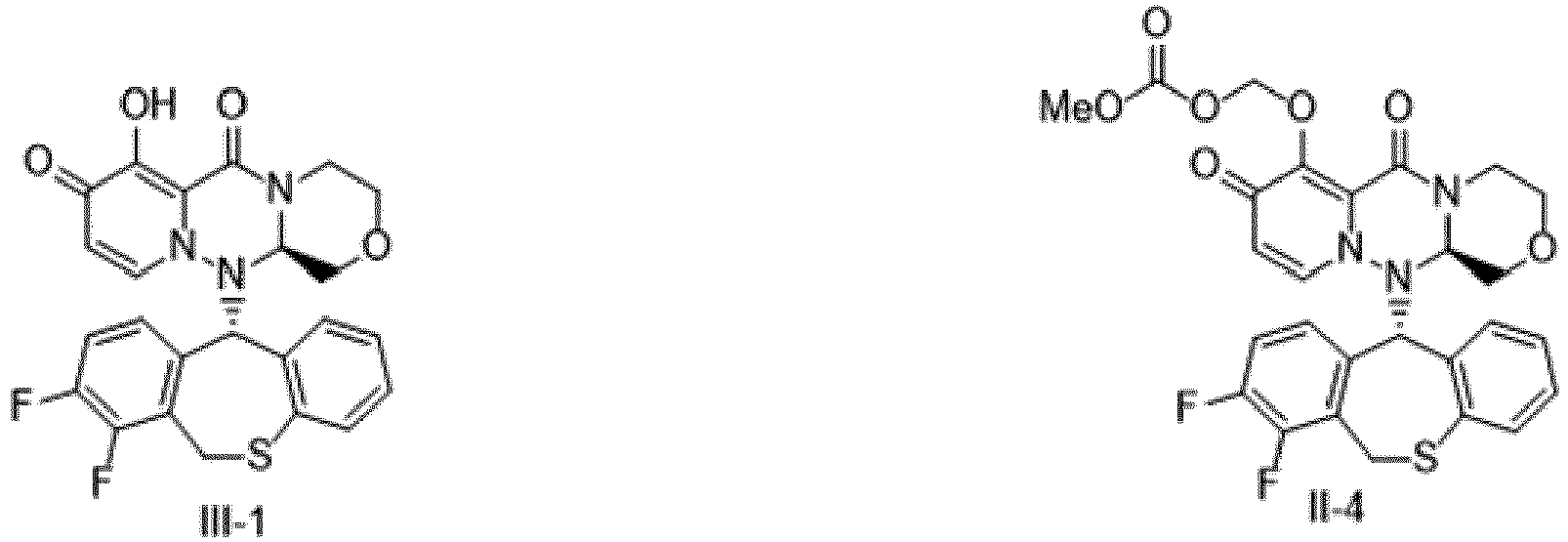
- (1) A medicament comprising (A) and (B), wherein (A) is a compound selected from the below III-1 and II-4:
- (i) (B) is Oseltamivir, and the medicament is for use in the treatment or prevention of influenza strain A/WSN/33 (H1N1), A/PR/8/34 (H1N1), A/Victoria/3/75 (H3N2) or A/HongKong/8/68 (H3N2); or
- (ii) (B) is Peramivir, Laninamivir or Zanamivir, and the medicament is for use in the treatment or prevention of influenza strain A/PR/8/34 (H1N1); or
- (iii) (B) is VX-787, and the medicament is for use in the treatment or prevention of influenza strain A/PR/8/34 (H1N1).
- (2) A compound (A) represented by the formula III-1 or II-4:

- (i) for use in the treatment or prevention of influenza strain A/WSN/33 (H1N1), A/PR/8/34 (H1N1), A/Victoria/3/75 (H3N2) or A/HongKong/8/68 (H3N2), wherein (A) is used together with a compound (B) which is Oseltamivir; or
- (ii) for use in the treatment or prevention of influenza strain A/PR/8/34 (H1N1), wherein (A) is used together with a compound (B) which is Peramivir, Laninamivir or Zanamivir; or
- (iii) for use in the treatment or prevention of influenza strain A/PR/8/34 (H1N1), wherein (A) is used together with a compound (B) which is VX-787.
- (3) The compound for use according to
claim 2, wherein (A) and (B) are formulated as a combination drug. - The medicament of the present invention is useful as a treatment and/or prevention of particular strains in an influenza infection.
-
- [
Figure 1] Figure 1 is a result of measuring the plasma concentration of Compound III-1, after oral administration of prodrug Compound II-4, the parent compound of which is Compound III-1, to rat under non-fasting conditions. - [
Figure 2] Figure 2 is a result of measuring the plasma concentration of Compound II-4, after oral administration of prodrug Compound II-4, the parent compound of which is Compound III-1, to rat under non-fasting conditions. - The meaning of each term used in the present description is explained below. Each term is used in a unified sense, and is used in the same sense when used alone, or when used in combination of other term
- The term of "consisting of" means having only components.
- The term of "comprising" means not restricting with components and not excluding undescribed factors.
- The present invention is a medicament as set out in the appended
claim 1, comprising (A) and (B), and a compound (A) used together with (B) as set out in the appendedclaim 2. - (A) is represented by the formula:

- (B) is a "compound having an anti-influenza activity" and is selected from Oseltamivir, Zanamivir, Peramivir, Laninamivir, and VX-787.
- The route of administration of the medicament of the present invention can be administered by either oral or parenteral methods and is not particularly limited to them.
- In the case of oral administration, it can be administered by the usual manner in the form of solid preparations for internal use (e.g., tablets, powders, granules, capsules, pills, films), internal solutions (e.g., suspensions, emulsions, elixirs, syrups, limonade agents, alcoholic agents, fragrance solutions, extracts, decoctions, tinctures), and the like. The tablet may be sugar-coated tablets, film-coated tablets, enteric coated tablets, extended release tablets, troches, sublingual tablets, buccal tablets, chewable tablets or orally disintegrating tablets. The powders and granules may be dry syrups. The capsule may be soft capsule, microcapsules or sustained release capsules.
- In the case of parenteral administration, any forms of injections, drops, external preparations (e.g., eye drops, nasal drops, ear drops, aerosols, inhalants, lotions, infusions, coating agents, gargles, enemas, ointments, plasters, jellies, creams, patches, cataplasms, external powders, suppositories) which are usually used can be suitably administered. The injection may be emulsions such as O/W, W/O, O/W/O or W/O/W type.
- The effective amount of the compound used in the medicament of the present invention are mixed as necessary with various pharmaceutical additives such as excipients, binders, disintegrants, and/or lubricants suitable for the dosage form to give the pharmaceutical composition. Furthermore, the pharmaceutical composition can be used for children, the elderly, serious patients or surgery, by appropriately changing the effective amount of the compound used in the medicament of the present invention, the dosage form and/or various pharmaceutical additives. The pediatric pharmaceutical composition is preferably administered to patients aged under 12 years old or 15 years old. The pediatric pharmaceutical composition can also be administered to patients less than 27 days after birth, 28 days to 23 months after birth, 2 years old to 11 years old, 12 years old to 16 or 18 years old. The pharmaceutical composition for the elderly is preferably administered to patients over 65 years old.
- The dose of the medicament of the present invention can be appropriately selected on the basis of the clinically used dosage. The mixing ratio of (A) and (B) can be appropriately selected depending on the administration subject, administration route, target disease, symptom, combination, and the like. For example, when the subject to be administered is a human, 0.01 to 400 parts by weight of (B) may be used per 1 part by weight of (A).
- The medicament of the present invention is useful for symptoms and/or diseases induced by influenza virus. It is effective for the treatment, prevention and/or improvement of symptoms such as cold-like symptoms accompanied by fever, chills, headache, muscle pain, and/or general malaise, airway inflammation symptoms such as sore throat, nasal discharge, nasal congestion, cough, and/or sputum, gastrointestinal symptoms such as abdominal pain, vomiting, and/or diarrhea, and secondary infection such as acute encephalopathy and/or pneumonia.
- The NMR analysis obtained compounds was carried out in 300 MHz, and was measured using DMSO-d6, CDCl3.
- The term RT represents a retention time at LC/MS: liquid chromatography/mass spectrometry, and was measured under the following conditions.
-
- (1) Column: ACQUITY UPLC (Registered trademark) BEH C18 (1.7pm i.d.2.1x50mm) (Waters)
- Flow rate: 0.8 mL/min
- UV detection wavelength: 254nm
- Mobile phase: [A]: a 0.1% formic acid-containing aqueous solution, [B]: a 0.1% formic acid-containing acetonitrile solution
- Gradient: a linear gradient of 5% to 100% solvent [B] was carried out in 3.5 minutes, and 100% solvent [B] was kept for 0.5 minutes.
- (2) Column: Shim-pack XR-ODS (2.2µm, i.d.50x3.0mm) (Shimadzu)
- Flow rate: 1.6 mL/min
- UV detection wavelength: 254nm
- Mobile phase: [A]: a 0.1% formic acid-containing aqueous solution, [B]: a 0.1% formic acid-containing acetonitrile solution
- Gradient: a linear gradient of 10% to 100% solvent [B] was carried out in 3 minutes, and 100% solvent [B] was kept for 0.5 minutes.
- (3) Column: ACQUITY UPLC (Registered trademark) BEH C18 (1.7pm i.d.2.1x50mm) (Waters)
- Flow rate: 0.8 mL/min
- UV detection wavelength: 254nm
- Mobile phase: [A]: a 10mM ammonium carbonate-containing aqueous solution, [B]: a acetonitrile solution
- Gradient: a linear gradient of 5% to 100% solvent [B] was carried out in 3.5 minutes, and 100% solvent [B] was kept for 0.5 minutes.
-

- To a solution of Compound 1 (5.0 g, 49.5 mmol) in THF (100 mL) was added dropwise 1.62mol/L n-butyllithium in hexane (30.5 mL, 49.5 mmol) at -78°C under a nitrogen atmosphere, and the mixture was stirred at -78°C for 2 hours. A solution of chloroformate allyl (5.96 g, 49.5 mmol) in THF (20 mL) was added dropwise thereto, and the mixture was stirred at -78°C for 2 hours. The mixture was quenched with a saturated aqueous solution of ammonium chloride, warmed up to room temperature, and extracted with ethyl acetate. The obtained organic layer was washed with brine, dried over anhydrous magnesium sulfate, and concentrated under reduced pressure to obtain Compound 2 (5.66 g, 62%).
1H·NMR(CDCl3)δ:3.83 (t, J = 8.0Hz, 2H), 3.92 (t, J = 8.0Hz, 2H), 4.26 (s, 2H), 4.78 (d, J = 8.0Hz, 2H), 5.30 (d, J = 12.0Hz, 1H), 5.44 (d, J = 16.0Hz, 1H), 5.93-6.03 (m, 1H), Second step - To a solution of Compound 2 (6.6 g, 35.6 mmol) in THF (66 mL) was added dropwise 1.03mol/L DIBAL-H in hexane (45.0 mL, 46.3 mmol), and the mixture was stirred at -78°C for 1 hour. The mixture was quenched with acetone, an aqueous solution of Rochelle salt was added thereto. The mixture was stirred, and extracted with ethyl acetate. The obtained organic layer was washed with brine, dried over anhydrous magnesium sulfate, and concentrated under reduced pressure to obtain Compound 3 (6.21 g, 93%).
1H-NMR(CDCl3)δ:3.44 (br, 1H), 3.50-3.64 (m, 2H), 3.71 (br, 1H), 3.95 (d, J = 8.0Hz, 2H), 4.64 (d, J = 8.0Hz, 2H), 5.24 (d, J = 12.0Hz, 1H), 5.40 (d, J = 16.0Hz, 1H), 5.47 (d, J = 4Hz, 1H), 5.87-6.00 (m, 1H) - To a solution of Compound 3 (6.2 g, 33.1 mmol) in methanol (65 mL) was added p-Toluenesulfonic acid monohydrate (0.63 g, 3.31 mmol), and the mixture was stirred at room temperature over night. The mixture was quenched with an aqueous solution of sodium hydrogen carbonate, concentrated, and extracted with ethyl acetate. The obtained organic layer was washed with brine, dried over anhydrous magnesium sulfate, and concentrated under reduced pressure to obtain Compound 4 (5.77 g, 87%).
1H-NMR(CDCl3)δ:3.34 (s, 3H), 3.55 (br, 2H), 3.73-3.99 (m, 3H), 4.64 (d, J = 8.0Hz, 2H), 5.10-5.20 (m, 1H), 5.25 (d, J = 8.0Hz, 1H), 5.33 (d, J = 16Hz, 1H), 5.88-6.05 (m, 1H) - To a solution of Compound 5 (20.0 g, 81 mmol) in DMF (100 mL) were added ethyl iodide (22.8 g, 146 mmol) and diazabicycloundecene (18.4 mL, 122 mmol), and the mixture was stirred at room temperature over night. The mixture was poured into 10% aqueous solution of ammonium chloride, and extracted with ethyl acetate. The obtained organic layer was washed with brine, dried over anhydrous magnesium sulfate, and concentrated under reduced pressure to obtain Compound 6 (22.3 g, 100%).
1H-NMR(CDCl3)δ:1.23 (t, J = 8.0Hz, 3H), 4.28 (q, J = 8.0Hz, 2H), 5.16 (s, 2H), 6.57 (d, J = 4.0Hz, 1H), 7.28-7.48 (m, 5H), 8.21 (d, J = 4.0Hz, 1H). - To a solution of Compound 6 (500 mg, 1.82 mmol) in DMA (5.0 mL) were added pyridinium p-toluenesulfonate (1.37 g, 5.47 mmol) and Boc-hydrazine (361 mg, 2.74 mmol), and the mixture was stirred at 60°C for 14 hours. To the mixture was added water and the mixture was extracted with ethyl acetate. The obtained organic layer was washed with a saturated aqueous solution of ammonium chloride and brine, dried over anhydrous magnesium sulfate, and concentrated under reduced pressure. The obtained residue was purified by silica gel column chromatography (chloroform-methanol) to obtain Compound 7 (519 mg, 73%).
1H-NMR(CDCl3)δ:1.24 (t, J = 8.0Hz, 3H), 1.46 (s, 9H), 4.26 (q, J = 8.0Hz, 2H), 5.28 (s, 2H), 6.40 (d, J = 8.0Hz, 1H), 7.27-7.38 (m, 4H), 7.40-7.45 (m, 2H). - Compound 7 (500 mg, 1.29 mmol) was dissolved in 4mol/L hydrogen chloride in ethyl acetate (5 mL), and the mixture was stirred at room temperature for 1 hour. The mixture was concentrated under reduced pressure. To the obtained residue was added a saturated aqueous solution of sodium hydrogen carbonate, and the mixture was extracted with dichloromethane. The obtained organic layer was washed with brine, dried over anhydrous magnesium sulfate, and concentrated under reduced pressure to obtain Compound 8 (369 mg, 99%).
1H-NMR(CDCl3)δ:1.26 (t, J = 8.0Hz, 3H), 4.31 (q, J = 8.0Hz, 2H), 5.24 (s, 2H), 6.47 (d, J = 8.0, 1H), 7.28-7.44 (m, 5H), 7.64 (d, J = 8.0, 1H). - To a solution of Compound 8 (365 mg, 1.27 mmol) and Compound 4 (306 mg, 1.52 mmol) in acetonitrile (8 mL) was added dropwise tin chloride (0.223 mL, 1.90 mmol) at -25°C under a nitrogen atmosphere, and the mixture was stirred at -25°C for 45 minutes. The mixture was quenched with a saturated aqueous solution of sodium hydrogen carbonate, and dichloromethane was added thereto. The mixture was stirred at room temperature and filtered through Celite, and filtrate was extracted with dichloromethane. The obtained organic layer was washed with brine, dried over anhydrous magnesium sulfate, and concentrated under reduced pressure to obtain crude Compound 9. The obtained Compound 9 was dissolved in THF (8 mL), morpholine (1.10 mL, 12.7 mmol) and tetrakis(triphenylphosphine)palladium (146 mg, 0.127 mmol) were added thereto, and the mixture was stirred at room temperature for 2 hours. To the mixture was added diethyl ether (16 mL), and the precipitated solid was filtered and dried to obtain Compound 10 (418 mg, 100%). 1H-NMR(CDCl3)δ:2.90-2.99 (m, 1H), 3.13 (t, J = 12.0Hz, 1H), 3.40-3.46 (m, 1H), 4.00-4.08 (m, 1H), 4.14 (d, J = 12.0Hz, 1H), 5.07 (s, 2H), 6.22 (d, J = 8.0Hz, 1H), 7.29-7.40 (m, 3H), 7.56 (d, J = 8.0Hz, 2H), 7.71 (d, J = 8.0Hz, 1H)
- To a suspension of (R)-2-Tetrahydrofurioic Acid (855 mg, 7.36 mmol) and Compound 10 (2.00 g, 6.11 mmol) in ethyl acetate (9 ml) were added pyridine (4.00 ml, 49.6 mmol) and T3P (50% in ethyl acetate, 11.0 ml, 18.5 mmol) at room temperature, and the mixture was stirred over night. The precipitated solid was filtered and washed with ethyl acetate (4 ml) and ethanol (4 ml). The obtained solid was suspended in ethanol (6 ml) and the suspension was stirred at room temperature for 6.5 hours. The suspension was filtered and the obtained solid was washed with ethanol (2 ml) twice to obtain Compound 11 (1.18 g, 45.4%).
1H-NMR (DMSO)5: 1.80-1.94(m, 2H), 1.95-2.14(m, 2H), 3.21-3.35-(m, 2H), 3.50-3.60(m, 1H), 3.70-3.82(m, 3H), 4.00-4.05(m, 1H), 4.32-4.38(m, 1H), 5.14(dd, J=10.8Hz, 21.6Hz, 2H), 5.76-5.81(m, 1H), 6.29(d; J=4.8Hz, 1H), 7.28-7.39(m, 3H), 7.48-7.54(m, 2H), 7.64-7.75(m, 1H) - To a suspension of Compound 11 (500 mg, 1.18 mmol) in ethanol (3.5 ml) was added DBU (0.0035 ml, 0.023 mmol) at room temperature, and the mixture was stirred for 30 minutes. To the obtained suspension was added diisopropylether (6.5ml), and the mixture was stirred at room temperature for 30 minutes. The precipitated solid was filtered and washed with ethyl acetate (1.5 ml) twice to obtain Compound i1 (346 mg, 89.9%).
1H-NMR (DMSO)5: 2.80-3.00(m, 1H), 3.10-3.18(m, 1H), 3.38-3.50(m, 1H), 3.98-4.08(m, 2H), 4.10-4.20(m, 1H), 4.76-4.84(m, 1H), 5.04-5.14(m, 2H), 6.22(m, J=7.6Hz, 1H), 7.27-7.40(m, 4H), 7.56-7.60(m, 2H), 7.70(d, J=7.6Hz, 1H) -

- To a suspension of Compound 13 (8.0 g, 50.8 mmol) in dichloromethane (120 mL) was added triethylamine (17.6mL, 127mmol) under ice-water bath, and allyl chloroformate (6.44mL, 60.9mmol) was added dropwise thereto, and the mixture was stirred at 0°C for 1 hour. To the mixture was added water, and the mixture was extracted with dichloromethane. The obtained organic layer was washed with 5% aqueous solution of citric acid and a saturated aqueous solution of sodium hydrogen carbonate, dried over anhydrous magnesium sulfate, and concentrated under reduced pressure to obtain Compound 14 (10.1 g, 97%).
1H-NMR (CDCl3)δ:1.96 (br, 4H), 3.62 (s, 4H), 4.60 (s, 2H), 5.22 (d, J = 12.0Hz, 1H), 5.30 (d, J = 16.0Hz, 1H), 5.86-5.99 (m, 1H) - To a solution of Compound 14 (0.9 g, 4.39 mmol), potassium carbonate (60 mg, 0.44 mmol) and tetraethylammonium -perchlorate (50 mg, 0.22 mmol) in methanol (30 mL) were immersed carbon electrode (anode) and platinum electrode (cathode), and the mixture was flushed with a constant current of 0.1A with stirring at room temperature for 6 hours. To the mixture were added ethyl acetate and water, and the mixture was extracted with ethyl acetate. The obtained organic layer was dried over anhydrous magnesium sulfate, and concentrated under reduced pressure to obtain Compound 15 (992 mg, 96%).
1H-NMR (CDCl3)δ:1.81-2.15 (m, 3H), 2.39 (t, J = 12.0Hz, 1H), 3.27 (s, 3H), 3.61 (s, 1H), 4.11 (br, 1H), 4.61 (br, 2H), 5.20-5.36 (m, 2H), 5.57 (br, 1H), 5.88-5.99 (m, 1H) Third step - Compound 16 was obtained in the same manner as in the seventh and eighth steps in reference example 1.
- The optical resolution of Compound 16 (870 mg, 2.41 mmol) by Waters SFC30 System (Daicel CHIRALPAK IB, liquefied carbon dioxide-methanol) gave Compound i2 (270mg, 31%).
-
- Column: CHIRALPAK IB/SFC (5pm, i.d.250x4.6mm) (DAICEL)
- Flow rate: 8.0 mL/min; UV detection wavelength: 254nm
- Back pressure: 100 bar
- Mobile phase: [A]: liquefied carbon dioxide, [B]: methanol
- Gradient: 5% solvent [B] was kept for 1 minute, a linear gradient of 5% to 40% solvent [B] was carried out in 6 minutes, 40% solvent [B] was kept for 2 minutes, and 5% solvent [B] was kept for 1 minute.
- Elution time: 7.3 minutes
-

- To a solution of Compound 17 (4.00 g, 16.3 mmol) in dichloromethane (40mL) were added oxalyl dichloride (1.56 mL, 17.9 mmol) and DMF (0.013 mL, 0.162 mmol) under iced-bath, and the mixture was warmed up to room temperature and stirred for 5 hours. The mixture was concentrated under reduced pressure, and the obtained residue was dissolved in dichloromethane (40 mL), 2,2,2-trifluoroethanol (2.44 g, 24.4 mmol), triethylamine (4.50 mL, 32.5 mmol) and 4-(dimethylamino)pyridine (99.0 mg, 0.812 mmol) were added thereto under iced-bath, and the mixture was warmed up to room temperature and stirred for 1 hour. The mixture was concentrated under reduced pressure and to the obtained residue was added 1mol/L aqueous solution of hydrochloric acid, and the mixture was extracted with ethyl acetate. The obtained organic layer was washed with 1mol/L aqueous solution of hydrochloric acid and brine, dried over anhydrous magnesium sulfate to obtain Compound 18 (5.33 g, 100%).
1H-NMR (CDCl3)δ: 4.64 (q, J = 8.2 Hz, 2H), 5.38 (s, 2H), 6.49 (d, J = 5.6 Hz, 1H), 7.30-7.38 (m, 3H), 7.43-7.49 (m, 2H), 7.75 (d, J = 5.6 Hz, 1H). - Compound 20 was obtained in the same manner as in the fifth and sixth steps in reference example 1.
1H-NMR (CDCl3)δ: 4.55 (q, J = 8.3 Hz, 2H), 5.18 (s, 2H), 5.29 (s, 2H), 6.37 (d, J = 7.8 Hz, 1H), 7.30-7.42 (m, 6H). - Compound 23 was obtained in the same manner as in the seventh step in reference example 1.
LC/MS (ESI):m/z = 342.1 [M+H]+ , RT=1.00,1.09 min, method (1) - To a solution of Compound 23 (820 mg, 2.40 mmol) in dichloromethane (16.5 mL) were added Boc2O (0.837 mL, 3.60 mmol), triethylamine (0.499 mL, 3.60 mmol) and 4-(dimethylamino)pyridine (44.0 mg, 0.360 mmol), and the mixture was stirred at room temperature for 3.5 hours. To the mixture was added 1mol/L aqueous solution of hydrochloric acid and the mixture was extracted with ethyl acetate. The obtained organic layer was washed with 1mol/L aqueous solution of hydrochloric acid and brine, dried over anhydrous sodium sulfate, and concentrated under reduced pressure. The obtained residue was purified by silica gel column chromatography (chloroform-methanol) to obtain Compound 24 (593 mg, 56%) and Compound i3 (170 mg, 16%).
Compound 24:LC/MS (ESI):m/z = 441.9 [M+H]+ , RT=1.67 min, method (1) - Compound 24 (547 mg, 1.24 mmol) was dissolved in acetic acid (5.5 mL) and the mixture was stirred at 80°C for 5 hours. The mixture was concentrated under reduced pressure and the obtained residue was purified by silica gel column chromatography (chloroform-methanol) to obtain Compound i3 (454 mg, 100%). 1H-NMR (CDCl3)δ: 1.46 (d, J = 6.4 Hz, 3H), 3.45 (dd, J = 10.5, 10.5 Hz, 1H), 3.55 (dd, J = 11.7, 4.3 Hz, 1H), 3.92 (dd, J = 11.7, 3.6 Hz, 1H), 3.95-4.01 (m, 2H), 4.76 (dq, J = 13.9, 4.3 Hz, 1H), 5.19 (d, J = 10.2 Hz, 1H), 5.22 (d, J = 10.2 Hz, 1H), 5.36 (d, J = 12.9 Hz, 1H), 6.28 (d, J = 7.8 Hz, 1H), 7.25 (d, J = 7.8 Hz, 1H), 7.28-7.36 (m, 3H), 7.56-7.61 (m, 2H).
-

- Compound i1 (1100 g, 3360 mmol) and 7,8-difluoro-6,11-dihydrodibenzothiepine-11-ol (977 g, 3697 mmol) were suspended in 50wt% T3P in ethyl acetate (3208 g, 5041 mmol) and ethyl acetate (1.1 L). To the mixture was added methanesulfonic acid (436 ml, 6721 mmol) at room temperature and the mixture was stirred at 70°C for 5.5 hours. To the mixture was added water under ice-water bath and the mixture was stirred at room temperature for 1 hour. THF was added thereto and the mixture was extracted with ethyl acetate. The obtained organic layer was washed with water and 8% aqueous solution of sodium hydrogen carbonate, dried over anhydrous sodium sulfate, and concentrated under reduced pressure. The obtained residue was dissolved in THF (5.5 L) and potassium carbonate (790 g, 5713 mmol) was added thereto. The mixture was warmed up to 50°C, benzyl bromide (240 ml, 2016 mmol) was added dropwise thereto, and the mixture was stirred at 60°C for 8.5 hours. To the mixture was added dropwise 2mol/L aqueous solution of hydrochloric acid under ice-water bath, and the mixture was stirred at room temperature for 10 minutes and extracted with ethyl acetate. The obtained organic layer was washed with water and 8% aqueous solution of sodium hydrogen carbonate and dried over anhydrous magnesium sulfate. An activated carbon (Norit SX-2, 240 g) was added thereto, the mixture was filtered through Celite, and the filtrate was concentrated under reduced pressure. To the obtained residue was added ethyl acetate and hexane and the precipitated solid was filtered to obtain Compound 25 (1019 g, 1776 mmol, 53%).
1H-NMR (CDCl3)δ: 2.88 (1H, t, J = 11.2 Hz), 3.28-3.39 (2H, m), 3.72 (1H, d, J = 12.6 Hz), 3.86 (1H, d, J = 9.6 Hz), 4.03 (1H, d, J = 13.9 Hz), 4.45 (1H, d, J = 8.6 Hz), 4.67 (1H, d, J = 13.1 Hz), 5.19-5.26 (2H, m), 5.45 (1H, d, J = 10.9 Hz), 5.63 (1H, d, J = 10.9 Hz), 5.77 (1H, d, J = 7.6 Hz), 6.40 (1H, d, J = 7.8 Hz), 6.68 (1H, t, J = 6.9 Hz), 6.94-7.01 (2H, m), 7.03-7.12 (3H, m), 7.29-7.38 (3H, m), 7.61 (2H, d, J = 7.1 Hz). - To a solution of Compound 25 (1200 g, 2092 mmol) in DMA (3.6 L) was added lithium chloride (443g, 10.5 mol) at room temperature, and the mixture was stirred at 80°C for 3 hours. To the mixture were added acetone (1.2L), 0.5mol/L aqueous solution of hydrochloric acid (6.0 L) and water (2.4 L) under ice-water bath, and the mixture was stirred for 1 hour. The precipitated solid was filtered. The obtained solid was dissolved in chloroform, isopropyl ether was added thereto, and the precipitated solid was filtered to obtain Compound III-1 (950 g, 1965 mmol, 94%). 1 H-NMR (CDCl3)δ: 2.99 (1H, dt, J = 17.5, 6.8 Hz), 3.47 (1H, td, J = 11.9, 2.5 Hz), 3.60 (1H, t, J = 10.6 Hz), 3.81 (1H, dd, J = 11.9, 3.3 Hz), 3.96 (1H, dd, J = 11.0, 2.9 Hz), 4.07 (1H, d, J = 13.8 Hz), 4.58 (1H, dd, J = 10.0, 2.9 Hz), 4.67 (1H, dd, J = 13.5, 1.9 Hz), 5.26-5.30 (2H, m), 5.75 (1H, d, J = 7.8 Hz), 6.69 (1H, d, J = 7.7 Hz), 6.83-6.87 (1H, m), 6.99-7.04 (2H, m), 7.07-7.15 (3H, m).
-

- To a suspention of Compound III-1 (1.00 g, 2.07 mmol) in DMA (5 ml) were added chloromethyl methyl carbonate (0.483 g, 3.10 mmol), potassium carbonate (0.572 g, 4.14 mmol) and potassium iodide (0.343 g, 2.07 mmol) and the mixture was stirred at 50°C for 6 hours. To the mixture was added DMA (1 ml) and the mixture was stirred for 6 hours. The mixture was cooled to room temperature, DMA (6 ml) was added thereto, and the mixture was stirred at 50°C for 5 minutes. The mixture was filtered. To the obtained filtrate were added 1mol/L aqueous solution of hydrochloric acid (10 ml) and water (4 ml) and the mixture was stirred for 1 hour. The presipitated solid was filtered and dried under reduced pressure at 60°C for 3 hours to obtain Compound II-4 (1.10g, 1.93 mmol, 93%).
1H-NMR (DMSO-D6) δ: 2.91-2.98 (1H, m), 3.24-3.31 (1H, m), 3.44 (1H, t, J = 10. 4 Hz), 3.69 (1H, dd, J = 11.5, 2.8 Hz), 3.73 (3H, s), 4.00 (1H, dd, J = 10.8, 2.9 Hz), 4.06 (1H, d, J = 14.3 Hz), 4.40 (1H, d, J = 11.8 Hz), 4.45 (1H, dd, J = 9.9, 2.9 Hz), 5.42 (1H, dd, J = 14.4, 1.8 Hz), 5.67 (1H, d, J = 6.5 Hz), 5.72-5.75 (3 H, m), 6.83-6.87 (1H, m), 7.01 (1H, d, J = 6.9 Hz), 7.09 (1H, dd, J = 8.0, 1.1 H z), 7.14-7.18 (1H, m), 7.23 (1H, d, J = 7.8 Hz), 7.37-7.44 (2H, m). - 30merRNA(5'-pp-[m2'-O]GAA UAU(-Cy3) GCA UCA CUA GUAAGC UUU GCU CUA-BHQ2-3': manufactured by Japan Bio Services Co., LTD.) in which G at a 5' end is diphosphate-modified, a hydroxy group at 2' position is methoxylation-modified, U sixth from a 5' end is labelled with Cy3, and a 3' end is labelled with BHQ2 was purchased, and a cap structure was added using ScriptCap system manufactured by EPICENTRE (a product was m7G [5'] ppp - [5'] [m2'-0]GAA UAU(-Cy3) GCA UCA CUA GUAAGC UUU GCU CUA(-BHQ2)-3'). This was separated and purified by denatured polyacrylamide gel electrophoresis, and used as a substrate.
- RNP was prepared from a virus particle using standard method (Reference Document: VIROLOGY(1976) 73, p327-338 OLGA M. ROCHOVANSKY). Specifically, A/WSN/33 virus (1 x 10³ PFU/mL, 200 µL) was inoculated in a 10 days old embryonated chicken egg. After incubation at 37°C for 2 days, the allantoic fluid of the chicken egg was recovered. A virus particle was purified by ultracentrifugation using 20% sucrose, solubilized using TritonX-100 and lysolecithin, and an RNP fraction (50-70% glycerol fraction) was collected by ultracentrifugation using a 30-70% glycerol density gradient, and was used as an enzyme solution (containing approximately 1 nM PB1·PB2·PA complex).
- An enzymatic reaction solution (2.5 µL) (composition: 53 mM Tris-hydrochloride (pH 7.8), 1 mM MgCl2, 1.25 mM dithiothreitol, 80 mM NaCl, 12.5% glycerol, enzyme solution 0.15 µL) was dispensed into a 384·well plate made of polypropylene. Then, 0.5 µL of a test compound solution which had been serially diluted with dimethyl sulfoxide (DMSO) was added to the plate. As a positive control (PC) or a negative control (NC), 0.5 µL of DMSO was added to the plate respectively. Each plate was mixed well. Then, 2 µL of a substrate solution (1.4 nM substrate RNA, 0.05% Tween20) was added to initiate a reaction. After room temperature incubation for 60 minutes, 1 µL of the reaction solution was collected and added to 10 µL of a Hi-Di formamide solution (containing GeneScan 120 Liz Size Standard as a sizing marker: manufactured by Applied Biosystems (ABI)) in order to stop the reaction. For NC, the reaction was stopped in advance by adding EDTA (4.5 mM) before initiation of the reaction (all concentrations described above are final concentrations).
- The solution for which the reaction was stopped was heated at 85°C for 5 minutes, rapidly cooled on ice for 2 minutes, and analyzed with an ABI PRIZM 3730 genetic analyzer. A peak of the cap-dependent endonuclease product was quantitated by analysis software ABI Genemapper, a CEN reaction inhibition ratio (%) of a test compound was obtained by setting fluorescent intensities of PC and NC to be 0% inhibition and 100% inhibition, respectively, an IC50 value was obtained using curve fitting software (XLfit2.0: Model 205 (manufactured by IDBS) etc.).
-
- 2% FCS E-MEM (prepared by adding kanamycin and FCS to MEM (Minimum Essential Medium) (Invitrogen))
- 0.5% BSA E-MEM (prepared by adding kanamycin and BSA to MEM (Minimum Essential Medium) (Invitrogen))
- HBSS (Hanks' Balanced Salt Solution)
- MDBK cell
- Cells were adjusted to the appropriate cell number (3 x 10⁵/mL) with 2% FCS E-MEM.
- MDCK cell
After washing with HBSS two times, cells were adjusted to the appropriate cell number (5 x 10⁵/mL) with 0.5% BSA E-MEM. - Trypsin solution
Trypsin from porcine pancreas (SIGMA) was dissolved in PBS(-), and filtrated with a 0.45 µm filter. - EnVision (PerkinElmer)
- WST-8 Kit (Kishida Chemical Co., Ltd.)
- 10% SDS solution
- As a culture medium, 2% FCS E-MEM was used at the use of MDBK cells, and 0.5% BSA E-MEM was used at the use of MDCK cells. Hereinafter, for diluting virus, cells and a test sample, the same culture medium was used.
- A test sample was diluted with a culture medium to an appropriate concentration in advance, and then 2 to 5-fold serial dilution on a 96 well plate (50 pL/well) was prepared. Two plates, one for measuring anti-Flu activity and the another for measuring cytotoxity, were prepared. Each assay was performed triplicate for each drug.
- At the use of MDCK cells, Trypsin was added to the cells to be a final concentration of 3 pg/mL only for measuring anti-Flu activity.
- An influenza virus was diluted with a culture medium to an appropriate concentration in advance, and each 50 pL/well was dispensed on a 96-well plate containing a test substance. Each 50 pL/well of a culture medium was dispensed on a plate containing a test substance for measuring cytotoxity.
- Each 100 pL/well of cells which had been adjusted to the appropriate cell number was dispensed on a 96 well plate containing a test sample.
- This was mixed with a plate mixer, and incubated in a CO2 incubator for 3 days for measuring anti-Flu activity and measuring cytotoxity.
- The cells in the 96-well plate which had been incubated for 3 days was observed visually under a microscope, and appearance of the cells, the presence or absence of a crystal of test substance were checked. The supernatant was removed so that the cells were not absorbed from the plate.
- WST-8 Kit was diluted 10-fold with a culture medium, and each 100 µL was dispensed into each well. After mixing with a plate mixer, cells were incubated in a CO2 incubator for 1 to 3 hours.
- After incubation, regarding the plate for measuring anti-Flu activity, each 10 pL/well of a 10% SDS solution was dispensed in order to inactivate a virus.
- After the 96-well plate was mixed, absorbance was measured with EnVision at two wavelengths of 450 nm/620 nm.
- The value was calculated using Microsoft Excel or a program having the equivalent calculation and processing ability, based on the following calculation equation.
- EC50 = 10Z

- For the compound (III·1)" measurement results of Test Example 1 and Test Example 2 were:
- CEN_IC50 (nM) = 1.93
- CPE_EC50 (nM) = 1.13.
- According to the method described in Test Example 1, the results of measuring the CEN inhibitory activity of the parent compound as a racemate described in
Patent Document 2 are as follows. "Bold line" and "dashed line" in the table indicate relative stereo and the following compounds are racemic.[Table 28] Structure CEN_IC50 nM Structure CEN_IC50 nM Structure CEN_IC50 nM 
25.5 
19.7 
28.1 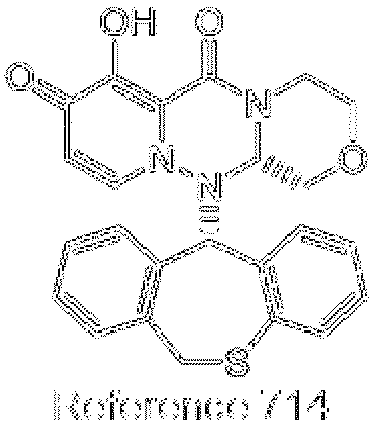
95.0 
104 
43.4 - Based on the above test results, the parent compound of the compound represented by the formula (III-1) has high cap-dependent endonuclease (CEN) inhibitory activity and/or high CPE inhibitory effect, and can be a useful medicine as a therapeutic and/or prophylactic agent for symptoms and/or diseases induced by infection with influenza virus.
- Trypsin from porcine pancreas (SIGMA) was dissolved in PBS(-), and filtrated with a 0.45 µm filter.
- 0.5% BSA MEM (prepared by adding kanamycin and BSA to MEM (Minimum Essential Medium) (Invitrogen))
- MDCK cell
- Cells were adjusted to the appropriate cell number (7.5 x 10⁵ cells/mL) with 0.5% BSA MEM
- EnVision (PerkinElmer)
- WST-8 Kit (Kishida Chemical Co., Ltd.)
- 10% SDS solution
- One day prior to infection, 80 µL of cell suspensions which had been adjusted to the appropriate cell number was dispensed to each well on a 96 well plate. The plates were incubated at 37°C in a CO2 incubator.
- An influenza virus was diluted with 0.5% BSA MEM to an appropriate concentration, and 20 µL of virus dilution was dispensed to each wells on the plates (MOI=0.003). In order to attach the virus to cells, the plates were incubated at 37°C in a CO2 incubator for 1 hour.
- A test sample was diluted with 0.5% BSA MEM containing 6 µg/mL trypsin to an appropriate concentration, and serial dilutions were prepared. After the viral attachment, the supernatants were removed and the cells were washed once to remove uninfected viruses. Fifty µL of 0.5% BSA MEM was added to each well on the plates. For each substance alone, 50 µL of the substance solutions were added to each well on the plates. For use in combination, 25 µL of the each substance solutions were added to each well on the plates. These plates were incubated at 37°C in a CO2 incubator for 2 or 3 days.
- The cells in the plates which had been incubated for 2 or 3 days were observed visually under a microscope, and appearance of the cells, the presence or absence of a crystal of test substance were checked. The supernatant was removed so that the cells were not absorbed from the plate.
- Hundred µL of MEM and 10 µL of WST-8 reagent were added to each well on the plates. After mixing with a plate mixer, the plates were incubated in a CO2 incubator for 1 to 3 hours. After incubation, 10 µL of 10% SDS solution was dispensed to each well on the plates in order to inactivate the viral infectivity.
- After the plates were mixed, absorbance was measured by EnVision using an absorption wavelength of 450 nm and 620 nm.
- The % of inhibition against influenza virus replication was calculated by the following formula.

- X: the average of O.D. (O.D. at 450 nm - O.D. at 620 nm) of substance
- Y: the average of O.D. (O.D. at 450 nm - O.D. at 620 nm) of cell control
- Z: the average of O.D. (O.D. at 450 nm - O.D. at 620 nm) of virus control
- The EC50 of each substance was calculated by using software XLfit 5.3.1.3.
- CIs under the condition that both substances were added at the closest ratio of each EC50 value were calculated by the following formula.

- DA: the EC50 of substance A alone
- DB: the EC50 of substance B alone
- DA/A + B: the concentration of substance A giving 50% inhibition in combination w ith substance B
- DB/A + B: the concentration of substance B giving 50% inhibition in combination w ith substance A
- Combination effects were analyzed according to the report from Naruto Taira (Ac ta Med. Okayama, 2006 vol. 60, p25-34).
- CI ≤ 0.8 : synergy
- 0.8 < CI < 1.2 : additive
- 1.2 ≤ CI : antagonism
- The
EC 50 values of each single agent are shown in Table 29. Also, the CI values are shown in Table 30 in cases where the compound III-1 and the compound or antibody having an anti-influenza activity are used in combination at a ratio corresponding to the ratio of the EC50 values for each single agent..[Table 29] Virus EC50 (nM) III-1 Oseltamivir Peramivir Laninamivir Zanamivir Favipiravir A/WSN/33 (H1N1) 2.85 59314.51 A/PR/8/34 (H1N1) 4.95 1829.67 213.77 212.74 1565.38 26919.33 A/Victoria/3/75 (H3N2) 3.48 244.62 A/HongKong/8/68 (H3N2) 2.08 71.19 B/Maryland/1/59 14.70 863.72 353.88 109.81 162.60 Virus EC50 (nM) EC50 (µg/mL) VX-787 Amantadine Rimantadine Tizoxanide anti HA antibody A/WSN/33 (H1N1) A/PR/8/34 (H1N1) 9.38 2.00 A/Victoria/3/75 (H3N2) 2511.43 158.44 8314.73 A/HongKong/8/68 (H3N2) B/Maryland/1/59 [Table 30] V irus CI value III-1 +Oseltamivir III-1 +Peramivir III-1 +Laninamivir III-1 +Zanamivir III-1 +Favipiravir A/WSN/33 (H1N1) 0.38 A/PR/8/34 (H1N1) 0.53 0.59 0.58 0.52 0.99 A/Victona/3/75 (H3N2) 0.31 A/HongKong/8/68 (H3N2) 0.45 B/Maryland/1/59 0.86 0.94 1.06 0.91 V irus CI value III-1 +VX-787 III-1 +Amantadine III-1 +Rimantadine III-1 +Tizoxanide III-1 +anti HA antibody A/WSN/33 (H1N1) A/PR/8/34 (H1N1) 0.61 0.84 A/Victona/3/75 (H3N2) 0.82 0.80 0.87 A/HongKong/8/68 (H3N2) B/Maryland/1/59 - Based on the above test results, it was found that combination administrations of the compound (No. 111-1) and the neuraminidase inhibitor (Oseltamivir, peramivir, Laninaminivir and Zanamivir), and the compound (No. III-1) and the PB2 Cap binding inhibitor (VX-787) were exhibited superior synergistic proliferation inhibitory effect on influenza virus A as compared with each single agent administration. Based on this fact, it has been found combinations exhibited superior synergistic proliferation inhibitory effect on influenza virus A.
- Also, it was found that combination administrations of the compound (No. III-1) with the RNA-dependent RNA polymerase inhibitor (Favipiravir), the M2 protein inhibitor (Amantadine and Rimantadine), the HA maturation inhibitor (Tizoxanide) and the anti-HA antibody were exhibited additive proliferation inhibitory effect on influenza virus A without antagonistic effect as compared with each single agent administration. Therefore, it has been found combinations exhibited additive proliferation inhibitory effect on influenza virus A.
- In addition, it was found that combination administration of the compound (No. III-1) and the neuraminidase inhibitor (Oseltamivir, peramivir, Laninaminivir and Zanamivir) was exhibited additive proliferation inhibitory effect on influenza virus B without antagonistic effect as compared with each single agent administration. Therefore, it has been found combinations exhibited additive proliferation inhibitory effect on influenza virus B.
-
- (1) Experimental animals: mice or SD rats were used.
- (2) Rearing condition: mice or SD rats were allowed free access to solid feed and sterilized tap water.
- (3) Setting of dosage and grouping: Oral administration and intravenous administration were performed with the predetermined dosage. Grouping was set as below. (Dosage was changed per compound)
-
Oral administration 1 to 30 mg/kg (n= 2 to 3) - Intravenous administration 0.5 to 10 mg/kg (n= 2 to 3)
-
- (4) Preparation of administration solutions: Oral administration was performed as solution or suspension. Intravenous administration was performed after solubilization.
- (5) Routes of administration: Oral administration was performed mandatory into the stomach by oral sonde. Intravenous administration was performed from caudal vein by syringes with needle.
- (6) Evaluation items: Blood was collected serially and concentration of a compound of the present invention in plasma was measured by LC/MS/MS.
- (7) Statistical analysis: About transition of concentration of a compound of the present invention in plasma, the area under the plasma concentration versus time curve (AUC) was calculated by non-linear least-squares method program, WinNonlin (a registered trademark), and bioavailability (BA) of a compound of the present invention was calculated from AUCs of the oral administration group and the intravenous administration group.
-
Figure 1 shows a result of measuring the plasma concentration of Compound III- 1 after oral administration of prodrug Compound II-4, the parent compound of whch is Compound III- 1 in (A), to rat under non-fasting conditions. -
Figure 2 shows a result of measuring the plasma concentration of Compound II-4 after oral administration of prodrug Compound II-4, the parent compound of whch is Compound III- 1 in (A), to rat under non-fasting conditions. - The concentration of Compound II-4 in all plasma samples was a determination limit or less. Therefore, prodrug Compound II-4, the parent compound of which is Compound III- 1, is found to have changed promptly to Compound III-1 in vivo after administration (see
Figure 2 ). - Based on the above test results, it was revealed that the prodrug compound of the compound represented by the formula (III-1) in (A) was absorbed into the body after oral administration, and rapidly converted into a parent compound in the blood. Therefore, the prodrug compound of the compound represented by the formula (III-1) in (A) can be a useful agent for treatment and/or prevention of symptom and/or disease induced by infection with influenza virus.
- Based on the above test results, the medicament of the present invention can be a useful agent for treatment and/or prevention of symptom and/or disease induced by infection with influenza virus.
- The following Formulation Examples are only exemplified and not intended to limit the scope of the invention.
- The compound represented by the formula (III-1), a compound having an anti-influenza activity, lactose and calcium stearate are mixed. The mixture is crushed, granulated and dried to give a suitable size of granules. Next, calcium stearate is added to the granules, and the mixture is compressed and molded to give tablets.
- The compound represented by the formula (III-1), a compound having an anti-influenza activity, lactose and calcium stearate are mixed uniformly to obtain powder medicines in the form of powders or fine granules. The powder medicines are filled into capsule containers to give capsules.
- The compound represented by the formula (III-1), a compound having an anti-influenza activity, lactose and calcium stearate are mixed uniformly and the mixture is compressed and molded. Then, it is crushed, granulated and sieved to give suitable sizes of granules.
- The compound represented by the formula (III-1), a compound having an anti-influenza activity and crystalline cellulose are mixed, granulated and tablets are made to give orally disintegrated tablets.
- The compound represented by the formula (III-1), a compound having an anti-influenza activity and lactose are mixed, crushed, granulated and sieved to give suitable sizes of dry syrups.
- The compound represented by the formula (III-1), a compound having an anti-influenza activity and phosphate buffer are mixed to give injection.
- The compound represented by the formula (III-1), a compound having an anti-influenza activity and phosphate buffer are mixed to give injection.
- The compound represented by the formula (III-1), a compound having an anti-influenza activity and lactose are mixed and crushed finely to give inhalations.
- The compound represented by the formula (III-1), a compound having an anti-influenza activity and petrolatum are mixed to give ointments.
- The compound represented by the formula (III-1), a compound having an anti-influenza activity and base such as adhesive plaster or the like are mixed to give patches.
- The medicament of the present invention can be a medicine useful as a therapeutic and/or prophylactic agent for symptoms and/or diseases induced by infection with influenza virus.
Claims (3)
- A medicament comprising (A) and (B), wherein (A) is a compound selected from the below III-1 and II-4:
 (i) (B) is Oseltamivir, and the medicament is for use in the treatment or prevention of influenza strain A/WSN/33 (H1N1), A/PR/8/34 (H1N1), A/Victoria/3/75 (H3N2) or A/HongKong/8/68 (H3N2); or(ii) (B) is Peramivir, Laninamivir or Zanamivir, and the medicament is for use in the treatment or prevention of influenza strain A/PR/8/34 (H1N1); or(iii) (B) is VX-787, and the medicament is for use in the treatment or prevention of influenza strain A/PR/8/34 (H1N1).
 - A compound (A) represented by the formula III-1 or II-4:
 (i) for use in the treatment or prevention of influenza strain A/WSN/33 (H1N1), A/PR/8/34 (H1N1), A/Victoria/3/75 (H3N2) or A/HongKong/8/68 (H3N2), wherein (A) is used together with a compound (B) which is Oseltamivir; or(ii) for use in the treatment or prevention of influenza strain A/PR/8/34 (H1N1), wherein (A) is used together with a compound (B) which is Peramivir, Laninamivir or Zanamivir; or(iii) for use in the treatment or prevention of influenza strain A/PR/8/34 (H1N1), wherein (A) is used together with a compound (B) which is VX-787.
 - The compound for use according to claim 2, wherein (A) and (B) are formulated as a combination drug.
Applications Claiming Priority (2)
| Application Number | Priority Date | Filing Date | Title |
|---|---|---|---|
| JP2015244492 | 2015-12-15 | ||
| PCT/JP2016/087170 WO2017104691A1 (en) | 2015-12-15 | 2016-12-14 | Medicine for treating influenza characterized by comprising combination of cap-dependent endonuclease inhibitor with anti-influenza drug |
Publications (4)
| Publication Number | Publication Date |
|---|---|
| EP3391888A1 EP3391888A1 (en) | 2018-10-24 |
| EP3391888A4 EP3391888A4 (en) | 2019-07-03 |
| EP3391888C0 EP3391888C0 (en) | 2023-09-27 |
| EP3391888B1 true EP3391888B1 (en) | 2023-09-27 |
Family
ID=59057323
Family Applications (1)
| Application Number | Title | Priority Date | Filing Date |
|---|---|---|---|
| EP16875668.2A Active EP3391888B1 (en) | 2015-12-15 | 2016-12-14 | Medicine for treating influenza characterized by comprising combination of cap-dependent endonuclease inhibitor with anti-influenza drug |
Country Status (19)
| Country | Link |
|---|---|
| US (1) | US11040048B2 (en) |
| EP (1) | EP3391888B1 (en) |
| JP (1) | JP6323860B2 (en) |
| KR (1) | KR102084109B1 (en) |
| CN (1) | CN108697715A (en) |
| AU (1) | AU2016374416A1 (en) |
| BR (1) | BR112018011103A2 (en) |
| CA (1) | CA3008607A1 (en) |
| CL (1) | CL2018001618A1 (en) |
| CR (1) | CR20180356A (en) |
| HK (1) | HK1254961A1 (en) |
| IL (1) | IL260025A (en) |
| MA (1) | MA44080A (en) |
| MX (1) | MX2018006966A (en) |
| PE (1) | PE20181516A1 (en) |
| RU (1) | RU2745071C2 (en) |
| SG (2) | SG11201804348SA (en) |
| WO (1) | WO2017104691A1 (en) |
| ZA (1) | ZA201803246B (en) |
Families Citing this family (48)
| Publication number | Priority date | Publication date | Assignee | Title |
|---|---|---|---|---|
| US9969794B2 (en) | 2012-05-10 | 2018-05-15 | Visterra, Inc. | HA binding agents |
| EP3287443B1 (en) | 2015-04-24 | 2021-10-27 | Shionogi & Co., Ltd | 6-membered heterocyclic derivative and pharmaceutical composition comprising same |
| DK4219508T3 (en) | 2015-04-28 | 2024-08-05 | Shionogi & Co | Substituted polycyclic pyridone derivative and prodrug thereof |
| EP3419663A1 (en) | 2016-02-24 | 2019-01-02 | Visterra, Inc. | Formulations of antibody molecules to influenza virus |
| SG11201810655QA (en) | 2016-06-20 | 2019-01-30 | Shionogi & Co | Method for producing substituted polycyclic pyridone derivative and crystal of same |
| AU2017310774B2 (en) * | 2016-08-10 | 2023-01-19 | Shionogi & Co., Ltd. | Substituted polycyclic pyridone derivative and pharmaceutical composition containing prodrug thereof |
| EP3686201A4 (en) * | 2017-09-18 | 2021-04-28 | Sunshine Lake Pharma Co., Ltd. | INHIBITOR OF INFLUENZA VIRUS REPLICATION AND ITS USE |
| AU2018344739B2 (en) | 2017-10-06 | 2023-04-13 | Shionogi & Co., Ltd. | Stereoselective process for preparing substituted polycyclic pyridone derivatives |
| TWI795462B (en) * | 2017-11-17 | 2023-03-11 | 日商鹽野義製藥股份有限公司 | Pharmaceutical preparation excellent in light stability and dissolution property |
| CN111848616B (en) * | 2018-01-17 | 2021-11-23 | 江西彩石医药科技有限公司 | Pyridone derivative and application thereof in preparation of anti-influenza virus medicines |
| CN110041327B (en) * | 2018-01-17 | 2022-01-21 | 江西彩石医药科技有限公司 | Pyridone derivative, composition thereof and application of pyridone derivative as anti-influenza virus medicament |
| KR102501180B1 (en) | 2018-04-24 | 2023-02-21 | 시오노기세야쿠 가부시키가이샤 | Solid formulation with excellent stability |
| MX395463B (en) * | 2018-04-24 | 2025-03-25 | Shionogi & Co | Solid formulation having excellent stability |
| WO2020058745A1 (en) * | 2018-09-18 | 2020-03-26 | Shionogi & Co., Ltd. | Treating influenza using substituted polycyclic pyridone derivatives and prodrugs thereof |
| PT3866778T (en) * | 2018-10-17 | 2023-02-28 | Cocrystal Pharma Inc | Combinations of inhibitors of influenza virus replication |
| EP3880251B1 (en) * | 2018-11-13 | 2025-04-09 | Cocrystal Pharma, Inc. | Formulations of influenza therapeutics |
| CN118791481A (en) * | 2018-12-12 | 2024-10-18 | 江西彩石医药科技有限公司 | Pyridone derivatives, compositions thereof and use thereof as anti-influenza virus drugs |
| CN111377944A (en) * | 2018-12-25 | 2020-07-07 | 广东东阳光药业有限公司 | Baloxavir marboxil crystal form and preparation method thereof |
| CN111410661B (en) * | 2019-01-04 | 2023-05-05 | 周雨恬 | Cap-dependent endonuclease inhibitors and uses thereof |
| WO2020177715A1 (en) * | 2019-03-05 | 2020-09-10 | 广东东阳光药业有限公司 | Influenza virus replication inhibitor and use thereof |
| KR20210137140A (en) | 2019-03-12 | 2021-11-17 | 시오노기 앤드 컴파니, 리미티드 | Influenza treatment with substituted polycyclic pyridone derivatives and prodrugs thereof in subjects with influenza and risk factors for complications |
| TWI830882B (en) * | 2019-03-13 | 2024-02-01 | 日商塩野義製藥股份有限公司 | Treating influenza using substituted polycyclic pyridone derivatives and prodrugs thereof in a subject having influenza and a complication risk factor |
| WO2020194024A1 (en) * | 2019-03-22 | 2020-10-01 | Shionogi & Co., Ltd. | Treating influenza using substituted polycyclic pyridone derivatives and prodrugs thereof in a subject having influenza and a severe influenza condition |
| US20220008429A2 (en) * | 2019-03-22 | 2022-01-13 | Shionogi & Co., Ltd. | Treating influenza using substituted polycyclic pyridone derivatives and prodrugs thereof in a subject having influenza and a severe influenza condition |
| CA3132521A1 (en) * | 2019-03-25 | 2020-10-01 | Visterra, Inc. | Compositions and methods for treating and preventing influenza |
| EP3714889A1 (en) | 2019-03-29 | 2020-09-30 | F. Hoffmann-La Roche AG | Baloxavir for the prevention of transmission of influenza virus |
| CN111825699B (en) * | 2019-04-15 | 2023-02-21 | 上海复星星泰医药科技有限公司 | Sulfur-containing heterocyclic compounds and process for producing the same |
| CN111909174B (en) | 2019-05-08 | 2022-01-21 | 江西彩石医药科技有限公司 | Crystal form of pyridone derivative, preparation method and application |
| BR112022000503A2 (en) * | 2019-07-11 | 2022-06-07 | Nanjing Zhegxiang Pharmaceuticals Co Ltd | Compounds Useful for Treating Influenza Virus Infections |
| US20210069204A1 (en) * | 2019-08-13 | 2021-03-11 | F. Hoffmann-La Roche Ag | Dosage of baloxavir marboxil for pediatric patients |
| WO2021038480A1 (en) * | 2019-08-27 | 2021-03-04 | Janssen Pharmaceuticals, Inc. | Combinations for treating influenza virus |
| WO2021093860A1 (en) * | 2019-11-13 | 2021-05-20 | 南京知和医药科技有限公司 | Substituted bis-tricyclic compound, and pharmaceutical composition and use thereof |
| CN112920202B (en) * | 2019-12-05 | 2024-08-09 | 北京凯因科技股份有限公司 | Cap-dependent protease inhibitor |
| CN113045589B (en) * | 2019-12-27 | 2024-08-23 | 广东东阳光药业股份有限公司 | Influenza virus replication inhibitors and uses thereof |
| CN112898346B (en) * | 2020-01-23 | 2023-11-10 | 南京知和医药科技有限公司 | Water-soluble polycyclic compounds, pharmaceutical compositions and uses thereof |
| BR112022014278A2 (en) * | 2020-01-24 | 2022-09-20 | Regeneron Pharma | PROTEIN-ANTIVIRAL COMPOUND CONJUGATES |
| CN112940009A (en) * | 2020-02-03 | 2021-06-11 | 南京知和医药科技有限公司 | Sulfonic acid polycyclic compound, pharmaceutical composition and application thereof |
| CN111233891B (en) * | 2020-03-04 | 2021-05-04 | 江苏柯菲平医药股份有限公司 | Fused ring pyridone derivative and preparation method and application thereof |
| CN115244049A (en) * | 2020-03-06 | 2022-10-25 | 广东众生睿创生物科技有限公司 | Pharmaceutical composition for treating influenza and preparation containing pharmaceutical composition |
| CN112578034B (en) * | 2020-11-04 | 2022-02-11 | 广东众生睿创生物科技有限公司 | Quality control method of chiral amine micromolecules and salts thereof |
| EP4249077A4 (en) | 2020-11-17 | 2025-02-12 | Shionogi & Co., Ltd | NEW ACRIDINIUM SALT AND ITS PRODUCTION PROCESS |
| JP2024054430A (en) * | 2020-12-28 | 2024-04-17 | 塩野義製薬株式会社 | Drug for treating viral respiratory tract infections comprising DP1 antagonist and cap-dependent endonuclease inhibitor |
| CN114315827A (en) * | 2020-12-28 | 2022-04-12 | 维眸生物科技(上海)有限公司 | Polycyclic pyridopyridazine amide oxime-containing carbocyclic derivatives and uses thereof |
| JP2024054429A (en) * | 2020-12-28 | 2024-04-17 | 塩野義製薬株式会社 | Drug for treating viral respiratory tract infections comprising DP1 antagonist and neuraminidase inhibitor |
| CN116829153A (en) * | 2021-05-10 | 2023-09-29 | 南京征祥医药有限公司 | Crystal forms and applications of compounds for treating influenza |
| CN117343079B (en) * | 2022-07-05 | 2024-08-20 | 山东如至生物医药科技有限公司 | Novel anti-influenza virus compound, and pharmaceutical composition and application thereof |
| CN118056834A (en) * | 2022-11-21 | 2024-05-21 | 合肥医工医药股份有限公司 | Condensed ring pyridone derivatives and preparation methods and uses thereof |
| CN118561867B (en) * | 2024-05-27 | 2025-04-18 | 安徽贝克制药股份有限公司 | Cap-dependent endonuclease inhibitor, preparation method thereof and application thereof |
Family Cites Families (39)
| Publication number | Priority date | Publication date | Assignee | Title |
|---|---|---|---|---|
| GB2280435A (en) | 1993-07-29 | 1995-02-01 | Merck & Co Inc | Anti-viral agent |
| US5475109A (en) | 1994-10-17 | 1995-12-12 | Merck & Co., Inc. | Dioxobutanoic acid derivatives as inhibitors of influenza endonuclease |
| TW200510425A (en) | 2003-08-13 | 2005-03-16 | Japan Tobacco Inc | Nitrogen-containing fused ring compound and use thereof as HIV integrase inhibitor |
| WO2006066414A1 (en) | 2004-12-23 | 2006-06-29 | Virochem Pharma Inc. | Hydroxydihydropyridopy razine-1,8-diones and methods for inhibiting hiv integrase |
| AU2006307101A1 (en) | 2005-10-27 | 2007-05-03 | Shionogi & Co., Ltd. | Polycyclic carbamoylpyridone derivative having inhibitory activity on HIV integrase |
| WO2008099874A1 (en) * | 2007-02-16 | 2008-08-21 | Toyama Chemical Co., Ltd. | Pharmaceutical composition comprising pyrazine derivative, and method of using pyrazine derivative in combination |
| DK2444400T3 (en) | 2009-06-15 | 2018-06-18 | Shionogi & Co | SUBSTITUTED POLYCYCLIC CARBAMOYLPYRIDONE DERIVATIVE |
| JP5766690B2 (en) | 2010-04-12 | 2015-08-19 | 塩野義製薬株式会社 | Pyridone derivatives having integrase inhibitory activity |
| CA2812363C (en) * | 2010-09-24 | 2019-04-02 | Shionogi & Co., Ltd. | Substituted polycyclic carbamoyl pyridone derivative prodrug |
| US8859290B2 (en) | 2011-07-22 | 2014-10-14 | Rutgers, The State University Of New Jersey | Inhibitors of influenza endonuclease activity and tools for their discovery |
| US20130102601A1 (en) * | 2011-10-21 | 2013-04-25 | F. Hoffmann-La Roche Ltd | Pyrimidin-4-one derivatives and their use in the treatment, amelioration or prevention of a viral disease |
| US20130102600A1 (en) | 2011-10-21 | 2013-04-25 | F. Hoffmann-La Roche Ltd | Heteroaryl hydroxamic acid derivatives and their use in the treatment, amelioration or prevention of a viral disease |
| KR20150014506A (en) | 2012-05-23 | 2015-02-06 | 사피라 파르마슈티칼즈 게엠베하 | 7-Oxo-4,7-Dihydro-Pyrazolo[1,5-A]Pyrimidine Derivatives Which Are Useful in the Treatment, Amelioration or Prevention of a Viral Disease |
| EP2864338B1 (en) | 2012-05-23 | 2016-12-14 | Savira Pharmaceuticals GmbH | 7-oxo-thiazolopyridine carbonic acid derivatives and their use in the treatment, amelioration or prevention of a viral disease |
| KR20150039832A (en) | 2012-08-06 | 2015-04-13 | 사피라 파르마슈티칼즈 게엠베하 | Dihydroxypyrimidine Carbonic Acid Derivatives and Their Use in the Treatment, Amelioration or Prevention of a Viral Disease |
| US9573938B2 (en) | 2012-09-11 | 2017-02-21 | Rutgers, The State University Of New Jersey | Therapeutic hydroxypyridinones, hydroxypyrimidinones and hydroxypyridazinones |
| US9701638B2 (en) | 2012-11-09 | 2017-07-11 | Rutgers, The State University Of New Jersey | Therapeutic hydroxyquinolones |
| EP2945945B1 (en) * | 2013-01-08 | 2016-08-31 | Savira Pharmaceuticals GmbH | Naphthyridinone derivatives and their use in the treatment, amelioration or prevention of a viral disease |
| HK1211287A1 (en) | 2013-01-08 | 2016-05-20 | Savira Pharmaceuticals Gmbh | Pyridone derivatives and their use in the treatment, amelioration or prevention of a viral disease |
| PE20151722A1 (en) | 2013-01-08 | 2015-11-19 | European Molecular Biology Lab Embl | PYRIMIDONE DERIVATIVES AND THEIR USE IN THE TREATMENT, IMPROVEMENT OR PREVENTION OF A VIRAL DISEASE |
| LT3030549T (en) | 2013-09-12 | 2019-06-25 | Janssen Biopharma, Inc. | Pyridazinone compounds and uses thereof |
| KR102323515B1 (en) | 2013-09-12 | 2021-11-05 | 얀센 바이오파마, 인코퍼레이트. | Aza-pyridone compounds and uses thereof |
| CA2953867A1 (en) | 2014-07-07 | 2016-01-14 | F. Hoffmann-La Roche Ag | Pyridopyrazine compounds and their use in the treatment, amelioration or prevention of influenza |
| JP2017521424A (en) | 2014-07-07 | 2017-08-03 | ザヴィラ ファーマシューティカルズ ゲーエムベーハー | Dihydropyridopyrazine-1,8-diones and their use in the treatment, amelioration or prevention of viral diseases |
| DK4219508T3 (en) * | 2015-04-28 | 2024-08-05 | Shionogi & Co | Substituted polycyclic pyridone derivative and prodrug thereof |
| US20170081331A1 (en) | 2015-09-18 | 2017-03-23 | F. Hoffmann-La Roche Ag | Pyrazolopyrazines and their use in the treatment, amelioration or prevention of a viral disease |
| US9988390B2 (en) | 2015-10-30 | 2018-06-05 | F. Hoffmann-La Roche Ag | Pyrimidone derivatives and their use in the treatment, amelioration or prevention of a viral disease |
| WO2017109088A1 (en) | 2015-12-23 | 2017-06-29 | Savira Pharmaceuticals Gmbh | Pyrimidone derivatives and their use in the treatment, amelioration or prevention of a viral disease |
| JP6806413B2 (en) | 2016-02-03 | 2021-01-06 | 塩野義製薬株式会社 | Polycyclic pyridone derivatives and their prodrugs |
| ES2881776T3 (en) | 2016-03-08 | 2021-11-30 | Novartis Ag | Tricyclic compounds useful for treating orthomyxovirus infections |
| WO2017158147A1 (en) | 2016-03-18 | 2017-09-21 | Savira Pharmaceuticals Gmbh | Pyrimidone derivatives and their use in the treatment, amelioration or prevention of a viral disease |
| WO2017158151A1 (en) | 2016-03-18 | 2017-09-21 | Savira Pharmaceuticals Gmbh | Pyrimidone derivatives and their use in the treatment, amelioration or prevention of a viral disease |
| SG11201810655QA (en) | 2016-06-20 | 2019-01-30 | Shionogi & Co | Method for producing substituted polycyclic pyridone derivative and crystal of same |
| WO2017223231A1 (en) | 2016-06-21 | 2017-12-28 | Alios Biopharma, Inc. | (s)-8-(benzhydryl )-6-isopropyl-3,5-dioxo- 5, 6,7,8,-tetrahydro-3h-pyrazino-[1,2-b]pyridazin-yl-isobutyrate antiviral agent for use in treating influenza |
| AU2017310774B2 (en) * | 2016-08-10 | 2023-01-19 | Shionogi & Co., Ltd. | Substituted polycyclic pyridone derivative and pharmaceutical composition containing prodrug thereof |
| JOP20170169A1 (en) | 2016-08-29 | 2019-01-30 | Novartis Ag | Fused tricyclic pyridazinone compounds useful to treat orthomyxovirus infections |
| WO2018108125A1 (en) | 2016-12-15 | 2018-06-21 | Sunshine Lake Pharma Co., Ltd. | Inhibitors of influenza virus replication and uses thereof |
| CN108727369B (en) | 2017-04-25 | 2023-06-09 | 广东东阳光药业有限公司 | Inhibitors of influenza virus replication and uses thereof |
| CN108440564B (en) | 2018-04-11 | 2019-08-06 | 安帝康(无锡)生物科技有限公司 | Substituted polycyclic carbamoylpyridone derivative and its prodrug |
-
2016
- 2016-12-14 JP JP2017556086A patent/JP6323860B2/en active Active
- 2016-12-14 CN CN201680081836.6A patent/CN108697715A/en active Pending
- 2016-12-14 HK HK18114068.8A patent/HK1254961A1/en unknown
- 2016-12-14 SG SG11201804348SA patent/SG11201804348SA/en unknown
- 2016-12-14 RU RU2018121145A patent/RU2745071C2/en active
- 2016-12-14 WO PCT/JP2016/087170 patent/WO2017104691A1/en not_active Ceased
- 2016-12-14 CR CR20180356A patent/CR20180356A/en unknown
- 2016-12-14 MA MA044080A patent/MA44080A/en unknown
- 2016-12-14 PE PE2018001110A patent/PE20181516A1/en unknown
- 2016-12-14 MX MX2018006966A patent/MX2018006966A/en unknown
- 2016-12-14 KR KR1020187016821A patent/KR102084109B1/en not_active Expired - Fee Related
- 2016-12-14 CA CA3008607A patent/CA3008607A1/en not_active Abandoned
- 2016-12-14 EP EP16875668.2A patent/EP3391888B1/en active Active
- 2016-12-14 BR BR112018011103-1A patent/BR112018011103A2/en not_active IP Right Cessation
- 2016-12-14 US US16/061,495 patent/US11040048B2/en active Active
- 2016-12-14 SG SG10201911957QA patent/SG10201911957QA/en unknown
- 2016-12-14 AU AU2016374416A patent/AU2016374416A1/en not_active Abandoned
-
2018
- 2018-05-16 ZA ZA2018/03246A patent/ZA201803246B/en unknown
- 2018-06-14 IL IL260025A patent/IL260025A/en unknown
- 2018-06-15 CL CL2018001618A patent/CL2018001618A1/en unknown
Also Published As
| Publication number | Publication date |
|---|---|
| JPWO2017104691A1 (en) | 2018-04-05 |
| PE20181516A1 (en) | 2018-09-21 |
| HK1254961A1 (en) | 2019-08-02 |
| WO2017104691A1 (en) | 2017-06-22 |
| EP3391888A1 (en) | 2018-10-24 |
| EP3391888A4 (en) | 2019-07-03 |
| ZA201803246B (en) | 2019-07-31 |
| IL260025A (en) | 2018-07-31 |
| JP6323860B2 (en) | 2018-05-16 |
| SG11201804348SA (en) | 2018-06-28 |
| AU2016374416A1 (en) | 2018-06-14 |
| KR20180080320A (en) | 2018-07-11 |
| CA3008607A1 (en) | 2017-06-22 |
| CL2018001618A1 (en) | 2018-12-21 |
| RU2018121145A (en) | 2020-01-17 |
| MA44080A (en) | 2018-10-24 |
| US11040048B2 (en) | 2021-06-22 |
| MX2018006966A (en) | 2018-09-21 |
| US20200261481A1 (en) | 2020-08-20 |
| RU2018121145A3 (en) | 2020-03-06 |
| RU2745071C2 (en) | 2021-03-18 |
| CR20180356A (en) | 2018-08-22 |
| EP3391888C0 (en) | 2023-09-27 |
| SG10201911957QA (en) | 2020-02-27 |
| CN108697715A (en) | 2018-10-23 |
| BR112018011103A2 (en) | 2018-11-21 |
| KR102084109B1 (en) | 2020-03-03 |
Similar Documents
| Publication | Publication Date | Title |
|---|---|---|
| EP3778608B1 (en) | Polycyclic carbamoylpyridone derivatives, pharmaceutical compositions and use thereof | |
| CN110325187B (en) | Application of N-carbamoylimino-5- (1-methyl-1H-pyrazol-4-yl) -2-naphthamide in preparing medicine for treating influenza | |
| EP3498281B1 (en) | Substituted polycyclic pyridone derivative and pharmaceutical composition containing prodrug thereof | |
| EP4219508B1 (en) | Substituted polycyclic pyridone derivative and prodrug thereof | |
| EP3068776B1 (en) | Inhibitors of influenza viruses replication | |
| RU2688191C2 (en) | New treatment | |
| AU2014348762A1 (en) | Formulations of azaindole compounds | |
| US8765941B2 (en) | Aniline derivative having anti-RNA viral activity | |
| US12357631B2 (en) | Pyrrolo[2,3-B]pyridin derivatives as inhibitors of influenza virus replication | |
| CA2907921C (en) | Inhibition of il-2 production | |
| CN113979935A (en) | 2-Arylureido-N-(4-fluorobenzyl)nicotinamide compounds and their application | |
| CN113979936A (en) | 2-Arylureido-N-[3-(4-morpholinyl)propyl]nicotinamide compounds and their application | |
| CN110812349B (en) | Medicine for treating influenza virus infection | |
| CN114057635A (en) | 2-aryl ureido-N- [2- (2-methoxyphenoxy) ethyl ] nicotinamide compound and application thereof | |
| Wu et al. | Pterostilbene inhibits influenza virus infection through interaction with NS1 protein | |
| US10323012B2 (en) | Miliusanes as antiviral agents | |
| WO2025248025A1 (en) | Inhibitors of the elongator complex | |
| HK40036696B (en) | Polycyclic carbamoylpyridone derivatives, pharmaceutical compositions and use thereof | |
| HK40036696A (en) | Polycyclic carbamoylpyridone derivatives, pharmaceutical compositions and use thereof | |
| CN121648127A (en) | Application of aryl substituted pyrimidine hydrazone compounds in preparation of anti-influenza virus drugs | |
| CN110787170A (en) | A drug to treat influenza virus infection | |
| HK40003033B (en) | Substituted polycyclic pyridone derivative and pharmaceutical composition containing prodrug thereof | |
| HK40017310A (en) | Methods of treating influenza | |
| HK40017310B (en) | Methods of treating influenza | |
| HK1227859A1 (en) | Inhibitors of influenza viruses replication |
Legal Events
| Date | Code | Title | Description |
|---|---|---|---|
| STAA | Information on the status of an ep patent application or granted ep patent |
Free format text: STATUS: THE INTERNATIONAL PUBLICATION HAS BEEN MADE |
|
| PUAI | Public reference made under article 153(3) epc to a published international application that has entered the european phase |
Free format text: ORIGINAL CODE: 0009012 |
|
| STAA | Information on the status of an ep patent application or granted ep patent |
Free format text: STATUS: REQUEST FOR EXAMINATION WAS MADE |
|
| 17P | Request for examination filed |
Effective date: 20180711 |
|
| AK | Designated contracting states |
Kind code of ref document: A1 Designated state(s): AL AT BE BG CH CY CZ DE DK EE ES FI FR GB GR HR HU IE IS IT LI LT LU LV MC MK MT NL NO PL PT RO RS SE SI SK SM TR |
|
| AX | Request for extension of the european patent |
Extension state: BA ME |
|
| DAX | Request for extension of the european patent (deleted) | ||
| RAV | Requested validation state of the european patent: fee paid |
Extension state: MA Effective date: 20180711 |
|
| A4 | Supplementary search report drawn up and despatched |
Effective date: 20190605 |
|
| RIC1 | Information provided on ipc code assigned before grant |
Ipc: A61K 31/661 20060101ALI20190529BHEP Ipc: A61P 43/00 20060101ALI20190529BHEP Ipc: A61P 31/16 20060101ALI20190529BHEP Ipc: A61K 31/5383 20060101ALI20190529BHEP Ipc: A61K 39/395 20060101ALI20190529BHEP Ipc: A61K 31/6615 20060101ALI20190529BHEP Ipc: A61K 45/00 20060101ALI20190529BHEP Ipc: A61K 31/542 20060101ALI20190529BHEP Ipc: A61K 31/53 20060101AFI20190529BHEP |
|
| REG | Reference to a national code |
Ref country code: HK Ref legal event code: DE Ref document number: 1254961 Country of ref document: HK |
|
| STAA | Information on the status of an ep patent application or granted ep patent |
Free format text: STATUS: EXAMINATION IS IN PROGRESS |
|
| 17Q | First examination report despatched |
Effective date: 20200528 |
|
| GRAP | Despatch of communication of intention to grant a patent |
Free format text: ORIGINAL CODE: EPIDOSNIGR1 |
|
| STAA | Information on the status of an ep patent application or granted ep patent |
Free format text: STATUS: GRANT OF PATENT IS INTENDED |
|
| INTG | Intention to grant announced |
Effective date: 20230411 |
|
| GRAS | Grant fee paid |
Free format text: ORIGINAL CODE: EPIDOSNIGR3 |
|
| GRAA | (expected) grant |
Free format text: ORIGINAL CODE: 0009210 |
|
| STAA | Information on the status of an ep patent application or granted ep patent |
Free format text: STATUS: THE PATENT HAS BEEN GRANTED |
|
| AK | Designated contracting states |
Kind code of ref document: B1 Designated state(s): AL AT BE BG CH CY CZ DE DK EE ES FI FR GB GR HR HU IE IS IT LI LT LU LV MC MK MT NL NO PL PT RO RS SE SI SK SM TR |
|
| REG | Reference to a national code |
Ref country code: GB Ref legal event code: FG4D |
|
| REG | Reference to a national code |
Ref country code: CH Ref legal event code: EP |
|
| REG | Reference to a national code |
Ref country code: DE Ref legal event code: R096 Ref document number: 602016083078 Country of ref document: DE |
|
| REG | Reference to a national code |
Ref country code: IE Ref legal event code: FG4D |
|
| U01 | Request for unitary effect filed |
Effective date: 20231012 |
|
| U07 | Unitary effect registered |
Designated state(s): AT BE BG DE DK EE FI FR IT LT LU LV MT NL PT SE SI Effective date: 20231020 |
|
| U20 | Renewal fee for the european patent with unitary effect paid |
Year of fee payment: 8 Effective date: 20231121 |
|
| PG25 | Lapsed in a contracting state [announced via postgrant information from national office to epo] |
Ref country code: GR Free format text: LAPSE BECAUSE OF FAILURE TO SUBMIT A TRANSLATION OF THE DESCRIPTION OR TO PAY THE FEE WITHIN THE PRESCRIBED TIME-LIMIT Effective date: 20231228 |
|
| PG25 | Lapsed in a contracting state [announced via postgrant information from national office to epo] |
Ref country code: RS Free format text: LAPSE BECAUSE OF FAILURE TO SUBMIT A TRANSLATION OF THE DESCRIPTION OR TO PAY THE FEE WITHIN THE PRESCRIBED TIME-LIMIT Effective date: 20230927 Ref country code: NO Free format text: LAPSE BECAUSE OF FAILURE TO SUBMIT A TRANSLATION OF THE DESCRIPTION OR TO PAY THE FEE WITHIN THE PRESCRIBED TIME-LIMIT Effective date: 20231227 Ref country code: GR Free format text: LAPSE BECAUSE OF FAILURE TO SUBMIT A TRANSLATION OF THE DESCRIPTION OR TO PAY THE FEE WITHIN THE PRESCRIBED TIME-LIMIT Effective date: 20231228 |
|
| PG25 | Lapsed in a contracting state [announced via postgrant information from national office to epo] |
Ref country code: IS Free format text: LAPSE BECAUSE OF FAILURE TO SUBMIT A TRANSLATION OF THE DESCRIPTION OR TO PAY THE FEE WITHIN THE PRESCRIBED TIME-LIMIT Effective date: 20240127 |
|
| PG25 | Lapsed in a contracting state [announced via postgrant information from national office to epo] |
Ref country code: ES Free format text: LAPSE BECAUSE OF FAILURE TO SUBMIT A TRANSLATION OF THE DESCRIPTION OR TO PAY THE FEE WITHIN THE PRESCRIBED TIME-LIMIT Effective date: 20230927 |
|
| PG25 | Lapsed in a contracting state [announced via postgrant information from national office to epo] |
Ref country code: SM Free format text: LAPSE BECAUSE OF FAILURE TO SUBMIT A TRANSLATION OF THE DESCRIPTION OR TO PAY THE FEE WITHIN THE PRESCRIBED TIME-LIMIT Effective date: 20230927 Ref country code: RO Free format text: LAPSE BECAUSE OF FAILURE TO SUBMIT A TRANSLATION OF THE DESCRIPTION OR TO PAY THE FEE WITHIN THE PRESCRIBED TIME-LIMIT Effective date: 20230927 Ref country code: IS Free format text: LAPSE BECAUSE OF FAILURE TO SUBMIT A TRANSLATION OF THE DESCRIPTION OR TO PAY THE FEE WITHIN THE PRESCRIBED TIME-LIMIT Effective date: 20240127 Ref country code: ES Free format text: LAPSE BECAUSE OF FAILURE TO SUBMIT A TRANSLATION OF THE DESCRIPTION OR TO PAY THE FEE WITHIN THE PRESCRIBED TIME-LIMIT Effective date: 20230927 Ref country code: CZ Free format text: LAPSE BECAUSE OF FAILURE TO SUBMIT A TRANSLATION OF THE DESCRIPTION OR TO PAY THE FEE WITHIN THE PRESCRIBED TIME-LIMIT Effective date: 20230927 Ref country code: SK Free format text: LAPSE BECAUSE OF FAILURE TO SUBMIT A TRANSLATION OF THE DESCRIPTION OR TO PAY THE FEE WITHIN THE PRESCRIBED TIME-LIMIT Effective date: 20230927 |
|
| PG25 | Lapsed in a contracting state [announced via postgrant information from national office to epo] |
Ref country code: PL Free format text: LAPSE BECAUSE OF FAILURE TO SUBMIT A TRANSLATION OF THE DESCRIPTION OR TO PAY THE FEE WITHIN THE PRESCRIBED TIME-LIMIT Effective date: 20230927 |
|
| REG | Reference to a national code |
Ref country code: DE Ref legal event code: R097 Ref document number: 602016083078 Country of ref document: DE |
|
| PLBE | No opposition filed within time limit |
Free format text: ORIGINAL CODE: 0009261 |
|
| STAA | Information on the status of an ep patent application or granted ep patent |
Free format text: STATUS: NO OPPOSITION FILED WITHIN TIME LIMIT |
|
| PG25 | Lapsed in a contracting state [announced via postgrant information from national office to epo] |
Ref country code: MC Free format text: LAPSE BECAUSE OF FAILURE TO SUBMIT A TRANSLATION OF THE DESCRIPTION OR TO PAY THE FEE WITHIN THE PRESCRIBED TIME-LIMIT Effective date: 20230927 |
|
| PG25 | Lapsed in a contracting state [announced via postgrant information from national office to epo] |
Ref country code: MC Free format text: LAPSE BECAUSE OF FAILURE TO SUBMIT A TRANSLATION OF THE DESCRIPTION OR TO PAY THE FEE WITHIN THE PRESCRIBED TIME-LIMIT Effective date: 20230927 |
|
| 26N | No opposition filed |
Effective date: 20240628 |
|
| REG | Reference to a national code |
Ref country code: IE Ref legal event code: MM4A |
|
| PG25 | Lapsed in a contracting state [announced via postgrant information from national office to epo] |
Ref country code: IE Free format text: LAPSE BECAUSE OF NON-PAYMENT OF DUE FEES Effective date: 20231214 |
|
| PG25 | Lapsed in a contracting state [announced via postgrant information from national office to epo] |
Ref country code: IE Free format text: LAPSE BECAUSE OF NON-PAYMENT OF DUE FEES Effective date: 20231214 |
|
| U20 | Renewal fee for the european patent with unitary effect paid |
Year of fee payment: 9 Effective date: 20241121 |
|
| PG25 | Lapsed in a contracting state [announced via postgrant information from national office to epo] |
Ref country code: HR Free format text: LAPSE BECAUSE OF FAILURE TO SUBMIT A TRANSLATION OF THE DESCRIPTION OR TO PAY THE FEE WITHIN THE PRESCRIBED TIME-LIMIT Effective date: 20230927 |
|
| REG | Reference to a national code |
Ref country code: HK Ref legal event code: WD Ref document number: 1254961 Country of ref document: HK |
|
| PG25 | Lapsed in a contracting state [announced via postgrant information from national office to epo] |
Ref country code: CY Free format text: LAPSE BECAUSE OF FAILURE TO SUBMIT A TRANSLATION OF THE DESCRIPTION OR TO PAY THE FEE WITHIN THE PRESCRIBED TIME-LIMIT; INVALID AB INITIO Effective date: 20161214 |
|
| PG25 | Lapsed in a contracting state [announced via postgrant information from national office to epo] |
Ref country code: HU Free format text: LAPSE BECAUSE OF FAILURE TO SUBMIT A TRANSLATION OF THE DESCRIPTION OR TO PAY THE FEE WITHIN THE PRESCRIBED TIME-LIMIT; INVALID AB INITIO Effective date: 20161214 |
|
| VS25 | Lapsed in a validation state [announced via postgrant information from nat. office to epo] |
Ref country code: MA Free format text: FAILURE TO ELECT DOMICILE IN THE NATIONAL COUNTRY Effective date: 20231228 |
|
| PG25 | Lapsed in a contracting state [announced via postgrant information from national office to epo] |
Ref country code: TR Free format text: LAPSE BECAUSE OF FAILURE TO SUBMIT A TRANSLATION OF THE DESCRIPTION OR TO PAY THE FEE WITHIN THE PRESCRIBED TIME-LIMIT Effective date: 20230927 |
|
| U20 | Renewal fee for the european patent with unitary effect paid |
Year of fee payment: 10 Effective date: 20251119 |
|
| REG | Reference to a national code |
Ref country code: CH Ref legal event code: U11 Free format text: ST27 STATUS EVENT CODE: U-0-0-U10-U11 (AS PROVIDED BY THE NATIONAL OFFICE) Effective date: 20260101 |
|
| PGFP | Annual fee paid to national office [announced via postgrant information from national office to epo] |
Ref country code: GB Payment date: 20251119 Year of fee payment: 10 |
|
| VS25 | Lapsed in a validation state [announced via postgrant information from nat. office to epo] |
Ref country code: MA Free format text: LAPSE BECAUSE OF FAILURE TO SUBMIT A TRANSLATION OF THE DESCRIPTION OR TO PAY THE FEE WITHIN THE PRESCRIBED TIME-LIMIT Effective date: 20230927 |
|
| PGFP | Annual fee paid to national office [announced via postgrant information from national office to epo] |
Ref country code: CH Payment date: 20260101 Year of fee payment: 10 |