EP3390482B1 - Polyisobutylene-polyurethanes and medical devices containing the same - Google Patents
Polyisobutylene-polyurethanes and medical devices containing the same Download PDFInfo
- Publication number
- EP3390482B1 EP3390482B1 EP16822357.6A EP16822357A EP3390482B1 EP 3390482 B1 EP3390482 B1 EP 3390482B1 EP 16822357 A EP16822357 A EP 16822357A EP 3390482 B1 EP3390482 B1 EP 3390482B1
- Authority
- EP
- European Patent Office
- Prior art keywords
- polymeric material
- polyisobutylene
- residue
- segment components
- segments
- Prior art date
- Legal status (The legal status is an assumption and is not a legal conclusion. Google has not performed a legal analysis and makes no representation as to the accuracy of the status listed.)
- Active
Links
Classifications
-
- C—CHEMISTRY; METALLURGY
- C08—ORGANIC MACROMOLECULAR COMPOUNDS; THEIR PREPARATION OR CHEMICAL WORKING-UP; COMPOSITIONS BASED THEREON
- C08G—MACROMOLECULAR COMPOUNDS OBTAINED OTHERWISE THAN BY REACTIONS ONLY INVOLVING UNSATURATED CARBON-TO-CARBON BONDS
- C08G81/00—Macromolecular compounds obtained by interreacting polymers in the absence of monomers, e.g. block polymers
- C08G81/02—Macromolecular compounds obtained by interreacting polymers in the absence of monomers, e.g. block polymers at least one of the polymers being obtained by reactions involving only carbon-to-carbon unsaturated bonds
- C08G81/024—Block or graft polymers containing sequences of polymers of C08C or C08F and of polymers of C08G
- C08G81/025—Block or graft polymers containing sequences of polymers of C08C or C08F and of polymers of C08G containing polyether sequences
-
- C—CHEMISTRY; METALLURGY
- C08—ORGANIC MACROMOLECULAR COMPOUNDS; THEIR PREPARATION OR CHEMICAL WORKING-UP; COMPOSITIONS BASED THEREON
- C08G—MACROMOLECULAR COMPOUNDS OBTAINED OTHERWISE THAN BY REACTIONS ONLY INVOLVING UNSATURATED CARBON-TO-CARBON BONDS
- C08G18/00—Polymeric products of isocyanates or isothiocyanates
- C08G18/06—Polymeric products of isocyanates or isothiocyanates with compounds having active hydrogen
- C08G18/28—Polymeric products of isocyanates or isothiocyanates with compounds having active hydrogen characterised by the compounds used containing active hydrogen
- C08G18/40—High-molecular-weight compounds
- C08G18/48—Polyethers
- C08G18/4854—Polyethers containing oxyalkylene groups having four carbon atoms in the alkylene group
-
- A—HUMAN NECESSITIES
- A61—MEDICAL OR VETERINARY SCIENCE; HYGIENE
- A61L—METHODS OR APPARATUS FOR STERILISING MATERIALS OR OBJECTS IN GENERAL; DISINFECTION, STERILISATION OR DEODORISATION OF AIR; CHEMICAL ASPECTS OF BANDAGES, DRESSINGS, ABSORBENT PADS OR SURGICAL ARTICLES; MATERIALS FOR BANDAGES, DRESSINGS, ABSORBENT PADS OR SURGICAL ARTICLES
- A61L29/00—Materials for catheters, medical tubing, cannulae, or endoscopes or for coating catheters
- A61L29/04—Macromolecular materials
- A61L29/06—Macromolecular materials obtained otherwise than by reactions only involving carbon-to-carbon unsaturated bonds
-
- C—CHEMISTRY; METALLURGY
- C08—ORGANIC MACROMOLECULAR COMPOUNDS; THEIR PREPARATION OR CHEMICAL WORKING-UP; COMPOSITIONS BASED THEREON
- C08G—MACROMOLECULAR COMPOUNDS OBTAINED OTHERWISE THAN BY REACTIONS ONLY INVOLVING UNSATURATED CARBON-TO-CARBON BONDS
- C08G18/00—Polymeric products of isocyanates or isothiocyanates
- C08G18/06—Polymeric products of isocyanates or isothiocyanates with compounds having active hydrogen
- C08G18/08—Processes
- C08G18/16—Catalysts
- C08G18/18—Catalysts containing secondary or tertiary amines or salts thereof
- C08G18/20—Heterocyclic amines; Salts thereof
- C08G18/2009—Heterocyclic amines; Salts thereof containing one heterocyclic ring
- C08G18/2018—Heterocyclic amines; Salts thereof containing one heterocyclic ring having one nitrogen atom in the ring
-
- C—CHEMISTRY; METALLURGY
- C08—ORGANIC MACROMOLECULAR COMPOUNDS; THEIR PREPARATION OR CHEMICAL WORKING-UP; COMPOSITIONS BASED THEREON
- C08G—MACROMOLECULAR COMPOUNDS OBTAINED OTHERWISE THAN BY REACTIONS ONLY INVOLVING UNSATURATED CARBON-TO-CARBON BONDS
- C08G18/00—Polymeric products of isocyanates or isothiocyanates
- C08G18/06—Polymeric products of isocyanates or isothiocyanates with compounds having active hydrogen
- C08G18/28—Polymeric products of isocyanates or isothiocyanates with compounds having active hydrogen characterised by the compounds used containing active hydrogen
- C08G18/30—Low-molecular-weight compounds
- C08G18/32—Polyhydroxy compounds; Polyamines; Hydroxyamines
- C08G18/3203—Polyhydroxy compounds
- C08G18/3206—Polyhydroxy compounds aliphatic
-
- C—CHEMISTRY; METALLURGY
- C08—ORGANIC MACROMOLECULAR COMPOUNDS; THEIR PREPARATION OR CHEMICAL WORKING-UP; COMPOSITIONS BASED THEREON
- C08G—MACROMOLECULAR COMPOUNDS OBTAINED OTHERWISE THAN BY REACTIONS ONLY INVOLVING UNSATURATED CARBON-TO-CARBON BONDS
- C08G18/00—Polymeric products of isocyanates or isothiocyanates
- C08G18/06—Polymeric products of isocyanates or isothiocyanates with compounds having active hydrogen
- C08G18/28—Polymeric products of isocyanates or isothiocyanates with compounds having active hydrogen characterised by the compounds used containing active hydrogen
- C08G18/40—High-molecular-weight compounds
- C08G18/4009—Two or more macromolecular compounds not provided for in one single group of groups C08G18/42 - C08G18/64
- C08G18/4063—Mixtures of compounds of group C08G18/62 with other macromolecular compounds
-
- C—CHEMISTRY; METALLURGY
- C08—ORGANIC MACROMOLECULAR COMPOUNDS; THEIR PREPARATION OR CHEMICAL WORKING-UP; COMPOSITIONS BASED THEREON
- C08G—MACROMOLECULAR COMPOUNDS OBTAINED OTHERWISE THAN BY REACTIONS ONLY INVOLVING UNSATURATED CARBON-TO-CARBON BONDS
- C08G18/00—Polymeric products of isocyanates or isothiocyanates
- C08G18/06—Polymeric products of isocyanates or isothiocyanates with compounds having active hydrogen
- C08G18/28—Polymeric products of isocyanates or isothiocyanates with compounds having active hydrogen characterised by the compounds used containing active hydrogen
- C08G18/40—High-molecular-weight compounds
- C08G18/62—Polymers of compounds having carbon-to-carbon double bonds
- C08G18/6204—Polymers of olefins
- C08G18/6208—Hydrogenated polymers of conjugated dienes
-
- C—CHEMISTRY; METALLURGY
- C08—ORGANIC MACROMOLECULAR COMPOUNDS; THEIR PREPARATION OR CHEMICAL WORKING-UP; COMPOSITIONS BASED THEREON
- C08G—MACROMOLECULAR COMPOUNDS OBTAINED OTHERWISE THAN BY REACTIONS ONLY INVOLVING UNSATURATED CARBON-TO-CARBON BONDS
- C08G18/00—Polymeric products of isocyanates or isothiocyanates
- C08G18/06—Polymeric products of isocyanates or isothiocyanates with compounds having active hydrogen
- C08G18/70—Polymeric products of isocyanates or isothiocyanates with compounds having active hydrogen characterised by the isocyanates or isothiocyanates used
- C08G18/72—Polyisocyanates or polyisothiocyanates
- C08G18/74—Polyisocyanates or polyisothiocyanates cyclic
- C08G18/76—Polyisocyanates or polyisothiocyanates cyclic aromatic
- C08G18/7657—Polyisocyanates or polyisothiocyanates cyclic aromatic containing two or more aromatic rings
- C08G18/7664—Polyisocyanates or polyisothiocyanates cyclic aromatic containing two or more aromatic rings containing alkylene polyphenyl groups
- C08G18/7671—Polyisocyanates or polyisothiocyanates cyclic aromatic containing two or more aromatic rings containing alkylene polyphenyl groups containing only one alkylene bisphenyl group
Definitions
- the present invention relates to polymeric materials. More specifically, the invention relates to polyisobutylene-polyurethane block copolymers, methods for making polyisobutylene-polyurethane block copolymers, and medical devices containing polyisobutylene-polyurethane block copolymers.
- Polymeric materials are widely used in the field of medical devices.
- polymeric materials such as silicone rubber, polyurethane, and fluoropolymers are used as coating and/or insulating materials for medical leads, stents, catheters, and other devices.
- Block copolymers are polymeric materials made of alternating sections of polymerized monomers.
- Polyisobutylene-polyurethane block copolymers are polymeric materials with many unique physical and mechanical properties. Exemplary properties, which may be particularly desirable in the field of medical devices, include thermal stability, chemical resistance, biocompatibility, and gas impermeability, among others.
- a polymeric material including a polyisobutylene-polyurethane block copolymer and a tertiary amine catalyst.
- the polyisobutylene-polyurethane block copolymer includes soft segments including at least one polyisobutylene diol residue, and hard segments including at least one diisocyanate residue.
- the tertiary amine catalyst includes 2,6-dimethylpyridine.
- polyisobutylene-polyurethane block copolymers also referred to herein collectively as "PIB-PUR" and methods for making the same are disclosed.
- Medical devices that can be implantable or insertable into the body of a patient and that comprise at least one polyisobutylene urethane copolymer are also disclosed.
- PIB-PUR is a thermoplastic polyurethane (TPUs) that contains hard and soft segments.
- TPUs thermoplastic polyurethane
- PIB-PUR is useful in a number of applications, including in medical devices used for insertion or implantation into a patient because they are hydrolytically stable and have good oxidative stability.
- Polyurethanes are a family of copolymers that are synthesized from polyfunctional isocyanates (e.g., diisocyanates, including both aliphatic and aromatic diisocyanates) and polyols (e.g., macroglycols).
- polyfunctional isocyanates e.g., diisocyanates, including both aliphatic and aromatic diisocyanates
- polyols e.g., macroglycols
- Commonly employed macroglycols include polyester diols, polyether diols and polycarbonate diols.
- the macroglycols can form polymeric segments of the polyurethane.
- Aliphatic or aromatic diols may also be employed as chain extenders, for example, to impart improved physical properties to the polyurethane.
- the polyisobutylene urethane copolymer includes one or more polyisobutylene segments, one or more segments that includes one or more diisocyanate residues, optionally one or more additional polymeric segments (other than polyisobutylene segments), and optionally one or more chain extenders.
- a "polymeric segment” or “segment” is a portion of a polymer.
- the polyisobutylene segments of the polyisobutylene urethane copolymers are generally considered to constitute soft segments, while the segments containing the diisocyanate residues are generally considered to constitute hard segments.
- the additional polymeric segments may include soft or hard polymeric segments.
- soft and hard segments are relative terms to describe the properties of polymer materials containing such segments. Without limiting the foregoing, a soft segment may display a glass transition temperature (Tg) that is below body temperature, more typically from 35 °C to 20 °C to 0 °C to -25 °C to -50 °C or below.
- Tg glass transition temperature
- a hard segment may display a Tg that is above body temperature, more typically from 40 °C to 50 °C to 75 °C to 100 °C or above.
- Tg can be measured by differential scanning calorimetry (DSC), dynamic mechanical analysis (DMA) and/or thermomechanical analysis (TMA).
- DSC differential scanning calorimetry
- DMA dynamic mechanical analysis
- TMA thermomechanical analysis
- the weight ratio of soft segments to hard segments in the polyisobutylene urethane copolymers of the various embodiments can be varied to achieve a wide range of physical and mechanical properties, and to achieve an array of desirable functional performance.
- the weight ratio of soft segments to hard segments in the polymer can be varied from 99:1 to 95:5 to 90:10 to 75:25 to 50:50 to 25:75 to 10:90 to 5:95 to 1:99, more particularly from 95:5 to 90:10 to 80:20 to 70:30 to 65:35 to 60:40 to 50:50, and even more particularly, from about 80:20 to about 50:50.
- the soft segment components can be about 40% to about 70% by weight of the copolymer, and the hard segment components can be about 30% to about 60% by weight of the copolymer.
- the copolymer may include polyisobutylene in an amount of about 60% to about 100% by weight of the soft segments and a polyether, a polyester, or a polycarbonate in an amount of about 0% to about 40% by weight of the soft segments.
- the copolymer may include soft segments in an amount of about 40% to about 70% by weight of the copolymer, of which polyisobutylene is present in an amount of about 60% to about 100% by weight of the soft segments and polyether is present in an amount of about 0% to about 40% by weight of the soft segments.
- the copolymer may include soft segments in an amount of about 40% to about 70% by weight of the copolymer, of which polyisobutylene (e.g., a polyisobutylene diol residue) is present in an amount of about 70% to about 95% by weight of the soft segments and a polyether (e.g., polytetramethylene oxide diol residue) is present in an amount of about 5% to about 40% by weight of the soft segments.
- polyisobutylene e.g., a polyisobutylene diol residue
- a polyether e.g., polytetramethylene oxide diol residue
- Diisocyanates for use in forming PIB-PUR of the various embodiments include aromatic and non-aromatic (e.g., aliphatic) diisocyanates.
- Aromatic diisocyanates may be selected from suitable members of the following, among others: 4,4'-methylenediphenyl diisocyanate (MDI), 2,4'-methylenediphenyl diisocyanate (2,4-MDI), 2,4- and/or 2,6-toluene diisocyanate (TDI), 1,5-naphthalene diisocyanate (NDI), para-phenylene diisocyanate, 3,3'-tolidene-4,4'-diisocyanate and 3,3'-dimethyl-diphenylmethane-4,4'-diisocyanate.
- MDI 4,4'-methylenediphenyl diisocyanate
- TDI 2,
- Non-aromatic diisocyanates may be selected from suitable members of the following, among others: 1,6-hexamethylene diisocyanate (HDI), 4,4'-dicyclohexylmethane diisocyanate (H12-MDI), 3-isocyanatomethyl-3,5,5-trimethylcyclohexyl isocyanate (isophorone diisocyanate or IPDI), cyclohexyl diisocyanate, and 2,2,4-trimethyl-1,6-hexamethylene diisocyanate (TMDI).
- HDI 1,6-hexamethylene diisocyanate
- H12-MDI 4,4'-dicyclohexylmethane diisocyanate
- IPDI isophorone diisocyanate
- cyclohexyl diisocyanate 2,2,4-trimethyl-1,6-hexamethylene diisocyanate
- a polyether diol such as polytetramethylene oxide diol (PTMO diol), polyhexametheylene oxide diol (PHMO diol), polyoctamethylene oxide diol or polydecamethylene oxide diol, can be combined with a polyisobutylene diol and diisocyanate to form a polyisobutylene polyurethane copolymer.
- PIB-PUR may have a generally uniform distribution of polyurethane hard segments, polyisobutylene segments and polyether segments to achieve favorable micro-phase separation in the polymer.
- polyether segments may improve key mechanical properties such as Shore hardness, tensile strength, tensile modulus, flexural modulus, elongation tear strength, flex fatigue, tensile creep, and/or abrasion performance, among others.
- PIB-PUR in accordance with the various embodiments may further include one or more optional chain extender residues.
- Chain extenders can increase the hard segment length, which can in turn results in a copolymer with a higher tensile modulus, lower elongation at break and/or increased strength.
- Chain extenders can be formed from aliphatic or aromatic diols, in which case a urethane bond is formed upon reaction with an isocyanate group.
- Chain extenders may be selected from suitable members of the following, among others: 1,4 cyclohexanedimethanol, alpha,omega-alkane diols such as ethylene glycol (1,2-ethane diol), 1,4-butanediol (BDO), and 1,6-hexanediol.
- Chain extenders may be also selected from suitable members of, among others, short chain diol polymers (e.g., alpha,omega-dihydroxy-terminated polymers having a molecular weight less than or equal to 1000) based on hard and soft polymeric segments (more typically soft polymeric segments) such as those described above, including short chain polyisobutylene diols, short chain polyether polyols such as polytetramethylene oxide diols, short chain polysiloxane diols such as polydimethylsiloxane diols, short chain polycarbonate diols such as polyhexamethylene carbonate diols, short chain poly(fluorinated ether) diols, short chain polyester diols, short chain polyacrylate diols, short chain polymethacrylate diols, and short chain poly(vinyl aromatic) diols. Chain extenders may also be selected form suitable glycols, such as propylene glycol, dipropylene glyco
- a polymeric material including PIB-PUR can be made by mixing soft segment components, including polyisobutylene diol, and hard segment components, including a diisocyanate, together and heating the mixture to an elevated temperature.
- An elevated temperature is any temperature above room temperature, such as 30°C, 40°C, 50°C, 60°C, 70°C, 80°C, 90°C, or 100°C, or any temperature between any of the preceding temperatures.
- the polyisobutylene diol may be a telechelic polyisobutylene diol formed from by carbocationic polymerization beginning with a difunctional initiator compound, such as 5- tert -butyl-1,3- bis (1-methoxy-1-methylethyl)benzene (hindered dicumyl ether), end-capped with hydroxyl functional groups and prepared by means known in the art (see, e.g., Ivan, B. and J.P. Kennedy, Living carbocationic polymerization. XXX. One-pot synthesis of allyl-terminated linear and tri-arm star polyisobutylenes, and epoxy- and hydroxy-telechelics therefrom. J. Polym. Sci., Part A: Polym. Chem., 1990. 28(1): p. 89-104 ).
- the resulting compound may be a polyisobutylene diol according to the formula:
- the diisocyanate includes two isocyanate groups, as shown the example of 4,4'-methylenediphenyl diisocyanate according to the formula:
- Each of the isocyanate groups may react with a hydroxyl group of the polyisobutylene diol, or with any other diol, such as polytetramethylene oxide diol or 1,4 butanediol to form a urethane linkage.
- PIB-PUR is formed.
- An exemplary PIB-PUR including polyisobutylene diol residue, diisocyanate residue in the form of 4,4'-methylenediphenyl diisocyanate residue, chain extender residue in the form of 1,4-butanediol residue, and polyether diol residue in the form of polytetramethylene oxide diol residue, is shown by the formula:
- a catalyst added to the mixture can increase the reaction rate and significantly reduce the time for substantial completion of the reaction.
- polyurethane catalysts have not been shown to be suitable for catalyzing a reaction with polyisobutylene diol.
- Polyisobutylene diol is a relatively nonpolar diol compared to other diols which may be used in forming PIB-PUR, such as polytetramethylene oxide diol and 1,4 butanediol.
- a suitable catalyst must be phase compatible with both the nonpolar polyisobutylene diol and the other, more polar diols used in forming PIB-PUR.
- a suitable catalyst must also promote comparable reaction rates between the diisocyanate and each of the diols in order to form PIB-PUR having residues from each of the diols substantially uniformly distributed along the polymer.
- Tin(II) 2-ethylhexanoate (stannous octoate) has been employed for decades as a suitable catalyst for making PIB-PUR.
- the use of tin(II) 2-ethylhexanoate catalyst increases the reaction rate such that the reaction may be substantially completed within a few hours.
- the organometallic catalysts remains mixed into PIB-PUR, although it is not part of the polymer itself. Although the ligands of the organometallic catalyst may breakdown to some extent over time, the active metal cation remains and may continue to catalyze side reactions, resulting in degradation of the PIB-PUR over time.
- a tertiary amine, 2,6-dimethylpyridine is also a suitable catalyst for making PIB-PUR.
- the 2,6-dimethylpyridine catalyst increases the polymerization reaction rate such that the reaction may be substantially completed within as little as five minutes.
- a substantial portion of the 2,6-dimethylpyridine may be removed from the PIB-PUR by heating to an elevated temperature.
- less of the tertiary amine catalyst is available in the PIB-PUR to continue to catalyze damaging side reactions compared to the amount of active metal cations remaining in PIB-PUR catalyzed with an organometallic catalyst.
- PIB-PUR made with a tertiary amine catalyst such as 2,6-dimethylpyridine, and free of an organometallic catalyst
- PIB-PUR made with an organometallic catalyst such as tin(II) 2-ethylhexanoate.
- tertiary amine catalysts suitable for use in making PIB-PUR may include 2-tert-butyl-1,1,3,3-tetramethylguanidine, 1,5-diazabicyclo[4.3.0]non-5-ene, 1,8-diazabicyclo[5.4.0]undec-7-ene, N,N-diisopropylmethylamine, N,N-dimethylcyclohexylamine, N,N,N',N',N"-pentamethyldiethylenetriamine, 4-methylmorpholine, 4-ethylmorpholine, 1-methylimidazole, N-ethyldiisopropylamine, 7-methyl-1,5,7-triazabicyclo[4.4.0]dec-5-ene, N,N,N,N-tetramethylethylenediamine, N,N,N'-trimethylethylenediamine, tributylamine, triethylamine,
- the PIB-PUR can be incorporated into medical devices which can be implanted or inserted into the body of a patient.
- Example medical devices may include, without limitation, vascular grafts, electrical leads, catheters, leadless cardiac pacemakers (LCP), pelvic floor repair support devices, shock coil coverings, covered stents including for intestine, esophageal and airway applications, urethral stents, internal feeding tube/balloon, embolics/bulking agents including mitral valve repair, structural heart applications including PFO, valve leaflets, and left atrial appendage, suture sleeves, breast implants, ophthalmic applications including intraocular lenses and glaucoma tubes, and spinal disc repair.
- Example electrical leads may include, without limitation, implantable electrical stimulation or diagnostic systems including neurostimulation systems such as spinal cord stimulation (SCS) systems, deep brain stimulation (DBS) systems, peripheral nerve stimulation (PNS) systems, gastric nerve stimulation systems, cochlear implant systems, and retinal implant systems, among others, and cardiac systems including implantable cardiac rhythm management (CRM) systems, implantable cardioverter-defibrillators (ICD's), and cardiac resynchronization and defibrillation (CRDT) devices, among others.
- neurostimulation systems such as spinal cord stimulation (SCS) systems, deep brain stimulation (DBS) systems, peripheral nerve stimulation (PNS) systems, gastric nerve stimulation systems, cochlear implant systems, and retinal implant systems, among others
- cardiac systems including implantable cardiac rhythm management (CRM) systems, implantable cardioverter-defibrillators (ICD's), and cardiac resynchronization and defibrillation (CRDT) devices, among others.
- CCM implantable cardiac rhythm management
- Polyisobutylene-polyurethane block copolymer including soft segments including at least one polyisobutylene diol residue and hard segments including at least one diisocyanate residue was prepared with a tertiary amine catalyst as follows. In a 1 liter resin kettle, 105.22 grams of polyisobutylene diol according to Formula I above, 71.72 grams of 4'-methylenediphenyl diisocyanate, and 56.88 grams of polytetramethylene oxide diol were dissolved in 541.15 grams of 2,6-dimethylpyridine. The 1 liter resin kettle was equipped with overhead mechanical stirring and was purged with dry nitrogen gas.
- the polyisobutylene diol had a number average molecular weight (Mn) of 1,932 grams/mole and the polytetramethylene oxide diol had a Mn of 1,000 grams/mole.
- Mn number average molecular weight
- the solution was stirred by the overhead mechanical stirrer under the flow of nitrogen gas at a temperature of 60 degrees Celsius while the reagents reacted for 2 hours. After the 2 hours, 15.78 grams of freshly distilled 1,4-butanediol was added to the solution by dropwise addition and the solution maintained at a temperature of 70 degrees Celsius while the reaction continued for an additional 2 hours. No organometallic catalyst, or any catalyst other than the 2,6-dimethylpyridine, was added to the reaction at any point. After the additional 2 hours, the solution was highly viscous solution containing the polyisobutylene-polyurethane block copolymer.
- the resulting polyisobutylene-polyurethane block copolymer was characterized by gel permeation chromatography using a multi angle light scattering detector (GPC-MALLS).
- the copolymer exhibited a Mn of 109,000 grams/mole and a weight average molecular weight (Mw) of 274,300 grams/mole, indicating substantial completion of the reaction in 4 hours.
- Mw weight average molecular weight
- the inventors have not been able to substantially complete this synthesis without the use of catalyst.
- the tertiary amine 2,6-dimethylpyridine is demonstrated to be an effective catalyst for the production of polyisobutylene-polyurethane block copolymer including soft segments including at least one polyisobutylene diol residue and hard segments including at least one diisocyanate residue.
Landscapes
- Chemical & Material Sciences (AREA)
- Health & Medical Sciences (AREA)
- Chemical Kinetics & Catalysis (AREA)
- Medicinal Chemistry (AREA)
- Organic Chemistry (AREA)
- Polymers & Plastics (AREA)
- Epidemiology (AREA)
- Public Health (AREA)
- Veterinary Medicine (AREA)
- General Health & Medical Sciences (AREA)
- Animal Behavior & Ethology (AREA)
- Life Sciences & Earth Sciences (AREA)
- Polyurethanes Or Polyureas (AREA)
Description
- This application claims priority to Provisional Application No.
62/268,732, filed December 17, 2015 - The present invention relates to polymeric materials. More specifically, the invention relates to polyisobutylene-polyurethane block copolymers, methods for making polyisobutylene-polyurethane block copolymers, and medical devices containing polyisobutylene-polyurethane block copolymers.
- Polymeric materials are widely used in the field of medical devices. For example, polymeric materials such as silicone rubber, polyurethane, and fluoropolymers are used as coating and/or insulating materials for medical leads, stents, catheters, and other devices.
- Block copolymers are polymeric materials made of alternating sections of polymerized monomers. Polyisobutylene-polyurethane block copolymers are polymeric materials with many unique physical and mechanical properties. Exemplary properties, which may be particularly desirable in the field of medical devices, include thermal stability, chemical resistance, biocompatibility, and gas impermeability, among others.
- The invention is defined in the appended claims. Disclosed is a polymeric material including a polyisobutylene-polyurethane block copolymer and a tertiary amine catalyst. The polyisobutylene-polyurethane block copolymer includes soft segments including at least one polyisobutylene diol residue, and hard segments including at least one diisocyanate residue. The tertiary amine catalyst includes 2,6-dimethylpyridine.
- A more complete understanding of the present invention is available by reference to the following detailed description of numerous aspects and embodiments of the invention. The detailed description of the invention which follows is intended to illustrate but not limit the invention.
- In accordance with various aspects of the disclosure, polyisobutylene-polyurethane block copolymers (also referred to herein collectively as "PIB-PUR") and methods for making the same are disclosed. Medical devices that can be implantable or insertable into the body of a patient and that comprise at least one polyisobutylene urethane copolymer are also disclosed. PIB-PUR is a thermoplastic polyurethane (TPUs) that contains hard and soft segments. PIB-PUR is useful in a number of applications, including in medical devices used for insertion or implantation into a patient because they are hydrolytically stable and have good oxidative stability.
- Polyurethanes are a family of copolymers that are synthesized from polyfunctional isocyanates (e.g., diisocyanates, including both aliphatic and aromatic diisocyanates) and polyols (e.g., macroglycols). Commonly employed macroglycols include polyester diols, polyether diols and polycarbonate diols. The macroglycols can form polymeric segments of the polyurethane. Aliphatic or aromatic diols may also be employed as chain extenders, for example, to impart improved physical properties to the polyurethane.
- In some embodiments, the polyisobutylene urethane copolymer includes one or more polyisobutylene segments, one or more segments that includes one or more diisocyanate residues, optionally one or more additional polymeric segments (other than polyisobutylene segments), and optionally one or more chain extenders.
- As used herein, a "polymeric segment" or "segment" is a portion of a polymer. The polyisobutylene segments of the polyisobutylene urethane copolymers are generally considered to constitute soft segments, while the segments containing the diisocyanate residues are generally considered to constitute hard segments. The additional polymeric segments may include soft or hard polymeric segments. As used herein, soft and hard segments are relative terms to describe the properties of polymer materials containing such segments. Without limiting the foregoing, a soft segment may display a glass transition temperature (Tg) that is below body temperature, more typically from 35 °C to 20 °C to 0 °C to -25 °C to -50 °C or below. A hard segment may display a Tg that is above body temperature, more typically from 40 °C to 50 °C to 75 °C to 100 °C or above. Tg can be measured by differential scanning calorimetry (DSC), dynamic mechanical analysis (DMA) and/or thermomechanical analysis (TMA).
- The weight ratio of soft segments to hard segments in the polyisobutylene urethane copolymers of the various embodiments can be varied to achieve a wide range of physical and mechanical properties, and to achieve an array of desirable functional performance. For example, the weight ratio of soft segments to hard segments in the polymer can be varied from 99:1 to 95:5 to 90:10 to 75:25 to 50:50 to 25:75 to 10:90 to 5:95 to 1:99, more particularly from 95:5 to 90:10 to 80:20 to 70:30 to 65:35 to 60:40 to 50:50, and even more particularly, from about 80:20 to about 50:50. In some embodiments, the soft segment components can be about 40% to about 70% by weight of the copolymer, and the hard segment components can be about 30% to about 60% by weight of the copolymer.
- In some embodiments, the copolymer may include polyisobutylene in an amount of about 60% to about 100% by weight of the soft segments and a polyether, a polyester, or a polycarbonate in an amount of about 0% to about 40% by weight of the soft segments. For example, the copolymer may include soft segments in an amount of about 40% to about 70% by weight of the copolymer, of which polyisobutylene is present in an amount of about 60% to about 100% by weight of the soft segments and polyether is present in an amount of about 0% to about 40% by weight of the soft segments. In another embodiment, the copolymer may include soft segments in an amount of about 40% to about 70% by weight of the copolymer, of which polyisobutylene (e.g., a polyisobutylene diol residue) is present in an amount of about 70% to about 95% by weight of the soft segments and a polyether (e.g., polytetramethylene oxide diol residue) is present in an amount of about 5% to about 40% by weight of the soft segments.
- Diisocyanates for use in forming PIB-PUR of the various embodiments include aromatic and non-aromatic (e.g., aliphatic) diisocyanates. Aromatic diisocyanates may be selected from suitable members of the following, among others: 4,4'-methylenediphenyl diisocyanate (MDI), 2,4'-methylenediphenyl diisocyanate (2,4-MDI), 2,4- and/or 2,6-toluene diisocyanate (TDI), 1,5-naphthalene diisocyanate (NDI), para-phenylene diisocyanate, 3,3'-tolidene-4,4'-diisocyanate and 3,3'-dimethyl-diphenylmethane-4,4'-diisocyanate. Non-aromatic diisocyanates may be selected from suitable members of the following, among others: 1,6-hexamethylene diisocyanate (HDI), 4,4'-dicyclohexylmethane diisocyanate (H12-MDI), 3-isocyanatomethyl-3,5,5-trimethylcyclohexyl isocyanate (isophorone diisocyanate or IPDI), cyclohexyl diisocyanate, and 2,2,4-trimethyl-1,6-hexamethylene diisocyanate (TMDI).
- In some embodiments, a polyether diol such as polytetramethylene oxide diol (PTMO diol), polyhexametheylene oxide diol (PHMO diol), polyoctamethylene oxide diol or polydecamethylene oxide diol, can be combined with a polyisobutylene diol and diisocyanate to form a polyisobutylene polyurethane copolymer. In some embodiments, PIB-PUR may have a generally uniform distribution of polyurethane hard segments, polyisobutylene segments and polyether segments to achieve favorable micro-phase separation in the polymer. In some embodiments, polyether segments may improve key mechanical properties such as Shore hardness, tensile strength, tensile modulus, flexural modulus, elongation tear strength, flex fatigue, tensile creep, and/or abrasion performance, among others.
- PIB-PUR in accordance with the various embodiments may further include one or more optional chain extender residues. Chain extenders can increase the hard segment length, which can in turn results in a copolymer with a higher tensile modulus, lower elongation at break and/or increased strength.
- Chain extenders can be formed from aliphatic or aromatic diols, in which case a urethane bond is formed upon reaction with an isocyanate group. Chain extenders may be selected from suitable members of the following, among others: 1,4 cyclohexanedimethanol, alpha,omega-alkane diols such as ethylene glycol (1,2-ethane diol), 1,4-butanediol (BDO), and 1,6-hexanediol. Chain extenders may be also selected from suitable members of, among others, short chain diol polymers (e.g., alpha,omega-dihydroxy-terminated polymers having a molecular weight less than or equal to 1000) based on hard and soft polymeric segments (more typically soft polymeric segments) such as those described above, including short chain polyisobutylene diols, short chain polyether polyols such as polytetramethylene oxide diols, short chain polysiloxane diols such as polydimethylsiloxane diols, short chain polycarbonate diols such as polyhexamethylene carbonate diols, short chain poly(fluorinated ether) diols, short chain polyester diols, short chain polyacrylate diols, short chain polymethacrylate diols, and short chain poly(vinyl aromatic) diols. Chain extenders may also be selected form suitable glycols, such as propylene glycol, dipropylene glycol, and tripropylene glycol.
- A polymeric material including PIB-PUR can be made by mixing soft segment components, including polyisobutylene diol, and hard segment components, including a diisocyanate, together and heating the mixture to an elevated temperature. An elevated temperature is any temperature above room temperature, such as 30°C, 40°C, 50°C, 60°C, 70°C, 80°C, 90°C, or 100°C, or any temperature between any of the preceding temperatures.
- The polyisobutylene diol may be a telechelic polyisobutylene diol formed from by carbocationic polymerization beginning with a difunctional initiator compound, such as 5-tert-butyl-1,3-bis(1-methoxy-1-methylethyl)benzene (hindered dicumyl ether), end-capped with hydroxyl functional groups and prepared by means known in the art (see, e.g., Ivan, B. and J.P. Kennedy, Living carbocationic polymerization. XXX. One-pot synthesis of allyl-terminated linear and tri-arm star polyisobutylenes, and epoxy- and hydroxy-telechelics therefrom. J. Polym. Sci., Part A: Polym. Chem., 1990. 28(1): p. 89-104). The resulting compound may be a polyisobutylene diol according to the formula:

- The diisocyanate includes two isocyanate groups, as shown the example of 4,4'-methylenediphenyl diisocyanate according to the formula:

- Each of the isocyanate groups may react with a hydroxyl group of the polyisobutylene diol, or with any other diol, such as polytetramethylene oxide diol or 1,4 butanediol to form a urethane linkage. As this polymerization process continues, PIB-PUR is formed. An exemplary PIB-PUR including polyisobutylene diol residue, diisocyanate residue in the form of 4,4'-methylenediphenyl diisocyanate residue, chain extender residue in the form of 1,4-butanediol residue, and polyether diol residue in the form of polytetramethylene oxide diol residue, is shown by the formula:
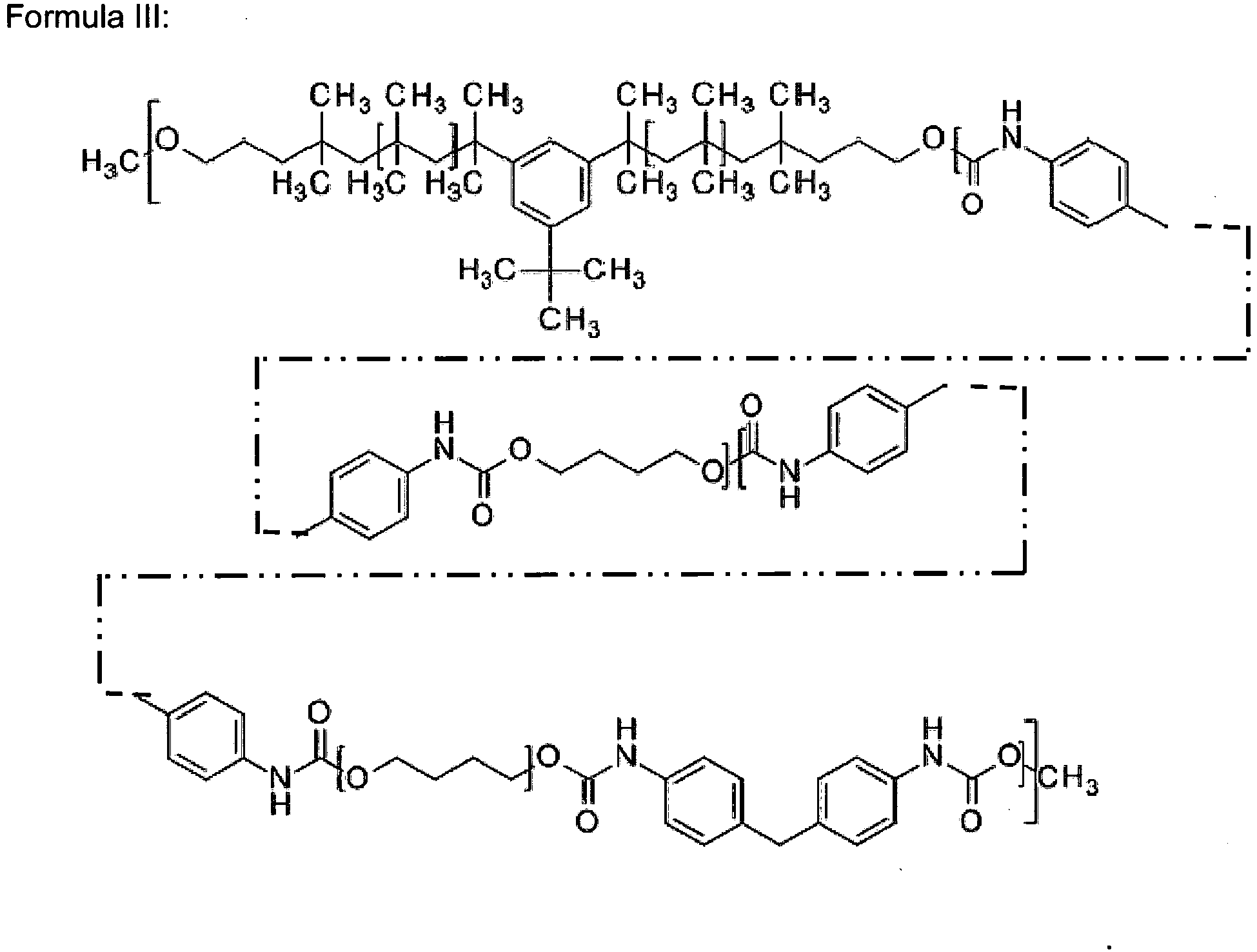
- A catalyst added to the mixture can increase the reaction rate and significantly reduce the time for substantial completion of the reaction. However, many known polyurethane catalysts have not been shown to be suitable for catalyzing a reaction with polyisobutylene diol. Polyisobutylene diol is a relatively nonpolar diol compared to other diols which may be used in forming PIB-PUR, such as polytetramethylene oxide diol and 1,4 butanediol. Thus, a suitable catalyst must be phase compatible with both the nonpolar polyisobutylene diol and the other, more polar diols used in forming PIB-PUR. A suitable catalyst must also promote comparable reaction rates between the diisocyanate and each of the diols in order to form PIB-PUR having residues from each of the diols substantially uniformly distributed along the polymer.
- Tin(II) 2-ethylhexanoate (stannous octoate) has been employed for decades as a suitable catalyst for making PIB-PUR. The use of tin(II) 2-ethylhexanoate catalyst increases the reaction rate such that the reaction may be substantially completed within a few hours. Once the polymerization reaction is complete, the organometallic catalysts remains mixed into PIB-PUR, although it is not part of the polymer itself. Although the ligands of the organometallic catalyst may breakdown to some extent over time, the active metal cation remains and may continue to catalyze side reactions, resulting in degradation of the PIB-PUR over time.
- It was surprisingly found that a tertiary amine, 2,6-dimethylpyridine, is also a suitable catalyst for making PIB-PUR. The 2,6-dimethylpyridine catalyst increases the polymerization reaction rate such that the reaction may be substantially completed within as little as five minutes. Unlike the organometallic catalysts, once the polymerization reaction is complete, a substantial portion of the 2,6-dimethylpyridine may be removed from the PIB-PUR by heating to an elevated temperature. As a result, less of the tertiary amine catalyst is available in the PIB-PUR to continue to catalyze damaging side reactions compared to the amount of active metal cations remaining in PIB-PUR catalyzed with an organometallic catalyst. Thus, PIB-PUR made with a tertiary amine catalyst, such as 2,6-dimethylpyridine, and free of an organometallic catalyst, may have a longer lifespan than PIB-PUR made with an organometallic catalyst, such as tin(II) 2-ethylhexanoate.
- In addition to 2,6-dimethylpyridine, other tertiary amine catalysts suitable for use in making PIB-PUR may include 2-tert-butyl-1,1,3,3-tetramethylguanidine, 1,5-diazabicyclo[4.3.0]non-5-ene, 1,8-diazabicyclo[5.4.0]undec-7-ene, N,N-diisopropylmethylamine, N,N-dimethylcyclohexylamine, N,N,N',N',N"-pentamethyldiethylenetriamine, 4-methylmorpholine, 4-ethylmorpholine, 1-methylimidazole, N-ethyldiisopropylamine, 7-methyl-1,5,7-triazabicyclo[4.4.0]dec-5-ene, N,N,N,N-tetramethylethylenediamine, N,N,N'-trimethylethylenediamine, tributylamine, triethylamine, and tris[2-(dimethylamino)ethyl]amine. Some tertiary amine catalysts, such as trimethylamine, may be less suitable for use at the elevated temperatures used for polymerization because they have relatively high vapor pressures and may be driven from the PIB-PUR before the polymerization reaction is complete.
- The PIB-PUR can be incorporated into medical devices which can be implanted or inserted into the body of a patient. Example medical devices may include, without limitation, vascular grafts, electrical leads, catheters, leadless cardiac pacemakers (LCP), pelvic floor repair support devices, shock coil coverings, covered stents including for intestine, esophageal and airway applications, urethral stents, internal feeding tube/balloon, embolics/bulking agents including mitral valve repair, structural heart applications including PFO, valve leaflets, and left atrial appendage, suture sleeves, breast implants, ophthalmic applications including intraocular lenses and glaucoma tubes, and spinal disc repair. Example electrical leads may include, without limitation, implantable electrical stimulation or diagnostic systems including neurostimulation systems such as spinal cord stimulation (SCS) systems, deep brain stimulation (DBS) systems, peripheral nerve stimulation (PNS) systems, gastric nerve stimulation systems, cochlear implant systems, and retinal implant systems, among others, and cardiac systems including implantable cardiac rhythm management (CRM) systems, implantable cardioverter-defibrillators (ICD's), and cardiac resynchronization and defibrillation (CRDT) devices, among others.
- The present invention is more particularly described in the following examples that are intended as illustrations only, since numerous modifications and variations will be apparent to those of skill in the art.
- Polyisobutylene-polyurethane block copolymer including soft segments including at least one polyisobutylene diol residue and hard segments including at least one diisocyanate residue was prepared with a tertiary amine catalyst as follows. In a 1 liter resin kettle, 105.22 grams of polyisobutylene diol according to Formula I above, 71.72 grams of 4'-methylenediphenyl diisocyanate, and 56.88 grams of polytetramethylene oxide diol were dissolved in 541.15 grams of 2,6-dimethylpyridine. The 1 liter resin kettle was equipped with overhead mechanical stirring and was purged with dry nitrogen gas. The polyisobutylene diol had a number average molecular weight (Mn) of 1,932 grams/mole and the polytetramethylene oxide diol had a Mn of 1,000 grams/mole. The solution was stirred by the overhead mechanical stirrer under the flow of nitrogen gas at a temperature of 60 degrees Celsius while the reagents reacted for 2 hours. After the 2 hours, 15.78 grams of freshly distilled 1,4-butanediol was added to the solution by dropwise addition and the solution maintained at a temperature of 70 degrees Celsius while the reaction continued for an additional 2 hours. No organometallic catalyst, or any catalyst other than the 2,6-dimethylpyridine, was added to the reaction at any point. After the additional 2 hours, the solution was highly viscous solution containing the polyisobutylene-polyurethane block copolymer.
- The resulting polyisobutylene-polyurethane block copolymer was characterized by gel permeation chromatography using a multi angle light scattering detector (GPC-MALLS). The copolymer exhibited a Mn of 109,000 grams/mole and a weight average molecular weight (Mw) of 274,300 grams/mole, indicating substantial completion of the reaction in 4 hours. In contrast, the inventors have not been able to substantially complete this synthesis without the use of catalyst. Thus, the tertiary amine 2,6-dimethylpyridine is demonstrated to be an effective catalyst for the production of polyisobutylene-polyurethane block copolymer including soft segments including at least one polyisobutylene diol residue and hard segments including at least one diisocyanate residue.
Claims (14)
- A polymeric material comprising:a polyisobutylene-polyurethane block copolymer including:soft segments including at least one polyisobutylene diol residue; andhard segments including at least one diisocyanate residue; anda tertiary amine catalyst, wherein the tertiary amine catalyst includes 2,6-dimethylpyridine.
- The polymeric material of claim 1, wherein the soft segments are present in the copolymer in an amount of about 40% to about 70% by weight of the copolymer, and the hard segments are present in the copolymer in an amount of about 30% to about 60% by weight of the copolymer.
- The polymeric material of either of claims 1 or 2, wherein the polymeric material is free of an organometallic catalyst.
- The polymeric material of any of claims 1-3, wherein the tertiary amine catalyst consists of 2,6-dimethylpyridine.
- The polymeric material of any of claims 1-4, wherein the diisocyanate residue includes 4,4'-methylene diphenyl diisocyanate residue.
- The polymeric material of any of claims 1-5, wherein the hard segments further include a chain extender residue.
- The polymeric material of claim 6, wherein the chain extender residue is 1,4-butanediol residue.
- The polymeric material of any of claims 1-7, wherein the soft segments further include at least one of a polyether diol residue, a polyester diol residue, and a polycarbonate diol residue.
- A medical device comprising the polymeric material of any of claims 1-8.
- A method of making a polymeric material, the method comprising:heating a mixture of soft segment components and hard segment components to an elevated temperature, the soft segment components including at least one polyisobutylene diol, and the hard segment components including at least one diisocyanate; andreacting the heated mixture of soft segment components and hard segment components by adding a tertiary amine catalyst to the mixture while maintaining the mixture at an elevated temperature, wherein the tertiary amine catalyst includes 2,6-dimethylpyridine.
- The method of claim 10, wherein the soft segment components are present in the mixture in an amount of about 40% to about 70% by weight of the soft segment components and the hard segment components together, and the hard segment components are present in the mixture in an amount of about 30% to about 60% by weight of the soft segment components and the hard segment components together.
- The method of either of claims 10 or 11, further including reacting a chain extender with the heated mixture and the tertiary amine catalyst.
- The method of any of claims 10-12, wherein the tertiary amine catalyst consists of 2,6-dimethylpyridine.
- The method of any of claims 10-13, wherein the polymeric material is free of an organometallic catalyst.
Applications Claiming Priority (2)
| Application Number | Priority Date | Filing Date | Title |
|---|---|---|---|
| US201562268732P | 2015-12-17 | 2015-12-17 | |
| PCT/US2016/067363 WO2017106774A1 (en) | 2015-12-17 | 2016-12-16 | Polyisobutylene-polyurethanes and medical devices containing the same |
Publications (2)
| Publication Number | Publication Date |
|---|---|
| EP3390482A1 EP3390482A1 (en) | 2018-10-24 |
| EP3390482B1 true EP3390482B1 (en) | 2021-03-03 |
Family
ID=57714713
Family Applications (1)
| Application Number | Title | Priority Date | Filing Date |
|---|---|---|---|
| EP16822357.6A Active EP3390482B1 (en) | 2015-12-17 | 2016-12-16 | Polyisobutylene-polyurethanes and medical devices containing the same |
Country Status (5)
| Country | Link |
|---|---|
| US (1) | US20170174845A1 (en) |
| EP (1) | EP3390482B1 (en) |
| JP (1) | JP6581303B2 (en) |
| CN (1) | CN108368229A (en) |
| WO (1) | WO2017106774A1 (en) |
Families Citing this family (11)
| Publication number | Priority date | Publication date | Assignee | Title |
|---|---|---|---|---|
| JP5638003B2 (en) | 2009-01-12 | 2014-12-10 | ユニバーシティ オブ マサチューセッツ ローウェル | Polyisobutylene polyurethane |
| US9926399B2 (en) | 2012-11-21 | 2018-03-27 | University Of Massachusetts | High strength polyisobutylene polyurethanes |
| WO2018165273A1 (en) | 2017-03-07 | 2018-09-13 | Cardiac Pacemakers, Inc. | Hydroboration/oxidation of allyl-terminated polyisobutylene |
| US10835638B2 (en) | 2017-08-17 | 2020-11-17 | Cardiac Pacemakers, Inc. | Photocrosslinked polymers for enhanced durability |
| US11472911B2 (en) | 2018-01-17 | 2022-10-18 | Cardiac Pacemakers, Inc. | End-capped polyisobutylene polyurethane |
| US10882945B2 (en) | 2018-03-26 | 2021-01-05 | Medtronic, Inc. | Modified polyisobutylene-based polymers, methods of making, and medical devices |
| CN111825826A (en) * | 2019-04-22 | 2020-10-27 | 常州市凯优医疗器械有限公司 | TPU material for disposable feeding bag and manufacturing method |
| CN110713582B (en) * | 2019-09-10 | 2021-06-11 | 华中科技大学 | Preparation method of copolyester polyurethane |
| CN114949372B (en) * | 2021-02-25 | 2023-08-29 | 贝克顿·迪金森公司 | Polyurethane medical articles |
| CN112831013B (en) * | 2021-02-25 | 2022-03-29 | 中国科学院长春应用化学研究所 | A kind of functionalized polyurethane and its preparation method and application |
| EP4739728A1 (en) * | 2023-07-03 | 2026-05-13 | Boston Scientific Scimed, Inc. | Tunable polyisobutylene polyurethane |
Family Cites Families (19)
| Publication number | Priority date | Publication date | Assignee | Title |
|---|---|---|---|---|
| JPS6173666A (en) * | 1984-09-19 | 1986-04-15 | 日本ゼオン株式会社 | Antithrombotic material made of polyurethane or polyurethane urea and method for producing the same |
| JPH02202908A (en) * | 1989-02-02 | 1990-08-13 | Nippon Zeon Co Ltd | Urethane composition |
| US4939184A (en) * | 1989-03-07 | 1990-07-03 | University Of Akron | Polyurethane foam |
| US5637647A (en) * | 1993-10-15 | 1997-06-10 | University Of Massachusetts Lowell | Capping of living polymers |
| CA2168938C (en) * | 1995-03-13 | 2010-06-01 | Wolfgang Kaufhold | A thermoplastic polyurethane resin |
| GB9513713D0 (en) * | 1995-07-05 | 1995-09-06 | Exxon Chemical Patents Inc | Curable elastomeric compositions and a process to produce curable elastomeric compositions |
| US5912302A (en) * | 1996-06-11 | 1999-06-15 | Gadkari; Avinash Chandrakant | Elastomeric compositions and a process to produce elastomeric compositions |
| SE510868C2 (en) * | 1997-11-03 | 1999-07-05 | Artimplant Dev Artdev Ab | Molds for use as implants in human medicine and a method for making such molds |
| JP3539544B2 (en) * | 1998-01-06 | 2004-07-07 | シャープ株式会社 | Surface modification method and surface modified particles |
| EP0916394B1 (en) * | 1997-11-14 | 2004-03-10 | Sharp Kabushiki Kaisha | Method of manufacturing modified particles and manufacturing device therefor |
| US6808766B1 (en) * | 1998-08-26 | 2004-10-26 | Nissan Chemical Industries, Ltd. | Liquid crystal alignment agent and liquid crystal device using the liquid crystal alignment and method for alignment of liquid crystal molecules |
| JP2000119363A (en) * | 1998-10-13 | 2000-04-25 | Kanegafuchi Chem Ind Co Ltd | Hydrocarbon polymer having alcoholic hydroxyl group at terminal and method for producing the same |
| HUP0203632A3 (en) * | 2002-10-25 | 2005-08-29 | Furukawa Electric Technologiai | Recyclable crosslinked polymers with saturated main chain and thermally reversible urethane crosslink points |
| JP5661285B2 (en) * | 2006-11-30 | 2015-01-28 | ザ ユニバーシティ オブ アクロンThe University of Akron | Polyisobutylene and process for producing the same |
| JP5638003B2 (en) * | 2009-01-12 | 2014-12-10 | ユニバーシティ オブ マサチューセッツ ローウェル | Polyisobutylene polyurethane |
| CN102573940B (en) * | 2009-08-21 | 2015-04-01 | 心脏起搏器公司 | Crosslinkable polyisobutylene-based polymers and medical devices containing the same |
| US8374704B2 (en) * | 2009-09-02 | 2013-02-12 | Cardiac Pacemakers, Inc. | Polyisobutylene urethane, urea and urethane/urea copolymers and medical leads containing the same |
| US8674034B2 (en) * | 2009-11-11 | 2014-03-18 | The University Of Akron | Polyisobutylene-based polyurethanes, polyureas and/or polyurethane-polyureas and method for making same |
| US20110152989A1 (en) * | 2009-12-23 | 2011-06-23 | Pacesetter, Inc. | Soft abrasion-resistant polyisobutylene urethane copolymers |
-
2016
- 2016-12-16 US US15/382,254 patent/US20170174845A1/en not_active Abandoned
- 2016-12-16 CN CN201680073619.2A patent/CN108368229A/en active Pending
- 2016-12-16 EP EP16822357.6A patent/EP3390482B1/en active Active
- 2016-12-16 JP JP2018518685A patent/JP6581303B2/en active Active
- 2016-12-16 WO PCT/US2016/067363 patent/WO2017106774A1/en not_active Ceased
Non-Patent Citations (1)
| Title |
|---|
| None * |
Also Published As
| Publication number | Publication date |
|---|---|
| WO2017106774A1 (en) | 2017-06-22 |
| CN108368229A (en) | 2018-08-03 |
| JP2018530654A (en) | 2018-10-18 |
| JP6581303B2 (en) | 2019-09-25 |
| US20170174845A1 (en) | 2017-06-22 |
| EP3390482A1 (en) | 2018-10-24 |
Similar Documents
| Publication | Publication Date | Title |
|---|---|---|
| JP6581303B2 (en) | POLYISOBUTYLENE-POLYURETHANE POLYMER MATERIAL, MEDICAL DEVICE CONTAINING SAME, AND METHOD FOR PRODUCING THE POLYMER MATERIAL | |
| US11851522B2 (en) | End-capped polyisobutylene polyurethane | |
| CN102573940B (en) | Crosslinkable polyisobutylene-based polymers and medical devices containing the same | |
| US8644952B2 (en) | Medical devices including polyisobutylene based polymers and derivatives thereof | |
| AU2009262097B2 (en) | Polyisobutylene urethane, urea and urethane/urea copolymers and medical devices containing the same | |
| EP2473213B1 (en) | Implantable medical lead including polyisobutylene based polymers and derivatives thereof | |
| EP3455272B1 (en) | Thermoset polyisobutylene-polyurethanes and methods for making | |
| EP3303447B1 (en) | Synthesis of polycarbonate siloxane diols |
Legal Events
| Date | Code | Title | Description |
|---|---|---|---|
| STAA | Information on the status of an ep patent application or granted ep patent |
Free format text: STATUS: UNKNOWN |
|
| STAA | Information on the status of an ep patent application or granted ep patent |
Free format text: STATUS: THE INTERNATIONAL PUBLICATION HAS BEEN MADE |
|
| PUAI | Public reference made under article 153(3) epc to a published international application that has entered the european phase |
Free format text: ORIGINAL CODE: 0009012 |
|
| STAA | Information on the status of an ep patent application or granted ep patent |
Free format text: STATUS: REQUEST FOR EXAMINATION WAS MADE |
|
| 17P | Request for examination filed |
Effective date: 20180704 |
|
| AK | Designated contracting states |
Kind code of ref document: A1 Designated state(s): AL AT BE BG CH CY CZ DE DK EE ES FI FR GB GR HR HU IE IS IT LI LT LU LV MC MK MT NL NO PL PT RO RS SE SI SK SM TR |
|
| AX | Request for extension of the european patent |
Extension state: BA ME |
|
| DAV | Request for validation of the european patent (deleted) | ||
| DAX | Request for extension of the european patent (deleted) | ||
| STAA | Information on the status of an ep patent application or granted ep patent |
Free format text: STATUS: EXAMINATION IS IN PROGRESS |
|
| 17Q | First examination report despatched |
Effective date: 20191107 |
|
| GRAP | Despatch of communication of intention to grant a patent |
Free format text: ORIGINAL CODE: EPIDOSNIGR1 |
|
| STAA | Information on the status of an ep patent application or granted ep patent |
Free format text: STATUS: GRANT OF PATENT IS INTENDED |
|
| INTG | Intention to grant announced |
Effective date: 20200922 |
|
| GRAS | Grant fee paid |
Free format text: ORIGINAL CODE: EPIDOSNIGR3 |
|
| GRAA | (expected) grant |
Free format text: ORIGINAL CODE: 0009210 |
|
| STAA | Information on the status of an ep patent application or granted ep patent |
Free format text: STATUS: THE PATENT HAS BEEN GRANTED |
|
| AK | Designated contracting states |
Kind code of ref document: B1 Designated state(s): AL AT BE BG CH CY CZ DE DK EE ES FI FR GB GR HR HU IE IS IT LI LT LU LV MC MK MT NL NO PL PT RO RS SE SI SK SM TR |
|
| REG | Reference to a national code |
Ref country code: GB Ref legal event code: FG4D |
|
| REG | Reference to a national code |
Ref country code: AT Ref legal event code: REF Ref document number: 1367131 Country of ref document: AT Kind code of ref document: T Effective date: 20210315 Ref country code: CH Ref legal event code: EP |
|
| REG | Reference to a national code |
Ref country code: DE Ref legal event code: R096 Ref document number: 602016053722 Country of ref document: DE |
|
| REG | Reference to a national code |
Ref country code: IE Ref legal event code: FG4D |
|
| REG | Reference to a national code |
Ref country code: LT Ref legal event code: MG9D |
|
| PG25 | Lapsed in a contracting state [announced via postgrant information from national office to epo] |
Ref country code: FI Free format text: LAPSE BECAUSE OF FAILURE TO SUBMIT A TRANSLATION OF THE DESCRIPTION OR TO PAY THE FEE WITHIN THE PRESCRIBED TIME-LIMIT Effective date: 20210303 Ref country code: GR Free format text: LAPSE BECAUSE OF FAILURE TO SUBMIT A TRANSLATION OF THE DESCRIPTION OR TO PAY THE FEE WITHIN THE PRESCRIBED TIME-LIMIT Effective date: 20210604 Ref country code: HR Free format text: LAPSE BECAUSE OF FAILURE TO SUBMIT A TRANSLATION OF THE DESCRIPTION OR TO PAY THE FEE WITHIN THE PRESCRIBED TIME-LIMIT Effective date: 20210303 Ref country code: NO Free format text: LAPSE BECAUSE OF FAILURE TO SUBMIT A TRANSLATION OF THE DESCRIPTION OR TO PAY THE FEE WITHIN THE PRESCRIBED TIME-LIMIT Effective date: 20210603 Ref country code: LT Free format text: LAPSE BECAUSE OF FAILURE TO SUBMIT A TRANSLATION OF THE DESCRIPTION OR TO PAY THE FEE WITHIN THE PRESCRIBED TIME-LIMIT Effective date: 20210303 Ref country code: BG Free format text: LAPSE BECAUSE OF FAILURE TO SUBMIT A TRANSLATION OF THE DESCRIPTION OR TO PAY THE FEE WITHIN THE PRESCRIBED TIME-LIMIT Effective date: 20210603 |
|
| REG | Reference to a national code |
Ref country code: NL Ref legal event code: MP Effective date: 20210303 |
|
| REG | Reference to a national code |
Ref country code: AT Ref legal event code: MK05 Ref document number: 1367131 Country of ref document: AT Kind code of ref document: T Effective date: 20210303 |
|
| PG25 | Lapsed in a contracting state [announced via postgrant information from national office to epo] |
Ref country code: SE Free format text: LAPSE BECAUSE OF FAILURE TO SUBMIT A TRANSLATION OF THE DESCRIPTION OR TO PAY THE FEE WITHIN THE PRESCRIBED TIME-LIMIT Effective date: 20210303 Ref country code: RS Free format text: LAPSE BECAUSE OF FAILURE TO SUBMIT A TRANSLATION OF THE DESCRIPTION OR TO PAY THE FEE WITHIN THE PRESCRIBED TIME-LIMIT Effective date: 20210303 Ref country code: LV Free format text: LAPSE BECAUSE OF FAILURE TO SUBMIT A TRANSLATION OF THE DESCRIPTION OR TO PAY THE FEE WITHIN THE PRESCRIBED TIME-LIMIT Effective date: 20210303 Ref country code: PL Free format text: LAPSE BECAUSE OF FAILURE TO SUBMIT A TRANSLATION OF THE DESCRIPTION OR TO PAY THE FEE WITHIN THE PRESCRIBED TIME-LIMIT Effective date: 20210303 |
|
| PG25 | Lapsed in a contracting state [announced via postgrant information from national office to epo] |
Ref country code: NL Free format text: LAPSE BECAUSE OF FAILURE TO SUBMIT A TRANSLATION OF THE DESCRIPTION OR TO PAY THE FEE WITHIN THE PRESCRIBED TIME-LIMIT Effective date: 20210303 |
|
| PG25 | Lapsed in a contracting state [announced via postgrant information from national office to epo] |
Ref country code: EE Free format text: LAPSE BECAUSE OF FAILURE TO SUBMIT A TRANSLATION OF THE DESCRIPTION OR TO PAY THE FEE WITHIN THE PRESCRIBED TIME-LIMIT Effective date: 20210303 Ref country code: CZ Free format text: LAPSE BECAUSE OF FAILURE TO SUBMIT A TRANSLATION OF THE DESCRIPTION OR TO PAY THE FEE WITHIN THE PRESCRIBED TIME-LIMIT Effective date: 20210303 Ref country code: SM Free format text: LAPSE BECAUSE OF FAILURE TO SUBMIT A TRANSLATION OF THE DESCRIPTION OR TO PAY THE FEE WITHIN THE PRESCRIBED TIME-LIMIT Effective date: 20210303 Ref country code: AT Free format text: LAPSE BECAUSE OF FAILURE TO SUBMIT A TRANSLATION OF THE DESCRIPTION OR TO PAY THE FEE WITHIN THE PRESCRIBED TIME-LIMIT Effective date: 20210303 |
|
| PG25 | Lapsed in a contracting state [announced via postgrant information from national office to epo] |
Ref country code: IS Free format text: LAPSE BECAUSE OF FAILURE TO SUBMIT A TRANSLATION OF THE DESCRIPTION OR TO PAY THE FEE WITHIN THE PRESCRIBED TIME-LIMIT Effective date: 20210703 Ref country code: RO Free format text: LAPSE BECAUSE OF FAILURE TO SUBMIT A TRANSLATION OF THE DESCRIPTION OR TO PAY THE FEE WITHIN THE PRESCRIBED TIME-LIMIT Effective date: 20210303 Ref country code: SK Free format text: LAPSE BECAUSE OF FAILURE TO SUBMIT A TRANSLATION OF THE DESCRIPTION OR TO PAY THE FEE WITHIN THE PRESCRIBED TIME-LIMIT Effective date: 20210303 Ref country code: PT Free format text: LAPSE BECAUSE OF FAILURE TO SUBMIT A TRANSLATION OF THE DESCRIPTION OR TO PAY THE FEE WITHIN THE PRESCRIBED TIME-LIMIT Effective date: 20210705 |
|
| REG | Reference to a national code |
Ref country code: DE Ref legal event code: R097 Ref document number: 602016053722 Country of ref document: DE |
|
| PLBE | No opposition filed within time limit |
Free format text: ORIGINAL CODE: 0009261 |
|
| STAA | Information on the status of an ep patent application or granted ep patent |
Free format text: STATUS: NO OPPOSITION FILED WITHIN TIME LIMIT |
|
| PG25 | Lapsed in a contracting state [announced via postgrant information from national office to epo] |
Ref country code: ES Free format text: LAPSE BECAUSE OF FAILURE TO SUBMIT A TRANSLATION OF THE DESCRIPTION OR TO PAY THE FEE WITHIN THE PRESCRIBED TIME-LIMIT Effective date: 20210303 Ref country code: DK Free format text: LAPSE BECAUSE OF FAILURE TO SUBMIT A TRANSLATION OF THE DESCRIPTION OR TO PAY THE FEE WITHIN THE PRESCRIBED TIME-LIMIT Effective date: 20210303 Ref country code: AL Free format text: LAPSE BECAUSE OF FAILURE TO SUBMIT A TRANSLATION OF THE DESCRIPTION OR TO PAY THE FEE WITHIN THE PRESCRIBED TIME-LIMIT Effective date: 20210303 |
|
| 26N | No opposition filed |
Effective date: 20211206 |
|
| PG25 | Lapsed in a contracting state [announced via postgrant information from national office to epo] |
Ref country code: SI Free format text: LAPSE BECAUSE OF FAILURE TO SUBMIT A TRANSLATION OF THE DESCRIPTION OR TO PAY THE FEE WITHIN THE PRESCRIBED TIME-LIMIT Effective date: 20210303 |
|
| PG25 | Lapsed in a contracting state [announced via postgrant information from national office to epo] |
Ref country code: IT Free format text: LAPSE BECAUSE OF FAILURE TO SUBMIT A TRANSLATION OF THE DESCRIPTION OR TO PAY THE FEE WITHIN THE PRESCRIBED TIME-LIMIT Effective date: 20210303 |
|
| PG25 | Lapsed in a contracting state [announced via postgrant information from national office to epo] |
Ref country code: IS Free format text: LAPSE BECAUSE OF FAILURE TO SUBMIT A TRANSLATION OF THE DESCRIPTION OR TO PAY THE FEE WITHIN THE PRESCRIBED TIME-LIMIT Effective date: 20210703 |
|
| PG25 | Lapsed in a contracting state [announced via postgrant information from national office to epo] |
Ref country code: MC Free format text: LAPSE BECAUSE OF FAILURE TO SUBMIT A TRANSLATION OF THE DESCRIPTION OR TO PAY THE FEE WITHIN THE PRESCRIBED TIME-LIMIT Effective date: 20210303 |
|
| REG | Reference to a national code |
Ref country code: CH Ref legal event code: PL |
|
| REG | Reference to a national code |
Ref country code: BE Ref legal event code: MM Effective date: 20211231 |
|
| PG25 | Lapsed in a contracting state [announced via postgrant information from national office to epo] |
Ref country code: LU Free format text: LAPSE BECAUSE OF NON-PAYMENT OF DUE FEES Effective date: 20211216 Ref country code: IE Free format text: LAPSE BECAUSE OF NON-PAYMENT OF DUE FEES Effective date: 20211216 |
|
| PG25 | Lapsed in a contracting state [announced via postgrant information from national office to epo] |
Ref country code: FR Free format text: LAPSE BECAUSE OF NON-PAYMENT OF DUE FEES Effective date: 20211231 Ref country code: BE Free format text: LAPSE BECAUSE OF NON-PAYMENT OF DUE FEES Effective date: 20211231 |
|
| PG25 | Lapsed in a contracting state [announced via postgrant information from national office to epo] |
Ref country code: LI Free format text: LAPSE BECAUSE OF NON-PAYMENT OF DUE FEES Effective date: 20211231 Ref country code: CH Free format text: LAPSE BECAUSE OF NON-PAYMENT OF DUE FEES Effective date: 20211231 |
|
| PG25 | Lapsed in a contracting state [announced via postgrant information from national office to epo] |
Ref country code: HU Free format text: LAPSE BECAUSE OF FAILURE TO SUBMIT A TRANSLATION OF THE DESCRIPTION OR TO PAY THE FEE WITHIN THE PRESCRIBED TIME-LIMIT; INVALID AB INITIO Effective date: 20161216 |
|
| P01 | Opt-out of the competence of the unified patent court (upc) registered |
Effective date: 20230524 |
|
| PG25 | Lapsed in a contracting state [announced via postgrant information from national office to epo] |
Ref country code: CY Free format text: LAPSE BECAUSE OF FAILURE TO SUBMIT A TRANSLATION OF THE DESCRIPTION OR TO PAY THE FEE WITHIN THE PRESCRIBED TIME-LIMIT Effective date: 20210303 |
|
| PG25 | Lapsed in a contracting state [announced via postgrant information from national office to epo] |
Ref country code: MK Free format text: LAPSE BECAUSE OF FAILURE TO SUBMIT A TRANSLATION OF THE DESCRIPTION OR TO PAY THE FEE WITHIN THE PRESCRIBED TIME-LIMIT Effective date: 20210303 |
|
| PG25 | Lapsed in a contracting state [announced via postgrant information from national office to epo] |
Ref country code: TR Free format text: LAPSE BECAUSE OF FAILURE TO SUBMIT A TRANSLATION OF THE DESCRIPTION OR TO PAY THE FEE WITHIN THE PRESCRIBED TIME-LIMIT Effective date: 20210303 |
|
| PG25 | Lapsed in a contracting state [announced via postgrant information from national office to epo] |
Ref country code: MT Free format text: LAPSE BECAUSE OF FAILURE TO SUBMIT A TRANSLATION OF THE DESCRIPTION OR TO PAY THE FEE WITHIN THE PRESCRIBED TIME-LIMIT Effective date: 20210303 |
|
| PGFP | Annual fee paid to national office [announced via postgrant information from national office to epo] |
Ref country code: DE Payment date: 20251126 Year of fee payment: 10 |
|
| PGFP | Annual fee paid to national office [announced via postgrant information from national office to epo] |
Ref country code: GB Payment date: 20251120 Year of fee payment: 10 |