EP3390370B1 - Bis-triazole compounds with anti-biofilm and anti-corrosion properties - Google Patents
Bis-triazole compounds with anti-biofilm and anti-corrosion properties Download PDFInfo
- Publication number
- EP3390370B1 EP3390370B1 EP16816645.2A EP16816645A EP3390370B1 EP 3390370 B1 EP3390370 B1 EP 3390370B1 EP 16816645 A EP16816645 A EP 16816645A EP 3390370 B1 EP3390370 B1 EP 3390370B1
- Authority
- EP
- European Patent Office
- Prior art keywords
- compound
- general formula
- mhz
- nmr
- ppm
- Prior art date
- Legal status (The legal status is an assumption and is not a legal conclusion. Google has not performed a legal analysis and makes no representation as to the accuracy of the status listed.)
- Not-in-force
Links
- 0 *c(cc1)ccc1O Chemical compound *c(cc1)ccc1O 0.000 description 13
- CMEQQGQSVYHGIS-UHFFFAOYSA-N CN(C)CCCOc1ccc(CC[n]2nnc(-c(cc3)ccc3-c3c[n](CCc(cc4)ccc4OCCCN(C)C)nn3)c2)cc1 Chemical compound CN(C)CCCOc1ccc(CC[n]2nnc(-c(cc3)ccc3-c3c[n](CCc(cc4)ccc4OCCCN(C)C)nn3)c2)cc1 CMEQQGQSVYHGIS-UHFFFAOYSA-N 0.000 description 2
- SGBUQIGLNCBTGQ-UHFFFAOYSA-N Oc1ccc(CC[n]2nnc(CCCCCCc3c[n](CCc(cc4)cc(Br)c4O)nn3)c2)cc1Br Chemical compound Oc1ccc(CC[n]2nnc(CCCCCCc3c[n](CCc(cc4)cc(Br)c4O)nn3)c2)cc1Br SGBUQIGLNCBTGQ-UHFFFAOYSA-N 0.000 description 2
- AMMOTDFPEUGSTM-UHFFFAOYSA-N CN(C)CCCOc(ccc(CC[n]1nnc(-c(cc2)ccc2-c2c[n](CCc(cc3Cl)ccc3OCCCN(C)C)nn2)c1)c1)c1Cl Chemical compound CN(C)CCCOc(ccc(CC[n]1nnc(-c(cc2)ccc2-c2c[n](CCc(cc3Cl)ccc3OCCCN(C)C)nn2)c1)c1)c1Cl AMMOTDFPEUGSTM-UHFFFAOYSA-N 0.000 description 1
- IKEQOJIZHNWJSE-UHFFFAOYSA-N CN(C)CCOc1ccc(CC[n]2nnc(CNCc3c[n](CCc(cc4Br)ccc4OCCN(C)C)nn3)c2)cc1Br Chemical compound CN(C)CCOc1ccc(CC[n]2nnc(CNCc3c[n](CCc(cc4Br)ccc4OCCN(C)C)nn3)c2)cc1Br IKEQOJIZHNWJSE-UHFFFAOYSA-N 0.000 description 1
- SWLKZRUGKVAYFZ-UHFFFAOYSA-N COC1=CC=C(CC[n]2nnc(-c3cc(-c4c[n](CCc(cc5)cc(Br)c5OC)nn4)ccc3)c2)CC1Br Chemical compound COC1=CC=C(CC[n]2nnc(-c3cc(-c4c[n](CCc(cc5)cc(Br)c5OC)nn4)ccc3)c2)CC1Br SWLKZRUGKVAYFZ-UHFFFAOYSA-N 0.000 description 1
- BPTABWMRAMRGRW-UHFFFAOYSA-N COc(ccc(CC[n]1nnc(CCCCCCc2c[n](CCc(cc3Br)ccc3OC)nn2)c1)c1)c1Br Chemical compound COc(ccc(CC[n]1nnc(CCCCCCc2c[n](CCc(cc3Br)ccc3OC)nn2)c1)c1)c1Br BPTABWMRAMRGRW-UHFFFAOYSA-N 0.000 description 1
- RIFBXJKMJUOMAP-SVJWQLCWSA-N COc1ccc(CCN(/C=C(/CCCC/C(/N)=C/N(CCc(cc2Br)ccc2OC)N)\N)N)cc1Br Chemical compound COc1ccc(CCN(/C=C(/CCCC/C(/N)=C/N(CCc(cc2Br)ccc2OC)N)\N)N)cc1Br RIFBXJKMJUOMAP-SVJWQLCWSA-N 0.000 description 1
- RFVYCJJUVRIUOC-UQQQWYQISA-N COc1ccc(CCN(/C=C(/c2cc(-c3c[n](CCc(cc4)cc(Br)c4OC)nn3)ccc2)\N)N)cc1Br Chemical compound COc1ccc(CCN(/C=C(/c2cc(-c3c[n](CCc(cc4)cc(Br)c4OC)nn3)ccc2)\N)N)cc1Br RFVYCJJUVRIUOC-UQQQWYQISA-N 0.000 description 1
- YVOUKSHBJJGXHF-UHFFFAOYSA-N COc1ccc(CC[n]2nnc(CNCc3c[n](CCc(cc4Br)ccc4OC)nn3)c2)cc1Br Chemical compound COc1ccc(CC[n]2nnc(CNCc3c[n](CCc(cc4Br)ccc4OC)nn3)c2)cc1Br YVOUKSHBJJGXHF-UHFFFAOYSA-N 0.000 description 1
- DZZLWEKNBSWUAX-UHFFFAOYSA-N Oc1ccc(CC[n]2nnc(CCCCc3c[n](CCc(cc4)cc(Br)c4O)nn3)c2)cc1Br Chemical compound Oc1ccc(CC[n]2nnc(CCCCc3c[n](CCc(cc4)cc(Br)c4O)nn3)c2)cc1Br DZZLWEKNBSWUAX-UHFFFAOYSA-N 0.000 description 1
Images


Classifications
-
- C—CHEMISTRY; METALLURGY
- C07—ORGANIC CHEMISTRY
- C07D—HETEROCYCLIC COMPOUNDS
- C07D403/00—Heterocyclic compounds containing two or more hetero rings, having nitrogen atoms as the only ring hetero atoms, not provided for by group C07D401/00
- C07D403/02—Heterocyclic compounds containing two or more hetero rings, having nitrogen atoms as the only ring hetero atoms, not provided for by group C07D401/00 containing two hetero rings
- C07D403/10—Heterocyclic compounds containing two or more hetero rings, having nitrogen atoms as the only ring hetero atoms, not provided for by group C07D401/00 containing two hetero rings linked by a carbon chain containing aromatic rings
-
- C—CHEMISTRY; METALLURGY
- C07—ORGANIC CHEMISTRY
- C07D—HETEROCYCLIC COMPOUNDS
- C07D249/00—Heterocyclic compounds containing five-membered rings having three nitrogen atoms as the only ring hetero atoms
- C07D249/02—Heterocyclic compounds containing five-membered rings having three nitrogen atoms as the only ring hetero atoms not condensed with other rings
- C07D249/04—1,2,3-Triazoles; Hydrogenated 1,2,3-triazoles
- C07D249/06—1,2,3-Triazoles; Hydrogenated 1,2,3-triazoles with aryl radicals directly attached to ring atoms
-
- A—HUMAN NECESSITIES
- A01—AGRICULTURE; FORESTRY; ANIMAL HUSBANDRY; HUNTING; TRAPPING; FISHING
- A01N—PRESERVATION OF BODIES OF HUMANS OR ANIMALS OR PLANTS OR PARTS THEREOF; BIOCIDES, e.g. AS DISINFECTANTS, AS PESTICIDES OR AS HERBICIDES; PEST REPELLANTS OR ATTRACTANTS; PLANT GROWTH REGULATORS
- A01N43/00—Biocides, pest repellants or attractants, or plant growth regulators containing heterocyclic compounds
- A01N43/64—Biocides, pest repellants or attractants, or plant growth regulators containing heterocyclic compounds having rings with three nitrogen atoms as the only ring hetero atoms
- A01N43/647—Triazoles; Hydrogenated triazoles
-
- A—HUMAN NECESSITIES
- A61—MEDICAL OR VETERINARY SCIENCE; HYGIENE
- A61K—PREPARATIONS FOR MEDICAL, DENTAL OR TOILETRY PURPOSES
- A61K31/00—Medicinal preparations containing organic active ingredients
- A61K31/33—Heterocyclic compounds
- A61K31/395—Heterocyclic compounds having nitrogen as a ring hetero atom, e.g. guanethidine or rifamycins
- A61K31/41—Heterocyclic compounds having nitrogen as a ring hetero atom, e.g. guanethidine or rifamycins having five-membered rings with two or more ring hetero atoms, at least one of which being nitrogen, e.g. tetrazole
- A61K31/4192—1,2,3-Triazoles
-
- A—HUMAN NECESSITIES
- A61—MEDICAL OR VETERINARY SCIENCE; HYGIENE
- A61P—SPECIFIC THERAPEUTIC ACTIVITY OF CHEMICAL COMPOUNDS OR MEDICINAL PREPARATIONS
- A61P31/00—Antiinfectives, i.e. antibiotics, antiseptics, chemotherapeutics
- A61P31/04—Antibacterial agents
-
- B—PERFORMING OPERATIONS; TRANSPORTING
- B63—SHIPS OR OTHER WATERBORNE VESSELS; RELATED EQUIPMENT
- B63B—SHIPS OR OTHER WATERBORNE VESSELS; EQUIPMENT FOR SHIPPING
- B63B59/00—Hull protection specially adapted for vessels; Cleaning devices specially adapted for vessels
- B63B59/04—Preventing hull fouling
-
- C—CHEMISTRY; METALLURGY
- C07—ORGANIC CHEMISTRY
- C07D—HETEROCYCLIC COMPOUNDS
- C07D403/00—Heterocyclic compounds containing two or more hetero rings, having nitrogen atoms as the only ring hetero atoms, not provided for by group C07D401/00
- C07D403/02—Heterocyclic compounds containing two or more hetero rings, having nitrogen atoms as the only ring hetero atoms, not provided for by group C07D401/00 containing two hetero rings
- C07D403/06—Heterocyclic compounds containing two or more hetero rings, having nitrogen atoms as the only ring hetero atoms, not provided for by group C07D401/00 containing two hetero rings linked by a carbon chain containing only aliphatic carbon atoms
-
- C—CHEMISTRY; METALLURGY
- C07—ORGANIC CHEMISTRY
- C07D—HETEROCYCLIC COMPOUNDS
- C07D403/00—Heterocyclic compounds containing two or more hetero rings, having nitrogen atoms as the only ring hetero atoms, not provided for by group C07D401/00
- C07D403/02—Heterocyclic compounds containing two or more hetero rings, having nitrogen atoms as the only ring hetero atoms, not provided for by group C07D401/00 containing two hetero rings
- C07D403/12—Heterocyclic compounds containing two or more hetero rings, having nitrogen atoms as the only ring hetero atoms, not provided for by group C07D401/00 containing two hetero rings linked by a chain containing hetero atoms as chain links
-
- C—CHEMISTRY; METALLURGY
- C23—COATING METALLIC MATERIAL; COATING MATERIAL WITH METALLIC MATERIAL; CHEMICAL SURFACE TREATMENT; DIFFUSION TREATMENT OF METALLIC MATERIAL; COATING BY VACUUM EVAPORATION, BY SPUTTERING, BY ION IMPLANTATION OR BY CHEMICAL VAPOUR DEPOSITION, IN GENERAL; INHIBITING CORROSION OF METALLIC MATERIAL OR INCRUSTATION IN GENERAL
- C23F—NON-MECHANICAL REMOVAL OF METALLIC MATERIAL FROM SURFACE; INHIBITING CORROSION OF METALLIC MATERIAL OR INCRUSTATION IN GENERAL; MULTI-STEP PROCESSES FOR SURFACE TREATMENT OF METALLIC MATERIAL INVOLVING AT LEAST ONE PROCESS PROVIDED FOR IN CLASS C23 AND AT LEAST ONE PROCESS COVERED BY SUBCLASS C21D OR C22F OR CLASS C25
- C23F11/00—Inhibiting corrosion of metallic material by applying inhibitors to the surface in danger of corrosion or adding them to the corrosive agent
- C23F11/08—Inhibiting corrosion of metallic material by applying inhibitors to the surface in danger of corrosion or adding them to the corrosive agent in other liquids
- C23F11/10—Inhibiting corrosion of metallic material by applying inhibitors to the surface in danger of corrosion or adding them to the corrosive agent in other liquids using organic inhibitors
- C23F11/14—Nitrogen-containing compounds
- C23F11/149—Heterocyclic compounds containing nitrogen as hetero atom
Definitions
- the present invention deals with novel bis-triazole compounds, compositions comprising said compounds, and their uses as a medicament, an antibacterial agent, an anti-biofilm agent, an anti-fouling agent and/or an anti-corrosion agent.
- biofilms have become a major concern in many different industries such as food-processing, maritime transport, aquaculture, offshore drilling but also in the domestic and medical environment.
- Biofilm formation is a process comprising three different steps.
- the first step consists in the attachment of mobile microorganisms, such as bacteria and microalgae, on a surface.
- the microorganisms produce polysaccharides which consolidate the interface between the microorganisms and the surface.
- the final step leading to a biofilm involves colonization, growth and division of the microorganisms on the surface.
- a fully developed biofilm will contain an exopolymeric matrix and mushroom-shaped structures separated by interstitial spaces. Biofilms have a heterogeneous structure and are capable of mass internal transport.
- biofilms are subsequently colonized with macrofoulers, such as macroalgae and invertebrates.
- macrofoulers such as macroalgae and invertebrates.
- Marine biofouling is an invasive phenomenon causing significant problems on immerged marine structures used in the shipping, aquaculture and offshore petroleum industry, such as an increase in weight, fuel consumption and frictional drag.
- Organotin-based paints have been used to control development, maturation, and growth of biofouling processes.
- Organotin-based paints have especially been used due to their biocide properties and their efficiency to prevent marine fouling.
- organotin coatings were found to adversely affect the environment due to the collateral damage inflicted on the marine ecosystem and non-target species.
- Organotins are now banned from use by the International Maritime Organization (IMO) and there is thus a need for non-toxic compounds that can effectively prevent biofilm formation.
- IMO International Maritime Organization
- bis-triazole compounds of general formula (I) exhibit excellent anti-biofilm activities. Surprisingly, these compounds also exhibit excellent anticorrosion properties. Since corrosion is another problem frequently encountered in immerged marine structures, the compounds of the present invention can advantageously be used to simultaneously protect said structures from fouling and corrosion.
- a first object of the present invention is thus a compound of general formula (I): wherein:
- Another object of the present invention is a compound of general formula (I) as defined herein for use as a medicament.
- Another object of the present invention is a composition comprising a compound of general formula (I) and a carrier.
- Yet another object of the present invention is the non-therapetic use of a compound of general formula (I) as an antibacterial agent.
- Yet another object of the present invention is the non-therapetic use of a compound of general formula (I) as an anti-biofilm agent.
- Yet another object of the present invention is the non-therapetic use of a compound of general formula (I) as an anti-fouling agent.
- Yet another object of the present invention is the non-therapetic use of a compound of general formula (I) as an anti-corrosion agent.
- alkyl means any monovalent radical of a linear or branched hydrocarbon chain comprising 1 to 18 carbon atoms.
- C 1 -C 6 alkyl represents an alkyl having 1 to 6 carbon atoms. Examples of C 1 -C 6 alkyl groups include methyl, ethyl, n -propyl, i -propyl, n-butyl, i -butyl, s-butyl or t -butyl, n-pentyl, n-hexyl.
- alkanediyl means any divalent radical of a linear or branched hydrocarbon chain comprising 1 to 18 carbon atoms.
- arylene represents any divalent radical of an aromatic hydrocarbon comprising 6 to 18 carbon atoms.
- C a -C 18 arylene groups include phenylene and naphthylene, phenanthrylene.
- heteroarylene represents any divalent radical of a monocyclic or bicyclic 5 to 10 membered aromatic group comprising from 1 to 3 heteroatoms independently selected from oxygen, nitrogen and sulfur.
- C 5 -C 10 heteroaryl groups include furyl, thienyl, pyrrolyl, pyrazoyl, imidazolyl, isoxazolyl, isothiazoyl, thiazolyl, oxazolyl, 1,2,3-triazolyl, 1,2,4-triazolyl, 1-benzofuryl, 1-benzothienyl, indolyl, benzimidazolyl, indazolyl, 1,2-benzisoxazolyl, 2,1-benzisoxazolyl, 1,2-benzisothiazolyl, 2,1-benzisothiazolyl, benzothiazolyl, benzoxazolyl, benzotriazolyl, pyridyl, pyridinium, quinolinyl, isoquinol
- the groups and radicals defined hereinabove may be unsubstituted or substituted by one or more substituents such as, for example, halogen, alkyl, alkoxy, aryl, heteroaryl, haloalkyl, haloalkoxy, alkoxycarbonyl, alkanoyl, aroyl, formyl, nitrile, nitro, amido, alkylthio, alkylsulfinyl, alkylsulfonyl, arylthio, arylsulfinyl, arylsulfonyl, amino, alkylamino, arylamino, dialkylamino and diarylamino.
- substituents such as, for example, halogen, alkyl, alkoxy, aryl, heteroaryl, haloalkyl, haloalkoxy, alkoxycarbonyl, alkanoyl, aroyl, formyl, nitrile, nitro, amid
- the linker L of the compound of general formula (I) may be selected from a substituted or unsubstituted alkanediyl radical.
- L may be selected from a substituted or unsubstituted alkanediyl radical having 1 to 10 carbon atoms, more particularly 2 to 8 carbon atoms, even more particularly 3 to 6 carbon atoms.
- the linker L may also be selected from -(CR a R b ) p -X-(CR a R b ) q - wherein:
- the linker L may further be selected from a substituted or unsubstituted arylene or heteroarylene directly branched with the triazole groups.
- the term "directly branched with the triazole groups” means that the substituted or unsubstituted arylene or heteroarylene is connected to the triazole groups by means of a bond, i.e. there is no other atom intercalated between the arylene or heteroarylene and the triazole groups.
- L may be a substituted or unsubstituted phenylene, preferably an unsubstituted phenylene directly branched in positions 1,3 or 1,4 with the triazole groups.
- the linker L may be as defined above and R 1 , R 3 , R 4 are R 6 are independently selected from H, Br, Cl, I and F.
- R 1 , R 3 , R 4 and R 6 may all be H or may all be Br.
- at least one of R 1 and R 3 is Br, Cl or I and at least one of R 4 and R 6 is Br, Cl or I, more particularly, one of R 1 and R 3 is H and the other is Br, Cl or I and one of R 4 and R 6 is H and the other is Br, Cl or I.
- L, R 1 , R 3 , R 4 are R 6 are as defined above and R 2 and R 5 are independently selected from H or a substituted or unsubstituted alkyl.
- R 2 and R 5 are independently selected from H, unsubstituted (C 1 -C 6 )alkyl, and (C 1 -C 6 )alkyl substituted by at least one group selected from amino, (C 1 -C 6 )alkylamino, (di(C 1 -C a )alkyl)amino group or an ammonium salt thereof.
- R 2 and R 5 are independently selected from H, methyl, methyl(dimethylamino), ethyl(dimethylamino), propyl(dimethylamino), the trifluoroacetate ammonium salt of ethyl(dimethylamino) or the trifluoroacetate ammonium salt of propyl(dimethylamino).
- L, R 1 , R 2 , R 3 , R 4 , R 5 and R 6 are as defined above and n and m are independently 0, 1, 2, 3 or 4. In particular, n and m are independently 0, 1, 2 or 3. More particularly, n and m are 2.
- the salts of compounds of general formula (I) include non-toxic acid addition salts and base salts.
- the acid addition salt may be selected from hydrochloride, hydrobromide, hydroiodide, nitrate, sulfate, bisulfate, phosphate, acid phosphate, acetate, lactate, citrate, acid citrate, tartrate, bitartrate, succinate, maleate, fumarate, gluconate, saccharate, benzoate, methanesulfonate, ethanesulfonate, benzenesulfonate, p-toluenesulfonate, and pamoate.
- Suitable base salts include sodium, potassium, calcium, magnesium, ammonium, N-methylglucamine, alkanolammonium, and salts of organic amines.
- the compounds of the present invention correspond to general formula (I) wherein L, R 1 , R 2 , R 3 , R 4 , R 5 , R 6 n and m are as defined above and wherein:
- the compounds of the present invention correspond to general formula (I) and are as defined above, wherein:
- the compounds of the present invention correspond to one of the following formulae:
- Compounds of general formula (I) may be prepared according to various methods well known in the art. For example, said compounds may be obtained in an easy and convergent manner from a dialkyne and two azides using a copper(I)-catalyzed Azide-Alkyne Cycloaddition (CuAAC) according to the following synthetic route:
- CuAAC copper(I)-catalyzed Azide-Alkyne Cycloaddition
- the copper source used in the reaction may be a copper (II) salt or a cooper (I) salt, in particular copper(II) sulfate pentahydrate, copper(II) acetate hydrate, copper(I) iodide, copper(I) triflate or tetrakis(acetonitrile)copper(I) hexafluorophosphate, preferably copper(II) sulfate pentahydrate.
- a copper (II) salt or a cooper (I) salt in particular copper(II) sulfate pentahydrate, copper(II) acetate hydrate, copper(I) iodide, copper(I) triflate or tetrakis(acetonitrile)copper(I) hexafluorophosphate, preferably copper(II) sulfate pentahydrate.
- the reaction may be conducted in a solvent selected from water, an alcohol such as tert-butanol, dimethylformamide, acetonitrile, dimethylsulfoxide, toluene, tetrahydrofurane, and mixtures thereof, preferably a mixture of water and dimethylformamide.
- a solvent selected from water, an alcohol such as tert-butanol, dimethylformamide, acetonitrile, dimethylsulfoxide, toluene, tetrahydrofurane, and mixtures thereof, preferably a mixture of water and dimethylformamide.
- the reaction may be carried out using an additive such as an in situ reducing agent, a ligand, a base and mixtures thereof.
- an additive such as an in situ reducing agent, a ligand, a base and mixtures thereof.
- suitable in situ reducing agents are sodium ascorbate, ascorbic acid, tris(2-carboxyethyl)phosphine (TCEP), preferably sodium ascorbate.
- Suitable ligands are tris(triazolylmethyl)amines such as tris[(1-benzyl-1H-1,2,3-triazol-4-yl)methyl]amine (TBTA), tris[(1-hydroxypropyl-1H-1,2,3-triazol-4-yl)methyl]amine (THPTA), 3-[4- ⁇ (bis[(1-tert-butyl-1H-1,2,3-triazol-4-yl)methyl]amino)methyl ⁇ -1H-1,2,3-triazol-1-yl]propanol (BTTP), 2-[4- ⁇ (bis[(1-tert-butyl-1H-1,2,3-triazol-4-yl)methyl]amino)methyl ⁇ -1H-1,2,3-triazol-1-yl]acetic acid (BTTAA), 2-[4- ⁇ (bis[(1-tert-butyl-1H-1,2,3-triazol-4-yl)methyl]amino)methyl ⁇ -1H-1,
- the reaction may be carried out at a temperature of 0°C to 25°C, in particular 20°C, during 6 to 24 hours, in particular 24 hours.
- composition according to the present invention comprises a compound of general formula (I) and a carrier.
- the carrier may be solid or liquid.
- the composition of the present invention comprises a compound of general formula (I), a solvent, a binder and optionally a filler, a pigment and/or additives.
- Said composition is suitable for use as a paint, varnish or lacquer to prevent biofilm formation and corrosion of a surface in contact with a liquid.
- the solvent may be water or an organic solvent such as hydrocarbons, for example toluene, xylene, and petroleum distillates; alcohols, for example ethanol, isopropanol, n-butanol, isobutanol 2-hexylethanol, isononanol, isodecanol or benzyl alcohol; alkyl ethers or dialkyl ethers of ethylene glycol or propylene glycol, for example hexylene glycol, butylglycol, methyldiglycol, ethyldiglycol, butyldiglycol, butylglycol acetate or propylene glycol methyl ether; esters, for example ethyl acetate, isopropyl acetate, butyl acetate, isobuyl acetate or amyl acetate; ketones, for example methylethylketone, methylbutylketone, methylisobutylketone, cyclohe
- the binder is the film-forming component of the composition.
- the binder may be any binder conventionally used in the formulation of paints and lacquers.
- Typical binders include synthetic resins, such as alkyds, acrylics, vinyl-acrylics, vinyl acetate/ethylene (VAE), polyurethanes, polyesters, melamine resins, phenolic resins, epoxy, oils, silicones, and mixtures thereof.
- Natural resins, such as damar, copal, colophany and lacquer, as well as natural bitumens may also be used as a binder.
- Fillers are granular solids that are incorporated to the composition to impart toughness, texture or to reduce its cost. Fillers may be selected from barite, calcium carbonate, dolomite, silica, kaolin, talc, mica, calcium silicate, and mixtures thereof.
- Pigments are used to impart a desired color to the composition.
- the pigments may be any pigments conventionally used in the formulation of paints and lacquers. Suitable pigments include mineral pigments, inorganic pigments, bio-sourced pigments, synthetic pigments and mixtures thereof.
- Typical mineral pigments include cadmium pigments, such as cadmium yellow, cadmium red, cadmium green, cadmium orange and cadmium sulfoselenide; chromium pigments, such as chrome yellow and chrome green; cobalt pigments, such as cobalt violet, cobalt blue, cerulean blue and aureolin; copper pigments, such as Azurite, Egyptian blue and malachite; iron oxide pigments, such as oxide red and red ochre; lead pigments, such as lead white, cremnitz white, Naples yellow, red lead and lead-tin-yellow; manganese pigments, such as manganese violet; mercury pigments, such as vermilion; titanium pigments, such as titanium yellow, titanium beige, titanium white and titanium black; and zinc pigments, such as zinc white and zinc ferrite.
- cadmium pigments such as cadmium yellow, cadmium red, cadmium green, cadmium orange and cadmium
- Inorganic pigments include carbon pigments, such as carbon black and ivory black; clay earth pigments or iron oxides, such as yellow ochre, raw sienna, burnt sienna, raw umber and burnt umber; and ultramarine pigments, such as ultramarine and ultramarine green shade.
- Bio-sourced pigments include gamboge, cochineal red, rose madder, indigo, Indian yellow and Tyrian purple.
- Synthetic pigments include alizarin, alizarin crimson, quinacridone, magenta, Phthalocyanine Green G, Phthalocyanine Blue BN, pigment red 170 and diarylide yellow.
- Additives that can be introduced in the composition of the invention include surfactants, thickening agents, antifoaming agents, plasticizers, hardeners, and mixtures thereof.
- the amount of compound of general formula (I) in the composition of the present invention is from 0.01 to 10% by weight, in particular 0.1 to 8%, more particularly 0.5 to 6% by weight based on the weight of the composition.
- Another object of the present invention is a compound of general formula (I) as defined herein for use as a medicament.
- the compound of general formula (I) may be used to prevent biofilm formation in the oral cavity of a subject.
- the compound of general formula (I) may be used to prevent the formation of dental plaque.
- the compound of general formula (I) may also be used to prevent endodontic infection in the dental root canal.
- Another object of the present invention is the non-therapeutic use of a compound of general formula (I) as an anti-biofilm agent, an anti-fouling agent, an antibacterial agent, and/or an anti-corrosion agent.
- Compounds of general formula (I) are able to prevent biofilm formation on a surface by preventing the adhesion of micoorganisms on said surface.
- the compounds of general formula (I) can be used as anti-biofilm agents and more widely as antibacterial agents and anti-fouling agents.
- compounds of general formula (I) may be used to prevent biofilm formation on surgical instruments, drip chambers and catheters or on medical devices prior to their implantation in a subject for example on a prosthesis, a pacemaker, an intrauterine device, an endotracheal tube, a heart valve, or a stent.
- Compounds of general formula (I) may also be used to prevent biofilm formation on a surface in contact with a liquid, for example on a ship, on an offshore platform, on nets and cages used in aquaculture, on tanks and pipes used in the food-processing industry, heat exchangers and water distribution systems.
- the compounds of general formula (I) may also be used as anti-corrosion agents.
- compounds of general formula (I) may be used to inhibit corrosion of metallic surfaces in contact with a liquid.
- the anti-adhesion bioassays and toxicity tests are adapted from those disclosed in M. Camps, J.-F. Briand, L. Guentas-Dombrowsky, G. Culioli, A. Bazire and Y. Blache, Mar. Poll. Bull., 2011, 62, 1032-1040 ; and A. Othmani, N. Bouzidi, Y. Viano, Z. Alliche, H. Seridi, Y. Blache, M. El Hattab, J.-F. Briand and G. Culioli, J Appl Phycol, 2014, 26, 1573-1584 .
- the corrosion rates were determined by electrochemical impedance spectroscopy measurements and gravimetry.
- VNSS Väuschänen nine-salts solution
- VNSS bacterial strains were harvested during the exponential phase.
- the microtiter plates (sterile transparent PS; Nunc, Fisher Scientific) were filled as described in the Anti-adhesion test method using VNSS instead of ASW to allow bacterial growth.
- the growth was followed by measuring the turbidity (OD 600 nm ) every hour during 6 or 7 hours.
- resazurin 50 ⁇ M was added in all the wells, and fluorescence was measured after 2 h to quantify the percent of bacterial viability.
- SYTO 61 was applied to calculate a percent of viability after resazurin staining. Only compounds with EC 50 lower than 200 ⁇ M were tested.
- the electrochemical measurements were performed on a 273 A potentiostat (EGG/PAR) coupled to a Solartron 1255 frequency response analyser. EIS measurements were carried out with a solution containing 1N HCl in the absence and presence of the tested compound at a concentration of 200 ppm under unstirred conditions, at open circuit potential with a 10 mV rms amplitude perturbation over a 20 mHz-100 kHz frequency range.
- a conventional three-electrode cell was used. It comprises a platinum foil as auxiliary electrode, a saturated calomel reference electrode (SCE) and a mild steel coupon as the working electrode with a surface area of 15.7 cm 2 .
- SCE saturated calomel reference electrode
- Paracoccus sp. (4M6) was isolated in March 2000 in the Morbihan Gulf (Atlantic Ocean, France) as described in B. Grasland, J. Mitalane, R. Briandet, E. Quémener, T. Meylheuc, I. Linossier, K. Vallée-Réhel, D. Haras, Biofouling, 2003, 19, 307 - 313 .
- Polaribacter sp. (TC5) was isolated in June 2010 in the Military Harbor of Toulon (Mediterranean Sea, France) as described in F. Brian-Jaisson, A. Ortalo-Magné, L. Guentas-Dombrowsky, F. Armougom, Y. Blache, M. Molmeret, Microb. Ecol., 2014, 68, 94-110 .
- Shewanella sp. was isolated in June 2010 in the Military Harbor of Toulon (Mediterranean Sea, France) as described in F. Brian-Jaisson, A. Ortalo-Magné, L. Guentas-Dombrowsky, F. Armougom, Y. Blache, M. Molmeret, Microb. Ecol., 2014, 68, 94-110 .
- Azide 2b was obtained from 4-(2-chloroethyl)-2-bromophenol using the experimental conditions of example 2. Azide 2b (2.34 g, 96%) was obtained as a dark brown oil.
- 13 C NMR 100 MHz, CDCl 3 ) ⁇ 151.1, 132.1, 131.6, 129.4, 116.2, 110.1, 52.3, 34.0.
- Azide 2c was obtained from 4-(2-chloroethyl)phenol using the experimental conditions of example 2. Azide 2c (2.5 g, 98%) was obtained as a brown oil.
- Azide 2d was obtained from 2,6-dibromo-4-(2-chloroethyl)phenol using the experimental conditions of example 2. Azide 2d (1.47 g, 92%) was obtained as a dark brown oil.
- Azide 2e was obtained from 2-bromo-4-(chloromethyl)-1-methoxybenzene using the experimental conditions of example 2. Azide 2e (869 mg, 99%) was obtained as a dark brown oil.
- IR (thin film) v N3 2092 cm -1 .
- Azide 2f was obtained from 2-bromo-4-(3-chloropropyl)phenol using the experimental conditions of example 2. Azide 2f (3 g, 92%) was obtained as a dark brown oil.
- Azide 2g was obtained from 2-chloro-4-(2-chloroethyl)phenol using the experimental conditions of example 2. Azide 2g (1.56 g, 79 %) was obtained as a brown oil.
- Azide 2h was obtained from 4-(2-chloroethyl)-2-iodophenol using the experimental conditions of example 2. Azide 2h (2.75 g, 95 %) was obtained as a brown oil.
- Azide 3b was obtained from azide 2b (3 g, 12.4 mmol) and 2-chloro-N,N-dimethylpropylamine hydrochloride (2.35 g, 14.9 mmol) using the experimental conditions of example 10.
- Azide 3d was obtained from azide 2c (0.6 g, 3.7 mmol) and 2-chloro-N,N-dimethylethylamine hydrochloride (0.64 g, 4.4 mmol) using the experimental conditions of example 10.
- Azide 3e was obtained from azide 2c (0.6 g, 3.7 mmol) and 2-chloro-N,N-dimethylpropylamine hydrochloride (0.69 g, 4.4 mmol) using the experimental conditions of example 10.
- Azide 3f was obtained from azide 2d (0.64 g, 2 mmol) and 2-chloro-N,N-dimethylethylamine hydrochloride (0.35 g, 2.4 mmol) using the experimental conditions of example 10.
- Azide 3g was obtained from azide 2d (0.64 g, 2 mmol) and 2-chloro-N,N-dimethylpropylamine hydrochloride (0.38 g, 2.4 mmol) using the experimental conditions of example 10.
- Azide 3h was obtained from azide 2g (0.4 g, 2 mmol) and 2-chloro-N,N-dimethylethylamine hydrochloride (0.35 g, 2.4 mmol) using the experimental conditions of example 10.
- Azide 3i was obtained from azide 2g (0.4 g, 2 mmol) and 2-chloro-N,N-dimethylpropylamine hydrochloride (0.38 g, 2.4 mmol) using the experimental conditions of example 10.
- Azide 3j was obtained from azide 2h (0.58 g, 2 mmol) and 2-chloro-N,N-dimethylethylamine hydrochloride (0.35 g, 2.4 mmol) using the experimental conditions of example 10.
- Azide 3k was obtained from azide 2h (0.58 g, 2 mmol) and 2-chloro-N,N-dimethylpropylamine hydrochloride (0.38 g, 2.4 mmol) using the experimental conditions of example 10.
- Azide 3l was obtained from azide 2f (0.5 g, 2 mmol) and 2-chloro-N,N-dimethylethylamine hydrochloride (0.35 g, 2.4 mmol) using the experimental conditions of example 10.
- Azide 3m was obtained from azide 2f (0.5 g, 2 mmol) and 2-chloro-N,N-dimethylpropylamine hydrochloride (0.38 g, 2.4 mmol) using the experimental conditions of example 10.
- Azide 3n was obtained from azide 1a (0.27 g, 2 mmol) and 2-chloro-N,N-dimethylethylamine hydrochloride (0.35 g, 2.4 mmol) using the experimental conditions of example 10.
- Azide 3o was obtained from azide 1a (0.27 g, 2 mmol) and 2-chloro-N,N-dimethylpropylamine hydrochloride (0.38 g, 2.4 mmol) using the experimental conditions of example 10.
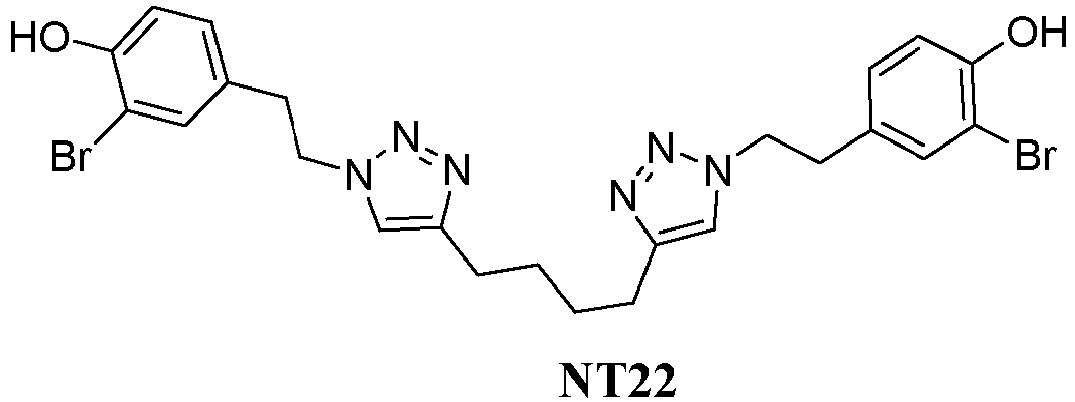
- NT22 was obtained from azide 2b (251.8 mg, 1.04 mmol) and 1,7-octadiyne (42.5 mg, 0.4 mmol) using the experimental conditions of example 24.
- NT22 was obtained (206 mg, 87%) as a white solid.
- NT25 was obtained from azide 2b (251.8 mg, 1.04 mmol) and 1,9-decadiyne (53.7 mg, 0.4 mmol) using the experimental conditions of example 24.
- NT25 was obtained (231 mg, 93%) as a white solid.
- NT24 was obtained from azide 2b (251.8 mg, 1.04 mmol) and 1,3-diethynylbenzene (50.48 mg, 0.4 mmol) using the experimental conditions of example 24.
- NT24 was obtained (188 mg, 77%) as a white solid.
- NT23 was obtained from azide 2b (251.8 mg, 1.04 mmol) and 1,4-diethynylbenzene (50.5 mg, 0.4 mmol) using the experimental conditions of example 24.
- NT23 was obtained (195 mg, 80%) as a yellow solid.
- 1 H NMR 400 MHz, DMSO
- NT26 was obtained from azide 2b (251.8 mg, 1.04 mmol) and propargyl ether (37.64 mg, 0.4 mmol) using the experimental conditions of example 24.
- NT26 was obtained (201 mg, 87%) as a yellow solid.
- NT10 was obtained from azide 2a (266.3 mg, 1.04 mmol) and 1,6-heptadiyne (36.8 mg, 0.4 mmol) using the experimental conditions of example 24.
- NT10 was obtained (221 mg, 91%) as a white solid.
- NT3 was obtained from azide 2a (266.3 mg, 1.04 mmol) and 1,7-octadiyne (42.48 mg, 0.4 mmol) using the experimental conditions of example 24.
- NT3 was obtained (238 mg, 96%) as a yellow solid.
- NT4 was obtained from azide 2a (266.3 mg, 1.04 mmol) and 1,9-decadiyne (53.7 mg, 0.4 mmol) using the experimental conditions of example 24.
- NT4 was obtained (251 mg, 97%) as a yellow oil.
- NT5 was obtained from azide 2a (266.3 mg, 1.04 mmol) and 1,3-diethynylbenzene (50.5 mg, 0.4 mmol) using the experimental conditions of example 24.
- NT5 was obtained (230 mg, 90%) as a white solid.
- NT6 was obtained from azide 2a (266.3 mg, 1.04 mmol) and propargyl ether (37.6 mg, 0.4 mmol) using the experimental conditions of example 24.
- NT6 was obtained (225 mg, 93%) as a brown oil.
- NT7 was obtained from azide 2a (266.3 mg, 1.04 mmol) and dipropargylamine (37.2 mg, 0.4 mmol) using the experimental conditions of example 24.
- NT7 was obtained (213 mg, 88%) as a brown solid.
- Example 36 Synthesis of 2-(4-(2-(4-(3-(1-(4-((dimethylamino)methoxy)-3-bromophenethyl)-1H-1,2,3-triazol-4-yl)propyl)-1H-1,2,3-triazol-1-yl)ethyl)-2-bromophenoxy)-N,N-dimethylethanamine (AS158)
- AS158 was obtained from azide 3a (325.6 mg, 1.04 mmol) and 1,6-heptadiyne (36.8 mg, 0.4 mmol) using the experimental conditions of example 24.
- AS159 was obtained from azide 3a (325.6 mg, 1.04 mmol) and 1,7-octadiyne (42.48 mg, 0.4 mmol) using the experimental conditions of example 24.
- AS160 was obtained from azide 3a (325.6 mg, 1.04 mmol) and 1,9-decadiyne (53.7 mg, 0.4 mmol) using the experimental conditions of example 24.
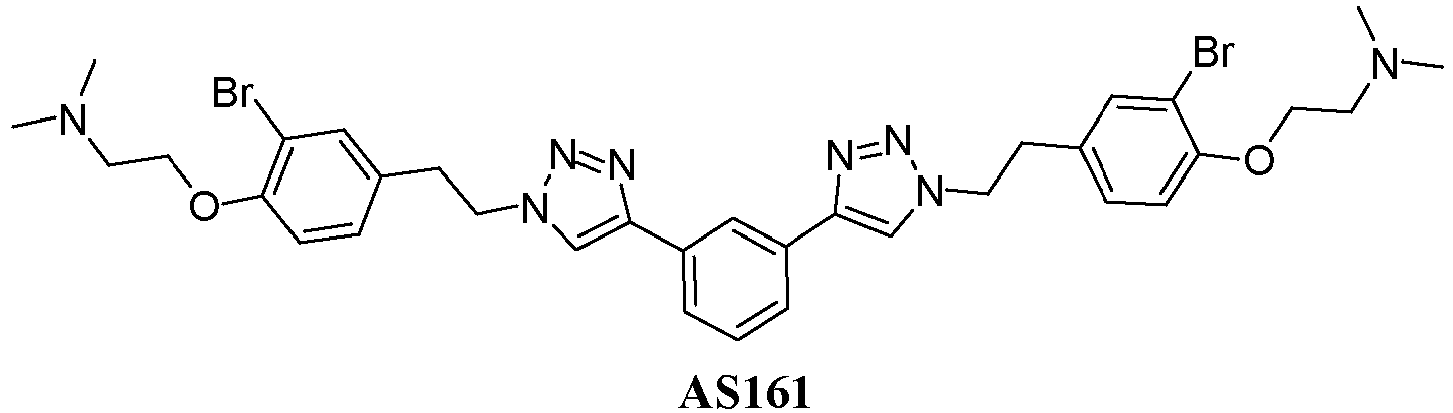
- AS161 was obtained from azide 3a (325.6 mg, 1.04 mmol) and 1,3-diethynylbenzene (50.5 mg, 0.4 mmol) using the experimental conditions of example 24.
- Example 40 Synthesis of 2-(4-(2-(4-(4-(1-(4-(2-(dimethylamino)ethoxy)-3-bromophenethyl)-1H-1,2,3-triazol-4-yl)phenyl)-1H-1,2,3-triazol-1-yl)ethyl)-2-bromophenoxy)-N,N-dimethylethanamine (AS162)
- AS162 was obtained from azide 3a (325.6 mg, 1.04 mmol) and 1,4-diethynylbenzene (50.5 mg, 0.4 mmol) using the experimental conditions of example 24.
- AS163 was obtained from azide 3a (325.6 mg, 1.04 mmol) and propargyl ether (37.6 mg, 0.4 mmol) using the experimental conditions of example 24.
- AS164 was obtained from azide 3a (325.6 mg, 1.04 mmol) and dipropargylamine (37.2 mg, 0.4 mmol) using the experimental conditions of example 24.
- Example 43 Synthesis of 3-(4-(2-(4-(3-(1-(4-(3-(dimethy)amino)propoxy)-3-bromophenethyl)-1H-1,2,3-triazol-4-yl)propyl)-1H-1,2,3-triazol-1-yl)ethyl)-2-bromophenoxy)-N,N-dimethylpropan-1-amine (AS168)
- AS168 was obtained from azide 3b (340.3 mg, 1.04 mmol) and 1,6-heptadiyne (36.8 mg, 0.4 mmol) using the experimental conditions of example 24.
- Example 44 Synthesis of 3-(4-(2-(4-(4-(1-(4-(3-(dimethylamino)propoxy)-3-bromophenethyl)-1H-1,2,3-triazo)-4-yl)butyl)-1H-1,2,3-triazol-1-yl)ethyl)-2-bromophenoxy)-N,N-dimethylpropan-1-amine (AS169)
- AS169 was obtained from azide 3b (340.3 mg, 1.04 mmol) and 1,7-octadiyne (42.48 mg, 0.4 mmol) using the experimental conditions of example 24.
- Example 45 Synthesis of 3-(4-(2-(4-(6-(1-(4-(3-(dimethy)amino)propoxy)-3-bromophenethyl)-1H-1,2,3-triazol-4-yl)hexyl)-1H-1,2,3-triazol-1-yl)ethyl)-2-bromophenoxy)-N,N-dimethylpropan-1-amine (AS170)
- AS170 was obtained from azide 3b (340.3 mg, 1.04 mmol) and 1,9-decadiyne (53.7 mg, 0.4 mmol) using the experimental conditions of example 24.
- Example 46 Synthesis of 3-(4-(2-(4-(3-(1-(4-(3-(dimethylamino)propoxy)-3-bromophenethyl)-1H-1,2,3-triazol-4-yl)phenyl)-1H-1,2,3-triazol-1-yl)ethyl)-2-bromophenoxy)-N,N-dimethy)propan-1-amine (AS171)
- AS171 was obtained from azide 3b (340.3 mg, 1.04 mmol) and 1,3-diethynylbenzene (50.5 mg, 0.4 mmol) using the experimental conditions of example 24.
- Example 47 Synthesis of 3-(4-(2-(4-(4-(1-(4-(3-(dimethylamino)propoxy)-3-bromophenethyl)-1H-1,2,3-triazol-4-yl)phenyl)-1H-1,2,3-triazol-1-yl)ethyl)-2-bromophenoxy)-N,N-dimethylpropan-1-amine (AS172)
- AS172 was obtained from azide 3b (340.3 mg, 1.04 mmol) and 1,4-diethynylbenzene (50.5 mg, 0.4 mmol) using the experimental conditions of example 24.
- Example 48 Synthesis of 3-(4-(2-(4-(((1-(4-(3-(dimethylamino)propoxy)-3-bromophenethyl)-1H-1,2,3-triazol-4-yl)methoxy)methyl)-1H-1,2,3-triazol-1-yl)ethyl)-2-bromophenoxy)-N,N-dimethylpropan-1-amine (AS173)
- AS173 was obtained from azide 3b (340.3 mg, 1.04 mmol) and propargyl ether (37.6 mg, 0.4 mmol) using the experimental conditions of example 24.
- AS174 was obtained from azide 3b (340.3 mg, 1.04 mmol) and dipropargylamine (37.2 mg, 0.4 mmol) using the experimental conditions of example 24.
- SA8 was obtained from azide 2e (252 mg, 1.04 mmol) and 1,4-diethynylbenzene (50.5 mg, 0.4 mmol) using the experimental conditions of example 24.
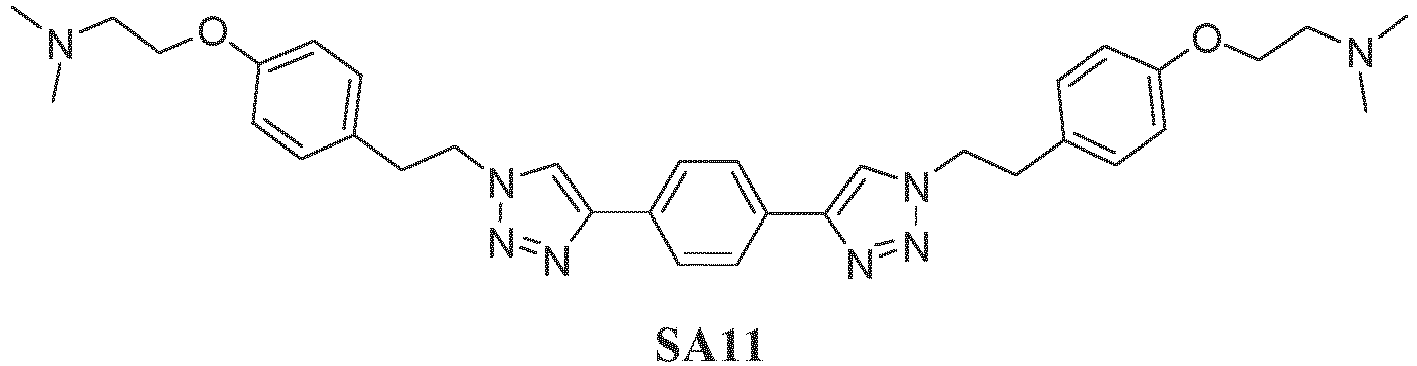
- SA11 was obtained from azide 3d (243.4 mg, 1.04 mmol) and 1,4-diethynylbenzene (50.5 mg, 0.4 mmol) using the experimental conditions of example 24.
- Example 52 Synthesis of 3-(4-(2-(4-(4-(1-(4-(3-(dimethylamino)propoxy)phenethyl)-1H-1,2,3-triazol-4-yl)phenyl)-1H-1,2,3-triazol-1-yl)ethyl)phenoxy)-N,N-dimethylpropan-1-amine (SA12)
- SA12 was obtained from azide 3e (257.9 mg, 1.04 mmol) and 1,4-diethynylbenzene (50.5 mg, 0.4 mmol) using the experimental conditions of example 24.
- Example 53 Synthesis of 2-(4-(3-(4-(4-(1-(3-(4-(2-(dimethylamino)ethoxy)-3-bromophenyl)propyl)-1H-1,2,3-triazol-4-yl)phenyl)-1H-1,2,3-triazol-1-yl)propyl)-2-bromophenoxy)-N,N-dimethylethanamine (SA31 )
- SA31 was obtained from azide 3l (340 mg, 1.04 mmol) and 1,4-diethynylbenzene (50.5 mg, 0.4 mmol) using the experimental conditions of example 24.
- Example 54 Synthesis of 3-(4-(3-(4-(4-(1-(3-(4-(3-(dimethy)amino)propoxy)-3-bromophenyl)propyl)-1H-1,2,3-triazol-4-yl)phenyl)-1H-1,2,3-triazol-1-yl)propyl)-2-bromophenoxy)-N,N-dimethylpropan-1-amine (SA32)
- SA32 was obtained from azide 3m (354 mg, 1.04 mmol) and 1,4-diethynylbenzene (50.5 mg, 0.4 mmol) using the experimental conditions of example 24.
- Example 55 Synthesis of 2-(4-(2-(4-(4-(1-(4-(2-(dimethy)amino)ethoxy)-3,5-dibromophenethyl)-1H-1,2,3-triazol-4-yl)phenyl)-1H-1,2,3-triazol-1-yl)ethyl)-2,6-dibromophenoxy)-N,N-dimethylethanamine (SA33)
- SA33 was obtained from azide 3f (408 mg, 1.04 mmol) and 1,4-diethynylbenzene (50.5 mg, 0.4 mmol) using the experimental conditions of example 24.
- Example 56 Synthesis of 3-(4-(2-(4-(4-(1-(4-(3-(dimethylamino)propoxy)-3,5-dibromophenethyl)-1H-1,2,3-triazol-4-yl)phenyl)-1H-1,2,3-triazol-1-yl)ethyl)-2,6-dibromophenoxy)-N,N-dimethylpropan-1-amine (SA34)
- SA34 was obtained from azide 3g (422 mg, 1.04 mmol) and 1,4-diethynylbenzene (50.5 mg, 0.4 mmol) using the experimental conditions of example 24.
- SA43 was obtained from azide 2h (301 mg, 1.04 mmol) and 1,4-diethynylbenzene (50.5 mg, 0.4 mmol) using the experimental conditions of example 24.
- Example 58 Synthesis of 2-(4-(2-(4-(4-(1-(4-(2-(dimethy)amino)ethoxy)-3-iodophenethyl)-1H-1,2,3-triazo)-4-yl)phenyl)-1H-1,2,3-triazol-1-yl)ethyl)-2-iodophenoxy)-N,N-dimethy)ethanamine (SA45)
- SA45 was obtained from azide 3j (374 mg, 1.04 mmol) and 1,4-diethynylbenzene (50.5 mg, 0.4 mmol) using the experimental conditions of example 24.
- Example 59 Synthesis of 3-(4-(2-(4-(4-(1-(4-(3-(dimethy)amino)propoxy)-3-iodophenethyl)-1H-1,2,3-triazol-4-yl)phenyl)-1H-1,2,3-triazol-1-yl)ethyl)-2-iodophenoxy)-N,N-dimethylpropan-1-amine (SA46)
- SA46 was obtained from azide 3k (384 mg, 1.04 mmol) and 1,4-diethynylbenzene (50.5 mg, 0.4 mmol) using the experimental conditions of example 24.
- Example 60 Synthesis of 2-(4-(2-(4-(4-(1-(4-(2-(dimethylamino)ethoxy)-3-chlorophenethyl)-1H-1,2,3-triazol-4-yl)phenyl)-1H-1,2,3-triazol-1-yl)ethyl)-2-chlorophenoxy)-N,N-dimethylethanamine (SA63)
- SA63 was obtained from azide 3h (284 mg, 1.04 mmol) and 1,4-diethynylbenzene (50.5 mg, 0.4 mmol) using the experimental conditions of example 24.
- Example 61 Synthesis of 3-(4-(2-(4-(4-(1-(4-(3-(dimethy)amino)propoxy)-3-chlorophenethyl)-1H-1,2,3-triazol-4-yl)phenyl)-1H-1,2,3-triazol-1-yl)ethyl)-2-chlorophenoxy)-N,N-dimethylpropan-1-amine (SA64)
- SA64 was obtained from azide 3i (293 mg, 1.04 mmol) and 1,4-diethynylbenzene (50.5 mg, 0.4 mmol) using the experimental conditions of example 24.
- Example 62 Synthesis of 2-(4-(4-(4-(1-(4-(2-(dimethylamino)ethoxy)phenyl)-1H-1,2,3-triazol-4-y))phenyl)-1H-1,2,3-triazol-1-yl)phenoxy)-N,N-dimethylethanamine (SA61)
- SA61 was obtained from azide 3n (214 mg, 1.04 mmol) and 1,4-diethynylbenzene (50.5 mg, 0.4 mmol) using the experimental conditions of example 24. Then, the product was dissolved in TFA (0.5 mL), precipitated in ether and washed with ether to yield bis-triazole SA61 (227 mg, 74%) as a white solid.
- Example 63 Synthesis of 3-(4-(4-(4-(1-(4-(3-(dimethy)amino)propoxy)-3-bromophenyl)-1H-1,2,3-triazol-4-yl)phenyl)-1H-1,2,3-triazol-1-yl)-2-bromophenoxy)-N,N-dimethylpropan-1-amine (SA66)
- a first bis-triazole compound was obtained from azide 3o (229 mg, 1.04 mmol) and 1,4-diethynylbenzene (50.5 mg, 0.4 mmol) using the experimental conditions of example 24.
- Example 64 Anti-biofilm properties of compounds according to the invention
- Table 1 gives the amount of five different marine bacterial strains (TC14, TC8, 4M6, TC5 and TC11) that adhere on a microtiter plate in the presence of a compound of the invention at a 200 micromolar concentration according to the Anti-adhesion test method disclosed herein.
- the compounds of the invention are able to inhibit at least 40% of the adhesion of one of the bacterial strains that were tested.
- Compounds AS162, AS163, AS172, NT23, NT27, SA33, SA34 and SA43 all inhibit at least 65% of the adhesion of at least two marine bacterial strains.
- Example 65 Toxicity of compounds according to the invention
- Table 2 below gives the EC 50 (effective concentration to inhibit 50% of the adhesion).
- LC 50 (necessary concentration to kill 50% of the bacteria), and the selectivity index IS (LC 50 /EC 50 ) of compounds of general formula (I) on five different bacterial strains according to the Toxicity test method disclosed herein.
- Two comparative examples, using respectively tributyltin oxide (TBTO) and zinc ethane-1.2-diylbis(dithiocarbamate) (ZINEB) are also given.
- Compounds AS162 and AS172 exhibit an EC 50 comparable to that of TBTO and lower than that of ZINEB.
- the LC 50 values show that compounds AS162 and AS172 are less toxic than TBTO and ZINEB.
- the selectivity index of AS162 and AS172 is higher than 10 thus showing that these compounds are non-toxic and environmentally friendly unlike TBTO and ZINEB.
- Example 66 Anti-corrosion properties of compounds according to the invention
- Electrochemical impedance spectroscopic (EIS) studies have been conducted to investigate corrosion inhibition processes of compounds of the invention according to the Electrochemical impedance spectroscopic test method described herein.
- Fig. 1 shows Nyquist plots obtained from AC impedance measurements for mild steel in 1N HCI in the absence and in the presence of AS164 at a concentration of 200 ppm.
- the EIS spectra show a depressed capacitive loop in the high frequency range followed by an inductive loop that is observed in the low frequency range.
- the high frequency capacitive loop can be ascribed to the charge transfer reaction.
- the low frequency inductive loop may be attributed to the relaxation process obtained by adsorption species like Cl - ads and H + ads on the electrode. It may also correspond to the re-dissolution of the passivated surface at low frequencies.
- the same shape of EIS spectra were obtained both in the blank and in the presence of AS164. This suggests that AS164 does not change the corrosion mechanism.
- the diameter of the high frequency loop dramatically increased in the presence of AS164 compounds indicative of a strong corrosion inhibitive effect.
- the high frequency loop was analyzed in terms of an equivalent circuit involving a parallel combination of R ct and the constant phase element of double layer (CPE).
- AS164 exhibits an excellent inhibition efficiency (IE %) of around 95%.
- Weight loss experiments were done to confirm the corrosion inhibitive properties of AS164.
- the first trials were performed in a concentration range of 25-200 ppm of AS164 which corresponds to a molar concentration range of 3.5.10 -5 M to 2.8.10 -4 M.
- This concentration range was chosen to be comparable with that used in the many reported results corresponding to mild steel exposed in such aggressive acidic corrosion medium in presence of corrosion inhibitive species (see for representative examples AK Singh et al., Corros. Sci. 53 (2011) 1288-97 and Zhang et al., Corros. Sci. 90 (2015) 284-95 ).
- the relative weight loss change was found to be linearly related to the immersion time as shown in Figure 2 .
- the corrosion rate CR expressed in g cm -2 h -1 , corresponds to the slope of the straight lines shown in Figure 2 .
- FIG. 3 shows the difference in corrosion of the mild steel coupon with and without 1 ppm of AS171 after one week of immersion in the corrosive medium.
Landscapes
- Chemical & Material Sciences (AREA)
- Organic Chemistry (AREA)
- Health & Medical Sciences (AREA)
- Life Sciences & Earth Sciences (AREA)
- General Health & Medical Sciences (AREA)
- Engineering & Computer Science (AREA)
- Veterinary Medicine (AREA)
- Animal Behavior & Ethology (AREA)
- Medicinal Chemistry (AREA)
- Pharmacology & Pharmacy (AREA)
- Public Health (AREA)
- Mechanical Engineering (AREA)
- Communicable Diseases (AREA)
- General Chemical & Material Sciences (AREA)
- Oncology (AREA)
- Nuclear Medicine, Radiotherapy & Molecular Imaging (AREA)
- Chemical Kinetics & Catalysis (AREA)
- Wood Science & Technology (AREA)
- Materials Engineering (AREA)
- Dentistry (AREA)
- Pest Control & Pesticides (AREA)
- Zoology (AREA)
- Environmental Sciences (AREA)
- Metallurgy (AREA)
- Plant Pathology (AREA)
- Agronomy & Crop Science (AREA)
- Epidemiology (AREA)
- Combustion & Propulsion (AREA)
- Ocean & Marine Engineering (AREA)
- Pharmaceuticals Containing Other Organic And Inorganic Compounds (AREA)
- Plural Heterocyclic Compounds (AREA)
Description
- The present invention deals with novel bis-triazole compounds, compositions comprising said compounds, and their uses as a medicament, an antibacterial agent, an anti-biofilm agent, an anti-fouling agent and/or an anti-corrosion agent.
- Over the past few years, biofilms have become a major concern in many different industries such as food-processing, maritime transport, aquaculture, offshore drilling but also in the domestic and medical environment.
- Biofilm formation is a process comprising three different steps. The first step consists in the attachment of mobile microorganisms, such as bacteria and microalgae, on a surface. In the second step, the microorganisms produce polysaccharides which consolidate the interface between the microorganisms and the surface. The final step leading to a biofilm involves colonization, growth and division of the microorganisms on the surface. A fully developed biofilm will contain an exopolymeric matrix and mushroom-shaped structures separated by interstitial spaces. Biofilms have a heterogeneous structure and are capable of mass internal transport.
- In a marine environment, biofilms are subsequently colonized with macrofoulers, such as macroalgae and invertebrates. Marine biofouling is an invasive phenomenon causing significant problems on immerged marine structures used in the shipping, aquaculture and offshore petroleum industry, such as an increase in weight, fuel consumption and frictional drag.
- Conventionally, metal-based paints have been used to control development, maturation, and growth of biofouling processes. Organotin-based paints have especially been used due to their biocide properties and their efficiency to prevent marine fouling. Unfortunately, organotin coatings were found to adversely affect the environment due to the collateral damage inflicted on the marine ecosystem and non-target species. Organotins are now banned from use by the International Maritime Organisation (IMO) and there is thus a need for non-toxic compounds that can effectively prevent biofilm formation.
- After extensive research, Applicant has found that bis-triazole compounds of general formula (I) exhibit excellent anti-biofilm activities. Surprisingly, these compounds also exhibit excellent anticorrosion properties. Since corrosion is another problem frequently encountered in immerged marine structures, the compounds of the present invention can advantageously be used to simultaneously protect said structures from fouling and corrosion.
- Eccher et al. (Journal of Molecular Liquids, 2010, 153(2-3): 162-166),
WO 2011/009934 , and Yoshihiro Matano et al. (Organic Letters, 2009, 11(15): 3338-3341) have described triazole compounds in the context of an application of image processing of liquid crystal textures, as catalysts useful for carrying out Click reactions, and as partners for the formation of phospole-triazole hybrid π systems, respectively. - A first object of the present invention is thus a compound of general formula (I):

- L is selected from a substituted or unsubstituted alkanediyl radical, -(CRaRb)p-X-(CRaRb)q- or a substituted or unsubstituted arylene or heteroarylene directly branched with the triazole groups;
- R1, R3, R4 and R6 are independently selected from H, Br, Cl, I and F;
- R2 and R5 are independently selected from H or a substituted or unsubstituted alkyl;
- X is selected from O, NR', S or S=O;
- R', Ra and Rb are independently H or (C1-C6)alkyl;
- n and m are independently 0, 1, 2, 3 or 4;
- p and q are independently 1, 2 or 3;
- wherein alkyl represents a monovalent radical of a linear or branched hydrocarbon chain comprising 1 to 18 carbon atoms;
- alkanediyl represents a divalent radical of a linear or branched hydrocarbon chain comprising 1 to 18 carbon atoms;
- arylene represents a divalent radical of an aromatic hydrocarbon comprising 6 to 18 carbon atoms;
- heteroarylene represents a divalent radical of a monocyclic or bicyclic 5 to 10 membered aromatic group comprising from 1 to 3 heteroatoms independently selected from oxygen, nitrogen and sulphur, wherein the C5-C10 heteroaryl group is selected from the group consisting of furyl, thienyl, pyrrolyl, pyrazoyl, imidazolyl, isoxazolyl, isothiazoyl, thiazolyl, oxazolyl, 1,2,3-triazolyl, 1,2,4-triazolyl, 1-benzofuryl, 1-benzothienyl, indolyl, benzimidazolyl, indazolyl, 1,2-benzisoxazolyl, 2,1-benzisoxazolyl, 1,2-benzisothiazolyl, 2,1-benzisothiazolyl, benzothiazolyl, benzoxazolyl, benzotriazolyl, pyridyl, pyridinium, quinolinyl, isoquinolinyl, pyridazinyl, cinnolinyl, phthalazinyl, pyrimidinyl, quinazolinyl, pyrazinyl and quinoxalinyl;
- substituted means substituted by one or more substituents selected from the group consisting of halogen, alkyl, alkoxy, aryl, heteroaryl, haloalkyl, haloalkoxy, alkoxycarbonyl, alkanoyl, aroyl, formyl, nitrile, nitro, amido, alkylthio, alkylsulfinyl, alkylsulfonyl, arylthio, arylsulfinyl, arylsulfonyl, amino, alkylamino, arylamino, dialkylamino and diarylamino;
- and salts thereof;
- with the proviso that said compound is not

- Another object of the present invention is a compound of general formula (I) as defined herein for use as a medicament.
- Another object of the present invention is a composition comprising a compound of general formula (I) and a carrier.
- Yet another object of the present invention is the non-therapetic use of a compound of general formula (I) as an antibacterial agent.
- Yet another object of the present invention is the non-therapetic use of a compound of general formula (I) as an anti-biofilm agent.
- Yet another object of the present invention is the non-therapetic use of a compound of general formula (I) as an anti-fouling agent.
- Yet another object of the present invention is the non-therapetic use of a compound of general formula (I) as an anti-corrosion agent.
- The term "alkyl" means any monovalent radical of a linear or branched hydrocarbon chain comprising 1 to 18 carbon atoms. The expression "C1-C6 alkyl" represents an alkyl having 1 to 6 carbon atoms. Examples of C1-C6 alkyl groups include methyl, ethyl, n-propyl, i-propyl, n-butyl, i-butyl, s-butyl or t-butyl, n-pentyl, n-hexyl.
- The term "alkanediyl" means any divalent radical of a linear or branched hydrocarbon chain comprising 1 to 18 carbon atoms.
- The expression "arylene" represents any divalent radical of an aromatic hydrocarbon comprising 6 to 18 carbon atoms. Examples of Ca-C18 arylene groups include phenylene and naphthylene, phenanthrylene.
- The expression "heteroarylene" represents any divalent radical of a monocyclic or bicyclic 5 to 10 membered aromatic group comprising from 1 to 3 heteroatoms independently selected from oxygen, nitrogen and sulfur. Examples of C5-C10 heteroaryl groups include furyl, thienyl, pyrrolyl, pyrazoyl, imidazolyl, isoxazolyl, isothiazoyl, thiazolyl, oxazolyl, 1,2,3-triazolyl, 1,2,4-triazolyl, 1-benzofuryl, 1-benzothienyl, indolyl, benzimidazolyl, indazolyl, 1,2-benzisoxazolyl, 2,1-benzisoxazolyl, 1,2-benzisothiazolyl, 2,1-benzisothiazolyl, benzothiazolyl, benzoxazolyl, benzotriazolyl, pyridyl, pyridinium, quinolinyl, isoquinolinyl, pyridazinyl, cinnolinyl, phthalazinyl, pyrimidinyl, quinazolinyl, pyrazinyl and quinoxalinyl.
- Unless mentioned otherwise, the groups and radicals defined hereinabove may be unsubstituted or substituted by one or more substituents such as, for example, halogen, alkyl, alkoxy, aryl, heteroaryl, haloalkyl, haloalkoxy, alkoxycarbonyl, alkanoyl, aroyl, formyl, nitrile, nitro, amido, alkylthio, alkylsulfinyl, alkylsulfonyl, arylthio, arylsulfinyl, arylsulfonyl, amino, alkylamino, arylamino, dialkylamino and diarylamino.
- Compounds of the present invention correspond to compounds of general formula (I):

- L is selected from a substituted or unsubstituted alkanediyl radical, -(CRaRb)p-X-(CRaRb)q- or a substituted or unsubstituted arylene or heteroarylene directly branched with the triazole groups;
- R1, R3, R4 and R6 are independently selected from H, Br, Cl, I and F;
- R2 and R5 are independently selected from H or a substituted or unsubstituted alkyl;
- X is selected from O, NR', S or S=O;
- R', Ra and Rb are independently H or (C1-C6)alkyl;
- n and m are independently 0, 1, 2, 3 or 4;
- p and q are independently 1, 2 or 3;
- wherein alkyl represents a monovalent radical of a linear or branched hydrocarbon chain comprising 1 to 18 carbon atoms;
- alkanediyl represents a divalent radical of a linear or branched hydrocarbon chain comprising 1 to 18 carbon atoms;
- arylene represents a divalent radical of an aromatic hydrocarbon comprising 6 to 18 carbon atoms;
- heteroarylene represents a divalent radical of a monocyclic or bicyclic 5 to 10 membered aromatic group comprising from 1 to 3 heteroatoms independently selected from oxygen, nitrogen and sulphur, wherein the C5-C10 heteroaryl group is selected from the group consisting of furyl, thienyl, pyrrolyl, pyrazoyl, imidazolyl, isoxazolyl, isothiazoyl, thiazolyl, oxazolyl, 1,2,3-triazolyl, 1,2,4-triazolyl, 1-benzofuryl, 1-benzothienyl, indolyl, benzimidazolyl, indazolyl, 1,2-benzisoxazolyl, 2,1-benzisoxazolyl, 1,2-benzisothiazolyl, 2,1-benzisothiazolyl, benzothiazolyl, benzoxazolyl, benzotriazolyl, pyridyl, pyridinium, quinolinyl, isoquinolinyl, pyridazinyl, cinnolinyl, phthalazinyl, pyrimidinyl, quinazolinyl, pyrazinyl and quinoxalinyl;
- substituted means substituted by one or more substituents selected from the group consisting of halogen, alkyl, alkoxy, aryl, heteroaryl, haloalkyl, haloalkoxy, alkoxycarbonyl, alkanoyl, aroyl, formyl, nitrile, nitro, amido, alkylthio, alkylsulfinyl, alkylsulfonyl, arylthio, arylsulfinyl, arylsulfonyl, amino, alkylamino, arylamino, dialkylamino and diarylamino;
- and salts thereof;
- with the proviso that said compound is not

- The linker L of the compound of general formula (I) may be selected from a substituted or unsubstituted alkanediyl radical. In particular, L may be selected from a substituted or unsubstituted alkanediyl radical having 1 to 10 carbon atoms, more particularly 2 to 8 carbon atoms, even more particularly 3 to 6 carbon atoms.
- The linker L may also be selected from -(CRaRb)p-X-(CRaRb)q- wherein:
- X is selected from O, NR', S or S=O;
- R', Ra and Rb are independently H or (C1-C6)alkyl; and
- p and q are independently 1, 2 or 3.
- The linker L may further be selected from a substituted or unsubstituted arylene or heteroarylene directly branched with the triazole groups. The term "directly branched with the triazole groups" means that the substituted or unsubstituted arylene or heteroarylene is connected to the triazole groups by means of a bond, i.e. there is no other atom intercalated between the arylene or heteroarylene and the triazole groups. More particularly, L may be a substituted or unsubstituted phenylene, preferably an unsubstituted phenylene directly branched in
positions 1,3 or 1,4 with the triazole groups. - According to one embodiment, the linker L may be as defined above and R1, R3, R4 are R6 are independently selected from H, Br, Cl, I and F. In particular, R1, R3, R4 and R6 may all be H or may all be Br. Alternatively, at least one of R1 and R3 is Br, Cl or I and at least one of R4 and R6 is Br, Cl or I, more particularly, one of R1 and R3 is H and the other is Br, Cl or I and one of R4 and R6 is H and the other is Br, Cl or I.
- According to another embodiment, L, R1, R3, R4 are R6 are as defined above and R2 and R5 are independently selected from H or a substituted or unsubstituted alkyl. In particular, R2 and R5 are independently selected from H, unsubstituted (C1-C6)alkyl, and (C1-C6)alkyl substituted by at least one group selected from amino, (C1-C6)alkylamino, (di(C1-Ca)alkyl)amino group or an ammonium salt thereof. More particularly R2 and R5 are independently selected from H, methyl, methyl(dimethylamino), ethyl(dimethylamino), propyl(dimethylamino), the trifluoroacetate ammonium salt of ethyl(dimethylamino) or the trifluoroacetate ammonium salt of propyl(dimethylamino).
- According to yet another embodiment, L, R1, R2, R3, R4, R5 and R6 are as defined above and n and m are independently 0, 1, 2, 3 or 4. In particular, n and m are independently 0, 1, 2 or 3. More particularly, n and m are 2.
- Also encompassed in the compounds of the present invention are the salts of compounds of general formula (I). Examples of suitable salts include non-toxic acid addition salts and base salts. For example, the acid addition salt may be selected from hydrochloride, hydrobromide, hydroiodide, nitrate, sulfate, bisulfate, phosphate, acid phosphate, acetate, lactate, citrate, acid citrate, tartrate, bitartrate, succinate, maleate, fumarate, gluconate, saccharate, benzoate, methanesulfonate, ethanesulfonate, benzenesulfonate, p-toluenesulfonate, and pamoate. Suitable base salts include sodium, potassium, calcium, magnesium, ammonium, N-methylglucamine, alkanolammonium, and salts of organic amines.
- In a preferred embodiment, the compounds of the present invention correspond to general formula (I) wherein L, R1, R2, R3, R4, R5, R6 n and m are as defined above and wherein:
- R1 and R6 are identical;
- R2 and R5 are identical;
- R3 and R4 are identical; and
- n and m are identical.
- In a preferred embodiment, the compounds of the present invention correspond to general formula (I) and are as defined above, wherein:
- L is selected from a substituted or unsubstituted alkanediyl radical having 3 to 6 carbon atoms, - CH2-O-CH2-, -CH2-NH-CH2; or a substituted or unsubstituted phenylene directly branched with the triazole groups;
- R1, R3, R4 and R6 are independently selected from H, Br, Cl and I;
- R2 and R5 are independently selected from H, unsubstituted (C1-C6)alkyl, and (C1-C6)alkyl substituted by a (di(C1-Ca)alkyl)amino group or an ammonium salt thereof;
- n and m are 0, 1, 2 or 3.
- In a particularly preferred embodiment, the compounds of the present invention correspond to one of the following formulae:








- Compounds of general formula (I) may be prepared according to various methods well known in the art. For example, said compounds may be obtained in an easy and convergent manner from a dialkyne and two azides using a copper(I)-catalyzed Azide-Alkyne Cycloaddition (CuAAC) according to the following synthetic route:

- The copper source used in the reaction may be a copper (II) salt or a cooper (I) salt, in particular copper(II) sulfate pentahydrate, copper(II) acetate hydrate, copper(I) iodide, copper(I) triflate or tetrakis(acetonitrile)copper(I) hexafluorophosphate, preferably copper(II) sulfate pentahydrate.
- The reaction may be conducted in a solvent selected from water, an alcohol such as tert-butanol, dimethylformamide, acetonitrile, dimethylsulfoxide, toluene, tetrahydrofurane, and mixtures thereof, preferably a mixture of water and dimethylformamide.
- The reaction may be carried out using an additive such as an in situ reducing agent, a ligand, a base and mixtures thereof. Examples of suitable in situ reducing agents are sodium ascorbate, ascorbic acid, tris(2-carboxyethyl)phosphine (TCEP), preferably sodium ascorbate. Examples of suitable ligands are tris(triazolylmethyl)amines such as tris[(1-benzyl-1H-1,2,3-triazol-4-yl)methyl]amine (TBTA), tris[(1-hydroxypropyl-1H-1,2,3-triazol-4-yl)methyl]amine (THPTA), 3-[4-{(bis[(1-tert-butyl-1H-1,2,3-triazol-4-yl)methyl]amino)methyl}-1H-1,2,3-triazol-1-yl]propanol (BTTP), 2-[4-{(bis[(1-tert-butyl-1H-1,2,3-triazol-4-yl)methyl]amino)methyl}-1H-1,2,3-triazol-1-yl]acetic acid (BTTAA), 2-[4-{(bis[(1-tert-butyl-1H-1,2,3-triazol-4-yl)methyl]amino)methyl}-1H-1,2,3-triazol-1-yl]ethyl hydrogen sulfate (BTTES), 3-[4-{(bis[(1-tert-butyl-1H-1,2,3-triazol-4-yl)methyl]amino)methyl}-1H-1,2,3-triazol-1-yl]propyl hydrogen sulfate (BTTPS); tris(heteroarylmethyl)amine ligands such as tris(pyridylmethyl)amines, tris(benzothiazolylmethyl)amines and tris(2-benzimidazolylmethyl)amines; 2,2'-bipyridine and 1,10-phenanthroline derivatives; phosphoramidite ligand MonoPhos, triphenylphosphine; copper(I) bromide dimethyl sulfide complex. Examples of suitable bases are triethylamine, N,N-diisopropylethylamine (DIPEA), pyridine and 2,6-lutidine.
- The reaction may be carried out at a temperature of 0°C to 25°C, in particular 20°C, during 6 to 24 hours, in particular 24 hours.
- The composition according to the present invention comprises a compound of general formula (I) and a carrier.
- The carrier may be solid or liquid.
- In one embodiment, the composition of the present invention comprises a compound of general formula (I), a solvent, a binder and optionally a filler, a pigment and/or additives. Said composition is suitable for use as a paint, varnish or lacquer to prevent biofilm formation and corrosion of a surface in contact with a liquid.
- The solvent may be water or an organic solvent such as hydrocarbons, for example toluene, xylene, and petroleum distillates; alcohols, for example ethanol, isopropanol, n-butanol, isobutanol 2-hexylethanol, isononanol, isodecanol or benzyl alcohol; alkyl ethers or dialkyl ethers of ethylene glycol or propylene glycol, for example hexylene glycol, butylglycol, methyldiglycol, ethyldiglycol, butyldiglycol, butylglycol acetate or propylene glycol methyl ether; esters, for example ethyl acetate, isopropyl acetate, butyl acetate, isobuyl acetate or amyl acetate; ketones, for example methylethylketone, methylbutylketone, methylisobutylketone, cyclohexanone, isophorone, N-methylpyrrolidinone or 4-hydroxy-4-methylpentan-2-one; and mixtures thereof.
- The binder is the film-forming component of the composition. The binder may be any binder conventionally used in the formulation of paints and lacquers. Typical binders include synthetic resins, such as alkyds, acrylics, vinyl-acrylics, vinyl acetate/ethylene (VAE), polyurethanes, polyesters, melamine resins, phenolic resins, epoxy, oils, silicones, and mixtures thereof. Natural resins, such as damar, copal, colophany and lacquer, as well as natural bitumens may also be used as a binder.
- Fillers are granular solids that are incorporated to the composition to impart toughness, texture or to reduce its cost. Fillers may be selected from barite, calcium carbonate, dolomite, silica, kaolin, talc, mica, calcium silicate, and mixtures thereof.
- Pigments are used to impart a desired color to the composition. The pigments may be any pigments conventionally used in the formulation of paints and lacquers. Suitable pigments include mineral pigments, inorganic pigments, bio-sourced pigments, synthetic pigments and mixtures thereof.
- Typical mineral pigments include cadmium pigments, such as cadmium yellow, cadmium red, cadmium green, cadmium orange and cadmium sulfoselenide; chromium pigments, such as chrome yellow and chrome green; cobalt pigments, such as cobalt violet, cobalt blue, cerulean blue and aureolin; copper pigments, such as Azurite, Egyptian blue and malachite; iron oxide pigments, such as oxide red and red ochre; lead pigments, such as lead white, cremnitz white, Naples yellow, red lead and lead-tin-yellow; manganese pigments, such as manganese violet; mercury pigments, such as vermilion; titanium pigments, such as titanium yellow, titanium beige, titanium white and titanium black; and zinc pigments, such as zinc white and zinc ferrite.
- Inorganic pigments include carbon pigments, such as carbon black and ivory black; clay earth pigments or iron oxides, such as yellow ochre, raw sienna, burnt sienna, raw umber and burnt umber; and ultramarine pigments, such as ultramarine and ultramarine green shade.
- Bio-sourced pigments include gamboge, cochineal red, rose madder, indigo, Indian yellow and Tyrian purple.
- Synthetic pigments include alizarin, alizarin crimson, quinacridone, magenta, Phthalocyanine Green G, Phthalocyanine Blue BN, pigment red 170 and diarylide yellow.
- Additives that can be introduced in the composition of the invention include surfactants, thickening agents, antifoaming agents, plasticizers, hardeners, and mixtures thereof.
- According to one embodiment the amount of compound of general formula (I) in the composition of the present invention is from 0.01 to 10% by weight, in particular 0.1 to 8%, more particularly 0.5 to 6% by weight based on the weight of the composition.
- Another object of the present invention is a compound of general formula (I) as defined herein for use as a medicament.
- According to an embodiment, the compound of general formula (I) may be used to prevent biofilm formation in the oral cavity of a subject.
- In particular, the compound of general formula (I) may be used to prevent the formation of dental plaque.
- The compound of general formula (I) may also be used to prevent endodontic infection in the dental root canal.
- Another object of the present invention is the non-therapeutic use of a compound of general formula (I) as an anti-biofilm agent, an anti-fouling agent, an antibacterial agent, and/or an anti-corrosion agent.
- Compounds of general formula (I) are able to prevent biofilm formation on a surface by preventing the adhesion of micoorganisms on said surface. As such, the compounds of general formula (I) can be used as anti-biofilm agents and more widely as antibacterial agents and anti-fouling agents.
- For example, compounds of general formula (I) may be used to prevent biofilm formation on surgical instruments, drip chambers and catheters or on medical devices prior to their implantation in a subject for example on a prosthesis, a pacemaker, an intrauterine device, an endotracheal tube, a heart valve, or a stent.
- Compounds of general formula (I) may also be used to prevent biofilm formation on a surface in contact with a liquid, for example on a ship, on an offshore platform, on nets and cages used in aquaculture, on tanks and pipes used in the food-processing industry, heat exchangers and water distribution systems.
- According to another embodiment, the compounds of general formula (I) may also be used as anti-corrosion agents. In particular, compounds of general formula (I) may be used to inhibit corrosion of metallic surfaces in contact with a liquid.
- The invention will now be described in more detail with the following examples which are given for purely illustrative purposes and which are not intended to limit the scope of this invention in any manner.
-
-
Figure 1 is a Nyquist diagram for mild steel in 1 N HCI without and with 200 ppm of AS164 according to example 66. -
Figure 2 shows the relative weight loss changes as a function of immersion time diagram for mild steel in 1 N HCI without and with 25, 50, 100 or 200 ppm of AS158 according to example 66. -
Figure 3 consists of photos of the steel coupons after one week of immersion in 1N HCl without (A) and with 1 ppm AS171 (B) according to example 66. -
Figure 4 is the Langmuir adsorption plots for mild steel in 1 M HCI containing different concentrations of AS174 according to example 66. - The anti-adhesion bioassays and toxicity tests are adapted from those disclosed in M. Camps, J.-F. Briand, L. Guentas-Dombrowsky, G. Culioli, A. Bazire and Y. Blache, Mar. Poll. Bull., 2011, 62, 1032-1040; and A. Othmani, N. Bouzidi, Y. Viano, Z. Alliche, H. Seridi, Y. Blache, M. El Hattab, J.-F. Briand and G. Culioli, J Appl Phycol, 2014, 26, 1573-1584.
- The corrosion rates were determined by electrochemical impedance spectroscopy measurements and gravimetry.
- Bacterial strains were grown on Väätänen nine-salts solution (VNSS). When the stationary phase was reached, the bacterial suspension was centrifuged. Cells were then diluted in sterile artificial sea water (ASW) and introduced in microtiter plates (sterile black PS; Nunc, Fisher Scientific, France) with the tested compound (at eight concentrations in three replicates) in the presence of three controls: (i) non-specific staining control, (ii) adhesion control, and (iii) positive control. The maximum percentage of solvent (
DMSO 2%) used to dilute the tested compound was also tested in triplicate as additional control. After incubation during an optimized adhesion time (moderately 15 h), non-adhered bacteria were eliminated and adhered cells were quantified after SYTO 61 (1 µM) staining. A percentage of inhibition was calculated per well. A sigmoid dose-response curve was obtained by plotting the percentage of inhibition as a function of the log of tested compound concentration, after mean (n = 3) and standard deviation (SD) calculation per triplicate for each concentration. EC50 values were then calculated for each compound. - After growth on VNSS, bacterial strains were harvested during the exponential phase. The microtiter plates (sterile transparent PS; Nunc, Fisher Scientific) were filled as described in the Anti-adhesion test method using VNSS instead of ASW to allow bacterial growth. The growth was followed by measuring the turbidity (OD600 nm) every hour during 6 or 7 hours. Then, resazurin (50 µM) was added in all the wells, and fluorescence was measured after 2 h to quantify the percent of bacterial viability. The same methodology used with SYTO 61 was applied to calculate a percent of viability after resazurin staining. Only compounds with EC50 lower than 200 µM were tested.
- The electrochemical measurements were performed on a 273 A potentiostat (EGG/PAR) coupled to a Solartron 1255 frequency response analyser. EIS measurements were carried out with a solution containing 1N HCl in the absence and presence of the tested compound at a concentration of 200 ppm under unstirred conditions, at open circuit potential with a 10 mV rms amplitude perturbation over a 20 mHz-100 kHz frequency range.
- EIS data were registered and analysed using Zview software (Scribners Associates, USA).
- A conventional three-electrode cell was used. It comprises a platinum foil as auxiliary electrode, a saturated calomel reference electrode (SCE) and a mild steel coupon as the working electrode with a surface area of 15.7 cm2.
- Weight loss measurements were performed on 2.5x2.0x0.1 cm rectangular mild steel coupons. The mild steel coupons were immersed into non-de-aerated HCI 1N solution in absence and presence of different concentrations of compounds of general formula (I). After the elapsed time, the coupons were taken out, washed, dried and weighed accurately. Experiments were duplicated.
- In examples 64 and 65, the following marine bacterial strains are used.
Pseudoalteromonas ulvae (TC14) was isolated in June 2010 in the Military Harbor of Toulon (Mediterranean Sea, France) as described in F. Brian-Jaisson, A. Ortalo-Magné, L. Guentas-Dombrowsky, F. Armougom, Y. Blache, M. Molmeret, Microb. Ecol., 2014, 68, 94-110. - Pseudoalteromonas lipolytica (TC8) was isolated in February 2008 in the Toulon Bay (Mediterranean Sea, France) as described in M. Camps, J.-F. Briand, L. Guentas-Dombrowsky, G. Culioli, A. Bazire, Y. Blache, Mar. Poll. Bull., 2011, 62, 1032-1040.
- Paracoccus sp. (4M6) was isolated in March 2000 in the Morbihan Gulf (Atlantic Ocean, France) as described in B. Grasland, J. Mitalane, R. Briandet, E. Quémener, T. Meylheuc, I. Linossier, K. Vallée-Réhel, D. Haras, Biofouling, 2003, 19, 307 - 313.
- Polaribacter sp. (TC5) was isolated in June 2010 in the Military Harbor of Toulon (Mediterranean Sea, France) as described in F. Brian-Jaisson, A. Ortalo-Magné, L. Guentas-Dombrowsky, F. Armougom, Y. Blache, M. Molmeret, Microb. Ecol., 2014, 68, 94-110.
- Shewanella sp. (TC11) was isolated in June 2010 in the Military Harbor of Toulon (Mediterranean Sea, France) as described in F. Brian-Jaisson, A. Ortalo-Magné, L. Guentas-Dombrowsky, F. Armougom, Y. Blache, M. Molmeret, Microb. Ecol., 2014, 68, 94-110.
-

- To a stirred solution of 4-aminophenol (2.18 g, 20 mmol) in H2O/HCl (50/50, 20 mL/20 mL) at 0°C was added NaNO2 (2.76 g, 40 mmol). The reaction mixture was further stirred for 2 h at the same temperature. Then, NaN3 (2.6 g, 40 mmol) was added portion-wise and the reaction mixture was allowed to attain the room temperature while stirring for 3 h. The product was extracted into ethyl acetate (3 times) and the combined organic layer was evaporated to afford 1.92 g (71 %) of 4-azidophenol as a dark red oil.
1H NMR (400 MHz, Acetone-d6) δ 8.41 (s, 1H, OH), 6.90 (m, 4H).
13C NMR (100 MHz, Acetone-d6) δ 155.9, 131.7, 120.9 (2C), 117.5 (2C).
IR (thin film) vN3 2095 cm-1. -

- A mixture of 4-(2-chloroethyl)-2-bromo-1-methoxybenzene (1 equiv) and NaN3 (2.6 equiv.) in DMF was stirred for 5 h at 90 °C. The mixture was allowed to warm to room temperature and diluted with Et2O. The organic phase was washed with brine and water, dried over Na2SO4, and concentrated under vacuum. The resulting azide was directly used in the next reaction without further purification.
- Azide 2a (1.388 g, 94%) was obtained as a dark brown oil.
1H NMR (400 MHz, CDCl3) δ 7.40 (d, J = 2.2 Hz, 1H), 7.12 (dd, J = 8.4, 2.2 Hz, 1H), 6.85 (d, J = 8.4 Hz, 1H), 3.88 (s, 3H), 3.47 (t, J = 7.1 Hz, 2H), 2.80 (t, J = 7.1 Hz, 2H).
13C NMR (100 MHz, CDCl3) δ 154.66, 133.41, 131.59, 128.79, 111.94, 111.55, 56.18, 52.33, 34.04.
IR (thin film) vN3 2090 cm-1. -

- Azide 2b was obtained from 4-(2-chloroethyl)-2-bromophenol using the experimental conditions of example 2. Azide 2b (2.34 g, 96%) was obtained as a dark brown oil.
1H NMR (400 MHz, CDCl3) δ 7.33 (d, J = 2.0 Hz, 1H), 7.07 (dd, J = 8.3, 2.0 Hz, 1H), 6.97 (d, J = 8.3 Hz, 1H), 5.44 (s, 1H, OH), 3.47 (t, J = 7.1 Hz, 2H), 2.80 (t, J = 7.1 Hz, 2H).
13C NMR (100 MHz, CDCl3) δ 151.1, 132.1, 131.6, 129.4, 116.2, 110.1, 52.3, 34.0.
IR (thin film) vN3 2090 cm-1. -

- Azide 2c was obtained from 4-(2-chloroethyl)phenol using the experimental conditions of example 2. Azide 2c (2.5 g, 98%) was obtained as a brown oil.
1H NMR (400 MHz, CDCl3) δ 7.15 - 7.04 (m, 2H), 6.86 - 6.76 (m, 2H), 5.20 (s, 1H), 3.46 (t, J = 7.2 Hz, 2H), 2.82 (t, J = 7.2 Hz, 2H).
13C NMR (100 MHz, CDCl3) δ 154.4, 130.3, 130.0 (2C), 115.6 (2C), 52.1, 33.9.
IR (thin film) vN3 2091 cm-1. -

- Azide 2d was obtained from 2,6-dibromo-4-(2-chloroethyl)phenol using the experimental conditions of example 2. Azide 2d (1.47 g, 92%) was obtained as a dark brown oil.
1H NMR (400 MHz, CDCl3) δ 7.31 (s, 2H), 5.48 (s, 1H), 3.48 (t, J = 6.9 Hz, H), 2.77 (t, J = 6.9 Hz, 2H).
13C NMR (100 MHz, CDCl3) δ 148.4, 132.8, 132.3 (2C), 109.9 (2C), 52.2, 33.9.
IR (thin film) vN3 2092 cm-1. -

- Azide 2e was obtained from 2-bromo-4-(chloromethyl)-1-methoxybenzene using the experimental conditions of example 2. Azide 2e (869 mg, 99%) was obtained as a dark brown oil.
1H NMR (400 MHz, CDCl3) δ 7.51 (d, J = 2.2 Hz, 1H), 7.23 (dd, J = 8.4, 2.2 Hz, 1H), 6.90 (d, J = 8.4 Hz, 1H), 4.26 (s, 2H), 3.90 (s, 3H).
13C NMR (100 MHz, CDCl3) δ 155.2, 132.5, 128.4, 128.0, 111.4, 111.1, 55.5, 52.9.
IR (thin film) vN3 2092 cm-1. -

- Azide 2f was obtained from 2-bromo-4-(3-chloropropyl)phenol using the experimental conditions of example 2. Azide 2f (3 g, 92%) was obtained as a dark brown oil.
1H NMR (400 MHz, CDCl3) δ 7.28 (d, J = 2.1 Hz, 1H), 7.03 (dd, J = 8.3, 2.1 Hz, 1H), 6.95 (d, J = 8.3 Hz, 1H), 5.41 (s, 1H), 3.28 (t, J = 6.7 Hz, 2H), 2.61 (t, J = 7.8 Hz, 2H), 1.86 (m, 2H).
13C NMR (100 MHz, CDCl3) δ 150.7, 134.6, 131.7, 129.3, 116.1, 110.2, 50.5, 31.6, 30.6.
IR (thin film) vN3 2093 cm-1. -

- Azide 2g was obtained from 2-chloro-4-(2-chloroethyl)phenol using the experimental conditions of example 2. Azide 2g (1.56 g, 79 %) was obtained as a brown oil.
1H NMR (400 MHz, CDCl3) δ 7.23 (d, J = 2.2 Hz, 1H), 7.08 (dd, J = 8.4, 2.2 Hz, 1H), 6.88 (d, J = 8.4 Hz, 1H), 3.89 (s, 3H), 3.67 (t, J = 7.3 Hz, 2H), 2.99 (t, J = 7.3 Hz, 2H).
13C NMR (100 MHz, CDCl3) δ 154.1, 131.3, 130.7, 128.3, 122.5, 112.2, 56.3, 45.0, 38.1.
IR (thin film) vN3 2090 cm-1. -

- Azide 2h was obtained from 4-(2-chloroethyl)-2-iodophenol using the experimental conditions of example 2. Azide 2h (2.75 g, 95 %) was obtained as a brown oil.
1H NMR (400 MHz, CDCl3) δ 7.63 (d, J = 1.4 Hz, 1H), 7.15 (dd, J = 8.4, 1.4 Hz, 1H), 6.75 (d, J = 8.4 Hz, 1H), 3.83 (s, 3H), 3.65 (t, J = 7.2 Hz, 2H), 2.94 (t, J = 7.2 Hz, 2H).
13C NMR (100 MHz, CDCl3) δ 156.8, 139.4, 132.0, 129.8, 110.7, 85.9, 56.3, 44.9, 37.4.
IR (thin film) vN3 2091 cm-1. -

- A mixture of azide 2b (3.5 g, 14.5 mmol, 1 equiv.), K2CO3 (2.5 equiv.), 18-Crown-6 (0.02 equiv.) and 2-chloro-N,N-dimethylethylamine (1.2 equiv.) in anhydrous acetone was stirred at reflux for 15 h. The solvent was evaporated under vacuum and the residue was extracted with chloroform followed by washing with brine (3 times). The organic layers were dried over Na2SO4, filtered and evaporated under vacuum. The resulting azide was directly used in the next reaction without further purification.
- Azide 3a (4.5 g, 99%) was obtained as a brown oil.
1H NMR (400 MHz, CDCl3) δ 7.39 (d, J = 2.2 Hz, 1H), 7.09 (dd, J = 8.4, 2.2 Hz, 1H), 6.84 (d, J = 8.4 Hz, 1H), 4.11 (t, J = 5.9 Hz, 2H), 3.46 (t, J = 7.1 Hz, 2H), 2.80 (m, 4H), 2.37 (s, 6H).
13C NMR (100 MHz, CDCl3) δ 154.1, 133.4, 131.7, 128.6, 113.3, 112.2, 67.9, 57.8, 52.3, 46.1 (2C), 34.0.
IR (thin film) vN3 2093 cm-1. -

- Azide 3b was obtained from azide 2b (3 g, 12.4 mmol) and 2-chloro-N,N-dimethylpropylamine hydrochloride (2.35 g, 14.9 mmol) using the experimental conditions of example 10.
- Azide 3b was obtained (4.04 g, 99%) as a brown oil.
1H NMR (400 MHz, CDCl3) δ 7.39 (d, J = 1.8 Hz, 1H), 7.08 (dd, J = 8.4, 1.8 Hz, 1H), 6.84 (d, J = 8.4 Hz, 1H), 4.06 (t, J = 6.3 Hz, 2H), 3.46 (t, J = 7.1 Hz, 2H), 2.79 (t, J = 7.1 Hz, 2H), 2.49 (t, J = 7.1 Hz, 2H), 2.25 (s, 6H), 2.02- 1.93 (m, 2H).
13C NMR (100 MHz, CDCl3) δ 154.2, 133.3, 131.5, 128.6, 113.3, 112.2, 67.3, 56.1, 52.3, 45.4 (2C), 34.1, 27.3. IR (thin film) vN3 2092 cm-1. -

- Azide 3d was obtained from azide 2c (0.6 g, 3.7 mmol) and 2-chloro-N,N-dimethylethylamine hydrochloride (0.64 g, 4.4 mmol) using the experimental conditions of example 10.
- Azide 3d was obtained (0.84 g, 97%) as a brown oil.
1H NMR (400 MHz, CDCl3) δ 7.08 (d, J = 8.1 Hz, 2H), 6.84 (d, J = 8.1 Hz, 2H), 4.01 (t, J = 5.7 Hz, 2H), 3.41 (t, J = 7.2 Hz, 2H), 2.78 (t, J = 7.2 Hz, 2H), 2.68 (t, J = 5.1 Hz, 2H), 2.29 (s, 6H).
13C NMR (100 MHz, CDCl3) δ 157.7, 130.0, 129.6 (2C), 114.6 (2C), 65.9, 58.2, 52.6, 45.8 (2C), 34.4.
IR (thin film) vN3 2091 cm-1. -

- Azide 3e was obtained from azide 2c (0.6 g, 3.7 mmol) and 2-chloro-N,N-dimethylpropylamine hydrochloride (0.69 g, 4.4 mmol) using the experimental conditions of example 10.
- Azide 3e was obtained (0.87 g, 95%) as a brown oil.
1H NMR (400 MHz, CDCl3) δ 7.08 (d, J = 8.0 Hz, 2H), 6.84 (d, J = 8.0 Hz, 2H), 4.02 (t, J = 6.3 Hz, 2H), 3.46 (t, J = 7.1 Hz, 2H), 2.79 (t, J = 7.1 Hz, 2H), 2.49 (t, J = 7.1 Hz, 2H), 2.25 (s, 6H), 2.01 - 1.95 (m, 2H).
13C NMR (100 MHz, CDCl3) δ 157.3, 129.8, 129.4 (2C), 114.4 (2C), 67.7, 56.4, 52.4, 45.4 (2C), 34.1, 27.5.
IR (thin film) vN3 2092 cm-1. -

- Azide 3f was obtained from azide 2d (0.64 g, 2 mmol) and 2-chloro-N,N-dimethylethylamine hydrochloride (0.35 g, 2.4 mmol) using the experimental conditions of example 10.
- Azide 3f was obtained (0.71 g, 90%) as a brown oil.
1H NMR (400 MHz, CDCl3) δ 7.23 (s, 2H), 3.94 (t, J = 5.9 Hz, 2H), 3.36 (t, J = 7.0 Hz, 2H), 2.72 - 2.58 (m, 4H), 2.23 (s, 6H).
13C NMR (100 MHz, CDCl3) δ 151.9, 136.6, 132.7 (2C), 118.0 (2C), 70.3, 58.5, 51.6, 45.6 (2C), 33.8.
IR (thin film) vN3 2092 cm-1. -

- Azide 3g was obtained from azide 2d (0.64 g, 2 mmol) and 2-chloro-N,N-dimethylpropylamine hydrochloride (0.38 g, 2.4 mmol) using the experimental conditions of example 10.
- Azide 3g was obtained (0.74 g, 91%) as a brown oil.
1H NMR (400 MHz, CDCl3) δ 7.17 (s, 2H), 3.94 (t, J = 6.4 Hz, 2H), 3.40 (t, J = 7.0 Hz, 2H), 2.69 (t, J = 7.0 Hz, 2H), 2.51 - 2.41 (m, 2H), 2.19 (s, 6H), 2.01 - 1.89 (m, 2H).
13C NMR (100 MHz, CDCl3) δ 152.2, 136.6, 130.2 (2C), 118.3 (2C), 72.0, 56.3, 51.9, 45.5 (2C), 34.0, 28.3. IR (thin film) vN3 2090 cm-1. -

- Azide 3h was obtained from azide 2g (0.4 g, 2 mmol) and 2-chloro-N,N-dimethylethylamine hydrochloride (0.35 g, 2.4 mmol) using the experimental conditions of example 10.
- Azide 3h was obtained (0.47 g, 88%) as a brown oil.
1H NMR (400 MHz, CDCl3) δ 7.18 (d, J = 2.1 Hz, 1H), 7.01 (dd, J = 8.4, 2.1 Hz, 1H), 6.84 (d, J = 8.4 Hz, 1H), 4.08 (t, J = 5.8 Hz, 2H), 3.43 (t, J = 7.1 Hz, 2H), 2.81 - 2.69 (m, 4H), 2.33 (s, 6H).
13C NMR (100 MHz, CDCl3) δ 153.3, 131.4, 130.5, 128.0, 123.0, 113.7, 67.9, 58.0, 52.4, 46.1 (2C), 34.2.
IR (thin film) vN3 2091 cm-1. -

- Azide 3i was obtained from azide 2g (0.4 g, 2 mmol) and 2-chloro-N,N-dimethylpropylamine hydrochloride (0.38 g, 2.4 mmol) using the experimental conditions of example 10.
- Azide 3i was obtained (0.48 g, 85%) as a brown oil.
1H NMR (400 MHz, CDCl3) δ 7.19 (d, J = 2.2 Hz, 1H), 7.02 (dd, J = 8.4, 2.2 Hz, 1H), 6.86 (d, J = 8.4 Hz, 1H), 4.05 (t, J = 6.4 Hz, 2H), 3.44 (t, J = 7.1 Hz, 2H), 2.77 (t, J = 7.1 Hz, 2H), 2.47 (t, J = 7.2 Hz, 2H), 2.23 (s, 6H), 2.02 - 1.90 (m, 2H).
13C NMR (100 MHz, CDCl3) δ 153.5, 131.2, 130.5, 128.0, 123.0, 113.7, 67.5, 56.3, 52.5, 45.6 (2C), 34.3, 27.5. IR (thin film) vN3 2094 cm-1. -

- Azide 3j was obtained from azide 2h (0.58 g, 2 mmol) and 2-chloro-N,N-dimethylethylamine hydrochloride (0.35 g, 2.4 mmol) using the experimental conditions of example 10.
- Azide 3j was obtained (0.67 g, 93%) as a brown oil.
1H NMR (400 MHz, CDCl3) δ 7.58 (d, J = 2.1 Hz, 1H), 7.09 (dd, J = 8.3, 2.1 Hz, 1H), 6.71 (d, J = 8.3 Hz, 1H), 4.06 (t, J = 5.8 Hz, 2H), 3.41 (t, J = 7.1 Hz, 2H), 2.83 - 2.65 (m, 4H), 2.33 (s, 6H).
13C NMR (100 MHz, CDCl3) δ 156.3, 139.4, 132.25, 129.7, 112.0, 86.7, 68.0, 57.9, 52.3, 46.2 (2C), 33.8.
IR (thin film) vN3 2093 cm-1. -

- Azide 3k was obtained from azide 2h (0.58 g, 2 mmol) and 2-chloro-N,N-dimethylpropylamine hydrochloride (0.38 g, 2.4 mmol) using the experimental conditions of example 10.
- Azide 3k was obtained (0.62 g, 82%) as a brown oil.
1H NMR (400 MHz, CDCl3) δ 7.57 (d, J = 2.0 Hz, 1H), 7.07 (dd, J = 8.4, 2.0 Hz, 1H), 6.70 (d, J = 8.4 Hz, 1H), 3.99 (t, J = 6.2 Hz, 2H), 3.40 (t, J = 7.1 Hz, 2H), 2.72 (t, J = 7.1 Hz, 2H), 2.47 (t, J = 7.2 Hz, 2H), 2.21 (s, 6H), 2.00 - 1.82 (m, 2H).
13C NMR (100 MHz, CDCl3) δ 156.4, 139.4, 132.1, 129.7, 112.0, 86.8, 67.4, 56.3, 52.4, 45.5 (2C), 33.9, 27.3. IR (thin film) vN3 2093 cm-1. -

- Azide 3l was obtained from azide 2f (0.5 g, 2 mmol) and 2-chloro-N,N-dimethylethylamine hydrochloride (0.35 g, 2.4 mmol) using the experimental conditions of example 10.
- Azide 3l was obtained (0.62 g, 95%) as a brown oil.
1H NMR (400 MHz, CDCl3) δ 7.22 (d, J = 2.1 Hz, 1H), 6.92 (dd, J = 8.4, 2.1 Hz, 1H), 6.70 (d, J = 8.4 Hz, 1H), 3.96 (t, J = 5.8 Hz, 2H), 3.13 (t, J = 6.8 Hz, 2H), 2.65 (t, J = 5.8 Hz, 2H), 2.47 (t, J = 7.6 Hz, 2H), 1.77 - 1.65 (m, 2H).
IR (thin film) vN3 2091 cm-1. -
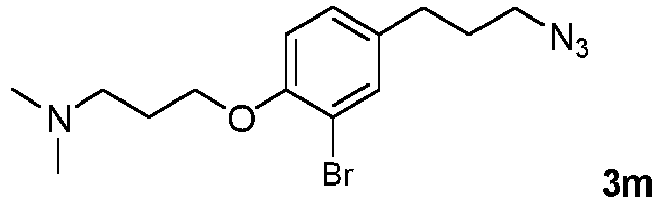
- Azide 3m was obtained from azide 2f (0.5 g, 2 mmol) and 2-chloro-N,N-dimethylpropylamine hydrochloride (0.38 g, 2.4 mmol) using the experimental conditions of example 10.
- Azide 3m was obtained (0.64 g, 93%) as a brown oil.
1H NMR (400 MHz, CDCl3) δ 7.23 (d, J = 2.1 Hz, 1H), 6.92 (dd, J = 8.4, 2.1 Hz, 1H), 6.71 (d, J = 8.4 Hz, 1H), 3.92 (t, J = 6.3 Hz, 2H), 3.14 (t, J = 6.7 Hz, 2H), 2.49 (t, J = 7.5 Hz, 3H), 2.37 (t, J = 7.2 Hz, 2H), 2.13 (s, 6H), 1.92 - 1.78 (m, 2H), 1.79 - 1.65 (m, 2H).
13C NMR (100 MHz, CDCl3) δ 153.5, 134.1, 132.8, 128.1, 113.1, 111.9, 67.2, 56.0, 50.20, 45.3 (2C), 31.2, 30.2, 27.2.
IR (thin film) vN3 2095 cm-1. -

- Azide 3n was obtained from azide 1a (0.27 g, 2 mmol) and 2-chloro-N,N-dimethylethylamine hydrochloride (0.35 g, 2.4 mmol) using the experimental conditions of example 10.
- Azide 3n was obtained (0.3 g, 74%) as a brown oil.
1H NMR (400 MHz, CDCl3) δ 7.01 - 6.71 (m, 4H), 3.98 (t, J = 5.7 Hz, 2H), 2.66 (t, J = 5.7 Hz, 2H), 2.28 (s, 6H).
13C NMR (100 MHz, CDCl3) δ 156.2, 132.3, 119.9 (2C), 115.8 (2C), 66.3, 58.2, 45.8 (2C).
IR (thin film) vN3 2096 cm-1. -

- Azide 3o was obtained from azide 1a (0.27 g, 2 mmol) and 2-chloro-N,N-dimethylpropylamine hydrochloride (0.38 g, 2.4 mmol) using the experimental conditions of example 10.
- Azide 3o was obtained (0.29 g, 67%) as a brown oil.
1H NMR (400 MHz, CDCl3) δ 7.04 - 6.63 (m, 4H), 3.95 (t, J = 6.4 Hz, 2H), 2.40 (d, J = 7.4 Hz, 2H), 2.22 (s, 6H), 1.97 - 1.86 (m, 2H).
13C NMR (100 MHz, CDCl3) δ 156.5, 132.2, 120.0 (2C), 115.8 (2C), 66.6, 56.4, 45.5 (2C), 27.6.
IR (thin film) vN3 2095 cm-1. -

- Azide 2b (251.8 mg, 1.04 mmol, 2.6 equiv.) and 1,6-heptadiyne (36.84 mg, 0.4 mmol, 1 equiv.) were dissolved in a 1:2 mixture of water and DMF, CuSO4.5H2O (0.04 equiv) and sodium ascorbate (0.08 equiv) were then added. The resultant mixture was stirred at room temperature for 24 h. The reaction solution was diluted with brine and extracted three times with chloroform. The organic layers were washed with water, dried over Na2SO4 and evaporated under vacuum. The residue was purified by silica gel column chromatography using a mixture of dichloromethane/methanol as the mobile phase.
- NT21 was obtained (213 mg, 92%) as a white solid.
1H NMR (400 MHz, DMSO) δ 10.06 (s, 2H, OH), 7.74 (s, 2H), 7.28 (d, J = 2.1 Hz, 2H), 6.94 (dd, J = 8.2, 2.1 Hz, 2H), 6.82 (d, J = 8.2 Hz, 2H), 4.48 (t, J = 7.2 Hz, 4H), 3.02 (t, J = 7.2 Hz, 4H), 2.58 (t, J = 7.4 Hz, 4H), 1.85 (p, J = 7.4 Hz, 2H).
13C NMR (100 MHz, DMSO) δ 152.8 (2C), 146.5 (2C), 133.1 (2C), 130.1 (2C), 129.2 (2C), 122.3 (2C), 116.4 (2C), 109.3 (2C), 50.7 (2C), 34.7 (2C), 29.1 (2C), 24.4 (1C). -

- NT22 was obtained from azide 2b (251.8 mg, 1.04 mmol) and 1,7-octadiyne (42.5 mg, 0.4 mmol) using the experimental conditions of example 24.
- NT22 was obtained (206 mg, 87%) as a white solid.
1H NMR (400 MHz, DMSO) δ 10.22 (s, 2H, OH), 7.72 (s, 2H), 7.26 (d, J = 2.1 Hz, 2H), 6.93 (dd, J = 8.2, 2.1 Hz, 2H), 6.84 (d, J = 8.2 Hz, 2H), 4.47 (t, J = 7.2 Hz, 4H), 3.00 (t, J = 7.2 Hz, 4H), 2.59 (t, J = 6.2 Hz, 4H), 1.57 (p, J = 6.2, 4H).
13C NMR (100 MHz, DMSO) δ 152.8 (2C), 146.5 (2C), 132.8 (2C), 129.7 (2C), 128.9 (2C), 121.8 (2C), 116.2 (2C), 109.1 (2C), 50.4 (2C), 34.5 (2C), 28.4 (2C), 24.7 (2C). -

- NT25 was obtained from azide 2b (251.8 mg, 1.04 mmol) and 1,9-decadiyne (53.7 mg, 0.4 mmol) using the experimental conditions of example 24.
- NT25 was obtained (231 mg, 93%) as a white solid.
1H NMR (400 MHz, DMSO) δ 10.08 (s, 2H, OH), 7.72 (s, 2H), 7.26 (d, J = 2.0 Hz, 2H), 6.93 (dd, J = 8.2, 2.0 Hz, 2H), 6.82 (d, J = 8.2 Hz, 2H), 4.47 (t, J = 7.2 Hz, 4H), 3.01 (t, J = 7.2 Hz, 4H), 2.56 (t, J = 7.4 Hz, 4H), 1.66 - 1.43 (m, 4H), 1.28 (m, 4H).
13C NMR (100 MHz, DMSO) δ 152.6 (2C), 146.6 (2C), 132.8 (2C), 129.8 (2C), 128.9 (2C), 121.7 (2C), 116.7 (2C), 109.1 (2C), 50.4 (2C), 34.5 (2C), 29.0 (2C), 28.2 (2C), 24.9 (2C). -

- NT24 was obtained from azide 2b (251.8 mg, 1.04 mmol) and 1,3-diethynylbenzene (50.48 mg, 0.4 mmol) using the experimental conditions of example 24.
- NT24 was obtained (188 mg, 77%) as a white solid.
1H NMR (400 MHz, DMSO) δ 10.10 (s, 2H, OH), 8.58 (s, 2H), 8.32 (s, 1H), 7.75 (d, J = 7.6 Hz, 2H), 7.50 (t, J = 7.6 Hz, 1H), 7.37 (d, J = 1.4 Hz, 2H), 6.98 (dd, J = 8.2, 1.4 Hz, 2H), 6.84 (d, J = 8.2 Hz, 2H), 4.61 (t, J = 7.0 Hz, 4H), 3.12 (t, J = 7.0 Hz, 4H).
13C NMR (100 MHz, DMSO) δ 153.2 (2C), 146.4 (2C), 133.4 (2C), 131.9 (2C), 130.2 (2C), 130.0 (1C), 129.4 (2C), 125.0 (2C), 122.15 (1C), 122.1 (2C), 116.7 (2C), 109.6 (2C), 51.3 (2C), 34.8 (2C). -
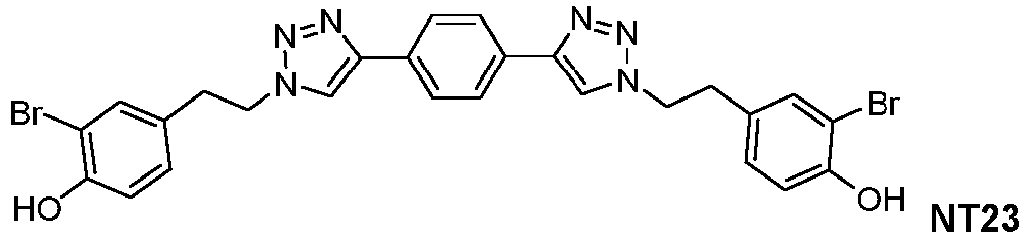
- NT23 was obtained from azide 2b (251.8 mg, 1.04 mmol) and 1,4-diethynylbenzene (50.5 mg, 0.4 mmol) using the experimental conditions of example 24.
- NT23 was obtained (195 mg, 80%) as a yellow solid.
1H NMR (400 MHz, DMSO) δ 10.11 (s, 2H, OH), 8.55 (s, 2H), 7.88 (s, 4H), 7.37 (d, J= 1.9 Hz, 2H), 6.98 (dd, J = 8.2, 1.9 Hz, 2H), 6.84 (d, J = 8.2 Hz, 2H), 4.60 (t, J = 7.1 Hz, 4H), 3.11 (t, J = 7.1 Hz, 4H).
13C NMR (100 MHz, DMSO) δ 152.7 (2C), 145.8 (2C), 132.9 (2C), 130.2 (2C), 129.7 (2C), 129.0 (2C), 125.6 (4C), 121.4 (2C), 116.2 (2C), 109.1 (2C), 50.8 (2C), 34.3 (2C). -

- NT26 was obtained from azide 2b (251.8 mg, 1.04 mmol) and propargyl ether (37.64 mg, 0.4 mmol) using the experimental conditions of example 24.
- NT26 was obtained (201 mg, 87%) as a yellow solid.
1H NMR (400 MHz, DMSO) δ 10.09 (s, 2H, OH), 8.01 (s, 2H), 7.33 (d, J = 1.6 Hz, 2H), 6.95 (dd, J = 8.2, 1.6 Hz, 2H), 6.84 (d, J = 8.2 Hz, 2H), 4.54 (m, 8H), 3.05 (t, J = 7.1 Hz, 4H).
13C NMR (100 MHz, DMSO) δ 153.1 (2C), 144.0 (2C), 133.3 (2C), 130.1 (2C), 129.4 (2C), 124.5 (2C), 116.7 (2C), 109.6 (2C), 62.86 (2C), 51.0 (2C), 34.9 (2C). -

- NT10 was obtained from azide 2a (266.3 mg, 1.04 mmol) and 1,6-heptadiyne (36.8 mg, 0.4 mmol) using the experimental conditions of example 24.
- NT10 was obtained (221 mg, 91%) as a white solid.
1H NMR (400 MHz, CDCl3) δ 7.24 (d, J = 2.1 Hz, 2H), 7.04 (s, 2H), 6.91 (dd, J = 8.4, 2.1 Hz, 2H), 6.76 (d, J = 8.4 Hz, 2H), 4.47 (t, J = 7.1 Hz, 4H), 3.80 (s, 6H), 3.08 (t, J = 7.1 Hz, 4H), 2.64 (t, J = 7.4 Hz, 4H), 1.94 (p, J = 7.4 Hz, 2H).
13C NMR (100 MHz, CDCl3) δ 154.9 (2C), 147.2 (2C), 133.4 (2C), 130.7 (2C), 128.9 (2C), 121.5 (2C), 112.1 (2C), 111.7 (2C), 56.3 (2C), 51.4 (2C), 35.6 (2C), 29.1 (2C), 24.7 (1C). -
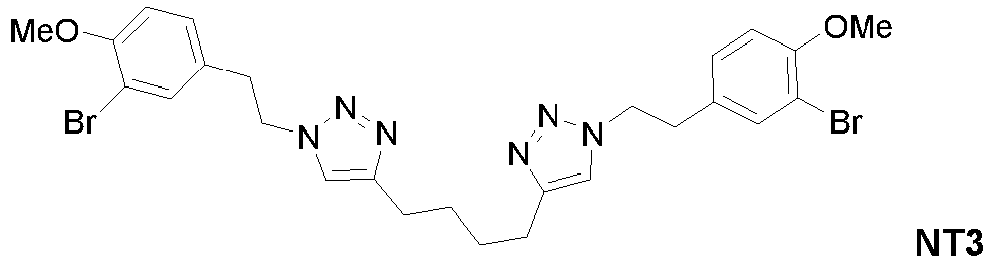
- NT3 was obtained from azide 2a (266.3 mg, 1.04 mmol) and 1,7-octadiyne (42.48 mg, 0.4 mmol) using the experimental conditions of example 24.
- NT3 was obtained (238 mg, 96%) as a yellow solid.
1H NMR (400 MHz, CDCl3) δ 7.20 (d, J = 2.1 Hz, 2H), 7.03 (s, 2H), 6.89 (dd, J = 8.4, 2.1 Hz, 2H), 6.73 (d, J = 8.4 Hz, 2H), 4.43 (t, J = 7.2 Hz, 4H), 3.78 (s, 6H), 3.04 (t, J = 7.2 Hz, 4H), 2.63 (br, 4H), 1.61 (br, 4H).
13C NMR (100 MHz, CDCl3) δ 154.8 (2C), 147.6 (2C), 133.3 (2C), 130.7 (2C), 128.7 (2C), 121.2 (2C), 112.0 (2C), 111.6 (2C), 56.2 (2C), 51.3 (2C), 35.4 (2C), 28.8 (2C), 25.2 (2C). -

- NT4 was obtained from azide 2a (266.3 mg, 1.04 mmol) and 1,9-decadiyne (53.7 mg, 0.4 mmol) using the experimental conditions of example 24.
- NT4 was obtained (251 mg, 97%) as a yellow oil.
1H NMR (400 MHz, CDCl3) δ 7.23 (d, J = 2.1 Hz, 2H), 7.03 (s, 2H), 6.92 (dd, J = 8.4, 2.1 Hz, 2H), 6.76 (d, J = 8.4 Hz, 2H), 4.46 (t, J = 7.2 Hz, 4H), 3.81 (s, 6H), 3.07 (t, J = 7.2 Hz, 4H), 2.62 (t, J = 7.5 Hz, 4H), 1.58 (br, 4H), 1.32 (br, 4H).
13C NMR (100 MHz, CDCl3) δ 154.9 (2C), 148.0 (2C), 133.4 (2C), 130.8 (2C), 128.8 (2C), 121.1 (2C), 112.1 (2C), 111.7 (2C), 56.3 (2C), 51.4 (2C), 35.6 (2C), 29.3 (2C), 28.8 (2C), 25.5 (2C). -

- NT5 was obtained from azide 2a (266.3 mg, 1.04 mmol) and 1,3-diethynylbenzene (50.5 mg, 0.4 mmol) using the experimental conditions of example 24.
- NT5 was obtained (230 mg, 90%) as a white solid.
1H NMR (400 MHz, CDCl3) δ 8.14 (t, J = 1.4 Hz, 1H), 7.71 (dd, J = 7.8, 1.4 Hz, 2H), 7.64 (s, 2H), 7.38 (t, J = 7.8 Hz, 1H), 7.30 (d, J = 2.2 Hz, 2H), 6.92 (dd, J = 8.4, 2.2 Hz, 2H), 6.72 (d, J = 8.4 Hz, 2H), 4.52 (t, J = 7.2 Hz, 4H), 3.77 (s, 6H), 3.11 (t, J = 7.2 Hz, 4H).
13C NMR (100 MHz, CDCl3) δ 154.8 (2C), 147.1 (2C), 133.3 (2C), 131.1 (2C), 130.5 (2C), 129.4 (1C), 128.8 (2C), 125.3 (2C), 122.8 (1C), 120.4 (2C), 112.1 (2C), 111.6 (2C), 56.2 (2C), 51.5 (2C), 35.3 (2C). -

- NT6 was obtained from azide 2a (266.3 mg, 1.04 mmol) and propargyl ether (37.6 mg, 0.4 mmol) using the experimental conditions of example 24.
- NT6 was obtained (225 mg, 93%) as a brown oil.
1H NMR (400 MHz, CDCl3) δ 7.35 (s, 2H), 7.27 (d, J = 2.2 Hz, 2H), 6.93 (dd, J = 8.4, 2.2 Hz, 2H), 6.77 (d, J = 8.4 Hz, 2H), 4.58 (s, 4H), 4.50 (t, J = 7.2 Hz, 6H), 3.81 (s, 6H), 3.10 (t, J = 7.2 Hz, 4H).
13C NMR (100 MHz, CDCl3) δ 154.9, 144.4, 133.4, 130.5, 128.8, 123.3, 112.2, 111.7, 63.2, 56.3, 51.5, 35.4. -

- NT7 was obtained from azide 2a (266.3 mg, 1.04 mmol) and dipropargylamine (37.2 mg, 0.4 mmol) using the experimental conditions of example 24.
- NT7 was obtained (213 mg, 88%) as a brown solid.
1H NMR (400 MHz, CDCl3) δ 7.34 (s, 2H), 7.24 (d, J = 2.1 Hz, 2H), 6.92 (dd, J = 8.4, 2.1 Hz, 2H), 6.75 (d, J = 8.4 Hz, 2H), 4.48 (t, J = 7.2 Hz, 4H), 3.95 - 3.66 (m, 10H, CH 2 NH, OCH 3 ), 3.07 (t, J = 7.2 Hz, 4H).
13C NMR (100 MHz, CDCl3) δ 154.9 (2C), 145.1 (2C), 133.3 (2C), 130.5 (2C), 128.8 (2C), 122.8 (2C), 112.1 (2C), 111.7 (2C), 56.2 (2C), 51.5 (2C), 43.1 (2C), 35.4 (2C). -

- AS158 was obtained from azide 3a (325.6 mg, 1.04 mmol) and 1,6-heptadiyne (36.8 mg, 0.4 mmol) using the experimental conditions of example 24.
- AS158 was obtained (267 mg, 93%) as a brown oil.
1H NMR (400 MHz, CDCl3) δ 7.09 (d, J = 2.1 Hz, 2H), 7.00 (s, 2H), 6.78 (dd, J = 8.4, 2.1 Hz, 2H), 6.65 (d, J = 8.4 Hz, 2H), 4.34 (t, J = 7.1 Hz, 4H), 3.96 (t, J = 5.6 Hz, 4H), 2.94 (t, J = 7.1 Hz, 4H), 2.94 (t, J = 7.1 Hz, 4H), 2.70 (t, J = 5.6 Hz, 4H), 2.51 (t, J = 7.4 Hz, 4H), 2.26 (s, 12H), 1.81 (p, J = 7.4 Hz, 2H).
13C NMR (101 MHz, CDCl3) δ 153.7 (2C), 146.8 (2C), 133.1 (2C), 130.7 (2C), 128.5 (2C), 121.3 (2C), 113.1 (2C), 111.8 (2C), 67.2 (2C), 57.4 (2C), 51.0 (2C), 45.62 (4C), 35.2 (2C), 28.8 (2C), 24.4 (1C). -

- AS159 was obtained from azide 3a (325.6 mg, 1.04 mmol) and 1,7-octadiyne (42.48 mg, 0.4 mmol) using the experimental conditions of example 24.
- AS159 was obtained (277 mg, 94%) as a yellow solid.
1H NMR (400 MHz, CDCl3) δ 7.11 (d, J = 2.1 Hz, 2H), 6.98 (s, 2H), 6.80 (dd, J = 8.4, 2.1 Hz, 2H), 6.66 (d, J = 8.4 Hz, 2H), 4.35 (t, J = 7.2 Hz, 4H), 3.95 (t, J = 5.8 Hz, 4H), 2.96 (t, J = 7.2 Hz, 4H), 2.64 (t, J = 5.8 Hz, 4H), 2.56 (t, J = 5.7 Hz, 4H), 2.22 (s, 12H), 1.63 - 1.48 (m, 4H).
13C NMR (100 MHz, CDCl3) δ 154.0 (2C), 147.4 (2C), 133.1 (2C), 130.7 (2C), 128.5 (2C), 121.0 (2C), 113.1 (2C), 111.9 (2C), 67.7 (2C), 57.6 (2C), 51.1 (2C), 45.96 (4C), 35.3 (2C), 28.6 (2C), 25.0 (2C). -

- AS160 was obtained from azide 3a (325.6 mg, 1.04 mmol) and 1,9-decadiyne (53.7 mg, 0.4 mmol) using the experimental conditions of example 24.
- AS160 was obtained (271 mg, 89%) as a yellow solid.
1H NMR (400 MHz, CDCl3) δ 7.15 (d, J = 2.2 Hz, 2H), 6.99 (s, 2H), 6.84 (dd, J = 8.4, 2.2 Hz, 2H), 6.69 (d, J = 8.4 Hz, 2H), 4.38 (t, J = 7.2 Hz, 4H), 4.00 (t, J = 5.7 Hz, 4H), 2.99 (t, J = 7.2 Hz, 4H), 2.71 (t, J = 5.7 Hz, 4H), 2.54 (t, J = 7.6 Hz, 4H), 2.28 (s, 12H), 1.64 - 1.36 (m, 4H), 1.33 - 1.08 (m, 4H).
13C NMR (100 MHz, CDCl3) δ 154.0 (2C), 147.8 (2C), 133.2 (2C), 130.8 (2C), 128.6 (2C), 121.0 (2C), 113.2 (2C), 112.04 (2C), 67.6 (2C), 57.7 (2C), 51.2 (2C), 45.9 (4C), 35.4 (2C), 29.2 (2C), 28.6 (2C), 25.3 (2C). -

- AS161 was obtained from azide 3a (325.6 mg, 1.04 mmol) and 1,3-diethynylbenzene (50.5 mg, 0.4 mmol) using the experimental conditions of example 24.
- AS161 was obtained (253 mg, 84%) as a brown oil.
1H NMR (400 MHz, CDCl3) δ 8.09 (t, J = 1.6 Hz, 1H), 7.68 (s, 2H), 7.63 (dd, J = 7.8, 1.6 Hz, 2H), 7.29 (t, J = 7.8 Hz, 1H), 7.21 (d, J = 2.1 Hz, 2H), 6.84 (dd, J = 8.4, 2.1 Hz, 2H), 6.64 (d, J = 8.4 Hz, 2H), 4.45 (t, J = 7.2 Hz, 4H), 3.99 (t, J = 5.5 Hz, 4H), 3.03 (t, J = 7.2 Hz, 4H), 2.75 (t, J = 5.5 Hz, 4H), 2.30 (s, 12H).
13C NMR (100 MHz, CDCl3) δ 153.8 (2C), 146.8 (2C), 133.2 (2C), 130.9 (2C), 130.6 (2C), 129.2 (1C), 128.6 (2C), 125.0 (2C), 122.6 (1C), 120.4 (2C), 113.1 (2C), 111.9 (2C), 67.0 (2C), 57.2 (2C), 51.3 (2C), 45.4 (4C), 35.1 (2C). -

- AS162 was obtained from azide 3a (325.6 mg, 1.04 mmol) and 1,4-diethynylbenzene (50.5 mg, 0.4 mmol) using the experimental conditions of example 24.
- AS162 was obtained (264 mg, 88%) as a yellow solid.
1H NMR (400 MHz, CDCl3) δ 7.78 (s, 4H), 7.59 (s, 2H), 7.33 (d, J = 2.1 Hz, 2H), 6.92 (dd, J = 8.2, 2.1 Hz, 2H), 6.76 (d, J = 8.2 Hz, 2H), 4.55 (t, J = 7.0 Hz, 4H), 4.06 (t, J = 5.6 Hz, 4H), 3.14 (t, J = 7.0 Hz, 4H), 2.77 (t, J = 5.6 Hz, 4H), 2.34 (s, 12H).
13C NMR (100 MHz, CDCl3) δ 154.4 (2C), 147.2 (2C), 133.5 (2C), 130.7 (2C), 130.3 (2C), 128.9 (2C), 126.2 (4C), 120.2 (2C), 113.4 (2C), 112.4 (2C), 68.0, 57.9 (2C), 51.7 (2C), 46.2 (4C), 35.6 (2C). -

- AS163 was obtained from azide 3a (325.6 mg, 1.04 mmol) and propargyl ether (37.6 mg, 0.4 mmol) using the experimental conditions of example 24.
- AS163 was obtained (282 mg, 98%) as a yellow solid.
1H NMR (400 MHz, CDCl3) δ 7.32 (s, 2H), 7.14 (d, J = 2.1 Hz, 2H), 6.81 (dd, J = 8.4, 2.1 Hz, 2H), 6.65 (d, J = 8.4 Hz, 2H), 4.46 (s, 4H), 4.38 (t, J = 7.2 Hz, 4H), 3.97 (t, J = 5.6 Hz, 4H), 2.96 (t, J = 7.2 Hz, 4H), 2.70 (t, J = 5.6 Hz, 4H), 2.26 (s, 12H).
13C NMR (100 MHz, CDCl3) δ 153.8 (2C), 143.9 (2C), 133.1 (2C), 130.5 (2C), 128.5 (2C), 123.1 (2C), 113.1 (2C), 111.8 (2C), 67.2 (2C), 62.9 (2C), 57.4 (2C), 51.1 (2C), 45.6 (4C), 35.1 (2C). -

- AS164 was obtained from azide 3a (325.6 mg, 1.04 mmol) and dipropargylamine (37.2 mg, 0.4 mmol) using the experimental conditions of example 24.
- AS164 was obtained (243 mg, 84%) as a brown solid.
1H NMR (400 MHz, CDCl3) δ 7.33 (s, 2H), 7.22 (d, J = 1.8 Hz, 2H), 6.90 (dd, J = 8.4, 1.8 Hz, 2H), 6.75 (d, J = 8.4 Hz, 2H), 4.46 (t, J = 7.2 Hz, 4H), 4.11 (t, J = 5.4 Hz, 4H), 3.81 (br, 4H), 3.06 (t, J = 7.2 Hz, 4H), 2.89 (t, J = 5.4 Hz, 4H), 2.42 (s, 12H).
13C NMR (100 MHz, CDCl3) δ 154.0 (2C), 145.3 (2C), 133.4 (2C), 130.9 (2C), 128.8 (2C), 122.7 (2C), 113.3 (2C), 112.1 (2C), 66.8 (2C), 57.2 (2C), 51.4 (2C), 45.3 (4C), 43.1 (2C), 35.4 (2C). -

- AS168 was obtained from azide 3b (340.3 mg, 1.04 mmol) and 1,6-heptadiyne (36.8 mg, 0.4 mmol) using the experimental conditions of example 24.
- AS168 was obtained (266 mg, 89%) as a brown oil.
1H NMR (400 MHz, CDCl3) δ 7.12 (d, J = 2.1 Hz, 2H), 6.99 (s, 2H), 6.78 (dd, J = 8.4, 2.1 Hz, 2H), 6.65 (d, J = 8.4 Hz, 2H), 4.35 (t, J = 7.1 Hz, 4H), 3.87 (t, J = 6.3 Hz, 4H), 2.95 (t, J = 7.1 Hz, 4H), 2.53 (t, J = 7.4 Hz, 4H), 2.36 (t, J = 7.2 Hz, 4H), 2.11 (s, 12H), 1.90 - 1.76 (m, 6H).
13C NMR (100 MHz, CDCl3) δ 154.0 (2C), 146.8 (2C), 133.0 (2C), 130.4 (2C), 128.5 (2C), 121.3 (2C), 113.1 (2C), 111.9 (2C), 67.0 (2C), 55.8 (2C), 51.1 (2C), 45.2 (4C), 35.3 (2C), 28.8 (2C), 26.9 (2C), 24.4 (1C). -

- AS169 was obtained from azide 3b (340.3 mg, 1.04 mmol) and 1,7-octadiyne (42.48 mg, 0.4 mmol) using the experimental conditions of example 24.
- AS169 was obtained (284 mg, 93%) as a yellow solid.
1H NMR (400 MHz, CDCl3) δ 7.17 (d, J = 2.1 Hz, 2H), 7.01 (s, 2H), 6.85 (dd, J = 8.4, 2.1 Hz, 2H), 6.72 (d, J = 8.4 Hz, 2H), 4.41 (t, J = 7.1 Hz, 4H), 3.96 (t, J = 6.3 Hz, 4H), 3.02 (t, J = 7.1 Hz, 4H), 2.62 (t, J = 6.3 Hz, 4H), 2.46 (t, J = 7.2 Hz, 4H), 2.20 (s, 12H), 1.97 - 1.87 (m, 4H), 1.64 - 1.55 (m, 4H).
13C NMR (100 MHz, CDCl3) δ 154.2 (2C), 147.6 (2C), 133.2 (2C), 130.6 (2C), 128.6 (2C), 121.1 (2C), 113.3 (2C), 112.1 (2C), 67.2 (2C), 56.0 (2C), 51.3 (2C), 45.3 (4C), 35.5 (2C), 28.8 (2C), 27.1 (2C), 25.2 (2C). -

- AS170 was obtained from azide 3b (340.3 mg, 1.04 mmol) and 1,9-decadiyne (53.7 mg, 0.4 mmol) using the experimental conditions of example 24.
- AS170 was obtained (275 mg, 87%) as a brown solid.
1H NMR (400 MHz, CDCl3) δ 7.18 (d, J = 2.1 Hz, 2H), 7.01 (s, 2H), 6.85 (dd, J = 8.4, 2.1 Hz, 2H), 6.72 (d, J = 8.4 Hz, 2H), 4.41 (t, J = 7.2 Hz, 4H), 3.96 (t, J = 6.3 Hz, 4H), 3.02 (t, J = 7.2 Hz, 4H), 2.58 (t, J = 7.6 Hz, 4H), 2.42 (t, J = 7.2 Hz, 4H), 2.18 (s, 12H), 1.97 - 1.83 (m, 4H), 1.65 - 1.43 (m, 4H), 1.36 - 1.20 (m, 4H).
13C NMR (100 MHz, CDCl3) δ 154.2 (2C), 147.9 (2C), 133.2 (2C), 130.6 (2C), 128.6 (2C), 121.0 (2C), 113.3 (2C), 112.2 (2C), 67.3 (2C), 56.1 (2C), 51.3 (2C), 45.4 (4C), 35.5 (2C), 29.3 (2C), 28.7 (2C), 27.2 (2C), 25.4 (2C). -

- AS171 was obtained from azide 3b (340.3 mg, 1.04 mmol) and 1,3-diethynylbenzene (50.5 mg, 0.4 mmol) using the experimental conditions of example 24.
- AS171 was obtained (288 mg, 92%) as a brown oil.
1H NMR (400 MHz, CDCl3) δ 8.12 (d, J = 1.6 Hz, 1H), 7.68 (dd, J = 7.7, 1.6 Hz, 2H), 7.64 (s, 2H), 7.35 (t, J = 7.7 Hz, 1H), 7.26 (d, J = 2.1 Hz, 2H), 6.87 (dd, J = 8.4, 2.1 Hz, 2H), 6.70 (d, J = 8.4 Hz, 2H), 4.49 (t, J = 7.2 Hz, 4H), 3.94 (t, J = 6.3 Hz, 4H), 3.07 (t, J = 7.2 Hz, 4H), 2.41 (t, J = 7.2 Hz, 4H), 2.17 (s, 12H), 1.96 - 1.79 (m, 4H).
13C NMR (100 MHz, CDCl3) δ 154.3 (2C), 147.0 (2C), 133.2 (2C), 131.1 (2C), 130.3 (2C), 129.32 (1C), 128.7 (2C), 125.2 (2C), 122.8 (1C), 120.4 (2C), 113.3 (2C), 112.2 (2C), 67.2 (2C), 56.1 (2C), 51.5 (2C), 45.4 (4C), 35.3 (2C), 27.2 (2C). -

- AS172 was obtained from azide 3b (340.3 mg, 1.04 mmol) and 1,4-diethynylbenzene (50.5 mg, 0.4 mmol) using the experimental conditions of example 24.
- AS172 was obtained (232 mg, 74%) as a brown solid.
1H NMR (400 MHz, CDCl3) δ 7.77 (s, 4H), 7.60 (s, 2H), 7.31 (d, J = 2.1 Hz, 2H), 6.90 (dd, J = 8.2, 2.1 Hz, 2H), 6.74 (d, J = 8.2 Hz, 2H), 4.53 (t, J = 6.5 Hz, 4H), 3.98 (t, J = 5.9 Hz, 4H), 3.12 (t, J = 6.5 Hz, 4H), 2.45 (t, J = 6.9 Hz, 4H), 2.21 (s, 12H), 2.01 - 1.84 (m, 4H).
13C NMR (100 MHz, CDCl3) δ 154.4 (2C), 147.1 (2C), 133.3 (2C), 130.4 (2C), 130.3 (2C), 128.8 (2C), 126.1 (4C), 120.2 (2C), 113.4 (2C), 112.3 (2C), 67.4 (2C), 56.2 (2C), 51.6 (2C), 45.50 (4C), 35.5 (2C), 27.3 (2C). -

- AS173 was obtained from azide 3b (340.3 mg, 1.04 mmol) and propargyl ether (37.6 mg, 0.4 mmol) using the experimental conditions of example 24.
- AS173 was obtained (256 mg, 85%) as a brown solid.
1H NMR (400 MHz, CDCl3) δ 7.30 (s, 2H), 7.14 (d, J = 2.1 Hz, 2H), 6.80 (dd, J = 8.4, 2.1 Hz, 2H), 6.66 (d, J = 8.4 Hz, 2H), 4.47 (s, 4H), 4.38 (t, J = 7.2 Hz, 4H), 3.88 (t, J = 6.3 Hz, 4H), 2.96 (t, J = 7.2 Hz, 4H), 2.34 (t, J = 7.2 Hz, 4H), 2.10 (s, 12H), 1.86 - 1.78 (m, 4H).
13C NMR (100 MHz, CDCl3) δ 154.1 (2C), 144.0 (2C), 133.0 (2C), 130.2 (2C), 128.5 (2C), 123.1 (2C), 113.1 (2C), 111.9 (2C), 67.1 (2C), 62.9 (2C), 55.9 (2C), 51.2 (2C), 45.22 (4C), 35.1 (2C), 27.0 (2C). -

- AS174 was obtained from azide 3b (340.3 mg, 1.04 mmol) and dipropargylamine (37.2 mg, 0.4 mmol) using the experimental conditions of example 24.
- AS174 was obtained (237 mg, 79%) as a brown solid.
1H NMR (400 MHz, CDCl3) δ 7.25 (s, 2H), 7.15 (d, J = 1.8 Hz, 2H), 6.83 (dd, J = 8.4, 1.8 Hz, 2H), 6.68 (d, J = 8.4 Hz, 2H), 4.41 (t, J = 7.0 Hz, 4H), 3.91 (t, J = 6.0 Hz, 4H), 3.73 (br, 4H), 3.00 (t, J = 7.0 Hz, 4H), 2.54 (d, J = 7.5 Hz, 4H), 2.25 (s, 12H), 1.97 - 1.88 (m, 4H).
13C NMR (100 MHz, CDCl3) δ 154.0 (2C), 145.5 (2C), 133.1 (2C), 130.5 (2C), 128.6 (2C), 122.4 (2C), 113.2 (2C), 112.0 (2C), 66.9, 55.5 (2C), 51.2 (2C), 44.4 (4C), 43.1 (2C), 35.3 (2C), 26.3 (2C). -

- SA8 was obtained from azide 2e (252 mg, 1.04 mmol) and 1,4-diethynylbenzene (50.5 mg, 0.4 mmol) using the experimental conditions of example 24.
- SA8 was obtained (171 mg, 70%) as a yellow solid.
1H NMR (400 MHz, DMSO) δ 8.66 (s, 2H), 7.91 (s, 4H), 7.66 (d, J = 2.2 Hz, 2H), 7.39 (dd, J = 8.5, 2.2 Hz, 2H), 7.13 (d, J = 8.5 Hz, 2H), 5.58 (s, 4H), 3.83 (s, 6H).
13C NMR (100 MHz, DMSO) δ 155.3 (2C), 146.3 (2C), 132.8 (2C), 130.1 (2C), 129.5 (2C), 129.1 (2C), 125.6 (4C), 121.5 (2C), 112.9 (2C), 110.6 (2C), 56.3 (2C), 51.8 (2C). -

- SA11 was obtained from azide 3d (243.4 mg, 1.04 mmol) and 1,4-diethynylbenzene (50.5 mg, 0.4 mmol) using the experimental conditions of example 24.
- SA11 was obtained (166 mg, 70%) as a yellow solid.
1H NMR (400 MHz, CDCl3) δ 7.81 (s, 4H), 7.51 (s, 2H), 7.02 (d, J = 8.6 Hz, 4H), 6.84 (d, J = 8.6 Hz, 4H), 4.59 (t, J = 7.2 Hz, 4H), 4.03 (t, J = 5.7 Hz, 4H), 3.18 (t, J = 7.2 Hz, 4H), 2.72 (t, J = 5.7 Hz, 4H), 2.33 (s, 12H).
13C NMR (100 MHz, CDCl3) δ 158.1 (2C), 147.2 (2C), 130.6 (2C), 129.8 (4C), 129.2 (2C), 126.2 (4C), 120.1 (2C), 115.0 (4C), 66.1 (2C), 58.3 (2C), 52.1 (2C), 45.9 (4C), 36.1 (2C). -

- SA12 was obtained from azide 3e (257.9 mg, 1.04 mmol) and 1,4-diethynylbenzene (50.5 mg, 0.4 mmol) using the experimental conditions of example 24.
- SA12 was obtained (124 mg, 50%) as a yellow solid.
1H NMR (400 MHz, DMSO) δ 8.57 (s, 2H), 7.88 (s, 4H), 7.13 (d, J = 8.6 Hz, 4H), 6.84 (d, J = 8.6 Hz, 4H), 4.62 (t, J = 7.2 Hz, 4H), 3.97 (t, J = 6.1 Hz, 4H), 3.16 (t, J = 7.1 Hz, 4H), 2.92 - 2.81 (m, 4H), 2.53 (s, 12H), 2.04 - 1.94 (m, 4H).
13C NMR (100 MHz, DMSO) δ 157.7 (2C), 146.3 (2C), 130.7 (2C), 130.3 (4C), 130.2 (2C), 126.1 (4C), 121.9 (2C), 115.0 (4C), 65.6 (2C), 55.2 (2C), 51.4 (2C), 43.7 (4C), 35.2 (2C), 25.5 (2C). -

- SA31 was obtained from azide 3l (340 mg, 1.04 mmol) and 1,4-diethynylbenzene (50.5 mg, 0.4 mmol) using the experimental conditions of example 24.
- SA31 was obtained (215 mg, 69%) as a yellow solid.
1H NMR (400 MHz, CDCl3) δ 7.83 (s, 4H), 7.76 (s, 2H), 7.31 (d, J = 2.1 Hz, 2H), 7.00 (dd, J = 8.4, 2.1 Hz, 2H), 6.76 (d, J = 8.4 Hz, 2H), 4.34 (t, J = 7.0 Hz, 4H), 4.04 (t, J = 5.8 Hz, 4H), 2.74 (t, J = 5.8 Hz, 4H), 2.55 (t, J = 7.4 Hz, 4H), 2.32 (s, 12H), 2.25 - 2.13 (m, 4H).
13C NMR (100 MHz, CDCl3) δ 153.8 (2C), 147.3 (2C), 133.9 (2C), 133.1 (2C), 130.3 (2C), 128.4 (2C), 126.1 (4C), 119.8 (2C), 113.4 (2C), 112.2 (2C), 67.9 (2C), 57.9 (2C), 49.5 (2C), 46.1 (4C), 31.6 (2C), 31.3 (2C). -

- SA32 was obtained from azide 3m (354 mg, 1.04 mmol) and 1,4-diethynylbenzene (50.5 mg, 0.4 mmol) using the experimental conditions of example 24.
- SA32 was obtained (203 mg, 63%) as a yellow solid.
1H NMR (400 MHz, CDCl3) δ 7.83 (s, 4H), 7.76 (s, 2H), 7.31 (d, J = 1.6 Hz, 2H), 6.99 (dd, J = 8.4, 1.6 Hz, 2H), 6.77 (d, J = 8.4 Hz, 2H), 4.34 (t, J = 7.2 Hz, 4H), 3.98 (t, J = 6.2 Hz, 4H), 2.55 (t, J = 7.2 Hz, 4H), 2.46 (t, J = 7.2 Hz, 4H), 2.28-2.13 (m, 16H), 2.01 - 1.87 (m, 4H).
13C NMR (100 MHz, CDCl3) δ 153.9 (2C), 147.3 (2C), 133.7 (2C), 133.0 (2C), 130.3 (2C), 128.4 (2C), 126.1 (4C), 119.8 (2C), 113.5 (2C), 112.2 (2C), 67.4 (2C), 56.2 (2C), 49.5 (2C), 45.4 (4C), 31.6 (2C), 31.3 (2C), 27.3 (2C). -

- SA33 was obtained from azide 3f (408 mg, 1.04 mmol) and 1,4-diethynylbenzene (50.5 mg, 0.4 mmol) using the experimental conditions of example 24.
- SA33 was obtained (237 mg, 65%) as a yellow solid.
1H NMR (400 MHz, CDCl3) δ 7.83 (s, 4H), 7.62 (s, 2H), 7.29 (s, 4H), 4.60 (t, J = 7.3 Hz, 4H), 4.07 (t, J = 5.8 Hz, 4H), 3.19 (t, J = 7.3 Hz, 4H), 2.80 (t, J = 5.8 Hz, 4H), 2.36 (s, 12H).
13C NMR (100 MHz, CDCl3) δ 152.5 (2C), 147.4 (2C), 135.6 (2C), 132.9 (4C), 130.3 (2C), 126.2 (4C), 120.3 (2C), 118.6 (4C), 70.9 (2C), 58.8 (2C), 51.1 (2C), 45.9 (4C), 35.4 (2C). -

- SA34 was obtained from azide 3g (422 mg, 1.04 mmol) and 1,4-diethynylbenzene (50.5 mg, 0.4 mmol) using the experimental conditions of example 24.
- SA34 was obtained (274 mg, 73%) as a brown solid.
1H NMR (400 MHz, CDCl3) δ 7.84 (s, 4H), 7.62 (s, 2H), 7.26 (s, 4H), 4.59 (t, J = 7.3 Hz, 4H), 4.03 (t, J = 6.4 Hz, 4H), 3.19 (t, J = 7.3 Hz, 4H), 2.54 (t, 6.4Hz, 4H), 2.77 (s, 12H), 2.08 - 1.97 (m, 4H).
13C NMR (100 MHz, CDCl3) δ 152.5 (2C), 147.3 (2C), 135.5 (2C), 132.9 (4C), 130.3 (2C), 126.2 (4C), 120.3 (2C), 118.6 (4C), 72.1 (2C), 56.3 (2C), 51.2 (2C), 45.6 (4C), 35.4 (2C), 28.3 (2C). -

- SA43 was obtained from azide 2h (301 mg, 1.04 mmol) and 1,4-diethynylbenzene (50.5 mg, 0.4 mmol) using the experimental conditions of example 24.
- SA43 was obtained (135 mg, 48%) as a yellow solid.
1H NMR (400 MHz, DMSO) δ 8.55 (s, 2H), 7.88 (s, 4H), 7.51 (d, J = 1.9 Hz, 2H), 6.97 (dd, J = 7.9, 1.9 Hz, 2H), 6.78 (d, J = 7.9 Hz, 2H), 4.57 (t, J = 6.8 Hz, 4H), 3.07 (t, J = 6.8 Hz, 4H).
13C NMR (100 MHz, DMSO) δ 156.5 (2C), 145.8 (2C), 138.6 (2C), 130.2 (2C), 129.7 (2C), 129.0 (2C), 125.6 (4C), 121.5 (2C), 115.1 (2C), 85.3 (2C), 50.9 (2C), 34.2 (2C). -

- SA45 was obtained from azide 3j (374 mg, 1.04 mmol) and 1,4-diethynylbenzene (50.5 mg, 0.4 mmol) using the experimental conditions of example 24.
- SA45 was obtained (230 mg, 68%) as a yellow solid.
1H NMR (400 MHz, CDCl3) δ 7.79 (s, 4H), 7.58 (s, 2H), 7.56 (d, J = 2.1 Hz, 2H), 6.96 (dd, J = 8.4, 2.1 Hz, 2H), 6.67 (d, J = 8.4 Hz, 2H), 4.54 (t, J = 7.2 Hz, 4H), 4.04 (t, J = 5.8 Hz, 4H), 3.12 (t, J = 7.2 Hz, 4H), 2.77 (t, J = 5.8 Hz, 4H), 2.34 (s, 12H).
13C NMR (100 MHz, CDCl3) δ 156.7 (2C), 147.2 (2C), 139.6 (2C), 131.3 (2C), 130.3 (2C), 129.9 (2C), 126.2 (4C), 120.2 (2C), 112.2 (2C), 86.9 (2C), 68.2 (2C), 58.0 (2C), 51.7 (2C), 46.3 (4C), 35.4 (2C). -

- SA46 was obtained from azide 3k (384 mg, 1.04 mmol) and 1,4-diethynylbenzene (50.5 mg, 0.4 mmol) using the experimental conditions of example 24.
- SA46 was obtained (185 mg, 53%) as a brown solid.
1H NMR (400 MHz, CDCl3) δ 7.79 (s, 4H), 7.59 (s, 2H), 7.54 (d, J = 1.4 Hz, 2H), 6.99 - 6.90 (dd, J = 8.4, 1.4 Hz, 2H), 6.65 (d, J = 8.4 Hz, 2H), 4.54 (t, J = 7.1 Hz, 4H), 3.99 (t, J = 5.9 Hz, 4H), 3.12 (t, J = 7.1 Hz, 4H), 2.75 - 2.64 (m, 4H), 2.35 (s, 12H), 2.09 - 1.96 (m, 4H).
13C NMR (100 MHz, CDCl3) δ 156.5 (2C), 147.2 (2C), 139.5 (2C), 131.3 (2C), 130.3 (2C), 129.9 (2C), 126.2 (4C), 120.2 (2C), 112.2 (2C), 86.9 (2C), 67.2 (2C), 55.9 (2C), 51.7 (2C), 44.5 (4C), 35.4 (2C), 26.4 (2C). -

- SA63 was obtained from azide 3h (284 mg, 1.04 mmol) and 1,4-diethynylbenzene (50.5 mg, 0.4 mmol) using the experimental conditions of example 24.
- SA63 was obtained (178 mg, 67%) as a yellow solid.
1H NMR (400 MHz, CDCl3) δ 7.79 (s, 4H), 7.59 (s, 2H), 7.16 (d, J = 1.8 Hz, 2H), 6.88 (dd, J = 8.4, 1.8 Hz, 2H), 6.79 (d, J = 8.4 Hz, 2H), 4.56 (t, J = 7.2 Hz, 4H), 4.07 (t, J = 5.7 Hz, 4H), 3.15 (t, J = 7.2 Hz, 4H), 2.77 (t, J = 5.7 Hz, 4H), 2.35 (s, 12H).
13C NMR (101 MHz, CDCl3) δ 153.5 (2C), 147.2 (2C), 130.4 (4C), 130.3 (2C), 128.1 (2C), 126.2 (4C), 123.2 (2C), 120.2 (2C), 113.7 (2C), 67.7 (2C), 57.9 (2C), 51.7 (2C), 46.1 (4C), 35.7 (2C). -

- SA64 was obtained from azide 3i (293 mg, 1.04 mmol) and 1,4-diethynylbenzene (50.5 mg, 0.4 mmol) using the experimental conditions of example 24.
- SA64 was obtained (116 mg, 42%) as a yellow solid.
1H NMR (400 MHz, CDCl3) δ 7.83 (s, 4H), 7.56 (s, 2H), 7.18 (d, J = 2.1 Hz, 2H), 6.90 (dd, J = 8.4, 2.1 Hz, 2H), 6.82 (d, J = 8.4 Hz, 2H), 4.59 (t, J = 7.2 Hz, 4H), 4.05 (t, J = 6.2 Hz, 4H), 3.18 (t, J = 7.2 Hz, 4H), 2.62 (d, J = 6.2 Hz, 4H), 2.34 (s, 12H), 2.10 - 1.97 (m, 4H).
13C NMR (101 MHz, CDCl3) δ 153.6 (2C), 147.3 (2C), 130.5 (2C), 130.4 (2C), 130.2 (2C), 128.2 (2C), 126.3 (4C), 123.3 (2C), 120.2 (2C), 113.8 (2C), 67.3 (2C), 56.1 (2C), 51.8 (2C), 45.1 (4C), 35.8 (2C), 26.9 (2C). -

- SA61 was obtained from azide 3n (214 mg, 1.04 mmol) and 1,4-diethynylbenzene (50.5 mg, 0.4 mmol) using the experimental conditions of example 24. Then, the product was dissolved in TFA (0.5 mL), precipitated in ether and washed with ether to yield bis-triazole SA61 (227 mg, 74%) as a white solid.
1H NMR (400 MHz, DMSO) δ 10.26 (brs, 2H, NH), 9.29 (s, 2H), 8.07 (s, 4H), 7.90-7.93 (m, 4H), 7.23-7.26 (m, 4H), 4.43 (t, J = 5.0 Hz, 4H), 3.69 - 3.44 (m, 4H), 2.91 (s, 12H).
13C NMR (101 MHz, DMSO) δ 157.6 (2C), 146.9 (2C), 130.8 (2C), 130.1 (2C), 125.9 (4C), 121.7 (4C), 119.8 (2C), 115.8 (4C), 62.7 (2C), 55.4 (2C), 42.85 (4C). -
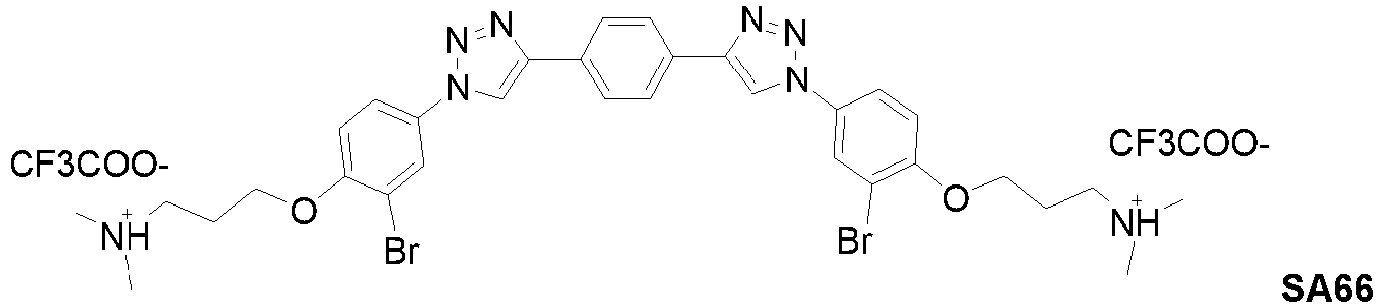
- A first bis-triazole compound was obtained from azide 3o (229 mg, 1.04 mmol) and 1,4-diethynylbenzene (50.5 mg, 0.4 mmol) using the experimental conditions of example 24.
- Said bis-triazole compound (79.5 mg, 0.1 mmol) was then diluted in CH2Cl2/TFA (1 mL/1 mL) and bromine (Br2) (64 mg, 0.4 mmol) in CH2Cl2 (1 mL) was added dropwise. The mixture was stirred at room temperature for 12 h. Then, the product was precipitated in ether and washed with ether to yield Bis-triazole SA66 (78 mg, 82%) as a white solid.
1H NMR (400 MHz, DMSO) δ 9.54 (brs, NH, 2H), 9.37 (s, 2H), 8.23 (d, J = 2.6 Hz, 2H), 8.05 (s, 4H), 7.98 (dd, J = 8.9, 2.6 Hz, 2H), 7.38 (d, J = 8.9 Hz, 2H), 4.25 (t, J = 6.0 Hz, 4H), 3.35 - 3.22 (m, 4H), 2.86 (d, J = 5 Hz, 12H) 2.33 - 2.04 (m, 4H).
13C NMR (100 MHz, DMSO) δ 154.6 (2C), 146.9 (2C), 130.7 (2C), 130.0 (2C), 125.9 (4C), 124.5 (2C), 120.7 (2C), 120.0 (2C), 114.5 (2C), 111.7 (2C), 66.6 (2C), 54.3 (2C), 42.4 (4C), 23.8 (2C). - Table 1 below gives the amount of five different marine bacterial strains (TC14, TC8, 4M6, TC5 and TC11) that adhere on a microtiter plate in the presence of a compound of the invention at a 200 micromolar concentration according to the Anti-adhesion test method disclosed herein.
Table 1 cpd yield % of adhesion at 200 µM TC14 TC8 4M6 TC5 TC11 nt3 96% 53.3±6.3 56.9±1.7 50.9±0.3 nt6 93% 38.4±7.4 42.7±6.5 44.9±3.1 nt7 88% 37.4±0.1 48.2±2.1 46.3±2.7 nt10 91% 50.4±2.2 50.0±4.9 49.2±0.8 nt21 92% 53.0±4.0 63.±8.1 83.4±3.9 nt22 87% 54.4±1.7 85.6±2.1 52.4±2.3 nt23 80% 31.0±6.1 58.3±8.7 31.8±3.5 nt24 77% 56.7±1.3 66.51±11.59 61.5±4.2 nt26 87% 40.2±3.3 50.34±5.79 47.8±0.1 nt27 63% 29.3±7.5 28.9±17.0 27.8±16.3 as158 93% 55.8±3.8 57.0±2.2 51.5±3.0 as159 94% 61.5±1.0 58.4±4.3 57.4±1.6 as160 89% 67.4±4.0 54.3±10.8 59.5±2.2 as162 88% 0±5.3 14.±11.8 10.9±8.1 21.516.6 4.317.5 as163 98% 34.8±2.7 34.6±5.1 40.4±7.8 as164 84% 40.8±5.0 47.1±1.0 51.7±4.3 as168 89% 53.8±5.9 59.9±6.4 77.1±2.4 as172 74% 0.5±0.8 5.3±2.5 5.1±1.4 12.67±5.7 4.6±0.4 as173 85% 41.7±1.6 51.6±1. 53.7±4.0 as174 79% 45.0±0.8 55.4±0.4 56.3±2.4 SA8 70% 23.3±3.8 24.1±2.6 33.1±4.4 38.3±0.1 16.4±8.0 SA12 50% 42.4±8.6 30.0±21.9 14.3±7.3 66.2±2.8 41.0±4.1 SA32 63% 34.3±2.6 17.7±11.1 26.7±5.6 53.4±13.8 17.4±2.9 SA33 65% 6.3±1.3 6.8±4.3 7.4±8.3 0.7±0.7 4.4±2.7 SA34 73% 13.0±7.7 10.2±3.1 8.2±3.5 7.9±7.3 7.0±3.12 SA43 48% 6.8±1.2 10.5±12.0 13.6±8.9 23.8±0.1 4.6±0.1 SA45 68% 42.1±2.9 30.0±16.3 3.2±4.6 37.5±13.3 9.3±0.5 SA46 53% 30.2±3.5 17.4±14.3 26.6±3.4 22.4±14.7 5.8±1.2 SA61 74% 47.8±1.7 45.6±1.2 40.2±0.3 89.4±0.8 19.3±16.9 SA63 67% 30.6±5.3 29.0±3.2 43.6±3.3 37.3±6.0 37.0±1.0 SA64 42% 28.4±14.0 20.2±21.1 31.0±12.4 42.9±4.5 42.6±5.6 SA66 82% 19.0±6.5 31.7±2.2 24.5±6.9 23.3±4.0 45.5±1.1 - At a 200 micromolar concentration, the compounds of the invention are able to inhibit at least 40% of the adhesion of one of the bacterial strains that were tested.
- Compounds AS162, AS163, AS172, NT23, NT27, SA33, SA34 and SA43 all inhibit at least 65% of the adhesion of at least two marine bacterial strains.
- Compounds AS162, AS172, SA33, SA34 and SA43 all inhibit at least 85% of the adhesion of at least four marine bacterial strains and compounds AS162 and AS172 totally inhibit the adhesion of bacterial strain TC14.
- Table 2 below gives the EC50 (effective concentration to inhibit 50% of the adhesion). LC50 (necessary concentration to kill 50% of the bacteria), and the selectivity index IS (LC50/EC50) of compounds of general formula (I) on five different bacterial strains according to the Toxicity test method disclosed herein. Two comparative examples, using respectively tributyltin oxide (TBTO) and zinc ethane-1.2-diylbis(dithiocarbamate) (ZINEB) are also given.
Table 2 Cpd EC50 (µM) LC50 (µM) IS : LC50/EC50 TC14 TC8 4M6 TC5 TC11 TC14 TC8 4M6 TC5 TC11 TC14 TC8 4M6 TC5 TC11 nt6 159.8±33.5 180.8±21.3 164.1±6.3 - - - - - - nt7 138.4±8.7 187.9±3.0 194.5±8.0 - - - - - - nt10 - - 182.4±15.2 - - - - - - nt23 40.9±11.4 - 59.9±7.7 - - - - - - nt26 127.1±27.5 194.9±10.7 198.3±4.1 - - - - - - nt27 59.9±27.2 80.3±18.9 88.3±46.2 - - - - - - as162 0.97±0.8 5.1±1.0 5.1±1.04 15.5±0.1 12.6±5.1 257.7 66.1 97.6 382 334.3 265.7 12.9 19.2 24.6 26.5 as163 918±17.9 101.6±46.2 146.2±81.9 - - - - - - as164 126.2±21.5 176.5±3 - - - - - - - as172 0.39±0.28 15.0±3.3 3.6±3.8 11.0 ± 0.3 15.6 ± 12.9 224.7 165.1 82.3 122.2 293 576.1 10.9 22.9 11.1 18.9 as173 121.7±59.1 - - - - - - - - as174 - 185.2±16.2 - - - - - - - TBTO - 7.0 ± 3.0 4.0 ± 3.0 - 4.8 1.1 - 0.7 0.25 ZINEB - 47.0 ± 24.0 23.0 ± 1 - 61.0 31.0 - 1.3 1.3 SA8 99.5±4.5 158.6±28.5 162.7±23.6 151.6±6.7 122.2±7.1 SA12 186.9±16.5 177.2±80.1 73.2±10.7 172.9±22.4 SA32 115.3±20.5 109.3±37.2 3.1±8.6 114.0±28.6 61.1±18.5 SA33 20.4±1.2 42.5±16.9 11.3±9.1 19.2±2.1 32.0±8.1 254.1 199.3 126.4 92.64 134.8 12.45 4.7 11.2 4.8 4.2 SA34 13.1±1.0 50.5±10.9 1.5±2.1 4.6±6.3 27.2±0.5 132 174.2 113.5 94.3 115.9 10.1 3.5 75.7 20.5 4.3 SA43 20.7±5.2 30.3±31.3 53.8±50.9 58.0±1.61 1.1±0.6 236.9 270.3 351.5 320.5 88.4 11.4 8.9 6.5 5.5 80.4 SA45 175.0±21.2 135.1±34.3 14.2±3.2 146.8±32.4 129.4±13.2 SA46 74.4±8.3 71.5±4.1 48.3±48.9 70.6±8.9 22.2±13.6 SA61 194.2±13.7 184.4±0.6 178.8±44.9 139.9±63.5 SA63 121.7±10.7 138.4±10.6 96.6±36.2 132.7±9.2 135.5±5.1 SA64 146.6±14.4 121.3±76.8 43.3±14.6 150.5±8.1 152.5±20.4 SA66 103.9±4.6 140.8±16.5 44.2±25.2 50.2±10.9 164.8±37.8 - Compounds AS162 and AS172 exhibit an EC50 comparable to that of TBTO and lower than that of ZINEB. The LC50 values show that compounds AS162 and AS172 are less toxic than TBTO and ZINEB. The selectivity index of AS162 and AS172 is higher than 10 thus showing that these compounds are non-toxic and environmentally friendly unlike TBTO and ZINEB.
- Compounds SA33, SA34 and SA43 exhibit an EC50 comparable to that of ZINEB and the LC50 values show that these compounds are less toxic than ZINEB.
- Electrochemical impedance spectroscopic (EIS) studies have been conducted to investigate corrosion inhibition processes of compounds of the invention according to the Electrochemical impedance spectroscopic test method described herein.
-
Fig. 1 shows Nyquist plots obtained from AC impedance measurements for mild steel in 1N HCI in the absence and in the presence of AS164 at a concentration of 200 ppm. - The EIS spectra show a depressed capacitive loop in the high frequency range followed by an inductive loop that is observed in the low frequency range. The high frequency capacitive loop can be ascribed to the charge transfer reaction. The low frequency inductive loop may be attributed to the relaxation process obtained by adsorption species like Cl- ads and H+ ads on the electrode. It may also correspond to the re-dissolution of the passivated surface at low frequencies. The same shape of EIS spectra were obtained both in the blank and in the presence of AS164. This suggests that AS164 does not change the corrosion mechanism.
- The diameter of the high frequency loop dramatically increased in the presence of AS164 compounds indicative of a strong corrosion inhibitive effect. The high frequency loop was analyzed in terms of an equivalent circuit involving a parallel combination of Rct and the constant phase element of double layer (CPE). The inhibition efficiency, IE (%), was estimated from the measured Rct values using the following equation:

- AS164 exhibits an excellent inhibition efficiency (IE %) of around 95%.
- Weight loss experiments were done to confirm the corrosion inhibitive properties of AS164. The first trials were performed in a concentration range of 25-200 ppm of AS164 which corresponds to a molar concentration range of 3.5.10-5 M to 2.8.10-4 M. This concentration range was chosen to be comparable with that used in the many reported results corresponding to mild steel exposed in such aggressive acidic corrosion medium in presence of corrosion inhibitive species (see for representative examples AK Singh et al., Corros. Sci. 53 (2011) 1288-97 and Zhang et al., Corros. Sci. 90 (2015) 284-95).
The relative weight loss change was found to be linearly related to the immersion time as shown inFigure 2 . - The corrosion rate CR, expressed in g cm-2 h-1, corresponds to the slope of the straight lines shown in
Figure 2 . The inhibition efficiency, IE (%), was estimated from the weight loss experiments using the following equation:
The inhibition efficiency of AS164 was found to be greaterthan 97%. - Inhibition efficiencies were measured for the following compounds according to the invention: AS158, AS159, AS160, AS161, AS162, AS163, AS164, AS168, AS169, AS170, AS171, AS172, AS173, AS174, SA11, SA12, SA31, SA32, SA33, SA34, SA45, SA46, SA61, SA63, SA64 and SA66 in a concentration range of 0.1 to 10 ppm. The results are shown in Table 3 below.
Table 3 Sample Concentration IE % AS158 10 ppm (1.42.10-5 M) 97.17 2 ppm (2.84.10-6 M) 95.98 0.5 ppm (0.71.10-6 M) 91.72 0.3 ppm (0.42.10-6 M) 87.00 0.1 ppm (0.14.10-6 M) 53.41 AS159 10 ppm (1.36.10-5 M) 97.30 2 ppm (2.72.10-6 M) 95.63 0.5 ppm (0.68.10-6 M) 91.95 0.3 ppm (0.41.10-6 M) 89.62 0.1 ppm (0.13.10-6 M) 39.96 AS160 10 ppm (1.31.10-5 M) 97.03 2 ppm (2.62.10-6 M) 96.06 0.5 ppm (0.65.10-6 M) 92.66 0.3 ppm (0.39.10-6 M) 92.14 0.1 ppm (0.13.10-6 M) 71.40 AS161 10 ppm (1.33.10-5 M) 98.33 2 ppm (2.66.10-6 M) 97.10 0.5 ppm (0.66.10-6 M) 94.07 0.3 ppm (0.40.10-6 M) 86.21 0.1ppm (0.13.10-6 M) 86.75 AS162 10 ppm (1.33.10-5 M) 97.30 2 ppm (2.66.10-6 M) 97.73 0.5 ppm (0.66.10-6 M) 92.92 0.3 ppm (0.40.10-6 M) 93.35 0.1 ppm (0.13.10-6 M) 48.81 AS163 10 ppm (1.38.10-5 M) 97.07 2 ppm (2.77.10-6 M) 96.52 0.5 ppm (0.69.10-6 M) 94.54 0.3 ppm(0.41.10-6 M) 89.36 0.1 ppm (0.13.10-6 M) 82.24 AS164 10 ppm (1.38.10-5 M) 97.20 2 ppm (2.77.10-6 M) 92.42 0.5 ppm (0.69.10-6 M) 89.20 0.3 ppm (0.41.10-6 M) 90.49 0.1 ppm (0.13.10-6 M) 57.10 AS171 10 ppm (1.28.10-5 M) 98.51 2 ppm (2.56.10-6 M) 97.25 0.5 ppm (0.64.10-6 M) 91.72 0.3 ppm (0.38.10-6 M) 86.91 0.1 ppm (0.13.10-6 M) 53.82 AS172 10 ppm (1.28.10-5 M) 98.15 2 ppm (2.56.10-6 M) 96.44 0.5 ppm (0.64.10-6 M) 91.11 0.3 ppm (0.38.10-6 M) 92.94 0.1 ppm (0.13.10-6 M) 40.16 AS173 10 ppm (1.33.10-5 M) 97.95 2 ppm (2.67.10-6 M) 95.77 0.5 ppm (0.67.10-6 M) 92.47 0.3 ppm (0.4.10-6 M) 86.70 0.1 ppm (0.13.10-6 M) 46.78 AS174 10 ppm (1.33.10-5 M) 97.17 2 ppm (2.67.10-6 M) 95.98 0.5 ppm (0.67.10-6 M) 91.72 0.3 ppm (0.4.10-6 M) 87.00 0.1 ppm (0.13.10-6 M) 53.41 SA11 10 ppm (1.68.10-5 M) 97.11 2 ppm (3.36.10-6 M) 96.95 0.5 ppm (0.84.10-6 M) 95.49 0.3 ppm (0.50.10-6 M) 93.32 0.1 ppm (0.17.10-6 M) 90.50 SA12 10 ppm (1.6.10-5 M) 95.73 2 ppm (3.21.10-6 M) 96.89 0.5 ppm (0.80.10-6 M) 94.65 0.3 ppm (0.48.10-6 M) 69.97 0.1 ppm (0.16.10-6 M) 39.30 SA31 10 ppm (1.28.10-5 M) 96.56 2 ppm (2.56.10-6 M) 96.17 0.5 ppm (0.64.10-6 M) 95.44 0.3 ppm (0.38.10-6 M) 93.00 0.1 ppm (0.13.10-6 M) 80.79 SA32 10 ppm (1.23.10-5 M) 95.58 2 ppm (2.47.10-5 M) 96.54 0.5 ppm (0.62.10-5 M) 96.30 0.3 ppm (0.37.10-5 M) 95.43 0.1 ppm (0.12.10-5 M) 79.01 SA33 10 ppm (1.10.10-5 M) 96.03 2 ppm (2.22.10-6 M) 96.25 0.5 ppm (0.55.10-6 M) 95.89 0.3 ppm (0.33.10-6 M) 95.37 0.1 ppm (0.11.10-6 M) 87.08 SA34 10 ppm (1.07.10-5 M) 95.69 2 ppm (2.13.10-6 M) 96.25 0.5 ppm (0.53.10-6 M) 92.23 0.3 ppm(0.32.10-6 M) 70.39 0.1 ppm (0.11.10-6 M) 52.40 SA45 10 ppm (1.18.10-5 M) 96.09 2 ppm (2.23.10-6 M) 95.23 0.5 ppm (0.59.10-6 M) 94.67 0.3 ppm (0.35.10-6 M) 93.01 0.1 ppm (0.12.10-6 M) 78.07 SA46 10 ppm (1.14.10-5 M) 94.96 2 ppm (2.29.10-6M) 96.05 0.5 ppm (0.57.10-6 M) 94.51 0.3 ppm (0.34.10-6 M) 90.47 0.1 ppm (0.11.10-6 M) 82.23 SA61 10 ppm (1.30.10-5 M) 95.93 2 ppm (2.61.10-6 M) 95.55 0.5 ppm (0.65.10-6 M) 94.34 0.3 ppm (0.39.10-6 M) 91.92 0.1 ppm (0.13.10-6 M) 87.42 SA63 10 ppm (1.50.10-5 M) 96.95 2 ppm (3.01.10-6 M) 95.98 0.5 ppm (0.75.10-6 M) 95.82 0.3 ppm (0.45.10-6 M) 95.02 0.1 ppm (0.15.10-6 M) 90.68 SA64 10 ppm (1.45.10-5 M) 96.64 2 ppm (2.89.10-6 M) 96.37 0.5 ppm (0.72.10-6 M) 95.90 0.3 ppm (0.43.10-6 M) 94.18 0.1 ppm (0.14.10-6 M) 90.59 SA66 10 ppm (1.05.10-5 M) 96.48 2 ppm (2.10.10-6 M) 95.16 0.5 ppm (0.52.10-6 M) 90.41 0.3 ppm (0.31.10-6 M) 88.30 0.1 ppm (0.10.10-6 M) 85.79 - The results show that all tested compounds exhibit an inhibition efficiency > 89% at a concentration of 0.5 ppm (submicromolar concentration).
- From the visual inspection of the mild steel specimens, it is clear that mild steel is severely corroded in the 1N HCI medium without a compound of the invention whereas the mild steel plate does not show any sign of corrosion in the presence of a compound of the invention. For example,
Figure 3 shows the difference in corrosion of the mild steel coupon with and without 1 ppm of AS171 after one week of immersion in the corrosive medium. - The linear relationships of Cinh/θ vs Cinh depicted in
Figure 4 suggest that the adsorption of AS174 from 1 N HCI solutions on the mild steel coupon obeyed the Langmuir adsorption isotherm. A strong correlation (r2>0.99) for the Langmuir adsorption isotherm plots was found for all tested compounds of Table 3.
Claims (15)
- Compound corresponding to the general formula (I):
 L is selected from a substituted or unsubstituted alkanediyl radical, -(CRaRb)p-X-(CRaRb)q- or a substituted or unsubstituted arylene or heteroarylene directly branched with the triazole groups;R1, R3, R4 and R6 are independently selected from H, Br, Cl, I and F;R2 and R5 are independently selected from H or a substituted or unsubstituted alkyl;X is selected from O, NR', S or S=O;R', Ra and Rb are independently H or (C1-C6)alkyl;n and m are independently 0, 1, 2, 3 or 4;p and q are independently 1, 2 or 3;wherein alkyl represents a monovalent radical of a linear or branched hydrocarbon chain comprising 1 to 18 carbon atoms;alkanediyl represents a divalent radical of a linear or branched hydrocarbon chain comprising 1 to 18 carbon atoms;arylene represents a divalent radical of an aromatic hydrocarbon comprising 6 to 18 carbon atoms;heteroarylene represents a divalent radical of a monocyclic or bicyclic 5 to 10 membered aromatic group comprising from 1 to 3 heteroatoms independently selected from oxygen, nitrogen and sulphur, wherein the C5-C10 heteroaryl group is selected from the group consisting of furyl, thienyl, pyrrolyl, pyrazoyl, imidazolyl, isoxazolyl, isothiazoyl, thiazolyl, oxazolyl, 1,2,3-triazolyl, 1,2,4-triazolyl, 1-benzofuryl, 1-benzothienyl, indolyl, benzimidazolyl, indazolyl, 1,2-benzisoxazolyl, 2,1-benzisoxazolyl, 1,2-benzisothiazolyl, 2,1-benzisothiazolyl, benzothiazolyl, benzoxazolyl, benzotriazolyl, pyridyl, pyridinium, quinolinyl, isoquinolinyl, pyridazinyl, cinnolinyl, phthalazinyl, pyrimidinyl, quinazolinyl, pyrazinyl and quinoxalinyl;substituted means substituted by one or more substituents selected from the group consisting of halogen, alkyl, alkoxy, aryl, heteroaryl, haloalkyl, haloalkoxy, alkoxycarbonyl, alkanoyl, aroyl, formyl, nitrile, nitro, amido, alkylthio, alkylsulfinyl, alkylsulfonyl, arylthio, arylsulfinyl, arylsulfonyl, amino, alkylamino, arylamino, dialkylamino and diarylamino;and salts thereof;with the proviso that said compound is not
- Compound of general formula (I) according to claim 1, wherein L is selected from a substituted or unsubstituted alkanediyl radical having 1 to 10, in particular 2 to 8, more particularly 3 to 6, carbon atoms ; -(CH2)p-O-(CH2)q- ; -(CH2)p-NH-(CH2)q- ; or a substituted or unsubstituted arylene or heteroarylene directly branched with the triazole groups, in particular a substituted or unsubstituted phenylene directly branched with the triazole groups, more particularly an unsubstituted phenylene directly branched in positions 1,3 and 1,4 with the triazole groups.
- Compound of general formula (I) according to claim 1 or 2, wherein p and q are independently 1 or 2, in particular p and q are 1.
- Compound of general formula (I) according to any one of claims 1 to 3, wherein R1, R3, R4 and R6 are all H or are all Br; or wherein at least one of R1 and R3 is Br, Cl or I and at least one of R4 and R6 is Br, Cl or I; in particular one of R1 and R3 is H and the other is Br, Cl or I and one of R4 and R6 is H and the other is Br, Cl or I.
- Compound of general formula (I) according to any one of claims 1 to 4, wherein R2 and R5 are independently selected from H, unsubstituted (C1-C6)alkyl, and (C1-C6)alkyl substituted by at least one group selected from amino, (C1-C6)alkylamino, (di(C1-C6)alkyl)amino or an ammonium salt thereof; in particular R2 and R5 are independently selected from H, methyl, methyl(dimethylamino), ethyl(dimethylamino), propyl(dimethylamino), the trifluoroacetate ammonium salt of ethyl(dimethylamino) or the trifluoroacetate ammonium salt of propyl(dimethylamino).
- Compound of general formula (I) according to any one of claims 1 to 5, wherein n and m are independently 0, 1, 2 or 3, in particular n and m are 2.
- Compound of general formula (I) according to any one of claims 1 to 6, wherein:- R1 and R6 are identical;- R2 and R5 are identical;- R3 and R4 are identical; and- n and m are identical.
- Compound of general formula (I) according to any one of claims 1 to 7, wherein:- L is selected from a substituted or unsubstituted alkanediyl radical having 3 to 6 carbon atoms, -CH2-O-CH2-, -CH2-NH-CH2, or a substituted or unsubstituted phenylene directly branched with the triazole groups;- R1, R3, R4 and R6 are independently selected from H, Br, Cl and I;- R2 and R5 are independently selected from H, unsubstituted (C1-C6)alkyl, and (C1-C6)alkyl substituted by a (di(C1-C6)alkyl)amino group or an ammonium salt thereof;- n and m are 0, 1, 2 or 3.
- Compound of general formula (I) according to any one of claims 1 to 8, corresponding to one of the following formulae:


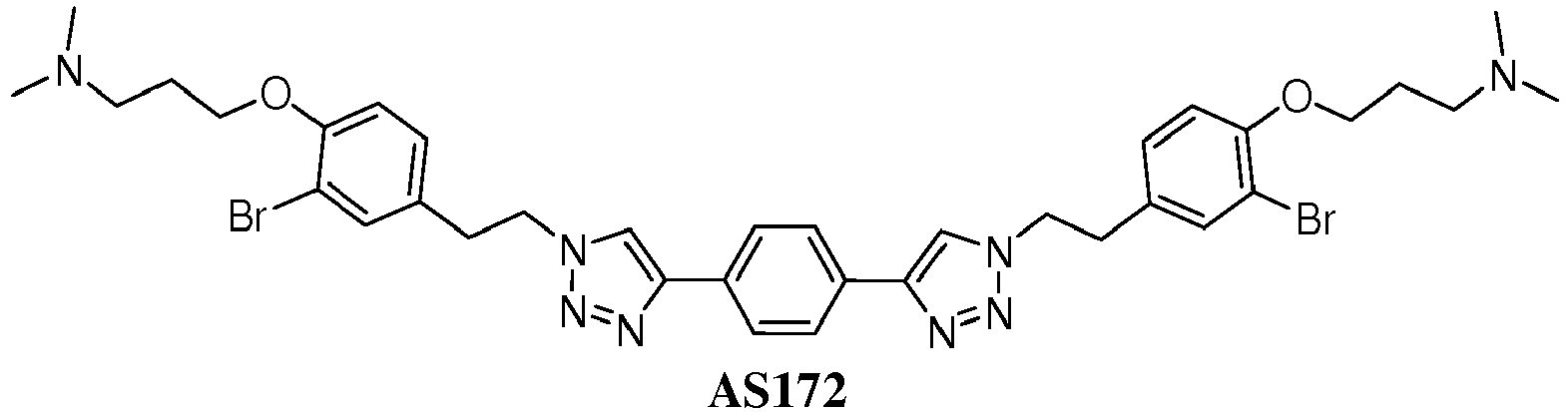


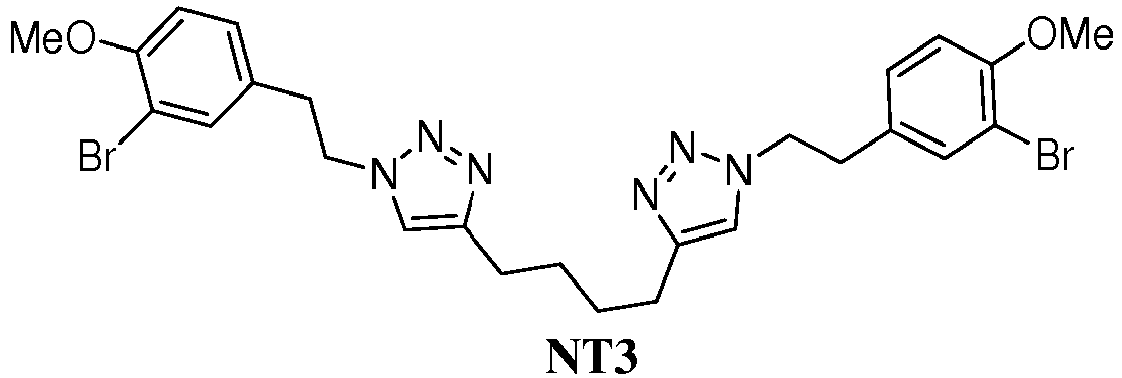

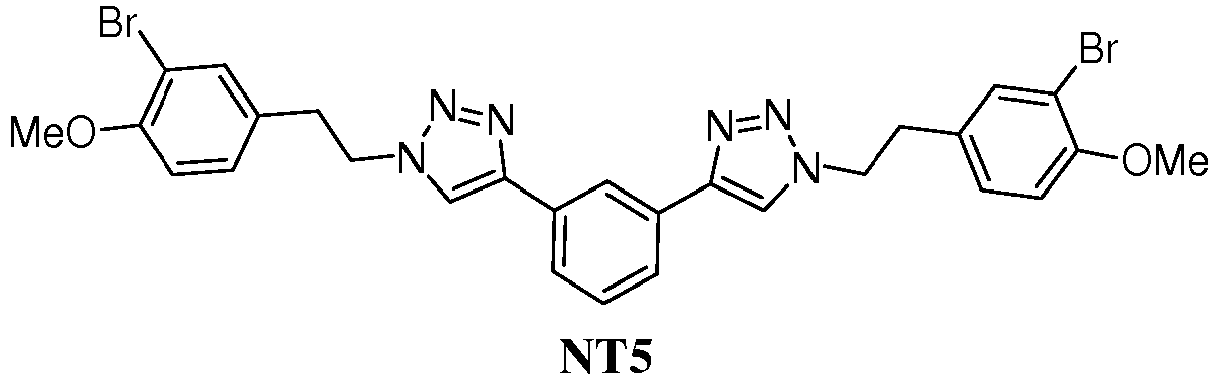


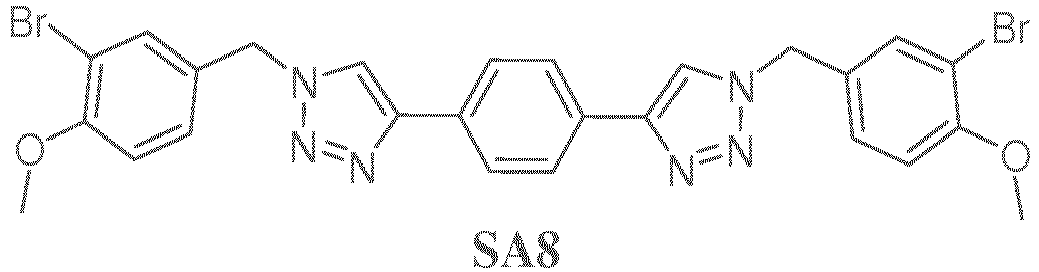
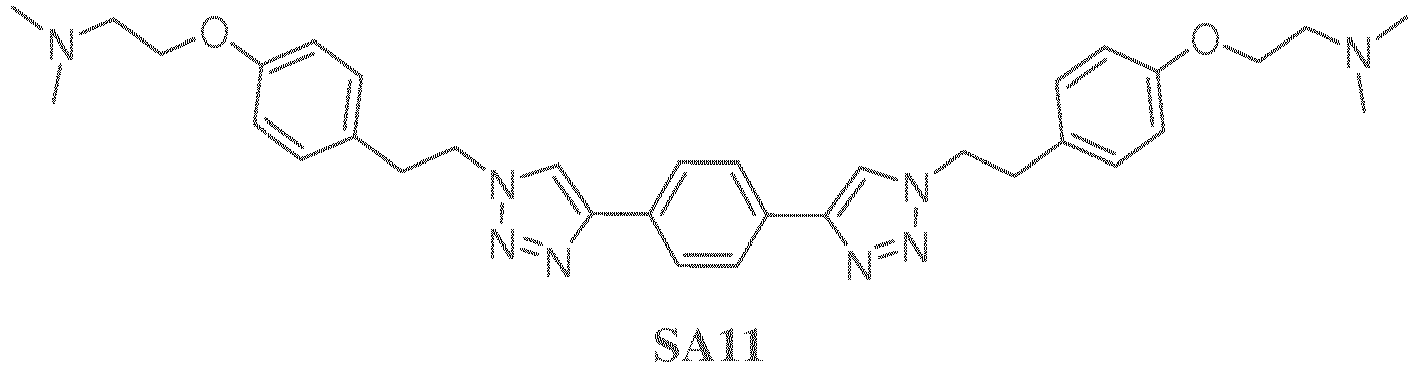
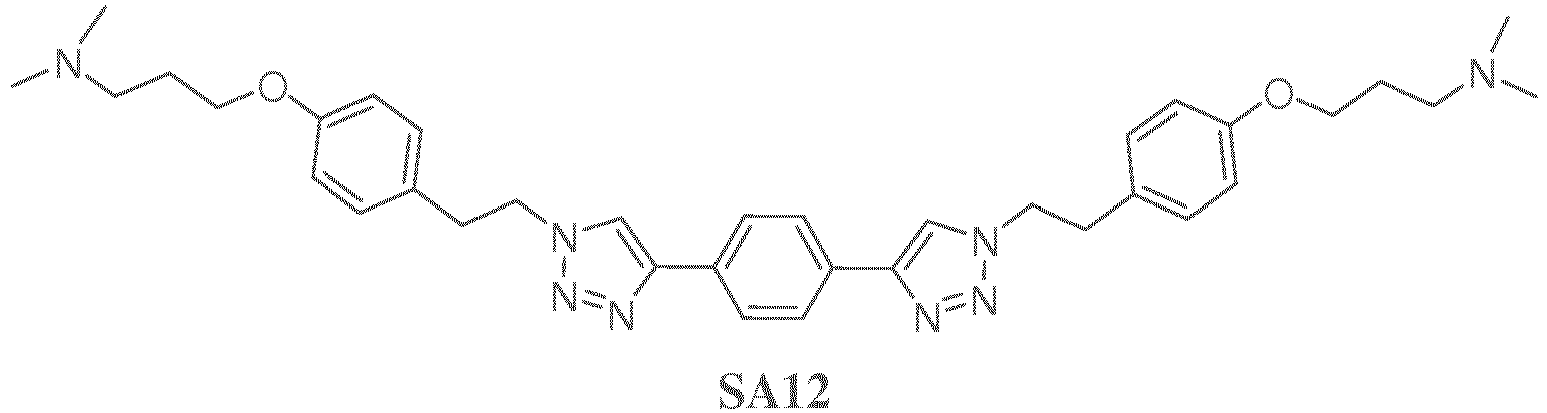


- Compound of general formula (I) as defined in any one of claims 1 to 9 for use as a medicament.
- Composition comprising a compound of general formula (I) as defined in any one of claims 1 to 9 and a carrier.
- Non-therapetic use of a compound of general formula (I) as defined in any one of claims 1 to 9 as an antibacterial agent.
- Non-therapetic use of a compound of general formula (I) as defined in any one of claims 1 to 9 as an anti-biofilm agent.
- Non-therapetic use of a compound of general formula (I) as defined in any one of claims 1 to 9 as an anti-fouling agent.
- Non-therapetic use of a compound of general formula (I) as defined in any one of claims 1 to 9 as an anti-corrosion agent.
Applications Claiming Priority (2)
| Application Number | Priority Date | Filing Date | Title |
|---|---|---|---|
| IB2015002582 | 2015-12-14 | ||
| PCT/EP2016/081068 WO2017102883A1 (en) | 2015-12-14 | 2016-12-14 | Bis-triazole compounds with anti-biofilm and anti-corrosion properties |
Publications (2)
| Publication Number | Publication Date |
|---|---|
| EP3390370A1 EP3390370A1 (en) | 2018-10-24 |
| EP3390370B1 true EP3390370B1 (en) | 2021-02-03 |
Family
ID=55346142
Family Applications (1)
| Application Number | Title | Priority Date | Filing Date |
|---|---|---|---|
| EP16816645.2A Not-in-force EP3390370B1 (en) | 2015-12-14 | 2016-12-14 | Bis-triazole compounds with anti-biofilm and anti-corrosion properties |
Country Status (7)
| Country | Link |
|---|---|
| US (1) | US10487071B2 (en) |
| EP (1) | EP3390370B1 (en) |
| JP (1) | JP2018538272A (en) |
| KR (1) | KR20180093904A (en) |
| CN (1) | CN108430979A (en) |
| CA (1) | CA3004386A1 (en) |
| WO (1) | WO2017102883A1 (en) |
Families Citing this family (4)
| Publication number | Priority date | Publication date | Assignee | Title |
|---|---|---|---|---|
| CN111072567B (en) * | 2020-01-07 | 2021-04-27 | 河南大学 | Amino acid Schiff base sodium salt containing pyrazole heterocycle and its synthesis method and application as metal corrosion inhibitor |
| WO2025137293A2 (en) * | 2023-12-22 | 2025-06-26 | Roche Sequencing Solutions, Inc. | Enhancement of nucleic acid polymerization by aromatic compounds |
| CN118079304B (en) * | 2024-02-29 | 2026-04-14 | 广州大学 | Biological passivating agent for passivating metal sulfide ore tailings and passivating method thereof |
| WO2026050121A1 (en) * | 2024-08-30 | 2026-03-05 | Roche Sequencing Solutions, Inc. | Compositions for replicating a nucleic acid template |
Citations (1)
| Publication number | Priority date | Publication date | Assignee | Title |
|---|---|---|---|---|
| WO2011009934A1 (en) * | 2009-07-24 | 2011-01-27 | Institut Català D'investigació Química (Iciq) | Tris(1,2,3-triazol-4-yl)methane organometallic compounds as catalysts and processes using them. |
Family Cites Families (2)
| Publication number | Priority date | Publication date | Assignee | Title |
|---|---|---|---|---|
| AU2012352621A1 (en) * | 2011-12-13 | 2014-07-24 | Cellceutix Corporation | Cyclic compounds and methods of making and using the same |
| CN104725393B (en) * | 2015-02-02 | 2017-02-22 | 新乡医学院 | Bergenin derivative as well as preparation method and application thereof |
-
2016
- 2016-12-14 WO PCT/EP2016/081068 patent/WO2017102883A1/en not_active Ceased
- 2016-12-14 US US16/061,767 patent/US10487071B2/en active Active
- 2016-12-14 KR KR1020187015562A patent/KR20180093904A/en not_active Withdrawn
- 2016-12-14 CN CN201680070497.1A patent/CN108430979A/en active Pending
- 2016-12-14 EP EP16816645.2A patent/EP3390370B1/en not_active Not-in-force
- 2016-12-14 CA CA3004386A patent/CA3004386A1/en not_active Abandoned
- 2016-12-14 JP JP2018526556A patent/JP2018538272A/en active Pending
Patent Citations (1)
| Publication number | Priority date | Publication date | Assignee | Title |
|---|---|---|---|---|
| WO2011009934A1 (en) * | 2009-07-24 | 2011-01-27 | Institut Català D'investigació Química (Iciq) | Tris(1,2,3-triazol-4-yl)methane organometallic compounds as catalysts and processes using them. |
Non-Patent Citations (2)
| Title |
|---|
| ECCHER J ET AL: "Image processing as a tool for phase transitions identification", JOURNAL OF MOLECULAR LIQUIDS, ELSEVIER, AMSTERDAM, NL, vol. 153, no. 2-3, 15 May 2010 (2010-05-15), pages 162 - 166, XP026996588, ISSN: 0167-7322, [retrieved on 20100224] * |
| YOSHIHIRO MATANO ET AL: "Phosphole-Triazole Hybrids: A Facile Synthesis and Complexation with Pd(II) and Pt(II) Salts", ORGANIC LETTERS, vol. 11, no. 15, 6 August 2009 (2009-08-06), US, pages 3338 - 3341, XP055586128, ISSN: 1523-7060, DOI: 10.1021/ol901194m * |
Also Published As
| Publication number | Publication date |
|---|---|
| CN108430979A (en) | 2018-08-21 |
| US10487071B2 (en) | 2019-11-26 |
| CA3004386A1 (en) | 2017-06-22 |
| US20180370953A1 (en) | 2018-12-27 |
| KR20180093904A (en) | 2018-08-22 |
| WO2017102883A1 (en) | 2017-06-22 |
| EP3390370A1 (en) | 2018-10-24 |
| JP2018538272A (en) | 2018-12-27 |
Similar Documents
| Publication | Publication Date | Title |
|---|---|---|
| US10487071B2 (en) | Bis-triazole compounds with anti-biofilm and anti-corrosion properties | |
| Verma et al. | Effect of substituent dependent molecular structure on anti-corrosive behavior of one-pot multicomponent synthesized pyrimido [2, 1-B] benzothiazoles: computer modelling supported experimental studies | |
| US11560483B2 (en) | Compositions for inhibiting corrosion | |
| Elshaarawy et al. | Mining marine shell wastes for polyelectrolyte chitosan anti-biofoulants: Fabrication of high-performance economic and ecofriendly anti-biofouling coatings | |
| Elshaarawy et al. | Hybrid molecules comprising 1, 2, 4-triazole or diaminothiadiazole Schiff-bases and ionic liquid moieties as potent antibacterial and marine antibiofouling nominees | |
| Sılku et al. | Synthesis of novel Schiff Bases containing acryloyl moiety and the investigation of spectroscopic and electrochemical properties | |
| Benali et al. | Synthesis and inhibition corrosion effect of two thiazole derivatives for carbon steel in 1 M HCl | |
| Abd El-Fattah et al. | Potential application of some coumarin derivatives incorporated thiazole ring as ecofriendly antimicrobial, flame retardant and corrosion inhibitor additives for polyurethane coating | |
| JPH024743A (en) | Destructed life active compound | |
| El Bakri et al. | Synthesis, crystal structure, DFT, molecular dynamics simulation and evaluation of the anticorrosion performance of a new pyrazolotriazole derivative | |
| Prathap et al. | Synthesis, characterization, crystal structure and quantum chemical investigations of three novel coumarin-benzenesulfonohydrazide derivatives | |
| KR20110105828A (en) | Antifouling coating comprising a resin composition, barnacle antifouling agent and method for producing same | |
| Xiong et al. | N-containing heterocyclic benzotriazole derivatives as new corrosion inhibitor for mild steel contained in emulsion | |
| Geisler et al. | Synthesis of 1, 3-selenazoles and bis (selenazoles) from primary selenocarboxylic amides and selenourea | |
| RU2006129889A (en) | APPARATUS SUITABLE FOR USE AS COMPONENTS IN COATING COMPOSITIONS, AND THEIR PRODUCTION | |
| Shanbhag et al. | Inhibition effects of acetyl coumarines and thiazole derivatives on corrosion of zinc in acidic medium | |
| Abd El-Wahab | The synthesis and characterization of the hydrazone ligand and its metal complexes and their performance in epoxy formulation surface coatings | |
| Lazić et al. | Structure-property relationship of 3-(4-substituted benzyl)-1, 3-diazaspiro [4.4] nonane-2, 4-diones as new potentional anticonvulsant agents. An experimental and theoretical study | |
| Bodige et al. | Structure and properties of N-phenylmaleimide derivatives | |
| Saleem et al. | Lone pair versus aromatic interactions on metal oxide surfaces: a combined spectroscopic and computational study | |
| Hernández-Altamirano et al. | New bis-di-organotin compounds derived from aminoacid-imine-hexadentate ligands. Multifunctional evaluation as corrosion inhibitors, antibacterials and asphaltene dispersants/inhibitors | |
| Ismael et al. | Divalent transition metal complexes of multidentate nitrogen, oxygen and sulfur containing ligand: Design, spectroscopic, theoretical molecular modeling and antioxidant like activity | |
| EP0254683A3 (en) | Flame-retardant compositions | |
| Hazani et al. | Synthesis, Characterisation and Corrosion Inhibition of Mild Steel by Butyltin (IV) 2-Acetylpyridine 4-Methyl-3-Thiosemicarbazone in HCl | |
| CN1317270C (en) | Alkoxy ethoxy propyl isothiazolinone and its preparation process and use |
Legal Events
| Date | Code | Title | Description |
|---|---|---|---|
| STAA | Information on the status of an ep patent application or granted ep patent |
Free format text: STATUS: UNKNOWN |
|
| STAA | Information on the status of an ep patent application or granted ep patent |
Free format text: STATUS: THE INTERNATIONAL PUBLICATION HAS BEEN MADE |
|
| PUAI | Public reference made under article 153(3) epc to a published international application that has entered the european phase |
Free format text: ORIGINAL CODE: 0009012 |
|
| STAA | Information on the status of an ep patent application or granted ep patent |
Free format text: STATUS: REQUEST FOR EXAMINATION WAS MADE |
|
| 17P | Request for examination filed |
Effective date: 20180530 |
|
| AK | Designated contracting states |
Kind code of ref document: A1 Designated state(s): AL AT BE BG CH CY CZ DE DK EE ES FI FR GB GR HR HU IE IS IT LI LT LU LV MC MK MT NL NO PL PT RO RS SE SI SK SM TR |
|
| AX | Request for extension of the european patent |
Extension state: BA ME |
|
| DAV | Request for validation of the european patent (deleted) | ||
| DAX | Request for extension of the european patent (deleted) | ||
| STAA | Information on the status of an ep patent application or granted ep patent |
Free format text: STATUS: EXAMINATION IS IN PROGRESS |
|
| RIC1 | Information provided on ipc code assigned before grant |
Ipc: C07D 403/10 20060101ALI20190502BHEP Ipc: C07D 403/12 20060101ALI20190502BHEP Ipc: C07D 403/06 20060101ALI20190502BHEP Ipc: C07D 249/06 20060101AFI20190502BHEP Ipc: C23F 11/14 20060101ALI20190502BHEP Ipc: A01N 43/647 20060101ALI20190502BHEP |
|
| 17Q | First examination report despatched |
Effective date: 20190510 |
|
| GRAP | Despatch of communication of intention to grant a patent |
Free format text: ORIGINAL CODE: EPIDOSNIGR1 |
|
| STAA | Information on the status of an ep patent application or granted ep patent |
Free format text: STATUS: GRANT OF PATENT IS INTENDED |
|
| INTG | Intention to grant announced |
Effective date: 20200727 |
|
| RIN1 | Information on inventor provided before grant (corrected) |
Inventor name: ANDJOUH, SOFYANE Inventor name: BLACHE, YVES GUY Inventor name: PERRIN, FRANCOIS-XAVIER |
|
| GRAS | Grant fee paid |
Free format text: ORIGINAL CODE: EPIDOSNIGR3 |
|
| GRAA | (expected) grant |
Free format text: ORIGINAL CODE: 0009210 |
|
| STAA | Information on the status of an ep patent application or granted ep patent |
Free format text: STATUS: THE PATENT HAS BEEN GRANTED |
|
| AK | Designated contracting states |
Kind code of ref document: B1 Designated state(s): AL AT BE BG CH CY CZ DE DK EE ES FI FR GB GR HR HU IE IS IT LI LT LU LV MC MK MT NL NO PL PT RO RS SE SI SK SM TR |
|
| REG | Reference to a national code |
Ref country code: GB Ref legal event code: FG4D |
|
| REG | Reference to a national code |
Ref country code: AT Ref legal event code: REF Ref document number: 1359674 Country of ref document: AT Kind code of ref document: T Effective date: 20210215 Ref country code: CH Ref legal event code: EP |
|
| REG | Reference to a national code |
Ref country code: DE Ref legal event code: R096 Ref document number: 602016052338 Country of ref document: DE |
|
| REG | Reference to a national code |
Ref country code: IE Ref legal event code: FG4D |
|
| REG | Reference to a national code |
Ref country code: GR Ref legal event code: EP Ref document number: 20210400820 Country of ref document: GR Effective date: 20210519 |
|
| REG | Reference to a national code |
Ref country code: NL Ref legal event code: MP Effective date: 20210203 |
|
| REG | Reference to a national code |
Ref country code: LT Ref legal event code: MG9D |
|
| REG | Reference to a national code |
Ref country code: AT Ref legal event code: MK05 Ref document number: 1359674 Country of ref document: AT Kind code of ref document: T Effective date: 20210203 |
|
| PG25 | Lapsed in a contracting state [announced via postgrant information from national office to epo] |
Ref country code: HR Free format text: LAPSE BECAUSE OF FAILURE TO SUBMIT A TRANSLATION OF THE DESCRIPTION OR TO PAY THE FEE WITHIN THE PRESCRIBED TIME-LIMIT Effective date: 20210203 Ref country code: FI Free format text: LAPSE BECAUSE OF FAILURE TO SUBMIT A TRANSLATION OF THE DESCRIPTION OR TO PAY THE FEE WITHIN THE PRESCRIBED TIME-LIMIT Effective date: 20210203 Ref country code: PT Free format text: LAPSE BECAUSE OF FAILURE TO SUBMIT A TRANSLATION OF THE DESCRIPTION OR TO PAY THE FEE WITHIN THE PRESCRIBED TIME-LIMIT Effective date: 20210604 Ref country code: NO Free format text: LAPSE BECAUSE OF FAILURE TO SUBMIT A TRANSLATION OF THE DESCRIPTION OR TO PAY THE FEE WITHIN THE PRESCRIBED TIME-LIMIT Effective date: 20210503 Ref country code: LT Free format text: LAPSE BECAUSE OF FAILURE TO SUBMIT A TRANSLATION OF THE DESCRIPTION OR TO PAY THE FEE WITHIN THE PRESCRIBED TIME-LIMIT Effective date: 20210203 Ref country code: BG Free format text: LAPSE BECAUSE OF FAILURE TO SUBMIT A TRANSLATION OF THE DESCRIPTION OR TO PAY THE FEE WITHIN THE PRESCRIBED TIME-LIMIT Effective date: 20210503 |
|
| PG25 | Lapsed in a contracting state [announced via postgrant information from national office to epo] |
Ref country code: AT Free format text: LAPSE BECAUSE OF FAILURE TO SUBMIT A TRANSLATION OF THE DESCRIPTION OR TO PAY THE FEE WITHIN THE PRESCRIBED TIME-LIMIT Effective date: 20210203 Ref country code: PL Free format text: LAPSE BECAUSE OF FAILURE TO SUBMIT A TRANSLATION OF THE DESCRIPTION OR TO PAY THE FEE WITHIN THE PRESCRIBED TIME-LIMIT Effective date: 20210203 Ref country code: RS Free format text: LAPSE BECAUSE OF FAILURE TO SUBMIT A TRANSLATION OF THE DESCRIPTION OR TO PAY THE FEE WITHIN THE PRESCRIBED TIME-LIMIT Effective date: 20210203 Ref country code: NL Free format text: LAPSE BECAUSE OF FAILURE TO SUBMIT A TRANSLATION OF THE DESCRIPTION OR TO PAY THE FEE WITHIN THE PRESCRIBED TIME-LIMIT Effective date: 20210203 Ref country code: LV Free format text: LAPSE BECAUSE OF FAILURE TO SUBMIT A TRANSLATION OF THE DESCRIPTION OR TO PAY THE FEE WITHIN THE PRESCRIBED TIME-LIMIT Effective date: 20210203 Ref country code: SE Free format text: LAPSE BECAUSE OF FAILURE TO SUBMIT A TRANSLATION OF THE DESCRIPTION OR TO PAY THE FEE WITHIN THE PRESCRIBED TIME-LIMIT Effective date: 20210203 |
|
| PG25 | Lapsed in a contracting state [announced via postgrant information from national office to epo] |
Ref country code: IS Free format text: LAPSE BECAUSE OF FAILURE TO SUBMIT A TRANSLATION OF THE DESCRIPTION OR TO PAY THE FEE WITHIN THE PRESCRIBED TIME-LIMIT Effective date: 20210603 |
|
| PG25 | Lapsed in a contracting state [announced via postgrant information from national office to epo] |
Ref country code: CZ Free format text: LAPSE BECAUSE OF FAILURE TO SUBMIT A TRANSLATION OF THE DESCRIPTION OR TO PAY THE FEE WITHIN THE PRESCRIBED TIME-LIMIT Effective date: 20210203 Ref country code: EE Free format text: LAPSE BECAUSE OF FAILURE TO SUBMIT A TRANSLATION OF THE DESCRIPTION OR TO PAY THE FEE WITHIN THE PRESCRIBED TIME-LIMIT Effective date: 20210203 Ref country code: SM Free format text: LAPSE BECAUSE OF FAILURE TO SUBMIT A TRANSLATION OF THE DESCRIPTION OR TO PAY THE FEE WITHIN THE PRESCRIBED TIME-LIMIT Effective date: 20210203 |
|
| REG | Reference to a national code |
Ref country code: DE Ref legal event code: R097 Ref document number: 602016052338 Country of ref document: DE |
|
| PG25 | Lapsed in a contracting state [announced via postgrant information from national office to epo] |
Ref country code: RO Free format text: LAPSE BECAUSE OF FAILURE TO SUBMIT A TRANSLATION OF THE DESCRIPTION OR TO PAY THE FEE WITHIN THE PRESCRIBED TIME-LIMIT Effective date: 20210203 Ref country code: SK Free format text: LAPSE BECAUSE OF FAILURE TO SUBMIT A TRANSLATION OF THE DESCRIPTION OR TO PAY THE FEE WITHIN THE PRESCRIBED TIME-LIMIT Effective date: 20210203 Ref country code: DK Free format text: LAPSE BECAUSE OF FAILURE TO SUBMIT A TRANSLATION OF THE DESCRIPTION OR TO PAY THE FEE WITHIN THE PRESCRIBED TIME-LIMIT Effective date: 20210203 |
|
| PLBE | No opposition filed within time limit |
Free format text: ORIGINAL CODE: 0009261 |
|
| STAA | Information on the status of an ep patent application or granted ep patent |
Free format text: STATUS: NO OPPOSITION FILED WITHIN TIME LIMIT |
|
| 26N | No opposition filed |
Effective date: 20211104 |
|
| PG25 | Lapsed in a contracting state [announced via postgrant information from national office to epo] |
Ref country code: AL Free format text: LAPSE BECAUSE OF FAILURE TO SUBMIT A TRANSLATION OF THE DESCRIPTION OR TO PAY THE FEE WITHIN THE PRESCRIBED TIME-LIMIT Effective date: 20210203 Ref country code: ES Free format text: LAPSE BECAUSE OF FAILURE TO SUBMIT A TRANSLATION OF THE DESCRIPTION OR TO PAY THE FEE WITHIN THE PRESCRIBED TIME-LIMIT Effective date: 20210203 |
|
| PG25 | Lapsed in a contracting state [announced via postgrant information from national office to epo] |
Ref country code: SI Free format text: LAPSE BECAUSE OF FAILURE TO SUBMIT A TRANSLATION OF THE DESCRIPTION OR TO PAY THE FEE WITHIN THE PRESCRIBED TIME-LIMIT Effective date: 20210203 |
|
| PG25 | Lapsed in a contracting state [announced via postgrant information from national office to epo] |
Ref country code: IS Free format text: LAPSE BECAUSE OF FAILURE TO SUBMIT A TRANSLATION OF THE DESCRIPTION OR TO PAY THE FEE WITHIN THE PRESCRIBED TIME-LIMIT Effective date: 20210603 |
|
| PG25 | Lapsed in a contracting state [announced via postgrant information from national office to epo] |
Ref country code: MC Free format text: LAPSE BECAUSE OF FAILURE TO SUBMIT A TRANSLATION OF THE DESCRIPTION OR TO PAY THE FEE WITHIN THE PRESCRIBED TIME-LIMIT Effective date: 20210203 |
|
| REG | Reference to a national code |
Ref country code: CH Ref legal event code: PL |
|
| PG25 | Lapsed in a contracting state [announced via postgrant information from national office to epo] |
Ref country code: LU Free format text: LAPSE BECAUSE OF NON-PAYMENT OF DUE FEES Effective date: 20211214 Ref country code: IE Free format text: LAPSE BECAUSE OF NON-PAYMENT OF DUE FEES Effective date: 20211214 |
|
| PG25 | Lapsed in a contracting state [announced via postgrant information from national office to epo] |
Ref country code: LI Free format text: LAPSE BECAUSE OF NON-PAYMENT OF DUE FEES Effective date: 20211231 Ref country code: CH Free format text: LAPSE BECAUSE OF NON-PAYMENT OF DUE FEES Effective date: 20211231 |
|
| PG25 | Lapsed in a contracting state [announced via postgrant information from national office to epo] |
Ref country code: HU Free format text: LAPSE BECAUSE OF FAILURE TO SUBMIT A TRANSLATION OF THE DESCRIPTION OR TO PAY THE FEE WITHIN THE PRESCRIBED TIME-LIMIT; INVALID AB INITIO Effective date: 20161214 |
|
| PG25 | Lapsed in a contracting state [announced via postgrant information from national office to epo] |
Ref country code: CY Free format text: LAPSE BECAUSE OF FAILURE TO SUBMIT A TRANSLATION OF THE DESCRIPTION OR TO PAY THE FEE WITHIN THE PRESCRIBED TIME-LIMIT Effective date: 20210203 |
|
| PGFP | Annual fee paid to national office [announced via postgrant information from national office to epo] |
Ref country code: GB Payment date: 20231221 Year of fee payment: 8 Ref country code: GR Payment date: 20231122 Year of fee payment: 8 |
|
| PGFP | Annual fee paid to national office [announced via postgrant information from national office to epo] |
Ref country code: IT Payment date: 20231211 Year of fee payment: 8 Ref country code: FR Payment date: 20231121 Year of fee payment: 8 Ref country code: DE Payment date: 20231208 Year of fee payment: 8 |
|
| PGFP | Annual fee paid to national office [announced via postgrant information from national office to epo] |
Ref country code: BE Payment date: 20231212 Year of fee payment: 8 |
|
| PG25 | Lapsed in a contracting state [announced via postgrant information from national office to epo] |
Ref country code: MK Free format text: LAPSE BECAUSE OF FAILURE TO SUBMIT A TRANSLATION OF THE DESCRIPTION OR TO PAY THE FEE WITHIN THE PRESCRIBED TIME-LIMIT Effective date: 20210203 |
|
| PG25 | Lapsed in a contracting state [announced via postgrant information from national office to epo] |
Ref country code: TR Free format text: LAPSE BECAUSE OF FAILURE TO SUBMIT A TRANSLATION OF THE DESCRIPTION OR TO PAY THE FEE WITHIN THE PRESCRIBED TIME-LIMIT Effective date: 20210203 |
|
| PG25 | Lapsed in a contracting state [announced via postgrant information from national office to epo] |
Ref country code: MT Free format text: LAPSE BECAUSE OF FAILURE TO SUBMIT A TRANSLATION OF THE DESCRIPTION OR TO PAY THE FEE WITHIN THE PRESCRIBED TIME-LIMIT Effective date: 20210203 |
|
| REG | Reference to a national code |
Ref country code: DE Ref legal event code: R119 Ref document number: 602016052338 Country of ref document: DE |
|
| GBPC | Gb: european patent ceased through non-payment of renewal fee |
Effective date: 20241214 |
|
| REG | Reference to a national code |
Ref country code: BE Ref legal event code: MM Effective date: 20241231 |
|
| PG25 | Lapsed in a contracting state [announced via postgrant information from national office to epo] |
Ref country code: DE Free format text: LAPSE BECAUSE OF NON-PAYMENT OF DUE FEES Effective date: 20250701 |
|
| PG25 | Lapsed in a contracting state [announced via postgrant information from national office to epo] |
Ref country code: IT Free format text: LAPSE BECAUSE OF NON-PAYMENT OF DUE FEES Effective date: 20241214 Ref country code: GR Free format text: LAPSE BECAUSE OF NON-PAYMENT OF DUE FEES Effective date: 20250704 |
|
| PG25 | Lapsed in a contracting state [announced via postgrant information from national office to epo] |
Ref country code: GB Free format text: LAPSE BECAUSE OF NON-PAYMENT OF DUE FEES Effective date: 20241214 Ref country code: BE Free format text: LAPSE BECAUSE OF NON-PAYMENT OF DUE FEES Effective date: 20241231 |
|
| PG25 | Lapsed in a contracting state [announced via postgrant information from national office to epo] |
Ref country code: FR Free format text: LAPSE BECAUSE OF NON-PAYMENT OF DUE FEES Effective date: 20241231 |