EP3389697B1 - Selective glucagon receptor agonists comprising a chelating moiety for imaging purposes - Google Patents
Selective glucagon receptor agonists comprising a chelating moiety for imaging purposes Download PDFInfo
- Publication number
- EP3389697B1 EP3389697B1 EP16819291.2A EP16819291A EP3389697B1 EP 3389697 B1 EP3389697 B1 EP 3389697B1 EP 16819291 A EP16819291 A EP 16819291A EP 3389697 B1 EP3389697 B1 EP 3389697B1
- Authority
- EP
- European Patent Office
- Prior art keywords
- res
- mod
- amino acid
- xaa
- cys
- Prior art date
- Legal status (The legal status is an assumption and is not a legal conclusion. Google has not performed a legal analysis and makes no representation as to the accuracy of the status listed.)
- Active
Links
- NZUXXJPNMHVJPC-UHFFFAOYSA-N CCCN(CCN(CCCCCC(O)=O)CC(ON(C(CC1)=O)C1=O)=O)CC(O)O Chemical compound CCCN(CCN(CCCCCC(O)=O)CC(ON(C(CC1)=O)C1=O)=O)CC(O)O NZUXXJPNMHVJPC-UHFFFAOYSA-N 0.000 description 1
Classifications
-
- C—CHEMISTRY; METALLURGY
- C07—ORGANIC CHEMISTRY
- C07K—PEPTIDES
- C07K14/00—Peptides having more than 20 amino acids; Gastrins; Somatostatins; Melanotropins; Derivatives thereof
- C07K14/435—Peptides having more than 20 amino acids; Gastrins; Somatostatins; Melanotropins; Derivatives thereof from animals; from humans
- C07K14/575—Hormones
- C07K14/605—Glucagons
-
- A—HUMAN NECESSITIES
- A61—MEDICAL OR VETERINARY SCIENCE; HYGIENE
- A61K—PREPARATIONS FOR MEDICAL, DENTAL OR TOILETRY PURPOSES
- A61K38/00—Medicinal preparations containing peptides
- A61K38/16—Peptides having more than 20 amino acids; Gastrins; Somatostatins; Melanotropins; Derivatives thereof
- A61K38/17—Peptides having more than 20 amino acids; Gastrins; Somatostatins; Melanotropins; Derivatives thereof from animals; from humans
- A61K38/22—Hormones
- A61K38/28—Insulins
-
- A—HUMAN NECESSITIES
- A61—MEDICAL OR VETERINARY SCIENCE; HYGIENE
- A61K—PREPARATIONS FOR MEDICAL, DENTAL OR TOILETRY PURPOSES
- A61K45/00—Medicinal preparations containing active ingredients not provided for in groups A61K31/00 - A61K41/00
- A61K45/06—Mixtures of active ingredients without chemical characterisation, e.g. antiphlogistics and cardiaca
-
- A—HUMAN NECESSITIES
- A61—MEDICAL OR VETERINARY SCIENCE; HYGIENE
- A61P—SPECIFIC THERAPEUTIC ACTIVITY OF CHEMICAL COMPOUNDS OR MEDICINAL PREPARATIONS
- A61P3/00—Drugs for disorders of the metabolism
-
- A—HUMAN NECESSITIES
- A61—MEDICAL OR VETERINARY SCIENCE; HYGIENE
- A61P—SPECIFIC THERAPEUTIC ACTIVITY OF CHEMICAL COMPOUNDS OR MEDICINAL PREPARATIONS
- A61P3/00—Drugs for disorders of the metabolism
- A61P3/08—Drugs for disorders of the metabolism for glucose homeostasis
-
- A—HUMAN NECESSITIES
- A61—MEDICAL OR VETERINARY SCIENCE; HYGIENE
- A61P—SPECIFIC THERAPEUTIC ACTIVITY OF CHEMICAL COMPOUNDS OR MEDICINAL PREPARATIONS
- A61P3/00—Drugs for disorders of the metabolism
- A61P3/08—Drugs for disorders of the metabolism for glucose homeostasis
- A61P3/10—Drugs for disorders of the metabolism for glucose homeostasis for hyperglycaemia, e.g. antidiabetics
-
- C—CHEMISTRY; METALLURGY
- C07—ORGANIC CHEMISTRY
- C07K—PEPTIDES
- C07K14/00—Peptides having more than 20 amino acids; Gastrins; Somatostatins; Melanotropins; Derivatives thereof
- C07K14/435—Peptides having more than 20 amino acids; Gastrins; Somatostatins; Melanotropins; Derivatives thereof from animals; from humans
- C07K14/575—Hormones
- C07K14/57563—Vasoactive intestinal peptide [VIP]; Related peptides
-
- A—HUMAN NECESSITIES
- A61—MEDICAL OR VETERINARY SCIENCE; HYGIENE
- A61K—PREPARATIONS FOR MEDICAL, DENTAL OR TOILETRY PURPOSES
- A61K38/00—Medicinal preparations containing peptides
-
- Y—GENERAL TAGGING OF NEW TECHNOLOGICAL DEVELOPMENTS; GENERAL TAGGING OF CROSS-SECTIONAL TECHNOLOGIES SPANNING OVER SEVERAL SECTIONS OF THE IPC; TECHNICAL SUBJECTS COVERED BY FORMER USPC CROSS-REFERENCE ART COLLECTIONS [XRACs] AND DIGESTS
- Y02—TECHNOLOGIES OR APPLICATIONS FOR MITIGATION OR ADAPTATION AGAINST CLIMATE CHANGE
- Y02A—TECHNOLOGIES FOR ADAPTATION TO CLIMATE CHANGE
- Y02A50/00—TECHNOLOGIES FOR ADAPTATION TO CLIMATE CHANGE in human health protection, e.g. against extreme weather
- Y02A50/30—Against vector-borne diseases, e.g. mosquito-borne, fly-borne, tick-borne or waterborne diseases whose impact is exacerbated by climate change
Definitions
- the present invention relates to exendin-4 peptide analogues which selectively bind and activate the glucagon receptor and comprise a chelating moiety capable of binding a metal ion.
- Preferred metal ions are radionuclides, e.g. detectable by positron emission tomography (PET) or single photon emission computed tomography (SPECT).
- PET positron emission tomography
- SPECT single photon emission computed tomography
- the obtained compounds are useful for visualizing cells overexpressing the glucagon receptor, in particular in the liver, as well as a method of detecting and treating neuroendocrine tumors characterized by an overexpression of the glucagon receptor.
- the invention includes a method of production of suitable agents.
- Exendin-4 is a 39 amino acid peptide which is produced by the salivary glands of the Gila monster (Heloderma suspectum) ( Eng,J. et al., J. Biol. Chem., 267:7402-05,1992 ). Exendin-4 is an activator of the glucagon-like peptide-1 (GLP-1) receptor, whereas it does not activate significantly the glucagon receptor.
- GLP-1 glucagon-like peptide-1
- exendin-4 is shown as SEQ ID NO: 1 HGEGTFTSDLSKQMEEEAVRLFIEWLKNGGPSSGAPPPS-NH 2
- Glucagon is a 29-amino acid peptide which is released into the bloodstream when circulating glucose is low. Glucagon's amino acid sequence is shown as SEQ ID NO: 2. HSQGTFTSDYSKYLDSRRAQDFVQWLMNT-OH
- Positron emission tomography is a routinely used nuclear medicine imaging technique, capable of producing three dimensional images of subjects. After injection of a suitable radioactive tracer containing a positron-emitting radionuclide, a pair of orthogonal gamma rays is detected resulting from annihilation of a positron. Three dimensional images can be obtained after computational reconstruction; correct anatomical localization is frequently ensured by simultaneous recording of a CT X-ray scan.
- Another nuclear medicine tomographic imaging technique to provide three dimensional images is single photon emission computed tomography (SPECT). This method is based on detection of gamma rays emitted by a suitable radioisotope.
- SPECT single photon emission computed tomography
- a marker radioisotope can be attached to a specific ligand to create a radioligand displaying specificity to certain tissues or receptors, for example GPCR's.
- Specific detection of a single receptor type by PET or SPECT requires a selective interaction of the tracer ligand with the receptor of interest.
- Selective GLP-1 receptor agonists with an imaging moiety have been described ( Marti, B. et al. WO2006024275 ; Selvaraju, R.K. et al, Journal of Nuclear Medicine, 2013, 54, 1-6 ; Eriksson, O. et al, J Clin Endocrinol Metab, 2014, 99(5):1519 -1524 ).
- WO 2015/193381 A1 relates to glucagon receptor agonists and their medical use, for example in the treatment of severe hypoglycaemia.
- exendin-4 analogues which potently and selectively activate the glucagon receptor and show higher solubility at near neutral pH and an enhanced chemical stability in solution compared to natural glucagon.
- WO 2006/127948 A2 describes human glucagon-like peptide-1 (GLP-1) receptor modulators that have biological activity similar or superior to native GLP-1 peptide and thus are useful for the treatment or prevention of diseases or disorders associated with GLP-1 activity.
- GLP-1 glucagon-like peptide-1
- the present invention comprises imaging ligands that selectively interact with the glucagon receptor (GCG-R).
- GCG-R glucagon receptor
- the peptides of this invention contain 4-Thiazolylalanine in position 1.
- 4-Thiazolylalanine in position 1 of a synthetic peptide has been described in WO07140284 for GLP-1 receptor agonists.
- 4-Thiazolylalanine in the present invention provides highly active glucagon receptor agonists with strongly reduced activity at the GLP-1 receptor when compared to peptides that carry the natural histidine at position 1 (native glucagon).
- the compounds of the present invention therefore are well suited for the investigation of the glucagon receptor in vivo using imaging technologies, such as PET or SPECT.
- exendin-4 analogs which potently and selectively bind and activate the glucagon receptor and comprise a chelating moiety capable of binding a metal ion, making the molecule suitable for imaging studies, for example PET studies.
- All the compounds carry the artificial amino acid 4-Thiazolylalanine at position 1. This surprisingly results in a higher selectivity towards the glucagon receptor versus the GLP1 receptor when identical compounds are compared to each other differing only at position 1 (Tza in position 1 instead of His).
- the present invention therefore provides highly selective glucagon receptor agonists which are well suited for the investigation of the glucagon receptor in vivo using an imaging technology, for example the PET technology.
- the invention provides a peptidic compound having the formula (I). wherein
- a further embodiment of the invention provides a peptidic compound having the formula (I) wherein
- peptidic compound of formula (I) are the compounds of SEQ ID NO: 3 to 90 as well as salts or solvates thereof.
- peptidic compound of formula (I) are the compounds of SEQ ID NO: 6, 8, 13, 14, 35, 36, 49, 50, 60, 61, 79, 80, 85 and 86 as well as salts or solvates thereof.
- a further embodiment of the invention provides a peptidic compound having the formula (I), wherein DOTA, NOTA, DO3A, NO2A or NODAGA is unloaded.
- a further embodiment of the invention provides a peptidic compound having the formula (I) wherein DOTA, NOTA, DO3A, NO2A or NODAGA is loaded with a metal ion selected from Gd 3+ , Ga 3+ , Cu 2+ , (Al-F) 2+ , Y 3+ , Tc 3+ , In 3+ , Lu 3+ and Re 3+ .
- a further embodiment of the invention provides a peptidic compound having the formula (I) wherein DOTA, NOTA, DO3A, NO2A or NODAGA is loaded with a metal ion Ga 3+ .
- a further embodiment of the invention provides a peptidic compound having the formula (I) wherein DOTA, NOTA, DO3A, NO2A or NODAGA is loaded with a metal ion Gd 3+ .
- a further embodiment of the invention provides a peptidic compound having the formula (I) wherein DOTA, NOTA, DO3A, NO2A or NODAGA is loaded with a metal radionucleotide ion (Cu-64) 2+ , (Ga-68) 3+ , (Al-F-18) 2+ , (Y-86) 3+ .
- a metal radionucleotide ion Cu-64) 2+ , (Ga-68) 3+ , (Al-F-18) 2+ , (Y-86) 3+ .
- a further embodiment of the invention provides a peptidic compound having the formula (I) wherein DOTA, NOTA, DO3A, NO2A or NODAGA is loaded with one metal radionucleotide ion (Ga-67) 3+ , (Tc-99) 3+ , (In-111) 3+ .
- a further embodiment of the invention provides a peptidic compound having the formula (I) wherein DOTA, NOTA, DO3A, NO2A or NODAGA is loaded with one metal radionucleotide ion selected from (Cu-67) 2+ , (Y-90) 3+ , (In-111) 3+ , (Lu-177) 3+ , (Re-186) 3+ and (Re-188) 3+ .
- Preferred compounds are the peptides with SEQ ID No. 3 to 90 listed in table 1 or a metal complex or a salt or a solvate thereof.
- Table 1 Sequences SEQ. ID Sequence 1 2 3 4 5 6 7 8 9 10 11 12 13 14 15 16 17 18 19 20 21 22 23 24 25 26 27 28 29 30 31 32 33 34 35 36 37 38 39 40 41 42 43 44 45 46 47 48 49 50 51 52 53 54 55 56 57 58 59 60 61 62 63 64 65 66 67 68 69 70 71 72 73 74 75 76 77 78 79 80 81 82 83 84 85 86 87 88 89 90 91
- asterisk indicates the formation of a lactam bridge between Glu 16 and Lys20.
- the compounds of the invention are capable of specifically binding to the glucagon receptor.
- the compounds of the invention are glucagon receptor agonists as determined by the observation that they are capable of stimulating intracellular cAMP formation upon binding at the receptor for glucagon.
- the compounds exhibit at least a relative activity of 0.1%, preferably 0.5%, more preferably 1.0% and even more preferably 10.0% compared to that of natural glucagon at the glucagon receptor.
- the compounds of the invention also activate the GLP1 receptor as determined by the observation that they are capable of stimulating intracellular cAMP formation upon binding at the receptor for GLP1.
- the activity of a given compound of this invention is below 1%, more preferably below 0.5% and even more preferably below 0.1% compared to the activity of the same compound at the glucagon receptor (expressed by its activity relative to the activity of glucagon at the glucagon receptor).
- peptidic compounds of the formula I with 4-Thiazolylalanine at position 1 showed increased glucagon receptor activation and strongly increased selectivity towards the activity on the GLP-1 receptor compared to derivatives having a histidine at this position.
- Histidine is the naturally occurring amino acid in glucagon at position 1 and has been shown to be important for the activation mechanism of the glucagon receptor ( Unson, C.G. et al, Arch. Biochem. Biophys., 300, 747-750, 1993 ).
- the compounds of the invention preferably have a favourable stability at acidic or physiological pH values, e.g., at pH 4.5 or at pH 7.4 at 4°C, 25°C or 40°C.
- the purity of the compounds in these buffers after 7 days at 25 °C is greater than 80% and after 14 days greater than 60%.
- the compounds of the invention contain a chelating moiety capable of binding a metal ion, making the molecule suitable for imaging studies, for example PET or SPECT studies.
- the chelating moiety represents a non-cyclic or cyclic structure containing electron pair donating elements to ensure strong binding to the metal cation. Strong chelation is a prerequisite for use as an imaging modality in order to prevent leaching of the radioisotope, which may result in systemic toxicity, increased background signal and reduction of the signal at the area of interest.
- Choice of an optimal chelating moiety depends on the nature of the complexed radiometal. Exemplifying frequently used chelating moieties and their corresponding names are listed in Scheme 1, more examples can e.g. be found in Wadas T.J. et al, Chem.Rev. 2010, 110, 2858-2902 .
- the invention further provides a nucleic acid (which may be DNA or RNA) encoding said compound, an expression vector comprising such a nucleic acid, and a host cell containing such a nucleic acid or expression vector.
- a nucleic acid which may be DNA or RNA
- the present invention provides a composition comprising a compound of the invention in admixture with a carrier.
- the composition is a pharmaceutically acceptable composition and the carrier is a pharmaceutically acceptable carrier.
- the compound of the invention may be in the form of a metal complex, e.g. a gallium(III) complex, a salt, e.g. a pharmaceutically acceptable salt, or a solvate, e.g. a hydrate.
- the present invention provides a composition for use in a method of medical treatment including diagnostic treatment, particularly in human medicine.
- Compounds of this invention and formulation thereof may primarily be used to visualize the glucagon receptor in living subjects and relevant tissues, preferably using the PET technology.
- amino acid sequences of the present invention contain the conventional one letter and three letter codes for naturally occurring amino acids, as well as generally accepted three letter codes for other amino acids, such as Nle (Norleucine).
- native exendin-4" refers to native exendin-4 having the sequence HGEGTFTSDLSKQMEEEAVRLFIEWLKNGGPSSGAPPPS-NH 2 (SEQ ID NO: 1).
- the invention provides peptidic compounds as defined above.
- the peptidic compounds of the present invention comprise a linear backbone of amino carboxylic acids linked by peptide, i.e. carboxamide bonds.
- the amino carboxylic acids are ⁇ -amino carboxylic acids and more preferably L- ⁇ -amino carboxylic acids, unless indicated otherwise.
- the peptidic compounds comprise a backbone sequence of 39 or 40 amino carboxylic acids.
- sequence of the peptidic moiety differs from native exendin-4 at least at one of those positions which are stated to allow variation.
- Amino acids within the peptide moiety can be considered to be numbered consecutively from 1 to 40 in the conventional N-terminal to C-terminal direction.
- Reference to a "position" within peptidic moiety should be constructed accordingly, as should reference to positions within native exendin-4 and other molecules, e.g., in exendin-4, His is at position 1, Gly at position 2, ..., Met at position 14, ... and Ser at position 39.
- the present invention provides a composition
- a composition comprising a compound of the invention as described herein, a metal comnplex, or a salt or solvate thereof, in admixture with a carrier.
- the invention also provides a composition wherein the composition is a pharmaceutically acceptable composition, and the carrier is a pharmaceutically acceptable carrier.
- peptides that are described in this invention. These methods include but are not limited to synthetic approaches and recombinant gene expression. Thus, one way of preparing these peptides is the synthesis in solution or on a solid support and subsequent isolation and purification. A different way of preparing the peptides is gene expression in a host cell in which a DNA sequence encoding the peptide has been introduced. Alternatively, the gene expression can be achieved without utilizing a cell system. The methods described above may also be combined in any way.
- a preferred way to prepare the peptides of the present invention is solid phase synthesis on a suitable resin.
- Solid phase peptide synthesis is a well established methodology (see for example: Stewart and Young, Solid Phase Peptide Synthesis, Pierce Chemical Co., Rockford, III., 1984 ; E. Atherton and R. C. Sheppard, Solid Phase Peptide Synthesis. A Practical Approach, Oxford-IRL Press, New York, 1989 ).
- Solid phase synthesis is initiated by attaching an N-terminally protected amino acid with its carboxy terminus to an inert solid support carrying a cleavable linker.
- This solid support can be any polymer that allows coupling of the initial amino acid, e.g.
- trityl resin a chlorotrityl resin, a Wang resin or a Rink amide resin in which the linkage of the carboxy group (or carboxamide for Rink resin) to the resin is sensitive to acid (when Fmoc strategy is used).
- the polymer support must be stable under the conditions used to deprotect the ⁇ -amino group during the peptide synthesis.
- the ⁇ -amino protecting group of this amino acid is removed.
- the remaining protected amino acids are then coupled one after the other in the order represented by the peptide sequence using appropriate amide coupling reagents, for example BOP, HBTU, HATU or DIC (N,N'-diisopropylcarbodiimide) / HOBt (1-hydroxybenzotriazol), wherein BOP, HBTU and HATU are used with tertiary amine bases.
- the liberated N-terminus can be functionalized with groups other than amino acids, for example carboxylic acids, etc.
- peptide is cleaved from the resin and deprotected. This can be achieved by using King's cocktail ( D. S. King, C. G. Fields, G. B. Fields, Int. J. Peptide Protein Res. 36, 1990, 255-266 ). The raw material can then be purified by chromatography, e.g. preparative RP-HPLC, if necessary.
- King's cocktail D. S. King, C. G. Fields, G. B. Fields, Int. J. Peptide Protein Res. 36, 1990, 255-266 .
- the raw material can then be purified by chromatography, e.g. preparative RP-HPLC, if necessary.
- the synthesized peptide is then further modified by attaching a side chain which contains a chelating moiety capaple of integration a metal ion, for example Ga 3+ .
- a side chain which contains a chelating moiety capaple of integration a metal ion, for example Ga 3+ .
- the side chain can be linked by the reaction with a suitable amidation group, e.g. a hydroxyl succinimide ester, or with a vinylsulfone group via Michael addition.
- the attachment side is a thiol of a cysteine
- the side chain can be connected by the reaction with a maleimide functionality or with a vinylsulfone group via Michael addition.
- the raw material can then be deprotected as necessary and purified by chromatography, e.g. preparative RP-HPLC.
- the side chains attached to the compounds of this invention are summarized in table 3.
- the building blocks listed in table 4 were used. With the exception of the building blocks VS-DO3A and VS-NO2A these building blocks were commercially available.
- the synthesis of VS-DO3A is described in Example 1, the synthesis of VS-NO2A can be performed in an analogous way.
- the complexing moiety at the side chain of the peptide can further be charged with a suitable metal ion, e.g. Ga 3+ .
- a suitable metal ion e.g. Ga 3+ .
- the peptide with the side chain is heated with a suitable salt of the desired cation in a suitable solvent.
- the raw material can then be purified by chromatography, e.g. preparative RP-HPLC or SPE, if necessary.
- potency or “in vitro potency” is a measure for the ability of a compound to activate the receptors for GLP-1 or glucagon in a cell-based assay. Numerically, it is expressed as the "EC50 value", which is the effective concentration of a compound that induces a half maximal increase of response (e.g. formation of intracellular cAMP) in a dose-response experiment.
- the compounds of the invention are agonists of the glucagon receptor. Such agonists may at first provide therapeutic benefit to address a clinical need for targeting hypoglycemia. Accordingly, glucagon receptors agonists of the invention may be used for the treatment of mild to moderate hypoglycemia or in an event of severe hypoglycemia.
- diagnostic use refers to a use for detection and /or quantification of glucagon receptors in living subjects and relevant tissues.
- Glucagon receptors have been identified e.g. in kidney, brain, lymphoid cells of the spleen and thymus, parenchymal cells of the liver and endothelial and Kupffer cells in the liver, heart, adipose tissue, intestinal smooth muscle tissue and endocrine pancreatic cells - expression is particularly high in liver ( Watanabe et al, Brazilian journal of Medical and biological research, 1998, 31, 243-256 and references cited therein). Receptor occupancy studies represent an option to identify an optimal dose of said therapeutic agent influencing the glucagon receptor.
- a glucagon receptor scintigraphy is particularly applicable in the diagnosis of diseases characterized by increased presence of cells strongly expressing the glucagon receptor, e.g. metastases in glucagonoma e.g. in liver, lymph nodes, mesentery/omentum/peritoneum, lung or adrenals.
- a person skilled in the art will be able to select a suitable metal ion for loading depending on the intended imaging technology. This includes, but is not limited to (Gd-68) 3+ for MRI, (Cu-64) 2+ , (Ga-68) 3+, (Al-F-18) 2+ or (Y-86) 3+ for PET or (Ga-67) 3+ , (Tc-99m) 3+ or (In-111) 3+ for SPECT measurements.
- terapéutica use indicates an application of peptides described in the current invention for use in radiotherapy. This involves loading of said peptide with a suitable radionuclide like (Cu-67) 2+ , (Y-90) 3+ , (In-111) 3+ , (Lu-177) 3+ , (Re-186) 3+ or (Re-188) 3+ , purification and quality control.
- a suitable radionuclide like (Cu-67) 2+ , (Y-90) 3+ , (In-111) 3+ , (Lu-177) 3+ , (Re-186) 3+ or (Re-188) 3+ , purification and quality control.
- a preparation is considered suitable, if a loading efficacy of >98% can be obtained.
- the radioactive preparation can be injected as a part of an acceptable pharmaceutical composition into a patient.
- the applied dose is selected by a physician depending on considerations on e.g. the intended use (therapeutic or diagnostic), disease state (benign ort malignant), tumor size and location and loaded radioisotope.
- composition indicates a mixture containing ingredients that are compatible when mixed and which may be administered.
- a pharmaceutical composition may include one or more bioactive molecules. Additionally, the pharmaceutical composition may include carriers, solvents, adjuvants, emollients, expanders, stabilizers and other components, whether these are considered active or inactive ingredients.
- Guidance for the one skilled in preparing pharmaceutical compositions may be found, for example, in Remington: The Science and Practice of Pharmacy, (20th ed.) ed. A. R. Gennaro A. R., 2000, Lippencott Williams & Wilkins .
- exendin-4 peptide derivatives of the present invention or metal complexes or salts or solvates thereof are administered in conjunction with an acceptable pharmaceutical carrier, diluent, or excipient as part of a pharmaceutical composition.
- a "pharmaceutically acceptable carrier” is a carrier which is physiologically acceptable while retaining the therapeutic properties of the substance with which it is administered. Standard acceptable pharmaceutical carriers and their formulations are known to one skilled in the art and described, for example, in Remington: The Science and Practice of Pharmacy, (20th ed.) ed. A. R. Gennaro A. R., 2000, Lippencott Williams & Wilkins .
- One exemplary pharmaceutically acceptable carrier is physiological saline solution.
- Acceptable pharmaceutical carriers or diluents include those used in formulations suitable for oral, rectal, nasal or parenteral (including subcutaneous, intramuscular, intravenous, intradermal, and transdermal) administration.
- the compounds of the present invention will typically be administered intravenously.
- salts or “pharmaceutically acceptable salt” means salts of the compounds of the invention which are safe and effective for use in mammals.
- Pharmaceutically acceptable salts may include, but are not limited to, acid addition salts and basic salts.
- acid addition salts include chloride, sulfate, hydrogen sulfate, (hydrogen) phosphate, acetate, trifluoroacetate, citrate, tosylate or mesylate salts.
- basic salts include salts with inorganic cations, e.g. alkaline or alkaline earth metal salts such as sodium, potassium, magnesium or calcium salts and salts with organic cations such as amine salts.
- solvate means complexes of the compounds of the invention or salts thereof with solvent molecules, e.g. organic solvent molecules and/or water.
- metal complex means a chelate complex of the compounds of the invention with metal ions (e.g of transition metals) wherein a polydentate (multiple bonded) ligand is a part of the compound that bonds to the metal ion through several of the ligand's atoms; (ligands with 2, 3 or 4 bonds to the metal ion are common).
- metal ions e.g of transition metals
- a polydentate (multiple bonded) ligand is a part of the compound that bonds to the metal ion through several of the ligand's atoms; (ligands with 2, 3 or 4 bonds to the metal ion are common).
- compositions of the invention are those suitable for parenteral (for example subcutaneous, intramuscular, intradermal or intravenous), oral, rectal, topical and peroral (for example sublingual) administration, although the most suitable mode of administration depends in each individual case on the specific use of the bioactive ingredient and on the nature of the compound of formula (I) used in each case.
- the route of administration for the intended use for the compounds of this invention is intravenous administration.
- CTC- or preloaded Fmoc-Ser(tBu)-Wang resin or Rink-Amide resin (4-(2',4'-Dimethoxyphenyl-Fmoc-aminomethyl)-phenoxyacetamido-norleucylaminomethyl resin) was used.
- CTC-resin was purchased from CBL Patras having a loading of 1,4mmol/g.
- Fmoc-Cys(Trt)-Wang resin was purchased from Bachem with a loading of 0.5 mmol/g.
- Rink-Amide resin was purchased from Novabiochem with a loading of 0.23 mmol/g.
- Fmoc protected natural amino acids were purchased from Protein Technologies Inc., Senn Chemicals, Merck Biosciences, Novabiochem, Iris Biotech or Bachem. The following standard amino acids were used throughout the syntheses: Fmoc-L-Ala-OH, Fmoc-L-Arg(Pbf)-OH, Fmoc-L-Asn(Trt)-OH, Fmoc-L-Asp(OtBu)-OH, Fmoc-L-Gln(Trt)-OH, Fmoc-L-Glu(OtBu)-OH, Fmoc-Gly-OH, Fmoc-L-His(Trt)-OH, Fmoc-L-Ile-OH, Fmoc-L-Leu-OH, Fmoc-L-Lys(Boc)-OH, Fmoc-L-Phe-OH, Fmoc-L-Pro-OH, Fmoc-L-Ser(t
- the solid phase peptide syntheses were performed on a Prelude Peptide Synthesizer (Protein Technologies Inc) using standard Fmoc chemistry and HBTU/DIPEA activation. DMF was used as the solvent. Deprotection : 20% piperidine/DMF for 2 x 2.5 min. Washes: 7 x DMF. Coupling 2:5:10 200 mM AA/ 500 mM HBTU / 2M DIPEA in DMF 2 x for 20 min. Washes: 5 x DMF.
- the crude peptides were purified either on an ⁇ kta Purifier System or on a Jasco semiprep HPLC System. Preparative RP-C18-HPLC columns of different sizes and with different flow rates were used depending on the amount of crude peptide to be purified. Acetonitrile + 0.1% TFA (B) and water + 0.1% TFA (A) were employed as eluents. Product-containing fractions were collected and lyophilized to obtain the purified product, typically as TFA salt.
- the target concentration was 0.5 mg/mL pure compound in either a pH 7.3 TRIS buffer (50 mM) containing m-cresol (30 mM), sodium chloride (85 mM) and polysorbate 20 (8 ⁇ M) or a pH 4.5 Methionine buffer (20 mM) containing m-Cresol (25 mM) and glycerol (220 mM).
- the solution was stored for 14 days at 4 °C, 25 °C or 40°C. After that time, the solution was analysed by UPLC.
- Agonism of compounds for the respective receptor was determined by functional assays measuring cAMP response of HEK-293 cell lines stably expressing human GLP-1 or glucagon receptor.
- cAMP content of cells was determined using a kit from Cisbio Corp. (cat. no. 62AM4PEC) based on HTRF (Homogenous Time Resolved Fluorescence).
- DMEM fetal bovine serum
- FBS fetal bovine serum
- test compound in assay buffer was added to the wells, followed by incubation for 30 minutes at room temperature.
- HTRF reagents diluted in lysis buffer (kit components)
- the plates were incubated for 1 hr, followed by measurement of the fluorescence ratio at 665 / 620 nm.
- In vitro potency of agonists was quantified by determining the concentrations that caused 50% activation of maximal response (EC50).
- a derivative of native glucacon (SEQ ID NO 2) was synthesized carrying a c-terminal cysteinamide with a VS-DO3A building block coupled to the side chain.
- H-S-Q-G-T-F-T-S-D-Y-S-K-Y-L-D-S-R-R-A-Q-D-F-V-Q-W-L-M 27 -N-T-C(VS-DO3A)-NH2 activated the glucagon receptor with 0.7 pM (EC50 hGLUC R) and the GLP-1 receptor with 16.1 pM (EC50 hGLP-1 R) respectively.
- compounds of the invention do not contain a methionine which can be oxidized during synthesis or storage, are much less prone to aggregation and show much reduced activation of the GLP-1 receptor.
- Example 1 Synthesis of VS-DO3A building block ([4,10-Bis-carboxymethyl-7-(2-ethenesulfonyl-ethyl)-1,4,7,10tetraaza-cyclododec-1-yl]-acetic acid)
- DO3A-tBu (4,10-Bis-tert-butoxycarbonylmethyl-1,4,7,10tetraazacyclododec-1-yl)-acetic acid tert-butyl ester (2,5 g) in DMF (10 mL) was at 0 °C added a solution of divinyl sulfone (5 mL) in DMF/water 1:1 (20 mL). The mixture was allowed to reach room temperature and was stirred for 2 h.
- VS-DO3A-tBu A solution of VS-DO3A-tBu in TFA/water 19:1 (75 mL) was stirred at room temperature for 1 day. TFA was carefully evaporated and the remaining solution was freeze-dried to give crude VS-DO3A ([4,10-Bis-carboxymethyl-7-(2-ethene sulfonyl-ethyl)-1,4,7,10tetraaza-cyclododec-1-yl]-acetic acid) which was directly used without further purification.
- the solid phase synthesis as described in Methods was carried out on Novabiochem Rink-Amide resin (4-(2',4'-Dimethoxyphenyl-Fmoc-aminomethyl)-phenoxyacetamido-norleucylaminomethyl resin), 100-200 mesh, loading of 0.23 mmol/g.
- the Fmoc-synthesis strategy was applied with HBTU/DIPEA-activation. In position 1 Fmoc-Tza-OH and in position 14 Fmoc-Tle-Nle-OH were used in the solid phase synthesis protocol.
- the peptide was cleaved from the resin with King's cocktail ( D. S. King, C. G. Fields, G. B. Fields, Int. J.
- the purified peptide (53 mg) was then dissolved in pH 7 buffer and the solution was charged with the VS-DO3A building block (14 mg) which was prepared in example 1.
- the pH was readjusted to pH 7 using pH 10 buffer.
- the solution was stirred at room temperature for 16 h and was then acidified to pH 4 using acetic acid.
- the crude product was purified via preparative HPLC on a Waters column (Sunfire, Prep C18) using an acetonitrile/water gradient (both buffers with 0.1% TFA). Finally, the molecular mass of the purified peptide was confirmed by LC-MS.
- Example 2 The peptide synthesized in Example 2 (SEQ. ID 35) was dissolved in acetate buffer pH 4.6 (10 mL) and was charged with gallium(III)-sulfate hydrate (4.8 mg). The mixture was stirred at 80 °C for 15 minutes and was then allowed to reach room temperature. The crude product was purified via preparative HPLC on a Waters column (Sunfire, Prep C18) using an acetonitrile/water gradient (both buffers with 0.1% TFA).
- the solid phase synthesis as described in Methods was carried out on Novabiochem Rink-Amide resin (4-(2',4'-Dimethoxyphenyl-Fmoc-aminomethyl)-phenoxyacetamido-norleucylaminomethyl resin), 100-200 mesh, loading of 0.23 mmol/g.
- the Fmoc-synthesis strategy was applied with HBTU/DIPEA-activation. In position 1 Fmoc-Tza-OH, in position 7 Fmoc-Aib-OH and in position 14 Fmoc-Nle-OH were used in the solid phase synthesis protocol.
- the peptide was cleaved from the resin with King's cocktail ( D. S. King, C. G. Fields, G.
- the crude product was purified via preparative HPLC on a Waters column (Sunfire, Prep C18) using an acetonitrile/water gradient (both buffers with 0.1% TFA). Finally, the molecular mass of the purified peptide was confirmed by LC-MS.
- the peptide was dissolved in water/acetonitrile (10/1) before the addition of DIPEA (60 eq) to reach 9 ⁇ pH ⁇ 10.
- the DOTA building block was then added (1 eq). Successive additions of 0.2 eq of the building block were needed to reach complete conversion of the starting material as judged by LCMS.
- the crude product was purified via preparative HPLC on a Waters column (Sunfire, Prep C18) using an acetonitrile/water gradient (both buffers with 0.1% TFA). Finally, the molecular mass of the purified peptide was confirmed by LC-MS.
- the crude product was purified via preparative HPLC on a Waters column (Sunfire, Prep C18) using an acetonitrile/water gradient (both buffers with 0.1% TFA). Finally, the molecular mass of the purified peptide was confirmed by LC-MS.
- peptides SEQ ID. NO: 62-78, 81-84 and 87-91 can be synthesized in an analogous way.
- Table 5 list of synthesized peptides and comparison of calculated vs. found monoisotopic mass. SEQ ID calc.
- Potencies of peptidic compounds at the GLP-1 and glucagon receptors were determined by exposing cells expressing human glucagon receptor (hGLUC R), and human GLP-1 receptor (hGLP-1 R) to the listed compounds at increasing concentrations and measuring the formed cAMP as described in Methods.
- Exendin-4 derivatives with activity at the human GLP-1 receptor (hGLP-1 R) and the human glucagon receptor (hGLUC R) are shown in Table 6.
- Table 6 EC50 values of exendin-4 peptide analogues at GLP-1 and Glucagon receptors (indicated in pM) SEQ ID NO EC50 hGLP-1 R [pM] EC50 hGLUC R [pM] 1 0.4 >10000000 2 56.6 1.0 3 11100.0 1.7 4 3480.0 0.8 5 2790.0 0.6 6 4960.0 0.8 7 7530.0 1.2 8 4130.0 1.1 9 4200.0 1,0 10 4570.0 0.9 11 14400,0 0,5 12 12900,0 0,7 13 143000,0 4.8 14 38600.0 2.8 15 177000.0 5.2 16 9999999.0 4.9 17 9999999.0 6.7 18 29400.0 5.7 19 116000.0 4.8 20 168000.0 4.7 21 4855.0 1.7 22 1010.0 6.3 23 725.0 5.1
- exendin-4 derivatives comprising the artificial amino acid 4-thiazolylalanine in position 1 has been tested in comparison to corresponding compounds that have histidine in position 1. Histidine at position 1 is essential for the activation of the receptor in glucagon but also in many related peptides including GLP-1 and exendin-4. Therefore it is surprising that the artificial amino acid 4-thiazolylalanine leads to a comparable activation of the receptor compared to identical compounds that have the natural histidine at position 1. Furthermore, the activation of the GLP-1 receptor which counterregulates the glucagon effect is surprisingly reduced by the introduction of the artificial amino acid 4-thiazolylalanine. This leads to even more selective glucagon receptor agonists with a higher GCG/GLP-1 activity ratio.
Landscapes
- Health & Medical Sciences (AREA)
- Chemical & Material Sciences (AREA)
- Life Sciences & Earth Sciences (AREA)
- Organic Chemistry (AREA)
- Medicinal Chemistry (AREA)
- General Health & Medical Sciences (AREA)
- Diabetes (AREA)
- Endocrinology (AREA)
- Proteomics, Peptides & Aminoacids (AREA)
- Gastroenterology & Hepatology (AREA)
- Zoology (AREA)
- Animal Behavior & Ethology (AREA)
- Pharmacology & Pharmacy (AREA)
- Public Health (AREA)
- Veterinary Medicine (AREA)
- Bioinformatics & Cheminformatics (AREA)
- Engineering & Computer Science (AREA)
- Toxicology (AREA)
- Molecular Biology (AREA)
- Genetics & Genomics (AREA)
- Biophysics (AREA)
- Biochemistry (AREA)
- Hematology (AREA)
- Nuclear Medicine, Radiotherapy & Molecular Imaging (AREA)
- Obesity (AREA)
- Chemical Kinetics & Catalysis (AREA)
- General Chemical & Material Sciences (AREA)
- Epidemiology (AREA)
- Vascular Medicine (AREA)
- Emergency Medicine (AREA)
- Immunology (AREA)
- Peptides Or Proteins (AREA)
- Medicines That Contain Protein Lipid Enzymes And Other Medicines (AREA)
- Medicines Containing Antibodies Or Antigens For Use As Internal Diagnostic Agents (AREA)
Description
- The present invention relates to exendin-4 peptide analogues which selectively bind and activate the glucagon receptor and comprise a chelating moiety capable of binding a metal ion. Preferred metal ions are radionuclides, e.g. detectable by positron emission tomography (PET) or single photon emission computed tomography (SPECT). The obtained compounds are useful for visualizing cells overexpressing the glucagon receptor, in particular in the liver, as well as a method of detecting and treating neuroendocrine tumors characterized by an overexpression of the glucagon receptor. The invention includes a method of production of suitable agents.
- Exendin-4 is a 39 amino acid peptide which is produced by the salivary glands of the Gila monster (Heloderma suspectum) (Eng,J. et al., J. Biol. Chem., 267:7402-05,1992). Exendin-4 is an activator of the glucagon-like peptide-1 (GLP-1) receptor, whereas it does not activate significantly the glucagon receptor.
- The amino acid sequence of exendin-4 is shown as SEQ ID NO: 1
HGEGTFTSDLSKQMEEEAVRLFIEWLKNGGPSSGAPPPS-NH2 - Glucagon is a 29-amino acid peptide which is released into the bloodstream when circulating glucose is low. Glucagon's amino acid sequence is shown as SEQ ID NO: 2.
HSQGTFTSDYSKYLDSRRAQDFVQWLMNT-OH - Positron emission tomography (PET) is a routinely used nuclear medicine imaging technique, capable of producing three dimensional images of subjects. After injection of a suitable radioactive tracer containing a positron-emitting radionuclide, a pair of orthogonal gamma rays is detected resulting from annihilation of a positron. Three dimensional images can be obtained after computational reconstruction; correct anatomical localization is frequently ensured by simultaneous recording of a CT X-ray scan.
Another nuclear medicine tomographic imaging technique to provide three dimensional images is single photon emission computed tomography (SPECT). This method is based on detection of gamma rays emitted by a suitable radioisotope.
These methods are generally utilized to examine tissues and to monitor physiological processes e.g. by using 18-fluorodeoxy glucose for monitoring of metabolic activity. Alternatively, a marker radioisotope can be attached to a specific ligand to create a radioligand displaying specificity to certain tissues or receptors, for example GPCR's.
Specific detection of a single receptor type by PET or SPECT requires a selective interaction of the tracer ligand with the receptor of interest. Selective GLP-1 receptor agonists with an imaging moiety have been described (Marti, B. et al. WO2006024275 ; Selvaraju, R.K. et al, Journal of Nuclear Medicine, 2013, 54, 1-6; Eriksson, O. et al, J Clin Endocrinol Metab, 2014, 99(5):1519 -1524). -
WO 2015/193381 A1 relates to glucagon receptor agonists and their medical use, for example in the treatment of severe hypoglycaemia. Provided are exendin-4 analogues which potently and selectively activate the glucagon receptor and show higher solubility at near neutral pH and an enhanced chemical stability in solution compared to natural glucagon. -
WO 2006/127948 A2 describes human glucagon-like peptide-1 (GLP-1) receptor modulators that have biological activity similar or superior to native GLP-1 peptide and thus are useful for the treatment or prevention of diseases or disorders associated with GLP-1 activity. - The present invention comprises imaging ligands that selectively interact with the glucagon receptor (GCG-R).
- The peptides of this invention contain 4-Thiazolylalanine in position 1.
- The use of 4-Thiazolylalanine in position 1 of a synthetic peptide has been described in
WO07140284 - The compounds of the present invention therefore are well suited for the investigation of the glucagon receptor in vivo using imaging technologies, such as PET or SPECT.
- Provided herein are exendin-4 analogs which potently and selectively bind and activate the glucagon receptor and comprise a chelating moiety capable of binding a metal ion, making the molecule suitable for imaging studies, for example PET studies. All the compounds carry the artificial amino acid 4-Thiazolylalanine at position 1. This surprisingly results in a higher selectivity towards the glucagon receptor versus the GLP1 receptor when identical compounds are compared to each other differing only at position 1 (Tza in position 1 instead of His). The present invention therefore provides highly selective glucagon receptor agonists which are well suited for the investigation of the glucagon receptor in vivo using an imaging technology, for example the PET technology.
- The invention provides a peptidic compound having the formula (I).wherein

- X2 represents an amino acid selected from Ser and d-Ser,
- X3 represents an amino acid selected from Gln and His,
- X7 represents an amino acid selected from Thr and Aib,
- X10 represents an amino acid residue selected from Tyr, Leu, Val, Ile, Phe,
- Phenylglycine, Thr, 2-Fluorophenylalanine, Cyclohexylglycine and tert-Leucine
- X12 represents an amino acid selected from Lys, Arg and Cys(VS-D03A),
- X13 represents an amino acid selected from Gln, Tyr and Cys(VS-D03A),
- X14 represents an amino acid residue selected from Leu, Nle and Cys(VS-D03A),
- X15 represents an amino acid selected from Glu and Asp,
- X16 represents an amino acid selected from Ser, Glu, Aib and Cys(VS-D03A),
- X17 represents an amino acid selected from Arg, Gln, Lys, Ala and Cys(VS-D03A),
- X18 represents an amino acid selected from Arg, Lys and Ala,
- X20 represents an amino acid selected from Gln, Glu, Aib, Lys and Cys(VS-D03A),
- If X16 is Glu and X20 is Lys, the sidechains of X16 and X20 may form a cyclic ring via a lactam,
- X21 represents an amino acid residue selected from Asp and Glu,
- X28 represents an amino acid selected from Ala and β-Ala,
- X29 represents an amino acid residue selected from Gly and Thr,
- X32 represents an amino acid selected from Glu and Ser,
- X40 represents an amino acid selected from Cys(VS-D03A), Cys(VS-N02A), Cys(mal-DOTA), Cys(mal-NOTA), Cys(mal-NODAGA), Lys(DOTA), Lys(NOTA), Lys(PEG-DOTA) and Lys(VS-D03A), or
- X40 may be absent if one of the amino acids X12, X13, X14, X16, X17 or X20 is Cys(VS-D03A),
- wherein DOTA, NOTA, D03A, NO2A or NODAGA may be unloaded or loaded with a metal ion selected from Gd3+, Ga3+, Cu2+, (Al-F)2+, Y3+, Tc3+,
- In3+, Lu3+ and Re3+,
- R1 represents OH or NH2;
- and wherein the compound is a glucagon receptor agonist;
- or a metal complex or a salt or a solvate thereof.
- A further embodiment of the invention provides a peptidic compound having the formula (I) wherein
- X2 represents an amino acid selected from Ser and d-Ser,
- X3 is Gln,
- X7 represents an amino acid selected from Thr and Aib,
- X10 represents an amino acid residue selected from Tyr, Leu, Ile,
- X12 is Lys,
- X13 is Gln,
- X14 represents an amino acid residue selected from Leu and Nle,
- X15 represents an amino acid selected from Glu and Asp,
- X16 represents an amino acid selected from Ser and Glu,
- X17 represents an amino acid selected from Arg and Gln,
- X18 is Arg,
- X20 represents an amino acid selected from Gln and Lys,
- If X16 is Glu and X20 is Lys, the sidechains of X16 and X20 may form a cyclic ring via a lactam,
- X21 represents an amino acid residue selected from Asp and Glu,
- X28 is Ala,
- X29 represents an amino acid residue selected from Gly and Thr,
- X32 is Glu,
- X40 is Cys(VS-D03A),
- wherein DO3A, may be unloaded or loaded with a metal ion selected from Gd3+, Ga3+, Cu2+, (Al-F)2+, Y3+, Tc3+, In3+, Lu3+ and Re3+,
- R1 represents OH or NH2;
- Specific examples of a peptidic compound of formula (I) are the compounds of SEQ ID NO: 3 to 90 as well as salts or solvates thereof.
- Specific examples of a peptidic compound of formula (I) are the compounds of SEQ ID NO: 6, 8, 13, 14, 35, 36, 49, 50, 60, 61, 79, 80, 85 and 86 as well as salts or solvates thereof.
- A further embodiment of the invention provides a peptidic compound having the formula (I), wherein
DOTA, NOTA, DO3A, NO2A or NODAGA is unloaded. - A further embodiment of the invention provides a peptidic compound having the formula (I) wherein
DOTA, NOTA, DO3A, NO2A or NODAGA is loaded with a metal ion selected from Gd3+, Ga3+, Cu2+, (Al-F)2+, Y3+, Tc3+, In3+, Lu3+ and Re3+. - A further embodiment of the invention provides a peptidic compound having the formula (I) wherein
DOTA, NOTA, DO3A, NO2A or NODAGA is loaded with a metal ion Ga3+. - A further embodiment of the invention provides a peptidic compound having the formula (I) wherein
DOTA, NOTA, DO3A, NO2A or NODAGA is loaded with a metal ion Gd3+. - A further embodiment of the invention provides a peptidic compound having the formula (I) wherein
DOTA, NOTA, DO3A, NO2A or NODAGA is loaded with a metal radionucleotide ion (Cu-64)2+, (Ga-68)3+, (Al-F-18)2+, (Y-86)3+. - A further embodiment of the invention provides a peptidic compound having the formula (I) wherein
DOTA, NOTA, DO3A, NO2A or NODAGA is loaded with one metal radionucleotide ion (Ga-67)3+, (Tc-99)3+, (In-111)3+. - A further embodiment of the invention provides a peptidic compound having the formula (I) wherein
DOTA, NOTA, DO3A, NO2A or NODAGA is loaded with one metal radionucleotide ion selected from (Cu-67)2+, (Y-90)3+, (In-111)3+, (Lu-177)3+, (Re-186)3+ and (Re-188)3+. - Preferred compounds are the peptides with SEQ ID No. 3 to 90 listed in table 1 or a metal complex or a salt or a solvate thereof.
Table 1: Sequences SEQ. ID Sequence 1 
2 
3 
4 
5 
6 
7 
8 
9 
10 
11 
12 
13 
14 
15 
16 
17 
18 
19 
20 
21 
22 
23 
24 
25 
26 
27 
28 
29 
30 
31 
32 
33 
34 
35 
36 
37 
38 
39 
40 
41 
42 
43 
44 
45 
46 
47 
48 
49 
50 
51 
52 
53 
54 
55 
56 
57 
58 
59 
60 
61 
62 
63 
64 
65 
66 
67 
68 
69 
70 
71 
72 
73 
74 
75 
76 
77 
78 
79 
80 
81 
82 
83 
84 
85 
86 
87 
88 
89 
90 
91 
- In sequence 60 and 61, asterisk ("*") indicates the formation of a lactam bridge between Glu 16 and Lys20.
- The compounds of the invention are capable of specifically binding to the glucagon receptor. The compounds of the invention are glucagon receptor agonists as determined by the observation that they are capable of stimulating intracellular cAMP formation upon binding at the receptor for glucagon. The compounds exhibit at least a relative activity of 0.1%, preferably 0.5%, more preferably 1.0% and even more preferably 10.0% compared to that of natural glucagon at the glucagon receptor.
- The compounds of the invention also activate the GLP1 receptor as determined by the observation that they are capable of stimulating intracellular cAMP formation upon binding at the receptor for GLP1. The activity of a given compound of this invention (expressed by its activity relative to the activity of GLP1 at the GLP1 receptor) is below 1%, more preferably below 0.5% and even more preferably below 0.1% compared to the activity of the same compound at the glucagon receptor (expressed by its activity relative to the activity of glucagon at the glucagon receptor).
- Surprisingly, it was found that peptidic compounds of the formula I with 4-Thiazolylalanine at position 1 showed increased glucagon receptor activation and strongly increased selectivity towards the activity on the GLP-1 receptor compared to derivatives having a histidine at this position. Histidine is the naturally occurring amino acid in glucagon at position 1 and has been shown to be important for the activation mechanism of the glucagon receptor (Unson, C.G. et al, Arch. Biochem. Biophys., 300, 747-750, 1993).
- Further, the compounds of the invention preferably have a favourable stability at acidic or physiological pH values, e.g., at pH 4.5 or at pH 7.4 at 4°C, 25°C or 40°C. Preferably, the purity of the compounds in these buffers after 7 days at 25 °C is greater than 80% and after 14 days greater than 60%.
- Furthermore, the compounds of the invention contain a chelating moiety capable of binding a metal ion, making the molecule suitable for imaging studies, for example PET or SPECT studies. The chelating moiety represents a non-cyclic or cyclic structure containing electron pair donating elements to ensure strong binding to the metal cation. Strong chelation is a prerequisite for use as an imaging modality in order to prevent leaching of the radioisotope, which may result in systemic toxicity, increased background signal and reduction of the signal at the area of interest. Choice of an optimal chelating moiety depends on the nature of the complexed radiometal. Exemplifying frequently used chelating moieties and their corresponding names are listed in Scheme 1, more examples can e.g. be found in Wadas T.J. et al, Chem.Rev. 2010, 110, 2858-2902.

- In certain embodiments, i.e. when the compound of formula (I) comprises genetically encoded amino acid residues, the invention further provides a nucleic acid (which may be DNA or RNA) encoding said compound, an expression vector comprising such a nucleic acid, and a host cell containing such a nucleic acid or expression vector.
- In a further aspect, the present invention provides a composition comprising a compound of the invention in admixture with a carrier. In preferred embodiments, the composition is a pharmaceutically acceptable composition and the carrier is a pharmaceutically acceptable carrier. The compound of the invention may be in the form of a metal complex, e.g. a gallium(III) complex, a salt, e.g. a pharmaceutically acceptable salt, or a solvate, e.g. a hydrate. In still a further aspect, the present invention provides a composition for use in a method of medical treatment including diagnostic treatment, particularly in human medicine.
- Compounds of this invention and formulation thereof may primarily be used to visualize the glucagon receptor in living subjects and relevant tissues, preferably using the PET technology.
- The amino acid sequences of the present invention contain the conventional one letter and three letter codes for naturally occurring amino acids, as well as generally accepted three letter codes for other amino acids, such as Nle (Norleucine).
- Furthermore, the following codes were used for the amino acids shown in Table 2.
Table 2: Unnatural amino acids Structure Name Code 
L-4-Thiazolylalanine Tza 
Aminoisobutyric acid Aib 
beta-Alanine Bal 
L-tert-Leucine Tle 
L-2-Fluorphenylalanine 2F-Phe 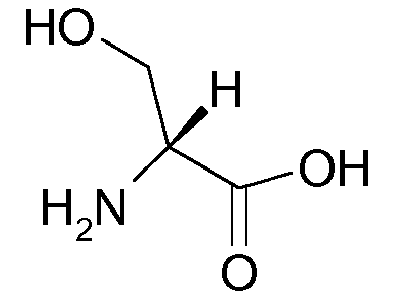
D-Serine s 
L-norleucine Nle - The term "native exendin-4" refers to native exendin-4 having the sequence HGEGTFTSDLSKQMEEEAVRLFIEWLKNGGPSSGAPPPS-NH2 (SEQ ID NO: 1).
- The invention provides peptidic compounds as defined above.
- The peptidic compounds of the present invention comprise a linear backbone of amino carboxylic acids linked by peptide, i.e. carboxamide bonds. Preferably, the amino carboxylic acids are α-amino carboxylic acids and more preferably L-α-amino carboxylic acids, unless indicated otherwise. The peptidic compounds comprise a backbone sequence of 39 or 40 amino carboxylic acids.
- For the avoidance of doubt, in the definitions provided herein, it is generally intended that the sequence of the peptidic moiety differs from native exendin-4 at least at one of those positions which are stated to allow variation. Amino acids within the peptide moiety can be considered to be numbered consecutively from 1 to 40 in the conventional N-terminal to C-terminal direction. Reference to a "position" within peptidic moiety should be constructed accordingly, as should reference to positions within native exendin-4 and other molecules, e.g., in exendin-4, His is at position 1, Gly at position 2, ..., Met at position 14, ... and Ser at position 39.
- In a further aspect, the present invention provides a composition comprising a compound of the invention as described herein, a metal comnplex, or a salt or solvate thereof, in admixture with a carrier.
- The invention also provides a composition wherein the composition is a pharmaceutically acceptable composition, and the carrier is a pharmaceutically acceptable carrier.
- The skilled person is aware of a variety of different methods to prepare peptides that are described in this invention. These methods include but are not limited to synthetic approaches and recombinant gene expression. Thus, one way of preparing these peptides is the synthesis in solution or on a solid support and subsequent isolation and purification. A different way of preparing the peptides is gene expression in a host cell in which a DNA sequence encoding the peptide has been introduced. Alternatively, the gene expression can be achieved without utilizing a cell system. The methods described above may also be combined in any way.
- A preferred way to prepare the peptides of the present invention is solid phase synthesis on a suitable resin. Solid phase peptide synthesis is a well established methodology (see for example: Stewart and Young, Solid Phase Peptide Synthesis, Pierce Chemical Co., Rockford, III., 1984; E. Atherton and R. C. Sheppard, Solid Phase Peptide Synthesis. A Practical Approach, Oxford-IRL Press, New York, 1989). Solid phase synthesis is initiated by attaching an N-terminally protected amino acid with its carboxy terminus to an inert solid support carrying a cleavable linker. This solid support can be any polymer that allows coupling of the initial amino acid, e.g. a trityl resin, a chlorotrityl resin, a Wang resin or a Rink amide resin in which the linkage of the carboxy group (or carboxamide for Rink resin) to the resin is sensitive to acid (when Fmoc strategy is used). The polymer support must be stable under the conditions used to deprotect the α-amino group during the peptide synthesis.
- After the first amino acid has been coupled to the solid support, the α-amino protecting group of this amino acid is removed. The remaining protected amino acids are then coupled one after the other in the order represented by the peptide sequence using appropriate amide coupling reagents, for example BOP, HBTU, HATU or DIC (N,N'-diisopropylcarbodiimide) / HOBt (1-hydroxybenzotriazol), wherein BOP, HBTU and HATU are used with tertiary amine bases. Alternatively, the liberated N-terminus can be functionalized with groups other than amino acids, for example carboxylic acids, etc.
- Finally the peptide is cleaved from the resin and deprotected. This can be achieved by using King's cocktail (D. S. King, C. G. Fields, G. B. Fields, Int. J. Peptide Protein Res. 36, 1990, 255-266). The raw material can then be purified by chromatography, e.g. preparative RP-HPLC, if necessary.
- The synthesized peptide is then further modified by attaching a side chain which contains a chelating moiety capaple of integration a metal ion, for example Ga3+. In those cases where the attachment point in the peptide backbone is a lysine the side chain can be linked by the reaction with a suitable amidation group, e.g. a hydroxyl succinimide ester, or with a vinylsulfone group via Michael addition. In other cases, when the attachment side is a thiol of a cysteine, the side chain can be connected by the reaction with a maleimide functionality or with a vinylsulfone group via Michael addition. The raw material can then be deprotected as necessary and purified by chromatography, e.g. preparative RP-HPLC. The side chains attached to the compounds of this invention are summarized in table 3.
- For the compounds of the present invention the building blocks listed in table 4 were used. With the exception of the building blocks VS-DO3A and VS-NO2A these building blocks were commercially available. The synthesis of VS-DO3A is described in Example 1, the synthesis of VS-NO2A can be performed in an analogous way.
Table 3: Side chains Side chain Side chain structure Side chain name mal-DOTA 
2,5-dioxo-1-{2-[2-(4,7,10-tris-carboxymethyl-1,4,7,10tetraazacyclododec-1-yl)-acetylamino]-ethyl}-pyrrolidin-3-yl mal-NOTA 
1-{2-[2-(4,7-bis-carboxymethyl-[1,4,7]triazonan-1 -yl)-acetylamino]-ethyl}-2,5-dioxo-pyrrolidin-3-yl mal-NODAGA 
1-{2-[(S)-4-(4,7-bis-carboxymethyl-[1,4,7]triazonan-1-yl)-4-carboxy-butyrylamino]-ethyl}-2,5-dioxo-pyrrolidin-3-yl DOTA 
(4,7,10-Tris-carboxymethyl-1,4,7,10-tetraaza-cyclododec-1-yl)-acetyl NOTA 
(4,7-Bis-carboxymethyl-[1,4,7]triazonan-1-yl)-acetyl PEG-NOTA 
3-{2-[2-(2-{2-[3-(1-{2-[2-(4,7-Bis-carboxymethyl-[1,4,7]triazonan-1-yl)-acetylamino]-ethyl}-2,5-dioxo-pyrrolidin-3-ylsulfanyl)-propionyl amino]-ethoxy}-ethoxy)-ethoxy]-ethoxy}-propionyl VS-NO2A 
2-[2-(4,7-bis-carboxymethyl-[1,4,7]triazonan-1-yl)-ethanesulfonyl]-ethyl VS-DO3A 
2-[2-(4,7,10-tris-carboxy methyl-1,4,7,10tetraazacyclododec-1-yl)-ethane sulfonyl]-ethyl Table 4: Relevant side chain building blocks Side chain building block Building block structure mal-DOTA building block 
mal-NOTA building block 
mal-NODAGA building block 
DOTA building block 
NOTA building block 
SPDP-dPEG8-NHS ester 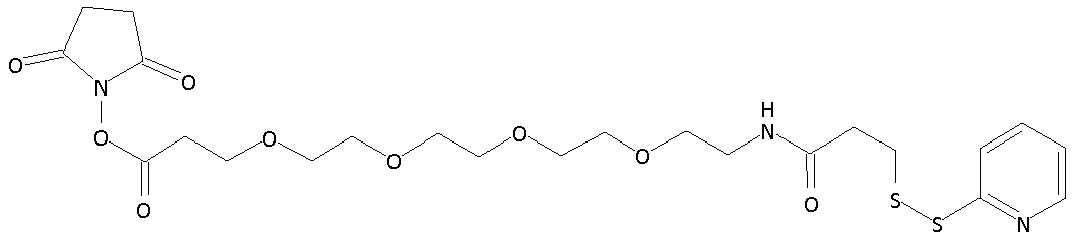
VS-NO2A building block 
VS-DO3A building block 
- The complexing moiety at the side chain of the peptide can further be charged with a suitable metal ion, e.g. Ga3+. To achieve this, the peptide with the side chain is heated with a suitable salt of the desired cation in a suitable solvent. The raw material can then be purified by chromatography, e.g. preparative RP-HPLC or SPE, if necessary.
- As used herein, the term "potency" or "in vitro potency" is a measure for the ability of a compound to activate the receptors for GLP-1 or glucagon in a cell-based assay. Numerically, it is expressed as the "EC50 value", which is the effective concentration of a compound that induces a half maximal increase of response (e.g. formation of intracellular cAMP) in a dose-response experiment.
- The compounds of the invention are agonists of the glucagon receptor. Such agonists may at first provide therapeutic benefit to address a clinical need for targeting hypoglycemia.
Accordingly, glucagon receptors agonists of the invention may be used for the treatment of mild to moderate hypoglycemia or in an event of severe hypoglycemia. - The term diagnostic use refers to a use for detection and /or quantification of glucagon receptors in living subjects and relevant tissues.
- This includes but is not limited to determination of a receptor occupancy state of a given dose of a therapeutic binding to the glucagon receptor in specific tissues. Glucagon receptors have been identified e.g. in kidney, brain, lymphoid cells of the spleen and thymus, parenchymal cells of the liver and endothelial and Kupffer cells in the liver, heart, adipose tissue, intestinal smooth muscle tissue and endocrine pancreatic cells - expression is particularly high in liver (Watanabe et al, Brazilian journal of Medical and biological research, 1998, 31, 243-256 and references cited therein). Receptor occupancy studies represent an option to identify an optimal dose of said therapeutic agent influencing the glucagon receptor.
- Furthermore, a glucagon receptor scintigraphy is particularly applicable in the diagnosis of diseases characterized by increased presence of cells strongly expressing the glucagon receptor, e.g. metastases in glucagonoma e.g. in liver, lymph nodes, mesentery/omentum/peritoneum, lung or adrenals.
- A person skilled in the art will be able to select a suitable metal ion for loading depending on the intended imaging technology. This includes, but is not limited to (Gd-68)3+ for MRI, (Cu-64)2+, (Ga-68)3+, (Al-F-18)2+ or (Y-86)3+ for PET or (Ga-67)3+, (Tc-99m)3+ or (In-111)3+ for SPECT measurements.
- The term "therapeutic use" indicates an application of peptides described in the current invention for use in radiotherapy. This involves loading of said peptide with a suitable radionuclide like (Cu-67)2+, (Y-90)3+, (In-111)3+, (Lu-177)3+, (Re-186)3+ or (Re-188)3+, purification and quality control.
- A preparation is considered suitable, if a loading efficacy of >98% can be obtained. The radioactive preparation can be injected as a part of an acceptable pharmaceutical composition into a patient. The applied dose is selected by a physician depending on considerations on e.g. the intended use (therapeutic or diagnostic), disease state (benign ort malignant), tumor size and location and loaded radioisotope.
- The term "pharmaceutical composition" indicates a mixture containing ingredients that are compatible when mixed and which may be administered. A pharmaceutical composition may include one or more bioactive molecules. Additionally, the pharmaceutical composition may include carriers, solvents, adjuvants, emollients, expanders, stabilizers and other components, whether these are considered active or inactive ingredients. Guidance for the one skilled in preparing pharmaceutical compositions may be found, for example, in Remington: The Science and Practice of Pharmacy, (20th ed.) ed. A. R. Gennaro A. R., 2000, Lippencott Williams & Wilkins.
- The exendin-4 peptide derivatives of the present invention or metal complexes or salts or solvates thereof, are administered in conjunction with an acceptable pharmaceutical carrier, diluent, or excipient as part of a pharmaceutical composition. A "pharmaceutically acceptable carrier" is a carrier which is physiologically acceptable while retaining the therapeutic properties of the substance with which it is administered. Standard acceptable pharmaceutical carriers and their formulations are known to one skilled in the art and described, for example, in Remington: The Science and Practice of Pharmacy, (20th ed.) ed. A. R. Gennaro A. R., 2000, Lippencott Williams & Wilkins. One exemplary pharmaceutically acceptable carrier is physiological saline solution.
- Acceptable pharmaceutical carriers or diluents include those used in formulations suitable for oral, rectal, nasal or parenteral (including subcutaneous, intramuscular, intravenous, intradermal, and transdermal) administration. The compounds of the present invention will typically be administered intravenously.
- The term "salt" or "pharmaceutically acceptable salt" means salts of the compounds of the invention which are safe and effective for use in mammals. Pharmaceutically acceptable salts may include, but are not limited to, acid addition salts and basic salts. Examples of acid addition salts include chloride, sulfate, hydrogen sulfate, (hydrogen) phosphate, acetate, trifluoroacetate, citrate, tosylate or mesylate salts. Examples of basic salts include salts with inorganic cations, e.g. alkaline or alkaline earth metal salts such as sodium, potassium, magnesium or calcium salts and salts with organic cations such as amine salts. Further examples of pharmaceutically acceptable salts are described in Remington: The Science and Practice of Pharmacy, (20th ed.) ed. A. R. Gennaro A. R., 2000, Lippencott Williams & Wilkins or in Handbook of Pharmaceutical Salts, Properties, Selection and Use, e.d. P. H. Stahl, C. G. Wermuth, 2002, jointly published by Verlag Helvetica Chimica Acta, Zurich, Switzerland, and Wiley-VCH, Weinheim, Germany.
- The term "solvate" means complexes of the compounds of the invention or salts thereof with solvent molecules, e.g. organic solvent molecules and/or water.
- The term "metal complex" means a chelate complex of the compounds of the invention with metal ions (e.g of transition metals) wherein a polydentate (multiple bonded) ligand is a part of the compound that bonds to the metal ion through several of the ligand's atoms; (ligands with 2, 3 or 4 bonds to the metal ion are common).
- Pharmaceutical compositions of the invention are those suitable for parenteral (for example subcutaneous, intramuscular, intradermal or intravenous), oral, rectal, topical and peroral (for example sublingual) administration, although the most suitable mode of administration depends in each individual case on the specific use of the bioactive ingredient and on the nature of the compound of formula (I) used in each case. Typically the route of administration for the intended use for the compounds of this invention is intravenous administration.
- Abbreviations employed are as follows:
- 2F-Phe
- 2-Fluorophenylalanine
- AA
- amino acid
- cAMP
- cyclic adenosine monophosphate
- Boc
- tert-butyloxycarbonyl
- BOP
- (benzotriazol-1-yloxy)tris(dimethylamino)phosphonium hexafluorophosphate
- tBu
- tertiary butyl
- CT
- Computer tomography
- CTC
- 2-Chlorotrityl chloride
- DIC
- N,N'-diisopropylcarbodiimide
- DIPEA
- N,N-diisopropylethylamine
- DMF
- dimethyl formamide
- EDT
- ethanedithiol
- Fmoc
- fluorenylmethyloxycarbonyl
- GCG
- Glucagon
- GLP-1
- Glucagon related peptide 1
- HATU
- 2-(1H-7-azabenzotriazol-1-yl)-1,1,3,3-tetramethyl uronium hexafluorophosphate
- HBTU
- 2-(1H-benzotriazol-1-yl)-1,1,3,3-tetramethyl-uronium hexafluorophosphate
- HOBt
- 1-hydroxybenzotriazole
- HPLC
- High Performance Liquid Chromatography
- MRI
- Magnetic resonance imaging
- PEG
- polyethylene glycole
- PET
- Positron emission tomography
- RP-HPLC
- reversed-phase high performance liquid chromatography
- s.c.
- subcutaneous
- SPE
- Solid phase extraction
- SPECT
- Single photon emission computed tomography
- TFA
- trifluoroacetic acid
- Tie
- tert-Leucine
- TRIS
- Tris(hydroxymethyl)-aminomethan
- Trt
- trityl
- Tza
- 4-Thiazolylalanine
- UPLC
- Ultra High Performance Liquid Chromatography
- UV
- ultraviolet
- For solid phase peptide synthesis CTC- or preloaded Fmoc-Ser(tBu)-Wang resin or Rink-Amide resin (4-(2',4'-Dimethoxyphenyl-Fmoc-aminomethyl)-phenoxyacetamido-norleucylaminomethyl resin) was used. CTC-resin was purchased from CBL Patras having a loading of 1,4mmol/g. Fmoc-Cys(Trt)-Wang resin was purchased from Bachem with a loading of 0.5 mmol/g. Rink-Amide resin was purchased from Novabiochem with a loading of 0.23 mmol/g.
- Fmoc protected natural amino acids were purchased from Protein Technologies Inc., Senn Chemicals, Merck Biosciences, Novabiochem, Iris Biotech or Bachem. The following standard amino acids were used throughout the syntheses: Fmoc-L-Ala-OH, Fmoc-L-Arg(Pbf)-OH, Fmoc-L-Asn(Trt)-OH, Fmoc-L-Asp(OtBu)-OH, Fmoc-L-Gln(Trt)-OH, Fmoc-L-Glu(OtBu)-OH, Fmoc-Gly-OH, Fmoc-L-His(Trt)-OH, Fmoc-L-Ile-OH, Fmoc-L-Leu-OH, Fmoc-L-Lys(Boc)-OH, Fmoc-L-Phe-OH, Fmoc-L-Pro-OH, Fmoc-L-Ser(tBu)-OH, Fmoc-L-Thr(tBu)-OH, Fmoc-L-Trp(Boc)-OH, Fmoc-L-Tyr(tBu)-OH, Fmoc-L-Val-OH, Fmoc-L-Cys(Trt)-OH.
- In addition, the following special amino acids were purchased from the same suppliers as above: Fmoc-L-Tza-OH, Fmoc-Aib-OH, Fmoc-Bal-OH, Fmoc-D-Ser(tBu)-OH, Fmoc-L-Nle-OH,Fmoc-L-2F-Phe-OH, Fmoc-L-Chg-OH, Fmoc-L-Tle-OH
- The solid phase peptide syntheses were performed on a Prelude Peptide Synthesizer (Protein Technologies Inc) using standard Fmoc chemistry and HBTU/DIPEA activation. DMF was used as the solvent. Deprotection : 20% piperidine/DMF for 2 x 2.5 min. Washes: 7 x DMF. Coupling 2:5:10 200 mM AA/ 500 mM HBTU / 2M DIPEA in DMF 2 x for 20 min. Washes: 5 x DMF.
- All the peptides that had been synthesized were cleaved from the resin with King's cleavage cocktail consisting of 82.5% TFA, 5% phenol, 5% water, 5% thioanisole, 2.5% EDT. The crude peptides were then precipitated in diethyl or diisopropyl ether, centrifuged, and lyophilized. Peptides were analyzed by analytical HPLC and checked by ESI mass spectrometry (see Table 5). Crude peptides were purified by a conventional preparative RP-HPLC purification procedure.
- The crude peptides were purified either on an Äkta Purifier System or on a Jasco semiprep HPLC System. Preparative RP-C18-HPLC columns of different sizes and with different flow rates were used depending on the amount of crude peptide to be purified. Acetonitrile + 0.1% TFA (B) and water + 0.1% TFA (A) were employed as eluents. Product-containing fractions were collected and lyophilized to obtain the purified product, typically as TFA salt.
- For stability testing, the target concentration was 0.5 mg/mL pure compound in either a pH 7.3 TRIS buffer (50 mM) containing m-cresol (30 mM), sodium chloride (85 mM) and polysorbate 20 (8 µM) or a pH 4.5 Methionine buffer (20 mM) containing m-Cresol (25 mM) and glycerol (220 mM). The solution was stored for 14 days at 4 °C, 25 °C or 40°C. After that time, the solution was analysed by UPLC.
- UPLC was performed on a Waters Acquity UPLC H-Class system with a Waters Acquity UPLC BEH130 C18 1.7 µm column (2.1 x 100 mm) at 40 °C with a gradient elution at a flow rate of 0.5 mL/min and monitored at 215 and 280 nm. The gradients were set up as 10% B to 90% B over 19.2 min and then 90% B for 0.8 min. Buffer A = 0.1 % formic acid in water and B = 0.1 % formic acid in acetonitrile.
- The "%Purity" after 14 days is defined by the %Relative purity at day 14 in relation to the %Relative purity at t0 following the equation

- The %Relative purity at t0 was calculated by dividing the peak area of the peptide at t0 by the sum of all peak areas at t0 following the equation

- Likewise, the %relative purity t14 was calculated by dividing the peak are of the peptide at t14 by the sum of all peak areas at t14 following the equation

- In analogous way, the %Purity after 7 days can be calculated.
- In vitro cellular assays for glucagon receptor efficacy:
Agonism of compounds for the respective receptor was determined by functional assays measuring cAMP response of HEK-293 cell lines stably expressing human GLP-1 or glucagon receptor. - cAMP content of cells was determined using a kit from Cisbio Corp. (cat. no. 62AM4PEC) based on HTRF (Homogenous Time Resolved Fluorescence). For preparation, cells were split into T175 culture flasks and grown overnight to near confluency in medium (DMEM / 10% FBS). Medium was then removed and cells washed with PBS lacking calcium and magnesium, followed by proteinase treatment with accutase (Sigma-Aldrich cat. no. A6964). Detached cells were washed and resuspended in assay buffer (1 x HBSS; 20 mM HEPES, 0.1% BSA, 2 mM IBMX) and cellular density determined. They were then diluted to 400000 cells/ml and 25 µl-aliquots dispensed into the wells of 96-well plates. For measurement, 25 µl of test compound in assay buffer was added to the wells, followed by incubation for 30 minutes at room temperature. After addition of HTRF reagents diluted in lysis buffer (kit components), the plates were incubated for 1 hr, followed by measurement of the fluorescence ratio at 665 / 620 nm. In vitro potency of agonists was quantified by determining the concentrations that caused 50% activation of maximal response (EC50).
- For exemplary reasons a derivative of native glucacon (SEQ ID NO 2) was synthesized carrying a c-terminal cysteinamide with a VS-DO3A building block coupled to the side chain.

- During the synthesis, especially during the conjugation step of the cysteine containing peptide with the VS-DO3A building block, rapid oxidation of methionine in position 27 was observed as well as aggregation, which is already well precedented for the native glucagon sequence. Nevertheless small amounts of the targeted compounds could be obtained. The resulting derivative was tested for Glucagon and GLP-1 receptor activation as in example 5. H-S-Q-G-T-F-T-S-D-Y-S-K-Y-L-D-S-R-R-A-Q-D-F-V-Q-W-L-M27-N-T-C(VS-DO3A)-NH2 activated the glucagon receptor with 0.7 pM (EC50 hGLUC R) and the GLP-1 receptor with 16.1 pM (EC50 hGLP-1 R) respectively.
- In contrast compounds of the invention do not contain a methionine which can be oxidized during synthesis or storage, are much less prone to aggregation and show much reduced activation of the GLP-1 receptor.
- The invention is further illustrated by the following examples.
-

- To a solution of DO3A-tBu (4,10-Bis-tert-butoxycarbonylmethyl-1,4,7,10tetraazacyclododec-1-yl)-acetic acid tert-butyl ester (2,5 g) in DMF (10 mL) was at 0 °C added a solution of divinyl sulfone (5 mL) in DMF/water 1:1 (20 mL). The mixture was allowed to reach room temperature and was stirred for 2 h. The mixture was directly purified by RP chromatography to give VS-DO3A-tBu ([4,10-Bis-tertbutoxycarbonylmethyl-7-(2-ethenesulfonyl-ethyl)-1,4,7,10-tetraazacyclododec-1-yl]-acetic acid tert-butyl ester).
- A solution of VS-DO3A-tBu in TFA/water 19:1 (75 mL) was stirred at room temperature for 1 day. TFA was carefully evaporated and the remaining solution was freeze-dried to give crude VS-DO3A ([4,10-Bis-carboxymethyl-7-(2-ethene sulfonyl-ethyl)-1,4,7,10tetraaza-cyclododec-1-yl]-acetic acid) which was directly used without further purification.
- The solid phase synthesis as described in Methods was carried out on Novabiochem Rink-Amide resin (4-(2',4'-Dimethoxyphenyl-Fmoc-aminomethyl)-phenoxyacetamido-norleucylaminomethyl resin), 100-200 mesh, loading of 0.23 mmol/g. The Fmoc-synthesis strategy was applied with HBTU/DIPEA-activation. In position 1 Fmoc-Tza-OH and in position 14 Fmoc-Tle-Nle-OH were used in the solid phase synthesis protocol. The peptide was cleaved from the resin with King's cocktail (D. S. King, C. G. Fields, G. B. Fields, Int. J. Peptide Protein Res. 36, 1990, 255-266). The crude product was purified via preparative HPLC on a Waters column (Sunfire, Prep C18) using an acetonitrile/water gradient (both buffers with 0.1% TFA).
Finally, the molecular mass of the purified peptide was confirmed by LC-MS. - The purified peptide (53 mg) was then dissolved in pH 7 buffer and the solution was charged with the VS-DO3A building block (14 mg) which was prepared in example 1. The pH was readjusted to pH 7 using pH 10 buffer. The solution was stirred at room temperature for 16 h and was then acidified to pH 4 using acetic acid. The crude product was purified via preparative HPLC on a Waters column (Sunfire, Prep C18) using an acetonitrile/water gradient (both buffers with 0.1% TFA).
Finally, the molecular mass of the purified peptide was confirmed by LC-MS. - The peptide synthesized in Example 2 (SEQ. ID 35) was dissolved in acetate buffer pH 4.6 (10 mL) and was charged with gallium(III)-sulfate hydrate (4.8 mg). The mixture was stirred at 80 °C for 15 minutes and was then allowed to reach room temperature. The crude product was purified via preparative HPLC on a Waters column (Sunfire, Prep C18) using an acetonitrile/water gradient (both buffers with 0.1% TFA).
- Finally, the molecular mass of the purified peptide was confirmed by LC-MS.
- The solid phase synthesis as described in Methods was carried out on Novabiochem Rink-Amide resin (4-(2',4'-Dimethoxyphenyl-Fmoc-aminomethyl)-phenoxyacetamido-norleucylaminomethyl resin), 100-200 mesh, loading of 0.23 mmol/g. The Fmoc-synthesis strategy was applied with HBTU/DIPEA-activation. In position 1 Fmoc-Tza-OH, in position 7 Fmoc-Aib-OH and in position 14 Fmoc-Nle-OH were used in the solid phase synthesis protocol. The peptide was cleaved from the resin with King's cocktail (D. S. King, C. G. Fields, G. B. Fields, Int. J. Peptide Protein Res. 36, 1990, 255-266). The crude product was purified via preparative HPLC on a Waters column (Sunfire, Prep C18) using an acetonitrile/water gradient (both buffers with 0.1% TFA).
Finally, the molecular mass of the purified peptide was confirmed by LC-MS. - The peptide with the free thiol was then dissolved in water/acetonitrile (10/1) before addition of the reducing agent TCEP.HCl (2.5 eq). The pH was adjusted to pH= 7 with a 1M NaOH aqueous solution. Finally, the mal-DOTA building block (2.5 eq) was added. The reaction was allowed to stir at room temperature for 10 minutes. Formation of the desired product and total consumption of starting material were confirmed by LCMS.
The crude product was purified via preparative HPLC on a Waters column (Sunfire, Prep C18) using an acetonitrile/water gradient (both buffers with 0.1% TFA).
Finally, the molecular mass of the purified peptide was confirmed by LC-MS. - The solid phase synthesis as described in Methods was carried out on Novabiochem Rink-Amide resin (4-(2',4'-Dimethoxyphenyl-Fmoc-aminomethyl)-phenoxyacetamido-norleucylaminomethyl resin), 100-200 mesh, loading of 0.23 mmol/g. The Fmoc-synthesis strategy was applied with HBTU/DIPEA-activation. The peptide was cleaved from the resin with King's cocktail (D. S. King, C. G. Fields, G. B. Fields, Int. J. Peptide Protein Res. 36, 1990, 255-266). The crude product was purified via preparative HPLC on a Waters column (Sunfire, Prep C18) using an acetonitrile/water gradient (both buffers with 0.1% TFA). Finally, the molecular mass of the purified peptide was confirmed by LC-MS.
- The peptide was dissolved in water/acetonitrile (10/1) before the addition of DIPEA (60 eq) to reach 9<pH<10. The DOTA building block was then added (1 eq). Successive additions of 0.2 eq of the building block were needed to reach complete conversion of the starting material as judged by LCMS. The crude product was purified via preparative HPLC on a Waters column (Sunfire, Prep C18) using an acetonitrile/water gradient (both buffers with 0.1% TFA). Finally, the molecular mass of the purified peptide was confirmed by LC-MS.
- The solid phase synthesis as described in Methods was carried out on Novabiochem Rink-Amide resin (4-(2',4'-Dimethoxyphenyl-Fmoc-aminomethyl)-phenoxyacetamido-norleucylaminomethyl resin), 100-200 mesh, loading of 0.23 mmol/g. The Fmoc-synthesis strategy was applied with HBTU/DIPEA-activation. The peptide was cleaved from the resin with King's cocktail (D. S. King, C. G. Fields, G. B. Fields, Int. J. Peptide Protein Res. 36, 1990, 255-266). The crude product was purified via preparative HPLC on a Waters column (Sunfire, Prep C18) using an acetonitrile/water gradient (both buffers with 0.1% TFA). Finally, the molecular mass of the purified peptide was confirmed by LC-MS.
- The peptide was dissolved in 4 mL Na2HPO4 buffer (pH=9). SPDP-PEG8-NHS ester (1 eq) was added dropwise to the mixture. The reaction mixture was stirred under argon for 10 min at room temperature. Successive additions of 0.2 eq of NHS ester were needed to reach complete conversion as judged by LCMS. TCEP.HCl (5 eq) and mal-NOTA building block (8 eq) were added and the mixture was stirred for 30 minutes.
The crude product was purified via preparative HPLC on a Waters column (Sunfire, Prep C18) using an acetonitrile/water gradient (both buffers with 0.1% TFA).
Finally, the molecular mass of the purified peptide was confirmed by LC-MS. - In an analogous way, the peptides SEQ ID NO: 3-61, 79, 80, 85 and 86 were synthesized, see table 1.
- Furthermore, the peptides SEQ ID. NO: 62-78, 81-84 and 87-91 can be synthesized in an analogous way.
Table 5: list of synthesized peptides and comparison of calculated vs. found monoisotopic mass. SEQ ID calc. mass found mass 3 4905.28 4905.27 4 4804.23 4804.22 5 4876.25 4876.24 6 4843.23 4843.30 7 4971.18 4971.18 8 4909.13 4909.10 9 4870.13 4870.13 10 4942.15 4942.15 11 4793.25 4793.40 12 4859.15 4859.30 13 4807.27 4807.30 14 4873.17 4873.10 15 4869.31 4869.31 16 4768.26 4768.26 17 4840.29 4840.28 18 4935.21 4935.21 19 4834.16 4834.17 20 4906.19 4906.18 21 4909.13 4909.20 22 4688.13 4688.10 23 4754.03 4754.20 24 4825.06 4825.20 25 4759.16 4759.20 26 4818.31 4818.31 27 4884.21 4884.21 28 4717.26 4717.26 29 5192.46 5192.46 30 5258.36 5258.36 31 4791.27 4791.30 32 4857.18 4857.20 33 4887.26 4887.30 34 4953.16 4953.20 35 4837.28 4837.30 36 4903.18 4903.25 37 4715.12 4715.13 38 4715.17 4715.21 39 4730.15 4730.19 40 4756.20 4756.20 41 4687.13 4687.13 42 4715.17 4715.17 43 4940.35 4940.40 44 5006.25 5006.40 45 4862.34 4862.33 46 4928.24 4928.24 47 4825.24 4825.20 48 4891.14 4891.20 49 4887.21 4887.20 50 4953.11 4953.20 51 4807.30 4807.40 52 4873.20 4873.20 53 4761.29 4761.20 54 4841.25 4841.25 55 4907.15 4907.15 56 4894.28 4894.20 57 4838.27 4838.20 58 4815.25 4815.30 59 4846.23 4846.20 60 4869.24 4869.23 61 4935.14 4935.16 79 4844.22 4844.20 80 4910.12 4910.10 85 4887.21 4887.20 86 4953.11 4953.10 91 4826.27 4826.20 - Chemical stability of peptidic compounds was assessed as described in Methods. The results are given in Table 5.
Table 5: Chemical stability Compound Formulation Temperature Purity after 7 days Purity after 14 days Seq. ID 6 4 °C 100 99 pH 4.6 25 °C 97 97 40 °C 92 91 4 °C 98 96 pH 7.4 25 °C 90 84 40 °C 64 53 Seq. ID 8 4 °C 100 99 pH 4.6 25 °C 99 97 40 °C 94 84 4 °C 97 94 pH 7.4 25 °C 81 67 40 °C 47 33 Seq. ID 13 4 °C 99 96 pH 4.6 25 °C 96 94 40 °C 64 30 4 °C 96 92 pH 7.4 25 °C 85 76 40 °C 61 52 Seq. ID 14 4 °C 100 94 pH 4.6 25 °C 98 97 40 °C 93 89 4 °C 95 93 pH 7.4 25 °C 81 68 40 °C 47 32 Seq. ID 35 4 °C 100 99 pH 4.6 25 °C 97 97 40 °C 92 91 4 °C 98 96 pH 7.4 25 °C 90 84 40 °C 64 53 Seq. ID 36 4 °C 100 99 pH 4.6 25 °C 99 97 40 °C 94 84 4 °C 97 94 pH 7.4 25 °C 81 67 40 °C 47 33 Seq. ID 49 4 °C 100 99 pH 4.6 25 °C 97 97 40 °C 92 91 4 °C 98 96 pH 7.4 25 °C 90 84 40 °C 64 53 Seq. ID 50 4 °C 100 99 pH 4.6 25 °C 99 97 40 °C 94 84 4 °C 97 94 pH 7.4 25 °C 81 67 40 °C 47 33 - Potencies of peptidic compounds at the GLP-1 and glucagon receptors were determined by exposing cells expressing human glucagon receptor (hGLUC R), and human GLP-1 receptor (hGLP-1 R) to the listed compounds at increasing concentrations and measuring the formed cAMP as described in Methods.
- The results for Exendin-4 derivatives with activity at the human GLP-1 receptor (hGLP-1 R) and the human glucagon receptor (hGLUC R) are shown in Table 6.
Table 6: EC50 values of exendin-4 peptide analogues at GLP-1 and Glucagon receptors (indicated in pM) SEQ ID NO EC50 hGLP-1 R [pM] EC50 hGLUC R [pM] 1 0.4 >10000000 2 56.6 1.0 3 11100.0 1.7 4 3480.0 0.8 5 2790.0 0.6 6 4960.0 0.8 7 7530.0 1.2 8 4130.0 1.1 9 4200.0 1,0 10 4570.0 0.9 11 14400,0 0,5 12 12900,0 0,7 13 143000,0 4.8 14 38600.0 2.8 15 177000.0 5.2 16 9999999.0 4.9 17 9999999.0 6.7 18 29400.0 5.7 19 116000.0 4.8 20 168000.0 4.7 21 4855.0 1.7 22 1010.0 6.3 23 725.0 5.1 24 8440.0 4.3 25 12000.0 4.3 27 11500.0 2.0 28 11000.0 1.6 29 8790.0 1.2 30 4010.0 0.9 31 9999999.0 31.7 32 58700.0 52.5 33 29400.0 0.9 34 18800.0 0.8 35 86700.0 2.0 36 65333.3 1.7 37 6590.0 5.5 38 5070.0 4.3 39 14100.0 26.6 40 672.0 0.3 41 4060.0 2.6 42 2210.0 0.7 43 44900.0 1.4 44 33500.0 0.8 45 46500.0 1.3 46 37500.0 1.3 47 9999999.0 79.1 48 297000.0 60.1 49 40700.0 0.6 50 36900.0 0.5 51 9999999.0 25.4 52 552000.0 17.2 53 31200.0 0.9 54 4370.0 0.5 55 2610.0 0.5 56 10200.0 0.6 57 835.0 0.5 58 14900.0 0.4 59 34200.0 1.1 61 13500.0 0.5 79 6970.0 0.8 80 5130.0 0.7 85 146000.0 1.0 86 115000.0 0.9 91 80.5 1.1 - A selection of exendin-4 derivatives comprising the artificial amino acid 4-thiazolylalanine in position 1 has been tested in comparison to corresponding compounds that have histidine in position 1. Histidine at position 1 is essential for the activation of the receptor in glucagon but also in many related peptides including GLP-1 and exendin-4. Therefore it is surprising that the artificial amino acid 4-thiazolylalanine leads to a comparable activation of the receptor compared to identical compounds that have the natural histidine at position 1. Furthermore, the activation of the GLP-1 receptor which counterregulates the glucagon effect is surprisingly reduced by the introduction of the artificial amino acid 4-thiazolylalanine. This leads to even more selective glucagon receptor agonists with a higher GCG/GLP-1 activity ratio. The reference pair compounds and the corresponding EC50 values at GLP-1 and Glucagon receptors (indicated in pM) are given in Table 7.
Table 7: Comparison of exendin-4 derivatives comprising the artificial amino acid 4-thiazolylalanine in position 1 vs. exendin-4 derivatives having the natural amino acid histidine in position 1. The values for native glucagon (SEQ. ID 2) are also given. EC50 values at GLP-1 and Glucagon receptors are indicated in pM. SEQ ID NO Amino acid in position 1 EC50 hGLP-1R EC50 hGlucagon-R Ratio 2 His 56.6 1.0 57 : 1 6 Tza 4960.0 0.8 6200 : 1 91 His 80.5 1.1 73 : 1 -
- <110> SANOFI
- <120> selective glucagon receptor agonists comprising a chelating moiety for imaging purposes
- <130>
DE 2015-159 WOPCT - <160> 91
- <170> PatentIn version 3.5
- <210> 1
<211> 39
<212> PRT
<213> Heloderma suspectum - <220>
<221> MOD_RES
<222> (39)..(39)
<223> Amidated C-terminus - <400> 1

- <210> 2
<211> 29
<212> PRT
<213> Homo sapiens - <400> 2

- <210> 3
<211> 40
<212> PRT
<213> Artificial Sequence - <220>
<223> artificial polypeptide - <220>
<221> MOD_RES
<222> (1)..(1)
<223> Xaa is L-4-Thiazolylalanine (Tza) - <220>
<221> MOD_RES
<222> (40)..(40)
<223> Xaa is Cys derivatized with 2,5-dioxo-1-{2-[2-(4,7,10-tris-carboxymethyl-1,4,7,10-tetraaza-cy clododec-1-yl)-acetylamino]-ethyl}-pyrrolidin-3-yl - <220>
<221> MOD_RES
<222> (40)..(40)
<223> Amidated C-terminus - <400> 3

- <210> 4
<211> 40
<212> PRT
<213> Artificial Sequence - <220>
<223> artificial polypeptide - <220>
<221> MOD_RES
<222> (1)..(1)
<223> Xaa is L-4-Thiazolylalanine (Tza) - <220>
<221> MOD_RES
<222> (40)..(40)
<223> Xaa is Cys derivatized with 1-{2-[2-(4,7-bis-carboxymethyl-[1,4,7]triazonan -1-yl)-acetylamino]ethyl}-2,5-dioxo-pyrrolidin-3-yl - <220>
<221> MOD_RES
<222> (40)..(40)
<223> Amidated C-terminus - <400> 4


- <210> 5
<211> 40
<212> PRT
<213> Artificial Sequence - <220>
<223> artificial polypeptide - <220>
<221> MOD_RES
<222> (1)..(1)
<223> Xaa is L-4-Thiazolylalanine (Tza) - <220>
<221> MOD_RES
<222> (40)..(40)
<223> Xaa is Cys derivatized with 1-{2-[(S)-4-(4,7-bis -carboxymethyl-[1,4,7]triazonan -1-yl)-4-carboxy-butyrylamino]ethyl}-2,5-dioxo-pyrrolidin-3-yl - <220>
<221> MOD_RES
<222> (40)..(40)
<223> Amidated C-terminus - <400> 5

- <210> 6
<211> 40
<212> PRT
<213> Artificial Sequence - <220>
<223> artificial polypeptide - <220>
<221> MOD_RES
<222> (1)..(1)
<223> Xaa is L-4-Thiazolylalanine (Tza) - <220>
<221> MOD_RES
<222> (40)..(40)
<223> Xaa is Cys derivatized with 2-[2-(4,7,10-Tris-carboxymethyl-1,4,7,10-tetraaza-cyclododec-1-yl )-ethanesulfonyl]-ethyl - <220>
<221> MOD_RES
<222> (40)..(40)
<223> Amidated C-terminus - <400> 6

- <210> 7
<211> 40
<212> PRT
<213> Artificial Sequence - <220>
<223> artificial polypeptide - <220>
<221> MOD_RES
<222> (1)..(1)
<223> Xaa is L-4-Thiazolylalanine (Tza) - <220>
<221> MOD_RES
<222> (40)..(40)
<223> Xaa is Cys derivatized with 2,5-dioxo-1-{2-[2-(4,7,10-tris-carboxymethyl-1,4,7,10-tetraaza-cy clododec-1-yl)-acetylamino]-ethyl}-pyrrolidin-3-yl with complexed Gallium - <220>
<221> MOD_RES
<222> (40)..(40)
<223> Amidated C-terminus - <400> 7

- <210> 8
<211> 40
<212> PRT
<213> Artificial Sequence - <220>
<223> artificial polypeptide - <220>
<221> MOD_RES
<222> (1)..(1)
<223> Xaa is L-4-Thiazolylalanine (Tza) - <220>
<221> MOD_RES
<222> (40)..(40)
<223> Xaa is Cys derivatized with 2-[2-(4,7,10-Tris-carboxymethyl-1,4,7,10-tetraaza-cyclododec-1-yl )-ethanesulfonyl]-ethyl with complexed Gallium - <220>
<221> MOD_RES
<222> (40)..(40)
<223> Amidated C-terminus - <400> 8
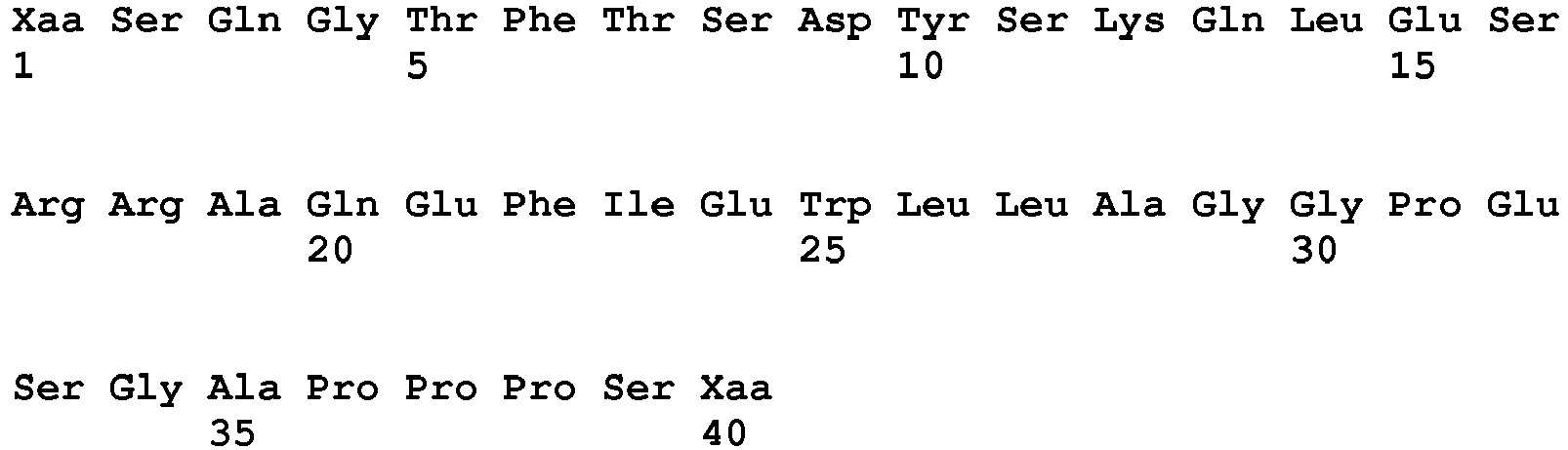
- <210> 9
<211> 40
<212> PRT
<213> Artificial Sequence - <220>
<223> artificial polypeptide - <220>
<221> MOD_RES
<222> (1)..(1)
<223> Xaa is L-4-Thiazolylalanine (Tza) - <220>
<221> MOD_RES
<222> (40)..(40)
<223> Xaa is Cys derivatized with 1-{2-[2-(4,7-bis-carboxymethyl-[1,4,7]triazonan -1-yl)-acetylamino]ethyl}-2,5-dioxo-pyrrolidin-3-yl with complexed Gallium - <220>
<221> MOD_RES
<222> (40)..(40)
<223> Amidated C-terminus - <400> 9

- <210> 10
<211> 40
<212> PRT
<213> Artificial Sequence - <220>
<223> artificial polypeptide - <220>
<221> MOD_RES
<222> (1)..(1)
<223> Xaa is L-4-Thiazolylalanine (Tza) - <220>
<221> MOD_RES
<222> (40)..(40)
<223> Xaa is Cys derivatized with 1-{2-[(S)-4-(4,7-bis -carboxymethyl-[1,4,7]triazonan -1-yl)-4-carboxy-butyrylamino]ethyl}-2,5-dioxo-pyrrolidin-3-yl with complexed Gallium - <220>
<221> MOD_RES
<222> (40)..(40)
<223> Amidated C-terminus - <400> 10

- <210> 11
<211> 40
<212> PRT
<213> Artificial Sequence - <220>
<223> artificial polypeptide - <220>
<221> MOD_RES
<222> (1)..(1)
<223> Xaa is L-4-Thiazolylalanine (Tza) - <220>
<221> MOD_RES
<222> (10)..(10)
<223> Xaa is L-tert-Leucine (Tle) - <220>
<221> MOD_RES
<222> (14)..(14)
<223> Xaa is L-Norleucine (Nle) - <220>
<221> MOD_RES
<222> (28)..(28)
<223> Xaa is beta-Alanine (Bal) - <220>
<221> MOD_RES
<222> (40)..(40)
<223> Xaa is Cys derivatized with 2-[2-(4,7,10-Tris-carboxymethyl-1,4,7,10-tetraaza-cyclododec-1-yl )-ethanesulfonyl]-ethyl - <220>
<221> MOD_RES
<222> (40)..(40)
<223> Amidated C-terminus - <400> 11
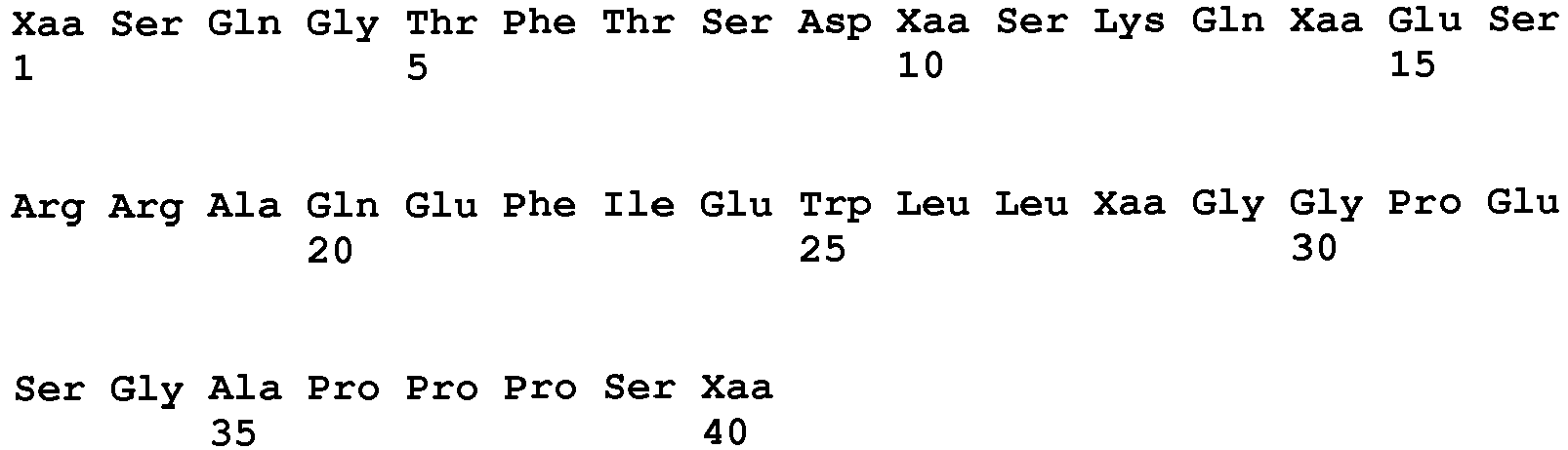
- <210> 12
<211> 40
<212> PRT
<213> Artificial Sequence - <220>
<223> artificial polypeptide - <220>
<221> MOD_RES
<222> (1)..(1)
<223> Xaa is L-4-Thiazolylalanine (Tza) - <220>
<221> MOD_RES
<222> (10)..(10)
<223> Xaa is L-tert-Leucine (Tle) - <220>
<221> MOD_RES
<222> (14)..(14)
<223> Xaa is L-Norleucine (Nle) - <220>
<221> MOD_RES
<222> (28)..(28)
<223> Xaa is beta-Alanine (Bal) - <220>
<221> MOD_RES
<222> (40)..(40)
<223> Xaa is Cys derivatized with 2-[2-(4,7,10-Tris-carboxymethyl-1,4,7,10-tetraaza-cyclododec-1-yl )-ethanesulfonyl]-ethyl with complexed Gallium - <220>
<221> MOD_RES
<222> (40)..(40)
<223> Amidated C-terminus - <400> 12

- <210> 13
<211> 40
<212> PRT
<213> Artificial Sequence - <220>
<223> artificial polypeptide - <220>
<221> MOD_RES
<222> (1)..(1)
<223> Xaa is L-4-Thiazolylalanine (Tza) - <220>
<221> MOD_RES
<222> (7)..(7)
<223> Xaa is Aminoisobutyric acid (Aib) - <220>
<221> MOD_RES
<222> (14)..(14)
<223> Xaa is L-Norleucine (Nle) - <220>
<221> MOD_RES
<222> (40)..(40)
<223> Xaa is Cys derivatized with 2-[2-(4,7,10-Tris-carboxymethyl-1,4,7,10-tetraaza-cyclododec-1-yl )-ethanesulfonyl]-ethyl - <220>
<221> MOD_RES
<222> (40)..(40)
<223> Amidated C-terminus - <400> 13

- <210> 14
<211> 40
<212> PRT
<213> Artificial Sequence - <220>
<223> artificial polypeptide - <220>
<221> MOD_RES
<222> (1)..(1)
<223> Xaa is L-4-Thiazolylalanine (Tza) - <220>
<221> MOD_RES
<222> (7)..(7)
<223> Xaa is Aminoisobutyric acid (Aib) - <220>
<221> MOD_RES
<222> (14)..(14)
<223> Xaa is L-Norleucine (Nle) - <220>
<221> MOD_RES
<222> (40)..(40)
<223> Xaa is Cys derivatized with 2-[2-(4,7,10-Tris-carboxymethyl-1,4,7,10-tetraaza-cyclododec-1-yl )-ethanesulfonyl]-ethyl with complexed Gallium - <220>
<221> MOD_RES
<222> (40)..(40)
<223> Amidated C-terminus - <400> 14

- <210> 15
<211> 40
<212> PRT
<213> Artificial Sequence - <220>
<223> artificial polypeptide - <220>
<221> MOD_RES
<222> (1)..(1)
<223> Xaa is L-4-Thiazolylalanine (Tza) - <220>
<221> MOD_RES
<222> (7)..(7)
<223> Xaa is Aminoisobutyric acid (Aib) - <220>
<221> MOD_RES
<222> (14)..(14)
<223> Xaa is L-Norleucine (Nle) - <220>
<221> MOD_RES
<222> (40)..(40)
<223> Xaa is Cys derivatized with 2,5-dioxo-1-{2-[2-(4,7,10-tris-carboxymethyl-1,4,7,10-tetraaza-cy clododec-1-yl)-acetylamino]-ethyl}-pyrrolidin-3-yl - <220>
<221> MOD_RES
<222> (40)..(40)
<223> Amidated C-terminus - <400> 15


- <210> 16
<211> 40
<212> PRT
<213> Artificial Sequence - <220>
<223> artificial polypeptide - <220>
<221> MOD_RES
<222> (1)..(1)
<223> Xaa is L-4-Thiazolylalanine (Tza) - <220>
<221> MOD_RES
<222> (7)..(7)
<223> Xaa is Aminoisobutyric acid (Aib) - <220>
<221> MOD_RES
<222> (14)..(14)
<223> Xaa is L-Norleucine (Nle) - <220>
<221> MOD_RES
<222> (40)..(40)
<223> Xaa is Cys derivatized with 1-{2-[2-(4,7-bis-carboxymethyl-[1,4,7]triazonan -1-yl)-acetylamino]ethyl}-2,5-dioxo-pyrrolidin-3-yl - <220>
<221> MOD_RES
<222> (40)..(40)
<223> Amidated C-terminus - <400> 16

- <210> 17
<211> 40
<212> PRT
<213> Artificial Sequence - <220>
<223> artificial polypeptide - <220>
<221> MOD_RES
<222> (1)..(1)
<223> Xaa is L-4-Thiazolylalanine (Tza) - <220>
<221> MOD_RES
<222> (7)..(7)
<223> Xaa is Aminoisobutyric acid (Aib) - <220>
<221> MOD_RES
<222> (14)..(14)
<223> Xaa is L-Norleucine (Nle) - <220>
<221> MOD_RES
<222> (40)..(40)
<223> Xaa is Cys derivatized with 1-{2-[(S)-4-(4,7-bis -carboxymethyl-[1,4,7]triazonan -1-yl)-4-carboxy-butyrylamino]ethyl}-2,5-dioxo-pyrrolidin-3-yl - <220>
<221> MOD_RES
<222> (40)..(40)
<223> Amidated C-terminus - <400> 17

- <210> 18
<211> 40
<212> PRT
<213> Artificial Sequence - <220>
<223> artificial polypeptide - <220>
<221> MOD_RES
<222> (1)..(1)
<223> Xaa is L-4-Thiazolylalanine (Tza) - <220>
<221> MOD_RES
<222> (7)..(7)
<223> Xaa is Aminoisobutyric acid (Aib) - <220>
<221> MOD_RES
<222> (14)..(14)
<223> Xaa is L-Norleucine (Nle) - <220>
<221> MOD_RES
<222> (40)..(40)
<223> Xaa is Cys derivatized with 2,5-dioxo-1-{2-[2-(4,7,10-tris-carboxymethyl-1,4,7,10-tetraaza-cy clododec-1-yl)-acetylamino]-ethyl}-pyrrolidin-3-yl with complexed Gallium - <220>
<221> MOD_RES
<222> (40)..(40)
<223> Amidated C-terminus - <400> 18

- <210> 19
<211> 40
<212> PRT
<213> Artificial Sequence - <220>
<223> artificial polypeptide - <220>
<221> MOD_RES
<222> (1)..(1)
<223> Xaa is L-4-Thiazolylalanine (Tza) - <220>
<221> MOD_RES
<222> (7)..(7)
<223> Xaa is Aminoisobutyric acid (Aib) - <220>
<221> MOD_RES
<222> (14)..(14)
<223> Xaa is L-Norleucine (Nle) - <220>
<221> MOD_RES
<222> (40)..(40)
<223> Xaa is Cys derivatized with 1-{2-[2-(4,7-bis-carboxymethyl-[1,4,7]triazonan -1-yl)-acetylamino]ethyl}-2,5-dioxo-pyrrolidin-3-yl with complexed Gallium - <220>
<221> MOD_RES
<222> (40)..(40)
<223> Amidated C-terminus - <400> 19

- <210> 20
<211> 40
<212> PRT
<213> Artificial Sequence - <220>
<223> artificial polypeptide - <220>
<221> MOD_RES
<222> (1)..(1)
<223> Xaa is L-4-Thiazolylalanine (Tza) - <220>
<221> MOD_RES
<222> (7)..(7)
<223> Xaa is Aminoisobutyric acid (Aib) - <220>
<221> MOD_RES
<222> (14)..(14)
<223> Xaa is L-Norleucine (Nle) - <220>
<221> MOD_RES
<222> (40)..(40)
<223> Xaa is Cys derivatized with 1-{2-[(S)-4-(4,7-bis -carboxymethyl-[1,4,7]triazonan -1-yl)-4-carboxy-butyrylamino]ethyl}-2,5-dioxo-pyrrolidin-3-yl with complexed Gallium - <220>
<221> MOD_RES
<222> (40)..(40)
<223> Amidated C-terminus - <400> 20


- <210> 21
<211> 40
<212> PRT
<213> Artificial Sequence - <220>
<223> artificial polypeptide - <220>
<221> MOD_RES
<222> (1)..(1)
<223> Xaa is L-4-Thiazolylalanine (Tza) - <220>
<221> MOD_RES
<222> (2)..(2)
<223> Xaa is D-Serine (s) - <220>
<221> MOD_RES
<222> (40)..(40)
<223> Xaa is Cys derivatized with 2-[2-(4,7,10-Tris-carboxymethyl-1,4,7,10-tetraaza-cyclododec-1-yl )-ethanesulfonyl]-ethyl with complexed Gallium - <220>
<221> MOD_RES
<222> (40)..(40)
<223> Amidated C-terminus - <400> 21

- <210> 22
<211> 40
<212> PRT
<213> Artificial Sequence - <220>
<223> artificial polypeptide - <220>
<221> MOD_RES
<222> (1)..(1)
<223> Xaa is L-4-Thiazolylalanine (Tza) - <220>
<221> MOD_RES
<222> (2)..(2)
<223> Xaa is D-Serine (s) - <220>
<221> MOD_RES
<222> (40)..(40)
<223> Xaa is Cys derivatized with 2-[2-(4,7,10-Tris-carboxymethyl-1,4,7,10-tetraaza-cyclododec-1-yl )-ethanesulfonyl]-ethyl - <220>
<221> MOD_RES
<222> (40)..(40)
<223> Amidated C-terminus - <400> 22

- <210> 23
<211> 40
<212> PRT
<213> Artificial Sequence - <220>
<223> artificial polypeptide - <220>
<221> MOD_RES
<222> (1)..(1)
<223> Xaa is L-4-Thiazolylalanine (Tza) - <220>
<221> MOD_RES
<222> (2)..(2)
<223> Xaa is D-Serine (s) - <220>
<221> MOD_RES
<222> (40)..(40)
<223> Xaa is Cys derivatized with 2-[2-(4,7,10-Tris-carboxymethyl-1,4,7,10-tetraaza-cyclododec-1-yl )-ethanesulfonyl]-ethyl with complexed Gallium - <220>
<221> MOD_RES
<222> (40)..(40)
<223> Amidated C-terminus - <400> 23
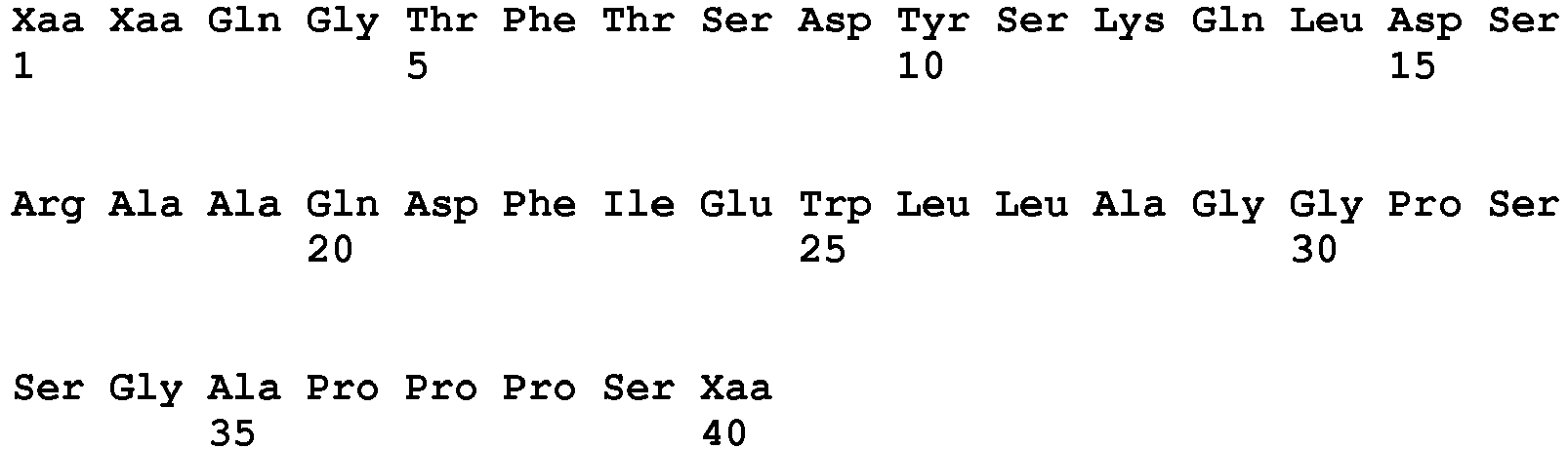
- <210> 24
<211> 40
<212> PRT
<213> Artificial Sequence - <220>
<223> artificial polypeptide - <220>
<221> MOD_RES
<222> (1)..(1)
<223> Xaa is L-4-Thiazolylalanine (Tza) - <220>
<221> MOD_RES
<222> (2)..(2)
<223> Xaa is D-Serine (s) - <220>
<221> MOD_RES
<222> (40)..(40)
<223> Xaa is Cys derivatized with 2-[2-(4,7,10-Tris-carboxymethyl-1,4,7,10-tetraaza-cyclododec-1-yl )-ethanesulfonyl]-ethyl with complexed Gallium - <220>
<221> MOD_RES
<222> (40)..(40)
<223> Amidated C-terminus - <400> 24

- <210> 25
<211> 40
<212> PRT
<213> Artificial Sequence - <220>
<223> artificial polypeptide - <220>
<221> MOD_RES
<222> (1)..(1)
<223> Xaa is L-4-Thiazolylalanine (Tza) - <220>
<221> MOD_RES
<222> (2)..(2)
<223> Xaa is D-Serine (s) - <220>
<221> MOD_RES
<222> (40)..(40)
<223> Xaa is Cys derivatized with 2-[2-(4,7,10-Tris-carboxymethyl-1,4,7,10-tetraaza-cyclododec-1-yl )-ethanesulfonyl]-ethyl - <220>
<221> MOD_RES
<222> (40)..(40)
<223> Amidated C-terminus - <400> 25

- <210> 26
<211> 40
<212> PRT
<213> Artificial Sequence - <220>
<223> artificial polypeptide - <220>
<221> MOD_RES
<222> (1)..(1)
<223> Xaa is L-4-Thiazolylalanine (Tza) - <220>
<221> MOD_RES
<222> (40)..(40)
<223> Xaa is Lys derivatized with (4,7,10-Tris-carboxymethyl-1,4,7,10-tetraaza-cyclododec-1-yl)-ace tyl - <220>
<221> MOD_RES
<222> (40)..(40)
<223> Amidated C-terminus - <400> 26

- <210> 27
<211> 40
<212> PRT
<213> Artificial Sequence - <220>
<223> artificial polypeptide - <220>
<221> MOD_RES
<222> (1)..(1)
<223> Xaa is L-4-Thiazolylalanine (Tza) - <220>
<221> MOD_RES
<222> (40)..(40)
<223> Xaa is Lys derivatized with (4,7,10-Tris-carboxymethyl-1,4,7,10-tetraaza-cyclododec-1-yl)-ace tyl with complexed Gallium - <220>
<221> MOD_RES
<222> (40)..(40)
<223> Amidated C-terminus - <400> 27

- <210> 28
<211> 40
<212> PRT
<213> Artificial Sequence - <220>
<223> artificial polypeptide - <220>
<221> MOD_RES
<222> (1)..(1)
<223> Xaa is L-4-Thiazolylalanine (Tza) - <220>
<221> MOD_RES
<222> (40)..(40)
<223> Xaa is Lys derivatized with (4,7-Bis-carboxymethyl-[1,4,7]triazonan-1-yl)-acetyl - <220>
<221> MOD_RES
<222> (40)..(40)
<223> Amidated C-terminus - <400> 28

- <210> 29
<211> 40
<212> PRT
<213> Artificial Sequence - <220>
<223> artificial polypeptide - <220>
<221> MOD_RES
<222> (1)..(1)
<223> Xaa is L-4-Thiazolylalanine (Tza) - <220>
<221> MOD_RES
<222> (40)..(40)
<223> Xaa is Lys derivatized with 3-{2-[2-(2-{2-[3-(1-{2-[2-(4,7-Bis-carboxymethyl-[1,4,7]triazonan -1-yl)-acetylamino]-ethyl}-2,5-dioxo-pyrrolidin-3-ylsulfanyl)-pro pionylamino]-ethoxy}-ethoxy)-ethoxy]-ethoxy}-propionyl - <220>
<221> MOD_RES
<222> (40)..(40)
<223> Amidated C-terminus - <400> 29

- <210> 30
<211> 40
<212> PRT
<213> Artificial Sequence - <220>
<223> artificial polypeptide - <220>
<221> MOD_RES
<222> (1)..(1)
<223> Xaa is L-4-Thiazolylalanine (Tza) - <220>
<221> MOD_RES
<222> (40)..(40)
<223> Xaa is Lys derivatized with 3-{2-[2-(2-{2-[3-(1-{2-[2-(4,7-Bis -carboxymethyl-[1,4,7]triazonan-1-yl)-acetylamino]-ethyl}-2,5-dioxo-pyrrolidin-3-ylsulfanyl) -propionylamino]-ethoxy}- ethoxy) -ethoxy] -ethoxy}-propionyl with complexed Gallium - <220>
<221> MOD_RES
<222> (40)..(40)
<223> Amidated C-terminus - <400> 30

- <210> 31
<211> 40
<212> PRT
<213> Artificial Sequence - <220>
<223> artificial polypeptide - <220>
<221> MOD_RES
<222> (1)..(1)
<223> Xaa is L-4-Thiazolylalanine (Tza) - <220>
<221> MOD_RES
<222> (7)..(7)
<223> Xaa is Aminoisobutyric acid (Aib) - <220>
<221> MOD_RES
<222> (14)..(14)
<223> Xaa is L-Norleucine (Nle) - <220>
<221> MOD_RES
<222> (40)..(40)
<223> Xaa is Cys derivatized with 2-[2-(4,7,10-Tris-carboxymethyl-1,4,7,10-tetraaza-cyclododec-1-yl )-ethanesulfonyl]-ethyl - <220>
<221> MOD_RES
<222> (40)..(40)
<223> Amidated C-terminus - <400> 31

- <210> 32
<211> 40
<212> PRT
<213> Artificial Sequence - <220>
<223> artificial polypeptide - <220>
<221> MOD_RES
<222> (1)..(1)
<223> Xaa is L-4-Thiazolylalanine (Tza) - <220>
<221> MOD_RES
<222> (7)..(7)
<223> Xaa is Aminoisobutyric acid (Aib) - <220>
<221> MOD_RES
<222> (14)..(14)
<223> Xaa is L-Norleucine (Nle) - <220>
<221> MOD_RES
<222> (40)..(40)
<223> Xaa is Cys derivatized with 2-[2-(4,7,10-Tris-carboxymethyl-1,4,7,10-tetraaza-cyclododec-1-yl )-ethanesulfonyl]-ethyl with complexed Gallium - <220>
<221> MOD_RES
<222> (40)..(40)
<223> Amidated C-terminus - <400> 32

- <210> 33
<211> 40
<212> PRT
<213> Artificial Sequence - <220>
<223> artificial polypeptide - <220>
<221> MOD_RES
<222> (1)..(1)
<223> Xaa is L-4-Thiazolylalanine (Tza) - <220>
<221> MOD_RES
<222> (40)..(40)
<223> Xaa is Cys derivatized with 2-[2-(4,7,10-Tris-carboxymethyl-1,4,7,10-tetraaza-cyclododec-1-yl )-ethanesulfonyl]-ethyl - <220>
<221> MOD_RES
<222> (40)..(40)
<223> Amidated C-terminus - <400> 33


- <210> 34
<211> 40
<212> PRT
<213> Artificial Sequence - <220>
<223> artificial polypeptide - <220>
<221> MOD_RES
<222> (1)..(1)
<223> Xaa is L-4-Thiazolylalanine (Tza) - <220>
<221> MOD_RES
<222> (40)..(40)
<223> Xaa is Cys derivatized with 2-[2-(4,7,10-Tris-carboxymethyl-1,4,7,10-tetraaza-cyclododec-1-yl )-ethanesulfonyl]-ethyl with complexed Gallium - <220>
<221> MOD_RES
<222> (40)..(40)
<223> Amidated C-terminus - <400> 34

- <210> 35
<211> 40
<212> PRT
<213> Artificial Sequence - <220>
<223> artificial polypeptide - <220>
<221> MOD_RES
<222> (1)..(1)
<223> Xaa is L-4-Thiazolylalanine (Tza) - <220>
<221> MOD_RES
<222> (14)..(14)
<223> Xaa is L-Norleucine (Nle) - <220>
<221> MOD_RES
<222> (40)..(40)
<223> Xaa is Cys derivatized with 2-[2-(4,7,10-Tris-carboxymethyl-1,4,7,10-tetraaza-cyclododec-1-yl )-ethanesulfonyl]-ethyl - <220>
<221> MOD_RES
<222> (40)..(40)
<223> Amidated C-terminus - <400> 35

- <210> 36
<211> 40
<212> PRT
<213> Artificial Sequence - <220>
<223> artificial polypeptide - <220>
<221> MOD_RES
<222> (1)..(1)
<223> Xaa is L-4-Thiazolylalanine (Tza) - <220>
<221> MOD_RES
<222> (14)..(14)
<223> Xaa is L-Norleucine (Nle) - <220>
<221> MOD_RES
<222> (40)..(40)
<223> Xaa is Cys derivatized with 2-[2-(4,7,10-Tris-carboxymethyl-1,4,7,10-tetraaza-cyclododec-1-yl )-ethanesulfonyl]-ethyl with complexed Gallium - <220>
<221> MOD_RES
<222> (40)..(40)
<223> Amidated C-terminus - <400> 36


- <210> 37
<211> 39
<212> PRT
<213> Artificial Sequence - <220>
<223> artificial polypeptide - <220>
<221> MOD_RES
<222> (1)..(1)
<223> Xaa is L-4-Thiazolylalanine (Tza) - <220>
<221> MOD_RES
<222> (12)..(12)
<223> Xaa is Cys derivatized with 2-[2-(4,7,10-Tris-carboxymethyl-1,4,7,10-tetraaza-cyclododec-1-yl )-ethanesulfonyl]-ethyl - <220>
<221> MOD_RES
<222> (39)..(39)
<223> Amidated C-terminus - <400> 37

- <210> 38
<211> 39
<212> PRT
<213> Artificial Sequence - <220>
<223> artificial polypeptide - <220>
<221> MOD_RES
<222> (1)..(1)
<223> Xaa is L-4-Thiazolylalanine (Tza) - <220>
<221> MOD_RES
<222> (13)..(13)
<223> Xaa is Cys derivatized with 2-[2-(4,7,10-Tris-carboxymethyl-1,4,7,10-tetraaza-cyclododec-1-yl )-ethanesulfonyl]-ethyl - <220>
<221> MOD_RES
<222> (39)..(39)
<223> Amidated C-terminus - <400> 38

- <210> 39
<211> 39
<212> PRT
<213> Artificial Sequence - <220>
<223> artificial polypeptide - <220>
<221> MOD_RES
<222> (1)..(1)
<223> Xaa is L-4-Thiazolylalanine (Tza) - <220>
<221> MOD_RES
<222> (14)..(14)
<223> Xaa is Cys derivatized with 2-[2-(4,7,10-Tris-carboxymethyl-1,4,7,10-tetraaza-cyclododec-1-yl )-ethanesulfonyl]-ethyl - <220>
<221> MOD_RES
<222> (39)..(39)
<223> Amidated C-terminus - <400> 39


- <210> 40
<211> 39
<212> PRT
<213> Artificial Sequence - <220>
<223> artificial polypeptide - <220>
<221> MOD_RES
<222> (1)..(1)
<223> Xaa is L-4-Thiazolylalanine (Tza) - <220>
<221> MOD_RES
<222> (16)..(16)
<223> Xaa is Cys derivatized with 2-[2-(4,7,10-Tris-carboxymethyl-1,4,7,10-tetraaza-cyclododec-1-yl )-ethanesulfonyl]-ethyl - <220>
<221> MOD_RES
<222> (39)..(39)
<223> Amidated C-terminus - <400> 40

- <210> 41
<211> 39
<212> PRT
<213> Artificial Sequence - <220>
<223> artificial polypeptide - <220>
<221> MOD_RES
<222> (1)..(1)
<223> Xaa is L-4-Thiazolylalanine (Tza) - <220>
<221> MOD_RES
<222> (17)..(17)
<223> Xaa is Cys derivatized with 2-[2-(4,7,10-Tris-carboxymethyl-1,4,7,10-tetraaza-cyclododec-1-yl )-ethanesulfonyl]-ethyl - <220>
<221> MOD_RES
<222> (39)..(39)
<223> Amidated C-terminus - <400> 41

- <210> 42
<211> 39
<212> PRT
<213> Artificial Sequence - <220>
<223> artificial polypeptide - <220>
<221> MOD_RES
<222> (1)..(1)
<223> Xaa is L-4-Thiazolylalanine (Tza) - <220>
<221> MOD_RES
<222> (20)..(20)
<223> Xaa is Cys derivatized with 2-[2-(4,7,10-Tris-carboxymethyl-1,4,7,10-tetraaza-cyclododec-1-yl )-ethanesulfonyl]-ethyl - <220>
<221> MOD_RES
<222> (39)..(39)
<223> Amidated C-terminus - <400> 42
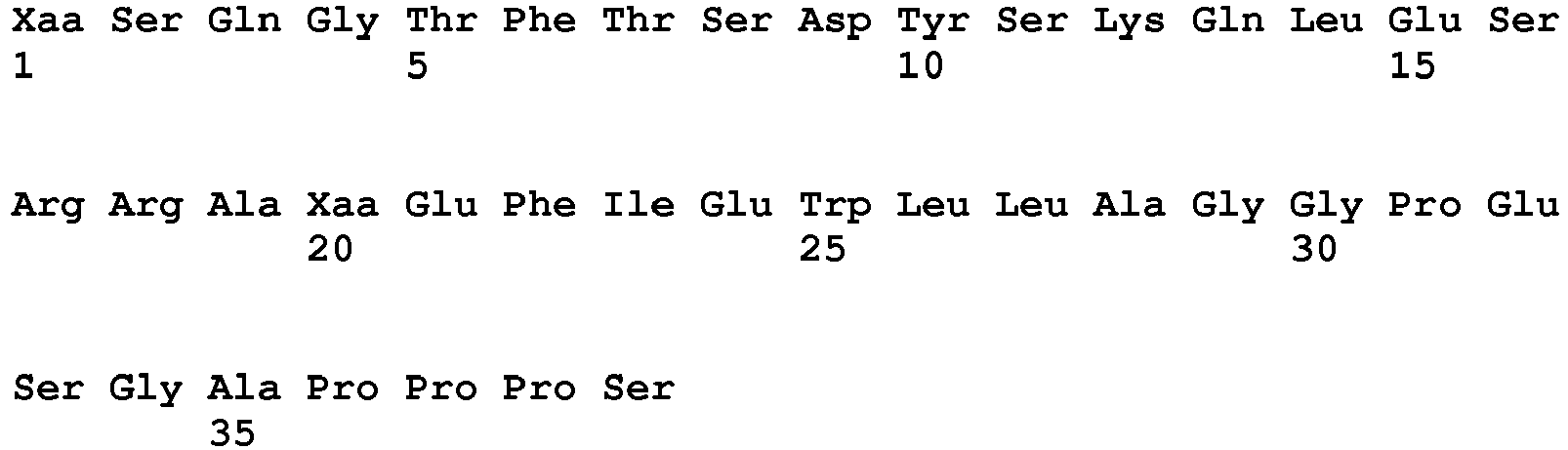
- <210> 43
<211> 40
<212> PRT
<213> Artificial Sequence - <220>
<223> artificial polypeptide - <220>
<221> MOD_RES
<222> (1)..(1)
<223> Xaa is L-4-Thiazolylalanine (Tza) - <220>
<221> MOD_RES
<222> (40)..(40)
<223> Xaa is Lys derivatized with 2-[2-(4,7,10-Tris-carboxymethyl-1,4,7,10-tetraaza-cyclododec-1-yl )-ethanesulfonyl]-ethyl - <220>
<221> MOD_RES
<222> (40)..(40)
<223> Amidated C-terminus - <400> 43

- <210> 44
<211> 40
<212> PRT
<213> Artificial Sequence - <220>
<223> artificial polypeptide - <220>
<221> MOD_RES
<222> (1)..(1)
<223> Xaa is L-4-Thiazolylalanine (Tza) - <220>
<221> MOD_RES
<222> (40)..(40)
<223> Xaa is Lys derivatized with 2-[2-(4,7,10-Tris-carboxymethyl-1,4,7,10-tetraaza-cyclododec-1-yl )-ethanesulfonyl]-ethyl with complexed Gallium - <220>
<221> MOD_RES
<222> (40)..(40)
<223> Amidated C-terminus - <400> 44

- <210> 45
<211> 40
<212> PRT
<213> Artificial Sequence - <220>
<223> artificial polypeptide - <220>
<221> MOD_RES
<222> (1)..(1)
<223> Xaa is L-4-Thiazolylalanine (Tza) - <220>
<221> MOD_RES
<222> (40)..(40)
<223> Xaa is Lys derivatized with (4,7,10-Tris-carboxymethyl-1,4,7,10-tetraaza-cyclododec-1-yl)-ace tyl - <220>
<221> MOD_RES
<222> (40)..(40)
<223> Amidated C-terminus - <400> 45

- <210> 46
<211> 40
<212> PRT
<213> Artificial Sequence - <220>
<223> artificial polypeptide - <220>
<221> MOD_RES
<222> (1)..(1)
<223> Xaa is L-4-Thiazolylalanine (Tza) - <220>
<221> MOD_RES
<222> (40)..(40)
<223> Xaa is Lys derivatized with (4,7,10-Tris-carboxymethyl-1,4,7,10-tetraaza-cyclododec-1-yl)-ace tyl with complexed Gallium - <220>
<221> MOD_RES
<222> (40)..(40)
<223> Amidated C-terminus - <400> 46

- <210> 47
<211> 40
<212> PRT
<213> Artificial Sequence - <220>
<223> artificial polypeptide - <220>
<221> MOD_RES
<222> (1)..(1)
<223> Xaa is L-4-Thiazolylalanine (Tza) - <220>
<221> MOD_RES
<222> (40)..(40)
<223> Xaa is Cys derivatized with 2-[2-(4,7,10-Tris-carboxymethyl-1,4,7,10-tetraaza-cyclododec-1-yl )-ethanesulfonyl]-ethyl - <220>
<221> MOD_RES
<222> (40)..(40)
<223> Amidated C-terminus - <400> 47


- <210> 48
<211> 40
<212> PRT
<213> Artificial Sequence - <220>
<223> artificial polypeptide - <220>
<221> MOD_RES
<222> (1)..(1)
<223> Xaa is L-4-Thiazolylalanine (Tza) - <220>
<221> MOD_RES
<222> (40)..(40)
<223> Xaa is Cys derivatized with 2-[2-(4,7,10-Tris-carboxymethyl-1,4,7,10-tetraaza-cyclododec-1-yl )-ethanesulfonyl]-ethyl with complexed Gallium - <220>
<221> MOD_RES
<222> (40)..(40)
<223> Amidated C-terminus - <400> 48

- <210> 49
<211> 40
<212> PRT
<213> Artificial Sequence - <220>
<223> artificial polypeptide - <220>
<221> MOD_RES
<222> (1)..(1)
<223> Xaa is L-4-Thiazolylalanine (Tza) - <220>
<221> MOD_RES
<222> (40)..(40)
<223> Xaa is Cys derivatized with 2-[2-(4,7,10-Tris-carboxymethyl-1,4,7,10-tetraaza-cyclododec-1-yl )-ethanesulfonyl]-ethyl - <220>
<221> MOD_RES
<222> (40)..(40)
<223> Amidated C-terminus - <400> 49

- <210> 50
<211> 40
<212> PRT
<213> Artificial Sequence - <220>
<223> artificial polypeptide - <220>
<221> MOD_RES
<222> (1)..(1)
<223> Xaa is L-4-Thiazolylalanine (Tza) - <220>
<221> MOD_RES
<222> (40)..(40)
<223> Xaa is Cys derivatized with 2-[2-(4,7,10-Tris-carboxymethyl-1,4,7,10-tetraaza-cyclododec-1-yl )-ethanesulfonyl]-ethyl with complexed Gallium - <220>
<221> MOD_RES
<222> (40)..(40)
<223> Amidated C-terminus - <400> 50


- <210> 51
<211> 40
<212> PRT
<213> Artificial Sequence - <220>
<223> artificial polypeptide - <220>
<221> MOD_RES
<222> (1)..(1)
<223> Xaa is L-4-Thiazolylalanine (Tza) - <220>
<221> MOD_RES
<222> (7)..(7)
<223> Xaa is Aminoisobutyric acid (Aib) - <220>
<221> MOD_RES
<222> (14)..(14)
<223> Xaa is L-Norleucine (Nle) - <220>
<221> MOD_RES
<222> (40)..(40)
<223> Xaa is Cys derivatized with 2-[2-(4,7,10-Tris-carboxymethyl-1,4,7,10-tetraaza-cyclododec-1-yl )-ethanesulfonyl]-ethyl - <220>
<221> MOD_RES
<222> (40)..(40)
<223> Amidated C-terminus - <400> 51

- <210> 52
<211> 40
<212> PRT
<213> Artificial Sequence - <220>
<223> artificial polypeptide - <220>
<221> MOD_RES
<222> (1)..(1)
<223> Xaa is L-4-Thiazolylalanine (Tza) - <220>
<221> MOD_RES
<222> (7)..(7)
<223> Xaa is Aminoisobutyric acid (Aib) - <220>
<221> MOD_RES
<222> (14)..(14)
<223> Xaa is L-Norleucine (Nle) - <220>
<221> MOD_RES
<222> (40)..(40)
<223> Xaa is Cys derivatized with 2-[2-(4,7,10-Tris-carboxymethyl-1,4,7,10-tetraaza-cyclododec-1-yl )-ethanesulfonyl]-ethyl with complexed Gallium - <220>
<221> MOD_RES
<222> (40)..(40)
<223> Amidated C-terminus - <400> 52

- <210> 53
<211> 40
<212> PRT
<213> Artificial Sequence - <220>
<223> artificial polypeptide - <220>
<221> MOD_RES
<222> (1)..(1)
<223> Xaa is L-4-Thiazolylalanine (Tza) - <220>
<221> MOD_RES
<222> (40)..(40)
<223> Xaa is Lys derivatized with (4,7-Bis-carboxymethyl-[1,4,7]triazonan -1-yl)-acetyl - <220>
<221> MOD_RES
<222> (40)..(40)
<223> Amidated C-terminus - <400> 53

- <210> 54
<211> 40
<212> PRT
<213> Artificial Sequence - <220>
<223> artificial polypeptide - <220>
<221> MOD_RES
<222> (1)..(1)
<223> Xaa is L-4-Thiazolylalanine (Tza) - <220>
<221> MOD_RES
<222> (16)..(16)
<223> Xaa is Aminoisobutyric acid (Aib) - <220>
<221> MOD_RES
<222> (40)..(40)
<223> Xaa is Cys derivatized with 2-[2-(4,7,10-Tris-carboxymethyl-1,4,7,10-tetraaza-cyclododec-1-yl )-ethanesulfonyl]-ethyl - <220>
<221> MOD_RES
<222> (40)..(40)
<223> Amidated C-terminus - <400> 54

- <210> 55
<211> 40
<212> PRT
<213> Artificial Sequence - <220>
<223> artificial polypeptide - <220>
<221> MOD_RES
<222> (1)..(1)
<223> Xaa is L-4-Thiazolylalanine (Tza) - <220>
<221> MOD_RES
<222> (16)..(16)
<223> Xaa is Aminoisobutyric acid (Aib) - <220>
<221> MOD_RES
<222> (40)..(40)
<223> Xaa is Cys derivatized with 2-[2-(4,7,10-Tris-carboxymethyl-1,4,7,10-tetraaza-cyclododec-1-yl )-ethanesulfonyl]-ethyl with complexed Gallium - <220>
<221> MOD_RES
<222> (40)..(40)
<223> Amidated C-terminus - <400> 55

- <210> 56
<211> 40
<212> PRT
<213> Artificial Sequence - <220>
<223> artificial polypeptide - <220>
<221> MOD_RES
<222> (1)..(1)
<223> Xaa is L-4-Thiazolylalanine (Tza) - <220>
<221> MOD_RES
<222> (16)..(16)
<223> Xaa is Aminoisobutyric acid (Aib) - <220>
<221> MOD_RES
<222> (40)..(40)
<223> Xaa is Cys derivatized with 2-[2-(4,7,10-Tris-carboxymethyl-1,4,7,10-tetraaza-cyclododec-1-yl )-ethanesulfonyl]-ethyl - <220>
<221> MOD_RES
<222> (40)..(40)
<223> Amidated C-terminus - <400> 56

- <210> 57
<211> 40
<212> PRT
<213> Artificial Sequence - <220>
<223> artificial polypeptide - <220>
<221> MOD_RES
<222> (1)..(1)
<223> Xaa is L-4-Thiazolylalanine (Tza) - <220>
<221> MOD_RES
<222> (16)..(16)
<223> Xaa is Aminoisobutyric acid (Aib) - <220>
<221> MOD_RES
<222> (40)..(40)
<223> Xaa is Cys derivatized with 2-[2-(4,7,10-Tris-carboxymethyl-1,4,7,10-tetraaza-cyclododec-1-yl )-ethanesulfonyl]-ethyl - <220>
<221> MOD_RES
<222> (40)..(40)
<223> Amidated C-terminus - <400> 57


- <210> 58
<211> 40
<212> PRT
<213> Artificial Sequence - <220>
<223> artificial polypeptide - <220>
<221> MOD_RES
<222> (1)..(1)
<223> Xaa is L-4-Thiazolylalanine (Tza) - <220>
<221> MOD_RES
<222> (2)..(2)
<223> Xaa is D-Serine (s) - <220>
<221> MOD_RES
<222> (16)..(16)
<223> Xaa is Aminoisobutyric acid (Aib) - <220>
<221> MOD_RES
<222> (40)..(40)
<223> Xaa is Cys derivatized with 2-[2-(4,7,10-Tris-carboxymethyl-1,4,7,10-tetraaza-cyclododec-1-yl )-ethanesulfonyl]-ethyl - <220>
<221> MOD_RES
<222> (40)..(40)
<223> Amidated C-terminus - <400> 58

- <210> 59
<211> 40
<212> PRT
<213> Artificial Sequence - <220>
<223> artificial polypeptide - <220>
<221> MOD_RES
<222> (1)..(1)
<223> Xaa is L-4-Thiazolylalanine (Tza) - <220>
<221> MOD_RES
<222> (40)..(40)
<223> Xaa is Cys derivatized with 2-[2-(4,7,10-Tris-carboxymethyl-1,4,7,10-tetraaza-cyclododec-1-yl )-ethanesulfonyl]-ethyl - <220>
<221> MOD_RES
<222> (40)..(40)
<223> Amidated C-terminus - <400> 59

- <210> 60
<211> 40
<212> PRT
<213> Artificial Sequence - <220>
<223> artificial polypeptide - <220>
<221> MOD_RES
<222> (1)..(1)
<223> Xaa is L-4-Thiazolylalanine (Tza) - <220>
<221> MOD_RES
<222> (2)..(2)
<223> Xaa is D-Serine (s) - <220>
<221> MOD_RES
<222> (16)..(16)
<223> Glu in position 16 forms a lactam bridge with Lys in position 20 - <220>
<221> MOD_RES
<222> (20)..(20)
<223> Lys in position 20 forms a lactam bridge with Glu in position 16 - <220>
<221> MOD_RES
<222> (40)..(40)
<223> Xaa is Cys derivatized with 2-[2-(4,7,10-Tris-carboxymethyl-1,4,7,10-tetraaza-cyclododec-1-yl )-ethanesulfonyl]-ethyl - <220>
<221> MOD_RES
<222> (40)..(40)
<223> Amidated C-terminus - <400> 60

- <210> 61
<211> 40
<212> PRT
<213> Artificial Sequence - <220>
<223> artificial polypeptide - <220>
<221> MOD_RES
<222> (1)..(1)
<223> Xaa is L-4-Thiazolylalanine (Tza) - <220>
<221> MOD_RES
<222> (2)..(2)
<223> Xaa is D-Serine (s) - <220>
<221> MOD_RES
<222> (16)..(16)
<223> Glu in position 16 forms a lactam bridge with Lys in position 20 - <220>
<221> MOD_RES
<222> (20)..(20)
<223> Lys in position 20 forms a lactam bridge with Glu in position 16 - <220>
<221> MOD_RES
<222> (40)..(40)
<223> Xaa is Cys derivatized with 2-[2-(4,7,10-Tris-carboxymethyl-1,4,7,10-tetraaza-cyclododec-1-yl )-ethanesulfonyl]-ethyl with complexed Gallium - <220>
<221> MOD_RES
<222> (40)..(40)
<223> Amidated C-terminus - <400> 61

- <210> 62
<211> 40
<212> PRT
<213> Artificial Sequence - <220>
<223> artificial polypeptide - <220>
<221> MOD_RES
<222> (1)..(1)
<223> Xaa is L-4-Thiazolylalanine (Tza) - <220>
<221> MOD_RES
<222> (40)..(40)
<223> Xaa is Cys derivatized with 2-[2-(4,7-Bis-carboxymethyl-[1,4,7]triazonan -1-yl)-ethanesulfonyl]-ethyl - <220>
<221> MOD_RES
<222> (40)..(40)
<223> Amidated C-terminus - <400> 62

- <210> 63
<211> 40
<212> PRT
<213> Artificial Sequence - <220>
<223> artificial polypeptide - <220>
<221> MOD_RES
<222> (1)..(1)
<223> Xaa is L-4-Thiazolylalanine (Tza) - <220>
<221> MOD_RES
<222> (40)..(40)
<223> Xaa is Cys derivatized with 2-[2-(4,7-Bis-carboxymethyl-[1,4,7]triazonan -1-yl)-ethanesulfonyl]-ethyl with complexed Gallium - <220>
<221> MOD_RES
<222> (40)..(40)
<223> Amidated C-terminus - <400> 63

- <210> 64
<211> 40
<212> PRT
<213> Artificial Sequence - <220>
<223> artificial polypeptide - <220>
<221> MOD_RES
<222> (1)..(1)
<223> Xaa is L-4-Thiazolylalanine (Tza) - <220>
<221> MOD_RES
<222> (7)..(7)
<223> Xaa is Aminoisobutyric acid (Aib) - <220>
<221> MOD_RES
<222> (14)..(14)
<223> Xaa is L-Norleucine (Nle) - <220>
<221> MOD_RES
<222> (40)..(40)
<223> Xaa is Cys derivatized with 2-[2-(4,7-Bis-carboxymethyl-[1,4,7]triazonan -1-yl)-ethanesulfonyl]-ethyl - <220>
<221> MOD_RES
<222> (40)..(40)
<223> Amidated C-terminus - <400> 64
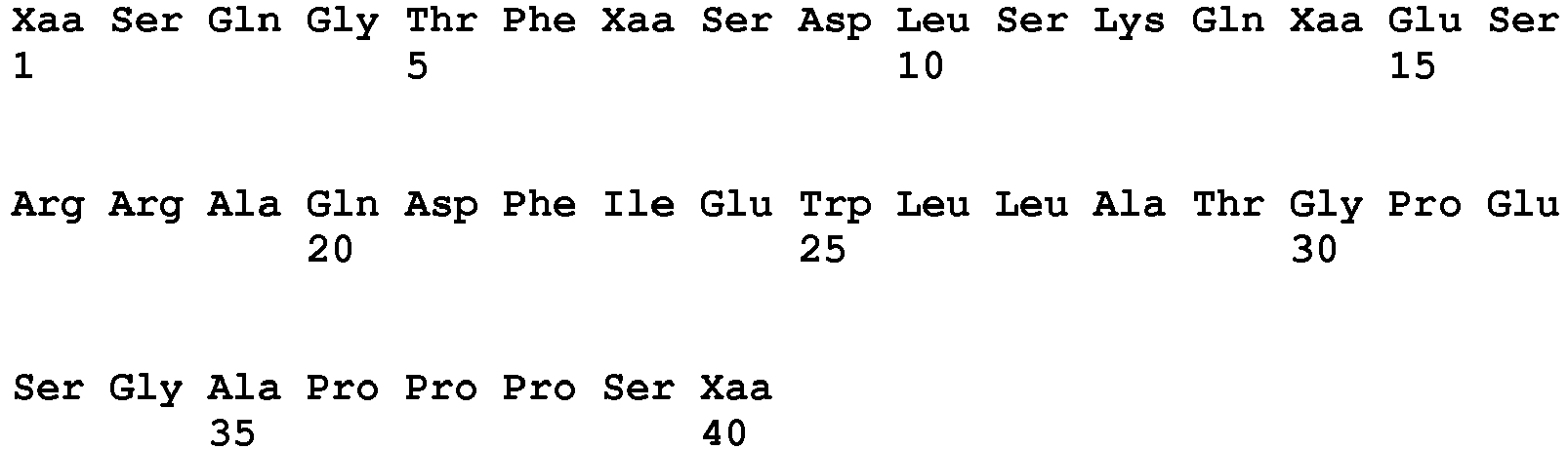
- <210> 65
<211> 40
<212> PRT
<213> Artificial Sequence - <220>
<223> artificial polypeptide - <220>
<221> MOD_RES
<222> (1)..(1)
<223> Xaa is L-4-Thiazolylalanine (Tza) - <220>
<221> MOD_RES
<222> (7)..(7)
<223> Xaa is Aminoisobutyric acid (Aib) - <220>
<221> MOD_RES
<222> (14)..(14)
<223> Xaa is L-Norleucine (Nle) - <220>
<221> MOD_RES
<222> (40)..(40)
<223> Xaa is Cys derivatized with 2-[2-(4,7-Bis-carboxymethyl-[1,4,7]triazonan -1-yl)-ethanesulfonyl]-ethyl with complexed Gallium - <220>
<221> MOD_RES
<222> (40)..(40)
<223> Amidated C-terminus - <400> 65


- <210> 66
<211> 40
<212> PRT
<213> Artificial Sequence - <220>
<223> artificial polypeptide - <220>
<221> MOD_RES
<222> (1)..(1)
<223> Xaa is L-4-Thiazolylalanine (Tza) - <220>
<221> MOD_RES
<222> (2)..(2)
<223> Xaa is D-Serine (s) - <220>
<221> MOD_RES
<222> (40)..(40)
<223> Xaa is Cys derivatized with 2-[2-(4,7,10-Tris-carboxymethyl-1,4,7,10-tetraaza-cyclododec-1-yl )-ethanesulfonyl]-ethyl - <220>
<221> MOD_RES
<222> (40)..(40)
<223> Amidated C-terminus - <400> 66

- <210> 67
<211> 40
<212> PRT
<213> Artificial Sequence - <220>
<223> artificial polypeptide - <220>
<221> MOD_RES
<222> (1)..(1)
<223> Xaa is L-4-Thiazolylalanine (Tza) - <220>
<221> MOD_RES
<222> (40)..(40)
<223> Xaa is Lys derivatized with (4,7,10-Tris-carboxymethyl-1,4,7,10-tetraaza-cyclododec-1-yl)-ace tyl - <220>
<221> MOD_RES
<222> (40)..(40)
<223> Amidated C-terminus - <400> 67

- <210> 68
<211> 40
<212> PRT
<213> Artificial Sequence - <220>
<223> artificial polypeptide - <220>
<221> MOD_RES
<222> (1)..(1)
<223> Xaa is L-4-Thiazolylalanine (Tza) - <220>
<221> MOD_RES
<222> (40)..(40)
<223> Xaa is Cys derivatized with 2-[2-(4,7,10-Tris-carboxymethyl-1,4,7,10-tetraaza-cyclododec-1-yl )-ethanesulfonyl]-ethyl - <220>
<221> MOD_RES
<222> (40)..(40)
<223> Amidated C-terminus - <400> 68


- <210> 69
<211> 40
<212> PRT
<213> Artificial Sequence - <220>
<223> artificial polypeptide - <220>
<221> MOD_RES
<222> (1)..(1)
<223> Xaa is L-4-Thiazolylalanine (Tza) - <220>
<221> MOD_RES
<222> (14)..(14)
<223> Xaa is L-Norleucine (Nle) - <220>
<221> MOD_RES
<222> (40)..(40)
<223> Xaa is Cys derivatized with 2-[2-(4,7-Bis-carboxymethyl-[1,4,7]triazonan -1-yl)-ethanesulfonyl]-ethyl - <220>
<221> MOD_RES
<222> (40)..(40)
<223> Amidated C-terminus - <400> 69

- <210> 70
<211> 40
<212> PRT
<213> Artificial Sequence - <220>
<223> artificial polypeptide - <220>
<221> MOD_RES
<222> (1)..(1)
<223> Xaa is L-4-Thiazolylalanine (Tza) - <220>
<221> MOD_RES
<222> (14)..(14)
<223> Xaa is L-Norleucine (Nle) - <220>
<221> MOD_RES
<222> (40)..(40)
<223> Xaa is Cys derivatized with 2-[2-(4,7-Bis-carboxymethyl-[1,4,7]triazonan -1-yl)-ethanesulfonyl]-ethyl with complexed Gallium - <220>
<221> MOD_RES
<222> (40)..(40)
<223> Amidated C-terminus - <400> 70

- <210> 71
<211> 40
<212> PRT
<213> Artificial Sequence - <220>
<223> artificial polypeptide - <220>
<221> MOD_RES
<222> (1)..(1)
<223> Xaa is L-4-Thiazolylalanine (Tza) - <220>
<221> MOD_RES
<222> (14)..(14)
<223> Xaa is L-Norleucine (Nle) - <220>
<221> MOD_RES
<222> (40)..(40)
<223> Xaa is Cys derivatized with 1-{2-[2-(4,7-bis-carboxymethyl-[1,4,7]triazonan -1-yl)-acetylamino]ethyl}-2,5-dioxo-pyrrolidin-3-yl - <220>
<221> MOD_RES
<222> (40)..(40)
<223> Amidated C-terminus - <400> 71

- <210> 72
<211> 40
<212> PRT
<213> Artificial Sequence - <220>
<223> artificial polypeptide - <220>
<221> MOD_RES
<222> (1)..(1)
<223> Xaa is L-4-Thiazolylalanine (Tza) - <220>
<221> MOD_RES
<222> (14)..(14)
<223> Xaa is L-Norleucine (Nle) - <220>
<221> MOD_RES
<222> (40)..(40)
<223> Xaa is Cys derivatized with 1-{2-[(S)-4-(4,7-bis -carboxymethyl-[1,4,7]triazonan -1-yl)-4-carboxy-butyrylamino]ethyl}-2,5-dioxo-pyrrolidin-3-yl - <220>
<221> MOD_RES
<222> (40)..(40)
<223> Amidated C-terminus - <400> 72

- <210> 73
<211> 40
<212> PRT
<213> Artificial Sequence - <220>
<223> artificial polypeptide - <220>
<221> MOD_RES
<222> (1)..(1)
<223> Xaa is L-4-Thiazolylalanine (Tza) - <220>
<221> MOD_RES
<222> (14)..(14)
<223> Xaa is L-Norleucine (Nle) - <220>
<221> MOD_RES
<222> (40)..(40)
<223> Xaa is Cys derivatized with 2-[2-(4,7,10-Tris-carboxymethyl-1,4,7,10-tetraaza-cyclododec-1-yl )-ethanesulfonyl]-ethyl - <220>
<221> MOD_RES
<222> (40)..(40)
<223> Amidated C-terminus - <400> 73

- <210> 74
<211> 40
<212> PRT
<213> Artificial Sequence - <220>
<223> artificial polypeptide - <220>
<221> MOD_RES
<222> (1)..(1)
<223> Xaa is L-4-Thiazolylalanine (Tza) - <220>
<221> MOD_RES
<222> (10)..(10)
<223> Xaa is L-2-Fluorphenylalanine (2F-Phe) - <220>
<221> MOD_RES
<222> (40)..(40)
<223> Xaa is Cys derivatized with 2-[2-(4,7,10-Tris-carboxymethyl-1,4,7,10-tetraaza-cyclododec-1-yl )-ethanesulfonyl]-ethyl - <220>
<221> MOD_RES
<222> (40)..(40)
<223> Amidated C-terminus - <400> 74

- <210> 75
<211> 40
<212> PRT
<213> Artificial Sequence - <220>
<223> artificial polypeptide - <220>
<221> MOD_RES
<222> (1)..(1)
<223> Xaa is L-4-Thiazolylalanine (Tza) - <220>
<221> MOD_RES
<222> (40)..(40)
<223> Xaa is Cys derivatized with 2-[2-(4,7-Bis-carboxymethyl-[1,4,7]triazonan -1-yl)-ethanesulfonyl]-ethyl - <220>
<221> MOD_RES
<222> (40)..(40)
<223> Amidated C-terminus - <400> 75
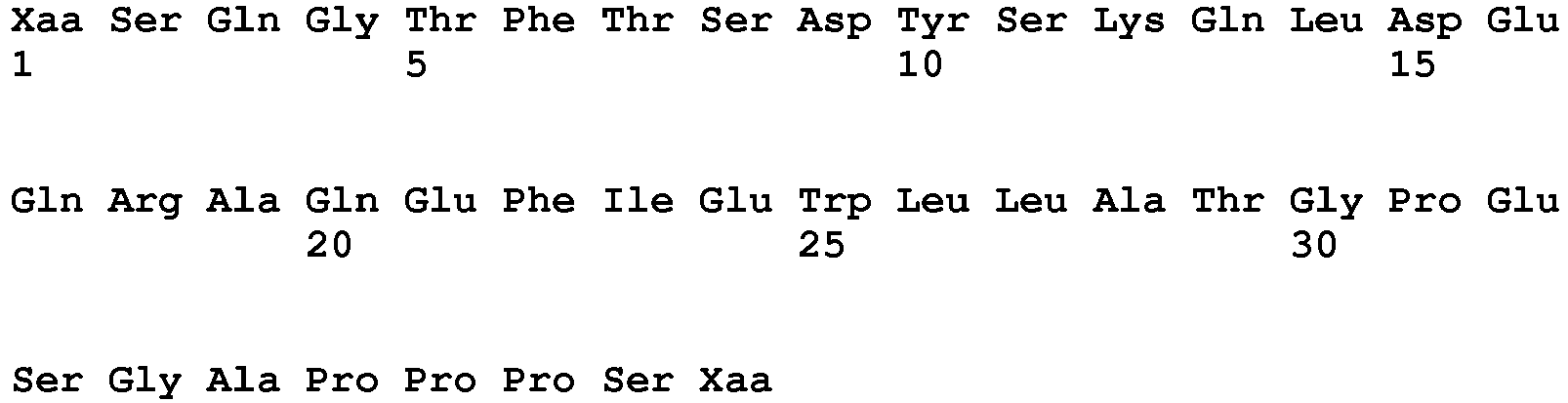

- <210> 76
<211> 40
<212> PRT
<213> Artificial Sequence - <220>
<223> artificial polypeptide - <220>
<221> MOD_RES
<222> (1)..(1)
<223> Xaa is L-4-Thiazolylalanine (Tza) - <220>
<221> MOD_RES
<222> (40)..(40)
<223> Xaa is Cys derivatized with 2-[2-(4,7-Bis-carboxymethyl-[1,4,7]triazonan -1-yl)-ethanesulfonyl]-ethyl with complexed Gallium - <220>
<221> MOD_RES
<222> (40)..(40)
<223> Amidated C-terminus - <400> 76

- <210> 77
<211> 40
<212> PRT
<213> Artificial Sequence - <220>
<223> artificial polypeptide - <220>
<221> MOD_RES
<222> (1)..(1)
<223> Xaa is L-4-Thiazolylalanine (Tza) - <220>
<221> MOD_RES
<222> (40)..(40)
<223> Xaa is Cys derivatized with 1-{2-[2-(4,7-bis-carboxymethyl-[1,4,7]triazonan -1-yl)-acetylamino]ethyl}-2,5-dioxo-pyrrolidin-3-yl - <220>
<221> MOD_RES
<222> (40)..(40)
<223> Amidated C-terminus - <400> 77

- <210> 78
<211> 40
<212> PRT
<213> Artificial Sequence - <220>
<223> artificial polypeptide - <220>
<221> MOD_RES
<222> (1)..(1)
<223> Xaa is L-4-Thiazolylalanine (Tza) - <220>
<221> MOD_RES
<222> (40)..(40)
<223> Xaa is Cys derivatized with 1-{2-[(S)-4-(4,7-bis -carboxymethyl-[1,4,7]triazonan -1-yl)-4-carboxy-butyrylamino]ethyl}-2,5-dioxo-pyrrolidin-3-yl - <220>
<221> MOD_RES
<222> (40)..(40)
<223> Amidated C-terminus - <400> 78

- <210> 79
<211> 40
<212> PRT
<213> Artificial Sequence - <220>
<223> artificial polypeptide - <220>
<221> MOD_RES
<222> (1)..(1)
<223> Xaa is L-4-Thiazolylalanine (Tza) - <220>
<221> MOD_RES
<222> (40)..(40)
<223> Xaa is Cys derivatized with 2-[2-(4,7,10-Tris-carboxymethyl-1,4,7,10-tetraaza-cyclododec-1-yl )-ethanesulfonyl]-ethyl - <400> 79

- <210> 80
<211> 40
<212> PRT
<213> Artificial Sequence - <220>
<223> artificial polypeptide - <220>
<221> MOD_RES
<222> (1)..(1)
<223> Xaa is L-4-Thiazolylalanine (Tza) - <220>
<221> MOD_RES
<222> (40)..(40)
<223> Xaa is Cys derivatized with 2-[2-(4,7,10-Tris-carboxymethyl-1,4,7,10-tetraaza-cyclododec-1-yl )-ethanesulfonyl]-ethyl with complexed Gallium - <400> 80


- <210> 81
<211> 40
<212> PRT
<213> Artificial Sequence - <220>
<223> artificial polypeptide - <220>
<221> MOD_RES
<222> (1)..(1)
<223> Xaa is L-4-Thiazolylalanine (Tza) - <220>
<221> MOD_RES
<222> (40)..(40)
<223> Xaa is Lys derivatized with (4,7,10-Tris-carboxymethyl-1,4,7,10-tetraaza-cyclododec-1-yl)-ace tyl - <220>
<221> MOD_RES
<222> (40)..(40)
<223> Amidated C-terminus - <400> 81

- <210> 82
<211> 40
<212> PRT
<213> Artificial Sequence - <220>
<223> artificial polypeptide - <220>
<221> MOD_RES
<222> (1)..(1)
<223> Xaa is L-4-Thiazolylalanine (Tza) - <220>
<221> MOD_RES
<222> (2)..(2)
<223> Xaa is D-Serine (s) - <220>
<221> MOD_RES
<222> (40)..(40)
<223> Xaa is Cys derivatized with 2-[2-(4,7,10-Tris-carboxymethyl-1,4,7,10-tetraaza-cyclododec-1-yl )-ethanesulfonyl]-ethyl - <220>
<221> MOD_RES
<222> (40)..(40)
<223> Amidated C-terminus - <400> 82

- <210> 83
<211> 40
<212> PRT
<213> Artificial Sequence - <220>
<223> artificial polypeptide - <220>
<221> MOD_RES
<222> (1)..(1)
<223> Xaa is L-4-Thiazolylalanine (Tza) - <220>
<221> MOD_RES
<222> (2)..(2)
<223> Xaa is D-Serine (s) - <220>
<221> MOD_RES
<222> (40)..(40)
<223> Xaa is Cys derivatized with 2-[2-(4,7,10-Tris-carboxymethyl-1,4,7,10-tetraaza-cyclododec-1-yl )-ethanesulfonyl]-ethyl with complexed Gallium - <220>
<221> MOD_RES
<222> (40)..(40)
<223> Amidated C-terminus - <400> 83


- <210> 84
<211> 40
<212> PRT
<213> Artificial Sequence - <220>
<223> artificial polypeptide - <220>
<221> MOD_RES
<222> (1)..(1)
<223> Xaa is L-4-Thiazolylalanine (Tza) - <220>
<221> MOD_RES
<222> (40)..(40)
<223> Xaa is Cys derivatized with 2-[2-(4,7,10-Tris-carboxymethyl-1,4,7,10-tetraaza-cyclododec-1-yl )-ethanesulfonyl]-ethyl - <220>
<221> MOD_RES
<222> (40)..(40)
<223> Amidated C-terminus - <400> 84
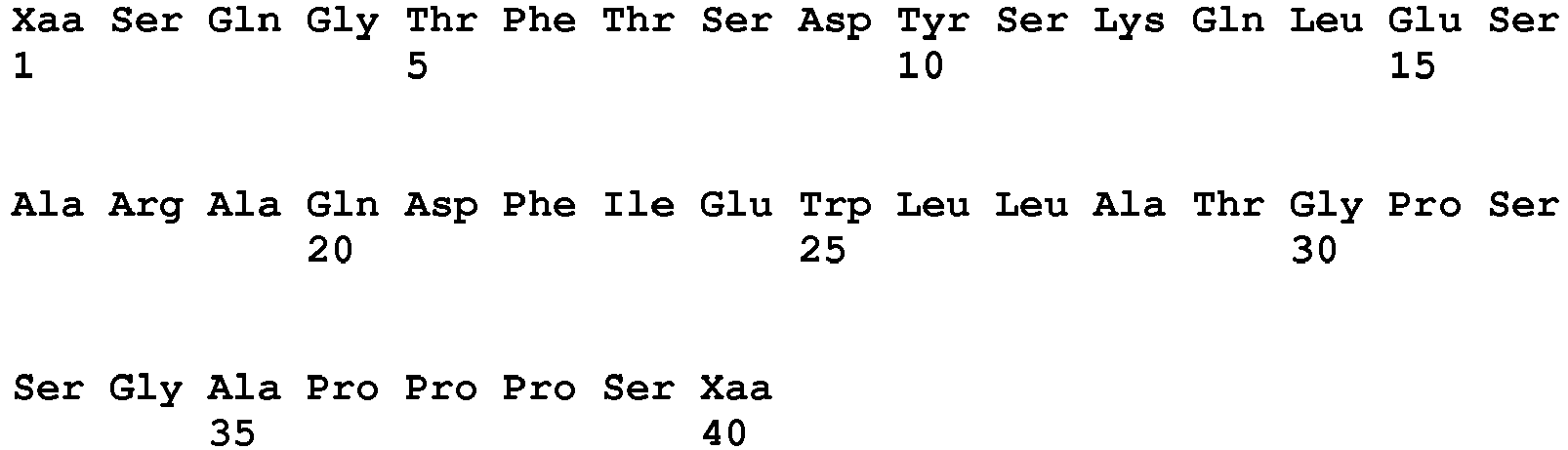
- <210> 85
<211> 40
<212> PRT
<213> Artificial Sequence - <220>
<223> artificial polypeptide - <220>
<221> MOD_RES
<222> (1)..(1)
<223> Xaa is L-4-Thiazolylalanine (Tza) - <220>
<221> MOD_RES
<222> (2)..(2)
<223> Xaa is D-Serine (s) - <220>
<221> MOD_RES
<222> (40)..(40)
<223> Xaa is Cys derivatized with 2-[2-(4,7,10-Tris-carboxymethyl-1,4,7,10-tetraaza-cyclododec-1-yl )-ethanesulfonyl]-ethyl - <220>
<221> MOD_RES
<222> (40)..(40)
<223> Amidated C-terminus - <400> 85

- <210> 86
<211> 40
<212> PRT
<213> Artificial Sequence - <220>
<223> artificial polypeptide - <220>
<221> MOD_RES
<222> (1)..(1)
<223> Xaa is L-4-Thiazolylalanine (Tza) - <220>
<221> MOD_RES
<222> (2)..(2)
<223> Xaa is D-Serine (s) - <220>
<221> MOD_RES
<222> (40)..(40)
<223> Xaa is Cys derivatized with 2-[2-(4,7,10-Tris-carboxymethyl-1,4,7,10-tetraaza-cyclododec-1-yl )-ethanesulfonyl]-ethyl with complexed Gallium - <220>
<221> MOD_RES
<222> (40)..(40)
<223> Amidated C-terminus - <400> 86

- <210> 87
<211> 40
<212> PRT
<213> Artificial Sequence - <220>
<223> artificial polypeptide - <220>
<221> MOD_RES
<222> (1)..(1)
<223> Xaa is L-4-Thiazolylalanine (Tza) - <220>
<221> MOD_RES
<222> (2)..(2)
<223> Xaa is D-Serine (s) - <220>
<221> MOD_RES
<222> (40)..(40)
<223> Xaa is Cys derivatized with 1-{2-[2-(4,7-bis-carboxymethyl-[1,4,7]triazonan -1-yl)-acetylamino]ethyl}-2,5-dioxo-pyrrolidin-3-yl - <220>
<221> MOD_RES
<222> (40)..(40)
<223> Amidated C-terminus - <400> 87

- <210> 88
<211> 40
<212> PRT
<213> Artificial Sequence - <220>
<223> artificial polypeptide - <220>
<221> MOD_RES
<222> (1)..(1)
<223> Xaa is L-4-Thiazolylalanine (Tza) - <220>
<221> MOD_RES
<222> (2)..(2)
<223> Xaa is D-Serine (s) - <220>
<221> MOD_RES
<222> (40)..(40)
<223> Xaa is Cys derivatized with 1-{2-[(S)-4-(4,7-bis -carboxymethyl-[1,4,7]triazonan -1-yl)-4-carboxy-butyrylamino]ethyl}-2,5-dioxo-pyrrolidin-3-yl - <220>
<221> MOD_RES
<222> (40)..(40)
<223> Amidated C-terminus - <400> 88

- <210> 89
<211> 40
<212> PRT
<213> Artificial Sequence - <220>
<223> artificial polypeptide - <220>
<221> MOD_RES
<222> (1)..(1)
<223> Xaa is L-4-Thiazolylalanine (Tza) - <220>
<221> MOD_RES
<222> (2)..(2)
<223> Xaa is D-Serine (s) - <220>
<221> MOD_RES
<222> (40)..(40)
<223> Xaa is Cys derivatized with 2-[2-(4,7-Bis-carboxymethyl-[1,4,7]triazonan -1-yl)-ethanesulfonyl]-ethyl - <220>
<221> MOD_RES
<222> (40)..(40)
<223> Amidated C-terminus - <400> 89

- <210> 90
<211> 40
<212> PRT
<213> Artificial Sequence - <220>
<223> artificial polypeptide - <220>
<221> MOD_RES
<222> (1)..(1)
<223> Xaa is L-4-Thiazolylalanine (Tza) - <220>
<221> MOD_RES
<222> (16)..(16)
<223> Xaa is Aminoisobutyric acid (Aib) - <220>
<221> MOD_RES
<222> (40)..(40)
<223> Xaa is Cys derivatized with 2-[2-(4,7,10-Tris-carboxymethyl-1,4,7,10-tetraaza-cyclododec-1-yl )-ethanesulfonyl]-ethyl - <220>
<221> MOD_RES
<222> (40)..(40)
<223> Amidated C-terminus - <400> 90


- <210> 91
<211> 40
<212> PRT
<213> Artificial Sequence - <220>
<223> artificial polypeptide - <220>
<221> MOD_RES
<222> (40)..(40)
<223> Xaa is Cys derivatized with 2-[2-(4,7,10-Tris-carboxymethyl-1,4,7,10-tetraaza-cyclododec-1-yl )-ethanesulfonyl]-ethyl - <220>
<221> MOD_RES
<222> (40)..(40)
<223> Amidated C-terminus - <400> 91

Claims (15)
- A peptidic compound having the formula (I):wherein
 X2 represents an amino acid selected from Ser and d-Ser,X3 represents an amino acid selected from Gln and His,X7 represents an amino acid selected from Thr and Aib,X10 represents an amino acid residue selected from Tyr, Leu, Val, Ile, Phe, Phenylglycine, Thr, 2-Fluorophenylalanine, Cyclohexylglycine and tert-Leucine,X12 represents an amino acid selected from Lys, Arg and Cys(VS-DO3A),X13 represents an amino acid selected from Gln, Tyr and Cys(VS-DO3A),X14 represents an amino acid residue selected from Leu, Nle and Cys(VS-DO3A),X15 represents an amino acid selected from Glu and Asp,X16 represents an amino acid selected from Ser, Glu, Aib and Cys(VS-DO3A),X17 represents an amino acid selected from Arg, Gln, Lys, Ala and Cys(VS-DO3A),X18 represents an amino acid selected from Arg, Lys and Ala,X20 represents an amino acid selected from Gln, Glu, Aib, Lys and Cys(VS-DO3A),If X16 is Glu and X20 is Lys, the sidechains of X16 and X20 may form a cyclic ring via a lactam,X21 represents an amino acid residue selected from Asp and Glu,X28 represents an amino acid selected from Ala and β-Ala,X29 represents an amino acid residue selected from Gly and Thr,X32 represents an amino acid selected from Glu and Ser,X40 represents an amino acid selected from Cys(VS-DO3A), Cys(VS-NO2A), Cys(mal-DOTA), Cys(mal-NOTA), Cys(mal-NODAGA), Lys(DOTA), Lys(NOTA), Lys(PEG-DOTA) and Lys(VS-DO3A), or X40 may be absent if one of the amino acids X12, X13, X14, X16, X17 or X20 is Cys(VS-DO3A),wherein DOTA, NOTA, DO3A, NO2A or NODAGA may be unloaded or loaded with a metal ion selected from Gd3+, Ga3+, Cu2+, (Al-F)2+, Y3+, Tc3+, In3+, Lu3+ and Re3+,R1 represents OH or NH2;and wherein the compound is a glucagon receptor agonist;or a metal complex or a salt or a solvate thereof.
 - The compound of formula (I) according to claim 1 , wherein
X2 represents an amino acid selected from Ser and d-Ser,
X3 is Gln,
X7 represents an amino acid selected from Thr and Aib,
X10 represents an amino acid residue selected from Tyr, Leu, Ile, X12 is Lys,
X13 is Gln,
X14 represents an amino acid residue selected from Leu and Nle, X15 represents an amino acid selected from Glu and Asp,
X16 represents an amino acid selected from Ser and Glu,
X17 represents an amino acid selected from Arg and Gln,
X18 is Arg,
X20 represents an amino acid selected from Gln and Lys,
If X16 is Glu and X20 is Lys, the sidechains of X16 and X20 may form a cyclic ring via a lactam,
X21 represents an amino acid residue selected from Asp and Glu, X28 is Ala,
X29 represents an amino acid residue selected from Gly and Thr, X32 is Glu,
X40 is Cys(VS-DO3A),
wherein DO3A, may be unloaded or loaded with a metal ion selected from Gd3+, Ga3+, Cu2+, (Al-F)2+, Y3+, Tc3+, In3+, Lu3+ and Re3+,
R1 represents OH or NH2;
or a metal complex or a salt or a solvate thereof. - The compound of formula (I) according to claim 1, selected from the compounds of SEQ ID NO: 3 - 90 as well as a metal complex, salts or solvates thereof.
- The compound of formula (I) according to any one of claims 1 to 3, selected from the compounds of SEQ ID NO: 6, 8, 13, 14, 35, 36, 49, 50, 60, 61 , 79, 80, 85 and 86 as well as a metal complex, salts or solvates thereof.
- The compound of formula (I) according to any one of claims 1 to 4, wherein DOTA, NOTA, DO3A, NO2A or NODAGA is loaded (i) with a metal ion Ga3+, or (ii) with a metal ion Gd3+.
- The compound of formula (I) according to any one of claims 1 to 4, wherein DOTA, NOTA, DO3A, NO2A or NODAGA is loaded (i) with a metal radionucleotide ion (Cu-64)2+, (Ga-68)3+, (Al-F-18)2+, (Y-86)3+, (ii) with a metal radionucleotide ion (Ga-67)3+, (Tc-99m)3+, (In-111)3+ or (iii) with a metal radionucleotide ion selected from (Cu-67)2+, (Y-90)3+, (In-111)3+, (Lu-177)3+, (Re-186)3+ and (Re-188)3+.
- A pharmaceutical composition comprising at least one compound according to any one of claims 1 - 6 or a physiologically acceptable salt or solvate of any of them.
- The compound according to any one of claims 1-6 which is present as an active agent in a pharmaceutical composition together with at least one pharmaceutically acceptable carrier.
- The compound according to any one of claims 1 - 6 for visualization of the glucagon receptor in living subjects and relevant tissues.
- The compound of any one of claims 1 - 6 for use in medicine, particularly in human medicine.
- The compound according to claim 5(ii) for visualization of the glucagon receptor in living subjects and relevant tissues by MRI.
- The compound according to claim 6(i) for visualization of the glucagon receptor in living subjects and relevant tissues by PET.
- The compound according to claim 6(ii) for visualization of the glucagon receptor in living subjects and relevant tissues by SPECT.
- The compound according to claim 6(iii) for use in radiotherapy.
- The compound according to any one of claim 1 to 6 for use in treating hypoglycemia, increasing blood glucose levels, or as adjunctive therapy with insulin, wherein the component is particularly administered parenterally.
Priority Applications (3)
| Application Number | Priority Date | Filing Date | Title |
|---|---|---|---|
| HRP20210073TT HRP20210073T1 (en) | 2015-12-14 | 2016-12-12 | SELECTIVE GLUKAGON RECEPTOR AGONISTS WITH A CHELATED PART FOR DISPLAY PURPOSES |
| PL16819291T PL3389697T3 (en) | 2015-12-14 | 2016-12-12 | Selective glucagon receptor agonists comprising a chelating moiety for imaging purposes |
| SI201631056T SI3389697T1 (en) | 2015-12-14 | 2016-12-12 | Selective glucagon receptor agonists comprising a chelating moiety for imaging purposes |
Applications Claiming Priority (2)
| Application Number | Priority Date | Filing Date | Title |
|---|---|---|---|
| EP15307000 | 2015-12-14 | ||
| PCT/EP2016/080553 WO2017102613A1 (en) | 2015-12-14 | 2016-12-12 | Selective glucagon receptor agonists comprising a chelating moiety for imaging purposes |
Publications (2)
| Publication Number | Publication Date |
|---|---|
| EP3389697A1 EP3389697A1 (en) | 2018-10-24 |
| EP3389697B1 true EP3389697B1 (en) | 2020-12-16 |
Family
ID=55129466
Family Applications (1)
| Application Number | Title | Priority Date | Filing Date |
|---|---|---|---|
| EP16819291.2A Active EP3389697B1 (en) | 2015-12-14 | 2016-12-12 | Selective glucagon receptor agonists comprising a chelating moiety for imaging purposes |
Country Status (21)
| Country | Link |
|---|---|
| US (1) | US11046743B2 (en) |
| EP (1) | EP3389697B1 (en) |
| JP (1) | JP6986516B2 (en) |
| KR (1) | KR102741433B1 (en) |
| CN (1) | CN108697767B (en) |
| AU (1) | AU2016372245B2 (en) |
| BR (1) | BR112018011892A2 (en) |
| CA (1) | CA3008052C (en) |
| DK (1) | DK3389697T3 (en) |
| ES (1) | ES2846023T3 (en) |
| HR (1) | HRP20210073T1 (en) |
| HU (1) | HUE053079T2 (en) |
| IL (1) | IL259961A (en) |
| LT (1) | LT3389697T (en) |
| MX (1) | MX2018007323A (en) |
| PL (1) | PL3389697T3 (en) |
| PT (1) | PT3389697T (en) |
| RU (1) | RU2018125958A (en) |
| SG (1) | SG11201804993RA (en) |
| SI (1) | SI3389697T1 (en) |
| WO (1) | WO2017102613A1 (en) |
Families Citing this family (2)
| Publication number | Priority date | Publication date | Assignee | Title |
|---|---|---|---|---|
| JP7736315B2 (en) * | 2020-03-31 | 2025-09-09 | アンタロス メディカル アクティエボラーグ | Selective GIP receptor agonists containing chelating moieties for imaging and therapeutic purposes |
| WO2026050206A1 (en) | 2024-08-27 | 2026-03-05 | Ironwood Pharmaceuticals, Inc. | Combinations of glp-1 and guanylate cyclase c (gc-c) receptor agonists |
Family Cites Families (6)
| Publication number | Priority date | Publication date | Assignee | Title |
|---|---|---|---|---|
| DE102004043153B4 (en) | 2004-09-03 | 2013-11-21 | Philipps-Universität Marburg | Invention relating to GLP-1 and exendin |
| TW200716679A (en) * | 2005-05-26 | 2007-05-01 | Bristol Myers Squibb Co | N-terminally modified GLP-1 receptor modulators |
| WO2007139589A1 (en) * | 2006-05-26 | 2007-12-06 | Bristol-Myers Squibb Company | Sustained release glp-1 receptor modulators |
| UA116217C2 (en) * | 2012-10-09 | 2018-02-26 | Санофі | Exendin-4 derivatives as dual glp1/glucagon agonists |
| JP2016506401A (en) * | 2012-12-21 | 2016-03-03 | サノフイ | Exendin-4 derivatives as dual GLP1 / GIP or three-way GLP1 / GIP / glucagon agonists |
| US9932381B2 (en) * | 2014-06-18 | 2018-04-03 | Sanofi | Exendin-4 derivatives as selective glucagon receptor agonists |
-
2016
- 2016-12-12 AU AU2016372245A patent/AU2016372245B2/en active Active
- 2016-12-12 SG SG11201804993RA patent/SG11201804993RA/en unknown
- 2016-12-12 ES ES16819291T patent/ES2846023T3/en active Active
- 2016-12-12 HU HUE16819291A patent/HUE053079T2/en unknown
- 2016-12-12 MX MX2018007323A patent/MX2018007323A/en unknown
- 2016-12-12 HR HRP20210073TT patent/HRP20210073T1/en unknown
- 2016-12-12 DK DK16819291.2T patent/DK3389697T3/en active
- 2016-12-12 US US16/061,421 patent/US11046743B2/en active Active
- 2016-12-12 BR BR112018011892-3A patent/BR112018011892A2/en not_active Application Discontinuation
- 2016-12-12 SI SI201631056T patent/SI3389697T1/en unknown
- 2016-12-12 RU RU2018125958A patent/RU2018125958A/en not_active Application Discontinuation
- 2016-12-12 WO PCT/EP2016/080553 patent/WO2017102613A1/en not_active Ceased
- 2016-12-12 CN CN201680081731.0A patent/CN108697767B/en active Active
- 2016-12-12 PL PL16819291T patent/PL3389697T3/en unknown
- 2016-12-12 KR KR1020187019959A patent/KR102741433B1/en active Active
- 2016-12-12 CA CA3008052A patent/CA3008052C/en active Active
- 2016-12-12 EP EP16819291.2A patent/EP3389697B1/en active Active
- 2016-12-12 JP JP2018549616A patent/JP6986516B2/en active Active
- 2016-12-12 PT PT168192912T patent/PT3389697T/en unknown
- 2016-12-12 LT LTEP16819291.2T patent/LT3389697T/en unknown
-
2018
- 2018-06-12 IL IL259961A patent/IL259961A/en unknown
Non-Patent Citations (1)
| Title |
|---|
| None * |
Also Published As
| Publication number | Publication date |
|---|---|
| JP6986516B2 (en) | 2021-12-22 |
| ES2846023T3 (en) | 2021-07-28 |
| IL259961A (en) | 2018-07-31 |
| CN108697767B (en) | 2022-04-15 |
| MX2018007323A (en) | 2019-01-10 |
| KR102741433B1 (en) | 2024-12-10 |
| AU2016372245A1 (en) | 2018-07-26 |
| CA3008052C (en) | 2024-01-02 |
| WO2017102613A1 (en) | 2017-06-22 |
| EP3389697A1 (en) | 2018-10-24 |
| LT3389697T (en) | 2021-02-10 |
| PL3389697T3 (en) | 2021-04-19 |
| DK3389697T3 (en) | 2021-01-11 |
| RU2018125958A (en) | 2020-01-20 |
| US11046743B2 (en) | 2021-06-29 |
| CA3008052A1 (en) | 2017-06-22 |
| CN108697767A (en) | 2018-10-23 |
| JP2019508480A (en) | 2019-03-28 |
| SI3389697T1 (en) | 2021-02-26 |
| US20200262885A1 (en) | 2020-08-20 |
| PT3389697T (en) | 2021-01-22 |
| HRP20210073T1 (en) | 2021-04-30 |
| BR112018011892A2 (en) | 2018-12-04 |
| HUE053079T2 (en) | 2021-06-28 |
| RU2018125958A3 (en) | 2020-06-09 |
| SG11201804993RA (en) | 2018-07-30 |
| KR20180086270A (en) | 2018-07-30 |
| AU2016372245B2 (en) | 2020-07-16 |
Similar Documents
| Publication | Publication Date | Title |
|---|---|---|
| EP3746467B1 (en) | Modified lipidated relaxin b chain peptides and their therapeutic use | |
| Marsouvanidis et al. | Gastrin releasing peptide receptor-directed radioligands based on a bombesin antagonist: synthesis, 111In-labeling, and preclinical profile | |
| EP3573668A1 (en) | Compositions and methods for cancer imaging and radiotherapy | |
| JP7736315B2 (en) | Selective GIP receptor agonists containing chelating moieties for imaging and therapeutic purposes | |
| US11046743B2 (en) | Selective glucagon receptor agonists comprising a chelating moiety for imaging purposes | |
| KR101511660B1 (en) | Peptide derivative and use thereof | |
| US20130323171A1 (en) | Radiolabeled bbn analogs for pet imaging of gastrin-releasing peptide receptors | |
| Azad et al. | Design, synthesis and in vitro characterization of Glucagon-Like Peptide-1 derivatives for pancreatic beta cell imaging by SPECT | |
| EP2155781A1 (en) | Labelled adrenomedullin derivatives and their use for imaging and therapy. | |
| JP4318985B2 (en) | Somatostatin analog derivatives and uses thereof | |
| CN104854126B (en) | polypeptide and imaging method | |
| EP4582437A1 (en) | Cyclic peptide and preparation method therefor, and complex comprising same and use thereof | |
| EP3673067A1 (en) | Peptide conjugates | |
| JP5892540B2 (en) | Radiolabeled compound directed to target tissue in vivo and use thereof | |
| US20120259092A1 (en) | Npy antagonists | |
| TW201440791A (en) | Polypeptide having radiolabeled gallium binding site, and radiolabeled gallium complex of the same | |
| Mascarin | Triazole-Based Radiopeptidomimetics: Novel Neurotensin (8-13) Analogues with Increased Metabolic Stability |
Legal Events
| Date | Code | Title | Description |
|---|---|---|---|
| STAA | Information on the status of an ep patent application or granted ep patent |
Free format text: STATUS: UNKNOWN |
|
| STAA | Information on the status of an ep patent application or granted ep patent |
Free format text: STATUS: THE INTERNATIONAL PUBLICATION HAS BEEN MADE |
|
| PUAI | Public reference made under article 153(3) epc to a published international application that has entered the european phase |
Free format text: ORIGINAL CODE: 0009012 |
|
| STAA | Information on the status of an ep patent application or granted ep patent |
Free format text: STATUS: REQUEST FOR EXAMINATION WAS MADE |
|
| 17P | Request for examination filed |
Effective date: 20180716 |
|
| AK | Designated contracting states |
Kind code of ref document: A1 Designated state(s): AL AT BE BG CH CY CZ DE DK EE ES FI FR GB GR HR HU IE IS IT LI LT LU LV MC MK MT NL NO PL PT RO RS SE SI SK SM TR |
|
| AX | Request for extension of the european patent |
Extension state: BA ME |
|
| DAV | Request for validation of the european patent (deleted) | ||
| DAX | Request for extension of the european patent (deleted) | ||
| STAA | Information on the status of an ep patent application or granted ep patent |
Free format text: STATUS: EXAMINATION IS IN PROGRESS |
|
| 17Q | First examination report despatched |
Effective date: 20190402 |
|
| RAP1 | Party data changed (applicant data changed or rights of an application transferred) |
Owner name: ANTAROS MEDICAL AB |
|
| GRAP | Despatch of communication of intention to grant a patent |
Free format text: ORIGINAL CODE: EPIDOSNIGR1 |
|
| STAA | Information on the status of an ep patent application or granted ep patent |
Free format text: STATUS: GRANT OF PATENT IS INTENDED |
|
| INTG | Intention to grant announced |
Effective date: 20200723 |
|
| RIN1 | Information on inventor provided before grant (corrected) |
Inventor name: PLETTENBURG, OLIVER Inventor name: EVERS, ANDREAS Inventor name: BOSSART, MARTIN Inventor name: BERTRAND, ROMAIN Inventor name: HAACK, TORSTEN Inventor name: WAGNER, MICHAEL |
|
| GRAS | Grant fee paid |
Free format text: ORIGINAL CODE: EPIDOSNIGR3 |
|
| GRAA | (expected) grant |
Free format text: ORIGINAL CODE: 0009210 |
|
| STAA | Information on the status of an ep patent application or granted ep patent |
Free format text: STATUS: THE PATENT HAS BEEN GRANTED |
|
| AK | Designated contracting states |
Kind code of ref document: B1 Designated state(s): AL AT BE BG CH CY CZ DE DK EE ES FI FR GB GR HR HU IE IS IT LI LT LU LV MC MK MT NL NO PL PT RO RS SE SI SK SM TR |
|
| REG | Reference to a national code |
Ref country code: GB Ref legal event code: FG4D |
|
| REG | Reference to a national code |
Ref country code: IE Ref legal event code: FG4D |
|
| REG | Reference to a national code |
Ref country code: DE Ref legal event code: R096 Ref document number: 602016049977 Country of ref document: DE |
|
| REG | Reference to a national code |
Ref country code: DK Ref legal event code: T3 Effective date: 20210107 Ref country code: FI Ref legal event code: FGE |
|
| REG | Reference to a national code |
Ref country code: HR Ref legal event code: TUEP Ref document number: P20210073T Country of ref document: HR |
|
| REG | Reference to a national code |
Ref country code: AT Ref legal event code: REF Ref document number: 1344982 Country of ref document: AT Kind code of ref document: T Effective date: 20210115 |
|
| REG | Reference to a national code |
Ref country code: RO Ref legal event code: EPE |
|
| REG | Reference to a national code |
Ref country code: PT Ref legal event code: SC4A Ref document number: 3389697 Country of ref document: PT Date of ref document: 20210122 Kind code of ref document: T Free format text: AVAILABILITY OF NATIONAL TRANSLATION Effective date: 20210118 |
|
| REG | Reference to a national code |
Ref country code: SE Ref legal event code: TRGR |
|
| REG | Reference to a national code |
Ref country code: NL Ref legal event code: FP |
|
| REG | Reference to a national code |
Ref country code: SK Ref legal event code: T3 Ref document number: E 36245 Country of ref document: SK |
|
| REG | Reference to a national code |
Ref country code: GR Ref legal event code: EP Ref document number: 20210400054 Country of ref document: GR Effective date: 20210215 |
|
| REG | Reference to a national code |
Ref country code: EE Ref legal event code: FG4A Ref document number: E020266 Country of ref document: EE Effective date: 20210120 Ref country code: NO Ref legal event code: T2 Effective date: 20201216 |
|
| PG25 | Lapsed in a contracting state [announced via postgrant information from national office to epo] |
Ref country code: RS Free format text: LAPSE BECAUSE OF FAILURE TO SUBMIT A TRANSLATION OF THE DESCRIPTION OR TO PAY THE FEE WITHIN THE PRESCRIBED TIME-LIMIT Effective date: 20201216 |
|
| REG | Reference to a national code |
Ref country code: HR Ref legal event code: T1PR Ref document number: P20210073 Country of ref document: HR |
|
| REG | Reference to a national code |
Ref country code: HU Ref legal event code: AG4A Ref document number: E053079 Country of ref document: HU |
|
| REG | Reference to a national code |
Ref country code: AT Ref legal event code: UEP Ref document number: 1344982 Country of ref document: AT Kind code of ref document: T Effective date: 20201216 |
|
| REG | Reference to a national code |
Ref country code: ES Ref legal event code: FG2A Ref document number: 2846023 Country of ref document: ES Kind code of ref document: T3 Effective date: 20210728 |
|
| PG25 | Lapsed in a contracting state [announced via postgrant information from national office to epo] |
Ref country code: SM Free format text: LAPSE BECAUSE OF FAILURE TO SUBMIT A TRANSLATION OF THE DESCRIPTION OR TO PAY THE FEE WITHIN THE PRESCRIBED TIME-LIMIT Effective date: 20201216 |
|
| REG | Reference to a national code |
Ref country code: DE Ref legal event code: R097 Ref document number: 602016049977 Country of ref document: DE |
|
| PLBE | No opposition filed within time limit |
Free format text: ORIGINAL CODE: 0009261 |
|
| STAA | Information on the status of an ep patent application or granted ep patent |
Free format text: STATUS: NO OPPOSITION FILED WITHIN TIME LIMIT |
|
| PG25 | Lapsed in a contracting state [announced via postgrant information from national office to epo] |
Ref country code: AL Free format text: LAPSE BECAUSE OF FAILURE TO SUBMIT A TRANSLATION OF THE DESCRIPTION OR TO PAY THE FEE WITHIN THE PRESCRIBED TIME-LIMIT Effective date: 20201216 |
|
| 26N | No opposition filed |
Effective date: 20210917 |
|
| REG | Reference to a national code |
Ref country code: HR Ref legal event code: ODRP Ref document number: P20210073 Country of ref document: HR Payment date: 20211209 Year of fee payment: 6 |
|
| PG25 | Lapsed in a contracting state [announced via postgrant information from national office to epo] |
Ref country code: MC Free format text: LAPSE BECAUSE OF FAILURE TO SUBMIT A TRANSLATION OF THE DESCRIPTION OR TO PAY THE FEE WITHIN THE PRESCRIBED TIME-LIMIT Effective date: 20201216 |
|
| REG | Reference to a national code |
Ref country code: CH Ref legal event code: PL |
|
| PG25 | Lapsed in a contracting state [announced via postgrant information from national office to epo] |
Ref country code: LI Free format text: LAPSE BECAUSE OF NON-PAYMENT OF DUE FEES Effective date: 20211231 Ref country code: CH Free format text: LAPSE BECAUSE OF NON-PAYMENT OF DUE FEES Effective date: 20211231 |
|
| REG | Reference to a national code |
Ref country code: HR Ref legal event code: ODRP Ref document number: P20210073 Country of ref document: HR Payment date: 20221206 Year of fee payment: 7 |
|
| P01 | Opt-out of the competence of the unified patent court (upc) registered |
Effective date: 20230519 |
|
| PG25 | Lapsed in a contracting state [announced via postgrant information from national office to epo] |
Ref country code: CY Free format text: LAPSE BECAUSE OF FAILURE TO SUBMIT A TRANSLATION OF THE DESCRIPTION OR TO PAY THE FEE WITHIN THE PRESCRIBED TIME-LIMIT Effective date: 20201216 |
|
| REG | Reference to a national code |
Ref country code: HR Ref legal event code: ODRP Ref document number: P20210073 Country of ref document: HR Payment date: 20231130 Year of fee payment: 8 |
|
| PGFP | Annual fee paid to national office [announced via postgrant information from national office to epo] |
Ref country code: SK Payment date: 20231206 Year of fee payment: 8 |
|
| PGFP | Annual fee paid to national office [announced via postgrant information from national office to epo] |
Ref country code: GR Payment date: 20231221 Year of fee payment: 8 |
|
| PGFP | Annual fee paid to national office [announced via postgrant information from national office to epo] |
Ref country code: IS Payment date: 20231212 Year of fee payment: 8 |
|
| PGFP | Annual fee paid to national office [announced via postgrant information from national office to epo] |
Ref country code: TR Payment date: 20231211 Year of fee payment: 8 Ref country code: SI Payment date: 20231130 Year of fee payment: 8 Ref country code: RO Payment date: 20231205 Year of fee payment: 8 Ref country code: PT Payment date: 20231130 Year of fee payment: 8 Ref country code: NO Payment date: 20231222 Year of fee payment: 8 Ref country code: LV Payment date: 20231222 Year of fee payment: 8 Ref country code: LU Payment date: 20231220 Year of fee payment: 8 Ref country code: LT Payment date: 20231123 Year of fee payment: 8 Ref country code: IE Payment date: 20231220 Year of fee payment: 8 Ref country code: HU Payment date: 20231222 Year of fee payment: 8 Ref country code: HR Payment date: 20231130 Year of fee payment: 8 Ref country code: EE Payment date: 20231218 Year of fee payment: 8 Ref country code: CZ Payment date: 20231206 Year of fee payment: 8 Ref country code: BG Payment date: 20231221 Year of fee payment: 8 |
|
| PGFP | Annual fee paid to national office [announced via postgrant information from national office to epo] |
Ref country code: PL Payment date: 20231201 Year of fee payment: 8 |
|
| PGFP | Annual fee paid to national office [announced via postgrant information from national office to epo] |
Ref country code: ES Payment date: 20240129 Year of fee payment: 8 |
|
| PG25 | Lapsed in a contracting state [announced via postgrant information from national office to epo] |
Ref country code: MK Free format text: LAPSE BECAUSE OF FAILURE TO SUBMIT A TRANSLATION OF THE DESCRIPTION OR TO PAY THE FEE WITHIN THE PRESCRIBED TIME-LIMIT Effective date: 20201216 |
|
| PG25 | Lapsed in a contracting state [announced via postgrant information from national office to epo] |
Ref country code: MT Free format text: LAPSE BECAUSE OF FAILURE TO SUBMIT A TRANSLATION OF THE DESCRIPTION OR TO PAY THE FEE WITHIN THE PRESCRIBED TIME-LIMIT Effective date: 20201216 |
|
| REG | Reference to a national code |
Ref country code: HR Ref legal event code: PBON Ref document number: P20210073 Country of ref document: HR Effective date: 20241212 |
|
| REG | Reference to a national code |
Ref country code: LT Ref legal event code: MM4D Effective date: 20241212 |
|
| PG25 | Lapsed in a contracting state [announced via postgrant information from national office to epo] |
Ref country code: PT Free format text: LAPSE BECAUSE OF NON-PAYMENT OF DUE FEES Effective date: 20250612 Ref country code: LV Free format text: LAPSE BECAUSE OF NON-PAYMENT OF DUE FEES Effective date: 20241212 |
|
| PG25 | Lapsed in a contracting state [announced via postgrant information from national office to epo] |
Ref country code: BG Free format text: LAPSE BECAUSE OF NON-PAYMENT OF DUE FEES Effective date: 20241212 |
|
| PG25 | Lapsed in a contracting state [announced via postgrant information from national office to epo] |
Ref country code: RO Free format text: LAPSE BECAUSE OF NON-PAYMENT OF DUE FEES Effective date: 20241212 |
|
| PG25 | Lapsed in a contracting state [announced via postgrant information from national office to epo] |
Ref country code: CZ Free format text: LAPSE BECAUSE OF NON-PAYMENT OF DUE FEES Effective date: 20241212 |
|
| REG | Reference to a national code |
Ref country code: SK Ref legal event code: MM4A Ref document number: E 36245 Country of ref document: SK Effective date: 20241212 |
|
| PG25 | Lapsed in a contracting state [announced via postgrant information from national office to epo] |
Ref country code: LU Free format text: LAPSE BECAUSE OF NON-PAYMENT OF DUE FEES Effective date: 20241212 |
|
| PG25 | Lapsed in a contracting state [announced via postgrant information from national office to epo] |
Ref country code: HU Free format text: LAPSE BECAUSE OF NON-PAYMENT OF DUE FEES Effective date: 20241213 |
|
| PG25 | Lapsed in a contracting state [announced via postgrant information from national office to epo] |
Ref country code: LT Free format text: LAPSE BECAUSE OF NON-PAYMENT OF DUE FEES Effective date: 20241212 |
|
| PG25 | Lapsed in a contracting state [announced via postgrant information from national office to epo] |
Ref country code: NO Free format text: LAPSE BECAUSE OF NON-PAYMENT OF DUE FEES Effective date: 20241231 Ref country code: GR Free format text: LAPSE BECAUSE OF NON-PAYMENT OF DUE FEES Effective date: 20250704 |
|
| PG25 | Lapsed in a contracting state [announced via postgrant information from national office to epo] |
Ref country code: HR Free format text: LAPSE BECAUSE OF NON-PAYMENT OF DUE FEES Effective date: 20241212 |
|
| PG25 | Lapsed in a contracting state [announced via postgrant information from national office to epo] |
Ref country code: IE Free format text: LAPSE BECAUSE OF NON-PAYMENT OF DUE FEES Effective date: 20241212 Ref country code: EE Free format text: LAPSE BECAUSE OF NON-PAYMENT OF DUE FEES Effective date: 20241231 |
|
| PG25 | Lapsed in a contracting state [announced via postgrant information from national office to epo] |
Ref country code: SK Free format text: LAPSE BECAUSE OF NON-PAYMENT OF DUE FEES Effective date: 20241212 |
|
| REG | Reference to a national code |
Ref country code: SI Ref legal event code: KO00 Effective date: 20241213 |
|
| PGFP | Annual fee paid to national office [announced via postgrant information from national office to epo] |
Ref country code: DE Payment date: 20251126 Year of fee payment: 10 |
|
| PGFP | Annual fee paid to national office [announced via postgrant information from national office to epo] |
Ref country code: GB Payment date: 20251219 Year of fee payment: 10 |
|
| PGFP | Annual fee paid to national office [announced via postgrant information from national office to epo] |
Ref country code: AT Payment date: 20251222 Year of fee payment: 10 |
|
| PGFP | Annual fee paid to national office [announced via postgrant information from national office to epo] |
Ref country code: IT Payment date: 20251223 Year of fee payment: 10 Ref country code: FI Payment date: 20251223 Year of fee payment: 10 Ref country code: DK Payment date: 20251224 Year of fee payment: 10 |
|
| PGFP | Annual fee paid to national office [announced via postgrant information from national office to epo] |
Ref country code: FR Payment date: 20251229 Year of fee payment: 10 Ref country code: NL Payment date: 20251219 Year of fee payment: 10 |
|
| PGFP | Annual fee paid to national office [announced via postgrant information from national office to epo] |
Ref country code: BE Payment date: 20251219 Year of fee payment: 10 |
|
| PGFP | Annual fee paid to national office [announced via postgrant information from national office to epo] |
Ref country code: SE Payment date: 20251219 Year of fee payment: 10 |
|
| REG | Reference to a national code |
Ref country code: ES Ref legal event code: FD2A Effective date: 20260130 |
|
| PG25 | Lapsed in a contracting state [announced via postgrant information from national office to epo] |
Ref country code: ES Free format text: LAPSE BECAUSE OF NON-PAYMENT OF DUE FEES Effective date: 20241213 |
|
| PG25 | Lapsed in a contracting state [announced via postgrant information from national office to epo] |
Ref country code: PL Free format text: LAPSE BECAUSE OF NON-PAYMENT OF DUE FEES Effective date: 20241212 |