EP3388352A1 - A packaging material, and a method for providing such packaging material - Google Patents
A packaging material, and a method for providing such packaging material Download PDFInfo
- Publication number
- EP3388352A1 EP3388352A1 EP18166350.1A EP18166350A EP3388352A1 EP 3388352 A1 EP3388352 A1 EP 3388352A1 EP 18166350 A EP18166350 A EP 18166350A EP 3388352 A1 EP3388352 A1 EP 3388352A1
- Authority
- EP
- European Patent Office
- Prior art keywords
- packaging material
- package
- crease
- crease line
- crease lines
- Prior art date
- Legal status (The legal status is an assumption and is not a legal conclusion. Google has not performed a legal analysis and makes no representation as to the accuracy of the status listed.)
- Granted
Links
Images




Classifications
-
- B—PERFORMING OPERATIONS; TRANSPORTING
- B65—CONVEYING; PACKING; STORING; HANDLING THIN OR FILAMENTARY MATERIAL
- B65D—CONTAINERS FOR STORAGE OR TRANSPORT OF ARTICLES OR MATERIALS, e.g. BAGS, BARRELS, BOTTLES, BOXES, CANS, CARTONS, CRATES, DRUMS, JARS, TANKS, HOPPERS, FORWARDING CONTAINERS; ACCESSORIES, CLOSURES, OR FITTINGS THEREFOR; PACKAGING ELEMENTS; PACKAGES
- B65D5/00—Rigid or semi-rigid containers of polygonal cross-section, e.g. boxes, cartons or trays, formed by folding or erecting one or more blanks made of paper
- B65D5/02—Rigid or semi-rigid containers of polygonal cross-section, e.g. boxes, cartons or trays, formed by folding or erecting one or more blanks made of paper by folding or erecting a single blank to form a tubular body with or without subsequent folding operations, or the addition of separate elements, to close the ends of the body
- B65D5/06—Rigid or semi-rigid containers of polygonal cross-section, e.g. boxes, cartons or trays, formed by folding or erecting one or more blanks made of paper by folding or erecting a single blank to form a tubular body with or without subsequent folding operations, or the addition of separate elements, to close the ends of the body with end-closing or contents-supporting elements formed by folding inwardly a wall extending from, and continuously around, an end of the tubular body
- B65D5/064—Rectangular containers having a body with gusset-flaps folded outwardly or adhered to the side or the top of the container
- B65D5/065—Rectangular containers having a body with gusset-flaps folded outwardly or adhered to the side or the top of the container with supplemental means facilitating the opening, e.g. tear lines, tear tabs
-
- B—PERFORMING OPERATIONS; TRANSPORTING
- B65—CONVEYING; PACKING; STORING; HANDLING THIN OR FILAMENTARY MATERIAL
- B65D—CONTAINERS FOR STORAGE OR TRANSPORT OF ARTICLES OR MATERIALS, e.g. BAGS, BARRELS, BOTTLES, BOXES, CANS, CARTONS, CRATES, DRUMS, JARS, TANKS, HOPPERS, FORWARDING CONTAINERS; ACCESSORIES, CLOSURES, OR FITTINGS THEREFOR; PACKAGING ELEMENTS; PACKAGES
- B65D5/00—Rigid or semi-rigid containers of polygonal cross-section, e.g. boxes, cartons or trays, formed by folding or erecting one or more blanks made of paper
- B65D5/42—Details of containers or of foldable or erectable container blanks
- B65D5/4266—Folding lines, score lines, crease lines
-
- B—PERFORMING OPERATIONS; TRANSPORTING
- B31—MAKING ARTICLES OF PAPER, CARDBOARD OR MATERIAL WORKED IN A MANNER ANALOGOUS TO PAPER; WORKING PAPER, CARDBOARD OR MATERIAL WORKED IN A MANNER ANALOGOUS TO PAPER
- B31B—MAKING CONTAINERS OF PAPER, CARDBOARD OR MATERIAL WORKED IN A MANNER ANALOGOUS TO PAPER
- B31B50/00—Making rigid or semi-rigid containers, e.g. boxes or cartons
- B31B50/25—Surface scoring
-
- B—PERFORMING OPERATIONS; TRANSPORTING
- B65—CONVEYING; PACKING; STORING; HANDLING THIN OR FILAMENTARY MATERIAL
- B65D—CONTAINERS FOR STORAGE OR TRANSPORT OF ARTICLES OR MATERIALS, e.g. BAGS, BARRELS, BOTTLES, BOXES, CANS, CARTONS, CRATES, DRUMS, JARS, TANKS, HOPPERS, FORWARDING CONTAINERS; ACCESSORIES, CLOSURES, OR FITTINGS THEREFOR; PACKAGING ELEMENTS; PACKAGES
- B65D5/00—Rigid or semi-rigid containers of polygonal cross-section, e.g. boxes, cartons or trays, formed by folding or erecting one or more blanks made of paper
- B65D5/02—Rigid or semi-rigid containers of polygonal cross-section, e.g. boxes, cartons or trays, formed by folding or erecting one or more blanks made of paper by folding or erecting a single blank to form a tubular body with or without subsequent folding operations, or the addition of separate elements, to close the ends of the body
- B65D5/06—Rigid or semi-rigid containers of polygonal cross-section, e.g. boxes, cartons or trays, formed by folding or erecting one or more blanks made of paper by folding or erecting a single blank to form a tubular body with or without subsequent folding operations, or the addition of separate elements, to close the ends of the body with end-closing or contents-supporting elements formed by folding inwardly a wall extending from, and continuously around, an end of the tubular body
- B65D5/064—Rectangular containers having a body with gusset-flaps folded outwardly or adhered to the side or the top of the container
-
- B—PERFORMING OPERATIONS; TRANSPORTING
- B65—CONVEYING; PACKING; STORING; HANDLING THIN OR FILAMENTARY MATERIAL
- B65D—CONTAINERS FOR STORAGE OR TRANSPORT OF ARTICLES OR MATERIALS, e.g. BAGS, BARRELS, BOTTLES, BOXES, CANS, CARTONS, CRATES, DRUMS, JARS, TANKS, HOPPERS, FORWARDING CONTAINERS; ACCESSORIES, CLOSURES, OR FITTINGS THEREFOR; PACKAGING ELEMENTS; PACKAGES
- B65D5/00—Rigid or semi-rigid containers of polygonal cross-section, e.g. boxes, cartons or trays, formed by folding or erecting one or more blanks made of paper
- B65D5/02—Rigid or semi-rigid containers of polygonal cross-section, e.g. boxes, cartons or trays, formed by folding or erecting one or more blanks made of paper by folding or erecting a single blank to form a tubular body with or without subsequent folding operations, or the addition of separate elements, to close the ends of the body
- B65D5/06—Rigid or semi-rigid containers of polygonal cross-section, e.g. boxes, cartons or trays, formed by folding or erecting one or more blanks made of paper by folding or erecting a single blank to form a tubular body with or without subsequent folding operations, or the addition of separate elements, to close the ends of the body with end-closing or contents-supporting elements formed by folding inwardly a wall extending from, and continuously around, an end of the tubular body
- B65D5/067—Gable-top containers
-
- B—PERFORMING OPERATIONS; TRANSPORTING
- B31—MAKING ARTICLES OF PAPER, CARDBOARD OR MATERIAL WORKED IN A MANNER ANALOGOUS TO PAPER; WORKING PAPER, CARDBOARD OR MATERIAL WORKED IN A MANNER ANALOGOUS TO PAPER
- B31B—MAKING CONTAINERS OF PAPER, CARDBOARD OR MATERIAL WORKED IN A MANNER ANALOGOUS TO PAPER
- B31B2110/00—Shape of rigid or semi-rigid containers
- B31B2110/30—Shape of rigid or semi-rigid containers having a polygonal cross section
Definitions
- the present solution relates to a packaging material, especially for packaging material intended to form individual packages for e.g. liquid food. It also relates to a method for providing such packaging material, as well as to a method for forming individual packages from such packaging material.
- the packaging material comprises a carton-based material layer, such as paper board or card board, having inner and outer layers of polymer which are laminated together in a lamination apparatus.
- the packaging material is fed to a filling machine either on a roll of packaging material or as individual packaging material blanks.
- a filling machine which could be either roll-fed or blank-fed includes various stations for transforming the packaging material fed into it into filled and sealed three-dimensional packages.
- the forming process i.e. the method of transforming the packaging material to a three-dimensional object, is facilitated by providing the packaging material with crease lines.
- the packaging material will fold at the positions of the crease lines it is possible to configure the packaging material beforehand according to various different shapes.
- Such shapes include e.g. Tetra Rex®, Tetra Brik®, and Tetra Prisma®. If a packaging material is intended to be transformed into a Tetra Rex® package, a web of packaging material is cut into individual blanks and a specific crease line pattern, corresponding to the final shape, is provided onto the packaging material before the packaging material blanks enter the filling machine.
- the packaging material comprises a set of crease lines along which the packaging material is intended to be folded in order to form a package, wherein the set of crease lines comprises at least one first crease line being configured to fold easier than an adjacent second crease line.
- the set of crease lines may be formed by compressing the packaging material.
- the first crease line may be compressed to a greater extent than the adjacent second crease line, and/or the width of the first crease line may be greater than the width of the second crease line.
- the first and second crease lines may be intended to define a corner surface of the package.
- the corner surface may extend along the vertical direction of the package to be formed.
- the packaging material may be in the form of a blank intended to form an individual package, or in the form of a web intended to form a series of individual packages.
- the distance between the first and second crease lines may be 30 mm or less.
- a method for producing a packaging material comprises providing a set of crease lines along which the packaging material is intended to be folded in order to form a package, by providing at least one first crease line and providing an adjacent second crease line, wherein the first crease line is configured to fold easier than the adjacent second crease line.
- the first and second crease lines may be provided simultaneously.
- the set of crease lines may be provided by compressing the packaging material.
- the width and/or depth of the first crease line may be greater than the width and/or depth of the second crease line.
- a method for producing a package comprises providing a packaging material by performing the method according to the second aspect, and folding, filling, and sealing the packaging material.
- the first and second crease lines of the packaging material may be folded in a single folding operation.
- FIG. 1 an example package 1 is illustrated.
- the package 1 is formed into the three-dimensional shape from a packaging material 3.
- Shaping of the packaging material 3 is performed by folding the packaging material along a set 10 of pre-arranged crease lines 10a-l.
- additional crease lines (not shown) are provided on the package material 3 for complete folding and forming of the package 1.
- the crease lines 10a-d are provided in order to define a longitudinal body 12 of the package 1
- the crease lines 10f-j are provided in order to define the upper gable-top end 14 of the package 1
- the crease lines 10k-l are provided in order to define the bottom end 16 of the package 1.
- the crease line 10a forms a first crease line being arranged adjacent to a second crease line 10b.
- the first and second crease lines 10a-b together define an corner surface 18 of the package 1, wherein the corner surface 18 extends at an angle relative its adjacent panels (i.e. one panel extending between crease lines 10a and 10d, and one panel extending between crease lines 10b and 10c).
- the corner surface 18 is not only provided to improve the aesthetic appearance of the package 1, but also to improve gripping of the package 1.
- FIG. 2 another example of a package 1' is illustrated.
- the package 1' is formed into the three-dimensional shape from a planar packaging material 3' by folding the packaging material 3' along a set 10' of pre-arranged crease lines 10'a-l.
- the crease lines 10'a-d are provided in order to define a longitudinal body 12' of the package 1'
- the crease lines 10'f-j are provided in order to define the upper end 14' of the package 1'
- the crease lines 10'k-l are provided in order to define the bottom end 16' of the package 1'.
- additional crease lines are provided on the package material for complete folding and forming of the package 1'.
- the crease line 10'a forms a first crease line being arranged adjacent to a second crease line 10'b.
- the first and second crease lines 10'a-b together define a corner surface 18' of the package 1'.
- a package similar to the package 1 shown in Fig. 1 is preferably produced from a blank 20 of packaging material 3 shown in Fig. 3a .
- the blank 20 is pre-cut so that the dimensions of the blank 20 will result in a package of desired size and shape.
- the lateral ends 22a-b are sealed to each other in order to form a so-called half folded blank
- Such a half-folded blank is usually produced at a site different from the site of a filling machine where the final raising of the of the half-folded blank is effected.
- the blank 20 When being loaded into a filling machine the blank 20 is also folded along the crease lines 10c-d for forming an open ended main body 12 of the package.
- the corners of the main body 12 are formed by folding the main body along crease line 10e, as well as along crease lines 10a-b. Subsequently one of the upper or lower ends 14, 16 are formed and sealed whereafter filling and final sealing of the still open end is performed.
- a web of paperboard material comprising the blanks corresponding to the blank in Fig. 3a is loaded into a filling machine where the blanks are cut into individual blanks 3a and where the panels 22a and 22b are sealed to form a tube. Thereafter the blank 20 is raised into a container in the same fashion as described in the previous paragraph.
- a rectangular body 12 When folding the crease lines 10a-e a rectangular body 12 will be formed, however having one corner defined by the angled corner surface 18 arranged between the first crease line 10a and the second crease line 10b.
- the packaging material 3 When defining the corners of the rectangular main body, during folding of the crease lines 10a-b, 10e the packaging material 3 will be subject to a force requiring the packaging material 3 to move in a desired direction. This means that for folding the main body 12 (and/or the upper or bottom end 14, 16) a single operation is performed whereby the crease lines 10a-b, 10e will allow for simultaneous folding. This is shown in Fig. 3b . Here the lateral ends 22a-b have been sealed to provide for a longitudinal sealing 24, and folding is performed along the crease lines 10a-b, 10e to provide the rectangular main body 12. Raising of the package 1 may e.g.
- the first crease line 10a will begin to fold before the second crease line 10b begins to fold. Should the opposite occur, i.e. that the second crease line 10b begins to fold prior to the first crease line 10a, there is a risk that the semi-raised package 1 will be locked in position, preventing the first crease line 10a to fold. The resulting package 1 will thus not correspond to the desired shape. On the other hand, as the raising force comes from the left when the first crease line 10a begins folding the second crease line 10b will fold automatically.
- packaging material 3 is configured to allow for controlled folding as will be further described with reference to Figs. 5-6 .
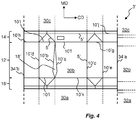
- a package similar to the package 1' shown in Fig. 2 is preferably produced from a web 30 of packaging material 3' shown in Fig. 4 .
- the web 30 is dimensioned so as to accommodate several consecutive segments 30a-c, 32a-c.
- Each segment 30a-c, 32a-c is designed to provide a single package 1'.
- Segments 30a-c are longitudinally aligned while the segments 32a-c are also longitudinally aligned in the machine direction MD. However the segments 30a-c are staggered relative segments 32a-c in the cross-direction CD. Before forming and filling segments 32a-c are cut from segments 30a-c such that the web 30 entering the filling machine has only one row of segments 30a-c.
- Each segment 30a-c, 32a-c is configured such that the dimensions of one segment 30a-c, 32a-c will result in a package 1' of desired size and shape.
- the lateral ends 34'a-b are sealed to each other so that a tube is formed.
- the tube is also folded along the crease lines 10'a-e for forming an open ended main body 12' of the package.
- the ends 14', 16' are formed and sealed, and the final package 1' is separated from the upstream tube.
- a rectangular body 12' When folding the crease lines 10'a-e a rectangular body 12' will be formed, however having one corner defined by the angled corner surface 18' arranged between the first crease line 10'a and the second crease line 10'b.
- the folding sequence is typically subject to the same concerns as described with reference to Fig. 3b , i.e. it is important to allow for initial folding of the first crease line 10'a before folding of the second crease line 10'b is initiated.
- first and second crease lines 10a-b, 10'a-b could be configured in a wide range of alternatives, e.g.as indicated by Figs. 1b-h .
- the first and second crease lines 10a-b, 10'a-b could be curved, or they may not extend along the entire length of the main body 12, 12'.
- the angled corned surfaces 18, 18' could be provided at any corner of the package 1, 1', e.g. they could replace one of the horizontal crease lines 10f, j, k, 10'e, f, j, k, I.
- Controlled folding is preferably effected for two adjacent crease lines 10a-b, 10'a-b.
- the first and second crease line 10a-b, 10'a-b may typically, but not necessarily, form a corner surface 18, 18' of the package 1, 1'.
- the distance between the first and second crease line 10a-b, 10'a-b may be in the range of 5-30 mm, even more preferably between 10-20 mm.
- FIG. 5a shows a first example of packaging material 3, 3' having a core layer 3a of a carton-based material.
- the inner side of the core layer 3a i.e. the side intended to face the product enclosed by the final package 1, 1', is covered with one or more layers 3b.
- the inside layers 3b may e.g. include an innermost layer, applied onto an aluminium foil.
- the innermost, inside layer may be composed of one or several part layers, comprising heat sealable thermoplastic polymers, such as adhesive polymers and/or polyolefins.
- a crease line 10 is formed in the packaging material 3, 3' by embossing from the outside. This means that the outside will be compressed inwards, leading to an embossed feature on the inside of the packaging material 3, 3'. The local compression of the packaging material 3, 3' will induce a weakness extending along the entire crease line 10 for facilitating folding of the packaging material 3, 3'.
- crease line 10 is compressed only, i.e. no embossed feature is present on the inside of the packaging material 3, 3'.
- This kind of crease line 10 may be realized by pressing the outside inwards while having a planar anvil on the inside of the packaging material 3, 3'.
- 3' all crease lines 10a-l, 10'a-l are not identically dimensioned. As can be seen in Fig. 6 a part of a packaging material 3, 3' is shown in which two adjacent crease lines 10a-b, 10'a-b are dimensioned differently such that the first crease line 10a, 10'a is configured to fold easier than the second crease line 10b, 10'b.
- the first crease line 10a, 10'a is in the shown example not only compressed to a greater extent, but its width is also greater than the width of the second crease line 10b, 10'b. It should be noted that it is not required to have both increased depth and increased width, but each one of these features by its own will reduce the robustness of the packaging material 3, 3' compared to the second crease line 10b, 10'b.
- the entire length of the first crease line 10a, 10'a may not be homogenously formed, but only parts of the first crease line 10a, 10'a may be dimensioned different from the second crease line 10b, 10'b still resulting in the first crease line 10a, 10'b being easier to fold than the second crease line 10b, 10'b.
- a method 100 for producing a packaging material 3, 3', as well as producing a package 1, 1' from such packaging material 1, 1' is shown.
- the method 100 comprises providing 102 a set of crease lines 10, 10' along which the packaging material is intended to be folded in order to form a package, by i) providing 104 at least one first crease line 10a, 10'a and ii) providing 106 an adjacent second crease line 10b, 10'b, wherein the first crease line 10a, 10'a is configured to fold easier than the adjacent second crease line 10b, 10'b.
- the first and second crease lines 10a-b, 10'a-b are provided simultaneously, for example by feeding the packaging material 3, 3' through a nip formed between a creasing roller and an anvil roller.
- the set of crease lines 10, 10' may be provided by compressing the packaging material 3, 3' locally.
- the method 100 may further comprise folding 108, filling 110, and sealing 112 the packaging material to form an individual package 1, 1'.
- the first and second crease lines 10a-b, 10'a-b of the packaging material 3, 3' are preferably folded in a single folding operation performed at the filling machine.
Landscapes
- Engineering & Computer Science (AREA)
- Mechanical Engineering (AREA)
- Cartons (AREA)
- Wrappers (AREA)
- Making Paper Articles (AREA)
- Buffer Packaging (AREA)
Abstract
Description
- The present solution relates to a packaging material, especially for packaging material intended to form individual packages for e.g. liquid food. It also relates to a method for providing such packaging material, as well as to a method for forming individual packages from such packaging material.
- Individual packages, e.g. packages used to enclose limited quantities of liquid food, are typically formed from a packaging material. The packaging material comprises a carton-based material layer, such as paper board or card board, having inner and outer layers of polymer which are laminated together in a lamination apparatus.
- For producing individual packages the packaging material is fed to a filling machine either on a roll of packaging material or as individual packaging material blanks. A filling machine which could be either roll-fed or blank-fed includes various stations for transforming the packaging material fed into it into filled and sealed three-dimensional packages.
- The forming process, i.e. the method of transforming the packaging material to a three-dimensional object, is facilitated by providing the packaging material with crease lines. As the packaging material will fold at the positions of the crease lines it is possible to configure the packaging material beforehand according to various different shapes. Such shapes include e.g. Tetra Rex®, Tetra Brik®, and Tetra Prisma®. If a packaging material is intended to be transformed into a Tetra Rex® package, a web of packaging material is cut into individual blanks and a specific crease line pattern, corresponding to the final shape, is provided onto the packaging material before the packaging material blanks enter the filling machine.
- As the desire for complex package forms is increasing more advanced crease line patterns are required. When the distance between two adjacent crease lines on the packaging material is decreased, e.g. in order to form an angled corner of a package, the forming process will be more difficult to control. There is particularly a risk that one fold is effected along one certain crease line, which fold prevents folding of the packaging material along an adjacent crease line. This is due to the fact that forming (i.e. folding of the packaging material along the crease line) is performed in a specific sequence defined by the forming tools of the filling machine. Should one fold occur along an unintended crease line the final package will have a shape not corresponding to the desired shape.
- In view of the above problem there is a need for an improved packaging material which reduces the risk for misforming of the package.
- It is an object of the present solution to at least partly overcome one or more of the above-identified limitations of the prior art. In particular, it is an object to provide a solution which allows the packaging material to fold correctly, even if the crease lines are arranged very close to each other. To solve these objects a packaging material is provided. The packaging material comprises a set of crease lines along which the packaging material is intended to be folded in order to form a package, wherein the set of crease lines comprises at least one first crease line being configured to fold easier than an adjacent second crease line.
- The set of crease lines may be formed by compressing the packaging material.
- The first crease line may be compressed to a greater extent than the adjacent second crease line, and/or the width of the first crease line may be greater than the width of the second crease line.
- The first and second crease lines may be intended to define a corner surface of the package.
- The corner surface may extend along the vertical direction of the package to be formed.
- The packaging material may be in the form of a blank intended to form an individual package, or in the form of a web intended to form a series of individual packages.
- The distance between the first and second crease lines may be 30 mm or less.
- According to a second aspect, a method for producing a packaging material is provided. The method comprises providing a set of crease lines along which the packaging material is intended to be folded in order to form a package, by providing at least one first crease line and providing an adjacent second crease line, wherein the first crease line is configured to fold easier than the adjacent second crease line. The first and second crease lines may be provided simultaneously.
The set of crease lines may be provided by compressing the packaging material. - The width and/or depth of the first crease line may be greater than the width and/or depth of the second crease line.
According to a third aspect, a method for producing a package is provided. The method comprises providing a packaging material by performing the method according to the second aspect, and folding, filling, and sealing the packaging material. The first and second crease lines of the packaging material may be folded in a single folding operation. - Still other objectives, features, aspects and advantages of the invention will appear from the following detailed description as well as from the drawings.
- Embodiments of the invention will now be described, by way of example, with reference to the accompanying schematic drawings, in which
-
Fig. 1 is an isometric view of a package produced by a packaging material according to an example; -
Fig. 2 is an isometric view of a package produced by a packaging material according to an example; -
Fig. 3a is a view of packaging material blank for producing a package similar to the package shown inFig. 1a ; -
Fig. 3b is an isometric view of the packaging material shown inFig. 3a during raising of the package; -
Fig. 4 is a view of a packaging material blank for producing a package similar to the package shown inFig. 2 ; -
Fig. 5a is a cross-sectional view of a packaging material according to an example; -
Fig. 5b is a cross-sectional view of a packaging material according to a second example; -
Fig. 6 is cross-sectional view of a packaging material according to an embodiment; and -
Fig. 7 is a schematic view of a method according to an embodiment. - With reference to
Fig. 1 anexample package 1 is illustrated. Thepackage 1 is formed into the three-dimensional shape from apackaging material 3. Shaping of thepackaging material 3 is performed by folding the packaging material along aset 10 ofpre-arranged crease lines 10a-l. It should be understood that not all crease lines are provided with reference numerals; additional crease lines (not shown) are provided on thepackage material 3 for complete folding and forming of thepackage 1. As indicated inFig. 1 thecrease lines 10a-d are provided in order to define alongitudinal body 12 of thepackage 1, thecrease lines 10f-j are provided in order to define the upper gable-top end 14 of thepackage 1, and thecrease lines 10k-l are provided in order to define thebottom end 16 of thepackage 1. - The
crease line 10a forms a first crease line being arranged adjacent to asecond crease line 10b. The first andsecond crease lines 10a-b together define ancorner surface 18 of thepackage 1, wherein thecorner surface 18 extends at an angle relative its adjacent panels (i.e. one panel extending betweencrease lines crease lines corner surface 18 is not only provided to improve the aesthetic appearance of thepackage 1, but also to improve gripping of thepackage 1. - With reference to
Fig. 2 another example of a package 1' is illustrated. As for thepackage 1 shown inFig. 1 the package 1' is formed into the three-dimensional shape from a planar packaging material 3' by folding the packaging material 3' along a set 10' of pre-arranged crease lines 10'a-l. As indicated inFig. 2 the crease lines 10'a-d are provided in order to define a longitudinal body 12' of the package 1', the crease lines 10'f-j are provided in order to define the upper end 14' of the package 1', and the crease lines 10'k-l are provided in order to define the bottom end 16' of the package 1'. It should be understood that additional crease lines (not shown) are provided on the package material for complete folding and forming of the package 1'. - The crease line 10'a forms a first crease line being arranged adjacent to a second crease line 10'b. The first and second crease lines 10'a-b together define a corner surface 18' of the package 1'.
- A package similar to the
package 1 shown inFig. 1 is preferably produced from a blank 20 ofpackaging material 3 shown inFig. 3a . The blank 20 is pre-cut so that the dimensions of the blank 20 will result in a package of desired size and shape. During forming the lateral ends 22a-b are sealed to each other in order to form a so-called half folded blank Such a half-folded blank is usually produced at a site different from the site of a filling machine where the final raising of the of the half-folded blank is effected. When being loaded into a filling machine the blank 20 is also folded along thecrease lines 10c-d for forming an open endedmain body 12 of the package. In a following step the corners of themain body 12 are formed by folding the main body alongcrease line 10e, as well as alongcrease lines 10a-b. Subsequently one of the upper or lower ends 14, 16 are formed and sealed whereafter filling and final sealing of the still open end is performed. - In another variant, a web of paperboard material comprising the blanks corresponding to the blank in
Fig. 3a is loaded into a filling machine where the blanks are cut intoindividual blanks 3a and where thepanels - When folding the
crease lines 10a-e arectangular body 12 will be formed, however having one corner defined by theangled corner surface 18 arranged between thefirst crease line 10a and thesecond crease line 10b. - When defining the corners of the rectangular main body, during folding of the
crease lines 10a-b, 10e thepackaging material 3 will be subject to a force requiring thepackaging material 3 to move in a desired direction. This means that for folding the main body 12 (and/or the upper orbottom end 14, 16) a single operation is performed whereby thecrease lines 10a-b, 10e will allow for simultaneous folding. This is shown inFig. 3b . Here the lateral ends 22a-b have been sealed to provide for a longitudinal sealing 24, and folding is performed along thecrease lines 10a-b, 10e to provide the rectangularmain body 12. Raising of thepackage 1 may e.g. be done by applying a folding force to at least one of the pre-folded edges, extending along thecrease lines 10c-d, as indicated by the block arrow. During this folding sequence it is important that thefirst crease line 10a will begin to fold before thesecond crease line 10b begins to fold. Should the opposite occur, i.e. that thesecond crease line 10b begins to fold prior to thefirst crease line 10a, there is a risk that thesemi-raised package 1 will be locked in position, preventing thefirst crease line 10a to fold. The resultingpackage 1 will thus not correspond to the desired shape. On the other hand, as the raising force comes from the left when thefirst crease line 10a begins folding thesecond crease line 10b will fold automatically. - Hence the
packaging material 3 is configured to allow for controlled folding as will be further described with reference toFigs. 5-6 . - A package similar to the package 1' shown in
Fig. 2 is preferably produced from a web 30 of packaging material 3' shown inFig. 4 . The web 30 is dimensioned so as to accommodate severalconsecutive segments 30a-c, 32a-c. Eachsegment 30a-c, 32a-c is designed to provide a single package 1'.Segments 30a-c are longitudinally aligned while thesegments 32a-c are also longitudinally aligned in the machine direction MD. However thesegments 30a-c are staggeredrelative segments 32a-c in the cross-direction CD. Before forming and fillingsegments 32a-c are cut fromsegments 30a-c such that the web 30 entering the filling machine has only one row ofsegments 30a-c. Eachsegment 30a-c, 32a-c is configured such that the dimensions of onesegment 30a-c, 32a-c will result in a package 1' of desired size and shape. During forming the lateral ends 34'a-b are sealed to each other so that a tube is formed. As the tube is filled with content the tube is also folded along the crease lines 10'a-e for forming an open ended main body 12' of the package. Simultaneously the ends 14', 16' are formed and sealed, and the final package 1' is separated from the upstream tube. - When folding the crease lines 10'a-e a rectangular body 12' will be formed, however having one corner defined by the angled corner surface 18' arranged between the first crease line 10'a and the second crease line 10'b. The folding sequence is typically subject to the same concerns as described with reference to
Fig. 3b , i.e. it is important to allow for initial folding of the first crease line 10'a before folding of the second crease line 10'b is initiated. - Although the corner surfaces 18, 18' are shown having a similar shape it should be noted that first and
second crease lines 10a-b, 10'a-b could be configured in a wide range of alternatives, e.g.as indicated byFigs. 1b-h . For example, the first andsecond crease lines 10a-b, 10'a-b could be curved, or they may not extend along the entire length of themain body 12, 12'. Even further the angledcorned surfaces 18, 18' could be provided at any corner of thepackage 1, 1', e.g. they could replace one of thehorizontal crease lines 10f, j, k, 10'e, f, j, k, I. - Controlled folding is preferably effected for two
adjacent crease lines 10a-b, 10'a-b. The first andsecond crease line 10a-b, 10'a-b may typically, but not necessarily, form acorner surface 18, 18' of thepackage 1, 1'. Hence the distance between the first andsecond crease line 10a-b, 10'a-b may be in the range of 5-30 mm, even more preferably between 10-20 mm. - Now turning to
Figs. 5a-b some structural details of thecrease lines 10a-d, 10'a-d will be discussed.Fig. 5a shows a first example ofpackaging material 3, 3' having acore layer 3a of a carton-based material. The inner side of thecore layer 3a, i.e. the side intended to face the product enclosed by thefinal package 1, 1', is covered with one ormore layers 3b. Theinside layers 3b may e.g. include an innermost layer, applied onto an aluminium foil. The innermost, inside layer may be composed of one or several part layers, comprising heat sealable thermoplastic polymers, such as adhesive polymers and/or polyolefins. - Also on the outside of the carton-based
material layer 3a there is an outermost heatsealable polymer layer 3c. - In
Fig. 5a acrease line 10 is formed in thepackaging material 3, 3' by embossing from the outside. This means that the outside will be compressed inwards, leading to an embossed feature on the inside of thepackaging material 3, 3'. The local compression of thepackaging material 3, 3' will induce a weakness extending along theentire crease line 10 for facilitating folding of thepackaging material 3, 3'. - In
Fig. 5b thecrease line 10 is compressed only, i.e. no embossed feature is present on the inside of thepackaging material 3, 3'. This kind ofcrease line 10 may be realized by pressing the outside inwards while having a planar anvil on the inside of thepackaging material 3, 3'. - For allowing folding control of the
packaging material 3, 3' allcrease lines 10a-l, 10'a-l are not identically dimensioned. As can be seen inFig. 6 a part of apackaging material 3, 3' is shown in which twoadjacent crease lines 10a-b, 10'a-b are dimensioned differently such that thefirst crease line 10a, 10'a is configured to fold easier than thesecond crease line 10b, 10'b. - The
first crease line 10a, 10'a is in the shown example not only compressed to a greater extent, but its width is also greater than the width of thesecond crease line 10b, 10'b. It should be noted that it is not required to have both increased depth and increased width, but each one of these features by its own will reduce the robustness of thepackaging material 3, 3' compared to thesecond crease line 10b, 10'b. Further to the shown example, the entire length of thefirst crease line 10a, 10'a may not be homogenously formed, but only parts of thefirst crease line 10a, 10'a may be dimensioned different from thesecond crease line 10b, 10'b still resulting in thefirst crease line 10a, 10'b being easier to fold than thesecond crease line 10b, 10'b. - In
Fig. 7 amethod 100 for producing apackaging material 3, 3', as well as producing apackage 1, 1' fromsuch packaging material 1, 1' is shown. Themethod 100 comprises providing 102 a set ofcrease lines 10, 10' along which the packaging material is intended to be folded in order to form a package, by i) providing 104 at least onefirst crease line 10a, 10'a and ii) providing 106 an adjacentsecond crease line 10b, 10'b, wherein thefirst crease line 10a, 10'a is configured to fold easier than the adjacentsecond crease line 10b, 10'b. - The first and
second crease lines 10a-b, 10'a-b are provided simultaneously, for example by feeding thepackaging material 3, 3' through a nip formed between a creasing roller and an anvil roller. The set ofcrease lines 10, 10' may be provided by compressing thepackaging material 3, 3' locally. - The
method 100 may further comprise folding 108, filling 110, and sealing 112 the packaging material to form anindividual package 1, 1'. - The first and
second crease lines 10a-b, 10'a-b of thepackaging material 3, 3' are preferably folded in a single folding operation performed at the filling machine. - From the description above follows that, although various embodiments of the invention have been described and shown, the invention is not restricted thereto, but may also be embodied in other ways within the scope of the subject-matter defined in the following claims.
Claims (13)
- A packaging material comprising a set of crease lines (10, 10') along which the packaging material (3, 3') is intended to be folded in order to form a package, wherein the set of crease lines (10) comprises at least one first crease line (10a, 10'a) being configured to fold easier than an adjacent second crease line (10b, 10'), wherein the first and second crease lines (10a-b, 10'a-b) are intended to define a corner surface (18, 18') of the package (3, 3') and wherein the corner surface (18, 18') extends along the vertical direction of the package (1, 1') to be formed.
- The packaging material according to claim 1, wherein the set of crease lines (10, 10') is formed by compressing the packaging material (3, 3').
- The packaging material according to claim 2, wherein the first crease line (10a, 10'a) is compressed to a greater extent than the adjacent second crease line (10b, 10'b).
- The packaging material according to claim 2 or 3, wherein the width of the first crease line (10a, 10'a) is greater than the width of the second crease line (10b, 10'b).
- The packaging material according to any one of the preceding claims, wherein the packaging material (3, 3') is in the form of a blank (20) intended to form an individual package (1).
- The packaging material according to any one of the preceding claims 1-5, wherein the packaging material (3, 3') is in the form of a web (30) intended to form a series of individual packages (1').
- The packaging material according to any one of the preceding claims, wherein the distance between the first and second crease lines (10a-b, 10'a-b) is 30 mm or less.
- A method for producing a packaging material, comprising providing a set of crease lines (10, 10') along which the packaging material is intended to be folded in order to form a package, by
providing at least one first crease line (10a ,10'a), and
providing an adjacent second crease line (10b, 10'b), wherein the first crease line (10a, 10'a) is configured to fold easier than the adjacent second crease line (10b, 10'b), wherein the first and second crease lines (10a-b, 10'a-b) are intended to define a corner surface (18, 18') of the package (3, 3') and wherein the corner surface (18, 18') extends along the vertical direction of the package (1, 1') to be formed. - The method according to claim 10, wherein the first and second crease lines (10a-b, 10'a-b) are provided simultaneously.
- The method according to claim 10 or 11, wherein the set of crease lines (10, 10') is provided by compressing the packaging material.
- The method according to claim 12, wherein the width and/or depth of the first crease line (10a, 10'a) is greater than the width and/or depth of the second crease line (10b, 10'b).
- A method for producing a package (1, 1'), comprising providing a packaging material (3, 3') by performing the method according to any one of claims 10-13, and folding, filling, and sealing the packaging material (3, 3').
- The method according to claim 14, wherein the first and second crease lines (10a-b, 10'a-b) of the packaging material (3, 3') are folded in a single folding operation.
Applications Claiming Priority (1)
| Application Number | Priority Date | Filing Date | Title |
|---|---|---|---|
| EP17166280 | 2017-04-12 |
Publications (2)
| Publication Number | Publication Date |
|---|---|
| EP3388352A1 true EP3388352A1 (en) | 2018-10-17 |
| EP3388352B1 EP3388352B1 (en) | 2019-11-20 |
Family
ID=58544856
Family Applications (1)
| Application Number | Title | Priority Date | Filing Date |
|---|---|---|---|
| EP18166350.1A Active EP3388352B1 (en) | 2017-04-12 | 2018-04-09 | A packaging material, and a method for providing such packaging material |
Country Status (7)
| Country | Link |
|---|---|
| US (1) | US20200377255A1 (en) |
| EP (1) | EP3388352B1 (en) |
| JP (1) | JP7084941B2 (en) |
| CN (2) | CN208761092U (en) |
| BR (1) | BR112019021273B1 (en) |
| ES (1) | ES2763173T3 (en) |
| WO (1) | WO2018189109A1 (en) |
Families Citing this family (3)
| Publication number | Priority date | Publication date | Assignee | Title |
|---|---|---|---|---|
| US20200377255A1 (en) * | 2017-04-12 | 2020-12-03 | Tetra Laval Holdings & Finance S.A. | A packaging material, and a method for providing such packaging material |
| USD1069578S1 (en) * | 2022-08-08 | 2025-04-08 | Tetra Laval Holdings & Finance S.A. | Lid for containers |
| CN121268314A (en) * | 2024-07-05 | 2026-01-06 | 康美包(苏州)有限公司 | Method and device for manufacturing packaging sleeve, method and system for manufacturing packaging |
Citations (4)
| Publication number | Priority date | Publication date | Assignee | Title |
|---|---|---|---|---|
| US4248351A (en) * | 1977-06-20 | 1981-02-03 | Tetra Pak International Ab | Packaging container with a pouring spout |
| US5938107A (en) * | 1996-03-21 | 1999-08-17 | Tetra Laval Holdings & Finance S.A. | Packaging container and a blank for producing the same |
| WO2003037730A1 (en) * | 2001-11-02 | 2003-05-08 | Tetra Laval Holdings & Finance Sa | Web packaging material for packaging food products |
| WO2012070018A1 (en) * | 2010-11-24 | 2012-05-31 | G.D Societa' Per Azioni | Feed method and unit for fitting a coupon to a collar, and hinged-lid package with a collar and coupon |
Family Cites Families (2)
| Publication number | Priority date | Publication date | Assignee | Title |
|---|---|---|---|---|
| CN201800267U (en) * | 2010-07-19 | 2011-04-20 | 深圳九星印刷包装集团有限公司 | Combined pressure mark structure, combined pressure mark die and straight grain corrugated paper box |
| US20200377255A1 (en) * | 2017-04-12 | 2020-12-03 | Tetra Laval Holdings & Finance S.A. | A packaging material, and a method for providing such packaging material |
-
2018
- 2018-04-09 US US16/604,765 patent/US20200377255A1/en not_active Abandoned
- 2018-04-09 ES ES18166350T patent/ES2763173T3/en active Active
- 2018-04-09 BR BR112019021273-6A patent/BR112019021273B1/en active IP Right Grant
- 2018-04-09 EP EP18166350.1A patent/EP3388352B1/en active Active
- 2018-04-09 WO PCT/EP2018/059023 patent/WO2018189109A1/en not_active Ceased
- 2018-04-09 JP JP2019555965A patent/JP7084941B2/en active Active
- 2018-04-11 CN CN201820507155.8U patent/CN208761092U/en not_active Withdrawn - After Issue
- 2018-04-11 CN CN201810319749.0A patent/CN108688924B/en active Active
Patent Citations (4)
| Publication number | Priority date | Publication date | Assignee | Title |
|---|---|---|---|---|
| US4248351A (en) * | 1977-06-20 | 1981-02-03 | Tetra Pak International Ab | Packaging container with a pouring spout |
| US5938107A (en) * | 1996-03-21 | 1999-08-17 | Tetra Laval Holdings & Finance S.A. | Packaging container and a blank for producing the same |
| WO2003037730A1 (en) * | 2001-11-02 | 2003-05-08 | Tetra Laval Holdings & Finance Sa | Web packaging material for packaging food products |
| WO2012070018A1 (en) * | 2010-11-24 | 2012-05-31 | G.D Societa' Per Azioni | Feed method and unit for fitting a coupon to a collar, and hinged-lid package with a collar and coupon |
Also Published As
| Publication number | Publication date |
|---|---|
| EP3388352B1 (en) | 2019-11-20 |
| WO2018189109A1 (en) | 2018-10-18 |
| JP2020516502A (en) | 2020-06-11 |
| CN108688924B (en) | 2021-06-25 |
| BR112019021273B1 (en) | 2023-02-14 |
| JP7084941B2 (en) | 2022-06-15 |
| CN208761092U (en) | 2019-04-19 |
| US20200377255A1 (en) | 2020-12-03 |
| BR112019021273A2 (en) | 2020-05-19 |
| ES2763173T3 (en) | 2020-05-27 |
| CN108688924A (en) | 2018-10-23 |
Similar Documents
| Publication | Publication Date | Title |
|---|---|---|
| US11643241B2 (en) | Process for forming plastic corrugated container and intermediary blank | |
| EP0185897B1 (en) | Method for the treatment of packing material and the material treated accordingly | |
| US11325740B2 (en) | Straight consistent body scores on plastic corrugated boxes and a process for making same | |
| US11643242B2 (en) | Air vent for welded portion in plastic corrugated material, and process for forming welded portion | |
| EP3388352B1 (en) | A packaging material, and a method for providing such packaging material | |
| EP3157822B1 (en) | A packaging material | |
| EP3166854B1 (en) | A package | |
| DE19711799A1 (en) | Method and device for producing tubular hollow bodies | |
| EP3950523A1 (en) | A packaging material and a method for providing a packaging material | |
| WO2003037730A1 (en) | Web packaging material for packaging food products | |
| EP3157823B1 (en) | A package | |
| EP3718915A1 (en) | A crease tool and a system and method for creasing a packaging material | |
| HK1232849B (en) | Plastic corrugated container | |
| HK1232849A1 (en) | Plastic corrugated container |
Legal Events
| Date | Code | Title | Description |
|---|---|---|---|
| PUAI | Public reference made under article 153(3) epc to a published international application that has entered the european phase |
Free format text: ORIGINAL CODE: 0009012 |
|
| STAA | Information on the status of an ep patent application or granted ep patent |
Free format text: STATUS: THE APPLICATION HAS BEEN PUBLISHED |
|
| AK | Designated contracting states |
Kind code of ref document: A1 Designated state(s): AL AT BE BG CH CY CZ DE DK EE ES FI FR GB GR HR HU IE IS IT LI LT LU LV MC MK MT NL NO PL PT RO RS SE SI SK SM TR |
|
| AX | Request for extension of the european patent |
Extension state: BA ME |
|
| STAA | Information on the status of an ep patent application or granted ep patent |
Free format text: STATUS: REQUEST FOR EXAMINATION WAS MADE |
|
| 17P | Request for examination filed |
Effective date: 20190417 |
|
| RBV | Designated contracting states (corrected) |
Designated state(s): AL AT BE BG CH CY CZ DE DK EE ES FI FR GB GR HR HU IE IS IT LI LT LU LV MC MK MT NL NO PL PT RO RS SE SI SK SM TR |
|
| RIC1 | Information provided on ipc code assigned before grant |
Ipc: B65D 5/42 20060101ALI20190513BHEP Ipc: B65D 5/06 20060101AFI20190513BHEP Ipc: B31B 50/25 20170101ALI20190513BHEP |
|
| GRAP | Despatch of communication of intention to grant a patent |
Free format text: ORIGINAL CODE: EPIDOSNIGR1 |
|
| STAA | Information on the status of an ep patent application or granted ep patent |
Free format text: STATUS: GRANT OF PATENT IS INTENDED |
|
| INTG | Intention to grant announced |
Effective date: 20190705 |
|
| GRAA | (expected) grant |
Free format text: ORIGINAL CODE: 0009210 |
|
| STAA | Information on the status of an ep patent application or granted ep patent |
Free format text: STATUS: THE PATENT HAS BEEN GRANTED |
|
| GRAS | Grant fee paid |
Free format text: ORIGINAL CODE: EPIDOSNIGR3 |
|
| AK | Designated contracting states |
Kind code of ref document: B1 Designated state(s): AL AT BE BG CH CY CZ DE DK EE ES FI FR GB GR HR HU IE IS IT LI LT LU LV MC MK MT NL NO PL PT RO RS SE SI SK SM TR |
|
| REG | Reference to a national code |
Ref country code: GB Ref legal event code: FG4D |
|
| REG | Reference to a national code |
Ref country code: CH Ref legal event code: EP |
|
| REG | Reference to a national code |
Ref country code: IE Ref legal event code: FG4D |
|
| REG | Reference to a national code |
Ref country code: DE Ref legal event code: R096 Ref document number: 602018001233 Country of ref document: DE |
|
| REG | Reference to a national code |
Ref country code: AT Ref legal event code: REF Ref document number: 1203939 Country of ref document: AT Kind code of ref document: T Effective date: 20191215 |
|
| REG | Reference to a national code |
Ref country code: NL Ref legal event code: MP Effective date: 20191120 |
|
| REG | Reference to a national code |
Ref country code: LT Ref legal event code: MG4D |
|
| PG25 | Lapsed in a contracting state [announced via postgrant information from national office to epo] |
Ref country code: LV Free format text: LAPSE BECAUSE OF FAILURE TO SUBMIT A TRANSLATION OF THE DESCRIPTION OR TO PAY THE FEE WITHIN THE PRESCRIBED TIME-LIMIT Effective date: 20191120 Ref country code: SE Free format text: LAPSE BECAUSE OF FAILURE TO SUBMIT A TRANSLATION OF THE DESCRIPTION OR TO PAY THE FEE WITHIN THE PRESCRIBED TIME-LIMIT Effective date: 20191120 Ref country code: NL Free format text: LAPSE BECAUSE OF FAILURE TO SUBMIT A TRANSLATION OF THE DESCRIPTION OR TO PAY THE FEE WITHIN THE PRESCRIBED TIME-LIMIT Effective date: 20191120 Ref country code: LT Free format text: LAPSE BECAUSE OF FAILURE TO SUBMIT A TRANSLATION OF THE DESCRIPTION OR TO PAY THE FEE WITHIN THE PRESCRIBED TIME-LIMIT Effective date: 20191120 Ref country code: BG Free format text: LAPSE BECAUSE OF FAILURE TO SUBMIT A TRANSLATION OF THE DESCRIPTION OR TO PAY THE FEE WITHIN THE PRESCRIBED TIME-LIMIT Effective date: 20200220 Ref country code: FI Free format text: LAPSE BECAUSE OF FAILURE TO SUBMIT A TRANSLATION OF THE DESCRIPTION OR TO PAY THE FEE WITHIN THE PRESCRIBED TIME-LIMIT Effective date: 20191120 Ref country code: GR Free format text: LAPSE BECAUSE OF FAILURE TO SUBMIT A TRANSLATION OF THE DESCRIPTION OR TO PAY THE FEE WITHIN THE PRESCRIBED TIME-LIMIT Effective date: 20200221 Ref country code: NO Free format text: LAPSE BECAUSE OF FAILURE TO SUBMIT A TRANSLATION OF THE DESCRIPTION OR TO PAY THE FEE WITHIN THE PRESCRIBED TIME-LIMIT Effective date: 20200220 |
|
| REG | Reference to a national code |
Ref country code: ES Ref legal event code: FG2A Ref document number: 2763173 Country of ref document: ES Kind code of ref document: T3 Effective date: 20200527 |
|
| PG25 | Lapsed in a contracting state [announced via postgrant information from national office to epo] |
Ref country code: RS Free format text: LAPSE BECAUSE OF FAILURE TO SUBMIT A TRANSLATION OF THE DESCRIPTION OR TO PAY THE FEE WITHIN THE PRESCRIBED TIME-LIMIT Effective date: 20191120 Ref country code: HR Free format text: LAPSE BECAUSE OF FAILURE TO SUBMIT A TRANSLATION OF THE DESCRIPTION OR TO PAY THE FEE WITHIN THE PRESCRIBED TIME-LIMIT Effective date: 20191120 Ref country code: IS Free format text: LAPSE BECAUSE OF FAILURE TO SUBMIT A TRANSLATION OF THE DESCRIPTION OR TO PAY THE FEE WITHIN THE PRESCRIBED TIME-LIMIT Effective date: 20200320 |
|
| PG25 | Lapsed in a contracting state [announced via postgrant information from national office to epo] |
Ref country code: AL Free format text: LAPSE BECAUSE OF FAILURE TO SUBMIT A TRANSLATION OF THE DESCRIPTION OR TO PAY THE FEE WITHIN THE PRESCRIBED TIME-LIMIT Effective date: 20191120 |
|
| PG25 | Lapsed in a contracting state [announced via postgrant information from national office to epo] |
Ref country code: CZ Free format text: LAPSE BECAUSE OF FAILURE TO SUBMIT A TRANSLATION OF THE DESCRIPTION OR TO PAY THE FEE WITHIN THE PRESCRIBED TIME-LIMIT Effective date: 20191120 Ref country code: RO Free format text: LAPSE BECAUSE OF FAILURE TO SUBMIT A TRANSLATION OF THE DESCRIPTION OR TO PAY THE FEE WITHIN THE PRESCRIBED TIME-LIMIT Effective date: 20191120 Ref country code: DK Free format text: LAPSE BECAUSE OF FAILURE TO SUBMIT A TRANSLATION OF THE DESCRIPTION OR TO PAY THE FEE WITHIN THE PRESCRIBED TIME-LIMIT Effective date: 20191120 Ref country code: PT Free format text: LAPSE BECAUSE OF FAILURE TO SUBMIT A TRANSLATION OF THE DESCRIPTION OR TO PAY THE FEE WITHIN THE PRESCRIBED TIME-LIMIT Effective date: 20200412 Ref country code: EE Free format text: LAPSE BECAUSE OF FAILURE TO SUBMIT A TRANSLATION OF THE DESCRIPTION OR TO PAY THE FEE WITHIN THE PRESCRIBED TIME-LIMIT Effective date: 20191120 |
|
| REG | Reference to a national code |
Ref country code: AT Ref legal event code: MK05 Ref document number: 1203939 Country of ref document: AT Kind code of ref document: T Effective date: 20191120 |
|
| REG | Reference to a national code |
Ref country code: DE Ref legal event code: R097 Ref document number: 602018001233 Country of ref document: DE |
|
| PG25 | Lapsed in a contracting state [announced via postgrant information from national office to epo] |
Ref country code: SK Free format text: LAPSE BECAUSE OF FAILURE TO SUBMIT A TRANSLATION OF THE DESCRIPTION OR TO PAY THE FEE WITHIN THE PRESCRIBED TIME-LIMIT Effective date: 20191120 Ref country code: SM Free format text: LAPSE BECAUSE OF FAILURE TO SUBMIT A TRANSLATION OF THE DESCRIPTION OR TO PAY THE FEE WITHIN THE PRESCRIBED TIME-LIMIT Effective date: 20191120 |
|
| PLBE | No opposition filed within time limit |
Free format text: ORIGINAL CODE: 0009261 |
|
| STAA | Information on the status of an ep patent application or granted ep patent |
Free format text: STATUS: NO OPPOSITION FILED WITHIN TIME LIMIT |
|
| 26N | No opposition filed |
Effective date: 20200821 |
|
| PG25 | Lapsed in a contracting state [announced via postgrant information from national office to epo] |
Ref country code: MC Free format text: LAPSE BECAUSE OF FAILURE TO SUBMIT A TRANSLATION OF THE DESCRIPTION OR TO PAY THE FEE WITHIN THE PRESCRIBED TIME-LIMIT Effective date: 20191120 Ref country code: AT Free format text: LAPSE BECAUSE OF FAILURE TO SUBMIT A TRANSLATION OF THE DESCRIPTION OR TO PAY THE FEE WITHIN THE PRESCRIBED TIME-LIMIT Effective date: 20191120 Ref country code: SI Free format text: LAPSE BECAUSE OF FAILURE TO SUBMIT A TRANSLATION OF THE DESCRIPTION OR TO PAY THE FEE WITHIN THE PRESCRIBED TIME-LIMIT Effective date: 20191120 Ref country code: PL Free format text: LAPSE BECAUSE OF FAILURE TO SUBMIT A TRANSLATION OF THE DESCRIPTION OR TO PAY THE FEE WITHIN THE PRESCRIBED TIME-LIMIT Effective date: 20191120 |
|
| PG25 | Lapsed in a contracting state [announced via postgrant information from national office to epo] |
Ref country code: LU Free format text: LAPSE BECAUSE OF NON-PAYMENT OF DUE FEES Effective date: 20200409 Ref country code: FR Free format text: LAPSE BECAUSE OF NON-PAYMENT OF DUE FEES Effective date: 20200430 |
|
| REG | Reference to a national code |
Ref country code: BE Ref legal event code: MM Effective date: 20200430 |
|
| PG25 | Lapsed in a contracting state [announced via postgrant information from national office to epo] |
Ref country code: BE Free format text: LAPSE BECAUSE OF NON-PAYMENT OF DUE FEES Effective date: 20200430 |
|
| PG25 | Lapsed in a contracting state [announced via postgrant information from national office to epo] |
Ref country code: IE Free format text: LAPSE BECAUSE OF NON-PAYMENT OF DUE FEES Effective date: 20200409 |
|
| PG25 | Lapsed in a contracting state [announced via postgrant information from national office to epo] |
Ref country code: LI Free format text: LAPSE BECAUSE OF NON-PAYMENT OF DUE FEES Effective date: 20210430 Ref country code: CH Free format text: LAPSE BECAUSE OF NON-PAYMENT OF DUE FEES Effective date: 20210430 |
|
| PG25 | Lapsed in a contracting state [announced via postgrant information from national office to epo] |
Ref country code: MT Free format text: LAPSE BECAUSE OF FAILURE TO SUBMIT A TRANSLATION OF THE DESCRIPTION OR TO PAY THE FEE WITHIN THE PRESCRIBED TIME-LIMIT Effective date: 20191120 Ref country code: CY Free format text: LAPSE BECAUSE OF FAILURE TO SUBMIT A TRANSLATION OF THE DESCRIPTION OR TO PAY THE FEE WITHIN THE PRESCRIBED TIME-LIMIT Effective date: 20191120 |
|
| PG25 | Lapsed in a contracting state [announced via postgrant information from national office to epo] |
Ref country code: MK Free format text: LAPSE BECAUSE OF FAILURE TO SUBMIT A TRANSLATION OF THE DESCRIPTION OR TO PAY THE FEE WITHIN THE PRESCRIBED TIME-LIMIT Effective date: 20191120 |
|
| GBPC | Gb: european patent ceased through non-payment of renewal fee |
Effective date: 20220409 |
|
| PG25 | Lapsed in a contracting state [announced via postgrant information from national office to epo] |
Ref country code: GB Free format text: LAPSE BECAUSE OF NON-PAYMENT OF DUE FEES Effective date: 20220409 |
|
| P01 | Opt-out of the competence of the unified patent court (upc) registered |
Effective date: 20230426 |
|
| PGFP | Annual fee paid to national office [announced via postgrant information from national office to epo] |
Ref country code: DE Payment date: 20250428 Year of fee payment: 8 |
|
| PGFP | Annual fee paid to national office [announced via postgrant information from national office to epo] |
Ref country code: ES Payment date: 20250513 Year of fee payment: 8 |
|
| PGFP | Annual fee paid to national office [announced via postgrant information from national office to epo] |
Ref country code: IT Payment date: 20250422 Year of fee payment: 8 |
|
| PGFP | Annual fee paid to national office [announced via postgrant information from national office to epo] |
Ref country code: TR Payment date: 20260330 Year of fee payment: 9 |