EP3385876A1 - System and method for providing simulated environment - Google Patents
System and method for providing simulated environment Download PDFInfo
- Publication number
- EP3385876A1 EP3385876A1 EP18151337.5A EP18151337A EP3385876A1 EP 3385876 A1 EP3385876 A1 EP 3385876A1 EP 18151337 A EP18151337 A EP 18151337A EP 3385876 A1 EP3385876 A1 EP 3385876A1
- Authority
- EP
- European Patent Office
- Prior art keywords
- computing unit
- user
- virtual object
- wearable device
- virtual
- Prior art date
- Legal status (The legal status is an assumption and is not a legal conclusion. Google has not performed a legal analysis and makes no representation as to the accuracy of the status listed.)
- Ceased
Links
Images



Classifications
-
- G—PHYSICS
- G06—COMPUTING OR CALCULATING; COUNTING
- G06F—ELECTRIC DIGITAL DATA PROCESSING
- G06F3/00—Input arrangements for transferring data to be processed into a form capable of being handled by the computer; Output arrangements for transferring data from processing unit to output unit, e.g. interface arrangements
- G06F3/01—Input arrangements or combined input and output arrangements for interaction between user and computer
- G06F3/011—Arrangements for interaction with the human body, e.g. for user immersion in virtual reality
-
- H—ELECTRICITY
- H04—ELECTRIC COMMUNICATION TECHNIQUE
- H04L—TRANSMISSION OF DIGITAL INFORMATION, e.g. TELEGRAPHIC COMMUNICATION
- H04L63/00—Network architectures or network communication protocols for network security
- H04L63/08—Network architectures or network communication protocols for network security for authentication of entities
- H04L63/0861—Network architectures or network communication protocols for network security for authentication of entities using biometrical features, e.g. fingerprint, retina-scan
-
- G—PHYSICS
- G06—COMPUTING OR CALCULATING; COUNTING
- G06F—ELECTRIC DIGITAL DATA PROCESSING
- G06F16/00—Information retrieval; Database structures therefor; File system structures therefor
- G06F16/40—Information retrieval; Database structures therefor; File system structures therefor of multimedia data, e.g. slideshows comprising image and additional audio data
- G06F16/43—Querying
- G06F16/435—Filtering based on additional data, e.g. user or group profiles
- G06F16/436—Filtering based on additional data, e.g. user or group profiles using biological or physiological data of a human being, e.g. blood pressure, facial expression, gestures
-
- G—PHYSICS
- G06—COMPUTING OR CALCULATING; COUNTING
- G06F—ELECTRIC DIGITAL DATA PROCESSING
- G06F21/00—Security arrangements for protecting computers, components thereof, programs or data against unauthorised activity
- G06F21/30—Authentication, i.e. establishing the identity or authorisation of security principals
- G06F21/31—User authentication
- G06F21/32—User authentication using biometric data, e.g. fingerprints, iris scans or voiceprints
-
- G—PHYSICS
- G06—COMPUTING OR CALCULATING; COUNTING
- G06F—ELECTRIC DIGITAL DATA PROCESSING
- G06F21/00—Security arrangements for protecting computers, components thereof, programs or data against unauthorised activity
- G06F21/60—Protecting data
- G06F21/62—Protecting access to data via a platform, e.g. using keys or access control rules
- G06F21/6218—Protecting access to data via a platform, e.g. using keys or access control rules to a system of files or objects, e.g. local or distributed file system or database
-
- G—PHYSICS
- G06—COMPUTING OR CALCULATING; COUNTING
- G06F—ELECTRIC DIGITAL DATA PROCESSING
- G06F21/00—Security arrangements for protecting computers, components thereof, programs or data against unauthorised activity
- G06F21/60—Protecting data
- G06F21/62—Protecting access to data via a platform, e.g. using keys or access control rules
- G06F21/629—Protecting access to data via a platform, e.g. using keys or access control rules to features or functions of an application
-
- G—PHYSICS
- G06—COMPUTING OR CALCULATING; COUNTING
- G06F—ELECTRIC DIGITAL DATA PROCESSING
- G06F3/00—Input arrangements for transferring data to be processed into a form capable of being handled by the computer; Output arrangements for transferring data from processing unit to output unit, e.g. interface arrangements
- G06F3/01—Input arrangements or combined input and output arrangements for interaction between user and computer
- G06F3/011—Arrangements for interaction with the human body, e.g. for user immersion in virtual reality
- G06F3/013—Eye tracking input arrangements
-
- G—PHYSICS
- G06—COMPUTING OR CALCULATING; COUNTING
- G06F—ELECTRIC DIGITAL DATA PROCESSING
- G06F3/00—Input arrangements for transferring data to be processed into a form capable of being handled by the computer; Output arrangements for transferring data from processing unit to output unit, e.g. interface arrangements
- G06F3/14—Digital output to display device ; Cooperation and interconnection of the display device with other functional units
-
- G—PHYSICS
- G06—COMPUTING OR CALCULATING; COUNTING
- G06Q—INFORMATION AND COMMUNICATION TECHNOLOGY [ICT] SPECIALLY ADAPTED FOR ADMINISTRATIVE, COMMERCIAL, FINANCIAL, MANAGERIAL OR SUPERVISORY PURPOSES; SYSTEMS OR METHODS SPECIALLY ADAPTED FOR ADMINISTRATIVE, COMMERCIAL, FINANCIAL, MANAGERIAL OR SUPERVISORY PURPOSES, NOT OTHERWISE PROVIDED FOR
- G06Q10/00—Administration; Management
- G06Q10/10—Office automation; Time management
- G06Q10/103—Workflow collaboration or project management
-
- G—PHYSICS
- G06—COMPUTING OR CALCULATING; COUNTING
- G06T—IMAGE DATA PROCESSING OR GENERATION, IN GENERAL
- G06T19/00—Manipulating three-dimensional [3D] models or images for computer graphics
- G06T19/003—Navigation within 3D models or images
-
- G—PHYSICS
- G06—COMPUTING OR CALCULATING; COUNTING
- G06T—IMAGE DATA PROCESSING OR GENERATION, IN GENERAL
- G06T19/00—Manipulating three-dimensional [3D] models or images for computer graphics
- G06T19/20—Editing of three-dimensional [3D] images, e.g. changing shapes or colours, aligning objects or positioning parts
-
- G—PHYSICS
- G06—COMPUTING OR CALCULATING; COUNTING
- G06T—IMAGE DATA PROCESSING OR GENERATION, IN GENERAL
- G06T2219/00—Indexing scheme for manipulating 3D models or images for computer graphics
- G06T2219/20—Indexing scheme for editing of 3D models
- G06T2219/2021—Shape modification
Definitions
- Present disclosure relates to a computing system and a method thereof, especially a system and a method for providing a simulated environment to multiple users.
- Virtual reality technology is very powerful when being applied to a group of people, especially when being applied for holding a conference or a workshop. It is much intuitive for having a prototype or a blueprint being presented in a visible three dimensional space rather than only on a two dimensional picture. However, there are still some unsolved problems for providing a virtual reality environment to multiple users located in different places.
- the disclosure relates to a system for providing a simulated environment.
- the system comprises a wearable device and a computing unit.
- the wearable device is configured to output a scenario of the simulated environment and to obtain a biometric characteristic.
- the computing unit is configured to determine a permission level according to the biometric characteristic, and to determine whether to conceal at least one portion of a virtual object which is being displayed in the scenario according to the permission level.
- Another aspect of present disclosure is to provide a method for providing a simulated environment.
- the method comprises following steps: outputting, by a wearable device, a scenario of the simulated environment; obtaining, by the wearable device, a biometric characteristic; determining, by a computing unit, a permission level according to the biometric characteristic; and determining, by the computing unit, whether to conceal at least one portion of a virtual object which is being displayed in the scenario according to the permission level.
- Coupled and “connected”, along with their derivatives, may be used.
- “connected” and “coupled” may be used to indicate that two or more elements are in direct physical or electrical contact with each other, or may also mean that two or more elements may be in indirect contact with each other.
- “Coupled” and “connected” may still be used to indicate that two or more elements cooperate or interact with each other.
- Fig. 1 is a schematic diagram of a system for providing a simulated environment according to some embodiments of present disclosure.
- Said simulated environment is an environment built with virtual objects illustrated by computing devices, for example, may be a virtual reality environment, an augmented reality environment or a mixed reality environment.
- a first wearable device 100 and a second wearable device 200 are in communication with a computing unit 300.
- the first wearable device 100 is carried by a first user and the second wearable device 200 is carried by a second user.
- the first wearable device 100 is configured to output a first scenario of a virtual reality environment to the first user, wherein the first scenario being displayed shows a partial view of the virtual reality environment corresponding to the viewpoint of the first wearable device 100.
- the first scenario may be updated according to the viewing that changed in response to the movement of the first user.
- the second wearable device 200 is configured to output a second scenario of the virtual reality environment to the second user, wherein the second scenario being displayed shows a partial view of the virtual reality environment corresponding to the viewpoint of the second wearable device 200.
- the second scenario may be updated according to the viewing that changed in response to the movement of the second user.
- the first wearable device 100 and the second wearable device 200 may receive signals from the computing unit 300 in order to display or update virtual objects or backgrounds in the first scenario and the second scenario.
- the first user may observe the virtual object from a first viewpoint corresponding to the first scenario
- the second user may observe the virtual object from a second viewpoint, which may be different from the first viewpoint, corresponding to the second scenario.
- the first wearable device 100 is also configured to obtain a first biometric characteristic from the first user.
- the first biometric may be an iris characteristic, obtained by an optical sensor being configured in the first wearable device 100 for detecting at least an eye of the first user.
- the first biometric characteristic may be sent to the computing unit 300, and the computing unit 300 may determine a first permission level of the first user according to the first biometric characteristic.
- the second wearable device 200 is also configured to obtain a second biometric characteristic from the second user.
- the second biometric characteristic being retrieved from the second user such as an iris characteristic may be sent to the computing unit 300 as well.
- the computing unit 300 may determine a second permission level of the second user according to the second biometric characteristic being retrieved.
- a database 400 is electrically coupled to the computing unit 300.
- the database 400 is configured to store a permission list, which is a record of relationships between permission levels and biometric characteristics.
- the permission list records the genders, tasks, titles or identities of users, which may be determined by the biometric characteristics, and the permission levels that they are granted to.
- the computing unit 300 may retrieve the permission list from the database 400, and the computing unit 300 may determine the first permission level to the first user according to the information in the permission list.
- the computing unit 300 may retrieve the permission list and determine the second permission level to the second user according to the information in the permission list.
- the permission levels regulate which portion of the virtual object a specific user may or may not observe.
- the first user and the second user are both participants of a project.
- the first user is a project manager so the first permission level granted to the first user is a supreme permission level.
- User being determined as an owner of the supreme permission level may observe the entire virtual object.
- the first biometric characteristic of the first user may be sent to the computing unit 300.
- the computing unit 300 may retrieve the permission list from the database 400 and determine the first user as the first permission level, and the computing unit 300 may determine not to conceal any portion of the virtual object. As such, the first user may observe the entire virtual object in the first scenario as it should be presented.
- the second user is a contract engineer participates in partial design of the virtual object.
- the other parts of the virtual object are forbidden to be disclosed to the second user.
- the second user is granted with the second permission level that only the parts he participates in may be presented.
- User being determined as an owner of the second permission level may observe the virtual object with some portions being concealed.
- the second biometric characteristic of the second user may be sent to the computing unit 300.
- the computing unit 300 may retrieve the permission list from the database 400 and determine the second user as the second permission level, and the computing unit 300 may determine to conceal some portions of the virtual object. As such, the second user may not observe the entire virtual object in the second scenario as it should be presented.
- the biometric characteristics include fingerprints of the users or habitual actions of the users.
- the first wearable device 100 and the second wearable device 200 may be configured with some fingerprint detectors. Before the first scenario and the second scenario being provided to the first wearable device 100 and the second wearable device 200, the first user and the second user have to put their fingers on the fingerprint detectors. The fingerprints of the first user and the second user may then be sent to the computing unit 300. Then the computing unit 300 may determine the permission levels for the users according to the obtained fingerprints.
- the first wearable device 100 and the second wearable device 200 may be configured with some motion detectors.
- the first user wears the first wearable device 100 and the second user wears the second wearable device 200
- their habitual actions may be collected by the motion detectors and sent to the computing unit 300.
- the computing unit 300 may determine the permission levels for the users according to the obtained habitual actions.
- the computing unit 300 illustrated in Fig. 1 is only an example.
- the computing unit 300 may be a CPU, GPU, or some control unit configured in the first wearable device 100 or the second wearable device 200.
- the biometric characteristics will be sent to that wearable device and being processed by the computing unit 300.
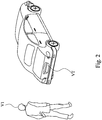
- Fig. 2 is a schematic diagram of a system for providing a simulated environment according to some embodiments of present disclosure.
- a first avatar V1 is being illustrated behind a virtual roadster VT in the virtual reality environment.
- the figure illustrates the viewpoint of the first user described in the embodiment of Fig. 1 being presented with the first scenario.
- the first avatar V1 is provided corresponding to the first user wearing the first wearable device 100 in the real world.
- the first wearable device 100 may collect the first biometric characteristic from the first user and send the first biometric characteristic to the computing unit 300.
- the computing unit 300 may retrieve the permission list from the database 400 to determine the permission level for the first user. Since the first user is being determined as the owner of the first permission level, through the first wearable device 100 the first user may observe the entire rear portion of the virtual roadster VT from the viewpoint of the first avatar V1 in the virtual reality environment.
- Fig. 3 is a schematic diagram of a system for providing a simulated environment according to some embodiments of present disclosure.
- the first avatar V1 is being illustrated in front of the virtual roadster VT in the virtual reality environment.
- the figure illustrates another viewpoint of the first user described in the embodiment of Fig. 1 being presented with the first scenario.
- the first avatar V1 is provided corresponding to the first user wearing the first wearable device 100 in the real world.
- the first wearable device 100 may collect the first biometric characteristic from the first user and send the first biometric characteristic to the computing unit 300.
- the computing unit 300 may retrieve the permission list from the database 400 to determine the permission level for the first user. Since the first user is being determined as the owner of the first permission level, through the first wearable device 100 the first user may observe the entire front portion of the virtual roadster VT from the viewpoint of the first avatar V1 shown in Fig. 3 .
- the first user having the first permission level may see any portion of the virtual roadster VT via the first scenario in the virtual reality environment, this is because the first biometric characteristic being retrieved from the first user determines that the first user is recognized as the manager of the project.
- Fig. 4 is a schematic diagram of a system for providing a simulated environment according to some embodiments of present disclosure.
- a second avatar V2 is being illustrated behind the virtual roadster VT in the virtual reality environment.
- the figure illustrates the viewpoint of the second user described in the embodiment of Fig. 1 being presented with the second scenario.
- the second wearable device 200 may collect the second biometric characteristic from the second user and send the second biometric characteristic to the computing unit 300.
- the computing unit 300 may retrieve the permission list from the database 400 to determine the permission level for the second user.
- the second user may be determined as the owner of the second permission level.
- the second permission level may only see the virtual object being partially concealed in the second scenario. Since the second user is the engineer who participates in the rear portion of the virtual roadster VT, the second user may observe the entire rear portion of the virtual roadster VT with the second permission level. In the embodiment, the second user may observe the entire rear portion of the virtual roadster VT from the viewpoint of the second avatar V2 through the second wearable device 200.
- Fig. 5 is a schematic diagram of a system for providing a simulated environment according to some embodiments of present disclosure.
- the second avatar V2 is being illustrated in front of the virtual roadster VT in the virtual reality environment.
- the figure illustrates the viewpoint of the second user described in the embodiment of Fig. 1 being presented with the second scenario.
- the second wearable device 200 may collect the second biometric characteristic from the second user and send the second biometric characteristic to the computing unit 300.
- the computing unit 300 may retrieve the permission list from the database 400 to determine the permission level for the second user.
- the second user may be determined as the owner of the second permission level.
- the second permission level may only see the virtual object being partially concealed in the second scenario. Since the second user is the engineer who participates in the rear portion of the virtual roadster VT, the second user may not observe the front portion of the virtual roadster VT. In the embodiment, the first user may observe the virtual roadster VT with its front portion being concealed from the viewpoint of the second avatar V2. Comparing Fig. 5 with Fig. 3 , it is apparent that the front portion of the virtual roadster VT in Fig. 5 is being cut off. As shown in Fig. 5 , the entire head of the virtual roadster VT is unobservable from the viewpoint of the second avatar V2 in the virtual reality environment.
- the embodiment illustrated in Fig. 5 is an example for concealing at least one portion of the virtual roadster VT.
- the computing unit 300 may conceal the specific portions of the virtual roadster VT by various approaches.
- the concealment may be applied by altering colors of specific portions of the virtual roadster VT, as shown in Fig.6 .
- portions of the virtual roadster VT are being painted with colors to make these portions unobservable to the second user.
- the act of concealment may be applied by excavating some specific portions from the virtual roadster VT.
- the concealment may be applied by altering the surface on some specific portions of the virtual roadster VT.
- the concealment may be applied by covering some specific portions of the virtual roadster VT with other virtual objects.
- the concealments may be applied through many other known approaches but not limited to the aforementioned applications.
- Fig. 7 is a flow chart of a method for providing a simulated environment to multiple users according to some embodiments of present disclosure. The steps of the method will be listed and explained in detail in following segments.
- Step S701 outputting, by a wearable device, a scenario of the simulated environment, wherein a virtual object is being displayed in the scenario.
- the computing unit 300 may provide the first scenario of the virtual reality environment to the first user.
- the computing unit 300 may provide the second scenario of the virtual reality environment to the second user.
- the virtual roadster VT is being displayed in both the first scenario and the second scenario, the difference is that portions of the virtual roadster VT may be concealed according to the permission levels of the users.
- Step S702 obtaining, by the wearable device, a biometric characteristic.
- the first wearable device 100 may obtain the first biometric characteristic from the first user
- the second wearable device 200 may obtain the second biometric characteristic from the second user.
- the first biometric characteristic and the second biometric characteristic may then be sent to the computing unit 300.
- Step S703 determining, by a computing unit, a permission level according to the biometric characteristic.
- the computing unit 300 may retrieve the permission list from the database 400 and start to determine permission levels for the users.
- the first user is being determined as the owner of the first permission level
- the second user is being determined as the owner of the second permission level.
- the permission levels to the users are being determined according to the permission list, such permission list records the relationship between the permission levels and biometric characteristics.
- Step S704 determining, by the computing unit, whether to conceal at least one portion of the virtual object in the scenario according to the permission level.
- users may see different portions of the virtual roadster VT according to their permission levels.
- the first user since the first user is being determined as owning the first permission level, whenever from any viewpoint in the virtual reality environment, the first user sees the entire virtual roadster VT, as illustrated in Fig. 2 and Fig. 3 .
- the second user since the second user is being determined as owning the second permission level, the first user may see the rear portion but not the front portion of the virtual roadster VT, as illustrated in Fig. 4 , Fig. 5 and Fig. 6 .
- present disclosure provides an approach to make specific parts of a virtual object being concealed according to the biometric characteristics of users.
- the method makes portions of the virtual object not being disclosed to some users without enough permission levels, provides a solid solution for establishing information security in the simulated environment.
Landscapes
- Engineering & Computer Science (AREA)
- Theoretical Computer Science (AREA)
- General Engineering & Computer Science (AREA)
- Physics & Mathematics (AREA)
- General Physics & Mathematics (AREA)
- Computer Security & Cryptography (AREA)
- Computer Hardware Design (AREA)
- Software Systems (AREA)
- Business, Economics & Management (AREA)
- Strategic Management (AREA)
- Health & Medical Sciences (AREA)
- General Health & Medical Sciences (AREA)
- Human Resources & Organizations (AREA)
- Human Computer Interaction (AREA)
- Entrepreneurship & Innovation (AREA)
- Data Mining & Analysis (AREA)
- Bioethics (AREA)
- Databases & Information Systems (AREA)
- Biomedical Technology (AREA)
- Computer Graphics (AREA)
- General Business, Economics & Management (AREA)
- Tourism & Hospitality (AREA)
- Quality & Reliability (AREA)
- Economics (AREA)
- Marketing (AREA)
- Operations Research (AREA)
- Physiology (AREA)
- Biophysics (AREA)
- Molecular Biology (AREA)
- Life Sciences & Earth Sciences (AREA)
- Multimedia (AREA)
- Signal Processing (AREA)
- Architecture (AREA)
- Computer Networks & Wireless Communication (AREA)
- Radar, Positioning & Navigation (AREA)
- Remote Sensing (AREA)
- Computing Systems (AREA)
- User Interface Of Digital Computer (AREA)
- Processing Or Creating Images (AREA)
Abstract
Description
- This application claims priority to
U.S. Provisional Application Serial Number 62/482,207, filed on April 06, 2017 - Present disclosure relates to a computing system and a method thereof, especially a system and a method for providing a simulated environment to multiple users.
- Virtual reality technology is very powerful when being applied to a group of people, especially when being applied for holding a conference or a workshop. It is much intuitive for having a prototype or a blueprint being presented in a visible three dimensional space rather than only on a two dimensional picture. However, there are still some unsolved problems for providing a virtual reality environment to multiple users located in different places.
- The disclosure relates to a system for providing a simulated environment. The system comprises a wearable device and a computing unit. The wearable device is configured to output a scenario of the simulated environment and to obtain a biometric characteristic. The computing unit is configured to determine a permission level according to the biometric characteristic, and to determine whether to conceal at least one portion of a virtual object which is being displayed in the scenario according to the permission level.
- Another aspect of present disclosure is to provide a method for providing a simulated environment. The method comprises following steps: outputting, by a wearable device, a scenario of the simulated environment; obtaining, by the wearable device, a biometric characteristic; determining, by a computing unit, a permission level according to the biometric characteristic; and determining, by the computing unit, whether to conceal at least one portion of a virtual object which is being displayed in the scenario according to the permission level.
- It is to be understood that both the foregoing general description and the following detailed description are by examples, and are intended to provide further explanation of the disclosure as claimed.
- Present disclosure can be more fully understood by reading the following detailed description of the embodiment, with reference made to the accompanying drawings as follows:
-
Fig. 1 is a schematic diagram of a system for providing a simulated environment according to some embodiments of present disclosure; -
Fig. 2 is a schematic diagram of a system for providing a simulated environment according to some embodiments of present disclosure; -
Fig. 3 is a schematic diagram of a system for providing a simulated environment according to some embodiments of present disclosure; -
Fig. 4 is a schematic diagram of a system for providing a simulated environment according to some embodiments of present disclosure; -
Fig. 5 is a schematic diagram of a system for providing a simulated environment according to some embodiments of present disclosure; -
Fig. 6 is a schematic diagram of a system for providing a simulated environment according to some embodiments of present disclosure; and -
Fig. 7 is a flow chart of a method for providing a simulated environment according to some embodiments of present disclosure. - Reference will now be made in detail to the present embodiments of the disclosure, examples of which are illustrated in the accompanying drawings. Wherever possible, the same reference numbers are used in the drawings and the description to refer to the same or like parts.
- The terms used in this specification generally have their ordinary meanings in the art and in the specific context where each term is used. The use of examples in this specification, including examples of any terms discussed herein, is illustrative only, and in no way limits the scope and meaning of the disclosure or of any exemplified term. Likewise, the present disclosure is not limited to various embodiments given in this specification.
- As used herein, the terms "comprising," "including," "having," and the like are to be understood to be open-ended, i.e., to mean including but not limited to.
- Reference throughout the specification to "one embodiment" or "an embodiment" means that a particular feature, structure, implementation, or characteristic described in connection with the embodiment is included in at least one embodiment of the present disclosure. Thus, uses of the phrases "in one embodiment" or "in an embodiment" in various places throughout the specification are not necessarily all referring to the same embodiment. Furthermore, the particular features, structures, implementation, or characteristics may be combined in any suitable manner in one or more embodiments.
- In the following description and claims, the terms "coupled" and "connected", along with their derivatives, may be used. In particular embodiments, "connected" and "coupled" may be used to indicate that two or more elements are in direct physical or electrical contact with each other, or may also mean that two or more elements may be in indirect contact with each other. "Coupled" and "connected" may still be used to indicate that two or more elements cooperate or interact with each other.
-
Fig. 1 is a schematic diagram of a system for providing a simulated environment according to some embodiments of present disclosure. Said simulated environment is an environment built with virtual objects illustrated by computing devices, for example, may be a virtual reality environment, an augmented reality environment or a mixed reality environment. As shown inFig. 1 , a firstwearable device 100 and a secondwearable device 200 are in communication with acomputing unit 300. In an embodiment, the firstwearable device 100 is carried by a first user and the secondwearable device 200 is carried by a second user. The firstwearable device 100 is configured to output a first scenario of a virtual reality environment to the first user, wherein the first scenario being displayed shows a partial view of the virtual reality environment corresponding to the viewpoint of the firstwearable device 100. The first scenario may be updated according to the viewing that changed in response to the movement of the first user. In the same manner, the secondwearable device 200 is configured to output a second scenario of the virtual reality environment to the second user, wherein the second scenario being displayed shows a partial view of the virtual reality environment corresponding to the viewpoint of the secondwearable device 200. The second scenario may be updated according to the viewing that changed in response to the movement of the second user. The firstwearable device 100 and the secondwearable device 200 may receive signals from thecomputing unit 300 in order to display or update virtual objects or backgrounds in the first scenario and the second scenario. - In the embodiment, since the first scenario and the second scenario are directed to the same virtual reality environment, when a virtual object is being displayed in the virtual reality environment, the first user may observe the virtual object from a first viewpoint corresponding to the first scenario, and the second user may observe the virtual object from a second viewpoint, which may be different from the first viewpoint, corresponding to the second scenario.
- In the embodiment, the first
wearable device 100 is also configured to obtain a first biometric characteristic from the first user. The first biometric may be an iris characteristic, obtained by an optical sensor being configured in the firstwearable device 100 for detecting at least an eye of the first user. The first biometric characteristic may be sent to thecomputing unit 300, and thecomputing unit 300 may determine a first permission level of the first user according to the first biometric characteristic. In the same manner, the secondwearable device 200 is also configured to obtain a second biometric characteristic from the second user. The second biometric characteristic being retrieved from the second user, such as an iris characteristic may be sent to thecomputing unit 300 as well. Thecomputing unit 300 may determine a second permission level of the second user according to the second biometric characteristic being retrieved. - In the embodiment, a
database 400 is electrically coupled to thecomputing unit 300. Thedatabase 400 is configured to store a permission list, which is a record of relationships between permission levels and biometric characteristics. In other words, the permission list records the genders, tasks, titles or identities of users, which may be determined by the biometric characteristics, and the permission levels that they are granted to. Whencomputing unit 300 receives the first biometric characteristic from the firstwearable device 100, thecomputing unit 300 may retrieve the permission list from thedatabase 400, and thecomputing unit 300 may determine the first permission level to the first user according to the information in the permission list. In the same manner, whencomputing unit 300 receives the second biometric characteristic from the first secondwearable device 200, thecomputing unit 300 may retrieve the permission list and determine the second permission level to the second user according to the information in the permission list. - In the embodiment, the permission levels regulate which portion of the virtual object a specific user may or may not observe. For example, in the embodiment, the first user and the second user are both participants of a project. The first user is a project manager so the first permission level granted to the first user is a supreme permission level. User being determined as an owner of the supreme permission level may observe the entire virtual object. Through the first
wearable device 100, the first biometric characteristic of the first user may be sent to thecomputing unit 300. Thecomputing unit 300 may retrieve the permission list from thedatabase 400 and determine the first user as the first permission level, and thecomputing unit 300 may determine not to conceal any portion of the virtual object. As such, the first user may observe the entire virtual object in the first scenario as it should be presented. - On the other hand, the second user is a contract engineer participates in partial design of the virtual object. For the sake of maintaining confidentiality, the other parts of the virtual object are forbidden to be disclosed to the second user. In order to do so, the second user is granted with the second permission level that only the parts he participates in may be presented. User being determined as an owner of the second permission level may observe the virtual object with some portions being concealed. Through the second
wearable device 200, the second biometric characteristic of the second user may be sent to thecomputing unit 300. Thecomputing unit 300 may retrieve the permission list from thedatabase 400 and determine the second user as the second permission level, and thecomputing unit 300 may determine to conceal some portions of the virtual object. As such, the second user may not observe the entire virtual object in the second scenario as it should be presented. - In some embodiments, the biometric characteristics include fingerprints of the users or habitual actions of the users. For example, the first
wearable device 100 and the secondwearable device 200 may be configured with some fingerprint detectors. Before the first scenario and the second scenario being provided to the firstwearable device 100 and the secondwearable device 200, the first user and the second user have to put their fingers on the fingerprint detectors. The fingerprints of the first user and the second user may then be sent to thecomputing unit 300. Then thecomputing unit 300 may determine the permission levels for the users according to the obtained fingerprints. For example, the firstwearable device 100 and the secondwearable device 200 may be configured with some motion detectors. When the first user wears the firstwearable device 100 and the second user wears the secondwearable device 200, their habitual actions may be collected by the motion detectors and sent to thecomputing unit 300. Then thecomputing unit 300 may determine the permission levels for the users according to the obtained habitual actions. - However, it should be understood that the
computing unit 300 illustrated inFig. 1 is only an example. In some embodiments, thecomputing unit 300 may be a CPU, GPU, or some control unit configured in the firstwearable device 100 or the secondwearable device 200. Depends on which wearable device is configured with thecomputing unit 300, the biometric characteristics will be sent to that wearable device and being processed by thecomputing unit 300. -
Fig. 2 is a schematic diagram of a system for providing a simulated environment according to some embodiments of present disclosure. As can be seen in the figure, a first avatar V1 is being illustrated behind a virtual roadster VT in the virtual reality environment. The figure illustrates the viewpoint of the first user described in the embodiment ofFig. 1 being presented with the first scenario. The first avatar V1 is provided corresponding to the first user wearing the firstwearable device 100 in the real world. As mentioned in the embodiment ofFig.1 , the firstwearable device 100 may collect the first biometric characteristic from the first user and send the first biometric characteristic to thecomputing unit 300. Thecomputing unit 300 may retrieve the permission list from thedatabase 400 to determine the permission level for the first user. Since the first user is being determined as the owner of the first permission level, through the firstwearable device 100 the first user may observe the entire rear portion of the virtual roadster VT from the viewpoint of the first avatar V1 in the virtual reality environment. -
Fig. 3 is a schematic diagram of a system for providing a simulated environment according to some embodiments of present disclosure. As can be seen in the figure, the first avatar V1 is being illustrated in front of the virtual roadster VT in the virtual reality environment. The figure illustrates another viewpoint of the first user described in the embodiment ofFig. 1 being presented with the first scenario. The first avatar V1 is provided corresponding to the first user wearing the firstwearable device 100 in the real world. As mentioned in the embodiment ofFig.1 , the firstwearable device 100 may collect the first biometric characteristic from the first user and send the first biometric characteristic to thecomputing unit 300. Thecomputing unit 300 may retrieve the permission list from thedatabase 400 to determine the permission level for the first user. Since the first user is being determined as the owner of the first permission level, through the firstwearable device 100 the first user may observe the entire front portion of the virtual roadster VT from the viewpoint of the first avatar V1 shown inFig. 3 . - In the embodiments shown in
Fig.2 andFig. 3 , it can be seen that the first user having the first permission level may see any portion of the virtual roadster VT via the first scenario in the virtual reality environment, this is because the first biometric characteristic being retrieved from the first user determines that the first user is recognized as the manager of the project. -
Fig. 4 is a schematic diagram of a system for providing a simulated environment according to some embodiments of present disclosure. As can be seen in theFig. 4 , a second avatar V2 is being illustrated behind the virtual roadster VT in the virtual reality environment. The figure illustrates the viewpoint of the second user described in the embodiment ofFig. 1 being presented with the second scenario. As mentioned in the embodiment ofFig.1 , the secondwearable device 200 may collect the second biometric characteristic from the second user and send the second biometric characteristic to thecomputing unit 300. Thecomputing unit 300 may retrieve the permission list from thedatabase 400 to determine the permission level for the second user. As mentioned, according to the permission list, the second user may be determined as the owner of the second permission level. The second permission level may only see the virtual object being partially concealed in the second scenario. Since the second user is the engineer who participates in the rear portion of the virtual roadster VT, the second user may observe the entire rear portion of the virtual roadster VT with the second permission level. In the embodiment, the second user may observe the entire rear portion of the virtual roadster VT from the viewpoint of the second avatar V2 through the secondwearable device 200. -
Fig. 5 is a schematic diagram of a system for providing a simulated environment according to some embodiments of present disclosure. As can be seen inFig. 5 , the second avatar V2 is being illustrated in front of the virtual roadster VT in the virtual reality environment. The figure illustrates the viewpoint of the second user described in the embodiment ofFig. 1 being presented with the second scenario. As mentioned in the embodiment ofFig.1 , the secondwearable device 200 may collect the second biometric characteristic from the second user and send the second biometric characteristic to thecomputing unit 300. Thecomputing unit 300 may retrieve the permission list from thedatabase 400 to determine the permission level for the second user. As mentioned, according to the permission list, the second user may be determined as the owner of the second permission level. The second permission level may only see the virtual object being partially concealed in the second scenario. Since the second user is the engineer who participates in the rear portion of the virtual roadster VT, the second user may not observe the front portion of the virtual roadster VT. In the embodiment, the first user may observe the virtual roadster VT with its front portion being concealed from the viewpoint of the second avatar V2. ComparingFig. 5 withFig. 3 , it is apparent that the front portion of the virtual roadster VT inFig. 5 is being cut off. As shown inFig. 5 , the entire head of the virtual roadster VT is unobservable from the viewpoint of the second avatar V2 in the virtual reality environment. - The embodiment illustrated in
Fig. 5 is an example for concealing at least one portion of the virtual roadster VT. In other embodiments, thecomputing unit 300 may conceal the specific portions of the virtual roadster VT by various approaches. For instance, the concealment may be applied by altering colors of specific portions of the virtual roadster VT, as shown inFig.6 . In the embodiment, looking from the viewpoint of the avatar V2, which is corresponding to the second user, portions of the virtual roadster VT are being painted with colors to make these portions unobservable to the second user. In other embodiments, the act of concealment may be applied by excavating some specific portions from the virtual roadster VT. The concealment may be applied by altering the surface on some specific portions of the virtual roadster VT. The concealment may be applied by covering some specific portions of the virtual roadster VT with other virtual objects. However, it should be understood that the concealments may be applied through many other known approaches but not limited to the aforementioned applications. -
Fig. 7 is a flow chart of a method for providing a simulated environment to multiple users according to some embodiments of present disclosure. The steps of the method will be listed and explained in detail in following segments. - Step S701: outputting, by a wearable device, a scenario of the simulated environment, wherein a virtual object is being displayed in the scenario. As shown in the embodiments from
Fig. 1 to Fig. 6 , when the first user wears the firstwearable device 100, thecomputing unit 300 may provide the first scenario of the virtual reality environment to the first user. In the same manner, when the second user wears the secondwearable device 200, thecomputing unit 300 may provide the second scenario of the virtual reality environment to the second user. The virtual roadster VT is being displayed in both the first scenario and the second scenario, the difference is that portions of the virtual roadster VT may be concealed according to the permission levels of the users. - Step S702: obtaining, by the wearable device, a biometric characteristic. As shown in the embodiments from
Fig. 1 to Fig. 6 , the firstwearable device 100 may obtain the first biometric characteristic from the first user, and the secondwearable device 200 may obtain the second biometric characteristic from the second user. The first biometric characteristic and the second biometric characteristic may then be sent to thecomputing unit 300. - Step S703: determining, by a computing unit, a permission level according to the biometric characteristic. As shown in the embodiments from
Fig. 1 to Fig. 6 , after the first biometric characteristic and the second biometric characteristic being sent to thecomputing unit 300, thecomputing unit 300 may retrieve the permission list from thedatabase 400 and start to determine permission levels for the users. As mentioned in the exemplary embodiments, the first user is being determined as the owner of the first permission level, and the second user is being determined as the owner of the second permission level. The permission levels to the users are being determined according to the permission list, such permission list records the relationship between the permission levels and biometric characteristics. - Step S704: determining, by the computing unit, whether to conceal at least one portion of the virtual object in the scenario according to the permission level. As shown in the embodiments from
Fig. 1 to Fig. 6 , users may see different portions of the virtual roadster VT according to their permission levels. In the embodiment, since the first user is being determined as owning the first permission level, whenever from any viewpoint in the virtual reality environment, the first user sees the entire virtual roadster VT, as illustrated inFig. 2 andFig. 3 . However, since the second user is being determined as owning the second permission level, the first user may see the rear portion but not the front portion of the virtual roadster VT, as illustrated inFig. 4 ,Fig. 5 andFig. 6 . - As described, present disclosure provides an approach to make specific parts of a virtual object being concealed according to the biometric characteristics of users. The method makes portions of the virtual object not being disclosed to some users without enough permission levels, provides a solid solution for establishing information security in the simulated environment.
- Although the present disclosure has been described in considerable detail with reference to certain embodiments thereof, other embodiments are possible. Therefore, the spirit and scope of the appended claims should not be limited to the description of the embodiments contained herein.
- It will be apparent to those skilled in the art that various modifications and variations can be made to the structure of the present disclosure without departing from the scope or spirit of the disclosure. In view of the foregoing, it is intended that the present disclosure cover modifications and variations of this disclosure provided they fall within the scope of the following claims.
Claims (15)
- A system for providing a simulated environment, comprising:a wearable device, configured to output a scenario of the simulated environment and to obtain a biometric characteristic; anda computing unit (300), configured to determine a permission level according to the biometric characteristic, and to determine whether to conceal at least one portion of a virtual object which is being displayed in the scenario according to the permission level.
- The system of claim 1, wherein the wearable device comprises an optical sensor, wherein the optical sensor is configured for obtaining an iris characteristic as the biometric characteristic.
- The system of claim 1 or 2, wherein the biometric characteristic comprises fingerprint patterns or habitual actions.
- The system of any one of the preceding claims, wherein the computing unit (300) is configured to conceal the at least one portion of the virtual object by excavating the at least one portion from the virtual object.
- The system of any one of the preceding claims, wherein the computing unit is configured to conceal the at least one portion of the virtual object by cutting the at least one portion from the virtual object.
- The system of any one of the preceding claims, wherein the computing unit (300) is configured to conceal the at least one portion of the virtual object by altering a surface on the at least one portion of the virtual object.
- The system of any one of the preceding claims, wherein the computing unit (300) is configured to conceal the at least one portion of the virtual object by covering the at least one portion of the virtual object with other virtual objects.
- A method for providing a simulated environment, comprising:outputting, by a wearable device, a scenario of the simulated environment;obtaining, by the wearable device, a biometric characteristic;determining, by a computing unit, a permission level according to the biometric characteristic; anddetermining, by the computing unit, whether to conceal at least one portion of a virtual object which is being displayed in the scenario according to the permission level.
- The method of claim 8, further comprising:obtaining, by an optical sensor configured in the wearable device, an iris characteristic as the biometric characteristic.
- The method of claim 8 or 9, wherein the biometric characteristic comprises fingerprint patterns or habitual actions.
- The method of any one of the claims 8 to 10, wherein the permission level is determined by genders, tasks, titles or identities.
- The method of any one of the claims 8 to 10, wherein the computing unit is configured to conceal the at least one portion of the virtual object by excavating the at least one portion from the virtual object.
- The method of any one of the claims 8 to 10, wherein the computing unit is configured to conceal the at least one portion of the virtual object by cutting the at least one portion from the virtual object.
- The method of any one of the claims 8 to 10, wherein the computing unit is configured to conceal the at least one portion of the virtual object by altering a surface on the at least one portion of the virtual object.
- The method of any one of the claims 8 to 10, wherein the computing unit is configured to conceal the at least one portion of the virtual object by covering the at least one portion of the virtual object with other virtual objects.
Applications Claiming Priority (2)
| Application Number | Priority Date | Filing Date | Title |
|---|---|---|---|
| US201762482207P | 2017-04-06 | 2017-04-06 | |
| US15/823,608 US10609025B2 (en) | 2017-04-06 | 2017-11-28 | System and method for providing simulated environment |
Publications (1)
| Publication Number | Publication Date |
|---|---|
| EP3385876A1 true EP3385876A1 (en) | 2018-10-10 |
Family
ID=60953796
Family Applications (1)
| Application Number | Title | Priority Date | Filing Date |
|---|---|---|---|
| EP18151337.5A Ceased EP3385876A1 (en) | 2017-04-06 | 2018-01-12 | System and method for providing simulated environment |
Country Status (4)
| Country | Link |
|---|---|
| US (1) | US10609025B2 (en) |
| EP (1) | EP3385876A1 (en) |
| CN (1) | CN108693962B (en) |
| TW (1) | TWI666570B (en) |
Families Citing this family (3)
| Publication number | Priority date | Publication date | Assignee | Title |
|---|---|---|---|---|
| US10608774B2 (en) | 2018-07-27 | 2020-03-31 | At&T Intellectual Property I, L.P. | Network switch and optical transponder connectivity verification for wavelength division multiplexing network |
| US11372474B2 (en) * | 2019-07-03 | 2022-06-28 | Saec/Kinetic Vision, Inc. | Systems and methods for virtual artificial intelligence development and testing |
| GB202020521D0 (en) * | 2020-12-23 | 2021-02-03 | British Telecomm | Extended Reality Access Control |
Citations (3)
| Publication number | Priority date | Publication date | Assignee | Title |
|---|---|---|---|---|
| US20060115130A1 (en) * | 2004-11-29 | 2006-06-01 | Douglas Kozlay | Eyewear with biometrics to protect displayed data |
| US20140337634A1 (en) * | 2013-05-08 | 2014-11-13 | Google Inc. | Biometric Authentication Substitute For Passwords On A Wearable Computing Device |
| US20160342782A1 (en) * | 2015-05-18 | 2016-11-24 | Daqri, Llc | Biometric authentication in a head mounted device |
Family Cites Families (14)
| Publication number | Priority date | Publication date | Assignee | Title |
|---|---|---|---|---|
| US6943665B2 (en) * | 2000-03-21 | 2005-09-13 | T. Eric Chornenky | Human machine interface |
| US9704154B2 (en) * | 2002-10-01 | 2017-07-11 | World Award Academy, World Award Foundation, Amobilepay, Inc. | Wearable personal digital device for facilitating mobile device payments and personal use |
| US8541745B2 (en) * | 2011-11-16 | 2013-09-24 | Motorola Mobility Llc | Methods and devices for clothing detection about a wearable electronic device |
| US9122321B2 (en) * | 2012-05-04 | 2015-09-01 | Microsoft Technology Licensing, Llc | Collaboration environment using see through displays |
| US9256253B2 (en) * | 2013-12-28 | 2016-02-09 | Intel Corporation | Clasp assembly and data interconnection for wearable computing devices |
| EP3090322A4 (en) * | 2013-12-31 | 2017-07-19 | Eyefluence, Inc. | Systems and methods for gaze-based media selection and editing |
| AU2015255652B2 (en) * | 2014-05-09 | 2018-03-29 | Google Llc | Systems and methods for using eye signals with secure mobile communications |
| US10299520B1 (en) * | 2014-08-12 | 2019-05-28 | Apple Inc. | Fabric-based items with environmental control elements |
| KR20160147636A (en) | 2015-06-15 | 2016-12-23 | 삼성전자주식회사 | Head Mounted Display Apparatus |
| US9591427B1 (en) | 2016-02-20 | 2017-03-07 | Philip Scott Lyren | Capturing audio impulse responses of a person with a smartphone |
| US10163282B2 (en) * | 2016-03-30 | 2018-12-25 | Intermec, Inc. | Systems and methods for authentication |
| US20170337352A1 (en) * | 2016-05-23 | 2017-11-23 | Daqri, Llc | Confidential information occlusion using augmented reality |
| CN106161966A (en) | 2016-09-08 | 2016-11-23 | 深圳市锐尔威视科技有限公司 | The double image capture method of VR and system thereof |
| CN106506446A (en) | 2016-09-21 | 2017-03-15 | 奇酷互联网络科技(深圳)有限公司 | Wear-type virtual reality device and its control method |
-
2017
- 2017-11-28 US US15/823,608 patent/US10609025B2/en active Active
-
2018
- 2018-01-03 TW TW107100233A patent/TWI666570B/en active
- 2018-01-08 CN CN201810015287.3A patent/CN108693962B/en active Active
- 2018-01-12 EP EP18151337.5A patent/EP3385876A1/en not_active Ceased
Patent Citations (3)
| Publication number | Priority date | Publication date | Assignee | Title |
|---|---|---|---|---|
| US20060115130A1 (en) * | 2004-11-29 | 2006-06-01 | Douglas Kozlay | Eyewear with biometrics to protect displayed data |
| US20140337634A1 (en) * | 2013-05-08 | 2014-11-13 | Google Inc. | Biometric Authentication Substitute For Passwords On A Wearable Computing Device |
| US20160342782A1 (en) * | 2015-05-18 | 2016-11-24 | Daqri, Llc | Biometric authentication in a head mounted device |
Also Published As
| Publication number | Publication date |
|---|---|
| US10609025B2 (en) | 2020-03-31 |
| TWI666570B (en) | 2019-07-21 |
| TW201837657A (en) | 2018-10-16 |
| CN108693962A (en) | 2018-10-23 |
| CN108693962B (en) | 2020-07-03 |
| US20180295130A1 (en) | 2018-10-11 |
Similar Documents
| Publication | Publication Date | Title |
|---|---|---|
| EP3692461B1 (en) | Removing personally identifiable data before transmission from a device | |
| Alhakamy | Extended reality (XR) toward building immersive solutions: the key to unlocking industry 4.0 | |
| JP6317765B2 (en) | Mixed reality display adjustment | |
| US10096166B2 (en) | Apparatus and method for selectively displaying an operational environment | |
| US9390561B2 (en) | Personal holographic billboard | |
| US10564717B1 (en) | Apparatus, systems, and methods for sensing biopotential signals | |
| US20150317832A1 (en) | World-locked display quality feedback | |
| US12437665B2 (en) | Methods, systems, apparatuses and devices for facilitating provisioning of a virtual experience | |
| EP3221769A1 (en) | Interactive control station | |
| CN111627117B (en) | Image display special effect adjusting method and device, electronic equipment and storage medium | |
| US10609025B2 (en) | System and method for providing simulated environment | |
| WO2019204372A1 (en) | R-snap for production of augmented realities | |
| US20180218631A1 (en) | Interactive vehicle control system | |
| US12352976B1 (en) | Computer-implemented system and method for providing VR/AR visual experiences to users by pupil-directed retinal projection in near-eye displays | |
| WO2017042070A1 (en) | A gazed virtual object identification module, a system for implementing gaze translucency, and a related method | |
| US10401957B2 (en) | System and method for providing simulated environment | |
| Kumar et al. | Sixth sense technology | |
| JP7794852B2 (en) | Information processing device | |
| JP7824977B2 (en) | Avatar Generator | |
| GB2536790A (en) | A mixed reality system and method for displaying data therein | |
| WO2016135450A1 (en) | A mixed reality system and method for displaying data therein | |
| JP7650312B2 (en) | PROGRAM, INFORMATION PROCESSING APPARATUS, AND INFORMATION PROCESSING SYSTEM | |
| JP2017134492A (en) | Image generation apparatus, image generation method, and image generation program | |
| Nijholt | Perceptual Modifications in Augmented Reality: A Short Survey | |
| JP7851969B2 (en) | Information setting device |
Legal Events
| Date | Code | Title | Description |
|---|---|---|---|
| PUAI | Public reference made under article 153(3) epc to a published international application that has entered the european phase |
Free format text: ORIGINAL CODE: 0009012 |
|
| STAA | Information on the status of an ep patent application or granted ep patent |
Free format text: STATUS: REQUEST FOR EXAMINATION WAS MADE |
|
| 17P | Request for examination filed |
Effective date: 20180112 |
|
| AK | Designated contracting states |
Kind code of ref document: A1 Designated state(s): AL AT BE BG CH CY CZ DE DK EE ES FI FR GB GR HR HU IE IS IT LI LT LU LV MC MK MT NL NO PL PT RO RS SE SI SK SM TR |
|
| AX | Request for extension of the european patent |
Extension state: BA ME |
|
| RBV | Designated contracting states (corrected) |
Designated state(s): AL AT BE BG CH CY CZ DE DK EE ES FI FR GB GR HR HU IE IS IT LI LT LU LV MC MK MT NL NO PL PT RO RS SE SI SK SM TR |
|
| STAA | Information on the status of an ep patent application or granted ep patent |
Free format text: STATUS: EXAMINATION IS IN PROGRESS |
|
| 17Q | First examination report despatched |
Effective date: 20190628 |
|
| STAA | Information on the status of an ep patent application or granted ep patent |
Free format text: STATUS: THE APPLICATION HAS BEEN REFUSED |
|
| 18R | Application refused |
Effective date: 20200624 |