EP3385428A1 - Nonwoven cellulose fiber fabric with fibers having non-circular cross section - Google Patents
Nonwoven cellulose fiber fabric with fibers having non-circular cross section Download PDFInfo
- Publication number
- EP3385428A1 EP3385428A1 EP17164518.7A EP17164518A EP3385428A1 EP 3385428 A1 EP3385428 A1 EP 3385428A1 EP 17164518 A EP17164518 A EP 17164518A EP 3385428 A1 EP3385428 A1 EP 3385428A1
- Authority
- EP
- European Patent Office
- Prior art keywords
- fibers
- fabric
- fiber
- spinning solution
- coagulation
- Prior art date
- Legal status (The legal status is an assumption and is not a legal conclusion. Google has not performed a legal analysis and makes no representation as to the accuracy of the status listed.)
- Withdrawn
Links
- 239000000835 fiber Substances 0.000 title claims abstract description 459
- 239000004744 fabric Substances 0.000 title claims abstract description 276
- 229920003043 Cellulose fiber Polymers 0.000 title claims abstract description 121
- 229920000433 Lyocell Polymers 0.000 claims abstract description 99
- 238000009987 spinning Methods 0.000 claims abstract description 97
- 238000005345 coagulation Methods 0.000 claims description 87
- 230000015271 coagulation Effects 0.000 claims description 87
- 238000000034 method Methods 0.000 claims description 84
- 230000008569 process Effects 0.000 claims description 70
- 238000004519 manufacturing process Methods 0.000 claims description 56
- 239000012530 fluid Substances 0.000 claims description 39
- 238000007493 shaping process Methods 0.000 claims description 15
- PXHVJJICTQNCMI-UHFFFAOYSA-N Nickel Chemical compound [Ni] PXHVJJICTQNCMI-UHFFFAOYSA-N 0.000 claims description 12
- 238000005516 engineering process Methods 0.000 claims description 11
- 238000012545 processing Methods 0.000 claims description 11
- 239000002131 composite material Substances 0.000 claims description 7
- 238000003490 calendering Methods 0.000 claims description 6
- 238000011065 in-situ storage Methods 0.000 claims description 6
- 229910052759 nickel Inorganic materials 0.000 claims description 6
- 238000004080 punching Methods 0.000 claims description 6
- RYGMFSIKBFXOCR-UHFFFAOYSA-N Copper Chemical compound [Cu] RYGMFSIKBFXOCR-UHFFFAOYSA-N 0.000 claims description 5
- 239000012298 atmosphere Substances 0.000 claims description 5
- 229910052802 copper Inorganic materials 0.000 claims description 5
- 239000010949 copper Substances 0.000 claims description 5
- 230000003796 beauty Effects 0.000 claims description 3
- 239000004746 geotextile Substances 0.000 claims description 3
- 238000005470 impregnation Methods 0.000 claims description 3
- 230000000704 physical effect Effects 0.000 claims 2
- 239000010410 layer Substances 0.000 description 115
- 239000000243 solution Substances 0.000 description 97
- 239000000047 product Substances 0.000 description 38
- 239000000463 material Substances 0.000 description 35
- 229920002678 cellulose Polymers 0.000 description 31
- 239000001913 cellulose Substances 0.000 description 31
- 230000015572 biosynthetic process Effects 0.000 description 26
- 238000005452 bending Methods 0.000 description 24
- 239000007789 gas Substances 0.000 description 24
- XLYOFNOQVPJJNP-UHFFFAOYSA-N water Substances O XLYOFNOQVPJJNP-UHFFFAOYSA-N 0.000 description 24
- 239000007788 liquid Substances 0.000 description 15
- 239000002904 solvent Substances 0.000 description 14
- 238000013461 design Methods 0.000 description 13
- 230000000694 effects Effects 0.000 description 11
- 230000004308 accommodation Effects 0.000 description 10
- SJRJJKPEHAURKC-UHFFFAOYSA-N N-Methylmorpholine Chemical compound CN1CCOCC1 SJRJJKPEHAURKC-UHFFFAOYSA-N 0.000 description 9
- 229920001131 Pulp (paper) Polymers 0.000 description 9
- 239000000126 substance Substances 0.000 description 9
- 230000001960 triggered effect Effects 0.000 description 9
- 238000009826 distribution Methods 0.000 description 8
- 229910001385 heavy metal Inorganic materials 0.000 description 6
- 239000000203 mixture Substances 0.000 description 6
- 241000196324 Embryophyta Species 0.000 description 5
- LFTLOKWAGJYHHR-UHFFFAOYSA-N N-methylmorpholine N-oxide Chemical compound CN1(=O)CCOCC1 LFTLOKWAGJYHHR-UHFFFAOYSA-N 0.000 description 5
- 238000011109 contamination Methods 0.000 description 5
- 238000009413 insulation Methods 0.000 description 5
- 230000003993 interaction Effects 0.000 description 5
- 238000004886 process control Methods 0.000 description 5
- 230000002787 reinforcement Effects 0.000 description 5
- 238000000926 separation method Methods 0.000 description 5
- 229920002994 synthetic fiber Polymers 0.000 description 5
- 238000005406 washing Methods 0.000 description 5
- OKTJSMMVPCPJKN-UHFFFAOYSA-N Carbon Chemical compound [C] OKTJSMMVPCPJKN-UHFFFAOYSA-N 0.000 description 4
- 230000002745 absorbent Effects 0.000 description 4
- 239000002250 absorbent Substances 0.000 description 4
- 239000000853 adhesive Substances 0.000 description 4
- 230000001070 adhesive effect Effects 0.000 description 4
- 238000000151 deposition Methods 0.000 description 4
- 239000003595 mist Substances 0.000 description 4
- 230000004048 modification Effects 0.000 description 4
- 238000012986 modification Methods 0.000 description 4
- 238000012805 post-processing Methods 0.000 description 4
- 238000001556 precipitation Methods 0.000 description 4
- 239000007787 solid Substances 0.000 description 4
- 239000004753 textile Substances 0.000 description 4
- 206010020751 Hypersensitivity Diseases 0.000 description 3
- 230000008901 benefit Effects 0.000 description 3
- 239000011230 binding agent Substances 0.000 description 3
- 229910052799 carbon Inorganic materials 0.000 description 3
- 239000000428 dust Substances 0.000 description 3
- 239000002657 fibrous material Substances 0.000 description 3
- 239000003063 flame retardant Substances 0.000 description 3
- 238000002156 mixing Methods 0.000 description 3
- 239000012071 phase Substances 0.000 description 3
- 239000011148 porous material Substances 0.000 description 3
- 230000002829 reductive effect Effects 0.000 description 3
- 230000006641 stabilisation Effects 0.000 description 3
- 238000003860 storage Methods 0.000 description 3
- 230000008961 swelling Effects 0.000 description 3
- 229920001059 synthetic polymer Polymers 0.000 description 3
- 230000007704 transition Effects 0.000 description 3
- 229920000742 Cotton Polymers 0.000 description 2
- 206010016807 Fluid retention Diseases 0.000 description 2
- 239000000654 additive Substances 0.000 description 2
- 150000001412 amines Chemical class 0.000 description 2
- 230000000844 anti-bacterial effect Effects 0.000 description 2
- 238000007664 blowing Methods 0.000 description 2
- 238000006243 chemical reaction Methods 0.000 description 2
- 239000003795 chemical substances by application Substances 0.000 description 2
- 238000004140 cleaning Methods 0.000 description 2
- 238000007906 compression Methods 0.000 description 2
- 230000006835 compression Effects 0.000 description 2
- 239000000470 constituent Substances 0.000 description 2
- 238000010276 construction Methods 0.000 description 2
- 239000002537 cosmetic Substances 0.000 description 2
- 230000003111 delayed effect Effects 0.000 description 2
- 238000004090 dissolution Methods 0.000 description 2
- 230000001815 facial effect Effects 0.000 description 2
- 235000013305 food Nutrition 0.000 description 2
- 230000006870 function Effects 0.000 description 2
- 229910052739 hydrogen Inorganic materials 0.000 description 2
- 239000001257 hydrogen Substances 0.000 description 2
- 230000002209 hydrophobic effect Effects 0.000 description 2
- 230000002401 inhibitory effect Effects 0.000 description 2
- 239000012212 insulator Substances 0.000 description 2
- 239000011229 interlayer Substances 0.000 description 2
- 239000006210 lotion Substances 0.000 description 2
- 238000005259 measurement Methods 0.000 description 2
- 230000007246 mechanism Effects 0.000 description 2
- 239000002609 medium Substances 0.000 description 2
- 239000002105 nanoparticle Substances 0.000 description 2
- -1 nasal strips Substances 0.000 description 2
- 238000004806 packaging method and process Methods 0.000 description 2
- 230000036961 partial effect Effects 0.000 description 2
- 230000001376 precipitating effect Effects 0.000 description 2
- 238000000746 purification Methods 0.000 description 2
- 239000013557 residual solvent Substances 0.000 description 2
- 239000011347 resin Substances 0.000 description 2
- 229920005989 resin Polymers 0.000 description 2
- 239000002689 soil Substances 0.000 description 2
- 239000007790 solid phase Substances 0.000 description 2
- RNFJDJUURJAICM-UHFFFAOYSA-N 2,2,4,4,6,6-hexaphenoxy-1,3,5-triaza-2$l^{5},4$l^{5},6$l^{5}-triphosphacyclohexa-1,3,5-triene Chemical compound N=1P(OC=2C=CC=CC=2)(OC=2C=CC=CC=2)=NP(OC=2C=CC=CC=2)(OC=2C=CC=CC=2)=NP=1(OC=1C=CC=CC=1)OC1=CC=CC=C1 RNFJDJUURJAICM-UHFFFAOYSA-N 0.000 description 1
- UGFAIRIUMAVXCW-UHFFFAOYSA-N Carbon monoxide Chemical compound [O+]#[C-] UGFAIRIUMAVXCW-UHFFFAOYSA-N 0.000 description 1
- 240000004272 Eragrostis cilianensis Species 0.000 description 1
- 241001424392 Lucia limbaria Species 0.000 description 1
- 229920001410 Microfiber Polymers 0.000 description 1
- 239000004743 Polypropylene Substances 0.000 description 1
- 239000004902 Softening Agent Substances 0.000 description 1
- 240000005572 Syzygium cordatum Species 0.000 description 1
- 235000006650 Syzygium cordatum Nutrition 0.000 description 1
- 244000269722 Thea sinensis Species 0.000 description 1
- 238000005299 abrasion Methods 0.000 description 1
- 239000003082 abrasive agent Substances 0.000 description 1
- 238000010521 absorption reaction Methods 0.000 description 1
- 239000002253 acid Substances 0.000 description 1
- 230000009471 action Effects 0.000 description 1
- 239000013543 active substance Substances 0.000 description 1
- 238000004026 adhesive bonding Methods 0.000 description 1
- 239000002390 adhesive tape Substances 0.000 description 1
- 238000004378 air conditioning Methods 0.000 description 1
- 238000004458 analytical method Methods 0.000 description 1
- 239000002216 antistatic agent Substances 0.000 description 1
- 238000013459 approach Methods 0.000 description 1
- 239000012736 aqueous medium Substances 0.000 description 1
- 239000010426 asphalt Substances 0.000 description 1
- 235000013405 beer Nutrition 0.000 description 1
- 238000006065 biodegradation reaction Methods 0.000 description 1
- 239000008280 blood Substances 0.000 description 1
- 210000004369 blood Anatomy 0.000 description 1
- 150000001722 carbon compounds Chemical class 0.000 description 1
- 235000013351 cheese Nutrition 0.000 description 1
- 229910052729 chemical element Inorganic materials 0.000 description 1
- 238000001311 chemical methods and process Methods 0.000 description 1
- 235000019504 cigarettes Nutrition 0.000 description 1
- 239000004567 concrete Substances 0.000 description 1
- 238000010924 continuous production Methods 0.000 description 1
- 239000002826 coolant Substances 0.000 description 1
- 125000004122 cyclic group Chemical group 0.000 description 1
- 230000006378 damage Effects 0.000 description 1
- 238000013016 damping Methods 0.000 description 1
- 238000000354 decomposition reaction Methods 0.000 description 1
- 230000003247 decreasing effect Effects 0.000 description 1
- 230000001419 dependent effect Effects 0.000 description 1
- 238000007865 diluting Methods 0.000 description 1
- 238000010790 dilution Methods 0.000 description 1
- 239000012895 dilution Substances 0.000 description 1
- 238000001035 drying Methods 0.000 description 1
- 230000003628 erosive effect Effects 0.000 description 1
- 238000001704 evaporation Methods 0.000 description 1
- 230000008020 evaporation Effects 0.000 description 1
- 238000001125 extrusion Methods 0.000 description 1
- 210000003608 fece Anatomy 0.000 description 1
- 238000007730 finishing process Methods 0.000 description 1
- 230000009969 flowable effect Effects 0.000 description 1
- 239000003546 flue gas Substances 0.000 description 1
- 239000011888 foil Substances 0.000 description 1
- 238000009472 formulation Methods 0.000 description 1
- 235000015203 fruit juice Nutrition 0.000 description 1
- 238000007306 functionalization reaction Methods 0.000 description 1
- 239000003292 glue Substances 0.000 description 1
- 229910002804 graphite Inorganic materials 0.000 description 1
- 239000010439 graphite Substances 0.000 description 1
- 229920006253 high performance fiber Polymers 0.000 description 1
- 239000012535 impurity Substances 0.000 description 1
- 238000001095 inductively coupled plasma mass spectrometry Methods 0.000 description 1
- 239000001023 inorganic pigment Substances 0.000 description 1
- 239000012774 insulation material Substances 0.000 description 1
- 238000005342 ion exchange Methods 0.000 description 1
- 239000003456 ion exchange resin Substances 0.000 description 1
- 229920003303 ion-exchange polymer Polymers 0.000 description 1
- 238000003973 irrigation Methods 0.000 description 1
- 230000002262 irrigation Effects 0.000 description 1
- 238000010030 laminating Methods 0.000 description 1
- 239000002649 leather substitute Substances 0.000 description 1
- 230000000670 limiting effect Effects 0.000 description 1
- 239000011344 liquid material Substances 0.000 description 1
- 239000007791 liquid phase Substances 0.000 description 1
- 238000011068 loading method Methods 0.000 description 1
- 239000000155 melt Substances 0.000 description 1
- 229910052751 metal Inorganic materials 0.000 description 1
- 239000002184 metal Substances 0.000 description 1
- 150000002739 metals Chemical group 0.000 description 1
- 239000003658 microfiber Substances 0.000 description 1
- 239000011859 microparticle Substances 0.000 description 1
- 239000008267 milk Substances 0.000 description 1
- 210000004080 milk Anatomy 0.000 description 1
- 235000013336 milk Nutrition 0.000 description 1
- 238000000465 moulding Methods 0.000 description 1
- 230000006855 networking Effects 0.000 description 1
- 239000011664 nicotinic acid Substances 0.000 description 1
- 239000004745 nonwoven fabric Substances 0.000 description 1
- 230000000474 nursing effect Effects 0.000 description 1
- 230000003287 optical effect Effects 0.000 description 1
- 239000002245 particle Substances 0.000 description 1
- 230000035515 penetration Effects 0.000 description 1
- 239000000049 pigment Substances 0.000 description 1
- 239000011505 plaster Substances 0.000 description 1
- 239000004033 plastic Substances 0.000 description 1
- 229920003023 plastic Polymers 0.000 description 1
- 239000002798 polar solvent Substances 0.000 description 1
- 238000005498 polishing Methods 0.000 description 1
- 229920000747 poly(lactic acid) Polymers 0.000 description 1
- 229920000728 polyester Polymers 0.000 description 1
- 239000004626 polylactic acid Substances 0.000 description 1
- 229920000642 polymer Polymers 0.000 description 1
- 239000002952 polymeric resin Substances 0.000 description 1
- 229920001155 polypropylene Polymers 0.000 description 1
- 230000001737 promoting effect Effects 0.000 description 1
- 239000002994 raw material Substances 0.000 description 1
- 238000011084 recovery Methods 0.000 description 1
- 230000009467 reduction Effects 0.000 description 1
- 238000011160 research Methods 0.000 description 1
- 235000013580 sausages Nutrition 0.000 description 1
- 238000007789 sealing Methods 0.000 description 1
- 239000003566 sealing material Substances 0.000 description 1
- 238000004062 sedimentation Methods 0.000 description 1
- 230000003584 silencer Effects 0.000 description 1
- 239000002356 single layer Substances 0.000 description 1
- 238000007711 solidification Methods 0.000 description 1
- 230000008023 solidification Effects 0.000 description 1
- 239000000725 suspension Substances 0.000 description 1
- 239000012209 synthetic fiber Substances 0.000 description 1
- 229920003002 synthetic resin Polymers 0.000 description 1
- 238000012549 training Methods 0.000 description 1
- 238000013271 transdermal drug delivery Methods 0.000 description 1
- 238000011144 upstream manufacturing Methods 0.000 description 1
Images





Classifications
-
- D—TEXTILES; PAPER
- D04—BRAIDING; LACE-MAKING; KNITTING; TRIMMINGS; NON-WOVEN FABRICS
- D04H—MAKING TEXTILE FABRICS, e.g. FROM FIBRES OR FILAMENTARY MATERIAL; FABRICS MADE BY SUCH PROCESSES OR APPARATUS, e.g. FELTS, NON-WOVEN FABRICS; COTTON-WOOL; WADDING ; NON-WOVEN FABRICS FROM STAPLE FIBRES, FILAMENTS OR YARNS, BONDED WITH AT LEAST ONE WEB-LIKE MATERIAL DURING THEIR CONSOLIDATION
- D04H3/00—Non-woven fabrics formed wholly or mainly of yarns or like filamentary material of substantial length
- D04H3/013—Regenerated cellulose series
-
- D—TEXTILES; PAPER
- D04—BRAIDING; LACE-MAKING; KNITTING; TRIMMINGS; NON-WOVEN FABRICS
- D04H—MAKING TEXTILE FABRICS, e.g. FROM FIBRES OR FILAMENTARY MATERIAL; FABRICS MADE BY SUCH PROCESSES OR APPARATUS, e.g. FELTS, NON-WOVEN FABRICS; COTTON-WOOL; WADDING ; NON-WOVEN FABRICS FROM STAPLE FIBRES, FILAMENTS OR YARNS, BONDED WITH AT LEAST ONE WEB-LIKE MATERIAL DURING THEIR CONSOLIDATION
- D04H3/00—Non-woven fabrics formed wholly or mainly of yarns or like filamentary material of substantial length
- D04H3/018—Non-woven fabrics formed wholly or mainly of yarns or like filamentary material of substantial length characterised by the shape
Definitions
- the invention relates to a nonwoven cellulose fiber fabric, a method of manufacturing a nonwoven cellulose fiber fabric, a device for manufacturing a nonwoven cellulose fiber fabric, a product or composite, and a method of use.
- Lyocell technology relates to the direct dissolution of cellulose wood pulp or other cellulose-based feedstock in a polar solvent (for example n-methyl morpholine n-oxide, which may also be denoted as "amine oxide” or "AO”) to produce a viscous highly shear-thinning solution which can be transformed into a range of useful cellulose-based materials.
- a polar solvent for example n-methyl morpholine n-oxide, which may also be denoted as "amine oxide” or "AO”
- AO n-methyl morpholine n-oxide
- the technology is used to produce a family of cellulose staple fibers (commercially available from Lenzing AG, Lenzing, Austria under the trademark TENCEL®) which are widely used in the textile industry.
- Other cellulose products from lyocell technology have also been used.
- Cellulose staple fibers have long been used as a component for conversion to nonwoven webs.
- adaption of lyocell technology to produce nonwoven webs directly would access properties and performance not possible for current cellulose web products.
- a nonwoven cellulose fiber fabric In order to achieve the object defined above, a nonwoven cellulose fiber fabric, a method of manufacturing a nonwoven cellulose fiber fabric, a device for manufacturing a nonwoven cellulose fiber fabric, a product or composite, and a method of use according to the independent claims are provided.
- a (in particular solution-blown) nonwoven cellulose fiber fabric is provided (which is in particular directly (in particular in an in situ process or in a continuous process executable in a continuously operating production line) manufactured from lyocell spinning solution), and wherein at least 1% of the fibers has a non-circular cross sectional shape (in particular along an entire fiber's longitudinal extension or only along a portion of the fiber's longitudinal extension) having a roundness of not more than 90%.
- a method of manufacturing (in particular solution-blown) nonwoven cellulose fiber fabric directly from lyocell spinning solution comprises extruding the lyocell spinning solution through orifices (which may be embodied as or which may form part of a spinneret or an extrusion unit) supported by a gas flow into a coagulation fluid atmosphere (in particular an atmosphere of dispersed coagulation fluid) to thereby form substantially endless fibers, collecting the fibers on a fiber support unit to thereby form the fabric, and adjusting process parameters so that at least 1% of the fibers has a non-circular cross sectional shape having a roundness of not more than 90%.
- orifices which may be embodied as or which may form part of a spinneret or an extrusion unit
- a gas flow into a coagulation fluid atmosphere in particular an atmosphere of dispersed coagulation fluid
- a device for manufacturing (in particular solution-blown) nonwoven cellulose fiber fabric directly from lyocell spinning solution comprising a jet with orifices configured for extruding the lyocell spinning solution supported by a gas flow, a coagulation unit configured for providing a coagulation fluid atmosphere for the extruded lyocell spinning solution to thereby form substantially endless fibers, a fiber support unit configured for collecting the fibers to thereby form the fabric, and a control unit (such as a processor configured for executing program code for manufacturing the nonwoven cellulose fiber fabric directly from the lyocell spinning solution) configured for adjusting process parameters so that at least 1% of the fibers has a non-circular cross sectional shape having a roundness of not more than 90%.
- a control unit such as a processor configured for executing program code for manufacturing the nonwoven cellulose fiber fabric directly from the lyocell spinning solution
- a nonwoven cellulose fiber fabric having the above-mentioned properties is used for at least one of the group consisting of a wipe, a filter, an absorbent hygiene product, a medical application product, a geotextile, agrotextile, clothing, a product for building technology, an automotive product, a furnishing, an industrial product, a product related to beauty, leisure, sports or travel, and a product related to school or office.
- a product or composite which comprises a fabric having the above mentioned properties.
- nonwoven cellulose fiber fabric (which may also be denoted as nonwoven cellulose filament fabric) may particularly denote a fabric or web composed of a plurality of substantially endless fibers.
- the term “substantially endless fibers” has in particular the meaning of filament fibers having a significantly longer length than conventional staple fibers.
- the term “substantially endless fibers” may in particular have the meaning of a web formed of filament fibers having a significantly smaller amount of fiber ends per volume than conventional staple fibers.
- endless fibers of a fabric according to an exemplary embodiment of the invention may have an amount of fiber ends per volume of less than 10,000 ends/cm 3 , in particular less than 5,000 ends/cm 3 .
- substantially endless fibers of the nonwoven cellulose fiber fabric may have a length of at least 200 mm, in particular at least 1000 mm.
- a person skilled in the art will be aware of the fact that even endless cellulose fibers may have interruptions, which may be formed by processes during and/or after fiber formation.
- a nonwoven cellulose fiber fabric made of substantially endless cellulose fibers has a significantly lower number of fibers per mass compared to nonwoven fabric made from staple fibers of the same denier.
- a nonwoven cellulose fiber fabric may be manufactured by spinning a plurality of fibers and by attenuating and stretching the latter towards a preferably moving fiber support unit. Thereby, a three-dimensional network or web of cellulose fibers is formed, constituting the nonwoven cellulose fiber fabric.
- the fabric may be made of cellulose as main or only constituent.
- lyocell spinning solution may particularly denote a solvent (for example a polar solution of a material such as N-methyl-morpholine, NMMO, "amine oxide” or "AO") in which cellulose (for instance wood pulp or other cellulose-based feedstock) is dissolved.
- the lyocell spinning solution is a solution rather than a melt.
- Cellulose filaments may be generated from the lyocell spinning solution by reducing the concentration of the solvent, for instance by contacting said filaments with water. The process of initial generation of cellulose fibers from a lyocell spinning solution can be described as coagulation.
- gas flow may particularly denote a flow of gas such as air substantially parallel to the moving direction of the cellulose fiber or its preform (i.e. lyocell spinning solution) while and/or after the lyocell spinning solution leaves or has left the spinneret.
- coagulation fluid may particularly denote a non-solvent fluid (i.e. a gas and/or a liquid, optionally including solid particles) which has the capability of diluting the lyocell spinning solution and exchanging with the solvent to such an extent that the cellulose fibers are formed from the lyocell filaments.
- a non-solvent fluid i.e. a gas and/or a liquid, optionally including solid particles
- such a coagulation fluid may be water mist.
- process parameters may particularly denote all physical parameters and/or chemical parameters and/or device parameters of substances and/or device components used for manufacturing nonwoven cellulose fiber fabric which may have an impact on the properties of the fibers and/or the fabric, in particular on fiber diameter and/or fiber diameter distribution.
- process parameters may be adjustable automatically by a control unit and/or manually by a user to thereby tune or adjust the properties of the fibers of the nonwoven cellulose fiber fabric.
- Physical parameters which may have an impact on the properties of the fibers may be temperature, pressure and/or density of the various media involved in the process (such as the lyocell spinning solution, the coagulation fluid, the gas flow, etc.).
- Chemical parameters may be concentration, amount, pH value of involved media (such as the lyocell spinning solution, the coagulation fluid, etc.).
- Device parameters may be size of and/or distances between orifices, distance between orifices and fiber support unit, speed of transportation of fiber support unit, the provision of one or more optional in situ post processing units, the gas flow, etc.
- Fibers may particularly denote elongated pieces of a material comprising cellulose, for instance roughly round or non-regularly formed in cross-section, optionally twisted with other fibers.
- Fibers may have an aspect ratio which is larger than 10, particularly larger than 100, more particularly larger than 1000. The aspect ratio is the ratio between the length of the fiber and a diameter of the fiber.
- Fibers may form networks by being interconnected by merging (so that an integral multi-fiber structure is formed) or by friction (so that the fibers remain separate but are weakly mechanically coupled by a friction force exerted when mutually moving the fibers being in physical contact with one another).
- Fibers may have a substantially cylindrical form which may however be straight, bent, kinked, or curved. Fibers may consist of a single homogenous material (i.e. cellulose). However, the fibers may also comprise one or more additives. Liquid materials such as water or oil may be accumulated between the fibers.
- a “jet with orifices” (which may for instance be denoted as an “arrangement of orifices”) may be any structure comprising an arrangement of orifices which are linearly arranged.
- roundness may particularly denote the ratio between the inscribed circle and the circumscribed circle of a cross section of a fiber, i.e. the maximum and minimum sizes for circles that are just sufficient to fit inside and to enclose the shape of the fiber's cross section.
- a cross sectional plane perpendicular to an extension direction of the fiber may be intersected with the fiber.
- roundness may be denoted as the measure of how closely the cross sectional shape of a respective fiber approaches that of a circle having a roundness of 100%.
- a cross-section of the respective fiber may have an oval (in particular elliptic) shape or may have a polygonal shape.
- a trajectory defining the exterior limits of a cross-section of a fiber may be any closed planar line showing a deviation from a circle.
- the cross-section of the respective fiber may be entirely round or may have one or more sharp edges.
- a nonwoven cellulose fiber fabric which has substantially endless fibers showing a significant deviation from an entirely circular cylindrical shape. From a mechanical point of view, this also has the consequence that a preferred bending direction of the fibers in the presence of a mechanical load is defined by the design of the cross-section of the fiber. For instance, wherein the fiber has an elliptic cross sectional shape with two main axes (i.e. major axis and minor axis) having different lengths, bending in the presence of an exerted force will occur predominantly with the minor axis as bending line. Thus, the bending characteristics of such a fiber fabric is no longer statistical and unpredictable, but in contrast to this, increases the defined order of the nonwoven cellulose fiber fabric.
- defined mechanical properties of the fabric can be adjusted in a simple way by simply influencing the cross-sectional geometry of the individual fibers.
- a mutual lay down behavior or networking behavior of the fibers may be adjusted by adjusting a deviation of some or substantially all of the fibers from a perfect circularity.
- a nonwoven cellulose fiber fabric with anisotropic mechanical properties may be manufactured when non-circular cylindrical fibers are aligned in an ordered or partially ordered way.
- nonwoven cellulose fiber fabric In the following, further exemplary embodiments of the nonwoven cellulose fiber fabric, the method of manufacturing a nonwoven cellulose fiber fabric, the device for manufacturing a nonwoven cellulose fiber fabric, the product or composite, and the method of use are described.
- At least 3%, in particular at least 5%, more particularly at least 10%, of the fibers has a non-circular cross sectional shape having a roundness of not more than 90%. Even more particularly, it is possible that at least 10%, at least 20%, at least 30%, at least 50% or at least 80% of the fibers has a non-circular cross sectional shape having a roundness of not more than 90%, not more than 80%, not more than 70%, not more than 60%, not more than 50%, or not more than 30%.
- At least 1%, at least 10%, at least 20%, at least 30%, at least 50% or at least 80% of the fibers has a non-circular cross sectional shape having a roundness of not more than 80%, in particular of not more than 70%, more particularly of not more than 50%. Even more particularly, it is possible that at least 1% of the fibers has a non-circular cross sectional shape having a roundness of not more than 60%, not more than 50%, not more than 40% or not more than 10%.
- the percentage of the fibers having a non-circular cross-sectional shape with a corresponding roundness value may be adjusted for example by adjusting a number and/or shape of the orifices through which the lyocell spinning solution, which forms the fibers after coagulation, is ejected. Additionally or alternatively, the percentage of the fibers having a non-circular cross-sectional shape with a corresponding roundness value may be adjusted for example by adjusting a number of filaments of the lyocell spinning solution being subject to a mechanical impact for changing the cross-sectional shape before coagulation.
- smoothness respectively the specific hand, of the fabric measured with a "Handle-O-Meter" on the basis of the nonwoven standard WSP90.3 is in a range between 2 mNm 2 /g and 70 mNm 2 /g.
- smoothness may hence be varied over a broad range.
- the mentioned smoothness of a fabric may be measured with a "Handle-O-Meter" (as commercially available by Thwing-Albert Instrument Co., Philadelphia, PA) on the basis of the nonwoven standard WSP90.3.
- a pivoting arm of the "Handle-O-Meter” is lowered and presses a sample (for instance having square dimensions of 10 cm x 10 cm) of fabric into an adjustable parallel slit.
- the force is measured which is required in order to press the sample into the slit.
- a bending force and a friction force are exerted on the sample.
- the average value from the measurements in CD direction and in MD direction correspond to an average force which is required to press the sample through the slit.
- the ratio between the average force (for instance given in mN) and basis weight of the fabric (for instance given in g/m 2 ) gives a smoothness value, measured as specific hand, in mNm 2 /g which is indicative for the smoothness of the fabric material.
- the fibers have a copper content of less than 5 ppm and/or have a nickel content of less than 2 ppm.
- the ppm values mentioned in this application all relate to mass (rather than to volume).
- the heavy metal contamination of the fibers or the fabric may be not more than 10 ppm for each individual chemical element. Due to the use of a lyocell spinning solution as a basis for the formation of the endless fiber-based fabric (in particular when involving a solvent such as N-methyl-morpholine, NMMO), the contamination of the fabric with heavy metals such as copper or nickel (which may cause allergic reactions of a user) may be kept extremely small. Due to the concept of direct merging of fibers under certain conditions adjustable by process control, no extra material (such as a glue or the like) needs to be introduced in the process for interconnecting the fibers. This keeps contaminations of the fabric very low.
- At least part of (in particular at least 10%, more particularly at least 20% of) the fibers are integrally merged at merging positions.
- the term "merging" may particularly denote an integral interconnection of different fibers at the respective merging position which results in the formation of one integrally connected fiber structure composed of the previously separate fiber preforms. Merging may be denoted as a fiber-fiber connection being established during coagulation of one, some or all of the merged fibers. Interconnected fibers may strongly adhere to one another at a respective merging position without a different additional material (such as a separate adhesive) so as to form a common structure. Separation of merged fibers may require destruction of the fiber network or part thereof.
- a nonwoven cellulose fiber fabric in which some or all of the fibers are integrally connected to one another by merging.
- Merging may be triggered by a corresponding control of the process parameters of a method of manufacturing the nonwoven cellulose fiber fabric.
- coagulation of filaments of lyocell spinning solution may be triggered (or at least completed) after the first contact between these filaments being not yet in the precipitated solid fiber state.
- a degree of merging is a powerful parameter which can be used for fine-tuning the properties of the manufactured fabric.
- mechanical stability of the network is the larger the higher the density of merging positions is.
- By an inhomogeneous distribution of merging positions over the volume of the fabric it is also possible to adjust regions of high mechanical stability and other regions of low mechanical stability. For instance, separation of the fabric into separate parts can be precisely defined to happen locally at mechanical weak regions with a low number of merging positions.
- merging between fibers is triggered by bringing different fiber preforms in form of lyocell spinning solution in direct contact with one another prior to coagulation. By such a coagulation process, single material common precipitation of the fibers is executed, thereby forming the merging positions.
- the merging points or merging positions consist of the same material as the merged fibers.
- the merging positions may be formed by cellulose material resulting directly from the coagulation of lyocell spinning solution. This not only renders the separate provision of a fiber connection material (such as an adhesive or a binder) dispensable, but also keeps the fabric clean and made of a single material. Formation of fibers having a non-circular cross-section and formation of fibers being interconnected by merging can be done by one single common process.
- different ones of the fibers are located at least partially in different distinguishable (i.e. showing a visible separation or interface region in between the layers) layers.
- varying mechanical properties among the layers and at an interface between the layers may be adjusted by a respective adjustment of the roundness value of the fibers of the respective layer.
- fibers of different layers are integrally merged at at least one merging position between the layers.
- different ones of the fibers being located at least partially in different distinguishable layers may be integrally connected at at least one merging position.
- two (or more) different layers of a fabric may be formed by serially aligning two (or more) jets with orifices through which lyocell spinning solution is extruded for coagulation and fiber formation.
- a first layer of fibers is formed on the fiber support unit by the first jet, and the second jet forms a second layer of fibers on the first layer when the moving fiber support unit reaches the position of the second jet.
- the process parameters of this method may be adjusted so that merging points are formed between the first layer and the second layer.
- fibers of the second layer under formation being not yet fully cured or solidified by coagulation may for example still have exterior skin or surface regions which are still in the liquid lyocell solution phase and not yet in the fully cured solid state.
- merging allows to control rigidity of the connection between the layers of the fabric.
- Merging can be controlled, for example, by adjusting the degree of curing or coagulation before pre-fiber structures of a respective layer reach the fiber support plate on an underlying layer of fibers or pre-fiber structures.
- a partial adhesion in particular between different layers may be controlled and adjusted for functionalizing the fabric for a product manufactured on the basis of the fabric.
- a package may be manufactured using such a (in particular multilayer) fabric which provides a slight adhesion force so that a packaged good can be properly handled through the weakly adhering parts thereof.
- a square sample of the fabric may be optically analyzed.
- a circle which has a diameter which has to stay fully inside the square sample, is drawn around each merging position of fibers crossing at least one of the diagonals of the square sample.
- the size of the circle is determined so that the circle encompasses the merging area between the merged fibers.
- An arithmetic average of the values of the diameter of the determined circles is calculated.
- the merging factor is calculated as ratio between the averaged diameter value and the diagonal length of the square sample, and may be given in percent.
- Twisting fibers is a further powerful tool of designing the mechanical strength of the fiber network.
- a twisted fiber may have a higher mechanical stability than an entirely straight fiber.
- forming twisted fiber groups may significantly increase the mechanical stability of the fabric in a similar way as a rope of twisted filaments has a significantly higher mechanical stability than a corresponding number of single filaments.
- Twisted fibers may be manufactured for instance by turning or rotating filaments of lyocell spinning solution during their stretching phase, i.e. before coagulation or precipitation.. Particularly the application of vorticity, i.e. a turbulent flow around the filaments of lyocell spinning solution prior to coagulation can be used for forming twisted fibers.
- the fibers are aligned anisotropically within the fabric to thereby define, on the average, at least one preferential alignment direction along which a larger portion of fibers is aligned compared to other directions.
- the adjustment of the fiber shape to deviate from a circular cross-section may be carried out for a group of or for all of the fibers of the fabric so that, when the fibers are laying down on the fiber support unit, they are aligned on the average or preferably along one or more predominant directions as a consequence of their preferred bending axes defined by the deviation of the respective fiber rounding from one.
- a certain degree of order may be introduced in the fabric which results in non-isotropic properties of the manufactured fabric.
- adjusting the process parameters comprises exerting a deforming force to filaments of the lyocell spinning solution before the coagulation is completed.
- a deforming force to filaments of the lyocell spinning solution before conversion to a solid phase.
- the filaments may be deformed from a for instance cylindrical cross sectional shape to a for instance oval (in particular elliptic) cross-sectional shape.
- the fiber deforming force can be applied in a direction perpendicular to a longitudinal extension of the fiber or fiber portion under analysis.
- the force is exerted by directing a shaping fluid (which may be a liquid and/or a gas) to the filaments of the lyocell spinning solution before the coagulation is completed.
- a shaping fluid may be a shaping gas (such as air) or a shaping liquid (such as water).
- a shaping gas such as air
- a shaping liquid such as water
- a precisely definable mechanical force is applicable to the not yet coagulated filaments without already triggering coagulation.
- an also precisely definable mechanical force is applicable to the not yet coagulated filaments which simultaneously also triggers coagulation by dilution of the lyocell spinning solution with the (in particular aqueous) liquid.
- deformation and coagulation may be carried out simultaneously.
- the mentioned pressure increase by a gaseous or a liquid (i.e. fluidic) flow may be configured so that the individual fluidic flows are antiparallel at a certain position, and the fiber under formation is in between. As a result, a local asymmetric pressure increase is created which impacts the fiber. At the same time, this phenomenon does not further influence the process of manufacturing fibers.
- the orifices are non-circular, in particular are oval (in particular elliptic) or polygonal.
- the openings in a jet plate of the fiber formation unit defining the orifices may have a shape with substantially the same roundness (in particular of not more than 90%) as the fibers composed of precipitated lyocell spinning solution ejected through these respective orifices.
- a first part of the orifices has a circular opening, whereas a second part of the orifices has a non-circular opening.
- adjusting the process parameters for adjusting merging comprises forming at least part of the merging positions after the lyocell spinning solution has left the orifices and before the lyocell spinning solution has reached the fiber support unit. This may be achieved for example by triggering an interaction between strands of lyocell spinning solution extruded through different ones of the orifices while moving downwardly.
- the gas flow may be adjusted in terms of strength and direction so that different strands or filaments of the (not yet fully coagulated) spinning solution are forced to get into interaction with one another in a lateral direction before reaching the fiber support unit.
- the gas flow is operated to be close or in the regime of turbulent flow so as to promote a mutual interaction between the various preforms of the fibers. Therefore, the individual preforms of the fibers may be brought in contact with one another prior to coagulation, thereby forming merging positions.
- adjusting the process parameters for adjusting merging comprises forming at least part of the merging positions after the lyocell spinning solution has reached the fiber support unit by triggering coagulation of at least part of the fibers when laying on the fiber support unit.
- the process of coagulation may be delayed intentionally (which may be adjusted by a corresponding operation of the coagulation unit, in particular by correspondingly adjusting the properties and the position of supply of the coagulation fluid). More specifically, the process of coagulation may be delayed until the spinning solution has reached the fiber support plate.
- the preforms of the fibers, still prior to coagulation are deposited on the fiber support plate and thereby get into contact with other preforms of the fiber, also still prior to coagulation.
- Spinning solution of different strands or preforms may thereby be forced to flow into contact with one another, and only thereafter coagulation may be triggered or completed.
- coagulation following initial contact between different preforms of fibers being still in the non-coagulated state is an efficient measure of forming merging positions.
- adjusting the process parameters for adjusting merging comprises serially arranging multiple jets with orifices along a movable fiber support unit, depositing a first layer of fibers on the fiber support unit, and depositing a second layer of fibers on the first layer before coagulation of at least part of the fibers at an interface between the layers has been completed.
- the process parameters of operating the corresponding jet may be adjusted so as to obtain a layer specific coagulation behavior.
- Layer specific coagulation behavior of the different layers may be adjusted so that merging positions are formed within the respective layer and preferably between adjacent layers. More specifically, process control may be adjusted so that merging positions are formed between two adjacent layers by promoting coagulation of both layers only after initial contact between spinning solution related to the different layers.
- the method further comprises further processing the fibers and/or the fabric after collection on the fiber support unit but preferably still in situ with the formation of the nonwoven cellulose fiber fabric with endless fibers.
- in situ processes may be those processes being carried out before the manufactured (in particular substantially endless) fabric is stored (for instance rolled by a winder) for shipping to a product manufacture destination.
- a further processing or post processing may involve hydroentanglement.
- Hydroentanglement may be denoted as a bonding process for wet or dry fibrous webs, the resulting bonded fabric being a nonwoven. Hydroentanglement may use fine, high pressure jets of water which penetrate the web, hit a fiber support unit (in particular a conveyor belt) and bounce back causing the fibers to entangle.
- a corresponding compression of the fabric may render the fabric more compact and mechanically more stable.
- steam treatment of the fibers with a pressurized steam may be carried out.
- such a further processing or post processing may involve a needling treatment of the manufactured fabric.
- a needle punching system may be used to bond the fibers of the fabric or web. Needle punched fabrics may be produced when barbed needles are pushed through the fibrous web forcing some fibers through the web, where they remain when the needles are withdrawn. If sufficient fibers are suitably displaced the web may be converted into a fabric by the consolidating effect of these fibers plugs.
- Yet another further processing or post processing treatment of the web or fabric is an impregnating treatment.
- Impregnating the network of endless fibers may involve the application of one or more chemicals (such as a softening agent, a hydrophobic agent, an antistatic agent, etc.) on the fabric.
- calendering may be denoted as a finishing process for treating the fabric and may employ a calender to smooth, coat, and/or compress the fabric.
- a nonwoven cellulose fiber fabric according to an exemplary embodiment of the invention may also be combined (for instance in situ or in a subsequent process) with one or more other materials, to thereby form a composite according to an exemplary embodiment of the invention.
- Exemplary materials, which can be combined with the fabric for forming such a composite may be selected from a group of materials comprising, but not being limited to, the following materials or combinations thereof: fluff pulp, a fiber suspension, a wetlaid nonwoven, an airlaid nonwoven, a spunbond web, a meltblown web, a carded spunlaced or needlepunched web or other sheet like structures made of various materials.
- connection between the different materials can be done by (but not limited to) one or a combination of the following processes: merging, hydroentanglement, needle punching, hydrogen bonding, thermobonding, gluing by a binder, laminating, and/or calendering.
- the nonwoven cellulose fiber fabric according to exemplary embodiments of the invention is used for manufacturing a filter.
- a filter may be an air filter, a HVAC, air condition filter, flue gas filter, liquid filters, coffee filters, tea bags, coffee bags, food filters, water purification filter, blood filter, cigarette filter; cabin filters, oil filters, cartridge filter, vacuum filter, vacuum cleaner bag, dust filter, hydraulic filter, kitchen filter, fan filter, moisture exchange filters, pollen filter, HEVAC/HEPA/ULPA filters, beer filter, milk filter, liquid coolant filter and fruit juices filters.
- the nonwoven cellulose fiber fabric may be used for manufacturing absorbent hygiene products.
- absorbent hygiene products examples thereof are an acquisition layer, a coverstock, a distribution layer, an absorbent cover, sanitary pads, topsheets, backsheets, leg cuffs, flushable products, pads, nursing pads, disposal underwear, training pants, face masks, beauty facial masks, cosmetic removal pads, washcloths, diapers, and sheets for a laundry dryer releasing an active component (such as a textile softener).
- the nonwoven cellulose fiber fabric may be used for manufacturing a medical application product.
- medical application products may be disposable caps, gowns, masks and shoe cover, wound care products, sterile packaging products, coverstock products, dressing materials, one way clothing, dialyses products, nasal strips, adhesives for dental plates, disposal underwear, drapes, wraps and packs, sponges, dressings and wipes, bed linen, transdermal drug delivery, shrouds, underpads, procedure packs, heat packs, ostomy bag liners, fixation tapes and incubator mattresses.
- the nonwoven cellulose fiber fabric may be used for manufacturing geotextiles. This may involve the production of crop protection covers, capillary matting, water purification, irrigation control, asphalt overlay, soil stabilisation, drainage, sedimentation and erosion control, pond liners, impregnation based, drainage channel liners, ground stabilisation, pit linings, seed blankets, weed control fabrics, greenhouse shading, root bags and biodegradable plant pots. It is also possible to use the nonwoven cellulose fiber fabric for a plant foil (for instance providing a light protection and/or a mechanical protection for a plant, and/or providing the plant or soil with dung or seed).
- the nonwoven cellulose fiber fabric may be used for manufacturing clothing.
- interlinings, clothing insulation and protection, handbag components, shoe components, belt liners, industrial headwear/foodwear, disposable workwear, clothing and shoe bags and thermal insulation may be manufactured on the basis of such fabric.
- the nonwoven cellulose fiber fabric may be used for manufacturing products used for building technology.
- roofing and tile underlay, underslating, thermal and noise insulation, house wrap, facings for plaster board, pipe wrap, concrete moulding layers, foundations and ground stabilisation, vertical drainages, shingles, roofing felts, noise abatement, reinforcement, sealing material, and damping material (mechanical) may be manufactured using such fabric.
- the nonwoven cellulose fiber fabric may be used for manufacturing an automotive product.
- automotive product examples are a cabin filter, boot liners, parcel shelves, heat shields, shelf trim, moulded bonnet liners, boot floor covering, oil filter, headliners, rear parcel shelves, decorative fabrics, airbags, silencer pads, insulation materials, car covers, underpadding, car mats, tapes, backing and tufted carpets, seat covers, door trim, needled carpet, and auto carpet backing.
- Still another field of application of fabric manufactured according to exemplary embodiments of the invention are furnishings, such as furniture, construction, insulator to arms and backs, cushion thicking, dust covers, linings, stitch reinforcements, edge trim materials, bedding constructions, quilt backing, spring wrap, mattress pad components, mattress covers, window curtains, wall coverings, carpet backings, lampshades, mattress components, spring insulators, sealings, pillow ticking, and mattress ticking.
- furnishings such as furniture, construction, insulator to arms and backs, cushion thicking, dust covers, linings, stitch reinforcements, edge trim materials, bedding constructions, quilt backing, spring wrap, mattress pad components, mattress covers, window curtains, wall coverings, carpet backings, lampshades, mattress components, spring insulators, sealings, pillow ticking, and mattress ticking.
- the nonwoven cellulose fiber fabric may be used for manufacturing industrial products. This may involve electronics, floppy disc liners, cable insulation, abrasives, insulation tapes, conveyor belts, noise absorbent layers, air conditioning, battery separators, acid systems, anti-slip matting stain removers, food wraps, adhesive tape, sausage casing, cheese casing, artificial leather, oil recovery booms and socks, and papermaking felts.
- Nonwoven cellulose fiber fabric according to exemplary embodiments of the invention is also appropriate for manufacturing products related to leisure and travel. Examples for such an application are sleeping bags, tents, luggage, handbags, shopping bags, airline headrests, CD-protection, pillowcases, and sandwich packaging.
- Still another field of application of exemplary embodiment of the invention relates to school and office products.
- book covers, mailing envelopes, maps, signs and pennants, towels, and flags shall be mentioned.
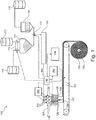
- Figure 1 illustrates a device 100 according to an exemplary embodiment of the invention for manufacturing nonwoven cellulose fiber fabric 102 which is directly formed from lyocell spinning solution 104.
- the latter is at least partly coagulated by a coagulation fluid 106 to be converted into partly-formed cellulose fibers 108.
- a lyocell solution blowing process according to an exemplary embodiment of the invention may be carried out.
- the term "lyocell solution-blowing process” may particularly encompass processes which can result in essentially endless filaments or fibers 108 of a discrete length or mixtures of endless filaments and fibers of discrete length being obtained.
- nozzles each having an orifice 126 are provided through which cellulose solution or lyocell spinning solution 104 is ejected together with a gas stream or gas flow 146 for manufacturing the nonwoven cellulose fiber fabric 102 according to an exemplary embodiment of the invention.
- wood pulp 110, other cellulose-based feedstock or the like may be supplied to a storage tank 114 via a metering unit 113.
- Water from a water container 112 is also supplied to the storage tank 114 via metering unit 113.
- the metering unit 113 under control of a control unit 140 described below in further detail, may define relative amounts of water and wood pulp 110 to be supplied to the storage tank 114.
- a solvent such as N-methyl-morpholine, NMMO
- NMMO N-methyl-morpholine
- the mixing unit 119 can be controlled by the control unit 140.
- the water-wood pulp 110 medium is dissolved in the concentrated solvent in a dissolving unit 120 with adjustable relative amounts, thereby obtaining lyocell spinning solution 104.
- the aqueous lyocell spinning solution 104 can be a honey-viscous medium composed of (for instance 5 mass % to 15 mass %) cellulose comprising wood pulp 110 and (for instance 85 mass % to 95 mass %) solvent.
- the lyocell spinning solution 104 is forwarded to a fiber formation unit 124 (which may be embodied as or which may comprise a number of spinning beams or jets 122).
- the number of orifices 126 of the jets 122 may be larger than 50, in particular larger than 100.
- all orifices 126 of a fiber formation unit 124 (which may comprise a number of spinnerets or jets 122) may have the same size and/or shape.
- size and/or shape of different orifices 126 of one jet 122 and/or orifices 126 of different jets 122 (which may be arranged serially for forming a multilayer fabric) may be different.
- the lyocell spinning solution 104 passes through the orifices 126 of the jets 122, it is divided into a plurality of parallel strands of lyocell spinning solution 104.
- a vertically oriented gas flow i.e. being oriented substantially parallel to spinning direction, forces the lyocell spinning solution 104 to transform into increasingly long and thin strands which can be adjusted by changing the process conditions under control of control unit 140.
- the gas flow may accelerate the lyocell spinning solution 104 along at least a part of its way from the orifices 126 to a fiber support unit 132.
- the coagulation fluid 106 is advantageously embodied as a vapor mist, for instance an aqueous mist.
- Process relevant properties of the coagulation fluid 106 are controlled by one or more coagulation units 128, providing the coagulation fluid 106 with adjustable properties.
- the coagulation units 128 are controlled, in turn, by control unit 140.
- respective coagulation units 128 are provided between the individual nozzles or orifices 126 for individually adjusting properties of respective layers of fabric 102 being produced.
- each jet 122 may have two assigned coagulation units 128, one from each side.
- the individual jets 122 can thus be provided with individual portions of lyocell spinning solution 104 which may also be adjusted to have different controllable properties of different layers of manufactured fabric 102.
- the solvent concentration of the lyocell spinning solution 104 is reduced, so that the cellulose of the former e.g. wood pulp 110 (or other feedstock) is at least partly coagulated as long and thin cellulose fibers 108 (which may still contain residual solvent and water).
- the cellulose fibers 108 are deposited on fiber support unit 132, which is here embodied as a conveyor belt with a planar fiber accommodation surface.
- the cellulose fibers 108 form a nonwoven cellulose fiber fabric 102 (illustrated only schematically in Figure 1 ).
- the nonwoven cellulose fiber fabric 102 is composed of continuous and substantially endless filaments or fibers 108.
- the solvent of the lyocell spinning solution 104 removed in coagulation by the coagulation unit 128 and in washing in a washing unit 180 can be at least partially recycled.
- the nonwoven cellulose fiber fabric 102 can be washed by washing unit 180 supplying wash liquor to remove residual solvent and may then be dried. It can be further processed by an optional but advantageous further processing unit 134.
- a further processing may involve hydro-entanglement, needle punching, impregnation, steam treatment with a pressurized steam, calendering, etc.
- the fiber support unit 132 may also transport the nonwoven cellulose fiber fabric 102 to a winder 136 on which the nonwoven cellulose fiber fabric 102 may be collected as a substantially endless sheet.
- the nonwoven cellulose fiber fabric 102 may then be shipped as roll-good to an entity manufacturing products such as wipes or textiles based on the nonwoven cellulose fiber fabric 102.
- control unit 140 such as a processor, part of a processor, or a plurality of processors.
- the control unit 140 is configured for controlling operation of the various units shown in Figure 1 , in particular one or more of the metering unit 113, the mixing unit 119, the fiber formation unit 124, the coagulation unit(s) 128, the further processing unit 134, the dissolution unit 120, the washing unit 118, etc.
- the control unit 140 (for instance by executing computer executable program code, and/or by executing control commands defined by a user) may precisely and flexibly define the process parameters according to which the nonwoven cellulose fiber fabric 102 is manufactured.
- Design parameters in this context are air flow along the orifices 126, properties of the coagulation fluid 106, drive speed of the fiber support unit 132, composition, temperature and/or pressure of the lyocell spinning solution 104, etc. Additional design parameters which may be adjusted for adjusting the properties of the nonwoven cellulose fiber fabric 102 are number and/or mutual distance and/or geometric arrangement of the orifices 126, chemical composition and degree of concentration of the lyocell spinning solution 104, etc. Thereby, the properties of the nonwoven cellulose fiber fabric 102 may be properly adjusted, as described below.
- Such adjustable properties may involve one or more of the following properties: diameter and/or diameter distribution of the fibers 108, amount and/or regions of merging between fibers 108, a purity level of the fibers 108, properties of a multilayer fabric 102, optical properties of the fabric 102, fluid retention and/or fluid release properties of the fabric 102, mechanical stability of the fabric 102, smoothness of a surface of the fabric 102, cross-sectional shape of the fibers 108, etc.
- each spinning jet 122 may comprise a polymer solution inlet via which the lyocell spinning solution 104 is supplied to the jet 122. Via an air inlet, a gas flow 146 can be applied to the lyocell spinning solution 104.
- the lyocell spinning solution 104 moves or is accelerated (by the gas flow 146 pulling the lyocell spinning solution 104 downwardly) downwardly through a respective orifice 126 and is laterally narrowed under the influence of the gas flow 146 so that continuously tapering cellulose filaments or cellulose fibers 108 are formed when the lyocell spinning solution 104 moves downwardly together with the gas flow 146 in the environment of the coagulation fluid 106.
- processes involved in the manufacturing method described by reference to Figure 1 may include that the lyocell spinning solution 104, which may also be denoted as cellulose solution is shaped to form liquid strands or latent filaments, which are drawn by the gas flow 146 and significantly decreased in diameter and increased in length. Partial coagulation of latent filaments or fibers 108 (or preforms thereof) by coagulation fluid 106 prior to or during web formation on the fiber support unit 132 may also be involved.
- the filaments or fibers 108 are formed into web like fabric 102, washed, dried and may be further processed (see further processing unit 134), as required.
- the filaments or fibers 108 may for instance be collected, for example on a rotating drum or belt, whereby a web is formed.
- the fibers 108 have a copper content of less than 5 ppm and have a nickel content of less than 2 ppm. This advantageously improves purity of the fabric 102.
- the lyocell solution blown web i.e. the nonwoven cellulose fiber fabric 102
- the lyocell solution blown web preferably exhibits one or more of the following properties:
- the lyocell solution-blown web exhibits all of said properties (i) to (viii) mentioned above.
- the process to produce the nonwoven cellulose fiber fabric 102 preferably comprises:
- Constituents of the nonwoven cellulose fiber fabric 102 may be bonded by merging, intermingling, hydrogen bonding, physical bonding such as hydroentanglement or needle punching, and/or chemical bonding.
- the nonwoven cellulose fiber fabric 102 may be combined with one or more layers of the same and/or other materials, such as (not shown) layers of synthetic polymers, cellulosic fluff pulp, nonwoven webs of cellulose or synthetic polymer fibers, bicomponent fibers, webs of cellulose pulp, such as airlaid or wetlaid pulp, webs or fabrics of high tenacity fibers, hydrophobic materials, high performance fibers (such as temperature resistant materials or flame retardant materials), layers imparting changed mechanical properties to the final products (such as Polypropylene or Polyester layers), biodegradable materials (e.g. films, fibers or webs from Polylactic acid), and/or high bulk materials.
- layers of synthetic polymers such as cellulosic fluff pulp, nonwoven webs of cellulose or synthetic polymer fibers, bicomponent fibers, webs of cellulose pulp, such as airlaid or wetlaid pulp, webs or fabrics of high tenacity fibers, hydrophobic materials, high performance fibers (such as
- nonwoven cellulose fiber fabric 102 It is also possible to combine several distinguishable layers of nonwoven cellulose fiber fabric 102, see for instance Figure 7 .
- the nonwoven cellulose fiber fabric 102 may essentially consist of cellulose alone. Alternatively, the nonwoven cellulose fiber fabric 102 may comprise a mixture of cellulose and one or more other fiber materials. The nonwoven cellulose fiber fabric 102, furthermore, may comprise a bicomponent fiber material. The fiber material in the nonwoven cellulose fiber fabric 102 may at least partly comprise a modifying substance.
- the modifying substance may be selected from, for example, the group consisting of a polymeric resin, an inorganic resin, inorganic pigments, antibacterial products, nanoparticles, lotions, fire-retardant products, absorbency-improving additives, such as superabsorbent resins, ion-exchange resins, carbon compounds such as active carbon, graphite, carbon for electrical conductivity, X-ray contrast substances, luminescent pigments, and dye stuffs.
- a polymeric resin an inorganic resin, inorganic pigments, antibacterial products, nanoparticles, lotions, fire-retardant products, absorbency-improving additives, such as superabsorbent resins, ion-exchange resins, carbon compounds such as active carbon, graphite, carbon for electrical conductivity, X-ray contrast substances, luminescent pigments, and dye stuffs.
- the cellulose nonwoven web or nonwoven cellulose fiber fabric 102 manufactured directly from the lyocell spinning solution 104 allows access to value added web performance which is not possible via staple fiber route. This includes the possibility to form uniform lightweight webs, to manufacture microfiber products, and to manufacture continuous filaments or fibers 108 forming a web. Moreover, compared to webs from staple fibers, several manufacturing procedures are no longer required.
- nonwoven cellulose fiber fabric 102 according to exemplary embodiments of the invention is biodegradable and manufactured from sustainably sourced raw material (i.e. wood pulp 110 or the like). Furthermore, it has advantages in terms of purity and absorbency. Beyond this, it has an adjustable mechanical strength, stiffness and softness.
- nonwoven cellulose fiber fabric 102 may be manufactured with low weight per area (for instance 10 to 30 g/m 2 ). Very fine filaments down to a diameter of not more than 5 ⁇ m, in particular not more than 3 ⁇ m, can be manufactured with this technology. Furthermore, nonwoven cellulose fiber fabric 102 according to an exemplary embodiment of the invention may be formed with a wide range of web aesthetics, for instance in a flat crispy film-like way, in a paper-like way, or in a soft flexible textile-like way. By adapting the process parameters of the described process, it is furthermore possible to precisely adjust stiffness and mechanical rigidity or flexibility and softness of the nonwoven cellulose fiber fabric 102.
- Figure 2 Figure 3 and Figure 4 show experimentally captured images of nonwoven cellulose fiber fabric 102 according to an exemplary embodiment of the invention in which merging of individual fibers 108 has been accomplished by a corresponding process control.
- the oval markers in Figure 2 to Figure 4 show such merging regions where multiple fibers 108 are integrally connected to one another. At such merging points, two or more fibers 108 may be interconnected to form an integral structure.
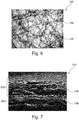
- Figure 5 and Figure 6 show experimentally captured images of nonwoven cellulose fiber fabric 102 according to an exemplary embodiment of the invention in which swelling of fibers 108 has been accomplished, wherein Figure 5 shows the fiber fabric 102 in a dry non-swollen state and Figure 6 shows the fiber fabric 102 in a humid swollen state.
- the pore diameters can be measured in both states of Figure 5 and Figure 6 and can be compared to one another. When calculating an average value of 30 measurements, a decrease of the pore size by swelling of the fibers 108 in an aqueous medium up to 47% of their initial diameter could be determined.
- Figure 7 shows an experimentally captured image of nonwoven cellulose fiber fabric 102 according to an exemplary embodiment of the invention in which formation of two superposed layers 200, 202 of fibers 108 has been accomplished by a corresponding process design, i.e. a serial arrangement of multiple spinnerets.
- the two separate, but connected layers 200, 202 are indicated by a horizontal line in Figure 7 .
- an n-layer fabric 102 (n ⁇ 2) can be manufactured by serially arranging n spinnerets or jets 122 along the machine direction.
- Figure 8 shows a schematic drawing which will be used for explaining that a defined bending of fibers 108 can be promoted when adjusting roundness of a cross-section of the fiber 108 to deviate from a circular cross-section.
- a fiber 108 is shown in Figure 8 in a straight force free state (upper illustration) and in a state where the fiber 108 undergoes bending (lower illustration).
- the fiber 108 has a perfect circular cylindrical cross-section, even an extremely small bending force may initiate bending of the fiber 108 along a non-predictable bending axis.
- it is impossible to predict or define a direction, along which a bunch of fibers 108 with perfect circular cylindrical cross-section will undergo bending.
- the fiber 108 is provided with a roundness deviating significantly from the value of one (i.e.
- a cross-section of the fiber 108 deviates from a perfect circle, for instance being shaped as an oval (in particular elliptic)), a preferred bending axis is thereby defined along which the bending is enabled in a simpler way (or by smaller forces) than in a direction perpendicular thereto.
- bending of a fiber 108 with oval-elliptic cross-section will be possible with smaller forces with the shorter minor axis as bending line as compared to the longer major axis as bending line.
- designing fibers 108 of such a fabric 102 with a circular cross-section allows to predictably define preferred bending axes of the fibers 108.
- the filaments of lyocell spinning solution 104 are laid down on a fiber support unit 132 for forming fibers 108 by coagulation, they will be aligned with a certain degree of order along the fiber accommodating surface of the fiber support unit 132 in a predictable manner and not merely statistical.
- the mechanical properties of the fabric 102 may be precisely defined by defining the cross-section of the fibers 108 to deviate from a circular symmetric geometry.
- predictability may be introduced in the nonwoven cellulose fiber fabric 102 as a consequence of the definition of the pronounced non-circular roundness of the fibers 108.
- Concluding, by adjusting a deviation of at least some of the fibers 108 of a nonwoven cellulose fiber fabric 102 according to an exemplary embodiment of the invention from a cylindrical geometry by a corresponding adjustment of the manufacturing process allows to precisely define the mechanical properties of the fabric 102, in particular allows to obtain a fabric 102 having a high mechanical robustness.
- Figure 9 shows an experimentally captured image of nonwoven cellulose fiber fabric 102 according to an exemplary embodiment of the invention illustrating fibers 102 having a cross-sectional shape deviating from a circular shape.
- At least 10% of the fibers 108 has a non-circular cross sectional shape having a roundness of not more than 50% along at least a portion of the fiber's 108 longitudinal extension.
- some degree of regularity may be defined in the fabric 102. This allows to fine-tune the mechanical properties of the obtained fabric 102.
- the smoothness of the fabric 102 measured with a "Handle-O-Meter" on the basis of the nonwoven standard WSP90.3 may be freely adjusted within a broad range between 2 mNm 2 /g and 70 mNm 2 /g, since a desired mechanical robustness can be precisely defined already by the non-circular roundness design of at least some of the fibers 108.
- the fibers 108 have only a very small copper content of less than 5 ppm and have only a very small nickel content of less than 2 ppm. Therefore, the fabric 102 can be manufactured with a very small contamination of heavy metals, which ensures biocompatibility of the fabric 102 and prevents allergic reactions when the fabric 102 comes into physical contact with a human skin.
- Figure 10 shows an experimentally captured image of nonwoven cellulose fiber fabric 102 according to an exemplary embodiment of the invention in which fibers 108 having a cross-sectional shape deviating from a circular shape are partially twisted.
- some of the fibers 108 are twisted. Consequently, these fibers 108 form a somewhat helical structure along at least a part of their longitudinal extension.
- Such a fiber twisting provides the obtained nonwoven cellulose fiber fabric 102 with a mechanical robustness while at the same time allowing some elastic adjustment of the fabric 100.
- the combination of fibers 108 having a roundness deviating from one, being twisted and being merged with one another at merging positions 204 provides the fabric 102 with some degree of flexibility.
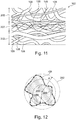
- Figure 11 shows an experimentally captured image of nonwoven cellulose fiber fabric 102 according to another exemplary embodiment of the invention composed of three stacked layers 202, 200, 200 with different diameters of fibers 108.
- an intermediate sandwich layer 200 has significantly smaller diameters of fibers 108 than the two exterior layers 200, 202 above and below.
- the multilayer fabric 102 shown in Figure 11 is particularly appropriate for applications such as medical applications, agricultural textiles, etc.
- an active substance may be stored in the inner layer 200 showing a high capillary action.
- the exterior layers 200, 202 may be designed in terms of rigidity and surface haptic. This is advantageous for cleaning and medical applications.
- the fiber layer design may be specifically configured in terms of evaporation properties and/or root penetration.
- the multilayer fabric 102 shown in Figure 11 may be used as facial mask, wherein the central layer 200 may have a specifically pronounced fluid retaining capability.
- the cover layers 200, 202 may be configured for adjusting fluid release properties.
- the diameters of the fibers 108 of the respective layer 200, 200, 202 may be used as a design parameter for adjusting these functions.
- the fibers 108 shown in Figure 11 are located in three different distinguishable layers 200, 202. Fibers 108 of different layers 200, 202 are integrally merged at merging positions 204 between the layers 200, 202. Moreover, at least some of the fibers 108 are provided with a non-circular cross-section having a roundness of not more than 90% which provides some degree of order in the respective layer 200, 202 and reinforces the fabric 102.
- Figure 12 shows how a value of roundness of fibers 108 having a cross-section deviating from a circular cross-section can be calculated as the ratio between the radii of an inscribed circle 280 and a circumscribed circle 282 of the cross-section of the fiber 108 according to an exemplary embodiment of the invention.
- the minimum circumscribed circle 282 is defined as the smallest circle which encloses whole of the roundness profile of the cross-section of the fiber 108 illustrated in Figure 12 .
- the maximum inscribed circle 280 is defined as the largest circle that can be inscribed inside the roundness profile of the cross-section of the fiber 108 illustrated in Figure 12 .
- roundness can be defined as a ratio between a radius r of the inscribed circle 280 divided by a radius R of the circumscribed surface 282. Roundness may be indicated by a resulting percentage value. In the present example, R ⁇ 2r and the roundness of the fiber 108 is therefore approximately 0.5 or 50%.
- Figure 13 illustrates a part of a device 100 for manufacturing nonwoven cellulose fiber fabric 102 composed of two stacked layers 200, 202 of endless cellulose fibers 108 according to an exemplary embodiment of the invention.
- the upstream jet 122 on the left-hand side of Figure 13 produces layer 202 of fibers 108.
- Layer 200 of other fibers 108 is produced by the downstream jet 122 (on the right hand side of Figure 13 ) and is attached to an upper main surface of the previously formed layer 202 so that a double layer 200, 202 of fabric 102 is obtained.
- control unit 140 (controlling the jets 122 and the coagulation units 128) is configured for adjusting process parameters so that at least part of the fibers 108 are integrally merged at merging positions 204 between layers 200, 202.
- one or more further nozzle bars or jets 122 may be provided and may be arranged serially along a transport direction of fiber support unit 132.
- the multiple jets 122 may be arranged so that further layer 200 of fibers 108 may be deposited on top of the previously formed layer 202, preferably before the coagulation or curing process of the fibers 108 of the layer 202 and/or of the layer 200 is fully completed, which may trigger merging.
- this may have advantageous effects in terms of the properties of a multilayer fabric 102:
- the device 100 according to Figure 13 which is configured for the manufacture of multilayer fabric 102, implements a high number of process parameters which can be used for adjusting merging factor, designing shape and/or diameter or diameter distribution of the fibers 108 as well as of fiber layers 200, 202.
- This is the result of the serial arrangement of multiple jets 122, each of which being operable with individually adjustable process parameters.
- orifices 126 of the multiple jets 122 are shaped differently and in a non-circular way, it is also possible to form a fabric 102 of fibers 108 which have a cross section deviating from a circle.
- Such fibers 108 may be oval, elliptic oblong, rectangular, triangular, polygonal, with sharp and/or round edges, etc.
- both intra-layer adhesion of the fibers 108 of one layer 200, 202 as well as inter-layer adhesion of the fibers 108 between adjacent layers 200, 202 may be properly and individually adjusted.
- a corresponding separate control for each layer 200, 202 individually may be in particular obtained when the process parameters are adjusted so that coagulation or curing of the fibers 108 of one layer 202 is already completed when the other layer 200 of fibers 108 is placed on top thereof.
- adjusting the process parameters for adjusting merging comprises serially arranging multiple jets 122 with orifices 126 along a movable fiber support unit 132, depositing first layer 202 of fibers 108 on the fiber support unit 132, and depositing second layer 200 of fibers 108 on the first layer 202 before coagulation of some or all of the fibers 108 at an interface between the layers 200, 202 has been completed.
- different ones of the fibers 108 of the fabric 102 may be located in different distinguishable layers 200, 202 which can however be merged by forming merging positions 204.
- fibers 108 of different layers 200, 202 may be integrally merged at one or more merging position 204 between the layers 200, 202.
- Figure 14 illustrates a part of a device 100 for manufacturing nonwoven cellulose fiber fabric 102 according to yet another exemplary embodiment of the invention in which the process is controlled by a control unit 140 so as to trigger formation of fibers 108 having a roundness deviating from a circular roundness by exerting a lateral force to the fibers 108 during coagulation.
- a spinning solution deformation unit 270 is provided in the device 100 which is configured for exerting a deforming force to filaments of the lyocell spinning solution 104 before the coagulation is completed.
- a deforming force may deform the filaments from a circular cross section into a non-circular cross section.
- the solution deformation force is exerted by directing a flow of shaping fluid 272 to the filaments of the lyocell spinning solution 104 before the coagulation is completed.
- the shaping fluid 272 can be a gas flow and/or a liquid flow being directed from the spinning solution deformation unit 272 to the filaments of lyocell spinning solution 104 before the fibers 108 are precipitated therefrom.
- the pressure applied by the shaping fluid 272 to the filaments of lyocell spinning solution 104 deforms the filaments from a for instance substantially circular cross-sectional shape into an elliptic or flat shape, as shown in detail 274.
- the pressure applied by the shaping fluid 272 to the filaments of lyocell spinning solution 104 is maintained until coagulation or precipitation is completed, the fibers 108 will be automatically formed in a corresponding shape with non-circular cross-section.
- the application of shaping pressure may be synergistically combined with the precipitation of coagulation of the fibers 108 from the lyocell spinning solution 104 triggered at least partially by the then aqueous shaping fluid 272.
- Figure 15 illustrates a part of a device 100 for manufacturing nonwoven cellulose fiber fabric 102 according to still another exemplary embodiment of the invention having orifices 126 being shaped to form fibers 108 having a roundness deviating from a circular roundness.
- the orifices 126 of the jets 122 of Figure 15 are provided with a non-circular shape.
- alternating rows of elliptical orifices 126 are foreseen having the respective major axis either oriented along a common align axis 236 (i.e. the horizontal direction according to Figure 15 , compare the odd rows of orifices 126) or oriented along parallel align axes 238 (i.e. the vertical direction according to Figure 15 , compare the even rows of orifices 126).
- a person skilled in the art will clearly understand that the shown patterns of orifices 126 are only exemplary, and many other patterns of non-circular orifices 126 can be implemented according to other exemplary embodiments of the invention.
- Figure 16 shows a schematic illustration of nonwoven cellulose fiber fabric 102 according to an exemplary embodiment of the invention illustrating fibers 108 having a cross-sectional shape deviating from a circular shape so that, as a result, the fibers 108 are arranged or aligned on the average along or around a preferential direction 290.
- the fibers 108 are aligned anisotropically within the fabric 102 to thereby define, on the average, one preferential alignment direction 290 along which a larger portion of fibers 108 is aligned compared to other directions.
- FIG 16 several fibers 108 of the fabric 102 are shown which all have a non-circular elliptic cross-section.
- the fibers 108 preferably bend around alignment direction 290 when being deposited on the fiber support unit 132.
- some of the fibers 108 are merged at merging positions 204 prior to coagulation, whereas other fibers 108 cross each other at crossing position 264 without being merged, i.e. experiencing only a mutual friction force.
- a nonwoven cellulose fiber fabric 102 having non-round endless fibers 108 allows to increase both rigidity and homogeneity.
- a predictable preferred lay down direction of the fibers 108 may be defined by configuring at least part of the fibers 108 with a non-circular cross-section.
- a corresponding increase of at least one of homogeneity and rigidity may be obtained by manufacturing at least a part of the fibers 108 with a sufficiently small roundness. This is particularly powerful for increasing stability of the fabric 102 when at the same time merging between at least part of the fibers 108 is triggered.
- a functionalization of the fabric 102 with regard to a specific application becomes possible.
- this makes it possible to design a fabric 102 with a higher mechanical robustness at a given grammage or to obtain a lower grammage at a given mechanical robustness.
- Such a reinforced mechanical stability may be obtained in one or both perpendicular directions in a plane of the fabric 102 corresponding to a fiber accommodation plane of the fiber support unit 132.
- such a fabric 102 according to an exemplary embodiment of the invention may be manufactured in accordance with a lyocell spinning solution architecture, so that a very low contamination of the obtained fabric 102 with heavy metal impurities may be guaranteed. Consequently, the obtained nonwoven cellulose fiber fabric 102 has a very high degree of purity so that the obtained fabric 102 or products manufactured on the basis thereof are not prone of causing allergic reactions of a user.
- one or more nozzle bars or jets 122 for creating filaments of lyocell spinning solution 104 are implemented, wherein these filaments are then stretched, swirled and laid down on a fiber accommodation surface of a fiber support unit 132.
- the formation of merging positions 204 between two or more fibers 108 may be triggered or promoted by air vorticity or turbulence during this stretching process and/or when the filaments of not yet coagulated lyocell spinning solution 104 are laid down on the fiber support unit 132.
- Such merging processes can occur at different points of time during coagulation of the chemical process of formation of endless fibers 108. They may also be adjusted with varying intensity and can be promoted using different media (such as water or air). By a corresponding adjustment, coagulation and/or shaping of the filaments may be controlled, as well as an adhesion at the mentioned contact or merging positions 204. As a result, a large variety of merging effects can be adjusted: on the one hand it is possible to form a fabric 102 with a very low tendency of adhesion of merging; on the other hand, it is possible to control the process so that extremely strong merging is obtained so that the fibers 108 lose their shape and tend to assume an areal film like structure.
- fibers 108 may be overcome by exemplary embodiments of the invention by configuring at least part of the fibers 108 with a non-circular cross-section in accordance with a roundness value of 90% or lower, as described above referring to Figure 8 .
- a fiber 108 deviates to a sufficient degree from a circular cylindrical cross-section one or more predominant lay down directions for the fibers 108 or for correspondingly designed and oriented groups of fibers 108 may be defined, thereby increasing homogeneity and predictability of the characteristics of the fabric 102.
- an elliptic fiber 108 will preferably bend down or kink in the direction of the smaller cross-sectional dimension (i.e. along the minor axis of the ellipse).
- a control of the cross-sectional shape of the manufactured fibers 108 deviating from a circular shape allows to define one or more preferred alignment directions of the fibers 108 in the fabric 102.
- fibers 108 with roundness below 90%, preferably below 50%, it is for instance possible to blow air or to produce a water jet exerting a pressure on not yet coagulated preforms of the fibers 108. It is also possible to apply such a pressure onto two opposing surfaces of the preforms of the fibers 108 for flattening the latter. For instance, when the pressure is applied from 0° and 180° directions, a preferred flattening or ovalization of the fibers 108 occurs along a 90°-270°-axis.
- orifices 126 of the jet 122 having an oval (or more generally non-circular) nozzle cross-section.
- one or more further nozzle bars or jets 122 may be provided and may be arranged serially along a transport direction of fiber support unit 132.
- the multiple jets 122 may be arranged so that further layer 200 of fibers 108 may be deposited on top of the previously formed layer 202, preferably before the coagulation or curing process of the fibers 108 of the layer 202 and/or of the layer 200 is fully completed, which may trigger inter-layer merging.
- this may have advantageous effects in terms of the properties of a multilayer fabric 102:
- merging may be a supported contact point adhesion of contacting filaments of fibers 108, in particular prior to the completion of a coagulation process of one or both of the fibers 108 being merged.
- merging may be promoted by increasing a contact pressure by a fluid flow (for instance a flow of air or water).
- a fluid flow for instance a flow of air or water.
- the device 100 according to Figure 13 which is configured for the manufacture of multilayer fabric 102, implements a high number of process parameters which can be used for designing shape and/or diameter or diameter distribution of the fibers 108 as well as of fiber layers 200, 202. This is the result of the serial arrangement of multiple jets 122, each of which being operable with individually adjustable process parameters.
- the high mechanical robustness of the fabric 102 also results from the following properties of the described manufacturing process: Firstly, the use of endless fibers 108 made of cellulose material, since endless fibers 108 (in comparison to staple fibers) has less disturbing transitions so that an individual fiber 108 has a higher loading capacity. Secondly, such fibers 108 may be manufactured highly pure, since the process related heavy metal content of a corresponding fabric 102 is very small. Thirdly, a specific design of carrier grid, supports web or other carrier structures (web support system) which may be implemented in a spunlace manufacturing method allows the control of the rigidity of the fabric 102. In particular, the stability of the fabric 102 may be significantly increased by (for instance air and/or water induced) merging, allowing to obtain bionic like structures with a high load capability.
- twisted fibers 108 may be formed which may have an increased stretchability by a corresponding spring effect.
- elasticity of the fabric 102 comprising twisted fibers 108 can be limited. This can be used to further increase the stability of the fabric 102. In particular upon bending of a fiber 108, it has the effect that elasticity is reduced with increased bending radius.
- appropriate airflow vorticity or turbulences it is possible to design fabric 102 of twisted fibers 108 with further increased stability.
- oval fibers 108 or filaments come to rest preferably on their broadside. This has a strong impact on the properties of the manufactured fabric 102, because this involves an ordering effect. In particular, this allows to manufacture a fabric 102 having a relatively small thickness and a relatively high density.
- the fabric 102 is composed of both circular fibers 108 and non-circular fibers 108.
- a corresponding fabric 102 can be manufactured by using mixed jets 122 with circular and non-circular orifices 126 and/or by a permanent, cyclic or repeated modification of the process parameters.
- serially arranged jets 122 may be implemented for manufacturing fabric 102.
- Each of the jets 122 may comprise multiple orifices 126.
- Each of the jets 122 may selectively have circular and/or non-circular orifices 126.
- the nonwoven cellulose fiber fabric 102 is used for a biodegradable product. After biodegradation, no binder material or adhesive material remains. In particular, no significant amount of heavy metals forms part of such a biodegradable product. Undesired abrasion of microparticles from the fabric 102 may be prevented by a corresponding design of the process.
- a defined deviation from a circular cross-section of an endless fiber 108 can be obtained in such a manner that the cross-sectional shape changes along the longitudinal extension of such a fiber 108.
- This can also be accomplished by bending a fiber 108 beyond its elastic limit, so that a transition from an elastic bending regime to a plastic bending regime occurs.
- This effect can be reinforced by a subsequent fixing of the bent fibers 108 (for instance by hydroentangling).
- this has the consequence that at certain loop or eyelet structures through which another endless fiber 108 is guided during tearing the diameter does not fit any longer and self-inhibition results already at small shape changes.
- This increases the tearing robustness of the fabric 102 as a whole. This is relevant in particular in terms of the implementation of endless fibers 108 in which this self-inhibiting effect promoted by a deviation of the roundness from one is stronger than with shorter staple fibers.
- a deviation of a cross-section of fibers 108 from a circular cross-section may be combined with a fiber diameter variation (in particular an intra -fiber thickness variation and/or an inter -fiber thickness variation). This combination allows to obtain a specifically pronounced increase of the mechanical stability of the fabric 102.
Landscapes
- Engineering & Computer Science (AREA)
- Textile Engineering (AREA)
- Nonwoven Fabrics (AREA)
- Treatments For Attaching Organic Compounds To Fibrous Goods (AREA)
- Chemical Or Physical Treatment Of Fibers (AREA)
- Materials For Medical Uses (AREA)
Abstract
A nonwoven cellulose fiber fabric (102), in particular directly manufactured from lyocell spinning solution (104), wherein the fabric (102) comprises a network of substantially endless fibers (108), and wherein at least 1% of the fibers (108) has a non-circular cross sectional shape having a roundness of not more than 90%.
Description
- The invention relates to a nonwoven cellulose fiber fabric, a method of manufacturing a nonwoven cellulose fiber fabric, a device for manufacturing a nonwoven cellulose fiber fabric, a product or composite, and a method of use.
- Lyocell technology relates to the direct dissolution of cellulose wood pulp or other cellulose-based feedstock in a polar solvent (for example n-methyl morpholine n-oxide, which may also be denoted as "amine oxide" or "AO") to produce a viscous highly shear-thinning solution which can be transformed into a range of useful cellulose-based materials. Commercially, the technology is used to produce a family of cellulose staple fibers (commercially available from Lenzing AG, Lenzing, Austria under the trademark TENCEL®) which are widely used in the textile industry. Other cellulose products from lyocell technology have also been used.
- Cellulose staple fibers have long been used as a component for conversion to nonwoven webs. However, adaption of lyocell technology to produce nonwoven webs directly would access properties and performance not possible for current cellulose web products. This could be considered as the cellulosic version of the meltblow and spunbond technologies widely used in the synthetic fiber industry, although it is not possible to directly adapt synthetic polymer technology to lyocell due to important technical differences.
- Much research has been carried out to develop technology to directly form cellulose webs from lyocell solutions (inter alia,
WO 98/26122 WO 99/47733 WO 98/07911 US 6,197,230 ,WO 99/64649 WO 05/106085 EP 1 358 369 ,EP 2 013 390 ). Further art is disclosed inWO 07/124521 A1 WO 07/124522 A1 - It is an object of the invention to provide a cellulose-based fabric having an adjustable mechanical stability.
- In order to achieve the object defined above, a nonwoven cellulose fiber fabric, a method of manufacturing a nonwoven cellulose fiber fabric, a device for manufacturing a nonwoven cellulose fiber fabric, a product or composite, and a method of use according to the independent claims are provided.
- According to an exemplary embodiment of the invention, a (in particular solution-blown) nonwoven cellulose fiber fabric is provided (which is in particular directly (in particular in an in situ process or in a continuous process executable in a continuously operating production line) manufactured from lyocell spinning solution), and wherein at least 1% of the fibers has a non-circular cross sectional shape (in particular along an entire fiber's longitudinal extension or only along a portion of the fiber's longitudinal extension) having a roundness of not more than 90%.
- According to another exemplary embodiment, a method of manufacturing (in particular solution-blown) nonwoven cellulose fiber fabric directly from lyocell spinning solution is provided, wherein the method comprises extruding the lyocell spinning solution through orifices (which may be embodied as or which may form part of a spinneret or an extrusion unit) supported by a gas flow into a coagulation fluid atmosphere (in particular an atmosphere of dispersed coagulation fluid) to thereby form substantially endless fibers, collecting the fibers on a fiber support unit to thereby form the fabric, and adjusting process parameters so that at least 1% of the fibers has a non-circular cross sectional shape having a roundness of not more than 90%.
- According to a further exemplary embodiment, a device for manufacturing (in particular solution-blown) nonwoven cellulose fiber fabric directly from lyocell spinning solution is provided, wherein the device comprises a jet with orifices configured for extruding the lyocell spinning solution supported by a gas flow, a coagulation unit configured for providing a coagulation fluid atmosphere for the extruded lyocell spinning solution to thereby form substantially endless fibers, a fiber support unit configured for collecting the fibers to thereby form the fabric, and a control unit (such as a processor configured for executing program code for manufacturing the nonwoven cellulose fiber fabric directly from the lyocell spinning solution) configured for adjusting process parameters so that at least 1% of the fibers has a non-circular cross sectional shape having a roundness of not more than 90%.
- According to yet another embodiment, a nonwoven cellulose fiber fabric having the above-mentioned properties is used for at least one of the group consisting of a wipe, a filter, an absorbent hygiene product, a medical application product, a geotextile, agrotextile, clothing, a product for building technology, an automotive product, a furnishing, an industrial product, a product related to beauty, leisure, sports or travel, and a product related to school or office.
- According to still another exemplary embodiment, a product or composite is provided which comprises a fabric having the above mentioned properties.
- In the context of this application, the term "nonwoven cellulose fiber fabric" (which may also be denoted as nonwoven cellulose filament fabric) may particularly denote a fabric or web composed of a plurality of substantially endless fibers. The term "substantially endless fibers" has in particular the meaning of filament fibers having a significantly longer length than conventional staple fibers. In an alternative formulation, the term "substantially endless fibers" may in particular have the meaning of a web formed of filament fibers having a significantly smaller amount of fiber ends per volume than conventional staple fibers. In particular, endless fibers of a fabric according to an exemplary embodiment of the invention may have an amount of fiber ends per volume of less than 10,000 ends/cm3, in particular less than 5,000 ends/cm3. For instance, when staple fibers are used as a substitute for cotton, they may have a length of 38 mm (corresponding to a typical natural length of cotton fibers). In contrast to this, substantially endless fibers of the nonwoven cellulose fiber fabric may have a length of at least 200 mm, in particular at least 1000 mm. However, a person skilled in the art will be aware of the fact that even endless cellulose fibers may have interruptions, which may be formed by processes during and/or after fiber formation. As a consequence, a nonwoven cellulose fiber fabric made of substantially endless cellulose fibers has a significantly lower number of fibers per mass compared to nonwoven fabric made from staple fibers of the same denier. A nonwoven cellulose fiber fabric may be manufactured by spinning a plurality of fibers and by attenuating and stretching the latter towards a preferably moving fiber support unit. Thereby, a three-dimensional network or web of cellulose fibers is formed, constituting the nonwoven cellulose fiber fabric. The fabric may be made of cellulose as main or only constituent.
- In the context of this application, the term "lyocell spinning solution" may particularly denote a solvent (for example a polar solution of a material such as N-methyl-morpholine, NMMO, "amine oxide" or "AO") in which cellulose (for instance wood pulp or other cellulose-based feedstock) is dissolved. The lyocell spinning solution is a solution rather than a melt. Cellulose filaments may be generated from the lyocell spinning solution by reducing the concentration of the solvent, for instance by contacting said filaments with water. The process of initial generation of cellulose fibers from a lyocell spinning solution can be described as coagulation.
- In the context of this application, the term "gas flow" may particularly denote a flow of gas such as air substantially parallel to the moving direction of the cellulose fiber or its preform (i.e. lyocell spinning solution) while and/or after the lyocell spinning solution leaves or has left the spinneret.
- In the context of this application, the term "coagulation fluid" may particularly denote a non-solvent fluid (i.e. a gas and/or a liquid, optionally including solid particles) which has the capability of diluting the lyocell spinning solution and exchanging with the solvent to such an extent that the cellulose fibers are formed from the lyocell filaments. For instance, such a coagulation fluid may be water mist.
- In the context of this application, the term "process parameters" may particularly denote all physical parameters and/or chemical parameters and/or device parameters of substances and/or device components used for manufacturing nonwoven cellulose fiber fabric which may have an impact on the properties of the fibers and/or the fabric, in particular on fiber diameter and/or fiber diameter distribution. Such process parameters may be adjustable automatically by a control unit and/or manually by a user to thereby tune or adjust the properties of the fibers of the nonwoven cellulose fiber fabric. Physical parameters which may have an impact on the properties of the fibers (in particular on their diameter or diameter distribution) may be temperature, pressure and/or density of the various media involved in the process (such as the lyocell spinning solution, the coagulation fluid, the gas flow, etc.). Chemical parameters may be concentration, amount, pH value of involved media (such as the lyocell spinning solution, the coagulation fluid, etc.). Device parameters may be size of and/or distances between orifices, distance between orifices and fiber support unit, speed of transportation of fiber support unit, the provision of one or more optional in situ post processing units, the gas flow, etc.
- The term "fibers" may particularly denote elongated pieces of a material comprising cellulose, for instance roughly round or non-regularly formed in cross-section, optionally twisted with other fibers. Fibers may have an aspect ratio which is larger than 10, particularly larger than 100, more particularly larger than 1000. The aspect ratio is the ratio between the length of the fiber and a diameter of the fiber. Fibers may form networks by being interconnected by merging (so that an integral multi-fiber structure is formed) or by friction (so that the fibers remain separate but are weakly mechanically coupled by a friction force exerted when mutually moving the fibers being in physical contact with one another). Fibers may have a substantially cylindrical form which may however be straight, bent, kinked, or curved. Fibers may consist of a single homogenous material (i.e. cellulose). However, the fibers may also comprise one or more additives. Liquid materials such as water or oil may be accumulated between the fibers.
- In the context of this document, a "jet with orifices" (which may for instance be denoted as an "arrangement of orifices") may be any structure comprising an arrangement of orifices which are linearly arranged.
- In the context of this application, the term "roundness" may particularly denote the ratio between the inscribed circle and the circumscribed circle of a cross section of a fiber, i.e. the maximum and minimum sizes for circles that are just sufficient to fit inside and to enclose the shape of the fiber's cross section. For determining roundness, a cross sectional plane perpendicular to an extension direction of the fiber may be intersected with the fiber. Thus, roundness may be denoted as the measure of how closely the cross sectional shape of a respective fiber approaches that of a circle having a roundness of 100%. For example, a cross-section of the respective fiber may have an oval (in particular elliptic) shape or may have a polygonal shape. More generally, a trajectory defining the exterior limits of a cross-section of a fiber may be any closed planar line showing a deviation from a circle. The cross-section of the respective fiber may be entirely round or may have one or more sharp edges.
- According to an exemplary embodiment, a nonwoven cellulose fiber fabric is provided which has substantially endless fibers showing a significant deviation from an entirely circular cylindrical shape. From a mechanical point of view, this also has the consequence that a preferred bending direction of the fibers in the presence of a mechanical load is defined by the design of the cross-section of the fiber. For instance, wherein the fiber has an elliptic cross sectional shape with two main axes (i.e. major axis and minor axis) having different lengths, bending in the presence of an exerted force will occur predominantly with the minor axis as bending line. Thus, the bending characteristics of such a fiber fabric is no longer statistical and unpredictable, but in contrast to this, increases the defined order of the nonwoven cellulose fiber fabric. Therefore, defined mechanical properties of the fabric can be adjusted in a simple way by simply influencing the cross-sectional geometry of the individual fibers. Also a mutual lay down behavior or networking behavior of the fibers may be adjusted by adjusting a deviation of some or substantially all of the fibers from a perfect circularity. Furthermore, a nonwoven cellulose fiber fabric with anisotropic mechanical properties may be manufactured when non-circular cylindrical fibers are aligned in an ordered or partially ordered way.
- In the following, further exemplary embodiments of the nonwoven cellulose fiber fabric, the method of manufacturing a nonwoven cellulose fiber fabric, the device for manufacturing a nonwoven cellulose fiber fabric, the product or composite, and the method of use are described.
- In an embodiment, at least 3%, in particular at least 5%, more particularly at least 10%, of the fibers has a non-circular cross sectional shape having a roundness of not more than 90%. Even more particularly, it is possible that at least 10%, at least 20%, at least 30%, at least 50% or at least 80% of the fibers has a non-circular cross sectional shape having a roundness of not more than 90%, not more than 80%, not more than 70%, not more than 60%, not more than 50%, or not more than 30%. The higher the amount of fibers deviating from a circular cross sectional shape, the higher is the deviation of the manufactured fiber fabric from an isotropic mechanical behavior and the more pronounced is the adjustability of the mechanical properties of the fabric.
- In an embodiment, at least 1%, at least 10%, at least 20%, at least 30%, at least 50% or at least 80% of the fibers has a non-circular cross sectional shape having a roundness of not more than 80%, in particular of not more than 70%, more particularly of not more than 50%. Even more particularly, it is possible that at least 1% of the fibers has a non-circular cross sectional shape having a roundness of not more than 60%, not more than 50%, not more than 40% or not more than 10%. The larger the amount of at least part of the fibers deviating from a circular cross sectional shape is, the higher is the deviation of the manufactured fiber fabric from an isotropic mechanical behavior and the more pronounced is the adjustability of the mechanical properties of the fabric.
- The percentage of the fibers having a non-circular cross-sectional shape with a corresponding roundness value may be adjusted for example by adjusting a number and/or shape of the orifices through which the lyocell spinning solution, which forms the fibers after coagulation, is ejected. Additionally or alternatively, the percentage of the fibers having a non-circular cross-sectional shape with a corresponding roundness value may be adjusted for example by adjusting a number of filaments of the lyocell spinning solution being subject to a mechanical impact for changing the cross-sectional shape before coagulation.
- In an embodiment, smoothness, respectively the specific hand, of the fabric measured with a "Handle-O-Meter" on the basis of the nonwoven standard WSP90.3 is in a range between 2 mNm2/g and 70 mNm2/g. By varying the process parameters of the described manufacturing method, smoothness may hence be varied over a broad range. When designing fibers with non-circular cross-section or non-circular cylindrical geometry, this may already ensure sufficient and defined stability of the fabric. The smoothness of the surface - even a very high degree of smoothness - may then be freely adjusted without any danger that stability of the fabric may suffer from this.
- The mentioned smoothness of a fabric may be measured with a "Handle-O-Meter" (as commercially available by Thwing-Albert Instrument Co., Philadelphia, PA) on the basis of the nonwoven standard WSP90.3. For determining smoothness of the fabric, a pivoting arm of the "Handle-O-Meter" is lowered and presses a sample (for instance having square dimensions of 10 cm x 10 cm) of fabric into an adjustable parallel slit. The force is measured which is required in order to press the sample into the slit. During this procedure, a bending force and a friction force are exerted on the sample. The average value from the measurements in CD direction and in MD direction correspond to an average force which is required to press the sample through the slit. The ratio between the average force (for instance given in mN) and basis weight of the fabric (for instance given in g/m2) gives a smoothness value, measured as specific hand, in mNm2/g which is indicative for the smoothness of the fabric material.
- In an embodiment, the fibers have a copper content of less than 5 ppm and/or have a nickel content of less than 2 ppm. The ppm values mentioned in this application all relate to mass (rather than to volume). Apart from this, the heavy metal contamination of the fibers or the fabric may be not more than 10 ppm for each individual chemical element. Due to the use of a lyocell spinning solution as a basis for the formation of the endless fiber-based fabric (in particular when involving a solvent such as N-methyl-morpholine, NMMO), the contamination of the fabric with heavy metals such as copper or nickel (which may cause allergic reactions of a user) may be kept extremely small. Due to the concept of direct merging of fibers under certain conditions adjustable by process control, no extra material (such as a glue or the like) needs to be introduced in the process for interconnecting the fibers. This keeps contaminations of the fabric very low.
- In an embodiment, at least part of (in particular at least 10%, more particularly at least 20% of) the fibers are integrally merged at merging positions. In the context of this application, the term "merging" may particularly denote an integral interconnection of different fibers at the respective merging position which results in the formation of one integrally connected fiber structure composed of the previously separate fiber preforms. Merging may be denoted as a fiber-fiber connection being established during coagulation of one, some or all of the merged fibers. Interconnected fibers may strongly adhere to one another at a respective merging position without a different additional material (such as a separate adhesive) so as to form a common structure. Separation of merged fibers may require destruction of the fiber network or part thereof. According to the described embodiment, a nonwoven cellulose fiber fabric is provided in which some or all of the fibers are integrally connected to one another by merging. Merging may be triggered by a corresponding control of the process parameters of a method of manufacturing the nonwoven cellulose fiber fabric. In particular, coagulation of filaments of lyocell spinning solution may be triggered (or at least completed) after the first contact between these filaments being not yet in the precipitated solid fiber state. Thereby, interaction between these filaments while still being in the solution phase and then or thereafter converting them into the solid phase by coagulation allows to properly adjust the merging characteristics. A degree of merging is a powerful parameter which can be used for fine-tuning the properties of the manufactured fabric. In particular, mechanical stability of the network is the larger the higher the density of merging positions is. By an inhomogeneous distribution of merging positions over the volume of the fabric, it is also possible to adjust regions of high mechanical stability and other regions of low mechanical stability. For instance, separation of the fabric into separate parts can be precisely defined to happen locally at mechanical weak regions with a low number of merging positions. In a preferred embodiment, merging between fibers is triggered by bringing different fiber preforms in form of lyocell spinning solution in direct contact with one another prior to coagulation. By such a coagulation process, single material common precipitation of the fibers is executed, thereby forming the merging positions.
- In an embodiment, the merging points or merging positions consist of the same material as the merged fibers. Thus, the merging positions may be formed by cellulose material resulting directly from the coagulation of lyocell spinning solution. This not only renders the separate provision of a fiber connection material (such as an adhesive or a binder) dispensable, but also keeps the fabric clean and made of a single material. Formation of fibers having a non-circular cross-section and formation of fibers being interconnected by merging can be done by one single common process. The reason for this is that both the formation of merging positions (such as merging points or merging lines) between fibers and the formation of fibers having a cross-section deviating from a perfectly circular diameter can be carried out by exerting a mechanical force on filaments of lyocell spinning solution prior to the completion of coagulation. Nevertheless, filaments of lyocell spinning solution may be influenced mechanically while they are still in a liquid phase. Descriptively speaking, applying a mechanical pressure on filaments of still liquid or viscous (typically being present in a honey-like consistency) lyocell spinning solution on the one hand may promote a deformation of cylindrical filaments into a (for instance oval (in particular elliptic)) non-circular shape to thereby reduce roundness. Simultaneously, the application of such a mechanical pressure on filaments of still liquid or viscous lyocell spinning solution and being in physical contact with one another may trigger formation of merging positions between the fibers upon coagulation.
- In an embodiment, different ones of the fibers are located at least partially in different distinguishable (i.e. showing a visible separation or interface region in between the layers) layers. For example, varying mechanical properties among the layers and at an interface between the layers may be adjusted by a respective adjustment of the roundness value of the fibers of the respective layer.
- More specifically, fibers of different layers are integrally merged at at least one merging position between the layers. Hence, different ones of the fibers being located at least partially in different distinguishable layers (which may be identical or which may differ concerning one or more parameters such as merging factor, fiber thickness, etc.) may be integrally connected at at least one merging position. For instance, two (or more) different layers of a fabric may be formed by serially aligning two (or more) jets with orifices through which lyocell spinning solution is extruded for coagulation and fiber formation. When such an arrangement is combined with a moving fiber support unit (such as a conveyor belt with a fiber accommodation surface), a first layer of fibers is formed on the fiber support unit by the first jet, and the second jet forms a second layer of fibers on the first layer when the moving fiber support unit reaches the position of the second jet. The process parameters of this method may be adjusted so that merging points are formed between the first layer and the second layer. In particular, fibers of the second layer under formation being not yet fully cured or solidified by coagulation may for example still have exterior skin or surface regions which are still in the liquid lyocell solution phase and not yet in the fully cured solid state. When such pre-fiber structures come into contact with one another and fully cure into the solid fiber state thereafter, this may result in the formation of two merged fibers at an interface between different layers. The higher the number of merging positions, the higher is the stability of the interconnection between the layers of the fabric. Thus, controlling merging allows to control rigidity of the connection between the layers of the fabric. Merging can be controlled, for example, by adjusting the degree of curing or coagulation before pre-fiber structures of a respective layer reach the fiber support plate on an underlying layer of fibers or pre-fiber structures. By merging of fibers of different layers at an interface there between, undesired separation of the layers may be prevented. In the absence of merging points between the layers, peeling off one layer from the other layer of fibers may be made possible. According to an exemplary embodiment of the invention, it is possible to adjust to the degree of adhesion between the fibers and/or between the layers gradually between "unmerged fibers or layers" and "fully merged fibers or layers". As a result, a partial adhesion in particular between different layers may be controlled and adjusted for functionalizing the fabric for a product manufactured on the basis of the fabric. For instance, a package may be manufactured using such a (in particular multilayer) fabric which provides a slight adhesion force so that a packaged good can be properly handled through the weakly adhering parts thereof.
- For determining the aforementioned merging factor (which may also be denoted as area merging factor) of fabric, the following determination process may be carried out: A square sample of the fabric may be optically analyzed. A circle, which has a diameter which has to stay fully inside the square sample, is drawn around each merging position of fibers crossing at least one of the diagonals of the square sample. The size of the circle is determined so that the circle encompasses the merging area between the merged fibers. An arithmetic average of the values of the diameter of the determined circles is calculated. The merging factor is calculated as ratio between the averaged diameter value and the diagonal length of the square sample, and may be given in percent.
- In an embodiment, at least part of the fibers is twisted. Twisting fibers is a further powerful tool of designing the mechanical strength of the fiber network. For instance, a twisted fiber may have a higher mechanical stability than an entirely straight fiber. Also forming twisted fiber groups (for instance twisted merged fibers) may significantly increase the mechanical stability of the fabric in a similar way as a rope of twisted filaments has a significantly higher mechanical stability than a corresponding number of single filaments. Twisted fibers may be manufactured for instance by turning or rotating filaments of lyocell spinning solution during their stretching phase, i.e. before coagulation or precipitation.. Particularly the application of vorticity, i.e. a turbulent flow around the filaments of lyocell spinning solution prior to coagulation can be used for forming twisted fibers.
- In an embodiment, the fibers are aligned anisotropically within the fabric to thereby define, on the average, at least one preferential alignment direction along which a larger portion of fibers is aligned compared to other directions. In such an embodiment, the adjustment of the fiber shape to deviate from a circular cross-section may be carried out for a group of or for all of the fibers of the fabric so that, when the fibers are laying down on the fiber support unit, they are aligned on the average or preferably along one or more predominant directions as a consequence of their preferred bending axes defined by the deviation of the respective fiber rounding from one. By taking this measure, a certain degree of order may be introduced in the fabric which results in non-isotropic properties of the manufactured fabric.
- In an embodiment, adjusting the process parameters comprises exerting a deforming force to filaments of the lyocell spinning solution before the coagulation is completed. Descriptively speaking, when a compression force is applied to a viscous and thus still flowable filament of the lyocell spinning solution before conversion to a solid phase, the filaments may be deformed from a for instance cylindrical cross sectional shape to a for instance oval (in particular elliptic) cross-sectional shape. The fiber deforming force can be applied in a direction perpendicular to a longitudinal extension of the fiber or fiber portion under analysis. When coagulation is then carried out while the filament of the lyocell spinning solution is in this deformed shape, fibers with a roundness of less than one are obtained.
- In an embodiment, the force is exerted by directing a shaping fluid (which may be a liquid and/or a gas) to the filaments of the lyocell spinning solution before the coagulation is completed. Such a shaping fluid may be a shaping gas (such as air) or a shaping liquid (such as water). When a shaping gas is employed, a precisely definable mechanical force is applicable to the not yet coagulated filaments without already triggering coagulation. When a shaping liquid is used, an also precisely definable mechanical force is applicable to the not yet coagulated filaments which simultaneously also triggers coagulation by dilution of the lyocell spinning solution with the (in particular aqueous) liquid. In such an embodiment, deformation and coagulation may be carried out simultaneously.
- In an embodiment, the mentioned pressure increase by a gaseous or a liquid (i.e. fluidic) flow may be configured so that the individual fluidic flows are antiparallel at a certain position, and the fiber under formation is in between. As a result, a local asymmetric pressure increase is created which impacts the fiber. At the same time, this phenomenon does not further influence the process of manufacturing fibers.
- In an embodiment, at least some of the orifices are non-circular, in particular are oval (in particular elliptic) or polygonal. Preferably, the openings in a jet plate of the fiber formation unit defining the orifices may have a shape with substantially the same roundness (in particular of not more than 90%) as the fibers composed of precipitated lyocell spinning solution ejected through these respective orifices. In one embodiment, a first part of the orifices has a circular opening, whereas a second part of the orifices has a non-circular opening. Thus, the design of the shape of the orifices allows to some extent to define also the shape of the manufactured fibers.
- In an embodiment, adjusting the process parameters for adjusting merging comprises forming at least part of the merging positions after the lyocell spinning solution has left the orifices and before the lyocell spinning solution has reached the fiber support unit. This may be achieved for example by triggering an interaction between strands of lyocell spinning solution extruded through different ones of the orifices while moving downwardly. For example, the gas flow may be adjusted in terms of strength and direction so that different strands or filaments of the (not yet fully coagulated) spinning solution are forced to get into interaction with one another in a lateral direction before reaching the fiber support unit. It is also possible that the gas flow is operated to be close or in the regime of turbulent flow so as to promote a mutual interaction between the various preforms of the fibers. Therefore, the individual preforms of the fibers may be brought in contact with one another prior to coagulation, thereby forming merging positions.
- In an embodiment, adjusting the process parameters for adjusting merging comprises forming at least part of the merging positions after the lyocell spinning solution has reached the fiber support unit by triggering coagulation of at least part of the fibers when laying on the fiber support unit. In such an embodiment, the process of coagulation may be delayed intentionally (which may be adjusted by a corresponding operation of the coagulation unit, in particular by correspondingly adjusting the properties and the position of supply of the coagulation fluid). More specifically, the process of coagulation may be delayed until the spinning solution has reached the fiber support plate. In such an embodiment, the preforms of the fibers, still prior to coagulation, are deposited on the fiber support plate and thereby get into contact with other preforms of the fiber, also still prior to coagulation. Spinning solution of different strands or preforms may thereby be forced to flow into contact with one another, and only thereafter coagulation may be triggered or completed. Thus, coagulation following initial contact between different preforms of fibers being still in the non-coagulated state is an efficient measure of forming merging positions.
- In an embodiment, adjusting the process parameters for adjusting merging comprises serially arranging multiple jets with orifices along a movable fiber support unit, depositing a first layer of fibers on the fiber support unit, and depositing a second layer of fibers on the first layer before coagulation of at least part of the fibers at an interface between the layers has been completed. For each layer to be formed, the process parameters of operating the corresponding jet may be adjusted so as to obtain a layer specific coagulation behavior. Layer specific coagulation behavior of the different layers may be adjusted so that merging positions are formed within the respective layer and preferably between adjacent layers. More specifically, process control may be adjusted so that merging positions are formed between two adjacent layers by promoting coagulation of both layers only after initial contact between spinning solution related to the different layers.
- In an embodiment, the method further comprises further processing the fibers and/or the fabric after collection on the fiber support unit but preferably still in situ with the formation of the nonwoven cellulose fiber fabric with endless fibers. Such in situ processes may be those processes being carried out before the manufactured (in particular substantially endless) fabric is stored (for instance rolled by a winder) for shipping to a product manufacture destination. For instance, such a further processing or post processing may involve hydroentanglement. Hydroentanglement may be denoted as a bonding process for wet or dry fibrous webs, the resulting bonded fabric being a nonwoven. Hydroentanglement may use fine, high pressure jets of water which penetrate the web, hit a fiber support unit (in particular a conveyor belt) and bounce back causing the fibers to entangle. A corresponding compression of the fabric may render the fabric more compact and mechanically more stable. Additionally or alternatively to hydroentanglement, steam treatment of the fibers with a pressurized steam may be carried out. Additionally or alternatively, such a further processing or post processing may involve a needling treatment of the manufactured fabric. A needle punching system may be used to bond the fibers of the fabric or web. Needle punched fabrics may be produced when barbed needles are pushed through the fibrous web forcing some fibers through the web, where they remain when the needles are withdrawn. If sufficient fibers are suitably displaced the web may be converted into a fabric by the consolidating effect of these fibers plugs. Yet another further processing or post processing treatment of the web or fabric is an impregnating treatment. Impregnating the network of endless fibers may involve the application of one or more chemicals (such as a softening agent, a hydrophobic agent, an antistatic agent, etc.) on the fabric. Still another further processing treatment of the fabric is calendering. Calendering may be denoted as a finishing process for treating the fabric and may employ a calender to smooth, coat, and/or compress the fabric.
- A nonwoven cellulose fiber fabric according to an exemplary embodiment of the invention may also be combined (for instance in situ or in a subsequent process) with one or more other materials, to thereby form a composite according to an exemplary embodiment of the invention. Exemplary materials, which can be combined with the fabric for forming such a composite may be selected from a group of materials comprising, but not being limited to, the following materials or combinations thereof: fluff pulp, a fiber suspension, a wetlaid nonwoven, an airlaid nonwoven, a spunbond web, a meltblown web, a carded spunlaced or needlepunched web or other sheet like structures made of various materials. In an embodiment, the connection between the different materials can be done by (but not limited to) one or a combination of the following processes: merging, hydroentanglement, needle punching, hydrogen bonding, thermobonding, gluing by a binder, laminating, and/or calendering.
- In the following, exemplary advantageous products comprising, or uses of, a nonwoven cellulose fiber fabric according to exemplary embodiments of the invention are summarized:
- Particular uses of the webs, either 100% cellulose fiber webs, or for example webs comprising or consisting of two or more fibers, or chemically modified fibers or fibers with incorporated materials such as anti-bacterial materials, ion exchange materials, active carbon, nano particles, lotions, medical agents or fire retardants, or bicomponent fibers may be as follows:
- The nonwoven cellulose fiber fabric according to exemplary embodiments of the invention may be used for manufacturing wipes such as baby, kitchen, wet wipes, cosmetic, hygiene, medical, cleaning, polishing (car, furniture), dust, industrial, duster and mops wipes.
- It is also possible that the nonwoven cellulose fiber fabric according to exemplary embodiments of the invention is used for manufacturing a filter. For instance, such a filter may be an air filter, a HVAC, air condition filter, flue gas filter, liquid filters, coffee filters, tea bags, coffee bags, food filters, water purification filter, blood filter, cigarette filter; cabin filters, oil filters, cartridge filter, vacuum filter, vacuum cleaner bag, dust filter, hydraulic filter, kitchen filter, fan filter, moisture exchange filters, pollen filter, HEVAC/HEPA/ULPA filters, beer filter, milk filter, liquid coolant filter and fruit juices filters.
- In yet another embodiment, the nonwoven cellulose fiber fabric may be used for manufacturing absorbent hygiene products. Examples thereof are an acquisition layer, a coverstock, a distribution layer, an absorbent cover, sanitary pads, topsheets, backsheets, leg cuffs, flushable products, pads, nursing pads, disposal underwear, training pants, face masks, beauty facial masks, cosmetic removal pads, washcloths, diapers, and sheets for a laundry dryer releasing an active component (such as a textile softener).
- In still another embodiment, the nonwoven cellulose fiber fabric may be used for manufacturing a medical application product. For instance, such medical application products may be disposable caps, gowns, masks and shoe cover, wound care products, sterile packaging products, coverstock products, dressing materials, one way clothing, dialyses products, nasal strips, adhesives for dental plates, disposal underwear, drapes, wraps and packs, sponges, dressings and wipes, bed linen, transdermal drug delivery, shrouds, underpads, procedure packs, heat packs, ostomy bag liners, fixation tapes and incubator mattresses.
- In yet another embodiment, the nonwoven cellulose fiber fabric may be used for manufacturing geotextiles. This may involve the production of crop protection covers, capillary matting, water purification, irrigation control, asphalt overlay, soil stabilisation, drainage, sedimentation and erosion control, pond liners, impregnation based, drainage channel liners, ground stabilisation, pit linings, seed blankets, weed control fabrics, greenhouse shading, root bags and biodegradable plant pots. It is also possible to use the nonwoven cellulose fiber fabric for a plant foil (for instance providing a light protection and/or a mechanical protection for a plant, and/or providing the plant or soil with dung or seed).
- In another embodiment, the nonwoven cellulose fiber fabric may be used for manufacturing clothing. For example, interlinings, clothing insulation and protection, handbag components, shoe components, belt liners, industrial headwear/foodwear, disposable workwear, clothing and shoe bags and thermal insulation may be manufactured on the basis of such fabric.
- In still another embodiment, the nonwoven cellulose fiber fabric may be used for manufacturing products used for building technology. For instance, roofing and tile underlay, underslating, thermal and noise insulation, house wrap, facings for plaster board, pipe wrap, concrete moulding layers, foundations and ground stabilisation, vertical drainages, shingles, roofing felts, noise abatement, reinforcement, sealing material, and damping material (mechanical) may be manufactured using such fabric.
- In still another embodiment, the nonwoven cellulose fiber fabric may be used for manufacturing an automotive product. Examples are a cabin filter, boot liners, parcel shelves, heat shields, shelf trim, moulded bonnet liners, boot floor covering, oil filter, headliners, rear parcel shelves, decorative fabrics, airbags, silencer pads, insulation materials, car covers, underpadding, car mats, tapes, backing and tufted carpets, seat covers, door trim, needled carpet, and auto carpet backing.
- Still another field of application of fabric manufactured according to exemplary embodiments of the invention are furnishings, such as furniture, construction, insulator to arms and backs, cushion thicking, dust covers, linings, stitch reinforcements, edge trim materials, bedding constructions, quilt backing, spring wrap, mattress pad components, mattress covers, window curtains, wall coverings, carpet backings, lampshades, mattress components, spring insulators, sealings, pillow ticking, and mattress ticking.
- In yet another embodiment, the nonwoven cellulose fiber fabric may be used for manufacturing industrial products. This may involve electronics, floppy disc liners, cable insulation, abrasives, insulation tapes, conveyor belts, noise absorbent layers, air conditioning, battery separators, acid systems, anti-slip matting stain removers, food wraps, adhesive tape, sausage casing, cheese casing, artificial leather, oil recovery booms and socks, and papermaking felts.
- Nonwoven cellulose fiber fabric according to exemplary embodiments of the invention is also appropriate for manufacturing products related to leisure and travel. Examples for such an application are sleeping bags, tents, luggage, handbags, shopping bags, airline headrests, CD-protection, pillowcases, and sandwich packaging.
- Still another field of application of exemplary embodiment of the invention relates to school and office products. As examples, book covers, mailing envelopes, maps, signs and pennants, towels, and flags shall be mentioned.
- The invention will be described in more detail hereinafter with reference to examples of embodiment but to which the invention is not limited:
-
Figure 1 illustrates a device for manufacturing nonwoven cellulose fiber fabric which is directly formed from lyocell spinning solution being coagulated by a coagulation fluid according to an exemplary embodiment of the invention. -
Figure 2 to Figure 4 show experimentally captured images of nonwoven cellulose fiber fabric according to an exemplary embodiment of the invention in which merging of individual fibers has been accomplished by a specific process control. -
Figure 5 andFigure 6 show experimentally captured images of nonwoven cellulose fiber fabric according to an exemplary embodiment of the invention in which swelling of fibers has been accomplished, whereinFigure 5 shows the fiber fabric in a dry non-swollen state andFigure 6 shows the fiber fabric in a humid swollen state. -
Figure 7 shows an experimentally captured image of nonwoven cellulose fiber fabric according to an exemplary embodiment of the invention in which formation of two superposed layers of fibers has been accomplished by a specific process implementing two serial bars of nozzles. -
Figure 8 shows a schematic drawing indicating that a defined bending of fibers can be promoted when adjusting roundness of a cross-section of the fiber to deviate from a circular cross-section. -
Figure 9 shows an experimentally captured image of nonwoven cellulose fiber fabric according to an exemplary embodiment of the invention illustrating fibers having a cross-sectional shape deviating from a circular shape. -
Figure 10 shows an experimentally captured image of nonwoven cellulose fiber fabric according to an exemplary embodiment of the invention in which fibers having a cross-sectional shape deviating from a circular shape are partially twisted. -
Figure 11 shows an experimentally captured image of nonwoven cellulose fiber fabric according to an exemplary embodiment of the invention composed of three stacked layers with different diameters of fibers. -
Figure 12 shows how a roundness of fibers having a cross-section deviating from a circular cross-section can be calculated as a ratio between the radii of an inscribed circle and a circumscribed circle of the cross-section of the fiber according to an exemplary embodiment of the invention. -
Figure 13 illustrates a device for manufacturing nonwoven cellulose fiber fabric according to another exemplary embodiment of the invention in which the process is controlled so as to trigger formation of merging positions between fibers. -
Figure 14 illustrates a part of a device for manufacturing nonwoven cellulose fiber fabric according to yet another exemplary embodiment of the invention in which the process is controlled so as to trigger formation of fibers having a roundness deviating from a circular roundness by exerting a lateral force to the oblong endless fibers during coagulation. -
Figure 15 illustrates a part of a device for manufacturing nonwoven cellulose fiber fabric according to still another exemplary embodiment of the invention having orifices being shaped to form fibers having a roundness deviating from a circular roundness and results in a mechanical reinforcement of the fabric. -
Figure 16 is a schematic illustration of nonwoven cellulose fiber fabric according to an exemplary embodiment of the invention illustrating fibers having a cross-sectional shape deviating from a circular shape so that, as a result, the fibers are arranged on the average along a preferential direction. - The illustrations in the drawings are schematic. In different drawings similar or identical elements are provided with the same reference labels.
-
Figure 1 illustrates adevice 100 according to an exemplary embodiment of the invention for manufacturing nonwovencellulose fiber fabric 102 which is directly formed fromlyocell spinning solution 104. The latter is at least partly coagulated by acoagulation fluid 106 to be converted into partly-formedcellulose fibers 108. By thedevice 100, a lyocell solution blowing process according to an exemplary embodiment of the invention may be carried out. In the context of the present application, the term "lyocell solution-blowing process" may particularly encompass processes which can result in essentially endless filaments orfibers 108 of a discrete length or mixtures of endless filaments and fibers of discrete length being obtained. As further described below, nozzles each having anorifice 126 are provided through which cellulose solution orlyocell spinning solution 104 is ejected together with a gas stream orgas flow 146 for manufacturing the nonwovencellulose fiber fabric 102 according to an exemplary embodiment of the invention. - As can be taken from
Figure 1 ,wood pulp 110, other cellulose-based feedstock or the like may be supplied to astorage tank 114 via ametering unit 113. Water from awater container 112 is also supplied to thestorage tank 114 viametering unit 113. Thus, themetering unit 113, under control of acontrol unit 140 described below in further detail, may define relative amounts of water andwood pulp 110 to be supplied to thestorage tank 114. A solvent (such as N-methyl-morpholine, NMMO) accommodated in asolvent container 116 may be concentrated in aconcentration unit 118 and may then be mixed with the mixture of water andwood pulp 110 or other cellulose-based feedstock with definable relative amounts in amixing unit 119. Also themixing unit 119 can be controlled by thecontrol unit 140. Thereby, the water-wood pulp 110 medium is dissolved in the concentrated solvent in adissolving unit 120 with adjustable relative amounts, thereby obtaininglyocell spinning solution 104. The aqueouslyocell spinning solution 104 can be a honey-viscous medium composed of (for instance 5 mass % to 15 mass %) cellulose comprisingwood pulp 110 and (for instance 85 mass % to 95 mass %) solvent. - The
lyocell spinning solution 104 is forwarded to a fiber formation unit 124 (which may be embodied as or which may comprise a number of spinning beams or jets 122). For instance, the number oforifices 126 of thejets 122 may be larger than 50, in particular larger than 100. In one embodiment, allorifices 126 of a fiber formation unit 124 (which may comprise a number of spinnerets or jets 122) may have the same size and/or shape. Alternatively, size and/or shape ofdifferent orifices 126 of onejet 122 and/ororifices 126 of different jets 122 (which may be arranged serially for forming a multilayer fabric) may be different. - When the
lyocell spinning solution 104 passes through theorifices 126 of thejets 122, it is divided into a plurality of parallel strands oflyocell spinning solution 104. A vertically oriented gas flow, i.e. being oriented substantially parallel to spinning direction, forces thelyocell spinning solution 104 to transform into increasingly long and thin strands which can be adjusted by changing the process conditions under control ofcontrol unit 140. The gas flow may accelerate thelyocell spinning solution 104 along at least a part of its way from theorifices 126 to afiber support unit 132. - While the
lyocell spinning solution 104 moves through thejets 122 and further downward, the long and thin strands of thelyocell spinning solution 104 interact withnon-solvent coagulation fluid 106. Thecoagulation fluid 106 is advantageously embodied as a vapor mist, for instance an aqueous mist. Process relevant properties of thecoagulation fluid 106 are controlled by one ormore coagulation units 128, providing thecoagulation fluid 106 with adjustable properties. Thecoagulation units 128 are controlled, in turn, bycontrol unit 140. Preferably,respective coagulation units 128 are provided between the individual nozzles ororifices 126 for individually adjusting properties of respective layers offabric 102 being produced. Preferably, eachjet 122 may have two assignedcoagulation units 128, one from each side. Theindividual jets 122 can thus be provided with individual portions oflyocell spinning solution 104 which may also be adjusted to have different controllable properties of different layers of manufacturedfabric 102. - When interacting with the coagulation fluid 106 (such as water), the solvent concentration of the
lyocell spinning solution 104 is reduced, so that the cellulose of the former e.g. wood pulp 110 (or other feedstock) is at least partly coagulated as long and thin cellulose fibers 108 (which may still contain residual solvent and water). - During or after initial formation of the
individual cellulose fibers 108 from the extrudedlyocell spinning solution 104, thecellulose fibers 108 are deposited onfiber support unit 132, which is here embodied as a conveyor belt with a planar fiber accommodation surface. Thecellulose fibers 108 form a nonwoven cellulose fiber fabric 102 (illustrated only schematically inFigure 1 ). The nonwovencellulose fiber fabric 102 is composed of continuous and substantially endless filaments orfibers 108. - Although not shown in
Figure 1 , the solvent of thelyocell spinning solution 104 removed in coagulation by thecoagulation unit 128 and in washing in awashing unit 180 can be at least partially recycled. - While being transported along the
fiber support unit 132, the nonwovencellulose fiber fabric 102 can be washed bywashing unit 180 supplying wash liquor to remove residual solvent and may then be dried. It can be further processed by an optional but advantageousfurther processing unit 134. For instance, such a further processing may involve hydro-entanglement, needle punching, impregnation, steam treatment with a pressurized steam, calendering, etc. - The
fiber support unit 132 may also transport the nonwovencellulose fiber fabric 102 to awinder 136 on which the nonwovencellulose fiber fabric 102 may be collected as a substantially endless sheet. The nonwovencellulose fiber fabric 102 may then be shipped as roll-good to an entity manufacturing products such as wipes or textiles based on the nonwovencellulose fiber fabric 102. - As indicated in
Figure 1 , the described process may be controlled by control unit 140 (such as a processor, part of a processor, or a plurality of processors). Thecontrol unit 140 is configured for controlling operation of the various units shown inFigure 1 , in particular one or more of themetering unit 113, themixing unit 119, thefiber formation unit 124, the coagulation unit(s) 128, thefurther processing unit 134, thedissolution unit 120, thewashing unit 118, etc. Thus, the control unit 140 (for instance by executing computer executable program code, and/or by executing control commands defined by a user) may precisely and flexibly define the process parameters according to which the nonwovencellulose fiber fabric 102 is manufactured. Design parameters in this context are air flow along theorifices 126, properties of thecoagulation fluid 106, drive speed of thefiber support unit 132, composition, temperature and/or pressure of thelyocell spinning solution 104, etc. Additional design parameters which may be adjusted for adjusting the properties of the nonwovencellulose fiber fabric 102 are number and/or mutual distance and/or geometric arrangement of theorifices 126, chemical composition and degree of concentration of thelyocell spinning solution 104, etc. Thereby, the properties of the nonwovencellulose fiber fabric 102 may be properly adjusted, as described below. Such adjustable properties (see below detailed description) may involve one or more of the following properties: diameter and/or diameter distribution of thefibers 108, amount and/or regions of merging betweenfibers 108, a purity level of thefibers 108, properties of amultilayer fabric 102, optical properties of thefabric 102, fluid retention and/or fluid release properties of thefabric 102, mechanical stability of thefabric 102, smoothness of a surface of thefabric 102, cross-sectional shape of thefibers 108, etc. - Although not shown, each spinning
jet 122 may comprise a polymer solution inlet via which thelyocell spinning solution 104 is supplied to thejet 122. Via an air inlet, agas flow 146 can be applied to thelyocell spinning solution 104. Starting from an interaction chamber in an interior of thejet 122 and delimited by a jet casing, thelyocell spinning solution 104 moves or is accelerated (by thegas flow 146 pulling thelyocell spinning solution 104 downwardly) downwardly through arespective orifice 126 and is laterally narrowed under the influence of thegas flow 146 so that continuously tapering cellulose filaments orcellulose fibers 108 are formed when thelyocell spinning solution 104 moves downwardly together with thegas flow 146 in the environment of thecoagulation fluid 106. - Thus, processes involved in the manufacturing method described by reference to
Figure 1 may include that thelyocell spinning solution 104, which may also be denoted as cellulose solution is shaped to form liquid strands or latent filaments, which are drawn by thegas flow 146 and significantly decreased in diameter and increased in length. Partial coagulation of latent filaments or fibers 108 (or preforms thereof) bycoagulation fluid 106 prior to or during web formation on thefiber support unit 132 may also be involved. The filaments orfibers 108 are formed into web likefabric 102, washed, dried and may be further processed (see further processing unit 134), as required. The filaments orfibers 108 may for instance be collected, for example on a rotating drum or belt, whereby a web is formed. - As a result of the described manufacturing process and in particular the choice of solvent used, the
fibers 108 have a copper content of less than 5 ppm and have a nickel content of less than 2 ppm. This advantageously improves purity of thefabric 102. - The lyocell solution blown web (i.e. the nonwoven cellulose fiber fabric 102) according to exemplary embodiments of the invention preferably exhibits one or more of the following properties:
- (i) The dry weight of the web is from 5 to 300 g/m2, preferably 10-80 g/m2
- (ii) The thickness of the web according to the standard WSP120.6 respectively DIN29073 (in particular in the latest version as in force at the priority date of the present patent application) is from 0.05 to 10.0 mm, preferably 0.1 to 2.5 mm
- (iii) The specific tenacity of the web in MD according to EN29073-3, respectively ISO9073-3 (in particular in the latest version as in force at the priority date of the present patent application) ranges from 0.1 to 3.0 Nm2/g, preferably from 0.4 to 2.3 Nm2/g
- (iv) The average elongation of the web according to EN29073-3, respectively ISO9073-3 (in particular in the latest version as in force at the priority date of the present patent application) ranges from 0.5 to 100%, preferably from 4 to 50%.
- (v) The MD/CD tenacity ratio of the web is from 1 to 12
- (vi) The water retention of the web according to DIN 53814 (in particular in the latest version as in force at the priority date of the present patent application) is from 1 to 250%, preferably 30 to 150%
- (vii) The water holding capacity of the web according to DIN 53923 (in particular in the latest version as in force at the priority date of the present patent application) ranges from 90 to 2000%, preferably 400 to 1100%.
- (viii) Metal residue levels of copper content of less than 5 ppm and nickel content of less than 2 ppm, in particular measured according to EN 15587-2 for decomposition and EN17294-2 for ICP-MS.
- Most preferably, the lyocell solution-blown web exhibits all of said properties (i) to (viii) mentioned above.
- As described, the process to produce the nonwoven
cellulose fiber fabric 102 preferably comprises: - (a) Extruding a solution comprising cellulose dissolved in NMMO (see reference numeral 104) through the
orifices 126 of at least onejet 122, thereby forming filaments oflyocell spinning solution 104 - (b) Stretching said filaments of
lyocell spinning solution 104 by a gaseous stream (see reference numeral 146) - (c) Contacting said filaments with a vapor mist (see reference numeral 106), preferably containing water, thereby at least partly precipitating said
fibers 108. Consequently, the filaments orfibers 108 are at least partly precipitated before forming web or nonwovencellulose fiber fabric 102. - (d) Collecting and precipitating said filaments or
fibers 108 in order to form a web or nonwovencellulose fiber fabric 102 - (e) Removing solvent in wash line (see washing unit 180)
- (f) Optionally bonding via hydro-entanglement, needle punching, etc. (see further processing unit 134)
- (g) Drying and roll collection
- Constituents of the nonwoven
cellulose fiber fabric 102 may be bonded by merging, intermingling, hydrogen bonding, physical bonding such as hydroentanglement or needle punching, and/or chemical bonding. - In order to be further processed, the nonwoven
cellulose fiber fabric 102 may be combined with one or more layers of the same and/or other materials, such as (not shown) layers of synthetic polymers, cellulosic fluff pulp, nonwoven webs of cellulose or synthetic polymer fibers, bicomponent fibers, webs of cellulose pulp, such as airlaid or wetlaid pulp, webs or fabrics of high tenacity fibers, hydrophobic materials, high performance fibers (such as temperature resistant materials or flame retardant materials), layers imparting changed mechanical properties to the final products (such as Polypropylene or Polyester layers), biodegradable materials (e.g. films, fibers or webs from Polylactic acid), and/or high bulk materials. - It is also possible to combine several distinguishable layers of nonwoven
cellulose fiber fabric 102, see for instanceFigure 7 . - The nonwoven
cellulose fiber fabric 102 may essentially consist of cellulose alone. Alternatively, the nonwovencellulose fiber fabric 102 may comprise a mixture of cellulose and one or more other fiber materials. The nonwovencellulose fiber fabric 102, furthermore, may comprise a bicomponent fiber material. The fiber material in the nonwovencellulose fiber fabric 102 may at least partly comprise a modifying substance. The modifying substance may be selected from, for example, the group consisting of a polymeric resin, an inorganic resin, inorganic pigments, antibacterial products, nanoparticles, lotions, fire-retardant products, absorbency-improving additives, such as superabsorbent resins, ion-exchange resins, carbon compounds such as active carbon, graphite, carbon for electrical conductivity, X-ray contrast substances, luminescent pigments, and dye stuffs. - Concluding, the cellulose nonwoven web or nonwoven
cellulose fiber fabric 102 manufactured directly from thelyocell spinning solution 104 allows access to value added web performance which is not possible via staple fiber route. This includes the possibility to form uniform lightweight webs, to manufacture microfiber products, and to manufacture continuous filaments orfibers 108 forming a web. Moreover, compared to webs from staple fibers, several manufacturing procedures are no longer required. Moreover, nonwovencellulose fiber fabric 102 according to exemplary embodiments of the invention is biodegradable and manufactured from sustainably sourced raw material (i.e.wood pulp 110 or the like). Furthermore, it has advantages in terms of purity and absorbency. Beyond this, it has an adjustable mechanical strength, stiffness and softness. Furthermore, nonwovencellulose fiber fabric 102 according to exemplary embodiments of the invention may be manufactured with low weight per area (forinstance 10 to 30 g/m2). Very fine filaments down to a diameter of not more than 5 µm, in particular not more than 3 µm, can be manufactured with this technology. Furthermore, nonwovencellulose fiber fabric 102 according to an exemplary embodiment of the invention may be formed with a wide range of web aesthetics, for instance in a flat crispy film-like way, in a paper-like way, or in a soft flexible textile-like way. By adapting the process parameters of the described process, it is furthermore possible to precisely adjust stiffness and mechanical rigidity or flexibility and softness of the nonwovencellulose fiber fabric 102. This can be adjusted for instance by adjusting a number of merging positions, the number of layers, or by after-treatment (such as needle punch, hydro-entanglement and/or calendering). It is in particular possible to manufacture the nonwovencellulose fiber fabric 102 with a relatively low basis weight of down to 10 g/m2 or lower, to obtain filaments orfibers 108 with a very small diameter (for instance of down to 3 to 5 µm, or less), etc. -
Figure 2, Figure 3 andFigure 4 show experimentally captured images of nonwovencellulose fiber fabric 102 according to an exemplary embodiment of the invention in which merging ofindividual fibers 108 has been accomplished by a corresponding process control. The oval markers inFigure 2 to Figure 4 show such merging regions wheremultiple fibers 108 are integrally connected to one another. At such merging points, two ormore fibers 108 may be interconnected to form an integral structure. -
Figure 5 andFigure 6 show experimentally captured images of nonwovencellulose fiber fabric 102 according to an exemplary embodiment of the invention in which swelling offibers 108 has been accomplished, whereinFigure 5 shows thefiber fabric 102 in a dry non-swollen state andFigure 6 shows thefiber fabric 102 in a humid swollen state. The pore diameters can be measured in both states ofFigure 5 andFigure 6 and can be compared to one another. When calculating an average value of 30 measurements, a decrease of the pore size by swelling of thefibers 108 in an aqueous medium up to 47% of their initial diameter could be determined. -
Figure 7 shows an experimentally captured image of nonwovencellulose fiber fabric 102 according to an exemplary embodiment of the invention in which formation of twosuperposed layers fibers 108 has been accomplished by a corresponding process design, i.e. a serial arrangement of multiple spinnerets. The two separate, but connectedlayers Figure 7 . For instance, an n-layer fabric 102 (n≥2) can be manufactured by serially arranging n spinnerets orjets 122 along the machine direction. - Specific exemplary embodiments of the invention will be described in the following in more detail:
-
Figure 8 shows a schematic drawing which will be used for explaining that a defined bending offibers 108 can be promoted when adjusting roundness of a cross-section of thefiber 108 to deviate from a circular cross-section. - In order to explain the mentioned phenomenon, a
fiber 108 is shown inFigure 8 in a straight force free state (upper illustration) and in a state where thefiber 108 undergoes bending (lower illustration). When thefiber 108 has a perfect circular cylindrical cross-section, even an extremely small bending force may initiate bending of thefiber 108 along a non-predictable bending axis. Thus, in a practical application, it is impossible to predict or define a direction, along which a bunch offibers 108 with perfect circular cylindrical cross-section will undergo bending. When however thefiber 108 is provided with a roundness deviating significantly from the value of one (i.e. a cross-section of thefiber 108 deviates from a perfect circle, for instance being shaped as an oval (in particular elliptic)), a preferred bending axis is thereby defined along which the bending is enabled in a simpler way (or by smaller forces) than in a direction perpendicular thereto. For instance, bending of afiber 108 with oval-elliptic cross-section will be possible with smaller forces with the shorter minor axis as bending line as compared to the longer major axis as bending line. - Applying the described phenomenon to the fiber design of a
fabric 102 according to an exemplary embodiment of the invention, designingfibers 108 of such afabric 102 with a circular cross-section allows to predictably define preferred bending axes of thefibers 108. When the filaments oflyocell spinning solution 104 are laid down on afiber support unit 132 for formingfibers 108 by coagulation, they will be aligned with a certain degree of order along the fiber accommodating surface of thefiber support unit 132 in a predictable manner and not merely statistical. As a consequence, the mechanical properties of thefabric 102 may be precisely defined by defining the cross-section of thefibers 108 to deviate from a circular symmetric geometry. Thus, predictability may be introduced in the nonwovencellulose fiber fabric 102 as a consequence of the definition of the pronounced non-circular roundness of thefibers 108. Concluding, by adjusting a deviation of at least some of thefibers 108 of a nonwovencellulose fiber fabric 102 according to an exemplary embodiment of the invention from a cylindrical geometry by a corresponding adjustment of the manufacturing process allows to precisely define the mechanical properties of thefabric 102, in particular allows to obtain afabric 102 having a high mechanical robustness. -
Figure 9 shows an experimentally captured image of nonwovencellulose fiber fabric 102 according to an exemplary embodiment of theinvention illustrating fibers 102 having a cross-sectional shape deviating from a circular shape. - Preferably, at least 10% of the
fibers 108 has a non-circular cross sectional shape having a roundness of not more than 50% along at least a portion of the fiber's 108 longitudinal extension. With such a strong deviation of a remarkable subset offibers 108 from a circular cylindrical geometry, some degree of regularity may be defined in thefabric 102. This allows to fine-tune the mechanical properties of the obtainedfabric 102. The smoothness of thefabric 102 measured with a "Handle-O-Meter" on the basis of the nonwoven standard WSP90.3 may be freely adjusted within a broad range between 2 mNm2/g and 70 mNm2/g, since a desired mechanical robustness can be precisely defined already by the non-circular roundness design of at least some of thefibers 108. - As a result of the manufacturing process of the
fabric 102 described above referring toFigure 1 , thefibers 108 have only a very small copper content of less than 5 ppm and have only a very small nickel content of less than 2 ppm. Therefore, thefabric 102 can be manufactured with a very small contamination of heavy metals, which ensures biocompatibility of thefabric 102 and prevents allergic reactions when thefabric 102 comes into physical contact with a human skin. -
Figure 10 shows an experimentally captured image of nonwovencellulose fiber fabric 102 according to an exemplary embodiment of the invention in whichfibers 108 having a cross-sectional shape deviating from a circular shape are partially twisted. - In the embodiment of
Figure 10 , some of thefibers 108 are twisted. Consequently, thesefibers 108 form a somewhat helical structure along at least a part of their longitudinal extension. Such a fiber twisting provides the obtained nonwovencellulose fiber fabric 102 with a mechanical robustness while at the same time allowing some elastic adjustment of thefabric 100. In particular, the combination offibers 108 having a roundness deviating from one, being twisted and being merged with one another at mergingpositions 204 provides thefabric 102 with some degree of flexibility. -
Figure 11 shows an experimentally captured image of nonwovencellulose fiber fabric 102 according to another exemplary embodiment of the invention composed of threestacked layers fibers 108. According toFigure 11 , anintermediate sandwich layer 200 has significantly smaller diameters offibers 108 than the twoexterior layers - The
multilayer fabric 102 shown inFigure 11 is particularly appropriate for applications such as medical applications, agricultural textiles, etc. For instance, an active substance may be stored in theinner layer 200 showing a high capillary action. The exterior layers 200, 202 may be designed in terms of rigidity and surface haptic. This is advantageous for cleaning and medical applications. For agricultural applications, the fiber layer design may be specifically configured in terms of evaporation properties and/or root penetration. - In another application, the
multilayer fabric 102 shown inFigure 11 may be used as facial mask, wherein thecentral layer 200 may have a specifically pronounced fluid retaining capability. The cover layers 200, 202 may be configured for adjusting fluid release properties. The diameters of thefibers 108 of therespective layer - Hence, the
fibers 108 shown inFigure 11 are located in three differentdistinguishable layers Fibers 108 ofdifferent layers positions 204 between thelayers fibers 108 are provided with a non-circular cross-section having a roundness of not more than 90% which provides some degree of order in therespective layer fabric 102. -
Figure 12 shows how a value of roundness offibers 108 having a cross-section deviating from a circular cross-section can be calculated as the ratio between the radii of an inscribedcircle 280 and a circumscribedcircle 282 of the cross-section of thefiber 108 according to an exemplary embodiment of the invention. - The minimum circumscribed
circle 282 is defined as the smallest circle which encloses whole of the roundness profile of the cross-section of thefiber 108 illustrated inFigure 12 . The maximum inscribedcircle 280 is defined as the largest circle that can be inscribed inside the roundness profile of the cross-section of thefiber 108 illustrated inFigure 12 . In the context of the present application, roundness can be defined as a ratio between a radius r of the inscribedcircle 280 divided by a radius R of the circumscribedsurface 282. Roundness may be indicated by a resulting percentage value. In the present example, R≈2r and the roundness of thefiber 108 is therefore approximately 0.5 or 50%. For comparison, a circularcylindrical fiber 108 fulfills the condition R=r and has a roundness of one or 100%. -
Figure 13 illustrates a part of adevice 100 for manufacturing nonwovencellulose fiber fabric 102 composed of twostacked layers endless cellulose fibers 108 according to an exemplary embodiment of the invention. In view of the movable fiber accommodation surface of the conveyor belt-typefiber support unit 132, theupstream jet 122 on the left-hand side ofFigure 13 produceslayer 202 offibers 108.Layer 200 ofother fibers 108 is produced by the downstream jet 122 (on the right hand side ofFigure 13 ) and is attached to an upper main surface of the previously formedlayer 202 so that adouble layer fabric 102 is obtained. - According to
Figure 13 , the control unit 140 (controlling thejets 122 and the coagulation units 128) is configured for adjusting process parameters so that at least part of thefibers 108 are integrally merged at mergingpositions 204 betweenlayers - Although not shown in
Figure 13 , it is possible to further process thefibers 108 after collection on thefiber support unit 132, for instance by hydro-entanglement, needling, and/or impregnating. - Still referring to the embodiment illustrated in
Figure 13 , one or more further nozzle bars orjets 122 may be provided and may be arranged serially along a transport direction offiber support unit 132. Themultiple jets 122 may be arranged so thatfurther layer 200 offibers 108 may be deposited on top of the previously formedlayer 202, preferably before the coagulation or curing process of thefibers 108 of thelayer 202 and/or of thelayer 200 is fully completed, which may trigger merging. When properly adjusting the process parameters, this may have advantageous effects in terms of the properties of a multilayer fabric 102: - Intended merging between
fibers 108 of thefabric 102 according toFigure 13 can be triggered so as to further increase the mechanical stability of thefabric 102. In this context, merging may be a supported contact point adhesion of contacting filaments offibers 108, in particular prior to the completion of a coagulation process of one or both of thefibers 108 being merged. For instance, merging may be promoted by increasing a contact pressure between two filaments oflyocell spinning solution 104 to be merged by a fluid flow (for instance a flow of air or water). By taking this measure, the cohesion on the one hand between different filaments orfibers 108 of one of thelayers layers - The
device 100 according toFigure 13 , which is configured for the manufacture ofmultilayer fabric 102, implements a high number of process parameters which can be used for adjusting merging factor, designing shape and/or diameter or diameter distribution of thefibers 108 as well as offiber layers multiple jets 122, each of which being operable with individually adjustable process parameters. Whenorifices 126 of themultiple jets 122 are shaped differently and in a non-circular way, it is also possible to form afabric 102 offibers 108 which have a cross section deviating from a circle.Such fibers 108 may be oval, elliptic oblong, rectangular, triangular, polygonal, with sharp and/or round edges, etc. - With
device 100 according toFigure 13 , it is in particular possible to manufacture afabric 102 composed of at least twolayers 200, 202 (preferably more than two layers). By the defined layer separation of amultilayer fabric 102, it is also possible to later separate themultilayer fabric 102 into the differentindividual layers fibers 108 of onelayer fibers 108 betweenadjacent layers 200, 202 (for instance by merging and/or by friction generating contact) may be properly and individually adjusted. A corresponding separate control for eachlayer fibers 108 of onelayer 202 is already completed when theother layer 200 offibers 108 is placed on top thereof. - For instance, adjusting the process parameters for adjusting merging according to
Figure 13 comprises serially arrangingmultiple jets 122 withorifices 126 along a movablefiber support unit 132, depositingfirst layer 202 offibers 108 on thefiber support unit 132, and depositingsecond layer 200 offibers 108 on thefirst layer 202 before coagulation of some or all of thefibers 108 at an interface between thelayers fibers 108 of thefabric 102 may be located in differentdistinguishable layers fibers 108 ofdifferent layers more merging position 204 between thelayers -
Figure 14 illustrates a part of adevice 100 for manufacturing nonwovencellulose fiber fabric 102 according to yet another exemplary embodiment of the invention in which the process is controlled by acontrol unit 140 so as to trigger formation offibers 108 having a roundness deviating from a circular roundness by exerting a lateral force to thefibers 108 during coagulation. - More specifically, a spinning
solution deformation unit 270 is provided in thedevice 100 which is configured for exerting a deforming force to filaments of thelyocell spinning solution 104 before the coagulation is completed. Such a deforming force may deform the filaments from a circular cross section into a non-circular cross section. As can be taken from adetail 274 showing a part of thefabric 102 prior to the completion of coagulation of thefibers 108, the solution deformation force is exerted by directing a flow of shapingfluid 272 to the filaments of thelyocell spinning solution 104 before the coagulation is completed. The shapingfluid 272 can be a gas flow and/or a liquid flow being directed from the spinningsolution deformation unit 272 to the filaments oflyocell spinning solution 104 before thefibers 108 are precipitated therefrom. The pressure applied by the shapingfluid 272 to the filaments oflyocell spinning solution 104 deforms the filaments from a for instance substantially circular cross-sectional shape into an elliptic or flat shape, as shown indetail 274. When the pressure applied by the shapingfluid 272 to the filaments oflyocell spinning solution 104 is maintained until coagulation or precipitation is completed, thefibers 108 will be automatically formed in a corresponding shape with non-circular cross-section. When the shapingfluid 272 comprises or consists of water, the application of shaping pressure may be synergistically combined with the precipitation of coagulation of thefibers 108 from thelyocell spinning solution 104 triggered at least partially by the then aqueous shapingfluid 272. -
Figure 15 illustrates a part of adevice 100 for manufacturing nonwovencellulose fiber fabric 102 according to still another exemplary embodiment of theinvention having orifices 126 being shaped to formfibers 108 having a roundness deviating from a circular roundness. - Additionally or alternatively to the provisions taking according to
Figure 14 for defining a roundness of less than one for at least part of thefibers 108 of thefabric 102, theorifices 126 of thejets 122 ofFigure 15 are provided with a non-circular shape. In the shown embodiment, alternating rows ofelliptical orifices 126 are foreseen having the respective major axis either oriented along a common align axis 236 (i.e. the horizontal direction according toFigure 15 , compare the odd rows of orifices 126) or oriented along parallel align axes 238 (i.e. the vertical direction according toFigure 15 , compare the even rows of orifices 126). However, a person skilled in the art will clearly understand that the shown patterns oforifices 126 are only exemplary, and many other patterns ofnon-circular orifices 126 can be implemented according to other exemplary embodiments of the invention. -
Figure 16 shows a schematic illustration of nonwovencellulose fiber fabric 102 according to an exemplary embodiment of theinvention illustrating fibers 108 having a cross-sectional shape deviating from a circular shape so that, as a result, thefibers 108 are arranged or aligned on the average along or around apreferential direction 290. In other words, thefibers 108 are aligned anisotropically within thefabric 102 to thereby define, on the average, onepreferential alignment direction 290 along which a larger portion offibers 108 is aligned compared to other directions. According toFigure 16 ,several fibers 108 of thefabric 102 are shown which all have a non-circular elliptic cross-section. As a consequence, thefibers 108 preferably bend aroundalignment direction 290 when being deposited on thefiber support unit 132. As can be taken fromFigure 16 , some of thefibers 108 are merged at mergingpositions 204 prior to coagulation, whereasother fibers 108 cross each other at crossingposition 264 without being merged, i.e. experiencing only a mutual friction force. - More generally, the provision of a nonwoven
cellulose fiber fabric 102 having non-roundendless fibers 108 allows to increase both rigidity and homogeneity. Although each individual process according to which onefiber 108 is laid down on afiber support unit 132 has a statistical impact, a predictable preferred lay down direction of thefibers 108 may be defined by configuring at least part of thefibers 108 with a non-circular cross-section. A corresponding increase of at least one of homogeneity and rigidity may be obtained by manufacturing at least a part of thefibers 108 with a sufficiently small roundness. This is particularly powerful for increasing stability of thefabric 102 when at the same time merging between at least part of thefibers 108 is triggered. By adjusting the properties of thefibers 108 of thefabric 102 according to an exemplary embodiment of the invention in terms of roundness value(s) or cross-sectional shape, a functionalization of thefabric 102 with regard to a specific application becomes possible. In particular, this makes it possible to design afabric 102 with a higher mechanical robustness at a given grammage or to obtain a lower grammage at a given mechanical robustness. Such a reinforced mechanical stability may be obtained in one or both perpendicular directions in a plane of thefabric 102 corresponding to a fiber accommodation plane of thefiber support unit 132. Highly advantageously, such afabric 102 according to an exemplary embodiment of the invention may be manufactured in accordance with a lyocell spinning solution architecture, so that a very low contamination of the obtainedfabric 102 with heavy metal impurities may be guaranteed. Consequently, the obtained nonwovencellulose fiber fabric 102 has a very high degree of purity so that the obtainedfabric 102 or products manufactured on the basis thereof are not prone of causing allergic reactions of a user. - According to a preferred embodiment, one or more nozzle bars or
jets 122 for creating filaments oflyocell spinning solution 104 are implemented, wherein these filaments are then stretched, swirled and laid down on a fiber accommodation surface of afiber support unit 132. The formation of mergingpositions 204 between two ormore fibers 108 may be triggered or promoted by air vorticity or turbulence during this stretching process and/or when the filaments of not yet coagulatedlyocell spinning solution 104 are laid down on thefiber support unit 132. - Such merging processes can occur at different points of time during coagulation of the chemical process of formation of
endless fibers 108. They may also be adjusted with varying intensity and can be promoted using different media (such as water or air). By a corresponding adjustment, coagulation and/or shaping of the filaments may be controlled, as well as an adhesion at the mentioned contact or mergingpositions 204. As a result, a large variety of merging effects can be adjusted: on the one hand it is possible to form afabric 102 with a very low tendency of adhesion of merging; on the other hand, it is possible to control the process so that extremely strong merging is obtained so that thefibers 108 lose their shape and tend to assume an areal film like structure. - During the lay-down process of the
fibers 108 or not yet fully coagulated preforms thereof, statistical or random processes may be involved. This may conventionally result in an arbitrary structure of the endless filaments orfibers 108. In particular when the transport velocity of the transport apparatus (i.e. the fiber support unit 132) is significantly smaller than the velocity of the filaments moving down on the fiber accommodation surface of thefiber support unit 132, an arbitrary orientation of the filaments offibers 108 may take place. In other words, a non-predictable or pseudo-random lay down direction of the filaments orfibers 108 may occur due to a counterforce applied from thefiber support unit 132 to the filaments when the latter move down on thefiber support unit 132. - This phenomenon has been described above referring to
Figure 8 . - However, such purely statistical of random lay down behavior of
fibers 108 may be overcome by exemplary embodiments of the invention by configuring at least part of thefibers 108 with a non-circular cross-section in accordance with a roundness value of 90% or lower, as described above referring toFigure 8 . When afiber 108 deviates to a sufficient degree from a circular cylindrical cross-section one or more predominant lay down directions for thefibers 108 or for correspondingly designed and oriented groups offibers 108 may be defined, thereby increasing homogeneity and predictability of the characteristics of thefabric 102. Descriptively speaking and referring to an elliptic cross-section of afiber 108, such anelliptic fiber 108 will preferably bend down or kink in the direction of the smaller cross-sectional dimension (i.e. along the minor axis of the ellipse). As a result of this phenomenon, a control of the cross-sectional shape of the manufacturedfibers 108 deviating from a circular shape allows to define one or more preferred alignment directions of thefibers 108 in thefabric 102. - In order to create
fibers 108 with roundness below 90%, preferably below 50%, it is for instance possible to blow air or to produce a water jet exerting a pressure on not yet coagulated preforms of thefibers 108. It is also possible to apply such a pressure onto two opposing surfaces of the preforms of thefibers 108 for flattening the latter. For instance, when the pressure is applied from 0° and 180° directions, a preferred flattening or ovalization of thefibers 108 occurs along a 90°-270°-axis. - In order to create
fibers 108 with roundness below 90%, preferably below 50%, it is additionally or alternatively possible to provideorifices 126 of thejet 122 having an oval (or more generally non-circular) nozzle cross-section. - In the framework of the described mechanisms for forming
fibers 108 having a non-circular cross-section, one or more of the following options can be applied: - a) At a high transport velocity of the
fiber support unit 132, the transportation of thefabric 102 in MD direction results in an implicit focusing of the average fiber alignment (as can be derived from a vector addition of the transport velocity and the lay down velocity). In particular when the transport velocity is in the same order of magnitude or even larger than the lay down velocity, an efficient orientation of the fiber alignment of thefabric 102 in MD direction can be achieved. By defined cross-sectional control of the laid downfibers 108 in CD direction due to a stretching or flattening modification of the cross-section of thefibers 108 compared to a circular cross-section and increased fiber orientation in CD direction would be obtained at the transport velocity of zero. Hence, it is possible to determine an average or intermediate value at a transport velocity and a CD lay down reinforcement at which no preferential alignment direction of thefibers 108 is obtained. In other words, under such conditions it is even possible to obtain a perfect homogeneity. It should however be mentioned that in some embodiments, the laydown velocity may be higher, in particular magnitudes higher, than the transport velocity. - b) It is presently believed that already a modification of a relatively low number of
fibers 108 according to the principle described under a) yields the result that further neighboredfibers 108 are also oriented preferably in CD direction. This can be explained with the analogy of a forest in the presence of a windstorm. The first tree(s) which break(s) trigger(s) a domino-like forest aisle along the breaking direction. - c) By a modification of a cross-sectional shape of
fibers 108, a friction-based clamping effect can be created in afabric 102 according to an exemplary embodiment of the invention. This results in a self-inhibition like in a conical tool receptacle. This effect can already be obtained with relatively small deviations of a cross-sectional shape offibers 108 compared to a circular cross-section. The transition of a circular cross-section to an oval cross-section may be capable of forming such a self-inhibiting system in relation to another fiber 108 (also having a non-circular cross-section or having a circular cross-section). - Again referring to the embodiment illustrated in
Figure 13 , one or more further nozzle bars orjets 122 may be provided and may be arranged serially along a transport direction offiber support unit 132. Themultiple jets 122 may be arranged so thatfurther layer 200 offibers 108 may be deposited on top of the previously formedlayer 202, preferably before the coagulation or curing process of thefibers 108 of thelayer 202 and/or of thelayer 200 is fully completed, which may trigger inter-layer merging. When properly adjusting the process parameters, this may have advantageous effects in terms of the properties of a multilayer fabric 102: - On the one hand, the first deposited
layer 202 may be laid on a transport band such as a conveyor belt asfiber support unit 132. In such an embodiment, thefiber support unit 132 may be embodied as an ordered structure of a release mechanism and air suction openings (not shown). In the statistical distribution of filaments offibers 108, this may have the effect that a higher material concentration can be found in the regions in which no airflow is present. Such a (in particular microscopic) material density variation can be considered as a perforation from a mechanical point of view which functions as a distortion (in particular due to its tendency of suppressing patterns) of the homogeneity of the nonwovencellulose fiber fabric 102. At the position where the gas flow or a liquid flow (for instance water) penetrates through the nonwovencellulose fiber fabric 102, pores may be formed in the nonwovencellulose fiber fabric 102. By such a fluid flow (wherein the fluid can be a gas or a liquid), the tensile strength of the manufactured nonwovencellulose fiber fabric 102 may be increased. Without wishing to be bound to a specific theory, it is presently believed that thesecond layer 200 can be considered as a reinforcement of thefirst layer 202, which compensates the homogeneity reduction of thelayer 202. This increase of the mechanical stability can be further improved by fiber diameter variation (in particular inter-fiber diameter variation and/or intra-fiber longitudinal diameter variation of the individual fibers 108). When exerting deeper (in particular punctual) pressure (for instance provided by air or water), the cross-sectional shape of afiber 108 can be further intentionally distorted, which may advantageously result in a further increased mechanical stability. - On the other hand, intended merging between
fibers 108 of thefabric 102 according toFigure 13 can be triggered so as to further increase the mechanical stability of thefabric 102. In this context, merging may be a supported contact point adhesion of contacting filaments offibers 108, in particular prior to the completion of a coagulation process of one or both of thefibers 108 being merged. For instance, merging may be promoted by increasing a contact pressure by a fluid flow (for instance a flow of air or water). By taking this measure, the strength of the coagulation on the one hand between filaments orfibers 108 of one of thelayers layers - The
device 100 according toFigure 13 , which is configured for the manufacture ofmultilayer fabric 102, implements a high number of process parameters which can be used for designing shape and/or diameter or diameter distribution of thefibers 108 as well as offiber layers multiple jets 122, each of which being operable with individually adjustable process parameters. - The high mechanical robustness of the
fabric 102 according to an exemplary embodiment of the invention also results from the following properties of the described manufacturing process: Firstly, the use ofendless fibers 108 made of cellulose material, since endless fibers 108 (in comparison to staple fibers) has less disturbing transitions so that anindividual fiber 108 has a higher loading capacity. Secondly,such fibers 108 may be manufactured highly pure, since the process related heavy metal content of acorresponding fabric 102 is very small. Thirdly, a specific design of carrier grid, supports web or other carrier structures (web support system) which may be implemented in a spunlace manufacturing method allows the control of the rigidity of thefabric 102. In particular, the stability of thefabric 102 may be significantly increased by (for instance air and/or water induced) merging, allowing to obtain bionic like structures with a high load capability. - By an appropriate process control it is possible to provide the individual filaments with a drill which can also be maintained in the readily manufactured
fabric 102. Thereby,twisted fibers 108 may be formed which may have an increased stretchability by a corresponding spring effect. At the same time, elasticity of thefabric 102 comprisingtwisted fibers 108 can be limited. This can be used to further increase the stability of thefabric 102. In particular upon bending of afiber 108, it has the effect that elasticity is reduced with increased bending radius. When implementing appropriate airflow vorticity or turbulences, it is possible to designfabric 102 oftwisted fibers 108 with further increased stability. - On a smooth flat fiber accommodation surface of the
fiber support unit 132,oval fibers 108 or filaments come to rest preferably on their broadside. This has a strong impact on the properties of the manufacturedfabric 102, because this involves an ordering effect. In particular, this allows to manufacture afabric 102 having a relatively small thickness and a relatively high density. - Preferably, the
fabric 102 according to an exemplary embodiment of the invention is composed of bothcircular fibers 108 andnon-circular fibers 108. Acorresponding fabric 102 can be manufactured by usingmixed jets 122 with circular andnon-circular orifices 126 and/or by a permanent, cyclic or repeated modification of the process parameters. - In exemplary embodiments of the invention, at least 2, in particular at least 3, more particularly at least 4, preferably up to 10, serially arranged
jets 122 may be implemented formanufacturing fabric 102. Each of thejets 122 may comprisemultiple orifices 126. Each of thejets 122 may selectively have circular and/ornon-circular orifices 126. - By adjusting coagulation and/or the conditions of the stretching of the filaments of
lyocell spinning solution 104 it is furthermore possible to manufacture afabric 102 in which in a cross-sectional view the non-circular fiber sections are oriented perpendicular or at least substantially perpendicular with regard to a surface of thefabric 102. This results in a stable adhesion and solidification of thefabric 102. - This allows to obtain one or more of the following advantages: manufacture of
high bulk fabric 102 at a relatively low grammage; recognizable layer structures with adjustable property profile; adjustable property offabric 102 at an upper and a lower main surface; horizontally alignedoval fibers 108 allow to obtain a high tensile strength at reduced longitudinal and lateral elongation; grammage can be adjusted over a wide range, for instance from 8 g/m2 up to 250 g/m2. - In another exemplary embodiment of the invention, the nonwoven
cellulose fiber fabric 102 is used for a biodegradable product. After biodegradation, no binder material or adhesive material remains. In particular, no significant amount of heavy metals forms part of such a biodegradable product. Undesired abrasion of microparticles from thefabric 102 may be prevented by a corresponding design of the process. - According to an exemplary embodiment of the invention, a defined deviation from a circular cross-section of an
endless fiber 108 can be obtained in such a manner that the cross-sectional shape changes along the longitudinal extension of such afiber 108. This can also be accomplished by bending afiber 108 beyond its elastic limit, so that a transition from an elastic bending regime to a plastic bending regime occurs. This effect can be reinforced by a subsequent fixing of the bent fibers 108 (for instance by hydroentangling). When tearing the nonwovencellulose fiber fabric 102, this has the consequence that at certain loop or eyelet structures through which anotherendless fiber 108 is guided during tearing the diameter does not fit any longer and self-inhibition results already at small shape changes. This increases the tearing robustness of thefabric 102 as a whole. This is relevant in particular in terms of the implementation ofendless fibers 108 in which this self-inhibiting effect promoted by a deviation of the roundness from one is stronger than with shorter staple fibers. - Highly advantageously, a deviation of a cross-section of
fibers 108 from a circular cross-section may be combined with a fiber diameter variation (in particular an intra-fiber thickness variation and/or an inter-fiber thickness variation). This combination allows to obtain a specifically pronounced increase of the mechanical stability of thefabric 102. - Summarizing, in particular one or more of the following adjustments may be made according to exemplary embodiments of the invention:
- a low homogeneous fiber diameter may allow to obtain a high smoothness of the
fabric 102 -
multilayer fabric 102 with low diameter fibers and relatively small velocity may allow to obtain a high fabric caliper at a low fabric density - equal absorption curves of the functionalized layers can allow to obtain a homogeneous humidity and fluid accommodation behavior, as well as a homogenous behavior in terms of fluid release
- it is also possible to differently functionalize
single layers - Finally, it should be noted that the above-mentioned embodiments illustrate rather than limit the invention, and that those skilled in the art will be capable of designing many alternative embodiments without departing from the scope of the invention as defined by the appended claims. In the claims, any reference signs placed in parentheses shall not be construed as limiting the claims. The words "comprising" and "comprises", and the like, do not exclude the presence of elements or steps other than those listed in any claim or the specification as a whole. The singular reference of an element does not exclude the plural reference of such elements and vice-versa. In a device claim enumerating several means, several of these means may be embodied by one and the same item of software or hardware. The mere fact that certain measures are recited in mutually different dependent claims does not indicate that a combination of these measures cannot be used to advantage.
Claims (15)
- A nonwoven cellulose fiber fabric (102), in particular directly manufactured from lyocell spinning solution (104), wherein the fabric (102) comprises a network of substantially endless fibers (108), and wherein at least 1% of the fibers (108) has a non-circular cross sectional shape having a roundness of not more than 90%.
- The fabric (102) according to claim 1, comprising at least one of the following features:wherein at least 3%, in particular at least 5%, of the fibers (108) has a non-circular cross sectional shape having a roundness of not more than 90%;wherein at least 1% of the fibers (108) has a non-circular cross sectional shape having a roundness of not more than 80%, in particular of not more than 70%.
- The fabric (102) according to claim 1 or 2, comprising at least one of the following features:wherein a smoothness, measured as specific hand, of the fabric (102) is in a range between 2 mNm2/g and 70 mNm2/g;wherein the fibers (108) have a copper content of less than 5 ppm and/or have a nickel content of less than 2 ppm;wherein at least part of the fibers (108) are integrally merged at merging positions (204).
- The fabric (102) according to any of claims 1 to 3, wherein different ones of the fibers (108) are located at least partially in different distinguishable layers (200, 202).
- The fabric (102) according to claim 4, comprising at least one of the following features:wherein fibers (108) of different layers (200, 202) are integrally merged at at least one merging position (204) between the layers (200, 202);wherein fibers (108) of different layers (200, 202) have the same physical properties;wherein fibers (108) of different layers (200, 202) have different physical properties.
- The fabric (102) according to any of claims 1 to 5, wherein at least part of the fibers (108) is twisted.
- The fabric (102) according to any of claims 1 to 6, wherein the fibers (108) are aligned anisotropically within the fabric (102) to thereby define, on the average, at least one preferential alignment direction (290) along which a larger portion of fibers (108) is aligned compared to other directions.
- A method of manufacturing nonwoven cellulose fiber fabric (102) directly from lyocell spinning solution (104), wherein the method comprisesextruding the lyocell spinning solution (104) through at least one jet (122) with orifices (126) supported by a gas flow (146) into a coagulation fluid (106) atmosphere to thereby form substantially endless fibers (108);collecting the fibers (108) on a fiber support unit (132) to thereby form the fabric (102);adjusting process parameters so that at least 1% of the fibers (108) has a non-circular cross sectional shape having a roundness of not more than 90%.
- The method according to claim 8, wherein adjusting the process parameters comprises exerting a force to filaments of the lyocell spinning solution (104) before the coagulation is completed.
- The method according to claim 9, wherein the force is exerted by directing a shaping fluid to the filaments of the lyocell spinning solution (104) before the coagulation is completed.
- The method according to any of claims 8 to 10, wherein the method further comprises further processing the fibers (108) and/or the fabric (102) in situ after collection on the fiber support unit (132), in particular by at least one of the group consisting of hydro-entanglement, needle punching, impregnation, steam treatment with a pressurized steam, and calendering.
- A device (100) for manufacturing nonwoven cellulose fiber fabric (102) directly from lyocell spinning solution (104), wherein the device (100) comprises:at least one jet (122) with orifices (126) configured for extruding the lyocell spinning solution (104) supported by a gas flow (146);a coagulation unit (128) configured for providing a coagulation fluid (104) atmosphere for the extruded lyocell spinning solution (104) to thereby form substantially endless fibers (108);a fiber support unit (132) configured for collecting the fibers (108) to thereby form the fabric (102);a control unit (140) configured for adjusting process parameters so that at least 1% of the fibers (108) has a non-circular cross sectional shape having a roundness of not more than 90%.
- The device (100) according to claim 12, wherein at least part of the orifices (126) are non-circular, in particular are oval, more particularly are elliptical.
- A method of using a nonwoven cellulose fiber fabric (102) according to any of claims 1 to 7 for at least one of the group consisting of a wipe, a dryer sheet, a filter, a hygiene product, a medical application product, a geotextile, agrotextile, clothing, a product for building technology, an automotive product, a furnishing, an industrial product, a product related to beauty, leisure, sports or travel, and a product related to school or office.
- A product or composite, comprising a fabric (102) according to any of claims 1 to 7.
Priority Applications (3)
| Application Number | Priority Date | Filing Date | Title |
|---|---|---|---|
| EP17164518.7A EP3385428A1 (en) | 2017-04-03 | 2017-04-03 | Nonwoven cellulose fiber fabric with fibers having non-circular cross section |
| TW107110760A TWI782967B (en) | 2017-04-03 | 2018-03-28 | Nonwoven cellulose fiber fabric with fibers, method and device for manufacturing the same, method of using the same, and product comprising the same |
| PCT/EP2018/057857 WO2018184924A1 (en) | 2017-04-03 | 2018-03-28 | Nonwoven cellulose fiber fabric with fibers having non-circular cross section |
Applications Claiming Priority (1)
| Application Number | Priority Date | Filing Date | Title |
|---|---|---|---|
| EP17164518.7A EP3385428A1 (en) | 2017-04-03 | 2017-04-03 | Nonwoven cellulose fiber fabric with fibers having non-circular cross section |
Publications (1)
| Publication Number | Publication Date |
|---|---|
| EP3385428A1 true EP3385428A1 (en) | 2018-10-10 |
Family
ID=58488890
Family Applications (1)
| Application Number | Title | Priority Date | Filing Date |
|---|---|---|---|
| EP17164518.7A Withdrawn EP3385428A1 (en) | 2017-04-03 | 2017-04-03 | Nonwoven cellulose fiber fabric with fibers having non-circular cross section |
Country Status (3)
| Country | Link |
|---|---|
| EP (1) | EP3385428A1 (en) |
| TW (1) | TWI782967B (en) |
| WO (1) | WO2018184924A1 (en) |
Cited By (2)
| Publication number | Priority date | Publication date | Assignee | Title |
|---|---|---|---|---|
| WO2022023394A1 (en) * | 2020-07-29 | 2022-02-03 | Lenzing Aktiengesellschaft | Use of lyocell fibres |
| US20230277966A1 (en) * | 2020-08-27 | 2023-09-07 | MKB Company, LLC | Tubular knitted geotextiles implementing hydrophobic cellulose based threads, methods of making the same, and erosion sediment and pollution control products made from the same |
Families Citing this family (3)
| Publication number | Priority date | Publication date | Assignee | Title |
|---|---|---|---|---|
| TW202031958A (en) * | 2018-12-05 | 2020-09-01 | 奧地利商蘭仁股份有限公司 | Method and device for producing tubular cellulosic spunbonded nonwoven fabrics |
| DE102020103812A1 (en) * | 2020-02-13 | 2021-08-19 | Geobrugg Ag | Protective device and slope securing |
| CN114262990B (en) * | 2021-12-28 | 2022-11-22 | 郑州纺机自控设备股份有限公司 | Spunlace non-woven fabric complete equipment |
Citations (13)
| Publication number | Priority date | Publication date | Assignee | Title |
|---|---|---|---|---|
| WO1998007911A1 (en) | 1996-08-23 | 1998-02-26 | Weyerhaeuser Company | Lyocell fibers and process for their preparation |
| WO1998026122A1 (en) | 1996-12-10 | 1998-06-18 | Acordis Fibres (Holdings) Limited | Method of manufacture of nonwoven fabric |
| WO1999047733A1 (en) | 1998-03-16 | 1999-09-23 | Weyerhaeuser Company | Lyocell fibers, and compositions for making the same |
| WO1999064649A1 (en) | 1998-06-05 | 1999-12-16 | Tencel Limited | Methods of manufacture of nonwoven fabric |
| US6197230B1 (en) | 1995-06-26 | 2001-03-06 | Acordis Fibres (Holdings) Limited | Process for the preparation of a mixture of cellulosic fibers and microfibers |
| US6221487B1 (en) * | 1996-08-23 | 2001-04-24 | The Weyerhauser Company | Lyocell fibers having enhanced CV properties |
| EP1358369A2 (en) | 2000-12-22 | 2003-11-05 | Lüder Dr.-Ing. Gerking | Method and device for producing substantially endless fine threads |
| US20050227563A1 (en) * | 2004-01-30 | 2005-10-13 | Bond Eric B | Shaped fiber fabrics |
| WO2005106085A1 (en) | 2004-04-26 | 2005-11-10 | Biax Fiberfilm Corporation | Apparatus , product and process forming micro-fiber cellulosic nonwoven webs |
| WO2007124522A1 (en) | 2006-04-28 | 2007-11-08 | Lenzing Aktiengesellschaft | Nonwoven melt-blown product |
| WO2007124521A1 (en) | 2006-04-28 | 2007-11-08 | Lenzing Aktiengesellschaft | Hydroentangled product comprising cellulose fibers |
| WO2007143761A1 (en) * | 2006-06-14 | 2007-12-21 | Lenzing Aktiengesellschaft | Lyocell staple fiber |
| WO2015152594A1 (en) * | 2014-03-31 | 2015-10-08 | 코오롱인더스트리 주식회사 | Lyocell fiber |
-
2017
- 2017-04-03 EP EP17164518.7A patent/EP3385428A1/en not_active Withdrawn
-
2018
- 2018-03-28 TW TW107110760A patent/TWI782967B/en not_active IP Right Cessation
- 2018-03-28 WO PCT/EP2018/057857 patent/WO2018184924A1/en not_active Ceased
Patent Citations (14)
| Publication number | Priority date | Publication date | Assignee | Title |
|---|---|---|---|---|
| US6197230B1 (en) | 1995-06-26 | 2001-03-06 | Acordis Fibres (Holdings) Limited | Process for the preparation of a mixture of cellulosic fibers and microfibers |
| WO1998007911A1 (en) | 1996-08-23 | 1998-02-26 | Weyerhaeuser Company | Lyocell fibers and process for their preparation |
| US6221487B1 (en) * | 1996-08-23 | 2001-04-24 | The Weyerhauser Company | Lyocell fibers having enhanced CV properties |
| WO1998026122A1 (en) | 1996-12-10 | 1998-06-18 | Acordis Fibres (Holdings) Limited | Method of manufacture of nonwoven fabric |
| WO1999047733A1 (en) | 1998-03-16 | 1999-09-23 | Weyerhaeuser Company | Lyocell fibers, and compositions for making the same |
| WO1999064649A1 (en) | 1998-06-05 | 1999-12-16 | Tencel Limited | Methods of manufacture of nonwoven fabric |
| EP1358369A2 (en) | 2000-12-22 | 2003-11-05 | Lüder Dr.-Ing. Gerking | Method and device for producing substantially endless fine threads |
| US20050227563A1 (en) * | 2004-01-30 | 2005-10-13 | Bond Eric B | Shaped fiber fabrics |
| WO2005106085A1 (en) | 2004-04-26 | 2005-11-10 | Biax Fiberfilm Corporation | Apparatus , product and process forming micro-fiber cellulosic nonwoven webs |
| WO2007124522A1 (en) | 2006-04-28 | 2007-11-08 | Lenzing Aktiengesellschaft | Nonwoven melt-blown product |
| WO2007124521A1 (en) | 2006-04-28 | 2007-11-08 | Lenzing Aktiengesellschaft | Hydroentangled product comprising cellulose fibers |
| EP2013390A1 (en) | 2006-04-28 | 2009-01-14 | Lenzing Aktiengesellschaft | Hydroentangled product comprising cellulose fibers |
| WO2007143761A1 (en) * | 2006-06-14 | 2007-12-21 | Lenzing Aktiengesellschaft | Lyocell staple fiber |
| WO2015152594A1 (en) * | 2014-03-31 | 2015-10-08 | 코오롱인더스트리 주식회사 | Lyocell fiber |
Cited By (3)
| Publication number | Priority date | Publication date | Assignee | Title |
|---|---|---|---|---|
| WO2022023394A1 (en) * | 2020-07-29 | 2022-02-03 | Lenzing Aktiengesellschaft | Use of lyocell fibres |
| US20230277966A1 (en) * | 2020-08-27 | 2023-09-07 | MKB Company, LLC | Tubular knitted geotextiles implementing hydrophobic cellulose based threads, methods of making the same, and erosion sediment and pollution control products made from the same |
| US12390789B2 (en) * | 2020-08-27 | 2025-08-19 | Mazcon, A Kurtz Bros. Company, Llc | Tubular knitted geotextiles implementing hydrophobic cellulose based threads, methods of making the same, and erosion sediment and pollution control products made from the same |
Also Published As
| Publication number | Publication date |
|---|---|
| TWI782967B (en) | 2022-11-11 |
| WO2018184924A1 (en) | 2018-10-11 |
| TW201900963A (en) | 2019-01-01 |
Similar Documents
| Publication | Publication Date | Title |
|---|---|---|
| US11326283B2 (en) | Nonwoven cellulose fiber fabric with homogeneously merged fibers | |
| EP3607126B1 (en) | Nonwoven cellulose fiber fabric with increased oil absorbing capability | |
| JP7019929B2 (en) | Non-woven cellulose fiber fabrics, methods, equipment, and products or complexes with improved oil absorption capacity | |
| EP3607129B1 (en) | Nonwoven cellulose fiber fabric with tailored liquid wicking capability | |
| EP3607125B1 (en) | Nonwoven cellulose fiber fabric with fiber diameter distribution | |
| TWI782967B (en) | Nonwoven cellulose fiber fabric with fibers, method and device for manufacturing the same, method of using the same, and product comprising the same | |
| EP3385434A1 (en) | Nonwoven cellulose fiber fabric with merged fibers | |
| EP3385429A1 (en) | Nonwoven cellulose fiber fabric with fiber connected radiation diffusing particles | |
| HK40012555A (en) | Nonwoven cellulose fiber fabric with homogeneously merged fibers | |
| HK40012555B (en) | Nonwoven cellulose fiber fabric with homogeneously merged fibers | |
| HK40015114B (en) | Nonwoven cellulose fiber fabric with fiber diameter distribution | |
| HK40015114A (en) | Nonwoven cellulose fiber fabric with fiber diameter distribution | |
| HK40017963B (en) | Nonwoven cellulose fiber fabric with increased water holding capability and low basis weight |
Legal Events
| Date | Code | Title | Description |
|---|---|---|---|
| PUAI | Public reference made under article 153(3) epc to a published international application that has entered the european phase |
Free format text: ORIGINAL CODE: 0009012 |
|
| AK | Designated contracting states |
Kind code of ref document: A1 Designated state(s): AL AT BE BG CH CY CZ DE DK EE ES FI FR GB GR HR HU IE IS IT LI LT LU LV MC MK MT NL NO PL PT RO RS SE SI SK SM TR |
|
| AX | Request for extension of the european patent |
Extension state: BA ME |
|
| STAA | Information on the status of an ep patent application or granted ep patent |
Free format text: STATUS: THE APPLICATION IS DEEMED TO BE WITHDRAWN |
|
| 18D | Application deemed to be withdrawn |
Effective date: 20190411 |