EP3385259A1 - Novel hydroxyl pyranone compound, method for producing same, and cosmetics composition comprising compound - Google Patents
Novel hydroxyl pyranone compound, method for producing same, and cosmetics composition comprising compound Download PDFInfo
- Publication number
- EP3385259A1 EP3385259A1 EP16870994.7A EP16870994A EP3385259A1 EP 3385259 A1 EP3385259 A1 EP 3385259A1 EP 16870994 A EP16870994 A EP 16870994A EP 3385259 A1 EP3385259 A1 EP 3385259A1
- Authority
- EP
- European Patent Office
- Prior art keywords
- compound
- formula
- present
- adipocyte differentiation
- hydroxyl pyranone
- Prior art date
- Legal status (The legal status is an assumption and is not a legal conclusion. Google has not performed a legal analysis and makes no representation as to the accuracy of the status listed.)
- Granted
Links
- 239000000203 mixture Substances 0.000 title claims abstract description 38
- -1 hydroxyl pyranone compound Chemical class 0.000 title claims abstract description 35
- 239000002537 cosmetic Substances 0.000 title claims abstract description 23
- 150000001875 compounds Chemical class 0.000 title abstract description 34
- 238000004519 manufacturing process Methods 0.000 title abstract 2
- 210000001789 adipocyte Anatomy 0.000 claims abstract description 38
- 239000004480 active ingredient Substances 0.000 claims abstract description 8
- 230000004069 differentiation Effects 0.000 claims description 29
- 230000001737 promoting effect Effects 0.000 claims description 18
- 238000006243 chemical reaction Methods 0.000 claims description 12
- 238000000034 method Methods 0.000 claims description 8
- 229910052736 halogen Inorganic materials 0.000 claims description 5
- VOLMSPGWNYJHQQ-UHFFFAOYSA-N Pyranone Natural products CC1=C(O)C(=O)C(O)CO1 VOLMSPGWNYJHQQ-UHFFFAOYSA-N 0.000 claims description 4
- 229910052708 sodium Inorganic materials 0.000 claims description 3
- 125000005843 halogen group Chemical group 0.000 claims description 2
- 230000001965 increasing effect Effects 0.000 abstract description 7
- 239000000463 material Substances 0.000 abstract description 7
- DNIAPMSPPWPWGF-UHFFFAOYSA-N Propylene glycol Chemical compound CC(O)CO DNIAPMSPPWPWGF-UHFFFAOYSA-N 0.000 description 18
- 210000003491 skin Anatomy 0.000 description 16
- XEKOWRVHYACXOJ-UHFFFAOYSA-N Ethyl acetate Chemical compound CCOC(C)=O XEKOWRVHYACXOJ-UHFFFAOYSA-N 0.000 description 15
- OKKJLVBELUTLKV-UHFFFAOYSA-N Methanol Chemical compound OC OKKJLVBELUTLKV-UHFFFAOYSA-N 0.000 description 15
- 238000009472 formulation Methods 0.000 description 14
- ZMXDDKWLCZADIW-UHFFFAOYSA-N N,N-Dimethylformamide Chemical compound CN(C)C=O ZMXDDKWLCZADIW-UHFFFAOYSA-N 0.000 description 13
- LFQSCWFLJHTTHZ-UHFFFAOYSA-N Ethanol Chemical compound CCO LFQSCWFLJHTTHZ-UHFFFAOYSA-N 0.000 description 12
- PEDCQBHIVMGVHV-UHFFFAOYSA-N Glycerol Natural products OCC(O)CO PEDCQBHIVMGVHV-UHFFFAOYSA-N 0.000 description 12
- XLYOFNOQVPJJNP-UHFFFAOYSA-N water Substances O XLYOFNOQVPJJNP-UHFFFAOYSA-N 0.000 description 11
- 102000011690 Adiponectin Human genes 0.000 description 10
- 108010076365 Adiponectin Proteins 0.000 description 10
- 239000006071 cream Substances 0.000 description 9
- 239000000243 solution Substances 0.000 description 9
- LYCAIKOWRPUZTN-UHFFFAOYSA-N Ethylene glycol Chemical compound OCCO LYCAIKOWRPUZTN-UHFFFAOYSA-N 0.000 description 8
- 239000006210 lotion Substances 0.000 description 8
- 210000002901 mesenchymal stem cell Anatomy 0.000 description 8
- 239000002904 solvent Substances 0.000 description 8
- HEMHJVSKTPXQMS-UHFFFAOYSA-M Sodium hydroxide Chemical compound [OH-].[Na+] HEMHJVSKTPXQMS-UHFFFAOYSA-M 0.000 description 6
- 230000000694 effects Effects 0.000 description 6
- 235000011187 glycerol Nutrition 0.000 description 6
- VLKZOEOYAKHREP-UHFFFAOYSA-N n-Hexane Chemical compound CCCCCC VLKZOEOYAKHREP-UHFFFAOYSA-N 0.000 description 6
- 239000002304 perfume Substances 0.000 description 6
- 239000000049 pigment Substances 0.000 description 6
- 229920001223 polyethylene glycol Polymers 0.000 description 6
- 239000003755 preservative agent Substances 0.000 description 6
- PRAKJMSDJKAYCZ-UHFFFAOYSA-N squalane Chemical compound CC(C)CCCC(C)CCCC(C)CCCCC(C)CCCC(C)CCCC(C)C PRAKJMSDJKAYCZ-UHFFFAOYSA-N 0.000 description 6
- WSVIQCQIJLDTEK-UHFFFAOYSA-N 2-(chloromethyl)-5-hydroxypyran-4-one Chemical compound OC1=COC(CCl)=CC1=O WSVIQCQIJLDTEK-UHFFFAOYSA-N 0.000 description 5
- LIPRKYKMVQPYPG-UHFFFAOYSA-N 3-Hydroxy-2H-pyran-2-one Chemical class OC1=CC=COC1=O LIPRKYKMVQPYPG-UHFFFAOYSA-N 0.000 description 5
- 238000007796 conventional method Methods 0.000 description 5
- BEJNERDRQOWKJM-UHFFFAOYSA-N kojic acid Chemical compound OCC1=CC(=O)C(O)=CO1 BEJNERDRQOWKJM-UHFFFAOYSA-N 0.000 description 5
- 150000002632 lipids Chemical class 0.000 description 5
- 239000000843 powder Substances 0.000 description 5
- 230000002335 preservative effect Effects 0.000 description 5
- 239000008213 purified water Substances 0.000 description 5
- 239000007787 solid Substances 0.000 description 5
- OKTJSMMVPCPJKN-UHFFFAOYSA-N Carbon Chemical compound [C] OKTJSMMVPCPJKN-UHFFFAOYSA-N 0.000 description 4
- IAZDPXIOMUYVGZ-UHFFFAOYSA-N Dimethylsulphoxide Chemical compound CS(C)=O IAZDPXIOMUYVGZ-UHFFFAOYSA-N 0.000 description 4
- CSNNHWWHGAXBCP-UHFFFAOYSA-L Magnesium sulfate Chemical compound [Mg+2].[O-][S+2]([O-])([O-])[O-] CSNNHWWHGAXBCP-UHFFFAOYSA-L 0.000 description 4
- 229920001214 Polysorbate 60 Polymers 0.000 description 4
- VYPSYNLAJGMNEJ-UHFFFAOYSA-N Silicium dioxide Chemical compound O=[Si]=O VYPSYNLAJGMNEJ-UHFFFAOYSA-N 0.000 description 4
- WYURNTSHIVDZCO-UHFFFAOYSA-N Tetrahydrofuran Chemical compound C1CCOC1 WYURNTSHIVDZCO-UHFFFAOYSA-N 0.000 description 4
- GSEJCLTVZPLZKY-UHFFFAOYSA-N Triethanolamine Chemical compound OCCN(CCO)CCO GSEJCLTVZPLZKY-UHFFFAOYSA-N 0.000 description 4
- WGCNASOHLSPBMP-UHFFFAOYSA-N hydroxyacetaldehyde Natural products OCC=O WGCNASOHLSPBMP-UHFFFAOYSA-N 0.000 description 4
- NOESYZHRGYRDHS-UHFFFAOYSA-N insulin Chemical compound N1C(=O)C(NC(=O)C(CCC(N)=O)NC(=O)C(CCC(O)=O)NC(=O)C(C(C)C)NC(=O)C(NC(=O)CN)C(C)CC)CSSCC(C(NC(CO)C(=O)NC(CC(C)C)C(=O)NC(CC=2C=CC(O)=CC=2)C(=O)NC(CCC(N)=O)C(=O)NC(CC(C)C)C(=O)NC(CCC(O)=O)C(=O)NC(CC(N)=O)C(=O)NC(CC=2C=CC(O)=CC=2)C(=O)NC(CSSCC(NC(=O)C(C(C)C)NC(=O)C(CC(C)C)NC(=O)C(CC=2C=CC(O)=CC=2)NC(=O)C(CC(C)C)NC(=O)C(C)NC(=O)C(CCC(O)=O)NC(=O)C(C(C)C)NC(=O)C(CC(C)C)NC(=O)C(CC=2NC=NC=2)NC(=O)C(CO)NC(=O)CNC2=O)C(=O)NCC(=O)NC(CCC(O)=O)C(=O)NC(CCCNC(N)=N)C(=O)NCC(=O)NC(CC=3C=CC=CC=3)C(=O)NC(CC=3C=CC=CC=3)C(=O)NC(CC=3C=CC(O)=CC=3)C(=O)NC(C(C)O)C(=O)N3C(CCC3)C(=O)NC(CCCCN)C(=O)NC(C)C(O)=O)C(=O)NC(CC(N)=O)C(O)=O)=O)NC(=O)C(C(C)CC)NC(=O)C(CO)NC(=O)C(C(C)O)NC(=O)C1CSSCC2NC(=O)C(CC(C)C)NC(=O)C(NC(=O)C(CCC(N)=O)NC(=O)C(CC(N)=O)NC(=O)C(NC(=O)C(N)CC=1C=CC=CC=1)C(C)C)CC1=CN=CN1 NOESYZHRGYRDHS-UHFFFAOYSA-N 0.000 description 4
- WZNJWVWKTVETCG-UHFFFAOYSA-N kojic acid Natural products OC(=O)C(N)CN1C=CC(=O)C(O)=C1 WZNJWVWKTVETCG-UHFFFAOYSA-N 0.000 description 4
- 235000015097 nutrients Nutrition 0.000 description 4
- 239000001818 polyoxyethylene sorbitan monostearate Substances 0.000 description 4
- 235000010989 polyoxyethylene sorbitan monostearate Nutrition 0.000 description 4
- 229940113124 polysorbate 60 Drugs 0.000 description 4
- 239000007921 spray Substances 0.000 description 4
- MQIRDWDCKACDRZ-DUXPYHPUSA-N (5-hydroxy-4-oxopyran-2-yl)methyl (e)-3-(1,3-benzodioxol-5-yl)prop-2-enoate Chemical compound O=C1C(O)=COC(COC(=O)\C=C\C=2C=C3OCOC3=CC=2)=C1 MQIRDWDCKACDRZ-DUXPYHPUSA-N 0.000 description 3
- WBYWAXJHAXSJNI-VOTSOKGWSA-M .beta-Phenylacrylic acid Natural products [O-]C(=O)\C=C\C1=CC=CC=C1 WBYWAXJHAXSJNI-VOTSOKGWSA-M 0.000 description 3
- WEVYAHXRMPXWCK-UHFFFAOYSA-N Acetonitrile Chemical compound CC#N WEVYAHXRMPXWCK-UHFFFAOYSA-N 0.000 description 3
- UHOVQNZJYSORNB-UHFFFAOYSA-N Benzene Chemical compound C1=CC=CC=C1 UHOVQNZJYSORNB-UHFFFAOYSA-N 0.000 description 3
- WBYWAXJHAXSJNI-SREVYHEPSA-N Cinnamic acid Chemical compound OC(=O)\C=C/C1=CC=CC=C1 WBYWAXJHAXSJNI-SREVYHEPSA-N 0.000 description 3
- SOJQDENXSTZDCL-UHFFFAOYSA-N OC=1C(C=C(OC=1)COC(C=CC1=C(CCCC1(C)C)C)=O)=O Chemical compound OC=1C(C=C(OC=1)COC(C=CC1=C(CCCC1(C)C)C)=O)=O SOJQDENXSTZDCL-UHFFFAOYSA-N 0.000 description 3
- YXFVVABEGXRONW-UHFFFAOYSA-N Toluene Chemical compound CC1=CC=CC=C1 YXFVVABEGXRONW-UHFFFAOYSA-N 0.000 description 3
- 210000004027 cell Anatomy 0.000 description 3
- 229930016911 cinnamic acid Natural products 0.000 description 3
- 235000013985 cinnamic acid Nutrition 0.000 description 3
- 239000000839 emulsion Substances 0.000 description 3
- 150000002367 halogens Chemical class 0.000 description 3
- 229940057995 liquid paraffin Drugs 0.000 description 3
- WBYWAXJHAXSJNI-UHFFFAOYSA-N methyl p-hydroxycinnamate Natural products OC(=O)C=CC1=CC=CC=C1 WBYWAXJHAXSJNI-UHFFFAOYSA-N 0.000 description 3
- JXTPJDDICSTXJX-UHFFFAOYSA-N n-Triacontane Natural products CCCCCCCCCCCCCCCCCCCCCCCCCCCCCC JXTPJDDICSTXJX-UHFFFAOYSA-N 0.000 description 3
- 239000003921 oil Substances 0.000 description 3
- 235000019198 oils Nutrition 0.000 description 3
- 210000000229 preadipocyte Anatomy 0.000 description 3
- 229940032094 squalane Drugs 0.000 description 3
- 238000012360 testing method Methods 0.000 description 3
- FYSNRJHAOHDILO-UHFFFAOYSA-N thionyl chloride Chemical compound ClS(Cl)=O FYSNRJHAOHDILO-UHFFFAOYSA-N 0.000 description 3
- LADGBHLMCUINGV-UHFFFAOYSA-N tricaprin Chemical compound CCCCCCCCCC(=O)OCC(OC(=O)CCCCCCCCC)COC(=O)CCCCCCCCC LADGBHLMCUINGV-UHFFFAOYSA-N 0.000 description 3
- GXPHKUHSUJUWKP-UHFFFAOYSA-N troglitazone Chemical compound C1CC=2C(C)=C(O)C(C)=C(C)C=2OC1(C)COC(C=C1)=CC=C1CC1SC(=O)NC1=O GXPHKUHSUJUWKP-UHFFFAOYSA-N 0.000 description 3
- 229960001641 troglitazone Drugs 0.000 description 3
- GXPHKUHSUJUWKP-NTKDMRAZSA-N troglitazone Natural products C([C@@]1(OC=2C(C)=C(C(=C(C)C=2CC1)O)C)C)OC(C=C1)=CC=C1C[C@H]1SC(=O)NC1=O GXPHKUHSUJUWKP-NTKDMRAZSA-N 0.000 description 3
- 230000037303 wrinkles Effects 0.000 description 3
- APIXJSLKIYYUKG-UHFFFAOYSA-N 3 Isobutyl 1 methylxanthine Chemical compound O=C1N(C)C(=O)N(CC(C)C)C2=C1N=CN2 APIXJSLKIYYUKG-UHFFFAOYSA-N 0.000 description 2
- 241000416162 Astragalus gummifer Species 0.000 description 2
- RTZKZFJDLAIYFH-UHFFFAOYSA-N Diethyl ether Chemical compound CCOCC RTZKZFJDLAIYFH-UHFFFAOYSA-N 0.000 description 2
- LCGLNKUTAGEVQW-UHFFFAOYSA-N Dimethyl ether Chemical compound COC LCGLNKUTAGEVQW-UHFFFAOYSA-N 0.000 description 2
- IAZDPXIOMUYVGZ-WFGJKAKNSA-N Dimethyl sulfoxide Chemical compound [2H]C([2H])([2H])S(=O)C([2H])([2H])[2H] IAZDPXIOMUYVGZ-WFGJKAKNSA-N 0.000 description 2
- 238000008157 ELISA kit Methods 0.000 description 2
- VEXZGXHMUGYJMC-UHFFFAOYSA-N Hydrochloric acid Chemical compound Cl VEXZGXHMUGYJMC-UHFFFAOYSA-N 0.000 description 2
- 102000004877 Insulin Human genes 0.000 description 2
- 108090001061 Insulin Proteins 0.000 description 2
- KFZMGEQAYNKOFK-UHFFFAOYSA-N Isopropanol Chemical compound CC(C)O KFZMGEQAYNKOFK-UHFFFAOYSA-N 0.000 description 2
- 239000002202 Polyethylene glycol Substances 0.000 description 2
- ATUOYWHBWRKTHZ-UHFFFAOYSA-N Propane Chemical compound CCC ATUOYWHBWRKTHZ-UHFFFAOYSA-N 0.000 description 2
- JUJWROOIHBZHMG-UHFFFAOYSA-N Pyridine Chemical compound C1=CC=NC=C1 JUJWROOIHBZHMG-UHFFFAOYSA-N 0.000 description 2
- 229920002125 Sokalan® Polymers 0.000 description 2
- 229920001615 Tragacanth Polymers 0.000 description 2
- XLOMVQKBTHCTTD-UHFFFAOYSA-N Zinc monoxide Chemical compound [Zn]=O XLOMVQKBTHCTTD-UHFFFAOYSA-N 0.000 description 2
- 239000000654 additive Substances 0.000 description 2
- 210000000577 adipose tissue Anatomy 0.000 description 2
- 230000032683 aging Effects 0.000 description 2
- POJWUDADGALRAB-UHFFFAOYSA-N allantoin Chemical compound NC(=O)NC1NC(=O)NC1=O POJWUDADGALRAB-UHFFFAOYSA-N 0.000 description 2
- 235000013871 bee wax Nutrition 0.000 description 2
- 239000000440 bentonite Substances 0.000 description 2
- 229910000278 bentonite Inorganic materials 0.000 description 2
- SVPXDRXYRYOSEX-UHFFFAOYSA-N bentoquatam Chemical compound O.O=[Si]=O.O=[Al]O[Al]=O SVPXDRXYRYOSEX-UHFFFAOYSA-N 0.000 description 2
- SESFRYSPDFLNCH-UHFFFAOYSA-N benzyl benzoate Chemical compound C=1C=CC=CC=1C(=O)OCC1=CC=CC=C1 SESFRYSPDFLNCH-UHFFFAOYSA-N 0.000 description 2
- 239000004359 castor oil Substances 0.000 description 2
- 235000019438 castor oil Nutrition 0.000 description 2
- 150000001768 cations Chemical class 0.000 description 2
- 239000007795 chemical reaction product Substances 0.000 description 2
- 239000003795 chemical substances by application Substances 0.000 description 2
- 239000013078 crystal Substances 0.000 description 2
- 238000012258 culturing Methods 0.000 description 2
- UREBDLICKHMUKA-CXSFZGCWSA-N dexamethasone Chemical compound C1CC2=CC(=O)C=C[C@]2(C)[C@]2(F)[C@@H]1[C@@H]1C[C@@H](C)[C@@](C(=O)CO)(O)[C@@]1(C)C[C@@H]2O UREBDLICKHMUKA-CXSFZGCWSA-N 0.000 description 2
- 229960003957 dexamethasone Drugs 0.000 description 2
- 238000001035 drying Methods 0.000 description 2
- 239000003995 emulsifying agent Substances 0.000 description 2
- 239000000706 filtrate Substances 0.000 description 2
- 239000000499 gel Substances 0.000 description 2
- 229960004580 glibenclamide Drugs 0.000 description 2
- ZNNLBTZKUZBEKO-UHFFFAOYSA-N glyburide Chemical compound COC1=CC=C(Cl)C=C1C(=O)NCCC1=CC=C(S(=O)(=O)NC(=O)NC2CCCCC2)C=C1 ZNNLBTZKUZBEKO-UHFFFAOYSA-N 0.000 description 2
- ZEMPKEQAKRGZGQ-XOQCFJPHSA-N glycerol triricinoleate Natural products CCCCCC[C@@H](O)CC=CCCCCCCCC(=O)OC[C@@H](COC(=O)CCCCCCCC=CC[C@@H](O)CCCCCC)OC(=O)CCCCCCCC=CC[C@H](O)CCCCCC ZEMPKEQAKRGZGQ-XOQCFJPHSA-N 0.000 description 2
- CGIGDMFJXJATDK-UHFFFAOYSA-N indomethacin Chemical compound CC1=C(CC(O)=O)C2=CC(OC)=CC=C2N1C(=O)C1=CC=C(Cl)C=C1 CGIGDMFJXJATDK-UHFFFAOYSA-N 0.000 description 2
- 229940125396 insulin Drugs 0.000 description 2
- 229960004705 kojic acid Drugs 0.000 description 2
- 229910052943 magnesium sulfate Inorganic materials 0.000 description 2
- 235000019341 magnesium sulphate Nutrition 0.000 description 2
- 239000002609 medium Substances 0.000 description 2
- 229910052751 metal Inorganic materials 0.000 description 2
- 239000002184 metal Substances 0.000 description 2
- 235000013336 milk Nutrition 0.000 description 2
- 239000008267 milk Substances 0.000 description 2
- 210000004080 milk Anatomy 0.000 description 2
- GSGDTSDELPUTKU-UHFFFAOYSA-N nonoxybenzene Chemical compound CCCCCCCCCOC1=CC=CC=C1 GSGDTSDELPUTKU-UHFFFAOYSA-N 0.000 description 2
- 206010033675 panniculitis Diseases 0.000 description 2
- 238000002360 preparation method Methods 0.000 description 2
- 238000011160 research Methods 0.000 description 2
- 239000000377 silicon dioxide Substances 0.000 description 2
- 239000011734 sodium Substances 0.000 description 2
- 210000004003 subcutaneous fat Anatomy 0.000 description 2
- 239000000375 suspending agent Substances 0.000 description 2
- 239000000725 suspension Substances 0.000 description 2
- 239000000454 talc Substances 0.000 description 2
- 229910052623 talc Inorganic materials 0.000 description 2
- YLQBMQCUIZJEEH-UHFFFAOYSA-N tetrahydrofuran Natural products C=1C=COC=1 YLQBMQCUIZJEEH-UHFFFAOYSA-N 0.000 description 2
- 239000000196 tragacanth Substances 0.000 description 2
- 235000010487 tragacanth Nutrition 0.000 description 2
- 229940116362 tragacanth Drugs 0.000 description 2
- 238000005406 washing Methods 0.000 description 2
- 239000001993 wax Substances 0.000 description 2
- JNYAEWCLZODPBN-JGWLITMVSA-N (2r,3r,4s)-2-[(1r)-1,2-dihydroxyethyl]oxolane-3,4-diol Chemical compound OC[C@@H](O)[C@H]1OC[C@H](O)[C@H]1O JNYAEWCLZODPBN-JGWLITMVSA-N 0.000 description 1
- RYHBNJHYFVUHQT-UHFFFAOYSA-N 1,4-Dioxane Chemical compound C1COCCO1 RYHBNJHYFVUHQT-UHFFFAOYSA-N 0.000 description 1
- WNWHHMBRJJOGFJ-UHFFFAOYSA-N 16-methylheptadecan-1-ol Chemical class CC(C)CCCCCCCCCCCCCCCO WNWHHMBRJJOGFJ-UHFFFAOYSA-N 0.000 description 1
- 238000005160 1H NMR spectroscopy Methods 0.000 description 1
- ZPSJGADGUYYRKE-UHFFFAOYSA-N 2H-pyran-2-one Chemical compound O=C1C=CC=CO1 ZPSJGADGUYYRKE-UHFFFAOYSA-N 0.000 description 1
- HBAQYPYDRFILMT-UHFFFAOYSA-N 8-[3-(1-cyclopropylpyrazol-4-yl)-1H-pyrazolo[4,3-d]pyrimidin-5-yl]-3-methyl-3,8-diazabicyclo[3.2.1]octan-2-one Chemical class C1(CC1)N1N=CC(=C1)C1=NNC2=C1N=C(N=C2)N1C2C(N(CC1CC2)C)=O HBAQYPYDRFILMT-UHFFFAOYSA-N 0.000 description 1
- 229920001817 Agar Polymers 0.000 description 1
- POJWUDADGALRAB-PVQJCKRUSA-N Allantoin Natural products NC(=O)N[C@@H]1NC(=O)NC1=O POJWUDADGALRAB-PVQJCKRUSA-N 0.000 description 1
- 0 C*CC1C(C)(C)C(C=CC(OCC(OC=C2O)=CC2=O)=O)=C(C)CC1 Chemical compound C*CC1C(C)(C)C(C=CC(OCC(OC=C2O)=CC2=O)=O)=C(C)CC1 0.000 description 1
- RJLVIISLNKAFCY-BQYQJAHWSA-N CC1(C)C(/C=C/C(OC)=O)=C(C)CCC1 Chemical compound CC1(C)C(/C=C/C(OC)=O)=C(C)CCC1 RJLVIISLNKAFCY-BQYQJAHWSA-N 0.000 description 1
- SOJQDENXSTZDCL-VOTSOKGWSA-N CC1(C)C(/C=C/C(OCC(OC=C2O)=CC2=O)=O)=C(C)CCC1 Chemical compound CC1(C)C(/C=C/C(OCC(OC=C2O)=CC2=O)=O)=C(C)CCC1 SOJQDENXSTZDCL-VOTSOKGWSA-N 0.000 description 1
- 102000008186 Collagen Human genes 0.000 description 1
- 108010035532 Collagen Proteins 0.000 description 1
- XDTMQSROBMDMFD-UHFFFAOYSA-N Cyclohexane Chemical compound C1CCCCC1 XDTMQSROBMDMFD-UHFFFAOYSA-N 0.000 description 1
- FBPFZTCFMRRESA-FSIIMWSLSA-N D-Glucitol Natural products OC[C@H](O)[C@H](O)[C@@H](O)[C@H](O)CO FBPFZTCFMRRESA-FSIIMWSLSA-N 0.000 description 1
- 102000016942 Elastin Human genes 0.000 description 1
- 108010014258 Elastin Proteins 0.000 description 1
- 102000004190 Enzymes Human genes 0.000 description 1
- 108090000790 Enzymes Proteins 0.000 description 1
- 241000282412 Homo Species 0.000 description 1
- DGAQECJNVWCQMB-PUAWFVPOSA-M Ilexoside XXIX Chemical compound C[C@@H]1CC[C@@]2(CC[C@@]3(C(=CC[C@H]4[C@]3(CC[C@@H]5[C@@]4(CC[C@@H](C5(C)C)OS(=O)(=O)[O-])C)C)[C@@H]2[C@]1(C)O)C)C(=O)O[C@H]6[C@@H]([C@H]([C@@H]([C@H](O6)CO)O)O)O.[Na+] DGAQECJNVWCQMB-PUAWFVPOSA-M 0.000 description 1
- GUBGYTABKSRVRQ-QKKXKWKRSA-N Lactose Natural products OC[C@H]1O[C@@H](O[C@H]2[C@H](O)[C@@H](O)C(O)O[C@@H]2CO)[C@H](O)[C@@H](O)[C@H]1O GUBGYTABKSRVRQ-QKKXKWKRSA-N 0.000 description 1
- 229920000168 Microcrystalline cellulose Polymers 0.000 description 1
- SECXISVLQFMRJM-UHFFFAOYSA-N N-Methylpyrrolidone Chemical compound CN1CCCC1=O SECXISVLQFMRJM-UHFFFAOYSA-N 0.000 description 1
- 229920003171 Poly (ethylene oxide) Polymers 0.000 description 1
- 239000004952 Polyamide Substances 0.000 description 1
- 239000004372 Polyvinyl alcohol Substances 0.000 description 1
- 229920002472 Starch Polymers 0.000 description 1
- 238000002835 absorbance Methods 0.000 description 1
- DPXJVFZANSGRMM-UHFFFAOYSA-N acetic acid;2,3,4,5,6-pentahydroxyhexanal;sodium Chemical compound [Na].CC(O)=O.OCC(O)C(O)C(O)C(O)C=O DPXJVFZANSGRMM-UHFFFAOYSA-N 0.000 description 1
- 230000003213 activating effect Effects 0.000 description 1
- 239000008272 agar Substances 0.000 description 1
- 229960000458 allantoin Drugs 0.000 description 1
- 229910052782 aluminium Inorganic materials 0.000 description 1
- XAGFODPZIPBFFR-UHFFFAOYSA-N aluminium Chemical compound [Al] XAGFODPZIPBFFR-UHFFFAOYSA-N 0.000 description 1
- WNROFYMDJYEPJX-UHFFFAOYSA-K aluminium hydroxide Chemical compound [OH-].[OH-].[OH-].[Al+3] WNROFYMDJYEPJX-UHFFFAOYSA-K 0.000 description 1
- 239000010775 animal oil Substances 0.000 description 1
- 239000003963 antioxidant agent Substances 0.000 description 1
- 230000008901 benefit Effects 0.000 description 1
- 229960002903 benzyl benzoate Drugs 0.000 description 1
- 210000002449 bone cell Anatomy 0.000 description 1
- 229910052794 bromium Inorganic materials 0.000 description 1
- 239000001273 butane Substances 0.000 description 1
- 239000000378 calcium silicate Substances 0.000 description 1
- 229910052918 calcium silicate Inorganic materials 0.000 description 1
- OYACROKNLOSFPA-UHFFFAOYSA-N calcium;dioxido(oxo)silane Chemical compound [Ca+2].[O-][Si]([O-])=O OYACROKNLOSFPA-UHFFFAOYSA-N 0.000 description 1
- 125000003178 carboxy group Chemical group [H]OC(*)=O 0.000 description 1
- 239000001768 carboxy methyl cellulose Substances 0.000 description 1
- 230000015556 catabolic process Effects 0.000 description 1
- 239000006143 cell culture medium Substances 0.000 description 1
- 239000001913 cellulose Substances 0.000 description 1
- 235000010980 cellulose Nutrition 0.000 description 1
- 229920002678 cellulose Polymers 0.000 description 1
- 229940081733 cetearyl alcohol Drugs 0.000 description 1
- 239000002738 chelating agent Substances 0.000 description 1
- 229910052801 chlorine Inorganic materials 0.000 description 1
- 150000005827 chlorofluoro hydrocarbons Chemical class 0.000 description 1
- 210000001612 chondrocyte Anatomy 0.000 description 1
- 150000001851 cinnamic acid derivatives Chemical class 0.000 description 1
- 229920001436 collagen Polymers 0.000 description 1
- 238000012790 confirmation Methods 0.000 description 1
- 238000005859 coupling reaction Methods 0.000 description 1
- 238000004042 decolorization Methods 0.000 description 1
- 230000003247 decreasing effect Effects 0.000 description 1
- 238000006731 degradation reaction Methods 0.000 description 1
- 210000004207 dermis Anatomy 0.000 description 1
- 238000001514 detection method Methods 0.000 description 1
- 235000014113 dietary fatty acids Nutrition 0.000 description 1
- 239000003085 diluting agent Substances 0.000 description 1
- 239000012153 distilled water Substances 0.000 description 1
- 239000000975 dye Substances 0.000 description 1
- 229920002549 elastin Polymers 0.000 description 1
- 230000002708 enhancing effect Effects 0.000 description 1
- 210000002615 epidermis Anatomy 0.000 description 1
- 150000002148 esters Chemical class 0.000 description 1
- 230000001747 exhibiting effect Effects 0.000 description 1
- 238000002474 experimental method Methods 0.000 description 1
- 239000003925 fat Substances 0.000 description 1
- 239000000194 fatty acid Substances 0.000 description 1
- 229930195729 fatty acid Natural products 0.000 description 1
- 239000000835 fiber Substances 0.000 description 1
- 239000000945 filler Substances 0.000 description 1
- 229910052731 fluorine Inorganic materials 0.000 description 1
- 239000004088 foaming agent Substances 0.000 description 1
- 239000003349 gelling agent Substances 0.000 description 1
- 239000001963 growth medium Substances 0.000 description 1
- 229940088597 hormone Drugs 0.000 description 1
- 239000005556 hormone Substances 0.000 description 1
- 239000003906 humectant Substances 0.000 description 1
- 229960000905 indomethacin Drugs 0.000 description 1
- 239000000411 inducer Substances 0.000 description 1
- 150000002500 ions Chemical class 0.000 description 1
- 239000008101 lactose Substances 0.000 description 1
- 239000007788 liquid Substances 0.000 description 1
- 238000000691 measurement method Methods 0.000 description 1
- 229910021645 metal ion Inorganic materials 0.000 description 1
- 229940016286 microcrystalline cellulose Drugs 0.000 description 1
- 235000019813 microcrystalline cellulose Nutrition 0.000 description 1
- 239000008108 microcrystalline cellulose Substances 0.000 description 1
- 238000002156 mixing Methods 0.000 description 1
- CQDGTJPVBWZJAZ-UHFFFAOYSA-N monoethyl carbonate Chemical compound CCOC(O)=O CQDGTJPVBWZJAZ-UHFFFAOYSA-N 0.000 description 1
- IJDNQMDRQITEOD-UHFFFAOYSA-N n-butane Chemical compound CCCC IJDNQMDRQITEOD-UHFFFAOYSA-N 0.000 description 1
- OFBQJSOFQDEBGM-UHFFFAOYSA-N n-pentane Natural products CCCCC OFBQJSOFQDEBGM-UHFFFAOYSA-N 0.000 description 1
- 102000039446 nucleic acids Human genes 0.000 description 1
- 108020004707 nucleic acids Proteins 0.000 description 1
- 150000007523 nucleic acids Chemical class 0.000 description 1
- GLDOVTGHNKAZLK-UHFFFAOYSA-N octadecan-1-ol Chemical compound CCCCCCCCCCCCCCCCCCO GLDOVTGHNKAZLK-UHFFFAOYSA-N 0.000 description 1
- 230000003287 optical effect Effects 0.000 description 1
- 239000003960 organic solvent Substances 0.000 description 1
- 239000012188 paraffin wax Substances 0.000 description 1
- 239000006072 paste Substances 0.000 description 1
- WVDDGKGOMKODPV-ZQBYOMGUSA-N phenyl(114C)methanol Chemical compound O[14CH2]C1=CC=CC=C1 WVDDGKGOMKODPV-ZQBYOMGUSA-N 0.000 description 1
- 229920002647 polyamide Polymers 0.000 description 1
- 239000000244 polyoxyethylene sorbitan monooleate Substances 0.000 description 1
- 235000010482 polyoxyethylene sorbitan monooleate Nutrition 0.000 description 1
- 229920001296 polysiloxane Polymers 0.000 description 1
- 229920000136 polysorbate Polymers 0.000 description 1
- 229920000053 polysorbate 80 Polymers 0.000 description 1
- 229940068968 polysorbate 80 Drugs 0.000 description 1
- 229920002451 polyvinyl alcohol Polymers 0.000 description 1
- 239000013641 positive control Substances 0.000 description 1
- 230000008569 process Effects 0.000 description 1
- 239000000047 product Substances 0.000 description 1
- 239000001294 propane Substances 0.000 description 1
- 239000003380 propellant Substances 0.000 description 1
- 102000004169 proteins and genes Human genes 0.000 description 1
- 108090000623 proteins and genes Proteins 0.000 description 1
- UMJSCPRVCHMLSP-UHFFFAOYSA-N pyridine Natural products COC1=CC=CN=C1 UMJSCPRVCHMLSP-UHFFFAOYSA-N 0.000 description 1
- 230000009467 reduction Effects 0.000 description 1
- 238000010992 reflux Methods 0.000 description 1
- 150000003839 salts Chemical group 0.000 description 1
- 238000012216 screening Methods 0.000 description 1
- 239000003352 sequestering agent Substances 0.000 description 1
- 235000019812 sodium carboxymethyl cellulose Nutrition 0.000 description 1
- 229920001027 sodium carboxymethylcellulose Polymers 0.000 description 1
- 239000000600 sorbitol Substances 0.000 description 1
- 239000003381 stabilizer Substances 0.000 description 1
- 239000008107 starch Substances 0.000 description 1
- 235000019698 starch Nutrition 0.000 description 1
- 238000003756 stirring Methods 0.000 description 1
- 239000012089 stop solution Substances 0.000 description 1
- 239000000126 substance Substances 0.000 description 1
- 239000000758 substrate Substances 0.000 description 1
- 239000000516 sunscreening agent Substances 0.000 description 1
- 239000004094 surface-active agent Substances 0.000 description 1
- 239000002562 thickening agent Substances 0.000 description 1
- 210000001519 tissue Anatomy 0.000 description 1
- 235000015112 vegetable and seed oil Nutrition 0.000 description 1
- 239000008158 vegetable oil Substances 0.000 description 1
- 239000011782 vitamin Substances 0.000 description 1
- 235000013343 vitamin Nutrition 0.000 description 1
- 229940088594 vitamin Drugs 0.000 description 1
- 229930003231 vitamin Natural products 0.000 description 1
- 239000000341 volatile oil Substances 0.000 description 1
- 239000011534 wash buffer Substances 0.000 description 1
- 230000037373 wrinkle formation Effects 0.000 description 1
- 239000011787 zinc oxide Substances 0.000 description 1
Classifications
-
- C—CHEMISTRY; METALLURGY
- C07—ORGANIC CHEMISTRY
- C07D—HETEROCYCLIC COMPOUNDS
- C07D309/00—Heterocyclic compounds containing six-membered rings having one oxygen atom as the only ring hetero atom, not condensed with other rings
- C07D309/34—Heterocyclic compounds containing six-membered rings having one oxygen atom as the only ring hetero atom, not condensed with other rings having three or more double bonds between ring members or between ring members and non-ring members
- C07D309/36—Heterocyclic compounds containing six-membered rings having one oxygen atom as the only ring hetero atom, not condensed with other rings having three or more double bonds between ring members or between ring members and non-ring members with oxygen atoms directly attached to ring carbon atoms
- C07D309/40—Oxygen atoms attached in positions 3 and 4, e.g. maltol
-
- A—HUMAN NECESSITIES
- A61—MEDICAL OR VETERINARY SCIENCE; HYGIENE
- A61K—PREPARATIONS FOR MEDICAL, DENTAL OR TOILETRY PURPOSES
- A61K8/00—Cosmetics or similar toiletry preparations
- A61K8/18—Cosmetics or similar toiletry preparations characterised by the composition
- A61K8/30—Cosmetics or similar toiletry preparations characterised by the composition containing organic compounds
- A61K8/49—Cosmetics or similar toiletry preparations characterised by the composition containing organic compounds containing heterocyclic compounds
- A61K8/4973—Cosmetics or similar toiletry preparations characterised by the composition containing organic compounds containing heterocyclic compounds with oxygen as the only hetero atom
- A61K8/498—Cosmetics or similar toiletry preparations characterised by the composition containing organic compounds containing heterocyclic compounds with oxygen as the only hetero atom having 6-membered rings or their condensed derivatives, e.g. coumarin
-
- A—HUMAN NECESSITIES
- A61—MEDICAL OR VETERINARY SCIENCE; HYGIENE
- A61Q—SPECIFIC USE OF COSMETICS OR SIMILAR TOILETRY PREPARATIONS
- A61Q19/00—Preparations for care of the skin
- A61Q19/08—Anti-ageing preparations
Definitions
- the present invention relates to a novel hydroxyl pyranone compound having adipocyte differentiation promoting ability, a method for preparing the same, and a cosmetic composition containing the same as an active ingredient.
- the basic structure of the skin is maintained by subcutaneous adipose tissue.
- the subcutaneous adipose tissue plays a critical role in maintaining the volume and strength of the skin. Accordingly, in order to maintain and improve the volume and elasticity of the skin, increasing the volume of the adipose tissue rather than imparting the elasticity to the dermis or epidermis in the outer layer of the skin can be a fundamental solution.
- the aging of the skin is a complex phenomenon caused by the decrease in the activity of adipocytes or hence the decrease in lipid droplets along with the degradation and reduction of skin fibers such as collagen and elastin, which are skin components. Therefore, if the lipid droplets can be produced and accumulated by promoting adipocyte differentiation in humans, the wrinkles and elasticity of the skin can be improved.
- preadipocytes are widely used because they have the property of differentiating into adipocytes by differentiation inducers such as insulin.
- mesenchymal stem cells for adipocytes have recently received attention. Since adipose-derived mesenchymal stem cells can be differentiated using methods similar to those used to differentiate preadipocytes into adipocytes ( Exp. Cell Res. 2006, 312, 1856-1864 ), they are widely used in the study of adipocyte differentiation ( Science 1999, 284, 143-146 ). In addition, such adipose-derived mesenchymal stem cells are known to be able to differentiate not only into adipocytes but also into other types of cells such as chondrocytes and bone cells ( J. Cell Sci. 2006, 119, 2204-2213 ), and are distributed in most tissues of the body, and thus are thought to be infinitely useful.
- the inventors of the present invention have conducted various studies on the compounds capable of improving the adipocyte differentiation promoting effect over the existing compounds based on the above-mentioned previous research results. As a result, the inventors have completed the present invention by preparing a novel compound comprising a mother nucleus of 3-(2,6,6-timethyl-cyclohex-1-enyl)-propenoic acid among the hydroxyl pyranone compounds, and then confirming that the novel compound improves the differentiation promoting effect of adipocytes.
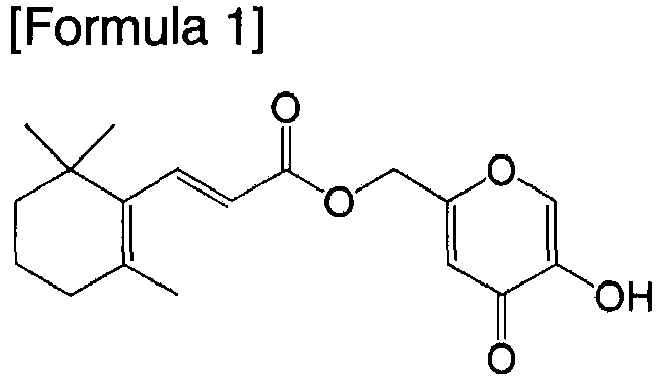
- the present invention provides a hydroxyl pyranone compound represented by the following Formula 1:
- the present invention provides a method for preparing a hydroxyl pyranone compound of Formula 1 by reacting a compound of the following Formula 2 and a compound of the following Formula 3, which is represented by the following Reaction Scheme 1: wherein X and M are as described in the specification.
- the present invention provides a cosmetic composition comprising a hydroxyl pyranone compound represented by Formula 1 as an active ingredient.
- the hydroxyl pyranone compound according to the present invention has an enhanced adipocyte differentiation promoting effect compared to the conventional seletinoid G or other adipocyte differentiation promoting compounds.
- the compounds of the present invention can promote the phenomenon of differentiation of human mesenchymal stem cells into adipocytes and thus induce lipid droplets, thereby enhancing the volume and elasticity of the skin, it can be formulated into various cosmetic products to improve the satisfaction of consumers.
- the present invention provides a novel hydroxyl pyranone compound represented by the following Formula 1:
- the IUPAC name of the hydroxyl pyranone compound of Formula 1 is 3-(2,6,6-trimethyl-cyclohex-1-enyl)-propenoic acid 5-hydroxy-4-oxo-4H-pyran-2-ylmethyl ester.
- the compound of Formula 1 is an off-white solid compound at room temperature.
- the hydroxyl pyranone compounds according to the present invention may include isomers.
- the "isomers” particularly may include optical isomers (e.g., essentially pure enantiomers, essentially pure diastereomers, or mixtures thereof), as well as conformation isomers (i.e., isomers differing only in the angle of one or more chemical bonds), position isomers (particularly tautomers) or geometric isomers (e.g., cis-trans isomers).
- the compound represented by Formula 1 is prepared by reacting a pyranone compoundof Formula 2 and a cyclohexenyl ester compoundof Formula 3 as shown in the following Reaction Scheme 1: wherein X is a halogen element and M is Li, Na or K.
- the compound of Formula 1 is prepared by a coupling reaction between a halogen element in the pyranone compound and a metal in the cyclohexenyl ester compound.
- X in the pyranone compound of Formula 2 is a halogen element.
- the halogen element may be F, Cl, Br, or I, preferably Cl.
- the compound of Formula 2 is commercially available or can be prepared directly.
- the cyclohexenyl ester compound of Formula 3 is present in a form in which a cation (M + ) is bonded to the carboxyl group of 3-(2,6,6-timethyl-cyclohex-1-enyl)-propenoic acid, which is an ionized salt form of 3-(2,6,6-timethyl-cyclohex-1-enyl)-propenoic acid.
- the cation (M + ) may be any one selected from the group consisting of Li + , Na + , and K + .
- the compound may be an ion-binding compound of 3-(2,6,6-timethyl-cyclohex-1-enyl)-propenoic acid and Na + , and it may be prepared by dissolving 3-(2,6,6-timethyl-cyclohex-1-enyl)-propenoic acid and sodium hydroxide in methanol and ionizing them and then distilling methanol.
- the hydroxyl pyranone compound of Formula 1 was prepared through an ester linkage of 5-hydroxy-2-(chloromethyl)-4H-pyran-4-one as the compound of Formula 2 and sodium 3-(2,6,6-timethyl-cyclohex-1-enyl)-propenoate as the compound of Formula 3.
- the reaction is not particularly limited in the present invention and may be carried out under conditions in which the halogen-metal bond reaction can be made sufficiently.
- the reaction may be carried out at the reflux temperature of the solvent, for example, at 50 to 250 °C for 0.5 to 5 hours, preferably for 1 to 3 hours.
- the solvent may be any solvent capable of sufficiently dissolving the compounds of Formulas 2 and 3, and for example, may be any one selected from the group consisting of N,N-dimethylformamide (DMF), tetrahydrofuran (THF), dimethyl sulfoxide (DMSO), acetonitrile, dioxane, benzene, toluene, ether, methanol, hexane, cyclohexane, pyridine, N-methyl pyrrolidone, and combinations thereof, and may preferably be DMF.
- DMF N,N-dimethylformamide
- THF tetrahydrofuran
- DMSO dimethyl sulfoxide
- acetonitrile dioxane
- benzene toluene
- ether methanol
- hexane cyclohexane
- pyridine N-methyl pyrrolidone
- N-methyl pyrrolidone N-methyl pyr
- a high-purity compound may be obtained through a post-treatment such as ordinary washing, drying, purifying and the like after the solvent is distilled.
- the hydroxyl pyranone compound of Formula 1 can be applied to various fields and may preferably be used in cosmetic compositions as an active ingredient.
- the compound of Formula 1 promotes adipocyte differentiation, and thus lipid droplets can be generated and accumulated, thereby improving wrinkles and elasticity of the skin
- the hydroxyl pyranone compound is used in a cosmetic composition as an active ingredient, the content thereof varies depending on the formulation and may be used in an amount of from 0.001 to 99 % by weight.
- the active ingredient is contained in the above range, it is not only suitable for exhibiting the intended effect of the present invention but also can satisfy both the stability and solubility of the composition, and it can be most efficient in terms of cost-effectiveness.
- the cosmetic composition may be prepared in any of the formulations conventionally manufactured in the prior art and may be formulated as, for example, but not limited to, solution, suspension, emulsion, paste, gel, cream, lotion, powder, oil, powder foundation, emulsion foundation, wax foundation and spray. More specifically, the cosmetic composition may be prepared as a formulation of sun cream, softening lotion, astringent lotion, nutrient lotion, nutrient cream, massage cream, essence, eye cream, pack, spray or powder.
- the cosmetic composition according to the present invention may include fats, organic solvents, solubilizer, thickeners, gelling agents, softeners, antioxidants, suspending agents, stabilizers, foaming agents, perfumes, surfactants, water, ionic or non-ionic emulsifiers, fillers, metal ion sequestrants and chelators, preservatives, vitamins, screening agents, humectants, essential oils, dyes, pigments, hydrophilic or lipophilic activating agents and lipid vesicles or additives commonly used in the field of cosmetics or dermatology, such as any other component commonly used in cosmetics. Thw additives may be introduced in amounts commonly used in the field of cosmetics or dermatology.
- the formulation is a paste, a cream or a gel, animal oils, vegetable oils, wax, paraffin, starch, tragacanth, cellulose derivative, polyethylene glycol, silicone, bentonite, silica, talc or zinc oxide, etc. may be used as a carrier component.
- the formulation is a powder or a spray
- lactose, talc, silica, aluminum hydroxide, calcium silicate or polyamide powder may be used as a carrier component.
- the spray may additionally comprise propellants such as chlorofluorohydrocarbon, propane/butane or dimethyl ether.
- solvent solubilizing agents or emulsifying agents
- emulsifying agents may be used as a carrier component.
- solvent solubilizing agents or emulsifying agents
- water ethanol, isopropanol, ethyl carbonate, ethyl acetate, benzyl alcohol, benzyl benzoate, propylene glycol, 1,3-butyl glycol oil, glycerol aliphatic ester, polyethylene glycol or a fatty acid ester of sorbitan may be used.
- liquid diluents such as water, ethanol or propylene glycol
- suspending agents such as ethoxylated isostearyl alcohol, polyoxyethylene sorbitol ester and polyoxyethylene sorbitan ester, or microcrystalline cellulose, aluminum metahydroxide, bentonite, agar, tragacanth, etc. may be used as a carrier component.
- Adiponectin is a typical protein hormone secreted from adipocytes. It has been reported that as adipocytes are differentiated, the expression of adiponectin is increased. Therefore, the adipocyte differentiation promoting effect was confirmed by measuring the amount of adiponectin expressed in the cell culture medium when treated with the novel compound of the present invention, which is an indicator of adipocyte differentiation promoting.
- the adipocyte differentiation was performed by culturing human adipose tissue derived mesenchymal stem cells (hAT-MSCs) from Lonza Inc. (Walkersville, MD, USA) according to Lonza's guidelines. The adipocyte differentiation was carried out using the method recommended by Lonza Inc., except that the adipocyte differentiation of adipose-derived mesenchymal stem cells is induced by using troglitazone (TRO) instead of indomethacin.
- TRO troglitazone
- the mesenchymal stem cells were differentiated into adipocytes by adding the medium for adipocyte differentiation (hereinafter referred to as IDX), which was prepared by mixing 1 g/ml of insulin, 1 M of Dexamethasone (DEXA), 0.5 mM of isobutylmethylxanthine (IBMX) and 2 M of TRO, to the culture medium of mesenchymal stem cells, and then culturing it.
- IDX the medium for adipocyte differentiation
- Adiponectin ELISA Kit R & D systems, Cat. No. DY1065
- the capture antibody was reacted in a 96-well plate, washed with washing buffer solution, and then the material shown in Table 1 below was added and reacted at room temperature for 2 hours. Thereafter, while washing three times every time when going through each step, the detection antibody, the HRP enzyme, the substrate solution, and the stop solution were added in order and reacted for the time indicated in the protocol. After the final reaction, the absorbance was measured at a wavelength of 450 nm using a spectrophotometer.
- the hydroxyl pyranone compound of Formula 1 according to the present invention has excellent adipocyte differentiation promoting ability, and the cosmetic composition containing it as an effective component can increase the volume and elasticity of the skin.
- cosmetic formulations according to atill another aspect of the present disclosure are provided.
- the cosmetic formulations comprising the hydroxyl pyranone compound according to the present invention are not limited only to the following examples.
- a lotion was prepared using the compositions shown in Table 2 below according to a conventional method.
- Component Content (wt.%) Compound of Formula 1 (Example) 0.1 Glycerine 3.0 Buthylene glycol 2.0 Propylene glycol 2.0 Carboxyvinyl polymer 0.1 PEG 12 nonylphenyl ether 0.2 Polysorbate 80 0.4 Ethanol 10.0 Triethanolamine 0.1 Preservative, Pigment, Perfume q.s. Purified water remainder
- a milk lotion was prepared using the compositions shown in Table 3 below according to a conventional method.
- Table 3 Combined component Content (wt.%) Compound of Formula 1 (Example) 1.0 Glycerine 3.0 Buthylene glycol 3.0 Propylene glycol 3.0 Carboxyvinyl polymer 0.1 Bee wax 4.0 Polysorbate 60 1.5 Caprlic/capric triglyceride 5.0 Squalane 5.0 Sorbitansesquiolate 1.5 Liquid paraffin 0.5 Cetearyl alcohol 1.0 Triethanolamine 0.2 Preservative, Pigment, Perfume q.s. Purified water remainder
- a nutrient cream was prepared using the compositions shown in Table 4 below according to a conventional method.
- Component Content (wt.%) Compound of Formula 1 (Example) 2.0 Polysorbate 60 1.5 Sorbitansesquiolate 0.5 PEG 60 hydrogenated castor oil 2.0 Liquid paraffin 10.
- Squalane 5.0 Caprlic/capric triglyceride 5.0 Glycerine 5.0 Buthylene glycol 3.0 Propylene glycol 3.0 Triethanolamine 0.2 Preservative, Pigment, Perfume q.s. Purified water remainder
- a massage cream was prepared using the compositions shown in Table 5 below according to a conventional method.
- Component Content (wt.%) Compound of Formula 1 (Example) 1.0 Bee wax 10.0 Polysorbate 60 1.5 PEG 60 hydrogenated castor oil 2.0 Sorbitansesquiolate 0.8 Liquid paraffin 40.0 Squalane 5.0 Caprlic/capric triglyceride 4.0 Glycerine 5.0 Buthylene glycol 3.0 Propylene glycol 3.0 Triethanolamine 0.2 Preservative, Pigment, Perfume q.s. Purified water remainder
- a pack was prepared using the compositions shown in Table 6 below according to a conventional method.
- Component Content (wt.%) Compound of Formula 1 (Example) 0.2 Polyvinyl alcohol 13.0 Sodium carboxymethyl cellulose 0.2 Glycerine 5.0 Allantoin 0.1 Ethanol 6.0 PEG 12 nonylphenyl ether 0.3 Polysorbate 60 0.3 Preservative, Pigment, Perfume q.s. Purified water remainder
Landscapes
- Health & Medical Sciences (AREA)
- Chemical & Material Sciences (AREA)
- Organic Chemistry (AREA)
- Life Sciences & Earth Sciences (AREA)
- Animal Behavior & Ethology (AREA)
- General Health & Medical Sciences (AREA)
- Public Health (AREA)
- Veterinary Medicine (AREA)
- Epidemiology (AREA)
- Dermatology (AREA)
- Birds (AREA)
- Gerontology & Geriatric Medicine (AREA)
- Cosmetics (AREA)
- Pyrane Compounds (AREA)
- Organic Low-Molecular-Weight Compounds And Preparation Thereof (AREA)
Abstract
Description
- The present application claims the benefit of Korean Patent Application No.
10-2015-0169638, filed on December 01, 2015 - The present invention relates to a novel hydroxyl pyranone compound having adipocyte differentiation promoting ability, a method for preparing the same, and a cosmetic composition containing the same as an active ingredient.
- The basic structure of the skin is maintained by subcutaneous adipose tissue. The subcutaneous adipose tissue plays a critical role in maintaining the volume and strength of the skin. Accordingly, in order to maintain and improve the volume and elasticity of the skin, increasing the volume of the adipose tissue rather than imparting the elasticity to the dermis or epidermis in the outer layer of the skin can be a fundamental solution.
- Specifically, as the aging of the human body progresses, wrinkles are generated on the skin, and at the same time, the elasticity of the skin is also reduced. The aging of the skin, such as wrinkle formation and decreased elasticity, is a complex phenomenon caused by the decrease in the activity of adipocytes or hence the decrease in lipid droplets along with the degradation and reduction of skin fibers such as collagen and elastin, which are skin components. Therefore, if the lipid droplets can be produced and accumulated by promoting adipocyte differentiation in humans, the wrinkles and elasticity of the skin can be improved.
- Recently, upon reviewing various research trends using adipocytes, currently, studies using adipocytes have been actively conducted in a variety of fields including studies for increasing the volume feel and elasticity of the skin. Among them, preadipocytes are widely used because they have the property of differentiating into adipocytes by differentiation inducers such as insulin.
- Particularly, among these preadipocytes, mesenchymal stem cells for adipocytes have recently received attention. Since adipose-derived mesenchymal stem cells can be differentiated using methods similar to those used to differentiate preadipocytes into adipocytes (Exp. Cell Res. 2006, 312, 1856-1864), they are widely used in the study of adipocyte differentiation (Science 1999, 284, 143-146). In addition, such adipose-derived mesenchymal stem cells are known to be able to differentiate not only into adipocytes but also into other types of cells such as chondrocytes and bone cells (J. Cell Sci. 2006, 119, 2204-2213), and are distributed in most tissues of the body, and thus are thought to be infinitely useful.
- In the meantime, various attempts have been made to promote the differentiation of adipocytes in order to improve the volume and elasticity of the skin. According to the results of such previous studies, it has been reported that cinnamic acid compounds show adipocyte differentiation promoting effect. In addition, there has been a report that hydroxyl pyranone derivatives including cinnamic acid mother nucleus significantly increase adipocyte differentiation promoting effect compared to cinnamic acid. In this regard, it was confirmed that as a result of analyzing the structural active correlations of various derivatives, the double bond of cinnamic acid plays an important role.
- However, since the effect of increasing the volume and elasticity of the skin in the human body, when incorporating these materials for promoting adipocyte differentiation into actual cosmetic compositions, etc. was still insufficient, it has been difficult for consumers to obtain maximum satisfaction related to the use of cosmetic composition.
- Accordingly, it was necessary to develop a material for promoting adipocyte differentiation with improved efficacy.
- Hydroxy pyranone derivative and preparation method thereof (Korea Patent No.
10-0482668 - In order to solve the above-described problems, the inventors of the present invention have conducted various studies on the compounds capable of improving the adipocyte differentiation promoting effect over the existing compounds based on the above-mentioned previous research results. As a result, the inventors have completed the present invention by preparing a novel compound comprising a mother nucleus of 3-(2,6,6-timethyl-cyclohex-1-enyl)-propenoic acid among the hydroxyl pyranone compounds, and then confirming that the novel compound improves the differentiation promoting effect of adipocytes.
- Therefore, it is an object of the present invention to provide a novel hydroxyl pyranone compound which improves the differentiation promoting effect of adipocytes.
- In addition, it is another object of the present invention to provide a method for preparing the novel hydroxyl pyranone compound.
- In addition, it is still another object of the present invention to provide a cosmetic composition comprising the novel hydroxyl pyranone compound as an active ingredient.
- According to an object of the present invention, the present invention provides a hydroxyl pyranone compound represented by the following Formula 1:
- According to another object of the present invention, the present invention provides a method for preparing a hydroxyl pyranone compound of Formula 1 by reacting a compound of the following Formula 2 and a compound of the following Formula 3, which is represented by the following Reaction Scheme 1:

- According to still another object of the present invention, the present invention provides a cosmetic composition comprising a hydroxyl pyranone compound represented by Formula 1 as an active ingredient.
- The hydroxyl pyranone compound according to the present invention has an enhanced adipocyte differentiation promoting effect compared to the conventional seletinoid G or other adipocyte differentiation promoting compounds.
- Specifically, since the compounds of the present invention can promote the phenomenon of differentiation of human mesenchymal stem cells into adipocytes and thus induce lipid droplets, thereby enhancing the volume and elasticity of the skin, it can be formulated into various cosmetic products to improve the satisfaction of consumers.
- Hereinafter, the present invention will be described in detail.
- The present invention provides a novel hydroxyl pyranone compound represented by the following Formula 1:

- The IUPAC name of the hydroxyl pyranone compound of Formula 1 is 3-(2,6,6-trimethyl-cyclohex-1-enyl)-propenoic acid 5-hydroxy-4-oxo-4H-pyran-2-ylmethyl ester.
- The compound of Formula 1 is an off-white solid compound at room temperature.
- The hydroxyl pyranone compounds according to the present invention may include isomers. At this time, the "isomers" particularly may include optical isomers (e.g., essentially pure enantiomers, essentially pure diastereomers, or mixtures thereof), as well as conformation isomers (i.e., isomers differing only in the angle of one or more chemical bonds), position isomers (particularly tautomers) or geometric isomers (e.g., cis-trans isomers).
- The compound represented by Formula 1 is prepared by reacting a pyranone compoundof Formula 2 and a cyclohexenyl ester compoundof Formula 3 as shown in the following Reaction Scheme 1:

- Referring to Reaction Scheme 1, the compound of Formula 1 is prepared by a coupling reaction between a halogen element in the pyranone compound and a metal in the cyclohexenyl ester compound.
- Herein, X in the pyranone compound of Formula 2 is a halogen element. At this time, the halogen element may be F, Cl, Br, or I, preferably Cl. The compound of Formula 2 is commercially available or can be prepared directly.
- In the Example of the present invention, 5-hydroxy-2-(chloromethyl)-4H-pyran-4-one in which X is Cl was used, which was prepared directly by reacting 5-hydroxy-2-(hydroxymethyl)-4H-pyran-4-one with thionyl chloride (SOCl2).
- In addition, the cyclohexenyl ester compound of Formula 3 is present in a form in which a cation (M+) is bonded to the carboxyl group of 3-(2,6,6-timethyl-cyclohex-1-enyl)-propenoic acid, which is an ionized salt form of 3-(2,6,6-timethyl-cyclohex-1-enyl)-propenoic acid.
- The cation (M+) may be any one selected from the group consisting of Li+, Na+, and K+. Preferably, the compound may be an ion-binding compound of 3-(2,6,6-timethyl-cyclohex-1-enyl)-propenoic acid and Na+, and it may be prepared by dissolving 3-(2,6,6-timethyl-cyclohex-1-enyl)-propenoic acid and sodium hydroxide in methanol and ionizing them and then distilling methanol.
- In a preferred embodiment of the present invention, the hydroxyl pyranone compound of Formula 1 was prepared through an ester linkage of 5-hydroxy-2-(chloromethyl)-4H-pyran-4-one as the compound of Formula 2 and sodium 3-(2,6,6-timethyl-cyclohex-1-enyl)-propenoate as the compound of Formula 3.
- At this time, the reaction is not particularly limited in the present invention and may be carried out under conditions in which the halogen-metal bond reaction can be made sufficiently.
- The reaction may be carried out at the reflux temperature of the solvent, for example, at 50 to 250 °C for 0.5 to 5 hours, preferably for 1 to 3 hours.
- At this time, the solvent may be any solvent capable of sufficiently dissolving the compounds of Formulas 2 and 3, and for example, may be any one selected from the group consisting of N,N-dimethylformamide (DMF), tetrahydrofuran (THF), dimethyl sulfoxide (DMSO), acetonitrile, dioxane, benzene, toluene, ether, methanol, hexane, cyclohexane, pyridine, N-methyl pyrrolidone, and combinations thereof, and may preferably be DMF.
- After the reaction, a high-purity compound may be obtained through a post-treatment such as ordinary washing, drying, purifying and the like after the solvent is distilled.
- The hydroxyl pyranone compound of Formula 1 according to the present invention can be applied to various fields and may preferably be used in cosmetic compositions as an active ingredient. At this time, the compound of Formula 1 promotes adipocyte differentiation, and thus lipid droplets can be generated and accumulated, thereby improving wrinkles and elasticity of the skin
When the hydroxyl pyranone compound is used in a cosmetic composition as an active ingredient, the content thereof varies depending on the formulation and may be used in an amount of from 0.001 to 99 % by weight. When the active ingredient is contained in the above range, it is not only suitable for exhibiting the intended effect of the present invention but also can satisfy both the stability and solubility of the composition, and it can be most efficient in terms of cost-effectiveness. - The cosmetic composition may be prepared in any of the formulations conventionally manufactured in the prior art and may be formulated as, for example, but not limited to, solution, suspension, emulsion, paste, gel, cream, lotion, powder, oil, powder foundation, emulsion foundation, wax foundation and spray. More specifically, the cosmetic composition may be prepared as a formulation of sun cream, softening lotion, astringent lotion, nutrient lotion, nutrient cream, massage cream, essence, eye cream, pack, spray or powder.
- In addition, the cosmetic composition according to the present invention may include fats, organic solvents, solubilizer, thickeners, gelling agents, softeners, antioxidants, suspending agents, stabilizers, foaming agents, perfumes, surfactants, water, ionic or non-ionic emulsifiers, fillers, metal ion sequestrants and chelators, preservatives, vitamins, screening agents, humectants, essential oils, dyes, pigments, hydrophilic or lipophilic activating agents and lipid vesicles or additives commonly used in the field of cosmetics or dermatology, such as any other component commonly used in cosmetics. Thw additives may be introduced in amounts commonly used in the field of cosmetics or dermatology.
- When the formulation is a paste, a cream or a gel, animal oils, vegetable oils, wax, paraffin, starch, tragacanth, cellulose derivative, polyethylene glycol, silicone, bentonite, silica, talc or zinc oxide, etc. may be used as a carrier component.
- When the formulation is a powder or a spray, lactose, talc, silica, aluminum hydroxide, calcium silicate or polyamide powder may be used as a carrier component. In particular, the spray may additionally comprise propellants such as chlorofluorohydrocarbon, propane/butane or dimethyl ether.
- When the formulation is a solution or an emulsion, solvent, solubilizing agents or emulsifying agents may be used as a carrier component. For example, water, ethanol, isopropanol, ethyl carbonate, ethyl acetate, benzyl alcohol, benzyl benzoate, propylene glycol, 1,3-butyl glycol oil, glycerol aliphatic ester, polyethylene glycol or a fatty acid ester of sorbitan may be used.
- When the formulation is a suspension, liquid diluents such as water, ethanol or propylene glycol, suspending agents such as ethoxylated isostearyl alcohol, polyoxyethylene sorbitol ester and polyoxyethylene sorbitan ester, or microcrystalline cellulose, aluminum metahydroxide, bentonite, agar, tragacanth, etc. may be used as a carrier component.
- Hereinafter, examples and test examples are provided for further explanation of the contents and effects of the present invention. However, the following contents are only examples of the present invention, and the scope and effect of the present invention are not limited thereto.
- 3-(2,6,6-trimethyl-cyclohex-1-enyl)-propenoic acid 5-hydroxy-4-oxo-4H-pyran-2-ylmethyl ester which is the hydroxyl pyranone compound of Formula 1 of the present invention was prepared according to the following Reaction Scheme 2.


- The detailed procedure for carrying out the Reaction Scheme 2 was as follows.
- 50 g of 5-hydroxy-2-(hydroxymethyl)-4H-pyran-4-one (0.35 mmol) was dissolved in 250 ml of N,N-dimethylformamide and cooled in an iced water bath at 10 °C and then 50 g (0.42 mol) of thionyl chloride was added dropwise over 30 minutes. After stirring at room temperature for 2 hours, the reaction solution was added to 2000 ml of an iced water. The resulting solid was filtered, and the solid (filtered material) was dissolved in 1000 ml of ethyl acetate. Magnesium sulfate and activated charcoal were added thereto for drying and decolorization and were filtered, and then the filtrate was concentrated and nucleic acid was added to obtain crystals. The resulting crystals were dried under vacuum to obtain 39.5 g (70%) of the reaction product, 5-hydroxy-2-(chloromethyl)-4H-pyran-4-one of the Formula 2-1 as a yellow solid.
- Subsequently, 5 g (0.026 mol) of 3-(2,6,6-timethyl-cyclohex-1-enyl)-propenoic acid and 1.3 g (0.031 mol) of sodium hydroxide were dissolved in 40 ml of methanol. After the methanol was distilled off, the remaining residue was dissolved in 70 ml of N,N-dimethylformamide to prepare a compound of Formula 3-1.
- To the compound of Formula 3-1, 4.2 g (0.026 mol) of 5-hydroxy-2-(chloromethyl)-4H-pyran-4-one of the prepared Formula 2-1 was added and then heated and stirred in an oil bath at 110 °C for 2 hours. The solvent was distilled off and the residue was dissolved in 300 ml of ethyl acetate, and then the ethyl acetate solution was washed with 5% hydrochloric acid and distilled water, and magnesium sulfate and activated carbon were added to dry and discolor the solution. Subsequently, the insoluble matters were filtered off and the filtrate was evaporated under reduced pressure to give 5.9 g (69% yield) of the reaction product as an off-white solid.
TLC (ethyl acetate: hexane = 1:1) Rf = 0.43
1H NMR (DMSO-d6, δ): 9.23(s, 1H), 8.09(s, 1H), 7.45(d, 1H, J = 16.2Hz), 6.48(s, 1H), 5.94(d, 1H, J = 16.2Hz), 5.04(s, 2H), 2.07(m, 2H), 1.75(s, 3H), 1.59(m, 2H), 1.42(m, 2H), 1.04(s, 6H) - In order to examine the adipocyte differentiation promoting effect of the compounds prepared in the Example, the following test was carried out.
- Adiponectin is a typical protein hormone secreted from adipocytes. It has been reported that as adipocytes are differentiated, the expression of adiponectin is increased. Therefore, the adipocyte differentiation promoting effect was confirmed by measuring the amount of adiponectin expressed in the cell culture medium when treated with the novel compound of the present invention, which is an indicator of adipocyte differentiation promoting.
- The adipocyte differentiation was performed by culturing human adipose tissue derived mesenchymal stem cells (hAT-MSCs) from Lonza Inc. (Walkersville, MD, USA) according to Lonza's guidelines. The adipocyte differentiation was carried out using the method recommended by Lonza Inc., except that the adipocyte differentiation of adipose-derived mesenchymal stem cells is induced by using troglitazone (TRO) instead of indomethacin. Specifically, the mesenchymal stem cells were differentiated into adipocytes by adding the medium for adipocyte differentiation (hereinafter referred to as IDX), which was prepared by mixing 1 g/ml of insulin, 1 M of Dexamethasone (DEXA), 0.5 mM of isobutylmethylxanthine (IBMX) and 2 M of TRO, to the culture medium of mesenchymal stem cells, and then culturing it.
- In order to determine the expression level of adiponectin, after the medium for adipocyte differentiation was collected on the 14th day of differentiation, the amount of adiponectin was quantified using the Adiponectin ELISA Kit (R & D systems, Cat. No. DY1065) (each data value was corrected by the control group). The specific measurement method using Adiponectin ELISA Kit was as follows.
- First, the capture antibody was reacted in a 96-well plate, washed with washing buffer solution, and then the material shown in Table 1 below was added and reacted at room temperature for 2 hours. Thereafter, while washing three times every time when going through each step, the detection antibody, the HRP enzyme, the substrate solution, and the stop solution were added in order and reacted for the time indicated in the protocol. After the final reaction, the absorbance was measured at a wavelength of 450 nm using a spectrophotometer.
- The results obtained through the above process are shown in Table 1.
[Table 1] Treating material Adiponectin (pg/ml, Avg ± S.D.) Untreated group 31 ± 10 IDX treated group 303 ± 40 IDX + Glibenclamide 1920 ± 100 IDX + Kojic acid (400M) 303 ± 98 IDX + Seletinoid G (60M) 1505 ± 109 IDX + compound of example (Formula 1) (60M) 1804 ± 110 - Referring to Table 1, when treated with kojic acid in the experiment for confirming the expression level of adiponectin, the expression level of adiponectin was not increased. On the other hand, when treated with the hydroxy pyranone derivative of the compound of Formula 1 of Example according to the present invention, it was confirmed that the expression level increases almost similarly to that with Glibenclamide, which is a positive control group. This corresponds to a significantly increased expression level even in comparison with the case of treatment with Seletinoid G, which is a conventional adipocyte differentiation promoting compound.
- Therefore, it was confirmed that the hydroxyl pyranone compound of Formula 1 according to the present invention has excellent adipocyte differentiation promoting ability, and the cosmetic composition containing it as an effective component can increase the volume and elasticity of the skin.
- Hereinafter, formulation examples of cosmetic compositions according to atill another aspect of the present disclosure are provided. However, the cosmetic formulations comprising the hydroxyl pyranone compound according to the present invention are not limited only to the following examples.
- A lotion was prepared using the compositions shown in Table 2 below according to a conventional method.
[Table 2] Component Content (wt.%) Compound of Formula 1 (Example) 0.1 Glycerine 3.0 Buthylene glycol 2.0 Propylene glycol 2.0 Carboxyvinyl polymer 0.1 PEG 12 nonylphenyl ether 0.2 Polysorbate 80 0.4 Ethanol 10.0 Triethanolamine 0.1 Preservative, Pigment, Perfume q.s. Purified water remainder - A milk lotion was prepared using the compositions shown in Table 3 below according to a conventional method.
[Table 3] Combined component Content (wt.%) Compound of Formula 1 (Example) 1.0 Glycerine 3.0 Buthylene glycol 3.0 Propylene glycol 3.0 Carboxyvinyl polymer 0.1 Bee wax 4.0 Polysorbate 60 1.5 Caprlic/capric triglyceride 5.0 Squalane 5.0 Sorbitansesquiolate 1.5 Liquid paraffin 0.5 Cetearyl alcohol 1.0 Triethanolamine 0.2 Preservative, Pigment, Perfume q.s. Purified water remainder - A nutrient cream was prepared using the compositions shown in Table 4 below according to a conventional method.
[Table 4] Component Content (wt.%) Compound of Formula 1 (Example) 2.0 Polysorbate 60 1.5 Sorbitansesquiolate 0.5 PEG 60 hydrogenated castor oil 2.0 Liquid paraffin 10. Squalane 5.0 Caprlic/capric triglyceride 5.0 Glycerine 5.0 Buthylene glycol 3.0 Propylene glycol 3.0 Triethanolamine 0.2 Preservative, Pigment, Perfume q.s. Purified water remainder - A massage cream was prepared using the compositions shown in Table 5 below according to a conventional method.
[Table 5] Component Content (wt.%) Compound of Formula 1 (Example) 1.0 Bee wax 10.0 Polysorbate 60 1.5 PEG 60 hydrogenated castor oil 2.0 Sorbitansesquiolate 0.8 Liquid paraffin 40.0 Squalane 5.0 Caprlic/capric triglyceride 4.0 Glycerine 5.0 Buthylene glycol 3.0 Propylene glycol 3.0 Triethanolamine 0.2 Preservative, Pigment, Perfume q.s. Purified water remainder - A pack was prepared using the compositions shown in Table 6 below according to a conventional method.
[Table 6] Component Content (wt.%) Compound of Formula 1 (Example) 0.2 Polyvinyl alcohol 13.0 Sodium carboxymethyl cellulose 0.2 Glycerine 5.0 Allantoin 0.1 Ethanol 6.0 PEG 12 nonylphenyl ether 0.3 Polysorbate 60 0.3 Preservative, Pigment, Perfume q.s. Purified water remainder
Claims (4)
- A hydroxyl pyranone compound represented by the following Formula 1:

- A method for preparing a hydroxyl pyranone compound of Formula 1 by reacting a pyranone compound of Formula 2 and a cyclohexenyl ester compound of Formula 3, which is represented by the following Reaction Scheme 1:

- A cosmetic composition comprising a hydroxyl pyranone compound represented by the following Formula 1 as an active ingredient:

- The cosmetic composition of claim 3, wherein the cosmetic composition has adipocyte differentiation promoting ability.
Applications Claiming Priority (2)
| Application Number | Priority Date | Filing Date | Title |
|---|---|---|---|
| KR1020150169638A KR102463238B1 (en) | 2015-12-01 | 2015-12-01 | Novel hydroxy pyranone derivative, preparation method thereof, and cosmetic composition comprising the same |
| PCT/KR2016/013794 WO2017095098A1 (en) | 2015-12-01 | 2016-11-28 | Novel hydroxyl pyranone compound, method for producing same, and cosmetics composition comprising compound |
Publications (3)
| Publication Number | Publication Date |
|---|---|
| EP3385259A1 true EP3385259A1 (en) | 2018-10-10 |
| EP3385259A4 EP3385259A4 (en) | 2018-10-24 |
| EP3385259B1 EP3385259B1 (en) | 2019-11-13 |
Family
ID=58797179
Family Applications (1)
| Application Number | Title | Priority Date | Filing Date |
|---|---|---|---|
| EP16870994.7A Active EP3385259B1 (en) | 2015-12-01 | 2016-11-28 | Novel hydroxyl pyranone compound, method for producing same, and cosmetics composition comprising compound |
Country Status (7)
| Country | Link |
|---|---|
| US (1) | US10259799B2 (en) |
| EP (1) | EP3385259B1 (en) |
| JP (1) | JP6845243B2 (en) |
| KR (1) | KR102463238B1 (en) |
| CN (1) | CN108473457B (en) |
| TW (1) | TWI703137B (en) |
| WO (1) | WO2017095098A1 (en) |
Families Citing this family (1)
| Publication number | Priority date | Publication date | Assignee | Title |
|---|---|---|---|---|
| KR102040900B1 (en) * | 2017-09-29 | 2019-11-06 | (주)아모레퍼시픽 | A composition containing trimethoxy phenyl compound for promoting adipocyte differentiation or adiponectin production |
Family Cites Families (14)
| Publication number | Priority date | Publication date | Assignee | Title |
|---|---|---|---|---|
| JPS6010005B2 (en) | 1982-08-20 | 1985-03-14 | 三省製薬株式会社 | fair skin cosmetics |
| JP2565513B2 (en) | 1987-09-25 | 1996-12-18 | 三省製薬株式会社 | Topical drug for suppressing melanin production |
| JP2799193B2 (en) * | 1989-09-14 | 1998-09-17 | 三省製薬株式会社 | External preparation for skin |
| JPH07118134A (en) * | 1992-04-17 | 1995-05-09 | Koichi Shudo | Skin external preparation |
| JP3388523B2 (en) | 1993-10-25 | 2003-03-24 | カシオ計算機株式会社 | Blood pressure measurement system and blood pressure value calculation device |
| JPH07242527A (en) | 1994-03-04 | 1995-09-19 | Shiseido Co Ltd | Skin agent for extrnal application |
| JP4389101B2 (en) | 2001-09-04 | 2009-12-24 | 独立行政法人産業技術総合研究所 | Kojic acid ester and synthesis method thereof |
| KR100482668B1 (en) * | 2002-06-22 | 2005-04-13 | 주식회사 태평양 | Hydroxy pyranone derivative and preparation method thereof |
| KR100494535B1 (en) | 2003-02-24 | 2005-06-10 | 주식회사 태평양 | Whitening composition for external application to the skin containing hydroxy pyranone derivatives |
| US8846723B2 (en) * | 2010-07-29 | 2014-09-30 | Eastman Chemical Company | Esters of O-substituted hydroxy carboxylic acids and preparations thereof |
| DE102010054149A1 (en) * | 2010-12-10 | 2012-06-14 | Merck Patent Gmbh | 2-pyrones |
| KR101516582B1 (en) | 2012-03-23 | 2015-05-11 | 주식회사 엔자임바이오 | Anti-obesity composition from CapsicumL. var.annuum to promote degradation of lipid by the enhanced activity of carnitine palmitoyltransferase-1 |
| KR102175466B1 (en) | 2013-11-29 | 2020-11-06 | (주)아모레퍼시픽 | Ionone derivatives compounds |
| KR102175468B1 (en) * | 2014-01-20 | 2020-11-06 | (주)아모레퍼시픽 | Cosmetic composition for promoting a differentiation of adipocyte comprising hydroxy pyranone derivative |
-
2015
- 2015-12-01 KR KR1020150169638A patent/KR102463238B1/en active Active
-
2016
- 2016-11-28 CN CN201680079690.1A patent/CN108473457B/en active Active
- 2016-11-28 WO PCT/KR2016/013794 patent/WO2017095098A1/en not_active Ceased
- 2016-11-28 EP EP16870994.7A patent/EP3385259B1/en active Active
- 2016-11-28 JP JP2018528288A patent/JP6845243B2/en active Active
- 2016-11-28 US US15/780,412 patent/US10259799B2/en active Active
- 2016-11-30 TW TW105139340A patent/TWI703137B/en not_active IP Right Cessation
Also Published As
| Publication number | Publication date |
|---|---|
| CN108473457B (en) | 2021-08-20 |
| CN108473457A (en) | 2018-08-31 |
| KR20170064198A (en) | 2017-06-09 |
| TWI703137B (en) | 2020-09-01 |
| TW201720804A (en) | 2017-06-16 |
| JP6845243B2 (en) | 2021-03-17 |
| EP3385259B1 (en) | 2019-11-13 |
| EP3385259A4 (en) | 2018-10-24 |
| US10259799B2 (en) | 2019-04-16 |
| KR102463238B1 (en) | 2022-11-04 |
| JP2018535990A (en) | 2018-12-06 |
| US20180370939A1 (en) | 2018-12-27 |
| WO2017095098A1 (en) | 2017-06-08 |
Similar Documents
| Publication | Publication Date | Title |
|---|---|---|
| EP3385260B1 (en) | Novel hydroxyl pyranone compound, method for producing same, and cosmetics composition comprising compound | |
| DE60314730T2 (en) | USE OF 4-AMINOPYRIMIDINES FOR ANTIMICROBIAL TREATMENT OF SURFACES | |
| CN105873584B (en) | Cosmetic composition containing hydroxypyrone derivative compound for promoting adipocyte differentiation | |
| KR102119465B1 (en) | Trimethoxy phenyl compound and composition containing the same for promoting hair sprouting or hair growth | |
| WO2004000836A1 (en) | Hydroxy pyranone derivative and preparation method thereof | |
| JPH11255639A (en) | Tyrosinase activity inhibitor and cosmetic | |
| EP3385259B1 (en) | Novel hydroxyl pyranone compound, method for producing same, and cosmetics composition comprising compound | |
| KR102068635B1 (en) | 3,4,5-Trimethoxy cinnamic acid derivatives, preparation method thereof, and skin whithening composition comprising the same | |
| CN111432791B (en) | Composition for promoting adipocyte differentiation or adiponectin comprising trimethoxyphenyl compound | |
| EP4171479A1 (en) | Use of compounds as self-tanning substances and tanning compositions thereof | |
| KR102463237B1 (en) | Salicylic acid derivative compounds, preparation method thereof, and whitening cosmetic composition comprising the same | |
| KR102202236B1 (en) | Kojic acid sulfide derivative having activity in the promotion of adipocyte differentiation and cosmetic composition containing it | |
| JP2022022672A (en) | Inflammatory cytokine inhibitor | |
| WO2017095121A1 (en) | Novel hydroxyl pyranone compound, method for producing same, and cosmetics composition comprising compound | |
| JP5449703B2 (en) | Skin external preparation for whitening | |
| KR20190036971A (en) | Composition containing trimethyl cyclohexen compound for promoting adiponectin production | |
| KR102076636B1 (en) | Composition containing trimethyl cyclohexen compound for promoting hair sprouting or hair growth | |
| HK40022799A (en) | Composition for promoting adipocyte differentiation or adiponectin, comprising trimethoxy phenyl compound | |
| KR20160141511A (en) | Cosmetic composition with irigenin for skin whitening |
Legal Events
| Date | Code | Title | Description |
|---|---|---|---|
| STAA | Information on the status of an ep patent application or granted ep patent |
Free format text: STATUS: THE INTERNATIONAL PUBLICATION HAS BEEN MADE |
|
| PUAI | Public reference made under article 153(3) epc to a published international application that has entered the european phase |
Free format text: ORIGINAL CODE: 0009012 |
|
| STAA | Information on the status of an ep patent application or granted ep patent |
Free format text: STATUS: REQUEST FOR EXAMINATION WAS MADE |
|
| 17P | Request for examination filed |
Effective date: 20180529 |
|
| AK | Designated contracting states |
Kind code of ref document: A1 Designated state(s): AL AT BE BG CH CY CZ DE DK EE ES FI FR GB GR HR HU IE IS IT LI LT LU LV MC MK MT NL NO PL PT RO RS SE SI SK SM TR |
|
| AX | Request for extension of the european patent |
Extension state: BA ME |
|
| A4 | Supplementary search report drawn up and despatched |
Effective date: 20180924 |
|
| RIC1 | Information provided on ipc code assigned before grant |
Ipc: C07D 309/40 20060101ALI20180917BHEP Ipc: A61K 8/49 20060101AFI20180917BHEP Ipc: A61Q 19/08 20060101ALI20180917BHEP |
|
| DAV | Request for validation of the european patent (deleted) | ||
| DAX | Request for extension of the european patent (deleted) | ||
| REG | Reference to a national code |
Ref country code: DE Ref legal event code: R079 Ref document number: 602016024479 Country of ref document: DE Free format text: PREVIOUS MAIN CLASS: C07D0309340000 Ipc: A61K0008490000 |
|
| GRAP | Despatch of communication of intention to grant a patent |
Free format text: ORIGINAL CODE: EPIDOSNIGR1 |
|
| STAA | Information on the status of an ep patent application or granted ep patent |
Free format text: STATUS: GRANT OF PATENT IS INTENDED |
|
| RIC1 | Information provided on ipc code assigned before grant |
Ipc: A61K 8/49 20060101AFI20190521BHEP Ipc: C07D 309/40 20060101ALI20190521BHEP Ipc: A61Q 19/08 20060101ALI20190521BHEP |
|
| INTG | Intention to grant announced |
Effective date: 20190626 |
|
| GRAS | Grant fee paid |
Free format text: ORIGINAL CODE: EPIDOSNIGR3 |
|
| GRAA | (expected) grant |
Free format text: ORIGINAL CODE: 0009210 |
|
| STAA | Information on the status of an ep patent application or granted ep patent |
Free format text: STATUS: THE PATENT HAS BEEN GRANTED |
|
| AK | Designated contracting states |
Kind code of ref document: B1 Designated state(s): AL AT BE BG CH CY CZ DE DK EE ES FI FR GB GR HR HU IE IS IT LI LT LU LV MC MK MT NL NO PL PT RO RS SE SI SK SM TR |
|
| REG | Reference to a national code |
Ref country code: CH Ref legal event code: EP Ref country code: AT Ref legal event code: REF Ref document number: 1200934 Country of ref document: AT Kind code of ref document: T Effective date: 20191115 |
|
| REG | Reference to a national code |
Ref country code: DE Ref legal event code: R096 Ref document number: 602016024479 Country of ref document: DE |
|
| REG | Reference to a national code |
Ref country code: IE Ref legal event code: FG4D |
|
| REG | Reference to a national code |
Ref country code: NL Ref legal event code: MP Effective date: 20191113 |
|
| REG | Reference to a national code |
Ref country code: LT Ref legal event code: MG4D |
|
| PG25 | Lapsed in a contracting state [announced via postgrant information from national office to epo] |
Ref country code: LT Free format text: LAPSE BECAUSE OF FAILURE TO SUBMIT A TRANSLATION OF THE DESCRIPTION OR TO PAY THE FEE WITHIN THE PRESCRIBED TIME-LIMIT Effective date: 20191113 Ref country code: NO Free format text: LAPSE BECAUSE OF FAILURE TO SUBMIT A TRANSLATION OF THE DESCRIPTION OR TO PAY THE FEE WITHIN THE PRESCRIBED TIME-LIMIT Effective date: 20200213 Ref country code: GR Free format text: LAPSE BECAUSE OF FAILURE TO SUBMIT A TRANSLATION OF THE DESCRIPTION OR TO PAY THE FEE WITHIN THE PRESCRIBED TIME-LIMIT Effective date: 20200214 Ref country code: PL Free format text: LAPSE BECAUSE OF FAILURE TO SUBMIT A TRANSLATION OF THE DESCRIPTION OR TO PAY THE FEE WITHIN THE PRESCRIBED TIME-LIMIT Effective date: 20191113 Ref country code: BG Free format text: LAPSE BECAUSE OF FAILURE TO SUBMIT A TRANSLATION OF THE DESCRIPTION OR TO PAY THE FEE WITHIN THE PRESCRIBED TIME-LIMIT Effective date: 20200213 Ref country code: NL Free format text: LAPSE BECAUSE OF FAILURE TO SUBMIT A TRANSLATION OF THE DESCRIPTION OR TO PAY THE FEE WITHIN THE PRESCRIBED TIME-LIMIT Effective date: 20191113 Ref country code: FI Free format text: LAPSE BECAUSE OF FAILURE TO SUBMIT A TRANSLATION OF THE DESCRIPTION OR TO PAY THE FEE WITHIN THE PRESCRIBED TIME-LIMIT Effective date: 20191113 Ref country code: PT Free format text: LAPSE BECAUSE OF FAILURE TO SUBMIT A TRANSLATION OF THE DESCRIPTION OR TO PAY THE FEE WITHIN THE PRESCRIBED TIME-LIMIT Effective date: 20200313 Ref country code: SE Free format text: LAPSE BECAUSE OF FAILURE TO SUBMIT A TRANSLATION OF THE DESCRIPTION OR TO PAY THE FEE WITHIN THE PRESCRIBED TIME-LIMIT Effective date: 20191113 Ref country code: LV Free format text: LAPSE BECAUSE OF FAILURE TO SUBMIT A TRANSLATION OF THE DESCRIPTION OR TO PAY THE FEE WITHIN THE PRESCRIBED TIME-LIMIT Effective date: 20191113 |
|
| PG25 | Lapsed in a contracting state [announced via postgrant information from national office to epo] |
Ref country code: IS Free format text: LAPSE BECAUSE OF FAILURE TO SUBMIT A TRANSLATION OF THE DESCRIPTION OR TO PAY THE FEE WITHIN THE PRESCRIBED TIME-LIMIT Effective date: 20200313 Ref country code: HR Free format text: LAPSE BECAUSE OF FAILURE TO SUBMIT A TRANSLATION OF THE DESCRIPTION OR TO PAY THE FEE WITHIN THE PRESCRIBED TIME-LIMIT Effective date: 20191113 Ref country code: RS Free format text: LAPSE BECAUSE OF FAILURE TO SUBMIT A TRANSLATION OF THE DESCRIPTION OR TO PAY THE FEE WITHIN THE PRESCRIBED TIME-LIMIT Effective date: 20191113 |
|
| PG25 | Lapsed in a contracting state [announced via postgrant information from national office to epo] |
Ref country code: AL Free format text: LAPSE BECAUSE OF FAILURE TO SUBMIT A TRANSLATION OF THE DESCRIPTION OR TO PAY THE FEE WITHIN THE PRESCRIBED TIME-LIMIT Effective date: 20191113 |
|
| REG | Reference to a national code |
Ref country code: CH Ref legal event code: PL |
|
| PG25 | Lapsed in a contracting state [announced via postgrant information from national office to epo] |
Ref country code: ES Free format text: LAPSE BECAUSE OF FAILURE TO SUBMIT A TRANSLATION OF THE DESCRIPTION OR TO PAY THE FEE WITHIN THE PRESCRIBED TIME-LIMIT Effective date: 20191113 Ref country code: CZ Free format text: LAPSE BECAUSE OF FAILURE TO SUBMIT A TRANSLATION OF THE DESCRIPTION OR TO PAY THE FEE WITHIN THE PRESCRIBED TIME-LIMIT Effective date: 20191113 Ref country code: LU Free format text: LAPSE BECAUSE OF NON-PAYMENT OF DUE FEES Effective date: 20191128 Ref country code: LI Free format text: LAPSE BECAUSE OF NON-PAYMENT OF DUE FEES Effective date: 20191130 Ref country code: RO Free format text: LAPSE BECAUSE OF FAILURE TO SUBMIT A TRANSLATION OF THE DESCRIPTION OR TO PAY THE FEE WITHIN THE PRESCRIBED TIME-LIMIT Effective date: 20191113 Ref country code: DK Free format text: LAPSE BECAUSE OF FAILURE TO SUBMIT A TRANSLATION OF THE DESCRIPTION OR TO PAY THE FEE WITHIN THE PRESCRIBED TIME-LIMIT Effective date: 20191113 Ref country code: CH Free format text: LAPSE BECAUSE OF NON-PAYMENT OF DUE FEES Effective date: 20191130 Ref country code: EE Free format text: LAPSE BECAUSE OF FAILURE TO SUBMIT A TRANSLATION OF THE DESCRIPTION OR TO PAY THE FEE WITHIN THE PRESCRIBED TIME-LIMIT Effective date: 20191113 |
|
| REG | Reference to a national code |
Ref country code: DE Ref legal event code: R097 Ref document number: 602016024479 Country of ref document: DE |
|
| REG | Reference to a national code |
Ref country code: AT Ref legal event code: MK05 Ref document number: 1200934 Country of ref document: AT Kind code of ref document: T Effective date: 20191113 |
|
| REG | Reference to a national code |
Ref country code: BE Ref legal event code: MM Effective date: 20191130 |
|
| PG25 | Lapsed in a contracting state [announced via postgrant information from national office to epo] |
Ref country code: SK Free format text: LAPSE BECAUSE OF FAILURE TO SUBMIT A TRANSLATION OF THE DESCRIPTION OR TO PAY THE FEE WITHIN THE PRESCRIBED TIME-LIMIT Effective date: 20191113 Ref country code: MC Free format text: LAPSE BECAUSE OF FAILURE TO SUBMIT A TRANSLATION OF THE DESCRIPTION OR TO PAY THE FEE WITHIN THE PRESCRIBED TIME-LIMIT Effective date: 20191113 Ref country code: SM Free format text: LAPSE BECAUSE OF FAILURE TO SUBMIT A TRANSLATION OF THE DESCRIPTION OR TO PAY THE FEE WITHIN THE PRESCRIBED TIME-LIMIT Effective date: 20191113 |
|
| PLBE | No opposition filed within time limit |
Free format text: ORIGINAL CODE: 0009261 |
|
| STAA | Information on the status of an ep patent application or granted ep patent |
Free format text: STATUS: NO OPPOSITION FILED WITHIN TIME LIMIT |
|
| 26N | No opposition filed |
Effective date: 20200814 |
|
| PG25 | Lapsed in a contracting state [announced via postgrant information from national office to epo] |
Ref country code: IE Free format text: LAPSE BECAUSE OF NON-PAYMENT OF DUE FEES Effective date: 20191128 Ref country code: FR Free format text: LAPSE BECAUSE OF NON-PAYMENT OF DUE FEES Effective date: 20200113 |
|
| PG25 | Lapsed in a contracting state [announced via postgrant information from national office to epo] |
Ref country code: AT Free format text: LAPSE BECAUSE OF FAILURE TO SUBMIT A TRANSLATION OF THE DESCRIPTION OR TO PAY THE FEE WITHIN THE PRESCRIBED TIME-LIMIT Effective date: 20191113 Ref country code: SI Free format text: LAPSE BECAUSE OF FAILURE TO SUBMIT A TRANSLATION OF THE DESCRIPTION OR TO PAY THE FEE WITHIN THE PRESCRIBED TIME-LIMIT Effective date: 20191113 Ref country code: BE Free format text: LAPSE BECAUSE OF NON-PAYMENT OF DUE FEES Effective date: 20191130 |
|
| PG25 | Lapsed in a contracting state [announced via postgrant information from national office to epo] |
Ref country code: IT Free format text: LAPSE BECAUSE OF FAILURE TO SUBMIT A TRANSLATION OF THE DESCRIPTION OR TO PAY THE FEE WITHIN THE PRESCRIBED TIME-LIMIT Effective date: 20191113 |
|
| PG25 | Lapsed in a contracting state [announced via postgrant information from national office to epo] |
Ref country code: CY Free format text: LAPSE BECAUSE OF FAILURE TO SUBMIT A TRANSLATION OF THE DESCRIPTION OR TO PAY THE FEE WITHIN THE PRESCRIBED TIME-LIMIT Effective date: 20191113 |
|
| GBPC | Gb: european patent ceased through non-payment of renewal fee |
Effective date: 20201128 |
|
| PG25 | Lapsed in a contracting state [announced via postgrant information from national office to epo] |
Ref country code: HU Free format text: LAPSE BECAUSE OF FAILURE TO SUBMIT A TRANSLATION OF THE DESCRIPTION OR TO PAY THE FEE WITHIN THE PRESCRIBED TIME-LIMIT; INVALID AB INITIO Effective date: 20161128 Ref country code: MT Free format text: LAPSE BECAUSE OF FAILURE TO SUBMIT A TRANSLATION OF THE DESCRIPTION OR TO PAY THE FEE WITHIN THE PRESCRIBED TIME-LIMIT Effective date: 20191113 |
|
| PG25 | Lapsed in a contracting state [announced via postgrant information from national office to epo] |
Ref country code: GB Free format text: LAPSE BECAUSE OF NON-PAYMENT OF DUE FEES Effective date: 20201128 |
|
| PG25 | Lapsed in a contracting state [announced via postgrant information from national office to epo] |
Ref country code: TR Free format text: LAPSE BECAUSE OF FAILURE TO SUBMIT A TRANSLATION OF THE DESCRIPTION OR TO PAY THE FEE WITHIN THE PRESCRIBED TIME-LIMIT Effective date: 20191113 |
|
| PG25 | Lapsed in a contracting state [announced via postgrant information from national office to epo] |
Ref country code: MK Free format text: LAPSE BECAUSE OF FAILURE TO SUBMIT A TRANSLATION OF THE DESCRIPTION OR TO PAY THE FEE WITHIN THE PRESCRIBED TIME-LIMIT Effective date: 20191113 |
|
| PGFP | Annual fee paid to national office [announced via postgrant information from national office to epo] |
Ref country code: DE Payment date: 20240920 Year of fee payment: 9 |