EP3384913A1 - Selective progesterone receptor modulators and stabilized estrogen level in patient - Google Patents
Selective progesterone receptor modulators and stabilized estrogen level in patient Download PDFInfo
- Publication number
- EP3384913A1 EP3384913A1 EP17164666.4A EP17164666A EP3384913A1 EP 3384913 A1 EP3384913 A1 EP 3384913A1 EP 17164666 A EP17164666 A EP 17164666A EP 3384913 A1 EP3384913 A1 EP 3384913A1
- Authority
- EP
- European Patent Office
- Prior art keywords
- treatment
- compound
- sprm
- progesterone receptor
- women
- Prior art date
- Legal status (The legal status is an assumption and is not a legal conclusion. Google has not performed a legal analysis and makes no representation as to the accuracy of the status listed.)
- Withdrawn
Links
- 239000002379 progesterone receptor modulator Substances 0.000 title claims abstract description 53
- 229940011871 estrogen Drugs 0.000 title claims abstract description 30
- 239000000262 estrogen Substances 0.000 title claims abstract description 30
- 238000011282 treatment Methods 0.000 claims abstract description 129
- 206010046798 Uterine leiomyoma Diseases 0.000 claims abstract description 62
- 201000010260 leiomyoma Diseases 0.000 claims abstract description 62
- 201000010099 disease Diseases 0.000 claims abstract description 28
- 208000037265 diseases, disorders, signs and symptoms Diseases 0.000 claims abstract description 28
- 201000009273 Endometriosis Diseases 0.000 claims abstract description 20
- 238000011321 prophylaxis Methods 0.000 claims abstract description 19
- 230000001419 dependent effect Effects 0.000 claims abstract description 15
- 239000003163 gonadal steroid hormone Substances 0.000 claims abstract description 15
- 229940125904 compound 1 Drugs 0.000 claims description 64
- 206010060800 Hot flush Diseases 0.000 claims description 60
- VOXZDWNPVJITMN-ZBRFXRBCSA-N 17β-estradiol Chemical compound OC1=CC=C2[C@H]3CC[C@](C)([C@H](CC4)O)[C@@H]4[C@@H]3CCC2=C1 VOXZDWNPVJITMN-ZBRFXRBCSA-N 0.000 claims description 42
- 229960005309 estradiol Drugs 0.000 claims description 32
- 208000024891 symptom Diseases 0.000 claims description 32
- 229930182833 estradiol Natural products 0.000 claims description 30
- 208000032843 Hemorrhage Diseases 0.000 claims description 24
- 208000034158 bleeding Diseases 0.000 claims description 24
- 230000000740 bleeding effect Effects 0.000 claims description 24
- 230000002175 menstrual effect Effects 0.000 claims description 21
- 150000003839 salts Chemical class 0.000 claims description 18
- 239000000203 mixture Substances 0.000 claims description 17
- 125000001997 phenyl group Chemical group [H]C1=C([H])C([H])=C(*)C([H])=C1[H] 0.000 claims description 15
- DBLOJPKZEOYNBN-SQNIBIBYSA-N (8s,13s,14s)-13-methyl-2,6,7,8,11,12,14,15,16,17-decahydro-1h-cyclopenta[a]phenanthren-3-one Chemical compound C1CC2=CC(=O)CCC2=C2[C@@H]1[C@@H]1CCC[C@@]1(C)CC2 DBLOJPKZEOYNBN-SQNIBIBYSA-N 0.000 claims description 12
- 208000004483 Dyspareunia Diseases 0.000 claims description 11
- 210000000988 bone and bone Anatomy 0.000 claims description 11
- 239000012453 solvate Substances 0.000 claims description 11
- OOLLAFOLCSJHRE-ZHAKMVSLSA-N ulipristal acetate Chemical compound C1=CC(N(C)C)=CC=C1[C@@H]1C2=C3CCC(=O)C=C3CC[C@H]2[C@H](CC[C@]2(OC(C)=O)C(C)=O)[C@]2(C)C1 OOLLAFOLCSJHRE-ZHAKMVSLSA-N 0.000 claims description 10
- 206010003694 Atrophy Diseases 0.000 claims description 9
- 230000037444 atrophy Effects 0.000 claims description 9
- 229910052500 inorganic mineral Inorganic materials 0.000 claims description 9
- 239000011707 mineral Substances 0.000 claims description 9
- 229960000499 ulipristal acetate Drugs 0.000 claims description 9
- 230000001457 vasomotor Effects 0.000 claims description 9
- 208000003251 Pruritus Diseases 0.000 claims description 8
- 206010047791 Vulvovaginal dryness Diseases 0.000 claims description 8
- 108700012941 GNRH1 Proteins 0.000 claims description 6
- AICOOMRHRUFYCM-ZRRPKQBOSA-N oxazine, 1 Chemical compound C([C@@H]1[C@H](C(C[C@]2(C)[C@@H]([C@H](C)N(C)C)[C@H](O)C[C@]21C)=O)CC1=CC2)C[C@H]1[C@@]1(C)[C@H]2N=C(C(C)C)OC1 AICOOMRHRUFYCM-ZRRPKQBOSA-N 0.000 claims description 5
- HEAUOKZIVMZVQL-VWLOTQADSA-N Elagolix Chemical compound COC1=CC=CC(C=2C(N(C[C@H](NCCCC(O)=O)C=3C=CC=CC=3)C(=O)N(CC=3C(=CC=CC=3F)C(F)(F)F)C=2C)=O)=C1F HEAUOKZIVMZVQL-VWLOTQADSA-N 0.000 claims description 3
- 108010000817 Leuprolide Proteins 0.000 claims description 3
- 229950004823 elagolix Drugs 0.000 claims description 3
- GFIJNRVAKGFPGQ-LIJARHBVSA-N leuprolide Chemical compound CCNC(=O)[C@@H]1CCCN1C(=O)[C@H](CCCNC(N)=N)NC(=O)[C@H](CC(C)C)NC(=O)[C@@H](CC(C)C)NC(=O)[C@@H](NC(=O)[C@H](CO)NC(=O)[C@H](CC=1C2=CC=CC=C2NC=1)NC(=O)[C@H](CC=1N=CNC=1)NC(=O)[C@H]1NC(=O)CC1)CC1=CC=C(O)C=C1 GFIJNRVAKGFPGQ-LIJARHBVSA-N 0.000 claims description 3
- 229960004338 leuprorelin Drugs 0.000 claims description 3
- 150000001875 compounds Chemical class 0.000 abstract description 13
- 238000004519 manufacturing process Methods 0.000 abstract description 5
- 239000004480 active ingredient Substances 0.000 abstract description 2
- 239000003795 chemical substances by application Substances 0.000 abstract description 2
- 239000008194 pharmaceutical composition Substances 0.000 abstract description 2
- 208000007106 menorrhagia Diseases 0.000 description 21
- 238000012216 screening Methods 0.000 description 17
- 238000002203 pretreatment Methods 0.000 description 12
- 230000005906 menstruation Effects 0.000 description 8
- 210000002966 serum Anatomy 0.000 description 8
- 229940079593 drug Drugs 0.000 description 7
- 239000003814 drug Substances 0.000 description 7
- OKKJLVBELUTLKV-UHFFFAOYSA-N Methanol Chemical compound OC OKKJLVBELUTLKV-UHFFFAOYSA-N 0.000 description 6
- 208000000450 Pelvic Pain Diseases 0.000 description 6
- 230000007423 decrease Effects 0.000 description 6
- 238000013461 design Methods 0.000 description 5
- 238000003745 diagnosis Methods 0.000 description 5
- 238000000034 method Methods 0.000 description 5
- 206010013935 Dysmenorrhoea Diseases 0.000 description 4
- 208000002193 Pain Diseases 0.000 description 4
- 208000000509 infertility Diseases 0.000 description 4
- 230000036512 infertility Effects 0.000 description 4
- 231100000535 infertility Toxicity 0.000 description 4
- 208000010579 uterine corpus leiomyoma Diseases 0.000 description 4
- 201000007954 uterine fibroid Diseases 0.000 description 4
- YMWUJEATGCHHMB-UHFFFAOYSA-N Dichloromethane Chemical compound ClCCl YMWUJEATGCHHMB-UHFFFAOYSA-N 0.000 description 3
- XEKOWRVHYACXOJ-UHFFFAOYSA-N Ethyl acetate Chemical compound CCOC(C)=O XEKOWRVHYACXOJ-UHFFFAOYSA-N 0.000 description 3
- 210000004369 blood Anatomy 0.000 description 3
- 239000008280 blood Substances 0.000 description 3
- 230000003247 decreasing effect Effects 0.000 description 3
- 230000027758 ovulation cycle Effects 0.000 description 3
- 239000000902 placebo Substances 0.000 description 3
- 229940068196 placebo Drugs 0.000 description 3
- 230000001568 sexual effect Effects 0.000 description 3
- 238000012360 testing method Methods 0.000 description 3
- 238000002604 ultrasonography Methods 0.000 description 3
- 230000002618 waking effect Effects 0.000 description 3
- 206010001928 Amenorrhoea Diseases 0.000 description 2
- 101100365087 Arabidopsis thaliana SCRA gene Proteins 0.000 description 2
- IAZDPXIOMUYVGZ-UHFFFAOYSA-N DMSO Substances CS(C)=O IAZDPXIOMUYVGZ-UHFFFAOYSA-N 0.000 description 2
- RJKFOVLPORLFTN-LEKSSAKUSA-N Progesterone Chemical compound C1CC2=CC(=O)CC[C@]2(C)[C@@H]2[C@@H]1[C@@H]1CC[C@H](C(=O)C)[C@@]1(C)CC2 RJKFOVLPORLFTN-LEKSSAKUSA-N 0.000 description 2
- 229940123788 Progesterone receptor antagonist Drugs 0.000 description 2
- 101150105073 SCR1 gene Proteins 0.000 description 2
- 101100134054 Saccharomyces cerevisiae (strain ATCC 204508 / S288c) NTG1 gene Proteins 0.000 description 2
- 230000003187 abdominal effect Effects 0.000 description 2
- 230000015572 biosynthetic process Effects 0.000 description 2
- 229940125782 compound 2 Drugs 0.000 description 2
- 238000009164 estrogen replacement therapy Methods 0.000 description 2
- VLKZOEOYAKHREP-UHFFFAOYSA-N n-Hexane Chemical compound CCCCCC VLKZOEOYAKHREP-UHFFFAOYSA-N 0.000 description 2
- 230000011599 ovarian follicle development Effects 0.000 description 2
- 230000003389 potentiating effect Effects 0.000 description 2
- 230000002829 reductive effect Effects 0.000 description 2
- 230000001850 reproductive effect Effects 0.000 description 2
- 230000002441 reversible effect Effects 0.000 description 2
- 238000012552 review Methods 0.000 description 2
- 230000035900 sweating Effects 0.000 description 2
- 238000003786 synthesis reaction Methods 0.000 description 2
- 230000005186 women's health Effects 0.000 description 2
- PROQIPRRNZUXQM-UHFFFAOYSA-N (16alpha,17betaOH)-Estra-1,3,5(10)-triene-3,16,17-triol Natural products OC1=CC=C2C3CCC(C)(C(C(O)C4)O)C4C3CCC2=C1 PROQIPRRNZUXQM-UHFFFAOYSA-N 0.000 description 1
- 238000001644 13C nuclear magnetic resonance spectroscopy Methods 0.000 description 1
- 238000005160 1H NMR spectroscopy Methods 0.000 description 1
- 208000024172 Cardiovascular disease Diseases 0.000 description 1
- DNXHEGUUPJUMQT-CBZIJGRNSA-N Estrone Chemical compound OC1=CC=C2[C@H]3CC[C@](C)(C(CC4)=O)[C@@H]4[C@@H]3CCC2=C1 DNXHEGUUPJUMQT-CBZIJGRNSA-N 0.000 description 1
- BDAGIHXWWSANSR-UHFFFAOYSA-N Formic acid Chemical compound OC=O BDAGIHXWWSANSR-UHFFFAOYSA-N 0.000 description 1
- 208000033830 Hot Flashes Diseases 0.000 description 1
- 208000001132 Osteoporosis Diseases 0.000 description 1
- 206010046543 Urinary incontinence Diseases 0.000 description 1
- 206010046555 Urinary retention Diseases 0.000 description 1
- 150000001336 alkenes Chemical class 0.000 description 1
- 230000009286 beneficial effect Effects 0.000 description 1
- 125000001797 benzyl group Chemical group [H]C1=C([H])C([H])=C(C([H])=C1[H])C([H])([H])* 0.000 description 1
- 238000004166 bioassay Methods 0.000 description 1
- 230000004071 biological effect Effects 0.000 description 1
- 239000003153 chemical reaction reagent Substances 0.000 description 1
- 238000004587 chromatography analysis Methods 0.000 description 1
- 235000019504 cigarettes Nutrition 0.000 description 1
- 230000001054 cortical effect Effects 0.000 description 1
- 230000007812 deficiency Effects 0.000 description 1
- 150000002009 diols Chemical class 0.000 description 1
- 208000002173 dizziness Diseases 0.000 description 1
- 230000000694 effects Effects 0.000 description 1
- 238000003821 enantio-separation Methods 0.000 description 1
- 230000002124 endocrine Effects 0.000 description 1
- 230000002357 endometrial effect Effects 0.000 description 1
- AJIPIJNNOJSSQC-NYLIRDPKSA-N estetrol Chemical compound OC1=CC=C2[C@H]3CC[C@](C)([C@H]([C@H](O)[C@@H]4O)O)[C@@H]4[C@@H]3CCC2=C1 AJIPIJNNOJSSQC-NYLIRDPKSA-N 0.000 description 1
- 229960001348 estriol Drugs 0.000 description 1
- PROQIPRRNZUXQM-ZXXIGWHRSA-N estriol Chemical compound OC1=CC=C2[C@H]3CC[C@](C)([C@H]([C@H](O)C4)O)[C@@H]4[C@@H]3CCC2=C1 PROQIPRRNZUXQM-ZXXIGWHRSA-N 0.000 description 1
- 239000012065 filter cake Substances 0.000 description 1
- 235000019253 formic acid Nutrition 0.000 description 1
- 210000004392 genitalia Anatomy 0.000 description 1
- 230000036541 health Effects 0.000 description 1
- 230000017525 heat dissipation Effects 0.000 description 1
- 230000003054 hormonal effect Effects 0.000 description 1
- 229940088597 hormone Drugs 0.000 description 1
- 239000005556 hormone Substances 0.000 description 1
- 150000004677 hydrates Chemical class 0.000 description 1
- 230000002401 inhibitory effect Effects 0.000 description 1
- 238000002347 injection Methods 0.000 description 1
- 239000007924 injection Substances 0.000 description 1
- 230000001788 irregular Effects 0.000 description 1
- 238000002955 isolation Methods 0.000 description 1
- 230000002045 lasting effect Effects 0.000 description 1
- 230000007774 longterm Effects 0.000 description 1
- 230000014759 maintenance of location Effects 0.000 description 1
- 239000000463 material Substances 0.000 description 1
- 238000005259 measurement Methods 0.000 description 1
- 230000009245 menopause Effects 0.000 description 1
- 210000004914 menses Anatomy 0.000 description 1
- 239000002207 metabolite Substances 0.000 description 1
- 150000007522 mineralic acids Chemical class 0.000 description 1
- SYSQUGFVNFXIIT-UHFFFAOYSA-N n-[4-(1,3-benzoxazol-2-yl)phenyl]-4-nitrobenzenesulfonamide Chemical class C1=CC([N+](=O)[O-])=CC=C1S(=O)(=O)NC1=CC=C(C=2OC3=CC=CC=C3N=2)C=C1 SYSQUGFVNFXIIT-UHFFFAOYSA-N 0.000 description 1
- JRZJOMJEPLMPRA-UHFFFAOYSA-N olefin Natural products CCCCCCCC=C JRZJOMJEPLMPRA-UHFFFAOYSA-N 0.000 description 1
- 150000007524 organic acids Chemical class 0.000 description 1
- 230000002611 ovarian Effects 0.000 description 1
- 210000001672 ovary Anatomy 0.000 description 1
- 230000016087 ovulation Effects 0.000 description 1
- 230000002093 peripheral effect Effects 0.000 description 1
- 230000003285 pharmacodynamic effect Effects 0.000 description 1
- 230000035479 physiological effects, processes and functions Effects 0.000 description 1
- 208000001685 postmenopausal osteoporosis Diseases 0.000 description 1
- 239000002244 precipitate Substances 0.000 description 1
- 230000035935 pregnancy Effects 0.000 description 1
- 230000002265 prevention Effects 0.000 description 1
- 239000000651 prodrug Substances 0.000 description 1
- 229940002612 prodrug Drugs 0.000 description 1
- 239000000186 progesterone Substances 0.000 description 1
- 229960003387 progesterone Drugs 0.000 description 1
- 102000003998 progesterone receptors Human genes 0.000 description 1
- 108090000468 progesterone receptors Proteins 0.000 description 1
- 238000000746 purification Methods 0.000 description 1
- 230000035484 reaction time Effects 0.000 description 1
- 238000000926 separation method Methods 0.000 description 1
- 230000000391 smoking effect Effects 0.000 description 1
- 229910000033 sodium borohydride Inorganic materials 0.000 description 1
- 239000012279 sodium borohydride Substances 0.000 description 1
- 238000010561 standard procedure Methods 0.000 description 1
- 239000007858 starting material Substances 0.000 description 1
- 238000003756 stirring Methods 0.000 description 1
- 230000001629 suppression Effects 0.000 description 1
- 238000001356 surgical procedure Methods 0.000 description 1
- 210000001519 tissue Anatomy 0.000 description 1
- 229960000200 ulipristal Drugs 0.000 description 1
- 230000024883 vasodilation Effects 0.000 description 1
- XLYOFNOQVPJJNP-UHFFFAOYSA-N water Substances O XLYOFNOQVPJJNP-UHFFFAOYSA-N 0.000 description 1
Images


Classifications
-
- A—HUMAN NECESSITIES
- A61—MEDICAL OR VETERINARY SCIENCE; HYGIENE
- A61K—PREPARATIONS FOR MEDICAL, DENTAL OR TOILETRY PURPOSES
- A61K31/00—Medicinal preparations containing organic active ingredients
- A61K31/56—Compounds containing cyclopenta[a]hydrophenanthrene ring systems; Derivatives thereof, e.g. steroids
- A61K31/565—Compounds containing cyclopenta[a]hydrophenanthrene ring systems; Derivatives thereof, e.g. steroids not substituted in position 17 beta by a carbon atom, e.g. estrane, estradiol
- A61K31/567—Compounds containing cyclopenta[a]hydrophenanthrene ring systems; Derivatives thereof, e.g. steroids not substituted in position 17 beta by a carbon atom, e.g. estrane, estradiol substituted in position 17 alpha, e.g. mestranol, norethandrolone
-
- A—HUMAN NECESSITIES
- A61—MEDICAL OR VETERINARY SCIENCE; HYGIENE
- A61K—PREPARATIONS FOR MEDICAL, DENTAL OR TOILETRY PURPOSES
- A61K31/00—Medicinal preparations containing organic active ingredients
- A61K31/095—Sulfur, selenium, or tellurium compounds, e.g. thiols
-
- A—HUMAN NECESSITIES
- A61—MEDICAL OR VETERINARY SCIENCE; HYGIENE
- A61K—PREPARATIONS FOR MEDICAL, DENTAL OR TOILETRY PURPOSES
- A61K31/00—Medicinal preparations containing organic active ingredients
- A61K31/33—Heterocyclic compounds
- A61K31/395—Heterocyclic compounds having nitrogen as a ring hetero atom, e.g. guanethidine or rifamycins
- A61K31/495—Heterocyclic compounds having nitrogen as a ring hetero atom, e.g. guanethidine or rifamycins having six-membered rings with two or more nitrogen atoms as the only ring heteroatoms, e.g. piperazine or tetrazines
- A61K31/505—Pyrimidines; Hydrogenated pyrimidines, e.g. trimethoprim
-
- A—HUMAN NECESSITIES
- A61—MEDICAL OR VETERINARY SCIENCE; HYGIENE
- A61K—PREPARATIONS FOR MEDICAL, DENTAL OR TOILETRY PURPOSES
- A61K31/00—Medicinal preparations containing organic active ingredients
- A61K31/56—Compounds containing cyclopenta[a]hydrophenanthrene ring systems; Derivatives thereof, e.g. steroids
- A61K31/57—Compounds containing cyclopenta[a]hydrophenanthrene ring systems; Derivatives thereof, e.g. steroids substituted in position 17 beta by a chain of two carbon atoms, e.g. pregnane or progesterone
-
- A—HUMAN NECESSITIES
- A61—MEDICAL OR VETERINARY SCIENCE; HYGIENE
- A61K—PREPARATIONS FOR MEDICAL, DENTAL OR TOILETRY PURPOSES
- A61K31/00—Medicinal preparations containing organic active ingredients
- A61K31/56—Compounds containing cyclopenta[a]hydrophenanthrene ring systems; Derivatives thereof, e.g. steroids
- A61K31/57—Compounds containing cyclopenta[a]hydrophenanthrene ring systems; Derivatives thereof, e.g. steroids substituted in position 17 beta by a chain of two carbon atoms, e.g. pregnane or progesterone
- A61K31/573—Compounds containing cyclopenta[a]hydrophenanthrene ring systems; Derivatives thereof, e.g. steroids substituted in position 17 beta by a chain of two carbon atoms, e.g. pregnane or progesterone substituted in position 21, e.g. cortisone, dexamethasone, prednisone or aldosterone
-
- A—HUMAN NECESSITIES
- A61—MEDICAL OR VETERINARY SCIENCE; HYGIENE
- A61K—PREPARATIONS FOR MEDICAL, DENTAL OR TOILETRY PURPOSES
- A61K38/00—Medicinal preparations containing peptides
- A61K38/04—Peptides having up to 20 amino acids in a fully defined sequence; Derivatives thereof
- A61K38/08—Peptides having 5 to 11 amino acids
- A61K38/09—Luteinising hormone-releasing hormone [LHRH], i.e. Gonadotropin-releasing hormone [GnRH]; Related peptides
-
- A—HUMAN NECESSITIES
- A61—MEDICAL OR VETERINARY SCIENCE; HYGIENE
- A61P—SPECIFIC THERAPEUTIC ACTIVITY OF CHEMICAL COMPOUNDS OR MEDICINAL PREPARATIONS
- A61P15/00—Drugs for genital or sexual disorders; Contraceptives
-
- A—HUMAN NECESSITIES
- A61—MEDICAL OR VETERINARY SCIENCE; HYGIENE
- A61P—SPECIFIC THERAPEUTIC ACTIVITY OF CHEMICAL COMPOUNDS OR MEDICINAL PREPARATIONS
- A61P15/00—Drugs for genital or sexual disorders; Contraceptives
- A61P15/12—Drugs for genital or sexual disorders; Contraceptives for climacteric disorders
-
- A—HUMAN NECESSITIES
- A61—MEDICAL OR VETERINARY SCIENCE; HYGIENE
- A61P—SPECIFIC THERAPEUTIC ACTIVITY OF CHEMICAL COMPOUNDS OR MEDICINAL PREPARATIONS
- A61P5/00—Drugs for disorders of the endocrine system
- A61P5/24—Drugs for disorders of the endocrine system of the sex hormones
- A61P5/34—Gestagens
-
- A—HUMAN NECESSITIES
- A61—MEDICAL OR VETERINARY SCIENCE; HYGIENE
- A61P—SPECIFIC THERAPEUTIC ACTIVITY OF CHEMICAL COMPOUNDS OR MEDICINAL PREPARATIONS
- A61P5/00—Drugs for disorders of the endocrine system
- A61P5/24—Drugs for disorders of the endocrine system of the sex hormones
- A61P5/36—Antigestagens
-
- C—CHEMISTRY; METALLURGY
- C07—ORGANIC CHEMISTRY
- C07J—STEROIDS
- C07J31/00—Normal steroids containing one or more sulfur atoms not belonging to a hetero ring
- C07J31/003—Normal steroids containing one or more sulfur atoms not belonging to a hetero ring the S atom directly linked to a ring carbon atom of the cyclopenta(a)hydrophenanthrene skeleton
Definitions
- the present invention is related to Selective Progesterone Receptor Modulators (SPRM) as described and defined herein, and covers the use of said compounds for manufacturing pharmaceutical compositions for the treatment or prophylaxis of sexual hormone dependent diseases in particular Endometriosis or Uterine Fibroids (UF), as a sole agent or in combination with other active ingredients wherein circulating endogenous estrogen concentration of treated women is maintained to a level in a range of 40 pg/mL to 85 pg/mL.
- SPRM Selective Progesterone Receptor Modulators
- the present invention is related to Selective Progesterone Receptor Modulators (SPRM) defined as (11 ⁇ ,17 ⁇ )-17-Hydroxy-11-[4-(methylsulphonyl)phenyl]-17-(pentafluoroethyl)estra-4,9-dien-3-one (Compound 1) of formula (I) or a stereoisomer, a tautomer, a hydrate, a solvate, or a salt thereof, or a mixture of same.
- SPRM Selective Progesterone Receptor Modulators
- Uterine Fibroids in the general population is difficult to quantify because many women with UF are asymptomatic. Ultrasound examination of over 1000 randomly selected members of an urban health plan in the USA has demonstrated that approximately half of premenopausal women with no previous diagnosis of UF had evidence of UF. Heavy menstrual bleeding (HMB) is one of the most common symptoms of UF. Other symptoms of UF may include bulk symptoms such as urinary incontinence/retention, bowel disturbance and pain. Ulipristal acetate (Esmya®) is a synthetic Progesterone Receptor Modulator that has predominantly inhibitory effects on the progesterone receptor that is currently marketed in Europe for treatment of UF with a dosage of 5 mg.
- Estrogen replacement therapy is beneficial for symptomatic relief of hot flushes and genital atrophy and for prevention of postmenopausal osteoporosis.
- SPRM Selective Progesterone Receptor Modulators
- SPRM Selective Progesterone Receptor Modulators
- UF Uterine Fibroids
- the present invention is directed to Selective Progesterone Receptor Modulators (SPRM) namely (11 ⁇ ,17 ⁇ )-17-Hydroxy-11-[4-(methylsulphonyl)phenyl]-17-(pentafluoroethyl)estra-4,9-dien-3-one (Compound 1) of formula (I) or a stereoisomer, a tautomer, a hydrate, a solvate, or a pharmaceutically acceptable salt thereof, or a mixture of same wherein said Compound 1 as defined above is administered to women in need of treatment as detailed below in a daily dosage of 1 mg to 5 mg during a treatment period of four (4) weeks to one (1) year; for use in the treatment and/or prophylaxis of a sexual hormone dependent disease, preferably, the disease is selected from Endometriosis, Uterine Fibroids (UF) and associated symptoms thereof; characterized in that Compound 1 as defined above is reducing the risk of estrogen-depletion associated with physiological changes selected from
- the invention is directed to a method for reducing the risk of estrogen-depletion associated with physiological changes selected from vulvar and vaginal atrophy causing vaginal dryness, pruritus and dyspareunia, and vasomotor instability manifested as hot flushes and loss of bone mineral density wherein at least one of these physiological changes applies comprising the step of administering Selective Progesterone Receptor Modulators (SPRM) namely (11 ⁇ ,17 ⁇ )-17-Hydroxy-11-[4-(methylsulphonyl)phenyl]-17-(pentafluoroethyl)estra-4,9-dien-3-one (Compound 1) of formula (I) or a stereoisomer, a tautomer, a hydrate, a solvate, or a pharmaceutically acceptable salt thereof, or a mixture of same to women in need of treatment and/or prophylaxis of a sexual hormone dependent disease, preferably, the disease is selected from Endometriosis
- the present invention is directed to Selective Progesterone Receptor Modulators (SPRM) namely (11 ⁇ ,17 ⁇ )-17-Hydroxy-11-[4-(methylsulphonyl)phenyl]-17-(pentafluoroethyl)estra-4,9-dien-3-one (Compound 1) of formula (I) or a stereoisomer, a tautomer, a hydrate, a solvate, or a pharmaceutically acceptable salt thereof, or a mixture of same wherein said Compound 1 as defined above is administered to women in need of treatment as detailed below in a daily dosage of 1 mg to 5 mg during a treatment period of four (4) weeks to one (1) year; for use in the treatment and/or prophylaxis of a sexual hormone dependent disease, preferably, the disease is selected from Endometriosis, Uterine Fibroids (UF) and associated symptoms thereof; characterized in that the circulating endogenous estrogen concentrations in women are maintained to a level within the range of 40
- the invention is directed to a method for maintaining the circulating endogenous estrogen concentrations to a level within the range of 40 pg/mL to 85 pg/mL during the treatment period comprising the step of administering Selective Progesterone Receptor Modulators (SPRM) namely (11 ⁇ ,17 ⁇ )-17-Hydroxy-11-[4-(methylsulphonyl)phenyl]-17-(pentafluoroethyl)estra-4,9-dien-3-one (Compound 1) of formula (I) or a stereoisomer, a tautomer, a hydrate, a solvate, or a pharmaceutically acceptable salt thereof, or a mixture of same in a daily dosage of 1 mg to 5 mg during a treatment period of four (4) weeks to one (1) year; to women in need of treatment and/or prophylaxis of a sexual hormone dependent disease, preferably, the disease is selected from Endometriosis, Uterine Fibroids (UF) and
- the present invention is directed to Selective Progesterone Receptor Modulators (SPRM) namely (11 ⁇ ,17 ⁇ )-17-Hydroxy-11-[4-(methylsulphonyl)phenyl]-17-(pentafluoroethyl)estra-4,9-dien-3-one (Compound 1) of formula (I) or a stereoisomer, a tautomer, a hydrate, a solvate, or a pharmaceutically acceptable salt thereof, or a mixture of same wherein the Compound 1 as defined above is administered to women in need of treatment as detailed below in a daily dosage of 1 mg to 5 mg during a treatment period of four (4) weeks to one (1) year; for use in the treatment and/or prophylaxis of a sexual hormone dependent disease, preferably, the disease is selected from Endometriosis, Uterine Fibroids (UF) and associated symptoms thereof; Characterized in that women in need of treatment are diagnostized as developing estrogen-depletion associated with physiological changes and/or
- the invention is directed to a method of treatment and/or prophylaxis of a sexual hormone dependent disease, preferably, the disease is selected from Endometriosis, Uterine Fibroids (UF) and associated symptoms thereof; wherein women in need of treatment are diagnostized as developing estrogen-depletion associated with physiological changes and/or are potentially at risk of estrogen-depletion associated with physiological changes selected from vulvar and vaginal atrophy causing vaginal dryness, pruritus and dyspareunia, and vasomotor instability manifested as hot flushes and loss of bone mineral density when treated with Selective Progesterone Receptor Modulators (SPRM) such as but not limited to Ulipristal acetate (UPA) or Gonadotrophin-Releasing Hormone (GnRH) analogues such as but not limited to Leuprolide and Elagolix comprising the step of diagnosing women at risk and/or identifying women potentially at risk and then administering Selective Progesterone Receptor
- the daily dosage is in a range from 2 to 4 mg of Compound 1 as defined above.
- the daily dosage is of about 2 or 4 mg of Compound 1 as defined above. More preferably, the daily dosage is of about 2 mg of Compound 1 as defined above.
- the treatment period is defined as period where Compound 1 is continuously administered during a period of four (4) weeks to one (1) year or optionally the treatment period is followed by a break period where administration of Compound 1 is discontinued until one (1) or two (2) menstrual bleeding episodes occur and treatment period and break period as defined above are repeated at least one (1) time.
- the treatment period is defined as period where Compound 1 is continuously administered during a period of four (4) weeks to one (1) year and additionally the treatment period is followed by a break period where administration of Compound 1 is discontinued until one (1) or two (2) menstrual bleeding episodes occur and treatment period and break period as defined above are repeated at least one (1) time.
- the treatment period is defined as a period where Compound 1 is continuously administered during a period of twelve (12) weeks followed by a break period where administration of Compound 1 is discontinued until one (1) menstrual bleeding episode occur and treatment period of twelve (12) weeks is restarted.
- the treatment period is defined as a period where Compound 1 is continuously administered during a period of twenty-four (24) weeks followed by a break period where administration of Compound 1 is discontinued until one (1) or two (2) menstrual bleeding episodes occur and treatment period of twenty-four (24) weeks is restarted.
- break period corresponds to a period where administration of Compound 1 is discontinued until two (2) menstrual bleeding episodes occur.
- treatment period and break period are repeated one (1) to five (5) times, more preferably one (1) or two (2) times or one (1) time.
- the treatment period is defined as a period where Compound 1 is continuously administered during a period of twelve (12) weeks up to twenty-four (24) weeks.
- the treatment period is defined as a period where Compound 1 is continuously administered during a period of twelve (12) weeks up to fifteen (15) weeks.
- the treatment period is defined as a period where Compound 1 is continuously administered during a period of sixteen (16) weeks up to twenty four (24) weeks.
- the treatment and/or prophylaxis is to apply to women in need of treatment suffering from sexual hormone dependent diseases selected from Endometriosis, Uterine Fibroids (UF) and associated symptoms thereof.
- the treatment and/or prophylaxis are to apply to women in need of treatment suffering from Endometriosis and associated symptoms thereof.
- Endometriosis associated symptoms are defined as, but not limited to, pelvic pain and Dysmenorrhoea (i.e. excessive pain during menstruation), Dyspareunia (i.e. painful sexual intercourse) or infertility.
- Endometriosis associated symptoms are defined as pelvic pain and Dysmenorrhoea (i.e.
- the treatment and/or prophylaxis are to apply to women in need of treatment suffering from Uterine Fibroids (UF) and associated symptoms thereof.
- Uterine Fibroids (UF) associated symptoms are defined as, but not limited to, pelvic pain, infertility, Heavy Menstrual Bleeding (HMB) and bleeding or spotting between menstruation periods.
- Uterine Fibroids (UF) associated symptoms are defined as pelvic pain, Heavy Menstrual Bleeding (HMB) and bleeding or spotting between menstruation periods.
- Uterine Fibroids (UF) associated symptoms are defined as Heavy Menstrual Bleeding (HMB) and bleeding or spotting between menstruation periods. Even more preferably, Uterine Fibroids (UF) associated symptoms are defined as, Heavy Menstrual Bleeding (HMB).
- HMB Heavy Menstrual Bleeding
- HMB Heavy Menstrual Bleeding
- the estrogen-depletion associated with physiological changes are selected from hot flushes and loss of bone mineral density.
- the estrogen-depletion associated with physiological change is hot flushes where the hot flushes appear in no more that 25 % of the treated women.
- the hot flushes occur in a range of 5 % to 25 % of the treated women. More preferably, the hot flushes occur in a range of 5 % to 10 %, 8 % to 14 %, 8 % to 10 % or 10 % to 20% in the treated women. Even more preferably, the hot flushes occur in about 10 % in the treated women with a standard variation of no more than +/-2 %.
- the hot flushes are distinguished into mild, moderate or severe hot flush.
- the hot flushes are mild- or moderate- hot flush. More preferably, the hot flushes are mild- or moderate- hot flush and appear in no more that 25% of the treated women.
- the hot flushes are mild- or moderate- hot flush and the hot flushes appear in a range of 5 % to 25 % of the treated women. More preferably, the hot flushes are mild- or moderate- hot flush and the hot flushes appear in a range of 5% to 10%, 8% to 14%, 8% to 10% or 10% to 20% in the treated women. Even more preferably, the hot flushes are mild- or moderate- hot flush and the hot flushes occur in about 10 % in the treated women with a standard variation of no more than +/-2%.
- the circulating endogenous estrogen in women is 17 ⁇ -estradiol.
- the circulating endogenous estrogen concentrations in women in particular Estradiol (E2) is maintained to a level within the range of 40 pg/mL to 85 pg/mL during the treatment period.
- the circulating endogenous estrogen concentrations in women is maintained to a level within the range of 50 pg/mL to 85 pg/mL during the treatment period.
- the circulating endogenous estrogen concentrations in women is maintained to a level within the range of 70 pg/mL to 85 pg/mL or the range of 70 pg/mL to 80 pg/mL or the range of 40 pg/mL to 60 pg/mL, the range of 40 pg/mL to 70 pg/mL or the range of 40 pg/mL to 80 pg/mL during the treatment period.
- the circulating endogenous estrogen concentrations in treated women in particular Estradiol (E2), is never lower than 40 pg/mL during the treatment period.
- the circulating endogenous estrogen concentrations in particular Estradiol (E2), in treated women is never lower than 50 pg/mL during the treatment period.
- the circulating endogenous estrogen concentrations in particular Estradiol (E2), in women is never lower than 70 pg/mL during the treatment period.
- the circulating endogenous estrogen concentrations in treated women in particular Estradiol (E2), is decreasing during the treatment period compared to the circulating endogenous estrogen concentrations baseline at treatment start but never lower than 40 pg/mL and this reduction is reversible after the end of the treatment period.
- Estradiol E2
- the circulating endogenous estrogen concentrations in women in particular Estradiol (E2), is maintained to a level within the range of 40 pg/mL to 85 pg/mL during the treatment period in at least 70% of the women, preferably in a range of 80 % to 90% of the women.
- Effective suppression of the endocrine ovarian function means that estrogen serum concentrations (notably 17 ⁇ -estradiol-levels) and consequently endogenous progesterone serum concentrations will be suppressed to such a level that virtually no growth of endometrial tissue will occur. When the ovaries are sufficiently suppressed, this will normally induce amenorrhoea.
- a bleeding episode is at least one day of menstrual bleeding.
- the treatment period means the period where the invention Compound 1 is administered to the women in need of treatment.
- Hot flushes refer to sudden feelings of heat or burning which starts in the head and neck area and then passes, often in waves, over the entire body. Immediately thereafter objective signs of body heat dissipation by sweating and peripheral vasodilation are usually observed ( Freedman; Physiology of hot flashes; Am. J. Human Biology, Vo1 13 pp 453-464, 2001 ). Hot flushes is a vasomotor deficiency symptom.
- Circulating endogenous estrogen refers to the naturally estrogen hormone circulating in blood. Naturally occurring forms of estrogen in women are estrone (E1), estradiol (E2), and estriol (E3). Another type of estrogen called estetrol (E4) is produced only during pregnancy.
- Women in need of treatment are female humans (subject) suffering from sexual hormone dependent diseases selected from Endometriosis, Uterine Fibroids (UF) and associated symptoms thereof.
- sexual hormone dependent diseases selected from Endometriosis, Uterine Fibroids (UF) and associated symptoms thereof.
- Uterine Fibroids Most common symptoms related to Uterine Fibroids (UF) are pelvic pain, infertility, Heavy Menstrual Bleeding (HMB) and bleeding or spotting between menstruation periods.
- treated symptom is Heavy Menstrual Bleeding (HMB).
- Dysmenorrhoea i.e. excessive pain during menstruation
- Dyspareunia i.e. painful sexual intercourse
- infertility i.e., treated symptom is Dysmenorrhoea.
- the reduced circulating endogenous estrogen refers to value that did not reach postmenopausal levels i.e. lower than 27 pg/mL of estradiol (E2).
- Mild hot flush refers to flashes or flushes that are barely noticeable and don't interfere with daily routine, normally lasting less than five minutes.
- Moderate hot flush refers to flashes or flushes that are more intense and noticeable, often including a bothersome feeling of heat in the upper body and irregular heartbeat. Severe hot flush refers to flashes or flushes that force women to seek immediate relief. They consist of profuse sweating, cold chills, and dizziness, among other symptoms.
- the wording "during the treatment period” means here until the end of the treatment period corresponding to the last time Compound 1 is administered in women suffering from sexual hormone dependent diseases selected from Endometriosis, Uterine Fibroids (UF) and associated symptoms thereof.
- sexual hormone dependent diseases selected from Endometriosis, Uterine Fibroids (UF) and associated symptoms thereof.
- depletion means a visible and measurable reduction.
- the twelve (12) weeks is to be equivalent to about 3 months.
- the twenty-four (24) weeks is to be equivalent to about 6 months.
- to treat and/or prophylaxis diseases means “to treat said diseases and/or provide prophylaxis against said diseases”.
- break period means that administration of Compound 1 is discontinued until at least one menstrual bleeding occur. Spotting shall not be comfortable as menstrual bleeding. Preferably, the menstrual bleeding shall occur one (1) to five (5) times.
- Preferred compounds are those which produce the more desirable biological activity.
- Separated, pure or partially purified isomers and stereoisomers or racemic or diastereomeric mixtures of the compounds of the present invention are also included within the scope of the present invention.
- the purification and the separation of such materials can be accomplished by standard techniques known in the art.
- the present invention includes all possible stereoisomers of the compounds of the present invention as single stereoisomers, or as any mixture of said stereoisomers, e.g . (R)- or (S)-isomers, in any ratio.
- Isolation of a single stereoisomer, e.g . a single enantiomer or a single diastereomer, of a compound of the present invention is achieved by any suitable state of the art method, such as chromatography, especially chiral chromatography, for example.
- the present invention includes all possible tautomers of the compounds of the present invention as single tautomers, or as any mixture of said tautomers, in any ratio.
- the present invention also covers useful forms of the compounds of the present invention, such as metabolites, hydrates, solvates, prodrugs, salts, in particular pharmaceutically acceptable salts, and/or co-precipitates.
- pharmaceutically acceptable salt refers to an inorganic or organic acid addition salt of a compound of the present invention.
- pharmaceutically acceptable salt refers to an inorganic or organic acid addition salt of a compound of the present invention.
- S. M. Berge, et al. “Pharmaceutical Salts,” J. Pharm. Sci. 1977, 66, 1-19 .
- the present invention includes all possible salts of the compounds of the present invention as single salts, or as any mixture of said salts, in any ratio.
- Compounds of present invention are administered in the form of unit dose e.g tablet.
- the estradiol (E2) serum concentration was assessed for each subject at the following Visit Days of the study, see Figure 1
- Estradiol (E2) serum concentrations are measured.
- Eligible subjects were randomized to one of the treatment groups (0.5 mg, 1 mg, 2 mg, or 4 mg Compound 1).
- the treatment period consisted of 12 weeks (84 days) of daily tablet intake.
- Table 1 shows the estradiol (E2) concentrations in serum of the study subjects at different Visit days. A slight decrease of estradiol (E2) concentrations is observed during treatment with Compound 1. This observation is completely reversible after end of treatment as seen by comparison of E2 concentrations at pre-treatment and follow-up Cycle 2.
- the Median Estradiol (E2) value is about 80 pg/mL at the dose groups 0.5, 1 and 2 mg and about 50 pg/mL at the 4 mg dose group.
- Hot flush event were reported and monitored during treatment period.
- Hot flush was reported in 11 subjects from the total study subjects with increasing frequency of hot flush in the higher dose groups, see Table 2. No severe hot flushes were reported.
- Example 4 Clinical Study in Women diagnosed with Uterine Fibroids during a 1 X 12 weeks /84 days treatment with Compound 1
- estradiol levels were measured
- estradiol levels under treatment were moderately suppressed compared to baseline.
- a trend of decreasing unbound estradiol concentrations with increasing Compound 1 exposure was noted.
- the Median value at End of Treatment was the same for the 1 mg and 2 mg dose (50 pg/mL), in the 4 mg it was lower (39 pg/mL), see Table 3.
- the Mean estradiol values returned to baseline levels for all Doses, data not shown.
- Estradiol levels under treatment were moderately suppressed compared to baseline, but individual values remained mostly within the physiological follicular phase range. Overall, no safety concerns were identified from the data analysed.
- Example 6 Clinical Study in Women diagnosed with Uterine Fibroids during a 1 X 24 weeks treatment with Compound 1
- estradiol levels were measured
- estradiol levels under treatment were moderately suppressed compared to baseline.
- a trend of decreasing unbound estradiol concentrations with increasing Compound 1 exposure was noted, see Table 5.
- the Mean estradiol values returned to baseline levels for all Doses, data not shown.
Landscapes
- Health & Medical Sciences (AREA)
- Chemical & Material Sciences (AREA)
- Life Sciences & Earth Sciences (AREA)
- General Health & Medical Sciences (AREA)
- Medicinal Chemistry (AREA)
- Pharmacology & Pharmacy (AREA)
- Animal Behavior & Ethology (AREA)
- Public Health (AREA)
- Veterinary Medicine (AREA)
- Epidemiology (AREA)
- Organic Chemistry (AREA)
- Endocrinology (AREA)
- Engineering & Computer Science (AREA)
- Bioinformatics & Cheminformatics (AREA)
- Chemical Kinetics & Catalysis (AREA)
- General Chemical & Material Sciences (AREA)
- Nuclear Medicine, Radiotherapy & Molecular Imaging (AREA)
- Reproductive Health (AREA)
- Diabetes (AREA)
- Gastroenterology & Hepatology (AREA)
- Immunology (AREA)
- Proteomics, Peptides & Aminoacids (AREA)
- Pharmaceuticals Containing Other Organic And Inorganic Compounds (AREA)
Abstract
The present invention is related to Selective Progesterone Receptor Modulators (SPRM) as described and defined herein, and covers the use of said compounds for manufacturing pharmaceutical compositions for the treatment or prophylaxis of sexual hormone dependent diseases in particular Endometriosis or Uterine Fibroids (UF), as a sole agent or in combination with other active ingredients wherein circulating endogenous estrogen concentration of treated women is maintained to a level in a range of 40 pg/mL to 85 pg/mL.
Description
- The present invention is related to Selective Progesterone Receptor Modulators (SPRM) as described and defined herein, and covers the use of said compounds for manufacturing pharmaceutical compositions for the treatment or prophylaxis of sexual hormone dependent diseases in particular Endometriosis or Uterine Fibroids (UF), as a sole agent or in combination with other active ingredients wherein circulating endogenous estrogen concentration of treated women is maintained to a level in a range of 40 pg/mL to 85 pg/mL.
- The present invention is related to Selective Progesterone Receptor Modulators (SPRM) defined as (11β,17β)-17-Hydroxy-11-[4-(methylsulphonyl)phenyl]-17-(pentafluoroethyl)estra-4,9-dien-3-one (Compound 1) of formula (I)

WO2011/009531 which are potent Progesterone Receptor antagonist. - The frequency of Uterine Fibroids (UF) in the general population is difficult to quantify because many women with UF are asymptomatic. Ultrasound examination of over 1000 randomly selected members of an urban health plan in the USA has demonstrated that approximately half of premenopausal women with no previous diagnosis of UF had evidence of UF. Heavy menstrual bleeding (HMB) is one of the most common symptoms of UF. Other symptoms of UF may include bulk symptoms such as urinary incontinence/retention, bowel disturbance and pain.
Ulipristal acetate (Esmya®) is a synthetic Progesterone Receptor Modulator that has predominantly inhibitory effects on the progesterone receptor that is currently marketed in Europe for treatment of UF with a dosage of 5 mg. It was shown in PEARL II study that Ulipristal acetate alleviates associated symptoms such as menorrhagia or as a pre-treatment to assist with surgical removal of Fibroids (UF). However, it appears that there are a certain proportion of patients experiencing moderate to severe hot flushes during treatment (not after the return of Uterine menses), see Powell et al. Womens Health Review 1-5, 2017.
Moderate to severe hot flushes were perceived to be experienced by 11%, and 10% of patients, receiving 5 mg/day or 10 mg/day of Ulipristal acetate during 12-13 weeks respectively. Overall, hot flushes of any severity occurred in 26% (5 mg) and 24% (10 mg). Further, the serum estradiol levels decrease to 64 and 61 pg/mL respectively after the 12-13 weeks treatment resulting in a low level of estradiol. Finally, amenorrhoea that was taken as secondary endpoints, was achieved with a rate of 75% and 89% respectively, see Powell et al. Womens Health Review 1-5, 2017. PEARL II results were as well discussed in Donnez et al, The new England Journal of Medicine, 366;5, Feb 2010, 421. - Following the cessation of menstruation, the decline in endogenous estrogen concentrations is typically rapid. As these estrogens decline during the time preceding (perimenopause) and following the menopause (postmenopause), various physiological changes may result, including vulvar and vaginal atrophy causing vaginal dryness, pruritus and dyspareunia, and vasomotor instability manifested as hot flushes. The long-term physiologic effects of postmenopausal estrogen deprivation may result in significant morbidity and mortality due to increase in the risk factors for cardiovascular disease and osteoporosis. As well, a decrease in endogenous estrogen concentrations may affect negatively bone mass of both cortical (spine) and trabecular (hip) bone.
- Estrogen replacement therapy (ERT) is beneficial for symptomatic relief of hot flushes and genital atrophy and for prevention of postmenopausal osteoporosis.
- It was surprisingly found that the Selective Progesterone Receptor Modulators (SPRM) of present invention are beside being potent Progesterone Receptor antagonist able to successfully treat and/or provide prophylaxis against sexual hormone dependent diseases preferably Endometriosis or Uterine Fibroids (UF) characterized in that a reduced risk of various physiological changes including vulvar and vaginal atrophy causing vaginal dryness, pruritus and dyspareunia, and vasomotor instability manifested as hot flushes and loss of bone mineral density is observed whereas physiological changes are resulting from the decline of endogenous estrogen concentration in treated women.
- The present invention is directed to Selective Progesterone Receptor Modulators (SPRM) namely (11β,17β)-17-Hydroxy-11-[4-(methylsulphonyl)phenyl]-17-(pentafluoroethyl)estra-4,9-dien-3-one (Compound 1) of formula (I)

for use in the treatment and/or prophylaxis of a sexual hormone dependent disease, preferably, the disease is selected from Endometriosis, Uterine Fibroids (UF) and associated symptoms thereof;
characterized in thatCompound 1 as defined above is reducing the risk of estrogen-depletion associated with physiological changes selected from vulvar and vaginal atrophy causing vaginal dryness, pruritus and dyspareunia, and vasomotor instability manifested as hot flushes and loss of bone mineral density wherein at least one of these physiological changes applies. - In other words, the invention is directed to a method for reducing the risk of estrogen-depletion associated with physiological changes selected from vulvar and vaginal atrophy causing vaginal dryness, pruritus and dyspareunia, and vasomotor instability manifested as hot flushes and loss of bone mineral density wherein at least one of these physiological changes applies comprising the step of administering Selective Progesterone Receptor Modulators (SPRM) namely (11β,17β)-17-Hydroxy-11-[4-(methylsulphonyl)phenyl]-17-(pentafluoroethyl)estra-4,9-dien-3-one (Compound 1) of formula (I)

- The present invention is directed to Selective Progesterone Receptor Modulators (SPRM) namely (11β,17β)-17-Hydroxy-11-[4-(methylsulphonyl)phenyl]-17-(pentafluoroethyl)estra-4,9-dien-3-one (Compound 1) of formula (I)

for use in the treatment and/or prophylaxis of a sexual hormone dependent disease, preferably, the disease is selected from Endometriosis, Uterine Fibroids (UF) and associated symptoms thereof;
characterized in that the circulating endogenous estrogen concentrations in women are maintained to a level within the range of 40 pg/mL to 85 pg/mL during the treatment period. - In other words, the invention is directed to a method for maintaining the circulating endogenous estrogen concentrations to a level within the range of 40 pg/mL to 85 pg/mL during the treatment period comprising the step of administering Selective Progesterone Receptor Modulators (SPRM) namely (11β,17β)-17-Hydroxy-11-[4-(methylsulphonyl)phenyl]-17-(pentafluoroethyl)estra-4,9-dien-3-one (Compound 1) of formula (I)

- The present invention is directed to Selective Progesterone Receptor Modulators (SPRM) namely (11β,17β)-17-Hydroxy-11-[4-(methylsulphonyl)phenyl]-17-(pentafluoroethyl)estra-4,9-dien-3-one (Compound 1) of formula (I)

Compound 1 as defined above is administered to women in need of treatment as detailed below in a daily dosage of 1 mg to 5 mg during a treatment period of four (4) weeks to one (1) year;
for use in the treatment and/or prophylaxis of a sexual hormone dependent disease, preferably, the disease is selected from Endometriosis, Uterine Fibroids (UF) and associated symptoms thereof;
Characterized in that
women in need of treatment are diagnostized as developing estrogen-depletion associated with physiological changes and/or are potentially at risk of estrogen-depletion associated with physiological changes selected from vulvar and vaginal atrophy causing vaginal dryness, pruritus and dyspareunia, and vasomotor instability manifested as hot flushes and loss of bone mineral density when treated with Selective Progesterone Receptor Modulators (SPRM) such as but not limited to Ulipristal acetate (UPA) or Gonadotrophin-Releasing Hormone (GnRH) analogues such as but not limited to Leuprolide and Elagolix. - In other words, the invention is directed to a method of treatment and/or prophylaxis of a sexual hormone dependent disease, preferably, the disease is selected from Endometriosis, Uterine Fibroids (UF) and associated symptoms thereof; wherein women in need of treatment are diagnostized as developing estrogen-depletion associated with physiological changes and/or are potentially at risk of estrogen-depletion associated with physiological changes selected from vulvar and vaginal atrophy causing vaginal dryness, pruritus and dyspareunia, and vasomotor instability manifested as hot flushes and loss of bone mineral density when treated with Selective Progesterone Receptor Modulators (SPRM) such as but not limited to Ulipristal acetate (UPA) or Gonadotrophin-Releasing Hormone (GnRH) analogues such as but not limited to Leuprolide and Elagolix comprising the step of diagnosing women at risk and/or identifying women potentially at risk and then administering Selective Progesterone Receptor Modulators (SPRM) namely (11β,17β)-17-Hydroxy-11-[4-(methylsulphonyl)phenyl]-17-(pentafluoroethyl)estra-4,9-dien-3-one (Compound 1) of formula (I)
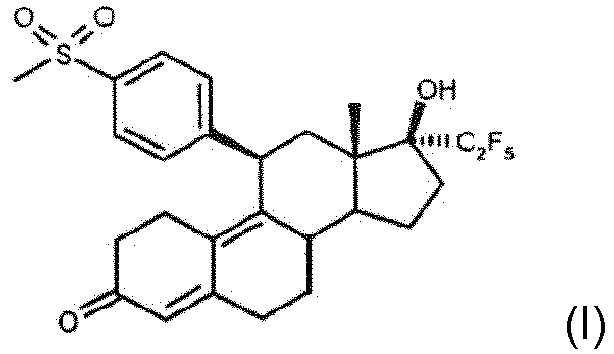
- In one embodiment the daily dosage is in a range from 2 to 4 mg of
Compound 1 as defined above. Preferably, the daily dosage is of about 2 or 4 mg of Compound 1 as defined above. More preferably, the daily dosage is of about 2 mg ofCompound 1 as defined above. - In one embodiment, the treatment period is defined as period where
Compound 1 is continuously administered during a period of four (4) weeks to one (1) year or optionally the treatment period is followed by a break period where administration ofCompound 1 is discontinued until one (1) or two (2) menstrual bleeding episodes occur and treatment period and break period as defined above are repeated at least one (1) time. - In one embodiment, the treatment period is defined as period where
Compound 1 is continuously administered during a period of four (4) weeks to one (1) year and additionally the treatment period is followed by a break period where administration ofCompound 1 is discontinued until one (1) or two (2) menstrual bleeding episodes occur and treatment period and break period as defined above are repeated at least one (1) time. - Preferably, the treatment period is defined as a period where
Compound 1 is continuously administered during a period of twelve (12) weeks followed by a break period where administration ofCompound 1 is discontinued until one (1) menstrual bleeding episode occur and treatment period of twelve (12) weeks is restarted. - Preferably, the treatment period is defined as a period where
Compound 1 is continuously administered during a period of twenty-four (24) weeks followed by a break period where administration ofCompound 1 is discontinued until one (1) or two (2) menstrual bleeding episodes occur and treatment period of twenty-four (24) weeks is restarted. Preferably, break period corresponds to a period where administration ofCompound 1 is discontinued until two (2) menstrual bleeding episodes occur. - Preferably, treatment period and break period are repeated one (1) to five (5) times, more preferably one (1) or two (2) times or one (1) time.
- In a further embodiment, the treatment period is defined as a period where
Compound 1 is continuously administered during a period of twelve (12) weeks up to twenty-four (24) weeks. - Preferably, the treatment period is defined as a period where
Compound 1 is continuously administered during a period of twelve (12) weeks up to fifteen (15) weeks. - Preferably, the treatment period is defined as a period where
Compound 1 is continuously administered during a period of sixteen (16) weeks up to twenty four (24) weeks. - In one embodiment, the treatment and/or prophylaxis is to apply to women in need of treatment suffering from sexual hormone dependent diseases selected from Endometriosis, Uterine Fibroids (UF) and associated symptoms thereof.
Preferably, the treatment and/or prophylaxis are to apply to women in need of treatment suffering from Endometriosis and associated symptoms thereof.
Endometriosis associated symptoms are defined as, but not limited to, pelvic pain and Dysmenorrhoea (i.e. excessive pain during menstruation), Dyspareunia (i.e. painful sexual intercourse) or infertility.
Preferably, Endometriosis associated symptoms are defined as pelvic pain and Dysmenorrhoea (i.e. excessive pain during menstruation) or Dyspareunia (i.e. painful sexual intercourse)
Preferably, the treatment and/or prophylaxis are to apply to women in need of treatment suffering from Uterine Fibroids (UF) and associated symptoms thereof.
Uterine Fibroids (UF) associated symptoms are defined as, but not limited to, pelvic pain, infertility, Heavy Menstrual Bleeding (HMB) and bleeding or spotting between menstruation periods.
Preferably, Uterine Fibroids (UF) associated symptoms are defined as pelvic pain, Heavy Menstrual Bleeding (HMB) and bleeding or spotting between menstruation periods. More preferably, Uterine Fibroids (UF) associated symptoms are defined as Heavy Menstrual Bleeding (HMB) and bleeding or spotting between menstruation periods. Even more preferably, Uterine Fibroids (UF) associated symptoms are defined as, Heavy Menstrual Bleeding (HMB). - In one embodiment, the estrogen-depletion associated with physiological changes are selected from hot flushes and loss of bone mineral density. Preferably, the estrogen-depletion associated with physiological change is hot flushes where the hot flushes appear in no more that 25 % of the treated women. Preferably, the hot flushes occur in a range of 5 % to 25 % of the treated women. More preferably, the hot flushes occur in a range of 5 % to 10 %, 8 % to 14 %, 8 % to 10 % or 10 % to 20% in the treated women. Even more preferably, the hot flushes occur in about 10 % in the treated women with a standard variation of no more than +/-2 %.
- In one embodiment, the hot flushes are distinguished into mild, moderate or severe hot flush. Preferably, the hot flushes are mild- or moderate- hot flush. More preferably, the hot flushes are mild- or moderate- hot flush and appear in no more that 25% of the treated women. Preferably, the hot flushes are mild- or moderate- hot flush and the hot flushes appear in a range of 5 % to 25 % of the treated women. More preferably, the hot flushes are mild- or moderate- hot flush and the hot flushes appear in a range of 5% to 10%, 8% to 14%, 8% to 10% or 10% to 20% in the treated women. Even more preferably, the hot flushes are mild- or moderate- hot flush and the hot flushes occur in about 10 % in the treated women with a standard variation of no more than +/-2%.
- In one embodiment, the circulating endogenous estrogen in women is 17β-estradiol.
- In one embodiment, the circulating endogenous estrogen concentrations in women, in particular Estradiol (E2) is maintained to a level within the range of 40 pg/mL to 85 pg/mL during the treatment period. Preferably, the circulating endogenous estrogen concentrations in women is maintained to a level within the range of 50 pg/mL to 85 pg/mL during the treatment period. More preferably, the circulating endogenous estrogen concentrations in women is maintained to a level within the range of 70 pg/mL to 85 pg/mL or the range of 70 pg/mL to 80 pg/mL or the range of 40 pg/mL to 60 pg/mL, the range of 40 pg/mL to 70 pg/mL or the range of 40 pg/mL to 80 pg/mL during the treatment period.
- In a further embodiment, the circulating endogenous estrogen concentrations in treated women, in particular Estradiol (E2), is never lower than 40 pg/mL during the treatment period. Preferably, the circulating endogenous estrogen concentrations in particular Estradiol (E2), in treated women is never lower than 50 pg/mL during the treatment period. More preferably, the circulating endogenous estrogen concentrations in particular Estradiol (E2), in women is never lower than 70 pg/mL during the treatment period.
- In a further embodiment, the circulating endogenous estrogen concentrations in treated women, in particular Estradiol (E2), is decreasing during the treatment period compared to the circulating endogenous estrogen concentrations baseline at treatment start but never lower than 40 pg/mL and this reduction is reversible after the end of the treatment period.
- In a further embodiment, the circulating endogenous estrogen concentrations in women, in particular Estradiol (E2), is maintained to a level within the range of 40 pg/mL to 85 pg/mL during the treatment period in at least 70% of the women, preferably in a range of 80 % to 90% of the women.
- The terms as mentioned in the present text have the following meanings:
- Effective suppression of the endocrine ovarian function means that estrogen serum concentrations (notably 17β-estradiol-levels) and consequently endogenous progesterone serum concentrations will be suppressed to such a level that virtually no growth of endometrial tissue will occur. When the ovaries are sufficiently suppressed, this will normally induce amenorrhoea.
- A bleeding episode is at least one day of menstrual bleeding.
- The treatment period means the period where the
invention Compound 1 is administered to the women in need of treatment. - Hot flushes refer to sudden feelings of heat or burning which starts in the head and neck area and then passes, often in waves, over the entire body. Immediately thereafter objective signs of body heat dissipation by sweating and peripheral vasodilation are usually observed (Freedman; Physiology of hot flashes; Am. J. Human Biology, Vo1 13 pp 453-464, 2001). Hot flushes is a vasomotor deficiency symptom.
- The invention range of 40 pg/mL to 85 pg/mL of circulating endogenous estrogen concentrations refers to Median or Mean values.
- Circulating endogenous estrogen refers to the naturally estrogen hormone circulating in blood. Naturally occurring forms of estrogen in women are estrone (E1), estradiol (E2), and estriol (E3). Another type of estrogen called estetrol (E4) is produced only during pregnancy.
- Women in need of treatment are female humans (subject) suffering from sexual hormone dependent diseases selected from Endometriosis, Uterine Fibroids (UF) and associated symptoms thereof.
- Most common symptoms related to Uterine Fibroids (UF) are pelvic pain, infertility, Heavy Menstrual Bleeding (HMB) and bleeding or spotting between menstruation periods. Preferably, treated symptom is Heavy Menstrual Bleeding (HMB).
- Most common symptoms related to Endometriosis are pelvic pain and Dysmenorrhoea (i.e. excessive pain during menstruation), Dyspareunia (i.e. painful sexual intercourse) and infertility. Preferably, treated symptom is Dysmenorrhoea.
- The reduced circulating endogenous estrogen refers to value that did not reach postmenopausal levels i.e. lower than 27 pg/mL of estradiol (E2). Mild hot flush refers to flashes or flushes that are barely noticeable and don't interfere with daily routine, normally lasting less than five minutes.
- Moderate hot flush refers to flashes or flushes that are more intense and noticeable, often including a bothersome feeling of heat in the upper body and irregular heartbeat.
Severe hot flush refers to flashes or flushes that force women to seek immediate relief. They consist of profuse sweating, cold chills, and dizziness, among other symptoms. - The wording "during the treatment period" means here until the end of the treatment period corresponding to the
last time Compound 1 is administered in women suffering from sexual hormone dependent diseases selected from Endometriosis, Uterine Fibroids (UF) and associated symptoms thereof. - The term "comprising" when used in the specification includes "consisting of".
- The term depletion means a visible and measurable reduction.
- The twelve (12) weeks is to be equivalent to about 3 months.
- The twenty-four (24) weeks is to be equivalent to about 6 months.
- The wording "to treat and/or prophylaxis diseases" means "to treat said diseases and/or provide prophylaxis against said diseases".
- The wording "potentially at risk" means that in view of women disease historic, weight, ethny and/or other parameters women can be classified as reacting negatively to a certain treatment.
- The wording "break period" means that administration of
Compound 1 is discontinued until at least one menstrual bleeding occur. Spotting shall not be compted as menstrual bleeding. Preferably, the menstrual bleeding shall occur one (1) to five (5) times. - If within the present text any item is referred to as "as mentioned herein", it means that it may be mentioned anywhere in the present text.
- Preferred compounds are those which produce the more desirable biological activity. Separated, pure or partially purified isomers and stereoisomers or racemic or diastereomeric mixtures of the compounds of the present invention are also included within the scope of the present invention. The purification and the separation of such materials can be accomplished by standard techniques known in the art.
- In order to distinguish different types of isomers from each other reference is made to IUPAC Rules Section E (Pure Appl Chem 45, 11-30, 1976).
- The present invention includes all possible stereoisomers of the compounds of the present invention as single stereoisomers, or as any mixture of said stereoisomers, e.g. (R)- or (S)-isomers, in any ratio. Isolation of a single stereoisomer, e.g. a single enantiomer or a single diastereomer, of a compound of the present invention is achieved by any suitable state of the art method, such as chromatography, especially chiral chromatography, for example.
- The present invention includes all possible tautomers of the compounds of the present invention as single tautomers, or as any mixture of said tautomers, in any ratio.
- The present invention also covers useful forms of the compounds of the present invention, such as metabolites, hydrates, solvates, prodrugs, salts, in particular pharmaceutically acceptable salts, and/or co-precipitates.
- The term "pharmaceutically acceptable salt" refers to an inorganic or organic acid addition salt of a compound of the present invention. For example, see S. M. Berge, et al. "Pharmaceutical Salts," J. Pharm. Sci. 1977, 66, 1-19.
- The present invention includes all possible salts of the compounds of the present invention as single salts, or as any mixture of said salts, in any ratio.
- Compounds of present invention are administered in the form of unit dose e.g tablet.
- All reagents, for which the synthesis is not described in the experimental part, are either commercially available, or are known compounds or may be formed from known compounds by known methods by a person skilled in the art.
-

- The production of (11β,17β)-17-hydroxy-11-[4-(methylsulfonyl)phenyl]-17-(pentafluoroethyl)estra-4,9-dien-3-one (CAS-No. 1262108-14-4; Compound 2) is described in
WO2011/009531 andDE 102009034362 and can be carried out by analogy with the instructions contained therein. - 50 g (11α,17β)-17-hydroxy-11-[4-(methylsulfonyl)phenyl]-17-(pentafluoroethyl) estra-4,9-dien-3-one (Compound 2) are dissolved in 500 mL methanol. 3.5 g (1 equiv.) sodium borohydride are added in portions at 0 - 5 °C whilst stirring. After a reaction time of about 6 hours at 5 °C, 170 mL water are slowly added, the resulting mixture is stirred for 1 hour and filtered. The filter cake is dried for 16 hours at 45°C in a vacuum. Interim yield: 46.9 g (mixture of
Compound 1 and the 3-beta isomer in a ratio of ∼ 2 : 1). - 45.9 g of the above diastereoisomer mixture dissolved in 462 mL dichloromethane and 76 mL methanol were chromatographed in 78 injections on 500 g Kromasil Diol 10MYM/60A with n-hexane/ethyl acetate (55:45 v/v) (column diameter 80 mm, flow rate 160 mL/min, 22°C +/-3°C). The desired fractions were each collected, cleaned and concentrated to dryness in a vacuum. The residue was dried in a high vacuum. Yield: 25.9 g (3α,11β,17β)-11-[4-(methylsulfonyl)phenyl]-17-(pentafluoro-ethyl)estra-4,9-diene-3,17-diol (Compound 1).
MS (ESI, neg. mode): 591 m/z (M - H+ + HCOOH)
1H-NMR (D6-DMSO; 500.13 MHz): 7.82 ppm (d, 2H, aromat.), 7.46 ppm (d, 2H, aromat.), 5.76 ppm (s, 1 H, OH), 5.42 ppm (bs, 1 H, olefin. 4-H), 4.62 ppm (d, 1 H, OH), 4.48 ppm (m, 1 H, benzyl. H-11), 4.08 ppm (m, 1 H, H-3), 3.18 ppm (s, 3H, CH3-SO2- 2.58 bis 1.15 ppm (several m, 16H), 0.44 ppm (s, 3H, CH3)
13C-NMR (D6-DMSO; 125.8 MHz): 152.28 ppm (s, quart.), 137.73 ppm (s, quart.), 134.05 ppm (s, quart.), 133.13 ppm (s, quart.), 130.87 ppm (s, quart.), 128.03 ppm (s, CH), 127.86 ppm (s, CH), 126.78 ppm (s, CH), 122 - 114 ppm (complex m, CF3-CF2-), 83.21 (t, quart., C-17), 65.20 ppm (s, CH, C-3), 51.46 ppm (d, CH), 50.09 ppm (s, quart., C-13), 43.51 ppm (s, CH3-SO2-), 39.48 ppm (s, CH, C-11), 38.63 ppm (d, CH2), 38.22 ppm (s, CH), 32.48 ppm (s, CH2), 32.28 ppm (s, CH2), 29.90 ppm (s, CH2), 28.35 ppm (s, CH2), 24.60 ppm (s, CH2), 23.74 ppm (s, CH2), 16.29 ppm (s, CH3). - Study protocol (N°15818): A randomized, double-blind, parallel-group, multi-center study to investigate the pharmacodynamics, pharmacokinetics and safety after daily oral administration of 4 different doses of
Compound 1 in healthy women of reproductive age -
- Test drug: Compound 1 (Cp1)
- Doses: 0.5 mg, 1 mg, 2 mg, or 4 mg once daily
- Route of administration: Oral
- Duration of treatment: 1 X 12 weeks (84 days)
- Main criteria for inclusion of Subjects:
- Healthy female subjects
- Age: 18 - 40 years
- Smoking ≤ 10 cigarettes/day
- Body mass index ≥ 18 and ≤ 32 kg/m2
- Signed informed consent prior to study participation
- No contraindication for intake of
Compound 1 - Ovulation in pre-treatment cycle
- Use of non-hormonal contraception during the study.
- Healthy female subjects
- Number of Subjects: see Table 1 for the number of subjects per Dosage
- The estradiol (E2) serum concentration was assessed for each subject at the following Visit Days of the study, see
Figure 1 - ∘ Pre-treatment Day 9 (D9) corresponds to the period before start of
Compound 1 uptake; the pre-treatment cycle starts on the first day of the subject waking up with menstrual bleeding with intensity more than spotting after screening examinations have shown that the subject is eligible for further participation. The pre-treatment period ends by the starting of next menstrual bleeding; - ∘ Treatment Day (D84) corresponds to last intake of
Compound 1. The treatment phase started with the first and ended with the last intake of the study drug. The subjects have to start the intake ofCompound 1 during the first week of the menstrual cycle after the pre-treatment cycle until the last Treatment Day (D84). - ∘ The follow-up
cycle 1 started on the first day without study drug intake and will end in case of start of menstrual bleeding (i.e. when the subject is waking up with menstrual bleeding with intensity more than spotting). The first day of menstrual bleeding will define the start of follow-upcycle 2. Follow-upcycle 2 ended when the subjects report the next menstrual bleeding (i.e. first day of waking up with menstrual bleeding with intensity more than spotting). - During pre-treatment, end of treatment and at Follow-up
Cycle 2, Estradiol (E2) serum concentrations are measured. - Eligible subjects were randomized to one of the treatment groups (0.5 mg, 1 mg, 2 mg, or 4 mg Compound 1). The treatment period consisted of 12 weeks (84 days) of daily tablet intake.
- Table 1 shows the estradiol (E2) concentrations in serum of the study subjects at different Visit days. A slight decrease of estradiol (E2) concentrations is observed during treatment with
Compound 1. This observation is completely reversible after end of treatment as seen by comparison of E2 concentrations at pre-treatment and follow-up Cycle 2. - At the last day (Day 84) the Median Estradiol (E2) value is about 80 pg/mL at the dose groups 0.5, 1 and 2 mg and about 50 pg/mL at the 4 mg dose group.
- See full study description in Example 2.
- Hot flush event were reported and monitored during treatment period.
- Hot flush was reported in 11 subjects from the total study subjects with increasing frequency of hot flush in the higher dose groups, see Table 2. No severe hot flushes were reported.
- Subjects reported only mild to moderate hot flushes.
Table 1: Study 15818 Estradiol concentrations in serum Dose Cp1 Visit Day Number of Subjects (N) Mean pg/mL SD pg/mL Min pg/mL Median pg/mL Max pg/mL 0.5 mg Pre-treatment D9 16 138 117.9 14 104.5 381 Treatment D84 17 135.6 122 23 82 423 Follow-up cycle2 D9 17 116.1 81.8 17 79.9 262 1 mg Pre-treatment D9 17 143.3 95 39 92.3 311 Treatment D84 17 119.4 76.5 42 81.5 276 Follow-up cycle2 D9 17 143.8 84.7 39 119.2 305 2 mg Pre-treatment D9 16 113.5 72.8 33 82.2 308 Treatment D84 15 91.2 73.1 34 78.5 330 Follow-up cycle2 D9 16 123.9 102.1 33 80.9 395 4 mg Pre-treatment D9 16 126.4 47.9 44 122.9 200 Treatment D84 16 53.9 13.6 39 50.5 81 Follow-up cycle2 D9 16 109.9 62.3 41 88.7 279 SD: Standard Deviation
Cp1:Compound 1Table 2: Hot flush events Dose Cp1 Number of subjects (N) Events (%) 0.5 mg 1 5.6 1.0 mg 2 11.1 2.0 mg, 3 17.6 4.0 mg 5 29.4 Cp1: Compound 1 -
- Test drug:
Compound 1 - Doses: 0.5 mg, 1 mg, 2 mg, or 4 mg once daily
- Route of administration: Oral
- Duration of treatment: 1 X 12 weeks (84 days)
- Reference drug: Placebo
- Duration of treatment: 1 X 12 weeks (84 days)
- Diagnosis and main criteria for inclusion of Subjects:
- Women, 18 to 50 years old, with uterine fibroids documented by transvaginal or abdominal ultrasound at screening with at least 1 uterine fibroid with
largest diameter 3 cm and Heavy Menstrual Bleeding (HMB) 80 mL were eligible for enrolment in the study.
- Women, 18 to 50 years old, with uterine fibroids documented by transvaginal or abdominal ultrasound at screening with at least 1 uterine fibroid with
- Number of Women:
- Randomized: 309
- Started treatment: 300
- Completed treatment: 286
- Completed follow-up: 243
- Screening period:
- Following screening visit 1 (Visit 1), there was a screening period of up to 90 days to arrange for complete results of all baseline assessments. During the screening period, subjects were to demonstrate eligibility including presence of at least 1 uterine fibroid of maximum 3 cm diameter and a diagnosis of HMB, defined as menstrual blood loss 80 mL assessed by menstrual pictogram (MP) during the bleeding episode following the screening visit 1 (Visit 1). Every effort was made to keep the duration of the screening period to a minimum.
- Treatment period:
- Eligible subjects were equally randomized to one of the treatment groups (Placebo, 0.5 mg, 1 mg, 2 mg, or 4 mg Compound 1). Treatment was started during the first week of the menstrual cycle following randomization. The treatment period consisted of 12 weeks (84 days) of daily tablet intake.
- Full description of the study in
Figure 2 .
Figure 2 : Study design overview - EoT: End of Treatment visit
- FUP: Follow-up
visit 1 - RND: Randomization visit
- SCR1, 2:
Screening visit - T1, 2, 3, 4, 5, 6:
Treatment visit - B: Break period, duration depending on group allocation
- TP1, 2:
Treatment period - In this study, estradiol levels were measured
- ∘ At the End of Treatment (EoT) visit and
-
∘ Randomization visit 3. - Overall, estradiol levels under treatment were moderately suppressed compared to baseline. A trend of decreasing unbound estradiol concentrations with increasing
Compound 1 exposure was noted. While the Median value at End of Treatment (EoT) was the same for the 1 mg and 2 mg dose (50 pg/mL), in the 4 mg it was lower (39 pg/mL), see Table 3. After the EoT, the Mean estradiol values returned to baseline levels for all Doses, data not shown. - Thus, Estradiol levels under treatment were moderately suppressed compared to baseline, but individual values remained mostly within the physiological follicular phase range. Overall, no safety concerns were identified from the data analysed.


- See full study description in Example 4.
- Hot flush events were reported and monitored during treatment.
- A single severe hot flush event occurred when subject treated with 0.5 mg of
Compound 1. - Overall, no more than 14% of the subjects show mild to moderate hot flushes, see Table 4.
Table 4: Hot flush events Cp1 Dose Group 4 mg 2 mg 1 mg 0,5 mg Placebo Total Number of Subjects (N)/Intensity N=60 (100%) N=61 (100%) N=61 (100%) N=60 (100%) N=58 (100%) N=300 (100%) MILD 5 (8.3%) 4 (6.6%) 3 (4.9%) 5 (8.3%) 3 (5.2%) 20 (6.7%) MODERATE 3 (5.0%) 1 (1.6%) 2 (3.3%) 0 1 (1.7%) 7 (2.3%) SEVERE 0 0 0 1 (1.7%) 0 1 (0.3%) Total 8 (13.3%) 5 (8.2%) 5 (8.2%) 6 (0.0%) 4 (6.9%) 28 (9.3%) Cp1: Compound 1 -
- Test drug:
Compound 1 - Doses: 2 mg once daily
- Route of administration: Oral
- Duration of treatment: 1 X 24 weeks
- Diagnosis and main criteria for inclusion of Subjects:
- Women, 18 to 50 years old, with uterine fibroids documented by transvaginal or abdominal ultrasound at screening with at least 1 uterine fibroid with largest diameter > 3 cm and Heavy Menstrual Bleeding (HMB) > 80 mL were eligible for enrolment in the study.
- Screening period:
- Following screening visit 1 (Visit 1), there was a screening period of up to 90 days to arrange for complete results of all baseline assessments. During the screening period, subjects were to demonstrate eligibility including presence of at least 1 uterine fibroid of maximum 3 cm diameter and a diagnosis of HMB, defined as menstrual blood loss 80 mL assessed by menstrual pictogram (MP) during the bleeding episode following the screening visit 1 (Visit 1). Every effort was made to keep the duration of the screening period to a minimum.
- Treatment period:
- Eligible subjects were equally randomized to
treatment 2 mg ofCompound 1. Treatment was started during the first week of the menstrual cycle following randomization. The treatment period consisted of 24 weeks of daily tablet intake.
- Eligible subjects were equally randomized to
- Full description of the study in
Figure 3 .
Figure 3 : Study design overview - EoT: End of Treatment visit
- FUP: Follow-up
visit 1 - RND: Randomization visit
- SCR1, 2:
Screening visit - T1, 2, 3, 4, 5, 6:
Treatment visit - B: Break period, duration depending on group allocation
- TP1, 2:
Treatment period - In this study, estradiol levels were measured
- ∘ Treatment Visit 3 (corresponding to the end of 12 weeks treatment),
- ∘ Treatment Visit 6 (corresponding to the end of 24 weeks treatment).
- Overall, estradiol levels under treatment were moderately suppressed compared to baseline. A trend of decreasing unbound estradiol concentrations with increasing
Compound 1 exposure was noted, see Table 5. After the EoT, the Mean estradiol values returned to baseline levels for all Doses, data not shown. - Thus, Estradiol levels under treatment were moderately suppressed compared to baseline, but individual values remained mostly within the physiological follicular phase range. Overall, no safety concerns were identified from the data analysed.
Table 5: Study 17541 Estradiol concentrations in serum Cp1 Dose Group Visit Day Number of Subjects (N) Mean pg/mL SD pg/mL Min pg/mL Median pg/mL Max pg/mL Baseline 34 135.97 138.76 29.4 93.55 644.2 2 mg Treatment Visit 3 31 77.46 105.41 11.0 47.50 557.5 Treatment Visit 631 44.69 30.81 7.9 42.50 132.5 SD: Standard Deviation
Cp1:Compound 1 - See full study description in Example 6.
- Hot flush events were reported and monitored during treatment.
- Overall, no more than 11.4 % of the subjects show hot flush, see Table 6.
Table 6: Hot flush events Dose Cp1 Number of subjects (N) 100% Number of subjects (N) Events (%) 2.0 mg 30 4 11.4 Cp1: Compound 1 -
Figure 1 : 15818 Study design -
Figure 2 : 15788 Study design -
Figure 3 : 17541 Study design
Claims (12)
- A Selective Progesterone Receptor Modulator (SPRM) namely (11β,17β)-17-Hydroxy-11-[4-(methylsulphonyl)phenyl]-17-(pentafluoroethyl)estra-4,9-dien-3-one (Compound 1) of formula (I)

for use in the treatment and/or prophylaxis of a sexual hormone dependent disease, preferably, the disease is selected from Endometriosis, Uterine Fibroids (UF) and associated symptoms thereof;
charactherized in that Compound 1 as defined above is reducing the risk of estrogen-depletion associated with physiological changes selected from vulvar and vaginal atrophy causing vaginal dryness, pruritus and dyspareunia, and vasomotor instability manifested as hot flushes and loss of bone mineral density wherein at least one of these physiological changes applies. - A Selective Progesterone Receptor Modulator (SPRM) namely (11β,17β)-17-Hydroxy-11-[4-(methylsulphonyl)phenyl]-17-(pentafluoroethyl)estra-4,9-dien-3-one (Compound 1) of formula (I)

for use in the treatment and/or prophylaxis of a sexual hormone dependent disease, preferably, the disease is selected from Endometriosis, Uterine Fibroids (UF) and associated symptoms thereof;
characterized in that the circulating endogenous estrogen concentrations in women is maintained to a level within the range of 40 pg/mL to 85 pg/mL during the treatment period. - A Selective Progesterone Receptor Modulator (SPRM) namely (11β,17β)-17-Hydroxy-11-[4-(methylsulphonyl)phenyl]-17-(pentafluoroethyl)estra-4,9-dien-3-one (Compound 1) of formula (I)

for use in the treatment and/or prophylaxis of a sexual hormone dependent disease, preferably, the disease is selected from Endometriosis, Uterine Fibroids (UF) and associated symptoms thereof;
characterized in that
women in need of treatment are diagnostized as developing estrogen-depletion associated with physiological changes or are potentially at risk of estrogen-depletion associated with physiological changes selected from vulvar and vaginal atrophy causing vaginal dryness, pruritus and dyspareunia, and vasomotor instability manifested as hot flushes and loss of bone mineral density when treated with Selective Progesterone Receptor Modulator (SPRM) such as but not limited to Ulipristal acetate (UPA) or Gonadotrophin-Releasing Hormone (GnRH) analogues such as but not limited to Leuprolide and Elagolix. - The Selective Progesterone Receptor Modulator (SPRM) according to claims 1, 2 or 3 independently from each other wherein the daily dosage is of about 2 mg to 4 mg of Compound 1.
- The Selective Progesterone Receptor Modulator (SPRM) according to claims 1, 2 or 3 independently from each other wherein the treatment period is defined as a period where Compound 1 is continuously administered during a period of four (4) weeks to one (1) year and optionally the treatment period is followed by a break period where administration of Compound 1 is discontinued until one (1) or two (2) menstrual bleeding episodes occur and treatment period and break period as defined above are repeated at least one (1) time.
- The Selective Progesterone Receptor Modulator (SPRM) according to claims 1 to 5 independently from each other wherein the treatment and/or prophylaxis is to apply to women in need of treatment suffering from Endometriosis and associated symptoms thereof.
- The Selective Progesterone Receptor Modulator (SPRM) according to claims 1 to 5 independently from each other wherein the treatment and/or prophylaxis is to apply to women in need of treatment suffering from Uterine Fibroids (UF) and associated symptoms thereof.
- The Selective Progesterone Receptor Modulator (SPRM) according to claims 3 to 7 independently from each other wherein the estrogen-depletion associated with physiological changes are selected from hot flushes and loss of bone mineral density.
- The Selective Progesterone Receptor Modulator (SPRM) according to claims 2, 4 to 8 independently from each other wherein the circulating endogenous estrogen is Estradiol (E2) namely 17β-estradiol.
- The Selective Progesterone Receptor Modulator (SPRM) according to claim 9 wherein the Estradiol (E2) is maintained to a level within the range of 40 pg/mL to 85 pg/mL during the treatment period.
- The Selective Progesterone Receptor Modulator (SPRM) according to claims 1, 4-10 independently from each other wherein the hot flushes is/are mild- or moderate- hot flush.
- The Selective Progesterone Receptor Modulator (SPRM) according to claims 11 wherein the hot flushes are mild- or moderate- hot flush and appear in no more than 25% of the treated women.
Priority Applications (3)
| Application Number | Priority Date | Filing Date | Title |
|---|---|---|---|
| EP17164666.4A EP3384913A1 (en) | 2017-04-03 | 2017-04-03 | Selective progesterone receptor modulators and stabilized estrogen level in patient |
| EP18164909.6A EP3384914A1 (en) | 2017-04-03 | 2018-03-29 | Selective progesterone receptor modulators (sprm) and stabilized estrogen level in patient |
| US15/942,802 US10485808B2 (en) | 2017-04-03 | 2018-04-02 | Selective progesterone receptor modulators (SPRM) and stabilized estrogen level in patient |
Applications Claiming Priority (1)
| Application Number | Priority Date | Filing Date | Title |
|---|---|---|---|
| EP17164666.4A EP3384913A1 (en) | 2017-04-03 | 2017-04-03 | Selective progesterone receptor modulators and stabilized estrogen level in patient |
Publications (1)
| Publication Number | Publication Date |
|---|---|
| EP3384913A1 true EP3384913A1 (en) | 2018-10-10 |
Family
ID=58489215
Family Applications (2)
| Application Number | Title | Priority Date | Filing Date |
|---|---|---|---|
| EP17164666.4A Withdrawn EP3384913A1 (en) | 2017-04-03 | 2017-04-03 | Selective progesterone receptor modulators and stabilized estrogen level in patient |
| EP18164909.6A Withdrawn EP3384914A1 (en) | 2017-04-03 | 2018-03-29 | Selective progesterone receptor modulators (sprm) and stabilized estrogen level in patient |
Family Applications After (1)
| Application Number | Title | Priority Date | Filing Date |
|---|---|---|---|
| EP18164909.6A Withdrawn EP3384914A1 (en) | 2017-04-03 | 2018-03-29 | Selective progesterone receptor modulators (sprm) and stabilized estrogen level in patient |
Country Status (2)
| Country | Link |
|---|---|
| US (1) | US10485808B2 (en) |
| EP (2) | EP3384913A1 (en) |
Families Citing this family (1)
| Publication number | Priority date | Publication date | Assignee | Title |
|---|---|---|---|---|
| MA42103A (en) * | 2015-05-18 | 2018-03-28 | Bayer Pharma AG | SELECTIVE PROGESTERONE RECEPTOR MODULATOR (RPM) DOSAGE REGIME |
Citations (4)
| Publication number | Priority date | Publication date | Assignee | Title |
|---|---|---|---|---|
| WO2011009531A2 (en) | 2009-07-20 | 2011-01-27 | Bayer Schering Pharma Aktiengesellschaft | 17-hydroxy-17-pentafluorethyl-estra-4,9(10)-dien-11-aryl derivatives, methods for the production thereof and use thereof for treating diseases |
| WO2014166971A1 (en) * | 2013-04-11 | 2014-10-16 | Bayer Pharma Aktiengesellschaft | Progesterone receptor antagonist dosage form |
| WO2016184863A1 (en) * | 2015-05-18 | 2016-11-24 | Bayer Pharma Aktiengesellschaft | Selective progesterone receptor modulator (sprm) regimen |
| EP3214092A1 (en) * | 2016-03-04 | 2017-09-06 | Bayer Pharma Aktiengesellschaft | Prodrugs of the selective progesterone receptor modulator (sprm) (11.beta.,17.beta.)-17-hydroxy-11-[4-(methylsulphonyl)phenyl]-17-(pentafluoroethyl)estra-4,9-dien-3-one |
-
2017
- 2017-04-03 EP EP17164666.4A patent/EP3384913A1/en not_active Withdrawn
-
2018
- 2018-03-29 EP EP18164909.6A patent/EP3384914A1/en not_active Withdrawn
- 2018-04-02 US US15/942,802 patent/US10485808B2/en not_active Expired - Fee Related
Patent Citations (5)
| Publication number | Priority date | Publication date | Assignee | Title |
|---|---|---|---|---|
| WO2011009531A2 (en) | 2009-07-20 | 2011-01-27 | Bayer Schering Pharma Aktiengesellschaft | 17-hydroxy-17-pentafluorethyl-estra-4,9(10)-dien-11-aryl derivatives, methods for the production thereof and use thereof for treating diseases |
| DE102009034362A1 (en) | 2009-07-20 | 2011-01-27 | Bayer Schering Pharma Aktiengesellschaft | 17-Hydroxy-17-pentafluoroethyl-estra-4,9 (10) -diene-11-aryl derivatives, process for their preparation and their use for the treatment of diseases |
| WO2014166971A1 (en) * | 2013-04-11 | 2014-10-16 | Bayer Pharma Aktiengesellschaft | Progesterone receptor antagonist dosage form |
| WO2016184863A1 (en) * | 2015-05-18 | 2016-11-24 | Bayer Pharma Aktiengesellschaft | Selective progesterone receptor modulator (sprm) regimen |
| EP3214092A1 (en) * | 2016-03-04 | 2017-09-06 | Bayer Pharma Aktiengesellschaft | Prodrugs of the selective progesterone receptor modulator (sprm) (11.beta.,17.beta.)-17-hydroxy-11-[4-(methylsulphonyl)phenyl]-17-(pentafluoroethyl)estra-4,9-dien-3-one |
Non-Patent Citations (9)
| Title |
|---|
| BARBARA SCHÜTT ET AL: "Pharmacodynamics and safety of the novel selective progesterone receptor modulator vilaprisan: a double-blind, randomized, placebo-controlled phase 1 trial in healthy women", HUMAN REPRODUCTION, vol. 31, no. 8, 10 June 2016 (2016-06-10), GB, pages 1703 - 1712, XP055404637, ISSN: 0268-1161, DOI: 10.1093/humrep/dew140 * |
| CHRISTIAN SEITZ ET AL: "Rationale and design of ASTEROID 2, a randomized, placebo- and active comparator-controlled study to assess the efficacy and safety of vilaprisan in patients with uterine fibroids", CONTEMPORARY CLINICAL TRIALS, vol. 55, 6 February 2017 (2017-02-06), GB, pages 56 - 62, XP055404494, ISSN: 1551-7144, DOI: 10.1016/j.cct.2017.02.002 * |
| DONNEZ ET AL., THE NEW ENGLAND JOURNAL OF MEDICINE, vol. 366, no. 5, February 2010 (2010-02-01), pages 421 |
| FREEDMAN: "Physiology of hot flashes", AM. J. HUMAN BIOLOGY, vol. 13, 2001, pages 453 - 464, XP008111393 |
| L. BRADLEY ET AL: "O-235 RESULTS OF THE ASTEROID (ASSESS SAFETY AND EFFICACY OF VILAPRISAN IN PATIENTS WITH UTERINE FIBROIDS) 1 STUDY: A PHASE 2, PLACEBO-CONTROLLED DOSE FINDING STUDY", FERTILITY & STERILITY ASRM ABSTRACTS, VOL. 106, ISSUE 3, SUPPLEMENT,, 1 September 2016 (2016-09-01), pages e95 - e96, XP055404504, Retrieved from the Internet <URL:http://www.fertstert.org/article/S0015-0282(16)61691-6/pdf> [retrieved on 20170907] * |
| POWELL ET AL., WOMENS HEALTH REVIEW, 2017, pages 1 - 5 |
| PURE APPL CHEM, vol. 45, 1976, pages 11 - 30 |
| ROBERTO MARCI ET AL: "Ulipristal acetate: a novel pharmacological approach for the treatment of uterine fibroids", DRUG DESIGN, DEVELOPMENT AND THERAPY, 1 February 2014 (2014-02-01), pages 285, XP055404936, DOI: 10.2147/DDDT.S54565 * |
| S. M. BERGE ET AL.: "Pharmaceutical Salts", J. PHARM. SCI., vol. 66, 1977, pages 1 - 19, XP002675560, DOI: doi:10.1002/jps.2600660104 |
Also Published As
| Publication number | Publication date |
|---|---|
| US10485808B2 (en) | 2019-11-26 |
| EP3384914A1 (en) | 2018-10-10 |
| US20180369257A1 (en) | 2018-12-27 |
Similar Documents
| Publication | Publication Date | Title |
|---|---|---|
| KR100805648B1 (en) | Hormone Supplementation with Combination of Complex Estrogen and Medroxyprogesterone Acetate | |
| KR0170764B1 (en) | Pharmaceutical package for contraception | |
| JPH03209328A (en) | Osteoporosis therapeutic agent | |
| KR100849919B1 (en) | Combination of an estrogen and an androgen for treating hormonal deficiencies in women undergoing estrogen replacement therapy | |
| US20030191096A1 (en) | Method of hormonal therapy | |
| JP2021098702A (en) | Selective Progesterone Receptor Modulator (SPRM) Regimen | |
| JP6691193B2 (en) | Progesterone receptor antagonist dosage form | |
| EP3384913A1 (en) | Selective progesterone receptor modulators and stabilized estrogen level in patient | |
| US20090023693A1 (en) | New drospirenone/17beta-estradiol regimen, pharmaceutical combination product and kit for performing this regimen | |
| US20050032758A1 (en) | Hormone replacement therapy and depression | |
| HK40010025A (en) | Progesterone receptor antagonist dosage form | |
| WO2009112232A2 (en) | New drospirenone/17beta-estradiol regimen, pharmaceutical combination product and kit for performing this regimen | |
| WO2020081726A1 (en) | Methods of treating menopausal symptoms using low dose progesterone | |
| EP2647378A1 (en) | Steroid sulfatase inhibitor regimen for the treatment of endometriosis | |
| WO2009112231A2 (en) | New drospirenone/17beta-estradil regimen, pharmaceutical combination product and kit for performing this regimen |
Legal Events
| Date | Code | Title | Description |
|---|---|---|---|
| PUAI | Public reference made under article 153(3) epc to a published international application that has entered the european phase |
Free format text: ORIGINAL CODE: 0009012 |
|
| STAA | Information on the status of an ep patent application or granted ep patent |
Free format text: STATUS: THE APPLICATION HAS BEEN PUBLISHED |
|
| AK | Designated contracting states |
Kind code of ref document: A1 Designated state(s): AL AT BE BG CH CY CZ DE DK EE ES FI FR GB GR HR HU IE IS IT LI LT LU LV MC MK MT NL NO PL PT RO RS SE SI SK SM TR |
|
| AX | Request for extension of the european patent |
Extension state: BA ME |
|
| STAA | Information on the status of an ep patent application or granted ep patent |
Free format text: STATUS: THE APPLICATION IS DEEMED TO BE WITHDRAWN |
|
| 18D | Application deemed to be withdrawn |
Effective date: 20190411 |