EP3382992A1 - Cross-layer optimized adaptive http streaming - Google Patents
Cross-layer optimized adaptive http streaming Download PDFInfo
- Publication number
- EP3382992A1 EP3382992A1 EP18172997.1A EP18172997A EP3382992A1 EP 3382992 A1 EP3382992 A1 EP 3382992A1 EP 18172997 A EP18172997 A EP 18172997A EP 3382992 A1 EP3382992 A1 EP 3382992A1
- Authority
- EP
- European Patent Office
- Prior art keywords
- module
- network
- policy
- remote device
- pcrf
- Prior art date
- Legal status (The legal status is an assumption and is not a legal conclusion. Google has not performed a legal analysis and makes no representation as to the accuracy of the status listed.)
- Granted
Links
Images


Classifications
-
- H—ELECTRICITY
- H04—ELECTRIC COMMUNICATION TECHNIQUE
- H04W—WIRELESS COMMUNICATION NETWORKS
- H04W48/00—Access restriction; Network selection; Access point selection
- H04W48/08—Access restriction or access information delivery, e.g. discovery data delivery
- H04W48/10—Access restriction or access information delivery, e.g. discovery data delivery using broadcasted information
-
- H—ELECTRICITY
- H04—ELECTRIC COMMUNICATION TECHNIQUE
- H04B—TRANSMISSION
- H04B7/00—Radio transmission systems, i.e. using radiation field
- H04B7/02—Diversity systems; Multi-antenna system, i.e. transmission or reception using multiple antennas
- H04B7/04—Diversity systems; Multi-antenna system, i.e. transmission or reception using multiple antennas using two or more spaced independent antennas
- H04B7/0413—MIMO systems
- H04B7/0456—Selection of precoding matrices or codebooks, e.g. using matrices antenna weighting
-
- H—ELECTRICITY
- H04—ELECTRIC COMMUNICATION TECHNIQUE
- H04B—TRANSMISSION
- H04B7/00—Radio transmission systems, i.e. using radiation field
- H04B7/02—Diversity systems; Multi-antenna system, i.e. transmission or reception using multiple antennas
- H04B7/04—Diversity systems; Multi-antenna system, i.e. transmission or reception using multiple antennas using two or more spaced independent antennas
- H04B7/06—Diversity systems; Multi-antenna system, i.e. transmission or reception using multiple antennas using two or more spaced independent antennas at the transmitting station
- H04B7/0613—Diversity systems; Multi-antenna system, i.e. transmission or reception using multiple antennas using two or more spaced independent antennas at the transmitting station using simultaneous transmission
- H04B7/0615—Diversity systems; Multi-antenna system, i.e. transmission or reception using multiple antennas using two or more spaced independent antennas at the transmitting station using simultaneous transmission of weighted versions of same signal
- H04B7/0619—Diversity systems; Multi-antenna system, i.e. transmission or reception using multiple antennas using two or more spaced independent antennas at the transmitting station using simultaneous transmission of weighted versions of same signal using feedback from receiving side
- H04B7/0621—Feedback content
- H04B7/0632—Channel quality parameters, e.g. channel quality indicator [CQI]
-
- H—ELECTRICITY
- H04—ELECTRIC COMMUNICATION TECHNIQUE
- H04B—TRANSMISSION
- H04B7/00—Radio transmission systems, i.e. using radiation field
- H04B7/02—Diversity systems; Multi-antenna system, i.e. transmission or reception using multiple antennas
- H04B7/04—Diversity systems; Multi-antenna system, i.e. transmission or reception using multiple antennas using two or more spaced independent antennas
- H04B7/06—Diversity systems; Multi-antenna system, i.e. transmission or reception using multiple antennas using two or more spaced independent antennas at the transmitting station
- H04B7/0613—Diversity systems; Multi-antenna system, i.e. transmission or reception using multiple antennas using two or more spaced independent antennas at the transmitting station using simultaneous transmission
- H04B7/0615—Diversity systems; Multi-antenna system, i.e. transmission or reception using multiple antennas using two or more spaced independent antennas at the transmitting station using simultaneous transmission of weighted versions of same signal
- H04B7/0619—Diversity systems; Multi-antenna system, i.e. transmission or reception using multiple antennas using two or more spaced independent antennas at the transmitting station using simultaneous transmission of weighted versions of same signal using feedback from receiving side
- H04B7/0636—Feedback format
- H04B7/0639—Using selective indices, e.g. of a codebook, e.g. pre-distortion matrix index [PMI] or for beam selection
-
- H—ELECTRICITY
- H04—ELECTRIC COMMUNICATION TECHNIQUE
- H04L—TRANSMISSION OF DIGITAL INFORMATION, e.g. TELEGRAPHIC COMMUNICATION
- H04L25/00—Baseband systems
- H04L25/02—Details ; arrangements for supplying electrical power along data transmission lines
- H04L25/0202—Channel estimation
- H04L25/0204—Channel estimation of multiple channels
-
- H—ELECTRICITY
- H04—ELECTRIC COMMUNICATION TECHNIQUE
- H04L—TRANSMISSION OF DIGITAL INFORMATION, e.g. TELEGRAPHIC COMMUNICATION
- H04L25/00—Baseband systems
- H04L25/02—Details ; arrangements for supplying electrical power along data transmission lines
- H04L25/0202—Channel estimation
- H04L25/0224—Channel estimation using sounding signals
- H04L25/0226—Channel estimation using sounding signals sounding signals per se
-
- H—ELECTRICITY
- H04—ELECTRIC COMMUNICATION TECHNIQUE
- H04L—TRANSMISSION OF DIGITAL INFORMATION, e.g. TELEGRAPHIC COMMUNICATION
- H04L25/00—Baseband systems
- H04L25/02—Details ; arrangements for supplying electrical power along data transmission lines
- H04L25/03—Shaping networks in transmitter or receiver, e.g. adaptive shaping networks
- H04L25/03006—Arrangements for removing intersymbol interference
- H04L25/03343—Arrangements at the transmitter end
-
- H—ELECTRICITY
- H04—ELECTRIC COMMUNICATION TECHNIQUE
- H04L—TRANSMISSION OF DIGITAL INFORMATION, e.g. TELEGRAPHIC COMMUNICATION
- H04L43/00—Arrangements for monitoring or testing data switching networks
- H04L43/50—Testing arrangements
-
- H—ELECTRICITY
- H04—ELECTRIC COMMUNICATION TECHNIQUE
- H04L—TRANSMISSION OF DIGITAL INFORMATION, e.g. TELEGRAPHIC COMMUNICATION
- H04L45/00—Routing or path finding of packets in data switching networks
- H04L45/70—Routing based on monitoring results
-
- H—ELECTRICITY
- H04—ELECTRIC COMMUNICATION TECHNIQUE
- H04L—TRANSMISSION OF DIGITAL INFORMATION, e.g. TELEGRAPHIC COMMUNICATION
- H04L5/00—Arrangements affording multiple use of the transmission path
- H04L5/003—Arrangements for allocating sub-channels of the transmission path
-
- H—ELECTRICITY
- H04—ELECTRIC COMMUNICATION TECHNIQUE
- H04L—TRANSMISSION OF DIGITAL INFORMATION, e.g. TELEGRAPHIC COMMUNICATION
- H04L5/00—Arrangements affording multiple use of the transmission path
- H04L5/003—Arrangements for allocating sub-channels of the transmission path
- H04L5/0037—Inter-user or inter-terminal allocation
-
- H—ELECTRICITY
- H04—ELECTRIC COMMUNICATION TECHNIQUE
- H04L—TRANSMISSION OF DIGITAL INFORMATION, e.g. TELEGRAPHIC COMMUNICATION
- H04L5/00—Arrangements affording multiple use of the transmission path
- H04L5/0091—Signalling for the administration of the divided path, e.g. signalling of configuration information
- H04L5/0094—Indication of how sub-channels of the path are allocated
-
- H—ELECTRICITY
- H04—ELECTRIC COMMUNICATION TECHNIQUE
- H04L—TRANSMISSION OF DIGITAL INFORMATION, e.g. TELEGRAPHIC COMMUNICATION
- H04L65/00—Network arrangements, protocols or services for supporting real-time applications in data packet communication
- H04L65/60—Network streaming of media packets
- H04L65/65—Network streaming protocols, e.g. real-time transport protocol [RTP] or real-time control protocol [RTCP]
-
- H—ELECTRICITY
- H04—ELECTRIC COMMUNICATION TECHNIQUE
- H04L—TRANSMISSION OF DIGITAL INFORMATION, e.g. TELEGRAPHIC COMMUNICATION
- H04L65/00—Network arrangements, protocols or services for supporting real-time applications in data packet communication
- H04L65/80—Responding to QoS
-
- H—ELECTRICITY
- H04—ELECTRIC COMMUNICATION TECHNIQUE
- H04W—WIRELESS COMMUNICATION NETWORKS
- H04W24/00—Supervisory, monitoring or testing arrangements
-
- H—ELECTRICITY
- H04—ELECTRIC COMMUNICATION TECHNIQUE
- H04W—WIRELESS COMMUNICATION NETWORKS
- H04W24/00—Supervisory, monitoring or testing arrangements
- H04W24/02—Arrangements for optimising operational condition
-
- H—ELECTRICITY
- H04—ELECTRIC COMMUNICATION TECHNIQUE
- H04W—WIRELESS COMMUNICATION NETWORKS
- H04W24/00—Supervisory, monitoring or testing arrangements
- H04W24/10—Scheduling measurement reports ; Arrangements for measurement reports
-
- H—ELECTRICITY
- H04—ELECTRIC COMMUNICATION TECHNIQUE
- H04W—WIRELESS COMMUNICATION NETWORKS
- H04W4/00—Services specially adapted for wireless communication networks; Facilities therefor
- H04W4/70—Services for machine-to-machine communication [M2M] or machine type communication [MTC]
-
- H—ELECTRICITY
- H04—ELECTRIC COMMUNICATION TECHNIQUE
- H04W—WIRELESS COMMUNICATION NETWORKS
- H04W48/00—Access restriction; Network selection; Access point selection
- H04W48/08—Access restriction or access information delivery, e.g. discovery data delivery
- H04W48/12—Access restriction or access information delivery, e.g. discovery data delivery using downlink control channel
-
- H—ELECTRICITY
- H04—ELECTRIC COMMUNICATION TECHNIQUE
- H04W—WIRELESS COMMUNICATION NETWORKS
- H04W52/00—Power management, e.g. Transmission Power Control [TPC] or power classes
- H04W52/02—Power saving arrangements
- H04W52/0209—Power saving arrangements in terminal devices
- H04W52/0212—Power saving arrangements in terminal devices managed by the network, e.g. network or access point is leader and terminal is follower
- H04W52/0216—Power saving arrangements in terminal devices managed by the network, e.g. network or access point is leader and terminal is follower using a pre-established activity schedule, e.g. traffic indication frame
-
- H—ELECTRICITY
- H04—ELECTRIC COMMUNICATION TECHNIQUE
- H04W—WIRELESS COMMUNICATION NETWORKS
- H04W52/00—Power management, e.g. Transmission Power Control [TPC] or power classes
- H04W52/04—Transmission power control [TPC]
- H04W52/06—TPC algorithms
- H04W52/14—Separate analysis of uplink or downlink
- H04W52/146—Uplink power control
-
- H—ELECTRICITY
- H04—ELECTRIC COMMUNICATION TECHNIQUE
- H04W—WIRELESS COMMUNICATION NETWORKS
- H04W52/00—Power management, e.g. Transmission Power Control [TPC] or power classes
- H04W52/04—Transmission power control [TPC]
- H04W52/18—TPC being performed according to specific parameters
-
- H—ELECTRICITY
- H04—ELECTRIC COMMUNICATION TECHNIQUE
- H04W—WIRELESS COMMUNICATION NETWORKS
- H04W72/00—Local resource management
- H04W72/04—Wireless resource allocation
- H04W72/044—Wireless resource allocation based on the type of the allocated resource
- H04W72/0453—Resources in frequency domain, e.g. a carrier in FDMA
-
- H—ELECTRICITY
- H04—ELECTRIC COMMUNICATION TECHNIQUE
- H04W—WIRELESS COMMUNICATION NETWORKS
- H04W72/00—Local resource management
- H04W72/20—Control channels or signalling for resource management
- H04W72/21—Control channels or signalling for resource management in the uplink direction of a wireless link, i.e. towards the network
-
- H—ELECTRICITY
- H04—ELECTRIC COMMUNICATION TECHNIQUE
- H04W—WIRELESS COMMUNICATION NETWORKS
- H04W72/00—Local resource management
- H04W72/20—Control channels or signalling for resource management
- H04W72/23—Control channels or signalling for resource management in the downlink direction of a wireless link, i.e. towards a terminal
-
- H—ELECTRICITY
- H04—ELECTRIC COMMUNICATION TECHNIQUE
- H04L—TRANSMISSION OF DIGITAL INFORMATION, e.g. TELEGRAPHIC COMMUNICATION
- H04L25/00—Baseband systems
- H04L25/02—Details ; arrangements for supplying electrical power along data transmission lines
- H04L25/03—Shaping networks in transmitter or receiver, e.g. adaptive shaping networks
- H04L25/03006—Arrangements for removing intersymbol interference
- H04L2025/0335—Arrangements for removing intersymbol interference characterised by the type of transmission
- H04L2025/03426—Arrangements for removing intersymbol interference characterised by the type of transmission transmission using multiple-input and multiple-output channels
-
- H—ELECTRICITY
- H04—ELECTRIC COMMUNICATION TECHNIQUE
- H04L—TRANSMISSION OF DIGITAL INFORMATION, e.g. TELEGRAPHIC COMMUNICATION
- H04L25/00—Baseband systems
- H04L25/02—Details ; arrangements for supplying electrical power along data transmission lines
- H04L25/03—Shaping networks in transmitter or receiver, e.g. adaptive shaping networks
- H04L25/03006—Arrangements for removing intersymbol interference
- H04L2025/03777—Arrangements for removing intersymbol interference characterised by the signalling
- H04L2025/03802—Signalling on the reverse channel
-
- H—ELECTRICITY
- H04—ELECTRIC COMMUNICATION TECHNIQUE
- H04L—TRANSMISSION OF DIGITAL INFORMATION, e.g. TELEGRAPHIC COMMUNICATION
- H04L25/00—Baseband systems
- H04L25/02—Details ; arrangements for supplying electrical power along data transmission lines
- H04L25/03—Shaping networks in transmitter or receiver, e.g. adaptive shaping networks
- H04L25/03006—Arrangements for removing intersymbol interference
- H04L25/03178—Arrangements involving sequence estimation techniques
- H04L25/03248—Arrangements for operating in conjunction with other apparatus
- H04L25/0328—Arrangements for operating in conjunction with other apparatus with interference cancellation circuitry
-
- H—ELECTRICITY
- H04—ELECTRIC COMMUNICATION TECHNIQUE
- H04L—TRANSMISSION OF DIGITAL INFORMATION, e.g. TELEGRAPHIC COMMUNICATION
- H04L5/00—Arrangements affording multiple use of the transmission path
- H04L5/003—Arrangements for allocating sub-channels of the transmission path
- H04L5/0048—Allocation of pilot signals, i.e. of signals known to the receiver
- H04L5/005—Allocation of pilot signals, i.e. of signals known to the receiver of common pilots, i.e. pilots destined for multiple users or terminals
-
- H—ELECTRICITY
- H04—ELECTRIC COMMUNICATION TECHNIQUE
- H04L—TRANSMISSION OF DIGITAL INFORMATION, e.g. TELEGRAPHIC COMMUNICATION
- H04L65/00—Network arrangements, protocols or services for supporting real-time applications in data packet communication
- H04L65/10—Architectures or entities
- H04L65/1059—End-user terminal functionalities specially adapted for real-time communication
-
- H—ELECTRICITY
- H04—ELECTRIC COMMUNICATION TECHNIQUE
- H04W—WIRELESS COMMUNICATION NETWORKS
- H04W28/00—Network traffic management; Network resource management
- H04W28/02—Traffic management, e.g. flow control or congestion control
- H04W28/04—Error control
-
- H—ELECTRICITY
- H04—ELECTRIC COMMUNICATION TECHNIQUE
- H04W—WIRELESS COMMUNICATION NETWORKS
- H04W72/00—Local resource management
-
- H—ELECTRICITY
- H04—ELECTRIC COMMUNICATION TECHNIQUE
- H04W—WIRELESS COMMUNICATION NETWORKS
- H04W88/00—Devices specially adapted for wireless communication networks, e.g. terminals, base stations or access point devices
- H04W88/02—Terminal devices
-
- H—ELECTRICITY
- H04—ELECTRIC COMMUNICATION TECHNIQUE
- H04W—WIRELESS COMMUNICATION NETWORKS
- H04W88/00—Devices specially adapted for wireless communication networks, e.g. terminals, base stations or access point devices
- H04W88/08—Access point devices
-
- H—ELECTRICITY
- H04—ELECTRIC COMMUNICATION TECHNIQUE
- H04W—WIRELESS COMMUNICATION NETWORKS
- H04W92/00—Interfaces specially adapted for wireless communication networks
- H04W92/16—Interfaces between hierarchically similar devices
- H04W92/20—Interfaces between hierarchically similar devices between access points
-
- Y—GENERAL TAGGING OF NEW TECHNOLOGICAL DEVELOPMENTS; GENERAL TAGGING OF CROSS-SECTIONAL TECHNOLOGIES SPANNING OVER SEVERAL SECTIONS OF THE IPC; TECHNICAL SUBJECTS COVERED BY FORMER USPC CROSS-REFERENCE ART COLLECTIONS [XRACs] AND DIGESTS
- Y02—TECHNOLOGIES OR APPLICATIONS FOR MITIGATION OR ADAPTATION AGAINST CLIMATE CHANGE
- Y02D—CLIMATE CHANGE MITIGATION TECHNOLOGIES IN INFORMATION AND COMMUNICATION TECHNOLOGIES [ICT], I.E. INFORMATION AND COMMUNICATION TECHNOLOGIES AIMING AT THE REDUCTION OF THEIR OWN ENERGY USE
- Y02D30/00—Reducing energy consumption in communication networks
- Y02D30/70—Reducing energy consumption in communication networks in wireless communication networks
Definitions
- HTTP-based streaming is spreading widely as a form of multimedia delivery of Internet video.
- HTTP-based delivery provides reliable and simple deployment due to the already broad adoption of both HTTP and its underlying Transmission Control Protocol/Internet Protocol (TCP/IP) protocols.
- HTTP-based delivery enables effortless streaming services by avoiding network address translation (NAT) and firewall traversal issues.
- HTTP-based streaming also provides the ability to use standard HTTP servers and caches instead of specialized streaming servers and has better scalability due to minimal state information on the server side.
- Adaptive video streaming is an important capability towards ensuring the best possible video experience for the end client user at all times, in terms of key performance goals such as high video quality, low startup delay and interrupt-free playback.
- Adaptive video streaming involves continuously optimizing video configurations such as bit rate, resolution and frame rate with respect to changing link conditions, device capabilities and content characteristics.
- RTSP Real-Time Streaming Protocol
- the server keeps track of the client's state until the client disconnects.
- frequent communication between the client and the server is involved for purposes such as session provisioning and negotiation of media parameters.
- the server sends the media as a continuous stream of packets over either User Datagram Protocol (UDP) or TCP transport.
- UDP User Datagram Protocol
- Example technologies for RTSP-based adaptive streaming include Microsoft Windows MediaTM, Apple QuickTimeTM, Adobe FlashTM, and HelixTM by Real Networks, among others.
- Dynamic adaptive streaming over HTTP is a new adaptive streaming technology that operates differently in comparison to RTSP-based adaptive streaming. In particular, it operates by the use of the HTTP protocol, which is stateless. As a client requests some data, the server responds by sending the data and the transaction is terminated. Each HTTP request is handled as a completely standalone one-time transaction.
- progressive download methods Prior to the utilization of DASH, progressive download methods were available for media delivery from standard HTTP Web servers. In HTTP-based progressive download, clients that support the approach can seek to selected positions in the media file by performing byte range requests to the Web server.
- HTTP-based progressive download is not really an adaptive streaming technique, i.e., it does not allow dynamically adapting video configurations with respect to changing link conditions, device capabilities or content characteristics.
- disadvantages of HTTP-based progressive download are mostly that bandwidth may be wasted if the user decides to stop watching the content after progressive download has started.
- HTTP-based progressive download does not support live media services. DASH technology addresses such weaknesses of HTTP-based progressive download.
- DASH-based adaptive streaming currently has the following key challenges for which the solution space is currently very limited.
- DASH moves the adaptive streaming intelligence from the server to the client, letting the client drive the streaming session and make the decisions on the video adaptation parameters.
- developing an intelligent client adaptation framework built specifically for DASH-based streaming services is important since the session state cannot easily be tracked by the network under HTTP-based streaming.
- 3GPP Third Generation Partnership Project
- RAN radio access network
- QoS quality of service
- service adaptation provides QoS support for DASH services impacts the 3GPP policy and charging control architecture (PCC).
- PCC 3GPP policy and charging control architecture
- Coupled may mean that two or more elements are in direct physical and/or electrical contact.
- coupled may also mean that two or more elements may not be in direct contact with each other, but yet may still cooperate and/or interact with each other.
- “coupled” may mean that two or more elements do not contact each other but are indirectly joined together via another element or intermediate elements.
- “On,” “overlying,” and “over” may be used to indicate that two or more elements are in direct physical contact with each other. However, “over” may also mean that two or more elements are not in direct contact with each other. For example, “over” may mean that one element is above another element but not contact each other and may have another element or elements in between the two elements.
- the term “and/or” may mean “and”, it may mean “or”, it may mean “exclusive-or”, it may mean “one”, it may mean “some, but not all”, it may mean “neither", and/or it may mean “both”, although the scope of claimed subject matter is not limited in this respect.
- the terms “comprise” and “include,” along with their derivatives, may be used and are intended as synonyms for each other.
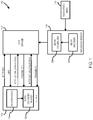
- a DASH enabled adaptive streaming network 100 includes a client 110 able to obtain multimedia services from a web server 112 which in turn may serve the multimedia content from a web/media server 114 on which the multimedia content is stored.
- the web/media server 114 receives the multimedia content via audio/video input 116 which may be a live input stream or previously stored media content, wherein the media is streamed to the client 110.
- Web/media server 114 may include a media encoder 124 to encode the media content to a suitable format, and media segmenter 126 to split the input media content into a series of fragments or chunks suitable for streaming.
- Client 110 may include a web browser 118 to interact with web server 112 and a media decoder/player 120 to decode and render the streaming multimedia content.
- DASH provides the ability to move control of the "streaming session" entirely to the client 110 and therefore moves the adaptive streaming intelligence from the server 112 to the client 110.
- the client 110 basically opens one or several or many TCP connections to one or several standard HTTP servers or caches, retrieves a media presentation description (MPD) metadata file providing information on the structure and different versions of the media content stored in the web/media server 114, including for example different bitrates, frame rates, resolutions, codec types, and so on.
- MPD media presentation description
- the MPD is used to convey the HTTP URL of each segment and associated metadata information to map segments into the media presentation timeline.
- the client 110 requests new data in chunks using HTTP GET or partial HTTP GET messages to obtain smaller data segments (HTTP GET URL(FRAG1 REQ), FRAGMENT 1, HTTP GET URL(FRAG i REQ), FRAGMENT i ) of the selected version of media file with individual HTTP GET messages which imitates streaming via short downloads as shown in FIG. 1 .
- the URL of the HTTP GET message is used to tell the web server 112 which segment or segments the client is requesting.
- the web browser 118 pulls the media from web server 112 segment by segment (or subsegment by subsegment based on byte range requests).
- Implementation of DASH on network 100 provides the ability to the client 110 to automatically choose an initial content rate to match initial available bandwidth without requiring the negotiation with the streaming web server 112, and to dynamically switch between different bitrate representations of the media content as the available bandwidth changes.
- implementing DASH on network 100 allows faster adaptation to changing network and wireless link conditions, user preferences, content characteristics and device capabilities such as display resolution, processor speed and resources, memory resources, and so on.
- Such dynamic adaptation provides better user quality of experience (QoE) with shorter startup delays, fewer rebuffering events, better video quality, and so on.
- Example DASH technologies include Microsoft IIS Smooth StreamingTM, Apple HTTP Live StreamingTM, and Adobe HTTP Dynamic StreamingTM.
- DASH technology may be implemented by various standards organizations including the Third Generation Partnership Project (3GPP), the Moving Picture Experts Group (MPEG) and the Open Internet Protocol Television (IPTV) Forum (OIPF), among others.
- 3GPP Third Generation Partnership Project
- MPEG Moving Picture Experts Group
- IPTV Open Internet Protocol Television
- enabling DASH on network 100 moves the adaptive streaming intelligence from the server 112 to the client 110, letting the client 110 drive the streaming session and make the decisions on the video adaptation parameters.
- an intelligent client adaptation framework built specifically for DASH-based streaming services may be implemented in one or more embodiments to track the session state.
- Such a paradigm shift from push-based, RTSP-based, streaming to pull-based, HTTP-based, streaming is capable of delivering the optimal user quality of experience (QoE).
- QoE quality of experience
- delivery of DASH-based services over different 3GPP radio access network (RAN) and core IP network architectures may be implemented, with support for QoS and service adaptation.
- An example diagram of end-to-end QoS deliver of DASH services is shown in an described with respect to FIG. 2 , below.
- the end-to-end quality of service (QoS) architecture 200 may be utilized to implement the delivery of DASH services on network 100.
- network 100 may be a Third Generation Partnership Project (3GPP) network or the like.
- network 100 may implement an evolution of the 3GPP standard such as a 3GPP Long Term Evolution (LTE) standard, an LTE Advanced standard, a Fourth Generation (4G) standard, and so on.
- LTE 3GPP Long Term Evolution
- 4G Fourth Generation
- network 100 may implement an Institute of Electrical Engineers (IEEE) 802.16 standard such as an IEEE 802.16e or IEEE 802.16m standard to implement a Worldwide Interoperability for Microwave Access (WiMAX) network or a WiMAX-II network, although the scope of the claimed subject matter is not limited in this respect.
- IEEE Institute of Electrical Engineers
- end-to-end QoS architecture 200 comprises a wireless network 210 and an internet protocol (IP) network 212.
- the subcomponents of the wireless network 210 and the IP network 212 include a public network 214 which may be the Internet, core network 216, access network 218, base station 220 which may be an enhanced NodeB (eNB), and a mobile station 222, which may be user equipment (UE).
- a DASH server 224 web server 112 is capable of providing streaming multimedia content 226 to mobile station 222 (client 110) via the IP network 212 and wireless network 210 as discussed in further detail herein.
- end-to-end QoS architecture 200 involves consideration of three interfaces: the air interface of base station 220, access network 218, and core network 216.
- the air interface such as a WiMAX or LTE network
- each interface defines a set of QoS classes or bearers, for example Unsolicited Grant Service, Real-time polling service (rtPS), extend rtPS (ertPS), non-real-time polling service (nrtPS), and best effort (BE) for an IEEE 802.16e standard, and specifies associated service attributes in terms of various performance requirements such as throughput, latency/jitter, packet error-loss rate, and so on.
- rtPS Real-time polling service
- ertPS extend rtPS
- nrtPS non-real-time polling service
- BE best effort
- the QoS classes and/or bearers enable the differentiation of the service flows between client applications and various services.
- each service flow is mapped to a specific QoS class and receives a common QoS treatment, and service flows are prioritized accordingly, when resources are distributed between different service flows through scheduling functions.
- some examples for QoS definitions in IP-based access and core networks include Differentiated Services such as DiffServ (RFC2474) and Integrated Services such as IntServ (RFC1633), specified by the Internet Engineering Task Force (IETF).
- IntServ follows the flow-based and signaled QoS model, wherein the end-hosts signal their QoS needs to the network 100, while DiffServ works on the provisioned-QoS model, wherein network elements are set up to service multiple classes of traffic with varying QoS requirements.
- DiffServ uses the 6-bit Differentiated Services Code Point (DSCP) field in the header of IP packets for packet classification purposes.
- DSCP Differentiated Services Code Point
- the IntServ model involves the Resource Reservation Protocol (RSVP) to explicitly signal and reserve the desired QoS for each flow in the network 100 as described by the FlowSpecs.
- RSVP Resource Reservation Protocol
- a convergence sub-layer may be defined to interface higher-layer protocol data units and perform classification and mapping functions. For example, in the case of DiffServ, each end-to-end internet protocol (IP) packet entering the system may be identified with a dedicated air interface bearer for the radio access network, by mapping its DSCP field over the core network from DiffServ to a particular QoS class for the radio access network.
- IP internet protocol
- QoS quality of service
- PCC policy and charging control
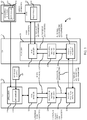
- the policy and charging control (PCC) architecture 300 of FIG. 3 includes user equipment (UE) which corresponds to client 110 of FIG. 1 coupled to a gateway (GW) which corresponds to web server 112 of FIG. 1 .
- UE user equipment
- GW gateway
- a service-aware QoS delivery framework developed by the Third Generation Partnership Project (3GPP) is the policy and charging control (PCC) architecture 300, providing operators of wireless networks such as network 100 with a standardized mechanism for QoS and charging control applicable to both Internet Protocol (IP) Multimedia Subsystem (IMS) and non-IMS based services.
- IP Internet Protocol
- IMS Internet Multimedia Subsystem
- non-IMS non-IMS based services.
- the application function 310 includes an application function (AF) 310 and a policy and charging rules function (PCRF).
- the application function 310 interacts with the applications that involve dynamic policy and charging control.
- Application function 310 extracts session information and provides this to the policy and charging rules function (PCRF) 312 over the Rx reference point.
- Application function 310 includes a serial digital interface (SDI) mapping function 334 that includes a media presentation description (MPD) handler 338.
- SDI serial digital interface
- MPD media presentation description
- the function of the MPD handler 338 is substantially similar to the MPD handler 318 of the application 316 of client 110 in that it is able to parse the MPD and extract the multimedia-specific application layer parameters.
- MPD handler 338 is provided when client 112 shares the MPD with the application function 310.
- Policy and charging rules function (PCRF) 312 is the policy engine of PCC 300 and serves as the central entity for PCC-related decisions. Such decisions may be based on input from a number of different sources including operator configuration policy engine 336 in the PCRF 312 that defines the policies applied to given services, subscription information/policies for a given user received from the subscription profile repository (SPR), information about the service received from the AF 310 based on the service description information contained in the application signaling, and information from the access network 218 about what access technology is used.
- SPR subscription profile repository
- the PCRF 312 combines the session information received over the Rx reference point and the input received from the Gx and Gxa/Gxc reference points with user-specific policies data from the SPR to form session-level policy decisions and provides those to the policy and charging enforcement function (PCEF) and bearer-binding and event-reporting function (BBERF) of PCEF/BBERF bock 314.
- PCEF policy and charging enforcement function
- BBERF bearer-binding and event-reporting function
- the PCRF 312 also forwards events between the BBERF, the PCEF and the AF 310.
- the PCEF 314 further may include an internet protocol bearer service (IP BS) manager 328 and an access-specific bearer service (BS) manager 332 along with a translation/mapping function 330 to provide the internetworking mechanism with the IP BS manager 328 and the access-specific BS manager 332.
- IP BS internet protocol bearer service
- BS access-specific bearer service
- client 110 includes its own IP BS manager 322, access-specific BS manager 326 with a translation/mapping function 324 providing the internetworking mechanism there between.
- the PCEF of PCEF/BBERF block 314 enforces policy decisions received from the PCRF 312 and also provides the PCRF 312 with user-specific and access-specific information over the Gx reference point.
- the UE client 110 is provided with the capability to parse the media presentation description (MPD) and derive target QoS parameters for the core network and radio access network from the MPD.
- the UE/client 110 should include the following new mapping functions provided by MPS to quality of service (QoS) mapping block 320.
- the first mapping function comprises mapping between multimedia-specific application-layer information contained in the MPD and the set of QoS parameters for the core network, for example the DiffServ/DSCP parameters, IntServ/FlowSpecs parameters, and so on.
- the second mapping function comprises mapping between multimedia-specific application-layer information contained in the MPD and the set of QoS parameters for the radio access network, for example QoS class identifiers (QCI), and so on.
- QCI QoS class identifiers
- the UE/client 110 should be able to signal the MPD to the network 100 in order to share DASH-related session information with the appropriate entities in the network, for example the AF 310 for the PCC architecture 300. In the case of signaling the MPD to the AF 310, further capabilities in the AF 310 may be involved in order to interpret MPD and recommend QoS policies for DASH to the PCRF.
- the set of multimedia-specific application-layer parameters in the MPD can include one or more of the following: multimedia bitrates, as included in the 'bandwidth' attribute of each DASH representation, multimedia resolution, as included in the horizontal and vertical resolution attributes of each DASH representation; multimedia encoder frame rate, as included in the 'frameRate' attribute of each DASH representation; which would also describe other codec-related parameters; buffer-related parameters, for example, minimum buffering period before initiating playout, multimedia codec information, for example, codec type such as AMR, MPEG4, H.264 AVC/SVC, and so on, possibly also describing profiles and levels, as included in the 'mimeType' attribute of each DASH representation; rate-distortion function for the multimedia stream, relevant for the 'quality Ranking' attribute of each DASH representation; other quality of experience (QoE) or multimedia quality metrics specified at different rates, reference, reduced-reference or non-reference metrics, for example, video quality metrics (VQM), structural similarity metrics (SSIM
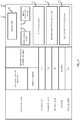
- FIG. 4 shows a DASH client adaptation architecture 400 and the associated Open Systems Interconnection (OSI) communication layer information 422 for client 110.
- the client adaptation architecture 400 of FIG. 4 may comprise a cross-layer optimized platform adaptation architecture for DASH as shown in FIG. 5 , below, in which video, transport and radio components in the platform cooperate and exchange information towards identifying in a joint manner the best platform configurations needed to optimize user quality of experience (QoE).
- the DASH client adaptation architecture 400 comprises the following system blocks.
- a Radio Adaptation and quality of service (QoS) Engine block 410 is capable of determining radio-level adaptation and QoS parameters.
- a Network Adaptation and QoS Engine block 412 is capable of determining network-level adaptation and QoS parameters.
- a hypertext transfer protocol (HTTP) Access Client block 414 is capable of handling transport-level hypertext transport protocol/transmission control protocol/internet protocol (HTTP/TCP/IP) operation, and establishing and managing the TCP connections.
- a DASH Control Engine block 416 is capable of parsing the media presentation description (MPD), and determining streaming parameters for DASH, for example DASH segment duration, and sequence and timing of HTTP requests.
- a Media Adaptation Engine 418 is capable of determining codec-level adaptation parameters.
- a quality of experience (QoE) monitor 420 is capable of dynamically measuring quality of experience (QoE).
- the DASH client platform 400 may have one or several configurations that may be jointly optimized at the video, transport and/or radio levels via cross-layer cooperation wherein the configurations include the following parameters.
- Video level parameters may be utilized to configure video bitrate, frame rate, and/or resolution, wherein the decisions of the client 110 are capable of driving the requested content representations from the DASH server 112.
- Transport level parameters may be utilized to configure the sequence and timing of HTTP requests, the number of parallel TCP connections, and/or DASH segment durations.
- Radio and network level parameters may be utilized to configure modulation and coding scheme (MCS), and/or target QoS parameters for the core network 216 and radio access network 218.
- MCS modulation and coding scheme
- target QoS parameters for the core network 216 and radio access network 218.
- the cross-layer optimized DASH client adaptation architecture 500 is shown in and described with respect to FIG. 5 , below.
- the cross-layer optimized DASH client adaptation architecture 500 of FIG. 5 is capable of optimizing configuration of the DASH client adaptation architecture of FIG. 4 , above.
- the cross-layer optimized client DASH client adaptation architecture includes a cross-layer adaptation manager 510 that may optimize configuration of the DASH client adaptation architecture 400 by dynamically tracking the following parameters and using them as inputs for the decisions towards jointly adapting the DASH client configurations via cross-layer cooperation.
- Measured QoE parameters may be utilized to optimize video quality metrics (VQM), structural similarity metrics (SSIM), perceptual evaluation of video quality metrics (PEVQ), video mean opinion scores (MOS), and so on, and/or other subjective quality metrics.
- additional parameters may be optimized including measured video rate-distortion characteristics, user preferences at the application layer, multimedia-related information retrieved from the media presentation description (MPD), information received from the network on current QoS availability and network congestion states, measured dynamic quality of service (QoS) parameters such as throughput, latency, reliability, and so on, measured dynamic channel/network conditions at the radio and transport levels, and/or power/latency budgets and central processing unit (CPU)/buffer/memory requirements at the platform architecture level.
- QoS measured dynamic quality of service
- these are merely example parameters that may be optimized via cross-layer optimized DASH client adaptation architecture 500, and the scope of the claimed subject matter is not limited in these respects.
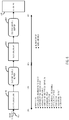
- the set of QoE metrics for DASH may also include the following metrics, listed below, to be measured by the DASH client 110 at four different observation points (OPs) such as OP1, OP2, OP3, and OP4 as shown in FIG. 6 .
- OPs observation points
- QoE measured via different metrics in DASH compared to RTSP-based streaming implying that the DASH client adaptation may be different with respect to RTSP-based streaming.
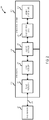
- the DASH client 110 receives DASH segments 610 which are provided to encoded sample buffer 612.
- the buffered segments are then decoded by media decoder 614 and fed into a decoded sample buffer 616.
- the decoded samples are then provided to an audio/video (A/V) output block 618 for playback of the media content received by the DASH client 110.
- the following metrics may be measured between observation points OP1 and OP2, and between OP2 and OP3: media presentation description (MPD) fetch event, initialization segment fetch event, representation switch event, average throughput, average segment fetch duration, download jitter, inactivity time, resource not accessible, initial playout time, buffer level, rebuffering event, and/or client state.
- the following metrics may be measured between observation points OP3 and OP4: audio metrics and/or video metrics.
- Information handling system 700 of FIG. 7 may tangibly embody one or more of any of the network elements of network 100 as shown in and described with respect to FIG. 1 and FIG 2 .
- information handling system 700 may represent the hardware of client 110, web server 112 and/or web/media server 114, with greater or fewer components depending on the hardware specifications of the particular device or network element.
- information handling system 700 represents one example of several types of computing platforms, information handling system 700 may include more or fewer elements and/or different arrangements of elements than shown in FIG. 7 , and the scope of the claimed subject matter is not limited in these respects.
- Information handling system 700 may comprise one or more processors such as processor 710 and/or processor 712, which may comprise one or more processing cores.
- processor 710 and/or processor 712 may couple to one or more memories 716 and/or 718 via memory bridge 714, which may be disposed external to processors 710 and/or 712, or alternatively at least partially disposed within one or more of processors 710 and/or 712.
- Memory 716 and/or memory 718 may comprise various types of semiconductor based memory, for example volatile type memory and/or non-volatile type memory.
- Memory bridge 714 may couple to a graphics system 720 to drive a display device (not shown) coupled to information handling system 700.
- Information handling system 700 may further comprise input/output (I/O) bridge 722 to couple to various types of I/O systems.
- I/O system 724 may comprise, for example, a universal serial bus (USB) type system, an IEEE 1394 type system, or the like, to couple one or more peripheral devices to information handling system 700.
- Bus system 726 may comprise one or more bus systems such as a peripheral component interconnect (PCI) express type bus or the like, to connect one or more peripheral devices to information handling system 700.
- a hard disk drive (HDD) controller system 728 may couple one or more hard disk drives or the like to information handling system, for example Serial ATA type drives or the like, or alternatively a semiconductor based drive comprising flash memory, phase change, and/or chalcogenide type memory or the like.
- Switch 730 may be utilized to couple one or more switched devices to I/O bridge 722, for example Gigabit Ethernet type devices or the like.
- information handling system 700 may include a radio-frequency (RF) transceiver 732 comprising RF circuits and devices coupled to one or more antennas 734 for wireless communication with other wireless communication devices and/or via wireless networks such as transmission system 100 of FIG. 1 of FIG. 2 .
- RF receiver 732 may implement multiple-input, multiple output (MIMO) communication schemes, although the scope of the claimed subject matter is not limited in this respect.
- MIMO multiple-input, multiple output
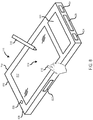
- FIG. 8 shows an example implementation of information handling system 700 of FIG. 7 tangibly embodied as a cellular telephone, or smartphone, or a tablet type device or the like.
- the information handling system 700 may comprise the client 110 of FIG. 1 , and as such may be capable of cross-layer optimized adaptive HTTP streaming as discussed herein, although the scope of the claimed subject matter is not limited in this respect.
- the information handling system 700 may comprise a housing 810 having a display 812 which may include a touch screen 814 for receiving tactile input control and commands via a finger 816 of a user and/or a via stylus 818 to control one or more processors 710 or 712.
- the housing 810 may house one or more components of information handling system 700, for example one or more processors 710 or 712, one or more of memory 716 or 718, transceiver 732.
- the information handling system 820 further may optionally include a physical actuator area 820 which may comprise a keyboard or buttons for controlling information handling system via one or more buttons or switches.
- the information handling system 700 may also include a port or slot 822 for receiving non-volatile memory such as flash memory, for example in the form of a secure digital (SD) card or a subscriber identity module (SIM) card.
- the information handling system 700 may further include one or more speakers and/or microphones 824 and a connection port for connecting the information handling system 700 to another electronic device, dock, display, battery charger, and so on.
- information handling system 700 may include a headphone or speaker jack 828 and one or more cameras 830 on one or more sides of the housing 810. It should be noted that the information handling system 700 of FIG. 8 may include more or fewer elements than shown, in various arrangements, and the scope of the claimed subject matter is not limited in this respect.
Landscapes
- Engineering & Computer Science (AREA)
- Signal Processing (AREA)
- Computer Networks & Wireless Communication (AREA)
- Multimedia (AREA)
- Power Engineering (AREA)
- Physics & Mathematics (AREA)
- Mathematical Physics (AREA)
- Computer Security & Cryptography (AREA)
- Mobile Radio Communication Systems (AREA)
- Two-Way Televisions, Distribution Of Moving Picture Or The Like (AREA)
Abstract
Description
- The present application claims priority to
U.S. Provisional Application No. 61/471,042 filed April 1, 2011 61/471,042 - Hypertext transfer protocol (HTTP) streaming is spreading widely as a form of multimedia delivery of Internet video. HTTP-based delivery provides reliable and simple deployment due to the already broad adoption of both HTTP and its underlying Transmission Control Protocol/Internet Protocol (TCP/IP) protocols. Moreover, HTTP-based delivery enables effortless streaming services by avoiding network address translation (NAT) and firewall traversal issues. HTTP-based streaming also provides the ability to use standard HTTP servers and caches instead of specialized streaming servers and has better scalability due to minimal state information on the server side.
- Adaptive video streaming is an important capability towards ensuring the best possible video experience for the end client user at all times, in terms of key performance goals such as high video quality, low startup delay and interrupt-free playback. Adaptive video streaming involves continuously optimizing video configurations such as bit rate, resolution and frame rate with respect to changing link conditions, device capabilities and content characteristics. Traditionally, adaptive video streaming generally involves using a state-tracking protocol, for example the Real-Time Streaming Protocol (RTSP). Once a client connects to the streaming server, the server keeps track of the client's state until the client disconnects. Typically, frequent communication between the client and the server is involved for purposes such as session provisioning and negotiation of media parameters. Once a session between the client and the server has been established, the server sends the media as a continuous stream of packets over either User Datagram Protocol (UDP) or TCP transport. Example technologies for RTSP-based adaptive streaming include Microsoft Windows Media™, Apple QuickTime™, Adobe Flash™, and Helix™ by Real Networks, among others.
- Dynamic adaptive streaming over HTTP (DASH) is a new adaptive streaming technology that operates differently in comparison to RTSP-based adaptive streaming. In particular, it operates by the use of the HTTP protocol, which is stateless. As a client requests some data, the server responds by sending the data and the transaction is terminated. Each HTTP request is handled as a completely standalone one-time transaction. Prior to the utilization of DASH, progressive download methods were available for media delivery from standard HTTP Web servers. In HTTP-based progressive download, clients that support the approach can seek to selected positions in the media file by performing byte range requests to the Web server. However, HTTP-based progressive download is not really an adaptive streaming technique, i.e., it does not allow dynamically adapting video configurations with respect to changing link conditions, device capabilities or content characteristics. Moreover, disadvantages of HTTP-based progressive download are mostly that bandwidth may be wasted if the user decides to stop watching the content after progressive download has started. In addition, HTTP-based progressive download does not support live media services. DASH technology addresses such weaknesses of HTTP-based progressive download.
- Most of the adaptive streaming solutions offered today are for the traditional RTSP-based streaming. As a relatively new technology, DASH-based adaptive streaming currently has the following key challenges for which the solution space is currently very limited. First, DASH moves the adaptive streaming intelligence from the server to the client, letting the client drive the streaming session and make the decisions on the video adaptation parameters. Thus, developing an intelligent client adaptation framework built specifically for DASH-based streaming services is important since the session state cannot easily be tracked by the network under HTTP-based streaming. Second, due to its differences from traditional RTSP-based streaming services, it is also important to devise methods toward delivery of DASH-based services over different Third Generation Partnership Project (3GPP) radio access network (RAN) and core IP network architectures, with support for quality of service (QoS) and service adaptation. Among others, providing QoS support for DASH services impacts the 3GPP policy and charging control architecture (PCC).
- Claimed subject matter is particularly pointed out and distinctly claimed in the concluding portion of the specification. However, such subject matter may be understood by reference to the following detailed description when read with the accompanying drawings in which:
-
FIG. 1 is a block diagram of procedures at the client and server for Dynamic Adaptive Streaming over HTTP (DASH) in accordance with one or more embodiments; -
FIG. 2 is a block diagram of and end-to-end quality of service (QoS) architecture for delivery of DASH services in accordance with one or more embodiments; -
FIG. 3 is a block diagram of a policy and charging control (PCC) architecture for delivery of DASH services in accordance with one or more embodiments; -
FIG. 4 is a block diagram of a DASH client adaptation architecture in accordance with one or more embodiments; -
FIG. 5 is a block diagram of a cross-layer optimized DASH client adaptation architecture in accordance with one or more embodiments; -
FIG. 6 is a diagram of quality of experience (QoE) metrics measured at select observation points for DASH in accordance with one or more embodiments; -
FIG. 7 is a block diagram of an information handling system capable of implementing cross-layer optimized adaptive HTTP streaming in accordance with one or more embodiments; and -
FIG. 8 is an isometric view of an information handling system ofFIG. 7 capable of implementing cross-layer optimized adaptive HTTP streaming in accordance with one or more embodiments. - It will be appreciated that for simplicity and/or clarity of illustration, elements illustrated in the figures have not necessarily been drawn to scale. For example, the dimensions of some of the elements may be exaggerated relative to other elements for clarity. Further, if considered appropriate, reference numerals have been repeated among the figures to indicate corresponding and/or analogous elements.
- In the following detailed description, numerous specific details are set forth to provide a thorough understanding of claimed subject matter. However, it will be understood by those skilled in the art that claimed subject matter may be practiced without these specific details. In other instances, well-known methods, procedures, components and/or circuits have not been described in detail.
- In the following description and/or claims, the terms coupled and/or connected, along with their derivatives, may be used. In particular embodiments, connected may be used to indicate that two or more elements are in direct physical and/or electrical contact with each other. Coupled may mean that two or more elements are in direct physical and/or electrical contact. However, coupled may also mean that two or more elements may not be in direct contact with each other, but yet may still cooperate and/or interact with each other. For example, "coupled" may mean that two or more elements do not contact each other but are indirectly joined together via another element or intermediate elements. Finally, the terms "on," "overlying," and "over" may be used in the following description and claims. "On," "overlying," and "over" may be used to indicate that two or more elements are in direct physical contact with each other. However, "over" may also mean that two or more elements are not in direct contact with each other. For example, "over" may mean that one element is above another element but not contact each other and may have another element or elements in between the two elements. Furthermore, the term "and/or" may mean "and", it may mean "or", it may mean "exclusive-or", it may mean "one", it may mean "some, but not all", it may mean "neither", and/or it may mean "both", although the scope of claimed subject matter is not limited in this respect. In the following description and/or claims, the terms "comprise" and "include," along with their derivatives, may be used and are intended as synonyms for each other.
- Referring now to
FIG. 1 , a block diagram of procedures at the client and server for Dynamic Adaptive Streaming over HTTP (DASH) in accordance with one or more embodiments will be discussed. As shown inFIG. 1 , a DASH enabledadaptive streaming network 100 includes aclient 110 able to obtain multimedia services from aweb server 112 which in turn may serve the multimedia content from a web/media server 114 on which the multimedia content is stored. The web/media server 114 receives the multimedia content via audio/video input 116 which may be a live input stream or previously stored media content, wherein the media is streamed to theclient 110. Web/media server 114 may include amedia encoder 124 to encode the media content to a suitable format, andmedia segmenter 126 to split the input media content into a series of fragments or chunks suitable for streaming.Client 110 may include aweb browser 118 to interact withweb server 112 and a media decoder/player 120 to decode and render the streaming multimedia content. DASH provides the ability to move control of the "streaming session" entirely to theclient 110 and therefore moves the adaptive streaming intelligence from theserver 112 to theclient 110. - In one or more embodiments, the
client 110 basically opens one or several or many TCP connections to one or several standard HTTP servers or caches, retrieves a media presentation description (MPD) metadata file providing information on the structure and different versions of the media content stored in the web/media server 114, including for example different bitrates, frame rates, resolutions, codec types, and so on. The MPD is used to convey the HTTP URL of each segment and associated metadata information to map segments into the media presentation timeline. Theclient 110 requests new data in chunks using HTTP GET or partial HTTP GET messages to obtain smaller data segments (HTTP GET URL(FRAG1 REQ),FRAGMENT 1, HTTP GET URL(FRAGi REQ), FRAGMENT i) of the selected version of media file with individual HTTP GET messages which imitates streaming via short downloads as shown inFIG. 1 . The URL of the HTTP GET message is used to tell theweb server 112 which segment or segments the client is requesting. As a result, theweb browser 118 pulls the media fromweb server 112 segment by segment (or subsegment by subsegment based on byte range requests). Implementation of DASH onnetwork 100 provides the ability to theclient 110 to automatically choose an initial content rate to match initial available bandwidth without requiring the negotiation with thestreaming web server 112, and to dynamically switch between different bitrate representations of the media content as the available bandwidth changes. As a result, implementing DASH onnetwork 100 allows faster adaptation to changing network and wireless link conditions, user preferences, content characteristics and device capabilities such as display resolution, processor speed and resources, memory resources, and so on. Such dynamic adaptation provides better user quality of experience (QoE) with shorter startup delays, fewer rebuffering events, better video quality, and so on. Example DASH technologies include Microsoft IIS Smooth Streaming™, Apple HTTP Live Streaming™, and Adobe HTTP Dynamic Streaming™. DASH technology may be implemented by various standards organizations including the Third Generation Partnership Project (3GPP), the Moving Picture Experts Group (MPEG) and the Open Internet Protocol Television (IPTV) Forum (OIPF), among others. - In accordance with one or more embodiments, enabling DASH on
network 100 moves the adaptive streaming intelligence from theserver 112 to theclient 110, letting theclient 110 drive the streaming session and make the decisions on the video adaptation parameters. Thus, an intelligent client adaptation framework built specifically for DASH-based streaming services may be implemented in one or more embodiments to track the session state. Such a paradigm shift from push-based, RTSP-based, streaming to pull-based, HTTP-based, streaming is capable of delivering the optimal user quality of experience (QoE). Furthermore, due to its differences from traditional RTSP-based streaming services, delivery of DASH-based services over different 3GPP radio access network (RAN) and core IP network architectures may be implemented, with support for QoS and service adaptation. An example diagram of end-to-end QoS deliver of DASH services is shown in an described with respect toFIG. 2 , below. - Referring now to
FIG. 2 , a block diagram of and end-to-end quality of service (QoS) architecture for delivery of DASH services in accordance with one or more embodiments will be discussed. As shown inFIG. 2 , the end-to-end quality of service (QoS)architecture 200 may be utilized to implement the delivery of DASH services onnetwork 100. In the example shown inFIG. 2 ,network 100 may be a Third Generation Partnership Project (3GPP) network or the like. In one or more alternative embodiments,network 100 may implement an evolution of the 3GPP standard such as a 3GPP Long Term Evolution (LTE) standard, an LTE Advanced standard, a Fourth Generation (4G) standard, and so on. Alternatively,network 100 may implement an Institute of Electrical Engineers (IEEE) 802.16 standard such as an IEEE 802.16e or IEEE 802.16m standard to implement a Worldwide Interoperability for Microwave Access (WiMAX) network or a WiMAX-II network, although the scope of the claimed subject matter is not limited in this respect. As shown inFIG. 2 , end-to-end QoS architecture 200 comprises awireless network 210 and an internet protocol (IP)network 212. The subcomponents of thewireless network 210 and theIP network 212 include apublic network 214 which may be the Internet,core network 216,access network 218, base station 220 which may be an enhanced NodeB (eNB), and amobile station 222, which may be user equipment (UE). In accordance with one or more embodiments, a DASH server 224 (web server 112) is capable of providingstreaming multimedia content 226 to mobile station 222 (client 110) via theIP network 212 andwireless network 210 as discussed in further detail herein. - As part of the internet protocol (IP) network architecture for DASH services, end-to-
end QoS architecture 200 involves consideration of three interfaces: the air interface of base station 220,access network 218, andcore network 216. Regarding the air interface, such as a WiMAX or LTE network, each interface defines a set of QoS classes or bearers, for example Unsolicited Grant Service, Real-time polling service (rtPS), extend rtPS (ertPS), non-real-time polling service (nrtPS), and best effort (BE) for an IEEE 802.16e standard, and specifies associated service attributes in terms of various performance requirements such as throughput, latency/jitter, packet error-loss rate, and so on. The QoS classes and/or bearers enable the differentiation of the service flows between client applications and various services. In particular, each service flow is mapped to a specific QoS class and receives a common QoS treatment, and service flows are prioritized accordingly, when resources are distributed between different service flows through scheduling functions. - In one or more embodiments, some examples for QoS definitions in IP-based access and core networks include Differentiated Services such as DiffServ (RFC2474) and Integrated Services such as IntServ (RFC1633), specified by the Internet Engineering Task Force (IETF). IntServ follows the flow-based and signaled QoS model, wherein the end-hosts signal their QoS needs to the
network 100, while DiffServ works on the provisioned-QoS model, wherein network elements are set up to service multiple classes of traffic with varying QoS requirements. In particular, DiffServ uses the 6-bit Differentiated Services Code Point (DSCP) field in the header of IP packets for packet classification purposes. The IntServ model involves the Resource Reservation Protocol (RSVP) to explicitly signal and reserve the desired QoS for each flow in thenetwork 100 as described by the FlowSpecs. In order to provide multi-layer QoS control and manage end-to-end QoS, a convergence sub-layer may be defined to interface higher-layer protocol data units and perform classification and mapping functions. For example, in the case of DiffServ, each end-to-end internet protocol (IP) packet entering the system may be identified with a dedicated air interface bearer for the radio access network, by mapping its DSCP field over the core network from DiffServ to a particular QoS class for the radio access network. However, it should be noted that these are merely example QoS definitions that may be implemented by end-to-end quality of service (QoS)architecture 200, and the scope of the claimed subject matter is not limited in these respects. An example policy and charging control (PCC) architecture for the delivery of DASH services is shown in and described with respect toFIG. 3 , below. - Referring now to
FIG. 3 , a block diagram of a policy and charging control (PCC) architecture for delivery of DASH services in accordance with one or more embodiments will be discussed. The policy and charging control (PCC)architecture 300 ofFIG. 3 includes user equipment (UE) which corresponds toclient 110 ofFIG. 1 coupled to a gateway (GW) which corresponds toweb server 112 ofFIG. 1 . A service-aware QoS delivery framework developed by the Third Generation Partnership Project (3GPP) is the policy and charging control (PCC)architecture 300, providing operators of wireless networks such asnetwork 100 with a standardized mechanism for QoS and charging control applicable to both Internet Protocol (IP) Multimedia Subsystem (IMS) and non-IMS based services. ThePCC architecture 300 ofFIG. 3 includes an application function (AF) 310 and a policy and charging rules function (PCRF). Theapplication function 310 interacts with the applications that involve dynamic policy and charging control.Application function 310 extracts session information and provides this to the policy and charging rules function (PCRF) 312 over the Rx reference point.Application function 310 includes a serial digital interface (SDI)mapping function 334 that includes a media presentation description (MPD)handler 338. The function of theMPD handler 338 is substantially similar to theMPD handler 318 of theapplication 316 ofclient 110 in that it is able to parse the MPD and extract the multimedia-specific application layer parameters. In some embodiments,MPD handler 338 is provided whenclient 112 shares the MPD with theapplication function 310. - Policy and charging rules function (PCRF) 312 is the policy engine of
PCC 300 and serves as the central entity for PCC-related decisions. Such decisions may be based on input from a number of different sources including operatorconfiguration policy engine 336 in thePCRF 312 that defines the policies applied to given services, subscription information/policies for a given user received from the subscription profile repository (SPR), information about the service received from theAF 310 based on the service description information contained in the application signaling, and information from theaccess network 218 about what access technology is used. ThePCRF 312 combines the session information received over the Rx reference point and the input received from the Gx and Gxa/Gxc reference points with user-specific policies data from the SPR to form session-level policy decisions and provides those to the policy and charging enforcement function (PCEF) and bearer-binding and event-reporting function (BBERF) of PCEF/BBERF bock 314. ThePCRF 312 also forwards events between the BBERF, the PCEF and theAF 310. ThePCEF 314 further may include an internet protocol bearer service (IP BS)manager 328 and an access-specific bearer service (BS)manager 332 along with a translation/mapping function 330 to provide the internetworking mechanism with theIP BS manager 328 and the access-specific BS manager 332. Likewise,client 110 includes its ownIP BS manager 322, access-specific BS manager 326 with a translation/mapping function 324 providing the internetworking mechanism there between. - In one or more embodiments, the PCEF of PCEF/
BBERF block 314 enforces policy decisions received from thePCRF 312 and also provides thePCRF 312 with user-specific and access-specific information over the Gx reference point. In order to integrate the DASH streaming mechanism into the QoS delivery framework enabled by the PCC architecture, theUE client 110 is provided with the capability to parse the media presentation description (MPD) and derive target QoS parameters for the core network and radio access network from the MPD. In other words, the UE/client 110 should include the following new mapping functions provided by MPS to quality of service (QoS)mapping block 320. The first mapping function comprises mapping between multimedia-specific application-layer information contained in the MPD and the set of QoS parameters for the core network, for example the DiffServ/DSCP parameters, IntServ/FlowSpecs parameters, and so on. The second mapping function comprises mapping between multimedia-specific application-layer information contained in the MPD and the set of QoS parameters for the radio access network, for example QoS class identifiers (QCI), and so on. Furthermore, the UE/client 110 should be able to signal the MPD to thenetwork 100 in order to share DASH-related session information with the appropriate entities in the network, for example theAF 310 for thePCC architecture 300. In the case of signaling the MPD to theAF 310, further capabilities in theAF 310 may be involved in order to interpret MPD and recommend QoS policies for DASH to the PCRF. - In one or more embodiments, the set of multimedia-specific application-layer parameters in the MPD can include one or more of the following: multimedia bitrates, as included in the 'bandwidth' attribute of each DASH representation, multimedia resolution, as included in the horizontal and vertical resolution attributes of each DASH
representation; multimedia encoder frame rate, as included in the 'frameRate' attribute of each DASH representation; which would also describe other codec-related parameters; buffer-related parameters, for example, minimum buffering period before initiating playout, multimedia codec information, for example, codec type such as AMR, MPEG4, H.264 AVC/SVC, and so on, possibly also describing profiles and levels, as included in the 'mimeType' attribute of each DASH representation; rate-distortion function for the multimedia stream, relevant for the 'quality Ranking' attribute of each DASH representation; other quality of experience (QoE) or multimedia quality metrics specified at different rates, reference, reduced-reference or non-reference metrics, for example, video quality metrics (VQM), structural similarity metrics (SSIM), perceptual evaluation of video quality metrics (PEVQ), video mean opinion scores (MOS), and so on, and other subjective quality metrics; number of group of picture (GOP) frames, that is GOP size and frame type, for example I-frame, P-frame, B-frame, and so on; quantization parameters for different frames, for example varying quantization scales for I, P, B frames and so on; layer type in case of scalable video coding (SVC), for example base layer, enhancement layer, and so on; application-level forward error correction (FEC), erasure coding or network coding parameters; or application-level constraints, for example delay, jitter, quality, and so on. - Referring now to
FIG. 4 , a block diagram of a DASH client adaptation architecture in accordance with one or more embodiments will be discussed.FIG. 4 shows a DASHclient adaptation architecture 400 and the associated Open Systems Interconnection (OSI) communication layer information 422 forclient 110. Theclient adaptation architecture 400 ofFIG. 4 may comprise a cross-layer optimized platform adaptation architecture for DASH as shown inFIG. 5 , below, in which video, transport and radio components in the platform cooperate and exchange information towards identifying in a joint manner the best platform configurations needed to optimize user quality of experience (QoE). In one or more embodiments, the DASHclient adaptation architecture 400 comprises the following system blocks. A Radio Adaptation and quality of service (QoS)Engine block 410 is capable of determining radio-level adaptation and QoS parameters. A Network Adaptation andQoS Engine block 412 is capable of determining network-level adaptation and QoS parameters. A hypertext transfer protocol (HTTP)Access Client block 414 is capable of handling transport-level hypertext transport protocol/transmission control protocol/internet protocol (HTTP/TCP/IP) operation, and establishing and managing the TCP connections. A DASHControl Engine block 416 is capable of parsing the media presentation description (MPD), and determining streaming parameters for DASH, for example DASH segment duration, and sequence and timing of HTTP requests. AMedia Adaptation Engine 418 is capable of determining codec-level adaptation parameters. A quality of experience (QoE) monitor 420 is capable of dynamically measuring quality of experience (QoE). - In one or more embodiments, the
DASH client platform 400 may have one or several configurations that may be jointly optimized at the video, transport and/or radio levels via cross-layer cooperation wherein the configurations include the following parameters. Video level parameters may be utilized to configure video bitrate, frame rate, and/or resolution, wherein the decisions of theclient 110 are capable of driving the requested content representations from theDASH server 112. Transport level parameters may be utilized to configure the sequence and timing of HTTP requests, the number of parallel TCP connections, and/or DASH segment durations. Radio and network level parameters may be utilized to configure modulation and coding scheme (MCS), and/or target QoS parameters for thecore network 216 andradio access network 218. The cross-layer optimized DASHclient adaptation architecture 500 is shown in and described with respect toFIG. 5 , below. - Referring now to
FIG. 5 , a block diagram of a cross-layer optimized DASH client adaptation architecture in accordance with one or more embodiments will be discussed. The cross-layer optimized DASHclient adaptation architecture 500 ofFIG. 5 is capable of optimizing configuration of the DASH client adaptation architecture ofFIG. 4 , above. In one or more embodiments, the cross-layer optimized client DASH client adaptation architecture includes across-layer adaptation manager 510 that may optimize configuration of the DASHclient adaptation architecture 400 by dynamically tracking the following parameters and using them as inputs for the decisions towards jointly adapting the DASH client configurations via cross-layer cooperation. Measured QoE parameters may be utilized to optimize video quality metrics (VQM), structural similarity metrics (SSIM), perceptual evaluation of video quality metrics (PEVQ), video mean opinion scores (MOS), and so on, and/or other subjective quality metrics. Furthermore, additional parameters may be optimized including measured video rate-distortion characteristics, user preferences at the application layer, multimedia-related information retrieved from the media presentation description (MPD), information received from the network on current QoS availability and network congestion states, measured dynamic quality of service (QoS) parameters such as throughput, latency, reliability, and so on, measured dynamic channel/network conditions at the radio and transport levels, and/or power/latency budgets and central processing unit (CPU)/buffer/memory requirements at the platform architecture level. However, these are merely example parameters that may be optimized via cross-layer optimized DASHclient adaptation architecture 500, and the scope of the claimed subject matter is not limited in these respects. - Referring now to
FIG. 6 , a diagram of quality of experience (QoE) metrics measured at select observation points for DASH in accordance with one or more embodiments will be discussed. In one or more embodiments, the set of QoE metrics for DASH may also include the following metrics, listed below, to be measured by theDASH client 110 at four different observation points (OPs) such as OP1, OP2, OP3, and OP4 as shown inFIG. 6 . It should be noted that QoE measured via different metrics in DASH compared to RTSP-based streaming, implying that the DASH client adaptation may be different with respect to RTSP-based streaming. TheDASH client 110 receivesDASH segments 610 which are provided to encodedsample buffer 612. The buffered segments are then decoded bymedia decoder 614 and fed into a decodedsample buffer 616. The decoded samples are then provided to an audio/video (A/V)output block 618 for playback of the media content received by theDASH client 110. As shown inFIG. 6 , the following metrics may be measured between observation points OP1 and OP2, and between OP2 and OP3: media presentation description (MPD) fetch event, initialization segment fetch event, representation switch event, average throughput, average segment fetch duration, download jitter, inactivity time, resource not accessible, initial playout time, buffer level, rebuffering event, and/or client state. The following metrics may be measured between observation points OP3 and OP4: audio metrics and/or video metrics. However, these are merely example metrics that may be measured at the DASH client for client adaptation, and the scope of the claimed subject matter is not limited in these respects. - Referring now to
FIG. 7 , a block diagram of an information handling system capable of implementing cross-layer optimized adaptive hypertext transport protocol (HTTP) streaming in accordance with one or more embodiments will be discussed.Information handling system 700 ofFIG. 7 may tangibly embody one or more of any of the network elements ofnetwork 100 as shown in and described with respect toFIG. 1 andFIG 2 . For example,information handling system 700 may represent the hardware ofclient 110,web server 112 and/or web/media server 114, with greater or fewer components depending on the hardware specifications of the particular device or network element. Althoughinformation handling system 700 represents one example of several types of computing platforms,information handling system 700 may include more or fewer elements and/or different arrangements of elements than shown inFIG. 7 , and the scope of the claimed subject matter is not limited in these respects. -
Information handling system 700 may comprise one or more processors such asprocessor 710 and/orprocessor 712, which may comprise one or more processing cores. One or more ofprocessor 710 and/orprocessor 712 may couple to one ormore memories 716 and/or 718 viamemory bridge 714, which may be disposed external toprocessors 710 and/or 712, or alternatively at least partially disposed within one or more ofprocessors 710 and/or 712.Memory 716 and/ormemory 718 may comprise various types of semiconductor based memory, for example volatile type memory and/or non-volatile type memory.Memory bridge 714 may couple to agraphics system 720 to drive a display device (not shown) coupled toinformation handling system 700. -
Information handling system 700 may further comprise input/output (I/O)bridge 722 to couple to various types of I/O systems. I/O system 724 may comprise, for example, a universal serial bus (USB) type system, an IEEE 1394 type system, or the like, to couple one or more peripheral devices toinformation handling system 700.Bus system 726 may comprise one or more bus systems such as a peripheral component interconnect (PCI) express type bus or the like, to connect one or more peripheral devices toinformation handling system 700. A hard disk drive (HDD)controller system 728 may couple one or more hard disk drives or the like to information handling system, for example Serial ATA type drives or the like, or alternatively a semiconductor based drive comprising flash memory, phase change, and/or chalcogenide type memory or the like.Switch 730 may be utilized to couple one or more switched devices to I/O bridge 722, for example Gigabit Ethernet type devices or the like. Furthermore, as shown inFIG. 7 ,information handling system 700 may include a radio-frequency (RF)transceiver 732 comprising RF circuits and devices coupled to one ormore antennas 734 for wireless communication with other wireless communication devices and/or via wireless networks such astransmission system 100 ofFIG. 1 ofFIG. 2 . Where the information handling system includesmultiple antennas 734,RF receiver 732 may implement multiple-input, multiple output (MIMO) communication schemes, although the scope of the claimed subject matter is not limited in this respect. An example embodiment of an information handling system is shown in and described with respect toFIG. 8 , below. - Referring now to
FIG. 8 , an isometric view of an information handling system ofFIG. 7 capable of implementing cross-layer optimized adaptive HTTP streaming in accordance with one or more embodiments will be discussed.FIG. 8 shows an example implementation ofinformation handling system 700 ofFIG. 7 tangibly embodied as a cellular telephone, or smartphone, or a tablet type device or the like. In one or more embodiments, theinformation handling system 700 may comprise theclient 110 ofFIG. 1 , and as such may be capable of cross-layer optimized adaptive HTTP streaming as discussed herein, although the scope of the claimed subject matter is not limited in this respect. Theinformation handling system 700 may comprise ahousing 810 having adisplay 812 which may include atouch screen 814 for receiving tactile input control and commands via afinger 816 of a user and/or a viastylus 818 to control one ormore processors housing 810 may house one or more components ofinformation handling system 700, for example one ormore processors memory transceiver 732. Theinformation handling system 820 further may optionally include aphysical actuator area 820 which may comprise a keyboard or buttons for controlling information handling system via one or more buttons or switches. Theinformation handling system 700 may also include a port or slot 822 for receiving non-volatile memory such as flash memory, for example in the form of a secure digital (SD) card or a subscriber identity module (SIM) card. Optionally, theinformation handling system 700 may further include one or more speakers and/ormicrophones 824 and a connection port for connecting theinformation handling system 700 to another electronic device, dock, display, battery charger, and so on. In addition,information handling system 700 may include a headphone orspeaker jack 828 and one ormore cameras 830 on one or more sides of thehousing 810. It should be noted that theinformation handling system 700 ofFIG. 8 may include more or fewer elements than shown, in various arrangements, and the scope of the claimed subject matter is not limited in this respect. - Although the claimed subject matter has been described with a certain degree of particularity, it should be recognized that elements thereof may be altered by persons skilled in the art without departing from the spirit and/or scope of claimed subject matter. It is believed that the subject matter pertaining to cross-layer optimized adaptive HTTP streaming and/or many of its attendant utilities will be understood by the forgoing description, and it will be apparent that various changes may be made in the form, construction and/or arrangement of the components thereof without departing from the scope and/or spirit of the claimed subject matter or without sacrificing all of its material advantages, the form herein before described being merely an explanatory embodiment thereof, and/or further without providing substantial change thereto. It is the intention of the claims to encompass and/or include such changes.
- The following section of the description consists of numbered paragraphs simply providing statements of the invention already described herein. The numbered paragraphs in this section are not claims. The claims are set forth below in the later section headed "claims".
- 1. An apparatus, comprising: an application function module to interact with an application on a remote device that utilizes dynamic policy and charging control to receive an adaptive multimedia stream; a policy and charging rules function (PCRF) module coupled to the application function module, wherein the PCRF module implements policy and charging control decisions; and a policy and charging enforcement function (PCEF) module coupled to the PCRF module, wherein the PCEF module enforces policy decisions received from the PCRF; wherein the remote device provides session information including a media presentation description (MPD) to the application function module to provide the multimedia stream to the remote device at a specified quality of service.
- 2. An apparatus as claimed in
claim 1, wherein the adaptive multimedia stream is controlled by the remote device via dynamically adaptive streaming over hypertext transport protocol (DASH). - 3. An apparatus as claimed in
claim 1, wherein the application function module extracts session information pertaining to the multimedia stream and provides the session information to the PCRF module. - 4. An apparatus as claimed in
claim 1, wherein the MPD includes the target quality of service (QoS) parameters for the adaptive multimedia stream including a guaranteed bitrate (GBR), a maximum bitrate (MBR), a target delay, or a target packet loss ratio. - 5. An apparatus as claimed in
claim 1, wherein the remote device obtains target quality of service (QoS) parameters from the MPD and communicates the MPD to the application function to allow the application function to determine the QoS parameters to be enforced over a core network or a radio access network. - 6. An apparatus as claimed in
claim 1, wherein the remote device determines quality of service parameters for a core network or a radio access network, or combinations thereof, and provides the quality of service parameters to the application function. - 7. An apparatus, comprising: an application module including a media presentation description (MPD) handler for receiving a multimedia stream over a network; a first mapping module to map application layer information of the MPD with a quality of service parameter for a core network of the network; and a second mapping module to map application layer information of the MPD with a quality of service parameter for a radio access network of the network; wherein the application module provides session information including the MPD to an application function module of a remote server to receive the multimedia stream from the remote server at a quality of service specified in the quality of service parameter for the core network, or the quality of service parameter for the radio access network, or combinations thereof.
- 8. An apparatus as claimed in claim 7, wherein the application module controls the remote server to deliver the multimedia stream via dynamically adaptive streaming over hypertext transport protocol (DASH).
- 9. An apparatus as claimed in claim 7, wherein the quality of service parameter for the core network comprises a DiffServ/DSCP parameter, an IntServ/FlowSpecs parameter, or combinations thereof.
- 10. An apparatus as claimed in claim 7, wherein the quality of service parameter for the radio access network comprises a quality of service class identifier.
- 11. An apparatus capable of receiving adaptive multimedia streaming, comprising: a cross-layer adaptation manager to optimize a quality of experience of a multimedia stream received over a network via a hypertext transport protocol; a streaming control engine coupled to the cross-layer adaptation manager, the streaming control engine being capable of parsing a media presentation description (MPD) of the multimedia stream, and to determine streaming parameters for streaming; a media adaptation engine coupled to the cross-layer adaptation manager, the media adaptation engine being capable of determining codec-level adaptation parameters for the multimedia stream; and a quality of experience monitor coupled to the cross-layer adaptation manager, the quality of experience monitor capable of dynamically measuring quality of experience of the multimedia stream.
- 12. An apparatus as claimed in claim 11, wherein the streaming control engine is capable of implementing a dynamic adaptive streaming over hypertext transport protocol (DASH).
- 13. A client as claimed in claim 11, further comprising a radio adaptation and quality of service engine coupled to the cross-layer adaptation manager, wherein the radio adaptation and quality of service engine is capable of determining radio-level adaptation and quality of service of the multimedia stream at the physical layer and the link layer of the network.
- 14. A client as claimed in claim 11, further comprising a network adaptation and quality of service engine coupled to the cross-layer adaptation manager, wherein the network adaptation and quality of service engine is capable of determining network-level adaptation and quality of service parameters at the network layer of the network.
- 15. A client as claimed in claim 11, further comprising a hypertext transfer protocol access client coupled to the cross-layer adaptation manager, wherein the hypertext transfer protocol access client is capable of handling transport-level hypertext transport protocol/transmission control protocol/internet protocol operation, and establishing and managing transmission control protocol connections at the transport layer of the network.
- 16. A client a claimed in claim 11, wherein the cross-layer adaptation manager is configured to optimize the media stream at the video level, the transport level, the radio level, the network level, or combinations thereof.
- 17. A client as claimed in claim 11, wherein the cross-layer adaptation manager optimizes the media stream at the video level by configuring a bit rate parameter, a frame rate parameter, or a resolution parameter, or combinations thereof.
- 18. A client as claimed in claim 11, wherein the cross-layer adaptation manager optimizes the media stream at the transport level by configuring a sequence and timing of hypertext transport protocol (HTTP) requests parameter, a number of parallel transmission control protocol (TCP) connections parameter, and/or a dynamic adaptive streaming over HTTP (DASH) segment duration parameter, or combinations thereof.
- 19. A client as claimed in claim 11, wherein the cross-layer adaptation manager optimizes the media stream at radio and network levels by configuring a modulation and coding scheme parameter, a bandwidth allocation parameter, a target quality of service parameter for a core network of the network, or a target quality of service parameter for a radio access network of the network, or combinations thereof.
- 20. An article of manufacture comprising a storage medium having instructions stored thereon that, if executed, result in: parsing a media presentation description (MPD) handler for a multimedia stream received over a network; mapping application layer information of the MPD with a quality of service parameter for a core network of the network; mapping application layer information of the MPD with a quality of service parameter for a radio access network of the network; and providing session information including the MPD to an application function module of a remote server to receive the multimedia stream from the remote server at a quality of service specified in the quality of service parameter for the core network, or the quality of service parameter for the radio access network, or combinations thereof.
- 21. An article of manufacture as claimed in claim 20, wherein the instructions, if executed, further result in controlling the remote server to deliver the multimedia stream via dynamically adaptive streaming over hypertext transport protocol (DASH).
- 22. An article of manufacture as claimed in claim 20, wherein the quality of service parameter for the core network comprises a DiffServ/DSCP parameter, an IntServ/FlowSpecs parameter, or combinations thereof.
- 23. An article of manufacture as claimed in claim 20, wherein the quality of service parameter for the radio access network comprises a quality of service class identifier.
- 24. An information handling system, comprising: a processor and a memory coupled to the processor; a radio-frequency transceiver; wherein instructions stored in the memory configure the processor to: parse a media presentation description (MPD) handler for a multimedia stream received over a network via the radio-frequency transceiver; map application layer information of the MPD with a quality of service parameter for a core network of the network; map application layer information of the MPD with a quality of service parameter for a radio access network of the network; and provide session information including the MPD to an application function module of a remote server to receive the multimedia stream from the remote server at a quality of service specified in the quality of service parameter for the core network, or the quality of service parameter for the radio access network, or combinations thereof.
- 25. An information handling system as claimed in claim 24, further comprising controlling the remote server to deliver the multimedia stream via dynamically adaptive streaming over hypertext transport protocol (DASH).
- 26. An information handling system as claimed in claim 24, wherein the quality of service parameter for the core network comprises a DiffServ/DSCP parameter, an IntServ/FlowSpecs parameter, or combinations thereof.
- 27. An information handling system as claimed in claim 24, wherein the quality of service parameter for the radio access network comprises a quality of service class identifier.
- 28. An information handling system as claimed in claim 24, further comprising a display to display the multimedia stream, and a touch screen coincident with the display to control the processor.
Claims (14)
- A network to deliver an adaptive multimedia stream, comprising:an application function module to interact with an application on a remote device, the remote device to utilize dynamic policy and charging control, PCC, to receive an adaptive multimedia stream;a policy and charging rules function, PCRF, module to couple to the application function module, the PCRF module to implement policy and charging control, PCC, decisions; anda policy and charging enforcement function, PCEF, module to couple to the PCRF module, the PCEF module to enforce policy decisions received from the PCRF; whereinthe remote device to provide session information including a media presentation description, MPD, to the application function module to provide the multimedia stream to the remote device at a specified quality of service, QoS.
- A network as claimed in claim 1, the adaptive multimedia stream to be controlled by the remote device via dynamically adaptive streaming over hypertext transport protocol, DASH
- A network as claimed in claim 1, the application function module to extract session information pertaining to the multimedia stream and to provide the session information to the PCRF module.
- A network as claimed in claim 1, wherein the specified quality of service, QoS, includes Internet Protocol, IP, QoS parameters.
- A network as claimed in claim 1, the remote device to communicate target quality of service, QoS, parameters to the application function to allow the PCRF module to determine the QoS parameters to be enforced over a connectivity access network.
- A network as claimed in claim 1, the remote device to report quality of service metrics to the application function via the MPD information provided to the application function.
- A method, comprising:interacting with an application on a remote device with an application function module, the remote device to utilize dynamic policy and charging control, PCC, to receive an adaptive multimedia stream;implementing policy and charging control, PCC, decisions with a policy and charging rules function, PCRF, module to couple to the application function module; andenforcing policy decisions received from the PCRF with a policy and charging enforcement function, PCEF, module to couple to the PCRF module;the remote device to provide session information including a media presentation description, MPD, to the application function module in order to provide the multimedia stream to the remote device at a specified quality of service, QoS.
- A method as claimed in claim 7, the adaptive multimedia stream to be controlled by the remote device via dynamically adaptive streaming over hypertext transport protocol, DASH.
- A method as claimed in claim 7, the application function module to extract session information pertaining to the multimedia stream and to provide the session information to the policy and charging rules function, PCRF, module.
- A method as claimed in claim 7, wherein the specified quality of service, QoS, includes Internet Protocol, IP, QoS parameters.
- A method as claimed in claim 7, the remote device to communicate target quality of service, QoS, parameters to the application function to allow the policy and charging rules function, PCRF, module to determine the QoS parameters to be enforced over a connectivity access network.
- A method as claimed in claim 7, the remote device to report quality of service metrics to the application function module via the MPD information provided to the application function module.
- An apparatus comprising means to perform a method as claimed in one of claims 7-12.
- Machine-readable storage including machine-readable instructions, when executed, to implement a method or realize a network as claimed in any preceding claim.
Applications Claiming Priority (3)
| Application Number | Priority Date | Filing Date | Title |
|---|---|---|---|
| US201161471042P | 2011-04-01 | 2011-04-01 | |
| PCT/US2011/054272 WO2012134530A1 (en) | 2011-04-01 | 2011-09-30 | Cross-layer optimized adaptive http streaming |
| EP11861966.7A EP2695352A4 (en) | 2011-04-01 | 2011-09-30 | ADAPTIVE BROADCASTING IN HTTP FLOW WITH OPTIMIZATION BETWEEN LAYERS |
Related Parent Applications (1)
| Application Number | Title | Priority Date | Filing Date |
|---|---|---|---|
| EP11861966.7A Division EP2695352A4 (en) | 2011-04-01 | 2011-09-30 | ADAPTIVE BROADCASTING IN HTTP FLOW WITH OPTIMIZATION BETWEEN LAYERS |
Publications (2)
| Publication Number | Publication Date |
|---|---|
| EP3382992A1 true EP3382992A1 (en) | 2018-10-03 |
| EP3382992B1 EP3382992B1 (en) | 2021-12-01 |
Family
ID=51213071
Family Applications (2)
| Application Number | Title | Priority Date | Filing Date |
|---|---|---|---|
| EP11861966.7A Withdrawn EP2695352A4 (en) | 2011-04-01 | 2011-09-30 | ADAPTIVE BROADCASTING IN HTTP FLOW WITH OPTIMIZATION BETWEEN LAYERS |
| EP18172997.1A Active EP3382992B1 (en) | 2011-04-01 | 2011-09-30 | Cross-layer optimized adaptive http streaming |
Family Applications Before (1)
| Application Number | Title | Priority Date | Filing Date |
|---|---|---|---|
| EP11861966.7A Withdrawn EP2695352A4 (en) | 2011-04-01 | 2011-09-30 | ADAPTIVE BROADCASTING IN HTTP FLOW WITH OPTIMIZATION BETWEEN LAYERS |
Country Status (4)
| Country | Link |
|---|---|
| US (1) | US10433239B2 (en) |
| EP (2) | EP2695352A4 (en) |
| CN (2) | CN103493459B (en) |
| WO (1) | WO2012134530A1 (en) |
Families Citing this family (65)
| Publication number | Priority date | Publication date | Assignee | Title |
|---|---|---|---|---|
| WO2010108053A1 (en) * | 2009-03-19 | 2010-09-23 | Azuki Systems, Inc. | Method for scalable live streaming delivery for mobile audiences |
| WO2012052538A1 (en) | 2010-10-22 | 2012-04-26 | Nokia Siemens Networks Oy | Enhanced inter-network access node scheduling coordination and signaling support for advanced receiver algorithms |
| WO2012059376A1 (en) * | 2010-11-02 | 2012-05-10 | Telefonaktiebolaget L M Ericsson (Publ) | Methods and devices for media description delivery |
| EP2924989A1 (en) | 2011-03-16 | 2015-09-30 | Electronics and Telecommunications Research Institute | Apparatus and method for providing streaming content using representations |
| EP2695352A4 (en) * | 2011-04-01 | 2014-12-31 | Intel Corp | ADAPTIVE BROADCASTING IN HTTP FLOW WITH OPTIMIZATION BETWEEN LAYERS |
| FR2975555A1 (en) * | 2011-05-18 | 2012-11-23 | Thomson Licensing | METHOD OF DYNAMIC ADAPTATION OF RECEPTION RATE AND RECEPTOR |
| CN102833219B (en) * | 2011-06-16 | 2015-06-03 | 华为技术有限公司 | Method and device for transmitting data files to client side |
| US9590814B2 (en) * | 2011-08-01 | 2017-03-07 | Qualcomm Incorporated | Method and apparatus for transport of dynamic adaptive streaming over HTTP (DASH) initialization segment description fragments as user service description fragments |
| US9055136B2 (en) * | 2011-10-13 | 2015-06-09 | Qualcomm Incorporated | Controlling streaming delay in networks |
| US8977704B2 (en) | 2011-12-29 | 2015-03-10 | Nokia Corporation | Method and apparatus for flexible caching of delivered media |
| US10218756B2 (en) * | 2012-01-06 | 2019-02-26 | Comcast Cable Communications, Llc | Streamlined delivery of video content |
| US9401968B2 (en) * | 2012-01-20 | 2016-07-26 | Nokia Techologies Oy | Method and apparatus for enabling pre-fetching of media |
| US9438883B2 (en) * | 2012-04-09 | 2016-09-06 | Intel Corporation | Quality of experience reporting for combined unicast-multicast/broadcast streaming of media content |
| US8930559B2 (en) * | 2012-06-01 | 2015-01-06 | Verizon Patent And Licensing Inc. | Adaptive hypertext transfer protocol (“HTTP”) media streaming systems and methods |
| AU2013288859B2 (en) * | 2012-07-09 | 2016-05-19 | Interdigital Vc Holdings, Inc. | Power aware video decoding and streaming |
| JP6697879B2 (en) * | 2012-07-10 | 2020-05-27 | ヴィド スケール インコーポレイテッド | Quality driven streaming |
| US9954717B2 (en) * | 2012-07-11 | 2018-04-24 | Futurewei Technologies, Inc. | Dynamic adaptive streaming over hypertext transfer protocol as hybrid multirate media description, delivery, and storage format |
| US9125073B2 (en) | 2012-08-03 | 2015-09-01 | Intel Corporation | Quality-aware adaptive streaming over hypertext transfer protocol using quality attributes in manifest file |
| JPWO2014057896A1 (en) * | 2012-10-09 | 2016-09-05 | シャープ株式会社 | Content playback device |
| US20140156865A1 (en) * | 2012-11-30 | 2014-06-05 | Futurewei Technologies, Inc. | Generic Substitution Parameters in DASH |
| US9967300B2 (en) * | 2012-12-10 | 2018-05-08 | Alcatel Lucent | Method and apparatus for scheduling adaptive bit rate streams |
| KR101803621B1 (en) * | 2012-12-21 | 2017-12-28 | 코닌클리즈케 케이피엔 엔.브이. | Low-latency streaming |
| US9647818B2 (en) | 2013-01-03 | 2017-05-09 | Intel IP Corporation | Apparatus and method for single-tone device discovery in wireless communication networks |
| CN105075276B (en) * | 2013-01-11 | 2019-04-16 | 瑞典爱立信有限公司 | Techniques for operating client and server devices in a broadcast communication network |
| JP6270873B2 (en) * | 2013-01-15 | 2018-01-31 | 華為技術有限公司Huawei Technologies Co.,Ltd. | Using quality information for adaptive streaming of media content |
| EP2942918B1 (en) | 2013-02-04 | 2019-01-02 | Huawei Technologies Co., Ltd. | Method and device for transmitting streaming media data |
| EP2770789B1 (en) * | 2013-02-21 | 2016-09-07 | Deutsche Telekom AG | Contextual and predictive prioritization of spectrum access |
| US9019858B2 (en) | 2013-02-22 | 2015-04-28 | Nokia Solutions And Networks Oy | Generating short term base station utilization estimates for wireless networks |
| US9300710B2 (en) * | 2013-03-07 | 2016-03-29 | Qualcomm Innovation Center, Inc. | Adaptive bandwidth switching via short-circuitable download |
| US10657278B2 (en) * | 2013-03-15 | 2020-05-19 | Live Nation Entertainment, Inc. | Prioritized link establishment for data transfer using task scheduling |
| US20160050246A1 (en) * | 2013-03-29 | 2016-02-18 | Intel IP Corporation | Quality-aware rate adaptation techniques for dash streaming |
| ES2695176T3 (en) | 2013-03-29 | 2019-01-02 | Intel Ip Corp | Extended search discontinuity (DRX) cycles in wireless communication networks |
| WO2014158274A1 (en) | 2013-03-29 | 2014-10-02 | Intel IP Corporation | Control of wlan selection policies in roaming scenarios |
| HK1217258A1 (en) | 2013-03-29 | 2016-12-30 | 英特尔Ip公司 | User equipment and method for distributed channel access for d2d communications |
| US9191178B2 (en) | 2013-04-04 | 2015-11-17 | Intel IP Corporation | Enhanced node B and method for RRC connection establishment for small data transfers |
| CN105379293B (en) | 2013-04-19 | 2019-03-26 | 华为技术有限公司 | Media Quality Information Indication in Dynamic Adaptive Streaming Media Based on Hypertext Protocol |
| US9973559B2 (en) * | 2013-05-29 | 2018-05-15 | Avago Technologies General Ip (Singapore) Pte. Ltd. | Systems and methods for presenting content streams to a client device |
| US9807452B2 (en) | 2013-10-07 | 2017-10-31 | Samsung Electronics Co., Ltd. | Practical delivery of high quality video using dynamic adaptive hypertext transport protocol (HTTP) streaming (DASH) without using HTTP in a broadcast network |
| US9832422B2 (en) * | 2013-10-22 | 2017-11-28 | Avaya Inc. | Selective recording of high quality media in a videoconference |
| EP2879339A1 (en) | 2013-11-27 | 2015-06-03 | Thomson Licensing | Method for distributing available bandwidth of a network amongst ongoing traffic sessions run by devices of the network, corresponding device. |
| US9363333B2 (en) | 2013-11-27 | 2016-06-07 | At&T Intellectual Property I, Lp | Server-side scheduling for media transmissions |
| EP2882135B1 (en) * | 2013-12-05 | 2017-08-23 | Accenture Global Services Limited | Network server system, client device, computer program product and computer-implemented method |
| US10476930B2 (en) | 2014-01-06 | 2019-11-12 | Intel IP Corporation | Client/server signaling commands for dash |
| CN105794263B (en) * | 2014-01-08 | 2019-08-13 | 华为技术有限公司 | Method and system for negotiating quality of service (referred to as QoS) in network-assisted adaptive flow |
| CN105793841A (en) * | 2014-01-10 | 2016-07-20 | 华为技术有限公司 | Client behavior control in adaptive streaming file |
| US10165028B2 (en) * | 2014-03-25 | 2018-12-25 | Intel Corporation | Context-aware streaming of digital content |
| US9591316B2 (en) | 2014-03-27 | 2017-03-07 | Intel IP Corporation | Scalable video encoding rate adaptation based on perceived quality |
| WO2015194392A1 (en) | 2014-06-20 | 2015-12-23 | ソニー株式会社 | Reception device, reception method, transmission device, and transmission method |
| KR102157185B1 (en) * | 2014-07-04 | 2020-09-18 | 삼성전자주식회사 | Apparatus and method for providing a service connection through access layer in wireless communication system |
| US9807592B2 (en) * | 2014-11-13 | 2017-10-31 | Intel Corporation | Context-aware resource management for video streaming services |
| US20170272691A1 (en) * | 2014-12-22 | 2017-09-21 | Lg Electronics Inc. | Broadcast signal transmission device, broadcast signal reception device, broadcast signal transmission method, and broadcast signal reception method |
| US11240349B2 (en) | 2014-12-31 | 2022-02-01 | Ebay Inc. | Multimodal content recognition and contextual advertising and content delivery |
| US10271112B2 (en) * | 2015-03-26 | 2019-04-23 | Carnegie Mellon University | System and method for dynamic adaptive video streaming using model predictive control |
| CN106303611B (en) * | 2015-06-02 | 2020-09-08 | 中兴通讯股份有限公司 | A method and system for realizing source push |
| WO2016209131A1 (en) * | 2015-06-25 | 2016-12-29 | Telefonaktiebolaget Lm Ericsson (Publ) | Setting up a dedicated bearer in a radio communication network |
| US10735485B2 (en) * | 2015-12-04 | 2020-08-04 | Telefonaktiebolaget Lm Ericsson (Publ) | Technique for adaptive streaming of temporally scaling media segment levels |
| JP6891497B2 (en) * | 2017-01-06 | 2021-06-18 | 富士フイルムビジネスイノベーション株式会社 | Information processing equipment, information processing systems and programs |
| CN110521185A (en) * | 2017-04-14 | 2019-11-29 | 英特尔公司 | Server and network assistance hypertext transfer protocol dynamic self-adapting stream signaling |
| US10194344B1 (en) * | 2017-07-21 | 2019-01-29 | Sprint Spectrum L.P. | Dynamically controlling bearer quality-of-service configuration |
| DE112018005254T5 (en) | 2017-09-18 | 2020-06-18 | Intel IP Corporation | DEVICE, SYSTEM AND METHOD FOR VIDEO CODING |
| US10820022B1 (en) * | 2018-05-03 | 2020-10-27 | Amazon Technologies, Inc. | Low latency playback for chunked media segments |
| WO2020187768A1 (en) * | 2019-03-15 | 2020-09-24 | Koninklijke Kpn N.V. | Facilitating real-time transport of data streams |
| CN111698536B (en) * | 2019-03-15 | 2023-03-28 | 瑞昱半导体股份有限公司 | Video processing method and system |
| CN116261874B (en) * | 2020-08-17 | 2024-08-16 | 高通股份有限公司 | Metric collection and reporting in 5G media streaming |
| US11889506B2 (en) * | 2021-03-31 | 2024-01-30 | Tencent America LLC | Method and apparatus for configuring 5G application servers in connected uplink-to-downlink streaming |
Family Cites Families (18)
| Publication number | Priority date | Publication date | Assignee | Title |
|---|---|---|---|---|
| US6999432B2 (en) * | 2000-07-13 | 2006-02-14 | Microsoft Corporation | Channel and quality of service adaptation for multimedia over wireless networks |
| US8161158B2 (en) * | 2002-09-25 | 2012-04-17 | Nokia Corporation | Method in a communication system, a communication system and a communication device |
| WO2004029854A2 (en) | 2002-09-27 | 2004-04-08 | Nokia Corporation | Enhanced qos control |
| US7391724B2 (en) | 2002-10-09 | 2008-06-24 | Spyder Navigations, L.L.C. | System and method with policy control function for multimedia broadcast/multicast system services |
| US20040202197A1 (en) | 2003-04-08 | 2004-10-14 | Docomo Communications Laboratories Usa, Inc. | Mobile terminal and method of providing cross layer interaction in a mobile terminal |
| WO2005041516A2 (en) * | 2003-10-15 | 2005-05-06 | Ntt Docomo, Inc. | Apparatus and method for controlling an operation of a plurality of communication layers in a layered communication scenario |
| EP1820305B1 (en) * | 2004-12-03 | 2011-08-10 | Telefonaktiebolaget LM Ericsson (publ) | Method and system for implementation of sblp for a wlan-gsm/3g integrated system |
| CN101247325B (en) | 2007-02-14 | 2011-06-01 | 华为技术有限公司 | Method and system for adding new service |
| CN101325780B (en) | 2007-06-15 | 2010-07-07 | 华为技术有限公司 | Method and system for implementing tactics control, entity for executing tactics and charging |
| CN101345633A (en) * | 2007-07-10 | 2009-01-14 | 华为技术有限公司 | Application policy control method and device |
| US7957314B2 (en) * | 2008-12-12 | 2011-06-07 | Cisco Technology, Inc. | System and method for provisioning charging and policy control in a network environment |
| WO2011158221A2 (en) * | 2010-06-18 | 2011-12-22 | Nokia Corporation | Method and apparatus for generating and handling streaming media quality-of-experience metrics |
| US8605655B1 (en) * | 2010-11-16 | 2013-12-10 | Juniper Networks, Inc. | Policy and charging control rule precedence mapping in wireless connectivity access networks |
| AU2012214332B2 (en) * | 2011-02-11 | 2015-05-21 | Interdigital Patent Holdings, Inc. | Method and apparatus for distribution and reception of content |
| EP2695352A4 (en) | 2011-04-01 | 2014-12-31 | Intel Corp | ADAPTIVE BROADCASTING IN HTTP FLOW WITH OPTIMIZATION BETWEEN LAYERS |
| KR101824487B1 (en) * | 2011-10-21 | 2018-02-02 | 프라운호퍼 게젤샤프트 쭈르 푀르데룽 데어 안겐반텐 포르슝 에. 베. | Radio resource management concept for transferring media content from a server to a client |
| US10595031B2 (en) * | 2013-07-12 | 2020-03-17 | Qualcomm Incorporated | Selection of target output layers in high efficiency video coding extensions |
| US11095537B2 (en) * | 2015-06-19 | 2021-08-17 | Qualcomm Incorporated | Middleware delivery of dash client QoE metrics |
-
2011
- 2011-09-30 EP EP11861966.7A patent/EP2695352A4/en not_active Withdrawn
- 2011-09-30 WO PCT/US2011/054272 patent/WO2012134530A1/en not_active Ceased
- 2011-09-30 CN CN201180070548.8A patent/CN103493459B/en active Active
- 2011-09-30 CN CN201610576202.XA patent/CN106209192B/en active Active
- 2011-09-30 US US13/995,162 patent/US10433239B2/en active Active
- 2011-09-30 EP EP18172997.1A patent/EP3382992B1/en active Active
Non-Patent Citations (3)
| Title |
|---|
| "3rd Generation Partnership Project; Technical Specification Group Core Network and Terminals; Policy and Charging Control signalling flows and Quality of Service (QoS) parameter mapping (Release 10)", 3GPP STANDARD; 3GPP TS 29.213, 3RD GENERATION PARTNERSHIP PROJECT (3GPP), MOBILE COMPETENCE CENTRE ; 650, ROUTE DES LUCIOLES ; F-06921 SOPHIA-ANTIPOLIS CEDEX ; FRANCE, no. V10.0.0, 7 January 2011 (2011-01-07), pages 1 - 132, XP050462613 * |
| FRANCE TELECOM: "IMS based HTTP adaptive Streaming", 3GPP DRAFT; S4-100622 IMS BASED HTTP STREAMING, 3RD GENERATION PARTNERSHIP PROJECT (3GPP), MOBILE COMPETENCE CENTRE ; 650, ROUTE DES LUCIOLES ; F-06921 SOPHIA-ANTIPOLIS CEDEX ; FRANCE, vol. SA WG4, no. Erlangen, Germany; 20100816, 11 August 2010 (2010-08-11), XP050460527 * |
| INTEL CORPORATION (UK) LTD: "PCC/QoS Support for DASH Services", 3GPP DRAFT; S4-110470, 3RD GENERATION PARTNERSHIP PROJECT (3GPP), MOBILE COMPETENCE CENTRE ; 650, ROUTE DES LUCIOLES ; F-06921 SOPHIA-ANTIPOLIS CEDEX ; FRANCE, vol. SA WG4, no. San Diego, USA; 20110411, 6 April 2011 (2011-04-06), XP050527899 * |
Also Published As
| Publication number | Publication date |
|---|---|
| WO2012134530A1 (en) | 2012-10-04 |
| US10433239B2 (en) | 2019-10-01 |
| US20130290493A1 (en) | 2013-10-31 |
| EP3382992B1 (en) | 2021-12-01 |
| EP2695352A1 (en) | 2014-02-12 |
| CN103493459B (en) | 2016-08-24 |
| CN106209192A (en) | 2016-12-07 |
| CN103493459A (en) | 2014-01-01 |
| EP2695352A4 (en) | 2014-12-31 |
| CN106209192B (en) | 2020-06-30 |
Similar Documents
| Publication | Publication Date | Title |
|---|---|---|
| US10433239B2 (en) | Cross-layer optimized adaptive HTTP streaming | |
| CN106375783B (en) | Method for quality-aware adaptive streaming over hypertext transfer protocol | |
| US10721715B2 (en) | Link-aware streaming adaptation | |
| CN104205734B (en) | QoE-aware radio access network architecture for HTTP-based video streaming | |
| US20210029181A1 (en) | Link-aware streaming adaptation | |
| EP3563540B1 (en) | Method and system for providing variable quality streaming video services in mobile communication networks | |
| HK1228115B (en) | Cross-layer optimized adaptive http streaming | |
| HK1228115A (en) | Cross-layer optimized adaptive http streaming | |
| HK1228115A1 (en) | Cross-layer optimized adaptive http streaming | |
| HK1232042A1 (en) | Methods for quality-aware adaptive streaming over hypertext transfer protocol |
Legal Events
| Date | Code | Title | Description |
|---|---|---|---|
| PUAI | Public reference made under article 153(3) epc to a published international application that has entered the european phase |
Free format text: ORIGINAL CODE: 0009012 |
|
| STAA | Information on the status of an ep patent application or granted ep patent |
Free format text: STATUS: THE APPLICATION HAS BEEN PUBLISHED |
|
| AC | Divisional application: reference to earlier application |
Ref document number: 2695352 Country of ref document: EP Kind code of ref document: P |
|
| AK | Designated contracting states |
Kind code of ref document: A1 Designated state(s): AL AT BE BG CH CY CZ DE DK EE ES FI FR GB GR HR HU IE IS IT LI LT LU LV MC MK MT NL NO PL PT RO RS SE SI SK SM TR |
|
| STAA | Information on the status of an ep patent application or granted ep patent |
Free format text: STATUS: REQUEST FOR EXAMINATION WAS MADE |
|
| 17P | Request for examination filed |
Effective date: 20190403 |
|
| RBV | Designated contracting states (corrected) |
Designated state(s): AL AT BE BG CH CY CZ DE DK EE ES FI FR GB GR HR HU IE IS IT LI LT LU LV MC MK MT NL NO PL PT RO RS SE SI SK SM TR |
|
| STAA | Information on the status of an ep patent application or granted ep patent |
Free format text: STATUS: EXAMINATION IS IN PROGRESS |
|
| 17Q | First examination report despatched |
Effective date: 20191018 |
|
| GRAP | Despatch of communication of intention to grant a patent |
Free format text: ORIGINAL CODE: EPIDOSNIGR1 |
|
| STAA | Information on the status of an ep patent application or granted ep patent |
Free format text: STATUS: GRANT OF PATENT IS INTENDED |
|
| INTG | Intention to grant announced |
Effective date: 20210629 |
|
| RIN1 | Information on inventor provided before grant (corrected) |
Inventor name: OYMAN, OZGUR Inventor name: FOERSTER, JEFFREY R. |
|
| GRAS | Grant fee paid |
Free format text: ORIGINAL CODE: EPIDOSNIGR3 |
|
| GRAA | (expected) grant |
Free format text: ORIGINAL CODE: 0009210 |
|
| STAA | Information on the status of an ep patent application or granted ep patent |
Free format text: STATUS: THE PATENT HAS BEEN GRANTED |
|
| REG | Reference to a national code |
Ref country code: DE Ref legal event code: R079 Ref document number: 602011072213 Country of ref document: DE Free format text: PREVIOUS MAIN CLASS: H04L0029060000 Ipc: H04L0065000000 |
|
| AC | Divisional application: reference to earlier application |
Ref document number: 2695352 Country of ref document: EP Kind code of ref document: P |
|
| AK | Designated contracting states |
Kind code of ref document: B1 Designated state(s): AL AT BE BG CH CY CZ DE DK EE ES FI FR GB GR HR HU IE IS IT LI LT LU LV MC MK MT NL NO PL PT RO RS SE SI SK SM TR |
|
| REG | Reference to a national code |
Ref country code: GB Ref legal event code: FG4D |
|
| REG | Reference to a national code |
Ref country code: AT Ref legal event code: REF Ref document number: 1452864 Country of ref document: AT Kind code of ref document: T Effective date: 20211215 Ref country code: CH Ref legal event code: EP |
|
| REG | Reference to a national code |
Ref country code: IE Ref legal event code: FG4D |
|
| REG | Reference to a national code |
Ref country code: DE Ref legal event code: R096 Ref document number: 602011072213 Country of ref document: DE |
|
| REG | Reference to a national code |
Ref country code: NL Ref legal event code: FP |
|
| REG | Reference to a national code |
Ref country code: LT Ref legal event code: MG9D |
|
| REG | Reference to a national code |
Ref country code: AT Ref legal event code: MK05 Ref document number: 1452864 Country of ref document: AT Kind code of ref document: T Effective date: 20211201 |
|
| PG25 | Lapsed in a contracting state [announced via postgrant information from national office to epo] |
Ref country code: RS Free format text: LAPSE BECAUSE OF FAILURE TO SUBMIT A TRANSLATION OF THE DESCRIPTION OR TO PAY THE FEE WITHIN THE PRESCRIBED TIME-LIMIT Effective date: 20211201 Ref country code: LT Free format text: LAPSE BECAUSE OF FAILURE TO SUBMIT A TRANSLATION OF THE DESCRIPTION OR TO PAY THE FEE WITHIN THE PRESCRIBED TIME-LIMIT Effective date: 20211201 Ref country code: FI Free format text: LAPSE BECAUSE OF FAILURE TO SUBMIT A TRANSLATION OF THE DESCRIPTION OR TO PAY THE FEE WITHIN THE PRESCRIBED TIME-LIMIT Effective date: 20211201 Ref country code: BG Free format text: LAPSE BECAUSE OF FAILURE TO SUBMIT A TRANSLATION OF THE DESCRIPTION OR TO PAY THE FEE WITHIN THE PRESCRIBED TIME-LIMIT Effective date: 20220301 Ref country code: AT Free format text: LAPSE BECAUSE OF FAILURE TO SUBMIT A TRANSLATION OF THE DESCRIPTION OR TO PAY THE FEE WITHIN THE PRESCRIBED TIME-LIMIT Effective date: 20211201 |
|
| PG25 | Lapsed in a contracting state [announced via postgrant information from national office to epo] |
Ref country code: SE Free format text: LAPSE BECAUSE OF FAILURE TO SUBMIT A TRANSLATION OF THE DESCRIPTION OR TO PAY THE FEE WITHIN THE PRESCRIBED TIME-LIMIT Effective date: 20211201 Ref country code: PL Free format text: LAPSE BECAUSE OF FAILURE TO SUBMIT A TRANSLATION OF THE DESCRIPTION OR TO PAY THE FEE WITHIN THE PRESCRIBED TIME-LIMIT Effective date: 20211201 Ref country code: NO Free format text: LAPSE BECAUSE OF FAILURE TO SUBMIT A TRANSLATION OF THE DESCRIPTION OR TO PAY THE FEE WITHIN THE PRESCRIBED TIME-LIMIT Effective date: 20220301 Ref country code: LV Free format text: LAPSE BECAUSE OF FAILURE TO SUBMIT A TRANSLATION OF THE DESCRIPTION OR TO PAY THE FEE WITHIN THE PRESCRIBED TIME-LIMIT Effective date: 20211201 Ref country code: HR Free format text: LAPSE BECAUSE OF FAILURE TO SUBMIT A TRANSLATION OF THE DESCRIPTION OR TO PAY THE FEE WITHIN THE PRESCRIBED TIME-LIMIT Effective date: 20211201 Ref country code: GR Free format text: LAPSE BECAUSE OF FAILURE TO SUBMIT A TRANSLATION OF THE DESCRIPTION OR TO PAY THE FEE WITHIN THE PRESCRIBED TIME-LIMIT Effective date: 20220302 Ref country code: ES Free format text: LAPSE BECAUSE OF FAILURE TO SUBMIT A TRANSLATION OF THE DESCRIPTION OR TO PAY THE FEE WITHIN THE PRESCRIBED TIME-LIMIT Effective date: 20211201 |
|
| PG25 | Lapsed in a contracting state [announced via postgrant information from national office to epo] |
Ref country code: SM Free format text: LAPSE BECAUSE OF FAILURE TO SUBMIT A TRANSLATION OF THE DESCRIPTION OR TO PAY THE FEE WITHIN THE PRESCRIBED TIME-LIMIT Effective date: 20211201 Ref country code: SK Free format text: LAPSE BECAUSE OF FAILURE TO SUBMIT A TRANSLATION OF THE DESCRIPTION OR TO PAY THE FEE WITHIN THE PRESCRIBED TIME-LIMIT Effective date: 20211201 Ref country code: RO Free format text: LAPSE BECAUSE OF FAILURE TO SUBMIT A TRANSLATION OF THE DESCRIPTION OR TO PAY THE FEE WITHIN THE PRESCRIBED TIME-LIMIT Effective date: 20211201 Ref country code: PT Free format text: LAPSE BECAUSE OF FAILURE TO SUBMIT A TRANSLATION OF THE DESCRIPTION OR TO PAY THE FEE WITHIN THE PRESCRIBED TIME-LIMIT Effective date: 20220401 Ref country code: EE Free format text: LAPSE BECAUSE OF FAILURE TO SUBMIT A TRANSLATION OF THE DESCRIPTION OR TO PAY THE FEE WITHIN THE PRESCRIBED TIME-LIMIT Effective date: 20211201 Ref country code: CZ Free format text: LAPSE BECAUSE OF FAILURE TO SUBMIT A TRANSLATION OF THE DESCRIPTION OR TO PAY THE FEE WITHIN THE PRESCRIBED TIME-LIMIT Effective date: 20211201 |
|
| REG | Reference to a national code |
Ref country code: DE Ref legal event code: R097 Ref document number: 602011072213 Country of ref document: DE |
|
| PG25 | Lapsed in a contracting state [announced via postgrant information from national office to epo] |
Ref country code: IS Free format text: LAPSE BECAUSE OF FAILURE TO SUBMIT A TRANSLATION OF THE DESCRIPTION OR TO PAY THE FEE WITHIN THE PRESCRIBED TIME-LIMIT Effective date: 20220401 |
|
| PLBE | No opposition filed within time limit |
Free format text: ORIGINAL CODE: 0009261 |
|
| STAA | Information on the status of an ep patent application or granted ep patent |
Free format text: STATUS: NO OPPOSITION FILED WITHIN TIME LIMIT |
|
| PG25 | Lapsed in a contracting state [announced via postgrant information from national office to epo] |
Ref country code: DK Free format text: LAPSE BECAUSE OF FAILURE TO SUBMIT A TRANSLATION OF THE DESCRIPTION OR TO PAY THE FEE WITHIN THE PRESCRIBED TIME-LIMIT Effective date: 20211201 Ref country code: AL Free format text: LAPSE BECAUSE OF FAILURE TO SUBMIT A TRANSLATION OF THE DESCRIPTION OR TO PAY THE FEE WITHIN THE PRESCRIBED TIME-LIMIT Effective date: 20211201 |
|
| 26N | No opposition filed |
Effective date: 20220902 |
|
| PG25 | Lapsed in a contracting state [announced via postgrant information from national office to epo] |
Ref country code: SI Free format text: LAPSE BECAUSE OF FAILURE TO SUBMIT A TRANSLATION OF THE DESCRIPTION OR TO PAY THE FEE WITHIN THE PRESCRIBED TIME-LIMIT Effective date: 20211201 |
|
| PG25 | Lapsed in a contracting state [announced via postgrant information from national office to epo] |
Ref country code: MC Free format text: LAPSE BECAUSE OF FAILURE TO SUBMIT A TRANSLATION OF THE DESCRIPTION OR TO PAY THE FEE WITHIN THE PRESCRIBED TIME-LIMIT Effective date: 20211201 |
|
| REG | Reference to a national code |
Ref country code: CH Ref legal event code: PL |
|
| REG | Reference to a national code |
Ref country code: BE Ref legal event code: MM Effective date: 20220930 |
|
| PG25 | Lapsed in a contracting state [announced via postgrant information from national office to epo] |
Ref country code: IT Free format text: LAPSE BECAUSE OF FAILURE TO SUBMIT A TRANSLATION OF THE DESCRIPTION OR TO PAY THE FEE WITHIN THE PRESCRIBED TIME-LIMIT Effective date: 20211201 |
|
| P01 | Opt-out of the competence of the unified patent court (upc) registered |
Effective date: 20230518 |
|
| PG25 | Lapsed in a contracting state [announced via postgrant information from national office to epo] |
Ref country code: LU Free format text: LAPSE BECAUSE OF NON-PAYMENT OF DUE FEES Effective date: 20220930 |
|
| PG25 | Lapsed in a contracting state [announced via postgrant information from national office to epo] |
Ref country code: LI Free format text: LAPSE BECAUSE OF NON-PAYMENT OF DUE FEES Effective date: 20220930 Ref country code: IE Free format text: LAPSE BECAUSE OF NON-PAYMENT OF DUE FEES Effective date: 20220930 Ref country code: CH Free format text: LAPSE BECAUSE OF NON-PAYMENT OF DUE FEES Effective date: 20220930 |
|
| PG25 | Lapsed in a contracting state [announced via postgrant information from national office to epo] |
Ref country code: BE Free format text: LAPSE BECAUSE OF NON-PAYMENT OF DUE FEES Effective date: 20220930 |
|
| PGFP | Annual fee paid to national office [announced via postgrant information from national office to epo] |
Ref country code: FR Payment date: 20230821 Year of fee payment: 13 Ref country code: DE Payment date: 20230822 Year of fee payment: 13 |
|
| PG25 | Lapsed in a contracting state [announced via postgrant information from national office to epo] |
Ref country code: HU Free format text: LAPSE BECAUSE OF FAILURE TO SUBMIT A TRANSLATION OF THE DESCRIPTION OR TO PAY THE FEE WITHIN THE PRESCRIBED TIME-LIMIT; INVALID AB INITIO Effective date: 20110930 |
|
| PG25 | Lapsed in a contracting state [announced via postgrant information from national office to epo] |
Ref country code: CY Free format text: LAPSE BECAUSE OF FAILURE TO SUBMIT A TRANSLATION OF THE DESCRIPTION OR TO PAY THE FEE WITHIN THE PRESCRIBED TIME-LIMIT Effective date: 20211201 |
|
| PG25 | Lapsed in a contracting state [announced via postgrant information from national office to epo] |
Ref country code: MK Free format text: LAPSE BECAUSE OF FAILURE TO SUBMIT A TRANSLATION OF THE DESCRIPTION OR TO PAY THE FEE WITHIN THE PRESCRIBED TIME-LIMIT Effective date: 20211201 |
|
| PG25 | Lapsed in a contracting state [announced via postgrant information from national office to epo] |
Ref country code: MT Free format text: LAPSE BECAUSE OF FAILURE TO SUBMIT A TRANSLATION OF THE DESCRIPTION OR TO PAY THE FEE WITHIN THE PRESCRIBED TIME-LIMIT Effective date: 20211201 |
|
| REG | Reference to a national code |
Ref country code: DE Ref legal event code: R119 Ref document number: 602011072213 Country of ref document: DE |
|
| PG25 | Lapsed in a contracting state [announced via postgrant information from national office to epo] |
Ref country code: DE Free format text: LAPSE BECAUSE OF NON-PAYMENT OF DUE FEES Effective date: 20250401 |
|
| PG25 | Lapsed in a contracting state [announced via postgrant information from national office to epo] |
Ref country code: FR Free format text: LAPSE BECAUSE OF NON-PAYMENT OF DUE FEES Effective date: 20240930 |
|
| PGFP | Annual fee paid to national office [announced via postgrant information from national office to epo] |
Ref country code: GB Payment date: 20250821 Year of fee payment: 15 |
|
| PG25 | Lapsed in a contracting state [announced via postgrant information from national office to epo] |
Ref country code: TR Free format text: LAPSE BECAUSE OF FAILURE TO SUBMIT A TRANSLATION OF THE DESCRIPTION OR TO PAY THE FEE WITHIN THE PRESCRIBED TIME-LIMIT Effective date: 20211201 |
|
| PGFP | Annual fee paid to national office [announced via postgrant information from national office to epo] |
Ref country code: NL Payment date: 20260825 Year of fee payment: 16 |