EP3382774B1 - Battery pack for vehicle, and vehicle - Google Patents
Battery pack for vehicle, and vehicle Download PDFInfo
- Publication number
- EP3382774B1 EP3382774B1 EP18163939.4A EP18163939A EP3382774B1 EP 3382774 B1 EP3382774 B1 EP 3382774B1 EP 18163939 A EP18163939 A EP 18163939A EP 3382774 B1 EP3382774 B1 EP 3382774B1
- Authority
- EP
- European Patent Office
- Prior art keywords
- upper plate
- battery pack
- battery module
- plate
- lower plate
- Prior art date
- Legal status (The legal status is an assumption and is not a legal conclusion. Google has not performed a legal analysis and makes no representation as to the accuracy of the status listed.)
- Active
Links
- 239000002826 coolant Substances 0.000 claims description 44
- 239000000853 adhesive Substances 0.000 claims description 34
- 230000001070 adhesive effect Effects 0.000 claims description 34
- 239000000463 material Substances 0.000 claims description 25
- 230000002787 reinforcement Effects 0.000 claims description 24
- 230000000903 blocking effect Effects 0.000 claims description 16
- 230000007797 corrosion Effects 0.000 claims description 15
- 238000005260 corrosion Methods 0.000 claims description 15
- 229910000831 Steel Inorganic materials 0.000 claims description 11
- 239000010959 steel Substances 0.000 claims description 11
- 230000003449 preventive effect Effects 0.000 claims description 2
- 238000010586 diagram Methods 0.000 description 15
- 239000010410 layer Substances 0.000 description 11
- 238000001816 cooling Methods 0.000 description 4
- 230000000694 effects Effects 0.000 description 4
- 230000003647 oxidation Effects 0.000 description 4
- 238000007254 oxidation reaction Methods 0.000 description 4
- 239000003973 paint Substances 0.000 description 4
- 239000011248 coating agent Substances 0.000 description 3
- 238000000576 coating method Methods 0.000 description 3
- 230000008878 coupling Effects 0.000 description 3
- 238000010168 coupling process Methods 0.000 description 3
- 238000005859 coupling reaction Methods 0.000 description 3
- 238000009413 insulation Methods 0.000 description 3
- 239000007788 liquid Substances 0.000 description 3
- 238000010422 painting Methods 0.000 description 3
- 230000004308 accommodation Effects 0.000 description 2
- 239000011149 active material Substances 0.000 description 2
- 230000000712 assembly Effects 0.000 description 2
- 238000000429 assembly Methods 0.000 description 2
- 238000005219 brazing Methods 0.000 description 2
- 230000015556 catabolic process Effects 0.000 description 2
- 239000011247 coating layer Substances 0.000 description 2
- 238000007599 discharging Methods 0.000 description 2
- 238000003487 electrochemical reaction Methods 0.000 description 2
- 239000003792 electrolyte Substances 0.000 description 2
- 230000005484 gravity Effects 0.000 description 2
- 239000000126 substance Substances 0.000 description 2
- XAGFODPZIPBFFR-UHFFFAOYSA-N aluminium Chemical compound [Al] XAGFODPZIPBFFR-UHFFFAOYSA-N 0.000 description 1
- 229910052782 aluminium Inorganic materials 0.000 description 1
- 238000002485 combustion reaction Methods 0.000 description 1
- 239000000470 constituent Substances 0.000 description 1
- 238000006731 degradation reaction Methods 0.000 description 1
- 230000001419 dependent effect Effects 0.000 description 1
- 238000004519 manufacturing process Methods 0.000 description 1
- 238000000034 method Methods 0.000 description 1
- 238000012986 modification Methods 0.000 description 1
- 230000004048 modification Effects 0.000 description 1
- 238000002360 preparation method Methods 0.000 description 1
- 238000006467 substitution reaction Methods 0.000 description 1
Images










Classifications
-
- B—PERFORMING OPERATIONS; TRANSPORTING
- B60—VEHICLES IN GENERAL
- B60K—ARRANGEMENT OR MOUNTING OF PROPULSION UNITS OR OF TRANSMISSIONS IN VEHICLES; ARRANGEMENT OR MOUNTING OF PLURAL DIVERSE PRIME-MOVERS IN VEHICLES; AUXILIARY DRIVES FOR VEHICLES; INSTRUMENTATION OR DASHBOARDS FOR VEHICLES; ARRANGEMENTS IN CONNECTION WITH COOLING, AIR INTAKE, GAS EXHAUST OR FUEL SUPPLY OF PROPULSION UNITS IN VEHICLES
- B60K1/00—Arrangement or mounting of electrical propulsion units
- B60K1/04—Arrangement or mounting of electrical propulsion units of the electric storage means for propulsion
-
- B—PERFORMING OPERATIONS; TRANSPORTING
- B60—VEHICLES IN GENERAL
- B60L—PROPULSION OF ELECTRICALLY-PROPELLED VEHICLES; SUPPLYING ELECTRIC POWER FOR AUXILIARY EQUIPMENT OF ELECTRICALLY-PROPELLED VEHICLES; ELECTRODYNAMIC BRAKE SYSTEMS FOR VEHICLES IN GENERAL; MAGNETIC SUSPENSION OR LEVITATION FOR VEHICLES; MONITORING OPERATING VARIABLES OF ELECTRICALLY-PROPELLED VEHICLES; ELECTRIC SAFETY DEVICES FOR ELECTRICALLY-PROPELLED VEHICLES
- B60L50/00—Electric propulsion with power supplied within the vehicle
- B60L50/50—Electric propulsion with power supplied within the vehicle using propulsion power supplied by batteries or fuel cells
- B60L50/60—Electric propulsion with power supplied within the vehicle using propulsion power supplied by batteries or fuel cells using power supplied by batteries
- B60L50/64—Constructional details of batteries specially adapted for electric vehicles
-
- B—PERFORMING OPERATIONS; TRANSPORTING
- B60—VEHICLES IN GENERAL
- B60L—PROPULSION OF ELECTRICALLY-PROPELLED VEHICLES; SUPPLYING ELECTRIC POWER FOR AUXILIARY EQUIPMENT OF ELECTRICALLY-PROPELLED VEHICLES; ELECTRODYNAMIC BRAKE SYSTEMS FOR VEHICLES IN GENERAL; MAGNETIC SUSPENSION OR LEVITATION FOR VEHICLES; MONITORING OPERATING VARIABLES OF ELECTRICALLY-PROPELLED VEHICLES; ELECTRIC SAFETY DEVICES FOR ELECTRICALLY-PROPELLED VEHICLES
- B60L50/00—Electric propulsion with power supplied within the vehicle
- B60L50/50—Electric propulsion with power supplied within the vehicle using propulsion power supplied by batteries or fuel cells
- B60L50/60—Electric propulsion with power supplied within the vehicle using propulsion power supplied by batteries or fuel cells using power supplied by batteries
- B60L50/66—Arrangements of batteries
-
- B—PERFORMING OPERATIONS; TRANSPORTING
- B60—VEHICLES IN GENERAL
- B60L—PROPULSION OF ELECTRICALLY-PROPELLED VEHICLES; SUPPLYING ELECTRIC POWER FOR AUXILIARY EQUIPMENT OF ELECTRICALLY-PROPELLED VEHICLES; ELECTRODYNAMIC BRAKE SYSTEMS FOR VEHICLES IN GENERAL; MAGNETIC SUSPENSION OR LEVITATION FOR VEHICLES; MONITORING OPERATING VARIABLES OF ELECTRICALLY-PROPELLED VEHICLES; ELECTRIC SAFETY DEVICES FOR ELECTRICALLY-PROPELLED VEHICLES
- B60L58/00—Methods or circuit arrangements for monitoring or controlling batteries or fuel cells, specially adapted for electric vehicles
- B60L58/10—Methods or circuit arrangements for monitoring or controlling batteries or fuel cells, specially adapted for electric vehicles for monitoring or controlling batteries
- B60L58/24—Methods or circuit arrangements for monitoring or controlling batteries or fuel cells, specially adapted for electric vehicles for monitoring or controlling batteries for controlling the temperature of batteries
- B60L58/25—Methods or circuit arrangements for monitoring or controlling batteries or fuel cells, specially adapted for electric vehicles for monitoring or controlling batteries for controlling the temperature of batteries by controlling the electric load
-
- H—ELECTRICITY
- H01—ELECTRIC ELEMENTS
- H01M—PROCESSES OR MEANS, e.g. BATTERIES, FOR THE DIRECT CONVERSION OF CHEMICAL ENERGY INTO ELECTRICAL ENERGY
- H01M10/00—Secondary cells; Manufacture thereof
- H01M10/60—Heating or cooling; Temperature control
- H01M10/61—Types of temperature control
- H01M10/613—Cooling or keeping cold
-
- H—ELECTRICITY
- H01—ELECTRIC ELEMENTS
- H01M—PROCESSES OR MEANS, e.g. BATTERIES, FOR THE DIRECT CONVERSION OF CHEMICAL ENERGY INTO ELECTRICAL ENERGY
- H01M10/00—Secondary cells; Manufacture thereof
- H01M10/60—Heating or cooling; Temperature control
- H01M10/61—Types of temperature control
- H01M10/617—Types of temperature control for achieving uniformity or desired distribution of temperature
-
- H—ELECTRICITY
- H01—ELECTRIC ELEMENTS
- H01M—PROCESSES OR MEANS, e.g. BATTERIES, FOR THE DIRECT CONVERSION OF CHEMICAL ENERGY INTO ELECTRICAL ENERGY
- H01M10/00—Secondary cells; Manufacture thereof
- H01M10/60—Heating or cooling; Temperature control
- H01M10/62—Heating or cooling; Temperature control specially adapted for specific applications
- H01M10/625—Vehicles
-
- H—ELECTRICITY
- H01—ELECTRIC ELEMENTS
- H01M—PROCESSES OR MEANS, e.g. BATTERIES, FOR THE DIRECT CONVERSION OF CHEMICAL ENERGY INTO ELECTRICAL ENERGY
- H01M10/00—Secondary cells; Manufacture thereof
- H01M10/60—Heating or cooling; Temperature control
- H01M10/65—Means for temperature control structurally associated with the cells
- H01M10/655—Solid structures for heat exchange or heat conduction
- H01M10/6554—Rods or plates
-
- H—ELECTRICITY
- H01—ELECTRIC ELEMENTS
- H01M—PROCESSES OR MEANS, e.g. BATTERIES, FOR THE DIRECT CONVERSION OF CHEMICAL ENERGY INTO ELECTRICAL ENERGY
- H01M10/00—Secondary cells; Manufacture thereof
- H01M10/60—Heating or cooling; Temperature control
- H01M10/65—Means for temperature control structurally associated with the cells
- H01M10/655—Solid structures for heat exchange or heat conduction
- H01M10/6556—Solid parts with flow channel passages or pipes for heat exchange
-
- H—ELECTRICITY
- H01—ELECTRIC ELEMENTS
- H01M—PROCESSES OR MEANS, e.g. BATTERIES, FOR THE DIRECT CONVERSION OF CHEMICAL ENERGY INTO ELECTRICAL ENERGY
- H01M10/00—Secondary cells; Manufacture thereof
- H01M10/60—Heating or cooling; Temperature control
- H01M10/65—Means for temperature control structurally associated with the cells
- H01M10/656—Means for temperature control structurally associated with the cells characterised by the type of heat-exchange fluid
- H01M10/6567—Liquids
-
- H—ELECTRICITY
- H01—ELECTRIC ELEMENTS
- H01M—PROCESSES OR MEANS, e.g. BATTERIES, FOR THE DIRECT CONVERSION OF CHEMICAL ENERGY INTO ELECTRICAL ENERGY
- H01M10/00—Secondary cells; Manufacture thereof
- H01M10/60—Heating or cooling; Temperature control
- H01M10/65—Means for temperature control structurally associated with the cells
- H01M10/656—Means for temperature control structurally associated with the cells characterised by the type of heat-exchange fluid
- H01M10/6567—Liquids
- H01M10/6568—Liquids characterised by flow circuits, e.g. loops, located externally to the cells or cell casings
-
- H—ELECTRICITY
- H01—ELECTRIC ELEMENTS
- H01M—PROCESSES OR MEANS, e.g. BATTERIES, FOR THE DIRECT CONVERSION OF CHEMICAL ENERGY INTO ELECTRICAL ENERGY
- H01M50/00—Constructional details or processes of manufacture of the non-active parts of electrochemical cells other than fuel cells, e.g. hybrid cells
- H01M50/20—Mountings; Secondary casings or frames; Racks, modules or packs; Suspension devices; Shock absorbers; Transport or carrying devices; Holders
- H01M50/218—Mountings; Secondary casings or frames; Racks, modules or packs; Suspension devices; Shock absorbers; Transport or carrying devices; Holders characterised by the material
- H01M50/22—Mountings; Secondary casings or frames; Racks, modules or packs; Suspension devices; Shock absorbers; Transport or carrying devices; Holders characterised by the material of the casings or racks
- H01M50/222—Inorganic material
- H01M50/224—Metals
-
- H—ELECTRICITY
- H01—ELECTRIC ELEMENTS
- H01M—PROCESSES OR MEANS, e.g. BATTERIES, FOR THE DIRECT CONVERSION OF CHEMICAL ENERGY INTO ELECTRICAL ENERGY
- H01M50/00—Constructional details or processes of manufacture of the non-active parts of electrochemical cells other than fuel cells, e.g. hybrid cells
- H01M50/20—Mountings; Secondary casings or frames; Racks, modules or packs; Suspension devices; Shock absorbers; Transport or carrying devices; Holders
- H01M50/233—Mountings; Secondary casings or frames; Racks, modules or packs; Suspension devices; Shock absorbers; Transport or carrying devices; Holders characterised by physical properties of casings or racks, e.g. dimensions
- H01M50/24—Mountings; Secondary casings or frames; Racks, modules or packs; Suspension devices; Shock absorbers; Transport or carrying devices; Holders characterised by physical properties of casings or racks, e.g. dimensions adapted for protecting batteries from their environment, e.g. from corrosion
-
- H—ELECTRICITY
- H01—ELECTRIC ELEMENTS
- H01M—PROCESSES OR MEANS, e.g. BATTERIES, FOR THE DIRECT CONVERSION OF CHEMICAL ENERGY INTO ELECTRICAL ENERGY
- H01M50/00—Constructional details or processes of manufacture of the non-active parts of electrochemical cells other than fuel cells, e.g. hybrid cells
- H01M50/20—Mountings; Secondary casings or frames; Racks, modules or packs; Suspension devices; Shock absorbers; Transport or carrying devices; Holders
- H01M50/244—Secondary casings; Racks; Suspension devices; Carrying devices; Holders characterised by their mounting method
-
- H—ELECTRICITY
- H01—ELECTRIC ELEMENTS
- H01M—PROCESSES OR MEANS, e.g. BATTERIES, FOR THE DIRECT CONVERSION OF CHEMICAL ENERGY INTO ELECTRICAL ENERGY
- H01M50/00—Constructional details or processes of manufacture of the non-active parts of electrochemical cells other than fuel cells, e.g. hybrid cells
- H01M50/20—Mountings; Secondary casings or frames; Racks, modules or packs; Suspension devices; Shock absorbers; Transport or carrying devices; Holders
- H01M50/249—Mountings; Secondary casings or frames; Racks, modules or packs; Suspension devices; Shock absorbers; Transport or carrying devices; Holders specially adapted for aircraft or vehicles, e.g. cars or trains
-
- H—ELECTRICITY
- H01—ELECTRIC ELEMENTS
- H01M—PROCESSES OR MEANS, e.g. BATTERIES, FOR THE DIRECT CONVERSION OF CHEMICAL ENERGY INTO ELECTRICAL ENERGY
- H01M50/00—Constructional details or processes of manufacture of the non-active parts of electrochemical cells other than fuel cells, e.g. hybrid cells
- H01M50/20—Mountings; Secondary casings or frames; Racks, modules or packs; Suspension devices; Shock absorbers; Transport or carrying devices; Holders
- H01M50/258—Modular batteries; Casings provided with means for assembling
-
- H—ELECTRICITY
- H01—ELECTRIC ELEMENTS
- H01M—PROCESSES OR MEANS, e.g. BATTERIES, FOR THE DIRECT CONVERSION OF CHEMICAL ENERGY INTO ELECTRICAL ENERGY
- H01M50/00—Constructional details or processes of manufacture of the non-active parts of electrochemical cells other than fuel cells, e.g. hybrid cells
- H01M50/20—Mountings; Secondary casings or frames; Racks, modules or packs; Suspension devices; Shock absorbers; Transport or carrying devices; Holders
- H01M50/262—Mountings; Secondary casings or frames; Racks, modules or packs; Suspension devices; Shock absorbers; Transport or carrying devices; Holders with fastening means, e.g. locks
-
- H—ELECTRICITY
- H01—ELECTRIC ELEMENTS
- H01M—PROCESSES OR MEANS, e.g. BATTERIES, FOR THE DIRECT CONVERSION OF CHEMICAL ENERGY INTO ELECTRICAL ENERGY
- H01M50/00—Constructional details or processes of manufacture of the non-active parts of electrochemical cells other than fuel cells, e.g. hybrid cells
- H01M50/20—Mountings; Secondary casings or frames; Racks, modules or packs; Suspension devices; Shock absorbers; Transport or carrying devices; Holders
- H01M50/271—Lids or covers for the racks or secondary casings
-
- B—PERFORMING OPERATIONS; TRANSPORTING
- B60—VEHICLES IN GENERAL
- B60L—PROPULSION OF ELECTRICALLY-PROPELLED VEHICLES; SUPPLYING ELECTRIC POWER FOR AUXILIARY EQUIPMENT OF ELECTRICALLY-PROPELLED VEHICLES; ELECTRODYNAMIC BRAKE SYSTEMS FOR VEHICLES IN GENERAL; MAGNETIC SUSPENSION OR LEVITATION FOR VEHICLES; MONITORING OPERATING VARIABLES OF ELECTRICALLY-PROPELLED VEHICLES; ELECTRIC SAFETY DEVICES FOR ELECTRICALLY-PROPELLED VEHICLES
- B60L58/00—Methods or circuit arrangements for monitoring or controlling batteries or fuel cells, specially adapted for electric vehicles
- B60L58/10—Methods or circuit arrangements for monitoring or controlling batteries or fuel cells, specially adapted for electric vehicles for monitoring or controlling batteries
- B60L58/24—Methods or circuit arrangements for monitoring or controlling batteries or fuel cells, specially adapted for electric vehicles for monitoring or controlling batteries for controlling the temperature of batteries
- B60L58/26—Methods or circuit arrangements for monitoring or controlling batteries or fuel cells, specially adapted for electric vehicles for monitoring or controlling batteries for controlling the temperature of batteries by cooling
-
- B—PERFORMING OPERATIONS; TRANSPORTING
- B60—VEHICLES IN GENERAL
- B60Y—INDEXING SCHEME RELATING TO ASPECTS CROSS-CUTTING VEHICLE TECHNOLOGY
- B60Y2200/00—Type of vehicle
- B60Y2200/90—Vehicles comprising electric prime movers
- B60Y2200/91—Electric vehicles
-
- H—ELECTRICITY
- H01—ELECTRIC ELEMENTS
- H01M—PROCESSES OR MEANS, e.g. BATTERIES, FOR THE DIRECT CONVERSION OF CHEMICAL ENERGY INTO ELECTRICAL ENERGY
- H01M2220/00—Batteries for particular applications
- H01M2220/20—Batteries in motive systems, e.g. vehicle, ship, plane
-
- H—ELECTRICITY
- H01—ELECTRIC ELEMENTS
- H01M—PROCESSES OR MEANS, e.g. BATTERIES, FOR THE DIRECT CONVERSION OF CHEMICAL ENERGY INTO ELECTRICAL ENERGY
- H01M50/00—Constructional details or processes of manufacture of the non-active parts of electrochemical cells other than fuel cells, e.g. hybrid cells
- H01M50/10—Primary casings; Jackets or wrappings
- H01M50/102—Primary casings; Jackets or wrappings characterised by their shape or physical structure
- H01M50/103—Primary casings; Jackets or wrappings characterised by their shape or physical structure prismatic or rectangular
-
- H—ELECTRICITY
- H01—ELECTRIC ELEMENTS
- H01M—PROCESSES OR MEANS, e.g. BATTERIES, FOR THE DIRECT CONVERSION OF CHEMICAL ENERGY INTO ELECTRICAL ENERGY
- H01M50/00—Constructional details or processes of manufacture of the non-active parts of electrochemical cells other than fuel cells, e.g. hybrid cells
- H01M50/20—Mountings; Secondary casings or frames; Racks, modules or packs; Suspension devices; Shock absorbers; Transport or carrying devices; Holders
- H01M50/204—Racks, modules or packs for multiple batteries or multiple cells
- H01M50/207—Racks, modules or packs for multiple batteries or multiple cells characterised by their shape
- H01M50/209—Racks, modules or packs for multiple batteries or multiple cells characterised by their shape adapted for prismatic or rectangular cells
-
- Y—GENERAL TAGGING OF NEW TECHNOLOGICAL DEVELOPMENTS; GENERAL TAGGING OF CROSS-SECTIONAL TECHNOLOGIES SPANNING OVER SEVERAL SECTIONS OF THE IPC; TECHNICAL SUBJECTS COVERED BY FORMER USPC CROSS-REFERENCE ART COLLECTIONS [XRACs] AND DIGESTS
- Y02—TECHNOLOGIES OR APPLICATIONS FOR MITIGATION OR ADAPTATION AGAINST CLIMATE CHANGE
- Y02E—REDUCTION OF GREENHOUSE GAS [GHG] EMISSIONS, RELATED TO ENERGY GENERATION, TRANSMISSION OR DISTRIBUTION
- Y02E60/00—Enabling technologies; Technologies with a potential or indirect contribution to GHG emissions mitigation
- Y02E60/10—Energy storage using batteries
-
- Y—GENERAL TAGGING OF NEW TECHNOLOGICAL DEVELOPMENTS; GENERAL TAGGING OF CROSS-SECTIONAL TECHNOLOGIES SPANNING OVER SEVERAL SECTIONS OF THE IPC; TECHNICAL SUBJECTS COVERED BY FORMER USPC CROSS-REFERENCE ART COLLECTIONS [XRACs] AND DIGESTS
- Y02—TECHNOLOGIES OR APPLICATIONS FOR MITIGATION OR ADAPTATION AGAINST CLIMATE CHANGE
- Y02T—CLIMATE CHANGE MITIGATION TECHNOLOGIES RELATED TO TRANSPORTATION
- Y02T10/00—Road transport of goods or passengers
- Y02T10/60—Other road transportation technologies with climate change mitigation effect
- Y02T10/70—Energy storage systems for electromobility, e.g. batteries
Definitions
- the present invention relates to a battery pack for vehicle, and a vehicle.
- a vehicle is an apparatus that moves in a direction desired by a user riding therein.
- a representative example of a vehicle may be an automobile.
- a vehicle using electrical energy needs to include a battery pack.
- the battery pack includes a battery module that is a set of connected cell assemblies which is a plurality of unit battery cells.
- Each unit battery cell includes positive and negative electrode collectors, a separator, active materials, and electrolyte, so that repeated charging and discharging can be done by electrochemical reaction between the components.
- the battery pack may further include a Battery Management system (BMS), which monitors and controls the state of a secondary cell by applying algorithms for controlling power in response to dynamic load, such as in a motor, for measuring an electrical feature value, such as current or voltage, for controlling equalization of voltage, and for estimating a State of Charge (SOC).
- BMS Battery Management system
- a battery pack including at least one battery module is manufactured such that a plurality of secondary cells (battery cells) are densely packed in a small space. Thus, the battery pack needs to easily dissipate heat generated by each secondary cell.
- the battery pack includes a thermal management system which has an air cooling or liquid cooling coolant passage and which is embedded in a battery module.
- US 2012/244392 A1 relates to systems and method for providing thermal control for battery packs using a battery pack support.
- KR 2014/0077272 A relates to a heat sink for preventing a battery formed at an electric vehicle from being overheated.
- the present invention has been made in view of the above problems, and it is one object of the present invention to provide a battery pack for vehicle, which spatially separates a thermal management system from a battery module so as to prevent a short that possibly occurs due to leakage of coolant.
- the aforementioned objects are achieved by the independent claim.
- Dependent claims refer to preferred embodiments.
- a battery pack for vehicle including: at least one battery module; and a liquid cooling thermal management system disposed below the battery module, wherein the thermal management system includes: an upper plate supporting the at least one battery module, and a lower plate bonded to the upper plate to thereby form a passage in which coolant circulates.
- the embodiments of the present invention have one or more effects as follows.
- a battery module and a thermal management system are spatially separate from each other, and therefore, it is possible to prevent dielectric breakdown that is possibly caused by leakage of coolant.
- the present invention is in a structure which does not allow coolant to flow into a battery module upon an external impact, thereby preventing a secondary damage by a short of an electronic component.
- the present invention also relates to a battery pack for a vehicle, comprising at least one battery module; and a thermal management system disposed below the at least one battery module, wherein the thermal management system comprises an upper plate which is formed of a steel material having a corrosion preventive layer on a surface thereof, and which is configured to support the at least one battery module, and a lower plate which is formed of a steel material having a corrosion protection layer on a surface thereof, and which is bonded to the upper plate to form a passage in which coolant circulates.
- the lower plate comprises a passage portion having a passage shape; and a bonding portion which is bonded to the upper plate and comprises a blocking portion that protrudes toward the upper plate so as to block leakage of an adhesive.
- the upper plate comprises a protruding portion which is formed in an area corresponding to the bonding portion, and which protrudes toward the bonding portion to block leakage of an adhesive.
- At a least part of the bonding portion is configured to support the at least one battery module.
- the bonding portion comprises an opening portion for allowing an adhesive to flow through; and a seal cap disposed below the opening portion to form a space for accommodating leaked adhesive.
- the passage portion comprises a bottom surface, the bottom surface of the passage portion preferably being formed to have a predetermined gradient in a first direction with respect to the upper plate.
- the passage portion comprises a coolant discharge hole which is formed at the bottom surface, the opening and closing of the coolant discharge hole preferably being controlled by an electrical signal.
- the passage portion comprises a first notch portion formed on a surface facing the upper plate.
- the passage portion comprises a second notch portion formed on a surface opposing the upper plate.
- the lower plate is thinner than the upper plate.
- the battery pack further comprises a reinforcement structure which is formed outside the at least one battery module.
- the reinforcement structure has one or more closed spaces therein.
- the reinforcement structure is secured to a vehicle body and the thermal management system.
- the battery pack further comprises an extension plate in contact with at least part of the lower plate.
- the lower plate is bolted to the reinforcement structure and the extension plate.
- the lower plate is longer than the upper plate in a direction outward from the at least one battery module.
- the battery pack further comprises an outer plate which is disposed below the thermal management system, bolted to the upper plate, and coupled to a vehicle body via a reinforcement beam to thereby support the at least one battery module and the thermal management system.
- the upper plate is coupled to a lateral housing of the at least one battery module to thereby function as a housing of the at least one battery module.
- a vehicle as described in this specification may include an automobile and a motorcycle.
- a description will be given based on an automobile.
- a vehicle as described in this specification may include all of an internal combustion engine vehicle including an engine as a power source, a hybrid vehicle including both an engine and an electric motor as a power source, and an electric vehicle including an electric motor as a power source.
- a "forward direction” may be defined as a forward direction of travel of a vehicle.
- a “backward direction” may be defined as a backward direction of travel of a vehicle.
- left side may be defined as the left side in the forward direction of travel of a vehicle.
- right side may be defined as the right side in the forward direction of travel of a vehicle.
- top may be defined as an opposite direction of gravity.
- above may be defined as a direction toward the top.
- bottom may be defined as a direction of gravity.
- below may be defined as a direction toward the bottom.
- FIG. 1 is an exploded perspective view of a battery pack for vehicle according to an embodiment of the present invention.
- a vehicle according to an embodiment of the present invention may include a battery pack 100 for vehicle.
- the battery pack 100 may include at least one battery module 110, a thermal management system 200, and an outer plate 300.
- the battery module 110 may include a battery cell stack 115, and a cartridge 130.
- the battery cell stack 115 may include a plurality of battery cells. Each unit battery cell may constitute a secondary cell.
- the battery cell stack 115 may include a plurality of battery cell assemblies which is a plurality of multiple battery cells stacked in a horizontal or vertical direction.
- Each battery cell may include positive and negative electrode current collectors, a separator, active materials, and electrolyte, so that repeated charging and discharging can be done by electrochemical reaction between the components.
- the cartridge 130 is a means for stacking a plurality of battery cells. By holding the plurality of battery cells, the cartridge 130 may prevent movement of the plurality of battery cells. In addition, the cartridge 130 is configured to allow the plurality of battery cells to be stacked, and thus, the cartridge 130 may guide assembling of the plurality of battery cells.
- the cartridge 130 may include a plurality of rectangle rings each having a blank area on the center thereof.
- the cartridge 130 may be disposed below the battery cell stack 115.
- the cartridge 130 may be an element included in the battery cell stack 115.
- the battery module 110 may further include a thermal pad 120 disposed between the battery cell stack 115 and the cartridge 130.
- the thermal pad 120 is used as a medium for transferring heat, generated by the battery cell stack 115, to the outside.
- the thermal pad 120 is formed of a material having high thermal conductivity.
- the thermal pad 120 may be disposed between the battery cell stack 115 and the thermal management system 200. In this case, the thermal pad 120 may transfer heat, generated by the batty cell stack 115, to the thermal management system 200.
- the thermal management system 200 may cool down heat generated by the battery module 110.
- the thermal management system 200 is disposed below the battery module 110 to support the battery module 110.
- the thermal management system 200 is disposed below the battery module 110 and may be in contact with the battery module 110.
- the thermal management system 200 will be described in detail with references to FIGS. 1 to 13 .
- the outer plate 300 may be disposed below the thermal management system 200.
- the outer plate 300 may cover the battery back pack 100 attached to a vehicle.
- the outer plate 300 will be described in more detail with references to FIGS. 18 and 19 .
- the battery back 100 may further include an insulation pad 150.
- the insulation pad 150 may be disposed between the thermal management system 200 and the outer plate 300.
- the insulation pad 150 may block heat transferred from the outside to the inside of the battery pack 100.
- FIG. 2 is a perspective view of a battery pack, from which a battery module is removed, according to an embodiment of the present invention.
- FIG. 3 is a cross-sectional view, taken along line A-A shown in FIG. 2 , according to an embodiment of the present invention.
- FIG. 4 is a partial cross-sectional view of a battery pack according to an embodiment of the present invention.
- FIG. 5 is a diagram for explanation of a configuration of a thermal management system according to an embodiment of the present invention.
- FIG. 5 is an enlarged view of a portion B shown in FIG. 3 .
- the thermal management system 200 may include an upper plate 210 and a lower plate 230.
- the upper plate 210 may be disposed below the battery module 110.
- the upper plate 210 may is in the form of a plate.
- the upper plate 210 may be laid with large surfaces facing up and down.
- the upper plate 210 When viewed from top to bottom, the upper plate 210 may have a rectangular shape.
- the upper plate 210 may be formed of a material having excellent thermal conductivity.
- the upper plate 210 is formed of a steel material.
- the upper plate 210 is formed of a steel material having a corrosion protection layer.
- the corrosion protection layer may include a paint layer that is formed by painting a specific color.
- the corrosion protection layer may include a coating layer that is formed by coating a specific material for the purpose of protection from a foreign substance.
- the upper plate 210 may support the battery module 110.
- the upper plate 210 may be formed of a high-rigid material.
- the upper plate 210 may be formed of a steel material.
- the upper plate 210 may be disposed in contact with the battery module 110.
- the upper plate 210 may be disposed in contact with the batty cell stack 115 of the battery module 110.
- the upper plate 210 may be disposed in contact with the thermal pad 120 of the battery module 110.
- the upper plate 210 may be disposed in contact with the cartridge 130 of the battery module 110.
- the upper plate 210 may function as a lower housing of the battery module 110.
- the upper plate 210 may be coupled to a lateral housing of the battery module 110 and thus function as a housing of the battery module 110.
- the upper plate 210 may be coupled to the lower plate 230 and therefore form a coolant passage 220 through which coolant circulates.
- the upper plate 210 may be bonded to the lower plate 230.
- the upper plate 210 may be divided into a non-bonding region 211 and a bonding region 212.
- the non-bonding region 211 may be a region facing a passage portion 231 of the lower plate 230.
- the non-bonding region 211 may have a shape corresponding to the passage portion 231.
- the non-bonding region 211 may have a groove in a portion facing the passage portion 231, the groove which is in a shape corresponding to the passage part 231.
- the bonding region 212 may be a region facing a bonding portion 232 of the lower plate 230.
- the bonding region 212 may be a region to be coupled to the bonding portion 232 by means of an adhesive 225.
- the non-bonding region 211 of the upper plate 210 and the passage portion 231 of the lower plate 230 may form a specific space that extends in a horizontal direction.
- the space is defined as the coolant passage 220.
- the upper plate 210 may include a protruding portion.
- the protruding portion may be formed in the bonding region 212.
- the protruding portion may protrude from the bonding region 212 toward the bonding portion 232 to double-prevent leakage of the adhesive 225.
- the upper plate 210 may be thicker than the lower plate 230.
- the upper plate 210 may be coated with a rustproofing material.
- the bonding region 211 of the upper plate 210 may be coated with a rustproofing material.
- the upper plate 210 may be coated with a specific paint material.
- the lower plate 230 may be coupled to the upper plate 210 to form the coolant passage 220 in which coolant circulates. Specifically, the lower plate 230 is bonded to the upper plate 210 to form a passage in which coolant circulates.
- the lower plate 230 may be in the form of a plate.
- the lower plate 230 may be laid with large surfaces facing up and down.
- the lower plate 230 When viewed from top to bottom, the lower plate 230 may have a rectangular shape.
- the lower plate 230 is formed of a steel material.
- the lower plate 230 is formed of a steel material having a corrosion protection layer.
- the corrosion protection layer may include a paint layer that is formed by painting a specific color.
- the corrosion protection layer may include a coating layer that is formed by coating a specific material.
- the lower plate 230 is coupled to the upper plate 210, corrosion may occur between the lower plate 230 and the upper plate 210 in the case where the lower plate 230 is formed of a material different from that of the upper plate 210.
- the lower plate 230 is formed of the same material as that of the upper plate 210, corrosion may be prevented.
- the corrosion protection layer may be damaged and therefore corrosion may occur.
- the lower plate 230 and the upper plate 210 may have a different thermal conductivity. Specifically, the lower plate 230 may have a thermal conductivity lower than that of the upper plate 210.
- the lower plate 230 has a thermal conductivity lower than that of the upper plate 210, it is possible to block heat which can possibly flow into the battery pack 100 from the outside. As a result, it is possible to prevent external heat from increasing temperature of the coolant.
- the lower plate 230 may be thinner than the upper plate 210.
- the lower plate 230 may be first damaged by an impact and it may lead to an artificial discharge of the coolant. Due to the discharge of the coolant, it is possible to prevent damage to the battery module 110 by the coolant.
- the lower plate 230 includes the passage portion 231 and the bonding portion 232.
- the passage portion 231 secures a space in which the coolant passage 220 is formed.
- the passage portion 231 may be defined as a groove which extends inside the lower plate 230 in a horizontal direction.
- the passage portion 231 may have a passage shape.
- the passage portion 231 may be in the shape of a groove which extends in a horizontal direction with an open top.
- the top of the passage portion 231 is covered by the upper plate 210 to thereby form the coolant passage 220.
- the passage portion 231 may form the coolant passage 220 along with the non-bonding region 211 of the upper plate 210.
- the passage portion 231 may be thinner than the bonding portion 231.
- the lower plate 230 may be first damaged by an impact and it may lead to an artificial discharge of coolant. Due to the discharge of the coolant, it is possible to prevent damage to the battery module 110 by the coolant.
- the bonding portion 232 may be bonded to the upper plate 210.
- the bonding portion 232 may be coupled to the bonding region 212 of the lower plate 230 by the adhesive 225.
- At least part of the bonding portion 232 may face the lower plate 230 with the adhesive 225 therebetween.
- the bonding portion 232 includes a blocking portion.
- the blocking portion may have a plurality of projection structures protruding toward the upper plate 210.
- the blocking portion accommodates an adhesive between the plurality of projection structures so as to prevent leakage of the adhesive.
- At least part of the bonding portion 232 may support the battery module 110. While the bonding portion 232 is bonded to the upper plate 310, at least part of the bonding portion 232 may support the battery module 110.
- the lower plate 230 may be coated with a rustproofing material.
- the passage portion 231 of the lower plate 230 may be coated with a rustproofing material.
- the lower plate 230 may be coated with a specific paint material.
- FIG. 6 is a diagram for explanation of bonding between an upper late and a lower plate according to an embodiment of the present invention.
- FIG. 7 is a diagram for explanation of an opening portion and a seal cap according to an embodiment of the present invention.
- the upper plate 210 and the lower plate 230 are both formed of a steel material, the upper plate 210 and the lower plate 230 cannot be coupled together by brazing.
- the coating or painting of the upper plate 210 and the lower plate 230 may be peeled off. As a result, oxidation due to the coolant may occur on the upper plate 210 and the lower plate 230.
- the upper plate 210 and the lower plate 230 may be bonded together by the adhesive 225.
- the bottom of the upper plate 210 and the top of the lower plate 230 may be coupled together by the adhesive 225.
- the bonding region 212 of the upper plate 210 and the bonding portion 232 of the lower plate 230 may be disposed to face each other.
- the bonding region 212 and the bonding portion 232 may be coupled together by the adhesive 225.
- a space defined as the coolant passage 220 may be secured by the non-bonding region 211 and the passage portion 231.
- the battery pack 100 may include one or more location pins.
- the adhesive 225 may be applied with the relative locations of the upper plate 210 and the lower plate 230 being using the location pins.
- the bonding portion 232 may include an opening portion 227.
- the opening portion 227 may allow the adhesive 225 to flow downward.
- the opening portion 227 may has an opening shape in the bonding portion 232. Through the opening shape, the opening portion 227 may allow the adhesive 225 to flow downward.
- the bonding portion 232 may further include a seal cap 226.
- the seal cap 226 may be disposed below the opening portion 227.
- the seal cap 226 may form a space in which the adhesive 225 flows through the opening portion 227 is accommodated.
- the seal cap 226 may have a basket shape with an open top.
- the seal cap 226 may be coupled to the bottom of the lower plate 230, in which the opening portion 227 is formed. As the seal cap 226 is coupled to the bottom of the lower plate 230, an adhesive accommodation space 226b with the top having an opening may be formed.
- the adhesive 225 may be accommodated in the adhesive accommodation space 226b through the opening portion 227. Due to this structure, it is possible to ensure a more strong coupling between the upper plate 210 and the lower plate 230.
- an outer diameter 226a of the seal cap 226 may be greater than a diameter 227a of the opening portion 227. Due to this structure, it is possible to prevent leakage of the adhesive 225 to the outside of the seal cap 226.
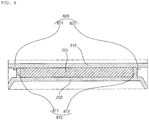
- FIGS. 8 and 9 are diagrams for explanation of a blocking portion and a protrusion according to an embodiment of the present invention.
- FIGS. 8 and 9 are enlarged views of the bonding region 212 and the bonding portion 232 bonded together by the adhesive 225.
- the bonding portion 232 includes a blocking portion 810.
- the blocking portion 810 protrudes toward the upper plate 210 to block leakage of an adhesive.
- the blocking portion 810 may include a plurality of projections 811 and 812.
- the plurality of projections 811 and 812 may extend in a horizontal direction while protruding toward the upper plate 210.
- a space between the plurality of projections 811 and 812 may be filled with an adhesive 225.
- the blocking portion 810 may include a first projection 811 and a second projection 812.
- the first projection 811 may be formed at one end of the bonding portion 232.
- the first projection 811 may extend in a horizontal direction while protruding toward the bonding region 212.
- the second projection 812 may be formed at the other end of the bonding portion 232.
- the second projection 812 may extend in a horizontal direction while protruding toward the bonding region 212.
- a space between the first projection 811 and the second projection 812 may be filled with the adhesive 225.
- the adhesive 225 may be blocked by the first projection 811 and the second projection 812 and therefore it cannot reach the passage portion 231.
- the upper plate 210 may include a protruding portion 820.
- the protruding portion 820 may be formed in the bonding region 212.
- the protruding portion 820 may extend in a horizontal direction while protruding toward the lower plate 230.
- the protruding portion 820 may be disposed close to the plurality of projections 811 and 812.
- the protruding portion 820 may be disposed such that one side surface thereof comes into contact with the plurality of projections 811 and 812.
- the protruding portion 820 may include a first protruding portion 821 and a second protruding portion 822.
- the first protruding portion 821 may be disposed such that one side surface thereof comes into contact with the first projection 811.
- the second protruding portion 822 may be disposed such that one side surface thereof comes into contact with the second projection 812.
- the protruding portion 820 may double-prevent leakage of the adhesive 225 to the outside of the bonding portion 232.
- the bonding region 212 may include a blocking portion, and the bonding portion 232 may include a protruding portion.
- the blocking portion may include a plurality of protrusions that extends in the horizontal direction while protruding toward the lower plate 230.
- a space between the plurality of protrusions may be filled with an adhesive.
- the protruding portion may extend in the horizontal direction while protruding toward the upper plate 230.
- the protruding portion may be disposed such that one side surface thereof comes into contact with the blocking portion.
- the bonding portion 232 may include a blocking portion 810.
- the blocking portion 810 may include a concave-convex part 831, 832 that consists of a plurality of protrusions and a plurality of grooves.
- the bonding region 212 may include a concave-convex part that consists of a plurality of protrusions and a plurality of grooves.
- the concave-convex part of the bonding portion 232 and the concave-convex part of the bonding region 212 may be engaged with each other.
- the concave-convex part of the bonding portion 232 and the concave-convex part of the bonding region 212 may be engaged with each other.
- each groove in the concave-convex part of the bonding portion 232 and each protrusion in the concave-convex part of the bonding region 212 may be formed to correspond to each other.
- each protrusion in the concave-convex part of the bonding portion 232 and each groove in the concave-convex part of the bonding region 212 may be formed to correspond to each other.
- the concave-convex part of the bonding portion 232 and the concave-convex part of the bonding region 212 are bonded together by the adhesive 225, and therefore, the upper plate 210 and the lower plate 230 may be coupled even stronger.
- a protruding portion 213 may be formed in the concave-convex part of the bonding region 212.
- the protruding portion 213 may protrude toward the lower plate 230.
- the protruding portion 213 may block leakage of the adhesive 225 to the passage portion 231.
- a protruding portion may be formed in the concave-convex part of the bonding portion 232.
- the protruding portion may protrude toward the upper plate 210.
- the protruding portion may block leakage of the adhesive 225 to the passage portion 231, when the concave-convex part of the bonding part 232 and the concave-convex part of the bonding region are engaged with each other.
- FIG. 10 is a diagram for explanation of a passage portion according to an embodiment of the present invention.
- the passage portion 231 may include a bottom surface 1010 and a side surface 1020.
- the bottom surface 1010 may be a surface facing the upper plate 210.
- the bottom surface 1010 of the passage portion 231 may be formed to have at a predetermined gradient in a first direction with respect to the upper plate 210.
- the first direction may be forward or backward. Alternatively, the first direction may be leftward or rightward.
- the passage portion 231 may include a coolant discharge hole 239 which is formed at the bottom surface 1010 and whose opening and closing is controlled by an electrical signal.
- the discharge hole 239 may be opened by an electrical signal which is provided by at least one control device included in a vehicle.
- the coolant may be discharged by the bottom surface 1010, formed at a gradient, through the discharge hole 239.
- coolant cannot flow into the battery module 110, and therefore, it is possible to prevent damage to the battery by the coolant.
- the side surface 1020 may extend from the bottom surface 1010 to the bonding region 232.
- the coolant passage 220 may include a plurality of passages.
- the passage portion 231 may include a passage that defines the plurality of respective passages. Respective bottom surfaces of the plurality of passages may include the coolant discharge hole 239.
- coolant can be quickly discharged by an impact.
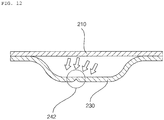
- FIGS. 11 to 13 are diagrams for explanation of a notch portion according to an embodiment of the present invention.
- the passage portion 231 may include a first notch portion 241.
- the first notch portion 241 may be formed on a surface facing the upper plate 210.
- first notch portion 241 may be formed on an edge of the passage portion 231.
- the first notch portion 241 may be formed where the bottom surface 1010 and the side surface 1020 are distinguished.
- the first notch 241 may be easily broken by an impact.
- a surface of the lower plate 230 facing the upper plate 210 may be defined as an inner side surface.
- the first notch portion 241 may be in a structure more fragile than other portions of the passage portion 231.
- the first notch portion 241 may has a V shape on the inner side surface. Due to the V-shape formed on the inner side surface, the first notch portion 241 may be broken by an impact, thereby possibly causing an artificial discharge of the coolant.
- the passage portion 231 may include a second notch portion 242.
- the second notch portion 242 may be formed on a surface opposing the upper plate 210.
- a surface of the lower plate 230 opposing the upper plate 210 may be defined as an outer side surface.
- the second notch portion 242 may be formed at the bottom surface.
- the second notch portion 242 may be easily broken when internal pressure is equal to or higher than a reference level.
- the second notch portion 242 may be in a fragile structure, compared to other portions of the passage portion 231.
- the second notch portion 242 may have a V shape on the outer side surface. Due to the V shape formed on the outer side surface, the second notch portion 242 is broken in response to internal pressure equal to or higher than a reference voltage, thereby possibly causing an artificial discharge of coolant.
- FIG. 13 shows an example of the thermal management system 200 as viewed from top to bottom.
- the first notch portion 241 and the second notch portion 242 may be located in a margin area 1310 of the thermal management system 200.
- the margin area 1310 of the thermal management system 200 may be an area spaced apart in a width direction at a distance, which is equal to or greater than one-fifth of the entire width of the thermal management system 200, from a centerline 1301 of a longitudinal direction.
- first notch portion 241 and the second notch portion 242 are located in the lateral margin area 1310 of the thermal management system 200, it is possible to prevent breakage of a major component of a vehicle by coolant even when the coolant is discharged.
- FIG. 14 is an enlarged view of a portion C shown in FIG. 3 .
- the battery pack 100 may further include a reinforcement structure 1410.
- the reinforcement structure 1410 may be formed of a steel material or an aluminum material.
- the reinforcement structure 1410 may be formed as a plurality of panels are coupled (e.g., welded) to one another.
- the reinforcement structure 1410 may be disposed outside the battery module 110.
- the reinforcement structure 1410 may have one or more closed space 1411, 1412, and 1413 therein.
- the closed spaces 1411, 1412, and 1413 may absorb impact of the collision which could be otherwise transferred to the battery module 110 and the thermal management system 200.
- the closed spaces 1411, 1412, and 1413 may be disposed above the upper late 210.
- the closed spaces 1411, 1412, and 1413 may absorb the impact so as to reduce the impact which could be otherwise transferred to the battery module 110. By reducing the impact, it is possible to prevent degradation of the battery module 110, which may be caused by the impact to the battery module 110.
- the closed spaces may be disposed below the upper plate 210.
- the closed spaces may absorb the impact so as to reduce the impact which could be otherwise transferred to the thermal management system 200. By reducing the impact, it is possible to prevent leakage of coolant in the thermal management system 200.
- the reinforcement structure 1410 may be secured to at least part of a vehicle body and the thermal management system 200.
- the battery module 110 and the thermal management system 200 may be secured by a long bolt 1490.
- the battery module 110 may be secured to the upper plate 210 and the lower plate 230 by the long bolt 1490.
- the battery module 110 may be secured to the upper plate 210, the lower plate 230, and an extension plate 1500 (see FIG. 15 ) being stacked together.
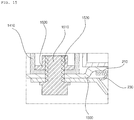
- FIG. 15 is an enlarged view of a portion E shown in FIG. 14 .
- the battery pack 100 may further include the extension plate 1500.
- the extension plate 1500 may be in contact with at least part of the lower plate 230.
- the lower plate 230, the reinforcement structure 1410, and the extension plate 1500 may be bolted together while being stacked.
- the lower plate 230, the reinforcement structure 1410, the extension plate 1500, and the outer plate 300 may be bolted together while being stacked.
- the lower plate 230 is disposed on the outer plate 300
- the extension plate 1500 is disposed on the lower plate 230
- the reinforcement structure 1410 is disposed on the extension plate 1500.
- the lower plate 230, the reinforcement structure 1410, the extension plate 1500, and the outer plate 300 may be secured together by one bolt 1510.
- the lower plate 230 may be longer than the upper plate 210 in a direction outward from the battery module 110.
- the lower plate 230 is longer than the upper plate 210, only the lower plate 230, except the upper plate 210, is secured to the outer plate 300, the extension plate 1500, and the reinforcement structure 1400.
- the battery pack 100 may further include at least one fastening bracket 1520.
- the fastening bracket 1520 may support the bolt 1510 to achieve a more stronger securing.
- FIG. 16 is an enlarged view of a portion D shown in FIG. 14 .
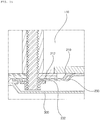
- FIG. 17 is an enlarged view of a portion F shown in FIG. 3 .
- an end part of the battery module 110 may be located in a portion where the upper plate 210 and the lower plate 230 are coupled.
- At least part of the battery module 110 may vertically overlap a portion where the bonding region 212 and the bonding portion 232 are coupled.
- the portion where the bonding region 212 and the bonding portion 232 are coupled may strongly support the battery module 110.
- FIGS. 18 and 19 are diagrams for explanation of an outer plate according to an embodiment of the present invention.
- the outer plate 300 may be disposed below a thermal management system.
- the outer plate 300 may be bolted to the upper plate 210.
- the coupling therebetween may be supported by at least one fastening bracket 1810.
- the outer plate 300 may be coupled to a vehicle body 1910 using a reinforce beam 1930.
- the vehicle body 1910 and the thermal management system 200 are disposed with having the reinforce beam 1930 therebetween, the vehicle body 1910, the reinforce beam 1930, the thermal management system 200 may be coupled via a long bolt 1931 that penetrates the reinforce beam 1930.
- the outer plate 300 may support the battery module 110 and the thermal management system 200.
Landscapes
- Engineering & Computer Science (AREA)
- Chemical & Material Sciences (AREA)
- Chemical Kinetics & Catalysis (AREA)
- Electrochemistry (AREA)
- General Chemical & Material Sciences (AREA)
- Manufacturing & Machinery (AREA)
- Mechanical Engineering (AREA)
- Transportation (AREA)
- Sustainable Energy (AREA)
- Power Engineering (AREA)
- Sustainable Development (AREA)
- Life Sciences & Earth Sciences (AREA)
- Aviation & Aerospace Engineering (AREA)
- Combustion & Propulsion (AREA)
- Inorganic Chemistry (AREA)
- Battery Mounting, Suspending (AREA)
- Secondary Cells (AREA)
Description
- The present invention relates to a battery pack for vehicle, and a vehicle.
- A vehicle is an apparatus that moves in a direction desired by a user riding therein. A representative example of a vehicle may be an automobile.
- Recently, electric or hybrid vehicles powered by electrical energy have attracting a growing attentions. A vehicle using electrical energy needs to include a battery pack.
- To obtain high power output, the battery pack includes a battery module that is a set of connected cell assemblies which is a plurality of unit battery cells. Each unit battery cell includes positive and negative electrode collectors, a separator, active materials, and electrolyte, so that repeated charging and discharging can be done by electrochemical reaction between the components.
- The battery pack may further include a Battery Management system (BMS), which monitors and controls the state of a secondary cell by applying algorithms for controlling power in response to dynamic load, such as in a motor, for measuring an electrical feature value, such as current or voltage, for controlling equalization of voltage, and for estimating a State of Charge (SOC).
- A battery pack including at least one battery module is manufactured such that a plurality of secondary cells (battery cells) are densely packed in a small space. Thus, the battery pack needs to easily dissipate heat generated by each secondary cell. In order to cool down heat generated by the battery module, the battery pack includes a thermal management system which has an air cooling or liquid cooling coolant passage and which is embedded in a battery module.
- However, in the case of a battery pack having a liquid cooling thermal management system, a breakage of the passage may result in leakage of coolant, leading a short to occur.
US 2012/244392 A1 relates to systems and method for providing thermal control for battery packs using a battery pack support.
KR 2014/0077272 A - The present invention, as defined in claim 1, has been made in view of the above problems, and it is one object of the present invention to provide a battery pack for vehicle, which spatially separates a thermal management system from a battery module so as to prevent a short that possibly occurs due to leakage of coolant.
- It is another object of the present invention to provide a vehicle including the aforementioned battery pack. The aforementioned objects are achieved by the independent claim. Dependent claims refer to preferred embodiments.
- Objects of the present invention should not be limited to the aforementioned objects and other unmentioned objects will be clearly understood by those skilled in the art from the following description.
- In accordance with an embodiment of the present invention, there is provided a battery pack for vehicle, including: at least one battery module; and a liquid cooling thermal management system disposed below the battery module, wherein the thermal management system includes: an upper plate supporting the at least one battery module, and a lower plate bonded to the upper plate to thereby form a passage in which coolant circulates.
- The details of other embodiments are included in the following description and the accompanying drawings.
- The embodiments of the present invention have one or more effects as follows.
- First, a battery module and a thermal management system are spatially separate from each other, and therefore, it is possible to prevent dielectric breakdown that is possibly caused by leakage of coolant.
- Second, the present invention is in a structure which does not allow coolant to flow into a battery module upon an external impact, thereby preventing a secondary damage by a short of an electronic component.
- Third, as an integrated housing is provided for the thermal management system and the battery module, it is possible to remove the need of one component, and therefore, reduce manufacturing costs.
- The present invention also relates to a battery pack for a vehicle, comprising at least one battery module; and a thermal management system disposed below the at least one battery module, wherein the thermal management system comprises an upper plate which is formed of a steel material having a corrosion preventive layer on a surface thereof, and which is configured to support the at least one battery module, and a lower plate which is formed of a steel material having a corrosion protection layer on a surface thereof, and which is bonded to the upper plate to form a passage in which coolant circulates.
- The lower plate comprises a passage portion having a passage shape; and a bonding portion which is bonded to the upper plate and comprises a blocking portion that protrudes toward the upper plate so as to block leakage of an adhesive.
- Preferably, the upper plate comprises a protruding portion which is formed in an area corresponding to the bonding portion, and which protrudes toward the bonding portion to block leakage of an adhesive.
- Preferably, at a least part of the bonding portion is configured to support the at least one battery module.
- Preferably, the bonding portion comprises an opening portion for allowing an adhesive to flow through; and a seal cap disposed below the opening portion to form a space for accommodating leaked adhesive.
- Preferably, the passage portion comprises a bottom surface, the bottom surface of the passage portion preferably being formed to have a predetermined gradient in a first direction with respect to the upper plate.
- Preferably, the passage portion comprises a coolant discharge hole which is formed at the bottom surface, the opening and closing of the coolant discharge hole preferably being controlled by an electrical signal.
- Preferably, the passage portion comprises a first notch portion formed on a surface facing the upper plate.
- Preferably, the passage portion comprises a second notch portion formed on a surface opposing the upper plate.
- Preferably, wherein the lower plate is thinner than the upper plate.
- Preferably, the battery pack further comprises a reinforcement structure which is formed outside the at least one battery module. Preferably, the reinforcement structure has one or more closed spaces therein.
- Preferably, the reinforcement structure is secured to a vehicle body and the thermal management system.
- Preferably, the battery pack further comprises an extension plate in contact with at least part of the lower plate.
- Preferably, the lower plate is bolted to the reinforcement structure and the extension plate.
- Preferably, the lower plate is longer than the upper plate in a direction outward from the at least one battery module.
- Preferably, the battery pack further comprises an outer plate which is disposed below the thermal management system, bolted to the upper plate, and coupled to a vehicle body via a reinforcement beam to thereby support the at least one battery module and the thermal management system.
- Preferably, the upper plate is coupled to a lateral housing of the at least one battery module to thereby function as a housing of the at least one battery module.
- Effects of the present invention should not be limited to the aforementioned effects and other unmentioned effects will be clearly understood by those skilled in the art from the claims.
- The embodiments will be described in detail with reference to the following drawings in which like reference numerals refer to like elements wherein:
-
FIG. 1 is an exploded perspective view of a battery pack for vehicle according to an embodiment of the present invention; -
FIG. 2 is a perspective view of a battery pack, from which a battery module is removed, according to an embodiment of the present invention; -
FIG. 3 is a cross-sectional view, taken along line A-A shown inFIG. 2 , according to an embodiment of the present invention; -
FIG. 4 is a partial cross-sectional view of a battery pack according to an embodiment of the present invention; -
FIG. 5 is a diagram for explanation of a configuration of a thermal management system according to an embodiment of the present invention, the diagram which is an enlarged view of a portion B shown inFIG. 3 ; -
FIG. 6 is a diagram for explanation of bonding between an upper late and a lower plate according to an embodiment of the present invention; -
FIG. 7 is a diagram for explanation of an opening portion and a seal cap according to an embodiment of the present invention; -
FIGS. 8 and9 are diagrams for explanation of a blocking portion and a protrusion according to an embodiment of the present invention; -
FIG. 10 is a diagram for explanation of a passage portion according to an embodiment of the present invention; -
FIGS. 11 to 13 are diagrams for explanation of a notch portion according to an embodiment of the present invention; -
FIG. 14 is an enlarged view of a portion C shown inFIG. 3 ; -
FIG. 15 is an enlarged view of a portion E shown inFIG. 14 ; -
FIG. 16 is an enlarged view of a portion D shown inFIG. 14 ; -
FIG. 17 is an enlarged view of a portion F shown inFIG. 3 ; and -
FIGS. 18 and19 are diagrams for explanation of an outer plate according to an embodiment of the present invention. - Hereinafter, the embodiments disclosed in the present specification will be described in detail with reference to the accompanying drawings, and the same or similar elements are denoted by the same reference numerals even though they are depicted in different drawings and redundant descriptions thereof will be omitted. In the following description, with respect to constituent elements used in the following description, the suffixes "module" and "unit" are used or combined with each other only in consideration of ease in the preparation of the specification, and do not have or serve as different meanings. Accordingly, the suffixes "module" and "unit" may be interchanged with each other. In addition, in the following description of the embodiments disclosed in the present specification, a detailed description of known functions and configurations incorporated herein will be omitted when it may make the subject matter of the embodiments disclosed in the present specification rather unclear. In addition, the accompanying drawings are provided only for a better understanding of the embodiments disclosed in the present specification and are not intended to limit the technical ideas disclosed in the present specification. Therefore, it should be understood that the accompanying drawings include all modifications, equivalents and substitutions included in the scope and sprit of the present invention.
- It will be understood that although the terms "first," "second," etc., may be used herein to describe various components, these components should not be limited by these terms. These terms are only used to distinguish one component from another component.
- It will be understood that when a component is referred to as being "connected to" or "coupled to" another component, it may be directly connected to or coupled to another component or intervening components may be present. In contrast, when a component is referred to as being "directly connected to" or "directly coupled to" another component, there are no intervening components present.
- As used herein, the singular form is intended to include the plural forms as well, unless the context clearly indicates otherwise.
- In the present application, it will be further understood that the terms "comprises", includes," etc. specify the presence of stated features, integers, steps, operations, elements, components, or combinations thereof, but do not preclude the presence or addition of one or more other features, integers, steps, operations, elements, components, or combinations thereof.
- A vehicle as described in this specification may include an automobile and a motorcycle. Hereinafter, a description will be given based on an automobile.
- A vehicle as described in this specification may include all of an internal combustion engine vehicle including an engine as a power source, a hybrid vehicle including both an engine and an electric motor as a power source, and an electric vehicle including an electric motor as a power source.
- In the following description, a "forward direction" may be defined as a forward direction of travel of a vehicle. A "backward direction" may be defined as a backward direction of travel of a vehicle.
- The term "left side" may be defined as the left side in the forward direction of travel of a vehicle. The term "right side" may be defined as the right side in the forward direction of travel of a vehicle.
- The term "top" may be defined as an opposite direction of gravity. The term "above" may be defined as a direction toward the top. The term "bottom" may be defined as a direction of gravity. The term "below" may be defined as a direction toward the bottom.
-
FIG. 1 is an exploded perspective view of a battery pack for vehicle according to an embodiment of the present invention. - A vehicle according to an embodiment of the present invention may include a battery pack 100 for vehicle.
- Referring to
FIG. 1 , the battery pack 100 may include at least onebattery module 110, athermal management system 200, and anouter plate 300. - The
battery module 110 may include abattery cell stack 115, and acartridge 130. - The
battery cell stack 115 may include a plurality of battery cells. Each unit battery cell may constitute a secondary cell. - The
battery cell stack 115 may include a plurality of battery cell assemblies which is a plurality of multiple battery cells stacked in a horizontal or vertical direction. - Each battery cell may include positive and negative electrode current collectors, a separator, active materials, and electrolyte, so that repeated charging and discharging can be done by electrochemical reaction between the components.
- The
cartridge 130 is a means for stacking a plurality of battery cells. By holding the plurality of battery cells, thecartridge 130 may prevent movement of the plurality of battery cells. In addition, thecartridge 130 is configured to allow the plurality of battery cells to be stacked, and thus, thecartridge 130 may guide assembling of the plurality of battery cells. - The
cartridge 130 may include a plurality of rectangle rings each having a blank area on the center thereof. - As illustrated in
FIG. 1 , thecartridge 130 may be disposed below thebattery cell stack 115. - Meanwhile, in some embodiments, the
cartridge 130 may be an element included in thebattery cell stack 115. - The
battery module 110 may further include athermal pad 120 disposed between thebattery cell stack 115 and thecartridge 130. - The
thermal pad 120 is used as a medium for transferring heat, generated by thebattery cell stack 115, to the outside. Thethermal pad 120 is formed of a material having high thermal conductivity. - The
thermal pad 120 may be disposed between thebattery cell stack 115 and thethermal management system 200. In this case, thethermal pad 120 may transfer heat, generated by thebatty cell stack 115, to thethermal management system 200. - The
thermal management system 200 may cool down heat generated by thebattery module 110. - The
thermal management system 200 is disposed below thebattery module 110 to support thebattery module 110. Thethermal management system 200 is disposed below thebattery module 110 and may be in contact with thebattery module 110. - The
thermal management system 200 will be described in detail with references toFIGS. 1 to 13 . - The
outer plate 300 may be disposed below thethermal management system 200. Theouter plate 300 may cover the battery back pack 100 attached to a vehicle. - The
outer plate 300 will be described in more detail with references toFIGS. 18 and19 . - Meanwhile, in some embodiments, the battery back 100 may further include an
insulation pad 150. - The
insulation pad 150 may be disposed between thethermal management system 200 and theouter plate 300. Theinsulation pad 150 may block heat transferred from the outside to the inside of the battery pack 100. -
FIG. 2 is a perspective view of a battery pack, from which a battery module is removed, according to an embodiment of the present invention. -
FIG. 3 is a cross-sectional view, taken along line A-A shown inFIG. 2 , according to an embodiment of the present invention. -
FIG. 4 is a partial cross-sectional view of a battery pack according to an embodiment of the present invention. -
FIG. 5 is a diagram for explanation of a configuration of a thermal management system according to an embodiment of the present invention.FIG. 5 is an enlarged view of a portion B shown inFIG. 3 . - Referring to the drawings, the
thermal management system 200 may include anupper plate 210 and alower plate 230. - The
upper plate 210 may be disposed below thebattery module 110. - The
upper plate 210 may is in the form of a plate. Theupper plate 210 may be laid with large surfaces facing up and down. - When viewed from top to bottom, the
upper plate 210 may have a rectangular shape. - For convenience in heat exchange with the
battery module 110, theupper plate 210 may be formed of a material having excellent thermal conductivity. - The
upper plate 210 is formed of a steel material. - For example, the
upper plate 210 is formed of a steel material having a corrosion protection layer. The corrosion protection layer may include a paint layer that is formed by painting a specific color. Alternatively, the corrosion protection layer may include a coating layer that is formed by coating a specific material for the purpose of protection from a foreign substance. - The
upper plate 210 may support thebattery module 110. To this end, theupper plate 210 may be formed of a high-rigid material. For example, theupper plate 210 may be formed of a steel material. - The
upper plate 210 may be disposed in contact with thebattery module 110. For example, theupper plate 210 may be disposed in contact with thebatty cell stack 115 of thebattery module 110. For example, theupper plate 210 may be disposed in contact with thethermal pad 120 of thebattery module 110. For example, theupper plate 210 may be disposed in contact with thecartridge 130 of thebattery module 110. - The
upper plate 210 may function as a lower housing of thebattery module 110. For example, theupper plate 210 may be coupled to a lateral housing of thebattery module 110 and thus function as a housing of thebattery module 110. - The
upper plate 210 may be coupled to thelower plate 230 and therefore form acoolant passage 220 through which coolant circulates. - The
upper plate 210 may be bonded to thelower plate 230. - The
upper plate 210 may be divided into anon-bonding region 211 and abonding region 212. - The
non-bonding region 211 may be a region facing apassage portion 231 of thelower plate 230. - The
non-bonding region 211 may have a shape corresponding to thepassage portion 231. For example, thenon-bonding region 211 may have a groove in a portion facing thepassage portion 231, the groove which is in a shape corresponding to thepassage part 231. - The
bonding region 212 may be a region facing abonding portion 232 of thelower plate 230. - The
bonding region 212 may be a region to be coupled to thebonding portion 232 by means of an adhesive 225. - As the
bonding region 212 of theupper plate 210 and thebonding portion 232 of thelower plate 230 are coupled to each other, thenon-bonding region 211 of theupper plate 210 and thepassage portion 231 of thelower plate 230 may form a specific space that extends in a horizontal direction. The space is defined as thecoolant passage 220. - The
upper plate 210 may include a protruding portion. - The protruding portion may be formed in the
bonding region 212. The protruding portion may protrude from thebonding region 212 toward thebonding portion 232 to double-prevent leakage of the adhesive 225. - The
upper plate 210 may be thicker than thelower plate 230. - The
upper plate 210 may be coated with a rustproofing material. For example, thebonding region 211 of theupper plate 210 may be coated with a rustproofing material. - To prevent oxidation, the
upper plate 210 may be coated with a specific paint material. - The
lower plate 230 may be coupled to theupper plate 210 to form thecoolant passage 220 in which coolant circulates. Specifically, thelower plate 230 is bonded to theupper plate 210 to form a passage in which coolant circulates. - The
lower plate 230 may be in the form of a plate. Thelower plate 230 may be laid with large surfaces facing up and down. - When viewed from top to bottom, the
lower plate 230 may have a rectangular shape. - The
lower plate 230 is formed of a steel material. - For example, the
lower plate 230 is formed of a steel material having a corrosion protection layer. The corrosion protection layer may include a paint layer that is formed by painting a specific color. Alternatively, for the protection from a foreign substance, the corrosion protection layer may include a coating layer that is formed by coating a specific material. - Since the
lower plate 230 is coupled to theupper plate 210, corrosion may occur between thelower plate 230 and theupper plate 210 in the case where thelower plate 230 is formed of a material different from that of theupper plate 210. - As the
lower plate 230 is formed of the same material as that of theupper plate 210, corrosion may be prevented. - If the
lower plate 230 and theupper plate 210 are welded to each other, the corrosion protection layer may be damaged and therefore corrosion may occur. - If the
lower plate 230 and theupper plate 210 are bonded to each other, corrosion may be prevented. - The
lower plate 230 and theupper plate 210 may have a different thermal conductivity. Specifically, thelower plate 230 may have a thermal conductivity lower than that of theupper plate 210. - As the
lower plate 230 has a thermal conductivity lower than that of theupper plate 210, it is possible to block heat which can possibly flow into the battery pack 100 from the outside. As a result, it is possible to prevent external heat from increasing temperature of the coolant. - The
lower plate 230 may be thinner than theupper plate 210. - As the
lower plate 230 is thinner than theupper plate 210, thelower plate 230 may be first damaged by an impact and it may lead to an artificial discharge of the coolant. Due to the discharge of the coolant, it is possible to prevent damage to thebattery module 110 by the coolant. - The lower plate 230 : includes the
passage portion 231 and thebonding portion 232. - The
passage portion 231 secures a space in which thecoolant passage 220 is formed. For example, thepassage portion 231 may be defined as a groove which extends inside thelower plate 230 in a horizontal direction. When thelower plate 230 is viewed from top to bottom, thepassage portion 231 may have a passage shape. - In the case where the
lower plate 230 and theupper plate 210 is not coupled together, thepassage portion 231 may be in the shape of a groove which extends in a horizontal direction with an open top. - When the
lower plate 230 and theupper plate 210 are coupled together, the top of thepassage portion 231 is covered by theupper plate 210 to thereby form thecoolant passage 220. For example, when thebonding region 212 of theupper plate 210 and thebonding portion 232 of thelower plate 230 are coupled together, thepassage portion 231 may form thecoolant passage 220 along with thenon-bonding region 211 of theupper plate 210. - Meanwhile, the
passage portion 231 may be thinner than thebonding portion 231. As thepassage portion 231 is thinner than thebonding portion 232, thelower plate 230 may be first damaged by an impact and it may lead to an artificial discharge of coolant. Due to the discharge of the coolant, it is possible to prevent damage to thebattery module 110 by the coolant. - The
bonding portion 232 may be bonded to theupper plate 210. - The
bonding portion 232 may be coupled to thebonding region 212 of thelower plate 230 by the adhesive 225. - At least part of the
bonding portion 232 may face thelower plate 230 with the adhesive 225 therebetween. - The
bonding portion 232 includes a blocking portion. The blocking portion may have a plurality of projection structures protruding toward theupper plate 210. The blocking portion accommodates an adhesive between the plurality of projection structures so as to prevent leakage of the adhesive. - At least part of the
bonding portion 232 may support thebattery module 110. While thebonding portion 232 is bonded to the upper plate 310, at least part of thebonding portion 232 may support thebattery module 110. - The
lower plate 230 may be coated with a rustproofing material. For example, thepassage portion 231 of thelower plate 230 may be coated with a rustproofing material. - For the purpose of oxidation, the
lower plate 230 may be coated with a specific paint material. -
FIG. 6 is a diagram for explanation of bonding between an upper late and a lower plate according to an embodiment of the present invention. -
FIG. 7 is a diagram for explanation of an opening portion and a seal cap according to an embodiment of the present invention. - In the case where the
upper plate 210 and thelower plate 230 are both formed of a steel material, theupper plate 210 and thelower plate 230 cannot be coupled together by brazing. - When coupled together by brazing, the coating or painting of the
upper plate 210 and thelower plate 230 may be peeled off. As a result, oxidation due to the coolant may occur on theupper plate 210 and thelower plate 230. - For the purpose of such oxidation, as illustrated in
FIG. 6 , theupper plate 210 and thelower plate 230 may be bonded together by the adhesive 225. - For example, the bottom of the
upper plate 210 and the top of thelower plate 230 may be coupled together by the adhesive 225. - For example, the
bonding region 212 of theupper plate 210 and thebonding portion 232 of thelower plate 230 may be disposed to face each other. Thebonding region 212 and thebonding portion 232 may be coupled together by the adhesive 225. - As the
bonding region 212 and thebonding portion 232 are bonded, a space defined as thecoolant passage 220 may be secured by thenon-bonding region 211 and thepassage portion 231. - In some embodiments, the battery pack 100 may include one or more location pins. The adhesive 225 may be applied with the relative locations of the
upper plate 210 and thelower plate 230 being using the location pins. - As illustrated in
FIG. 7 , thebonding portion 232 may include anopening portion 227. Theopening portion 227 may allow the adhesive 225 to flow downward. - The
opening portion 227 may has an opening shape in thebonding portion 232. Through the opening shape, theopening portion 227 may allow the adhesive 225 to flow downward. - The
bonding portion 232 may further include aseal cap 226. - The
seal cap 226 may be disposed below theopening portion 227. - The
seal cap 226 may form a space in which the adhesive 225 flows through theopening portion 227 is accommodated. - The
seal cap 226 may have a basket shape with an open top. Theseal cap 226 may be coupled to the bottom of thelower plate 230, in which theopening portion 227 is formed. As theseal cap 226 is coupled to the bottom of thelower plate 230, anadhesive accommodation space 226b with the top having an opening may be formed. - If the
upper plate 210 and thelower plate 230 are coupled together with a sufficient amount of the adhesive 225 being applied to thebonding region 212 or thebonding portion 232, the adhesive 225 may be accommodated in theadhesive accommodation space 226b through theopening portion 227. Due to this structure, it is possible to ensure a more strong coupling between theupper plate 210 and thelower plate 230. - Meanwhile, an
outer diameter 226a of theseal cap 226 may be greater than adiameter 227a of theopening portion 227. Due to this structure, it is possible to prevent leakage of the adhesive 225 to the outside of theseal cap 226. -
FIGS. 8 and9 are diagrams for explanation of a blocking portion and a protrusion according to an embodiment of the present invention. -
FIGS. 8 and9 are enlarged views of thebonding region 212 and thebonding portion 232 bonded together by the adhesive 225. - Referring to
FIG. 8 , thebonding portion 232 includes a blockingportion 810. The blockingportion 810 protrudes toward theupper plate 210 to block leakage of an adhesive. - The blocking
portion 810 may include a plurality ofprojections - The plurality of
projections upper plate 210. - A space between the plurality of
projections - For example, the blocking
portion 810 may include afirst projection 811 and asecond projection 812. - The
first projection 811 may be formed at one end of thebonding portion 232. Thefirst projection 811 may extend in a horizontal direction while protruding toward thebonding region 212. - The
second projection 812 may be formed at the other end of thebonding portion 232. Thesecond projection 812 may extend in a horizontal direction while protruding toward thebonding region 212. - A space between the
first projection 811 and thesecond projection 812 may be filled with the adhesive 225. - Even in the case where the
upper plate 210 and thelower plate 230 are pressed together, the adhesive 225 may be blocked by thefirst projection 811 and thesecond projection 812 and therefore it cannot reach thepassage portion 231. - The
upper plate 210 may include a protrudingportion 820. The protrudingportion 820 may be formed in thebonding region 212. The protrudingportion 820 may extend in a horizontal direction while protruding toward thelower plate 230. - The protruding
portion 820 may be disposed close to the plurality ofprojections portion 820 may be disposed such that one side surface thereof comes into contact with the plurality ofprojections - For example, the protruding
portion 820 may include a first protrudingportion 821 and a second protrudingportion 822. - The first protruding
portion 821 may be disposed such that one side surface thereof comes into contact with thefirst projection 811. The second protrudingportion 822 may be disposed such that one side surface thereof comes into contact with thesecond projection 812. - The protruding
portion 820 may double-prevent leakage of the adhesive 225 to the outside of thebonding portion 232. - Meanwhile, in some embodiments, the
bonding region 212 may include a blocking portion, and thebonding portion 232 may include a protruding portion. - In this case, the blocking portion may include a plurality of protrusions that extends in the horizontal direction while protruding toward the
lower plate 230. A space between the plurality of protrusions may be filled with an adhesive. - In this case, the protruding portion may extend in the horizontal direction while protruding toward the
upper plate 230. The protruding portion may be disposed such that one side surface thereof comes into contact with the blocking portion. - Referring to
FIG. 9 , thebonding portion 232 may include a blockingportion 810. The blockingportion 810 may include a concave-convex part - The
bonding region 212 may include a concave-convex part that consists of a plurality of protrusions and a plurality of grooves. - The concave-convex part of the
bonding portion 232 and the concave-convex part of thebonding region 212 may be engaged with each other. The concave-convex part of thebonding portion 232 and the concave-convex part of thebonding region 212 may be engaged with each other. Specifically, each groove in the concave-convex part of thebonding portion 232 and each protrusion in the concave-convex part of thebonding region 212 may be formed to correspond to each other. In addition, each protrusion in the concave-convex part of thebonding portion 232 and each groove in the concave-convex part of thebonding region 212 may be formed to correspond to each other. - In this case, the concave-convex part of the
bonding portion 232 and the concave-convex part of thebonding region 212 are bonded together by the adhesive 225, and therefore, theupper plate 210 and thelower plate 230 may be coupled even stronger. - A protruding
portion 213 may be formed in the concave-convex part of thebonding region 212. The protrudingportion 213 may protrude toward thelower plate 230. When the concave-convex part of thebonding portion 232 and the concave-convex part of thebonding region 212 are engaged with each other, the protrudingportion 213 may block leakage of the adhesive 225 to thepassage portion 231. - A protruding portion may be formed in the concave-convex part of the
bonding portion 232. The protruding portion may protrude toward theupper plate 210. The protruding portion may block leakage of the adhesive 225 to thepassage portion 231, when the concave-convex part of thebonding part 232 and the concave-convex part of the bonding region are engaged with each other. -
FIG. 10 is a diagram for explanation of a passage portion according to an embodiment of the present invention. - Referring to
FIG. 10 , thepassage portion 231 may include abottom surface 1010 and aside surface 1020. - The
bottom surface 1010 may be a surface facing theupper plate 210. - The
bottom surface 1010 of thepassage portion 231 may be formed to have at a predetermined gradient in a first direction with respect to theupper plate 210. The first direction may be forward or backward. Alternatively, the first direction may be leftward or rightward. - The
passage portion 231 may include acoolant discharge hole 239 which is formed at thebottom surface 1010 and whose opening and closing is controlled by an electrical signal. - When an impact occurs, the
discharge hole 239 may be opened by an electrical signal which is provided by at least one control device included in a vehicle. In this case, the coolant may be discharged by thebottom surface 1010, formed at a gradient, through thedischarge hole 239. As a result, coolant cannot flow into thebattery module 110, and therefore, it is possible to prevent damage to the battery by the coolant. - The
side surface 1020 may extend from thebottom surface 1010 to thebonding region 232. - Meanwhile, the
coolant passage 220 may include a plurality of passages. Thepassage portion 231 may include a passage that defines the plurality of respective passages. Respective bottom surfaces of the plurality of passages may include thecoolant discharge hole 239. - If there is a plurality of discharge holes 239, coolant can be quickly discharged by an impact.
-
FIGS. 11 to 13 are diagrams for explanation of a notch portion according to an embodiment of the present invention. - Referring to
FIG. 11 , thepassage portion 231 may include afirst notch portion 241. - The
first notch portion 241 may be formed on a surface facing theupper plate 210. - For example, the
first notch portion 241 may be formed on an edge of thepassage portion 231. - For example, the
first notch portion 241 may be formed where thebottom surface 1010 and theside surface 1020 are distinguished. - Due to this location of the
first notch portion 241, thefirst notch 241 may be easily broken by an impact. - Meanwhile, a surface of the
lower plate 230 facing theupper plate 210 may be defined as an inner side surface. - The
first notch portion 241 may be in a structure more fragile than other portions of thepassage portion 231. - For example, the
first notch portion 241 may has a V shape on the inner side surface. Due to the V-shape formed on the inner side surface, thefirst notch portion 241 may be broken by an impact, thereby possibly causing an artificial discharge of the coolant. - Referring to
FIG. 12 , thepassage portion 231 may include asecond notch portion 242. - The
second notch portion 242 may be formed on a surface opposing theupper plate 210. - Meanwhile, a surface of the
lower plate 230 opposing theupper plate 210 may be defined as an outer side surface. - For example, the
second notch portion 242 may be formed at the bottom surface. - Due to this location of the
second notch portion 242, thesecond notch portion 242 may be easily broken when internal pressure is equal to or higher than a reference level. - The
second notch portion 242 may be in a fragile structure, compared to other portions of thepassage portion 231. - For example, the
second notch portion 242 may have a V shape on the outer side surface. Due to the V shape formed on the outer side surface, thesecond notch portion 242 is broken in response to internal pressure equal to or higher than a reference voltage, thereby possibly causing an artificial discharge of coolant. -
FIG. 13 shows an example of thethermal management system 200 as viewed from top to bottom. - The
first notch portion 241 and thesecond notch portion 242 may be located in amargin area 1310 of thethermal management system 200. Themargin area 1310 of thethermal management system 200 may be an area spaced apart in a width direction at a distance, which is equal to or greater than one-fifth of the entire width of thethermal management system 200, from acenterline 1301 of a longitudinal direction. - As the
first notch portion 241 and thesecond notch portion 242 are located in thelateral margin area 1310 of thethermal management system 200, it is possible to prevent breakage of a major component of a vehicle by coolant even when the coolant is discharged. -
FIG. 14 is an enlarged view of a portion C shown inFIG. 3 . - Referring to
FIG. 14 , the battery pack 100 may further include areinforcement structure 1410. - The
reinforcement structure 1410 may be formed of a steel material or an aluminum material. Thereinforcement structure 1410 may be formed as a plurality of panels are coupled (e.g., welded) to one another. - The
reinforcement structure 1410 may be disposed outside thebattery module 110. Thereinforcement structure 1410 may have one or moreclosed space - When a vehicle collides with an external object, the
closed spaces battery module 110 and thethermal management system 200. - In some embodiments, the
closed spaces closed spaces battery module 110. By reducing the impact, it is possible to prevent degradation of thebattery module 110, which may be caused by the impact to thebattery module 110. - In some embodiments, the closed spaces may be disposed below the
upper plate 210. In this case, when the vehicle collides with an external object, the closed spaces may absorb the impact so as to reduce the impact which could be otherwise transferred to thethermal management system 200. By reducing the impact, it is possible to prevent leakage of coolant in thethermal management system 200. - Meanwhile, the
reinforcement structure 1410 may be secured to at least part of a vehicle body and thethermal management system 200. - As the
reinforcement structure 1410 is secured to at least part of a vehicle body frame, a stable securing can be achieved. - The coupling between the
reinforcement structure 1410 and thethermal management system 200 will be described with reference toFIG. 15 . - Meanwhile, the
battery module 110 and thethermal management system 200 may be secured by along bolt 1490. - Specifically, the
battery module 110 may be secured to theupper plate 210 and thelower plate 230 by thelong bolt 1490. - In some embodiments, the
battery module 110 may be secured to theupper plate 210, thelower plate 230, and an extension plate 1500 (seeFIG. 15 ) being stacked together. -
FIG. 15 is an enlarged view of a portion E shown inFIG. 14 . - Referring to
FIG. 15 , the battery pack 100 may further include theextension plate 1500. - The
extension plate 1500 may be in contact with at least part of thelower plate 230. - The
lower plate 230, thereinforcement structure 1410, and theextension plate 1500 may be bolted together while being stacked. - In some embodiments, the
lower plate 230, thereinforcement structure 1410, theextension plate 1500, and theouter plate 300 may be bolted together while being stacked. - As illustrated in
FIG. 15 , thelower plate 230 is disposed on theouter plate 300, theextension plate 1500 is disposed on thelower plate 230, and thereinforcement structure 1410 is disposed on theextension plate 1500. In this case, thelower plate 230, thereinforcement structure 1410, theextension plate 1500, and theouter plate 300 may be secured together by onebolt 1510. - In this case, the
lower plate 230 may be longer than theupper plate 210 in a direction outward from thebattery module 110. - Since the
lower plate 230 is longer than theupper plate 210, only thelower plate 230, except theupper plate 210, is secured to theouter plate 300, theextension plate 1500, and the reinforcement structure 1400. - If a vehicle collides with an external object, only the
lower plate 230 may be pushed back by impact of the collision due to the above-described structure, and therefore, coolant may be discharged to the outside. As a result, the coolant is unlikely to flow into thebattery module 110. - The battery pack 100 may further include at least one
fastening bracket 1520. - When the
lower plate 230, thereinforcement structure 1410, theextension plate 1500, and theouter plate 200 are bolted to each other, thefastening bracket 1520 may support thebolt 1510 to achieve a more stronger securing. -
FIG. 16 is an enlarged view of a portion D shown inFIG. 14 . -
FIG. 17 is an enlarged view of a portion F shown inFIG. 3 . - Referring to
FIGS. 16 and17 , an end part of thebattery module 110 may be located in a portion where theupper plate 210 and thelower plate 230 are coupled. - That is, at least part of the
battery module 110 may vertically overlap a portion where thebonding region 212 and thebonding portion 232 are coupled. - The portion where the
bonding region 212 and thebonding portion 232 are coupled may strongly support thebattery module 110. -
FIGS. 18 and19 are diagrams for explanation of an outer plate according to an embodiment of the present invention. - Referring to
FIG. 18 , theouter plate 300 may be disposed below a thermal management system. - The
outer plate 300 may be bolted to theupper plate 210. - When the
outer plate 300 is bolted to theupper plate 210, the coupling therebetween may be supported by at least onefastening bracket 1810. - Referring to
FIG. 19 , theouter plate 300 may be coupled to avehicle body 1910 using a reinforcebeam 1930. - While the
vehicle body 1910 and thethermal management system 200 are disposed with having the reinforcebeam 1930 therebetween, thevehicle body 1910, the reinforcebeam 1930, thethermal management system 200 may be coupled via along bolt 1931 that penetrates the reinforcebeam 1930. - If they are coupled via the reinforce
beam 1930, theouter plate 300 may support thebattery module 110 and thethermal management system 200.
Thus, the above detailed description should not be construed as being limited to the embodiments set forth herein in all terms, but should be considered by way of example. The scope of the present invention should be determined by the reasonable interpretation of the accompanying claims and all changes in the equivalent range of the present invention are intended to be included in the scope of the present invention.
Claims (14)
- A battery pack for a vehicle, comprising:at least one battery module (110); anda thermal management system (200) disposed below the at least one battery module (110),wherein the thermal management system (200) comprises:an upper plate (210) which is formed of a steel material having a corrosion preventive layer on a surface
thereof, and which is configured to support the at least one battery module (110), anda lower plate (230) which is formed of a steel material having a corrosion protection layer on a surface
thereof, and which is bonded to the upper plate (210) to form a passage (220) in which coolant circulates,wherein the lower plate (230) comprises:a passage portion (231) having a passage shape; anda bonding portion (232) which is bonded to the upper plate (210) and characterized in that it comprises a blocking portion (810) that protrudes toward the upper plate. - The battery pack according to claim 1, wherein the upper plate (210) comprises a protruding portion (820) which is formed in an area corresponding to the bonding portion (232), and which protrudes toward the bonding portion (232).
- The battery pack according to claim 1 or 2, wherein at a least part of the bonding portion (232) is configured to support the at least one battery module (110).
- The battery pack according to any one of claims 1 to 3, wherein the bonding portion (232) comprises:an opening portion (227) for allowing an adhesive to flow through; anda seal cap (226) disposed below the opening portion to form a space for accommodating leaked adhesive.
- The battery pack according to any one of claims 1 to 4, wherein the passage portion (231) comprises a bottom surface (1010), the bottom surface (1010) of the passage portion (231) preferably being formed to have a gradient in a first direction with respect to the upper plate (210).
- The battery pack according to claim 5, wherein the passage portion (231) comprises a coolant discharge hole (239) which is formed at the bottom surface (1010), the opening and closing of the coolant discharge hole (239) preferably being controlled by an electrical signal.
- The battery pack according any one of claims 1 to 6, wherein the passage portion (231) comprises a first notch portion (241) formed on a surface facing the upper plate (210).
- The battery pack according to any one of claims 5 to 7, wherein the passage portion (231) comprises a second notch portion (242) formed on a surface opposing the upper plate.
- The battery pack according to any one of claims 1 to 8, wherein the lower plate (230) is thinner than the upper plate (210).
- The battery pack according to any one of claims 1 to 9, further comprising: a reinforcement structure (1410) which is formed outside the at least one battery module (110), wherein the reinforcement structure (1410) has one or more closed spaces (1411, 1412, 1413) therein,
and/or
wherein the reinforcement structure (1410) is secured to a vehicle body and the thermal management system (200). - The battery pack according to claim 10, further comprising: an extension plate (1500) in contact with at least part of the lower plate (230),
wherein the lower plate (230) is bolted to the reinforcement structure (1410) and the extension plate (1500). - The battery pack according to any one of claims 1 to 11, wherein the lower plate (230) is longer than the upper plate (210) in a direction outward from the at least one battery module (110).
- The battery pack according to any one of claims 1 to 12, further comprising: an outer plate (300) which is disposed below the thermal management system (200), bolted to the upper plate (210), and coupled to a vehicle body via a reinforcement beam to thereby support the at least one battery module (110) and the thermal management system (200) .
- The battery pack according to any one of claims 1 to 13, wherein the upper plate (210) is coupled to a lateral housing of the at least one battery module (110) to thereby function as a housing of the at least one battery module (110).
Applications Claiming Priority (1)
| Application Number | Priority Date | Filing Date | Title |
|---|---|---|---|
| KR1020170041044A KR101916429B1 (en) | 2017-03-30 | 2017-03-30 | Battery pack for vehicle and vehicle |
Publications (2)
| Publication Number | Publication Date |
|---|---|
| EP3382774A1 EP3382774A1 (en) | 2018-10-03 |
| EP3382774B1 true EP3382774B1 (en) | 2020-02-19 |
Family
ID=61800375
Family Applications (1)
| Application Number | Title | Priority Date | Filing Date |
|---|---|---|---|
| EP18163939.4A Active EP3382774B1 (en) | 2017-03-30 | 2018-03-26 | Battery pack for vehicle, and vehicle |
Country Status (4)
| Country | Link |
|---|---|
| US (1) | US20180287227A1 (en) |
| EP (1) | EP3382774B1 (en) |
| KR (1) | KR101916429B1 (en) |
| CN (1) | CN108695575A (en) |
Cited By (2)
| Publication number | Priority date | Publication date | Assignee | Title |
|---|---|---|---|---|
| US20230291035A1 (en) * | 2021-03-05 | 2023-09-14 | Lg Energy Solution, Ltd. | Battery pack and device including the same |
| EP4148875A4 (en) * | 2021-03-05 | 2023-12-13 | LG Energy Solution, Ltd. | Battery pack and device including same |
Families Citing this family (53)
| Publication number | Priority date | Publication date | Assignee | Title |
|---|---|---|---|---|
| US10632857B2 (en) | 2016-08-17 | 2020-04-28 | Shape Corp. | Battery support and protection structure for a vehicle |
| CN110383526A (en) | 2017-01-04 | 2019-10-25 | 形状集团 | Node Modular Vehicle Battery Tray Structure |
| WO2018213383A1 (en) | 2017-05-16 | 2018-11-22 | Shape Corp. | Vehicle battery tray with integrated battery retention and support features |
| US10886513B2 (en) | 2017-05-16 | 2021-01-05 | Shape Corp. | Vehicle battery tray having tub-based integration |
| US10483510B2 (en) | 2017-05-16 | 2019-11-19 | Shape Corp. | Polarized battery tray for a vehicle |
| US12347879B2 (en) | 2017-09-13 | 2025-07-01 | Shape Corp. | Vehicle battery tray with tubular peripheral wall |
| CN111108015A (en) | 2017-09-13 | 2020-05-05 | 形状集团 | Vehicle battery tray with tubular peripheral wall |
| WO2019071013A1 (en) | 2017-10-04 | 2019-04-11 | Shape Corp. | Battery tray floor assembly for electric vehicles |
| EP3511231B1 (en) * | 2018-01-10 | 2023-12-06 | Volvo Car Corporation | Reinforcement structure |
| EP3759761B1 (en) | 2018-03-01 | 2026-04-08 | Shape Corp. | Cooling system integrated with vehicle battery tray |
| DE102018203375A1 (en) * | 2018-03-07 | 2019-09-12 | Audi Ag | Method for producing a high-voltage energy storage device for a motor vehicle, and high-voltage energy storage for a motor vehicle |
| US11688910B2 (en) | 2018-03-15 | 2023-06-27 | Shape Corp. | Vehicle battery tray having tub-based component |
| CN112585802A (en) | 2018-07-05 | 2021-03-30 | 摩丁制造公司 | Battery cooling plate and fluid manifold |
| DE102018211471B3 (en) * | 2018-07-11 | 2019-09-05 | Audi Ag | battery case |
| JP7110927B2 (en) * | 2018-11-13 | 2022-08-02 | トヨタ自動車株式会社 | Cooling system |
| KR20200074320A (en) * | 2018-12-14 | 2020-06-25 | 현대자동차주식회사 | Battery pack |
| US12080864B2 (en) * | 2018-12-14 | 2024-09-03 | 3M Innovative Properties Company | Electric vehicle battery cold plate assemblies |
| KR102544785B1 (en) | 2018-12-18 | 2023-06-15 | 주식회사 엘지에너지솔루션 | Battery pack and vehicle comprising the battery pack |
| KR102146171B1 (en) | 2018-12-26 | 2020-08-20 | 서진산업 주식회사 | Steel type Battery Case |
| CN209104228U (en) * | 2018-12-27 | 2019-07-12 | 宁德时代新能源科技股份有限公司 | battery box |
| CN209401679U (en) * | 2018-12-29 | 2019-09-17 | 宁德时代新能源科技股份有限公司 | Battery case |
| WO2020177609A1 (en) * | 2019-03-05 | 2020-09-10 | 爱驰汽车有限公司 | Battery pack |
| KR102798415B1 (en) * | 2019-05-27 | 2025-04-22 | 에스케이온 주식회사 | Bettery module |
| KR102845719B1 (en) * | 2019-06-10 | 2025-08-12 | 현대자동차주식회사 | Cooling block for battery module and manufacturing method thereof |
| KR102873394B1 (en) | 2019-12-04 | 2025-10-17 | 주식회사 엘지에너지솔루션 | Battery Module and Battery Pack |
| FR3104830B1 (en) * | 2019-12-12 | 2022-05-20 | Valeo Systemes Thermiques | Compartment for equipment likely to generate heat |
| KR102888354B1 (en) | 2020-05-22 | 2025-11-18 | 주식회사 엘지에너지솔루션 | Battery Module Including Cooling Member, and Battery Pack Including The Battery Module, and Electrical Device |
| KR102882505B1 (en) * | 2020-06-12 | 2025-11-05 | 에스케이온 주식회사 | Battery Module |
| CN114175379B (en) * | 2020-07-10 | 2023-11-28 | 宁德时代新能源科技股份有限公司 | Battery and related device, preparation method and preparation equipment thereof |
| KR102485011B1 (en) * | 2020-10-12 | 2023-01-04 | 주식회사 포스코 | Side frame for battery case |
| KR102928721B1 (en) * | 2020-10-23 | 2026-02-19 | 주식회사 엘지에너지솔루션 | Battery Pack, and Vehicle |
| KR102484798B1 (en) * | 2020-10-27 | 2023-01-06 | 주식회사 서연이화 | Cooling structure of battery pack |
| KR20220065601A (en) * | 2020-11-13 | 2022-05-20 | 주식회사 엘지에너지솔루션 | Battery pack having a structure capable of swelling control and Vehicle including the same |
| KR102440895B1 (en) | 2020-12-18 | 2022-09-07 | 서진산업 주식회사 | Hybrid type applied battery case |
| EP4299352B1 (en) * | 2021-02-24 | 2025-01-22 | Nissan Motor Co., Ltd. | Vehicle-mounted battery pack structure |
| FR3122774A1 (en) * | 2021-05-10 | 2022-11-11 | Psa Automobiles Sa | MODULAR BATTERY SYSTEM EXCHANGES CALORIES WITH ITS STRUCTURE |
| US11752898B2 (en) * | 2021-09-13 | 2023-09-12 | Textron Innovations Inc. | Aircraft battery systems having heat activated thermal barriers |
| JP7582141B2 (en) * | 2021-09-24 | 2024-11-13 | トヨタ自動車株式会社 | Power storage device |
| JP7521508B2 (en) * | 2021-09-24 | 2024-07-24 | トヨタ自動車株式会社 | Power storage device |
| JP7635686B2 (en) * | 2021-09-24 | 2025-02-26 | トヨタ自動車株式会社 | Power storage device |
| CN216488342U (en) * | 2021-10-20 | 2022-05-10 | 宁德时代新能源科技股份有限公司 | Box, battery and electrical device |
| US12341211B2 (en) | 2021-11-25 | 2025-06-24 | Samsung Sdi Co., Ltd. | Lateral battery bracket comprising two semi products |
| KR102445541B1 (en) * | 2022-03-07 | 2022-09-22 | 주식회사 서연이화 | Battery module for electric vehicle with thermal runaway prevention structure |
| CN118900787A (en) * | 2022-03-22 | 2024-11-05 | 麦格纳国际公司 | Stamped battery housing |
| KR20240038415A (en) | 2022-09-16 | 2024-03-25 | 주식회사 엘지에너지솔루션 | Battery pack |
| KR102831337B1 (en) | 2022-11-25 | 2025-07-10 | 서진산업 주식회사 | Mounting structure of battery case using foam gasket |
| KR102831338B1 (en) | 2022-11-25 | 2025-07-10 | 서진산업 주식회사 | Mounting structure of battery case using Riv-tecT and adhesive |
| KR20240083048A (en) * | 2022-12-02 | 2024-06-11 | 주식회사 엘지에너지솔루션 | Battery pack |
| KR102822575B1 (en) * | 2022-12-06 | 2025-06-20 | 한국자동차연구원 | Battery pack for electric vehicles |
| KR20240144835A (en) | 2023-03-26 | 2024-10-04 | 삼성에스디아이 주식회사 | Battery pack equipped with heat non-diffusion cooling structure using comb shape |
| WO2024243342A1 (en) | 2023-05-24 | 2024-11-28 | Ternium Mexico S.A. De C.V. | Steel battery housing and methods of manufacturing thereof |
| US12600246B2 (en) * | 2023-12-18 | 2026-04-14 | GM Global Technology Operations LLC | Adjustable thermal mid-beam member for separating battery cell rows in a battery assembly |
| US12613286B2 (en) | 2024-01-22 | 2026-04-28 | Garrett Transportation I Inc. | System and method for battery parameter recharacterization |
Family Cites Families (11)
| Publication number | Priority date | Publication date | Assignee | Title |
|---|---|---|---|---|
| US8877366B2 (en) * | 2010-01-04 | 2014-11-04 | GM Global Technology Operations LLC | Cooling plate for lithium-ion battery pack |
| JP5646041B2 (en) * | 2010-04-13 | 2014-12-24 | エルジー・ケム・リミテッド | Battery pack case with new structure |
| US8852780B2 (en) * | 2011-03-22 | 2014-10-07 | Enerdel, Inc. | Battery pack support with thermal control |
| US8647763B2 (en) * | 2011-06-30 | 2014-02-11 | Tesla Motors, Inc. | Battery coolant jacket |
| CN203039016U (en) * | 2012-12-06 | 2013-07-03 | 浙江天能动力能源有限公司 | Water leakage supporting plate and transferring water tank for battery injected liquid cooling |
| KR101446956B1 (en) * | 2012-12-13 | 2014-11-04 | 대한칼소닉주식회사 | Battery heat sink having structure stacked fluid path |
| JP6024704B2 (en) * | 2014-05-09 | 2016-11-16 | 株式会社デンソー | Battery pack |
| US9559346B2 (en) * | 2015-06-11 | 2017-01-31 | Ford Global Technologies, Llc | Traction battery electrical joint |
| CN105304842A (en) * | 2015-11-15 | 2016-02-03 | 北京工业大学 | Liquid heat transfer battery module structure and design method |
| DE112017002349B4 (en) * | 2016-05-06 | 2026-03-26 | Dana Canada Corporation | HEAT EXCHANGER |
| CN105958153A (en) * | 2016-05-10 | 2016-09-21 | 济南陆枋志合信息技术有限公司 | New energy vehicle |
-
2017
- 2017-03-30 KR KR1020170041044A patent/KR101916429B1/en not_active Expired - Fee Related
- 2017-12-29 US US15/857,697 patent/US20180287227A1/en not_active Abandoned
-
2018
- 2018-03-26 EP EP18163939.4A patent/EP3382774B1/en active Active
- 2018-03-26 CN CN201810250716.5A patent/CN108695575A/en active Pending
Non-Patent Citations (1)
| Title |
|---|
| None * |
Cited By (2)
| Publication number | Priority date | Publication date | Assignee | Title |
|---|---|---|---|---|
| US20230291035A1 (en) * | 2021-03-05 | 2023-09-14 | Lg Energy Solution, Ltd. | Battery pack and device including the same |
| EP4148875A4 (en) * | 2021-03-05 | 2023-12-13 | LG Energy Solution, Ltd. | Battery pack and device including same |
Also Published As
| Publication number | Publication date |
|---|---|
| EP3382774A1 (en) | 2018-10-03 |
| KR20180110969A (en) | 2018-10-11 |
| CN108695575A (en) | 2018-10-23 |
| KR101916429B1 (en) | 2018-11-07 |
| US20180287227A1 (en) | 2018-10-04 |
Similar Documents
| Publication | Publication Date | Title |
|---|---|---|
| EP3382774B1 (en) | Battery pack for vehicle, and vehicle | |
| JP7612272B2 (en) | Battery pack and device including same | |
| EP3958377B1 (en) | BATTERY MODULE | |
| EP2132823A1 (en) | Electricity storage device | |
| EP4416789A1 (en) | Battery cell pack for electric vehicle | |
| EP4047720A1 (en) | Battery module and battery pack including same | |
| EP4184666B1 (en) | Battery pack and device including the same | |
| KR20210150843A (en) | Battery module and battery pack including the same | |
| KR20210133529A (en) | Battery pack and device including the same | |
| EP4181275B1 (en) | Battery module and battery pack including same | |
| CN115191054B (en) | Battery module and battery including the battery module | |
| KR20220151876A (en) | Battery pack and device including the same | |
| JP7379720B2 (en) | Battery packs and automobiles containing them | |
| JP7375212B2 (en) | Battery packs and automobiles containing them | |
| US12394835B2 (en) | Battery module and battery pack including the same | |
| JP7648286B2 (en) | Battery pack and device including same | |
| EP4539227A1 (en) | Battery pack and device including the same | |
| EP4730515A1 (en) | Battery assembly | |
| EP4700936A1 (en) | Battery assembly | |
| CN120883429A (en) | Battery Components | |
| KR20240082989A (en) | Battery pack and method of manufacturing the same | |
| KR20220041426A (en) | Battery module and battery pack including the same |
Legal Events
| Date | Code | Title | Description |
|---|---|---|---|
| PUAI | Public reference made under article 153(3) epc to a published international application that has entered the european phase |
Free format text: ORIGINAL CODE: 0009012 |
|
| STAA | Information on the status of an ep patent application or granted ep patent |
Free format text: STATUS: REQUEST FOR EXAMINATION WAS MADE |
|
| 17P | Request for examination filed |
Effective date: 20180426 |
|
| AK | Designated contracting states |
Kind code of ref document: A1 Designated state(s): AL AT BE BG CH CY CZ DE DK EE ES FI FR GB GR HR HU IE IS IT LI LT LU LV MC MK MT NL NO PL PT RO RS SE SI SK SM TR |
|
| AX | Request for extension of the european patent |
Extension state: BA ME |
|
| RBV | Designated contracting states (corrected) |
Designated state(s): AL AT BE BG CH CY CZ DE DK EE ES FI FR GB GR HR HU IE IS IT LI LT LU LV MC MK MT NL NO PL PT RO RS SE SI SK SM TR |
|
| GRAP | Despatch of communication of intention to grant a patent |
Free format text: ORIGINAL CODE: EPIDOSNIGR1 |
|
| STAA | Information on the status of an ep patent application or granted ep patent |
Free format text: STATUS: GRANT OF PATENT IS INTENDED |
|
| INTG | Intention to grant announced |
Effective date: 20191002 |
|
| RAP1 | Party data changed (applicant data changed or rights of an application transferred) |
Owner name: LG ELECTRONICS INC. |
|
| GRAS | Grant fee paid |
Free format text: ORIGINAL CODE: EPIDOSNIGR3 |
|
| GRAA | (expected) grant |
Free format text: ORIGINAL CODE: 0009210 |
|
| STAA | Information on the status of an ep patent application or granted ep patent |
Free format text: STATUS: THE PATENT HAS BEEN GRANTED |
|
| AK | Designated contracting states |
Kind code of ref document: B1 Designated state(s): AL AT BE BG CH CY CZ DE DK EE ES FI FR GB GR HR HU IE IS IT LI LT LU LV MC MK MT NL NO PL PT RO RS SE SI SK SM TR |
|
| REG | Reference to a national code |
Ref country code: CH Ref legal event code: EP |
|
| REG | Reference to a national code |
Ref country code: DE Ref legal event code: R096 Ref document number: 602018002466 Country of ref document: DE |
|
| REG | Reference to a national code |
Ref country code: AT Ref legal event code: REF Ref document number: 1235967 Country of ref document: AT Kind code of ref document: T Effective date: 20200315 |
|
| REG | Reference to a national code |
Ref country code: IE Ref legal event code: FG4D |
|
| REG | Reference to a national code |
Ref country code: NL Ref legal event code: MP Effective date: 20200219 |
|
| PG25 | Lapsed in a contracting state [announced via postgrant information from national office to epo] |
Ref country code: RS Free format text: LAPSE BECAUSE OF FAILURE TO SUBMIT A TRANSLATION OF THE DESCRIPTION OR TO PAY THE FEE WITHIN THE PRESCRIBED TIME-LIMIT Effective date: 20200219 Ref country code: FI Free format text: LAPSE BECAUSE OF FAILURE TO SUBMIT A TRANSLATION OF THE DESCRIPTION OR TO PAY THE FEE WITHIN THE PRESCRIBED TIME-LIMIT Effective date: 20200219 Ref country code: NO Free format text: LAPSE BECAUSE OF FAILURE TO SUBMIT A TRANSLATION OF THE DESCRIPTION OR TO PAY THE FEE WITHIN THE PRESCRIBED TIME-LIMIT Effective date: 20200519 |
|
| PGFP | Annual fee paid to national office [announced via postgrant information from national office to epo] |
Ref country code: DE Payment date: 20200331 Year of fee payment: 3 |
|
| REG | Reference to a national code |
Ref country code: LT Ref legal event code: MG4D |
|
| PG25 | Lapsed in a contracting state [announced via postgrant information from national office to epo] |
Ref country code: SE Free format text: LAPSE BECAUSE OF FAILURE TO SUBMIT A TRANSLATION OF THE DESCRIPTION OR TO PAY THE FEE WITHIN THE PRESCRIBED TIME-LIMIT Effective date: 20200219 Ref country code: HR Free format text: LAPSE BECAUSE OF FAILURE TO SUBMIT A TRANSLATION OF THE DESCRIPTION OR TO PAY THE FEE WITHIN THE PRESCRIBED TIME-LIMIT Effective date: 20200219 Ref country code: GR Free format text: LAPSE BECAUSE OF FAILURE TO SUBMIT A TRANSLATION OF THE DESCRIPTION OR TO PAY THE FEE WITHIN THE PRESCRIBED TIME-LIMIT Effective date: 20200520 Ref country code: IS Free format text: LAPSE BECAUSE OF FAILURE TO SUBMIT A TRANSLATION OF THE DESCRIPTION OR TO PAY THE FEE WITHIN THE PRESCRIBED TIME-LIMIT Effective date: 20200619 Ref country code: BG Free format text: LAPSE BECAUSE OF FAILURE TO SUBMIT A TRANSLATION OF THE DESCRIPTION OR TO PAY THE FEE WITHIN THE PRESCRIBED TIME-LIMIT Effective date: 20200519 Ref country code: LV Free format text: LAPSE BECAUSE OF FAILURE TO SUBMIT A TRANSLATION OF THE DESCRIPTION OR TO PAY THE FEE WITHIN THE PRESCRIBED TIME-LIMIT Effective date: 20200219 |
|
| PG25 | Lapsed in a contracting state [announced via postgrant information from national office to epo] |
Ref country code: NL Free format text: LAPSE BECAUSE OF FAILURE TO SUBMIT A TRANSLATION OF THE DESCRIPTION OR TO PAY THE FEE WITHIN THE PRESCRIBED TIME-LIMIT Effective date: 20200219 |
|
| PG25 | Lapsed in a contracting state [announced via postgrant information from national office to epo] |
Ref country code: PT Free format text: LAPSE BECAUSE OF FAILURE TO SUBMIT A TRANSLATION OF THE DESCRIPTION OR TO PAY THE FEE WITHIN THE PRESCRIBED TIME-LIMIT Effective date: 20200712 Ref country code: CZ Free format text: LAPSE BECAUSE OF FAILURE TO SUBMIT A TRANSLATION OF THE DESCRIPTION OR TO PAY THE FEE WITHIN THE PRESCRIBED TIME-LIMIT Effective date: 20200219 Ref country code: SK Free format text: LAPSE BECAUSE OF FAILURE TO SUBMIT A TRANSLATION OF THE DESCRIPTION OR TO PAY THE FEE WITHIN THE PRESCRIBED TIME-LIMIT Effective date: 20200219 Ref country code: RO Free format text: LAPSE BECAUSE OF FAILURE TO SUBMIT A TRANSLATION OF THE DESCRIPTION OR TO PAY THE FEE WITHIN THE PRESCRIBED TIME-LIMIT Effective date: 20200219 Ref country code: EE Free format text: LAPSE BECAUSE OF FAILURE TO SUBMIT A TRANSLATION OF THE DESCRIPTION OR TO PAY THE FEE WITHIN THE PRESCRIBED TIME-LIMIT Effective date: 20200219 Ref country code: SM Free format text: LAPSE BECAUSE OF FAILURE TO SUBMIT A TRANSLATION OF THE DESCRIPTION OR TO PAY THE FEE WITHIN THE PRESCRIBED TIME-LIMIT Effective date: 20200219 Ref country code: DK Free format text: LAPSE BECAUSE OF FAILURE TO SUBMIT A TRANSLATION OF THE DESCRIPTION OR TO PAY THE FEE WITHIN THE PRESCRIBED TIME-LIMIT Effective date: 20200219 Ref country code: LT Free format text: LAPSE BECAUSE OF FAILURE TO SUBMIT A TRANSLATION OF THE DESCRIPTION OR TO PAY THE FEE WITHIN THE PRESCRIBED TIME-LIMIT Effective date: 20200219 Ref country code: ES Free format text: LAPSE BECAUSE OF FAILURE TO SUBMIT A TRANSLATION OF THE DESCRIPTION OR TO PAY THE FEE WITHIN THE PRESCRIBED TIME-LIMIT Effective date: 20200219 |
|
| REG | Reference to a national code |
Ref country code: AT Ref legal event code: MK05 Ref document number: 1235967 Country of ref document: AT Kind code of ref document: T Effective date: 20200219 |
|
| REG | Reference to a national code |
Ref country code: DE Ref legal event code: R097 Ref document number: 602018002466 Country of ref document: DE |
|
| REG | Reference to a national code |
Ref country code: DE Ref legal event code: R079 Ref document number: 602018002466 Country of ref document: DE Free format text: PREVIOUS MAIN CLASS: H01M0002100000 Ipc: H01M0050200000 |
|
| PG25 | Lapsed in a contracting state [announced via postgrant information from national office to epo] |
Ref country code: MC Free format text: LAPSE BECAUSE OF FAILURE TO SUBMIT A TRANSLATION OF THE DESCRIPTION OR TO PAY THE FEE WITHIN THE PRESCRIBED TIME-LIMIT Effective date: 20200219 |
|
| REG | Reference to a national code |
Ref country code: BE Ref legal event code: MM Effective date: 20200331 |
|
| PLBE | No opposition filed within time limit |
Free format text: ORIGINAL CODE: 0009261 |
|
| STAA | Information on the status of an ep patent application or granted ep patent |
Free format text: STATUS: NO OPPOSITION FILED WITHIN TIME LIMIT |
|
| PG25 | Lapsed in a contracting state [announced via postgrant information from national office to epo] |
Ref country code: LU Free format text: LAPSE BECAUSE OF NON-PAYMENT OF DUE FEES Effective date: 20200326 |
|
| 26N | No opposition filed |
Effective date: 20201120 |
|
| PG25 | Lapsed in a contracting state [announced via postgrant information from national office to epo] |
Ref country code: AT Free format text: LAPSE BECAUSE OF FAILURE TO SUBMIT A TRANSLATION OF THE DESCRIPTION OR TO PAY THE FEE WITHIN THE PRESCRIBED TIME-LIMIT Effective date: 20200219 Ref country code: IT Free format text: LAPSE BECAUSE OF FAILURE TO SUBMIT A TRANSLATION OF THE DESCRIPTION OR TO PAY THE FEE WITHIN THE PRESCRIBED TIME-LIMIT Effective date: 20200219 Ref country code: FR Free format text: LAPSE BECAUSE OF NON-PAYMENT OF DUE FEES Effective date: 20200419 Ref country code: IE Free format text: LAPSE BECAUSE OF NON-PAYMENT OF DUE FEES Effective date: 20200326 |
|
| PG25 | Lapsed in a contracting state [announced via postgrant information from national office to epo] |
Ref country code: PL Free format text: LAPSE BECAUSE OF FAILURE TO SUBMIT A TRANSLATION OF THE DESCRIPTION OR TO PAY THE FEE WITHIN THE PRESCRIBED TIME-LIMIT Effective date: 20200219 Ref country code: BE Free format text: LAPSE BECAUSE OF NON-PAYMENT OF DUE FEES Effective date: 20200331 Ref country code: SI Free format text: LAPSE BECAUSE OF FAILURE TO SUBMIT A TRANSLATION OF THE DESCRIPTION OR TO PAY THE FEE WITHIN THE PRESCRIBED TIME-LIMIT Effective date: 20200219 |
|
| REG | Reference to a national code |
Ref country code: DE Ref legal event code: R119 Ref document number: 602018002466 Country of ref document: DE |
|
| REG | Reference to a national code |
Ref country code: CH Ref legal event code: PL |
|
| PG25 | Lapsed in a contracting state [announced via postgrant information from national office to epo] |
Ref country code: DE Free format text: LAPSE BECAUSE OF NON-PAYMENT OF DUE FEES Effective date: 20211001 Ref country code: CH Free format text: LAPSE BECAUSE OF NON-PAYMENT OF DUE FEES Effective date: 20210331 Ref country code: LI Free format text: LAPSE BECAUSE OF NON-PAYMENT OF DUE FEES Effective date: 20210331 |
|
| PG25 | Lapsed in a contracting state [announced via postgrant information from national office to epo] |
Ref country code: TR Free format text: LAPSE BECAUSE OF FAILURE TO SUBMIT A TRANSLATION OF THE DESCRIPTION OR TO PAY THE FEE WITHIN THE PRESCRIBED TIME-LIMIT Effective date: 20200219 Ref country code: MT Free format text: LAPSE BECAUSE OF FAILURE TO SUBMIT A TRANSLATION OF THE DESCRIPTION OR TO PAY THE FEE WITHIN THE PRESCRIBED TIME-LIMIT Effective date: 20200219 Ref country code: CY Free format text: LAPSE BECAUSE OF FAILURE TO SUBMIT A TRANSLATION OF THE DESCRIPTION OR TO PAY THE FEE WITHIN THE PRESCRIBED TIME-LIMIT Effective date: 20200219 |
|
| PG25 | Lapsed in a contracting state [announced via postgrant information from national office to epo] |
Ref country code: MK Free format text: LAPSE BECAUSE OF FAILURE TO SUBMIT A TRANSLATION OF THE DESCRIPTION OR TO PAY THE FEE WITHIN THE PRESCRIBED TIME-LIMIT Effective date: 20200219 Ref country code: AL Free format text: LAPSE BECAUSE OF FAILURE TO SUBMIT A TRANSLATION OF THE DESCRIPTION OR TO PAY THE FEE WITHIN THE PRESCRIBED TIME-LIMIT Effective date: 20200219 |
|
| GBPC | Gb: european patent ceased through non-payment of renewal fee |
Effective date: 20220326 |
|
| PG25 | Lapsed in a contracting state [announced via postgrant information from national office to epo] |
Ref country code: GB Free format text: LAPSE BECAUSE OF NON-PAYMENT OF DUE FEES Effective date: 20220326 |