EP3382611A1 - System and method for call timing and analysis - Google Patents
System and method for call timing and analysis Download PDFInfo
- Publication number
- EP3382611A1 EP3382611A1 EP17164179.8A EP17164179A EP3382611A1 EP 3382611 A1 EP3382611 A1 EP 3382611A1 EP 17164179 A EP17164179 A EP 17164179A EP 3382611 A1 EP3382611 A1 EP 3382611A1
- Authority
- EP
- European Patent Office
- Prior art keywords
- section
- keystroke
- time
- measured
- aggregate
- Prior art date
- Legal status (The legal status is an assumption and is not a legal conclusion. Google has not performed a legal analysis and makes no representation as to the accuracy of the status listed.)
- Granted
Links
Images


Classifications
-
- G—PHYSICS
- G06—COMPUTING OR CALCULATING; COUNTING
- G06Q—INFORMATION AND COMMUNICATION TECHNOLOGY [ICT] SPECIALLY ADAPTED FOR ADMINISTRATIVE, COMMERCIAL, FINANCIAL, MANAGERIAL OR SUPERVISORY PURPOSES; SYSTEMS OR METHODS SPECIALLY ADAPTED FOR ADMINISTRATIVE, COMMERCIAL, FINANCIAL, MANAGERIAL OR SUPERVISORY PURPOSES, NOT OTHERWISE PROVIDED FOR
- G06Q10/00—Administration; Management
- G06Q10/06—Resources, workflows, human or project management; Enterprise or organisation planning; Enterprise or organisation modelling
- G06Q10/063—Operations research, analysis or management
-
- G—PHYSICS
- G06—COMPUTING OR CALCULATING; COUNTING
- G06Q—INFORMATION AND COMMUNICATION TECHNOLOGY [ICT] SPECIALLY ADAPTED FOR ADMINISTRATIVE, COMMERCIAL, FINANCIAL, MANAGERIAL OR SUPERVISORY PURPOSES; SYSTEMS OR METHODS SPECIALLY ADAPTED FOR ADMINISTRATIVE, COMMERCIAL, FINANCIAL, MANAGERIAL OR SUPERVISORY PURPOSES, NOT OTHERWISE PROVIDED FOR
- G06Q10/00—Administration; Management
-
- G—PHYSICS
- G06—COMPUTING OR CALCULATING; COUNTING
- G06Q—INFORMATION AND COMMUNICATION TECHNOLOGY [ICT] SPECIALLY ADAPTED FOR ADMINISTRATIVE, COMMERCIAL, FINANCIAL, MANAGERIAL OR SUPERVISORY PURPOSES; SYSTEMS OR METHODS SPECIALLY ADAPTED FOR ADMINISTRATIVE, COMMERCIAL, FINANCIAL, MANAGERIAL OR SUPERVISORY PURPOSES, NOT OTHERWISE PROVIDED FOR
- G06Q10/00—Administration; Management
- G06Q10/06—Resources, workflows, human or project management; Enterprise or organisation planning; Enterprise or organisation modelling
- G06Q10/063—Operations research, analysis or management
- G06Q10/0639—Performance analysis of employees; Performance analysis of enterprise or organisation operations
-
- G—PHYSICS
- G06—COMPUTING OR CALCULATING; COUNTING
- G06Q—INFORMATION AND COMMUNICATION TECHNOLOGY [ICT] SPECIALLY ADAPTED FOR ADMINISTRATIVE, COMMERCIAL, FINANCIAL, MANAGERIAL OR SUPERVISORY PURPOSES; SYSTEMS OR METHODS SPECIALLY ADAPTED FOR ADMINISTRATIVE, COMMERCIAL, FINANCIAL, MANAGERIAL OR SUPERVISORY PURPOSES, NOT OTHERWISE PROVIDED FOR
- G06Q10/00—Administration; Management
- G06Q10/06—Resources, workflows, human or project management; Enterprise or organisation planning; Enterprise or organisation modelling
- G06Q10/063—Operations research, analysis or management
- G06Q10/0639—Performance analysis of employees; Performance analysis of enterprise or organisation operations
- G06Q10/06398—Performance of employee with respect to a job function
-
- G—PHYSICS
- G06—COMPUTING OR CALCULATING; COUNTING
- G06Q—INFORMATION AND COMMUNICATION TECHNOLOGY [ICT] SPECIALLY ADAPTED FOR ADMINISTRATIVE, COMMERCIAL, FINANCIAL, MANAGERIAL OR SUPERVISORY PURPOSES; SYSTEMS OR METHODS SPECIALLY ADAPTED FOR ADMINISTRATIVE, COMMERCIAL, FINANCIAL, MANAGERIAL OR SUPERVISORY PURPOSES, NOT OTHERWISE PROVIDED FOR
- G06Q10/00—Administration; Management
- G06Q10/10—Office automation; Time management
-
- G—PHYSICS
- G06—COMPUTING OR CALCULATING; COUNTING
- G06Q—INFORMATION AND COMMUNICATION TECHNOLOGY [ICT] SPECIALLY ADAPTED FOR ADMINISTRATIVE, COMMERCIAL, FINANCIAL, MANAGERIAL OR SUPERVISORY PURPOSES; SYSTEMS OR METHODS SPECIALLY ADAPTED FOR ADMINISTRATIVE, COMMERCIAL, FINANCIAL, MANAGERIAL OR SUPERVISORY PURPOSES, NOT OTHERWISE PROVIDED FOR
- G06Q10/00—Administration; Management
- G06Q10/10—Office automation; Time management
- G06Q10/109—Time management, e.g. calendars, reminders, meetings or time accounting
-
- G—PHYSICS
- G06—COMPUTING OR CALCULATING; COUNTING
- G06Q—INFORMATION AND COMMUNICATION TECHNOLOGY [ICT] SPECIALLY ADAPTED FOR ADMINISTRATIVE, COMMERCIAL, FINANCIAL, MANAGERIAL OR SUPERVISORY PURPOSES; SYSTEMS OR METHODS SPECIALLY ADAPTED FOR ADMINISTRATIVE, COMMERCIAL, FINANCIAL, MANAGERIAL OR SUPERVISORY PURPOSES, NOT OTHERWISE PROVIDED FOR
- G06Q10/00—Administration; Management
- G06Q10/10—Office automation; Time management
- G06Q10/109—Time management, e.g. calendars, reminders, meetings or time accounting
- G06Q10/1091—Recording time for administrative or management purposes
-
- H—ELECTRICITY
- H04—ELECTRIC COMMUNICATION TECHNIQUE
- H04M—TELEPHONIC COMMUNICATION
- H04M3/00—Automatic or semi-automatic exchanges
- H04M3/42—Systems providing special services or facilities to subscribers
- H04M3/42221—Conversation recording systems
-
- H—ELECTRICITY
- H04—ELECTRIC COMMUNICATION TECHNIQUE
- H04M—TELEPHONIC COMMUNICATION
- H04M3/00—Automatic or semi-automatic exchanges
- H04M3/42—Systems providing special services or facilities to subscribers
- H04M3/50—Centralised arrangements for answering calls; Centralised arrangements for recording messages for absent or busy subscribers ; Centralised arrangements for recording messages
- H04M3/51—Centralised call answering arrangements requiring operator intervention, e.g. call or contact centers for telemarketing
- H04M3/5183—Call or contact centers with computer-telephony arrangements
-
- H—ELECTRICITY
- H04—ELECTRIC COMMUNICATION TECHNIQUE
- H04M—TELEPHONIC COMMUNICATION
- H04M2203/00—Aspects of automatic or semi-automatic exchanges
- H04M2203/40—Aspects of automatic or semi-automatic exchanges related to call centers
- H04M2203/401—Performance feedback
Definitions
- the present invention relates to a system configured to provide a new voice call analysis technique by measuring subsection call times and comparing these with predetermined thresholds.
- agents are often required to read aloud scripted sections of text and to record the called parties' response.
- Existing systems record only the total call length to use as a measure of agent performance.
- a technique is therefore required which allows a call server to measure and analyse calls in greater detail and to automatically analyse the calls without extra burden on the agents.
- a first aspect of the invention provides a method comprising: detecting a start of section keystroke; detecting an end of section keystroke; measuring a section time between the start of section keystroke and the end of section keystroke; aggregating the measured section time with previously measured section times; comparing the aggregate of the measured section times with a section target time; and sending an alert when a difference between the aggregate of the measured section times and the section target time is greater than a predetermined threshold.
- the method may further comprise recording the section time in a server and the aggregating, comparing and sending may be performed by the server.
- the start of section keystroke may indicate a start of a user recited script.
- the end of section keystroke may indicate an end of data entry following the user recited script.
- the previously measured section times may relate to a single user. Alternatively, the previously measured section times may relate to multiple users.
- the section target time may be predetermined. Alternatively, the section target time may be dynamically updated based on an aggregate of measured section times of a subset of users.
- the method may further comprise displaying the section target time in response to detecting the start of section keystroke.
- the method may further comprise displaying a section of scripted text and, in response to detecting the start of section keystroke, providing a visual indication of a target reading speed on the scripted text, the target reading speed resulting in the scripted text being recited in the section target time.
- the method may further comprise determining a time required to read a section of text based on average reading speed; sending the section of text to a remote device; and preventing the sending of further text to the remote device until the determined time has elapsed.
- a second aspect of the invention provides a system configured to: detect a start of section keystroke; detect an end of section keystroke; measure a section time between the start of section keystroke and the end of section keystroke; aggregate the measured section time with previously measured section times; compare the aggregate of the measured section times with a section target time; and send an alert when a difference between the aggregate of the measured section times and the section target time is greater than a predetermined threshold.
- a third aspect of the invention provides a non-transitory computer-readable storage medium having stored thereon computer-readable code, which, when executed by computing apparatus, causes the computing apparatus to: detect a start of section keystroke; detect an end of section keystroke; measure a section time between the start of section keystroke and the end of section keystroke; aggregate the measured section time with previously measured section times; compare the aggregate of the measured section times with a section target time; and send an alert when a difference between the aggregate of the measured section times and the section target time is greater than a predetermined threshold.
- a fourth aspect of the invention provides an apparatus comprising:
- a fifth aspect of the invention provides an apparatus comprising at least one processor and at least one memory including computer program code, the at least one memory and the computer program code configured to, with the at least one processor, cause the apparatus at least to: detect a start of section keystroke; detect an end of section keystroke; measure a section time between the start of section keystroke and the end of section keystroke; aggregate the measured section time with previously measured section times; compare the aggregate of the measured section times with a section target time; and send an alert when a difference between the aggregate of the measured section times and the section target time is greater than a predetermined threshold.
- modules may be implemented as a hardware circuit comprising custom VLSI circuits or gate arrays, off-the-shelf semiconductors such as logic chips, transistors, or other discrete components.
- a module may also be implemented in programmable hardware devices such as field programmable gate arrays, programmable array logic, programmable logic devices or the like.
- Modules may also be implemented in software for execution by various types of processors.
- An identified module of executable code may, for instance, comprise one or more physical or logical blocks of computer instructions, which may, for instance, be organized as an object, procedure, or function. Nevertheless, the executables of an identified module need not be physically located together, but may comprise disparate instructions stored in different locations which, when joined logically together, comprise the module and achieve the stated purpose for the module.
- a module of executable code may be a single instruction, or many instructions, and may even be distributed over several different code segments, among different programs, and across several memory devices.
- operational data may be identified and illustrated herein within modules, and may be embodied in any suitable form and organized within any suitable type of data structure. The operational data may be collected as a single data set, or may be distributed over different locations including over different storage devices, and may exist, at least partially, merely as electronic signals on a system or network.
- the modules may be passive or active, including agents operable to perform desired functions.
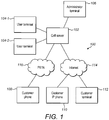
- Figure 1 shows an example embodiment of a telephony system 100 for timing and analyzing voice call subsections.
- the telephony system 100 comprises a call server 102, which may for example be a Private Branch Exchange (PBX) server, an internet protocol (IP) call server, or another type of server configured to receive and route telephonic information.
- the call server 102 may be embodied in a single apparatus or may be distributed across a number of different apparatus.
- the call server 102 includes at least one processor and at least one electronic memory operatively coupled to the at least one processor for controlling operation of the call server.
- the call server also includes a number of other components which allow the call server to communicate with external apparatus and to control its internal functions. These are not shown to avoid obscuring the invention.
- the telephony system 100 comprises a number of user terminals, including a first user terminal 104-1 and a second user terminal 104-2.
- the first and second user terminals are connected to the call server 102. Only two user terminals are shown in Figure 1 for simplicity, but it will be appreciated that the system may comprise a large number of separate user terminals connected to the call server 102.
- the telephony system 100 also includes an administrator terminal 106.
- the administrator terminal 106 may be the same as the user terminals, or it may have additional components and/or functionality. Both the user terminals 104-1, 104-2 and the administrator terminal 106 may comprise IP phones and an associated computer terminal or alternatively only a computer terminal capable of making and receiving VOIP calls.
- the terminals 104-1, 104-2, 106 may also have user input hardware, such as a keyboard.
- the call server 102, user terminals 104-1, 04-2 and administrator terminal 106 may all reside on the same network, for example a LAN.
- the terminals 104-1, 104-2, 106 may be widely distributed and may communicate with the call server 102 over a WAN and/or the internet.
- the call server 102 is configured to facilitate voice calls between the user terminals 104-1, 104-2 and customer phones.
- the telephony system 100 may include a normal customer phone 108, i.e . a phone not capable of using VOIP and a customer IP phone 110 which is configured to communicate using VOIP.
- the telephony system 100 may include a customer computer terminal 112 through which the customer is able to conduct voice calls.
- the customer IP phone 110 and customer computer terminal 112 may be contacted by the call server 102 through the internet 114, while the normal customer phone 108 may be contacted by the call server via the PSTN 116.
- a voice call being conducted between one of the user terminals 104-1, 104-2 and one of the customer phones 108, 110 or terminals 112 comprises a number of call subsections.
- the user reads a scripted statement and/or asks a scripted question and the customer responds. The user may then enter data relating to the customer's response into their terminal. Each round of user/customer dialogue and subsequent data entry constitutes a subsection of the call.
- a sub-call timer is used to measure the length of the call subsections.
- the user inputs a predefined keystroke to signal the end of the current call subsection and reset the sub-call timer.
- the sub-call timer may reside on the user terminal 104, in which case, the user terminal is programmed to communicate the timing information to the call server 102 during or after the call.
- the sub-call timer may reside on the call server 102, in which case the user terminals 104 are programmed to indicate the times at which end of section keystrokes are received.
- the call server 102 then calculates the elapsed times for each call subsection.
- the call server 102 is also programmed to perform further analysis on the recorded call subsection times in order to effect an improvement in the overall system.
- the call server 102 stores a list of subsection target times. Each call subsection may have a single predefined target time or a lower and upper boundary time.
- the call server 102 also aggregates the measured subsection time with previously measured times for the same subsection for that user. This generates a running per-user average for each call subsection.
- the call server 102 is programmed to compare the aggregate of the measured subsection times with the corresponding subsection target time and to record the difference.
- the call server 102 is also configured to send an alert when the recorded difference between the aggregate of the measured section times and the corresponding section target time is greater than a predetermined threshold.
- the alert may only be generated once a minimum number of subsection times have been aggregated, for example once 10 times for the same subsection have been aggregated.
- the alert may take any suitable form and may be sent to the administrator terminal 106.
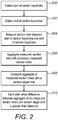
- step 200 the system 100 detects a start of section keystroke.
- the keystroke may be input to the user terminal 104-1 by the user.
- the user terminal 104-1 may optionally communicate that the start of section keystroke has been received to the call server 102.
- step 202 the system 100 detects an end of section keystroke.
- the keystroke may be input to the user terminal 104-1 by the user.
- the user terminal 104-1 may optionally communicate that the end of section keystroke has been received to the call server 102.
- the elapsed section time between the start of section keystroke and the end of section keystroke is measured.
- This step may be performed by a processor on the user terminal 104-1.
- the user terminal 104-1 is programmed to start and stop a section timer in response to the start and end of section keystrokes respectively, and then to determine the elapsed time for that section in step 204.
- the elapsed section time between the start of section keystroke and the end of section keystroke may be measured by the call server 102.
- the call server 102 receives timings signals from the user terminal 104-1 indicating the start and end of section keystrokes and uses these to start and stop a section timer, and then to determine the elapsed time for that section in step 204.
- the start and end of section keystrokes may refer to the same keystroke used to move between sections of the scripted call. For example, tabbing to the next field in a questionnaire can be used as both the end of section keystroke for the section that has just been completed and as the start of section keystroke for the new section. In other words, the user does not need to perform extra steps to operate the sub-call timer.
- a dedicated key for example F11
- F11 may be assigned for the start and end of section keystrokes and that key may have no other function in the system.
- the section time measured in step 204 is aggregated with previously measured section times.
- the most recently measured section time is added to the sum of all the previously measured times for that section and the result divided by the total number of separate section times represented, in order to produce an average section time for the user.
- this step may be performed by a processor on the user terminal 104-1.
- the user terminal 104-1 then sends the aggregated section time result to the call server 102.
- the aggregation may be performed by the call server 102.
- the call server 102 compares the aggregate of the measured section times with a section target time.
- the section target time is stored in a memory of the call server 102.
- the call server 102 sends an alert when a difference between the aggregate of the measured section times and the section target time is greater than a predetermined threshold.
- the memory of the call server 102 also stores at least one predetermined threshold value.
- the server 102 may store upper and lower thresholds, which may be different.
- the call server 102 may be programmed to compare the aggregate of the measured section times with a particular one of the thresholds, depending on whether the result of the comparison is positive or negative.
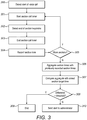
- FIG. 3 is a flowchart showing additional steps performed by the telephony system 100 of Figure 1 according to some embodiments.
- the system 100 detects the start of a voice call between a user terminal 104-1 and customer phone 108, 110, 112. This detection may occur when the customer answers the phone call placed by the user terminal 104-1 or when the user terminal 104-1 is connected to a customer phone is which is on hold.
- the detection in step 300 may also occur when a customer calls the user and leaves the automated Interactive Voice Response queue and is connected to the user. For example the customer may be dialing into a system for technical support.
- a section call timer is started.
- the section call timer may reside on the user terminal 104-1 or on the call server 102.
- the system 100 detects an end of section keystroke.
- the keystroke may be input to the user terminal 104-1 by the user.
- the user terminal 104-1 may optionally communicate that the end of section keystroke has been received to the call server 102.
- the section call timer is ended.
- the section time is recorded in the memory of the call server 102 ( i.e . the elapsed time between the starting and ending of the section call timer is recorded).
- the system 104-1 determines whether there are more sections of the scripted phone call to be completed.
- the user terminal 104-1 may be programmed with the scripted phone call and may monitor the progress through the scripted sections. If there are more sections remaining in the call (YES at step 305) the process returns to step 301 and a new section call timer is started. The process loops steps 301 to 304 until all of the sections have been completed and the section times recorded. When there are no more sections remaining (NO at step 305) the process continues to step 306 in which the section times recorded in step 304 are aggregated with the previously recorded times for the respective sections.
- the most recently recorded section time is added to the sum of all the previously recorded times for that section and the result divided by the total number of separate section times represented, in order to produce an average section time for the user.
- the sections times are recorded on the call server 102 and step 306 is performed by the call server 102.
- the call server 102 compares the aggregate of the recorded section times with a stored section target time in the memory of the call server 102. In step 308, the call server 102 determines whether the difference resulting from the comparison of step 307 is larger than a threshold value.
- the server 102 may store a single threshold value for each section, or a single +/- threshold criteria for each section, or different positive and negative threshold values for each section.
- step 308 If the difference is not greater than the threshold value (NO at step 308) then the process ends at step 309 with no further action being taken. If the difference is greater than the threshold value (YES at step 308) then the process continues to step 310, in which the call server 102 sends an alert to an administrator, for example to administrator terminal 106. In some embodiments, the alert is only sent after a minimum number of recorded section times have been aggregated, for example 5 or 10 sections minimum.
- the section target time may be 90 seconds and the threshold value used in step 308 may be ⁇ 15 seconds.
- the aggregate of the recorded sections times for a particular user may be 108 seconds, leading to a difference of 18 seconds. As the difference is greater than the threshold value, an alert would be sent to the administrator.
- the section target time may be 30 seconds and the threshold value used in step 308 may be ⁇ 8 seconds.
- the aggregate of the recorded sections times for a particular user may be 27 seconds, leading to a difference of minus 3 seconds. As the difference is less than the threshold value, no alert is sent.
- the operation of the telephony system 100 allows it to automatically identify users that are not completing the scripted sections in the desired time period without the need for manual intervention by an administrator and without any extra steps being required of the user.
- a further advantage of the present system is that system 100 is able to identify particular scripted sections which are not being completed in the desired time period by a number of different users.
- the call server 102 may perform additional steps of (a) recording the number of different users whose aggregated times for a particular section exceed the section target time by the threshold value and (b) when the number of different users in this category exceeds a predefined number, sending a second alert to an administrator identifying the relevant section. This may help to identify scripted section which are poorly worded, or section target times which are impractical.
- the present system allows both under-performing users and poorly worded sections to be automatically identified by a call server.
- Figure 4 is a flow chart illustrating where processes are carried out in an exemplary embodiment of the telephony system 100.
- Figure 4 shows many of the same steps as are shown in Figures 2 and 3 , although some of the nomenclature is altered.
- the section call timer is referred to by the proprietary name MiTempo Timer and the section target time is referred to as a "golden time”.
- the system includes a separate call timer 400 for recording the total call time.
- the MiTempo Timer 402 initially records the length of the agent greeting, beginning when the call is received and ending when the agent hits a key to begin the first question in the scripted call.
- the system also features a user interface to assist the agent/user in completing each call section in the golden time/section target time. Although a golden time may be set for the agent greeting, this section may not form part of the automatic monitoring performed on the rest of the call and no alert may be sent if the agent greeting time exceeds or is below the set golden time.
- the agent then moves onto the processes in box 404.
- the agent reads aloud the first (nth) question, listens to the customer's response and then enters the response information.
- the MiTempo Timer 402 is started (box 406).
- the MiTempo Timer 402 is stopped and the question time recorded.
- the agent repeats the processes in box 404 until all of the questions have been asked.
- the MiTempo Timer 402 repeats the processes in box 406 until the last question has been asked.
- the golden time may be predefined in the system, or dynamically updated.
- the golden time may be based on the aggregated times of one or more experienced agents.
- the second user terminal 104-2 may be the terminal of one of these experience agents.
- the telephony system 100 may measure and aggregate the section times of this agent in the same way as described above, and may then use the aggregated section times as the section target times for the other users. This allows the other users to measure themselves against a golden standard for each section.
- the aggregated section times of a number of experience agents may be used as the section target time. This may better account for the natural variation in the speed at which different people speak.
- the system also features a MiTempo user interface (UI) 408.
- UI user interface
- the UI begins a pacing timer. This may be implemented in a number of ways, for example as a simple timer showing seconds elapsed or as a countdown timer which begins at the golden time and counts down.
- the script itself is displayed in the user interface and the individual words or whole sentences are highlighted at the correct pace to meet the golden time.
- highlighting a 'bouncing ball' animation may be used to indicate the pace at which the words should be spoken.
- the MiTempo UI 408 also feature a loop 410 which is performed in conjunction with the loop 404 by the agent and loop 406 by the MiTempo Timer 402. All three of the loops are linked to end of section keystrokes received at the user terminal 104-1.
- the agent is able to view their times for each section against the target/golden times for the sections. These may be shown as a fraction with the recorded times as the numerator and the section target times as the denominator. Colour coding may be used to indicate immediately to the agent which sections they performed well or badly on. For example, if the recorded time is within the predetermined threshold then the fraction may be colour coded green and if the recorded time exceeds the predetermined threshold then the fraction may be colour coded red.
- a question may be written in one language and then translated for use in other languages, but that the way in which the question is worded may be difficult and/or long-winded in the translation, leading to a longer time for reading the question.
- the present system allows this situation to be identified automatically, leading to a quicker resolution.
- the concepts in the present disclosure may also be used to send text messages to a customer (rather than audio information) at a pace which is comfortable for the customer to read. This may be achieve by determining a time required to read the section of text to be sent, based on average reading speeds.
- the call server 102 then sends the section of text to the customer device or terminal capable of displaying the text.
- the customer may be engaged in a text chat session with the agent.
- the call server 102 is programmed to prevent the sending by the agent of further text to the customer until the determined time has elapsed. In this way, the customer is not sent large sections of text in quick succession, or sent text at a rate which is too quick for them to comfortably read. This increases the overall quality of the chat experience for the customer.
Landscapes
- Business, Economics & Management (AREA)
- Human Resources & Organizations (AREA)
- Engineering & Computer Science (AREA)
- Strategic Management (AREA)
- Entrepreneurship & Innovation (AREA)
- Economics (AREA)
- Marketing (AREA)
- Operations Research (AREA)
- Quality & Reliability (AREA)
- Tourism & Hospitality (AREA)
- Physics & Mathematics (AREA)
- General Business, Economics & Management (AREA)
- General Physics & Mathematics (AREA)
- Theoretical Computer Science (AREA)
- Educational Administration (AREA)
- Development Economics (AREA)
- Game Theory and Decision Science (AREA)
- Data Mining & Analysis (AREA)
- Signal Processing (AREA)
- Telephonic Communication Services (AREA)
Abstract
Description
- The present invention relates to a system configured to provide a new voice call analysis technique by measuring subsection call times and comparing these with predetermined thresholds.
- In a call centre environment, agents are often required to read aloud scripted sections of text and to record the called parties' response. Existing systems record only the total call length to use as a measure of agent performance. A technique is therefore required which allows a call server to measure and analyse calls in greater detail and to automatically analyse the calls without extra burden on the agents.
- A first aspect of the invention provides a method comprising: detecting a start of section keystroke; detecting an end of section keystroke; measuring a section time between the start of section keystroke and the end of section keystroke; aggregating the measured section time with previously measured section times; comparing the aggregate of the measured section times with a section target time; and sending an alert when a difference between the aggregate of the measured section times and the section target time is greater than a predetermined threshold.
- The method may further comprise recording the section time in a server and the aggregating, comparing and sending may be performed by the server. The start of section keystroke may indicate a start of a user recited script. The end of section keystroke may indicate an end of data entry following the user recited script.
- The previously measured section times may relate to a single user. Alternatively, the previously measured section times may relate to multiple users. The section target time may be predetermined. Alternatively, the section target time may be dynamically updated based on an aggregate of measured section times of a subset of users.
- The method may further comprise displaying the section target time in response to detecting the start of section keystroke. The method may further comprise displaying a section of scripted text and, in response to detecting the start of section keystroke, providing a visual indication of a target reading speed on the scripted text, the target reading speed resulting in the scripted text being recited in the section target time.
- The method may further comprise determining a time required to read a section of text based on average reading speed; sending the section of text to a remote device; and preventing the sending of further text to the remote device until the determined time has elapsed.
- A second aspect of the invention provides a system configured to: detect a start of section keystroke; detect an end of section keystroke; measure a section time between the start of section keystroke and the end of section keystroke; aggregate the measured section time with previously measured section times; compare the aggregate of the measured section times with a section target time; and send an alert when a difference between the aggregate of the measured section times and the section target time is greater than a predetermined threshold.
- A third aspect of the invention provides a non-transitory computer-readable storage medium having stored thereon computer-readable code, which, when executed by computing apparatus, causes the computing apparatus to: detect a start of section keystroke; detect an end of section keystroke; measure a section time between the start of section keystroke and the end of section keystroke; aggregate the measured section time with previously measured section times; compare the aggregate of the measured section times with a section target time; and send an alert when a difference between the aggregate of the measured section times and the section target time is greater than a predetermined threshold.
- A fourth aspect of the invention provides an apparatus comprising:
- means for detecting a start of section keystroke; means for detecting an end of section keystroke; means for measuring a section time between the start of section keystroke and the end of section keystroke; means for aggregating the measured section time with previously measured section times; means for comparing the aggregate of the measured section times with a section target time; and means for sending an alert when a difference between the aggregate of the measured section times and the section target time is greater than a predetermined threshold.
- A fifth aspect of the invention provides an apparatus comprising at least one processor and at least one memory including computer program code, the at least one memory and the computer program code configured to, with the at least one processor, cause the apparatus at least to: detect a start of section keystroke; detect an end of section keystroke; measure a section time between the start of section keystroke and the end of section keystroke; aggregate the measured section time with previously measured section times; compare the aggregate of the measured section times with a section target time; and send an alert when a difference between the aggregate of the measured section times and the section target time is greater than a predetermined threshold.
- Embodiments will now be described, by way of example only, with reference to the accompanying drawings, in which:
-
Figure 1 is a schematic illustration of an exemplary telephony system in which the invention can be implemented; -
Figure 2 is a flowchart showing steps performed by the telephony system ofFigure 1 according to some embodiments; -
Figure 3 is a flowchart showing additional steps performed by the telephony system ofFigure 1 according to some embodiments; and -
Figure 4 is a flow diagram illustrating exemplary operation of the telephony system ofFigure 1 according to some embodiments. - Before the present invention is disclosed and described, it is to be understood that this invention is not limited to the particular structures, process steps, or materials disclosed herein, but is extended to equivalents thereof as would be recognized by those ordinarily skilled in the relevant arts. It should also be understood that terminology employed herein is used for the purpose of describing particular embodiments only and is not intended to be limiting.
- It should be understood that many of the functional units described in this specification have been labeled as modules, in order to more particularly emphasize their implementation independence. For example, a module may be implemented as a hardware circuit comprising custom VLSI circuits or gate arrays, off-the-shelf semiconductors such as logic chips, transistors, or other discrete components. A module may also be implemented in programmable hardware devices such as field programmable gate arrays, programmable array logic, programmable logic devices or the like.
- Modules may also be implemented in software for execution by various types of processors. An identified module of executable code may, for instance, comprise one or more physical or logical blocks of computer instructions, which may, for instance, be organized as an object, procedure, or function. Nevertheless, the executables of an identified module need not be physically located together, but may comprise disparate instructions stored in different locations which, when joined logically together, comprise the module and achieve the stated purpose for the module.
- Indeed, a module of executable code may be a single instruction, or many instructions, and may even be distributed over several different code segments, among different programs, and across several memory devices. Similarly, operational data may be identified and illustrated herein within modules, and may be embodied in any suitable form and organized within any suitable type of data structure. The operational data may be collected as a single data set, or may be distributed over different locations including over different storage devices, and may exist, at least partially, merely as electronic signals on a system or network. The modules may be passive or active, including agents operable to perform desired functions.
- Reference throughout this specification to "one embodiment" or "an embodiment" means that a particular feature, structure, or characteristic described in connection with the embodiment is included in at least one embodiment of the present invention. Thus, appearances of the phrases "in one embodiment" or "in an embodiment" in various places throughout this specification are not necessarily all referring to the same embodiment.
- As used herein, a plurality of items, structural elements, compositional elements, and/or materials may be presented in a common list for convenience. However, these lists should be construed as though each member of the list is individually identified as a separate and unique member. Thus, no individual member of such list should be construed as a de facto equivalent of any other member of the same list solely based on their presentation in a common group without indications to the contrary. In addition, various embodiments and example of the present invention may be referred to herein along with alternatives for the various components thereof. It is understood that such embodiments, examples, and alternatives are not to be construed as defacto equivalents of one another, but are to be considered as separate and autonomous representations of the present invention.
- Furthermore, the described features, structures, or characteristics may be combined in any suitable manner in one or more embodiments. In the following description, numerous specific details are provided, such as examples of materials, fasteners, sizes, lengths, widths, shapes, etc., to provide a thorough understanding of embodiments of the invention. One skilled in the relevant art will recognize, however, that the invention can be practiced without one or more of the specific details, or with other methods, components, materials, etc. In other instances, well-known structures, materials, or operations are not shown or described in detail to avoid obscuring aspects of the invention.
-
Figure 1 shows an example embodiment of atelephony system 100 for timing and analyzing voice call subsections. - The
telephony system 100 comprises acall server 102, which may for example be a Private Branch Exchange (PBX) server, an internet protocol (IP) call server, or another type of server configured to receive and route telephonic information. Thecall server 102 may be embodied in a single apparatus or may be distributed across a number of different apparatus. Although not shown in the Figures, thecall server 102 includes at least one processor and at least one electronic memory operatively coupled to the at least one processor for controlling operation of the call server. The call server also includes a number of other components which allow the call server to communicate with external apparatus and to control its internal functions. These are not shown to avoid obscuring the invention. - The
telephony system 100 comprises a number of user terminals, including a first user terminal 104-1 and a second user terminal 104-2. The first and second user terminals are connected to thecall server 102. Only two user terminals are shown inFigure 1 for simplicity, but it will be appreciated that the system may comprise a large number of separate user terminals connected to thecall server 102. Thetelephony system 100 also includes anadministrator terminal 106. Theadministrator terminal 106 may be the same as the user terminals, or it may have additional components and/or functionality. Both the user terminals 104-1, 104-2 and theadministrator terminal 106 may comprise IP phones and an associated computer terminal or alternatively only a computer terminal capable of making and receiving VOIP calls. The terminals 104-1, 104-2, 106 may also have user input hardware, such as a keyboard. Thecall server 102, user terminals 104-1, 04-2 andadministrator terminal 106 may all reside on the same network, for example a LAN. Alternatively, the terminals 104-1, 104-2, 106 may be widely distributed and may communicate with thecall server 102 over a WAN and/or the internet. - The
call server 102 is configured to facilitate voice calls between the user terminals 104-1, 104-2 and customer phones. Thetelephony system 100 may include anormal customer phone 108, i.e. a phone not capable of using VOIP and acustomer IP phone 110 which is configured to communicate using VOIP. In addition thetelephony system 100 may include acustomer computer terminal 112 through which the customer is able to conduct voice calls. Thecustomer IP phone 110 andcustomer computer terminal 112 may be contacted by thecall server 102 through theinternet 114, while thenormal customer phone 108 may be contacted by the call server via thePSTN 116. - In some embodiments, a voice call being conducted between one of the user terminals 104-1, 104-2 and one of the
customer phones terminals 112 comprises a number of call subsections. In these embodiments, the user reads a scripted statement and/or asks a scripted question and the customer responds. The user may then enter data relating to the customer's response into their terminal. Each round of user/customer dialogue and subsequent data entry constitutes a subsection of the call. - A sub-call timer is used to measure the length of the call subsections. The user inputs a predefined keystroke to signal the end of the current call subsection and reset the sub-call timer. The sub-call timer may reside on the user terminal 104, in which case, the user terminal is programmed to communicate the timing information to the
call server 102 during or after the call. Alternatively, the sub-call timer may reside on thecall server 102, in which case the user terminals 104 are programmed to indicate the times at which end of section keystrokes are received. Thecall server 102 then calculates the elapsed times for each call subsection. - The
call server 102 is also programmed to perform further analysis on the recorded call subsection times in order to effect an improvement in the overall system. Thecall server 102 stores a list of subsection target times. Each call subsection may have a single predefined target time or a lower and upper boundary time. Thecall server 102 also aggregates the measured subsection time with previously measured times for the same subsection for that user. This generates a running per-user average for each call subsection. Thecall server 102 is programmed to compare the aggregate of the measured subsection times with the corresponding subsection target time and to record the difference. Thecall server 102 is also configured to send an alert when the recorded difference between the aggregate of the measured section times and the corresponding section target time is greater than a predetermined threshold. The alert may only be generated once a minimum number of subsection times have been aggregated, for example once 10 times for the same subsection have been aggregated. The alert may take any suitable form and may be sent to theadministrator terminal 106. - Turning now to
Figure 2 , a flowchart is shows steps performed by thetelephony system 100 ofFigure 1 according to some embodiments. Instep 200 thesystem 100 detects a start of section keystroke. The keystroke may be input to the user terminal 104-1 by the user. The user terminal 104-1 may optionally communicate that the start of section keystroke has been received to thecall server 102. Instep 202 thesystem 100 detects an end of section keystroke. The keystroke may be input to the user terminal 104-1 by the user. The user terminal 104-1 may optionally communicate that the end of section keystroke has been received to thecall server 102. - At
step 204, the elapsed section time between the start of section keystroke and the end of section keystroke is measured. This step may be performed by a processor on the user terminal 104-1. In these embodiments, the user terminal 104-1 is programmed to start and stop a section timer in response to the start and end of section keystrokes respectively, and then to determine the elapsed time for that section instep 204. Alternatively, the elapsed section time between the start of section keystroke and the end of section keystroke may be measured by thecall server 102. In these embodiments, thecall server 102 receives timings signals from the user terminal 104-1 indicating the start and end of section keystrokes and uses these to start and stop a section timer, and then to determine the elapsed time for that section instep 204. - The start and end of section keystrokes may refer to the same keystroke used to move between sections of the scripted call. For example, tabbing to the next field in a questionnaire can be used as both the end of section keystroke for the section that has just been completed and as the start of section keystroke for the new section. In other words, the user does not need to perform extra steps to operate the sub-call timer. In some other embodiments, a dedicated key (for example F11) may be assigned for the start and end of section keystrokes and that key may have no other function in the system.
- At
step 206, the section time measured instep 204 is aggregated with previously measured section times. The most recently measured section time is added to the sum of all the previously measured times for that section and the result divided by the total number of separate section times represented, in order to produce an average section time for the user. In some embodiments, this step may be performed by a processor on the user terminal 104-1. In these embodiments the user terminal 104-1 then sends the aggregated section time result to thecall server 102. Alternatively, the aggregation may be performed by thecall server 102. - At
step 208, thecall server 102 compares the aggregate of the measured section times with a section target time. The section target time is stored in a memory of thecall server 102. Instep 210, thecall server 102 sends an alert when a difference between the aggregate of the measured section times and the section target time is greater than a predetermined threshold. The memory of thecall server 102 also stores at least one predetermined threshold value. For example, theserver 102 may store upper and lower thresholds, which may be different. Thecall server 102 may be programmed to compare the aggregate of the measured section times with a particular one of the thresholds, depending on whether the result of the comparison is positive or negative. -
Figure 3 is a flowchart showing additional steps performed by thetelephony system 100 ofFigure 1 according to some embodiments. Atstep 300, thesystem 100 detects the start of a voice call between a user terminal 104-1 andcustomer phone step 300 may also occur when a customer calls the user and leaves the automated Interactive Voice Response queue and is connected to the user. For example the customer may be dialing into a system for technical support. - In response to the detection in
step 300, at step 301 a section call timer is started. The section call timer may reside on the user terminal 104-1 or on thecall server 102. Atstep 302 thesystem 100 detects an end of section keystroke. The keystroke may be input to the user terminal 104-1 by the user. The user terminal 104-1 may optionally communicate that the end of section keystroke has been received to thecall server 102. In response to the detection instep 302, atstep 303 the section call timer is ended. Atstep 304 the section time is recorded in the memory of the call server 102 (i.e. the elapsed time between the starting and ending of the section call timer is recorded). - At
step 305 the system 104-1 determines whether there are more sections of the scripted phone call to be completed. The user terminal 104-1 may be programmed with the scripted phone call and may monitor the progress through the scripted sections. If there are more sections remaining in the call (YES at step 305) the process returns to step 301 and a new section call timer is started. The process loops steps 301 to 304 until all of the sections have been completed and the section times recorded. When there are no more sections remaining (NO at step 305) the process continues to step 306 in which the section times recorded instep 304 are aggregated with the previously recorded times for the respective sections. The most recently recorded section time is added to the sum of all the previously recorded times for that section and the result divided by the total number of separate section times represented, in order to produce an average section time for the user. In this embodiment, the sections times are recorded on thecall server 102 and step 306 is performed by thecall server 102. - At
step 307, thecall server 102 compares the aggregate of the recorded section times with a stored section target time in the memory of thecall server 102. Instep 308, thecall server 102 determines whether the difference resulting from the comparison ofstep 307 is larger than a threshold value. Theserver 102 may store a single threshold value for each section, or a single +/- threshold criteria for each section, or different positive and negative threshold values for each section. - If the difference is not greater than the threshold value (NO at step 308) then the process ends at
step 309 with no further action being taken. If the difference is greater than the threshold value (YES at step 308) then the process continues to step 310, in which thecall server 102 sends an alert to an administrator, for example toadministrator terminal 106. In some embodiments, the alert is only sent after a minimum number of recorded section times have been aggregated, for example 5 or 10 sections minimum. - As a first example, for a particular scripted section, the section target time may be 90 seconds and the threshold value used in
step 308 may be ±15 seconds. The aggregate of the recorded sections times for a particular user may be 108 seconds, leading to a difference of 18 seconds. As the difference is greater than the threshold value, an alert would be sent to the administrator. - As a second example, for another scripted section, the section target time may be 30 seconds and the threshold value used in
step 308 may be ±8 seconds. The aggregate of the recorded sections times for a particular user may be 27 seconds, leading to a difference of minus 3 seconds. As the difference is less than the threshold value, no alert is sent. - As the above examples illustrate, the operation of the
telephony system 100 allows it to automatically identify users that are not completing the scripted sections in the desired time period without the need for manual intervention by an administrator and without any extra steps being required of the user. - A further advantage of the present system is that
system 100 is able to identify particular scripted sections which are not being completed in the desired time period by a number of different users. To this end, thecall server 102 may perform additional steps of (a) recording the number of different users whose aggregated times for a particular section exceed the section target time by the threshold value and (b) when the number of different users in this category exceeds a predefined number, sending a second alert to an administrator identifying the relevant section. This may help to identify scripted section which are poorly worded, or section target times which are impractical. Thus the present system allows both under-performing users and poorly worded sections to be automatically identified by a call server. - Referring to
Figure 4 , further aspects and advantages of the telephony system can be appreciated.Figure 4 is a flow chart illustrating where processes are carried out in an exemplary embodiment of thetelephony system 100.Figure 4 shows many of the same steps as are shown inFigures 2 and3 , although some of the nomenclature is altered. For example, the section call timer is referred to by the proprietary name MiTempo Timer and the section target time is referred to as a "golden time". - As can be seen, as well as featuring the
MiTempo Timer 402, the system includes a separate call timer 400 for recording the total call time. TheMiTempo Timer 402 initially records the length of the agent greeting, beginning when the call is received and ending when the agent hits a key to begin the first question in the scripted call. The system also features a user interface to assist the agent/user in completing each call section in the golden time/section target time. Although a golden time may be set for the agent greeting, this section may not form part of the automatic monitoring performed on the rest of the call and no alert may be sent if the agent greeting time exceeds or is below the set golden time. The agent then moves onto the processes inbox 404. The agent reads aloud the first (nth) question, listens to the customer's response and then enters the response information. In response to the agent beginning the question, theMiTempo Timer 402 is started (box 406). In response to the agent finishing entering the response info, theMiTempo Timer 402 is stopped and the question time recorded. The agent repeats the processes inbox 404 until all of the questions have been asked. TheMiTempo Timer 402 repeats the processes inbox 406 until the last question has been asked. - The golden time may be predefined in the system, or dynamically updated. For example the golden time may be based on the aggregated times of one or more experienced agents. Referring again to
Figure 1 , the second user terminal 104-2 may be the terminal of one of these experience agents. Thetelephony system 100 may measure and aggregate the section times of this agent in the same way as described above, and may then use the aggregated section times as the section target times for the other users. This allows the other users to measure themselves against a golden standard for each section. In some other embodiments, the aggregated section times of a number of experience agents may be used as the section target time. This may better account for the natural variation in the speed at which different people speak. - Referring again to
Figure 4 , the system also features a MiTempo user interface (UI) 408. As the user moves through each of the scripted call section, the golden time for each section is sent to theMiTempo UI 408. The UI then begins a pacing timer. This may be implemented in a number of ways, for example as a simple timer showing seconds elapsed or as a countdown timer which begins at the golden time and counts down. Alternatively, the script itself is displayed in the user interface and the individual words or whole sentences are highlighted at the correct pace to meet the golden time. As an alternative to highlighting a 'bouncing ball' animation may be used to indicate the pace at which the words should be spoken. TheMiTempo UI 408 also feature aloop 410 which is performed in conjunction with theloop 404 by the agent andloop 406 by theMiTempo Timer 402. All three of the loops are linked to end of section keystrokes received at the user terminal 104-1. - During or at the end of the call, the agent is able to view their times for each section against the target/golden times for the sections. These may be shown as a fraction with the recorded times as the numerator and the section target times as the denominator. Colour coding may be used to indicate immediately to the agent which sections they performed well or badly on. For example, if the recorded time is within the predetermined threshold then the fraction may be colour coded green and if the recorded time exceeds the predetermined threshold then the fraction may be colour coded red.
- These features provide the agents with a way to pace themselves against a golden standard for training and Service Level Agreement (SLA) timing requirements. Although the total call time provides some information, it does not allow poorly worded questions to be identified. If a question is poorly worded, agents may rush subsequent questions, resulting in the agent needing to repeat themselves and the target time being missed. Additionally it provides managers a way to measure agents' pacing and assess the timing and efficiency of written scripts. This in turn allows the scripts to be fine-tuned to better meet SLA requirements. It will also be appreciated that a question may be written in one language and then translated for use in other languages, but that the way in which the question is worded may be difficult and/or long-winded in the translation, leading to a longer time for reading the question. The present system allows this situation to be identified automatically, leading to a quicker resolution.
- The concepts in the present disclosure may also be used to send text messages to a customer (rather than audio information) at a pace which is comfortable for the customer to read. This may be achieve by determining a time required to read the section of text to be sent, based on average reading speeds. The
call server 102 then sends the section of text to the customer device or terminal capable of displaying the text. For example, the customer may be engaged in a text chat session with the agent. Thecall server 102 is programmed to prevent the sending by the agent of further text to the customer until the determined time has elapsed. In this way, the customer is not sent large sections of text in quick succession, or sent text at a rate which is too quick for them to comfortably read. This increases the overall quality of the chat experience for the customer. - Persons skilled in the art will appreciate that there are yet more alternative implementations and modifications possible for implementing the embodiments, and that the above implementations and examples are only illustrations of one or more embodiments. The scope, therefore, is only to be limited by the claims appended hereto.
Claims (15)
- A method comprising:detecting a start of section keystroke;detecting an end of section keystroke;measuring a section time between the start of section keystroke and the end of section keystroke;aggregating the measured section time with previously measured section times;comparing the aggregate of the measured section times with a section target time; andsending an alert when a difference between the aggregate of the measured section times and the section target time is greater than a predetermined threshold.
- A method according to claim 1, further comprising recording the section time in a server and wherein the aggregating, comparing and sending are performed by the server.
- A method according to claim 1 or claim 2, wherein the start of section keystroke indicates a start of a user recited script.
- A method according to claim 3, wherein the end of section keystroke indicates an end of data entry following the user recited script.
- A method according to any preceding claim, wherein the previously measured section times relate to a single user.
- A method according to any of claims 1-4, wherein the previously measured section times relate to multiple users.
- A method according to any preceding claim, wherein the section target time is predetermined.
- A method according to any of claims 1-6, wherein the section target time is dynamically updated based on an aggregate of measured section times of a subset of users.
- A method according to any preceding claim, further comprising displaying the section target time in response to detecting the start of section keystroke.
- A method according to any preceding claim, further comprising displaying a section of scripted text and, in response to detecting the start of section keystroke, providing a visual indication of a target reading speed on the scripted text, the target reading speed resulting in the scripted text being recited in the section target time.
- A method according to any preceding claim, further comprising:determining a time required to read a section of text based on average reading speed;sending the section of text to a remote device; andpreventing the sending of further text to the remote device until the determined time has elapsed.
- A system configured to:detect a start of section keystroke;detect an end of section keystroke;measure a section time between the start of section keystroke and the end of section keystroke;aggregate the measured section time with previously measured section times;compare the aggregate of the measured section times with a section target time; andsend an alert when a difference between the aggregate of the measured section times and the section target time is greater than a predetermined threshold.
- A system according to claim 12, wherein the start of section keystroke indicates a start of a user recited script.
- A system according to claim 12 or claim 13, wherein the end of section keystroke indicates an end of data entry following the user recited script.
- A system according to any of claims 12-14, wherein the section target time is dynamically updated based on an aggregate of measured section times of a subset of users.
Priority Applications (3)
| Application Number | Priority Date | Filing Date | Title |
|---|---|---|---|
| EP17164179.8A EP3382611B1 (en) | 2017-03-31 | 2017-03-31 | System and method for call timing and analysis |
| US15/940,838 US10878348B2 (en) | 2017-03-31 | 2018-03-29 | System and method for call timing and analysis |
| US16/953,470 US11361258B2 (en) | 2017-03-31 | 2020-11-20 | System and method for call timing and analysis |
Applications Claiming Priority (1)
| Application Number | Priority Date | Filing Date | Title |
|---|---|---|---|
| EP17164179.8A EP3382611B1 (en) | 2017-03-31 | 2017-03-31 | System and method for call timing and analysis |
Publications (2)
| Publication Number | Publication Date |
|---|---|
| EP3382611A1 true EP3382611A1 (en) | 2018-10-03 |
| EP3382611B1 EP3382611B1 (en) | 2022-09-28 |
Family
ID=58578822
Family Applications (1)
| Application Number | Title | Priority Date | Filing Date |
|---|---|---|---|
| EP17164179.8A Active EP3382611B1 (en) | 2017-03-31 | 2017-03-31 | System and method for call timing and analysis |
Country Status (2)
| Country | Link |
|---|---|
| US (2) | US10878348B2 (en) |
| EP (1) | EP3382611B1 (en) |
Families Citing this family (1)
| Publication number | Priority date | Publication date | Assignee | Title |
|---|---|---|---|---|
| US10547746B2 (en) * | 2017-10-26 | 2020-01-28 | Mitel Networks Corporation | Method and system for dynamically changing a service level agreement |
Citations (3)
| Publication number | Priority date | Publication date | Assignee | Title |
|---|---|---|---|---|
| US20040230479A1 (en) * | 2003-05-14 | 2004-11-18 | Konica Minolta Photo Imaging, Inc. | Display system |
| US20060265090A1 (en) * | 2005-05-18 | 2006-11-23 | Kelly Conway | Method and software for training a customer service representative by analysis of a telephonic interaction between a customer and a contact center |
| US20080262904A1 (en) * | 2007-03-30 | 2008-10-23 | Kelly Conway | Method and system for automatically monitoring contact center performance |
Family Cites Families (23)
| Publication number | Priority date | Publication date | Assignee | Title |
|---|---|---|---|---|
| FR2482228B1 (en) * | 1980-05-06 | 1986-02-28 | Dba | PUNCTUAL ACTION BRAKE |
| EP0062121B1 (en) * | 1981-04-08 | 1986-07-16 | International Business Machines Corporation | Text processing apparatus with two-stage formatting of text |
| US5790652A (en) * | 1996-03-12 | 1998-08-04 | Intergrated Systems, Inc. | Telephone station equipment employing rewriteable display keys |
| JPH11202998A (en) * | 1998-01-08 | 1999-07-30 | Fujitsu Takamisawa Component Ltd | Information processor |
| US6707811B2 (en) * | 1999-03-19 | 2004-03-16 | Estara, Inc. | Internet telephony for ecommerce |
| US7881441B2 (en) * | 2005-06-29 | 2011-02-01 | Ultratec, Inc. | Device independent text captioned telephone service |
| US8416925B2 (en) * | 2005-06-29 | 2013-04-09 | Ultratec, Inc. | Device independent text captioned telephone service |
| GB0408457D0 (en) * | 2004-04-15 | 2004-05-19 | Ring 2 Comm Ltd | Various improvements relating to telephone and conference calls between telephony devices |
| US7526081B1 (en) * | 2004-10-05 | 2009-04-28 | 3Com Corporation | Telephone recording and storing arbitrary keystrokes sequence with replay with a single stoke |
| US7836412B1 (en) * | 2004-12-03 | 2010-11-16 | Escription, Inc. | Transcription editing |
| US7739109B2 (en) * | 2005-01-12 | 2010-06-15 | Microsoft Corporation | System and process for muting audio transmission during a computer network-based, multi-party teleconferencing session |
| JP2007274480A (en) * | 2006-03-31 | 2007-10-18 | Toshiba Corp | Telephone system and telephone terminal device |
| US20080118054A1 (en) * | 2006-11-20 | 2008-05-22 | Mcardle James Michael | Telephone system and method |
| US8094791B2 (en) * | 2006-12-21 | 2012-01-10 | Verizon Data Services Llc | Biometric systems and methods for enhanced caller identification and call intercept |
| US8078698B2 (en) * | 2007-06-26 | 2011-12-13 | At&T Intellectual Property I, L.P. | Methods, systems, and products for producing persona-based hosts |
| US20090106312A1 (en) * | 2007-10-22 | 2009-04-23 | Franklin Charles Breslau | User function feedback method and system |
| US8762356B1 (en) * | 2011-07-15 | 2014-06-24 | Google Inc. | Detecting change in rate of input reception |
| HUE049804T2 (en) * | 2012-12-21 | 2020-10-28 | Biobex Llc | Verification of password using a keyboard with a secure password entry mode |
| US10095608B2 (en) * | 2015-09-15 | 2018-10-09 | International Business Machines Corporation | Application test automation transmitting data via phone/voice calls |
| US10262134B2 (en) * | 2016-10-07 | 2019-04-16 | International Business Machines Corporation | Detection of key logging activity |
| US10170100B2 (en) * | 2017-03-24 | 2019-01-01 | International Business Machines Corporation | Sensor based text-to-speech emotional conveyance |
| US10970573B2 (en) * | 2018-04-27 | 2021-04-06 | ID R&D, Inc. | Method and system for free text keystroke biometric authentication |
| US10462023B1 (en) * | 2018-06-20 | 2019-10-29 | Mitel Networks Corporation | Communication method and system including built-in self test |
-
2017
- 2017-03-31 EP EP17164179.8A patent/EP3382611B1/en active Active
-
2018
- 2018-03-29 US US15/940,838 patent/US10878348B2/en active Active
-
2020
- 2020-11-20 US US16/953,470 patent/US11361258B2/en active Active
Patent Citations (3)
| Publication number | Priority date | Publication date | Assignee | Title |
|---|---|---|---|---|
| US20040230479A1 (en) * | 2003-05-14 | 2004-11-18 | Konica Minolta Photo Imaging, Inc. | Display system |
| US20060265090A1 (en) * | 2005-05-18 | 2006-11-23 | Kelly Conway | Method and software for training a customer service representative by analysis of a telephonic interaction between a customer and a contact center |
| US20080262904A1 (en) * | 2007-03-30 | 2008-10-23 | Kelly Conway | Method and system for automatically monitoring contact center performance |
Also Published As
| Publication number | Publication date |
|---|---|
| US20210073691A1 (en) | 2021-03-11 |
| US11361258B2 (en) | 2022-06-14 |
| US20180285789A1 (en) | 2018-10-04 |
| EP3382611B1 (en) | 2022-09-28 |
| US10878348B2 (en) | 2020-12-29 |
Similar Documents
| Publication | Publication Date | Title |
|---|---|---|
| US9185222B1 (en) | Identifying escalation events in communication sessions | |
| US11240374B2 (en) | Call processing method and apparatus, server, storage medium, and system | |
| US7606718B2 (en) | Apparatus and method for processing service interactions | |
| US8463606B2 (en) | System for analyzing interactions and reporting analytic results to human-operated and system interfaces in real time | |
| US10181319B1 (en) | Method and apparatus for voice recognition unit simulation | |
| US11557311B2 (en) | Satisfaction estimation model learning apparatus, satisfaction estimating apparatus, satisfaction estimation model learning method, satisfaction estimation method, and program | |
| US20140112461A1 (en) | Analyzing speech application performance | |
| EP2991329A1 (en) | Automated testing of interactive voice response systems | |
| US20160098663A1 (en) | Agent quality and performance monitoring based on non-primary skill evaluation | |
| US20120269338A1 (en) | Method for Increasing the Efficiency of Automated Telephony Systems | |
| US10212283B1 (en) | Live call debugging and monitoring tool for an interactive voice response unit | |
| US9258421B2 (en) | Speech analytics: conversation timing and adjustment | |
| US11361258B2 (en) | System and method for call timing and analysis | |
| CN111402653A (en) | Online training methods, devices and terminal equipment | |
| US9210262B1 (en) | Using a speech analytics system to control pre-recorded scripts for debt collection calls | |
| Levin et al. | Value-based optimal decision for dialog systems | |
| US8705706B2 (en) | Interactive flowgraph for analyzing caller utterances | |
| US20250166656A1 (en) | Emotion information utilization device, emotion information utilization method, and program | |
| CN111953854B (en) | Intelligent customer service assisting method based on scene model | |
| CN118098218A (en) | Method, device, equipment and storage medium for determining speech technology |
Legal Events
| Date | Code | Title | Description |
|---|---|---|---|
| PUAI | Public reference made under article 153(3) epc to a published international application that has entered the european phase |
Free format text: ORIGINAL CODE: 0009012 |
|
| STAA | Information on the status of an ep patent application or granted ep patent |
Free format text: STATUS: THE APPLICATION HAS BEEN PUBLISHED |
|
| AK | Designated contracting states |
Kind code of ref document: A1 Designated state(s): AL AT BE BG CH CY CZ DE DK EE ES FI FR GB GR HR HU IE IS IT LI LT LU LV MC MK MT NL NO PL PT RO RS SE SI SK SM TR |
|
| AX | Request for extension of the european patent |
Extension state: BA ME |
|
| STAA | Information on the status of an ep patent application or granted ep patent |
Free format text: STATUS: REQUEST FOR EXAMINATION WAS MADE |
|
| 17P | Request for examination filed |
Effective date: 20190402 |
|
| RBV | Designated contracting states (corrected) |
Designated state(s): AL AT BE BG CH CY CZ DE DK EE ES FI FR GB GR HR HU IE IS IT LI LT LU LV MC MK MT NL NO PL PT RO RS SE SI SK SM TR |
|
| STAA | Information on the status of an ep patent application or granted ep patent |
Free format text: STATUS: EXAMINATION IS IN PROGRESS |
|
| 17Q | First examination report despatched |
Effective date: 20200715 |
|
| GRAP | Despatch of communication of intention to grant a patent |
Free format text: ORIGINAL CODE: EPIDOSNIGR1 |
|
| STAA | Information on the status of an ep patent application or granted ep patent |
Free format text: STATUS: GRANT OF PATENT IS INTENDED |
|
| INTG | Intention to grant announced |
Effective date: 20220708 |
|
| GRAS | Grant fee paid |
Free format text: ORIGINAL CODE: EPIDOSNIGR3 |
|
| GRAA | (expected) grant |
Free format text: ORIGINAL CODE: 0009210 |
|
| STAA | Information on the status of an ep patent application or granted ep patent |
Free format text: STATUS: THE PATENT HAS BEEN GRANTED |
|
| AK | Designated contracting states |
Kind code of ref document: B1 Designated state(s): AL AT BE BG CH CY CZ DE DK EE ES FI FR GB GR HR HU IE IS IT LI LT LU LV MC MK MT NL NO PL PT RO RS SE SI SK SM TR |
|
| REG | Reference to a national code |
Ref country code: GB Ref legal event code: FG4D |
|
| REG | Reference to a national code |
Ref country code: CH Ref legal event code: EP |
|
| REG | Reference to a national code |
Ref country code: AT Ref legal event code: REF Ref document number: 1521739 Country of ref document: AT Kind code of ref document: T Effective date: 20221015 |
|
| REG | Reference to a national code |
Ref country code: DE Ref legal event code: R096 Ref document number: 602017062080 Country of ref document: DE |
|
| REG | Reference to a national code |
Ref country code: IE Ref legal event code: FG4D |
|
| REG | Reference to a national code |
Ref country code: LT Ref legal event code: MG9D |
|
| PG25 | Lapsed in a contracting state [announced via postgrant information from national office to epo] |
Ref country code: SE Free format text: LAPSE BECAUSE OF FAILURE TO SUBMIT A TRANSLATION OF THE DESCRIPTION OR TO PAY THE FEE WITHIN THE PRESCRIBED TIME-LIMIT Effective date: 20220928 Ref country code: RS Free format text: LAPSE BECAUSE OF FAILURE TO SUBMIT A TRANSLATION OF THE DESCRIPTION OR TO PAY THE FEE WITHIN THE PRESCRIBED TIME-LIMIT Effective date: 20220928 Ref country code: NO Free format text: LAPSE BECAUSE OF FAILURE TO SUBMIT A TRANSLATION OF THE DESCRIPTION OR TO PAY THE FEE WITHIN THE PRESCRIBED TIME-LIMIT Effective date: 20221228 Ref country code: LV Free format text: LAPSE BECAUSE OF FAILURE TO SUBMIT A TRANSLATION OF THE DESCRIPTION OR TO PAY THE FEE WITHIN THE PRESCRIBED TIME-LIMIT Effective date: 20220928 Ref country code: LT Free format text: LAPSE BECAUSE OF FAILURE TO SUBMIT A TRANSLATION OF THE DESCRIPTION OR TO PAY THE FEE WITHIN THE PRESCRIBED TIME-LIMIT Effective date: 20220928 Ref country code: FI Free format text: LAPSE BECAUSE OF FAILURE TO SUBMIT A TRANSLATION OF THE DESCRIPTION OR TO PAY THE FEE WITHIN THE PRESCRIBED TIME-LIMIT Effective date: 20220928 |
|
| REG | Reference to a national code |
Ref country code: NL Ref legal event code: MP Effective date: 20220928 |
|
| REG | Reference to a national code |
Ref country code: AT Ref legal event code: MK05 Ref document number: 1521739 Country of ref document: AT Kind code of ref document: T Effective date: 20220928 |
|
| PG25 | Lapsed in a contracting state [announced via postgrant information from national office to epo] |
Ref country code: HR Free format text: LAPSE BECAUSE OF FAILURE TO SUBMIT A TRANSLATION OF THE DESCRIPTION OR TO PAY THE FEE WITHIN THE PRESCRIBED TIME-LIMIT Effective date: 20220928 Ref country code: GR Free format text: LAPSE BECAUSE OF FAILURE TO SUBMIT A TRANSLATION OF THE DESCRIPTION OR TO PAY THE FEE WITHIN THE PRESCRIBED TIME-LIMIT Effective date: 20221229 |
|
| RAP4 | Party data changed (patent owner data changed or rights of a patent transferred) |
Owner name: MITEL NETWORKS CORPORATION |
|
| PG25 | Lapsed in a contracting state [announced via postgrant information from national office to epo] |
Ref country code: SM Free format text: LAPSE BECAUSE OF FAILURE TO SUBMIT A TRANSLATION OF THE DESCRIPTION OR TO PAY THE FEE WITHIN THE PRESCRIBED TIME-LIMIT Effective date: 20220928 Ref country code: RO Free format text: LAPSE BECAUSE OF FAILURE TO SUBMIT A TRANSLATION OF THE DESCRIPTION OR TO PAY THE FEE WITHIN THE PRESCRIBED TIME-LIMIT Effective date: 20220928 Ref country code: PT Free format text: LAPSE BECAUSE OF FAILURE TO SUBMIT A TRANSLATION OF THE DESCRIPTION OR TO PAY THE FEE WITHIN THE PRESCRIBED TIME-LIMIT Effective date: 20230130 Ref country code: ES Free format text: LAPSE BECAUSE OF FAILURE TO SUBMIT A TRANSLATION OF THE DESCRIPTION OR TO PAY THE FEE WITHIN THE PRESCRIBED TIME-LIMIT Effective date: 20220928 Ref country code: CZ Free format text: LAPSE BECAUSE OF FAILURE TO SUBMIT A TRANSLATION OF THE DESCRIPTION OR TO PAY THE FEE WITHIN THE PRESCRIBED TIME-LIMIT Effective date: 20220928 Ref country code: AT Free format text: LAPSE BECAUSE OF FAILURE TO SUBMIT A TRANSLATION OF THE DESCRIPTION OR TO PAY THE FEE WITHIN THE PRESCRIBED TIME-LIMIT Effective date: 20220928 |
|
| PG25 | Lapsed in a contracting state [announced via postgrant information from national office to epo] |
Ref country code: SK Free format text: LAPSE BECAUSE OF FAILURE TO SUBMIT A TRANSLATION OF THE DESCRIPTION OR TO PAY THE FEE WITHIN THE PRESCRIBED TIME-LIMIT Effective date: 20220928 Ref country code: PL Free format text: LAPSE BECAUSE OF FAILURE TO SUBMIT A TRANSLATION OF THE DESCRIPTION OR TO PAY THE FEE WITHIN THE PRESCRIBED TIME-LIMIT Effective date: 20220928 Ref country code: IS Free format text: LAPSE BECAUSE OF FAILURE TO SUBMIT A TRANSLATION OF THE DESCRIPTION OR TO PAY THE FEE WITHIN THE PRESCRIBED TIME-LIMIT Effective date: 20230128 Ref country code: EE Free format text: LAPSE BECAUSE OF FAILURE TO SUBMIT A TRANSLATION OF THE DESCRIPTION OR TO PAY THE FEE WITHIN THE PRESCRIBED TIME-LIMIT Effective date: 20220928 |
|
| REG | Reference to a national code |
Ref country code: DE Ref legal event code: R097 Ref document number: 602017062080 Country of ref document: DE |
|
| PG25 | Lapsed in a contracting state [announced via postgrant information from national office to epo] |
Ref country code: NL Free format text: LAPSE BECAUSE OF FAILURE TO SUBMIT A TRANSLATION OF THE DESCRIPTION OR TO PAY THE FEE WITHIN THE PRESCRIBED TIME-LIMIT Effective date: 20220928 Ref country code: AL Free format text: LAPSE BECAUSE OF FAILURE TO SUBMIT A TRANSLATION OF THE DESCRIPTION OR TO PAY THE FEE WITHIN THE PRESCRIBED TIME-LIMIT Effective date: 20220928 |
|
| PG25 | Lapsed in a contracting state [announced via postgrant information from national office to epo] |
Ref country code: DK Free format text: LAPSE BECAUSE OF FAILURE TO SUBMIT A TRANSLATION OF THE DESCRIPTION OR TO PAY THE FEE WITHIN THE PRESCRIBED TIME-LIMIT Effective date: 20220928 |
|
| PLBE | No opposition filed within time limit |
Free format text: ORIGINAL CODE: 0009261 |
|
| STAA | Information on the status of an ep patent application or granted ep patent |
Free format text: STATUS: NO OPPOSITION FILED WITHIN TIME LIMIT |
|
| 26N | No opposition filed |
Effective date: 20230629 |
|
| PG25 | Lapsed in a contracting state [announced via postgrant information from national office to epo] |
Ref country code: MC Free format text: LAPSE BECAUSE OF FAILURE TO SUBMIT A TRANSLATION OF THE DESCRIPTION OR TO PAY THE FEE WITHIN THE PRESCRIBED TIME-LIMIT Effective date: 20220928 |
|
| REG | Reference to a national code |
Ref country code: CH Ref legal event code: PL |
|
| PG25 | Lapsed in a contracting state [announced via postgrant information from national office to epo] |
Ref country code: SI Free format text: LAPSE BECAUSE OF FAILURE TO SUBMIT A TRANSLATION OF THE DESCRIPTION OR TO PAY THE FEE WITHIN THE PRESCRIBED TIME-LIMIT Effective date: 20220928 |
|
| REG | Reference to a national code |
Ref country code: BE Ref legal event code: MM Effective date: 20230331 |
|
| PG25 | Lapsed in a contracting state [announced via postgrant information from national office to epo] |
Ref country code: LU Free format text: LAPSE BECAUSE OF NON-PAYMENT OF DUE FEES Effective date: 20230331 |
|
| REG | Reference to a national code |
Ref country code: IE Ref legal event code: MM4A |
|
| PG25 | Lapsed in a contracting state [announced via postgrant information from national office to epo] |
Ref country code: LI Free format text: LAPSE BECAUSE OF NON-PAYMENT OF DUE FEES Effective date: 20230331 Ref country code: IE Free format text: LAPSE BECAUSE OF NON-PAYMENT OF DUE FEES Effective date: 20230331 Ref country code: CH Free format text: LAPSE BECAUSE OF NON-PAYMENT OF DUE FEES Effective date: 20230331 |
|
| PG25 | Lapsed in a contracting state [announced via postgrant information from national office to epo] |
Ref country code: BE Free format text: LAPSE BECAUSE OF NON-PAYMENT OF DUE FEES Effective date: 20230331 |
|
| PG25 | Lapsed in a contracting state [announced via postgrant information from national office to epo] |
Ref country code: IT Free format text: LAPSE BECAUSE OF FAILURE TO SUBMIT A TRANSLATION OF THE DESCRIPTION OR TO PAY THE FEE WITHIN THE PRESCRIBED TIME-LIMIT Effective date: 20220928 |
|
| PG25 | Lapsed in a contracting state [announced via postgrant information from national office to epo] |
Ref country code: BG Free format text: LAPSE BECAUSE OF FAILURE TO SUBMIT A TRANSLATION OF THE DESCRIPTION OR TO PAY THE FEE WITHIN THE PRESCRIBED TIME-LIMIT Effective date: 20220928 |
|
| PG25 | Lapsed in a contracting state [announced via postgrant information from national office to epo] |
Ref country code: BG Free format text: LAPSE BECAUSE OF FAILURE TO SUBMIT A TRANSLATION OF THE DESCRIPTION OR TO PAY THE FEE WITHIN THE PRESCRIBED TIME-LIMIT Effective date: 20220928 |
|
| PG25 | Lapsed in a contracting state [announced via postgrant information from national office to epo] |
Ref country code: CY Free format text: LAPSE BECAUSE OF FAILURE TO SUBMIT A TRANSLATION OF THE DESCRIPTION OR TO PAY THE FEE WITHIN THE PRESCRIBED TIME-LIMIT; INVALID AB INITIO Effective date: 20170331 |
|
| PG25 | Lapsed in a contracting state [announced via postgrant information from national office to epo] |
Ref country code: HU Free format text: LAPSE BECAUSE OF FAILURE TO SUBMIT A TRANSLATION OF THE DESCRIPTION OR TO PAY THE FEE WITHIN THE PRESCRIBED TIME-LIMIT; INVALID AB INITIO Effective date: 20170331 |
|
| PG25 | Lapsed in a contracting state [announced via postgrant information from national office to epo] |
Ref country code: TR Free format text: LAPSE BECAUSE OF FAILURE TO SUBMIT A TRANSLATION OF THE DESCRIPTION OR TO PAY THE FEE WITHIN THE PRESCRIBED TIME-LIMIT Effective date: 20220928 |
|
| PGFP | Annual fee paid to national office [announced via postgrant information from national office to epo] |
Ref country code: GB Payment date: 20260209 Year of fee payment: 10 |
|
| PGFP | Annual fee paid to national office [announced via postgrant information from national office to epo] |
Ref country code: DE Payment date: 20260102 Year of fee payment: 10 |
|
| PGFP | Annual fee paid to national office [announced via postgrant information from national office to epo] |
Ref country code: FR Payment date: 20260209 Year of fee payment: 10 |