EP3381903A1 - Pentafluorosulfanylpyridine - Google Patents
Pentafluorosulfanylpyridine Download PDFInfo
- Publication number
- EP3381903A1 EP3381903A1 EP16868689.7A EP16868689A EP3381903A1 EP 3381903 A1 EP3381903 A1 EP 3381903A1 EP 16868689 A EP16868689 A EP 16868689A EP 3381903 A1 EP3381903 A1 EP 3381903A1
- Authority
- EP
- European Patent Office
- Prior art keywords
- substituted
- group
- carbon atoms
- pyridine
- pentafluorosulfanyl
- Prior art date
- Legal status (The legal status is an assumption and is not a legal conclusion. Google has not performed a legal analysis and makes no representation as to the accuracy of the status listed.)
- Granted
Links
- 0 *c1cccnc1OCc1ccccc1 Chemical compound *c1cccnc1OCc1ccccc1 0.000 description 4
Classifications
-
- C—CHEMISTRY; METALLURGY
- C07—ORGANIC CHEMISTRY
- C07D—HETEROCYCLIC COMPOUNDS
- C07D213/00—Heterocyclic compounds containing six-membered rings, not condensed with other rings, with one nitrogen atom as the only ring hetero atom and three or more double bonds between ring members or between ring members and non-ring members
- C07D213/02—Heterocyclic compounds containing six-membered rings, not condensed with other rings, with one nitrogen atom as the only ring hetero atom and three or more double bonds between ring members or between ring members and non-ring members having three double bonds between ring members or between ring members and non-ring members
- C07D213/04—Heterocyclic compounds containing six-membered rings, not condensed with other rings, with one nitrogen atom as the only ring hetero atom and three or more double bonds between ring members or between ring members and non-ring members having three double bonds between ring members or between ring members and non-ring members having no bond between the ring nitrogen atom and a non-ring member or having only hydrogen or carbon atoms directly attached to the ring nitrogen atom
- C07D213/60—Heterocyclic compounds containing six-membered rings, not condensed with other rings, with one nitrogen atom as the only ring hetero atom and three or more double bonds between ring members or between ring members and non-ring members having three double bonds between ring members or between ring members and non-ring members having no bond between the ring nitrogen atom and a non-ring member or having only hydrogen or carbon atoms directly attached to the ring nitrogen atom with hetero atoms or with carbon atoms having three bonds to hetero atoms with at the most one bond to halogen, e.g. ester or nitrile radicals, directly attached to ring carbon atoms
- C07D213/62—Oxygen or sulfur atoms
- C07D213/70—Sulfur atoms
- C07D213/71—Sulfur atoms to which a second hetero atom is attached
-
- C—CHEMISTRY; METALLURGY
- C07—ORGANIC CHEMISTRY
- C07D—HETEROCYCLIC COMPOUNDS
- C07D213/00—Heterocyclic compounds containing six-membered rings, not condensed with other rings, with one nitrogen atom as the only ring hetero atom and three or more double bonds between ring members or between ring members and non-ring members
- C07D213/02—Heterocyclic compounds containing six-membered rings, not condensed with other rings, with one nitrogen atom as the only ring hetero atom and three or more double bonds between ring members or between ring members and non-ring members having three double bonds between ring members or between ring members and non-ring members
- C07D213/04—Heterocyclic compounds containing six-membered rings, not condensed with other rings, with one nitrogen atom as the only ring hetero atom and three or more double bonds between ring members or between ring members and non-ring members having three double bonds between ring members or between ring members and non-ring members having no bond between the ring nitrogen atom and a non-ring member or having only hydrogen or carbon atoms directly attached to the ring nitrogen atom
- C07D213/60—Heterocyclic compounds containing six-membered rings, not condensed with other rings, with one nitrogen atom as the only ring hetero atom and three or more double bonds between ring members or between ring members and non-ring members having three double bonds between ring members or between ring members and non-ring members having no bond between the ring nitrogen atom and a non-ring member or having only hydrogen or carbon atoms directly attached to the ring nitrogen atom with hetero atoms or with carbon atoms having three bonds to hetero atoms with at the most one bond to halogen, e.g. ester or nitrile radicals, directly attached to ring carbon atoms
- C07D213/72—Nitrogen atoms
- C07D213/73—Unsubstituted amino or imino radicals
-
- C—CHEMISTRY; METALLURGY
- C07—ORGANIC CHEMISTRY
- C07D—HETEROCYCLIC COMPOUNDS
- C07D213/00—Heterocyclic compounds containing six-membered rings, not condensed with other rings, with one nitrogen atom as the only ring hetero atom and three or more double bonds between ring members or between ring members and non-ring members
- C07D213/02—Heterocyclic compounds containing six-membered rings, not condensed with other rings, with one nitrogen atom as the only ring hetero atom and three or more double bonds between ring members or between ring members and non-ring members having three double bonds between ring members or between ring members and non-ring members
- C07D213/04—Heterocyclic compounds containing six-membered rings, not condensed with other rings, with one nitrogen atom as the only ring hetero atom and three or more double bonds between ring members or between ring members and non-ring members having three double bonds between ring members or between ring members and non-ring members having no bond between the ring nitrogen atom and a non-ring member or having only hydrogen or carbon atoms directly attached to the ring nitrogen atom
- C07D213/60—Heterocyclic compounds containing six-membered rings, not condensed with other rings, with one nitrogen atom as the only ring hetero atom and three or more double bonds between ring members or between ring members and non-ring members having three double bonds between ring members or between ring members and non-ring members having no bond between the ring nitrogen atom and a non-ring member or having only hydrogen or carbon atoms directly attached to the ring nitrogen atom with hetero atoms or with carbon atoms having three bonds to hetero atoms with at the most one bond to halogen, e.g. ester or nitrile radicals, directly attached to ring carbon atoms
- C07D213/72—Nitrogen atoms
- C07D213/74—Amino or imino radicals substituted by hydrocarbon or substituted hydrocarbon radicals
-
- C—CHEMISTRY; METALLURGY
- C07—ORGANIC CHEMISTRY
- C07D—HETEROCYCLIC COMPOUNDS
- C07D213/00—Heterocyclic compounds containing six-membered rings, not condensed with other rings, with one nitrogen atom as the only ring hetero atom and three or more double bonds between ring members or between ring members and non-ring members
- C07D213/02—Heterocyclic compounds containing six-membered rings, not condensed with other rings, with one nitrogen atom as the only ring hetero atom and three or more double bonds between ring members or between ring members and non-ring members having three double bonds between ring members or between ring members and non-ring members
- C07D213/04—Heterocyclic compounds containing six-membered rings, not condensed with other rings, with one nitrogen atom as the only ring hetero atom and three or more double bonds between ring members or between ring members and non-ring members having three double bonds between ring members or between ring members and non-ring members having no bond between the ring nitrogen atom and a non-ring member or having only hydrogen or carbon atoms directly attached to the ring nitrogen atom
- C07D213/60—Heterocyclic compounds containing six-membered rings, not condensed with other rings, with one nitrogen atom as the only ring hetero atom and three or more double bonds between ring members or between ring members and non-ring members having three double bonds between ring members or between ring members and non-ring members having no bond between the ring nitrogen atom and a non-ring member or having only hydrogen or carbon atoms directly attached to the ring nitrogen atom with hetero atoms or with carbon atoms having three bonds to hetero atoms with at the most one bond to halogen, e.g. ester or nitrile radicals, directly attached to ring carbon atoms
- C07D213/72—Nitrogen atoms
- C07D213/76—Nitrogen atoms to which a second hetero atom is attached
-
- C—CHEMISTRY; METALLURGY
- C07—ORGANIC CHEMISTRY
- C07D—HETEROCYCLIC COMPOUNDS
- C07D213/00—Heterocyclic compounds containing six-membered rings, not condensed with other rings, with one nitrogen atom as the only ring hetero atom and three or more double bonds between ring members or between ring members and non-ring members
- C07D213/02—Heterocyclic compounds containing six-membered rings, not condensed with other rings, with one nitrogen atom as the only ring hetero atom and three or more double bonds between ring members or between ring members and non-ring members having three double bonds between ring members or between ring members and non-ring members
- C07D213/04—Heterocyclic compounds containing six-membered rings, not condensed with other rings, with one nitrogen atom as the only ring hetero atom and three or more double bonds between ring members or between ring members and non-ring members having three double bonds between ring members or between ring members and non-ring members having no bond between the ring nitrogen atom and a non-ring member or having only hydrogen or carbon atoms directly attached to the ring nitrogen atom
- C07D213/60—Heterocyclic compounds containing six-membered rings, not condensed with other rings, with one nitrogen atom as the only ring hetero atom and three or more double bonds between ring members or between ring members and non-ring members having three double bonds between ring members or between ring members and non-ring members having no bond between the ring nitrogen atom and a non-ring member or having only hydrogen or carbon atoms directly attached to the ring nitrogen atom with hetero atoms or with carbon atoms having three bonds to hetero atoms with at the most one bond to halogen, e.g. ester or nitrile radicals, directly attached to ring carbon atoms
- C07D213/78—Carbon atoms having three bonds to hetero atoms, with at the most one bond to halogen, e.g. ester or nitrile radicals
- C07D213/84—Nitriles
Definitions
- the present invention relates to pentafluorosulfanyl pyridine and a manufacturing process of the same.
- the pentafluorosulfanyl group (hereinafter referred to as the SF 5 group) is an electron-withdrawing and lipophilic substituent used for designing a functional organic molecule. Accordingly, a SF 5 group-containing compound is crucial in the development of a liquid crystal molecule or a low molecular weight medicine/agricultural chemical molecule, and the synthetic method of such compound is recently under development (NPL1). It is particularly important to introduce a SF 5 group to the pyridine ring, which is widely used as biologically active substances in pharmaceutical and agrochemicals, but the introduction of SF5 group is difficult, due to the instability of the intermediates, namely trifluorosulfanyl pyridine and halotetrafluorosulfanyl pyridine.
- Proposed as a method for introducing SF 5 group to pyridine ring is the one using a disulfide compound as a starting material, and the disulfide is oxidized in the presence of potassium fluoride by chlorine gas and then the subjecting obtained material, through a halogen exchange reaction using silver fluoride, is converted to the compound having a SF 5 group at position-2 of the pyridine ring (NPL2).
- NPL2 a pragmatic method for introducing a SF 5 group to position-3 or position-4 of the pyridine ring has yet to be developed.
- a SF 5 group may be introduced to position-3 of the pyridine ring by fluorination of pyridyldisulfide using AgF 2 (PTL1), only a single sentence is attributed to the fact, and no data of the compound such as NMR or Examples of the compound are shown.
- bioactive compound groups that have a SF 5 group introduced onto position-3 of the pyridine ring (PTL2 to PTL5), but similarly to the above, only a single sentence is attributed to the fact, and no data of the compound or Examples of the compound are shown.
- SF 5 -containing pyridine is extremely difficult because the intermediates are unstable, and the only case reported to have been successfully synthesized so far is a compound having a SF 5 group on position-2 of the pyridine ring.
- a compound having a SF 5 group or its precursor, a SF 4 Cl group, bound to a position other than position-2 of the pyridine ring is successfully synthesized, such compound would greatly benefit the design of the next generation medicine/agricultural chemical molecule.
- the present invention is directed to the issue of providing a pyridine having a SF 5 group or a SF 4 Cl group on position-3 or position-4 of the pyridine ring and a manufacturing process of the same.
- the present inventors found that the above issue can be solved by using pyridyldisulfide that possesses specific substituents as a starting material, and completed the present invention. In other words, the aforementioned issue may be solved by the present invention described below.
- the present invention may provide manufacturing of a pentafluorosulfanyl pyridine in which position-3 or position-4 of the pyridine ring is substituted with a SF 5 group and a manufacturing process of this compound.
- the expression "X to Y" includes the values on both ends, that is, X and Y.
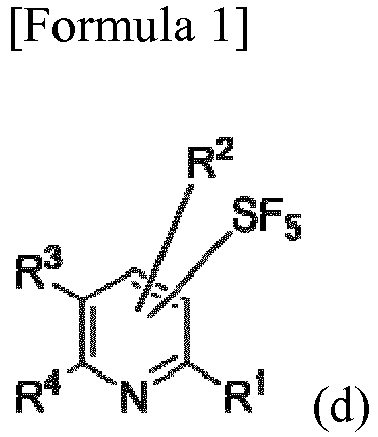
- the pentafluorosulfanyl pyridine of the present invention is represented by formula (d). wherein the SF 5 group binds to the pyridine ring at position-3 or position- 4. R 2 binds to one of position-3 and position-4 that the SF 5 group does not bind to.
- R 1 , R 2 , R 3 , and R 4 are substituents on the pyridine ring, which are independently a hydrogen atom, a halogen atom, a substituted or non-substituted alkyl group having 1 to 18 carbon atoms, a substituted or non-substituted aryl group having 6 to 30 carbon atoms, a nitro group, a cyano group, a substituted or non-substituted alkanesulfonyl group having 1 to 18 carbon atoms, a substituted or non-substituted arenesulfonyl group having 6 to 30 carbon atoms, a substituted or non-substituted alkoxy group having 1 to 18 carbon atoms, a substituted or non-substituted aryloxy group having 6 to 30 carbon atoms, a substituted or non-substituted acyloxy group having 1 to 18 carbon atoms, a substituted or non-substit
- the halogen atoms are a fluorine atom, a chlorine atom, a bromine atom, or an iodine atom.
- a substituted or non-substituted aralkyloxy group having 7 to 30 carbon atoms include a benzyloxy group (Ph-CH 2 -O-) or a substituted benzyloxy group.
- a substituted or non-substituted aralkylsulfide group having 7 to 30 carbon atoms include a benzylsulfide group (Ph-CH 2 -S-) or a substituted benzylsulfide group.
- a substituted amino group having 1 to 18 carbon atoms include a benzylamino group or a substituted benzylamino group.
- R 1 and R 2 should preferably be a hydrogen atom or a fluorine atom, which exhibit low steric hindrance.
- At least one of R 1 and R 4 should preferably be a halogen atom.
- R 1 and R 4 should preferably be a substituted amino group having 1 to 18 carbon atoms, an amino group, an azide group, a substituted or non-substituted aralkyloxy group having 7 to 30 carbon atoms, or a substituted or non-substituted aralkylsulfide group having 7 to 30 carbon atoms.
- the chlorotetrafluorosulfanyl pyridine of the present invention is represented by formula (c'). wherein SF 4 Cl group is a group that provides the SF 5 group to Compound (d). R 1 , R 2 , R 3 , and R 4 are defined in the same manner as Compound (d).
- pentafluorosulfanyl pyridine it is preferable for pentafluorosulfanyl pyridine to be manufactured by the following scheme.
- the pyridyldisulfide compound represented by formula (a) is reacted with halogens selected from a group consisting of chlorine, bromine, iodine and interhalogen compounds, and a fluoride salt represented by formula (b) to manufacture halotetrafluorosulfanyl pyridine compound represented by formula (c).
- the pyridyldisulfide compound (Compound (a)) is first reacted with a fluoride salt under the presence of halogens to obtain halotetrafluorosulfanyl pyridine (Compound (c)).
- the amount of halogens used may be any amount as long as it is excessive against the pyridyldisulfide compound, but an amount of 12 to 16 equivalents is preferred.
- the amount of fluoride salt to be used may be any amount as long as it is excessive against pyridyldisulfide, but an amount of 14 to 18 equivalents is preferred.
- the solvent there is no limitation to the solvent, but an aprotic, polar solvent, such as acetonitrile, is preferred in view of the solubility of the fluoride salt and to prevent the fluoride salt's reaction with halogens.
- the reaction temperature may be adjusted as necessary, but a temperature of -20 to 50°C is preferred.
- the reaction time is not limited, but it may be from a few hours to a few days, preferably 2 to 3 days.
- the reaction container is preferably that made from fluoropolymer, such as polytetrafluoroethylene, in order to suppress secondary reactions.
- the reaction should preferably be performed under a deoxidized atmosphere and a dry condition in view of the instability of the reaction intermediates.
- the R 1 , R 2 , R 3 , and R 4 in Compound (d) may differ from R 1 , R 2 , R 3 , and R 4 of the starting material, Compound (a). Accordingly, some embodiments of the present invention includes transforming R 1 , R 2 , R 3 , and R 4 to a different R 1 , R 2 , R 3 , and R 4 . This transformation may be performed in a reaction that converts Compound (a) to Compound (c) or in a reaction that transforms Compound (c) to Compound (d).
- Typical halogens to be used in the present invention include chlorine (Cl 2 ), bromine (Br 2 ), iodine (I 2 ), and interhalogen compounds such as ClF, BrF, ClBr, ClI, Cl 3 I, BrI. Chlorine (Cl 2 ) is preferable from the cost perspective.
- the fluoride salt represented by formula (b) is easily acquired, and examples of such fluoride salt include metal fluorides, ammonium fluorides and phosphonium fluorides.
- metal fluorides are alkali metal fluorides, such as lithium fluoride, sodium fluoride, potassium fluoride (including spray-dried potassium fluoride), rubidium fluoride, and caesium fluoride.
- preferable ammonium fluorides are tetramethyl ammonium fluoride, tetrabutyl ammonium fluoride, benzyltrimethyl ammonium fluoride, and benzyltriethyl ammonium fluoride.
- Examples of preferable phosphonium fluorides are tetramethyl phosphonium fluoride, tetraethyl phosphonium fluoride, tetrapropyl phosphonium fluoride, tetrabutyl phosphonium fluoride, tetraphenyl phosphonium fluoride, and tetratolylphosphonium fluoride.
- An alkali metal fluoride such as potassium fluoride and caesium fluoride are preferred from the perspective of ease of acquisition and of capacity to provide high yield, and potassium fluoride is preferred from the cost perspective.
- a mixture of metal fluoride and ammonium fluoride or phosphonium fluoride, a mixture of ammonium fluoride and phosphonium fluoride, and a mixture of metal fluoride, ammonium fluoride and phosphonium fluoride may be used as a fluoride salt represented by formula (b).
- Halotetrafluorosulfanyl pyridine represented by formula (c) is reacted with a fluoride source to obtain pentafluorosulfanyl represented by formula (d).
- halotetrafluorosulfanyl pyridine (Compound (c)) is reacted with a fluoride source to obtain pentafluorosulfanyl pyridine (Compound (d)) by a halogen exchange reaction.
- the amount of fluoride source used may be any amount as long as it is excessive against pyridyldisulfide, but an amount of 12 to 16 equivalents is preferred.
- the amount of fluoride source to be used may be any amount as long as it is excessive against halotetrafluorosulfanyl pyridine, but an amount of 1 to 3 equivalents is preferred.
- a solvent-less reaction is preferred from the perspective of high reaction efficiency and low cost, but a halogen-containing carbon compound, ether, nitrile (acetonitrile, etc.), or nitro compound may also be used as a solvent to adjust reactivity.
- the reaction temperature may be adjusted as necessary, but a temperature of -100 to 150°C is preferred.
- the reaction time is not limited, but it may be from a few hours to a few days, preferably 2 to 3 days.
- the reaction container is preferably that made from fluoropolymer, such as polytetrafluoroethylene, in order to suppress secondary reactions.
- the reaction should preferably be performed under a deoxidized atmosphere and a dry condition from the perspective of instability of reaction intermediates.
- the fluoride source to be used is an anhydride compound exhibiting an activity of fluorinating halotetrafluorosulfanyl pyridine represented by formula (c).
- the fluoride source may be selected from a fluoride of a typical element in the periodic table, a fluoride or a transition element in the periodic table, and a mixture or a compound of fluorides of the typical element or the transition element.
- the fluoride source may be hydrogen fluoride or a mixture, salt or complex with a single or multiple types of organic molecules that does not limit the present invention.
- the fluoride source also includes a mixture or a compound of the fluoride source and a fluoride source-activating compound, such as SbCl 5 , AlCl 3 , PCl 5 , BCl 3 .
- Fluorides of the Group 11 elements (Cu, Ag, Au) and Group 12 elements (Zn, Cd, Hg), which are transition metal fluorides, are preferred from the perspective of high reactivity of halogen exchange.
- the present process is categorized into reactions performed in stages as shown below. 1) Oxidation of the sulfur atom binding to position-3 or position-4 of the pyridine ring by halogen and fluoride salt, and generation of halotetrafluorosulfanyl compound by halogen exchange. 2) Generation of pentafluorosulfanyl pyridine compound by halogen exchange.
- a compound including a SF 3 group represented by formula (a') is provided as an intermediate.
- the compound is a tetravalent sulfur compound, and its presence may be verified by 19 F-NMR.
- a pyridine compound possessing a SF 3 group or a SF 4 Cl group is easily decomposed by a nucleophilic attack by water or an anion type in the system.
- R 1 or R 4 that is a halogen atom improves the chemical stability of pyridyldisulfide such that this reaction may be carried out more efficiently.
- Potassium fluoride (spray-dried product, 2.32 g, 40 mmol, Wako pure chemical corp.) and acetonitrile (15 mL) were put in a 30 mL polytetrafluoroethylene container under a nitrogen atmosphere.
- the agitated mixture was cooled in an ice-containing water bath, and a polytetrafluoroethylene tube (inner diameter 1 mm) was used to perform bubbling of chlorine (Cl 2 ; about 2.5 g to 2.8 g, about 35 to 40 mmol) in the mixture for 10 min. at an outlet pressure of 0.005 MPa.
- pyridyldisulfide (a1) (641 mg, 2.5 mmol) synthesized by the inventors was added under a nitrogen gas flow, and the container was sealed to perform agitation at room temperature for 36 h. After the reaction completed, the insoluble matter was removed under a nitrogen atmosphere using a glass filter. The filtrate was evaporated in a polytetrafluoroethylene container under vacuum, and the obtained residue (2-fluoro-3-chlorotetrafluorosulfanyl pyridine (c1)) was used for the subsequent reaction without being purified.
- Mass spectrometry was performed in the present invention using a device by Shimadzu corporation with a serial name of LCMS-2020, and 1 H-NMR and 19 F-NMR were performed using Mercury 300 by Varian.
- a pentafluorosulfanyl pyridine compound was synthesized by the following reaction.
- Potassium fluoride (spray-dried product, 6.03 g, 104 mmol, Wako pure chemical corp.) and acetonitrile (39 mL) were put under a nitrogen atmosphere in a 60 mL polytetrafluoroethylene container.
- the agitated mixture was cooled in an ice-containing water bath, and a polytetrafluoroethylene tube (inner diameter 1 mm) was used to bubble chlorine (Cl 2 ; about 6.5 g to 7.4 g, about 91 to 104 mmol) in the mixture for 10 min. at an outlet pressure of 0.005 MPa.
- pyridyldisulfide (a4) (1.90 g, 6.5 mmol) synthesized by the inventors was added under a nitrogen gas flow, and the container was sealed to perform agitation at room temperature for 48 h. After the reaction completed, the insoluble matter was removed under a nitrogen atmosphere using a glass filter. The filtrate was evaporated in a polytetrafluoroethylene container under vacuum, and the obtained residue (2,6-difluoro-4-chlorotetrafluorosulfanyl pyridine (c4), 3.01 g, 90% yield) was used for the subsequent reaction without being purified.
- Pentafluorosulfanyl pyridine (d1) synthesized as described above was subjected to a nucleophilic substitution reaction.
- Table 3 shows the nucleophilic reagent, the reaction condition and the product.
- Pentafluorosulfanyl pyridine (d3) synthesized as described above was subjected to a nucleophilic substitution reaction.
- Table 4 shows the nucleophilic reagent, the reaction condition, and the product, etc.
- Pentafluorosulfanyl pyridine (d2) synthesized as described above was subjected to a nucleophilic substitution reaction.
- Table 5 shows the nucleophilic reagent, the reaction condition, and the product, etc.
- Pentafluorosulfanyl pyridine (d4) synthesized as described above was subjected to a nucleophilic substitution reaction.
- Table 6 shows the nucleophilic reagent, the reaction condition, and the product, etc.
- a pyridine compound having a pentafluorosulfanyl group at position-3 and position-4 are obtained by the present invention.
- a pyridine compound having a halogen atom together with pentafluorosulfanyl group may be synthesized in the present invention, and modification such as a coupling reaction, performed using the halogen atom, allows the invention to be of assistance in the synthesis of physiological substances such as medicine.
Landscapes
- Chemical & Material Sciences (AREA)
- Organic Chemistry (AREA)
- Pyridine Compounds (AREA)
Abstract
R1, R2, R3, and R4 are independently a hydrogen atom, a halogen atom, a substituted or non-substituted alkyl group having 1 to 18 carbon atoms, a substituted or non-substituted aryl group having 6 to 30 carbon atoms, a nitro group, a cyano group, a substituted or non-substituted alkanesulfonyl group having 1 to 18 carbon atoms, a substituted or non-substituted arenesulfonyl group having 6 to 30 carbon atoms, a substituted or non-substituted alkoxy group having 1 to 18 carbon atoms, a substituted or non-substituted aryloxy group having 6 to 30 carbon atoms, an acyloxy group having 1 to 18 carbon atoms, a substituted or non-substituted alkanesulfonyloxy group having 1 to 18 carbon atoms, a substituted or non-substituted arenesulfonyloxy group having 6 to 30 carbon atoms, a substituted or non-substituted alkoxycarbonyl group having 2 to 18 carbon atoms, a substituted or non-substituted aryloxycarbonyl group having 7 to 30 carbon atoms, a substituted carbamoyl group having 2 to 18 carbon atoms, a substituted amino group having 1 to 18 carbon atoms, an amino group, an azide group, a substituted or non-substituted aralkyloxy group having 7 to 30 carbon atoms, a substituted or non-substituted aralkylsulfide group having 7 to 30 carbon atoms, or a SF5 group.
Description
- The present invention relates to pentafluorosulfanyl pyridine and a manufacturing process of the same.
- The pentafluorosulfanyl group (hereinafter referred to as the SF5 group) is an electron-withdrawing and lipophilic substituent used for designing a functional organic molecule. Accordingly, a SF5 group-containing compound is crucial in the development of a liquid crystal molecule or a low molecular weight medicine/agricultural chemical molecule, and the synthetic method of such compound is recently under development (NPL1). It is particularly important to introduce a SF5 group to the pyridine ring, which is widely used as biologically active substances in pharmaceutical and agrochemicals, but the introduction of SF5 group is difficult, due to the instability of the intermediates, namely trifluorosulfanyl pyridine and halotetrafluorosulfanyl pyridine. Proposed as a method for introducing SF5 group to pyridine ring is the one using a disulfide compound as a starting material, and the disulfide is oxidized in the presence of potassium fluoride by chlorine gas and then the subjecting obtained material, through a halogen exchange reaction using silver fluoride, is converted to the compound having a SF5 group at position-2 of the pyridine ring (NPL2). However, a pragmatic method for introducing a SF5 group to position-3 or position-4 of the pyridine ring has yet to be developed. Although there is report that a SF5 group may be introduced to position-3 of the pyridine ring by fluorination of pyridyldisulfide using AgF2 (PTL1), only a single sentence is attributed to the fact, and no data of the compound such as NMR or Examples of the compound are shown. There are also other reports of bioactive compound groups that have a SF5 group introduced onto position-3 of the pyridine ring (PTL2 to PTL5), but similarly to the above, only a single sentence is attributed to the fact, and no data of the compound or Examples of the compound are shown.
- There is no report of a compound having a SF5 group on position-4 of a pyridine ring, and of a compound having a chlorotetrafluorosulfanyl group (hereinafter referred to as the SF4Cl group) on position-3 or position-4 of the pyridine ring.
-
- [PTL1]
WO 1994/022817 - [PTL2]
US Patent No. 5739326 - [PTL3]
US Patent No. 6531501 - [PTL4]
WO 2011/105506 - [PTL5]
WO 2014/119674 -
- [NPL1]Chem. Rev. 2015, 115, 1130.
- [NPL2]Angew. Chem. Int. Ed. 2015, 54, 280.
- The synthesis of SF5-containing pyridine is extremely difficult because the intermediates are unstable, and the only case reported to have been successfully synthesized so far is a compound having a SF5 group on position-2 of the pyridine ring. On the other hand, if a compound having a SF5 group or its precursor, a SF4Cl group, bound to a position other than position-2 of the pyridine ring is successfully synthesized, such compound would greatly benefit the design of the next generation medicine/agricultural chemical molecule. In view of this circumstance, the present invention is directed to the issue of providing a pyridine having a SF5 group or a SF4Cl group on position-3 or position-4 of the pyridine ring and a manufacturing process of the same.
- The present inventors found that the above issue can be solved by using pyridyldisulfide that possesses specific substituents as a starting material, and completed the present invention. In other words, the aforementioned issue may be solved by the present invention described below.
- (1) Pentafluorosulfanyl pyridine represented by formula (d) shown below, wherein a SF5 group is substituted on either position-3 or position-4 of a pyridine ring.
- (2) Pentafluorosulfanyl pyridine according to (1), wherein at least one of the R1 and R4 is a fluorine atom.
- (3) Pentafluorosulfanyl pyridine according to (1) that is 2-fluoro-3-pentafluorosulfanyl pyridine, 2,6-difluoro-3-pentafluorosulfanyl pyridine, or 6-fluoro-3-pentafluorosulfanyl pyridine.
- (4) Chlorotetrafluorosulfanyl pyridine represented by formula (c') shown below, wherein a SF4Cl group is substituted on either position-3 or position-4 of a pyridine ring.
- (5) Chlorotetrafluorosulfanyl pyridine according to (4), wherein at least one of the R1 and R4 is a fluorine atom.
- (6) Chlorotetrafluorosulfanyl pyridine according to (4) that is 2-fluoro-3-chlorotetrafluorosulfanyl pyridine, 2,6-difluoro-3-chlorotetrafluorosulfanyl pyridine, or 6-fluoro-3 -chlorotetrafluorosulfanyl pyridine.
- (7) A manufacturing process of pentafluorosulfanyl pyridine according to (1) comprising: a step of reacting pyridyldisulfide represented by formula (a) shown below with halogens selected from a group consisting of chlorine, bromine, iodine and a halogen compound, and a fluoride salt represented by formula (b) shown below to form halotetrafluorosulfanyl pyridine represented by formula (c) shown below; and a step of reacting the obtained halotetrafluorosulfanyl pyridine with a fluoride source to form pentafluorosulfanyl pyridine.
- (8) The process according to (7), wherein a halogen to be reacted with the pyridyldisulfide compound is chlorine (Cl2).
- (9) The process according to (7), wherein the fluoride salt represented by formula (b) is alkali metal fluoride.
- (10) The process according to any one of (7) to (9), wherein the fluoride source is hydrogen fluoride.
- The present invention may provide manufacturing of a pentafluorosulfanyl pyridine in which position-3 or position-4 of the pyridine ring is substituted with a SF5 group and a manufacturing process of this compound.
- The present invention is described in detail below. In this invention, the expression "X to Y" includes the values on both ends, that is, X and Y.
- The pentafluorosulfanyl pyridine of the present invention is represented by formula (d).

- R1, R2, R3, and R4 are substituents on the pyridine ring, which are independently a hydrogen atom, a halogen atom, a substituted or non-substituted alkyl group having 1 to 18 carbon atoms, a substituted or non-substituted aryl group having 6 to 30 carbon atoms, a nitro group, a cyano group, a substituted or non-substituted alkanesulfonyl group having 1 to 18 carbon atoms, a substituted or non-substituted arenesulfonyl group having 6 to 30 carbon atoms, a substituted or non-substituted alkoxy group having 1 to 18 carbon atoms, a substituted or non-substituted aryloxy group having 6 to 30 carbon atoms, a substituted or non-substituted acyloxy group having 1 to 18 carbon atoms, a substituted or non-substituted alkanesulfonyloxy group having 1 to 18 carbon atoms, a substituted or non-substituted arenesulfonyloxy group having 6 to 30 carbon atoms, a substituted or non-substituted alkoxycarbonyl group having 2 to 18 carbon atoms, a substituted or non-substituted aryloxycarbonyl group having 7 to 30 carbon atoms, a substituted carbamoyl group having 2 to 18 carbon atoms, a substituted amino group having 1 to 18 carbon atoms, an amino group, an azide group, a substituted or non-substituted aralkyloxy group having 7 to 30 carbon atoms, a substituted or non-substituted aralkylsulfide group having 7 to 30 carbon atoms, or a SF5 group. The halogen atoms are a fluorine atom, a chlorine atom, a bromine atom, or an iodine atom. A substituted or non-substituted aralkyloxy group having 7 to 30 carbon atoms include a benzyloxy group (Ph-CH2-O-) or a substituted benzyloxy group. A substituted or non-substituted aralkylsulfide group having 7 to 30 carbon atoms include a benzylsulfide group (Ph-CH2-S-) or a substituted benzylsulfide group. A substituted amino group having 1 to 18 carbon atoms include a benzylamino group or a substituted benzylamino group.
- Due to the availability of the halotetrafluorosulfanyl compound, which is a precursor of Compound (d), R1 and R2 should preferably be a hydrogen atom or a fluorine atom, which exhibit low steric hindrance.
- In view of the stability of the halotetrafluorosulfanyl compound, which is a precursor of Compound (d), at least one of R1 and R4 should preferably be a halogen atom.
- In addition, at least one of R1 and R4 should preferably be a substituted amino group having 1 to 18 carbon atoms, an amino group, an azide group, a substituted or non-substituted aralkyloxy group having 7 to 30 carbon atoms, or a substituted or non-substituted aralkylsulfide group having 7 to 30 carbon atoms.
- The chlorotetrafluorosulfanyl pyridine of the present invention is represented by formula (c').


- It is preferable for pentafluorosulfanyl pyridine to be manufactured by the following scheme.

- The pyridyldisulfide compound represented by formula (a) is reacted with halogens selected from a group consisting of chlorine, bromine, iodine and interhalogen compounds, and a fluoride salt represented by formula (b) to manufacture halotetrafluorosulfanyl pyridine compound represented by formula (c).
- Specifically speaking, the pyridyldisulfide compound (Compound (a)) is first reacted with a fluoride salt under the presence of halogens to obtain halotetrafluorosulfanyl pyridine (Compound (c)). The amount of halogens used may be any amount as long as it is excessive against the pyridyldisulfide compound, but an amount of 12 to 16 equivalents is preferred. The amount of fluoride salt to be used may be any amount as long as it is excessive against pyridyldisulfide, but an amount of 14 to 18 equivalents is preferred. There is no limitation to the solvent, but an aprotic, polar solvent, such as acetonitrile, is preferred in view of the solubility of the fluoride salt and to prevent the fluoride salt's reaction with halogens. The reaction temperature may be adjusted as necessary, but a temperature of -20 to 50°C is preferred. The reaction time is not limited, but it may be from a few hours to a few days, preferably 2 to 3 days. The reaction container is preferably that made from fluoropolymer, such as polytetrafluoroethylene, in order to suppress secondary reactions. In addition, the reaction should preferably be performed under a deoxidized atmosphere and a dry condition in view of the instability of the reaction intermediates.
- The R1, R2, R3, and R4 in Compound (d) may differ from R1, R2, R3, and R4 of the starting material, Compound (a). Accordingly, some embodiments of the present invention includes transforming R1, R2, R3, and R4 to a different R1, R2, R3, and R4. This transformation may be performed in a reaction that converts Compound (a) to Compound (c) or in a reaction that transforms Compound (c) to Compound (d).
- Typical halogens to be used in the present invention include chlorine (Cl2), bromine (Br2), iodine (I2), and interhalogen compounds such as ClF, BrF, ClBr, ClI, Cl3I, BrI. Chlorine (Cl2) is preferable from the cost perspective.
- The fluoride salt represented by formula (b) is easily acquired, and examples of such fluoride salt include metal fluorides, ammonium fluorides and phosphonium fluorides. Examples of preferable metal fluorides are alkali metal fluorides, such as lithium fluoride, sodium fluoride, potassium fluoride (including spray-dried potassium fluoride), rubidium fluoride, and caesium fluoride. Examples of preferable ammonium fluorides are tetramethyl ammonium fluoride, tetrabutyl ammonium fluoride, benzyltrimethyl ammonium fluoride, and benzyltriethyl ammonium fluoride. Examples of preferable phosphonium fluorides are tetramethyl phosphonium fluoride, tetraethyl phosphonium fluoride, tetrapropyl phosphonium fluoride, tetrabutyl phosphonium fluoride, tetraphenyl phosphonium fluoride, and tetratolylphosphonium fluoride. An alkali metal fluoride such as potassium fluoride and caesium fluoride are preferred from the perspective of ease of acquisition and of capacity to provide high yield, and potassium fluoride is preferred from the cost perspective.
- A mixture of metal fluoride and ammonium fluoride or phosphonium fluoride, a mixture of ammonium fluoride and phosphonium fluoride, and a mixture of metal fluoride, ammonium fluoride and phosphonium fluoride may be used as a fluoride salt represented by formula (b).
- Halotetrafluorosulfanyl pyridine represented by formula (c) is reacted with a fluoride source to obtain pentafluorosulfanyl represented by formula (d).
- Specifically speaking, halotetrafluorosulfanyl pyridine (Compound (c)) is reacted with a fluoride source to obtain pentafluorosulfanyl pyridine (Compound (d)) by a halogen exchange reaction. The amount of fluoride source used may be any amount as long as it is excessive against pyridyldisulfide, but an amount of 12 to 16 equivalents is preferred. The amount of fluoride source to be used may be any amount as long as it is excessive against halotetrafluorosulfanyl pyridine, but an amount of 1 to 3 equivalents is preferred. A solvent-less reaction is preferred from the perspective of high reaction efficiency and low cost, but a halogen-containing carbon compound, ether, nitrile (acetonitrile, etc.), or nitro compound may also be used as a solvent to adjust reactivity. The reaction temperature may be adjusted as necessary, but a temperature of -100 to 150°C is preferred. The reaction time is not limited, but it may be from a few hours to a few days, preferably 2 to 3 days. The reaction container is preferably that made from fluoropolymer, such as polytetrafluoroethylene, in order to suppress secondary reactions. In addition, the reaction should preferably be performed under a deoxidized atmosphere and a dry condition from the perspective of instability of reaction intermediates.
- The fluoride source to be used is an anhydride compound exhibiting an activity of fluorinating halotetrafluorosulfanyl pyridine represented by formula (c). The fluoride source may be selected from a fluoride of a typical element in the periodic table, a fluoride or a transition element in the periodic table, and a mixture or a compound of fluorides of the typical element or the transition element. The fluoride source may be hydrogen fluoride or a mixture, salt or complex with a single or multiple types of organic molecules that does not limit the present invention. The fluoride source also includes a mixture or a compound of the fluoride source and a fluoride source-activating compound, such as SbCl5, AlCl3, PCl5, BCl3. Fluorides of the Group 11 elements (Cu, Ag, Au) and Group 12 elements (Zn, Cd, Hg), which are transition metal fluorides, are preferred from the perspective of high reactivity of halogen exchange.
- The present process is categorized into reactions performed in stages as shown below. 1) Oxidation of the sulfur atom binding to position-3 or position-4 of the pyridine ring by halogen and fluoride salt, and generation of halotetrafluorosulfanyl compound by halogen exchange. 2) Generation of pentafluorosulfanyl pyridine compound by halogen exchange.

- In Stage 1) above, a compound including a SF3 group represented by formula (a') is provided as an intermediate. The compound is a tetravalent sulfur compound, and its presence may be verified by 19F-NMR. A pyridine compound possessing a SF3 group or a SF4Cl group is easily decomposed by a nucleophilic attack by water or an anion type in the system. As such, R1 or R4 that is a halogen atom improves the chemical stability of pyridyldisulfide such that this reaction may be carried out more efficiently.
- By reacting pentafluorosulfanyl pyridine (d), whose R1 or R4 is a halogen atom, with a nucleophilic reagent, it is possible to substitute R1 or R4 with another functional group. The scheme of the present invention and an example of the thus synthesized pentafluorosulfanyl pyridine (d) is shown below.

- The following reaction was performed to synthesize a pentafluorosulfanyl pyridine compound.


- Potassium fluoride (spray-dried product, 2.32 g, 40 mmol, Wako pure chemical corp.) and acetonitrile (15 mL) were put in a 30 mL polytetrafluoroethylene container under a nitrogen atmosphere. The agitated mixture was cooled in an ice-containing water bath, and a polytetrafluoroethylene tube (inner diameter 1 mm) was used to perform bubbling of chlorine (Cl2; about 2.5 g to 2.8 g, about 35 to 40 mmol) in the mixture for 10 min. at an outlet pressure of 0.005 MPa. Then, pyridyldisulfide (a1) (641 mg, 2.5 mmol) synthesized by the inventors was added under a nitrogen gas flow, and the container was sealed to perform agitation at room temperature for 36 h. After the reaction completed, the insoluble matter was removed under a nitrogen atmosphere using a glass filter. The filtrate was evaporated in a polytetrafluoroethylene container under vacuum, and the obtained residue (2-fluoro-3-chlorotetrafluorosulfanyl pyridine (c1)) was used for the subsequent reaction without being purified.
- To the 2-fluoro-3-chlorotetrafluorosulfanyl pyridine (c1) in the 30 mL polytetrafluoroethylene container, obtained in the previous step, was added silver fluoride (I) (634 mg, 5.0 mmol), and the mixture was agitated under a nitrogen atmosphere at 100°C for 24 h. After cooling to room temperature, water (5 mL) and dichloromethane (5 mL) were added to the mixture, and the mixture was agitated for 1 h., then, the product was extracted using dichloromethane and the organic phase was dried by sodium sulfate. Then, the solvent was removed by distillation under reduced pressure, and purified by silica gel column chromatography (pentane/dichloromethane = 5/1→2/1, Rf value 0.56) and a transparent, oil-like product (d1) (151 mg, 27%) was obtained.
- Similar syntheses were performed using the following compounds. The analysis result using mass spectrometry and NMR is summarized below. Mass spectrometry was performed in the present invention using a device by Shimadzu corporation with a serial name of LCMS-2020, and 1H-NMR and 19F-NMR were performed using Mercury 300 by Varian.
-
Table 1 EXAMPLE 1 Pyridyldisulfide Chlorotetrafluorosulfanyl Pyridine Pentafluorosulfanyl Pyridine 


c1 d1 a1 24% yield 


c2 d2 a2 27% yield 


c3 d3 a3 20% yield -
- 3-(Chlorotetrafluorosulfanyl)-2-fluoropyridine (c1)
1H NMR (CDCl3, 300 MHz): δ = 7.36 (dd, J= 6.5, 5.5 Hz, 1H), 8.20 (td, J = 8.3, 1.7 Hz, 1H), 8.40 (d, J = 4.5 Hz, 1H);
19F NMR (CDCl3, 300 MHz): δ = -59.56 - -60.48 (m, 1F) 138.71 (d, J = 21.5 Hz, 4F) - 3-(Chlorotetrafluorosulfanyl)-2,6-difluoropyridine (c2)
19F NMR (CDCl3, 300 MHz): δ = -61.86 (s, IF), -60.32 - -61.06 (m, IF), 139.13 (d, J = 21.8 Hz, 4F) - 5-(Chlorotetrafluorosulfanyl)-2-fluoropyridine (c3)
19F NMR (CDCl3, 300 MHz): δ = -63.88 (s, IF), 136.28 (s, 4F) - 2-Fluoro-3-(pentafluorosulfanyl)pyridine (d1)
MS (EI, m/z) 223 (M+); 1H NMR (CDCl3, 300 MHz): δ = 7.42 - 7.30 (m, 1H), 8.26 - 8.13 (m, 1H), 8.40 (d, J = 3.2 Hz, 1H); 19F NMR (CDCl3, 300 MHz): δ = -60.21 - -61.04 (m, 1F), 66.93 (dd, J= 151.8, 24.0 Hz, 4F), 80.60 - 77.84 (m, IF); (2 steps) 24% yield - 2,6-Difluoro-3-(pentafluorosulfanyl)pyridine (d2)
MS (EI, m/z) 241 (M+); 1H NMR (CDCl3, 300 MHz): δ =2 6.99 (d, J= 8.6 Hz, 1H), 8.51 - 8.06 (m, 1H); 19F NMR (CDCl3, 300 MHz): δ = -63.13 (s, IF), -61.48 - -62.07 (m, IF), 64.79 (ddd, J = 150.9, 24.1, 3.6, 4F), 77.26 - 74.64 (m, IF); (2 steps) 27% yield - 2-Fluoro-5-(pentafluorosulfanyl)pyridine (d3)
MS (EI, m/z) 223 (M+); 1H NMR (CDCl3, 300 MHz): δ = 7.07 (d, J= 8.9 Hz, 1H), 8.19 (ddt, J = 9.1, 6.5, 2.5 Hz, 1H), 8.70 - 8.62 (br, 1H); 19F NMR (CDCl3, 300 MHz): δ = -61.77 (s, IF), 65.75 (d, J= 151.4 Hz, 4F), 82.97 - 80.04 (m, IF); (2 steps) 20% yield - A pentafluorosulfanyl pyridine compound was synthesized by the following reaction.


- Potassium fluoride (spray-dried product, 6.03 g, 104 mmol, Wako pure chemical corp.) and acetonitrile (39 mL) were put under a nitrogen atmosphere in a 60 mL polytetrafluoroethylene container. The agitated mixture was cooled in an ice-containing water bath, and a polytetrafluoroethylene tube (inner diameter 1 mm) was used to bubble chlorine (Cl2; about 6.5 g to 7.4 g, about 91 to 104 mmol) in the mixture for 10 min. at an outlet pressure of 0.005 MPa. Then, pyridyldisulfide (a4) (1.90 g, 6.5 mmol) synthesized by the inventors was added under a nitrogen gas flow, and the container was sealed to perform agitation at room temperature for 48 h. After the reaction completed, the insoluble matter was removed under a nitrogen atmosphere using a glass filter. The filtrate was evaporated in a polytetrafluoroethylene container under vacuum, and the obtained residue (2,6-difluoro-4-chlorotetrafluorosulfanyl pyridine (c4), 3.01 g, 90% yield) was used for the subsequent reaction without being purified.
- To the previously obtained 2,6-difluoro-4-chlorotetrafluorosulfanyl pyridine (c4) (2.58 g, 10 mmol) in the 30 mL polytetrafluoroethylene container was added silver fluoride (I) (2.54 g, 20 mmol), and the mixture was agitated under a nitrogen atmosphere at 120°C for 48 h. After cooling to room temperature, water (10 mL) and dichloromethane (10 mL) were added to the mixture, and the mixture was agitated for 1 h., then, the product was extracted using dichloromethane and the organic phase was dried by sodium sulfate. Then, the solvent was removed by distillation under reduced pressure, and purified by silica gel column chromatography (pentane/dichloromethane=20/1, Rf value 0.34) and a transparent, oil-like product (d4) (844 mg, 35% yield) was obtained.
- A similar synthesis was further performed and product (d5) was obtained. The analysis result using mass spectrometry and NMR is summarized below.
-
Table 2 Example 2 Pyridyldisulfide Chlorotetrafluorosulfanyl Pyridine Pentafluorosulfanyl Pyridine 


c4 d4 a4 90% yield 35% yield 


c5 d5 a5 68% yield 5% yield -
- 4-(Chlorotetrafluorosulfanyl)-2,6-difluoropyridine (c4)
1H NMR (300 MHz, CDCl3) δ: 7.20 (s, 2H). 19F NMR (282 MHz, CDCl3) δ: 132.28 (s, 4F), - 63.35 (s, 2F); 90% yield - 4-(Chlorotetrafluorosulfanyl)-2-fluoropyridine (c5)
1H NMR (300 MHz, CDCl3) δ: 8.42 (d, J = 4.7 Hz, 1H), 7.53 (d, J = 4.7 Hz, 1H), 7.29 (s, 1H). 19F NMR (282 MHz, CDCl3) δ: 132.48 (s, 4F), -63.54 (s, IF); 68% yield - 2,6-Difluoro-4-(pentafluorosulfanyl)pyridine (d4)
HRMS (TOF/EI+): Calculated for C5H2F7NS+: 240.9796, found: 240.9799; 1H NMR (300 MHz, CDCl3) δ: 7.22 (s, 2H). 19F NMR (282 MHz, CDCl3) δ: 78.69 - 75.66 (m, IF), 60.91 (d, J = 152.4 Hz, 4F), -63.14 (s, 2F). 13C NMR (125 MHz, CDCl3) δ: 167.1 - 166.4 (m), 161.7 (dd, J = 250.8, 15.3 Hz), 105.0 - 104.4 (m); 35% yield - 2-Fluoro-4-(pentafluorosulfanyl)pyridine (d5)
HRMS (TOF/EI+): Calculated for C5H3F6NS+: 222.9890, found: 222.9888;
1H NMR (300 MHz, CDCl3) δ: 8.44 (d, J = 5.4 Hz, 1H), 7.56 (d, J = 5.4 Hz, 1H), 7.37 - 7.24 (m, 1H). 19F NMR (282 MHz, CDCl3) δ: 79.85 - 76.24 (m, IF), 60.52 (d, J= 151.7 Hz, 4F), - 63.43 (s, IF). 13C NMR (125 MHz, CDCl3) δ: 163.8 (pd, J = 20.8, 7.5 Hz), 163.8 (d, J = 242.6 Hz), 149.2 (d, J = 15.0 Hz), 118.2 - 118.0 (m), 107.8 (dp, J = 42.4, 4.9 Hz); 5% yield - Pentafluorosulfanyl pyridine (d1) synthesized as described above was subjected to a nucleophilic substitution reaction. Table 3 shows the nucleophilic reagent, the reaction condition and the product.
-
Table 3 Example 3: Nucleophilic substitution reaction of Compound (d1) Nucleophilic Reagent Reaction Condition Product (number shows yield) benzylamine 95°C, 10 h. 
86% NH3 105°C, 18 h. 
72% Me3SiCN 55°C, 10 h. 
87% benzylalcohol 95°C, 10 h. 
84% benzylthiol 95°C, 10 h. 
83% NaN3 95°C, 10 h. 
96% - Pentafluorosulfanyl pyridine (d3) synthesized as described above was subjected to a nucleophilic substitution reaction. Table 4 shows the nucleophilic reagent, the reaction condition, and the product, etc.
-
Table 4 Example 4: Nucleophilic substitution reaction of Compound (d3) Nucleophilic Reagent Reaction Condition Product (number shows yield) benzylamine 95°C, 10 h. 
92% Me3SiCN 55°C, 10 h. 
83% benzylalcohol 95°C, 10 h. 
93% NH3 105°C, 18 h. 
89% benzylthiol 95°C, 10 h. 
84% - Pentafluorosulfanyl pyridine (d2) synthesized as described above was subjected to a nucleophilic substitution reaction. Table 5 shows the nucleophilic reagent, the reaction condition, and the product, etc.
-
Table 5 Example 5: Nucleophilic substitution reaction of Compound (d2) Nucleophilic Reagent Reaction Condition Product (number shows yield) benzylamine 25°C, 10 h. 
89% benzylalcohol 25°C, 10 h. 
72% - Pentafluorosulfanyl pyridine (d4) synthesized as described above was subjected to a nucleophilic substitution reaction. Table 6 shows the nucleophilic reagent, the reaction condition, and the product, etc.
-
Table 6 Example 6: Nucleophilic substitution reaction of Compound (d4) Nucleophilic Reagent Reaction Condition Product (number shows yield) NH3 90°C, 3 h. 
69% NH3 120°C, 24 h. 
77% benzylthiol 95°C, 10 h. 
70% - It is apparent that a pyridine compound having a pentafluorosulfanyl group at position-3 and position-4 are obtained by the present invention. A pyridine compound having a halogen atom together with pentafluorosulfanyl group may be synthesized in the present invention, and modification such as a coupling reaction, performed using the halogen atom, allows the invention to be of assistance in the synthesis of physiological substances such as medicine.
Claims (10)
- Pentafluorosulfanyl pyridine represented by formula (d):
 wherein a SF5 group binds to either one of position-3 or position-4 of a pyridine ring, and R2 binds to the other one of position-3 or position-4; andR1, R2, R3, and R4 are independently a hydrogen atom, a halogen atom, a substituted or non-substituted alkyl group having 1 to 18 carbon atoms, a substituted or non-substituted aryl group having 6 to 30 carbon atoms, a nitro group, a cyano group, a substituted or non-substituted alkanesulfonyl group having 1 to 18 carbon atoms, a substituted or non-substituted arenesulfonyl group having 6 to 30 carbon atoms, a substituted or non-substituted alkoxy group having 1 to 18 carbon atoms, a substituted or non-substituted aryloxy group having 6 to 30 carbon atoms, an acyloxy group having 1 to 18 carbon atoms, a substituted or non-substituted alkanesulfonyloxy group having 1 to 18 carbon atoms, a substituted or non-substituted arenesulfonyloxy group having 6 to 30 carbon atoms, a substituted or non-substituted alkoxycarbonyl group having 2 to 18 carbon atoms, a substituted or non-substituted aryloxycarbonyl group having 7 to 30 carbon atoms, a substituted carbamoyl group having 2 to 18 carbon atoms, a substituted amino group having 1 to 18 carbon atoms, an amino group, an azide group, a substituted or non-substituted aralkyloxy group having 7 to 30 carbon atoms, a substituted or non-substituted aralkylsulfide group having 7 to 30 carbon atoms, or a SF5 group).
 - Pentafluorosulfanyl pyridine according to claim 1, wherein at least one of the R1 and R4 is a fluorine atom.
- Pentafluorosulfanyl pyridine according to claim 1 that is 2-fluoro-3-pentafluorosulfanyl pyridine, 2,6-difluoro-3-pentafluorosulfanyl pyridine, or 6-fluoro-3-pentafluorosulfanyl pyridine.
- Chlorotetrafluorosulfanyl pyridine represented by formula (c'):
 wherein a SF4Cl group binds to either one of position-3 or position-4 of a pyridine ring, and R2 binds to the other one of position-3 or position-4; andR1, R2, R3, and R4 are independently a hydrogen atom, a halogen atom, a substituted or non-substituted alkyl group having 1 to 18 carbon atoms, a substituted or non-substituted aryl group having 6 to 30 carbon atoms, a nitro group, a cyano group, a substituted or non-substituted alkanesulfonyl group having 1 to 18 carbon atoms, a substituted or non-substituted arenesulfonyl group having 6 to 30 carbon atoms, a substituted or non-substituted alkoxy group having 1 to 18 carbon atoms, a substituted or non-substituted aryloxy group having 6 to 30 carbon atoms, an acyloxy group having 1 to 18 carbon atoms, a substituted or non-substituted alkanesulfonyloxy group having 1 to 18 carbon atoms, a substituted or non-substituted allenesulfonyloxy group having 6 to 30 carbon atoms, a substituted or non-substituted alkoxycarbonyl group having 2 to 18 carbon atoms, a substituted or non-substituted aryloxycarbonyl group having 7 to 30 carbon atoms, a substituted carbamoyl group having 2 to 18 carbon atoms, a substituted amino group having 1 to 18 carbon atoms, an amino group, an azide group, a substituted or non-substituted aralkyloxy group having 7 to 30 carbon atoms, a substituted or non-substituted aralkylsulfide group having 7 to 30 carbon atoms, or a SF5 group).
 - Chlorotetrafluorosulfanyl pyridine according to claim 4, wherein at least one of the R1 and R4 is a fluorine atom.
- Chlorotetrafluorosulfanyl pyridine according to claim 4 that is 2-fluoro-3-chlorotetrafluorosulfanyl pyridine, 2,6-difluoro-3-chlorotetrafluorosulfanyl pyridine, or 6-fluoro-3 -chlorotetrafluorosulfanyl pyridine.
- A manufacturing process of pentafluorosulfanyl pyridine according to claim 1 comprising:
a step of reacting a pyridyldisulfide compound represented by formula (a):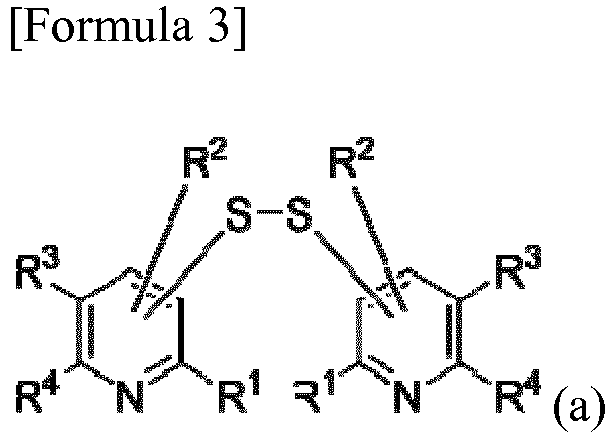 wherein R1, R2, R3, and R4 are as defined above,with halogens selected from a group consisting of chlorine, bromine, iodine and a halogen compound, anda fluoride salt represented by formula (b):
M+F- (b)
wherein M is a metal atom, an ammonium group or a phosphonium group to form halotetrafluorosulfanyl pyridine represented by formula (c): wherein R1, R2, R3, and R4 are as defined above, and X is a chlorine atom, a bromine atom or an iodine atom; anda step of reacting the halotetrafluorosulfanyl pyridine with a fluoride source to form pentafluorosulfanyl pyridine.
 - The process according to claim 7, wherein a halogen to be reacted with pyridyldisulfide is chlorine (Cl2).
- The process according to claim 7, wherein the fluoride salt represented by formula (b) is alkali metal fluoride.
- The process according to any one of claims 7 to 9, wherein the fluoride source is hydrogen fluoride.
Applications Claiming Priority (3)
| Application Number | Priority Date | Filing Date | Title |
|---|---|---|---|
| JP2015229882 | 2015-11-25 | ||
| JP2016137763 | 2016-07-12 | ||
| PCT/JP2016/085036 WO2017090746A1 (en) | 2015-11-25 | 2016-11-25 | Pentafluorosulfanylpyridine |
Publications (3)
| Publication Number | Publication Date |
|---|---|
| EP3381903A1 true EP3381903A1 (en) | 2018-10-03 |
| EP3381903A4 EP3381903A4 (en) | 2019-07-17 |
| EP3381903B1 EP3381903B1 (en) | 2020-12-30 |
Family
ID=58764362
Family Applications (1)
| Application Number | Title | Priority Date | Filing Date |
|---|---|---|---|
| EP16868689.7A Not-in-force EP3381903B1 (en) | 2015-11-25 | 2016-11-25 | Pentafluorosulfanylpyridine |
Country Status (5)
| Country | Link |
|---|---|
| US (1) | US10676439B2 (en) |
| EP (1) | EP3381903B1 (en) |
| JP (1) | JP6779468B2 (en) |
| CN (1) | CN108368048A (en) |
| WO (1) | WO2017090746A1 (en) |
Families Citing this family (2)
| Publication number | Priority date | Publication date | Assignee | Title |
|---|---|---|---|---|
| JP7049604B2 (en) * | 2017-02-28 | 2022-04-07 | 宇部興産株式会社 | Method for Producing Pentafluorosulfanyl Aromatic Compound |
| JP7205729B2 (en) * | 2017-08-29 | 2023-01-17 | Ube株式会社 | Method for producing pentafluorosulfanyl aromatic compound |
Family Cites Families (12)
| Publication number | Priority date | Publication date | Assignee | Title |
|---|---|---|---|---|
| GB9307245D0 (en) | 1993-04-07 | 1993-06-02 | Zeneca Ltd | Process |
| US5739326A (en) | 1995-12-13 | 1998-04-14 | E. I. Du Pont De Nemours And Company | Heterobicyclic herbicides |
| AR021608A1 (en) * | 1998-12-11 | 2002-07-31 | Merial Ltd | REPRESSION OF ARTROPODES IN ANIMALS |
| US6531501B1 (en) | 1998-12-11 | 2003-03-11 | Aventis Cropscience, S.A. | Control of arthropods in animals |
| CA2857831C (en) * | 2007-03-23 | 2017-01-03 | Ube Industries, Ltd. | Process for producing arylsulfur pentafluorides |
| CN101519373B (en) * | 2008-12-30 | 2011-10-05 | 凯莱英医药化学(天津)有限公司 | Method for synthesizing 2,6-difluoropyridine |
| AR081721A1 (en) | 2010-02-25 | 2012-10-17 | Nippon Soda Co | CYCLING AND ACARICIDE AMINA COMPOUND |
| TW201234965A (en) | 2010-12-24 | 2012-09-01 | Sumitomo Chemical Co | Fused heterocyclic compound and use for pest control thereof |
| US9108910B2 (en) | 2011-02-15 | 2015-08-18 | Ube Industries, Ltd. | Industrial methods for producing arylsulfur pentafluorides |
| TWI607005B (en) | 2013-01-31 | 2017-12-01 | 住友化學股份有限公司 | Composition and method for controlling pests |
| CN104788366A (en) * | 2014-01-21 | 2015-07-22 | 王若文 | Raf kinase inhibitor pentafluoride sulfur-based aryl urea, and preparation method and applications thereof |
| CN105985284A (en) | 2015-02-27 | 2016-10-05 | 王若文 | Pyridine compound containing sulfur pentafluoride group and preparation method of pyridine compound |
-
2016
- 2016-11-25 CN CN201680068940.1A patent/CN108368048A/en active Pending
- 2016-11-25 EP EP16868689.7A patent/EP3381903B1/en not_active Not-in-force
- 2016-11-25 US US15/778,920 patent/US10676439B2/en active Active
- 2016-11-25 JP JP2017552740A patent/JP6779468B2/en not_active Expired - Fee Related
- 2016-11-25 WO PCT/JP2016/085036 patent/WO2017090746A1/en not_active Ceased
Also Published As
| Publication number | Publication date |
|---|---|
| WO2017090746A1 (en) | 2017-06-01 |
| CN108368048A (en) | 2018-08-03 |
| US10676439B2 (en) | 2020-06-09 |
| EP3381903B1 (en) | 2020-12-30 |
| EP3381903A4 (en) | 2019-07-17 |
| US20180370917A1 (en) | 2018-12-27 |
| JPWO2017090746A1 (en) | 2018-09-06 |
| JP6779468B2 (en) | 2020-11-04 |
Similar Documents
| Publication | Publication Date | Title |
|---|---|---|
| EP2334661B1 (en) | Processes for preparing poly(pentafluorosulfanyl)aromatic compounds | |
| CA2857831C (en) | Process for producing arylsulfur pentafluorides | |
| EP0374061A1 (en) | Process for the preparation of perhalogen alkyl thio ethers | |
| EP3381903B1 (en) | Pentafluorosulfanylpyridine | |
| JP2003064033A (en) | Improved method for producing nuclear fluorinated aromatic compound | |
| WO2018123301A1 (en) | Method for manufacturing sulfur tetrafluoride | |
| KR20050105487A (en) | Method for producing 4-fluoro-1,3-dioxolan-2-one | |
| CN115974733A (en) | Preparation and application of novel alkene sulfamide fluoride compound with anti-tumor effect | |
| US20230130333A1 (en) | Method for manufacturing phosphonate esters and method for manufacturing phosphate esters | |
| JP6246224B2 (en) | Fluorinating agent | |
| CN116410218B (en) | Synthesis method of monofluoro alkenyl silicon | |
| CN117603107B (en) | Perfluoro hydrocarbon thio silver reagent and preparation and application method thereof | |
| KR20230046122A (en) | Methods for manufacturing a n-acyl derivative with high purity | |
| JPH061776A (en) | Production of substituted pyrazinecarbonitrile | |
| EP3883920B1 (en) | N-trifluormethylcarbonyl compounds and methods for their synthesis | |
| CN113754602B (en) | Synthesis method of 5, 5-dimethyl-4, 5-dihydro-isoxazole-3-one | |
| JPS6277370A (en) | Fluorine-containing pyrazole derivative | |
| CN121779337A (en) | Deuterated difluoromethyl compounds, their preparation methods and applications | |
| JP2008174552A (en) | Method for producing 4-perfluoroisopropylanilines | |
| JPH03275683A (en) | Production of benzo-1,3-dioxole | |
| CN121554401A (en) | Preparation method of aryl sulfonyl fluoride compound | |
| JPH02200646A (en) | Fluoroalkyl group-containing aromatic derivative and preparation thereof | |
| CN121219255A (en) | Methods for manufacturing fluorinated alkyl compounds and methods for manufacturing optically active fluorinated alkyl compounds | |
| CN112500303A (en) | Preparation method of beta-fluoro chiral unnatural amino acid | |
| WO2025053142A1 (en) | Production method for halogenated alkane sulfonyl chloride |
Legal Events
| Date | Code | Title | Description |
|---|---|---|---|
| STAA | Information on the status of an ep patent application or granted ep patent |
Free format text: STATUS: THE INTERNATIONAL PUBLICATION HAS BEEN MADE |
|
| PUAI | Public reference made under article 153(3) epc to a published international application that has entered the european phase |
Free format text: ORIGINAL CODE: 0009012 |
|
| STAA | Information on the status of an ep patent application or granted ep patent |
Free format text: STATUS: REQUEST FOR EXAMINATION WAS MADE |
|
| 17P | Request for examination filed |
Effective date: 20180608 |
|
| AK | Designated contracting states |
Kind code of ref document: A1 Designated state(s): AL AT BE BG CH CY CZ DE DK EE ES FI FR GB GR HR HU IE IS IT LI LT LU LV MC MK MT NL NO PL PT RO RS SE SI SK SM TR |
|
| AX | Request for extension of the european patent |
Extension state: BA ME |
|
| DAV | Request for validation of the european patent (deleted) | ||
| DAX | Request for extension of the european patent (deleted) | ||
| A4 | Supplementary search report drawn up and despatched |
Effective date: 20190617 |
|
| RIC1 | Information provided on ipc code assigned before grant |
Ipc: C07D 213/73 20060101ALI20190611BHEP Ipc: C07D 213/71 20060101AFI20190611BHEP Ipc: C07D 213/74 20060101ALI20190611BHEP Ipc: C07D 213/76 20060101ALI20190611BHEP Ipc: C07D 213/84 20060101ALI20190611BHEP |
|
| GRAP | Despatch of communication of intention to grant a patent |
Free format text: ORIGINAL CODE: EPIDOSNIGR1 |
|
| STAA | Information on the status of an ep patent application or granted ep patent |
Free format text: STATUS: GRANT OF PATENT IS INTENDED |
|
| INTG | Intention to grant announced |
Effective date: 20200722 |
|
| GRAS | Grant fee paid |
Free format text: ORIGINAL CODE: EPIDOSNIGR3 |
|
| GRAA | (expected) grant |
Free format text: ORIGINAL CODE: 0009210 |
|
| STAA | Information on the status of an ep patent application or granted ep patent |
Free format text: STATUS: THE PATENT HAS BEEN GRANTED |
|
| AK | Designated contracting states |
Kind code of ref document: B1 Designated state(s): AL AT BE BG CH CY CZ DE DK EE ES FI FR GB GR HR HU IE IS IT LI LT LU LV MC MK MT NL NO PL PT RO RS SE SI SK SM TR |
|
| REG | Reference to a national code |
Ref country code: GB Ref legal event code: FG4D |
|
| REG | Reference to a national code |
Ref country code: DE Ref legal event code: R096 Ref document number: 602016050804 Country of ref document: DE |
|
| REG | Reference to a national code |
Ref country code: AT Ref legal event code: REF Ref document number: 1349803 Country of ref document: AT Kind code of ref document: T Effective date: 20210115 |
|
| REG | Reference to a national code |
Ref country code: IE Ref legal event code: FG4D |
|
| PG25 | Lapsed in a contracting state [announced via postgrant information from national office to epo] |
Ref country code: NO Free format text: LAPSE BECAUSE OF FAILURE TO SUBMIT A TRANSLATION OF THE DESCRIPTION OR TO PAY THE FEE WITHIN THE PRESCRIBED TIME-LIMIT Effective date: 20210330 Ref country code: RS Free format text: LAPSE BECAUSE OF FAILURE TO SUBMIT A TRANSLATION OF THE DESCRIPTION OR TO PAY THE FEE WITHIN THE PRESCRIBED TIME-LIMIT Effective date: 20201230 Ref country code: FI Free format text: LAPSE BECAUSE OF FAILURE TO SUBMIT A TRANSLATION OF THE DESCRIPTION OR TO PAY THE FEE WITHIN THE PRESCRIBED TIME-LIMIT Effective date: 20201230 Ref country code: GR Free format text: LAPSE BECAUSE OF FAILURE TO SUBMIT A TRANSLATION OF THE DESCRIPTION OR TO PAY THE FEE WITHIN THE PRESCRIBED TIME-LIMIT Effective date: 20210331 |
|
| REG | Reference to a national code |
Ref country code: AT Ref legal event code: MK05 Ref document number: 1349803 Country of ref document: AT Kind code of ref document: T Effective date: 20201230 |
|
| PG25 | Lapsed in a contracting state [announced via postgrant information from national office to epo] |
Ref country code: BG Free format text: LAPSE BECAUSE OF FAILURE TO SUBMIT A TRANSLATION OF THE DESCRIPTION OR TO PAY THE FEE WITHIN THE PRESCRIBED TIME-LIMIT Effective date: 20210330 Ref country code: LV Free format text: LAPSE BECAUSE OF FAILURE TO SUBMIT A TRANSLATION OF THE DESCRIPTION OR TO PAY THE FEE WITHIN THE PRESCRIBED TIME-LIMIT Effective date: 20201230 Ref country code: SE Free format text: LAPSE BECAUSE OF FAILURE TO SUBMIT A TRANSLATION OF THE DESCRIPTION OR TO PAY THE FEE WITHIN THE PRESCRIBED TIME-LIMIT Effective date: 20201230 |
|
| REG | Reference to a national code |
Ref country code: NL Ref legal event code: MP Effective date: 20201230 |
|
| PG25 | Lapsed in a contracting state [announced via postgrant information from national office to epo] |
Ref country code: HR Free format text: LAPSE BECAUSE OF FAILURE TO SUBMIT A TRANSLATION OF THE DESCRIPTION OR TO PAY THE FEE WITHIN THE PRESCRIBED TIME-LIMIT Effective date: 20201230 |
|
| REG | Reference to a national code |
Ref country code: LT Ref legal event code: MG9D |
|
| PG25 | Lapsed in a contracting state [announced via postgrant information from national office to epo] |
Ref country code: SK Free format text: LAPSE BECAUSE OF FAILURE TO SUBMIT A TRANSLATION OF THE DESCRIPTION OR TO PAY THE FEE WITHIN THE PRESCRIBED TIME-LIMIT Effective date: 20201230 Ref country code: RO Free format text: LAPSE BECAUSE OF FAILURE TO SUBMIT A TRANSLATION OF THE DESCRIPTION OR TO PAY THE FEE WITHIN THE PRESCRIBED TIME-LIMIT Effective date: 20201230 Ref country code: PT Free format text: LAPSE BECAUSE OF FAILURE TO SUBMIT A TRANSLATION OF THE DESCRIPTION OR TO PAY THE FEE WITHIN THE PRESCRIBED TIME-LIMIT Effective date: 20210430 Ref country code: EE Free format text: LAPSE BECAUSE OF FAILURE TO SUBMIT A TRANSLATION OF THE DESCRIPTION OR TO PAY THE FEE WITHIN THE PRESCRIBED TIME-LIMIT Effective date: 20201230 Ref country code: CZ Free format text: LAPSE BECAUSE OF FAILURE TO SUBMIT A TRANSLATION OF THE DESCRIPTION OR TO PAY THE FEE WITHIN THE PRESCRIBED TIME-LIMIT Effective date: 20201230 Ref country code: LT Free format text: LAPSE BECAUSE OF FAILURE TO SUBMIT A TRANSLATION OF THE DESCRIPTION OR TO PAY THE FEE WITHIN THE PRESCRIBED TIME-LIMIT Effective date: 20201230 |
|
| PG25 | Lapsed in a contracting state [announced via postgrant information from national office to epo] |
Ref country code: AT Free format text: LAPSE BECAUSE OF FAILURE TO SUBMIT A TRANSLATION OF THE DESCRIPTION OR TO PAY THE FEE WITHIN THE PRESCRIBED TIME-LIMIT Effective date: 20201230 Ref country code: PL Free format text: LAPSE BECAUSE OF FAILURE TO SUBMIT A TRANSLATION OF THE DESCRIPTION OR TO PAY THE FEE WITHIN THE PRESCRIBED TIME-LIMIT Effective date: 20201230 |
|
| PG25 | Lapsed in a contracting state [announced via postgrant information from national office to epo] |
Ref country code: IS Free format text: LAPSE BECAUSE OF FAILURE TO SUBMIT A TRANSLATION OF THE DESCRIPTION OR TO PAY THE FEE WITHIN THE PRESCRIBED TIME-LIMIT Effective date: 20210430 |
|
| REG | Reference to a national code |
Ref country code: DE Ref legal event code: R097 Ref document number: 602016050804 Country of ref document: DE |
|
| PG25 | Lapsed in a contracting state [announced via postgrant information from national office to epo] |
Ref country code: IT Free format text: LAPSE BECAUSE OF FAILURE TO SUBMIT A TRANSLATION OF THE DESCRIPTION OR TO PAY THE FEE WITHIN THE PRESCRIBED TIME-LIMIT Effective date: 20201230 Ref country code: AL Free format text: LAPSE BECAUSE OF FAILURE TO SUBMIT A TRANSLATION OF THE DESCRIPTION OR TO PAY THE FEE WITHIN THE PRESCRIBED TIME-LIMIT Effective date: 20201230 |
|
| PLBE | No opposition filed within time limit |
Free format text: ORIGINAL CODE: 0009261 |
|
| STAA | Information on the status of an ep patent application or granted ep patent |
Free format text: STATUS: NO OPPOSITION FILED WITHIN TIME LIMIT |
|
| PG25 | Lapsed in a contracting state [announced via postgrant information from national office to epo] |
Ref country code: DK Free format text: LAPSE BECAUSE OF FAILURE TO SUBMIT A TRANSLATION OF THE DESCRIPTION OR TO PAY THE FEE WITHIN THE PRESCRIBED TIME-LIMIT Effective date: 20201230 |
|
| 26N | No opposition filed |
Effective date: 20211001 |
|
| PG25 | Lapsed in a contracting state [announced via postgrant information from national office to epo] |
Ref country code: ES Free format text: LAPSE BECAUSE OF FAILURE TO SUBMIT A TRANSLATION OF THE DESCRIPTION OR TO PAY THE FEE WITHIN THE PRESCRIBED TIME-LIMIT Effective date: 20201230 |
|
| PG25 | Lapsed in a contracting state [announced via postgrant information from national office to epo] |
Ref country code: SI Free format text: LAPSE BECAUSE OF FAILURE TO SUBMIT A TRANSLATION OF THE DESCRIPTION OR TO PAY THE FEE WITHIN THE PRESCRIBED TIME-LIMIT Effective date: 20201230 |
|
| PG25 | Lapsed in a contracting state [announced via postgrant information from national office to epo] |
Ref country code: IS Free format text: LAPSE BECAUSE OF FAILURE TO SUBMIT A TRANSLATION OF THE DESCRIPTION OR TO PAY THE FEE WITHIN THE PRESCRIBED TIME-LIMIT Effective date: 20210430 |
|
| PG25 | Lapsed in a contracting state [announced via postgrant information from national office to epo] |
Ref country code: MC Free format text: LAPSE BECAUSE OF FAILURE TO SUBMIT A TRANSLATION OF THE DESCRIPTION OR TO PAY THE FEE WITHIN THE PRESCRIBED TIME-LIMIT Effective date: 20201230 |
|
| REG | Reference to a national code |
Ref country code: CH Ref legal event code: PL |
|
| GBPC | Gb: european patent ceased through non-payment of renewal fee |
Effective date: 20211125 |
|
| PG25 | Lapsed in a contracting state [announced via postgrant information from national office to epo] |
Ref country code: LU Free format text: LAPSE BECAUSE OF NON-PAYMENT OF DUE FEES Effective date: 20211125 Ref country code: BE Free format text: LAPSE BECAUSE OF NON-PAYMENT OF DUE FEES Effective date: 20211130 |
|
| REG | Reference to a national code |
Ref country code: BE Ref legal event code: MM Effective date: 20211130 |
|
| PG25 | Lapsed in a contracting state [announced via postgrant information from national office to epo] |
Ref country code: LI Free format text: LAPSE BECAUSE OF NON-PAYMENT OF DUE FEES Effective date: 20211130 Ref country code: CH Free format text: LAPSE BECAUSE OF NON-PAYMENT OF DUE FEES Effective date: 20211130 |
|
| PG25 | Lapsed in a contracting state [announced via postgrant information from national office to epo] |
Ref country code: IE Free format text: LAPSE BECAUSE OF NON-PAYMENT OF DUE FEES Effective date: 20211125 Ref country code: GB Free format text: LAPSE BECAUSE OF NON-PAYMENT OF DUE FEES Effective date: 20211125 |
|
| REG | Reference to a national code |
Ref country code: DE Ref legal event code: R081 Ref document number: 602016050804 Country of ref document: DE Owner name: UBE CORPORATION, UBE-SHI, JP Free format text: FORMER OWNER: UBE INDUSTRIES, LTD., UBE-SHI, YAMAGUCHI, JP |
|
| PG25 | Lapsed in a contracting state [announced via postgrant information from national office to epo] |
Ref country code: FR Free format text: LAPSE BECAUSE OF NON-PAYMENT OF DUE FEES Effective date: 20211130 |
|
| PG25 | Lapsed in a contracting state [announced via postgrant information from national office to epo] |
Ref country code: HU Free format text: LAPSE BECAUSE OF FAILURE TO SUBMIT A TRANSLATION OF THE DESCRIPTION OR TO PAY THE FEE WITHIN THE PRESCRIBED TIME-LIMIT; INVALID AB INITIO Effective date: 20161125 |
|
| P01 | Opt-out of the competence of the unified patent court (upc) registered |
Effective date: 20230522 |
|
| PG25 | Lapsed in a contracting state [announced via postgrant information from national office to epo] |
Ref country code: NL Free format text: LAPSE BECAUSE OF NON-PAYMENT OF DUE FEES Effective date: 20201230 Ref country code: CY Free format text: LAPSE BECAUSE OF FAILURE TO SUBMIT A TRANSLATION OF THE DESCRIPTION OR TO PAY THE FEE WITHIN THE PRESCRIBED TIME-LIMIT Effective date: 20201230 |
|
| PG25 | Lapsed in a contracting state [announced via postgrant information from national office to epo] |
Ref country code: SM Free format text: LAPSE BECAUSE OF FAILURE TO SUBMIT A TRANSLATION OF THE DESCRIPTION OR TO PAY THE FEE WITHIN THE PRESCRIBED TIME-LIMIT Effective date: 20201230 |
|
| PGFP | Annual fee paid to national office [announced via postgrant information from national office to epo] |
Ref country code: DE Payment date: 20231121 Year of fee payment: 8 |
|
| PG25 | Lapsed in a contracting state [announced via postgrant information from national office to epo] |
Ref country code: MK Free format text: LAPSE BECAUSE OF FAILURE TO SUBMIT A TRANSLATION OF THE DESCRIPTION OR TO PAY THE FEE WITHIN THE PRESCRIBED TIME-LIMIT Effective date: 20201230 |
|
| PG25 | Lapsed in a contracting state [announced via postgrant information from national office to epo] |
Ref country code: MT Free format text: LAPSE BECAUSE OF FAILURE TO SUBMIT A TRANSLATION OF THE DESCRIPTION OR TO PAY THE FEE WITHIN THE PRESCRIBED TIME-LIMIT Effective date: 20201230 |
|
| REG | Reference to a national code |
Ref country code: DE Ref legal event code: R119 Ref document number: 602016050804 Country of ref document: DE |
|
| PG25 | Lapsed in a contracting state [announced via postgrant information from national office to epo] |
Ref country code: DE Free format text: LAPSE BECAUSE OF NON-PAYMENT OF DUE FEES Effective date: 20250603 |
|
| PG25 | Lapsed in a contracting state [announced via postgrant information from national office to epo] |
Ref country code: TR Free format text: LAPSE BECAUSE OF FAILURE TO SUBMIT A TRANSLATION OF THE DESCRIPTION OR TO PAY THE FEE WITHIN THE PRESCRIBED TIME-LIMIT Effective date: 20201230 |