EP3381901A1 - Pentafluorosulfanylpyridyl-group-containing diaryliodonium salt - Google Patents
Pentafluorosulfanylpyridyl-group-containing diaryliodonium salt Download PDFInfo
- Publication number
- EP3381901A1 EP3381901A1 EP16868254.0A EP16868254A EP3381901A1 EP 3381901 A1 EP3381901 A1 EP 3381901A1 EP 16868254 A EP16868254 A EP 16868254A EP 3381901 A1 EP3381901 A1 EP 3381901A1
- Authority
- EP
- European Patent Office
- Prior art keywords
- compound
- group
- diaryliodonium salt
- reaction
- general formula
- Prior art date
- Legal status (The legal status is an assumption and is not a legal conclusion. Google has not performed a legal analysis and makes no representation as to the accuracy of the status listed.)
- Withdrawn
Links
- 0 *c1ccccc1 Chemical compound *c1ccccc1 0.000 description 4
- YKTSAHBOSLDIBX-UHFFFAOYSA-N C[I+]c1ccccc1 Chemical compound C[I+]c1ccccc1 YKTSAHBOSLDIBX-UHFFFAOYSA-N 0.000 description 1
- FJSXCRBHGRCMIB-UHFFFAOYSA-N Cc(cc1)cnc1S(F)(F)(F)(F)F Chemical compound Cc(cc1)cnc1S(F)(F)(F)(F)F FJSXCRBHGRCMIB-UHFFFAOYSA-N 0.000 description 1
- BFIMMTCNYPIMRN-UHFFFAOYSA-N Cc1cc(C)c(C)c(C)c1 Chemical compound Cc1cc(C)c(C)c(C)c1 BFIMMTCNYPIMRN-UHFFFAOYSA-N 0.000 description 1
- YXFVVABEGXRONW-UHFFFAOYSA-N Cc1ccccc1 Chemical compound Cc1ccccc1 YXFVVABEGXRONW-UHFFFAOYSA-N 0.000 description 1
Images


Classifications
-
- C—CHEMISTRY; METALLURGY
- C07—ORGANIC CHEMISTRY
- C07D—HETEROCYCLIC COMPOUNDS
- C07D213/00—Heterocyclic compounds containing six-membered rings, not condensed with other rings, with one nitrogen atom as the only ring hetero atom and three or more double bonds between ring members or between ring members and non-ring members
- C07D213/02—Heterocyclic compounds containing six-membered rings, not condensed with other rings, with one nitrogen atom as the only ring hetero atom and three or more double bonds between ring members or between ring members and non-ring members having three double bonds between ring members or between ring members and non-ring members
- C07D213/04—Heterocyclic compounds containing six-membered rings, not condensed with other rings, with one nitrogen atom as the only ring hetero atom and three or more double bonds between ring members or between ring members and non-ring members having three double bonds between ring members or between ring members and non-ring members having no bond between the ring nitrogen atom and a non-ring member or having only hydrogen or carbon atoms directly attached to the ring nitrogen atom
- C07D213/60—Heterocyclic compounds containing six-membered rings, not condensed with other rings, with one nitrogen atom as the only ring hetero atom and three or more double bonds between ring members or between ring members and non-ring members having three double bonds between ring members or between ring members and non-ring members having no bond between the ring nitrogen atom and a non-ring member or having only hydrogen or carbon atoms directly attached to the ring nitrogen atom with hetero atoms or with carbon atoms having three bonds to hetero atoms with at the most one bond to halogen, e.g. ester or nitrile radicals, directly attached to ring carbon atoms
- C07D213/62—Oxygen or sulfur atoms
- C07D213/70—Sulfur atoms
- C07D213/71—Sulfur atoms to which a second hetero atom is attached
-
- C—CHEMISTRY; METALLURGY
- C07—ORGANIC CHEMISTRY
- C07D—HETEROCYCLIC COMPOUNDS
- C07D213/00—Heterocyclic compounds containing six-membered rings, not condensed with other rings, with one nitrogen atom as the only ring hetero atom and three or more double bonds between ring members or between ring members and non-ring members
- C07D213/02—Heterocyclic compounds containing six-membered rings, not condensed with other rings, with one nitrogen atom as the only ring hetero atom and three or more double bonds between ring members or between ring members and non-ring members having three double bonds between ring members or between ring members and non-ring members
- C07D213/04—Heterocyclic compounds containing six-membered rings, not condensed with other rings, with one nitrogen atom as the only ring hetero atom and three or more double bonds between ring members or between ring members and non-ring members having three double bonds between ring members or between ring members and non-ring members having no bond between the ring nitrogen atom and a non-ring member or having only hydrogen or carbon atoms directly attached to the ring nitrogen atom
- C07D213/60—Heterocyclic compounds containing six-membered rings, not condensed with other rings, with one nitrogen atom as the only ring hetero atom and three or more double bonds between ring members or between ring members and non-ring members having three double bonds between ring members or between ring members and non-ring members having no bond between the ring nitrogen atom and a non-ring member or having only hydrogen or carbon atoms directly attached to the ring nitrogen atom with hetero atoms or with carbon atoms having three bonds to hetero atoms with at the most one bond to halogen, e.g. ester or nitrile radicals, directly attached to ring carbon atoms
- C07D213/72—Nitrogen atoms
- C07D213/74—Amino or imino radicals substituted by hydrocarbon or substituted hydrocarbon radicals
-
- C—CHEMISTRY; METALLURGY
- C07—ORGANIC CHEMISTRY
- C07D—HETEROCYCLIC COMPOUNDS
- C07D213/00—Heterocyclic compounds containing six-membered rings, not condensed with other rings, with one nitrogen atom as the only ring hetero atom and three or more double bonds between ring members or between ring members and non-ring members
- C07D213/02—Heterocyclic compounds containing six-membered rings, not condensed with other rings, with one nitrogen atom as the only ring hetero atom and three or more double bonds between ring members or between ring members and non-ring members having three double bonds between ring members or between ring members and non-ring members
- C07D213/04—Heterocyclic compounds containing six-membered rings, not condensed with other rings, with one nitrogen atom as the only ring hetero atom and three or more double bonds between ring members or between ring members and non-ring members having three double bonds between ring members or between ring members and non-ring members having no bond between the ring nitrogen atom and a non-ring member or having only hydrogen or carbon atoms directly attached to the ring nitrogen atom
- C07D213/60—Heterocyclic compounds containing six-membered rings, not condensed with other rings, with one nitrogen atom as the only ring hetero atom and three or more double bonds between ring members or between ring members and non-ring members having three double bonds between ring members or between ring members and non-ring members having no bond between the ring nitrogen atom and a non-ring member or having only hydrogen or carbon atoms directly attached to the ring nitrogen atom with hetero atoms or with carbon atoms having three bonds to hetero atoms with at the most one bond to halogen, e.g. ester or nitrile radicals, directly attached to ring carbon atoms
- C07D213/72—Nitrogen atoms
- C07D213/75—Amino or imino radicals, acylated by carboxylic or carbonic acids, or by sulfur or nitrogen analogues thereof, e.g. carbamates
Definitions
- the present invention relates to a pentafluorosulfanylpyridyl group-containing diaryliodonium salt. More specifically, the present invention relates to a pentafluorosulfanylpyridyl group-containing diaryliodonium salt and a method for introducing a pentafluorosulfanyl group-containing pyridyl group into a compound using the pentafluorosulfanylpyridyl group-containing diaryliodonium salt.
- a pentafluorosulfanyl group (hereinafter, referred to as an SF 5 group) imparts an electron-withdrawing property and high fat-solubility to a compound. Therefore, an SF 5 group-containing compound is expected to be applied to an electronic material and development of a medical and agricultural chemical. Particularly, synthesis of a compound having an SF 5 group introduced into a pyridine ring frequently used for designing a physiologically active substance is important. It has been reported that an SF 5 group-containing pyridine compound is synthesized by a halogen exchange reaction with silver fluoride following oxidation with a chlorine gas in the presence of potassium fluoride using a disulfide compound as a starting material (Non-Patent Literature 1).
- a diaryliodonium salt is known as a compound that can introduce an aryl group into another compound.
- the diaryliodonium salt is disclosed in Non-Patent Literatures 2 to 6, for example.
- Non-Patent Literatures 1 to 6 do not disclose such a compound. A method described in Non-Patent Literature 1 limits a substrate that can be used, and it is difficult to synthesize such a target compound.
- an object of the present invention is to provide a diaryliodonium salt having a 2-SF 5 Py group.
- the present invention can provide a diaryliodonium salt having a 2-SF 5 Py group.
- X to Y includes values at both ends, that is, X and Y.
- the diaryliodonium salt of the present invention is represented by General Formula (d).
- the SF 5 group is bonded to a 2-position of the pyridine ring.
- the SF 5 group bonded to the 2-position lowers basicity of the pyridine ring, imparts high fat-solubility, and imparts three-dimensional bulkiness.
- R 1 is a substituent on the pyridine ring and is an alkyl group having 1 or 2 carbon atoms.
- k represents the number of R 1 and is an integer of 0 to 4.
- R 1 is preferably absent, that is, k is preferably 0 from a viewpoint of reducing steric hindrance.
- R 1 is preferably a methyl group, and k is preferably 1 or 2.
- R 2 is a substituent on the benzene ring and is a linear or branched alkyl group having 1 to 4 carbon atoms.
- R 2 is preferably a methyl group, an ethyl group, an n-propyl group, an i-propyl group, or a methoxy group because of easy synthesis.
- m represents the number of R 2 and is an integer of 0 to 5.
- n is preferably 3 for the similar reason.
- R 2 is preferably bonded to the ortho and para positions. In a case where m is 1, R 2 is preferably bonded to the para position.
- m is preferably 0 from a viewpoint of availability of a raw material.
- I is bonded to any one of 3-position to 6-position of the pyridine ring. As described later, I is preferably bonded to a 3-position or a 5-position of the pyridine ring from a viewpoint of pharmacological activity.
- a - is a counter anion.
- a - affects solubility of a diaryliodonium salt in a solvent.
- a - is preferably a trifluoromethanesulfonate anion (hereinafter, also referred to as OTf - ) from this viewpoint.
- a diaryliodonium salt is preferably manufactured according to the following scheme.
- compound (b) is prepared.
- R 1 and k in compound (b) are defined as described above.
- Compound (b) can be prepared by any method and can be prepared by an aromatic Finkelstein reaction of a corresponding Br compound in the presence of a metal catalyst ( J. Am. Chem. Soc. 2002, 124, 14844 ., Chem. Commun. 2012, 48, 3993 ).
- the Br-compound (compound (a)) is caused to react with NaI in the presence of CuI to obtain an I-compound.
- the use amount of CuI is 5 to 20 mol% relative to the Br-compound.
- the use amount of NaI only needs to be excessive relative to the Br-compound but is preferably 1.5 to 3 equivalents.
- the amine is preferably a tertiary amine such as N,N'-dimethylethylenediamine.
- a solvent is not limited but is preferably an ether-based solvent such as dioxane or an alcohol-based solvent having 3 to 5 carbon atoms, such as propanol, butanol, or pentanol.
- a reaction temperature may be appropriately adjusted, but is preferably 80 to 150°C. The reaction is exemplified below. Even in a case where an SF 5 group and I are adjacent to each other in compound (b), synthesis is possible according to the following reaction.
- An oxidation reaction of compound (b) thus prepared and a Friedel-Crafts reaction between compounds (b) and (c) are performed simultaneously.
- An oxidizing agent is preferably a peroxide, and particularly preferably metachloroperbenzoic acid.
- the use amount of the oxidizing agent is preferably 1.0 to 1.5 equivalents relative to compound (b).
- Compound (c) is a benzene compound.
- R 2 and m in compound (c) are defined as above.
- the use amount of compound (c) is preferably 1.0 to 1.5 equivalents relative to compound (b).
- the Friedel-Crafts reaction is performed in the presence of a Lewis acid.
- the Lewis acid is preferably trifluoromethanesulfonic acid from a viewpoint of reactivity, solubility of a product in a solvent, or the like.
- the use amount of the Lewis acid is preferably 1.0 to 2.5 equivalents relative to compound (b).
- a reaction temperature is not limited and can be about 20 to 60°C but is preferably room temperature.
- the solvent is preferably a halogenated hydrocarbon, and more preferably dichloromethane or the like. These reactions are described in Chem. Commun. 2007, 2521 . and J. Am. Chem. Soc. 2011, 133, 13778 .
- a diaryliodonium salt as a target compound can be purified by recrystallization using diethyl ether.
- a diaryliodonium salt can react with a nucleophilic compound to introduce a 2-SF 5 Py group into the nucleophilic compound. This reaction can be represented by the following formula.
- the nucleophilic compound has a nucleophilic site and can introduce an ArSF 5 group into the nucleophilic site by this reaction. Therefore, in the present invention, the nucleophilic compound is also referred to as a target compound.
- the reaction is preferably performed under an excessive condition such that the diaryliodonium salt is 1.1 to 2 equivalents relative to the nucleophilic compound Z.
- a reaction temperature can be appropriately adjusted depending on reactivity but is preferably about 20 to 160°C.
- a reaction solvent is also determined in consideration of the reaction temperature and solubility but is preferably a polar solvent such as water, an alcohol, NMP (N-methylpyrrolidone), DMF (N,N-dimethylformamide), or a halogenated hydrocarbon (dichloromethane or the like).
- a reaction accelerator such as an base or a metal can be appropriately used depending on the nucleophilic compound.
- the base as the reaction accelerator include a metal alkoxide such as potassium tert-butoxide and a hydrogenated metal such as sodium hydride.
- metal powder such as copper powder can be used.
- the nucleophilic compound examples include a 1,3-dicarbonyl compound such as ⁇ -ketoester or malonic acid, a phenol compound, an aniline compound, a heterocyclic compound, an alcohol compound, an oximide compound, an aromatic sulfur compound, and an aromatic cyan compound. These compounds may each have a substituent.
- the phenol compound examples include phenol, an alkyl-substituted phenol, and a halogenated phenol. The same applies to the other compounds.
- the reaction accelerator is preferably a strong base.
- the base examples include a metal alkoxide such as potassium tert-butoxide and a hydrogenated metal such as sodium hydride.
- the reaction accelerator is preferably a metal such as copper powder.
- nucleophilic compound Z coordinates to the central iodine I by elimination of the counter anion A. It is considered that ligand coupling with an electron-deficient 2-SF 5 Py group proceeds selectively afterward through a reaction intermediate as in ipso substitution.
- the diaryliodonium salt of the present invention has an antitumor property.
- a tumor refers to a cell population that has started to undergo autonomous and uncontrolled proliferation by genetic mutation and includes a benign tumor and a malignant tumor.
- the malignant tumor include an epithelioma, a sarcoma, and a hematologic malignancy.
- the epithelioma is not limited, but examples thereof include skin cancer, tongue cancer, esophageal cancer, pharynx cancer, stomach cancer, colon cancer, gallbladder cancer, bile duct cancer, pancreatic cancer, duodenal cancer, kidney cancer, hepatocellular carcinoma, prostate cancer, ovarian cancer, uterine cancer, and breast cancer.
- the sarcoma is not limited, but examples thereof include synovial sarcoma, osteosarcoma, fibrosarcoma, liposarcoma, myosarcoma, malignant fibrous histiocytoma, dermal fibrosarcoma, angiosarcoma, Kaposi's sarcoma, and lymphangiosarcoma.
- the hematologic malignancy is not limited, but examples thereof include leukemia, malignant lymphoma, and multiple myeloma.
- An antitumor property is evaluated by reduction or elimination of a tumor size, decrease or disappearance of the number of tumor cells, detection of apoptosis induced to tumor cells, and the like.
- An antitumor agent in the present invention is a tumor therapeutic agent and can be combined with a pharmaceutical carrier to form a pharmaceutical composition.
- a known pharmaceutical carrier can be used, and examples thereof include a binder such as methylcellulose, a disintegrating agent such as starch, a lubricant such as magnesium stearate, a fragrance such as menthol, and a diluent such as water or physiological saline.
- the pharmaceutical composition can be a composition for oral administration, an injectable composition, or the like.
- the dosage of the pharmaceutical composition is determined in consideration of the age and weight of a subject to be administered, the type of dosage form, an administration method, and the like.
- Aryl bromide (a1) (1.65 g, 5.80 mmol) synthesized by the inventors, copper (I) iodide (111 mg, 0.580 mmol, manufactured by Kanto Kagaku), and sodium iodide (1.72 g, 11.6 mmol, manufactured by Nacalai Tesque, Inc.) were put in a Schlenk tube, and the interior thereof was replaced with argon. Thereafter, N,N'-dimethylethylenediamine (0.12 mL, 1.16 mmol, manufactured by Sigma-Aldrich) and 1-pentanol (6.0 mL) were added thereto and stirred at 130°C for 72 hours.
- Metachloroperbenzoic acid (77%, 1.80 g, 8.1 mmol, manufactured by Sigma-Aldrich) was put in an eggplant-shaped flask and dried under vacuum at room temperature for one hour. Thereafter, a dichloromethane solution (30 mL) of aryl iodide (b1) (1.80 g, 5.40 mmol) was added thereto. Subsequently, the resulting mixture was cooled to 0°C. Thereafter, trifluoromethanesulfonic acid (2.5 mL, 21.7 mmol, manufactured by Central Glass Co., Ltd.) was dropwise added thereto, and the resulting mixture was stirred at room temperature for two hours. Then, the mixture was cooled to 0°C.
- mass spectrometry was performed using model name LCMS-2020 manufactured by Shimadzu Corporation, and 1 H-NMR and 19 F-NMR were measured using Mercury 300 manufactured by Varian.
- a diaryliodonium salt (d2) was synthesized similarly.
- a ⁇ -ketoester (t1) synthesized by the inventors (20.7 mg, 0.109 mmol and sodium hydride (60%, 5.2 mg, 0.130 mmol, manufactured by Nacalai Tesque, Inc.) were stirred in N,N'-dimethylformamide (1.3 mL) for 10 minutes. Thereafter, the diaryliodonium salt (d1) (71.9 mg, 0.120 mmol) obtained in Example 1 was added thereto, and the resulting mixture was further stirred for three hours. After completion of the reaction, water was added thereto. The resulting mixture was extracted with diethyl ether. The organic phase was washed with a saturated sodium chloride aqueous solution and dried over sodium sulfate.
- Phenol (t10) (9.4 mg, 0.100 mmol, manufactured by Tokyo Chemical Industry Co., Ltd.) was added to a tetrahydrofuran (0.3 mL) suspension of potassium tert-butoxide (13.5 mg, 0.120 mmol), and the resulting mixture was stirred at 0°C for 15 minutes.
- the diaryliodonium salt (d1) (71.9 mg, 0.120 mmol) was added to the mixture, and the resulting mixture was further stirred at 40°C for three hours. After completion of the reaction, water was added thereto, and the resulting mixture was extracted with dichloromethane. The organic phase was washed with a saturated sodium chloride aqueous solution and dried over sodium sulfate.
- a 2-pentafluorosulfanylpyridyl group can be introduced into various target compounds.
- a pentafluorosulfanylpyridyl group can be introduced into an sp3 carbon of a target compound, and the present invention is useful for a physiological substance such as this compound drug.
- a pentafluorosulfanylpyridyl group can be introduced into an oxygen atom or a nitrogen atom of a target compound.
- 1 ⁇ 10 4 leukemia cancer cell lines (U937: human monocytic leukemia cell line, manufactured by DS Pharma Biomedical) were suspended in 1 mL of a culture medium (RPMI 1640 medium (manufactured by Sigma-Aldrich)).
- the diaryliodonium salt of the present invention was dissolved in DMSO to prepare solutions of 500 ⁇ M, 2500 ⁇ M, and 10 mM. Subsequently, 2 ⁇ L of each of the solutions was dropwise added to the cancer cell line, and the solution was allowed to stand at 37°C for 24 hours.
- Annexine V positivity as an indicator of apoptosis was measured using a Muse (trademark) Annexin V and Dead Cell Assay Kit (Merck Millipore Corporation, Darmstadt, Germany) measurement kit. Results are illustrated in Figs. 1 and 2 .
- Compound (d18) is a known substance and was synthesized by the inventors.
- Compound (b19) was synthesized according to the reaction described in Example 1.
- Compounds (b20) and (b21) were obtained from Ube Industries, Ltd. Antitumor activity was evaluated in a similar manner to Example 5 using these compounds.
Landscapes
- Chemical & Material Sciences (AREA)
- Organic Chemistry (AREA)
- Pyridine Compounds (AREA)
Abstract

Description
- The present invention relates to a pentafluorosulfanylpyridyl group-containing diaryliodonium salt. More specifically, the present invention relates to a pentafluorosulfanylpyridyl group-containing diaryliodonium salt and a method for introducing a pentafluorosulfanyl group-containing pyridyl group into a compound using the pentafluorosulfanylpyridyl group-containing diaryliodonium salt.
- A pentafluorosulfanyl group (hereinafter, referred to as an SF5 group) imparts an electron-withdrawing property and high fat-solubility to a compound. Therefore, an SF5 group-containing compound is expected to be applied to an electronic material and development of a medical and agricultural chemical. Particularly, synthesis of a compound having an SF5 group introduced into a pyridine ring frequently used for designing a physiologically active substance is important. It has been reported that an SF5 group-containing pyridine compound is synthesized by a halogen exchange reaction with silver fluoride following oxidation with a chlorine gas in the presence of potassium fluoride using a disulfide compound as a starting material (Non-Patent Literature 1).
- Meanwhile, a diaryliodonium salt is known as a compound that can introduce an aryl group into another compound. The diaryliodonium salt is disclosed in Non-Patent Literatures 2 to 6, for example.
-
- Non-Patent Literature 1: Angew. Chem. Int. Ed. 2015, 54, 280.
- Non-Patent Literature 2: Chemistry Open 2014, 3, 19
- Non-Patent Literature 3: J. Label. Compd. Radiopharm 2007, 50, 452
- Non-Patent Literature 4: J. Am. Chem. Soc. 2013, 135, 3772
- Non-Patent Literature 5: Eur. J. Org. Chem. 2015, 5919
- Non-Patent Literature 6: Chem. Commun. 2015, 51, 2273
- The inventors have gained an idea that synthesis of a diaryliodonium salt having an SF5-containing pyridine structure will bring a large advantage in the field of pharmaceuticals and the like. Particularly, a pentafluorosulfanyl group-containing pyridyl group in which an SF5 group is bonded to a 2-position of a pyridine ring (hereinafter, also referred to as a 2-SF5Py group) is amphiphilic. Therefore, introduction of the group into a target compound can provide an advantage compound in the field of pharmaceuticals and the like. However, Non-Patent Literatures 1 to 6 do not disclose such a compound. A method described in Non-Patent Literature 1 limits a substrate that can be used, and it is difficult to synthesize such a target compound.
- In view of such circumstances, an object of the present invention is to provide a diaryliodonium salt having a 2-SF5Py group.
- The inventors have found that a specific diaryliodonium salt solves the above problems and have completed the present invention. That is, the above problems are solved by the present invention described below.
- (1) A diaryliodonium salt having a pentafluorosulfanyl group at a 2-position of a pyridine ring represented by General Formula (d) described later.
- (2) The diaryliodonium salt according to (1), in which k is 0, and m is 3 in the formula.
- (3) The diaryliodonium salt according to (2), in which R2 is a methyl group, an ethyl group, an n-propyl group, an i-propyl group, or a methoxy group.
- (4) The diaryliodonium salt according to (1), in which k is 0, and m is 0 in the formula.
- (5) A method for manufacturing the diaryliodonium salt according to any one of (1) to (4), including:
- a step of preparing a compound represented by General Formula (b) described later; and
- a step of simultaneously performing an oxidation reaction of the compound and a Friedel-Crafts reaction thereof with a compound represented by General Formula (c) to generate a diaryliodonium salt represented by General Formula (d).
- (6) A method for manufacturing a compound represented by General Formula (f), including causing a reaction between a compound represented by General Formula (d) described later and a nucleophilic compound Z to introduce a pyridyl group having a pentafluorosulfanyl group at a 2-position into the nucleophilic compound.
- (7) The method for manufacturing the compound according to (6), in which the nucleophilic compound Z is selected from the group consisting of a 1,3-dicarbonyl compound, a phenol compound, an aniline compound, a heterocyclic compound, an alcohol compound, an oximide compound, an aromatic sulfur compound, and an aromatic cyan compound.
- The present invention can provide a diaryliodonium salt having a 2-SF5Py group.
-
-
Fig. 1 illustrates an antitumor property of a diaryliodonium salt. -
Fig. 2 illustrates an antitumor property of a diaryliodonium salt. - Hereinafter, the present invention will be described in detail. In the present invention, "X to Y" includes values at both ends, that is, X and Y.
- The diaryliodonium salt of the present invention is represented by General Formula (d).

- In the formula, the SF5 group is bonded to a 2-position of the pyridine ring. The SF5 group bonded to the 2-position lowers basicity of the pyridine ring, imparts high fat-solubility, and imparts three-dimensional bulkiness.
- R1 is a substituent on the pyridine ring and is an alkyl group having 1 or 2 carbon atoms. k represents the number of R1 and is an integer of 0 to 4. R1 is preferably absent, that is, k is preferably 0 from a viewpoint of reducing steric hindrance. However, in a case where R1 is present, R1 is preferably a methyl group, and k is preferably 1 or 2.
- R2 is a substituent on the benzene ring and is a linear or branched alkyl group having 1 to 4 carbon atoms. R2 is preferably a methyl group, an ethyl group, an n-propyl group, an i-propyl group, or a methoxy group because of easy synthesis. m represents the number of R2 and is an integer of 0 to 5. n is preferably 3 for the similar reason. In this case, R2 is preferably bonded to the ortho and para positions. In a case where m is 1, R2 is preferably bonded to the para position. m is preferably 0 from a viewpoint of availability of a raw material.
- I is bonded to any one of 3-position to 6-position of the pyridine ring. As described later, I is preferably bonded to a 3-position or a 5-position of the pyridine ring from a viewpoint of pharmacological activity.
- A- is a counter anion. A- affects solubility of a diaryliodonium salt in a solvent. A- is preferably a trifluoromethanesulfonate anion (hereinafter, also referred to as OTf-) from this viewpoint.
- A diaryliodonium salt is preferably manufactured according to the following scheme.

- First, compound (b) is prepared. R1 and k in compound (b) are defined as described above. Compound (b) can be prepared by any method and can be prepared by an aromatic Finkelstein reaction of a corresponding Br compound in the presence of a metal catalyst (J. Am. Chem. Soc. 2002, 124, 14844., Chem. Commun. 2012, 48, 3993). Specifically, the Br-compound (compound (a)) is caused to react with NaI in the presence of CuI to obtain an I-compound. The use amount of CuI is 5 to 20 mol% relative to the Br-compound. The use amount of NaI only needs to be excessive relative to the Br-compound but is preferably 1.5 to 3 equivalents. At this time, 5 to 20 mol% of an amine relative to the Br-compound is preferably used. The amine is preferably a tertiary amine such as N,N'-dimethylethylenediamine. A solvent is not limited but is preferably an ether-based solvent such as dioxane or an alcohol-based solvent having 3 to 5 carbon atoms, such as propanol, butanol, or pentanol. A reaction temperature may be appropriately adjusted, but is preferably 80 to 150°C. The reaction is exemplified below. Even in a case where an SF5 group and I are adjacent to each other in compound (b), synthesis is possible according to the following reaction.

- An oxidation reaction of compound (b) thus prepared and a Friedel-Crafts reaction between compounds (b) and (c) are performed simultaneously. An oxidizing agent is preferably a peroxide, and particularly preferably metachloroperbenzoic acid. The use amount of the oxidizing agent is preferably 1.0 to 1.5 equivalents relative to compound (b).
- Compound (c) is a benzene compound. R2 and m in compound (c) are defined as above. The use amount of compound (c) is preferably 1.0 to 1.5 equivalents relative to compound (b). The Friedel-Crafts reaction is performed in the presence of a Lewis acid. The Lewis acid is preferably trifluoromethanesulfonic acid from a viewpoint of reactivity, solubility of a product in a solvent, or the like. The use amount of the Lewis acid is preferably 1.0 to 2.5 equivalents relative to compound (b).
- A reaction temperature is not limited and can be about 20 to 60°C but is preferably room temperature. The solvent is preferably a halogenated hydrocarbon, and more preferably dichloromethane or the like. These reactions are described in Chem. Commun. 2007, 2521. and J. Am. Chem. Soc. 2011, 133, 13778. A diaryliodonium salt as a target compound can be purified by recrystallization using diethyl ether.
- A diaryliodonium salt can react with a nucleophilic compound to introduce a 2-SF5Py group into the nucleophilic compound. This reaction can be represented by the following formula.


- The nucleophilic compound has a nucleophilic site and can introduce an ArSF5 group into the nucleophilic site by this reaction. Therefore, in the present invention, the nucleophilic compound is also referred to as a target compound. The reaction is preferably performed under an excessive condition such that the diaryliodonium salt is 1.1 to 2 equivalents relative to the nucleophilic compound Z. A reaction temperature can be appropriately adjusted depending on reactivity but is preferably about 20 to 160°C. A reaction solvent is also determined in consideration of the reaction temperature and solubility but is preferably a polar solvent such as water, an alcohol, NMP (N-methylpyrrolidone), DMF (N,N-dimethylformamide), or a halogenated hydrocarbon (dichloromethane or the like). A reaction accelerator such as an base or a metal can be appropriately used depending on the nucleophilic compound. Examples of the base as the reaction accelerator include a metal alkoxide such as potassium tert-butoxide and a hydrogenated metal such as sodium hydride. For the metal as the reaction accelerator, metal powder such as copper powder can be used.
- Examples of the nucleophilic compound include a 1,3-dicarbonyl compound such as β-ketoester or malonic acid, a phenol compound, an aniline compound, a heterocyclic compound, an alcohol compound, an oximide compound, an aromatic sulfur compound, and an aromatic cyan compound. These compounds may each have a substituent. Examples of the phenol compound include phenol, an alkyl-substituted phenol, and a halogenated phenol. The same applies to the other compounds. In a case where a 1,3-dicarbonyl compound, a phenol compound, an alcohol compound, or an oximide compound is used, the reaction accelerator is preferably a strong base. Examples of the base include a metal alkoxide such as potassium tert-butoxide and a hydrogenated metal such as sodium hydride. In a case where an aniline compound, a heterocyclic compound, an aromatic sulfur compound, or an aromatic cyan compound is used, the reaction accelerator is preferably a metal such as copper powder.
- It is estimated that a reaction mechanism of this reaction proceeds through ligand coupling as follows (ARKIVOC 2003, 43.).
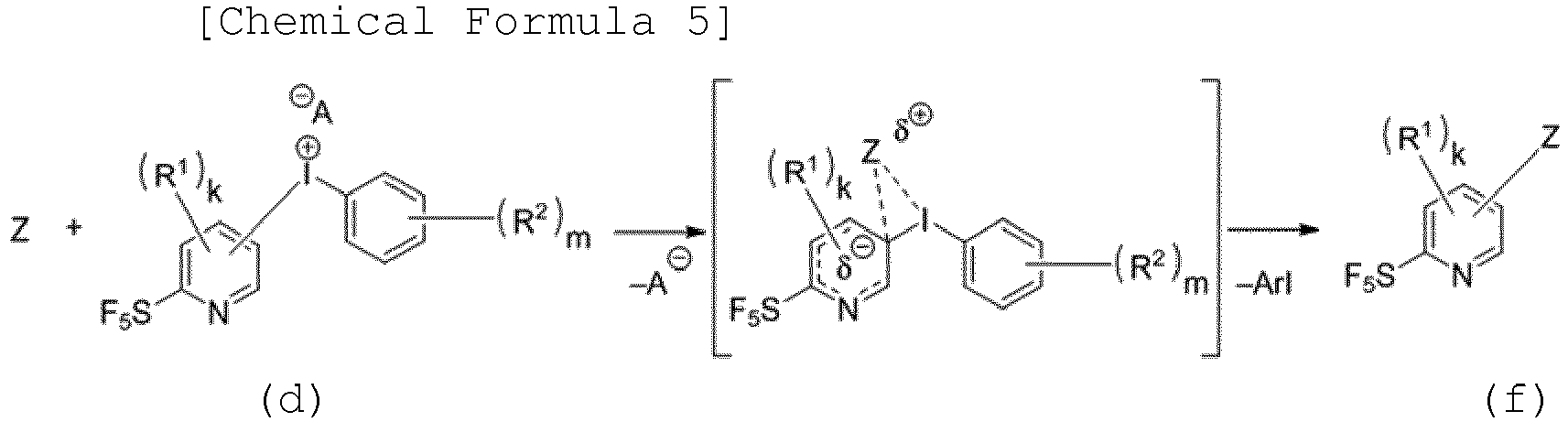
- First, the nucleophilic compound Z coordinates to the central iodine I by elimination of the counter anion A. It is considered that ligand coupling with an electron-deficient 2-SF5Py group proceeds selectively afterward through a reaction intermediate as in ipso substitution.
- The diaryliodonium salt of the present invention has an antitumor property. A tumor refers to a cell population that has started to undergo autonomous and uncontrolled proliferation by genetic mutation and includes a benign tumor and a malignant tumor. Examples of the malignant tumor include an epithelioma, a sarcoma, and a hematologic malignancy. The epithelioma is not limited, but examples thereof include skin cancer, tongue cancer, esophageal cancer, pharynx cancer, stomach cancer, colon cancer, gallbladder cancer, bile duct cancer, pancreatic cancer, duodenal cancer, kidney cancer, hepatocellular carcinoma, prostate cancer, ovarian cancer, uterine cancer, and breast cancer. The sarcoma is not limited, but examples thereof include synovial sarcoma, osteosarcoma, fibrosarcoma, liposarcoma, myosarcoma, malignant fibrous histiocytoma, dermal fibrosarcoma, angiosarcoma, Kaposi's sarcoma, and lymphangiosarcoma. The hematologic malignancy is not limited, but examples thereof include leukemia, malignant lymphoma, and multiple myeloma.
- An antitumor property is evaluated by reduction or elimination of a tumor size, decrease or disappearance of the number of tumor cells, detection of apoptosis induced to tumor cells, and the like.
- An antitumor agent in the present invention is a tumor therapeutic agent and can be combined with a pharmaceutical carrier to form a pharmaceutical composition. A known pharmaceutical carrier can be used, and examples thereof include a binder such as methylcellulose, a disintegrating agent such as starch, a lubricant such as magnesium stearate, a fragrance such as menthol, and a diluent such as water or physiological saline. The pharmaceutical composition can be a composition for oral administration, an injectable composition, or the like. The dosage of the pharmaceutical composition is determined in consideration of the age and weight of a subject to be administered, the type of dosage form, an administration method, and the like.
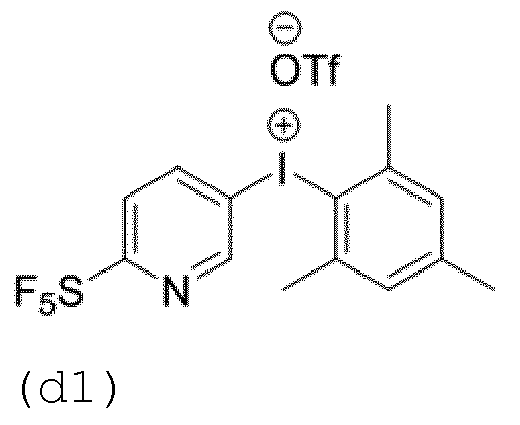
- The following reaction was performed to synthesize a diaryliodonium salt.

- Aryl bromide (a1) (1.65 g, 5.80 mmol) synthesized by the inventors, copper (I) iodide (111 mg, 0.580 mmol, manufactured by Kanto Kagaku), and sodium iodide (1.72 g, 11.6 mmol, manufactured by Nacalai Tesque, Inc.) were put in a Schlenk tube, and the interior thereof was replaced with argon. Thereafter, N,N'-dimethylethylenediamine (0.12 mL, 1.16 mmol, manufactured by Sigma-Aldrich) and 1-pentanol (6.0 mL) were added thereto and stirred at 130°C for 72 hours. After completion of the reaction, the mixture was cooled to room temperature, and an ammonia aqueous solution (28%) and water were added thereto. The resulting mixture was extracted with dichloromethane. The organic phase was washed with a saturated sodium chloride aqueous solution and dried over sodium sulfate. Subsequently, the solvent was distilled off under reduced pressure, and the residue was purified by silica gel column chromatography (hexane/ethyl acetate = 9/1) to obtain aryl iodide (b1) (1.82 g, 95%) as a pale yellow solid.
- Metachloroperbenzoic acid (77%, 1.80 g, 8.1 mmol, manufactured by Sigma-Aldrich) was put in an eggplant-shaped flask and dried under vacuum at room temperature for one hour. Thereafter, a dichloromethane solution (30 mL) of aryl iodide (b1) (1.80 g, 5.40 mmol) was added thereto. Subsequently, the resulting mixture was cooled to 0°C. Thereafter, trifluoromethanesulfonic acid (2.5 mL, 21.7 mmol, manufactured by Central Glass Co., Ltd.) was dropwise added thereto, and the resulting mixture was stirred at room temperature for two hours. Then, the mixture was cooled to 0°C. Thereafter, mesitylene (0.80 mL, 5.94 mmol, manufactured by Nacalai Tesque, Inc.) was dropwise added thereto, and the resulting mixture was further stirred at room temperature for 16 hours. After completion of the reaction, the solvent was distilled off under reduced pressure. Diethyl ether was added thereto to reprecipitate a product. The solid was collected by filtration using a Kiriyama funnel and washed with diethyl ether. Finally, the solid was dried under vacuum to obtain a diaryliodonium salt (d1) (1.97 g, 61%) as a white solid.
- Analysis results by mass spectrometry and NMR are summarized below. In the present invention, mass spectrometry was performed using model name LCMS-2020 manufactured by Shimadzu Corporation, and 1H-NMR and 19F-NMR were measured using Mercury 300 manufactured by Varian.
- A diaryliodonium salt (d2) was synthesized similarly.
-
Table 1 Example 1 Aryl bromide Diaryliodonium salt 

58% Yield 

- MS (ESI, m/z) 450 [(M-OTf)+]; 1H NMR ((CD3)2CO, 300 MHz): δ = 2.40 (s, 3H), 2.78 (s, 6H), 7.35 (s, 2H), 8.17 (d, J = 8.4 Hz, 1H), 8.85 (d, J = 8.4 Hz, 1H), 9.17 (s, 1H); 19F NMR (CDCl3:DMSO-d6 = 24:1, 282 MHz): δ = -79.0 (s, 3F), 52.1 (d, J = 149.3 Hz, 4F), 76.2 (quint, J = 149.3 Hz, 1F),; (2 steps) 58% yield
- HRMS (ESI) calcd. for C14H14NF5SI [(M-OTf)+] : 449.9812 found 449.9812; 1H NMR (CDCl3, 300 MHz) δ = 2.44 (s, 3H), 2.60 (s, 6H), 7.25 (s, 2H), 7.52 (t, J = 6 Hz, 2H), 8.71 (s, 1H); 19F NMR (CDCl3, 282 MHz) δ = -78.98 (s, 3F), 53.63 (d, J = 149.46 Hz, 4F), 75.86 (quintet, J = 152.28 Hz, 1F). (2 steps) 5% yield
- The following reaction was performed to introduce a 2-SF5Py group into a target compound.

- A β-ketoester (t1) synthesized by the inventors (20.7 mg, 0.109 mmol and sodium hydride (60%, 5.2 mg, 0.130 mmol, manufactured by Nacalai Tesque, Inc.) were stirred in N,N'-dimethylformamide (1.3 mL) for 10 minutes. Thereafter, the diaryliodonium salt (d1) (71.9 mg, 0.120 mmol) obtained in Example 1 was added thereto, and the resulting mixture was further stirred for three hours. After completion of the reaction, water was added thereto. The resulting mixture was extracted with diethyl ether. The organic phase was washed with a saturated sodium chloride aqueous solution and dried over sodium sulfate. Subsequently, the solvent was distilled off under reduced pressure, and the residue was purified by silica gel column chromatography (hexane/ethyl acetate = 7/3) to obtain a product (f1) (22.0 mg, 51%) as a white solid.
- A similar reaction was performed using the following raw materials to manufacture products (f2) to (f6). Analysis results are summarized below.
-
Table 2 Example 2 β-ketoester Diaryliodonium salt Product 


- MS (ESI, m/z) 394 [(M+H)+]; 1H NMR ((CD3)2CO, 300 MHz) : δ = 3.72 (s, 3H), 3.89 (d, J = 17.7 Hz, 1H), 4.26 (d, J = 17.7 Hz, 1H), 7.56 (t, J = 6.9 Hz, 1H), 7.69 (d, J = 7.2 Hz, 1H), 7.77-7.83 (m, 2H), 7.92 (d, J = 8.7 Hz, 1H), 8.31 (d, J = 7.5 Hz, 1H), 8.77 (s, 1H); 19F NMR (CDCl3, 282 MHz) : δ = 52.7 (d, J = 148.1 Hz, 4F), 79.1 (quint, J = 148.1 Hz, 1F); 51% yield
- MS (ESI, m/z) 408 [(M+H)+]; 1H NMR (CDCl3, 300 MHz) : δ = 1.22 (t, J = 7.1 Hz, 3H), 3.63 (d, J = 17.1 Hz, 1H), 4.19-4.26 (m, 4H), 7.50 (t, J = 7.2 Hz, 1H), 7.56 (d, J = 7.5 Hz, 1H), 7.69-7.76 (m, 2H), 7.86 (d, J = 7.5 Hz, 1H), 8.17 (d, J = 8.7 Hz, 1H), 8.64 (s, 1H); 19F NMR (CDCl3, 282 MHz) : δ = 52.1 (d, J = 149.5 Hz, 4F), 77.8 (quint, J = 149.5 Hz, 1F); 58% yield
- MS (ESI, m/z) 436 [(M+H)+]; 1H NMR (CDCl3, 300 MHz) : δ = 1.38 (s, 9H), 3.61 (d, J = 17.0 Hz, 1H), 4.15 (d, J = 17.0 Hz, 1H), 7.46 (t, J = 7.4 Hz, 1H), 7.55 (d, J = 8.1 Hz, 1H), 7.67-7.75 (m, 2H), 7.84 (d, J = 8.1 Hz, 1H), 8.19 (d, J = 8.1 Hz, 1H), 8.64 (s, 1H); 19F NMR (CDCl3, 282 MHz) : δ = 52.1 (d, J = 149.5 Hz, 4F), 77.9 (quint, J = 149.5 Hz, 1F); 72% yield
- MS (ESI, m/z) 454 [(M+H)+]; 1H NMR (CDCl3, 300 MHz) : δ = 3.49 (d, J = 17.0 Hz, 1H), 3.78 (s, 3H), 3.95 (s, 3H), 4.01 (s, 3H), 4.16 (d, J = 17.0 Hz, 1H), 6.95 (s, 1H), 7.25 (s, 1H), 7.75 (d, J = 8.4 Hz, 1H), 8.15 (d, J = 8.4 Hz, 1H), 8.61 (s, 1H); 19F NMR (CDCl3, 282 MHz) : δ = 52.1 (d, J = 149.6 Hz, 4F), 77.8 (quint, J = 149.6 Hz, 1F); 67% yield Methyl 5,7-dimethyl-1-oxo-2-(6-(pentafluorosulfanyl)pyridin-3-yl)-1,2,3,4-tetrahydronaphthalene-2-carboxylate (f5)
- MS (ESI, m/z) 436 [(M+H)+]; 1H NMR (CDCl3, 300 MHz) : δ = 2.34 (s, 3H), 2.35 (s, 3H), 2.67-2.79 (m, 2H), 2.89-3.09 (m, 2H), 3.24 (s, 1H), 7.80-7.84 (m, 2H), 8.50 (s, 1H); 19F NMR (CDCl3, 282 MHz): δ = 52.1 (d, J = 149.9 Hz, 4F), 77.7 (quint, J = 149.9 Hz, 1F); 47% yield
- The following reaction was performed to introduce a 2-SF5Py group into a target compound.

- Phenol (t10) (9.4 mg, 0.100 mmol, manufactured by Tokyo Chemical Industry Co., Ltd.) was added to a tetrahydrofuran (0.3 mL) suspension of potassium tert-butoxide (13.5 mg, 0.120 mmol), and the resulting mixture was stirred at 0°C for 15 minutes. Subsequently, the diaryliodonium salt (d1) (71.9 mg, 0.120 mmol) was added to the mixture, and the resulting mixture was further stirred at 40°C for three hours. After completion of the reaction, water was added thereto, and the resulting mixture was extracted with dichloromethane. The organic phase was washed with a saturated sodium chloride aqueous solution and dried over sodium sulfate. Subsequently, the solvent was distilled off under reduced pressure, and the residue was purified by silica gel column chromatography (hexane/ethyl acetate = 9/1) to obtain a product (f10) (20.8 mg, 70%) as a white solid. Results are summarized below.
-
Table 3 Example 3 Target compound Diaryliodonium salt Product 


- MS (EI, m/z) 297 (M+); 1H NMR (CDCl3, 300 MHz) : δ = 7.10 (d, J = 7.5 Hz, 1H), 7.26 (t, J = 7.5 Hz, 1H), 7.35-7.47 (m, 3H), 7.70 (d, J = 8.7 Hz, 1H), 8.27 (s, 1H); 19F NMR (CDCl3, 282 MHz): δ = 53.3 (d, J = 150.0 Hz, 4F), 78.9 (quint, J = 150.0 Hz, 1F); 70% yield
- The following reaction was performed to introduce a 2-SF5Py group into a target compound.
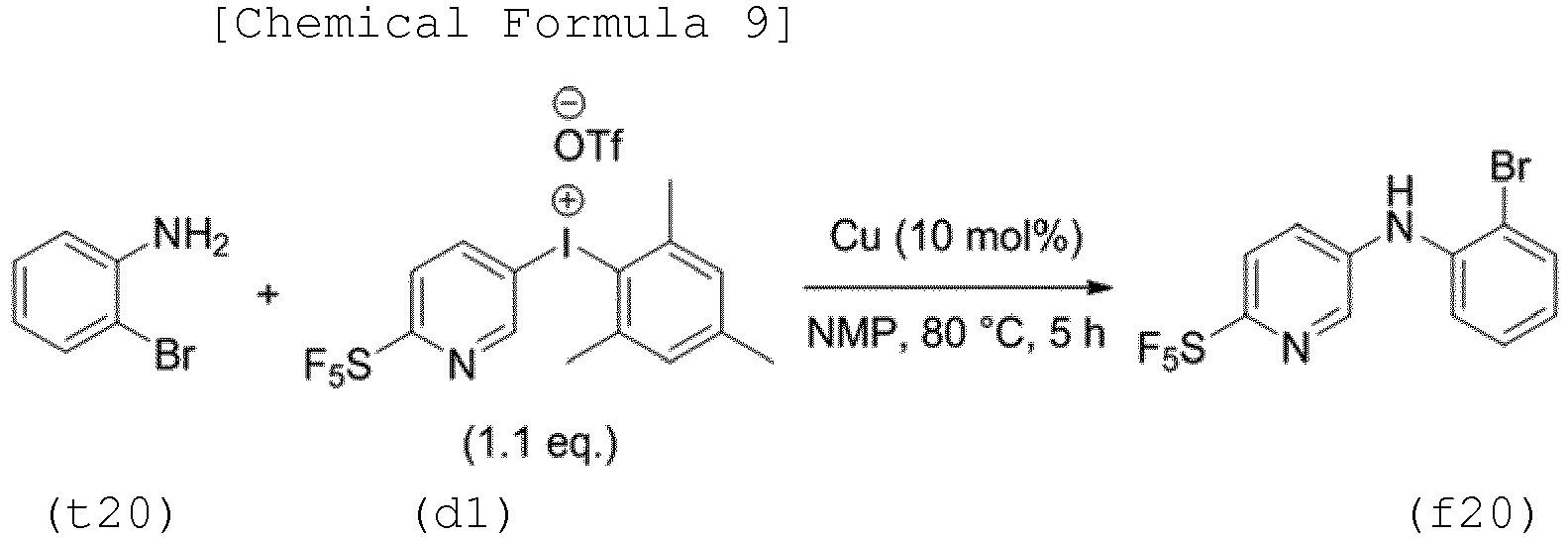
- An N-methyl-2-pyrrolidone (0.4 mL) suspension of 2-bromoaniline (t20) (34.4 mg, 0.200 mmol, manufactured by Tokyo Chemical Industry Co., Ltd.) and copper powder (1.3 mg, 0.0200 mmol, manufactured by Hayashi Pure Chemical Industries) was stirred at room temperature for 10 minutes. Subsequently, the diaryliodonium salt (d1) (132 mg, 0.220 mmol) was added to the mixture, and the resulting mixture was further stirred at 80°C for five hours. After completion of the reaction, an insoluble matter was removed by silica gel filtration, and a dissolved matter was washed out with diethyl ether. Subsequently, the solvent was distilled off under reduced pressure, and the residue was purified by silica gel column chromatography (hexane/ethyl acetate = 9/1) to obtain a product (f20) (42.8 mg, 71%) as a yellow solid. Results are summarized below.
-
Table 4 Example 4 Target compound Diaryliodonium salt Product 

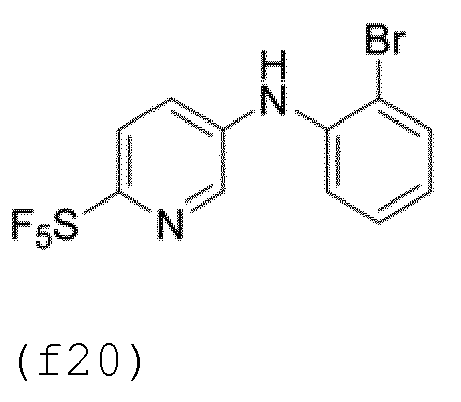
- MS (ESI, m/z) 375 [(M+H)+]; 1H NMR (CDCl3, 300 MHz): δ = 6.24 (brs, 1H), 6.99 (t, J = 6.9 Hz, 1H), 7.30-7.46 (m, 3H), 7.62-7.65 (m, 2H), 8.27 (s, 1H); 19F NMR (CDCl3, 282 MHz) : δ = 53.5 (d, J = 149.3 Hz, 4F), 79.9 (quint, J = 149.3 Hz, 1F); 71% yield
- The following reaction was performed to introduce a 2-SF5Py group into a target compound.


- An amide (t30) (16.3 mg, 0.100 mmol) synthesized by the inventors, the diaryliodonium salt (d1) (71.9 mg, 0.120 mmol), and sodium hydride (60%, 6.1 mg, 0.152 mmol, manufactured by Nacalai Tesque, Inc.) were stirred in toluene (2.0 mL) for 19 hours. After completion of the reaction, the solvent was distilled off under reduced pressure, and the residue was purified by silica gel column chromatography (hexane/ethyl acetate = 8/2) to obtain a product (f1) (23.1 mg, 63%) as a colorless oil.
- A similar reaction was performed using the following raw materials to manufacture a product (f31). Analysis results are summarized below.
-
Table 5 Example 5 Target compound Diaryliodonium salt Product 


- MS (ESI, m/z) 367 [(M+H)+]; 1H NMR (CDCl3, 300 MHz) : δ = 1.14 (d, J = 6.8 Hz, 6H), 2.67 (sept, J = 6.8 Hz, 1H), 7.27-7.29 (m, 2H), 7.46-7.54 (m, 3H), 7.69 (d, J = 8.4 Hz), 7.91 (d, J = 8.4 Hz), 8.32 (s, 1H); 19F NMR (CDCl3, 282 MHz): δ = 52.6 (d, J = 149.3 Hz, 4F), 78.3 (quint, J = 149.3 Hz, 1F); 63% yield
- MS (ESI, m/z) 431 [(M+H)+]; 1H NMR (CDCl3, 300 MHz): δ = 3.78 (s, 3H), 6.82 (d, J = 6.8 Hz, 2H), 7.02 (d, J = 6.8 Hz, 2H), 7.24-7.29 (m, 2H), 7.25 (t, J = 7.5 Hz, 1H), 7.45 (d, J = 7.5 Hz, 2H), 7.69-7.76 (m, 2H), 8.38 (d, J = 2.4 Hz, 1H); 19F NMR (CDCl3, 282 MHz) : δ = 52.7 (d, J = 149.7 Hz, 4F), 78.2 (quint, J = 149.7 Hz, 1F); 63% yield
- According to the present invention, it is clear that a 2-pentafluorosulfanylpyridyl group can be introduced into various target compounds. In the present invention, a pentafluorosulfanylpyridyl group can be introduced into an sp3 carbon of a target compound, and the present invention is useful for a physiological substance such as this compound drug. In addition, in the present invention, a pentafluorosulfanylpyridyl group can be introduced into an oxygen atom or a nitrogen atom of a target compound.
- 1 × 10⁴ leukemia cancer cell lines (U937: human monocytic leukemia cell line, manufactured by DS Pharma Biomedical) were suspended in 1 mL of a culture medium (RPMI 1640 medium (manufactured by Sigma-Aldrich)). The diaryliodonium salt of the present invention was dissolved in DMSO to prepare solutions of 500 µM, 2500 µM, and 10 mM. Subsequently, 2 µL of each of the solutions was dropwise added to the cancer cell line, and the solution was allowed to stand at 37°C for 24 hours. Thereafter, Annexine V positivity as an indicator of apoptosis was measured using a Muse (trademark) Annexin V and Dead Cell Assay Kit (Merck Millipore Corporation, Darmstadt, Germany) measurement kit. Results are illustrated in
Figs. 1 and2 . - The following compounds were prepared as comparative compounds. Compound (d18) is a known substance and was synthesized by the inventors. Compound (b19) was synthesized according to the reaction described in Example 1. Compounds (b20) and (b21) were obtained from Ube Industries, Ltd. Antitumor activity was evaluated in a similar manner to Example 5 using these compounds.

- Results are illustrated in
Figs. 1 and2 . It is clear that the diaryliodonium salt of the present invention exhibits an excellent antitumor property.
Claims (7)
- A diaryliodonium salt having a pentafluorosulfanyl group at a 2-position of a pyridine ring, represented by General Formula (d):
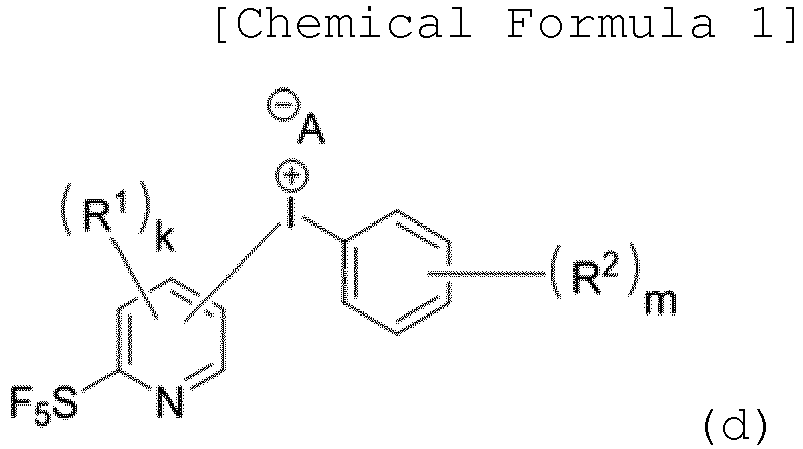 R1 is an alkyl group having 1 or 2 carbon atoms, k is an integer of 0 to 4,R2 is a linear or branched alkyl group having 1 to 4 carbon atoms or a linear or branched alkoxy group having 1 to 4 carbon atoms, m is an integer of 0 to 5, andA- is a counter anion.
 - The diaryliodonium salt according to claim 1, wherein k is 0, and m is 3.
- The diaryliodonium salt according to claim 2, wherein R2 is a methyl group, an ethyl group, an n-propyl group, an i-propyl group, or a methoxy group.
- The diaryliodonium salt according to claim 1, wherein k is 0, and m is 0.
- A method for manufacturing the diaryliodonium salt according to any one of claims 1 to 4, comprising:preparing a compound represented by General Formula (b); andsimultaneously performing an oxidation reaction of the compound and a Friedel-Crafts reaction thereof with a compound represented by General Formula (c) to generate a diaryliodonium salt represented by General Formula (d):

- A method for manufacturing a compound represented by General Formula (f):

causing a reaction between a compound represented by General Formula (d) and a nucleophilic compound Z to introduce a pyridyl group having a pentafluorosulfanyl group at a 2-position into the nucleophilic compound. - The method for manufacturing the compound according to claim 6, wherein the nucleophilic compound Z is selected from the group consisting of a 1,3-dicarbonyl compound, a phenol compound, an aniline compound, a heterocyclic compound, an alcohol compound, an oximide compound, an aromatic sulfur compound, and an aromatic cyan compound.
Applications Claiming Priority (2)
| Application Number | Priority Date | Filing Date | Title |
|---|---|---|---|
| JP2015229881 | 2015-11-25 | ||
| PCT/JP2016/077312 WO2017090305A1 (en) | 2015-11-25 | 2016-09-15 | Pentafluorosulfanylpyridyl-group-containing diaryliodonium salt |
Publications (2)
| Publication Number | Publication Date |
|---|---|
| EP3381901A1 true EP3381901A1 (en) | 2018-10-03 |
| EP3381901A4 EP3381901A4 (en) | 2019-07-24 |
Family
ID=58763429
Family Applications (1)
| Application Number | Title | Priority Date | Filing Date |
|---|---|---|---|
| EP16868254.0A Withdrawn EP3381901A4 (en) | 2015-11-25 | 2016-09-15 | DIARYLIODONIUM SALT CONTAINING PENTAFLUOROSULFANYLPYRIDYL GROUP |
Country Status (4)
| Country | Link |
|---|---|
| US (1) | US20180354903A1 (en) |
| EP (1) | EP3381901A4 (en) |
| JP (1) | JP6853958B2 (en) |
| WO (1) | WO2017090305A1 (en) |
Family Cites Families (3)
| Publication number | Priority date | Publication date | Assignee | Title |
|---|---|---|---|---|
| GB9307245D0 (en) * | 1993-04-07 | 1993-06-02 | Zeneca Ltd | Process |
| CA2911307C (en) * | 2012-05-17 | 2021-05-25 | The University Of Chicago | Use of fluorinated derivatives of 4-aminopyridine in therapeutics and medical imaging |
| CN103172612B (en) * | 2013-03-06 | 2015-07-15 | 中山大学肿瘤防治中心 | Dibenzo iodonium salts and anticancer application thereof |
-
2016
- 2016-09-15 US US15/778,757 patent/US20180354903A1/en not_active Abandoned
- 2016-09-15 EP EP16868254.0A patent/EP3381901A4/en not_active Withdrawn
- 2016-09-15 JP JP2017552298A patent/JP6853958B2/en not_active Expired - Fee Related
- 2016-09-15 WO PCT/JP2016/077312 patent/WO2017090305A1/en not_active Ceased
Also Published As
| Publication number | Publication date |
|---|---|
| EP3381901A4 (en) | 2019-07-24 |
| JPWO2017090305A1 (en) | 2018-10-04 |
| JP6853958B2 (en) | 2021-04-07 |
| WO2017090305A1 (en) | 2017-06-01 |
| US20180354903A1 (en) | 2018-12-13 |
Similar Documents
| Publication | Publication Date | Title |
|---|---|---|
| CN118005656B (en) | Preparation and application of pyrimidine-thiopyranedione inhibitors of KRAS G12C mutant protein | |
| EP2736894B1 (en) | Method for producing benzo[b] thiophene compounds | |
| CA2736097C (en) | Carbazole compounds for inhibition of nf-kb activity | |
| RU2128648C1 (en) | Sulfonamide derivatives, methods of their synthesis, a pharmaceutical composition and method of patient treatment | |
| EP2883870B1 (en) | Method for producing 1,4-benzoxazine compound | |
| US20160289204A1 (en) | Griseofulvin derivatives | |
| CN101463014B (en) | Diaryl benzo pyridine derivative, and its pharmaceutical composition and use thereof | |
| Chen et al. | CuI catalyzed domino coupling–cyclization of 2-iodo-phenols and 1-alkynes to the synthesis of 2-substituted benzo [b] furans/furo-pyridines | |
| CN102516152A (en) | Alpha-difluoro carbonyl substituted chiral tert-alcohol compound, its synthetic method and application thereof | |
| CN103922992B (en) | A kind of antitumour activity indolone derivatives, preparation method and use | |
| CN103265487A (en) | Pleuromutilin expansion ring derivative, and preparation method and application thereof | |
| CN106188044A (en) | A kind of synthetic method of 3 arylthio imidazos [1,5 a] the N heterocyclic compound of catalysis of iodine | |
| JP2018043952A (en) | Antitumor drug and composition containing the same | |
| US20180354903A1 (en) | Pentafluorosulfanylpyridyl group-containing diaryliodonium salt | |
| JPWO2016125845A1 (en) | Cross coupling method and method for producing organic compound using the cross coupling method | |
| CN114436918B (en) | Cyclobut-1-enamine compound and its preparation method and application in medicine | |
| EP2888250B1 (en) | Process for the synthesis of substituted gamma lactams | |
| CN105439966B (en) | Compound and its preparation method and application | |
| KR102413552B1 (en) | Indolopyran derivative and synthesis method of the same and use of the same | |
| CN115677659A (en) | Preparation method of erlotinib | |
| WO2007088670A1 (en) | Method for synthesizing radioactive ligand having 18f-labeled fluorobenzene ring | |
| CN101328154B (en) | 3-alcoxymethyl amidine-1,2,4-benzotriazin derivates, preparation and use thereof | |
| EP4085059B1 (en) | Heteroaryl compounds as inhibitors of programmed necrosis pathway, composition and method using the same | |
| JP5461088B2 (en) | Cell growth inhibitor and anticancer agent | |
| CN110511197A (en) | A kind of N- furanonyl arylsulfonyl hydrazone compounds and its synthetic method and application |
Legal Events
| Date | Code | Title | Description |
|---|---|---|---|
| PUAI | Public reference made under article 153(3) epc to a published international application that has entered the european phase |
Free format text: ORIGINAL CODE: 0009012 |
|
| 17P | Request for examination filed |
Effective date: 20180608 |
|
| AK | Designated contracting states |
Kind code of ref document: A1 Designated state(s): AL AT BE BG CH CY CZ DE DK EE ES FI FR GB GR HR HU IE IS IT LI LT LU LV MC MK MT NL NO PL PT RO RS SE SI SK SM TR |
|
| AX | Request for extension of the european patent |
Extension state: BA ME |
|
| DAV | Request for validation of the european patent (deleted) | ||
| DAX | Request for extension of the european patent (deleted) | ||
| A4 | Supplementary search report drawn up and despatched |
Effective date: 20190624 |
|
| RIC1 | Information provided on ipc code assigned before grant |
Ipc: C07D 213/71 20060101AFI20190614BHEP |
|
| STAA | Information on the status of an ep patent application or granted ep patent |
Free format text: STATUS: THE APPLICATION IS DEEMED TO BE WITHDRAWN |
|
| 18D | Application deemed to be withdrawn |
Effective date: 20200122 |