EP3380064B1 - Personal care compositions - Google Patents
Personal care compositions Download PDFInfo
- Publication number
- EP3380064B1 EP3380064B1 EP16826628.6A EP16826628A EP3380064B1 EP 3380064 B1 EP3380064 B1 EP 3380064B1 EP 16826628 A EP16826628 A EP 16826628A EP 3380064 B1 EP3380064 B1 EP 3380064B1
- Authority
- EP
- European Patent Office
- Prior art keywords
- weight
- composition
- ppm
- complex
- pyrophosphate
- Prior art date
- Legal status (The legal status is an assumption and is not a legal conclusion. Google has not performed a legal analysis and makes no representation as to the accuracy of the status listed.)
- Active
Links
Images


Classifications
-
- A—HUMAN NECESSITIES
- A61—MEDICAL OR VETERINARY SCIENCE; HYGIENE
- A61K—PREPARATIONS FOR MEDICAL, DENTAL OR TOILETRY PURPOSES
- A61K8/00—Cosmetics or similar toiletry preparations
- A61K8/18—Cosmetics or similar toiletry preparations characterised by the composition
- A61K8/19—Cosmetics or similar toiletry preparations characterised by the composition containing inorganic ingredients
- A61K8/20—Halogens; Compounds thereof
- A61K8/21—Fluorides; Derivatives thereof
-
- A—HUMAN NECESSITIES
- A61—MEDICAL OR VETERINARY SCIENCE; HYGIENE
- A61K—PREPARATIONS FOR MEDICAL, DENTAL OR TOILETRY PURPOSES
- A61K8/00—Cosmetics or similar toiletry preparations
- A61K8/18—Cosmetics or similar toiletry preparations characterised by the composition
- A61K8/19—Cosmetics or similar toiletry preparations characterised by the composition containing inorganic ingredients
-
- A—HUMAN NECESSITIES
- A61—MEDICAL OR VETERINARY SCIENCE; HYGIENE
- A61K—PREPARATIONS FOR MEDICAL, DENTAL OR TOILETRY PURPOSES
- A61K8/00—Cosmetics or similar toiletry preparations
- A61K8/18—Cosmetics or similar toiletry preparations characterised by the composition
- A61K8/19—Cosmetics or similar toiletry preparations characterised by the composition containing inorganic ingredients
- A61K8/24—Phosphorous; Compounds thereof
-
- A—HUMAN NECESSITIES
- A61—MEDICAL OR VETERINARY SCIENCE; HYGIENE
- A61Q—SPECIFIC USE OF COSMETICS OR SIMILAR TOILETRY PREPARATIONS
- A61Q15/00—Anti-perspirants or body deodorants
-
- A—HUMAN NECESSITIES
- A61—MEDICAL OR VETERINARY SCIENCE; HYGIENE
- A61K—PREPARATIONS FOR MEDICAL, DENTAL OR TOILETRY PURPOSES
- A61K2800/00—Properties of cosmetic compositions or active ingredients thereof or formulation aids used therein and process related aspects
- A61K2800/20—Chemical, physico-chemical or functional or structural properties of the composition as a whole
- A61K2800/30—Characterized by the absence of a particular group of ingredients
-
- A—HUMAN NECESSITIES
- A61—MEDICAL OR VETERINARY SCIENCE; HYGIENE
- A61K—PREPARATIONS FOR MEDICAL, DENTAL OR TOILETRY PURPOSES
- A61K2800/00—Properties of cosmetic compositions or active ingredients thereof or formulation aids used therein and process related aspects
- A61K2800/40—Chemical, physico-chemical or functional or structural properties of particular ingredients
- A61K2800/58—Metal complex; Coordination compounds
Definitions
- antiperspirants designed to help people reduce sweat. Examples of these can be found in U.S. Code of Regulation 21 C.F.R. ⁇ 350.
- the majority of the active agents used in antiperspirants are aluminum and zirconium halide compounds and complexes and their derivatives. While these active agents are generally effective, there is still a need for alternative antiperspirant actives.
- Tin (II) fluoride also known as stannous fluoride
- Tin (II) fluoride is soluble in water, however, it oxidizes to form insoluble precipitates of tin.
- tin can form insoluble compounds with phosphates.
- Embodiments of the present invention are designed to meet these, and other, needs.
- tin (II) fluoride forms an aqueous soluble tin phosphate complex upon mixture with a pyrophosphate salt, e.g., tetrapotassium pyrophosphate (K 4 P 2 O 7 ) (TKPP) or tetrasodium pyrophosphate (Na 4 P 2 O 7 ) (TSPP).
- a pyrophosphate salt e.g., tetrapotassium pyrophosphate (K 4 P 2 O 7 ) (TKPP) or tetrasodium pyrophosphate (Na 4 P 2 O 7 ) (TSPP).
- tin (II) chloride upon mixture with a pyrophosphate salt, e.g., tetrapotassium pyrophosphate (K 4 P 2 O 7 .) (TKPP) or tetrasodium pyrophosphate (Na 4 P 2 O 7 ) (TSPP), forms solid (Examples 8 and 9).
- a pyrophosphate salt e.g., tetrapotassium pyrophosphate (K 4 P 2 O 7 .) (TKPP) or tetrasodium pyrophosphate (Na 4 P 2 O 7 ) (TSPP)
- the aqueous soluble tin phosphate complex forms a white precipitate, which may be an appropriate occlusive active for wetness control because it forms plugs that can physically inhibit sweat from skin.
- an aqueous soluble tin phosphate complex e.g., formed from a mixture comprising tin (II) fluoride and a pyrophosphate salt, e.g., an alkali pyrophosphate salt, e.g., tetrapotassium pyrophosphate (K 4 P 2 O 7 .) (TKPP) or tetrasodium pyrophosphate (Na 4 P 2 O 7 ) (TSPP).
- a aqueous soluble tin phosphate complex e.g., formed from a mixture comprising tin (II) fluoride and a pyrophosphate salt, e.g., an alkali pyrophosphate salt, e.g., tetrapotassium pyrophosphate (K 4 P 2 O 7 .) (TKPP) or tetrasodium pyrophosphate (Na 4 P 2 O 7 ) (TSPP).
- TKPP
- compositions e.g., antiperspirants and/or deodorants, comprising the aqueous soluble tin phosphate complex.
- antiperspirants and/or deodorants comprising the aqueous soluble tin phosphate complex that form a precipitate when contacted with sweat.
- compositions comprising tin (II) fluoride and a pyrophosphate salt, e.g., an alkali pyrophosphate salt, e.g., tetrapotassium pyrophosphate (K 4 P 2 O 7 ) (TKPP) or tetrasodium pyrophosphate (Na 4 P 2 O 7 ) (TSPP), e.g., tetrapotassium pyrophosphate (K 4 P 2 O 7 ), e.g., tetrasodium pyrophosphate (Na 4 P 2 O 7 ) (TSPP), wherein the tin (II) fluoride and pyrophosphate salt form an aqueous soluble tin phosphate complex.
- a pyrophosphate salt e.g., an alkali pyrophosphate salt, e.g., tetrapotassium pyrophosphate (K 4 P 2 O 7 ) (TKPP) or
- compositions e.g., antiperspirants
- aqueous soluble tin phosphate complex comprising combining tin (II) fluoride and a pyrophosphate salt, e.g., an alkali pyrophosphate salt, e.g., tetrapotassium pyrophosphate (K 4 P 2 O 7 ) (TKPP) or tetrasodium pyrophosphate (Na 4 P 2 O 7 ) (TSPP), in aqueous solution, e.g., at a molar ratio of at least 1P : 1Sn, e.g., 1P : 1Sn to 15P : 1Sn, e.g., 1P : 1Sn to less than 15P : 1Sn, e.g., 1P: 1Sn to 10P : 1Sn, e.g., 1P : 1Sn to less than 10P : 1Sn, e.g., 1P : 1Sn to
- compositions e.g., antiperspirants
- methods of making the external personal care compositions comprising admixing the aqueous soluble tin phosphate complex with a personal care carrier.
- ranges are used as shorthand for describing each and every value that is within the range. Any value within the range can be selected as the terminus of the range. In the event of a conflict in a definition in the present disclosure and that of a cited reference, the present disclosure controls.
- aqueous soluble tin phosphate complex (Complex 1), e.g.,
- Method 1 to occlude pores and/or reduce sweat, in a person in need thereof comprising applying an effective amount of any of Complex 1 et seq. to the skin of the person.
- Method 2 of making an aqueous soluble tin phosphate complex, e.g., any of Complex 1 et seq., comprising combining tin (II) fluoride and a pyrophosphate salt, e.g., an alkali pyrophosphate salt, e.g., tetrapotassium pyrophosphate (K 4 P 2 O 7 ) (TKPP) or tetrasodium pyrophosphate (Na 4 P 2 O 7 ) (TSPP), e.g.,
- a pyrophosphate salt e.g., an alkali pyrophosphate salt, e.g., tetrapotassium pyrophosphate (K 4 P 2 O 7 ) (TKPP) or tetrasodium pyrophosphate (Na 4 P 2 O 7 ) (TSPP), e.g.,
- aqueous soluble tin phosphate complex made by any of Method 2 et seq.
- composition 1 e.g., an antiperspirant, deodorant, body wash, shower gel, soap (e.g., bar soap, hand soap), shampoo, hair conditioner, or cosmetic, comprising tin (II) fluoride and a pyrophosphate salt, e.g., an alkali pyrophosphate salt, e.g., tetrapotassium pyrophosphate (K 4 P 2 O 7 ) or tetrasodium pyrophosphate (Na 4 P 2 O 7 ), e.g.,
- Method 3 to occlude pores and/or reduce sweat, in a person in need thereof comprising applying an effective amount of an external personal care composition comprising tin (II) fluoride and a pyrophosphate salt, e.g., an alkali pyrophosphate salt, e.g., tetrapotassium pyrophosphate (K 4 P 2 O 7 ) (TKPP) or tetrasodium pyrophosphate (Na 4 P 2 O 7 ) (TSPP), e.g., any of Composition 1 et seq., to the skin of the person, e.g.,
- Method 4 of making an external personal care composition comprising tin (II) fluoride and a pyrophosphate salt, e.g., tetrapotassium pyrophosphate (K 4 P 2 O 7 ) (TKPP) or tetrasodium pyrophosphate (Na 4 P 2 O 7 ) (TSPP), e.g., any of Composition 1 et seq., comprising mixing the tin (II) fluoride and a pyrophosphate salt, e.g., an alkali pyrophosphate salt, with a personal care carrier, e.g.,
- Tin (II) fluoride and a pyrophosphate salt e.g., an alkali pyrophosphate salt, e.g., tetrapotassium pyrophosphate (K 4 P 2 O 7 ) (TKPP) or tetrasodium pyrophosphate (Na 4 P 2 O 7 ) (TSPP), may be combined to form a pre-formed aqueous soluble tin phosphate complex, e.g., any of Complex 1 et seq., which may be prepared in bulk, and then incorporated into the external personal care compositions disclosed herein, e.g., any of Composition 1 et seq.
- a pyrophosphate salt e.g., an alkali pyrophosphate salt, e.g., tetrapotassium pyrophosphate (K 4 P 2 O 7 ) (TKPP) or tetrasodium pyrophosphate (Na 4 P 2 O 7 ) (
- tin (II) fluoride and a pyrophosphate salt e.g., tetrapotassium pyrophosphate (K 4 P 2 O 7 ) (TKPP) or tetrasodium pyrophosphate (Na 4 P 2 O 7 ) (TSPP)
- TKPP tetrapotassium pyrophosphate
- TSPP tetrasodium pyrophosphate
- the carrier can be any carrier that is used for antiperspirants and/or deodorants.
- the carrier can be in the form of a stick, a gel, a roll-on, or an aerosol (e.g. spray).
- the carrier may include oils and/or silicones and gelling agents.
- Optional ingredients that may be included in an antiperspirant and/or deodorant disclosed herein, e.g., any of Composition 1 et seq., include solvents; water-soluble alcohols such as C 2-8 alcohols; glycols; glycerides including mono-, di- and triglycerides; medium to long chain organic acids, alcohols, and esters; surfactants including emulsifying and dispersing agents; amino acids; structurants including thickeners and gelling agents, for example polymers, silicates, and silicon dioxide; emollients; fragrances; and colorants including dyes and pigments.
- solvents water-soluble alcohols such as C 2-8 alcohols
- glycols such as C 2-8 alcohols
- glycerides including mono-, di- and triglycerides
- surfactants including emulsifying and dispersing agents
- amino acids including thickeners and gelling agents, for example polymers
- the complexes disclosed herein can be formulated into topical antiperspirants and/or deodorants suitable for application to skin, illustratively a stick, a gel, a cream, a roll-on, a soft solid, a powder, a liquid, an emulsion, a suspension, a dispersion, or a spray.
- the compositions disclosed herein, e.g., any of Composition 1 et seq. can comprise a single phase or can be a multi-phase system, for example a system comprising a polar phase and an oil phase, optionally in the form of a stable emulsion.
- compositions disclosed herein can be liquid, semi-solid, or solid.
- Antiperspirants and/or deodorants may be provided in any suitable container such as an aerosol can, tube, or container with a porous cap, roll-on container, bottle, container with an open end, etc.
- complexes disclosed herein e.g., any of Complex 1 et seq.
- body washes and soaps e.g., hand soaps
- the complexes and compositions disclosed herein may be destructive to or inhibit the growth of bacteria.
- the complexes disclosed herein e.g., any of Complex 1 et seq.
- the formation of precipitate of the complexes and compositions disclosed herein e.g., any of Complex 1 et seq., e.g., any of Composition 1 et seq., may provide a residual antibacterial effect.
- the complexes and compositions disclosed herein may be used in a method to reduce sweating by applying the complex and/or composition to skin.
- the application is to axilla.
- a method for controlling perspiration comprising applying to skin an antiperspirant effective amount of a complex or a composition disclosed herein, e.g., any of Complex 1 et seq., e.g., any of Composition 1 et seq.
- a complex disclosed herein may be described by reference to a spectrum as "substantially” shown or depicted in a figure or by one or more data points. It will be appreciated that a Fourier transform infrared, Raman, or NMR spectrum of a given sample may vary depending on factors known to those of skill in the art, e.g., instrument used, etc. Therefore, the Fourier transform infrared, Raman, and NMR spectrum peaks set forth herein will have an acceptable level of deviation.
- the peaks may have an acceptable deviation of e.g., ⁇ 20 cm -1 or ⁇ 16 cm -1 or ⁇ 4 cm -1 or ⁇ 2 cm -1 or ⁇ 1 cm -1 or ⁇ 0.5 cm -1 .
- the peaks may have an acceptable deviation of, e.g., ⁇ 1-2 cm -1 , e.g., ⁇ 1 cm -1 , e.g., ⁇ 2 cm -1 .
- the peaks may have an acceptable deviation of, e.g., ⁇ 1 ppm.
- external means suitable for application to the skin, including the scalp, and nails.
- aqueous solution means a solution in which the solvent is water.
- aqueous soluble tin phosphate complex includes a complex in which 1 gram of the complex is soluble in 1 or 10 to 100 ml water, e.g., 1 or 10 to 90 ml water, e.g., 1 or 10 to 80 ml water, e.g., 1 or 10 to 70 ml water, e.g., 1 or 10 to 60 ml water, e.g., 1 or 10 to 50 ml water, e.g., 1 or 10 to 40 ml water, e.g., 1 or 10 to 30 ml water, e.g., 1 or 10 to 20 ml water, e.g., 1-10 ml water, e.g., less than 1 ml water.
- TKPP Tetrapotassium Pyrophosphate
- the solutions are prepared by first dissolving TSPP or TKPP in water (mixing under high heat if necessary) and then adding a 20% stannous fluoride solution to the clear solution with an automatic pipet. The pH of all clear solutions is recorded. All of the solutions contain 2% SnF 2 .
- TKPP is more water soluble than TSPP.
- TSPP solutions with a P/Sn molar ratio spanning from 1 to 5 remain clear.
- TKPP solutions with a P/Sn molar ratio spanning from 1 to 15 remain clear.
- BSA Bovine Serum Albumin
- Bovine serum albumin simulates sweat proteins and may reveal the benefit of the complex in antiperspirants, as the formation of precipitate may block sweat ducts.
- Bovine serum albumin (BSA) is used to model interaction of solutions with skin protein. Clear TSPP and TKPP solutions are aged at 37°C overnight after the addition of 1% BSA.
- Solutions of SnF 2 + TKPP with P/Sn molar ratios of 1, 2, 5, and 10 with 1% BSA form a precipitate after aging overnight at 37°C.
- a 1% BSA control after aging overnight at room temperature shows no precipitate.
- a 1% BSA control after aging overnight at 37°C shows no precipitate.
- a clear solution comprising 2% stannous fluoride (SnF 2 ) and tetrasodium pyrophosphate (TSPP) with a P:Sn molar ratio of 1 is lyophilized using a Labconco FreeZone 2.5 Freeze Dryer.
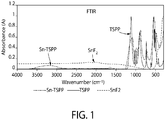
- FTIR-ATR analysis is conducted on freeze dried powder on an extended range Spectrum One Perkin Elmer system featuring a CsI beam splitter, DTGS detector, and single-bounce diamond KRS-5 ATR crystal. Sample is placed directly on the ATR diamond. See Figure 1 . Peaks observed for the Sn-TSPP complex are listed in Table 5 (broad peaks from water/ethanol at about 1640 and 3200 cm -1 are omitted from peak table).
- Ethanol is added dropwise to a clear solution comprising 2% stannous fluoride (SnF 2 ) and tetrasodium pyrophosphate (TSPP) with a P:Sn molar ratio of 1 until precipitate forms.
- Solid is filtered and air dried.
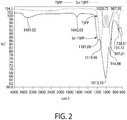
- FTIR-ATR analysis is conducted on solid on an extended range Spectrum One Perkin Elmer system featuring a CsI beam splitter, DTGS detector, and single-bounce diamond KRS-5 ATR crystal. Sample is placed directly on the ATR diamond. See Figure 2 .
- An FTIR-ATR for solid SnF 2 is in Figure 5 .
- FTIR-ATR analysis may be conducted on about 10-100 mg of solid.
- a 2% SnF 2 solution with TSPP at a P:Sn molar ratio of 1 is prepared in a 50 mL centrifuge vial according to the following: 0.8 g SnF 2 , 0.5 g TSPP, 40 g total (with H 2 O). Vortex and sonicate until solution is clear. Roughly 32.5 mL is left in the centrifuge vial while the rest is transferred to a scintillation vial. To the 32.5 mL, 18 g 100% EtOH is added, yielding an opaque solution that settles a white precipitate to the bottom. The solution becomes opaque once > 13.58 g EtOH is added. The sample is left overnight at room temperature. The solid is centrifuged, decanted, and washed with EtOH.
- Solutions of 2% SnF 2 and TSPP in water with P/Sn molar ratios of 1, 2, and 5 are prepared. 5 weight % D 2 O is added to the solutions.
- 31 P and 119 Sn NMR are acquired on a Bruker AVANCE 500 spectrometer working at 202.4 MHz for 31 P NMR and 163.5 MHz for 119 Sn NMR at room temperature.
- 31 P NMR are externally referenced to 85% H 3 PO 4 set to 0 ppm.
- 119 Sn NMR are externally referenced to saturated SnF 2 in D 2 O at -796 ppm prepared right before measurement.
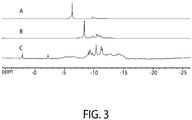
- Figures 3a, 3b, and 3c depict 31 P NMR spectra of solutions with P:Sn molar ratios of 5 ( Figure 3a ), 2 ( Figure 3b ), and 1 ( Figure 3c ).
- Figures 4a, 4b, and 4c depict 119 Sn NMR spectra of solutions with P:Sn molar ratios of 5 ( Figure 4a ), 2 ( Figure 4b ), and 1 ( Figure 4c ).
- 31 P NMR peaks are listed in Table 8 and 119 Sn NMR peaks are listed in Table 9.
- a 31 P NMR spectrum of a solution of TSPP in water with 5 weight % D 2 O added and externally referenced to 85% H 3 PO 4 set to 0 ppm is in Figure 7 .
- a roll-on antiperspirant comprising the aqueous soluble tin phosphate complex as disclosed herein can be formulated as described in Table 10 (below).
- Table 10 Material Weight Percent Aqueous soluble tin phosphate complex 5-30% Surfactant(s) 1-30%, e.g., 5% Emollient(s) 1-10%, e.g, 2% Silicone(s) 1-10%, e.g., 2% Fragrance(s) 0.5-5%, e.g., 1% Water Q.S.
- TSPP Tetrasodium Pyrophosphate
- Solutions are prepared by dissolving TSPP in deionized water (mixing under heat if necessary) and then adding 0.6 g of SnCl 2 • 2H 2 O to make 20-gram solutions.
- the solutions with a P/Sn molar ratio spanning from 0.5 to 5 containing 3% SnCl 2 • 2H 2 O are aged overnight at room temperature.
- a 3% SnCl 2 • 2H 2 O solution is used as a control.
- the control, 0.5:1, and 1:1 solutions each form a cloudy precipitate that settles after aging overnight.
- the 2:1 and 5:1 solutions form crystals immediately after the addition of SnCl 2 • 2H 2 O. The crystals dissolve after aging for one week.
- TKPP Tetraspotassium Pyrophosphate
- Solutions are prepared by dissolving TKPP in deionized water (mixing under heat if necessary) and then adding 0.6 g SnCl 2 • 2H 2 O to make 20-g solutions.
- the solutions with a P/Sn molar ratio spanning from 0.5 to 5 containing 3% SnCl 2 • 2H 2 O are aged overnight at room temperature.
- a 3% SnCl 2 • 2H 2 O solution is used as a control.
- the control, 0.5:1, and 1:1 solutions each form a cloudy precipitate that settles after aging overnight.
- the 2:1 solution forms a precipitate that settles immediately.
- the 5:1, 10:1, and 15:1 solutions are mostly clear with a small amount (decreasing as phosphate amount increases) of precipitate at the bottom of each vial. The amount of precipitate decreases after aging, but the precipitate never fully dissolves.
Landscapes
- Life Sciences & Earth Sciences (AREA)
- Health & Medical Sciences (AREA)
- Animal Behavior & Ethology (AREA)
- General Health & Medical Sciences (AREA)
- Public Health (AREA)
- Veterinary Medicine (AREA)
- Chemical & Material Sciences (AREA)
- Inorganic Chemistry (AREA)
- Birds (AREA)
- Epidemiology (AREA)
- Cosmetics (AREA)
Description
- This application claims priority to U.S. Provisional Application No.
62/273,315 filed December 30, 2015 - There have been many antiperspirants designed to help people reduce sweat. Examples of these can be found in U.S. Code of
Regulation 21 C.F.R. § 350. The majority of the active agents used in antiperspirants are aluminum and zirconium halide compounds and complexes and their derivatives. While these active agents are generally effective, there is still a need for alternative antiperspirant actives. - Tin (II) fluoride (also known as stannous fluoride) is soluble in water, however, it oxidizes to form insoluble precipitates of tin. In addition, tin can form insoluble compounds with phosphates. Thus, there is still a need for methods to stabilize tin (II) fluoride to make it effective in personal care products. Embodiments of the present invention are designed to meet these, and other, needs.
- It has now been discovered that tin (II) fluoride forms an aqueous soluble tin phosphate complex upon mixture with a pyrophosphate salt, e.g., tetrapotassium pyrophosphate (K4P2O7) (TKPP) or tetrasodium pyrophosphate (Na4P2O7) (TSPP). In contrast, tin (II) chloride upon mixture with a pyrophosphate salt, e.g., tetrapotassium pyrophosphate (K4P2O7.) (TKPP) or tetrasodium pyrophosphate (Na4P2O7) (TSPP), forms solid (Examples 8 and 9).
- Without being bound by theory, it is believed that when the complex is contacted with proteins to simulate sweat, the aqueous soluble tin phosphate complex forms a white precipitate, which may be an appropriate occlusive active for wetness control because it forms plugs that can physically inhibit sweat from skin.
- The invention is defined in the appended claims.
- Provided is an aqueous soluble tin phosphate complex, e.g., formed from a mixture comprising tin (II) fluoride and a pyrophosphate salt, e.g., an alkali pyrophosphate salt, e.g., tetrapotassium pyrophosphate (K4P2O7.) (TKPP) or tetrasodium pyrophosphate (Na4P2O7) (TSPP).
- Also provided are external personal care compositions, e.g., antiperspirants and/or deodorants, comprising the aqueous soluble tin phosphate complex.
- Further provided are antiperspirants and/or deodorants comprising the aqueous soluble tin phosphate complex that form a precipitate when contacted with sweat.
- Further provided are external personal care compositions, e.g., antiperspirants and/or deodorants, comprising tin (II) fluoride and a pyrophosphate salt, e.g., an alkali pyrophosphate salt, e.g., tetrapotassium pyrophosphate (K4P2O7) (TKPP) or tetrasodium pyrophosphate (Na4P2O7) (TSPP), e.g., tetrapotassium pyrophosphate (K4P2O7), e.g., tetrasodium pyrophosphate (Na4P2O7) (TSPP), wherein the tin (II) fluoride and pyrophosphate salt form an aqueous soluble tin phosphate complex.
- Further provided are methods of using the external personal care compositions, e.g., antiperspirants, to occlude pores and/or reduce sweat in a person in need thereof comprising applying the composition to the skin of the person.
- Further provided are methods of making the aqueous soluble tin phosphate complex comprising combining tin (II) fluoride and a pyrophosphate salt, e.g., an alkali pyrophosphate salt, e.g., tetrapotassium pyrophosphate (K4P2O7) (TKPP) or tetrasodium pyrophosphate (Na4P2O7) (TSPP), in aqueous solution, e.g., at a molar ratio of at least 1P : 1Sn, e.g., 1P : 1Sn to 15P : 1Sn, e.g., 1P : 1Sn to less than 15P : 1Sn, e.g., 1P: 1Sn to 10P : 1Sn, e.g., 1P : 1Sn to less than 10P : 1Sn, e.g., 1P : 1Sn to 5P : 1Sn, e.g., 1P : 1Sn to less than 5P : 1Sn, e.g., 1P : 1Sn to 2P : 1Sn, e.g., 1P : 1Sn, e.g., 2P : 1Sn, e.g., 5P : 1Sn, e.g., 10P : 1Sn, e.g., 15P : 1Sn, optionally isolating the complex thus formed as a solid.
- Further provided are methods of making the external personal care compositions, e.g., antiperspirants, comprising admixing the aqueous soluble tin phosphate complex with a personal care carrier.
- Further areas of applicability of the present invention will become apparent from the detailed description provided hereinafter. It should be understood that the detailed description and specific examples, while indicating preferred embodiments of the invention, are intended for purposes of illustration only and are not intended to limit the scope of the invention.
- The present invention will become more fully understood from the detailed description and the accompanying drawings, wherein:
-
Figure 1 depicts Fourier transform infrared spectra. -
Figure 2 depicts Fourier transform infrared spectra. -
Figures 3a, 3b, and 3c depict 31P NMR spectra of solutions with P:Sn molar ratios of 5 (Figure 3a ), 2 (Figure 3b ), and1 (Figure 3c ). -
Figures 4a, 4b, and 4c depict 119Sn NMR spectra of solutions with P:Sn molar ratios of 5 (Figure 4a ), 2 (Figure 4b ), and1 (Figure 4c ). -
Figure 5 is a Fourier transform infrared spectrum of SnF2. -
Figure 6 depicts Raman spectra of water and solutions with P:Sn molar ratios of 1, 2, and 5 (from top to bottom: P:Sn molar ratio 5, P:Sn molar ratio 2, P:Sn molar ratio 1, and water). -
Figure 7 depicts a 31P NMR spectrum of a solution of TSPP. - The following description of the preferred embodiment(s) is merely exemplary in nature and is in no way intended to limit the invention, its application, or uses.
- As used throughout, ranges are used as shorthand for describing each and every value that is within the range. Any value within the range can be selected as the terminus of the range. In the event of a conflict in a definition in the present disclosure and that of a cited reference, the present disclosure controls.
- Unless otherwise specified, all percentages and amounts expressed herein and elsewhere in the specification should be understood to refer to percentages by weight. The amounts given are based on the active weight of the material.
- Provided is an aqueous soluble tin phosphate complex (Complex 1), e.g.,
- 1.1
Complex 1, wherein the complex is formed from a mixture comprising tin (11) fluoride and a pyrophosphate salt, e.g., an alkali pyrophosphate salt, e.g., tetrapotassium pyrophosphate or tetrasodium pyrophosphate. - 1.2
Complex 1 or 1.1, wherein the complex is formed from a mixture comprising tin (II) fluoride and a pyrophosphate salt, e.g., an alkali pyrophosphate salt, e.g., tetrapotassium pyrophosphate or tetrasodium pyrophosphate, in an aqueous solution. - 1.3 Complex 1.2, wherein the aqueous solution has a pH from 5-11, e.g., 5-10, e.g., 5-9, e.g., 5-8, e.g., 5-7, e.g., 5-6, e.g., 6-8, e.g., 6-7, e.g., 8-9, e.g., 9-10, e.g., 10-11. Complex 1.2, wherein the pyrophosphate salt is tetrapotassium pyrophosphate and the aqueous solution has a pH from 5-11, e.g., 5-10, e.g., 5-9, e.g., 5-8, e.g., 5-7, e.g., 5-6, e.g., 6-8, e.g., 6-7, e.g., 9-10, e.g., 10-11. Complex 1.2, wherein the pyrophosphate salt is tetrasodium pyrophosphate and the aqueous solution has a pH from 5-9, e.g., 5-8, e.g., 5-7, e.g., 5-6, e.g., 6-8, e.g., 6-7, e.g., 8-9.
- 1.4 Any of the foregoing complexes, wherein the complex is formed from a mixture comprising the tin (II) fluoride and pyrophosphate salt in a molar ratio of at least 1P : 1Sn, e.g., 1P : 1Sn to 15P : 1Sn, e.g., 1P : 1Sn to less than 15P : 1Sn, e.g., 1P : 1Sn to 10P : 1Sn, e.g., 1P : 1Sn to less than 10P: 1Sn, e.g., 1P: 1Sn to 5P : 1Sn, e.g., 1P: 1Sn to less than 5P : 1Sn, e.g., 1P : 1Sn to 2P : 1Sn, e.g., 1P : 1Sn, e.g., 2P : 1Sn, e.g., 5P : 1Sn, e.g., 10P : 1Sn, e.g., 15P: 1Sn.
- 1.5 Any of the foregoing complexes, wherein the complex is formed from a mixture comprising the tin (II) fluoride and pyrophosphate salt in a molar ratio of 1P : 1Sn to 15P : 1Sn, e.g., 1P : 1Sn to 10P : 1Sn, e.g., 1P : 1Sn to less than 10P : 1Sn, e.g., 1P : 1Sn to 5P : 1Sn, e.g., 1P : 1Sn to 2P : 1Sn, e.g., 1P : 1Sn, e.g., 2P : 1Sn, e.g., 5P : 1Sn, e.g., 10P : 1Sn, e.g., 15P: 1Sn.
- 1.6 Any of the foregoing complexes, wherein the complex is formed from a mixture comprising 1-10 weight % tin (II) fluoride by weight of the mixture, e.g., 1-9 weight % tin (II) fluoride by weight of the mixture, e.g., 2 weight % tin (II) fluoride by weight of the mixture, and 1-40 weight % pyrophosphate salt by weight of the mixture, e.g., 1-30 weight % pyrophosphate salt by weight of the mixture, e.g., 1-20 weight % pyrophosphate salt by weight of the mixture, e.g., 1-10 weight % pyrophosphate salt by weight of the mixture.
- 1.7 Any of the foregoing complexes, wherein the complex is formed from a mixture comprising tin (II) fluoride and tetrapotassium pyrophosphate (K4P2O7) (TKPP).
- 1.8 Complex 1.7, wherein the complex is formed from a mixture comprising tin (II) fluoride and tetrapotassium pyrophosphate (K4P2O7) (TKPP) in a molar ratio of at least 1P : 1Sn, e.g., 1P : 1Sn to 15P : 1Sn, e.g., 1P : 1Sn to less than 15P: 1Sn, e.g., 1P : 1Sn to 10P : 1Sn, e.g., 1P : 1Sn to less than 10P: 1Sn, e.g., 1P: 1Sn to 5P : 1Sn, e.g., 1P: 1Sn to less than 5P : 1Sn, e.g., 1P : 1Sn to 2P : 1Sn, e.g., 1P : 1Sn, e.g., 2P : 1Sn, e.g., 5P : 1Sn, e.g., 10P : 1Sn, e.g., 15P : 1Sn.
- 1.9 Complex 1.7 or 1.8, wherein the complex is formed from a mixture comprising 1-10 weight % tin (II) fluoride by weight of the mixture, e.g., 1-9 weight % tin (II) fluoride by weight of the mixture, e.g., 2 weight % tin (II) fluoride by weight of the mixture, and 1-40 weight % tetrapotassium pyrophosphate by weight of the mixture, e.g., 1-30 weight % tetrapotassium pyrophosphate by weight of the mixture, e.g., 1-20 weight % tetrapotassium pyrophosphate by weight of the mixture, e.g., 1-10 weight % tetrapotassium pyrophosphate by weight of the mixture.
- 1.10 Any of
Complex 1 or 1.1-1.6, wherein the complex is formed from a mixture comprising tin (II) fluoride and tetrasodium pyrophosphate. - 1.11 Complex 1.10, wherein the complex is formed from a mixture comprising tin (II) fluoride and tetrasodium pyrophosphate in a molar ratio of 1P : 1Sn to 10P : 1Sn, e.g., 1P : 1Sn to less than 10P : 1Sn, e.g., 1P : 1Sn to 5P : 1Sn, e.g., 1P : 1Sn to less than 5P : 1Sn, e.g., 1P : 1Sn to 2P : 1Sn, e.g., 1P: 1Sn, e.g., 2P : 1Sn, e.g., 5P: 1Sn.
- 1.12 Complex 1.10 or 1.11, wherein the complex is formed from a mixture comprising 1-10 weight % tin (II) fluoride by weight of the mixture, e.g., 1-9 weight % tin (II) fluoride by weight of the mixture, e.g., 2 weight % tin (II) fluoride by weight of the mixture, and 1-30 weight % tetrasodium pyrophosphate by weight of the mixture, e.g., 1-20 weight % tetrasodium pyrophosphate by weight of the mixture, e.g., 1-10 weight % tetrasodium pyrophosphate by weight of the mixture.
- 1.13 Any of the foregoing complexes, wherein the complex exhibits a Fourier transform infrared spectrum substantially as shown in the Sn-TSPP spectrum in
Figure 1 . - 1.14 Any of the foregoing complexes, wherein the complex exhibits a Fourier transform infrared spectrum substantially as shown in the Sn-TSPP spectrum in
Figure 2 . - 1.15 Any of the foregoing complexes, wherein the complex exhibits a Fourier transform infrared spectrum comprising one or more peaks selected from the group consisting of: 1181 cm-1, 1013 cm-1, 915 cm-1, and 739 cm-1.
- 1.16 Any of the foregoing complexes, wherein the complex exhibits a Fourier transform infrared spectrum comprising one or more peaks selected from the group consisting of: 3401 cm-1, 1642 cm-1, 1181 cm-1, 1013 cm-1, 915 cm-1, and 739 cm-1.
- 1.17 Any of the foregoing complexes, wherein the complex exhibits a Fourier transform infrared spectrum comprising the following peaks: 1181 cm-1, 1013 cm-1, 915 cm-1, and 739 cm-1.
- 1.18 Any of the foregoing complexes, wherein the complex exhibits a Fourier transform infrared spectrum comprising the following peaks: 3401 cm-1, 1642 cm-1, 1181 cm-1, 1013 cm-1, 915 cm-1 and 739 cm-1
- 1.19 Any of the foregoing complexes, wherein the complex exhibits a Fourier transform infrared spectrum comprising one or more peaks selected from the group consisting of: 1101 cm-1, 1081 cm-1 979 cm-1, 722 cm-1, 546 cm-1, and 481 cm-1.
- 1.20 Any of the foregoing complexes, wherein the complex exhibits a Fourier transform infrared spectrum comprising the following peaks: 1101 cm-1, 1081 cm-1, 979 cm-1, 722 cm-1, 546 cm-1, and 481 cm-1.
- 1.21 Any of the foregoing complexes, wherein the complex exhibits a Fourier transform infrared spectrum comprising one or more peaks selected from the group consisting of: 1101 cm-1, 1081 cm-1, 979 cm-1, 881 cm-1, 722 cm-1, 546 cm-1, and 481 cm-1.
- 1.22 Any of the foregoing complexes, wherein the complex exhibits a Fourier transform infrared spectrum comprising the following peaks: 1101 cm-1, 1081 cm-1, 979 cm-1, 881 cm-1, 722 cm-1, 546 cm-1, and 481 cm-1.
- 1.23 Any of the foregoing complexes, wherein the complex exhibits a Raman spectrum substantially as shown in any of the P/Sn Raman spectra of
Figure 6 . - 1.24 Any of the foregoing complexes, wherein the complex exhibits a Raman spectrum comprising a peak at 1022 cm-1.
- 1.25 Any of the foregoing complexes, wherein the complex exhibits a 31P NMR spectrum as shown in any of the NMR spectra of
Figure 3a, 3b, or 3c , wherein the NMR spectrum is obtained on an aqueous solution with 5 weight % D2O added and is externally referenced to 85% H3PO4 set to 0 ppm. - 1.26 Any of the foregoing complexes, wherein the complex exhibits a 31P NMR spectrum comprising the following peak: -6 ppm, e.g., -6.3 ppm, e.g., -6.30 ppm, wherein the NMR spectrum is obtained on an aqueous solution with 5 weight % D2O added and is externally referenced to 85% H3PO4 set to 0 ppm.
- 1.27 Any of the foregoing complexes, wherein the complex exhibits a 31P NMR spectrum comprising one or more peaks selected from the group consisting of: -6 ppm, -10 ppm, and -10 ppm (doublet), e.g., -6.3 ppm, -9.8 ppm, -10.2 ppm (doublet), and -10.3 ppm (doublet), e.g., -6.30 ppm, -9.82 ppm, -10.23 ppm (doublet), and -10.31 ppm (doublet), wherein the NMR spectrum is obtained on an aqueous solution with 5 weight % D2O added and is externally referenced to 85% H3PO4 set to 0 ppm.
- 1.28 Any of the foregoing complexes, wherein the complex exhibits a 31P NMR spectrum comprising the following peaks: -6 ppm, -10 ppm, and -10 ppm (doublet), e.g., -6.3 ppm, -9.8 ppm, -10.2 ppm (doublet), and -10.3 ppm (doublet), e.g., -6.30 ppm, -9.82 ppm, -10.23 ppm (doublet), and -10.31 ppm (doublet), wherein the NMR spectrum is obtained on an aqueous solution with 5 weight % D2O added and is externally referenced to 85% H3PO4 set to 0 ppm.
- 1.29 Any of the foregoing complexes, wherein the complex exhibits a 31P NMR spectrum comprising the following peak: -8 ppm, e.g., -8.3 ppm, e.g., -8.34 ppm, wherein the NMR spectrum is obtained on an aqueous solution with 5 weight % D2O added and is externally referenced to 85% H3PO4 set to 0 ppm.
- 1.30 Any of the foregoing complexes, wherein the complex exhibits a 31P NMR spectrum comprising one or more peaks selected from the group consisting of: -8 ppm, -10 ppm, and -11 ppm, e.g., -8.3 ppm, -9.8 ppm, -10.5 ppm, -10.7 ppm, and -11.1 ppm, e.g., -8.34 ppm, -9.78 ppm, -10.49 ppm, -10.69 ppm, and -11.09 ppm, wherein the NMR spectrum is obtained on an aqueous solution with 5 weight % D2O added and is externally referenced to 85% H3PO4 set to 0 ppm.
- 1.31 Any of the foregoing complexes, wherein the complex exhibits a 31P NMR spectrum comprising the following peaks: -8 ppm, -10 ppm, and -11 ppm, e.g., -8.3 ppm, -9.8 ppm, -10.5 ppm, -10.7 ppm, and -11.1 ppm, e.g., -8.34 ppm, -9.78 ppm, -10.49 ppm, -10.69 ppm, and -11.09 ppm, wherein the NMR spectrum is obtained on an aqueous solution with 5 weight % D2O added and is externally referenced to 85% H3PO4 set to 0 ppm.
- 1.32 Any of the foregoing complexes, wherein the complex exhibits a 31P NMR spectrum comprising one or more peaks selected from the group consisting of: 2 ppm, -9 ppm, -10 ppm, -11 ppm, -13 ppm, and -14 ppm, e.g., 2.1 ppm, 2.2 ppm, -9.0 ppm, -9.3 ppm, -9.7 ppm, -10.4 ppm, -11.2 ppm, -11.4 ppm, -12.8 ppm, and -14.4 ppm, e.g., 2.10 ppm, 2.22 ppm, -9.03 ppm, -9.31 ppm, -9.65 ppm, -9.74 ppm, -10.36 ppm, -11.22 ppm, -11.40 ppm, -12.77 ppm, and -14.35 ppm, wherein the NMR spectrum is obtained on an aqueous solution with 5 weight % D2O added and is externally referenced to 85% H3PO4 set to 0 ppm.
- 1.33 Any of the foregoing complexes, wherein the complex exhibits a 31P NMR spectrum comprising the following peaks: 2 ppm, -9 ppm, -10 ppm, -11 ppm, -13 ppm, and -14 ppm, e.g., 2.1 ppm, 2.2 ppm, -9.0 ppm, -9.3 ppm, -9.7 ppm, -10.4 ppm, -11.2 ppm, -11.4 ppm, -12.8 ppm, and -14.4 ppm, e.g., 2.10 ppm, 2.22 ppm, -9.03 ppm, -9.31 ppm, -9.65 ppm, -9.74 ppm, -10.36 ppm, -11.22 ppm, -11.40 ppm, -12.77 ppm, and -14.35 ppm, wherein the NMR spectrum is obtained on an aqueous solution with 5 weight % D2O added and is externally referenced to 85% H3PO4 set to 0 ppm.
- 1.34 Any of the foregoing complexes, wherein the complex exhibits a 119Sn NMR spectrum as shown in any of the NMR spectra of
Figure 4a, 4b, or 4c , wherein the NMR spectrum is obtained on an aqueous solution with 5 weight % D2O added and is externally referenced to saturated SnF2 in D2O at -796 ppm. - 1.35 Any of the foregoing complexes, wherein the complex exhibits a 119Sn NMR spectrum comprising the following peak: -641 ppm, e.g., -640.6 ppm, e.g., -640.63 ppm, wherein the NMR spectrum is obtained on an aqueous solution with 5 weight % D2O added and is externally referenced to saturated SnF2 at -796 ppm.
- 1.36 Any of the foregoing complexes, wherein the complex exhibits a 119Sn NMR spectrum comprising one or more peaks selected from the group consisting of: -641 ppm, -687 ppm, and -694 ppm, e.g., -640.6 ppm, -686.6 ppm, and -693.8 ppm, e.g., -640.63 ppm, -686.58 ppm, and -693.76 ppm, wherein the NMR spectrum is obtained on an aqueous solution with 5 weight % D2O added and is externally referenced to saturated SnF2 at -796 ppm.
- 1.37 Any of the foregoing complexes, wherein the complex exhibits a 119Sn NMR spectrum comprising the following peaks: -641 ppm, -687 ppm, and -694 ppm, e.g., -640.6 ppm, -686.6 ppm, and -693.8 ppm, e.g., -640.63 ppm, -686.58 ppm, and -693.76 ppm, wherein the NMR spectrum is obtained on an aqueous solution with 5 weight % D2O added and is externally referenced to saturated SnF2 in D2O at -796 ppm.
- 1.38 Any of the foregoing complexes, wherein the complex exhibits a 119Sn NMR spectrum comprising the following peak: -642 ppm, e.g., -642.4 ppm, e.g., -642.35 ppm, wherein the NMR spectrum is obtained on an aqueous solution with 5 weight % D2O added and is externally referenced to saturated SnF2 at -796 ppm.
- 1.39 Any of the foregoing complexes, wherein the complex exhibits a 119Sn NMR spectrum comprising one or more peaks selected from the group consisting of: -642 ppm, -679 ppm, and -725 ppm, e.g., -642.4 ppm, -678.8 ppm, and -724.6 ppm, e.g., -642.35 ppm, -678.79 ppm, and -724.61 ppm, wherein the NMR spectrum is obtained on an aqueous solution with 5 weight % D2O added and is externally referenced to saturated SnF2 at -796 ppm.
- 1.40 Any of the foregoing complexes, wherein the complex exhibits a 119Sn NMR spectrum comprising the following peaks: -642 ppm, -679 ppm, and -725 ppm, e.g., -642.4 ppm, -678.8 ppm, and -724.6 ppm, e.g., -642.35 ppm, -678.79 ppm, and -724.61 ppm, wherein the NMR spectrum is obtained on an aqueous solution with 5 weight % D2O added and is externally referenced to saturated SnF2 in D2O at -796 ppm.
- 1.41 Any of the foregoing complexes, wherein the complex exhibits a 119Sn NMR spectrum comprising one or more peaks selected from the group consisting of: -673 ppm, -686 ppm, -696 ppm, -706 ppm, -735 ppm, -743 ppm, -748 ppm, -755 ppm, -764 ppm, -767 ppm, -774 ppm, -805 ppm, -813 ppm, and -821 ppm, e.g., -673.0 ppm, -686.4 ppm, -696.1 ppm, -705.8 ppm, -734.9 ppm, -742.9 ppm, -747.9 ppm, -755.0 ppm, -764.4 ppm, -766.7 ppm, -773.8 ppm, -804.8 ppm, -813.1 ppm, and -821.5 ppm, e.g., -672.97 ppm, -686.36 ppm, -696.08 ppm, -705.84 ppm, -734.85 ppm, -742.85 ppm, -747.93 ppm, -754.99 ppm, -764.39 ppm, -766.74 ppm, -773.79 ppm, -804.84 ppm, -813.14 ppm, and -821.45 ppm, wherein the NMR spectrum is obtained on an aqueous solution with 5 weight % D2O added and is externally referenced to saturated SnF2 at -796 ppm.
- 1.42 Any of the foregoing complexes, wherein the complex exhibits a 119Sn NMR spectrum comprising the following peaks: -673 ppm, -686 ppm, -696 ppm, -706 ppm, -735 ppm, -743 ppm, -748 ppm, -755 ppm, -764 ppm, -767 ppm, -774 ppm, -805 ppm, -813 ppm, and -821 ppm, e.g., -673.0 ppm, -686.4 ppm, -696.1 ppm, -705.8 ppm, -734.9 ppm, -742.9 ppm, -747.9 ppm, -755.0 ppm, -764.4 ppm, -766.7 ppm, -773.8 ppm, -804.8 ppm, -813.1 ppm, and -821.5 ppm, e.g., -672.97 ppm, -686.36 ppm, -696.08 ppm, -705.84 ppm, -734.85 ppm, -742.85 ppm, -747.93 ppm, -754.99 ppm, -764.39 ppm, -766.74 ppm, -773.79 ppm, -804.84 ppm, -813.14 ppm, and -821.45 ppm, wherein the NMR spectrum is obtained on an aqueous solution with 5 weight % D2O added and is externally referenced to saturated SnF2 in D2O at -796 ppm.
- 1.43 Any of the foregoing complexes, wherein the complex is [P2O7]4-Na+Sn2+F-.
- 1.44 Any of the foregoing complexes, wherein the complex is isolated.
- 1.45 Any of the foregoing complexes, wherein the complex is lyophilized.
- 1.46 Any of the foregoing complexes, wherein the complex is isolated with an anti-solvent, e.g., an organic solvent, e.g., ethanol.
- 1.47 Any of the foregoing complexes for use in an external personal care composition, e.g., an antiperspirant, deodorant, body wash, shower gel, soap (e.g., bar soap, hand soap), shampoo, hair conditioner, or cosmetic, e.g., an antiperspirant and/or deodorant comprising the aqueous soluble tin phosphate complex as described in any of the foregoing, e.g., a body wash or soap (e.g., hand soap) comprising the aqueous soluble tin phosphate complex as described in any of the foregoing.
- 1.48 Any of the foregoing complexes for use to occlude pores.
- 1.49 Any of the foregoing complexes for use to reduce sweat.
- Further provided is a method (Method 1) to occlude pores and/or reduce sweat, in a person in need thereof comprising applying an effective amount of any of
Complex 1 et seq. to the skin of the person. - Further provided is a method (Method 2) of making an aqueous soluble tin phosphate complex, e.g., any of
Complex 1 et seq., comprising combining tin (II) fluoride and a pyrophosphate salt, e.g., an alkali pyrophosphate salt, e.g., tetrapotassium pyrophosphate (K4P2O7) (TKPP) or tetrasodium pyrophosphate (Na4P2O7) (TSPP), e.g., - 2.1
Method 2 comprising combining the tin (II) fluoride and pyrophosphate salt, e.g., alkali pyrophosphate salt, in an aqueous solution. - 2.2 Method 2.1, wherein the aqueous solution has a pH from 5-11, e.g., 5-10, e.g., 5-9, e.g., 5-8, e.g., 5-7, e.g., 5-6, e.g., 6-8, e.g., 6-7, e.g., 8-9, e.g., 9-10, e.g., 10-11. Method 2.1, wherein the pyrophosphate salt is tetrapotassium pyrophosphate and the aqueous solution has a pH from 5-11, e.g., 5-10, e.g., 5-9, e.g., 5-8, e.g., 5-7, e.g., 5-6, e.g., 6-8, e.g., 6-7, e.g., 9-10, e.g., 10-11. Method 2.1, wherein the pyrophosphate salt is tetrasodium pyrophosphate and the aqueous solution has a pH from 5-9, e.g., 5-8, e.g., 5-7, e.g., 5-6, e.g., 6-8, e.g., 6-7, e.g., 8-9.
- 2.3 Any of the foregoing methods comprising combining the tin (II) fluoride and pyrophosphate salt in a molar ratio of at least 1P : 1Sn, e.g., 1P: 1Sn to 15P : 1Sn, e.g., 1P : 1Sn to less than 15P : 1Sn, e.g., 1P : 1Sn to 10P : 1Sn, e.g., 1P: 1Sn to less than 10P : 1Sn, e.g., 1P: 1Sn to 5P : 1Sn, e.g., 1P : 1Sn to less than 5P : 1Sn, e.g., 1P : 1Sn to 2P : 1Sn, e.g., 1P: 1Sn, e.g., 2P : 1Sn, e.g., 5P : 1Sn, e.g., 10P : 1Sn, e.g., 15P : 1Sn.
- 2.4 Any of the foregoing methods comprising combining the tin (II) fluoride and pyrophosphate salt in a molar ratio of 1P : 1Sn to 15P : 1Sn, e.g., 1P : 1Sn to 10P : 1Sn, e.g., 1P: 1Sn to less than 10P: 1Sn, e.g., 1P: 1Sn to 5P: 1Sn, e.g., 1P : 1Sn to 2P: 1Sn, e.g., 1P : 1Sn, e.g., 2P : 1Sn, e.g., 5P : 1Sn, e.g., 10P: 1Sn, e.g., 15P : 1Sn.
- 2.5 Any of the foregoing methods comprising combining 1-10 weight % tin (II) fluoride by weight of the combination, e.g., 1-9 weight % tin (II) fluoride by weight of the combination, e.g., 2 weight % tin (II) fluoride by weight of the combination, and 1-40 weight % pyrophosphate salt by weight of the combination, e.g., 1-30 weight % pyrophosphate salt by weight of the combination, e.g., 1-20 weight % pyrophosphate salt by weight of the combination, e.g., 1-10 weight % pyrophosphate salt by weight of the combination.
- 2.6 Any of the foregoing methods, wherein the pyrophosphate salt is tetrapotassium pyrophosphate (K4P2O7).
- 2.7 Method 2.6 comprising combining the tin (II) fluoride and tetrapotassium pyrophosphate in a molar ratio of at least 1P : 1Sn, e.g., 1P : 1Sn to 15P : 1Sn, e.g., 1P : 1Sn to less than 15P : 1Sn, e.g., 1P : 1Sn to 10P : 1Sn, e.g., 1P : 1Sn to less than 10P : 1Sn, e.g., 1P : 1Sn to 5P : 1Sn, e.g., 1P : 1Sn to less than 5P : 1Sn, e.g., 1P : 1Sn to 2P : 1Sn, e.g., 1P : 1Sn, e.g., 2P : 1Sn, e.g., 5P : 1Sn, e.g., 10P: 1Sn, e.g., 15P : 1Sn.
- 2.8 Method 2.6 or 2.7 comprising combining 1-10 weight % tin (II) fluoride by weight of the combination, e.g., 1-9 weight % tin (II) fluoride by weight of the combination, e.g., 2 weight % tin (II) fluoride by weight of the combination, and 1-40 weight % tetrapotassium pyrophosphate by weight of the combination, e.g., 1-30 weight % tetrapotassium pyrophosphate by weight of the combination, e.g., 1-20 weight % tetrapotassium pyrophosphate by weight of the combination, e.g., 1-10 weight % tetrapotassium pyrophosphate by weight of the combination.
- 2.9 Any of
Method 2 or 2.1-2.5, wherein the pyrophosphate salt is tetrasodium pyrophosphate (Na4P2O7). - 2.10 Method 2.9 comprising combining the tin (II) fluoride and tetrasodium pyrophosphate in a molar ratio of 1P : 1Sn to 10P : 1Sn, e.g., 1P : 1Sn to less than 10P : 1Sn, e.g., 1P : 1Sn to 5P : 1Sn, e.g., 1P : 1Sn to less than 5P : 1Sn, e.g., 1P : 1Sn to 2P : 1Sn, e.g., 1P : 1Sn, e.g., 2P: 1Sn, e.g., 5P : 1Sn.
- 2.11 Method 2.9 or 2.10 comprising combining 1-10 weight % tin (II) fluoride by weight of the combination, e.g., 1-9 weight % tin (II) fluoride by weight of the combination, e.g., 2 weight % tin (II) fluoride by weight of the combination, and 1-30 weight % tetrasodium pyrophosphate by weight of the combination, e.g., 1-20 weight % tetrasodium pyrophosphate by weight of the combination, e.g., 1-10 weight % tetrasodium pyrophosphate by weight of the combination.
- 2.12 Any of the foregoing methods comprising isolating the complex in solid form.
- 2.13 Any of the foregoing methods comprising lyophilizing the complex.
- 2.14 Any of the foregoing methods comprising isolating the complex with an anti-solvent, e.g., an organic solvent, e.g., ethanol.
- 2.15 An external personal care composition, e.g., an antiperspirant, deodorant, body wash, shower gel, soap (e.g., bar soap, hand soap), shampoo, hair conditioner, or cosmetic, e.g., an antiperspirant and/or deodorant, comprising an aqueous soluble tin phosphate complex made as described in any of the foregoing methods, e.g., a body wash or soap (e.g., hand soap) comprising an aqueous soluble tin phosphate complex made as described in any of the foregoing methods.
- Further provided is an aqueous soluble tin phosphate complex made by any of
Method 2 et seq. - Further provided is an external personal care composition (Composition 1), e.g., an antiperspirant, deodorant, body wash, shower gel, soap (e.g., bar soap, hand soap), shampoo, hair conditioner, or cosmetic, comprising tin (II) fluoride and a pyrophosphate salt, e.g., an alkali pyrophosphate salt, e.g., tetrapotassium pyrophosphate (K4P2O7) or tetrasodium pyrophosphate (Na4P2O7), e.g.,
- 1.1
Composition 1 or 1.1, wherein the tin (II) fluoride and pyrophosphate salt form an aqueous soluble tin phosphate complex, e.g., any ofComplex 1 et seq. - 1.2 Composition 1.1, wherein the complex is formed in the composition in situ.
- 1.3 Composition 1.1, wherein the complex is formed in situ in an aqueous solution and combined with the composition.
- 1.4 Any of Composition 1.1 or 1.3, wherein the complex is combined as a solid with the composition, e.g., wherein the complex is isolated from the aqueous solution in solid form and combined with the composition.
- 1.5 Any of Composition 1.1, 1.3, or 1.4, wherein the complex is lyophilized and combined with the composition.
- 1.6 Any of Composition 1.1 or 1.3-1.5, wherein the complex is isolated with an anti-solvent, e.g., an organic solvent, e.g., ethanol, and combined with the composition.
- 1.7 Any of Composition 1.1-1.6, wherein the complex is made as described in any of
Method 2 et seq. - 1.8 Any of Composition 1.1-1.7, wherein the complex is present in an amount of 5-30 weight % by weight of the composition.
- 1.9 Any of the foregoing compositions, wherein the composition comprises or wherein the complex is formed from the tin (II) fluoride and pyrophosphate salt in a molar ratio of at least 1P: 1Sn, e.g., 1P: 1Sn to 15P: 1Sn, e.g., 1P: 1Sn to less than 15P: 1Sn, e.g., 1P: 1Sn to 10P : ISn, e.g., 1P: 1Sn to less than 10P: 1Sn, e.g., 1P: 1Sn to 5P: 1Sn, e.g., 1P: 1Sn to less than 5P : 1Sn, e.g., 1P : 1Sn to 2P : 1Sn, e.g., 1P : 1Sn, e.g., 2P : 1Sn, e.g., 5P : 1Sn, e.g., 10P : 1Sn, e.g., 15P : 1Sn.
- 1.10 Any of the foregoing compositions, wherein the composition comprises or wherein the complex is formed from the tin (II) fluoride and pyrophosphate salt in a molar ratio of 1P : 1Sn to 15P: 1Sn, e.g., 1P : 1Sn to 10P : 1Sn, e.g., 1P : 1Sn to less than 10P : 1Sn, e.g., 1P : 1Sn to 5P : 1Sn, e.g., 1P : 1Sn to 2P : 1Sn, e.g., 1P : 1Sn, e.g., 2P : 1Sn, e.g., 5P: 1Sn, e.g., 10P: 1Sn, e.g., 15P: 1Sn.
- 1.11 Any of the foregoing compositions, wherein the composition comprises or wherein the complex is formed from a mixture comprising 1-10 weight % tin (II) fluoride by weight of the composition or the mixture, e.g., 1-9 weight % tin (II) fluoride by weight of the composition or the mixture, e.g., 2 weight % tin (II) fluoride by weight of the composition or the mixture, and 1-40 weight % pyrophosphate salt by weight of the composition or the mixture, e.g., 1-30 weight % pyrophosphate salt by weight of the composition or the mixture, e.g., 1-20 weight % pyrophosphate salt by weight of the composition or the mixture, e.g., 1-10 weight % pyrophosphate salt by weight of the composition or the mixture.
- 1.12 Any of the foregoing compositions, wherein the pyrophosphate salt is tetrapotassium pyrophosphate (K4P2O7).
- 1.13 Composition 1.12, wherein the composition comprises or wherein the complex is formed from the tin (II) fluoride and tetrapotassium pyrophosphate in a molar ratio of at least 1P : 1Sn, e.g., 1P : 1Sn to 15P : 1Sn, e.g., 1P : 1Sn to less than 15P : 1Sn, e.g., 1P : 1Sn to 10P : 1Sn, e.g., 1P : 1Sn to less than 10P : 1Sn, e.g., 1P : 1Sn to 5P : 1Sn, e.g., 1P : 1Sn to less than 5P : 1Sn, e.g., 1P : 1Sn to 2P : 1Sn, 1P : 1Sn, e.g., 2P : 1Sn, e.g., 5P : 1Sn, e.g., 10P : 1Sn, e.g., 15P : 1Sn.
- 1.14 Composition 1.12 or 1.13, wherein the composition comprises or wherein the complex is formed from a mixture comprising 1-10 weight % tin (II) fluoride by weight of the composition or the mixture, e.g., 1-9 weight % tin (II) fluoride by weight of the composition or the mixture, e.g., 2 weight % tin (II) fluoride by weight of the composition or the mixture, and 1-40 weight % tetrapotassium pyrophosphate by weight of the composition or the mixture, e.g., 1-30 weight % tetrapotassium pyrophosphate by weight of the composition or the mixture, e.g., 1-20 weight % tetrapotassium pyrophosphate by weight of the composition or the mixture, e.g., 1-10 weight % tetrapotassium pyrophosphate by weight of the composition or the mixture.
- 1.15 Any of
Composition 1 or 1.1-1.11, wherein the pyrophosphate salt is tetrasodium pyrophosphate (Na4P2O7). - 1.16 Composition 1.15, wherein the composition comprises or wherein the complex is formed from the tin (II) fluoride and tetrasodium pyrophosphate in a molar ratio of 1P : 1Sn to 10P : 1Sn, e.g., 1P : 1Sn to less than 10P : 1Sn, e.g., 1P : 1Sn to 5P : 1Sn, e.g., 1P : 1Sn to less than 5P : 1Sn, e.g., 1P: 1Sn to 2P : 1Sn, e.g., 1P : 1Sn, e.g., 2P : 1Sn, e.g., 5P : 1Sn.
- 1.17 Composition 1.15 or 1.16, wherein the composition comprises or wherein the complex is formed from a mixture comprising 1-10 weight % tin (II) fluoride by weight of the composition or the mixture, e.g., 1-9 weight % tin (II) fluoride by weight of the composition or the mixture, e.g., 2 weight % tin (II) fluoride by weight of the composition or the mixture, and 1-30 weight % tetrasodium pyrophosphate by weight of the composition or the mixture, e.g., 1-20 weight % tetrasodium pyrophosphate by weight of the composition or the mixture, e.g., 1-10 weight % tetrasodium pyrophosphate by weight of the composition or the mixture.
- 1.18 Any of the foregoing compositions further comprising another antiperspirant salt comprising a polyvalent cation, e.g., antiperspirant complexes of (i) aluminum and optionally zirconium, (ii) chlorohydrate, and (iii) optionally an amino acid and/or ammonium acid, for example glycine and/or trimethylglycine, e.g., aluminum zirconium tetrachlorohydrex glycine. The complex may enhance the efficacy of the other antiperspirant salt.
- 1.19 Any of
Composition 1 or 1.1-1.17, wherein the composition is entirely or substantially free of aluminum and optionally zirconium. For example, the compositions may include less than 2 weight % by weight of the composition, or less than 0.5 weight % by weight of the composition, or less than 0.1 weight % by weight of the composition, or less than 0.01 weight % by weight of the composition, or less than 0.001 weight % by weight of the composition, or less than 0.0001 weight % by weight of the composition, aluminum or zirconium. - 1.20 Any of the foregoing compositions, wherein the composition comprises an aqueous solution.
- 1.21 Any of the foregoing compositions further comprising 60-85 weight % water by weight of the composition.
- 1.22 Any of the foregoing compositions, wherein the composition has a pH from 5-11, e.g., 5-10, e.g., 5-9, e.g., 5-8, e.g., 5-7, e.g., 5-6, e.g., 6-8 e.g., 6-7, e.g., 8-9, e.g., 9-10, e.g., 10-11.
- 1.23 Any of the foregoing compositions, wherein the pyrophosphate salt is tetrapotassium pyrophosphate and the composition has a pH from 5-11, e.g., 5-10, e.g., 5-9, e.g., 5-8, e.g., 5-7, e.g., 5-6, e.g., 6-8, e.g., 6-7, e.g., 9-10, e.g., 10-11.
- 1.24 Any of
Composition 1 or 1.1-1.22, wherein the pyrophosphate salt is tetrasodium pyrophosphate and the composition has a pH from 5-9, e.g., 5-8, e.g., 5-7, e.g., 5-6, e.g., 6-8, e.g., 6-7, e.g., 8-9. - 1.25 Any of the foregoing compositions, wherein the composition is an antiperspirant.
- 1.26 Any of the foregoing compositions, wherein the composition is a deodorant.
- 1.27 Any of the foregoing compositions, wherein the composition is a body wash or soap (e.g., hand soap).
- 1.28 Any of the foregoing compositions for use to occlude pores.
- 1.29 Any of the foregoing compositions for use to reduce sweat.
- Further provided is a method (Method 3) to occlude pores and/or reduce sweat, in a person in need thereof comprising applying an effective amount of an external personal care composition comprising tin (II) fluoride and a pyrophosphate salt, e.g., an alkali pyrophosphate salt, e.g., tetrapotassium pyrophosphate (K4P2O7) (TKPP) or tetrasodium pyrophosphate (Na4P2O7) (TSPP), e.g., any of
Composition 1 et seq., to the skin of the person, e.g., - 3.1 Method 3, wherein the tin (II) fluoride and pyrophosphate salt, e.g., alkali pyrophosphate salt, form an aqueous soluble tin phosphate complex, e.g., any of
Complex 1 et seq. - 3.2 Method 3.1, wherein the complex is formed in situ in the composition, e.g., wherein the composition has a pH from 5-11, e.g., 5-10, e.g., 5-9, e.g., 5-8, e.g., 5-7, e.g., 5-6, e.g., 6-8, e.g., 6-7, e.g., 8-9, e.g., 9-10, e.g., 10-11. Method 3.1, wherein the pyrophosphate salt is tetrapotassium pyrophosphate and the composition has a pH from 5-11, e.g., 5-10, e.g., 5-9, e.g., 5-8, e.g., 5-7, e.g., 5-6, e.g., 6-8, e.g., 6-7, e.g., 9-10, e.g., 10-11. Method 3.1, wherein the pyrophosphate salt is tetrasodium pyrophosphate and the composition has a pH from 5-9, e.g., 5-8, e.g., 5-7, e.g., 5-6, e.g., 6-8, e.g., 6-7, e.g., 8-9.
- 3.3 Method 3.1, wherein the complex is formed in situ in an aqueous solution and combined with the composition, e.g., wherein the aqueous solution has a pH from 5-11, e.g., 5-10, e.g., 5-9, e.g., 5-8, e.g., 5-7, e.g., 5-6, e.g., 6-8, e.g., 6-7, e.g., 8-9, e.g., 9-10, e.g., 10-11. Method 3.1, wherein the pyrophosphate salt is tetrapotassium pyrophosphate and the aqueous solution has a pH from 5-11, e.g., 5-10, e.g., 5-9, e.g., 5-8, e.g., 5-7, e.g., 5-6, e.g., 6-8, e.g., 6-7, e.g., 9-10, e.g., 10-11. Method 3.1, wherein the pyrophosphate salt is tetrasodium pyrophosphate and the aqueous solution has a pH from 5-9, e.g., 5-8, e.g., 5-7, e.g., 5-6, e.g., 6-8, e.g., 6-7, e.g., 8-9.
- 3.4 Method 3.1 or 3.3, wherein the complex is combined as a solid with the composition, e.g., wherein the complex is isolated from the aqueous solution in solid form and combined with the composition.
- 3.5 Any of Method 3.1, 3.3, or 3.4, wherein the complex is lyophilized and combined with the composition.
- 3.6 Any of Method 3.1 or 3.3-3.5, wherein the complex is isolated with an anti-solvent, e.g., an organic solvent, e.g., ethanol, and combined with the composition.
- 3.7 Any of Method 3.1-3.6, wherein the complex is made as described in any of
Method 2 et seq. - 3.8 Any of Method 3.1-3.7, wherein the complex is present in an amount of 5-30 weight % by weight of the composition.
- 3.9 Any of the foregoing methods, wherein the composition comprises or wherein the complex is formed from the tin (II) fluoride and pyrophosphate salt in a molar ratio of at least 1P : 1Sn, e.g., 1P : 1Sn to 15P : 1Sn, e.g., 1P : 1Sn to less than 15P : 1Sn, e.g., 1P : 1Sn to 10P : 1Sn, e.g., 1P : 1Sn to less than 10P : 1Sn, e.g., 1P : 1Sn to 5P : 1Sn, e.g., 1P : 1Sn to less than 5P : 1Sn, e.g., 1P : 1Sn to 2P : 1Sn, e.g., 1P : 1Sn, e.g., 2P : 1Sn, e.g., 5P : 1Sn, e.g., 10P : 1Sn, e.g., 15P : 1Sn.
- 3.10 Any of the foregoing methods, wherein the composition comprises or wherein the complex is formed from the tin (II) fluoride and pyrophosphate salt in a molar ratio of 1P : 1Sn to 15P : 1Sn, e.g., 1P : 1Sn to 10P : 1Sn, e.g., 1P : 1Sn to less than 10P : 1Sn, e.g., 1P : 1Sn to 5P : 1Sn, e.g., 1P : 1Sn to 2P : 1Sn, e.g., 1P : 1Sn, e.g., 2P : 1Sn, e.g., 5P : 1Sn, e.g., 10P : 1Sn, e.g., 15P : 1Sn.
- 3.11 Any of the foregoing methods, wherein the composition comprises or wherein the complex is formed from a mixture comprising 1-10 weight % tin (II) fluoride by weight of the composition or the mixture, e.g., 1-9 weight % tin (II) fluoride by weight of the composition or the mixture, e.g., 2 weight % tin (II) fluoride by weight of the composition or the mixture, and 1-10 weight % pyrophosphate salt by weight of the composition or the mixture, e.g., 3-4 weight % pyrophosphate salt by weight of the composition or the mixture, e.g., 7-8 weight % pyrophosphate salt by weight of the composition or the mixture.
- 3.12 Any of the foregoing methods, wherein the pyrophosphate salt is tetrapotassium pyrophosphate.
- 3.13 Method 3.12, wherein the composition comprises or wherein the complex is formed from the tin (II) fluoride and tetrapotassium pyrophosphate in a molar ratio of at least 1P : 1Sn, e.g., 1P : 1Sn to 15P : 1Sn, e.g., 1P : 1Sn to less than 15P : 1Sn, e.g., 1P : 1Sn to 10P : 1Sn, e.g., 1P : 1Sn to less than 10P : 1Sn, e.g., 1P : 1Sn to 5P : 1Sn, e.g., 1P : 1Sn to less than 5P : 1Sn, e.g., 1P : 1Sn to 2P : 1Sn, e.g., 1P : 1Sn, e.g., 2P : 1Sn, e.g., 5P : 1Sn, e.g., 10P : 1Sn, e.g., 15P : 1Sn.
- 3.14 Method 3.12 or 3.13, wherein the composition comprises or wherein the complex is formed from a mixture comprising 1-10 weight % tin (II) fluoride by weight of the composition or the mixture, e.g., 1-9 weight % tin (II) fluoride by weight of the composition or the mixture, e.g., 2 weight % tin (II) fluoride by weight of the composition or the mixture, and 1-40 weight % tetrapotassium pyrophosphate by weight of the composition or the mixture, e.g., 1-30 weight % tetrapotassium pyrophosphate by weight of the composition or the mixture, e.g., 1-20 weight % tetrapotassium pyrophosphate by weight of the composition or the mixture, e.g., 1-10 weight % tetrapotassium pyrophosphate by weight of the composition or the mixture.
- 3.15 Any of Method 3 or 3.1-3.11, wherein the pyrophosphate salt is tetrasodium pyrophosphate.
- 3.16 Method 3.15, wherein the composition comprises or wherein the complex is formed from the tin (II) fluoride and tetrasodium pyrophosphate in a molar ratio of 1P : 1Sn to 10P : 1Sn, e.g., 1P : 1Sn to less than 10P: 1Sn, e.g., 1P : 1Sn to 5P : 1Sn, e.g., 1P : 1Sn to less than 5P : 1Sn, e.g., 1P : 1Sn to 2P: 1Sn, e.g., 1P : 1Sn, e.g., 2P : 1Sn, e.g., 5P : 1Sn.
- 3.17 Method 3.15 or 3.16, wherein the composition comprises or wherein the complex is formed from a mixture comprising 1-10 weight % tin (II) fluoride by weight of the composition or the mixture, e.g., 1-9 weight % tin (II) fluoride by weight of the composition or the mixture, e.g., 2 weight % tin (II) fluoride by weight of the composition or the mixture, and 1-30 weight % tetrasodium pyrophosphate by weight of the composition or the mixture, e.g., 1-20 weight % tetrasodium pyrophosphate by weight of the composition or the mixture, e.g., 1-10 weight % tetrasodium pyrophosphate by weight of the composition or the mixture.
- 3.18 Any of the foregoing methods, wherein the composition further comprises another antiperspirant salt comprising a polyvalent cation, e.g., antiperspirant complexes of (i) aluminum and optionally zirconium, (ii) chlorohydrate, and (iii) optionally an amino acid and/or ammonium acid, for example glycine and/or trimethylglycine, e.g., aluminum zirconium tetrachlorohydrex glycine. The complex may enhance the efficacy of the other antiperspirant salt.
- 3.19 Any of Method 3 or 3.1-3.17, wherein the composition is entirely or substantially free of aluminum and optionally zirconium. For example, the compositions may include less than 2 weight % by weight of the composition, or less than 0.5 weight % by weight of the composition, or less than 0.1 weight % by weight of the composition, or less than 0.01 weight % by weight of the composition, or less than 0.001 weight % by weight of the composition, or less than 0.0001 weight % by weight of the composition, aluminum or zirconium.
- 3.20 Any of the foregoing methods, wherein the composition comprises an aqueous solution.
- 3.21 Any of the foregoing methods, wherein the composition further comprises 60-85 weight % water by weight of the composition.
- 3.22 Any of the foregoing methods, wherein the pH of the composition is from 5-11, e.g., 5-10, e.g., 5-9, e.g., 5-6, e.g., 6-7, e.g., 8-9, e.g., 9-10, e.g., 10-11.
- 3.23 Any of the foregoing methods, wherein the pyrophosphate salt is tetrapotassium pyrophosphate and the composition has a pH from 5-11, e.g., 5-10, e.g., 5-9, e.g., 5-6, e.g., 6-7, e.g., 9-10, e.g., 10-11.
- 3.24 Any of Method 3 or 3.1-3.22, wherein the pyrophosphate salt is tetrasodium pyrophosphate and the composition has a pH from 5-9, e.g., 5-6, e.g., 6-7, e.g., 8-9.
- 3.25 Any of the foregoing methods, wherein the method is to occlude pores.
- 3.26 Any of the foregoing methods, wherein the method is to reduce sweat.
- 3.27 Any of the foregoing methods, wherein the composition is any of
Composition 1 et seq. - 3.28 Any of the foregoing methods, wherein the composition is an antiperspirant.
- 3.29 Any of the foregoing methods, wherein the composition is a deodorant.
- Further provided is a method (Method 4) of making an external personal care composition comprising tin (II) fluoride and a pyrophosphate salt, e.g., tetrapotassium pyrophosphate (K4P2O7) (TKPP) or tetrasodium pyrophosphate (Na4P2O7) (TSPP), e.g., any of
Composition 1 et seq., comprising mixing the tin (II) fluoride and a pyrophosphate salt, e.g., an alkali pyrophosphate salt, with a personal care carrier, e.g., - 4.1 Method 4, wherein the tin (II) fluoride and pyrophosphate salt, e.g., alkali pyrophosphate salt, e.g., tetrapotassium pyrophosphate or tetrasodium pyrophosphate, form an aqueous soluble tin phosphate complex, e.g., any of
Complex 1 et seq. - 4.2 Method 4.1, wherein the complex is formed in situ in the composition, e.g., wherein the composition has a pH from 5-11, e.g., 5-10, e.g., 5-9, e.g., 5-8, e.g., 5-7, e.g., 5-6, e.g., 6-8, e.g., 6-7, e.g., 8-9, e.g., 9-10, e.g., 10-11. Method 4.1, wherein the pyrophosphate salt is tetrapotassium pyrophosphate and the composition has a pH from 5-11, e.g., 5-10, e.g., 5-9, e.g., 5-8, e.g., 5-7, e.g., 5-6, e.g., 6-8, e.g., 6-7, e.g., 9-10, e.g., 10-11. Method 4.1, wherein the pyrophosphate salt is tetrasodium pyrophosphate and the composition has a pH from 5-9, e.g., 5-8, e.g., 5-7, e.g., 5-6, e.g., 6-8, e.g., 6-7, e.g., 8-9.
- 4.3 Method 4.1, wherein the complex is formed in situ in an aqueous solution and combined with the personal care carrier, e.g., wherein the aqueous solution has a pH from 5-11, e.g., 5-10, e.g., 5-9, e.g., 5-8, e.g., 5-7, e.g., 5-6, e.g., 6-8, e.g., 6-7, e.g., 8-9, e.g., 9-10, e.g., 10-11. Method 4.1, wherein the pyrophosphate salt is tetrapotassium pyrophosphate and the aqueous solution has a pH from 5-11, e.g., 5-10, e.g., 5-9, e.g., 5-8, e.g., 5-7, e.g., 5-6, e.g., 6-8, e.g., 6-7, e.g., 9-10, e.g., 10-11. Method 4.1, wherein the pyrophosphate salt is tetrasodium pyrophosphate and the aqueous solution has a pH from 5-9, e.g., 5-8, e.g., 5-7, e.g., 5-6, e.g., 6-8, e.g., 6-7, e.g., 8-9.
- 4.4 Method 4.1 or 4.3, wherein the complex is combined as a solid with the personal care carrier, e.g., wherein the complex is isolated from the aqueous solution in solid form and combined with the personal care carrier, e.g., an antiperspirant and/or deodorant carrier, e.g., an antiperspirant carrier, e.g., a deodorant carrier.
- 4.5 Any of Method 4.1, 4.3, or 4.4, wherein the complex is lyophilized and combined with the personal care carrier, e.g., an antiperspirant and/or deodorant carrier, e.g., an antiperspirant carrier, e.g., a deodorant carrier.
- 4.6 Any of Method 4.1 or 4.3-4.5, wherein the complex is isolated with an anti-solvent, e.g., an organic solvent, e.g., ethanol, and combined with the personal care carrier, e.g., an antiperspirant and/or deodorant carrier, e.g., an antiperspirant carrier, e.g., a deodorant carrier.
- 4.7 Any of Method 4.1-4.6, wherein the complex is made as described in any of
Method 2 et seq. - 4.8 Any of Method 4.1-4.7, wherein the complex is present in an amount of 5-30 weight % by weight of the composition.
- 4.9 Any of the foregoing methods comprising mixing the tin (II) fluoride and pyrophosphate salt, e.g., alkali pyrophosphate salt, in a molar ratio of at least 1P : 1Sn, e.g., 1P : 1Sn to 15P : 1Sn, e.g., 1P : 1Sn to less than 15P : 1Sn, e.g., 1P : 1Sn to 10P : 1Sn, e.g., 1P : 1Sn to less than 10P : 1Sn, e.g., 1P : 1Sn to 5P : 1Sn, e.g., 1P : 1Sn to less than 5P : 1Sn, e.g., 1P : 1Sn to 2P : 1Sn, e.g., 1P : 1Sn, e.g., 2P : 1Sn, e.g., 5P : 1Sn, e.g., 10P : 1Sn, e.g., 15P : 1Sn.
- 4.10 Any of the foregoing methods comprising mixing the tin (II) fluoride and pyrophosphate salt, e.g., alkali pyrophosphate salt, in a molar ratio of 1P : 1Sn to 15P : 1Sn, e.g., 1P : 1Sn to 10P : 1Sn, e.g., 1P : 1Sn to less than 10P : 1Sn, e.g., 1P : 1Sn to 5P : 1Sn, e.g., 1P : 1Sn to 2P : 1Sn, e.g., 1P : 1Sn, e.g., 2P : 1Sn, e.g., 5P : 1Sn, e.g., 10P : 1Sn, e.g., 15P : 1Sn.
- 4.11 Any of the foregoing methods comprising mixing 1-10 weight % tin (II) fluoride by weight of the mixture, e.g., 1-9 weight % tin (II) fluoride by weight of the mixture, e.g., 2 weight % tin (II) fluoride by weight of the mixture, and 1-10 weight % pyrophosphate salt, e.g., alkali pyrophosphate salt, by weight of the mixture, e.g., 3-4 weight % pyrophosphate salt, e.g., alkali pyrophosphate salt, by weight of the mixture, e.g., 7-8 weight % pyrophosphate salt, e.g., alkali pyrophosphate salt, by weight of the mixture.
- 4.12 Any of the foregoing methods, wherein the pyrophosphate salt is tetrapotassium pyrophosphate.
- 4.13 Method 4.12 comprising mixing the tin (II) fluoride and tetrapotassium pyrophosphate salt in a molar ratio of at least 1P : 1Sn, e.g., 1P : 1Sn to 15P: 1Sn, e.g., 1P: 1Sn to less than 15P : 1Sn, e.g., 1P : 1Sn to 10P : 1Sn, e.g., 1P : 1Sn to less than 10P : 1Sn, e.g., 1P : 1Sn to 5P : 1Sn, e.g., 1P : 1Sn to less than 5P : 1Sn, e.g., 1P : 1Sn to 2P : 1Sn, e.g., 1P : 1Sn, e.g., 2P: 1Sn, e.g., 5P : 1Sn, e.g., 10P : 1Sn, e.g., 15P : 1Sn.
- 4.14 Method 4.12 or 4.13 comprising mixing 1-10 weight % tin (II) fluoride by weight of the mixture, e.g., 1-9 weight % tin (II) fluoride by weight of the mixture, e.g., 2 weight % tin (II) fluoride by weight of the mixture, and 1-40 weight % tetrapotassium pyrophosphate by weight of the mixture, e.g., 1-30 weight % tetrapotassium pyrophosphate by weight of the mixture, e.g., 1-20 weight % tetrapotassium pyrophosphate by weight of the mixture, e.g., 1-10 weight % tetrapotassium pyrophosphate by weight of the mixture.
- 4.15 Any of Method 4 or 4.1-4.11, wherein the pyrophosphate salt is tetrasodium pyrophosphate.
- 4.16 Method 4.15 comprising mixing the tin (II) fluoride and tetrasodium pyrophosphate salt in a molar ratio of 1P : 1Sn to 10P : 1Sn, e.g., 1P : 1Sn to less than 10P : 1Sn, e.g., 1P : 1Sn to 5P : 1Sn, e.g., 1P : 1Sn to less than 5P : 1Sn, e.g., 1P : 1Sn to 2P : 1Sn, e.g., 1P : 1Sn, e.g., 2P : 1Sn. e.g., 5P : 1Sn.
- 4.17 Method 4.15 or 4.16 comprising mixing 1-10 weight % tin (II) fluoride by weight of the mixture, e.g., 1-9 weight % tin (II) fluoride by weight of the mixture, e.g., 2 weight % tin (II) fluoride by weight of the mixture, and 1-30 weight % tetrasodium pyrophosphate by weight of the mixture, e.g., 1-20 weight % tetrasodium pyrophosphate by weight of the mixture, e.g., 1-10 weight % tetrasodium pyrophosphate by weight of the mixture.
- 4.18 Any of the foregoing methods, wherein the personal care carrier is an antiperspirant carrier.
- 4.19 Any of the foregoing methods, wherein the personal care carrier is a deodorant carrier.
- Tin (II) fluoride and a pyrophosphate salt, e.g., an alkali pyrophosphate salt, e.g., tetrapotassium pyrophosphate (K4P2O7) (TKPP) or tetrasodium pyrophosphate (Na4P2O7) (TSPP), may be combined to form a pre-formed aqueous soluble tin phosphate complex, e.g., any of
Complex 1 et seq., which may be prepared in bulk, and then incorporated into the external personal care compositions disclosed herein, e.g., any ofComposition 1 et seq. Alternatively, tin (II) fluoride and a pyrophosphate salt, e.g., tetrapotassium pyrophosphate (K4P2O7) (TKPP) or tetrasodium pyrophosphate (Na4P2O7) (TSPP), may be combined during the manufacture of the external personal care compositions disclosed herein, e.g., any ofComposition 1 et seq., to form the complex in situ in the composition. - For antiperspirant and/or deodorants, the carrier can be any carrier that is used for antiperspirants and/or deodorants. The carrier can be in the form of a stick, a gel, a roll-on, or an aerosol (e.g. spray). For stick compositions, the carrier may include oils and/or silicones and gelling agents.
- Optional ingredients that may be included in an antiperspirant and/or deodorant disclosed herein, e.g., any of
Composition 1 et seq., include solvents; water-soluble alcohols such as C2-8 alcohols; glycols; glycerides including mono-, di- and triglycerides; medium to long chain organic acids, alcohols, and esters; surfactants including emulsifying and dispersing agents; amino acids; structurants including thickeners and gelling agents, for example polymers, silicates, and silicon dioxide; emollients; fragrances; and colorants including dyes and pigments. - The complexes disclosed herein, e.g., any of Complex I et seq., can be formulated into topical antiperspirants and/or deodorants suitable for application to skin, illustratively a stick, a gel, a cream, a roll-on, a soft solid, a powder, a liquid, an emulsion, a suspension, a dispersion, or a spray. The compositions disclosed herein, e.g., any of
Composition 1 et seq., can comprise a single phase or can be a multi-phase system, for example a system comprising a polar phase and an oil phase, optionally in the form of a stable emulsion. The compositions disclosed herein, e.g., any ofComposition 1 et seq., can be liquid, semi-solid, or solid. Antiperspirants and/or deodorants may be provided in any suitable container such as an aerosol can, tube, or container with a porous cap, roll-on container, bottle, container with an open end, etc. - The complexes disclosed herein, e.g., any of
Complex 1 et seq., can be formulated into body washes and soaps (e.g., hand soaps). - The complexes and compositions disclosed herein, e.g., any of
Complex 1 et seq., e.g., any ofComposition 1 et seq., may be destructive to or inhibit the growth of bacteria. For instance, the complexes disclosed herein, e.g., any ofComplex 1 et seq., may act as a preservative system. In addition, the formation of precipitate of the complexes and compositions disclosed herein, e.g., any ofComplex 1 et seq., e.g., any ofComposition 1 et seq., may provide a residual antibacterial effect. - The complexes and compositions disclosed herein, e.g., any of
Complex 1 et seq., e.g., any ofComposition 1 et seq., may be used in a method to reduce sweating by applying the complex and/or composition to skin. In certain embodiments, the application is to axilla. Thus, provided is a method for controlling perspiration comprising applying to skin an antiperspirant effective amount of a complex or a composition disclosed herein, e.g., any ofComplex 1 et seq., e.g., any ofComposition 1 et seq. - A complex disclosed herein may be described by reference to a spectrum as "substantially" shown or depicted in a figure or by one or more data points. It will be appreciated that a Fourier transform infrared, Raman, or NMR spectrum of a given sample may vary depending on factors known to those of skill in the art, e.g., instrument used, etc. Therefore, the Fourier transform infrared, Raman, and NMR spectrum peaks set forth herein will have an acceptable level of deviation. For example, for Fourier transform infrared spectra, the peaks may have an acceptable deviation of e.g., ± 20 cm-1 or ± 16 cm-1 or ± 4 cm-1 or ± 2 cm-1 or ± 1 cm-1 or ± 0.5 cm-1. For example, for Raman spectra, the peaks may have an acceptable deviation of, e.g., ± 1-2 cm-1, e.g., ± 1 cm-1, e.g., ± 2 cm-1. For example, for NMR spectra, the peaks may have an acceptable deviation of, e.g., ± 1 ppm.
- As used herein, "external" means suitable for application to the skin, including the scalp, and nails.
- As used herein, "aqueous solution" means a solution in which the solvent is water.
- As used herein, "aqueous soluble tin phosphate complex" includes a complex in which 1 gram of the complex is soluble in 1 or 10 to 100 ml water, e.g., 1 or 10 to 90 ml water, e.g., 1 or 10 to 80 ml water, e.g., 1 or 10 to 70 ml water, e.g., 1 or 10 to 60 ml water, e.g., 1 or 10 to 50 ml water, e.g., 1 or 10 to 40 ml water, e.g., 1 or 10 to 30 ml water, e.g., 1 or 10 to 20 ml water, e.g., 1-10 ml water, e.g., less than 1 ml water.
-
Table 1. Stannous Fluoride Stock Solution Preparation % SnF2 SnF2 (g) Total (g) 20 4 20 Table 2. Tetrasodium Pyrophosphate (TSPP) Solution Preparation P:Sn Molar Ratio TSPP (g) SnF2 Sol (g) Total (g) pH 0.5 0.08 1 10 1 0.2 1 10 5.5 2 0.3 1 10 6.6 5 0.8 1 10 8.8 10 1.7 1 10 Table 3. Tetrapotassium Pyrophosphate (TKPP) Solution Preparation P:Sn Molar Ratio TKPP (g) SnF2 Sol (g) Total (g) pH 0.5 0.1 1 10 1 0.2 1 10 5.6 2 0.4 1 10 6.8 5 1.1 1 10 9.3 10 2.1 1 10 10.0 15 3.2 1 10 10.4 - The solutions are prepared by first dissolving TSPP or TKPP in water (mixing under high heat if necessary) and then adding a 20% stannous fluoride solution to the clear solution with an automatic pipet. The pH of all clear solutions is recorded. All of the solutions contain 2% SnF2.
- With TSPP, clear solutions are observed for solutions with P/Sn molar ratios of 1, 2, and 5. At
molar ratios 10 and greater, TSPP does not fully dissolve. - With TKPP, clear solutions are observed for all tested P/Sn molar ratios greater than or equal to 1. TKPP is more water soluble than TSPP.
- Solutions are aged overnight at room temperature. A 2% stannous fluoride solution is used as a control, which shows precipitate almost immediately after dissolution. After overnight aging, TSPP solutions with a P/Sn molar ratio spanning from 1 to 5 remain clear. After overnight aging, TKPP solutions with a P/Sn molar ratio spanning from 1 to 15 remain clear.
- All stable solutions remain stable after 4 weeks of aging at room temperature.
-
Table 4. Preparation of 1% Bovine Serum Albumin (BSA) Solutions Sample Amount of BSA (g) Amount of Total Solution (g) TSPP 1Sn : 1P solution 0.03 3 TSPP 1Sn : 2P solution 0.03 3 TSPP 1Sn : 5P solution 0.03 3 TKPP 1Sn : 1P solution 0.03 3 TKPP 1Sn : 2P solution 0.03 3 TKPP 1Sn : 5P solution 0.03 3 TKPP 1Sn : 10P solution 0.03 3 TKPP 1Sn : 15P solution 0.03 3 Control: 1 % BSA in D1 water 0.03 3 - Bovine serum albumin (BSA) simulates sweat proteins and may reveal the benefit of the complex in antiperspirants, as the formation of precipitate may block sweat ducts.
- Bovine serum albumin (BSA) is used to model interaction of solutions with skin protein. Clear TSPP and TKPP solutions are aged at 37°C overnight after the addition of 1% BSA.
- All three solutions of SnF2 + TSPP (P/Sn molar ratios of 1, 2, and 5) with 1% BSA form a precipitate after aging overnight at 37°C.
- Solutions of SnF2 + TKPP with P/Sn molar ratios of 1, 2, 5, and 10 with 1% BSA form a precipitate after aging overnight at 37°C. The solution with a P/Sn molar ratio of 15 fails to completely dissolve the BSA, and no change is observed overnight.
- A 1% BSA control after aging overnight at room temperature shows no precipitate. A 1% BSA control after aging overnight at 37°C shows no precipitate.
- A clear solution comprising 2% stannous fluoride (SnF2) and tetrasodium pyrophosphate (TSPP) with a P:Sn molar ratio of 1 is lyophilized using a Labconco FreeZone 2.5 Freeze Dryer. FTIR-ATR analysis is conducted on freeze dried powder on an extended range Spectrum One Perkin Elmer system featuring a CsI beam splitter, DTGS detector, and single-bounce diamond KRS-5 ATR crystal. Sample is placed directly on the ATR diamond. See
Figure 1 . Peaks observed for the Sn-TSPP complex are listed in Table 5 (broad peaks from water/ethanol at about 1640 and 3200 cm-1 are omitted from peak table).Table 5 Wavenumber Absorbance (cm-1) (A) 481 0.6901 546 0.9997 722 0.3353 881 0.7443 979 0.4082 1081 0.5859 1101 0.5938 - Ethanol is added dropwise to a clear solution comprising 2% stannous fluoride (SnF2) and tetrasodium pyrophosphate (TSPP) with a P:Sn molar ratio of 1 until precipitate forms. Solid is filtered and air dried. FTIR-ATR analysis is conducted on solid on an extended range Spectrum One Perkin Elmer system featuring a CsI beam splitter, DTGS detector, and single-bounce diamond KRS-5 ATR crystal. Sample is placed directly on the ATR diamond. See
Figure 2 . An FTIR-ATR for solid SnF2 is inFigure 5 . - FTIR-ATR analysis may be conducted on about 10-100 mg of solid.
- Solutions of 2% SnF2 and TSPP in water with P/Sn molar ratios of 1, 2, and 5 are prepared. The solutions are analyzed as-prepared on an Agiltron PeakSeeker Raman System equipped with a fiber optic probe designed for liquid samples. The spectra, obtained in 30 second integration times, is compared to that of scintillation vials containing deionized water as a blank using RSIQ software. Raman spectra for the solutions are shown in
Figure 6 and peaks are listed in Table 6 (below).Table 6 Sample Raman Shift (cm-1) P/ Sn 1None P/ Sn 21022 P/ Sn 51022 - A 2% SnF2 solution with TSPP at a P:Sn molar ratio of 1 is prepared in a 50 mL centrifuge vial according to the following: 0.8 g SnF2, 0.5 g TSPP, 40 g total (with H2O). Vortex and sonicate until solution is clear. Roughly 32.5 mL is left in the centrifuge vial while the rest is transferred to a scintillation vial. To the 32.5 mL, 18
g 100% EtOH is added, yielding an opaque solution that settles a white precipitate to the bottom. The solution becomes opaque once > 13.58 g EtOH is added. The sample is left overnight at room temperature. The solid is centrifuged, decanted, and washed with EtOH. - Elemental analysis of the solid is obtained providing a P:Sn:Na molar ratio. Fluoride is calculated based on charge neutrality (assuming Sn remains in +2 oxidation state). Prior to analysis, the solid is dissolved in nitric acid. Phosphorous is quantified via ICP-OES, while Na and Sn are quantified using AAS.
Table 7. Results: 1 pyrophosphate4- (P2O7 4-) : 1 Na+ : 2 Sn2+ : 1 F- % mmol Mol Ratio Phosphorus 12.30 3.97 2 Sodium 4.64 2.02 1 Tin 47.54 4.00 2 - Solutions of 2% SnF2 and TSPP in water with P/Sn molar ratios of 1, 2, and 5 are prepared. 5 weight % D2O is added to the solutions. 31P and 119Sn NMR are acquired on a
Bruker AVANCE 500 spectrometer working at 202.4 MHz for 31P NMR and 163.5 MHz for 119Sn NMR at room temperature. 31P NMR are externally referenced to 85% H3PO4 set to 0 ppm. 119Sn NMR are externally referenced to saturated SnF2 in D2O at -796 ppm prepared right before measurement.Figures 3a, 3b, and 3c depict 31P NMR spectra of solutions with P:Sn molar ratios of 5 (Figure 3a ), 2 (Figure 3b ), and1 (Figure 3c ).Figures 4a, 4b, and 4c depict 119Sn NMR spectra of solutions with P:Sn molar ratios of 5 (Figure 4a ), 2 (Figure 4b ), and1 (Figure 4c ). 31P NMR peaks are listed in Table 8 and 119Sn NMR peaks are listed in Table 9. A 31P NMR spectrum of a solution of TSPP in water with 5 weight % D2O added and externally referenced to 85% H3PO4 set to 0 ppm is inFigure 7 .Table 8 P/Sn Molar Ratio 31 P Chemical Shift (ppm) SnF2-TSPP 5 -6.30 -9.82 -10.23 (doublet) -10.31 (doublet) SnF2-TSPP 2 -8.34 -9.78 -10.49 -10.69 -11.09 SnF2- TSPP 1 2.10 2.22 -9.03 -9.31 -9.65 -9.74 -10.36 -11.22 -11.40 -12.77 -14.35 Table 9 P/Sn Molar Ratio 119Sn Chemical Shift (ppm) SnF2-TSPP 5 -640.63 -686.58 -693.76 SnF2-TSPP 2 -642.35 -678.79 -724.61 SnF2-TSPP 1 -672.97 -686.36 -696.08 -705.84 -734.85 -742.85 -747.93 -754.99 -764.39 -766.74 -773.79 -804.84 -813.14 -821.45 - A roll-on antiperspirant comprising the aqueous soluble tin phosphate complex as disclosed herein can be formulated as described in Table 10 (below).
Table 10 Material Weight Percent Aqueous soluble tin phosphate complex 5-30% Surfactant(s) 1-30%, e.g., 5% Emollient(s) 1-10%, e.g, 2% Silicone(s) 1-10%, e.g., 2% Fragrance(s) 0.5-5%, e.g., 1% Water Q.S. -
Table 11. Tetrasodium Pyrophosphate (TSPP) Solution Preparation Solution Preparation (TSPP in 3% SnCl2 • 2H2O) P:Sn Molar Ratio TSPP (g) SnCl2 • 2H2O (g) Total (g) 0.5 0.2 0.6 20 1 0.3 0.6 20 2 0.7 0.6 20 5 1.7 0.6 20 10 TSPP not soluble - Solutions are prepared by dissolving TSPP in deionized water (mixing under heat if necessary) and then adding 0.6 g of SnCl2 • 2H2O to make 20-gram solutions.
- The solutions with a P/Sn molar ratio spanning from 0.5 to 5 containing 3% SnCl2 • 2H2O are aged overnight at room temperature. A 3% SnCl2 • 2H2O solution is used as a control. The control, 0.5:1, and 1:1 solutions each form a cloudy precipitate that settles after aging overnight. The 2:1 and 5:1 solutions form crystals immediately after the addition of SnCl2 • 2H2O. The crystals dissolve after aging for one week.
-
Table 12. Tetraspotassium Pyrophosphate (TKPP) Solution Preparation Solution Preparation (TKPP in 3% SuCl2 • 2H2O) P:Sn Molar Ratio TKPP (g) SnCl2 • 2H2O (g) Total (g) 0.5 0.2 0.6 20 1 0.4 0.6 20 2 0.8 0.6 20 5 2.1 0.6 20 10 4.2 0.6 20 15 6.3 0.6 20 - Solutions are prepared by dissolving TKPP in deionized water (mixing under heat if necessary) and then adding 0.6 g SnCl2 • 2H2O to make 20-g solutions.
- The solutions with a P/Sn molar ratio spanning from 0.5 to 5 containing 3% SnCl2 • 2H2O are aged overnight at room temperature. A 3% SnCl2 • 2H2O solution is used as a control. The control, 0.5:1, and 1:1 solutions each form a cloudy precipitate that settles after aging overnight. The 2:1 solution forms a precipitate that settles immediately. The 5:1, 10:1, and 15:1 solutions are mostly clear with a small amount (decreasing as phosphate amount increases) of precipitate at the bottom of each vial. The amount of precipitate decreases after aging, but the precipitate never fully dissolves.
Claims (15)
- An external personal care composition comprising water, tin (II) fluoride and a pyrophosphate salt, wherein the composition comprises the tin (II) fluoride and pyrophosphate salt in a molar ratio of 1P : 1Sn to 15P : 1Sn, wherein the tin (II) fluoride and pyrophosphate salt form an aqueous soluble tin phosphate complex, wherein the complex is present in an amount of 5 to 30 weight % by weight of the composition, and wherein water is present in an amount of 60 to 85 weight % by weight of the composition.
- The composition of claim 1, wherein the complex is formed in the composition in situ.
- The composition of claim 1, wherein the complex is formed in situ in an aqueous solution and combined with the composition.
- The composition of claim 3, wherein the complex is isolated from the aqueous solution in solid form and combined with the composition.
- The composition of any one of claims 1, 3, or 4, wherein the complex is lyophilized and combined with the composition.
- The composition of any one of claims 1 or 3-5, wherein the complex is isolated with an anti-solvent and combined with the composition.
- The composition of any one of the preceding claims, wherein the composition comprises the tin (II) fluoride and pyrophosphate salt in a molar ratio of at least 1P : 1Sn.
- The composition of any one of the preceding claims, wherein the composition comprises 1 to 10 weight % tin (II) fluoride by weight of the composition and 1 to 40 weight % pyrophosphate salt by weight of the composition.
- The composition of any one of the preceding claims, wherein the pyrophosphate salt is tetrapotassium pyrophosphate (K4P2O7).
- The composition of any one of claims 1 to 8, wherein the pyrophosphate salt is tetrasodium pyrophosphate (Na4P2O7).
- The composition of claim 10, wherein the tin (II) fluoride and tetrasodium pyrophosphate (Na4P2O7) form a complex having the formula [P2O7]4-Na+Sn2+ 2F-.
- The composition of any one of the preceding claims further comprising another antiperspirant salt comprising a polyvalent cation.
- The composition of any one of claims 1 to 11, wherein the composition is entirely or substantially free of aluminum and optionally zirconium.
- The composition of any one of the preceding claims, wherein the composition is an antiperspirant, a deodorant, for use to occlude pores, or for use to reduce sweat.
- A non-therapeutical method to occlude pores and/or reduce sweat in a person in need thereof comprising applying an effective amount of an external personal care composition as claimed in any one of claims 1-14 to the skin of the person.
Applications Claiming Priority (2)
| Application Number | Priority Date | Filing Date | Title |
|---|---|---|---|
| US201562273315P | 2015-12-30 | 2015-12-30 | |
| PCT/US2016/068769 WO2017117155A1 (en) | 2015-12-30 | 2016-12-27 | Personal care compositions |
Publications (2)
| Publication Number | Publication Date |
|---|---|
| EP3380064A1 EP3380064A1 (en) | 2018-10-03 |
| EP3380064B1 true EP3380064B1 (en) | 2020-05-06 |
Family
ID=57799903
Family Applications (1)
| Application Number | Title | Priority Date | Filing Date |
|---|---|---|---|
| EP16826628.6A Active EP3380064B1 (en) | 2015-12-30 | 2016-12-27 | Personal care compositions |
Country Status (8)
| Country | Link |
|---|---|
| US (1) | US10292912B2 (en) |
| EP (1) | EP3380064B1 (en) |
| CN (1) | CN108472208B (en) |
| BR (1) | BR112018012621B1 (en) |
| CA (1) | CA3009800C (en) |
| MX (1) | MX2018007866A (en) |
| RU (1) | RU2731096C2 (en) |
| WO (1) | WO2017117155A1 (en) |
Family Cites Families (68)
| Publication number | Priority date | Publication date | Assignee | Title |
|---|---|---|---|---|
| US2145583A (en) * | 1934-12-06 | 1939-01-31 | Victor H Roehrich | Antisudorific deodorizing shaving cream |
| US2236387A (en) | 1938-05-03 | 1941-03-25 | Wallace Jr | Perspiration inhibiting composition |
| US2412535A (en) * | 1944-11-29 | 1946-12-10 | Colgate Palmolive Peet Co | Antiperspirant preparation |
| BE539808A (en) | 1953-07-08 | |||
| US3028216A (en) | 1956-05-25 | 1962-04-03 | Monsanto Chemicals | Methods of preparing stannous pyrophosphate |
| US3934004A (en) | 1973-03-09 | 1976-01-20 | Orren Leonard J | Stain resistant anti-perspirant composition |
| US3939261A (en) | 1974-08-30 | 1976-02-17 | Colgate-Palmolive Company | Flavored dentifrice |
| US4198394A (en) | 1978-07-25 | 1980-04-15 | Faunce Frank R | Sodium dihydrogen phosphate enhanced dentifrice composition |
| US4292306A (en) | 1978-12-28 | 1981-09-29 | Faunce Frank R | Dentifrice with topical and systemic phosphate fluoride system |
| US4340583A (en) | 1979-05-23 | 1982-07-20 | J. M. Huber Corporation | High fluoride compatibility dentifrice abrasives and compositions |
| GB2084463B (en) | 1980-09-24 | 1984-05-31 | Colgate Palmolive Co | Dentifrices |
| US4627977A (en) | 1985-09-13 | 1986-12-09 | Colgate-Palmolive Company | Anticalculus oral composition |
| US5004597A (en) | 1987-09-14 | 1991-04-02 | The Procter & Gamble Company | Oral compositions comprising stannous flouride and stannous gluconate |
| US5000944A (en) | 1989-06-09 | 1991-03-19 | Colgate-Palmolive Company | Zinc-containing oral products with reduced astringency |
| US5188820A (en) | 1989-10-05 | 1993-02-23 | Chesebrough-Pond's Usa Co., Dividion Of Conopco, Inc. | Method of inhibiting plaque on teeth by applying an oral composition |
| US4961924A (en) | 1989-11-15 | 1990-10-09 | Gillette Canada Inc. | Stabilized stannous fluoride toothpaste |
| US5017363A (en) | 1989-11-15 | 1991-05-21 | Gillette Canada, Inc. | Stabilized stannous fluoride toothpaste |
| GB9110721D0 (en) | 1991-05-17 | 1991-07-10 | Unilever Plc | Dentifrice compositions |
| US5145666A (en) | 1991-10-23 | 1992-09-08 | The Proctor & Gamble Co. | Methods of reducing plaque and gingivitis with reduced staining |
| US5281410A (en) | 1991-10-23 | 1994-01-25 | The Proctor & Gamble Company | Methods of reducing plaque and gingivitis with reduced staining |
| US5213790A (en) | 1991-10-23 | 1993-05-25 | The Procter & Gamble Co. | Methods of reducing plaque and gingivitis with reduced staining |
| JP3165247B2 (en) | 1992-06-19 | 2001-05-14 | シスメックス株式会社 | Particle analysis method and device |
| US5281411A (en) | 1992-07-31 | 1994-01-25 | The Procter & Gamble Company | Oral compositions |
| US5338537A (en) | 1993-10-05 | 1994-08-16 | The Procter & Gamble Company | Oral compositions |
| US5599527A (en) | 1994-11-14 | 1997-02-04 | Colgate-Palmolive Company | Dentifrice compositions having improved anticalculus properties |
| US5578293A (en) | 1994-12-06 | 1996-11-26 | Colgate Palmolive Company | Oral compositions containing stabilized stannous compounds having antiplaque and antitartar efficacy |
| US5487906A (en) * | 1994-12-15 | 1996-01-30 | Colgate-Palmolive Company | Method of forming stable aqueous solutions of stannous compounds |
| US6455076B1 (en) * | 1994-12-21 | 2002-09-24 | Gary S. Hahn | Formulations and methods for reducing skin irritation |
| US5716600A (en) | 1995-11-14 | 1998-02-10 | Professional Dental Technologies, Inc. | Stable stannous fluoride toothpaste compositions |
| US6350436B1 (en) | 1996-11-21 | 2002-02-26 | The Procter & Gamble Company | Method of reducing staining of stannous in dentifrice compositions |
| US6713049B1 (en) | 1999-11-12 | 2004-03-30 | The Procter & Gamble Company | Oral compositions providing optimal surface conditioning |
| US6187295B1 (en) | 1996-11-21 | 2001-02-13 | The Procter & Gamble Company | Methods of reducing the astringency of stannous in dentifrice compositions |
| US6190644B1 (en) | 1996-11-21 | 2001-02-20 | The Procter & Gamble Company | Dentifrice compositions containing polyphosphate and monofluorophosphate |
| US5939052A (en) | 1996-11-21 | 1999-08-17 | The Procter & Gamble Company | Dentifrice compositions containing polyphosphate and fluoride |
| US5939051A (en) | 1998-02-27 | 1999-08-17 | Colgate-Palmolive Company | Dental abrasive |
| US6464963B1 (en) | 1998-04-23 | 2002-10-15 | Colgate Palmolive Company | Desensitizing dentifrice containing potassium and tin salts |
| TR200003674T2 (en) * | 1998-06-09 | 2001-07-23 | J. Embro William | Method for the treatment of epidermal inflammations and infections. |
| US6685920B2 (en) | 1999-11-12 | 2004-02-03 | The Procter & Gamble Company | Method of protecting teeth against erosion |
| US7387774B2 (en) | 1999-11-12 | 2008-06-17 | The Procter & Gamble Co. | Method of enhancing fluoridation and mineralization of teeth |
| US9139731B2 (en) | 1999-11-12 | 2015-09-22 | The Procter & Gamble Company | Compositions and methods for improving overall tooth health and appearance |
| MXPA02004787A (en) | 1999-11-12 | 2002-08-30 | Procter & Gamble | Improved stannous oral compositions. |
| US20070025928A1 (en) | 1999-11-12 | 2007-02-01 | The Procter & Gamble Company | Stannous oral care compositions |
| US8283135B2 (en) | 2000-06-30 | 2012-10-09 | The Procter & Gamble Company | Oral care compositions containing combinations of anti-bacterial and host-response modulating agents |
| AU2001271545A1 (en) | 2000-06-30 | 2002-01-14 | The Procter And Gamble Company | Promoting whole body health |
| ATE413209T1 (en) | 2001-06-25 | 2008-11-15 | Procter & Gamble | ORAL CARE COMPOSITIONS |
| MXPA04005066A (en) | 2001-11-28 | 2004-08-19 | Procter & Gamble | DENTIFRIC COMPOSITIONS CONTAINING A STABLE PHASE WITH LOW WATER CONTENT THAT INCLUDES IONIC ACTIVE POLYPHOSPHATE AND INGREDIENTS. |
| US6652841B1 (en) | 2002-08-28 | 2003-11-25 | Colgate Palmolive Company | Antiplaque enzyme containing dual component composition |
| CN101683312B (en) | 2003-02-05 | 2013-01-16 | Fmc有限公司 | Toothpaste compositions with reduced abrasivity |
| JP4520814B2 (en) * | 2004-10-15 | 2010-08-11 | 株式会社湯山製作所 | Chemical dispensing device |
| US20060141072A1 (en) | 2004-12-29 | 2006-06-29 | Arvanitidou Evangelia S | Oxidation resistant dentifrice compositions |
| AU2006318270B2 (en) | 2005-11-23 | 2010-05-13 | Colgate-Palmolive Company | Stannous salt and sodium tripoly-phosphate oral care compositions and methods |
| CA2752337C (en) | 2005-12-21 | 2017-01-17 | Colgate-Palmolive Company | Improved oral compositions comprising zinc citrate and/or tocopherol agents |
| US8628755B2 (en) | 2007-01-30 | 2014-01-14 | Colgate-Palmolive Company | Dentifrice containing zinc ions and polyphosphate ions |
| CN101848694A (en) | 2007-11-09 | 2010-09-29 | 宝洁公司 | Stannous oral compositions |
| AU2009324944B2 (en) | 2008-11-25 | 2014-10-16 | The Procter & Gamble Company | Improved cleaning oral care compositions |
| TWI442937B (en) * | 2009-05-26 | 2014-07-01 | 美國棕欖公司 | Higher loading zinc-containing films |
| CA2775444C (en) | 2009-10-29 | 2015-04-21 | Colgate-Palmolive Company | Dentifrice comprising stannous fluoride plus zinc citrate and low levels of water |
| AU2010363319B2 (en) | 2010-11-04 | 2015-02-19 | Colgate-Palmolive Company | Dentifrice composition with reduced astringency |
| SG190904A1 (en) | 2010-12-21 | 2013-07-31 | Colgate Palmolive Co | Metal salt compositions |
| US10098829B2 (en) | 2011-06-02 | 2018-10-16 | Colgate-Palmolive Company | Low water metal ion dentifrice |
| MX339909B (en) | 2011-07-12 | 2016-06-14 | Procter & Gamble | Oral care compositions comprising phytic acid. |
| US8956593B2 (en) | 2011-09-01 | 2015-02-17 | The Procter & Gamble Co. | Oral care compositions with improved rheology |
| CA2903419A1 (en) | 2013-04-10 | 2014-10-16 | The Procter & Gamble Company | Oral care compositions containing polyorganosilsesquioxane particles |
| CA2921555C (en) | 2013-09-02 | 2020-12-15 | Glaxo Group Limited | Novel dentifrice composition |
| CA2952921C (en) | 2014-06-20 | 2021-06-15 | Colgate-Palmolive Company | Oral compositions containing zinc, stannous and fluoride ion sources |
| EP3157639B1 (en) | 2014-06-20 | 2018-12-26 | Colgate-Palmolive Company | Oral compositions containing metal ions |
| US11135144B2 (en) * | 2014-12-26 | 2021-10-05 | Colgate-Palmolive Company | Low water dentifrice compositions |
| CA2981006C (en) * | 2015-05-01 | 2023-01-03 | Colgate-Palmolive Company | Low water dentifrice compositions comprising a calcium pyrophosphate base |
-
2016
- 2016-12-27 CA CA3009800A patent/CA3009800C/en active Active
- 2016-12-27 BR BR112018012621-7A patent/BR112018012621B1/en active IP Right Grant
- 2016-12-27 US US15/391,830 patent/US10292912B2/en active Active
- 2016-12-27 RU RU2018123786A patent/RU2731096C2/en active
- 2016-12-27 WO PCT/US2016/068769 patent/WO2017117155A1/en not_active Ceased
- 2016-12-27 MX MX2018007866A patent/MX2018007866A/en active IP Right Grant
- 2016-12-27 EP EP16826628.6A patent/EP3380064B1/en active Active
- 2016-12-27 CN CN201680076787.7A patent/CN108472208B/en active Active
Non-Patent Citations (1)
| Title |
|---|
| None * |
Also Published As
| Publication number | Publication date |
|---|---|
| CN108472208A (en) | 2018-08-31 |
| CA3009800C (en) | 2024-01-16 |
| BR112018012621A2 (en) | 2018-12-04 |
| MX2018007866A (en) | 2018-08-27 |
| RU2018123786A (en) | 2019-12-30 |
| BR112018012621B1 (en) | 2021-08-24 |
| RU2731096C2 (en) | 2020-08-28 |
| WO2017117155A1 (en) | 2017-07-06 |
| EP3380064A1 (en) | 2018-10-03 |
| US20170189285A1 (en) | 2017-07-06 |
| US10292912B2 (en) | 2019-05-21 |
| RU2018123786A3 (en) | 2020-03-18 |
| CA3009800A1 (en) | 2017-07-06 |
| CN108472208B (en) | 2021-12-10 |
Similar Documents
| Publication | Publication Date | Title |
|---|---|---|
| AU2014415216B2 (en) | Zinc phosphate complex | |
| EP3223913B1 (en) | Zinc phosphate complex | |
| AU2014415217B2 (en) | Zinc phosphate complex | |
| US10123952B2 (en) | Personal care compositions | |
| CA2972236C (en) | Personal care compositions with zinc phosphate active | |
| US10292912B2 (en) | Personal care compositions | |
| CA2971579C (en) | Zinc phosphate complex for oral care | |
| US11020330B2 (en) | Personal care composition with Zinc phosphate active | |
| CA3009827C (en) | Personal care compositions comprising tripolyphosphate and tin fluoride or tin chloride | |
| US9861562B2 (en) | Occlusive personal care composition | |
| WO2017105438A1 (en) | Occlusive personal care composition |
Legal Events
| Date | Code | Title | Description |
|---|---|---|---|
| STAA | Information on the status of an ep patent application or granted ep patent |
Free format text: STATUS: UNKNOWN |
|
| STAA | Information on the status of an ep patent application or granted ep patent |
Free format text: STATUS: THE INTERNATIONAL PUBLICATION HAS BEEN MADE |
|
| PUAI | Public reference made under article 153(3) epc to a published international application that has entered the european phase |
Free format text: ORIGINAL CODE: 0009012 |
|
| STAA | Information on the status of an ep patent application or granted ep patent |
Free format text: STATUS: REQUEST FOR EXAMINATION WAS MADE |
|
| 17P | Request for examination filed |
Effective date: 20180626 |
|
| AK | Designated contracting states |
Kind code of ref document: A1 Designated state(s): AL AT BE BG CH CY CZ DE DK EE ES FI FR GB GR HR HU IE IS IT LI LT LU LV MC MK MT NL NO PL PT RO RS SE SI SK SM TR |
|
| AX | Request for extension of the european patent |
Extension state: BA ME |
|
| RIN1 | Information on inventor provided before grant (corrected) |
Inventor name: PAN, LONG Inventor name: NAWROCKI, SHIRI Inventor name: SCHANKEL, DANIEL Inventor name: DUBOVOY, VIKTOR |
|
| DAV | Request for validation of the european patent (deleted) | ||
| DAX | Request for extension of the european patent (deleted) | ||
| GRAP | Despatch of communication of intention to grant a patent |
Free format text: ORIGINAL CODE: EPIDOSNIGR1 |
|
| STAA | Information on the status of an ep patent application or granted ep patent |
Free format text: STATUS: GRANT OF PATENT IS INTENDED |
|
| INTG | Intention to grant announced |
Effective date: 20200115 |
|
| GRAS | Grant fee paid |
Free format text: ORIGINAL CODE: EPIDOSNIGR3 |
|
| GRAA | (expected) grant |
Free format text: ORIGINAL CODE: 0009210 |
|
| STAA | Information on the status of an ep patent application or granted ep patent |
Free format text: STATUS: THE PATENT HAS BEEN GRANTED |
|
| AK | Designated contracting states |
Kind code of ref document: B1 Designated state(s): AL AT BE BG CH CY CZ DE DK EE ES FI FR GB GR HR HU IE IS IT LI LT LU LV MC MK MT NL NO PL PT RO RS SE SI SK SM TR |
|
| REG | Reference to a national code |
Ref country code: GB Ref legal event code: FG4D |
|
| REG | Reference to a national code |
Ref country code: AT Ref legal event code: REF Ref document number: 1265628 Country of ref document: AT Kind code of ref document: T Effective date: 20200515 Ref country code: CH Ref legal event code: EP |
|
| REG | Reference to a national code |
Ref country code: IE Ref legal event code: FG4D |
|
| REG | Reference to a national code |
Ref country code: DE Ref legal event code: R096 Ref document number: 602016036071 Country of ref document: DE |
|
| REG | Reference to a national code |
Ref country code: LT Ref legal event code: MG4D |
|
| REG | Reference to a national code |
Ref country code: NL Ref legal event code: MP Effective date: 20200506 |
|
| PG25 | Lapsed in a contracting state [announced via postgrant information from national office to epo] |
Ref country code: GR Free format text: LAPSE BECAUSE OF FAILURE TO SUBMIT A TRANSLATION OF THE DESCRIPTION OR TO PAY THE FEE WITHIN THE PRESCRIBED TIME-LIMIT Effective date: 20200807 Ref country code: IS Free format text: LAPSE BECAUSE OF FAILURE TO SUBMIT A TRANSLATION OF THE DESCRIPTION OR TO PAY THE FEE WITHIN THE PRESCRIBED TIME-LIMIT Effective date: 20200906 Ref country code: SE Free format text: LAPSE BECAUSE OF FAILURE TO SUBMIT A TRANSLATION OF THE DESCRIPTION OR TO PAY THE FEE WITHIN THE PRESCRIBED TIME-LIMIT Effective date: 20200506 Ref country code: NO Free format text: LAPSE BECAUSE OF FAILURE TO SUBMIT A TRANSLATION OF THE DESCRIPTION OR TO PAY THE FEE WITHIN THE PRESCRIBED TIME-LIMIT Effective date: 20200806 Ref country code: FI Free format text: LAPSE BECAUSE OF FAILURE TO SUBMIT A TRANSLATION OF THE DESCRIPTION OR TO PAY THE FEE WITHIN THE PRESCRIBED TIME-LIMIT Effective date: 20200506 Ref country code: PT Free format text: LAPSE BECAUSE OF FAILURE TO SUBMIT A TRANSLATION OF THE DESCRIPTION OR TO PAY THE FEE WITHIN THE PRESCRIBED TIME-LIMIT Effective date: 20200907 Ref country code: LT Free format text: LAPSE BECAUSE OF FAILURE TO SUBMIT A TRANSLATION OF THE DESCRIPTION OR TO PAY THE FEE WITHIN THE PRESCRIBED TIME-LIMIT Effective date: 20200506 |
|
| PG25 | Lapsed in a contracting state [announced via postgrant information from national office to epo] |
Ref country code: HR Free format text: LAPSE BECAUSE OF FAILURE TO SUBMIT A TRANSLATION OF THE DESCRIPTION OR TO PAY THE FEE WITHIN THE PRESCRIBED TIME-LIMIT Effective date: 20200506 Ref country code: BG Free format text: LAPSE BECAUSE OF FAILURE TO SUBMIT A TRANSLATION OF THE DESCRIPTION OR TO PAY THE FEE WITHIN THE PRESCRIBED TIME-LIMIT Effective date: 20200806 Ref country code: RS Free format text: LAPSE BECAUSE OF FAILURE TO SUBMIT A TRANSLATION OF THE DESCRIPTION OR TO PAY THE FEE WITHIN THE PRESCRIBED TIME-LIMIT Effective date: 20200506 Ref country code: LV Free format text: LAPSE BECAUSE OF FAILURE TO SUBMIT A TRANSLATION OF THE DESCRIPTION OR TO PAY THE FEE WITHIN THE PRESCRIBED TIME-LIMIT Effective date: 20200506 |
|
| REG | Reference to a national code |
Ref country code: AT Ref legal event code: MK05 Ref document number: 1265628 Country of ref document: AT Kind code of ref document: T Effective date: 20200506 |
|
| PG25 | Lapsed in a contracting state [announced via postgrant information from national office to epo] |
Ref country code: NL Free format text: LAPSE BECAUSE OF FAILURE TO SUBMIT A TRANSLATION OF THE DESCRIPTION OR TO PAY THE FEE WITHIN THE PRESCRIBED TIME-LIMIT Effective date: 20200506 Ref country code: AL Free format text: LAPSE BECAUSE OF FAILURE TO SUBMIT A TRANSLATION OF THE DESCRIPTION OR TO PAY THE FEE WITHIN THE PRESCRIBED TIME-LIMIT Effective date: 20200506 |
|
| PG25 | Lapsed in a contracting state [announced via postgrant information from national office to epo] |
Ref country code: DK Free format text: LAPSE BECAUSE OF FAILURE TO SUBMIT A TRANSLATION OF THE DESCRIPTION OR TO PAY THE FEE WITHIN THE PRESCRIBED TIME-LIMIT Effective date: 20200506 Ref country code: SM Free format text: LAPSE BECAUSE OF FAILURE TO SUBMIT A TRANSLATION OF THE DESCRIPTION OR TO PAY THE FEE WITHIN THE PRESCRIBED TIME-LIMIT Effective date: 20200506 Ref country code: AT Free format text: LAPSE BECAUSE OF FAILURE TO SUBMIT A TRANSLATION OF THE DESCRIPTION OR TO PAY THE FEE WITHIN THE PRESCRIBED TIME-LIMIT Effective date: 20200506 Ref country code: EE Free format text: LAPSE BECAUSE OF FAILURE TO SUBMIT A TRANSLATION OF THE DESCRIPTION OR TO PAY THE FEE WITHIN THE PRESCRIBED TIME-LIMIT Effective date: 20200506 Ref country code: RO Free format text: LAPSE BECAUSE OF FAILURE TO SUBMIT A TRANSLATION OF THE DESCRIPTION OR TO PAY THE FEE WITHIN THE PRESCRIBED TIME-LIMIT Effective date: 20200506 Ref country code: ES Free format text: LAPSE BECAUSE OF FAILURE TO SUBMIT A TRANSLATION OF THE DESCRIPTION OR TO PAY THE FEE WITHIN THE PRESCRIBED TIME-LIMIT Effective date: 20200506 Ref country code: IT Free format text: LAPSE BECAUSE OF FAILURE TO SUBMIT A TRANSLATION OF THE DESCRIPTION OR TO PAY THE FEE WITHIN THE PRESCRIBED TIME-LIMIT Effective date: 20200506 Ref country code: CZ Free format text: LAPSE BECAUSE OF FAILURE TO SUBMIT A TRANSLATION OF THE DESCRIPTION OR TO PAY THE FEE WITHIN THE PRESCRIBED TIME-LIMIT Effective date: 20200506 |
|
| REG | Reference to a national code |
Ref country code: DE Ref legal event code: R097 Ref document number: 602016036071 Country of ref document: DE |
|
| PG25 | Lapsed in a contracting state [announced via postgrant information from national office to epo] |
Ref country code: PL Free format text: LAPSE BECAUSE OF FAILURE TO SUBMIT A TRANSLATION OF THE DESCRIPTION OR TO PAY THE FEE WITHIN THE PRESCRIBED TIME-LIMIT Effective date: 20200506 Ref country code: SK Free format text: LAPSE BECAUSE OF FAILURE TO SUBMIT A TRANSLATION OF THE DESCRIPTION OR TO PAY THE FEE WITHIN THE PRESCRIBED TIME-LIMIT Effective date: 20200506 |
|
| PLBE | No opposition filed within time limit |
Free format text: ORIGINAL CODE: 0009261 |
|
| STAA | Information on the status of an ep patent application or granted ep patent |
Free format text: STATUS: NO OPPOSITION FILED WITHIN TIME LIMIT |
|
| 26N | No opposition filed |
Effective date: 20210209 |
|
| PG25 | Lapsed in a contracting state [announced via postgrant information from national office to epo] |
Ref country code: SI Free format text: LAPSE BECAUSE OF FAILURE TO SUBMIT A TRANSLATION OF THE DESCRIPTION OR TO PAY THE FEE WITHIN THE PRESCRIBED TIME-LIMIT Effective date: 20200506 |
|
| REG | Reference to a national code |
Ref country code: DE Ref legal event code: R119 Ref document number: 602016036071 Country of ref document: DE |
|
| REG | Reference to a national code |
Ref country code: CH Ref legal event code: PL |
|
| PG25 | Lapsed in a contracting state [announced via postgrant information from national office to epo] |
Ref country code: MC Free format text: LAPSE BECAUSE OF FAILURE TO SUBMIT A TRANSLATION OF THE DESCRIPTION OR TO PAY THE FEE WITHIN THE PRESCRIBED TIME-LIMIT Effective date: 20200506 |
|
| REG | Reference to a national code |
Ref country code: BE Ref legal event code: MM Effective date: 20201231 |
|
| PG25 | Lapsed in a contracting state [announced via postgrant information from national office to epo] |
Ref country code: LU Free format text: LAPSE BECAUSE OF NON-PAYMENT OF DUE FEES Effective date: 20201227 Ref country code: IE Free format text: LAPSE BECAUSE OF NON-PAYMENT OF DUE FEES Effective date: 20201227 |
|
| PG25 | Lapsed in a contracting state [announced via postgrant information from national office to epo] |
Ref country code: LI Free format text: LAPSE BECAUSE OF NON-PAYMENT OF DUE FEES Effective date: 20201231 Ref country code: CH Free format text: LAPSE BECAUSE OF NON-PAYMENT OF DUE FEES Effective date: 20201231 Ref country code: DE Free format text: LAPSE BECAUSE OF NON-PAYMENT OF DUE FEES Effective date: 20210701 |
|
| PG25 | Lapsed in a contracting state [announced via postgrant information from national office to epo] |
Ref country code: TR Free format text: LAPSE BECAUSE OF FAILURE TO SUBMIT A TRANSLATION OF THE DESCRIPTION OR TO PAY THE FEE WITHIN THE PRESCRIBED TIME-LIMIT Effective date: 20200506 Ref country code: MT Free format text: LAPSE BECAUSE OF FAILURE TO SUBMIT A TRANSLATION OF THE DESCRIPTION OR TO PAY THE FEE WITHIN THE PRESCRIBED TIME-LIMIT Effective date: 20200506 Ref country code: CY Free format text: LAPSE BECAUSE OF FAILURE TO SUBMIT A TRANSLATION OF THE DESCRIPTION OR TO PAY THE FEE WITHIN THE PRESCRIBED TIME-LIMIT Effective date: 20200506 |
|
| PG25 | Lapsed in a contracting state [announced via postgrant information from national office to epo] |
Ref country code: MK Free format text: LAPSE BECAUSE OF FAILURE TO SUBMIT A TRANSLATION OF THE DESCRIPTION OR TO PAY THE FEE WITHIN THE PRESCRIBED TIME-LIMIT Effective date: 20200506 |
|
| PG25 | Lapsed in a contracting state [announced via postgrant information from national office to epo] |
Ref country code: BE Free format text: LAPSE BECAUSE OF NON-PAYMENT OF DUE FEES Effective date: 20201231 |
|
| P01 | Opt-out of the competence of the unified patent court (upc) registered |
Effective date: 20230528 |
|
| PGFP | Annual fee paid to national office [announced via postgrant information from national office to epo] |
Ref country code: GB Payment date: 20251229 Year of fee payment: 10 |
|
| PGFP | Annual fee paid to national office [announced via postgrant information from national office to epo] |
Ref country code: FR Payment date: 20251226 Year of fee payment: 10 |