EP3379509A1 - Apparatus, method, and image processing device for smoke detection - Google Patents
Apparatus, method, and image processing device for smoke detection Download PDFInfo
- Publication number
- EP3379509A1 EP3379509A1 EP15908590.1A EP15908590A EP3379509A1 EP 3379509 A1 EP3379509 A1 EP 3379509A1 EP 15908590 A EP15908590 A EP 15908590A EP 3379509 A1 EP3379509 A1 EP 3379509A1
- Authority
- EP
- European Patent Office
- Prior art keywords
- image
- candidate area
- smoke
- current
- area
- Prior art date
- Legal status (The legal status is an assumption and is not a legal conclusion. Google has not performed a legal analysis and makes no representation as to the accuracy of the status listed.)
- Withdrawn
Links
Images










Classifications
-
- G—PHYSICS
- G08—SIGNALLING
- G08B—SIGNALLING SYSTEMS, e.g. PERSONAL CALLING SYSTEMS; ORDER TELEGRAPHS; ALARM SYSTEMS
- G08B17/00—Fire alarms; Alarms responsive to explosion
- G08B17/12—Actuation by presence of radiation or particles, e.g. of infrared radiation or of ions
- G08B17/125—Actuation by presence of radiation or particles, e.g. of infrared radiation or of ions by using a video camera to detect fire or smoke
-
- G—PHYSICS
- G06—COMPUTING OR CALCULATING; COUNTING
- G06T—IMAGE DATA PROCESSING OR GENERATION, IN GENERAL
- G06T7/00—Image analysis
-
- G—PHYSICS
- G06—COMPUTING OR CALCULATING; COUNTING
- G06T—IMAGE DATA PROCESSING OR GENERATION, IN GENERAL
- G06T7/00—Image analysis
- G06T7/10—Segmentation; Edge detection
- G06T7/194—Segmentation; Edge detection involving foreground-background segmentation
-
- G—PHYSICS
- G06—COMPUTING OR CALCULATING; COUNTING
- G06T—IMAGE DATA PROCESSING OR GENERATION, IN GENERAL
- G06T7/00—Image analysis
- G06T7/20—Analysis of motion
- G06T7/246—Analysis of motion using feature-based methods, e.g. the tracking of corners or segments
- G06T7/251—Analysis of motion using feature-based methods, e.g. the tracking of corners or segments involving models
-
- G—PHYSICS
- G06—COMPUTING OR CALCULATING; COUNTING
- G06T—IMAGE DATA PROCESSING OR GENERATION, IN GENERAL
- G06T7/00—Image analysis
- G06T7/90—Determination of colour characteristics
-
- G—PHYSICS
- G06—COMPUTING OR CALCULATING; COUNTING
- G06V—IMAGE OR VIDEO RECOGNITION OR UNDERSTANDING
- G06V10/00—Arrangements for image or video recognition or understanding
- G06V10/40—Extraction of image or video features
- G06V10/42—Global feature extraction by analysis of the whole pattern, e.g. using frequency domain transformations or autocorrelation
- G06V10/435—Computation of moments
-
- G—PHYSICS
- G06—COMPUTING OR CALCULATING; COUNTING
- G06V—IMAGE OR VIDEO RECOGNITION OR UNDERSTANDING
- G06V10/00—Arrangements for image or video recognition or understanding
- G06V10/40—Extraction of image or video features
- G06V10/56—Extraction of image or video features relating to colour
-
- G—PHYSICS
- G06—COMPUTING OR CALCULATING; COUNTING
- G06V—IMAGE OR VIDEO RECOGNITION OR UNDERSTANDING
- G06V20/00—Scenes; Scene-specific elements
- G06V20/50—Context or environment of the image
- G06V20/52—Surveillance or monitoring of activities, e.g. for recognising suspicious objects
-
- G—PHYSICS
- G08—SIGNALLING
- G08B—SIGNALLING SYSTEMS, e.g. PERSONAL CALLING SYSTEMS; ORDER TELEGRAPHS; ALARM SYSTEMS
- G08B17/00—Fire alarms; Alarms responsive to explosion
- G08B17/10—Actuation by presence of smoke or gases, e.g. automatic alarm devices for analysing flowing fluid materials by the use of optical means
Definitions
- This disclosure relates to the field of graphic and image technologies, and in particular to an apparatus, method and an image processing device for smoke detection.
- smoke detection is required in video surveillance. For example, when a fire occurs at a certain place in a building, if appearance of smoke in the area may be automatically detected via video images, fire alarm can be performed as soon as possible to reduce the loss caused by the fire.
- Embodiments of this disclosure provide an apparatus, method and an image processing device for smoke detection, in which the smoke can be detected quickly and accurately through video images, and the detection accuracy of video-based smoke detection when light changes and at complex environments can be improved.
- an apparatus for smoke detection including:
- a method for smoke detection including:
- an image processing device including the apparatus for smoke detection as described above.
- a computer readable program code which, when executed in an image processing device, will cause a computer unit to carry out the method for smoke detection as described above in the image processing device.
- a computer readable medium including a computer readable program code, which will cause a computer unit to carry out the method for smoke detection as described above in an image processing device.
- An advantage of the embodiments of this disclosure exists in that one or more candidate areas are acquired based on the foreground image, attribute information of a candidate area corresponding to the current image and/or the background image is calculated, and whether there exists smoke in the candidate area is determined according to the attribute information. Hence, not only the smoke can be detected quickly and accurately through video images, but also the detection accuracy of video-based smoke detection when light changes and at complex environments can be improved.
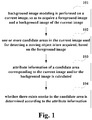
- FIG. 1 is a schematic diagram of the method for smoke detection of Embodiment 1 of this disclosure. As shown in FIG. 1 , the method for smoke detection includes:
- a video including a plurality of frames may be obtained by using such a device as a camera.
- a background image modeling method based on a Gaussian mixture model (GMM) may be used, to acquire the foreground image and the background image after performing background modeling on the color current image (or called current frame) of the input video.
- GMM Gaussian mixture model
- this disclosure is not limited thereto, and any method of background image modeling may be adopted.
- one or more candidate areas may be acquired, based on the foreground image.
- the foreground image may be expressed by a binary image and a binarized image of the foreground image may be obtained; for example, a pixel value of a foreground portion pixel is "1", and a pixel value of a background portion pixel is "0".
- the binarized image may be median-filtered to remove small noise points. Then, a plurality of pixels having the same pixel value (for example, "1") and connecting with each other in the binarized image are used as a connected component (CC), to acquire one or more connected components representing the moving object in the foreground image. For example, a number of connected components of different sizes may be extracted from a binarized image.
- FIG. 2 is a schematic diagram of extracting a connected component of Embodiment 1 of this disclosure.
- a plurality of connected pixels of which the pixel values are "1" may form a connected component.
- a total of five connected components may be extracted, which are respectively marked as a connected component 201, a connected component 202, ..., and a connected component 205.
- one or more connected components may be selected to acquire one or more candidate areas.
- a connected component of an area less than or equal to a predefined threshold (a first threshold) may be removed, and/or a connected component of an average color depth out of a predefined range may be removed.
- a particular value of the first threshold may be, for example, set in advance based on an empirical value, and the first threshold is not limited in this disclosure.
- the connected components 201, 202, and 205 may be taken as candidate areas.
- whether smoke is present in the candidate area may be determined.
- attribute information of the candidate area corresponding to the current image and/or background image may be calculated, and whether or not smoke is present in the candidate area may be determined according to the attribute information.
- the attribute information may include one or more of the following types of information: saturation information, gray variance information, gradient direction information, gray average information, and moving direction information.
- saturation information may include one or more of the following types of information: saturation information, gray variance information, gradient direction information, gray average information, and moving direction information.
- this disclosure is not limited thereto, and other attribute information corresponding to the current image and/or background image may also be used. This disclosure is described by taking the above attribute information as an example only.
- FIG. 3 is another schematic diagram of the method for smoke detection of the embodiment of this disclosure, which further uses the consecutive moving area based on a candidate area for smoke detection.
- the method for smoke detection includes:
- FIG. 4 is a schematic diagram of acquiring the consecutive moving area of the embodiment of this disclosure.
- the current frame is denoted as an N-th frame, and there exist candidate area 401 in all the N+1 image frames from the N-th frame to the 0-th frame. Positions and shapes of the candidate area 401 may possibly vary in the 0-th to the N-th frame. By combining the candidate areas 401, a consecutive moving area 402 may be obtained.
- Block 305 attribute information of the candidate area corresponding to the current image and/or the background image is calculated, based on the consecutive moving area.
- Block 306 whether smoke exists in the candidate area is determined according to the attribute information
- Block 307 whether there exists another candidate area is determined, if it is determined yes, executing block 303 to select another candidate area and continue to perform determination on another candidate area.
- whether there exists smoke in a candidate area may be determined, according to whether a major moving direction of the candidate area in multiple image frames is downward.
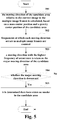
- FIG. 5 is a schematic diagram of performing smoke detection on a candidate area of the embodiment of this disclosure.
- the method includes: Block 501: the moving direction of the candidate area relative to the current image in the multiple image frames is calculated, based on a mass center position and a gravity center position of the candidate area.
- the mass center Mc (Xc, Yc) of "the candidate area" in the current frame may be calculated by using the following equation (1).
- X c ⁇ p ⁇ Component p . x N ;
- Y c ⁇ p ⁇ Component p . y N
- N is the number of pixels included in "the candidate area”
- p ⁇ component indicates that the "candidate area” includes a pixel p
- p.x refers to the x coordinate of the pixel p
- p.y refers to the y-coordinate of the pixel p.
- FIG. 6 is a schematic diagram of a direction of the embodiment of this disclosure. As shown in FIG. 6 , 8 directions may be defined; however, this disclosure is not limited thereto. For example, more or less directions may be defined, definition may be performed according to an actual situation.
- the moving directions of the candidate area relative to the current frame in each image frame may be obtained.
- Block 502 frequencies at which each moving direction occurs in multiple image frames are counted.
- Block 503 a moving direction with the highest frequency of occurrence is taken as the major moving direction of the candidate area.
- the moving directions of "the candidate area" in a number of consecutive frames may be recorded, and the frequencies of occurrence of each moving direction may also be recorded. And then the moving direction with the highest frequency of occurrence is deemed as the major moving direction of "the candidate area".
- Block 504 it is determined whether the major moving direction is downward, and block 505 is executed when the major moving direction is downward;
- Block 505 it is determined that there exists no smoke in the candidate area.
- the candidate area of the current frame may be removed from "a candidate area list”; that is, determining that there exists no smoke in the candidate area. Furthermore, in a case where the major moving direction is not downward, it may be determined that there exists smoke in the candidate area, or in order to make the detection result more accurate, detection of other items on the candidate area may be continued.
- whether there exists smoke in a candidate area may be determined according to whether saturation information of the candidate area is less than a predefined threshold.
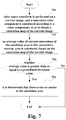
- FIG. 7 is another schematic diagram of performing smoke detection on a candidate area of the embodiment of this disclosure.
- Block 702 an average value of current saturations of the candidate area in the consecutive moving area is calculated, based on the saturation map of the current image.
- Block 703 it is determined whether the average value of the current saturations is greater than or equal to a predefined threshold value (a second threshold value), and block 704 is executed when the average value of the current saturations is greater than or equal to the predefined threshold value; in this embodiment, a particular numeral value of the second threshold value may be, for example, predefined according to an empirical value, and is not limited in this disclosure.
- Block 704 it is determined that there exists no smoke in the candidate area.
- the average value of the current saturations is greater than or equal to the second threshold value, it shows that the saturation of the moving object is relatively high, and a saturation of smoke is generally relatively low, therefore it may be determined that there exists no smoke in the candidate area, and "the candidate area" of the current frame may be removed from "a candidate area list”. And furthermore, when the average value of the current saturations is less than the second threshold value, it may be determined that there exists smoke in the candidate area, or in order to make the detection result more accurate, detection of other items on the candidate area may be continued.
- whether there exists smoke in a candidate area may be determined, according to a result of comparison between current saturation information and background saturation information of the candidate area in a consecutive moving area.
- FIG. 8 is a further schematic diagram of performing smoke detection on a candidate area of the embodiment of this disclosure. As shown in FIG. 8 , the method includes:
- the average value of the current saturations is greater than or equal to the average value of background saturations, it shows that the overall saturation of the candidate area is relatively high, and an overall saturation of an area where there exists smoke is generally relatively low, therefore it may be determined that there exists no smoke in the candidate area, and "the candidate area" of the current frame may be removed from "a candidate area list”. And furthermore, when the average value of the current saturations is less than the average value of background saturations, it may be determined that there exists smoke in the candidate area, or in order to make the detection result more accurate, detection of other items on the candidate area may be continued.
- whether there exists smoke in a candidate area may be determined according to information of gray variance values of a candidate area in the consecutive moving area.
- FIG. 9 is still another schematic diagram of performing smoke detection on a candidate area of the embodiment of this disclosure.
- the method includes: Block 901: a gray variance value of the candidate area in the consecutive moving area is calculated, based on a gray map of the current image.
- Block 902 it is determined whether the gray variance value is greater than or equal to a predefined threshold value (a third threshold value), and block 903 is executed when the gray variance value is greater than or equal to the predefined threshold value; in this embodiment, a particular numeral value of the third threshold value may be, for example, predefined according to an empirical value, and is not limited in this disclosure.
- Block 903 it is determined that there exists no smoke in the candidate area.
- the gray variance value is greater than or equal to the third threshold value, it shows that a texture of the object is relatively high, and a texture of smoke is generally relatively low, therefore it may be determined that there exists no smoke in the candidate area, and "the candidate area" of the current frame may be removed from "a candidate area list”. And furthermore, when the gray variance value is less than the third threshold value, it may be determined that there exists smoke in the candidate area, or in order to make the detection result more accurate, detection of other items on the candidate area may be continued.
- whether there exists smoke in a candidate area may be determined according to gray average information of the candidate area in the consecutive moving area.
- FIG. 10 is yet another schematic diagram of performing smoke detection on a candidate area of the embodiment of this disclosure. As shown in FIG. 10 , the method includes: Block 1001: the candidate area is removed from the consecutive moving area, so as to acquire a remaining moving area.
- FIG. 11 is a schematic diagram of acquiring a remaining moving area of the embodiment of this disclosure, in which a remaining moving area is obtained based on FIG. 4 .
- the candidate area 401 of the current frame (the N-th frame) may be removed from the consecutive moving area 402 shown in FIG. 4 , so as to obtain a remaining moving area 1101.
- Block 1002 a current gray average value of the remaining moving area is calculated, based on the gray map of the current image.
- Block 1003 a background gray average value of the remaining moving area is calculated, based on a gray map of the background image.
- Block 1004 a value of difference between the current gray average value and the background gray average value is calculated.
- Block 1005 it is determined whether the value of difference is less than or equal to a predefined threshold value (a fourth threshold value), and block 1006 is executed when the value of difference is less than or equal to the predefined threshold value;
- a particular numeral value of the fourth threshold value may be, for example, predefined according to an empirical value, and is not limited in this disclosure.
- Block 1006 it is determined that there exists no smoke in the candidate area.
- the value of difference between the current gray average value and the background gray average value is less than or equal to the fourth threshold value, it shows that the moving object in the candidate area is a rigid object, and smoke is generally diffusely divergent, therefore it may be determined that there exists no smoke in the candidate area, and "the candidate area" of the current frame may be removed from "a candidate area list”. And furthermore, when the value of difference is greater than the fourth threshold value, it may be determined that there exists smoke in the candidate area, or in order to make the detection result more accurate, detection of other items on the candidate area may be continued.
- whether there exists smoke in a candidate area may be determined according to gradient direction information of the candidate area.
- FIG. 12 is yet still another schematic diagram of performing smoke detection on a candidate area of the embodiment of this disclosure. As shown in FIG. 12 , the method includes:
- a horizontal gradient of a pixel may be calculated according to equation (7) below:
- Block 1203 a related value of an included angle between the current image gradient direction and the background image gradient direction of the pixel is calculated; in this implementation, the included angle may be acquired according to the current image gradient direction and the background image gradient direction, and then the related value (such as a cosine value) of the included angle is calculated.
- the related value such as a cosine value
- this disclosure is not limited thereto; for example, it may also be other related values (such as a cotangent value), and the following description shall be given by taking a cosine value as an example only.
- Block 1204 related values of included angles for multiple pixels (such as all pixels) in the candidate area are counted and averaged, and an averaged related value of included angle in the candidate area is taken as a gradient direction information average value.
- Block 1205 it is determined whether the gradient direction information average value is greater than or equal to a predefined threshold value (a fifth threshold value), and block 1206 is executed when the gradient direction information average value is greater than or equal to the predefined threshold value; in this implementation, a particular numeral value of the fifth threshold value may be, for example, predefined according to an empirical value, and is not limited in this disclosure.
- Block 1206 it is determined that there exists no smoke in the candidate area.
- the gradient direction information average value is greater than or equal to the fifth threshold value, it shows that the candidate area is not a foreground generated by a real moving object, while it is a pseudo-foreground caused by illumination changes.
- the candidate area of the current frame may be removed from “a candidate area list”.
- the gradient direction information average value is less than the fifth threshold value, it may be determined that there exists smoke in the candidate area, or in order to make the detection result more accurate, detection of other items on the candidate area may be continued.
- implementations 1-6 may be adopted, such as adopting only one of the implementations, or all of the above implementations may be adopted, and an order for executing them is not limited.
- implementations 1-6 may be in a sequential order, or implementation 4 may be executed first, and then implementation 2 is executed, and so on.
- a particular detection scheme may be determined according to an actual situation.
- one or more candidate areas are acquired, based on the foreground image, attribute information of a candidate area corresponding to the current image and/or the background image is calculated, and whether there exists smoke in the candidate area is determined according to the attribute information.
- the smoke can be detected quickly and accurately through video images, but also the detection accuracy of video-based smoke detection when light changes and at complex environments can be improved.
- the embodiment of this disclosure provides an apparatus for smoke detection, corresponding to the method for smoke detection, with identical contents being not going to be described herein any further.
- FIG. 13 is a schematic diagram of the apparatus for smoke detection of the embodiment of this disclosure. As shown in FIG. 13 , the apparatus 1300 for smoke detection includes:
- FIG. 14 is a schematic diagram of the candidate area acquiring unit of the embodiment of this disclosure.
- the candidate area acquiring unit 1302 may include:
- the connected component selecting unit 1403 may be configured to remove a connected component of an area less than or equal to a predefined threshold value, and/or remove a connected component of an average color depth out of a predefined range.
- this disclosure is not limited thereto, and a connected component may be selected according to other rules.
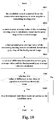
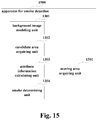
- FIG. 15 is another schematic diagram of the apparatus for smoke detection of the embodiment of this disclosure.
- the apparatus 1500 for smoke detection includes the background image modeling unit 1301, the candidate area acquiring unit 1302, the attribute information calculating unit 1303 and the smoke determining unit 1304, as described above.
- the apparatus 1500 for smoke detection may further include:
- whether there exists smoke in a candidate area may be determined according to whether a major moving direction of the candidate area in multiple image frames is downward.
- the attribute information calculating unit 1303 may further be configured to acquire the major moving direction of the candidate area in multiple image frames, and the smoke determining unit 1304 may further be configured to determine that there exists no smoke in the candidate area in a case where the major moving direction of the candidate area is downward.
- FIG. 16 is a schematic diagram of the attribute information calculating unit of the embodiment of this disclosure. As shown in FIG. 16 , the attribute information calculating unit 1303 may include:
- whether there exists smoke in a candidate area may be determined, according to whether saturation information of the candidate area in the consecutive moving area is less than a predefined threshold.
- FIG. 17 is another schematic diagram of the attribute information calculating unit of the embodiment of this disclosure.
- the attribute information calculating unit 1303 may include:
- the smoke determining unit 1304 may further be configured to determine that there exists no smoke in the candidate area in a case where the average value of current saturations is greater than or equal to a predefine threshold value.
- whether there exists smoke in a candidate area may be determined according to a result of comparison between current saturation information and background saturation information of the candidate area in a consecutive moving area.
- FIG. 18 is a further schematic diagram of the attribute information calculating unit of the embodiment of this disclosure.
- the attribute information calculating unit 1303 may include a current saturation map acquiring unit 1701 and a current saturation calculating unit 1702, as described above.
- the attribute information calculating unit 1303 may further include:
- the smoke determining unit 1304 may further be configured to determine that there exists no smoke in the candidate area in a case where the average value of the current saturations is greater than or equal to the average value of background saturations.
- whether there exists smoke in a candidate area may be determined according to information on a gray variance value of a candidate area in the consecutive moving area.
- FIG. 19 is still another schematic diagram of the attribute information calculating unit of the embodiment of this disclosure.
- the attribute information calculating unit 1303 may include: a variance value calculating unit 1901 configured to calculate a gray variance value of the candidate area in the consecutive moving area, based on a gray map of the current image.
- the smoke determining unit 1304 may further be configured to determine that there exists no smoke in the candidate area in a case where the gray variance value is greater than or equal to a predefined threshold value.
- whether there exists smoke in a candidate area may be determined according to gray average information of the candidate area in the consecutive moving area.
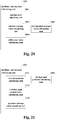
- FIG. 20 is yet another schematic diagram of the attribute information calculating unit of the embodiment of this disclosure.
- the attribute information calculating unit 1303 may include:
- the smoke determining unit 1304 may further be configured to determine that there exists no smoke in the candidate area in a case where the value of difference between the current gray average value and the background gray average value is less than or equal to a predefined threshold value.
- whether there exists smoke in a candidate area may be determined according to gradient direction information of the candidate area.
- the attribute information calculating unit 1303 may further be configured to determine a gradient direction information average value of the candidate area
- the smoke determining unit 1304 may further be configured to determine that there exists no smoke in the candidate area in a case where the gradient direction information average value is greater than or equal to a predefined threshold value.
- FIG. 21 is yet still another schematic diagram of the attribute information calculating unit of the embodiment of this disclosure.
- the attribute information calculating unit 1303 may include:
- the attribute information may include one or more of the following types of information: saturation information, gray variance information, gradient direction information, gray average information, and moving direction information.
- saturation information may include one or more of the following types of information: saturation information, gray variance information, gradient direction information, gray average information, and moving direction information.
- this disclosure is not limited thereto; for example, other attribute information may also be used for determination.
- one or more of the above implementations may be adopted, and a particular detection scheme may be determined according to an actual situation.
- one or more candidate areas are acquired, based on the foreground image, attribute information of a candidate area corresponding to the current image and/or the background image is calculated, and whether there exists smoke in the candidate area is determined according to the attribute information.
- the smoke can be detected quickly and accurately through video images, but also the detection accuracy of video-based smoke detection when light changes and at complex environments can be improved.
- the embodiment of this disclosure provides an image processing device, including the apparatus for smoke detection as described in Embodiment 2.
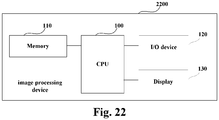
- FIG. 22 is a schematic diagram of the image processing device of the embodiment of this disclosure.
- the image processing device 2200 may include a central processing unit (CPU) 100 and a memory 110, the memory 110 being coupled to the central processing unit 100.
- the memory 110 may store various data, and furthermore, it may store programs for information processing, and the program may be executed under control of the central processing unit 100.
- the functions of the apparatus for smoke detection may be integrated into the central processing unit 100.
- the central processing unit 100 may be configured to control the method for smoke detection as described in Embodiment 1.
- the apparatus for smoke detection and the central processing unit 100 may be configured separately.
- the apparatus for smoke detection may be configured as a chip connected to the central processing unit 100, with its functions being realized under control of the central processing unit 100.
- the central processing unit 100 may be configured to perform the following control: performing background image modeling on a current image, so as to acquire a foreground image and a background image of the current image; acquiring, one or more candidate areas in the current image used for detecting a moving object, based on the foreground image; calculating attribute information of a candidate area corresponding to the current image and/or the background image; and determining whether there exists smoke in the candidate area according to the attribute information.
- the central processing unit 100 may be configured to perform the following control: acquiring a consecutive moving area to which the candidate area corresponds, according to locations of the candidate area respectively in multiple image frames; and calculating the attribute information of the candidate area corresponding to the current image and/or the background image based on the consecutive moving area.
- the image processing device 2200 may include an input/output (I/O) device 120, and a display 130, etc. Functions of the above components are similar to those in the relevant art, and shall not be described herein any further. It should be noted that the image processing device 2200 does not necessarily include all the parts shown in FIG. 22 , and furthermore, the image processing device 2200 may include parts not shown in FIG. 22 , and the relevant art may be referred to.
- I/O input/output
- An embodiment of the present disclosure provides a computer readable program code, which, when executed in an image processing device, will cause the computer to carry out the method for smoke detection as described in Embodiment 1 in the image processing device.
- An embodiment of the present disclosure provides a computer readable medium, including a computer readable program code, which will cause the computer to carry out the method for smoke detection as described in Embodiment 1 in an image processing device.
- the above apparatuses of the present invention may be implemented by hardware, or by hardware in combination with software.
- the present invention relates to such a computer-readable program that when the program is executed by a logic device, the logic device is enabled to carry out the apparatus or components as described above, or to carry out the methods or steps as described above.
- the present invention also relates to a storage medium for storing the above program, such as a hard disk, a floppy disk, a CD, a DVD, and a flash memory, etc.
- One or more functional blocks and/or one or more combinations of the functional blocks in the drawings may be realized as a universal processor, a digital signal processor (DSP), an application-specific integrated circuit (ASIC), a field programmable gate array (FPGA) or other programmable logic devices, discrete gate or transistor logic devices, discrete hardware component or any appropriate combinations thereof carrying out the functions described in this application.
- DSP digital signal processor
- ASIC application-specific integrated circuit
- FPGA field programmable gate array
- the one or more functional block diagrams and/or one or more combinations of the functional block diagrams in the drawings may also be realized as a combination of computing equipment, such as a combination of a DSP and a microprocessor, multiple processors, one or more microprocessors in communication combination with a DSP, or any other such configuration.
Landscapes
- Engineering & Computer Science (AREA)
- Physics & Mathematics (AREA)
- General Physics & Mathematics (AREA)
- Theoretical Computer Science (AREA)
- Multimedia (AREA)
- Computer Vision & Pattern Recognition (AREA)
- Emergency Management (AREA)
- Business, Economics & Management (AREA)
- Computing Systems (AREA)
- Chemical & Material Sciences (AREA)
- Analytical Chemistry (AREA)
- Image Analysis (AREA)
- Fire-Detection Mechanisms (AREA)
- Alarm Systems (AREA)
Abstract
Description
- This disclosure relates to the field of graphic and image technologies, and in particular to an apparatus, method and an image processing device for smoke detection.
- Currently, smoke detection is required in video surveillance. For example, when a fire occurs at a certain place in a building, if appearance of smoke in the area may be automatically detected via video images, fire alarm can be performed as soon as possible to reduce the loss caused by the fire.
- However, due to the diffuse nature of smoke motion, accurate detection of smoke based on video images is difficult. In the prior art, the technical solutions for determining the presence or absence of smoke through detection on the video image have the problems that the detection accuracy is not high and the detection cannot be performed quickly and accurately.
- It should be noted that the above description of the background is merely provided for clear and complete explanation of this disclosure and for easy understanding by those skilled in the art. And it should not be understood that the above technical solution is known to those skilled in the art as it is described in the background of this disclosure.
- Embodiments of this disclosure provide an apparatus, method and an image processing device for smoke detection, in which the smoke can be detected quickly and accurately through video images, and the detection accuracy of video-based smoke detection when light changes and at complex environments can be improved.
- According to a first aspect of the embodiments of this disclosure, there is provided an apparatus for smoke detection, including:
- a background image modeling unit configured to perform background image modeling on a current image, to acquire a foreground image and a background image of the current image;
- a candidate area acquiring unit configured to acquire one or more candidate areas in the current image used for detecting a moving object, based on the foreground image;
- an attribute information calculating unit configured to calculate attribute information of a candidate area corresponding to the current image and/or the background image; and
- a smoke determining unit configured to determine whether there exists smoke in the candidate area according to the attribute information.
- According to a second aspect of the embodiments of this disclosure, there is provided a method for smoke detection, including:
- performing background image modeling on a current image, to acquire a foreground image and a background image of the current image;
- acquiring one or more candidate areas in the current image used for detecting a moving object, based on the foreground image;
- calculating attribute information of a candidate area corresponding to the current image and/or the background image; and
- determining whether there exists smoke in the candidate area according to the attribute information.
- According to a third aspect of the embodiments of this disclosure, there is provided an image processing device, including the apparatus for smoke detection as described above.
- According to another aspect of the embodiments of this disclosure, there is provided a computer readable program code, which, when executed in an image processing device, will cause a computer unit to carry out the method for smoke detection as described above in the image processing device.
- According to a further aspect of the embodiments of this disclosure, there is provided a computer readable medium, including a computer readable program code, which will cause a computer unit to carry out the method for smoke detection as described above in an image processing device.
- An advantage of the embodiments of this disclosure exists in that one or more candidate areas are acquired based on the foreground image, attribute information of a candidate area corresponding to the current image and/or the background image is calculated, and whether there exists smoke in the candidate area is determined according to the attribute information. Hence, not only the smoke can be detected quickly and accurately through video images, but also the detection accuracy of video-based smoke detection when light changes and at complex environments can be improved.
- With reference to the following description and drawings, the particular embodiments of this disclosure are disclosed in detail, and the principle of this disclosure and the manners of use are indicated. It should be understood that the scope of the embodiments of this disclosure is not limited thereto. The embodiments of this disclosure contain many alternations, modifications and equivalents within the scope of the terms of the appended claims.
- Features that are described and/or illustrated with respect to one embodiment may be used in the same way or in a similar way in one or more other embodiments and/or in combination with or instead of the features of the other embodiments.
- It should be emphasized that the term "comprise/include" when used in this specification is taken to specify the presence of stated features, integers, steps or components but does not preclude the presence or addition of one or more other features, integers, steps, components or groups thereof.
- Many aspects of the invention can be better understood with reference to the following drawings. The components in the drawings are not necessarily to scale, emphasis instead being placed upon clearly illustrating the principles of this disclosure. To facilitate illustrating and describing some parts of the invention, corresponding portions of the drawings may be exaggerated or reduced.
- Elements and features depicted in one drawing or embodiment of the invention may be combined with elements and features depicted in one or more additional drawings or embodiments. Moreover, in the drawings, like reference numerals designate corresponding parts throughout the several views and may be used to designate like or similar parts in more than one embodiment.
-
FIG 1 is a schematic diagram of the method for smoke detection ofEmbodiment 1 of this disclosure; -
FIG 2 is a schematic diagram of extracting a connected component ofEmbodiment 1 of this disclosure; -
FIG. 3 is another schematic diagram of the method for smoke detection ofEmbodiment 1 of this disclosure; -
FIG. 4 is a schematic diagram of acquiring a consecutive moving area ofEmbodiment 1 of this disclosure; -
FIG. 5 is a schematic diagram of performing smoke detection on a candidate area ofEmbodiment 1 of this disclosure; -
FIG. 6 is a schematic diagram of a direction ofEmbodiment 1 of this disclosure; -
FIG. 7 is another schematic diagram of performing smoke detection on a candidate area ofEmbodiment 1 of this disclosure; -
FIG. 8 is a further schematic diagram of performing smoke detection on a candidate area ofEmbodiment 1 of this disclosure; -
FIG. 9 is still another schematic diagram of performing smoke detection on a candidate area ofEmbodiment 1 of this disclosure; -
FIG. 10 is yet another schematic diagram of performing smoke detection on a candidate area ofEmbodiment 1 of this disclosure; -
FIG. 11 is a schematic diagram of acquiring a remaining moving area ofEmbodiment 1 of this disclosure; -
FIG. 12 is yet still another schematic diagram of performing smoke detection on a candidate area ofEmbodiment 1 of this disclosure; -
FIG. 13 is a schematic diagram of the apparatus for smoke detection ofEmbodiment 2 of this disclosure; -
FIG. 14 is a schematic diagram of a candidate area acquiring unit ofEmbodiment 2 of this disclosure; -
FIG. 15 is another schematic diagram of the apparatus for smoke detection ofEmbodiment 2 of this disclosure; -
FIG. 16 is a schematic diagram of an attribute information calculating unit ofEmbodiment 2 of this disclosure; -
FIG. 17 is another schematic diagram of the attribute information calculating unit ofEmbodiment 2 of this disclosure; -
FIG. 18 is a further schematic diagram of the attribute information calculating unit ofEmbodiment 2 of this disclosure; -
FIG. 19 is still another schematic diagram of the attribute information calculating unit ofEmbodiment 2 of this disclosure; -
FIG. 20 is yet another schematic diagram of the attribute information calculating unit ofEmbodiment 2 of this disclosure; -
FIG. 21 is yet still another schematic diagram of the attribute information calculating unit ofEmbodiment 2 of this disclosure; and -
FIG. 22 is a schematic diagram of the image processing device ofEmbodiment 3 of this disclosure. - These and further aspects and features of this disclosure will be apparent with reference to the following description and attached drawings. In the description and drawings, particular embodiments of the invention have been disclosed in detail as being indicative of some of the ways in which the principles of the invention may be employed, but it is understood that the invention is not limited correspondingly in scope. Rather, the invention includes all changes, modifications and equivalents coming within the terms of the appended claims.
- The embodiment of this disclosure provides a method for smoke detection.
FIG. 1 is a schematic diagram of the method for smoke detection ofEmbodiment 1 of this disclosure. As shown inFIG. 1 , the method for smoke detection includes: - Block 101: background image modeling is performed on a current image, so as to acquire a foreground image and a background image of the current image.
- Block 102: one or more candidate areas in the current image used for detecting a moving object is/are acquired, based on the foreground image.
- Block 103: attribute information of a candidate area corresponding to the current image and/or the background image is calculated; and
- Block 104: whether there exists smoke in the candidate area is determined according to the attribute information.
- In this embodiment, a video including a plurality of frames may be obtained by using such a device as a camera. A background image modeling method based on a Gaussian mixture model (GMM) may be used, to acquire the foreground image and the background image after performing background modeling on the color current image (or called current frame) of the input video. However, this disclosure is not limited thereto, and any method of background image modeling may be adopted.
- In this embodiment, one or more candidate areas may be acquired, based on the foreground image. For example, the foreground image may be expressed by a binary image and a binarized image of the foreground image may be obtained; for example, a pixel value of a foreground portion pixel is "1", and a pixel value of a background portion pixel is "0".
- In this embodiment, the binarized image may be median-filtered to remove small noise points. Then, a plurality of pixels having the same pixel value (for example, "1") and connecting with each other in the binarized image are used as a connected component (CC), to acquire one or more connected components representing the moving object in the foreground image. For example, a number of connected components of different sizes may be extracted from a binarized image.
-
FIG. 2 is a schematic diagram of extracting a connected component ofEmbodiment 1 of this disclosure. As shown inFIG. 2 , for example, a plurality of connected pixels of which the pixel values are "1" may form a connected component. In this binarized image, a total of five connected components may be extracted, which are respectively marked as aconnected component 201, aconnected component 202, ..., and aconnected component 205. - In this embodiment, one or more connected components may be selected to acquire one or more candidate areas. For example, a connected component of an area less than or equal to a predefined threshold (a first threshold) may be removed, and/or a connected component of an average color depth out of a predefined range may be removed. A particular value of the first threshold may be, for example, set in advance based on an empirical value, and the first threshold is not limited in this disclosure.
- In the example shown in
FIG. 2 , for example, if the areas of theconnected components connected components connected components - In this embodiment, for each candidate area, whether smoke is present in the candidate area may be determined. For example, for a candidate area, attribute information of the candidate area corresponding to the current image and/or background image may be calculated, and whether or not smoke is present in the candidate area may be determined according to the attribute information.
- The attribute information may include one or more of the following types of information: saturation information, gray variance information, gradient direction information, gray average information, and moving direction information. However, this disclosure is not limited thereto, and other attribute information corresponding to the current image and/or background image may also be used. This disclosure is described by taking the above attribute information as an example only.
- Hence, not only the smoke can be detected quickly and accurately through video images, but also the detection accuracy of video-based smoke detection when light changes and at complex environments can be improved.
-
FIG. 3 is another schematic diagram of the method for smoke detection of the embodiment of this disclosure, which further uses the consecutive moving area based on a candidate area for smoke detection. As shown inFIG. 3 , the method for smoke detection includes: - Block 301: background image modeling is performed on a current image, so as to acquire a foreground image and a background image of the current image.
- Block 302: one or more candidate areas for detecting a moving object in the current image is/are acquired, based on the foreground image.
- Block 303: a candidate area is selected.
- Block 304: a consecutive moving area corresponding to the candidate area is acquired, according to locations of the candidate area respectively in multiple image frames;
- in this embodiment, multiple consecutive (e.g. N) image frames before the current frame may be acquired, and then corresponding candidate areas in the N+1 frames are combined to construct a consecutive moving area to which the candidate area corresponds, that is, the consecutive moving area is a "moving trajectory" of the candidate area in the N+1 image frames.
-
FIG. 4 is a schematic diagram of acquiring the consecutive moving area of the embodiment of this disclosure. As shown inFIG. 4 , the current frame is denoted as an N-th frame, and there existcandidate area 401 in all the N+1 image frames from the N-th frame to the 0-th frame. Positions and shapes of thecandidate area 401 may possibly vary in the 0-th to the N-th frame. By combining thecandidate areas 401, a consecutive movingarea 402 may be obtained. - Block 305: attribute information of the candidate area corresponding to the current image and/or the background image is calculated, based on the consecutive moving area.
- Block 306: whether smoke exists in the candidate area is determined according to the attribute information; and
- Block 307: whether there exists another candidate area is determined, if it is determined yes, executing
block 303 to select another candidate area and continue to perform determination on another candidate area. - The flow of the method for smoke detection of the embodiment of this disclosure is schematically described above. In the following, smoke detection on a candidate area in this disclosure shall be further explained by taking moving direction information, a saturation average value, a gray variance value, an average value of the gradient direction information, and a gray average value as examples. For how to obtain a candidate area and how to obtain a consecutive moving area, reference may be made to the above contents.
- In one implementation (Implementation 1), whether there exists smoke in a candidate area may be determined, according to whether a major moving direction of the candidate area in multiple image frames is downward.
-
FIG. 5 is a schematic diagram of performing smoke detection on a candidate area of the embodiment of this disclosure. As shown inFIG. 5 , the method includes:
Block 501: the moving direction of the candidate area relative to the current image in the multiple image frames is calculated, based on a mass center position and a gravity center position of the candidate area. - For example, the mass center Mc (Xc, Yc) of "the candidate area" in the current frame may be calculated by using the following equation (1).

- Assuming that the mass center of "the candidate area" of the current frame is Mc (Xc, Yc), and a gravity center of a corresponding "candidate area" in a number of frames before the current frame (for example, the 5th or 10th frame before the current frame) is Mp (Xp, Yp), then the following values are calculated:


-
FIG. 6 is a schematic diagram of a direction of the embodiment of this disclosure. As shown inFIG. 6 ,8 directions may be defined; however, this disclosure is not limited thereto. For example, more or less directions may be defined, definition may be performed according to an actual situation. - If ΔX > 0 and ΔY = 0, the moving direction is 1;
- if ΔX > 0 and ΔY < 0, the moving direction is 2;
- if ΔX = 0 and ΔY < 0, the moving direction is 3;
- if ΔX < 0 and ΔY < 0, the moving direction is 4;
- if ΔX < 0 and ΔY = 0, the moving direction is 5;
- if ΔX < 0 and ΔY > 0, the moving direction is 6;
- if ΔX = 0 and ΔY > 0, the moving direction is 7;
- and if ΔX > 0 and ΔY > 0, the moving direction is 8.
- In this way, the moving directions of the candidate area relative to the current frame in each image frame may be obtained.
- Block 502: frequencies at which each moving direction occurs in multiple image frames are counted.
- Block 503: a moving direction with the highest frequency of occurrence is taken as the major moving direction of the candidate area.
- In this embodiment, the moving directions of "the candidate area" in a number of consecutive frames may be recorded, and the frequencies of occurrence of each moving direction may also be recorded. And then the moving direction with the highest frequency of occurrence is deemed as the major moving direction of "the candidate area".
- Block 504: it is determined whether the major moving direction is downward, and block 505 is executed when the major moving direction is downward; and
- Block 505: it is determined that there exists no smoke in the candidate area.
- In this implementation, for example, if the major moving direction of "a candidate area" is downward (such as 6, 7, 8, shown in
FIG. 6 ), "the candidate area" of the current frame may be removed from "a candidate area list"; that is, determining that there exists no smoke in the candidate area. Furthermore, in a case where the major moving direction is not downward, it may be determined that there exists smoke in the candidate area, or in order to make the detection result more accurate, detection of other items on the candidate area may be continued. - In another implementation (Implementation 2), whether there exists smoke in a candidate area may be determined according to whether saturation information of the candidate area is less than a predefined threshold.
-
FIG. 7 is another schematic diagram of performing smoke detection on a candidate area of the embodiment of this disclosure. As shown inFIG. 7 , the method includes:
Block 701: color space transform is performed on a current image, and a saturation color component is calculated according to a color component, so as to obtain a saturation map of the current image;
for example, an equation for calculating a saturation is as shown by equation (2) below:
- How to calculate a saturation of a pixel is only illustrated above. Any existing methods may be used for calculating a saturation, which shall not be described herein any further.
- Block 702: an average value of current saturations of the candidate area in the consecutive moving area is calculated, based on the saturation map of the current image.
- For example, an equation for calculating the average value of current saturations may be as shown by equation (3) below:

- The above equation only illustrates how to calculate the average value of current saturations. However, this disclosure is not limited thereto, and appropriate adjustment or variation may be made according to an actual situation.
- Block 703: it is determined whether the average value of the current saturations is greater than or equal to a predefined threshold value (a second threshold value), and block 704 is executed when the average value of the current saturations is greater than or equal to the predefined threshold value;
in this embodiment, a particular numeral value of the second threshold value may be, for example, predefined according to an empirical value, and is not limited in this disclosure. - Block 704: it is determined that there exists no smoke in the candidate area.
- In this implementation, for example, if the average value of the current saturations is greater than or equal to the second threshold value, it shows that the saturation of the moving object is relatively high, and a saturation of smoke is generally relatively low, therefore it may be determined that there exists no smoke in the candidate area, and "the candidate area" of the current frame may be removed from "a candidate area list". And furthermore, when the average value of the current saturations is less than the second threshold value, it may be determined that there exists smoke in the candidate area, or in order to make the detection result more accurate, detection of other items on the candidate area may be continued.
- In a further implementation (Implementation 3), whether there exists smoke in a candidate area may be determined, according to a result of comparison between current saturation information and background saturation information of the candidate area in a consecutive moving area.
-
FIG. 8 is a further schematic diagram of performing smoke detection on a candidate area of the embodiment of this disclosure. As shown inFIG. 8 , the method includes: - Block 801: color space transform is performed on the current image, and a saturation color component is calculated according to a color component, so as to acquire a saturation map of the current image.
- Block 802: an average value of current saturations of the candidate area in the consecutive moving area is calculated, based on the saturation map of the current image.
- Block 803: color space transform is performed on the background image, and a saturation color component is calculated according to a color component, so as to acquire a saturation map of the background image.
- Block 804: an average value of background saturations of the candidate area in the consecutive moving area is calculated, based on the saturation map of the background image;
- in this implementation, equation (3), for example, may also be used for calculating the average value of background saturations.
- Block 805: it is determined whether the average value of the current saturations is greater than or equal to the average value of background saturations, and block 806 is executed when the average value of the current saturations is greater than or equal to the average value of background saturations; and
- Block 806: it is determined that there exists no smoke in the candidate area.
- In this implementation, for example, if the average value of the current saturations is greater than or equal to the average value of background saturations, it shows that the overall saturation of the candidate area is relatively high, and an overall saturation of an area where there exists smoke is generally relatively low, therefore it may be determined that there exists no smoke in the candidate area, and "the candidate area" of the current frame may be removed from "a candidate area list". And furthermore, when the average value of the current saturations is less than the average value of background saturations, it may be determined that there exists smoke in the candidate area, or in order to make the detection result more accurate, detection of other items on the candidate area may be continued.
- In still another implementation (Implementation 4), whether there exists smoke in a candidate area may be determined according to information of gray variance values of a candidate area in the consecutive moving area.
-
FIG. 9 is still another schematic diagram of performing smoke detection on a candidate area of the embodiment of this disclosure. As shown inFIG. 9 , the method includes:
Block 901: a gray variance value of the candidate area in the consecutive moving area is calculated, based on a gray map of the current image. - For example, an equation for calculating the gray variance value may be as shown by equation (4) below:

- How to calculate the gray variance value is only illustrated above. However, this disclosure is not limited thereto, and appropriate adjustment or variation may be made according to an actual situation. Furthermore, any existing methods may be used for how to calculate a gray map or a gray value, which shall not be described herein any further.
- Block 902: it is determined whether the gray variance value is greater than or equal to a predefined threshold value (a third threshold value), and block 903 is executed when the gray variance value is greater than or equal to the predefined threshold value;
in this embodiment, a particular numeral value of the third threshold value may be, for example, predefined according to an empirical value, and is not limited in this disclosure. - Block 903: it is determined that there exists no smoke in the candidate area.
- In this implementation, for example, if the gray variance value is greater than or equal to the third threshold value, it shows that a texture of the object is relatively high, and a texture of smoke is generally relatively low, therefore it may be determined that there exists no smoke in the candidate area, and "the candidate area" of the current frame may be removed from "a candidate area list". And furthermore, when the gray variance value is less than the third threshold value, it may be determined that there exists smoke in the candidate area, or in order to make the detection result more accurate, detection of other items on the candidate area may be continued.
- In yet another implementation (Implementation 5), whether there exists smoke in a candidate area may be determined according to gray average information of the candidate area in the consecutive moving area.
-
FIG. 10 is yet another schematic diagram of performing smoke detection on a candidate area of the embodiment of this disclosure. As shown inFIG. 10 , the method includes:
Block 1001: the candidate area is removed from the consecutive moving area, so as to acquire a remaining moving area. -
FIG. 11 is a schematic diagram of acquiring a remaining moving area of the embodiment of this disclosure, in which a remaining moving area is obtained based onFIG. 4 . As shown inFIG. 11 , thecandidate area 401 of the current frame (the N-th frame) may be removed from the consecutive movingarea 402 shown inFIG. 4 , so as to obtain a remaining movingarea 1101. - Block 1002: a current gray average value of the remaining moving area is calculated, based on the gray map of the current image.
- For example, an equation for calculating the current gray average value may be as shown by equation (5) below:

- Block 1003: a background gray average value of the remaining moving area is calculated, based on a gray map of the background image.
- For example, an equation for calculating the background gray average value may be as shown by equation (6) below:

- Block 1004: a value of difference between the current gray average value and the background gray average value is calculated.
- Block 1005: it is determined whether the value of difference is less than or equal to a predefined threshold value (a fourth threshold value), and
block 1006 is executed when the value of difference is less than or equal to the predefined threshold value;
in this embodiment, a particular numeral value of the fourth threshold value may be, for example, predefined according to an empirical value, and is not limited in this disclosure. - Block 1006: it is determined that there exists no smoke in the candidate area.
- In this implementation, for example, if the value of difference between the current gray average value and the background gray average value is less than or equal to the fourth threshold value, it shows that the moving object in the candidate area is a rigid object, and smoke is generally diffusely divergent, therefore it may be determined that there exists no smoke in the candidate area, and "the candidate area" of the current frame may be removed from "a candidate area list". And furthermore, when the value of difference is greater than the fourth threshold value, it may be determined that there exists smoke in the candidate area, or in order to make the detection result more accurate, detection of other items on the candidate area may be continued.
- In yet another implementation (Implementation 6), whether there exists smoke in a candidate area may be determined according to gradient direction information of the candidate area.
-
FIG. 12 is yet still another schematic diagram of performing smoke detection on a candidate area of the embodiment of this disclosure. As shown inFIG. 12 , the method includes: - Block 1201: for a pixel in the candidate area, a horizontal gradient and a vertical gradient of the pixel are calculated, based on the gray map of the current image, so as to acquire a current image gradient direction of the pixel.
- Block 1202: a horizontal gradient and a vertical gradient of the pixel are calculated, based on the gray map of the background image, so as to acquire a background image gradient direction of the pixel.
- In this implementation, for example, a horizontal gradient of a pixel may be calculated according to equation (7) below:


- Block 1203: a related value of an included angle between the current image gradient direction and the background image gradient direction of the pixel is calculated;
in this implementation, the included angle may be acquired according to the current image gradient direction and the background image gradient direction, and then the related value (such as a cosine value) of the included angle is calculated. However, this disclosure is not limited thereto; for example, it may also be other related values (such as a cotangent value), and the following description shall be given by taking a cosine value as an example only. - Block 1204: related values of included angles for multiple pixels (such as all pixels) in the candidate area are counted and averaged, and an averaged related value of included angle in the candidate area is taken as a gradient direction information average value.
- Block 1205: it is determined whether the gradient direction information average value is greater than or equal to a predefined threshold value (a fifth threshold value), and
block 1206 is executed when the gradient direction information average value is greater than or equal to the predefined threshold value;
in this implementation, a particular numeral value of the fifth threshold value may be, for example, predefined according to an empirical value, and is not limited in this disclosure. - Block 1206: it is determined that there exists no smoke in the candidate area.
- In this implementation, for example, if the gradient direction information average value is greater than or equal to the fifth threshold value, it shows that the candidate area is not a foreground generated by a real moving object, while it is a pseudo-foreground caused by illumination changes. Hence. "the candidate area" of the current frame may be removed from "a candidate area list". And furthermore, when the gradient direction information average value is less than the fifth threshold value, it may be determined that there exists smoke in the candidate area, or in order to make the detection result more accurate, detection of other items on the candidate area may be continued.
- How to determine whether there exists smoke in a candidate area is illustrated above. However, this disclosure is not limited thereto; for example, other attribute information may also be used for determination. And the above equations (1)-(8) only illustrate this disclosure. However, this disclosure is not limited thereto, and appropriate adjustment or variation may be made to the above equations (1)-(8) according to an actual situation.
- Furthermore, one or more of the above implementations 1-6 may be adopted, such as adopting only one of the implementations, or all of the above implementations may be adopted, and an order for executing them is not limited. For example, implementations 1-6 may be in a sequential order, or implementation 4 may be executed first, and then
implementation 2 is executed, and so on. In practical application, a particular detection scheme may be determined according to an actual situation. - It can be seen from the above embodiment that one or more candidate areas are acquired, based on the foreground image, attribute information of a candidate area corresponding to the current image and/or the background image is calculated, and whether there exists smoke in the candidate area is determined according to the attribute information. Hence, not only the smoke can be detected quickly and accurately through video images, but also the detection accuracy of video-based smoke detection when light changes and at complex environments can be improved.
- The embodiment of this disclosure provides an apparatus for smoke detection, corresponding to the method for smoke detection, with identical contents being not going to be described herein any further.
-
FIG. 13 is a schematic diagram of the apparatus for smoke detection of the embodiment of this disclosure. As shown inFIG. 13 , theapparatus 1300 for smoke detection includes: - a background
image modeling unit 1301 configured to perform background image modeling on a current image, to acquire a foreground image and a background image of the current image; - a candidate
area acquiring unit 1302 configured to acquire, based on the foreground image, one or more candidate areas in the current image used for detecting a moving object; - an attribute
information calculating unit 1303 configured to calculate attribute information of a candidate area corresponding to the current image and/or the background image; and - a
smoke determining unit 1304 configured to determine whether there exists smoke in the candidate area according to the attribute information. -
FIG. 14 is a schematic diagram of the candidate area acquiring unit of the embodiment of this disclosure. As shown inFIG. 14 , the candidatearea acquiring unit 1302 may include: - a binarized
image acquiring unit 1401 configured to acquire a binarized image of the foreground image; - a connected
component acquiring unit 1402 configured to take multiple pixels in the binarized image that have identical pixel values and are connected to each other as a connected component, to acquire one or more connected components representing a moving object in the foreground image; and - a connected
component selecting unit 1403 configured to select the connected components to acquire the one or more candidate areas. - The connected
component selecting unit 1403 may be configured to remove a connected component of an area less than or equal to a predefined threshold value, and/or remove a connected component of an average color depth out of a predefined range. However, this disclosure is not limited thereto, and a connected component may be selected according to other rules. -
FIG. 15 is another schematic diagram of the apparatus for smoke detection of the embodiment of this disclosure. As shown inFIG. 15 , theapparatus 1500 for smoke detection includes the backgroundimage modeling unit 1301, the candidatearea acquiring unit 1302, the attributeinformation calculating unit 1303 and thesmoke determining unit 1304, as described above. - As shown in
FIG. 15 , theapparatus 1500 for smoke detection may further include: - a moving
area acquiring unit 1501 configured to acquire a consecutive moving area to which the candidate area corresponds according to locations of the candidate area respectively in multiple image frames; - and the attribute
information calculating unit 1303 may further be configured to calculate the attribute information of the candidate area corresponding to the current image and/or the background image, based on the consecutive moving area. - In one implementation, whether there exists smoke in a candidate area may be determined according to whether a major moving direction of the candidate area in multiple image frames is downward.
- In this implementation, the attribute
information calculating unit 1303 may further be configured to acquire the major moving direction of the candidate area in multiple image frames, and thesmoke determining unit 1304 may further be configured to determine that there exists no smoke in the candidate area in a case where the major moving direction of the candidate area is downward. -
FIG. 16 is a schematic diagram of the attribute information calculating unit of the embodiment of this disclosure. As shown inFIG. 16 , the attributeinformation calculating unit 1303 may include: - a moving
direction calculating unit 1601 configured to calculate a moving direction of the candidate area relative to the current image in the multiple image frames, based on a mass center location and a gravity center location of the candidate area; - a moving
direction counting unit 1602 configured to count a frequency of appearance of each moving direction in the multiple image frames; and - a major moving
direction determining unit 1603 configured to determine a moving direction of a highest frequency of appearance as a major moving direction of the candidate area. - In another implementation, whether there exists smoke in a candidate area may be determined, according to whether saturation information of the candidate area in the consecutive moving area is less than a predefined threshold.
-
FIG. 17 is another schematic diagram of the attribute information calculating unit of the embodiment of this disclosure. As shown inFIG. 17 , the attributeinformation calculating unit 1303 may include: - a current saturation
map acquiring unit 1701 configured to perform color space transform on the current image, and calculate a saturation color component according to a color component, to acquire a saturation map of the current image; and - a current
saturation calculating unit 1702 configured to calculate an average value of current saturations of the candidate area in the consecutive moving area, based on the saturation map of the current image. - In this implementation, the
smoke determining unit 1304 may further be configured to determine that there exists no smoke in the candidate area in a case where the average value of current saturations is greater than or equal to a predefine threshold value. - In another implementation, whether there exists smoke in a candidate area may be determined according to a result of comparison between current saturation information and background saturation information of the candidate area in a consecutive moving area.
-
FIG. 18 is a further schematic diagram of the attribute information calculating unit of the embodiment of this disclosure. As shown inFIG. 18 , the attributeinformation calculating unit 1303 may include a current saturationmap acquiring unit 1701 and a currentsaturation calculating unit 1702, as described above. - As shown in
FIG. 18 , the attributeinformation calculating unit 1303 may further include: - a background saturation
map acquiring unit 1801 configured to perform color space transform on the background image, and calculate a saturation color component according to a color component, to acquire a saturation map of the background image; and - a background
saturation calculating unit 1802 configured to calculate an average value of background saturations of the candidate area in the consecutive moving area, based on the saturation map of the background image. - In this implementation, the
smoke determining unit 1304 may further be configured to determine that there exists no smoke in the candidate area in a case where the average value of the current saturations is greater than or equal to the average value of background saturations. - In still another implementation, whether there exists smoke in a candidate area may be determined according to information on a gray variance value of a candidate area in the consecutive moving area.
-
FIG. 19 is still another schematic diagram of the attribute information calculating unit of the embodiment of this disclosure. As shown inFIG. 19 , the attributeinformation calculating unit 1303 may include:
a variancevalue calculating unit 1901 configured to calculate a gray variance value of the candidate area in the consecutive moving area, based on a gray map of the current image. - In this implementation, the
smoke determining unit 1304 may further be configured to determine that there exists no smoke in the candidate area in a case where the gray variance value is greater than or equal to a predefined threshold value. - In yet another implementation, whether there exists smoke in a candidate area may be determined according to gray average information of the candidate area in the consecutive moving area.
-
FIG. 20 is yet another schematic diagram of the attribute information calculating unit of the embodiment of this disclosure. As shown inFIG. 20 , the attributeinformation calculating unit 1303 may include: - a moving
area adjusting unit 2001 configured to remove the candidate area from the consecutive moving area, to acquire a remaining moving area; - a current average
value calculating unit 2002 configured to calculate a current gray average value of the remaining moving area, based on the gray map of the current image; - a background average
value calculating unit 2003 configured to calculate a background gray average value of the remaining moving area, based on a gray map of the background image; and - a difference
value calculating unit 2004 configured to calculate a value of difference between the current gray average value and the background gray average value. - In this implementation, the
smoke determining unit 1304 may further be configured to determine that there exists no smoke in the candidate area in a case where the value of difference between the current gray average value and the background gray average value is less than or equal to a predefined threshold value. - In yet another implementation, whether there exists smoke in a candidate area may be determined according to gradient direction information of the candidate area.
- In this implementation, the attribute
information calculating unit 1303 may further be configured to determine a gradient direction information average value of the candidate area, and thesmoke determining unit 1304 may further be configured to determine that there exists no smoke in the candidate area in a case where the gradient direction information average value is greater than or equal to a predefined threshold value. -
FIG. 21 is yet still another schematic diagram of the attribute information calculating unit of the embodiment of this disclosure. As shown inFIG. 21 , the attributeinformation calculating unit 1303 may include: - a current
gradient calculating unit 2101 configured to, for a pixel in the candidate area, calculate a horizontal gradient and a vertical gradient of the pixel, based on the gray map of the current image, to acquire a current image gradient direction of the pixel; - a background
gradient calculating unit 2102 configured to calculate a horizontal gradient and a vertical gradient of the pixel, based on the gray map of the background image, to acquire a background image gradient direction of the pixel; - an included angle related
value calculating unit 2103 configured to calculate a related value of an included angle between the current image gradient direction and the background image gradient direction of the pixel; and - a gradient average
value acquiring unit 2104 configured to count and average related values of included angles for multiple pixels in the candidate area, and take an averaged related value of included angle in the candidate area as a gradient direction information average value. - In this embodiment, the attribute information may include one or more of the following types of information: saturation information, gray variance information, gradient direction information, gray average information, and moving direction information. However, this disclosure is not limited thereto; for example, other attribute information may also be used for determination. And furthermore, one or more of the above implementations may be adopted, and a particular detection scheme may be determined according to an actual situation.
- It can be seen from the above embodiment that one or more candidate areas are acquired, based on the foreground image, attribute information of a candidate area corresponding to the current image and/or the background image is calculated, and whether there exists smoke in the candidate area is determined according to the attribute information. Hence, not only the smoke can be detected quickly and accurately through video images, but also the detection accuracy of video-based smoke detection when light changes and at complex environments can be improved.
- The embodiment of this disclosure provides an image processing device, including the apparatus for smoke detection as described in
Embodiment 2. -
FIG. 22 is a schematic diagram of the image processing device of the embodiment of this disclosure. As shown inFIG. 22 , theimage processing device 2200 may include a central processing unit (CPU) 100 and amemory 110, thememory 110 being coupled to thecentral processing unit 100. Thememory 110 may store various data, and furthermore, it may store programs for information processing, and the program may be executed under control of thecentral processing unit 100. - In an implementation, the functions of the apparatus for smoke detection may be integrated into the
central processing unit 100. Thecentral processing unit 100 may be configured to control the method for smoke detection as described inEmbodiment 1. - In another implementation, the apparatus for smoke detection and the
central processing unit 100 may be configured separately. For example, the apparatus for smoke detection may be configured as a chip connected to thecentral processing unit 100, with its functions being realized under control of thecentral processing unit 100. - In this embodiment, the
central processing unit 100 may be configured to perform the following control:
performing background image modeling on a current image, so as to acquire a foreground image and a background image of the current image; acquiring, one or more candidate areas in the current image used for detecting a moving object, based on the foreground image; calculating attribute information of a candidate area corresponding to the current image and/or the background image; and determining whether there exists smoke in the candidate area according to the attribute information. - Furthermore, the
central processing unit 100 may be configured to perform the following control: acquiring a consecutive moving area to which the candidate area corresponds, according to locations of the candidate area respectively in multiple image frames; and calculating the attribute information of the candidate area corresponding to the current image and/or the background image based on the consecutive moving area. - Furthermore, as shown in
FIG. 22 , theimage processing device 2200 may include an input/output (I/O)device 120, and adisplay 130, etc. Functions of the above components are similar to those in the relevant art, and shall not be described herein any further. It should be noted that theimage processing device 2200 does not necessarily include all the parts shown inFIG. 22 , and furthermore, theimage processing device 2200 may include parts not shown inFIG. 22 , and the relevant art may be referred to. - An embodiment of the present disclosure provides a computer readable program code, which, when executed in an image processing device, will cause the computer to carry out the method for smoke detection as described in
Embodiment 1 in the image processing device. - An embodiment of the present disclosure provides a computer readable medium, including a computer readable program code, which will cause the computer to carry out the method for smoke detection as described in
Embodiment 1 in an image processing device. - The above apparatuses of the present invention may be implemented by hardware, or by hardware in combination with software. The present invention relates to such a computer-readable program that when the program is executed by a logic device, the logic device is enabled to carry out the apparatus or components as described above, or to carry out the methods or steps as described above. The present invention also relates to a storage medium for storing the above program, such as a hard disk, a floppy disk, a CD, a DVD, and a flash memory, etc.
- One or more functional blocks and/or one or more combinations of the functional blocks in the drawings may be realized as a universal processor, a digital signal processor (DSP), an application-specific integrated circuit (ASIC), a field programmable gate array (FPGA) or other programmable logic devices, discrete gate or transistor logic devices, discrete hardware component or any appropriate combinations thereof carrying out the functions described in this application. And the one or more functional block diagrams and/or one or more combinations of the functional block diagrams in the drawings may also be realized as a combination of computing equipment, such as a combination of a DSP and a microprocessor, multiple processors, one or more microprocessors in communication combination with a DSP, or any other such configuration.
- This disclosure is described above with reference to particular embodiments. However, it should be understood by those skilled in the art that such a description is illustrative only, and not intended to limit the protection scope of the present invention. Various variants and modifications may be made by those skilled in the art according to the principle of the present invention, and such variants and modifications fall within the scope of the present invention.
Claims (20)
- An apparatus for smoke detection, comprising:a background image modeling unit configured to perform background image modeling on a current image, to acquire a foreground image and a background image of the current image;a candidate area acquiring unit configured to acquire one or more candidate areas in the current image used for detecting a moving object, based on the foreground image;an attribute information calculating unit configured to calculate attribute information of a candidate area corresponding to the current image and/or the background image; anda smoke determining unit configured to determine whether there exists smoke in the candidate area according to the attribute information.
- The apparatus according to claim 1, wherein the apparatus further comprises:a moving area acquiring unit configured to acquire a consecutive moving area to which the candidate area corresponds, according to locations of the candidate area respectively in multiple image frames;and the attribute information calculating unit is further configured to calculate the attribute information of the candidate area corresponding to the current image and/or the background image based on the consecutive moving area.
- The apparatus according to claim 2, wherein the attribute information calculating unit comprises:a current saturation map acquiring unit configured to perform color space transform on the current image, and calculate a saturation color component according to a color component, to acquire a saturation map of the current image; anda current saturation calculating unit configured to calculate an average value of current saturations of the candidate area in the consecutive moving area, based on the saturation map of the current image.
- The apparatus according to claim 3, wherein the smoke determining unit is further configured to determine that there exists no smoke in the candidate area in a case where the average value of the current saturations is greater than or equal to a predefined threshold value.
- The apparatus according to claim 3, wherein the attribute information calculating unit further comprises:a background saturation map acquiring unit configured to perform color space transform on the background image, and calculate a saturation color component according to a color component, to acquire a saturation map of the background image; anda background saturation calculating unit configured to calculate an average value of background saturations of the candidate area in the consecutive moving area, based on the saturation map of the background image.
- The apparatus according to claim 5, wherein the smoke determining unit is further configured to determine that there exists no smoke in the candidate area in a case where the average value of the current saturations is greater than or equal to the average value of background saturations.
- The apparatus according to claim 2, wherein the attribute information calculating unit comprises:
a variance value calculating unit configured to calculate a gray variance value of the candidate area in the consecutive moving area, based on a gray map of the current image. - The apparatus according to claim 7, wherein the smoke determining unit is further configured to determine that there exists no smoke in the candidate area in a case where the gray variance value is greater than or equal to a predefined threshold value.
- The apparatus according to claim 2, wherein the attribute information calculating unit comprises:a moving area adjusting unit configured to remove the candidate area from the consecutive moving area, to acquire a remaining moving area;a current average value calculating unit configured to calculate a current gray average value of the remaining moving area, based on the gray map of the current image;a background average value calculating unit configured to calculate a background gray average value of the remaining moving area, based on a gray map of the background image; anda difference value calculating unit configured to calculate a value of difference between the current gray average value and the background gray average value.
- The apparatus according to claim 9, wherein the smoke determining unit is further configured to determine that there exists no smoke in the candidate area in a case where the value of difference is less than or equal to a predefined threshold value.
- The apparatus according to claim 1, wherein the attribute information calculating unit comprises:a current gradient calculating unit configured to, for a pixel in the candidate area, calculate a horizontal gradient and a vertical gradient of the pixel, based on the gray map of the current image, to acquire a current image gradient direction of the pixel;a background gradient calculating unit configured to calculate a horizontal gradient and a vertical gradient of the pixel, based on the gray map of the background image, to acquire a background image gradient direction of the pixel;an included angle related value calculating unit configured to calculate a related value of an included angle between the current image gradient direction and the background image gradient direction of the pixel; anda gradient average value acquiring unit configured to count and average related values of included angles for multiple pixels in the candidate area, and take an averaged related value of included angle in the candidate area as a gradient direction information average value.
- The apparatus according to claim 11, wherein the smoke determining unit is further configured to determine that there exists no smoke in the candidate area in a case where the gradient direction information average value is greater than or equal to a predefined threshold value.
- The apparatus according to claim 1, wherein the candidate area acquiring unit comprises:a binarized image acquiring unit configured to acquire a binarized image of the foreground image;a connected component acquiring unit configured to take multiple pixels in the binarized image that have identical pixel values and are connected to each other as a connected component, to acquire one or more connected components representing a moving object in the foreground image; anda connected component selecting unit configured to select the connected components, to acquire the one or more candidate areas.
- The apparatus according to claim 13, wherein the connected component selecting unit is configured to remove a connected component of an area less than or equal to a predefined threshold value, and/or remove a connected component of an average color depth out of a predefined range.
- The apparatus according to claim 1, wherein the attribute information calculating unit comprises:a moving direction calculating unit configured to calculate a moving direction of the candidate area relative to the current image in the multiple image frames, based on a mass center location and a gravity center location of the candidate area;a moving direction counting unit configured to count a frequency of appearance of each moving direction in the multiple image frames; anda major moving direction determining unit configured to determine a moving direction of a highest frequency of appearance as a major moving direction of the candidate area.
- The apparatus according to claim 15, wherein the smoke determining unit is further configured to determine that there exists no smoke in the candidate area in a case where the major moving direction of the candidate area is downward.
- A method for smoke detection, comprising:performing background image modeling on a current image, to acquire a foreground image and a background image of the current image;acquiring one or more candidate areas in the current image used for detecting a moving object, based on the foreground image;calculating attribute information of a candidate area corresponding to the current image and/or the background image; anddetermining whether there exists smoke in the candidate area according to the attribute information.
- The method according to claim 17, wherein the method further comprises:acquiring a consecutive moving area to which the candidate area corresponds according to locations of the candidate area respectively in multiple image frames; andcalculating the attribute information of the candidate area corresponding to the current image and/or the background image based on the consecutive moving area.
- The method according to claim 18, wherein the attribute information comprises one or more of the following types of information: saturation information, gray variance information, gradient direction information, gray average information, and moving direction information.
- An image processing device, comprising the apparatus for smoke detection as claimed in claim 1.
Applications Claiming Priority (1)
| Application Number | Priority Date | Filing Date | Title |
|---|---|---|---|
| PCT/CN2015/095178 WO2017084094A1 (en) | 2015-11-20 | 2015-11-20 | Apparatus, method, and image processing device for smoke detection |
Publications (2)
| Publication Number | Publication Date |
|---|---|
| EP3379509A1 true EP3379509A1 (en) | 2018-09-26 |
| EP3379509A4 EP3379509A4 (en) | 2019-10-30 |
Family
ID=58717279
Family Applications (1)
| Application Number | Title | Priority Date | Filing Date |
|---|---|---|---|
| EP15908590.1A Withdrawn EP3379509A4 (en) | 2015-11-20 | 2015-11-20 | IMAGE PROCESSING APPARATUS, METHOD, AND DEVICE FOR SMOKE DETECTION |
Country Status (5)
| Country | Link |
|---|---|
| US (1) | US10846867B2 (en) |
| EP (1) | EP3379509A4 (en) |
| JP (1) | JP6620888B2 (en) |
| CN (1) | CN108140291A (en) |
| WO (1) | WO2017084094A1 (en) |
Families Citing this family (23)
| Publication number | Priority date | Publication date | Assignee | Title |
|---|---|---|---|---|
| CN106997461B (en) * | 2017-03-28 | 2019-09-17 | 浙江大华技术股份有限公司 | A kind of firework detecting method and device |
| CN107633212A (en) * | 2017-08-30 | 2018-01-26 | 清华大学苏州汽车研究院(吴江) | A kind of firework detecting method and device based on video image |
| CN109035666B (en) * | 2018-08-29 | 2020-05-19 | 深圳市中电数通智慧安全科技股份有限公司 | A fire and smoke detection method, device and terminal equipment |
| CN109028234B (en) * | 2018-09-29 | 2020-11-10 | 佛山市云米电器科技有限公司 | Range hood capable of identifying smoke grade |
| CN109142176B (en) * | 2018-09-29 | 2024-01-12 | 佛山市云米电器科技有限公司 | Smoke subarea space rechecking method based on space association |
| CN111353334A (en) | 2018-12-21 | 2020-06-30 | 富士通株式会社 | Smoke detection method and device |
| CN111060442B (en) * | 2019-04-30 | 2022-06-17 | 威海戥同测试设备有限公司 | Oil particle detection method based on image processing |
| CN110263654A (en) * | 2019-05-23 | 2019-09-20 | 深圳市中电数通智慧安全科技股份有限公司 | A kind of flame detecting method, device and embedded device |
| CN111144312B (en) * | 2019-12-27 | 2024-03-22 | 中国移动通信集团江苏有限公司 | Image processing method, device, equipment and medium |
| CN111443019A (en) * | 2020-05-10 | 2020-07-24 | 安徽建筑大学 | Group mist detection device and group mist movement direction determination method |
| CN112115875B (en) * | 2020-09-21 | 2024-05-24 | 北京林业大学 | A forest fire smoke root detection method based on dynamic and static combined regional stacking strategy |
| US11908195B2 (en) | 2020-12-01 | 2024-02-20 | Devon Energy Corporation | Systems, methods, and computer program products for object detection and analysis of an image |
| CN112616049B (en) * | 2020-12-15 | 2022-12-02 | 南昌欧菲光电技术有限公司 | Monitoring equipment water mist frost treatment method, device, equipment and medium |
| CN112819791A (en) * | 2021-02-03 | 2021-05-18 | 广州市云景信息科技有限公司 | Ringelmann blackness detection method and device on ring inspection line, detector and black cigarette vehicle identification system |
| KR102279627B1 (en) | 2021-03-02 | 2021-07-21 | 한국콜마주식회사 | Container |
| CN113112453B (en) * | 2021-03-22 | 2022-03-22 | 深圳市华启生物科技有限公司 | Colloidal gold detection card identification method and system, electronic equipment and storage medium |
| CN113505707B (en) * | 2021-07-14 | 2025-08-19 | 腾讯音乐娱乐科技(深圳)有限公司 | Smoking behavior detection method, electronic device, and readable storage medium |
| TWI793901B (en) * | 2021-12-08 | 2023-02-21 | 威盛電子股份有限公司 | Smoke detection system and smoke detection method |
| CN116579970B (en) * | 2022-01-28 | 2025-08-12 | 北京华航无线电测量研究所 | An optical smoke detection method under sea and sky background |
| CN115311621A (en) * | 2022-08-09 | 2022-11-08 | 日立楼宇技术(广州)有限公司 | Elevator smoke detection method and device, electronic equipment and storage medium |
| CN116433035B (en) * | 2023-06-13 | 2023-09-15 | 中科数创(临沂)数字科技有限公司 | An artificial intelligence-based building electrical fire risk assessment and prediction method |
| CN116503388B (en) * | 2023-06-25 | 2023-11-14 | 广东利元亨智能装备股份有限公司 | Defect detection method, device and storage medium |
| CN119091324B (en) * | 2024-11-07 | 2025-03-04 | 大连禾圣科技有限公司 | Data visualization analysis method, system and medium for homeland remediation |
Family Cites Families (23)
| Publication number | Priority date | Publication date | Assignee | Title |
|---|---|---|---|---|
| JP4672658B2 (en) | 2006-04-26 | 2011-04-20 | 三菱電機株式会社 | Object detection device and elevator object detection device |
| JP4926603B2 (en) * | 2006-08-17 | 2012-05-09 | 能美防災株式会社 | Smoke detector |
| US7859419B2 (en) * | 2006-12-12 | 2010-12-28 | Industrial Technology Research Institute | Smoke detecting method and device |
| KR100858140B1 (en) * | 2007-02-20 | 2008-09-10 | (주)에이치엠씨 | Fire Detection Method and System Using Image Processing |
| EP2000952B1 (en) * | 2007-05-31 | 2013-06-12 | Industrial Technology Research Institute | Smoke detecting method and device |
| CN101609589A (en) * | 2008-06-17 | 2009-12-23 | 侯荣琴 | Multi-frequency image fire detection system |
| US7786877B2 (en) * | 2008-06-20 | 2010-08-31 | Billy Hou | Multi-wavelength video image fire detecting system |
| CN101441771B (en) * | 2008-12-19 | 2011-07-20 | 中国科学技术大学 | Video fire hazard smoke detecting method based on color saturation degree and movement mode |
| CN101738394B (en) * | 2009-02-11 | 2011-10-05 | 北京智安邦科技有限公司 | Method and system for detecting indoor smog |
| CN101751558B (en) * | 2009-12-16 | 2011-12-14 | 北京智安邦科技有限公司 | Tunnel smog detection method based on video and device thereof |
| US9082165B2 (en) * | 2010-05-31 | 2015-07-14 | Dvp Technologies Ltd. | Inspection of region of interest |
| CN101908141B (en) * | 2010-08-04 | 2014-05-07 | 丁天 | Video smoke detection method based on mixed Gaussian model and morphological characteristics |
| CN101916372B (en) * | 2010-09-08 | 2012-12-26 | 大连古野软件有限公司 | Video-based smoke detection device and method according to multi-feature fusion |
| CN102136059B (en) * | 2011-03-03 | 2012-07-04 | 苏州市慧视通讯科技有限公司 | Video- analysis-base smoke detecting method |
| JP5697587B2 (en) * | 2011-12-09 | 2015-04-08 | 三菱電機株式会社 | Vehicle fire detection device |
| CN102663869B (en) * | 2012-04-23 | 2013-09-11 | 国家消防工程技术研究中心 | Indoor fire detection method based on video monitoring platform |
| JP5971761B2 (en) * | 2013-03-26 | 2016-08-17 | 能美防災株式会社 | Smoke detection device and smoke detection method |
| DE102013017395B3 (en) * | 2013-10-19 | 2014-12-11 | IQ Wireless Entwicklungsges. für Systeme und Technologien der Telekommunikation mbH | Method and device for automated early forest fire detection by means of optical detection of clouds of smoke |
| CN104978733B (en) * | 2014-04-11 | 2018-02-23 | 富士通株式会社 | Smog detection method and device |
| CN104050480A (en) * | 2014-05-21 | 2014-09-17 | 燕山大学 | Cigarette smoke detection method based on computer vision |
| CN103983574B (en) * | 2014-06-03 | 2016-08-24 | 上海安维尔信息科技有限公司 | A kind of smog detection method |
| CN104316974B (en) * | 2014-11-04 | 2017-03-01 | 青岛橡胶谷知识产权有限公司 | Forest smoke region detecting system |
| CN104408745A (en) * | 2014-11-18 | 2015-03-11 | 北京航空航天大学 | Real-time smog scene detection method based on video image |
-
2015
- 2015-11-20 EP EP15908590.1A patent/EP3379509A4/en not_active Withdrawn
- 2015-11-20 CN CN201580084015.3A patent/CN108140291A/en active Pending
- 2015-11-20 JP JP2018525692A patent/JP6620888B2/en not_active Expired - Fee Related
- 2015-11-20 WO PCT/CN2015/095178 patent/WO2017084094A1/en not_active Ceased
-
2018
- 2018-05-14 US US15/978,817 patent/US10846867B2/en not_active Expired - Fee Related
Also Published As
| Publication number | Publication date |
|---|---|
| EP3379509A4 (en) | 2019-10-30 |
| JP6620888B2 (en) | 2019-12-18 |
| WO2017084094A1 (en) | 2017-05-26 |
| US20180260963A1 (en) | 2018-09-13 |
| CN108140291A (en) | 2018-06-08 |
| JP2019504379A (en) | 2019-02-14 |
| US10846867B2 (en) | 2020-11-24 |
Similar Documents
| Publication | Publication Date | Title |
|---|---|---|
| US10846867B2 (en) | Apparatus, method and image processing device for smoke detection in image | |
| US10991072B2 (en) | Method and device for fusing panoramic video images | |
| EP3486872B1 (en) | Image processing apparatus, image processing method, and program | |
| JP6719457B2 (en) | Method and system for extracting main subject of image | |
| US9652861B2 (en) | Estimating device and estimation method | |
| CN111340749B (en) | Image quality detection method, device, equipment and storage medium | |
| US10121089B2 (en) | Object information extraction apparatus, object information extraction program, and object information extraction method | |
| CN104978733B (en) | Smog detection method and device | |
| US10169673B2 (en) | Region-of-interest detection apparatus, region-of-interest detection method, and recording medium | |
| CN110738686A (en) | Static and dynamic combined video man-vehicle detection method and system | |
| US20180047271A1 (en) | Fire detection method, fire detection apparatus and electronic equipment | |
| US20150104067A1 (en) | Method and apparatus for tracking object, and method for selecting tracking feature | |
| US20160171341A1 (en) | Apparatus and method for detecting object in image, and apparatus and method for computer-aided diagnosis | |
| CN108875534A (en) | Method, apparatus, system and the computer storage medium of recognition of face | |
| CN108875531B (en) | Face detection method, device and system and computer storage medium | |
| CN110298318A (en) | Number of people human body associated detecting method, device and electronic equipment | |
| US20200211202A1 (en) | Fall detection method, fall detection apparatus and electronic device | |
| US20170103536A1 (en) | Counting apparatus and method for moving objects | |
| US10095958B2 (en) | Smoke detection device, smoke detection method, and program recording medium | |
| WO2024124536A1 (en) | Safety belt wearing detection method and apparatus, electronic device and storage medium | |
| CN108960012B (en) | Feature point detection method and device and electronic equipment | |
| US9639763B2 (en) | Image target detecting apparatus and method | |
| CN113569812A (en) | Method, device and electronic device for identifying unknown obstacles | |
| US11361533B2 (en) | Method for detecting objects | |
| JPWO2018179119A1 (en) | Video analysis device, video analysis method, and program |
Legal Events
| Date | Code | Title | Description |
|---|---|---|---|
| STAA | Information on the status of an ep patent application or granted ep patent |
Free format text: STATUS: THE INTERNATIONAL PUBLICATION HAS BEEN MADE |
|
| PUAI | Public reference made under article 153(3) epc to a published international application that has entered the european phase |
Free format text: ORIGINAL CODE: 0009012 |
|
| STAA | Information on the status of an ep patent application or granted ep patent |
Free format text: STATUS: REQUEST FOR EXAMINATION WAS MADE |
|
| 17P | Request for examination filed |
Effective date: 20180514 |
|
| AK | Designated contracting states |
Kind code of ref document: A1 Designated state(s): AL AT BE BG CH CY CZ DE DK EE ES FI FR GB GR HR HU IE IS IT LI LT LU LV MC MK MT NL NO PL PT RO RS SE SI SK SM TR |
|
| AX | Request for extension of the european patent |
Extension state: BA ME |
|
| DAV | Request for validation of the european patent (deleted) | ||
| DAX | Request for extension of the european patent (deleted) | ||
| RIC1 | Information provided on ipc code assigned before grant |
Ipc: G06K 9/52 20060101ALI20190527BHEP Ipc: G06K 9/00 20060101ALI20190527BHEP Ipc: G08B 17/12 20060101ALI20190527BHEP Ipc: G08B 17/10 20060101AFI20190527BHEP Ipc: G06K 9/46 20060101ALI20190527BHEP Ipc: G06T 7/00 20170101ALI20190527BHEP |
|
| RIC1 | Information provided on ipc code assigned before grant |
Ipc: G08B 17/12 20060101ALI20190906BHEP Ipc: G06K 9/52 20060101ALI20190906BHEP Ipc: G08B 17/10 20060101AFI20190906BHEP Ipc: G06K 9/46 20060101ALI20190906BHEP Ipc: G06K 9/00 20060101ALI20190906BHEP Ipc: G06T 7/00 20170101ALI20190906BHEP |
|
| A4 | Supplementary search report drawn up and despatched |
Effective date: 20190926 |
|
| RIC1 | Information provided on ipc code assigned before grant |
Ipc: G06K 9/52 20060101ALI20190920BHEP Ipc: G08B 17/10 20060101AFI20190920BHEP Ipc: G06T 7/00 20170101ALI20190920BHEP Ipc: G06K 9/00 20060101ALI20190920BHEP Ipc: G06K 9/46 20060101ALI20190920BHEP Ipc: G08B 17/12 20060101ALI20190920BHEP |
|
| STAA | Information on the status of an ep patent application or granted ep patent |
Free format text: STATUS: EXAMINATION IS IN PROGRESS |
|
| 17Q | First examination report despatched |
Effective date: 20210226 |
|
| STAA | Information on the status of an ep patent application or granted ep patent |
Free format text: STATUS: THE APPLICATION IS DEEMED TO BE WITHDRAWN |
|
| 18D | Application deemed to be withdrawn |
Effective date: 20221123 |