EP3378976B1 - Polyimide fiber and preparation method therefor - Google Patents
Polyimide fiber and preparation method therefor Download PDFInfo
- Publication number
- EP3378976B1 EP3378976B1 EP16865597.5A EP16865597A EP3378976B1 EP 3378976 B1 EP3378976 B1 EP 3378976B1 EP 16865597 A EP16865597 A EP 16865597A EP 3378976 B1 EP3378976 B1 EP 3378976B1
- Authority
- EP
- European Patent Office
- Prior art keywords
- fiber
- formula
- spinning
- polyamic acid
- preparation
- Prior art date
- Legal status (The legal status is an assumption and is not a legal conclusion. Google has not performed a legal analysis and makes no representation as to the accuracy of the status listed.)
- Active
Links
- 0 CN=CC(N)=CC=* Chemical compound CN=CC(N)=CC=* 0.000 description 2
Images


Classifications
-
- D—TEXTILES; PAPER
- D01—NATURAL OR MAN-MADE THREADS OR FIBRES; SPINNING
- D01F—CHEMICAL FEATURES IN THE MANUFACTURE OF ARTIFICIAL FILAMENTS, THREADS, FIBRES, BRISTLES OR RIBBONS; APPARATUS SPECIALLY ADAPTED FOR THE MANUFACTURE OF CARBON FILAMENTS
- D01F6/00—Monocomponent artificial filaments or the like of synthetic polymers; Manufacture thereof
- D01F6/58—Monocomponent artificial filaments or the like of synthetic polymers; Manufacture thereof from homopolycondensation products
- D01F6/74—Monocomponent artificial filaments or the like of synthetic polymers; Manufacture thereof from homopolycondensation products from polycondensates of cyclic compounds, e.g. polyimides, polybenzimidazoles
-
- C—CHEMISTRY; METALLURGY
- C08—ORGANIC MACROMOLECULAR COMPOUNDS; THEIR PREPARATION OR CHEMICAL WORKING-UP; COMPOSITIONS BASED THEREON
- C08G—MACROMOLECULAR COMPOUNDS OBTAINED OTHERWISE THAN BY REACTIONS ONLY INVOLVING UNSATURATED CARBON-TO-CARBON BONDS
- C08G73/00—Macromolecular compounds obtained by reactions forming a linkage containing nitrogen with or without oxygen or carbon in the main chain of the macromolecule, not provided for in groups C08G12/00 - C08G71/00
- C08G73/06—Polycondensates having nitrogen-containing heterocyclic rings in the main chain of the macromolecule
- C08G73/10—Polyimides; Polyester-imides; Polyamide-imides; Polyamide acids or similar polyimide precursors
-
- C—CHEMISTRY; METALLURGY
- C08—ORGANIC MACROMOLECULAR COMPOUNDS; THEIR PREPARATION OR CHEMICAL WORKING-UP; COMPOSITIONS BASED THEREON
- C08G—MACROMOLECULAR COMPOUNDS OBTAINED OTHERWISE THAN BY REACTIONS ONLY INVOLVING UNSATURATED CARBON-TO-CARBON BONDS
- C08G73/00—Macromolecular compounds obtained by reactions forming a linkage containing nitrogen with or without oxygen or carbon in the main chain of the macromolecule, not provided for in groups C08G12/00 - C08G71/00
- C08G73/06—Polycondensates having nitrogen-containing heterocyclic rings in the main chain of the macromolecule
- C08G73/10—Polyimides; Polyester-imides; Polyamide-imides; Polyamide acids or similar polyimide precursors
- C08G73/1003—Preparatory processes
- C08G73/1007—Preparatory processes from tetracarboxylic acids or derivatives and diamines
- C08G73/1028—Preparatory processes from tetracarboxylic acids or derivatives and diamines characterised by the process itself, e.g. steps, continuous
-
- C—CHEMISTRY; METALLURGY
- C08—ORGANIC MACROMOLECULAR COMPOUNDS; THEIR PREPARATION OR CHEMICAL WORKING-UP; COMPOSITIONS BASED THEREON
- C08G—MACROMOLECULAR COMPOUNDS OBTAINED OTHERWISE THAN BY REACTIONS ONLY INVOLVING UNSATURATED CARBON-TO-CARBON BONDS
- C08G73/00—Macromolecular compounds obtained by reactions forming a linkage containing nitrogen with or without oxygen or carbon in the main chain of the macromolecule, not provided for in groups C08G12/00 - C08G71/00
- C08G73/06—Polycondensates having nitrogen-containing heterocyclic rings in the main chain of the macromolecule
- C08G73/10—Polyimides; Polyester-imides; Polyamide-imides; Polyamide acids or similar polyimide precursors
- C08G73/1042—Copolyimides derived from at least two different tetracarboxylic compounds or two different diamino compounds
-
- C—CHEMISTRY; METALLURGY
- C08—ORGANIC MACROMOLECULAR COMPOUNDS; THEIR PREPARATION OR CHEMICAL WORKING-UP; COMPOSITIONS BASED THEREON
- C08G—MACROMOLECULAR COMPOUNDS OBTAINED OTHERWISE THAN BY REACTIONS ONLY INVOLVING UNSATURATED CARBON-TO-CARBON BONDS
- C08G73/00—Macromolecular compounds obtained by reactions forming a linkage containing nitrogen with or without oxygen or carbon in the main chain of the macromolecule, not provided for in groups C08G12/00 - C08G71/00
- C08G73/06—Polycondensates having nitrogen-containing heterocyclic rings in the main chain of the macromolecule
- C08G73/10—Polyimides; Polyester-imides; Polyamide-imides; Polyamide acids or similar polyimide precursors
- C08G73/1057—Polyimides containing other atoms than carbon, hydrogen, nitrogen or oxygen in the main chain
- C08G73/1064—Polyimides containing other atoms than carbon, hydrogen, nitrogen or oxygen in the main chain containing sulfur
-
- C—CHEMISTRY; METALLURGY
- C08—ORGANIC MACROMOLECULAR COMPOUNDS; THEIR PREPARATION OR CHEMICAL WORKING-UP; COMPOSITIONS BASED THEREON
- C08G—MACROMOLECULAR COMPOUNDS OBTAINED OTHERWISE THAN BY REACTIONS ONLY INVOLVING UNSATURATED CARBON-TO-CARBON BONDS
- C08G73/00—Macromolecular compounds obtained by reactions forming a linkage containing nitrogen with or without oxygen or carbon in the main chain of the macromolecule, not provided for in groups C08G12/00 - C08G71/00
- C08G73/06—Polycondensates having nitrogen-containing heterocyclic rings in the main chain of the macromolecule
- C08G73/10—Polyimides; Polyester-imides; Polyamide-imides; Polyamide acids or similar polyimide precursors
- C08G73/1067—Wholly aromatic polyimides, i.e. having both tetracarboxylic and diamino moieties aromatically bound
-
- C—CHEMISTRY; METALLURGY
- C08—ORGANIC MACROMOLECULAR COMPOUNDS; THEIR PREPARATION OR CHEMICAL WORKING-UP; COMPOSITIONS BASED THEREON
- C08G—MACROMOLECULAR COMPOUNDS OBTAINED OTHERWISE THAN BY REACTIONS ONLY INVOLVING UNSATURATED CARBON-TO-CARBON BONDS
- C08G73/00—Macromolecular compounds obtained by reactions forming a linkage containing nitrogen with or without oxygen or carbon in the main chain of the macromolecule, not provided for in groups C08G12/00 - C08G71/00
- C08G73/06—Polycondensates having nitrogen-containing heterocyclic rings in the main chain of the macromolecule
- C08G73/10—Polyimides; Polyester-imides; Polyamide-imides; Polyamide acids or similar polyimide precursors
- C08G73/1085—Polyimides with diamino moieties or tetracarboxylic segments containing heterocyclic moieties
-
- C—CHEMISTRY; METALLURGY
- C08—ORGANIC MACROMOLECULAR COMPOUNDS; THEIR PREPARATION OR CHEMICAL WORKING-UP; COMPOSITIONS BASED THEREON
- C08G—MACROMOLECULAR COMPOUNDS OBTAINED OTHERWISE THAN BY REACTIONS ONLY INVOLVING UNSATURATED CARBON-TO-CARBON BONDS
- C08G73/00—Macromolecular compounds obtained by reactions forming a linkage containing nitrogen with or without oxygen or carbon in the main chain of the macromolecule, not provided for in groups C08G12/00 - C08G71/00
- C08G73/06—Polycondensates having nitrogen-containing heterocyclic rings in the main chain of the macromolecule
- C08G73/22—Polybenzoxazoles
-
- C—CHEMISTRY; METALLURGY
- C08—ORGANIC MACROMOLECULAR COMPOUNDS; THEIR PREPARATION OR CHEMICAL WORKING-UP; COMPOSITIONS BASED THEREON
- C08G—MACROMOLECULAR COMPOUNDS OBTAINED OTHERWISE THAN BY REACTIONS ONLY INVOLVING UNSATURATED CARBON-TO-CARBON BONDS
- C08G75/00—Macromolecular compounds obtained by reactions forming a linkage containing sulfur with or without nitrogen, oxygen, or carbon in the main chain of the macromolecule
- C08G75/32—Polythiazoles; Polythiadiazoles
-
- D—TEXTILES; PAPER
- D01—NATURAL OR MAN-MADE THREADS OR FIBRES; SPINNING
- D01D—MECHANICAL METHODS OR APPARATUS IN THE MANUFACTURE OF ARTIFICIAL FILAMENTS, THREADS, FIBRES, BRISTLES OR RIBBONS
- D01D1/00—Treatment of filament-forming or like material
- D01D1/02—Preparation of spinning solutions
-
- D—TEXTILES; PAPER
- D01—NATURAL OR MAN-MADE THREADS OR FIBRES; SPINNING
- D01D—MECHANICAL METHODS OR APPARATUS IN THE MANUFACTURE OF ARTIFICIAL FILAMENTS, THREADS, FIBRES, BRISTLES OR RIBBONS
- D01D1/00—Treatment of filament-forming or like material
- D01D1/04—Melting filament-forming substances
-
- D—TEXTILES; PAPER
- D01—NATURAL OR MAN-MADE THREADS OR FIBRES; SPINNING
- D01D—MECHANICAL METHODS OR APPARATUS IN THE MANUFACTURE OF ARTIFICIAL FILAMENTS, THREADS, FIBRES, BRISTLES OR RIBBONS
- D01D10/00—Physical treatment of artificial filaments or the like during manufacture, i.e. during a continuous production process before the filaments have been collected
- D01D10/02—Heat treatment
-
- D—TEXTILES; PAPER
- D01—NATURAL OR MAN-MADE THREADS OR FIBRES; SPINNING
- D01D—MECHANICAL METHODS OR APPARATUS IN THE MANUFACTURE OF ARTIFICIAL FILAMENTS, THREADS, FIBRES, BRISTLES OR RIBBONS
- D01D5/00—Formation of filaments, threads, or the like
- D01D5/06—Wet spinning methods
-
- D—TEXTILES; PAPER
- D01—NATURAL OR MAN-MADE THREADS OR FIBRES; SPINNING
- D01F—CHEMICAL FEATURES IN THE MANUFACTURE OF ARTIFICIAL FILAMENTS, THREADS, FIBRES, BRISTLES OR RIBBONS; APPARATUS SPECIALLY ADAPTED FOR THE MANUFACTURE OF CARBON FILAMENTS
- D01F6/00—Monocomponent artificial filaments or the like of synthetic polymers; Manufacture thereof
- D01F6/78—Monocomponent artificial filaments or the like of synthetic polymers; Manufacture thereof from copolycondensation products
Definitions
- This invention relates to the technical field of high-performance organic fibers, and particularly to a polyimide fiber and a preparation method thereof.
- a polyimide fiber is one of high-performance organic synthetic fibers, and has a plurality of excellent properties, such as high strength, high modulus, good resistance to high temperature, good resistance to low temperature, good flame resistance, good resistance to chemical corrosion, good irradiation resistance, etc. It plays a more and more important role in various fields, such as aerospace, national defence and military industry, new construction material, environmental protection, fire prevention, etc.
- Two major methods namely, one-step and two-step methods, are generally used to fabricate PI fibers. In the one-step method, PI fibers are directly generated from a soluble PI solution.
- the two-step method is a method in which diamine and dianhydride are first subjected to a polycondensation reaction to generate a polyamic acid solution, which is then spun to obtain a polyamic acid fiber, and the polyamic acid fiber is further subjected to processes of imidization, thermal drawing, and the like to finally obtain a polyimide fiber.
- the preparation of polyimide fibers using the single-step method is advantageous in that imidization is not required for precursor fibers to be spun, the process flow is short, and the polyimide fiber obtained has relatively high mechanical properties.
- this method is considered as the most effective means to prepare the high-performance PI fibers, the presence of soluble monomers and toxic solvents restricts the industrial production.
- the preparation of polyimide fibers using the two-step method is advantageous in that processability challenges caused by insolubility and infusibility of the polyimide are solved, there are many types of low-toxicity synthetic raw materials and useful solvents, the residual amount of solvents in the fiber is low, and it is suitable for industrial production.
- Senbiao Huang, et al. (e-Polymers, 2012, no.086 ) has obtained a biphenyl type polyimide fiber containing a benzoxazole structure, which has a good spinnability, a highest strength of 0.73 GPa, and an initial modulus of 39.5 GPa, by copolymerization using the two-step method.
- the existing technology for preparing a polyimide fiber by the two-step method has certain disadvantages in terms of improving the strength and the modulus of fibers.
- this application provides a polyimide fiber and a preparation method thereof.
- the polyimide fiber provided by this invention has properties of high strength and high modulus and can be used at a relatively high temperature, contributing to application.
- This invention provides a polyimide fiber produced from a polymer as defined in the claims.
- the polymer has a structure of Formula III, Formula IV, Formula V, Formula VI, Formula VII, Formula VIII, Formula IX, Formula X, Formula XI, or Formula XII: wherein each of n, m, 1, and k represents a polymerization degree.
- This invention provides a preparation method for a polyimide fiber as defined above, comprising the steps of:
- said diamine compound further comprises one or more of diamines having structures of Formulae 16 to 22: wherein -G- is selected from -O-, -S-, -CH 2 -, and
- J is selected from O, S, or NH.
- the temperature of said polymerization reaction is in a range from -10°C to 50°C.
- the intrinsic viscosity of said polyamic acid solution is between 1.5 dL/g and 3.7 dL/g.
- the concentration of said polyamic acid solution is 5 wt%-35 wt%.
- the molar ratio of said dianhydride compound to said diamine compound is 1:(0.8-1.5).
- a polyimide fiber containing a hydroxybenzoxazole or hydroxybenzothiazole structure is produced by a wet or dry-jet wet spinning process in this invention.
- the polyimide fiber having this structure of this invention has a higher rigidity and can introduce a hydrogen bond to provide an interaction between molecular chains so as to influence the arrangement of the molecular chain in the polymer and the crystallinity, which imparts more excellent mechanical properties to the polyimide fiber.
- the polyimide fiber obtained in this invention has a higher glass transition temperature (Tg) and a better heat resistance, and is more suitable to be used in various aspects, such as spacecrafts, national defence construction, ocean exploitation, sports equipment, protective tools, cables, nuclear industry, fireproof, flame-retardant materials, and the like.
- Tg glass transition temperature
- a hydroxy group is introduced in this invention to allow the increase of active groups on the surface of the fiber, and this is also more suitable to be used in the field of fiber-reinforced composite materials. It is indicated by experimental results that the polyimide fiber provided by this invention has a highest strength of 4.5 GPa and a modulus of up to 212 GPa.
- the polyimide fiber provided by this invention has characteristics of high strength and high modulus, excellent mechanical properties, and good heat resistance, and can be used at a relatively high temperature.
- the repeating unit comprises a hydroxybenzoxazole or hydroxybenzothiazole structure.
- This structure allows the polyimide fiber to have a higher rigidity and be able to introduce a hydrogen bond to provide an interaction between molecular chains so as to influence the arrangement of the molecular chain in the polymer and the crystallinity, which imparts more excellent mechanical properties to the polyimide fiber.
- the fineness of said polyimide fiber is between 2 dtex and 4 dtex.
- the polyimide fibers provided in embodiments of this invention may have a breaking strength of 2.3 GPa-4.5 GPa, a modulus of 105 GPa-212 GPa, and an elongation at break of 2.1%-3.4%.
- said polyimide fiber may have a glass transition temperature of 310°C-320°C.
- this invention provides a preparation method for a polyimide fiber, comprising the steps of:
- this invention provides a preparation method for a polyimide fiber having high strength and high modulus, which may be divided into four procedures: the preparation of a spinning solution, the spinning of a polyamic acid fiber, the imidization of the polyamic acid fiber, and the thermal drawing of the polyimide fiber.
- a diamine compound and a dianhydride compound are added to a solvent and reacted for a certain period to obtain a polyamic acid solution, which is a light yellow viscous polyamic acid spinning solution, and the solution can be directly used as spinning slurry after filtration.
- said diamine compound comprises a diamine having a structure of Formula 12 or Formula 13.
- A is selected from S or O; the amino groups at both ends may be at any position of positions 3, 4, 5, and 6 of the benzene ring.
- said diamine compound may comprises one or more of 6-amino-2-(2-hydroxy-4-aminophenyl)benzoxazole, 5-amino-2-(2-hydroxy-4-aminophenyl)benzoxazole, 5-amino-2-(2-hydroxy-5-aminophenyl)benzoxazole, 5-amino-2-(2-hydroxy-4-aminophenyl)benzothiazole, and 2,5-di(5-amino-benzoxazol-2-yl)-1,4-benzenediol; and the structural formulae thereof are Formula 12-1, Formula 12-2, Formula 12-3, Formula 12-4, and Formula 13-1 respectively:
- the source of the diamine having a structure of Formula 12 or Formula 13 is not particularly limited in this invention, and commercially available products may be used or the diamine may be self-prepared.
- said diamine compound preferably further comprises one or more of diamines having structures of Formulae 16 to 22, and more preferably further comprises one or more of diamines having structures of Formulae 16 to 19; and Formulae 16 to 22 are as follows: wherein in Formula 19, -G- is selected from -O-, -S-, -CH 2 -, or and is preferably -O-.
- J is selected from O, S, or NH, and preferably selected from O or S.
- said diamine compound further comprises 4,4'-oxydianiline or p-phenylenediamine; and the structural formulae thereof are respectively:
- said diamine compound comprises 5-amino-2-(2-hydroxy-4-aminophenyl)benzoxazole and 4,4'-oxydianiline. In another embodiment of this invention, said diamine compound comprises 5-amino-2-(2-hydroxy-5-aminophenyl)benzoxazole and p-phenylenediamine. In another embodiment of this invention, said diamine compound comprises 2,5-di(5-amino-benzoxazol-2-yl)-1,4-benzenediol and p-phenylenediamine. In another embodiment of this invention, said diamine compound comprises 5-amino-2-(2-hydroxy-4-aminophenyl)benzoxazole and p-phenylenediamine. Furthermore, the ratio of amounts between various diamine compounds is not particularly limited in this invention.
- said dianhydride compound comprises one or more of dianhydrides having structures of Formula 14 and Formula 15.
- the dianhydride represented by Formula 14 is pyromellitic dianhydride.
- t is selected from 0 or 1. When t is 0, two benzene rings are connected through a single bond at any position of positions 3, 4, 5, and 6, and preferably at position 3 or position 4; and when t is 1, two benzene rings are connected through a linking group E at any position of positions 3, 4, 5, and 6, and preferably at position 3 or position 4.
- t is preferably 0.
- said dianhydride compound comprises 4,4'-biphthalic dianhydride, and the structural formula thereof is:
- said dianhydride compound comprises pyromellitic dianhydride. In another embodiment of this invention, said dianhydride compound comprises pyromellitic dianhydride and 4,4'-biphthalic dianhydride. In another embodiment of this invention, said dianhydride compound comprises 4,4'-biphthalic dianhydride and 3,4'-biphthalic dianhydride.
- said dianhydride compound and said diamine compound are subjected to a polymerization reaction to prepare a polyamic acid spinning solution.
- the molar ratio of said dianhydride compound to said diamine compound is preferably 1:(0.8-1.5), and more preferably 1:(0.9-1.2).
- the polymerization is preferably performed at a temperature from -10°C to 50°C to prepare a precursor polyamic acid solution. That is, the temperature of the polymerization reaction is preferably in a range from -10°C to 50°C, and more preferably from 5°C to 40°C.
- a dianhydride monomer and a diamine monomer are polymerized in a solvent to prepare a precursor polyamic acid solution.
- the solvent used is typically a mixture composed of one or more of polar aprotic solvents, and is more preferably selected from one or more of N,N-dimethylformamide, N,N-dimethylacetamide, dimethyl sulfoxide, and N-methylpyrrolidone.
- the amount of said solvent is not particularly limited in this invention; and the concentration of said polyamic acid solution is preferably 5 wt%-35 wt%, and more preferably 10 wt%-30 wt%.
- the intrinsic viscosity of said polyamic acid solution is between 1.5 dL/g and 3.7 dL/g.
- the spinning procedure of a polyamic acid fiber is performed in this invention.
- the spinning solution prepared above is filtered, vacuum defoamed, and then spun by a spinning process such as dry-jet wet spinning, wet spinning, dry molding spinning, etc., to obtain a polyamic acid fiber.
- a dry-jet wet spinning process or a wet spinning process is preferably used, wherein the dry-jet wet spinning process comprises the procedures as follows.
- the spinning solution prepared above is filtered and vacuum defoamed, and may be extruded from a spinneret orifice on a spinneret through a metering pump, passed through a section of an air layer, passed into a coagulating bath to be molded, passed through a water washing tank, and dried through a hot roller or a hot gas channel to finally obtain a polyamic acid fiber.
- the orifice size of the spinneret is preferably ⁇ 0.04 mm- ⁇ 0.4 mm, and more preferably ⁇ 0.05 mm- ⁇ 0.3 mm; and the orifice number may be 10-10,000, and preferably 100-8,000.
- the spinning draft ratio is preferably 1.1-7.0, and more preferably 1.5-6.0; and the extrusion speed may be 5 m/min-100 m/min, and preferably 10 m/min-80 m/min.
- a extruded fine fluid may be passed through an air layer with a height of 3 mm-100 mm and then passed into a coagulating bath to be molded; and the height of said air layer is preferably 10 mm-80 mm.
- the coagulating bath used in this invention may be an alcohol-water solution, such as a mixture of water and any one of methanol, ethanol, ethylene glycol, butanol, acetone, and butanone, or may be a mixture of water and one of N,N-dimethylformamide, N,N-dimethylacetamide, dimethyl sulfoxide, N-methylpyrrolidone.
- a commonly used ratio of the solvent to water in said coagulating bath may be used.
- the coagulating bath may be formed from N,N-dimethylacetamide and water, and the volume ratio therebetween is 1:5.
- the atmosphere for said drying may be air, nitrogen gas, argon gas, or other inert gases, and is not particularly limited in this invention.
- the wet spinning process comprises the procedures as follows.
- the spinning solution prepared above is filtered and vacuum defoamed, and may be extruded from a spinneret orifice on a spinneret through a metering pump, passed into a coagulating bath to be molded, passed through a water washing tank, and dried through a hot roller or a hot gas channel to obtain a polyamic acid fiber.
- the orifice size of the spinneret is preferably ⁇ 0.04 mm- ⁇ 0.4 mm, and more preferably ⁇ 0.05 mm- ⁇ 0.3 mm; and the orifice number may be 10-12,000, and preferably 100-10,000.
- the spinning draft ratio is preferably 1.1-7.0, and more preferably 1.5-6.0; and the extrusion speed may be 5 m/min-100 m/min, and preferably 10 m/min-80 m/min.
- the coagulating bath used in this invention is well known by the person skilled in the art, and may be an alcohol-water solution, such as a mixture of water and any one of methanol, ethanol, ethylene glycol, butanol, acetone, and butanone, or may be a mixture of water and one of N,N-dimethylformamide, N,N-dimethylacetamide, dimethyl sulfoxide, N-methylpyrrolidone.
- the atmosphere for said drying may be air, nitrogen gas, argon gas, or other inert gases, and is not particularly limited in this invention.
- the polyamic acid fiber is obtained, it is subjected to imidization and may be treated in a thermal imidization furnace to obtain a primary polyimide fiber.
- said imidization is thermal imidization which is well known by the person skilled in the art, and is preferably performed by using a gradient heating thermal treatment furnace or a constant temperature thermal treatment furnace.
- the temperature range of said gradient heating thermal treatment is preferably 50°C-500°C, and more preferably 60°C-400°C; and the heating rate is preferably I°C/min-30°C/min, and more preferably 2°Cmin-20°C/min.
- the temperature of said constant temperature treatment is preferably 300°C-500°C, and more preferably 350°C-450°C; and the time of treatment is preferably 5 min-60 min, and more preferably 10 min-50 min.
- the atmosphere for said imidization may be air, nitrogen gas, argon gas, or other inert gases.
- the imidization of the polyamic acid fiber is preferably performed under an atmosphere of nitrogen gas to obtain a primary polyimide fiber.
- the primary polyimide fiber obtained is subjected to thermal drawing to obtain a finished polyimide fiber.
- Said thermal drawing is not particularly limited in this invention.
- the temperature of said thermal drawing is preferably 30°C-570°C, and more preferably 50°C-500°C.
- the drawing ratio of said thermal drawing may be 1.0-6.0, and is preferably 2.0-5.0.
- the atmosphere for said thermal drawing may be air, nitrogen gas, argon gas, or other inert gases, and is preferably an atmosphere of nitrogen gas.
- the structures and properties thereof are detected.
- FT-IR Fourier transform infrared spectroscopy
- scanning electron microscopic analysis and DSC thermal analysis are performed on the spun finished fiber in this invention.
- the test conditions of the DSC thermal analysis include: an atmosphere of nitrogen gas, a temperature in a range of room temperature to 400°C, and a heating rate of 10°C/min. The result shows that the glass transition temperature of said polyimide fiber may be 310°C-320°C.
- mechanical properties of a finished fiber are tested by using a FAVIMAT tester for linear density, degree of crimp, and tensile strength of single fiber available from Textechno Corporation, Germany.
- the test method comprises the procedures as follows. Each fiber is tested at least 10 times, and average values are employed. In test conditions, a modulus of deformation between 0.2%-0.4% is employed, a test form - Group9 (PBO) suitable for fibers having high strength and high modulus is employed, and the load cell in common parameters is 210 cN. In a Favimat fiber test, the gauge length is 20 mm, and the nominal linear density (Nominal L.D.) is 3.0 dtex.
- the test speed is 5.0 mm/min, and the pretension is 2.00 cN/tex.
- the test speed is 5.0 mm/min, the pretension is 1.00 cN/tex, and the correction value is 0.000%. It is indicated by results that the polyimide fiber provided by this invention has a highest strength of 4.5 GPa and a modulus of up to 212 GPa.
- a polyamic acid spinning solution a polyamic acid fiber is then produced by spinning, and the polyamic acid fiber is subjected to thermal imidization and finally thermal drawing to obtain a polyimide fiber, which has properties of high strength and high modulus and has a relatively high usage temperature.
- a wet or dry-jet wet spinning process may be used, which has a simple process and facilitates continuous production.
- the polyamic acid slurry described above was spun and molded by using a technical scheme of dry-jet wet spinning, and the spinning slurry at normal temperature was precisely metered with a metering pump, extruded from a spinneret orifice, passed through an air layer, and then passed into a coagulating bath of N,N-dimethylformamide and water (in a volume ratio of 1:2).
- the spinneret had 200 orifices, the orifice size was ⁇ 0.15 mm, the spinning draft ratio was 4.8, the spinning speed was 50 m/min, and the height of the air layer was 10 mm.
- the resultant primary fiber was washed with water and dried through a hot nitrogen gas channel to obtain a polyamic acid fiber.
- the resultant polyamic acid fiber was treated with a gradient heating thermal imidization furnace under an atmosphere of nitrogen gas to obtain a primary polyimide fiber.
- the temperature of thermal imidization was 50°C-400°C and the heating rate was 5°C/min.
- the resultant primary polyimide fiber was drawn at a drawing ratio of 1.5 under an atmosphere of nitrogen gas at 500°C to obtain a finished polyimide fiber.
- Fig. 1 is a scanning electron microscope image of a finished fiber spun in Example 1 of this invention.
- the finished fiber had a breaking strength of 3.4 GPa, a modulus of 137.4 GPa, and an elongation at break of 2.8%.
- the structural formula of the polyimide fiber in this Example was as follow:
- the polyamic acid slurry described above was spun and molded by using a technical scheme of dry-jet wet spinning, and the spinning slurry at normal temperature was precisely metered with a metering pump, extruded from a spinneret orifice, passed through an air layer, and then passed into a coagulating bath of N,N-dimethylformamide and water (in a volume ratio of 1:4).
- the spinneret had 200 orifices, the orifice size was ⁇ 0.18 mm, the spinning draft ratio was 4.0, the spinning speed was 40 m/min, and the height of the air layer was 10 mm.
- the resultant primary fiber was washed with water and dried through a hot nitrogen gas channel to obtain a polyamic acid fiber.
- the resultant polyamic acid fiber was treated with a gradient heating thermal imidization furnace under an atmosphere of nitrogen gas to obtain a primary polyimide fiber.
- the temperature of thermal imidization was 50°C-400°C and the heating rate was 5°C/min.
- the resultant primary fiber was drawn at a drawing ratio of 1.5 under an atmosphere of nitrogen gas at 500°C to obtain a finished polyimide fiber.
- Fig. 2 is a DSC plot of a finished fiber spun in Example 2 of this invention. As can be seen from Fig. 2 , Tg of the fiber was 312.5°C. The finished fiber had a breaking strength of 3.7 GPa, a modulus of 130.8 GPa, and an elongation at break of 2.4%.
- the molecular structural formula of the polyimide fiber in this Example was as follow:
- the polyamic acid slurry described above was spun and molded by using a technical scheme of wet spinning, and the spinning slurry at 60°C was precisely metered with a metering pump, extruded from a spinneret orifice, and then passed into a coagulating bath of N,N-dimethylformamide and water (in a volume ratio of 1:6).
- the spinneret had 100 orifices, the orifice size was ⁇ 0.15 mm, the spinning draft ratio was 3.2, the spinning speed was 50 m/min, and the height of the air layer was 10 mm.
- the primary fiber was washed with water and dried through a hot nitrogen gas channel to obtain a polyamic acid fiber.
- the resultant polyamic acid fiber was treated with a gradient heating thermal imidization furnace under an atmosphere of nitrogen gas to obtain a primary polyimide fiber.
- the temperature of thermal imidization was 50°C-400°C and the heating rate was 5°C/min.
- the resultant primary fiber was drawn at a drawing ratio of 1.5 under an atmosphere of nitrogen gas at 500°C to obtain a finished polyimide fiber.
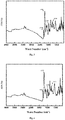
- Fig. 3 is a FT-IR spectrum of a finished fiber prepared in Example 3 of this invention.
- 1778 cm -1 was attributed to a symmetrical stretching vibration of a carbonyl group in an imine ring
- 1712 cm -1 was attributed to an asymmetric stretching vibration of a carbonyl group in an imine ring
- 1487 cm -1 was attributed to a stretching vibration of a benzoxazole ring
- 1250 cm -1 was attributed to an asymmetric stretching vibration of C-O in a benzoxazole ring.
- the finished fiber had a breaking strength of 2.5 GPa, a modulus of 105 GPa, and an elongation at break of 2.1%.
- the molecular structural formula of the polyimide fiber in this Example was as follow:
- the polyamic acid slurry described above was spun and molded by using a technical scheme of dry-jet wet spinning, and the spinning slurry at normal temperature was precisely metered with a metering pump, extruded from a spinneret orifice, passed through an air layer, and then passed into a coagulating bath of N,N-dimethylformamide and water (in a volume ratio of 1:5).
- the spinneret had 200 orifices, the orifice size was ⁇ 0.18 mm, the spinning draft ratio was 3.6, the spinning speed was 60 m/min, and the height of the air layer was 10 mm.
- the resultant primary fiber was washed with water and dried through a hot nitrogen gas channel to obtain a polyamic acid fiber.
- the resultant polyamic acid fiber was treated with a gradient heating thermal imidization furnace under an atmosphere of nitrogen gas to obtain a primary polyimide fiber.
- the temperature of thermal imidization was 50°C-400°C and the heating rate was 5°C/min.
- the resultant primary fiber was drawn at a drawing ratio of 1.5 under an atmosphere of nitrogen gas at 500°C to obtain a finished polyimide fiber.
- Fig. 4 is a FT-IR spectrum of a finished fiber prepared in Example 4 of this invention.
- 1778 cm -1 was attributed to a symmetrical stretching vibration of a carbonyl group in an imine ring
- 1712 cm -1 was attributed to an asymmetric stretching vibration of a carbonyl group in an imine ring
- 1490 cm -1 was attributed to a stretching vibration of a benzoxazole ring
- 1252 cm -1 was attributed to an asymmetric stretching vibration of C-O in a benzoxazole ring.
- the finished fiber had a breaking strength of 4.5 GPa, a modulus of 212 GPa, and an elongation at break of 2.3%.
- the molecular structural formula of the polyimide fiber in this Example was as follow:
- the polyamic acid slurry described above was spun and molded by using a technical scheme of dry-jet wet spinning, and the spinning slurry at normal temperature was precisely metered with a metering pump, extruded from a spinneret orifice, passed through an air layer, and then passed into a coagulating bath of N,N-dimethylformamide and water (in a volume ratio of 1:4).
- the spinneret had 100 orifices, the orifice size was ⁇ 0.15 mm, the spinning draft ratio was 4.8, the spinning speed was 50 m/min, and the height of the air layer was 10 mm.
- the resultant primary fiber was washed with water and dried through a hot nitrogen gas channel to obtain a polyamic acid fiber.
- the resultant polyamic acid fiber was treated with a gradient heating thermal imidization furnace under an atmosphere of nitrogen gas to obtain a primary polyimide fiber.
- the temperature of thermal imidization was 50°C-400°C and the heating rate was 5°C/min.
- the resultant primary fiber was drawn at a drawing ratio of 1.5 under an atmosphere of nitrogen gas at 500°C to obtain a finished polyimide fiber.
- the finished fiber was tested according to the method hereinbefore.
- the fiber had a breaking strength of 3.1 GPa, a modulus of 116.1 GPa, and an elongation at break of 3.4%.
- the structural formula of the polyimide fiber in this Example was:
- the polyamic acid slurry described above was spun and molded by using a technical scheme of dry-jet wet spinning, and the spinning slurry at normal temperature was precisely metered with a metering pump, extruded from a spinneret orifice, passed through an air layer, and then passed into a coagulating bath of N-methylpyrrolidone and water (in a volume ratio of 1:5).
- the spinneret had 50 orifices, the orifice size was ⁇ 0.12 mm, the spinning draft ratio was 3.6, the spinning speed was 40 m/min, and the height of the air layer was 5 mm.
- the resultant primary fiber was washed with water and dried through a hot argon gas channel to obtain a polyamic acid fiber.
- the resultant polyamic acid fiber was treated with a gradient heating thermal imidization furnace under an atmosphere of argon gas to obtain a primary polyimide fiber.
- the temperature of thermal imidization was 50°C-400°C and the heating rate was 10°C/min.
- the resultant primary fiber was drawn at a drawing ratio of 1.2 under an atmosphere of argon gas at 530°C to obtain a finished polyimide fiber.
- the finished fiber was tested according to the method hereinbefore.
- the fiber had a breaking strength of 3.8 GPa, a modulus of 155.2 GPa, and an elongation at break of 2.3%.
- the structural formula of the polyimide fiber in this Example was:
- the polyamic acid slurry described above was spun and molded by using dry-jet wet spinning, and the spinning slurry at normal temperature was precisely metered with a metering pump, extruded from a spinning orifice, passed through an air layer, and then passed into a coagulating bath of N,N-dimethylformamide and water (in a volume ratio of 1:5).
- the spinneret had 100 orifices, the orifice size was ⁇ 0.15 mm, the spinning speed was 100 m/min, the spinning draft ratio was 5.0, and the height of the air layer was 60 mm.
- the resultant primary fiber was washed with water and dried through a hot roller to obtain a polyamic acid fiber.
- the resultant polyamic acid fiber was treated with a gradient heating thermal treatment furnace under an atmosphere of nitrogen gas to obtain a primary polyimide fiber.
- the temperature of thermal imidization was 50°C-400°C and the heating rate was 5°C/min.
- the resultant primary fiber was drawn at a drawing ratio of 1.3 under an atmosphere of nitrogen gas at 510°C to obtain a finished polyimide fiber.
- Fig. 5 is a FT-IR spectrum of a finished fiber prepared in Example 7 of this invention.
- 1780 cm -1 was attributed to a symmetrical stretching vibration of a carbonyl group in an imine ring
- 1718 cm -1 was attributed to an asymmetric stretching vibration of a carbonyl group in an imine ring
- 1044 cm -1 was attributed to a stretching vibration of a benzothiazole ring
- 1090 cm -1 was attributed to an asymmetric stretching vibration of C-S in a benzothiazole ring.
- the finished fiber had a breaking strength of 3.1 GPa, a modulus of 116.8 GPa, and an elongation at break of 3.2%.
- the molecular structural formula of the polyimide fiber in this Example was as follow:
- the polyamic acid slurry described above was spun and molded by using dry-jet wet spinning, and the spinning slurry at normal temperature was precisely metered with a metering pump, extruded from a spinneret orifice, passed through an air layer, and then passed into a coagulating bath of N,N-dimethylacetamide and water (in a volume ratio of 1:5).
- the spinneret had 200 orifices, the orifice size was ⁇ 0.08 mm, the spinning speed was 15 m/min, the spinning draft ratio was 2.80, and the height of the air layer was 20 mm.
- the resultant primary fiber was washed with water and dried through a hot roller to obtain a polyamic acid fiber.
- the resultant polyamic acid fiber was treated with a gradient heating thermal imidization furnace under an atmosphere of nitrogen gas to obtain a primary polyimide fiber.
- the temperature of thermal imidization was 50°C-400°C and the heating rate was 1°C/min.
- the resultant primary fiber was drawn at a drawing ratio of 2.5 under an atmosphere of nitrogen gas at 550°C to obtain a finished polyimide fiber.
- the finished fiber was tested according to the method hereinbefore.
- the fiber had a breaking strength of 4.1 GPa, a modulus of 206.1 GPa, and an elongation at break of 2.1%.
- the structural formula of the polyimide fiber in this Example was:
- the polyamic acid slurry described above was spun and molded by using dry-jet wet spinning, and the spinning slurry at normal temperature was precisely metered with a metering pump, extruded from a spinneret orifice, passed through an air layer, and then passed into a coagulating bath of N,N-dimethylacetamide and water (in a volume ratio of 1:5).
- the spinneret had 200 orifices, the orifice size was ⁇ 0.10 mm, the spinning speed was 4 m/min, the spinning draft ratio was 3.0, and the height of the air layer was 2 mm.
- the resultant primary fiber was washed with water and dried through a hot roller to obtain a polyamic acid fiber.
- the resultant polyamic acid fiber was treated with a gradient heating thermal imidization furnace under an atmosphere of nitrogen gas to obtain a primary polyimide fiber.
- the temperature of thermal imidization was 50°C-400°C and the heating rate was 10°C/min.
- the resultant primary fiber was drawn at a drawing ratio of 2.1 under an atmosphere of nitrogen gas at 500°C to obtain a finished polyimide fiber.
- the finished fiber was tested according to the method hereinbefore.
- the fiber had a breaking strength of 3.70 GPa, a modulus of 140.3 GPa, and an elongation at break of 2.1%.
- the structural formula of the polyimide fiber in this Example was:
- the polyamic acid slurry described above was spun and molded by using a technical scheme of dry-jet wet spinning, and the spinning slurry at normal temperature was precisely metered with a metering pump, extruded from a spinneret orifice, passed through an air layer, and then passed into a coagulating bath of N,N-dimethylacetamide and water (in a volume ratio of 1:5).
- the spinneret had 200 orifices, the orifice size was ⁇ 0.18 mm, the spinning draft ratio was 3.8, the spinning speed was 45 m/min, and the height of the air layer was 10 mm.
- the resultant primary fiber was washed with water and dried through a hot nitrogen gas channel to obtain a polyamic acid fiber.
- the resultant polyamic acid fiber was treated with a gradient heating thermal imidization furnace under an atmosphere of nitrogen gas to obtain a primary polyimide fiber.
- the temperature of thermal imidization was 50°C-400°C and the heating rate was 5°C/min.
- the resultant primary fiber was drawn at a drawing ratio of 1.5 under an atmosphere of nitrogen gas at 500°C to obtain a finished polyimide fiber.
- the finished fiber was tested according to the method hereinbefore.
- the fiber had a breaking strength of 3.9 GPa, a modulus of 142.6 GPa, and an elongation at break of 2.4%.
- the structural formula of the polyimide fiber in this Example was:
Landscapes
- Chemical & Material Sciences (AREA)
- Engineering & Computer Science (AREA)
- Chemical Kinetics & Catalysis (AREA)
- Medicinal Chemistry (AREA)
- Polymers & Plastics (AREA)
- Organic Chemistry (AREA)
- Health & Medical Sciences (AREA)
- Textile Engineering (AREA)
- Mechanical Engineering (AREA)
- General Chemical & Material Sciences (AREA)
- Physics & Mathematics (AREA)
- Thermal Sciences (AREA)
- Macromolecular Compounds Obtained By Forming Nitrogen-Containing Linkages In General (AREA)
- Artificial Filaments (AREA)
Description
- This invention relates to the technical field of high-performance organic fibers, and particularly to a polyimide fiber and a preparation method thereof.
- A polyimide fiber is one of high-performance organic synthetic fibers, and has a plurality of excellent properties, such as high strength, high modulus, good resistance to high temperature, good resistance to low temperature, good flame resistance, good resistance to chemical corrosion, good irradiation resistance, etc. It plays a more and more important role in various fields, such as aerospace, national defence and military industry, new construction material, environmental protection, fire prevention, etc. Two major methods, namely, one-step and two-step methods, are generally used to fabricate PI fibers. In the one-step method, PI fibers are directly generated from a soluble PI solution. The two-step method is a method in which diamine and dianhydride are first subjected to a polycondensation reaction to generate a polyamic acid solution, which is then spun to obtain a polyamic acid fiber, and the polyamic acid fiber is further subjected to processes of imidization, thermal drawing, and the like to finally obtain a polyimide fiber.
- Here, the preparation of polyimide fibers using the single-step method is advantageous in that imidization is not required for precursor fibers to be spun, the process flow is short, and the polyimide fiber obtained has relatively high mechanical properties. Although this method is considered as the most effective means to prepare the high-performance PI fibers, the presence of soluble monomers and toxic solvents restricts the industrial production. The preparation of polyimide fibers using the two-step method is advantageous in that processability challenges caused by insolubility and infusibility of the polyimide are solved, there are many types of low-toxicity synthetic raw materials and useful solvents, the residual amount of solvents in the fiber is low, and it is suitable for industrial production.
- With the development of science and technology, a polyimide fiber having high strength and high modulus has been increasingly desired at present. Therefore, how to prepare a polyimide fiber having high strength and high modulus by the two-step method has become a main trend in both domestic and foreign research and development. For example, Senbiao Huang, et al., (e-Polymers, 2012, no.086) has obtained a biphenyl type polyimide fiber containing a benzoxazole structure, which has a good spinnability, a highest strength of 0.73 GPa, and an initial modulus of 39.5 GPa, by copolymerization using the two-step method. However, the existing technology for preparing a polyimide fiber by the two-step method has certain disadvantages in terms of improving the strength and the modulus of fibers.
- In view of this, this application provides a polyimide fiber and a preparation method thereof. The polyimide fiber provided by this invention has properties of high strength and high modulus and can be used at a relatively high temperature, contributing to application.
- This invention provides a polyimide fiber produced from a polymer as defined in the claims.
- The polymer has a structure of Formula III, Formula IV, Formula V, Formula VI, Formula VII, Formula VIII, Formula IX, Formula X, Formula XI, or Formula XII:


- This invention provides a preparation method for a polyimide fiber as defined above, comprising the steps of:
- A) subjecting a dianhydride compound and a diamine compound to a polymerization reaction in a solvent to obtain a polyamic acid solution, wherein said diamine compound comprises a diamine having a structure of Formula 12 or Formula 13:


said dianhydride compound comprises one or more of dianhydrides having structures of Formula 14 and Formula 15:

- B) subjecting said polyamic acid solution to spinning to obtain a polyamic acid fiber; and
- C) sequentially subjecting said polyamic acid fiber to imidization and thermal drawing to obtain a polyimide fiber.
- Preferably, said diamine compound further comprises one or more of diamines having structures of Formulae 16 to 22:


- J is selected from O, S, or NH.
- Preferably, the temperature of said polymerization reaction is in a range from -10°C to 50°C.
- Preferably, the intrinsic viscosity of said polyamic acid solution is between 1.5 dL/g and 3.7 dL/g.
- Preferably, the concentration of said polyamic acid solution is 5 wt%-35 wt%.
- Preferably, the molar ratio of said dianhydride compound to said diamine compound is 1:(0.8-1.5).
- Compared to the prior art, a polyimide fiber containing a hydroxybenzoxazole or hydroxybenzothiazole structure is produced by a wet or dry-jet wet spinning process in this invention. The polyimide fiber having this structure of this invention has a higher rigidity and can introduce a hydrogen bond to provide an interaction between molecular chains so as to influence the arrangement of the molecular chain in the polymer and the crystallinity, which imparts more excellent mechanical properties to the polyimide fiber. Furthermore, the polyimide fiber obtained in this invention has a higher glass transition temperature (Tg) and a better heat resistance, and is more suitable to be used in various aspects, such as spacecrafts, national defence construction, ocean exploitation, sports equipment, protective tools, cables, nuclear industry, fireproof, flame-retardant materials, and the like. Furthermore, a hydroxy group is introduced in this invention to allow the increase of active groups on the surface of the fiber, and this is also more suitable to be used in the field of fiber-reinforced composite materials. It is indicated by experimental results that the polyimide fiber provided by this invention has a highest strength of 4.5 GPa and a modulus of up to 212 GPa.
- Furthermore, the production process for preparing a polyimide fiber of this invention is stable.
- In order to illustrate the technical solutions in embodiments of this present invention or in the prior art more clearly, figures required for describing the embodiments or the prior art will be simply introduced below. It is apparent that the figures described below are merely embodiments of this invention, and other figures may be further obtained by those of ordinary skill in the art according to the figures provided without inventive efforts.
-
Fig. 1 is a scanning electron microscope image of a finished fiber spun in Example 1 of this invention; -
Fig. 2 is a DSC plot of a finished fiber spun in Example 2 of this invention; -
Fig. 3 is a FT-IR spectrum of a finished fiber prepared in Example 3 of this invention; -
Fig. 4 is a FT-IR spectrum of a finished fiber prepared in Example 4 of this invention; and -
Fig. 5 is a FT-IR spectrum of a finished fiber prepared in Example 7 of this invention. - The polyimide fiber provided by this invention has characteristics of high strength and high modulus, excellent mechanical properties, and good heat resistance, and can be used at a relatively high temperature.
- In this invention, the repeating unit comprises a hydroxybenzoxazole or hydroxybenzothiazole structure. This structure allows the polyimide fiber to have a higher rigidity and be able to introduce a hydrogen bond to provide an interaction between molecular chains so as to influence the arrangement of the molecular chain in the polymer and the crystallinity, which imparts more excellent mechanical properties to the polyimide fiber.
- In an embodiment of this invention, the fineness of said polyimide fiber is between 2 dtex and 4 dtex. The polyimide fibers provided in embodiments of this invention may have a breaking strength of 2.3 GPa-4.5 GPa, a modulus of 105 GPa-212 GPa, and an elongation at break of 2.1%-3.4%. In this invention, said polyimide fiber may have a glass transition temperature of 310°C-320°C.
- Accordingly, this invention provides a preparation method for a polyimide fiber, comprising the steps of:
- A) subjecting a dianhydride compound and a diamine compound to a polymerization reaction in a solvent to obtain a polyamic acid solution, wherein said diamine compound comprises a diamine having a structure of Formula 12 or Formula 13:


said dianhydride compound comprises one or more of dianhydrides having structures of Formula 14 and Formula 15:


- B) subjecting said polyamic acid solution to spinning to obtain a polyamic acid fiber; and
- C) sequentially subjecting said polyamic acid fiber to imidization and thermal drawing to obtain a polyimide fiber.
- In order to overcome the disadvantages in terms of the strength and the modulus of the polyimide fiber prepared by the existing two-step method, this invention provides a preparation method for a polyimide fiber having high strength and high modulus, which may be divided into four procedures: the preparation of a spinning solution, the spinning of a polyamic acid fiber, the imidization of the polyamic acid fiber, and the thermal drawing of the polyimide fiber.
- In an embodiment of this invention, a diamine compound and a dianhydride compound are added to a solvent and reacted for a certain period to obtain a polyamic acid solution, which is a light yellow viscous polyamic acid spinning solution, and the solution can be directly used as spinning slurry after filtration.
- In this invention, said diamine compound comprises a diamine having a structure of Formula 12 or Formula 13. In Formula 12 and Formula 13, A is selected from S or O; the amino groups at both ends may be at any position of positions 3, 4, 5, and 6 of the benzene ring. Particularly, said diamine compound may comprises one or more of 6-amino-2-(2-hydroxy-4-aminophenyl)benzoxazole, 5-amino-2-(2-hydroxy-4-aminophenyl)benzoxazole, 5-amino-2-(2-hydroxy-5-aminophenyl)benzoxazole, 5-amino-2-(2-hydroxy-4-aminophenyl)benzothiazole, and 2,5-di(5-amino-benzoxazol-2-yl)-1,4-benzenediol; and the structural formulae thereof are Formula 12-1, Formula 12-2, Formula 12-3, Formula 12-4, and Formula 13-1 respectively:


- The source of the diamine having a structure of Formula 12 or Formula 13 is not particularly limited in this invention, and commercially available products may be used or the diamine may be self-prepared.
- In order to further improve the performance of the fiber, said diamine compound preferably further comprises one or more of diamines having structures of Formulae 16 to 22, and more preferably further comprises one or more of diamines having structures of Formulae 16 to 19; and Formulae 16 to 22 are as follows:


- In Formulae 20 to 22, J is selected from O, S, or NH, and preferably selected from O or S.
- In an embodiment of this invention, said diamine compound further comprises 4,4'-oxydianiline or p-phenylenediamine; and the structural formulae thereof are respectively:

- In one embodiment of this invention, said diamine compound comprises 5-amino-2-(2-hydroxy-4-aminophenyl)benzoxazole and 4,4'-oxydianiline. In another embodiment of this invention, said diamine compound comprises 5-amino-2-(2-hydroxy-5-aminophenyl)benzoxazole and p-phenylenediamine. In another embodiment of this invention, said diamine compound comprises 2,5-di(5-amino-benzoxazol-2-yl)-1,4-benzenediol and p-phenylenediamine. In another embodiment of this invention, said diamine compound comprises 5-amino-2-(2-hydroxy-4-aminophenyl)benzoxazole and p-phenylenediamine. Furthermore, the ratio of amounts between various diamine compounds is not particularly limited in this invention.
- In this invention, said dianhydride compound comprises one or more of dianhydrides having structures of Formula 14 and Formula 15. Here, the dianhydride represented by Formula 14 is pyromellitic dianhydride. In Formula 15, t is selected from 0 or 1. When t is 0, two benzene rings are connected through a single bond at any position of positions 3, 4, 5, and 6, and preferably at position 3 or position 4; and when t is 1, two benzene rings are connected through a linking group E at any position of positions 3, 4, 5, and 6, and preferably at position 3 or position 4. In this invention, t is preferably 0.
- In Formula 15 of this invention, E is selected from S, O, C(CF3)2, C(CH3)2, C=O, C=S,

- In one embodiment of this invention, said dianhydride compound comprises 4,4'-biphthalic dianhydride, and the structural formula thereof is:

- In one embodiment of this invention, said dianhydride compound comprises pyromellitic dianhydride. In another embodiment of this invention, said dianhydride compound comprises pyromellitic dianhydride and 4,4'-biphthalic dianhydride. In another embodiment of this invention, said dianhydride compound comprises 4,4'-biphthalic dianhydride and 3,4'-biphthalic dianhydride.
- In this invention, said dianhydride compound and said diamine compound are subjected to a polymerization reaction to prepare a polyamic acid spinning solution. The molar ratio of said dianhydride compound to said diamine compound is preferably 1:(0.8-1.5), and more preferably 1:(0.9-1.2). In this invention, the polymerization is preferably performed at a temperature from -10°C to 50°C to prepare a precursor polyamic acid solution. That is, the temperature of the polymerization reaction is preferably in a range from -10°C to 50°C, and more preferably from 5°C to 40°C.
- In this invention, a dianhydride monomer and a diamine monomer are polymerized in a solvent to prepare a precursor polyamic acid solution. The solvent used is typically a mixture composed of one or more of polar aprotic solvents, and is more preferably selected from one or more of N,N-dimethylformamide, N,N-dimethylacetamide, dimethyl sulfoxide, and N-methylpyrrolidone. The amount of said solvent is not particularly limited in this invention; and the concentration of said polyamic acid solution is preferably 5 wt%-35 wt%, and more preferably 10 wt%-30 wt%. In an embodiment of this invention, the intrinsic viscosity of said polyamic acid solution is between 1.5 dL/g and 3.7 dL/g.
- After the polyamic acid solution is obtained, the spinning procedure of a polyamic acid fiber is performed in this invention. In an embodiment of this invention, the spinning solution prepared above is filtered, vacuum defoamed, and then spun by a spinning process such as dry-jet wet spinning, wet spinning, dry molding spinning, etc., to obtain a polyamic acid fiber.
- In this invention, a dry-jet wet spinning process or a wet spinning process is preferably used, wherein the dry-jet wet spinning process comprises the procedures as follows. The spinning solution prepared above is filtered and vacuum defoamed, and may be extruded from a spinneret orifice on a spinneret through a metering pump, passed through a section of an air layer, passed into a coagulating bath to be molded, passed through a water washing tank, and dried through a hot roller or a hot gas channel to finally obtain a polyamic acid fiber.
- In the dry-jet wet process, the orifice size of the spinneret is preferably Φ0.04 mm-Φ0.4 mm, and more preferably Φ0.05 mm-Φ0.3 mm; and the orifice number may be 10-10,000, and preferably 100-8,000. The spinning draft ratio is preferably 1.1-7.0, and more preferably 1.5-6.0; and the extrusion speed may be 5 m/min-100 m/min, and preferably 10 m/min-80 m/min. A extruded fine fluid may be passed through an air layer with a height of 3 mm-100 mm and then passed into a coagulating bath to be molded; and the height of said air layer is preferably 10 mm-80 mm. The coagulating bath used in this invention may be an alcohol-water solution, such as a mixture of water and any one of methanol, ethanol, ethylene glycol, butanol, acetone, and butanone, or may be a mixture of water and one of N,N-dimethylformamide, N,N-dimethylacetamide, dimethyl sulfoxide, N-methylpyrrolidone. A commonly used ratio of the solvent to water in said coagulating bath may be used. In one embodiment of this invention, the coagulating bath may be formed from N,N-dimethylacetamide and water, and the volume ratio therebetween is 1:5. In this invention, the atmosphere for said drying may be air, nitrogen gas, argon gas, or other inert gases, and is not particularly limited in this invention.
- The wet spinning process comprises the procedures as follows. The spinning solution prepared above is filtered and vacuum defoamed, and may be extruded from a spinneret orifice on a spinneret through a metering pump, passed into a coagulating bath to be molded, passed through a water washing tank, and dried through a hot roller or a hot gas channel to obtain a polyamic acid fiber.
- In the wet process, the orifice size of the spinneret is preferably Φ0.04 mm-Φ0.4 mm, and more preferably Φ0.05 mm-Φ0.3 mm; and the orifice number may be 10-12,000, and preferably 100-10,000. The spinning draft ratio is preferably 1.1-7.0, and more preferably 1.5-6.0; and the extrusion speed may be 5 m/min-100 m/min, and preferably 10 m/min-80 m/min. The coagulating bath used in this invention is well known by the person skilled in the art, and may be an alcohol-water solution, such as a mixture of water and any one of methanol, ethanol, ethylene glycol, butanol, acetone, and butanone, or may be a mixture of water and one of N,N-dimethylformamide, N,N-dimethylacetamide, dimethyl sulfoxide, N-methylpyrrolidone. The atmosphere for said drying may be air, nitrogen gas, argon gas, or other inert gases, and is not particularly limited in this invention.
- In an embodiment of this invention, after the polyamic acid fiber is obtained, it is subjected to imidization and may be treated in a thermal imidization furnace to obtain a primary polyimide fiber. In this invention, said imidization is thermal imidization which is well known by the person skilled in the art, and is preferably performed by using a gradient heating thermal treatment furnace or a constant temperature thermal treatment furnace. In this invention, when the imidization is performed by gradient heating thermal treatment, the temperature range of said gradient heating thermal treatment is preferably 50°C-500°C, and more preferably 60°C-400°C; and the heating rate is preferably I°C/min-30°C/min, and more preferably 2°Cmin-20°C/min. In this invention, when the imidization is performed by constant temperature treatment, the temperature of said constant temperature treatment is preferably 300°C-500°C, and more preferably 350°C-450°C; and the time of treatment is preferably 5 min-60 min, and more preferably 10 min-50 min. In this invention, The atmosphere for said imidization may be air, nitrogen gas, argon gas, or other inert gases. In this invention, the imidization of the polyamic acid fiber is preferably performed under an atmosphere of nitrogen gas to obtain a primary polyimide fiber.
- In an embodiment of this invention, the primary polyimide fiber obtained is subjected to thermal drawing to obtain a finished polyimide fiber. Said thermal drawing is not particularly limited in this invention. The temperature of said thermal drawing is preferably 30°C-570°C, and more preferably 50°C-500°C. The drawing ratio of said thermal drawing may be 1.0-6.0, and is preferably 2.0-5.0. The atmosphere for said thermal drawing may be air, nitrogen gas, argon gas, or other inert gases, and is preferably an atmosphere of nitrogen gas.
- In this invention, after the polyimide fiber is obtained, the structures and properties thereof are detected. Here, a commonly used Fourier transform infrared spectroscopy (FT-IR) is used in this invention to analyze the structure of a finished fiber. Furthermore, scanning electron microscopic analysis and DSC thermal analysis are performed on the spun finished fiber in this invention. The test conditions of the DSC thermal analysis include: an atmosphere of nitrogen gas, a temperature in a range of room temperature to 400°C, and a heating rate of 10°C/min. The result shows that the glass transition temperature of said polyimide fiber may be 310°C-320°C.
- In this invention, mechanical properties of a finished fiber are tested by using a FAVIMAT tester for linear density, degree of crimp, and tensile strength of single fiber available from Textechno Corporation, Germany. The test method comprises the procedures as follows. Each fiber is tested at least 10 times, and average values are employed. In test conditions, a modulus of deformation between 0.2%-0.4% is employed, a test form - Group9 (PBO) suitable for fibers having high strength and high modulus is employed, and the load cell in common parameters is 210 cN. In a Favimat fiber test, the gauge length is 20 mm, and the nominal linear density (Nominal L.D.) is 3.0 dtex. In a tensile test, the test speed is 5.0 mm/min, and the pretension is 2.00 cN/tex. In a linear density test, the test speed is 5.0 mm/min, the pretension is 1.00 cN/tex, and the correction value is 0.000%. It is indicated by results that the polyimide fiber provided by this invention has a highest strength of 4.5 GPa and a modulus of up to 212 GPa.
- In summary, in this invention, specific diamine and dianhydride monomers are polymerized to produce a polyamic acid spinning solution, a polyamic acid fiber is then produced by spinning, and the polyamic acid fiber is subjected to thermal imidization and finally thermal drawing to obtain a polyimide fiber, which has properties of high strength and high modulus and has a relatively high usage temperature. In this invention, a wet or dry-jet wet spinning process may be used, which has a simple process and facilitates continuous production.
- For further understanding of this application, the polyimide fiber and the preparation method thereof provided by this application are described in detail below in conjunction with Examples.
- 241.25 g (1.0 mol) of 6-amino-2-(2-hydroxy-4-aminophenyl)benzoxazole was weighed and dissolved in 3,500 mL of N,N-dimethylformamide, 294.22 g (1.0 mol) of 4,4'-biphthalic dianhydride was added with stirring, and reaction was performed at 30°C for 24 hours to obtain a light yellow viscous polyamic acid spinning solution having an intrinsic viscosity of 3.07 dL/g. The solution was directly used as spinning slurry after filtration.
- The polyamic acid slurry described above was spun and molded by using a technical scheme of dry-jet wet spinning, and the spinning slurry at normal temperature was precisely metered with a metering pump, extruded from a spinneret orifice, passed through an air layer, and then passed into a coagulating bath of N,N-dimethylformamide and water (in a volume ratio of 1:2). Here, the spinneret had 200 orifices, the orifice size was Φ0.15 mm, the spinning draft ratio was 4.8, the spinning speed was 50 m/min, and the height of the air layer was 10 mm. The resultant primary fiber was washed with water and dried through a hot nitrogen gas channel to obtain a polyamic acid fiber.
- The resultant polyamic acid fiber was treated with a gradient heating thermal imidization furnace under an atmosphere of nitrogen gas to obtain a primary polyimide fiber. Here, the temperature of thermal imidization was 50°C-400°C and the heating rate was 5°C/min. The resultant primary polyimide fiber was drawn at a drawing ratio of 1.5 under an atmosphere of nitrogen gas at 500°C to obtain a finished polyimide fiber.
- The finished fiber was tested according to the method hereinbefore. With reference to
Fig. 1, Fig. 1 is a scanning electron microscope image of a finished fiber spun in Example 1 of this invention. The finished fiber had a breaking strength of 3.4 GPa, a modulus of 137.4 GPa, and an elongation at break of 2.8%. The structural formula of the polyimide fiber in this Example was as follow:
- 241.25 g (1.0 mol) of 5-amino-2-(2-hydroxy-4-aminophenyl)benzoxazole was weighed and dissolved in 3,500 mL of N,N-dimethylformamide, 294.22 g (1.0 mol) of 4,4'-biphthalic dianhydride was added with stirring, and reaction was performed at 30°C for 24 hours to obtain a light yellow viscous polyamic acid spinning solution having an intrinsic viscosity of 2.32 dL/g. The solution was directly used as spinning slurry after filtration.
- The polyamic acid slurry described above was spun and molded by using a technical scheme of dry-jet wet spinning, and the spinning slurry at normal temperature was precisely metered with a metering pump, extruded from a spinneret orifice, passed through an air layer, and then passed into a coagulating bath of N,N-dimethylformamide and water (in a volume ratio of 1:4). Here, the spinneret had 200 orifices, the orifice size was Φ0.18 mm, the spinning draft ratio was 4.0, the spinning speed was 40 m/min, and the height of the air layer was 10 mm. The resultant primary fiber was washed with water and dried through a hot nitrogen gas channel to obtain a polyamic acid fiber.
- The resultant polyamic acid fiber was treated with a gradient heating thermal imidization furnace under an atmosphere of nitrogen gas to obtain a primary polyimide fiber. Here, the temperature of thermal imidization was 50°C-400°C and the heating rate was 5°C/min. The resultant primary fiber was drawn at a drawing ratio of 1.5 under an atmosphere of nitrogen gas at 500°C to obtain a finished polyimide fiber.
- The finished fiber was tested according to the method hereinbefore. With reference to
Fig. 2, Fig. 2 is a DSC plot of a finished fiber spun in Example 2 of this invention. As can be seen fromFig. 2 , Tg of the fiber was 312.5°C. The finished fiber had a breaking strength of 3.7 GPa, a modulus of 130.8 GPa, and an elongation at break of 2.4%. The molecular structural formula of the polyimide fiber in this Example was as follow:
- 241.25 g (1.0 mol) of 5-amino-2-(2-hydroxy-5-aminophenyl)benzoxazole was weighed and dissolved in 3,800 mL of N,N-dimethylformamide, 294.22 g (1.0 mol) of 4,4'-biphthalic dianhydride was added with stirring, and reaction was performed at -10°C for 48 hours to obtain a light yellow viscous polyamic acid spinning solution having an intrinsic viscosity of 2.78 dL/g. The solution was directly used as spinning slurry after filtration.
- The polyamic acid slurry described above was spun and molded by using a technical scheme of wet spinning, and the spinning slurry at 60°C was precisely metered with a metering pump, extruded from a spinneret orifice, and then passed into a coagulating bath of N,N-dimethylformamide and water (in a volume ratio of 1:6). Here, the spinneret had 100 orifices, the orifice size was Φ0.15 mm, the spinning draft ratio was 3.2, the spinning speed was 50 m/min, and the height of the air layer was 10 mm. The primary fiber was washed with water and dried through a hot nitrogen gas channel to obtain a polyamic acid fiber.
- The resultant polyamic acid fiber was treated with a gradient heating thermal imidization furnace under an atmosphere of nitrogen gas to obtain a primary polyimide fiber. Here, the temperature of thermal imidization was 50°C-400°C and the heating rate was 5°C/min. The resultant primary fiber was drawn at a drawing ratio of 1.5 under an atmosphere of nitrogen gas at 500°C to obtain a finished polyimide fiber.
- The finished fiber was tested according to the method hereinbefore. With reference to
Fig. 3, Fig. 3 is a FT-IR spectrum of a finished fiber prepared in Example 3 of this invention. Here, 1778 cm-1 was attributed to a symmetrical stretching vibration of a carbonyl group in an imine ring, 1712 cm-1 was attributed to an asymmetric stretching vibration of a carbonyl group in an imine ring, 1487 cm-1 was attributed to a stretching vibration of a benzoxazole ring, and 1250 cm-1 was attributed to an asymmetric stretching vibration of C-O in a benzoxazole ring. The finished fiber had a breaking strength of 2.5 GPa, a modulus of 105 GPa, and an elongation at break of 2.1%. The molecular structural formula of the polyimide fiber in this Example was as follow:
- 361.88 g (1.5 mol) of 5-amino-2-(2-hydroxy-5-aminophenyl)benzoxazole was weighed and dissolved in 4,500 mL of N,N-dimethylformamide, 163.66 g (0.75 mol) of pyromellitic dianhydride and 220.67 g (0.75 mol) of 4,4'-biphthalic dianhydride were added with stirring, and reaction was performed at -10°C for 10 hours to obtain a light yellow viscous polyamic acid spinning solution having an intrinsic viscosity of 2.14 dL/g. The solution was directly used as spinning slurry after filtration.
- The polyamic acid slurry described above was spun and molded by using a technical scheme of dry-jet wet spinning, and the spinning slurry at normal temperature was precisely metered with a metering pump, extruded from a spinneret orifice, passed through an air layer, and then passed into a coagulating bath of N,N-dimethylformamide and water (in a volume ratio of 1:5). Here, the spinneret had 200 orifices, the orifice size was Φ0.18 mm, the spinning draft ratio was 3.6, the spinning speed was 60 m/min, and the height of the air layer was 10 mm. The resultant primary fiber was washed with water and dried through a hot nitrogen gas channel to obtain a polyamic acid fiber.
- The resultant polyamic acid fiber was treated with a gradient heating thermal imidization furnace under an atmosphere of nitrogen gas to obtain a primary polyimide fiber. Here, the temperature of thermal imidization was 50°C-400°C and the heating rate was 5°C/min. The resultant primary fiber was drawn at a drawing ratio of 1.5 under an atmosphere of nitrogen gas at 500°C to obtain a finished polyimide fiber.
- The finished fiber was tested according to the method hereinbefore. With reference to
Fig. 4, Fig. 4 is a FT-IR spectrum of a finished fiber prepared in Example 4 of this invention. Here, 1778 cm-1 was attributed to a symmetrical stretching vibration of a carbonyl group in an imine ring, 1712 cm-1 was attributed to an asymmetric stretching vibration of a carbonyl group in an imine ring, 1490 cm-1 was attributed to a stretching vibration of a benzoxazole ring, and 1252 cm-1 was attributed to an asymmetric stretching vibration of C-O in a benzoxazole ring. The finished fiber had a breaking strength of 4.5 GPa, a modulus of 212 GPa, and an elongation at break of 2.3%. The molecular structural formula of the polyimide fiber in this Example was as follow:
- 180.94 g (0.750 mol) of 5-amino-2-(2-hydroxy-4-aminophenyl)benzoxazole and 150.18 g (0.750 mol) of 4,4'-oxydianiline were weighed and dissolved in 3,500 mL of N,N-dimethylformamide, 441.34 g (1.50 mol) of 4,4'-biphthalic dianhydride was added with stirring, and reaction was performed at -10°C for 10 hours to obtain a light yellow viscous polyamic acid spinning solution having an intrinsic viscosity of 1.87 dL/g. The solution was directly used as spinning slurry after filtration.
- The polyamic acid slurry described above was spun and molded by using a technical scheme of dry-jet wet spinning, and the spinning slurry at normal temperature was precisely metered with a metering pump, extruded from a spinneret orifice, passed through an air layer, and then passed into a coagulating bath of N,N-dimethylformamide and water (in a volume ratio of 1:4). Here, the spinneret had 100 orifices, the orifice size was Φ0.15 mm, the spinning draft ratio was 4.8, the spinning speed was 50 m/min, and the height of the air layer was 10 mm. The resultant primary fiber was washed with water and dried through a hot nitrogen gas channel to obtain a polyamic acid fiber.
- The resultant polyamic acid fiber was treated with a gradient heating thermal imidization furnace under an atmosphere of nitrogen gas to obtain a primary polyimide fiber. Here, the temperature of thermal imidization was 50°C-400°C and the heating rate was 5°C/min. The resultant primary fiber was drawn at a drawing ratio of 1.5 under an atmosphere of nitrogen gas at 500°C to obtain a finished polyimide fiber.
- The finished fiber was tested according to the method hereinbefore. The fiber had a breaking strength of 3.1 GPa, a modulus of 116.1 GPa, and an elongation at break of 3.4%. The structural formula of the polyimide fiber in this Example was:

- 180.94 g (0.750 mol) of 5-amino-2-(2-hydroxy-5-aminophenyl)benzoxazole and 81.11 g (0.750 mol) of p-phenylenediamine were weighed and dissolved in 4,500 mL of N-methylpyrrolidone, 308.93 g (1.05 mol) of 4,4'-biphthalic dianhydride and 98.15 g (0.45 mol) of pyromellitic dianhydride were added with stirring, and reaction was performed at 40°C for 24 hours to obtain a light yellow viscous polyamic acid spinning solution having an intrinsic viscosity of 2.53 dL/g. The solution was directly used as spinning slurry after filtration.
- The polyamic acid slurry described above was spun and molded by using a technical scheme of dry-jet wet spinning, and the spinning slurry at normal temperature was precisely metered with a metering pump, extruded from a spinneret orifice, passed through an air layer, and then passed into a coagulating bath of N-methylpyrrolidone and water (in a volume ratio of 1:5). Here, the spinneret had 50 orifices, the orifice size was Φ0.12 mm, the spinning draft ratio was 3.6, the spinning speed was 40 m/min, and the height of the air layer was 5 mm. The resultant primary fiber was washed with water and dried through a hot argon gas channel to obtain a polyamic acid fiber.
- The resultant polyamic acid fiber was treated with a gradient heating thermal imidization furnace under an atmosphere of argon gas to obtain a primary polyimide fiber. Here, the temperature of thermal imidization was 50°C-400°C and the heating rate was 10°C/min. The resultant primary fiber was drawn at a drawing ratio of 1.2 under an atmosphere of argon gas at 530°C to obtain a finished polyimide fiber.
- The finished fiber was tested according to the method hereinbefore. The fiber had a breaking strength of 3.8 GPa, a modulus of 155.2 GPa, and an elongation at break of 2.3%. The structural formula of the polyimide fiber in this Example was:

- 385.97 g (1.5 mol) of 5-amino-2-(2-hydroxy-4-aminophenyl)benzothiazole was weighed and dissolved in 4,700 mL of N,N-dimethylformamide, 220.67 g (0.75 mol) of 4,4'-biphthalic dianhydride and 163.67 g (0.75 mol) of pyromellitic dianhydride were added with stirring, and reaction was performed at 30°C for 12 hours to obtain a light yellow viscous polyamic acid spinning solution having an intrinsic viscosity of 2.91 dL/g. The solution was directly used as spinning slurry after filtration.
- The polyamic acid slurry described above was spun and molded by using dry-jet wet spinning, and the spinning slurry at normal temperature was precisely metered with a metering pump, extruded from a spinning orifice, passed through an air layer, and then passed into a coagulating bath of N,N-dimethylformamide and water (in a volume ratio of 1:5). Here, the spinneret had 100 orifices, the orifice size was Φ0.15 mm, the spinning speed was 100 m/min, the spinning draft ratio was 5.0, and the height of the air layer was 60 mm. The resultant primary fiber was washed with water and dried through a hot roller to obtain a polyamic acid fiber.
- The resultant polyamic acid fiber was treated with a gradient heating thermal treatment furnace under an atmosphere of nitrogen gas to obtain a primary polyimide fiber. Here, the temperature of thermal imidization was 50°C-400°C and the heating rate was 5°C/min. The resultant primary fiber was drawn at a drawing ratio of 1.3 under an atmosphere of nitrogen gas at 510°C to obtain a finished polyimide fiber.
- The finished fiber was tested according to the method hereinbefore. With reference to
Fig. 5, Fig. 5 is a FT-IR spectrum of a finished fiber prepared in Example 7 of this invention. Here, 1780 cm-1 was attributed to a symmetrical stretching vibration of a carbonyl group in an imine ring, 1718 cm-1 was attributed to an asymmetric stretching vibration of a carbonyl group in an imine ring, 1044 cm-1 was attributed to a stretching vibration of a benzothiazole ring, and 1090 cm-1 was attributed to an asymmetric stretching vibration of C-S in a benzothiazole ring. The finished fiber had a breaking strength of 3.1 GPa, a modulus of 116.8 GPa, and an elongation at break of 3.2%. The molecular structural formula of the polyimide fiber in this Example was as follow:
- 374.35 g (1.0 mol) of 2,5-di(5-amino-benzoxazol-2-yl)-1,4-benzenediol and 54.07 g (0.50 mol) of p-phenylenediamine were weighed and dissolved in 5,300 mL of N,N-dimethylacetamide, 220.67 g (0.75 mol) of 4,4'-biphthalic dianhydride and 163.67 g (0.75 mol) of pyromellitic dianhydride were added with stirring, and reaction was performed at 30°C for 12 hours to obtain a light yellow viscous polyamic acid spinning solution having an intrinsic viscosity of 2.03 dL/g. The solution was directly used as spinning slurry after filtration.
- The polyamic acid slurry described above was spun and molded by using dry-jet wet spinning, and the spinning slurry at normal temperature was precisely metered with a metering pump, extruded from a spinneret orifice, passed through an air layer, and then passed into a coagulating bath of N,N-dimethylacetamide and water (in a volume ratio of 1:5). Here, the spinneret had 200 orifices, the orifice size was Φ0.08 mm, the spinning speed was 15 m/min, the spinning draft ratio was 2.80, and the height of the air layer was 20 mm. The resultant primary fiber was washed with water and dried through a hot roller to obtain a polyamic acid fiber.
- The resultant polyamic acid fiber was treated with a gradient heating thermal imidization furnace under an atmosphere of nitrogen gas to obtain a primary polyimide fiber. Here, the temperature of thermal imidization was 50°C-400°C and the heating rate was 1°C/min. The resultant primary fiber was drawn at a drawing ratio of 2.5 under an atmosphere of nitrogen gas at 550°C to obtain a finished polyimide fiber.
- The finished fiber was tested according to the method hereinbefore. The fiber had a breaking strength of 4.1 GPa, a modulus of 206.1 GPa, and an elongation at break of 2.1%. The structural formula of the polyimide fiber in this Example was:

- 180.94 g (0.750 mol) of 5-amino-2-(2-hydroxy-4-aminophenyl)benzoxazole and 81.11 g (0.750 mol) of p-phenylenediamine were weighed and dissolved in 5,000 mL of N-methylpyrrolidone, 308.93 g (1.05 mol) of 4,4'-biphthalic dianhydride and 132.40 g (0.45 mol) of 3,4'-biphthalic dianhydride were added with stirring, and reaction was performed at -5°C for 24 hours to obtain a light yellow viscous polyamic acid spinning solution having an intrinsic viscosity of 2.42 dL/g. The solution was directly used as spinning slurry after filtration.
- The polyamic acid slurry described above was spun and molded by using dry-jet wet spinning, and the spinning slurry at normal temperature was precisely metered with a metering pump, extruded from a spinneret orifice, passed through an air layer, and then passed into a coagulating bath of N,N-dimethylacetamide and water (in a volume ratio of 1:5). Here, the spinneret had 200 orifices, the orifice size was Φ0.10 mm, the spinning speed was 4 m/min, the spinning draft ratio was 3.0, and the height of the air layer was 2 mm. The resultant primary fiber was washed with water and dried through a hot roller to obtain a polyamic acid fiber.
- The resultant polyamic acid fiber was treated with a gradient heating thermal imidization furnace under an atmosphere of nitrogen gas to obtain a primary polyimide fiber. Here, the temperature of thermal imidization was 50°C-400°C and the heating rate was 10°C/min. The resultant primary fiber was drawn at a drawing ratio of 2.1 under an atmosphere of nitrogen gas at 500°C to obtain a finished polyimide fiber.
- The finished fiber was tested according to the method hereinbefore. The fiber had a breaking strength of 3.70 GPa, a modulus of 140.3 GPa, and an elongation at break of 2.1%. The structural formula of the polyimide fiber in this Example was:

- 180.94 g (0.75 mol) of 5-amino-2-(2-hydroxy-4-aminophenyl)benzoxazole and 180.94 g (0.750 mol) of 5-amino-2-(2-hydroxy-5-aminophenyl)benzoxazole were weighed and dissolved in 5,000 mL of N,N-dimethylacetamide, 441.34 g (1.50 mol) of 4,4'-biphthalic dianhydride was added with stirring, and reaction was performed at room temperature for 24 hours to obtain a light yellow viscous polyamic acid spinning solution having an intrinsic viscosity of 3.12 dL/g. The solution was directly used as spinning slurry after filtration.
- The polyamic acid slurry described above was spun and molded by using a technical scheme of dry-jet wet spinning, and the spinning slurry at normal temperature was precisely metered with a metering pump, extruded from a spinneret orifice, passed through an air layer, and then passed into a coagulating bath of N,N-dimethylacetamide and water (in a volume ratio of 1:5). Here, the spinneret had 200 orifices, the orifice size was Φ0.18 mm, the spinning draft ratio was 3.8, the spinning speed was 45 m/min, and the height of the air layer was 10 mm. The resultant primary fiber was washed with water and dried through a hot nitrogen gas channel to obtain a polyamic acid fiber.
- The resultant polyamic acid fiber was treated with a gradient heating thermal imidization furnace under an atmosphere of nitrogen gas to obtain a primary polyimide fiber. Here, the temperature of thermal imidization was 50°C-400°C and the heating rate was 5°C/min. The resultant primary fiber was drawn at a drawing ratio of 1.5 under an atmosphere of nitrogen gas at 500°C to obtain a finished polyimide fiber.
- The finished fiber was tested according to the method hereinbefore. The fiber had a breaking strength of 3.9 GPa, a modulus of 142.6 GPa, and an elongation at break of 2.4%. The structural formula of the polyimide fiber in this Example was:

Claims (11)
- A polyimide fiber produced from a polymer, characterized in that said polymer has a structure of Formula III, Formula IV, Formula V, Formula VI, Formula VII, Formula VIII, Formula IX, Formula X, Formula XI, or Formula XII:


- A preparation method for the polyimide fiber as defined in claim 1, characterized in that the preparation method comprises the steps of:A) subjecting a dianhydride compound and a diamine compound to a polymerization reaction in a solvent to obtain a polyamic acid solution, wherein said diamine compound comprises a diamine having a structure of Formula 12 or Formula 13:


said dianhydride compound comprises one or more of dianhydrides having structures of Formula 14 and Formula 15:


t is selected from 0 or 1;B) subjecting said polyamic acid solution to spinning to obtain a polyamic acid fiber; andC) sequentially subjecting said polyamic acid fiber to imidization and thermal drawing to obtain a polyimide fiber,
or said diamine compound further comprises one or more of diamines having structures of Formulae 16 to 22:



J is selected from O, S, or NH - The preparation method according to claim 2, characterized in that the temperature of said polymerization reaction is in a range from -10°C to 50°C.
- The preparation method according to claim 2, characterized in that the intrinsic viscosity of said polyamic acid solution is between 1.5 dL/g and 3.7 dL/g.
- The preparation method according to claim 4, characterized in that the concentration of said polyamic acid solution is 5 wt%-35 wt%.
- The preparation method according to claim 2, characterized in that the molar ratio of said dianhydride compound to said diamine compound is 1 :(0.8-1.5).
- The preparation method according to claim 2, characterized in that said solvent in step A) is an aprotic polar solvent.
- The preparation method according to claim 7, characterized in that said aprotic polar solvent is selected from one or more of N,N-dimethylformamide, N,N-dimethylacetamide, dimethyl sulfoxide, and N-methylpyrrolidone.
- The preparation method according to claim 2, characterized in that said spinning is dry-jet wet spinning, wherein a spinneret for the dry-jet wet spinning has a orifice size of Φ0.04 mm-Φ0.4 mm and an orifice number of 10-10,000; a spinning draft ratio of the dry-jet wet spinning is 1.1-7.0; and an extrusion speed of the dry-jet wet spinning is 5 m/min-100 m/min.
- The preparation method according to claim 2, characterized in that said spinning is wet spinning, wherein a spinneret for the wet spinning has a orifice size of Φ0.04 mm-Φ0.4 mm and an orifice number of 10-12,000; a spinning draft ratio of the wet spinning is 1.1-7.0; and an extrusion speed of the wet spinning is 5 m/min-100 m/min.
- The polyimide fiber according to claim 1, characterized in that the fineness of said polyimide fiber is between 2 dtex and 4 dtex, the breaking strength of said polyimide fiber is 2.3 GPa-4.5 GPa, or the modulus of said polyimide fiber is 105 GPa-212 GPa.
Applications Claiming Priority (2)
| Application Number | Priority Date | Filing Date | Title |
|---|---|---|---|
| CN201510790527.3A CN105297165B (en) | 2015-11-17 | 2015-11-17 | A kind of polyimide fiber and preparation method thereof |
| PCT/CN2016/098426 WO2017084419A1 (en) | 2015-11-17 | 2016-09-08 | Polyimide fiber and preparation method therefor |
Publications (3)
| Publication Number | Publication Date |
|---|---|
| EP3378976A1 EP3378976A1 (en) | 2018-09-26 |
| EP3378976A4 EP3378976A4 (en) | 2019-07-31 |
| EP3378976B1 true EP3378976B1 (en) | 2021-04-07 |
Family
ID=55194953
Family Applications (1)
| Application Number | Title | Priority Date | Filing Date |
|---|---|---|---|
| EP16865597.5A Active EP3378976B1 (en) | 2015-11-17 | 2016-09-08 | Polyimide fiber and preparation method therefor |
Country Status (4)
| Country | Link |
|---|---|
| US (1) | US20180282907A1 (en) |
| EP (1) | EP3378976B1 (en) |
| CN (1) | CN105297165B (en) |
| WO (1) | WO2017084419A1 (en) |
Families Citing this family (5)
| Publication number | Priority date | Publication date | Assignee | Title |
|---|---|---|---|---|
| CN105297165B (en) * | 2015-11-17 | 2017-12-19 | 中国科学院长春应用化学研究所 | A kind of polyimide fiber and preparation method thereof |
| CN105801857B (en) * | 2016-04-20 | 2018-03-20 | 中国科学院长春应用化学研究所 | A kind of polyimide microsphere and preparation method thereof |
| CN106893104B (en) * | 2017-04-06 | 2020-07-07 | 中国科学院长春应用化学研究所 | A kind of diamine compound, polyimide fiber and preparation method thereof |
| CN116103779B (en) * | 2023-02-14 | 2024-04-12 | 江苏奥神新材料股份有限公司 | Polyimide fiber with high heat resistance and preparation method thereof |
| CN117327020A (en) * | 2023-10-07 | 2024-01-02 | 中国科学院过程工程研究所 | Amino aromatic compound containing benzazepine structure, and preparation method and application thereof |
Family Cites Families (19)
| Publication number | Priority date | Publication date | Assignee | Title |
|---|---|---|---|---|
| US3661849A (en) * | 1965-10-06 | 1972-05-09 | Ashland Oil Inc | Heterocyclic polyimides prepared from heterocyclic diamines |
| US4640972A (en) * | 1985-11-15 | 1987-02-03 | E. I. Du Pont De Nemours And Company | Filament of polyimide from pyromellitic acid dianhydride and 3,4'-oxydianiline |
| KR100584483B1 (en) * | 2004-06-04 | 2006-05-29 | 충남대학교산학협력단 | Benzoxazole-based difunctional monomer compound having a hydroxyphenyl group adjacent thereto and a method for producing the same |
| CN1245434C (en) * | 2004-06-25 | 2006-03-15 | 东华大学 | Poly-benzobisoxazole polymer containing hydroxyl group and process for preparing same |
| JP4546854B2 (en) * | 2005-03-09 | 2010-09-22 | 帝人株式会社 | Rigid heterocyclic polymer and method for producing the same |
| JP2007106980A (en) * | 2005-09-13 | 2007-04-26 | Toyobo Co Ltd | Method for producing polybenzoxazole polymer and the resultant polymer |
| CN101200822B (en) * | 2007-11-30 | 2010-09-01 | 四川大学 | Polyimide fibre containing benzimidazole structure and preparation method thereof |
| JP2010139930A (en) * | 2008-12-15 | 2010-06-24 | Toyobo Co Ltd | Positive photosensitive polyimide resin composition |
| US8127936B2 (en) * | 2009-03-27 | 2012-03-06 | Uop Llc | High performance cross-linked polybenzoxazole and polybenzothiazole polymer membranes |
| CN101922061B (en) * | 2010-08-06 | 2013-04-03 | 东华大学 | Polyimide fiber and preparation method thereof |
| CN102041576B (en) * | 2010-12-03 | 2012-04-18 | 中国科学院长春应用化学研究所 | A kind of polyimide fiber and preparation method thereof |
| CN102191581B (en) * | 2011-03-28 | 2012-10-24 | 中国科学院长春应用化学研究所 | Polyimide fiber and preparation method thereof |
| CN102219747A (en) * | 2011-04-20 | 2011-10-19 | 东华大学 | Synthesis method of aromatic diamine containing double imidazole rings |
| CN102838745B (en) * | 2012-09-19 | 2014-11-26 | 中国科学院长春应用化学研究所 | Preparation method of polyimide foam |
| CN103696033B (en) * | 2013-12-16 | 2016-07-06 | 中国科学院长春应用化学研究所 | A kind of preparation method of polyimide fiber |
| CN104119534B (en) * | 2014-07-10 | 2017-07-14 | 金宁人 | A kind of polyhydroxy-p-phenylene benzobisoxazole polymer and its preparation and application |
| CN104947228B (en) * | 2015-07-09 | 2018-11-27 | 中国科学院长春应用化学研究所 | A kind of polyimide fiber and preparation method thereof |
| CN105297166B (en) * | 2015-11-17 | 2017-12-19 | 中国科学院长春应用化学研究所 | A kind of polyimide fiber and preparation method thereof |
| CN105297165B (en) * | 2015-11-17 | 2017-12-19 | 中国科学院长春应用化学研究所 | A kind of polyimide fiber and preparation method thereof |
-
2015
- 2015-11-17 CN CN201510790527.3A patent/CN105297165B/en active Active
-
2016
- 2016-09-08 EP EP16865597.5A patent/EP3378976B1/en active Active
- 2016-09-08 WO PCT/CN2016/098426 patent/WO2017084419A1/en not_active Ceased
- 2016-09-08 US US15/572,464 patent/US20180282907A1/en not_active Abandoned
Non-Patent Citations (1)
| Title |
|---|
| ZHANG T ET AL: "XPS study of PBO fiber surface modified by incorporation of hydroxyl polar groups in main chains", APPLIED SURFACE SCIENCE, ELSEVIER, AMSTERDAM, NL, vol. 256, no. 7, 15 January 2010 (2010-01-15), pages 2073 - 2075, XP026857934, ISSN: 0169-4332, [retrieved on 20090923] * |
Also Published As
| Publication number | Publication date |
|---|---|
| EP3378976A1 (en) | 2018-09-26 |
| EP3378976A4 (en) | 2019-07-31 |
| US20180282907A1 (en) | 2018-10-04 |
| WO2017084419A1 (en) | 2017-05-26 |
| CN105297165B (en) | 2017-12-19 |
| CN105297165A (en) | 2016-02-03 |
Similar Documents
| Publication | Publication Date | Title |
|---|---|---|
| EP3378977B1 (en) | Polyimide fiber and preparation method therefor | |
| EP3378976A1 (en) | Polyimide fiber and preparation method therefor | |
| CN101338462B (en) | Method for preparing polyimide fiber | |
| EP1421032B1 (en) | Compositions comprising rigid-rod polymers and carbon nanotubes and process for making the same | |
| CN103696033B (en) | A kind of preparation method of polyimide fiber | |
| CN101200822A (en) | Polyimide fiber containing benzimidazole structure and preparation method thereof | |
| Zhang et al. | Heat-resistant polybenzoxazole nanofibers made by electrospinning | |
| CN115125630B (en) | Preparation method of radiation-resistant polyimide fiber | |
| CN101525783A (en) | Polyimide fiber and preparation method thereof | |
| EP3767018A1 (en) | Preparation process for and use of super-high-count pi-psa electrospun fiber long-staple yarn | |
| Zhang et al. | Superior comprehensive performance of a rigid-rod poly (hydroxy-p-phenylenebenzobisoxazole) fiber | |
| Zhao et al. | Synthesis and properties of novel polyimide fibers containing phosphorus groups in the main chain | |
| Li et al. | Preparation and Characterization of Hydrophilic Wetting‐Modified Polyamide Fibers | |
| Gao et al. | Structure and properties of novel PMDA/ODA/PABZ polyimide fibers | |
| EP3228736A1 (en) | Carbon-fiber precursor fiber, carbon fiber, and method for producing carbon fiber | |
| CN104947228A (en) | Polyimide fiber and preparation method thereof | |
| Zhang et al. | Effect of draw ratio on the morphologies and properties of BPDA/PMDA/ODA polyimide fibers | |
| CN103255501B (en) | The preparation method of polyimide fiber | |
| EP2927351B1 (en) | Precursor fiber for carbon fibers, and method for producing carbon fiber | |
| CN104372435A (en) | Aromatic polysulfone amide copolymer fiber containing PPTA (Poly-p-phenylene Terephthalamide) chain section and manufacturing method thereof | |
| Hasbullah et al. | Asymmetric hollow fibre membranes based on ring-substituted polyaniline and investigation towards its gas transport properties | |
| CN1922214B (en) | Solution containing flame-resistant polymer and carbon molding | |
| CN112225895A (en) | Flame-retardant aromatic polyoxadiazole polymer and preparation method thereof | |
| CN103014902A (en) | Polyimide fiber and preparation method thereof | |
| JP7224466B2 (en) | Polymer composite material containing aramid nanofibers and method for producing the same |
Legal Events
| Date | Code | Title | Description |
|---|---|---|---|
| STAA | Information on the status of an ep patent application or granted ep patent |
Free format text: STATUS: THE INTERNATIONAL PUBLICATION HAS BEEN MADE |
|
| PUAI | Public reference made under article 153(3) epc to a published international application that has entered the european phase |
Free format text: ORIGINAL CODE: 0009012 |
|
| STAA | Information on the status of an ep patent application or granted ep patent |
Free format text: STATUS: REQUEST FOR EXAMINATION WAS MADE |
|
| 17P | Request for examination filed |
Effective date: 20171110 |
|
| AK | Designated contracting states |
Kind code of ref document: A1 Designated state(s): AL AT BE BG CH CY CZ DE DK EE ES FI FR GB GR HR HU IE IS IT LI LT LU LV MC MK MT NL NO PL PT RO RS SE SI SK SM TR |
|
| AX | Request for extension of the european patent |
Extension state: BA ME |
|
| DAV | Request for validation of the european patent (deleted) | ||
| DAX | Request for extension of the european patent (deleted) | ||
| A4 | Supplementary search report drawn up and despatched |
Effective date: 20190701 |
|
| RIC1 | Information provided on ipc code assigned before grant |
Ipc: D01D 5/06 20060101ALI20190625BHEP Ipc: D01D 1/02 20060101ALI20190625BHEP Ipc: D01F 6/74 20060101AFI20190625BHEP Ipc: D01F 6/78 20060101ALI20190625BHEP Ipc: C08G 73/10 20060101ALI20190625BHEP |
|
| STAA | Information on the status of an ep patent application or granted ep patent |
Free format text: STATUS: EXAMINATION IS IN PROGRESS |
|
| 17Q | First examination report despatched |
Effective date: 20200402 |
|
| GRAP | Despatch of communication of intention to grant a patent |
Free format text: ORIGINAL CODE: EPIDOSNIGR1 |
|
| STAA | Information on the status of an ep patent application or granted ep patent |
Free format text: STATUS: GRANT OF PATENT IS INTENDED |
|
| INTG | Intention to grant announced |
Effective date: 20201102 |
|
| GRAS | Grant fee paid |
Free format text: ORIGINAL CODE: EPIDOSNIGR3 |
|
| GRAA | (expected) grant |
Free format text: ORIGINAL CODE: 0009210 |
|
| STAA | Information on the status of an ep patent application or granted ep patent |
Free format text: STATUS: THE PATENT HAS BEEN GRANTED |
|
| AK | Designated contracting states |
Kind code of ref document: B1 Designated state(s): AL AT BE BG CH CY CZ DE DK EE ES FI FR GB GR HR HU IE IS IT LI LT LU LV MC MK MT NL NO PL PT RO RS SE SI SK SM TR |
|
| REG | Reference to a national code |
Ref country code: GB Ref legal event code: FG4D |
|
| REG | Reference to a national code |
Ref country code: AT Ref legal event code: REF Ref document number: 1379808 Country of ref document: AT Kind code of ref document: T Effective date: 20210415 Ref country code: CH Ref legal event code: EP |
|
| REG | Reference to a national code |
Ref country code: DE Ref legal event code: R096 Ref document number: 602016055854 Country of ref document: DE |
|
| REG | Reference to a national code |
Ref country code: IE Ref legal event code: FG4D |
|
| REG | Reference to a national code |
Ref country code: LT Ref legal event code: MG9D |
|
| REG | Reference to a national code |
Ref country code: NL Ref legal event code: MP Effective date: 20210407 |
|
| PG25 | Lapsed in a contracting state [announced via postgrant information from national office to epo] |
Ref country code: FI Free format text: LAPSE BECAUSE OF FAILURE TO SUBMIT A TRANSLATION OF THE DESCRIPTION OR TO PAY THE FEE WITHIN THE PRESCRIBED TIME-LIMIT Effective date: 20210407 Ref country code: LT Free format text: LAPSE BECAUSE OF FAILURE TO SUBMIT A TRANSLATION OF THE DESCRIPTION OR TO PAY THE FEE WITHIN THE PRESCRIBED TIME-LIMIT Effective date: 20210407 Ref country code: HR Free format text: LAPSE BECAUSE OF FAILURE TO SUBMIT A TRANSLATION OF THE DESCRIPTION OR TO PAY THE FEE WITHIN THE PRESCRIBED TIME-LIMIT Effective date: 20210407 Ref country code: BG Free format text: LAPSE BECAUSE OF FAILURE TO SUBMIT A TRANSLATION OF THE DESCRIPTION OR TO PAY THE FEE WITHIN THE PRESCRIBED TIME-LIMIT Effective date: 20210707 Ref country code: NL Free format text: LAPSE BECAUSE OF FAILURE TO SUBMIT A TRANSLATION OF THE DESCRIPTION OR TO PAY THE FEE WITHIN THE PRESCRIBED TIME-LIMIT Effective date: 20210407 |
|
| PG25 | Lapsed in a contracting state [announced via postgrant information from national office to epo] |
Ref country code: NO Free format text: LAPSE BECAUSE OF FAILURE TO SUBMIT A TRANSLATION OF THE DESCRIPTION OR TO PAY THE FEE WITHIN THE PRESCRIBED TIME-LIMIT Effective date: 20210707 Ref country code: PL Free format text: LAPSE BECAUSE OF FAILURE TO SUBMIT A TRANSLATION OF THE DESCRIPTION OR TO PAY THE FEE WITHIN THE PRESCRIBED TIME-LIMIT Effective date: 20210407 Ref country code: PT Free format text: LAPSE BECAUSE OF FAILURE TO SUBMIT A TRANSLATION OF THE DESCRIPTION OR TO PAY THE FEE WITHIN THE PRESCRIBED TIME-LIMIT Effective date: 20210809 Ref country code: RS Free format text: LAPSE BECAUSE OF FAILURE TO SUBMIT A TRANSLATION OF THE DESCRIPTION OR TO PAY THE FEE WITHIN THE PRESCRIBED TIME-LIMIT Effective date: 20210407 Ref country code: SE Free format text: LAPSE BECAUSE OF FAILURE TO SUBMIT A TRANSLATION OF THE DESCRIPTION OR TO PAY THE FEE WITHIN THE PRESCRIBED TIME-LIMIT Effective date: 20210407 Ref country code: IS Free format text: LAPSE BECAUSE OF FAILURE TO SUBMIT A TRANSLATION OF THE DESCRIPTION OR TO PAY THE FEE WITHIN THE PRESCRIBED TIME-LIMIT Effective date: 20210807 Ref country code: LV Free format text: LAPSE BECAUSE OF FAILURE TO SUBMIT A TRANSLATION OF THE DESCRIPTION OR TO PAY THE FEE WITHIN THE PRESCRIBED TIME-LIMIT Effective date: 20210407 Ref country code: GR Free format text: LAPSE BECAUSE OF FAILURE TO SUBMIT A TRANSLATION OF THE DESCRIPTION OR TO PAY THE FEE WITHIN THE PRESCRIBED TIME-LIMIT Effective date: 20210708 |
|
| REG | Reference to a national code |
Ref country code: DE Ref legal event code: R097 Ref document number: 602016055854 Country of ref document: DE |
|
| PG25 | Lapsed in a contracting state [announced via postgrant information from national office to epo] |
Ref country code: SK Free format text: LAPSE BECAUSE OF FAILURE TO SUBMIT A TRANSLATION OF THE DESCRIPTION OR TO PAY THE FEE WITHIN THE PRESCRIBED TIME-LIMIT Effective date: 20210407 Ref country code: SM Free format text: LAPSE BECAUSE OF FAILURE TO SUBMIT A TRANSLATION OF THE DESCRIPTION OR TO PAY THE FEE WITHIN THE PRESCRIBED TIME-LIMIT Effective date: 20210407 Ref country code: CZ Free format text: LAPSE BECAUSE OF FAILURE TO SUBMIT A TRANSLATION OF THE DESCRIPTION OR TO PAY THE FEE WITHIN THE PRESCRIBED TIME-LIMIT Effective date: 20210407 Ref country code: DK Free format text: LAPSE BECAUSE OF FAILURE TO SUBMIT A TRANSLATION OF THE DESCRIPTION OR TO PAY THE FEE WITHIN THE PRESCRIBED TIME-LIMIT Effective date: 20210407 Ref country code: EE Free format text: LAPSE BECAUSE OF FAILURE TO SUBMIT A TRANSLATION OF THE DESCRIPTION OR TO PAY THE FEE WITHIN THE PRESCRIBED TIME-LIMIT Effective date: 20210407 Ref country code: RO Free format text: LAPSE BECAUSE OF FAILURE TO SUBMIT A TRANSLATION OF THE DESCRIPTION OR TO PAY THE FEE WITHIN THE PRESCRIBED TIME-LIMIT Effective date: 20210407 Ref country code: ES Free format text: LAPSE BECAUSE OF FAILURE TO SUBMIT A TRANSLATION OF THE DESCRIPTION OR TO PAY THE FEE WITHIN THE PRESCRIBED TIME-LIMIT Effective date: 20210407 |
|
| PLBE | No opposition filed within time limit |
Free format text: ORIGINAL CODE: 0009261 |
|
| STAA | Information on the status of an ep patent application or granted ep patent |
Free format text: STATUS: NO OPPOSITION FILED WITHIN TIME LIMIT |
|
| 26N | No opposition filed |
Effective date: 20220110 |
|
| REG | Reference to a national code |
Ref country code: CH Ref legal event code: PL |
|
| REG | Reference to a national code |
Ref country code: BE Ref legal event code: MM Effective date: 20210930 |
|
| PG25 | Lapsed in a contracting state [announced via postgrant information from national office to epo] |
Ref country code: IS Free format text: LAPSE BECAUSE OF FAILURE TO SUBMIT A TRANSLATION OF THE DESCRIPTION OR TO PAY THE FEE WITHIN THE PRESCRIBED TIME-LIMIT Effective date: 20210807 Ref country code: MC Free format text: LAPSE BECAUSE OF FAILURE TO SUBMIT A TRANSLATION OF THE DESCRIPTION OR TO PAY THE FEE WITHIN THE PRESCRIBED TIME-LIMIT Effective date: 20210407 Ref country code: AL Free format text: LAPSE BECAUSE OF FAILURE TO SUBMIT A TRANSLATION OF THE DESCRIPTION OR TO PAY THE FEE WITHIN THE PRESCRIBED TIME-LIMIT Effective date: 20210407 |
|
| PG25 | Lapsed in a contracting state [announced via postgrant information from national office to epo] |
Ref country code: LU Free format text: LAPSE BECAUSE OF NON-PAYMENT OF DUE FEES Effective date: 20210908 Ref country code: IT Free format text: LAPSE BECAUSE OF FAILURE TO SUBMIT A TRANSLATION OF THE DESCRIPTION OR TO PAY THE FEE WITHIN THE PRESCRIBED TIME-LIMIT Effective date: 20210407 Ref country code: IE Free format text: LAPSE BECAUSE OF NON-PAYMENT OF DUE FEES Effective date: 20210908 Ref country code: BE Free format text: LAPSE BECAUSE OF NON-PAYMENT OF DUE FEES Effective date: 20210930 |
|
| PG25 | Lapsed in a contracting state [announced via postgrant information from national office to epo] |
Ref country code: LI Free format text: LAPSE BECAUSE OF NON-PAYMENT OF DUE FEES Effective date: 20210930 Ref country code: CH Free format text: LAPSE BECAUSE OF NON-PAYMENT OF DUE FEES Effective date: 20210930 |
|
| REG | Reference to a national code |
Ref country code: AT Ref legal event code: UEP Ref document number: 1379808 Country of ref document: AT Kind code of ref document: T Effective date: 20210407 |
|
| PG25 | Lapsed in a contracting state [announced via postgrant information from national office to epo] |
Ref country code: CY Free format text: LAPSE BECAUSE OF FAILURE TO SUBMIT A TRANSLATION OF THE DESCRIPTION OR TO PAY THE FEE WITHIN THE PRESCRIBED TIME-LIMIT Effective date: 20210407 |
|
| P01 | Opt-out of the competence of the unified patent court (upc) registered |
Effective date: 20230530 |
|
| PG25 | Lapsed in a contracting state [announced via postgrant information from national office to epo] |
Ref country code: HU Free format text: LAPSE BECAUSE OF FAILURE TO SUBMIT A TRANSLATION OF THE DESCRIPTION OR TO PAY THE FEE WITHIN THE PRESCRIBED TIME-LIMIT; INVALID AB INITIO Effective date: 20160908 |
|
| PG25 | Lapsed in a contracting state [announced via postgrant information from national office to epo] |
Ref country code: MK Free format text: LAPSE BECAUSE OF FAILURE TO SUBMIT A TRANSLATION OF THE DESCRIPTION OR TO PAY THE FEE WITHIN THE PRESCRIBED TIME-LIMIT Effective date: 20210407 |
|
| PG25 | Lapsed in a contracting state [announced via postgrant information from national office to epo] |
Ref country code: MT Free format text: LAPSE BECAUSE OF FAILURE TO SUBMIT A TRANSLATION OF THE DESCRIPTION OR TO PAY THE FEE WITHIN THE PRESCRIBED TIME-LIMIT Effective date: 20210407 |
|
| PGFP | Annual fee paid to national office [announced via postgrant information from national office to epo] |
Ref country code: DE Payment date: 20250925 Year of fee payment: 10 |
|
| PGFP | Annual fee paid to national office [announced via postgrant information from national office to epo] |
Ref country code: GB Payment date: 20250926 Year of fee payment: 10 |
|
| PGFP | Annual fee paid to national office [announced via postgrant information from national office to epo] |
Ref country code: FR Payment date: 20250926 Year of fee payment: 10 Ref country code: AT Payment date: 20250926 Year of fee payment: 10 |
|
| PG25 | Lapsed in a contracting state [announced via postgrant information from national office to epo] |
Ref country code: TR Free format text: LAPSE BECAUSE OF FAILURE TO SUBMIT A TRANSLATION OF THE DESCRIPTION OR TO PAY THE FEE WITHIN THE PRESCRIBED TIME-LIMIT Effective date: 20210407 |