EP3377492B1 - Catalyst for the preparation of polyurethanes - Google Patents
Catalyst for the preparation of polyurethanes Download PDFInfo
- Publication number
- EP3377492B1 EP3377492B1 EP16801742.4A EP16801742A EP3377492B1 EP 3377492 B1 EP3377492 B1 EP 3377492B1 EP 16801742 A EP16801742 A EP 16801742A EP 3377492 B1 EP3377492 B1 EP 3377492B1
- Authority
- EP
- European Patent Office
- Prior art keywords
- substituted
- unsubstituted
- alkyl
- linear
- branched
- Prior art date
- Legal status (The legal status is an assumption and is not a legal conclusion. Google has not performed a legal analysis and makes no representation as to the accuracy of the status listed.)
- Active
Links
Images
Classifications
-
- C—CHEMISTRY; METALLURGY
- C08—ORGANIC MACROMOLECULAR COMPOUNDS; THEIR PREPARATION OR CHEMICAL WORKING-UP; COMPOSITIONS BASED THEREON
- C08G—MACROMOLECULAR COMPOUNDS OBTAINED OTHERWISE THAN BY REACTIONS ONLY INVOLVING UNSATURATED CARBON-TO-CARBON BONDS
- C08G18/00—Polymeric products of isocyanates or isothiocyanates
- C08G18/06—Polymeric products of isocyanates or isothiocyanates with compounds having active hydrogen
- C08G18/08—Processes
- C08G18/16—Catalysts
- C08G18/18—Catalysts containing secondary or tertiary amines or salts thereof
- C08G18/1875—Catalysts containing secondary or tertiary amines or salts thereof containing ammonium salts or mixtures of secondary of tertiary amines and acids
-
- C—CHEMISTRY; METALLURGY
- C07—ORGANIC CHEMISTRY
- C07C—ACYCLIC OR CARBOCYCLIC COMPOUNDS
- C07C229/00—Compounds containing amino and carboxyl groups bound to the same carbon skeleton
- C07C229/02—Compounds containing amino and carboxyl groups bound to the same carbon skeleton having amino and carboxyl groups bound to acyclic carbon atoms of the same carbon skeleton
- C07C229/04—Compounds containing amino and carboxyl groups bound to the same carbon skeleton having amino and carboxyl groups bound to acyclic carbon atoms of the same carbon skeleton the carbon skeleton being acyclic and saturated
- C07C229/06—Compounds containing amino and carboxyl groups bound to the same carbon skeleton having amino and carboxyl groups bound to acyclic carbon atoms of the same carbon skeleton the carbon skeleton being acyclic and saturated having only one amino and one carboxyl group bound to the carbon skeleton
- C07C229/08—Compounds containing amino and carboxyl groups bound to the same carbon skeleton having amino and carboxyl groups bound to acyclic carbon atoms of the same carbon skeleton the carbon skeleton being acyclic and saturated having only one amino and one carboxyl group bound to the carbon skeleton the nitrogen atom of the amino group being further bound to hydrogen atoms
-
- C—CHEMISTRY; METALLURGY
- C07—ORGANIC CHEMISTRY
- C07C—ACYCLIC OR CARBOCYCLIC COMPOUNDS
- C07C235/00—Carboxylic acid amides, the carbon skeleton of the acid part being further substituted by oxygen atoms
- C07C235/70—Carboxylic acid amides, the carbon skeleton of the acid part being further substituted by oxygen atoms having carbon atoms of carboxamide groups and doubly-bound oxygen atoms bound to the same carbon skeleton
- C07C235/72—Carboxylic acid amides, the carbon skeleton of the acid part being further substituted by oxygen atoms having carbon atoms of carboxamide groups and doubly-bound oxygen atoms bound to the same carbon skeleton with the carbon atoms of the carboxamide groups bound to acyclic carbon atoms
- C07C235/74—Carboxylic acid amides, the carbon skeleton of the acid part being further substituted by oxygen atoms having carbon atoms of carboxamide groups and doubly-bound oxygen atoms bound to the same carbon skeleton with the carbon atoms of the carboxamide groups bound to acyclic carbon atoms of a saturated carbon skeleton
-
- C—CHEMISTRY; METALLURGY
- C07—ORGANIC CHEMISTRY
- C07C—ACYCLIC OR CARBOCYCLIC COMPOUNDS
- C07C235/00—Carboxylic acid amides, the carbon skeleton of the acid part being further substituted by oxygen atoms
- C07C235/70—Carboxylic acid amides, the carbon skeleton of the acid part being further substituted by oxygen atoms having carbon atoms of carboxamide groups and doubly-bound oxygen atoms bound to the same carbon skeleton
- C07C235/72—Carboxylic acid amides, the carbon skeleton of the acid part being further substituted by oxygen atoms having carbon atoms of carboxamide groups and doubly-bound oxygen atoms bound to the same carbon skeleton with the carbon atoms of the carboxamide groups bound to acyclic carbon atoms
- C07C235/76—Carboxylic acid amides, the carbon skeleton of the acid part being further substituted by oxygen atoms having carbon atoms of carboxamide groups and doubly-bound oxygen atoms bound to the same carbon skeleton with the carbon atoms of the carboxamide groups bound to acyclic carbon atoms of an unsaturated carbon skeleton
-
- C—CHEMISTRY; METALLURGY
- C07—ORGANIC CHEMISTRY
- C07C—ACYCLIC OR CARBOCYCLIC COMPOUNDS
- C07C235/00—Carboxylic acid amides, the carbon skeleton of the acid part being further substituted by oxygen atoms
- C07C235/70—Carboxylic acid amides, the carbon skeleton of the acid part being further substituted by oxygen atoms having carbon atoms of carboxamide groups and doubly-bound oxygen atoms bound to the same carbon skeleton
- C07C235/84—Carboxylic acid amides, the carbon skeleton of the acid part being further substituted by oxygen atoms having carbon atoms of carboxamide groups and doubly-bound oxygen atoms bound to the same carbon skeleton with the carbon atom of at least one of the carboxamide groups bound to a carbon atom of a six-membered aromatic ring
-
- C—CHEMISTRY; METALLURGY
- C07—ORGANIC CHEMISTRY
- C07C—ACYCLIC OR CARBOCYCLIC COMPOUNDS
- C07C311/00—Amides of sulfonic acids, i.e. compounds having singly-bound oxygen atoms of sulfo groups replaced by nitrogen atoms, not being part of nitro or nitroso groups
- C07C311/15—Sulfonamides having sulfur atoms of sulfonamide groups bound to carbon atoms of six-membered aromatic rings
- C07C311/21—Sulfonamides having sulfur atoms of sulfonamide groups bound to carbon atoms of six-membered aromatic rings having the nitrogen atom of at least one of the sulfonamide groups bound to a carbon atom of a six-membered aromatic ring
-
- C—CHEMISTRY; METALLURGY
- C07—ORGANIC CHEMISTRY
- C07D—HETEROCYCLIC COMPOUNDS
- C07D471/00—Heterocyclic compounds containing nitrogen atoms as the only ring hetero atoms in the condensed system, at least one ring being a six-membered ring with one nitrogen atom, not provided for by groups C07D451/00 - C07D463/00
- C07D471/02—Heterocyclic compounds containing nitrogen atoms as the only ring hetero atoms in the condensed system, at least one ring being a six-membered ring with one nitrogen atom, not provided for by groups C07D451/00 - C07D463/00 in which the condensed system contains two hetero rings
- C07D471/04—Ortho-condensed systems
-
- C—CHEMISTRY; METALLURGY
- C07—ORGANIC CHEMISTRY
- C07D—HETEROCYCLIC COMPOUNDS
- C07D471/00—Heterocyclic compounds containing nitrogen atoms as the only ring hetero atoms in the condensed system, at least one ring being a six-membered ring with one nitrogen atom, not provided for by groups C07D451/00 - C07D463/00
- C07D471/02—Heterocyclic compounds containing nitrogen atoms as the only ring hetero atoms in the condensed system, at least one ring being a six-membered ring with one nitrogen atom, not provided for by groups C07D451/00 - C07D463/00 in which the condensed system contains two hetero rings
- C07D471/08—Bridged systems
-
- C—CHEMISTRY; METALLURGY
- C08—ORGANIC MACROMOLECULAR COMPOUNDS; THEIR PREPARATION OR CHEMICAL WORKING-UP; COMPOSITIONS BASED THEREON
- C08G—MACROMOLECULAR COMPOUNDS OBTAINED OTHERWISE THAN BY REACTIONS ONLY INVOLVING UNSATURATED CARBON-TO-CARBON BONDS
- C08G18/00—Polymeric products of isocyanates or isothiocyanates
- C08G18/06—Polymeric products of isocyanates or isothiocyanates with compounds having active hydrogen
- C08G18/08—Processes
- C08G18/16—Catalysts
- C08G18/18—Catalysts containing secondary or tertiary amines or salts thereof
- C08G18/1825—Catalysts containing secondary or tertiary amines or salts thereof having hydroxy or primary amino groups
-
- C—CHEMISTRY; METALLURGY
- C08—ORGANIC MACROMOLECULAR COMPOUNDS; THEIR PREPARATION OR CHEMICAL WORKING-UP; COMPOSITIONS BASED THEREON
- C08G—MACROMOLECULAR COMPOUNDS OBTAINED OTHERWISE THAN BY REACTIONS ONLY INVOLVING UNSATURATED CARBON-TO-CARBON BONDS
- C08G18/00—Polymeric products of isocyanates or isothiocyanates
- C08G18/06—Polymeric products of isocyanates or isothiocyanates with compounds having active hydrogen
- C08G18/08—Processes
- C08G18/16—Catalysts
- C08G18/18—Catalysts containing secondary or tertiary amines or salts thereof
- C08G18/1841—Catalysts containing secondary or tertiary amines or salts thereof having carbonyl groups which may be linked to one or more nitrogen or oxygen atoms
-
- C—CHEMISTRY; METALLURGY
- C08—ORGANIC MACROMOLECULAR COMPOUNDS; THEIR PREPARATION OR CHEMICAL WORKING-UP; COMPOSITIONS BASED THEREON
- C08G—MACROMOLECULAR COMPOUNDS OBTAINED OTHERWISE THAN BY REACTIONS ONLY INVOLVING UNSATURATED CARBON-TO-CARBON BONDS
- C08G18/00—Polymeric products of isocyanates or isothiocyanates
- C08G18/06—Polymeric products of isocyanates or isothiocyanates with compounds having active hydrogen
- C08G18/08—Processes
- C08G18/16—Catalysts
- C08G18/18—Catalysts containing secondary or tertiary amines or salts thereof
- C08G18/20—Heterocyclic amines; Salts thereof
- C08G18/2045—Heterocyclic amines; Salts thereof containing condensed heterocyclic rings
- C08G18/2063—Heterocyclic amines; Salts thereof containing condensed heterocyclic rings having two nitrogen atoms in the condensed ring system
-
- C—CHEMISTRY; METALLURGY
- C08—ORGANIC MACROMOLECULAR COMPOUNDS; THEIR PREPARATION OR CHEMICAL WORKING-UP; COMPOSITIONS BASED THEREON
- C08G—MACROMOLECULAR COMPOUNDS OBTAINED OTHERWISE THAN BY REACTIONS ONLY INVOLVING UNSATURATED CARBON-TO-CARBON BONDS
- C08G18/00—Polymeric products of isocyanates or isothiocyanates
- C08G18/06—Polymeric products of isocyanates or isothiocyanates with compounds having active hydrogen
- C08G18/28—Polymeric products of isocyanates or isothiocyanates with compounds having active hydrogen characterised by the compounds used containing active hydrogen
- C08G18/40—High-molecular-weight compounds
- C08G18/48—Polyethers
- C08G18/4804—Two or more polyethers of different physical or chemical nature
- C08G18/4812—Mixtures of polyetherdiols with polyetherpolyols having at least three hydroxy groups
-
- C—CHEMISTRY; METALLURGY
- C08—ORGANIC MACROMOLECULAR COMPOUNDS; THEIR PREPARATION OR CHEMICAL WORKING-UP; COMPOSITIONS BASED THEREON
- C08G—MACROMOLECULAR COMPOUNDS OBTAINED OTHERWISE THAN BY REACTIONS ONLY INVOLVING UNSATURATED CARBON-TO-CARBON BONDS
- C08G18/00—Polymeric products of isocyanates or isothiocyanates
- C08G18/06—Polymeric products of isocyanates or isothiocyanates with compounds having active hydrogen
- C08G18/28—Polymeric products of isocyanates or isothiocyanates with compounds having active hydrogen characterised by the compounds used containing active hydrogen
- C08G18/40—High-molecular-weight compounds
- C08G18/48—Polyethers
- C08G18/4825—Polyethers containing two hydroxy groups
-
- C—CHEMISTRY; METALLURGY
- C08—ORGANIC MACROMOLECULAR COMPOUNDS; THEIR PREPARATION OR CHEMICAL WORKING-UP; COMPOSITIONS BASED THEREON
- C08G—MACROMOLECULAR COMPOUNDS OBTAINED OTHERWISE THAN BY REACTIONS ONLY INVOLVING UNSATURATED CARBON-TO-CARBON BONDS
- C08G18/00—Polymeric products of isocyanates or isothiocyanates
- C08G18/06—Polymeric products of isocyanates or isothiocyanates with compounds having active hydrogen
- C08G18/28—Polymeric products of isocyanates or isothiocyanates with compounds having active hydrogen characterised by the compounds used containing active hydrogen
- C08G18/40—High-molecular-weight compounds
- C08G18/48—Polyethers
- C08G18/4829—Polyethers containing at least three hydroxy groups
-
- C—CHEMISTRY; METALLURGY
- C08—ORGANIC MACROMOLECULAR COMPOUNDS; THEIR PREPARATION OR CHEMICAL WORKING-UP; COMPOSITIONS BASED THEREON
- C08G—MACROMOLECULAR COMPOUNDS OBTAINED OTHERWISE THAN BY REACTIONS ONLY INVOLVING UNSATURATED CARBON-TO-CARBON BONDS
- C08G18/00—Polymeric products of isocyanates or isothiocyanates
- C08G18/06—Polymeric products of isocyanates or isothiocyanates with compounds having active hydrogen
- C08G18/70—Polymeric products of isocyanates or isothiocyanates with compounds having active hydrogen characterised by the isocyanates or isothiocyanates used
- C08G18/72—Polyisocyanates or polyisothiocyanates
- C08G18/74—Polyisocyanates or polyisothiocyanates cyclic
- C08G18/76—Polyisocyanates or polyisothiocyanates cyclic aromatic
- C08G18/7614—Polyisocyanates or polyisothiocyanates cyclic aromatic containing only one aromatic ring
- C08G18/7621—Polyisocyanates or polyisothiocyanates cyclic aromatic containing only one aromatic ring being toluene diisocyanate including isomer mixtures
-
- C—CHEMISTRY; METALLURGY
- C08—ORGANIC MACROMOLECULAR COMPOUNDS; THEIR PREPARATION OR CHEMICAL WORKING-UP; COMPOSITIONS BASED THEREON
- C08G—MACROMOLECULAR COMPOUNDS OBTAINED OTHERWISE THAN BY REACTIONS ONLY INVOLVING UNSATURATED CARBON-TO-CARBON BONDS
- C08G18/00—Polymeric products of isocyanates or isothiocyanates
- C08G18/06—Polymeric products of isocyanates or isothiocyanates with compounds having active hydrogen
- C08G18/70—Polymeric products of isocyanates or isothiocyanates with compounds having active hydrogen characterised by the isocyanates or isothiocyanates used
- C08G18/72—Polyisocyanates or polyisothiocyanates
- C08G18/74—Polyisocyanates or polyisothiocyanates cyclic
- C08G18/76—Polyisocyanates or polyisothiocyanates cyclic aromatic
- C08G18/7657—Polyisocyanates or polyisothiocyanates cyclic aromatic containing two or more aromatic rings
- C08G18/7664—Polyisocyanates or polyisothiocyanates cyclic aromatic containing two or more aromatic rings containing alkylene polyphenyl groups
-
- C—CHEMISTRY; METALLURGY
- C08—ORGANIC MACROMOLECULAR COMPOUNDS; THEIR PREPARATION OR CHEMICAL WORKING-UP; COMPOSITIONS BASED THEREON
- C08G—MACROMOLECULAR COMPOUNDS OBTAINED OTHERWISE THAN BY REACTIONS ONLY INVOLVING UNSATURATED CARBON-TO-CARBON BONDS
- C08G18/00—Polymeric products of isocyanates or isothiocyanates
- C08G18/06—Polymeric products of isocyanates or isothiocyanates with compounds having active hydrogen
- C08G18/70—Polymeric products of isocyanates or isothiocyanates with compounds having active hydrogen characterised by the isocyanates or isothiocyanates used
- C08G18/72—Polyisocyanates or polyisothiocyanates
- C08G18/74—Polyisocyanates or polyisothiocyanates cyclic
- C08G18/76—Polyisocyanates or polyisothiocyanates cyclic aromatic
- C08G18/7657—Polyisocyanates or polyisothiocyanates cyclic aromatic containing two or more aromatic rings
- C08G18/7664—Polyisocyanates or polyisothiocyanates cyclic aromatic containing two or more aromatic rings containing alkylene polyphenyl groups
- C08G18/7671—Polyisocyanates or polyisothiocyanates cyclic aromatic containing two or more aromatic rings containing alkylene polyphenyl groups containing only one alkylene bisphenyl group
Definitions
- thermolatent bases and their use as catalysts for the preparation of polyurethanes as well as a process for the preparation of polyurethanes in the presence of the catalyst according to the present invention.
- Polyurethanes are produced industrially in a reaction of a polyisocyanate with polyol or polyamine compounds. The reactions are almost always catalyzed to provide cure times that are short enough for the manufacturing process to be economically feasible.
- Some manufacturing processes require a delayed cure.
- some manufacturing processes require that a polyurethane-forming mixture to be prepared and then applied to some other material or mold before it is cured.
- some delay in the initial cure is wanted, to provide enough time that the polyurethane-forming mixture can be applied and manipulated.
- WO 2013/097928 A2 discloses a crosslinking two-component polyurethane composition consisting of a constituent A containing polyols and additives, and a constituent B containing between 100 and 65 wt. % of aromatic polyisocyanates, between 0 and 35 wt. % of aliphatic polyisocyanates, and between 0.05 and 3.0 wt. % of a retarder, and optionally additives, the mixed composition having a pot life of longer than 60 minutes.
- the two-component polyurethane composition is suitable as an adhesive and as a matrix substance for composite materials.
- latent catalysts which will be inert at a chosen temperature, but become active at a higher temperature.
- tertiary amine salts of carboxylic acid derivatives and the use of these compounds in processes for preparing polyurethanes.
- WO 91/01970 A2 discloses cyclic amidocarboxy surfactants.
- EP 2 050 775 A1 discloses a catalyst composition for producing a polyurethane resin.
- US 6,432,864 B1 discloses acid-blocked amine catalysts and their use in the preparation of polyurethanes.
- thermolatent bases catalysts for the synthesis of polyurethanes which are inactive at room temperature, but become active at a elevated temperature They can be used for example for mold applications, where the viscosity of the system has to stay low until the mold is filled up, but where the polymerization - crosslinking process must start at a defined higher temperature and be quick in order for processing time to stay as short as possible.
- the latent catalysts known are either not latent enough and start being active at too low temperatures or are not active enough, i.e. have weak catalytic activity once the activation temperature is reached. There is therefore a need for developing better thermolatent base catalysts showing a sharper activation profile.
- the present invention relates to a process for preparing a polyurethane comprising reacting at least one polyisocyanate with a polyol composition comprising at least one polyol in the presence of a catalyst composition comprising at least one compound (C) selected from the group consisting of compounds of the general formula (Ia) or (Ib) wherein
- thermolatent catalyst liberating the base upon heating, i.e. the compound (C) as defined above can be used as thermolatent catalyst.
- the compound (C) is selected from the group consisting of compounds of the general formula (Ia) or (lb).
- m 1, the compound (C) is selected from the group consisting of compounds of the general formula (I'a) or (I'b).
- n 1, the compound (C) is selected from the group consisting of compounds of the general formula (I"a) or (I"b).
- n is 0 or 1 when X is a carbon atom, preferably n is 1 when X is a carbon atom. Generally, n is 2 when X is a sulfur atom.
- n' is 0 or 1.
- n is an integer from 1 to 6, preferably, m is 1 or 2, more preferable, m is 1.
- R is selected from monovalent, or divalent, or trivalent or polyvalent residues.
- R is a monovalent, divalent or trivalent rest, more preferable R is monovalent.
- R When R is monovalent, R is H, OH, substituted or unsubstituted, linear or branched C 1 -C 18 alkyl, C 5 -C 7 cycloalkyl which can be substituted by OH, OR 1 or NR 2 R 3 , and which may be interrupted by one or more -O-, -S- or -NR 4 .
- R is H, OH, linear or branched C 1 -C 18 alkyl, C 5 -C 7 cycloalkyl which may be interrupted by one or more -O-, -S- or -NR 4 -. More preferable, R is H, linear or branched alkyl, cycloalkyl.
- R is substituted or unsubstituted, linear or branched C 3 -C 18 alkylene, C 5 -C 7 cycloalkylene which can be substituted by OH, OR 1 or NR 2 R 3 , and which may be interrupted by one or more -O-, -S- or - NR 4 -.
- R is linear or branched C 3 -C 18 alkylene, or C 5 -C 7 cycloalkylene which may be interrupted by one or more -O-, -S- or - NR 4 -.
- R is selected from N(CH 2 -CH 2 -*) 3 , or
- R When R is trivalent, R preferably is selected from N(CH 2 -CH 2 -*) 3 , or
- R' is linear or branched C 1 -C 5 alkyl substituted by NHR 2 , in particular substituted by NH 2 or NH(alkyl).
- B is a nitrogen containing organic base.
- B is a tertiary amine like triethylamine, tributylamine, tripropylamine, dimethylbenzylamine, N-methyl, N-ethyl, N-cyclohexylmorpholine, N,N,N',N'-tetramethylethylenediamine, N,N,N',N'-tetramethyl-butanediamine, N,N,N',N'-tetramethyl-hexanediamine, pentamethyl-diethylenetriamine, tetramethyl-diaminoethylether, bis-(dimethylaminopropyl)-urea, dimethylpiperazine, 1-aza-bicyclo-(3,3,0)-octane and 1,4-diaza-bicyclo-(2,2,2)-octane or 1,2-dimethylimidazole, or an amidine, like 2,3-Dimethyl-3,4,5,6
- L is a C 1 -C 8 substituted or unsubstituted alkylene chain, or a substituted or unsubstituted C 6 cycloalkylene chain, or substituted or unsubstituted C 9 -C 11 polycyclic chain, or a substituted or unsubstituted double bond, which can be interrupted by O, S, NR 4 , or a substituted or unsubstituted C 3 to C 4 alkenylene chain, or a substituted or unsubstituted benzene ring, or substituted or unsubstituted naphthalene ring.
- L is a C 1 to C 8 substituted or unsubstituted alkylene chain, or a substituted or unsubstituted double bond, or a substituted or unsubstituted C 3 to C 4 alkenylene chain, or has the formula: when m is 1 or has the formula: when m is 2.
- L is a C 1 to C 8 substituted or unsubstituted alkylene chain, or a substituted or unsubstituted double bond, or a substituted or unsubstituted C 3 to C 4 alkenylene chain, or has the formula: wherein R 5 , R 6 , R 7 , R 8 independently from each other are hydrogen, unsubstituted or substituted C 1 -C 28 alkyl, C 2 -C 28 alkenyl, C 7 -C 9 aralkyl, C 3 -C 20 heteroalkyl, C 5 -C 16 heteroaralkyl, phenyl or naphthyl, OR 1 , NR 2 R 3 , or halogen, or R 7 and R 8 , R 8 and R 9 or R 9 and R 10 are linked together to form 1, 2, 3 or 4 carbocyclic or heterocyclic rings, which may be uninterrupted or interrupted by one or more - O-, -S- or -NR 4 - .
- L is a C 1 to C 8 substituted or unsubstituted alkylene chain, or has the formula: with R 5 , R 6 , R 7 , R 8 independently from each other are hydrogen, unsubstituted or substituted C 1 -C 28 alkyl, C 2 -C 28 alkenyl, C 7 -C 9 aralkyl, C 3 -C 20 heteroalkyl, C 5 -C 16 heteroaralkyl, phenyl or naphthyl, OR 1 , NR 2 R 3 , or halogen, or R 5 and R 6 , R 6 and R 7 or R 7 and R 8 are linked together to form 1, 2, 3 or 4 carbocyclic or heterocyclic rings, which may be uninterrupted or interrupted by one or more -O-, -S- or - NR 4 -.
- R 1 is H, C 1 -C 18 alkyl.
- R 2 and R 3 independently are hydrogen, unsubstituted or substituted C 1 -C 18 alkyl or phenyl; or R 2 and R 3 together with the nitrogen atom to which they are bonded form a 5 or 6 membered-ring which may contain a further heteroatom.
- R 4 is H, unsubstituted or substituted C 1 -C 18 alkyl.
- the ratio between A a and B a or between A b and B b ranges from 0.5 : 1 to 10 : 1, preferably in the range of from 1 : 1 to 6 : 1, more preferable in the range of from 1 : 1 to 4 : 1.
- the present invention is also directed to the process as disclosed above, wherein the compound (C) is selected from the group consisting of compounds of the general formula (Ia) or (Ib) wherein
- the present invention is also directed to the process as disclosed above, wherein the compound (C) is selected from the group consisting of compounds of the general formula (I'a) or (I'b) wherein
- the present invention is also directed to the process as disclosed above, wherein the compound (C) is selected from the group consisting of compounds of the general formula (I"a) or (I"b) wherein
- the present invention is also directed to the process as disclosed above, wherein the compound (C) is selected from the group consisting of compounds of the general formula (I"a) or (I"b) wherein
- the compounds used according to the present invention can be made by methods well established by the chemical organic synthetic methods.
- One, non limiting possibility consist in just mixing the base BH and the acidic partner in equimolar quantities in a suitable solvent, for example ethyleneglycol, 1,2-propyleneglycol, 1,4-butanediol, 1,5-pentanediol, and just stir the solution for the required amount of time, for example between 2 hours and 24 hours at a temperature in the range from 10 to 40°C, in particular at room temperature.
- a suitable solvent for example ethyleneglycol, 1,2-propyleneglycol, 1,4-butanediol, 1,5-pentanediol
- It is also possible to isolate the salts by working in an appropriate solvent, for example diethylether, tertiobutylmethylether.
- Compound (C) is especially advantageous for the use as catalyst since it has good solubility in many solvents used in the preparation of polyurethanes or epoxy resins. Methods for preparing polyurethanes and epoxy resins are generally known. According to the present invention, the compound (C) as described above can be used as catalyst in such processes. It is possible to prepare and isolate compound (C) before using it as catalyst. However, it is also possible to prepare the compound (C) in situ, i.e. to add the acidic component as well as the base to the process to be catalyzed.
- the present invention thus is directed to a process for preparing a polyurethane comprising reacting at least one polyisocyanate with a polyol composition comprising at least one polyol in the presence of a catalyst composition comprising at least one compound (C) as disclosed above.
- the compound (C) is particularly suitable as catalyst for preparing molds since it is thermolatent, i.e. it is activated at a predetermined temperature.
- the activation temperature is above 25°C, preferably above 40°C, more preferable above 60°C.
- the process can comprise several steps such as mixing the components and activating the catalyst.
- the process can comprise further steps, such as temperature treatment or delivering the reaction mixture into a mold.
- the present invention is also directed to a process for preparing a polyurethane, wherein the process comprises at least the following steps:
- the process for preparing a polyurethane according to the present invention can comprise a step selected from reaction injection molding (RIM), reaction transfer molding (RTM), casting molding, vacuum infusion, filament winding, centrifugal casting, long fiber injection, spray coating.
- reaction injection molding RIM
- reaction transfer molding RTM
- casting molding vacuum infusion, filament winding, centrifugal casting, long fiber injection, spray coating.
- the process according to the present invention is particularly suitable to prepare polyurethane molds, for example fiber reinforced polyurethanes. Therefore the present invention is also directed to a process for preparing a mold comprising a polyurethane according to the present invention.
- the catalyst composition comprises at least one compound (C). It is possible, that the catalyst composition comprises further compounds which can act as a catalyst in a process for preparing polyurethanes. These further compounds might be catalysts generally used in the preparation of polyurethanes or further compounds (C) as defined above. It is also possible in the context of the present invention that the catalyst composition comprises no further compounds, i.e. only comprises compound (C) as catalytically active compound.
- the catalyst composition further can comprise solvents. Suitable solvents are known to the person skilled in the art.
- the present invention is also directed to a process for preparing a polyurethane as disclosed above, wherein the catalyst composition comprises at least one further catalyst.
- Suitable further catalysts for preparing the polyurethanes of the present invention which, in particular, accelerate the reaction between the NCO groups of the diisocyanates and the hydroxyl groups of the polyol are the customary catalysts known from the prior art, for example tertiary amines such as triethylamine, dimethylcyclohexylamine, N-methylmorpholine, N,N'-dimethylpiperazine, diazabicyclo[2.2.2]octane and the like, and also, in particular, organic metal compounds such as titanate esters, iron compounds, tin compounds, e.g.
- tin diacetate tin dioctoate, tin dilaurate or the dialkyltin salts of aliphatic carboxylic acids, e.g. dibutyltin diacetate, dibutyltin dilaurate or the like.
- At least one polyisocyanate is reacted with a polyol composition comprising at least one polyol.
- Suitable polyisocyanates are known to the person skilled in the art. As polyisocyanates it is possible to use aliphatic, cycloaliphatic, araliphatic and/or aromatic diisocyanates. Specific examples include the following aromatic isocyanates: 2,4-tolylene diisocyanate, mixtures of 2,4- and 2,6-toluene diisocyanate, 4,4'-, 2,4'- and/or 2,2'-diphenylmethane diisocyanate (MDI), mixtures of 2,4'- and 4,4'-diphenylmethane diisocyanate, urethane-modified liquid 4,4'- and/or 2,4-diphenylmethane diisocyanates, 4,4'-diisocyanatodiphenylethane, the mixtures of monomeric methanediphenyl diisocyanates and more highly polycyclic homologues of methanediphenyl diisocyanate (polymeric MDI), 1,2-
- Aliphatic diisocyanates used are customarily aliphatic and/or cycloaliphatic diisocyanates, examples being tri-, tetra-, penta-, hexa-, hepta- and/or octamethylene diisocyanate, 2-methylpentamethylene 1,5-diisocyanate, 2-ethylbutylene 1,4-diisocyanate, 1-isocyanato-3,3,5-trimethyl-5-isocyanatomethylcyclohexane (isophorone diisocyanate, IPDI), 1,4- and/or 1,3-bis(isocyanatomethyl)cyclohexane (HXDI), 1,4-cyclohexane diisocyanate, 1-methyl-2,4- and/or -2,6-cyclohexane diisocyanate, 4,4'-, 2,4'- and/or 2,2'-dicyclohexylmethane diisocyanate.
- Polyisocyanate prepolymers are obtainable by reacting above-described polyisocyanates in excess, at temperatures of 30 to 100°C, for example, preferably at about 80°C, with polyols to give the prepolymer.
- Polyols are known to the skilled person and are described for example in " Kunststoffhandbuch, volume 7, Polyurethane", Carl Hanser Verlag, 3rd edition 1993 , section 3.1.
- Polyols used with preference in this context are the polymeric compounds described under b), having hydrogen atoms that are reactive toward isocyanates.
- Particularly preferred for use as polyols are polyetherols.
- customary chain extenders or crosslinking agents are added optionally to the stated polyols. Such substances are described above hereinafter.
- Particularly preferred for use as chain extender is 1,4-butanediol, dipropylene glycol and/or tripropylene glycol.
- the ratio of organic polyisocyanates to polyols and chain extenders is preferably selected such that the isocyanate prepolymer has an NCO content of 2% to 30%, preferably of 6% to 28%, more preferably of 10% to 24%.
- Particularly preferred polyisocyanates are selected from the group consisting of MDI, polymeric MDI, and TDI, and also derivatives thereof or prepolymers of these polyisocyanates.
- the present invention therefore is also directed to a process for preparing a polyurethane as disclosed above, wherein the polyisocyanate is selected from the group consisting of MDI, polymeric MDI, and TDI, and derivatives thereof or prepolymers of these polyisocyanates.
- the polyol composition comprises at least one polyol.
- Suitable polyols are known to the person skilled in the art. Suitable polyols are for example polyols having a functionality of from 2 to 4 and molecular weights of from 500 g/mol to 8000 g/mol. Compounds which have been found to be useful are particularly polyether diols or polyester diols. Also suitable are other hydroxyl-containing polymers having ether or ester groups in the polymer chain, for example polyacetals such as polyoxymethylene and in particular water-insoluble formals, eg.
- polybutanediol formal and polyhexanediol formal and polycarbonates, in particular those prepared from diphenyl carbonate and 1,6-hexanediol by transesterification.
- the polyhydroxyl compounds should be at least predominantly linear and have to be essentially difunctional in the context of the isocyanate reaction.
- the polyhydroxyl compounds mentioned can be used as individual compounds or in the form of mixtures.
- Suitable polyether diols can be prepared by known methods, for example from one or more alkylene oxides having from 2 to 4 carbon atoms in the alkylene radical by anionic polymerization using alkali metal hydroxides such as sodium or potassium hydroxide, or alkali metal alkoxides such as sodium methoxide, sodium or potassium ethoxide or potassium isopropoxide as catalysts and with addition of at least one initiator molecule containing 2 or 3, preferably 2, reactive hydrogen atoms in bonded form, or by cationic polymerization using Lewis acids such as antimony pentachloride, boron fluoride etherate, etc., or bleaching earth as catalysts.
- alkali metal hydroxides such as sodium or potassium hydroxide
- alkali metal alkoxides such as sodium methoxide, sodium or potassium ethoxide or potassium isopropoxide
- initiator molecule containing 2 or 3, preferably 2, reactive hydrogen atoms in bonded form or by cationic polymerization using
- alkylene oxides examples are tetrahydrofuran, 1,3-propylene oxide, 1,2- or 2,3-butylene oxide and particularly preferably ethylene oxide and 1,2-propylene oxide.
- the alkylene oxides can be used individually, alternately in succession or as mixtures.
- suitable initiator molecules are: water, organic dicarboxylic acids such as succinic acid, adipic acid and/or glutaric acid, alkanolamines such as ethanolamine, N-alkylalkanol-amines, N-alkyldialkanolamines such as N-methyldiethanolamine and N-ethyldiethanolamine and preferably dihydric alcohols which may contain bonded ether bridges, e.g.
- ethanediol 1,2-and 1,3-propanediol, 1,4-butanediol, diethylene glycol, 1,5-pentanediol, 1,6-hexanediol, dipropylene glycol, 2-methylpentane-1,5-diol and 2-ethylbutane-1,4-diol.
- the initiator molecules can be used individually or as mixtures.
- polyetherols derived from 1,2-propylene oxide and ethylene oxide Preference is given to using polyetherols derived from 1,2-propylene oxide and ethylene oxide.
- Such polyetherols can be obtained by, for example, polymerizing first the 1,2-propylene oxide and subsequently thereto the ethylene oxide onto the initiator molecule or first copolymerizing all the 1,2-propylene oxide together with part of the ethylene oxide and subsequently polymerizing on the remainder of the ethylene oxide or, stepwise, first polymerizing part of the ethylene oxide, then all the 1,2-propylene oxide.
- polyetherols are the hydroxyl-containing polymerization products of tetrahydrofuran.
- the essentially linear polyetherols usually have molecular weights of from 500 g/mol to 8000 g/mol, preferably from 600 g/mol to 6000 g/mol and in particular from 650 g/mol to 3500 g/mol, with the polyoxytetramethylene glycols preferably having molecular weights of from 500 g/mol to 2800 g/mol. They can be used either individually or in the form of mixtures with one another.
- Suitable polyester diols can be prepared, for example, from dicarboxylic acids having from 2 to 12, preferably from 4 to 6, carbon atoms and diols.
- suitable dicarboxylic acids are: aliphatic dicarboxylic acids such as succinic acid, glutaric acid, adipic acid, suberic acid, azelaic acid and sebacic acid, and aromatic dicarboxylic acids such as phthalic acid, isophthalic acid and terephthalic acid.
- the dicarboxylic acids can be used individually or as mixtures, e.g. in the form of a succinic, glutaric and adipic acid mixture.
- polyesterols For preparing the polyesterols, it may be advantageous to replace the dicarboxylic acids with the corresponding dicarboxylic acid derivatives such as monoesters or diesters of dicarboxylic acid having from 1 to 4 carbon atoms in the alcohol radical, dicarboxylic anhydrides or dicarboxylic acid dichlorides.
- dicarboxylic acids such as monoesters or diesters of dicarboxylic acid having from 1 to 4 carbon atoms in the alcohol radical, dicarboxylic anhydrides or dicarboxylic acid dichlorides.
- diols examples include glycols having from 2 to 10, preferably from 2 to 6, carbon atoms, for example ethylene glycol, diethylene glycol, 1,4-butanediol, 1,5-pentanediol, 1,6-hexanediol, 1,10-decanediol, 2,2-dimethylpropane-1,3-diol, 1,3-propanediol and dipropylene glycol.
- the diols can be used alone or in admixture with one another.
- esters of carbonic acid with the diols mentioned in particular those having from 4 to 6 carbon atoms, e.g. 1,4-butanediol and/or 1,6-hexanediol; condensation products of omega-hydroxycarboxylic acids, for example omega-hydroxycaproic acid, and preferably polymerization products of lactones, for example unsubstituted or substituted epsilon-caprolactone.
- Polyester diols which are preferably used are ethanediol polyadipates, 1,4-butanediol polyadipates, ethanediol-1,4-butanediol polyadipates, 1,6-hexanediol-neopentyl glycol polyadipates, 1,6-hexanediol-1,4-butanediol polyadipates and polycaprolactones.
- the polyester diols generally have molecular weights of from 500 g/mol to 6000 g/mol, preferably from 600 g/mol to 3500 g/mol.
- the polyol composition may comprise low molecular weight chain extenders and crosslinkers and also further auxiliaries and additives.
- Suitable crosslinkers are known to the person skilled in the art.
- Suitable chain extenders having molecular weights of generally from 60 g/mol to 400 g/mol, preferably from 60 g/mol to 300 g/mol, are preferably aliphatic diols having from 2 to 12 carbon atoms, preferably having 2, 4 or 6 carbon atoms, e.g. ethanediol, 1,6-hexanediol, diethylene glycol, dipropylene glycol and in particular 1,4-butanediol.
- other suitable chain extenders are diesters of terephthalic acid with glycols having from 2 to 4 carbon atoms, e.g.
- the amounts of the higher molecular weight polyols and the chain extenders and/or crosslinkers which are used can be varied within a relatively wide range of molar ratios.
- this enables the hardness and melt flow index to be adjusted, with the hardness and the melt viscosity rising with an increasing content of chain extenders (c), while the melt flow index falls.
- a blowing agent may be present when it is desirable to produce a cellular product.
- Suitable chemical and physical blowing agents are known to the person skilled in the art.
- the polyisocyanate and the polyolcomposition can be reacted at an isocyanate index of from 70 to 1000 or more, although a more typical isocyanate index is from 80 to 500.
- Isocyanate index is calculated as the number of reactive isocyanate groups provided by the polyisocyanate component divided by the number of isocyanate-reactive groups in the polyol composition (including isocyanate-reactive blowing agents such as water, if present) and multiplying by 100. Water is considered to have two isocyanate-reactive groups per molecule for purposes of calculating isocyanate index.
- a preferred isocyanate index is from 100 to 300.
- the catalyst composition is used in catalytically sufficient amounts.
- a suitable amount of the catalyst mixture is from about 0.02 to about 2 parts, especially from about 0.05 to about 0.5 part, of the catalyst mixture per 100 parts by weight of the polyol(s). The weight of any solvent is disregarded in determining the amount of catalyst composition.
- auxiliaries examples include surface-active substances, fillers, further flame retardants, nucleators, oxidation stabilizers, lubricity aids and mold release aids, dyes and pigments, optionally stabilizers, with respect to hydrolysis, light, heat, or discoloration, for example, inorganic and/or organic fillers, reinforcing agents, and plasticizers.
- Suitable auxiliaries and adjuvants may be found, for example, in Kunststoffhandbuch, volume VII, edited by Vieweg and Höchtlen, Carl Hanser Verlag, Kunststoff 1966 (pp. 103-113 ).
- the present invention is also directed to the use of the compound (C) as disclosed above as catalyst in a process for the preparation of a polyurethane.
- the present invention is also directed to a polyurethane obtained or obtainable according to a process as disclosed above.
- the polyurethanes according to the present invention are particularly suitable as matrix material for fiber reinforced composits. They have for example improve matrix dominated properties like fatigue or inter laminar shear strength (ILSS).
- the polyurethanes obtained according to the present invention are in particular suitable for applications such as coatings, laminating, seals, and production of moldings for applications in which components of very high surface area are being produced, such as rotor blades for wind turbines, boat hulls, or plastic vehicle bodies for automobiles.
- the starting acidic partners are commercially available or were synthesized by state of the art methods, for example for some of them by reaction between an amine and an anhydride, as exemplified in table 2.
- Example 9 4-(tert-butylamino)-4-oxo-butanoate; 2,3,4,6,7,8,9,10-octahydropyrimido[1,2-a]azepin-1-ium
- Example 10 4-(tert-butylamino)-4-oxo-butanoate;1-ethyl-4-methyl-piperazin-4-ium
- Example 11 4-(isopropylamino)-4-oxo-butanoate; 2,3,4,6,7,8,9,10-octahydropyrimido[1,2-a]azepin-1-ium
- Example 12 4-(isopropylamino)-4-oxo-butanoate;1-ethyl-4-methyl-piperazin-4-ium
- Example 13 2-(2-hydroxyethylcarbamoyl)benzoate; 3,4,6,7,8,9-hexahydro-2H-pyrimido[1,2-a]pyrimidin-1 -ium
- Example 16 4-aminobutanoate; 2,3,4,6,7,8,9,10-octahydropyrimido[1,2-a]azepin-1-ium
- Example 17 4-aminobutanoate;1-ethyl-4-methyl-piperazin-4-ium
- Example 18 (Z)-4-(tert-butylamino)-2,3-dimethyl-4-oxo-but-2-enoate; 2,3,4,6,7,8,9,10-octahydropyrimido[1,2-a]azepin-1-ium; 2-methylpropan-2-amine
- DBU was neutralized by the t -butylammonium salt of the acid.
- Example 19 (Z)-4-(tert-butylamino)-2,3-dimethyl-4-oxo-but-2-enoate; 1-ethyl-4-methyl-piperazin-4-ium; 2-methylpropan-2-amine
- DABCO was neutralized by the t -butylammonium salt of the acid.
- Example 20 2-sulfamoylbenzoate; 2,3,4,6,7,8,9,10-octahydropyrimido[1,2-a]azepin-1-ium
- Example 21 2-sulfamoylbenzoate; 1-ethyl-4-methyl-piperazin-4-ium
- Example 22 2-(2-amino-2-methyl-propoxy)carbonylbenzoate;2,3,4,6,7,8,9,10-octahydropyrimido[1,2-a]azepin-1 -ium
- Example 25 4-(propylamino)-4-oxo-butanoate; 2,3,4,6,7,8,9,10-octahydropyrimido[1,2-a]azepin-1-ium
- Example 26 4-(propylamino)-4-oxo-butanoate;1-ethyl-4-methyl-piperazin-4-ium
- Examples 27-30 were synthesized using the same general method by adjusting the ration between the starting acid and the amine base.
- the amount specified in the formulation corresponds to the concentration of catalytic species.
- Cat. Ref. 1 1,8-diazabicyclo-5,4,0-undecen-7 (DBU) from BASF AG
- Cat. Ref. 2 Polycat ® SA1-10 from Air Products
- Cat. Ref. 3 50 wt.% ethylene glycol solution of 1 eq. of phthalamic acid (Aldrich) and DBU from BASF AG
- Cat. Ref. 4 structure from JP2014055114A 20140327
- the acidic component was prepared according to Jha, Amitabh; Chou, Ting-Yi; Al Jaroudi, Zainab; Ellis, Bobby D.; Cameron, T. Stanley, Beilstein Journal of Organic Chemistry, 2014, 10, 848-857.
- the acid was mixed with ethyleneglycol to give a thick suspension to which DBU was added while the temperature was maintained between 14°C and 16°C. After stirring for 3 hours at room temperature, a colorless solution was obtained.
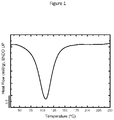
- the polyol component was mixed using a speed mixer for 5 min under vacuum conditions. Then, the isocyanates component was added and the components were mixed again with a speed mixer under vacuum for additional 2 min. Approximately 10 mg was weighted into a DSC Al-pan. The reactive mixture was then heated from 30°C to 250°C at 20 K/min. An example can be appreciated in Figure 1 . The curing reaction was recorded. The onset, peak and offset temperatures were extracted from the curve, the results can be appreciated in Table 3. They were calculated by estimating the area under the curve. The temperatures at 10%, 50% and 95% area were considered as the onset, peak and offset temperatures, respectively.
- the cured resin was cooled down (30°C) and re-heated (150°C).
- the glass transition of the cured resin was approx. 80°C in all the cases.
- the latency of the DBU-carboxylate can be measured as the shift of the temperature peak during the curing reaction.
- a good thermolatent catalyst would be one that shift the onset of the temperature of the curing reaction by keeping, at least, the same offset temperature as the reference (DBU).
- the DBU carboxylate prepared with succinamic acid has the better latency (shift of temperature at 10% curing) and lower end-curing temperature (temperature at 95% degree of curing).
- the DBU carboxylate prepared with 4-oxo-4-(propylamino)butanoic acid a minimum shift in the 10% temperature is observed by comparable end-curing temperature to polycat SA1-10.
- thermolatency of the different DBU carboxylates can be also evaluated by varying the ratio DBU:acid ratio.
- Table 4 summarizes the results. Surprisingly, in the case of the 4-oxo-4-(propylamino)butanoic acid the increase in its concentrations, related to DBU, shifted the onset of the curing reaction and shortens the offset temperature. Table 3. Comparison uncatalyzed with catalyzed system. Molar ratio DBU to acid 1:1 From the area ID Catalyst 10% (°C) 50% (°C) 95% (°C) 1 93 138 207 2 Cat. Ref. 1 78 102 132 3 Cat. Ref. 2 77 101 130 4 Cat. Ref. 3 82 107 137 5 Cat.
- a commercial RTM formulation, named BASF Ellastolit R8819/104 LT was tested. 14 cm x 12 cm x 2 mm plates were prepared with/without Toray T700 carbon fiber fabrics at 90°C and 110°C (mold temperature). Without carbon fibers it can be appreciated that the plates catalyzed with ID1 (Table 4) are more transparent than the original Ellastolit formulation. In the case of the fiber reinforced plates, the addition of the catalyst ID 1 (Table 4) reduced the de-molding time at 90°C from 3 to 2 min and at 110°C from higher than to 2 to 2 min. The use of catalyst ID 1 (Table 4) reduces the de-molding time of an approx. 30%. Most translucent PU composite parts are an advantage for the monitoring of defect (e.g. fiber orientation, hot spots, enclosed air, etc.) during production.
- defect e.g. fiber orientation, hot spots, enclosed air, etc.
Landscapes
- Chemical & Material Sciences (AREA)
- Organic Chemistry (AREA)
- Health & Medical Sciences (AREA)
- Chemical Kinetics & Catalysis (AREA)
- Medicinal Chemistry (AREA)
- Polymers & Plastics (AREA)
- Polyurethanes Or Polyureas (AREA)
Description
- Object of the invention are thermolatent bases and their use as catalysts for the preparation of polyurethanes as well as a process for the preparation of polyurethanes in the presence of the catalyst according to the present invention.
- Cellular or compact polyurethanes, in particular polyurethane casting elastomers and thermoplastic polyurethanes (TPU), have long been known from numerous patent and literature publications. Their industrial importance is based on the combination of valuable mechanical properties with the advantages of low-cost processing methods. The use of different chemical formative components in different ratios makes it possible to prepare thermoplastically processable or crosslinked, compact or cellular polyurethanes having a wide variety of mechanical and processing properties. An overview of polyurethanes and their properties and applications is given, for example, in Kunststoff-Handbuch, Volume 7, Polyurethane, 1st Edition, 1966, edited by Dr. R. Vieweg and Dr. A. Hochtlen, and 2nd Edition, 1983, and also 3rd Edition, 1993, edited by Dr. G. Oertel, (Carl Hanser Verlag, Munich, Vienna).
- Polyurethanes are produced industrially in a reaction of a polyisocyanate with polyol or polyamine compounds. The reactions are almost always catalyzed to provide cure times that are short enough for the manufacturing process to be economically feasible.
- Some manufacturing processes require a delayed cure. For example, some manufacturing processes require that a polyurethane-forming mixture to be prepared and then applied to some other material or mold before it is cured. Some "working time", which may be up to several minutes in some processes, may be needed to apply the mixture and to manipulate it further, before the mixture builds a high molecular weight and becomes too viscous to work with. In all of these processes, some delay in the initial cure is wanted, to provide enough time that the polyurethane-forming mixture can be applied and manipulated. However, after some predetermined "working time", it is usually desirable that the reaction mixture cures rapidly. The rapid cure allows manufacturing equipment to handle greater volumes of product per unit time and thus allows for increased production rates and lower manufacturing costs.
- For example
WO 2013/097928 A2 discloses a crosslinking two-component polyurethane composition consisting of a constituent A containing polyols and additives, and a constituent B containing between 100 and 65 wt. % of aromatic polyisocyanates, between 0 and 35 wt. % of aliphatic polyisocyanates, and between 0.05 and 3.0 wt. % of a retarder, and optionally additives, the mixed composition having a pot life of longer than 60 minutes. The two-component polyurethane composition is suitable as an adhesive and as a matrix substance for composite materials. Also M Kempf et al., "Effect of impact damage on the compression performance of glass and carbon fibre reinforced composits", 18th International Conference on Composite Materials, published 2011 - iccm-central.org focusses on the properties of fiber reinforced polyurethane composits. - Previous efforts to provide a delayed cure have focused on the selection of the catalyst. Various types of delayed action catalysts are known. Some are simply relatively inactive catalysts, and the delayed action is mainly an artifact of a generally slow cure. These catalysts can provide for good working time, but the slow cure means that line processing speeds are slow and/or in-mold residence times are long, and for that reason these catalysts are often not useful in commercial processes.
- A way to achieve this is to use latent catalysts, which will be inert at a chosen temperature, but become active at a higher temperature. Reference is made for example to
WO 2011/094244 ,EP 989146 A US 5212306 , orUS 4582861 . - Also known from the state of the art are tertiary amine salts of carboxylic acid derivatives and the use of these compounds in processes for preparing polyurethanes. For example
WO 91/01970 A2 EP 2 050 775 A1 discloses a catalyst composition for producing a polyurethane resin.US 6,432,864 B1 discloses acid-blocked amine catalysts and their use in the preparation of polyurethanes. - The literature describes various families of thermolatent bases catalysts for the synthesis of polyurethanes which are inactive at room temperature, but become active at a elevated temperature They can be used for example for mold applications, where the viscosity of the system has to stay low until the mold is filled up, but where the polymerization - crosslinking process must start at a defined higher temperature and be quick in order for processing time to stay as short as possible. The latent catalysts known are either not latent enough and start being active at too low temperatures or are not active enough, i.e. have weak catalytic activity once the activation temperature is reached. There is therefore a need for developing better thermolatent base catalysts showing a sharper activation profile.
- The present invention relates to a process for preparing a polyurethane comprising reacting at least one polyisocyanate with a polyol composition comprising at least one polyol in the presence of a catalyst composition comprising at least one compound (C) selected from the group consisting of compounds of the general formula (Ia) or (Ib)

- n is 0 or 1 when X is a carbon atom,
n is 2 when X is a sulfur atom, - n' is 0 or 1,
- m is an integer from 1 to 6,
- R is selected from monovalent, or divalent, or trivalent or polyvalent residues, wherein
- when R is monovalent, R is H, OH, substituted or unsubstituted, linear or branched C1-C18 alkyl, C5-C7 cycloalkyl which can be substituted by OH, OR1 or NR2R3, and which may be interrupted by one or more -O-, -S- or -NR4-;
- when R is divalent, R is substituted or unsubstituted, linear or branched C3-C18 alkylene, C5-C7 cycloalkylene which can be substituted by OH, OR1 or NR2R3, and which may be interrupted by one or more -O-, -S- or - NR4-;
- when R is trivalent, R is selected from N(CH2-CH2-*)3,

- R' is linear or branched C1-C5 alkyl substituted by NHR2,
- B is a nitrogen containing organic base,
- L is a C1-C8 substituted or unsubstituted alkylene chain, or a substituted or unsubstituted C6 cycloalkylene chain, or substituted or unsubstituted C9-C11 polycyclic chain, or a substituted or unsubstituted double bond, which can be interrupted by O, S, NR4, or a substituted or unsubstituted C3 to C4 alkenylene chain, or a substituted or unsubstituted benzene ring, or substituted or unsubstituted naphthalene ring,
- R1 is H, C1-C18 alkyl,
- R2 and R3, independently are hydrogen, unsubstituted or substituted C1-C18alkyl or phenyl; or R2 and R3 together with the nitrogen atom to which they are bonded form a 5 or 6 membered-ring which may contain a further heteroatom,
- R4 is H, unsubstituted or substituted C1-C18alkyl, and
- the ratio between Aa and Ba or between Ab and Bb ranges from 0.5 : 1 to 10 : 1.
- It was surprisingly found that salts of bases with acids which undergo thermally induced cyclization into less or non acidic products according to general formula (Ia) or (Ib) can be used as thermolatent catalyst liberating the base upon heating, i.e. the compound (C) as defined above can be used as thermolatent catalyst.
- The compound (C) is selected from the group consisting of compounds of the general formula (Ia) or (lb). When m is 1, the compound (C) is selected from the group consisting of compounds of the general formula (I'a) or (I'b). When m is 1 and n and n' is 1, the compound (C) is selected from the group consisting of compounds of the general formula (I"a) or (I"b).
- According to the present invention, n is 0 or 1 when X is a carbon atom, preferably n is 1 when X is a carbon atom. Generally, n is 2 when X is a sulfur atom.
- In formula (Ia) od (Ib) or in formula (I'a) or (I'b), n' is 0 or 1.
- According to the present invention, m is an integer from 1 to 6, preferably, m is 1 or 2, more preferable, m is 1.
- R is selected from monovalent, or divalent, or trivalent or polyvalent residues. Preferably, R is a monovalent, divalent or trivalent rest, more preferable R is monovalent.
- When R is monovalent, R is H, OH, substituted or unsubstituted, linear or branched C1-C18 alkyl, C5-C7 cycloalkyl which can be substituted by OH, OR1 or NR2R3, and which may be interrupted by one or more -O-, -S- or -NR4. Preferably, R is H, OH, linear or branched C1-C18 alkyl, C5-C7 cycloalkyl which may be interrupted by one or more -O-, -S- or -NR4-. More preferable, R is H, linear or branched alkyl, cycloalkyl.
- When R is divalent, R is substituted or unsubstituted, linear or branched C3-C18 alkylene, C5-C7 cycloalkylene which can be substituted by OH, OR1 or NR2R3, and which may be interrupted by one or more -O-, -S- or - NR4-. Preferably, when R is divalent, R is linear or branched C3-C18 alkylene, or C5-C7 cycloalkylene which may be interrupted by one or more -O-, -S- or - NR4-.
- When R is trivalent, R is selected from N(CH2-CH2-*)3, or

- When R is trivalent, R preferably is selected from N(CH2-CH2-*)3, or

- R' is linear or branched C1-C5 alkyl substituted by NHR2, in particular substituted by NH2 or NH(alkyl).
- B is a nitrogen containing organic base. Preferably, B is a tertiary amine like triethylamine, tributylamine, tripropylamine, dimethylbenzylamine, N-methyl, N-ethyl, N-cyclohexylmorpholine, N,N,N',N'-tetramethylethylenediamine, N,N,N',N'-tetramethyl-butanediamine, N,N,N',N'-tetramethyl-hexanediamine, pentamethyl-diethylenetriamine, tetramethyl-diaminoethylether, bis-(dimethylaminopropyl)-urea, dimethylpiperazine, 1-aza-bicyclo-(3,3,0)-octane and 1,4-diaza-bicyclo-(2,2,2)-octane or 1,2-dimethylimidazole, or an amidine, like 2,3-Dimethyl-3,4,5,6-tetrahydropyrimidine, substituted or unsubstituted 1,8-diazabicyclo[5.4.0]undec-7-en (DBU), 1,5-diazabicyclo[4.3.0]non-5-ene (DBN), triazabycyclodecene (TBD), or 1,1,3,3-tetramethylguanidine (TMG), as well as alkanolamine bonds, like triethanolamine, triisopropanolamine, N-methyl- und N-ethyl-diethanolamine and dimethylethanolamine.
- L is a C1-C8 substituted or unsubstituted alkylene chain, or a substituted or unsubstituted C6 cycloalkylene chain, or substituted or unsubstituted C9-C11 polycyclic chain, or a substituted or unsubstituted double bond, which can be interrupted by O, S, NR4, or a substituted or unsubstituted C3 to C4 alkenylene chain, or a substituted or unsubstituted benzene ring, or substituted or unsubstituted naphthalene ring. Preferably, L is a C1 to C8 substituted or unsubstituted alkylene chain, or a substituted or unsubstituted double bond, or a substituted or unsubstituted C3 to C4 alkenylene chain, or has the formula:


- More preferable, L is a C1 to C8 substituted or unsubstituted alkylene chain, or a substituted or unsubstituted double bond, or a substituted or unsubstituted C3 to C4 alkenylene chain, or has the formula:


- In formula (Ia) od (Ib) or in formula (I'a) or (I'b) or in formula (I"a) or (I"b), R1 is H, C1-C18 alkyl.
- In formula (Ia) or (Ib) or in formula (I'a) or (I'b) or in formula (I"a) or (I"b), R2 and R3, independently are hydrogen, unsubstituted or substituted C1-C18 alkyl or phenyl; or R2 and R3 together with the nitrogen atom to which they are bonded form a 5 or 6 membered-ring which may contain a further heteroatom.
- Generally, R4 is H, unsubstituted or substituted C1-C18alkyl.
- According to the present invention, the ratio between Aa and Ba or between Ab and Bb ranges from 0.5 : 1 to 10 : 1, preferably in the range of from 1 : 1 to 6 : 1, more preferable in the range of from 1 : 1 to 4 : 1.
- According to a further embodiment, the present invention is also directed to the process as disclosed above, wherein the compound (C) is selected from the group consisting of compounds of the general formula (Ia) or (Ib)

- n is 1 when X is a carbon atom,
n is 2 when X is a sulfur atom, - n' is 0 or 1,
- m is 1 or 2,
- R is a monovalent, divalent or trivalent rest,
- When R is monovalent, R is H, OH, linear or branched C1-C18 alkyl, C5-C7 cycloalkyl which may be interrupted by one or more -O-, -S- or -NR4-,
- when R is divalent, R is linear or branched C3-C18 alkylene, or C5-C7 cycloalkylene which may be interrupted by one or more -O-, -S- or - NR4-,
- when R is trivalent, R can be for example the following trivalent residues: N(CH2-CH2-*)3,

- R' is linear or branched alkyl substituted by NHR2,
- B is substituted or unsubstituted 1,8-Diazabicyclo[5.4.0]undec-7-en (DBU), 1,5-Diazabicyclo[4.3.0]non-5-ene (DBN), Triazabycyclodecene (TBD), 1,4-Diazabicyclo[2.2.2]octan (DABCO), 1,1,3,3-tetramethylguanidine (TMG), or substituted or unsubstituted tertiary aliphatic amines,
- L is a C1 to C8 substituted or unsubstituted alkylene chain, or a substituted or unsubstituted double bond, or a substituted or unsubstituted C3 to C4 alkenylene chain, or has the formula:


- R5, R6, R7, R8 independently from each other are hydrogen, unsubstituted or substituted C1-C28 alkyl, C2-C28 alkenyl, C7-C9 aralkyl, C3-C20 heteroalkyl, C5-C16 heteroaralkyl, phenyl or naphthyl, OR1, NR2R3, or halogen, or
- R5 and R6, R6 and R7 or R7 and R8 are linked together to form 1, 2, 3 or 4 carbocyclic or heterocyclic rings, which may be uninterrupted or interrupted by one or more -O-, -S- or -NR4- ;
- R1 is H, C1-C18 alkyl,
- R2, R3, independently are hydrogen, unsubstituted or substituted C1-C18alkyl or phenyl, or R2 and R3 together with the nitrogen atom to which they are bonded form a 5 or 6 membered-ring which may contain a further heteroatom,
- R4 is H, unsubstituted or substituted C1-C18 alkyl,
- the ratio between Aa and Ba or between Ab and Bb ranges from 1 : 1 to 4 : 1.
- According to a further embodiment, the present invention is also directed to the process as disclosed above, wherein the compound (C) is selected from the group consisting of compounds of the general formula (I'a) or (I'b)
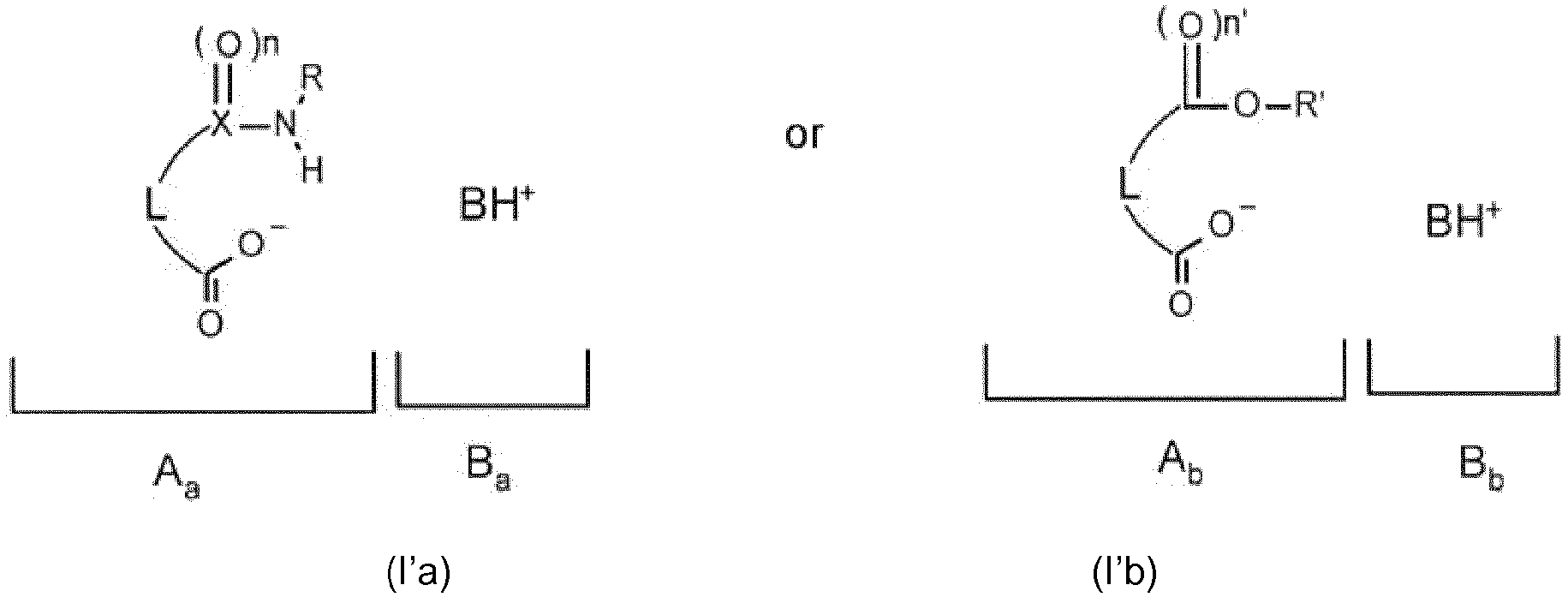
- n is 1 when X is a carbon atom,
- n is 2 when X is a sulfur atom,
- n' is 0 or 1
- R is monovalent,
- R is H, linear or branched alkyl, cycloalkyl,
- R' is linear or branched alkyl substituted by NH2 or NH(alkyl),
- B is DBU, DBN, TBD, DABCO, TMG, tertiary aliphatic amines,
- L is a C1 to C8 substituted or unsubstituted alkylene chain, or a substituted or unsubstituted double bond, or a substituted or unsubstituted C3 to C4 alkenylene chain, or has the formula:

- R5, R6, R7, R8 independently from each other are hydrogen, unsubstituted or substituted C1-C28 alkyl, C2-C28 alkenyl, C7-C9 aralkyl, C3-C20 heteroalkyl, C5-C16 heteroaralkyl, phenyl or naphthyl, OR1, NR2R3, or halogen,
or - R5 and R6, R6 and R7 or R7 and R8 are linked together to form 1, 2, 3 or 4 carbocyclic or heterocyclic rings, which may be uninterrupted or interrupted by one or more - O-, -S- or -NR4- ;
- R5, R6, R7, R8 independently from each other are hydrogen, unsubstituted or substituted C1-C28 alkyl, C2-C28 alkenyl, C7-C9 aralkyl, C3-C20 heteroalkyl, C5-C16 heteroaralkyl, phenyl or naphthyl, OR1, NR2R3, or halogen,
- R1 is H, C1-C18alkyl,
- R2, R3, independently are hydrogen, unsubstituted or substituted C1-C18alkyl or phenyl; or R2 and R3 together with the nitrogen atom to which they are bonded form a 5 or 6 membered-ring which may contain a further heteroatom,
- R4 is H, unsubstituted or substituted C1-C18alkyl,
- the ratio between Aa and Ba or between Ab and Bb ranges from 1 : 1 to 4 : 1.
- According to a further embodiment, the present invention is also directed to the process as disclosed above, wherein the compound (C) is selected from the group consisting of compounds of the general formula (I"a) or (I"b)

- R is monovalent,
- R is H, linear or branched alkyl, cycloalkyl,
- R' is linear or branched alkyl substituted by NH2 or NH(alkyl),
- B is DBU, DBN, TBD, DABCO, TMG, tertiary aliphatic amines,
- L is a C1 to C8 substituted or unsubstituted alkylene chain, or has the formula:

- R5, R6, R7, R8 independently from each other are hydrogen, unsubstituted or substituted C1-C28 alkyl, C2-C28 alkenyl, C7-C9 aralkyl, C3-C20 heteroalkyl, C5-C16 heteroaralkyl, phenyl or naphthyl, OR1, NR2R3, or halogen,
or - R5 and R6, R6 and R7 or R7 and R8 are linked together to form 1, 2, 3 or 4 carbocyclic or heterocyclic rings, which may be uninterrupted or interrupted by one or more -O-, -S- or - NR4-;
- R5, R6, R7, R8 independently from each other are hydrogen, unsubstituted or substituted C1-C28 alkyl, C2-C28 alkenyl, C7-C9 aralkyl, C3-C20 heteroalkyl, C5-C16 heteroaralkyl, phenyl or naphthyl, OR1, NR2R3, or halogen,
- R1 is H, C1-C18 alkyl,
- R2, R3, independently are hydrogen, unsubstituted or substituted C1-C18 alkyl or phenyl; or R2 and R3 together with the nitrogen atom to which they are bonded form a 5 or 6 membered-ring which may contain a further heteroatom,
- R4 is H, unsubstituted or substituted C1 -C18alkyl,
- the ratio between Aa and Ba or between Ab and Bb ranges from 1 : 1 to 4 : 1.
- According to a further embodiment, the present invention is also directed to the process as disclosed above, wherein the compound (C) is selected from the group consisting of compounds of the general formula (I"a) or (I"b)

- R is monovalent,
- R is H, linear or branched alkyl, cycloalkyl,
- R' is linear or branched alkyl substituted by NH2 or NH(alkyl),
- B is DBU,
- L is a C1 to C8 substituted or unsubstituted alkylene chain, or has the formula:

- R5, R6, R7, R8 independently from each other are hydrogen, unsubstituted or substituted C1-C28alkyl, C2-C28alkenyl, C1-C9aralkyl, C3-C20heteroalkyl, C5-C16heteroaralkyl, phenyl or naphthyl, OR1, NR2R3, or halogen,
or - R5 and R6, R6 and R7 or R7 and R8 are linked together to form 1, 2, 3 or 4 carbocyclic or heterocyclic rings, which may be uninterrupted or interrupted by one or more - O-, -S- or - NR4-,
- R5, R6, R7, R8 independently from each other are hydrogen, unsubstituted or substituted C1-C28alkyl, C2-C28alkenyl, C1-C9aralkyl, C3-C20heteroalkyl, C5-C16heteroaralkyl, phenyl or naphthyl, OR1, NR2R3, or halogen,
- R1 is H, C1-C16alkyl,
- R2, R3, independently are hydrogen, unsubstituted or substituted C1-C18 alkyl or phenyl; or R2 and R3 together with the nitrogen atom to which they are bonded form a 5 or 6 membered-ring which may contain a further heteroatom,
- R4 is H, unsubstituted or substituted C1-C18alkyl,
- the ratio between Aa and Ba or between Ab and Bb ranges from 1 : 1 to 4 : 1.
- The compounds used according to the present invention can be made by methods well established by the chemical organic synthetic methods. One, non limiting possibility consist in just mixing the base BH and the acidic partner in equimolar quantities in a suitable solvent, for example ethyleneglycol, 1,2-propyleneglycol, 1,4-butanediol, 1,5-pentanediol, and just stir the solution for the required amount of time, for example between 2 hours and 24 hours at a temperature in the range from 10 to 40°C, in particular at room temperature. It is also possible to isolate the salts by working in an appropriate solvent, for example diethylether, tertiobutylmethylether.
- It has been found that the compound (C) as defined above can be used as catalyst for the preparation of polyurethanes or epoxy resins.
- Compound (C) is especially advantageous for the use as catalyst since it has good solubility in many solvents used in the preparation of polyurethanes or epoxy resins. Methods for preparing polyurethanes and epoxy resins are generally known. According to the present invention, the compound (C) as described above can be used as catalyst in such processes. It is possible to prepare and isolate compound (C) before using it as catalyst. However, it is also possible to prepare the compound (C) in situ, i.e. to add the acidic component as well as the base to the process to be catalyzed.
- As set out above, the present invention thus is directed to a process for preparing a polyurethane comprising reacting at least one polyisocyanate with a polyol composition comprising at least one polyol in the presence of a catalyst composition comprising at least one compound (C) as disclosed above. The compound (C) is particularly suitable as catalyst for preparing molds since it is thermolatent, i.e. it is activated at a predetermined temperature.
- Generally, the activation temperature is above 25°C, preferably above 40°C, more preferable above 60°C.
- Thus, the process can comprise several steps such as mixing the components and activating the catalyst. The process can comprise further steps, such as temperature treatment or delivering the reaction mixture into a mold.
- The present invention is also directed to a process for preparing a polyurethane, wherein the process comprises at least the following steps:
- (i) mixing the at least one polyisocyanate, the polyol composition and the compound (C) to obtain a mixture (I);
- (ii) delivering the mixture (I) into a mold or to the desired reaction site by pouring, spraying, or distributing;
- (iii) heating the mixture (I) to a temperature above 25°C until the mixture is cured.
- Furthermore, the process for preparing a polyurethane according to the present invention can comprise a step selected from reaction injection molding (RIM), reaction transfer molding (RTM), casting molding, vacuum infusion, filament winding, centrifugal casting, long fiber injection, spray coating.
- The process according to the present invention is particularly suitable to prepare polyurethane molds, for example fiber reinforced polyurethanes. Therefore the present invention is also directed to a process for preparing a mold comprising a polyurethane according to the present invention.
- The compounds used in the process for preparing a polyurethane according to the present invention are exemplified in the following without limiting the scope of the invention.
- According to the present invention, the catalyst composition comprises at least one compound (C). It is possible, that the catalyst composition comprises further compounds which can act as a catalyst in a process for preparing polyurethanes. These further compounds might be catalysts generally used in the preparation of polyurethanes or further compounds (C) as defined above. It is also possible in the context of the present invention that the catalyst composition comprises no further compounds, i.e. only comprises compound (C) as catalytically active compound. The catalyst composition further can comprise solvents. Suitable solvents are known to the person skilled in the art.
- According to a further embodiment, the present invention is also directed to a process for preparing a polyurethane as disclosed above, wherein the catalyst composition comprises at least one further catalyst.
- Suitable further catalysts for preparing the polyurethanes of the present invention, which, in particular, accelerate the reaction between the NCO groups of the diisocyanates and the hydroxyl groups of the polyol are the customary catalysts known from the prior art, for example tertiary amines such as triethylamine, dimethylcyclohexylamine, N-methylmorpholine, N,N'-dimethylpiperazine, diazabicyclo[2.2.2]octane and the like, and also, in particular, organic metal compounds such as titanate esters, iron compounds, tin compounds, e.g. tin diacetate, tin dioctoate, tin dilaurate or the dialkyltin salts of aliphatic carboxylic acids, e.g. dibutyltin diacetate, dibutyltin dilaurate or the like.
- In the process of the present invention, at least one polyisocyanate is reacted with a polyol composition comprising at least one polyol.
- Suitable polyisocyanates are known to the person skilled in the art. As polyisocyanates it is possible to use aliphatic, cycloaliphatic, araliphatic and/or aromatic diisocyanates. Specific examples include the following aromatic isocyanates: 2,4-tolylene diisocyanate, mixtures of 2,4- and 2,6-toluene diisocyanate, 4,4'-, 2,4'- and/or 2,2'-diphenylmethane diisocyanate (MDI), mixtures of 2,4'- and 4,4'-diphenylmethane diisocyanate, urethane-modified liquid 4,4'- and/or 2,4-diphenylmethane diisocyanates, 4,4'-diisocyanatodiphenylethane, the mixtures of monomeric methanediphenyl diisocyanates and more highly polycyclic homologues of methanediphenyl diisocyanate (polymeric MDI), 1,2- and 1,5-naphthylene diisocyanate.
- Aliphatic diisocyanates used are customarily aliphatic and/or cycloaliphatic diisocyanates, examples being tri-, tetra-, penta-, hexa-, hepta- and/or octamethylene diisocyanate, 2-methylpentamethylene 1,5-diisocyanate, 2-ethylbutylene 1,4-diisocyanate, 1-isocyanato-3,3,5-trimethyl-5-isocyanatomethylcyclohexane (isophorone diisocyanate, IPDI), 1,4- and/or 1,3-bis(isocyanatomethyl)cyclohexane (HXDI), 1,4-cyclohexane diisocyanate, 1-methyl-2,4- and/or -2,6-cyclohexane diisocyanate, 4,4'-, 2,4'- and/or 2,2'-dicyclohexylmethane diisocyanate.
- Polyisocyanate prepolymers are obtainable by reacting above-described polyisocyanates in excess, at temperatures of 30 to 100°C, for example, preferably at about 80°C, with polyols to give the prepolymer. For the preparation of the prepolymers of the invention, preference is given to using polyisocyanates and commercial polyols based on polyesters, starting for example from adipic acid, or on polyethers, starting for example from ethylene oxide and/or propylene oxide.
- Polyols are known to the skilled person and are described for example in "Kunststoffhandbuch, volume 7, Polyurethane", Carl Hanser Verlag, 3rd edition 1993, section 3.1. Polyols used with preference in this context are the polymeric compounds described under b), having hydrogen atoms that are reactive toward isocyanates. Particularly preferred for use as polyols are polyetherols.
- In the preparation of the isocyanate prepolymers, customary chain extenders or crosslinking agents are added optionally to the stated polyols. Such substances are described above hereinafter. Particularly preferred for use as chain extender is 1,4-butanediol, dipropylene glycol and/or tripropylene glycol. In this case the ratio of organic polyisocyanates to polyols and chain extenders is preferably selected such that the isocyanate prepolymer has an NCO content of 2% to 30%, preferably of 6% to 28%, more preferably of 10% to 24%.
- Particularly preferred polyisocyanates are selected from the group consisting of MDI, polymeric MDI, and TDI, and also derivatives thereof or prepolymers of these polyisocyanates.
- According to a further embodiment, the present invention therefore is also directed to a process for preparing a polyurethane as disclosed above, wherein the polyisocyanate is selected from the group consisting of MDI, polymeric MDI, and TDI, and derivatives thereof or prepolymers of these polyisocyanates.
- The polyol composition comprises at least one polyol. Suitable polyols are known to the person skilled in the art. Suitable polyols are for example polyols having a functionality of from 2 to 4 and molecular weights of from 500 g/mol to 8000 g/mol. Compounds which have been found to be useful are particularly polyether diols or polyester diols. Also suitable are other hydroxyl-containing polymers having ether or ester groups in the polymer chain, for example polyacetals such as polyoxymethylene and in particular water-insoluble formals, eg. polybutanediol formal and polyhexanediol formal, and polycarbonates, in particular those prepared from diphenyl carbonate and 1,6-hexanediol by transesterification. The polyhydroxyl compounds should be at least predominantly linear and have to be essentially difunctional in the context of the isocyanate reaction. The polyhydroxyl compounds mentioned can be used as individual compounds or in the form of mixtures.
- Suitable polyether diols can be prepared by known methods, for example from one or more alkylene oxides having from 2 to 4 carbon atoms in the alkylene radical by anionic polymerization using alkali metal hydroxides such as sodium or potassium hydroxide, or alkali metal alkoxides such as sodium methoxide, sodium or potassium ethoxide or potassium isopropoxide as catalysts and with addition of at least one initiator molecule containing 2 or 3, preferably 2, reactive hydrogen atoms in bonded form, or by cationic polymerization using Lewis acids such as antimony pentachloride, boron fluoride etherate, etc., or bleaching earth as catalysts.
- Examples of suitable alkylene oxides are tetrahydrofuran, 1,3-propylene oxide, 1,2- or 2,3-butylene oxide and particularly preferably ethylene oxide and 1,2-propylene oxide. The alkylene oxides can be used individually, alternately in succession or as mixtures. Examples of suitable initiator molecules are: water, organic dicarboxylic acids such as succinic acid, adipic acid and/or glutaric acid, alkanolamines such as ethanolamine, N-alkylalkanol-amines, N-alkyldialkanolamines such as N-methyldiethanolamine and N-ethyldiethanolamine and preferably dihydric alcohols which may contain bonded ether bridges, e.g. ethanediol, 1,2-and 1,3-propanediol, 1,4-butanediol, diethylene glycol, 1,5-pentanediol, 1,6-hexanediol, dipropylene glycol, 2-methylpentane-1,5-diol and 2-ethylbutane-1,4-diol. The initiator molecules can be used individually or as mixtures.
- Preference is given to using polyetherols derived from 1,2-propylene oxide and ethylene oxide. Such polyetherols can be obtained by, for example, polymerizing first the 1,2-propylene oxide and subsequently thereto the ethylene oxide onto the initiator molecule or first copolymerizing all the 1,2-propylene oxide together with part of the ethylene oxide and subsequently polymerizing on the remainder of the ethylene oxide or, stepwise, first polymerizing part of the ethylene oxide, then all the 1,2-propylene oxide.
- Other particularly suitable polyetherols are the hydroxyl-containing polymerization products of tetrahydrofuran.
- The essentially linear polyetherols usually have molecular weights of from 500 g/mol to 8000 g/mol, preferably from 600 g/mol to 6000 g/mol and in particular from 650 g/mol to 3500 g/mol, with the polyoxytetramethylene glycols preferably having molecular weights of from 500 g/mol to 2800 g/mol. They can be used either individually or in the form of mixtures with one another.
- Suitable polyester diols can be prepared, for example, from dicarboxylic acids having from 2 to 12, preferably from 4 to 6, carbon atoms and diols. Examples of suitable dicarboxylic acids are: aliphatic dicarboxylic acids such as succinic acid, glutaric acid, adipic acid, suberic acid, azelaic acid and sebacic acid, and aromatic dicarboxylic acids such as phthalic acid, isophthalic acid and terephthalic acid. The dicarboxylic acids can be used individually or as mixtures, e.g. in the form of a succinic, glutaric and adipic acid mixture. For preparing the polyesterols, it may be advantageous to replace the dicarboxylic acids with the corresponding dicarboxylic acid derivatives such as monoesters or diesters of dicarboxylic acid having from 1 to 4 carbon atoms in the alcohol radical, dicarboxylic anhydrides or dicarboxylic acid dichlorides. Examples of diols are glycols having from 2 to 10, preferably from 2 to 6, carbon atoms, for example ethylene glycol, diethylene glycol, 1,4-butanediol, 1,5-pentanediol, 1,6-hexanediol, 1,10-decanediol, 2,2-dimethylpropane-1,3-diol, 1,3-propanediol and dipropylene glycol. Depending on the desired properties, the diols can be used alone or in admixture with one another.
- Also suitable are esters of carbonic acid with the diols mentioned, in particular those having from 4 to 6 carbon atoms, e.g. 1,4-butanediol and/or 1,6-hexanediol; condensation products of omega-hydroxycarboxylic acids, for example omega-hydroxycaproic acid, and preferably polymerization products of lactones, for example unsubstituted or substituted epsilon-caprolactone.
- Polyester diols which are preferably used are ethanediol polyadipates, 1,4-butanediol polyadipates, ethanediol-1,4-butanediol polyadipates, 1,6-hexanediol-neopentyl glycol polyadipates, 1,6-hexanediol-1,4-butanediol polyadipates and polycaprolactones.
- The polyester diols generally have molecular weights of from 500 g/mol to 6000 g/mol, preferably from 600 g/mol to 3500 g/mol.
- Furthermore, depending on the nature of the polyurethane prepared, the polyol composition may comprise low molecular weight chain extenders and crosslinkers and also further auxiliaries and additives.
- Suitable crosslinkers are known to the person skilled in the art.
- Suitable chain extenders having molecular weights of generally from 60 g/mol to 400 g/mol, preferably from 60 g/mol to 300 g/mol, are preferably aliphatic diols having from 2 to 12 carbon atoms, preferably having 2, 4 or 6 carbon atoms, e.g. ethanediol, 1,6-hexanediol, diethylene glycol, dipropylene glycol and in particular 1,4-butanediol. However, other suitable chain extenders are diesters of terephthalic acid with glycols having from 2 to 4 carbon atoms, e.g. bis(ethylene glycol) terephthalate or bis(1,4-butanediol) terephthalate and hydroxyalkylene ethers of hydroquinone, e.g. 1,4-di(beta-hydroxyethyl) hydroquinone and also polytetramethylene glycols.
- Depending on the desired properties of the polyurethanes of the present invention, the amounts of the higher molecular weight polyols and the chain extenders and/or crosslinkers which are used can be varied within a relatively wide range of molar ratios. In the case of the TPUs preferably prepared, this enables the hardness and melt flow index to be adjusted, with the hardness and the melt viscosity rising with an increasing content of chain extenders (c), while the melt flow index falls.
- A blowing agent may be present when it is desirable to produce a cellular product. Suitable chemical and physical blowing agents are known to the person skilled in the art.
- The polyisocyanate and the polyolcomposition can be reacted at an isocyanate index of from 70 to 1000 or more, although a more typical isocyanate index is from 80 to 500. Isocyanate index is calculated as the number of reactive isocyanate groups provided by the polyisocyanate component divided by the number of isocyanate-reactive groups in the polyol composition (including isocyanate-reactive blowing agents such as water, if present) and multiplying by 100. Water is considered to have two isocyanate-reactive groups per molecule for purposes of calculating isocyanate index. A preferred isocyanate index is from 100 to 300.
- The catalyst composition is used in catalytically sufficient amounts. A suitable amount of the catalyst mixture is from about 0.02 to about 2 parts, especially from about 0.05 to about 0.5 part, of the catalyst mixture per 100 parts by weight of the polyol(s). The weight of any solvent is disregarded in determining the amount of catalyst composition.
- In accordance with the invention it is possible to add customary auxiliaries. Examples that may be mentioned include surface-active substances, fillers, further flame retardants, nucleators, oxidation stabilizers, lubricity aids and mold release aids, dyes and pigments, optionally stabilizers, with respect to hydrolysis, light, heat, or discoloration, for example, inorganic and/or organic fillers, reinforcing agents, and plasticizers. Suitable auxiliaries and adjuvants may be found, for example, in Kunststoffhandbuch, volume VII, edited by Vieweg and Höchtlen, Carl Hanser Verlag, Munich 1966 (pp. 103-113).
- According to a further aspect, the present invention is also directed to the use of the compound (C) as disclosed above as catalyst in a process for the preparation of a polyurethane.
- Furthermore, the present invention is also directed to a polyurethane obtained or obtainable according to a process as disclosed above. The polyurethanes according to the present invention are particularly suitable as matrix material for fiber reinforced composits. They have for example improve matrix dominated properties like fatigue or inter laminar shear strength (ILSS). The polyurethanes obtained according to the present invention are in particular suitable for applications such as coatings, laminating, seals, and production of moldings for applications in which components of very high surface area are being produced, such as rotor blades for wind turbines, boat hulls, or plastic vehicle bodies for automobiles.
- Further embodiments of the present invention are apparent from the claims and the examples. It is understood that the features of the subject matter/method/uses of the invention, as elucidated below and as stated above, can be used not only in the particular combination specified but also in other combinations as well, without departing the scope of the invention. Accordingly, for example, the combination of a preferred feature with a more preferred feature, or of an otherwise uncharacterized feature with a very preferred feature, etc., is implicitly comprised, even if that combination is not expressly mentioned.
- The examples which follow are for illustration of the invention, but are not in any way restricting as regards the subject matter of the present invention.
- Non limiting examples of the inventive compounds are given below. The respective structures obtained for compounds (1) to (30) are summarized in Table 1.
- The starting acidic partners are commercially available or were synthesized by state of the art methods, for example for some of them by reaction between an amine and an anhydride, as exemplified in table 2.
- 307.5 g (1.47 mol) of 2-(2-hydroxyethylcarbamoyl)benzoic acid were mixed with 396.7 g ethyleneglycol to give a thick suspension to which were added 223.8 g (1.47 mol) DBU over 48 min while the temperature was maintained between 14°C and 16°C. 134.6 g additional ethyleneglycol were then added to obtain a thin suspension. After stirring for 3 hours at room temperature, a colorless solution was obtained. 13C-NMR (CDCl3, 400 MHz, δ ppm): 173.5, 171.5, 166, 137, 136, 129.5, 129, 128, 127, 63 (ethyleneglycol), 61, 54, 48, 42, 38, 32, 29, 26, 24, 19.
- 5.6 g (50 mmol) DABCO were mixed with 48.2 g of ethyleneglycol to give a white suspension. 10.5 g (50 mmol) of 2-(2-hydroxyethylcarbamoyl)benzoic acid were added under slight cooling to obtain a suspension. The mixture was stirred one hour at room temperature to give a yellowish solution. 13C-NMR (D2O, 400 MHz, δ ppm): 175.5, 173, 137.5, 134.5, 130.5, 129.5, 129, 128, 62.5 (ethyleneglycol), 60, 44, 42.
- 11.1 g (50 mmol) of 2-(tert-butylcarbamoyl)benzoic acid were mixed with 18 g ethyleneglycol, which thick white suspension was cooled down to 15°C at which temperature it could not be stirred anymore. 37.3 g ethyleneglycol were added. 7.6 g (50 mmol) DBU were added dropwise, followed by 1g ethyleneglycol. The mixture was stirred for four hours at room temperature to give a clear solution.13C-NMR (CDCl3, 400 MHz, δ ppm): 175, 170, 166, 138.5, 135, 129.5, 128, 127.5, 63 (ethyleneglycol), 54, 51.5, 48.5, 38, 32.5, 29.5, 28.5, 26.5, 24, 19.
- 5.6 g (50 mmol) DABCO were mixed with 16.7 g of ethyleneglycol to give a white suspension. 11 g (50 mmol) of 2-(tert-butylcarbamoyl)benzoic acid were added in three portions under slight cooling to obtain a thin white suspension. The mixture was stirred over night at room temperature to give a colorless solution. 13C-NMR (CDCl3, 400 MHz, δ ppm): 174.5, 170.5, 137, 136.5, 129.5, 129, 128, 127, 63.5 (ethyleneglycol), 51.5, 44.5, 28.5.
- 10.4 g (50 mmol) of 2-(isopropylcarbamoyl)benzoic acid were mixed with 16 g ethyleneglycol, which white suspension was cooled down to 15°C. 7.6 g (50 mmol) DBU were added dropwise, followed by 2g ethyleneglycol. The mixture was stirred for three hours to give a clear solution.13C-NMR (DMSO, 400 MHz, δ ppm): 173.5, 167.5, 165,5, 142, 132.5, 130, 129, 128.5, 127, 63 (ethyleneglycol), 54, 48, 41, 38, 32, 28.5, 26.5, 23.5, 22.5, 19.5.
- 5.6 g (50 mmol) DABCO were mixed with 16.0 g of ethyleneglycol. 10.4 g (50 mmol) of 2-(isopropylcarbamoyl)benzoic acid were added in three portions under slight cooling to obtain a thin white suspension. The mixture was stirred over night at room temperature to give a colorless solution. 13C-NMR (CDCl3, 400 MHz, δ ppm): 174.5, 170, 137.5, 135.5, 129.5, 129, 128, 127,5, 63.5 (ethyleneglycol), 44.5, 42, 22.
- 10.4 g (50 mmol) of 2-(propylcarbamoyl)benzoic acid were mixed with 16 g ethyleneglycol, which white suspension was cooled down to 15°C. 7.6 g (50 mmol) DBU were added dropwise, followed by 2g ethyleneglycol. The mixture was stirred for two hours to give a clear solution.13C-NMR (DMSO, 400 MHz, δ ppm): 173.5, 168.5, 166, 142, 133, 130, 129, 128.5, 127, 63 (ethyleneglycol), 53.5, 48, 41.5, 38, 32, 28.5, 26.5, 24, 22.5, 19.5, 12.
- 5.6 g (50 mmol) DABCO were mixed with 16.0 g of ethyleneglycol. 10.4 g (50 mmol) of 2-(propylcarbamoyl)benzoic acid were added in four portions under slight cooling to obtain a thin white suspension. The mixture was stirred over night at room temperature to give a colorless solution. 13C-NMR (CDCl3, 400 MHz, δ ppm): 174.5, 171, 138, 135.5, 129.5, 129, 128.5, 127,5, 63.5 (ethyleneglycol), 44.5, 41.5, 22.5, 11.5.
- 8.7 g (50 mmol)of 4-(tert-butylamino)-4-oxo-butanoic acid were mixed with 14.3 g of ethyleneglycol to give a which suspension to which were added 7.6 g (50 mmol) DBU maintaining the temperature between 14 and 18°C to give a thin white suspension. 2 g additional ethyleneglycol were then added to obtain a thin suspension. After stirring for 2 hours at room temperature, a colorless solution was obtained. 13C-NMR (DMSO, 400 MHz, δ ppm): 177, 173, 165, 63 (ethyleneglycol), 53.5, 50, 48, 38, 34.5, 34, 32, 29, 28, 26.5, 24, 19.5.
- 5.6 g (50 mmol) DABCO were mixed with 35 g ethyleneglycol to give a white suspension. 6g (50 mmol) of 4-(tert-butylamino)-4-oxo-butanoic acid were added in three portions under slight cooling to obtain a thin white suspension. 7 g ethyleneglycol were added and the mixture was stirred one hour at room temperature to give a colorless solution. 13C-NMR (DMSO, 400 MHz, δ ppm): 176, 172, 63 (ethyleneglycol), 50, 46, 32, 31.5, 29.
- 8.0 g (50 mmol)of 4-( isopropylamino)-4-oxo-butanoic acid were mixed with 13.6 g of ethyleneglycol to give a white suspension to which were added 7.6 g (50 mmol) DBU maintaining the temperature between 14 and 19°C to give a thin white suspension. 2 g additional ethyleneglycol were then added to obtain a thin suspension. After stirring for 2 hours at room temperature, a colorless solution was obtained. 13C-NMR (DMSO, 400 MHz, δ ppm): 177, 172.5, 165.5, 63 (ethyleneglycol), 53.5, 50, 48.5, 38, 34, 33.5, 32, 29, 26.5, 24, 23, 19.5.
- 4.26 g (38 mmol) DABCO were mixed with 8 g ethyleneglycol to give a colorless solution. 6g (38 mmol) of 4-( isopropylamino)-4-oxo-butanoic acid were added in three portions under slight cooling to obtain a white suspension. 2.3 g ethyleneglycol were added and the mixture was stirred one hour at room temperature to give a colorless solution. 13C-NMR (DMSO, 400 MHz, δ ppm): 175.5, 162, 63 (ethyleneglycol), 46, 40.5, 31.5, 31, 23.
- 5.0 g (36 mmol) TBD were mixed with 37.6 g ethyleneglycol to give a solution. 7.5 g (36 mmol) of 2-(2-hydroxyethylcarbamoyl)benzoic acid were added in four portions at a temperature maintained between 14 and 19°C. Stirring was continued for 3 hours to give a colorless solution. 13C-NMR (MeOD, 400 MHz, δ ppm): 174.5, 172, 151, 138.5, 135.5, 129, 128.5, 128, 127, 63 (ethyleneglycol), 60, 46.5, 42.5, 38, 20.5.
- 4.5 g (25 mmol)of 2-(hydroxycarbamoyl)benzoic acid were mixed with 6.34 g of ethyleneglycol to give a yellow suspension to which were added 3.8 g (25 mmol) DBU maintaining the temperature between 14 and 18°C to give a thin orange suspension. 2 g additional ethyleneglycol were then added to obtain a thin suspension. After stirring for 2 hours at room temperature, the thin suspension was filtered to give a clear orange solution. 13C-NMR (DMSO, 400 MHz, δ ppm): 177.5, 166, 165, 140.5, 132, 129.5, 129, 128, 63 (ethyleneglycol), 53.5, 48.5, 33, 29, 28, 24.5, 20.
- 5.1 g (28 mmol) of 2-(hydroxycarbamoyl)benzoic acid were mixed with 8.2 g of ethyleneglycol to give a suspension to which were added 3.1 g (28 mmol) DABCO maintaining the temperature below 22°C to give a yellow suspension. 8.2 g additional ethyleneglycol were then added to obtain a thin suspension. After stirring for 2 hours at room temperature, the thin suspension was filtered to give a clear yellow solution.
- 5.2 g (50 mmol) of 4-aminobutanoic acid were mixed with 10.8 g of ethyleneglycol to give a white suspension which was cooled down to 13°C. 7.6 g (50 mmol) DBU were added dropwise and 2 g additional ethyleneglycol were then added to give a suspension. 25.5 g additional ethyleneglycol were added and stirring was continued over night to give a colorless solution.13C-NMR (DMSO, 400 MHz, δ ppm): 178.5, 165, 63.5 (ethyleneglycol), 53.5, .48, 42, 38.5, 36, 32.5, 30, 29, 26.5, 24, 20.
- 4.1 g (40 mmol) of 4-aminobutanoic acid were mixed with 6.6 g of ethyleneglycol to give a white suspension to which were added 4.5 g (40 mmol) DABCO maintaining the temperature below 15°C. 70 g additional ethyleneglycol were then added to obtain a clear solution. 13C-NMR (D2O, 400 MHz, δ ppm): 181.5, 62.5 (ethyleneglycol), 45, 40, 34.5, 24.
- DBU was neutralized by the t-butylammonium salt of the acid.
- 6.8 g (25 mmol) of (Z)-4-(tert-butylamino)-2,3-dimethyl-4-oxo-but-2-enoate;tert-butylammonium were mixed with 8.6 g of ethyleneglycol to give a white suspension which was cooled down to 17°C. 3.8 g (25 mmol) DBU were added dropwise and 2 g additional ethyleneglycol were then added. Stirring was continued for two hours to give a colorless solution.13C-NMR (DMSO, 400 MHz, δ ppm): 176, 170, 165.5, 140.5, 123, 63.5 (ethyleneglycol), 53.5, 50, 48.5, 47.5, 38.5, 32.5, 29, 28.5, 26.5, 24, 19.5, 18.5, 15.
- DABCO was neutralized by the t-butylammonium salt of the acid.
- 6.1 g (22 mmol) of (Z)-4-(tert-butylamino)-2,3-dimethyl-4-oxo-but-2-enoate;tert-butylammonium were mixed with 6.6 g of ethyleneglycol to give a white suspension which was cooled down to 15°C. 2.5 g (22 mmol) DABCO were added dropwise and 19.1 g additional ethyleneglycol were then added. Stirring was continued for two hours to give a colorless solution.13C-NMR (DMSO, 400 MHz, δ ppm): 176.5, 170, 139, 124.5, 63 (ethyleneglycol), 51, 50.5, 47, 39, 38.5, 18, 15.
- 5 g (25 mmol) of 2-sulfamoylbenzoic acid were mixed with 5.6 g of ethyleneglycol to give a white suspension which was cooled down to 13°C. 3.8 g (25 mmol) DBU were added dropwise and 19.7 g additional ethyleneglycol were then added to give a white suspension. 53 g additional ethyleneglycol were then added to give a colorless solution.13C-NMR (DMSO, 400 MHz, δ ppm): 171.5, 166, 141, 140.5, 132, 131, 128, 126, 63 (ethyleneglycol), 54,, 48.5, 38.5, 32.5, 29.5, 26.5, 24, 19.5.
- 6 g (30 mmol ) of 2-sulfamoylbenzoic acid were mixed with 7.4 g of ethyleneglycol to give a white suspension which was cooled down to 17°C. 3.4 g (30 mmol) DABCO were added dropwise to give a white suspension. 2 g additional ethyleneglycol were then added. Stirring was continued over night to give a colorless solution.13C-NMR (DMSO, 400 MHz, δ ppm): 172, 140.5, 140, 132, 130, 128.5, 126, 63.5 (ethyleneglycol), 44.5.
- 5.9 g (25 mmol) of 2-(2-amino-2-methyl-propoxy)carbonylbenzoic acid were mixed with 8.6 g of ethyleneglycol to give a white suspension which was cooled down to 14°C. 3.8 g (25 mmol) DBU were added dropwise and 2 g additional ethyleneglycol were then added to give a thin white suspension. 21.1 g additional ethyleneglycol were then added and stirring was continued over night to give a colorless solution.13C-NMR (DMSO, 400 MHz, δ ppm): 171.5, 166, 141, 140.5, 132, 131, 128, 126, 63 (ethyleneglycol), 54, 48.5, 38.5, 32.5, 29.5, 26.5, 24, 19.5.
- 3.8 g (25 mmol) of 2-(hydroxymethyl)benzoic acid were mixed with 5.6 g of ethyleneglycol to give a white suspension which was cooled down to 13°C. 3.8 g (25 mmol) DBU were added dropwise and 2 g additional ethyleneglycol were then added to give a thin white suspension. 15.2 g additional ethyleneglycol were then added and stirring was continued for three hours to give a colorless solution.13C-NMR (DMSO, 400 MHz, δ ppm): 173, 165.5, 141, 139.5, 130.5, 129, 128.5, 127, 64.5, 63 (ethyleneglycol), 54, 48, 38, 32, 28.5, 26.5, 24, 19.
- 4.9 g (32 mmol) of 2-(hydroxymethyl)benzoic acid were mixed with 6.5 g of ethyleneglycol to give a thick white suspension to which were added 3.6 g (32 mmol) DABCO maintaining the temperature between 15°C and 17°C. 2 g additional ethyleneglycol. Stirring was continued for 4 hours to obtain a clear solution. 13C-NMR (DMSO, 400 MHz, δ ppm): 172.5, 142.5, 136.5, 130.5, 130, 128, 127, 64, 63 (ethyleneglycol), 45.
- 8.0 g (50 mmol) of 4-(propylamino)-4-oxo-butanoic acid were mixed with 13.6 g of ethyleneglycol to give a thick white suspension. 7.6 g (50 mmol) DBU were added dropwise maintaining the temperature between 16 and 17°C. 2 g additional ethyleneglycol were then added to give a thin suspension. Stirring was continued for three hours to give a colorless solution.13C-NMR (DMSO, 400 MHz, δ ppm): 177, 173, 165.5, 63.5 (ethyleneglycol), 53.5, .48.5, 40.5, 38, 34, 33.5, 32, 29, 26.5, 24, 23, 19.5, 12.
- 5.6 g (50 mmol) DABCO were mixed with 10 g ethyleneglycol to give a colorless solution. 7.96g (50 mmol) of 4-(propylamino)-4-oxo-butanoic acid were added in three portions under slight cooling to obtain a white suspension. 3.6 g ethyleneglycol were added and the mixture was stirred one hour at room temperature to give a colorless solution. 13C-NMR (DMSO, 400 MHz, δ ppm): 176, 172, 63 (ethyleneglycol), 45.5, 41, 32, 31.5, 23, 12.
-
Table 1: Structure of compounds (1) to (30) No. Structure 1 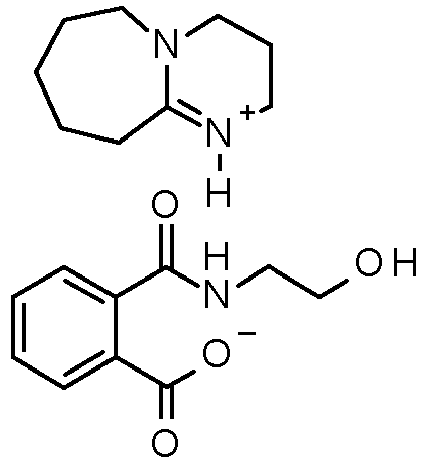
Molar ratio DBU : Acid 1 : 1 2 
Molar ratio DABCO : Acid 1 : 1 3 
Molar ratio DBU : Acid 1 : 1 4 
Molar ratio DABCO : Acid 1 : 1 5 
Molar ratio DBU : Acid 1 : 1 6 
Molar ratio DABCO : Acid 1 : 1 7 
Molar ratio DBU : Acid 1 : 1 8 
Molar ratio DABCO : Acid 1 : 1 9 
Molar ratio DBU : Acid 1 : 1 10 
Molar ratio DABCO : Acid 1 : 1 11 
Molar ratio DBU : Acid 1 : 1 12 
Molar ratio DABCO : Acid 1 : 1 13 
Molar ratio TBD : Acid 1 : 1 14 
Molar ratio DBU : Acid 1 : 1 15 
Molar ratio DABCO : Acid 1 : 1 16 
Molar ratio DBU : Acid 1 : 1 17 
Molar ratio DABCO : Acid 1 : 1 18 
Molar ratio DBU : Acid 1 : 1 19 
Molar ratio DABCO : Acid 1 : 1 20 
Molar ratio DBU : Acid 1 : 1 21 
Molar ratio DABCO : Acid 1 : 1 22 
Molar ratio DBU : Acid 1 : 1 23 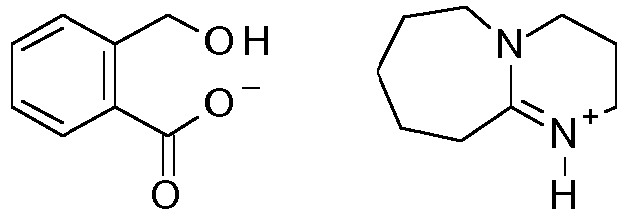
Molar ratio DBU : Acid 1 : 1 24 
Molar ratio DABCO : Acid 1 : 1 25 
Molar ratio DBU : Acid 1 : 1 26 
Molar ratio DABCO : Acid 1 : 1 27 
Molar ratio DBU : Acid 1 : 1.25 28 
Molar ratio DBU : Acid 1 : 1.5 29 
Molar ratio DABCO : Acid 1 : 1.25 30 
Molar ratio DABCO : Acid 1 : 1.5 31 
Molar ratio DABCO : Acid 1 : 1 Table 2: starting acidic partners Acidic partner Number of the corresponding salt(s) reference 
3,4 Kaicharla, Trinadh; Thangaraj, Manikandan; Biju, Akkattu T. Organic Letters 2014, 16, 1728-1731. 2-(tert-butylcarbamoyl)benzoic acid 
5,6 Verbicky, John W., Jr.; Williams, Louella Journal of Organic Chemistry 1981, 46, 175-7. 2-(isopropylcarbamoyl)benzoic acid 
7,8 Yasuda, Naohiko; Naka-mura, Asao; Tsuboi, Masamichi Journal of Heterocyclic Chemistry 1987, 24, 303-7 2-(propylcarbamoyl)benzoic acid 
9,10 Zhang, Fu-chen; Gong, Sheng-chen; Chen, Qi-fan Liaodong Xueyuan Xuebao, Ziran Kexueban 2010, 17, 1-4. 4-(tert-butylamino)-4-oxo-butanoic acid 
11,12 Valla, Alain; Cartier, Dominique; Zentz, Frederic; Labia, Roger Synthetic Communications 2006, 36, 3591-3597. 4-(isopropylamino)-4-oxo-butanoic acid 
14, 15 Wang, Wen-Hua; Liu, Wei-Sheng; Wang, Ya-Wen; Li, Yang; Zheng, Li-Fang; Wang, Da-Qi Journal of Inorganic Biochemistry 2007, 101, 297-304. 2-(hydroxycarbamoyl)benzoic acid 
25, 26 Tanaka, Kazuo; Ishiguro, Fumiyasu; Chujo, Yoshiki Journal of the American Chemical Society 2010, 132, 17649-17651. 4-oxo-4-(propylamino)butanoic acid 
31 Commercially available 4-amino-4-oxo-butanoic acid -
Polyol wt.% Polyol A 32 Polyol B 30 Polyol C 35 Additive 1 2.9 Additive 2 0.1 Catalyst (active species) 0.05 Isocyanate wt.% Iso A 40 Iso B 60 MV 100:98 - Polyol A:
- Polyetherpolyol with an average OH value of 248 mg KOH/g, a functionality of 2.0 and a propylene oxide content, respect to the polymer weight, of approx. 83 wt.%
- Polyol B:
- Isopol 1200-3600 of the company ISO-ELEKTRA Elektrochemische Fabrik GmbH
- Polyol C:
- Polyetherpolyol with an average OH value of 490 mg KOH/g, a functionality of 4.3 and a propylene oxide content, respect to the polymer weight, of approx. 67 wt.%
- Additive 1:
- Zeolite-Paste 3A from the company ISO-ELEKTRA Elektrochemische Fabrik GmbH
- Additive 2:
- Xiameter ACP-1000 Antifoam compound from the company Dow Corning Corporation
- Iso A:
- Poly(methylen-diphenyl-diisocyanate) with a NCO content of 31.5 wt.% and an average functionality of 2.7
- Iso B:
- Methylene-diphenyl-diisocyanat with a NCO content of 33.5 Gew.-% and an average functionality of 2, with an isomeric 4,4'content of 49 wt.%
- In a typical experiment, 50 wt.% ethylene glycol solution of the different salts were prepared. The corresponding amounts of acid, base and solvent were added and shortly heated in a microwave oven (900 Watts) for 20 sec. After that the mixture was vigorously stirred for 10 sec to obtain a homogeneous solution.
- The amount specified in the formulation corresponds to the concentration of catalytic species.
Cat. Ref. 1: 1,8-diazabicyclo-5,4,0-undecen-7 (DBU) from BASF AG Cat. Ref. 2: Polycat® SA1-10 from Air Products Cat. Ref. 3: 50 wt.% ethylene glycol solution of 1 eq. of phthalamic acid (Aldrich) and DBU from BASF AG Cat. Ref. 4: structure from JP2014055114A 20140327 - The acid was mixed with ethyleneglycol to give a thick suspension to which DBU was added while the temperature was maintained between 14°C and 16°C. After stirring for 3 hours at room temperature, a colorless solution was obtained.
- The polyol component was mixed using a speed mixer for 5 min under vacuum conditions. Then, the isocyanates component was added and the components were mixed again with a speed mixer under vacuum for additional 2 min. Approximately 10 mg was weighted into a DSC Al-pan. The reactive mixture was then heated from 30°C to 250°C at 20 K/min. An example can be appreciated in
Figure 1 . The curing reaction was recorded. The onset, peak and offset temperatures were extracted from the curve, the results can be appreciated in Table 3. They were calculated by estimating the area under the curve. The temperatures at 10%, 50% and 95% area were considered as the onset, peak and offset temperatures, respectively.
- The cured resin was cooled down (30°C) and re-heated (150°C). The glass transition of the cured resin was approx. 80°C in all the cases.
- The latency of the DBU-carboxylate can be measured as the shift of the temperature peak during the curing reaction. A good thermolatent catalyst would be one that shift the onset of the temperature of the curing reaction by keeping, at least, the same offset temperature as the reference (DBU).
- From the results can be observed that the DBU carboxylate prepared with succinamic acid has the better latency (shift of temperature at 10% curing) and lower end-curing temperature (temperature at 95% degree of curing). By using the DBU carboxylate prepared with 4-oxo-4-(propylamino)butanoic acid, a minimum shift in the 10% temperature is observed by comparable end-curing temperature to polycat SA1-10.
- The thermolatency of the different DBU carboxylates can be also evaluated by varying the ratio DBU:acid ratio. Table 4 summarizes the results. Surprisingly, in the case of the 4-oxo-4-(propylamino)butanoic acid the increase in its concentrations, related to DBU, shifted the onset of the curing reaction and shortens the offset temperature.
Table 3. Comparison uncatalyzed with catalyzed system. Molar ratio DBU to acid 1:1 From the area ID Catalyst 10% (°C) 50% (°C) 95% (°C) 1 93 138 207 2 Cat. Ref. 1 78 102 132 3 Cat. Ref. 2 77 101 130 4 Cat. Ref. 3 82 107 137 5 Cat. Ref. 4 4-methoxyphthalanilic acid:DBU 1:1 78 103 134 6 Succinamic acid:DBU 1:1 80 104 130 7 4-oxo-4-(propylamino)butanoic acid:DBU 1:1 (25) 79 103 132 8 2-(propyl carbomoyl)benzoic acid:DBU 1:1 (1) 80 104 134 9 2-(hydroxymethyl)benzoic acid:DBU 1:1 (23) 81 104 132 10 7 80 111 143 11 4-methoxysuccinanilic acid:DBU 1:1 79 101 127 Table 4. Comparison different DBU molar ratio. Variation of Molar ratio between DBU and acid From the area ID Catalyst 10% (°C) 50% (°C) 95% (°C) 1 4-oxo-4-(propylamino) butanoic acid:DBU 1:1 (25) 79 103 132 3 4-oxo-4-(propylamino)butanoic acid:DBU 1.5:1 80 102 129 4 4-oxo-4-(propylamino)butanoic acid:DBU 2:1 81 102 129 5 4-oxo-4-(propylamino)butanoic acid:DBU 3:1 80 105 132 6 4-oxo-4-(propylamino)butanoic acid:DBU 4:1 81 104 128 7 4-oxo-4-(propylamino)butanoic acid:DBU 10:1 81 117 157 8 2-(propylcarbomoyl)benzoic acid:DBU 1:1 (1) 80 104 134 9 2-(propylcarbomoyl)benzoic acid:DBU 1.5:1 81 107 138 10 Cat. Ref. 3 82 107 137 11 Phthalamic acid:DBU 1.5:1 81 107 140 12 2-(hydroxymethyl)benzoic acid:DBU 1:1 (23) 81 104 131 13 2-(hydroxymethyl)benzoic acid:DBU 2:1 81 112 139 14 2-(hydroxymethyl)benzoic acid:DBU 3:1 81 115 141 15 Succinamic acid:DBU 1:1 80 101 125 16 Succinamic acid:DBU 1:1 81 105 135 17 Succinamic acid:DBU 2:1 80 106 136 18 Succinamic acid:DBU 4:1 79 105 134 19 Succinamic acid:DBU 10:1 74 112 142 - Plates were produced via reaction transfer molding.
- A commercial RTM formulation, named BASF Ellastolit R8819/104 LT was tested. 14 cm x 12 cm x 2 mm plates were prepared with/without Toray T700 carbon fiber fabrics at 90°C and 110°C (mold temperature). Without carbon fibers it can be appreciated that the plates catalyzed with ID1 (Table 4) are more transparent than the original Ellastolit formulation. In the case of the fiber reinforced plates, the addition of the catalyst ID 1 (Table 4) reduced the de-molding time at 90°C from 3 to 2 min and at 110°C from higher than to 2 to 2 min. The use of catalyst ID 1 (Table 4) reduces the de-molding time of an approx. 30%. Most translucent PU composite parts are an advantage for the monitoring of defect (e.g. fiber orientation, hot spots, enclosed air, etc.) during production.
Claims (8)
- Process for preparing a polyurethane comprising reacting at least one polyisocyanate with a polyol composition comprising at least one polyol in the presence of a catalyst composition comprising at least one compound (C) selected from the group consisting of compounds of the general formula (Ia) or (Ib)
 - n is 0 or 1 when X is a carbon atom,
n is 2 when X is a sulfur atom,- n' is 0 or 1,- m is an integer from 1 to 6,- R is selected from monovalent, or divalent, or trivalent or polyvalent residues, wherein- when R is monovalent, R is H, OH, substituted or unsubstituted, linear or branched C1-C18 alkyl, C5-C7 cycloalkyl which can be substituted by OH, OR1 or NR2R3, and which may be interrupted by one or more -O-, -S- or -NR4-;- when R is divalent, R is substituted or unsubstituted, linear or branched C3-C18 alkylene, C5-C7 cycloalkylene which can be substituted by OH, OR1 or NR2R3, and which may be interrupted by one or more -O-, -S- or - NR4-;- when R is trivalent, R is selected from N(CH2-CH2-*)3, - R' is linear or branched C1-C5 alkyl substituted by NHR2,- B is a nitrogen containing organic base,- L is a C1-C8 substituted or unsubstituted alkylene chain, or a substituted or unsubstituted C6 cycloalkylene chain, or substituted or unsubstituted C9-C11 polycyclic chain, or a substituted or unsubstituted double bond, which can be interrupted by O, S, NR4, or a substituted or unsubstituted C3 to C4 alkenylene chain, or a substituted or unsubstituted benzene ring, or substituted or unsubstituted naphthalene ring,- R1 is H, C1-C18 alkyl,- R2 and R3, independently are hydrogen, unsubstituted or substituted C1-C18 alkyl or phenyl; or R2 and R3 together with the nitrogen atom to which they are bonded form a 5 or 6 membered-ring which may contain a further heteroatom,- R4 is H, unsubstituted or substituted C1-C18 alkyl,- the ratio between Aa and Ba or between Ab and Bb ranges from 0.5 : 1 to 10 : 1.
 - The process according to claim 1, wherein the compound (C) is selected from the group consisting of compounds of the general formula (Ia) or (Ib)
 - n is 1 when X is a carbon atom,
n is 2 when X is a sulfur atom,- n' is 0 or 1,- m is 1 or 2,- R is a monovalent, divalent or trivalent rest,- when R is monovalent, R is H, OH, linear or branched C1-C18 alkyl, C5-C7 cycloalkyl which may be interrupted by one or more -O-, -S- or -NR4-,- when R is divalent, R is linear or branched C3-C18 alkylene, or C5-C7 cycloalkylene which may be interrupted by one or more -O-, -S- or - NR4-,- when R is trivalent, R can be for example the following trivalent residues: N(CH2-CH2-*)3, - R' is linear or branched alkyl substituted by NHR2,- B is substituted or unsubstituted 1,8-Diazabicyclo[5.4.0]undec-7-en (DBU), 1,5-Diazabicyclo[4.3.0]non-5-ene (DBN), Triazabycyclodecene (TBD), 1,4-Diazabicyclo[2.2.2]octan (DABCO), 1,1,3,3-tetramethylguanidine (TMG), or substituted or unsubstituted tertiary aliphatic amines,- L is a C1 to C8 substituted or unsubstituted alkylene chain, or a substituted or unsubstituted double bond, or a substituted or unsubstituted C3 to C4 alkenylene chain, or has the formula:
 - R5, R6, R7, R8 independently from each other are hydrogen, unsubstituted or substituted C1-C28alkyl, C2-C28alkenyl, C7-C9aralkyl, C3-C20 heteroalkyl, C5-C16heteroaralkyl, phenyl or naphthyl, OR1, NR2R3, or halogen,
or- R5 and R6, R6 and R7 or R7 and R8 are linked together to form 1, 2, 3 or 4 carbocyclic or heterocyclic rings, which may be uninterrupted or interrupted by one or more -O-, -S- or -NR4- ;- R1 is H, C1-C18 alkyl,- R2, R3, independently are hydrogen, unsubstituted or substituted C1-C18alkyl or phenyl, or R2 and R3 together with the nitrogen atom to which they are bonded form a 5 or 6 membered-ring which may contain a further heteroatom,- R4 is H, unsubstituted or substituted C1-C18alkyl,- the ratio between Aa and Ba or between Ab and Bb ranges from 1 : 1 to 4 : 1. - The process according to claim 1 or 2, wherein the compound (C) is selected from the group consisting of compounds of the general formula (I'a) or (I'b)
 - n is 1 when X is a carbon atom,n is 2 when X is a sulfur atom,n' is 0 or 1,- R is monovalent,- R is H, linear or branched alkyl, cycloalkyl,- R' is linear or branched alkyl substituted by NH2 or NH(alkyl),- B is DBU, DBN, TBD, DABCO, TMG, tertiary aliphatic amines,- L is a C1 to C8 substituted or unsubstituted alkylene chain, or a substituted or unsubstituted double bond, or a substituted or unsubstituted C3 to C4 alkenylene chain, or has the formula:
 - R5, R6, R7, R8 independently from each other are hydrogen, unsubstituted or substituted C1-C28alkyl, C2-C28alkenyl, C7-C9aralkyl, C3-C20heteroalkyl, C5-C16heteroaralkyl, phenyl or naphthyl, OR1, NR2R3, or halogen,
or- R5 and R6, R6 and R7 or R7 and R8 are linked together to form 1, 2, 3 or 4 carbocyclic or heterocyclic rings, which may be uninterrupted or interrupted by one or more - O-, -S- or -NR4- ;- R1 is H, C1-C18alkyl,- R2, R3, independently are hydrogen, unsubstituted or substituted C1-C18alkyl or phenyl; or R2 and R3 together with the nitrogen atom to which they are bonded form a 5 or 6 membered-ring which may contain a further heteroatom,- R4 is H, unsubstituted or substituted C1-C18alkyl,- the ratio between Aa and Ba or between Ab and Bb ranges from 1 : 1 to 4 : 1. - The process according to any of claims 1 to 3, wherein the compound (C) is selected from the group consisting of compounds of the general formula (I"a) or (I"b)
 - R is monovalent,- R is H, linear or branched alkyl, cycloalkyl,- R' is linear or branched alkyl substituted by NH2 or NH(alkyl),- B is DBU, DBN, TBD, DABCO, TMG, tertiary aliphatic amines,- L is a C1 to C8 substituted or unsubstituted alkylene chain, or has the formula:
 - R5, R6, R7, R8 independently from each other are hydrogen, unsubstituted or substituted C1-C28alkyl, C2-C28alkenyl, C7-C9aralkyl, C3-C20heteroalkyl, C5-C16heteroaralkyl, phenyl or naphthyl, OR1, NR2R3, or halogen,
or- R5 and R6, R6 and R7 or R7 and R8 are linked together to form 1, 2, 3 or 4 carbocyclic or heterocyclic rings, which may be uninterrupted or interrupted by one or more -O-, -S- or - NR4-;- R1 is H, C1-C18 alkyl,- R2, R3, independently are hydrogen, unsubstituted or substituted C1-C18alkyl or phenyl; or R2 and R3 together with the nitrogen atom to which they are bonded form a 5 or 6 membered-ring which may contain a further heteroatom,- R4 is H, unsubstituted or substituted C1 -C18alkyl,- the ratio between Aa and Ba or between Ab and Bb ranges from 1 : 1 to 4 : 1. - The process according to any of claims 1 to 4, wherein the compound (C) is selected from the group consisting of compounds of the general formula (I"a) or (I"b)
 - R is monovalent,- R is H, linear or branched alkyl, cycloalkyl,- R' is linear or branched alkyl substituted by NH2 or NH(alkyl),- B is DBU,- L is a C1 to C8 substituted or unsubstituted alkylene chain, or has the formula:
 - R5, R6, R7, R8 independently from each other are hydrogen, unsubstituted or substituted C1-C28alkyl, C2-C28alkenyl, C1-C9aralkyl, C3-C20heteroalkyl, C5-C16heteroaralkyl, phenyl or naphthyl, OR1, NR2R3, or halogen,
or- R5 and R6, R6 and R7 or R7 and R8 are linked together to form 1, 2, 3 or 4 carbocyclic or heterocyclic rings, which may be uninterrupted or interrupted by one or more - O-, -S- or - NR4-,- R1 is H, C1-C16alkyl,- R2, R3, independently are hydrogen, unsubstituted or substituted C1-C18alkyl or phenyl; or R2 and R3 together with the nitrogen atom to which they are bonded form a 5 or 6 membered-ring which may contain a further heteroatom,- R4 is H, unsubstituted or substituted C1-C18alkyl,- the ratio between Aa and Ba or between Ab and Bb ranges from 1 : 1 to 4 : 1. - The process according to any one of claims 1 to 5, wherein the catalyst composition comprises at least one further catalyst.
- The process according any one of claims 1 to 6, wherein the polyisocyanate is selected from the group consisting of MDI, polymeric MDI, and TDI, and derivatives thereof or prepolymers of these polyisocyanates.
- Use of a compound (C) selected from the group consisting of compounds of the general formula (Ia) or (Ib)
 - n is 0 or 1 when X is a carbon atom,
n is 2 when X is a sulfur atom,- n' is 0 or 1,- m is an integer from 1 to 6,- R is selected from monovalent, or divalent, or trivalent or polyvalent residues, wherein- when R is monovalent, R is H, OH, substituted or unsubstituted, linear or branched C1-C18 alkyl, C5-C7 cycloalkyl which can be substituted by OH, OR1 or NR2R3, and which may be interrupted by one or more -O-, -S- or -NR4-;- when R is divalent, R is substituted or unsubstituted, linear or branched C3-C18 alkylene, C5-C7 cycloalkylene which can be substituted by OH, OR1 or NR2R3, and which may be interrupted by one or more -O-, -S- or - NR4-;- when R is trivalent, R is selected from N(CH2-CH2-*)3, - R' is linear or branched C1-C5 alkyl substituted by NHR2,- B is a nitrogen containing organic base,- L is a C1-C8 substituted or unsubstituted alkylene chain, or a substituted or unsubstituted C6 cycloalkylene chain, or substituted or unsubstituted C9-C11 polycyclic chain, or a substituted or unsubstituted double bond, which can be interrupted by O, S, NR4, or a substituted or unsubstituted C3 to C4 alkenylene chain, or a substituted or unsubstituted benzene ring, or substituted or unsubstituted naphthalene ring,- R1 is H, C1-C18 alkyl,- R2 and R3, independently are hydrogen, unsubstituted or substituted C1-C18 alkyl or phenyl; or R2 and R3 together with the nitrogen atom to which they are bonded form a 5 or 6 membered-ring which may contain a further heteroatom,- R4 is H, unsubstituted or substituted C1-C18 alkyl,- the ratio between Aa and Ba or between Ab and Bb ranges from 0.5 : 1 to 10 : 1,as catalyst in a process for the preparation of a polyurethane or epoxy resin.
Applications Claiming Priority (2)
| Application Number | Priority Date | Filing Date | Title |
|---|---|---|---|
| EP15195384 | 2015-11-19 | ||
| PCT/EP2016/078135 WO2017085252A1 (en) | 2015-11-19 | 2016-11-18 | Catalyst for the preparation of polyurethanes |
Publications (2)
| Publication Number | Publication Date |
|---|---|
| EP3377492A1 EP3377492A1 (en) | 2018-09-26 |
| EP3377492B1 true EP3377492B1 (en) | 2022-08-31 |
Family
ID=54704984
Family Applications (1)
| Application Number | Title | Priority Date | Filing Date |
|---|---|---|---|
| EP16801742.4A Active EP3377492B1 (en) | 2015-11-19 | 2016-11-18 | Catalyst for the preparation of polyurethanes |
Country Status (4)
| Country | Link |
|---|---|
| US (1) | US11021560B2 (en) |
| EP (1) | EP3377492B1 (en) |
| CN (1) | CN108368109B (en) |
| WO (1) | WO2017085252A1 (en) |
Families Citing this family (2)
| Publication number | Priority date | Publication date | Assignee | Title |
|---|---|---|---|---|
| JP7194278B2 (en) * | 2019-06-26 | 2022-12-21 | 富士フイルム株式会社 | Curable resin composition, cured film, laminate, method for producing cured film, and semiconductor device |
| CN117486886A (en) * | 2023-10-30 | 2024-02-02 | 南京大学 | Preparation method and use of protonic amino acid ionic liquid |
Family Cites Families (24)
| Publication number | Priority date | Publication date | Assignee | Title |
|---|---|---|---|---|
| GB1182014A (en) * | 1966-10-29 | 1970-02-25 | San Abbott Ltd | Urethane and Urea Catalyst |
| DE2559255C2 (en) * | 1975-12-31 | 1985-03-28 | Bayer Ag, 5090 Leverkusen | Process for the production of inorganic-organic plastics |
| US4540781A (en) * | 1983-08-11 | 1985-09-10 | The Upjohn Company | Product and process trimerization of organic isocyanates |
| US4582861A (en) * | 1984-11-13 | 1986-04-15 | Air Products And Chemicals, Inc. | Delayed action/enhanced curing catalysis in polyurethane systems |
| DE69025404T2 (en) | 1989-08-08 | 1996-07-04 | Stepan Co | CYCLIC AMIDOCARBOXY SURFACE ACTIVE CONNECTIONS, PRODUCTION AND THEIR USE |
| US5212306A (en) | 1992-09-18 | 1993-05-18 | Air Products And Chemicals, Inc. | Amine-borate and amine-boron halide complexes as catalyst compositions for the production of polyurethanes |
| JP4147637B2 (en) | 1998-09-21 | 2008-09-10 | 東ソー株式会社 | Catalyst for polyurethane production |
| US6432864B1 (en) * | 2001-04-11 | 2002-08-13 | Air Products And Chemicals, Inc. | Acid-blocked amine catalysts for the production of polyurethanes |
| KR101486600B1 (en) * | 2006-08-11 | 2015-01-26 | 도소 가부시키가이샤 | Catalyst composition for producing polyurethane resin and method for producing polyurethane resin |
| EP2528962A1 (en) | 2010-01-27 | 2012-12-05 | Dow Global Technologies LLC | Delayed action polyurethane catalyst |
| DE102011090132B4 (en) | 2011-12-29 | 2017-09-14 | Olympus Winter & Ibe Gmbh | Video endoscope and video endoscope system |
| JP5734242B2 (en) | 2012-06-20 | 2015-06-17 | 株式会社ユニケア | Diapers |
| JP2014055114A (en) | 2012-09-11 | 2014-03-27 | Jsr Corp | New compound, composition for cured film formation and cured film |
| US20170015762A1 (en) | 2014-03-07 | 2017-01-19 | Basf Se | Controlled radical polymerization |
| WO2015150508A1 (en) | 2014-04-04 | 2015-10-08 | Basf Se | Aqueous polymer compositions |
| WO2015185448A1 (en) | 2014-06-02 | 2015-12-10 | Basf Se | Composite material composed of outer layer and polyurethane foam layer |
| EP2952531A1 (en) | 2014-06-02 | 2015-12-09 | Basf Se | Elastic molded parts based on polyurethane |
| US10329372B2 (en) | 2014-06-13 | 2019-06-25 | Basf Se | Polyurethanes with reduced aldehyde emission |
| ES2798135T5 (en) | 2014-09-04 | 2023-11-16 | Igm Group B V | Polycyclic photoinitiators |
| JP6682538B2 (en) | 2014-12-18 | 2020-04-15 | ビーエーエスエフ ソシエタス・ヨーロピアBasf Se | Alkynylpyrazoles as nitrification inhibitors |
| EP3253209A1 (en) | 2015-02-06 | 2017-12-13 | Basf Se | Pyrazole compounds as nitrification inhibitors |
| US20180086872A1 (en) | 2015-04-17 | 2018-03-29 | Basf Se | Polyurethanes with reduced aldehyde emission |
| MX2017014459A (en) | 2015-05-12 | 2018-03-16 | Basf Se | THIOETER COMPOUNDS AS INHIBITORS OF NITRIFICATION. |
| CN107683297B (en) | 2015-05-29 | 2020-09-08 | 巴斯夫欧洲公司 | Polyurethane-polyisocyanurate resins with long open time for fiber composites |
-
2016
- 2016-11-18 WO PCT/EP2016/078135 patent/WO2017085252A1/en not_active Ceased
- 2016-11-18 EP EP16801742.4A patent/EP3377492B1/en active Active
- 2016-11-18 US US15/777,272 patent/US11021560B2/en active Active
- 2016-11-18 CN CN201680067764.XA patent/CN108368109B/en active Active
Also Published As
| Publication number | Publication date |
|---|---|
| US20180327534A1 (en) | 2018-11-15 |
| CN108368109A (en) | 2018-08-03 |
| EP3377492A1 (en) | 2018-09-26 |
| US20200172652A9 (en) | 2020-06-04 |
| CN108368109B (en) | 2021-11-23 |
| WO2017085252A1 (en) | 2017-05-26 |
| US11021560B2 (en) | 2021-06-01 |
Similar Documents
| Publication | Publication Date | Title |
|---|---|---|
| KR101797124B1 (en) | A polyol based on dimer fatty acid residues and the corresponding polyurethanes | |
| KR102344130B1 (en) | Method for manufacturing pultrusion products based on polyurethane | |
| KR19990044680A (en) | Process for preparing compressed or foamed polyurethane elastomers and isocyanate prepolymers suitable therefor | |
| EP2438102B1 (en) | Composites which contain a thermoformable polyurethane rigid foam, adhesive and coating material. | |
| TW201708294A (en) | Hard polyurethane resin composition, hard polyurethane resin, molded article, and fiber-reinforced plastic | |
| KR100442072B1 (en) | Process for Producing Compact or Cellular Polyurethane Elastomers Based on 3,3'-Dimethyl Biphenyl 4,4'-Diisocyanate-Containing Polyisocyanate Mixtures and Isocyanate Prepolymers Suitable therefor | |
| KR20220100032A (en) | Moisture-curable polyurethane hot melt adhesive with high initial strength | |
| EP2438101B1 (en) | Composites which contain a thermoformable polyurethane rigid foam, adhesive and coating material. | |
| KR101983430B1 (en) | Novel carbodiimide-containing compositions and method for the production and use thereof | |
| US4731392A (en) | Process for the preparation of polyester polyols, based on 2-methyl-1,4-butanediol, which are liquid at room temperature, and their use for the preparation of plastic materials | |
| KR20190098967A (en) | Thermoplastic Polyurethane with High Tear Propagation Strength | |
| US11021560B2 (en) | Catalyst for the preparation of polyurethanes | |
| JPH11310623A (en) | Production of transparent molded polyisocyanate polyaddition product, transparent polyisocyanate polyaddition product having dense texture obtained by the production and its use | |
| JP2018520239A (en) | Polyurethane system for layer structure in wind turbine | |
| KR102698590B1 (en) | Adhesive composition | |
| US12552111B2 (en) | Method for producing polyurethane sandwich molded parts | |
| CN103974989B (en) | Comprise the composite component of the hard polyurethane foams of plastic deformation, tackiness agent and covering material | |
| US20180134836A1 (en) | Polyurethane coverings having reduced water absorption and use thereof | |
| US20110245366A1 (en) | Process for preparing polyester alcohols and use thereof for preparation of polyurethanes | |
| CN118302467A (en) | Prepolymer composition, polyurethane resin, elastic molded product, and method for producing prepolymer composition | |
| KR20210021557A (en) | Transparent rigid thermoplastic polyurethane | |
| JPH05295071A (en) | Production of aliphatic polyester having high molecular weight | |
| US9272489B2 (en) | Composite parts comprising plastically deformable rigid polyurethane foam, adhesive and covering material | |
| KR102054641B1 (en) | Method of preparation catalytic compound | |
| WO2025093350A1 (en) | Thermolatent catalyst for polyurethane preparation |
Legal Events
| Date | Code | Title | Description |
|---|---|---|---|
| STAA | Information on the status of an ep patent application or granted ep patent |
Free format text: STATUS: UNKNOWN |
|
| STAA | Information on the status of an ep patent application or granted ep patent |
Free format text: STATUS: THE INTERNATIONAL PUBLICATION HAS BEEN MADE |
|
| PUAI | Public reference made under article 153(3) epc to a published international application that has entered the european phase |
Free format text: ORIGINAL CODE: 0009012 |
|
| STAA | Information on the status of an ep patent application or granted ep patent |
Free format text: STATUS: REQUEST FOR EXAMINATION WAS MADE |
|
| 17P | Request for examination filed |
Effective date: 20180619 |
|
| AK | Designated contracting states |
Kind code of ref document: A1 Designated state(s): AL AT BE BG CH CY CZ DE DK EE ES FI FR GB GR HR HU IE IS IT LI LT LU LV MC MK MT NL NO PL PT RO RS SE SI SK SM TR |
|
| AX | Request for extension of the european patent |
Extension state: BA ME |
|
| DAV | Request for validation of the european patent (deleted) | ||
| DAX | Request for extension of the european patent (deleted) | ||
| STAA | Information on the status of an ep patent application or granted ep patent |
Free format text: STATUS: EXAMINATION IS IN PROGRESS |
|
| 17Q | First examination report despatched |
Effective date: 20190418 |
|
| GRAP | Despatch of communication of intention to grant a patent |
Free format text: ORIGINAL CODE: EPIDOSNIGR1 |
|
| STAA | Information on the status of an ep patent application or granted ep patent |
Free format text: STATUS: GRANT OF PATENT IS INTENDED |
|
| INTG | Intention to grant announced |
Effective date: 20220126 |
|
| GRAJ | Information related to disapproval of communication of intention to grant by the applicant or resumption of examination proceedings by the epo deleted |
Free format text: ORIGINAL CODE: EPIDOSDIGR1 |
|
| STAA | Information on the status of an ep patent application or granted ep patent |
Free format text: STATUS: EXAMINATION IS IN PROGRESS |
|
| GRAP | Despatch of communication of intention to grant a patent |
Free format text: ORIGINAL CODE: EPIDOSNIGR1 |
|
| STAA | Information on the status of an ep patent application or granted ep patent |
Free format text: STATUS: GRANT OF PATENT IS INTENDED |
|
| INTC | Intention to grant announced (deleted) | ||
| INTG | Intention to grant announced |
Effective date: 20220325 |
|
| GRAS | Grant fee paid |
Free format text: ORIGINAL CODE: EPIDOSNIGR3 |
|
| GRAA | (expected) grant |
Free format text: ORIGINAL CODE: 0009210 |
|
| STAA | Information on the status of an ep patent application or granted ep patent |
Free format text: STATUS: THE PATENT HAS BEEN GRANTED |
|
| AK | Designated contracting states |
Kind code of ref document: B1 Designated state(s): AL AT BE BG CH CY CZ DE DK EE ES FI FR GB GR HR HU IE IS IT LI LT LU LV MC MK MT NL NO PL PT RO RS SE SI SK SM TR |
|
| REG | Reference to a national code |
Ref country code: CH Ref legal event code: EP Ref country code: GB Ref legal event code: FG4D |
|
| REG | Reference to a national code |
Ref country code: AT Ref legal event code: REF Ref document number: 1515230 Country of ref document: AT Kind code of ref document: T Effective date: 20220915 Ref country code: DE Ref legal event code: R096 Ref document number: 602016074696 Country of ref document: DE |
|
| REG | Reference to a national code |
Ref country code: IE Ref legal event code: FG4D |
|
| REG | Reference to a national code |
Ref country code: LT Ref legal event code: MG9D |
|
| REG | Reference to a national code |
Ref country code: NL Ref legal event code: MP Effective date: 20220831 |
|
| PG25 | Lapsed in a contracting state [announced via postgrant information from national office to epo] |
Ref country code: SE Free format text: LAPSE BECAUSE OF FAILURE TO SUBMIT A TRANSLATION OF THE DESCRIPTION OR TO PAY THE FEE WITHIN THE PRESCRIBED TIME-LIMIT Effective date: 20220831 Ref country code: RS Free format text: LAPSE BECAUSE OF FAILURE TO SUBMIT A TRANSLATION OF THE DESCRIPTION OR TO PAY THE FEE WITHIN THE PRESCRIBED TIME-LIMIT Effective date: 20220831 Ref country code: NO Free format text: LAPSE BECAUSE OF FAILURE TO SUBMIT A TRANSLATION OF THE DESCRIPTION OR TO PAY THE FEE WITHIN THE PRESCRIBED TIME-LIMIT Effective date: 20221130 Ref country code: LV Free format text: LAPSE BECAUSE OF FAILURE TO SUBMIT A TRANSLATION OF THE DESCRIPTION OR TO PAY THE FEE WITHIN THE PRESCRIBED TIME-LIMIT Effective date: 20220831 Ref country code: LT Free format text: LAPSE BECAUSE OF FAILURE TO SUBMIT A TRANSLATION OF THE DESCRIPTION OR TO PAY THE FEE WITHIN THE PRESCRIBED TIME-LIMIT Effective date: 20220831 Ref country code: FI Free format text: LAPSE BECAUSE OF FAILURE TO SUBMIT A TRANSLATION OF THE DESCRIPTION OR TO PAY THE FEE WITHIN THE PRESCRIBED TIME-LIMIT Effective date: 20220831 |
|
| REG | Reference to a national code |
Ref country code: AT Ref legal event code: MK05 Ref document number: 1515230 Country of ref document: AT Kind code of ref document: T Effective date: 20220831 |
|
| PG25 | Lapsed in a contracting state [announced via postgrant information from national office to epo] |
Ref country code: PL Free format text: LAPSE BECAUSE OF FAILURE TO SUBMIT A TRANSLATION OF THE DESCRIPTION OR TO PAY THE FEE WITHIN THE PRESCRIBED TIME-LIMIT Effective date: 20220831 Ref country code: IS Free format text: LAPSE BECAUSE OF FAILURE TO SUBMIT A TRANSLATION OF THE DESCRIPTION OR TO PAY THE FEE WITHIN THE PRESCRIBED TIME-LIMIT Effective date: 20221231 Ref country code: HR Free format text: LAPSE BECAUSE OF FAILURE TO SUBMIT A TRANSLATION OF THE DESCRIPTION OR TO PAY THE FEE WITHIN THE PRESCRIBED TIME-LIMIT Effective date: 20220831 Ref country code: GR Free format text: LAPSE BECAUSE OF FAILURE TO SUBMIT A TRANSLATION OF THE DESCRIPTION OR TO PAY THE FEE WITHIN THE PRESCRIBED TIME-LIMIT Effective date: 20221201 |
|
| PG25 | Lapsed in a contracting state [announced via postgrant information from national office to epo] |
Ref country code: SM Free format text: LAPSE BECAUSE OF FAILURE TO SUBMIT A TRANSLATION OF THE DESCRIPTION OR TO PAY THE FEE WITHIN THE PRESCRIBED TIME-LIMIT Effective date: 20220831 Ref country code: RO Free format text: LAPSE BECAUSE OF FAILURE TO SUBMIT A TRANSLATION OF THE DESCRIPTION OR TO PAY THE FEE WITHIN THE PRESCRIBED TIME-LIMIT Effective date: 20220831 Ref country code: PT Free format text: LAPSE BECAUSE OF FAILURE TO SUBMIT A TRANSLATION OF THE DESCRIPTION OR TO PAY THE FEE WITHIN THE PRESCRIBED TIME-LIMIT Effective date: 20230102 Ref country code: ES Free format text: LAPSE BECAUSE OF FAILURE TO SUBMIT A TRANSLATION OF THE DESCRIPTION OR TO PAY THE FEE WITHIN THE PRESCRIBED TIME-LIMIT Effective date: 20220831 Ref country code: DK Free format text: LAPSE BECAUSE OF FAILURE TO SUBMIT A TRANSLATION OF THE DESCRIPTION OR TO PAY THE FEE WITHIN THE PRESCRIBED TIME-LIMIT Effective date: 20220831 Ref country code: CZ Free format text: LAPSE BECAUSE OF FAILURE TO SUBMIT A TRANSLATION OF THE DESCRIPTION OR TO PAY THE FEE WITHIN THE PRESCRIBED TIME-LIMIT Effective date: 20220831 Ref country code: AT Free format text: LAPSE BECAUSE OF FAILURE TO SUBMIT A TRANSLATION OF THE DESCRIPTION OR TO PAY THE FEE WITHIN THE PRESCRIBED TIME-LIMIT Effective date: 20220831 |
|
| PG25 | Lapsed in a contracting state [announced via postgrant information from national office to epo] |
Ref country code: SK Free format text: LAPSE BECAUSE OF FAILURE TO SUBMIT A TRANSLATION OF THE DESCRIPTION OR TO PAY THE FEE WITHIN THE PRESCRIBED TIME-LIMIT Effective date: 20220831 Ref country code: EE Free format text: LAPSE BECAUSE OF FAILURE TO SUBMIT A TRANSLATION OF THE DESCRIPTION OR TO PAY THE FEE WITHIN THE PRESCRIBED TIME-LIMIT Effective date: 20220831 |
|
| REG | Reference to a national code |
Ref country code: DE Ref legal event code: R097 Ref document number: 602016074696 Country of ref document: DE |
|
| PG25 | Lapsed in a contracting state [announced via postgrant information from national office to epo] |
Ref country code: NL Free format text: LAPSE BECAUSE OF FAILURE TO SUBMIT A TRANSLATION OF THE DESCRIPTION OR TO PAY THE FEE WITHIN THE PRESCRIBED TIME-LIMIT Effective date: 20220831 Ref country code: MC Free format text: LAPSE BECAUSE OF FAILURE TO SUBMIT A TRANSLATION OF THE DESCRIPTION OR TO PAY THE FEE WITHIN THE PRESCRIBED TIME-LIMIT Effective date: 20220831 Ref country code: AL Free format text: LAPSE BECAUSE OF FAILURE TO SUBMIT A TRANSLATION OF THE DESCRIPTION OR TO PAY THE FEE WITHIN THE PRESCRIBED TIME-LIMIT Effective date: 20220831 |
|
| REG | Reference to a national code |
Ref country code: CH Ref legal event code: PL |
|
| PLBE | No opposition filed within time limit |
Free format text: ORIGINAL CODE: 0009261 |
|
| STAA | Information on the status of an ep patent application or granted ep patent |
Free format text: STATUS: NO OPPOSITION FILED WITHIN TIME LIMIT |
|
| GBPC | Gb: european patent ceased through non-payment of renewal fee |
Effective date: 20221130 |
|
| REG | Reference to a national code |
Ref country code: BE Ref legal event code: MM Effective date: 20221130 |
|
| PG25 | Lapsed in a contracting state [announced via postgrant information from national office to epo] |
Ref country code: LI Free format text: LAPSE BECAUSE OF NON-PAYMENT OF DUE FEES Effective date: 20221130 Ref country code: CH Free format text: LAPSE BECAUSE OF NON-PAYMENT OF DUE FEES Effective date: 20221130 |
|
| 26N | No opposition filed |
Effective date: 20230601 |
|
| PG25 | Lapsed in a contracting state [announced via postgrant information from national office to epo] |
Ref country code: SI Free format text: LAPSE BECAUSE OF FAILURE TO SUBMIT A TRANSLATION OF THE DESCRIPTION OR TO PAY THE FEE WITHIN THE PRESCRIBED TIME-LIMIT Effective date: 20220831 Ref country code: LU Free format text: LAPSE BECAUSE OF NON-PAYMENT OF DUE FEES Effective date: 20221118 |
|
| PG25 | Lapsed in a contracting state [announced via postgrant information from national office to epo] |
Ref country code: IE Free format text: LAPSE BECAUSE OF NON-PAYMENT OF DUE FEES Effective date: 20221118 Ref country code: GB Free format text: LAPSE BECAUSE OF NON-PAYMENT OF DUE FEES Effective date: 20221130 |
|
| PG25 | Lapsed in a contracting state [announced via postgrant information from national office to epo] |
Ref country code: FR Free format text: LAPSE BECAUSE OF NON-PAYMENT OF DUE FEES Effective date: 20221130 Ref country code: BE Free format text: LAPSE BECAUSE OF NON-PAYMENT OF DUE FEES Effective date: 20221130 |
|
| PG25 | Lapsed in a contracting state [announced via postgrant information from national office to epo] |
Ref country code: HU Free format text: LAPSE BECAUSE OF FAILURE TO SUBMIT A TRANSLATION OF THE DESCRIPTION OR TO PAY THE FEE WITHIN THE PRESCRIBED TIME-LIMIT; INVALID AB INITIO Effective date: 20161118 |
|
| PG25 | Lapsed in a contracting state [announced via postgrant information from national office to epo] |
Ref country code: CY Free format text: LAPSE BECAUSE OF FAILURE TO SUBMIT A TRANSLATION OF THE DESCRIPTION OR TO PAY THE FEE WITHIN THE PRESCRIBED TIME-LIMIT Effective date: 20220831 |
|
| PG25 | Lapsed in a contracting state [announced via postgrant information from national office to epo] |
Ref country code: MK Free format text: LAPSE BECAUSE OF FAILURE TO SUBMIT A TRANSLATION OF THE DESCRIPTION OR TO PAY THE FEE WITHIN THE PRESCRIBED TIME-LIMIT Effective date: 20220831 Ref country code: IT Free format text: LAPSE BECAUSE OF FAILURE TO SUBMIT A TRANSLATION OF THE DESCRIPTION OR TO PAY THE FEE WITHIN THE PRESCRIBED TIME-LIMIT Effective date: 20220831 |
|
| PG25 | Lapsed in a contracting state [announced via postgrant information from national office to epo] |
Ref country code: TR Free format text: LAPSE BECAUSE OF FAILURE TO SUBMIT A TRANSLATION OF THE DESCRIPTION OR TO PAY THE FEE WITHIN THE PRESCRIBED TIME-LIMIT Effective date: 20220831 |
|
| PG25 | Lapsed in a contracting state [announced via postgrant information from national office to epo] |
Ref country code: BG Free format text: LAPSE BECAUSE OF FAILURE TO SUBMIT A TRANSLATION OF THE DESCRIPTION OR TO PAY THE FEE WITHIN THE PRESCRIBED TIME-LIMIT Effective date: 20220831 |
|
| PG25 | Lapsed in a contracting state [announced via postgrant information from national office to epo] |
Ref country code: MT Free format text: LAPSE BECAUSE OF FAILURE TO SUBMIT A TRANSLATION OF THE DESCRIPTION OR TO PAY THE FEE WITHIN THE PRESCRIBED TIME-LIMIT Effective date: 20220831 |
|
| PGFP | Annual fee paid to national office [announced via postgrant information from national office to epo] |
Ref country code: DE Payment date: 20251126 Year of fee payment: 10 |