EP3375884A1 - Process for producing proteins under inducing conditions - Google Patents
Process for producing proteins under inducing conditions Download PDFInfo
- Publication number
- EP3375884A1 EP3375884A1 EP17161104.9A EP17161104A EP3375884A1 EP 3375884 A1 EP3375884 A1 EP 3375884A1 EP 17161104 A EP17161104 A EP 17161104A EP 3375884 A1 EP3375884 A1 EP 3375884A1
- Authority
- EP
- European Patent Office
- Prior art keywords
- preferred
- fermentation medium
- carried out
- filamentous fungus
- cell
- Prior art date
- Legal status (The legal status is an assumption and is not a legal conclusion. Google has not performed a legal analysis and makes no representation as to the accuracy of the status listed.)
- Granted
Links
Images



Classifications
-
- C—CHEMISTRY; METALLURGY
- C12—BIOCHEMISTRY; BEER; SPIRITS; WINE; VINEGAR; MICROBIOLOGY; ENZYMOLOGY; MUTATION OR GENETIC ENGINEERING
- C12P—FERMENTATION OR ENZYME-USING PROCESSES TO SYNTHESISE A DESIRED CHEMICAL COMPOUND OR COMPOSITION OR TO SEPARATE OPTICAL ISOMERS FROM A RACEMIC MIXTURE
- C12P21/00—Preparation of peptides or proteins
-
- C—CHEMISTRY; METALLURGY
- C12—BIOCHEMISTRY; BEER; SPIRITS; WINE; VINEGAR; MICROBIOLOGY; ENZYMOLOGY; MUTATION OR GENETIC ENGINEERING
- C12N—MICROORGANISMS OR ENZYMES; COMPOSITIONS THEREOF; PROPAGATING, PRESERVING, OR MAINTAINING MICROORGANISMS; MUTATION OR GENETIC ENGINEERING; CULTURE MEDIA
- C12N1/00—Microorganisms; Compositions thereof; Processes of propagating, maintaining or preserving microorganisms or compositions thereof; Processes of preparing or isolating a composition containing a microorganism; Culture media therefor
- C12N1/22—Processes using, or culture media containing, cellulose or hydrolysates thereof
Definitions
- the present invention relates to a high-performance method for the fermentative production of proteins involving the in-situ generation of an inducer substance.
- Proteins are used in various applications, such as pharmaceuticals, food, feed or home care and laundry products. Production i.e. expression of the desired proteins is often carried out by fermentation processes involving yeasts, bacteria or fungi capable of expression of the desired protein. In order to yield a maximum amount of protein, the organisms are often genetically modified.
- a further mechanism to increase yield is the addition of supplemental substances and/or additional substrate during fermentation, for example the feeding of so called “inducer substances” or “inducers”.
- inducers are compounds, which further increase expression rates of the desired protein by acting upon microorganisms via molecular mechanisms in a way that leads to an increased production of a target molecule.
- sophorose analog a potent inducer for gene expression in Trichoderma reesei; Enzyme and Microbial Technology; Volume 85, April 2016, Pages 44-50 ) describe the inductive effect of sophorose on gene expression in Trichoderma reesei.
- sophorose is expensive due to elaborate production processes and would easily increase productions costs by about 300 € per liter of fermented substrate.
- the aim of the inventors of the present invention was to provide a method, which is neither expensive due to the incorporation of costly inducer substances nor due to elaborate process designs to avoid contamination but still guarantees high yields of the desired protein.
- the inventors have now surprisingly found a method involving the in-situ generation of inducers, which provides these advantages. Moreover, the method even reduces further costs as substantially smaller amounts of alkaline or acid are needed for pH adjustment during fermentation as a higher percentage of the supplied carbon source is utilized for the production of the target enzyme and consequently less by-products are produced, which require the addition of base or acid to prevent a shift of the pH.
- the amount of enzyme needed is substantially reduced due to the continuous production and presence of intermediate substances: Many intermediate products generated during in-situ cellulose-hydrolysis boost the inductive effect. In case the cellulose hydrolysation is carried out externally in a separate step and vessel, these compounds are no longer present in the final hydrolysate and would have to be compensated by a higher dosage of enzyme.
- the present invention relates to a method for the production of proteins comprising the following steps:
- the term "protein” is to be understood as any protein known to a person skilled in the art as suitable for the inventive method.
- the protein is selected from enzymes, wherein hydrolases are particularly preferred.
- the enzyme is selected from enzymes with main- or side activity of hydrolases such as peptidases and esterases, phytases, lyases and oxidases. Particularly preferred are enzymes belonging to EC 3, even more preferred esterases as contained in class 3.1 and glycosylases as contained in class 3.2 and most preferred phosphoric monoester hydrolases (EC number 3.1.3.)and glucoamylases (EC number 3.2.1.3).
- the term "fermentation medium” is to be understood as comprising any medium known to a person skilled in the art as suitable for the inventive method.
- the fermentation medium preferably contains cellulose and/or glucose as carbon source.
- An example for a preferred growth medium is Mandels-Andreotti medium.
- the fermentation medium comprises form 0.01 to 30 wt.-% cellulose wherein in this context "wt.-%" pertains to the total weight of the fermentation medium, filamentous fungus cell(s), cellulase(s) and mono- and/or disaccharide added until the end of the process.
- the fermentation medium comprises from 0.05 to 20 wt.-% cellulose, further preferred from 0.1 to 15 wt.-% cellulose, particularly preferred from 0.25 to 10 wt.-% cellulose and most preferred from 0.5 to 7.5 wt.-% cellulose.
- the cellulose may be selected from any cellulose known to a person skilled in the art as suitable for the inventive method.
- a suitable cellulose is for example any cellulose originating from organic biomass such as but not limited to celluloses from wood, cereal straw and/or husks, bagasse, oat hulls, switch grass, cellulose, raw paper pulp (obtained from pulp and paper production) molasses and mixtures thereof.
- a suitable commercially available product is Arbocel ® or AlbaFiber ® in different qualities (preferably containing of from 50.0 wt.-% to 99.9 wt.-% cellulose, further preferred of from 65 to 99.0 wt.-%, particularly preferred of from 70.0 to 95.0 wt.-% cellulose; also preferred is cellulose in crystalline form).
- Preferred particle sizes of the cellulose compound are selected from 10 ⁇ m to 10 000 ⁇ m, further preferred of from 15 ⁇ m to 5000 ⁇ m, particularly preferred of from 20 to 1000 ⁇ m and most preferred of from 25 to 500 ⁇ m.
- the inventive method further comprises step (f): adding from 0.1 to 25 wt.-% cellulose, preferably from 0.5 to 20 wt.-% cellulose and most preferred from 1 to 15 wt.-% (wherein the wt.-% are to be determined as defined above) wherein the cellulose is added to the fermentation medium in regular quantities or in a continuous fashion and wherein step (f) is carried out after, concurrently with or during step (c), (d) or (e).
- "Regular quantities" are to be understood as portions of equal weight added at equal time intervals during the total run of the process.
- the fermentation medium comprises 5 to 30 wt.-%, preferably 10 to 15 wt.-% of cellulose and from 0.5 to 20 wt.-% cellulose are added during step (f) of the inventive method. It is thereby particularly preferred to select the particle size from a range of from 15 to 500 ⁇ m when adding of from 0.1 to 25 wt.-%, preferably a range from 20 to 1000 ⁇ m when adding from 0.5 to 20 wt.-%, which guarantees a further improvement of the inductive effect while maintaining a pumpable slurry.
- continuous fashion or “continuously” is to be understood as a constant addition or performance of the respective step without any interruption or time-interval without addition of the respective substance or compound.
- the fermentation medium is degerminated.
- the degermination can be carried out by any method known to a person skilled in the art as suitable for the inventive process.
- Degermination is preferably carried out by heating the fermentation medium to a temperature of at least 60 °C, preferably at least 80 °C and most preferred of at least 90 °C, wherein selection of the temperature from the range of from 60 to 150°C, preferably from 80 to 120°C is particularly preferred.
- Suitable and preferred methods for degermination are pasteurization, short-term heating and autoclaving.
- Degermination is preferably carried out for a time of from 1 s to 10 hours, preferably from 10s to 5 hours and most preferred of from 15s to 1 hour.
- degerminations of from 10 to 59 s at temperatures of from 122 to 150 °C in case of e.g. a continuous-flow heater or from 1 minute to 20 minutes at temperatures of from 60 to 121 °C e.g. in case of in-situ heating of the batch within the reactor. All method can either be carried out in-situ or by implementing an external, continuous-flow heater.
- step (c) of the inventive method at least one filamentous fungus cell is added to the fermentation medium. It is thereby preferred that the filamentous fungus is added in a quantity of from 10 2 to 10 10 cells, preferably in a quantity of from 10 3 to 10 8 cells and most preferred in a quantity of from 10 4 to 10 7 cells per g of fermentation medium.
- filamentous fungus cell is to be understood as any cell from any filamentous fungus existing in nature and/or known to a person skilled in the art.
- the term also comprises any filamentous fungus cell either of natural origin or wild type or genetically modified.
- the filamentous fungus cell is selected from the group consisting of Acremonium, Aspergillus, Chaetomium, Fusarium, Humicola, Irpex, Magnaporte, Myceliophthora, Neurospora, Penicillium, Rhizopus, Talaromyces, Trichoderma and Trametes, wherein Trichoderma and Aspergillus are particularly preferred, most preferred is Trichoderma reesei.
- the at least one filamentous fungus cell is a recombinant cell.
- a "recombinant cell” refers to any genetically modified cell whose genetic material has been altered using genetic engineering technique.
- genetic engineering technique pertains to a set of technologies used to change the genetic makeup of cells, including the transfer of genes within and across species.
- the at least one filamentous fungus cell is a cell wherein the expression level of one or more cellulases has been reduced and/or one or more cellulase encoding genes have been knocked out.
- step c) can be carried out by any method known to a person skilled in the art as suitable for the inventive purpose.
- step (d) of the present invention 0.01 to 35 wt.-%, preferably from 0.5 to 30 wt.-%, further preferred from 1 to 25 wt.-% and most preferred of from 5 to 20 wt.-% of a mono- and/or disaccharide is added over a period of at least 1 hour, preferably at least 12 hours, further preferred at least 36 hours, particularly preferred at least 72 hours and most preferred at least 100 hours, wherein a period of from 5 to 500 hours is also preferred, particularly preferred of from 24 hours to 240 hours and most preferred of from 36 to 144 hours.
- wt.-% pertains to the total weight of the fermentation medium, filamentous fungus cell(s), cellulase(s) and mono- and/or disaccharide added until the end of the process.
- the mono- and/or disaccharide can be selected from any saccharide known to the person skilled in the art as suitable for the inventive purpose and is preferably selected from the group consisting of glucose, lactose, fructose, saccharose, mannose, rhamnose, lactulose, maltose, trehalose and mixtures thereof. Glucose is particularly preferred. Further preferred are saccharides from hydrolysates of cellulosic or lignocellulosic biomasses such as wood, cereal straw and/or husks, bagasse, oat hulls, switch grass, cellulose, raw paper pulp (obtained from pulp and paper production) or molasses or starch and mixtures thereof.
- step (d) is carried out in a continuous fashion.
- the addition is preferably performed with addition rates increasing throughout the duration of the addition.
- the ratio of addition rates at the end of the addition to addition rates at the beginning of the addition are preferably selected from the range of from 1.1 to 20, further preferably from 1.2 to 10 and most preferred from 1.5 to 3.
- step (e) of the inventive method from 0.01 to 10 000 FPU (filter paper unit) cellulase per kg fermentation medium, preferably from 0.05 to 5000 FPU, further preferred from 0.1 to 3570 FPU, also preferred from 10 to 2500 FPU, particularly preferred from 15 to 1000 FPU and most preferred from 30 to 600 FPU are added to the fermentation medium.
- 0.01 to 10 000 FPU cellulase per kg fermentation medium are added in from 1 to 500 portions, preferably from 5 to 400, further preferred from 10 to 100, also preferred from 15 to 70, particularly preferred from 17 to 50 and most preferred of from 20 to 45 portions or in a continuous fashion.
- the term “cellulase” is to be understood as referring to any enzyme catalyzing cellulolysis, which is the decomposition of cellulose and related polysaccharides.
- the term “cellulase” also refers to any naturally occurring mixture or complex of such enzymes, which act serially or synergistically to decompose cellulosic material.
- the cellulase of the present invention may be of fungal, bacterial or protozoal origin.
- the term “cellulases” refers in particular to any enzyme capable of breaking down cellulose into monosaccharides such as beta-glucose, or shorter polysaccharides and oligosaccharides.
- exo- and endocellulases i.e. Cellobiohydrolase (CBH) I, II, endoglucanase (EG) I-IV, beta-Glucosidase (BGL)
- exo- and endohemicellulases i.e. xylanase, xylosidase, xylobiase, arabinase, arabinofucosidase, mannanase, mannosidase, galactase and galactosidase
- esterases i.e. Cellobiohydrolase (CBH) I, II, endoglucanase (EG) I-IV, beta-Glucosidase (BGL)
- exo- and endohemicellulases i.e. xylanase, xylosidase, xylobiase, arabinase, arabinofucosidase, mannan
- the cellulase has one or more activities selected from the group consisting of: Cellobiohydrolase type I or type II (CBH I or CBH II), endoglucanase type I, II, III or IV (EGI, EGII, EGIII, EGIV), beta-glucosidase (BGL), esterase, exo-hemicellulase and endo-hemicellulase.
- CBH I or CBH II Cellobiohydrolase type I or type II
- EGI, EGII, EGIII, EGIV endoglucanase type I, II, III or IV
- BGL beta-glucosidase
- esterase exo-hemicellulase and endo-hemicellulase.
- exo-hemicellulase and endo-hemicellulase are preferentially selected from xylanase, xylosidase, xylobiase, arabinase, arabinofucosidase, mannanase, mannosidase, galactase and galactosidase.
- steps (c) to (e) of the inventive method are carried out concurrently or in a consecutive fashion, wherein consecutive fashion is preferred. It is thereby particularly preferred that step (d) is carried out in a continuous fashion and step (e) is carried out in that regular quantities of the cellulase are added.
- step (d) is carried out in a continuous fashion
- step (e) is carried out in that regular quantities of the cellulase are added.
- This embodiment is particularly preferred as by individual dosing of cellulase and saccharide, fermentation conditions can be ideally adapted to the specific fungus and substrate to guarantee the highest possible yield of the target protein.
- the pH is kept at a constant level during the whole run of the process by adding base and/or acid, wherein the base is preferably selected from ammonia, sodium hydroxide, potassium hydroxide and the acid is preferably selected from sulfuric acid, phosphoric acid and acetic acid.
- At least steps (c) and (d) are carried out at a temperature of from 10 to 45 °C, preferably of from 20 to 35 °C and/or at a pH of from 2.5 to 9.5, preferably of from 3.5 to 8.5 and/or for a time period of from 1 minute to 20 days, preferably of from 1 day to 10 days and/or with a gassing rate of from 0.2 to 3 vvm, preferably of from 0.75 to 1.5 and/or with a a mechanical power input of from 0.01 to 20 kW/m 3 , preferably of from 0.1 to 10 kW/m 3 .
- a head space pressure of the fermentation medium of from 0 to 5 bar, preferably of from 0.5 to 3 bar.
- the "mechanical power input" is preferably generated by a stirrer of a stirred tank reactor but may also be generated by a mixer or an ultra-turrax ® . Alternatively, the mechanical power input is generated by pumping the fermentation medium. This can be achieved for example by pumping the fermentation medium from the fermenter bottom through a bypass to the top of the fermenter.
- step (d) is carried out in a continuous fashion.
- the at least one filamentous fungus cell is Trichoderma reesei, preferably a recombinant Trichoderma reesei cell wherein the expression level of one or more cellulases has been reduced and/or one or more cellulase encoding genes have been knocked out and wherein the protein is selected from enzymes from EC class 3.
- Particularly preferred is a method as defined in any of preferred embodiment 1 to 4, wherein the 0.01 to 10000 FPU cellulase per kg fermentation medium are added in a continuous fashion.
- the at least one filamentous fungus cell is a recombinant Trichoderma reesei cell, wherein the expression level of one or more cellulases has been reduced and/or one or more cellulase encoding genes have been knocked out and wherein the protein is selected from enzymes from EC class 3.
- the weight-percentages (wt.-%) in this example refer to the weight of a component relative to the final weight of the broth in the bioreactor, unless specified differently.
- Fermentations were carried out in a stirred tank bioreactor system (DASGIP ® Bioreactor SR0700ODLS/Bioblock, Eppendorf, Germany) in a medium containing 0.7 wt.-% glucose as the main carbon source, 0.5 wt.-% soymeal as additional carbon and nitrogen source, 1 wt.-% cellulose (Arbocel ® ) and additional salts and minerals (0.3 wt.-% (NH 4 ) 2 SO 4 , 0.2 wt.-% KH 2 PO 4 , 0.03 wt.-% CaSO 4 , 0.02 wt.-% MgCl 2 , 0.002 wt.-% FeSO 4 x 7 H 2 O, 0.0001 wt.-% MnSO 4 x H 2 0, 0.0001 wt.-%,ZnSO 4 x 7 H 2 O).
- DASGIP ® Bioreactor SR0700ODLS/Bioblock Eppendorf, Germany
- Both the state of the art process and the inventive process were conducted at 30 °C with air used for gassing at a rate of 1.5 L kg (total weight) -1 min -1 and agitation with 2 Rushton-impellers set to 1000 rpm, ensuring dissolved oxygen levels above 25 % of the dissolved amount in the fermentation medium before the inoculation of the fermenter with cells of the filamentous fungus.
- the pH was kept at 5 by automated addition of ammonia (12.5 wt.-% aqueous solution) and H 2 SO 4 (4M).
- the fungal strain used was a Trichoderma reesei RUT-C30 derived strain in which the genes for all cellulases had been disrupted and which had been genetically modified to produce glucoamylase (EC number 3.2.1.3).
- a solution (feeding-solution) containing glucose (3.3 wt.-%) and ammonium sulfate (0.21 wt.-%) was continuously pumped into the bioreactor over the course of 120 hours.
- the feeding-solution comprised 12 wt.-% of the total weight.
- 10 FPU kg (total weight) -1 cellulase was added to the fermenter. The addition of the cellulase was omitted in reference fermentations, i.e. the state of the art process.
Landscapes
- Chemical & Material Sciences (AREA)
- Life Sciences & Earth Sciences (AREA)
- Health & Medical Sciences (AREA)
- Engineering & Computer Science (AREA)
- Organic Chemistry (AREA)
- Wood Science & Technology (AREA)
- Zoology (AREA)
- Genetics & Genomics (AREA)
- Biotechnology (AREA)
- Bioinformatics & Cheminformatics (AREA)
- General Engineering & Computer Science (AREA)
- General Health & Medical Sciences (AREA)
- Microbiology (AREA)
- Biochemistry (AREA)
- Chemical Kinetics & Catalysis (AREA)
- General Chemical & Material Sciences (AREA)
- Molecular Biology (AREA)
- Medicinal Chemistry (AREA)
- Tropical Medicine & Parasitology (AREA)
- Virology (AREA)
- Biomedical Technology (AREA)
- Enzymes And Modification Thereof (AREA)
- Preparation Of Compounds By Using Micro-Organisms (AREA)
- Micro-Organisms Or Cultivation Processes Thereof (AREA)
Abstract
Description
- The present invention relates to a high-performance method for the fermentative production of proteins involving the in-situ generation of an inducer substance.
- Proteins are used in various applications, such as pharmaceuticals, food, feed or home care and laundry products. Production i.e. expression of the desired proteins is often carried out by fermentation processes involving yeasts, bacteria or fungi capable of expression of the desired protein. In order to yield a maximum amount of protein, the organisms are often genetically modified.
- A further mechanism to increase yield is the addition of supplemental substances and/or additional substrate during fermentation, for example the feeding of so called "inducer substances" or "inducers". "Inducers" are compounds, which further increase expression rates of the desired protein by acting upon microorganisms via molecular mechanisms in a way that leads to an increased production of a target molecule.
- Within the state of the art, various inducer substances such as Sophorose ((2S,3R,4S,5S,6R)-2-(hydroxymethyl)-6-[(2S,3R,4S,5S,6R)-2,4,5-trihydroxy-6-(hydroxymethyl)oxan-3-yl]oxyoxane-3,4,5-triol (alpha-Sophorose) or 2-O-beta-D-Glucopyranosyl-alpha-D-glucose; CAS Number 534-46-3) are known which overcome the problem of a likely contamination. Huang T.T. and Wages J.M. (New-to-nature sophorose analog: a potent inducer for gene expression in Trichoderma reesei; Enzyme and Microbial Technology; Volume 85, April 2016, Pages 44-50) describe the inductive effect of sophorose on gene expression in Trichoderma reesei. However, sophorose is expensive due to elaborate production processes and would easily increase productions costs by about 300€ per liter of fermented substrate.
- Another, cheaper state of the art approach to increase protein yield is the feeding of solid substrates during fermentation, which might also contribute an inductive effect. A problem of adding further substrate or other solids is, however, a likely contamination of the fermentation batch. External sterilization and thus sterile feeding of such substances is not feasible as it is complex and costly.
- Therefore, the aim of the inventors of the present invention was to provide a method, which is neither expensive due to the incorporation of costly inducer substances nor due to elaborate process designs to avoid contamination but still guarantees high yields of the desired protein.
- The inventors have now surprisingly found a method involving the in-situ generation of inducers, which provides these advantages. Moreover, the method even reduces further costs as substantially smaller amounts of alkaline or acid are needed for pH adjustment during fermentation as a higher percentage of the supplied carbon source is utilized for the production of the target enzyme and consequently less by-products are produced, which require the addition of base or acid to prevent a shift of the pH.
- Further, compared to methods including the feeding of hydrolysate of e.g. cellulosic origin, the amount of enzyme needed is substantially reduced due to the continuous production and presence of intermediate substances: Many intermediate products generated during in-situ cellulose-hydrolysis boost the inductive effect. In case the cellulose hydrolysation is carried out externally in a separate step and vessel, these compounds are no longer present in the final hydrolysate and would have to be compensated by a higher dosage of enzyme.
- In a first aspect, the present invention relates to a method for the production of proteins comprising the following steps:
- (a) providing a fermentation medium comprising from 0.01 to 30 wt.-% cellulose;
- (b) degermination of the fermentation medium;
- (c) adding at least one filamentous fungus cell to the medium;
- (d) adding from 0.01 to 35 wt.-% of a mono- and/or disaccharide over a period of at least 1 hour;
- (e) adding from 0.01 to 10000 FPU cellulase per kg fermentation medium to the medium.
- Within the present invention, the term "protein" is to be understood as any protein known to a person skilled in the art as suitable for the inventive method. Preferably, the protein is selected from enzymes, wherein hydrolases are particularly preferred. Most preferably, the enzyme is selected from enzymes with main- or side activity of hydrolases such as peptidases and esterases, phytases, lyases and oxidases. Particularly preferred are enzymes belonging to EC 3, even more preferred esterases as contained in class 3.1 and glycosylases as contained in class 3.2 and most preferred phosphoric monoester hydrolases (EC number 3.1.3.)and glucoamylases (EC number 3.2.1.3).
- Within the present invention, the term "fermentation medium" is to be understood as comprising any medium known to a person skilled in the art as suitable for the inventive method. The fermentation medium preferably contains cellulose and/or glucose as carbon source. An example for a preferred growth medium is Mandels-Andreotti medium.
- Within the present invention, the fermentation medium comprises form 0.01 to 30 wt.-% cellulose wherein in this context "wt.-%" pertains to the total weight of the fermentation medium, filamentous fungus cell(s), cellulase(s) and mono- and/or disaccharide added until the end of the process. Within a preferred embodiment of the inventive method, the fermentation medium comprises from 0.05 to 20 wt.-% cellulose, further preferred from 0.1 to 15 wt.-% cellulose, particularly preferred from 0.25 to 10 wt.-% cellulose and most preferred from 0.5 to 7.5 wt.-% cellulose. The cellulose may be selected from any cellulose known to a person skilled in the art as suitable for the inventive method. A suitable cellulose is for example any cellulose originating from organic biomass such as but not limited to celluloses from wood, cereal straw and/or husks, bagasse, oat hulls, switch grass, cellulose, raw paper pulp (obtained from pulp and paper production) molasses and mixtures thereof. A suitable commercially available product is Arbocel® or AlbaFiber® in different qualities (preferably containing of from 50.0 wt.-% to 99.9 wt.-% cellulose, further preferred of from 65 to 99.0 wt.-%, particularly preferred of from 70.0 to 95.0 wt.-% cellulose; also preferred is cellulose in crystalline form). Preferred particle sizes of the cellulose compound are selected from 10 µm to 10 000 µm, further preferred of from 15 µm to 5000 µm, particularly preferred of from 20 to 1000 µm and most preferred of from 25 to 500 µm.
- Within a preferred embodiment, the inventive method further comprises step (f): adding from 0.1 to 25 wt.-% cellulose, preferably from 0.5 to 20 wt.-% cellulose and most preferred from 1 to 15 wt.-% (wherein the wt.-% are to be determined as defined above) wherein the cellulose is added to the fermentation medium in regular quantities or in a continuous fashion and wherein step (f) is carried out after, concurrently with or during step (c), (d) or (e). "Regular quantities" are to be understood as portions of equal weight added at equal time intervals during the total run of the process. Within another embodiment of the inventive method, the fermentation medium comprises 5 to 30 wt.-%, preferably 10 to 15 wt.-% of cellulose and from 0.5 to 20 wt.-% cellulose are added during step (f) of the inventive method. It is thereby particularly preferred to select the particle size from a range of from 15 to 500 µm when adding of from 0.1 to 25 wt.-%, preferably a range from 20 to 1000 µm when adding from 0.5 to 20 wt.-%, which guarantees a further improvement of the inductive effect while maintaining a pumpable slurry.
- Within the present invention, the term "continuous fashion" or "continuously" is to be understood as a constant addition or performance of the respective step without any interruption or time-interval without addition of the respective substance or compound.
- Within step (b) of the inventive method, the fermentation medium is degerminated. The degermination can be carried out by any method known to a person skilled in the art as suitable for the inventive process. Degermination is preferably carried out by heating the fermentation medium to a temperature of at least 60 °C, preferably at least 80 °C and most preferred of at least 90 °C, wherein selection of the temperature from the range of from 60 to 150°C, preferably from 80 to 120°C is particularly preferred. Suitable and preferred methods for degermination are pasteurization, short-term heating and autoclaving. Degermination is preferably carried out for a time of from 1 s to 10 hours, preferably from 10s to 5 hours and most preferred of from 15s to 1 hour. Preferred are degerminations of from 10 to 59 s at temperatures of from 122 to 150 °C in case of e.g. a continuous-flow heater or from 1 minute to 20 minutes at temperatures of from 60 to 121 °C e.g. in case of in-situ heating of the batch within the reactor. All method can either be carried out in-situ or by implementing an external, continuous-flow heater.
- Within step (c) of the inventive method, at least one filamentous fungus cell is added to the fermentation medium. It is thereby preferred that the filamentous fungus is added in a quantity of from 102 to 1010 cells, preferably in a quantity of from 103 to 108 cells and most preferred in a quantity of from 104 to 107 cells per g of fermentation medium.
- Within the present invention the term "filamentous fungus cell" is to be understood as any cell from any filamentous fungus existing in nature and/or known to a person skilled in the art. The term also comprises any filamentous fungus cell either of natural origin or wild type or genetically modified. Within a preferred embodiment the filamentous fungus cell is selected from the group consisting of Acremonium, Aspergillus, Chaetomium, Fusarium, Humicola, Irpex, Magnaporte, Myceliophthora, Neurospora, Penicillium, Rhizopus, Talaromyces, Trichoderma and Trametes, wherein Trichoderma and Aspergillus are particularly preferred, most preferred is Trichoderma reesei.
- Within a preferred embodiment, the at least one filamentous fungus cell is a recombinant cell. A "recombinant cell" refers to any genetically modified cell whose genetic material has been altered using genetic engineering technique. The term "genetic engineering technique" pertains to a set of technologies used to change the genetic makeup of cells, including the transfer of genes within and across species.
- Within a particularly preferred embodiment, the at least one filamentous fungus cell is a cell wherein the expression level of one or more cellulases has been reduced and/or one or more cellulase encoding genes have been knocked out.
- The "adding" according to step c) can be carried out by any method known to a person skilled in the art as suitable for the inventive purpose.
- Within step (d) of the present invention 0.01 to 35 wt.-%, preferably from 0.5 to 30 wt.-%, further preferred from 1 to 25 wt.-% and most preferred of from 5 to 20 wt.-% of a mono- and/or disaccharide is added over a period of at least 1 hour, preferably at least 12 hours, further preferred at least 36 hours, particularly preferred at least 72 hours and most preferred at least 100 hours, wherein a period of from 5 to 500 hours is also preferred, particularly preferred of from 24 hours to 240 hours and most preferred of from 36 to 144 hours. In this context "wt.-%" pertains to the total weight of the fermentation medium, filamentous fungus cell(s), cellulase(s) and mono- and/or disaccharide added until the end of the process.
- The mono- and/or disaccharide can be selected from any saccharide known to the person skilled in the art as suitable for the inventive purpose and is preferably selected from the group consisting of glucose, lactose, fructose, saccharose, mannose, rhamnose, lactulose, maltose, trehalose and mixtures thereof. Glucose is particularly preferred. Further preferred are saccharides from hydrolysates of cellulosic or lignocellulosic biomasses such as wood, cereal straw and/or husks, bagasse, oat hulls, switch grass, cellulose, raw paper pulp (obtained from pulp and paper production) or molasses or starch and mixtures thereof.
- Within a preferred embodiment of the present invention step (d) is carried out in a continuous fashion. The addition is preferably performed with addition rates increasing throughout the duration of the addition. The ratio of addition rates at the end of the addition to addition rates at the beginning of the addition are preferably selected from the range of from 1.1 to 20, further preferably from 1.2 to 10 and most preferred from 1.5 to 3.
- Within step (e) of the inventive method from 0.01 to 10 000 FPU (filter paper unit) cellulase per kg fermentation medium, preferably from 0.05 to 5000 FPU, further preferred from 0.1 to 3570 FPU, also preferred from 10 to 2500 FPU, particularly preferred from 15 to 1000 FPU and most preferred from 30 to 600 FPU are added to the fermentation medium. Within a preferred embodiment the 0.01 to 10 000 FPU cellulase per kg fermentation medium are added in from 1 to 500 portions, preferably from 5 to 400, further preferred from 10 to 100, also preferred from 15 to 70, particularly preferred from 17 to 50 and most preferred of from 20 to 45 portions or in a continuous fashion.
- Within the present invention, the term "cellulase" is to be understood as referring to any enzyme catalyzing cellulolysis, which is the decomposition of cellulose and related polysaccharides. Within the present invention, the term "cellulase" also refers to any naturally occurring mixture or complex of such enzymes, which act serially or synergistically to decompose cellulosic material. The cellulase of the present invention may be of fungal, bacterial or protozoal origin. The term "cellulases" refers in particular to any enzyme capable of breaking down cellulose into monosaccharides such as beta-glucose, or shorter polysaccharides and oligosaccharides.
- Preferred are exo- and endocellulases (i.e. Cellobiohydrolase (CBH) I, II, endoglucanase (EG) I-IV, beta-Glucosidase (BGL)), exo- and endohemicellulases (i.e. xylanase, xylosidase, xylobiase, arabinase, arabinofucosidase, mannanase, mannosidase, galactase and galactosidase) and esterases. Within a preferred embodiment the cellulase has one or more activities selected from the group consisting of: Cellobiohydrolase type I or type II (CBH I or CBH II), endoglucanase type I, II, III or IV (EGI, EGII, EGIII, EGIV), beta-glucosidase (BGL), esterase, exo-hemicellulase and endo-hemicellulase. Even more preferred is that the exo-hemicellulase and endo-hemicellulase are preferentially selected from xylanase, xylosidase, xylobiase, arabinase, arabinofucosidase, mannanase, mannosidase, galactase and galactosidase.
- Within another preferred embodiment, steps (c) to (e) of the inventive method are carried out concurrently or in a consecutive fashion, wherein consecutive fashion is preferred. It is thereby particularly preferred that step (d) is carried out in a continuous fashion and step (e) is carried out in that regular quantities of the cellulase are added. This embodiment is particularly preferred as by individual dosing of cellulase and saccharide, fermentation conditions can be ideally adapted to the specific fungus and substrate to guarantee the highest possible yield of the target protein.
- Within another preferred embodiment of the inventive method, the pH is kept at a constant level during the whole run of the process by adding base and/or acid, wherein the base is preferably selected from ammonia, sodium hydroxide, potassium hydroxide and the acid is preferably selected from sulfuric acid, phosphoric acid and acetic acid.
- Within another preferred embodiment of the inventive method, from 0.01 to 10 wt.-%, preferably from 0.5 to 5 wt.-% of an aqueous solution of ammonia (12.5 wt.-%) or the equivalent molar amount as gaseous ammonia is added.
- Within another preferred embodiment of the inventive method at least steps (c) and (d) are carried out at a temperature of from 10 to 45 °C, preferably of from 20 to 35 °C and/or at a pH of from 2.5 to 9.5, preferably of from 3.5 to 8.5 and/or for a time period of from 1 minute to 20 days, preferably of from 1 day to 10 days and/or with a gassing rate of from 0.2 to 3 vvm, preferably of from 0.75 to 1.5 and/or with a a mechanical power input of from 0.01 to 20 kW/m3, preferably of from 0.1 to 10 kW/m3. It is further preferred to select a head space pressure of the fermentation medium of from 0 to 5 bar, preferably of from 0.5 to 3 bar. The "mechanical power input" is preferably generated by a stirrer of a stirred tank reactor but may also be generated by a mixer or an ultra-turrax®. Alternatively, the mechanical power input is generated by pumping the fermentation medium. This can be achieved for example by pumping the fermentation medium from the fermenter bottom through a bypass to the top of the fermenter.
- In the following particularly preferred embodiments of the inventive process are described which are not to be understood as limiting the invention in any respect. It is to be understood that irrespective of the following particularly preferred embodiments any combination of the features as defined before is within the scope of the present invention.
- Particularly preferred is a method for the production of proteins comprising the following steps:
- (a) providing a fermentation medium comprising from 0.01 to 30 wt.-% cellulose;
- (b) degermination of the fermentation medium;
- (c) adding at least one filamentous fungus cell selected from Trichoderma or Aspergillus species to the medium;
- (d) adding from 0.01 to 35 wt.-% of a mono- and/or disaccharide over a period of from 24 to 240 hours;
- (e) adding from 0.01 to 10000 FPU cellulase per kg fermentation medium to the medium.
- Particularly preferred is a method as defined in preferred embodiment 1, wherein at least steps (c) to (e) are carried out concurrently or in a consecutive fashion.
- Particularly preferred is a method as defined in preferred embodiment 2, wherein step (d) is carried out in a continuous fashion.
- Particularly preferred is a method as defined in preferred embodiment 1, 2 or 3, wherein the at least one filamentous fungus cell is Trichoderma reesei, preferably a recombinant Trichoderma reesei cell wherein the expression level of one or more cellulases has been reduced and/or one or more cellulase encoding genes have been knocked out and wherein the protein is selected from enzymes from EC class 3.
- Particularly preferred is a method as defined in any of preferred embodiment 1 to 4, wherein the 0.01 to 10000 FPU cellulase per kg fermentation medium are added in a continuous fashion.
- Particularly preferred is a method for the production of proteins comprising the following steps:
- (a) providing a fermentation medium comprising from 0.01 to 30 wt.-% cellulose;
- (b) degermination of the fermentation medium;
- (c) adding at least one filamentous fungus cell selected from Trichoderma species, preferably Trichoderma reesei, to the medium;
- (d) adding from 0.01 to 5 wt.-% of a mono- and/or disaccharide, preferably glucose, over a period of from 24 to 240 hours;
- (e) adding from 0.01 to 10000 FPU cellulase per kg fermentation medium to the medium;
- Particularly preferred is a method as defined in preferred embodiment 6, wherein at least steps (c) and (d) are carried out with a gassing rate of from 0.2 to 3 vvm and/or at a pressure of from 1 bar to 3 bar and/or with a with a a mechanical power input of from 0.01 to 20 kW/m3.
- Particularly preferred is a method as defined in preferred embodiment 6 or 7, wherein the at least one filamentous fungus cell is a recombinant Trichoderma reesei cell, wherein the expression level of one or more cellulases has been reduced and/or one or more cellulase encoding genes have been knocked out and wherein the protein is selected from enzymes from EC class 3.
- The present invention is now described by the following examples and figures. The examples and figures are for illustrative purposes only and are not to be understood as limiting the invention.
- List of Figures
- Fig. 1
- shows the relative increase in the final protein concentration of the fermentation carried out without the addition of cellulase (comparative example; left column) and with the addition of cellulase (example 1; right column) when carrying out the process of the present invention as described in example 1.
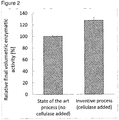
- Fig. 2
- shows the relative increase in the final volumetric (units U per volume ml) enzymatic activity of the fermentation carried out without the addition of cellulase (comparative example; left column) and with the addition of cellulase (example 1; right column) when carrying out the process of the present invention as described in example 1.
- Fig. 3
- shows the relative decrease in the final biomass concentration of the fermentation carried out without the addition of cellulase (comparative example; left column) and with the addition of cellulase (example 1; right column) when carrying out the process of the present invention as defined in example 1.
- Fig. 4
- shows the relative decrease in the base (12.5 % aqueous ammonia solution) consumption for pH correction during the fermentation carried out without the addition of cellulase (comparative example; left column) and with the addition of cellulase (example 1; right column) when carrying out the process of the present invention as defined in example 1.
- The weight-percentages (wt.-%) in this example refer to the weight of a component relative to the final weight of the broth in the bioreactor, unless specified differently.
- Fermentations were carried out in a stirred tank bioreactor system (DASGIP® Bioreactor SR0700ODLS/Bioblock, Eppendorf, Germany) in a medium containing 0.7 wt.-% glucose as the main carbon source, 0.5 wt.-% soymeal as additional carbon and nitrogen source, 1 wt.-% cellulose (Arbocel®) and additional salts and minerals (0.3 wt.-% (NH4)2SO4, 0.2 wt.-% KH2PO4, 0.03 wt.-% CaSO4, 0.02 wt.-% MgCl2, 0.002 wt.-% FeSO4 x 7 H2O, 0.0001 wt.-% MnSO4 x H20, 0.0001 wt.-%,ZnSO4 x 7 H2O). Both the state of the art process and the inventive process were conducted at 30 °C with air used for gassing at a rate of 1.5 L kg(total weight) -1 min-1 and agitation with 2 Rushton-impellers set to 1000 rpm, ensuring dissolved oxygen levels above 25 % of the dissolved amount in the fermentation medium before the inoculation of the fermenter with cells of the filamentous fungus. The pH was kept at 5 by automated addition of ammonia (12.5 wt.-% aqueous solution) and H2SO4 (4M).
- The fungal strain used was a Trichoderma reesei RUT-C30 derived strain in which the genes for all cellulases had been disrupted and which had been genetically modified to produce glucoamylase (EC number 3.2.1.3).
- After 24 hours and the consumption of the initially added glucose, a solution (feeding-solution) containing glucose (3.3 wt.-%) and ammonium sulfate (0.21 wt.-%) was continuously pumped into the bioreactor over the course of 120 hours. The feeding-solution comprised 12 wt.-% of the total weight. After 24, 48, 72 and 98 hours 10 FPU kg(total weight) -1 cellulase was added to the fermenter. The addition of the cellulase was omitted in reference fermentations, i.e. the state of the art process.
- Comparison of the "final biomass concentration" (dry weight of the cells present by the end of the fermentation), the "final volumetric enzymatic activity" and the "total amount of ammonia" (volume of base (12.5 wt-% ammonia) pumped into the reactor by the end of the fermentation over the course of the entire process to keep the pH at a pre-set value) used for pH correction can be seen in
figures 1 to 4 . The comparison shows significant increase of the final protein concentration and the final volumetric enzymatic activity for the inventive process as compared to the state of the art process. The final biomass concentration as well as the total amount of ammonia used for pH correction are both significantly reduced in the inventive process as compared to the state of the art process.
and
wherein at least steps (c) to (e) are carried out concurrently or in a consecutive fashion; and
wherein step (d) is carried out in a continuous fashion.
Claims (10)
- Method for the production of proteins comprising the following steps:(a) providing a fermentation medium comprising from 0.01 to 30 wt.-% cellulose;(b) degermination of the fermentation medium;(c) adding at least one filamentous fungus cell to the medium;(d) adding from 0.01 to 35 wt.-% of a mono- and/or disaccharide over a period of at least 1 hour;(e) adding from 0.1 to 10000 FPU cellulase per kg fermentation medium to the medium.
- Method according to claim 1, wherein at least steps (c) to (e) are carried out concurrently or in a consecutive fashion.
- Method according to any of the preceding claims, wherein step (d) is carried out in a continuous fashion.
- Method according to any of the preceding claims, wherein the 0.1 to 10000 FPU cellulase per kg fermentation medium are added in from 1 to 500 portions or in a continuous fashion.
- Method according to any of the preceding claims, wherein the pH is kept at a constant level by adding base or acid.
- Method according to any of the preceding claims, wherein the at least one filamentous fungus cell is a recombinant cell.
- Method according to claim 6, wherein the at least one filamentous fungus cell is a cell wherein the expression level of one or more cellulases has been reduced and/or one or more cellulase encoding genes have been knocked out.
- Method according to any of the preceding claims, wherein the filamentous fungus cell is selected from the group consisting of Acremonium, Aspergillus, Chaetomium, Fusarium, Humicola, Irpex, Magnaporte, Mucor, Myceliophthora, Neurospora, Penicillium, Rhizomucor, Rhizopus, Talaromyces, Trametes and Trichoderma species.
- Method according to any of the preceding claims, wherein the protein is selected from the group of enzymes, consisting of esterases, hydrolases, lyases and oxidases.
- Method according to any of the preceding claims, wherein at least steps (c) and (d) are carried out at a temperature of from 10 to 45 °C and/or at a pH of from 2.5 to 9.5 and/or for a time period of from 1 minute to 14 days and/or with a gassing rate of from 0.2 to 3 vvm and/or at a pressure of from 1 bar to 3 bar and/or with a a mechanical power input of from 0.01 to 20 kW/m3.
Priority Applications (5)
| Application Number | Priority Date | Filing Date | Title |
|---|---|---|---|
| EP17161104.9A EP3375884B1 (en) | 2017-03-15 | 2017-03-15 | Process for producing proteins under inducing conditions |
| DK17161104.9T DK3375884T3 (en) | 2017-03-15 | 2017-03-15 | Process for the production of proteins under inducing conditions |
| PCT/EP2018/056448 WO2018167174A1 (en) | 2017-03-15 | 2018-03-14 | Process for producing proteins under inducing conditions |
| US16/494,594 US20210115486A1 (en) | 2017-03-15 | 2018-03-14 | Process for producing proteins under inducing conditions |
| CN201880013974.XA CN110325647A (en) | 2017-03-15 | 2018-03-14 | Method for producing proteins under induced conditions |
Applications Claiming Priority (1)
| Application Number | Priority Date | Filing Date | Title |
|---|---|---|---|
| EP17161104.9A EP3375884B1 (en) | 2017-03-15 | 2017-03-15 | Process for producing proteins under inducing conditions |
Publications (2)
| Publication Number | Publication Date |
|---|---|
| EP3375884A1 true EP3375884A1 (en) | 2018-09-19 |
| EP3375884B1 EP3375884B1 (en) | 2020-05-06 |
Family
ID=58398023
Family Applications (1)
| Application Number | Title | Priority Date | Filing Date |
|---|---|---|---|
| EP17161104.9A Not-in-force EP3375884B1 (en) | 2017-03-15 | 2017-03-15 | Process for producing proteins under inducing conditions |
Country Status (5)
| Country | Link |
|---|---|
| US (1) | US20210115486A1 (en) |
| EP (1) | EP3375884B1 (en) |
| CN (1) | CN110325647A (en) |
| DK (1) | DK3375884T3 (en) |
| WO (1) | WO2018167174A1 (en) |
Citations (3)
| Publication number | Priority date | Publication date | Assignee | Title |
|---|---|---|---|---|
| EP0121397A2 (en) * | 1983-03-28 | 1984-10-10 | THE UNITED STATES OF AMERICA as represented by the Secretary United States Department of Commerce | Hyperproducing cellulase microorganism |
| WO2004035070A1 (en) * | 2002-09-10 | 2004-04-29 | Genencor International, Inc. | Induction of gene expression using a high concentration sugar mixture |
| WO2014110223A1 (en) * | 2013-01-11 | 2014-07-17 | Codexis, Inc. | Enzyme production compositions and methods |
Family Cites Families (3)
| Publication number | Priority date | Publication date | Assignee | Title |
|---|---|---|---|---|
| EP1899476A4 (en) * | 2005-06-30 | 2009-03-04 | Novozymes North America Inc | Production of cellulase |
| BR112013023715A2 (en) * | 2011-03-17 | 2016-09-13 | Danisco Us Inc | "polypeptide, polynucleotide, vector, host cell, and composition for use in biomass hydrolysis, as well as methods for hydrolyzing cellulosic biomass material and for producing culture mixture composition or fermentation broth" |
| CN104630186A (en) * | 2015-02-07 | 2015-05-20 | 大连理工大学 | A preparation method and application of a sugar mixture for inducing the production of cellulase |
-
2017
- 2017-03-15 DK DK17161104.9T patent/DK3375884T3/en active
- 2017-03-15 EP EP17161104.9A patent/EP3375884B1/en not_active Not-in-force
-
2018
- 2018-03-14 WO PCT/EP2018/056448 patent/WO2018167174A1/en not_active Ceased
- 2018-03-14 US US16/494,594 patent/US20210115486A1/en not_active Abandoned
- 2018-03-14 CN CN201880013974.XA patent/CN110325647A/en active Pending
Patent Citations (3)
| Publication number | Priority date | Publication date | Assignee | Title |
|---|---|---|---|---|
| EP0121397A2 (en) * | 1983-03-28 | 1984-10-10 | THE UNITED STATES OF AMERICA as represented by the Secretary United States Department of Commerce | Hyperproducing cellulase microorganism |
| WO2004035070A1 (en) * | 2002-09-10 | 2004-04-29 | Genencor International, Inc. | Induction of gene expression using a high concentration sugar mixture |
| WO2014110223A1 (en) * | 2013-01-11 | 2014-07-17 | Codexis, Inc. | Enzyme production compositions and methods |
Non-Patent Citations (2)
| Title |
|---|
| ALLEN, A.L. & MORTENSEN R.E.: "Production of Cellulase from Trichoderma reesei in Fed-Batch Fermentation from Soluble Carbon Sources", BIOTECHNOLOGY AND BIOENGINEERING, vol. 23, no. 11, November 1981 (1981-11-01), pages 2641 - 2646, XP008069337 * |
| HUANG T.T; WAGES J.M.: "New-to-nature sophorose analog: a potent inducer for gene expression in Trichoderma reesei", ENZYME AND MICROBIAL TECHNOLOGY, vol. 85, April 2016 (2016-04-01), pages 44 - 50 |
Also Published As
| Publication number | Publication date |
|---|---|
| DK3375884T3 (en) | 2020-07-27 |
| WO2018167174A1 (en) | 2018-09-20 |
| CN110325647A (en) | 2019-10-11 |
| US20210115486A1 (en) | 2021-04-22 |
| EP3375884B1 (en) | 2020-05-06 |
Similar Documents
| Publication | Publication Date | Title |
|---|---|---|
| Sohail et al. | Cellulase production from Aspergillus niger MS82: effect of temperature and pH | |
| Ellilä et al. | Development of a low-cost cellulase production process using Trichoderma reesei for Brazilian biorefineries | |
| Ray et al. | Optimization of fermentation conditions for cellulase production by Bacillus subtilis CY5 and Bacillus circulans TP3 isolated from fish gut | |
| Cunha et al. | Sequential solid-state and submerged cultivation of Aspergillus niger on sugarcane bagasse for the production of cellulase | |
| US6444437B1 (en) | Process for the production of nutritional products with microorganisms using sequential solid substrate and liquid fermentation | |
| Meng et al. | Engineering Trichoderma reesei Rut-C30 with the overexpression of egl1 at the ace1 locus to relieve repression on cellulase production and to adjust the ratio of cellulolytic enzymes for more efficient hydrolysis of lignocellulosic biomass | |
| CN101809151A (en) | Production method of cellulase | |
| Faria et al. | Production of xylanolytic enzymes by Moesziomyces spp. using xylose, xylan and brewery’s spent grain as substrates | |
| Bhalla et al. | Production of metabolites, industrial enzymes, amino acid, organic acids, antibiotics, vitamins and single cell proteins | |
| MX2014000665A (en) | Method for the production of cellulases by a filamentous fungus adapted to a fermenter having a low volumetric oxygen transfer coefficient kla. | |
| CN107012176B (en) | Method for producing sodium gluconate by using cellulose biomass as raw material through enzymatic conversion | |
| Lemos et al. | Xylanase production by Aspergillus awamori in solid-state fermentation and influence of different nitrogen sources | |
| KR19990023742A (en) | Enzyme complex | |
| Shinkawa et al. | Feasibility study of on-site solid-state enzyme production by Aspergillus oryzae | |
| CN108048473A (en) | A kind of feruloyl esterase gene, engineering strain and preparation method and purposes | |
| CA2896622A1 (en) | Enzyme production compositions and methods | |
| Fadel et al. | Cellulases and animal feed production by solid-state fermentation by Aspergillus fumigatus NRCF-122 mutant | |
| Ravichandra et al. | Xylanase production by isolated fungal strain, Aspergillus fumigatus RSP-8 (MTCC 12039): Impact of agro-industrial material as substrate | |
| Geetha et al. | Optimization of nutrient medium containing agricultural waste for xylanase production by Bacillus pumilus B20 | |
| US8530193B2 (en) | Altering enzyme balance through fermentation conditions | |
| EP3375884B1 (en) | Process for producing proteins under inducing conditions | |
| KR20250009476A (en) | Production of glycosidases from simple carbon sources by genetically modified functional microorganisms | |
| EP3660150B1 (en) | Provident method of cellulases enzymes production by penicillium funiculosum mrj-16 using low cost media components | |
| TWI626312B (en) | Xylosidase having improved enzymatic activity | |
| EP2408907B1 (en) | Use of cellulose and ligno-cellulose active proteins |
Legal Events
| Date | Code | Title | Description |
|---|---|---|---|
| PUAI | Public reference made under article 153(3) epc to a published international application that has entered the european phase |
Free format text: ORIGINAL CODE: 0009012 |
|
| STAA | Information on the status of an ep patent application or granted ep patent |
Free format text: STATUS: THE APPLICATION HAS BEEN PUBLISHED |
|
| AK | Designated contracting states |
Kind code of ref document: A1 Designated state(s): AL AT BE BG CH CY CZ DE DK EE ES FI FR GB GR HR HU IE IS IT LI LT LU LV MC MK MT NL NO PL PT RO RS SE SI SK SM TR |
|
| AX | Request for extension of the european patent |
Extension state: BA ME |
|
| STAA | Information on the status of an ep patent application or granted ep patent |
Free format text: STATUS: REQUEST FOR EXAMINATION WAS MADE |
|
| 17P | Request for examination filed |
Effective date: 20190319 |
|
| RBV | Designated contracting states (corrected) |
Designated state(s): AL AT BE BG CH CY CZ DE DK EE ES FI FR GB GR HR HU IE IS IT LI LT LU LV MC MK MT NL NO PL PT RO RS SE SI SK SM TR |
|
| GRAP | Despatch of communication of intention to grant a patent |
Free format text: ORIGINAL CODE: EPIDOSNIGR1 |
|
| STAA | Information on the status of an ep patent application or granted ep patent |
Free format text: STATUS: GRANT OF PATENT IS INTENDED |
|
| INTG | Intention to grant announced |
Effective date: 20191218 |
|
| GRAS | Grant fee paid |
Free format text: ORIGINAL CODE: EPIDOSNIGR3 |
|
| GRAA | (expected) grant |
Free format text: ORIGINAL CODE: 0009210 |
|
| STAA | Information on the status of an ep patent application or granted ep patent |
Free format text: STATUS: THE PATENT HAS BEEN GRANTED |
|
| AK | Designated contracting states |
Kind code of ref document: B1 Designated state(s): AL AT BE BG CH CY CZ DE DK EE ES FI FR GB GR HR HU IE IS IT LI LT LU LV MC MK MT NL NO PL PT RO RS SE SI SK SM TR |
|
| REG | Reference to a national code |
Ref country code: GB Ref legal event code: FG4D |
|
| REG | Reference to a national code |
Ref country code: CH Ref legal event code: EP Ref country code: AT Ref legal event code: REF Ref document number: 1266780 Country of ref document: AT Kind code of ref document: T Effective date: 20200515 |
|
| REG | Reference to a national code |
Ref country code: DE Ref legal event code: R096 Ref document number: 602017015954 Country of ref document: DE |
|
| REG | Reference to a national code |
Ref country code: IE Ref legal event code: FG4D |
|
| REG | Reference to a national code |
Ref country code: FI Ref legal event code: FGE |
|
| REG | Reference to a national code |
Ref country code: DK Ref legal event code: T3 Effective date: 20200723 |
|
| REG | Reference to a national code |
Ref country code: NL Ref legal event code: FP |
|
| REG | Reference to a national code |
Ref country code: LT Ref legal event code: MG4D |
|
| PG25 | Lapsed in a contracting state [announced via postgrant information from national office to epo] |
Ref country code: SE Free format text: LAPSE BECAUSE OF FAILURE TO SUBMIT A TRANSLATION OF THE DESCRIPTION OR TO PAY THE FEE WITHIN THE PRESCRIBED TIME-LIMIT Effective date: 20200506 Ref country code: IS Free format text: LAPSE BECAUSE OF FAILURE TO SUBMIT A TRANSLATION OF THE DESCRIPTION OR TO PAY THE FEE WITHIN THE PRESCRIBED TIME-LIMIT Effective date: 20200906 Ref country code: NO Free format text: LAPSE BECAUSE OF FAILURE TO SUBMIT A TRANSLATION OF THE DESCRIPTION OR TO PAY THE FEE WITHIN THE PRESCRIBED TIME-LIMIT Effective date: 20200806 Ref country code: GR Free format text: LAPSE BECAUSE OF FAILURE TO SUBMIT A TRANSLATION OF THE DESCRIPTION OR TO PAY THE FEE WITHIN THE PRESCRIBED TIME-LIMIT Effective date: 20200807 Ref country code: PT Free format text: LAPSE BECAUSE OF FAILURE TO SUBMIT A TRANSLATION OF THE DESCRIPTION OR TO PAY THE FEE WITHIN THE PRESCRIBED TIME-LIMIT Effective date: 20200907 Ref country code: LT Free format text: LAPSE BECAUSE OF FAILURE TO SUBMIT A TRANSLATION OF THE DESCRIPTION OR TO PAY THE FEE WITHIN THE PRESCRIBED TIME-LIMIT Effective date: 20200506 |
|
| PG25 | Lapsed in a contracting state [announced via postgrant information from national office to epo] |
Ref country code: LV Free format text: LAPSE BECAUSE OF FAILURE TO SUBMIT A TRANSLATION OF THE DESCRIPTION OR TO PAY THE FEE WITHIN THE PRESCRIBED TIME-LIMIT Effective date: 20200506 Ref country code: RS Free format text: LAPSE BECAUSE OF FAILURE TO SUBMIT A TRANSLATION OF THE DESCRIPTION OR TO PAY THE FEE WITHIN THE PRESCRIBED TIME-LIMIT Effective date: 20200506 Ref country code: BG Free format text: LAPSE BECAUSE OF FAILURE TO SUBMIT A TRANSLATION OF THE DESCRIPTION OR TO PAY THE FEE WITHIN THE PRESCRIBED TIME-LIMIT Effective date: 20200806 Ref country code: HR Free format text: LAPSE BECAUSE OF FAILURE TO SUBMIT A TRANSLATION OF THE DESCRIPTION OR TO PAY THE FEE WITHIN THE PRESCRIBED TIME-LIMIT Effective date: 20200506 |
|
| REG | Reference to a national code |
Ref country code: AT Ref legal event code: MK05 Ref document number: 1266780 Country of ref document: AT Kind code of ref document: T Effective date: 20200506 |
|
| PG25 | Lapsed in a contracting state [announced via postgrant information from national office to epo] |
Ref country code: AL Free format text: LAPSE BECAUSE OF FAILURE TO SUBMIT A TRANSLATION OF THE DESCRIPTION OR TO PAY THE FEE WITHIN THE PRESCRIBED TIME-LIMIT Effective date: 20200506 |
|
| PG25 | Lapsed in a contracting state [announced via postgrant information from national office to epo] |
Ref country code: SM Free format text: LAPSE BECAUSE OF FAILURE TO SUBMIT A TRANSLATION OF THE DESCRIPTION OR TO PAY THE FEE WITHIN THE PRESCRIBED TIME-LIMIT Effective date: 20200506 Ref country code: EE Free format text: LAPSE BECAUSE OF FAILURE TO SUBMIT A TRANSLATION OF THE DESCRIPTION OR TO PAY THE FEE WITHIN THE PRESCRIBED TIME-LIMIT Effective date: 20200506 Ref country code: ES Free format text: LAPSE BECAUSE OF FAILURE TO SUBMIT A TRANSLATION OF THE DESCRIPTION OR TO PAY THE FEE WITHIN THE PRESCRIBED TIME-LIMIT Effective date: 20200506 Ref country code: AT Free format text: LAPSE BECAUSE OF FAILURE TO SUBMIT A TRANSLATION OF THE DESCRIPTION OR TO PAY THE FEE WITHIN THE PRESCRIBED TIME-LIMIT Effective date: 20200506 Ref country code: CZ Free format text: LAPSE BECAUSE OF FAILURE TO SUBMIT A TRANSLATION OF THE DESCRIPTION OR TO PAY THE FEE WITHIN THE PRESCRIBED TIME-LIMIT Effective date: 20200506 Ref country code: RO Free format text: LAPSE BECAUSE OF FAILURE TO SUBMIT A TRANSLATION OF THE DESCRIPTION OR TO PAY THE FEE WITHIN THE PRESCRIBED TIME-LIMIT Effective date: 20200506 |
|
| REG | Reference to a national code |
Ref country code: DE Ref legal event code: R097 Ref document number: 602017015954 Country of ref document: DE |
|
| PG25 | Lapsed in a contracting state [announced via postgrant information from national office to epo] |
Ref country code: SK Free format text: LAPSE BECAUSE OF FAILURE TO SUBMIT A TRANSLATION OF THE DESCRIPTION OR TO PAY THE FEE WITHIN THE PRESCRIBED TIME-LIMIT Effective date: 20200506 Ref country code: PL Free format text: LAPSE BECAUSE OF FAILURE TO SUBMIT A TRANSLATION OF THE DESCRIPTION OR TO PAY THE FEE WITHIN THE PRESCRIBED TIME-LIMIT Effective date: 20200506 |
|
| PLBE | No opposition filed within time limit |
Free format text: ORIGINAL CODE: 0009261 |
|
| STAA | Information on the status of an ep patent application or granted ep patent |
Free format text: STATUS: NO OPPOSITION FILED WITHIN TIME LIMIT |
|
| 26N | No opposition filed |
Effective date: 20210209 |
|
| PG25 | Lapsed in a contracting state [announced via postgrant information from national office to epo] |
Ref country code: SI Free format text: LAPSE BECAUSE OF FAILURE TO SUBMIT A TRANSLATION OF THE DESCRIPTION OR TO PAY THE FEE WITHIN THE PRESCRIBED TIME-LIMIT Effective date: 20200506 |
|
| PG25 | Lapsed in a contracting state [announced via postgrant information from national office to epo] |
Ref country code: MC Free format text: LAPSE BECAUSE OF FAILURE TO SUBMIT A TRANSLATION OF THE DESCRIPTION OR TO PAY THE FEE WITHIN THE PRESCRIBED TIME-LIMIT Effective date: 20200506 |
|
| REG | Reference to a national code |
Ref country code: CH Ref legal event code: PL |
|
| PG25 | Lapsed in a contracting state [announced via postgrant information from national office to epo] |
Ref country code: IE Free format text: LAPSE BECAUSE OF NON-PAYMENT OF DUE FEES Effective date: 20210315 Ref country code: LI Free format text: LAPSE BECAUSE OF NON-PAYMENT OF DUE FEES Effective date: 20210331 Ref country code: LU Free format text: LAPSE BECAUSE OF NON-PAYMENT OF DUE FEES Effective date: 20210315 Ref country code: CH Free format text: LAPSE BECAUSE OF NON-PAYMENT OF DUE FEES Effective date: 20210331 |
|
| PGFP | Annual fee paid to national office [announced via postgrant information from national office to epo] |
Ref country code: GB Payment date: 20220322 Year of fee payment: 6 Ref country code: FI Payment date: 20220318 Year of fee payment: 6 Ref country code: DK Payment date: 20220324 Year of fee payment: 6 |
|
| PGFP | Annual fee paid to national office [announced via postgrant information from national office to epo] |
Ref country code: NL Payment date: 20220325 Year of fee payment: 6 Ref country code: IT Payment date: 20220323 Year of fee payment: 6 Ref country code: FR Payment date: 20220325 Year of fee payment: 6 Ref country code: BE Payment date: 20220325 Year of fee payment: 6 |
|
| PGFP | Annual fee paid to national office [announced via postgrant information from national office to epo] |
Ref country code: DE Payment date: 20220428 Year of fee payment: 6 |
|
| REG | Reference to a national code |
Ref country code: NL Ref legal event code: PD Owner name: CLARIANT PRODUKTE (DEUTSCHLAND) GMBH; DE Free format text: DETAILS ASSIGNMENT: CHANGE OF OWNER(S), ASSIGNMENT; FORMER OWNER NAME: CLARIANT INTERNATIONAL LTD Effective date: 20230428 |
|
| REG | Reference to a national code |
Ref country code: GB Ref legal event code: 732E Free format text: REGISTERED BETWEEN 20230602 AND 20230607 |
|
| PG25 | Lapsed in a contracting state [announced via postgrant information from national office to epo] |
Ref country code: CY Free format text: LAPSE BECAUSE OF FAILURE TO SUBMIT A TRANSLATION OF THE DESCRIPTION OR TO PAY THE FEE WITHIN THE PRESCRIBED TIME-LIMIT Effective date: 20200506 |
|
| PG25 | Lapsed in a contracting state [announced via postgrant information from national office to epo] |
Ref country code: HU Free format text: LAPSE BECAUSE OF FAILURE TO SUBMIT A TRANSLATION OF THE DESCRIPTION OR TO PAY THE FEE WITHIN THE PRESCRIBED TIME-LIMIT; INVALID AB INITIO Effective date: 20170315 |
|
| REG | Reference to a national code |
Ref country code: FI Ref legal event code: PCE Owner name: CLARIANT PRODUKTE (DEUTSCHLAND) GMBH |
|
| REG | Reference to a national code |
Ref country code: DE Ref legal event code: R119 Ref document number: 602017015954 Country of ref document: DE |
|
| PG25 | Lapsed in a contracting state [announced via postgrant information from national office to epo] |
Ref country code: FI Free format text: LAPSE BECAUSE OF NON-PAYMENT OF DUE FEES Effective date: 20230315 |
|
| REG | Reference to a national code |
Ref country code: DK Ref legal event code: EBP Effective date: 20230331 |
|
| REG | Reference to a national code |
Ref country code: NL Ref legal event code: MM Effective date: 20230401 |
|
| GBPC | Gb: european patent ceased through non-payment of renewal fee |
Effective date: 20230315 |
|
| REG | Reference to a national code |
Ref country code: BE Ref legal event code: MM Effective date: 20230331 |
|
| PG25 | Lapsed in a contracting state [announced via postgrant information from national office to epo] |
Ref country code: NL Free format text: LAPSE BECAUSE OF NON-PAYMENT OF DUE FEES Effective date: 20230401 |
|
| PG25 | Lapsed in a contracting state [announced via postgrant information from national office to epo] |
Ref country code: GB Free format text: LAPSE BECAUSE OF NON-PAYMENT OF DUE FEES Effective date: 20230315 |
|
| PG25 | Lapsed in a contracting state [announced via postgrant information from national office to epo] |
Ref country code: GB Free format text: LAPSE BECAUSE OF NON-PAYMENT OF DUE FEES Effective date: 20230315 Ref country code: FR Free format text: LAPSE BECAUSE OF NON-PAYMENT OF DUE FEES Effective date: 20230331 Ref country code: DE Free format text: LAPSE BECAUSE OF NON-PAYMENT OF DUE FEES Effective date: 20231003 |
|
| PG25 | Lapsed in a contracting state [announced via postgrant information from national office to epo] |
Ref country code: BE Free format text: LAPSE BECAUSE OF NON-PAYMENT OF DUE FEES Effective date: 20230331 |
|
| PG25 | Lapsed in a contracting state [announced via postgrant information from national office to epo] |
Ref country code: MK Free format text: LAPSE BECAUSE OF FAILURE TO SUBMIT A TRANSLATION OF THE DESCRIPTION OR TO PAY THE FEE WITHIN THE PRESCRIBED TIME-LIMIT Effective date: 20200506 Ref country code: IT Free format text: LAPSE BECAUSE OF NON-PAYMENT OF DUE FEES Effective date: 20230315 Ref country code: DK Free format text: LAPSE BECAUSE OF NON-PAYMENT OF DUE FEES Effective date: 20230331 |
|
| PG25 | Lapsed in a contracting state [announced via postgrant information from national office to epo] |
Ref country code: TR Free format text: LAPSE BECAUSE OF FAILURE TO SUBMIT A TRANSLATION OF THE DESCRIPTION OR TO PAY THE FEE WITHIN THE PRESCRIBED TIME-LIMIT Effective date: 20200506 |
|
| PG25 | Lapsed in a contracting state [announced via postgrant information from national office to epo] |
Ref country code: MT Free format text: LAPSE BECAUSE OF FAILURE TO SUBMIT A TRANSLATION OF THE DESCRIPTION OR TO PAY THE FEE WITHIN THE PRESCRIBED TIME-LIMIT Effective date: 20200506 |