EP3375443B1 - Pharmaceutical composition for treating respiratory diseases - Google Patents
Pharmaceutical composition for treating respiratory diseases Download PDFInfo
- Publication number
- EP3375443B1 EP3375443B1 EP16863661.1A EP16863661A EP3375443B1 EP 3375443 B1 EP3375443 B1 EP 3375443B1 EP 16863661 A EP16863661 A EP 16863661A EP 3375443 B1 EP3375443 B1 EP 3375443B1
- Authority
- EP
- European Patent Office
- Prior art keywords
- weight
- pharmaceutical composition
- group
- scholaricine
- parts
- Prior art date
- Legal status (The legal status is an assumption and is not a legal conclusion. Google has not performed a legal analysis and makes no representation as to the accuracy of the status listed.)
- Active
Links
Images
Classifications
-
- A—HUMAN NECESSITIES
- A61—MEDICAL OR VETERINARY SCIENCE; HYGIENE
- A61K—PREPARATIONS FOR MEDICAL, DENTAL OR TOILETRY PURPOSES
- A61K36/00—Medicinal preparations of undetermined constitution containing material from algae, lichens, fungi or plants, or derivatives thereof, e.g. traditional herbal medicines
- A61K36/18—Magnoliophyta (angiosperms)
- A61K36/185—Magnoliopsida (dicotyledons)
- A61K36/24—Apocynaceae (Dogbane family), e.g. plumeria or periwinkle
-
- A—HUMAN NECESSITIES
- A61—MEDICAL OR VETERINARY SCIENCE; HYGIENE
- A61K—PREPARATIONS FOR MEDICAL, DENTAL OR TOILETRY PURPOSES
- A61K31/00—Medicinal preparations containing organic active ingredients
- A61K31/33—Heterocyclic compounds
- A61K31/395—Heterocyclic compounds having nitrogen as a ring hetero atom, e.g. guanethidine or rifamycins
- A61K31/435—Heterocyclic compounds having nitrogen as a ring hetero atom, e.g. guanethidine or rifamycins having six-membered rings with one nitrogen as the only ring hetero atom
- A61K31/439—Heterocyclic compounds having nitrogen as a ring hetero atom, e.g. guanethidine or rifamycins having six-membered rings with one nitrogen as the only ring hetero atom the ring forming part of a bridged ring system, e.g. quinuclidine
-
- A—HUMAN NECESSITIES
- A61—MEDICAL OR VETERINARY SCIENCE; HYGIENE
- A61K—PREPARATIONS FOR MEDICAL, DENTAL OR TOILETRY PURPOSES
- A61K31/00—Medicinal preparations containing organic active ingredients
- A61K31/33—Heterocyclic compounds
- A61K31/395—Heterocyclic compounds having nitrogen as a ring hetero atom, e.g. guanethidine or rifamycins
-
- A—HUMAN NECESSITIES
- A61—MEDICAL OR VETERINARY SCIENCE; HYGIENE
- A61K—PREPARATIONS FOR MEDICAL, DENTAL OR TOILETRY PURPOSES
- A61K31/00—Medicinal preparations containing organic active ingredients
- A61K31/33—Heterocyclic compounds
- A61K31/395—Heterocyclic compounds having nitrogen as a ring hetero atom, e.g. guanethidine or rifamycins
- A61K31/40—Heterocyclic compounds having nitrogen as a ring hetero atom, e.g. guanethidine or rifamycins having five-membered rings with one nitrogen as the only ring hetero atom, e.g. sulpiride, succinimide, tolmetin, buflomedil
- A61K31/403—Heterocyclic compounds having nitrogen as a ring hetero atom, e.g. guanethidine or rifamycins having five-membered rings with one nitrogen as the only ring hetero atom, e.g. sulpiride, succinimide, tolmetin, buflomedil condensed with carbocyclic rings, e.g. carbazole
- A61K31/404—Indoles, e.g. pindolol
- A61K31/405—Indole-alkanecarboxylic acids; Derivatives thereof, e.g. tryptophan, indomethacin
-
- A—HUMAN NECESSITIES
- A61—MEDICAL OR VETERINARY SCIENCE; HYGIENE
- A61P—SPECIFIC THERAPEUTIC ACTIVITY OF CHEMICAL COMPOUNDS OR MEDICINAL PREPARATIONS
- A61P11/00—Drugs for disorders of the respiratory system
- A61P11/06—Antiasthmatics
-
- A—HUMAN NECESSITIES
- A61—MEDICAL OR VETERINARY SCIENCE; HYGIENE
- A61P—SPECIFIC THERAPEUTIC ACTIVITY OF CHEMICAL COMPOUNDS OR MEDICINAL PREPARATIONS
- A61P29/00—Non-central analgesic, antipyretic or antiinflammatory agents, e.g. antirheumatic agents; Non-steroidal antiinflammatory drugs [NSAID]
-
- A—HUMAN NECESSITIES
- A61—MEDICAL OR VETERINARY SCIENCE; HYGIENE
- A61K—PREPARATIONS FOR MEDICAL, DENTAL OR TOILETRY PURPOSES
- A61K2236/00—Isolation or extraction methods of medicinal preparations of undetermined constitution containing material from algae, lichens, fungi or plants, or derivatives thereof, e.g. traditional herbal medicine
- A61K2236/30—Extraction of the material
- A61K2236/33—Extraction of the material involving extraction with hydrophilic solvents, e.g. lower alcohols, esters or ketones
Definitions
- the invention relates to the field of medical technology, particularly relates to a pharmaceutical composition for use in treating chronic obstructive pulmonary disease or pulmonary fibrosis disease according to claim 1 or an alkaloid composition for use in treating chronic obstructive pulmonary disease or pulmonary fibrosis disease according to claim 2.
- Respiratory disease is a common and frequently-occurring disease, which has the main pathologenic changes in trachea, bronchi, lung and pleural cavity. Mild patients generally have cough, chest pain, and have breathing disturbed, while severe patients have difficulty in breathing, have hypoxia, or even die due to respiratory failure.
- Airway inflammatory disease which is one of the common and frequently-occurring respiratory diseases in clinic, refers to inflammatory disease in upper airway (mainly including nose, pharynx and larynx) and lower airway (mainly including trachea). It is characterized by airway inflammation and tissue remodeling, and is manifested as changes in epithelial cells, mucosal and submucosal exudation and infiltration of inflammatory cell, hypertrophy and hyperplasia of goblet cells, strong glandular secretion, subepithelial edema, basement membrane thickening and fibrosis, etc. Its pathogenic cause is mainly associated with smoking, air pollution, infection, harmful gas, dust inhalation, and intrinsic factor of organism, etc.
- airway barrier protection is weakened, which stimulates the participation of active oxygen system, various inflammatory cell and inflammatory mediators, thereby aggravating the inflammatory response. Therefore, the treatment against inflammation has become the most critical part in the treatment of airway inflammatory disease.
- COPD Chronic obstructive pulmonary disease
- Many inflammatory cell such as neutrophils, alveolar macrophages and lymphocytes promote the occurrence and development of chronic airway inflammation in different phases by releasing various bioactive substances such as interleukin, tumor necrosis factor and so on.
- Airway mucus hypersecretion and inflammatory response considered as one of the important causes for COPD, eventually lead to airway obstruction and airflow limitation.
- Bronchial asthma is a common respiratory disease in adults and children, and its pathological characteristic is chronic airway inflammation in which various inflammatory cell are involved, such as eosinophils, lymphocytes, mast cells and neutrophils.
- Pulmonary fibrosis particularly idiopathic pulmonary fibrosis, has been considered for a long time as a progressive and substantially irreversible pathological change. That is, it starts from infiltration of inflammatory cell in lower respiratory tract, gradually leads to injury to alveolar epithelial cells and vascular endothelial cells, is accompanied by the release of cytokines and the like which can promote proliferation of myofibroblasts and alveolar type II epithelial cells, results in extracellular matrix protein and collagen deposition, and finally causes damage to lung structure.
- Alstoniascholaris (L.) R. Br., also called Alstonia scholaris, is a plant of the genus Alstonia of the family Apocynaceae. Its medicinal parts are root, bark and leaf. Alstonia scholaris contains various alkaloids having relatively high bioactivities, such as picrinine, vallesamine, scholaricine and 19-epischolaricine.
- Alstonia scholaris is generally used for the treatment of headache, pneumonia, pertussis, and chronic bronchitis in civilian populations. It has been recorded in the local journal of medicine such as " Lu Chuan Ben Cao”, “Selections of Chinese herbal medicines of Yunnan” and “Drug Standards of Yunnan Republic” (1974 ) and " Pharmacopoeia of the People's Republic of China, Vol. 1" (published in 1977 ). Leaves of Alstonia scholaris can clear internal heat, remove phlegm and relieve a cough, and are useful for cough resulted from pulmonary retention of phlegmopyrexia, stethocatharsis, and chronic bronchitis, as well as pertussis having the above-mentioned syndromes. It has not been reported yet that Alstonia scholaris has a significant inhibitory effect on respiratory disease.
- CN103655651 discloses common alstonia leaf extractum and extract as well as preparation methods thereof.
- CN101084951 discloses a medicament for treating cold, fever and respiratory disease caused by cold and fever comprises therapeutically-effective amount of alcohol extract or acid water extract of Alstonia scholaris (L.)R.Br. or total alkaloid of Alstonia scholaris.
- CN100563670 discloses a Chinese-medicinal composition for treating cough asthma.
- the alkaloid composition (comprising four main alkaloids, i.e. picrinine, vallesamine, scholaricine and 19-epischolaricine, referred to hereafter as the same) extracted from leaves of Alstonia scholaris, or the effective components isolated from the alkaloid composition, i.e. picrinine, vallesamine, scholaricine, and 19-epischolaricine, and any combination thereof, have a significant inhibitory effect on respiratory disease.
- the alkaloid composition for use according to the invention may decrease the level of IL-6 and CRP in serum, enhance antioxidant activity in organism, reduce the infiltration of leukocyte and neutrophil, and therefore may be used to treat chronic obstructive pulmonary disease.
- the alkaloid composition for use according to the invention may decrease the level of KL-6, LDH in serum, and the content of TGF- ⁇ , Col-1, HYP and MMP-1 in homogenate, improve the oxidation-antioxidation balance in organism, and therefore may be used to treat pulmonary fibrosis disease.
- the invention provides a pharmaceutical composition for use in treating chronic obstructive pulmonary disease or pulmonary fibrosis disease comprising: 8-50 parts by weight of picrinine, 5-45 parts by weight of vallesamine, 5-30 parts by weight of scholaricine and 0-10 parts by weight of 19-epischolaricine.
- picrinine in the pharmaceutical composition, is in an amount of 8-16 parts by weight.
- vallesamine in the pharmaceutical composition, is in an amount of 5-15 parts by weight.
- scholaricine in the pharmaceutical composition, scholaricine is in an amount of 5-10 parts by weight.
- 19-epischolaricine in the pharmaceutical composition, is in an amount of 1-5 parts by weight.
- the pharmaceutical composition comprises: 8-16 parts by weight of picrinine, 5-15 parts by weight of vallesamine, 5-10 parts by weight of scholaricine and 1-5 parts by weight of 19-epischolaricine.
- the pharmaceutical composition comprises: 8-12 parts by weight of picrinine, 5-9 parts by weight of vallesamine, 5-9 parts by weight of scholaricine and 1-3 parts by weight of 19-epischolaricine.
- the pharmaceutical composition comprises about 10 parts by weight of picrinine, 7 parts by weight of vallesamine, 7 parts by weight of scholaricine and 2 parts by weight of 19-epischolaricine.
- the pharmaceutical composition for use according to the invention may be applied alone or in combination with, for example, an additional drug, such as the alkaloid composition of the invention, to form a compound, and may also be prepared in a form of health product and food through conventional procedures.
- an additional drug such as the alkaloid composition of the invention
- the pharmaceutical composition for use according to the invention may be prepared into various appropriate dosage forms depending on the route of administration, by conventional procedures in the art. Therefore, in some preferred embodiments of the invention, the pharmaceutical composition further comprises a pharmaceutically acceptable carrier and/or excipient.
- the pharmaceutical composition for oral use may be in the form of a tablet, a sustained-release tablet, a controlled-release tablet, a lozenge, a hard or soft capsule, an aqueous or oily suspension, an emulsion, a dispersible pulvis or granule, a syrup or elixir, a dropping pill, a mini-pill or oral solution. Therefore, a composition for oral administration may comprise, for example, one or more colouring agents, sweetening agents, flavouring agents and/or preservatives.
- a pharmaceutically acceptable excipient suitable for a tablet includes an inert diluent such as lactose, sodium carbonate, calcium phosphate or calcium carbonate; a disintegrating agent such as corn starch and alginic acid; a binder, such as starch; a lubricant, such as magnesium stearate, stearic acid or talc; a preservative such as ethyl or propyl parahydroxybenzoate; and an antioxidant, such as ascorbic acid, etc.
- a tablet may be uncoated or coated either to modify its disintegration and the subsequent absorption of the active ingredient within the gastrointestinal tract, or to improve its stability and/or appearance. In either cases, using conventional coating agents and procedures well known in the art.
- a pharmaceutically acceptable excipient suitable for a hard capsule includes an inert solid diluent such as calcium carbonate, calcium phosphate or kaolin, etc.
- a pharmaceutically acceptable excipient suitable for a soft capsule includes water or oil such as peanut oil, liquid paraffin or olive oil, etc.
- An aqueous suspension generally comprises an active ingredient in finely powdered form together with one or more dispersants, diluents or suspending agents, the suspending agent is, for example, carboxymethylcellulose sodium, methylcellulose, hydroxypropyl methyl cellulose, sodium alginate, polyvinyl-pyrrolidone, gum trargacanth, and gum acacia, etc.; a dispersant or wetting agent, such as lecithin or a condensation product of alkylene oxide with fatty acid (e.g.
- polyoxyethylene stearate or a condensation product of ethylene oxide with long-chain aliphatic alcohol, such as heptadecaethyleneoxycetanol, or a condensation product of ethylene oxide with partial ester derived from fatty acid and a hexitol, e.g. polyoxyethylene sorbitol monooleate, or a condensation product of ethylene oxide with partial ester derived from fatty acid and hexitan, e.g. polyoxyethylene sorbitan monooleate.
- An aqueous suspension may further comprise one or more preservatives (e.g. ethyl or propyl parahydroxybenzoate), antioxidants (e.g. ascorbic acid), colouring agents, flavouring agents, and/or sweetening agents (e.g. sucrose, saccharin and aspartame), etc.
- preservatives e.g. ethyl or propyl parahydroxybenzoate
- antioxidants e.g. ascorbic acid
- An oily suspension may be formulated by suspending the active ingredient in a vegetable oil (such as peanut oil, olive oil, sesame oil or coconut oil) or in a mineral oil (such as liquid paraffin).
- the oily suspension may further comprise a thickener, such as beewax, hard paraffin, or cetyl alcohol.
- the sweetener and flavouring agent such as those set above may be added to provide a palatable oral preparation.
- These compositions may be preserved by the addition of an antioxidant such as ascorbic acid.
- the pharmaceutical composition for use according to the invention may also be in the form of oil-in-water emulsion.
- the oily phase may be a vegetable oil, such as olive oil or peanut oil, or a mineral oil such as liquid paraffin, or a mixture of any of these.
- a suitable emulsifier may be, for example, a naturally-occuring gum such as gum acacia or gum trargacanth, a naturally occuring phosphatide such as soybean lecithin, and an ester or a partial ester derived from fatty acid and hexitol anhydride (such as sorbitan monooleate), as well as a condensation product of the partial ester with ethylene oxide, such as polyoxyethylene sorbitan monooleate.
- An emulsion may also comprise a sweetening agent, a flavouring agent and a preservative, etc.
- a syrup and an elixir may be formulated with a sweetening agent (such as glycerol, propylene glycol, sorbitol, aspartame or sucrose), or may also comprise a demulcent, a preservative, a flavouring agent and/or a colouring agent, etc.
- a sweetening agent such as glycerol, propylene glycol, sorbitol, aspartame or sucrose
- the pharmaceutical composition for parenteral administration may be in the form of a sterile aqueous or oily solution, a sterile powder, a liposome, an emulsion, a microemulsion, a nanoemulsion or a microcapsule.
- the pharmaceutical composition may also be in the form of an sterile injectable aqueous or oily suspension, which may be formulated according to known procedures using one or more of the appropriate dispersants, diluents and/or suspending agents as described above.
- a sterile injectable preparation may also be a sterile injectable aqueous or oily suspension in a diluent or a solvent that is nontoxic and gastrointestinally acceptable, for example, a solution in 1, 3-butanediol.
- an active ingredient that is combined with one or more excipients to produce a single dosage form will necessarily vary depending upon the host treated and the particular route of administration.
- a formulation intended for oral administration to human will generally comprises, for example, an active ingredient in an amount of 0.5 mg-2 g with an appropriate and convenient amount of excipient (which accounts for about 5-98% of the total weight of a composition).
- Dosage unit form will generally comprise an active ingredient in an amount of about 1 mg-500 mg.
- the size of the dose for therapeutic or prophylactic purposes of the pharmaceutical composition will naturally vary according to the nature and severity of the conditions, the age and gender of the animal or patient, and the route of administration, etc.
- a daily dose in the range for example, 1 mg-100 mg/kg body weight is received, given if required in divided doses.
- lower doses will be administered when a parenteral route is employed.
- a dose in a range for example, 1 mg-10 mg/kg body weight will generally be used.
- the invention provides an alkaloid composition according claim 2 for use according to claim 2.
- the alkaloid composition extracted from leaves of Alstonia scholaris may comprise: 8-50 parts by weight of picrinine, 5-45 parts by weight of vallesamine, 5-30 parts by weight of scholaricine and 0-10 parts by weight of 19-epischolaricine.
- picrinine is in an amount of 8-16 parts by weight.
- vallesamine is in an amount of 5-15 parts by weight.
- scholaricine is in an amount of 5-10 parts by weight.
- 19-epischolaricine is in an amount of 1-5 parts by weight.
- the alkaloid composition comprises: 8-16 parts by weight of picrinine, 5-15 parts by weight of vallesamine, 5-10 parts by weight of scholaricine and 1-5 parts by weight of 19-epischolaricine.
- the alkaloid composition comprises: 8-12 parts by weight of picrinine, 5-9 parts by weight of vallesamine, 5-9 parts by weight of scholaricine and 1-3 parts by weight of 19-epischolaricine.
- the alkaloid composition comprises about 10 parts by weight of picrinine, 7 parts by weight of vallesamine, 7 parts by weight of scholaricine and 2 parts by weight of 19-epischolaricine.
- the alkaloid composition extracted from leaves of Alstonia scholaris for use according the invention is prepared by the following method:
- the method is characterized by one or more of the following items:
- the pharmaceutical composition or alkaloid composition is administered in a daily dose of 1 mg-100 mg/kg.
- the invention provides the pharmaceutical composition of the first aspect, or the alkaloid composition of the second aspect for use in treating a respiratory disease, wherein the respiratory disease is selected from chronic obstructive pulmonary disease, and pulmonary fibrosis disease.
- the invention may provide the pharmaceutical composition of the first aspect, or the alkaloid composition of the second aspect for use in treating a disease or disorder caused by abnormal content of IL-6 and/or CRP in a cell, wherein the disease or disorder caused by abnormal content of IL-6 and/or CRP in a cell is chronic obstructive pulmonary disease.
- the invention may provide the pharmaceutical composition of the first aspect or the alkaloid composition of the second aspect for use in treating a disease or disorder caused by abnormal content of KL-6, LDH, TGF- ⁇ , Col-1, Hyp and/or MMP-1 in a cell, wherein the disease or disorder caused by abnormal content of KL-6, LDH, TGF- ⁇ , Col-1, Hyp and/or MMP-1 in a cell is pulmonary fibrosis disease.
- airway inflammation refers to upper airway (mainly including nose, pharynx and larynx) and lower airway (mainly including trachea) inflammatory disease, which is one of the common and frequently-occurring respiratory diseases in clinic, mainly including bronchial asthma, chronic obstructive pulmonary disease, interstitial pneumonia, etc., which often co-exist at the same time. It is selected from disease of airway inflammation resulted from any of the following causes: smoking, infection, air pollution, harmful gas, dust inhalation, intrinsic factor of organism, etc.
- the chronic obstructive pulmonary disease is resulted from any of the following causes: smoking, infection, physical and chemical factor, and air pollution.
- the physical and chemical factor refers to physical, chemical or biological factor that has an effect on a disease; wherein a physical factor includes high temperature, low temperature, low atmospheric pressure, high atmospheric pressure, noise, vibration, ionizing radiation, high frequency, ultraviolet light, snow blinding, electric shock, drowning, seasickness, etc.; chemical factors include, for example, "three wastes” in industry, organic solvents, irritating gases, asphyxiating toxicants, corrosive toxicants, heavy metal ions, agricultural chemicals, and the like, as well as household cleaners, pesticides, drugs, etc.
- the asthma is resulted from any of the following causes: food, dust mite, pollen, fungal spore, animal scurf, insect excrement, drug, and cold air.
- the pulmonary fibrosis disease is resulted from any of the following causes: smoking, asbestos, inorganic dust, drug, radiation injury, harmful gas, infection, environmental factor and pneumopathy.
- the term "subject" refers to animal, particularly mammal, preferably human.
- an effective amount refers to an amount that is sufficient to achieve or at least partially achieve a desired effect.
- a prophylactically effective amount refers to an amount that is sufficient to prevent, suppress or delay the occurrence of a disease
- a therapeutically effective amount refers to an amount that is sufficient to cure or at least partially suppress a disease and its complications in a patient with the disease.
- the determination of such an effective amount is completely within the ability of a person skilled in the art.
- an amount effective for a therapeutic use depends on the severity degree of a disease to be treated, general state of the immune system in a patient, general conditions of a patient such as age, weight and gender, route of administration of the drug, additional therapies used simultaneously, and the like.
- the particular amount of the effective components in the pharmaceutical composition or alkaloid composition is expressed by using "about". It means that due to the objective reasons such as analytic means or instrumental error, the actual amount of the effective monomer may be in the range of the numerical value of the present application ⁇ 20%, e.g. ⁇ 10%, e.g. ⁇ 5%, e.g. ⁇ 2%, e.g. ⁇ 1%, e.g. ⁇ 0.5%, e.g. ⁇ 0.1%.
- the pharmaceutical composition for use according to of the invention may be prepared by the following method: an alkaloid composition comprising the components or pure form of the components is prepared by any known method, and then the pharmaceutical composition and the pure form of the components are mixed so that the components are present in a desired ratio.
- picrinine used may be an alkaloid composition comprising 10-99% picrinine or a pure form of picrinine, preferably an alkaloid composition extracted from a plant of the family Apocynaceae, more preferably an alkaloid composition extracted from a plant of the genus Alstonia, more preferably an alkaloid composition of Alstonia scholaris comprising 10-99% picrinine.
- Vallesamine used may be an alkaloid composition comprising 10-99% vallesamine or a pure form of vallesamine, preferably an alkaloid composition extracted from a plant of the family Apocynaceae, more preferably an alkaloid composition extracted from a plant of the genus Alstonia, more preferably an alkaloid composition of Alstonia scholaris comprising 10-99% vallesamine.
- Scholaricine used may be an alkaloid composition comprising 10-99% scholaricine or a pure form of scholaricine, preferably an alkaloid composition extracted from a plant of the family Apocynaceae, more preferably an alkaloid composition extracted from a plant of the genus Alstonia, more preferably an alkaloid composition of Alstonia scholaris comprising 10-99% scholaricine.
- 19-epischolaricine used may be an alkaloid composition comprising 10-99% 19-epischolaricine or a pure form of 19-epischolaricine, preferably an alkaloid composition extracted from a plant of the family Apocynaceae, more preferably an alkaloid composition comprising extracted from a plant of the genus Alstonia , more preferably an alkaloid composition of Alstonia scholaris comprising 10-99% 19-epischolaricine.
- a method for preparing the pharmaceutical composition of the first aspect is described herein, characterized in that, the method comprises the following steps:
- step a comprises: Alstonia scholaris is used as raw material, and is subjected to reflux extraction with aqueous ethanol; the extract is concentrated and soaked with an aqueous solution of acid (preferably hydrochloric acid or sulfuric acid), and filtrated; the resultant acidic aqueous solution is concentrated to obtain an acidic ethanol extract; the acidic ethanol extract is dissolved in water, and adjusted with a base (preferably, ammonia water, NaOH, KOH or Na 2 CO 3 aqueous solution) to have a pH of 7.5-11; the resultant solution is extracted with ethyl acetate, and the solvent is recovered from the organic phase, to obtain the alkaloid composition.
- a base preferably, ammonia water, NaOH, KOH or Na 2 CO 3 aqueous solution
- step a comprises: Alstonia scholaris is used as raw material, and is subjected to reflux extraction with aqueous ethanol, the extract is concentrated and soaked with an aqueous solution of acid (preferably hydrochloric acid or sulfuric acid), and filtrated; the resultant acidic aqueous solution is concentrated to obtain an acidic ethanol extract; the acidic ethanol extract is dissolved in water, and pH is adjusted with an acid (preferably hydrochloric acid or sulfuric acid) to 2-6; the resultant solution is loaded to an ion exchange resin, and eluted with water and ethanol-ammonia water, respectively; the eluent eluted by the ethanol-ammonia water is collected, and the solvent is recovered, to obtain an alkaloid composition.
- the method is characterized by one or more of the following items:
- the pharmaceutical composition for use according to the invention has a simple preparation process and is easily to obtained, thus showing high clinically applicable prospect.
- the invention provides a method for preparing an alkaloid composition extracted from leaves of Alstonia scholaris, which is selected from Method 1 and Method 2,
- the method is characterized by one or more of the following items:
- the pharmaceutical composition or alkaloid composition in vivo pharmacodynamic studies on the pharmaceutical composition or alkaloid composition were conducted. The results showed: after intragastrical administration for 7 days continuously, the pharmaceutical composition or alkaloid composition significantly inhibit aggregation of inflammatory cell in chronic obstructive pulmonary disease duplicated by lipopolysaccharide plus smoke exposure, decrease the level of IL-6, CRP, enhance the activity of SOD, decrease the content of MDA, alleviate airway remodeling and airway obstruction, and improve symptom of airway obstruction.
- the pharmaceutical composition or alkaloid composition can effectively inhibit obstruction occurred in respiratory tract disease, and have the effect of treating a disease associated with airway obstruction and airflow limitation.
- the pharmaceutical composition or alkaloid composition of the invention can be used to treat chronic obstructive pulmonary disease.
- the pharmaceutical composition or alkaloid composition of the invention can decrease the level of KL-6 and LDH in serum, alleviate the injury of alveolar epithelial cell and the injured degree of lung tissue blood-air barrier function, and have a preventive and therapeutic effect on pulmonary fibrosis.
- the pharmaceutical composition or alkaloid composition of the invention can decrease the level of TGF- ⁇ , Col-1, Hyp in tissue, reduce the formation of pulmonary collagen fiber, and have a preventive and therapeutic effect on pulmonary fibrosis.
- the pharmaceutical composition or alkaloid composition in vivo pharmacodynamic studies on the pharmaceutical composition or alkaloid composition were conducted. The results showed: after intragastrical administration for 28 days continuously, the pharmaceutical composition could significantly inhibit the production of sialylated glycoprotein in fibrosis disease duplicated by bleomycin, alleviate the injury of alveolar epithelial cell, inhibit fibrosis, and therefore have a protective effect on pulmonary fibrosis.
- the pharmaceutical composition or alkaloid composition can effectively alleviate the injury of alveolar epithelial cell, reduce the formation of extracellular matrix, decrease the content of hydroxyproline, reduce the formation of collagen fiber, and have the effect of treating a disease associated with fibrosis.
- the pharmaceutical composition or alkaloid composition of the invention can be used to treat pulmonary fibrosis.
- the invention provides an alkaloid composition extracted from leaves of Alstonia scholaris for use according to claim 2
- the invention further provides a pharmaceutical composition,for use according to claim 1'.
- the alkaloid composition extracted from leaves of Alstonia scholaris or the pharmaceutical composition has a significant therapeutic effect on respiratory disease.
- the pharmaceutical composition or alkaloid composition can achieve at least one of the following technical effects:
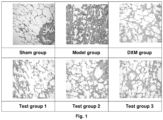
- Fig.1 shows the effect of the pharmaceutical composition and alkaloid composition of the invention on pathologic state of lung tissue in LPS-induced rat.
- the total alkaloids obtained in any example of Examples 1.1-1.6 were mixed with twice the amount of silica gel, loaded to chromatographic column containing 10 times the amount of silica gel, and washed with CHCl 3 -MeOH (30:1-1:1).
- a chromogenic agent specific for alkaloids i.e. bismuth potassium iodide
- fractions comprising picrinine, vallesamine, scholaricine or 19-epischolaricine were collected, respectively, to obtain pure forms of picrinine, vallesamine, scholaricine, and 19-epischolaricine.
- the pharmaceutical composition prepared in accordance with the method described in Example 1.8 was dissolved in sterile water for injection, under stirring, and was subjected to sterile suction filtration with a funnel, and then to sterile refined filtration.
- the filtrate was subpackaged into two ampules, and were subjected to sterile sealing to obtain a sterile powder for injection after low-temperature freeze-drying.
- an excipient was added at a ratio of 9:1 by weight, to prepare a powder.
- Example 1.8 To the pharmaceutical composition prepared in accordance with the method described in Example 1.8, an excipient was added a ratio of 1:5-1:10 by weight, and the mixture was granulated and compressed to prepare a tablet.
- the pharmaceutical composition prepared in accordance with the method described in Example 1.8 was subjected to a conventional method for preparing oral liquids to prepare an oral liquid.
- Example 7 Preparation of a capsule, a granule or an electuary
- an excipient was added at a ratio of 5:1 by weight, to prepare a capsule, a granule or an electuary.
- Example 8 Preparation of a capsule, a granule or an electuary
- an excipient was added at a ratio of 3:1 by weight, to prepare a capsule, a granule or an electuary.
- Animal source 190 ⁇ 220g male SD rat, from laboratory animal department of Kunming Medical University, License No. SCXK (Dian) 2011-0004.
- LPS lipopolysaccharide
- Test group 1 picrinine, vallesamine, scholaricine and 19-epischolaricine prepared in Example 1.7 were homogeneously mixed at different ratios by weight (30 mg/kg)
- Test group 2 picrinine, vallesamine, scholaricine and 19-epischolaricine prepared in Example 1.7 were homogeneously mixed (15 mg/kg)
- Test group 3 the alkaloid composition prepared in Example 1.1 (7.5 mg/kg).
- Test group 1 and Test group 2 the ratio of picrinine, vallesamine, scholaricine and 19-epischolaricine by weight was 43:16:30:8 and 20:38:30:7, respectively, and the other groups and doses thereof were as described in Example 9.
- Test index Total number of white blood cells (WBCs) and inflammatory cell classification in bronchoalveolar lavage fluid (BALF) were used as indexes. The result was shown in Table 1.
- Table 1 Effect on inflammatory cell in LPS-induced rat ( x ⁇ S) Group dose(/kg) WBC ( ⁇ 10 5 /ml) BALF cell classification*(%) AM N L M Sham - 1.52 ⁇ 0.68 67.0 ⁇ 8.4 7.6 ⁇ 2.4 13.1 ⁇ 3.3 12.4 ⁇ 3.4 LPS 10ml 7.05 ⁇ 2.29 ⁇ 40.5 ⁇ 7.4 ⁇ 43.9 ⁇ 6.3 ⁇ 7.8 ⁇ 2.5 ⁇ 7.8 ⁇ 2.6 ⁇
- Test group 1 30 mg 4.00 ⁇ 2.43** 52.5 ⁇ 14.6* 17.2 ⁇ 7.6** 10.2 ⁇ 3.9 19.3 ⁇ 7.4** Test group 2 15 mg 4.79 ⁇ 2.51* 48.8 ⁇ 9.7* 16.5 ⁇ 3.9
- both the pharmaceutical composition and alkaloid composition of the invention could significantly lower the total number of white blood cells (WBCs) and the percentage of neutrophils (N%) in BALF of model rat, and significantly increase the percentage of macrophages (AM%) and monocytes (M%), and had statistical difference as compared to control group ( P ⁇ 0.05/0.01); thereby indicating that the pharmaceutical composition and alkaloid composition could effectively prevent aggregation of inflammatory cell, and significantly alleviate airway inflammation.
- WBCs white blood cells
- N% neutrophils
- M% monocytes
- Test index IL-8 in bronchoalveolar lavage fluid (BALF), serum, and homogenate was used as index. The result was shown in Table 2.
- Table 2 Effect on IL-8 in LPS-induced rat Group dose(/kg) IL-8( x ⁇ S, pg/mL) serum BALF lung tissue Sham - 25.52 ⁇ 8.97 15.57 ⁇ 5.01 46.92 ⁇ 26.01 LPS 10ml 48.42 ⁇ 21.93 ⁇ 56.62 ⁇ 24.63 ⁇ 97.02 ⁇ 27.32 ⁇ DXM 1.5mg 29.62 ⁇ 12.13* 24.62 ⁇ 12.42** 60.62 ⁇ 20.11** Test group 1 30 mg 33.22 ⁇ 18.55 36.22 ⁇ 15.36* 64.22 ⁇ 19.62** Test group 2 15 mg 31.72 ⁇ 13.09 31.72 ⁇ 15.58* 70.72 ⁇ 26.87* Test group 3 7.5 mg 29.22 ⁇ 13.08* 30.22 ⁇ 14.57* 65.22 ⁇ 18.71** As compared to
- both the pharmaceutical composition and alkaloid composition of the invention could significantly decrease the level of IL-8 in BALF and lung tissue; the alkaloid composition could significantly decrease the level of IL-8 in serum; and therefore, the pharmaceutical composition and alkaloid composition of the invention could reduce the production of IL-8, reduce neutrophil chemotaxis, and alleviate the injury to airway and lung tissue.
- Test group 1 and Test group 2 the ratio of picrinine, vallesamine, scholaricine and 19-epischolaricine by weight was, 45:36:7:10 and 10:18:9:2, respectively, and the other groups and doses thereof were as described in Example 9.
- Test index TNF- ⁇ in bronchoalveolar lavage fluid (BALF), serum, and homogenate was used as index. The result was shown in Table 3.
- the experimental result showed: after the treatment with the pharmaceutical composition and alkaloid composition of the invention, the level of TNF- ⁇ in rat lung tissue and bronchoalveolar lavage fluid was significantly decreased, indicating that the pharmaceutical composition and alkaloid composition of the invention could inhibit over-activation of alveolar macrophages, reduce chemotaxis, infiltration and release of inflammatory cell, and reduce hyperreactivity of airway, by decreasing the content of TNF- ⁇ .
- Test group 1 and Test group 2 the ratio of picrinine, vallesamine, scholaricine and 19-epischolaricine by weight was 40:30:28:2 and 15:18:26:7, respectively, and the other groups and doses thereof were as described in Example 9.
- Test index NO in bronchoalveolar lavage fluid (BALF), serum, and homogenate was used as index. The result was shown in Table 4.
- Table 4 Effect on NO in LPS-induced rat Group Dose (/kg) NO( x ⁇ S ,umol/L) Serum BALF Lung tissue Sham - 31.81 ⁇ 11.73 16.31 ⁇ 3.17 23.47 ⁇ 8.62 LPS 10ml 17.78 ⁇ 9.44 ⁇ 9.97 ⁇ 3.75 ⁇ 11.71 ⁇ 5.94 ⁇ DXM 1.5mg 27.20 ⁇ 7.67* 13.52 ⁇ 4.17 18.35 ⁇ 5.30* Test group 1 30 mg 26.21 ⁇ 7.82* 12.78 ⁇ 3.23 19.24 ⁇ 6.62* Test group 2 15 mg 29.39 ⁇ 11.02* 11.31 ⁇ 4.37 17.59 ⁇ 5.93* Test group 3 7.5 mg 28.86 ⁇ 10.33* 12.30 ⁇ 3.27 21.47 ⁇ 9.64* As compared to Sham group, ⁇ / ⁇ P ⁇ 0.05/0.01; as compared to LPS group, * P ⁇ 0.05
- the experimental result showed: in tracheitis induced by LPS, airway and pulmonary epithelium, endothelial cell and alveolar macrophage, etc. had a reduced ability of synthesizing and releasing NO.
- the content of NO in serum and lung tissue was significantly increased, and the content of NO in lavage fluid had a tendency of increase, and the disturbance in oxidation-antioxidation balance in organism was improved, so as to alleviate the injured degree of cells in organism.
- Test group 1 and Test group 2 the ratio of picrinine, vallesamine, scholaricine and 19-epischolaricine by weight was 8:45:29:9 and 20:14:12:7, respectively, and the other groups and doses thereof were as described in Example 9.
- Test index SOD in bronchoalveolar lavage fluid (BALF), serum, and homogenate was used as index. The result was shown in Table 5.
- Table 5 Effect on SOD in LPS-induced rat Group dose (/kg) SOD( x ⁇ S , U/mL) Serum BALF Lung tissue Sham - 381.5 ⁇ 114.6 63.27 ⁇ 8.08 100.82 ⁇ 10.09 LPS 10ml 206.7 ⁇ 87.0 ⁇ 44.44 ⁇ 15.37 ⁇ 72.46 ⁇ 5.22 ⁇ DXM 1.5mg 307.6 ⁇ 97.7* 63.35 ⁇ 13.45* 92.25 ⁇ 8.88** Test group 1 30 mg 301.2 ⁇ 106.0* 58.14 ⁇ 11.34* 85.26 ⁇ 11.42** Test group 2 15 mg 256.7 ⁇ 93.0 56.53 ⁇ 12.24 81.27 ⁇ 8.84* Test group 3 7.5 mg 291.2 ⁇ 89.2* 63.02 ⁇ 10.84** 90.33 ⁇ 8.81** As compared to Sham group, ⁇ / ⁇ P
- the pharmaceutical composition and alkaloid composition of the invention could enhance the activity of SOD in serum, bronchoalveolar lavage fluid and lung tissue to different extents.
- the pharmaceutical composition and alkaloid composition of the invention could clean the injury of free radical to organism, and have a certain effect on maintaining the balance of free radical generation and clearance.
- Test index MDA in bronchoalveolar lavage fluid (BALF), serum, and homogenate was used as index. The result was shown in Table 6.
- Table 6 Effect on MDA in LPS-induced rat Group dose (Ikg) MDA( x ⁇ S ,nmol/mL) Serum BALF lung tissue Sham - 3.31 ⁇ 1.43 4.11 ⁇ 1.49 1.11 ⁇ 0.69 LPS 10ml 5.98 ⁇ 1.43 ⁇ 6.78 ⁇ 1.66 ⁇ 2.98 ⁇ 1.17 ⁇ DXM 1.5mg 4.21 ⁇ 1.49* 4.81 ⁇ 1.30** 1.61 ⁇ 0.71** Test group 1 30 mg 4.21 ⁇ 1.48* 4.91 ⁇ 1.34* 2.03 ⁇ 0.46* Test group 2 15 mg 4.91 ⁇ 1.71 5.39 ⁇ 1.66 2.11 ⁇ 0.40* Test group 3 7.5 mg 4.51 ⁇ 1.66* 4.86 ⁇ 1.58** 1.91 ⁇ 0.69* As compared to Sham group, ⁇ P ⁇ 0.01; as compared to LPS group, */** P ⁇ 0.05/0.01;
- the experimental result showed: during the development of airway inflammation, a lot of lipid peroxidation products aggregated, and after the treatment of the groups, the content of MDA in lung tissue was decreased significantly; and the content of MDA in serum and BALF had a tendency of decrease. Therefore, the pharmaceutical composition and alkaloid composition of the invention could significantly improve the disturbance in oxidization-antioxidization balance in vivo, and therefore could alleviate the injured degree of cells in organism.
- Test group 1 and Test group 2 the ratio of picrinine, vallesamine, scholaricine and 19-epischolaricine by weight was 36:38:7:1 and 16:15:14:5, respectively, and the other groups and doses thereof were as described in Example 9.
- Test index ALB in bronchoalveolar lavage fluid (BALF), and serum was used as index. The result was shown in Table 7.
- Table 7 Effect on ALB in LPS-induced rat Group dose(/kg) ALB(g/L) BALF Serum Sham - 0.02 ⁇ 0.05 18.4 ⁇ 1.6 LPS 10ml 0.33 ⁇ 0.13 ⁇ 16.3 ⁇ 1.1 ⁇ DXM 1.5mg 0.18 ⁇ 0.07** 19.4 ⁇ 1.4** Test group 1 30 mg 0.22 ⁇ 0.06* 17.4 ⁇ 1.2* Test group 2 15 mg 0.22 ⁇ 0.09* 17.9 ⁇ 2.0* Test group 3 7.5 mg 0.19 ⁇ 0.09* 17.7 ⁇ 1.4* As compared to Sham group, ⁇ P ⁇ 0.01; as compared to LPS group, * P ⁇ 0.05;
- the experimental result showed: during the development of airway inflammation, the pulmonary alveolar epithelial-capillary barrier was injured, so that the ALB in blood could pass through the barrier, resulting in an increase in ALB in bronchoalveolar lavage fluid, and a decrease in ALB in serum.
- ALB in both bronchoalveolar lavage fluid and lung tissue was significantly improved.
- the pharmaceutical composition and alkaloid composition of the invention could repair the injured pulmonary alveolar epithelial-capillary barrier.
- Test group 1 and Test group 2 the ratio of picrinine, vallesamine, scholaricine and 19-epischolaricine by weight was 8:25:30:9 and 12:10:9:2, respectively, and the other groups and doses thereof were as described in Example 9.
- Test index AKP in bronchoalveolar lavage fluid (BALF), and serum was used as index. The result was shown in Table 8.
- Table 8 Effect on AKP in LPS-induced rat Group dose (Ikg) AKP(UIL) BALF Serum Sham - 33.4 ⁇ 12.3 296.6 ⁇ 114.4 LPS 10ml 59.5 ⁇ 32.2 ⁇ 271.1 ⁇ 137.8 DXM 1.5mg 29.0 ⁇ 5.9** 116.1 ⁇ 36.0** Test group 1 30 mg 26.2 ⁇ 7.9** 197.4 ⁇ 58.8 Test group 2 15 mg 25.2 ⁇ 20.8* 214.3 ⁇ 56.4 Test group 3 7.5 mg 24.7 ⁇ 9.9** 264.7 ⁇ 114.3 As compared to Sham group, ⁇ P ⁇ 0.05/0.01; as compared to LPS group, */** P ⁇ 0.05/0.01;
- the experimental result showed: during the development of airway inflammation, alveolar type II epithelial cell and other cells were injured. After the treatment of the groups, ALB in bronchoalveolar lavage fluid was significantly improved. It indicated that both the pharmaceutical composition and alkaloid composition of the invention could repair the injured alveolar type II epithelial cell and other cells.
- Test group 1 and Test group 2 the ratio of picrinine, vallesamine, scholaricine and 19-epischolaricine by weight was 10:28:15:8 and 10:7:7:2, respectively, and the other groups and doses thereof were as described in Example 9.
- Test index LDH in bronchoalveolar lavage fluid (BALF), and serum was used as index. The result was shown in Table 9.
- Table 9 Effect on LDH in LPS-induced rat Group dose (/kg) LDH(U/L) BALF Serum Sham - 219.4 ⁇ 86.7 404.0 ⁇ 128.4 LPS 10ml 355.0 ⁇ 178.9 ⁇ 894.7 ⁇ 429.5 ⁇ DXM 1.5mg 96.7 ⁇ 25.6** 386.5 ⁇ 92.7** Test group 1 30 mg 193.3 ⁇ 107.1* 567.5 ⁇ 187.3* Test group 2 15 mg 160.9 ⁇ 101.8** 536.8 ⁇ 232.5* Test group 3 7.5 mg 257.4 ⁇ 107.1* 494.9 ⁇ 136.0* As compared to Sham group, ⁇ / ⁇ P ⁇ 0.05/0.01; as compared to LPS group, */** P ⁇ 0.05/0.01;
- the experimental result showed: during the development of airway inflammation, cells were injured, cell membrane permeability increased or cell died, and in all these cases, LDH could be released to the outside of cell.
- LDH in bronchoalveolar lavage fluid and serum was significantly improved, and both the pharmaceutical composition and alkaloid composition of the invention could alleviate the injured degree of cells.
- Test group 1 and Test group 2 the ratio of picrinine, vallesamine, scholaricine and 19-epischolaricine by weight was 8:41:27:1 and 8:5:5:1, respectively, and the other groups and doses thereof were as described in Example 9.
- Test index LDH in bronchoalveolar lavage fluid (BALF), and serum was used as index. The result was shown in Fig. 1 .
- the experimental result showed: during the development of airway inflammation, consolidation of lung tissue occurred, alveolar cavity narrowed significantly, alveolar wall thickened significantly, and interstitium was filled with a lot of cells, accompanied by hyperplasia of a few fibrous connective tissues, or not. After the treatment of the groups, the number of diseased animals and the pathogenic degree were significantly lowered, indicating that both the pharmaceutical composition and the alkaloid composition of the invention could resist histomorphological changes of airway inflammation.
- LPS lipopolysaccharide plus smoke exposure was used for 30 days to induce mouse chronic obstructive pulmonary disease model; and after intragastrical administration for 7 d at a dose of 20 mL/kg, the animal was sacrificed at the eighth day.
- Group and dose Sham group, Model group, Positive control group, dexamethasone (2 mg/kg), Test group 1: picrinine, vallesamine, scholaricine and 19-epischolaricine prepared in Example 1.7 were mixed at different ratios by weight (50 mg/kg), Test group 2: the alkaloid composition (25 mg/kg) prepared in Example 1.2, Test group 3: the alkaloid composition (10 mg/kg) prepared in Example 1.3. Picrinine group (10 mg/kg), Vallesamine group (6.0 mg/kg), Scholaricine group (7.0 mg/kg), 19-epischolaricine group (2.0 mg/kg).
- Test group 1 the ratio of picrinine, vallesamine, scholaricine and 19-epischolaricine by weight was 48:40:29:10, and the other groups and doses thereof were as described in Example 10.
- Test index total number of white blood cells and inflammatory cell classification in bronchoalveolar lavage fluid (BALF) were used as indexes, and were determined by full-automatic hemocytometer. The result was shown in Table 10.
- Table 10 Effect on white blood cell count and classification in BALF of COPD model mouse ( x ⁇ SD, ⁇ 10 5 /mL) Group dose (/kg) Animal (number) Administration route Leukocyte number Neutrophil number Sham - 9 ig 1.1 ⁇ 1.5 0.54 ⁇ 0.38 Model 10mL 10 ig 3.8 ⁇ 2.4 ⁇ 1.1 ⁇ 0.25 ⁇ dexamethasone 1mg 10 ig 1.1 ⁇ 0.5* 0.53 ⁇ 0.50* Test group 1 50 mg 10 ig 1.5 ⁇ 1.3 0.43 ⁇ 0.26** Test group 2 25 mg 10 ig 1.6 ⁇ 1.3 0.54 ⁇ 0.26** Test group 3 10 mg 10 ig 1.1 ⁇ 0.8* 0.43 ⁇ 0.25** picrinine 10mg 10 ig 2.1 ⁇ 1.8 0.51 ⁇ 0.29** vallesamine 6
- the experimental result showed: the pharmaceutical composition, alkaloid composition and four monomeric compounds of the invention could significantly lower the total number of white blood cells (WBCs) and the neutrophil percentage (N%) in BALF of model rat, wherein the three test groups of the pharmaceutical composition and alkaloid composition, the picrinine group and the 19-epi-scholaricine group had a statistic difference as compared to Control group ( P ⁇ 0.01); thereby indicating that the pharmaceutical composition and alkaloid composition, picrinine and 19-epi-scholaricine could effectively prevent the aggregation of inflammatory cell in COPD model.
- WBCs white blood cells
- N neutrophil percentage
- Test group 1 the ratio of picrinine, vallesamine, scholaricine and 19-epischolaricine by weight was 38:30:27:7, and the other groups and doses thereof were as described in Example 10.
- Test index IL-6 in serum was used as index, and was determined by enzyme linked immunosorbent assay. The result was shown in Table 11.
- Table 11 Effect on IL-6 in serum of COPD model mouse ( x ⁇ SD , pg/mL) Group Dose (/kg) Animal (number) Administration Route IL-6 Sham - 9 ig 20.8 ⁇ 2.2 Model 10mL 10 ig 26.5 ⁇ 3.4 ⁇ dexamethasone 1mg 10 ig 22.0 ⁇ 2.0* Test group 1 50 mg 10 ig 23.2 ⁇ 4.2 Test group 2 25 mg 10 ig 24.1 ⁇ 2.4 Test group 3 10 mg 10 ig 22.7 ⁇ 2.0* picrinine 10mg 10 ig 23.9 ⁇ 3.9 vallesamine 6mg 10 ig 25.0 ⁇ 3.6 scholaricine 7mg 10 ig 22.2 ⁇ 3.0* 19-epi-scholaricine 2mg 10 ig 23.3 ⁇ 4.1 As compared to Sham group, ⁇ P ⁇ 0.05; as compared to Model group, * P
- both the pharmaceutical composition and scholaricine of the invention could significantly decrease the level of IL-6 in serum (p ⁇ 0.05), and therefore, both the pharmaceutical composition and scholaricine of the invention could reduce the production of IL-6, reduce chemotaxis of inflammatory cell, and thus alleviate the injury to respiratory tract.
- Test group 1 the ratio of picrinine, vallesamine, scholaricine and 19-epischolaricine by weight was 25:19:20:4, and the other groups and doses thereof were as described in Example 10.
- Test index CRP in serum was used as index, and was determined by enzyme linked immunosorbent assay. The result was shown in Table 12.
- Table 12 Effect on CRP in serum in COPD model mouse ( x ⁇ SD , pg/mL) Group Dose (Ikg) Animal (number) Administratio n route CRP Sham group - 9 ig 20.8 ⁇ 2.7 Model 10mL 10 ig 24.8 ⁇ 1.7 ⁇ dexamethasone 1mg 10 ig 22.3 ⁇ 2.0* Test group 1 50 mg 10 ig 22.7 ⁇ 1.5* Test group 2 25 mg 10 ig 23.5 ⁇ 2.0 Test group 3 10mg 10 ig 22.9 ⁇ 1.3* picrinine 10mg 10 ig 23.5 ⁇ 2.2 vallesamine 6mg 10 ig 23.8 ⁇ 1.9 scholaricine 7mg 10 ig 24.4 ⁇ 2.4 19-epi-scholaricine 2mg 10 ig 22.6 ⁇ 1.8* As compared to Sham group, ⁇ P ⁇ 0.05; as compared to Model
- the pharmaceutical composition, the alkaloid composition and 19-epi-scholaricine of the invention could significantly decrease the level of CRP in serum (p ⁇ 0.05), and therefore, both the pharmaceutical composition, alkaloid composition of the invention and 19-epi-scholaricine could reduce the production of CRP, reduce the chemotaxis of inflammatory cell, and therefore alleviate injury to respiratory tract.
- Test group 1 the ratio of picrinine, vallesamine, scholaricine and 19-epischolaricine by weight was 16:11:12:3, and the other groups and doses thereof were as described in Example 10.
- Test index SOD in serum and lung homogenate was used as index, and was determined by xanthine oxidase method. The result was shown in Table 13. Table 13 Effect on SOD in serum and homogenate of COPD model mouse ( x ⁇ SD , U/mL) Group dose (Ikg) Animal (number) Administration route Serum homogenate Sham - 9 ig 93.48 ⁇ 5.42 61.31 ⁇ 3.61 Model 10mL 10 ig 85.51 ⁇ 7.70 ⁇ 53.37 ⁇ 6.76 ⁇ dexamethasone 1mg 10 ig 86.85 ⁇ 9.48 63.92 ⁇ 5.84* Test group 1 50 mg 10 ig 92.15 ⁇ 8.53 54.00 ⁇ 16.65 Test group 2 25 mg 10 ig 97.70 ⁇ 7.94* 64.18 ⁇ 4.61** Test group 3 10 mg 10 ig 94.71 ⁇ 6.97* 63.13 ⁇ 6.89* picrinine 10mg 10 ig 91.15 ⁇ 10.90 56
- both the pharmaceutical composition and alkaloid composition of the invention could significantly enhance the activity of SOD in serum and lung homogenate (p ⁇ 0.05/0.01); in addition, 19-epi-scholaricine could also significantly enhance the activity of SOD in serum (p ⁇ 0.01); therefore, the pharmaceutical composition and alkaloid composition of the invention, and 19-epi-scholaricine could enhance the production of SOD, and reduce the aggravation of COPD caused by oxidative damage.
- Test group 1 the ratio of picrinine, vallesamine, scholaricine and 19-epischolaricine by weight was 9:6:5:1, and the other groups and doses thereof were as described in Example 10.
- Test index MDA in serum and homogenate was used as index, and was determined by thibabituric acid method. The result was shown in Table 14.
- Table 14 Effect on MDA in serum and homogenate of COPD model mouse ( x ⁇ SD , nmol/mL) Group dose (/kg) Animal (number) Administration route Serum Homogenate Sham - 9 ig 9.78 ⁇ 2.95 6.37 ⁇ 0.61 Model 10mL 10 ig 13.73 ⁇ 2.14 ⁇ 7.41 ⁇ 0.54 ⁇ dexamethasone 1mg 10 ig 14.04 ⁇ 3.64 6.23 ⁇ 0.60** Test group 1 50 mg ) 10 ig 11.88 ⁇ 2.29 6.63 ⁇ 1.37 Test group 2 25 mg 10 ig 12.08 ⁇ 6.40 6.23 ⁇ 1.06 Test group 3 10 mg 10 ig 10.96 ⁇ 2.64* 6.21 ⁇ 1.18* picrinine 10mg 10 ig 11.21 ⁇ 4.46 6.17 ⁇ 1.46 vallesamine 6mg 10 ig 11.07 ⁇ 1.29** 7.12 ⁇ 1.4
- both the pharmaceutical composition and alkaloid composition of the invention could significantly decrease the content of MDA in serum and homogenate; in addition, vallesamine, scholaricine and 19-epi-scholaricine could also significantly decrease the content of MDA; therefore, the pharmaceutical composition, alkaloid composition, vallesamine, scholaricine and 19-epi-scholaricine of the invention could reduce the production of MDA, and reduce the aggravation of COPD caused by oxidative damage.
- OVA ovalbumin
- Test group 1 picrinine, vallesamine, scholaricine and 19-epischolaricine prepared in Example 1.7 were homogeneously mixed at different ratios by weight (50 mg/kg)
- Test group 2 the alkaloid composition prepared in Example 1.4 (25 mg/kg).
- Picrinine group (5mg/kg)
- Vallesamine group (3.0mg/kg
- Scholaricine group 3.0mg/kg
- 19-epischolaricine group 1.0mg/kg).
- Positive control drug dexamethasone acetate tablet, Approval number: H33020822, 0.75 mg/tablet, produced by Zhejiang Xianju Pharmaceutical Co.,Ltd., Batch No. 140329.
- Test group 1 the ratio of picrinine, vallesamine, scholaricine and 19-epischolaricine by weight was 41:45:28:7, and the other groups and doses thereof were as described in Example 11.
- Test index number of white blood cells (WBCs) and number of eosinophil in bronchoalveolar lavage fluid (BALF) were used as index, and were determined by full-automatic hemocytometer. The result was shown in Table 15. Table 15 Effect on WBC count and eosinophil percentage in BALF of asthma model mouse ( x ⁇ SD) Group dose (/kg) Animal (number) Number of WBCs ( ⁇ 10 9 /L) Eosinophil percentage (%) Normal - 10 0.45 ⁇ 0.19 0.02 ⁇ 0.07 Model - 10 1.17 ⁇ 0.57 ⁇ 9.51 ⁇ 4.61 ⁇ dexamethasone 2 mg 10 0.50 ⁇ 0.17** 4.32 ⁇ 1.12** Test group 1 50 mg 11 0.58 ⁇ 0.27* 5.50 ⁇ 1.61* Test group 2 25 mg 11 0.54 ⁇ 0.17** 5.34 ⁇ 1.66* picrinine 5.0mg 11 0.91 ⁇ 0.50 6.18 ⁇ 3.61 vallesamine 3.0mg 11 0.73 ⁇ 0.35 6.48 ⁇ 2.84 scholaricine 3.0mg
- the experimental result showed: the pharmaceutical composition, alkaloid composition and the monomeric compounds scholaricine and 19-epi-scholaricine of the invention could significantly lower the total number of WBCs and the eosinophil percentage in BALF of model rat, and had a statistic difference as compared to Control group (P ⁇ 0.05/0.01); thereby indicating that the pharmaceutical composition, alkaloid composition and the monomeric compounds scholaricine and 19-epi-scholaricine could effectively prevent aggregation of inflammatory cell in asthma model.
- Test group 1 the ratio of picrinine, vallesamine, scholaricine and 19-epischolaricine by weight was 37:42:30:8, and the other groups and doses thereof were as described in Example 11.
- Test index eosinophil chemotactic factor (Eotaxin) in serum was used as index, and was determined by enzyme linked immunosorbent assay. The result was shown in Table 16.
- Table 16 Effect on Eotaxin in serum of asthma model mouse ( x ⁇ SD, pg/mL) Group dose (/kg) Administr ation route Animal (number ) Eotaxin Control - ig 10 4.87 ⁇ 0.60 Model - ig 10 10.58 ⁇ 2.51 ⁇ dexamethasone 2.0mg ig 10 7.87 ⁇ 0.45** Test group 1 50 mg ig 11 8.35 ⁇ 0.61* Test group 2 25 mg ig 11 8.47 ⁇ 0.91* picrinine 5.0mg ig 11 9.03 ⁇ 1.80 vallesamine 3.0mg ig 11 8.90 ⁇ 2.36 scholaricine 3.0mg ig 11 8.48 ⁇ 0.63* 19-epi-scholaricin e 3.5mg ig 11 8.74 ⁇ 1.40 As compared to
- the experimental result showed: the pharmaceutical composition, alkaloid composition and scholaricine of the invention could significantly reduce eosinophil chemotactic factor (Eotaxin) in serum of model mouse, and had a statistic difference as compared to Model group ( P ⁇ 0.05); thereby indicating that the pharmaceutical composition, alkaloid composition and scholaricine could effectively reduce the production of eosinophil chemotactic factor (Eotaxin) in serum of asthma model.
- Test group 1 the ratio of picrinine, vallesamine, scholaricine and 19-epischolaricine by weight was 30:33:27:6, and the other groups and doses thereof were as described in Example 11.
- Test index immunoglobulin IgE in serum was used as index, and was determined by enzyme linked immunosorbent assay. The result was shown in Table 17.
- Table 17 Effect on IgE in serum of asthma model mouse ( x ⁇ SD, pg/mL) Group dose (Ikg) Administration route Animal (number)
- the experimental result showed: the pharmaceutical composition, alkaloid composition and scholaricine of the invention could significantly suppress the production of immunoglobulin IgE in serum of asthma model mouse, and had a statistic difference as compared to Model group (P ⁇ 0.05); thereby indicating that the pharmaceutical composition, alkaloid composition and scholaricine could effectively reduce the production of IgE in serum of asthma model, and significantly alleviate symptom of asthma;.
- Test group 1 the ratio of picrinine, vallesamine, scholaricine and 19-epischolaricine by weight was 25:18:15:3, and the other groups and doses thereof were as described in Example 11.
- Test index immunoglobulin IL-4 in serum was used as index, and was determined by enzyme linked immunosorbent assay. The result was shown in Table 18.
- Table 18 Effect on IL-4 in BALF of asthma model mouse ( x ⁇ SD, pg/mL) Group dose (/kg) Admini stration route Animal (number) IL-4 Control - ig 10 7.45 ⁇ 2.91 Model - ig 10 16.69 ⁇ 6.57 ⁇ ⁇ dexamethasone 2.0mg ig 10 9.96 ⁇ 4.03* Test group 1 50 mg ig 11 10.43 ⁇ 1.88* Test group 2 25 mg ig 11 10.97 ⁇ 3.08* picrinine 5.0mg ig 11 12.60 ⁇ 4.39 vallesamine 3.0mg ig 11 11.61 ⁇ 2.40* scholaricine 3.0mg ig 11 11.21 ⁇ 3.62* 19-epi-scholaricine 3.5mg ig 11 11.16 ⁇ 3.58* As compared to Model group: * p ⁇ 0.05, as
- the experimental result showed: the pharmaceutical composition, alkaloid composition and four monomeric compounds of the invention could significantly suppress the production of IL-4 in BALF of asthma model mouse, and had a statistic difference as compared to Model group (P ⁇ 0.05); thereby indicating that the pharmaceutical composition, alkaloid composition and four monomeric compounds could effectively reduce the production of IL-4 in BALF of asthma model, and significantly alleviate symptom of asthma.
- Test group 1 the ratio of picrinine, vallesamine, scholaricine and 19-epischolaricine by weight was 18:13:14:3, and the other groups and doses thereof were as described in Example 11.
- Test index IL-10 in BALF was used as index, and was determined by enzyme linked immunosorbent assay. The result was shown in Table 19.
- the experimental result showed: the pharmaceutical composition, alkaloid composition, scholaricine, and 19-epi-scholaricine of the invention could significantly enhance the production of IL-10 in BALF of asthma model mouse, and had a statistic difference as compared to Model group ( P ⁇ 0.05 / 0.01 ); thereby indicating that the pharmaceutical composition, alkaloid composition, scholaricine, and 19-epi-scholaricine could effectively promote the production of IL-10 in BALF of asthma model, and significantly alleviate symptom of asthma;.
- Test group 1 the ratio of picrinine, vallesamine, scholaricine and 19-epischolaricine by weight was 12:10:9:2, and the other groups and doses thereof were as described in Example 11.
- Test index SOD in serum and BALF was used as index, and was determined by xanthine oxidase method. The result was shown in Table 20.
- Table 20 Effect on SOD in serum and BALF of asthma model mouse ( x ⁇ SD, U/mL) Group dose(/kg) Administration route Animal (number) SOD serum lavage fluid Control - ig 10 86.09 ⁇ 6.66 81.42 ⁇ 8.02 Model - ig 10 64.79 ⁇ 8.59 ⁇ 59.57 ⁇ 11.83 ⁇ dexamethasone 2.0mg ig 10 74.83 ⁇ 8.43* 76.57 ⁇ 12.52** Test group 1 50 mg ig 11 75.58 ⁇ 9.60* 74.80 ⁇ 7.59** Test group 2 25 mg ig 11 74.09 ⁇ 6.26* 70.64 ⁇ 5.89* picrinine 5.0mg ig 11 70.31 ⁇ 7.30 62.32 ⁇ 8.22 vallesamine 3.0mg ig 11 70.53 ⁇ 7.77
- the experimental result showed: the pharmaceutical composition, alkaloid composition and four monomeric compounds of the invention could significantly promote the production of SOD in BALF of asthma model mouse, and had a statistic difference as compared to Model group (P ⁇ 0.05/0.01); thereby indicating that the pharmaceutical composition, alkaloid composition and four monomeric compounds could effectively enhance the activity of SOD in serum and BALF of asthma model, and enhance the antioxidant effect.
- Test group 1 the ratio of picrinine, vallesamine, scholaricine and 19-epischolaricine by weight was 8:6:5:1, and the other groups and doses thereof were as described in Example 11.
- Test index MDA in serum and BALF was used as index, and was determined by thiobarbituric acid method. The result was shown in Table 21.
- Table 21 Effect on MDA in serum and BALF of asthma model mouse ( x ⁇ SD, nmol/mL) Group dose(/kg) Administration route Animal (number) MDA serum lavage fluid Control - ig 10 8.77 ⁇ 2.06 1.90 ⁇ 0.38 Model - ig 10 16.92 ⁇ 1.41 ⁇ 4.25 ⁇ 1.851 ⁇ dexamethasone 2.0mg ig 10 10.99 ⁇ 2.38** 2.17 ⁇ .17** Test group 1 50 mg ig 11 9.47 ⁇ 1.98** 2.56 ⁇ .56** Test group 2 25 mg ig 11 9.07 ⁇ 1.96** 2.55 ⁇ 1.19* picrinine 5.0mg ig 11 14.03 ⁇ 5.71 3.29 ⁇ 2.07 vallesamine 3.0mg ig 11 13.36 ⁇ 6.10 2.92 ⁇ 1.48 scholaricine 3.0mg ig 11 9.19 ⁇ 2.77** 2.43
- the experimental result showed: the pharmaceutical composition, alkaloid composition, and the four monomeric compounds of the invention could significantly reduce the production of MDA in BALF of asthma model mouse, and had a statistic difference as compared to Model group ( P ⁇ 0.05 / 0.01 ); thereby indicating that the pharmaceutical composition, alkaloid composition and four monomeric compounds could effectively reduce the production of lipid peroxidation product in serum and BALF of asthma model, and reduce peroxidative damage.
- bleomycin was used to induce mouse pulmonary fibrosis, and after intragastrical administration for 28 d at a dose of 20 mL/kg, the animal was sacrificed at the 29th day.
- Group and dose Sham group, Model group, Positive control group, prednisone acetate (5mg/kg) group, Test group 1: picrinine, vallesamine, scholaricine and 19-epischolaricine prepared in Example 1.7 were mixed at different ratios by weight (50 mg/kg), Test group 2: the alkaloid composition (25 mg/kg) prepared in Example 1.5, Test group 3: the alkaloid composition (12.5 mg/kg) prepared in Example 1.6, Picrinine group (5.0 mg/kg), Vallesamine group (3.0 mg/kg), Scholaricine group (3.5 mg/kg), and 19-epischolaricine group (1.0 mg/kg).
- Positive control drug prednisone acetate tablet, Approval number: H33021207, 5mg/tablet, produced by Zhejiang Xianju Pharmaceutical Co., Ltd., Batch No. 140146.
- Test group 1 the ratio of picrinine, vallesamine, scholaricine and 19-epischolaricine by weight was 45:38:30:8, and the other groups and doses thereof were as described in Example 12.
- Test index KL-6 in serum was used as index, and was determined by enzyme linked immunosorbent assay. The result was shown in Table 22. Table 22 Effect on KL-6 in serum of pulmonary fibrosis model mouse ( x ⁇ SD, U/mg prot) Group dose(/kg) Administration route Animal (number) KL-6 Sham - Ig 10 2.52 ⁇ 1.44 Model - Ig 10 5.12 ⁇ 1.94 ⁇ prednisone acetate 5 mg Ig 10 3.00 ⁇ 1.00** Test group 1 50 mg Ig 10 3.32 ⁇ 1.24* Test group 2 25 mg Ig 10 3.39 ⁇ 1.40* Test group 3 12.5 mg Ig 10 3.56 ⁇ 2.02 picrinine 5.0mg Ig 10 3.91 ⁇ 0.60 vallesamine 3.0mg Ig 10 3.62 ⁇ 0.87* scholaricine 3.5mg Ig 10 3.72 ⁇ 0.79* 19-epi-scholaricine 1.0mg Ig 10 4.10 ⁇ 0.97 As compared to Model group: *
- the experimental result showed: the pharmaceutical composition alkaloid composition, vallesamine and scholaricine of the invention could significantly reduce the production of KL-6 in serum of pulmonary fibrosis model mouse, and had a statistic difference as compared to Model group (P ⁇ 0.05); thereby indicating that the pharmaceutical composition, alkaloid composition, vallesamine and scholaricine could effectively reduce the production of KL-6 in serum of pulmonary fibrosis model, and alleviate the injury to alveolar epithelial cell.
- Test group 1 the ratio of picrinine, vallesamine, scholaricine and 19-epischolaricine by weight was 35:28:23:6, and the other groups and doses thereof were as described in Example 12.
- Test index LDH in serum was used as index, and was determined by 2, 4-dinitrophenylhydrazine method. The result was shown in Table 23.
- Table 23 Effect on LDH in serum of pulmonary fibrosis model mouse ( x ⁇ SD, U/g prot) Group dose(/kg) Admi nistra tion route Animal (number) LDH Sham - ig 10 9.8 ⁇ 3.2 Model - ig 10 15.6 ⁇ 5.1 ⁇ prednisone acetate 5 mg ig 10 10.5 ⁇ 3.4* Test group 1 50 mg ig 10 10.7 ⁇ 2.2* Test group 2 25 mg ig 10 11.2 ⁇ 2.8* Test group 3 12.5 mg ig 10 10.8 ⁇ 2.8* picrinine 5.0mg ig 10 11.9 ⁇ 2.3* vallesamine 3.0mg ig 10 10.6 ⁇ 2.2* scholaricine 3.5mg ig 10 12.5 ⁇ 3.2 19-epi-scholarici ne 1.0mg ig 10 11.9 ⁇ 2.2* as
- the experimental result showed: the pharmaceutical composition, alkaloid composition, picrinine, vallesamine and 19-epi-scholaricine of the invention could significantly reduce the production of LDH in serum of pulmonary fibrosis model mouse, and had a statistic difference as compared to Model group (P ⁇ 0.05); thereby indicating that the pharmaceutical composition, alkaloid composition, picrinine, vallesamine and 19-epi-scholaricine could effectively reduce the production of LDH in serum of pulmonary fibrosis model, and alleviate the injury to alveolar epithelial cell.
- Test group 1 the ratio of picrinine, vallesamine, scholaricine and 19-epischolaricine by weight was 25:18:16:4, and the other groups and doses thereof were as described in Example 12.
- Test index TGF- ⁇ in homogenate was used as index, and was determined by enzyme linked immunosorbent assay. The result was shown in Table 24.
- Table 24 Effect on TGF- ⁇ in homogenate of pulmonary fibrosis model mouse ( x ⁇ SD , mg/g prot) Group dose(/kg) Administration route Animal (number) TGF- ⁇ Sham - ig 10 39.4 ⁇ 12.5 Model - ig 10 67.2 ⁇ 24.1 ⁇ prednisone acetate 5 mg ig 10 45.2 ⁇ 14.0* Test group 1 50 mg ig 10 46.2 ⁇ 21.0 Test group 2 25 mg ig 10 47.9 ⁇ 15.1* Test group 3 12.5 mg ig 10 41.5 ⁇ 19.3* picrinine 5.0mg ig 10 40.7 ⁇ 12.5** vallesamine 3.0mg ig 10 56.5 ⁇ 17.6 scholaricine 3.5mg ig 10 46.5 ⁇ 12.3* 19-epi-scholaricine 1.0mg ig 10
- the experimental result showed: the pharmaceutical composition, alkaloid composition, picrinine and scholaricine of the invention could significantly reduce the production of TGF- ⁇ in homogenate of pulmonary fibrosis model mouse, and had a statistic difference as compared to Model group (P ⁇ 0.05/0.01); thereby indicating that the pharmaceutical composition, alkaloid composition, picrinine and scholaricine could effectively reduce the production of TGF- ⁇ in homogenate of pulmonary fibrosis model, and reduce fibrosis.
- Test group 1 the ratio of picrinine, vallesamine, scholaricine and 19-epischolaricine by weight was 20:17:17:4, and the other groups and doses thereof were as described in Example 12.
- Test index Col-1 in homogenate was used as index, and was determined by enzyme linked immunosorbent assay. The result was shown in Table 25.
- Table 25 Effect on Col-1 in homogenate of pulmonary fibrosis model mouse ( x ⁇ SD , ⁇ g/ g prot) Group dose(/kg) Administration route Animal (number) Col-1 Sham - ig 10 4.4 ⁇ 1.2 Model - ig 10 8.2 ⁇ 1.4 ⁇ prednisone acetate 5 mg ig 10 6.0 ⁇ 2.1* Test group 1 50 mg ig 10 5.6 ⁇ 1.9** Test group 2 25 mg ig 10 6.4 ⁇ 2.0* Test group 3 12.5 mg ig 10 5.1 ⁇ 2.6** picrinine 5.0mg ig 10 4.5 ⁇ 2.3** vallesamine 3.0mg ig 10 6.3 ⁇ 2.7 scholaricine 3.5mg ig 10 5.9 ⁇ 2.1** 19-epi-scholaricine 1.0mg ig 10 6.5 ⁇ 2.2 As compared to Model group: */**p
- the experimental result showed: the pharmaceutical composition, alkaloid composition, picrinine and scholaricine of the invention could significantly reduce the production of Col-1 in homogenate of pulmonary fibrosis model mouse, and had a statistic difference as compared to Model group (P ⁇ 0.05/0.01); thereby indicating that the pharmaceutical composition, alkaloid composition, picrinine and scholaricine could effectively reduce the production of Col-1 in homogenate of pulmonary fibrosis model, and reduce collagenic fibrosis.
- Test group 1 the ratio of picrinine, vallesamine, scholaricine and 19-epischolaricine by weight was 15:11:12:3, and the other groups and doses thereof were as described in Example 12.
- Test index Hyp in homogenate was used as index, and was determined by enzyme linked immunosorbent assay. The result was shown in Table 26.
- Table 26 Effect on Hyp in homogenate of pulmonary fibrosis model mouse ( x ⁇ SD , ⁇ g/ g prot) Group dose(/kg) Administration route Animal (number) Hyp Sham - ig 10 4.4 ⁇ 1.2 Model - ig 10 8.5 ⁇ 2.7 ⁇ prednisone acetate 5 mg ig 10 2.9 ⁇ 0.8 Test group 1 50 mg ig 10 7.7 ⁇ 1.7 Test group 2 25 mg ig 10 6.1 ⁇ 2.4* Test group 3 12.5 mg ig 10 3.1 ⁇ 1.3** picrinine 5.0mg ig 10 5.6 ⁇ 1.4** vallesamine 3.0mg ig 10 5.5 ⁇ 1.7** scholaricine 3.5mg ig 10 6.5 ⁇ 1.5 19-epi-scholaricine 1.0mg ig 10 6.0 ⁇ 2.2* As compared to Model group: *p ⁇ 0.05,
- the experimental result showed: the pharmaceutical composition, alkaloid composition, picrinine, vallesamine and 19-epi-scholaricine of the invention could significantly reduce the production of Hyp in homogenate of pulmonary fibrosis model mouse, and had a statistic difference as compared to Model group (P ⁇ 0.05/0.01); thereby indicating that the pharmaceutical composition, alkaloid composition, picrinine, vallesamine and 19-epi-scholaricine could effectively reduce the production of Hyp in homogenate of pulmonary fibrosis model.
- Test group 1 the ratio of picrinine, vallesamine, scholaricine and 19-epischolaricine by weight was 10:7:7:2, and the other groups and doses thereof were as described in Example 12.
- Test index SOD in serum and homogenate was used as index, and was determined by xanthine oxidase method. The result was shown in Table 27.
- Table 27 Effect on SOD in serum and homogenate of pulmonary fibrosis model mouse ( x ⁇ SD, U/mg prot) Group Dose (/kg) Administration route Animal (number) Serum Homogenate Sham - ig 10 19.1 ⁇ 7.8 79.6 ⁇ 9.7 Model - ig 10 12.4 ⁇ 2.1 ⁇ 44.7 ⁇ 9.7 ⁇ prednisone acetate 5 mg ig 10 15.5 ⁇ 3.8* 60.0 ⁇ 15.9* Test group 1 50 mg ig 10 14.5 ⁇ 5.4 52.2 ⁇ 8.7 Test group 2 25 mg ig 10 15.8 ⁇ 5.8 61.4 ⁇ 8.5** Test group 3 12.5 mg ig 10 17.8 ⁇ 6.7* 55.5 ⁇ 11.1* picrinine 5.0mg ig 10 17.2 ⁇ 5.1 53.2 ⁇ 8.9 vallesamine 3.0mg i
- the experimental result showed: the pharmaceutical composition, alkaloid composition, vallesamine, scholaricine and 19-epi-scholaricine of the invention could significantly enhance the activity of SOD in serum and homogenate of pulmonary fibrosis model mouse, and had a statistic difference as compared to Model group (P ⁇ 0.05/0.01); thereby indicating that the pharmaceutical composition, alkaloid composition, vallesamine, scholaricine and 19-epi-scholaricine could effectively enhance the antioxidant activity in serum and homogenate of pulmonary fibrosis model, and reduce fibrosis.
- Test group 1 the ratio of picrinine, vallesamine, scholaricine and 19-epischolaricine by weight was 8:5:5:1, and the other groups and doses thereof were as described in Example 12.
- Test index MDA in serum and homogenate was used as index, and was determined by thiobabituric acid method. The result was shown in Table 28.
- Table 28 Effect on MDA in serum and homogenate of pulmonary fibrosis model mouse ( x ⁇ SD , nmol/ mg prot) Group Dose (/kg) Administration route Animal (number) Serum Homogenate Sham - ig 10 0.49 ⁇ 0.22 17.7 ⁇ 7.5 Model - ig 10 0.91 ⁇ 0.39 ⁇ 25.7 ⁇ 3.8 ⁇ prednisone acetate 5 mg ig 10 0.55 ⁇ 0.17* 19.0 ⁇ 6.6* Test group 1 50mg ig 10 0.57 ⁇ 0.13* 17.4 ⁇ 9.7* Test group 2 25 mg ig 10 0.60 ⁇ 0.15* 20.1 ⁇ 6.9* Test group 3 12.5 mg Ig 10 0.55 ⁇ 0.18* 21.2 ⁇ 2.7** picrinine 5.0mg ig 10 0.62 ⁇ 0.18* 21.7 ⁇ 4.2* vallesamine 3.0mg
- the experimental result showed: the pharmaceutical composition, alkaloid composition, picrinine, vallesamine and scholaricine of the invention could significantly reduce the production of MDA in serum and homogenate of pulmonary fibrosis model mouse, and had a statistic difference as compared to Model group (P ⁇ 0.05/0.01); thereby indicating that the pharmaceutical composition, alkaloid composition, picrinine, vallesamine and scholaricine could reduce the production of peroxides in serum and homogenate of pulmonary fibrosis model, and reduce the fibrosis.
Landscapes
- Health & Medical Sciences (AREA)
- Life Sciences & Earth Sciences (AREA)
- Chemical & Material Sciences (AREA)
- Medicinal Chemistry (AREA)
- Pharmacology & Pharmacy (AREA)
- Animal Behavior & Ethology (AREA)
- General Health & Medical Sciences (AREA)
- Public Health (AREA)
- Veterinary Medicine (AREA)
- Natural Medicines & Medicinal Plants (AREA)
- Epidemiology (AREA)
- Engineering & Computer Science (AREA)
- Nuclear Medicine, Radiotherapy & Molecular Imaging (AREA)
- General Chemical & Material Sciences (AREA)
- Chemical Kinetics & Catalysis (AREA)
- Organic Chemistry (AREA)
- Pulmonology (AREA)
- Botany (AREA)
- Alternative & Traditional Medicine (AREA)
- Biotechnology (AREA)
- Medical Informatics (AREA)
- Microbiology (AREA)
- Mycology (AREA)
- Bioinformatics & Cheminformatics (AREA)
- Pain & Pain Management (AREA)
- Rheumatology (AREA)
- Pharmaceuticals Containing Other Organic And Inorganic Compounds (AREA)
- Medicines Containing Plant Substances (AREA)
Description
- The invention relates to the field of medical technology, particularly relates to a pharmaceutical composition for use in treating chronic obstructive pulmonary disease or pulmonary fibrosis disease according to
claim 1 or an alkaloid composition for use in treating chronic obstructive pulmonary disease or pulmonary fibrosis disease according toclaim 2. - Respiratory disease is a common and frequently-occurring disease, which has the main pathologenic changes in trachea, bronchi, lung and pleural cavity. Mild patients generally have cough, chest pain, and have breathing disturbed, while severe patients have difficulty in breathing, have hypoxia, or even die due to respiratory failure.
- Since the 21st century, with the rapid development of economics and constantly accelerating process of urbanization in China, air pollution has become an inevitable practical issue. The respiratory problems caused thereby have drawn global attention. According to a large number of epidemiological surveys and statistics, respiratory disease (not including lung cancer) accounted for 13.1% of death in urban residents (ranking fourth among various causes of death) and 16.4% in rural residents (ranking third among various causes of death).
- Airway inflammatory disease, which is one of the common and frequently-occurring respiratory diseases in clinic, refers to inflammatory disease in upper airway (mainly including nose, pharynx and larynx) and lower airway (mainly including trachea). It is characterized by airway inflammation and tissue remodeling, and is manifested as changes in epithelial cells, mucosal and submucosal exudation and infiltration of inflammatory cell, hypertrophy and hyperplasia of goblet cells, strong glandular secretion, subepithelial edema, basement membrane thickening and fibrosis, etc. Its pathogenic cause is mainly associated with smoking, air pollution, infection, harmful gas, dust inhalation, and intrinsic factor of organism, etc. For site of the organism in direct contact with inhalation irritants, symbionts, and pathogens, airway barrier protection is weakened, which stimulates the participation of active oxygen system, various inflammatory cell and inflammatory mediators, thereby aggravating the inflammatory response. Therefore, the treatment against inflammation has become the most critical part in the treatment of airway inflammatory disease.
- Chronic obstructive pulmonary disease (COPD) is a chronic, refractory, senile respiratory disease, characterized by incompletely reversible airflow limitation, and has a high disability rate and mortality. Many inflammatory cell such as neutrophils, alveolar macrophages and lymphocytes promote the occurrence and development of chronic airway inflammation in different phases by releasing various bioactive substances such as interleukin, tumor necrosis factor and so on. Airway mucus hypersecretion and inflammatory response, considered as one of the important causes for COPD, eventually lead to airway obstruction and airflow limitation.
- Bronchial asthma is a common respiratory disease in adults and children, and its pathological characteristic is chronic airway inflammation in which various inflammatory cell are involved, such as eosinophils, lymphocytes, mast cells and neutrophils.
- Pulmonary fibrosis, particularly idiopathic pulmonary fibrosis, has been considered for a long time as a progressive and substantially irreversible pathological change. That is, it starts from infiltration of inflammatory cell in lower respiratory tract, gradually leads to injury to alveolar epithelial cells and vascular endothelial cells, is accompanied by the release of cytokines and the like which can promote proliferation of myofibroblasts and alveolar type II epithelial cells, results in extracellular matrix protein and collagen deposition, and finally causes damage to lung structure.
- Therefore, how to effectively treat respiratory disease has become a problem to be solved urgently.
- There are documents showing that about 80% of drugs available in market are derived from natural products directly or indirectly, and natural drugs have become an important source for the development of therapeutic drugs for human. However, it has not been reported yet that natural drugs have a significant inhibitory effect on respiratory disease.
- Alstoniascholaris (L.) R. Br., also called Alstonia scholaris, is a plant of the genus Alstonia of the family Apocynaceae. Its medicinal parts are root, bark and leaf. Alstonia scholaris contains various alkaloids having relatively high bioactivities, such as picrinine, vallesamine, scholaricine and 19-epischolaricine.
- The structure of picrinine is as follows:

- The structure of vallesamine is as follows:

- The structure of scholaricine is as follows:

- The structure of 19-epischolaricine is as follows:

- Alstonia scholaris is generally used for the treatment of headache, pneumonia, pertussis, and chronic bronchitis in civilian populations. It has been recorded in the local journal of medicine such as "Lu Chuan Ben Cao", "Selections of Chinese herbal medicines of Yunnan" and "Drug Standards of Yunnan Province" (1974) and "Pharmacopoeia of the People's Republic of China, Vol. 1" (published in 1977). Leaves of Alstonia scholaris can clear internal heat, remove phlegm and relieve a cough, and are useful for cough resulted from pulmonary retention of phlegmopyrexia, stethocatharsis, and chronic bronchitis, as well as pertussis having the above-mentioned syndromes. It has not been reported yet that Alstonia scholaris has a significant inhibitory effect on respiratory disease.
- CAO JING ET AL, JOURNAL OF CHROMATOGRAPHY B: BIOMEDICAL SCIENCES & APPLICATIONS, ELSEVIER, AMSTERDAM, NL, (20150729), vol. 1026, doi:10.1016/J.JCHROMB.2015.07.044, ISSN 1570-0232, pages 43 - 55, XP029622812 discloses characterization of chemical constituents and rats metabolites of an alkaloid extract of Alstonia scholaris leaves by liquid chromatography coupled with mass spectrometry.
- SHANG J H ET AL, JOURNAL OF ETHNOPHARMACOLOGY, ELSEVIER IRELAND LTD, IE, vol. 129, no. 2, ISSN 0378-8741, (20100527), pages 174 - 181, (20100226), XP027044543 discloses a pharmacological evaluation of Alstonia scholaris in particular in relation to anti-inflammatory and analgesic effects.
- SHANG J H ET AL, JOURNAL OF ETHNOPHARMACOLOGY, ELSEVIER IRELAND LTD, IE, vol. 129, no. 3, doi:10.1016/J.JEP.2010.03.029, ISSN 0378-8741, (20100616), pages 293 - 298, (20100408), XP027065400, discloses pharmacological evaluation of Alstonia scholaris in particular in relation to anti-tussive, anti-asthmatic and expectorant activities.
-
CN103655651 discloses common alstonia leaf extractum and extract as well as preparation methods thereof. - XIANG-HAI CAI ET AL, ZEITSCHRIFT FUR NATURFORSCHUNG - SECTION B JOURNAL OF CHEMICAL SCIENCES, DE, (20100901), vol. 65, no. 9, doi:10.1515/znb-2010-0918, ISSN 0932-0776, pages 1164 - 116, discloses an number of alkaloids from Alstonia scholaris,
-
CN101084951 discloses a medicament for treating cold, fever and respiratory disease caused by cold and fever comprises therapeutically-effective amount of alcohol extract or acid water extract of Alstonia scholaris (L.)R.Br. or total alkaloid of Alstonia scholaris. -
CN100563670 discloses a Chinese-medicinal composition for treating cough asthma. - The inventor of the invention found surprisingly that the alkaloid composition (comprising four main alkaloids, i.e. picrinine, vallesamine, scholaricine and 19-epischolaricine, referred to hereafter as the same) extracted from leaves of Alstonia scholaris, or the effective components isolated from the alkaloid composition, i.e. picrinine, vallesamine, scholaricine, and 19-epischolaricine, and any combination thereof, have a significant inhibitory effect on respiratory disease. The alkaloid composition for use according to the invention may decrease the level of IL-6 and CRP in serum, enhance antioxidant activity in organism, reduce the infiltration of leukocyte and neutrophil, and therefore may be used to treat chronic obstructive pulmonary disease. The alkaloid composition for use according to the invention may decrease the level of KL-6, LDH in serum, and the content of TGF-β, Col-1, HYP and MMP-1 in homogenate, improve the oxidation-antioxidation balance in organism, and therefore may be used to treat pulmonary fibrosis disease.
- Therefore, in a first aspect, the invention provides a pharmaceutical composition for use in treating chronic obstructive pulmonary disease or pulmonary fibrosis disease comprising: 8-50 parts by weight of picrinine, 5-45 parts by weight of vallesamine, 5-30 parts by weight of scholaricine and 0-10 parts by weight of 19-epischolaricine.
- In some preferred embodiments of the invention, in the pharmaceutical composition, picrinine is in an amount of 8-16 parts by weight.
- In some preferred embodiments of the invention, in the pharmaceutical composition, vallesamine is in an amount of 5-15 parts by weight.
- In some preferred embodiments of the invention, in the pharmaceutical composition, scholaricine is in an amount of 5-10 parts by weight.
- In some preferred embodiments of the invention, in the pharmaceutical composition, 19-epischolaricine is in an amount of 1-5 parts by weight.
- In some preferred embodiments of the invention, the pharmaceutical composition comprises: 8-16 parts by weight of picrinine, 5-15 parts by weight of vallesamine, 5-10 parts by weight of scholaricine and 1-5 parts by weight of 19-epischolaricine.
- In some preferred embodiments of the invention, the pharmaceutical composition comprises: 8-12 parts by weight of picrinine, 5-9 parts by weight of vallesamine, 5-9 parts by weight of scholaricine and 1-3 parts by weight of 19-epischolaricine.
- In some preferred embodiments of the invention, the pharmaceutical composition comprises about 10 parts by weight of picrinine, 7 parts by weight of vallesamine, 7 parts by weight of scholaricine and 2 parts by weight of 19-epischolaricine.
- The pharmaceutical composition for use according to the invention may be applied alone or in combination with, for example, an additional drug, such as the alkaloid composition of the invention, to form a compound, and may also be prepared in a form of health product and food through conventional procedures.
- The pharmaceutical composition for use according to the invention may be prepared into various appropriate dosage forms depending on the route of administration, by conventional procedures in the art. Therefore, in some preferred embodiments of the invention, the pharmaceutical composition further comprises a pharmaceutically acceptable carrier and/or excipient.
- The pharmaceutical composition for oral use may be in the form of a tablet, a sustained-release tablet, a controlled-release tablet, a lozenge, a hard or soft capsule, an aqueous or oily suspension, an emulsion, a dispersible pulvis or granule, a syrup or elixir, a dropping pill, a mini-pill or oral solution. Therefore, a composition for oral administration may comprise, for example, one or more colouring agents, sweetening agents, flavouring agents and/or preservatives.
- A pharmaceutically acceptable excipient suitable for a tablet includes an inert diluent such as lactose, sodium carbonate, calcium phosphate or calcium carbonate; a disintegrating agent such as corn starch and alginic acid; a binder, such as starch; a lubricant, such as magnesium stearate, stearic acid or talc; a preservative such as ethyl or propyl parahydroxybenzoate; and an antioxidant, such as ascorbic acid, etc. A tablet may be uncoated or coated either to modify its disintegration and the subsequent absorption of the active ingredient within the gastrointestinal tract, or to improve its stability and/or appearance. In either cases, using conventional coating agents and procedures well known in the art.
- A pharmaceutically acceptable excipient suitable for a hard capsule includes an inert solid diluent such as calcium carbonate, calcium phosphate or kaolin, etc. A pharmaceutically acceptable excipient suitable for a soft capsule includes water or oil such as peanut oil, liquid paraffin or olive oil, etc.
- An aqueous suspension generally comprises an active ingredient in finely powdered form together with one or more dispersants, diluents or suspending agents, the suspending agent is, for example, carboxymethylcellulose sodium, methylcellulose, hydroxypropyl methyl cellulose, sodium alginate, polyvinyl-pyrrolidone, gum trargacanth, and gum acacia, etc.; a dispersant or wetting agent, such as lecithin or a condensation product of alkylene oxide with fatty acid (e.g. polyoxyethylene stearate), or a condensation product of ethylene oxide with long-chain aliphatic alcohol, such as heptadecaethyleneoxycetanol, or a condensation product of ethylene oxide with partial ester derived from fatty acid and a hexitol, e.g. polyoxyethylene sorbitol monooleate, or a condensation product of ethylene oxide with partial ester derived from fatty acid and hexitan, e.g. polyoxyethylene sorbitan monooleate. An aqueous suspension may further comprise one or more preservatives (e.g. ethyl or propyl parahydroxybenzoate), antioxidants (e.g. ascorbic acid), colouring agents, flavouring agents, and/or sweetening agents (e.g. sucrose, saccharin and aspartame), etc.
- An oily suspension may be formulated by suspending the active ingredient in a vegetable oil (such as peanut oil, olive oil, sesame oil or coconut oil) or in a mineral oil (such as liquid paraffin). The oily suspension may further comprise a thickener, such as beewax, hard paraffin, or cetyl alcohol. The sweetener and flavouring agent such as those set above may be added to provide a palatable oral preparation. These compositions may be preserved by the addition of an antioxidant such as ascorbic acid.
- The pharmaceutical composition for use according to the invention may also be in the form of oil-in-water emulsion. The oily phase may be a vegetable oil, such as olive oil or peanut oil, or a mineral oil such as liquid paraffin, or a mixture of any of these. A suitable emulsifier may be, for example, a naturally-occuring gum such as gum acacia or gum trargacanth, a naturally occuring phosphatide such as soybean lecithin, and an ester or a partial ester derived from fatty acid and hexitol anhydride (such as sorbitan monooleate), as well as a condensation product of the partial ester with ethylene oxide, such as polyoxyethylene sorbitan monooleate. An emulsion may also comprise a sweetening agent, a flavouring agent and a preservative, etc.
- A syrup and an elixir may be formulated with a sweetening agent (such as glycerol, propylene glycol, sorbitol, aspartame or sucrose), or may also comprise a demulcent, a preservative, a flavouring agent and/or a colouring agent, etc.
- The pharmaceutical composition for parenteral administration (e.g. intravenous administration, subcutaneous administration or intramuscular administration) may be in the form of a sterile aqueous or oily solution, a sterile powder, a liposome, an emulsion, a microemulsion, a nanoemulsion or a microcapsule.
- The pharmaceutical composition may also be in the form of an sterile injectable aqueous or oily suspension, which may be formulated according to known procedures using one or more of the appropriate dispersants, diluents and/or suspending agents as described above. A sterile injectable preparation may also be a sterile injectable aqueous or oily suspension in a diluent or a solvent that is nontoxic and gastrointestinally acceptable, for example, a solution in 1, 3-butanediol.
- For further information on formulation the reader is referred to Chapter 25.2 in Volume 5 of Comprehensive Medicinal Chemistry (Corwin Hanschl; Chairman of Editorial Board), Pergamon Press 1990.
- The amount of an active ingredient that is combined with one or more excipients to produce a single dosage form will necessarily vary depending upon the host treated and the particular route of administration. For example, a formulation intended for oral administration to human will generally comprises, for example, an active ingredient in an amount of 0.5 mg-2 g with an appropriate and convenient amount of excipient (which accounts for about 5-98% of the total weight of a composition). Dosage unit form will generally comprise an active ingredient in an amount of about 1 mg-500 mg. For further information on routes of administration and dosage regimes the reader is referred to Chapter 25.3 in Volume 5 of Comprehensive Medicinal Chemistry (Corwin Hanschl; Chairman of Editorial Board), Pergamon Press 1990.
- The size of the dose for therapeutic or prophylactic purposes of the pharmaceutical composition will naturally vary according to the nature and severity of the conditions, the age and gender of the animal or patient, and the route of administration, etc.
- In using a pharmaceutical composition for therapeutic or prophylactic purpose it will generally be administered so that a daily dose in the range, for example, 1 mg-100 mg/kg body weight is received, given if required in divided doses. In general, lower doses will be administered when a parenteral route is employed. Thus, for example, for intravenous administration, a dose in a range, for example, 1 mg-10 mg/kg body weight will generally be used.
- In a second aspect, the invention provides an alkaloid
composition according claim 2 for use according toclaim 2. - The alkaloid composition extracted from leaves of Alstonia scholaris, may comprise: 8-50 parts by weight of picrinine, 5-45 parts by weight of vallesamine, 5-30 parts by weight of scholaricine and 0-10 parts by weight of 19-epischolaricine.
- In some preferred embodiments of the invention, picrinine is in an amount of 8-16 parts by weight.
- In some preferred embodiments of the invention, vallesamine is in an amount of 5-15 parts by weight.
- In some preferred embodiments of the invention, scholaricine is in an amount of 5-10 parts by weight.
- In some preferred embodiments of the invention, 19-epischolaricine is in an amount of 1-5 parts by weight.
- In some preferred embodiments of the invention, the alkaloid composition comprises: 8-16 parts by weight of picrinine, 5-15 parts by weight of vallesamine, 5-10 parts by weight of scholaricine and 1-5 parts by weight of 19-epischolaricine.
- In some preferred embodiments of the invention, the alkaloid composition comprises: 8-12 parts by weight of picrinine, 5-9 parts by weight of vallesamine, 5-9 parts by weight of scholaricine and 1-3 parts by weight of 19-epischolaricine.
- In some preferred embodiments of the invention, the alkaloid composition comprises about 10 parts by weight of picrinine, 7 parts by weight of vallesamine, 7 parts by weight of scholaricine and 2 parts by weight of 19-epischolaricine.
- The alkaloid composition extracted from leaves of Alstonia scholaris for use according the invention is prepared by the following method:
- Method 1:
leaves of Alstonia scholaris are extracted with ethanol or an ethanol aqueous solution, and the extract is collected and concentrated to obtain a concrete; the concrete is soaked with hydrochloric acid or sulfuric acid for 1-5 times (e.g. 1, 2, 3, 4 or 5 times), filtrated, to collect a filtrate; the filtrate is loaded to an ion exchange resin, and eluted with water and ethanol-ammonia water, respectively; the eluent eluted by the ethanol-ammonia water is collected and concentrated to obtain the alkaloid composition; or, - Method 2:
- (1) leaves of Alstonia scholaris are extracted with ethanol or an ethanol aqueous solution, and the extract is collected and concentrated to obtain a concrete; the concrete is soaked with hydrochloric acid or sulfuric acid, and filtrated; the filtrate is collected and concentrated, to obtain an acidic ethanol extract;
- (2) the acidic ethanol extract is dissolved in water, adjusted to have a basic pH, and extracted with ethyl acetate, the ethyl acetate phase is collected and concentrated, to obtain the alkaloid composition.
- In some preferred embodiments of the invention, the method is characterized by one or more of the following items:
- (1) in
Method 1 orMethod 2, each kilogram of leaves of Alstonia scholaris is extracted with 1-20 liters (e.g. 5 liters, 10 liters, 15 liters) of ethanol or an ethanol aqueous solution; - (2) in
Method 1 orMethod 2, the ethanol aqueous solution has a mass fraction of 50-95%, e.g. a mass fraction of 60%, 70%, 80% or 90%; - (3) in
Method 1 orMethod 2, leaves of Alstonia scholaris are extracted under heating, for example, at 50-100 °C (e.g. 60 °C, 70 °C, 80 °C or 90 °C), for example, at reflux; - (4) in
Method 1 orMethod 2, the hydrochloric acid has a mass fraction of 0.1-20% (e.g. 0.1-10% hydrochloric acid, e.g. 0.1-5% hydrochloric acid, e.g. 0.1-1% hydrochloric acid, e.g. 0.3% hydrochloric acid, e.g. 0.4% hydrochloric acid, e.g. 0.05% hydrochloric acid); - (5) in
Method 1 orMethod 2, the sulfuric acid has a mass fraction of 0.01-10% (e.g. 0.01-5% sulfuric acid, e.g. 0.01-1% sulfuric acid, e.g. 0.01-0.05% sulfuric acid, e.g. 0.02% sulfuric acid, e.g. 0.04% sulfuric acid); - (6) in
Method 1 orMethod 2, the hydrochloric acid or sulfuric acid is used in such an amount that the filtrate has an acidic pH, for example, has a pH of 2-6 (e.g. 2.5, 3, 3.5, 4, 4.5, 5 or 5.5); - (7) in
Method 1, before loading the filtrate to the ion exchange resin, a step of concentrating the filtrate is further comprised; - (8) in
Method 1, the ion exchange resin is a cation exchange resin, e.g. LSD001 Type cation exchange resin, e.g. 001×7 Type cation exchange resin, e.g. 001×4 Type cation exchange resin; - (9) in
Method 1, ethanol and ammonia water is in a volume ratio of is (1-10): 1, e.g. (1-5): 1, e.g. 1: 1, e.g. 2: 1, e.g. 3: 1, e.g. 4: 1, e.g. 5: 1 in the ethanol-ammonia water; - (10) in step (2) of
Method 2, each kilogram of the acidic ethanol extract is dissolved with water in an amount of 1-15L, e.g. 3-15L, e.g. 5L, e.g. 7L, e.g. 10L, e.g. 12L; - (11) in step (2) of
Method 2, the pH is adjusted by a base (e.g. ammonia water (e.g. 20% ammonia water), NaOH aqueous solution (e.g. 10% NaOH aqueous solution), KOH aqueous solution (e.g. 10% KOH aqueous solution) or Na2CO3 aqueous solution (e.g. 30% Na2CO3 aqueous solution)); - (12) in step (2) of
Method 2, the pH value is 7.5-11 (e.g. 8, 8.5, 9, 9.5, 10, 10.5 or 11). - In some preferred embodiments of the invention, the pharmaceutical composition or alkaloid composition is administered in a daily dose of 1 mg-100 mg/kg.
- The invention provides the pharmaceutical composition of the first aspect, or the alkaloid composition of the second aspect for use in treating a respiratory disease, wherein
the respiratory disease is selected from chronic obstructive pulmonary disease, and pulmonary fibrosis disease. - The invention may provide the pharmaceutical composition of the first aspect, or the alkaloid composition of the second aspect for use in treating a disease or disorder caused by abnormal content of IL-6 and/or CRP in a cell,
wherein the disease or disorder caused by abnormal content of IL-6 and/or CRP in a cell is chronic obstructive pulmonary disease. - The invention may provide the pharmaceutical composition of the first aspect or the alkaloid composition of the second aspect for use in treating a disease or disorder caused by abnormal content of KL-6, LDH, TGF-β, Col-1, Hyp and/or MMP-1 in a cell, wherein the disease or disorder caused by abnormal content of KL-6, LDH, TGF-β, Col-1, Hyp and/or MMP-1 in a cell is pulmonary fibrosis disease.
- In the present application, the "airway inflammation" refers to upper airway (mainly including nose, pharynx and larynx) and lower airway (mainly including trachea) inflammatory disease, which is one of the common and frequently-occurring respiratory diseases in clinic, mainly including bronchial asthma, chronic obstructive pulmonary disease, interstitial pneumonia, etc., which often co-exist at the same time. It is selected from disease of airway inflammation resulted from any of the following causes: smoking, infection, air pollution, harmful gas, dust inhalation, intrinsic factor of organism, etc.
- In the invention, the chronic obstructive pulmonary disease is resulted from any of the following causes: smoking, infection, physical and chemical factor, and air pollution.
- In the invention, the physical and chemical factor refers to physical, chemical or biological factor that has an effect on a disease; wherein a physical factor includes high temperature, low temperature, low atmospheric pressure, high atmospheric pressure, noise, vibration, ionizing radiation, high frequency, ultraviolet light, snow blinding, electric shock, drowning, seasickness, etc.; chemical factors include, for example, "three wastes" in industry, organic solvents, irritating gases, asphyxiating toxicants, corrosive toxicants, heavy metal ions, agricultural chemicals, and the like, as well as household cleaners, pesticides, drugs, etc.
- In the present application, the asthma is resulted from any of the following causes: food, dust mite, pollen, fungal spore, animal scurf, insect excrement, drug, and cold air.
- In the invention, the pulmonary fibrosis disease is resulted from any of the following causes: smoking, asbestos, inorganic dust, drug, radiation injury, harmful gas, infection, environmental factor and pneumopathy.
- In the invention, the term "subject" refers to animal, particularly mammal, preferably human.
- In the invention, the term "an effective amount" refers to an amount that is sufficient to achieve or at least partially achieve a desired effect. For example, a prophylactically effective amount refers to an amount that is sufficient to prevent, suppress or delay the occurrence of a disease; a therapeutically effective amount refers to an amount that is sufficient to cure or at least partially suppress a disease and its complications in a patient with the disease. The determination of such an effective amount is completely within the ability of a person skilled in the art. For example, an amount effective for a therapeutic use depends on the severity degree of a disease to be treated, general state of the immune system in a patient, general conditions of a patient such as age, weight and gender, route of administration of the drug, additional therapies used simultaneously, and the like.
- In the invention, the particular amount of the effective components in the pharmaceutical composition or alkaloid composition is expressed by using "about". It means that due to the objective reasons such as analytic means or instrumental error, the actual amount of the effective monomer may be in the range of the numerical value of the present application ±20%, e.g. ±10%, e.g. ±5%, e.g. ±2%, e.g. ±1%, e.g. ±0.5%, e.g. ±0.1%.
- The pharmaceutical composition for use according to of the invention may be prepared by the following method: an alkaloid composition comprising the components or pure form of the components is prepared by any known method, and then the pharmaceutical composition and the pure form of the components are mixed so that the components are present in a desired ratio. For example, picrinine used may be an alkaloid composition comprising 10-99% picrinine or a pure form of picrinine, preferably an alkaloid composition extracted from a plant of the family Apocynaceae, more preferably an alkaloid composition extracted from a plant of the genus Alstonia, more preferably an alkaloid composition of Alstonia scholaris comprising 10-99% picrinine. Vallesamine used may be an alkaloid composition comprising 10-99% vallesamine or a pure form of vallesamine, preferably an alkaloid composition extracted from a plant of the family Apocynaceae, more preferably an alkaloid composition extracted from a plant of the genus Alstonia, more preferably an alkaloid composition of Alstonia scholaris comprising 10-99% vallesamine. Scholaricine used may be an alkaloid composition comprising 10-99% scholaricine or a pure form of scholaricine, preferably an alkaloid composition extracted from a plant of the family Apocynaceae, more preferably an alkaloid composition extracted from a plant of the genus Alstonia, more preferably an alkaloid composition of Alstonia scholaris comprising 10-99% scholaricine. 19-epischolaricine used may be an alkaloid composition comprising 10-99% 19-epischolaricine or a pure form of 19-epischolaricine, preferably an alkaloid composition extracted from a plant of the family Apocynaceae, more preferably an alkaloid composition comprising extracted from a plant of the genus Alstonia , more preferably an alkaloid composition of Alstonia scholaris comprising 10-99% 19-epischolaricine.
- A method for preparing the pharmaceutical composition of the first aspect is described herein, characterized in that, the method comprises the following steps:
- a. Alstonia scholaris is used as raw material to prepare the alkaloid composition,
- b. optionally, according to actual need, the alkaloid composition is mixed with at least one of a pure form of picrinine, vallesamine, scholaricine or 19-epischolaricine, or an alkaloid composition comprising picrinine, vallesamine, scholaricine and 19-epischolaricine in any ratio, so that in the pharmaceutical composition, picrinine, vallesamine, scholaricine, and 19-epischolaricine are present in the amounts by weight as required in the pharmaceutical composition of the first aspect of the invention.
- It is preferred that step a comprises: Alstonia scholaris is used as raw material, and is subjected to reflux extraction with aqueous ethanol; the extract is concentrated and soaked with an aqueous solution of acid (preferably hydrochloric acid or sulfuric acid), and filtrated; the resultant acidic aqueous solution is concentrated to obtain an acidic ethanol extract; the acidic ethanol extract is dissolved in water, and adjusted with a base (preferably, ammonia water, NaOH, KOH or Na2CO3 aqueous solution) to have a pH of 7.5-11; the resultant solution is extracted with ethyl acetate, and the solvent is recovered from the organic phase, to obtain the alkaloid composition.
- It is preferred that the method is characterized by one or more of the following items:
- (1) in step a, the raw material is selected from bark, root and leaf of Alstonia scholaris, preferably, leaf of Alstonia scholaris;
- (2) in step a, 1-20 liters (e.g. 5 liters, 10 liters, 15 liters) of aqueous ethanol are used to extract each kilogram of Alstonia scholaris;
- (3) in step a, the aqueous ethanol has a mass fraction of 50-95%, e.g. a mass fraction of 60%, 70%, 80% or 90%;
- (4) in step a, the extraction is performed under heating, for example, the extraction is performed at 50-100 °C (e.g. 60 °C, 70 °C, 80 °C or 90 °C), for example, the extraction is performed at reflux;
- (5) in step a, the concentrated aqueous ethanol extract is soaked with hydrochloric acid with a mass fraction of 0.1-20% (e.g. 0.1-10% hydrochloric acid, e.g. 0.1-5% hydrochloric acid, e.g. 0.1-1%hydrochloric acid, e.g. 0.3% hydrochloric acid, e.g. 0.4% hydrochloric acid, e.g. 0.05% hydrochloric acid);
- (6) in step a, the concentrated aqueous ethanol extract is soaked with sulfuric acid with a mass fraction of 0.01-10% (e.g. 0.01-5% sulfuric acid, e.g. 0.01-1% sulfuric acid, e.g. 0.01-0.05% sulfuric acid, e.g. 0.02% sulfuric acid, e.g. 0.04% sulfuric acid);
- (7) in step a, each kilogram of the acidic ethanol extract is dissolved with water in an amount of 1-15L, e.g. 3-15L, e.g. 5L, e.g. 7L, e.g. 10L, e.g. 12L;
- (8) in step a, the pH is adjusted with a base (e.g. ammonia water (e.g. 20% ammonia water), NaOH aqueous solution (e.g. 10%NaOH aqueous solution), KOH aqueous solution (e.g. 10% KOH aqueous solution) or Na2CO3 aqueous solution (e.g. 30% Na2CO3 aqueous solution));
- (9) in step a, a base is used to adjust pH to 7.5-11 (e.g. 8, 8.5, 9, 9.5, 10, 10.5 or 11).
- It is preferred that step a comprises: Alstonia scholaris is used as raw material, and is subjected to reflux extraction with aqueous ethanol, the extract is concentrated and soaked with an aqueous solution of acid (preferably hydrochloric acid or sulfuric acid), and filtrated; the resultant acidic aqueous solution is concentrated to obtain an acidic ethanol extract; the acidic ethanol extract is dissolved in water, and pH is adjusted with an acid (preferably hydrochloric acid or sulfuric acid) to 2-6; the resultant solution is loaded to an ion exchange resin, and eluted with water and ethanol-ammonia water, respectively; the eluent eluted by the ethanol-ammonia water is collected, and the solvent is recovered, to obtain an alkaloid composition. It is preferred that the method is characterized by one or more of the following items:
- (1) in step a, the raw material is selected from bark, root and leaf of Alstonia scholaris, preferably, leaf of Alstonia scholaris;
- (2) in step a, 1-20 liters (e.g. 5 liters, 10 liters, 15 liters) of aqueous ethanol are used to extract each kilogram of Alstonia scholaris;
- (3) in step a, the aqueous ethanol hasa mass fraction of 50-95%, e.g. a mass fraction of 60%, 70%, 80% or 90%;
- (4) in step a, the extraction is performed under heating, for example, the extraction is performed at 50-100 °C (e.g. 60 °C, 70 °C, 80 °C or 90 °C), for example, the extraction is performed at reflux;
- (5) in step a, the concentrated aqueous ethanol extract is soaked with hydrochloric acid with a mass fraction of 0.1-20% (e.g. 0.1-10% hydrochloric acid, e.g. 0.1-5% hydrochloric acid, e.g. 0.1-1%hydrochloric acid, e.g. 0.3% hydrochloric acid, e.g. 0.4% hydrochloric acid, e.g. 0.05% hydrochloric acid);
- (6) in step a, the concentrated aqueous ethanol extract is soaked with sulfuric acid with a mass fraction of 0.01-10% (e.g. 0.01-5% sulfuric acid, e.g. 0.01-1% sulfuric acid, e.g. 0.01-0.05% sulfuric acid, e.g. 0.02% sulfuric acid, e.g. 0.04% sulfuric acid);
- (7) in step a, each kilogram of the acidic ethanol extract is dissolved with water in an amount of 1-15L, e.g. 3-15L, e.g. 5L, e.g. 7L, e.g. 10L, e.g. 12L;
- (8) in step a, an acid is used to adjust the pH of the aqueous solution of the acidic ethanol extract to an acidic pH, e.g. pH of 2-6 (e.g. 2.5, 3, 3.5, 4, 4.5, 5 or 5.5);
- (9) in step a, the ion exchange resin is a cation exchange resin, e.g. LSD001 Type cation exchange resin, e.g. 001×7 Type cation exchange resin, e.g. 001×4 Type cation exchange resin;
- (10) in step a, ethanol and ammonia water is in a volume ratio of is (1-10): 1, e.g. (1-5): 1, e.g. 1: 1, e.g. 2: 1, e.g. 3: 1, e.g. 4: 1, e.g. 5: 1 in the ethanol-ammonia water.
- The pharmaceutical composition for use according to the invention has a simple preparation process and is easily to obtained, thus showing high clinically applicable prospect.
- In another aspect, the invention provides a method for preparing an alkaloid composition extracted from leaves of Alstonia scholaris, which is selected from
Method 1 andMethod 2, - Method 1:
leaves of Alstonia scholaris are extracted with ethanol or an ethanol aqueous solution, and the extract is collected and concentrated to obtain a concrete; the concrete is soaked with hydrochloric acid or sulfuric acid for 1-5 times (e.g. 1, 2, 3, 4 or 5 times), and filtrated to collect a filtrate; the filtrate is loaded to an ion exchange resin, and eluted with water and ethanol-ammonia water, respectively; the eluent eluted by the ethanol-ammonia water is collected and concentrated, to obtain the alkaloid composition; or, - Method 2:
- (1) leaves of Alstonia scholaris are extracted with ethanol or an ethanol aqueous solution, and the extract is collected and concentrated to obtain a concrete; the concrete is soaked with hydrochloric acid or sulfuric acid, and filtrated; the filtrate is collected and concentrated, to obtain an acidic ethanol extract;
- (2) the acidic ethanol extract is dissolved in water, adjusted to have a basic pH, and extracted with ethyl acetate, the ethyl acetate phase is collected and concentrated, to obtain the alkaloid composition.
- In some preferred embodiments of the invention, the method is characterized by one or more of the following items:
- (1) in
Method 1 orMethod 2, 1-20 liters (e.g. 5 liters, 10 liters, 15 liters) of ethanol or an ethanol aqueous solution are used to extract each kilogram of leaves of Alstonia scholaris; - (2) in
Method 1 orMethod 2, the ethanol aqueous solution has a mass fraction of 50-95%, e.g. a mass fraction of 60%, 70%, 80% or 90%; - (3) in
Method 1 orMethod 2, leaves of Alstonia scholaris are extracted under heating, for example, at 50-100 °C (e.g. 60 °C, 70 °C, 80 °C or 90 °C), for example, at reflux; - (4) in
Method 1 orMethod 2, the hydrochloric acid has a mass fraction of 0.1-20% (e.g. 0.1-10% hydrochloric acid, e.g. 0.1-5% hydrochloric acid, e.g. 0.1-1%hydrochloric acid, e.g. 0.3% hydrochloric acid, e.g. 0.4% hydrochloric acid, e.g. 0.05% hydrochloric acid); - (5) in
Method 1 orMethod 2, the sulfuric acid has a mass fraction of 0.01-10% (e.g. 0.01-5% sulfuric acid, e.g. 0.01-1% sulfuric acid, e.g. 0.01-0.05% sulfuric acid, e.g. 0.02% sulfuric acid, e.g. 0.04% sulfuric acid); - (6) in
Method 1 orMethod 2, the hydrochloric acid or sulfuric acid is used in such an amount that the filtrate has an acidic pH, for example, has a pH of 2-6 (e.g. 2.5, 3, 3.5, 4, 4.5, 5 or 5.5); - (7) in
Method 1, before loading the filtrate to the ion exchange resin, a step of concentrating the filtrate is further comprised; - (8) in
Method 1, the ion exchange resin is cation exchange resin, e.g. LSD001 Type cation exchange resin, e.g. 001×7 Type cation exchange resin, e.g. 001×4 Type cation exchange resin; - (9) in
Method 1, ethanol and ammonia water is in a volume ratio of is (1-10): 1, e.g. (1-5): 1, e.g. 1: 1, e.g. 2: 1, e.g. 3: 1, e.g. 4: 1, e.g. 5: 1 in the ethanol-ammonia water; - (10) in step (2) of
Method 2, each kilogram of the acidic ethanol extract is dissolved with water in an amount of 1-15L, e.g. 3-15L, e.g. 5L, e.g. 7L, e.g. 10L, e.g. 12L; - (11) in step (2) of
Method 2, the pH is adjusted by a base (e.g. ammonia water (e.g. 20% ammonia water), NaOH aqueous solution (e.g. 10% NaOH aqueous solution), KOH aqueous solution (e.g. 10% KOH aqueous solution) or Na2CO3 aqueous solution (e.g. 30% Na2CO3 aqueous solution)); - (12) in step (2) of
Method 2, the pH value is 7.5-11 (e.g. 8, 8.5, 9, 9.5, 10, 10.5 or 11). - In the invention, in vivo pharmacodynamic studies on the pharmaceutical composition or alkaloid composition were conducted. The results showed: after intragastrical administration for 7 days continuously, the pharmaceutical composition or alkaloid composition significantly inhibit aggregation of inflammatory cell in chronic obstructive pulmonary disease duplicated by lipopolysaccharide plus smoke exposure, decrease the level of IL-6, CRP, enhance the activity of SOD, decrease the content of MDA, alleviate airway remodeling and airway obstruction, and improve symptom of airway obstruction. These results indicate that the pharmaceutical composition or alkaloid composition can effectively inhibit obstruction occurred in respiratory tract disease, and have the effect of treating a disease associated with airway obstruction and airflow limitation. Preferably, the pharmaceutical composition or alkaloid composition of the invention can be used to treat chronic obstructive pulmonary disease.
- In some embodiments of the invention, the pharmaceutical composition or alkaloid composition of the invention can decrease the level of KL-6 and LDH in serum, alleviate the injury of alveolar epithelial cell and the injured degree of lung tissue blood-air barrier function, and have a preventive and therapeutic effect on pulmonary fibrosis.
- In some embodiments of the invention, the pharmaceutical composition or alkaloid composition of the invention can decrease the level of TGF-β, Col-1, Hyp in tissue, reduce the formation of pulmonary collagen fiber, and have a preventive and therapeutic effect on pulmonary fibrosis.
- In the invention, in vivo pharmacodynamic studies on the pharmaceutical composition or alkaloid composition were conducted. The results showed: after intragastrical administration for 28 days continuously, the pharmaceutical composition could significantly inhibit the production of sialylated glycoprotein in fibrosis disease duplicated by bleomycin, alleviate the injury of alveolar epithelial cell, inhibit fibrosis, and therefore have a protective effect on pulmonary fibrosis. These results indicate that the pharmaceutical composition or alkaloid composition can effectively alleviate the injury of alveolar epithelial cell, reduce the formation of extracellular matrix, decrease the content of hydroxyproline, reduce the formation of collagen fiber, and have the effect of treating a disease associated with fibrosis. Preferably, the pharmaceutical composition or alkaloid composition of the invention can be used to treat pulmonary fibrosis.
- The invention provides an alkaloid composition extracted from leaves of Alstonia scholaris for use according to
claim 2 The invention further provides a pharmaceutical composition,for use according to claim 1'.. The alkaloid composition extracted from leaves of Alstonia scholaris or the pharmaceutical composition has a significant therapeutic effect on respiratory disease. The pharmaceutical composition or alkaloid composition can achieve at least one of the following technical effects: - (1) the pharmaceutical composition or alkaloid composition of the invention can decrease the level of IL-8 in lung tissue and serum, reduce the production of IL-8, reduce neutrophil chemotaxis, and alleviate the injury to airway and lung tissue; can inhibit over-activation of alveolar macrophages, reduce chemotaxis, infiltration and release of inflammatory cell, and reduce hyperreactivity of airway, by decreasing the content of TNF-α; increasing the content of NO in serum, lung tissue, and lavage fluid, improve the oxidation-antioxidation balance in organism, and lower the injured degree of cell in organism; prevent aggregation of inflammatory cell, alleviate airway inflammation, and be used to treat airway inflammation caused by infection factor;
- (2) the pharmaceutical composition or alkaloid composition of the invention can decrease the level of IL-6 and CRP in serum, enhance antioxidant activity in organism, reduce infiltration of leukocyte and neutrophil, and can be used to treat chronic obstructive pulmonary disease;
- (3) The pharmaceutical composition or alkaloid composition of the invention can decrease the level of Eotaxin, IgE in serum and the content of IL-4 in bronchoalveolar lavage fluid, increase the content of IL-10 in bronchoalveolar lavage fluid, improve the oxidation-antioxidation balance in organism, reduce infiltration of leukocyte and eosinophil, and can be used to treat asthma; and
- (4) The pharmaceutical composition or alkaloid composition of the invention can decrease the level of KL-6, LDH in serum, and the content of TGF-β, Col-1, HYP and MMP-1 in homogenate, improve the oxidation-antioxidation balance in organism, and can be used to treat pulmonary fibrosis disease.
-
Fig.1 shows the effect of the pharmaceutical composition and alkaloid composition of the invention on pathologic state of lung tissue in LPS-induced rat. - The embodiments of the invention are described by combining the following examples. However, a person skilled in the art understands that the following examples are only intended to describe the invention, and shall not be regarded as defining the scope of the invention. In the case where the concrete conditions are not indicated in the examples, the examples are carried out according to conventional conditions or the conditions recommended by the manufacturer. The reagents or apparatuses, the manufacturers of which are not indicated, are the conventional products that are commercially available.
- Only examples disclosing embodiments inside the scope of the claims are considered as examples according to the invention.
- Leaves of Alstonia scholaris (10 kg) were subjected to reflux extraction with 150 L 70% ethanol twice, and concentrated under reduced pressure to obtain a concrete. The concrete was soaked with 15 L 0.5% hydrochloric acid for three times, and the obtained acidic aqueous solution was concentrated and dried to obtain an acidic ethanol extract (1.2 kg); the obtained acidic ethanol extract (1.2 kg) was dissolved in 15 L water, and then 20% ammonia water solution was used to adjust pH to 10.5. The resultant solution was extracted with ethyl acetate for four times. The ethyl acetate phase was concentrated under reduced pressure, the solvent was recovered, and the residue was dried to obtain an alkaloid composition (90 g).
- Leaves of Alstonia scholaris (10 kg) were subjected to reflux extraction with 200 L 60% ethanol twice, and concentrated under reduced pressure to obtain a concrete. The concrete was soaked with
20L 1% hydrochloric acid for three times, and the obtained acidic aqueous solution was concentrated and dried to obtain an acidic ethanol extract (1.2 kg). The obtained acidic ethanol extract (1.2 kg) is dissolved in 18 L water, and then 1% hydrochloric acid solution was used to adjust pH to 2.5. The acidic aqueous solution was loaded to LSD001 cation exchange resin, and eluted with water, followed by elution with ethanol-ammonia water (25%) at a ratio of 2:1. The eluent eluted by the ethanol-ammonia water was collected, and concentrated under reduced pressure, the solvent was recovered, and the residue was dried to obtain an alkaloid composition (135 g). - Leaves of Alstonia scholaris (10 kg) were subjected to reflux extraction with 50 L 90% ethanol for three times, and concentrated under reduced pressure to obtain a concrete. The concrete was soaked with 5L 0.05% sulfuric acid for five times, and the obtained acidic aqueous solution was concentrated and dried to obtain an acidic ethanol extract (1.3 kg). The obtained acidic ethanol extract (1.3 kg) was dissolved in 5 L water, and then 10% NaOH aqueous solution was used to adjust pH to 7.5. The resultant solution was extracted with ethyl acetate for four times. The ethyl acetate phase was concentrated under reduced pressure, the solvent was recovered, and the residue was dried to obtain an alkaloid composition (98 g).
- Leaves of Alstonia scholaris (10 kg) were subjected to reflux extraction with 100 L 75% ethanol for three times, and concentrated under reduced pressure to obtain a concrete. The concrete was soaked with 10L 0.03% sulfuric acid for five times, and the obtained acidic aqueous solution was concentrated and dried to obtain an acidic ethanol extract (1.3 kg). The obtained acidic ethanol extract was dissolved in 10 L water, and then 0.1% H2SO4 aqueous solution was used to adjust pH to 5.5. The acidic aqueous solution was loaded to ion exchange resin 001×7, and eluted with water, followed by elusion with ethanol-ammonia water at a ratio of 3:1. The eluent eluted by the ethanol-ammonia water was collected, and concentrated under reduced pressure, the solvent was recovered, and the residue was dried to obtain an alkaloid composition (139 g).
- Leaves of Alstonia scholaris (10 kg) were subjected to reflux extraction with 100 L 80% ethanol for three times, and concentrated under reduced pressure to obtain a concrete. The concrete was soaked with 0.4% hydrochloric acid 10L for three times, and the obtained acidic aqueous solution was concentrated and dried to obtain an acidic ethanol extract (1.35 kg). The obtained acidic ethanol extract was dissolved in 10 L water, and then 30% Na2CO3 aqueous solution was used to adjust pH to 8.5. The resultant solution was extracted with ethyl acetate for four times. The ethyl acetate phase was concentrated under reduced pressure, the solvent was recovered, and the residue was dried to obtain an alkaloid composition (91 g).
- Leaves of Alstonia scholaris (10 kg) were subjected to reflux extraction with 100 L 85% ethanol for three times, and concentrated under reduced pressure to obtain a concrete. The concrete was soaked with 0.3% hydrochloric acid 10 L for three times, and the obtained acidic aqueous solution was concentrated and dried to obtain an acidic ethanol extract (1.35 kg). The obtained acidic ethanol extract was dissolved in 15 L water, and then 5% HCl aqueous solution was used to adjust pH to 4.5. The acidic aqueous solution was loaded to ion exchange resin 001×4, and eluted with water, followed by elution with ethanol-ammonia water at a ratio of 4:1. The eluent eluted by the ethanol-ammonia water was collected, and concentrated under reduced pressure, the solvent was recovered, and the residue was dried to obtain an alkaloid composition (141 g).
- The total alkaloids obtained in any example of Examples 1.1-1.6 were mixed with twice the amount of silica gel, loaded to chromatographic column containing 10 times the amount of silica gel, and washed with CHCl3-MeOH (30:1-1:1). By monitoring with TLC, using a standard as reference, and developing color with a chromogenic agent specific for alkaloids, i.e. bismuth potassium iodide, fractions comprising picrinine, vallesamine, scholaricine or 19-epischolaricine were collected, respectively, to obtain pure forms of picrinine, vallesamine, scholaricine, and 19-epischolaricine.
-
- (1) Raw materials were weighed at the following ratio by weight: 8-50 parts by weight of picrinine, 5-45 parts by weight of vallesamine, 5-30 parts by weight of scholaricine,and 0-10 parts by weight of 19-epischolaricine obtained in Example 1.7; the alkaloid components were mixed at said different ratios, and volatile oil was added by spraying. The resultant mixture was directly packaged and sealed to obtain the composition.
- Or, (2) to all the raw materials in a formulation, starch and dextrin were added, and the resultant mixture was prepared into a heterotypical tablet in accordance with a conventional method, at 0.5 g per tablet.
- Or, (3) The total alkaloids prepared in Examples 1.1-1.6 were mixed with at least one of picrinine, vallesamine, scholaricine or 19-epischolaricine prepared in Example 1.7, so that the composition comprised 8-50 parts by weight of picrinine, 5-45 parts by weight of vallesamine, 5-30 parts by weight of scholaricine, and 0-10 parts by weight of 19-epischolaricine. Starch and dextrin were then added, and the resultant mixture was compressed into tablets in accordance with a conventional method.
- To the pharmaceutical composition prepared in accordance with the method described in Example 1.8, water for injection was added conventionally. After refined filtration, encapsulation and sterillization, the injection was prepared.
- The pharmaceutical composition prepared in accordance with the method described in Example 1.8, was dissolved in sterile water for injection, under stirring, and was subjected to sterile suction filtration with a funnel, and then to sterile refined filtration. The filtrate was subpackaged into two ampules, and were subjected to sterile sealing to obtain a sterile powder for injection after low-temperature freeze-drying.
- To the pharmaceutical composition prepared in accordance with the method described in Example 1.8, an excipient was added at a ratio of 9:1 by weight, to prepare a powder.
- To the pharmaceutical composition prepared in accordance with the method described in Example 1.8, an excipient was added a ratio of 1:5-1:10 by weight, and the mixture was granulated and compressed to prepare a tablet.
- The pharmaceutical composition prepared in accordance with the method described in Example 1.8, was subjected to a conventional method for preparing oral liquids to prepare an oral liquid.
- To the pharmaceutical composition prepared in accordance with the method described in Example 1.8, an excipient was added at a ratio of 5:1 by weight, to prepare a capsule, a granule or an electuary.
- To the pharmaceutical composition prepared in accordance with the method described in Example 1.8, an excipient was added at a ratio of 3:1 by weight, to prepare a capsule, a granule or an electuary.
- Animal source: 190~220g male SD rat, from laboratory animal department of Kunming Medical University, License No. SCXK (Dian) 2011-0004.
- Method and route: lipopolysaccharide (LPS) was used to induce a rat airway inflammation model; after intragastrical administration for 7 d at a dose of 10 mL/kg, the animal was sacrificed at the eighth day.
- Group and dose: Sham operation group (Sham), Model group (LPS), positive control dexamethasone (DXM) Group at 1.5 mg/kg, Test group 1: picrinine, vallesamine, scholaricine and 19-epischolaricine prepared in Example 1.7 were homogeneously mixed at different ratios by weight (30 mg/kg), Test group 2: picrinine, vallesamine, scholaricine and 19-epischolaricine prepared in Example 1.7 were homogeneously mixed (15 mg/kg), and Test group 3: the alkaloid composition prepared in Example 1.1 (7.5 mg/kg).
- Positive control: dexamethasone tablet, Approval number: H12020686, 0.75 mg/tablet, produced by Tianjin Tianyao Pharmaceuticals Co., Ltd., Batch No. 100102.
- Sample preparation: all the samples were prepared by using 0.5% carboxymethylcellulose sodium (0.5%CMC-Na).
- Group and dose: in
Test group 1 andTest group 2, the ratio of picrinine, vallesamine, scholaricine and 19-epischolaricine by weight was 43:16:30:8 and 20:38:30:7, respectively, and the other groups and doses thereof were as described in Example 9. - Test index: Total number of white blood cells (WBCs) and inflammatory cell classification in bronchoalveolar lavage fluid (BALF) were used as indexes. The result was shown in Table 1.
Table 1 Effect on inflammatory cell in LPS-induced rat ( x ±S)Group dose(/kg) WBC (×105/ml) BALF cell classification*(%) AM N L M Sham - 1.52±0.68 67.0±8.4 7.6±2.4 13.1±3.3 12.4±3.4 LPS 10ml 7.05±2.29△△ 40.5±7.4△△ 43.9±6.3△△ 7.8±2.5△△ 7.8±2.6△△ DXM 1.5mg 3.35±1.89** 52.5±7.0** 8.2±2.9** 9.3±5.0 28.9±6.20** Test group 130 mg 4.00±2.43** 52.5±14.6* 17.2±7.6** 10.2±3.9 19.3±7.4** Test group 215 mg 4.79±2.51* 48.8±9.7* 16.5±3.9** 9.6±3.7 25.2±8.5** Test group 37.5 mg 3.71±1.64** 49.9±7.5* 16.9±5.5** 9.4±2.1 22.8±6.1** As compared to Sham group, △△P<0.01; as compared to LPS group, */**P<0.05/0.01;
*AM: alveolar macrophage; N: neutrophil; L: lymphocyte; M: monocyte - The experimental results showed: both the pharmaceutical composition and alkaloid composition of the invention could significantly lower the total number of white blood cells (WBCs) and the percentage of neutrophils (N%) in BALF of model rat, and significantly increase the percentage of macrophages (AM%) and monocytes (M%), and had statistical difference as compared to control group (P<0.05/0.01); thereby indicating that the pharmaceutical composition and alkaloid composition could effectively prevent aggregation of inflammatory cell, and significantly alleviate airway inflammation.
- Group and dose: in
Test group 1 andTest group 2, the ratio of picrinine, vallesamine, scholaricine and 19-epischolaricine by weight was 48:10:30:9 and12:14:15:6, respectively, and the other groups and doses thereof were as described in Example 9. - Test index: IL-8 in bronchoalveolar lavage fluid (BALF), serum, and homogenate was used as index. The result was shown in Table 2.
Table 2 Effect on IL-8 in LPS-induced rat Group dose(/kg) IL-8( x ±S, pg/mL)serum BALF lung tissue Sham - 25.52±8.97 15.57±5.01 46.92±26.01 LPS 10ml 48.42±21.93△ 56.62±24.63△△ 97.02±27.32△△ DXM 1.5mg 29.62±12.13* 24.62±12.42** 60.62±20.11** Test group 130 mg 33.22±18.55 36.22±15.36* 64.22±19.62** Test group 215 mg 31.72±13.09 31.72±15.58* 70.72±26.87* Test group 37.5 mg 29.22±13.08* 30.22±14.57* 65.22±18.71** As compared to Sham group, △/△△ P<0.05/0.01; as compared to LPS group, */**P<0.05/0.01; - The experimental result showed: both the pharmaceutical composition and alkaloid composition of the invention could significantly decrease the level of IL-8 in BALF and lung tissue; the alkaloid composition could significantly decrease the level of IL-8 in serum; and therefore, the pharmaceutical composition and alkaloid composition of the invention could reduce the production of IL-8, reduce neutrophil chemotaxis, and alleviate the injury to airway and lung tissue.
- Group and dose: in
Test group 1 andTest group 2, the ratio of picrinine, vallesamine, scholaricine and 19-epischolaricine by weight was, 45:36:7:10 and 10:18:9:2, respectively, and the other groups and doses thereof were as described in Example 9. - Test index: TNF-α in bronchoalveolar lavage fluid (BALF), serum, and homogenate was used as index. The result was shown in Table 3.
Table 3 Effect on TNF-α in LPS-induced rat Group dose(/kg) TNF-a ( x ±S, pg/mL)Serum BALF lung tissue Sham - 5.21±1.68 7.64±2.02 15.22±1.68 LPS 10ml 6.98±1.76△ 19.73±6.42△△ 235.98±53.47△△ DXM 1.5mg 5.11±1.67* 11.28±4.51** 152.11±37.64** Test group 130 mg 6.01±1.64 13.00±5.28* 175.01±32.67** Test group 215 mg 5.81±1.34 13.43±6.46* 183.81±34.09* Test group 37.5 mg 6.31±1.66 12.43±4.41** 169.31±33.66** As compared to Sham group, △/△△ P<0.05/0.01; as compared to LPS group, */**P<0.05/0.01; - The experimental result showed: after the treatment with the pharmaceutical composition and alkaloid composition of the invention, the level of TNF-α in rat lung tissue and bronchoalveolar lavage fluid was significantly decreased, indicating that the pharmaceutical composition and alkaloid composition of the invention could inhibit over-activation of alveolar macrophages, reduce chemotaxis, infiltration and release of inflammatory cell, and reduce hyperreactivity of airway, by decreasing the content of TNF-α.
- Group and dose: in
Test group 1 andTest group 2, the ratio of picrinine, vallesamine, scholaricine and 19-epischolaricine by weight was 40:30:28:2 and 15:18:26:7, respectively, and the other groups and doses thereof were as described in Example 9. - Test index: NO in bronchoalveolar lavage fluid (BALF), serum, and homogenate was used as index. The result was shown in Table 4.
Table 4 Effect on NO in LPS-induced rat Group Dose (/kg) NO( x ±S,umol/L)Serum BALF Lung tissue Sham - 31.81±11.73 16.31±3.17 23.47±8.62 LPS 10ml 17.78±9.44△△ 9.97±3.75△△ 11.71±5.94△△ DXM 1.5mg 27.20±7.67* 13.52±4.17 18.35±5.30* Test group 130 mg 26.21±7.82* 12.78±3.23 19.24±6.62* Test group 215 mg 29.39±11.02* 11.31±4.37 17.59±5.93* Test group 37.5 mg 28.86±10.33* 12.30±3.27 21.47±9.64* As compared to Sham group, △/△△ P<0.05/0.01; as compared to LPS group, *P<0.05; - The experimental result showed: in tracheitis induced by LPS, airway and pulmonary epithelium, endothelial cell and alveolar macrophage, etc. had a reduced ability of synthesizing and releasing NO. After the treatment with the pharmaceutical composition and alkaloid composition of the invention, the content of NO in serum and lung tissue was significantly increased, and the content of NO in lavage fluid had a tendency of increase, and the disturbance in oxidation-antioxidation balance in organism was improved, so as to alleviate the injured degree of cells in organism.
- Group and dose: in
Test group 1 andTest group 2, the ratio of picrinine, vallesamine, scholaricine and 19-epischolaricine by weight was 8:45:29:9 and 20:14:12:7, respectively, and the other groups and doses thereof were as described in Example 9. - Test index: SOD in bronchoalveolar lavage fluid (BALF), serum, and homogenate was used as index. The result was shown in Table 5.
Table 5 Effect on SOD in LPS-induced rat Group dose (/kg) SOD( x ±S, U/mL)Serum BALF Lung tissue Sham - 381.5±114.6 63.27±8.08 100.82±10.09 LPS 10ml 206.7±87.0△△ 44.44±15.37△△ 72.46±5.22△△ DXM 1.5mg 307.6±97.7* 63.35±13.45* 92.25±8.88** Test group 130 mg 301.2±106.0* 58.14±11.34* 85.26±11.42** Test group 215 mg 256.7±93.0 56.53±12.24 81.27±8.84* Test group 37.5 mg 291.2±89.2* 63.02±10.84** 90.33±8.81** As compared to Sham group, △/△△ P<0.05/0.01; as compared to LPS group, */**P<0.05/0.01; - The experimental result showed: after the treatment, the pharmaceutical composition and alkaloid composition of the invention could enhance the activity of SOD in serum, bronchoalveolar lavage fluid and lung tissue to different extents. The pharmaceutical composition and alkaloid composition of the invention could clean the injury of free radical to organism, and have a certain effect on maintaining the balance of free radical generation and clearance.
- Group and dose: in
Test group 1 andTest group 2, the ratio of picrinine, vallesamine, scholaricine and 19-epischolaricine by weight was 45:6:28:3 and 17:14:9:4, respectively, and the other groups and doses thereof were as described in Example 9. - Test index: MDA in bronchoalveolar lavage fluid (BALF), serum, and homogenate was used as index. The result was shown in Table 6.
Table 6 Effect on MDA in LPS-induced rat Group dose (Ikg) MDA( x ±S,nmol/mL)Serum BALF lung tissue Sham - 3.31±1.43 4.11±1.49 1.11±0.69 LPS 10ml 5.98±1.43△△ 6.78±1.66△△ 2.98±1.17△△ DXM 1.5mg 4.21±1.49* 4.81±1.30** 1.61±0.71** Test group 130 mg 4.21±1.48* 4.91±1.34* 2.03±0.46* Test group 215 mg 4.91±1.71 5.39±1.66 2.11±0.40* Test group 37.5 mg 4.51±1.66* 4.86±1.58** 1.91±0.69* As compared to Sham group, △△ P<0.01; as compared to LPS group, */**P<0.05/0.01; - The experimental result showed: during the development of airway inflammation, a lot of lipid peroxidation products aggregated, and after the treatment of the groups, the content of MDA in lung tissue was decreased significantly; and the content of MDA in serum and BALF had a tendency of decrease. Therefore, the pharmaceutical composition and alkaloid composition of the invention could significantly improve the disturbance in oxidization-antioxidization balance in vivo, and therefore could alleviate the injured degree of cells in organism.
- Group and dose: in
Test group 1 andTest group 2, the ratio of picrinine, vallesamine, scholaricine and 19-epischolaricine by weight was 36:38:7:1 and 16:15:14:5, respectively, and the other groups and doses thereof were as described in Example 9. - Test index: ALB in bronchoalveolar lavage fluid (BALF), and serum was used as index. The result was shown in Table 7.
Table 7 Effect on ALB in LPS-induced rat Group dose(/kg) ALB(g/L) BALF Serum Sham - 0.02±0.05 18.4±1.6 LPS 10ml 0.33±0.13△△ 16.3±1.1△△ DXM 1.5mg 0.18±0.07** 19.4±1.4** Test group 130 mg 0.22±0.06* 17.4±1.2* Test group 215 mg 0.22±0.09* 17.9±2.0* Test group 37.5 mg 0.19±0.09* 17.7±1.4* As compared to Sham group, △△ P<0.01; as compared to LPS group, *P<0.05; - The experimental result showed: during the development of airway inflammation, the pulmonary alveolar epithelial-capillary barrier was injured, so that the ALB in blood could pass through the barrier, resulting in an increase in ALB in bronchoalveolar lavage fluid, and a decrease in ALB in serum. After the treatment with the pharmaceutical composition and alkaloid composition of the invention, ALB in both bronchoalveolar lavage fluid and lung tissue was significantly improved. The pharmaceutical composition and alkaloid composition of the invention could repair the injured pulmonary alveolar epithelial-capillary barrier.
- Group and dose: in
Test group 1 andTest group 2, the ratio of picrinine, vallesamine, scholaricine and 19-epischolaricine by weight was 8:25:30:9 and 12:10:9:2, respectively, and the other groups and doses thereof were as described in Example 9. - Test index: AKP in bronchoalveolar lavage fluid (BALF), and serum was used as index. The result was shown in Table 8.
Table 8 Effect on AKP in LPS-induced rat Group dose (Ikg) AKP(UIL) BALF Serum Sham - 33.4±12.3 296.6±114.4 LPS 10ml 59.5±32.2△ 271.1±137.8 DXM 1.5mg 29.0±5.9** 116.1±36.0** Test group 130 mg 26.2±7.9** 197.4±58.8 Test group 215 mg 25.2±20.8* 214.3±56.4 Test group 37.5 mg 24.7±9.9** 264.7±114.3 As compared to Sham group, △ P<0.05/0.01; as compared to LPS group, */**P<0.05/0.01; - The experimental result showed: during the development of airway inflammation, alveolar type II epithelial cell and other cells were injured. After the treatment of the groups, ALB in bronchoalveolar lavage fluid was significantly improved. It indicated that both the pharmaceutical composition and alkaloid composition of the invention could repair the injured alveolar type II epithelial cell and other cells.
- Group and dose: in
Test group 1 andTest group 2, the ratio of picrinine, vallesamine, scholaricine and 19-epischolaricine by weight was 10:28:15:8 and 10:7:7:2, respectively, and the other groups and doses thereof were as described in Example 9. - Test index: LDH in bronchoalveolar lavage fluid (BALF), and serum was used as index. The result was shown in Table 9.
Table 9 Effect on LDH in LPS-induced rat Group dose (/kg) LDH(U/L) BALF Serum Sham - 219.4±86.7 404.0±128.4 LPS 10ml 355.0±178.9△ 894.7±429.5△△ DXM 1.5mg 96.7±25.6** 386.5±92.7** Test group 130 mg 193.3±107.1* 567.5±187.3* Test group 215 mg 160.9±101.8** 536.8±232.5* Test group 37.5 mg 257.4±107.1* 494.9±136.0* As compared to Sham group, △/△△ P<0.05/0.01; as compared to LPS group, */**P<0.05/0.01; - The experimental result showed: during the development of airway inflammation, cells were injured, cell membrane permeability increased or cell died, and in all these cases, LDH could be released to the outside of cell. After the treatment of the groups, LDH in bronchoalveolar lavage fluid and serum was significantly improved, and both the pharmaceutical composition and alkaloid composition of the invention could alleviate the injured degree of cells.
- Group and dose: in
Test group 1 andTest group 2, the ratio of picrinine, vallesamine, scholaricine and 19-epischolaricine by weight was 8:41:27:1 and 8:5:5:1, respectively, and the other groups and doses thereof were as described in Example 9. - Test index: LDH in bronchoalveolar lavage fluid (BALF), and serum was used as index. The result was shown in
Fig. 1 . - The experimental result showed: during the development of airway inflammation, consolidation of lung tissue occurred, alveolar cavity narrowed significantly, alveolar wall thickened significantly, and interstitium was filled with a lot of cells, accompanied by hyperplasia of a few fibrous connective tissues, or not. After the treatment of the groups, the number of diseased animals and the pathogenic degree were significantly lowered, indicating that both the pharmaceutical composition and the alkaloid composition of the invention could resist histomorphological changes of airway inflammation.
- Animal source: 25~30g male ICR mouse, from laboratory animal department of Kunming Medical University, License No. SCXK (Dian) 2011-0004.
- Method and route: lipopolysaccharide (LPS) plus smoke exposure was used for 30 days to induce mouse chronic obstructive pulmonary disease model; and after intragastrical administration for 7 d at a dose of 20 mL/kg, the animal was sacrificed at the eighth day.
- Group and dose: Sham group, Model group, Positive control group, dexamethasone (2 mg/kg), Test group 1: picrinine, vallesamine, scholaricine and 19-epischolaricine prepared in Example 1.7 were mixed at different ratios by weight (50 mg/kg), Test group 2: the alkaloid composition (25 mg/kg) prepared in Example 1.2, Test group 3: the alkaloid composition (10 mg/kg) prepared in Example 1.3. Picrinine group (10 mg/kg), Vallesamine group (6.0 mg/kg), Scholaricine group (7.0 mg/kg), 19-epischolaricine group (2.0 mg/kg).
- Dexamethasone acetate tablet, Approval number: H33020822, 0.75 mg/tablet, produced by Zhejiang Xianju Pharmaceutical Co.,Ltd., Batch No. 140329.
- Sample preparation: all the samples were prepared by using 0.5% carboxymethylcellulose sodium (0.5%CMC-Na).
- Group and dose: in
Test group 1, the ratio of picrinine, vallesamine, scholaricine and 19-epischolaricine by weight was 48:40:29:10, and the other groups and doses thereof were as described in Example 10. - Test index: total number of white blood cells and inflammatory cell classification in bronchoalveolar lavage fluid (BALF) were used as indexes, and were determined by full-automatic hemocytometer. The result was shown in Table 10.
Table 10 Effect on white blood cell count and classification in BALF of COPD model mouse ( x ±SD, ×105/mL)Group dose (/kg) Animal (number) Administration route Leukocyte number Neutrophil number Sham - 9 ig 1.1±1.5 0.54±0.38 Model 10mL 10 ig 3.8±2.4△ 1.1±0.25△ dexamethasone 1mg 10 ig 1.1±0.5* 0.53±0.50* Test group 150 mg 10 ig 1.5±1.3 0.43±0.26** Test group 225 mg 10 ig 1.6±1.3 0.54±0.26** Test group 310 mg 10 ig 1.1±0.8* 0.43±0.25** picrinine 10mg 10 ig 2.1±1.8 0.51±0.29** vallesamine 6mg 10 ig 1.8±1.7 0.75±0.51 scholaricine 7mg 10 ig 2.5±3.5 0.66±0.81 19-epi-scholaricine 2mg 10 ig 2.0±1.6 0.62±0.42* As compared to Sham group, △ P<0.05; as compared to Model group, */**P<0.05/0.01; - The experimental result showed: the pharmaceutical composition, alkaloid composition and four monomeric compounds of the invention could significantly lower the total number of white blood cells (WBCs) and the neutrophil percentage (N%) in BALF of model rat, wherein the three test groups of the pharmaceutical composition and alkaloid composition, the picrinine group and the 19-epi-scholaricine group had a statistic difference as compared to Control group (P<0.01); thereby indicating that the pharmaceutical composition and alkaloid composition, picrinine and 19-epi-scholaricine could effectively prevent the aggregation of inflammatory cell in COPD model.
- Group and dose: in
Test group 1, the ratio of picrinine, vallesamine, scholaricine and 19-epischolaricine by weight was 38:30:27:7, and the other groups and doses thereof were as described in Example 10. - Test index: IL-6 in serum was used as index, and was determined by enzyme linked immunosorbent assay. The result was shown in Table 11.
Table 11 Effect on IL-6 in serum of COPD model mouse ( x ±SD, pg/mL)Group Dose (/kg) Animal (number) Administration Route IL-6 Sham - 9 ig 20.8±2.2 Model 10mL 10 ig 26.5±3.4 △ dexamethasone 1mg 10 ig 22.0±2.0* Test group 150 mg 10 ig 23.2±4.2 Test group 225 mg 10 ig 24.1±2.4 Test group 310 mg 10 ig 22.7±2.0* picrinine 10mg 10 ig 23.9±3.9 vallesamine 6mg 10 ig 25.0±3.6 scholaricine 7mg 10 ig 22.2±3.0* 19-epi-scholaricine 2mg 10 ig 23.3±4.1 As compared to Sham group, △ P<0.05; as compared to Model group, *P<0.05; - The experimental result showed: both the pharmaceutical composition and scholaricine of the invention could significantly decrease the level of IL-6 in serum (p<0.05), and therefore, both the pharmaceutical composition and scholaricine of the invention could reduce the production of IL-6, reduce chemotaxis of inflammatory cell, and thus alleviate the injury to respiratory tract.
- Group and dose: in
Test group 1, the ratio of picrinine, vallesamine, scholaricine and 19-epischolaricine by weight was 25:19:20:4, and the other groups and doses thereof were as described in Example 10. - Test index: CRP in serum was used as index, and was determined by enzyme linked immunosorbent assay. The result was shown in Table 12.
Table 12 Effect on CRP in serum in COPD model mouse ( x ±SD, pg/mL)Group Dose (Ikg) Animal (number) Administratio n route CRP Sham group - 9 ig 20.8±2.7 Model 10mL 10 ig 24.8±1.7△ dexamethasone 1mg 10 ig 22.3±2.0* Test group 150 mg 10 ig 22.7±1.5* Test group 225 mg 10 ig 23.5±2.0 Test group 310mg 10 ig 22.9±1.3* picrinine 10mg 10 ig 23.5±2.2 vallesamine 6mg 10 ig 23.8±1.9 scholaricine 7mg 10 ig 24.4±2.4 19-epi-scholaricine 2mg 10 ig 22.6±1.8* As compared to Sham group, △ P<0.05; as compared to Model group, *P<0.05; - The experimental result showed: the pharmaceutical composition, the alkaloid composition and 19-epi-scholaricine of the invention could significantly decrease the level of CRP in serum (p<0.05), and therefore, both the pharmaceutical composition, alkaloid composition of the invention and 19-epi-scholaricine could reduce the production of CRP, reduce the chemotaxis of inflammatory cell, and therefore alleviate injury to respiratory tract.
- Group and dose: in
Test group 1, the ratio of picrinine, vallesamine, scholaricine and 19-epischolaricine by weight was 16:11:12:3, and the other groups and doses thereof were as described in Example 10. - Test index: SOD in serum and lung homogenate was used as index, and was determined by xanthine oxidase method. The result was shown in Table 13.
Table 13 Effect on SOD in serum and homogenate of COPD model mouse (x±SD, U/mL) Group dose (Ikg) Animal (number) Administration route Serum homogenate Sham - 9 ig 93.48±5.42 61.31±3.61 Model 10mL 10 ig 85.51±7.70△△ 53.37±6.76△ dexamethasone 1mg 10 ig 86.85±9.48 63.92±5.84* Test group 150 mg 10 ig 92.15±8.53 54.00±16.65 Test group 225 mg 10 ig 97.70±7.94* 64.18±4.61** Test group 310 mg 10 ig 94.71±6.97* 63.13±6.89* picrinine 10mg 10 ig 91.15±10.90 56.01±12.78 vallesamine 6mg 10 ig 91.72±12.34 58.43±5.73 scholaricine 7mg 10 ig 93.61±12.37 58.43±7.04 19-epi-scholaricine 2mg 10 ig 101.04±9.25** 61.32±9.35 As compared to Sham group, △ P<0.05; as compared to Model group, */**P<0.05/0.01 - The experimental result showed: both the pharmaceutical composition and alkaloid composition of the invention could significantly enhance the activity of SOD in serum and lung homogenate (p<0.05/0.01); in addition, 19-epi-scholaricine could also significantly enhance the activity of SOD in serum (p<0.01); therefore, the pharmaceutical composition and alkaloid composition of the invention, and 19-epi-scholaricine could enhance the production of SOD, and reduce the aggravation of COPD caused by oxidative damage.
- Group and dose: in
Test group 1, the ratio of picrinine, vallesamine, scholaricine and 19-epischolaricine by weight was 9:6:5:1, and the other groups and doses thereof were as described in Example 10. - Test index: MDA in serum and homogenate was used as index, and was determined by thibabituric acid method. The result was shown in Table 14.
Table 14 Effect on MDA in serum and homogenate of COPD model mouse ( x ±SD, nmol/mL)Group dose (/kg) Animal (number) Administration route Serum Homogenate Sham - 9 ig 9.78±2.95 6.37±0.61 Model 10mL 10 ig 13.73±2.14△ 7.41±0.54△ dexamethasone 1mg 10 ig 14.04±3.64 6.23±0.60** Test group 150 mg ) 10 ig 11.88±2.29 6.63±1.37 Test group 225 mg 10 ig 12.08±6.40 6.23±1.06 Test group 310 mg 10 ig 10.96±2.64* 6.21±1.18* picrinine 10mg 10 ig 11.21±4.46 6.17±1.46 vallesamine 6mg 10 ig 11.07±1.29** 7.12±1.44 scholaricine 7mg 10 ig 12.21±3.38 6.09±1.25* 19-epi-scholaricine 2mg 10 ig 10.94±1.67* 6.03±0.66** As compared to Sham group, △△ P<0.05/0.01; as compared to Model group, */**P<0.05/0.01 - The experimental result showed: both the pharmaceutical composition and alkaloid composition of the invention could significantly decrease the content of MDA in serum and homogenate; in addition, vallesamine, scholaricine and 19-epi-scholaricine could also significantly decrease the content of MDA; therefore, the pharmaceutical composition, alkaloid composition, vallesamine, scholaricine and 19-epi-scholaricine of the invention could reduce the production of MDA, and reduce the aggravation of COPD caused by oxidative damage.
- Animal source: 25~30g male ICR mouse, from laboratory animal department of Kunming Medical University, License No. SCXK (Dian) 2011-0004.
- Method and route: ovalbumin (OVA) was used to induce mouse asthma model, and after intragastrical administration for 7 d at a dose of 20 mL/kg, the animal was sacrificed at the eighth day.
- Group and dose: Control group, Model group, Positive control group, dexamethasone group (2 mg/kg),
Test group 1: picrinine, vallesamine, scholaricine and 19-epischolaricine prepared in Example 1.7 were homogeneously mixed at different ratios by weight (50 mg/kg), Test group 2: the alkaloid composition prepared in Example 1.4 (25 mg/kg). Picrinine group (5mg/kg), Vallesamine group (3.0mg/kg), Scholaricine group (3.0mg/kg), and 19-epischolaricine group (1.0mg/kg). - Positive control drug: dexamethasone acetate tablet, Approval number: H33020822, 0.75 mg/tablet, produced by Zhejiang Xianju Pharmaceutical Co.,Ltd., Batch No. 140329.
- Sample preparation: all the samples were prepared by using 0.5% carboxymethylcellulose sodium (0.5%CMC-Na).
- Group and dose: in
Test group 1, the ratio of picrinine, vallesamine, scholaricine and 19-epischolaricine by weight was 41:45:28:7, and the other groups and doses thereof were as described in Example 11. - Test index: number of white blood cells (WBCs) and number of eosinophil in bronchoalveolar lavage fluid (BALF) were used as index, and were determined by full-automatic hemocytometer. The result was shown in Table 15.
Table 15 Effect on WBC count and eosinophil percentage in BALF of asthma model mouse ( x ±SD)Group dose (/kg) Animal (number) Number of WBCs (×109 /L) Eosinophil percentage (%) Normal - 10 0.45±0.19 0.02±0.07 Model - 10 1.17±0.57▲▲ 9.51±4.61▲▲ dexamethasone 2 mg 10 0.50±0.17** 4.32±1.12** Test group 150 mg 11 0.58±0.27* 5.50±1.61* Test group 225 mg 11 0.54±0.17** 5.34±1.66* picrinine 5.0mg 11 0.91±0.50 6.18±3.61 vallesamine 3.0mg 11 0.73±0.35 6.48±2.84 scholaricine 3.0mg 11 0.60±0.28* 5.33±1.62* 19-epi-scholaricine 3.5mg 11 0.75±0.22 5.70±2.63* As compared to Model group: */**p<0.05/0.01, as compared to Normal group: ▲▲ p<0.01 - The experimental result showed: the pharmaceutical composition, alkaloid composition and the monomeric compounds scholaricine and 19-epi-scholaricine of the invention could significantly lower the total number of WBCs and the eosinophil percentage in BALF of model rat, and had a statistic difference as compared to Control group (P<0.05/0.01); thereby indicating that the pharmaceutical composition, alkaloid composition and the monomeric compounds scholaricine and 19-epi-scholaricine could effectively prevent aggregation of inflammatory cell in asthma model.
- Group and dose: in
Test group 1, the ratio of picrinine, vallesamine, scholaricine and 19-epischolaricine by weight was 37:42:30:8, and the other groups and doses thereof were as described in Example 11. - Test index: eosinophil chemotactic factor (Eotaxin) in serum was used as index, and was determined by enzyme linked immunosorbent assay. The result was shown in Table 16.
Table 16 Effect on Eotaxin in serum of asthma model mouse ( x ±SD, pg/mL)Group dose (/kg) Administr ation route Animal (number ) Eotaxin Control - ig 10 4.87±0.60 Model - ig 10 10.58±2.51▲▲ dexamethasone 2.0mg ig 10 7.87±0.45** Test group 150 mg ig 11 8.35±0.61* Test group 225 mg ig 11 8.47±0.91* picrinine 5.0mg ig 11 9.03±1.80 vallesamine 3.0mg ig 11 8.90±2.36 scholaricine 3.0mg ig 11 8.48±0.63* 19-epi-scholaricin e 3.5mg ig 11 8.74±1.40 As compared to Model group: */**p<0.05/0.01, as compared to Control group: ▲▲ p<0.01 - The experimental result showed: the pharmaceutical composition, alkaloid composition and scholaricine of the invention could significantly reduce eosinophil chemotactic factor (Eotaxin) in serum of model mouse, and had a statistic difference as compared to Model group (P<0.05); thereby indicating that the pharmaceutical composition, alkaloid composition and scholaricine could effectively reduce the production of eosinophil chemotactic factor (Eotaxin) in serum of asthma model.
- Group and dose: In
Test group 1, the ratio of picrinine, vallesamine, scholaricine and 19-epischolaricine by weight was 30:33:27:6, and the other groups and doses thereof were as described in Example 11. - Test index: immunoglobulin IgE in serum was used as index, and was determined by enzyme linked immunosorbent assay. The result was shown in Table 17.
Table 17 Effect on IgE in serum of asthma model mouse ( x ±SD, pg/mL)Group dose (Ikg) Administration route Animal (number) IgE Control - ig 10 2.56±0.50 Model - ig 10 4.58±1.32▲▲ dexamethasone 2.0mg ig 10 3.23±0.53 g Test group 1 50 mg ig 11 3.34±0.93* Test group 225 mg ig 11 3.38±0.80* picrinine 5.0mg ig 11 3.85±0.72 vallesamine 3.0mg ig 11 3.57±0.99 scholaricine 3.0mg ig 11 3.39±0.80* 19-epi-scholaricine 3.5mg ig 11 3.55±0.87 as compared to Model group: *p<0.05/0.01, as compared to Control group: ▲▲p<0.01 - The experimental result showed: the pharmaceutical composition, alkaloid composition and scholaricine of the invention could significantly suppress the production of immunoglobulin IgE in serum of asthma model mouse, and had a statistic difference as compared to Model group (P<0.05); thereby indicating that the pharmaceutical composition, alkaloid composition and scholaricine could effectively reduce the production of IgE in serum of asthma model, and significantly alleviate symptom of asthma;.
- Group and dose: in
Test group 1, the ratio of picrinine, vallesamine, scholaricine and 19-epischolaricine by weight was 25:18:15:3, and the other groups and doses thereof were as described in Example 11. - Test index: immunoglobulin IL-4 in serum was used as index, and was determined by enzyme linked immunosorbent assay. The result was shown in Table 18.
Table 18 Effect on IL-4 in BALF of asthma model mouse ( x ±SD, pg/mL)Group dose (/kg) Admini stration route Animal (number) IL-4 Control - ig 10 7.45±2.91 Model - ig 10 16.69±6.57▲ ▲ dexamethasone 2.0mg ig 10 9.96±4.03* Test group 150 mg ig 11 10.43±1.88* Test group 225 mg ig 11 10.97±3.08* picrinine 5.0mg ig 11 12.60±4.39 vallesamine 3.0mg ig 11 11.61±2.40* scholaricine 3.0mg ig 11 11.21±3.62* 19-epi-scholaricine 3.5mg ig 11 11.16±3.58* As compared to Model group: *p<0.05, as compared to Normal group: ▲▲p<0.01 - The experimental result showed: the pharmaceutical composition, alkaloid composition and four monomeric compounds of the invention could significantly suppress the production of IL-4 in BALF of asthma model mouse, and had a statistic difference as compared to Model group (P<0.05); thereby indicating that the pharmaceutical composition, alkaloid composition and four monomeric compounds could effectively reduce the production of IL-4 in BALF of asthma model, and significantly alleviate symptom of asthma.
- Group and dose: in
Test group 1, the ratio of picrinine, vallesamine, scholaricine and 19-epischolaricine by weight was 18:13:14:3, and the other groups and doses thereof were as described in Example 11. - Test index: IL-10 in BALF was used as index, and was determined by enzyme linked immunosorbent assay. The result was shown in Table 19.
Table 19 Effect on IL-10 in BALF of asthma model mouse ( x ±SD, pg/mL)Group dose (/kg) Administration route Animal (number) IL-10 Control - ig 10 24.99±5.58 Model - ig 10 11.60±3.11▲▲ dexamethasone 2.0mg ig 10 17.45±5.60* Test group 150 mg ig 11 16.06±3.21** Test group 225 mg ig 11 16.03±3.70* picrinine 5.0mg ig 11 13.00±3.15 vallesamine 3.0mg ig 11 14.83±3.49 scholaricine 3.0mg ig 11 16.83±3.87** 19-epi-scholaricine 3.5mg ig 11 16.56±4.92* As compared to Model group: */**p<0.05/0.01, as compared to Control group: ▲▲p<0.01 - The experimental result showed: the pharmaceutical composition, alkaloid composition, scholaricine, and 19-epi-scholaricine of the invention could significantly enhance the production of IL-10 in BALF of asthma model mouse, and had a statistic difference as compared to Model group (P<0.05/0.01); thereby indicating that the pharmaceutical composition, alkaloid composition, scholaricine, and 19-epi-scholaricine could effectively promote the production of IL-10 in BALF of asthma model, and significantly alleviate symptom of asthma;.
- Group and dose: in
Test group 1, the ratio of picrinine, vallesamine, scholaricine and 19-epischolaricine by weight was 12:10:9:2, and the other groups and doses thereof were as described in Example 11. - Test index: SOD in serum and BALF was used as index, and was determined by xanthine oxidase method. The result was shown in Table 20.
Table 20 Effect on SOD in serum and BALF of asthma model mouse ( x ±SD, U/mL)Group dose(/kg) Administration route Animal (number) SOD serum lavage fluid Control - ig 10 86.09±6.66 81.42±8.02 Model - ig 10 64.79±8.59▲▲ 59.57±11.83▲▲ dexamethasone 2.0mg ig 10 74.83±8.43* 76.57±12.52** Test group 150 mg ig 11 75.58±9.60* 74.80±7.59** Test group 225 mg ig 11 74.09±6.26* 70.64±5.89* picrinine 5.0mg ig 11 70.31±7.30 62.32±8.22 vallesamine 3.0mg ig 11 70.53±7.77 70.88±8.52* scholaricine 3.0mg ig 11 73.36±8.44* 76.78±8.01** 19-epi-scholaricine 3.5mg ig 11 73.85±7.93* 71.82±12.39* As compared to Model group: */**p<0.05/0.01, as compared to Control group: ▲▲p<0.01 - The experimental result showed: the pharmaceutical composition, alkaloid composition and four monomeric compounds of the invention could significantly promote the production of SOD in BALF of asthma model mouse, and had a statistic difference as compared to Model group (P<0.05/0.01); thereby indicating that the pharmaceutical composition, alkaloid composition and four monomeric compounds could effectively enhance the activity of SOD in serum and BALF of asthma model, and enhance the antioxidant effect.
- Group and dose: in
Test group 1, the ratio of picrinine, vallesamine, scholaricine and 19-epischolaricine by weight was 8:6:5:1, and the other groups and doses thereof were as described in Example 11. - Test index: MDA in serum and BALF was used as index, and was determined by thiobarbituric acid method. The result was shown in Table 21.
Table 21 Effect on MDA in serum and BALF of asthma model mouse ( x ±SD, nmol/mL)Group dose(/kg) Administration route Animal (number) MDA serum lavage fluid Control - ig 10 8.77±2.06 1.90±0.38 Model - ig 10 16.92±1.41▲▲ 4.25±1.851▲▲ dexamethasone 2.0mg ig 10 10.99±2.38** 2.17±.17** Test group 150 mg ig 11 9.47±1.98** 2.56±.56** Test group 225 mg ig 11 9.07±1.96** 2.55±1.19* picrinine 5.0mg ig 11 14.03±5.71 3.29±2.07 vallesamine 3.0mg ig 11 13.36±6.10 2.92±1.48 scholaricine 3.0mg ig 11 9.19±2.77** 2.43±1.05* 19-epi-scholaricine 3.5mg ig 11 13.55±4.66 2.55±1.47* As compared to Model group: */**p<0.05/0.01, as compared to Control group: ▲▲p<0.01 - The experimental result showed: the pharmaceutical composition, alkaloid composition, and the four monomeric compounds of the invention could significantly reduce the production of MDA in BALF of asthma model mouse, and had a statistic difference as compared to Model group (P<0.05/0.01); thereby indicating that the pharmaceutical composition, alkaloid composition and four monomeric compounds could effectively reduce the production of lipid peroxidation product in serum and BALF of asthma model, and reduce peroxidative damage.
- Animal source: 30~35g male ICR mouse, from laboratory animal department of Kunming Medical University, License No. SCXK (Dian) 2011-0004.
- Method and route: bleomycin was used to induce mouse pulmonary fibrosis, and after intragastrical administration for 28 d at a dose of 20 mL/kg, the animal was sacrificed at the 29th day.
- Group and dose: Sham group, Model group, Positive control group, prednisone acetate (5mg/kg) group, Test group 1: picrinine, vallesamine, scholaricine and 19-epischolaricine prepared in Example 1.7 were mixed at different ratios by weight (50 mg/kg), Test group 2: the alkaloid composition (25 mg/kg) prepared in Example 1.5, Test group 3: the alkaloid composition (12.5 mg/kg) prepared in Example 1.6, Picrinine group (5.0 mg/kg), Vallesamine group (3.0 mg/kg), Scholaricine group (3.5 mg/kg), and 19-epischolaricine group (1.0 mg/kg).
- Positive control drug: prednisone acetate tablet, Approval number: H33021207, 5mg/tablet, produced by Zhejiang Xianju Pharmaceutical Co., Ltd., Batch No. 140146.
- Sample preparation: all the samples were prepared by using 0.5% carboxymethylcellulose sodium (0.5%CMC-Na).
- Group and dose: in
Test group 1, the ratio of picrinine, vallesamine, scholaricine and 19-epischolaricine by weight was 45:38:30:8, and the other groups and doses thereof were as described in Example 12. - Test index: KL-6 in serum was used as index, and was determined by enzyme linked immunosorbent assay. The result was shown in Table 22.
Table 22 Effect on KL-6 in serum of pulmonary fibrosis model mouse ( x ±SD, U/mg prot)Group dose(/kg) Administration route Animal (number) KL-6 Sham - Ig 10 2.52 ± 1.44 Model - Ig 10 5.12 ± 1.94▲▲ prednisone acetate 5 mg Ig 10 3.00 ± 1.00** Test group 150 mg Ig 10 3.32 ± 1.24* Test group 225 mg Ig 10 3.39 ± 1.40* Test group 312.5 mg Ig 10 3.56 ± 2.02 picrinine 5.0mg Ig 10 3.91 ± 0.60 vallesamine 3.0mg Ig 10 3.62 ± 0.87* scholaricine 3.5mg Ig 10 3.72 ± 0.79* 19-epi-scholaricine 1.0mg Ig 10 4.10 ± 0.97 As compared to Model group: */**p<0.05/0.01, as compared to Sham group: ▲▲p<0.01 - The experimental result showed: the pharmaceutical composition alkaloid composition, vallesamine and scholaricine of the invention could significantly reduce the production of KL-6 in serum of pulmonary fibrosis model mouse, and had a statistic difference as compared to Model group (P<0.05); thereby indicating that the pharmaceutical composition, alkaloid composition, vallesamine and scholaricine could effectively reduce the production of KL-6 in serum of pulmonary fibrosis model, and alleviate the injury to alveolar epithelial cell.
- Group and dose: In
Test group 1, the ratio of picrinine, vallesamine, scholaricine and 19-epischolaricine by weight was 35:28:23:6, and the other groups and doses thereof were as described in Example 12. - Test index: LDH in serum was used as index, and was determined by 2, 4-dinitrophenylhydrazine method. The result was shown in Table 23.
Table 23 Effect on LDH in serum of pulmonary fibrosis model mouse ( x ±SD, U/g prot)Group dose(/kg) Admi nistra tion route Animal (number) LDH Sham - ig 10 9.8±3.2 Model - ig 10 15.6±5.1▲▲ prednisone acetate 5 mg ig 10 10.5±3.4* Test group 150 mg ig 10 10.7±2.2* Test group 225 mg ig 10 11.2±2.8* Test group 312.5 mg ig 10 10.8±2.8* picrinine 5.0mg ig 10 11.9±2.3* vallesamine 3.0mg ig 10 10.6±2.2* scholaricine 3.5mg ig 10 12.5±3.2 19-epi-scholarici ne 1.0mg ig 10 11.9±2.2* as compared to Model group: *p<0.05, As compared to Sham group: ▲▲p<0.01 - The experimental result showed: the pharmaceutical composition, alkaloid composition, picrinine, vallesamine and 19-epi-scholaricine of the invention could significantly reduce the production of LDH in serum of pulmonary fibrosis model mouse, and had a statistic difference as compared to Model group (P<0.05); thereby indicating that the pharmaceutical composition, alkaloid composition, picrinine, vallesamine and 19-epi-scholaricine could effectively reduce the production of LDH in serum of pulmonary fibrosis model, and alleviate the injury to alveolar epithelial cell.
- Group and dose: in
Test group 1, the ratio of picrinine, vallesamine, scholaricine and 19-epischolaricine by weight was 25:18:16:4, and the other groups and doses thereof were as described in Example 12. - Test index: TGF-β in homogenate was used as index, and was determined by enzyme linked immunosorbent assay. The result was shown in Table 24.
Table 24 Effect on TGF-β in homogenate of pulmonary fibrosis model mouse ( x ±SD, mg/g prot)Group dose(/kg) Administration route Animal (number) TGF-β Sham - ig 10 39.4±12.5 Model - ig 10 67.2±24.1▲▲ prednisone acetate 5 mg ig 10 45.2±14.0* Test group 150 mg ig 10 46.2±21.0 Test group 225 mg ig 10 47.9±15.1* Test group 312.5 mg ig 10 41.5±19.3* picrinine 5.0mg ig 10 40.7±12.5** vallesamine 3.0mg ig 10 56.5±17.6 scholaricine 3.5mg ig 10 46.5±12.3* 19-epi-scholaricine 1.0mg ig 10 60.2±17.7 As compared to Model group: *p<0.05, as compared to Sham group: · ·p<0.01 - The experimental result showed: the pharmaceutical composition, alkaloid composition, picrinine and scholaricine of the invention could significantly reduce the production of TGF-β in homogenate of pulmonary fibrosis model mouse, and had a statistic difference as compared to Model group (P<0.05/0.01); thereby indicating that the pharmaceutical composition, alkaloid composition, picrinine and scholaricine could effectively reduce the production of TGF-β in homogenate of pulmonary fibrosis model, and reduce fibrosis.
- Group and dose: in
Test group 1, the ratio of picrinine, vallesamine, scholaricine and 19-epischolaricine by weight was 20:17:17:4, and the other groups and doses thereof were as described in Example 12. - Test index: Col-1 in homogenate was used as index, and was determined by enzyme linked immunosorbent assay. The result was shown in Table 25.
Table 25 Effect on Col-1 in homogenate of pulmonary fibrosis model mouse ( x ±SD, µg/ g prot)Group dose(/kg) Administration route Animal (number) Col-1 Sham - ig 10 4.4±1.2 Model - ig 10 8.2±1.4▲▲ prednisone acetate 5 mg ig 10 6.0±2.1* Test group 150 mg ig 10 5.6±1.9** Test group 225 mg ig 10 6.4±2.0* Test group 312.5 mg ig 10 5.1±2.6** picrinine 5.0mg ig 10 4.5±2.3** vallesamine 3.0mg ig 10 6.3±2.7 scholaricine 3.5mg ig 10 5.9±2.1** 19-epi-scholaricine 1.0mg ig 10 6.5±2.2 As compared to Model group: */**p<0.05/0.01, as compared to Sham group: ▲▲p<0.01 - The experimental result showed: the pharmaceutical composition, alkaloid composition, picrinine and scholaricine of the invention could significantly reduce the production of Col-1 in homogenate of pulmonary fibrosis model mouse, and had a statistic difference as compared to Model group (P<0.05/0.01); thereby indicating that the pharmaceutical composition, alkaloid composition, picrinine and scholaricine could effectively reduce the production of Col-1 in homogenate of pulmonary fibrosis model, and reduce collagenic fibrosis.
- Group and dose: in
Test group 1, the ratio of picrinine, vallesamine, scholaricine and 19-epischolaricine by weight was 15:11:12:3, and the other groups and doses thereof were as described in Example 12. - Test index: Hyp in homogenate was used as index, and was determined by enzyme linked immunosorbent assay. The result was shown in Table 26.
Table 26 Effect on Hyp in homogenate of pulmonary fibrosis model mouse ( x ±SD, µg/ g prot)Group dose(/kg) Administration route Animal (number) Hyp Sham - ig 10 4.4±1.2 Model - ig 10 8.5±2.7▲▲ prednisone acetate 5 mg ig 10 2.9±0.8 Test group 150 mg ig 10 7.7±1.7 Test group 225 mg ig 10 6.1±2.4* Test group 312.5 mg ig 10 3.1±1.3** picrinine 5.0mg ig 10 5.6±1.4** vallesamine 3.0mg ig 10 5.5±1.7** scholaricine 3.5mg ig 10 6.5±1.5 19-epi-scholaricine 1.0mg ig 10 6.0±2.2* As compared to Model group: *p<0.05, as compared to Sham group: · ·p<0.01 - The experimental result showed: the pharmaceutical composition, alkaloid composition, picrinine, vallesamine and 19-epi-scholaricine of the invention could significantly reduce the production of Hyp in homogenate of pulmonary fibrosis model mouse, and had a statistic difference as compared to Model group (P<0.05/0.01); thereby indicating that the pharmaceutical composition, alkaloid composition, picrinine, vallesamine and 19-epi-scholaricine could effectively reduce the production of Hyp in homogenate of pulmonary fibrosis model.
- Group and dose: in
Test group 1, the ratio of picrinine, vallesamine, scholaricine and 19-epischolaricine by weight was 10:7:7:2, and the other groups and doses thereof were as described in Example 12. - Test index: SOD in serum and homogenate was used as index, and was determined by xanthine oxidase method. The result was shown in Table 27.
Table 27 Effect on SOD in serum and homogenate of pulmonary fibrosis model mouse ( x ±SD, U/mg prot)Group Dose (/kg) Administration route Animal (number) Serum Homogenate Sham - ig 10 19.1±7.8 79.6±9.7 Model - ig 10 12.4±2.1▲ 44.7±9.7▲▲ prednisone acetate 5 mg ig 10 15.5±3.8* 60.0±15.9* Test group 150 mg ig 10 14.5±5.4 52.2±8.7 Test group 225 mg ig 10 15.8±5.8 61.4±8.5** Test group 312.5 mg ig 10 17.8±6.7* 55.5±11.1* picrinine 5.0mg ig 10 17.2±5.1 53.2±8.9 vallesamine 3.0mg ig 10 14.2±3.4 54.9±10.7* scholaricine 3.5mg ig 10 16.1±4.9 63.0±16.8** 19-epi-scholaricine 1.0mg ig 10 15.0±4.4 66.0±9.8** As compared to Model group: */**p<0.05/0.01, as compared to Sham group: ▲▲p<0.01 - The experimental result showed: the pharmaceutical composition, alkaloid composition, vallesamine, scholaricine and 19-epi-scholaricine of the invention could significantly enhance the activity of SOD in serum and homogenate of pulmonary fibrosis model mouse, and had a statistic difference as compared to Model group (P<0.05/0.01); thereby indicating that the pharmaceutical composition, alkaloid composition, vallesamine, scholaricine and 19-epi-scholaricine could effectively enhance the antioxidant activity in serum and homogenate of pulmonary fibrosis model, and reduce fibrosis.
- Group and dose: in
Test group 1, the ratio of picrinine, vallesamine, scholaricine and 19-epischolaricine by weight was 8:5:5:1, and the other groups and doses thereof were as described in Example 12. - Test index: MDA in serum and homogenate was used as index, and was determined by thiobabituric acid method. The result was shown in Table 28.
Table 28 Effect on MDA in serum and homogenate of pulmonary fibrosis model mouse ( x ±SD, nmol/ mg prot)Group Dose (/kg) Administration route Animal (number) Serum Homogenate Sham - ig 10 0.49±0.22 17.7±7.5 Model - ig 10 0.91±0.39▲▲ 25.7±3.8▲▲ prednisone acetate 5 mg ig 10 0.55±0.17* 19.0±6.6* Test group 150mg ig 10 0.57±0.13* 17.4±9.7* Test group 225 mg ig 10 0.60±0.15* 20.1±6.9* Test group 312.5 mg Ig 10 0.55±0.18* 21.2±2.7** picrinine 5.0mg ig 10 0.62±0.18* 21.7±4.2* vallesamine 3.0mg ig 10 0.66±0.24 19.9±7.7* scholaricine 3.5mg ig 10 0.64±0.17 21.9±4.3* 19-epi-scholaricine 1.0mg ig 10 0.66±0.18 22.0±7.4 as compared to Model group: */**p<0.05/0.01, As compared to Sham group: ▲▲p<0.01 - The experimental result showed: the pharmaceutical composition, alkaloid composition, picrinine, vallesamine and scholaricine of the invention could significantly reduce the production of MDA in serum and homogenate of pulmonary fibrosis model mouse, and had a statistic difference as compared to Model group (P<0.05/0.01); thereby indicating that the pharmaceutical composition, alkaloid composition, picrinine, vallesamine and scholaricine could reduce the production of peroxides in serum and homogenate of pulmonary fibrosis model, and reduce the fibrosis.
- Although the embodiments of the invention have been described in detail, a person skilled in the art would understand that a variety of modifications and replacements may be performed to the details according to all the teachings disclosed therein. These changes all fall into the protection scope of the invention. The scope of the invention is defined by the attached claims.
Claims (10)
- A pharmaceutical composition for use in treating chronic obstructive pulmonary disease or pulmonary fibrosis disease; wherein,
the pharmaceutical composition comprises 8-50 parts by weight of picrinine, 5-45 parts by weight of vallesamine, 5-30 parts by weight of scholaricine and 0-10 parts by weight of 19-epischolaricine. - An alkaloid composition for use in treating chronic obstructive pulmonary disease or pulmonary fibrosis disease; wherein,
the alkaloid composition is prepared by Method 1 or Method 2:Method 1:
leaves of Alstonia scholaris are extracted with ethanol or an ethanol aqueous solution, and the extract is collected and concentrated to obtain a concrete; the concrete is soaked with hydrochloric acid or sulfuric acid for 1, 2, 3, 4 or 5 times, and filtrated, to collect a filtrate; the filtrate is loaded to an ion exchange resin, and eluted with water and ethanol-ammonia water, respectively; the eluent eluted by the ethanol-ammonia water is collected and concentrated, to obtain the alkaloid composition of leaves of Alstonia scholaris; or,Method 2:(1) leaves of Alstonia scholaris are extracted with ethanol or an ethanol aqueous solution, and the extract is collected and concentrated to obtain a concrete; the concrete is soaked with hydrochloric acid or sulfuric acid, and filtrated; the filtrate is collected and concentrated, to obtain an acidic ethanol extract;(2) the acidic ethanol extract is dissolved in water, adjusted to have a basic pH, and extracted with ethyl acetate, the ethyl acetate phase is collected and concentrated, to obtain the alkaloid composition of leaves of Alstonia scholaris. - The pharmaceutical composition for use according to claim 1, wherein, in the pharmaceutical composition, picrinine is in an amount of 8-16 parts by weight; vallesamine is in an amount of 5-15 parts by weight; scholaricine is in an amount of 5-10 parts by weight; and 19-epischolaricine is in an amount of 1-5 parts by weight.
- The pharmaceutical composition for use according to claim 1, wherein, the pharmaceutical composition comprises 8-12 parts by weight of picrinine, 5-9 parts by weight of vallesamine, 5-9 parts by weight of scholaricine and 1-3 parts by weight of 19-epischolaricine.
- The pharmaceutical composition for use according to claim 1, wherein, the pharmaceutical composition comprises about 10 parts by weight of picrinine, 7 parts by weight of vallesamine, 7 parts by weight of scholaricine and 2 parts by weight of 19-epischolaricine.
- The alkaloid composition for use according to claim 2, wherein the method is characterized by one or more items selected from the group consisting of:(1) in Method 1 or Method 2, each kilogram of leaves of Alstonia scholaris is extracted with 1-20 liters, 5, 10 or 15 liters in particular, of ethanol or an ethanol aqueous solution;(2) in Method 1 or Method 2, the ethanol aqueous solution has a mass fraction of 50-95%, 60%, 70%, 80% or 90% in particular;(3) in Method 1 or Method 2, leaves of Alstonia scholaris are extracted at 50-100 °C, 60 °C, 70 °C, 80 °C or 90 °C in particular, preferably at reflux;(4) in Method 1 or Method 2, the hydrochloric acid has a mass fraction of 0.1-20%, preferably 0.1-10% hydrochloric acid, more preferably 0.1-5% hydrochloric acid, more preferably 0.1-1% hydrochloric acid, 0.3%, 0.4%, or 0.05% hydrochloric acid in particular;(5) in Method 1 or Method 2, the sulfuric acid has a mass fraction of 0.01-10%, preferably 0.01-5% sulfuric acid, more preferably 0.01-1% sulfuric acid, more preferably 0.01-0.05% sulfuric acid, 0.02% or 0.04% sulfuric acid in particular;(6) in Method 1 or Method 2, the hydrochloric acid or sulfuric acid is used in such an amount that the filtrate has an acidic pH of 2-6, 2.5, 3, 3.5, 4, 4.5, 5 or 5.5 in particular;(7) in Method 1, the ion exchange resin is a cation exchange resin selected from LSD001 Type cation exchange resin, 001×7 Type cation exchange resin or 001×4 Type cation exchange resin in particular;(8) in Method 1, ethanol and ammonia water is in a volume ratio of (1-10): 1, preferably (1-5): 1, 1: 1, 2: 1, 3: 1, 4: 1, or 5: 1 in particular, in the ethanol-ammonia water;(9) in step (2) of Method 2, each kilogram of the acidic ethanol extract is dissolved with water in an amount of 1-15L, preferably 3-15L, 5L, 7L, 10L, or 12L in particular;(10) in step (2) of Method 2, the pH is adjusted by 20% ammonia water, 10% NaOH aqueous solution, 10% KOH aqueous solution or 30% Na2CO3 aqueous solution;(11) in step (2) of Method 2, the basic pH is 7.5-11, 8, 8.5, 9, 9.5, 10, 10.5 or 11 in particular.
- The pharmaceutical composition for use according to any one of claims 1, 3-5, wherein,the chronic obstructive pulmonary disease is resulted from any of the following causes: smoking, infection, physical and chemical factor, and air pollution; and/orthe pulmonary fibrosis disease is resulted from any of the following causes: smoking, asbestos, inorganic dust, drug, radiation injury, harmful gas, infection, environmental factor and pneumopathy.
- The pharmaceutical composition for use according to any of claims 1, 3-5, and 7, wherein the pharmaceutical composition is administered in a daily dose of 1 mg-100 mg/kg.
- The alkaloid composition for use according to claim 2 or claim 6, wherein,the chronic obstructive pulmonary disease is resulted from any of the following causes: smoking, infection, physical and chemical factor, and air pollution; and/orthe pulmonary fibrosis disease is resulted from any of the following causes: smoking, asbestos, inorganic dust, drug, radiation injury, harmful gas, infection, environmental factor and pneumopathy.
- The alkaloid composition for use according to any of claims 2, 6 and 9, wherein the alkaloid composition is administered in a daily dose of 1 mg-100 mg/kg.
Applications Claiming Priority (2)
| Application Number | Priority Date | Filing Date | Title |
|---|---|---|---|
| CN201510770997.3A CN105456263A (en) | 2015-11-11 | 2015-11-11 | Medicine composition for resisting airway inflammation |
| PCT/CN2016/105318 WO2017080485A1 (en) | 2015-11-11 | 2016-11-10 | Pharmaceutical composition for treating respiratory diseases |
Publications (3)
| Publication Number | Publication Date |
|---|---|
| EP3375443A1 EP3375443A1 (en) | 2018-09-19 |
| EP3375443A4 EP3375443A4 (en) | 2019-11-06 |
| EP3375443B1 true EP3375443B1 (en) | 2024-02-14 |
Family
ID=55594730
Family Applications (1)
| Application Number | Title | Priority Date | Filing Date |
|---|---|---|---|
| EP16863661.1A Active EP3375443B1 (en) | 2015-11-11 | 2016-11-10 | Pharmaceutical composition for treating respiratory diseases |
Country Status (4)
| Country | Link |
|---|---|
| US (1) | US10603345B2 (en) |
| EP (1) | EP3375443B1 (en) |
| CN (2) | CN105456263A (en) |
| WO (1) | WO2017080485A1 (en) |
Families Citing this family (5)
| Publication number | Priority date | Publication date | Assignee | Title |
|---|---|---|---|---|
| CN105456263A (en) * | 2015-11-11 | 2016-04-06 | 中国科学院昆明植物研究所 | Medicine composition for resisting airway inflammation |
| US10292972B1 (en) * | 2017-10-26 | 2019-05-21 | King Abdulaziz University | Pharmaceutical composition for treating cancer and a method thereof |
| EP4267579A1 (en) * | 2020-12-22 | 2023-11-01 | Luxembourg Institute of Health (LIH) | Conolidine analogues as selective ackr3 modulators for the treatment of cancer and cardiovascular diseases |
| CN113876844B (en) * | 2021-10-11 | 2022-07-15 | 山南市藏医医院 | Pure traditional Chinese medicine Tibetan medicine for treating chronic tracheitis and preparation method and application thereof |
| CN121299134B (en) * | 2025-09-30 | 2026-04-03 | 上海市肺科医院 | Application of KL-6 alone and in combination with other inflammatory immunomarkers in the identification of complex silicosis and assessment of pulmonary function impairment |
Family Cites Families (6)
| Publication number | Priority date | Publication date | Assignee | Title |
|---|---|---|---|---|
| US7658954B2 (en) * | 2004-12-29 | 2010-02-09 | Council Of Scientific & Industrial Research | Synergistic antipyretic formulation |
| CN101084951B (en) * | 2006-06-07 | 2011-03-16 | 中国科学院昆明植物研究所 | Medicine for treating diseases concerned with respiratory and preparation method and application thereof |
| CN101084894B (en) * | 2006-06-07 | 2011-11-23 | 中国科学院昆明植物研究所 | Drugs for treating respiratory related diseases and their application |
| CN100563670C (en) * | 2007-02-08 | 2009-12-02 | 中国药品生物制品检定所 | A kind of Chinese medicine composition for the treatment of cough, asthma |
| CN103655651B (en) * | 2013-12-19 | 2016-11-16 | 昆明振华制药厂有限公司 | A kind of Folium Alstoniae Scholaris extractum and extract and preparation method thereof |
| CN105456263A (en) * | 2015-11-11 | 2016-04-06 | 中国科学院昆明植物研究所 | Medicine composition for resisting airway inflammation |
-
2015
- 2015-11-11 CN CN201510770997.3A patent/CN105456263A/en active Pending
-
2016
- 2016-11-10 WO PCT/CN2016/105318 patent/WO2017080485A1/en not_active Ceased
- 2016-11-10 CN CN201680077848.1A patent/CN108697695B/en active Active
- 2016-11-10 US US15/775,372 patent/US10603345B2/en active Active
- 2016-11-10 EP EP16863661.1A patent/EP3375443B1/en active Active
Also Published As
| Publication number | Publication date |
|---|---|
| EP3375443A1 (en) | 2018-09-19 |
| US10603345B2 (en) | 2020-03-31 |
| CN108697695B (en) | 2021-08-03 |
| EP3375443A4 (en) | 2019-11-06 |
| US20180344792A1 (en) | 2018-12-06 |
| CN108697695A (en) | 2018-10-23 |
| CN105456263A (en) | 2016-04-06 |
| WO2017080485A1 (en) | 2017-05-18 |
Similar Documents
| Publication | Publication Date | Title |
|---|---|---|
| US10603345B2 (en) | Pharmaceutical composition for treating respiratory disease | |
| CN100575358C (en) | Honeysuckle extract, its preparation method and application | |
| KR102006738B1 (en) | Pharmaceutical Composition comprising extracts of Justicia procumbens L. for prevention or treatment of respiratory diseases | |
| CN103417601B (en) | A kind of medical composition and its use with regulating blood lipid action | |
| KR20200118448A (en) | Separated windproof polysaccharides and their uses | |
| CN113773409B (en) | Polysaccharides from Scutellaria saponifera and its application | |
| CN101214252B (en) | Antiviral antibacterial medicinal composition and preparation thereof | |
| EP1414475B1 (en) | An herbal composition for the treatment and remedy of bronchial respiratory difficulties | |
| KR20060125489A (en) | Pharmaceutical composition containing the plant extracts of the genus Cubicidae with anti-inflammatory, anti-allergic and anti-asthmatic activity | |
| KR20210094996A (en) | Pharmaceuticals or health functional foods for treating or preventing Chronic Obstructive Pulmonary Disease comprising novel compounds isolated from Cervus nippon | |
| JP6076361B2 (en) | Application of Albizziachinensis extract in the preparation of medicament for the treatment of gastric ulcer | |
| CN1504478A (en) | Total saponins extract of sanguisorba officinalis and preparation method and application thereof | |
| CN117503788A (en) | Pharmaceutical composition for treating pulmonary inflammatory diseases and preparation and application thereof | |
| CN1537849A (en) | Hydroxy stilbene kind compound and its preparation method and application | |
| EP1411909B1 (en) | Pharmaceutical composition comprising (-)-secoisolariciresinol | |
| CN1237973C (en) | Chronic bronchitis treating traditional Chinese medicine | |
| CN1454664A (en) | Liver-recovering capsule | |
| CN112007036A (en) | Use of compounds and compositions thereof for preparing medicines for relieving pulmonary cell inflammatory activity | |
| CN1965896A (en) | Prunella plant extract, preparation method, medical use and application thereof | |
| KR102906305B1 (en) | Composition of herbal medicine mixture with the enhanced immune activity | |
| CN114767695B (en) | Extraction method and application of allium fistulosum lactone | |
| KR20200128668A (en) | Separated band polysaccharides and uses thereof | |
| US20220160738A1 (en) | Composition for preventing or treating fine dust-induced respiratory disease comprising mixture (rgx-365) comprising ginsenosides rg2, rg4, rg6 and rh1, as active ingredient, and preparation method thereof | |
| KR20250107340A (en) | Composition for improving particulate matter-induced lung inflammation comprising herbal medicine extract | |
| KR20250107990A (en) | Composition for improving fine dust-induced lung inflammation containing Gami-Eungyosan, a korean medicine prescription |
Legal Events
| Date | Code | Title | Description |
|---|---|---|---|
| STAA | Information on the status of an ep patent application or granted ep patent |
Free format text: STATUS: THE INTERNATIONAL PUBLICATION HAS BEEN MADE |
|
| PUAI | Public reference made under article 153(3) epc to a published international application that has entered the european phase |
Free format text: ORIGINAL CODE: 0009012 |
|
| STAA | Information on the status of an ep patent application or granted ep patent |
Free format text: STATUS: REQUEST FOR EXAMINATION WAS MADE |
|
| 17P | Request for examination filed |
Effective date: 20180608 |
|
| AK | Designated contracting states |
Kind code of ref document: A1 Designated state(s): AL AT BE BG CH CY CZ DE DK EE ES FI FR GB GR HR HU IE IS IT LI LT LU LV MC MK MT NL NO PL PT RO RS SE SI SK SM TR |
|
| AX | Request for extension of the european patent |
Extension state: BA ME |
|
| RIN1 | Information on inventor provided before grant (corrected) |
Inventor name: LIU, YAPING Inventor name: LUO, XIAODONG Inventor name: SHANG, JIANHUA Inventor name: WANG, YIFEN Inventor name: ZHAO, YUNLI |
|
| DAV | Request for validation of the european patent (deleted) | ||
| DAX | Request for extension of the european patent (deleted) | ||
| RIC1 | Information provided on ipc code assigned before grant |
Ipc: A61K 31/395 20060101ALI20190604BHEP Ipc: A61P 29/00 20060101ALI20190604BHEP Ipc: A61P 11/06 20060101ALI20190604BHEP Ipc: A61K 36/24 20060101ALI20190604BHEP Ipc: A61K 31/439 20060101AFI20190604BHEP Ipc: A61K 31/405 20060101ALI20190604BHEP Ipc: A61P 11/00 20060101ALI20190604BHEP |
|
| A4 | Supplementary search report drawn up and despatched |
Effective date: 20191008 |
|
| RIC1 | Information provided on ipc code assigned before grant |
Ipc: A61P 11/00 20060101ALI20191001BHEP Ipc: A61K 31/395 20060101ALI20191001BHEP Ipc: A61P 11/06 20060101ALI20191001BHEP Ipc: A61P 29/00 20060101ALI20191001BHEP Ipc: A61K 31/405 20060101ALI20191001BHEP Ipc: A61K 36/24 20060101ALI20191001BHEP Ipc: A61K 31/439 20060101AFI20191001BHEP |
|
| STAA | Information on the status of an ep patent application or granted ep patent |
Free format text: STATUS: EXAMINATION IS IN PROGRESS |
|
| 17Q | First examination report despatched |
Effective date: 20200825 |
|
| GRAP | Despatch of communication of intention to grant a patent |
Free format text: ORIGINAL CODE: EPIDOSNIGR1 |
|
| STAA | Information on the status of an ep patent application or granted ep patent |
Free format text: STATUS: GRANT OF PATENT IS INTENDED |
|
| INTG | Intention to grant announced |
Effective date: 20231027 |
|
| GRAS | Grant fee paid |
Free format text: ORIGINAL CODE: EPIDOSNIGR3 |
|
| GRAA | (expected) grant |
Free format text: ORIGINAL CODE: 0009210 |
|
| STAA | Information on the status of an ep patent application or granted ep patent |
Free format text: STATUS: THE PATENT HAS BEEN GRANTED |
|
| AK | Designated contracting states |
Kind code of ref document: B1 Designated state(s): AL AT BE BG CH CY CZ DE DK EE ES FI FR GB GR HR HU IE IS IT LI LT LU LV MC MK MT NL NO PL PT RO RS SE SI SK SM TR |
|
| REG | Reference to a national code |
Ref country code: GB Ref legal event code: FG4D |
|
| REG | Reference to a national code |
Ref country code: CH Ref legal event code: EP |
|
| REG | Reference to a national code |
Ref country code: DE Ref legal event code: R096 Ref document number: 602016085820 Country of ref document: DE |
|
| REG | Reference to a national code |
Ref country code: IE Ref legal event code: FG4D |
|
| REG | Reference to a national code |
Ref country code: LT Ref legal event code: MG9D |
|
| REG | Reference to a national code |
Ref country code: NL Ref legal event code: MP Effective date: 20240214 |
|
| PG25 | Lapsed in a contracting state [announced via postgrant information from national office to epo] |
Ref country code: IS Free format text: LAPSE BECAUSE OF FAILURE TO SUBMIT A TRANSLATION OF THE DESCRIPTION OR TO PAY THE FEE WITHIN THE PRESCRIBED TIME-LIMIT Effective date: 20240614 |
|
| PG25 | Lapsed in a contracting state [announced via postgrant information from national office to epo] |
Ref country code: LT Free format text: LAPSE BECAUSE OF FAILURE TO SUBMIT A TRANSLATION OF THE DESCRIPTION OR TO PAY THE FEE WITHIN THE PRESCRIBED TIME-LIMIT Effective date: 20240214 |
|
| PG25 | Lapsed in a contracting state [announced via postgrant information from national office to epo] |
Ref country code: GR Free format text: LAPSE BECAUSE OF FAILURE TO SUBMIT A TRANSLATION OF THE DESCRIPTION OR TO PAY THE FEE WITHIN THE PRESCRIBED TIME-LIMIT Effective date: 20240515 |
|
| REG | Reference to a national code |
Ref country code: AT Ref legal event code: MK05 Ref document number: 1656470 Country of ref document: AT Kind code of ref document: T Effective date: 20240214 |
|
| PG25 | Lapsed in a contracting state [announced via postgrant information from national office to epo] |
Ref country code: RS Free format text: LAPSE BECAUSE OF FAILURE TO SUBMIT A TRANSLATION OF THE DESCRIPTION OR TO PAY THE FEE WITHIN THE PRESCRIBED TIME-LIMIT Effective date: 20240514 Ref country code: NL Free format text: LAPSE BECAUSE OF FAILURE TO SUBMIT A TRANSLATION OF THE DESCRIPTION OR TO PAY THE FEE WITHIN THE PRESCRIBED TIME-LIMIT Effective date: 20240214 Ref country code: HR Free format text: LAPSE BECAUSE OF FAILURE TO SUBMIT A TRANSLATION OF THE DESCRIPTION OR TO PAY THE FEE WITHIN THE PRESCRIBED TIME-LIMIT Effective date: 20240214 |
|
| PG25 | Lapsed in a contracting state [announced via postgrant information from national office to epo] |
Ref country code: ES Free format text: LAPSE BECAUSE OF FAILURE TO SUBMIT A TRANSLATION OF THE DESCRIPTION OR TO PAY THE FEE WITHIN THE PRESCRIBED TIME-LIMIT Effective date: 20240214 |
|
| PG25 | Lapsed in a contracting state [announced via postgrant information from national office to epo] |
Ref country code: AT Free format text: LAPSE BECAUSE OF FAILURE TO SUBMIT A TRANSLATION OF THE DESCRIPTION OR TO PAY THE FEE WITHIN THE PRESCRIBED TIME-LIMIT Effective date: 20240214 |
|
| PG25 | Lapsed in a contracting state [announced via postgrant information from national office to epo] |
Ref country code: RS Free format text: LAPSE BECAUSE OF FAILURE TO SUBMIT A TRANSLATION OF THE DESCRIPTION OR TO PAY THE FEE WITHIN THE PRESCRIBED TIME-LIMIT Effective date: 20240514 Ref country code: NO Free format text: LAPSE BECAUSE OF FAILURE TO SUBMIT A TRANSLATION OF THE DESCRIPTION OR TO PAY THE FEE WITHIN THE PRESCRIBED TIME-LIMIT Effective date: 20240514 Ref country code: NL Free format text: LAPSE BECAUSE OF FAILURE TO SUBMIT A TRANSLATION OF THE DESCRIPTION OR TO PAY THE FEE WITHIN THE PRESCRIBED TIME-LIMIT Effective date: 20240214 Ref country code: LT Free format text: LAPSE BECAUSE OF FAILURE TO SUBMIT A TRANSLATION OF THE DESCRIPTION OR TO PAY THE FEE WITHIN THE PRESCRIBED TIME-LIMIT Effective date: 20240214 Ref country code: IS Free format text: LAPSE BECAUSE OF FAILURE TO SUBMIT A TRANSLATION OF THE DESCRIPTION OR TO PAY THE FEE WITHIN THE PRESCRIBED TIME-LIMIT Effective date: 20240614 Ref country code: HR Free format text: LAPSE BECAUSE OF FAILURE TO SUBMIT A TRANSLATION OF THE DESCRIPTION OR TO PAY THE FEE WITHIN THE PRESCRIBED TIME-LIMIT Effective date: 20240214 Ref country code: GR Free format text: LAPSE BECAUSE OF FAILURE TO SUBMIT A TRANSLATION OF THE DESCRIPTION OR TO PAY THE FEE WITHIN THE PRESCRIBED TIME-LIMIT Effective date: 20240515 Ref country code: FI Free format text: LAPSE BECAUSE OF FAILURE TO SUBMIT A TRANSLATION OF THE DESCRIPTION OR TO PAY THE FEE WITHIN THE PRESCRIBED TIME-LIMIT Effective date: 20240214 Ref country code: ES Free format text: LAPSE BECAUSE OF FAILURE TO SUBMIT A TRANSLATION OF THE DESCRIPTION OR TO PAY THE FEE WITHIN THE PRESCRIBED TIME-LIMIT Effective date: 20240214 Ref country code: BG Free format text: LAPSE BECAUSE OF FAILURE TO SUBMIT A TRANSLATION OF THE DESCRIPTION OR TO PAY THE FEE WITHIN THE PRESCRIBED TIME-LIMIT Effective date: 20240214 Ref country code: AT Free format text: LAPSE BECAUSE OF FAILURE TO SUBMIT A TRANSLATION OF THE DESCRIPTION OR TO PAY THE FEE WITHIN THE PRESCRIBED TIME-LIMIT Effective date: 20240214 |
|
| PG25 | Lapsed in a contracting state [announced via postgrant information from national office to epo] |
Ref country code: PL Free format text: LAPSE BECAUSE OF FAILURE TO SUBMIT A TRANSLATION OF THE DESCRIPTION OR TO PAY THE FEE WITHIN THE PRESCRIBED TIME-LIMIT Effective date: 20240214 Ref country code: PT Free format text: LAPSE BECAUSE OF FAILURE TO SUBMIT A TRANSLATION OF THE DESCRIPTION OR TO PAY THE FEE WITHIN THE PRESCRIBED TIME-LIMIT Effective date: 20240614 |
|
| PG25 | Lapsed in a contracting state [announced via postgrant information from national office to epo] |
Ref country code: SE Free format text: LAPSE BECAUSE OF FAILURE TO SUBMIT A TRANSLATION OF THE DESCRIPTION OR TO PAY THE FEE WITHIN THE PRESCRIBED TIME-LIMIT Effective date: 20240214 Ref country code: PT Free format text: LAPSE BECAUSE OF FAILURE TO SUBMIT A TRANSLATION OF THE DESCRIPTION OR TO PAY THE FEE WITHIN THE PRESCRIBED TIME-LIMIT Effective date: 20240614 Ref country code: PL Free format text: LAPSE BECAUSE OF FAILURE TO SUBMIT A TRANSLATION OF THE DESCRIPTION OR TO PAY THE FEE WITHIN THE PRESCRIBED TIME-LIMIT Effective date: 20240214 Ref country code: LV Free format text: LAPSE BECAUSE OF FAILURE TO SUBMIT A TRANSLATION OF THE DESCRIPTION OR TO PAY THE FEE WITHIN THE PRESCRIBED TIME-LIMIT Effective date: 20240214 |
|
| PG25 | Lapsed in a contracting state [announced via postgrant information from national office to epo] |
Ref country code: DK Free format text: LAPSE BECAUSE OF FAILURE TO SUBMIT A TRANSLATION OF THE DESCRIPTION OR TO PAY THE FEE WITHIN THE PRESCRIBED TIME-LIMIT Effective date: 20240214 |
|
| PG25 | Lapsed in a contracting state [announced via postgrant information from national office to epo] |
Ref country code: SM Free format text: LAPSE BECAUSE OF FAILURE TO SUBMIT A TRANSLATION OF THE DESCRIPTION OR TO PAY THE FEE WITHIN THE PRESCRIBED TIME-LIMIT Effective date: 20240214 |
|
| PG25 | Lapsed in a contracting state [announced via postgrant information from national office to epo] |
Ref country code: EE Free format text: LAPSE BECAUSE OF FAILURE TO SUBMIT A TRANSLATION OF THE DESCRIPTION OR TO PAY THE FEE WITHIN THE PRESCRIBED TIME-LIMIT Effective date: 20240214 Ref country code: CZ Free format text: LAPSE BECAUSE OF FAILURE TO SUBMIT A TRANSLATION OF THE DESCRIPTION OR TO PAY THE FEE WITHIN THE PRESCRIBED TIME-LIMIT Effective date: 20240214 |
|
| PG25 | Lapsed in a contracting state [announced via postgrant information from national office to epo] |
Ref country code: SK Free format text: LAPSE BECAUSE OF FAILURE TO SUBMIT A TRANSLATION OF THE DESCRIPTION OR TO PAY THE FEE WITHIN THE PRESCRIBED TIME-LIMIT Effective date: 20240214 |
|
| PG25 | Lapsed in a contracting state [announced via postgrant information from national office to epo] |
Ref country code: SM Free format text: LAPSE BECAUSE OF FAILURE TO SUBMIT A TRANSLATION OF THE DESCRIPTION OR TO PAY THE FEE WITHIN THE PRESCRIBED TIME-LIMIT Effective date: 20240214 Ref country code: SK Free format text: LAPSE BECAUSE OF FAILURE TO SUBMIT A TRANSLATION OF THE DESCRIPTION OR TO PAY THE FEE WITHIN THE PRESCRIBED TIME-LIMIT Effective date: 20240214 Ref country code: RO Free format text: LAPSE BECAUSE OF FAILURE TO SUBMIT A TRANSLATION OF THE DESCRIPTION OR TO PAY THE FEE WITHIN THE PRESCRIBED TIME-LIMIT Effective date: 20240214 Ref country code: EE Free format text: LAPSE BECAUSE OF FAILURE TO SUBMIT A TRANSLATION OF THE DESCRIPTION OR TO PAY THE FEE WITHIN THE PRESCRIBED TIME-LIMIT Effective date: 20240214 Ref country code: DK Free format text: LAPSE BECAUSE OF FAILURE TO SUBMIT A TRANSLATION OF THE DESCRIPTION OR TO PAY THE FEE WITHIN THE PRESCRIBED TIME-LIMIT Effective date: 20240214 Ref country code: CZ Free format text: LAPSE BECAUSE OF FAILURE TO SUBMIT A TRANSLATION OF THE DESCRIPTION OR TO PAY THE FEE WITHIN THE PRESCRIBED TIME-LIMIT Effective date: 20240214 |
|
| REG | Reference to a national code |
Ref country code: DE Ref legal event code: R097 Ref document number: 602016085820 Country of ref document: DE |
|
| PG25 | Lapsed in a contracting state [announced via postgrant information from national office to epo] |
Ref country code: IT Free format text: LAPSE BECAUSE OF FAILURE TO SUBMIT A TRANSLATION OF THE DESCRIPTION OR TO PAY THE FEE WITHIN THE PRESCRIBED TIME-LIMIT Effective date: 20240214 |
|
| PLBE | No opposition filed within time limit |
Free format text: ORIGINAL CODE: 0009261 |
|
| STAA | Information on the status of an ep patent application or granted ep patent |
Free format text: STATUS: NO OPPOSITION FILED WITHIN TIME LIMIT |
|
| PG25 | Lapsed in a contracting state [announced via postgrant information from national office to epo] |
Ref country code: IT Free format text: LAPSE BECAUSE OF FAILURE TO SUBMIT A TRANSLATION OF THE DESCRIPTION OR TO PAY THE FEE WITHIN THE PRESCRIBED TIME-LIMIT Effective date: 20240214 |
|
| 26N | No opposition filed |
Effective date: 20241115 |
|
| PG25 | Lapsed in a contracting state [announced via postgrant information from national office to epo] |
Ref country code: SI Free format text: LAPSE BECAUSE OF FAILURE TO SUBMIT A TRANSLATION OF THE DESCRIPTION OR TO PAY THE FEE WITHIN THE PRESCRIBED TIME-LIMIT Effective date: 20240214 |
|
| REG | Reference to a national code |
Ref country code: DE Ref legal event code: R119 Ref document number: 602016085820 Country of ref document: DE |
|
| REG | Reference to a national code |
Ref country code: CH Ref legal event code: PL |
|
| PG25 | Lapsed in a contracting state [announced via postgrant information from national office to epo] |
Ref country code: MC Free format text: LAPSE BECAUSE OF FAILURE TO SUBMIT A TRANSLATION OF THE DESCRIPTION OR TO PAY THE FEE WITHIN THE PRESCRIBED TIME-LIMIT Effective date: 20240214 |
|
| PG25 | Lapsed in a contracting state [announced via postgrant information from national office to epo] |
Ref country code: LU Free format text: LAPSE BECAUSE OF NON-PAYMENT OF DUE FEES Effective date: 20241110 |
|
| REG | Reference to a national code |
Ref country code: CH Ref legal event code: PL |
|
| PG25 | Lapsed in a contracting state [announced via postgrant information from national office to epo] |
Ref country code: CH Free format text: LAPSE BECAUSE OF NON-PAYMENT OF DUE FEES Effective date: 20241130 |
|
| REG | Reference to a national code |
Ref country code: BE Ref legal event code: MM Effective date: 20241130 |
|
| PG25 | Lapsed in a contracting state [announced via postgrant information from national office to epo] |
Ref country code: DE Free format text: LAPSE BECAUSE OF NON-PAYMENT OF DUE FEES Effective date: 20250603 |
|
| PG25 | Lapsed in a contracting state [announced via postgrant information from national office to epo] |
Ref country code: BE Free format text: LAPSE BECAUSE OF NON-PAYMENT OF DUE FEES Effective date: 20241130 |
|
| PG25 | Lapsed in a contracting state [announced via postgrant information from national office to epo] |
Ref country code: IE Free format text: LAPSE BECAUSE OF NON-PAYMENT OF DUE FEES Effective date: 20241110 |
|
| PGFP | Annual fee paid to national office [announced via postgrant information from national office to epo] |
Ref country code: GB Payment date: 20251113 Year of fee payment: 10 |
|
| PGFP | Annual fee paid to national office [announced via postgrant information from national office to epo] |
Ref country code: FR Payment date: 20251124 Year of fee payment: 10 |
|
| PG25 | Lapsed in a contracting state [announced via postgrant information from national office to epo] |
Ref country code: HU Free format text: LAPSE BECAUSE OF FAILURE TO SUBMIT A TRANSLATION OF THE DESCRIPTION OR TO PAY THE FEE WITHIN THE PRESCRIBED TIME-LIMIT; INVALID AB INITIO Effective date: 20161110 |
|
| PG25 | Lapsed in a contracting state [announced via postgrant information from national office to epo] |
Ref country code: CY Free format text: LAPSE BECAUSE OF FAILURE TO SUBMIT A TRANSLATION OF THE DESCRIPTION OR TO PAY THE FEE WITHIN THE PRESCRIBED TIME-LIMIT; INVALID AB INITIO Effective date: 20161110 |