EP3375098B1 - Puncturing and shortening of polar codes - Google Patents
Puncturing and shortening of polar codes Download PDFInfo
- Publication number
- EP3375098B1 EP3375098B1 EP16723345.1A EP16723345A EP3375098B1 EP 3375098 B1 EP3375098 B1 EP 3375098B1 EP 16723345 A EP16723345 A EP 16723345A EP 3375098 B1 EP3375098 B1 EP 3375098B1
- Authority
- EP
- European Patent Office
- Prior art keywords
- length
- indices
- bit indices
- shortening
- puncturing
- Prior art date
- Legal status (The legal status is an assumption and is not a legal conclusion. Google has not performed a legal analysis and makes no representation as to the accuracy of the status listed.)
- Active
Links
Images








Classifications
-
- H—ELECTRICITY
- H03—ELECTRONIC CIRCUITRY
- H03M—CODING; DECODING; CODE CONVERSION IN GENERAL
- H03M13/00—Coding, decoding or code conversion, for error detection or error correction; Coding theory basic assumptions; Coding bounds; Error probability evaluation methods; Channel models; Simulation or testing of codes
- H03M13/61—Aspects and characteristics of methods and arrangements for error correction or error detection, not provided for otherwise
- H03M13/618—Shortening and extension of codes
-
- H—ELECTRICITY
- H03—ELECTRONIC CIRCUITRY
- H03M—CODING; DECODING; CODE CONVERSION IN GENERAL
- H03M13/00—Coding, decoding or code conversion, for error detection or error correction; Coding theory basic assumptions; Coding bounds; Error probability evaluation methods; Channel models; Simulation or testing of codes
- H03M13/03—Error detection or forward error correction by redundancy in data representation, i.e. code words containing more digits than the source words
- H03M13/05—Error detection or forward error correction by redundancy in data representation, i.e. code words containing more digits than the source words using block codes, i.e. a predetermined number of check bits joined to a predetermined number of information bits
- H03M13/09—Error detection only, e.g. using cyclic redundancy check [CRC] codes or single parity bit
-
- H—ELECTRICITY
- H03—ELECTRONIC CIRCUITRY
- H03M—CODING; DECODING; CODE CONVERSION IN GENERAL
- H03M13/00—Coding, decoding or code conversion, for error detection or error correction; Coding theory basic assumptions; Coding bounds; Error probability evaluation methods; Channel models; Simulation or testing of codes
- H03M13/03—Error detection or forward error correction by redundancy in data representation, i.e. code words containing more digits than the source words
- H03M13/05—Error detection or forward error correction by redundancy in data representation, i.e. code words containing more digits than the source words using block codes, i.e. a predetermined number of check bits joined to a predetermined number of information bits
- H03M13/13—Linear codes
-
- H—ELECTRICITY
- H03—ELECTRONIC CIRCUITRY
- H03M—CODING; DECODING; CODE CONVERSION IN GENERAL
- H03M13/00—Coding, decoding or code conversion, for error detection or error correction; Coding theory basic assumptions; Coding bounds; Error probability evaluation methods; Channel models; Simulation or testing of codes
- H03M13/61—Aspects and characteristics of methods and arrangements for error correction or error detection, not provided for otherwise
- H03M13/611—Specific encoding aspects, e.g. encoding by means of decoding
-
- H—ELECTRICITY
- H03—ELECTRONIC CIRCUITRY
- H03M—CODING; DECODING; CODE CONVERSION IN GENERAL
- H03M13/00—Coding, decoding or code conversion, for error detection or error correction; Coding theory basic assumptions; Coding bounds; Error probability evaluation methods; Channel models; Simulation or testing of codes
- H03M13/63—Joint error correction and other techniques
- H03M13/635—Error control coding in combination with rate matching
- H03M13/6362—Error control coding in combination with rate matching by puncturing
-
- H—ELECTRICITY
- H03—ELECTRONIC CIRCUITRY
- H03M—CODING; DECODING; CODE CONVERSION IN GENERAL
- H03M13/00—Coding, decoding or code conversion, for error detection or error correction; Coding theory basic assumptions; Coding bounds; Error probability evaluation methods; Channel models; Simulation or testing of codes
- H03M13/63—Joint error correction and other techniques
- H03M13/635—Error control coding in combination with rate matching
- H03M13/6362—Error control coding in combination with rate matching by puncturing
- H03M13/6368—Error control coding in combination with rate matching by puncturing using rate compatible puncturing or complementary puncturing
-
- H—ELECTRICITY
- H04—ELECTRIC COMMUNICATION TECHNIQUE
- H04L—TRANSMISSION OF DIGITAL INFORMATION, e.g. TELEGRAPHIC COMMUNICATION
- H04L1/00—Arrangements for detecting or preventing errors in the information received
- H04L1/004—Arrangements for detecting or preventing errors in the information received by using forward error control
- H04L1/0041—Arrangements at the transmitter end
-
- H—ELECTRICITY
- H04—ELECTRIC COMMUNICATION TECHNIQUE
- H04L—TRANSMISSION OF DIGITAL INFORMATION, e.g. TELEGRAPHIC COMMUNICATION
- H04L1/00—Arrangements for detecting or preventing errors in the information received
- H04L1/004—Arrangements for detecting or preventing errors in the information received by using forward error control
- H04L1/0056—Systems characterized by the type of code used
- H04L1/0067—Rate matching
- H04L1/0068—Rate matching by puncturing
- H04L1/0069—Puncturing patterns
Definitions
- the present invention relates to data encoding and decoding in communication systems. More specifically, the present invention relates to devices and methods for encoding and decoding data using polar codes.
- Polar codes define a new class of channel codes, which were introduced by Arikan in his seminal work "Channel polarization: a method for constructing capacity-achieving codes for symmetric binary-input memoryless channels", IEEE Trans. Inform. Theory, July 2009 . Polar codes are capacity-achieving over various classes of channels under encoding and decoding complexity of order O(N log N) in the code length N which was a break-through in coding theory. These codes have remarkable performance for practical finite code lengths as well.
- the state-of-the-art decoder uses successive cancellation (SC) decoding, as described in the above mentioned work of Arikan, in connection with list decoding (e. g., Tal and A.
- SC successive cancellation
- N 2 n
- n an integer.
- a CRC is applied to the K information bits. This CRC significantly improves the code properties, and is also exploited in the decoding process.
- the K information bits can be encoded using polar codes of length N either by means of non-systematic encoding or by means of systematic encoding.
- the mutual information I(W i ) of the so-called virtual channels for the bits u i is shown on the left-hand side.
- the mutual information I(W i ) expresses the bit-channel reliability: if it is close to one, than the channel is defined as a 'good' channel and can be used to transmit information bits. On the contrary, if I(W i ) is close to zero than the channel is defined as a 'bad' channel and it shouldn't be used to transmit information bits.
- the four information bits [u 0 u 1 u 2 u 3 ] are placed in the non-frozen position and the bits corresponding to the indices contained in the set of frozen bit indices F are set to zero.
- Fig. 1(b) shows an example of systematic encoding of an (8, 4) polar code, wherein the systematic encoding can be achieved by a two-step scheme as illustrated in " Flexible and low-complexity encoding and decoding of systematic polar codes," in arXiv:1507.03614 July 2015, by Sarkis et.al .
- the first step is identical to the one in non-systematic encoding.
- the frozen bits are again set to zero, and the non-systematic encoding is applied again.
- a systematic encoder is obtained and the information bits become the systematic bits in the code word (bits on the right).
- the sets of indices of frozen bits define the polar codes, hence their design is of paramount importance for the code performance.
- a CRC may be applied to the vector of information bits, defined by [ u 0 u 1 u 2 u 3 ] in the above mentioned example.
- SC successive cancellation
- LSC list SC
- the SC decoding scheme has extremely low complexity and is sufficient for very large code lengths N due to the polarization effect.
- the LSC decoding scheme is preferred due to the fact that it can efficiently deal with the error propagation of SC decoding.
- the LSC decoding scheme allows to decrease the decoding error rate by using longer lists. Thus it allows to trade performance versus complexity.
- Fig. 2 shows the bit error rate as a function of the signal-to-noise-ration (SNR) in dB for different decoding schemes, in case of a binary phase shift keying - additive white Gaussian noise ((BPSK-AWGN) channel.
- SNR signal-to-noise-ration
- BPSK-AWGN binary phase shift keying - additive white Gaussian noise
- the restriction of the length of the code is a major drawback of polar codes, which needs to be overcome for practical applications.
- the polar codes can be trimmed to any code length, as it will be explained in the following.
- Fig. 3(a) illustrates the main idea of puncturing.
- Puncturing In puncturing, one or more code bits are not transmitted.
- the P punctured code bits are assigned log-likelihood ratios (LLR) of zero, and usual decoding of the mother polar code of length N is applied. Puncturing changes the code properties and the decoding behavior, therefore the positions to be punctured need to be carefully chosen.
- LLR log-likelihood ratios
- Fig. 3(b) illustrates the main idea of shortening.
- shortening a sub-code of the mother polar code of length N is used in which one or more bits are restricted to a fixed value, typically zero.
- one or more systematic bits can be chosen for this purpose, and they can simply be set to zero in the encoding process. These fixed bits are not transmitted.
- the shortened bits are known, their LLRs are set to very large values, and the decoder of the mother polar code of length N is applied. Shortening achieves the same code rate flexibility as puncturing, however with more control over the code properties.
- a code of length N' has to be created to encode K information bits
- the obtained K+S information bits and shortening bits are encoded using a systematic polar encoder. Before transmission the S shortening bits are removed. This procedure preserves the minimum distance of the mother polar code and thus provides more control over the code properties than puncturing. At the decoder side, the S removed bits are known to be zero. Correspondingly the LLRs of these code bits are initialized with large positive values (in theory with infinity). Afterwards, usual decoding of the mother polar code of length N is applied.
- the optimal puncturing or shortening pattern generation technique deals with finding the optimal puncturing or shortening patterns once the frozen sets of the mother polar code are given.
- This technique is used in the work " On the Puncturing Patterns for Punctured Polar Codes", IEEE ISIT July 2014, by Zhang et. al , to create a punctured polar code.
- the less reliable bits are selected to be frozen, and an algorithm is run to find an optimal puncturing pattern leading to the selected frozen bits.
- the error-rate performance of this technique is sub-optimal compared to other ones, but the puncturing pattern is less complex to compute.
- the optimization algorithm has to be run every time a (N,K) polar code has to be generated. This increases the latency of the system, which is a disadvantage of this approach.
- the optimal frozen set generation technique deals with finding the optimal frozen set once the puncturing or shortening pattern is given.
- This technique is proposed for shortening of non-systematic polar codes in the work " A Novel Puncturing Scheme for Polar Codes", IEEE Commun. Letters, Dec 2014, by Wang et. al , while it is proposed for puncturing of non-systematic polar codes in the works " Design of Length-Compatible Polar Codes Based on the Reduction of Polarizing Matrices", IEEE Trans. Commun., 2013, by Shin et.al . and “ Beyond Turbo Codes: Rate-Compatible Punctured Polar Codes", IEEE ICC June 2013 by C. Kai et al.
- the shortening pattern is selected using the last bits of a (N,K) mother polar code.
- the puncturing pattern is generated according to a certain heuristic, and a density evolution (DE) algorithm is run to find the optimal frozen set given the puncturing pattern.
- the frozen set needs to be calculated at every encoding and every decoding, whenever the code is changed, and the DE algorithm is a relatively complex algorithm. Even though the error-rate performance of this technique is good, the high complexity and resulting latency due to the DE calculation makes this technique unattractive for practical implementations.
- the joint optimization technique is presented for shortening of non-systematic polar codes in the work " Shortened Polar Codes", IEEE Trans. Inform. Theo., Sept. 2015 by V. Miloslavskaya .
- the frozen set and the shortening pattern are jointly optimized.
- N',K the number of possible shortening patterns
- the complexity of this full search can largely be reduced by exploiting certain symmetries of the polar encoder.
- the error-rate performance of this technique is good due to the optimal design.
- large amounts of memory are required for storing a table comprising the frozen set and the shortening pattern for every N' and K. For practical applications that require large sets of code lengths N' and code rates R, this method is not convenient.
- US2015077277 discloses a method for polar code encoding with shortening and puncturing.
- the method generally converts an (N, K) polar code into an (N-K'-K", K-K'-K”) polar code, where K' bits are shortened and K" bits are punctured, and Li Yue et al, "A study of polar codes for MLC NAND flash memories", 2015 INTERNATIONAL CONFERENCE ON COMPUTING, NETWORKING AND COMMUNICATIONS (ICNC), IEEE, (20150216), doi:10.1109/ICCNC.2015.7069414, pages 608 - 612, XP032752610 , discloses schemes for shortening non-systematic and systematic polar codes.
- the shortening method is intrinsically progressive, since K' shortened indices are either at the end of the block or are obtained by bit-reversal permutation on the block of K' last positions of the block.
- EP 2 722 993 A1 discloses an operating method of a nonvolatile memory controller including selecting bits of a code word of a polar code to be punctured; detecting locations of incapable bits of an input word which have a high error probability owing to puncturing based on locations of the bits to be punctured and on a structure of a generation matrix; refreezing the input word by adjusting the location of frozen bits such that frozen bits and incapable bits of the input word overlap; generating input word bits by inserting frozen bits into the information word bits; generating the code word from the input word bits using a generation matrix; generating output bits by puncturing the code word based on locations of the bits to be punctured; and transmitting the output bits to a nonvolatile memory device.
- Gabi Sarkis et al. “Flexible and Low-Complexity Encoding and Decoding of Systematic Polar Codes", IEEE Transactions on Communications, January 2016, pages 2732-2745, XP055336370, doi: 10.1109/TCOMM.2016.2574996 discloses flexible polar systematic encoders and decoders.
- Rn-flexible (i.e. rate and length flexible) decoder shortening is implemented using masking where the LLRs corresponding to shortened bits are replaced with the maximum LLR value based on an nmax-bit mask that is stored in a memory.
- the invention relates to an encoder for systematic encoding K information bits into a code word of length N' on the basis of a polar code of length N, wherein N is a power of 2 and greater than or equal to N'.
- the encoder comprises a memory storing a plurality of bit indices, wherein the plurality of bit indices comprise a set of N frozen bit indices associated with the polar code of length N, a set of N/2 puncturing bit indices and a set of N/2 shortening bit indices.
- the encoder comprises a processor configured to retrieve at least a subset of the plurality of bit indices from the memory, to encode the K information bits using the polar code of length N for obtaining encoded data of length N and to reduce the number of bits of the encoded data to the length N' for obtaining the code word of length N' by a combination of puncturing and shortening the polar code of length N to the length N' and with the K information bits according to the following rules: a frozen set comprises first F indices of the set of N frozen bit indices, a puncturing set comprises first P indices of the N/2 puncturing bit indices, and a shortening set comprises first S indices of the N/2 shortening bit indices, where bits used for shortening are set to zero, and values of F, P, and S are a function of N' and a code rate R in such a way that an error rate is minimized, where R equals K/N'.
- polar codes are provided to generate the frozen set.
- the set of frozen bit indices required to describe the polar codes can be optimized off-line, such that high complexity algorithms can be applied in this code optimization.
- the low description complexity allows for practical application in systems, where a large set of polar codes with various different lengths and rates is required.
- the plurality of bit indices further comprise a set of M frozen bit indices associated with a polar code of length M, a set of M/2 puncturing bit indices and/or a set of M/2 shortening bit indices, wherein M is a power of 2 and smaller than N, and wherein the processor is configured to encode the K information bits using the polar code of length M and to reduce the number of bits of the encoded data to the length N', in case N' is smaller than or equal to M.
- the memory is configured to store the plurality of bit indices in a look-up table.
- the invention relates to a method for systematic encoding K information bits into a code word of length N' on the basis of a polar code of length N, wherein N is a power of 2 and greater than or equal to N'.
- the method comprises the steps of storing a plurality of bit indices in a memory, wherein the plurality of bit indices comprise a set of N frozen bit indices associated with the polar code of length N, a set of N/2 puncturing bit indices and a set of N/2 shortening bit indices, retrieving at least a subset of the plurality of bit indices from the memory, encoding the K information bits using the polar code of length N for obtaining encoded data of length N and reducing the number of bits of the encoded data to the length N' for obtaining the code word of length N' by a combination of puncturing and shortening of the polar code of length N to the length N' and with the K information bits according to the following rules: a frozen set
- the invention relates to a decoder for systematic decoding K information bits encoded in a code word of length N' on the basis of a polar code of length N, wherein N is a power of 2 and greater than or equal to N'.
- the decoder comprises a memory storing a plurality of bit indices, wherein the plurality of bit indices comprise a set of N frozen bit indices associated with the polar code of length N, a set of N/2 puncturing bit indices and a set of N/2 shortening bit indices and a processor configured to retrieve at least a subset of the plurality of bit indices from the memory and to decode the K information bits encoded in the code word of length N' using the polar code of length N for obtaining decoded data of dimension K by a combination of puncturing and shortening of the polar code of length N to the length N' and with the K information bits according to the following rules: a frozen set comprises first F indices of the set of N frozen bit indices, a puncturing set comprises first P indices of the N/2 puncturing bit indices, and a shortening set comprises first S indices of the N/2 shortening bit indices, where bits used for shortening are set to zero,
- the plurality of bit indices further comprise a set of M frozen bit indices associated with a polar code of length M, a set of M/2 puncturing bit indices and/or a set of M/2 shortening bit indices, wherein M is a power of 2 and smaller than N, and wherein the processor is configured to decode the K information bits encoded in the code word of length N' using the polar code of length M, in case N' is smaller than or equal to M.
- the memory is configured to store the plurality of bit indices in a look-up table.
- the invention relates to a method for systematic decoding K information bits encoded in a code word of length N' on the basis of a polar code of length N, wherein N is a power of 2 and greater than or equal to N'.
- the method comprises the steps of storing a plurality of bit indices in a memory, wherein the plurality of bit indices comprise a set of N frozen bit indices associated with the polar code of length N, a set of N/2 puncturing bit indices and a set of N/2 shortening bit indices, retrieving at least a subset of the plurality of bit indices from the memory and decoding the K information bits encoded in the code word of length N' using the polar code of length N for obtaining decoded data of dimension K by a combination of puncturing and shortening of the polar code of length N to the length N' and with the K information bits according to the following rules: a frozen set comprises first F indices of the set of N frozen bit indices, a puncturing set comprises first P indices of the N/2 puncturing bit indices, and a shortening set comprises first S indices of the N/2 shortening bit indices, where bits used for shortening are set to zero, and values of
- a disclosure in connection with a described method may also hold true for a corresponding device or system configured to perform the method and vice versa.
- a corresponding device may include a unit to perform the described method step, even if such unit is not explicitly described or illustrated in the figures.
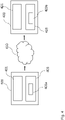
- Fig. 4 shows a schematic diagram of an encoder 400 and of a decoder 420, which are configured to communicate over a communication channel 410 using a polar code according to an embodiment.
- the encoder 400 comprises a processor 401, a memory 403 and a look-up table 403a which is stored in the memory 403.
- the decoder 420 comprises a processor 421, a memory 423 and a look-up table 423a which is stored in the memory 423.
- the encoder 400 is configured to encode K information bits into a code word of length N' on the basis of a polar code of length N, wherein N is a power of 2 and greater than or equal to N'.
- the memory 403 stores a plurality of bit indices, wherein the plurality of bit indices comprise a set of N frozen bit indices associated with the polar code of length N, a set of N/2 puncturing bit indices and/or a set of N/2 shortening bit indices.
- the processor 401 is configured to retrieve at least a subset of the plurality of bit indices from the memory 403, to encode the K information bits using the polar code of length N for obtaining encoded data of length N and to reduce the number of bits of the encoded data to the length N' for obtaining the code word of length N'.
- the above mentioned techniques for encoding and decoding can require the use of look-up tables 403a and 423a, wherein the look-up tables 403a and 423a comprise sets of bit indices, according to the following rules.
- the look-up tables 403a and 423a comprise sets of bit indices, according to the following rules.
- puncturing a set of N frozen bit indices and a set of N/2 puncturing bit indices can be used.
- shortening a set of N frozen bit indices and a set of N/2 shortening bit indices can be used.
- a set of N frozen bit indices, a set of N/2 puncturing bit indices and a set of N/2 shortening bit indices can be used.
- the bits which are used for shortening are set to zero.
- the set of N/2 puncturing bit indices and the set of N/2 shortening bit indices can be derived from the set of N frozen bit indices, wherein the set of N/2 puncturing bit indices corresponds to the first N/2 indices of the set of N frozen bit indices in bit-reversal order and the set of N/2 shortening bit indices corresponds to the inversion of the last N/2 indices of the set of N frozen bit indices in bit-reversal order.
- the shorter code of length N' can be constructed by a combination of puncturing and shortening of a mother polar code of length N according to the following rules: the frozen set comprises the first F indices of the set of frozen bit indices, the puncturing set comprises the first P indices of the puncturing bit indices and the shortening set comprises the first S indices of the shortening bit indices.
- the bits which are used for shortening are set to zero, while the values of F, P and S are chosen as a function of N' and R in a pre-determined way, e.g. in such a way that the error-rate is minimized.
- the encoder 400 is a systematic encoder 400 and the decoder 420 is a systematic decoder 420. Furthermore, the proposed techniques for generating a code of length N' using a mother polar code of length N can be implemented using the systematic encoding scheme mentioned in the background section.
- the look-up tables 403a and 423a storing the sets of frozen bit indices, the sets of puncturing bits indices and the sets of shortening bit indices can be determined off-line.
- a possible way to compute the look-up tables 403a and 423a is detailed in the descriptions of Fig. 9 , Fig. 10 and Fig. 11 .
- This invention proposes a solution for encoding and decoding information bits which requires only small storage memory 403 and allows to define the codes, as required by the encoder 400 and the decoder 420, by simple and fast look-up tables 403a and 423a. Furthermore, the look-up tables 403a and 423a can be generated off-line. Therefore, high complexity is affordable for the optimization of the look-up tables 403a and 423a without impacting the encoder 400 and decoder 420 in the actual application.
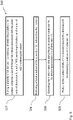
- Fig. 5 shows a schematic diagram of a method 500 for encoding data using a polar code according to an embodiment.
- the method 500 for encoding K information bits into a code word of length N' on the basis of a polar code of length N, wherein N is a power of 2 and greater than or equal to N' comprises the steps of storing 502 a plurality of bit indices in a memory 403, wherein the plurality of bit indices comprise a set of N frozen bit indices associated with the polar code of length N, a set of N/2 puncturing bit indices and a set of N/2 shortening bit indices, retrieving 504 at least a subset of the plurality of bit indices from the memory 403, encoding 506 the K information bits using the polar code of length N for obtaining encoded data of length N and reducing 508 the number of bits of the encoded data to the length N' for obtaining the code word of length N'.
- Fig. 6 shows a schematic diagram of a method 600 for decoding data using a polar code according to an embodiment.
- the method 600 for decoding K information bits encoded in a code word of length N' on the basis of a polar code of length N, wherein N is a power of 2 and greater than or equal to N' comprises the steps of storing 602 a plurality of bit indices in a memory 423, wherein the plurality of bit indices comprise a set of N frozen bit indices associated with the polar code of length N, a set of N/2 puncturing bit indices and a set of N/2 shortening bit indices, retrieving 604 at least a subset of the plurality of bit indices from the memory 423 and decoding 606 the K information bits encoded in the code word of length N' using the polar code of length N for obtaining decoded data of dimension K.
- Fig. 7 shows a schematic diagram of several look-up tables 403a, 403b, 403c and 403d stored in a memory 403.
- N a mother polar code
- the look-up tables 403a, 403b, 403c and 403d comprising frozen bit indices (F n p and F n s ), puncturing bit indices (P n ) and shortening indices (S n ) are provided.
- the dimension of F n p and F n s is N and the dimension of both P n and S n is N/2.
- the stored look-up table e.g. 403a, comprises two sets of indices for puncturing (F n p and P n ) and two sets of indices for shortening (F n s and S n ).
- a set of F n p frozen bit indices of size 2 n comprising indices from 1 to 2 n
- a set of P n puncturing bit indices of size 2 n-1 comprising indices from 1 to 2 n
- a set of F n s frozen bit indices of size 2 n comprising indices from 1 to 2 n
- a set of S n shortening bit indices of size 2 n-1 comprising indices from 1 to 2 n
- Fig. 8 shows a schematic diagram of a puncturing scheme (a) and of a shortening scheme (b) for polar codes according to an embodiment.
- K the dimension of the information set.
- the set of F n p frozen bit indices and the set of P n puncturing bit indices can be read in the memory 403.
- the first N-K indices of F n p represent the elements of the frozen set, while the remaining K indices correspond to the bit indices of the information set.
- the K information bits can be encoded using a systematic polar encoder 400 using the (N,K) mother polar code. After the encoding, the bits can be punctured to reduce the length of the code word.
- the first P N-N' entries of P n are selected as the positions of the bits to be punctured, as schematically shown in (a). Then, the bits in the punctured position are discarded. After the puncturing, the remaining N' bits are transmitted.
- the log-likelihood ratios (LLR) of the received code bits are calculated.
- a decoder 420 for the (N,K) mother polar code is run, where the LLR values of the bits in the punctured positions can be set to zero.
- the set of F n s frozen bit indices and the set of S n shortening bit indices can be read in the memory 403.
- the remaining K+S indices represent the indices of the information bits of the (N,K+S) mother polar code.
- the first S indices of S n represent a subset of the information set, and can be padded with zeros, while the K information bits can be put in the remaining K indices of the set of the K+S information bits.
- the K+S information bits obtained in the previous stage can be encoded using a systematic polar encoder 400 using the (N,K+S) mother polar code. After the encoding, the encoded bits can be shortened in order to reduce the length of the message.
- a decoder 420 for the (N,K+S) mother polar code is run, where the LLR values of the bits in the shortened positions can be set to very high values, indicating that these bits are perfectly known.
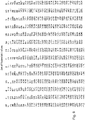
- Fig. 9 shows a set of frozen bit indices according to an embodiment.
- DE density evolution
- Fig. 10 shows a set of puncturing bit indices according to an embodiment.
- the set P 9 of puncturing bit indices is generated using the first 256 entries of F 9 , shown in Fig. 9 , in bit-reversal order.
- Fig. 11 shows a set of shortening bit indices according to an embodiment.
- the set S 9 of shortening bit indices is generated using the inversion of the last 256 entries of F 9 , shown in Fig. 9 , in bit-reversal order.
- Fig. 12 shows the performance of a code using a polar code according to an embodiment.
- LSC list successive-cancellation
- the solid lines refer to the performances of the decoding schemes according to this invention using the set of frozen bit indices shown in Fig. 9 , the set of puncturing bit indices shown in Fig. 10 and the set of shortening bit indices shown in Fig. 11 .
- the look-up table 423a comprise the set of frozen bit indices F 9, the set of punctured bit indices P 9 and the set of shortened bit indices S 9 .
- the dashed lines refer to results making use of the decoding schemes of the state-of-the-art LTE-Turbo solution (LTE-Turbo case) and to the results making use of the decoding schemes shown in the aforementioned work by Wang et al. (case [4]) and by Kai et al. (case [6 ]).
Landscapes
- Engineering & Computer Science (AREA)
- Physics & Mathematics (AREA)
- Probability & Statistics with Applications (AREA)
- Theoretical Computer Science (AREA)
- Computer Networks & Wireless Communication (AREA)
- Signal Processing (AREA)
- Error Detection And Correction (AREA)
Description
- In general, the present invention relates to data encoding and decoding in communication systems. More specifically, the present invention relates to devices and methods for encoding and decoding data using polar codes.
- Polar codes define a new class of channel codes, which were introduced by Arikan in his seminal work "Channel polarization: a method for constructing capacity-achieving codes for symmetric binary-input memoryless channels", IEEE Trans. Inform. Theory, July 2009. Polar codes are capacity-achieving over various classes of channels under encoding and decoding complexity of order O(N log N) in the code length N which was a break-through in coding theory. These codes have remarkable performance for practical finite code lengths as well. The state-of-the-art decoder uses successive cancellation (SC) decoding, as described in the above mentioned work of Arikan, in connection with list decoding (e. g., Tal and A. Vardy in "List decoding of polar codes," in IEEE ISIT July 2011) and possibly an additional cyclic-redundancy-check (CRC) to improve the distance properties of the code and to improve the list decoding (e. g., Kai Niu and Kai Chen, "CRC-Aided Decoding of Polar Codes", IEEE Commun. Letters, vol. 16, no. 10, Oct. 2012).
- According to their initial construction, polar codes have lengths N that are powers of two, i.e. N = 2n, where n is an integer. However, recent works have proposed ways to puncture or shorten polar codes of length N in order to achieve any code length N' (N ≠ N'). Therefore, any code rate R, wherein R = K/N, K being the number of information bits, is possible. In practical deployments, a CRC is applied to the K information bits. This CRC significantly improves the code properties, and is also exploited in the decoding process.
- A (N, K) polar code, where N = 2n, is defined by the following matrix:

2x2 base matrix 
-
Fig. 1(a) shows an example of non-systematic encoding of four information bits using a polar code of length eight, referred to as a (8,4) polar code having a rate R = 1/2, according to the above mentioned work of Arikan. In this figure, the mutual information I(Wi) of the so-called virtual channels for the bits ui is shown on the left-hand side. The mutual information I(Wi) expresses the bit-channel reliability: if it is close to one, than the channel is defined as a 'good' channel and can be used to transmit information bits. On the contrary, if I(Wi) is close to zero than the channel is defined as a 'bad' channel and it shouldn't be used to transmit information bits. Therefore, the four bit indices corresponding to the lowest values of the mutual information I(Wi) are collected into the set of frozen bit indices F = {1,2,3,5}, in order to obtain a code having a rate R=1/2. For encoding, the four information bits [u0 u1 u2 u3 ] are placed in the non-frozen position and the bits corresponding to the indices contained in the set of frozen bit indices F are set to zero. Through matrix multiplication the code bits [c0 c1 c2 c3 c4 c5 c6 c7] are obtained as follows:
-
Fig. 1(b) shows an example of systematic encoding of an (8, 4) polar code, wherein the systematic encoding can be achieved by a two-step scheme as illustrated in "Flexible and low-complexity encoding and decoding of systematic polar codes," in arXiv:1507.03614 July 2015, by Sarkis et.al. The first step is identical to the one in non-systematic encoding. In the vector obtained after the first step, the frozen bits are again set to zero, and the non-systematic encoding is applied again. As a result, a systematic encoder is obtained and the information bits become the systematic bits in the code word (bits on the right).The sets of indices of frozen bits define the polar codes, hence their design is of paramount importance for the code performance. - In both the non-systematic encoder and the systematic encoder, a CRC may be applied to the vector of information bits, defined by [ u0 u1 u2 u3 ] in the above mentioned example. Concerning the decoding by means of polar codes, there are two main decoding algorithms: the successive cancellation (SC) decoding, as suggested in the above mentioned work by Arikan, and the list SC (LSC) decoding, as suggested in List Decoding of Polar Codes," in IEEE ISIT July 2011 by Tal and A. Vardy and in "CRC-Aided Decoding of Polar Codes", IEEE Commun. Letters, vol. 16, no. 10, Oct 2012 by Kai Niu and Kai Chen.
- The SC decoding scheme has extremely low complexity and is sufficient for very large code lengths N due to the polarization effect. For medium-length and short-length codes, the LSC decoding scheme is preferred due to the fact that it can efficiently deal with the error propagation of SC decoding. Furthermore, the LSC decoding scheme allows to decrease the decoding error rate by using longer lists. Thus it allows to trade performance versus complexity.
-
Fig. 2 shows the bit error rate as a function of the signal-to-noise-ration (SNR) in dB for different decoding schemes, in case of a binary phase shift keying - additive white Gaussian noise ((BPSK-AWGN) channel. In particular, it allows to compare the performance of a (2048,1024) polar code using SC and LSC (L=32) decoding schemes to the performance of the state-of-the-art channel decoding schemes. This comparison shows that polar codes are a very powerful class of channel codes, and they can be expected to play an important role in future communication systems. - The original polar code construction allows for any code rate, by choosing the size of the frozen set. However, they allow only the construction of codes having lengths that are powers of 2, i.e., N=2n. The restriction of the length of the code is a major drawback of polar codes, which needs to be overcome for practical applications. Using the techniques of so-called puncturing and shortening from coding theory, the polar codes can be trimmed to any code length, as it will be explained in the following. In the following, polar codes of lengths N=2n will also be referred to as mother polar codes.
-
Fig. 3(a) illustrates the main idea of puncturing. In puncturing, one or more code bits are not transmitted. The decoder typically handles punctured bits as erased and applies the decoder of the mother polar code of length N. Puncturing has the benefit of making the code rate R more flexible and allows immediately for incremental redundancy, however it gives less control on the resulting distance properties. If a code of length N' has to be created to encode K information bits with R= K/N', then a mother (K,N) polar code is used to encode the data, with N > N', and P = N-N' bits are punctured. For decoding, the P punctured code bits are assigned log-likelihood ratios (LLR) of zero, and usual decoding of the mother polar code of length N is applied. Puncturing changes the code properties and the decoding behavior, therefore the positions to be punctured need to be carefully chosen. -
Fig. 3(b) illustrates the main idea of shortening. In shortening, a sub-code of the mother polar code of length N is used in which one or more bits are restricted to a fixed value, typically zero. In the case of a systematic encoder, one or more systematic bits can be chosen for this purpose, and they can simply be set to zero in the encoding process. These fixed bits are not transmitted. At the decoder side, the shortened bits are known, their LLRs are set to very large values, and the decoder of the mother polar code of length N is applied. Shortening achieves the same code rate flexibility as puncturing, however with more control over the code properties. If a code of length N' has to be created to encode K information bits, the data is initially padded with S=N-N' zeros (also called the shortening bits), and a (N,K+S) mother polar code is chosen with N > N'. The obtained K+S information bits and shortening bits are encoded using a systematic polar encoder. Before transmission the S shortening bits are removed. This procedure preserves the minimum distance of the mother polar code and thus provides more control over the code properties than puncturing. At the decoder side, the S removed bits are known to be zero. Correspondingly the LLRs of these code bits are initialized with large positive values (in theory with infinity). Afterwards, usual decoding of the mother polar code of length N is applied. - In both puncturing and shortening, the selection of the bit positions to puncture or shorten is of paramount importance in the mother polar code design in order to obtain good error-rate performance.
- In the prior art several solutions are provided in order to design sets of frozen bit indices, sets of puncturing bit indices and sets of shortening bit indices. These solutions can be divided into three categories: optimal puncturing/shortening pattern generation, optimal frozen set generation and joint optimization, as will be described in the following.
- The optimal puncturing or shortening pattern generation technique deals with finding the optimal puncturing or shortening patterns once the frozen sets of the mother polar code are given. This technique is used in the work "On the Puncturing Patterns for Punctured Polar Codes", IEEE ISIT July 2014, by Zhang et. al, to create a punctured polar code. In particular, the less reliable bits are selected to be frozen, and an algorithm is run to find an optimal puncturing pattern leading to the selected frozen bits. The error-rate performance of this technique is sub-optimal compared to other ones, but the puncturing pattern is less complex to compute. Still, the optimization algorithm has to be run every time a (N,K) polar code has to be generated. This increases the latency of the system, which is a disadvantage of this approach.
- The optimal frozen set generation technique deals with finding the optimal frozen set once the puncturing or shortening pattern is given. This technique is proposed for shortening of non-systematic polar codes in the work "A Novel Puncturing Scheme for Polar Codes", IEEE Commun. Letters, Dec 2014, by Wang et. al, while it is proposed for puncturing of non-systematic polar codes in the works "Design of Length-Compatible Polar Codes Based on the Reduction of Polarizing Matrices", IEEE Trans. Commun., 2013, by Shin et.al. and "Beyond Turbo Codes: Rate-Compatible Punctured Polar Codes", IEEE ICC June 2013 by C. Kai et al. In the above mentioned work by Wang et al., the shortening pattern is selected using the last bits of a (N,K) mother polar code. Similarly, in the above mentioned works by Shin et al. and by Kai et al., the puncturing pattern is generated according to a certain heuristic, and a density evolution (DE) algorithm is run to find the optimal frozen set given the puncturing pattern. The frozen set needs to be calculated at every encoding and every decoding, whenever the code is changed, and the DE algorithm is a relatively complex algorithm. Even though the error-rate performance of this technique is good, the high complexity and resulting latency due to the DE calculation makes this technique unattractive for practical implementations.
- The joint optimization technique is presented for shortening of non-systematic polar codes in the work "Shortened Polar Codes", IEEE Trans. Inform. Theo., Sept. 2015 by V. Miloslavskaya. In this technique, the frozen set and the shortening pattern are jointly optimized. For a given (N',K) code, a search over all possible shortening patterns is performed. The complexity of this full search can largely be reduced by exploiting certain symmetries of the polar encoder. The error-rate performance of this technique is good due to the optimal design. However, large amounts of memory are required for storing a table comprising the frozen set and the shortening pattern for every N' and K. For practical applications that require large sets of code lengths N' and code rates R, this method is not convenient.
- Although the above mentioned techniques of the prior art provide some solutions to the problem of designing codes having arbitrary lengths and rates by using polar codes, they all present disadvantages related to their practical implementations due to their high description complexity. One of the main disadvantages of existing techniques is the lack of structure in the generation of the frozen sets, the puncturing patterns and the shortening patterns. In particular, every (N',K) code has a different frozen set and puncturing or shortening pattern, and for each pair (N',K), these sets and patterns have to either be stored or be calculated on the fly, resulting in large computational complexity.
- Ali Eslami et al, "A Practical Approach to Polar Codes", ARXIV.ORG, CORNELL UNIVERSITY LIBRARY, 201 OLIN LIBRARY CORNELL UNIVERSITY ITHACA, NY 14853, (20110727), doi:10.1109/ISIT.2011.6033837, XP080517802, discloses a rate compatible polar code encoder in which a parent code is designed for the worst channel, then a puncturing pattern is determined off-line for every channel parameter and loaded into the encoder. Further it is disclosed using J nested information sets corresponding to an ordered sequence of J transmission channels, where each channel is degraded with respect to the preceding channel.
- HUAWEI et al, "Overview of Polar Codes", vol. RAN WG1, no. Busan, Korea; 20160411 - 20160415, (20160402), 3GPP DRAFT; R1-162161, 3RD GENERATION PARTNERSHIP PROJECT (3GPP), MOBILE COMPETENCE CENTRE ; 650, ROUTE DES LUCIOLES ; F-06921 SOPHIA-ANTIPOLIS CEDEX ; FRANCE, URL: http://www.3gpp.org/ftp/tsg_ran/WG1_RL1/TSGR1_84b/Docs/, (20160402), XP051080007, discloses that polar codes are in discussion for the next generation mobile communications standard LTE E-UTRA, and that if a codeword of code length N has to be created to encode K information bits, a mother (N',K) polar code is used to encode the data, with N'>N, and N'-N bits are punctured.
-
US2015077277 discloses a method for polar code encoding with shortening and puncturing. The method generally converts an (N, K) polar code into an (N-K'-K", K-K'-K") polar code, where K' bits are shortened and K" bits are punctured, and Li Yue et al, "A study of polar codes for MLC NAND flash memories", 2015 INTERNATIONAL CONFERENCE ON COMPUTING, NETWORKING AND COMMUNICATIONS (ICNC), IEEE, (20150216), doi:10.1109/ICCNC.2015.7069414, pages 608 - 612, XP032752610, discloses schemes for shortening non-systematic and systematic polar codes. The shortening method is intrinsically progressive, since K' shortened indices are either at the end of the block or are obtained by bit-reversal permutation on the block of K' last positions of the block. - Eroz M et al.: "On the design of prunable interleavers for turbo codes", 19th Vehicular Technology Conference, 1999 IEEE HOUSTON, TX, USA (19990516), pages 1669-1673, XP010342111, doi: 10.1109/VETEC.1999. 780687 discloses interleavers of
lengths 512 to 8192. When the desired length is N, then an interleaver is obtained by pruning the next-higher-sized interleaver, 0.5<N/2r+c ≤1. -
EP 2 722 993 A1 - Gabi Sarkis et al.: "Flexible and Low-Complexity Encoding and Decoding of Systematic Polar Codes", IEEE Transactions on Communications, January 2016, pages 2732-2745, XP055336370, doi: 10.1109/TCOMM.2016.2574996 discloses flexible polar systematic encoders and decoders. For Rn-flexible (i.e. rate and length flexible) decoder, shortening is implemented using masking where the LLRs corresponding to shortened bits are replaced with the maximum LLR value based on an nmax-bit mask that is stored in a memory.
- Saber Hamid et al: "An Incremental Redundancy Hybrid ARO Scheme via Puncturing and Extending of Polar Codes", IEEE Transactions on Communications, vol. 63, no. 11, November 2015, pages 3964-3973, XP011589911, doi: 10.1109/TCOMM.2015.2477082 discloses that first-error event probabilities can be sorted in ascending order, and the indices of the K bits with the smallest error probabilities can be used for the information set A. A rate compatible polar code can be found by fixing N and varying K, with A K the information set for rate K/N. In this case A K will contain all elements of A K-1 plus one additional index. The transmitter and receiver only need to know the order of the indices to produce codes with any rate that is an integer multiple of 1/N.
- Therefore, there is a need for improved devices and methods implementing polar codes in communication systems.
- It is an object of the invention to provide improved devices and methods implementing polar codes in communication systems.
- The foregoing and other objects are achieved by the subject matter of the independent claims. Further implementation forms are apparent from the dependent claims, the description and the figures.
- According to a first aspect, the invention relates to an encoder for systematic encoding K information bits into a code word of length N' on the basis of a polar code of length N, wherein N is a power of 2 and greater than or equal to N'. The encoder comprises a memory storing a plurality of bit indices, wherein the plurality of bit indices comprise a set of N frozen bit indices associated with the polar code of length N, a set of N/2 puncturing bit indices and a set of N/2 shortening bit indices. Furthermore the encoder comprises a processor configured to retrieve at least a subset of the plurality of bit indices from the memory, to encode the K information bits using the polar code of length N for obtaining encoded data of length N and to reduce the number of bits of the encoded data to the length N' for obtaining the code word of length N' by a combination of puncturing and shortening the polar code of length N to the length N' and with the K information bits according to the following rules: a frozen set comprises first F indices of the set of N frozen bit indices, a puncturing set comprises first P indices of the N/2 puncturing bit indices, and a shortening set comprises first S indices of the N/2 shortening bit indices, where bits used for shortening are set to zero, and values of F, P, and S are a function of N' and a code rate R in such a way that an error rate is minimized, where R equals K/N'.
- Thus, a compact and simple description of polar codes is provided to generate the frozen set. Furthermore, the set of frozen bit indices required to describe the polar codes can be optimized off-line, such that high complexity algorithms can be applied in this code optimization. This represents another advantage compared to the methods used in prior art, wherein the code parameters are determined online and low-complexity methods have to be used due to computational and latency constraints in the transmitter and in the receiver. Furthermore, the low description complexity allows for practical application in systems, where a large set of polar codes with various different lengths and rates is required.
- In a first possible implementation form of the encoder according to the first aspect as such, the plurality of bit indices further comprise a set of M frozen bit indices associated with a polar code of length M, a set of M/2 puncturing bit indices and/or a set of M/2 shortening bit indices, wherein M is a power of 2 and smaller than N, and wherein the processor is configured to encode the K information bits using the polar code of length M and to reduce the number of bits of the encoded data to the length N', in case N' is smaller than or equal to M.
- In a second possible implementation form of the encoder according to the first aspect as such or the first implementation form thereof, the memory is configured to store the plurality of bit indices in a look-up table.
- According to a second aspect, the invention relates to a method for systematic encoding K information bits into a code word of length N' on the basis of a polar code of length N, wherein N is a power of 2 and greater than or equal to N'. The method comprises the steps of storing a plurality of bit indices in a memory, wherein the plurality of bit indices comprise a set of N frozen bit indices associated with the polar code of length N, a set of N/2 puncturing bit indices and a set of N/2 shortening bit indices, retrieving at least a subset of the plurality of bit indices from the memory, encoding the K information bits using the polar code of length N for obtaining encoded data of length N and reducing the number of bits of the encoded data to the length N' for obtaining the code word of length N' by a combination of puncturing and shortening of the polar code of length N to the length N' and with the K information bits according to the following rules: a frozen set comprises first F indices of the set of N frozen bit indices, a puncturing set comprises first P indices of the puncturing N/2 bit indices, and a shortening set comprises first S indices of the N/2 shortening bit indices, where bits used for shortening are set to zero, and values of F, P, and S are a function of N' and a code rate R in such a way that an error rate is minimized, where R equals K/N'.
- According to a third aspect, the invention relates to a decoder for systematic decoding K information bits encoded in a code word of length N' on the basis of a polar code of length N, wherein N is a power of 2 and greater than or equal to N'. The decoder comprises a memory storing a plurality of bit indices, wherein the plurality of bit indices comprise a set of N frozen bit indices associated with the polar code of length N, a set of N/2 puncturing bit indices and a set of N/2 shortening bit indices and a processor configured to retrieve at least a subset of the plurality of bit indices from the memory and to decode the K information bits encoded in the code word of length N' using the polar code of length N for obtaining decoded data of dimension K by a combination of puncturing and shortening of the polar code of length N to the length N' and with the K information bits according to the following rules: a frozen set comprises first F indices of the set of N frozen bit indices, a puncturing set comprises first P indices of the N/2 puncturing bit indices, and a shortening set comprises first S indices of the N/2 shortening bit indices, where bits used for shortening are set to zero, and values of F, P, and S are a function of N' and a code rate R in such a way that an error rate is minimized, where R equals K/N'.
- In a first possible implementation form of the decoder according to the third aspect as such, the plurality of bit indices further comprise a set of M frozen bit indices associated with a polar code of length M, a set of M/2 puncturing bit indices and/or a set of M/2 shortening bit indices, wherein M is a power of 2 and smaller than N, and wherein the processor is configured to decode the K information bits encoded in the code word of length N' using the polar code of length M, in case N' is smaller than or equal to M.
- In a second possible implementation form of the decoder according to the third aspect as such, the memory is configured to store the plurality of bit indices in a look-up table.
- According to a fourth aspect, the invention relates to a method for systematic decoding K information bits encoded in a code word of length N' on the basis of a polar code of length N, wherein N is a power of 2 and greater than or equal to N'. The method comprises the steps of storing a plurality of bit indices in a memory, wherein the plurality of bit indices comprise a set of N frozen bit indices associated with the polar code of length N, a set of N/2 puncturing bit indices and a set of N/2 shortening bit indices, retrieving at least a subset of the plurality of bit indices from the memory and decoding the K information bits encoded in the code word of length N' using the polar code of length N for obtaining decoded data of dimension K by a combination of puncturing and shortening of the polar code of length N to the length N' and with the K information bits according to the following rules: a frozen set comprises first F indices of the set of N frozen bit indices, a puncturing set comprises first P indices of the N/2 puncturing bit indices, and a shortening set comprises first S indices of the N/2 shortening bit indices, where bits used for shortening are set to zero, and values of F, P, and S are a function of N' and a code rate R in such a way that an error rate is minimized, where R equals K/N'.
- Further embodiments of the invention will be described with respect to the following figures, wherein:
-
Fig. 1 shows an example of non-systematic encoding of a polar code (a) and an example of a systematic encoding of a polar code (b); -
Fig. 2 shows the bit error rate as a function of the signal-to-noise-ratio in dB for different decoding schemes; -
Fig. 3 shows a schematic diagram illustrating the main idea of puncturing (a) and of shortening (b); -
Fig. 4 shows a schematic diagram of a communication system comprising an encoder according to an embodiment and a decoder according to an embodiment; -
Fig. 5 shows a schematic diagram of a method for encoding data using a polar code according to an embodiment; -
Fig. 6 shows a schematic diagram of a method for decoding data using a polar code according to an embodiment; -
Fig. 7 shows a schematic diagram of look-up tables for polar codes according to anexample ; -
Fig. 8 shows schematic diagrams of a puncturing scheme (a) and of a shortening scheme (b) for polar codes according to an example; -
Fig. 9 shows a look-up table comprising a set of frozen bit indices according to an example; -
Fig. 10 shows a look-up table comprising a set of puncturing bit indices according to an embodiment; -
Fig. 11 shows a look-up table comprising a set of shortening bit indices according to anexample; -
Fig. 12 shows the performance of a code using a polar code according to an example; -
Fig. 13 shows the performance of a code using a polar code according to an example; -
Fig. 14 shows the performance of a code using a polar code according to an example; and -
Fig. 15 shows the performance of a code using a polar code according to an example. - In the various figures, identical reference signs will be used for identical or at least functionally equivalent features.
- In the following, the embodiments regarding
Figs. 7 to 15 are not part of the invention, but are illustrative examples necessary for understanding the invention. - In the following description, reference is made to the accompanying drawings, which form part of the disclosure, and in which are shown, by way of illustration, specific aspects in which the present invention may be placed. It will be appreciated that other aspects may be utilized and structural or logical changes may be made without departing from the scope of the appended claims. The following detailed description, therefore, is not to be taken in a limiting sense, as the scope of the present invention is defined by the appended claims.
- For instance, it will be appreciated that a disclosure in connection with a described method may also hold true for a corresponding device or system configured to perform the method and vice versa. For example, if a specific method step is described, a corresponding device may include a unit to perform the described method step, even if such unit is not explicitly described or illustrated in the figures.
- Moreover, in the following detailed description as well as in the claims embodiments with different functional blocks or processing units are described, which are connected with each other or exchange signals. It will be appreciated that the present invention covers embodiments as well, which include additional functional blocks or processing units that are arranged between the functional blocks or processing units of the embodiments described below.
- Finally, it is understood that the features of the various exemplary aspects described herein may be combined with each other, unless specifically noted otherwise.
-
Fig. 4 shows a schematic diagram of anencoder 400 and of adecoder 420, which are configured to communicate over acommunication channel 410 using a polar code according to an embodiment. In the embodiment shown infigure 4 , theencoder 400 comprises aprocessor 401, amemory 403 and a look-up table 403a which is stored in thememory 403. In the embodiment shown infigure 4 , thedecoder 420 comprises aprocessor 421, amemory 423 and a look-up table 423a which is stored in thememory 423. - As will be described in further detail below, according to embodiments of the invention, a shorter code of length N' of K information bits and rate R=K/N' can be obtained from the mother polar code of length N=2n, wherein n=ceil(log2(N')), by puncturing, shortening, combined puncturing and shortening or may be determined based on the desired code parameters N' and R, e.g. by a simple function.
- Thus in an embodiment, the
encoder 400 is configured to encode K information bits into a code word of length N' on the basis of a polar code of length N, wherein N is a power of 2 and greater than or equal to N'. Thememory 403 stores a plurality of bit indices, wherein the plurality of bit indices comprise a set of N frozen bit indices associated with the polar code of length N, a set of N/2 puncturing bit indices and/or a set of N/2 shortening bit indices. Theprocessor 401 is configured to retrieve at least a subset of the plurality of bit indices from thememory 403, to encode the K information bits using the polar code of length N for obtaining encoded data of length N and to reduce the number of bits of the encoded data to the length N' for obtaining the code word of length N'. - In an embodiment, the above mentioned techniques for encoding and decoding can require the use of look-up tables 403a and 423a, wherein the look-up tables 403a and 423a comprise sets of bit indices, according to the following rules. In the case of puncturing, a set of N frozen bit indices and a set of N/2 puncturing bit indices can be used. In the case of shortening, a set of N frozen bit indices and a set of N/2 shortening bit indices can be used. In the case of combined puncturing and shortening, a set of N frozen bit indices, a set of N/2 puncturing bit indices and a set of N/2 shortening bit indices can be used.
- In an embodiment, the shorter code of length N' can be constructed by puncturing a mother polar code of length N according to the following rules: the frozen set comprises the first F=N-K indices of the set of frozen bit indices and the puncturing set comprises the first P=N-N' indices of the set of puncturing bit indices.
- In an embodiment, the shorter code of length N' can be constructed by shortening a mother polar code of length N according to the following rules: the frozen set comprises the first F=N-K-S indices of the set of frozen bit indices and the shortening set comprises the first S=N-N' indices of the set of shortening bit indices. The bits which are used for shortening are set to zero.
- In an embodiment, the set of N/2 puncturing bit indices and the set of N/2 shortening bit indices can be derived from the set of N frozen bit indices, wherein the set of N/2 puncturing bit indices corresponds to the first N/2 indices of the set of N frozen bit indices in bit-reversal order and the set of N/2 shortening bit indices corresponds to the inversion of the last N/2 indices of the set of N frozen bit indices in bit-reversal order.
- In an embodiment, the shorter code of length N' can be constructed by a combination of puncturing and shortening of a mother polar code of length N according to the following rules: the frozen set comprises the first F indices of the set of frozen bit indices, the puncturing set comprises the first P indices of the puncturing bit indices and the shortening set comprises the first S indices of the shortening bit indices. The bits which are used for shortening are set to zero, while the values of F, P and S are chosen as a function of N' and R in a pre-determined way, e.g. in such a way that the error-rate is minimized.
- In an embodiment, the
encoder 400 is asystematic encoder 400 and thedecoder 420 is asystematic decoder 420. Furthermore, the proposed techniques for generating a code of length N' using a mother polar code of length N can be implemented using the systematic encoding scheme mentioned in the background section. - In an embodiment, the look-up tables 403a and 423a storing the sets of frozen bit indices, the sets of puncturing bits indices and the sets of shortening bit indices can be determined off-line. A possible way to compute the look-up tables 403a and 423a is detailed in the descriptions of
Fig. 9 ,Fig. 10 andFig. 11 . - This invention proposes a solution for encoding and decoding information bits which requires only
small storage memory 403 and allows to define the codes, as required by theencoder 400 and thedecoder 420, by simple and fast look-up tables 403a and 423a. Furthermore, the look-up tables 403a and 423a can be generated off-line. Therefore, high complexity is affordable for the optimization of the look-up tables 403a and 423a without impacting theencoder 400 anddecoder 420 in the actual application. -
Fig. 5 shows a schematic diagram of amethod 500 for encoding data using a polar code according to an embodiment. In this embodiment, themethod 500 for encoding K information bits into a code word of length N' on the basis of a polar code of length N, wherein N is a power of 2 and greater than or equal to N', comprises the steps of storing 502 a plurality of bit indices in amemory 403, wherein the plurality of bit indices comprise a set of N frozen bit indices associated with the polar code of length N, a set of N/2 puncturing bit indices and a set of N/2 shortening bit indices, retrieving 504 at least a subset of the plurality of bit indices from thememory 403, encoding 506 the K information bits using the polar code of length N for obtaining encoded data of length N and reducing 508 the number of bits of the encoded data to the length N' for obtaining the code word of length N'. -
Fig. 6 shows a schematic diagram of amethod 600 for decoding data using a polar code according to an embodiment. In this embodiment, themethod 600 for decoding K information bits encoded in a code word of length N' on the basis of a polar code of length N, wherein N is a power of 2 and greater than or equal to N', comprises the steps of storing 602 a plurality of bit indices in amemory 423, wherein the plurality of bit indices comprise a set of N frozen bit indices associated with the polar code of length N, a set of N/2 puncturing bit indices and a set of N/2 shortening bit indices, retrieving 604 at least a subset of the plurality of bit indices from thememory 423 and decoding 606 the K information bits encoded in the code word of length N' using the polar code of length N for obtaining decoded data of dimension K. -
Fig. 7 shows a schematic diagram of several look-up tables 403a, 403b, 403c and 403d stored in amemory 403. In this embodiment, it is assumed that for each length of a mother polar code N, from N=64 to N=2n, n being a natural number, the look-up tables 403a, 403b, 403c and 403d comprising frozen bit indices (Fn p and Fn s), puncturing bit indices (Pn) and shortening indices (Sn) are provided. In this embodiment, the dimension of Fn p and Fn s is N and the dimension of both Pn and Sn is N/2. Therefore, for every value of n required by the system, i.e. for every n such that log2(N'min) ≤ n ≤ log2(N'max), one of the look-up tables 403a, 403b, 403c and 403d can be stored in thememory 403. The stored look-up table, e.g. 403a, comprises two sets of indices for puncturing (Fn p and Pn) and two sets of indices for shortening (Fn s and Sn). In particular, for puncturing, a set of Fn p frozen bit indices ofsize 2n, comprising indices from 1 to 2n, and a set of Pn puncturing bit indices ofsize 2n-1, comprising indices from 1 to 2n, can be stored in thememory 403. For shortening, a set of Fn s frozen bit indices ofsize 2n, comprising indices from 1 to 2n, and a set of Sn shortening bit indices ofsize 2n-1, comprising indices from 1 to 2n, can be stored in thememory 403. Therefore, for every value of n, four sets of bit indices can be stored in thememory 403, resulting in 3 × 2n bits being stored in thememory 403. Generalizations including combined sets of indices for shortening and puncturing follow along the same lines. -
Fig. 8 shows a schematic diagram of a puncturing scheme (a) and of a shortening scheme (b) for polar codes according to an embodiment. In order to generate a (N',K) punctured polar code with N'≠2n, the length of the mother polar code N=2n can be calculated, wherein n=ceil(log2(N')) and K is the dimension of the information set. In an embodiment, the set of Fn p frozen bit indices and the set of Pn puncturing bit indices can be read in thememory 403. In this embodiment, the first N-K indices of Fn p represent the elements of the frozen set, while the remaining K indices correspond to the bit indices of the information set. The K information bits can be encoded using a systematicpolar encoder 400 using the (N,K) mother polar code. After the encoding, the bits can be punctured to reduce the length of the code word. The first P = N-N' entries of Pn are selected as the positions of the bits to be punctured, as schematically shown in (a). Then, the bits in the punctured position are discarded. After the puncturing, the remaining N' bits are transmitted. At the receiver, the log-likelihood ratios (LLR) of the received code bits are calculated. Afterwards, adecoder 420 for the (N,K) mother polar code is run, where the LLR values of the bits in the punctured positions can be set to zero. - In (b), a shortening scheme is shown according to an embodiment in order to generate a (N',K) shortened polar code with N'≠2n, the length of the mother polar code being N=2n, wherein n=ceil(log2(N')). The set of Fn s frozen bit indices and the set of Sn shortening bit indices can be read in the
memory 403. The first N-K-S indices of Fn s correspond to the elements of the set comprising the frozen bit indices, where S = N-N'. The remaining K+S indices represent the indices of the information bits of the (N,K+S) mother polar code. The first S indices of Sn represent a subset of the information set, and can be padded with zeros, while the K information bits can be put in the remaining K indices of the set of the K+S information bits. The K+S information bits obtained in the previous stage can be encoded using a systematicpolar encoder 400 using the (N,K+S) mother polar code. After the encoding, the encoded bits can be shortened in order to reduce the length of the message. The first S = N-N' entries of Sn can be selected as the positions of the bits to be shortened. Afterwards, the bits in the shortened position can be discarded. After the shortening, the remaining N' code bits are transmitted. At the receiver, the LLRs of the received code bits are calculated. Adecoder 420 for the (N,K+S) mother polar code is run, where the LLR values of the bits in the shortened positions can be set to very high values, indicating that these bits are perfectly known. -
Fig. 9 shows a set of frozen bit indices according to an embodiment. In this embodiment, the set F9 of frozen bit indices of a mother polar code of length N=512 (n=9) is generated running a density evolution (DE) algorithm with Gaussian approximation over anAWGN channel 410 at 1 dB of SNR. -
Fig. 10 shows a set of puncturing bit indices according to an embodiment. In this embodiment, the set P9 of frozen bit indices refers to a mother polar code of length N=512 (n=9). The set P9 of puncturing bit indices is generated using the first 256 entries of F9, shown inFig. 9 , in bit-reversal order. -
Fig. 11 shows a set of shortening bit indices according to an embodiment. In this embodiment, the set S9 of shortening bit indices refers to a mother polar code of length N=512 (n=9). The set S9 of shortening bit indices is generated using the inversion of the last 256 entries of F9, shown inFig. 9 , in bit-reversal order. -
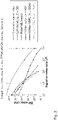
Fig. 12 shows the performance of a code using a polar code according to an embodiment. In particular, it shows the block-error-rate of different decoding schemes as a function of the signal-to-noise-ratio (Eb/N0) in dB. In this embodiment, the code has a length N'=320 and a rate R= 0.5, while the mother polar code has a length N = 512 = 29, i.e. n = 9. Furthermore, the polar code uses a CRC oflength 24 bits, and it is decoded using a list successive-cancellation (LSC)decoder 420 with list length L=32. The solid lines refer to the performances of the decoding schemes according to this invention using the set of frozen bit indices shown inFig. 9 , the set of puncturing bit indices shown inFig. 10 and the set of shortening bit indices shown inFig. 11 . In this embodiment, the sets of frozen bit indices are generated using the same method for both shortening and puncturing, therefore there is a unique set of frozen bit indices, namely F9 p = F9 s =F9. In this embodiment, the look-up table 423a comprise the set of frozen bit indices F9, the set of punctured bit indices P9 and the set of shortened bit indices S9. - The dashed lines refer to results making use of the decoding schemes of the state-of-the-art LTE-Turbo solution (LTE-Turbo case) and to the results making use of the decoding schemes shown in the aforementioned work by Wang et al. (case [4]) and by Kai et al. (case [6 ]).
-
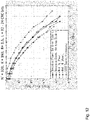
Fig. 13 shows the performance of a code using a polar code according to an embodiment. This case is identical to the one described inFig. 12 , with the exception that, in this case, the dimension of the information bits is K=104, therefore the code has a rate R=0.325. -
Fig. 14 shows the performance of a code using a polar code according to an embodiment. This case is identical to the one described inFig. 12 , with the exception that, in this case, the dimension of the information bits is K=64, therefore the code has a rate R=0.2. -
Fig. 15 shows the performance of a code using a polar code according to an embodiment. This case is identical to the one described inFig. 12 , with the exception that, in this case, the dimension of the information bits is K=216, therefore the code has a rate R=0.675. - The results shown in
figures 12 to 15 highlight the following facts. In most cases, the punctured and shortened polar codes generated from the set of indices shown inFig.9 ,Fig.10 andFig. 11 outperform the state-of-the-art LTE-Turbo codes of the same rate. Moreover, the performance loss of the polar codes generated from the set of indices shown inFig.9 ,Fig.10 andFig. 11 is generally negligible compared to the highly optimized and complex methods described in previous state-of-the-art solutions, e.g. in the aforementioned work by Wang et al. (case [4] in the plots) and in the aforementioned work by Kai et al. (case [6] in the plots). They can even have the same performance in particular cases, e.g. for R= 0.2 and R=0.675. Therefore, the error-rate performance of polar codes defined in this invention remains comparable to existing solutions, where the individual codes are optimized for the desired length and rate. Furthermore, the punctured polar codes outperform the shortened polar codes for low rates, while the contrary happens for high rates. The same behavior was also observed in the aforementioned works of Wang et al. and by Kai et al. These facts give the possibility to choose the best scheme between puncturing and shortening at theencoder 400 depending on the target code rate R=K/N'. In particular only the best look-up tables 403a and 423a can be stored for a given regime, providing further gains in terms of memory consumption for storing generating tables in thememories - While a particular feature or aspect of the disclosure may have been disclosed with respect to only one of several implementations or embodiments, such feature or aspect may be combined with one or more other features or aspects of the other implementations or embodiments as may be desired and advantageous for any given or particular application. Furthermore, to the extent that the terms "include", "have", "with", or other variants thereof are used in either the detailed description or the claims, such terms are intended to be inclusive in a manner similar to the term "comprise". Also, the terms "exemplary", "for example" and "e.g." are merely meant as an example, rather than the best or optimal. The terms "coupled" and "connected", along with derivatives may have been used. It should be understood that these terms may have been used to indicate that two elements cooperate or interact with each other regardless whether they are in direct physical or electrical contact, or they are not in direct contact with each other.
- Although specific aspects have been illustrated and described herein, it will be appreciated by those of ordinary skill in the art that a variety of alternate and/or equivalent implementations may be substituted for the specific aspects shown and described.
- Many alternatives, modifications, and variations will be apparent to those skilled in the art in light of the above teachings. Of course, those skilled in the art readily recognize that there are numerous applications of the invention beyond those described herein. While the present invention has been described with reference to one or more particular embodiments, those skilled in the art recognize that many changes may be made thereto without departing from the scope of the appended claims. It is therefore to be understood that within the scope of the appended claims, the invention may be practiced otherwise than as specifically described herein.
Claims (8)
- An encoder (400) for systematic encoding K information bits into a code word of length N' based on a polar code of length N, wherein N is a power of 2 and greater than N', the encoder (400) comprising:a memory (403) storing a plurality of bit indices, wherein the plurality of bit indices comprises a set of N frozen bit indices associated with the polar code of length N, a set of N/2 puncturing bit indices, and a set of N/2 shortening bit indices; anda processor (401) configured to:retrieve at least a subset of the plurality of bit indices from the memory (403);encode the K information bits using the polar code of length N to obtain encoded data of length N; andreduce a number of bits of the encoded data of length N to the length N' to obtain the code word of length N' by a combination of puncturing and shortening the polar code of length N to the length N' and with the K information bits according to the following rules:a frozen set comprises first F indices of the set of N frozen bit indices,a puncturing set comprises first P indices of the N/2 puncturing bit indices, anda shortening set comprises first S indices of the N/2 shortening bit indices,wherein bits used for shortening are set to zero, and values of F, P, and S are a function of N' and a code rate R in such a way that an error rate is minimized, where R equals K/N'.
- The encoder (400) according to claim 1, wherein the plurality of bit indices further comprise a set of M frozen bit indices associated with a polar code of length M, a set of M/2 puncturing bit indices, and a set of M/2 shortening bit indices, wherein M is a power of 2 and smaller than N, and wherein the processor (401) is further configured to:encode the K information bits using the polar code of length M; andreduce the number of bits of the encoded data to the length N', in case N' is smaller than M.
- The encoder (400) according to claim 1 or 2, wherein the memory (403) is configured to store the plurality of bit indices in a look-up table (403a).
- A method (500) for systematic encoding K information bits into a code word of length N' based on a polar code of length N, wherein N is a power of 2 and greater than N', the method (500) comprising:storing (502) a plurality of bit indices in a memory (403), wherein the plurality of bit indices comprises a set of N frozen bit indices associated with the polar code of length N, a set of N/2 puncturing bit indices, and a set of N/2 shortening bit indices;retrieving (504) at least a subset of the plurality of bit indices from the memory (403);encoding (506) the K information bits using the polar code of length N to obtain encoded data of length N; andreducing (508) a number of bits of the encoded data to the length N' to obtain the code word of length N' by a combination of puncturing and shortening of the polar code of length N to the length N' and with the K information bits according to the following rules:a frozen set comprises first F indices of the set of N frozen bit indices,a puncturing set comprises first P indices of the puncturing N/2 bit indices, anda shortening set comprises first S indices of the N/2 shortening bit indices,wherein bits used for shortening are set to zero, and values of F, P, and S are a function of N' and a code rate R in such a way that an error rate is minimized, where R equals K/N'.
- A decoder (420) for systematic decoding K information bits encoded in a code word of length N' based on a polar code of length N, wherein N is a power of 2 and greater than N', the decoder (420) comprising:a memory (423) storing a plurality of bit indices, wherein the plurality of bit indices comprises a set of N frozen bit indices associated with the polar code of length N, a set of N/2 puncturing bit indices, and a set of N/2 shortening bit indices; anda processor (421) configured to:
retrieve at least a subset of the plurality of bit indices from the memory (423); anddecode the K information bits encoded in the code word of length N' using the polar code of length N to obtain decoded data of length K by a combination of puncturing and shortening the polar code of length N to the length N' and with the K information bits according to the following rules:a frozen set comprises first F indices of the set of N frozen bit indices,a puncturing set comprises first P indices of the N/2 puncturing bit indices, anda shortening set comprises first S indices of the N/2 shortening bit indices,wherein bits used for shortening are set to zero, and values of F, P, and S are a function of N' and a code rate R in such a way that an error rate is minimized, where R equals K/N'. - The decoder (420) according to claim 5, wherein the plurality of bit indices further comprises a set of M frozen bit indices associated with a polar code of length M, a set of M/2 puncturing bit indices, and a set of M/2 shortening bit indices, wherein M is a power of 2 and smaller than N, and wherein the processor (421) is configured to decode the K information bits encoded in the code word of length N' using the polar code of length M, in case N' is smaller than M.
- The decoder (420) according to claim 5 or 6, wherein the memory (423) is configured to store the plurality of bit indices in a look-up table (423a).
- A method (600) for systematic decoding K information bits encoded in a code word of length N' based on a polar code of length N, wherein N is a power of 2 and greater than N', the method (600) comprising:storing (602) a plurality of bit indices in a memory (423), wherein the plurality of bit indices comprises a set of N frozen bit indices associated with the polar code of length N, a set of N/2 puncturing bit indices, and a set of N/2 shortening bit indices;retrieving (604) at least a subset of the plurality of bit indices from the memory (423); anddecoding (606) the K information bits encoded in the code word of length N' using the polar code of length N to obtain decoded data of length K by a combination of puncturing and shortening the polar code of length N to the length N' and with the K information bits according to the following rules:a frozen set comprises first F indices of the set of N frozen bit indices,a puncturing set comprises first P indices of the N/2 puncturing bit indices, anda shortening set comprises first S indices of the N/2 shortening bit indices,wherein bits used for shortening are set to zero, and values of F, P, and S are a function of N' and a code rate R in such a way that an error rate is minimized, where R equals K/N'.
Applications Claiming Priority (1)
| Application Number | Priority Date | Filing Date | Title |
|---|---|---|---|
| PCT/EP2016/060730 WO2017194133A1 (en) | 2016-05-12 | 2016-05-12 | Puncturing and shortening of polar codes |
Publications (2)
| Publication Number | Publication Date |
|---|---|
| EP3375098A1 EP3375098A1 (en) | 2018-09-19 |
| EP3375098B1 true EP3375098B1 (en) | 2022-11-30 |
Family
ID=56014995
Family Applications (1)
| Application Number | Title | Priority Date | Filing Date |
|---|---|---|---|
| EP16723345.1A Active EP3375098B1 (en) | 2016-05-12 | 2016-05-12 | Puncturing and shortening of polar codes |
Country Status (4)
| Country | Link |
|---|---|
| US (1) | US10541710B2 (en) |
| EP (1) | EP3375098B1 (en) |
| CN (1) | CN109155634B (en) |
| WO (1) | WO2017194133A1 (en) |
Cited By (1)
| Publication number | Priority date | Publication date | Assignee | Title |
|---|---|---|---|---|
| WO2024248590A1 (en) * | 2023-05-30 | 2024-12-05 | Samsung Electronics Co., Ltd. | Polarization-adjusted convolutional codes with freezer |
Families Citing this family (13)
| Publication number | Priority date | Publication date | Assignee | Title |
|---|---|---|---|---|
| WO2018073850A1 (en) * | 2016-10-21 | 2018-04-26 | Nec Corporation | Design of puncturing pattern for polar codes |
| US10498481B2 (en) * | 2017-01-09 | 2019-12-03 | Mediatek Inc. | Broadcast channel enhancement with polar code |
| CN109962753B (en) * | 2017-12-26 | 2022-02-18 | 华为技术有限公司 | Method and equipment for rate matching and polar code coding |
| CN111865487B (en) * | 2019-04-29 | 2022-07-29 | 华为技术有限公司 | Coding method and communication equipment |
| CN112214358A (en) * | 2020-10-30 | 2021-01-12 | 上海爱数信息技术股份有限公司 | Backup and recovery system and method for GaussDB distributed database |
| CN113179147A (en) * | 2021-02-05 | 2021-07-27 | 北京睿信丰科技有限公司 | Rate matching device for polar code |
| EP4648316A1 (en) * | 2023-01-02 | 2025-11-12 | LG Electronics Inc. | Method, communication device, processing device, and storage medium for performing encoding, and method and communication device for performing decoding |
| EP4681362A1 (en) * | 2023-03-23 | 2026-01-21 | Huawei Technologies Co., Ltd. | Methods, systems, and apparatus for rateless polar coding |
| WO2024192916A1 (en) * | 2023-03-23 | 2024-09-26 | Huawei Technologies Co., Ltd. | Methods, systems, and apparatus for rateless polar coding and low-complexity decoding |
| EP4684487A1 (en) * | 2023-03-23 | 2026-01-28 | Huawei Technologies Co., Ltd. | Methods, systems, and apparatus for non-sequential decoding of polar codes |
| WO2024192945A1 (en) * | 2023-03-23 | 2024-09-26 | Huawei Technologies Co., Ltd. | Methods, systems, and apparatus for rateless polar coding and incremental redundancy |
| CN119154893A (en) * | 2023-06-14 | 2024-12-17 | 中兴通讯股份有限公司 | Encoding method, apparatus, and computer-readable storage medium |
| US20250343627A1 (en) * | 2024-05-06 | 2025-11-06 | Qualcomm Incorporated | Techniques for applying systematic polar codes for joint source and channel coding (jscc) |
Family Cites Families (8)
| Publication number | Priority date | Publication date | Assignee | Title |
|---|---|---|---|---|
| CN102122966B (en) * | 2011-04-15 | 2012-11-14 | 北京邮电大学 | Channel-polarization-based encoder for staggered structure duplication code, and encoding and decoding methods thereof |
| KR102015121B1 (en) * | 2012-10-17 | 2019-08-28 | 삼성전자주식회사 | Controller configured to control nonvolatile memory device and operating method of controller |
| CN104038234B (en) * | 2013-03-07 | 2017-09-29 | 华为技术有限公司 | The interpretation method and decoder of polar code |
| US9007241B2 (en) | 2013-09-16 | 2015-04-14 | Seagate Technology Llc | Reduced polar codes |
| US10193578B2 (en) * | 2014-07-10 | 2019-01-29 | The Royal Institution For The Advancement Of Learning / Mcgill University | Flexible polar encoders and decoders |
| KR102621627B1 (en) * | 2016-06-01 | 2024-01-08 | 삼성전자주식회사 | Apparatus and method for encoding with cyclic redundancy check and polar code |
| US10277252B2 (en) * | 2017-01-09 | 2019-04-30 | At&T Intellectual Property I, L.P. | Encoding data with polar codes for control channels |
| US10312946B2 (en) * | 2017-02-06 | 2019-06-04 | Mitsubishi Electric Research Laboratories, Inc. | Soft-output decoding of codewords encoded with polar code |
-
2016
- 2016-05-12 WO PCT/EP2016/060730 patent/WO2017194133A1/en not_active Ceased
- 2016-05-12 EP EP16723345.1A patent/EP3375098B1/en active Active
- 2016-05-12 CN CN201680085596.7A patent/CN109155634B/en active Active
-
2018
- 2018-11-13 US US16/188,717 patent/US10541710B2/en active Active
Non-Patent Citations (1)
| Title |
|---|
| SABER HAMID ET AL: "An Incremental Redundancy Hybrid ARQ Scheme via Puncturing and Extending of Polar Codes", IEEE TRANSACTIONS ON COMMUNICATIONS, IEEE SERVICE CENTER, PISCATAWAY, NJ. USA, vol. 63, no. 11, 1 November 2015 (2015-11-01), pages 3964 - 3973, XP011589911, ISSN: 0090-6778, [retrieved on 20151113], DOI: 10.1109/TCOMM.2015.2477082 * |
Cited By (1)
| Publication number | Priority date | Publication date | Assignee | Title |
|---|---|---|---|---|
| WO2024248590A1 (en) * | 2023-05-30 | 2024-12-05 | Samsung Electronics Co., Ltd. | Polarization-adjusted convolutional codes with freezer |
Also Published As
| Publication number | Publication date |
|---|---|
| CN109155634A (en) | 2019-01-04 |
| WO2017194133A1 (en) | 2017-11-16 |
| EP3375098A1 (en) | 2018-09-19 |
| CN109155634B (en) | 2023-06-20 |
| US10541710B2 (en) | 2020-01-21 |
| US20190081646A1 (en) | 2019-03-14 |
Similar Documents
| Publication | Publication Date | Title |
|---|---|---|
| US10541710B2 (en) | Devices and methods implementing polar codes | |
| US10326478B2 (en) | Apparatus and method for encoding and decoding data in twisted polar code | |
| EP2802080B1 (en) | Decoding method and decoding apparatus for polar code concatenated with cyclic redundancy check | |
| CN108540141B (en) | Polar code coding and decoding method and device | |
| CN107370560A (en) | Coding and speed matching method, the device and equipment of a kind of polarization code | |
| EP3443677B1 (en) | Communication device and communication method using polar codes | |
| KR20120091001A (en) | Method of communicating signal data in gnss using ldpc convolution codes and a system thereof | |
| Chen et al. | Distributing CRC bits to aid polar decoding | |
| Oliveira et al. | Puncturing based on polarization for polar codes in 5G networks | |
| JP6734577B2 (en) | Design of puncturing pattern for polar code | |
| KR102396814B1 (en) | Apparatus and method for channel encoding/decoding in communication or broadcasting system | |
| CN109644006A (en) | Apparatus and method for encoding and decoding data | |
| EP3656058B1 (en) | Device and method for generating a multi-kernel polar code | |
| KR102334420B1 (en) | Method for encoding and decodong using distributed crc-polar codes and apparatus for performing the same | |
| Ju et al. | On improving the design of parity-check polar codes | |
| CN110798284B (en) | Polarization code transmission method based on double BP decoding graph parallel decoding technology | |
| Hong et al. | On the catastrophic puncturing patterns for finite-length polar codes | |
| Li et al. | An Efficient Construction and Low Complexity Collaborative Decoding of Reed-Solomon Concatenated with Modified Polar Codes. | |
| US8091012B2 (en) | System and method for decreasing decoder complexity | |
| Tse et al. | Polar coding for parallel Gaussian channels | |
| Jalaleddine et al. | Hardware-friendly IR-HARQ for polar SCL decoders | |
| CA2828799C (en) | Error correction encoding method, decoding method and associated devices | |
| Qi et al. | An improved successive cancellation decoder for polar codes | |
| Oliveira et al. | Polarization-driven puncturing for polar codes in 5g systems | |
| KR20250052570A (en) | Apparatus and method for encoding and decoding of data in communication or broadcasting system |
Legal Events
| Date | Code | Title | Description |
|---|---|---|---|
| STAA | Information on the status of an ep patent application or granted ep patent |
Free format text: STATUS: UNKNOWN |
|
| STAA | Information on the status of an ep patent application or granted ep patent |
Free format text: STATUS: THE INTERNATIONAL PUBLICATION HAS BEEN MADE |
|
| PUAI | Public reference made under article 153(3) epc to a published international application that has entered the european phase |
Free format text: ORIGINAL CODE: 0009012 |
|
| STAA | Information on the status of an ep patent application or granted ep patent |
Free format text: STATUS: REQUEST FOR EXAMINATION WAS MADE |
|
| 17P | Request for examination filed |
Effective date: 20180613 |
|
| AK | Designated contracting states |
Kind code of ref document: A1 Designated state(s): AL AT BE BG CH CY CZ DE DK EE ES FI FR GB GR HR HU IE IS IT LI LT LU LV MC MK MT NL NO PL PT RO RS SE SI SK SM TR |
|
| AX | Request for extension of the european patent |
Extension state: BA ME |
|
| DAV | Request for validation of the european patent (deleted) | ||
| DAX | Request for extension of the european patent (deleted) | ||
| STAA | Information on the status of an ep patent application or granted ep patent |
Free format text: STATUS: EXAMINATION IS IN PROGRESS |
|
| 17Q | First examination report despatched |
Effective date: 20200428 |
|
| GRAP | Despatch of communication of intention to grant a patent |
Free format text: ORIGINAL CODE: EPIDOSNIGR1 |
|
| STAA | Information on the status of an ep patent application or granted ep patent |
Free format text: STATUS: GRANT OF PATENT IS INTENDED |
|
| INTG | Intention to grant announced |
Effective date: 20220714 |
|
| GRAS | Grant fee paid |
Free format text: ORIGINAL CODE: EPIDOSNIGR3 |
|
| GRAA | (expected) grant |
Free format text: ORIGINAL CODE: 0009210 |
|
| STAA | Information on the status of an ep patent application or granted ep patent |
Free format text: STATUS: THE PATENT HAS BEEN GRANTED |
|
| AK | Designated contracting states |
Kind code of ref document: B1 Designated state(s): AL AT BE BG CH CY CZ DE DK EE ES FI FR GB GR HR HU IE IS IT LI LT LU LV MC MK MT NL NO PL PT RO RS SE SI SK SM TR |
|
| REG | Reference to a national code |
Ref country code: CH Ref legal event code: EP Ref country code: GB Ref legal event code: FG4D |
|
| REG | Reference to a national code |
Ref country code: AT Ref legal event code: REF Ref document number: 1535488 Country of ref document: AT Kind code of ref document: T Effective date: 20221215 Ref country code: DE Ref legal event code: R096 Ref document number: 602016076594 Country of ref document: DE |
|
| REG | Reference to a national code |
Ref country code: IE Ref legal event code: FG4D |
|
| REG | Reference to a national code |
Ref country code: LT Ref legal event code: MG9D |
|
| REG | Reference to a national code |
Ref country code: NL Ref legal event code: MP Effective date: 20221130 |
|
| PG25 | Lapsed in a contracting state [announced via postgrant information from national office to epo] |
Ref country code: SE Free format text: LAPSE BECAUSE OF FAILURE TO SUBMIT A TRANSLATION OF THE DESCRIPTION OR TO PAY THE FEE WITHIN THE PRESCRIBED TIME-LIMIT Effective date: 20221130 Ref country code: PT Free format text: LAPSE BECAUSE OF FAILURE TO SUBMIT A TRANSLATION OF THE DESCRIPTION OR TO PAY THE FEE WITHIN THE PRESCRIBED TIME-LIMIT Effective date: 20230331 Ref country code: NO Free format text: LAPSE BECAUSE OF FAILURE TO SUBMIT A TRANSLATION OF THE DESCRIPTION OR TO PAY THE FEE WITHIN THE PRESCRIBED TIME-LIMIT Effective date: 20230228 Ref country code: LT Free format text: LAPSE BECAUSE OF FAILURE TO SUBMIT A TRANSLATION OF THE DESCRIPTION OR TO PAY THE FEE WITHIN THE PRESCRIBED TIME-LIMIT Effective date: 20221130 Ref country code: FI Free format text: LAPSE BECAUSE OF FAILURE TO SUBMIT A TRANSLATION OF THE DESCRIPTION OR TO PAY THE FEE WITHIN THE PRESCRIBED TIME-LIMIT Effective date: 20221130 Ref country code: ES Free format text: LAPSE BECAUSE OF FAILURE TO SUBMIT A TRANSLATION OF THE DESCRIPTION OR TO PAY THE FEE WITHIN THE PRESCRIBED TIME-LIMIT Effective date: 20221130 |
|
| REG | Reference to a national code |
Ref country code: AT Ref legal event code: MK05 Ref document number: 1535488 Country of ref document: AT Kind code of ref document: T Effective date: 20221130 |
|
| PG25 | Lapsed in a contracting state [announced via postgrant information from national office to epo] |
Ref country code: RS Free format text: LAPSE BECAUSE OF FAILURE TO SUBMIT A TRANSLATION OF THE DESCRIPTION OR TO PAY THE FEE WITHIN THE PRESCRIBED TIME-LIMIT Effective date: 20221130 Ref country code: PL Free format text: LAPSE BECAUSE OF FAILURE TO SUBMIT A TRANSLATION OF THE DESCRIPTION OR TO PAY THE FEE WITHIN THE PRESCRIBED TIME-LIMIT Effective date: 20221130 Ref country code: LV Free format text: LAPSE BECAUSE OF FAILURE TO SUBMIT A TRANSLATION OF THE DESCRIPTION OR TO PAY THE FEE WITHIN THE PRESCRIBED TIME-LIMIT Effective date: 20221130 Ref country code: IS Free format text: LAPSE BECAUSE OF FAILURE TO SUBMIT A TRANSLATION OF THE DESCRIPTION OR TO PAY THE FEE WITHIN THE PRESCRIBED TIME-LIMIT Effective date: 20230330 Ref country code: HR Free format text: LAPSE BECAUSE OF FAILURE TO SUBMIT A TRANSLATION OF THE DESCRIPTION OR TO PAY THE FEE WITHIN THE PRESCRIBED TIME-LIMIT Effective date: 20221130 Ref country code: GR Free format text: LAPSE BECAUSE OF FAILURE TO SUBMIT A TRANSLATION OF THE DESCRIPTION OR TO PAY THE FEE WITHIN THE PRESCRIBED TIME-LIMIT Effective date: 20230301 |
|
| P01 | Opt-out of the competence of the unified patent court (upc) registered |
Effective date: 20230524 |
|
| PG25 | Lapsed in a contracting state [announced via postgrant information from national office to epo] |
Ref country code: NL Free format text: LAPSE BECAUSE OF FAILURE TO SUBMIT A TRANSLATION OF THE DESCRIPTION OR TO PAY THE FEE WITHIN THE PRESCRIBED TIME-LIMIT Effective date: 20221130 |
|
| PG25 | Lapsed in a contracting state [announced via postgrant information from national office to epo] |
Ref country code: SM Free format text: LAPSE BECAUSE OF FAILURE TO SUBMIT A TRANSLATION OF THE DESCRIPTION OR TO PAY THE FEE WITHIN THE PRESCRIBED TIME-LIMIT Effective date: 20221130 Ref country code: RO Free format text: LAPSE BECAUSE OF FAILURE TO SUBMIT A TRANSLATION OF THE DESCRIPTION OR TO PAY THE FEE WITHIN THE PRESCRIBED TIME-LIMIT Effective date: 20221130 Ref country code: EE Free format text: LAPSE BECAUSE OF FAILURE TO SUBMIT A TRANSLATION OF THE DESCRIPTION OR TO PAY THE FEE WITHIN THE PRESCRIBED TIME-LIMIT Effective date: 20221130 Ref country code: DK Free format text: LAPSE BECAUSE OF FAILURE TO SUBMIT A TRANSLATION OF THE DESCRIPTION OR TO PAY THE FEE WITHIN THE PRESCRIBED TIME-LIMIT Effective date: 20221130 Ref country code: CZ Free format text: LAPSE BECAUSE OF FAILURE TO SUBMIT A TRANSLATION OF THE DESCRIPTION OR TO PAY THE FEE WITHIN THE PRESCRIBED TIME-LIMIT Effective date: 20221130 Ref country code: AT Free format text: LAPSE BECAUSE OF FAILURE TO SUBMIT A TRANSLATION OF THE DESCRIPTION OR TO PAY THE FEE WITHIN THE PRESCRIBED TIME-LIMIT Effective date: 20221130 |
|
| PG25 | Lapsed in a contracting state [announced via postgrant information from national office to epo] |
Ref country code: SK Free format text: LAPSE BECAUSE OF FAILURE TO SUBMIT A TRANSLATION OF THE DESCRIPTION OR TO PAY THE FEE WITHIN THE PRESCRIBED TIME-LIMIT Effective date: 20221130 Ref country code: AL Free format text: LAPSE BECAUSE OF FAILURE TO SUBMIT A TRANSLATION OF THE DESCRIPTION OR TO PAY THE FEE WITHIN THE PRESCRIBED TIME-LIMIT Effective date: 20221130 |
|
| REG | Reference to a national code |
Ref country code: DE Ref legal event code: R097 Ref document number: 602016076594 Country of ref document: DE |
|
| PLBE | No opposition filed within time limit |
Free format text: ORIGINAL CODE: 0009261 |
|
| STAA | Information on the status of an ep patent application or granted ep patent |
Free format text: STATUS: NO OPPOSITION FILED WITHIN TIME LIMIT |
|
| 26N | No opposition filed |
Effective date: 20230831 |
|
| PG25 | Lapsed in a contracting state [announced via postgrant information from national office to epo] |
Ref country code: SI Free format text: LAPSE BECAUSE OF FAILURE TO SUBMIT A TRANSLATION OF THE DESCRIPTION OR TO PAY THE FEE WITHIN THE PRESCRIBED TIME-LIMIT Effective date: 20221130 |
|
| REG | Reference to a national code |
Ref country code: CH Ref legal event code: PL |
|
| PG25 | Lapsed in a contracting state [announced via postgrant information from national office to epo] |
Ref country code: MC Free format text: LAPSE BECAUSE OF FAILURE TO SUBMIT A TRANSLATION OF THE DESCRIPTION OR TO PAY THE FEE WITHIN THE PRESCRIBED TIME-LIMIT Effective date: 20221130 |
|
| GBPC | Gb: european patent ceased through non-payment of renewal fee |
Effective date: 20230512 |
|
| REG | Reference to a national code |
Ref country code: BE Ref legal event code: MM Effective date: 20230531 |
|
| PG25 | Lapsed in a contracting state [announced via postgrant information from national office to epo] |
Ref country code: MC Free format text: LAPSE BECAUSE OF FAILURE TO SUBMIT A TRANSLATION OF THE DESCRIPTION OR TO PAY THE FEE WITHIN THE PRESCRIBED TIME-LIMIT Effective date: 20221130 Ref country code: LU Free format text: LAPSE BECAUSE OF NON-PAYMENT OF DUE FEES Effective date: 20230512 Ref country code: LI Free format text: LAPSE BECAUSE OF NON-PAYMENT OF DUE FEES Effective date: 20230531 Ref country code: CH Free format text: LAPSE BECAUSE OF NON-PAYMENT OF DUE FEES Effective date: 20230531 |
|
| REG | Reference to a national code |
Ref country code: IE Ref legal event code: MM4A |
|
| PG25 | Lapsed in a contracting state [announced via postgrant information from national office to epo] |
Ref country code: IE Free format text: LAPSE BECAUSE OF NON-PAYMENT OF DUE FEES Effective date: 20230512 |
|
| PG25 | Lapsed in a contracting state [announced via postgrant information from national office to epo] |
Ref country code: IE Free format text: LAPSE BECAUSE OF NON-PAYMENT OF DUE FEES Effective date: 20230512 Ref country code: GB Free format text: LAPSE BECAUSE OF NON-PAYMENT OF DUE FEES Effective date: 20230512 |
|
| PG25 | Lapsed in a contracting state [announced via postgrant information from national office to epo] |
Ref country code: IT Free format text: LAPSE BECAUSE OF FAILURE TO SUBMIT A TRANSLATION OF THE DESCRIPTION OR TO PAY THE FEE WITHIN THE PRESCRIBED TIME-LIMIT Effective date: 20221130 Ref country code: FR Free format text: LAPSE BECAUSE OF NON-PAYMENT OF DUE FEES Effective date: 20230531 Ref country code: BE Free format text: LAPSE BECAUSE OF NON-PAYMENT OF DUE FEES Effective date: 20230531 |
|
| PG25 | Lapsed in a contracting state [announced via postgrant information from national office to epo] |
Ref country code: BG Free format text: LAPSE BECAUSE OF FAILURE TO SUBMIT A TRANSLATION OF THE DESCRIPTION OR TO PAY THE FEE WITHIN THE PRESCRIBED TIME-LIMIT Effective date: 20221130 |
|
| PG25 | Lapsed in a contracting state [announced via postgrant information from national office to epo] |
Ref country code: BG Free format text: LAPSE BECAUSE OF FAILURE TO SUBMIT A TRANSLATION OF THE DESCRIPTION OR TO PAY THE FEE WITHIN THE PRESCRIBED TIME-LIMIT Effective date: 20221130 |
|
| PGFP | Annual fee paid to national office [announced via postgrant information from national office to epo] |
Ref country code: DE Payment date: 20250402 Year of fee payment: 10 |
|
| PG25 | Lapsed in a contracting state [announced via postgrant information from national office to epo] |
Ref country code: CY Free format text: LAPSE BECAUSE OF FAILURE TO SUBMIT A TRANSLATION OF THE DESCRIPTION OR TO PAY THE FEE WITHIN THE PRESCRIBED TIME-LIMIT; INVALID AB INITIO Effective date: 20160512 |
|
| PG25 | Lapsed in a contracting state [announced via postgrant information from national office to epo] |
Ref country code: HU Free format text: LAPSE BECAUSE OF FAILURE TO SUBMIT A TRANSLATION OF THE DESCRIPTION OR TO PAY THE FEE WITHIN THE PRESCRIBED TIME-LIMIT; INVALID AB INITIO Effective date: 20160512 |
|
| PG25 | Lapsed in a contracting state [announced via postgrant information from national office to epo] |
Ref country code: TR Free format text: LAPSE BECAUSE OF FAILURE TO SUBMIT A TRANSLATION OF THE DESCRIPTION OR TO PAY THE FEE WITHIN THE PRESCRIBED TIME-LIMIT Effective date: 20221130 |