EP3373156A1 - Method and device for dividing webpage tabs into groups - Google Patents
Method and device for dividing webpage tabs into groups Download PDFInfo
- Publication number
- EP3373156A1 EP3373156A1 EP16861468.3A EP16861468A EP3373156A1 EP 3373156 A1 EP3373156 A1 EP 3373156A1 EP 16861468 A EP16861468 A EP 16861468A EP 3373156 A1 EP3373156 A1 EP 3373156A1
- Authority
- EP
- European Patent Office
- Prior art keywords
- web page
- label
- titles
- labels
- title
- Prior art date
- Legal status (The legal status is an assumption and is not a legal conclusion. Google has not performed a legal analysis and makes no representation as to the accuracy of the status listed.)
- Withdrawn
Links
Images


Classifications
-
- G—PHYSICS
- G06—COMPUTING OR CALCULATING; COUNTING
- G06F—ELECTRIC DIGITAL DATA PROCESSING
- G06F16/00—Information retrieval; Database structures therefor; File system structures therefor
- G06F16/90—Details of database functions independent of the retrieved data types
- G06F16/95—Retrieval from the web
- G06F16/954—Navigation, e.g. using categorised browsing
-
- G—PHYSICS
- G06—COMPUTING OR CALCULATING; COUNTING
- G06F—ELECTRIC DIGITAL DATA PROCESSING
- G06F16/00—Information retrieval; Database structures therefor; File system structures therefor
-
- G—PHYSICS
- G06—COMPUTING OR CALCULATING; COUNTING
- G06F—ELECTRIC DIGITAL DATA PROCESSING
- G06F16/00—Information retrieval; Database structures therefor; File system structures therefor
- G06F16/90—Details of database functions independent of the retrieved data types
- G06F16/95—Retrieval from the web
- G06F16/955—Retrieval from the web using information identifiers, e.g. uniform resource locators [URL]
- G06F16/9562—Bookmark management
-
- G—PHYSICS
- G06—COMPUTING OR CALCULATING; COUNTING
- G06F—ELECTRIC DIGITAL DATA PROCESSING
- G06F16/00—Information retrieval; Database structures therefor; File system structures therefor
- G06F16/90—Details of database functions independent of the retrieved data types
- G06F16/95—Retrieval from the web
- G06F16/957—Browsing optimisation, e.g. caching or content distillation
- G06F16/9577—Optimising the visualization of content, e.g. distillation of HTML documents
-
- G—PHYSICS
- G06—COMPUTING OR CALCULATING; COUNTING
- G06F—ELECTRIC DIGITAL DATA PROCESSING
- G06F18/00—Pattern recognition
- G06F18/20—Analysing
- G06F18/22—Matching criteria, e.g. proximity measures
-
- G—PHYSICS
- G06—COMPUTING OR CALCULATING; COUNTING
- G06F—ELECTRIC DIGITAL DATA PROCESSING
- G06F18/00—Pattern recognition
- G06F18/20—Analysing
- G06F18/23—Clustering techniques
- G06F18/232—Non-hierarchical techniques
- G06F18/2321—Non-hierarchical techniques using statistics or function optimisation, e.g. modelling of probability density functions
- G06F18/23213—Non-hierarchical techniques using statistics or function optimisation, e.g. modelling of probability density functions with fixed number of clusters, e.g. K-means clustering
-
- G—PHYSICS
- G06—COMPUTING OR CALCULATING; COUNTING
- G06F—ELECTRIC DIGITAL DATA PROCESSING
- G06F3/00—Input arrangements for transferring data to be processed into a form capable of being handled by the computer; Output arrangements for transferring data from processing unit to output unit, e.g. interface arrangements
- G06F3/01—Input arrangements or combined input and output arrangements for interaction between user and computer
- G06F3/048—Interaction techniques based on graphical user interfaces [GUI]
- G06F3/0481—Interaction techniques based on graphical user interfaces [GUI] based on specific properties of the displayed interaction object or a metaphor-based environment, e.g. interaction with desktop elements like windows or icons, or assisted by a cursor's changing behaviour or appearance
- G06F3/0483—Interaction with page-structured environments, e.g. book metaphor
-
- G—PHYSICS
- G06—COMPUTING OR CALCULATING; COUNTING
- G06F—ELECTRIC DIGITAL DATA PROCESSING
- G06F40/00—Handling natural language data
- G06F40/30—Semantic analysis
Definitions
- the disclosed embodiments relate to the field of data processing, and in particular, to a method and an apparatus for grouping web page labels displayed in a web browser.
- opened web pages When a browser is used for browsing web pages, opened web pages will be arranged one after another in a tab bar of the browser in the format of web page labels. More web page labels will be arranged in the tab bar when more web pages are opened. Web page labels are arranged in the tab bar according to the sequence of time when the web page labels are generated. A web page label of a newly opened web page is arranged after a web page label of the currently presented web page.
- the web page labels in a tab bar of the browser are not ordered in any specific way. If intending to find a web page opened previously, the user needs to spend a certain period looking through a large number of web page labels in the tab bar to find the web page label corresponding to a previously opened web page, resulting in poor user experience.
- a conventional solution involves grouping web page labels.
- a user can establish one or more groups in advance and distinguish one group from others by naming the groups, such as "work” and "shopping.”
- Several specific Uniform Resource Locators (URLs) are set as one group.
- URLs Uniform Resource Locators
- the conventional web page grouping manner has the following problem: after grouping, if a user needs to open a web page corresponding to a web page label that has been categorized into a group, the user first needs to identify in which group the web page label may be located. The user then needs to click at least twice to select the web page label after confirming the group. The first click comprises clicking a group label in which the web page label is located, obtaining a presentation interface displaying web page labels in the group. The second click comprises clicking the required web page label on the presentation interface.
- the multiple-click process is too complicated and leads to poor user experience.
- the disclosed embodiments provide a method and an apparatus for grouping web page labels, such that web page labels belonging to the same label group are arranged successively together in a tab bar. A user can then select a needed web page label with a single click, thus improving user experience.
- a method for grouping web page labels comprising: extracting titles of a plurality of web page labels in a tab bar of a browser; calculating semantic distances between the extracted plurality of titles; clustering web page labels corresponding to the plurality of titles based on the semantic distances between the plurality of titles; obtaining at least one label group based on the clustering, the one label group comprising at least one web page label; and sequentially arranging the at least one label group in the tab bar, wherein web page labels belonging to the same label group are successively arranged in the tab bar.
- the clustering the web page labels corresponding to the plurality of titles based on the semantic distances between the plurality of titles comprises: selecting at least one target title from the plurality of titles and clustering the web page labels corresponding to the plurality of titles according to semantic distances between non-target titles and the target titles in the plurality of titles, the quantity of the at least one label group obtained through the clustering being the same as the quantity of the at least one target title, wherein a label group is obtained according to a target title through the clustering.
- the calculating semantic distances between the extracted plurality of titles comprises: segmenting the plurality of titles, wherein a segmented word set is obtained by segmenting a title; calculating semantic sub-distances among segmented words in a plurality of obtained segmented word sets; and obtaining the semantic distances between the plurality of titles according to the semantic sub-distances.
- the method further comprises: if a new web page label appears in the tab bar, extracting a title of the new web page label; determining whether a semantic distance between the title of the new web page label and a title in the at least one label group meets a preset threshold; if a semantic distance between the title of the new web page label and a title in only one label group meets the preset threshold, adding the new web page label into the label group, and successively arranging the new web page label and web page labels of the label group in the tab bar; and if semantic distances between the title of the new web page label and titles in a plurality of label groups meet the preset threshold, adding the new web page label into the minimum label group, and successively arranging the new web page label and web page labels of the minimum label group in the tab bar; the minimum label group being a label group between the plurality of label groups having the shortest semantic distance between the title of this label group and the title of the new web page label
- the selecting is done by selecting at least one target title from the plurality of titles, clustering the web page labels corresponding to the plurality of titles according to semantic distances between non-target titles and the target title in the plurality of titles, the semantic distance between the title of the new web page label and the title in the at least one label group comprising: a semantic distance between the title of the new web page label and the target title of the at least one label group.
- the method further comprises: recording cases where the plurality of web page labels are used as clicked labels, a web page label corresponding to a web page presented by the browser being the clicked label; determining that a behavior similarity degree between a first web page label and a second web page label meets a preset similarity degree if a switch number of the web page labels used as the clicked labels switching continuously between a first web page label and a second web page label meets a preset number of times; and arranging the first web page label and the second web page label adjacently in the tab bar by moving the web page labels.
- the selecting is done by selecting at least one target title from the plurality of titles, clustering the web page labels corresponding to the plurality of titles according to semantic distances between non-target titles and the target title in the plurality of titles; the arranging the first web page label and the second web page label adjacently in the tab bar by moving the web page labels comprises: moving the second web page label to an adjacent position of the first web page label in the tab bar if a semantic similarity degree between the first web page label and a central label of a label group where the first web page label locates is greater than a semantic similarity degree between the second web page label and a central label of a label group where the second web page label locates, the central label being a web page label corresponding to the target title in the label group, and the semantic similarity degree is obtained by calculation based on the semantic distance.
- An apparatus for grouping web page labels comprising: an extraction unit, configured to extract titles of a plurality of web page labels in a tab bar of a browser; a calculation unit, configured to calculate semantic distances between the extracted plurality of titles; a clustering unit, configured to cluster web page labels corresponding to the plurality of titles based on the semantic distances between the plurality of titles; a grouping unit, configured to obtain at least one label group based on the clustering, the one label group comprising at least one web page label; and an arrangement unit, configured to sequentially arrange the at least one label group in the tab bar, wherein web page labels belonging to the same label group are successively arranged in the tab bar.
- the clustering unit is specifically configured to select at least one target title from the plurality of titles and cluster the web page labels corresponding to the plurality of titles according to semantic distances between non-target titles and the target titles in the plurality of titles; the quantity of the at least one label group obtained through the clustering being the same as the quantity of the at least one target title, wherein a label group is obtained according to a target title through the clustering.
- the calculation unit is specifically configured to segment the plurality of titles, wherein a segmented word set is obtained by segmenting a title; calculate semantic sub-distances among segmented words in a plurality of obtained segmented word sets; and obtain the semantic distances between the plurality of titles according to the semantic sub-distances.
- the apparatus further comprises: the extraction unit is further configured to do the following: after the arrangement unit is triggered and if a new web page label appears in the tab bar, extract a title of the new web page label; a determining unit, configured to determine whether a semantic distance between the title of the new web page label and a title in the at least one label group meets a preset threshold; trigger a first adding unit if the determination result of the determining unit is that a semantic distance between the title of the new web page label and a title in only one label group meets the preset threshold; and trigger a second adding unit if the determination result of the determining unit is that semantic distances between the title of the new web page label and titles in a plurality of label groups meet the preset threshold; the first adding unit configured to add the new web page label into the label group, and successively arranging the new web page label and web page labels of the label group in the tab bar; and the second adding unit configured to add the new web page label into the minimum label group, and successively arranging the new web page
- the clustering unit is specifically configured to select at least one target title from the plurality of titles, clustering the web page labels corresponding to the plurality of titles according to semantic distances between non-target titles and the target title in the plurality of titles; the determining unit is specifically configured to determine a semantic distance between the title of the new web page label and a target title of the at least one label group.
- the apparatus further comprises: a recording unit, configured to do the following: after the arrangement unit is triggered, record cases where the plurality of web page labels are used as clicked labels, a web page label corresponding to a web page presented by the browser being the clicked label; a comparison unit, configured to determine that a behavior similarity degree between a first web page label and a second web page label meets a preset similarity degree if a switch number of the web page labels used as the clicked labels switching continuously between a first web page label and a second web page label meets a preset number of times; and a moving unit, configured to arrange the first web page label and the second web page label adjacently in the tab bar by moving the web page labels.
- a recording unit configured to do the following: after the arrangement unit is triggered, record cases where the plurality of web page labels are used as clicked labels, a web page label corresponding to a web page presented by the browser being the clicked label
- a comparison unit configured to determine that a behavior similarity degree between a first web page label and a
- the clustering unit is specifically configured to select at least one target title from the plurality of titles, clustering the web page labels corresponding to the plurality of titles according to semantic distances between non-target titles and the target title in the plurality of titles; the moving unit is specifically configured to move the second web page label to an adjacent position of the first web page label in the tab bar if a semantic similarity degree between the first web page label and a central label of a label group where the first web page label locates is greater than a semantic similarity degree between the second web page label and a central label of a label group where the second web page label locates, the central label being a web page label corresponding to the target title in the label group, and the semantic similarity degree being obtained by calculation based on the semantic distance.
- titles of a plurality of web page labels in a tab bar of a browser are extracted, and semantic distances between the plurality of extracted titles are calculated.
- the web page labels corresponding to the plurality of titles are clustered based on the semantic distances between the plurality of titles, and sets obtained based on the clustering are used as label groups after grouping.
- the grouping based on the semantic distances between the titles of the web page labels can be automatically implemented by the browser or a system, thus avoiding a complicated operation of manually setting URLs for groups in advance in the conventional grouping manner; the method further expands the applicable range of the grouping manner.
- the at least one label group is arranged sequentially in the tab bar, wherein web page labels belonging to the same label group are successively arranged in the tab bar.
- the web page labels are still presented to a user in the format of web page labels in the tab bar; and the user only needs to click once to select the needed web page label.
- web page labels belonging to the same label group are successively arranged together in the tab bar, such that the web page labels in the tab bar are arranged and ordered; and a user can find a needed web page label quickly through the tab bar, thus improving user experience.
- the opened web pages When a browser is used for browsing web pages, the opened web pages will be arranged one after another in a tab bar of the browser in the format of web page labels.
- the web page labels in a tab bar of the browser are not ordered in any specific way. If intending to find a web page opened previously, the user needs to spend a certain period looking through a large number of web page labels in the tab bar to find the web page label corresponding to the web page opened previously, resulting in poor user experience.
- the conventional solution involves grouping web page labels. A user can set several specific URLs. When a web page label is generated, a URL of the web page label is extracted and then matched with the specific URLs set for groups to perform grouping. After grouping, the tab bar of the browser would only have the group labels and web page labels that have not been added to the groups.
- the above, conventional web page grouping technique has the following problem. After grouping, if a user needs to open a web page corresponding to a web page label that has been categorized into a group, the user needs to click at least twice to select the web page label. This multiple-click process is overly complicated and results in poor user experience.
- URLs of some web pages without shopping interfaces may also include "www.taobao.com,” but they are still mistakenly categorized into a "shopping" group by the grouping mechanism.
- the grouping mechanism As such, when the user needs to view the web page subsequently, it is possible that the user cannot find the web page after searching for a long time because the web page label of the web page was categorized into the wrong group. This mis-grouping prolongs the time it takes for the user to find the web page label and frustrates the original intention of grouping the web page labels resulting in negative effects.
- the embodiments of the disclosure provide a method and an apparatus for grouping web page labels.
- Titles of a plurality of web page labels in a tab bar of a browser are extracted, and semantic distances between the plurality of extracted titles are calculated.
- the web page labels corresponding to the plurality of titles are clustered based on the semantic distances between the plurality of titles, and sets obtained based on the clustering are used as label groups after grouping.
- the grouping based on the semantic distances between the titles of the web page labels can be automatically implemented by the browser or a system, thus avoiding a complicated operation of manually setting URLs for groups in advance in the conventional grouping manner.
- the method also expands the applicable range of the grouping process.
- the at least one label group is arranged sequentially in the tab bar, where web page labels belonging to the same label group are successively arranged in the tab bar.
- the web page labels are still presented to a user in the format of web page labels in the tab bar and the user only needs to click once to select the needed web page label.
- web page labels belonging to the same label group are successively arranged together in the tab bar, such that the web page labels in the tab bar are arranged and ordered.
- a user can find a needed web page label quickly through the tab bar which improves the user experience.
- similar web page labels can be categorized into one label group more accurately by comparing semantic distances between the titles of the web page labels. This improves the accuracy of the web page label grouping and effectively reduces the number of situations where a user spends longer time searching for a web page label after web page labels are grouped.
- a title of the new web page label is extracted.
- a semantic distance between the title of the new web page label and a title of a web page label in the at least one label group is calculated. It is then determined according to the semantic distance whether a matching label group in the at least one label group exists and to which the new web page label can be added.
- the new web page label is added into the matching label group after the matching label group is determined.
- the new web page label and web page labels of the label group into which the new web page label is added are arranged successively in the tab bar. As such, after the web page labels are grouped, even when a new web page label appears in the tab bar, the new web page label can also be arranged together with similar web page labels. This ensures an ordered arrangement of the web page labels in the tab bar.
- a user continuously switching between two web pages to compare the prices during shopping is used as an example.
- the user needs to move the cursor a longer distance in the process of switching if web page labels of the two web pages are distantly arranged in the tab bar.
- cases in which the web page labels in the tab bar are used as clicked labels are recorded. If the situation where the web page labels used as the clicked labels continuously switch between two web page labels occurs, positions of the two web page labels in the tab bar are adjusted to be adjacently arranged. This reduces the cursor moving distance in the process of switching between the two web page labels by the user, and improves user experience.
- condition for triggering web page label grouping may be the quantity of web page labels in a tab bar of a browser, or it could be a request sent actively to request for web page label grouping.
- a browser, a third-party tool, or an operating system may execute the web page label grouping operation. This is not limited in the disclosed embodiments.
- FIG. 1 is a flow diagram illustrating a method for grouping web page labels according to some embodiments of the disclosure. The method includes the following steps.
- S101 Extract titles of a plurality of web page labels in a tab bar of a browser.
- a web page label has a corresponding title.
- the quantity of titles extracted from the plurality of web page labels is the same as the quantity of the plurality of web page labels.
- the plurality of web page labels may refer to two or more web page labels. A need to group web page labels arises when a plurality of web page labels exist in the tab bar.
- FIG. 2 is a user interface diagram of a tab bar of a browser according to some embodiments of the disclosure. There are five web page labels arranged in the tab bar of the browser in FIG. 2 . Text parts displayed on the web page labels can be understood as titles of the web page labels. For example, a title of the rightmost web page label in the tab bar of FIG. 2 is "Taobao-Tao! I like it.”
- S102 Calculate semantic distances between the extracted plurality of titles.
- the semantic distance is a parameter representing a semantic similarity degree.
- a shorter semantic distance between two titles indicates closer or more similar semantic meanings of the two titles.
- one embodiment provides a manner for calculation among titles.
- FIG. 3 is a flow diagram illustrating a method for calculating semantic distances between titles according to some embodiments of the disclosure. The method includes the following steps.
- S301 Segment the plurality of titles, wherein a segmented word set is obtained by segmenting a title.
- segmenting is dividing a content of a title in terms of words.
- segmented word sets obtained by segmenting the title “Taobao-Tao! I like it” may include: “Taobao,” “Tao,” “I,” “like,” and “it.”
- a Chinese title may be segmented by using a segmenting tool such as IKANALYZER, PANGUSEGMENT, and PAODING, to decompose a title into a plurality of meaningful terms. If a title includes English, segmenting may be performed directly according to spaces in the English.
- a segmenting tool such as IKANALYZER, PANGUSEGMENT, and PAODING
- S302 Calculate semantic sub-distances among segmented words in a plurality of obtained segmented word sets.
- stopwords in the segmented word sets may further be removed to improve the accuracy and calculation efficiency.
- the stopword refers to a word that repeatedly appears in a corpus but is a semantically light-weighted word.
- "I" is a common stopword and can be removed from the segmented word sets before semantic sub-distances are calculated.
- common stopwords further include "in,” "of,” and the like.
- a segmented word set A includes “machine learning” and “Mathematics”
- a segmented word set B includes “machine learning” and “algorithm.”
- a semantic sub-distance between "machine learning” in the segmented word set A and “machine learning” in the segmented word set B is 0; and a semantic sub-distance between "Mathematics" in the segmented word set A and “algorithm” in the segmented word set B is 0.34.
- the semantic distances between the titles can be calculated according to the plurality of semantic sub-distances obtained from S302 in various ways. To avoid the situation where an excessively large semantic distance exists due to too many lexical items of segmented words, one embodiment provides an optional manner for obtaining semantic distances between titles. That is, an average value of semantic sub-distances is calculated; and the average value obtained by the calculation is used as a semantic distance between titles. For example, a semantic distance between the segmented word set A and the segmented word set B can be an average value 0.17 of the two semantic sub-distances 0 and 0.34 obtained above.
- S103 Cluster web page labels corresponding to the plurality of titles based on the semantic distances between the plurality of titles.
- S104 Generate at least one label group based on the clustering, the one label group comprising at least one web page label.
- the disclosed embodiments are not limited to the clustering manner for performing clustering based on semantic distances.
- the web page labels can be clustered by using a k-medoids algorithm.
- an optional method is that the clustering can be performed by using an agglomerative hierarchical clustering manner.
- one embodiment provides a clustering manner in which during clustering, a convergence target is the target title or can be considered as the web page label corresponding to the target title.
- the quantity of label groups that need to be obtained by clustering is the same as the quantity of target titles that need to be selected to serve as convergence targets during clustering.
- the target title does not need to be selected manually by the user, and can be automatically selected through the logic of an algorithm.
- the clustering the web page labels corresponding to the plurality of titles based on the semantic distances between the plurality of titles comprises selecting at least one target title from the plurality of titles and clustering the web page labels corresponding to the plurality of titles according to semantic distances between non-target titles and the target titles in the plurality of titles.
- the quantity of the at least one label group obtained through the clustering is the same as the quantity of the at least one target title, wherein a label group is obtained according to a target title through the clustering.
- the quantity of target titles selected from the plurality of web page labels can be preset. For example, when the quantity of web page labels in the tab bar reaches N , n target titles are selected. Then, n label groups can be obtained after the clustering. When the quantity of web page labels in the tab bar reaches M, m target titles are selected, and m label groups can be obtained after the clustering. For a target title, if a semantic distance between a title A and the target title is less than a fixed value during clustering, a web page label corresponding to the title A and a web page label corresponding to the target title can be clustered into one category. One label group obtained based on the clustering includes at least one web page label. If only one web page label is included, the web page label is a web page label corresponding to the target title.
- the disclosed embodiments may further provide an optional manner for presenting a tab bar, which still presents web page labels in a label group in the tab bar as individual web page labels. Therefore, the user only needs to click once to select a web page label in the label group.
- S105 Sequentially arrange the at least one label group in the tab bar, the web page labels belonging to the at least one label group successively arranged in the tab bar.
- the web page labels need to be rearranged in the tab bar in the form of "groups." From the perspective of the user, an actual outline of a label group will not be displayed in the tab bar in one embodiment. Rather, web page labels categorized into the label groups are still arranged sequentially as individual web page labels. No identifier will exist between label groups to serve as a boundary. That is, the existence of the label group is actually invisible to a user of the tab bar after the web page labels are grouped, causing no troubles to operations of the user.
- arrangement of web page labels is an ordered arrangement according to the grouping result, and similar web page labels are arranged together to save time for the user to search for a web page label.
- FIG. 4 is a user interface diagram of an arrangement of web page labels in a tab bar after a grouping of the web page labels according to some embodiments of the disclosure. It should be noted that boxes enclosing the web page labels in FIG. 4 are merely used for clearly identifying the existence of the label groups graphically; and no boxes as those in FIG. 4 will exist in the process of actual presentation.
- the original five web page labels in FIG. 2 are grouped into three label groups, namely, a label group 1, a label group 2, and a label group 3.
- the web page labels categorized into the same label group are rearranged together in the tab bar, for example, web page labels "Tmall" and "Taobao" at the leftmost of FIG. 4 .
- Sequentially arranging the label groups can be understood as that when there is a plurality of label groups, web page labels of one label group are arranged in the tab bar first; web page labels of another label group are arranged next, and so on.
- the label group arranged first and the label groups arranged later are not limited in the disclosed embodiments. However, it is generally preferred to arrange web page labels in a label group at eye-catching positions in the tab bar. For example, a manner for arranging web page labels in a horizontal tab bar is generally from left to right; and a manner for arranging web page labels in a vertical tab bar is generally from top to bottom.
- the arrangement order can be set according to personal preferences. After web page labels of the label groups are arranged, if there are web page labels that are not categorized into any label group, these web page labels are arranged successively according to an arrangement order.
- the successive arrangement of web page labels belonging to the same label group can be understood as that the web page labels of the same label group will be arranged together successively.
- a web page label categorized into a label group or not categorized into any label group will not be arranged between two web page labels in another label group.
- the arrangement order between the web page labels in a label group is not limited in the disclosed embodiments.
- No identifier is used as a boundary between adjacent positions of web page labels in different label groups.
- FIG. 4 there is no difference between the adjacent web page labels "Taobao" and "Numerals in machine learning" belonging to the label group 1 and the label group 2 and the adjacent web page labels "Tmall" and "Taobao" which belong to the same label group.
- the above technical effect of orderly arranged web page labels according to the grouping result, and arranging similar web page labels together is achieved.
- titles of a plurality of web page labels in a tab bar of a browser are extracted, and semantic distances between the plurality of extracted titles are calculated.
- the web page labels corresponding to the plurality of titles are clustered based on the semantic distances between the plurality of titles, and sets obtained based on the clustering are used as label groups after grouping.
- the grouping based on the semantic distances between the titles of the web page labels can be automatically implemented by the browser or a system, thus avoiding a complicated operation of manually setting URLs for groups in advance in the conventional grouping manner; the method further expands the applicable range of the grouping manner.
- the at least one label group is arranged sequentially in the tab bar, wherein web page labels belonging to the same label group are successively arranged in the tab bar.
- the web page labels are still presented to a user in the format of web page labels in the tab bar; and the user only needs to click once to select the needed web page label.
- web page labels belonging to the same label group are successively arranged together in the tab bar, such that the web page labels in the tab bar are arranged and ordered; and a user can find a needed web page label quickly through the tab bar, thus improving user experience.
- FIG. 5 shows a flow diagram illustrating a method for categorizing web page labels according to some embodiments of the disclosure.
- S502 Determine whether a semantic distance between the title of the new web page label and a title in the at least one label group meets a preset threshold. If a semantic distance between the title of the new web page label and a title in only one label group meets the preset threshold, S503 is performed. If semantic distances between the title of the new web page label and titles in a plurality of label groups meet the preset threshold, S504 is performed.
- the manner of acquiring a title of the new web page label and the manner of calculating a semantic distance between the titles of the new web page label and the web page label in the label group can be obtained by referring to the descriptions in the embodiments corresponding to FIG. 1 . Details will not be repeated herein again.
- a semantic distance between the title of the new web page label and a title of any web page label in a label group can be calculated to serve as a determination reference in S502.
- the selecting is done by selecting at least one target title from the plurality of titles
- the web page labels corresponding to the plurality of titles are clustered according to semantic distances between non-target titles and the target title in the plurality of titles.
- the semantic distance between the title of the new web page label and the title in the at least one label group includes a semantic distance between the title of the new web page label and the target title of the at least one label group.
- S503 Add the new web page label into the label group, and successively arrange the new web page label and web page labels of the label group in the tab bar.
- the arrangement order of the new web page label and other web page labels in the label group is not limited in the disclosed embodiments.
- the new web page label can be placed in front of all other web page labels in the label group, or placed at the very end, or placed at a position in the middle.
- S504 Add the new web page label into a minimum label group, and successively arrange the new web page label and web page labels of the minimum label group in the tab bar, the minimum label group being a label group between the plurality of label groups having the shortest semantic distance between the title of this label group and the title of the new web page label.
- the selected minimum label group can be considered as having the shortest semantic distance between a title of a web page label in its own label group and the title of the new web page label.
- the similarity degree between the web page label in the minimum label group and the new web page label is the highest.
- the new web page label is added into the matching label group after the matching label group is determined; and the new web page label and web page labels of the label group into which the new web page label is added are arranged successively in the tab bar.
- the new web page label can also be arranged together with similar web page labels, thus ensuring an ordered arrangement of the web page labels in the tab bar.
- the user's habit of frequently switching web pages when browsing web pages by using the browser is considered. For example, continuously switching between two web pages is generally needed to compare the prices during shopping. If web page labels of the two continuously switched web pages are arranged farther from each other in the tab bar, the user needs to move the cursor for a long distance to click the web page label in the process of each switching, which inevitably leads to poor user experience.
- FIG. 6 shows a flow diagram illustrating a method for adjusting positions of web page labels according to some embodiments of the disclosure. The method includes the following steps.
- S601 Record cases where the plurality of web page labels are used as clicked labels, a web page label corresponding to a web page presented by the browser being the clicked label.
- the web page label has a clicked state in presentation.
- a web page corresponding to the web page label is presented on a main interface of the browser, and web pages corresponding to remaining web page labels are in a not-presented state.
- the user can click other web page labels to enable the selected web page label to be used as the clicked label.
- S602 Determine that a behavior similarity degree between a first web page label and a second web page label meets a preset similarity degree if a switch number of the web page labels used as the clicked labels switching continuously between a first web page label and a second web page label meets a preset number of times.
- the continuous switching described in one embodiment can be understood as an operation of continuously clicking two web page labels back and forth.
- the continuous switching of the web page label as the clicked label between the first web page label and the second web page label may be considered as that the clicked label changes from the first web page label to the second web page label, then changes from the second web page label back to the first web page label; then changes from the first web page label to the second web page label, and so on as the user clicks back and forth.
- the operation in which the clicked label is switched from the first web page label to the second web page label is considered as one switching. That is, the number of switches is incremented by one.
- the operation in which the clicked label is switched from the second web page label to the first web page label is also considered as one switching; that is, the number of switches is incremented by one.
- a user uses a browser to browse a web page A having a corresponding web page label being a web page label A. Then the user views a web page B having a corresponding web page label being a web page label B. Then the user switches back to the web page A.
- the above operations can be recorded as that the switch number of the web page labels used as the clicked label switching continuously between the web page label A and the web page label B is two.
- One embodiment provides a manner for conveniently calculating a behavior similarity degree between the first web page label and the second web page label based on the number of continuous switches.
- the preset number of switches can be set according to conditions of label groups where the first web page label and the second web page label locate. For example, if the first web page label and the second web page label belong to the same label group, the preset number of switches can be set to be relatively small. If the first web page label and the second web page label belong to different label groups, the preset number of switches can be set to be relatively large.
- S603 Arrange the first web page label and the second web page label adjacently in the tab bar by moving the web page labels.
- the specific means to move the position of the web page label in the tab bar is not limited in the disclosed embodiments.
- the first web page label is moved to an adjacent position of the second web page label, or the second web page label is moved to an adjacent position of the first web page label; or the first web page label and the second web page label are moved simultaneously such that the first web page label and the second web page label locate in any adjacent positions in the tab bar.
- the following can be implemented in order to ensure ordered arrangement of web page labels in the tab bar. If the selecting is done by selecting at least one target title from the plurality of titles, the web page labels corresponding to the plurality of titles are clustered according to semantic distances between non-target titles and the target title in the plurality of titles.
- One embodiment provides a manner of moving web page labels and the arranging the first web page label and the second web page label adjacently in the tab bar by moving the web page labels includes moving the second web page label to an adjacent position of the first web page label in the tab bar if a semantic similarity degree between the first web page label and a central label of a label group where the first web page label locates is greater than a semantic similarity degree between the second web page label and a central label of a label group where the second web page label locates, the central label being a web page label corresponding to the target title in the label group, and the semantic similarity degree being obtained by calculation based on the semantic distance.
- the second web page label is moved to an adjacent position of the first web page label.
- the adjacent position is described by using a horizontal tab bar as an example.
- the adjacent position may be an adjacent position at left of the first web page label or an adjacent position at right of the web page label.
- the second web page label may locate in the tab bar among web page labels in the label group where the first web page label locates.
- FIG. 4 is used as an example.
- the web page label "data mining" may be moved to a position adjacent to the web page label "algorithm in machine learning"
- the tab bar after the moving may be as that shown in FIG. 7 .
- FIG. 8 is a block diagram of an apparatus for grouping web page labels according to some embodiments of the disclosure, the apparatus including the following units.
- An extraction unit 801 configured to extract titles of a plurality of web page labels in a tab bar of a browser.
- a calculation unit 802 configured to calculate semantic distances between the extracted plurality of titles.
- the calculation unit is specifically configured to segment the plurality of titles, wherein a segmented word set is obtained by segmenting a title; calculate semantic sub-distances among segmented words in a plurality of obtained segmented word sets; and obtain the semantic distances between the plurality of titles according to the semantic sub-distances.
- a clustering unit 803 configured to cluster web page labels corresponding to the plurality of titles based on the semantic distances between the plurality of titles.
- the clustering unit 803 is specifically configured to select at least one target title from the plurality of titles and cluster the web page labels corresponding to the plurality of titles according to semantic distances between non-target titles and the target titles in the plurality of titles; the quantity of the at least one label group obtained through the clustering being the same as the quantity of the at least one target title, wherein a label group is obtained according to a target title through the clustering.
- a grouping unit 804 configured to obtain at least one label group based on the clustering, the one label group comprising at least one web page label.
- An arrangement unit 805 configured to sequentially arrange the at least one label group in the tab bar, wherein web page labels belonging to the same label group are successively arranged in the tab bar.
- titles of a plurality of web page labels in a tab bar of a browser are extracted, and semantic distances between the plurality of extracted titles are calculated.
- the web page labels corresponding to the plurality of titles are clustered based on the semantic distances between the plurality of titles, and sets obtained based on the clustering are used as label groups after grouping.
- the grouping based on the semantic distances between the titles of the web page labels can be automatically implemented by the browser or a system, thus avoiding a complicated operation of manually setting URLs for groups in advance in the conventional grouping manner; the method further expands the applicable range of the grouping manner.
- the at least one label group is arranged sequentially in the tab bar, wherein web page labels belonging to the same label group are successively arranged in the tab bar.
- the web page labels are still presented to a user in the format of web page labels in the tab bar; and the user only needs to click once to select the needed web page label.
- web page labels belonging to the same label group are successively arranged together in the tab bar, such that the web page labels in the tab bar are arranged and ordered; and a user can find a needed web page label quickly through the tab bar, thus improving user experience.
- FIG. 9 shows a block diagram of an apparatus for categorizing web page labels according to some embodiments of the disclosure.
- An extraction unit 901 is configured to, if a new web page label appears in the tab bar, extract a title of the new web page label.
- a determining unit 902 is configured to determine whether a semantic distance between the title of the new web page label and a title in the at least one label group meets a preset threshold; trigger a first adding unit 903 if the determination result of the determining unit is that a semantic distance between the title of the new web page label and a title in only one label group meets the preset threshold; and trigger a second adding unit 904 if the determination result of the determining unit is that semantic distances between the title of the new web page label and titles in a plurality of label groups meet the preset threshold.
- clustering unit 803 is specifically configured to select at least one target title from the plurality of titles, clustering the web page labels corresponding to the plurality of titles according to semantic distances between non-target titles and the target title in the plurality of titles.
- the determining unit 902 is specifically configured to determine a semantic distance between the title of the new web page label and a target title of the at least one label group.
- the first adding unit 903 is configured to add the new web page label into the label group, and successively arranging the new web page label and web page labels of the label group in the tab bar.
- the second adding unit 904 is configured to add the new web page label into the minimum label group, and successively arranging the new web page label and web page labels of the minimum label group in the tab bar; the minimum label group being a label group between the plurality of label groups having the shortest semantic distance between the title of this label group and the title of the new web page label.
- the new web page label is added into the matching label group after the matching label group is determined; and the new web page label and web page labels of the label group into which the new web page label is added are arranged successively in the tab bar.
- the new web page label can also be arranged together with similar web page labels, thus ensuring an ordered arrangement of the web page labels in the tab bar.
- the user's habit of frequently switching web pages when browsing web pages by using the browser is considered. For example, continuously switching between two web pages is generally needed to compare the prices during shopping; and if web page labels of the two continuously switched web pages are arranged farther from each other in the tab bar, the user needs to move the cursor for a long distance to click the web page label in the process of each switching, which inevitably leads to poor user experience.
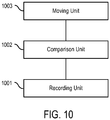
- FIG. 10 shows a block diagram of an apparatus for adjusting positions of web page labels according to some embodiments of the disclosure.
- the apparatus includes the following units.
- a recording unit 1001 configured to do the following: after the arrangement unit is triggered, record cases where the plurality of web page labels are used as clicked labels, a web page label corresponding to a web page presented by the browser being the clicked label.
- a comparison unit 1002 configured to determine that a behavior similarity degree between a first web page label and a second web page label meets a preset similarity degree if a switch number of the web page labels used as the clicked labels switching continuously between a first web page label and a second web page label meets a preset number of times.
- a moving unit 1003, configured to arrange the first web page label and the second web page label adjacently in the tab bar by moving the web page labels.
- clustering unit 803 is specifically configured to select at least one target title from the plurality of titles, clustering the web page labels corresponding to the plurality of titles according to semantic distances between non-target titles and the target title in the plurality of titles.
- the moving unit 1003 is specifically configured to move the second web page label to an adjacent position of the first web page label in the tab bar if a semantic similarity degree between the first web page label and a central label of a label group where the first web page label locates is greater than a semantic similarity degree between the second web page label and a central label of a label group where the second web page label locates, the central label being a web page label corresponding to the target title in the label group, and the semantic similarity degree being obtained by calculation based on the semantic distance.
- the foregoing program may be stored in a computer-readable storage medium, and when executed, the program may perform the steps of the method embodiments above.
- the foregoing storage medium may be at least one of the following media: a read-only memory (ROM), a RAM, a magnetic disk, an optical disc, and other media that can store program code.
Landscapes
- Engineering & Computer Science (AREA)
- Theoretical Computer Science (AREA)
- General Engineering & Computer Science (AREA)
- Physics & Mathematics (AREA)
- Databases & Information Systems (AREA)
- Data Mining & Analysis (AREA)
- General Physics & Mathematics (AREA)
- Artificial Intelligence (AREA)
- Remote Sensing (AREA)
- Radar, Positioning & Navigation (AREA)
- Bioinformatics & Cheminformatics (AREA)
- Evolutionary Computation (AREA)
- Evolutionary Biology (AREA)
- Computer Vision & Pattern Recognition (AREA)
- Bioinformatics & Computational Biology (AREA)
- Life Sciences & Earth Sciences (AREA)
- Human Computer Interaction (AREA)
- Health & Medical Sciences (AREA)
- Audiology, Speech & Language Pathology (AREA)
- Computational Linguistics (AREA)
- General Health & Medical Sciences (AREA)
- Probability & Statistics with Applications (AREA)
- Information Retrieval, Db Structures And Fs Structures Therefor (AREA)
- Information Transfer Between Computers (AREA)
- User Interface Of Digital Computer (AREA)
Abstract
Description
- The application claims priority to Chinese Patent Application No.
201510742568.5, filed on November 4, 2015 PCT/CN16/103326 filed on Oct. 26, 2016 , and entitled "METHOD AND DEVICE FOR DIVIDING WEB PAGE TABS INTO GROUPS," both of which are incorporated herein by reference in its entirety. - The disclosed embodiments relate to the field of data processing, and in particular, to a method and an apparatus for grouping web page labels displayed in a web browser.
- When a browser is used for browsing web pages, opened web pages will be arranged one after another in a tab bar of the browser in the format of web page labels. More web page labels will be arranged in the tab bar when more web pages are opened. Web page labels are arranged in the tab bar according to the sequence of time when the web page labels are generated. A web page label of a newly opened web page is arranged after a web page label of the currently presented web page.
- When a user uses a browser to open many web pages, the web page labels in a tab bar of the browser are not ordered in any specific way. If intending to find a web page opened previously, the user needs to spend a certain period looking through a large number of web page labels in the tab bar to find the web page label corresponding to a previously opened web page, resulting in poor user experience.
- A conventional solution involves grouping web page labels. A user can establish one or more groups in advance and distinguish one group from others by naming the groups, such as "work" and "shopping." Several specific Uniform Resource Locators (URLs) are set as one group. When a web page label is generated, a URL of the web page label is extracted and matched with the specific URLs set for the group. If the matching succeeds, the web page label is automatically added into the group matching successfully. For example, if a specific URL set for the group "shopping" is "www.taobao.com," then a web page label in the tab bar will be added into the group "shopping" if a URL of the web page label includes "www.taobao.com." After grouping, the tab bar of the browser would only have the group labels and any web page labels that have not been added to groups.
- The conventional web page grouping manner has the following problem: after grouping, if a user needs to open a web page corresponding to a web page label that has been categorized into a group, the user first needs to identify in which group the web page label may be located. The user then needs to click at least twice to select the web page label after confirming the group. The first click comprises clicking a group label in which the web page label is located, obtaining a presentation interface displaying web page labels in the group. The second click comprises clicking the required web page label on the presentation interface. The multiple-click process is too complicated and leads to poor user experience.
- To solve the above technical problem, the disclosed embodiments provide a method and an apparatus for grouping web page labels, such that web page labels belonging to the same label group are arranged successively together in a tab bar. A user can then select a needed web page label with a single click, thus improving user experience.
- Disclosed in embodiments are the following technical solutions.
- A method for grouping web page labels, comprising: extracting titles of a plurality of web page labels in a tab bar of a browser; calculating semantic distances between the extracted plurality of titles; clustering web page labels corresponding to the plurality of titles based on the semantic distances between the plurality of titles; obtaining at least one label group based on the clustering, the one label group comprising at least one web page label; and sequentially arranging the at least one label group in the tab bar, wherein web page labels belonging to the same label group are successively arranged in the tab bar.
- In one embodiment, the clustering the web page labels corresponding to the plurality of titles based on the semantic distances between the plurality of titles comprises: selecting at least one target title from the plurality of titles and clustering the web page labels corresponding to the plurality of titles according to semantic distances between non-target titles and the target titles in the plurality of titles, the quantity of the at least one label group obtained through the clustering being the same as the quantity of the at least one target title, wherein a label group is obtained according to a target title through the clustering.
- In one embodiment, the calculating semantic distances between the extracted plurality of titles comprises: segmenting the plurality of titles, wherein a segmented word set is obtained by segmenting a title; calculating semantic sub-distances among segmented words in a plurality of obtained segmented word sets; and obtaining the semantic distances between the plurality of titles according to the semantic sub-distances.
- In one embodiment, after the sequentially arranging the at least one label group in the tab bar, the method further comprises: if a new web page label appears in the tab bar, extracting a title of the new web page label; determining whether a semantic distance between the title of the new web page label and a title in the at least one label group meets a preset threshold; if a semantic distance between the title of the new web page label and a title in only one label group meets the preset threshold, adding the new web page label into the label group, and successively arranging the new web page label and web page labels of the label group in the tab bar; and if semantic distances between the title of the new web page label and titles in a plurality of label groups meet the preset threshold, adding the new web page label into the minimum label group, and successively arranging the new web page label and web page labels of the minimum label group in the tab bar; the minimum label group being a label group between the plurality of label groups having the shortest semantic distance between the title of this label group and the title of the new web page label.
- In one embodiment, if the selecting is done by selecting at least one target title from the plurality of titles, clustering the web page labels corresponding to the plurality of titles according to semantic distances between non-target titles and the target title in the plurality of titles, the semantic distance between the title of the new web page label and the title in the at least one label group comprising: a semantic distance between the title of the new web page label and the target title of the at least one label group.
- In one embodiment, after the sequentially arranging the at least one label group in the tab bar, the method further comprises: recording cases where the plurality of web page labels are used as clicked labels, a web page label corresponding to a web page presented by the browser being the clicked label; determining that a behavior similarity degree between a first web page label and a second web page label meets a preset similarity degree if a switch number of the web page labels used as the clicked labels switching continuously between a first web page label and a second web page label meets a preset number of times; and arranging the first web page label and the second web page label adjacently in the tab bar by moving the web page labels.
- In one embodiment, if the selecting is done by selecting at least one target title from the plurality of titles, clustering the web page labels corresponding to the plurality of titles according to semantic distances between non-target titles and the target title in the plurality of titles; the arranging the first web page label and the second web page label adjacently in the tab bar by moving the web page labels comprises: moving the second web page label to an adjacent position of the first web page label in the tab bar if a semantic similarity degree between the first web page label and a central label of a label group where the first web page label locates is greater than a semantic similarity degree between the second web page label and a central label of a label group where the second web page label locates, the central label being a web page label corresponding to the target title in the label group, and the semantic similarity degree is obtained by calculation based on the semantic distance.
- An apparatus for grouping web page labels, comprising: an extraction unit, configured to extract titles of a plurality of web page labels in a tab bar of a browser; a calculation unit, configured to calculate semantic distances between the extracted plurality of titles; a clustering unit, configured to cluster web page labels corresponding to the plurality of titles based on the semantic distances between the plurality of titles; a grouping unit, configured to obtain at least one label group based on the clustering, the one label group comprising at least one web page label; and an arrangement unit, configured to sequentially arrange the at least one label group in the tab bar, wherein web page labels belonging to the same label group are successively arranged in the tab bar.
- In one embodiment, the clustering unit is specifically configured to select at least one target title from the plurality of titles and cluster the web page labels corresponding to the plurality of titles according to semantic distances between non-target titles and the target titles in the plurality of titles; the quantity of the at least one label group obtained through the clustering being the same as the quantity of the at least one target title, wherein a label group is obtained according to a target title through the clustering.
- In one embodiment, the calculation unit is specifically configured to segment the plurality of titles, wherein a segmented word set is obtained by segmenting a title; calculate semantic sub-distances among segmented words in a plurality of obtained segmented word sets; and obtain the semantic distances between the plurality of titles according to the semantic sub-distances.
- In one embodiment, the apparatus further comprises: the extraction unit is further configured to do the following: after the arrangement unit is triggered and if a new web page label appears in the tab bar, extract a title of the new web page label; a determining unit, configured to determine whether a semantic distance between the title of the new web page label and a title in the at least one label group meets a preset threshold; trigger a first adding unit if the determination result of the determining unit is that a semantic distance between the title of the new web page label and a title in only one label group meets the preset threshold; and trigger a second adding unit if the determination result of the determining unit is that semantic distances between the title of the new web page label and titles in a plurality of label groups meet the preset threshold; the first adding unit configured to add the new web page label into the label group, and successively arranging the new web page label and web page labels of the label group in the tab bar; and the second adding unit configured to add the new web page label into the minimum label group, and successively arranging the new web page label and web page labels of the minimum label group in the tab bar; the minimum label group being a label group between the plurality of label groups having the shortest semantic distance between the title of this label group and the title of the new web page label.
- In one embodiment, if the clustering unit is specifically configured to select at least one target title from the plurality of titles, clustering the web page labels corresponding to the plurality of titles according to semantic distances between non-target titles and the target title in the plurality of titles; the determining unit is specifically configured to determine a semantic distance between the title of the new web page label and a target title of the at least one label group.
- In one embodiment, the apparatus further comprises: a recording unit, configured to do the following: after the arrangement unit is triggered, record cases where the plurality of web page labels are used as clicked labels, a web page label corresponding to a web page presented by the browser being the clicked label; a comparison unit, configured to determine that a behavior similarity degree between a first web page label and a second web page label meets a preset similarity degree if a switch number of the web page labels used as the clicked labels switching continuously between a first web page label and a second web page label meets a preset number of times; and a moving unit, configured to arrange the first web page label and the second web page label adjacently in the tab bar by moving the web page labels.
- In one embodiment, if the clustering unit is specifically configured to select at least one target title from the plurality of titles, clustering the web page labels corresponding to the plurality of titles according to semantic distances between non-target titles and the target title in the plurality of titles; the moving unit is specifically configured to move the second web page label to an adjacent position of the first web page label in the tab bar if a semantic similarity degree between the first web page label and a central label of a label group where the first web page label locates is greater than a semantic similarity degree between the second web page label and a central label of a label group where the second web page label locates, the central label being a web page label corresponding to the target title in the label group, and the semantic similarity degree being obtained by calculation based on the semantic distance.
- As can be seen from the above technical solutions, titles of a plurality of web page labels in a tab bar of a browser are extracted, and semantic distances between the plurality of extracted titles are calculated. The web page labels corresponding to the plurality of titles are clustered based on the semantic distances between the plurality of titles, and sets obtained based on the clustering are used as label groups after grouping. The grouping based on the semantic distances between the titles of the web page labels can be automatically implemented by the browser or a system, thus avoiding a complicated operation of manually setting URLs for groups in advance in the conventional grouping manner; the method further expands the applicable range of the grouping manner. The at least one label group is arranged sequentially in the tab bar, wherein web page labels belonging to the same label group are successively arranged in the tab bar. As such, the web page labels are still presented to a user in the format of web page labels in the tab bar; and the user only needs to click once to select the needed web page label. Moreover, web page labels belonging to the same label group are successively arranged together in the tab bar, such that the web page labels in the tab bar are arranged and ordered; and a user can find a needed web page label quickly through the tab bar, thus improving user experience.
- To illustrate the technical solutions in the disclosed embodiments or the prior art more clearly, the drawings which need to be used in the description of the embodiments or the prior art will be introduced briefly below. The drawings described below are merely some embodiments of the disclosure, and those of ordinary skill in the art can also obtain other drawings according to these drawings without making creative efforts.
-
FIG. 1 is a flow diagram illustrating a method for grouping web page labels according to some embodiments of the disclosure. -
FIG. 2 is a user interface diagram of a tab bar of a browser according to some embodiments of the disclosure. -
FIG. 3 is a flow diagram illustrating a method for calculating semantic distances among titles according to some embodiments of the disclosure. -
FIG. 4 is a user interface diagram of an arrangement of web page labels in a tab bar after a grouping of the web page labels according to some embodiments of the disclosure. -
FIG. 5 is a flow diagram illustrating a method for categorizing web page labels according to some embodiments of the disclosure. -
FIG. 6 is a flow diagram illustrating a method for adjusting positions of web page labels according to some embodiments of the disclosure. -
FIG. 7 is a user interface diagram of an arrangement of web page labels in a tab bar after moving of the web page labels according to some embodiments of the disclosure. -
FIG. 8 is a block diagram of an apparatus for grouping web page labels according to some embodiments of the disclosure. -
FIG. 9 is a block diagram of an apparatus for categorizing web page labels according to some embodiments of the disclosure. -
FIG. 10 is a block diagram of an apparatus for adjusting positions of web page labels according to some embodiments of the disclosure. - To make the purposes, technical solutions, and advantages of the embodiments of the disclosure clearer, the technical solutions in the embodiments of the disclosure will be described below with reference to the drawings. The described embodiments are part of the embodiments of the disclosure, rather than all the embodiments. Based on the disclosed embodiments, all other embodiments obtained by those of ordinary skill in the art without making creative efforts shall fall within the protection scope of the disclosure.
- When a browser is used for browsing web pages, the opened web pages will be arranged one after another in a tab bar of the browser in the format of web page labels. When a user uses a browser to open many web pages, the web page labels in a tab bar of the browser are not ordered in any specific way. If intending to find a web page opened previously, the user needs to spend a certain period looking through a large number of web page labels in the tab bar to find the web page label corresponding to the web page opened previously, resulting in poor user experience. The conventional solution involves grouping web page labels. A user can set several specific URLs. When a web page label is generated, a URL of the web page label is extracted and then matched with the specific URLs set for groups to perform grouping. After grouping, the tab bar of the browser would only have the group labels and web page labels that have not been added to the groups.
- The above, conventional web page grouping technique has the following problem. After grouping, if a user needs to open a web page corresponding to a web page label that has been categorized into a group, the user needs to click at least twice to select the web page label. This multiple-click process is overly complicated and results in poor user experience.
- Also, the conventional grouping technique of comparing URLs has a low grouping accuracy. For example, URLs of some web pages without shopping interfaces may also include "www.taobao.com," but they are still mistakenly categorized into a "shopping" group by the grouping mechanism. As such, when the user needs to view the web page subsequently, it is possible that the user cannot find the web page after searching for a long time because the web page label of the web page was categorized into the wrong group. This mis-grouping prolongs the time it takes for the user to find the web page label and frustrates the original intention of grouping the web page labels resulting in negative effects.
- Therefore, the embodiments of the disclosure provide a method and an apparatus for grouping web page labels. Titles of a plurality of web page labels in a tab bar of a browser are extracted, and semantic distances between the plurality of extracted titles are calculated. The web page labels corresponding to the plurality of titles are clustered based on the semantic distances between the plurality of titles, and sets obtained based on the clustering are used as label groups after grouping. The grouping based on the semantic distances between the titles of the web page labels can be automatically implemented by the browser or a system, thus avoiding a complicated operation of manually setting URLs for groups in advance in the conventional grouping manner. The method also expands the applicable range of the grouping process. The at least one label group is arranged sequentially in the tab bar, where web page labels belonging to the same label group are successively arranged in the tab bar. As such, the web page labels are still presented to a user in the format of web page labels in the tab bar and the user only needs to click once to select the needed web page label. Moreover, web page labels belonging to the same label group are successively arranged together in the tab bar, such that the web page labels in the tab bar are arranged and ordered. Thus, a user can find a needed web page label quickly through the tab bar which improves the user experience.
- Moreover, similar web page labels can be categorized into one label group more accurately by comparing semantic distances between the titles of the web page labels. This improves the accuracy of the web page label grouping and effectively reduces the number of situations where a user spends longer time searching for a web page label after web page labels are grouped.
- After the web page labels are grouped, if a new web page label appears in the tab bar of the browser, a title of the new web page label is extracted. A semantic distance between the title of the new web page label and a title of a web page label in the at least one label group is calculated. It is then determined according to the semantic distance whether a matching label group in the at least one label group exists and to which the new web page label can be added. The new web page label is added into the matching label group after the matching label group is determined. The new web page label and web page labels of the label group into which the new web page label is added are arranged successively in the tab bar. As such, after the web page labels are grouped, even when a new web page label appears in the tab bar, the new web page label can also be arranged together with similar web page labels. This ensures an ordered arrangement of the web page labels in the tab bar.
- Further, for a user's habit of using a browser for browsing web pages, a user continuously switching between two web pages to compare the prices during shopping is used as an example. In this example browsing process, the user needs to move the cursor a longer distance in the process of switching if web page labels of the two web pages are distantly arranged in the tab bar. In one embodiment, cases in which the web page labels in the tab bar are used as clicked labels are recorded. If the situation where the web page labels used as the clicked labels continuously switch between two web page labels occurs, positions of the two web page labels in the tab bar are adjusted to be adjacently arranged. This reduces the cursor moving distance in the process of switching between the two web page labels by the user, and improves user experience.
- It should be noted that the condition for triggering web page label grouping may be the quantity of web page labels in a tab bar of a browser, or it could be a request sent actively to request for web page label grouping.
- A browser, a third-party tool, or an operating system may execute the web page label grouping operation. This is not limited in the disclosed embodiments.
-
FIG. 1 is a flow diagram illustrating a method for grouping web page labels according to some embodiments of the disclosure. The method includes the following steps. - S101: Extract titles of a plurality of web page labels in a tab bar of a browser.
- For example, a web page label has a corresponding title. The quantity of titles extracted from the plurality of web page labels is the same as the quantity of the plurality of web page labels. The plurality of web page labels may refer to two or more web page labels. A need to group web page labels arises when a plurality of web page labels exist in the tab bar.
- An example of web page labels in the tab bar of the browser is shown in
FIG. 2. FIG. 2 is a user interface diagram of a tab bar of a browser according to some embodiments of the disclosure. There are five web page labels arranged in the tab bar of the browser inFIG. 2 . Text parts displayed on the web page labels can be understood as titles of the web page labels. For example, a title of the rightmost web page label in the tab bar ofFIG. 2 is "Taobao-Tao! I like it." - S102: Calculate semantic distances between the extracted plurality of titles.
- For example, the semantic distance is a parameter representing a semantic similarity degree. A shorter semantic distance between two titles indicates closer or more similar semantic meanings of the two titles.
- Optionally, for the calculating semantic distances between the extracted plurality of titles, one embodiment provides a manner for calculation among titles.
-
FIG. 3 is a flow diagram illustrating a method for calculating semantic distances between titles according to some embodiments of the disclosure. The method includes the following steps. - S301: Segment the plurality of titles, wherein a segmented word set is obtained by segmenting a title.
- For example, the segmenting is dividing a content of a title in terms of words. For example, segmented word sets obtained by segmenting the title "Taobao-Tao! I like it" may include: "Taobao," "Tao," "I," "like," and "it."
- Optionally, A Chinese title may be segmented by using a segmenting tool such as IKANALYZER, PANGUSEGMENT, and PAODING, to decompose a title into a plurality of meaningful terms. If a title includes English, segmenting may be performed directly according to spaces in the English.
- S302: Calculate semantic sub-distances among segmented words in a plurality of obtained segmented word sets.
- For example, before the semantic sub-distances are calculated, stopwords in the segmented word sets may further be removed to improve the accuracy and calculation efficiency. The stopword refers to a word that repeatedly appears in a corpus but is a semantically light-weighted word. For example, in the segmented word sets obtained in S301, "I" is a common stopword and can be removed from the segmented word sets before semantic sub-distances are calculated. For example, common stopwords further include "in," "of," and the like.
- How to calculate semantic distances or semantic sub-distances is not limited in the disclosure. An existing semantic distance calculation manner such as a WORD2VEC tool can be used.
- How to calculate semantic sub-distances is illustrated by using the following example. Assuming that a segmented word set A includes "machine learning" and "Mathematics," and a segmented word set B includes "machine learning" and "algorithm." A semantic sub-distance between "machine learning" in the segmented word set A and "machine learning" in the segmented word set B is 0; and a semantic sub-distance between "Mathematics" in the segmented word set A and "algorithm" in the segmented word set B is 0.34.
- S303: Obtain the semantic distances between the plurality of titles according to the semantic sub-distances.
- The semantic distances between the titles can be calculated according to the plurality of semantic sub-distances obtained from S302 in various ways. To avoid the situation where an excessively large semantic distance exists due to too many lexical items of segmented words, one embodiment provides an optional manner for obtaining semantic distances between titles. That is, an average value of semantic sub-distances is calculated; and the average value obtained by the calculation is used as a semantic distance between titles. For example, a semantic distance between the segmented word set A and the segmented word set B can be an average value 0.17 of the two semantic sub-distances 0 and 0.34 obtained above.
- S103: Cluster web page labels corresponding to the plurality of titles based on the semantic distances between the plurality of titles.
- S104: Generate at least one label group based on the clustering, the one label group comprising at least one web page label.
- For example, the disclosed embodiments are not limited to the clustering manner for performing clustering based on semantic distances. For example, optionally, the web page labels can be clustered by using a k-medoids algorithm. Or, an optional method is that the clustering can be performed by using an agglomerative hierarchical clustering manner.
- If clustering is performed by using a manner that needs a convergence target, optionally, one embodiment provides a clustering manner in which during clustering, a convergence target is the target title or can be considered as the web page label corresponding to the target title. The quantity of label groups that need to be obtained by clustering is the same as the quantity of target titles that need to be selected to serve as convergence targets during clustering. The target title does not need to be selected manually by the user, and can be automatically selected through the logic of an algorithm.
- In one embodiment, the clustering the web page labels corresponding to the plurality of titles based on the semantic distances between the plurality of titles comprises selecting at least one target title from the plurality of titles and clustering the web page labels corresponding to the plurality of titles according to semantic distances between non-target titles and the target titles in the plurality of titles. In one embodiment, the quantity of the at least one label group obtained through the clustering is the same as the quantity of the at least one target title, wherein a label group is obtained according to a target title through the clustering.
- The quantity of target titles selected from the plurality of web page labels can be preset. For example, when the quantity of web page labels in the tab bar reaches N, n target titles are selected. Then, n label groups can be obtained after the clustering. When the quantity of web page labels in the tab bar reaches M, m target titles are selected, and m label groups can be obtained after the clustering. For a target title, if a semantic distance between a title A and the target title is less than a fixed value during clustering, a web page label corresponding to the title A and a web page label corresponding to the target title can be clustered into one category. One label group obtained based on the clustering includes at least one web page label. If only one web page label is included, the web page label is a web page label corresponding to the target title.
- It should be noted that it can be considered that improvement on the conventional manner for grouping web page labels has been implemented based on the processing from S101 to S104. The grouping based on the semantic distances between the titles of the web page labels can be automatically implemented by the browser or a system, i.e., automatic grouping can be implemented, thus avoiding a complicated operation of manually setting URLs for groups in advance in the conventional grouping manner; the method further expands the applicable range of the grouping manner.
- Next, for at least one label group obtained by the clustering, the disclosed embodiments may further provide an optional manner for presenting a tab bar, which still presents web page labels in a label group in the tab bar as individual web page labels. Therefore, the user only needs to click once to select a web page label in the label group.
- S105: Sequentially arrange the at least one label group in the tab bar, the web page labels belonging to the at least one label group successively arranged in the tab bar.
- For example, after the plurality of web page labels are grouped, the web page labels need to be rearranged in the tab bar in the form of "groups." From the perspective of the user, an actual outline of a label group will not be displayed in the tab bar in one embodiment. Rather, web page labels categorized into the label groups are still arranged sequentially as individual web page labels. No identifier will exist between label groups to serve as a boundary. That is, the existence of the label group is actually invisible to a user of the tab bar after the web page labels are grouped, causing no troubles to operations of the user. However, arrangement of web page labels is an ordered arrangement according to the grouping result, and similar web page labels are arranged together to save time for the user to search for a web page label.
-
FIG. 4 is a user interface diagram of an arrangement of web page labels in a tab bar after a grouping of the web page labels according to some embodiments of the disclosure. It should be noted that boxes enclosing the web page labels inFIG. 4 are merely used for clearly identifying the existence of the label groups graphically; and no boxes as those inFIG. 4 will exist in the process of actual presentation. As shown inFIG. 4 , by grouping the web page labels, the original five web page labels inFIG. 2 are grouped into three label groups, namely, alabel group 1, alabel group 2, and alabel group 3. As can be seen, the web page labels categorized into the same label group are rearranged together in the tab bar, for example, web page labels "Tmall..." and "Taobao..." at the leftmost ofFIG. 4 . - Sequentially arranging the label groups can be understood as that when there is a plurality of label groups, web page labels of one label group are arranged in the tab bar first; web page labels of another label group are arranged next, and so on. The label group arranged first and the label groups arranged later are not limited in the disclosed embodiments. However, it is generally preferred to arrange web page labels in a label group at eye-catching positions in the tab bar. For example, a manner for arranging web page labels in a horizontal tab bar is generally from left to right; and a manner for arranging web page labels in a vertical tab bar is generally from top to bottom. The arrangement order can be set according to personal preferences. After web page labels of the label groups are arranged, if there are web page labels that are not categorized into any label group, these web page labels are arranged successively according to an arrangement order.
- The successive arrangement of web page labels belonging to the same label group can be understood as that the web page labels of the same label group will be arranged together successively. A web page label categorized into a label group or not categorized into any label group will not be arranged between two web page labels in another label group. The arrangement order between the web page labels in a label group is not limited in the disclosed embodiments.
- No identifier is used as a boundary between adjacent positions of web page labels in different label groups. For example, in
FIG. 4 , there is no difference between the adjacent web page labels "Taobao..." and "Numerals in machine learning..." belonging to thelabel group 1 and thelabel group 2 and the adjacent web page labels "Tmall..." and "Taobao..." which belong to the same label group. Although invisible to a user, the above technical effect of orderly arranged web page labels according to the grouping result, and arranging similar web page labels together is achieved. - As can be seen from this embodiment, titles of a plurality of web page labels in a tab bar of a browser are extracted, and semantic distances between the plurality of extracted titles are calculated. The web page labels corresponding to the plurality of titles are clustered based on the semantic distances between the plurality of titles, and sets obtained based on the clustering are used as label groups after grouping. The grouping based on the semantic distances between the titles of the web page labels can be automatically implemented by the browser or a system, thus avoiding a complicated operation of manually setting URLs for groups in advance in the conventional grouping manner; the method further expands the applicable range of the grouping manner. The at least one label group is arranged sequentially in the tab bar, wherein web page labels belonging to the same label group are successively arranged in the tab bar. As such, the web page labels are still presented to a user in the format of web page labels in the tab bar; and the user only needs to click once to select the needed web page label. Moreover, web page labels belonging to the same label group are successively arranged together in the tab bar, such that the web page labels in the tab bar are arranged and ordered; and a user can find a needed web page label quickly through the tab bar, thus improving user experience.
- After a plurality of web page labels in a tab bar are grouped, a new web page label may further appear in the tab bar of a browser as the user continues using the browser. If the new web page label is not processed, the new web page label will be directly placed to the very end of the tab bar, thus damaging the original ordered arrangement state of the tab bar to some extent. For a web page label newly appearing after the grouping, one embodiment provides a manner for categorizing web page labels. On the basis of the embodiments corresponding to
FIG. 1 , after at least one label group is arranged sequentially in the tab bar,FIG. 5 shows a flow diagram illustrating a method for categorizing web page labels according to some embodiments of the disclosure. - S501: If a new web page label appears in the tab bar, extracting a title of the new web page label.
- S502: Determine whether a semantic distance between the title of the new web page label and a title in the at least one label group meets a preset threshold. If a semantic distance between the title of the new web page label and a title in only one label group meets the preset threshold, S503 is performed. If semantic distances between the title of the new web page label and titles in a plurality of label groups meet the preset threshold, S504 is performed.
- For example, the manner of acquiring a title of the new web page label and the manner of calculating a semantic distance between the titles of the new web page label and the web page label in the label group can be obtained by referring to the descriptions in the embodiments corresponding to
FIG. 1 . Details will not be repeated herein again. - In S502, for a label group, a semantic distance between the title of the new web page label and a title of any web page label in a label group can be calculated to serve as a determination reference in S502. However, to improve the determination accuracy, optionally, if the selecting is done by selecting at least one target title from the plurality of titles, the web page labels corresponding to the plurality of titles are clustered according to semantic distances between non-target titles and the target title in the plurality of titles. The semantic distance between the title of the new web page label and the title in the at least one label group includes a semantic distance between the title of the new web page label and the target title of the at least one label group.
- S503: Add the new web page label into the label group, and successively arrange the new web page label and web page labels of the label group in the tab bar.
- The arrangement order of the new web page label and other web page labels in the label group is not limited in the disclosed embodiments. For example, the new web page label can be placed in front of all other web page labels in the label group, or placed at the very end, or placed at a position in the middle.
- S504: Add the new web page label into a minimum label group, and successively arrange the new web page label and web page labels of the minimum label group in the tab bar, the minimum label group being a label group between the plurality of label groups having the shortest semantic distance between the title of this label group and the title of the new web page label.
- For example, if there is a plurality of label groups meeting the preset threshold, the selected minimum label group can be considered as having the shortest semantic distance between a title of a web page label in its own label group and the title of the new web page label. The similarity degree between the web page label in the minimum label group and the new web page label is the highest.
- As can be seen from the above, after the web page labels are grouped, if a new web page label appears in the tab bar of the browser, a title of the new web page label is extracted; a semantic distance between the title of the new web page label and a title of a web page label in the at least one label group is calculated; and it is determined according to the semantic distance whether a matching label group in the at least one label group exists and to which the new web page label can be added. The new web page label is added into the matching label group after the matching label group is determined; and the new web page label and web page labels of the label group into which the new web page label is added are arranged successively in the tab bar. As such, after the web page labels are grouped, even when a new web page label appears in the tab bar, the new web page label can also be arranged together with similar web page labels, thus ensuring an ordered arrangement of the web page labels in the tab bar.
- Further, the user's habit of frequently switching web pages when browsing web pages by using the browser is considered. For example, continuously switching between two web pages is generally needed to compare the prices during shopping. If web page labels of the two continuously switched web pages are arranged farther from each other in the tab bar, the user needs to move the cursor for a long distance to click the web page label in the process of each switching, which inevitably leads to poor user experience.
- Therefore, on the basis of the embodiment corresponding to
FIG. 1 , after at least one label group is arranged in the tab bar sequentially,FIG. 6 shows a flow diagram illustrating a method for adjusting positions of web page labels according to some embodiments of the disclosure. The method includes the following steps. - S601: Record cases where the plurality of web page labels are used as clicked labels, a web page label corresponding to a web page presented by the browser being the clicked label.
- For example, after a web page label in the tab bar is clicked, the web page label has a clicked state in presentation. A web page corresponding to the web page label is presented on a main interface of the browser, and web pages corresponding to remaining web page labels are in a not-presented state. The user can click other web page labels to enable the selected web page label to be used as the clicked label.
- S602: Determine that a behavior similarity degree between a first web page label and a second web page label meets a preset similarity degree if a switch number of the web page labels used as the clicked labels switching continuously between a first web page label and a second web page label meets a preset number of times.
- For example, the continuous switching described in one embodiment can be understood as an operation of continuously clicking two web page labels back and forth. In other words, the continuous switching of the web page label as the clicked label between the first web page label and the second web page label may be considered as that the clicked label changes from the first web page label to the second web page label, then changes from the second web page label back to the first web page label; then changes from the first web page label to the second web page label, and so on as the user clicks back and forth. In one embodiment, the operation in which the clicked label is switched from the first web page label to the second web page label is considered as one switching. That is, the number of switches is incremented by one. The operation in which the clicked label is switched from the second web page label to the first web page label is also considered as one switching; that is, the number of switches is incremented by one. For example, a user uses a browser to browse a web page A having a corresponding web page label being a web page label A. Then the user views a web page B having a corresponding web page label being a web page label B. Then the user switches back to the web page A. The above operations can be recorded as that the switch number of the web page labels used as the clicked label switching continuously between the web page label A and the web page label B is two. After switching to the web page A, if the user starts to browse a web page C having a corresponding web page label being a web page label C, the previous record on the number of switches is removed and the number of switches of the web page labels used as the clicked labels switching continuously between the web page label A and the web page label C is recorded.
- One embodiment provides a manner for conveniently calculating a behavior similarity degree between the first web page label and the second web page label based on the number of continuous switches. The specific calculation can be seen in the following formula:

- The preset number of switches can be set according to conditions of label groups where the first web page label and the second web page label locate. For example, if the first web page label and the second web page label belong to the same label group, the preset number of switches can be set to be relatively small. If the first web page label and the second web page label belong to different label groups, the preset number of switches can be set to be relatively large.
- S603: Arrange the first web page label and the second web page label adjacently in the tab bar by moving the web page labels.
- The specific means to move the position of the web page label in the tab bar is not limited in the disclosed embodiments. For example, it is possible that the first web page label is moved to an adjacent position of the second web page label, or the second web page label is moved to an adjacent position of the first web page label; or the first web page label and the second web page label are moved simultaneously such that the first web page label and the second web page label locate in any adjacent positions in the tab bar. However, the following can be implemented in order to ensure ordered arrangement of web page labels in the tab bar. If the selecting is done by selecting at least one target title from the plurality of titles, the web page labels corresponding to the plurality of titles are clustered according to semantic distances between non-target titles and the target title in the plurality of titles. One embodiment provides a manner of moving web page labels and the arranging the first web page label and the second web page label adjacently in the tab bar by moving the web page labels includes moving the second web page label to an adjacent position of the first web page label in the tab bar if a semantic similarity degree between the first web page label and a central label of a label group where the first web page label locates is greater than a semantic similarity degree between the second web page label and a central label of a label group where the second web page label locates, the central label being a web page label corresponding to the target title in the label group, and the semantic similarity degree being obtained by calculation based on the semantic distance.
- In other words, if the first web page label is more similar to the central label of the label group where the first web page label locates than the second web page label to the central label of the label group where the second web page label locates, the second web page label is moved to an adjacent position of the first web page label. The adjacent position is described by using a horizontal tab bar as an example. Here, the adjacent position may be an adjacent position at left of the first web page label or an adjacent position at right of the web page label. After the second web page label is moved, the second web page label may locate in the tab bar among web page labels in the label group where the first web page label locates.
- Now
FIG. 4 is used as an example. On the basis ofFIG. 4 , assuming that the user continuous switches between the web page labels "algorithm in machine learning..." and "data mining...," which belong to two different label groups, and the number of switches exceeds a preset number of switches, the web page label "data mining..." may be moved to a position adjacent to the web page label "algorithm in machine learning..." The tab bar after the moving may be as that shown inFIG. 7 . - As can be seen from the above that cases in which the web page labels in the tab bar are used as clicked labels are recorded; and if the situation where the web page labels used as the clicked labels continuously switch between two web page labels occurs, positions of the two web page labels in the tab bar are adjusted to be adjacently arranged, thus reducing the cursor moving distance in the process of switching between the two web page labels by the user, and improving user experience.
-
FIG. 8 is a block diagram of an apparatus for grouping web page labels according to some embodiments of the disclosure, the apparatus including the following units. - An
extraction unit 801 configured to extract titles of a plurality of web page labels in a tab bar of a browser. - A
calculation unit 802 configured to calculate semantic distances between the extracted plurality of titles. - Optionally, the calculation unit is specifically configured to segment the plurality of titles, wherein a segmented word set is obtained by segmenting a title; calculate semantic sub-distances among segmented words in a plurality of obtained segmented word sets; and obtain the semantic distances between the plurality of titles according to the semantic sub-distances.
- A
clustering unit 803, configured to cluster web page labels corresponding to the plurality of titles based on the semantic distances between the plurality of titles. - Optionally, the
clustering unit 803 is specifically configured to select at least one target title from the plurality of titles and cluster the web page labels corresponding to the plurality of titles according to semantic distances between non-target titles and the target titles in the plurality of titles; the quantity of the at least one label group obtained through the clustering being the same as the quantity of the at least one target title, wherein a label group is obtained according to a target title through the clustering. - A
grouping unit 804, configured to obtain at least one label group based on the clustering, the one label group comprising at least one web page label. - An
arrangement unit 805, configured to sequentially arrange the at least one label group in the tab bar, wherein web page labels belonging to the same label group are successively arranged in the tab bar. - As can be seen from this embodiment, titles of a plurality of web page labels in a tab bar of a browser are extracted, and semantic distances between the plurality of extracted titles are calculated. The web page labels corresponding to the plurality of titles are clustered based on the semantic distances between the plurality of titles, and sets obtained based on the clustering are used as label groups after grouping. The grouping based on the semantic distances between the titles of the web page labels can be automatically implemented by the browser or a system, thus avoiding a complicated operation of manually setting URLs for groups in advance in the conventional grouping manner; the method further expands the applicable range of the grouping manner. The at least one label group is arranged sequentially in the tab bar, wherein web page labels belonging to the same label group are successively arranged in the tab bar. As such, the web page labels are still presented to a user in the format of web page labels in the tab bar; and the user only needs to click once to select the needed web page label. Moreover, web page labels belonging to the same label group are successively arranged together in the tab bar, such that the web page labels in the tab bar are arranged and ordered; and a user can find a needed web page label quickly through the tab bar, thus improving user experience.
- After a plurality of web page labels in a tab bar are grouped, a new web page label may further appear in the tab bar of a browser as the user continues using the browser. If the new web page label is not processed, the new web page label will be directly placed to the very end of the tab bar, thus damaging the original ordered arrangement state of the tab bar to some extent. For the web page label newly appearing after the grouping, one embodiment provides an apparatus for categorizing web page labels. On the basis of the embodiment corresponding to
FIG. 8 , after the arrangement unit is triggered to sequentially arrange at least one label group in the tab bar,FIG. 9 shows a block diagram of an apparatus for categorizing web page labels according to some embodiments of the disclosure. - An
extraction unit 901 is configured to, if a new web page label appears in the tab bar, extract a title of the new web page label. - A determining
unit 902 is configured to determine whether a semantic distance between the title of the new web page label and a title in the at least one label group meets a preset threshold; trigger a first addingunit 903 if the determination result of the determining unit is that a semantic distance between the title of the new web page label and a title in only one label group meets the preset threshold; and trigger a second addingunit 904 if the determination result of the determining unit is that semantic distances between the title of the new web page label and titles in a plurality of label groups meet the preset threshold. - Optionally, if the
clustering unit 803 is specifically configured to select at least one target title from the plurality of titles, clustering the web page labels corresponding to the plurality of titles according to semantic distances between non-target titles and the target title in the plurality of titles. - The determining
unit 902 is specifically configured to determine a semantic distance between the title of the new web page label and a target title of the at least one label group. - The first adding
unit 903 is configured to add the new web page label into the label group, and successively arranging the new web page label and web page labels of the label group in the tab bar. - The second adding
unit 904 is configured to add the new web page label into the minimum label group, and successively arranging the new web page label and web page labels of the minimum label group in the tab bar; the minimum label group being a label group between the plurality of label groups having the shortest semantic distance between the title of this label group and the title of the new web page label. - As can be seen from the above, after the web page labels are grouped, if a new web page label appears in the tab bar of the browser, a title of the new web page label is extracted; a semantic distance between the title of the new web page label and a title of a web page label in the at least one label group is calculated; and it is determined according to the semantic distance whether a matching label group in the at least one label group exists and to which the new web page label can be added. The new web page label is added into the matching label group after the matching label group is determined; and the new web page label and web page labels of the label group into which the new web page label is added are arranged successively in the tab bar. As such, after the web page labels are grouped, even when a new web page label appears in the tab bar, the new web page label can also be arranged together with similar web page labels, thus ensuring an ordered arrangement of the web page labels in the tab bar.
- Further, the user's habit of frequently switching web pages when browsing web pages by using the browser is considered. For example, continuously switching between two web pages is generally needed to compare the prices during shopping; and if web page labels of the two continuously switched web pages are arranged farther from each other in the tab bar, the user needs to move the cursor for a long distance to click the web page label in the process of each switching, which inevitably leads to poor user experience.
- Therefore, on the basis of the embodiment corresponding to
FIG. 8 , after at least one label group is arranged sequentially in the tab bar,FIG. 10 shows a block diagram of an apparatus for adjusting positions of web page labels according to some embodiments of the disclosure. The apparatus includes the following units. - A
recording unit 1001, configured to do the following: after the arrangement unit is triggered, record cases where the plurality of web page labels are used as clicked labels, a web page label corresponding to a web page presented by the browser being the clicked label. - A
comparison unit 1002, configured to determine that a behavior similarity degree between a first web page label and a second web page label meets a preset similarity degree if a switch number of the web page labels used as the clicked labels switching continuously between a first web page label and a second web page label meets a preset number of times. - A moving
unit 1003, configured to arrange the first web page label and the second web page label adjacently in the tab bar by moving the web page labels. - Optionally, if the
clustering unit 803 is specifically configured to select at least one target title from the plurality of titles, clustering the web page labels corresponding to the plurality of titles according to semantic distances between non-target titles and the target title in the plurality of titles. - The moving
unit 1003 is specifically configured to move the second web page label to an adjacent position of the first web page label in the tab bar if a semantic similarity degree between the first web page label and a central label of a label group where the first web page label locates is greater than a semantic similarity degree between the second web page label and a central label of a label group where the second web page label locates, the central label being a web page label corresponding to the target title in the label group, and the semantic similarity degree being obtained by calculation based on the semantic distance. - As can be seen from the above that cases in which the web page labels in the tab bar are used as clicked labels are recorded; and if the situation where the web page labels used as the clicked labels continuously switch between two web page labels occurs, positions of the two web page labels in the tab bar are adjusted to be adjacently arranged, thus reducing the cursor moving distance in the process of switching between the two web page labels by the user, and improving user experience.
- Those of ordinary skill in the art may understand that all or part of the steps for implementing the method embodiments above may be completed by a program instructing relevant hardware. The foregoing program may be stored in a computer-readable storage medium, and when executed, the program may perform the steps of the method embodiments above. The foregoing storage medium may be at least one of the following media: a read-only memory (ROM), a RAM, a magnetic disk, an optical disc, and other media that can store program code.
- It should be noted that the embodiments in this specification are described in a progressive manner, and for the same or similar parts in the embodiments, reference may be made to each other, and each embodiment focuses on differences from other embodiments. In particular, for the device and system embodiments, because they are basically similar to the method embodiments, the description is relatively simple, and for relevant parts, reference may be made to the descriptions in the method embodiment section. The apparatus and system embodiments described above are merely exemplary. The units described as separate parts may or may not be physically separate, and the components shown as units may or may not be physical units, that is, the components may be located in one place or may be distributed onto a plurality of network units. The objectives of the solutions of the embodiments can be achieved by selecting parts or all of the modules according to actual requirements. Those of ordinary skill in the art can understand and implement them without creative efforts.
- The above descriptions are merely preferred specific implementations of the disclosed embodiments, but the scope of the disclosed embodiments is not limited thereto. Changes or replacements that any person skilled in the art can easily conceive of within the technical scope disclosed by the disclosed embodiments should be covered by the scope of the disclosed embodiments. Therefore, the scope of the disclosed embodiments invention should be subject to the scope of the claims.
Claims (14)
- A method for grouping web page labels, comprising:extracting titles of a plurality of web page labels in a tab bar of a browser;calculating semantic distances between the extracted plurality of titles;clustering web page labels corresponding to the plurality of titles based on the semantic distances between the plurality of titles;obtaining at least one label group based on the clustering, the one label group comprising at least one web page label; andsequentially arranging the at least one label group in the tab bar, the web page labels belonging to the same label group being successively arranged in the tab bar.
- The method according to claim 1, wherein the clustering web page labels corresponding to the plurality of titles based on the semantic distances between the plurality of titles comprises:
selecting at least one target title from the plurality of titles and clustering the web page labels corresponding to the plurality of titles according to semantic distances between non-target titles and the target titles in the plurality of titles, the quantity of the at least one label group obtained through the clustering being the same as the quantity of the at least one target title, a label group obtained according to a target title through the clustering. - The method according to claim 1, wherein the calculating semantic distances between the extracted plurality of titles comprises:segmenting the plurality of titles, wherein a segmented word set is obtained by segmenting a title;calculating semantic sub-distances among segmented words in a plurality of obtained segmented word sets; andobtaining the semantic distances between the plurality of titles according to the semantic sub-distances.
- The method according to any of claims 1 to 3, wherein after the sequentially arranging the at least one label group in the tab bar, the method further comprises:if a new web page label appears in the tab bar, extracting a title of the new web page label;determining whether a semantic distance between the title of the new web page label and a title in the at least one label group meets a preset threshold,if a semantic distance between the title of the new web page label and a title in only one label group meets the preset threshold, adding the new web page label into the label group, and successively arranging the new web page label and web page labels of the label group in the tab bar; andif semantic distances between the title of the new web page label and titles in a plurality of label groups meet the preset threshold, adding the new web page label into a minimum label group, and successively arranging the new web page label and web page labels of the minimum label group in the tab bar, the minimum label group being a label group among the plurality of label groups having the shortest semantic distance between the title of this label group and the title of the new web page label.
- The method according to claim 4, wherein if the selecting is done by selecting at least one target title from the plurality of titles, clustering the web page labels corresponding to the plurality of titles according to semantic distances between non-target titles and the target title in the plurality of titles, the semantic distance between the title of the new web page label and the title in the at least one label group comprising a semantic distance between the title of the new web page label and the target title of the at least one label group.
- The method according to any of claims 1 to 3, wherein after the sequentially arranging the at least one label group in the tab bar, the method further comprises:recording cases where the plurality of web page labels are used as clicked labels, a web page label corresponding to a web page presented by the browser being the clicked label;determining that a behavior similarity degree between a first web page label and a second web page label meets a preset similarity degree if a switch number of the web page labels used as the clicked labels switching continuously between a first web page label and a second web page label meets a preset number of times; andarranging the first web page label and the second web page label adjacently in the tab bar by moving the web page labels.
- The method according to claim 6, wherein if the selecting is done by selecting at least one target title from the plurality of titles, clustering the web page labels corresponding to the plurality of titles according to semantic distances between non-target titles and the target title in the plurality of titles, the arranging the first web page label and the second web page label adjacently in the tab bar by moving the web page labels comprising moving the second web page label to an adjacent position of the first web page label in the tab bar if a semantic similarity degree between the first web page label and a central label of a label group where the first web page label locates is greater than a semantic similarity degree between the second web page label and a central label of a label group where the second web page label locates, the central label being a web page label corresponding to the target title in the label group, and the semantic similarity degree being obtained by calculation based on the semantic distance.
- An apparatus for grouping web page labels, comprising:an extraction unit, configured to extract titles of a plurality of web page labels in a tab bar of a browser;a calculation unit, configured to calculate semantic distances between the extracted plurality of titles;a clustering unit, configured to cluster web page labels corresponding to the plurality of titles based on the semantic distances between the plurality of titles;a grouping unit, configured to obtain at least one label group based on the clustering, the one label group comprising at least one web page label; andan arrangement unit, configured to sequentially arrange the at least one label group in the tab bar, the web page labels belonging to the same label group being successively arranged in the tab bar.
- The apparatus according to claim 8, wherein
the clustering unit is specifically configured to select at least one target title from the plurality of titles and cluster the web page labels corresponding to the plurality of titles according to semantic distances between non-target titles and the target titles in the plurality of titles, the quantity of the at least one label group obtained through the clustering being the same as the quantity of the at least one target title, a label group obtained according to a target title through the clustering. - The apparatus according to claim 8, wherein
the calculation unit is specifically configured to segment the plurality of titles, wherein a segmented word set is obtained by segmenting a title; calculate semantic sub-distances among segmented words in a plurality of obtained segmented word sets; and obtain the semantic distances between the plurality of titles according to the semantic sub-distances. - The apparatus according to any of claims 8 to 10, further comprising:the extraction unit is further configured to do the following: after the arrangement unit is triggered and if a new web page label appears in the tab bar, extract a title of the new web page label;a determining unit, configured to determine whether a semantic distance between the title of the new web page label and a title in the at least one label group meets a preset threshold; trigger a first adding unit if the determination result of the determining unit is that a semantic distance between the title of the new web page label and a title in only one label group meets the preset threshold; and trigger a second adding unit if the determination result of the determining unit is that semantic distances between the title of the new web page label and titles in a plurality of label groups meet the preset threshold;the first adding unit configured to add the new web page label into the label group, and successively arranging the new web page label and web page labels of the label group in the tab bar; andthe second adding unit configured to add the new web page label into a minimum label group, and successively arranging the new web page label and web page labels of the minimum label group in the tab bar; the minimum label group being a label group between the plurality of label groups having the shortest semantic distance between the title of this label group and the title of the new web page label.
- The apparatus according to claim 11, wherein if the clustering unit is specifically configured to select at least one target title from the plurality of titles, clustering, by the clustering unit, the web page labels corresponding to the plurality of titles according to semantic distances between non-target titles and the target title in the plurality of titles; and determining, by the determining unit, a semantic distance between the title of the new web page label and a target title of the at least one label group.
- The apparatus according to any of claims 8 to 10, further comprising:a recording unit, configured to, after the arrangement unit is triggered, record cases where the plurality of web page labels are used as clicked labels, a web page label corresponding to a web page presented by the browser being the clicked label;a comparison unit, configured to determine that a behavior similarity degree between a first web page label and a second web page label meets a preset similarity degree if a switch number of the web page labels used as the clicked labels switching continuously between a first web page label and a second web page label meets a preset number of times; anda moving unit, configured to arrange the first web page label and the second web page label adjacently in the tab bar by moving the web page labels.
- The apparatus according to claim 13, wherein if the clustering unit is specifically configured to select at least one target title from the plurality of titles, clustering, by the clustering unit, the web page labels corresponding to the plurality of titles according to semantic distances between non-target titles and the target title in the plurality of titles; moving, by the moving unit, the second web page label to an adjacent position of the first web page label in the tab bar if a semantic similarity degree between the first web page label and a central label of a label group where the first web page label locates is greater than a semantic similarity degree between the second web page label and a central label of a label group where the second web page label locates, the central label being a web page label corresponding to the target title in the label group, and the semantic similarity degree being obtained by calculation based on the semantic distance.
Applications Claiming Priority (2)
| Application Number | Priority Date | Filing Date | Title |
|---|---|---|---|
| CN201510742568.5A CN106649413A (en) | 2015-11-04 | 2015-11-04 | Grouping method and device for webpage tabs |
| PCT/CN2016/103326 WO2017076200A1 (en) | 2015-11-04 | 2016-10-26 | Method and device for dividing webpage tabs into groups |
Publications (2)
| Publication Number | Publication Date |
|---|---|
| EP3373156A1 true EP3373156A1 (en) | 2018-09-12 |
| EP3373156A4 EP3373156A4 (en) | 2019-05-22 |
Family
ID=58661681
Family Applications (1)
| Application Number | Title | Priority Date | Filing Date |
|---|---|---|---|
| EP16861468.3A Withdrawn EP3373156A4 (en) | 2015-11-04 | 2016-10-26 | Method and device for dividing webpage tabs into groups |
Country Status (5)
| Country | Link |
|---|---|
| US (1) | US10803137B2 (en) |
| EP (1) | EP3373156A4 (en) |
| JP (1) | JP2018538599A (en) |
| CN (1) | CN106649413A (en) |
| WO (1) | WO2017076200A1 (en) |
Cited By (2)
| Publication number | Priority date | Publication date | Assignee | Title |
|---|---|---|---|---|
| CN109460473A (en) * | 2018-11-21 | 2019-03-12 | 中南大学 | The electronic health record multi-tag classification method with character representation is extracted based on symptom |
| CN110781685A (en) * | 2019-10-18 | 2020-02-11 | 四川长虹电器股份有限公司 | Method for automatically marking correctness of semantic analysis result based on user feedback |
Families Citing this family (12)
| Publication number | Priority date | Publication date | Assignee | Title |
|---|---|---|---|---|
| KR102455232B1 (en) * | 2015-06-23 | 2022-10-17 | 삼성전자 주식회사 | Method and electronic device for tab management based on context |
| US20180113583A1 (en) * | 2016-10-20 | 2018-04-26 | Samsung Electronics Co., Ltd. | Device and method for providing at least one functionality to a user with respect to at least one of a plurality of webpages |
| US11138286B2 (en) * | 2018-07-31 | 2021-10-05 | Google Llc | Browser-based navigation suggestions for task completion |
| CN109241481A (en) * | 2018-08-21 | 2019-01-18 | 优视科技新加坡有限公司 | A kind of processing method of Shipping Options Page, device, equipment/terminal/server and computer-readable medium |
| US11373636B2 (en) * | 2019-08-08 | 2022-06-28 | Discord Inc. | Expanding semantic classes via user feedback |
| CN111046282B (en) * | 2019-12-06 | 2021-04-16 | 北京房江湖科技有限公司 | Text label setting method, device, medium and electronic equipment |
| CN111597301B (en) * | 2020-04-24 | 2023-06-09 | 北京百度网讯科技有限公司 | Text prediction method and device and electronic equipment |
| KR20240019303A (en) | 2021-08-11 | 2024-02-14 | 구글 엘엘씨 | User interface for displaying web browser history data |
| US11960820B2 (en) | 2021-10-11 | 2024-04-16 | Graphite Growth, Inc. | Analysis and restructuring of web pages of a web site |
| WO2023067746A1 (en) * | 2021-10-21 | 2023-04-27 | データ・サイエンティスト株式会社 | Bodily-sensation distance information generation program, bodily-sensation distance information generation method, and bodily-sensation distance information generation device |
| CN116010356B (en) * | 2023-03-27 | 2023-08-11 | 天津联想协同科技有限公司 | Method, device, network disk and storage medium for quickly previewing file through label |
| WO2025089650A1 (en) * | 2023-10-25 | 2025-05-01 | 삼성전자주식회사 | Electronic device, method, and non-transitory computer-readable recording medium for setting tab of browser according to context |
Family Cites Families (32)
| Publication number | Priority date | Publication date | Assignee | Title |
|---|---|---|---|---|
| US20070156665A1 (en) * | 2001-12-05 | 2007-07-05 | Janusz Wnek | Taxonomy discovery |
| US20040093562A1 (en) * | 2002-08-23 | 2004-05-13 | Diorio Donato S. | System and method for a hierarchical browser |
| US8473532B1 (en) * | 2003-08-12 | 2013-06-25 | Louisiana Tech University Research Foundation | Method and apparatus for automatic organization for computer files |
| US20060155728A1 (en) * | 2004-12-29 | 2006-07-13 | Jason Bosarge | Browser application and search engine integration |
| US7921365B2 (en) | 2005-02-15 | 2011-04-05 | Microsoft Corporation | System and method for browsing tabbed-heterogeneous windows |
| US7921372B2 (en) | 2005-03-25 | 2011-04-05 | Microsoft Corporation | System and method for pinning tabs in a tabbed browser |
| US20070073599A1 (en) * | 2005-09-23 | 2007-03-29 | Redcarpet, Inc. | Method and system for updating a database |
| KR100702968B1 (en) * | 2005-11-24 | 2007-04-03 | 삼성전자주식회사 | Semiconductor package having a floating heat sink, laminated package using the same, and manufacturing method thereof |
| US9195372B2 (en) | 2006-06-28 | 2015-11-24 | Scenera Technologies, Llc | Methods, systems, and computer program products for grouping tabbed portion of a display object based on content relationships and user interaction levels |
| US7793226B2 (en) | 2006-08-14 | 2010-09-07 | International Business Machines Corporation | Method and system for grouping and stacking tab user interface objects with icon status indicators |
| US8631340B2 (en) * | 2008-06-25 | 2014-01-14 | Microsoft Corporation | Tab management in a user interface window |
| JP5335083B2 (en) | 2008-09-01 | 2013-11-06 | グーグル インコーポレイテッド | New tab page and bookmark toolbar in browser |
| US8762879B1 (en) | 2008-09-01 | 2014-06-24 | Google Inc. | Tab management in a browser |
| US9110568B2 (en) * | 2009-10-13 | 2015-08-18 | Google Inc. | Browser tab management |
| US20110131523A1 (en) | 2009-11-30 | 2011-06-02 | International Business Machines Corporation | Grouping of windows based on user-defined contexts |
| US9378202B2 (en) * | 2010-03-26 | 2016-06-28 | Virtuoz Sa | Semantic clustering |
| US8566360B2 (en) * | 2010-05-28 | 2013-10-22 | Drexel University | System and method for automatically generating systematic reviews of a scientific field |
| US8375321B2 (en) | 2010-06-18 | 2013-02-12 | Microsoft Corporation | Custom visualizations in tab groups |
| US20120131485A1 (en) | 2010-11-23 | 2012-05-24 | Opera Software Asa | System and method for providing interactive tab management in tabbed browsers |
| US8799807B2 (en) | 2011-09-30 | 2014-08-05 | International Business Machines Corporation | Organization and display of tabs and tab groups over hierarchical levels |
| US8191007B1 (en) | 2011-10-07 | 2012-05-29 | Google Inc. | Organizing a browser environment |
| CN103377239B (en) * | 2012-04-26 | 2020-08-07 | 深圳市世纪光速信息技术有限公司 | Method and device for calculating similarity between texts |
| CN102937996A (en) * | 2012-11-26 | 2013-02-20 | 北京奇虎科技有限公司 | Browser tab management system and method |
| TWI483174B (en) | 2012-12-12 | 2015-05-01 | Acer Inc | Web page group management method |
| CN103488741A (en) * | 2013-09-22 | 2014-01-01 | 华东师范大学 | Online semantic excavation system of Chinese polysemic words and based on uniform resource locator (URL) |
| US10088974B2 (en) * | 2014-01-23 | 2018-10-02 | Adobe Systems Incorporated | Summarization and communication of large data sets |
| US20150220228A1 (en) * | 2014-02-06 | 2015-08-06 | Yoav Podemsky | Systems Methods Circuits and Associated Computer Executable Code for Arranging and Organizing Computerized Application Tabs Based on Content Service and User Characterization |
| US9424102B2 (en) | 2014-05-14 | 2016-08-23 | International Business Machines Corporation | Task grouping by context |
| CN104239545B (en) | 2014-09-23 | 2018-01-23 | 北京金山安全软件有限公司 | Multi-label page preview method and device |
| KR102455232B1 (en) | 2015-06-23 | 2022-10-17 | 삼성전자 주식회사 | Method and electronic device for tab management based on context |
| US9703887B2 (en) | 2015-08-04 | 2017-07-11 | International Business Machines Corporation | Automatically grouping browser tabs based on a pattern of usage |
| US9971847B2 (en) | 2016-01-07 | 2018-05-15 | International Business Machines Corporation | Automating browser tab groupings based on the similarity of facial features in images |
-
2015
- 2015-11-04 CN CN201510742568.5A patent/CN106649413A/en active Pending
-
2016
- 2016-10-26 WO PCT/CN2016/103326 patent/WO2017076200A1/en not_active Ceased
- 2016-10-26 US US15/767,925 patent/US10803137B2/en active Active
- 2016-10-26 EP EP16861468.3A patent/EP3373156A4/en not_active Withdrawn
- 2016-10-26 JP JP2018519716A patent/JP2018538599A/en active Pending
Cited By (3)
| Publication number | Priority date | Publication date | Assignee | Title |
|---|---|---|---|---|
| CN109460473A (en) * | 2018-11-21 | 2019-03-12 | 中南大学 | The electronic health record multi-tag classification method with character representation is extracted based on symptom |
| CN110781685A (en) * | 2019-10-18 | 2020-02-11 | 四川长虹电器股份有限公司 | Method for automatically marking correctness of semantic analysis result based on user feedback |
| CN110781685B (en) * | 2019-10-18 | 2022-08-19 | 四川长虹电器股份有限公司 | Method for automatically marking correctness of semantic analysis result based on user feedback |
Also Published As
| Publication number | Publication date |
|---|---|
| US10803137B2 (en) | 2020-10-13 |
| WO2017076200A1 (en) | 2017-05-11 |
| JP2018538599A (en) | 2018-12-27 |
| US20180307768A1 (en) | 2018-10-25 |
| CN106649413A (en) | 2017-05-10 |
| EP3373156A4 (en) | 2019-05-22 |
Similar Documents
| Publication | Publication Date | Title |
|---|---|---|
| US10803137B2 (en) | Method and apparatus for grouping web page labels in a web browser | |
| EP3262497B1 (en) | Contextual zoom | |
| US10268758B2 (en) | Method and system of acquiring semantic information, keyword expansion and keyword search thereof | |
| US8065145B2 (en) | Keyword outputting apparatus and method | |
| JP5661200B2 (en) | Providing search information | |
| EP1881428A1 (en) | Searching for documents using relevance feedback | |
| CN104111941B (en) | The method and apparatus that information is shown | |
| CN105005562B (en) | The display processing method and device of retrieval result | |
| US20150121291A1 (en) | Input Method Editor | |
| US8732160B2 (en) | Exploring large textual data sets via interactive aggregation | |
| Smith et al. | Evaluating visual representations for topic understanding and their effects on manually generated topic labels | |
| WO2011037721A1 (en) | Information search method and system | |
| CA2853199A1 (en) | Extracting principal content from web pages | |
| CN110147425A (en) | A kind of keyword extracting method, device, computer equipment and storage medium | |
| AU2006266103A1 (en) | Determination of a desired repository | |
| RU2632423C2 (en) | Method and search engine for providing search results on plurality of client devices | |
| CN103488465A (en) | Method and system for recommending functional configuration | |
| WO2016202279A1 (en) | Interface interaction method and apparatus | |
| CN104102636B (en) | A kind of statistics of page data, rendering method and device | |
| EP3293642A1 (en) | Method and apparatus for recording and restoring click position in page | |
| US20150206101A1 (en) | System for determining infringement of copyright based on the text reference point and method thereof | |
| CN105260369A (en) | Reading assisting method and electronic equipment | |
| US20260104780A1 (en) | Method and system for improving user experience for accessing content on a user interface | |
| US8595619B1 (en) | In response to a search result query providing a snippet of a document including an element previously highlighted by a user | |
| CN106372038A (en) | Keyword extraction method and device |
Legal Events
| Date | Code | Title | Description |
|---|---|---|---|
| PUAI | Public reference made under article 153(3) epc to a published international application that has entered the european phase |
Free format text: ORIGINAL CODE: 0009012 |
|
| 17P | Request for examination filed |
Effective date: 20180529 |
|
| AK | Designated contracting states |
Kind code of ref document: A1 Designated state(s): AL AT BE BG CH CY CZ DE DK EE ES FI FR GB GR HR HU IE IS IT LI LT LU LV MC MK MT NL NO PL PT RO RS SE SI SK SM TR |
|
| AX | Request for extension of the european patent |
Extension state: BA ME |
|
| DAV | Request for validation of the european patent (deleted) | ||
| DAX | Request for extension of the european patent (deleted) | ||
| REG | Reference to a national code |
Ref country code: DE Ref legal event code: R079 Free format text: PREVIOUS MAIN CLASS: G06F0017300000 Ipc: G06F0016000000 |
|
| A4 | Supplementary search report drawn up and despatched |
Effective date: 20190425 |
|
| RIC1 | Information provided on ipc code assigned before grant |
Ipc: G06F 16/00 20190101AFI20190417BHEP |
|
| STAA | Information on the status of an ep patent application or granted ep patent |
Free format text: STATUS: THE APPLICATION IS DEEMED TO BE WITHDRAWN |
|
| 18D | Application deemed to be withdrawn |
Effective date: 20191126 |
|
| P01 | Opt-out of the competence of the unified patent court (upc) registered |
Effective date: 20230418 |