EP3372611A1 - Organometallic compound, composition containing the organometallic compound, and organic light-emitting device including the organometallic compound - Google Patents
Organometallic compound, composition containing the organometallic compound, and organic light-emitting device including the organometallic compound Download PDFInfo
- Publication number
- EP3372611A1 EP3372611A1 EP18160440.6A EP18160440A EP3372611A1 EP 3372611 A1 EP3372611 A1 EP 3372611A1 EP 18160440 A EP18160440 A EP 18160440A EP 3372611 A1 EP3372611 A1 EP 3372611A1
- Authority
- EP
- European Patent Office
- Prior art keywords
- group
- substituted
- unsubstituted
- deuterium
- organometallic compound
- Prior art date
- Legal status (The legal status is an assumption and is not a legal conclusion. Google has not performed a legal analysis and makes no representation as to the accuracy of the status listed.)
- Granted
Links
- 0 CCC(*(C)/*=*/*c(c(-c1c(*)cccc1*)cc(C)c1)c1-c1c(*)cccc1*)(C1(CC)C(CC)=C)S1/C=C/N=N Chemical compound CCC(*(C)/*=*/*c(c(-c1c(*)cccc1*)cc(C)c1)c1-c1c(*)cccc1*)(C1(CC)C(CC)=C)S1/C=C/N=N 0.000 description 7
- PQSAVJFAQBDUPN-UHFFFAOYSA-N N=CN(Cc(c(-c1ccccc1)ccc1)c1-c1ccccc1)C(c1cccc(Br)c1)=N Chemical compound N=CN(Cc(c(-c1ccccc1)ccc1)c1-c1ccccc1)C(c1cccc(Br)c1)=N PQSAVJFAQBDUPN-UHFFFAOYSA-N 0.000 description 1
Images
Classifications
-
- C—CHEMISTRY; METALLURGY
- C07—ORGANIC CHEMISTRY
- C07F—ACYCLIC, CARBOCYCLIC OR HETEROCYCLIC COMPOUNDS CONTAINING ELEMENTS OTHER THAN CARBON, HYDROGEN, HALOGEN, OXYGEN, NITROGEN, SULFUR, SELENIUM OR TELLURIUM
- C07F15/00—Compounds containing elements of Groups 8, 9, 10 or 18 of the Periodic Table
- C07F15/0006—Compounds containing elements of Groups 8, 9, 10 or 18 of the Periodic Table compounds of the platinum group
- C07F15/0033—Iridium compounds
-
- C—CHEMISTRY; METALLURGY
- C09—DYES; PAINTS; POLISHES; NATURAL RESINS; ADHESIVES; COMPOSITIONS NOT OTHERWISE PROVIDED FOR; APPLICATIONS OF MATERIALS NOT OTHERWISE PROVIDED FOR
- C09K—MATERIALS FOR MISCELLANEOUS APPLICATIONS, NOT PROVIDED FOR ELSEWHERE
- C09K11/00—Luminescent materials, e.g. electroluminescent or chemiluminescent
- C09K11/06—Luminescent materials, e.g. electroluminescent or chemiluminescent containing organic luminescent materials
-
- H—ELECTRICITY
- H10—SEMICONDUCTOR DEVICES; ELECTRIC SOLID-STATE DEVICES NOT OTHERWISE PROVIDED FOR
- H10K—ORGANIC ELECTRIC SOLID-STATE DEVICES
- H10K50/00—Organic light-emitting devices
-
- H—ELECTRICITY
- H10—SEMICONDUCTOR DEVICES; ELECTRIC SOLID-STATE DEVICES NOT OTHERWISE PROVIDED FOR
- H10K—ORGANIC ELECTRIC SOLID-STATE DEVICES
- H10K50/00—Organic light-emitting devices
- H10K50/10—OLEDs or polymer light-emitting diodes [PLED]
- H10K50/11—OLEDs or polymer light-emitting diodes [PLED] characterised by the electroluminescent [EL] layers
- H10K50/12—OLEDs or polymer light-emitting diodes [PLED] characterised by the electroluminescent [EL] layers comprising dopants
-
- H—ELECTRICITY
- H10—SEMICONDUCTOR DEVICES; ELECTRIC SOLID-STATE DEVICES NOT OTHERWISE PROVIDED FOR
- H10K—ORGANIC ELECTRIC SOLID-STATE DEVICES
- H10K85/00—Organic materials used in the body or electrodes of devices covered by this subclass
- H10K85/30—Coordination compounds
- H10K85/341—Transition metal complexes, e.g. Ru(II)polypyridine complexes
- H10K85/342—Transition metal complexes, e.g. Ru(II)polypyridine complexes comprising iridium
-
- H—ELECTRICITY
- H10—SEMICONDUCTOR DEVICES; ELECTRIC SOLID-STATE DEVICES NOT OTHERWISE PROVIDED FOR
- H10K—ORGANIC ELECTRIC SOLID-STATE DEVICES
- H10K85/00—Organic materials used in the body or electrodes of devices covered by this subclass
- H10K85/60—Organic compounds having low molecular weight
- H10K85/615—Polycyclic condensed aromatic hydrocarbons, e.g. anthracene
-
- H—ELECTRICITY
- H10—SEMICONDUCTOR DEVICES; ELECTRIC SOLID-STATE DEVICES NOT OTHERWISE PROVIDED FOR
- H10K—ORGANIC ELECTRIC SOLID-STATE DEVICES
- H10K85/00—Organic materials used in the body or electrodes of devices covered by this subclass
- H10K85/60—Organic compounds having low molecular weight
- H10K85/649—Aromatic compounds comprising a hetero atom
- H10K85/654—Aromatic compounds comprising a hetero atom comprising only nitrogen as heteroatom
-
- H—ELECTRICITY
- H10—SEMICONDUCTOR DEVICES; ELECTRIC SOLID-STATE DEVICES NOT OTHERWISE PROVIDED FOR
- H10K—ORGANIC ELECTRIC SOLID-STATE DEVICES
- H10K85/00—Organic materials used in the body or electrodes of devices covered by this subclass
- H10K85/60—Organic compounds having low molecular weight
- H10K85/649—Aromatic compounds comprising a hetero atom
- H10K85/657—Polycyclic condensed heteroaromatic hydrocarbons
- H10K85/6572—Polycyclic condensed heteroaromatic hydrocarbons comprising only nitrogen in the heteroaromatic polycondensed ring system, e.g. phenanthroline or carbazole
-
- C—CHEMISTRY; METALLURGY
- C07—ORGANIC CHEMISTRY
- C07B—GENERAL METHODS OF ORGANIC CHEMISTRY; APPARATUS THEREFOR
- C07B2200/00—Indexing scheme relating to specific properties of organic compounds
- C07B2200/05—Isotopically modified compounds, e.g. labelled
-
- C—CHEMISTRY; METALLURGY
- C09—DYES; PAINTS; POLISHES; NATURAL RESINS; ADHESIVES; COMPOSITIONS NOT OTHERWISE PROVIDED FOR; APPLICATIONS OF MATERIALS NOT OTHERWISE PROVIDED FOR
- C09K—MATERIALS FOR MISCELLANEOUS APPLICATIONS, NOT PROVIDED FOR ELSEWHERE
- C09K2211/00—Chemical nature of organic luminescent or tenebrescent compounds
- C09K2211/10—Non-macromolecular compounds
- C09K2211/1018—Heterocyclic compounds
- C09K2211/1025—Heterocyclic compounds characterised by ligands
- C09K2211/1059—Heterocyclic compounds characterised by ligands containing three nitrogen atoms as heteroatoms
-
- C—CHEMISTRY; METALLURGY
- C09—DYES; PAINTS; POLISHES; NATURAL RESINS; ADHESIVES; COMPOSITIONS NOT OTHERWISE PROVIDED FOR; APPLICATIONS OF MATERIALS NOT OTHERWISE PROVIDED FOR
- C09K—MATERIALS FOR MISCELLANEOUS APPLICATIONS, NOT PROVIDED FOR ELSEWHERE
- C09K2211/00—Chemical nature of organic luminescent or tenebrescent compounds
- C09K2211/18—Metal complexes
- C09K2211/185—Metal complexes of the platinum group, i.e. Os, Ir, Pt, Ru, Rh or Pd
-
- H—ELECTRICITY
- H10—SEMICONDUCTOR DEVICES; ELECTRIC SOLID-STATE DEVICES NOT OTHERWISE PROVIDED FOR
- H10K—ORGANIC ELECTRIC SOLID-STATE DEVICES
- H10K2102/00—Constructional details relating to the organic devices covered by this subclass
- H10K2102/10—Transparent electrodes, e.g. using graphene
- H10K2102/101—Transparent electrodes, e.g. using graphene comprising transparent conductive oxides [TCO]
- H10K2102/103—Transparent electrodes, e.g. using graphene comprising transparent conductive oxides [TCO] comprising indium oxides, e.g. ITO
-
- H—ELECTRICITY
- H10—SEMICONDUCTOR DEVICES; ELECTRIC SOLID-STATE DEVICES NOT OTHERWISE PROVIDED FOR
- H10K—ORGANIC ELECTRIC SOLID-STATE DEVICES
- H10K2102/00—Constructional details relating to the organic devices covered by this subclass
- H10K2102/301—Details of OLEDs
- H10K2102/351—Thickness
-
- H—ELECTRICITY
- H10—SEMICONDUCTOR DEVICES; ELECTRIC SOLID-STATE DEVICES NOT OTHERWISE PROVIDED FOR
- H10K—ORGANIC ELECTRIC SOLID-STATE DEVICES
- H10K50/00—Organic light-emitting devices
- H10K50/10—OLEDs or polymer light-emitting diodes [PLED]
- H10K50/11—OLEDs or polymer light-emitting diodes [PLED] characterised by the electroluminescent [EL] layers
-
- H—ELECTRICITY
- H10—SEMICONDUCTOR DEVICES; ELECTRIC SOLID-STATE DEVICES NOT OTHERWISE PROVIDED FOR
- H10K—ORGANIC ELECTRIC SOLID-STATE DEVICES
- H10K50/00—Organic light-emitting devices
- H10K50/10—OLEDs or polymer light-emitting diodes [PLED]
- H10K50/14—Carrier transporting layers
- H10K50/16—Electron transporting layers
-
- H—ELECTRICITY
- H10—SEMICONDUCTOR DEVICES; ELECTRIC SOLID-STATE DEVICES NOT OTHERWISE PROVIDED FOR
- H10K—ORGANIC ELECTRIC SOLID-STATE DEVICES
- H10K50/00—Organic light-emitting devices
- H10K50/10—OLEDs or polymer light-emitting diodes [PLED]
- H10K50/17—Carrier injection layers
-
- H—ELECTRICITY
- H10—SEMICONDUCTOR DEVICES; ELECTRIC SOLID-STATE DEVICES NOT OTHERWISE PROVIDED FOR
- H10K—ORGANIC ELECTRIC SOLID-STATE DEVICES
- H10K50/00—Organic light-emitting devices
- H10K50/10—OLEDs or polymer light-emitting diodes [PLED]
- H10K50/17—Carrier injection layers
- H10K50/171—Electron injection layers
-
- H—ELECTRICITY
- H10—SEMICONDUCTOR DEVICES; ELECTRIC SOLID-STATE DEVICES NOT OTHERWISE PROVIDED FOR
- H10K—ORGANIC ELECTRIC SOLID-STATE DEVICES
- H10K50/00—Organic light-emitting devices
- H10K50/10—OLEDs or polymer light-emitting diodes [PLED]
- H10K50/18—Carrier blocking layers
-
- H—ELECTRICITY
- H10—SEMICONDUCTOR DEVICES; ELECTRIC SOLID-STATE DEVICES NOT OTHERWISE PROVIDED FOR
- H10K—ORGANIC ELECTRIC SOLID-STATE DEVICES
- H10K50/00—Organic light-emitting devices
- H10K50/80—Constructional details
- H10K50/805—Electrodes
- H10K50/81—Anodes
-
- H—ELECTRICITY
- H10—SEMICONDUCTOR DEVICES; ELECTRIC SOLID-STATE DEVICES NOT OTHERWISE PROVIDED FOR
- H10K—ORGANIC ELECTRIC SOLID-STATE DEVICES
- H10K71/00—Manufacture or treatment specially adapted for the organic devices covered by this subclass
-
- H—ELECTRICITY
- H10—SEMICONDUCTOR DEVICES; ELECTRIC SOLID-STATE DEVICES NOT OTHERWISE PROVIDED FOR
- H10K—ORGANIC ELECTRIC SOLID-STATE DEVICES
- H10K71/00—Manufacture or treatment specially adapted for the organic devices covered by this subclass
- H10K71/10—Deposition of organic active material
- H10K71/16—Deposition of organic active material using physical vapour deposition [PVD], e.g. vacuum deposition or sputtering
- H10K71/164—Deposition of organic active material using physical vapour deposition [PVD], e.g. vacuum deposition or sputtering using vacuum deposition
Definitions
- One or more embodiments relate to an organometallic compound, a composition containing the organometallic compound, and an organic light-emitting device including the organometallic compound.
- OLEDs are self-emission devices that produce full-color images, and also have wide viewing angles, high contrast ratios, short response times, and excellent characteristics in terms of brightness, driving voltage, and response speed, compared to devices in the art.
- a typical organic light-emitting device includes an anode, a cathode, and an organic layer disposed between the anode and the cathode, wherein the organic layer includes an emission layer.
- a hole transport region may be disposed between the anode and the emission layer, and an electron transport region may be disposed between the emission layer and the cathode.
- Holes provided from the anode may move toward the emission layer through the hole transport region, and electrons provided from the cathode may move toward the emission layer through the electron transport region.
- the holes and the electrons recombine in the emission layer to produce excitons. These excitons transition from an excited state to a ground state, thereby generating light.
- One or more embodiments include a novel organometallic compound, a composition containing the organometallic compound, and an organic light-emitting device including the organometallic compound.
- an organometallic compound is represented by Formula 1: In Formula 1,
- a composition containing the organometallic compound includes a first organometallic compound represented by Formula 1 and including at least one deuterium and a second organometallic compound represented by Formula 2: In Formulae 1 and 2,
- FIGURE is a schematic view of an organic light-emitting device according to an embodiment.
- first, second, third etc. may be used herein to describe various elements, components, regions, layers, and/or sections, these elements, components, regions, layers, and/or sections should not be limited by these terms. These terms are only used to distinguish one element, component, region, layer, or section from another element, component, region, layer, or section. Thus, a first element, component, region, layer, or section discussed below could be termed a second element, component, region, layer, or section without departing from the teachings of the present embodiments.
- Exemplary embodiments are described herein with reference to cross section illustrations that are schematic illustrations of idealized embodiments. As such, variations from the shapes of the illustrations as a result, for example, of manufacturing techniques and/or tolerances, are to be expected. Thus, embodiments described herein should not be construed as limited to the particular shapes of regions as illustrated herein but are to include deviations in shapes that result, for example, from manufacturing. For example, a region illustrated or described as flat may, typically, have rough and/or nonlinear features. Moreover, sharp angles that are illustrated may be rounded. Thus, the regions illustrated in the figures are schematic in nature and their shapes are not intended to illustrate the precise shape of a region and are not intended to limit the scope of the present claims.
- An organometallic compound according to an embodiment is represented by Formula 1 below:
- M 1 in Formula 1 may be selected from a first-row transition metal of the Periodic Table of Elements, a second-row transition metal of the Periodic Table of Elements, and a third-row transition metal of the Periodic Table of Elements.
- M 1 may be selected from iridium (Ir), platinum (Pt), osmium (Os), titanium (Ti), zirconium (Zr), hafnium (Hf), europium (Eu), terbium (Tb), thulium (Tm), and rhodium (Rh).
- M 1 may be iridium, but embodiments of the present disclosure are not limited thereto.
- n1 in Formula 1 may be 1, 2, or 3, wherein, when n1 is two or more, two or more ligands represented by in Formula 1 (wherein * and *' each indicate a binding site to M 1 in Formula 1) may be identical to or different from each other, L 2 may be a monodentate ligand or a bidentate ligand, and n2 may be 0, 1, 2, 3, or 4, wherein, when n2 is two or more, two or more groups L 2 may be identical to or different from each other. L 2 is the same as described below.
- M 1 may be Ir or Os, and the sum of n1 and n2 may be 3 or 4; or M 1 may be Pt, and the sum of n1 and n2 may be 2.
- M 1 may be Ir, n1 may be 3, and n2 may be 0, but embodiments of the present disclosure are not limited thereto.
- M 1 may be Ir, n1 may be 3, n2 may be 0, and three ligands represented by may be identical to or different from one another.
- X 1 and X 2 in Formula 1 may each independently be carbon or nitrogen.
- X 1 and X 2 may each be carbon, but embodiments of the present disclosure are not limited thereto.
- CY 1 and CY 2 in Formula 1 may each independently be a C 5 -C 30 carbocyclic group or a C 2 -C 30 heterocyclic group.
- CY 1 and CY 2 may each independently be selected from a cyclopentene group, a cyclohexene group, a benzene group, a pyridine group, a pyrimidine group, a pyridazine group, a pyrazine group, a triazine group, a pyrrole group, a pyrazole group, an imidazole group, a triazole group, an oxazole group, an isoxazole group, an oxadiazole group, a thiazole group, an isothiazole group, and a thiadiazole group.
- CY 1 and CY 2 may each independently be a benzene group, a pyridine group, or a pyrimidine group.
- CY 1 and CY 2 may each be a benzene group, but embodiments of the present disclosure are not limited thereto.
- X 19 may be N or C(R 19 ), and X 20 may be N or C(R 20 ), provided that at least one of X 19 and X 20 is N.
- one of X 19 and X 20 may be N.
- both X 19 and X 20 may be N at the same time.
- X 19 may be C(R 19 ), and X 20 may be N.
- X 19 may be N, and X 20 may be C(R 20 ).
- R 1 , R 2 , R 11 to R 16 , R 19 , and R 20 in Formula 1 may each independently be selected from hydrogen, deuterium, -F, -Cl, -Br, -I, -SF 5 , a hydroxyl group, a cyano group, a nitro group, an amino group, an amidino group, a hydrazine group, a hydrazone group, a carboxylic acid group or a salt thereof, a sulfonic acid group or a salt thereof, a phosphoric acid group or a salt thereof, a substituted or unsubstituted C 1 -C 60 alkyl group, a substituted or unsubstituted C 2 -C 60 alkenyl group, a substituted or unsubstituted C 2 -C 60 alkynyl group, a substituted or unsubstituted C 1 -C 60 alkoxy group, a substituted or unsubstituted C 3
- R 1 , R 2 , R 11 to R 16 , R 19 , and R 20 may each independently be selected from:
- R 1 , R 2 , R 11 to R 16 , R 19 , and R 20 may each independently be selected from:
- two or more neighboring groups selected from R 1 , R 2 , R 11 to R 13 , CY 1 , and CY 2 may optionally be linked to form a C 5 -C 30 carbocyclic group unsubstituted or substituted with at least one R 101 (for example, a 5-membered or 6-membered carbocyclic group unsubstituted or substituted with at least one R 101 ) or a C 2 -C 30 heterocyclic group unsubstituted or substituted with at least one R 101 (for example, a 5-membered or 6-membered heterocyclic group unsubstituted or substituted with at least one R 101 ).
- R 101 is the same as described in connection with R 1 .
- a1 and a2 in Formula 1 respectively indicate the number of groups R 1 and the number of groups R 2 and may each independently be an integer from 0 to 5.
- a1 and a2 may each independently be 0, 1, or 2, but embodiments of the present disclosure are not limited thereto.
- R 1 , R 2 , R 11 to R 16 , R 19 , and R 20 in Formula 1 may each independently be selected from hydrogen, deuterium, -CH 3 , -CD 3 , -CD 2 H, -CDH 2 , - CH 2 CH 3 , -CH 2 CD 3 , -CH 2 CD 2 H, -CH 2 CDH 2 , -CHDCH 3 , -CHDCD 2 H, -CHDCDH 2 , - CHDCD 3 , -CD 2 CD 3 , -CD 2 CD 2 H, -CD 2 CDH 2 , -CF 3 , -CF 2 H, -CFH 2 , groups represented by Formulae 9-1 to 9-24, groups represented by Formulae 10-1 to 10-62, and - Si(Q 3 )(Q 4 )(Q 5 ), but embodiments of the present disclosure are not limited thereto: * in Formulae 9-1 to 9-24 and 10-1 to 10-62 indicates a binding site to a neighboring
- the deuterium-containing substituent may be selected from deuterium, -CD 3 , -CD 2 H, -CDH 2 , -CH 2 CD 3 , -CH 2 CD 2 H, -CH 2 CDH 2 , -CHDCH 3 , - CHDCD 2 H, -CHDCDH 2 , -CHDCD 3 , -CD 2 CD 3 , -CD 2 CD 2 H, -CD 2 CDH 2 , and groups represented by Formulae 9-14 to 9-24, but embodiments of the present disclosure are not limited thereto.
- a ligand represented by in Formula 1 may include at least one deuterium. Whether the ligand represented by includes deuterium may be confirmed by analyzing the organometallic compound represented by Formula 1 through a 1 H NMR spectrum or analyzing a molecular weight of the organometallic compound by using a molecular weight measurement apparatus such as matrix-assisted laser desorption/ionization (MALDI) apparatus.
- a molecular weight measurement apparatus such as matrix-assisted laser desorption/ionization (MALDI) apparatus.
- a compound, which has the same backbone as the organometallic compound represented by Formula 1 but does not include deuterium (hereinafter, referred to as a "first standard compound"), is prepared.
- a 1 H NMR spectrum of the first standard compound and a 1 H NMR spectrum of the organometallic compound represented by Formula 1 are obtained.
- the number of hydrogens that are substituted with deuterium among hydrogens bonded at a specific position (specific carbon) of the organometallic compound represented by Formula 1 may be calculated by comparing integral values of signals of specific chemical shift (parts per million, ppm) selected from the measured spectrum.
- a compound, which has the same backbone as the organometallic compound represented by Formula 1 and in which all hydrogens of the organometallic compound represented by Formula 1 are substituted with deuterium (hereinafter, referred to as a "second standard compound"), is assumed.
- the number of hydrogens that are substituted with deuterium among hydrogens of the organometallic compound represented by Formula 1 may be calculated by comparing a calculated molecular weight of the second standard compound with a molecular weight of the organometallic compound represented by Formula 1.
- X 19 may be C(R 19 ), X 20 may be N, and at least one of R 12 , R 14 , and R 19 may be a deuterium-containing substituent; ii) X 19 may be N, X 20 may be C(R 20 ), and at least one of R 12 , R 14 , and R 20 may be a deuterium-containing substituent; or iii) X 19 and X 20 may each be N, and at least one of R 12 and R 14 may be a deuterium-containing substituent, wherein the deuterium-containing substituent is the same as described herein.
- the organometallic compound represented by Formula 1 may be represented by one of Formulae 1-1 to 1-3:
- M 1 , n1, L 2 , n2, R 11 to R 16 , R 19 , and R 20 are each independently the same as described herein, R 1a to R 1e are each independently the same as described in connection with R 1 , and R 2a to R 2e are each independently the same as described in connection with R 2 .
- the organometallic compound represented by Formula 1 may be represented by one of Formulae 1 (1) to 1 (3):
- M 1 , n1, L 2 , n2, R 12 , R 14 , R 19 , and R 20 are each independently the same as described herein, R 1a and R 1e are each independently the same as described in connection with R 1 , and R 2a and R 2e are each independently the same as described in connection with R 2 .
- L 2 in Formula 1 may be a monodentate ligand or a bidentate ligand.
- L 2 may be a monodentate ligand, and L 2 may be selected from I - , Br - , Cl - , sulfide, nitrate, azide, hydroxide, cyanate, isocyanate, thiocyanate, water, acetonitrile, pyridine, ammonia, carbon monoxide, P(Ph) 3 , P(Ph) 2 CH 3 , PPh(CH 3 ) 2 , and P(CH 3 ) 3 , but embodiments of the present disclosure are not limited thereto.
- L 2 may be a bidentate ligand, and L 2 may be selected from oxalate, acetylacetonate, a picolinic acid, 1,2-bis(diphenylphosphino)ethane, 1,1-bis(diphenylphosphino)methane, glycinate, and ethylenediamine, but embodiments of the present disclosure are not limited thereto.
- L 2 in Formula 1 may be selected from ligands represented by Formulae 3A to 3F: In Formulae 3A to 3F,
- L 2 in Formula 1 may be represented by one of Formulae 5-1 to 5-119, but embodiments of the present disclosure are not limited thereto: In Formulae 5-1 to 5-119,
- the organometallic compound represented by Formula 1 is neutral and may not have a salt form including an anion and a cation.
- the organometallic compound represented by Formula 1 may be selected from Compounds 1 to 10, but embodiments of the present disclosure are not limited thereto:
- a maximum emission wavelength (experimental value) of the organometallic compound may be in a range of about 440 nanometers (nm) to about 465 nm, for example, about 440 nm to about 460 nm.
- the maximum emission wavelength is in a range of about 440 nm to about 465 nm, an organic light-emitting device emitting deep blue light may be provided.
- the organometallic compound represented by Formula 1 essentially includes CY 1 and CY 2 at positions defined herein.
- the organometallic compound may have a natural population analysis (NPA) charge value of about 0.6 or less, for example, about 0.4 to about 0.55.
- NPA natural population analysis
- the NPA charge value is evaluated by a density functional theory (DFT) method using a Gaussian program that is structurally optimized at a level of B3LYP/6-31 G(d,p), and NPA charge values of Compounds 1 to 10 are shown in Table 1: Table 1 Compound No. NPA charge value 1 0.48 2 0.45 3 0.47 4 0.51 5 0.47 6 0.47 7 0.48 8 0.51 9 0.46 10 0.47
- an electronic device for example, an organic light-emitting device, which includes the organometallic compound, may have a long lifespan.
- a "carbon atom C" in Formula 1 is essentially bonded to a cyano group (see Formula 1').
- the organometallic compound represented by Formula 1 since the organometallic compound represented by Formula 1 has a deep highest occupied molecular orbital (HOMO) energy level (that is, a low HOMO energy level or a large absolute value of a HOMO energy level), the organometallic compound may have a high triplet energy level. Therefore, the use of the organometallic compound represented by Formula 1 may make it possible to emit deep blue light having excellent color purity.
- HOMO deep highest occupied molecular orbital
- the organometallic compound represented by Formula 1 may include at least one deuterium. Compared with a single bond between carbon and hydrogen, a single bond between carbon and deuterium has a stronger bond strength and a shorter bond length. Thus, the deuterium-containing organometallic compound may have higher thermal stability than the deuterium-free organometallic compound. Therefore, radicalization of the organometallic compound represented by Formula 1 slowly progresses due to heat and/or electric field generated when the organic light-emitting device is kept and/or driven, and thus, an organic light-emitting device including the organometallic compound may have a longer lifespan.
- R 14 in Formula 1 may not be hydrogen, or may be, for example, a deuterium-containing substituent.
- the organometallic compound represented by Formula 1 may have a high lowest unoccupied molecular orbital (LUMO) energy level and a high triplet (T 1 ) energy level.
- LUMO lowest unoccupied molecular orbital
- T 1 triplet
- HOMO energy levels, LUMO energy levels, T 1 energy levels, emission wavelengths and maximum emission wavelengths ( ⁇ max ) of some of the organometallic compounds represented by Formula 1 were evaluated by using a Gaussian 09 program for optimizing a molecular structure through DFT based on B3LYP. Evaluation results thereof are shown in Table 2.
- an organometallic compound in which hydrogen is not substituted with deuterium that is, an organometallic compound represented by Formula 2 as follows
- a composition containing the organometallic compound, which includes organometallic compound represented by Formula 1 and includes at least one deuterium hereinafter, a "first organometallic compound” and further includes an organometallic compound represented by Formula 2 (hereinafter, a "second organometallic compound")
- first organometallic compound which includes organometallic compound represented by Formula 1 and includes at least one deuterium
- second organometallic compound an organometallic compound represented by Formula 2
- a deuteration rate of the composition containing the organometallic compound may be about 50% or more.
- a deuterium-free substituent corresponding to the deuterium-containing substituent in the right compound may mean a substituent indicated by a dashed box in the right compound. That is, in the present disclosure, substituents bonded to carbon at the same position in two compounds that differ from each other only in terms of the presence or absence of isotope are defined as "corresponding" substituents.
- n D2 means the total number of deuterium atoms included in the two deuterium-containing substituents.
- n H2 means the sum of the number of hydrogens included in the two deuterium-containing substituents and the number of hydrogens included in the deuterium-free substituent of the second organometallic compound corresponding to the two deuterium-containing substituents.
- the deuteration rate may be about 70% or more, about 90% or more, about 95% or more, about 96% or more, about 97% or more, about 98% or more, or about 99% or more, but embodiments of the present disclosure are not limited thereto.
- Synthesis methods of the organometallic compound represented by Formula 1 may be recognizable by one of ordinary skill in the art by referring to Synthesis Examples provided below.
- composition containing the organometallic compound including the first organometallic compound and the second organometallic compound may be obtained by an incomplete deuteration in synthesizing the first organometallic compound, not by mixing the first organometallic compound and the second organometallic compound.
- Synthesis methods of the organometallic compound represented by Formula 1 may be recognizable by one of ordinary skill in the art by referring to Synthesis Examples provided below.
- the organometallic compound represented by Formula 1 or a composition including the organometallic compound may be suitable for use in an organic layer of an organic light-emitting device, for example, for use as a dopant in an emission layer of the organic layer.
- an organic light-emitting device that includes:
- the organic light-emitting device may have, due to the inclusion of an organic layer including the organometallic compound represented by Formula 1 or the composition including the organometallic compound, high efficiency, a long lifespan, and a high color purity.
- the organometallic compound of Formula 1 or the composition including the organometallic compound may be used between a pair of electrodes of an organic light-emitting device.
- the organometallic compound represented by Formula 1 or the composition including the organometallic compound may be included in the emission layer.
- the organometallic compound or the composition including the organometallic compound may act as a dopant, and the emission layer may further include a host (that is, an amount of the organometallic compound represented by Formula 1 or the composition including the organometallic compound is smaller than an amount of the host).
- the dopant may emit blue light.
- (an organic layer) includes at least one of organometallic compounds may include an embodiment in which "(an organic layer) includes identical organometallic compounds represented by Formula 1" and an embodiment in which "(an organic layer) includes two or more different organometallic compounds represented by Formula 1."
- the organic layer may include, as the organometallic compound, only Compound 1.
- Compound 1 may be included in an emission layer of the organic light-emitting device.
- the organic layer may include, as the organometallic compound, Compound 1 and Compound 2.
- Compound 1 and Compound 2 may be included in an identical layer (for example, Compound 1 and Compound 2 may both be included in an emission layer).
- the first electrode may be an anode, which is a hole injection electrode, and the second electrode may be a cathode, which is an electron injection electrode; or the first electrode may be a cathode, which is an electron injection electrode, and the second electrode may be an anode, which is a hole injection electrode.
- the first electrode is an anode
- the second electrode is a cathode
- the organic layer further includes a hole transport region disposed between the first electrode and the emission layer and an electron transport region disposed between the emission layer and the second electrode
- the hole transport region includes a hole injection layer, a hole transport layer, an electron blocking layer, a buffer layer or any combination thereof
- the electron transport region includes a hole blocking layer, an electron transport layer, an electron injection layer or any combination thereof.
- organic layer refers to a single layer and/or a plurality of layers disposed between the first electrode and the second electrode of the organic light-emitting device.
- the “organic layer” may include, in addition to an organic compound, an organometallic complex including metal.
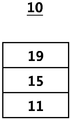
- the FIGURE is a schematic view of an organic light-emitting device 10 according to an embodiment.
- the organic light-emitting device 10 includes a first electrode 11, an organic layer 15, and a second electrode 19, which are sequentially stacked.
- a substrate may be additionally disposed under the first electrode 11 or above the second electrode 19.
- the substrate any substrate that is used in general organic light-emitting devices may be used, and the substrate may be a glass substrate or a transparent plastic substrate, each having excellent mechanical strength, thermal stability, transparency, surface smoothness, ease of handling, and water resistance.
- the first electrode 11 may be formed by depositing or sputtering a material for forming the first electrode 11 on the substrate.
- the first electrode 11 may be an anode.
- the material for forming the first electrode 11 may be selected from materials with a high work function to facilitate hole injection.
- the first electrode 11 may be a reflective electrode, a semi-transmissive electrode, or a transmissive electrode.
- the material for forming the first electrode may be, for example, indium tin oxide (ITO), indium zinc oxide (IZO), tin oxide (SnO 2 ), and zinc oxide (ZnO).
- magnesium (Mg), aluminum (Al), aluminum-lithium (Al-Li), calcium (Ca), magnesium-indium (Mg-In), or magnesium-silver (Mg-Ag) may be used as the material for forming the first electrode.
- the first electrode 11 may have a single-layered structure or a multi-layered structure including two or more layers.
- the first electrode 11 may have a three-layered structure of ITO/Ag/ITO, but the structure of the first electrode 110 is not limited thereto.
- the organic layer 15 is disposed on the first electrode 11.
- the organic layer 15 may include a hole transport region, an emission layer, and an electron transport region.
- the hole transport region may be disposed between the first electrode 11 and the emission layer.
- the hole transport region may include at least one selected from a hole injection layer, a hole transport layer, an electron blocking layer, and a buffer layer.
- the hole transport region may include only either a hole injection layer or a hole transport layer.
- the hole transport region may have a hole injection layer/hole transport layer structure or a hole injection layer/hole transport layer/electron blocking layer structure, which are sequentially stacked in this stated order from the first electrode 11.
- a hole injection layer may be formed on the first electrode 11 by using one or more suitable methods selected from vacuum deposition, spin coating, casting, or Langmuir-Blodgett (LB) deposition.
- suitable methods selected from vacuum deposition, spin coating, casting, or Langmuir-Blodgett (LB) deposition.
- the deposition conditions may vary according to a compound that is used to form the hole injection layer, and the structure and thermal characteristics of the hole injection layer.
- the deposition conditions may include a deposition temperature of about 100°C to about 500°C, a vacuum pressure of about 10 -8 torr to about 10 -3 torr, and a deposition rate of about 0.01 ⁇ /sec to about 100 ⁇ /sec.
- the deposition conditions are not limited thereto.
- coating conditions may vary according to the material used to form the hole injection layer, and the structure and thermal properties of the hole injection layer.
- a coating speed may be from about 2,000 revolutions per minute (rpm) to about 5,000 rpm
- a temperature at which a heat treatment is performed to remove a solvent after coating may be from about 80°C to about 200°C.
- the coating conditions are not limited thereto.
- Conditions for forming a hole transport layer and an electron blocking layer may be understood by referring to conditions for forming the hole injection layer.
- the hole transport region may include at least one selected from m-MTDATA, TDATA, 2-TNATA, NPB, ⁇ -NPB, TPD, Spiro-TPD, Spiro-NPB, methylated-NPB, TAPC, HMTPD, 4,4',4"-tris(N-carbazolyl)triphenylamine (TCTA), polyaniline/dodecylbenzene sulfonic acid (PANI/DBSA), poly(3,4-ethylenedioxythiophene)/poly(4-styrene sulfonate) (PEDOT/PSS), polyaniline/camphor sulfonic acid (PANI/CSA), polyaniline/poly(4-styrene sulfonate) (PANI/PSS), a compound represented by Formula 201 below, and a compound represented by Formula 202 below: Ar 101 and Ar 102 in Formula 201 may each independently be selected from:
- xa and xb may each independently be an integer from 0 to 5, or 0, 1, or 2.
- xa may be 1, and xb may be 0, but embodiments of the present disclosure are not limited thereto.
- R 101 to R 108 , R 111 to R 119 , and R 121 to R 124 may each independently be selected from:
- the compound represented by Formula 201 may be represented by Formula 201A, but embodiments of the present disclosure are not limited thereto:
- R 101 , R 111 , R 112 , and R 109 in Formula 201A may be understood by referring to the description provided herein.
- the compound represented by Formula 201 and the compound represented by Formula 202 may include compounds HT1 to HT20 illustrated below, but are not limited thereto.
- a thickness of the hole transport region may be in a range of about 100 ⁇ to about 10,000 ⁇ , for example, about 100 ⁇ to about 1,000 ⁇ .
- the thickness of the hole injection layer may be in a range of about 100 ⁇ to about 10,000 ⁇ , and for example, about 100 ⁇ to about 1,000 ⁇
- the thickness of the hole transport layer may be in a range of about 50 ⁇ to about 2,000 ⁇ , and for example, about 100 ⁇ to about 1,500 ⁇ . While not wishing to be bound by theory, it is understood that when the thicknesses of the hole transport region, the hole injection layer, and the hole transport layer are within these ranges, satisfactory hole transporting characteristics may be obtained without a substantial increase in driving voltage.
- the hole transport region may further include, in addition to these materials, a charge-generation material for the improvement of conductive properties.
- the charge-generation material may be homogeneously or non-homogeneously dispersed in the hole transport region.
- the charge-generation material may be, for example, a p-dopant.
- the p-dopant may be one selected from a quinone derivative, a metal oxide, and a cyano group-containing compound, but embodiments of the present disclosure are not limited thereto.
- Non-limiting examples of the p-dopant are a quinone derivative, such as tetracyanoquinonedimethane (TCNQ) or 2,3,5,6-tetrafluoro-tetracyano-1,4-benzoquinonedimethane (F4-TCNQ); a metal oxide, such as a tungsten oxide or a molybdenium oxide; and a cyano group-containing compound, such as Compound HT-D1 or Compound HT-D2 below, but are not limited thereto.
- a quinone derivative such as tetracyanoquinonedimethane (TCNQ) or 2,3,5,6-tetrafluoro-tetracyano-1,4-benzoquinonedimethane (F4-TCNQ)
- a metal oxide such as a tungsten oxide or a molybdenium oxide
- a cyano group-containing compound such as Compound HT-D1 or Compound
- the hole transport region may include a buffer layer.
- the buffer layer may compensate for an optical resonance distance according to a wavelength of light emitted from the emission layer, and thus, efficiency of a formed organic light-emitting device may be improved.
- an emission layer may be formed on the hole transport region by vacuum deposition, spin coating, casting, LB deposition, or the like.
- the deposition or coating conditions may be similar to those applied in forming the hole injection layer although the deposition or coating conditions may vary according to a compound that is used to form the emission layer.
- a material for the electron blocking layer may be selected from materials for the hole transport region described above and materials for a host to be explained later.
- the material for the electron blocking layer is not limited thereto.
- a material for the electron blocking layer may be mCP, which will be explained later.
- the emission layer may include a host and a dopant, and the dopant may include the organometallic compound represented by Formula 1 or a composition containing the organometallic compound.
- the host may include at least one selected from TPBi, TBADN, ADN (also referred to as "DNA”), CBP, CDBP, TCP, mCP, Compound H50, Compound H51 and Compound 52:
- the emission layer may be patterned into a red emission layer, a green emission layer, and a blue emission layer.
- the emission layer may emit white light.
- an amount of the dopant may be in a range of about 0.01 parts by weight to about 15 parts by weight based on 100 parts by weight of the host, but embodiments of the present disclosure are not limited thereto.
- the dopant may include at least one of organometallic compounds represented by Formula 1 or the composition containing the organometallic compound described above.
- a thickness of the emission layer may be in a range of about 100 ⁇ to about 1,000 ⁇ , for example, about 200 ⁇ to about 600 ⁇ . While not wishing to be bound by theory, it is understood that when the thickness of the emission layer is within this range, excellent light-emission characteristics may be obtained without a substantial increase in driving voltage.
- an electron transport region may be disposed on the emission layer.
- the electron transport region may include at least one selected from a hole blocking layer, an electron transport layer, and an electron injection layer.
- the electron transport region may have a hole blocking layer/electron transport layer/electron injection layer structure or an electron transport layer/electron injection layer structure, but the structure of the electron transport region is not limited thereto.
- the electron transport layer may have a single-layered structure or a multi-layered structure including two or more different materials.
- Conditions for forming the hole blocking layer, the electron transport layer, and the electron injection layer which constitute the electron transport region may be understood by referring to the conditions for forming the hole injection layer.
- the hole blocking layer may include, for example, at least one of BCP, Bphen, and BAlq but embodiments of the present disclosure are not limited thereto.
- a thickness of the hole blocking layer may be in a range of about 20 ⁇ to about 1,000 ⁇ , for example, about 30 ⁇ to about 300 ⁇ . While not wishing to be bound by theory, it is understood that when the thickness of the hole blocking layer is within these ranges, the hole blocking layer may have improved hole blocking ability without a substantial increase in driving voltage.
- the electron transport layer may include at least one selected from BCP, Bphen, Alq 3 , BAlq, TAZ, and NTAZ.
- the electron transport layer may include at least one of ET1 to ET25, but are not limited thereto:
- a thickness of the electron transport layer may be in a range of about 100 ⁇ to about 1,000 ⁇ , for example, about 150 ⁇ to about 500 ⁇ . While not wishing to be bound by theory, it is understood that when the thickness of the electron transport layer is within the range described above, the electron transport layer may have satisfactory electron transport characteristics without a substantial increase in driving voltage.
- the electron transport layer may further include, in addition to the materials described above, a metal-containing material.
- the metal-containing material may include a Li complex.
- the Li complex may include, for example, Compound ET-D1 (lithium 8-hydroxyquinolate, LiQ) or ET-D2.
- the electron transport region may include an electron injection layer that promotes injection of electrons from the second electrode 19 thereinto.
- the electron injection layer may include at least one selected from LiF, NaCl, CsF, Li 2 O, and BaO.
- a thickness of the electron injection layer may be in a range of about 1 ⁇ to about 100 ⁇ , for example, about 3 ⁇ to about 90 ⁇ . While not wishing to be bound by theory, it is understood that when the thickness of the electron injection layer is within the range described above, the electron injection layer may have satisfactory electron injection characteristics without a substantial increase in driving voltage.
- the second electrode 19 is disposed on the organic layer 15.
- the second electrode 19 may be a cathode.
- a material for forming the second electrode 19 may be selected from metal, an alloy, an electrically conductive compound, and a combination thereof, which have a relatively low work function.
- lithium (Li), magnesium (Mg), aluminum (Al), aluminum-lithium (Al-Li), calcium (Ca), magnesium-indium (Mg-In), or magnesium-silver (Mg-Ag) may be used as a material for forming the second electrode 19.
- a transmissive electrode formed using ITO or IZO may be used as the second electrode 19.
- C 1 -C 60 alkyl group refers to a linear or branched saturated aliphatic hydrocarbon monovalent group having 1 to 60 carbon atoms, and non-limiting examples thereof include a methyl group, an ethyl group, a propyl group, an iso-butyl group, a sec-butyl group, a tert-butyl group, a pentyl group, an iso-amyl group, and a hexyl group.
- C 1 -C 60 alkylene group refers to a divalent group having the same structure as the C 1 -C 60 alkyl group.
- C 1 -C 60 alkoxy group refers to a monovalent group represented by -OA 101 (wherein A 101 is the C 1 -C 60 alkyl group), and non-limiting examples thereof include a methoxy group, an ethoxy group, and an iso-propyloxy group.
- C 2 -C 60 alkenyl group refers to a hydrocarbon group formed by including at least one carbon-carbon double bond in the middle or at the terminus of the C 2 -C 60 alkyl group, and examples thereof include an ethenyl group, a propenyl group, and a butenyl group.
- C 2 -C 60 alkenylene group refers to a divalent group having the same structure as the C 2 -C 60 alkenyl group.
- C 2 -C 60 alkynyl group refers to a hydrocarbon group formed by including at least one carbon-carbon triple bond in the middle or at the terminus of the C 2 -C 60 alkyl group, and examples thereof include an ethynyl group, and a propynyl group.
- C 2 -C 60 alkynylene group refers to a divalent group having the same structure as the C 2 -C 60 alkynyl group.
- C 3 -C 10 cycloalkyl group refers to a monovalent saturated hydrocarbon monocyclic group having 3 to 10 carbon atoms, and non-limiting examples thereof include a cyclopropyl group, a cyclobutyl group, a cyclopentyl group, a cyclohexyl group, and a cycloheptyl group.
- C 3 -C 10 cycloalkylene group refers to a divalent group having the same structure as the C 3 -C 10 cycloalkyl group.
- C 1 -C 10 heterocycloalkyl group refers to a monovalent saturated monocyclic group having at least one heteroatom selected from N, O, P, Si and S as a ring-forming atom and 1 to 10 carbon atoms, and non-limiting examples thereof include a tetrahydrofuranyl group, and a tetrahydrothiophenyl group.
- C 1 -C 10 heterocycloalkylene group refers to a divalent group having the same structure as the C 1 -C 10 heterocycloalkyl group.
- C 3 -C 10 cycloalkenyl group refers to a monovalent monocyclic hydrocarbon group that has 3 to 10 carbon atoms and at least one carbon-carbon double bond in the ring thereof and that has no aromaticity, and non-limiting examples thereof include a cyclopentenyl group, a cyclohexenyl group, and a cycloheptenyl group.
- C 3 -C 10 cycloalkenylene group refers to a divalent group having the same structure as the C 3 -C 10 cycloalkenyl group.
- C 1 -C 10 heterocycloalkenyl group refers to a monovalent monocyclic group that has at least one heteroatom selected from N, O, P, Si, and S as a ring-forming atom, 1 to 10 carbon atoms, and at least one double bond in its ring.
- Examples of the C 1 -C 10 heterocycloalkenyl group are a 2,3-dihydrofuranyl group and a 2,3-dihydrothiophenyl group.
- C 1 -C 10 heterocycloalkenylene group refers to a divalent group having the same structure as the C 1 -C 10 heterocycloalkenyl group.
- C 6 -C 60 aryl group refers to a monovalent group having a carbocyclic aromatic system having 6 to 60 carbon atoms
- a C 6 -C 60 arylene group refers to a divalent group having a carbocyclic aromatic system having 6 to 60 carbon atoms.
- Non-limiting examples of the C 6 -C 60 aryl group include a phenyl group, a naphthyl group, an anthracenyl group, a phenanthrenyl group, a pyrenyl group, and a chrysenyl group.
- the C 6 -C 60 aryl group and the C 6 -C 60 arylene group each include two or more rings, the rings may be fused to each other.
- C 1 -C 60 heteroaryl group refers to a monovalent group having a heterocyclic aromatic system that has at least one heteroatom selected from N, O, P, Si, and S as a ring-forming atom, and 1 to 60 carbon atoms.
- C 1 -C 60 heteroarylene group refers to a divalent group having a heterocyclic aromatic system that has at least one heteroatom selected from N, O, P, Si, and S as a ring-forming atom, and 1 to 60 carbon atoms.
- Non-limiting examples of the C 1 -C 60 heteroaryl group include a pyridinyl group, a pyrimidinyl group, a pyrazinyl group, a pyridazinyl group, a triazinyl group, a quinolinyl group, and an isoquinolinyl group.
- the C 1 -C 60 heteroaryl group and the C 1 -C 60 heteroarylene group each include two or more rings, wherein the rings may be fused to each other.
- C 6 -C 60 aryloxy group indicates -OA 102 (wherein A 102 is the C 6 -C 60 aryl group), the term “C 6 -C 60 arylthio group” as used herein indicates -SA 103 (wherein A 103 is the C 6 -C 60 aryl group), and the term “C 7 -C 60 arylalkyl group” as used herein indicates -A 104 A 105 (wherein A 104 is the C 6 -C 59 aryl group and A 105 is the C 1 -C 53 alkyl group).
- C 2 -C 60 heteroaryloxy group refers to -OA 106 (wherein A 106 is the C 2 -C 60 heteroaryl group), and the term “C 2 -C 60 heteroarylthio group” as used herein indicates -SA 107 (wherein A 107 is the C 2 -C 60 heteroaryl group).
- C 3 -C 60 heteroarylalkyl group refers to -A 108 A 109 (A 109 is a C 2 -C 59 heteroaryl group, and A 108 is a C 1 -C 58 alkylene group).
- monovalent non-aromatic condensed polycyclic group refers to a monovalent group (for example, having 8 to 60 carbon atoms) having two or more rings condensed to each other, only carbon atoms as ring-forming atoms, and having no aromaticity in its entire molecular structure.
- monovalent non-aromatic condensed polycyclic group include a fluorenyl group.
- divalent non-aromatic condensed polycyclic group refers to a divalent group having the same structure as the monovalent non-aromatic condensed polycyclic group.
- the term "monovalent non-aromatic condensed heteropolycyclic group” as used herein refers to a monovalent group (for example, having 2 to 60 carbon atoms) having two or more rings condensed to each other, a heteroatom selected from N, O, P, Si, and S, other than carbon atoms, as a ring-forming atom, and having no aromaticity in its entire molecular structure.
- Non-limiting examples of the monovalent non-aromatic condensed heteropolycyclic group include a carbazolyl group.
- divalent non-aromatic condensed heteropolycyclic group refers to a divalent group having the same structure as the monovalent non-aromatic condensed heteropolycyclic group.
- C 5 -C 30 carbocyclic group refers to a saturated or unsaturated cyclic group having, as a ring-forming atom, 5 to 30 carbon atoms only.
- C 5 -C 30 carbocyclic group refers to a monocyclic group or a polycyclic group, and, according to its chemical structure, a monovalent, divalent, trivalent, tetravalent, pentavalent, or hexavalent group.
- C 2 -C 30 heterocyclic group refers to a saturated or unsaturated cyclic group having, as a ring-forming atom, at least one heteroatom selected from N, O, Si, P, and S other than 2 to 30 carbon atoms.
- C 2 -C 30 heterocyclic group refers to a monocyclic group or a polycyclic group, and, according to its chemical structure, a monovalent, divalent, trivalent, tetravalent, pentavalent, or hexavalent group.
- Ligand 5-1 was synthesized in the same manner as Ligand 1-1 in Synthesis Example 1, except that Intermediate 5-1 was used instead of Intermediate 1-1.
- Ligand 9-1 was synthesized in the same manner as Ligand 1-1 in Synthesis Example 1, except that Intermediate 9-1 was used instead of Intermediate 1-1.
- Evaluation Example 1 Evaluation of HOMO, LUMO, and Triplet (T 1 ) Energy Levels
- HOMO, LUMO, and T 1 energy levels of Compounds 1, 5, and 9 were evaluated by using the methods provided in Table 3. Results thereof are shown in Table 4.
- Table 3 HOMO energy level evaluation method A voltage-current (V-A) graph of each Compound was obtained by using a cyclic voltammetry (CV) (electrolyte: 0.1 M Bu 4 NClO 4 / solvent: CH 2 Cl 2 / electrode: 3-electrode system (working electrode: GC, reference electrode: Ag/AgCl, auxiliary electrode: Pt)), and then, a HOMO energy level of each Compound was calculated from an onset oxidation potential of the V-A graph.
- CV cyclic voltammetry
- LUMO energy level evaluation method Each Compound was diluted at a concentration of 1x10 -5 M in CHCl 3 , an UV absorption spectrum thereof was measured at room temperature by using a Shimadzu UV-350 Spectrometer, and then, a LUMO energy level thereof was calculated by using an optical band gap (Eg) from an edge of the absorption spectrum.
- T 1 energy level evaluation method After a mixture of toluene and each Compound (1 milligram (mg) of each Compound was dissolved in 3 cubic centimeters (cc) of toluene) was added to a quartz cell and then added to liquid nitrogen (77 Kelvins, K), a photoluminescence spectrum was measured by using a photoluminescence measurement apparatus.
- the T 1 energy level was calculated by analyzing peaks observed only at a low temperature through comparison between the photoluminescence spectrum and a general room-temperature photoluminescence spectrum.
- Table 4 Compound No. HOMO (eV) LUMO (eV) T 1 (eV) 1 -5.49 -2.76 2.73 5 -5.43 -2.72 2.71 9 -5.49 -2.76 2.73
- Compounds 1, 5, and 9 have electrical characteristics suitable for use as materials for an organic light-emitting device.
- Evaluation Example 3 Evaluation of Photoluminescence (PL) Spectrum Light emission characteristics of each Compound were evaluated by evaluating PL spectra of Compounds 1, 5, and 9. Compound 1 was diluted at a concentration of 10 millimolar (mM) in CHCl 3 , and a PL spectrum was measured at room temperature by using an ICS PC1 Spectrofluorometer equipped with a xenon lamp. This process was repeated on Compounds 5 and 9.
- mM millimolar
- Emission wavelengths and maximum emission wavelengths ( ⁇ max ) of the PL spectra of Compounds 1, 5, and 9 are shown in Table 6.
- Table 6 Compound No. Emission wavelengths(nm) 1 454( ⁇ max ), 482 5 457( ⁇ max ), 487 9 454( ⁇ max ), 483
- ITO electrode first electrode, anode
- Compound HT3 was vacuum-deposited on the ITO electrode of the glass substrate to form a first hole injection layer having a thickness of 3,500 ⁇
- Compound HT-D1 was vacuum-deposited on the first hole injection layer to form a second hole injection layer having a thickness of 300 ⁇
- TAPC was vacuum-deposited on the second hole injection layer to form an electron blocking layer having a thickness of 100 ⁇ , thereby forming a hole transport region.
- Compound H52 and Compound 1 were co-deposited on the hole transport region to form an emission layer having a thickness of 300 ⁇ .
- Compound ET3 was vacuum-deposited on the emission layer to form an electron transport layer having a thickness of 250 ⁇ , ET-D1 (LiQ) was deposited on the electron transport layer to form an electron injection layer having a thickness of 5 ⁇ , and Al was deposited on the electron injection layer to form a second electrode (cathode) having a thickness of 1,000 ⁇ , thereby completing the manufacture of an organic light-emitting device.
- Organic light-emitting devices were manufactured in the same manner as in Example 1, except that Compounds shown in Table 7 were each used instead of Compound 1 as a dopant in forming an emission layer.
- EL spectra of the manufactured organic light-emitting devices were measured by using a luminance meter (Minolta Cs-1000A) at a luminance of 500 candelas per square meter (cd/m 2 ).
- a current value flowing through the manufactured organic light-emitting devices was measured by using a current-voltage meter (Keithley 2400) with respect to the manufactured organic light-emitting devices while increasing a voltage from 0 volts (V) to 10 V, and a current density was obtained by dividing the measured current value by an area.
- a current-voltage meter Kelvin 2400
- Luminance was measured by using a luminance meter (Minolta Cs-1000A) with respect to the manufactured organic light-emitting devices while increasing a voltage from 0 V to 10 V, and results thereof were obtained.
- CIE color coordinates were obtained by measuring EL spectra of the manufactured organic light-emitting devices at a luminance of 500 cd/m 2 by using a luminance meter (Minolta Cs-1000A).
- Table 7 Example Dopant Current density (mA/cm 2 ) Luminance (cd/m 2 ) Efficiency (cd/A) Conversion Efficiency EQE (%) ⁇ max in EL sp ectrum (nm) T 95 (hr) Color coordinates (x, y) 1 1 3.97 1000 25.24 110.1 14.6 455 3.03 0.166, 0.22 9 2 5 3.58 1000 28.09 108.2 15.0 458 0.96 0.171, 0.25 9 3 9 3.55 1000 28.23 120.4 16.2 457 2.85 0.169, 0.23 5
- the organic light-emitting devices of Examples 1 to 3 have excellent efficiency, external quantum emission efficiency, and lifespan characteristics and can also emit deep blue light.
- the organometallic compounds according to embodiments of the present disclosure have excellent electrical characteristics and thermal stability, and accordingly, organic light-emitting devices including such organometallic compounds may have excellent driving voltage, current density, efficiency, power, color purity, and lifespan characteristics.
Landscapes
- Chemical & Material Sciences (AREA)
- Organic Chemistry (AREA)
- Engineering & Computer Science (AREA)
- Materials Engineering (AREA)
- Physics & Mathematics (AREA)
- Spectroscopy & Molecular Physics (AREA)
- Crystallography & Structural Chemistry (AREA)
- Inorganic Chemistry (AREA)
- Optics & Photonics (AREA)
- Electroluminescent Light Sources (AREA)
Abstract
Description
- One or more embodiments relate to an organometallic compound, a composition containing the organometallic compound, and an organic light-emitting device including the organometallic compound.
- Organic light-emitting devices (OLEDs) are self-emission devices that produce full-color images, and also have wide viewing angles, high contrast ratios, short response times, and excellent characteristics in terms of brightness, driving voltage, and response speed, compared to devices in the art.
- A typical organic light-emitting device includes an anode, a cathode, and an organic layer disposed between the anode and the cathode, wherein the organic layer includes an emission layer. A hole transport region may be disposed between the anode and the emission layer, and an electron transport region may be disposed between the emission layer and the cathode. Holes provided from the anode may move toward the emission layer through the hole transport region, and electrons provided from the cathode may move toward the emission layer through the electron transport region. The holes and the electrons recombine in the emission layer to produce excitons. These excitons transition from an excited state to a ground state, thereby generating light.
- Various types of organic light emitting devices are known. However, there still remains a need in OLEDs having low driving voltage, high efficiency, high brightness, and long lifespan.
- One or more embodiments include a novel organometallic compound, a composition containing the organometallic compound, and an organic light-emitting device including the organometallic compound.
- Additional aspects will be set forth in part in the description which follows and, in part, will be apparent from the description, or may be learned by practice of the presented embodiments.
- According to one or more embodiments, an organometallic compound is represented by Formula 1:

- M1 may be selected from a first-row transition metal of the Periodic Table of Elements, a second-row transition metal of the Periodic Table of Elements, and a third-row transition metal of the Periodic Table of Elements,
- n1 may be 1, 2, or 3,
- L2 may be a monodentate ligand or a bidentate ligand,
- n2 may be 0, 1, 2, 3, or 4, wherein, when n2 is two or more, two or more groups L2 may be identical to or different from each other,
- X1 and X2 may each independently be carbon or nitrogen,
- CY1 and CY2 may each independently be a C5-C30 carbocyclic group or a C2-C30 heterocyclic group,
- X19 may be N or C(R19), and X20 may be N or C(R20), provided that at least one of X19 and X20 is N,
- R1, R2, R11 to R16, R19, and R20 may each independently be selected from hydrogen, deuterium, -F, -Cl, -Br, -I, -SF5, a hydroxyl group, a cyano group, a nitro group, an amino group, an amidino group, a hydrazine group, a hydrazone group, a carboxylic acid group or a salt thereof, a sulfonic acid group or a salt thereof, a phosphoric acid group or a salt thereof, a substituted or unsubstituted C1-C60 alkyl group, a substituted or unsubstituted C2-C60 alkenyl group, a substituted or unsubstituted C2-C60 alkynyl group, a substituted or unsubstituted C1-C60 alkoxy group, a substituted or unsubstituted C3-C10 cycloalkyl group, a substituted or unsubstituted C1-C10 heterocycloalkyl group, a substituted or unsubstituted C3-C10 cycloalkenyl group, a substituted or unsubstituted C1-C10 heterocycloalkenyl group, a substituted or unsubstituted C6-C60 aryl group, a substituted or unsubstituted C6-C60 aryloxy group, a substituted or unsubstituted C6-C60 arylthio group, a substituted or unsubstituted C7-C60 arylalkyl group, a substituted or unsubstituted C1-C60 heteroaryl group, a substituted or unsubstituted C1-C60 heteroaryloxy group, a substituted or unsubstituted C1-C60 heteroarylthio group, a substituted or unsubstituted C2-C60 heteroarylalkyl group, a substituted or unsubstituted monovalent non-aromatic condensed polycyclic group, a substituted or unsubstituted monovalent non-aromatic condensed heteropolycyclic group, -N(Q1)(Q2), -Si(Q3)(Q4)(Q5), -B(Q6)(Q7), and - P(=O)(Q8)(Q9),
- two or more neighboring groups selected from R1, R2, R11 to R13, CY1, and CY2 may optionally be linked to form a substituted or unsubstituted C5-C30 carbocyclic group or a substituted or unsubstituted C2-C30 heterocyclic group,
- a1 and a2 may each independently be an integer from 0 to 5,
- at least one substituent of the substituted C5-C30 carbocyclic group, the substituted C2-C30 heterocyclic group, the substituted C1-C60 alkyl group, the substituted C2-C60 alkenyl group, the substituted C2-C60 alkynyl group, the substituted C1-C60 alkoxy group, the substituted C3-C10 cycloalkyl group, the substituted C1-C10 heterocycloalkyl group, the substituted C3-C10 cycloalkenyl group, the substituted C1-C10 heterocycloalkenyl group, the substituted C6-C60 aryl group, the substituted C6-C60 aryloxy group, the substituted C6-C60 arylthio group, the substituted C7-C60 arylalkyl group, the substituted C1-C60 heteroaryl group, the substituted C1-C60 heteroaryloxy group, the substituted C1-C60 heteroarylthio group, the substituted C2-C60 heteroarylalkyl group, the substituted monovalent non-aromatic condensed polycyclic group, and the substituted monovalent non-aromatic condensed heteropolycyclic group may be selected from:
- deuterium, -F, -Cl, -Br, -I, -CD3, -CD2H, -CDH2, -CF3, -CF2H, -CFH2, a hydroxyl group, a cyano group, a nitro group, an amino group, an amidino group, a hydrazine group, a hydrazone group, a carboxylic acid group or a salt thereof, a sulfonic acid group or a salt thereof, a phosphoric acid group or a salt thereof, a C1-C60 alkyl group, a C2-C60 alkenyl group, a C2-C60 alkynyl group, and a C1-C60 alkoxy group;
- a C1-C60 alkyl group, a C2-C60 alkenyl group, a C2-C60 alkynyl group, and a C1-C60 alkoxy group, each substituted with at least one selected from deuterium, -F, -Cl, -Br, -I, -CD3, -CD2H, -CDH2, -CF3, -CF2H, -CFH2, a hydroxyl group, a cyano group, a nitro group, an amino group, an amidino group, a hydrazine group, a hydrazone group, a carboxylic acid group or a salt thereof, a sulfonic acid group or a salt thereof, a phosphoric acid group or a salt thereof, a C3-C10 cycloalkyl group, a C1-C10 heterocycloalkyl group, a C3-C10 cycloalkenyl group, a C1-C10 heterocycloalkenyl group, a C6-C60 aryl group, a C6-C60 aryloxy group, a C6-C60 arylthio group, a C7-C60 arylalkyl group, a C1-C60 heteroaryl group, a C1-C60 heteroaryloxy group, a C1-C60 heteroarylthio group, a C2-C60 heteroarylalkyl group, a monovalent non-aromatic condensed polycyclic group, a monovalent non-aromatic condensed heteropolycyclic group, -N(Q11)(Q12), -Si(Q13)(Q14)(Q15), -B(Q16)(Q17), and - P(=O)(Q18)(Q19);
- a C3-C10 cycloalkyl group, a C1-C10 heterocycloalkyl group, a C3-C10 cycloalkenyl group, a C1-C10 heterocycloalkenyl group, a C6-C60 aryl group, a C6-C60 aryloxy group, a C6-C60 arylthio group, a C7-C60 arylalkyl group, a C1-C60 heteroaryl group, a C1-C60 heteroaryloxy group, a C1-C60 heteroarylthio group, a C2-C60 heteroarylalkyl group, a monovalent non-aromatic condensed polycyclic group, and a monovalent non-aromatic condensed heteropolycyclic group;
- a C3-C10 cycloalkyl group, a C1-C10 heterocycloalkyl group, a C3-C10 cycloalkenyl group, a C1-C10 heterocycloalkenyl group, a C6-C60 aryl group, a C6-C60 aryloxy group, a C6-C60 arylthio group, a C7-C60 arylalkyl group, a C1-C60 heteroaryl group, a C1-C60 heteroaryloxy group, a C1-C60 heteroarylthio group, a C2-C60 heteroarylalkyl group, a monovalent non-aromatic condensed polycyclic group, and a monovalent non-aromatic condensed heteropolycyclic group, each substituted with at least one selected from deuterium, -F, -Cl, -Br, -I, -CD3, -CD2H, -CDH2, -CF3, -CF2H, -CFH2, a hydroxyl group, a cyano group, a nitro group, an amino group, an amidino group, a hydrazine group, a hydrazone group, a carboxylic acid group or a salt thereof, a sulfonic acid group or a salt thereof, a phosphoric acid group or a salt thereof, a C1-C60 alkyl group, a C2-C60 alkenyl group, a C2-C60 alkynyl group, a C1-C60 alkoxy group, a C3-C10 cycloalkyl group, a C1-C10 heterocycloalkyl group, a C3-C10 cycloalkenyl group, a C1-C10 heterocycloalkenyl group, a C6-C60 aryl group, a C6-C60 aryloxy group, a C6-C60 arylthio group, a C7-C60 arylalkyl group, a C1-C60 heteroaryl group, a C1-C60 heteroaryloxy group, a C1-C60 heteroarylthio group, a C2-C60 heteroarylalkyl group, a monovalent non-aromatic condensed polycyclic group, a monovalent non-aromatic condensed heteropolycyclic group, - N(Q21)(Q22), -Si(Q23)(Q24)(Q25), -B(Q26)(Q27), and -P(=O)(Q28)(Q29); and
- -N(Q31)(Q32), -Si(Q33)(Q34)(Q35), -B(Q36)(Q37), and -P(=O)(Q38)(Q39), and
- Q1 to Q9, Q11 to Q19, Q21 to Q29, and Q31 to Q39 may each independently be selected from hydrogen, deuterium, -F, -Cl, -Br, -I, a hydroxyl group, a cyano group, a nitro group, an amino group, an amidino group, a hydrazine group, a hydrazone group, a carboxylic acid group or a salt thereof, a sulfonic acid group or a salt thereof, a phosphoric acid group or a salt thereof, a C1-C60 alkyl group, a C2-C60 alkenyl group, a C2-C60 alkynyl group, a C1-C60 alkoxy group, a C3-C10 cycloalkyl group, a C1-C10 heterocycloalkyl group, a C3-C10 cycloalkenyl group, a C1-C10 heterocycloalkenyl group, a C6-C60 aryl group, a C6-C60 aryl group substituted with at least one selected from a C1-C60 alkyl group and a C6-C60 aryl group, a C6-C60 aryloxy group, a C6-C60 arylthio group, a C7-C60 arylalkyl group, a C1-C60 heteroaryl group, a C1-C60 heteroaryloxy group, a C1-C60 heteroarylthio group, a C2-C60 heteroarylalkyl group, a monovalent non-aromatic condensed polycyclic group, and a monovalent non-aromatic condensed heteropolycyclic group.
- According to one or more embodiments, a composition containing the organometallic compound includes a first organometallic compound represented by Formula 1 and including at least one deuterium and a second organometallic compound represented by Formula 2:

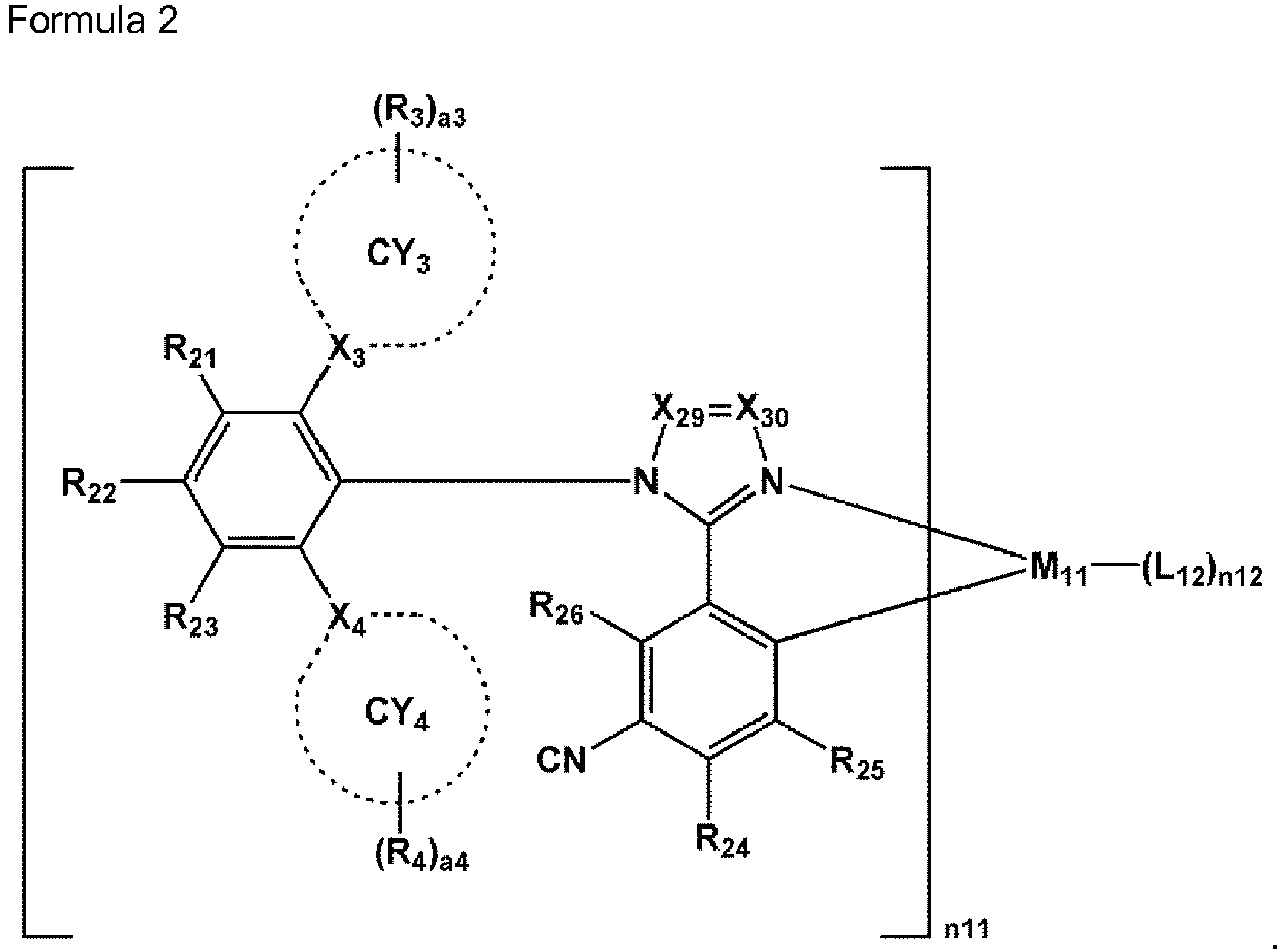
- M1 and M11 may each independently be selected from a first-row transition metal of the Periodic Table of Elements, a second-row transition metal of the Periodic Table of Elements, and a third-row transition metal of the Periodic Table of Elements,
- n1 and n11 may each independently be 1, 2, or 3,
- L2 and L12 may each independently be a monodentate ligand or a bidentate ligand,
- n2 and n12 may each independently be 0, 1, 2, 3, or 4, wherein, when n2 is two or more, two or more groups L2 may be identical to or different from each other, and when n12 is two or more, two or more groups L12 may be identical to or different from each other,
- X1 to X4 may each independently be carbon or nitrogen,
- CY1 to CY4 may each independently be a C5-C30 carbocyclic group or a C2-C30 heterocyclic group,
- X19 may be N or C(R19), and X20 may be N or C(R20), provided that at least one of X19 and X20 is N,
- X29 may be N or C(R29), and X30 may be N or C(R30), provided that at least one of X29 and X30 is N,
- R1, R2, R11 to R16, R19, and R20 may each independently be selected from hydrogen, deuterium, -F, -Cl, -Br, -I, -SF5, a hydroxyl group, a cyano group, a nitro group, an amino group, an amidino group, a hydrazine group, a hydrazone group, a carboxylic acid group or a salt thereof, a sulfonic acid group or a salt thereof, a phosphoric acid group or a salt thereof, a substituted or unsubstituted C1-C60 alkyl group, a substituted or unsubstituted C2-C60 alkenyl group, a substituted or unsubstituted C2-C60 alkynyl group, a substituted or unsubstituted C1-C60 alkoxy group, a substituted or unsubstituted C3-C10 cycloalkyl group, a substituted or unsubstituted C1-C10 heterocycloalkyl group, a substituted or unsubstituted C3-C10 cycloalkenyl group, a substituted or unsubstituted C1-C10 heterocycloalkenyl group, a substituted or unsubstituted C6-C60 aryl group, a substituted or unsubstituted C6-C60 aryloxy group, a substituted or unsubstituted C6-C60 arylthio group, a substituted or unsubstituted C7-C60 arylalkyl group, a substituted or unsubstituted C1-C60 heteroaryl group, a substituted or unsubstituted C1-C60 heteroaryloxy group, a substituted or unsubstituted C1-C60 heteroarylthio group, a substituted or unsubstituted C2-C60 heteroarylalkyl group, a substituted or unsubstituted monovalent non-aromatic condensed polycyclic group, a substituted or unsubstituted monovalent non-aromatic condensed heteropolycyclic group, -N(Q1)(Q2), -Si(Q3)(Q4)(Q5), -B(Q6)(Q7), and - P(=O)(Q8)(Q9),
- two or more neighboring groups selected from R1, R2, R11 to R13, CY1, and CY2 may optionally be linked to form a substituted or unsubstituted C5-C30 carbocyclic group or a substituted or unsubstituted C2-C30 heterocyclic group,
- a1 and a2 may each independently be an integer from 0 to 5,
- i) X19 may be C(R19), X20 may be N, and at least one of R1, R2, R11 to R16, and R19 may be a deuterium-containing substituent; ii) X19 may be N, X20 may be C(R20), and at least one of R1, R2, R11 to R16, and R20 may be a deuterium-containing substituent; or iii) X19 and X20 may each be N, and at least one of R1, R2, and R11 to R16 may be a deuterium-containing substituent,
- R3, R4, R21 to R26, R29, and R30 may each independently be selected from hydrogen, -F, -Cl, -Br, -I, -SF5, a hydroxyl group, a cyano group, a nitro group, an amino group, an amidino group, a hydrazine group, a hydrazone group, a carboxylic acid group or a salt thereof, a sulfonic acid group or a salt thereof, a phosphoric acid group or a salt thereof, a substituted or unsubstituted C1-C60 alkyl group, a substituted or unsubstituted C2-C60 alkenyl group, a substituted or unsubstituted C2-C60 alkynyl group, a substituted or unsubstituted C1-C60 alkoxy group, a substituted or unsubstituted C3-C10 cycloalkyl group, a substituted or unsubstituted C1-C10 heterocycloalkyl group, a substituted or unsubstituted C3-C10 cycloalkenyl group, a substituted or unsubstituted C1-C10 heterocycloalkenyl group, a substituted or unsubstituted C6-C60 aryl group, a substituted or unsubstituted C6-C60 aryloxy group, a substituted or unsubstituted C6-C60 arylthio group, a substituted or unsubstituted C7-C60 arylalkyl group, a substituted or unsubstituted C1-C60 heteroaryl group, a substituted or unsubstituted C1-C60 heteroaryloxy group, a substituted or unsubstituted C1-C60 heteroarylthio group, a substituted or unsubstituted C2-C60 heteroarylalkyl group, a substituted or unsubstituted monovalent non-aromatic condensed polycyclic group, a substituted or unsubstituted monovalent non-aromatic condensed heteropolycyclic group, -N(Q1)(Q2), -Si(Q3)(Q4)(Q5), -B(Q6)(Q7), and - P(=O)(Q8)(Q9),
- two or more neighboring groups selected from R3, R4, R21 to R23, CY3, and CY4 may optionally be linked to form a substituted or unsubstituted C5-C30 carbocyclic group or a substituted or unsubstituted C2-C30 heterocyclic group,
- a3 and a4 may each independently be an integer from 0 to 5, and
- R3, R4, R21 to R26, R29, and R30 may each be a deuterium-free substituent.
- a first electrode;
- a second electrode; and
- an organic layer disposed between the first electrode and the second electrode, wherein the organic layer includes an emission layer, and
- wherein the organic layer includes at least one organometallic compound or a composition containing the organometallic compound.
- These and/or other aspects will become apparent and more readily appreciated from the following description of the embodiments, taken in conjunction with the FIGURE, which is a schematic view of an organic light-emitting device according to an embodiment.
- Reference will now be made in detail to embodiments, examples of which are illustrated in the accompanying drawings, wherein like reference numerals refer to like elements throughout. In this regard, the present embodiments may have different forms and should not be construed as being limited to the descriptions set forth herein. Accordingly, the embodiments are merely described below, by referring to the figures, to explain aspects of the present description. As used herein, the term "and/or" includes any and all combinations of one or more of the associated listed items. Expressions such as "at least one of," when preceding a list of elements, modify the entire list of elements and do not modify the individual elements of the list.
- It will be understood that when an element is referred to as being "on" another element, it can be directly in contact with the other element or intervening elements may be present therebetween. In contrast, when an element is referred to as being "directly on" another element, there are no intervening elements present.
- It will be understood that, although the terms first, second, third etc. may be used herein to describe various elements, components, regions, layers, and/or sections, these elements, components, regions, layers, and/or sections should not be limited by these terms. These terms are only used to distinguish one element, component, region, layer, or section from another element, component, region, layer, or section. Thus, a first element, component, region, layer, or section discussed below could be termed a second element, component, region, layer, or section without departing from the teachings of the present embodiments.
- The terminology used herein is for the purpose of describing particular embodiments only and is not intended to be limiting. As used herein, the singular forms "a," "an," and "the" are intended to include the plural forms as well, unless the context clearly indicates otherwise.
- The term "or" means "and/or." It will be further understood that the terms "comprises" and/or "comprising," or "includes" and/or "including" when used in this specification, specify the presence of stated features, regions, integers, steps, operations, elements, and/or components, but do not preclude the presence or addition of one or more other features, regions, integers, steps, operations, elements, components, and/or groups thereof.
- Unless otherwise defined, all terms (including technical and scientific terms) used herein have the same meaning as commonly understood by one of ordinary skill in the art to which this general inventive concept belongs. It will be further understood that terms, such as those defined in commonly used dictionaries, should be interpreted as having a meaning that is consistent with their meaning in the context of the relevant art and the present disclosure, and will not be interpreted in an idealized or overly formal sense unless expressly so defined herein.
- Exemplary embodiments are described herein with reference to cross section illustrations that are schematic illustrations of idealized embodiments. As such, variations from the shapes of the illustrations as a result, for example, of manufacturing techniques and/or tolerances, are to be expected. Thus, embodiments described herein should not be construed as limited to the particular shapes of regions as illustrated herein but are to include deviations in shapes that result, for example, from manufacturing. For example, a region illustrated or described as flat may, typically, have rough and/or nonlinear features. Moreover, sharp angles that are illustrated may be rounded. Thus, the regions illustrated in the figures are schematic in nature and their shapes are not intended to illustrate the precise shape of a region and are not intended to limit the scope of the present claims.
- "About" or "approximately" as used herein is inclusive of the stated value and means within an acceptable range of deviation for the particular value as determined by one of ordinary skill in the art, considering the measurement in question and the error associated with measurement of the particular quantity (i.e., the limitations of the measurement system). For example, "about" can mean within one or more standard deviations, or within ± 30%, 20%, 10%, 5% of the stated value.
- An organometallic compound according to an embodiment is represented by Formula 1 below:

- M1 in Formula 1 may be selected from a first-row transition metal of the Periodic Table of Elements, a second-row transition metal of the Periodic Table of Elements, and a third-row transition metal of the Periodic Table of Elements.
- For example, M1 may be selected from iridium (Ir), platinum (Pt), osmium (Os), titanium (Ti), zirconium (Zr), hafnium (Hf), europium (Eu), terbium (Tb), thulium (Tm), and rhodium (Rh).
- In an embodiment, M1 may be iridium, but embodiments of the present disclosure are not limited thereto.
- n1 in Formula 1 may be 1, 2, or 3, wherein, when n1 is two or more, two or more ligands represented by

- In an embodiment, in Formula 1, M1 may be Ir or Os, and the sum of n1 and n2 may be 3 or 4; or M1 may be Pt, and the sum of n1 and n2 may be 2.
- In an embodiment, in Formula 1, M1 may be Ir, n1 may be 3, and n2 may be 0, but embodiments of the present disclosure are not limited thereto.
- In an embodiment, in Formula 1, M1 may be Ir, n1 may be 3, n2 may be 0, and three ligands represented by

- X1 and X2 in Formula 1 may each independently be carbon or nitrogen.
- In an embodiment, X1 and X2 may each be carbon, but embodiments of the present disclosure are not limited thereto.
- CY1 and CY2 in Formula 1 may each independently be a C5-C30 carbocyclic group or a C2-C30 heterocyclic group.
- For example, CY1 and CY2 may each independently be selected from a cyclopentene group, a cyclohexene group, a benzene group, a pyridine group, a pyrimidine group, a pyridazine group, a pyrazine group, a triazine group, a pyrrole group, a pyrazole group, an imidazole group, a triazole group, an oxazole group, an isoxazole group, an oxadiazole group, a thiazole group, an isothiazole group, and a thiadiazole group.
- In an embodiment, CY1 and CY2 may each independently be a benzene group, a pyridine group, or a pyrimidine group.
- In one or more embodiments, CY1 and CY2 may each be a benzene group, but embodiments of the present disclosure are not limited thereto.
- In Formula 1, X19 may be N or C(R19), and X20 may be N or C(R20), provided that at least one of X19 and X20 is N.
- In an embodiment, one of X19 and X20 may be N.
- In one or more embodiments, both X19 and X20 may be N at the same time.
- For example, in Formula 1, X19 may be C(R19), and X20 may be N.
- In an embodiment, in Formula 1, X19 may be N, and X20 may be C(R20).
- R1, R2, R11 to R16, R19, and R20 in Formula 1 may each independently be selected from hydrogen, deuterium, -F, -Cl, -Br, -I, -SF5, a hydroxyl group, a cyano group, a nitro group, an amino group, an amidino group, a hydrazine group, a hydrazone group, a carboxylic acid group or a salt thereof, a sulfonic acid group or a salt thereof, a phosphoric acid group or a salt thereof, a substituted or unsubstituted C1-C60 alkyl group, a substituted or unsubstituted C2-C60 alkenyl group, a substituted or unsubstituted C2-C60 alkynyl group, a substituted or unsubstituted C1-C60 alkoxy group, a substituted or unsubstituted C3-C10 cycloalkyl group, a substituted or unsubstituted C1-C10 heterocycloalkyl group, a substituted or unsubstituted C3-C10 cycloalkenyl group, a substituted or unsubstituted C1-C10 heterocycloalkenyl group, a substituted or unsubstituted C6-C60 aryl group, a substituted or unsubstituted C6-C60 aryloxy group, a substituted or unsubstituted C6-C60 arylthio group, a substituted or unsubstituted C7-C60 arylalkyl group, a substituted or unsubstituted C1-C60 heteroaryl group, a substituted or unsubstituted C1-C60 heteroaryloxy group, a substituted or unsubstituted C1-C60 heteroarylthio group, a substituted or unsubstituted C2-C60 heteroarylalkyl group, a substituted or unsubstituted monovalent non-aromatic condensed polycyclic group, a substituted or unsubstituted monovalent non-aromatic condensed heteropolycyclic group, -N(Q1)(Q2), -Si(Q3)(Q4)(Q5), -B(Q6)(Q7), and - P(=O)(Q8)(Q9). Q1 to Q9 are each independently the same as described herein.
- For example, R1, R2, R11 to R16, R19, and R20 may each independently be selected from:
- hydrogen, deuterium, -F, -Cl, -Br, -I, a hydroxyl group, a cyano group, a nitro group, an amino group, an amidino group, a hydrazine group, a hydrazone group, a carboxylic acid group or a salt thereof, a sulfonic acid group or a salt thereof, a phosphoric acid group or a salt thereof, -SF5, a C1-C20 alkyl group, and a C1-C20 alkoxy group;
- a C1-C20 alkyl group and a C1-C20 alkoxy group, each substituted with at least one selected from deuterium, -F, -Cl, -Br, -I, -CD3, -CD2H, -CDH2, - CF3, -CF2H, -CFH2, a hydroxyl group, a cyano group, a nitro group, an amino group, an amidino group, a hydrazine group, a hydrazone group, a carboxylic acid group or a salt thereof, a sulfonic acid group or a salt thereof, a phosphoric acid group or a salt thereof, a C1-C10 alkyl group, a cyclopentyl group, a cyclohexyl group, a cycloheptyl group, a cyclooctyl group, an adamantanyl group, a norbornanyl group, a norbornenyl group, a cyclopentenyl group, a cyclohexenyl group, a cycloheptenyl group, a phenyl group, a naphthyl group, a pyridinyl group, and a pyrimidinyl group;
- a cyclopentyl group, a cyclohexyl group, a cycloheptyl group, a cyclooctyl group, an adamantanyl group, a norbornanyl group, a norbornenyl group, a cyclopentenyl group, a cyclohexenyl group, a cycloheptenyl group, a phenyl group, a naphthyl group, a fluorenyl group, a phenanthrenyl group, an anthracenyl group, a fluoranthenyl group, a triphenylenyl group, a pyrenyl group, a chrysenyl group, a pyrrolyl group, a thiophenyl group, a furanyl group, an imidazolyl group, a pyrazolyl group, a thiazolyl group, an isothiazolyl group, an oxazolyl group, an isoxazolyl group, a pyridinyl group, a pyrazinyl group, a pyrimidinyl group, a pyridazinyl group, an isoindolyl group, an indolyl group, an indazolyl group, a purinyl group, a quinolinyl group, an isoquinolinyl group, a benzoquinolinyl group, a quinoxalinyl group, a quinazolinyl group, a cinnolinyl group, a carbazolyl group, a phenanthrolinyl group, a benzimidazolyl group, a benzofuranyl group, a benzothiophenyl group, an isobenzothiazolyl group, a benzoxazolyl group, an isobenzoxazolyl group, a triazolyl group, a tetrazolyl group, an oxadiazolyl group, a triazinyl group, a dibenzofuranyl group, a dibenzothiophenyl group, a benzocarbazolyl group, a dibenzocarbazolyl group, an imidazopyridinyl group, and an imidazopyrimidinyl group;
- a cyclopentyl group, a cyclohexyl group, a cycloheptyl group, a cyclooctyl group, an adamantanyl group, a norbornanyl group, a norbornenyl group, a cyclopentenyl group, a cyclohexenyl group, a cycloheptenyl group, a phenyl group, a naphthyl group, a fluorenyl group, a phenanthrenyl group, an anthracenyl group, a fluoranthenyl group, a triphenylenyl group, a pyrenyl group, a chrysenyl group, a pyrrolyl group, a thiophenyl group, a furanyl group, an imidazolyl group, a pyrazolyl group, a thiazolyl group, an isothiazolyl group, an oxazolyl group, an isoxazolyl group, a pyridinyl group, a pyrazinyl group, a pyrimidinyl group, a pyridazinyl group, an isoindolyl group, an indolyl group, an indazolyl group, a purinyl group, a quinolinyl group, an isoquinolinyl group, a benzoquinolinyl group, a quinoxalinyl group, a quinazolinyl group, a cinnolinyl group, a carbazolyl group, a phenanthrolinyl group, a benzimidazolyl group, a benzofuranyl group, a benzothiophenyl group, an isobenzothiazolyl group, a benzoxazolyl group, an isobenzoxazolyl group, a triazolyl group, a tetrazolyl group, an oxadiazolyl group, a triazinyl group, a dibenzofuranyl group, a dibenzothiophenyl group, a benzocarbazolyl group, a dibenzocarbazolyl group, an imidazopyridinyl group, and an imidazopyrimidinyl group, each substituted with at least one selected from deuterium, -F, -Cl, -Br, -I, -CD3, -CD2H, -CDH2, -CF3, -CF2H, -CFH2, a hydroxyl group, a cyano group, a nitro group, an amino group, an amidino group, a hydrazine group, a hydrazone group, a carboxylic acid group or a salt thereof, a sulfonic acid group or a salt thereof, a phosphoric acid group or a salt thereof, a C1-C20 alkyl group, a C1-C20 alkoxy group, a cyclopentyl group, a cyclohexyl group, a cycloheptyl group, a cyclooctyl group, an adamantanyl group, a norbornanyl group, a norbornenyl group, a cyclopentenyl group, a cyclohexenyl group, a cycloheptenyl group, a phenyl group, a naphthyl group, a fluorenyl group, a phenanthrenyl group, an anthracenyl group, a fluoranthenyl group, a triphenylenyl group, a pyrenyl group, a chrysenyl group, a pyrrolyl group, a thiophenyl group, a furanyl group, an imidazolyl group, a pyrazolyl group, a thiazolyl group, an isothiazolyl group, an oxazolyl group, an isoxazolyl group, a pyridinyl group, a pyrazinyl group, a pyrimidinyl group, a pyridazinyl group, an isoindolyl group, an indolyl group, an indazolyl group, a purinyl group, a quinolinyl group, an isoquinolinyl group, a benzoquinolinyl group, a quinoxalinyl group, a quinazolinyl group, a cinnolinyl group, a carbazolyl group, a phenanthrolinyl group, a benzimidazolyl group, a benzofuranyl group, a benzothiophenyl group, an isobenzothiazolyl group, a benzoxazolyl group, an isobenzoxazolyl group, a triazolyl group, a tetrazolyl group, an oxadiazolyl group, a triazinyl group, a dibenzofuranyl group, a dibenzothiophenyl group, a benzocarbazolyl group, a dibenzocarbazolyl group, an imidazopyridinyl group, and an imidazopyrimidinyl group; and
- -N(Q1)(Q2), -Si(Q3)(Q4)(Q5), -B(Q6)(Q7), and -P(=O)(Q8)(Q9), and
- Q1 to Q9 may each independently be selected from:
- -CH3, -CD3, -CD2H, -CDH2, -CH2CH3, -CH2CD3, -CH2CD2H, - CH2CDH2, -CHDCH3, -CHDCD2H, -CHDCDH2, -CHDCD3, -CD2CD3, - CD2CD2H, and -CD2CDH2;
- an n-propyl group, an iso-propyl group, an n-butyl group, an iso-butyl group, a sec-butyl group, a tert-butyl group, an n-pentyl group, an iso-pentyl group, a sec-pentyl group, a tert-pentyl group, a phenyl group, and a naphthyl group; and
- an n-propyl group, an iso-propyl group, an n-butyl group, an iso-butyl group, a sec-butyl group, a tert-butyl group, an n-pentyl group, an iso-pentyl group, a sec-pentyl group, a tert-pentyl group, a phenyl group, and a naphthyl group, each substituted with at least one selected from deuterium, a C1-C10 alkyl group, and a phenyl group,
- but embodiments of the present disclosure are not limited thereto.
- In an embodiment, R1, R2, R11 to R16, R19, and R20 may each independently be selected from:
- hydrogen, deuterium, -F, a cyano group, a nitro group, -SF5, a methyl group, an ethyl group, an n-propyl group, an iso-propyl group, an n-butyl group, an iso-butyl group, a sec-butyl group, a tert-butyl group, an n-pentyl group, an iso-pentyl group, a sec-pentyl group, a tert-pentyl group, an n-hexyl group, an iso-hexyl group, a sec-hexyl group, a tert-hexyl group, an n-heptyl group, an iso-heptyl group, a sec-heptyl group, a tert-heptyl group, an n-octyl group, an iso-octyl group, a sec-octyl group, a tert-octyl group, an n-nonyl group, an iso-nonyl group, a sec-nonyl group, a tert-nonyl group, an n-decyl group, an iso-decyl group, a sec-decyl group, a tert-decyl group, a methoxy group, an ethoxy group, a propoxy group, a butoxy group, a pentoxy group, a cyclopentyl group, a cyclohexyl group, a cycloheptyl group, a cyclooctyl group, an adamantanyl group, a norbornanyl group, a norbornenyl group, a cyclopentenyl group, a cyclohexenyl group, a cycloheptenyl group, a phenyl group, a naphthyl group, a pyridinyl group, a pyrimidinyl group, a dibenzofuranyl group, and a dibenzothiophenyl group;
- a methyl group, an ethyl group, an n-propyl group, an iso-propyl group, an n-butyl group, an iso-butyl group, a sec-butyl group, a tert-butyl group, an n-pentyl group, an iso-pentyl group, a sec-pentyl group, a tert-pentyl group, an n-hexyl group, an iso-hexyl group, a sec-hexyl group, a tert-hexyl group, an n-heptyl group, an iso-heptyl group, a sec-heptyl group, a tert-heptyl group, an n-octyl group, an iso-octyl group, a sec-octyl group, a tert-octyl group, an n-nonyl group, an iso-nonyl group, a sec-nonyl group, a tert-nonyl group, an n-decyl group, an iso-decyl group, a sec-decyl group, a tert-decyl group, a methoxy group, an ethoxy group, a propoxy group, a butoxy group, a pentoxy group, a cyclopentyl group, a cyclohexyl group, a cycloheptyl group, a cyclooctyl group, an adamantanyl group, a norbornanyl group, a norbornenyl group, a cyclopentenyl group, a cyclohexenyl group, a cycloheptenyl group, a phenyl group, a naphthyl group, a pyridinyl group, a pyrimidinyl group, a dibenzofuranyl group, and a dibenzothiophenyl group, each substituted with at least one selected from deuterium, -F, -CD3, -CD2H, -CDH2, -CF3, -CF2H, -CFH2, a cyano group, a nitro group, a C1-C10 alkyl group, a C1-C10 alkoxy group, a cyclopentyl group, a cyclohexyl group, a cycloheptyl group, a cyclooctyl group, an adamantanyl group, a norbornanyl group, a norbornenyl group, a cyclopentenyl group, a cyclohexenyl group, a cycloheptenyl group, a phenyl group, a naphthyl group, a pyridinyl group, a pyrimidinyl group, a dibenzofuranyl group, and a dibenzothiophenyl group; and
- -N(Q1)(Q2), -Si(Q3)(Q4)(Q5), -B(Q6)(Q7), and -P(=O)(Q8)(Q9), and
- Q1 to Q9 are each independently the same as described herein.
- In Formula 1, two or more neighboring groups selected from R1, R2, R11 to R13, CY1, and CY2 may optionally be linked to form a C5-C30 carbocyclic group unsubstituted or substituted with at least one R101 (for example, a 5-membered or 6-membered carbocyclic group unsubstituted or substituted with at least one R101) or a C2-C30 heterocyclic group unsubstituted or substituted with at least one R101 (for example, a 5-membered or 6-membered heterocyclic group unsubstituted or substituted with at least one R101). R101 is the same as described in connection with R1.
- a1 and a2 in Formula 1 respectively indicate the number of groups R1 and the number of groups R2 and may each independently be an integer from 0 to 5.
- For example, a1 and a2 may each independently be 0, 1, or 2, but embodiments of the present disclosure are not limited thereto.
- In an embodiment, R1, R2, R11 to R16, R19, and R20 in Formula 1 may each independently be selected from hydrogen, deuterium, -CH3, -CD3, -CD2H, -CDH2, - CH2CH3, -CH2CD3, -CH2CD2H, -CH2CDH2, -CHDCH3, -CHDCD2H, -CHDCDH2, - CHDCD3, -CD2CD3, -CD2CD2H, -CD2CDH2, -CF3, -CF2H, -CFH2, groups represented by Formulae 9-1 to 9-24, groups represented by Formulae 10-1 to 10-62, and - Si(Q3)(Q4)(Q5), but embodiments of the present disclosure are not limited thereto:





In an embodiment, in Formula 1, - i) X19 may be C(R19), X20 may be N, and at least one of R1, R2, R11 to R16, and R19 may be a deuterium-containing substituent;
- ii) X19 may be N, X20 may be C(R20), and at least one of R1, R2, R11 to R16, and R20 may be a deuterium-containing substituent; or
- iii) X19 and X20 may each be N, and at least one of R1, R2, and R11 to R16 may be a deuterium-containing substituent, and
- deuterium; and
- a C1-C20 alkyl group, a C1-C20 alkoxy group, and a phenyl group, each substituted with at least one deuterium.
- deuterium; and
- a methyl group, an ethyl group, an n-propyl group, an iso-propyl group, an n-butyl group, a sec-butyl group, an iso-butyl group, a tert-butyl group, an n-pentyl group, an iso-pentyl group, a 1-methylbutyl group, a 2-methylbutyl group, a neo-pentyl group, a 1,2-dimethylpropyl group, and a tert-pentyl group, each substituted with at least one deuterium.
- deuterium; and
- a methyl group, an ethyl group, an n-propyl group, an iso-propyl group, an n-butyl group, a sec-butyl group, an iso-butyl group, and a tert-butyl group, each substituted with at least one deuterium, but embodiments of the present disclosure are not limited thereto.
- In an embodiment, the deuterium-containing substituent may be selected from deuterium, -CD3, -CD2H, -CDH2, -CH2CD3, -CH2CD2H, -CH2CDH2, -CHDCH3, - CHDCD2H, -CHDCDH2, -CHDCD3, -CD2CD3, -CD2CD2H, -CD2CDH2, and groups represented by Formulae 9-14 to 9-24, but embodiments of the present disclosure are not limited thereto.
- In an embodiment, a ligand represented by


- A compound, which has the same backbone as the organometallic compound represented by Formula 1 but does not include deuterium (hereinafter, referred to as a "first standard compound"), is prepared. A 1H NMR spectrum of the first standard compound and a 1H NMR spectrum of the organometallic compound represented by Formula 1 are obtained. Then, the number of hydrogens that are substituted with deuterium among hydrogens bonded at a specific position (specific carbon) of the organometallic compound represented by Formula 1 may be calculated by comparing integral values of signals of specific chemical shift (parts per million, ppm) selected from the measured spectrum.
- Alternatively, a compound, which has the same backbone as the organometallic compound represented by Formula 1 and in which all hydrogens of the organometallic compound represented by Formula 1 are substituted with deuterium (hereinafter, referred to as a "second standard compound"), is assumed. The number of hydrogens that are substituted with deuterium among hydrogens of the organometallic compound represented by Formula 1 may be calculated by comparing a calculated molecular weight of the second standard compound with a molecular weight of the organometallic compound represented by Formula 1.
- In one or more embodiments, in Formula 1, i) X19 may be C(R19), X20 may be N, and at least one of R12, R14, and R19 may be a deuterium-containing substituent; ii) X19 may be N, X20 may be C(R20), and at least one of R12, R14, and R20 may be a deuterium-containing substituent; or iii) X19 and X20 may each be N, and at least one of R12 and R14 may be a deuterium-containing substituent, wherein the deuterium-containing substituent is the same as described herein.
- In an embodiment, the organometallic compound represented by Formula 1 may be represented by one of Formulae 1-1 to 1-3:


- In Formulae 1-1 to 1-3, M1, n1, L2, n2, R11 to R16, R19, and R20 are each independently the same as described herein, R1a to R1e are each independently the same as described in connection with R1, and R2a to R2e are each independently the same as described in connection with R2.
- In an embodiment, the organometallic compound represented by Formula 1 may be represented by one of Formulae 1 (1) to 1 (3):
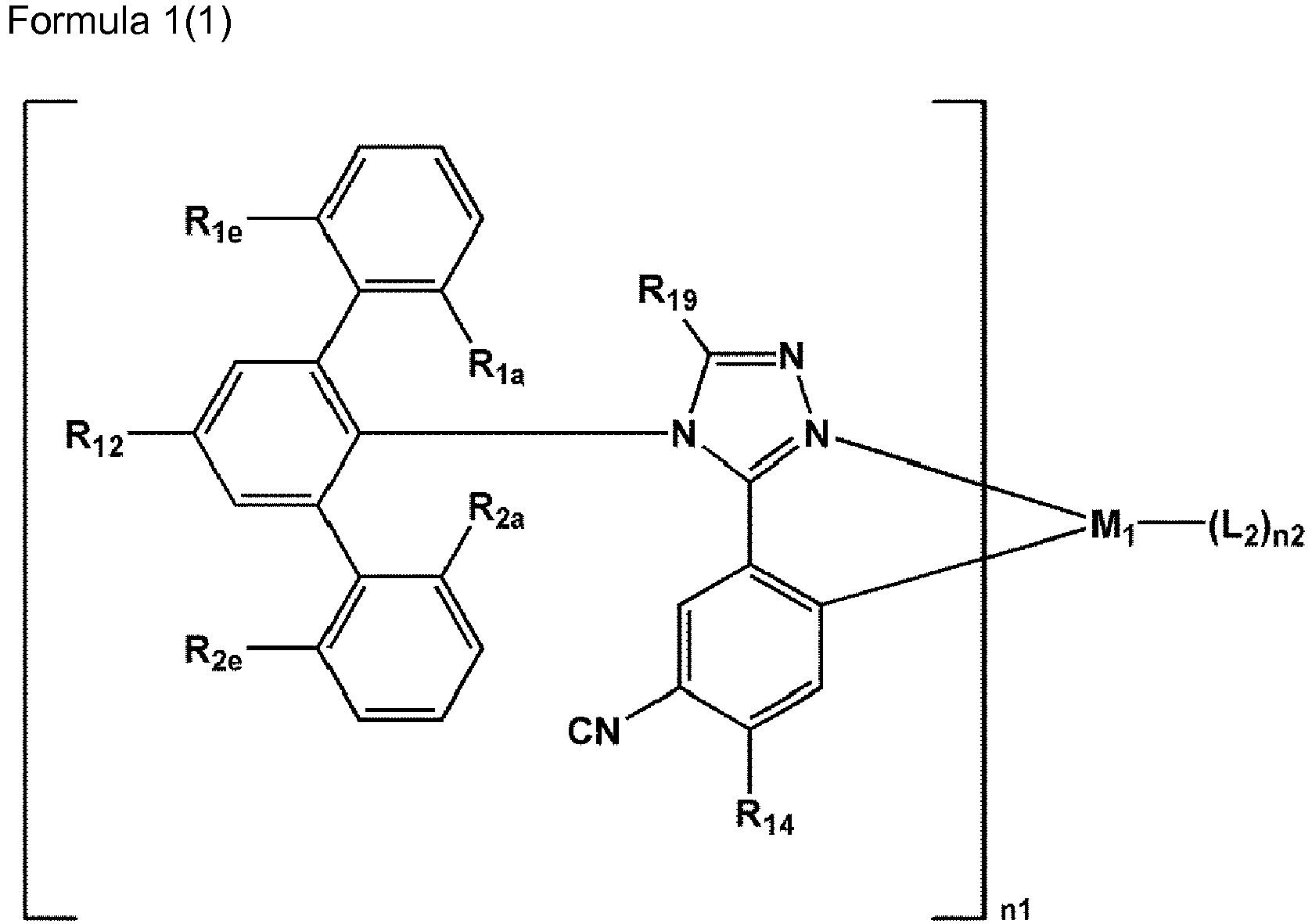


- In Formulae 1(1) to 1(3), M1, n1, L2, n2, R12, R14, R19, and R20 are each independently the same as described herein, R1a and R1e are each independently the same as described in connection with R1, and R2a and R2e are each independently the same as described in connection with R2.
- L2 in Formula 1 may be a monodentate ligand or a bidentate ligand.
- For example, in Formula 1, L2 may be a monodentate ligand, and L2 may be selected from I-, Br-, Cl-, sulfide, nitrate, azide, hydroxide, cyanate, isocyanate, thiocyanate, water, acetonitrile, pyridine, ammonia, carbon monoxide, P(Ph)3, P(Ph)2CH3, PPh(CH3)2, and P(CH3)3, but embodiments of the present disclosure are not limited thereto.
- In an embodiment, in Formula 1, L2 may be a bidentate ligand, and L2 may be selected from oxalate, acetylacetonate, a picolinic acid, 1,2-bis(diphenylphosphino)ethane, 1,1-bis(diphenylphosphino)methane, glycinate, and ethylenediamine, but embodiments of the present disclosure are not limited thereto.
- In an embodiment, L2 in Formula 1 may be selected from ligands represented by Formulae 3A to 3F:


- Y11 may be selected from O, N, N(Z1), P(Z1)(Z2), and As(Z1)(Z2),
- Y12 may be selected from O, N, N(Z3), P(Z3)(Z4), and As(Z3)(Z4),
- CY11 may be a C2-C30 heterocyclic group (for example, a pyridine group, a pyrimidine group, a quinoline group, an isoquinoline group, a quinoxaline group, a carbazole group, or the like),
- T11 may each independently be selected from a single bond, a double bond, *-C(Z11)(Z12)-*', *-C(Z11)=C(Z12)-*', *=C(Z11)-*', *-C(Z11)=*', *=C(Z11)-C(Z12)=C(Z13)-*', *-C(Z11)=C(Z12)-C(Z13)=*', *-N(Z11)-*', and a substituted or unsubstituted C5-C30 carbocyclic group,
- a11 may be an integer from 1 to 10,
- Y13 to Y16 may each independently be carbon (C) or nitrogen (N), Y13 and Y14 may be linked via a single bond or a double bond, and Y15 and Y16 may be linked via a single bond or a double bond,
- CY12 and CY13 may each independently be a C5-C30 carbocyclic group or a C2-C30 heterocyclic group (for example, a benzene group, a naphthalene group, a fluorene group, a dibenzofuran group, a dibenzothiophene group, a pyrazole group, an imidazole group, a triazole group, a tetrazole group, a pyridine group, a pyrimidine group, a quinoline group, an isoquinoline group, a quinoxaline group, a carbazole group, or the like),
- A1 may be P or As,
- Z1 to Z4 and Z11 to Z13 may each independently be selected from hydrogen, deuterium, -F, -Cl, -Br, -I, a hydroxyl group, a cyano group, a nitro group, an amino group, an amidino group, a hydrazine group, a hydrazone group, a carboxylic acid group or a salt thereof, a sulfonic acid group or a salt thereof, a phosphoric acid group or a salt thereof, a substituted or unsubstituted C1-C60 alkyl group, a substituted or unsubstituted C2-C60 alkenyl group, a substituted or unsubstituted C2-C60 alkynyl group, a substituted or unsubstituted C1-C60 alkoxy group, a substituted or unsubstituted C3-C10 cycloalkyl group, a substituted or unsubstituted C1-C10 heterocycloalkyl group, a substituted or unsubstituted C3-C10 cycloalkenyl group, a substituted or unsubstituted C1-C10 heterocycloalkenyl group, a substituted or unsubstituted C6-C60 aryl group, a substituted or unsubstituted C6-C60 aryloxy group, a substituted or unsubstituted C6-C60 arylthio group, a substituted or unsubstituted C7-C60 arylalkyl group, a substituted or unsubstituted C1-C60 heteroaryl group, a substituted or unsubstituted C1-C60 heteroaryloxy group, a substituted or unsubstituted C1-C60 heteroarylthio group, a substituted or unsubstituted C2-C60 heteroarylalkyl group, a substituted or unsubstituted monovalent non-aromatic condensed polycyclic group, a substituted or unsubstituted monovalent non-aromatic condensed heteropolycyclic group, -N(Q1)(Q2), -Si(Q3)(Q4)(Q5), -B(Q6)(Q7), and - P(=O)(Q8)(Q9),
- Q1 to Q9 may each be independently selected from hydrogen, deuterium, -F, - Cl, -Br, -I, a hydroxyl group, a cyano group, a nitro group, an amino group, an amidino group, a hydrazine group, a hydrazone group, a carboxylic acid group or a salt thereof, a sulfonic acid group or a salt thereof, a phosphoric acid group or a salt thereof, a C1-C60 alkyl group, a C2-C60 alkenyl group, a C2-C60 alkynyl group, a C1-C60 alkoxy group, a C3-C10 cycloalkyl group, a C1-C10 heterocycloalkyl group, a C3-C10 cycloalkenyl group, a C1-C10 heterocycloalkenyl group, a C6-C60 aryl group, a C6-C60 aryl group substituted with at least one selected from a C1-C60 alkyl group and a C6-C60 aryl group, a C6-C60 aryloxy group, a C6-C60 arylthio group, a C7-C60 arylalkyl group, a C1-C60 heteroaryl group, a C1-C60 heteroaryloxy group, a C1-C60 heteroarylthio group, a C2-C60 heteroarylalkyl group, a monovalent non-aromatic condensed polycyclic group, and a monovalent non-aromatic condensed heteropolycyclic group,
- d1 and d2 may each independently be an integer from 0 to 10, and
- * and *' each indicate a binding site to M1 in Formula 1.
- In an embodiment, L2 in Formula 1 may be represented by one of Formulae 5-1 to 5-119, but embodiments of the present disclosure are not limited thereto:


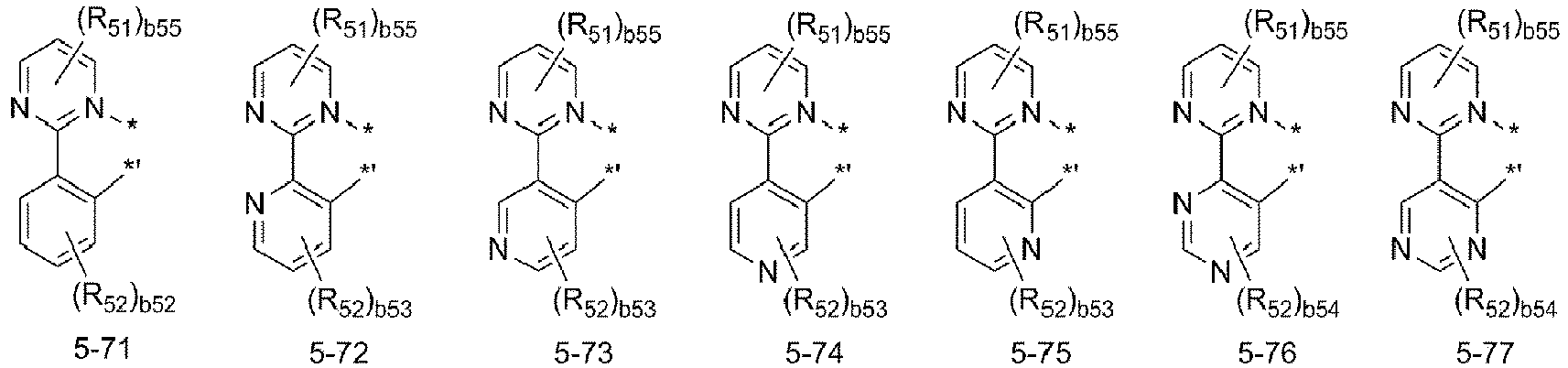


- R51 to R53 may each independently be selected from:
- hydrogen, -F, a cyano group, a nitro group, a methyl group, an ethyl group, a propyl group, an n-butyl group, an iso-butyl group, a sec-butyl group, a tert-butyl group, an n-pentyl group, an iso-pentyl group, a sec-pentyl group, a tert-pentyl group, an n-hexyl group, an iso-hexyl group, a sec-hexyl group, a tert-hexyl group, an n-heptyl group, an iso-heptyl group, a sec-heptyl group, a tert-heptyl group, an n-octyl group, an iso-octyl group, a sec-octyl group, a tert-octyl group, an n-nonyl group, an iso-nonyl group, a sec-nonyl group, a tert-nonyl group, an n-decanyl group, an iso-decanyl group, a sec-decanyl group, a tert-decanyl group, a methoxy group, an ethoxy group, a propoxy group, a butoxy group, a pentoxy group, a phenyl group, a naphthyl group, a pyridinyl group, a pyrimidinyl group, a triazinyl group, a dibenzofuranyl group, and a dibenzothiophenyl group; and
- a methyl group, an ethyl group, a propyl group, an n-butyl group, an iso-butyl group, a sec-butyl group, a tert-butyl group, an n-pentyl group, an iso-pentyl group, a sec-pentyl group, a tert-pentyl group, an n-hexyl group, an iso-hexyl group, a sec-hexyl group, a tert-hexyl group, an n-heptyl group, an iso-heptyl group, a sec-heptyl group, a tert-heptyl group, an n-octyl group, an iso-octyl group, a sec-octyl group, a tert-octyl group, an n-nonyl group, an iso-nonyl group, a sec-nonyl group, a tert-nonyl group, an n-decanyl group, an iso-decanyl group, a sec-decanyl group, a tert-decanyl group, a methoxy group, an ethoxy group, a propoxy group, a butoxy group, a pentoxy group, a phenyl group, a naphthyl group, a pyridinyl group, a pyrimidinyl group, a triazinyl group, a dibenzofuranyl group, and a dibenzothiophenyl group, each substituted with at least one selected from -F, a cyano group, and a nitro group,
- b51 and b54 may each independently be 1 or 2,
- b53 and b55 may each independently be an integer from 1 to 3,
- b52 may be an integer from 1 to 4, and
- * and *' each indicate a binding site to M1 in Formula 1.
- The organometallic compound represented by Formula 1 is neutral and may not have a salt form including an anion and a cation.
- The organometallic compound represented by Formula 1 may be selected from Compounds 1 to 10, but embodiments of the present disclosure are not limited thereto:


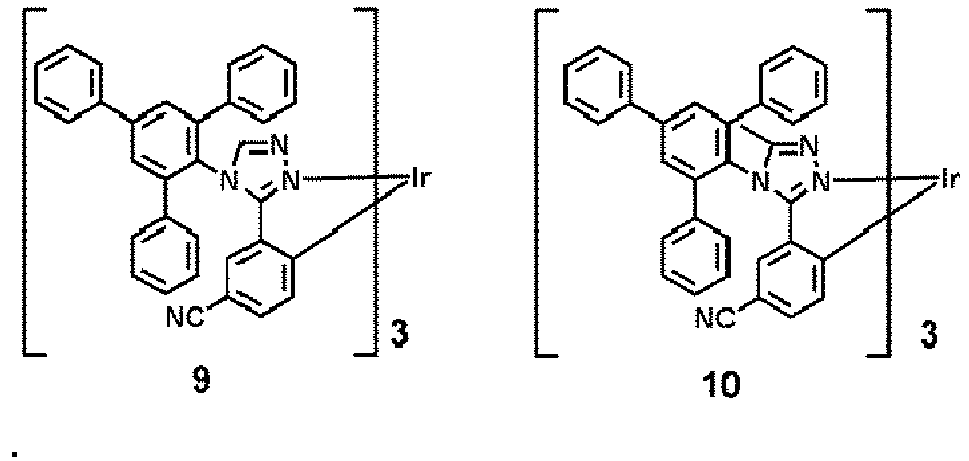
- A maximum emission wavelength (experimental value) of the organometallic compound may be in a range of about 440 nanometers (nm) to about 465 nm, for example, about 440 nm to about 460 nm. When the maximum emission wavelength is in a range of about 440 nm to about 465 nm, an organic light-emitting device emitting deep blue light may be provided.
- The organometallic compound represented by Formula 1 essentially includes CY1 and CY2 at positions defined herein.
- Thus, the organometallic compound may have a natural population analysis (NPA) charge value of about 0.6 or less, for example, about 0.4 to about 0.55. The NPA charge value is evaluated by a density functional theory (DFT) method using a Gaussian program that is structurally optimized at a level of B3LYP/6-31 G(d,p), and NPA charge values of Compounds 1 to 10 are shown in Table 1:
Table 1 Compound No. NPA charge value 1 0.48 2 0.45 3 0.47 4 0.51 5 0.47 6 0.47 7 0.48 8 0.51 9 0.46 10 0.47 - Since the organometallic compound having the NPA charge value in the above-described range has excellent heat resistance and/or decomposition resistance, an electronic device, for example, an organic light-emitting device, which includes the organometallic compound, may have a long lifespan.
- On the other hand, a "carbon atom C" in Formula 1 is essentially bonded to a cyano group (see Formula 1'). Thus, since the organometallic compound represented by Formula 1 has a deep highest occupied molecular orbital (HOMO) energy level (that is, a low HOMO energy level or a large absolute value of a HOMO energy level), the organometallic compound may have a high triplet energy level. Therefore, the use of the organometallic compound represented by Formula 1 may make it possible to emit deep blue light having excellent color purity.

- Also, in one or more embodiments, the organometallic compound represented by Formula 1 may include at least one deuterium. Compared with a single bond between carbon and hydrogen, a single bond between carbon and deuterium has a stronger bond strength and a shorter bond length. Thus, the deuterium-containing organometallic compound may have higher thermal stability than the deuterium-free organometallic compound. Therefore, radicalization of the organometallic compound represented by Formula 1 slowly progresses due to heat and/or electric field generated when the organic light-emitting device is kept and/or driven, and thus, an organic light-emitting device including the organometallic compound may have a longer lifespan.
- Furthermore, in one or more embodiments, R14 in Formula 1 may not be hydrogen, or may be, for example, a deuterium-containing substituent. The organometallic compound represented by Formula 1 may have a high lowest unoccupied molecular orbital (LUMO) energy level and a high triplet (T1) energy level. Thus, the use of the organometallic compound represented by Formula 1 may make it possible to emit blue light having excellent color purity.
- HOMO energy levels, LUMO energy levels, T1 energy levels, emission wavelengths and maximum emission wavelengths (λmax) of some of the organometallic compounds represented by Formula 1 were evaluated by using a Gaussian 09 program for optimizing a molecular structure through DFT based on B3LYP. Evaluation results thereof are shown in Table 2.
Table 2 Compound No. HOMO (e V) LUMO (eV) T1 (eV) emission wavelength(s) (nm) 1 -5.40 -1.40 2.73 467(λmax), 492 2 -5.35 -1.31 2.74 465(λmax), 492 3 -5.30 -1.31 2.77 460(λmax), 484 4 -5.28 -1.25 2.78 453(λmax), 480 5 -5.28 -1.33 2.70 470(λmax), 497 6 -5.36 -1.52 2.63 478(λmax), 509 7 -5.81 -1.77 2.75 458(λmax) 8 -5.38 -1.34 2.75 457(λmax), 486 9 -5.37 -1.50 2.73 468(λmax), 492 10 -5.25 -1.45 2.70 471 (λmax), 497 - On the other hand, in synthesizing an organometallic compound that is represented by Formula 1 but includes at least one deuterium, if at least one of the organometallic compound is deuterated, an organometallic compound in which hydrogen is not substituted with deuterium (that is, an organometallic compound represented by Formula 2 as follows) may also be synthesized, simultaneously. Thus, a composition containing the organometallic compound, which includes organometallic compound represented by Formula 1 and includes at least one deuterium (hereinafter, a "first organometallic compound") and further includes an organometallic compound represented by Formula 2 (hereinafter, a "second organometallic compound"), may be provided:
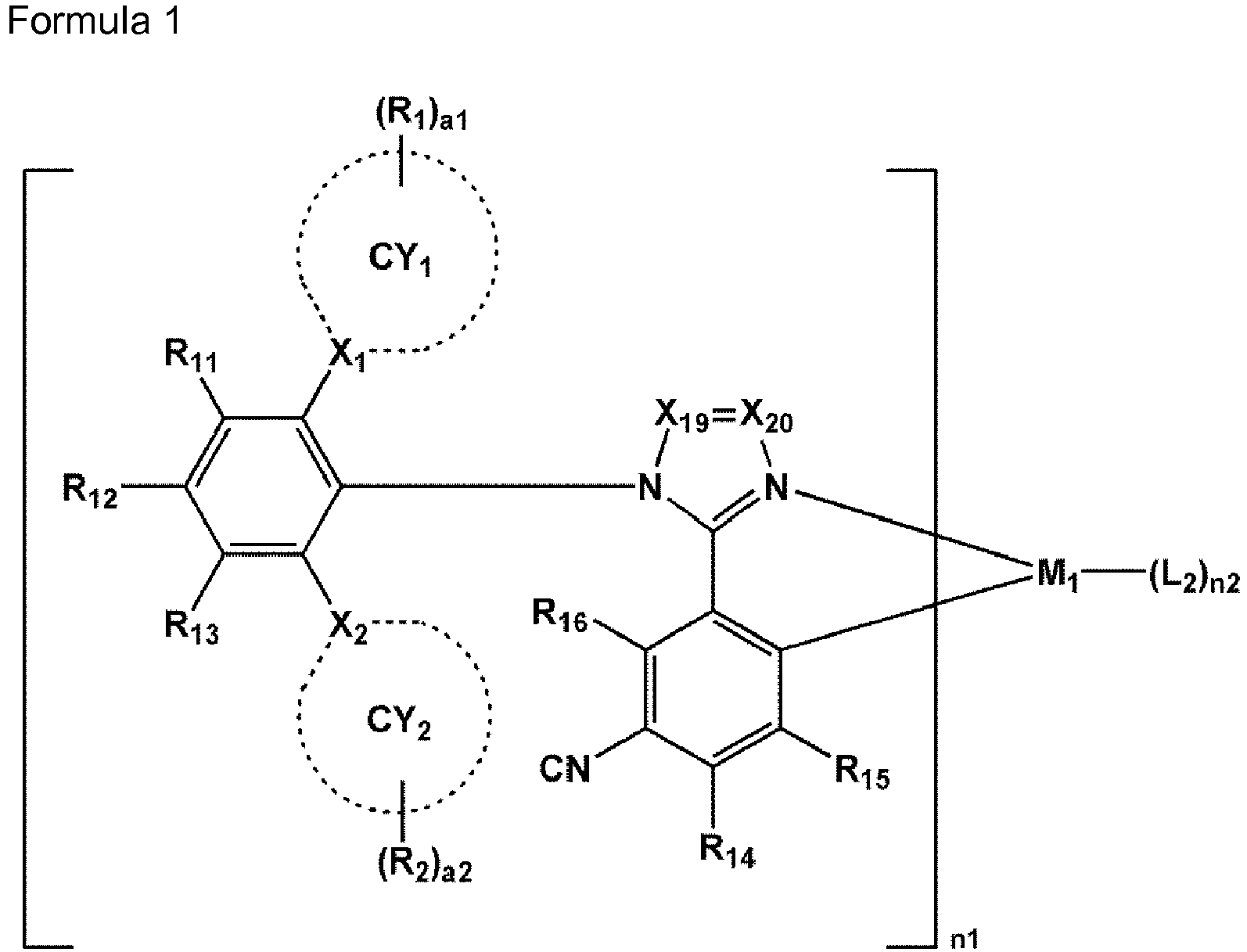

- M1 and M11 may each independently be selected from a first-row transition metal of the Periodic Table of Elements, a second-row transition metal of the Periodic Table of Elements, and a third-row transition metal of the Periodic Table of Elements,
- n1 and n11 may each independently be 1, 2, or 3,
- L2 and L12 may each independently be a monodentate ligand or a bidentate ligand,
- n2 and n12 may each independently be 0, 1, 2, 3, or 4, wherein, when n2 is two or more, two or more groups L2 may be identical to or different from each other, and when n12 is two or more, two or more groups L12 may be identical to or different from each other,
- X1 to X4 may each independently be carbon or nitrogen,
- CY1 to CY4 may each independently be a C5-C30 carbocyclic group or a C2-C30 heterocyclic group,
- X19 may be N or C(R19), and X20 may be N or C(R20), provided that at least one of X19 and X20 is N,
- X29 may be N or C(R29), and X30 may be N or C(R30), provided that at least one of X29 and X30 is N,
- R1, R2, R11 to R16, R19, and R20 may each independently be selected from hydrogen, deuterium, -F, -Cl, -Br, -I, -SF5, a hydroxyl group, a cyano group, a nitro group, an amino group, an amidino group, a hydrazine group, a hydrazone group, a carboxylic acid group or a salt thereof, a sulfonic acid group or a salt thereof, a phosphoric acid group or a salt thereof, a substituted or unsubstituted C1-C60 alkyl group, a substituted or unsubstituted C2-C60 alkenyl group, a substituted or unsubstituted C2-C60 alkynyl group, a substituted or unsubstituted C1-C60 alkoxy group, a substituted or unsubstituted C3-C10 cycloalkyl group, a substituted or unsubstituted C1-C10 heterocycloalkyl group, a substituted or unsubstituted C3-C10 cycloalkenyl group, a substituted or unsubstituted C1-C10 heterocycloalkenyl group, a substituted or unsubstituted C6-C60 aryl group, a substituted or unsubstituted C6-C60 aryloxy group, a substituted or unsubstituted C6-C60 arylthio group, a substituted or unsubstituted C7-C60 arylalkyl group, a substituted or unsubstituted C1-C60 heteroaryl group, a substituted or unsubstituted C1-C60 heteroaryloxy group, a substituted or unsubstituted C1-C60 heteroarylthio group, a substituted or unsubstituted C2-C60 heteroarylalkyl group, a substituted or unsubstituted monovalent non-aromatic condensed polycyclic group, a substituted or unsubstituted monovalent non-aromatic condensed heteropolycyclic group, -N(Q1)(Q2), -Si(Q3)(Q4)(Q5), -B(Q6)(Q7), and - P(=O)(Q8)(Q9),
- two or more neighboring groups selected from R1, R2, R11 to R13, CY1, and CY2 may optionally be linked to form a substituted or unsubstituted C5-C30 carbocyclic group or a substituted or unsubstituted C2-C30 heterocyclic group,
- a1 and a2 may each independently be an integer from 0 to 5,
- i) X19 may be C(R19), X20 may be N, and at least one of R1, R2, R11 to R16, and R19 may be a deuterium-containing substituent; ii) X19 may be N, X20 may be C(R20), and at least one of R1, R2, R11 to R16, and R20 may be a deuterium-containing substituent; or iii) X19 and X20 may each be N, and at least one of R1, R2, and R11 to R16 may be a deuterium-containing substituent,
- R3, R4, R21 to R26, R29, and R30 may each independently be selected from hydrogen, -F, -Cl, -Br, -I, -SF5, a hydroxyl group, a cyano group, a nitro group, an amino group, an amidino group, a hydrazine group, a hydrazone group, a carboxylic acid group or a salt thereof, a sulfonic acid group or a salt thereof, a phosphoric acid group or a salt thereof, a substituted or unsubstituted C1-C60 alkyl group, a substituted or unsubstituted C2-C60 alkenyl group, a substituted or unsubstituted C2-C60 alkynyl group, a substituted or unsubstituted C1-C60 alkoxy group, a substituted or unsubstituted C3-C10 cycloalkyl group, a substituted or unsubstituted C1-C10 heterocycloalkyl group, a substituted or unsubstituted C3-C10 cycloalkenyl group, a substituted or unsubstituted C1-C10 heterocycloalkenyl group, a substituted or unsubstituted C6-C60 aryl group, a substituted or unsubstituted C6-C60 aryloxy group, a substituted or unsubstituted C6-C60 arylthio group, a substituted or unsubstituted C7-C60 arylalkyl group, a substituted or unsubstituted C1-C60 heteroaryl group, a substituted or unsubstituted C1-C60 heteroaryloxy group, a substituted or unsubstituted C1-C60 heteroarylthio group, a substituted or unsubstituted C2-C60 heteroarylalkyl group, a substituted or unsubstituted monovalent non-aromatic condensed polycyclic group, a substituted or unsubstituted monovalent non-aromatic condensed heteropolycyclic group, -N(Q1)(Q2), -Si(Q3)(Q4)(Q5), -B(Q6)(Q7), and - P(=O)(Q8)(Q9),
- two or more neighboring groups selected from R3, R4, R21 to R23, CY3, and CY4 may optionally be linked to form a substituted or unsubstituted C5-C30 carbocyclic group or a substituted or unsubstituted C2-C30 heterocyclic group,
- a3 and a4 may each independently be an integer from 0 to 5, and
- R3, R4, R21 to R26, R29, and R30 may each be a deuterium-free substituent.
- Descriptions for the first organometallic compound are the same as described in Formula 1, except that at least one deuterium is included therein and descriptions for the second organometallic compound are the same as described in Formula 1, except that deuterium is not included therein.
- A deuteration rate of the composition containing the organometallic compound may be about 50% or more. The deuteration rate may be calculated by using Equation 2:

- nH2 represents the sum of a total number of hydrogens included in the deuterium-containing substituents in the first organometallic compound and a total number of hydrogens included in the deuterium-free substituent of the second organometallic compound corresponding to the deuterium-containing substituent in the first organometallic compound, and
- nD2 represents a total number of deuterium atoms included in the deuterium-containing substituents in the first organometallic compound.
- When a substituent indicated by a dashed box in the left compound of the following compounds is a deuterium-containing substituent, a deuterium-free substituent corresponding to the deuterium-containing substituent in the right compound may mean a substituent indicated by a dashed box in the right compound. That is, in the present disclosure, substituents bonded to carbon at the same position in two compounds that differ from each other only in terms of the presence or absence of isotope are defined as "corresponding" substituents.

- For example, if the first organometallic compound includes two deuterium-containing substituents, nD2 means the total number of deuterium atoms included in the two deuterium-containing substituents. Also, nH2 means the sum of the number of hydrogens included in the two deuterium-containing substituents and the number of hydrogens included in the deuterium-free substituent of the second organometallic compound corresponding to the two deuterium-containing substituents.
- In an embodiment, the deuteration rate may be about 70% or more, about 90% or more, about 95% or more, about 96% or more, about 97% or more, about 98% or more, or about 99% or more, but embodiments of the present disclosure are not limited thereto.
- Synthesis methods of the organometallic compound represented by Formula 1 may be recognizable by one of ordinary skill in the art by referring to Synthesis Examples provided below.
- The composition containing the organometallic compound including the first organometallic compound and the second organometallic compound may be obtained by an incomplete deuteration in synthesizing the first organometallic compound, not by mixing the first organometallic compound and the second organometallic compound.
- Synthesis methods of the organometallic compound represented by Formula 1 may be recognizable by one of ordinary skill in the art by referring to Synthesis Examples provided below.
- The organometallic compound represented by Formula 1 or a composition including the organometallic compound may be suitable for use in an organic layer of an organic light-emitting device, for example, for use as a dopant in an emission layer of the organic layer. Thus, another aspect of the present description provides an organic light-emitting device that includes:
- a first electrode;
- a second electrode; and
- an organic layer disposed between the first electrode and the second electrode, wherein the organic layer includes an emission layer and at least one of the organometallic compound represented by Formula 1.
- The organic light-emitting device may have, due to the inclusion of an organic layer including the organometallic compound represented by Formula 1 or the composition including the organometallic compound, high efficiency, a long lifespan, and a high color purity.
- The organometallic compound of Formula 1 or the composition including the organometallic compound may be used between a pair of electrodes of an organic light-emitting device. For example, the organometallic compound represented by Formula 1 or the composition including the organometallic compound may be included in the emission layer. In this embodiment, the organometallic compound or the composition including the organometallic compound may act as a dopant, and the emission layer may further include a host (that is, an amount of the organometallic compound represented by Formula 1 or the composition including the organometallic compound is smaller than an amount of the host). In this embodiment, the dopant may emit blue light.
- The expression "(an organic layer) includes at least one of organometallic compounds" as used herein may include an embodiment in which "(an organic layer) includes identical organometallic compounds represented by Formula 1" and an embodiment in which "(an organic layer) includes two or more different organometallic compounds represented by Formula 1."
- For example, the organic layer may include, as the organometallic compound, only Compound 1. In this regard, Compound 1 may be included in an emission layer of the organic light-emitting device. In one or more embodiments, the organic layer may include, as the organometallic compound, Compound 1 and Compound 2. In this embodiment, Compound 1 and Compound 2 may be included in an identical layer (for example, Compound 1 and Compound 2 may both be included in an emission layer).
- The first electrode may be an anode, which is a hole injection electrode, and the second electrode may be a cathode, which is an electron injection electrode; or the first electrode may be a cathode, which is an electron injection electrode, and the second electrode may be an anode, which is a hole injection electrode.
- In an embodiment, in the organic light-emitting device, the first electrode is an anode, and the second electrode is a cathode, and the organic layer further includes a hole transport region disposed between the first electrode and the emission layer and an electron transport region disposed between the emission layer and the second electrode, and the hole transport region includes a hole injection layer, a hole transport layer, an electron blocking layer, a buffer layer or any combination thereof and the electron transport region includes a hole blocking layer, an electron transport layer, an electron injection layer or any combination thereof.
- The term "organic layer" as used herein refers to a single layer and/or a plurality of layers disposed between the first electrode and the second electrode of the organic light-emitting device. The "organic layer" may include, in addition to an organic compound, an organometallic complex including metal.
- The FIGURE is a schematic view of an organic light-emitting
device 10 according to an embodiment. Hereinafter, the structure of an organic light-emitting device according to an embodiment and a method of manufacturing an organic light-emitting device according to an embodiment will be described in connection with the FIGURE. The organic light-emittingdevice 10 includes afirst electrode 11, anorganic layer 15, and asecond electrode 19, which are sequentially stacked. - A substrate may be additionally disposed under the
first electrode 11 or above thesecond electrode 19. For use as the substrate, any substrate that is used in general organic light-emitting devices may be used, and the substrate may be a glass substrate or a transparent plastic substrate, each having excellent mechanical strength, thermal stability, transparency, surface smoothness, ease of handling, and water resistance. - The
first electrode 11 may be formed by depositing or sputtering a material for forming thefirst electrode 11 on the substrate. Thefirst electrode 11 may be an anode. The material for forming thefirst electrode 11 may be selected from materials with a high work function to facilitate hole injection. Thefirst electrode 11 may be a reflective electrode, a semi-transmissive electrode, or a transmissive electrode. The material for forming the first electrode may be, for example, indium tin oxide (ITO), indium zinc oxide (IZO), tin oxide (SnO2), and zinc oxide (ZnO). In one or more embodiments, magnesium (Mg), aluminum (Al), aluminum-lithium (Al-Li), calcium (Ca), magnesium-indium (Mg-In), or magnesium-silver (Mg-Ag) may be used as the material for forming the first electrode. - The
first electrode 11 may have a single-layered structure or a multi-layered structure including two or more layers. For example, thefirst electrode 11 may have a three-layered structure of ITO/Ag/ITO, but the structure of the first electrode 110 is not limited thereto. - The
organic layer 15 is disposed on thefirst electrode 11. - The
organic layer 15 may include a hole transport region, an emission layer, and an electron transport region. - The hole transport region may be disposed between the
first electrode 11 and the emission layer. - The hole transport region may include at least one selected from a hole injection layer, a hole transport layer, an electron blocking layer, and a buffer layer.
- The hole transport region may include only either a hole injection layer or a hole transport layer. In one or more embodiments, the hole transport region may have a hole injection layer/hole transport layer structure or a hole injection layer/hole transport layer/electron blocking layer structure, which are sequentially stacked in this stated order from the
first electrode 11. - A hole injection layer may be formed on the
first electrode 11 by using one or more suitable methods selected from vacuum deposition, spin coating, casting, or Langmuir-Blodgett (LB) deposition. - When a hole injection layer is formed by vacuum deposition, the deposition conditions may vary according to a compound that is used to form the hole injection layer, and the structure and thermal characteristics of the hole injection layer. For example, the deposition conditions may include a deposition temperature of about 100°C to about 500°C, a vacuum pressure of about 10-8 torr to about 10-3 torr, and a deposition rate of about 0.01 Å/sec to about 100 Å/sec. However, the deposition conditions are not limited thereto.
- When the hole injection layer is formed using spin coating, coating conditions may vary according to the material used to form the hole injection layer, and the structure and thermal properties of the hole injection layer. For example, a coating speed may be from about 2,000 revolutions per minute (rpm) to about 5,000 rpm, and a temperature at which a heat treatment is performed to remove a solvent after coating may be from about 80°C to about 200°C. However, the coating conditions are not limited thereto.
- Conditions for forming a hole transport layer and an electron blocking layer may be understood by referring to conditions for forming the hole injection layer.
- The hole transport region may include at least one selected from m-MTDATA, TDATA, 2-TNATA, NPB, β-NPB, TPD, Spiro-TPD, Spiro-NPB, methylated-NPB, TAPC, HMTPD, 4,4',4"-tris(N-carbazolyl)triphenylamine (TCTA), polyaniline/dodecylbenzene sulfonic acid (PANI/DBSA), poly(3,4-ethylenedioxythiophene)/poly(4-styrene sulfonate) (PEDOT/PSS), polyaniline/camphor sulfonic acid (PANI/CSA), polyaniline/poly(4-styrene sulfonate) (PANI/PSS), a compound represented by Formula 201 below, and a compound represented by Formula 202 below:




- a phenylene group, a pentalenylene group, an indenylene group, a naphthylene group, an azulenylene group, a heptalenylene group, an acenaphthylene group, a fluorenylene group, a phenalenylene group, a phenanthrenylene group, an anthracenylene group, a fluoranthenylene group, a triphenylenylene group, a pyrenylene group, a chrysenylenylene group, a naphthacenylene group, a picenylene group, a perylenylene group, and a pentacenylene group; and
- a phenylene group, a pentalenylene group, an indenylene group, a naphthylene group, an azulenylene group, a heptalenylene group, an acenaphthylene group, a fluorenylene group, a phenalenylene group, a phenanthrenylene group, an anthracenylene group, a fluoranthenylene group, a triphenylenylene group, a pyrenylene group, a chrysenylenylene group, a naphthacenylene group, a picenylene group, a perylenylene group, and a pentacenylene group, each substituted with at least one selected from deuterium, -F, -Cl, -Br, -I, a hydroxyl group, a cyano group, a nitro group, an amino group, an amidino group, a hydrazine group, a hydrazone group, a carboxylic acid group or a salt thereof, a sulfonic acid group or a salt thereof, a phosphoric acid group or a salt thereof, a C1-C60 alkyl group, a C2-C60 alkenyl group, a C2-C60 alkynyl group, a C1-C60 alkoxy group, a C3-C10 cycloalkyl group, a C3-C10 cycloalkenyl group, a C1-C10 heterocycloalkyl group, a C1-C10 heterocycloalkenyl group, a C6-C60 aryl group, a C6-C60 aryloxy group, a C6-C60 arylthio group, a C7-C60 arylalkyl group, a C1-C60 heteroaryl group, a C1-C60 heteroaryloxy group, a C1-C60 heteroarylthio group, a C2-C60 heteroarylalkyl group, a monovalent non-aromatic condensed polycyclic group, and a monovalent non-aromatic condensed heteropolycyclic group.
- In Formula 201, xa and xb may each independently be an integer from 0 to 5, or 0, 1, or 2. For example, xa may be 1, and xb may be 0, but embodiments of the present disclosure are not limited thereto.
- In Formulae 201 and 202, R101 to R108, R111 to R119, and R121 to R124 may each independently be selected from:
- hydrogen, deuterium, -F, -Cl, -Br, -I, a hydroxyl group, a cyano group, a nitro group, an amino group, an amidino group, a hydrazine group, a hydrazone group, a carboxylic acid group or a salt thereof, a sulfonic acid group or a salt thereof, a phosphoric acid group or a salt thereof, a C1-C10 alkyl group (for example, a methyl group, an ethyl group, a propyl group, a butyl group, pentyl group, and a hexyl group), and C1-C10 alkoxy group (for example, a methoxy group, an ethoxy group, a propoxy group, a butoxy group, and a pentoxy group);
- a C1-C10 alkyl group and a C1-C10 alkoxy group, each substituted with at least one selected from deuterium, -F, -Cl, -Br, -I, a hydroxyl group, a cyano group, a nitro group, an amino group, an amidino group, a hydrazine group, a hydrazone group, a carboxylic acid group or a salt thereof, a sulfonic acid group or a salt thereof, and a phosphoric acid group or a salt thereof;
- a phenyl group, a naphthyl group, an anthracenyl group, a fluorenyl group, and a pyrenyl group; and
- a phenyl group, a naphthyl group, an anthracenyl group, a fluorenyl group, and a pyrenyl group, each substituted with at least one selected from deuterium, -F, -Cl, -Br, -I, a hydroxyl group, a cyano group, a nitro group, an amino group, an amidino group, a hydrazine group, a hydrazone group, a carboxylic acid group or a salt thereof, a sulfonic acid group or a salt thereof, a phosphoric acid group or a salt thereof, a C1-C10 alkyl group, and a C1-C10 alkoxy group, but embodiments of the present disclosure are not limited thereto.
- a phenyl group, a naphthyl group, an anthracenyl group, and a pyridinyl group; and
- a phenyl group, a naphthyl group, an anthracenyl group, and a pyridinyl group, each substituted with at least one selected from deuterium, - F, -Cl, -Br, -I, a hydroxyl group, a cyano group, a nitro group, an amino group, an amidino group, a hydrazine group, a hydrazone group, a carboxylic acid group or a salt thereof, a sulfonic acid group or a salt thereof, a phosphoric acid group or a salt thereof, a C1-C20 alkyl group, a C1-C20 alkoxy group, a phenyl group, a naphthyl group, an anthracenyl group, and a pyridinyl group.
- According to an embodiment, the compound represented by Formula 201 may be represented by Formula 201A, but embodiments of the present disclosure are not limited thereto:

- R101, R111, R112, and R109 in Formula 201A may be understood by referring to the description provided herein.
- For example, the compound represented by Formula 201, and the compound represented by Formula 202 may include compounds HT1 to HT20 illustrated below, but are not limited thereto.


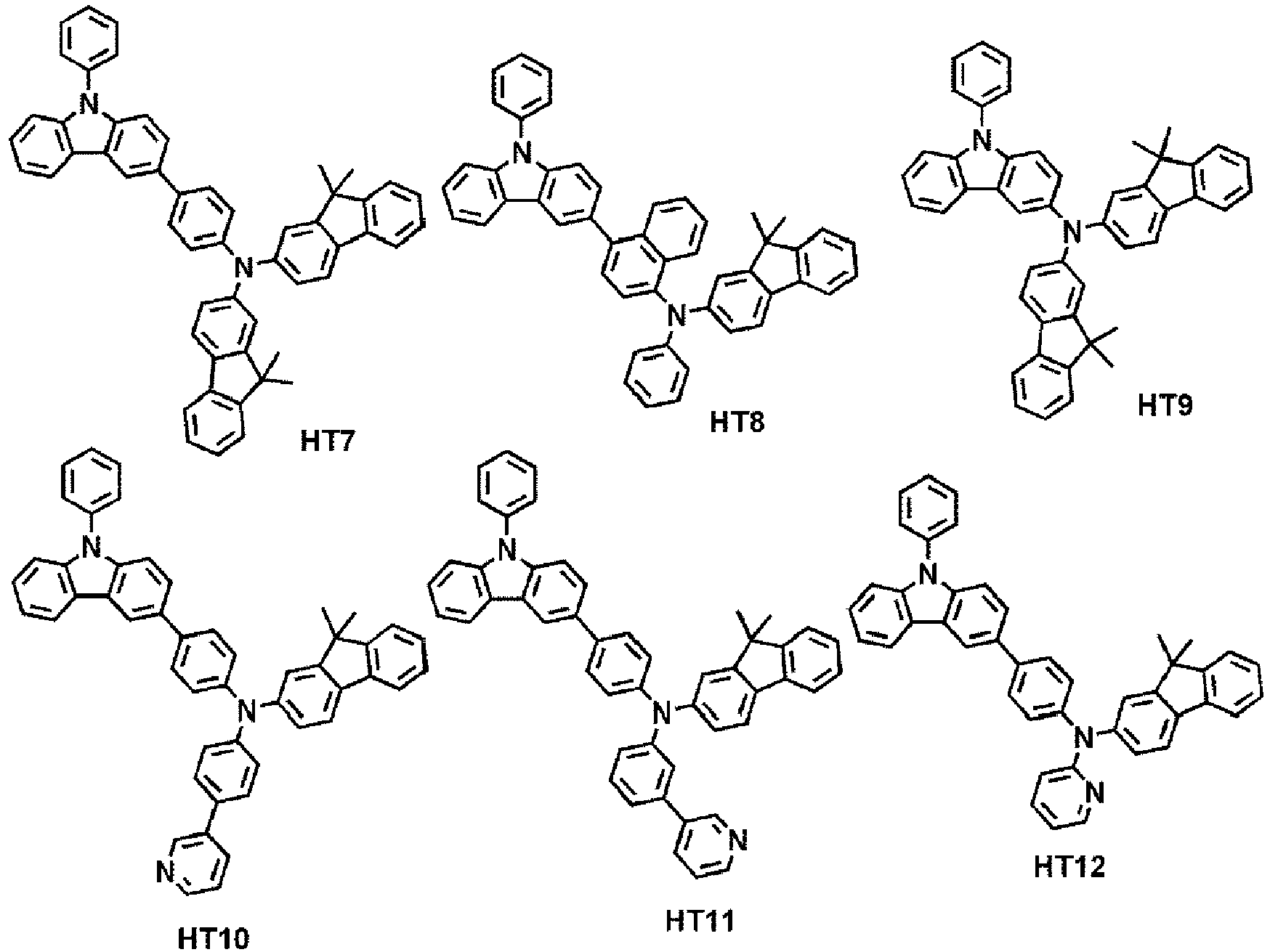


- A thickness of the hole transport region may be in a range of about 100 Å to about 10,000 Å, for example, about 100 Å to about 1,000 Å. When the hole transport region includes a hole injection layer and a hole transport layer, the thickness of the hole injection layer may be in a range of about 100 Å to about 10,000 Å, and for example, about 100 Å to about 1,000 Å, and the thickness of the hole transport layer may be in a range of about 50 Å to about 2,000 Å, and for example, about 100 Å to about 1,500 Å. While not wishing to be bound by theory, it is understood that when the thicknesses of the hole transport region, the hole injection layer, and the hole transport layer are within these ranges, satisfactory hole transporting characteristics may be obtained without a substantial increase in driving voltage.
- The hole transport region may further include, in addition to these materials, a charge-generation material for the improvement of conductive properties. The charge-generation material may be homogeneously or non-homogeneously dispersed in the hole transport region.
- The charge-generation material may be, for example, a p-dopant. The p-dopant may be one selected from a quinone derivative, a metal oxide, and a cyano group-containing compound, but embodiments of the present disclosure are not limited thereto. Non-limiting examples of the p-dopant are a quinone derivative, such as tetracyanoquinonedimethane (TCNQ) or 2,3,5,6-tetrafluoro-tetracyano-1,4-benzoquinonedimethane (F4-TCNQ); a metal oxide, such as a tungsten oxide or a molybdenium oxide; and a cyano group-containing compound, such as Compound HT-D1 or Compound HT-D2 below, but are not limited thereto.


- The hole transport region may include a buffer layer.
- Also, the buffer layer may compensate for an optical resonance distance according to a wavelength of light emitted from the emission layer, and thus, efficiency of a formed organic light-emitting device may be improved.
- Then, an emission layer may be formed on the hole transport region by vacuum deposition, spin coating, casting, LB deposition, or the like. When the emission layer is formed by vacuum deposition or spin coating, the deposition or coating conditions may be similar to those applied in forming the hole injection layer although the deposition or coating conditions may vary according to a compound that is used to form the emission layer.
- Meanwhile, when the hole transport region includes an electron blocking layer, a material for the electron blocking layer may be selected from materials for the hole transport region described above and materials for a host to be explained later. However, the material for the electron blocking layer is not limited thereto. For example, when the hole transport region includes an electron blocking layer, a material for the electron blocking layer may be mCP, which will be explained later.
- The emission layer may include a host and a dopant, and the dopant may include the organometallic compound represented by Formula 1 or a composition containing the organometallic compound.
- The host may include at least one selected from TPBi, TBADN, ADN (also referred to as "DNA"), CBP, CDBP, TCP, mCP, Compound H50, Compound H51 and Compound 52:


- When the organic light-emitting device is a full-color organic light-emitting device, the emission layer may be patterned into a red emission layer, a green emission layer, and a blue emission layer. In one or more embodiments, due to a stacked structure including a red emission layer, a green emission layer, and/or a blue emission layer, the emission layer may emit white light.
- When the emission layer includes a host and a dopant, an amount of the dopant may be in a range of about 0.01 parts by weight to about 15 parts by weight based on 100 parts by weight of the host, but embodiments of the present disclosure are not limited thereto.
- The dopant may include at least one of organometallic compounds represented by Formula 1 or the composition containing the organometallic compound described above.
- A thickness of the emission layer may be in a range of about 100 Å to about 1,000 Å, for example, about 200 Å to about 600 Å. While not wishing to be bound by theory, it is understood that when the thickness of the emission layer is within this range, excellent light-emission characteristics may be obtained without a substantial increase in driving voltage.
- Then, an electron transport region may be disposed on the emission layer.
- The electron transport region may include at least one selected from a hole blocking layer, an electron transport layer, and an electron injection layer.
- For example, the electron transport region may have a hole blocking layer/electron transport layer/electron injection layer structure or an electron transport layer/electron injection layer structure, but the structure of the electron transport region is not limited thereto. The electron transport layer may have a single-layered structure or a multi-layered structure including two or more different materials.
- Conditions for forming the hole blocking layer, the electron transport layer, and the electron injection layer which constitute the electron transport region may be understood by referring to the conditions for forming the hole injection layer.
- When the electron transport region includes a hole blocking layer, the hole blocking layer may include, for example, at least one of BCP, Bphen, and BAlq but embodiments of the present disclosure are not limited thereto.

- A thickness of the hole blocking layer may be in a range of about 20 Å to about 1,000 Å, for example, about 30 Å to about 300 Å. While not wishing to be bound by theory, it is understood that when the thickness of the hole blocking layer is within these ranges, the hole blocking layer may have improved hole blocking ability without a substantial increase in driving voltage.
- The electron transport layer may include at least one selected from BCP, Bphen, Alq3, BAlq, TAZ, and NTAZ.


- In one or more embodiments, the electron transport layer may include at least one of ET1 to ET25, but are not limited thereto:


- A thickness of the electron transport layer may be in a range of about 100 Å to about 1,000 Å, for example, about 150 Å to about 500 Å. While not wishing to be bound by theory, it is understood that when the thickness of the electron transport layer is within the range described above, the electron transport layer may have satisfactory electron transport characteristics without a substantial increase in driving voltage.
- Also, the electron transport layer may further include, in addition to the materials described above, a metal-containing material.
- The metal-containing material may include a Li complex. The Li complex may include, for example, Compound ET-D1 (lithium 8-hydroxyquinolate, LiQ) or ET-D2.

- The electron transport region may include an electron injection layer that promotes injection of electrons from the
second electrode 19 thereinto. - The electron injection layer may include at least one selected from LiF, NaCl, CsF, Li2O, and BaO.
- A thickness of the electron injection layer may be in a range of about 1 Å to about 100 Å, for example, about 3 Å to about 90 Å. While not wishing to be bound by theory, it is understood that when the thickness of the electron injection layer is within the range described above, the electron injection layer may have satisfactory electron injection characteristics without a substantial increase in driving voltage.
- The
second electrode 19 is disposed on theorganic layer 15. Thesecond electrode 19 may be a cathode. A material for forming thesecond electrode 19 may be selected from metal, an alloy, an electrically conductive compound, and a combination thereof, which have a relatively low work function. For example, lithium (Li), magnesium (Mg), aluminum (Al), aluminum-lithium (Al-Li), calcium (Ca), magnesium-indium (Mg-In), or magnesium-silver (Mg-Ag) may be used as a material for forming thesecond electrode 19. In one or more embodiments, to manufacture a top-emission type light-emitting device, a transmissive electrode formed using ITO or IZO may be used as thesecond electrode 19. - Hereinbefore, the organic light-emitting device has been described with reference to the FIGURE, but embodiments of the present disclosure are not limited thereto.
- The term "C1-C60 alkyl group" as used herein refers to a linear or branched saturated aliphatic hydrocarbon monovalent group having 1 to 60 carbon atoms, and non-limiting examples thereof include a methyl group, an ethyl group, a propyl group, an iso-butyl group, a sec-butyl group, a tert-butyl group, a pentyl group, an iso-amyl group, and a hexyl group. The term "C1-C60 alkylene group" as used herein refers to a divalent group having the same structure as the C1-C60 alkyl group.
- The term "C1-C60 alkoxy group" as used herein refers to a monovalent group represented by -OA101 (wherein A101 is the C1-C60 alkyl group), and non-limiting examples thereof include a methoxy group, an ethoxy group, and an iso-propyloxy group.
- The term "C2-C60 alkenyl group" as used herein refers to a hydrocarbon group formed by including at least one carbon-carbon double bond in the middle or at the terminus of the C2-C60 alkyl group, and examples thereof include an ethenyl group, a propenyl group, and a butenyl group. The term "C2-C60 alkenylene group" as used herein refers to a divalent group having the same structure as the C2-C60 alkenyl group.
- The term "C2-C60 alkynyl group" as used herein refers to a hydrocarbon group formed by including at least one carbon-carbon triple bond in the middle or at the terminus of the C2-C60 alkyl group, and examples thereof include an ethynyl group, and a propynyl group. The term "C2-C60 alkynylene group" as used herein refers to a divalent group having the same structure as the C2-C60 alkynyl group.
- The term "C3-C10 cycloalkyl group" as used herein refers to a monovalent saturated hydrocarbon monocyclic group having 3 to 10 carbon atoms, and non-limiting examples thereof include a cyclopropyl group, a cyclobutyl group, a cyclopentyl group, a cyclohexyl group, and a cycloheptyl group. The term "C3-C10 cycloalkylene group" as used herein refers to a divalent group having the same structure as the C3-C10 cycloalkyl group.
- The term "C1-C10 heterocycloalkyl group" as used herein refers to a monovalent saturated monocyclic group having at least one heteroatom selected from N, O, P, Si and S as a ring-forming atom and 1 to 10 carbon atoms, and non-limiting examples thereof include a tetrahydrofuranyl group, and a tetrahydrothiophenyl group. The term "C1-C10 heterocycloalkylene group" as used herein refers to a divalent group having the same structure as the C1-C10 heterocycloalkyl group.
- The term "C3-C10 cycloalkenyl group" as used herein refers to a monovalent monocyclic hydrocarbon group that has 3 to 10 carbon atoms and at least one carbon-carbon double bond in the ring thereof and that has no aromaticity, and non-limiting examples thereof include a cyclopentenyl group, a cyclohexenyl group, and a cycloheptenyl group. The term "C3-C10 cycloalkenylene group" as used herein refers to a divalent group having the same structure as the C3-C10 cycloalkenyl group.
- The term "C1-C10 heterocycloalkenyl group" as used herein refers to a monovalent monocyclic group that has at least one heteroatom selected from N, O, P, Si, and S as a ring-forming atom, 1 to 10 carbon atoms, and at least one double bond in its ring. Examples of the C1-C10 heterocycloalkenyl group are a 2,3-dihydrofuranyl group and a 2,3-dihydrothiophenyl group. The term "C1-C10 heterocycloalkenylene group" as used herein refers to a divalent group having the same structure as the C1-C10 heterocycloalkenyl group.
- The term "C6-C60 aryl group" as used herein refers to a monovalent group having a carbocyclic aromatic system having 6 to 60 carbon atoms, and a C6-C60 arylene group as used herein refers to a divalent group having a carbocyclic aromatic system having 6 to 60 carbon atoms. Non-limiting examples of the C6-C60 aryl group include a phenyl group, a naphthyl group, an anthracenyl group, a phenanthrenyl group, a pyrenyl group, and a chrysenyl group. When the C6-C60 aryl group and the C6-C60 arylene group each include two or more rings, the rings may be fused to each other.
- The term "C1-C60 heteroaryl group" as used herein refers to a monovalent group having a heterocyclic aromatic system that has at least one heteroatom selected from N, O, P, Si, and S as a ring-forming atom, and 1 to 60 carbon atoms. The term "C1-C60 heteroarylene group," as used herein refers to a divalent group having a heterocyclic aromatic system that has at least one heteroatom selected from N, O, P, Si, and S as a ring-forming atom, and 1 to 60 carbon atoms. Non-limiting examples of the C1-C60 heteroaryl group include a pyridinyl group, a pyrimidinyl group, a pyrazinyl group, a pyridazinyl group, a triazinyl group, a quinolinyl group, and an isoquinolinyl group. When the C1-C60 heteroaryl group and the C1-C60 heteroarylene group each include two or more rings, wherein the rings may be fused to each other.
- The term "C6-C60 aryloxy group" as used herein indicates -OA102 (wherein A102 is the C6-C60 aryl group), the term "C6-C60 arylthio group" as used herein indicates -SA103 (wherein A103 is the C6-C60 aryl group), and the term "C7-C60 arylalkyl group" as used herein indicates -A104A105 (wherein A104 is the C6-C59 aryl group and A105 is the C1-C53 alkyl group).
- The term "C2-C60 heteroaryloxy group" as used herein refers to -OA106 (wherein A106 is the C2-C60 heteroaryl group), and the term "C2-C60 heteroarylthio group" as used herein indicates -SA107 (wherein A107 is the C2-C60 heteroaryl group).
- The term "C3-C60 heteroarylalkyl group" as used herein refers to -A108A109 (A109 is a C2-C59 heteroaryl group, and A108 is a C1-C58 alkylene group).
- The term "monovalent non-aromatic condensed polycyclic group" as used herein refers to a monovalent group (for example, having 8 to 60 carbon atoms) having two or more rings condensed to each other, only carbon atoms as ring-forming atoms, and having no aromaticity in its entire molecular structure. Examples of the monovalent non-aromatic condensed polycyclic group include a fluorenyl group. The term "divalent non-aromatic condensed polycyclic group," as used herein, refers to a divalent group having the same structure as the monovalent non-aromatic condensed polycyclic group.
- The term "monovalent non-aromatic condensed heteropolycyclic group" as used herein refers to a monovalent group (for example, having 2 to 60 carbon atoms) having two or more rings condensed to each other, a heteroatom selected from N, O, P, Si, and S, other than carbon atoms, as a ring-forming atom, and having no aromaticity in its entire molecular structure. Non-limiting examples of the monovalent non-aromatic condensed heteropolycyclic group include a carbazolyl group. The term "divalent non-aromatic condensed heteropolycyclic group" as used herein refers to a divalent group having the same structure as the monovalent non-aromatic condensed heteropolycyclic group.
- The term "C5-C30 carbocyclic group" as used herein refers to a saturated or unsaturated cyclic group having, as a ring-forming atom, 5 to 30 carbon atoms only. The term "C5-C30 carbocyclic group" as used herein refers to a monocyclic group or a polycyclic group, and, according to its chemical structure, a monovalent, divalent, trivalent, tetravalent, pentavalent, or hexavalent group.
- The term "C2-C30 heterocyclic group" as used herein refers to a saturated or unsaturated cyclic group having, as a ring-forming atom, at least one heteroatom selected from N, O, Si, P, and S other than 2 to 30 carbon atoms. The term "C2-C30 heterocyclic group" as used herein refers to a monocyclic group or a polycyclic group, and, according to its chemical structure, a monovalent, divalent, trivalent, tetravalent, pentavalent, or hexavalent group.
- At least one substituent of the substituted C5-C30 carbocyclic group, the substituted C2-C30 heterocyclic group, the substituted C1-C60 alkyl group, the substituted C2-C60 alkenyl group, the substituted C2-C60 alkynyl group, the substituted C1-C60 alkoxy group, the substituted C3-C10 cycloalkyl group, the substituted C1-C10 heterocycloalkyl group, the substituted C3-C10 cycloalkenyl group, the substituted C1-C10 heterocycloalkenyl group, the substituted C6-C60 aryl group, the substituted C6-C60 aryloxy group, the substituted C6-C60 arylthio group, the substituted C7-C60 arylalkyl group, the substituted C1-C60 heteroaryl group, the substituted C1-C60 heteroaryloxy group, the substituted C1-C60 heteroarylthio group, the substituted C2-C60 heteroarylalkyl group, the substituted monovalent non-aromatic condensed polycyclic group, and the substituted monovalent non-aromatic condensed heteropolycyclic group may be selected from:
- deuterium, -F, -Cl, -Br, -I, -CD3, -CD2H, -CDH2, -CF3, -CF2H, -CFH2, a hydroxyl group, a cyano group, a nitro group, an amino group, an amidino group, a hydrazine group, a hydrazone group, a carboxylic acid group or a salt thereof, a sulfonic acid group or a salt thereof, a phosphoric acid group or a salt thereof, a C1-C60 alkyl group, a C2-C60 alkenyl group, a C2-C60 alkynyl group, and a C1-C60 alkoxy group;
- a C1-C60 alkyl group, a C2-C60 alkenyl group, a C2-C60 alkynyl group, and a C1-C60 alkoxy group, each substituted with at least one selected from deuterium, -F, -Cl, -Br, -I, -CD3, -CD2H, -CDH2, -CF3, -CF2H, -CFH2, a hydroxyl group, a cyano group, a nitro group, an amino group, an amidino group, a hydrazine group, a hydrazone group, a carboxylic acid group or a salt thereof, a sulfonic acid group or a salt thereof, a phosphoric acid group or a salt thereof, a C3-C10 cycloalkyl group, a C1-C10 heterocycloalkyl group, a C3-C10 cycloalkenyl group, a C1-C10 heterocycloalkenyl group, a C6-C60 aryl group, a C6-C60 aryloxy group, a C6-C60 arylthio group, a C7-C60 arylalkyl group, a C1-C60 heteroaryl group, a C1-C60 heteroaryloxy group, a C1-C60 heteroarylthio group, a C2-C60 heteroarylalkyl group, a monovalent non-aromatic condensed polycyclic group, a monovalent non-aromatic condensed heteropolycyclic group, -N(Q11)(Q12), -Si(Q13)(Q14)(Q15), -B(Q16)(Q17), and - P(=O)(Q18)(Q19);
- a C3-C10 cycloalkyl group, a C1-C10 heterocycloalkyl group, a C3-C10 cycloalkenyl group, a C1-C10 heterocycloalkenyl group, a C6-C60 aryl group, a C6-C60 aryloxy group, a C6-C60 arylthio group, a C7-C60 arylalkyl group, a C1-C60 heteroaryl group, a C1-C60 heteroaryloxy group, a C1-C60 heteroarylthio group, a C2-C60 heteroarylalkyl group, a monovalent non-aromatic condensed polycyclic group, and a monovalent non-aromatic condensed heteropolycyclic group;
- a C3-C10 cycloalkyl group, a C1-C10 heterocycloalkyl group, a C3-C10 cycloalkenyl group, a C1-C10 heterocycloalkenyl group, a C6-C60 aryl group, a C6-C60 aryloxy group, a C6-C60 arylthio group, a C7-C60 arylalkyl group, a C1-C60 heteroaryl group, a C1-C60 heteroaryloxy group, a C1-C60 heteroarylthio group, a C2-C60 heteroarylalkyl group, a monovalent non-aromatic condensed polycyclic group, and a monovalent non-aromatic condensed heteropolycyclic group, each substituted with at least one selected from deuterium, -F, -Cl, -Br, -I, -CD3, -CD2H, -CDH2, -CF3, -CF2H, -CFH2, a hydroxyl group, a cyano group, a nitro group, an amino group, an amidino group, a hydrazine group, a hydrazone group, a carboxylic acid group or a salt thereof, a sulfonic acid group or a salt thereof, a phosphoric acid group or a salt thereof, a C1-C60 alkyl group, a C2-C60 alkenyl group, a C2-C60 alkynyl group, a C1-C60 alkoxy group, a C3-C10 cycloalkyl group, a C1-C10 heterocycloalkyl group, a C3-C10 cycloalkenyl group, a C1-C10 heterocycloalkenyl group, a C6-C60 aryl group, a C6-C60 aryloxy group, a C6-C60 arylthio group, a C7-C60 arylalkyl group, a C1-C60 heteroaryl group, a C1-C60 heteroaryloxy group, a C1-C60 heteroarylthio group, a C2-C60 heteroarylalkyl group, a monovalent non-aromatic condensed polycyclic group, a monovalent non-aromatic condensed heteropolycyclic group, - N(Q21)(Q22), -Si(Q23)(Q24)(Q25), -B(Q26)(Q27), and -P(=O)(Q28)(Q29); and
- -N(Q31)(Q32), -Si(Q33)(Q34)(Q35), -B(Q36)(Q37), and -P(=O)(Q38)(Q39), and
- Q1 to Q9, Q11 to Q19, Q21 to Q29, and Q31 to Q39 may each independently be selected from hydrogen, deuterium, -F, -Cl, -Br, -I, a hydroxyl group, a cyano group, a nitro group, an amino group, an amidino group, a hydrazine group, a hydrazone group, a carboxylic acid group or a salt thereof, a sulfonic acid group or a salt thereof, a phosphoric acid group or a salt thereof, a C1-C60 alkyl group, a C2-C60 alkenyl group, a C2-C60 alkynyl group, a C1-C60 alkoxy group, a C3-C10 cycloalkyl group, a C1-C10 heterocycloalkyl group, a C3-C10 cycloalkenyl group, a C1-C10 heterocycloalkenyl group, a C6-C60 aryl group, a C6-C60 aryl group substituted with at least one selected from a C1-C60 alkyl group and a C6-C60 aryl group, a C6-C60 aryloxy group, a C6-C60 arylthio group, a C7-C60 arylalkyl group, a C1-C60 heteroaryl group, a C1-C60 heteroaryloxy group, a C1-C60 heteroarylthio group, a C2-C60 heteroarylalkyl group, a monovalent non-aromatic condensed polycyclic group, and a monovalent non-aromatic condensed heteropolycyclic group.
- Hereinafter, a compound and an organic light-emitting device according to embodiments are described in detail with reference to Synthesis Example and Examples. However, the organic light-emitting device is not limited thereto. The wording "B was used instead of A" used in describing Synthesis Examples means that an amount of A used was identical to an amount of B used, in terms of molar equivalents.
-

- 0.5 grams (g) (1.56 millimoles, mmol) of a starting material 1, 0.49 g (2.18 mmol) of a starting material 2, and 1.3 milliliters (mL) of o-dichlorobenzene (o-DCB) were mixed, and 0.25 g (2.18 mmol) of trifluoroacetic acid (TFA) were added thereto. The resultant mixture was heated and stirred at a temperature of 185°C overnight. The resultant mixture was then cooled to room temperature, and an excess amount of water was added thereto. The pH of the resultant mixture was adjusted to about 9 by using 10% Na2CO3 aqueous solution, and an organic layer was extracted by using ethyl acetate. The extracted organic layer was washed by using brine and dried by using anhydrous MgSO4, and a solvent was removed therefrom under reduced pressure. The product obtained therefrom was purified by silica gel column chromatography to obtain 0.35 g (yield: 50%) of Intermediate 1-1.
- 0.9 g (2 mmol) of Intermediate 1-1 and 10 mL of N-methyl pyrrolidone (NMP) were mixed, and 0.29 g (2.5 mmol) of Zn(CN)2, 0.19 g (3.4 mmol) of KOH, and 0.7 g (0.63 mmol) of Pd(PPh3)4 were added thereto. The resultant mixture was heated at a temperature of 100°C for 10 hours. The resultant obtained therefrom was cooled to room temperature, and water is added thereto. An organic layer was extracted by using CHCl3 and washed by using 1 molar (M) NaOH aqueous solution and brine, dried by using anhydrous MgSO4, and a solvent was removed therefrom. The product obtained therefrom was purified by silica gel column chromatography to obtain 0.56 g (yield: 70%) of Ligand 1-1.
- 3.98 g (10 mmol) of Ligand 1-1 and 1.24 g (2.5 mmol) of Ir(COD)2BF4 were mixed with 40 mL of NMP, and the resultant mixture underwent a reaction at a temperature of 200°C for 48 hours. 200 mL of dichloromethane (DCM) was added thereto, and the resultant mixture was washed by using 200 mL of 10% NH4OH aqueous solution, 200 mL of saturated NaHCO3 aqueous solution, and 200 mL of brine (saturated NaCl aqueous solution). An organic layer obtained therefrom was dried by using anhydrous MgSO4, filtered, and a solvent was removed therefrom under reduced pressure. The product was purified by silica gel column chromatography (DCM 100% - EtOAc (1% in DCM)) to obtain 0.17 g (0.125 mol, yield: 5%) of Compound 1.
- M/Z 1384.264 1H NMR (CD2Cl2, 500 MHz) δ = 7.82 (t, 3H), 7.67 (dd, 3H), 7.64(dd, 3H), 7.58 (s, 3H), 7.10 (t, 6H), 7.05 (tt, 3H), 6.95-7.02 (m, 9H), 6.77-6.85 (m, 9H), 6.73-6.79 (m, 9H), 6.33 (d, 3H).
-

- Intermediate 5-1 was synthesized in the same manner as Intermediate 1-1 in Synthesis Example 1, except that a starting material 3 was used instead of the starting material 1.
- Ligand 5-1 was synthesized in the same manner as Ligand 1-1 in Synthesis Example 1, except that Intermediate 5-1 was used instead of Intermediate 1-1.
- Compound 5 (yield: 7%) was synthesized in the same manner as in Synthesis Example 1, except that Ligand 5-1 was used instead of Ligand 1-1.
- 1H NMR (CD2Cl2, 500 MHz) δ = 7.85 (t, 3H), 7.69 (td, 6H), 6.95-7.05 (m, 9H), 6.95(d, 6H), 6.91 (t, 3H), 6.85 (dd, 3H), 6.81 (d, 6H), 6.72 (t, 9H), 6.39 (d, 3H), 1.92 (s, 9H).
-

- Intermediate 9-1 was synthesized in the same manner as Intermediate 1-1 in Synthesis Example 1, except that a starting material 4 was used instead of the starting material 2.
- Ligand 9-1 was synthesized in the same manner as Ligand 1-1 in Synthesis Example 1, except that Intermediate 9-1 was used instead of Intermediate 1-1.
- Compound 9 (yield: 6%) was synthesized in the same manner as in Synthesis Example 1, except that Ligand 9-1 was used instead of Ligand 1-1.
- M/Z 1613.872 NMR data (CD2Cl2, 300 MHz) δ = 7.9 (d, 6H), 7.82 (d, 6H), 7.62 (s, 3H), 7.4-7.6 (m, 9H), 7.0-7.2 (m, 18H), 6.98 (s, 3H), 6.76-6.94 (m, 15H), 6.38 (d, 3H).
- HOMO, LUMO, and T1 energy levels of Compounds 1, 5, and 9 were evaluated by using the methods provided in Table 3. Results thereof are shown in Table 4.
Table 3 HOMO energy level evaluation method A voltage-current (V-A) graph of each Compound was obtained by using a cyclic voltammetry (CV) (electrolyte: 0.1 M Bu4NClO4 / solvent: CH2Cl2 / electrode: 3-electrode system (working electrode: GC, reference electrode: Ag/AgCl, auxiliary electrode: Pt)), and then, a HOMO energy level of each Compound was calculated from an onset oxidation potential of the V-A graph. LUMO energy level evaluation method Each Compound was diluted at a concentration of 1x10⁻⁵ M in CHCl3, an UV absorption spectrum thereof was measured at room temperature by using a Shimadzu UV-350 Spectrometer, and then, a LUMO energy level thereof was calculated by using an optical band gap (Eg) from an edge of the absorption spectrum. T1 energy level evaluation method After a mixture of toluene and each Compound (1 milligram (mg) of each Compound was dissolved in 3 cubic centimeters (cc) of toluene) was added to a quartz cell and then added to liquid nitrogen (77 Kelvins, K), a photoluminescence spectrum was measured by using a photoluminescence measurement apparatus. The T1 energy level was calculated by analyzing peaks observed only at a low temperature through comparison between the photoluminescence spectrum and a general room-temperature photoluminescence spectrum. Table 4 Compound No. HOMO (eV) LUMO (eV) T1 (eV) 1 -5.49 -2.76 2.73 5 -5.43 -2.72 2.71 9 -5.49 -2.76 2.73 - Referring to Table 4, it is confirmed that Compounds 1, 5, and 9 have electrical characteristics suitable for use as materials for an organic light-emitting device.
- A thermal analysis (N2 atmosphere, temperature range: room temperature to 600°C (10°C/min), pan type: Pt pan in disposable Al pan) was performed on Compounds 1, 5, and 9 by using thermo gravimetric analysis (TGA). Results thereof are shown in Table 5.
Table 5 Compound No. Td(1%,°C) 1 310 5 230 9 245 - Referring to Table 5, it has been determined that Compounds 1, 5, and 9 have excellent thermal stability.
- Evaluation Example 3: Evaluation of Photoluminescence (PL) Spectrum Light emission characteristics of each Compound were evaluated by evaluating PL spectra of Compounds 1, 5, and 9. Compound 1 was diluted at a concentration of 10 millimolar (mM) in CHCl3, and a PL spectrum was measured at room temperature by using an ICS PC1 Spectrofluorometer equipped with a xenon lamp. This process was repeated on Compounds 5 and 9.
- Emission wavelengths and maximum emission wavelengths (λmax) of the PL spectra of Compounds 1, 5, and 9 are shown in Table 6.
Table 6 Compound No. Emission wavelengths(nm) 1 454(λmax), 482 5 457(λmax), 487 9 454(λmax), 483 - Referring to Table 6, it is confirmed that Compounds 1, 5, and 9 have PL emission characteristics suitable for deep blue light emission.
- A glass substrate, on which an ITO electrode (first electrode, anode) having a thickness of 1,500 Å was formed, was sonicated with distilled water. After the sonicating with distilled water was completed, the glass substrate was ultrasonically cleaned by sequentially using iso-propyl alcohol, acetone, and methanol, was dried, and then transferred to a plasma cleaner. The glass substrate was cleaned for 5 minutes by using oxygen plasma and was provided to a vacuum deposition apparatus.
- Compound HT3 was vacuum-deposited on the ITO electrode of the glass substrate to form a first hole injection layer having a thickness of 3,500 Å, Compound HT-D1 was vacuum-deposited on the first hole injection layer to form a second hole injection layer having a thickness of 300 Å, and TAPC was vacuum-deposited on the second hole injection layer to form an electron blocking layer having a thickness of 100 Å, thereby forming a hole transport region.
- Compound H52 and Compound 1 (dopant, 10wt%) were co-deposited on the hole transport region to form an emission layer having a thickness of 300 Å.
- Compound ET3 was vacuum-deposited on the emission layer to form an electron transport layer having a thickness of 250 Å, ET-D1 (LiQ) was deposited on the electron transport layer to form an electron injection layer having a thickness of 5 Å, and Al was deposited on the electron injection layer to form a second electrode (cathode) having a thickness of 1,000 Å, thereby completing the manufacture of an organic light-emitting device.


- Organic light-emitting devices were manufactured in the same manner as in Example 1, except that Compounds shown in Table 7 were each used instead of Compound 1 as a dopant in forming an emission layer.
- An EL spectrum, a change in current density according to voltage, a change in luminance according to voltage, efficiency, conversion efficiency, external quantum emission efficiency, lifespan, and CIE color coordinates were measured with respect to the organic light-emitting devices manufactured according to Examples 1 to 3. Specific measurement methods are as follows, and results thereof are shown in Table 7.
- EL spectra of the manufactured organic light-emitting devices were measured by using a luminance meter (Minolta Cs-1000A) at a luminance of 500 candelas per square meter (cd/m2).
- A current value flowing through the manufactured organic light-emitting devices was measured by using a current-voltage meter (Keithley 2400) with respect to the manufactured organic light-emitting devices while increasing a voltage from 0 volts (V) to 10 V, and a current density was obtained by dividing the measured current value by an area.
- Luminance was measured by using a luminance meter (Minolta Cs-1000A) with respect to the manufactured organic light-emitting devices while increasing a voltage from 0 V to 10 V, and results thereof were obtained.
- Current efficiency (cd/A) of the same current density (10 milliamperes per square centimeter, mA/cm2) was calculated by using the luminance and the current density measured from (2) and (3) and the voltage. Then, conversion efficiency was calculated by dividing the current efficiency by a y value of CIE color coordinates measured in (6).
- An amount of time (T95) that lapsed when luminance measured from (3) was 95% of initial luminance (100%) was calculated.
- CIE color coordinates were obtained by measuring EL spectra of the manufactured organic light-emitting devices at a luminance of 500 cd/m2 by using a luminance meter (Minolta Cs-1000A).
Table 7 Example Dopant Current density (mA/cm2) Luminance (cd/m2) Efficiency (cd/A) Conversion Efficiency EQE (%) λmax in EL sp ectrum (nm) T95 (hr) Color coordinates (x, y) 1 1 3.97 1000 25.24 110.1 14.6 455 3.03 0.166, 0.22 9 2 5 3.58 1000 28.09 108.2 15.0 458 0.96 0.171, 0.25 9 3 9 3.55 1000 28.23 120.4 16.2 457 2.85 0.169, 0.23 5 
- Referring to Table 7, it is confirmed that the organic light-emitting devices of Examples 1 to 3 have excellent efficiency, external quantum emission efficiency, and lifespan characteristics and can also emit deep blue light.
- As described above, the organometallic compounds according to embodiments of the present disclosure have excellent electrical characteristics and thermal stability, and accordingly, organic light-emitting devices including such organometallic compounds may have excellent driving voltage, current density, efficiency, power, color purity, and lifespan characteristics.
- It should be understood that embodiments described herein should be considered in a descriptive sense only and not for purposes of limitation. Descriptions of features or aspects within each embodiment should typically be considered as available for other similar features or aspects in other embodiments.
- While one or more embodiments have been described with reference to the figures, it will be understood by those of ordinary skill in the art that various changes in form and details may be made therein without departing from the scope of the present disclosure as defined by the following claims.
-D, -CH2D, -CHD2, -CD3, -CH2CH2D, -CH2CHD2, -CH2CD3, -CHDCH3, - CHDCH2D, -CHDCHD2, -CHDCD3, -CD2CH3, -CD2CH2D, -CD2CHD2, - CD2CD3, -CH2CH2CH2D, -CH2CH2CHD2, -CH2CH2CD3, -CH2CHDCH3, - CH2CHDCH2D, -CH2CHDCHD2, -CH2CHDCD3, -CH2CD2CH3, - CH2CD2CH2D, -CH2CD2CHD2, -CH2CD2CD3, -CHDCH2CH2D, - CHDCH2CHD2, -CHDCH2CD3, -CHDCHDCH3, -CHDCHDCH2D, - CHDCHDCHD2, -CHDCHDCD3, -CHDCD2CH3, -CHDCD2CH2D, - CHDCD2CHD2, -CHDCD2CD3, -CD2CH2CH2D, -CD2CH2CHD2, -CD2CH2CD3, -CD2CHDCH3, -CD2CHDCH2D, -CD2CHDCHD2, -CD2CHDCD3, -CD2CD2CH3, -CD2CD2CH2D, -CD2CD2CHD2, -CD2CD2CD3, -CH(CH3)(CH2D), - CH(CH3)(CHD2), -CH(CH2D)(CH2D), -CH(CH3)(CD3), -CH(CHD2)(CHD2), - CH(CH2D)(CD3), -CH(CHD2)(CD3), -CH(CD3)2, -CD(CH3)2, -CD(CH3)(CH2D), -CD(CH3)(CHD2), -CD(CH2D)(CH2D), -CD(CH3)(CD3), -CD(CHD2)(CHD2), - CD(CH2D)(CD3), -CD(CHD2)(CD3), -CD(CD3)2, and -C(CD3)3, but embodiments of the present disclosure are not limited thereto.
Claims (15)
- An organometallic compound represented by Formula 1:
 M1 is selected from a first-row transition metal of the Periodic Table of Elements, a second-row transition metal of the Periodic Table of Elements, and a third-row transition metal of the Periodic Table of Elements,n1 is 1, 2, or 3,L2 is a monodentate ligand or a bidentate ligand,n2 is 0, 1, 2, 3, or 4, wherein, when n2 is two or more, two or more groups L2 are identical to or different from each other,X1 and X2 are each independently carbon or nitrogen,CY1 and CY2 are each independently a C5-C30 carbocyclic group or a C2-C30 heterocyclic group,X19 is N or C(R19), and X20 is N or C(R20), provided that at least one of X19 and X20 is N,R1, R2, R11 to R16, R19, and R20 are each independently selected from hydrogen, deuterium, -F, -Cl, -Br, -I, -SF5, a hydroxyl group, a cyano group, a nitro group, an amino group, an amidino group, a hydrazine group, a hydrazone group, a carboxylic acid group or a salt thereof, a sulfonic acid group or a salt thereof, a phosphoric acid group or a salt thereof, a substituted or unsubstituted C1-C60 alkyl group, a substituted or unsubstituted C2-C60 alkenyl group, a substituted or unsubstituted C2-C60 alkynyl group, a substituted or unsubstituted C1-C60 alkoxy group, a substituted or unsubstituted C3-C10 cycloalkyl group, a substituted or unsubstituted C1-C10 heterocycloalkyl group, a substituted or unsubstituted C3-C10 cycloalkenyl group, a substituted or unsubstituted C1-C10 heterocycloalkenyl group, a substituted or unsubstituted C6-C60 aryl group, a substituted or unsubstituted C6-C60 aryloxy group, a substituted or unsubstituted C6-C60 arylthio group, a substituted or unsubstituted C7-C60 arylalkyl group, a substituted or unsubstituted C1-C60 heteroaryl group, a substituted or unsubstituted C1-C60 heteroaryloxy group, a substituted or unsubstituted C1-C60 heteroarylthio group, a substituted or unsubstituted C2-C60 heteroarylalkyl group, a substituted or unsubstituted monovalent non-aromatic condensed polycyclic group, a substituted or unsubstituted monovalent non-aromatic condensed heteropolycyclic group, -N(Q1)(Q2), -Si(Q3)(Q4)(Q5), -B(Q6)(Q7), and - P(=O)(Q8)(Q9),two or more neighboring groups selected from R1, R2, R11 to R13, CY1, and CY2 are optionally linked to form a substituted or unsubstituted C5-C30 carbocyclic group or a substituted or unsubstituted C2-C30 heterocyclic group,a1 and a2 are each independently an integer from 0 to 5,at least one substituent of the substituted C5-C30 carbocyclic group, the substituted C2-C30 heterocyclic group, the substituted C1-C60 alkyl group, the substituted C2-C60 alkenyl group, the substituted C2-C60 alkynyl group, the substituted C1-C60 alkoxy group, the substituted C3-C10 cycloalkyl group, the substituted C1-C10 heterocycloalkyl group, the substituted C3-C10 cycloalkenyl group, the substituted C1-C10 heterocycloalkenyl group, the substituted C6-C60 aryl group, the substituted C6-C60 aryloxy group, the substituted C6-C60 arylthio group, the substituted C7-C60 arylalkyl group, the substituted C1-C60 heteroaryl group, the substituted C1-C60 heteroaryloxy group, the substituted C1-C60 heteroarylthio group, the substituted C2-C60 heteroarylalkyl group, the substituted monovalent non-aromatic condensed polycyclic group, and the substituted monovalent non-aromatic condensed heteropolycyclic group is selected from:deuterium, -F, -Cl, -Br, -I, -CD3, -CD2H, -CDH2, -CF3, -CF2H, -CFH2, a hydroxyl group, a cyano group, a nitro group, an amino group, an amidino group, a hydrazine group, a hydrazone group, a carboxylic acid group or a salt thereof, a sulfonic acid group or a salt thereof, a phosphoric acid group or a salt thereof, a C1-C60 alkyl group, a C2-C60 alkenyl group, a C2-C60 alkynyl group, and a C1-C60 alkoxy group;a C1-C60 alkyl group, a C2-C60 alkenyl group, a C2-C60 alkynyl group, and a C1-C60 alkoxy group, each substituted with at least one selected from deuterium, -F, - Cl, -Br, -I, -CD3, -CD2H, -CDH2, -CF3, -CF2H, -CFH2, a hydroxyl group, a cyano group, a nitro group, an amino group, an amidino group, a hydrazine group, a hydrazone group, a carboxylic acid group or a salt thereof, a sulfonic acid group or a salt thereof, a phosphoric acid group or a salt thereof, a C3-C10 cycloalkyl group, a C1-C10 heterocycloalkyl group, a C3-C10 cycloalkenyl group, a C1-C10 heterocycloalkenyl group, a C6-C60 aryl group, a C6-C60 aryloxy group, a C6-C60 arylthio group, a C7-C60 arylalkyl group, a C1-C60 heteroaryl group, a C1-C60 heteroaryloxy group, a C1-C60 heteroarylthio group, a C2-C60 heteroarylalkyl group, a monovalent non-aromatic condensed polycyclic group, a monovalent non-aromatic condensed heteropolycyclic group, -N(Q11)(Q12), -Si(Q13)(Q14)(Q15), -B(Q16)(Q17), and -P(=O)(Q18)(Q19);a C3-C10 cycloalkyl group, a C1-C10 heterocycloalkyl group, a C3-C10 cycloalkenyl group, a C1-C10 heterocycloalkenyl group, a C6-C60 aryl group, a C6-C60 aryloxy group, a C6-C60 arylthio group, a C7-C60 arylalkyl group, a C1-C60 heteroaryl group, a C1-C60 heteroaryloxy group, a C1-C60 heteroarylthio group, a C2-C60 heteroarylalkyl group, a monovalent non-aromatic condensed polycyclic group, and a monovalent non-aromatic condensed heteropolycyclic group;a C3-C10 cycloalkyl group, a C1-C10 heterocycloalkyl group, a C3-C10 cycloalkenyl group, a C1-C10 heterocycloalkenyl group, a C6-C60 aryl group, a C6-C60 aryloxy group, a C6-C60 arylthio group, a C7-C60 arylalkyl group, a C1-C60 heteroaryl group, a C1-C60 heteroaryloxy group, a C1-C60 heteroarylthio group, a C2-C60 heteroarylalkyl group, a monovalent non-aromatic condensed polycyclic group, and a monovalent non-aromatic condensed heteropolycyclic group, each substituted with at least one selected from deuterium, -F, -Cl, -Br, -I, -CD3, -CD2H, -CDH2, -CF3, - CF2H, -CFH2, a hydroxyl group, a cyano group, a nitro group, an amino group, an amidino group, a hydrazine group, a hydrazone group, a carboxylic acid group or a salt thereof, a sulfonic acid group or a salt thereof, a phosphoric acid group or a salt thereof, a C1-C60 alkyl group, a C2-C60 alkenyl group, a C2-C60 alkynyl group, a C1-C60 alkoxy group, a C3-C10 cycloalkyl group, a C1-C10 heterocycloalkyl group, a C3-C10 cycloalkenyl group, a C1-C10 heterocycloalkenyl group, a C6-C60 aryl group, a C6-C60 aryloxy group, a C6-C60 arylthio group, a C7-C60 arylalkyl group, a C1-C60 heteroaryl group, a C1-C60 heteroaryloxy group, a C1-C60 heteroarylthio group, a C2-C60 heteroarylalkyl group, a monovalent non-aromatic condensed polycyclic group, a monovalent non-aromatic condensed heteropolycyclic group, -N(Q21)(Q22), - Si(Q23)(Q24)(Q25), -B(Q26)(Q27), and -P(=O)(Q28)(Q29); and-N(Q31)(Q32), -Si(Q33)(Q34)(Q35), -B(Q36)(Q37), and -P(=O)(Q38)(Q39), andQ1 to Q9, Q11 to Q19, Q21 to Q29, and Q31 to Q39 are each independently selected from hydrogen, deuterium, -F, -Cl, -Br, -I, a hydroxyl group, a cyano group, a nitro group, an amino group, an amidino group, a hydrazine group, a hydrazone group, a carboxylic acid group or a salt thereof, a sulfonic acid group or a salt thereof, a phosphoric acid group or a salt thereof, a C1-C60 alkyl group, a C2-C60 alkenyl group, a C2-C60 alkynyl group, a C1-C60 alkoxy group, a C3-C10 cycloalkyl group, a C1-C10 heterocycloalkyl group, a C3-C10 cycloalkenyl group, a C1-C10 heterocycloalkenyl group, a C6-C60 aryl group, a C6-C60 aryl group substituted with at least one selected from a C1-C60 alkyl group and a C6-C60 aryl group, a C6-C60 aryloxy group, a C6-C60 arylthio group, a C7-C60 arylalkyl group, a C1-C60 heteroaryl group, a C1-C60 heteroaryloxy group, a C1-C60 heteroarylthio group, a C2-C60 heteroarylalkyl group, a monovalent non-aromatic condensed polycyclic group, and a monovalent non-aromatic condensed heteropolycyclic group.
 - The organometallic compound of claim 1, whereinM1 is Ir or Os, and the sum of n1 and n2 is 3 or 4; orM1 is Pt, and the sum of n1 and n2 is 2.
- The organometallic compound of claims 1 or 2, whereinCY1 and CY2 are each independently selected from a cyclopentene group, a cyclohexene group, a benzene group, a pyridine group, a pyrimidine group, a pyridazine group, a pyrazine group, a triazine group, a pyrrole group, a pyrazole group, an imidazole group, a triazole group, an oxazole group, an isoxazole group, an oxadiazole group, a thiazole group, an isothiazole group, and a thiadiazole group; and/orwhereinX19 is C(R19), and X20 is N, orX19 is N, and X20 is C(R20).
- The organometallic compound of any of claims 1-3, whereinR1, R2, R11 to R16, R19, and R20 are each independently selected from:hydrogen, deuterium, -F, a cyano group, a nitro group, -SF5, a methyl group, an ethyl group, an n-propyl group, an iso-propyl group, an n-butyl group, an iso-butyl group, a sec-butyl group, a tert-butyl group, an n-pentyl group, an iso-pentyl group, a sec-pentyl group, a tert-pentyl group, an n-hexyl group, an iso-hexyl group, a sec-hexyl group, a tert-hexyl group, an n-heptyl group, an iso-heptyl group, a sec-heptyl group, a tert-heptyl group, an n-octyl group, an iso-octyl group, a sec-octyl group, a tert-octyl group, an n-nonyl group, an iso-nonyl group, a sec-nonyl group, a tert-nonyl group, an n-decyl group, an iso-decyl group, a sec-decyl group, a tert-decyl group, a methoxy group, an ethoxy group, a propoxy group, a butoxy group, a pentoxy group, a cyclopentyl group, a cyclohexyl group, a cycloheptyl group, a cyclooctyl group, an adamantanyl group, a norbornanyl group, a norbornenyl group, a cyclopentenyl group, a cyclohexenyl group, a cycloheptenyl group, a phenyl group, a naphthyl group, a pyridinyl group, a pyrimidinyl group, a dibenzofuranyl group, and a dibenzothiophenyl group;a methyl group, an ethyl group, an n-propyl group, an iso-propyl group, an n-butyl group, an iso-butyl group, a sec-butyl group, a tert-butyl group, an n-pentyl group, an iso-pentyl group, a sec-pentyl group, a tert-pentyl group, an n-hexyl group, an iso-hexyl group, a sec-hexyl group, a tert-hexyl group, an n-heptyl group, an iso-heptyl group, a sec-heptyl group, a tert-heptyl group, an n-octyl group, an iso-octyl group, a sec-octyl group, a tert-octyl group, an n-nonyl group, an iso-nonyl group, a sec-nonyl group, a tert-nonyl group, an n-decyl group, an iso-decyl group, a sec-decyl group, a tert-decyl group, a methoxy group, an ethoxy group, a propoxy group, a butoxy group, a pentoxy group, a cyclopentyl group, a cyclohexyl group, a cycloheptyl group, a cyclooctyl group, an adamantanyl group, a norbornanyl group, a norbornenyl group, a cyclopentenyl group, a cyclohexenyl group, a cycloheptenyl group, a phenyl group, a naphthyl group, a pyridinyl group, a pyrimidinyl group, a dibenzofuranyl group, and a dibenzothiophenyl group, each substituted with at least one selected from deuterium, -F, -CD3, -CD2H, -CDH2, -CF3, -CF2H, -CFH2, a cyano group, a nitro group, a C1-C10 alkyl group, a C1-C10 alkoxy group, a cyclopentyl group, a cyclohexyl group, a cycloheptyl group, a cyclooctyl group, an adamantanyl group, a norbornanyl group, a norbornenyl group, a cyclopentenyl group, a cyclohexenyl group, a cycloheptenyl group, a phenyl group, a naphthyl group, a pyridinyl group, a pyrimidinyl group, a dibenzofuranyl group, and a dibenzothiophenyl group; and-N(Q1)(Q2), -Si(Q3)(Q4)(Q5), -B(Q6)(Q7), and -P(=O)(Q8)(Q9), andQ1 to Q9 are each independently selected from:-CH3, -CD3, -CD2H, -CDH2, -CH2CH3, -CH2CD3, -CH2CD2H, -CH2CDH2, - CHDCH3, -CHDCD2H, -CHDCDH2, -CHDCD3, -CD2CD3, -CD2CD2H, and -CD2CDH2;an n-propyl group, an iso-propyl group, an n-butyl group, an iso-butyl group, a sec-butyl group, a tert-butyl group, an n-pentyl group, an iso-pentyl group, a sec-pentyl group, a tert-pentyl group, a phenyl group, and a naphthyl group; andan n-propyl group, an iso-propyl group, an n-butyl group, an iso-butyl group, a sec-butyl group, a tert-butyl group, an n-pentyl group, an iso-pentyl group, a sec-pentyl group, a tert-pentyl group, a phenyl group, and a naphthyl group, each substituted with at least one selected from deuterium, a C1-C10 alkyl group, and a phenyl group.
- The organometallic compound of any of claims 1-4, whereinR1, R2, R11 to R16, R19, and R20 are each independently selected from hydrogen, deuterium, -CH3, -CD3, -CD2H, -CDH2, -CH2CH3, -CH2CD3, -CH2CD2H, - CH2CDH2, -CHDCH3, -CHDCD2H, -CHDCDH2, -CHDCD3, -CD2CD3, -CD2CD2H, - CD2CDH2, -CF3, -CF2H, -CFH2, groups represented by Formulae 9-1 to 9-24, groups represented by Formulae 10-1 to 10-62, and -Si(Q3)(Q4)(Q5):




 wherein * in Formulae 9-1 to 9-24 and 10-1 to 10-62 indicates a binding site to a neighboring atom.
 - The organometallic compound of any of claims 1-5, whereini) X19 is C(R19), X20 is N, and at least one of R1, R2, R11 to R16, and R19 is a deuterium-containing substituent;ii) X19 is N, X20 is C(R20), and at least one of R1, R2, R11 to R16, and R20 is a deuterium-containing substituent; oriii) X19 and X20 are each N, and at least one of R1, R2, and R11 to R16 is a deuterium-containing substituent, andthe deuterium-containing substituent is selected from:deuterium; anda C1-C20 alkyl group, a C1-C20 alkoxy group, and a phenyl group, each substituted with at least one deuterium;preferably whereinthe deuterium-containing substituent is selected from:deuterium; anda methyl group, an ethyl group, an n-propyl group, an iso-propyl group, an n-butyl group, a sec-butyl group, an iso-butyl group, a tert-butyl group, an n-pentyl group, an iso-pentyl group, a 1-methylbutyl group, a 2-methylbutyl group, a neopentyl group, a 1,2-dimethylpropyl group, and a tert-pentyl group, each substituted with at least one deuterium.
- The organometallic compound of any of claims 1-6, whereini) X19 is C(R19), X20 is N, and at least one of R12, R14, and R19 is a deuterium-containing substituent;ii) X19 is N, X20 is C(R20), and at least one of R12, R14, and R20 is a deuterium-containing substituent; oriii) X19 and X20 are each N, and at least one of R12 and R14 is a deuterium-containing substituent, and
the deuterium-containing substituent is selected from:deuterium; anda methyl group, an ethyl group, an n-propyl group, an iso-propyl group, an n-butyl group, a sec-butyl group, an iso-butyl group, a tert-butyl group, an n-pentyl group, an iso-pentyl group, a 1-methylbutyl group, a 2-methylbutyl group, a neopentyl group, a 1,2-dimethylpropyl group, and a tert-pentyl group, each substituted with at least one deuterium. - The organometallic compound of any of claims 1-7, wherein
the organometallic compound is represented by one of Formulae 1-1 to 1-3:


- The organometallic compound of any of claims 1-8, wherein
the organometallic compound is represented by one of Formulae 1 (1) to 1 (3):


- The organometallic compound of any of claims 1-9, whereinL2 in Formula 1 is selected from ligands represented by Formulae 3A to 3F:

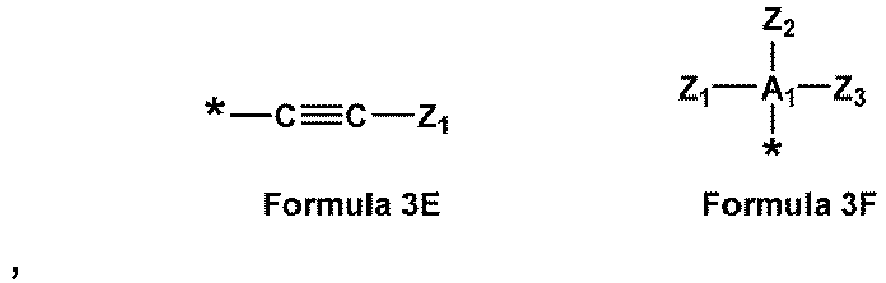 wherein, in Formulae 3A to 3F,Y11 is selected from O, N, N(Z1), P(Z1)(Z2), and As(Z1)(Z2),Y12 is selected from O, N, N(Z3), P(Z3)(Z4), and As(Z3)(Z4),CY11 is a C2-C30 heterocyclic group,T11 is selected from a single bond, a double bond, *-C(Z11)(Z12)-*', *-C(Z11)=C(Z12)-*', *=C(Z11)-*', *-C(Z11)=*', *=C(Z11)-C(Z12)=C(Z13)-*', *-C(Z11)=C(Z12)-C(Z13)=*', *-N(Z11)-*', and a substituted or unsubstituted C5-C30 carbocyclic group,a11 is an integer from 1 to 10,Y13 to Y16 are each independently carbon (C) or nitrogen (N), Y13 and Y14 are linked via a single bond or a double bond, and Y15 and Y16 are linked via a single bond or a double bond,CY12 and CY13 are each independently a C5-C30 carbocyclic group or a C2-C30 heterocyclic group,A1 is P or As,Z1 to Z4 and Z11 to Z13 are each independently selected from hydrogen, deuterium, -F, -Cl, -Br, -I, a hydroxyl group, a cyano group, a nitro group, an amino group, an amidino group, a hydrazine group, a hydrazone group, a carboxylic acid group or a salt thereof, a sulfonic acid group or a salt thereof, a phosphoric acid group or a salt thereof, a substituted or unsubstituted C1-C60 alkyl group, a substituted or unsubstituted C2-C60 alkenyl group, a substituted or unsubstituted C2-C60 alkynyl group, a substituted or unsubstituted C1-C60 alkoxy group, a substituted or unsubstituted C3-C10 cycloalkyl group, a substituted or unsubstituted C1-C10 heterocycloalkyl group, a substituted or unsubstituted C3-C10 cycloalkenyl group, a substituted or unsubstituted C1-C10 heterocycloalkenyl group, a substituted or unsubstituted C6-C60 aryl group, a substituted or unsubstituted C6-C60 aryloxy group, a substituted or unsubstituted C6-C60 arylthio group, a substituted or unsubstituted C7-C60 arylalkyl group, a substituted or unsubstituted C1-C60 heteroaryl group, a substituted or unsubstituted C1-C60 heteroaryloxy group, a substituted or unsubstituted C1-C60 heteroarylthio group, a substituted or unsubstituted C2-C60 heteroarylalkyl group, a substituted or unsubstituted monovalent non-aromatic condensed polycyclic group, a substituted or unsubstituted monovalent non-aromatic condensed heteropolycyclic group, -N(Q1)(Q2), -Si(Q3)(Q4)(Q5), -B(Q6)(Q7), and - P(=O)(Q8)(Q9),Q1 to Q9 are each independently selected from hydrogen, deuterium, -F, -Cl, -Br, -I, a hydroxyl group, a cyano group, a nitro group, an amino group, an amidino group, a hydrazine group, a hydrazone group, a carboxylic acid group or a salt thereof, a sulfonic acid group or a salt thereof, a phosphoric acid group or a salt thereof, a C1-C60 alkyl group, a C2-C60 alkenyl group, a C2-C60 alkynyl group, a C1-C60 alkoxy group, a C3-C10 cycloalkyl group, a C1-C10 heterocycloalkyl group, a C3-C10 cycloalkenyl group, a C1-C10 heterocycloalkenyl group, a C6-C60 aryl group, a C6-C60 aryl group substituted with at least one selected from a C1-C60 alkyl group and a C6-C60 aryl group, a C6-C60 aryloxy group, a C6-C60 arylthio group, a C7-C60 arylalkyl group, a C1-C60 heteroaryl group, a C1-C60 heteroaryloxy group, a C1-C60 heteroarylthio group, a C2-C60 heteroarylalkyl group, a monovalent non-aromatic condensed polycyclic group, and a monovalent non-aromatic condensed heteropolycyclic group,d1 and d2 are each independently an integer from 0 to 10, and* and *' each indicate a binding site to M1 in Formula 1.
 - The organometallic compound of any of claims 1-10, wherein
the organometallic compound is one of Compounds 1 to 10:


- The organometallic compound of any of claims 1-11, wherein
the organometallic compound has a natural population analysis (NPA) charge value of 0.6 or less, preferably from 0.4 to 0.55. - A composition containing an organometallic compound, the composition comprising:a first organometallic compound represented by Formula 1 according to any of claims 1-12 and comprising at least one deuterium; anda second organometallic compound represented by Formula 2:wherein, in Formulae 1 and 2,


 M1 and M11 are each independently selected from a first-row transition metal of the Periodic Table of Elements, a second-row transition metal of the Periodic Table of Elements, and a third-row transition metal of the Periodic Table of Elements,n1 and n11 are each independently 1, 2, or 3,L2 and L12 are each independently a monodentate ligand or a bidentate ligand,n2 and n12 are each independently 0, 1, 2, 3, or 4, wherein, when n2 is two or more, two or more L2 are identical to or different from each other, and when n12 is two or more, two or more groups L12 are identical to or different from each other,X1 to X4 are each independently carbon or nitrogen,CY1 to CY4 are each independently a C5-C30 carbocyclic group or a C2-C30 heterocyclic group,X19 is N or C(R19), and X20 is N or C(R20), provided that at least one of X19 and X20 is N,X29 is N or C(R29), and X30 is N or C(R30), provided that at least one of X29 and X30 is N,R1, R2, R11 to R16, R19, and R20 are each independently selected from hydrogen, deuterium, -F, -Cl, -Br, -I, -SF5, a hydroxyl group, a cyano group, a nitro group, an amino group, an amidino group, a hydrazine group, a hydrazone group, a carboxylic acid group or a salt thereof, a sulfonic acid group or a salt thereof, a phosphoric acid group or a salt thereof, a substituted or unsubstituted C1-C60 alkyl group, a substituted or unsubstituted C2-C60 alkenyl group, a substituted or unsubstituted C2-C60 alkynyl group, a substituted or unsubstituted C1-C60 alkoxy group, a substituted or unsubstituted C3-C10 cycloalkyl group, a substituted or unsubstituted C1-C10 heterocycloalkyl group, a substituted or unsubstituted C3-C10 cycloalkenyl group, a substituted or unsubstituted C1-C10 heterocycloalkenyl group, a substituted or unsubstituted C6-C60 aryl group, a substituted or unsubstituted C6-C60 aryloxy group, a substituted or unsubstituted C6-C60 arylthio group, a substituted or unsubstituted C7-C60 arylalkyl group, a substituted or unsubstituted C1-C60 heteroaryl group, a substituted or unsubstituted C1-C60 heteroaryloxy group, a substituted or unsubstituted C1-C60 heteroarylthio group, a substituted or unsubstituted C2-C60 heteroarylalkyl group, a substituted or unsubstituted monovalent non-aromatic condensed polycyclic group, a substituted or unsubstituted monovalent non-aromatic condensed heteropolycyclic group, -N(Q1)(Q2), -Si(Q3)(Q4)(Q5), -B(Q6)(Q7), and - P(=O)(Q8)(Q9),two or more neighboring groups selected from R1, R2, R11 to R13, CY1, and CY2 are optionally linked to form a substituted or unsubstituted C5-C30 carbocyclic group or a substituted or unsubstituted C2-C30 heterocyclic group,a1 and a2 are each independently an integer from 0 to 5,i) X19 is C(R19), X20 is N, and at least one of R1, R2, R11 to R16, and R19 is a deuterium-containing substituent; ii) X19 is N, X20 is C(R20), and at least one of R1, R2, R11 to R16, and R20 is a deuterium-containing substituent; or iii) X19 and X20 are each N, and at least one of R1, R2, and R11 to R16 is a deuterium-containing substituent,R3, R4, R21 to R26, R29, and R30 are each independently selected from hydrogen, -F, -Cl, -Br, -I, -SF5, a hydroxyl group, a cyano group, a nitro group, an amino group, an amidino group, a hydrazine group, a hydrazone group, a carboxylic acid group or a salt thereof, a sulfonic acid group or a salt thereof, a phosphoric acid group or a salt thereof, a substituted or unsubstituted C1-C60 alkyl group, a substituted or unsubstituted C2-C60 alkenyl group, a substituted or unsubstituted C2-C60 alkynyl group, a substituted or unsubstituted C1-C60 alkoxy group, a substituted or unsubstituted C3-C10 cycloalkyl group, a substituted or unsubstituted C1-C10 heterocycloalkyl group, a substituted or unsubstituted C3-C10 cycloalkenyl group, a substituted or unsubstituted C1-C10 heterocycloalkenyl group, a substituted or unsubstituted C6-C60 aryl group, a substituted or unsubstituted C6-C60 aryloxy group, a substituted or unsubstituted C6-C60 arylthio group, a substituted or unsubstituted C7-C60 arylalkyl group, a substituted or unsubstituted C1-C60 heteroaryl group, a substituted or unsubstituted C1-C60 heteroaryloxy group, a substituted or unsubstituted C1-C60 heteroarylthio group, a substituted or unsubstituted C2-C60 heteroarylalkyl group, a substituted or unsubstituted monovalent non-aromatic condensed polycyclic group, a substituted or unsubstituted monovalent non-aromatic condensed heteropolycyclic group, -N(Q1)(Q2), -Si(Q3)(Q4)(Q5), -B(Q6)(Q7), and - P(=O)(Q8)(Q9),two or more neighboring groups selected from R3, R4, R21 to R23, CY3, and CY4 are optionally linked to form a substituted or unsubstituted C5-C30 carbocyclic group or a substituted or unsubstituted C2-C30 heterocyclic group,a3 and a4 are each independently an integer from 0 to 5, andR3, R4, R21 to R26, R29, and R30 are each a deuterium-free substituent; preferably whereina deuteration rate represented by Equation 2 is 50% or more:
 wherein, in Equation 2,nH2 represents the sum of a total number of hydrogens included in deuterium-containing substituents in the first organometallic compound and a total number of hydrogens included in a deuterium-free substituent of the second organometallic compound corresponding to the deuterium-containing substituent in the first organometallic compound, andnD2 represents a total number of deuterium atoms included in the deuterium-containing substituents in the first organometallic compound.
 - An organic light-emitting device comprising:a first electrode;a second electrode; andan organic layer disposed between the first electrode and the second electrode, wherein the organic layer comprises an emission layer,wherein the organic layer comprises at least one of the organometallic compound of any of claims 1-12 or the composition of claim 13;preferably whereinthe emission layer comprises the organometallic compound or the composition.
- The organic light-emitting device of claim 14, wherein
the emission layer further comprises a host;
preferably wherein
the host is selected from the following compounds:


Applications Claiming Priority (2)
| Application Number | Priority Date | Filing Date | Title |
|---|---|---|---|
| KR20170029608 | 2017-03-08 | ||
| KR1020180026443A KR20180103004A (en) | 2017-03-08 | 2018-03-06 | Organometallic compound, composition including organometallic compound and organic light emitting device |
Publications (2)
| Publication Number | Publication Date |
|---|---|
| EP3372611A1 true EP3372611A1 (en) | 2018-09-12 |
| EP3372611B1 EP3372611B1 (en) | 2020-06-24 |
Family
ID=61598908
Family Applications (1)
| Application Number | Title | Priority Date | Filing Date |
|---|---|---|---|
| EP18160440.6A Active EP3372611B1 (en) | 2017-03-08 | 2018-03-07 | Organometallic compound, composition containing the organometallic compound, and organic light-emitting device including the organometallic compound |
Country Status (4)
| Country | Link |
|---|---|
| US (1) | US10923667B2 (en) |
| EP (1) | EP3372611B1 (en) |
| KR (1) | KR20240041893A (en) |
| CN (1) | CN108570075B (en) |
Families Citing this family (4)
| Publication number | Priority date | Publication date | Assignee | Title |
|---|---|---|---|---|
| EP3372611B1 (en) | 2017-03-08 | 2020-06-24 | Samsung Electronics Co., Ltd. | Organometallic compound, composition containing the organometallic compound, and organic light-emitting device including the organometallic compound |
| EP3689888B1 (en) | 2019-01-31 | 2021-09-22 | Samsung Electronics Co., Ltd. | Organometallic compound and organic light-emitting device including the same |
| KR102896847B1 (en) | 2019-01-31 | 2025-12-05 | 삼성전자주식회사 | Organometallic compound and organic light emitting device including the same |
| US12310229B2 (en) * | 2020-05-21 | 2025-05-20 | Samsung Electronics Co., Ltd. | Organometallic compound, organic light-emitting device including organometallic compound, and electronic apparatus including organic light-emitting device |
Citations (2)
| Publication number | Priority date | Publication date | Assignee | Title |
|---|---|---|---|---|
| JP2014111549A (en) * | 2012-12-05 | 2014-06-19 | Konica Minolta Inc | Iridium complex, organic electroluminescent element material, and organic electroluminescent element using the same |
| EP3053986A1 (en) * | 2015-02-06 | 2016-08-10 | Samsung Electronics Co., Ltd. | Organometallic compound, composition containing the organometallic compound, and organic light-emitting device including the organometallic compound or composition |
Family Cites Families (15)
| Publication number | Priority date | Publication date | Assignee | Title |
|---|---|---|---|---|
| US20020121638A1 (en) | 2000-06-30 | 2002-09-05 | Vladimir Grushin | Electroluminescent iridium compounds with fluorinated phenylpyridines, phenylpyrimidines, and phenylquinolines and devices made with such compounds |
| CN101924190B (en) | 2000-08-11 | 2012-07-04 | 普林斯顿大学理事会 | Organometallic compounds and emission-shifting organic electrophosphorescence |
| US6579630B2 (en) * | 2000-12-07 | 2003-06-17 | Canon Kabushiki Kaisha | Deuterated semiconducting organic compounds used for opto-electronic devices |
| DE10338550A1 (en) | 2003-08-19 | 2005-03-31 | Basf Ag | Transition metal complexes with carbene ligands as emitters for organic light-emitting diodes (OLEDs) |
| KR100537621B1 (en) | 2004-02-02 | 2005-12-19 | 삼성에스디아이 주식회사 | Iridium compound and organic electroluminescent display device using the same |
| WO2005123873A1 (en) | 2004-06-17 | 2005-12-29 | Konica Minolta Holdings, Inc. | Organic electroluminescent device material, organic electroluminescent device, display and illuminating device |
| CN101415718B (en) | 2006-02-10 | 2013-05-29 | 通用显示公司 | Cyclometallated imidazo[1,2-f]phenanthridine and diimidazo[1,2-a:1',2'-c]quinazoline ligands and their isoelectronic and benzocyclization analogs metal complexes |
| JP5181448B2 (en) | 2006-09-13 | 2013-04-10 | コニカミノルタホールディングス株式会社 | Organic electroluminescence element material |
| CN105399776A (en) | 2009-11-02 | 2016-03-16 | 株式会社半导体能源研究所 | Organometallic Complex, Light-emitting Element, Display Device, Electronic Device, And Lighting Device |
| JP5742581B2 (en) | 2011-08-16 | 2015-07-01 | コニカミノルタ株式会社 | Organic electroluminescence element, display device, lighting device |
| JP6085985B2 (en) | 2013-02-12 | 2017-03-01 | コニカミノルタ株式会社 | ORGANIC METAL COMPLEX, ORGANIC ELECTROLUMINESCENT ELEMENT MATERIAL, ORGANIC ELECTROLUMINESCENT ELEMENT, LIGHTING DEVICE AND DISPLAY DEVICE |
| JP2014214127A (en) | 2013-04-26 | 2014-11-17 | 株式会社半導体エネルギー研究所 | Synthesis method for phosphorescent organic metal iridium complex |
| US9478757B2 (en) | 2014-02-26 | 2016-10-25 | E I Du Pont De Nemours And Company | Blue luminescent compounds |
| KR20180082808A (en) | 2017-01-11 | 2018-07-19 | 삼성전자주식회사 | Organometallic compound, composition including organometallic compound and organic light emitting device |
| EP3372611B1 (en) | 2017-03-08 | 2020-06-24 | Samsung Electronics Co., Ltd. | Organometallic compound, composition containing the organometallic compound, and organic light-emitting device including the organometallic compound |
-
2018
- 2018-03-07 EP EP18160440.6A patent/EP3372611B1/en active Active
- 2018-03-08 US US15/915,131 patent/US10923667B2/en active Active
- 2018-03-08 CN CN201810189162.2A patent/CN108570075B/en active Active
-
2024
- 2024-03-18 KR KR1020240037367A patent/KR20240041893A/en not_active Ceased
Patent Citations (2)
| Publication number | Priority date | Publication date | Assignee | Title |
|---|---|---|---|---|
| JP2014111549A (en) * | 2012-12-05 | 2014-06-19 | Konica Minolta Inc | Iridium complex, organic electroluminescent element material, and organic electroluminescent element using the same |
| EP3053986A1 (en) * | 2015-02-06 | 2016-08-10 | Samsung Electronics Co., Ltd. | Organometallic compound, composition containing the organometallic compound, and organic light-emitting device including the organometallic compound or composition |
Non-Patent Citations (1)
| Title |
|---|
| DATABASE CA [online] CHEMICAL ABSTRACTS SERVICE, COLUMBUS, OHIO, US; 2014, SUGINO, MOTOAKI ET AL: "Preparation of (2-phenylimidazole)iridium complexes, organic electroluminescence element materials, and organic electroluminescent devices using these complexes", XP002783040, retrieved from STN Database accession no. 2014:988840 * |
Also Published As
| Publication number | Publication date |
|---|---|
| EP3372611B1 (en) | 2020-06-24 |
| US20180261780A1 (en) | 2018-09-13 |
| CN108570075B (en) | 2023-02-03 |
| US10923667B2 (en) | 2021-02-16 |
| KR20240041893A (en) | 2024-04-01 |
| CN108570075A (en) | 2018-09-25 |
Similar Documents
| Publication | Publication Date | Title |
|---|---|---|
| EP3348562B1 (en) | Organometallic compound, composition containing the organometallic compound, and organic light-emitting device | |
| EP3663308B1 (en) | Organometallic compound, organic light-emitting device including the organometallic compound, and diagnostic composition including the organometallic compound | |
| EP3026056B1 (en) | Organometallic compound and organic light-emitting device including the same | |
| EP3560940B1 (en) | Organometallic compound, organic light-emitting device with the organometallic compound, and diagnostic composition including the organometallic compound | |
| EP3205659A1 (en) | Organometallic compound, organic light-emitting device including the organometallic compound, and diagnosis composition including the organometallic compound | |
| EP3000815A1 (en) | Organometallic compound and organic light-emitting device including the same | |
| EP3604321B1 (en) | Organometallic compound, organic light-emitting device including the same, and diagnostic composition including the organometallic compound | |
| EP3715354B1 (en) | Organometallic compound, organic light-emitting device including organometallic compound, and diagnostic composition including organometallic compound | |
| EP3461830A1 (en) | Organometallic compound, organic light-emitting device including the organometallic compound, and diagnostic composition including the organometallic compound | |
| EP3549944B1 (en) | Organometallic compound, organic light-emitting device including the same, and diagnostic composition including the organometallic compound | |
| EP3392258B1 (en) | Organometallic compound, organic light-emitting device including the organometallic compound, and diagnostic composition including the organometallic compound | |
| EP3626724A1 (en) | Organometallic compound, organic light-emitting device including the same, and diagnostic compostion including the organometallic compound | |
| EP3034582A1 (en) | Organometallic compound and organic light-emitting device including the same | |
| EP3865553A1 (en) | Organometallic compound, organic light-emitting device including the same, and electronic apparatus including the organic light-emitting device | |
| KR20240041893A (en) | Organometallic compound, composition including organometallic compound and organic light emitting device | |
| EP3432381A1 (en) | Organometallic compound and organic light-emitting device including the same | |
| EP3053986B1 (en) | Organometallic compound, composition containing the organometallic compound, and organic light-emitting device including the organometallic compound or composition | |
| EP3772517B1 (en) | Organometallic compound, organic light-emitting device including same, and diagnostic composition including same | |
| EP3395823B1 (en) | Organometallic compound, organic light-emitting device including the same, and diagnostic composition including the organometallic compound | |
| EP3560941B1 (en) | Organometallic compound, organic light-emitting device including the organometallic compound, and diagnostic compound including the organometallic compound | |
| EP3725793A1 (en) | Organometallic compound, organic light-emitting device including the organometallic compound, and diagnostic composition including the organometallic compound | |
| EP3722301A1 (en) | Organometallic compound, organic light-emitting device including the organometallic compound, diagnostic composition including the organometallic compound | |
| EP3617216B1 (en) | Organometallic compound, organic light-emitting device including the same, and diagnostic composition including the organometallic compound | |
| KR102409384B1 (en) | Organometallic compound and organic light emitting device including the same | |
| EP3489249B1 (en) | Organometallic compound and organic light-emitting device including the same |
Legal Events
| Date | Code | Title | Description |
|---|---|---|---|
| PUAI | Public reference made under article 153(3) epc to a published international application that has entered the european phase |
Free format text: ORIGINAL CODE: 0009012 |
|
| STAA | Information on the status of an ep patent application or granted ep patent |
Free format text: STATUS: THE APPLICATION HAS BEEN PUBLISHED |
|
| AK | Designated contracting states |
Kind code of ref document: A1 Designated state(s): AL AT BE BG CH CY CZ DE DK EE ES FI FR GB GR HR HU IE IS IT LI LT LU LV MC MK MT NL NO PL PT RO RS SE SI SK SM TR |
|
| AX | Request for extension of the european patent |
Extension state: BA ME |
|
| RIN1 | Information on inventor provided before grant (corrected) |
Inventor name: KIM, SANGMO Inventor name: CHWAE, JUN Inventor name: KRAVCHUK, DMITRY Inventor name: KWON, EUNSUK Inventor name: CHANG, JAEJUN Inventor name: KIM, SUNGHAN Inventor name: SON, YOUNGMOK Inventor name: PARK, SANGHO Inventor name: LEE, NAMHEON Inventor name: BAE, HYEJIN Inventor name: KIM, WOOK Inventor name: CHUNG, YEONSOOK Inventor name: SOTOYAMA, WATARU |
|
| STAA | Information on the status of an ep patent application or granted ep patent |
Free format text: STATUS: REQUEST FOR EXAMINATION WAS MADE |
|
| 17P | Request for examination filed |
Effective date: 20190312 |
|
| RBV | Designated contracting states (corrected) |
Designated state(s): AL AT BE BG CH CY CZ DE DK EE ES FI FR GB GR HR HU IE IS IT LI LT LU LV MC MK MT NL NO PL PT RO RS SE SI SK SM TR |
|
| REG | Reference to a national code |
Ref country code: DE Ref legal event code: R079 Ref document number: 602018005455 Country of ref document: DE Free format text: PREVIOUS MAIN CLASS: C07F0015000000 Ipc: C09K0011060000 |
|
| RIC1 | Information provided on ipc code assigned before grant |
Ipc: C07F 15/00 20060101ALI20191126BHEP Ipc: C09K 11/06 20060101AFI20191126BHEP Ipc: H01L 51/50 20060101ALI20191126BHEP |
|
| GRAP | Despatch of communication of intention to grant a patent |
Free format text: ORIGINAL CODE: EPIDOSNIGR1 |
|
| STAA | Information on the status of an ep patent application or granted ep patent |
Free format text: STATUS: GRANT OF PATENT IS INTENDED |
|
| INTG | Intention to grant announced |
Effective date: 20200103 |
|
| GRAS | Grant fee paid |
Free format text: ORIGINAL CODE: EPIDOSNIGR3 |
|
| GRAA | (expected) grant |
Free format text: ORIGINAL CODE: 0009210 |
|
| STAA | Information on the status of an ep patent application or granted ep patent |
Free format text: STATUS: THE PATENT HAS BEEN GRANTED |
|
| AK | Designated contracting states |
Kind code of ref document: B1 Designated state(s): AL AT BE BG CH CY CZ DE DK EE ES FI FR GB GR HR HU IE IS IT LI LT LU LV MC MK MT NL NO PL PT RO RS SE SI SK SM TR |
|
| REG | Reference to a national code |
Ref country code: GB Ref legal event code: FG4D |
|
| REG | Reference to a national code |
Ref country code: CH Ref legal event code: EP |
|
| REG | Reference to a national code |
Ref country code: AT Ref legal event code: REF Ref document number: 1283892 Country of ref document: AT Kind code of ref document: T Effective date: 20200715 |
|
| REG | Reference to a national code |
Ref country code: DE Ref legal event code: R096 Ref document number: 602018005455 Country of ref document: DE |
|
| REG | Reference to a national code |
Ref country code: IE Ref legal event code: FG4D |
|
| PG25 | Lapsed in a contracting state [announced via postgrant information from national office to epo] |
Ref country code: SE Free format text: LAPSE BECAUSE OF FAILURE TO SUBMIT A TRANSLATION OF THE DESCRIPTION OR TO PAY THE FEE WITHIN THE PRESCRIBED TIME-LIMIT Effective date: 20200624 Ref country code: NO Free format text: LAPSE BECAUSE OF FAILURE TO SUBMIT A TRANSLATION OF THE DESCRIPTION OR TO PAY THE FEE WITHIN THE PRESCRIBED TIME-LIMIT Effective date: 20200924 Ref country code: FI Free format text: LAPSE BECAUSE OF FAILURE TO SUBMIT A TRANSLATION OF THE DESCRIPTION OR TO PAY THE FEE WITHIN THE PRESCRIBED TIME-LIMIT Effective date: 20200624 Ref country code: GR Free format text: LAPSE BECAUSE OF FAILURE TO SUBMIT A TRANSLATION OF THE DESCRIPTION OR TO PAY THE FEE WITHIN THE PRESCRIBED TIME-LIMIT Effective date: 20200925 Ref country code: LT Free format text: LAPSE BECAUSE OF FAILURE TO SUBMIT A TRANSLATION OF THE DESCRIPTION OR TO PAY THE FEE WITHIN THE PRESCRIBED TIME-LIMIT Effective date: 20200624 |
|
| REG | Reference to a national code |
Ref country code: LT Ref legal event code: MG4D |
|
| PG25 | Lapsed in a contracting state [announced via postgrant information from national office to epo] |
Ref country code: HR Free format text: LAPSE BECAUSE OF FAILURE TO SUBMIT A TRANSLATION OF THE DESCRIPTION OR TO PAY THE FEE WITHIN THE PRESCRIBED TIME-LIMIT Effective date: 20200624 Ref country code: LV Free format text: LAPSE BECAUSE OF FAILURE TO SUBMIT A TRANSLATION OF THE DESCRIPTION OR TO PAY THE FEE WITHIN THE PRESCRIBED TIME-LIMIT Effective date: 20200624 Ref country code: BG Free format text: LAPSE BECAUSE OF FAILURE TO SUBMIT A TRANSLATION OF THE DESCRIPTION OR TO PAY THE FEE WITHIN THE PRESCRIBED TIME-LIMIT Effective date: 20200924 Ref country code: RS Free format text: LAPSE BECAUSE OF FAILURE TO SUBMIT A TRANSLATION OF THE DESCRIPTION OR TO PAY THE FEE WITHIN THE PRESCRIBED TIME-LIMIT Effective date: 20200624 |
|
| REG | Reference to a national code |
Ref country code: NL Ref legal event code: MP Effective date: 20200624 |
|
| REG | Reference to a national code |
Ref country code: AT Ref legal event code: MK05 Ref document number: 1283892 Country of ref document: AT Kind code of ref document: T Effective date: 20200624 |
|
| PG25 | Lapsed in a contracting state [announced via postgrant information from national office to epo] |
Ref country code: NL Free format text: LAPSE BECAUSE OF FAILURE TO SUBMIT A TRANSLATION OF THE DESCRIPTION OR TO PAY THE FEE WITHIN THE PRESCRIBED TIME-LIMIT Effective date: 20200624 Ref country code: AL Free format text: LAPSE BECAUSE OF FAILURE TO SUBMIT A TRANSLATION OF THE DESCRIPTION OR TO PAY THE FEE WITHIN THE PRESCRIBED TIME-LIMIT Effective date: 20200624 |
|
| PG25 | Lapsed in a contracting state [announced via postgrant information from national office to epo] |
Ref country code: IT Free format text: LAPSE BECAUSE OF FAILURE TO SUBMIT A TRANSLATION OF THE DESCRIPTION OR TO PAY THE FEE WITHIN THE PRESCRIBED TIME-LIMIT Effective date: 20200624 Ref country code: SM Free format text: LAPSE BECAUSE OF FAILURE TO SUBMIT A TRANSLATION OF THE DESCRIPTION OR TO PAY THE FEE WITHIN THE PRESCRIBED TIME-LIMIT Effective date: 20200624 Ref country code: ES Free format text: LAPSE BECAUSE OF FAILURE TO SUBMIT A TRANSLATION OF THE DESCRIPTION OR TO PAY THE FEE WITHIN THE PRESCRIBED TIME-LIMIT Effective date: 20200624 Ref country code: AT Free format text: LAPSE BECAUSE OF FAILURE TO SUBMIT A TRANSLATION OF THE DESCRIPTION OR TO PAY THE FEE WITHIN THE PRESCRIBED TIME-LIMIT Effective date: 20200624 Ref country code: PT Free format text: LAPSE BECAUSE OF FAILURE TO SUBMIT A TRANSLATION OF THE DESCRIPTION OR TO PAY THE FEE WITHIN THE PRESCRIBED TIME-LIMIT Effective date: 20201026 Ref country code: EE Free format text: LAPSE BECAUSE OF FAILURE TO SUBMIT A TRANSLATION OF THE DESCRIPTION OR TO PAY THE FEE WITHIN THE PRESCRIBED TIME-LIMIT Effective date: 20200624 Ref country code: CZ Free format text: LAPSE BECAUSE OF FAILURE TO SUBMIT A TRANSLATION OF THE DESCRIPTION OR TO PAY THE FEE WITHIN THE PRESCRIBED TIME-LIMIT Effective date: 20200624 Ref country code: RO Free format text: LAPSE BECAUSE OF FAILURE TO SUBMIT A TRANSLATION OF THE DESCRIPTION OR TO PAY THE FEE WITHIN THE PRESCRIBED TIME-LIMIT Effective date: 20200624 |
|
| PG25 | Lapsed in a contracting state [announced via postgrant information from national office to epo] |
Ref country code: SK Free format text: LAPSE BECAUSE OF FAILURE TO SUBMIT A TRANSLATION OF THE DESCRIPTION OR TO PAY THE FEE WITHIN THE PRESCRIBED TIME-LIMIT Effective date: 20200624 Ref country code: PL Free format text: LAPSE BECAUSE OF FAILURE TO SUBMIT A TRANSLATION OF THE DESCRIPTION OR TO PAY THE FEE WITHIN THE PRESCRIBED TIME-LIMIT Effective date: 20200624 Ref country code: IS Free format text: LAPSE BECAUSE OF FAILURE TO SUBMIT A TRANSLATION OF THE DESCRIPTION OR TO PAY THE FEE WITHIN THE PRESCRIBED TIME-LIMIT Effective date: 20201024 |
|
| REG | Reference to a national code |
Ref country code: DE Ref legal event code: R097 Ref document number: 602018005455 Country of ref document: DE |
|
| PG25 | Lapsed in a contracting state [announced via postgrant information from national office to epo] |
Ref country code: DK Free format text: LAPSE BECAUSE OF FAILURE TO SUBMIT A TRANSLATION OF THE DESCRIPTION OR TO PAY THE FEE WITHIN THE PRESCRIBED TIME-LIMIT Effective date: 20200624 |
|
| PLBE | No opposition filed within time limit |
Free format text: ORIGINAL CODE: 0009261 |
|
| STAA | Information on the status of an ep patent application or granted ep patent |
Free format text: STATUS: NO OPPOSITION FILED WITHIN TIME LIMIT |
|
| 26N | No opposition filed |
Effective date: 20210325 |
|
| PG25 | Lapsed in a contracting state [announced via postgrant information from national office to epo] |
Ref country code: SI Free format text: LAPSE BECAUSE OF FAILURE TO SUBMIT A TRANSLATION OF THE DESCRIPTION OR TO PAY THE FEE WITHIN THE PRESCRIBED TIME-LIMIT Effective date: 20200624 |
|
| PG25 | Lapsed in a contracting state [announced via postgrant information from national office to epo] |
Ref country code: MC Free format text: LAPSE BECAUSE OF FAILURE TO SUBMIT A TRANSLATION OF THE DESCRIPTION OR TO PAY THE FEE WITHIN THE PRESCRIBED TIME-LIMIT Effective date: 20200624 |
|
| REG | Reference to a national code |
Ref country code: CH Ref legal event code: PL |
|
| REG | Reference to a national code |
Ref country code: BE Ref legal event code: MM Effective date: 20210331 |
|
| PG25 | Lapsed in a contracting state [announced via postgrant information from national office to epo] |
Ref country code: IE Free format text: LAPSE BECAUSE OF NON-PAYMENT OF DUE FEES Effective date: 20210307 Ref country code: CH Free format text: LAPSE BECAUSE OF NON-PAYMENT OF DUE FEES Effective date: 20210331 Ref country code: LU Free format text: LAPSE BECAUSE OF NON-PAYMENT OF DUE FEES Effective date: 20210307 Ref country code: LI Free format text: LAPSE BECAUSE OF NON-PAYMENT OF DUE FEES Effective date: 20210331 |
|
| PG25 | Lapsed in a contracting state [announced via postgrant information from national office to epo] |
Ref country code: BE Free format text: LAPSE BECAUSE OF NON-PAYMENT OF DUE FEES Effective date: 20210331 |
|
| PG25 | Lapsed in a contracting state [announced via postgrant information from national office to epo] |
Ref country code: CY Free format text: LAPSE BECAUSE OF FAILURE TO SUBMIT A TRANSLATION OF THE DESCRIPTION OR TO PAY THE FEE WITHIN THE PRESCRIBED TIME-LIMIT Effective date: 20200624 |
|
| P01 | Opt-out of the competence of the unified patent court (upc) registered |
Effective date: 20230530 |
|
| PG25 | Lapsed in a contracting state [announced via postgrant information from national office to epo] |
Ref country code: HU Free format text: LAPSE BECAUSE OF FAILURE TO SUBMIT A TRANSLATION OF THE DESCRIPTION OR TO PAY THE FEE WITHIN THE PRESCRIBED TIME-LIMIT; INVALID AB INITIO Effective date: 20180307 |
|
| PG25 | Lapsed in a contracting state [announced via postgrant information from national office to epo] |
Ref country code: MK Free format text: LAPSE BECAUSE OF FAILURE TO SUBMIT A TRANSLATION OF THE DESCRIPTION OR TO PAY THE FEE WITHIN THE PRESCRIBED TIME-LIMIT Effective date: 20200624 |
|
| PG25 | Lapsed in a contracting state [announced via postgrant information from national office to epo] |
Ref country code: MT Free format text: LAPSE BECAUSE OF FAILURE TO SUBMIT A TRANSLATION OF THE DESCRIPTION OR TO PAY THE FEE WITHIN THE PRESCRIBED TIME-LIMIT Effective date: 20200624 |
|
| PG25 | Lapsed in a contracting state [announced via postgrant information from national office to epo] |
Ref country code: TR Free format text: LAPSE BECAUSE OF FAILURE TO SUBMIT A TRANSLATION OF THE DESCRIPTION OR TO PAY THE FEE WITHIN THE PRESCRIBED TIME-LIMIT Effective date: 20200624 |
|
| PGFP | Annual fee paid to national office [announced via postgrant information from national office to epo] |
Ref country code: GB Payment date: 20260216 Year of fee payment: 9 |
|
| PGFP | Annual fee paid to national office [announced via postgrant information from national office to epo] |
Ref country code: DE Payment date: 20260211 Year of fee payment: 9 |
|
| PGFP | Annual fee paid to national office [announced via postgrant information from national office to epo] |
Ref country code: FR Payment date: 20260209 Year of fee payment: 9 |