EP3372581A1 - FULLERENE DERIVATIVE AND n-TYPE SEMICONDUCTOR MATERIAL - Google Patents
FULLERENE DERIVATIVE AND n-TYPE SEMICONDUCTOR MATERIAL Download PDFInfo
- Publication number
- EP3372581A1 EP3372581A1 EP16853695.1A EP16853695A EP3372581A1 EP 3372581 A1 EP3372581 A1 EP 3372581A1 EP 16853695 A EP16853695 A EP 16853695A EP 3372581 A1 EP3372581 A1 EP 3372581A1
- Authority
- EP
- European Patent Office
- Prior art keywords
- carbonyloxy
- oxycarbonyl
- ethyl
- optionally substituted
- substituent
- Prior art date
- Legal status (The legal status is an assumption and is not a legal conclusion. Google has not performed a legal analysis and makes no representation as to the accuracy of the status listed.)
- Granted
Links
- VPCYMDCQKGJWDO-UHFFFAOYSA-N CC(C)(C(O)=O)Nc1ccccc1 Chemical compound CC(C)(C(O)=O)Nc1ccccc1 VPCYMDCQKGJWDO-UHFFFAOYSA-N 0.000 description 2
- RCYFOPUXRMOLQM-UHFFFAOYSA-N O=Cc1ccc(cc2)c3c1ccc1c3c2ccc1 Chemical compound O=Cc1ccc(cc2)c3c1ccc1c3c2ccc1 RCYFOPUXRMOLQM-UHFFFAOYSA-N 0.000 description 1
Classifications
-
- C—CHEMISTRY; METALLURGY
- C07—ORGANIC CHEMISTRY
- C07D—HETEROCYCLIC COMPOUNDS
- C07D209/00—Heterocyclic compounds containing five-membered rings, condensed with other rings, with one nitrogen atom as the only ring hetero atom
- C07D209/02—Heterocyclic compounds containing five-membered rings, condensed with other rings, with one nitrogen atom as the only ring hetero atom condensed with one carbocyclic ring
- C07D209/52—Heterocyclic compounds containing five-membered rings, condensed with other rings, with one nitrogen atom as the only ring hetero atom condensed with one carbocyclic ring condensed with a ring other than six-membered
-
- C—CHEMISTRY; METALLURGY
- C01—INORGANIC CHEMISTRY
- C01B—NON-METALLIC ELEMENTS; COMPOUNDS THEREOF; METALLOIDS OR COMPOUNDS THEREOF NOT COVERED BY SUBCLASS C01C
- C01B32/00—Carbon; Compounds thereof
- C01B32/15—Nano-sized carbon materials
- C01B32/152—Fullerenes
- C01B32/154—Preparation
-
- H—ELECTRICITY
- H10—SEMICONDUCTOR DEVICES; ELECTRIC SOLID-STATE DEVICES NOT OTHERWISE PROVIDED FOR
- H10F—INORGANIC SEMICONDUCTOR DEVICES SENSITIVE TO INFRARED RADIATION, LIGHT, ELECTROMAGNETIC RADIATION OF SHORTER WAVELENGTH OR CORPUSCULAR RADIATION
- H10F77/00—Constructional details of devices covered by this subclass
- H10F77/30—Coatings
- H10F77/306—Coatings for devices having potential barriers
- H10F77/311—Coatings for devices having potential barriers for photovoltaic cells
-
- H—ELECTRICITY
- H10—SEMICONDUCTOR DEVICES; ELECTRIC SOLID-STATE DEVICES NOT OTHERWISE PROVIDED FOR
- H10K—ORGANIC ELECTRIC SOLID-STATE DEVICES
- H10K30/00—Organic devices sensitive to infrared radiation, light, electromagnetic radiation of shorter wavelength or corpuscular radiation
- H10K30/30—Organic devices sensitive to infrared radiation, light, electromagnetic radiation of shorter wavelength or corpuscular radiation comprising bulk heterojunctions, e.g. interpenetrating networks of donor and acceptor material domains
-
- H—ELECTRICITY
- H10—SEMICONDUCTOR DEVICES; ELECTRIC SOLID-STATE DEVICES NOT OTHERWISE PROVIDED FOR
- H10K—ORGANIC ELECTRIC SOLID-STATE DEVICES
- H10K30/00—Organic devices sensitive to infrared radiation, light, electromagnetic radiation of shorter wavelength or corpuscular radiation
- H10K30/80—Constructional details
- H10K30/81—Electrodes
-
- H—ELECTRICITY
- H10—SEMICONDUCTOR DEVICES; ELECTRIC SOLID-STATE DEVICES NOT OTHERWISE PROVIDED FOR
- H10K—ORGANIC ELECTRIC SOLID-STATE DEVICES
- H10K85/00—Organic materials used in the body or electrodes of devices covered by this subclass
- H10K85/20—Carbon compounds, e.g. carbon nanotubes or fullerenes
- H10K85/211—Fullerenes, e.g. C60
- H10K85/215—Fullerenes, e.g. C60 comprising substituents, e.g. PCBM
-
- H—ELECTRICITY
- H10—SEMICONDUCTOR DEVICES; ELECTRIC SOLID-STATE DEVICES NOT OTHERWISE PROVIDED FOR
- H10K—ORGANIC ELECTRIC SOLID-STATE DEVICES
- H10K30/00—Organic devices sensitive to infrared radiation, light, electromagnetic radiation of shorter wavelength or corpuscular radiation
- H10K30/50—Photovoltaic [PV] devices
-
- Y—GENERAL TAGGING OF NEW TECHNOLOGICAL DEVELOPMENTS; GENERAL TAGGING OF CROSS-SECTIONAL TECHNOLOGIES SPANNING OVER SEVERAL SECTIONS OF THE IPC; TECHNICAL SUBJECTS COVERED BY FORMER USPC CROSS-REFERENCE ART COLLECTIONS [XRACs] AND DIGESTS
- Y02—TECHNOLOGIES OR APPLICATIONS FOR MITIGATION OR ADAPTATION AGAINST CLIMATE CHANGE
- Y02E—REDUCTION OF GREENHOUSE GAS [GHG] EMISSIONS, RELATED TO ENERGY GENERATION, TRANSMISSION OR DISTRIBUTION
- Y02E10/00—Energy generation through renewable energy sources
- Y02E10/50—Photovoltaic [PV] energy
- Y02E10/549—Organic PV cells
Definitions
- the present invention relates to a fullerene derivative, an n-type semiconductor material, and the like.
- Organic thin-film solar cells are formed by a coating technique using a solution of an organic compound, which is a photoelectric conversion material.
- the cells have various advantages: for example, 1) device production costs are low; 2) area expansion is easy; 3) the cells are more flexible than inorganic materials, such as silicon, thus enabling a wider range of applications; and 4) resource depletion is less likely.
- recent years have seen the development of organic thin-film solar cells, and in particular, the use of the bulk heterojunction structure has led to a significant increase in conversion efficiency, attracting widespread attention.
- poly-3-hexylthiophene P3HT
- organic p-type semiconductor material exhibiting excellent performance.
- compounds donor-acceptor-type ⁇ -conjugated polymers
- Examples of such compounds include poly-p-phenylenevinylene and poly[[4,8-bis[(2-ethylhexyl)oxy]benzo[1,2-b:4,5-b']dithiophene-2,6-diyl][3-fluoro-2-[(2-ethylhexyl)carbonyl]thieno[3,4-b]thiophenediyl]] (PTB7).
- PCBM [6,6]-phenyl-C 61 -butyric acid methyl ester
- PCBM is a fullerene derivative having a 3-membered ring moiety, and most of the fullerene derivatives so far reported also contain a 3-membered ring moiety as with PCBM.
- Non-patent Literature 1 discloses a fullerene derivative having a pyrrolidine ring that has substituents only at positions 1 and 2.
- Patent Literature 3 teaches that among the fullerene derivatives having a pyrrolidine ring substituted only at positions 1 and 2, in particular, the use of fullerene derivatives having substituted or unsubstituted phenyl at position 1 in n-type semiconductors for solar cells can achieve high conversion efficiency.
- Patent Literature 4 discloses a fullerene derivative having a pyrrolidine ring substituted only at positions 1 and 2.
- Patent Literature 5 discloses a fullerene derivative having two or more pyrrolidine rings.
- Non-patent Literature 2 teaches that it is effective to use a fullerene derivative having a pyrrolidine ring substituted with phenyl at position 1 in n-type semiconductors for organic thin-film solar cells.
- Non-patent Literature 1 achieves higher conversion efficiency than devices using PCBM. However, this comparison was made between special devices from which a current collector material of the positive electrode (ITO electrode) was removed.
- a major object of the present invention is to provide a material that exhibits excellent performance as an n-type semiconductor, in particular, an n-type semiconductor for photoelectric conversion elements, such as organic thin-film solar cells.
- An example of typically listed excellent performance of an n-type semiconductor for photoelectric conversion elements, such as organic thin-film solar cells is high conversion efficiency.
- an object of the present invention is to provide a novel fullerene derivative that achieves high conversion efficiency.
- a predetermined drive voltage or a higher voltage is required.
- the output voltage of one cell for a solar battery is low, many cells are required. If an n-type semiconductor that can generate a high voltage is provided, fewer cells are required, reducing the space for the solar battery.
- a feature of organic thin-film solar cells is that the cells make it possible to prepare devices with a large area at low cost by using a solution coating technique in the production process of solar batteries.
- the solubility of a material used is a performance that plays an important role in this technique.
- an object of the present invention is to provide a novel fullerene derivative that simplifies the production of a device and that enables high voltage output.
- an object of the present invention is to provide a fullerene derivative that exhibits high conversion efficiency and that enables high voltage output.
- the present invention includes the following subject matter.
- R 1 is aryl optionally substituted with at least one substituent selected from the group consisting of fluorine, chlorine, bromine, iodine, methyl, methoxy, and cyano.
- R 2 is alkyl optionally substituted with at least one substituent, alkenyl optionally substituted with at least one substituent, alkynyl optionally substituted with at least one substituent, aryl optionally substituted with at least one substituent, ether optionally substituted with at least one substituent, or ester optionally substituted with at least one substituent.
- R 3 and R 4 are identical or different and each represent hydrogen, alkyl optionally substituted with at least one substituent, alkenyl optionally substituted with at least one substituent, alkynyl optionally substituted with at least one substituent, aryl optionally substituted with at least one substituent, ether optionally substituted with at least one substituent, or ester optionally substituted with at least one substituent.
- An n-type semiconductor material comprising the fullerene derivative according to any one of items 1 to 7.
- the n-type semiconductor material according to item 8 which is for use in an organic thin-film solar cell.
- An organic power-generating layer comprising the n-type semiconductor material according to item 9.
- a photoelectric conversion element comprising the organic power-generating layer according to item 10.
- the photoelectric conversion element according to item 11 which is an organic thin-film solar cell.
- the present invention provides a fullerene derivative that exhibits high conversion efficiency, and that enables high voltage output.
- a fullerene derivative that exhibits a high solubility in an organic solvent is provided.
- organic group refers to a group containing at least one carbon atom as its constituent atom.
- organic group examples include hydrocarbon groups.
- hydrocarbon group refers to a group containing at least one carbon atom and at least one hydrogen atom as its constituent atoms.
- hydrocarbon group may be referred to as “hydrocarbyl group.”
- hydrocarbon group examples include aliphatic hydrocarbon groups optionally substituted with at least one aromatic hydrocarbon group (e.g., benzyl group) and aromatic hydrocarbon groups (aryl group) optionally substituted with at least one aliphatic hydrocarbon group.
- aliphatic hydrocarbon group may be a linear, branched, or cyclic aliphatic hydrocarbon group, or a combination thereof.
- aliphatic hydrocarbon group may be a saturated or unsaturated aliphatic hydrocarbon group.
- aliphatic hydrocarbon group includes alkyl, alkenyl, alkynyl, and cycloalkyl.
- alkyl refers to a linear or branched C 1-10 alkyl, such as methyl, ethyl, propyl, isopropyl, butyl, isobutyl, sec-butyl, tert-butyl, pentyl, isopentyl, neopentyl, and hexyl.
- alkenyl refers to a linear or branched C 1-10 alkenyl, such as vinyl, 1-propenyl, isopropenyl, 2-methyl-1-propenyl, 1-butenyl, 2-butenyl, 3-butenyl, 2-ethyl-1-butenyl, 1-pentenyl, 2-pentenyl, 3-pentenyl, 4-pentenyl, 4-methyl-3-pentenyl, 1-hexenyl, 2-hexenyl, 3-hexenyl, 4-hexenyl, and 5-hexenyl.
- alkynyl refers to a linear or branched C 2-6 alkynyl, such as ethynyl, 1-propynyl, 2-propynyl, 1-butynyl, 2-butynyl, 3-butynyl, 1-pentynyl, 2-pentynyl, 3-pentynyl, 4-pentynyl, 1-hexynyl, 2-hexynyl, 3-hexynyl, 4-hexynyl, and 5-hexynyl.
- cycloalkyl refers to C 3-8 cycloalkyl, such as cyclopentyl, cyclohexyl, and cycloheptyl.
- aromatic hydrocarbon group refers to phenyl, naphthyl, phenanthryl, anthryl, and pyrenyl.
- alkoxy refers to, for example, a group represented by RO- (wherein R represents alkyl).
- ester include groups represented by formula RCO 2 - (wherein R represents alkyl) and groups represented by formula R a -CO 2 -R b - (wherein R a represents alkyl and R b represents alkylene).
- ether refers to a group having an ether bond (-O-).
- Examples of ether include polyether.
- Examples of polyether include groups represented by formula R a -(O-R b ) n -(wherein R a represents alkyl; R b , in each occurrence, is identical or different and represents alkylene; and n is an integer of 1 or more).
- Alkylene is a divalent group formed by removing one hydrogen atom from an alkyl group.
- ether also include hydrocarbyl ether groups.
- a hydrocarbyl ether group refers to a hydrocarbon group having at least one ether bond.
- a hydrocarbyl group having at least one ether bond may be a hydrocarbyl group into which at least one ether bond is inserted. Examples include a benzyl oxy group.
- hydrocarbon group having at least one ether bond examples include alkyl having at least one ether bond.
- Alkyl having at least one ether bond may be alkyl into which at least one ether bond is inserted. As used herein, such a group may be referred to as an "alkyl ether group.”
- acyl includes alkanoyl.
- alkanoyl refers to, for example, a group represented by RCO- (wherein R represents alkyl).
- a "5-membered heteroaryl group” refers to, for example, a 5-membered heteroaryl group containing as members of its ring at least one heteroatom (e.g., 1, 2, or 3 heteroatoms) selected from the group consisting of oxygen, sulfur, and nitrogen, unless indicated otherwise;
- examples of the 5-membered heteroaryl group include pyrrolyl (e.g., 1-pyrrolyl, 2-pyrrolyl, and 3-pyrrolyl), furyl (e.g., 2-furyl, and 3- furyl), thienyl (e.g., 2-thienyl and 3-thienyl), pyrazolyl (e.g., 1-pyrazolyl, 3-pyrazolyl, and 4-pyrazolyl), imidazolyl (e.g., 1-imidazolyl, 2-imidazolyl, and 4-imidazolyl), isoxazolyl (e.g., 3-isoxazolyl, 4-isoxazolyl,
- R 1 does not form a ring with R 2 , R 3 , or R 4 .
- substituents in the "aryl optionally substituted with at least one substituent" represented by R 1 include fluorine, chlorine, bromine, iodine, alkyl optionally substituted with at least one fluorine atom (preferably methyl), alkoxy optionally substituted with at least one fluorine atom (preferably methoxy), ester, and cyano.
- the number of substituents may be at least one and equal to or lower than the maximum number with which substitution is possible.
- the preferable number of substituents is, for example, 1 to 4, 1 to 3, 1 to 2, or 1.
- the aryl optionally substituted with at least one substituent represented by R 1 may be preferably aryl optionally substituted with at least one substituent selected from the group consisting of fluorine, chlorine, bromine, iodine, methyl, methoxy, and cyano.
- the aryl optionally substituted with at least one substituent represented by R 1 may be preferably unsubstituted aryl.
- aryl in "aryl optionally substituted with at least one substituent" represented by R 1 may be preferably phenyl.
- R 1 may be preferably a group represented by the following partial structural formula wherein
- the fullerene derivative of the present invention exhibits decreased properties as a base due to the nitrogen atom, thereby having excellent properties as an n-type semiconductor material.
- the fullerene derivative in this embodiment exhibits decreased properties as a base due to the nitrogen atom, thereby having excellent properties as an n-type semiconductor material.
- R 1 preferably represents phenyl substituted with 1 or 2 fluorine atoms, or a 5-membered heteroaryl group optionally substituted with 1 to 3 methyl groups.
- R 1 is such a compact, substituted or unsubstituted aromatic group, the fullerene derivative of the present invention exhibits excellent properties as an n-type semiconductor material.
- phenyl substituted with 1 or 2 fluorine atoms represented by R 1 is preferably a phenyl group substituted with 1 or 2 fluorine atoms at its ortho-position (i.e., 2-fluorophenyl or 2,6-difluorophenyl).
- R 1 is preferably, for example, phenyl, 2-fluorophenyl, 2-cyanophenyl, 2,6-methoxyphenyl, 2,6-dichlorophenyl, 2,6-difluorophenyl, 2,6-dimethylphenyl, 2,6-cyanophenyl, 2-methoxyphenyl, 2-chlorophenyl, 2-methylphenyl, 2-thienyl, or 2-thiazolyl, more preferably, for example, phenyl, 2-fluorophenyl, 2,6-difluorophenyl, 2-thienyl, or 2-thiazolyl, and more preferably, for example, phenyl, 2-fluorophenyl, or 2,6-difluorophenyl.
- a preferable embodiment of the fullerene derivative represented by formula (1) is a fullerene derivative wherein at least one of R 1a or R 1b is a fluorine atom.
- Another preferable embodiment of the fullerene derivative represented by formula (1) is a fullerene derivative wherein both R 1a and R 1b are a hydrogen atom; and R 1 represents phenyl substituted with 1 or 2 fluorine atoms or a 5-membered heteroaryl group substituted with 1 to 3 methyl groups.
- R 1 is more preferably, for example, phenyl, 2-fluorophenyl or 2,6-difluorophenyl, and still more preferably, for example, phenyl.
- R 2 is preferably alkyl optionally substituted with at least one substituent, alkenyl optionally substituted with at least one substituent, alkynyl optionally substituted with at least one substituent, aryl optionally substituted with at least one substituent, ether optionally substituted with at least one substituent, or ester optionally substituted with at least one substituent.
- R 2 is more preferably
- R 2 is still more preferably alkyl having 2 to 18 carbon atoms (preferably 3 to 12, more preferably 4 to 10, and still more preferably 5 to 8 carbon atoms), phenyl optionally substituted with at least one substituent selected from fluorine, alkyl optionally substituted with at least one fluorine atom, alkoxy optionally substituted with at least one fluorine atom, ester, and cyano, or ether having 1 to 12 carbon atoms (preferably 1 to 10, more preferably 1 to 8, and still more preferably 1 to 6 carbon atoms) (preferably alkyl ether).
- R 2 is
- the fullerene derivative of the present invention can further exhibit high solubility in an organic solvent.
- organic solvent include carbon disulfide, chloroform, dichloroethane, toluene, xylene, chlorobenzene, and dichlorobenzene.
- the fullerene derivative of the present invention when used in, for example, an n-type semiconductor for photoelectric conversion elements, such as organic thin-film solar cells, the fullerene derivative suitably dissolves in an organic solvent in the production of such a semiconductor; as a result, operability in preparing a device through a coating process is improved, and the n-type semiconductor as a material can suitably be arranged in the obtained device, making it possible to produce an organic thin-film solar cell that exhibits excellent performance.
- R 3 is preferably alkyl optionally substituted with at least one substituent, alkenyl optionally substituted with at least one substituent, alkynyl optionally substituted with at least one substituent, aryl optionally substituted with at least one substituent, ether optionally substituted with at least one substituent, or ester optionally substituted with at least one substituent.
- R 3 is more preferably alkyl having 2 to 18 carbon atoms (preferably 3 to 12, more preferably 4 to 10, and still more preferably 5 to 8 carbon atoms), ether having 1 to 12 carbon atoms (preferably 1 to 10, more preferably 1 to 8, and still more preferably 1 to 6 carbon atoms), or ester having 2 to 12 carbon atoms (preferably 2 to 10, more preferably 2 to 8, and still more preferably 2 to 6 carbon atoms).
- R 3 is still more preferably alkyl having 1 to 8 carbon atoms or ether having 5 to 6 carbon atoms.
- R 3 is still more preferably methyl, hexyl, 2-ethylhexyl, CH 3 -(CH 2 ) 2 -O-CH 2 -, or CH 3 -O-(CH 2 ) 2 -O-(CH 2 ) 2 -O-CH 2 -.
- the fullerene derivative of the present invention can further exhibit high solubility in an organic solvent.
- organic solvent include carbon disulfide, chloroform, dichloroethane, toluene, xylene, chlorobenzene, and dichlorobenzene.
- the fullerene derivative of the present invention when used in, for example, an n-type semiconductor for photoelectric conversion elements, such as organic thin-film solar cells, the fullerene derivative suitably dissolves in an organic solvent in the production of such a semiconductor; as a result, operability in preparing a device through a coating process is improved, and the n-type semiconductor as a material can suitably be arranged in the obtained device, making it possible to produce an organic thin-film solar cell that exhibits excellent performance.
- R 4 is preferably a hydrogen atom, alkyl optionally substituted with at least one substituent, alkenyl optionally substituted with at least one substituent, alkynyl optionally substituted with at least one substituent, aryl optionally substituted with at least one substituent, ether optionally substituted with at least one substituent, or ester optionally substituted with at least one substituent.
- Examples of the substituent and the number of substituents in "alkyl optionally substituted with at least one substituent,” “alkenyl optionally substituted with at least one substituent,” “alkynyl optionally substituted with at least one substituent,” “aryl optionally substituted with at least one substituent,” “ether optionally substituted with at least one substituent,” and “ester optionally substituted with at least one substituent” all represented by R 4 are those described the examples of substituents and the number of substituents for "aryl optionally substituted with at least one substituent” represented by R 1 .
- R 4 is
- R 4 is more preferably a hydrogen atom or alkyl having 1 to 8 carbon atoms.
- R 4 is still more preferably a hydrogen atom or methyl.
- R 3 is methyl, hexyl, 2-ethylhexyl, CH 3 -(CH 2 ) 2 -O-CH 2 -, or CH 3 -O-(CH 2 ) 2 -O-(CH 2 ) 2 -O-CH 2 -, and R 4 is a hydrogen atom or methyl.
- R 2 and R 3 are alkyl.
- R 3 and R 4 are both alkyl (preferably methyl) .
- R 1 is phenyl optionally substituted with at least one fluorine atom
- R 2 is alkyl optionally substituted with at least one substituent, alkenyl optionally substituted with at least one substituent, alkynyl optionally substituted with at least one substituent, aryl optionally substituted with at least one substituent, ether optionally substituted with at least one substituent, or ester optionally substituted with at least one substituent
- R 3 and R 4 are identical or different and are a hydrogen atom, alkyl optionally substituted with at least one substituent, alkenyl optionally substituted with at least one substituent, alkynyl optionally substituted with at least one substituent, aryl optionally substituted with at least one substituent, ether optionally substituted with at least one substituent, or ester optionally substituted with at least one substituent.
- R 2 and R 3 is alkyl optionally substituted with at least one substituent or alkyl ether optionally substituted with at least one substituent.
- R 1 is phenyl
- R 2 is hexyl or phenyl
- R 3 is methyl, hexyl, 2-ethylhexyl, CH 3 -(CH 2 ) 2 -O-CH 2 -, or CH 3 -O-(CH 2 ) 2 -O-(CH 2 ) 2 -O-CH 2 -
- R 4 is hydrogen or methyl
- R 1 is phenyl
- R 2 is aryl
- R 3 is alkyl
- R 4 is hydrogen
- R 1 , R 2 , R 3 , and R 4 forming such a chemical structure
- the fullerene derivative of the present invention when used in, for example, an n-type semiconductor for photoelectric conversion elements, such as organic thin-film solar cells, the fullerene derivative can provide a high voltage.
- R 3 or R 4 , or both are alkyl as described above, the fullerene derivative exhibits high solubility in a solvent, and this makes it possible to produce organic thin-film solar cells that exhibit excellent performance.
- Ring A is preferably a C 60 fullerene or a C 70 fullerene, and more preferably a C 60 fullerene.
- the fullerene derivative represented by formula (1) may be a mixture of a fullerene derivative wherein ring A is a C 60 fullerene (which hereinafter may be referred to as a "C 60 fullerene derivative"), and a fullerene derivative wherein ring A is a C 70 fullerene (which hereinafter may be referred to as a "C 70 fullerene derivative").
- the content ratio of the C 60 fullerene derivative to the C 70 fullerene derivative in the mixture may be, for example, 99.999:0.001 to 0.001:99.999, 99.99:0.01 to 0.01:99.99, 99.9:0.1 to 0.1:99.9, 99:1 to 1:99, 95:5 to 5:95, 90:10 to 10:90, or 80:20 to 20:80 on a molar ratio basis.
- the content ratio of the C 60 fullerene derivative to the C 70 fullerene derivative is preferably 80:20 to 50:50, and more preferably 80:20 to 60:40.
- the content of the C 60 fullerene derivative in the mixture may be, for example, 0.001 to 99.999 mass%, 0.01 to 99.99 mass%, 0.1 to 99.9 mass%, 1 to 99 mass%, 5 to 95 mass%, 10 to 90 mass%, or 20 to 80 mass%.
- the content of the C 60 fullerene derivative is preferably 50 to 80 mass%, and more preferably 60 to 80 mass%.
- the content of the C 70 fullerene derivative in the mixture may be, for example, 0.001 to 99.999 mass%, 0.01 to 99.99 mass%, 0.1 to 99.9 mass%, 1 to 99 mass%, 5 to 95 mass%, 10 to 90 mass%, or 20 to 80 mass%.
- the content of the C 70 fullerene derivative is preferably 20 to 50 mass%, and more preferably 20 to 40 mass%.
- the mixture may essentially consist of the C 60 fullerene derivative and the C 70 fullerene derivative.
- the mixture may consist of the C 60 fullerene derivative and the C 70 fullerene derivative.
- the mixture may be a mixture of the C 60 fullerene derivative and the C 70 fullerene derivative.
- C 60 fullerene may be represented by the following structural formula, as is common in this technical field.
- the fullerene derivative of the present invention exhibits excellent solubility in various organic solvents, the fullerene derivative makes it easy to form a thin film by a coating technique.
- the fullerene derivative of the present invention makes it easy to form a bulk heterojunction structure when used as an n-type semiconductor material together with an organic p-type semiconductor material in the production of an organic power-generating layer.
- the fullerene derivative of the present invention exhibits high conversion efficiency and enables high voltage output.
- the present invention also provides a fullerene derivative that has an LUMO level of -3.65 eV or more (1) and that has a solubility in toluene at room temperature of 0.5% or more (2).
- the LUMO level can be measured by a method according to Karakawa et al., Journal of Materials Chemistry A, 2014, vol.2, p. 20889 .
- the solubility in toluene at room temperature can be determined from the absorbance in accordance with the Beer-Lambert law.
- a molar extinction coefficient is determined using a fullerene derivative toluene solution of a known concentration.
- a predetermined amount of the supernatant of a supersaturated fullerene derivative toluene solution is weighed, and the absorbance of this solution is measured.
- the concentration is calculated from the following equation.
- C A / ⁇ d wherein C is a concentration; A is an absorbance; ⁇ is a molar extinction coefficient; and d is a cell length for absorbance measurement (1 cm)
- fullerene derivative examples include the fullerene derivatives described above.
- a preferable embodiment of the present invention can be the fullerene derivative according to any one of Items 1 to 5 that has an LUMO level of -3.65 eV or more (1), and that has a solubility in toluene at room temperature of 0.5% or more (2).
- the fullerene derivative of the present invention can be produced by a known method for producing a fullerene derivative, or by a method complying with the method.
- the fullerene derivative of the present invention can be synthesized, for example, in accordance with the following scheme.
- the symbols in the scheme are as defined above, and the symbols in formulas (a) and (b) correspond to those in formula (1) for easy understanding for a person skilled in the art.
- step A a glycine derivative (compound (b)) is reacted with an aldehyde compound (compound (a)) and a fullerene (compound (c)) to thereby obtain a fullerene derivative (compound (1)) represented by formula (1).
- the aldehyde compound (compound (a)), the glycine derivative (compound (b)), and the fullerene (compound (c)) is arbitrarily determined, the aldehyde compound (compound (a)) and the glycine derivative (compound (b)) are each typically added in an amount of 0.1 to 10 moles, and preferably 0.5 to 2 moles, per mole of the fullerene (compound (c)), from the standpoint of achieving high yield.
- the reaction is performed without a solvent or in a solvent.
- solvents include carbon disulfide, chloroform, dichloroethane, toluene, xylene, chlorobenzene, and dichlorobenzene. Of these, chloroform, toluene, xylene, and chlorobenzene are preferable. These solvents may also be mixed in suitable proportions.
- the reaction temperature is typically within the range of room temperature to about 150°C, and preferably within the range of about 80 to about 120°C. In this specification, the room temperature is within the range of 15 to 30°C.
- the reaction time is typically within the range of about 1 hour to about 4 days, and preferably within the range of about 10 to about 24 hours.
- the obtained compound (1) can optionally be purified by a conventional purification method.
- the obtained compound (1) can be purified by silica gel column chromatography (as a developing solvent, for example, hexane-chloroform, hexane-toluene, or hexane-carbon disulfide is preferably used), and further purified by HPLC (preparative GPC) (as a developing solvent, for example, chloroform or toluene is preferably used).
- the aldehyde compound (compound (a)), the glycine derivative (compound (b)), and the fullerene (compound (c)) used in step A are all known compounds; these compounds can be synthesized by a known method or a method complying with a known method, and are also commercially available.
- the aldehyde compound (compound (a)) can be synthesized, for example, by method (a1), (a2), or (a3) described below.
- R 2 is as defined in formula (1), and corresponds to R 2 of the target fullerene derivative.
- oxidation in this method for example, the following known methods can be used: (i) a method using chromic acid, manganese oxide, or the like as an oxidant, (ii) Swern oxidation using dimethyl sulfoxide as an oxidant, or (iii) an oxidation method using hydrogen peroxide, oxygen, air, or the like in the presence of a catalyst.
- the following known methods can be used: (i) a method using metal hydride as a reducing agent, (ii) a method for hydrogen reduction in the presence of a catalyst, or (iii) a method using hydrazine as a reducing agent.
- a method including forming an anion from the halide described above using n-BuLi and introducing a carbonyl group thereinto can be used.
- amide compounds such as N,N -dimethylformamide (DMF) or N -formyl derivatives of piperidine, morpholine, piperazine, or pyrrolidine can be used.
- the glycine derivative (compound (b)) can be synthesized, for example, by method (b1), (b2), or (b3) described below.
- This reaction can use water, methanol, ethanol, or a mixture thereof as a solvent, and can be carried out optionally in the presence of a base.
- the reaction between an aniline derivative and a halogenated acetic acid ester can use, for example, methanol or ethanol as a solvent, and can be carried out in the presence of a base such as acetate, carbonate, phosphate, and tertiary amine.
- a base such as acetate, carbonate, phosphate, and tertiary amine.
- the hydrolysis of a glycine derivative ester can typically be carried out in the presence of a water-soluble alkali at room temperature.
- the reaction uses, for example, monovalent copper as a catalyst, and can be carried out in the presence of a bulky amine, an amino acid, an amino alcohol, or the like.
- Preferable reaction solvents for use include water, methanol, ethanol, and a mixture thereof.
- the reaction temperature is from room temperature to about 100°C.
- the fullerene derivative of the present invention can be synthesized by a simple method using a glycine derivative and an aldehyde derivative as starting materials; thus, the fullerene derivative can be produced at low cost.
- the fullerene derivative of the present invention can be suitably used as an n-type semiconductor material, in particular as an n-type semiconductor material for photoelectric conversion elements such as organic thin-film solar cells.
- the fullerene derivative of the present invention is typically used in combination with an organic p-type semiconductor material (organic p-type semiconductor compound).
- organic p-type semiconductor materials include poly-3-hexylthiophene (P3HT), poly-p-phenylenevinylene, poly-alkoxy-p-phenylenevinylene, poly-9,9-dialkylfluorene, and poly-p-phenylenevinylene.
- P3HT poly-3-hexylthiophene
- poly-p-phenylenevinylene poly-alkoxy-p-phenylenevinylene
- poly-9,9-dialkylfluorene poly-p-phenylenevinylene.
- donor-acceptor ⁇ -conjugated polymers capable of absorbing long-wavelength light because of their narrowed bandgap (low bandgap) are effective.
- These donor-acceptor n-conjugated polymers comprise donor units and acceptor units, which are alternately positioned.
- Examples of usable donor units include benzodithiophene, dithienosilole, and N -alkyl carbazole, and examples of usable acceptor units include benzothiadiazole, thienothiophene, and thiophene pyrrole dione.
- high-molecular compounds obtained by combining these units, such as poly(thieno[3,4-b]thiophene-co-benzo[1,2-b:4,5-b']thiophene) (PTBx series), and poly(dithieno[1,2-b:4,5-b'][3,2-b:2',3'-d]silole-alt-(2,1,3-benzothiadiazole).
- PTB-based compounds containing, as an acceptor unit, thieno[3,4-b]thiophene having a fluorine atom at position 3, and particularly preferable examples include PBDTTT-CF and PTB7.
- n represents the number of repeating units.
- n represents the number of repeating units.
- n represents the number of repeating units.
- n represents the number of repeating units.
- An organic power-generating layer prepared using the fullerene derivative of the present invention as an n-type semiconductor material in combination with an organic p-type semiconductor material can achieve high conversion efficiency.
- the fullerene derivative of the present invention when used as an n-type semiconductor material, enables the preparation of an organic power-generating layer by a coating technique, and also simplifies the preparation of an organic power-generating layer having a large area.
- the fullerene derivative of the present invention is a compound having excellent compatibility with organic p-type semiconductor materials and suitable self-aggregating properties. Thus, it is easy to form an organic power-generating layer having a bulk junction structure using the fullerene derivative as an n-type semiconductor material (organic n-type semiconductor material). The use of this organic power-generating layer enables the production of an organic thin-film solar cell or photosensor that exhibits high conversion efficiency.
- the use of the fullerene derivative of the present invention as an n-type semiconductor material enables the production of an organic thin-film solar cell exhibiting excellent performance at low cost.
- An alternative application of the organic power-generating layer comprising (or consisting of) the n-type semiconductor material of the present invention is the use of the layer in an image sensor for digital cameras. While digital cameras are required to have advanced functions (higher definition), existing image sensors composed of a silicon semiconductor suffer from decreased sensitivity. To address this situation, an image sensor composed of an organic material with high photosensitivity is expected to achieve higher sensitivity and higher definition. Materials for forming the light-receiving part of such a sensor need to absorb light highly sensitively and generate an electrical signal from that light highly efficiently.
- an organic power-generating layer comprising (or consisting of) the n-type semiconductor material of the present invention can provide a high functionality as a material for the image sensor light-receiving part described above, because of its ability to efficiently convert visible light into electrical energy.
- the n-type semiconductor material of the present invention consists of the fullerene derivative of the present invention.
- the organic power-generating layer of the present invention comprises the fullerene derivative of the present invention as an n-type semiconductor material (n-type semiconductor compound).
- the organic power-generating layer of the present invention can be a light conversion layer (photoelectric conversion layer).
- the organic power-generating layer of the present invention typically comprises the organic p-type semiconductor material mentioned above (organic p-type semiconductor compound) in combination with the fullerene derivative of the present invention, i.e., the n-type semiconductor material of the present invention.
- the organic power-generating layer of the present invention typically consists of the n-type semiconductor material of the present invention and the organic p-type semiconductor material.
- the organic power-generating layer of the present invention preferably has a bulk heterojunction structure formed by the n-type semiconductor material of the present invention and the organic p-type semiconductor material.
- the organic power-generating layer of the present invention can be prepared, for example, by dissolving the n-type semiconductor material of the present invention and the organic p-type semiconductor material mentioned above in an organic solvent, and forming a thin film from the obtained solution on a substrate using a known thin-film forming technique, such as spin coating, casting, dipping, inkjet, and screen printing.
- a known thin-film forming technique such as spin coating, casting, dipping, inkjet, and screen printing.
- the fullerene derivative of the present invention exhibits excellent compatibility with organic p-type semiconductor materials (preferably, P3HT or PTB7) and suitable self-aggregating properties. This makes it easy to produce an organic power-generating layer comprising the fullerene derivative of the present invention as an n-type semiconductor material and an organic p-type semiconductor material in a bulk heterojunction structure.
- organic p-type semiconductor materials preferably, P3HT or PTB7
- the organic thin-film solar cell of the present invention comprises the organic power-generating layer of the present invention described above.
- the organic thin-film solar cell of the present invention exhibits high conversion efficiency.
- the structure of the organic thin-film solar cell is not particularly limited, and may be the same as that of a known organic thin-film solar cell.
- the organic thin-film solar cell of the present invention can be produced in accordance with a known method for producing an organic thin-film solar cell.
- the organic thin-film solar cell comprising the fullerene derivative is a solar cell comprising, disposed on a substrate in series, a transparent electrode (negative electrode), a charge transport layer on the negative electrode side, an organic power-generating layer, a charge transport layer on the positive electrode side, and an opposite electrode (positive electrode).
- the organic power-generating layer is preferably a thin-film semiconductor layer (i.e., a photoelectric conversion layer) that comprises an organic p-type semiconductor material and the fullerene derivative of the present invention as an n-type semiconductor material, and that is formed in a bulk heterojunction structure.
- Electrode materials include aluminium, gold, silver, copper, and indium tin oxide (ITO).
- charge transport layer materials include PFN (poly[9,9-bis(3'-(N,N-dimethylamino)propyl-2,7-fluorene)-alt-2,7-(9,9-dioctylfluorene)]) and MoO 3 (molybdenum oxide).
- the photoelectric conversion layer obtained by the present invention can effectively function as an image sensor light-receiving part of advanced digital cameras.
- a photosensor using the photoelectric conversion layer obtained by the present invention can receive an image in a well-lit area without overexposure as well as a clear image in a poorly lit area. This makes it possible to obtain an image with higher quality than those of conventional cameras.
- a photosensor comprises a silicon substrate, electrodes, a light-receiving part consisting of a photoelectric conversion layer, a color filter, and a microlens.
- the light-receiving part can be about several hundred nanometers in thickness, a fraction of the thickness of conventional silicon photodiodes.
- aldehyde compounds used as a starting material in synthesizing fullerene derivatives in the following Examples were synthesized in accordance with the method disclosed in the literature below.
- the obtained aqueous phase was adjusted to a pH of 3 with 1N hydrochloric acid and extracted with ethyl acetate.
- reaction mixture was diluted with ethyl acetate and extracted with 5% sodium hydroxide.
- the obtained aqueous phase was adjusted to a pH of 4 with 1N hydrochloric acid and extracted with ethyl acetate.
- Test Example 1 Solubility (measured with a toluene solution)
- the solubility of each fullerene derivative was calculated from the absorbance measured with an ultraviolet-visible absorptiometer.
- the absorbance of the fullerene derivatives of a predetermined concentration was measured to determine the molar extinction coefficient of each compound.
- a supersaturated toluene solution of a fullerene derivative was prepared. A predetermined amount of the supernatant of this solution was taken out, and its absorbance was measured.
- Control Compounds two compounds that are fullerene derivatives with no substituent at position 5 represented by the following chemical formulas were used in comparison. Control Compound 1 (Solubility in Toluene: 0.3%) Control Compound 2 (Solubility in Toluene: 1.8%)
- control compound 1 phenyl
- control compound 2 hexyl
- Solar cells were prepared using the fullerene derivatives obtained in Synthesis Examples and the control compounds as an n-type semiconductor material in accordance with the following method, and the function of the cells was evaluated.
- PTB7 for an organic p-type semiconductor material
- PFN poly[9,9-bis(3'-(N,N-dimethylamino)propyl-2,7-fluorene)-alt-2,7-(9,9-dioctylfluorene)]
- MoO 3 molecular oxide
- ITO indium tin oxide
- negative electrode negative electrode
- aluminium positive electrode
- An ITO patterning glass plate was placed in a plasma cleaner, and the surface of the substrate was washed with generated plasma for 10 minutes while oxygen gas was allowed to flow in.
- a PFN thin film was formed using a PFN methanol solution (2% w/v) on the pretreated ITO glass plate with an ABLE/ASS-301 spin-coating-film-forming device.
- the formed PFN thin film had a thickness of about 10 nm.
- the PFN thin film was spin-coated with a solution containing PTB7 and the fullerene derivative dissolved in chlorobenzene beforehand, and diiodooctane (3% v/v relative to chlorobenzene), with a MIKASA/MS-100 spin-coating film-forming device at 1,000 rpm for 2 minutes to form an organic semiconductor thin film (organic power-generating layer) of about 90 to 110 nm.
- organic semiconductor thin film organic power-generating layer
- the prepared laminate was placed on a mask inside a compact high-vacuum evaporator.
- An MoO 3 layer (10 nm) as a charge transport layer on the positive electrode side and an aluminium layer (80 nm) as a metal electrode were deposited on the laminate in series with the high-vacuum evaporator.
- the solar cells for testing prepared in section (1) were irradiated with pseudo solar light of 100 mW, and the generated current and voltage were measured. Energy conversion efficiency was then calculated from the following equation.
- Table 1 shows the measurement results of short-circuit current, open voltage, fill factor (FF), and conversion efficiency.
- the conversion efficiency is a value determined from the following equation.
- Conversion efficiency ⁇ % FF V oc ⁇ J sc / P in ⁇ 100
- the table shows the following results.
- the LUMO level of the fullerene derivatives obtained in Synthesis Examples and the control compounds was estimated from the measured values in cyclic voltammetry (CV).
- the LUMO level is calculated from the half-wave potential E 1 1/2 (Fc/Fc + benchmark) of the first reduction wave measured by CV (3-electrode system) using the following equation.
- E LUMO ⁇ E 1 1 / 2 + 4.8 ev Table 2
- LUMO (eV) V oc [V] Compound 1 -1.16 -3.64 0.79 Compound 4 -1.17 -3.63 0.79 Compound 3 -1.17 -3.63 0.79 Compound 5 -1.17 -3.63 0.84 Compound 6 -1.17 -3.63 0.81 Compound 2 -1.17 -3.63 0.82 Control Compound 1 -1.13 -3.67 0.75 Control Compound 2 -1.14 -3.66 0.76 [60]PCBM -1.13 -3.67 0.736
Landscapes
- Chemical & Material Sciences (AREA)
- Organic Chemistry (AREA)
- Engineering & Computer Science (AREA)
- Materials Engineering (AREA)
- Physics & Mathematics (AREA)
- Electromagnetism (AREA)
- Nanotechnology (AREA)
- Inorganic Chemistry (AREA)
- Organic Low-Molecular-Weight Compounds And Preparation Thereof (AREA)
- Photovoltaic Devices (AREA)
- Indole Compounds (AREA)
- Life Sciences & Earth Sciences (AREA)
- Sustainable Development (AREA)
- Sustainable Energy (AREA)
- Electroluminescent Light Sources (AREA)
Abstract

Description
- The present invention relates to a fullerene derivative, an n-type semiconductor material, and the like.
- Organic thin-film solar cells are formed by a coating technique using a solution of an organic compound, which is a photoelectric conversion material. The cells have various advantages: for example, 1) device production costs are low; 2) area expansion is easy; 3) the cells are more flexible than inorganic materials, such as silicon, thus enabling a wider range of applications; and 4) resource depletion is less likely. Thus, recent years have seen the development of organic thin-film solar cells, and in particular, the use of the bulk heterojunction structure has led to a significant increase in conversion efficiency, attracting widespread attention.
- Of the photoelectric conversion basic materials used for organic thin-film solar cells, poly-3-hexylthiophene (P3HT) is in particular known as an organic p-type semiconductor material exhibiting excellent performance. With an aim to obtain advanced materials, recent developments have provided compounds (donor-acceptor-type π-conjugated polymers) that can absorb broad wavelengths of solar light or that have their energy levels tuned, leading to significant improvements in performance. Examples of such compounds include poly-p-phenylenevinylene and poly[[4,8-bis[(2-ethylhexyl)oxy]benzo[1,2-b:4,5-b']dithiophene-2,6-diyl][3-fluoro-2-[(2-ethylhexyl)carbonyl]thieno[3,4-b]thiophenediyl]] (PTB7).
- Regarding n-type semiconductors as well, fullerene derivatives have been intensively studied, and [6,6]-phenyl-C61-butyric acid methyl ester (PCBM) has been reported as a material having excellent photoelectric conversion performance (see, e.g., Patent Literature 1 and 2 listed below). Nonetheless, there have been few reports that demonstrate stable and excellent conversion efficiency of fullerene derivatives except for PCBM.
- PCBM is a fullerene derivative having a 3-membered ring moiety, and most of the fullerene derivatives so far reported also contain a 3-membered ring moiety as with PCBM.
- Regarding fullerene derivatives other than fullerene derivatives having a 3-membered ring moiety, fullerene derivatives having a 5-membered ring moiety are also known; however, there are few reports of them. Non-patent Literature 1 discloses a fullerene derivative having a pyrrolidine ring that has substituents only at positions 1 and 2. Patent Literature 3 teaches that among the fullerene derivatives having a pyrrolidine ring substituted only at positions 1 and 2, in particular, the use of fullerene derivatives having substituted or unsubstituted phenyl at position 1 in n-type semiconductors for solar cells can achieve high conversion efficiency. Patent Literature 4 discloses a fullerene derivative having a pyrrolidine ring substituted only at positions 1 and 2. Patent Literature 5 discloses a fullerene derivative having two or more pyrrolidine rings. Non-patent Literature 2 teaches that it is effective to use a fullerene derivative having a pyrrolidine ring substituted with phenyl at position 1 in n-type semiconductors for organic thin-film solar cells.
-
- Patent Literature 1:
JP2009-84264A - Patent Literature 2:
JP2010-92964A - Patent Literature 3:
JP2012-089538A - Patent Literature 4:
WO2014/185536 - Patent Literature 5:
JP2011-181719A -
- Non-patent Literature 1: T. Itoh et al., Journal of Materials Chemistry, 2010, vol. 20, p. 9226
- Non-patent Literature 2: M. Karakawa et al., Journal of Material Chemistry A, 2014, vol. 2, p. 20889
- A device using the fullerene derivative disclosed in Non-patent Literature 1 achieves higher conversion efficiency than devices using PCBM. However, this comparison was made between special devices from which a current collector material of the positive electrode (ITO electrode) was removed.
- As noted above, development of practicable organic thin-film solar cells using a fullerene derivative remains to be seen, and there has still been demand for the development of a novel fullerene derivative usable in n-type semiconductor materials for organic thin-film solar cells and the like.
- A major object of the present invention is to provide a material that exhibits excellent performance as an n-type semiconductor, in particular, an n-type semiconductor for photoelectric conversion elements, such as organic thin-film solar cells.
- An example of typically listed excellent performance of an n-type semiconductor for photoelectric conversion elements, such as organic thin-film solar cells is high conversion efficiency.
- Thus, an object of the present invention is to provide a novel fullerene derivative that achieves high conversion efficiency.
- Typically, to activate an electrical device, a predetermined drive voltage or a higher voltage is required. Thus, when the output voltage of one cell for a solar battery is low, many cells are required. If an n-type semiconductor that can generate a high voltage is provided, fewer cells are required, reducing the space for the solar battery.
- A feature of organic thin-film solar cells is that the cells make it possible to prepare devices with a large area at low cost by using a solution coating technique in the production process of solar batteries. Thus, the solubility of a material used is a performance that plays an important role in this technique.
- Specifically, there has been demand for materials having a suitable solubility that makes it possible to use solution coating in device production and that exhibit high electric generation efficiency.
- Thus, an object of the present invention is to provide a novel fullerene derivative that simplifies the production of a device and that enables high voltage output.
- Thus, an object of the present invention is to provide a fullerene derivative that exhibits high conversion efficiency and that enables high voltage output.
- The present inventors found that the problems can be solved by the fullerene derivative represented by formula (1) described below.
- The present invention includes the following subject matter.
- A fullerene derivative represented by formula (1)

- R1 represents aryl optionally substituted with at least one substituent,
- R2 represents an organic group,
- R3 represents an organic group, with the proviso that at least one of R2 and R3 is alkyl optionally substituted with at least one substituent or alkyl ether optionally substituted with at least one substituent,
- R4 represents a hydrogen atom or an organic group, and ring A represents a fullerene ring.
- The fullerene derivative according to item 1, wherein R1 is aryl optionally substituted with at least one substituent selected from the group consisting of fluorine, chlorine, bromine, iodine, methyl, methoxy, and cyano.
- The fullerene derivative according to item 1 or 2, wherein R1 is phenyl optionally substituted with at least one fluorine atom.
- The fullerene derivative according to any one of items 1 to 3, wherein R2 is alkyl optionally substituted with at least one substituent, alkenyl optionally substituted with at least one substituent, alkynyl optionally substituted with at least one substituent, aryl optionally substituted with at least one substituent, ether optionally substituted with at least one substituent, or ester optionally substituted with at least one substituent.
- The fullerene derivative according to any one of items 1 to 4, wherein R3 and R4 are identical or different and each represent hydrogen, alkyl optionally substituted with at least one substituent, alkenyl optionally substituted with at least one substituent, alkynyl optionally substituted with at least one substituent, aryl optionally substituted with at least one substituent, ether optionally substituted with at least one substituent, or ester optionally substituted with at least one substituent.
- The fullerene derivative according to any one of items 1 to 5, wherein ring A is a C60 fullerene or a C70 fullerene.
- A fullerene derivative that has an LUMO level of -3.65 eV or more (1), and that has a solubility in toluene at room temperature of 0.5% or more (2).
- An n-type semiconductor material comprising the fullerene derivative according to any one of items 1 to 7.
- The n-type semiconductor material according to item 8, which is for use in an organic thin-film solar cell.
- An organic power-generating layer comprising the n-type semiconductor material according to item 9.
- A photoelectric conversion element comprising the organic power-generating layer according to item 10.
- The photoelectric conversion element according to item 11, which is an organic thin-film solar cell.
- The present invention provides a fullerene derivative that exhibits high conversion efficiency, and that enables high voltage output.
- In an embodiment of the present invention, a fullerene derivative that exhibits a high solubility in an organic solvent is provided.
- As used herein, unless particularly specified otherwise, the term "organic group" refers to a group containing at least one carbon atom as its constituent atom.
- As used herein, unless particularly specified otherwise, examples of "organic group" include hydrocarbon groups.
- As used herein, unless particularly specified otherwise, the term "hydrocarbon group" refers to a group containing at least one carbon atom and at least one hydrogen atom as its constituent atoms.
- As used herein, the term "hydrocarbon group" may be referred to as "hydrocarbyl group."
- As used herein, unless particularly specified otherwise, examples of "hydrocarbon group" include aliphatic hydrocarbon groups optionally substituted with at least one aromatic hydrocarbon group (e.g., benzyl group) and aromatic hydrocarbon groups (aryl group) optionally substituted with at least one aliphatic hydrocarbon group.
- As used herein, unless particularly specified otherwise, the term "aliphatic hydrocarbon group" may be a linear, branched, or cyclic aliphatic hydrocarbon group, or a combination thereof.
- As used herein, unless particularly specified otherwise, the term "aliphatic hydrocarbon group" may be a saturated or unsaturated aliphatic hydrocarbon group.
- As used herein, unless particularly specified otherwise, examples of "aliphatic hydrocarbon group" includes alkyl, alkenyl, alkynyl, and cycloalkyl.
- As used herein, unless particularly specified otherwise, the term "alkyl" refers to a linear or branched C1-10 alkyl, such as methyl, ethyl, propyl, isopropyl, butyl, isobutyl, sec-butyl, tert-butyl, pentyl, isopentyl, neopentyl, and hexyl.
- As used herein, unless particularly specified otherwise, the term "alkenyl" refers to a linear or branched C1-10 alkenyl, such as vinyl, 1-propenyl, isopropenyl, 2-methyl-1-propenyl, 1-butenyl, 2-butenyl, 3-butenyl, 2-ethyl-1-butenyl, 1-pentenyl, 2-pentenyl, 3-pentenyl, 4-pentenyl, 4-methyl-3-pentenyl, 1-hexenyl, 2-hexenyl, 3-hexenyl, 4-hexenyl, and 5-hexenyl.
- As used herein, unless particularly specified otherwise, the term "alkynyl" refers to a linear or branched C2-6 alkynyl, such as ethynyl, 1-propynyl, 2-propynyl, 1-butynyl, 2-butynyl, 3-butynyl, 1-pentynyl, 2-pentynyl, 3-pentynyl, 4-pentynyl, 1-hexynyl, 2-hexynyl, 3-hexynyl, 4-hexynyl, and 5-hexynyl.
- As used herein, unless particularly specified otherwise, the term "cycloalkyl" refers to C3-8 cycloalkyl, such as cyclopentyl, cyclohexyl, and cycloheptyl.
- As used herein, unless particularly specified otherwise, the term "aromatic hydrocarbon group (aryl group)" refers to phenyl, naphthyl, phenanthryl, anthryl, and pyrenyl.
- As used herein, unless particularly specified otherwise, the term "alkoxy" refers to, for example, a group represented by RO- (wherein R represents alkyl).
- As used herein, unless particularly specified otherwise, the term "ester" refers to an organic group having an ester bond (i.e., -C(=O)-O- or -O-C(=O)-). Examples of ester include groups represented by formula RCO2- (wherein R represents alkyl) and groups represented by formula Ra-CO2-Rb- (wherein Ra represents alkyl and Rb represents alkylene).
- As used herein, unless particularly specified otherwise, the term "ether" refers to a group having an ether bond (-O-).
- Examples of ether include polyether. Examples of polyether include groups represented by formula Ra-(O-Rb)n-(wherein Ra represents alkyl; Rb, in each occurrence, is identical or different and represents alkylene; and n is an integer of 1 or more). Alkylene is a divalent group formed by removing one hydrogen atom from an alkyl group.
- Examples of ether also include hydrocarbyl ether groups. A hydrocarbyl ether group refers to a hydrocarbon group having at least one ether bond. A hydrocarbyl group having at least one ether bond may be a hydrocarbyl group into which at least one ether bond is inserted. Examples include a benzyl oxy group.
- Examples of the hydrocarbon group having at least one ether bond include alkyl having at least one ether bond. Alkyl having at least one ether bond may be alkyl into which at least one ether bond is inserted. As used herein, such a group may be referred to as an "alkyl ether group."
- As used herein, unless particularly specified otherwise, the term "acyl" includes alkanoyl. As used herein, unless particularly specified otherwise, the term "alkanoyl" refers to, for example, a group represented by RCO- (wherein R represents alkyl).
- As used herein, a "5-membered heteroaryl group" refers to, for example, a 5-membered heteroaryl group containing as members of its ring at least one heteroatom (e.g., 1, 2, or 3 heteroatoms) selected from the group consisting of oxygen, sulfur, and nitrogen, unless indicated otherwise; examples of the 5-membered heteroaryl group include pyrrolyl (e.g., 1-pyrrolyl, 2-pyrrolyl, and 3-pyrrolyl), furyl (e.g., 2-furyl, and 3- furyl), thienyl (e.g., 2-thienyl and 3-thienyl), pyrazolyl (e.g., 1-pyrazolyl, 3-pyrazolyl, and 4-pyrazolyl), imidazolyl (e.g., 1-imidazolyl, 2-imidazolyl, and 4-imidazolyl), isoxazolyl (e.g., 3-isoxazolyl, 4-isoxazolyl, and 5-isoxazolyl), oxazolyl (e.g., 2-oxazolyl, 4-oxazolyl, and 5-oxazolyl), isothiazolyl (e.g., 3-isothiazolyl, 4-isothiazolyl, and 5-isothiazolyl), thiazolyl (e.g., 2-thiazolyl, 4-thiazolyl, and 5-thiazolyl), triazolyl (e.g., 1,2,3-triazol-4-yl and 1,2,4-triazol-3-yl), oxadiazolyl (e.g., 1,2,4-oxadiazol-3-yl and 1,2,4-oxadiazol-5-yl), and thiadiazolyl (e.g., 1,2,4-thiadiazol-3-yl and 1,2,4-thiadiazol-5-yl) .
- The following describes in detail a fullerene derivative of the present invention, an n-type semiconductor material comprising the fullerene derivative, and the like.
- The fullerene derivative of the present invention is represented by the following formula (1)

- R1 represents aryl optionally substituted with at least one substituent,
- R2 represents an organic group,
- R3 represents an organic group, with the proviso that at least one of R2 and R3 is alkyl optionally substituted with at least one substituent or alkyl ether optionally substituted with at least one substituent,
- R4 represents an hydrogen atom or an organic group, and ring A represents a fullerene ring.
- As usually understood by a person skilled in the art, R1 does not form a ring with R2, R3, or R4.
- Examples of the substituent in the "aryl optionally substituted with at least one substituent" represented by R1 include fluorine, chlorine, bromine, iodine, alkyl optionally substituted with at least one fluorine atom (preferably methyl), alkoxy optionally substituted with at least one fluorine atom (preferably methoxy), ester, and cyano. The number of substituents may be at least one and equal to or lower than the maximum number with which substitution is possible. The preferable number of substituents is, for example, 1 to 4, 1 to 3, 1 to 2, or 1.
- The aryl optionally substituted with at least one substituent represented by R1 may be preferably aryl optionally substituted with at least one substituent selected from the group consisting of fluorine, chlorine, bromine, iodine, methyl, methoxy, and cyano.
- The aryl optionally substituted with at least one substituent represented by R1 may be preferably unsubstituted aryl.
- The aryl in "aryl optionally substituted with at least one substituent" represented by R1 may be preferably phenyl.
- R1 may be preferably a group represented by the following partial structural formula

- R1a and R1b are identical or different and represent hydrogen or fluorine, and
- R1c and R1d are identical or different and represent hydrogen, fluorine, alkyl optionally substituted with at least one fluorine atom, alkoxy optionally substituted with at least one fluorine atom, ester, or cyano.
- Because of such a substituent attached to the nitrogen atom that is a constituent atom of the pyrrolidine site of formula (1), the fullerene derivative of the present invention exhibits decreased properties as a base due to the nitrogen atom, thereby having excellent properties as an n-type semiconductor material.
- Because of a compact, substituted or unsubstituted phenyl group (i.e., phenyl, 2-fluorophenyl, or 2,6-difluorophenyl) represented by the following partial structural formula

- In this embodiment, R1 preferably represents phenyl substituted with 1 or 2 fluorine atoms, or a 5-membered heteroaryl group optionally substituted with 1 to 3 methyl groups.
- Because R1 is such a compact, substituted or unsubstituted aromatic group, the fullerene derivative of the present invention exhibits excellent properties as an n-type semiconductor material.
- In this embodiment, "phenyl substituted with 1 or 2 fluorine atoms" represented by R1 is preferably a phenyl group substituted with 1 or 2 fluorine atoms at its ortho-position (i.e., 2-fluorophenyl or 2,6-difluorophenyl).
- In this embodiment, R1 is preferably, for example, phenyl, 2-fluorophenyl, 2-cyanophenyl, 2,6-methoxyphenyl, 2,6-dichlorophenyl, 2,6-difluorophenyl, 2,6-dimethylphenyl, 2,6-cyanophenyl, 2-methoxyphenyl, 2-chlorophenyl, 2-methylphenyl, 2-thienyl, or 2-thiazolyl, more preferably, for example, phenyl, 2-fluorophenyl, 2,6-difluorophenyl, 2-thienyl, or 2-thiazolyl, and more preferably, for example, phenyl, 2-fluorophenyl, or 2,6-difluorophenyl.
- A preferable embodiment of the fullerene derivative represented by formula (1) is a fullerene derivative wherein at least one of R1a or R1b is a fluorine atom.
- Another preferable embodiment of the fullerene derivative represented by formula (1) is a fullerene derivative wherein both R1a and R1b are a hydrogen atom; and R1 represents phenyl substituted with 1 or 2 fluorine atoms or a 5-membered heteroaryl group substituted with 1 to 3 methyl groups.
- R1 is more preferably, for example, phenyl, 2-fluorophenyl or 2,6-difluorophenyl, and still more preferably, for example, phenyl.
- R2 is preferably alkyl optionally substituted with at least one substituent, alkenyl optionally substituted with at least one substituent, alkynyl optionally substituted with at least one substituent, aryl optionally substituted with at least one substituent, ether optionally substituted with at least one substituent, or ester optionally substituted with at least one substituent.
- Examples of the substituent and the number of substituents in "alkyl optionally substituted with at least one substituent," "alkenyl optionally substituted with at least one substituent," "alkynyl optionally substituted with at least one substituent," "aryl optionally substituted with at least one substituent," "ether optionally substituted with at least one substituent," and "ester optionally substituted with at least one substituent" all represented by R2 are those described in the examples of substituents and the number of substituents for "aryl optionally substituted with at least one substituent" represented by R1.
- R2 is more preferably
- (1) alkyl having 2 to 18 carbon atoms (preferably 3 to 12, more preferably 4 to 10, still more preferably 5 to 8 carbon atoms),
- (2) aryl optionally substituted with at least one substituent selected from fluorine, alkyl optionally substituted with at least one fluorine atom, alkoxy optionally substituted with at least one fluorine atom, ester, and cyano (preferably phenyl),
- (3) ether having 1 to 12 carbon atoms (preferably 1 to 10, more preferably 1 to 8, and still more preferably 1 to 6 carbon atoms) (preferably, alkyl ether), or
- (4) ester having 2 to 12 carbon atoms (preferably 2 to 10, more preferably 2 to 8, and still more preferably 2 to 6 carbon atoms).
- In another embodiment of the present invention, R2 is still more preferably alkyl having 2 to 18 carbon atoms (preferably 3 to 12, more preferably 4 to 10, and still more preferably 5 to 8 carbon atoms), phenyl optionally substituted with at least one substituent selected from fluorine, alkyl optionally substituted with at least one fluorine atom, alkoxy optionally substituted with at least one fluorine atom, ester, and cyano, or ether having 1 to 12 carbon atoms (preferably 1 to 10, more preferably 1 to 8, and still more preferably 1 to 6 carbon atoms) (preferably alkyl ether).
- R2 is still more preferably alkyl having 5 to 8 carbon atoms or aryl.
- In a preferable embodiment of the present invention, R2 is
- [1] a C2-8 alkyl group
[examples: (a) linear C2-8 alkyl (e.g., ethyl, n-propyl, n-butyl, n-pentyl, n-hexyl, n-heptyl, and n-octyl); and
(b) branched alkyl (e.g., isopropyl, isobutyl, sec-butyl, isopentyl, 1-methylpentyl, 2-methylpentyl, 3-methylpentyl, 4-methylpentyl, 1-ethylbutyl, 2-ethylbutyl, 1-methylhexyl, 2-methylhexyl, 3-methylhexyl, 4-methylhexyl, 5-methylhexyl, 1-ethylpentyl, 2-ethylpentyl, 3-ethylpentyl, 1-propylbutyl, 1-(1-methylethyl)butyl, 1-(1-methylethyl)-2-methylpropyl, 1-methylheptyl, 2-methylheptyl, 3-methylheptyl, 4-methylheptyl, 5-methylheptyl, 6-methylheptyl, 1-ethylhexyl, 2-ethylhexyl, 3-ethylhexyl, 4-ethylhexyl, 1-n-propylpentyl, 2-propylpentyl, 1-(1-methylethyl)pentyl, 1-butylbutyl, 1-butyl-2-methylbutyl, 1-butyl-3-methylbutyl, 1-(1,1-dimethylethyl)butylbutyl, tert-butyl, 1,1-dimethylpropyl, 1,1-dimethylbutyl, 1,2-dimethylbutyl, 1,3-dimethylbutyl, 2,3-dimethylbutyl, 1-ethyl-2-methylpropyl, 1,1-dimethylpentyl, 1,2-dimethylpentyl, 1,3-dimethylpentyl, 1,4-dimethylpentyl, 2,2-dimethylpentyl, 2,3-dimethylpentyl, 2,4-dimethylpentyl, 3,3-dimethylpentyl, 3,4-dimethylpentyl, 1-ethyl-1-methylbutyl, 1-ethyl-2-methylbutyl, 1-ethyl-3-methylbutyl, 2-ethyl-1-methylbutyl, 2-ethyl-3-methylbutyl, 1,1-dimethylhexyl, 1,2-dimethylhexyl, 1,3-dimethylhexyl, 1,4-dimethylhexyl, 1,5-dimethylhexyl, 2,2-dimethylhexyl, 2,3-dimethylhexyl, 2,4-dimethylhexyl, 2,5-dimethylhexyl, 3,3-dimethylhexyl, 3,4-dimethylhexyl, 3,5-dimethylhexyl, 4,4-dimethylhexyl, 4,5-dimethylhexyl, 1-ethyl-2-methylpentyl, 1-ethyl-3-methylpentyl, 1-ethyl-4-methylpentyl, 2-ethyl-1-methylpentyl, 2-ethyl-2-methylpentyl, 2-ethyl-3-methylpentyl, 2-ethyl-4-methylpentyl, 3-ethyl-1-methylpentyl, 3-ethyl-2-methylpentyl, 3-ethyl-3-methylpentyl, 3-ethyl-4-methylpentyl, 1-propyl-1-methylbutyl, 1-propyl-2-methylbutyl, 1-propyl-3-methylbutyl, 1-(1-methylethyl)-1-methylbutyl, 1-(1-methylethyl)-2-methylbutyl, 1-(1-methylethyl)-3-methylbutyl, 1,1-diethylbutyl, and 1,2-diethylbutyl)]; - [2] a C1-8 alkyloxy group
[examples: (a) linear C1-8 alkyloxy (e.g., methyloxy, ethyloxy, n-propyloxy, n-butyloxy, n-pentyloxy, n-hexyloxy, n-heptyloxy, and n-octyloxy); and
(b) branched C3-8 alkyloxy (e.g., isopropyloxy, isobutyloxy, sec-butyloxy, isopentyloxy, 1-methylpentyloxy, 2-methylpentyloxy, 3-methylpentyloxy, 4-methylpentyloxy, 1-ethylbutyloxy, 2-ethylbutyloxy, 1-methylhexyloxy, 2-methylhexyloxy, 3-methylhexyloxy, 4-methylhexyloxy, 5-methylhexyloxy, 1-ethylpentyloxy, 2-ethylpentyloxy, 3-ethylpentyloxy, 1-propylbutyloxy, 1-(1-methylethyl)butyloxy, 1-(1-methylethyl)-2-methylpropyloxy, 1-methylheptyloxy, 2-methylheptyloxy, 3-methylheptyloxy, 4-methylheptyloxy, 5-methylheptyloxy, 6-methylheptyloxy, 1-ethylhexyloxy, 2-ethylhexyloxy, 3-ethylhexyloxy, 4-ethylhexyloxy, 1-n-propylpentyloxy, 2-propylpentyloxy, 1-(1-methylethyl)pentyloxy, 1-butylbutyloxy, 1-butyl-2-methylbutyloxy, 1-butyl-3-methylbutyloxy, 1-(1,1-dimethylethyl)butylbutyloxy, tert-butyloxy, 1,1-dimethylpropyloxy, 1,1-dimethylbutyloxy, 1,2-dimethylbutyloxy, 1,3-dimethylbutyloxy, 2,3-dimethylbutyloxy, 1-ethyl-2-methylpropyloxy, 1,1-dimethylpentyloxy, 1,2-dimethylpentyloxy, 1,3-dimethylpentyloxy, 1,4-dimethylpentyloxy, 2,2-dimethylpentyloxy, 2,3-dimethylpentyloxy, 2,4-dimethylpentyloxy, 3,3-dimethylpentyloxy, 3,4-dimethylpentyloxy, 1-ethyl-1-methylbutyloxy, 1-ethyl-2-methylbutyloxy, 1-ethyl-3-methylbutyloxy, 2-ethyl-1-methylbutyloxy, 2-ethyl-3-methylbutyloxy, 1,1-dimethylhexyloxy, 1,2-dimethylhexyloxy, 1,3-dimethylhexyloxy, 1,4-dimethylhexyloxy, 1,5-dimethylhexyloxy, 2,2-dimethylhexyloxy, 2,3-dimethylhexyloxy, 2,4-dimethylhexyloxy, 2,5-dimethylhexyloxy, 3,3-dimethylhexyloxy, 3,4-dimethylhexyloxy, 3,5-dimethylhexyloxy, 4,4-dimethylhexyloxy, 4,5-dimethylhexyloxy, 1-ethyl-2-methylpentyloxy, 1-ethyl-3-methylpentyloxy, 1-ethyl-4-methylpentyloxy, 2-ethyl-1-methylpentyloxy, 2-ethyl-2-methylpentyloxy, 2-ethyl-3-methylpentyloxy, 2-ethyl-4-methylpentyloxy, 3-ethyl-1-methylpentyloxy, 3-ethyl-2-methylpentyloxy, 3-ethyl-3-methylpentyloxy, 3-ethyl-4-methylpentyloxy, 1-propyl-1-methylbutyloxy, 1-propyl-2-methylbutyloxy, 1-propyl-3-methylbutyloxy, 1-(1-methylethyl)-1-methylbutyloxy, 1-(1-methylethyl)-2-methylbutyloxy, 1-(1-methylethyl)-3-methylbutyloxy, 1,1-diethylbutyloxy, and 1,2-diethylbutyloxy)] - [3] a C1-8 alkyl-carbonyloxy group;
[examples: (a) linear C1-8 alkyl-carbonyloxy (e.g., methylcarbonyloxy, ethylcarbonyloxy, n-propylcarbonyloxy, n-butylcarbonyloxy, n-pentylcarbonyloxy, n-hexylcarbonyloxy, n-heptylcarbonyloxy, and n-octylcarbonyloxy); and
(b) branched C3-8 alkyl-carbonyloxy (e.g., isopropyl carbonyloxy, isobutyl carbonyloxy, sec-butyl carbonyloxy, isopentyl carbonyloxy, 1-methylpentyl carbonyloxy, 2-methylpentyl carbonyloxy, 3-methylpentyl carbonyloxy, 4-methylpentyl carbonyloxy, 1-ethylbutyl carbonyloxy, 2-ethylbutyl carbonyloxy, 1-methylhexyl carbonyloxy, 2-methylhexyl carbonyloxy, 3-methylhexyl carbonyloxy, 4-methylhexyl carbonyloxy, 5-methylhexyl carbonyloxy, 1-ethylpentyl carbonyloxy, 2-ethylpentyl carbonyloxy, 3-ethylpentyl carbonyloxy, 1-propylbutyl carbonyloxy, 1-(1-methylethyl)butyl carbonyloxy, 1-(1-methylethyl)-2-methylpropyl carbonyloxy, 1-methylheptyl carbonyloxy, 2-methylheptyl carbonyloxy, 3-methylheptyl carbonyloxy, 4-methylheptyl carbonyloxy, 5-methylheptyl carbonyloxy, 6-methylheptyl carbonyloxy, 1-ethylhexyl carbonyloxy, 2-ethylhexyl carbonyloxy, 3-ethylhexyl carbonyloxy, 4-ethylhexyl carbonyloxy, 1-n-propylpentyl carbonyloxy, 2-propylpentyl carbonyloxy, 1-(1-methylethyl)pentyl carbonyloxy, 1-butylbutyl carbonyloxy, 1-butyl-2-methylbutyl carbonyloxy, 1-butyl-3-methylbutyl carbonyloxy, 1-(1,1-dimethylethyl)butylbutyl carbonyloxy, tert-butyl carbonyloxy, 1,1-dimethylpropyl carbonyloxy, 1,1-dimethylbutyl carbonyloxy, 1,2-dimethylbutyl carbonyloxy, 1,3-dimethylbutyl carbonyloxy, 2,3-dimethylbutyl carbonyloxy, 1-ethyl-2-methylpropyl carbonyloxy, 1,1-dimethylpentyl carbonyloxy, 1,2-dimethylpentyl carbonyloxy, 1,3-dimethylpentyl carbonyloxy, 1,4-dimethylpentyl carbonyloxy, 2,2-dimethylpentyl carbonyloxy, 2,3-dimethylpentyl carbonyloxy, 2,4-dimethylpentyl carbonyloxy, 3,3-dimethylpentyl carbonyloxy, 3,4-dimethylpentyl carbonyloxy, 1-ethyl-1-methylbutyl carbonyloxy, 1-ethyl-2-methylbutyl carbonyloxy, 1-ethyl-3-methylbutyl carbonyloxy, 2-ethyl-1-methylbutyl carbonyloxy, 2-ethyl-3-methylbutyl carbonyloxy, 1,1-dimethylhexyl carbonyloxy, 1,2-dimethylhexyl carbonyloxy, 1,3-dimethylhexyl carbonyloxy, 1,4-dimethylhexyl carbonyloxy, 1,5-dimethylhexyl carbonyloxy, 2,2-dimethylhexyl carbonyloxy, 2,3-dimethylhexyl carbonyloxy, 2,4-dimethylhexyl carbonyloxy, 2,5-dimethylhexyl carbonyloxy, 3,3-dimethylhexyl carbonyloxy, 3,4-dimethylhexyl carbonyloxy, 3,5-dimethylhexyl carbonyloxy, 4,4-dimethylhexyl carbonyloxy, 4,5-dimethylhexyl carbonyloxy, 1-ethyl-2-methylpentyl carbonyloxy, 1-ethyl-3-methylpentyl carbonyloxy, 1-ethyl-4-methylpentyl carbonyloxy, 2-ethyl-1-methylpentyl carbonyloxy, 2-ethyl-2-methylpentyl carbonyloxy, 2-ethyl-3-methylpentyl carbonyloxy, 2-ethyl-4-methylpentyl carbonyloxy, 3-ethyl-1-methylpentyl carbonyloxy, 3-ethyl-2-methylpentyl carbonyloxy, 3-ethyl-3-methylpentyl carbonyloxy, 3-ethyl-4-methylpentyl carbonyloxy, 1-propyl-1-methylbutyl carbonyloxy, 1-propyl-2-methylbutyl carbonyloxy, 1-propyl-3-methylbutyl carbonyloxy, 1-(1-methylethyl)-1-methylbutyl carbonyloxy, 1-(1-methylethyl)-2-methylbutyl carbonyloxy, 1-(1-methylethyl)-3-methylbutyl carbonyloxy, 1,1-diethylbutyl carbonyloxy, and 1,2-diethylbutyl carbonyloxy)] - [4] a C1-8 alkyl-oxycarbonyl group
[examples: (a) linear C1-8 alkyl-oxycarbonyl (e.g., methyloxycarbonyl, ethyloxycarbonyl, n-propyloxycarbonyl, n-butyloxycarbonyl, n-pentyloxycarbonyl, n-hexyloxycarbonyl, n-heptyloxycarbonyl, and n-octyloxycarbonyl); and
(b) branched C3-8 alkyl-oxycarbonyl (e.g., isopropyl oxycarbonyl, isobutyl oxycarbonyl, sec-butyl oxycarbonyl, isopentyl oxycarbonyl, 1-methylpentyl oxycarbonyl, 2-methylpentyl oxycarbonyl, 3-methylpentyl oxycarbonyl, 4-methylpentyl oxycarbonyl, 1-ethylbutyl oxycarbonyl, 2-ethylbutyl oxycarbonyl, 1-methylhexyl oxycarbonyl, 2-methylhexyl oxycarbonyl, 3-methylhexyl oxycarbonyl, 4-methylhexyl oxycarbonyl, 5-methylhexyl oxycarbonyl, 1-ethylpentyl oxycarbonyl, 2-ethylpentyl oxycarbonyl, 3-ethylpentyl oxycarbonyl, 1-propylbutyl oxycarbonyl, 1-(1-methylethyl)butyl oxycarbonyl, 1-(1-methylethyl)-2-methylpropyl oxycarbonyl, 1-methylheptyl oxycarbonyl, 2-methylheptyl oxycarbonyl, 3-methylheptyl oxycarbonyl, 4-methylheptyl oxycarbonyl, 5-methylheptyl oxycarbonyl, 6-methylheptyl oxycarbonyl, 1-ethylhexyl oxycarbonyl, 2-ethylhexyl oxycarbonyl, 3-ethylhexyl oxycarbonyl, 4-ethylhexyl oxycarbonyl, 1-n-propylpentyl oxycarbonyl, 2-propylpentyl oxycarbonyl, 1-(1-methylethyl)pentyl oxycarbonyl, 1-butylbutyl oxycarbonyl, 1-butyl-2-methylbutyl oxycarbonyl, 1-butyl-3-methylbutyl oxycarbonyl, 1-(1,1-dimethylethyl)butylbutyl oxycarbonyl, tert-butyl oxycarbonyl, 1,1-dimethylpropyl oxycarbonyl, 1,1-dimethylbutyl oxycarbonyl, 1,2-dimethylbutyl oxycarbonyl, 1,3-dimethylbutyl oxycarbonyl, 2,3-dimethylbutyl oxycarbonyl, 1-ethyl-2-methylpropyl oxycarbonyl, 1,1-dimethylpentyl oxycarbonyl, 1,2-dimethylpentyl oxycarbonyl, 1,3-dimethylpentyl oxycarbonyl, 1,4-dimethylpentyl oxycarbonyl, 2,2-dimethylpentyl oxycarbonyl, 2,3-dimethylpentyl oxycarbonyl, 2,4-dimethylpentyl oxycarbonyl, 3,3-dimethylpentyl oxycarbonyl, 3,4-dimethylpentyl oxycarbonyl, 1-ethyl-1-methylbutyl oxycarbonyl, 1-ethyl-2-methylbutyl oxycarbonyl, 1-ethyl-3-methylbutyl oxycarbonyl, 2-ethyl-1-methylbutyl oxycarbonyl, 2-ethyl-3-methylbutyl oxycarbonyl, 1,1-dimethylhexyl oxycarbonyl, 1,2-dimethylhexyl oxycarbonyl, 1,3-dimethylhexyl oxycarbonyl, 1,4-dimethylhexyl oxycarbonyl, 1,5-dimethylhexyl oxycarbonyl, 2,2-dimethylhexyl oxycarbonyl, 2,3-dimethylhexyl oxycarbonyl, 2,4-dimethylhexyl oxycarbonyl, 2,5-dimethylhexyl oxycarbonyl, 3,3-dimethylhexyl oxycarbonyl, 3,4-dimethylhexyl oxycarbonyl, 3,5-dimethylhexyl oxycarbonyl, 4,4-dimethylhexyl oxycarbonyl, 4,5-dimethylhexyl oxycarbonyl, 1-ethyl-2-methylpentyl oxycarbonyl, 1-ethyl-3-methylpentyl oxycarbonyl, 1-ethyl-4-methylpentyl oxycarbonyl, 2-ethyl-1-methylpentyl oxycarbonyl, 2-ethyl-2-methylpentyl oxycarbonyl, 2-ethyl-3-methylpentyl oxycarbonyl, 2-ethyl-4-methylpentyl oxycarbonyl, 3-ethyl-1-methylpentyl oxycarbonyl, 3-ethyl-2-methylpentyl oxycarbonyl, 3-ethyl-3-methylpentyl oxycarbonyl, 3-ethyl-4-methylpentyl oxycarbonyl, 1-propyl-1-methylbutyl oxycarbonyl, 1-propyl-2-methylbutyl oxycarbonyl, 1-propyl-3-methylbutyl oxycarbonyl, 1-(1-methylethyl)-1-methylbutyl oxycarbonyl, 1-(1-methylethyl)-2-methylbutyl oxycarbonyl, 1-(1-methylethyl)-3-methylbutyl oxycarbonyl, 1,1-diethylbutyl oxycarbonyl, and 1,2-diethylbutyl oxycarbonyl)]; - [5] a C1-8 ether group
[examples: (1) a group formed by introducing at least one (e.g., 1, 2, 3, or 4) ether oxygen into alkyl listed in [1] above or (2) a C1-8 ether group represented by each of the following formulas:- H-CpH2p-O-CqHzq- wherein p is 1 to 7, q is 1 to 7, and p+q is 2 to 8; H-CpH2p-O-CqH2q-O-CrH2r- wherein p is 1 to 6, q is 1 to 6, r is 1 to 6 and p+q+r is 3 to 8; or H-CpH2p-O-CqH2q-O-CrH2r-O-CsH2s- wherein
- p is 1 to 6, q is 1 to 6, r is 1 to 6, and p+q+r+s is 4 to 8 (in these formulas, the alkylene chains represented by CpH2p, CqH2q, CrH2r, or CsH2s may be independently a linear or branched chain)]; or
- [6] a phenyl group, a naphthyl group, or a pyrenyl group each optionally substituted with at least one substituent selected from the group consisting of fluorine, methyl, groups listed in [1] to [5], and cyano.
- R2 is still more preferably hexyl, 2-ethylhexyl, phenyl, or pyrenyl.
- In particular, when R2 is alkyl, the fullerene derivative of the present invention can further exhibit high solubility in an organic solvent. Examples of the organic solvent include carbon disulfide, chloroform, dichloroethane, toluene, xylene, chlorobenzene, and dichlorobenzene. Thus, when the fullerene derivative of the present invention is used in, for example, an n-type semiconductor for photoelectric conversion elements, such as organic thin-film solar cells, the fullerene derivative suitably dissolves in an organic solvent in the production of such a semiconductor; as a result, operability in preparing a device through a coating process is improved, and the n-type semiconductor as a material can suitably be arranged in the obtained device, making it possible to produce an organic thin-film solar cell that exhibits excellent performance.
- R3 is preferably alkyl optionally substituted with at least one substituent, alkenyl optionally substituted with at least one substituent, alkynyl optionally substituted with at least one substituent, aryl optionally substituted with at least one substituent, ether optionally substituted with at least one substituent, or ester optionally substituted with at least one substituent.
- Examples of the substituent and the number of substituents in "alkyl optionally substituted with at least one substituent," "alkenyl optionally substituted with at least one substituent," "alkynyl optionally substituted with at least one substituent," "aryl optionally substituted with at least one substituent," "ether optionally substituted with at least one substituent," and "ester optionally substituted with at least one substituent" all represented by R3 are those described the examples of substituents and the number of substituents for "aryl optionally substituted with at least one substituent" represented by R1.
- R3 is more preferably alkyl having 2 to 18 carbon atoms (preferably 3 to 12, more preferably 4 to 10, and still more preferably 5 to 8 carbon atoms), ether having 1 to 12 carbon atoms (preferably 1 to 10, more preferably 1 to 8, and still more preferably 1 to 6 carbon atoms), or ester having 2 to 12 carbon atoms (preferably 2 to 10, more preferably 2 to 8, and still more preferably 2 to 6 carbon atoms).
- R3 is still more preferably alkyl having 1 to 8 carbon atoms or ether having 5 to 6 carbon atoms.
- In a preferable embodiment of the present invention, R3 is
- [1] a C1-8 alkyl group
(examples include (a) linear C1-8 alkyl (e.g., methyl, ethyl, n-propyl, n-butyl, n-pentyl, n-hexyl, n-heptyl, and n-octyl); and (b) branched alkyl (e.g., isopropyl, isobutyl, sec-butyl, isopentyl, 1-methylpentyl, 2-methylpentyl, 3-methylpentyl, 4-methylpentyl, 1-ethylbutyl, 2-ethylbutyl, 1-methylhexyl, 2-methylhexyl, 3-methylhexyl, 4-methylhexyl, 5-methylhexyl, 1-ethylpentyl, 2-ethylpentyl, 3-ethylpentyl, 1-propylbutyl, 1-(1-methylethyl)butyl, 1-(1-methylethyl)-2-methylpropyl, 1-methylheptyl, 2-methylheptyl, 3-methylheptyl, 4-methylheptyl, 5-methylheptyl, 6-methylheptyl, 1-ethylhexyl, 2-ethylhexyl, 3-ethylhexyl, 4-ethylhexyl, 1-n-propylpentyl, 2-propylpentyl, 1-(1-methylethyl)pentyl, 1-butylbutyl, 1-butyl-2-methylbutyl, 1-butyl-3-methylbutyl, 1-(1,1-dimethylethyl)butylbutyl, tert-butyl, 1,1-dimethylpropyl, 1,1-dimethylbutyl, 1,2-dimethylbutyl, 1,3-dimethylbutyl, 2,3-dimethylbutyl, 1-ethyl-2-methylpropyl, 1,1-dimethylpentyl, 1,2-dimethylpentyl, 1,3-dimethylpentyl, 1,4-dimethylpentyl, 2,2-dimethylpentyl, 2,3-dimethylpentyl, 2,4-dimethylpentyl, 3,3-dimethylpentyl, 3,4-dimethylpentyl, 1-ethyl-1-methylbutyl, 1-ethyl-2-methylbutyl, 1-ethyl-3-methylbutyl, 2-ethyl-1-methylbutyl, 2-ethyl-3-methylbutyl, 1,1-dimethylhexyl, 1,2-dimethylhexyl, 1,3-dimethylhexyl, 1,4-dimethylhexyl, 1,5-dimethylhexyl, 2,2-dimethylhexyl, 2,3-dimethylhexyl, 2,4-dimethylhexyl, 2,5-dimethylhexyl, 3,3-dimethylhexyl, 3,4-dimethylhexyl, 3,5-dimethylhexyl, 4,4-dimethylhexyl, 4,5-dimethylhexyl, 1-ethyl-2-methylpentyl, 1-ethyl-3-methylpentyl, 1-ethyl-4-methylpentyl, 2-ethyl-1-methylpentyl, 2-ethyl-2-methylpentyl, 2-ethyl-3-methylpentyl, 2-ethyl-4-methylpentyl, 3-ethyl-1-methylpentyl, 3-ethyl-2-methylpentyl, 3-ethyl-3-methylpentyl, 3-ethyl-4-methylpentyl, 1-propyl-1-methylbutyl, 1-propyl-2-methylbutyl, 1-propyl-3-methylbutyl, 1-(1-methylethyl)-1-methylbutyl, 1-(1-methylethyl)-2-methylbutyl, 1-(1-methylethyl)-3-methylbutyl, 1,1-diethylbutyl, and 1,2-diethylbutyl)); - [2] a C1-8 alkyloxy group
(examples include (a) linear C1-8 alkyloxy (e.g., methyloxy, ethyloxy, n-propyloxy, n-butyloxy, n-pentyloxy, n-hexyloxy, n-heptyloxy, and n-octyloxy); and (b) branched C3-8 alkyloxy (e.g., isopropyloxy, isobutyloxy, sec-butyloxy, isopentyloxy, 1-methylpentyloxy, 2-methylpentyloxy, 3-methylpentyloxy, 4-methylpentyloxy, 1-ethylbutyloxy, 2-ethylbutyloxy, 1-methylhexyloxy, 2-methylhexyloxy, 3-methylhexyloxy, 4-methylhexyloxy, 5-methylhexyloxy, 1-ethylpentyloxy, 2-ethylpentyloxy, 3-ethylpentyloxy, 1-propylbutyloxy, 1-(1-methylethyl)butyloxy, 1-(1-methylethyl)-2-methylpropyloxy, 1-methylheptyloxy, 2-methylheptyloxy, 3-methylheptyloxy, 4-methylheptyloxy, 5-methylheptyloxy, 6-methylheptyloxy, 1-ethylhexyloxy, 2-ethylhexyloxy, 3-ethylhexyloxy, 4-ethylhexyloxy, 1-n-propylpentyloxy, 2-propylpentyloxy, 1-(1-methylethyl)pentyloxy, 1-butylbutyloxy, 1-butyl-2-methylbutyloxy, 1-butyl-3-methylbutyloxy, 1-(1,1-dimethylethyl)butylbutyloxy, tert-butyloxy, 1,1-dimethylpropyloxy, 1,1-dimethylbutyloxy, 1,2-dimethylbutyloxy, 1,3-dimethylbutyloxy, 2,3-dimethylbutyloxy, 1-ethyl-2-methylpropyloxy, 1,1-dimethylpentyloxy, 1,2-dimethylpentyloxy, 1,3-dimethylpentyloxy, 1,4-dimethylpentyloxy, 2,2-dimethylpentyloxy, 2,3-dimethylpentyloxy, 2,4-dimethylpentyloxy, 3,3-dimethylpentyloxy, 3,4-dimethylpentyloxy, 1-ethyl-1-methylbutyloxy, 1-ethyl-2-methylbutyloxy, 1-ethyl-3-methylbutyloxy, 2-ethyl-1-methylbutyloxy, 2-ethyl-3-methylbutyloxy, 1,1-dimethylhexyloxy, 1,2-dimethylhexyloxy, 1,3-dimethylhexyloxy, 1,4-dimethylhexyloxy, 1,5-dimethylhexyloxy, 2,2-dimethylhexyloxy, 2,3-dimethylhexyloxy, 2,4-dimethylhexyloxy, 2,5-dimethylhexyloxy, 3,3-dimethylhexyloxy, 3,4-dimethylhexyloxy, 3,5-dimethylhexyloxy, 4,4-dimethylhexyloxy, 4,5-dimethylhexyloxy, 1-ethyl-2-methylpentyloxy, 1-ethyl-3-methylpentyloxy, 1-ethyl-4-methylpentyloxy, 2-ethyl-1-methylpentyloxy, 2-ethyl-2-methylpentyloxy, 2-ethyl-3-methylpentyloxy, 2-ethyl-4-methylpentyloxy, 3-ethyl-1-methylpentyloxy, 3-ethyl-2-methylpentyloxy, 3-ethyl-3-methylpentyloxy, 3-ethyl-4-methylpentyloxy, 1-propyl-1-methylbutyloxy, 1-propyl-2-methylbutyloxy, 1-propyl-3-methylbutyloxy, 1-(1-methylethyl)-1-methylbutyloxy, 1-(1-methylethyl)-2-methylbutyloxy, 1-(1-methylethyl)-3-methylbutyloxy, 1,1-diethylbutyloxy, and 1,2-diethylbutyloxy)) - [3] a C1-8 alkyl-carbonyloxy group;
(examples include (a) linear C1-8 alkyl-carbonyloxy (e.g., methylcarbonyloxy, ethylcarbonyloxy, n-propylcarbonyloxy, n-butylcarbonyloxy, n-pentylcarbonyloxy, n-hexylcarbonyloxy, n-heptylcarbonyloxy, and n-octylcarbonyloxy,); and (b) branched C3-8 alkyl-carbonyloxy (e.g., isopropyl carbonyloxy, isobutyl carbonyloxy, sec-butyl carbonyloxy, isopentyl carbonyloxy, 1-methylpentyl carbonyloxy, 2-methylpentyl carbonyloxy, 3-methylpentyl carbonyloxy, 4-methylpentyl carbonyloxy, 1-ethylbutyl carbonyloxy, 2-ethylbutyl carbonyloxy, 1-methylhexyl carbonyloxy, 2-methylhexyl carbonyloxy, 3-methylhexyl carbonyloxy, 4-methylhexyl carbonyloxy, 5-methylhexyl carbonyloxy, 1-ethylpentyl carbonyloxy, 2-ethylpentyl carbonyloxy, 3-ethylpentyl carbonyloxy, 1-propylbutyl carbonyloxy, 1-(1-methylethyl)butyl carbonyloxy, 1-(1-methylethyl)-2-methylpropyl carbonyloxy, 1-methylheptyl carbonyloxy, 2-methylheptyl carbonyloxy, 3-methylheptyl carbonyloxy, 4-methylheptyl carbonyloxy, 5-methylheptyl carbonyloxy, 6-methylheptyl carbonyloxy, 1-ethylhexyl carbonyloxy, 2-ethylhexyl carbonyloxy, 3-ethylhexyl carbonyloxy, 4-ethylhexyl carbonyloxy, 1-n-propylpentyl carbonyloxy, 2-propylpentyl carbonyloxy, 1-(1-methylethyl)pentyl carbonyloxy, 1-butylbutyl carbonyloxy, 1-butyl-2-methylbutyl carbonyloxy, 1-butyl-3-methylbutyl carbonyloxy, 1-(1,1-dimethylethyl)butylbutyl carbonyloxy, tert-butyl carbonyloxy, 1,1-dimethylpropyl carbonyloxy, 1,1-dimethylbutyl carbonyloxy, 1,2-dimethylbutyl carbonyloxy, 1,3-dimethylbutyl carbonyloxy, 2,3-dimethylbutyl carbonyloxy, 1-ethyl-2-methylpropyl carbonyloxy, 1,1-dimethylpentyl carbonyloxy, 1,2-dimethylpentyl carbonyloxy, 1,3-dimethylpentyl carbonyloxy, 1,4-dimethylpentyl carbonyloxy, 2,2-dimethylpentyl carbonyloxy, 2,3-dimethylpentyl carbonyloxy, 2,4-dimethylpentyl carbonyloxy, 3,3-dimethylpentyl carbonyloxy, 3,4-dimethylpentyl carbonyloxy, 1-ethyl-1-methylbutyl carbonyloxy, 1-ethyl-2-methylbutyl carbonyloxy, 1-ethyl-3-methylbutyl carbonyloxy, 2-ethyl-1-methylbutyl carbonyloxy, 2-ethyl-3-methylbutyl carbonyloxy, 1,1-dimethylhexyl carbonyloxy, 1,2-dimethylhexyl carbonyloxy, 1,3-dimethylhexyl carbonyloxy, 1,4-dimethylhexyl carbonyloxy, 1,5-dimethylhexyl carbonyloxy, 2,2-dimethylhexyl carbonyloxy, 2,3-dimethylhexyl carbonyloxy, 2,4-dimethylhexyl carbonyloxy, 2,5-dimethylhexyl carbonyloxy, 3,3-dimethylhexyl carbonyloxy, 3,4-dimethylhexyl carbonyloxy, 3,5-dimethylhexyl carbonyloxy, 4,4-dimethylhexyl carbonyloxy, 4,5-dimethylhexyl carbonyloxy, 1-ethyl-2-methylpentyl carbonyloxy, 1-ethyl-3-methylpentyl carbonyloxy, 1-ethyl-4-methylpentyl carbonyloxy, 2-ethyl-1-methylpentyl carbonyloxy, 2-ethyl-2-methylpentyl carbonyloxy, 2-ethyl-3-methylpentyl carbonyloxy, 2-ethyl-4-methylpentyl carbonyloxy, 3-ethyl-1-methylpentyl carbonyloxy, 3-ethyl-2-methylpentyl carbonyloxy, 3-ethyl-3-methylpentyl carbonyloxy, 3-ethyl-4-methylpentyl carbonyloxy, 1-propyl-1-methylbutyl carbonyloxy, 1-propyl-2-methylbutyl carbonyloxy, 1-propyl-3-methylbutyl carbonyloxy, 1-(1-methylethyl)-1-methylbutyl carbonyloxy, 1-(1-methylethyl)-2-methylbutyl carbonyloxy, 1-(1-methylethyl)-3-methylbutyl carbonyloxy, 1,1-diethylbutyl carbonyloxy, and 1,2-diethylbutyl carbonyloxy)) - [4] a C1-8 alkyl-oxycarbonyl group
(examples include (a) linear C1-8 alkyl-oxycarbonyl (e.g., methyloxycarbonyl, ethyloxycarbonyl, n-propyloxycarbonyl, n-butyloxycarbonyl, n-pentyloxycarbonyl, n-hexyloxycarbonyl, n-heptyloxycarbonyl, and n-octyloxycarbonyl); and (b) branched C3-8 alkyl-oxycarbonyl (e.g., isopropyl oxycarbonyl, isobutyl oxycarbonyl, sec-butyl oxycarbonyl, isopentyl oxycarbonyl, 1-methylpentyl oxycarbonyl, 2-methylpentyl oxycarbonyl, 3-methylpentyl oxycarbonyl, 4-methylpentyl oxycarbonyl, 1-ethylbutyl oxycarbonyl, 2-ethylbutyl oxycarbonyl, 1-methylhexyl oxycarbonyl, 2-methylhexyl oxycarbonyl, 3-methylhexyl oxycarbonyl, 4-methylhexyl oxycarbonyl, 5-methylhexyl oxycarbonyl, 1-ethylpentyl oxycarbonyl, 2-ethylpentyl oxycarbonyl, 3-ethylpentyl oxycarbonyl, 1-propylbutyl oxycarbonyl, 1-(1-methylethyl)butyl oxycarbonyl, 1-(1-methylethyl)-2-methylpropyl oxycarbonyl, 1-methylheptyl oxycarbonyl, 2-methylheptyl oxycarbonyl, 3-methylheptyl oxycarbonyl, 4-methylheptyl oxycarbonyl, 5-methylheptyl oxycarbonyl, 6-methylheptyl oxycarbonyl, 1-ethylhexyl oxycarbonyl, 2-ethylhexyl oxycarbonyl, 3-ethylhexyl oxycarbonyl, 4-ethylhexyl oxycarbonyl, 1-n-propylpentyl oxycarbonyl, 2-propylpentyl oxycarbonyl, 1-(1-methylethyl)pentyl oxycarbonyl, 1-butylbutyl oxycarbonyl, 1-butyl-2-methylbutyl oxycarbonyl, 1-butyl-3-methylbutyl oxycarbonyl, 1-(1,1-dimethylethyl)butylbutyl oxycarbonyl, tert-butyl oxycarbonyl, 1,1-dimethylpropyl oxycarbonyl, 1,1-dimethylbutyl oxycarbonyl, 1,2-dimethylbutyl oxycarbonyl, 1,3-dimethylbutyl oxycarbonyl, 2,3-dimethylbutyl oxycarbonyl, 1-ethyl-2-methylpropyl oxycarbonyl, 1,1-dimethylpentyl oxycarbonyl, 1,2-dimethylpentyl oxycarbonyl, 1,3-dimethylpentyl oxycarbonyl, 1,4-dimethylpentyl oxycarbonyl, 2,2-dimethylpentyl oxycarbonyl, 2,3-dimethylpentyl oxycarbonyl, 2,4-dimethylpentyl oxycarbonyl, 3,3-dimethylpentyl oxycarbonyl, 3,4-dimethylpentyl oxycarbonyl, 1-ethyl-1-methylbutyl oxycarbonyl, 1-ethyl-2-methylbutyl oxycarbonyl, 1-ethyl-3-methylbutyl oxycarbonyl, 2-ethyl-1-methylbutyl oxycarbonyl, 2-ethyl-3-methylbutyl oxycarbonyl, 1,1-dimethylhexyl oxycarbonyl, 1,2-dimethylhexyl oxycarbonyl, 1,3-dimethylhexyl oxycarbonyl, 1,4-dimethylhexyl oxycarbonyl, 1,5-dimethylhexyl oxycarbonyl, 2,2-dimethylhexyl oxycarbonyl, 2,3-dimethylhexyl oxycarbonyl, 2,4-dimethylhexyl oxycarbonyl, 2,5-dimethylhexyl oxycarbonyl, 3,3-dimethylhexyl oxycarbonyl, 3,4-dimethylhexyl oxycarbonyl, 3,5-dimethylhexyl oxycarbonyl, 4,4-dimethylhexyl oxycarbonyl, 4,5-dimethylhexyl oxycarbonyl, 1-ethyl-2-methylpentyl oxycarbonyl, 1-ethyl-3-methylpentyl oxycarbonyl, 1-ethyl-4-methylpentyl oxycarbonyl, 2-ethyl-1-methylpentyl oxycarbonyl, 2-ethyl-2-methylpentyl oxycarbonyl, 2-ethyl-3-methylpentyl oxycarbonyl, 2-ethyl-4-methylpentyl oxycarbonyl, 3-ethyl-1-methylpentyl oxycarbonyl, 3-ethyl-2-methylpentyl oxycarbonyl, 3-ethyl-3-methylpentyl oxycarbonyl, 3-ethyl-4-methylpentyl oxycarbonyl, 1-propyl-1-methylbutyl oxycarbonyl, 1-propyl-2-methylbutyl oxycarbonyl, 1-propyl-3-methylbutyl oxycarbonyl, 1-(1-methylethyl)-1-methylbutyl oxycarbonyl, 1-(1-methylethyl)-2-methylbutyl oxycarbonyl, 1-(1-methylethyl)-3-methylbutyl oxycarbonyl, 1,1-diethylbutyl oxycarbonyl, and 1,2-diethylbutyl oxycarbonyl)); or - [5] a C1-8 ether group
(examples include (1) a group formed by introducing at least one (e.g., 1, 2, 3, or 4) ether oxygen into alkyl listed in [1] above and (2) a C1-8 ether group represented by each of the following formulas: H-CpH2p-O-CqH2q- wherein p is 1 to 7, q is 1 to 7, and p+q is 2 to 8; H-CpH2p-O-CqH2q-O-CrH2r- wherein p is 1 to 6, q is 1 to 6, r is 1 to 6, and p+q+r is 3 to 8; and H-CpH2p-O-CqH2q-O-CrH2r-O-CsH2s- wherein p is 1 to 6, q is 1 to 6, r is 1 to 6, and p+q+r+s is 4 to 8 (in these formulas, the alkylene chains represented by CpH2p, CqH2q, CrH2r, or CsH2s may be independently a linear or branched chain)). - R3 is still more preferably methyl, hexyl, 2-ethylhexyl, CH3-(CH2)2-O-CH2-, or CH3-O-(CH2)2-O-(CH2)2-O-CH2-.
- In particular, when R3 is alkyl or alkyl ether, the fullerene derivative of the present invention can further exhibit high solubility in an organic solvent. Examples of the organic solvent include carbon disulfide, chloroform, dichloroethane, toluene, xylene, chlorobenzene, and dichlorobenzene. Thus, when the fullerene derivative of the present invention is used in, for example, an n-type semiconductor for photoelectric conversion elements, such as organic thin-film solar cells, the fullerene derivative suitably dissolves in an organic solvent in the production of such a semiconductor; as a result, operability in preparing a device through a coating process is improved, and the n-type semiconductor as a material can suitably be arranged in the obtained device, making it possible to produce an organic thin-film solar cell that exhibits excellent performance.
- R4 is preferably a hydrogen atom, alkyl optionally substituted with at least one substituent, alkenyl optionally substituted with at least one substituent, alkynyl optionally substituted with at least one substituent, aryl optionally substituted with at least one substituent, ether optionally substituted with at least one substituent, or ester optionally substituted with at least one substituent.
- Examples of the substituent and the number of substituents in "alkyl optionally substituted with at least one substituent," "alkenyl optionally substituted with at least one substituent," "alkynyl optionally substituted with at least one substituent," "aryl optionally substituted with at least one substituent," "ether optionally substituted with at least one substituent," and "ester optionally substituted with at least one substituent" all represented by R4 are those described the examples of substituents and the number of substituents for "aryl optionally substituted with at least one substituent" represented by R1.
- In a preferable embodiment of the present invention, R4 is
- [1] a C1-8 alkyl group
(examples include (a) linear C1-8 alkyl (e.g., methyl, ethyl, n-propyl, n-butyl, n-pentyl, n-hexyl, n-heptyl, and n-octyl); and (b) branched alkyl (e.g., isopropyl, isobutyl, sec-butyl, isopentyl, 1-methylpentyl, 2-methylpentyl, 3-methylpentyl, 4-methylpentyl, 1-ethylbutyl, 2-ethylbutyl, 1-methylhexyl, 2-methylhexyl, 3-methylhexyl, 4-methylhexyl, 5-methylhexyl, 1-ethylpentyl, 2-ethylpentyl, 3-ethylpentyl, 1-propylbutyl, 1-(1-methylethyl)butyl, 1-(1-methylethyl)-2-methylpropyl, 1-methylheptyl, 2-methylheptyl, 3-methylheptyl, 4-methylheptyl, 5-methylheptyl, 6-methylheptyl, 1-ethylhexyl, 2-ethylhexyl, 3-ethylhexyl, 4-ethylhexyl, 1-n-propylpentyl, 2-propylpentyl, 1-(1-methylethyl)pentyl, 1-butylbutyl, 1-butyl-2-methylbutyl, 1-butyl-3-methylbutyl, 1-(1,1-dimethylethyl)butylbutyl, tert-butyl, 1,1-dimethylpropyl, 1,1-dimethylbutyl, 1,2-dimethylbutyl, 1,3-dimethylbutyl, 2,3-dimethylbutyl, 1-ethyl-2-methylpropyl, 1,1-dimethylpentyl, 1,2-dimethylpentyl, 1,3-dimethylpentyl, 1,4-dimethylpentyl, 2,2-dimethylpentyl, 2,3-dimethylpentyl, 2,4-dimethylpentyl, 3,3-dimethylpentyl, 3,4-dimethylpentyl, 1-ethyl-1-methylbutyl, 1-ethyl-2-methylbutyl, 1-ethyl-3-methylbutyl, 2-ethyl-1-methylbutyl, 2-ethyl-3-methylbutyl, 1,1-dimethylhexyl, 1,2-dimethylhexyl, 1,3-dimethylhexyl, 1,4-dimethylhexyl, 1,5-dimethylhexyl, 2,2-dimethylhexyl, 2,3-dimethylhexyl, 2,4-dimethylhexyl, 2,5-dimethylhexyl, 3,3-dimethylhexyl, 3,4-dimethylhexyl, 3,5-dimethylhexyl, 4,4-dimethylhexyl, 4,5-dimethylhexyl, 1-ethyl-2-methylpentyl, 1-ethyl-3-methylpentyl, 1-ethyl-4-methylpentyl, 2-ethyl-1-methylpentyl, 2-ethyl-2-methylpentyl, 2-ethyl-3-methylpentyl, 2-ethyl-4-methylpentyl, 3-ethyl-1-methylpentyl, 3-ethyl-2-methylpentyl, 3-ethyl-3-methylpentyl, 3-ethyl-4-methylpentyl, 1-propyl-1-methylbutyl, 1-propyl-2-methylbutyl, 1-propyl-3-methylbutyl, 1-(1-methylethyl)-1-methylbutyl, 1-(1-methylethyl)-2-methylbutyl, 1-(1-methylethyl)-3-methylbutyl, 1,1-diethylbutyl, and 1,2-diethylbutyl)); - [2] a C1-8 alkyloxy group
(examples include (a) linear C1-8 alkyloxy (e.g., methyloxy, ethyloxy, n-propyloxy, n-butyloxy, n-pentyloxy, n-hexyloxy, n-heptyloxy, and n-octyloxy); and (b) branched C3-8 alkyloxy (e.g., isopropyloxy, isobutyloxy, sec-butyloxy, isopentyloxy, 1-methylpentyloxy, 2-methylpentyloxy, 3-methylpentyloxy, 4-methylpentyloxy, 1-ethylbutyloxy, 2-ethylbutyloxy, 1-methylhexyloxy, 2-methylhexyloxy, 3-methylhexyloxy, 4-methylhexyloxy, 5-methylhexyloxy, 1-ethylpentyloxy, 2-ethylpentyloxy, 3-ethylpentyloxy, 1-propylbutyloxy, 1-(1-methylethyl)butyloxy, 1-(1-methylethyl)-2-methylpropyloxy, 1-methylheptyloxy, 2-methylheptyloxy, 3-methylheptyloxy, 4-methylheptyloxy, 5-methylheptyloxy, 6-methylheptyloxy, 1-ethylhexyloxy, 2-ethylhexyloxy, 3-ethylhexyloxy, 4-ethylhexyloxy, 1-n-propylpentyloxy, 2-propylpentyloxy, 1-(1-methylethyl)pentyloxy, 1-butylbutyloxy, 1-butyl-2-methylbutyloxy, 1-butyl-3-methylbutyloxy, 1-(1,1-dimethylethyl)butylbutyloxy, tert-butyloxy, 1,1-dimethylpropyloxy, 1,1-dimethylbutyloxy, 1,2-dimethylbutyloxy, 1,3-dimethylbutyloxy, 2,3-dimethylbutyloxy, 1-ethyl-2-methylpropyloxy, 1,1-dimethylpentyloxy, 1,2-dimethylpentyloxy, 1,3-dimethylpentyloxy, 1,4-dimethylpentyloxy, 2,2-dimethylpentyloxy, 2,3-dimethylpentyloxy, 2,4-dimethylpentyloxy, 3,3-dimethylpentyloxy, 3,4-dimethylpentyloxy, 1-ethyl-1-methylbutyloxy, 1-ethyl-2-methylbutyloxy, 1-ethyl-3-methylbutyloxy, 2-ethyl-1-methylbutyloxy, 2-ethyl-3-methylbutyloxy, 1,1-dimethylhexyloxy, 1,2-dimethylhexyloxy, 1,3-dimethylhexyloxy, 1,4-dimethylhexyloxy, 1,5-dimethylhexyloxy, 2,2-dimethylhexyloxy, 2,3-dimethylhexyloxy, 2,4-dimethylhexyloxy, 2,5-dimethylhexyloxy, 3,3-dimethylhexyloxy, 3,4-dimethylhexyloxy, 3,5-dimethylhexyloxy, 4,4-dimethylhexyloxy, 4,5-dimethylhexyloxy, 1-ethyl-2-methylpentyloxy, 1-ethyl-3-methylpentyloxy, 1-ethyl-4-methylpentyloxy, 2-ethyl-1-methylpentyloxy, 2-ethyl-2-methylpentyloxy, 2-ethyl-3-methylpentyloxy, 2-ethyl-4-methylpentyloxy, 3-ethyl-1-methylpentyloxy, 3-ethyl-2-methylpentyloxy, 3-ethyl-3-methylpentyloxy, 3-ethyl-4-methylpentyloxy, 1-propyl-1-methylbutyloxy, 1-propyl-2-methylbutyloxy, 1-propyl-3-methylbutyloxy, 1-(1-methylethyl)-1-methylbutyloxy, 1-(1-methylethyl)-2-methylbutyloxy, 1-(1-methylethyl)-3-methylbutyloxy, 1,1-diethylbutyloxy, and 1,2-diethylbutyloxy)) - [3] a C1-8 alkyl-carbonyloxy group;
(examples include (a) linear C1-8 alkyl-carbonyloxy (e.g., methylcarbonyloxy, ethylcarbonyloxy, n-propylcarbonyloxy, n-butylcarbonyloxy, n-pentylcarbonyloxy, n-hexylcarbonyloxy, n-heptylcarbonyloxy, and n-octylcarbonyloxy); and (b) branched C3-8 alkyl-carbonyloxy (e.g., isopropyl carbonyloxy, isobutyl carbonyloxy, sec-butyl carbonyloxy, isopentyl carbonyloxy, 1-methylpentyl carbonyloxy, 2-methylpentyl carbonyloxy, 3-methylpentyl carbonyloxy, 4-methylpentyl carbonyloxy, 1-ethylbutyl carbonyloxy, 2-ethylbutyl carbonyloxy, 1-methylhexyl carbonyloxy, 2-methylhexyl carbonyloxy, 3-methylhexyl carbonyloxy, 4-methylhexyl carbonyloxy, 5-methylhexyl carbonyloxy, 1-ethylpentyl carbonyloxy, 2-ethylpentyl carbonyloxy, 3-ethylpentyl carbonyloxy, 1-propylbutyl carbonyloxy, 1-(1-methylethyl)butyl carbonyloxy, 1-(1-methylethyl)-2-methylpropyl carbonyloxy, 1-methylheptyl carbonyloxy, 2-methylheptyl carbonyloxy, 3-methylheptyl carbonyloxy, 4-methylheptyl carbonyloxy, 5-methylheptyl carbonyloxy, 6-methylheptyl carbonyloxy, 1-ethylhexyl carbonyloxy, 2-ethylhexyl carbonyloxy, 3-ethylhexyl carbonyloxy, 4-ethylhexyl carbonyloxy, 1-n-propylpentyl carbonyloxy, 2-propylpentyl carbonyloxy, 1-(1-methylethyl)pentyl carbonyloxy, 1-butylbutyl carbonyloxy, 1-butyl-2-methylbutyl carbonyloxy, 1-butyl-3-methylbutyl carbonyloxy, 1-(1,1-dimethylethyl)butylbutyl carbonyloxy, tert-butyl carbonyloxy, 1,1-dimethylpropyl carbonyloxy, 1,1-dimethylbutyl carbonyloxy, 1,2-dimethylbutyl carbonyloxy, 1,3-dimethylbutyl carbonyloxy, 2,3-dimethylbutyl carbonyloxy, 1-ethyl-2-methylpropyl carbonyloxy, 1,1-dimethylpentyl carbonyloxy, 1,2-dimethylpentyl carbonyloxy, 1,3-dimethylpentyl carbonyloxy, 1,4-dimethylpentyl carbonyloxy, 2,2-dimethylpentyl carbonyloxy, 2,3-dimethylpentyl carbonyloxy, 2,4-dimethylpentyl carbonyloxy, 3,3-dimethylpentyl carbonyloxy, 3,4-dimethylpentyl carbonyloxy, 1-ethyl-1-methylbutyl carbonyloxy, 1-ethyl-2-methylbutyl carbonyloxy, 1-ethyl-3-methylbutyl carbonyloxy, 2-ethyl-1-methylbutyl carbonyloxy, 2-ethyl-3-methylbutyl carbonyloxy, 1,1-dimethylhexyl carbonyloxy, 1,2-dimethylhexyl carbonyloxy, 1,3-dimethylhexyl carbonyloxy, 1,4-dimethylhexyl carbonyloxy, 1,5-dimethylhexyl carbonyloxy, 2,2-dimethylhexyl carbonyloxy, 2,3-dimethylhexyl carbonyloxy, 2,4-dimethylhexyl carbonyloxy, 2,5-dimethylhexyl carbonyloxy, 3,3-dimethylhexyl carbonyloxy, 3,4-dimethylhexyl carbonyloxy, 3,5-dimethylhexyl carbonyloxy, 4,4-dimethylhexyl carbonyloxy, 4,5-dimethylhexyl carbonyloxy, 1-ethyl-2-methylpentyl carbonyloxy, 1-ethyl-3-methylpentyl carbonyloxy, 1-ethyl-4-methylpentyl carbonyloxy, 2-ethyl-1-methylpentyl carbonyloxy, 2-ethyl-2-methylpentyl carbonyloxy, 2-ethyl-3-methylpentyl carbonyloxy, 2-ethyl-4-methylpentyl carbonyloxy, 3-ethyl-1-methylpentyl carbonyloxy, 3-ethyl-2-methylpentyl carbonyloxy, 3-ethyl-3-methylpentyl carbonyloxy, 3-ethyl-4-methylpentyl carbonyloxy, 1-propyl-1-methylbutyl carbonyloxy, 1-propyl-2-methylbutyl carbonyloxy, 1-propyl-3-methylbutyl carbonyloxy, 1-(1-methylethyl)-1-methylbutyl carbonyloxy, 1-(1-methylethyl)-2-methylbutyl carbonyloxy, 1-(1-methylethyl)-3-methylbutyl carbonyloxy, 1,1-diethylbutyl carbonyloxy, and 1,2-diethylbutyl carbonyloxy)) - [4] a C1-8 alkyl-oxycarbonyl group
(examples include (a) linear C1-8 alkyl-oxycarbonyl (e.g., methyloxycarbonyl, ethyloxycarbonyl, n-propyloxycarbonyl, n-butyloxycarbonyl, n-pentyloxycarbonyl, n-hexyloxycarbonyl, n-heptyloxycarbonyl, and n-octyloxycarbonyl); and (b) branched C3-8 alkyl-oxycarbonyl (e.g., isopropyl oxycarbonyl, isobutyl oxycarbonyl, sec-butyl oxycarbonyl, isopentyl oxycarbonyl, 1-methylpentyl oxycarbonyl, 2-methylpentyl oxycarbonyl, 3-methylpentyl oxycarbonyl, 4-methylpentyl oxycarbonyl, 1-ethylbutyl oxycarbonyl, 2-ethylbutyl oxycarbonyl, 1-methylhexyl oxycarbonyl, 2-methylhexyl oxycarbonyl, 3-methylhexyl oxycarbonyl, 4-methylhexyl oxycarbonyl, 5-methylhexyl oxycarbonyl, 1-ethylpentyl oxycarbonyl, 2-ethylpentyl oxycarbonyl, 3-ethylpentyl oxycarbonyl, 1-propylbutyl oxycarbonyl, 1-(1-methylethyl)butyl oxycarbonyl, 1-(1-methylethyl)-2-methylpropyl oxycarbonyl, 1-methylheptyl oxycarbonyl, 2-methylheptyl oxycarbonyl, 3-methylheptyl oxycarbonyl, 4-methylheptyl oxycarbonyl, 5-methylheptyl oxycarbonyl, 6-methylheptyl oxycarbonyl, 1-ethylhexyl oxycarbonyl, 2-ethylhexyl oxycarbonyl, 3-ethylhexyl oxycarbonyl, 4-ethylhexyl oxycarbonyl, 1-n-propylpentyl oxycarbonyl, 2-propylpentyl oxycarbonyl, 1-(1-methylethyl)pentyl oxycarbonyl, 1-butylbutyl oxycarbonyl, 1-butyl-2-methylbutyl oxycarbonyl, 1-butyl-3-methylbutyl oxycarbonyl, 1-(1,1-dimethylethyl)butylbutyl oxycarbonyl, tert-butyl oxycarbonyl, 1,1-dimethylpropyl oxycarbonyl, 1,1-dimethylbutyl oxycarbonyl, 1,2-dimethylbutyl oxycarbonyl, 1,3-dimethylbutyl oxycarbonyl, 2,3-dimethylbutyl oxycarbonyl, 1-ethyl-2-methylpropyl oxycarbonyl, 1,1-dimethylpentyl oxycarbonyl, 1,2-dimethylpentyl oxycarbonyl, 1,3-dimethylpentyl oxycarbonyl, 1,4-dimethylpentyl oxycarbonyl, 2,2-dimethylpentyl oxycarbonyl, 2,3-dimethylpentyl oxycarbonyl, 2,4-dimethylpentyl oxycarbonyl, 3,3-dimethylpentyl oxycarbonyl, 3,4-dimethylpentyl oxycarbonyl, 1-ethyl-1-methylbutyl oxycarbonyl, 1-ethyl-2-methylbutyl oxycarbonyl, 1-ethyl-3-methylbutyl oxycarbonyl, 2-ethyl-1-methylbutyl oxycarbonyl, 2-ethyl-3-methylbutyl oxycarbonyl, 1,1-dimethylhexyl oxycarbonyl, 1,2-dimethylhexyl oxycarbonyl, 1,3-dimethylhexyl oxycarbonyl, 1,4-dimethylhexyl oxycarbonyl, 1,5-dimethylhexyl oxycarbonyl, 2,2-dimethylhexyl oxycarbonyl, 2,3-dimethylhexyl oxycarbonyl, 2,4-dimethylhexyl oxycarbonyl, 2,5-dimethylhexyl oxycarbonyl, 3,3-dimethylhexyl oxycarbonyl, 3,4-dimethylhexyl oxycarbonyl, 3,5-dimethylhexyl oxycarbonyl, 4,4-dimethylhexyl oxycarbonyl, 4,5-dimethylhexyl oxycarbonyl, 1-ethyl-2-methylpentyl oxycarbonyl, 1-ethyl-3-methylpentyl oxycarbonyl, 1-ethyl-4-methylpentyl oxycarbonyl, 2-ethyl-1-methylpentyl oxycarbonyl, 2-ethyl-2-methylpentyl oxycarbonyl, 2-ethyl-3-methylpentyl oxycarbonyl, 2-ethyl-4-methylpentyl oxycarbonyl, 3-ethyl-1-methylpentyl oxycarbonyl, 3-ethyl-2-methylpentyl oxycarbonyl, 3-ethyl-3-methylpentyl oxycarbonyl, 3-ethyl-4-methylpentyl oxycarbonyl, 1-propyl-1-methylbutyl oxycarbonyl, 1-propyl-2-methylbutyl oxycarbonyl, 1-propyl-3-methylbutyl oxycarbonyl, 1-(1-methylethyl)-1-methylbutyl oxycarbonyl, 1-(1-methylethyl)-2-methylbutyl oxycarbonyl, 1-(1-methylethyl)-3-methylbutyl oxycarbonyl, 1,1-diethylbutyl oxycarbonyl, and 1,2-diethylbutyl oxycarbonyl)); - [5] a C1-8 ether group
(examples include (1) a group formed by introducing at least one (e.g., 1, 2, 3, or 4) ether oxygen into alkyl listed in [1] above and (2) a C1-8 ether group represented by each of the following formulas:
H-CpH2p-O-CqH2q- wherein p is 1 to 7, q is 1 to 7, and p+q is 2 to 8; H-CpH2p-O-CqH2q-O-CrH2r- wherein p is 1 to 6, q is 1 to 6, r is 1 to 6, and p+q+r is 3 to 8; and H-CpH2p-O-CqH2q-O-CrH2r-O-CsH2s- wherein p is 1 to 6, q is 1 to 6, r is 1 to 6, and p+q+r+s is 4 to 8 (in these formulas, the alkylene chains represented by CpH2p, CqH2q, CrH2r, or CsH2s may be independently a linear or branched chain)); or - [6] phenyl, naphthyl, or pyrenyl each optionally substituted with at least one substituent selected from the group consisting of fluorine, methyl, groups listed in [1] to [5], and cyano; or
- [7] a hydrogen atom.
- R4 is more preferably a hydrogen atom or alkyl having 1 to 8 carbon atoms.
- R4 is still more preferably a hydrogen atom or methyl.
- In a preferable embodiment of the present invention, R3 is methyl, hexyl, 2-ethylhexyl, CH3-(CH2)2-O-CH2-, or CH3-O-(CH2)2-O-(CH2)2-O-CH2-, and R4 is a hydrogen atom or methyl.
- In a preferable embodiment of the present invention, R2 and R3 are alkyl.
- In a preferable embodiment of the present invention, R3 and R4 are both alkyl (preferably methyl) .
- In a preferable embodiment of the present invention, R1 is phenyl optionally substituted with at least one fluorine atom; R2 is alkyl optionally substituted with at least one substituent, alkenyl optionally substituted with at least one substituent, alkynyl optionally substituted with at least one substituent, aryl optionally substituted with at least one substituent, ether optionally substituted with at least one substituent, or ester optionally substituted with at least one substituent; and R3 and R4 are identical or different and are a hydrogen atom, alkyl optionally substituted with at least one substituent, alkenyl optionally substituted with at least one substituent, alkynyl optionally substituted with at least one substituent, aryl optionally substituted with at least one substituent, ether optionally substituted with at least one substituent, or ester optionally substituted with at least one substituent.
- As described above, at least one of R2 and R3 is alkyl optionally substituted with at least one substituent or alkyl ether optionally substituted with at least one substituent.
- In a preferable embodiment of the present invention, R1 is phenyl, R2 is hexyl or phenyl, R3 is methyl, hexyl, 2-ethylhexyl, CH3-(CH2)2-O-CH2-, or CH3-O-(CH2)2-O-(CH2)2-O-CH2-, and R4 is hydrogen or methyl.
- In a preferable embodiment of the present invention, R1 is phenyl, R2 is aryl, R3 is alkyl, and R4 is hydrogen.
- Although this would be easily understood by a person skilled in the art and is described simply for confirmation, the compound in this embodiment has the same structure as that of a compound wherein R1 is phenyl, R2 is alkyl, R3 is aryl, and R4 is hydrogen.
- Because of R1, R2, R3, and R4 forming such a chemical structure, when the fullerene derivative of the present invention is used in, for example, an n-type semiconductor for photoelectric conversion elements, such as organic thin-film solar cells, the fullerene derivative can provide a high voltage. Additionally, when R3 or R4, or both are alkyl as described above, the fullerene derivative exhibits high solubility in a solvent, and this makes it possible to produce organic thin-film solar cells that exhibit excellent performance.
- Ring A is preferably a C60 fullerene or a C70 fullerene, and more preferably a C60 fullerene.
- The fullerene derivative represented by formula (1) may be a mixture of a fullerene derivative wherein ring A is a C60 fullerene (which hereinafter may be referred to as a "C60 fullerene derivative"), and a fullerene derivative wherein ring A is a C70 fullerene (which hereinafter may be referred to as a "C70 fullerene derivative").
- The content ratio of the C60 fullerene derivative to the C70 fullerene derivative in the mixture may be, for example, 99.999:0.001 to 0.001:99.999, 99.99:0.01 to 0.01:99.99, 99.9:0.1 to 0.1:99.9, 99:1 to 1:99, 95:5 to 5:95, 90:10 to 10:90, or 80:20 to 20:80 on a molar ratio basis.
- The content ratio of the C60 fullerene derivative to the C70 fullerene derivative is preferably 80:20 to 50:50, and more preferably 80:20 to 60:40.
- The content of the C60 fullerene derivative in the mixture may be, for example, 0.001 to 99.999 mass%, 0.01 to 99.99 mass%, 0.1 to 99.9 mass%, 1 to 99 mass%, 5 to 95 mass%, 10 to 90 mass%, or 20 to 80 mass%.
- The content of the C60 fullerene derivative is preferably 50 to 80 mass%, and more preferably 60 to 80 mass%. The content of the C70 fullerene derivative in the mixture may be, for example, 0.001 to 99.999 mass%, 0.01 to 99.99 mass%, 0.1 to 99.9 mass%, 1 to 99 mass%, 5 to 95 mass%, 10 to 90 mass%, or 20 to 80 mass%.
- The content of the C70 fullerene derivative is preferably 20 to 50 mass%, and more preferably 20 to 40 mass%.
- The mixture may essentially consist of the C60 fullerene derivative and the C70 fullerene derivative.
- The mixture may consist of the C60 fullerene derivative and the C70 fullerene derivative.
- The mixture may be a mixture of the C60 fullerene derivative and the C70 fullerene derivative.
- In this specification, the C60 fullerene may be represented by the following structural formula, as is common in this technical field.

- Thus, when ring A is a C60 fullerene, the fullerene derivative represented by formula (1) can be represented by the following formula.

- Because the fullerene derivative of the present invention exhibits excellent solubility in various organic solvents, the fullerene derivative makes it easy to form a thin film by a coating technique.
- Additionally, the fullerene derivative of the present invention makes it easy to form a bulk heterojunction structure when used as an n-type semiconductor material together with an organic p-type semiconductor material in the production of an organic power-generating layer.
- The fullerene derivative of the present invention exhibits high conversion efficiency and enables high voltage output.
- The present invention also provides a fullerene derivative that has an LUMO level of -3.65 eV or more (1) and that has a solubility in toluene at room temperature of 0.5% or more (2).
- The LUMO level can be measured by a method according to Karakawa et al., Journal of Materials Chemistry A, 2014, vol.2, p. 20889.
- The solubility in toluene at room temperature can be determined from the absorbance in accordance with the Beer-Lambert law. First, a molar extinction coefficient is determined using a fullerene derivative toluene solution of a known concentration. A predetermined amount of the supernatant of a supersaturated fullerene derivative toluene solution is weighed, and the absorbance of this solution is measured. The concentration is calculated from the following equation.

- Preferable examples of such a fullerene derivative include the fullerene derivatives described above.
- A preferable embodiment of the present invention can be the fullerene derivative according to any one of Items 1 to 5 that has an LUMO level of -3.65 eV or more (1), and that has a solubility in toluene at room temperature of 0.5% or more (2).
- The fullerene derivative of the present invention can be produced by a known method for producing a fullerene derivative, or by a method complying with the method.
- Specifically, the fullerene derivative of the present invention can be synthesized, for example, in accordance with the following scheme. The symbols in the scheme are as defined above, and the symbols in formulas (a) and (b) correspond to those in formula (1) for easy understanding for a person skilled in the art.

- In step A, a glycine derivative (compound (b)) is reacted with an aldehyde compound (compound (a)) and a fullerene (compound (c)) to thereby obtain a fullerene derivative (compound (1)) represented by formula (1).
- Although the amount ratio of the aldehyde compound (compound (a)), the glycine derivative (compound (b)), and the fullerene (compound (c)) is arbitrarily determined, the aldehyde compound (compound (a)) and the glycine derivative (compound (b)) are each typically added in an amount of 0.1 to 10 moles, and preferably 0.5 to 2 moles, per mole of the fullerene (compound (c)), from the standpoint of achieving high yield.
- The reaction is performed without a solvent or in a solvent. Examples of solvents include carbon disulfide, chloroform, dichloroethane, toluene, xylene, chlorobenzene, and dichlorobenzene. Of these, chloroform, toluene, xylene, and chlorobenzene are preferable. These solvents may also be mixed in suitable proportions.
- The reaction temperature is typically within the range of room temperature to about 150°C, and preferably within the range of about 80 to about 120°C. In this specification, the room temperature is within the range of 15 to 30°C.
- The reaction time is typically within the range of about 1 hour to about 4 days, and preferably within the range of about 10 to about 24 hours.
- The obtained compound (1) can optionally be purified by a conventional purification method. For example, the obtained compound (1) can be purified by silica gel column chromatography (as a developing solvent, for example, hexane-chloroform, hexane-toluene, or hexane-carbon disulfide is preferably used), and further purified by HPLC (preparative GPC) (as a developing solvent, for example, chloroform or toluene is preferably used).
- The aldehyde compound (compound (a)), the glycine derivative (compound (b)), and the fullerene (compound (c)) used in step A are all known compounds; these compounds can be synthesized by a known method or a method complying with a known method, and are also commercially available.
- Specifically, the aldehyde compound (compound (a)) can be synthesized, for example, by method (a1), (a2), or (a3) described below.
- In the reaction formulas describing these methods, R2 is as defined in formula (1), and corresponds to R2 of the target fullerene derivative.
- For oxidation in this method, for example, the following known methods can be used: (i) a method using chromic acid, manganese oxide, or the like as an oxidant, (ii) Swern oxidation using dimethyl sulfoxide as an oxidant, or (iii) an oxidation method using hydrogen peroxide, oxygen, air, or the like in the presence of a catalyst.
- For reduction in this method, for example, the following known methods can be used: (i) a method using metal hydride as a reducing agent, (ii) a method for hydrogen reduction in the presence of a catalyst, or (iii) a method using hydrazine as a reducing agent.
- For carbonylation in this method, for example, a method including forming an anion from the halide described above using n-BuLi and introducing a carbonyl group thereinto can be used. As a carbonyl group-introducing reagent, amide compounds, such as N,N-dimethylformamide (DMF) or N-formyl derivatives of piperidine, morpholine, piperazine, or pyrrolidine can be used.
- Specifically, the glycine derivative (compound (b)) can be synthesized, for example, by method (b1), (b2), or (b3) described below.
-

- This reaction can use water, methanol, ethanol, or a mixture thereof as a solvent, and can be carried out optionally in the presence of a base.
-

- In this method, the reaction between an aniline derivative and a halogenated acetic acid ester can use, for example, methanol or ethanol as a solvent, and can be carried out in the presence of a base such as acetate, carbonate, phosphate, and tertiary amine. The hydrolysis of a glycine derivative ester can typically be carried out in the presence of a water-soluble alkali at room temperature.
-

- The reaction uses, for example, monovalent copper as a catalyst, and can be carried out in the presence of a bulky amine, an amino acid, an amino alcohol, or the like. Preferable reaction solvents for use include water, methanol, ethanol, and a mixture thereof. The reaction temperature is from room temperature to about 100°C.
- As described above, the fullerene derivative of the present invention can be synthesized by a simple method using a glycine derivative and an aldehyde derivative as starting materials; thus, the fullerene derivative can be produced at low cost.
- The fullerene derivative of the present invention can be suitably used as an n-type semiconductor material, in particular as an n-type semiconductor material for photoelectric conversion elements such as organic thin-film solar cells.
- When used as an n-type semiconductor material, the fullerene derivative of the present invention is typically used in combination with an organic p-type semiconductor material (organic p-type semiconductor compound).
- Examples of organic p-type semiconductor materials include poly-3-hexylthiophene (P3HT), poly-p-phenylenevinylene, poly-alkoxy-p-phenylenevinylene, poly-9,9-dialkylfluorene, and poly-p-phenylenevinylene.
- Because of the many approaches to use these materials in solar cells in the past and their ready availability, these materials can easily provide devices that exhibit stable performance.
- To achieve higher conversion efficiency, donor-acceptor π-conjugated polymers capable of absorbing long-wavelength light because of their narrowed bandgap (low bandgap) are effective. These donor-acceptor n-conjugated polymers comprise donor units and acceptor units, which are alternately positioned.
- Examples of usable donor units include benzodithiophene, dithienosilole, and N-alkyl carbazole, and examples of usable acceptor units include benzothiadiazole, thienothiophene, and thiophene pyrrole dione.
- Specific examples include high-molecular compounds obtained by combining these units, such as poly(thieno[3,4-b]thiophene-co-benzo[1,2-b:4,5-b']thiophene) (PTBx series), and poly(dithieno[1,2-b:4,5-b'][3,2-b:2',3'-d]silole-alt-(2,1,3-benzothiadiazole).
- Of these, the following are preferable:
- (1) poly({4,8-bis[(2-ethylhexyl)oxy]benzo[1,2-b:4,5-b']dithiophene-2,6-diyl}{3-fluoro-2-[(2-ethylhexyl)carbonyl]thieno[3,4-b]thiophenediyl}) (PTB7, the structural formula is shown below);
- (2) poly[(4,8-di(2-ethylhexyloxy)benzo[1,2-b:4,5-b']dithiophene)-2,6-diyl-alt-((5-octylthieno[3,4-c]pyrrol-4,6-dione)-1,3-diyl) (PBDTTPD, the structural formula is shown below);
- (3) poly[(4,4'-bis(2-ethylhexyl)dithieno[3,2-b:2',3'-d]silole)-2,6-diyl-alt-(2,1,3-benzothiadiazole)-4,7-diyl](PSBTBT, the structural formula is shown below);
- (4) poly[N-9"-heptadecanyl-2,7-carbazole-alt-5,5-(4',7'-di-2-thienyl-2',1',3'-benzothiadiazole)](PCDTBT, the structural formula is shown below); and
- (5) poly[1-(6-{4,8-bis[(2-ethylhexyl)oxy]-6-methylbenzo[1,2-b:4,5-b']dithiophene-2-yl}{3-fluoro-4-methylthieno[3,4-b]thiophene-2-yl}-1-octanone) (PBDTTT-CF, the structural formula is shown below).
- Of these, more preferable are PTB-based compounds containing, as an acceptor unit, thieno[3,4-b]thiophene having a fluorine atom at position 3, and particularly preferable examples include PBDTTT-CF and PTB7.


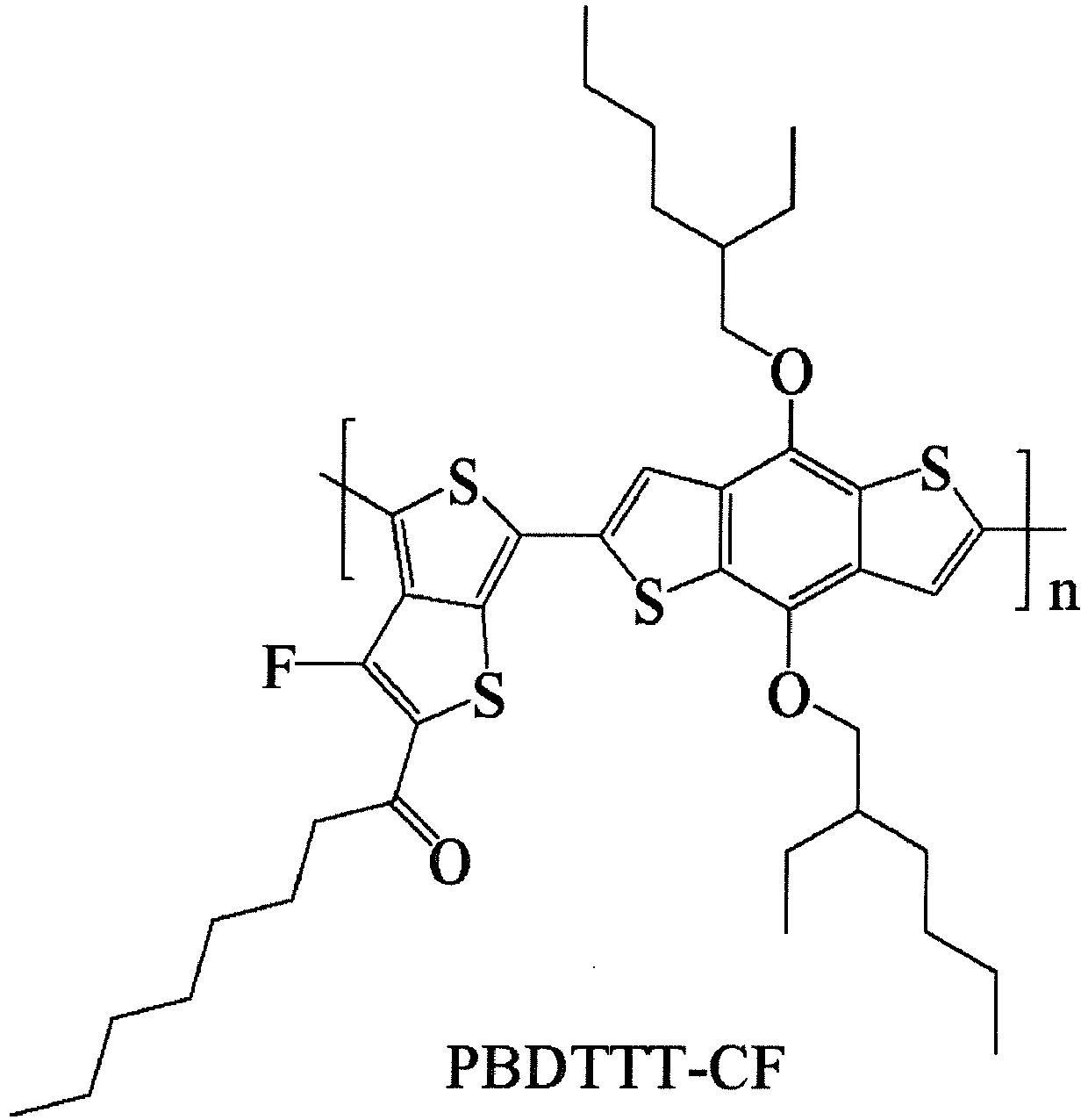
- An organic power-generating layer prepared using the fullerene derivative of the present invention as an n-type semiconductor material in combination with an organic p-type semiconductor material can achieve high conversion efficiency.
- Because of its excellent solubility in various organic solvents, the fullerene derivative of the present invention, when used as an n-type semiconductor material, enables the preparation of an organic power-generating layer by a coating technique, and also simplifies the preparation of an organic power-generating layer having a large area.
- The fullerene derivative of the present invention is a compound having excellent compatibility with organic p-type semiconductor materials and suitable self-aggregating properties. Thus, it is easy to form an organic power-generating layer having a bulk junction structure using the fullerene derivative as an n-type semiconductor material (organic n-type semiconductor material). The use of this organic power-generating layer enables the production of an organic thin-film solar cell or photosensor that exhibits high conversion efficiency.
- Accordingly, the use of the fullerene derivative of the present invention as an n-type semiconductor material enables the production of an organic thin-film solar cell exhibiting excellent performance at low cost.
- An alternative application of the organic power-generating layer comprising (or consisting of) the n-type semiconductor material of the present invention is the use of the layer in an image sensor for digital cameras. While digital cameras are required to have advanced functions (higher definition), existing image sensors composed of a silicon semiconductor suffer from decreased sensitivity. To address this situation, an image sensor composed of an organic material with high photosensitivity is expected to achieve higher sensitivity and higher definition. Materials for forming the light-receiving part of such a sensor need to absorb light highly sensitively and generate an electrical signal from that light highly efficiently. To meet this demand, an organic power-generating layer comprising (or consisting of) the n-type semiconductor material of the present invention can provide a high functionality as a material for the image sensor light-receiving part described above, because of its ability to efficiently convert visible light into electrical energy.
- The n-type semiconductor material of the present invention consists of the fullerene derivative of the present invention.
- The organic power-generating layer of the present invention comprises the fullerene derivative of the present invention as an n-type semiconductor material (n-type semiconductor compound).
- The organic power-generating layer of the present invention can be a light conversion layer (photoelectric conversion layer).
- The organic power-generating layer of the present invention typically comprises the organic p-type semiconductor material mentioned above (organic p-type semiconductor compound) in combination with the fullerene derivative of the present invention, i.e., the n-type semiconductor material of the present invention.
- The organic power-generating layer of the present invention typically consists of the n-type semiconductor material of the present invention and the organic p-type semiconductor material.
- The organic power-generating layer of the present invention preferably has a bulk heterojunction structure formed by the n-type semiconductor material of the present invention and the organic p-type semiconductor material.
- The organic power-generating layer of the present invention can be prepared, for example, by dissolving the n-type semiconductor material of the present invention and the organic p-type semiconductor material mentioned above in an organic solvent, and forming a thin film from the obtained solution on a substrate using a known thin-film forming technique, such as spin coating, casting, dipping, inkjet, and screen printing.
- In thin-film formation of an organic power-generating layer, the fullerene derivative of the present invention exhibits excellent compatibility with organic p-type semiconductor materials (preferably, P3HT or PTB7) and suitable self-aggregating properties. This makes it easy to produce an organic power-generating layer comprising the fullerene derivative of the present invention as an n-type semiconductor material and an organic p-type semiconductor material in a bulk heterojunction structure.
- The organic thin-film solar cell of the present invention comprises the organic power-generating layer of the present invention described above.
- Thus, the organic thin-film solar cell of the present invention exhibits high conversion efficiency.
- The structure of the organic thin-film solar cell is not particularly limited, and may be the same as that of a known organic thin-film solar cell. The organic thin-film solar cell of the present invention can be produced in accordance with a known method for producing an organic thin-film solar cell.
- One example of the organic thin-film solar cell comprising the fullerene derivative is a solar cell comprising, disposed on a substrate in series, a transparent electrode (negative electrode), a charge transport layer on the negative electrode side, an organic power-generating layer, a charge transport layer on the positive electrode side, and an opposite electrode (positive electrode). The organic power-generating layer is preferably a thin-film semiconductor layer (i.e., a photoelectric conversion layer) that comprises an organic p-type semiconductor material and the fullerene derivative of the present invention as an n-type semiconductor material, and that is formed in a bulk heterojunction structure.
- In solar cells having the structure described above, known materials can suitably be used as materials for layers other than the organic power-generating layer. Specific examples of electrode materials include aluminium, gold, silver, copper, and indium tin oxide (ITO). Examples of charge transport layer materials include PFN (poly[9,9-bis(3'-(N,N-dimethylamino)propyl-2,7-fluorene)-alt-2,7-(9,9-dioctylfluorene)]) and MoO3 (molybdenum oxide).
- As described above, the photoelectric conversion layer obtained by the present invention can effectively function as an image sensor light-receiving part of advanced digital cameras. As compared with conventional photosensors using a silicon photodiode, a photosensor using the photoelectric conversion layer obtained by the present invention can receive an image in a well-lit area without overexposure as well as a clear image in a poorly lit area. This makes it possible to obtain an image with higher quality than those of conventional cameras. A photosensor comprises a silicon substrate, electrodes, a light-receiving part consisting of a photoelectric conversion layer, a color filter, and a microlens. The light-receiving part can be about several hundred nanometers in thickness, a fraction of the thickness of conventional silicon photodiodes.
- The following Examples describe the present invention in more detail. However, the present invention is not limited to the Examples.
- The annotation of the symbols and abbreviations used in the Examples is shown below. In addition, symbols and abbreviations typically used in the technical field to which the present invention pertains may also be used throughout this specification.
- The aldehyde compounds used as a starting material in synthesizing fullerene derivatives in the following Examples were synthesized in accordance with the method disclosed in the literature below.
- Yuichi Yamamoto, Yakugaku Zasshi (Journal of the Pharmaceutical Society of Japan), 1953, vol. 73, p. 938
- J. M. Harris et al., J. Polym. Sci. Part A, 1987, vol. 25, p. 2447
- Wei You et al., Macromolecules, 2010, vol. 43, p. 811
-

- An ethanol solution (3 mL) of 2-bromooctanoic acid (1.28 g, 5.74 mmol), aniline (534 mg, 5.74 mmol), and potassium carbonate (800 mg, 5.74 mmol) was heated under reflux for 48 hours. After cooling, the reaction product solution was diluted with water and extracted with ether.
- Additionally, the obtained aqueous phase was adjusted to a pH of 3 with 1N hydrochloric acid and extracted with ethyl acetate.
- The organic phase was dried over magnesium sulfate and concentrated under reduced pressure, thereby obtaining 982 mg (72.8%) of the target product.
1H-NMR (acetone-d6)δ: 0.85 (3H, t, J=6.9 Hz), 1.14 - 1.54(8H, m), 1.68 - 1.90 (2H, m), 2.83 (2H, bs), 3.99 (1H, d-d, J=7.2, 5.6 Hz), 6.58 (1H, t, J=7.3 Hz), 6.64(2H, d, J=7.6 Hz), 7.06(2H, d-d, J=7.3, 7.6 Hz). -

- 2-bromophenylacetic acid (2.15 g, 10.0 mmol) and aniline (4.09 g, 44.0 mmol) were heated at 100°C for 72 hours in the absence of a solvent.
- After cooling, the reaction mixture was diluted with ethyl acetate and extracted with 5% sodium hydroxide.
- The obtained aqueous phase was adjusted to a pH of 4 with 1N hydrochloric acid and extracted with ethyl acetate.
- The organic phase was dried over magnesium sulfate and concentrated under reduced pressure.
- The obtained crude product was recrystallized with water-ethanol, thereby obtaining 560 mg (24.0%) of the target product.
1H-NMR (acetone-d6)δ: 2.02 (1H, bs), 5.15 (1H, s), 6.57 (1H, t, J=7.3 Hz), 6.67 (2H, d, J=8.8 Hz), 7.03 (2H, t, J=8.2 Hz), 7.27 (1H, t, J=7.3 Hz), 7.34(2H, t, J=8.1 Hz), 7.55 (2H, d, J=7.8 Hz). -

- A chlorobenzene solution (150 mL) of 2-(phenylamino)-octanoic acid (118 mg, 0.5 mmol), benzaldehyde (1 mL), and a fullerene (360 mg, 0.5 mmol) was heated under reflux for 48 hours.
- The reaction product solution was concentrated under reduced pressure, and the reaction product was purified by column chromatography (SiO2, hexane-toluene = 100:1 to 20:1), followed by further purification by HPLC (Buckyprep: toluene), thereby obtaining 105 mg (17.0%) of the target product (purity: 99% or more).
1H-NMR (CDCl3)δ: 0.82 (3H, t, J=7.2 Hz), 1.08 - 1.44 (6H, m), 1.46 - 1.58 (1H, m), 1.58 - 1.72 (1H, m), 2.22 - 2.34 (1H, m), 2.76 - 3.90 (1H, m), 5.67 (1H, d, J=9.2 Hz), 6.28 (1H, s), 6.95 - 7.05 (1H, m), 7.10 - 7.40 (7H, m), 7.66 (2H, d, J = 7.6 Hz). MS (FAB) m/z 1000 (M+). HRMS calcd for C80H25N 999.19870; found 999.2017. -

- A chlorobenzene solution (200 mL) of N-phenyl-2-phenylglycine (112 mg, 0.5 mmol), 4-ethylheptanal (142 mg, 1 mmol), and a fullerene (360 mg, 0.5 mmol) was heated under reflux for 48 hours.
- The reaction product solution was concentrated under reduced pressure, and the reaction product was purified by column chromatography (SiO2, hexane-toluene = 100:1 to 20:1), thereby obtaining 154.5 mg (30.0%) of the target product (purity: 99% or more).
1H-NMR (CDCl3)δ: 0.70 - 1.00 (7H, m), 1.00 - 1.68 (8H, m), 1.99 - 2.13 (1H, m), 2.80 - 2.93 (1H, m), 5.62 - 5.75 (1H, m), 6.28 (1H, s), 6.95 - 7.08 (1H, m), 7.10 - 7.40 (7H, m), 7.67 (2H, d, J = 7.8 Hz).
MS (FAB) m/z 1028(M+). HRMS calcd for C82H28N 1027.2300; found 1027.2290. -

- A chlorobenzene solution (150 mL) of N-phenyl-2-phenylglycine (112 mg, 0.5 mmol), 3,6,9-trioxadecanal (162 mg, 1 mmol), and a fullerene (360 mg, 0.5 mmol) was heated under reflux for 72 hours.
- The reaction product solution was concentrated under reduced pressure, and the reaction product was purified by column chromatography (SiO2, toluene-toluene: ethyl acetate = 25:1), followed by further purification by HPLC (Buckyprep: toluene), thereby obtaining 217 mg (40.0%) of the target product (purity: 99% or more).
1H-NMR (CDCl3)δ: 3.35 (3H, s), 3.45 - 3.73 (8H, m), 4.30 (1H, d, J=10.0 Hz),
4.46 (1H, d-d, J=10.0, 5.2 Hz), 5.87 (1H, d, J=5.2 Hz), 6.78 (1H, s), 6.95 - 7.05 (1H, m),
7.15 - 7.40 (7H, m), 7.70 (2H, d, J = 8.0 Hz).
MS (FAB) m/z 1047(M+). HRMS calcd for C80H26NO3(M+1) 1048.1913; found 1048.1897. -

- A chlorobenzene solution (150 mL) of N-phenyl-2-phenylglycine (112 mg, 0.5 mmol), 3-oxaheptanal (116 mg, 1 mmol), and a fullerene (360 mg, 0.5 mmol) was heated under reflux for 48 hours.
- The reaction product solution was concentrated under reduced pressure, and the reaction product was purified by column chromatography (SiO2, hexane:toluene = 3:1), thereby obtaining 220.9 mg (44.1%) of the target product (purity: 99% or more). 1H-NMR (CDCl3)δ: 0.92 (3H, t, J=7.2 Hz), 1.38 - 1.52 (2H, m), 1.52 - 1.70 (2H, m), 3.30 - 3.42 (1H, m), 3.42 - 3.52 (1H, m), 4.20 (1H, d-d, J=10.0, 1.6 Hz), 4.39 (1H, d-d, J=10.0, 4.4 Hz), 5.85 (1H, d-d, J=4.4, 1.6 Hz), 6.80 (1H, s), 6.96 - 7.05 (1H, m), 7.10 - 7.37 (7H, m), 7.70 (2H, d, J = 7.6 Hz).
MS (FAB) m/z 1002(M+). HRMS calcd for C79H23NO 1001.17796; found 1001.1790. -

- A chlorobenzene solution (150 mL) of 2-(phenylamino)-octanoic acid (118 mg, 0.5 mmol), heptanal (2 mL), and a fullerene (360 mg, 0.5 mmol) was heated under reflux for 48 hours.
- The reaction product solution was concentrated under reduced pressure, and the reaction product was purified by column chromatography (SiO2, hexane-toluene = 100:1 to 20:1), followed by further purification by HPLC (Buckyprep: toluene), thereby obtaining 113 mg (22.4%) of the target product (purity: 99% or more).
1H-NMR (CDCl3)δ: 0.80 (6H, t, J=7.0 Hz), 1.10 - 1.39 (12H, m), 1.52 - 1.78 (4H, m), 2.32 - 2.56 (4H, m), 5.16 (2H, m), 7.14 - 7.24 (1H, m), 7.42 - 7.56 (4H, m).
MS (FAB) m/z 1008(M+). HRMS calcd for C80H33N 1007.26130; found 1007.2620. -

- A chlorobenzene solution (150 mL) of N-phenyl-2-methyl alanine (90 mg, 0.5 mmol), heptanal (1 mL), and a fullerene (360 mg, 0.5 mmol) was heated under reflux for 48 hours.
- The reaction product solution was concentrated under reduced pressure, and the reaction product was purified by column chromatography (SiO2, hexane-toluene = 100:1 to 10:1), thereby obtaining 211.9 mg (44.5%) of the target product (purity: 99% or more).
1H-NMR (CDCl3)δ: 0.76 (3H, t, J=7.0 Hz), 1.05 - 1.30 (6H, m), 1.55 - 1.70 (1H, m), 1.70 - 1.85 (1H, m), 2.14 - 2.38 (2H, m), 5.34 (1H, d-d, J=7.6, 2.4 Hz), 7.36 (1H, t, J=7.2 Hz), 7.47 - 7.63 (4H, m) .
MS (FAB) m/z 952(M+). HRMS calcd for C76H25N 951.19870; found 951.1990. -

- A chlorobenzene solution (300 mL) of N-phenyl-2-methyl alanine (180 mg, 1.0 mmol), 4-ethylheptanal (0.5 mL), and a fullerene (720 mg, 1.0 mmol) was heated under reflux for 48 hours.
- The reaction product solution was concentrated under reduced pressure, and the reaction product was purified by column chromatography (SiO2, hexane-toluene = 100:1), followed by further purification by HPLC (Buckyprep: toluene), thereby obtaining 276 mg (28.2%) of the target product (purity: 99% or more). 1H-NMR (CDCl3)δ: 0.66 (1.5H, t, J=7.3 Hz), 0.70 - 0.75 (3H, m), 0.87 (1.5H, t, J=7.3 Hz), 0.94 - 1.66 (9H, m), 1.86 - 1.96 (1H, m), 2.22 - 2.36 (1H, m), 5.39 - 5.45 (1H, m), 7.37 (1H, t, J=8.2 Hz), 7.51 (2H, d-d, J=8.2, 8.2 Hz),7.59 (2H, d, J=8.2 Hz).
-

- A chlorobenzene solution (150 mL) of 2-(phenylamino)-octanoic acid (118 mg, 0.5 mmol), 4-ethylheptanal (1 mL), and a fullerene (360 mg, 0.5 mmol) was heated under reflux for 15 hours.
- The reaction product solution was concentrated under reduced pressure, and the reaction product was purified by column chromatography (SiO2, hexane-toluene = 100:1 to 30:1), followed by further purification by HPLC (Buckyprep: toluene), thereby obtaining 58.0 mg (11.0%) of the target product (purity: 99% or more).
1H-NMR (CDCl3)δ: 0.70 - 0.90 (9H, m), 0.90 - 1.90 (18H, m), 2.30 - 2.60 (3H, m), 5.17 (1H, d-d, J=7.5, 3.0 Hz), 5.31 (1H, d-d, J=8.5, 3.0 Hz), 7.10 - 7.30 (1H, m), 7.40 - 7.60 (4H, m). -

- A chlorobenzene solution (150 mL) of 2-(phenylamino)-octanoic acid (118 mg, 0.5 mmol), 1-pyrene aldehyde (150 mg, 0.5 mmol), and a fullerene (360 mg, 0.5 mmol) was heated under reflux for 48 hours.
- The reaction product solution was concentrated under reduced pressure, and the reaction product was purified by column chromatography (SiO2, hexane-toluene = 20:1 to 5:1), followed by further purification by HPLC (Buckyprep: toluene), thereby obtaining 99.0 mg (17.6%) of the target product (purity: 99% or more).
1H-NMR (CDCl3)δ: 0.83 (3H, t, J=8.0 Hz), 1.10 - 1.50 (6H, m), 1.50 - 1.85 (2H, m), 2.30 - 2.50 (1H, m), 3.00 - 3.15 (1H, m), 5.78 - 5.89 (1H, m), 6.91 (1H, t, J=7.0 Hz), 7.06 - 7.32 (4H, m), 7.50 (1H, s), 7.90 - 8.10 (4H, m), 8.10 - 8.25 (3H, m), 8.58 (1H, d, J=9.6 Hz), 8.90 (1H, d, J=9.6 Hz).
MS (FAB) m/z 1024 (M+). HRMS calcd for C90H30N (M+1) 1024.2378; found 1024.2392. - The solubility of each fullerene derivative was calculated from the absorbance measured with an ultraviolet-visible absorptiometer.
- In advance, the absorbance of the fullerene derivatives of a predetermined concentration was measured to determine the molar extinction coefficient of each compound.
- A supersaturated toluene solution of a fullerene derivative was prepared. A predetermined amount of the supernatant of this solution was taken out, and its absorbance was measured.
- From the measured absorbance value and the molar extinction coefficient, the concentration of the supernatant of the supersaturated toluene solution was determined.
Control Compounds: two compounds that are fullerene derivatives with no substituent at position 5 represented by the following chemical formulas were used in comparison.

- Compound 1: Solubility in Toluene 0.5%
- Compound 2: Solubility in Toluene 1.0%
- Compound 3: Solubility in Toluene 0.5%
- Compound 4: Solubility in Toluene 0.5%
- Compound 5: Solubility in Toluene 2.4%
- Compound 8: Solubility in Toluene 7.0%
- When the control compounds having a substituent at position 2 (control compound 1: phenyl, control compound 2: hexyl) additionally had an alkyl group at position 5, their solubility was significantly increased.
- Solar cells were prepared using the fullerene derivatives obtained in Synthesis Examples and the control compounds as an n-type semiconductor material in accordance with the following method, and the function of the cells was evaluated.
- The following materials were used: PTB7 for an organic p-type semiconductor material, PFN (poly[9,9-bis(3'-(N,N-dimethylamino)propyl-2,7-fluorene)-alt-2,7-(9,9-dioctylfluorene)]) and MoO3 (molybdenum oxide) for charge transport layer materials, and ITO (indium tin oxide) (negative electrode) and aluminium (positive electrode) for electrodes.
- Solar cells for testing were prepared in accordance with the following procedure.
- An ITO patterning glass plate was placed in a plasma cleaner, and the surface of the substrate was washed with generated plasma for 10 minutes while oxygen gas was allowed to flow in.
- A PFN thin film was formed using a PFN methanol solution (2% w/v) on the pretreated ITO glass plate with an ABLE/ASS-301 spin-coating-film-forming device. The formed PFN thin film had a thickness of about 10 nm.
- With the substrate placed in a glove box, the PFN thin film was spin-coated with a solution containing PTB7 and the fullerene derivative dissolved in chlorobenzene beforehand, and diiodooctane (3% v/v relative to chlorobenzene), with a MIKASA/MS-100 spin-coating film-forming device at 1,000 rpm for 2 minutes to form an organic semiconductor thin film (organic power-generating layer) of about 90 to 110 nm. A laminate was thus obtained.
- The prepared laminate was placed on a mask inside a compact high-vacuum evaporator. An MoO3 layer (10 nm) as a charge transport layer on the positive electrode side and an aluminium layer (80 nm) as a metal electrode were deposited on the laminate in series with the high-vacuum evaporator.
- Current measurement using pseudo solar light irradiation was conducted by using a SourceMeter, current-voltage measuring software, and a solar simulator.
- The solar cells for testing prepared in section (1) were irradiated with pseudo solar light of 100 mW, and the generated current and voltage were measured. Energy conversion efficiency was then calculated from the following equation.
- Table 1 shows the measurement results of short-circuit current, open voltage, fill factor (FF), and conversion efficiency. The conversion efficiency is a value determined from the following equation.

- FF: Fill Factor, Voc: Open Voltage, Jsc: Short-circuit Current,
- Pin: Intensity of Incident Light (Density).
- Compared with the control compounds 1 and 2, which have no substituent at position 5 of their pyrrolidine ring, solar cells using the compounds of the present invention all exhibited an increased open voltage due to the presence of an alkyl group or the like, which is an electron-donating group, at position 5.
- Additionally, in response to the number of the alkyl substituents, open voltage was increased.
- Although there is some literature that mentions substituents of phenyl contained in a fullerene derivative structure and open voltage (literature 1) to 4) listed below), there have been no findings concerning the number and type of substituents introduced into a pyrrolidine-containing derivative. Additionally, there have been no findings concerning the structure and performance of solar cells using a fullerene derivative whose pyrrolidine ring has substituents at positions 1, 2, and 5.
- The LUMO level of the fullerene derivatives obtained in Synthesis Examples and the control compounds was estimated from the measured values in cyclic voltammetry (CV).
- The measurement was performed in accordance with the experiment section in M. Karakawa et al., Journal of Material Chemistry A, 2014, vol. 2, p. 20889.
- Measurement Device: BAS CV-50W Voltammetric Analyzer
- Measurement Solvent: Chlorobenzene:Acetonitrile = 5:1
- Supporting Electrolyte: n-Bu4NPF6 concentration 0.1 mol/L
- The LUMO level is calculated from the half-wave potential E1 1/2 (Fc/Fc+ benchmark) of the first reduction wave measured by CV (3-electrode system) using the following equation.

Table 2 Compound E1 1/2 (V vs Fc/Fc++) LUMO (eV) Voc [V] Compound 1 -1.16 -3.64 0.79 Compound 4 -1.17 -3.63 0.79 Compound 3 -1.17 -3.63 0.79 Compound 5 -1.17 -3.63 0.84 Compound 6 -1.17 -3.63 0.81 Compound 2 -1.17 -3.63 0.82 Control Compound 1 -1.13 -3.67 0.75 Control Compound 2 -1.14 -3.66 0.76 [60]PCBM -1.13 -3.67 0.736
| Fullerene Derivative | P-type Semiconductor Material | Short-circuit Current (mA/cm2) | Open Voltage (V) | FF | Conversion Efficiency (%) |
| Control Compound 1 | PTB7 | 15.48 | 0.75 | 0.63 | 7.34 |
| Control Compound 2 | PTB7 | 14.21 | 0.76 | 0.67 | 7.27 |
| Compound 1 | PTB7 | 14.52 | 0.79 | 0.63 | 7.28 |
| Compound 2 | PTB7 | 14.96 | 0.82 | 0.61 | 7.48 |
| Compound 3 | PTB7 | 13.66 | 0.79 | 0.65 | 6.96 |
| Compound 4 | PTB7 | 14.86 | 0.79 | 0.60 | 7.00 |
| Compound 5 | PTB7 | 13.86 | 0.84 | 0.56 | 6.48 |
| Compound 6 | PTB7 | 14.22 | 0.81 | 0.60 | 6.87 |
| Compound 7 | PTB7 | 14.20 | 0.82 | 0.59 | 6.84 |
| Compound 9 | PTB7 | 12.88 | 0.79 | 0.51 | 5.13 |
Claims (12)
- A fullerene derivative represented by formula (1)
 R1 represents aryl optionally substituted with at least one substituent,R2 represents an organic group,R3 represents an organic group, with the proviso that at least one of R2 and R3 is alkyl optionally substituted with at least one substituent or alkyl ether optionally substituted with at least one substituent,R4 represents a hydrogen atom or an organic group, andring A represents a fullerene ring.
 - The fullerene derivative according to claim 1, wherein R1 is aryl optionally substituted with at least one substituent selected from the group consisting of fluorine, chlorine, bromine, iodine, methyl, methoxy, and cyano.
- The fullerene derivative according to claim 1 or 2, wherein R1 is phenyl optionally substituted with at least one fluorine atom.
- The fullerene derivative according to any one of claims 1 to 3, wherein R2 is alkyl optionally substituted with at least one substituent, alkenyl optionally substituted with at least one substituent, alkynyl optionally substituted with at least one substituent, aryl optionally substituted with at least one substituent, ether optionally substituted with at least one substituent, or ester optionally substituted with at least one substituent.
- The fullerene derivative according to any one of claims 1 to 4, wherein R3 and R4 are identical or different and each represent hydrogen, alkyl optionally substituted with at least one substituent, alkenyl optionally substituted with at least one substituent, alkynyl optionally substituted with at least one substituent, aryl optionally substituted with at least one substituent, ether optionally substituted with at least one substituent, or ester optionally substituted with at least one substituent.
- The fullerene derivative according to any one of claims 1 to 5, wherein ring A is a C60 fullerene or a C70 fullerene.
- A fullerene derivative that has an LUMO level of -3.65 eV or more (1), and that has a solubility in toluene at room temperature of 0.5% or more (2).
- An n-type semiconductor material comprising the fullerene derivative according to any one of claims 1 to 7.
- The n-type semiconductor material according to claim 8, which is for use in an organic thin-film solar cell.
- An organic power-generating layer comprising the n-type semiconductor material according to claim 9.
- A photoelectric conversion element comprising the organic power-generating layer according to claim 10.
- The photoelectric conversion element according to claim 11, which is an organic thin-film solar cell.
Applications Claiming Priority (2)
| Application Number | Priority Date | Filing Date | Title |
|---|---|---|---|
| JP2015198877 | 2015-10-06 | ||
| PCT/JP2016/079795 WO2017061543A1 (en) | 2015-10-06 | 2016-10-06 | FULLERENE DERIVATIVE AND n-TYPE SEMICONDUCTOR MATERIAL |
Publications (3)
| Publication Number | Publication Date |
|---|---|
| EP3372581A1 true EP3372581A1 (en) | 2018-09-12 |
| EP3372581A4 EP3372581A4 (en) | 2019-05-08 |
| EP3372581B1 EP3372581B1 (en) | 2021-06-23 |
Family
ID=58487857
Family Applications (1)
| Application Number | Title | Priority Date | Filing Date |
|---|---|---|---|
| EP16853695.1A Active EP3372581B1 (en) | 2015-10-06 | 2016-10-06 | FULLERENE DERIVATIVE AND n-TYPE SEMICONDUCTOR MATERIAL |
Country Status (5)
| Country | Link |
|---|---|
| US (1) | US10894770B2 (en) |
| EP (1) | EP3372581B1 (en) |
| JP (2) | JP6706828B2 (en) |
| CN (1) | CN108137498A (en) |
| WO (1) | WO2017061543A1 (en) |
Families Citing this family (6)
| Publication number | Priority date | Publication date | Assignee | Title |
|---|---|---|---|---|
| CN108137498A (en) * | 2015-10-06 | 2018-06-08 | 大金工业株式会社 | Fullerene derivate and n-type semiconductor |
| JP2019043895A (en) * | 2017-09-01 | 2019-03-22 | ダイキン工業株式会社 | Fullerene derivative composition |
| CN111491921A (en) * | 2017-12-22 | 2020-08-04 | 大金工业株式会社 | Refinement method |
| WO2023100719A1 (en) * | 2021-11-30 | 2023-06-08 | 株式会社ハーベス | FULLERENE DERIVATIVE, n-TYPE SEMICONDUCTOR MATERIAL, ORGANIC POWER GENERATION LAYER AND PHOTOELECTRIC CONVERSION ELEMENT |
| CN115322139A (en) * | 2022-09-01 | 2022-11-11 | 广西师范大学 | Preparation method and application of styryl fullerene derivative |
| CN117143088B (en) * | 2023-09-01 | 2026-01-23 | 华侨大学 | Fullerene derivative, preparation method and application thereof, and tin-based perovskite solar cell |
Family Cites Families (15)
| Publication number | Priority date | Publication date | Assignee | Title |
|---|---|---|---|---|
| JP5568300B2 (en) * | 2006-07-06 | 2014-08-06 | ソレンネ ベーヴェー | Mixtures of fullerene derivatives and their use in electronic devices |
| JP5323393B2 (en) | 2007-09-12 | 2013-10-23 | 住友化学株式会社 | Fullerene derivatives |
| JP5425438B2 (en) | 2008-10-06 | 2014-02-26 | 住友化学株式会社 | Fullerene derivatives |
| CN102473843A (en) * | 2009-08-04 | 2012-05-23 | 三菱化学株式会社 | Photoelectric conversion element and solar cell using same |
| JP5643572B2 (en) * | 2009-12-09 | 2014-12-17 | ダイキン工業株式会社 | Fullerene derivative, charge transfer material containing the same, n-type semiconductor material containing the same, and n-type semiconductor thin film containing the same |
| JP2011181719A (en) | 2010-03-02 | 2011-09-15 | Sumitomo Chemical Co Ltd | Fullerene derivative and method of manufacturing the same |
| JP5881283B2 (en) * | 2010-10-15 | 2016-03-09 | ダイキン工業株式会社 | N-type semiconductor materials for organic thin-film solar cells |
| WO2012090971A1 (en) * | 2010-12-27 | 2012-07-05 | 住友化学株式会社 | Photoelectric conversion element and composition used in same |
| CN111471007B (en) * | 2013-05-16 | 2025-02-28 | 大金工业株式会社 | Fullerene derivatives and n-type semiconductor materials |
| JP6141423B2 (en) | 2013-05-16 | 2017-06-07 | ダイキン工業株式会社 | Fullerene derivative and n-type semiconductor material |
| JP2015013844A (en) * | 2013-07-08 | 2015-01-22 | 住友化学株式会社 | Fullerene derivatives |
| JP6340782B2 (en) * | 2013-12-11 | 2018-06-13 | 株式会社リコー | Fullerene derivative and method for producing the same |
| EP2905277A1 (en) * | 2014-02-07 | 2015-08-12 | LANXESS Deutschland GmbH | 1',2',5'-trisubstituted Fulleropyrrolidines |
| CN104447507B (en) * | 2014-11-19 | 2016-07-20 | 苏州大学 | A kind of N-phenyl fulleropyrrolidine derivative and its production and use |
| CN108137498A (en) * | 2015-10-06 | 2018-06-08 | 大金工业株式会社 | Fullerene derivate and n-type semiconductor |
-
2016
- 2016-10-06 CN CN201680058086.0A patent/CN108137498A/en active Pending
- 2016-10-06 WO PCT/JP2016/079795 patent/WO2017061543A1/en not_active Ceased
- 2016-10-06 US US15/766,148 patent/US10894770B2/en active Active
- 2016-10-06 JP JP2017544221A patent/JP6706828B2/en active Active
- 2016-10-06 EP EP16853695.1A patent/EP3372581B1/en active Active
-
2020
- 2020-02-19 JP JP2020026683A patent/JP2020109093A/en active Pending
Also Published As
| Publication number | Publication date |
|---|---|
| US10894770B2 (en) | 2021-01-19 |
| JP2020109093A (en) | 2020-07-16 |
| JPWO2017061543A1 (en) | 2018-07-12 |
| EP3372581A4 (en) | 2019-05-08 |
| EP3372581B1 (en) | 2021-06-23 |
| JP6706828B2 (en) | 2020-06-10 |
| US20180282274A1 (en) | 2018-10-04 |
| WO2017061543A1 (en) | 2017-04-13 |
| CN108137498A (en) | 2018-06-08 |
Similar Documents
| Publication | Publication Date | Title |
|---|---|---|
| EP3372581B1 (en) | FULLERENE DERIVATIVE AND n-TYPE SEMICONDUCTOR MATERIAL | |
| JP6141423B2 (en) | Fullerene derivative and n-type semiconductor material | |
| JP7195546B2 (en) | fullerene derivative and n-type semiconductor material | |
| Jiang et al. | Tuning optical and electronic properties of star-shaped conjugated molecules with enlarged π-delocalization for organic solar cell application | |
| CN104045657A (en) | Perylene diimide dimer bridged by five-membered heterocyclic derivatives, its preparation method and its application in organic photovoltaic devices | |
| JP5906803B2 (en) | Organic photoelectric conversion element material and method for producing organic photoelectric conversion element | |
| Zhu et al. | Synthesis and evaluation of simple molecule as a co-adsorbent dye for highly efficient co-sensitized solar cells | |
| JP2013237828A (en) | Method for producing nitrogen-containing compound | |
| JP2012186462A (en) | Manufacturing method of organic photoelectric conversion element | |
| Jiang et al. | A 3D nonfullerene electron acceptor with a 9, 9′-bicarbazole backbone for high-efficiency organic solar cells | |
| WO2014029014A1 (en) | Thieno, furo and selenopheno-[3,4-c]pyrrole-4,6-dione copolymers | |
| Wang et al. | D-(π-A) 3 type low bandgap star-shaped fused-ring electron acceptor with alkoxy-substituted thiophene as π-bridge | |
| JP7125702B2 (en) | fullerene derivative | |
| Lee et al. | Push–pull organic semiconductors with planar indenothiophene bridges for solution-processed small-molecule organic solar cells | |
| Song et al. | Synthesis and characterization of phenathrothiadiazole-based conjugated polymer for photovoltaic device | |
| KR101912604B1 (en) | Organic semiconductor compounds Containing Posphine oxide and Solar Cell Device Using This Material | |
| JPWO2015108206A1 (en) | Compound and electronic device | |
| de Aguiar | New Boron-Dipyrromethene (Bodipy) Molecules as Suitable Electron-Donors for Organic Photovoltaic Cells | |
| KR101905088B1 (en) | Organic semiconductor compounds Containing Posphine oxide and Solar Cell Device Using This Material | |
| Kim et al. | Syntheses and Properties of Copolymers with N‐Alkyl‐2, 2′‐bithiophene‐3, 3′‐dicarboximide Unit for Polymer Solar Cells | |
| JP2019085356A (en) | Fullerene derivative, and n-type semiconductor material |
Legal Events
| Date | Code | Title | Description |
|---|---|---|---|
| STAA | Information on the status of an ep patent application or granted ep patent |
Free format text: STATUS: THE INTERNATIONAL PUBLICATION HAS BEEN MADE |
|
| PUAI | Public reference made under article 153(3) epc to a published international application that has entered the european phase |
Free format text: ORIGINAL CODE: 0009012 |
|
| STAA | Information on the status of an ep patent application or granted ep patent |
Free format text: STATUS: REQUEST FOR EXAMINATION WAS MADE |
|
| 17P | Request for examination filed |
Effective date: 20180502 |
|
| AK | Designated contracting states |
Kind code of ref document: A1 Designated state(s): AL AT BE BG CH CY CZ DE DK EE ES FI FR GB GR HR HU IE IS IT LI LT LU LV MC MK MT NL NO PL PT RO RS SE SI SK SM TR |
|
| AX | Request for extension of the european patent |
Extension state: BA ME |
|
| DAV | Request for validation of the european patent (deleted) | ||
| DAX | Request for extension of the european patent (deleted) | ||
| A4 | Supplementary search report drawn up and despatched |
Effective date: 20190410 |
|
| RIC1 | Information provided on ipc code assigned before grant |
Ipc: C07D 209/52 20060101AFI20190404BHEP Ipc: H01L 51/46 20060101ALI20190404BHEP |
|
| STAA | Information on the status of an ep patent application or granted ep patent |
Free format text: STATUS: EXAMINATION IS IN PROGRESS |
|
| 17Q | First examination report despatched |
Effective date: 20200401 |
|
| GRAP | Despatch of communication of intention to grant a patent |
Free format text: ORIGINAL CODE: EPIDOSNIGR1 |
|
| STAA | Information on the status of an ep patent application or granted ep patent |
Free format text: STATUS: GRANT OF PATENT IS INTENDED |
|
| INTG | Intention to grant announced |
Effective date: 20210302 |
|
| GRAS | Grant fee paid |
Free format text: ORIGINAL CODE: EPIDOSNIGR3 |
|
| GRAA | (expected) grant |
Free format text: ORIGINAL CODE: 0009210 |
|
| STAA | Information on the status of an ep patent application or granted ep patent |
Free format text: STATUS: THE PATENT HAS BEEN GRANTED |
|
| AK | Designated contracting states |
Kind code of ref document: B1 Designated state(s): AL AT BE BG CH CY CZ DE DK EE ES FI FR GB GR HR HU IE IS IT LI LT LU LV MC MK MT NL NO PL PT RO RS SE SI SK SM TR |
|
| REG | Reference to a national code |
Ref country code: GB Ref legal event code: FG4D |
|
| REG | Reference to a national code |
Ref country code: CH Ref legal event code: EP |
|
| REG | Reference to a national code |
Ref country code: DE Ref legal event code: R096 Ref document number: 602016059785 Country of ref document: DE Ref country code: AT Ref legal event code: REF Ref document number: 1404205 Country of ref document: AT Kind code of ref document: T Effective date: 20210715 |
|
| REG | Reference to a national code |
Ref country code: IE Ref legal event code: FG4D |
|
| REG | Reference to a national code |
Ref country code: LT Ref legal event code: MG9D |
|
| PG25 | Lapsed in a contracting state [announced via postgrant information from national office to epo] |
Ref country code: FI Free format text: LAPSE BECAUSE OF FAILURE TO SUBMIT A TRANSLATION OF THE DESCRIPTION OR TO PAY THE FEE WITHIN THE PRESCRIBED TIME-LIMIT Effective date: 20210623 Ref country code: LT Free format text: LAPSE BECAUSE OF FAILURE TO SUBMIT A TRANSLATION OF THE DESCRIPTION OR TO PAY THE FEE WITHIN THE PRESCRIBED TIME-LIMIT Effective date: 20210623 Ref country code: BG Free format text: LAPSE BECAUSE OF FAILURE TO SUBMIT A TRANSLATION OF THE DESCRIPTION OR TO PAY THE FEE WITHIN THE PRESCRIBED TIME-LIMIT Effective date: 20210923 Ref country code: HR Free format text: LAPSE BECAUSE OF FAILURE TO SUBMIT A TRANSLATION OF THE DESCRIPTION OR TO PAY THE FEE WITHIN THE PRESCRIBED TIME-LIMIT Effective date: 20210623 |
|
| REG | Reference to a national code |
Ref country code: AT Ref legal event code: MK05 Ref document number: 1404205 Country of ref document: AT Kind code of ref document: T Effective date: 20210623 |
|
| PG25 | Lapsed in a contracting state [announced via postgrant information from national office to epo] |
Ref country code: NO Free format text: LAPSE BECAUSE OF FAILURE TO SUBMIT A TRANSLATION OF THE DESCRIPTION OR TO PAY THE FEE WITHIN THE PRESCRIBED TIME-LIMIT Effective date: 20210923 Ref country code: RS Free format text: LAPSE BECAUSE OF FAILURE TO SUBMIT A TRANSLATION OF THE DESCRIPTION OR TO PAY THE FEE WITHIN THE PRESCRIBED TIME-LIMIT Effective date: 20210623 Ref country code: SE Free format text: LAPSE BECAUSE OF FAILURE TO SUBMIT A TRANSLATION OF THE DESCRIPTION OR TO PAY THE FEE WITHIN THE PRESCRIBED TIME-LIMIT Effective date: 20210623 Ref country code: LV Free format text: LAPSE BECAUSE OF FAILURE TO SUBMIT A TRANSLATION OF THE DESCRIPTION OR TO PAY THE FEE WITHIN THE PRESCRIBED TIME-LIMIT Effective date: 20210623 Ref country code: GR Free format text: LAPSE BECAUSE OF FAILURE TO SUBMIT A TRANSLATION OF THE DESCRIPTION OR TO PAY THE FEE WITHIN THE PRESCRIBED TIME-LIMIT Effective date: 20210924 |
|
| REG | Reference to a national code |
Ref country code: NL Ref legal event code: MP Effective date: 20210623 |
|
| PG25 | Lapsed in a contracting state [announced via postgrant information from national office to epo] |
Ref country code: AT Free format text: LAPSE BECAUSE OF FAILURE TO SUBMIT A TRANSLATION OF THE DESCRIPTION OR TO PAY THE FEE WITHIN THE PRESCRIBED TIME-LIMIT Effective date: 20210623 Ref country code: CZ Free format text: LAPSE BECAUSE OF FAILURE TO SUBMIT A TRANSLATION OF THE DESCRIPTION OR TO PAY THE FEE WITHIN THE PRESCRIBED TIME-LIMIT Effective date: 20210623 Ref country code: EE Free format text: LAPSE BECAUSE OF FAILURE TO SUBMIT A TRANSLATION OF THE DESCRIPTION OR TO PAY THE FEE WITHIN THE PRESCRIBED TIME-LIMIT Effective date: 20210623 Ref country code: ES Free format text: LAPSE BECAUSE OF FAILURE TO SUBMIT A TRANSLATION OF THE DESCRIPTION OR TO PAY THE FEE WITHIN THE PRESCRIBED TIME-LIMIT Effective date: 20210623 Ref country code: RO Free format text: LAPSE BECAUSE OF FAILURE TO SUBMIT A TRANSLATION OF THE DESCRIPTION OR TO PAY THE FEE WITHIN THE PRESCRIBED TIME-LIMIT Effective date: 20210623 Ref country code: PT Free format text: LAPSE BECAUSE OF FAILURE TO SUBMIT A TRANSLATION OF THE DESCRIPTION OR TO PAY THE FEE WITHIN THE PRESCRIBED TIME-LIMIT Effective date: 20211025 Ref country code: NL Free format text: LAPSE BECAUSE OF FAILURE TO SUBMIT A TRANSLATION OF THE DESCRIPTION OR TO PAY THE FEE WITHIN THE PRESCRIBED TIME-LIMIT Effective date: 20210623 Ref country code: SK Free format text: LAPSE BECAUSE OF FAILURE TO SUBMIT A TRANSLATION OF THE DESCRIPTION OR TO PAY THE FEE WITHIN THE PRESCRIBED TIME-LIMIT Effective date: 20210623 Ref country code: SM Free format text: LAPSE BECAUSE OF FAILURE TO SUBMIT A TRANSLATION OF THE DESCRIPTION OR TO PAY THE FEE WITHIN THE PRESCRIBED TIME-LIMIT Effective date: 20210623 |
|
| PG25 | Lapsed in a contracting state [announced via postgrant information from national office to epo] |
Ref country code: PL Free format text: LAPSE BECAUSE OF FAILURE TO SUBMIT A TRANSLATION OF THE DESCRIPTION OR TO PAY THE FEE WITHIN THE PRESCRIBED TIME-LIMIT Effective date: 20210623 |
|
| REG | Reference to a national code |
Ref country code: DE Ref legal event code: R097 Ref document number: 602016059785 Country of ref document: DE |
|
| PG25 | Lapsed in a contracting state [announced via postgrant information from national office to epo] |
Ref country code: DK Free format text: LAPSE BECAUSE OF FAILURE TO SUBMIT A TRANSLATION OF THE DESCRIPTION OR TO PAY THE FEE WITHIN THE PRESCRIBED TIME-LIMIT Effective date: 20210623 |
|
| PLBE | No opposition filed within time limit |
Free format text: ORIGINAL CODE: 0009261 |
|
| STAA | Information on the status of an ep patent application or granted ep patent |
Free format text: STATUS: NO OPPOSITION FILED WITHIN TIME LIMIT |
|
| REG | Reference to a national code |
Ref country code: CH Ref legal event code: PL |
|
| 26N | No opposition filed |
Effective date: 20220324 |
|
| PG25 | Lapsed in a contracting state [announced via postgrant information from national office to epo] |
Ref country code: AL Free format text: LAPSE BECAUSE OF FAILURE TO SUBMIT A TRANSLATION OF THE DESCRIPTION OR TO PAY THE FEE WITHIN THE PRESCRIBED TIME-LIMIT Effective date: 20210623 |
|
| REG | Reference to a national code |
Ref country code: BE Ref legal event code: MM Effective date: 20211031 |
|
| PG25 | Lapsed in a contracting state [announced via postgrant information from national office to epo] |
Ref country code: MC Free format text: LAPSE BECAUSE OF FAILURE TO SUBMIT A TRANSLATION OF THE DESCRIPTION OR TO PAY THE FEE WITHIN THE PRESCRIBED TIME-LIMIT Effective date: 20210623 |
|
| PG25 | Lapsed in a contracting state [announced via postgrant information from national office to epo] |
Ref country code: LU Free format text: LAPSE BECAUSE OF NON-PAYMENT OF DUE FEES Effective date: 20211006 Ref country code: BE Free format text: LAPSE BECAUSE OF NON-PAYMENT OF DUE FEES Effective date: 20211031 |
|
| PG25 | Lapsed in a contracting state [announced via postgrant information from national office to epo] |
Ref country code: LI Free format text: LAPSE BECAUSE OF NON-PAYMENT OF DUE FEES Effective date: 20211031 Ref country code: CH Free format text: LAPSE BECAUSE OF NON-PAYMENT OF DUE FEES Effective date: 20211031 |
|
| PG25 | Lapsed in a contracting state [announced via postgrant information from national office to epo] |
Ref country code: IE Free format text: LAPSE BECAUSE OF NON-PAYMENT OF DUE FEES Effective date: 20211006 |
|
| PG25 | Lapsed in a contracting state [announced via postgrant information from national office to epo] |
Ref country code: HU Free format text: LAPSE BECAUSE OF FAILURE TO SUBMIT A TRANSLATION OF THE DESCRIPTION OR TO PAY THE FEE WITHIN THE PRESCRIBED TIME-LIMIT; INVALID AB INITIO Effective date: 20161006 |
|
| PG25 | Lapsed in a contracting state [announced via postgrant information from national office to epo] |
Ref country code: CY Free format text: LAPSE BECAUSE OF FAILURE TO SUBMIT A TRANSLATION OF THE DESCRIPTION OR TO PAY THE FEE WITHIN THE PRESCRIBED TIME-LIMIT Effective date: 20210623 |
|
| P01 | Opt-out of the competence of the unified patent court (upc) registered |
Effective date: 20230525 |
|
| PG25 | Lapsed in a contracting state [announced via postgrant information from national office to epo] |
Ref country code: MK Free format text: LAPSE BECAUSE OF FAILURE TO SUBMIT A TRANSLATION OF THE DESCRIPTION OR TO PAY THE FEE WITHIN THE PRESCRIBED TIME-LIMIT Effective date: 20210623 |
|
| PG25 | Lapsed in a contracting state [announced via postgrant information from national office to epo] |
Ref country code: MT Free format text: LAPSE BECAUSE OF FAILURE TO SUBMIT A TRANSLATION OF THE DESCRIPTION OR TO PAY THE FEE WITHIN THE PRESCRIBED TIME-LIMIT Effective date: 20210623 |
|
| PG25 | Lapsed in a contracting state [announced via postgrant information from national office to epo] |
Ref country code: TR Free format text: LAPSE BECAUSE OF FAILURE TO SUBMIT A TRANSLATION OF THE DESCRIPTION OR TO PAY THE FEE WITHIN THE PRESCRIBED TIME-LIMIT Effective date: 20210623 |
|
| PGFP | Annual fee paid to national office [announced via postgrant information from national office to epo] |
Ref country code: DE Payment date: 20251021 Year of fee payment: 10 |
|
| PGFP | Annual fee paid to national office [announced via postgrant information from national office to epo] |
Ref country code: GB Payment date: 20251022 Year of fee payment: 10 |
|
| PGFP | Annual fee paid to national office [announced via postgrant information from national office to epo] |
Ref country code: IT Payment date: 20251024 Year of fee payment: 10 |
|
| PGFP | Annual fee paid to national office [announced via postgrant information from national office to epo] |
Ref country code: FR Payment date: 20251030 Year of fee payment: 10 |