EP3372555A1 - Composite carbonitride powder and method for producing same - Google Patents
Composite carbonitride powder and method for producing same Download PDFInfo
- Publication number
- EP3372555A1 EP3372555A1 EP16861948.4A EP16861948A EP3372555A1 EP 3372555 A1 EP3372555 A1 EP 3372555A1 EP 16861948 A EP16861948 A EP 16861948A EP 3372555 A1 EP3372555 A1 EP 3372555A1
- Authority
- EP
- European Patent Office
- Prior art keywords
- complex carbonitride
- powder
- equal
- particles
- atom
- Prior art date
- Legal status (The legal status is an assumption and is not a legal conclusion. Google has not performed a legal analysis and makes no representation as to the accuracy of the status listed.)
- Pending
Links
Images



Classifications
-
- C—CHEMISTRY; METALLURGY
- C01—INORGANIC CHEMISTRY
- C01B—NON-METALLIC ELEMENTS; COMPOUNDS THEREOF; METALLOIDS OR COMPOUNDS THEREOF NOT COVERED BY SUBCLASS C01C
- C01B21/00—Nitrogen; Compounds thereof
- C01B21/082—Compounds containing nitrogen and non-metals and optionally metals
- C01B21/0828—Carbonitrides or oxycarbonitrides of metals, boron or silicon
-
- B—PERFORMING OPERATIONS; TRANSPORTING
- B01—PHYSICAL OR CHEMICAL PROCESSES OR APPARATUS IN GENERAL
- B01J—CHEMICAL OR PHYSICAL PROCESSES, e.g. CATALYSIS OR COLLOID CHEMISTRY; THEIR RELEVANT APPARATUS
- B01J2/00—Processes or devices for granulating materials, e.g. fertilisers in general; Rendering particulate materials free flowing in general, e.g. making them hydrophobic
- B01J2/12—Processes or devices for granulating materials, e.g. fertilisers in general; Rendering particulate materials free flowing in general, e.g. making them hydrophobic in rotating drums
-
- B—PERFORMING OPERATIONS; TRANSPORTING
- B01—PHYSICAL OR CHEMICAL PROCESSES OR APPARATUS IN GENERAL
- B01J—CHEMICAL OR PHYSICAL PROCESSES, e.g. CATALYSIS OR COLLOID CHEMISTRY; THEIR RELEVANT APPARATUS
- B01J6/00—Heat treatments such as Calcining; Fusing ; Pyrolysis
-
- C—CHEMISTRY; METALLURGY
- C22—METALLURGY; FERROUS OR NON-FERROUS ALLOYS; TREATMENT OF ALLOYS OR NON-FERROUS METALS
- C22C—ALLOYS
- C22C29/00—Alloys based on carbides, oxides, nitrides, borides, or silicides, e.g. cermets, or other metal compounds, e.g. oxynitrides, sulfides
- C22C29/02—Alloys based on carbides, oxides, nitrides, borides, or silicides, e.g. cermets, or other metal compounds, e.g. oxynitrides, sulfides based on carbides or carbonitrides
- C22C29/04—Alloys based on carbides, oxides, nitrides, borides, or silicides, e.g. cermets, or other metal compounds, e.g. oxynitrides, sulfides based on carbides or carbonitrides based on carbonitrides
-
- B—PERFORMING OPERATIONS; TRANSPORTING
- B22—CASTING; POWDER METALLURGY
- B22F—WORKING METALLIC POWDER; MANUFACTURE OF ARTICLES FROM METALLIC POWDER; MAKING METALLIC POWDER; APPARATUS OR DEVICES SPECIALLY ADAPTED FOR METALLIC POWDER
- B22F2998/00—Supplementary information concerning processes or compositions relating to powder metallurgy
-
- B—PERFORMING OPERATIONS; TRANSPORTING
- B22—CASTING; POWDER METALLURGY
- B22F—WORKING METALLIC POWDER; MANUFACTURE OF ARTICLES FROM METALLIC POWDER; MAKING METALLIC POWDER; APPARATUS OR DEVICES SPECIALLY ADAPTED FOR METALLIC POWDER
- B22F2999/00—Aspects linked to processes or compositions used in powder metallurgy
-
- C—CHEMISTRY; METALLURGY
- C01—INORGANIC CHEMISTRY
- C01P—INDEXING SCHEME RELATING TO STRUCTURAL AND PHYSICAL ASPECTS OF SOLID INORGANIC COMPOUNDS
- C01P2004/00—Particle morphology
- C01P2004/01—Particle morphology depicted by an image
- C01P2004/03—Particle morphology depicted by an image obtained by SEM
-
- C—CHEMISTRY; METALLURGY
- C01—INORGANIC CHEMISTRY
- C01P—INDEXING SCHEME RELATING TO STRUCTURAL AND PHYSICAL ASPECTS OF SOLID INORGANIC COMPOUNDS
- C01P2004/00—Particle morphology
- C01P2004/60—Particles characterised by their size
- C01P2004/61—Micrometer sized, i.e. from 1-100 micrometer
-
- C—CHEMISTRY; METALLURGY
- C01—INORGANIC CHEMISTRY
- C01P—INDEXING SCHEME RELATING TO STRUCTURAL AND PHYSICAL ASPECTS OF SOLID INORGANIC COMPOUNDS
- C01P2004/00—Particle morphology
- C01P2004/60—Particles characterised by their size
- C01P2004/62—Submicrometer sized, i.e. from 0.1-1 micrometer
Definitions
- the present invention relates to a complex carbonitride powder and a method for producing the complex carbonitride powder.
- the present application claims priority based on Japanese Patent Application No. 2015-215721 filed on November 2, 2015 and all the contents described in the Japanese application are incorporated herein by reference.
- a cermet that is a hard alloy containing Ti as a main component element is excellent in wear resistance and therefore has been suitably used for, for example, cutting tools and wear resistance tools.
- Japanese Patent Laying-Open No. 02-190438 discloses a cermet for tools that includes 70 to 95 vol% of a hard dispersed phase and 5 to 30 vol% of a binder phase containing at least one iron group metal and that includes, as a composition structure, single phase particles, i.e., I particles, and II particles having a core portion and a peripheral portion.
- Japanese Patent Laying-Open No. 2004-292842 discloses a cermet that includes a hard phase and a binder phase, the hard phase including a first hard phase that has a core portion of titanium carbonitride and a peripheral portion of a complex carbonitride solid solution of at least one metal other than titanium and titanium, and a second hard phase containing a complex carbonitride solid solution of at least one metal other than titanium and titanium.
- Japanese Patent Laying-Open No. 2006-131975 discloses a cermet for saw blades that includes a binder phase containing iron group metals, mainly Co and Ni, and a hard phase mainly containing a carbonitride of essential Ti and W and at least one other metal component, the hard phase having a core structure that includes a black core particle and a peripheral component.
- WO 2010/008004 A discloses a hard powder containing greater than or equal to 90 vol% of a complex carbonitride solid solution represented by (Ti 1-x ,M x )(C 1-y ,N y ), a method for producing the hard powder, and a sintered hard alloy consisting of a hard phase that contains the complex carbonitride solid solution represented by (Ti 1-x ,M x )(C 1-y ,N y ) in an amount of greater than or equal to 90 vol% of the whole hard phase, and a binder phase.
- a complex carbonitride powder according to the present disclosure contains titanium as a main component element and at least one additional element selected from the group consisting of zirconium, hafnium, vanadium, niobium, tantalum, chromium, molybdenum, tungsten, aluminum, and silicon.
- the complex carbonitride powder includes a plurality of complex carbonitride particles containing titanium and the additional element.
- the plurality of complex carbonitride particles include a plurality of homogeneous composition particles where average concentrations of titanium and the additional element in each complex carbonitride particle have a difference in a range of greater than or equal to -5 atom% and less than or equal to 5 atom% from average concentrations of titanium and the additional element in the whole complex carbonitride powder.
- a cross-sectional area of the homogeneous composition particles is greater than or equal to 90% of a cross-sectional area of the complex carbonitride particles, and the homogeneous composition particles are greater than or equal to 90% of the complex carbonitride particles in number.
- a method for producing a complex carbonitride powder according to the present disclosure is a method for producing a complex carbonitride powder containing titanium as a main component element and at least one additional element selected from the group consisting of zirconium, hafnium, vanadium, niobium, tantalum, chromium, molybdenum, tungsten, aluminum, and silicon, the method including a mixing step of mixing an oxide powder containing titanium, an oxide powder containing the additional element, and a carbon source powder containing carbon to form a mixed powder; a granulating step of granulating the mixed powder to form granules; and a heat treatment step of subjecting the granules to a heat treatment at a temperature of greater than or equal to 1800°C in a nitrogen-gas-containing nitrogen atmosphere gas to form a complex carbonitride powder.
- All the cermets disclosed in Japanese Patent Laying-Open No. 02-190438 (PTD 1), Japanese Patent Laying-Open No. 2004-292842 (PTD 2), and Japanese Patent Laying-Open No. 2006-131975 (PTD 3) include a hard phase having a core structure that includes a core portion and a peripheral portion surrounding the core portion, resulting in different types of composition in the core portion and the peripheral portion, so that there has been a problem that it is difficult to increase the strength of the cermets.
- WO 2010/0080004 A describes that a complex carbonitride solid solution contained in a hard powder has uniform composition where metal elements contained in the complex carbonitride solid solution are each in the range of less than or equal to plus/minus 5 atom% from the average composition of each of the metal elements.
- Such a hard powder includes, as at least a part of raw materials, a carbonitride containing Ti, and such a carbonitride containing Ti is chemically very stable and is therefore unlikely to be integrated with another raw material even when subjected to a heat treatment at a high temperature of 2200°C, providing a large amount of residual unreacted carbonitrides containing Ti that act as a nucleus of dissolution and reprecipitation during sintering, to end up forming a hard phase having a core structure.
- WO 2010/0080004 A PTD 4
- an object of the present invention is to solve the problems and provide a complex carbonitride powder having homogeneous composition and a method for producing the complex carbonitride powder.
- a complex carbonitride powder having homogeneous composition and a method for producing the complex carbonitride powder.
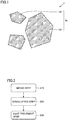
- a complex carbonitride powder 1 contains titanium as a main component element and at least one additional element selected from the group consisting of zirconium, hafnium, vanadium, niobium, tantalum, chromium, molybdenum, tungsten, aluminum, and silicon.
- Complex carbonitride powder 1 includes a plurality of complex carbonitride particles 1p containing titanium and the additional element.
- the plurality of complex carbonitride particles 1p include a plurality of homogeneous composition particles 1ph where average concentrations of titanium and the additional element in each complex carbonitride particle 1p have a difference in a range of greater than or equal to -5 atom% and less than or equal to 5 atom% from average concentrations of titanium and the additional element in whole complex carbonitride powder 1.
- a cross-sectional area of homogeneous composition particles 1ph is greater than or equal to 90% of a cross-sectional area of complex carbonitride particles 1p, and homogeneous composition particles 1ph are greater than or equal to 90% of complex carbonitride particles 1p in number.
- Many of the plurality of complex carbonitride particles 1p included in complex carbonitride powder 1 according to the present embodiment are homogeneous composition particles that are uniform and have little variation in composition of titanium and the additional element in the particles, so that it is possible to produce a hard alloy that includes homogeneous complex carbonitride phases and is high in both hardness and fracture toughness.
- concentration distributions of titanium and the additional element in each of homogeneous composition particles 1ph can be set to a range of greater than or equal to -5 atom% and less than or equal to 5 atom% from the average concentrations of titanium and the additional element in whole complex carbonitride powder 1.
- Such complex carbonitride powder 1 can produce a hard alloy that includes homogeneous complex carbonitride phases and is high in both hardness and fracture toughness.
- a method for producing complex carbonitride powder 1 is a method for producing complex carbonitride powder 1 containing titanium as a main component element and at least one additional element selected from the group consisting of zirconium, hafnium, vanadium, niobium, tantalum, chromium, molybdenum, tungsten, aluminum, and silicon.
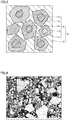
- the method for producing complex carbonitride powder 1 includes a mixing step S10 of mixing a titanium-containing oxide powder, an additional-element-containing oxide powder, and a carbon-containing carbon source powder to form a mixed powder; a granulating step S20 of granulating the mixed powder to form granules; and a heat treatment step S30 of subjecting the granules to a heat treatment at a temperature of greater than or equal to 1800°C in a nitrogen-gas-containing nitrogen atmosphere gas to form complex carbonitride powder 1.
- the titanium-containing oxide powder, the additional-element-containing oxide powder, and the carbon-containing carbon source powder are used as starting raw materials to substantially simultaneously and continuously cause, in the heat treatment step, a reduction reaction, a solid solution reaction, and a carbonitriding reaction of the starting raw materials, in particular, to remarkably promote the solid solution reaction by retention of active titanium and additional element immediately after reduction, so that complex carbonitride powder 1 according to Embodiment 1 can be obtained that includes complex carbonitride particles 1p including many homogeneous composition particles 1ph homogeneous in composition in the particles.
- an inclined rotary reaction tube 110 is heated to greater than or equal to 1800°C, the granules are continuously supplied from an upper portion of rotary reaction tube 110 while a nitrogen atmosphere gas is flown through rotary reaction tube 110, and rotary reaction tube 110 is rotated, to perform a heat treatment while the granules move in rotary reaction tube 110, so that complex carbonitride powder 1 is formed and can be extracted from a lower portion of rotary reaction tube 110.
- Such a method for producing complex carbonitride powder 1 can continuously and efficiently give stable-quality complex carbonitride powder 1 according to Embodiment 1 that includes complex carbonitride particles 1p including many homogeneous composition particles 1ph homogeneous in composition in the particles.
- the mixed powder can be set to have a median particle diameter D50 of less than or equal to 0.5 ⁇ m.
- a method for producing complex carbonitride powder 1 easily homogenizes the composition of complex carbonitride particle 1p in complex carbonitride powder 1.
- At least a part of the titanium-containing oxide powder and the additional-element-containing oxide powder can be a complex oxide powder containing titanium and the additional element.
- Such a method for producing complex carbonitride powder 1 can homogenize the composition of complex carbonitride particle 1p while keeping small the median particle diameter D50 of complex carbonitride particles 1p in complex carbonitride powder 1.
- a hard alloy 10 produced with use of complex carbonitride powder 1 according to the above-mentioned embodiment of the present invention includes a plurality of complex carbonitride hard phases 11 that contain titanium as a main component element and at least one additional element selected from the group consisting of zirconium, hafnium, vanadium, niobium, tantalum, chromium, molybdenum, tungsten, aluminum, and silicon, and a metal binder phase 12 containing an iron group element as a main component element.
- the plurality of complex carbonitride hard phases 11 include a plurality of homogeneous composition hard phases 11h where average concentrations of titanium and the additional element in each complex carbonitride hard phase 11 have a difference in a range of greater than or equal to -5 atom% and less than or equal to 5 atom% from average concentrations of titanium and the additional element in all complex carbonitride hard phases 11.
- a cross-sectional area of homogeneous composition hard phases 11h is greater than or equal to 80% of a cross-sectional area of complex carbonitride hard phases 11, and homogeneous composition hard phases 11h are greater than or equal to 80% of complex carbonitride hard phases 11 in number.
- complex carbonitride hard phases 11 included in hard alloy 10 are homogeneous composition hard phases that are uniform and have little variation in composition of titanium and the additional element in the phases, so that the hard alloy is high in both hardness and fracture toughness.
- a complex carbonitride powder 1 contains titanium (Ti) as a main component element and at least one additional element selected from the group consisting of zirconium (Zr), hafnium (Hf), vanadium (V), niobium (Nb), tantalum (Ta), chromium (Cr), molybdenum (Mo), tungsten (W), aluminum (Al), and silicon (Si).
- Complex carbonitride powder 1 includes a plurality of complex carbonitride particles 1p containing titanium (Ti) and the additional element.
- the plurality of complex carbonitride particles 1p include a plurality of homogeneous composition particles 1ph where average concentrations of titanium (Ti) and the additional element in each complex carbonitride particle 1p have a difference in a range of greater than or equal to -5 atom% and less than or equal to 5 atom% from average concentrations of titanium (Ti) and the additional element in whole complex carbonitride powder 1.
- a cross-sectional area of homogeneous composition particles 1ph is greater than or equal to 90% of a cross-sectional area of complex carbonitride particles 1p, and homogeneous composition particles 1ph are greater than or equal to 90% of complex carbonitride particles 1p in number.
- Many of the plurality of complex carbonitride particles 1p included in complex carbonitride powder 1 according to the present embodiment are homogeneous composition particles that are uniform and have little variation in composition of Ti and the additional element in the particles, so that it is possible to produce a hard alloy that includes homogeneous complex carbonitride phases and is high in both hardness and fracture toughness.
- Ti contained in complex carbonitride powder 1 is a main component element, and the average concentration of Ti is greater than 50 atom% relative to the total of Ti and the additional element. Further, the average concentration of Ti is preferably greater than or equal to 60 atom% and less than or equal to 95 atom%, more preferably greater than or equal to 75 atom% and less than or equal to 90 atom%, from the viewpoint that the addition amount of the additional element is set to less than or equal to a solid solubility limit and an effect of the additional element is sufficiently drawn.
- the additional element contained in complex carbonitride powder 1 is at least one element selected from the group consisting of Zr, Hf, V, Nb, Ta, Cr, Mo, W, Al, and Si, and the average concentration of the additional element is less than 50 atom% relative to the total of Ti and the additional element.
- the average concentration of the additional element is preferably greater than or equal to 5 atom% and less than or equal to 40 atom%, more preferably greater than or equal to 10 atom% and less than or equal to 25 atom%, from the viewpoint that an effect of the additional element is sufficiently drawn and the addition amount of the additional element is set to less than or equal to a solid solubility limit.
- the identification of Ti and a type of the additional element in complex carbonitride powder 1 and complex carbonitride particles 1p and the measurement of the average concentrations of these elements are performed for a wrapped cut surface obtained by embedding complex carbonitride powder 1 in a resin, cutting the complex carbonitride powder together with the resin along any specified surface, and wrapping the cut surface, by SEM (scanning electron microscope)/EDX (energy dispersive X-ray spectroscopy) and/or EPMA (electron probe microanalyzer).
- Suitable examples of the resin for embedding complex carbonitride powder 1 therein include an epoxy resin, a polyester resin, a phenol resin, and an acrylic resin.
- complex carbonitride particle 1p having clear contrast in the particle is understood not to be a homogeneous composition particle without the analyses described above.
- Complex carbonitride particles 1p included in complex carbonitride powder 1 contain Ti and the additional element.
- Complex carbonitride particles 1p include the plurality of homogeneous composition particles 1ph where average concentrations C ⁇ Ti and C ⁇ A (atom%) of Ti and the additional element in each complex carbonitride particle 1p have differences C ⁇ Ti - C ⁇ Ti0 and C ⁇ A - C ⁇ A0 (atom%) in a range of greater than or equal to -5 atom% and less than or equal to 5 atom% from average concentrations C ⁇ Ti0 and C ⁇ A0 (atom%) of Ti and the additional element in whole complex carbonitride powder 1, from the viewpoint that the composition of Ti and the additional element is made uniform and small in variation (specifically to homogenize the composition) in complex carbonitride particles 1p.
- at least one of the differences C ⁇ Ti - C ⁇ Ti0 and C ⁇ A - C ⁇ A0 is preferably greater than or equal to -3 atom% and less than or equal to 3 atom%.
- the cross-sectional area of homogeneous composition particles 1ph is greater than or equal to 90% of the cross-sectional area of complex carbonitride particles 1p, and homogeneous composition particles 1ph are greater than or equal to 90% of complex carbonitride particles 1p in number, from the viewpoint that the composition of Ti and the additional element is made uniform and small in variation (specifically to homogenize the composition) in complex carbonitride particles 1p.
- the cross-sectional area of homogeneous composition particles 1ph is preferably greater than or equal to 92%, more preferably greater than or equal to 94% of the cross-sectional area of complex carbonitride particles 1p.
- homogeneous composition particles 1ph are preferably greater than or equal to 92%, more preferably greater than or equal to 94% of complex carbonitride particles 1p in number.
- concentration distributions of titanium and the additional element in each of homogeneous composition particles 1ph are preferably in a range of greater than or equal to -5 atom% and less than or equal to 5 atom%, more preferably greater than or equal to -3 atom% and less than or equal to 3 atom% from the average concentrations of titanium and the additional element in whole complex carbonitride powder 1.
- Such complex carbonitride powder 1 can produce a hard alloy that includes homogeneous complex carbonitride phases and is high in both hardness and fracture toughness.
- a concentration distribution of titanium in each of homogeneous composition particles 1ph is in a range of greater than or equal to -5 atom% and less than or equal to 5 atom% or in a range of greater than or equal to 3 atom% and less than or equal to 3 atom% from the average concentration of titanium in whole complex carbonitride powder 1" refers to that, as for a minimum concentration C ⁇ Ti-Min (atom%) and a maximum concentration C ⁇ Ti-Max (atom%) of titanium in each of homogeneous composition particles 1ph and the average concentration C ⁇ Ti0 (atom%) of titanium in whole complex carbonitride powder 1, C ⁇ Ti-Min - C ⁇ Ti0 is greater than or equal to -5 atom% and C ⁇ Ti-Max - C ⁇ Ti0 is less than or equal to 5 atom%, or C ⁇ Ti-Min - C ⁇ Ti0 is greater than or equal to -3 atom% and C ⁇ Ti-Max - C ⁇ Ti0 is less than or equal to
- a concentration distribution of the additional element in each of homogeneous composition particles 1ph is in a range of greater than or equal to -5 atom% and less than or equal to 5 atom% or in a range of greater than or equal to 3 atom% and less than or equal to 3 atom% from the average concentration of the additional element in whole complex carbonitride powder 1" refers to that, as for a minimum concentration C ⁇ A-Min (atom%) and a maximum concentration C ⁇ A-Max (atom%) of the additional element in each of homogeneous composition particles 1ph and the average concentration C ⁇ A0 (atom%) of titanium in whole complex carbonitride powder 1, C ⁇ A-Min - C ⁇ A0 is greater than or equal to -5 atom% and C ⁇ A-Max - C ⁇ A0 is less than or equal to 5 atom%, or C ⁇ A-Min - C ⁇ A0 is greater than or equal to -3 atom% and C ⁇ A-Max - C ⁇ A0
- a median particle diameter D50 of complex carbonitride particles 1p is preferably greater than or equal to 0.3 ⁇ m and less than or equal to 5.0 ⁇ m from the viewpoint that the volume of the powder is reduced for easy handling and excessive pulverization of the powder that is used as a raw material powder of a hard alloy is made unnecessary, and further, the median particle diameter D50 is more preferably greater than or equal to 0.5 ⁇ m and less than or equal to 3.0 ⁇ m from the viewpoint of improving both the hardness and the fracture toughness of a cutting tool.
- the median particle diameter D50 of complex carbonitride particles 1p can be adjusted to a predetermined size by normal pulverization and classification of complex carbonitride powder 1.
- the median particle diameter D50 of complex carbonitride particles 1p is calculated from a volume-based cumulative particle size distribution of particles measured by a laser diffraction particle size distribution analyzer.
- a method for producing complex carbonitride powder 1 according to Embodiment 2 is a method for producing complex carbonitride powder 1 according to Embodiment 1 that contains titanium (Ti) as a main component element and at least one additional element selected from the group consisting of zirconium (Zr), hafnium (Hf), vanadium (V), niobium (Nb), tantalum (Ta), chromium (Cr), molybdenum (Mo), tungsten (W), aluminum (Al), and silicon (Si).
- Ti titanium
- Zr zirconium
- Hf hafnium
- V vanadium
- Nb niobium
- Ta tantalum
- Cr chromium
- Mo molybdenum
- W aluminum
- Al aluminum
- Si silicon
- the method for producing complex carbonitride powder 1 includes a mixing step S10 of mixing a titanium (Ti)-containing oxide powder, an additional-element-containing oxide powder, and a carbon (C)-containing carbon source powder to form a mixed powder; a granulating step S20 of granulating the mixed powder to form granules; and a heat treatment step S30 of subjecting the granules to a heat treatment at a temperature of greater than or equal to 1800°C in a nitrogen-gas-containing nitrogen atmosphere gas to form complex carbonitride powder 1.
- the Ti-containing oxide powder, the additional-element-containing oxide powder, and the C-containing carbon source powder are used as starting raw materials to substantially simultaneously and continuously cause, in the heat treatment step, a reduction reaction of the oxide powders, a solid solution reaction resulting from mutual dispersion between active Ti and additional element of the reduced oxide powders, and a carbonitriding reaction of the powders that have been made into a solid solution, in particular, to remarkably promote the solid solution reaction by retention of the active Ti and additional element immediately after reduction, so that complex carbonitride powder 1 according to Embodiment 1 can be obtained that includes complex carbonitride particles 1p including homogeneous composition particles 1ph homogeneous in composition in the particles.
- the starting raw materials i.e., the Ti-containing oxide powder, the additional-element-containing oxide powder, and the C-containing carbon source powder are mixed to form a mixed powder.
- the Ti-containing oxide is not particularly limited, and examples thereof include TiO 2 .
- a crystal structure of TiO 2 is not particularly limited and may be any of a rutile type, an anatase type, and a brookite type.
- the additional-element-containing oxide is not particularly limited, and examples thereof include oxide powders of Zr, Hf, V, Nb, Ta, Cr, Mo, W, Al, and Si, namely, ZrO 2 , HfO 2 , V 2 O 5 , Nb 2 O 5 , Ta 2 O 5 , Cr 2 O 3 , MoO 3 , WO 3 , Al 2 O 3 , and SiO 2 , respectively.
- the oxidation number of each element and a content of impurities can be changed as long as the change is not against the object.
- the C-containing carbon source is not particularly limited, and graphite and polysaccharides can be also used, for example.
- the Ti-containing oxide and the additional-element-containing oxide is preferably a complex oxide containing Ti and the additional element.
- a complex oxide containing Ti and the additional element As described later, it is possible to homogenize the composition of complex carbonitride particle 1p while keeping small the median particle diameter D50 of complex carbonitride particles 1p in complex carbonitride powder 1.
- the complex oxide containing Ti and the additional element is not particularly limited, and examples thereof include Ti 0.9 Zr 0.1 O 2 and Ti 0.9 W 0.1 O 2 .
- the method of mixing the starting raw materials is not particularly limited. Suitable examples of the method, however, include mixing by a dry ball mill and mixing by a wet ball mill that have a high pulverization action, from the viewpoint of reducing the median particle diameter D50 of the mixed powder (referring to the powder obtained through mixture of powders, the same applies hereinafter).
- mixing with use of, for example, a rotary blade fluidized mixer having a low pulverization action can be applied if primary particles of the starting raw materials have a median particle diameter D50 of less than or equal to 0.5 ⁇ m and aggregation of secondary particles is weak.
- the median particle diameter D50 of the mixed powder obtained as described above is preferably greater than or equal to 0.1 ⁇ m and less than or equal to 0.5 ⁇ m, from the viewpoint of easily homogenizing the composition of complex carbonitride particle 1p in complex carbonitride powder 1 and preventing excessive aggregation of a granulated and heat-treated powder described later.
- the median particle diameter D50 of the mixed powder is measured by calculating, with image analysis software, an equivalent circle diameter from an external observation image obtained by an SEM (scanning electron microscope).
- the mixed powder is granulated to form granules.
- a step can simplify the following heat treatment step and handleability afterward.
- the granulating method is not particularly limited, and applicable examples of the method include use of known devices such as a spray drier and an extrusion granulation machine.
- binder components such as a wax material may be appropriately used as a binder material.
- the shape and dimension of the granules are not particularly limited.
- the granules can be made as a circular column shape having a diameter of 0.5 mm to 5.0 mm and a length of about 5 mm to 20 mm.
- heat treatment step S30 illustrated in Fig. 2 the granules are subjected to a heat treatment at a temperature of greater than or equal to 1800°C in a nitrogen-gas-containing nitrogen atmosphere gas to form complex carbonitride powder 1.
- oxygen (O) in the Ti-containing oxide powder and the additional-element-containing oxide powder first reacts with carbon (C) in the carbon source powder to cause a reduction reaction where the oxide powders are reduced to provide Ti and the additional element.
- C carbon
- Ti and the additional element in the oxide powders, which have been provided through the reduction, are in a state of being likely to cause a solid solution reaction where Ti and the additional element are made into a solid solution by mutual dispersion.
- complex carbonitride powder 1 that includes complex carbonitride particles 1p including homogeneous composition particles that contain Ti and the additional element in homogeneous composition.
- the median particle diameter D50 of complex carbonitride particles 1p in complex carbonitride powder 1 can be adjusted to a predetermined size by normal pulverization and classification of heat-treated complex carbonitride powder 1.
- At least a part of the Ti-containing oxide and the additional-element-containing oxide is preferably a complex oxide containing Ti and the additional element, form the viewpoint of homogenizing the composition of complex carbonitride particle 1p while keeping small the median particle diameter D50 of complex carbonitride particles 1p in complex carbonitride powder 1.
- Only a mixed oxide powder that contains an oxide powder containing only Ti and an oxide powder containing only the additional element requires mutual adhesion of particles of the powders to promote the solid solution reaction and increases the median particle diameter D50 of complex carbonitride particles 1p in complex carbonitride powder 1 obtained, giving an disadvantage for forming a hard alloy that includes, in complex carbonitride hard phases, many homogeneous composition hard phases having homogenized composition.
- the oxide powders that is, the Ti-containing oxide powder and the additional-element-containing oxide powder (including the cases where at least a part of the oxide powders is a complex oxide powder containing Ti and the additional element)
- the carbon source powder are used as starting raw materials to substantially simultaneously and continuously cause, by the heat treatment, a reduction reaction, a solid solution reaction, and a carbonitriding reaction of the starting raw materials, in particular, to remarkably promote the solid solution reaction by retention of active Ti and additional element immediately after reduction, so that complex carbonitride powder 1 obtained includes complex carbonitride particles 1p including many homogeneous composition particles 1ph homogeneous in composition in the particles.
- metal powders specifically, a Ti-containing metal powder and an additional-element-containing metal powder
- carbonitride powders specifically, a Ti-containing carbonitride powder and an additional-element-containing carbonitride powder
- a complex carbonitride powder that includes complex carbonitride particles including many homogeneous composition particles homogeneous in composition in the particles.
- the reason why such a complex carbonitride powder cannot be obtained when the metal powders are used as starting raw materials is that the heat treatment causes the carbonitriding reaction earlier, so that the solid solution reaction resulting from mutual dispersion between Ti and the additional element does not proceed.
- the atmosphere in the heat treatment of heat treatment step S30 is a nitrogen gas (N 2 gas)-containing nitrogen atmosphere gas, from the viewpoint of forming a carbon nitrogen powder from the oxide powders together with the carbon source powder.
- the nitrogen atmosphere gas may be a pure N 2 gas or a mixed gas obtained by mixing a N 2 gas with a hydrogen gas (H 2 gas), an argon gas (Ar gas), a helium gas (He gas), or a carbon monoxide gas (CO gas).
- a temperature in the heat treatment of heat treatment step S30 is greater than or equal to 1800°C, preferably greater than or equal to 2000°C, from the viewpoint of allowing the reduction reaction, the solid solution reaction, and the carbonitriding reaction of the oxide powders to proceed and promoting these reactions.
- the temperature needs to be greater than or equal to 1800°C from the viewpoint of sufficiently reducing, forming a solid solution from, and carbonitriding the Ti-containing oxide powder, and the temperature is preferably greater than or equal to 2000°C from the viewpoint of sufficiently reducing, forming a solid solution from, and carbonitriding an oxide powder containing Al, Zr, and/or Hf as the additional element.
- the temperature is preferably less than or equal to 2400°C from the viewpoint of preventing excessive aggregation of a heat-treated powder.
- a heat treatment time in heat treatment step S30 varies according to the median particle diameter D50 of the mixed powder of the oxide powders and the carbon source powder as starting raw materials.
- the time is suitably about 15 minutes to 60 minutes.
- a rotary continuous heat treatment device 100 such as a rotary kiln is used in heat treatment step S30.
- An inclined rotary reaction tube 110 is heated to greater than or equal to 1800°C, the granules are continuously supplied from an upper portion of rotary reaction tube 110 while a nitrogen atmosphere gas is flown through rotary reaction tube 110, and rotary reaction tube 110 is rotated, to perform a heat treatment while the granules move in rotary reaction tube 110, so that complex carbonitride powder 1 is formed and can be extracted from a lower portion of rotary reaction tube 110.
- Such a method for producing complex carbonitride powder 1 can continuously and efficiently give stable-quality complex carbonitride powder 1 according to Embodiment 1 that includes complex carbonitride particles 1p including many homogeneous composition particles 1ph homogeneous in composition in the particles.
- Heat treatment device 100 illustrated in Fig. 3 includes rotary reaction tube 110 that rotates around a long axis and is cylindrical; a rotary mechanism 120 for rotating rotary reaction tube 110; a heating mechanism 130 for heating rotary reaction tube 110; and a casing 140 that stores the heating mechanism.
- Rotary reaction tube 110 is provided with a gas inlet 110i for introducing the nitrogen atmosphere gas into rotary reaction tube 110; a gas outlet 110e for discharging the nitrogen atmosphere gas from rotary reaction tube 110; a raw material inlet 110s for charging the starting raw materials into rotary reaction tube 110; and a heat-treated product outlet 110t for extracting the complex carbonitride powder as a heat-treated product from rotary reaction tube 110.
- Rotary reaction tube 110 rotates around the long axis.
- gas inlet 110i is provided in the lower portion of rotary reaction tube 110 while gas outlet 110e is provided in the upper portion of rotary reaction tube 110 to give a configuration where the nitrogen atmosphere gas passes from the lower portion toward the upper portion of rotary reaction tube 110.
- the configuration may be the other way around so that the nitrogen atmosphere gas passes from the upper portion toward the lower portion of rotary reaction tube 110.
- heat treatment device 100 illustrated in Fig. 3 operates as follows.
- Rotary reaction tube 110 is heated in advance to greater than or equal to 1800°C by heating mechanism 130 of heat treatment device 100, while the nitrogen atmosphere gas is introduced into rotary reaction tube 110 from gas inlet 110i.
- Rotary reaction tube 110 is heated to a predetermined heat treatment temperature of greater than or equal to 1800°C, and then the granules are supplied from raw material inlet 110s into rotary reaction tube 110 while rotary reaction tube 110 is rotated by rotary mechanism 120.
- the granules that have been supplied into rotary reaction tube 110 move from the upper portion toward the lower portion of rotary reaction tube 110 in rotary reaction tube 110 by rotation of rotary reaction tube 110 while heated to the above-mentioned heat treatment temperature by heat transferred from an inner wall of rotary reaction tube 110 and radiant heat.
- the oxide powders (the Ti-containing oxide powder and the additional-element-containing oxide powder (including the cases where at least a part of the oxide powders is a complex oxide powder containing Ti and the additional element)) in the granules.
- Active Ti and additional element in the oxide powders which have been provided through the reduction, promote formation of a solid solution by mutual dispersion between Ti and the additional element. Further, Ti and the additional element react with nitrogen supplied from the gas inlet and C in the carbon source powder in the granules, so that a carbonitriding reaction proceeds almost at the same time as the formation of a solid solution.
- the thus carbonitrided granules reach the lower portion of rotary reaction tube 110 and are extracted from heat-treated product outlet 110t provided in the lower portion.
- the extracted granules are crushed and/or pulverized by a known pulverizing method appropriately selected by a person skilled in the art to give a complex carbonitride powder.
- Heat treatment device 100 having the configuration described above can substantially fix heat treatment conditions (heat treatment atmosphere, heat treatment temperature, and heat treatment time) for granules to continuously and efficiently produce a complex carbonitride powder stable in quality.
- a hard alloy 10 produced with use of the complex carbonitride powder according to Embodiment 1 includes a plurality of complex carbonitride hard phases 11 that contain titanium (Ti) as a main component element and at least one additional element selected from the group consisting of zirconium (Zr), hafnium (Hf), vanadium (V), niobium (Nb), tantalum (Ta), chromium (Cr), molybdenum (Mo), tungsten (W), aluminum (Al), and silicon (Si), and a metal binder phase 12 containing an iron group element as a main component element.
- Zr zirconium
- Hf hafnium
- V vanadium
- Nb niobium
- Ta tantalum
- Cr chromium
- Mo molybdenum
- W aluminum
- Al aluminum
- Si silicon
- the plurality of complex carbonitride hard phases 11 include a plurality of homogeneous composition hard phases 11h where average concentrations of titanium (Ti) and the additional element in each complex carbonitride hard phase 11 have a difference in a range of greater than or equal to -5 atom% and less than or equal to 5 atom% from average concentrations of titanium (Ti) and the additional element in all complex carbonitride hard phases 11.
- a cross-sectional area of homogeneous composition hard phases 11h is greater than or equal to 80% of a cross-sectional area of complex carbonitride hard phases 11, and homogeneous composition hard phases 11h are greater than or equal to 80% of complex carbonitride hard phases 11 in number.
- complex carbonitride hard phases 11 included in hard alloy 10 are homogeneous composition hard phases that are uniform and have little variation in composition of Ti and the additional element in the phases, so that the hard alloy is high in both hardness and fracture toughness.
- Ti contained in complex carbonitride hard phases 11 is a main component element, and the average concentration of Ti is greater than 50 atom% relative to the total of Ti and the additional element. Further, the average concentration of Ti is preferably greater than or equal to 60 atom% and less than or equal to 95 atom%, more preferably greater than or equal to 75 atom% and less than or equal to 90 atom%, from the viewpoint that the addition amount of the additional element is set to less than or equal to a solid solubility limit and an effect of the additional element is sufficiently drawn.
- the additional element contained in complex carbonitride hard phases 11 is at least one element selected from the group consisting of Zr, Hf, V, Nb, Ta, Cr, Mo, W, Al, and Si, and the average concentration of the additional element is less than 50 atom% relative to the total of Ti and the additional element.
- the average concentration of the additional element is preferably greater than or equal to 5 atom% and less than or equal to 40 atom%, more preferably greater than or equal to 10 atom% and less than or equal to 25 atom%, from the viewpoint that an effect of the additional element is sufficiently drawn and the addition amount of the additional element is set to less than or equal to a solid solubility limit.
- Metal binder phase 12 contains the iron group element as a main component element and, in addition to the iron group element, an inevitable element mixed from a carbonitride hard phase (i.e., at least a part of the additional element) and a slight amount of an impurity element.
- An average concentration of the iron group element is preferably greater than or equal to 90 atom%, more preferably greater than or equal to 95 atom%, from the viewpoint that the iron group element keeps a state of a metal and formation of a brittle intermediate compound is avoided.
- the iron group element refers to the elements of Groups 8, 9, and 10 in Period 4, i.e., iron (Fe), cobalt (Co), and nickel (Ni).
- the element other than the iron group element contained in metal binder phase 12 include titanium (Ti) and tungsten (W).
- the identification of Ti and a type of the additional element in complex carbonitride hard phases 11 and types of the iron group element and a metal element other than the iron group element in the metal binder phase and the measurement of the average concentrations of these elements are performed for a wrapped cut surface obtained by cutting hard alloy 10 along any specified surface and wrapping the cut surface, by SEM (scanning electron microscope)/EDX (energy dispersive X-ray spectroscopy) and/or EPMA (electron probe microanalyzer).
- SEM scanning electron microscope
- EDX energy dispersive X-ray spectroscopy
- EPMA electron probe microanalyzer
- the plurality of complex carbonitride hard phases 11 contain Ti and the additional element.
- the plurality of complex carbonitride hard phases 11 include the plurality of homogeneous composition hard phases 11h where average concentrations C ⁇ Ti and C ⁇ A (atom%) of Ti and the additional element in each complex carbonitride hard phase 11 have differences C ⁇ Ti - C ⁇ Ti0 and C ⁇ A - C ⁇ A0 (atom%) in a range of greater than or equal to -5 atom% and less than or equal to 5 atom% from average concentrations C ⁇ Ti0 and C ⁇ A0 (atom%) of Ti and the additional element in all the plurality of complex carbonitride hard phases 11, from the viewpoint that the composition of Ti and the additional element is made uniform and small in variation (specifically to homogenize the composition) in complex carbonitride hard phases 11.
- at least one of the differences C ⁇ Ti - C ⁇ Ti0 and C ⁇ A - C ⁇ A0 is preferably greater than or equal to -3 atom% and less than or equal to 3 atom%.
- a cross-sectional area of homogeneous composition hard phases 11h is greater than or equal to 80% of a cross-sectional area of complex carbonitride hard phases 11, and homogeneous composition hard phases 11h are greater than or equal to 80% of complex carbonitride hard phases 11 in number, from the viewpoint that the composition of Ti and the additional element is made uniform and small in variation (specifically to homogenize the composition) in complex carbonitride hard phases 11.
- the cross-sectional area of homogeneous composition hard phases 11h is preferably greater than or equal to 85%, more preferably greater than or equal to 90% of the cross-sectional area of complex carbonitride hard phases 11.
- homogeneous composition hard phases 11h are preferably greater than or equal to 85%, more preferably greater than or equal to 90% of complex carbonitride hard phases 11 in number.
- a median phase diameter D50 of complex carbonitride hard phases 11 is preferably greater than or equal to 0.3 ⁇ m and less than or equal to 5.0 ⁇ m, more preferably greater than or equal to 0.5 ⁇ m and less than or equal to 3.0 ⁇ m, from the viewpoint of increasing both the hardness and the fracture toughness of the hard alloy used for cutting tools.
- the median phase diameter D50 of complex carbonitride hard phases 11 is measured by calculating, with image analysis software, an equivalent circle diameter from a cross-sectional observation image obtained by an SEM (scanning electron microscope).
- the equivalent circle diameter can be also determined by analyzing a crystal particle structure of a hard phase with use of SEM/EBSD (electron backscatter diffraction) and using crystal orientation analysis software.
- the cross-sectional area of complex carbonitride hard phases 11 is preferably greater than or equal to 80% and less than or equal to 97%, more preferably greater than or equal to 84% and less than or equal to 92%, and the cross-sectional area of metal binder phase 12 is preferably greater than or equal to 3% and less than or equal to 20%, more preferably greater than or equal to 8% and less than or equal to 16%, from the viewpoint that hard alloy 10 is high in both hardness and fracture toughness.
- conventional hard alloy 10 is manufactured with use of conventional complex carbonitride powder 1 (that is, a powder that is formed of complex carbonitride particles not containing the homogeneous composition particles homogeneous in composition of Ti and the additional element in the particles), resulting in the cases where, as illustrated in Fig. 5 , many of complex carbonitride hard phases 11 included in the hard alloy are dual phases formed of a core phase 11p or 11q and a peripheral phase 11s that are different from each other in composition of Ti and the additional element. Even when the complex carbonitride hard phases include a single phase 11o, it is exceedingly rare for the single phase to be a homogeneous composition hard phase homogeneous in composition of Ti and the additional element in the phase. Thus, it is difficult for conventional hard alloy 10 to increase various physical properties such as hardness and fracture toughness together.
- conventional complex carbonitride powder 1 that is, a powder that is formed of complex carbonitride particles not containing the homogeneous composition particles homogeneous in composition of Ti and the additional element
- a method for producing hard alloy 10 according to the present embodiment is not particularly limited as long as the method is appropriate for production of hard alloy 10 according to the present embodiment.
- the method is preferably a powder metallurgy technique from the viewpoint of enabling near net shape molding.
- Examples 1 to 11 are examples of the complex carbonitride powder according to Embodiment 1 and the method for producing the complex carbonitride powder according to Embodiment 2.
- Table 1 shows, in Examples 1 to 11, starting raw materials, i.e., oxide powders, namely a TiO 2 powder and an additional element oxide (ZrO 2 , HfO 2 , V 2 O 5 , Nb 2 O 5 , Ta 2 O 5 , Cr 2 O 3 , MoO 3 , WO 3 , Al 2 O 3 , and SiO 2 ) powder and a carbon source powder, namely a graphite powder.
- oxide powders namely a TiO 2 powder and an additional element oxide (ZrO 2 , HfO 2 , V 2 O 5 , Nb 2 O 5 , Ta 2 O 5 , Cr 2 O 3 , MoO 3 , WO 3 , Al 2 O 3 , and SiO 2 ) powder and a carbon source powder, namely a graphite powder.
- the starting raw materials were mixed in blending ratios to give designed composition.
- the mixing was performed by a wet ball mill method.
- the median particle diameter D50 of the mixed powder obtained is measured by calculating, with image analysis software, an equivalent circle diameter from an external observation image obtained by an SEM (scanning electron microscope). The results are shown in Table 1.
- the mixed powder was formed into circular column-shaped granules having an average diameter of 2.4 mm and an average length of about 10 mm by a known extrusion granulation machine (hole diameter: ⁇ 2.5 mm).
- the average diameter and the average length of the granules were measured by a micrometer.
- the granules were subjected to a heat treatment by a heat treatment device 100 illustrated in Fig. 5 , namely a rotary kiln in an atmosphere of a nitrogen gas as a nitrogen atmosphere gas at a heat treatment temperature shown in Table 1 to give a complex carbonitride powder.
- the granules passed a heating zone with a passing time of about 30 minutes.
- the obtained complex carbonitride powder was subjected to measurement through SEM/EDX and EPMA for a wrapped cut surface obtained by embedding complex carbonitride powder 1 in a resin, cutting the powder together with the resin, and wrapping the cut surface, to obtain a percentage of a cross-sectional area of homogeneous composition particles 1ph to a cross-sectional area of complex carbonitride particles 1p and a percentage of the number of homogeneous composition particles 1ph to the number of complex carbonitride particles 1p in the obtained complex carbonitride powder.
- Table 1 The results are shown in Table 1.
- Fig. 6 shows an SEM photograph of a cross-sectional structure on the cut surface of the complex carbonitride powder that was obtained in Example 2 and had not been subjected to particle diameter adjustment after the heat treatment.
- the cut surface was measured through SEM/EDX and EPMA for average concentrations of Ti and the additional element in each complex carbonitride particle against average concentrations of Ti and the additional element in all the 30 particles, and each of the complex carbonitride particles was determined whether or not it was a homogeneous composition particle. The results are shown in Table 2.
- the average concentrations of Mo (18.0 atom% to 24.3 atom%) in each complex carbonitride particle were in a range of 17.2 atom% to 27.2 atom% that was greater than or equal to -5 atom% and less than or equal to 5 atom% of the average concentration of Mo (22.2 atom%) in all the 30 complex carbonitride particles.
- the average concentrations of W (0.1 atom% to 0.2 atom%) in each complex carbonitride particle were in a range of greater than or equal to -5 atom% and less than or equal to 5 atom% of the average concentration of W (0.2 atom%) in all the 30 complex carbonitride particles.
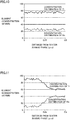
- Fig. 7 shows a graph illustrating concentration distributions of titanium (Ti) and the additional element molybdenum (Mo) of a homogeneous composition particle in the complex carbonitride particles of the complex carbonitride powder that was obtained in Example 2 and had not been subjected to particle diameter adjustment after the heat treatment.
- Ti titanium
- Mo additional element molybdenum
- Fig. 8 shows an SEM photograph of a cross-sectional structure on the cut surface of the complex carbonitride powder that was obtained in Example 3 and had not been subjected to particle diameter adjustment after the heat treatment.
- the cross section was measured through SEM/EDX and EPMA for average concentrations of Ti and the additional element in each complex carbonitride particle against average concentrations of Ti and the additional element in all the 30 complex carbonitride particles, and each of the complex carbonitride particles was determined whether or not it was a homogeneous composition particle. The results are shown in Table 3.
- the average concentrations of Nb (13.8 atom% to 17.9 atom%) in each complex carbonitride particle were in a range of 10.6 atom% to 20.6 atom% that was greater than or equal to -5 atom% and less than or equal to 5 atom% of the average concentration ofNb (15.6 atom%) in all the 30 complex carbonitride particles.
- the average concentrations of W (0.1 atom% to 0.5 atom%) in each complex carbonitride particle were in a range of greater than or equal to -5 atom% and less than or equal to 5 atom% of the average concentration of W (0.2 atom%) in all the 30 complex carbonitride particles.
- the methods for producing a complex carbonitride powder according to Embodiment 2 could give the complex carbonitride powders according to Embodiment 1 that included complex carbonitride particles including many homogeneous composition particles homogeneous in composition in the particles.
- Comparative Examples 1 to 5 are comparative examples of conventional complex carbonitride powders.
- Comparative Example 1 a complex carbonitride powder was obtained in the same manner as in Example 1 except that the starting materials, i.e., a titanium carbonitride powder (average particle diameter 3 ⁇ m) and a metal tungsten powder (average particle diameter 20 ⁇ m) were mixed in such a blending ratio as to give the designed composition indicated in Comparative Example 1 of Table 4 and a batch furnace was used as a heat treatment device.
- the starting materials i.e., a titanium carbonitride powder (average particle diameter 3 ⁇ m) and a metal tungsten powder (average particle diameter 20 ⁇ m) were mixed in such a blending ratio as to give the designed composition indicated in Comparative Example 1 of Table 4 and a batch furnace was used as a heat treatment device.
- Comparative Example 2 a complex carbonitride powder was obtained in the same manner as in Example 1 except that the starting materials, i.e., a titanium carbonitride powder (average particle diameter 3 ⁇ m) and a tungsten carbide powder (average particle diameter 5.6 ⁇ m) were mixed in such a blending ratio as to give the designed composition indicated in Comparative Example 2 of Table 4.
- the starting materials i.e., a titanium carbonitride powder (average particle diameter 3 ⁇ m) and a tungsten carbide powder (average particle diameter 5.6 ⁇ m) were mixed in such a blending ratio as to give the designed composition indicated in Comparative Example 2 of Table 4.
- Comparative Examples 3 to 5 a complex carbonitride powder was obtained in the same manner as in Example 1 except that the starting materials, i.e., a titanium carbonitride powder (average particle diameter 3 ⁇ m) and a tungsten carbide powder (average particle diameter 5.6 ⁇ m) were mixed in such a blending ratio as to give the designed composition indicated in each of Comparative Example 3 to 5 of Table 4 and a hot press was used as a heat treatment device.
- the average particle diameters of the powders used as the starting materials in Comparative Examples 1 to 5 were determined by the Fischer method. It should be noted that the hot press and mixed powders containing fine particles were used in Comparative Examples 3 to 5 to promote a solid solution reaction.
- Table 4 shows a median particle diameter of the mixed powder, and a percentage of a cross-sectional area of homogeneous composition particles to a cross-sectional area of complex carbonitride particles and a percentage of the number of the homogeneous composition particles to the number of the complex carbonitride particles in the complex carbonitride powder.
- Fig. 9 shows an SEM photograph of a cross-sectional structure of the complex carbonitride powder obtained in Comparative Example 4.
- Examples 12 to 14 are examples of hard alloys manufactured with use of the complex carbonitride powder according to Embodiment 1.
- Example 12 to 14 the complex carbonitride powder obtained in each of Examples 1 to 3, a metal cobalt powder (average particle diameter 1.5 ⁇ m), and a metal nickel powder (average particle diameter 2.5 ⁇ m) were used and a hard alloy having designed composition indicated in Table 5 was manufactured by a powder metallurgy technique.
- the average particle diameters of the metal cobalt powder and the metal nickel powder were determined by the Fischer method.
- the obtained hard alloy was subjected to measurement through SEM/EDX and EPMA for a wrapped cut surface obtained by cutting the hard alloy and wrapping the cut surface, to obtain a percentage of a cross-sectional area of homogeneous composition hard phases to a cross-sectional area of complex carbonitride hard phases and a percentage of the number of the homogeneous composition hard phases to the number of the complex carbonitride hard phases in the obtained hard alloy.
- the hardness of the hard alloy the Vickers hardness was measured in accordance with JIS Z2244: 2009.
- the fracture toughness of the hard alloy was measured in accordance with JIS R1607: 1995. The results are shown in Table 5. Fig.
- Example 10 shows concentration distributions of titanium (Ti) and the additional element molybdenum (Mo) of a homogeneous composition hard phase in complex carbonitride hard phases in Example 13.
- Example Designed composition vol%) Homogeneous composition hard phase Hardness (GPa) Fracture toughness (MPa•m 0.5 ) Percentage of cross-sectional area (%) Percentage of number of particles (%) 12 84(Ti 0.75 W 0.25 )CN-8Co-8Ni 82.4 84 14.3 8.5 13 88(Ti 0.77 Mo 0.23 )CN-6Co-6Ni 94.4 98 14.8 8.3 14 90(Ti 0.85 Nb 0.15 )CN-5Co-5Ni 94.2 94 13.2 8.7
- the hard alloys according to Embodiment 3 included complex carbonitride hard phases including many homogeneous composition hard phases homogeneous in composition in the phases and were high in both hardness and fracture toughness, the hard alloys being manufactured with use of the complex carbonitride powders according to Embodiment 1 that included complex carbonitride particles including many homogeneous composition particles homogeneous in composition in the particles.
- the complex carbonitride powder according to Embodiment 1 that includes complex carbonitride particles including many homogeneous composition particles homogeneous in composition in the particles, it was found that it is possible to obtain the hard alloy according to Embodiment 3 that is high in both hardness and fracture toughness.
- Comparative Examples 6 to 8 are comparative examples of conventional hard alloys.
- a titanium carbonitride powder (average particle diameter 3.0 ⁇ m), a tungsten carbide powder (average particle diameter 5.0 ⁇ m), a molybdenum carbide powder (average particle diameter 2.0 ⁇ m), and a niobium carbide powder (average particle diameter 1.8 ⁇ m) were blended to give the same composition of the complex carbonitride powder according to each of Examples 12 to 14, fired for integration by a hot press at 2200°C for 2 hours, and then pulverized to give a complex carbonitride powder for use.
- the pulverized complex carbonitride powder had a median particle diameter of about 3.5 ⁇ m.
- This complex carbonitride powder, a metal cobalt powder (average particle diameter 1.5 ⁇ m), and a metal nickel powder (average particle diameter 2.5 ⁇ m) were mixed and a hard alloy having designed composition indicated in Table 6 was manufactured by a powder metallurgy technique.
- the average particle diameters of the powders used as the starting materials in Comparative Examples 6 to 8 were determined by the Fischer method.
- the obtained hard alloy was measured for a percentage of a cross-sectional area of homogeneous composition hard phases to a cross-sectional area of complex carbonitride hard phases, a percentage of the number of the homogeneous composition hard phases to the number of the complex carbonitride hard phases, the hardness, and the fracture toughness. The results are shown in Table 6. Fig.
- the hard alloys manufactured with use of the conventional complex carbonitride powders included complex carbonitride hard phases hardly including homogeneous composition hard phases homogeneous in composition in the phases and were low in fracture toughness even though being high in hardness, the conventional complex carbonitride powders hardly including homogeneous composition particles homogeneous in composition in the particles.
Landscapes
- Chemical & Material Sciences (AREA)
- Organic Chemistry (AREA)
- Inorganic Chemistry (AREA)
- Engineering & Computer Science (AREA)
- Materials Engineering (AREA)
- Mechanical Engineering (AREA)
- Metallurgy (AREA)
- Chemical Kinetics & Catalysis (AREA)
- Physics & Mathematics (AREA)
- Thermal Sciences (AREA)
- Powder Metallurgy (AREA)
- Inorganic Compounds Of Heavy Metals (AREA)
Abstract
Description
- The present invention relates to a complex carbonitride powder and a method for producing the complex carbonitride powder. The present application claims priority based on Japanese Patent Application No.
2015-215721 filed on November 2, 2015 - A cermet that is a hard alloy containing Ti as a main component element is excellent in wear resistance and therefore has been suitably used for, for example, cutting tools and wear resistance tools.
- Japanese Patent Laying-Open No.
02-190438 - Japanese Patent Laying-Open No.
2004-292842 - Japanese Patent Laying-Open No.
2006-131975 -
WO 2010/008004 A (PTD 4) discloses a hard powder containing greater than or equal to 90 vol% of a complex carbonitride solid solution represented by (Ti1-x,Mx)(C1-y,Ny), a method for producing the hard powder, and a sintered hard alloy consisting of a hard phase that contains the complex carbonitride solid solution represented by (Ti1-x,Mx)(C1-y,Ny) in an amount of greater than or equal to 90 vol% of the whole hard phase, and a binder phase. -
- PTD 1: Japanese Patent Laying-Open No.
02-190438 - PTD 2: Japanese Patent Laying-Open No.
2004-292842 - PTD 3: Japanese Patent Laying-Open No.
2006-131975 - PTD 4:
WO 2010/008004 A - A complex carbonitride powder according to the present disclosure contains titanium as a main component element and at least one additional element selected from the group consisting of zirconium, hafnium, vanadium, niobium, tantalum, chromium, molybdenum, tungsten, aluminum, and silicon. The complex carbonitride powder includes a plurality of complex carbonitride particles containing titanium and the additional element. The plurality of complex carbonitride particles include a plurality of homogeneous composition particles where average concentrations of titanium and the additional element in each complex carbonitride particle have a difference in a range of greater than or equal to -5 atom% and less than or equal to 5 atom% from average concentrations of titanium and the additional element in the whole complex carbonitride powder. A cross-sectional area of the homogeneous composition particles is greater than or equal to 90% of a cross-sectional area of the complex carbonitride particles, and the homogeneous composition particles are greater than or equal to 90% of the complex carbonitride particles in number.
- A method for producing a complex carbonitride powder according to the present disclosure is a method for producing a complex carbonitride powder containing titanium as a main component element and at least one additional element selected from the group consisting of zirconium, hafnium, vanadium, niobium, tantalum, chromium, molybdenum, tungsten, aluminum, and silicon, the method including a mixing step of mixing an oxide powder containing titanium, an oxide powder containing the additional element, and a carbon source powder containing carbon to form a mixed powder; a granulating step of granulating the mixed powder to form granules; and a heat treatment step of subjecting the granules to a heat treatment at a temperature of greater than or equal to 1800°C in a nitrogen-gas-containing nitrogen atmosphere gas to form a complex carbonitride powder.
-
-
Fig. 1 is a schematic view illustrating one example of a cross-sectional structure of a complex carbonitride powder according to an aspect of the present invention. -
Fig. 2 is a flow chart illustrating one example of a method for producing a complex carbonitride powder according to another aspect of the present invention. -
Fig. 3 is a schematic view illustrating one example of a heat treatment device used in the method for producing a complex carbonitride powder according to the aspect of the present invention. -
Fig. 4 is a schematic view illustrating one example of a cross-sectional structure of a hard alloy produced with use of a complex carbonitride powder according to an aspect of the present invention. -
Fig. 5 is a schematic view illustrating one example of a cross-sectional structure of a conventional hard alloy. -
Fig. 6 is an electron micrograph showing a cross-sectional structure of a complex carbonitride powder in Example 2 according to the present invention. -
Fig. 7 is a graph illustrating concentration distributions of titanium and an additional element of a homogeneous composition particle in complex carbonitride particles of the complex carbonitride powder in Example 2 according to the present invention. -
Fig. 8 is an electron micrograph showing a cross-sectional structure of a complex carbonitride powder in Example 3 according to the present invention. -
Fig. 9 is an electron micrograph showing a cross-sectional structure of a complex carbonitride powder in Comparative Example 4. -
Fig. 10 is a graph illustrating concentration distributions of titanium and an additional element of a homogeneous composition hard phase in complex carbonitride hard phases of a hard alloy manufactured in Example 13 according to the present invention. -
Fig. 11 is a graph illustrating concentration distributions of titanium and an additional element of a complex carbonitride hard phase in a hard alloy manufactured in Comparative Example 7. - All the cermets disclosed in Japanese Patent Laying-Open No.
02-190438 2004-292842 2006-131975 -
WO 2010/0080004 A WO 2010/0080004 A - Thus, an object of the present invention is to solve the problems and provide a complex carbonitride powder having homogeneous composition and a method for producing the complex carbonitride powder.
- According to the object, there can be provided a complex carbonitride powder having homogeneous composition and a method for producing the complex carbonitride powder.
- As illustrated in
Fig. 1 , acomplex carbonitride powder 1 according to an embodiment of the present invention contains titanium as a main component element and at least one additional element selected from the group consisting of zirconium, hafnium, vanadium, niobium, tantalum, chromium, molybdenum, tungsten, aluminum, and silicon.Complex carbonitride powder 1 includes a plurality ofcomplex carbonitride particles 1p containing titanium and the additional element. The plurality ofcomplex carbonitride particles 1p include a plurality of homogeneous composition particles 1ph where average concentrations of titanium and the additional element in eachcomplex carbonitride particle 1p have a difference in a range of greater than or equal to -5 atom% and less than or equal to 5 atom% from average concentrations of titanium and the additional element in wholecomplex carbonitride powder 1. A cross-sectional area of homogeneous composition particles 1ph is greater than or equal to 90% of a cross-sectional area ofcomplex carbonitride particles 1p, and homogeneous composition particles 1ph are greater than or equal to 90% ofcomplex carbonitride particles 1p in number. - Many of the plurality of
complex carbonitride particles 1p included incomplex carbonitride powder 1 according to the present embodiment are homogeneous composition particles that are uniform and have little variation in composition of titanium and the additional element in the particles, so that it is possible to produce a hard alloy that includes homogeneous complex carbonitride phases and is high in both hardness and fracture toughness. - In homogeneous composition particles 1ph of
complex carbonitride powder 1 according to the present embodiment, concentration distributions of titanium and the additional element in each of homogeneous composition particles 1ph can be set to a range of greater than or equal to -5 atom% and less than or equal to 5 atom% from the average concentrations of titanium and the additional element in wholecomplex carbonitride powder 1. Suchcomplex carbonitride powder 1 can produce a hard alloy that includes homogeneous complex carbonitride phases and is high in both hardness and fracture toughness. - As illustrated in
Figs. 1 to 3 , a method for producingcomplex carbonitride powder 1 according to another embodiment of the present invention is a method for producingcomplex carbonitride powder 1 containing titanium as a main component element and at least one additional element selected from the group consisting of zirconium, hafnium, vanadium, niobium, tantalum, chromium, molybdenum, tungsten, aluminum, and silicon. The method for producingcomplex carbonitride powder 1 includes a mixing step S10 of mixing a titanium-containing oxide powder, an additional-element-containing oxide powder, and a carbon-containing carbon source powder to form a mixed powder; a granulating step S20 of granulating the mixed powder to form granules; and a heat treatment step S30 of subjecting the granules to a heat treatment at a temperature of greater than or equal to 1800°C in a nitrogen-gas-containing nitrogen atmosphere gas to formcomplex carbonitride powder 1. - In the method for producing
complex carbonitride powder 1 according to the present embodiment, the titanium-containing oxide powder, the additional-element-containing oxide powder, and the carbon-containing carbon source powder are used as starting raw materials to substantially simultaneously and continuously cause, in the heat treatment step, a reduction reaction, a solid solution reaction, and a carbonitriding reaction of the starting raw materials, in particular, to remarkably promote the solid solution reaction by retention of active titanium and additional element immediately after reduction, so thatcomplex carbonitride powder 1 according toEmbodiment 1 can be obtained that includescomplex carbonitride particles 1p including many homogeneous composition particles 1ph homogeneous in composition in the particles. - In heat treatment step S30 of the method for producing
complex carbonitride powder 1 according to the present embodiment, an inclinedrotary reaction tube 110 is heated to greater than or equal to 1800°C, the granules are continuously supplied from an upper portion ofrotary reaction tube 110 while a nitrogen atmosphere gas is flown throughrotary reaction tube 110, androtary reaction tube 110 is rotated, to perform a heat treatment while the granules move inrotary reaction tube 110, so thatcomplex carbonitride powder 1 is formed and can be extracted from a lower portion ofrotary reaction tube 110. Such a method for producingcomplex carbonitride powder 1 can continuously and efficiently give stable-qualitycomplex carbonitride powder 1 according toEmbodiment 1 that includescomplex carbonitride particles 1p including many homogeneous composition particles 1ph homogeneous in composition in the particles. - In the mixing step of the method for producing
complex carbonitride powder 1 according to the present embodiment, the mixed powder can be set to have a median particle diameter D50 of less than or equal to 0.5 µm. Such a method for producingcomplex carbonitride powder 1 easily homogenizes the composition ofcomplex carbonitride particle 1p incomplex carbonitride powder 1. - In the method for producing
complex carbonitride powder 1 according to the present embodiment, at least a part of the titanium-containing oxide powder and the additional-element-containing oxide powder can be a complex oxide powder containing titanium and the additional element. Such a method for producingcomplex carbonitride powder 1 can homogenize the composition ofcomplex carbonitride particle 1p while keeping small the median particle diameter D50 ofcomplex carbonitride particles 1p incomplex carbonitride powder 1. - As illustrated in
Fig. 4 , ahard alloy 10 produced with use ofcomplex carbonitride powder 1 according to the above-mentioned embodiment of the present invention includes a plurality of complex carbonitridehard phases 11 that contain titanium as a main component element and at least one additional element selected from the group consisting of zirconium, hafnium, vanadium, niobium, tantalum, chromium, molybdenum, tungsten, aluminum, and silicon, and ametal binder phase 12 containing an iron group element as a main component element. The plurality of complex carbonitridehard phases 11 include a plurality of homogeneous compositionhard phases 11h where average concentrations of titanium and the additional element in each complex carbonitridehard phase 11 have a difference in a range of greater than or equal to -5 atom% and less than or equal to 5 atom% from average concentrations of titanium and the additional element in all complex carbonitridehard phases 11. A cross-sectional area of homogeneous compositionhard phases 11h is greater than or equal to 80% of a cross-sectional area of complex carbonitridehard phases 11, and homogeneous compositionhard phases 11h are greater than or equal to 80% of complex carbonitridehard phases 11 in number. - Many of complex carbonitride
hard phases 11 included inhard alloy 10 are homogeneous composition hard phases that are uniform and have little variation in composition of titanium and the additional element in the phases, so that the hard alloy is high in both hardness and fracture toughness. - As illustrated in
Fig. 1 , acomplex carbonitride powder 1 according toEmbodiment 1 contains titanium (Ti) as a main component element and at least one additional element selected from the group consisting of zirconium (Zr), hafnium (Hf), vanadium (V), niobium (Nb), tantalum (Ta), chromium (Cr), molybdenum (Mo), tungsten (W), aluminum (Al), and silicon (Si).Complex carbonitride powder 1 includes a plurality ofcomplex carbonitride particles 1p containing titanium (Ti) and the additional element. The plurality ofcomplex carbonitride particles 1p include a plurality of homogeneous composition particles 1ph where average concentrations of titanium (Ti) and the additional element in eachcomplex carbonitride particle 1p have a difference in a range of greater than or equal to -5 atom% and less than or equal to 5 atom% from average concentrations of titanium (Ti) and the additional element in wholecomplex carbonitride powder 1. A cross-sectional area of homogeneous composition particles 1ph is greater than or equal to 90% of a cross-sectional area ofcomplex carbonitride particles 1p, and homogeneous composition particles 1ph are greater than or equal to 90% ofcomplex carbonitride particles 1p in number. - Many of the plurality of
complex carbonitride particles 1p included incomplex carbonitride powder 1 according to the present embodiment are homogeneous composition particles that are uniform and have little variation in composition of Ti and the additional element in the particles, so that it is possible to produce a hard alloy that includes homogeneous complex carbonitride phases and is high in both hardness and fracture toughness. - Ti contained in
complex carbonitride powder 1 is a main component element, and the average concentration of Ti is greater than 50 atom% relative to the total of Ti and the additional element. Further, the average concentration of Ti is preferably greater than or equal to 60 atom% and less than or equal to 95 atom%, more preferably greater than or equal to 75 atom% and less than or equal to 90 atom%, from the viewpoint that the addition amount of the additional element is set to less than or equal to a solid solubility limit and an effect of the additional element is sufficiently drawn. - The additional element contained in
complex carbonitride powder 1 is at least one element selected from the group consisting of Zr, Hf, V, Nb, Ta, Cr, Mo, W, Al, and Si, and the average concentration of the additional element is less than 50 atom% relative to the total of Ti and the additional element. The average concentration of the additional element is preferably greater than or equal to 5 atom% and less than or equal to 40 atom%, more preferably greater than or equal to 10 atom% and less than or equal to 25 atom%, from the viewpoint that an effect of the additional element is sufficiently drawn and the addition amount of the additional element is set to less than or equal to a solid solubility limit. - Here, the identification of Ti and a type of the additional element in
complex carbonitride powder 1 andcomplex carbonitride particles 1p and the measurement of the average concentrations of these elements are performed for a wrapped cut surface obtained by embeddingcomplex carbonitride powder 1 in a resin, cutting the complex carbonitride powder together with the resin along any specified surface, and wrapping the cut surface, by SEM (scanning electron microscope)/EDX (energy dispersive X-ray spectroscopy) and/or EPMA (electron probe microanalyzer). Suitable examples of the resin for embeddingcomplex carbonitride powder 1 therein include an epoxy resin, a polyester resin, a phenol resin, and an acrylic resin. In an SEM composition image of the cut surface ofcomplex carbonitride powder 1,complex carbonitride particle 1p having clear contrast in the particle is understood not to be a homogeneous composition particle without the analyses described above. -
Complex carbonitride particles 1p included incomplex carbonitride powder 1 contain Ti and the additional element.Complex carbonitride particles 1p include the plurality of homogeneous composition particles 1ph where average concentrations CαTi and CαA (atom%) of Ti and the additional element in eachcomplex carbonitride particle 1p have differences CαTi - CαTi0 and CαA - CαA0 (atom%) in a range of greater than or equal to -5 atom% and less than or equal to 5 atom% from average concentrations CαTi0 and CαA0 (atom%) of Ti and the additional element in wholecomplex carbonitride powder 1, from the viewpoint that the composition of Ti and the additional element is made uniform and small in variation (specifically to homogenize the composition) incomplex carbonitride particles 1p. From the viewpoint described above, at least one of the differences CαTi - CαTi0 and CαA - CαA0 is preferably greater than or equal to -3 atom% and less than or equal to 3 atom%. - In
complex carbonitride powder 1, the cross-sectional area of homogeneous composition particles 1ph is greater than or equal to 90% of the cross-sectional area ofcomplex carbonitride particles 1p, and homogeneous composition particles 1ph are greater than or equal to 90% ofcomplex carbonitride particles 1p in number, from the viewpoint that the composition of Ti and the additional element is made uniform and small in variation (specifically to homogenize the composition) incomplex carbonitride particles 1p. From the viewpoint described above, the cross-sectional area of homogeneous composition particles 1ph is preferably greater than or equal to 92%, more preferably greater than or equal to 94% of the cross-sectional area ofcomplex carbonitride particles 1p. In addition, homogeneous composition particles 1ph are preferably greater than or equal to 92%, more preferably greater than or equal to 94% ofcomplex carbonitride particles 1p in number. - In homogeneous composition particles 1ph of
complex carbonitride powder 1 according to the present embodiment, concentration distributions of titanium and the additional element in each of homogeneous composition particles 1ph are preferably in a range of greater than or equal to -5 atom% and less than or equal to 5 atom%, more preferably greater than or equal to -3 atom% and less than or equal to 3 atom% from the average concentrations of titanium and the additional element in wholecomplex carbonitride powder 1. Suchcomplex carbonitride powder 1 can produce a hard alloy that includes homogeneous complex carbonitride phases and is high in both hardness and fracture toughness. - Here, as for homogeneous composition particles 1ph, the phrase "a concentration distribution of titanium in each of homogeneous composition particles 1ph is in a range of greater than or equal to -5 atom% and less than or equal to 5 atom% or in a range of greater than or equal to 3 atom% and less than or equal to 3 atom% from the average concentration of titanium in whole
complex carbonitride powder 1" refers to that, as for a minimum concentration CαTi-Min (atom%) and a maximum concentration CαTi-Max (atom%) of titanium in each of homogeneous composition particles 1ph and the average concentration CαTi0 (atom%) of titanium in wholecomplex carbonitride powder 1, CαTi-Min - CαTi0 is greater than or equal to -5 atom% and CαTi-Max - CαTi0 is less than or equal to 5 atom%, or CαTi-Min - CαTi0 is greater than or equal to -3 atom% and CαTi-Max - CαTi0 is less than or equal to 3 atom%. - Here, as for homogeneous composition particles 1ph, the phrase "a concentration distribution of the additional element in each of homogeneous composition particles 1ph is in a range of greater than or equal to -5 atom% and less than or equal to 5 atom% or in a range of greater than or equal to 3 atom% and less than or equal to 3 atom% from the average concentration of the additional element in whole
complex carbonitride powder 1" refers to that, as for a minimum concentration CαA-Min (atom%) and a maximum concentration CαA-Max (atom%) of the additional element in each of homogeneous composition particles 1ph and the average concentration CαA0 (atom%) of titanium in wholecomplex carbonitride powder 1, CαA-Min - CαA0 is greater than or equal to -5 atom% and CαA-Max - CαA0 is less than or equal to 5 atom%, or CαA-Min - CαA0 is greater than or equal to -3 atom% and CαA-Max - CαA0 is less than or equal to 3 atom%. - A median particle diameter D50 of
complex carbonitride particles 1p is preferably greater than or equal to 0.3 µm and less than or equal to 5.0 µm from the viewpoint that the volume of the powder is reduced for easy handling and excessive pulverization of the powder that is used as a raw material powder of a hard alloy is made unnecessary, and further, the median particle diameter D50 is more preferably greater than or equal to 0.5 µm and less than or equal to 3.0 µm from the viewpoint of improving both the hardness and the fracture toughness of a cutting tool. The median particle diameter D50 ofcomplex carbonitride particles 1p can be adjusted to a predetermined size by normal pulverization and classification ofcomplex carbonitride powder 1. Here, the median particle diameter D50 ofcomplex carbonitride particles 1p is calculated from a volume-based cumulative particle size distribution of particles measured by a laser diffraction particle size distribution analyzer. - As illustrated in
Figs. 1 to 3 , a method for producingcomplex carbonitride powder 1 according toEmbodiment 2 is a method for producingcomplex carbonitride powder 1 according toEmbodiment 1 that contains titanium (Ti) as a main component element and at least one additional element selected from the group consisting of zirconium (Zr), hafnium (Hf), vanadium (V), niobium (Nb), tantalum (Ta), chromium (Cr), molybdenum (Mo), tungsten (W), aluminum (Al), and silicon (Si). The method for producingcomplex carbonitride powder 1 according to the present embodiment includes a mixing step S10 of mixing a titanium (Ti)-containing oxide powder, an additional-element-containing oxide powder, and a carbon (C)-containing carbon source powder to form a mixed powder; a granulating step S20 of granulating the mixed powder to form granules; and a heat treatment step S30 of subjecting the granules to a heat treatment at a temperature of greater than or equal to 1800°C in a nitrogen-gas-containing nitrogen atmosphere gas to formcomplex carbonitride powder 1. - In the method for producing
complex carbonitride powder 1 according to the present embodiment, the Ti-containing oxide powder, the additional-element-containing oxide powder, and the C-containing carbon source powder are used as starting raw materials to substantially simultaneously and continuously cause, in the heat treatment step, a reduction reaction of the oxide powders, a solid solution reaction resulting from mutual dispersion between active Ti and additional element of the reduced oxide powders, and a carbonitriding reaction of the powders that have been made into a solid solution, in particular, to remarkably promote the solid solution reaction by retention of the active Ti and additional element immediately after reduction, so thatcomplex carbonitride powder 1 according toEmbodiment 1 can be obtained that includescomplex carbonitride particles 1p including homogeneous composition particles 1ph homogeneous in composition in the particles. - In mixing step S10 illustrated in
Fig. 2 , the starting raw materials, i.e., the Ti-containing oxide powder, the additional-element-containing oxide powder, and the C-containing carbon source powder are mixed to form a mixed powder. The Ti-containing oxide is not particularly limited, and examples thereof include TiO2. A crystal structure of TiO2 is not particularly limited and may be any of a rutile type, an anatase type, and a brookite type. The additional-element-containing oxide is not particularly limited, and examples thereof include oxide powders of Zr, Hf, V, Nb, Ta, Cr, Mo, W, Al, and Si, namely, ZrO2, HfO2, V2O5, Nb2O5, Ta2O5, Cr2O3, MoO3, WO3, Al2O3, and SiO2, respectively. Here, the oxidation number of each element and a content of impurities can be changed as long as the change is not against the object. The C-containing carbon source is not particularly limited, and graphite and polysaccharides can be also used, for example. - Here, at least a part of the Ti-containing oxide and the additional-element-containing oxide is preferably a complex oxide containing Ti and the additional element. As described later, it is possible to homogenize the composition of
complex carbonitride particle 1p while keeping small the median particle diameter D50 ofcomplex carbonitride particles 1p incomplex carbonitride powder 1. The complex oxide containing Ti and the additional element is not particularly limited, and examples thereof include Ti0.9Zr0.1O2 and Ti0.9W0.1O2. - The method of mixing the starting raw materials is not particularly limited. Suitable examples of the method, however, include mixing by a dry ball mill and mixing by a wet ball mill that have a high pulverization action, from the viewpoint of reducing the median particle diameter D50 of the mixed powder (referring to the powder obtained through mixture of powders, the same applies hereinafter). Alternatively, mixing with use of, for example, a rotary blade fluidized mixer having a low pulverization action can be applied if primary particles of the starting raw materials have a median particle diameter D50 of less than or equal to 0.5 µm and aggregation of secondary particles is weak.
- The median particle diameter D50 of the mixed powder obtained as described above is preferably greater than or equal to 0.1 µm and less than or equal to 0.5 µm, from the viewpoint of easily homogenizing the composition of
complex carbonitride particle 1p incomplex carbonitride powder 1 and preventing excessive aggregation of a granulated and heat-treated powder described later. Here, the median particle diameter D50 of the mixed powder is measured by calculating, with image analysis software, an equivalent circle diameter from an external observation image obtained by an SEM (scanning electron microscope). - In granulating step S20 illustrated in
Fig. 2 , the mixed powder is granulated to form granules. Such a step can simplify the following heat treatment step and handleability afterward. The granulating method is not particularly limited, and applicable examples of the method include use of known devices such as a spray drier and an extrusion granulation machine. In granulation, binder components such as a wax material may be appropriately used as a binder material. The shape and dimension of the granules are not particularly limited. The granules can be made as a circular column shape having a diameter of 0.5 mm to 5.0 mm and a length of about 5 mm to 20 mm. - In heat treatment step S30 illustrated in
Fig. 2 , the granules are subjected to a heat treatment at a temperature of greater than or equal to 1800°C in a nitrogen-gas-containing nitrogen atmosphere gas to formcomplex carbonitride powder 1. - In heat treatment step S30, when the granules are subjected to a heat treatment, oxygen (O) in the Ti-containing oxide powder and the additional-element-containing oxide powder (including the cases where at least a part of the oxide powders is a complex oxide powder containing Ti and the additional element) first reacts with carbon (C) in the carbon source powder to cause a reduction reaction where the oxide powders are reduced to provide Ti and the additional element. Ti and the additional element in the oxide powders, which have been provided through the reduction, are in a state of being likely to cause a solid solution reaction where Ti and the additional element are made into a solid solution by mutual dispersion. Ti and the additional element in the oxide powders, which have been provided through the reduction, cause a carbonitriding reaction of reacting with nitrogen (N) in the nitrogen atmosphere gas and carbon (C) in the carbide source powder almost at the same time as the solid solution reaction proceeds, to form
complex carbonitride powder 1 that includescomplex carbonitride particles 1p including homogeneous composition particles that contain Ti and the additional element in homogeneous composition. The median particle diameter D50 ofcomplex carbonitride particles 1p incomplex carbonitride powder 1 can be adjusted to a predetermined size by normal pulverization and classification of heat-treatedcomplex carbonitride powder 1. - Here, at least a part of the Ti-containing oxide and the additional-element-containing oxide is preferably a complex oxide containing Ti and the additional element, form the viewpoint of homogenizing the composition of
complex carbonitride particle 1p while keeping small the median particle diameter D50 ofcomplex carbonitride particles 1p incomplex carbonitride powder 1. Only a mixed oxide powder that contains an oxide powder containing only Ti and an oxide powder containing only the additional element requires mutual adhesion of particles of the powders to promote the solid solution reaction and increases the median particle diameter D50 ofcomplex carbonitride particles 1p incomplex carbonitride powder 1 obtained, giving an disadvantage for forming a hard alloy that includes, in complex carbonitride hard phases, many homogeneous composition hard phases having homogenized composition. - As described above, in the method for producing
complex carbonitride powder 1 according to the present embodiment, the oxide powders (that is, the Ti-containing oxide powder and the additional-element-containing oxide powder (including the cases where at least a part of the oxide powders is a complex oxide powder containing Ti and the additional element)) and the carbon source powder are used as starting raw materials to substantially simultaneously and continuously cause, by the heat treatment, a reduction reaction, a solid solution reaction, and a carbonitriding reaction of the starting raw materials, in particular, to remarkably promote the solid solution reaction by retention of active Ti and additional element immediately after reduction, so thatcomplex carbonitride powder 1 obtained includescomplex carbonitride particles 1p including many homogeneous composition particles 1ph homogeneous in composition in the particles. - On the other hand, the use of metal powders (specifically, a Ti-containing metal powder and an additional-element-containing metal powder) or carbonitride powders (specifically, a Ti-containing carbonitride powder and an additional-element-containing carbonitride powder) as starting raw materials cannot give a complex carbonitride powder that includes complex carbonitride particles including many homogeneous composition particles homogeneous in composition in the particles. The reason why such a complex carbonitride powder cannot be obtained when the metal powders are used as starting raw materials is that the heat treatment causes the carbonitriding reaction earlier, so that the solid solution reaction resulting from mutual dispersion between Ti and the additional element does not proceed. The reason why such a complex carbonitride powder cannot be obtained when the carbonitride powders are used as starting raw materials is that the carbonitride powders (particularly, the Ti-containing carbonitride powder) are chemically stable even in a high temperature range exceeding 2000°C, so that the solid solution reaction resulting from mutual dispersion between Ti and the additional element does not proceed.
- The atmosphere in the heat treatment of heat treatment step S30 is a nitrogen gas (N2 gas)-containing nitrogen atmosphere gas, from the viewpoint of forming a carbon nitrogen powder from the oxide powders together with the carbon source powder. The nitrogen atmosphere gas may be a pure N2 gas or a mixed gas obtained by mixing a N2 gas with a hydrogen gas (H2 gas), an argon gas (Ar gas), a helium gas (He gas), or a carbon monoxide gas (CO gas).
- A temperature in the heat treatment of heat treatment step S30 is greater than or equal to 1800°C, preferably greater than or equal to 2000°C, from the viewpoint of allowing the reduction reaction, the solid solution reaction, and the carbonitriding reaction of the oxide powders to proceed and promoting these reactions. In particular, the temperature needs to be greater than or equal to 1800°C from the viewpoint of sufficiently reducing, forming a solid solution from, and carbonitriding the Ti-containing oxide powder, and the temperature is preferably greater than or equal to 2000°C from the viewpoint of sufficiently reducing, forming a solid solution from, and carbonitriding an oxide powder containing Al, Zr, and/or Hf as the additional element. In addition, the temperature is preferably less than or equal to 2400°C from the viewpoint of preventing excessive aggregation of a heat-treated powder.
- A heat treatment time in heat treatment step S30 varies according to the median particle diameter D50 of the mixed powder of the oxide powders and the carbon source powder as starting raw materials. For example, when the median particle diameter D50 of the mixed powder is about 0.3 µm to 0.5 µm, the time is suitably about 15 minutes to 60 minutes.
- Referring to
Figs. 2 and3 , in the method for producingcomplex carbonitride powder 1 according to the present embodiment, a rotary continuousheat treatment device 100 such as a rotary kiln is used in heat treatment step S30. An inclinedrotary reaction tube 110 is heated to greater than or equal to 1800°C, the granules are continuously supplied from an upper portion ofrotary reaction tube 110 while a nitrogen atmosphere gas is flown throughrotary reaction tube 110, androtary reaction tube 110 is rotated, to perform a heat treatment while the granules move inrotary reaction tube 110, so thatcomplex carbonitride powder 1 is formed and can be extracted from a lower portion ofrotary reaction tube 110. Such a method for producingcomplex carbonitride powder 1 can continuously and efficiently give stable-qualitycomplex carbonitride powder 1 according toEmbodiment 1 that includescomplex carbonitride particles 1p including many homogeneous composition particles 1ph homogeneous in composition in the particles. -
Heat treatment device 100 illustrated inFig. 3 includesrotary reaction tube 110 that rotates around a long axis and is cylindrical; arotary mechanism 120 for rotatingrotary reaction tube 110; aheating mechanism 130 for heatingrotary reaction tube 110; and acasing 140 that stores the heating mechanism.Rotary reaction tube 110 is provided with agas inlet 110i for introducing the nitrogen atmosphere gas intorotary reaction tube 110; agas outlet 110e for discharging the nitrogen atmosphere gas fromrotary reaction tube 110; araw material inlet 110s for charging the starting raw materials intorotary reaction tube 110; and a heat-treatedproduct outlet 110t for extracting the complex carbonitride powder as a heat-treated product fromrotary reaction tube 110.Rotary reaction tube 110 rotates around the long axis. - In
heat treatment device 100 illustrated inFig. 3 ,gas inlet 110i is provided in the lower portion ofrotary reaction tube 110 whilegas outlet 110e is provided in the upper portion ofrotary reaction tube 110 to give a configuration where the nitrogen atmosphere gas passes from the lower portion toward the upper portion ofrotary reaction tube 110. The configuration, however, may be the other way around so that the nitrogen atmosphere gas passes from the upper portion toward the lower portion ofrotary reaction tube 110. - In heat treatment step S30,
heat treatment device 100 illustrated inFig. 3 operates as follows.Rotary reaction tube 110 is heated in advance to greater than or equal to 1800°C byheating mechanism 130 ofheat treatment device 100, while the nitrogen atmosphere gas is introduced intorotary reaction tube 110 fromgas inlet 110i.Rotary reaction tube 110 is heated to a predetermined heat treatment temperature of greater than or equal to 1800°C, and then the granules are supplied fromraw material inlet 110s intorotary reaction tube 110 whilerotary reaction tube 110 is rotated byrotary mechanism 120. The granules that have been supplied intorotary reaction tube 110 move from the upper portion toward the lower portion ofrotary reaction tube 110 inrotary reaction tube 110 by rotation ofrotary reaction tube 110 while heated to the above-mentioned heat treatment temperature by heat transferred from an inner wall ofrotary reaction tube 110 and radiant heat. - In the granules that have been heated to a heat treatment temperature of greater than or equal to 1800°C occurs a reduction reaction of the oxide powders (the Ti-containing oxide powder and the additional-element-containing oxide powder (including the cases where at least a part of the oxide powders is a complex oxide powder containing Ti and the additional element)) in the granules. Active Ti and additional element in the oxide powders, which have been provided through the reduction, promote formation of a solid solution by mutual dispersion between Ti and the additional element. Further, Ti and the additional element react with nitrogen supplied from the gas inlet and C in the carbon source powder in the granules, so that a carbonitriding reaction proceeds almost at the same time as the formation of a solid solution. The thus carbonitrided granules reach the lower portion of
rotary reaction tube 110 and are extracted from heat-treatedproduct outlet 110t provided in the lower portion. The extracted granules are crushed and/or pulverized by a known pulverizing method appropriately selected by a person skilled in the art to give a complex carbonitride powder. -
Heat treatment device 100 having the configuration described above can substantially fix heat treatment conditions (heat treatment atmosphere, heat treatment temperature, and heat treatment time) for granules to continuously and efficiently produce a complex carbonitride powder stable in quality. - As illustrated in
Fig. 4 , ahard alloy 10 produced with use of the complex carbonitride powder according toEmbodiment 1 includes a plurality of complex carbonitride hard phases 11 that contain titanium (Ti) as a main component element and at least one additional element selected from the group consisting of zirconium (Zr), hafnium (Hf), vanadium (V), niobium (Nb), tantalum (Ta), chromium (Cr), molybdenum (Mo), tungsten (W), aluminum (Al), and silicon (Si), and ametal binder phase 12 containing an iron group element as a main component element. The plurality of complex carbonitride hard phases 11 include a plurality of homogeneous compositionhard phases 11h where average concentrations of titanium (Ti) and the additional element in each complex carbonitridehard phase 11 have a difference in a range of greater than or equal to -5 atom% and less than or equal to 5 atom% from average concentrations of titanium (Ti) and the additional element in all complex carbonitride hard phases 11. A cross-sectional area of homogeneous compositionhard phases 11h is greater than or equal to 80% of a cross-sectional area of complex carbonitride hard phases 11, and homogeneous compositionhard phases 11h are greater than or equal to 80% of complex carbonitride hard phases 11 in number. - Many of complex carbonitride hard phases 11 included in
hard alloy 10 are homogeneous composition hard phases that are uniform and have little variation in composition of Ti and the additional element in the phases, so that the hard alloy is high in both hardness and fracture toughness. - Ti contained in complex carbonitride hard phases 11 is a main component element, and the average concentration of Ti is greater than 50 atom% relative to the total of Ti and the additional element. Further, the average concentration of Ti is preferably greater than or equal to 60 atom% and less than or equal to 95 atom%, more preferably greater than or equal to 75 atom% and less than or equal to 90 atom%, from the viewpoint that the addition amount of the additional element is set to less than or equal to a solid solubility limit and an effect of the additional element is sufficiently drawn.
- The additional element contained in complex carbonitride hard phases 11 is at least one element selected from the group consisting of Zr, Hf, V, Nb, Ta, Cr, Mo, W, Al, and Si, and the average concentration of the additional element is less than 50 atom% relative to the total of Ti and the additional element. The average concentration of the additional element is preferably greater than or equal to 5 atom% and less than or equal to 40 atom%, more preferably greater than or equal to 10 atom% and less than or equal to 25 atom%, from the viewpoint that an effect of the additional element is sufficiently drawn and the addition amount of the additional element is set to less than or equal to a solid solubility limit.
-
Metal binder phase 12 contains the iron group element as a main component element and, in addition to the iron group element, an inevitable element mixed from a carbonitride hard phase (i.e., at least a part of the additional element) and a slight amount of an impurity element. An average concentration of the iron group element is preferably greater than or equal to 90 atom%, more preferably greater than or equal to 95 atom%, from the viewpoint that the iron group element keeps a state of a metal and formation of a brittle intermediate compound is avoided. Here, the iron group element refers to the elements ofGroups Period 4, i.e., iron (Fe), cobalt (Co), and nickel (Ni). Examples of the element other than the iron group element contained inmetal binder phase 12 include titanium (Ti) and tungsten (W). - Here, the identification of Ti and a type of the additional element in complex carbonitride hard phases 11 and types of the iron group element and a metal element other than the iron group element in the metal binder phase and the measurement of the average concentrations of these elements are performed for a wrapped cut surface obtained by cutting
hard alloy 10 along any specified surface and wrapping the cut surface, by SEM (scanning electron microscope)/EDX (energy dispersive X-ray spectroscopy) and/or EPMA (electron probe microanalyzer). In an SEM composition image of the cut surface ofhard alloy 10, complex carbonitridehard phase 11 having clear contrast in the phase is understood not to be a homogeneous composition hard phase without the analyses described above. - The plurality of complex carbonitride hard phases 11 contain Ti and the additional element. The plurality of complex carbonitride hard phases 11 include the plurality of homogeneous composition
hard phases 11h where average concentrations CβTi and CβA (atom%) of Ti and the additional element in each complex carbonitridehard phase 11 have differences CβTi - CβTi0 and CβA - CβA0 (atom%) in a range of greater than or equal to -5 atom% and less than or equal to 5 atom% from average concentrations CβTi0 and CβA0 (atom%) of Ti and the additional element in all the plurality of complex carbonitride hard phases 11, from the viewpoint that the composition of Ti and the additional element is made uniform and small in variation (specifically to homogenize the composition) in complex carbonitride hard phases 11. From the viewpoint described above, at least one of the differences CβTi - CβTi0 and CβA - CβA0 is preferably greater than or equal to -3 atom% and less than or equal to 3 atom%. - In complex carbonitride hard phases 11, a cross-sectional area of homogeneous composition
hard phases 11h is greater than or equal to 80% of a cross-sectional area of complex carbonitride hard phases 11, and homogeneous compositionhard phases 11h are greater than or equal to 80% of complex carbonitride hard phases 11 in number, from the viewpoint that the composition of Ti and the additional element is made uniform and small in variation (specifically to homogenize the composition) in complex carbonitride hard phases 11. From the viewpoint described above, the cross-sectional area of homogeneous compositionhard phases 11h is preferably greater than or equal to 85%, more preferably greater than or equal to 90% of the cross-sectional area of complex carbonitride hard phases 11. In addition, homogeneous compositionhard phases 11h are preferably greater than or equal to 85%, more preferably greater than or equal to 90% of complex carbonitride hard phases 11 in number. - A median phase diameter D50 of complex carbonitride hard phases 11 is preferably greater than or equal to 0.3 µm and less than or equal to 5.0 µm, more preferably greater than or equal to 0.5 µm and less than or equal to 3.0 µm, from the viewpoint of increasing both the hardness and the fracture toughness of the hard alloy used for cutting tools. Here, the median phase diameter D50 of complex carbonitride hard phases 11 is measured by calculating, with image analysis software, an equivalent circle diameter from a cross-sectional observation image obtained by an SEM (scanning electron microscope). The equivalent circle diameter can be also determined by analyzing a crystal particle structure of a hard phase with use of SEM/EBSD (electron backscatter diffraction) and using crystal orientation analysis software.
- As regards percentages of the cross-sectional areas of complex carbonitride hard phases 11 and
metal binder phase 12 inhard alloy 10 according to the present embodiment, the cross-sectional area of complex carbonitride hard phases 11 is preferably greater than or equal to 80% and less than or equal to 97%, more preferably greater than or equal to 84% and less than or equal to 92%, and the cross-sectional area ofmetal binder phase 12 is preferably greater than or equal to 3% and less than or equal to 20%, more preferably greater than or equal to 8% and less than or equal to 16%, from the viewpoint thathard alloy 10 is high in both hardness and fracture toughness. - It should be noted that, conventional
hard alloy 10 is manufactured with use of conventional complex carbonitride powder 1 (that is, a powder that is formed of complex carbonitride particles not containing the homogeneous composition particles homogeneous in composition of Ti and the additional element in the particles), resulting in the cases where, as illustrated inFig. 5 , many of complex carbonitride hard phases 11 included in the hard alloy are dual phases formed of acore phase peripheral phase 11s that are different from each other in composition of Ti and the additional element. Even when the complex carbonitride hard phases include a single phase 11o, it is exceedingly rare for the single phase to be a homogeneous composition hard phase homogeneous in composition of Ti and the additional element in the phase. Thus, it is difficult for conventionalhard alloy 10 to increase various physical properties such as hardness and fracture toughness together. - A method for producing
hard alloy 10 according to the present embodiment is not particularly limited as long as the method is appropriate for production ofhard alloy 10 according to the present embodiment. The method, however, is preferably a powder metallurgy technique from the viewpoint of enabling near net shape molding. - Examples 1 to 11 are examples of the complex carbonitride powder according to
Embodiment 1 and the method for producing the complex carbonitride powder according toEmbodiment 2. - Table 1 shows, in Examples 1 to 11, starting raw materials, i.e., oxide powders, namely a TiO2 powder and an additional element oxide (ZrO2, HfO2, V2O5, Nb2O5, Ta2O5, Cr2O3, MoO3, WO3, Al2O3, and SiO2) powder and a carbon source powder, namely a graphite powder.
- The starting raw materials were mixed in blending ratios to give designed composition. The mixing was performed by a wet ball mill method. The median particle diameter D50 of the mixed powder obtained is measured by calculating, with image analysis software, an equivalent circle diameter from an external observation image obtained by an SEM (scanning electron microscope). The results are shown in Table 1.
- The mixed powder was formed into circular column-shaped granules having an average diameter of 2.4 mm and an average length of about 10 mm by a known extrusion granulation machine (hole diameter: ϕ2.5 mm). Here, the average diameter and the average length of the granules were measured by a micrometer.
- The granules were subjected to a heat treatment by a
heat treatment device 100 illustrated inFig. 5 , namely a rotary kiln in an atmosphere of a nitrogen gas as a nitrogen atmosphere gas at a heat treatment temperature shown in Table 1 to give a complex carbonitride powder. The granules passed a heating zone with a passing time of about 30 minutes. The obtained complex carbonitride powder was subjected to measurement through SEM/EDX and EPMA for a wrapped cut surface obtained by embeddingcomplex carbonitride powder 1 in a resin, cutting the powder together with the resin, and wrapping the cut surface, to obtain a percentage of a cross-sectional area of homogeneous composition particles 1ph to a cross-sectional area ofcomplex carbonitride particles 1p and a percentage of the number of homogeneous composition particles 1ph to the number ofcomplex carbonitride particles 1p in the obtained complex carbonitride powder. The results are shown in Table 1.[Table 1] Example Designed composition (atom ratio) Starting raw material Median particle diameter of mixed powder (µm) Heat treatment device Heat treatment temperature (°C) Homogeneous composition particle Percentage of cross-sectional area (%) Percentage of number of particles (%) 1 (Ti 0.75 W0.25) CN Oxide powder /Graphite powder 0.33 Rotary kiln 1800 92.1 92 2 (Ti0.77Mo0.23)CN Oxide powder /Graphite powder 0.29 Rotary kiln 1800 93.3 94 3 (Ti 0.85 Nb 0.15 )CN Oxide powder /Graphite powder 0.25 Rotary kiln 1800 92.7 92 4 (Ti0.80 Ta 0.20 )CN Oxide powder /Graphite powder 0.26 Rotary kiln 1800 94.7 96 5 (Ti0.95V0.05)CN Oxide powder /Graphite powder 0.27 Rotary kiln 1800 93.1 94 6 (Ti0.95Cr0.05)CN Oxide powder /Graphite powder 0.32 Rotary kiln 1800 96.6 96 8 (Ti0.95Si0.05)CN Oxide powder /Graphite powder 0.32 Rotary kiln 1800 96.5 96 7 (Ti0.95Al0.05)CN Oxide powder /Graphite powder 0.27 Rotary kiln 2000 93.6 92 9 (Ti0.90Zr0.10)CN Oxide powder /Graphite powder 0.34 Rotary kiln 2000 94.7 96 10 (Ti0.90 Hf0.10 )CN Oxide powder /Graphite powder 0.29 Rotary kiln 2200 93.2 96 11 (Ti 0.75 W0.25 )CN Oxide powder /Graphite powder 0.78 Rotary kiln 1800 90.2 90 -
Fig. 6 shows an SEM photograph of a cross-sectional structure on the cut surface of the complex carbonitride powder that was obtained in Example 2 and had not been subjected to particle diameter adjustment after the heat treatment. As regards 30 complex carbonitride particles randomly selected from the complex carbonitride powder that was obtained in Example 2 and had not been subjected to particle diameter adjustment after the heat treatment, the cut surface was measured through SEM/EDX and EPMA for average concentrations of Ti and the additional element in each complex carbonitride particle against average concentrations of Ti and the additional element in all the 30 particles, and each of the complex carbonitride particles was determined whether or not it was a homogeneous composition particle. The results are shown in Table 2. In Table 2, values representing the average concentrations of the elements were rounded off to one decimal place to give an error in the first decimal place, so that the total of the elements is not always 100 atom%. In Table 2, the average concentrations of Ti (75.5 atom% to 81.8 atom%) in each complex carbonitride particle were in a range of 72.6 atom% to 82.6 atom% that was greater than or equal to -5 atom% and less than or equal to 5 atom% of the average concentration of Ti (77.6 atom%) in all the 30 complex carbonitride particles. The average concentrations of Mo (18.0 atom% to 24.3 atom%) in each complex carbonitride particle were in a range of 17.2 atom% to 27.2 atom% that was greater than or equal to -5 atom% and less than or equal to 5 atom% of the average concentration of Mo (22.2 atom%) in all the 30 complex carbonitride particles. The average concentrations of W (0.1 atom% to 0.2 atom%) in each complex carbonitride particle were in a range of greater than or equal to -5 atom% and less than or equal to 5 atom% of the average concentration of W (0.2 atom%) in all the 30 complex carbonitride particles.[Table 2] Particle number Average concentration (atom%) Homogeneous composition particle determination Ti Mo W (slight amount) 1 77.5 22.3 0.2 Homogeneous composition particle 2 77.5 22.3 0.2 Homogeneous composition particle 3 77.7 22.2 0.2 Homogeneous composition particle 4 75.5 24.3 0.2 Homogeneous composition particle 5 77.1 22.8 0.1 Homogeneous composition particle 6 77.6 22.3 0.2 Homogeneous composition particle 7 76.3 23.5 0.2 Homogeneous composition particle 8 79.9 20.0 0.2 Homogeneous composition particle 9 77.0 22.9 0.2 Homogeneous composition particle 10 76.8 23.1 0.2 Homogeneous composition particle 11 77.6 22.2 0.2 Homogeneous composition particle 12 77.0 22.8 0.2 Homogeneous composition particle 13 76.2 23.6 0.2 Homogeneous composition particle 14 77.3 22.5 0.2 Homogeneous composition particle 15 78.0 21.9 0.2 Homogeneous composition particle 16 76.4 23.5 0.1 Homogeneous composition particle 17 77.8 22.1 0.2 Homogeneous composition particle 18 81.8 18.0 0.2 Homogeneous composition particle 19 77.1 22.7 0.2 Homogeneous composition particle 20 77.4 22.4 0.2 Homogeneous composition particle 21 77.3 22.5 0.2 Homogeneous composition particle 22 77.7 22.1 0.1 Homogeneous composition particle 23 77.6 22.2 0.2 Homogeneous composition particle 24 79.3 20.5 0.2 Homogeneous composition particle 25 77.2 22.6 0.2 Homogeneous composition particle 26 78.0 21.9 0.2 Homogeneous composition particle 27 77.5 22.3 0.2 Homogeneous composition particle 28 77.9 21.9 0.2 Homogeneous composition particle 29 77.7 22.2 0.2 Homogeneous composition particle 30 77.8 22.0 0.2 Homogeneous composition particle Average 77.6 22.2 0.2 - Further,
Fig. 7 shows a graph illustrating concentration distributions of titanium (Ti) and the additional element molybdenum (Mo) of a homogeneous composition particle in the complex carbonitride particles of the complex carbonitride powder that was obtained in Example 2 and had not been subjected to particle diameter adjustment after the heat treatment. As illustrated inFig. 7 , because the average concentrations of Ti and Mo in the whole complex carbonitride powder were 77 atom% and 23 atom%, respectively, the average concentrations of Ti and Mo in the homogeneous composition particle were in the range of greater than or equal to -5 atom% and less than or equal to 5 atom% of the average concentrations of Ti and Mo in the whole complex carbonitride powder. -
Fig. 8 shows an SEM photograph of a cross-sectional structure on the cut surface of the complex carbonitride powder that was obtained in Example 3 and had not been subjected to particle diameter adjustment after the heat treatment. As regards 30 complex carbonitride particles randomly selected from the complex carbonitride powder that was obtained in Example 3 and had not been subjected to particle diameter adjustment after the heat treatment, the cross section was measured through SEM/EDX and EPMA for average concentrations of Ti and the additional element in each complex carbonitride particle against average concentrations of Ti and the additional element in all the 30 complex carbonitride particles, and each of the complex carbonitride particles was determined whether or not it was a homogeneous composition particle. The results are shown in Table 3. In Table 3, values representing the average concentrations of the elements were rounded off to one decimal place to give an error in the first decimal place, so that the total of the elements is not always 100 atom%. In Table 3, the average concentrations of Ti (81.9 atom% to 86.1 atom%) in each complex carbonitride particle were in a range of 79.2 atom% to 89.2 atom% that was greater than or equal to -5 atom% and less than or equal to 5 atom% of the average concentration of Ti (84.2 atom%) in all the 30 complex carbonitride particles. The average concentrations of Nb (13.8 atom% to 17.9 atom%) in each complex carbonitride particle were in a range of 10.6 atom% to 20.6 atom% that was greater than or equal to -5 atom% and less than or equal to 5 atom% of the average concentration ofNb (15.6 atom%) in all the 30 complex carbonitride particles. The average concentrations of W (0.1 atom% to 0.5 atom%) in each complex carbonitride particle were in a range of greater than or equal to -5 atom% and less than or equal to 5 atom% of the average concentration of W (0.2 atom%) in all the 30 complex carbonitride particles.[Table 3] Particle number Average concentration (atom%) Homogeneous composition particle determination Ti Nb W (slight amount) 1 83.2 16.7 0.1 Homogeneous composition particle 2 82.7 17.2 0.1 Homogeneous composition particle 3 82.7 16.3 1.0 Homogeneous composition particle 4 83.1 16.8 0.1 Homogeneous composition particle 5 85.0 14.9 0.1 Homogeneous composition particle 6 84.8 15.1 0.2 Homogeneous composition particle 7 84.8 15.1 0.1 Homogeneous composition particle 8 84.0 15.7 0.4 Homogeneous composition particle 9 85.7 14.2 0.1 Homogeneous composition particle 10 85.3 14.6 0.1 Homogeneous composition particle 11 81.9 17.9 0.2 Homogeneous composition particle 12 82.3 17.6 0.1 Homogeneous composition particle 13 84.7 15.3 0.1 Homogeneous composition particle 14 85.1 14.8 0.1 Homogeneous composition particle 15 83.9 15.7 0.5 Homogeneous composition particle 16 83.9 16.0 0.1 Homogeneous composition particle 17 84.9 14.9 0.2 Homogeneous composition particle 18 84.4 15.5 0.1 Homogeneous composition particle 19 83.6 16.2 0.1 Homogeneous composition particle 20 86.0 13.9 0.2 Homogeneous composition particle 21 84.2 15.7 0.2 Homogeneous composition particle 22 85.8 14.1 0.1 Homogeneous composition particle 23 85.5 14.5 0.1 Homogeneous composition particle 24 84.5 15.4 0.1 Homogeneous composition particle 25 84.6 15.3 0.1 Homogeneous composition particle 26 84.8 15.1 0.1 Homogeneous composition particle 27 82.9 16.7 0.4 Homogeneous composition particle 28 86.1 13.8 0.1 Homogeneous composition particle 29 83.4 16.5 0.1 Homogeneous composition particle 30 82.4 17.4 0.2 Homogeneous composition particle Average 84.2 15.6 0.2 - As is clear from Tables 1 to 3 and
Figs. 6 and8 , the methods for producing a complex carbonitride powder according toEmbodiment 2 could give the complex carbonitride powders according toEmbodiment 1 that included complex carbonitride particles including many homogeneous composition particles homogeneous in composition in the particles. - Comparative Examples 1 to 5 are comparative examples of conventional complex carbonitride powders.
- In Comparative Example 1, a complex carbonitride powder was obtained in the same manner as in Example 1 except that the starting materials, i.e., a titanium carbonitride powder (average particle diameter 3 µm) and a metal tungsten powder (
average particle diameter 20 µm) were mixed in such a blending ratio as to give the designed composition indicated in Comparative Example 1 of Table 4 and a batch furnace was used as a heat treatment device. In Comparative Example 2, a complex carbonitride powder was obtained in the same manner as in Example 1 except that the starting materials, i.e., a titanium carbonitride powder (average particle diameter 3 µm) and a tungsten carbide powder (average particle diameter 5.6 µm) were mixed in such a blending ratio as to give the designed composition indicated in Comparative Example 2 of Table 4. In Comparative Examples 3 to 5, a complex carbonitride powder was obtained in the same manner as in Example 1 except that the starting materials, i.e., a titanium carbonitride powder (average particle diameter 3 µm) and a tungsten carbide powder (average particle diameter 5.6 µm) were mixed in such a blending ratio as to give the designed composition indicated in each of Comparative Example 3 to 5 of Table 4 and a hot press was used as a heat treatment device. The average particle diameters of the powders used as the starting materials in Comparative Examples 1 to 5 were determined by the Fischer method. It should be noted that the hot press and mixed powders containing fine particles were used in Comparative Examples 3 to 5 to promote a solid solution reaction. Regarding Comparative Examples 1 to 5, Table 4 shows a median particle diameter of the mixed powder, and a percentage of a cross-sectional area of homogeneous composition particles to a cross-sectional area of complex carbonitride particles and a percentage of the number of the homogeneous composition particles to the number of the complex carbonitride particles in the complex carbonitride powder.Fig. 9 shows an SEM photograph of a cross-sectional structure of the complex carbonitride powder obtained in Comparative Example 4.[Table 4] Comparative Example Designed composition (atom ratio) Starting raw material Median particle diameter of mixed powder (µm) Heat treatment device Heat treatment temperature (°C) Homogeneous composition particle Percentage of cross-sectional area (%) Percentage of number of particles (%) 1 (Ti 0.75 W0.25 )CN Carbo nitride powder/Metal powder 12.1 Batch furnace 1800 54.6 58 2 (Ti0.75W0.25)CN Carbonitride powder 4.6 Rotary kiln 1800 9.5 14 3 (Ti0.75W0.25)CN Carbonitride powder 4.6 Hot press 1800 14.4 10 4 (Ti0.75W0.25)CN Carbonitride powder 4.6 Hot press 2200 53.3 54 5 (Ti0.75W0.25)CN Carbonitride powder 0.43 Hot press 2200 71.8 76 - As is clear from Table 4 and
Fig. 9 , all the methods for producing a conventional complex carbonitride powder could not give the complex carbonitride powder according toEmbodiment 1 that included complex carbonitride particles including many homogeneous composition particles homogeneous in composition in the particles. - Examples 12 to 14 are examples of hard alloys manufactured with use of the complex carbonitride powder according to
Embodiment 1. - In Examples 12 to 14, the complex carbonitride powder obtained in each of Examples 1 to 3, a metal cobalt powder (average particle diameter 1.5 µm), and a metal nickel powder (average particle diameter 2.5 µm) were used and a hard alloy having designed composition indicated in Table 5 was manufactured by a powder metallurgy technique. The average particle diameters of the metal cobalt powder and the metal nickel powder were determined by the Fischer method. The obtained hard alloy was subjected to measurement through SEM/EDX and EPMA for a wrapped cut surface obtained by cutting the hard alloy and wrapping the cut surface, to obtain a percentage of a cross-sectional area of homogeneous composition hard phases to a cross-sectional area of complex carbonitride hard phases and a percentage of the number of the homogeneous composition hard phases to the number of the complex carbonitride hard phases in the obtained hard alloy. As the hardness of the hard alloy, the Vickers hardness was measured in accordance with JIS Z2244: 2009. The fracture toughness of the hard alloy was measured in accordance with JIS R1607: 1995. The results are shown in Table 5.
Fig. 10 shows concentration distributions of titanium (Ti) and the additional element molybdenum (Mo) of a homogeneous composition hard phase in complex carbonitride hard phases in Example 13.[Table 5] Example Designed composition (vol%) Homogeneous composition hard phase Hardness (GPa) Fracture toughness (MPa•m0.5) Percentage of cross-sectional area (%) Percentage of number of particles (%) 12 84(Ti 0.75 W 0.25 )CN-8Co-8Ni 82.4 84 14.3 8.5 13 88(Ti 0.77 Mo 0.23 )CN-6Co-6Ni 94.4 98 14.8 8.3 14 90(Ti0.85Nb0.15)CN-5Co-5Ni 94.2 94 13.2 8.7 - As is clear from Table 5 and
Fig. 10 , the hard alloys according to Embodiment 3 included complex carbonitride hard phases including many homogeneous composition hard phases homogeneous in composition in the phases and were high in both hardness and fracture toughness, the hard alloys being manufactured with use of the complex carbonitride powders according toEmbodiment 1 that included complex carbonitride particles including many homogeneous composition particles homogeneous in composition in the particles. As described above, with use of the complex carbonitride powder according toEmbodiment 1 that includes complex carbonitride particles including many homogeneous composition particles homogeneous in composition in the particles, it was found that it is possible to obtain the hard alloy according to Embodiment 3 that is high in both hardness and fracture toughness. - Comparative Examples 6 to 8 are comparative examples of conventional hard alloys.
- In Comparative Examples 6 to 8, a titanium carbonitride powder (average particle diameter 3.0 µm), a tungsten carbide powder (average particle diameter 5.0 µm), a molybdenum carbide powder (average particle diameter 2.0 µm), and a niobium carbide powder (average particle diameter 1.8 µm) were blended to give the same composition of the complex carbonitride powder according to each of Examples 12 to 14, fired for integration by a hot press at 2200°C for 2 hours, and then pulverized to give a complex carbonitride powder for use. The pulverized complex carbonitride powder had a median particle diameter of about 3.5 µm. This complex carbonitride powder, a metal cobalt powder (average particle diameter 1.5 µm), and a metal nickel powder (average particle diameter 2.5 µm) were mixed and a hard alloy having designed composition indicated in Table 6 was manufactured by a powder metallurgy technique. The average particle diameters of the powders used as the starting materials in Comparative Examples 6 to 8 were determined by the Fischer method. The obtained hard alloy was measured for a percentage of a cross-sectional area of homogeneous composition hard phases to a cross-sectional area of complex carbonitride hard phases, a percentage of the number of the homogeneous composition hard phases to the number of the complex carbonitride hard phases, the hardness, and the fracture toughness. The results are shown in Table 6.
Fig. 11 shows concentration distributions of titanium (Ti) and the additional element molybdenum (Mo) of a complex carbonitride hard phase in Comparative Example 7.[Table 6] Comparative Example Designed composition (vol%) Homogeneous composition hard phase Hardness (GPa) Fracture toughness (MPa•m0.5) Percentage of cross-sectional area (%) Percentage of number of particles (%) 6 59.9TiCN-24.1WC-8Co-8Ni 7.3% 14% 14.3 6.4 7 68.6TiCN-19.4Mo2C-6Co-6Ni 8.2% 12% 14.7 5.9 8 74.9TiCN-15.1NbC-5Co-5Ni 6.0% 22% 13.3 5.1 - As is clear from Table 6 and
Fig. 11 , the hard alloys manufactured with use of the conventional complex carbonitride powders included complex carbonitride hard phases hardly including homogeneous composition hard phases homogeneous in composition in the phases and were low in fracture toughness even though being high in hardness, the conventional complex carbonitride powders hardly including homogeneous composition particles homogeneous in composition in the particles. - The embodiments and the examples that have been disclosed this time should be considered in all aspects as exemplary but not as limiting. The scope of the present invention is defined by the claims, rather than the above description, and is intended to include equivalents of the claims and any modifications within the claims.
- 1: Complex carbonitride powder, 1p: Complex carbonitride particle, 1ph: Homogeneous composition particle, 10: Hard alloy, 11: Complex carbonitride hard phase, 11h: Homogeneous composition hard phase, 11o: Single phase, 11p, 11q: Core phase, 11s: Peripheral phase, 12: Metal binder phase, 100: Heat treatment device, 110: Rotary reaction tube, 110e: Gas outlet, 110i: Gas inlet, 110s: Raw material inlet, 110t: Heat-treated product outlet, 120: Rotary mechanism, 130: Heating mechanism, 140: Casing, S10: Mixing step, S20: Granulating step, S30: Heat treatment step
Claims (6)
- A complex carbonitride powder comprising titanium as a main component element and at least one additional element selected from the group consisting of zirconium, hafnium, vanadium, niobium, tantalum, chromium, molybdenum, tungsten, aluminum, and silicon,
the complex carbonitride powder including a plurality of complex carbonitride particles containing titanium and the additional element,
the plurality of complex carbonitride particles including a plurality of homogeneous composition particles where average concentrations of titanium and the additional element in each complex carbonitride particle have a difference in a range of greater than or equal to -5 atom% and less than or equal to 5 atom% from average concentrations of titanium and the additional element in the complex carbonitride powder as a whole, and
a cross-sectional area of the homogeneous composition particles being greater than or equal to 90% of a cross-sectional area of the complex carbonitride particles, and the homogeneous composition particles being greater than or equal to 90% of the complex carbonitride particles in number. - The complex carbonitride powder according to claim 1, wherein, in the homogeneous composition particles, concentration distributions of titanium and the additional element in each of the homogeneous composition particles are in a range of greater than or equal to -5 atom% and less than or equal to 5 atom% from the average concentrations of titanium and the additional element in the complex carbonitride powder as a whole.
- A method for producing a complex carbonitride powder containing titanium as a main component element and at least one additional element selected from the group consisting of zirconium, hafnium, vanadium, niobium, tantalum, chromium, molybdenum, tungsten, aluminum, and silicon, the method comprising:a mixing step of mixing an oxide powder containing titanium, an oxide powder containing the additional element, and a carbon source powder containing carbon to form a mixed powder;a granulating step of granulating the mixed powder to form granules; anda heat treatment step of subjecting the granules to a heat treatment at a temperature of greater than or equal to 1800°C in a nitrogen-gas-containing nitrogen atmosphere gas to form a complex carbonitride powder.
- The method for producing a complex carbonitride powder according to claim 3, wherein, in the heat treatment step, an inclined rotary reaction tube is heated to greater than or equal to 1800°C, the granules are continuously supplied from an upper portion of the rotary reaction tube while the nitrogen atmosphere gas is flown through the rotary reaction tube, and the rotary reaction tube is rotated, to perform a heat treatment while the granules move in the rotary reaction tube, so that the complex carbonitride powder is formed and extracted from a lower portion of the rotary reaction tube.
- The method for producing a complex carbonitride powder according to claim 3 or 4, wherein the mixed powder has a median particle diameter D50 of less than or equal to 0.5 µm in the mixing step.
- The method for producing a complex carbonitride powder according to any one of claims 3 to 5, wherein at least a part of the oxide powder containing titanium and the oxide powder containing the additional element is a complex oxide powder containing titanium and the additional element.
Applications Claiming Priority (2)
| Application Number | Priority Date | Filing Date | Title |
|---|---|---|---|
| JP2015215721 | 2015-11-02 | ||
| PCT/JP2016/081311 WO2017077885A1 (en) | 2015-11-02 | 2016-10-21 | Composite carbonitride powder and method for producing same |
Publications (2)
| Publication Number | Publication Date |
|---|---|
| EP3372555A1 true EP3372555A1 (en) | 2018-09-12 |
| EP3372555A4 EP3372555A4 (en) | 2019-05-08 |
Family
ID=58662571
Family Applications (1)
| Application Number | Title | Priority Date | Filing Date |
|---|---|---|---|
| EP16861948.4A Pending EP3372555A4 (en) | 2015-11-02 | 2016-10-21 | COMPOSITE CARBONITRIDE POWDER AND METHOD FOR MANUFACTURING THE SAME |
Country Status (7)
| Country | Link |
|---|---|
| US (1) | US10858252B2 (en) |
| EP (1) | EP3372555A4 (en) |
| JP (1) | JP6802180B2 (en) |
| KR (1) | KR102094091B1 (en) |
| CN (1) | CN108349736B (en) |
| CA (1) | CA3003856C (en) |
| WO (1) | WO2017077885A1 (en) |
Cited By (1)
| Publication number | Priority date | Publication date | Assignee | Title |
|---|---|---|---|---|
| KR20210025081A (en) * | 2018-10-04 | 2021-03-08 | 스미또모 덴꼬오 하드메탈 가부시끼가이샤 | Cemented carbide, cutting tool including the same, and method of manufacturing cemented carbide |
Families Citing this family (5)
| Publication number | Priority date | Publication date | Assignee | Title |
|---|---|---|---|---|
| WO2019220533A1 (en) * | 2018-05-15 | 2019-11-21 | 住友電気工業株式会社 | Cermet, cutting tool containing same, and method for producing cermet |
| CN109437908B (en) * | 2018-11-13 | 2021-07-30 | 长沙百川超硬材料工具有限公司 | A kind of high thermal hardness cemented carbide and preparation method thereof |
| CN110607473B (en) * | 2019-10-14 | 2020-11-06 | 石家庄铁道大学 | A transition metal carbonitride-based high-entropy cermet and its preparation method and application |
| CN114472883B (en) * | 2022-01-27 | 2024-01-30 | 长沙南方钽铌有限责任公司 | Manufacturing process of tantalum particles |
| CN116178019B (en) * | 2022-09-08 | 2023-12-22 | 合肥工业大学 | Method for preparing porous MAX phase ceramic material by pressureless wrapping calcination |
Family Cites Families (22)
| Publication number | Priority date | Publication date | Assignee | Title |
|---|---|---|---|---|
| JPS596803B2 (en) * | 1980-07-25 | 1984-02-14 | 住友電気工業株式会社 | Method for producing composite carbonitride containing Ti and W |
| JPS5836914A (en) * | 1981-08-24 | 1983-03-04 | Sumitomo Electric Ind Ltd | Carbonitride raw material carbonitride manufacturing method |
| JPS58144436A (en) | 1982-02-23 | 1983-08-27 | Sumitomo Metal Ind Ltd | Method and apparatus for recovering zinc from dust |
| JPS58213618A (en) * | 1982-06-07 | 1983-12-12 | Mitsubishi Metal Corp | Production of powder of composite carbonitride solid solution |
| JPS61106406A (en) * | 1984-10-29 | 1986-05-24 | Sumitomo Electric Ind Ltd | Manufacturing method of titanium-molybdenum composite carbonitride powder |
| JPS6445701A (en) * | 1987-08-17 | 1989-02-20 | Sumitomo Electric Industries | Production of composite carbon nitride |
| JPS6445702A (en) * | 1987-08-17 | 1989-02-20 | Sumitomo Electric Industries | Production of composite carbon nitride |
| JPS6445703A (en) * | 1987-08-17 | 1989-02-20 | Sumitomo Electric Industries | Production of composite carbon nitride |
| JPS6445704A (en) * | 1987-08-17 | 1989-02-20 | Sumitomo Electric Industries | Production of composite carbon nitride |
| JP2706502B2 (en) | 1989-01-13 | 1998-01-28 | 日本特殊陶業株式会社 | Cermet for tools |
| US5166103A (en) | 1991-08-13 | 1992-11-24 | Vladimir Krstic | Method of making monotunsten carbide and mixtures of monotungsten carbide-titanium carbide powders |
| DE19704242C1 (en) * | 1997-02-05 | 1998-08-27 | Starck H C Gmbh Co Kg | Carbonitride powder, process for their preparation and their use |
| US5756410A (en) * | 1997-02-27 | 1998-05-26 | The Dow Chemical Company | Method for making submicrometer transition metal carbonitrides |
| JP4405694B2 (en) * | 2001-07-16 | 2010-01-27 | 株式会社アライドマテリアル | Titanium carbonitride powder and method for producing the same |
| US6626976B2 (en) | 2001-11-06 | 2003-09-30 | Cyprus Amax Minerals Company | Method for producing molybdenum metal |
| JP2004292842A (en) | 2003-03-25 | 2004-10-21 | Tungaloy Corp | Cermet |
| JP2006131975A (en) | 2004-11-08 | 2006-05-25 | Sumitomo Electric Hardmetal Corp | Cermet for saw blade |
| WO2009082178A2 (en) * | 2007-12-26 | 2009-07-02 | Seoul National University Industry Foundation | Solid-solution carbide/carbonitride powder and method for preparing thereof under high temperature |
| US20110117368A1 (en) * | 2008-07-16 | 2011-05-19 | Hideaki Matsubara | Hard Powder, Process for Preparing Hard Powder and Sintered Hard Alloy |
| JP5618364B2 (en) * | 2010-11-04 | 2014-11-05 | 一般財団法人ファインセラミックスセンター | Method for producing ultrafine and homogeneous titanium carbonitride solid solution powder |
| CN104987075B (en) * | 2015-06-09 | 2019-05-21 | 四川大学 | (M1,M2)(CxN1-x) powder the rotary continuous preparation method of dynamic and rotary dynamic continuous sintering device |
| CN107429338B (en) * | 2015-11-02 | 2019-06-14 | 住友电气工业株式会社 | Carbide and Cutting Tools |
-
2016
- 2016-10-21 CA CA3003856A patent/CA3003856C/en active Active
- 2016-10-21 US US15/772,582 patent/US10858252B2/en active Active
- 2016-10-21 JP JP2017548708A patent/JP6802180B2/en not_active Expired - Fee Related
- 2016-10-21 WO PCT/JP2016/081311 patent/WO2017077885A1/en not_active Ceased
- 2016-10-21 CN CN201680063964.8A patent/CN108349736B/en not_active Expired - Fee Related
- 2016-10-21 KR KR1020187012197A patent/KR102094091B1/en not_active Expired - Fee Related
- 2016-10-21 EP EP16861948.4A patent/EP3372555A4/en active Pending
Cited By (2)
| Publication number | Priority date | Publication date | Assignee | Title |
|---|---|---|---|---|
| KR20210025081A (en) * | 2018-10-04 | 2021-03-08 | 스미또모 덴꼬오 하드메탈 가부시끼가이샤 | Cemented carbide, cutting tool including the same, and method of manufacturing cemented carbide |
| EP3862450A4 (en) * | 2018-10-04 | 2022-06-22 | Sumitomo Electric Hardmetal Corp. | CERMET-CARBIDE ALLOY, CUTTING TOOL CONTAINING THE SAME, AND METHOD FOR PRODUCING THE CERMET-CARBIDE ALLOY |
Also Published As
| Publication number | Publication date |
|---|---|
| KR20180063208A (en) | 2018-06-11 |
| CA3003856A1 (en) | 2017-05-11 |
| US20190092638A1 (en) | 2019-03-28 |
| CN108349736A (en) | 2018-07-31 |
| JP6802180B2 (en) | 2020-12-16 |
| US10858252B2 (en) | 2020-12-08 |
| CN108349736B (en) | 2022-06-03 |
| KR102094091B1 (en) | 2020-03-26 |
| EP3372555A4 (en) | 2019-05-08 |
| JPWO2017077885A1 (en) | 2018-09-20 |
| WO2017077885A1 (en) | 2017-05-11 |
| CA3003856C (en) | 2022-07-19 |
Similar Documents
| Publication | Publication Date | Title |
|---|---|---|
| US10858252B2 (en) | Complex carbonitride powder and method for producing same | |
| US10603721B2 (en) | Hard alloy and cutting tool | |
| CN110719966B (en) | Cermet, cutting tool including the same, and method of manufacturing cermet | |
| CN112513302B (en) | Cemented carbide, cutting tool containing the cemented carbide, and manufacturing method of cemented carbide | |
| EP3712109B1 (en) | Powder containing tungsten carbide | |
| EP3587609A1 (en) | Cemented carbide, cutting tool containing same, and production method for cemented carbide | |
| EP4357474B1 (en) | HARD METAL | |
| JPWO2018194018A1 (en) | Cemented carbide, cutting tool including the same, and method for producing cemented carbide | |
| JP6736034B2 (en) | Hard materials and cutting tools | |
| EP4275822B1 (en) | Cemented carbide | |
| EP3502079B1 (en) | Titanium carbonitride powder and method for producing titanium carbonitride powder | |
| JP2007162065A (en) | Coated cemented carbide member and method for producing rare earth element-containing cemented carbide | |
| JPH06192762A (en) | Method for producing composite carbonitride |
Legal Events
| Date | Code | Title | Description |
|---|---|---|---|
| STAA | Information on the status of an ep patent application or granted ep patent |
Free format text: STATUS: THE INTERNATIONAL PUBLICATION HAS BEEN MADE |
|
| PUAI | Public reference made under article 153(3) epc to a published international application that has entered the european phase |
Free format text: ORIGINAL CODE: 0009012 |
|
| STAA | Information on the status of an ep patent application or granted ep patent |
Free format text: STATUS: REQUEST FOR EXAMINATION WAS MADE |
|
| 17P | Request for examination filed |
Effective date: 20180430 |
|
| AK | Designated contracting states |
Kind code of ref document: A1 Designated state(s): AL AT BE BG CH CY CZ DE DK EE ES FI FR GB GR HR HU IE IS IT LI LT LU LV MC MK MT NL NO PL PT RO RS SE SI SK SM TR |
|
| AX | Request for extension of the european patent |
Extension state: BA ME |
|
| DAV | Request for validation of the european patent (deleted) | ||
| DAX | Request for extension of the european patent (deleted) | ||
| A4 | Supplementary search report drawn up and despatched |
Effective date: 20190404 |
|
| RIC1 | Information provided on ipc code assigned before grant |
Ipc: C22C 29/04 20060101ALI20190329BHEP Ipc: C01B 21/06 20060101ALI20190329BHEP Ipc: C22C 29/02 20060101ALI20190329BHEP Ipc: C01B 21/082 20060101AFI20190329BHEP Ipc: B22F 7/00 20060101ALI20190329BHEP |
|
| STAA | Information on the status of an ep patent application or granted ep patent |
Free format text: STATUS: EXAMINATION IS IN PROGRESS |
|
| 17Q | First examination report despatched |
Effective date: 20210129 |
|
| RAP1 | Party data changed (applicant data changed or rights of an application transferred) |
Owner name: SUMITOMO ELECTRIC INDUSTRIES, LTD. |