EP3372247A1 - Composition for skin permeation comprising cationic molecular transporter and protein - Google Patents
Composition for skin permeation comprising cationic molecular transporter and protein Download PDFInfo
- Publication number
- EP3372247A1 EP3372247A1 EP16862483.1A EP16862483A EP3372247A1 EP 3372247 A1 EP3372247 A1 EP 3372247A1 EP 16862483 A EP16862483 A EP 16862483A EP 3372247 A1 EP3372247 A1 EP 3372247A1
- Authority
- EP
- European Patent Office
- Prior art keywords
- protein
- skin
- composition
- cationic compound
- skin penetration
- Prior art date
- Legal status (The legal status is an assumption and is not a legal conclusion. Google has not performed a legal analysis and makes no representation as to the accuracy of the status listed.)
- Granted
Links
Images


Classifications
-
- A—HUMAN NECESSITIES
- A61—MEDICAL OR VETERINARY SCIENCE; HYGIENE
- A61K—PREPARATIONS FOR MEDICAL, DENTAL OR TOILETRY PURPOSES
- A61K47/00—Medicinal preparations characterised by the non-active ingredients used, e.g. carriers or inert additives; Targeting or modifying agents chemically bound to the active ingredient
- A61K47/50—Medicinal preparations characterised by the non-active ingredients used, e.g. carriers or inert additives; Targeting or modifying agents chemically bound to the active ingredient the non-active ingredient being chemically bound to the active ingredient, e.g. polymer-drug conjugates
- A61K47/51—Medicinal preparations characterised by the non-active ingredients used, e.g. carriers or inert additives; Targeting or modifying agents chemically bound to the active ingredient the non-active ingredient being chemically bound to the active ingredient, e.g. polymer-drug conjugates the non-active ingredient being a modifying agent
- A61K47/54—Medicinal preparations characterised by the non-active ingredients used, e.g. carriers or inert additives; Targeting or modifying agents chemically bound to the active ingredient the non-active ingredient being chemically bound to the active ingredient, e.g. polymer-drug conjugates the non-active ingredient being a modifying agent the modifying agent being an organic compound
- A61K47/541—Organic ions forming an ion pair complex with the pharmacologically or therapeutically active agent
-
- A—HUMAN NECESSITIES
- A61—MEDICAL OR VETERINARY SCIENCE; HYGIENE
- A61K—PREPARATIONS FOR MEDICAL, DENTAL OR TOILETRY PURPOSES
- A61K47/00—Medicinal preparations characterised by the non-active ingredients used, e.g. carriers or inert additives; Targeting or modifying agents chemically bound to the active ingredient
- A61K47/50—Medicinal preparations characterised by the non-active ingredients used, e.g. carriers or inert additives; Targeting or modifying agents chemically bound to the active ingredient the non-active ingredient being chemically bound to the active ingredient, e.g. polymer-drug conjugates
- A61K47/51—Medicinal preparations characterised by the non-active ingredients used, e.g. carriers or inert additives; Targeting or modifying agents chemically bound to the active ingredient the non-active ingredient being chemically bound to the active ingredient, e.g. polymer-drug conjugates the non-active ingredient being a modifying agent
- A61K47/54—Medicinal preparations characterised by the non-active ingredients used, e.g. carriers or inert additives; Targeting or modifying agents chemically bound to the active ingredient the non-active ingredient being chemically bound to the active ingredient, e.g. polymer-drug conjugates the non-active ingredient being a modifying agent the modifying agent being an organic compound
-
- A—HUMAN NECESSITIES
- A61—MEDICAL OR VETERINARY SCIENCE; HYGIENE
- A61K—PREPARATIONS FOR MEDICAL, DENTAL OR TOILETRY PURPOSES
- A61K38/00—Medicinal preparations containing peptides
-
- A—HUMAN NECESSITIES
- A61—MEDICAL OR VETERINARY SCIENCE; HYGIENE
- A61K—PREPARATIONS FOR MEDICAL, DENTAL OR TOILETRY PURPOSES
- A61K38/00—Medicinal preparations containing peptides
- A61K38/16—Peptides having more than 20 amino acids; Gastrins; Somatostatins; Melanotropins; Derivatives thereof
- A61K38/17—Peptides having more than 20 amino acids; Gastrins; Somatostatins; Melanotropins; Derivatives thereof from animals; from humans
- A61K38/38—Albumins
-
- A—HUMAN NECESSITIES
- A61—MEDICAL OR VETERINARY SCIENCE; HYGIENE
- A61K—PREPARATIONS FOR MEDICAL, DENTAL OR TOILETRY PURPOSES
- A61K39/00—Medicinal preparations containing antigens or antibodies
- A61K39/395—Antibodies; Immunoglobulins; Immune serum, e.g. antilymphocytic serum
-
- A—HUMAN NECESSITIES
- A61—MEDICAL OR VETERINARY SCIENCE; HYGIENE
- A61K—PREPARATIONS FOR MEDICAL, DENTAL OR TOILETRY PURPOSES
- A61K47/00—Medicinal preparations characterised by the non-active ingredients used, e.g. carriers or inert additives; Targeting or modifying agents chemically bound to the active ingredient
- A61K47/06—Organic compounds, e.g. natural or synthetic hydrocarbons, polyolefins, mineral oil, petrolatum or ozokerite
- A61K47/08—Organic compounds, e.g. natural or synthetic hydrocarbons, polyolefins, mineral oil, petrolatum or ozokerite containing oxygen, e.g. ethers, acetals, ketones, quinones, aldehydes, peroxides
- A61K47/12—Carboxylic acids; Salts or anhydrides thereof
-
- A—HUMAN NECESSITIES
- A61—MEDICAL OR VETERINARY SCIENCE; HYGIENE
- A61K—PREPARATIONS FOR MEDICAL, DENTAL OR TOILETRY PURPOSES
- A61K47/00—Medicinal preparations characterised by the non-active ingredients used, e.g. carriers or inert additives; Targeting or modifying agents chemically bound to the active ingredient
- A61K47/06—Organic compounds, e.g. natural or synthetic hydrocarbons, polyolefins, mineral oil, petrolatum or ozokerite
- A61K47/16—Organic compounds, e.g. natural or synthetic hydrocarbons, polyolefins, mineral oil, petrolatum or ozokerite containing nitrogen, e.g. nitro-, nitroso-, azo-compounds, nitriles, cyanates
- A61K47/18—Amines; Amides; Ureas; Quaternary ammonium compounds; Amino acids; Oligopeptides having up to five amino acids
-
- A—HUMAN NECESSITIES
- A61—MEDICAL OR VETERINARY SCIENCE; HYGIENE
- A61K—PREPARATIONS FOR MEDICAL, DENTAL OR TOILETRY PURPOSES
- A61K49/00—Preparations for testing in vivo
-
- A—HUMAN NECESSITIES
- A61—MEDICAL OR VETERINARY SCIENCE; HYGIENE
- A61K—PREPARATIONS FOR MEDICAL, DENTAL OR TOILETRY PURPOSES
- A61K49/00—Preparations for testing in vivo
- A61K49/001—Preparation for luminescence or biological staining
- A61K49/0013—Luminescence
- A61K49/0017—Fluorescence in vivo
- A61K49/0019—Fluorescence in vivo characterised by the fluorescent group, e.g. oligomeric, polymeric or dendritic molecules
- A61K49/0045—Fluorescence in vivo characterised by the fluorescent group, e.g. oligomeric, polymeric or dendritic molecules the fluorescent agent being a peptide or protein used for imaging or diagnosis in vivo
- A61K49/0047—Green fluorescent protein [GFP]
-
- A—HUMAN NECESSITIES
- A61—MEDICAL OR VETERINARY SCIENCE; HYGIENE
- A61K—PREPARATIONS FOR MEDICAL, DENTAL OR TOILETRY PURPOSES
- A61K9/00—Medicinal preparations characterised by special physical form
-
- A—HUMAN NECESSITIES
- A61—MEDICAL OR VETERINARY SCIENCE; HYGIENE
- A61K—PREPARATIONS FOR MEDICAL, DENTAL OR TOILETRY PURPOSES
- A61K9/00—Medicinal preparations characterised by special physical form
- A61K9/0012—Galenical forms characterised by the site of application
- A61K9/0014—Skin, i.e. galenical aspects of topical compositions
-
- A—HUMAN NECESSITIES
- A61—MEDICAL OR VETERINARY SCIENCE; HYGIENE
- A61P—SPECIFIC THERAPEUTIC ACTIVITY OF CHEMICAL COMPOUNDS OR MEDICINAL PREPARATIONS
- A61P43/00—Drugs for specific purposes, not provided for in groups A61P1/00-A61P41/00
-
- A—HUMAN NECESSITIES
- A61—MEDICAL OR VETERINARY SCIENCE; HYGIENE
- A61P—SPECIFIC THERAPEUTIC ACTIVITY OF CHEMICAL COMPOUNDS OR MEDICINAL PREPARATIONS
- A61P5/00—Drugs for disorders of the endocrine system
-
- C—CHEMISTRY; METALLURGY
- C07—ORGANIC CHEMISTRY
- C07C—ACYCLIC OR CARBOCYCLIC COMPOUNDS
- C07C279/00—Derivatives of guanidine, i.e. compounds containing the group, the singly-bound nitrogen atoms not being part of nitro or nitroso groups
- C07C279/04—Derivatives of guanidine, i.e. compounds containing the group, the singly-bound nitrogen atoms not being part of nitro or nitroso groups having nitrogen atoms of guanidine groups bound to acyclic carbon atoms of a carbon skeleton
Definitions
- the present invention relates to a composition for skin penetration, which comprises a cationic molecular carrier and a protein and which aims to deliver the protein into the skin, particularly into a part of the epidermis and the dermis.
- the cell membrane is one of many biomembranes.
- biomembranes for which the difficulty of penetration is well known include the blood-brain barrier, the skin/stratum corneum barrier, and the like. It is also well known that certain substances cannot readily pass through the nuclear membrane and the mitochondrial membrane even though they can readily pass through the cell membrane. Furthermore, not all substances that pass through the cell membrane can readily penetrate into various cell organelles surrounded by other biological membranes. Given the nature of the different biomembranes and the difference in permeability between them, it cannot be predicted that a substance that passes through the in vivo cell membrane will pass through the skin barrier as well.
- the skin is responsible for protecting the body from external stimuli or chemicals, so that it is very difficult for most substances to pass through the skin. It is known that a substance with a low molecular weight, while having adequate fat-solubility and water-solubility, can penetrate the skin. It is generally known that in order for a substance to penetrate the skin, it should have a molecular weight of about 500 Da or less regardless of the type of molecule ( see Testa et al., Comp. Med. Chem. (2007) p. 292 ; Naik et al., PSTT Vol. 3, No. 9 Sept. (2000) p. 319 ).
- Molecular carriers of these various structures have been applied to deliver various small molecules or such macromolecules as proteins into cells or into skin tissue.
- covalent bonding, encapsulation with a nanodevice such as a liposome, and complex interactions between protein and protein have been used for the connection between a molecular carrier and a cargo (see S. A. Nasrollahi, et. al., Chem. Biol. Drug. Des. 2012, 80, 639-646 ; W. Shi and S. F. Dowdy, in Cell Penetrating Peptides, Ed. U. Langel, 2007, p201-217 ; and Y Hou, et al., Exper. Dermatol. 2007, 16, 999-1006 ).
- an object of the present invention is to provide a composition for skin penetration for the purpose of delivering a protein into the skin.
- composition according to the present invention exhibits an excellent effect of penetrating proteins having difficulty in passing through the cell membrane or the skin layers into the skin. Thus, it may be effectively used for delivering proteins into the skin.
- the present invention provides a composition for skin penetration, which comprises an ionic complex in which a cationic compound of any one represented by the following Formulae 1 to 4 and a protein are ionically bonded and which is for delivering the protein into the skin:
- the compound according to Formula 1 has a structure in which 1 to 8 guanidine groups are introduced into a sugar alcohol derivative capable of introducing a desired functional group in a high density to the backbone structure by using a side chain structure in a branched form.
- the compound of Formula 1 for example, may be alditol derivatives or salts thereof having a steric conformation of sorbitol, mannitol, or galactitol.
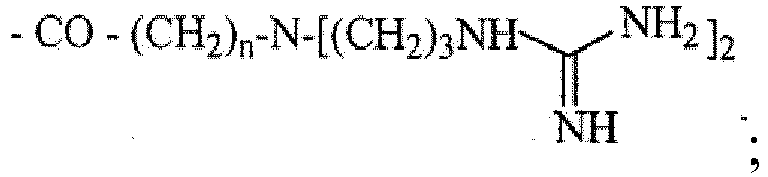
- the compound according to Formula 3, more specifically, may be sorbitol derivatives or salts thereof having 6 guanidine groups introduced thereinto.
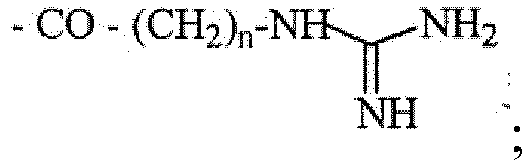
- the compound according to Formula 4 may be arginine (in case of n being 1) or an arginine oligomer (in case of n being any one of 2 to 8). Specifically, it may be an arginine oligomer wherein n is 6 or 8.
- the protein comprised in the ionic complex of the present invention is anionic and can be bonded with the cationic compound to form an ionic complex.
- examples thereof include hormones, enzymes, enzyme inhibitors, antibodies, cytokines, fluorescent material, and the like.
- the composition for skin penetration according to the present invention has an advantage in that a protein can be efficiently delivered into the skin by forming an ionic complex with the cationic compound as described above even in the case where the protein has a molecular weight far exceeding 500 Da.
- the weight average molecular weight of the protein may be 200 kDa or less, 180 kDa or less, 150 kDa or less, 115 kDa or less, 100 kDa or less, 80 kDa or less, 65 kDa or less, 27 kDa or less, or 10 kDa or less.
- the protein examples include green fluorescent protein, red fluorescent protein, epidermal growth factor (EGF), fibroblast growth factor (FGF), antibodies (including a therapeutic monoclonal antibody), lectins, insulin, growth hormone, interferons, interleukins, parathyroid hormone, albumins, streptavidin, concanavalin, immunoglobulin, and the like.
- EGF epidermal growth factor
- FGF fibroblast growth factor
- antibodies including a therapeutic monoclonal antibody
- lectins insulin, growth hormone, interferons, interleukins, parathyroid hormone, albumins, streptavidin, concanavalin, immunoglobulin, and the like.
- the cationic compound and the protein may be ionically bonded in a ratio of 1:1 to 20:1, 2:1 to 18:1, 4:1 to 16:1, 5:1 to 15:1, 8:1 to 13:1, or 7.5:1 to 10:1, based on the charge.
- the cationic compound and the protein may be ionically bonded in a ratio of 10:1 to 50:1, 20:1 to 40:1, 12:1 to 30:1, or 15:1 to 25:1, based on the molar ratio.
- composition for skin penetration according to the present invention penetrates into the skin up to a depth of 50 to 100 ⁇ m, 55 to 80 ⁇ m, or 60 to 65 ⁇ m. Therefore, the composition for skin penetration according to the present invention can penetrate into the cell or under the skin, e.g., between the epidermis and the dermis, to deliver a protein ( see Test Example 2 and Figs. 3 and 4 ). Thus, it can greatly improve the delivery of functional cosmetics and therapeutic agents for skin disorders that contain a protein. In addition, it can be advantageously used for delivering a variety of therapeutic or diagnostic agents comprising a protein, which must be subcutaneously administered.
- Example 1 Preparation of an ionic complex comprising a cationic compound of a sorbitol backbone with 8 guanidine groups and the green fluorescent protein (GFP)
- the cationic compound (hereinafter referred to as "sorbitol-based G8 molecular carrier” or "SG8") having a sorbitol backbone and 8 guanidine groups (+8; one positive charge per guanidine group) as represented by Formula 2 of the present invention was prepared according to the method described in Example 1 of Korean Patent No. 0699279 . Next, 3.5 ⁇ g (2.45 nmol) of the SG8 prepared above was dissolved in 16.76 ⁇ l of triple distilled water to prepare a solution containing the cationic SG8.
- the solution containing the anionic GFP prepared above was slowly added dropwise to the solution containing the cationic SG8 and mixed, followed by stirring at 0°C for about 30 minutes until the turbid mixed solution became clear. Then, the mixed solution was stored at -20°C for freezing to obtain an ionic complex in which the cationic compound and the GFP were ionically bonded in a charge ratio of 10:1.
- Example 2 Preparation of an ionic complex comprising a cationic compound of a sorbitol backbone with 6 guanidine groups and the GFP
- the cationic compound (hereinafter referred to as "sorbitol-based G6 molecular carrier" or "SG6") having a sorbitol backbone and 6 guanidine groups (+6; one positive charge per guanidine group) as represented by Formula 3 of the present invention was prepared according to the method described in Example 8 of Korean Patent No. 0699279 . Next, 2.7 ⁇ g (2.45 nmol) of the SG6 prepared above was dissolved in 16.76 ⁇ l of triple distilled water to prepare a solution containing the cationic SG6.
- the solution containing the anionic GFP prepared above was slowly added dropwise to the solution containing the cationic SG6 and mixed, followed by stirring at 0°C for about 30 minutes until the turbid mixed solution became clear. Then, the mixed solution was stored at -20°C for freezing to obtain an ionic complex in which the cationic compound and the GFP were ionically bonded in a charge ratio of 7.5:1.
- Example 3 Preparation of an ionic complex comprising an arginine octamer with 8 guanidine groups and the GFP
- the solution containing the anionic GFP prepared above was slowly added dropwise to the solution containing the cationic ARG8 and mixed, followed by stirring at 0°C for about 30 minutes until the turbid mixed solution became clear. Then, the mixed solution was stored at -20°C for freezing to obtain an ionic complex in which the cationic compound and the GFP were ionically bonded in a charge ratio of 10:1.
- albumin-FITC molecular weight of 66 kDa
- concanavalin A-FITC (molecular weight of 102 kDa) was dissolved in 10.0 ⁇ l of triple distilled water to prepare a solution containing anionic concanavalin A-FITC.
- the solution containing anionic concanavalin A-FITC prepared above was slowly added dropwise to the solution containing the cationic SG6 and mixed, followed by stirring at 0°C for about 30 minutes until the turbid mixed solution became clear. Then, the mixed solution was stored at -20°C for freezing to obtain an ionic complex in which the cationic compound and fluorescently labeled concanavalin A were ionically bonded in a molar ratio of about 40:1.
- immunoglobulin G-FITC (molecular weight of 150 kDa) was dissolved in 10.0 ⁇ l of triple distilled water to prepare a solution containing anionic immunoglobulin G-FITC.
- Test Example 1 Measurement of the cell membrane permeability
- the fluorescence emitted from the substrate GFP itself was measured with a Confocal Laser Scanning Microscope (Olympus FV1000).
- HeLa cells (ATCC CCL-2TM) were cultured in DMEM (Dulbecco's modified Eagle's medium) containing 10% FBS as a culture medium in a dish plate.
- DMEM Dulbecco's modified Eagle's medium
- FBS FBS
- a serum-free medium was added to the ionic complexes prepared in Examples 1 to 3 so that the final concentration of the GFP in the ionic complex became 1 ⁇ M.
- the Hela cells were treated with the ionic complex and cultured for 1 hour at 37°C. Thereafter, the cells were washed with PBS 3 times, and the permeability through the cell membrane was immediately observed with a confocal microscope. In the meantime, the GFP only instead of the ionic complex was used for the control group.
- Fig. 1 An Ar laser (488 nm) was used for the excitation of the GFP, and the cells were observed at a magnification of 40 times. The results are shown in Fig. 1 .
- column A shows fluorescence images of the cells treated with the ionic complex
- column B shows morphological images (DIC) of the cells treated with the ionic complex.
- the cells treated with each ionic complex of Examples 1 to 3 of the present invention showed much stronger fluorescence signals than those of the control group treated with the GFP only.
- Fig. 2 column A shows fluorescence images of the cells treated with the ionic complex, and column B shows morphological images (DIC) of the cells treated with the ionic complex.
- the cells treated with each ionic complex of Examples 4 to 6 of the present invention showed strong fluorescence signals of the proteins that penetrated into the cells.
- Test Example 2 Measurement of penetration into the mouse skin and distribution therein
- the ionic complexes prepared in Examples 2 and 3 were each diluted with triple distilled water such that the final concentration of the GFP was 24.7 ⁇ l. Thereafter, 15 ⁇ l of the aqueous solution of the ionic complex was mixed with 50 ⁇ l of PEG400 to prepare a sample solution having 15.4% by weight of the GFP.
- mice were each anesthetized with gas, and 65 ⁇ l of the sample solution prepared above was applied to an area of 1 cm ⁇ 1 cm on the skin of the hind leg femur. Then, they were left in anesthesia in a dark room for 3 hours. After 3 hours, the samples on the legs were washed with distilled water and 70% ethanol, and the mice were euthanized with carbon dioxide. Subsequently, the femoral skin tissue was peeled off, placed on a glass slide, and fixed with a cover slip. Each slide sample was observed for transdermal permeability with a two-photon laser microscope.
- a femtosecond laser (wavelength 900 nm) was used to excite the fluorescent material, and the subcutaneous layer was continuously photographed at a depth interval of 3 ⁇ m from the skin surface.
- the images of representative specific depths (33 ⁇ m and 63 ⁇ m) were observed, and the results are shown in Fig. 3 .
- row A shows fluorescence photographs of the mouse skin observed from a depth of 33 ⁇ m
- row B shows those observed at a depth of 63 ⁇ m.
- Fig. 4 the fluorescence emitted from the fluorescently labeled protein as a substrate using the ionic complexes prepared in Examples 4 to 6 as described above was measured with a two-photon laser scanning microscope (Leica). The results are shown in Fig. 4 .
- row A shows fluorescence photographs of the mouse skin observed from a depth of 33 ⁇ m
- row B shows those observed at a depth of 63 ⁇ m.
- the ionic complexes prepared according to the present invention exhibit a high permeability into the cell membrane and the skin.
- proteins having very high molecular weights it is difficult for proteins having very high molecular weights to be delivered into the subcutaneous layer from the skin surface by a conventional method.
- proteins, which are bonded with the cationic compound to thereby form a simple ionic complex according to the present invention are well delivered into the skin layer and the dermal layer.
- the ionic complex according to the present invention can be advantageously used for delivering a protein into a cell or the subcutaneous layer (i.e., the epidermis or the dermis).
Landscapes
- Health & Medical Sciences (AREA)
- Life Sciences & Earth Sciences (AREA)
- Chemical & Material Sciences (AREA)
- Medicinal Chemistry (AREA)
- Veterinary Medicine (AREA)
- Public Health (AREA)
- General Health & Medical Sciences (AREA)
- Animal Behavior & Ethology (AREA)
- Epidemiology (AREA)
- Pharmacology & Pharmacy (AREA)
- Engineering & Computer Science (AREA)
- Bioinformatics & Cheminformatics (AREA)
- Organic Chemistry (AREA)
- Immunology (AREA)
- Proteomics, Peptides & Aminoacids (AREA)
- General Chemical & Material Sciences (AREA)
- Chemical Kinetics & Catalysis (AREA)
- Oil, Petroleum & Natural Gas (AREA)
- Mycology (AREA)
- Microbiology (AREA)
- Nuclear Medicine, Radiotherapy & Molecular Imaging (AREA)
- Molecular Biology (AREA)
- Dermatology (AREA)
- Zoology (AREA)
- Gastroenterology & Hepatology (AREA)
- Biomedical Technology (AREA)
- Radiology & Medical Imaging (AREA)
- Pathology (AREA)
- Endocrinology (AREA)
- Diabetes (AREA)
- Medicinal Preparation (AREA)
- Peptides Or Proteins (AREA)
- Cosmetics (AREA)
- Medicines That Contain Protein Lipid Enzymes And Other Medicines (AREA)
- Medicines Containing Antibodies Or Antigens For Use As Internal Diagnostic Agents (AREA)
Abstract
Description
- The present invention relates to a composition for skin penetration, which comprises a cationic molecular carrier and a protein and which aims to deliver the protein into the skin, particularly into a part of the epidermis and the dermis.
- Cells are the basic structural unit of all living organisms and are composed of the cytoplasm in which intracellular organelles are present and the cell membrane that protects the cytoplasm and also separates it from the extracellular environment. Since the cell membrane that has a selective permeability of substances has proteins in a fluid state distributed in the phospholipid bilayer in a mosaic pattern, there are many restrictions on the penetration of substances with a useful therapeutic activity through the cell membrane. Particularly, since it is difficult for hydrophilic molecules, highly charged molecules of low molecular weights, and macromolecules such as peptides and oligonucleotides (e.g., nucleic acids and genes) to pass through the cell membrane, several methods for delivering these molecules into cells have been developed (see S. Futaki, Adv. Drug Delivery Rev. 2005, 57, 547-558 and P. A. Wender, et al., Adv. Drug Delivery Rev. 2008, 60, 452-472). In reality, however, there have been raised many problems such as causing cytotoxicity.
- The cell membrane is one of many biomembranes. Among the various types of biomembranes, examples of biomembranes for which the difficulty of penetration is well known include the blood-brain barrier, the skin/stratum corneum barrier, and the like. It is also well known that certain substances cannot readily pass through the nuclear membrane and the mitochondrial membrane even though they can readily pass through the cell membrane. Furthermore, not all substances that pass through the cell membrane can readily penetrate into various cell organelles surrounded by other biological membranes. Given the nature of the different biomembranes and the difference in permeability between them, it cannot be predicted that a substance that passes through the in vivo cell membrane will pass through the skin barrier as well.
- The skin is responsible for protecting the body from external stimuli or chemicals, so that it is very difficult for most substances to pass through the skin. It is known that a substance with a low molecular weight, while having adequate fat-solubility and water-solubility, can penetrate the skin. It is generally known that in order for a substance to penetrate the skin, it should have a molecular weight of about 500 Da or less regardless of the type of molecule (see Testa et al., Comp. Med. Chem. (2007) p. 292; Naik et al., PSTT Vol. 3, No. 9 Sept. (2000) p. 319).
- In the meantime, a variety of molecular carriers that are capable of delivering physiologically active molecules and have a peptide-based structure or a non-peptide-based structure have been developed (see S. K. Chung, et al., Int. J. Pharmaceutics, 2008, 354, 16-22]; K. K. Maiti, et al., Angew. Chem. Int. Ed., 2007, 46, 5880-5884; K. K. Maiti, et al., Angew. Chem. Int. Ed., 2006, 45, 2907-2912; and Korean Patent Nos.
0578732 0699279 0849033 1021078 - Molecular carriers of these various structures have been applied to deliver various small molecules or such macromolecules as proteins into cells or into skin tissue. For example, covalent bonding, encapsulation with a nanodevice such as a liposome, and complex interactions between protein and protein have been used for the connection between a molecular carrier and a cargo (see S. A. Nasrollahi, et. al., Chem. Biol. Drug. Des. 2012, 80, 639-646; W. Shi and S. F. Dowdy, in Cell Penetrating Peptides, Ed. U. Langel, 2007, p201-217; and Y Hou, et al., Exper. Dermatol. 2007, 16, 999-1006).
- However, there has not yet been a successful delivery of a protein into the skin in the form of an ionic complex in which the molecular carrier and the protein form a simple ionic interaction between them.
- The present inventors have prepared an ionic complex by ionic bonding a molecular carrier previously reported with a protein to a predetermined ratio in order to deliver the protein into the skin and confirmed that the ionically complex thus prepared can improve the skin permeability of the protein, thereby completing the present invention.
- Accordingly, an object of the present invention is to provide a composition for skin penetration for the purpose of delivering a protein into the skin.
- In order to achieve the object of the present invention, there is provided a composition for skin penetration, which comprises an ionic complex in which a cationic compound of any one represented by the following
Formulae 1 to 4 and a protein are ionically bonded and which is for delivering the protein into the skin:


- wherein R1 and R2 are each independently H, C1-C6 alkyl, C6-C12 aryl C1-C6 alkyl, C3-C8 cycloalkyl, C3-C8 heteroalkyl, -(CH2)mNHR', -(CH2)1CO2R", -COR"', or -SO2R"", wherein R', R", R'" and R"" are each independently H, C1-C6 alkyl, C6-C12 aryl C1-C6 alkyl, C3-C8 cycloalkyl, or C3-C8 heteroalkyl, m is an integer of 2 to 5, and 1 is an integer of 1 to 5;
- R3 is


- R4 is

- R5 is

- n is an integer of 1 to 8.
- The composition according to the present invention exhibits an excellent effect of penetrating proteins having difficulty in passing through the cell membrane or the skin layers into the skin. Thus, it may be effectively used for delivering proteins into the skin.
-
-
Fig. 1 shows fluorescence images (A) and cell morphological images (B) showing the cell membrane permeability of an ionic complex prepared using the green fluorescent protein according to an embodiment of the present invention. -
Fig. 2 shows fluorescence images (A) and cell morphological images (B) showing the cell membrane permeability of an ionic complex prepared using albumin-FITC (Example 4), concanavalin A-FITC (Example 5), and immunoglobulin G-FITC (Example 6), respectively, as a protein according to an embodiment of the present invention. -
Fig. 3 shows fluorescence photographs of the mouse skin observed at a depth of 33 µm (A) and 63 µm (B), respectively, from the skin surface of a mouse upon the application of an ionic complex prepared using the green fluorescent protein according to an embodiment of the present invention to the skin of the hind leg femur of the mouse. -
Fig. 4 shows fluorescence photographs of the mouse skin observed at a depth of 33 µm (A) and 63 µm (B), respectively, from the skin surface of a mouse upon the application of an ionic complex prepared using albumin-FITC (Example 4), concanavalin A-FITC (Example 5), and immunoglobulin G-FITC (Example 6), respectively, as a protein according to an embodiment of the present invention to the skin of the hind leg femur of the mouse. - Hereinafter, the present invention will be described in more detail.
- The present invention provides a composition for skin penetration, which comprises an ionic complex in which a cationic compound of any one represented by the following
Formulae 1 to 4 and a protein are ionically bonded and which is for delivering the protein into the skin:


- wherein R1 and R2 are each independently H, C1-C6 alkyl, C6-C12 aryl C1-C6 alkyl, C3-C8 cycloalkyl, C3-C8 heteroalkyl, -(CH2)mNHR', -(CH2)1CO2R", -COR"', or -SO2R"", wherein R', R", R'" and R"" are each independently H, C1-C6 alkyl, C6-C12 aryl C1-C6 alkyl, C3-C8 cycloalkyl, or C3-C8 heteroalkyl, m is an integer of 2 to 5, and 1 is an integer of 1 to 5;
- R3 is


- R4 is

- R5 is
- n is an integer of 1 to 8.
- In the present invention, the ionic complex comprises a cationic compound. The cationic compound may be any one represented by the
above Formulae 1 to 4 and is used as a molecular carrier (see, e.g., Korean Patent No.0578732 0699279 0849033 1021078 Formulae 1 to 4. Since the cationic compound is watersoluble and excellent in the biomembrane permeability, it can readily pass through the cell membrane and the skin layer in the form of an ionic complex bonded with an anionic protein. - The compound according to
Formula 1 has a structure in which 1 to 8 guanidine groups are introduced into a sugar alcohol derivative capable of introducing a desired functional group in a high density to the backbone structure by using a side chain structure in a branched form. According to an embodiment of the present invention, the compound ofFormula 1, for example, may be alditol derivatives or salts thereof having a steric conformation of sorbitol, mannitol, or galactitol. - The compound according to
Formula 2, more specifically, may be sorbitol derivatives or salts thereof having 8 guanidine groups introduced thereinto. - The compound according to
Formula 3, more specifically, may be sorbitol derivatives or salts thereof having 6 guanidine groups introduced thereinto. - The compound according to
Formula 4 may be arginine (in case of n being 1) or an arginine oligomer (in case of n being any one of 2 to 8). Specifically, it may be an arginine oligomer wherein n is 6 or 8. - There are no special limitations to the protein comprised in the ionic complex of the present invention as long as it is anionic and can be bonded with the cationic compound to form an ionic complex. Examples thereof include hormones, enzymes, enzyme inhibitors, antibodies, cytokines, fluorescent material, and the like.
- Especially, although it is common knowledge in the art that a certain substance should have a molecular weight of about 500 Da or less in order for the substance to penetrate through the skin layer and reach the dermis, the composition for skin penetration according to the present invention has an advantage in that a protein can be efficiently delivered into the skin by forming an ionic complex with the cationic compound as described above even in the case where the protein has a molecular weight far exceeding 500 Da.
- For example, the weight average molecular weight of the protein may be 200 kDa or less, 180 kDa or less, 150 kDa or less, 115 kDa or less, 100 kDa or less, 80 kDa or less, 65 kDa or less, 27 kDa or less, or 10 kDa or less.
- Specific examples of the protein include green fluorescent protein, red fluorescent protein, epidermal growth factor (EGF), fibroblast growth factor (FGF), antibodies (including a therapeutic monoclonal antibody), lectins, insulin, growth hormone, interferons, interleukins, parathyroid hormone, albumins, streptavidin, concanavalin, immunoglobulin, and the like.
- In the ionic complex of the present invention, the cationic compound and the protein may be ionically bonded in a ratio of 1:1 to 20:1, 2:1 to 18:1, 4:1 to 16:1, 5:1 to 15:1, 8:1 to 13:1, or 7.5:1 to 10:1, based on the charge.
- In the ionic complex of the present invention, the cationic compound and the protein may be ionically bonded in a ratio of 10:1 to 50:1, 20:1 to 40:1, 12:1 to 30:1, or 15:1 to 25:1, based on the molar ratio.
- If the bonding ratio of the cationic molecular carrier and the protein is within the above range in the preparation of the ionic complex, the number of guanidine groups per molecule of the ionic complex is appropriate, so that the cell permeability is improved, and it is possible to prevent the phenomenon that the surplus molecular carriers in a free form, which are not involved in the formation of the ionic complex, penetrate the cell membrane competitively. As a result, it is possible to increase the rate of penetration of the ionic complex to the cell membrane and to improve the efficiency of delivering the protein (or substrate).
- The composition for skin penetration according to the present invention penetrates into the skin up to a depth of 50 to 100 µm, 55 to 80 µm, or 60 to 65 µm. Therefore, the composition for skin penetration according to the present invention can penetrate into the cell or under the skin, e.g., between the epidermis and the dermis, to deliver a protein (see Test Example 2 and
Figs. 3 and 4 ). Thus, it can greatly improve the delivery of functional cosmetics and therapeutic agents for skin disorders that contain a protein. In addition, it can be advantageously used for delivering a variety of therapeutic or diagnostic agents comprising a protein, which must be subcutaneously administered. - Hereinafter, the present invention is explained in more detail by the following Examples. However, the following Examples are intended to further illustrate the present invention. The scope of the present invention is not limited thereby.
- The cationic compound (hereinafter referred to as "sorbitol-based G8 molecular carrier" or "SG8") having a sorbitol backbone and 8 guanidine groups (+8; one positive charge per guanidine group) as represented by
Formula 2 of the present invention was prepared according to the method described in Example 1 of Korean Patent No.0699279 - In the meantime, 13.8 µg (0.68 nmol) of the GFP (active A.victoria GFP - Ab84191, 27 kDa, Abcam, -8; 8 negative charges per GFP) was dissolved in 6.76 µl of triple distilled water to prepare a solution containing the anionic GFP.
- The solution containing the anionic GFP prepared above was slowly added dropwise to the solution containing the cationic SG8 and mixed, followed by stirring at 0°C for about 30 minutes until the turbid mixed solution became clear. Then, the mixed solution was stored at -20°C for freezing to obtain an ionic complex in which the cationic compound and the GFP were ionically bonded in a charge ratio of 10:1.
- The cationic compound (hereinafter referred to as "sorbitol-based G6 molecular carrier" or "SG6") having a sorbitol backbone and 6 guanidine groups (+6; one positive charge per guanidine group) as represented by
Formula 3 of the present invention was prepared according to the method described in Example 8 of Korean Patent No.0699279 - In the meantime, 13.8 µg (0.68 nmol) of the GFP (-8; 8 negative charges per GFP) was dissolved in 6.76 µl of triple distilled water to prepare a solution containing the anionic GFP.
- The solution containing the anionic GFP prepared above was slowly added dropwise to the solution containing the cationic SG6 and mixed, followed by stirring at 0°C for about 30 minutes until the turbid mixed solution became clear. Then, the mixed solution was stored at -20°C for freezing to obtain an ionic complex in which the cationic compound and the GFP were ionically bonded in a charge ratio of 7.5:1.
- The cationic compound (hereinafter referred to as "ARG8") of an arginine octamer (n=8; +8) as represented by
Formula 4 of the present invention was supplied by Peptron Inc. Next, 3.11 µg (2.45 nmol) of the ARG8 was dissolved in 16.76 µl of triple distilled water to prepare a solution containing the cationic ARG8. - In the meantime, 13.8 µg (0.68 nmol) of the GFP (-8; 8 negative charges per GFP) was dissolved in 6.76 µl of triple distilled water to prepare a solution containing the anionic GFP.
- The solution containing the anionic GFP prepared above was slowly added dropwise to the solution containing the cationic ARG8 and mixed, followed by stirring at 0°C for about 30 minutes until the turbid mixed solution became clear. Then, the mixed solution was stored at -20°C for freezing to obtain an ionic complex in which the cationic compound and the GFP were ionically bonded in a charge ratio of 10:1.
- 29.5 µg (26.6 nmol) of the cationic compound SG6 obtained according to the method described in Example 2 was dissolved in 20.0 µl of triple distilled water to prepare a solution containing the cationic SG6.
- In the meantime, 88 µg (0.68 nmol) of albumin-FITC (molecular weight of 66 kDa) was dissolved in 10.0 µl of triple distilled water to prepare a solution containing anionic albumin-FITC.
- The solution containing anionic albumin-FITC prepared above was slowly added dropwise to the solution containing the cationic SG6 and mixed, followed by stirring at 0°C for about 30 minutes until the turbid mixed solution became clear. Then, the mixed solution was stored at -20°C for freezing to obtain an ionic complex in which the cationic compound and fluorescently labeled albumin were ionically bonded in a molar ratio of about 40:1.
- 29.5 µg (26.6 nmol) of the cationic compound SG6 obtained according to the method described in Example 2 was dissolved in 20.0 µl of triple distilled water to prepare a solution containing the cationic SG6.
- In the meantime, 135 µg (0.68 nmol) of concanavalin A-FITC (molecular weight of 102 kDa) was dissolved in 10.0 µl of triple distilled water to prepare a solution containing anionic concanavalin A-FITC.
- The solution containing anionic concanavalin A-FITC prepared above was slowly added dropwise to the solution containing the cationic SG6 and mixed, followed by stirring at 0°C for about 30 minutes until the turbid mixed solution became clear. Then, the mixed solution was stored at -20°C for freezing to obtain an ionic complex in which the cationic compound and fluorescently labeled concanavalin A were ionically bonded in a molar ratio of about 40:1.
- 29.5 µg (26.6 nmol) of the cationic compound SG6 obtained according to the method described in Example 2 was dissolved in 20.0 µl of triple distilled water to prepare a solution containing the cationic SG6.
- In the meantime, 199 µg (0.68 nmol) of immunoglobulin G-FITC (molecular weight of 150 kDa) was dissolved in 10.0 µl of triple distilled water to prepare a solution containing anionic immunoglobulin G-FITC.
- The solution containing anionic immunoglobulin G-FITC prepared above was slowly added dropwise to the solution containing the cationic SG6 and mixed, followed by stirring at 0°C for about 30 minutes until the turbid mixed solution became clear. Then, the mixed solution was stored at -20°C for freezing to obtain an ionic complex in which the cationic compound and fluorescently labeled immunoglobulin G were ionically bonded in a molar ratio of about 40:1.
- In order to confirm the cell membrane permeability of the ionic complexes prepared in the above Examples, the fluorescence emitted from the substrate GFP itself was measured with a Confocal Laser Scanning Microscope (Olympus FV1000).
- First, HeLa cells (ATCC CCL-2™) were cultured in DMEM (Dulbecco's modified Eagle's medium) containing 10% FBS as a culture medium in a dish plate. Next, a serum-free medium was added to the ionic complexes prepared in Examples 1 to 3 so that the final concentration of the GFP in the ionic complex became 1 µM. The Hela cells were treated with the ionic complex and cultured for 1 hour at 37°C. Thereafter, the cells were washed with
PBS 3 times, and the permeability through the cell membrane was immediately observed with a confocal microscope. In the meantime, the GFP only instead of the ionic complex was used for the control group. - An Ar laser (488 nm) was used for the excitation of the GFP, and the cells were observed at a magnification of 40 times. The results are shown in
Fig. 1 . InFig. 1 , column A shows fluorescence images of the cells treated with the ionic complex, and column B shows morphological images (DIC) of the cells treated with the ionic complex. - As shown in
Fig. 1 , the cells treated with each ionic complex of Examples 1 to 3 of the present invention showed much stronger fluorescence signals than those of the control group treated with the GFP only. - In addition, the cell membrane permeability of the HeLa cells was observed by confocal microscopy using the ionic complexes prepared in Examples 4 to 6 prepared by the methods as described above, and the results are shown in
Fig 2 . InFig. 2 , column A shows fluorescence images of the cells treated with the ionic complex, and column B shows morphological images (DIC) of the cells treated with the ionic complex. - As shown in
Fig. 2 , the cells treated with each ionic complex of Examples 4 to 6 of the present invention showed strong fluorescence signals of the proteins that penetrated into the cells. - In order to confirm the permeability of the ionic complexes prepared in the above Examples into the mouse skin, the fluorescence emitted from the GFP substrate itself was measured with a two-photon laser scanning microscope (Leica).
- First, the ionic complexes prepared in Examples 2 and 3 were each diluted with triple distilled water such that the final concentration of the GFP was 24.7 µl. Thereafter, 15 µl of the aqueous solution of the ionic complex was mixed with 50 µl of PEG400 to prepare a sample solution having 15.4% by weight of the GFP.
- After 7-week-old BALB/c nude mice were each anesthetized with gas, and 65 µl of the sample solution prepared above was applied to an area of 1 cm × 1 cm on the skin of the hind leg femur. Then, they were left in anesthesia in a dark room for 3 hours. After 3 hours, the samples on the legs were washed with distilled water and 70% ethanol, and the mice were euthanized with carbon dioxide. Subsequently, the femoral skin tissue was peeled off, placed on a glass slide, and fixed with a cover slip. Each slide sample was observed for transdermal permeability with a two-photon laser microscope. A femtosecond laser (wavelength 900 nm) was used to excite the fluorescent material, and the subcutaneous layer was continuously photographed at a depth interval of 3 µm from the skin surface. The images of representative specific depths (33 µm and 63 µm) were observed, and the results are shown in
Fig. 3 . InFig. 3 , row A shows fluorescence photographs of the mouse skin observed from a depth of 33 µm, and row B shows those observed at a depth of 63 µm. - As shown in
Fig. 3 , it was confirmed that the ionic complexes of Examples 2 and 3 better penetrate the subcutaneous layer of the mouse as compared with the control group treated with the GFP only. In addition, as the depth of photographing was deepened, the amount of the proteins gradually decreased and the fluorescence intensity weakened. According to the results of transcutaneous penetration measured by a two-photon laser scanning microscopy, it was observed that the proteins with fluorescence penetrated to a depth of at least 63 µm. - Further, the fluorescence emitted from the fluorescently labeled protein as a substrate using the ionic complexes prepared in Examples 4 to 6 as described above was measured with a two-photon laser scanning microscope (Leica). The results are shown in
Fig. 4 . InFig. 4 , row A shows fluorescence photographs of the mouse skin observed from a depth of 33 µm, and row B shows those observed at a depth of 63 µm. - As shown in
Fig. 4 , the ionic complexes of the proteins prepared in Examples 4 to 6 well penetrated into the subcutaneous layer of the mouse. - From the above results, it was confirmed that the ionic complexes prepared according to the present invention exhibit a high permeability into the cell membrane and the skin. In addition, it is difficult for proteins having very high molecular weights to be delivered into the subcutaneous layer from the skin surface by a conventional method. However, it was confirmed that such proteins, which are bonded with the cationic compound to thereby form a simple ionic complex according to the present invention, are well delivered into the skin layer and the dermal layer.
- Accordingly, the ionic complex according to the present invention can be advantageously used for delivering a protein into a cell or the subcutaneous layer (i.e., the epidermis or the dermis).
Claims (9)
- A composition for skin penetration, which comprises an ionic complex in which a cationic compound of any one represented by the following Formulae 1 to 4 and a protein are ionically bonded and which is for delivering the protein into the skin:


 wherein R1 and R2 are each independently H, C1-C6 alkyl, C6-C12 aryl C1-C6 alkyl, C3-C8 cycloalkyl, C3-C8 heteroalkyl, -(CH2)mNHR', -(CH2)1CO2R", -COR"', or -SO2R"", wherein R', R", R'" and R"" are each independently H, C1-C6 alkyl, C6-C12 aryl C1-C6 alkyl, C3-C8 cycloalkyl, or C3-C8 heteroalkyl, m is an integer of 2 to 5, and 1 is an integer of 1 to 5;R3 is
 R4 is
R4 is R5 is ; andn is an integer of 1 to 8
- The composition for skin penetration of claim 1, wherein the cationic compound and the protein are bonded in a ratio of 1:1 to 20:1 based on the charge.
- The composition for skin penetration of claim 2, wherein the cationic compound and the protein are bonded in a ratio of 7.5:1 to 10:1 based on the charge.
- The composition for skin penetration of claim 1, wherein the cationic compound and the protein are bonded in a ratio of 10:1 to 50:1 based on the molar ratio.
- The composition for skin penetration of claim 4, wherein the cationic compound and the protein are bonded in a ratio of 20:1 to 40:1 based on the molar ratio.
- The composition for skin penetration of claim 1, wherein the protein is any one selected from the group consisting of green fluorescent protein (GFP), red fluorescent protein (RFP), epidermal growth factor (EGF), fibroblast growth factor (FGF), antibodies (including a therapeutic monoclonal antibody), lectins, insulin, growth hormone, interferons, interleukins, parathyroid hormone, albumins, streptavidin, concanavalin, and immunoglobulin.
- The composition for skin penetration of any one of claims 1 to 5, wherein the weight average molecular weight of the protein is 200 kDa or less.
- The composition for skin penetration of claim 1, which penetrates into the skin between the epidermis and the dermis.
- The composition for skin penetration of claim 8, which penetrates into the skin up to a depth of 50 to 100 µm.
Applications Claiming Priority (2)
| Application Number | Priority Date | Filing Date | Title |
|---|---|---|---|
| KR20150154384 | 2015-11-04 | ||
| PCT/KR2016/012672 WO2017078467A1 (en) | 2015-11-04 | 2016-11-04 | Composition for skin permeation comprising cationic molecular transporter and protein |
Publications (3)
| Publication Number | Publication Date |
|---|---|
| EP3372247A1 true EP3372247A1 (en) | 2018-09-12 |
| EP3372247A4 EP3372247A4 (en) | 2019-11-06 |
| EP3372247B1 EP3372247B1 (en) | 2022-01-05 |
Family
ID=58662221
Family Applications (1)
| Application Number | Title | Priority Date | Filing Date |
|---|---|---|---|
| EP16862483.1A Active EP3372247B1 (en) | 2015-11-04 | 2016-11-04 | Composition for skin permeation comprising cationic molecular transporter and protein |
Country Status (5)
| Country | Link |
|---|---|
| US (1) | US20180236088A1 (en) |
| EP (1) | EP3372247B1 (en) |
| JP (1) | JP6776360B2 (en) |
| KR (1) | KR101945498B1 (en) |
| WO (1) | WO2017078467A1 (en) |
Family Cites Families (7)
| Publication number | Priority date | Publication date | Assignee | Title |
|---|---|---|---|---|
| TW570805B (en) * | 1998-09-01 | 2004-01-11 | Hoffmann La Roche | Water-soluble pharmaceutical composition in an ionic complex |
| US20020009491A1 (en) * | 2000-02-14 | 2002-01-24 | Rothbard Jonathan B. | Compositions and methods for enhancing drug delivery across biological membranes and tissues |
| KR100849033B1 (en) * | 2006-09-07 | 2008-07-29 | 포항공과대학교 산학협력단 | Molecular transporters based on alditol or inositol derivatives |
| KR100699279B1 (en) * | 2005-04-28 | 2007-03-23 | 학교법인 포항공과대학교 | Molecular transporters based on sugars or sugar analogs and methods for preparing the same |
| WO2007021970A2 (en) * | 2005-08-15 | 2007-02-22 | Praecis Pharmaceuticals, Inc. | Stable pharmaceutical formulations and methods of use thereof |
| JP5305371B2 (en) * | 2007-07-19 | 2013-10-02 | 国立大学法人 岡山大学 | Biomembrane-permeable composition and method for enhancing biomembrane permeability of drugs |
| KR20160001419A (en) * | 2014-06-27 | 2016-01-06 | 포항공과대학교 산학협력단 | Composition for skin permeation comprising cationic molecular transporters and anionic bioactive substance |
-
2016
- 2016-11-04 EP EP16862483.1A patent/EP3372247B1/en active Active
- 2016-11-04 KR KR1020160146883A patent/KR101945498B1/en active Active
- 2016-11-04 US US15/769,809 patent/US20180236088A1/en not_active Abandoned
- 2016-11-04 JP JP2018542094A patent/JP6776360B2/en active Active
- 2016-11-04 WO PCT/KR2016/012672 patent/WO2017078467A1/en not_active Ceased
Also Published As
| Publication number | Publication date |
|---|---|
| JP2018532792A (en) | 2018-11-08 |
| US20180236088A1 (en) | 2018-08-23 |
| KR101945498B1 (en) | 2019-02-08 |
| EP3372247A4 (en) | 2019-11-06 |
| WO2017078467A1 (en) | 2017-05-11 |
| EP3372247B1 (en) | 2022-01-05 |
| KR20170052518A (en) | 2017-05-12 |
| JP6776360B2 (en) | 2020-10-28 |
Similar Documents
| Publication | Publication Date | Title |
|---|---|---|
| Zhang et al. | A pH-responsive α-helical cell penetrating peptide-mediated liposomal delivery system | |
| Patra et al. | Retracted Article: The next generation cell-penetrating peptide and carbon dot conjugated nano-liposome for transdermal delivery of curcumin | |
| CN114727964A (en) | Freeze-dried composition of lipid nanoparticles | |
| JP2002535247A (en) | Transport complex | |
| Ookubo et al. | The transdermal inhibition of melanogenesis by a cell-membrane-permeable peptide delivery system based on poly-arginine | |
| van den Berg et al. | Shielding the cationic charge of nanoparticle-formulated dermal DNA vaccines is essential for antigen expression and immunogenicity | |
| KR20200136441A (en) | New cationic lipid with improved intracellular kinetics | |
| KR20130139254A (en) | Skin Penetration and Cell Entry Peptides and Methods of Use thereof | |
| EP3071177B1 (en) | Targeted capsules for the delivery of skin whitening agents in the skin | |
| ES2696623T3 (en) | Functionalized liposomes useful for the administration of bioactive compounds | |
| KR20030074999A (en) | Fusion peptide comprising tat peptide and human type-ⅰ collagen derived peptide, its preparation method, and anti-aging cosmetic composition comprising the same | |
| Shi et al. | Intelligent “Peptide-Gathering Mechanical Arm” tames wild “Trojan-Horse” peptides for the controlled delivery of cancer nanotherapeutics | |
| Tang et al. | A detachable coating of cholesterol-anchored PEG improves tumor targeting of cell-penetrating peptide-modified liposomes | |
| KR101813560B1 (en) | Topical formulation with Skin Physiological Activity Composed of Cell Permeable Growth Factors | |
| Mortazavi et al. | Topically applied GHK as an anti-wrinkle peptide: Advantages, problems and prospective | |
| Hardiningtyas et al. | Mechanistic investigation of transcutaneous protein delivery using solid-in-oil nanodispersion: A case study with phycocyanin | |
| JP6411648B2 (en) | Skin penetration composition containing cationic molecular transporter and anionic bioactive material | |
| KR102824695B1 (en) | Novel cell-penetrating peptides and composition including the same | |
| KR101471633B1 (en) | Transdermal delivery system based on polyamidoamine dendrimer | |
| EP3372247B1 (en) | Composition for skin permeation comprising cationic molecular transporter and protein | |
| KR102206808B1 (en) | Novel cell-penetrating peptiedes and composition for skin improvement including the same | |
| Neuberg et al. | Design and evaluation of ionizable peptide amphiphiles for siRNA delivery | |
| WO2013112488A2 (en) | Dermal filling compositions and methods | |
| EP1173192B1 (en) | Methods and compositions for targeted drug delivery | |
| KR101945497B1 (en) | Composition for skin permeation comprising cationic molecular transporters and anionic bioactive substance |
Legal Events
| Date | Code | Title | Description |
|---|---|---|---|
| STAA | Information on the status of an ep patent application or granted ep patent |
Free format text: STATUS: THE INTERNATIONAL PUBLICATION HAS BEEN MADE |
|
| PUAI | Public reference made under article 153(3) epc to a published international application that has entered the european phase |
Free format text: ORIGINAL CODE: 0009012 |
|
| STAA | Information on the status of an ep patent application or granted ep patent |
Free format text: STATUS: REQUEST FOR EXAMINATION WAS MADE |
|
| 17P | Request for examination filed |
Effective date: 20180601 |
|
| AK | Designated contracting states |
Kind code of ref document: A1 Designated state(s): AL AT BE BG CH CY CZ DE DK EE ES FI FR GB GR HR HU IE IS IT LI LT LU LV MC MK MT NL NO PL PT RO RS SE SI SK SM TR |
|
| AX | Request for extension of the european patent |
Extension state: BA ME |
|
| DAV | Request for validation of the european patent (deleted) | ||
| DAX | Request for extension of the european patent (deleted) | ||
| RIC1 | Information provided on ipc code assigned before grant |
Ipc: A61K 38/00 20060101ALI20190529BHEP Ipc: A61K 47/12 20060101ALI20190529BHEP Ipc: C07C 279/04 20060101ALI20190529BHEP Ipc: A61K 47/50 20170101AFI20190529BHEP Ipc: A61K 9/00 20060101ALI20190529BHEP |
|
| A4 | Supplementary search report drawn up and despatched |
Effective date: 20191004 |
|
| RIC1 | Information provided on ipc code assigned before grant |
Ipc: A61K 38/00 20060101ALI20190927BHEP Ipc: A61K 38/38 20060101ALI20190927BHEP Ipc: A61K 47/18 20170101ALI20190927BHEP Ipc: A61K 47/12 20060101AFI20190927BHEP Ipc: A61K 9/00 20060101ALI20190927BHEP |
|
| STAA | Information on the status of an ep patent application or granted ep patent |
Free format text: STATUS: EXAMINATION IS IN PROGRESS |
|
| 17Q | First examination report despatched |
Effective date: 20200619 |
|
| REG | Reference to a national code |
Ref country code: DE Ref legal event code: R079 Ref document number: 602016068169 Country of ref document: DE Free format text: PREVIOUS MAIN CLASS: A61K0047500000 Ipc: A61K0047120000 |
|
| RIC1 | Information provided on ipc code assigned before grant |
Ipc: A61K 47/12 20060101AFI20210421BHEP Ipc: A61K 47/18 20170101ALI20210421BHEP Ipc: A61K 38/00 20060101ALI20210421BHEP Ipc: A61K 38/38 20060101ALI20210421BHEP Ipc: A61K 9/00 20060101ALI20210421BHEP Ipc: A61P 5/00 20060101ALI20210421BHEP Ipc: A61P 43/00 20060101ALI20210421BHEP |
|
| GRAP | Despatch of communication of intention to grant a patent |
Free format text: ORIGINAL CODE: EPIDOSNIGR1 |
|
| STAA | Information on the status of an ep patent application or granted ep patent |
Free format text: STATUS: GRANT OF PATENT IS INTENDED |
|
| INTG | Intention to grant announced |
Effective date: 20210702 |
|
| GRAS | Grant fee paid |
Free format text: ORIGINAL CODE: EPIDOSNIGR3 |
|
| GRAA | (expected) grant |
Free format text: ORIGINAL CODE: 0009210 |
|
| STAA | Information on the status of an ep patent application or granted ep patent |
Free format text: STATUS: THE PATENT HAS BEEN GRANTED |
|
| AK | Designated contracting states |
Kind code of ref document: B1 Designated state(s): AL AT BE BG CH CY CZ DE DK EE ES FI FR GB GR HR HU IE IS IT LI LT LU LV MC MK MT NL NO PL PT RO RS SE SI SK SM TR |
|
| REG | Reference to a national code |
Ref country code: GB Ref legal event code: FG4D |
|
| REG | Reference to a national code |
Ref country code: CH Ref legal event code: EP |
|
| REG | Reference to a national code |
Ref country code: AT Ref legal event code: REF Ref document number: 1459949 Country of ref document: AT Kind code of ref document: T Effective date: 20220115 |
|
| REG | Reference to a national code |
Ref country code: DE Ref legal event code: R096 Ref document number: 602016068169 Country of ref document: DE |
|
| REG | Reference to a national code |
Ref country code: IE Ref legal event code: FG4D |
|
| REG | Reference to a national code |
Ref country code: LT Ref legal event code: MG9D |
|
| REG | Reference to a national code |
Ref country code: NL Ref legal event code: MP Effective date: 20220105 |
|
| REG | Reference to a national code |
Ref country code: AT Ref legal event code: MK05 Ref document number: 1459949 Country of ref document: AT Kind code of ref document: T Effective date: 20220105 |
|
| PG25 | Lapsed in a contracting state [announced via postgrant information from national office to epo] |
Ref country code: NL Free format text: LAPSE BECAUSE OF FAILURE TO SUBMIT A TRANSLATION OF THE DESCRIPTION OR TO PAY THE FEE WITHIN THE PRESCRIBED TIME-LIMIT Effective date: 20220105 |
|
| PG25 | Lapsed in a contracting state [announced via postgrant information from national office to epo] |
Ref country code: SE Free format text: LAPSE BECAUSE OF FAILURE TO SUBMIT A TRANSLATION OF THE DESCRIPTION OR TO PAY THE FEE WITHIN THE PRESCRIBED TIME-LIMIT Effective date: 20220105 Ref country code: RS Free format text: LAPSE BECAUSE OF FAILURE TO SUBMIT A TRANSLATION OF THE DESCRIPTION OR TO PAY THE FEE WITHIN THE PRESCRIBED TIME-LIMIT Effective date: 20220105 Ref country code: PT Free format text: LAPSE BECAUSE OF FAILURE TO SUBMIT A TRANSLATION OF THE DESCRIPTION OR TO PAY THE FEE WITHIN THE PRESCRIBED TIME-LIMIT Effective date: 20220505 Ref country code: NO Free format text: LAPSE BECAUSE OF FAILURE TO SUBMIT A TRANSLATION OF THE DESCRIPTION OR TO PAY THE FEE WITHIN THE PRESCRIBED TIME-LIMIT Effective date: 20220405 Ref country code: LT Free format text: LAPSE BECAUSE OF FAILURE TO SUBMIT A TRANSLATION OF THE DESCRIPTION OR TO PAY THE FEE WITHIN THE PRESCRIBED TIME-LIMIT Effective date: 20220105 Ref country code: HR Free format text: LAPSE BECAUSE OF FAILURE TO SUBMIT A TRANSLATION OF THE DESCRIPTION OR TO PAY THE FEE WITHIN THE PRESCRIBED TIME-LIMIT Effective date: 20220105 Ref country code: ES Free format text: LAPSE BECAUSE OF FAILURE TO SUBMIT A TRANSLATION OF THE DESCRIPTION OR TO PAY THE FEE WITHIN THE PRESCRIBED TIME-LIMIT Effective date: 20220105 Ref country code: BG Free format text: LAPSE BECAUSE OF FAILURE TO SUBMIT A TRANSLATION OF THE DESCRIPTION OR TO PAY THE FEE WITHIN THE PRESCRIBED TIME-LIMIT Effective date: 20220405 |
|
| PG25 | Lapsed in a contracting state [announced via postgrant information from national office to epo] |
Ref country code: PL Free format text: LAPSE BECAUSE OF FAILURE TO SUBMIT A TRANSLATION OF THE DESCRIPTION OR TO PAY THE FEE WITHIN THE PRESCRIBED TIME-LIMIT Effective date: 20220105 Ref country code: LV Free format text: LAPSE BECAUSE OF FAILURE TO SUBMIT A TRANSLATION OF THE DESCRIPTION OR TO PAY THE FEE WITHIN THE PRESCRIBED TIME-LIMIT Effective date: 20220105 Ref country code: GR Free format text: LAPSE BECAUSE OF FAILURE TO SUBMIT A TRANSLATION OF THE DESCRIPTION OR TO PAY THE FEE WITHIN THE PRESCRIBED TIME-LIMIT Effective date: 20220406 Ref country code: FI Free format text: LAPSE BECAUSE OF FAILURE TO SUBMIT A TRANSLATION OF THE DESCRIPTION OR TO PAY THE FEE WITHIN THE PRESCRIBED TIME-LIMIT Effective date: 20220105 Ref country code: AT Free format text: LAPSE BECAUSE OF FAILURE TO SUBMIT A TRANSLATION OF THE DESCRIPTION OR TO PAY THE FEE WITHIN THE PRESCRIBED TIME-LIMIT Effective date: 20220105 |
|
| PG25 | Lapsed in a contracting state [announced via postgrant information from national office to epo] |
Ref country code: IS Free format text: LAPSE BECAUSE OF FAILURE TO SUBMIT A TRANSLATION OF THE DESCRIPTION OR TO PAY THE FEE WITHIN THE PRESCRIBED TIME-LIMIT Effective date: 20220505 |
|
| REG | Reference to a national code |
Ref country code: DE Ref legal event code: R097 Ref document number: 602016068169 Country of ref document: DE |
|
| PG25 | Lapsed in a contracting state [announced via postgrant information from national office to epo] |
Ref country code: SM Free format text: LAPSE BECAUSE OF FAILURE TO SUBMIT A TRANSLATION OF THE DESCRIPTION OR TO PAY THE FEE WITHIN THE PRESCRIBED TIME-LIMIT Effective date: 20220105 Ref country code: SK Free format text: LAPSE BECAUSE OF FAILURE TO SUBMIT A TRANSLATION OF THE DESCRIPTION OR TO PAY THE FEE WITHIN THE PRESCRIBED TIME-LIMIT Effective date: 20220105 Ref country code: RO Free format text: LAPSE BECAUSE OF FAILURE TO SUBMIT A TRANSLATION OF THE DESCRIPTION OR TO PAY THE FEE WITHIN THE PRESCRIBED TIME-LIMIT Effective date: 20220105 Ref country code: EE Free format text: LAPSE BECAUSE OF FAILURE TO SUBMIT A TRANSLATION OF THE DESCRIPTION OR TO PAY THE FEE WITHIN THE PRESCRIBED TIME-LIMIT Effective date: 20220105 Ref country code: DK Free format text: LAPSE BECAUSE OF FAILURE TO SUBMIT A TRANSLATION OF THE DESCRIPTION OR TO PAY THE FEE WITHIN THE PRESCRIBED TIME-LIMIT Effective date: 20220105 Ref country code: CZ Free format text: LAPSE BECAUSE OF FAILURE TO SUBMIT A TRANSLATION OF THE DESCRIPTION OR TO PAY THE FEE WITHIN THE PRESCRIBED TIME-LIMIT Effective date: 20220105 |
|
| PLBE | No opposition filed within time limit |
Free format text: ORIGINAL CODE: 0009261 |
|
| STAA | Information on the status of an ep patent application or granted ep patent |
Free format text: STATUS: NO OPPOSITION FILED WITHIN TIME LIMIT |
|
| PG25 | Lapsed in a contracting state [announced via postgrant information from national office to epo] |
Ref country code: AL Free format text: LAPSE BECAUSE OF FAILURE TO SUBMIT A TRANSLATION OF THE DESCRIPTION OR TO PAY THE FEE WITHIN THE PRESCRIBED TIME-LIMIT Effective date: 20220105 |
|
| 26N | No opposition filed |
Effective date: 20221006 |
|
| PG25 | Lapsed in a contracting state [announced via postgrant information from national office to epo] |
Ref country code: SI Free format text: LAPSE BECAUSE OF FAILURE TO SUBMIT A TRANSLATION OF THE DESCRIPTION OR TO PAY THE FEE WITHIN THE PRESCRIBED TIME-LIMIT Effective date: 20220105 |
|
| PG25 | Lapsed in a contracting state [announced via postgrant information from national office to epo] |
Ref country code: MC Free format text: LAPSE BECAUSE OF FAILURE TO SUBMIT A TRANSLATION OF THE DESCRIPTION OR TO PAY THE FEE WITHIN THE PRESCRIBED TIME-LIMIT Effective date: 20220105 |
|
| REG | Reference to a national code |
Ref country code: BE Ref legal event code: MM Effective date: 20221130 |
|
| PG25 | Lapsed in a contracting state [announced via postgrant information from national office to epo] |
Ref country code: IT Free format text: LAPSE BECAUSE OF FAILURE TO SUBMIT A TRANSLATION OF THE DESCRIPTION OR TO PAY THE FEE WITHIN THE PRESCRIBED TIME-LIMIT Effective date: 20220105 |
|
| PG25 | Lapsed in a contracting state [announced via postgrant information from national office to epo] |
Ref country code: LU Free format text: LAPSE BECAUSE OF NON-PAYMENT OF DUE FEES Effective date: 20221104 |
|
| PG25 | Lapsed in a contracting state [announced via postgrant information from national office to epo] |
Ref country code: IE Free format text: LAPSE BECAUSE OF NON-PAYMENT OF DUE FEES Effective date: 20221104 |
|
| PG25 | Lapsed in a contracting state [announced via postgrant information from national office to epo] |
Ref country code: FR Free format text: LAPSE BECAUSE OF NON-PAYMENT OF DUE FEES Effective date: 20221130 Ref country code: BE Free format text: LAPSE BECAUSE OF NON-PAYMENT OF DUE FEES Effective date: 20221130 |
|
| PG25 | Lapsed in a contracting state [announced via postgrant information from national office to epo] |
Ref country code: HU Free format text: LAPSE BECAUSE OF FAILURE TO SUBMIT A TRANSLATION OF THE DESCRIPTION OR TO PAY THE FEE WITHIN THE PRESCRIBED TIME-LIMIT; INVALID AB INITIO Effective date: 20161104 |
|
| PG25 | Lapsed in a contracting state [announced via postgrant information from national office to epo] |
Ref country code: CY Free format text: LAPSE BECAUSE OF FAILURE TO SUBMIT A TRANSLATION OF THE DESCRIPTION OR TO PAY THE FEE WITHIN THE PRESCRIBED TIME-LIMIT Effective date: 20220105 |
|
| PG25 | Lapsed in a contracting state [announced via postgrant information from national office to epo] |
Ref country code: MK Free format text: LAPSE BECAUSE OF FAILURE TO SUBMIT A TRANSLATION OF THE DESCRIPTION OR TO PAY THE FEE WITHIN THE PRESCRIBED TIME-LIMIT Effective date: 20220105 |
|
| PG25 | Lapsed in a contracting state [announced via postgrant information from national office to epo] |
Ref country code: TR Free format text: LAPSE BECAUSE OF FAILURE TO SUBMIT A TRANSLATION OF THE DESCRIPTION OR TO PAY THE FEE WITHIN THE PRESCRIBED TIME-LIMIT Effective date: 20220105 |
|
| PG25 | Lapsed in a contracting state [announced via postgrant information from national office to epo] |
Ref country code: MT Free format text: LAPSE BECAUSE OF FAILURE TO SUBMIT A TRANSLATION OF THE DESCRIPTION OR TO PAY THE FEE WITHIN THE PRESCRIBED TIME-LIMIT Effective date: 20220105 |
|
| PGFP | Annual fee paid to national office [announced via postgrant information from national office to epo] |
Ref country code: DE Payment date: 20240926 Year of fee payment: 9 |
|
| PGFP | Annual fee paid to national office [announced via postgrant information from national office to epo] |
Ref country code: GB Payment date: 20241121 Year of fee payment: 9 |
|
| PGFP | Annual fee paid to national office [announced via postgrant information from national office to epo] |
Ref country code: CH Payment date: 20241201 Year of fee payment: 9 |
|
| REG | Reference to a national code |
Ref country code: DE Ref legal event code: R119 Ref document number: 602016068169 Country of ref document: DE |
|
| REG | Reference to a national code |
Ref country code: CH Ref legal event code: H13 Free format text: ST27 STATUS EVENT CODE: U-0-0-H10-H13 (AS PROVIDED BY THE NATIONAL OFFICE) Effective date: 20260623 |
|
| PG25 | Lapsed in a contracting state [announced via postgrant information from national office to epo] |
Ref country code: CH Free format text: LAPSE BECAUSE OF NON-PAYMENT OF DUE FEES Effective date: 20251130 |