EP3372214A1 - Absorbent article - Google Patents
Absorbent article Download PDFInfo
- Publication number
- EP3372214A1 EP3372214A1 EP16881535.5A EP16881535A EP3372214A1 EP 3372214 A1 EP3372214 A1 EP 3372214A1 EP 16881535 A EP16881535 A EP 16881535A EP 3372214 A1 EP3372214 A1 EP 3372214A1
- Authority
- EP
- European Patent Office
- Prior art keywords
- region
- waist portion
- elastic
- main body
- lateral direction
- Prior art date
- Legal status (The legal status is an assumption and is not a legal conclusion. Google has not performed a legal analysis and makes no representation as to the accuracy of the status listed.)
- Granted
Links
Images




Classifications
-
- A—HUMAN NECESSITIES
- A61—MEDICAL OR VETERINARY SCIENCE; HYGIENE
- A61F—FILTERS IMPLANTABLE INTO BLOOD VESSELS; PROSTHESES; DEVICES PROVIDING PATENCY TO, OR PREVENTING COLLAPSING OF, TUBULAR STRUCTURES OF THE BODY, e.g. STENTS; ORTHOPAEDIC, NURSING OR CONTRACEPTIVE DEVICES; FOMENTATION; TREATMENT OR PROTECTION OF EYES OR EARS; BANDAGES, DRESSINGS OR ABSORBENT PADS; FIRST-AID KITS
- A61F13/00—Bandages or dressings; Absorbent pads
- A61F13/15—Absorbent pads, e.g. sanitary towels, swabs or tampons for external or internal application to the body; Supporting or fastening means therefor; Tampon applicators
- A61F13/56—Supporting or fastening means
- A61F13/5622—Supporting or fastening means specially adapted for diapers or the like
- A61F13/5633—Supporting or fastening means specially adapted for diapers or the like open type diaper
- A61F13/5638—Supporting or fastening means specially adapted for diapers or the like open type diaper adjustable open type diapers
-
- A—HUMAN NECESSITIES
- A61—MEDICAL OR VETERINARY SCIENCE; HYGIENE
- A61F—FILTERS IMPLANTABLE INTO BLOOD VESSELS; PROSTHESES; DEVICES PROVIDING PATENCY TO, OR PREVENTING COLLAPSING OF, TUBULAR STRUCTURES OF THE BODY, e.g. STENTS; ORTHOPAEDIC, NURSING OR CONTRACEPTIVE DEVICES; FOMENTATION; TREATMENT OR PROTECTION OF EYES OR EARS; BANDAGES, DRESSINGS OR ABSORBENT PADS; FIRST-AID KITS
- A61F13/00—Bandages or dressings; Absorbent pads
- A61F13/15—Absorbent pads, e.g. sanitary towels, swabs or tampons for external or internal application to the body; Supporting or fastening means therefor; Tampon applicators
- A61F13/45—Absorbent pads, e.g. sanitary towels, swabs or tampons for external or internal application to the body; Supporting or fastening means therefor; Tampon applicators characterised by the shape
- A61F13/49—Absorbent pads, e.g. sanitary towels, swabs or tampons for external or internal application to the body; Supporting or fastening means therefor; Tampon applicators characterised by the shape specially adapted to be worn around the waist, e.g. diapers or nappies
- A61F13/49007—Form-fitting, self-adjusting disposable diapers
- A61F13/49009—Form-fitting, self-adjusting disposable diapers with elastic means
- A61F13/49011—Form-fitting, self-adjusting disposable diapers with elastic means the elastic means is located at the waist region
-
- A—HUMAN NECESSITIES
- A61—MEDICAL OR VETERINARY SCIENCE; HYGIENE
- A61F—FILTERS IMPLANTABLE INTO BLOOD VESSELS; PROSTHESES; DEVICES PROVIDING PATENCY TO, OR PREVENTING COLLAPSING OF, TUBULAR STRUCTURES OF THE BODY, e.g. STENTS; ORTHOPAEDIC, NURSING OR CONTRACEPTIVE DEVICES; FOMENTATION; TREATMENT OR PROTECTION OF EYES OR EARS; BANDAGES, DRESSINGS OR ABSORBENT PADS; FIRST-AID KITS
- A61F13/00—Bandages or dressings; Absorbent pads
- A61F13/15—Absorbent pads, e.g. sanitary towels, swabs or tampons for external or internal application to the body; Supporting or fastening means therefor; Tampon applicators
- A61F13/45—Absorbent pads, e.g. sanitary towels, swabs or tampons for external or internal application to the body; Supporting or fastening means therefor; Tampon applicators characterised by the shape
- A61F13/49—Absorbent pads, e.g. sanitary towels, swabs or tampons for external or internal application to the body; Supporting or fastening means therefor; Tampon applicators characterised by the shape specially adapted to be worn around the waist, e.g. diapers or nappies
- A61F13/49007—Form-fitting, self-adjusting disposable diapers
- A61F13/49009—Form-fitting, self-adjusting disposable diapers with elastic means
- A61F13/49017—Form-fitting, self-adjusting disposable diapers with elastic means the elastic means being located at the crotch region
-
- A—HUMAN NECESSITIES
- A61—MEDICAL OR VETERINARY SCIENCE; HYGIENE
- A61F—FILTERS IMPLANTABLE INTO BLOOD VESSELS; PROSTHESES; DEVICES PROVIDING PATENCY TO, OR PREVENTING COLLAPSING OF, TUBULAR STRUCTURES OF THE BODY, e.g. STENTS; ORTHOPAEDIC, NURSING OR CONTRACEPTIVE DEVICES; FOMENTATION; TREATMENT OR PROTECTION OF EYES OR EARS; BANDAGES, DRESSINGS OR ABSORBENT PADS; FIRST-AID KITS
- A61F13/00—Bandages or dressings; Absorbent pads
- A61F13/15—Absorbent pads, e.g. sanitary towels, swabs or tampons for external or internal application to the body; Supporting or fastening means therefor; Tampon applicators
- A61F13/45—Absorbent pads, e.g. sanitary towels, swabs or tampons for external or internal application to the body; Supporting or fastening means therefor; Tampon applicators characterised by the shape
- A61F13/49—Absorbent pads, e.g. sanitary towels, swabs or tampons for external or internal application to the body; Supporting or fastening means therefor; Tampon applicators characterised by the shape specially adapted to be worn around the waist, e.g. diapers or nappies
- A61F13/496—Absorbent pads, e.g. sanitary towels, swabs or tampons for external or internal application to the body; Supporting or fastening means therefor; Tampon applicators characterised by the shape specially adapted to be worn around the waist, e.g. diapers or nappies in the form of pants or briefs
-
- A—HUMAN NECESSITIES
- A61—MEDICAL OR VETERINARY SCIENCE; HYGIENE
- A61F—FILTERS IMPLANTABLE INTO BLOOD VESSELS; PROSTHESES; DEVICES PROVIDING PATENCY TO, OR PREVENTING COLLAPSING OF, TUBULAR STRUCTURES OF THE BODY, e.g. STENTS; ORTHOPAEDIC, NURSING OR CONTRACEPTIVE DEVICES; FOMENTATION; TREATMENT OR PROTECTION OF EYES OR EARS; BANDAGES, DRESSINGS OR ABSORBENT PADS; FIRST-AID KITS
- A61F13/00—Bandages or dressings; Absorbent pads
- A61F13/15—Absorbent pads, e.g. sanitary towels, swabs or tampons for external or internal application to the body; Supporting or fastening means therefor; Tampon applicators
- A61F13/56—Supporting or fastening means
-
- A—HUMAN NECESSITIES
- A61—MEDICAL OR VETERINARY SCIENCE; HYGIENE
- A61F—FILTERS IMPLANTABLE INTO BLOOD VESSELS; PROSTHESES; DEVICES PROVIDING PATENCY TO, OR PREVENTING COLLAPSING OF, TUBULAR STRUCTURES OF THE BODY, e.g. STENTS; ORTHOPAEDIC, NURSING OR CONTRACEPTIVE DEVICES; FOMENTATION; TREATMENT OR PROTECTION OF EYES OR EARS; BANDAGES, DRESSINGS OR ABSORBENT PADS; FIRST-AID KITS
- A61F13/00—Bandages or dressings; Absorbent pads
- A61F13/15—Absorbent pads, e.g. sanitary towels, swabs or tampons for external or internal application to the body; Supporting or fastening means therefor; Tampon applicators
- A61F13/45—Absorbent pads, e.g. sanitary towels, swabs or tampons for external or internal application to the body; Supporting or fastening means therefor; Tampon applicators characterised by the shape
- A61F13/49—Absorbent pads, e.g. sanitary towels, swabs or tampons for external or internal application to the body; Supporting or fastening means therefor; Tampon applicators characterised by the shape specially adapted to be worn around the waist, e.g. diapers or nappies
- A61F2013/49068—Absorbent pads, e.g. sanitary towels, swabs or tampons for external or internal application to the body; Supporting or fastening means therefor; Tampon applicators characterised by the shape specially adapted to be worn around the waist, e.g. diapers or nappies characterized by the shape of the outline
- A61F2013/49076—Absorbent pads, e.g. sanitary towels, swabs or tampons for external or internal application to the body; Supporting or fastening means therefor; Tampon applicators characterised by the shape specially adapted to be worn around the waist, e.g. diapers or nappies characterized by the shape of the outline as "I"-shaped
-
- A—HUMAN NECESSITIES
- A61—MEDICAL OR VETERINARY SCIENCE; HYGIENE
- A61F—FILTERS IMPLANTABLE INTO BLOOD VESSELS; PROSTHESES; DEVICES PROVIDING PATENCY TO, OR PREVENTING COLLAPSING OF, TUBULAR STRUCTURES OF THE BODY, e.g. STENTS; ORTHOPAEDIC, NURSING OR CONTRACEPTIVE DEVICES; FOMENTATION; TREATMENT OR PROTECTION OF EYES OR EARS; BANDAGES, DRESSINGS OR ABSORBENT PADS; FIRST-AID KITS
- A61F13/00—Bandages or dressings; Absorbent pads
- A61F13/15—Absorbent pads, e.g. sanitary towels, swabs or tampons for external or internal application to the body; Supporting or fastening means therefor; Tampon applicators
- A61F13/56—Supporting or fastening means
- A61F13/58—Adhesive tab fastener elements
- A61F2013/582—Adhesive tab fastener elements with one strip on one place
Definitions
- the present invention relates to an absorbent article.
- a disposable diaper such as a so-called tape-type diaper or an underpants-shaped disposable diaper is conventionally known as an absorbent article for absorbing excrement.
- These tape-type diapers and underpants-shaped disposable diapers have a problem of difficulty in being put on a wriggling infant and a problem that the diapers force a wearer to take an unnatural posture when being put on.
- PTL 1 discloses a half-open underpants-shaped diaper in which portions on either one side of the left or right sides of the waist part are joined together, and portions on the other side are not joined together.
- one leg of the wearer When the half-open underpants-shaped diaper is to be put on, one leg of the wearer is first inserted into the leg hole of either one side of the left or right sides of the waist part. Thereafter, the front and back waist parts on the other side are pulled to the other side together so as to overlap, and a fastening portion (tape fastener; provided on the back waist part side) is joined to a target region (adhesion region; provided on the front waist part side).
- a fastening portion tape fastener; provided on the back waist part side
- the present invention was achieved in light of the problems described above, and an aspect of the present invention is to provide a half-open diaper which is easily balanced on the left and right sides and has a good fit when being put on.
- An aspect of the invention to achieve the above advantage is an absorbent article having a longitudinal direction, a lateral direction intersecting the longitudinal direction, and a front-back direction intersecting the longitudinal direction and the lateral direction, the absorbent article including: a front waist portion extending along the lateral direction; a back waist portion extending along the lateral direction; and an absorbent main body including an absorbent body that absorbs liquid, and being provided between the front waist portion and the back waist portion, a one-side end portion of the back waist portion on a one side in the lateral direction being joined by a first joining portion to a one-side end portion of the front waist portion on the one side in the lateral direction, the back waist portion including a fastening portion on another side in the lateral direction, the fastening portion being fastened to the front waist portion when putting on the absorbent article, the front waist portion having a first region located on the one side relative to a lateral center of the absorbent main body, the front waist portion having a second region located on the other side relative to the lateral
- An absorbent article having a longitudinal direction, a lateral direction intersecting the longitudinal direction, and a front-back direction intersecting the longitudinal direction and the lateral direction
- the absorbent article including: a front waist portion extending along the lateral direction; a back waist portion extending along the lateral direction; and an absorbent main body including an absorbent body that absorbs liquid, and being provided between the front waist portion and the back waist portion, a one-side end portion of the back waist portion on a one side in the lateral direction being joined by a first joining portion to a one-side end portion of the front waist portion on the one side in the lateral direction, the back waist portion including a fastening portion on another side in the lateral direction, the fastening portion being fastened to the front waist portion when putting on the absorbent article, the front waist portion having a first region located on the one side relative to a lateral center of the absorbent main body, the front waist portion having a second region located on the other side relative to the lateral center of the absorbent main body, an elastic
- the back waist portion has a third region located on the one side relative to the lateral center of the absorbent main body, and that the elastic region is provided in at least a part of the third region.
- the back waist portion has a fourth region located on the other side relative to the lateral center of the absorbent main body, and that the elastic region is provided in at least a part of the fourth region.
- the elastic region is not provided in a region located on the other side relative to the elastic region that is provided in the fourth region.
- the elastic region provided in the third region and the elastic region provided in the fourth region are continuous in the lateral direction to each other.
- the stretching force of the elastic region provided in the third region and the stretching force of the elastic region provided in the fourth region work together, ensuring stretchability throughout the entirety of the back waist portion. This makes it easier for the stretching forces to be exerted evenly. This makes it difficult for the back waist portion to cause local variation of the stretching proportion and distortion, improving the fit of the absorbent article when it is put on. Also, the back waist portion becomes likely to fit on wearer's back.
- the elastic region provided in the first region and the elastic region provided in the third region are substantially continuous in the lateral direction to each other.
- the stretching force of the elastic region provided in the third region and the stretching force of the elastic region provided in the first region work together, ensuring stretchability throughout the entire circumference of the waist opening. This makes it easier for the stretching forces to be exerted evenly. This makes it difficult for the waist opening to cause local variation of the stretching proportion and distortion, improving the fit of the absorbent article when it is put on. Also, this improves the fit of the absorbent article when it is put on.
- the elastic region is not provided at all in any region of the second region.
- the second region does not stretch/contract as a whole. This makes it easier for a force for pulling the front waist portion to be exerted directly on the absorbent body, making it easier to shift the absorbent body in the lateral direction. This makes it easier for the position of the absorbent body to fit precisely to the center of the wearer's body.
- a target region is provided in a predetermined region of the second region, and that the target region is a region to which the fastening portion is fastened.
- the entirety of the second region is difficult to stretch/contract. Accordingly, the target region is likely to maintain its plain shape, and is less likely to crease. Further, the fastening portion is easy to be fastened to the surface of the target region, and after fastening, these components are difficult to be pulled apart. This makes it difficult for the absorbent article to shift even when the wearer moves his/her body, making it easier to maintain the good fit.
- a leg-gather elastic member is provided on each of lateral end portions of a crotch portion, the leg-gather elastic member being capable of stretching/contracting in the longitudinal direction, and that a range on which an elastic force of the leg-gather elastic member is exerted overlaps in the longitudinal direction at least a partial region of the back waist portion on the other side relative to the lateral center of the absorbent main body.
- a longitudinal length of the back waist portion is larger than a longitudinal length of the front waist portion.
- FIG. 1 is a schematic perspective view of the diaper 1 according to the present embodiment.
- FIG. 2 is a plan view of the diaper 1 in an unfolded state.
- the unfolded state is a state where a fastening portion 41 of the diaper 1 in FIG. 1 is detached from a target region 34, a first joining portion 1b is uncoupled and opened, and the entirety of the diaper 1 is laid flat.
- FIG. 3 is a diagram illustrating elastic regions X and Y.
- the diaper 1 is a disposable diaper mainly for use of newborn infants, infants, or the like. As shown in FIG. 1 , the diaper 1 has a "longitudinal direction", a “lateral direction” that intersects the longitudinal direction, and a “front-back direction” that intersects the longitudinal direction and the lateral direction. Also, in the following description, the left side in the lateral direction is the “one side”, and the right side is the “other side” (see FIGS. 1 and 2 ).
- the diaper 1 includes: an absorbent main body 10 (also called a "crotch portion") that is arranged at the crotch of the wearer and absorbs excrement; a back waist portion 20 that covers the back side of the wearer; and a front waist portion 30 and a fastening member 40 that cover the stomach side of the wearer.
- the diaper 1 in the unfolded state shown in FIG. 2 is folded in half with an approximately central position in the longitudinal direction serving as the folding position, and end portion s of the back waist portion 20 and the front waist portion 30 on one side in the lateral direction are joined together in the first joining portion 1b, thus forming a leg opening 1HL on one side.
- the diaper 1 of the present embodiment is a so-called "half-open diaper" in which the back waist portion 20 and the front waist portion 30 are joined and closed on the one side in the lateral direction, and are unjoined and open on the other side.
- the back waist portion 20 and the front waist portion 30 have an approximately rectangular planar shape, and in the unfolded state in FIG. 2 , the back waist portion 20 and the front waist portion 30 are parallel with a space between each other in the longitudinal direction, and are bridged by the absorbent main body 10. Also, the back waist portion 20 is fixed to one end portion 10a of the absorbent main body 10, and the front waist portion 30 is fixed to an other end portion 10b.
- the absorbent main body 10 (crotch portion) is approximately shaped as an elongated rectangle in a plan view, and is arranged at a central position in the lateral direction, with its lengthwise direction extending along the longitudinal direction of the diaper 1.
- a center line AC is the center of the absorbent main body 10 in the lateral direction.
- the absorbent main body 10 includes: an absorbent body 11 that absorbs and holds a liquid; a liquid-permeable top face sheet 12 that covers the absorbent body 11 on the wearer's skin side and allows the passage of excrement such as urine; and a liquid-impermeable back-face sheet 13 that covers the absorbent body 11 on the non-skin side and prevents the leakage of a liquid from the non-skin side.
- the absorbent body 11 is constituted by liquid-absorbent fibers such as pulp fibers and is formed with a predetermined shape such as approximately an hourglass shape in a plan view as shown in FIG. 2 , and has a superabsorbent polymer incorporated therein.
- leg gathers LG leg elastic portions that stretch and contract along the longitudinal direction are provided at locations on respective side portions in the lateral direction of the absorbent main body 10.
- the leg gathers LG are formed by a nonwoven fabric or the like, and each include a leg-gather elastic member 16 that stretches and contracts along the longitudinal direction.
- the leg-gather elastic members 16 are formed by an elastic string or the like, and are joined to the leg gathers LG with being stretched in the longitudinal direction, giving the leg gathers LG stretchability in the longitudinal direction.
- a pair of leg side gathers LSG may be further provided inward of the leg gathers LG in the lateral direction of the absorbent main body 10 (not shown in FIG. 2 ).
- the back waist portion 20 includes: a skin-side member 21 that is located on the wearer's skin side; a non-skin-side member 22 that is located on the non-skin side; and a plurality of elastic strings 23 that are located between the skin-side member 21 and the non-skin-side member 22.
- the skin-side member 21 and the non-skin-side member 22 are each a flexible sheet member that is constituted by a nonwoven fabric or the like.
- the elastic strings 23 are elastic members that give the back waist portion 20 lateral stretchability. In the present embodiment, the elastic strings 23 are arranged side-by-side at a predetermined longitudinal interval. And the elastic strings 23 are joined with an adhesive between the skin-side member 21 and the non-skin-side member 22 with being stretched in the lateral direction.
- a center line RC indicates the lateral center of the back waist portion 20.
- a joining region 20j is provided in an end portion on the one side of the back waist portion 20.
- the joining region 20j is joined to a joining region 30j (described later) of the front waist portion 30 by certain joining means (e.g., heat welding), forming a first joining portion 1b of the diaper 1.
- a fixing region 40j is provided in an end portion on the other side of the back waist portion 20. The fastening member 40 is fixed to the fixing region 40j.
- the elastic strings 23 form an elastic region X and improve the fit of the diaper 1.
- the elastic strings 23 are continuous from the one end side to the other end side in the lateral direction, and are arranged side-by-side at a predetermined longitudinal interval.
- the back waist portion 20 is overlapped with the absorbent body 11.
- the elastic strings 23 are not provided.
- the elastic strings 23 are provided substantially parallel with each other.
- the elastic region X is the region where the elastic strings 23 are provided, and extends from the laterally inward end (the end on the other side) of the joining region 20j to the laterally inward end (the end on the one side) of the fixing region 40j; as mentioned above, in the lateral direction, the joining region 20j is provided on the one side of the back waist portion 20, and the fixing region 40j is provided on the other side.
- the elastic region X is indicated by the hatched portion. Note that for convenience in FIG. 3 , hatching has been omitted for the joining regions 20j and 30j and the fixing region 40j. As shown in FIGS.
- the elastic strings 23 extend to lateral ends 20er and 20el of the back waist portion 20.
- providing the joining region 20j and the fixing region 40j respectively in these lateral end portion s of the back waist portion 20 makes it substantially impossible to exhibit stretching force of the following regions: the joining region 20j; the portion laterally outward of the joining region 20j; the fixing region 40j; and the portion laterally outward of the fixing region 40j.
- a one-side end Xe1 of the elastic region X is at the same position as the laterally inward end of the joining region 20j, and an other-side end Xe2 of the elastic region X is at the same position as the laterally inward end of the fixing region 40j.
- the elastic strings 23 are also provided in a region other than elastic region X indicated by the hatched portion in FIG. 3 (a non-elastic region), and the elastic strings 23 are cut in this non-elastic region to prevent stretchability from being exhibited.
- a center line BC indicates the approximate center of the body of a wearer when a wearer's leg has been inserted.
- the center line BC is at the same position as the center line RC that indicates the lateral center of the back waist portion 20.
- the center line RC and the center line BC are located different from the center line AC that indicates the center of the absorbent main body 10, and are to the right (on the other side) of the center line AC. The reason for this will be described later.
- an inclined portion 20bl that is inclined toward the one-side end portion.
- a straight portion 20bs and an inclined portion 20br are provided; the straight portion 20bs is substantially parallel with the lower end of the front waist portion 30, and the inclined portion 20br is on the laterally inward side of the straight portion 20bs and is symmetrical with the inclined portion 20bl about the center line AC.
- the lower end of the front waist portion 30 can be aligned with the straight portion 20bs of the back waist portion 20. This improves the appearance of the diaper 1 when it is worn.
- the distance in the longitudinal direction (longitudinal length) from the upper end 20a of the back waist portion 20 to the lower end 20b is defined as a length H20.
- the fastening member 40 is a tape substrate having a substantially trapezoidal shape, and is fixed to the back waist portion 20 in the fixing region 40j using a predetermined fixing means such as heat welding.
- the fastening member 40 has a fastening portion 41, which is a hook-and-loop fastener having a plurality of fastening projections (hooks) on its skin-side surface.
- the fastening projections of the fastening portion 41 are hooked to the target region 34 provided in the front waist portion 30, fastening the fastening member 40 to the front waist portion 30.
- the leg opening 1HL on the other side, and the waist opening 1HB are thus formed (see FIG. 1 ).
- the fastening portion 41 When the diaper 1 is put on, if the fastening portion 41 is pulled in the lateral direction according to contraction of the elastic region X, the fastening projections (hooks) becomes more likely to be caught by the target region 34. This makes it possible for the fastening portion 41 to be fastened more securely.
- the back waist portion 20 and the fastening member 40 are formed as separate members, and are joined to each other in the fixing region 40j. But, the back waist portion 20 and the fastening member 40 may be formed together as a single unit. Specifically, the front waist portion 30 and the fastening member 40 in FIG. 2 may be combined into the "back waist portion 20". In this case, the fastening portion 41 is directly joined to the laterally, other-side end portion of the back waist portion 20. In this case, the elastic region X is provided such that the other-side end Xe2 of the elastic region X is located inside (laterally closer to the one side than) the laterally, one-side end portion of the fastening portion 41.
- the front waist portion 30 includes: a skin-side member 31 that is located on the wearer's skin side; a non-skin-side member 32 that is located on the non-skin side; a plurality of elastic strings 33 (elastic members) that are located between the skin-side member 31 and the non-skin-side member 32; and the target region 34 on the non-skin-side surface of the front waist portion 30.
- the skin-side member 31 and the non-skin-side member 32 are each a flexible sheet member that is constituted by a nonwoven fabric or the like.
- the elastic strings 33 are elastic members that give the front waist portion 30 lateral stretchability. In the present embodiment, the elastic strings 33 are arranged side-by-side at a predetermined longitudinal interval.
- the target region 34 is a region capable of engaging with the fastening portion 41.
- the target region 34 is made of a member whose fibers on the upper surface of a nonwoven fabric are formed into loop shapes so as to be readily engaged with the fastening projections (hooks) of the fastening portion 41.
- the target region 34 is formed by processing a partial region of the non-skin-side member 32 of the front waist portion 30.
- the elastic strings 33 form an elastic region Y, improving the fit of the diaper 1.
- the elastic strings 33 extend from a laterally, one-side (left) end 30el of the front waist portion 30 to a predetermined lateral position that is located on the one side relative to the center line AC.
- the elastic strings 33 (the elastic region Y) are provided in a range extending from the lateral end 30el to a position laterally on the one side relative to the absorbent main body 10.
- the elastic strings 33 are not provided in the range from a laterally, other-side (right) end 30er to the center line AC. Also, as shown by a hatched portion in FIG.
- the elastic region Y is a region in which the elastic strings 33 are provided from the laterally inward end of the joining region 30j to the left end 10el of the absorbent main body 10. Note that a configuration is possible in which the elastic strings 33 are also provided in a region other than elastic region Y indicated by the hatched portion in FIG. 3 (a non-elastic region), and the elastic strings 33 are cut in this non-elastic region to prevent stretchability from being exhibited.
- the joining region 30j is provided in the left end portion of the front waist portion 30.
- the joining region 30j is joined with the joining region 20j of the back waist portion 20, forming the first joining portion 1b.
- the lateral length of the front waist portion 30 is smaller than lateral length of the back waist portion 20.
- the one-side (left) end 30el of the front waist portion 30 is provided at substantially the same position as the one-side (left) end 20el of the back waist portion 20.
- the other-side (right) end 30er of the front waist portion 30 is provided inside the other-side (right) end 20er of the back waist portion 20.
- the distance in the longitudinal direction (longitudinal length) from the upper end 30a of the front waist portion 30 to the lower end 30b is defined as a length H30.
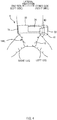
- FIG. 4 is a diagram illustrating a method of putting on the diaper 1.
- the laterally one-side end portion of the diaper 1 the front waist portion 30 and the back waist portion 20 are joined together by the first joining portion 1b, thus forming the leg opening 1HL.
- the laterally, other-side end portion is in an open state in which the front waist portion 30 and the back waist portion 20 are not joined together.
- the diaper 1 is in a state where its lateral one side is open.
- the leg opening 1HL on the one side is arranged at the joint of the right leg of the wearer, that is to say at the same position as the one leg in the worn state.
- the operator putting on the diaper on pulls the other-side end portion of the front waist portion 30 toward laterally the other side by his/her hand, and then holds it in that state.
- the operator then pulls the fastening member 40 (the other-side end portion of the back waist portion 20) toward laterally the other side by his/her other hand, and wraps it around to the front side of the front waist portion 30.
- the operator fastens the fastening portion 41 to the target region 34 of the front waist portion 30.
- the leg opening on the other side is formed, putting the diaper 1 on the wearer.
- the fastening portion 41 is fastened to the target region 34 while the one of the wearer's legs has been inserted through the leg opening 1HL on the one side, thus making it possible to form the leg opening 1HL on the other side and the waist opening 1HB at the same time.
- This makes it possible to put on the diaper 1 easily even if the wearer (a newborn infant or an infant) is wriggling their legs.
- the absorbent main body 10 joined to the front waist portion 30 shifts in the lateral direction according to laterally stretching of the front waist portion 30 when the front waist portion 30 (the back waist portion 20) is being pulled toward the lateral other side. For this reason, in the diaper 1, in the state where one of wearer's legs has been inserted into the leg opening 1HL on the lateral one side, the lateral center line RC of the back waist portion 20 is located on the other side relative to the lateral center line AC of the absorbent main body 10.
- the center line AC of the absorbent main body 10 is located on the one side (the right leg side) of the center line BC that indicates the center of the body of the wearer.
- the fastening member 40 is pulled to the other side, and the fastening portion 41 is fastened to the front waist portion 30, forming the diaper 1 into a shape when it is worn.
- the back waist portion 20 stretches in the lateral direction, and the absorbent main body 10 moves to the other side (the left leg side). Accordingly, the center line AC and the center line BC approach each other, and the absorbent main body 10 can be brought near the center of the body of the wearer.
- FIG. 5 is a diagram illustrating a force exerted on the waist portion 30 when the diaper 1 is put on.
- FIG. 5 shows a state where the front waist portion 30 is pulled toward the lateral other side when the diaper 1 is put on.
- a region of the front waist portion 30 on the one side relative to the lateral center of the absorbent main body 10 (the center line AC) is defined as a first region.
- a region of the front waist portion 30 on the other side relative to the lateral center of the absorbent main body 10 (the center line AC) is defined as a second region.
- the elastic region Y is formed of a plurality of the elastic strings 33 being capable of stretching/contracting in the lateral direction. As described in FIG. 3 , in the present embodiment, the elastic region Y is provided in a region from the lateral other-side end (inward end) of the joining region 30j and to the left end 10el of the absorbent main body 10. In the second region of the front waist portion 30, no elastic region is formed. That is, the entirety of the second region is a non-elastic (not stretching/contracting) region.
- the elastic region Y of the first region is stretched in the lateral direction, producing a force F1' for contracting the first region in the lateral direction.
- the one-side end 10el of the absorbent main body 10 is pulled to the other side in the lateral direction. That is, when the diaper 1 is put on, a force for pulling to both lateral sides is exerted on the absorbent main body 10.
- the absorbent main body 10 enlarges in the lateral direction, making it difficult to produce creases or the like on the absorbent body 11. This makes it easier to fit the absorbent body 11 to the wearer's body, making it easier to suppress troubles such as leakage of excrement. Even with a diaper 1 which is asymmetric on the left and right, the diaper 1 is easily balanced on the left and right sides when being put on, giving the good fit to the wearer.
- pulling the end 30er of the front waist portion 30 alone sufficiently makes it possible to easily align the absorbent main body 10 with the center of the wearer's body.
- adjusting the force F1 for pulling the end 30er can make slight change in the amount of movement of the absorbent main body 10. This makes it easier to improve the fit of the absorbent main body 10 when the diaper 1 is put on.
- the lateral other-side end portion of the front waist portion 30 including the end 30er is a non-elastic region. This makes it easier to hold and pull the non-elastic region, improving ease of putting on. Consequently, the operation for putting on the diaper 1 becomes comfortable.
- the entirety of the second region is not necessary to be non-elastic. It is sufficient that no elastic region is provided in at least a region located on the other side relative to the other-side end 10er of the absorbent main body 10. This is because a region that does not stretch/contract can transmit the force F1 for pulling the front waist portion 30 directly to the absorbent main body 10, moving the absorbent main body 10.
- the second region may have no elastic region on the other side relative to the other-side end 11er of the absorbent body 11.
- the elastic region Y may be provided in a region on the one side relative to the one-side end 11el of the absorbent body 11. Even with such a configuration, it is possible to enlarge the absorbent body 11 and to precisely adjust the position of the absorbent body 11.
- the target region 34 is provided in the second region of the front waist portion 30, and the entirety of the second region is non-elastic region and is difficult to stretch/contract. Accordingly, the target region 34 is likely to maintain its plain shape, and is less likely to crease. Further, the fastening projections of the fastening portion 41 are easy to be fastened to the surface of the target region 34, and after fastening, these components are difficult to be pulled apart. This makes it difficult for the diaper 1 to shift even when the wearer (e.g., an infant) moves his/her body, making it easier to maintain the good fit.
- FIG. 6 is a diagram illustrating a force exerted on the waist portion 30 when the diaper according to the modified example is put on.
- the upper part of the front waist portion 30 has an elastic region throughout a region from laterally one-side end 30el to the other-side end 30er, and does not have a non-elastic region.
- the front waist portion 30 is pulled to the lateral direction one side, and thereby a region of the second region between the other-side end 10er of the absorbent main body 10 and the other-side end 30er of the front waist portion 30 stretches/contracts.
- the force F1 for pulling the front waist portion 30 in the lateral direction is used for stretching the front waist portion 30, and the force F1" for pulling the other-side end 10er of the absorbent main body 10 is weaker than the force F1 (F1 > F1"). That is, the force F1 for pulling the front waist portion 30 in the lateral direction is not transmitted sufficiently to the absorbent main body 10, and the center line AC of the absorbent main body 10 becomes less likely to move to the center line BC of the wearer's body, making it difficult to realize the good fit. Accordingly, as in the present embodiment, it is preferable that the first region includes an elastic region in its predetermined region, and the second region does not include an elastic region in its predetermined region.
- FIG. 7 is a diagram illustrating a force exerted on the back waist portion 20 when the diaper 1 is put on.
- FIG. 6 shows a state where the back waist portion 20 is pulled toward the lateral other side when the diaper 1 is put on.
- a region of the back waist portion 20 on the one side relative to the lateral center of the absorbent main body 10 (the center line AC) is defined as a third region.
- a region of the back waist portion 20 on the other side relative to the lateral center of the absorbent main body 10 (the center line AC) is defined as a fourth region.
- the elastic region X3 is formed of a plurality of the elastic strings 23 being capable of stretching/contracting in the lateral direction.
- the elastic region X3 extends from the lateral other-side end (inward end) of the joining region 20j to the center line AC.
- the elastic region X4 is formed of a plurality of elastic strings 23 being capable of stretching/contracting in the lateral direction.
- the elastic region X4 extends from the center line AC to the lateral one-side end (inward end) of the fixing region 40j.
- the elastic region X is formed throughout the entire lateral region of the back waist portion 20 (see FIG. 3 ).
- the fastening member 40 located on the lateral other side of the back waist portion 20 is pulled to the other side.
- force F2 for pulling the fastening member 40 the elastic regions X3 and X4 are stretched in the lateral direction, producing stretching force on the third region and the fourth region. Consequently, laterally outward force F2' is exerted on the lateral ends of the absorbent main body 10.
- the absorbent body 11 enlarges in the lateral direction, and stretchability is given to the waist opening 1HB, making it easier for the absorbent body 11 to fit to the wearer's body.
- the elastic region X3 is provided in at least the third region of the back waist portion 20 from the center line AC to the lateral one side.
- the back waist portion 20 is a portion wrapping an wide area of the wearer's waist on the side of the wearer's buttocks when the diaper 1 is put on. Accordingly, in order to make it difficult for positional shift of the diaper 1 to occur, it is necessary that the waist opening 1HB has sufficient stretchability.
- the elastic region X4 is provided in the fourth region from the center line AC to the lateral other side so that stretchability is exerted on a wide range of the back waist portion 20.
- pulling the second region (non-elastic region) of the front waist portion 30 can adjust the lateral position of the absorbent main body 10. Accordingly, even though the fourth region (the elastic region X4) of the back waist portion 40 has stretchability, it is possible to align the position of the absorbent main body 10 with the center of the wearer's body.
- the elastic region X3 and the elastic region X4 are continuous to each other. That is, the lateral stretching force of the elastic region X3 and the lateral stretching force of the elastic region X4 work together, ensuring stretchability throughout the entirety of the back waist portion 20. This makes it easier for the stretching forces to be exerted evenly. This makes it difficult to cause local variation of the stretching proportion and distortion which will cause when the elastic regions X3 and X4 stretch. And, this suppresses local tightness around the wearer's back waist when the diaper 1 is put on. Also, the back waist portion 20 becomes likely to fit on wearer's back, improving the fit of the diaper 1 when it is put on.
- the elastic region X3 and the elastic region Y are substantially continuous to each other. That is, the stretching force of the elastic region X3 of the back waist portion 20 and the stretching force of the elastic region Y of the front waist portion 20 work together, ensuring stretchability throughout the entire circumference of the waist opening 1HB of the diaper 1. This makes it easier for the stretching forces to be exerted evenly. This makes it difficult to cause local variation of the stretching proportion and distortion which will cause the elastic regions X3 and X4 and the elastic region Y stretch. And, this suppresses local tightness around the wearer's waist when the diaper 1 is put on, further improving the fit.
- FIG. 8 is a schematic sectional view illustrating continuity between the elastic region X3 and the elastic region Y.
- FIG. 8 shows the vicinity of the joining regions 30j and 40j viewed from above.
- the front waist portion 30 and the back waist portion 20 are joined in the first joining portion 1b (30j, 40j).
- the elastic strings 33 provided in the elastic region Y is not necessarily configured to be as a single unit with the elastic strings 23 provided in the elastic region X3. But, since the elastic strings 33 and 22 are pressed together by the first joining portion 1b, stretching force of the elastic region X3 and stretching force of the elastic region Y work together. This makes it possible to exert stretching force on the entirety of the wearer's waist.
- No elastic region is provided in the fastening member 40 (the fastening portion 41) joined to the other-side end portion of the back waist portion 20. That is, a lateral region on the other side relative to the elastic region X4 of the fourth region is a non-elastic region.
- the fastening member 40 is a part to be held for pulling the back waist portion 20 to the lateral other side when the diaper 1 is put on. Accordingly, if the part does not stretch/contract, it is easy to handle it.
- the fastening member 40 does not stretch/contract, a force for pulling the fastening member 40 in the lateral direction is easy to be directly transmitted to the elastic region X4, making it possible to facilitate an operation of putting on the diaper.
- the fastening member 40 does not stretch/contract, this makes it easier for the fastening portion 41 provided in the fastening member 40 to maintain its planer shape. Accordingly, it is possible to securely fasten the fastening portion 41 to the target region 34.
- the leg-gather elastic member 16 overlaps the fourth region of the back waist portion 20 (see FIG. 2 ). That is, the range on which the stretchability of the leg-gather elastic member 16 works overlaps in the longitudinal direction at least a part of the fourth region.
- the leg gather LG is more likely to crease due to being pressed by the absorbent main body 10. But, by stretching the leg gather LG due to the foregoing pulling up, creases produced on the leg gather LG are stretched, making it possible to improve the fit to the wearer's buttocks.
- the elastic strings 23b provided in the lower part of the fourth region are arranged so as to intersect the leg-gather elastic member 16, and therefore the lateral stretching force of the elastic string 23b is also exerted on the leg-gather elastic member 16. This further increases pulling up of the leg gather LG.
- the longitudinal length H20 of the back waist portion 20 is larger than the longitudinal length H30 of the front waist portion 30. Accordingly, when the diaper 1 is put on, the area of a part of the wearer's body covered with the back waist portion 20 is larger than the area of a part of the wearer's body covered with the front waist portion 30. That is, it is possible to cover reliably a region of the wearer's buttocks having a large area. Due to elastic force of the elastic region X through the lateral entirety of the back waist portion 20, the back waist portion 20 having a large area is stretched as a whole. This makes it difficult for the back waist portion 20 to crease even though the back waist portion 20 has a large area, making it possible to give the good fit to the wearer.
- This "stretching" state is a state where the absorbent main body 10 is stretched in the longitudinal direction without creases, and where the back waist portion 20 and the front waist portion 30 are stretched in the lateral direction without creases.
- the absorbent main body 10 is stretched in the longitudinal direction such that the longitudinal dimension thereof reaches a length equal or close to the longitudinal dimension of the top face sheet 12;
- the back waist portion 20 is stretched in the lateral direction such that the lateral dimension thereof is a length equal or close to the lateral dimension of the skin-side member 21 and the lateral dimension of the non-skin-side member 22;
- the front waist portion 30 is stretched in the lateral direction such that the lateral dimension thereof is a length equal or close to the lateral dimension of the skin-side member 31 and the lateral dimension of the non-skin-side member 32.
- the absorbent article may be a two piece type of disposable diaper including: a first component is an exterior sheet including a back waist portion and a front waist portion that are connected via a crotch portion as a single unit; and a second component is an absorbent main body that is fixed to the skin-side surface of the exterior sheet.
- the target region 34 has loops
- the fastening portion 41 has hooks
- the fastening portion 41 is fastened to the target region 34 by the loops becoming caught on the hooks.
- the configurations of the target region 34 and the fastening portion 41 are not limited to the above example.
- at least one of the target region 34 and the fastening portion 41 may be provided with adhesiveness on its surface, and they may be fastened by adhering this adhesive member to the surface of the other member.
- the above embodiment describes the state where the fastening member 40 projects in a lateral direction from the back waist portion 20 when the diaper is put on.
- the fastening member 40 may be folded when the disposable diaper 1 is manufactured, or the fastening member 40 may be provisionally connected to the front waist portion 30 by perforations.
- the elastic strings 23 and 33 are used as the elastic members, there is no limitation to this. It is possible to use a nonwoven fabric that has stretchability, for example.
- the elastic strings 23 and 33 are not provided in the overlapping regions of the back waist portion 20 and the front waist portion 30 in which they overlap with the absorbent body 11, there is no limitation to this.
- the elastic strings 23 and 33 may be provided in the regions overlapping with the absorbent body 11. By not providing the elastic strings 23 and 33 in the regions overlapping with the absorbent body 11, it is possible to reduce the risk of the absorbent body 11 deformed due to stretching and contracting of the elastic strings 23 and 33. However, by providing the elastic strings 23 and 33 in the regions overlapping with the absorbent body 11, it is possible to improve the fit of the absorbent main body 10 through stretching force.
Landscapes
- Health & Medical Sciences (AREA)
- Epidemiology (AREA)
- Engineering & Computer Science (AREA)
- Biomedical Technology (AREA)
- Heart & Thoracic Surgery (AREA)
- Vascular Medicine (AREA)
- Life Sciences & Earth Sciences (AREA)
- Animal Behavior & Ethology (AREA)
- General Health & Medical Sciences (AREA)
- Public Health (AREA)
- Veterinary Medicine (AREA)
- Absorbent Articles And Supports Therefor (AREA)
Abstract
Description
- The present invention relates to an absorbent article.
- A disposable diaper such as a so-called tape-type diaper or an underpants-shaped disposable diaper is conventionally known as an absorbent article for absorbing excrement. These tape-type diapers and underpants-shaped disposable diapers have a problem of difficulty in being put on a wriggling infant and a problem that the diapers force a wearer to take an unnatural posture when being put on. In order to solve these problems,
PTL 1 discloses a half-open underpants-shaped diaper in which portions on either one side of the left or right sides of the waist part are joined together, and portions on the other side are not joined together. - [PTL 1] Japanese Unexamined Utility Model Application Publication No.
H 4-5826 - When the half-open underpants-shaped diaper is to be put on, one leg of the wearer is first inserted into the leg hole of either one side of the left or right sides of the waist part. Thereafter, the front and back waist parts on the other side are pulled to the other side together so as to overlap, and a fastening portion (tape fastener; provided on the back waist part side) is joined to a target region (adhesion region; provided on the front waist part side).
- In such an operation for putting on a diaper, when pulling the front and back waist parts to the other side, the position of a diaper is adjusted relative to the wearer's body. But, in case of pulling the waist part to only a one side (the other side), it is difficult to adjust the position of the absorbent body to be aligned with the center of the wearer's body. In a half-open, underpants-shaped diaper of
PTL 1, though the shapes of components such as the waist portion is asymmetric on the left and right sides, the diaper is designed based on a symmetric configuration similar to a conventional diaper. Consequently, when a diaper is put on, the position of its absorbent body is not aligned with the center, causing a problem of leakage of excrement or a problem that the fit of the diaper deteriorates due to the diaper being unbalanced on the left and right. This makes it easier to adjust the position of the absorbent body to be aligned with the center of the wearer's body and makes it easier to balance the diaper on the left and right. Accordingly, it is possible to give the good fit to the wearer. - The present invention was achieved in light of the problems described above, and an aspect of the present invention is to provide a half-open diaper which is easily balanced on the left and right sides and has a good fit when being put on.
- An aspect of the invention to achieve the above advantage is an absorbent article having a longitudinal direction, a lateral direction intersecting the longitudinal direction, and a front-back direction intersecting the longitudinal direction and the lateral direction, the absorbent article including: a front waist portion extending along the lateral direction; a back waist portion extending along the lateral direction; and an absorbent main body including an absorbent body that absorbs liquid, and being provided between the front waist portion and the back waist portion, a one-side end portion of the back waist portion on a one side in the lateral direction being joined by a first joining portion to a one-side end portion of the front waist portion on the one side in the lateral direction, the back waist portion including a fastening portion on another side in the lateral direction, the fastening portion being fastened to the front waist portion when putting on the absorbent article, the front waist portion having a first region located on the one side relative to a lateral center of the absorbent main body, the front waist portion having a second region located on the other side relative to the lateral center of the absorbent main body, an elastic region stretching/contracting in the lateral direction, the elastic region being provided in at least a part of the first region, the elastic region being not provided in a region of the second region on the other side relative to another-side end of the absorbent main body on the other side.
- Other features of the present invention will become apparent from the description of the present specification and the accompanying drawings.
- According to the invention, it is possible to provide a half-open diaper which is easily balanced on the left and right sides and has a good fit when being put on.
-
- [
FIG. 1] FIG. 1 is a schematic perspective view of adiaper 1 according to an embodiment. - [
FIG. 2] FIG. 2 is a plan view of thediaper 1 in an unfolded state. - [
FIG. 3] FIG. 3 is a diagram illustrating elastic regions X and Y. - [
FIG. 4] FIG. 4 is a diagram illustrating a method of putting on thediaper 1. - [
FIG. 5] FIG. 5 is a diagram illustrating a force exerted on thewaist portion 30 when thediaper 1 is put on. - [
FIG. 6] FIG. 6 is a diagram illustrating a force exerted on thewaist portion 30 when the diaper according to a modified example is put on. - [
FIG. 7] FIG. 7 is a diagram illustrating a force exerted on theback waist portion 20 when thediaper 1 is put on. - [
FIG. 8] FIG. 8 is a schematic sectional view illustrating continuity between an elastic region X3 and an elastic region Y. - At least the following matters will be made clear by the description in the present specification and the accompanying drawings.
- An absorbent article having a longitudinal direction, a lateral direction intersecting the longitudinal direction, and a front-back direction intersecting the longitudinal direction and the lateral direction, the absorbent article including: a front waist portion extending along the lateral direction; a back waist portion extending along the lateral direction; and an absorbent main body including an absorbent body that absorbs liquid, and being provided between the front waist portion and the back waist portion, a one-side end portion of the back waist portion on a one side in the lateral direction being joined by a first joining portion to a one-side end portion of the front waist portion on the one side in the lateral direction, the back waist portion including a fastening portion on another side in the lateral direction, the fastening portion being fastened to the front waist portion when putting on the absorbent article, the front waist portion having a first region located on the one side relative to a lateral center of the absorbent main body, the front waist portion having a second region located on the other side relative to the lateral center of the absorbent main body, an elastic region stretching/contracting in the lateral direction, the elastic region being provided in at least a part of the first region, the elastic region being not provided in a region of the second region on the other side relative to another-side end of the absorbent main body on the other side.
- With such an absorbent article, in the operation for putting on the absorbent article, when the front waist portion is pulled in the lateral direction, a region of the second region located laterally on the other side relative to the absorbent main body does not stretch/contract. This makes it easier to move the absorbent main body in the lateral direction with a force for pulling the front waist portion. Since the first region do stretch/contract, a force for pulling the absorbent main body is exerted in a direction opposite thereto, the absorbent main body enlarges in the lateral direction.
- In such an absorbent article, it is desirable
that the back waist portion has a third region located on the one side relative to the lateral center of the absorbent main body, and
that the elastic region is provided in at least a part of the third region. - With such an absorbent article, in the operation for putting on the absorbent article, when the back waist portion is pulled in the lateral direction, a lateral stretching force is produced by the elastic region of the third region, pulling the absorbent main body in a direction opposite thereto. Accordingly, the absorbent main body enlarges in the lateral direction, making it difficult to produce creases or the like on the absorbent body. This makes it possible to improve the fit of the absorbent article when being put on.
- In such an absorbent article, it is desirable
that the back waist portion has a fourth region located on the other side relative to the lateral center of the absorbent main body, and
that the elastic region is provided in at least a part of the fourth region. - With such an absorbent article, a lateral stretching force is exerted on a wide range of the
back waist portion 20. This makes it easier to fit the entirety of theback waist portion 20 to the wearer's body with the absorbent main body enlarging in the lateral direction. In particular, even in the wearer's buttocks having a large area, it is difficult for the absorbent article to shift. - In such an absorbent article, it is desirable
that the elastic region is not provided in a region located on the other side relative to the elastic region that is provided in the fourth region. - With such an absorbent article, a part to be held for pulling the back waist portion in the lateral direction when putting on the absorbent article (the fastening member) does not stretch/contract, making it easy to handle the part. In addition, since the fastening portion is provided in such a non-stretching/contracting region, this suppress the fastening portion from creasing, making it easier to maintain its planer shape. Accordingly, it is possible to securely fasten the fastening portion to the front waist portion (the target region).
- In such an absorbent article, it is desirable
that the elastic region provided in the third region and the elastic region provided in the fourth region are continuous in the lateral direction to each other. - With such an absorbent article, the stretching force of the elastic region provided in the third region and the stretching force of the elastic region provided in the fourth region work together, ensuring stretchability throughout the entirety of the back waist portion. This makes it easier for the stretching forces to be exerted evenly. This makes it difficult for the back waist portion to cause local variation of the stretching proportion and distortion, improving the fit of the absorbent article when it is put on. Also, the back waist portion becomes likely to fit on wearer's back.
- In such an absorbent article, it is desirable
that the elastic region provided in the first region and the elastic region provided in the third region are substantially continuous in the lateral direction to each other. - With such an absorbent article, the stretching force of the elastic region provided in the third region and the stretching force of the elastic region provided in the first region work together, ensuring stretchability throughout the entire circumference of the waist opening. This makes it easier for the stretching forces to be exerted evenly. This makes it difficult for the waist opening to cause local variation of the stretching proportion and distortion, improving the fit of the absorbent article when it is put on. Also, this improves the fit of the absorbent article when it is put on.
- In such an absorbent article, it is desirable
that the elastic region is not provided at all in any region of the second region. - With such an absorbent article, in the operation for putting on the absorbent article, when the front waist portion is pulled in the lateral direction, the second region does not stretch/contract as a whole. This makes it easier for a force for pulling the front waist portion to be exerted directly on the absorbent body, making it easier to shift the absorbent body in the lateral direction. This makes it easier for the position of the absorbent body to fit precisely to the center of the wearer's body.
- In such an absorbent article, it is desirable
that on a non-skin side of the front waist portion, a target region is provided in a predetermined region of the second region, and
that the target region is a region to which the fastening portion is fastened. - With such an absorbent article, the entirety of the second region is difficult to stretch/contract. Accordingly, the target region is likely to maintain its plain shape, and is less likely to crease. Further, the fastening portion is easy to be fastened to the surface of the target region, and after fastening, these components are difficult to be pulled apart. This makes it difficult for the absorbent article to shift even when the wearer moves his/her body, making it easier to maintain the good fit.
- In such an absorbent article, it is desirable
that a leg-gather elastic member is provided on each of lateral end portions of a crotch portion, the leg-gather elastic member being capable of stretching/contracting in the longitudinal direction, and
that a range on which an elastic force of the leg-gather elastic member is exerted overlaps in the longitudinal direction at least a partial region of the back waist portion on the other side relative to the lateral center of the absorbent main body. - With such an absorbent article, in the operation for putting on the absorbent article, when the back waist portion is pulled in the lateral direction, the leg-gather elastic member is pulled together with the back waist portion, pulling obliquely upward the leg gather. Also, stretching the leg gather makes it difficult to crease, making it possible to improve the fit around legs on the wearer's back (buttocks) side.
- In such an absorbent article, it is desirable that a longitudinal length of the back waist portion is larger than a longitudinal length of the front waist portion.
- With such an absorbent article, it is possible for the back waist portion to reliably cover the wearer's buttocks having a large area when putting on the absorbent article.
- The following describes the configuration of a half-open disposable diaper 1 (hereinafter, also simply called the diaper 1) as an example of an absorbent article according to the present embodiment.
FIG. 1 is a schematic perspective view of thediaper 1 according to the present embodiment.FIG. 2 is a plan view of thediaper 1 in an unfolded state. The unfolded state is a state where afastening portion 41 of thediaper 1 inFIG. 1 is detached from atarget region 34, a first joiningportion 1b is uncoupled and opened, and the entirety of thediaper 1 is laid flat.FIG. 3 is a diagram illustrating elastic regions X and Y. - The
diaper 1 according to the present embodiment is a disposable diaper mainly for use of newborn infants, infants, or the like. As shown inFIG. 1 , thediaper 1 has a "longitudinal direction", a "lateral direction" that intersects the longitudinal direction, and a "front-back direction" that intersects the longitudinal direction and the lateral direction. Also, in the following description, the left side in the lateral direction is the "one side", and the right side is the "other side" (seeFIGS. 1 and2 ). - The
diaper 1 includes: an absorbent main body 10 (also called a "crotch portion") that is arranged at the crotch of the wearer and absorbs excrement; aback waist portion 20 that covers the back side of the wearer; and afront waist portion 30 and afastening member 40 that cover the stomach side of the wearer. Thediaper 1 in the unfolded state shown inFIG. 2 is folded in half with an approximately central position in the longitudinal direction serving as the folding position, and end portion s of theback waist portion 20 and thefront waist portion 30 on one side in the lateral direction are joined together in the first joiningportion 1b, thus forming a leg opening 1HL on one side. The end portion s of theback waist portion 20 and thefront waist portion 30 on the other side in the lateral direction are not joined together, and a leg opening 1HL on the other side and a waist opening 1HB are formed by fastening thefastening member 40 to thefront waist portion 30. In other words, thediaper 1 of the present embodiment is a so-called "half-open diaper" in which theback waist portion 20 and thefront waist portion 30 are joined and closed on the one side in the lateral direction, and are unjoined and open on the other side. - The
back waist portion 20 and thefront waist portion 30 have an approximately rectangular planar shape, and in the unfolded state inFIG. 2 , theback waist portion 20 and thefront waist portion 30 are parallel with a space between each other in the longitudinal direction, and are bridged by the absorbentmain body 10. Also, theback waist portion 20 is fixed to oneend portion 10a of the absorbentmain body 10, and thefront waist portion 30 is fixed to another end portion 10b. - The absorbent main body 10 (crotch portion) is approximately shaped as an elongated rectangle in a plan view, and is arranged at a central position in the lateral direction, with its lengthwise direction extending along the longitudinal direction of the
diaper 1. InFIG. 2 , a center line AC is the center of the absorbentmain body 10 in the lateral direction. The absorbentmain body 10 includes: anabsorbent body 11 that absorbs and holds a liquid; a liquid-permeabletop face sheet 12 that covers theabsorbent body 11 on the wearer's skin side and allows the passage of excrement such as urine; and a liquid-impermeable back-face sheet 13 that covers theabsorbent body 11 on the non-skin side and prevents the leakage of a liquid from the non-skin side. Theabsorbent body 11 is constituted by liquid-absorbent fibers such as pulp fibers and is formed with a predetermined shape such as approximately an hourglass shape in a plan view as shown inFIG. 2 , and has a superabsorbent polymer incorporated therein. - Also, leg gathers LG (leg elastic portions) that stretch and contract along the longitudinal direction are provided at locations on respective side portions in the lateral direction of the absorbent
main body 10. The leg gathers LG are formed by a nonwoven fabric or the like, and each include a leg-gatherelastic member 16 that stretches and contracts along the longitudinal direction. The leg-gatherelastic members 16 are formed by an elastic string or the like, and are joined to the leg gathers LG with being stretched in the longitudinal direction, giving the leg gathers LG stretchability in the longitudinal direction. Also, a pair of leg side gathers LSG (barrier cuffs) may be further provided inward of the leg gathers LG in the lateral direction of the absorbent main body 10 (not shown inFIG. 2 ). - The
back waist portion 20 includes: a skin-side member 21 that is located on the wearer's skin side; a non-skin-side member 22 that is located on the non-skin side; and a plurality ofelastic strings 23 that are located between the skin-side member 21 and the non-skin-side member 22. The skin-side member 21 and the non-skin-side member 22 are each a flexible sheet member that is constituted by a nonwoven fabric or the like. Theelastic strings 23 are elastic members that give theback waist portion 20 lateral stretchability. In the present embodiment, theelastic strings 23 are arranged side-by-side at a predetermined longitudinal interval. And theelastic strings 23 are joined with an adhesive between the skin-side member 21 and the non-skin-side member 22 with being stretched in the lateral direction. - In
FIG. 2 , a center line RC indicates the lateral center of theback waist portion 20. A joiningregion 20j is provided in an end portion on the one side of theback waist portion 20. The joiningregion 20j is joined to a joiningregion 30j (described later) of thefront waist portion 30 by certain joining means (e.g., heat welding), forming a first joiningportion 1b of thediaper 1. Also, a fixingregion 40j is provided in an end portion on the other side of theback waist portion 20. Thefastening member 40 is fixed to the fixingregion 40j. - The
elastic strings 23 form an elastic region X and improve the fit of thediaper 1. In the upper end portion of theback waist portion 20, theelastic strings 23 are continuous from the one end side to the other end side in the lateral direction, and are arranged side-by-side at a predetermined longitudinal interval. Here, in the longitudinal central portion and the lower longitudinal end portion of theback waist portion 20, theback waist portion 20 is overlapped with theabsorbent body 11. In that region, in the widthwise central portion of theback waist portion 20, in which theabsorbent body 11 is provided, theelastic strings 23 are not provided. On the other hand, in the respective regions to the left and right of theabsorbent body 11, theelastic strings 23 are provided substantially parallel with each other. - As shown in
FIG. 3 , the elastic region X is the region where theelastic strings 23 are provided, and extends from the laterally inward end (the end on the other side) of the joiningregion 20j to the laterally inward end (the end on the one side) of the fixingregion 40j; as mentioned above, in the lateral direction, the joiningregion 20j is provided on the one side of theback waist portion 20, and the fixingregion 40j is provided on the other side. InFIG. 3 , the elastic region X is indicated by the hatched portion. Note that for convenience inFIG. 3 , hatching has been omitted for the joiningregions region 40j. As shown inFIGS. 2 and3 , theelastic strings 23 extend to lateral ends 20er and 20el of theback waist portion 20. But, providing the joiningregion 20j and the fixingregion 40j respectively in these lateral end portion s of theback waist portion 20 makes it substantially impossible to exhibit stretching force of the following regions: the joiningregion 20j; the portion laterally outward of the joiningregion 20j; the fixingregion 40j; and the portion laterally outward of the fixingregion 40j. A one-side end Xe1 of the elastic region X is at the same position as the laterally inward end of the joiningregion 20j, and an other-side end Xe2 of the elastic region X is at the same position as the laterally inward end of the fixingregion 40j. Note that a configuration is possible in which theelastic strings 23 are also provided in a region other than elastic region X indicated by the hatched portion inFIG. 3 (a non-elastic region), and theelastic strings 23 are cut in this non-elastic region to prevent stretchability from being exhibited. - A center line BC indicates the approximate center of the body of a wearer when a wearer's leg has been inserted. In the present embodiment, the center line BC is at the same position as the center line RC that indicates the lateral center of the
back waist portion 20. The center line RC and the center line BC are located different from the center line AC that indicates the center of the absorbentmain body 10, and are to the right (on the other side) of the center line AC. The reason for this will be described later. - In the
back waist portion 20, on the one side of itslower end 20b, provided is an inclined portion 20bl that is inclined toward the one-side end portion. On the other side of thelower end 20b, a straight portion 20bs and an inclined portion 20br are provided; the straight portion 20bs is substantially parallel with the lower end of thefront waist portion 30, and the inclined portion 20br is on the laterally inward side of the straight portion 20bs and is symmetrical with the inclined portion 20bl about the center line AC. Thus, providing the right and left inclined portions in a symmetrical manner makes it easier for both right and left inclined portions to fit the roundness of a wearer's buttocks. Due to the straight portion 20bs being substantially parallel with the lower end of thefront waist portion 30, when thediaper 1 is put on by fastening thefastening portion 41 to thetarget region 34, the lower end of thefront waist portion 30 can be aligned with the straight portion 20bs of theback waist portion 20. This improves the appearance of thediaper 1 when it is worn. As shown inFIG. 2 , the distance in the longitudinal direction (longitudinal length) from theupper end 20a of theback waist portion 20 to thelower end 20b is defined as a length H20. - The
fastening member 40 is a tape substrate having a substantially trapezoidal shape, and is fixed to theback waist portion 20 in the fixingregion 40j using a predetermined fixing means such as heat welding. Thefastening member 40 has afastening portion 41, which is a hook-and-loop fastener having a plurality of fastening projections (hooks) on its skin-side surface. The fastening projections of thefastening portion 41 are hooked to thetarget region 34 provided in thefront waist portion 30, fastening thefastening member 40 to thefront waist portion 30. The leg opening 1HL on the other side, and the waist opening 1HB are thus formed (seeFIG. 1 ). When thediaper 1 is put on, if thefastening portion 41 is pulled in the lateral direction according to contraction of the elastic region X, the fastening projections (hooks) becomes more likely to be caught by thetarget region 34. This makes it possible for thefastening portion 41 to be fastened more securely. - Note that in the example shown in
FIG. 2 , theback waist portion 20 and thefastening member 40 are formed as separate members, and are joined to each other in the fixingregion 40j. But, theback waist portion 20 and thefastening member 40 may be formed together as a single unit. Specifically, thefront waist portion 30 and thefastening member 40 inFIG. 2 may be combined into the "backwaist portion 20". In this case, thefastening portion 41 is directly joined to the laterally, other-side end portion of theback waist portion 20. In this case, the elastic region X is provided such that the other-side end Xe2 of the elastic region X is located inside (laterally closer to the one side than) the laterally, one-side end portion of thefastening portion 41. - The
front waist portion 30 includes: a skin-side member 31 that is located on the wearer's skin side; a non-skin-side member 32 that is located on the non-skin side; a plurality of elastic strings 33 (elastic members) that are located between the skin-side member 31 and the non-skin-side member 32; and thetarget region 34 on the non-skin-side surface of thefront waist portion 30. The skin-side member 31 and the non-skin-side member 32 are each a flexible sheet member that is constituted by a nonwoven fabric or the like. Theelastic strings 33 are elastic members that give thefront waist portion 30 lateral stretchability. In the present embodiment, theelastic strings 33 are arranged side-by-side at a predetermined longitudinal interval. And, theelastic strings 33 are joined with an adhesive between the skin-side member 31 and the non-skin-side member 32 with being stretched in the lateral direction. Thetarget region 34 is a region capable of engaging with thefastening portion 41. For example, thetarget region 34 is made of a member whose fibers on the upper surface of a nonwoven fabric are formed into loop shapes so as to be readily engaged with the fastening projections (hooks) of thefastening portion 41. Note that the following configuration is also acceptable: instead of making thetarget region 34 and thefront waist portion 30 different, thetarget region 34 is formed by processing a partial region of the non-skin-side member 32 of thefront waist portion 30. - The
elastic strings 33 form an elastic region Y, improving the fit of thediaper 1. Theelastic strings 33 extend from a laterally, one-side (left) end 30el of thefront waist portion 30 to a predetermined lateral position that is located on the one side relative to the center line AC. In the present embodiment, the elastic strings 33 (the elastic region Y) are provided in a range extending from the lateral end 30el to a position laterally on the one side relative to the absorbentmain body 10. In contrast, theelastic strings 33 are not provided in the range from a laterally, other-side (right) end 30er to the center line AC. Also, as shown by a hatched portion inFIG. 3 , the elastic region Y is a region in which theelastic strings 33 are provided from the laterally inward end of the joiningregion 30j to the left end 10el of the absorbentmain body 10. Note that a configuration is possible in which theelastic strings 33 are also provided in a region other than elastic region Y indicated by the hatched portion inFIG. 3 (a non-elastic region), and theelastic strings 33 are cut in this non-elastic region to prevent stretchability from being exhibited. - As shown in
FIG. 2 , the joiningregion 30j is provided in the left end portion of thefront waist portion 30. The joiningregion 30j is joined with the joiningregion 20j of theback waist portion 20, forming the first joiningportion 1b. Also, the lateral length of thefront waist portion 30 is smaller than lateral length of theback waist portion 20. Specifically, in the lateral direction, the one-side (left) end 30el of thefront waist portion 30 is provided at substantially the same position as the one-side (left) end 20el of theback waist portion 20. In contrast, in the lateral direction, the other-side (right) end 30er of thefront waist portion 30 is provided inside the other-side (right) end 20er of theback waist portion 20. - As shown in
FIG. 2 , the distance in the longitudinal direction (longitudinal length) from theupper end 30a of thefront waist portion 30 to thelower end 30b is defined as a length H30. -
FIG. 4 is a diagram illustrating a method of putting on thediaper 1. As described above, in the laterally one-side end portion of thediaper 1, thefront waist portion 30 and theback waist portion 20 are joined together by the first joiningportion 1b, thus forming the leg opening 1HL. In contrast, the laterally, other-side end portion is in an open state in which thefront waist portion 30 and theback waist portion 20 are not joined together. In other words, thediaper 1 is in a state where its lateral one side is open. When thisdiaper 1 is to be put on the wearer (an infant or the like), first, one leg (the right leg) of the wearer is inserted into the leg opening 1HL formed on the one side in the lateral direction of thediaper 1. Then, the leg opening 1HL on the one side is arranged at the joint of the right leg of the wearer, that is to say at the same position as the one leg in the worn state. Thereafter, the operator putting on the diaper on pulls the other-side end portion of thefront waist portion 30 toward laterally the other side by his/her hand, and then holds it in that state. The operator then pulls the fastening member 40 (the other-side end portion of the back waist portion 20) toward laterally the other side by his/her other hand, and wraps it around to the front side of thefront waist portion 30. Then, the operator fastens thefastening portion 41 to thetarget region 34 of thefront waist portion 30. Thus, the leg opening on the other side is formed, putting thediaper 1 on the wearer. - With this putting-on method, the
fastening portion 41 is fastened to thetarget region 34 while the one of the wearer's legs has been inserted through the leg opening 1HL on the one side, thus making it possible to form the leg opening 1HL on the other side and the waist opening 1HB at the same time. This makes it possible to put on thediaper 1 easily even if the wearer (a newborn infant or an infant) is wriggling their legs. - In such an operation for putting on the
diaper 1, the absorbentmain body 10 joined to thefront waist portion 30 shifts in the lateral direction according to laterally stretching of thefront waist portion 30 when the front waist portion 30 (the back waist portion 20) is being pulled toward the lateral other side. For this reason, in thediaper 1, in the state where one of wearer's legs has been inserted into the leg opening 1HL on the lateral one side, the lateral center line RC of theback waist portion 20 is located on the other side relative to the lateral center line AC of the absorbentmain body 10. - When one of wearer's legs has been inserted into the leg opening 1HL, the center line AC of the absorbent
main body 10 is located on the one side (the right leg side) of the center line BC that indicates the center of the body of the wearer. In this state, thefastening member 40 is pulled to the other side, and thefastening portion 41 is fastened to thefront waist portion 30, forming thediaper 1 into a shape when it is worn. Then, theback waist portion 20 stretches in the lateral direction, and the absorbentmain body 10 moves to the other side (the left leg side). Accordingly, the center line AC and the center line BC approach each other, and the absorbentmain body 10 can be brought near the center of the body of the wearer. - In the foregoing operation for putting on the
diaper 1, if the position of the absorbentmain body 10 is not able to be precisely adjusted to the center of the wearer's body, there is a possibility that theabsorbent body 11 does not fit the wearer's body, causing leakage of excrement and/or giving discomfort to the wearer. In the present embodiment, adjusting the arrangement of the elastic regions X and Y of thediaper 1 makes it possible to move precisely the absorbentmain body 10 to the center of the wearer's body when putting on thediaper 1. The arrangement of the elastic regions X and Y of thediaper 1 will be described below in detail. - First, the side of the
front waist portion 30 will be described below.FIG. 5 is a diagram illustrating a force exerted on thewaist portion 30 when thediaper 1 is put on.FIG. 5 shows a state where thefront waist portion 30 is pulled toward the lateral other side when thediaper 1 is put on. A region of thefront waist portion 30 on the one side relative to the lateral center of the absorbent main body 10 (the center line AC) is defined as a first region. Similarly, a region of thefront waist portion 30 on the other side relative to the lateral center of the absorbent main body 10 (the center line AC) is defined as a second region. - In the first region of the
front waist portion 30, the elastic region Y is formed of a plurality of theelastic strings 33 being capable of stretching/contracting in the lateral direction. As described inFIG. 3 , in the present embodiment, the elastic region Y is provided in a region from the lateral other-side end (inward end) of the joiningregion 30j and to the left end 10el of the absorbentmain body 10. In the second region of thefront waist portion 30, no elastic region is formed. That is, the entirety of the second region is a non-elastic (not stretching/contracting) region. - When putting on the
diaper 1, while the laterally one-side end 30el of thefront waist portion 30 being fixed to the wearer's body, the laterally other-side end 30er of thefront waist portion 30 is pulled to the other side. Since the second region does not stretch/contract, force F1 for pulling the end 30er to the other side is transmitted, almost without changing, to the absorbentmain body 10 through the second region (non-elastic region) of thefront waist portion 30. Consequently, the other-side end 10er of the absorbentmain body 10 is pulled at the force F1 to the other side in the lateral direction. This moves the absorbentmain body 10 toward the lateral other side, and the center line AC of the absorbentmain body 10 moves closer to the center line BC of the wearer's body. - According to pulling the end 30el to the other side, the elastic region Y of the first region is stretched in the lateral direction, producing a force F1' for contracting the first region in the lateral direction. With the contraction force, the one-side end 10el of the absorbent
main body 10 is pulled to the other side in the lateral direction. That is, when thediaper 1 is put on, a force for pulling to both lateral sides is exerted on the absorbentmain body 10. Accordingly, the absorbentmain body 10 enlarges in the lateral direction, making it difficult to produce creases or the like on theabsorbent body 11. This makes it easier to fit theabsorbent body 11 to the wearer's body, making it easier to suppress troubles such as leakage of excrement. Even with adiaper 1 which is asymmetric on the left and right, thediaper 1 is easily balanced on the left and right sides when being put on, giving the good fit to the wearer. - As mentioned above, pulling the end 30er of the
front waist portion 30 alone sufficiently makes it possible to easily align the absorbentmain body 10 with the center of the wearer's body. In the pulling, adjusting the force F1 for pulling the end 30er can make slight change in the amount of movement of the absorbentmain body 10. This makes it easier to improve the fit of the absorbentmain body 10 when thediaper 1 is put on. And, the lateral other-side end portion of thefront waist portion 30 including the end 30er is a non-elastic region. This makes it easier to hold and pull the non-elastic region, improving ease of putting on. Consequently, the operation for putting on thediaper 1 becomes comfortable. - As mentioned above, in the present embodiment, since no elastic region is provided in the second region between the other-side end 10er of the absorbent
main body 10 and the other-side end 30er of thefront waist portion 30, this makes it possible to move precisely the absorbentmain body 10 in the lateral direction. However, the entirety of the second region is not necessary to be non-elastic. It is sufficient that no elastic region is provided in at least a region located on the other side relative to the other-side end 10er of the absorbentmain body 10. This is because a region that does not stretch/contract can transmit the force F1 for pulling thefront waist portion 30 directly to the absorbentmain body 10, moving the absorbentmain body 10. - Note that, for adjusting the position of the
absorbent body 11 relative to the wearer's body, the second region may have no elastic region on the other side relative to the other-side end 11er of theabsorbent body 11. Similarly, in the first region, the elastic region Y may be provided in a region on the one side relative to the one-side end 11el of theabsorbent body 11. Even with such a configuration, it is possible to enlarge theabsorbent body 11 and to precisely adjust the position of theabsorbent body 11. - In the present embodiment, the
target region 34 is provided in the second region of thefront waist portion 30, and the entirety of the second region is non-elastic region and is difficult to stretch/contract. Accordingly, thetarget region 34 is likely to maintain its plain shape, and is less likely to crease. Further, the fastening projections of thefastening portion 41 are easy to be fastened to the surface of thetarget region 34, and after fastening, these components are difficult to be pulled apart. This makes it difficult for thediaper 1 to shift even when the wearer (e.g., an infant) moves his/her body, making it easier to maintain the good fit. - As a modified example, a case where non-elastic region is not provided in an appropriate part of the
front waist portion 30 will be described below.FIG. 6 is a diagram illustrating a force exerted on thewaist portion 30 when the diaper according to the modified example is put on. In the modified example, the upper part of thefront waist portion 30 has an elastic region throughout a region from laterally one-side end 30el to the other-side end 30er, and does not have a non-elastic region. When putting on such a diaper, thefront waist portion 30 is pulled to the lateral direction one side, and thereby a region of the second region between the other-side end 10er of the absorbentmain body 10 and the other-side end 30er of thefront waist portion 30 stretches/contracts. Accordingly, the force F1 for pulling thefront waist portion 30 in the lateral direction is used for stretching thefront waist portion 30, and the force F1" for pulling the other-side end 10er of the absorbentmain body 10 is weaker than the force F1 (F1 > F1"). That is, the force F1 for pulling thefront waist portion 30 in the lateral direction is not transmitted sufficiently to the absorbentmain body 10, and the center line AC of the absorbentmain body 10 becomes less likely to move to the center line BC of the wearer's body, making it difficult to realize the good fit. Accordingly, as in the present embodiment, it is preferable that the first region includes an elastic region in its predetermined region, and the second region does not include an elastic region in its predetermined region. - Next, the side of the
back waist portion 20 will be described below.FIG. 7 is a diagram illustrating a force exerted on theback waist portion 20 when thediaper 1 is put on.FIG. 6 shows a state where theback waist portion 20 is pulled toward the lateral other side when thediaper 1 is put on. A region of theback waist portion 20 on the one side relative to the lateral center of the absorbent main body 10 (the center line AC) is defined as a third region. Similarly, a region of theback waist portion 20 on the other side relative to the lateral center of the absorbent main body 10 (the center line AC) is defined as a fourth region. - In the third region of the
back waist portion 20, the elastic region X3 is formed of a plurality of theelastic strings 23 being capable of stretching/contracting in the lateral direction. InFIG. 7 , the elastic region X3 extends from the lateral other-side end (inward end) of the joiningregion 20j to the center line AC. Similarly, in the fourth region, the elastic region X4 is formed of a plurality ofelastic strings 23 being capable of stretching/contracting in the lateral direction. InFIG. 7 , the elastic region X4 extends from the center line AC to the lateral one-side end (inward end) of the fixingregion 40j. In the elastic region X3 and the elastic region X4, the elastic region X is formed throughout the entire lateral region of the back waist portion 20 (seeFIG. 3 ). - When the
diaper 1 is put on, while the laterally one-side end 20el of theback waist portion 20 being fixed to the wearer's body, thefastening member 40 located on the lateral other side of theback waist portion 20 is pulled to the other side. By force F2 for pulling thefastening member 40, the elastic regions X3 and X4 are stretched in the lateral direction, producing stretching force on the third region and the fourth region. Consequently, laterally outward force F2' is exerted on the lateral ends of the absorbentmain body 10. Theabsorbent body 11 enlarges in the lateral direction, and stretchability is given to the waist opening 1HB, making it easier for theabsorbent body 11 to fit to the wearer's body. - For enlarging the absorbent
main body 10, it is sufficient that, in similar to the description of thefront waist portion 30, the elastic region X3 is provided in at least the third region of theback waist portion 20 from the center line AC to the lateral one side. However, theback waist portion 20 is a portion wrapping an wide area of the wearer's waist on the side of the wearer's buttocks when thediaper 1 is put on. Accordingly, in order to make it difficult for positional shift of thediaper 1 to occur, it is necessary that the waist opening 1HB has sufficient stretchability. For this purpose, in thediaper 1, the elastic region X4 is provided in the fourth region from the center line AC to the lateral other side so that stretchability is exerted on a wide range of theback waist portion 20. In the present embodiment, pulling the second region (non-elastic region) of thefront waist portion 30 can adjust the lateral position of the absorbentmain body 10. Accordingly, even though the fourth region (the elastic region X4) of theback waist portion 40 has stretchability, it is possible to align the position of the absorbentmain body 10 with the center of the wearer's body. - In the
diaper 1, the elastic region X3 and the elastic region X4 are continuous to each other. That is, the lateral stretching force of the elastic region X3 and the lateral stretching force of the elastic region X4 work together, ensuring stretchability throughout the entirety of theback waist portion 20. This makes it easier for the stretching forces to be exerted evenly. This makes it difficult to cause local variation of the stretching proportion and distortion which will cause when the elastic regions X3 and X4 stretch. And, this suppresses local tightness around the wearer's back waist when thediaper 1 is put on. Also, theback waist portion 20 becomes likely to fit on wearer's back, improving the fit of thediaper 1 when it is put on. - Further, in the
diaper 1, the elastic region X3 and the elastic region Y are substantially continuous to each other. That is, the stretching force of the elastic region X3 of theback waist portion 20 and the stretching force of the elastic region Y of thefront waist portion 20 work together, ensuring stretchability throughout the entire circumference of the waist opening 1HB of thediaper 1. This makes it easier for the stretching forces to be exerted evenly. This makes it difficult to cause local variation of the stretching proportion and distortion which will cause the elastic regions X3 and X4 and the elastic region Y stretch. And, this suppresses local tightness around the wearer's waist when thediaper 1 is put on, further improving the fit. - Note that a state where the elastic region X3 and the elastic region Y are substantially continuous to each other means that an range of the elastic region X3 in which stretching force is exhibited is continuous to an range of the elastic region Y in which stretching force is exhibited.
FIG. 8 is a schematic sectional view illustrating continuity between the elastic region X3 and the elastic region Y. In the region of the lateral one-side end portion of thediaper 1,FIG. 8 shows the vicinity of the joiningregions FIG. 8 , thefront waist portion 30 and theback waist portion 20 are joined in the first joiningportion 1b (30j, 40j). Here, theelastic strings 33 provided in the elastic region Y is not necessarily configured to be as a single unit with theelastic strings 23 provided in the elastic region X3. But, since theelastic strings portion 1b, stretching force of the elastic region X3 and stretching force of the elastic region Y work together. This makes it possible to exert stretching force on the entirety of the wearer's waist. - No elastic region is provided in the fastening member 40 (the fastening portion 41) joined to the other-side end portion of the
back waist portion 20. That is, a lateral region on the other side relative to the elastic region X4 of the fourth region is a non-elastic region. Thefastening member 40 is a part to be held for pulling theback waist portion 20 to the lateral other side when thediaper 1 is put on. Accordingly, if the part does not stretch/contract, it is easy to handle it. In addition, since thefastening member 40 does not stretch/contract, a force for pulling thefastening member 40 in the lateral direction is easy to be directly transmitted to the elastic region X4, making it possible to facilitate an operation of putting on the diaper. Further, since thefastening member 40 does not stretch/contract, this makes it easier for thefastening portion 41 provided in thefastening member 40 to maintain its planer shape. Accordingly, it is possible to securely fasten thefastening portion 41 to thetarget region 34. - In the
diaper 1, there is a part in which the leg-gatherelastic member 16 overlaps the fourth region of the back waist portion 20 (seeFIG. 2 ). That is, the range on which the stretchability of the leg-gatherelastic member 16 works overlaps in the longitudinal direction at least a part of the fourth region. With such a configuration, in the operation for putting on thediaper 1, when theback waist portion 20 is pulled to the lateral other side, the leg-gatherelastic member 16 is pulled together with theback waist portion 20, pulling up the leg gather LG longitudinally upward and laterally to the other side. On the side of the wearer's buttocks (the fourth region), this makes the leg opening 1HL easier to fit the wearer's buttocks. As mentioned above, since the absorbent main body 10 (the center line AC) moves to the other side in the lateral direction when thediaper 1 is put on, the leg gather LG is more likely to crease due to being pressed by the absorbentmain body 10. But, by stretching the leg gather LG due to the foregoing pulling up, creases produced on the leg gather LG are stretched, making it possible to improve the fit to the wearer's buttocks. - In the
diaper 1, theelastic strings 23b provided in the lower part of the fourth region are arranged so as to intersect the leg-gatherelastic member 16, and therefore the lateral stretching force of theelastic string 23b is also exerted on the leg-gatherelastic member 16. This further increases pulling up of the leg gather LG. - In the
diaper 1, the longitudinal length H20 of theback waist portion 20 is larger than the longitudinal length H30 of thefront waist portion 30. Accordingly, when thediaper 1 is put on, the area of a part of the wearer's body covered with theback waist portion 20 is larger than the area of a part of the wearer's body covered with thefront waist portion 30. That is, it is possible to cover reliably a region of the wearer's buttocks having a large area. Due to elastic force of the elastic region X through the lateral entirety of theback waist portion 20, theback waist portion 20 having a large area is stretched as a whole. This makes it difficult for theback waist portion 20 to crease even though theback waist portion 20 has a large area, making it possible to give the good fit to the wearer. - Note that in the above embodiment, the comparison of the lengths H20, H30, and the like shown in
FIG. 2 is made with stretching theback waist portion 20, and the front waist portion 30 (and the absorbent main body 10). This "stretching" state is a state where the absorbentmain body 10 is stretched in the longitudinal direction without creases, and where theback waist portion 20 and thefront waist portion 30 are stretched in the lateral direction without creases. More specifically, it is a state as follow: the absorbentmain body 10 is stretched in the longitudinal direction such that the longitudinal dimension thereof reaches a length equal or close to the longitudinal dimension of thetop face sheet 12; theback waist portion 20 is stretched in the lateral direction such that the lateral dimension thereof is a length equal or close to the lateral dimension of the skin-side member 21 and the lateral dimension of the non-skin-side member 22; and thefront waist portion 30 is stretched in the lateral direction such that the lateral dimension thereof is a length equal or close to the lateral dimension of the skin-side member 31 and the lateral dimension of the non-skin-side member 32. - Although an embodiment of the present invention has been described above, the above embodiment is for facilitating the understanding of the present invention, and is not to be construed as limiting the present invention. The present invention can be modified, improved, etc. without departing from the gist of the present invention, and equivalents of the present invention are also encompassed within the present invention. For example, the invention can be altered as described below.
- Although the above embodiment illustrates the so-called three piece type of
disposable diaper 1 as an example of the absorbent article, there is no limitation whatsoever to this. For example, the absorbent article may be a two piece type of disposable diaper including: a first component is an exterior sheet including a back waist portion and a front waist portion that are connected via a crotch portion as a single unit; and a second component is an absorbent main body that is fixed to the skin-side surface of the exterior sheet. - The above embodiment describes an example in which the
target region 34 has loops, thefastening portion 41 has hooks, and thefastening portion 41 is fastened to thetarget region 34 by the loops becoming caught on the hooks. However, the configurations of thetarget region 34 and thefastening portion 41 are not limited to the above example. For example, at least one of thetarget region 34 and thefastening portion 41 may be provided with adhesiveness on its surface, and they may be fastened by adhering this adhesive member to the surface of the other member. - The above embodiment describes the state where the
fastening member 40 projects in a lateral direction from theback waist portion 20 when the diaper is put on. However, thefastening member 40 may be folded when thedisposable diaper 1 is manufactured, or thefastening member 40 may be provisionally connected to thefront waist portion 30 by perforations. - In the above embodiment, although the
elastic strings - In the above embodiment, although the
elastic strings back waist portion 20 and thefront waist portion 30 in which they overlap with theabsorbent body 11, there is no limitation to this. Theelastic strings absorbent body 11. By not providing theelastic strings absorbent body 11, it is possible to reduce the risk of theabsorbent body 11 deformed due to stretching and contracting of theelastic strings elastic strings absorbent body 11, it is possible to improve the fit of the absorbentmain body 10 through stretching force. -
- 1 diaper (absorbent article),
- 1b first joining portion, 2b second joining portion,
- 1HB waist opening, 1HL leg opening,
- 10 absorbent main body (crotch portion),
- 10a one end portion, 10b other end portion, 10er end, 10el end,
- 11 absorbent body, 11er end, 12 top face sheet, 13 back-face sheet,
- 16 leg-gather elastic member,
- 20 back waist portion, 20a upper end, 20b lower end, 20bs straight portion,
- 20bl inclined portion (one-side inclined portion), 20br inclined portion (other-side inclined portion),
- 20er end, 20el end, 20j joining region,
- 21 skin-side member, 22 non-skin-side member, 23 elastic string (elastic member),
- 30 front waist portion, 30a upper end, 30b lower end,
- 30er end, 30el end, 30j joining region,
- 31 skin-side member, 32 non-skin-side member, 33 elastic string (elastic member),
- 34 target region,
- 40 fastening member, 40j fixing region,
- 41 fastening portion, H41 length (longitudinal direction), W41 width (lateral direction),
- X elastic region, Xe1 one-side end, Xe2 other-side end,
- X3 elastic region, X4 elastic region, Y elastic region
Claims (10)
- An absorbent article having a longitudinal direction, a lateral direction intersecting the longitudinal direction, and a front-back direction intersecting the longitudinal direction and the lateral direction,
the absorbent article comprising:a front waist portion extending along the lateral direction;a back waist portion extending along the lateral direction; andan absorbent main body including an absorbent body that absorbs liquid, and being provided between the front waist portion and the back waist portion,a one-side end portion of the back waist portion on a one side in the lateral direction being joined by a first joining portion to a one-side end portion of the front waist portion on the one side in the lateral direction,the back waist portion including a fastening portion on another side in the lateral direction,the fastening portion being fastened to the front waist portion when putting on the absorbent article,the front waist portion having a first region located on the one side relative to a lateral center of the absorbent main body,the front waist portion having a second region located on the other side relative to the lateral center of the absorbent main body,an elastic region stretching/contracting in the lateral direction,the elastic region being provided in at least a part of the first region,the elastic region being not provided in a region of the second region on the other side relative to another-side end of the absorbent main body on the other side. - An absorbent article according to claim 1, wherein
the back waist portion has a third region located on the one side relative to the lateral center of the absorbent main body, and
the elastic region is provided in at least a part of the third region. - An absorbent article according to claim 2, wherein
the back waist portion has a fourth region located on the other side relative to the lateral center of the absorbent main body, and
the elastic region is provided in at least a part of the fourth region. - An absorbent article according to claim 3, wherein
the elastic region is not provided in a region located on the other side relative to the elastic region that is provided in the fourth region. - An absorbent article according to claim 3 or 4, wherein
the elastic region provided in the third region and the elastic region provided in the fourth region are continuous in the lateral direction to each other. - An absorbent article according to any one of claims 2 to 5, wherein
the elastic region provided in the first region and the elastic region provided in the third region are substantially continuous in the lateral direction to each other. - An absorbent article according to any one of claims 1 to 6, wherein
the elastic region is not provided at all in any region of the second region. - An absorbent article according to claim 7, wherein
on a non-skin side of the front waist portion, a target region is provided in a predetermined region of the second region, and
the target region is a region to which the fastening portion is fastened. - An absorbent article according to any one of claims 1 to 8, wherein
a leg-gather elastic member is provided on each of lateral end portions of a crotch portion,
the leg-gather elastic member being capable of stretching/contracting in the longitudinal direction, and
a range on which an elastic force of the leg-gather elastic member is exerted overlaps in the longitudinal direction at least a partial region of the back waist portion on the other side relative to the lateral center of the absorbent main body. - An absorbent article according to any one of claims 1 to 9, wherein
a longitudinal length of the back waist portion is larger than a longitudinal length of the front waist portion.
Applications Claiming Priority (2)
| Application Number | Priority Date | Filing Date | Title |
|---|---|---|---|
| JP2015256833A JP6402092B2 (en) | 2015-12-28 | 2015-12-28 | Absorbent articles |
| PCT/JP2016/082569 WO2017115555A1 (en) | 2015-12-28 | 2016-11-02 | Absorbent article |
Publications (3)
| Publication Number | Publication Date |
|---|---|
| EP3372214A1 true EP3372214A1 (en) | 2018-09-12 |
| EP3372214A4 EP3372214A4 (en) | 2018-09-12 |
| EP3372214B1 EP3372214B1 (en) | 2019-10-30 |
Family
ID=59224936
Family Applications (1)
| Application Number | Title | Priority Date | Filing Date |
|---|---|---|---|
| EP16881535.5A Active EP3372214B1 (en) | 2015-12-28 | 2016-11-02 | Absorbent article |
Country Status (6)
| Country | Link |
|---|---|
| US (1) | US20190008706A1 (en) |
| EP (1) | EP3372214B1 (en) |
| JP (1) | JP6402092B2 (en) |
| CN (1) | CN108472186A (en) |
| TW (1) | TWI697324B (en) |
| WO (1) | WO2017115555A1 (en) |
Families Citing this family (4)
| Publication number | Priority date | Publication date | Assignee | Title |
|---|---|---|---|---|
| JP6427484B2 (en) * | 2015-12-28 | 2018-11-21 | ユニ・チャーム株式会社 | Absorbent articles |
| JP7217203B2 (en) * | 2019-06-20 | 2023-02-02 | ユニ・チャーム株式会社 | absorbent article |
| JP7321974B2 (en) * | 2020-05-28 | 2023-08-07 | ユニ・チャーム株式会社 | Pants-type absorbent article |
| JP7677766B2 (en) * | 2020-08-31 | 2025-05-15 | ユニ・チャーム株式会社 | Absorbent articles for pets |
Family Cites Families (17)
| Publication number | Priority date | Publication date | Assignee | Title |
|---|---|---|---|---|
| JPH0717304Y2 (en) * | 1990-05-01 | 1995-04-26 | 花王株式会社 | Disposable diapers |
| MY106077A (en) * | 1990-05-09 | 1995-03-31 | Kao Corp | Disposable diapers. |
| US5368585A (en) * | 1992-04-07 | 1994-11-29 | Dokken; Glenda K. | Reusable diaper and cover combination |
| US5593401A (en) * | 1994-08-03 | 1997-01-14 | Kimberly-Clark Corporation | Absorbent article with bridge flap |
| US6132411A (en) * | 1997-06-04 | 2000-10-17 | The Procter & Gamble Company | Absorbent article with multiple zone side panels |
| JP3082938U (en) * | 2001-06-25 | 2002-01-11 | 慶枝 石川 | Easy-to-remove diapers |
| CN101312702B (en) * | 2005-12-19 | 2012-07-04 | Sca卫生产品股份公司 | Short pant typed absorbent article capable to be fastened again and production process therefor |
| JP5140367B2 (en) * | 2006-09-29 | 2013-02-06 | 大王製紙株式会社 | Disposable diapers |
| WO2008143560A1 (en) * | 2007-05-21 | 2008-11-27 | Sca Hygiene Products Ab | Absorbent article with improved fit |
| JP5328203B2 (en) * | 2008-03-31 | 2013-10-30 | ユニ・チャーム株式会社 | Disposable absorbent wearing articles |
| JP5346177B2 (en) * | 2008-06-03 | 2013-11-20 | ユニ・チャーム株式会社 | Pants-shaped wearing article and manufacturing method thereof |
| JP5405933B2 (en) * | 2009-07-29 | 2014-02-05 | 花王株式会社 | Absorbent articles |
| CN201734793U (en) * | 2010-09-01 | 2011-02-09 | 刘春梅 | Femoral vein puncture intubation tube elastic force fixing strip |
| CN204379552U (en) * | 2014-12-30 | 2015-06-10 | 刘洋 | The preoperative aseptic elastic bandage of a kind of hip replacement |
| CN204397093U (en) * | 2014-12-31 | 2015-06-17 | 十堰博硕汽车零部件有限公司 | A kind of simple and easy screw setting machine |
| JP6465749B2 (en) * | 2015-05-25 | 2019-02-06 | ユニ・チャーム株式会社 | Absorbent articles for pets |
| JP6890983B2 (en) * | 2016-02-01 | 2021-06-18 | イチカワ株式会社 | Shoe press belt |
-
2015
- 2015-12-28 JP JP2015256833A patent/JP6402092B2/en active Active
-
2016
- 2016-11-02 US US16/066,312 patent/US20190008706A1/en not_active Abandoned
- 2016-11-02 WO PCT/JP2016/082569 patent/WO2017115555A1/en not_active Ceased
- 2016-11-02 CN CN201680076704.4A patent/CN108472186A/en active Pending
- 2016-11-02 EP EP16881535.5A patent/EP3372214B1/en active Active
- 2016-12-08 TW TW105140673A patent/TWI697324B/en active
Also Published As
| Publication number | Publication date |
|---|---|
| WO2017115555A1 (en) | 2017-07-06 |
| TWI697324B (en) | 2020-07-01 |
| EP3372214B1 (en) | 2019-10-30 |
| US20190008706A1 (en) | 2019-01-10 |
| JP2017118967A (en) | 2017-07-06 |
| CN108472186A (en) | 2018-08-31 |
| JP6402092B2 (en) | 2018-10-10 |
| EP3372214A4 (en) | 2018-09-12 |
| TW201733539A (en) | 2017-10-01 |
Similar Documents
| Publication | Publication Date | Title |
|---|---|---|
| US11026851B2 (en) | Absorbent article | |
| EP3372214B1 (en) | Absorbent article | |
| CN106456389A (en) | Unfolding-type disposable diaper for infants weighing 3000 grams or less at birth | |
| EP3372211B1 (en) | Absorbent article | |
| KR20170039206A (en) | Absorptive article | |
| US12036106B2 (en) | Low-weight infant diaper | |
| EP3398574B1 (en) | Absorbent article | |
| EP3372210B1 (en) | Absorbent article | |
| JP6412863B2 (en) | Absorbent articles |
Legal Events
| Date | Code | Title | Description |
|---|---|---|---|
| STAA | Information on the status of an ep patent application or granted ep patent |
Free format text: STATUS: THE INTERNATIONAL PUBLICATION HAS BEEN MADE |
|
| PUAI | Public reference made under article 153(3) epc to a published international application that has entered the european phase |
Free format text: ORIGINAL CODE: 0009012 |
|
| STAA | Information on the status of an ep patent application or granted ep patent |
Free format text: STATUS: REQUEST FOR EXAMINATION WAS MADE |
|
| 17P | Request for examination filed |
Effective date: 20180608 |
|
| A4 | Supplementary search report drawn up and despatched |
Effective date: 20180816 |
|
| AK | Designated contracting states |
Kind code of ref document: A1 Designated state(s): AL AT BE BG CH CY CZ DE DK EE ES FI FR GB GR HR HU IE IS IT LI LT LU LV MC MK MT NL NO PL PT RO RS SE SI SK SM TR |
|
| AX | Request for extension of the european patent |
Extension state: BA ME |
|
| DAV | Request for validation of the european patent (deleted) | ||
| DAX | Request for extension of the european patent (deleted) | ||
| GRAP | Despatch of communication of intention to grant a patent |
Free format text: ORIGINAL CODE: EPIDOSNIGR1 |
|
| STAA | Information on the status of an ep patent application or granted ep patent |
Free format text: STATUS: GRANT OF PATENT IS INTENDED |
|
| INTG | Intention to grant announced |
Effective date: 20190606 |
|
| GRAS | Grant fee paid |
Free format text: ORIGINAL CODE: EPIDOSNIGR3 |
|
| GRAA | (expected) grant |
Free format text: ORIGINAL CODE: 0009210 |
|
| STAA | Information on the status of an ep patent application or granted ep patent |
Free format text: STATUS: THE PATENT HAS BEEN GRANTED |
|
| AK | Designated contracting states |
Kind code of ref document: B1 Designated state(s): AL AT BE BG CH CY CZ DE DK EE ES FI FR GB GR HR HU IE IS IT LI LT LU LV MC MK MT NL NO PL PT RO RS SE SI SK SM TR |
|
| REG | Reference to a national code |
Ref country code: GB Ref legal event code: FG4D |
|
| REG | Reference to a national code |
Ref country code: CH Ref legal event code: EP |
|
| REG | Reference to a national code |
Ref country code: AT Ref legal event code: REF Ref document number: 1195373 Country of ref document: AT Kind code of ref document: T Effective date: 20191115 |
|
| REG | Reference to a national code |
Ref country code: IE Ref legal event code: FG4D |
|
| REG | Reference to a national code |
Ref country code: DE Ref legal event code: R096 Ref document number: 602016023539 Country of ref document: DE |
|
| REG | Reference to a national code |
Ref country code: LT Ref legal event code: MG4D |
|
| PG25 | Lapsed in a contracting state [announced via postgrant information from national office to epo] |
Ref country code: BG Free format text: LAPSE BECAUSE OF FAILURE TO SUBMIT A TRANSLATION OF THE DESCRIPTION OR TO PAY THE FEE WITHIN THE PRESCRIBED TIME-LIMIT Effective date: 20200130 Ref country code: LT Free format text: LAPSE BECAUSE OF FAILURE TO SUBMIT A TRANSLATION OF THE DESCRIPTION OR TO PAY THE FEE WITHIN THE PRESCRIBED TIME-LIMIT Effective date: 20191030 Ref country code: FI Free format text: LAPSE BECAUSE OF FAILURE TO SUBMIT A TRANSLATION OF THE DESCRIPTION OR TO PAY THE FEE WITHIN THE PRESCRIBED TIME-LIMIT Effective date: 20191030 Ref country code: NL Free format text: LAPSE BECAUSE OF FAILURE TO SUBMIT A TRANSLATION OF THE DESCRIPTION OR TO PAY THE FEE WITHIN THE PRESCRIBED TIME-LIMIT Effective date: 20191030 Ref country code: PT Free format text: LAPSE BECAUSE OF FAILURE TO SUBMIT A TRANSLATION OF THE DESCRIPTION OR TO PAY THE FEE WITHIN THE PRESCRIBED TIME-LIMIT Effective date: 20200302 Ref country code: SE Free format text: LAPSE BECAUSE OF FAILURE TO SUBMIT A TRANSLATION OF THE DESCRIPTION OR TO PAY THE FEE WITHIN THE PRESCRIBED TIME-LIMIT Effective date: 20191030 Ref country code: LV Free format text: LAPSE BECAUSE OF FAILURE TO SUBMIT A TRANSLATION OF THE DESCRIPTION OR TO PAY THE FEE WITHIN THE PRESCRIBED TIME-LIMIT Effective date: 20191030 Ref country code: PL Free format text: LAPSE BECAUSE OF FAILURE TO SUBMIT A TRANSLATION OF THE DESCRIPTION OR TO PAY THE FEE WITHIN THE PRESCRIBED TIME-LIMIT Effective date: 20191030 Ref country code: GR Free format text: LAPSE BECAUSE OF FAILURE TO SUBMIT A TRANSLATION OF THE DESCRIPTION OR TO PAY THE FEE WITHIN THE PRESCRIBED TIME-LIMIT Effective date: 20200131 Ref country code: NO Free format text: LAPSE BECAUSE OF FAILURE TO SUBMIT A TRANSLATION OF THE DESCRIPTION OR TO PAY THE FEE WITHIN THE PRESCRIBED TIME-LIMIT Effective date: 20200130 |
|
| REG | Reference to a national code |
Ref country code: NL Ref legal event code: MP Effective date: 20191030 |
|
| PG25 | Lapsed in a contracting state [announced via postgrant information from national office to epo] |
Ref country code: IS Free format text: LAPSE BECAUSE OF FAILURE TO SUBMIT A TRANSLATION OF THE DESCRIPTION OR TO PAY THE FEE WITHIN THE PRESCRIBED TIME-LIMIT Effective date: 20200229 Ref country code: RS Free format text: LAPSE BECAUSE OF FAILURE TO SUBMIT A TRANSLATION OF THE DESCRIPTION OR TO PAY THE FEE WITHIN THE PRESCRIBED TIME-LIMIT Effective date: 20191030 Ref country code: HR Free format text: LAPSE BECAUSE OF FAILURE TO SUBMIT A TRANSLATION OF THE DESCRIPTION OR TO PAY THE FEE WITHIN THE PRESCRIBED TIME-LIMIT Effective date: 20191030 |
|
| PG25 | Lapsed in a contracting state [announced via postgrant information from national office to epo] |
Ref country code: AL Free format text: LAPSE BECAUSE OF FAILURE TO SUBMIT A TRANSLATION OF THE DESCRIPTION OR TO PAY THE FEE WITHIN THE PRESCRIBED TIME-LIMIT Effective date: 20191030 |
|
| REG | Reference to a national code |
Ref country code: CH Ref legal event code: PL |
|
| PG25 | Lapsed in a contracting state [announced via postgrant information from national office to epo] |
Ref country code: ES Free format text: LAPSE BECAUSE OF FAILURE TO SUBMIT A TRANSLATION OF THE DESCRIPTION OR TO PAY THE FEE WITHIN THE PRESCRIBED TIME-LIMIT Effective date: 20191030 Ref country code: MC Free format text: LAPSE BECAUSE OF FAILURE TO SUBMIT A TRANSLATION OF THE DESCRIPTION OR TO PAY THE FEE WITHIN THE PRESCRIBED TIME-LIMIT Effective date: 20191030 Ref country code: LU Free format text: LAPSE BECAUSE OF NON-PAYMENT OF DUE FEES Effective date: 20191102 Ref country code: CZ Free format text: LAPSE BECAUSE OF FAILURE TO SUBMIT A TRANSLATION OF THE DESCRIPTION OR TO PAY THE FEE WITHIN THE PRESCRIBED TIME-LIMIT Effective date: 20191030 Ref country code: RO Free format text: LAPSE BECAUSE OF FAILURE TO SUBMIT A TRANSLATION OF THE DESCRIPTION OR TO PAY THE FEE WITHIN THE PRESCRIBED TIME-LIMIT Effective date: 20191030 Ref country code: LI Free format text: LAPSE BECAUSE OF NON-PAYMENT OF DUE FEES Effective date: 20191130 Ref country code: EE Free format text: LAPSE BECAUSE OF FAILURE TO SUBMIT A TRANSLATION OF THE DESCRIPTION OR TO PAY THE FEE WITHIN THE PRESCRIBED TIME-LIMIT Effective date: 20191030 Ref country code: DK Free format text: LAPSE BECAUSE OF FAILURE TO SUBMIT A TRANSLATION OF THE DESCRIPTION OR TO PAY THE FEE WITHIN THE PRESCRIBED TIME-LIMIT Effective date: 20191030 Ref country code: CH Free format text: LAPSE BECAUSE OF NON-PAYMENT OF DUE FEES Effective date: 20191130 |
|
| REG | Reference to a national code |
Ref country code: DE Ref legal event code: R097 Ref document number: 602016023539 Country of ref document: DE |
|
| REG | Reference to a national code |
Ref country code: AT Ref legal event code: MK05 Ref document number: 1195373 Country of ref document: AT Kind code of ref document: T Effective date: 20191030 |
|
| REG | Reference to a national code |
Ref country code: BE Ref legal event code: MM Effective date: 20191130 |
|
| PG25 | Lapsed in a contracting state [announced via postgrant information from national office to epo] |
Ref country code: SM Free format text: LAPSE BECAUSE OF FAILURE TO SUBMIT A TRANSLATION OF THE DESCRIPTION OR TO PAY THE FEE WITHIN THE PRESCRIBED TIME-LIMIT Effective date: 20191030 Ref country code: SK Free format text: LAPSE BECAUSE OF FAILURE TO SUBMIT A TRANSLATION OF THE DESCRIPTION OR TO PAY THE FEE WITHIN THE PRESCRIBED TIME-LIMIT Effective date: 20191030 Ref country code: IT Free format text: LAPSE BECAUSE OF FAILURE TO SUBMIT A TRANSLATION OF THE DESCRIPTION OR TO PAY THE FEE WITHIN THE PRESCRIBED TIME-LIMIT Effective date: 20191030 |
|
| PLBE | No opposition filed within time limit |
Free format text: ORIGINAL CODE: 0009261 |
|
| STAA | Information on the status of an ep patent application or granted ep patent |
Free format text: STATUS: NO OPPOSITION FILED WITHIN TIME LIMIT |
|
| 26N | No opposition filed |
Effective date: 20200731 |
|
| PG25 | Lapsed in a contracting state [announced via postgrant information from national office to epo] |
Ref country code: IE Free format text: LAPSE BECAUSE OF NON-PAYMENT OF DUE FEES Effective date: 20191102 |
|
| PG25 | Lapsed in a contracting state [announced via postgrant information from national office to epo] |
Ref country code: AT Free format text: LAPSE BECAUSE OF FAILURE TO SUBMIT A TRANSLATION OF THE DESCRIPTION OR TO PAY THE FEE WITHIN THE PRESCRIBED TIME-LIMIT Effective date: 20191030 Ref country code: BE Free format text: LAPSE BECAUSE OF NON-PAYMENT OF DUE FEES Effective date: 20191130 Ref country code: SI Free format text: LAPSE BECAUSE OF FAILURE TO SUBMIT A TRANSLATION OF THE DESCRIPTION OR TO PAY THE FEE WITHIN THE PRESCRIBED TIME-LIMIT Effective date: 20191030 |
|
| PG25 | Lapsed in a contracting state [announced via postgrant information from national office to epo] |
Ref country code: CY Free format text: LAPSE BECAUSE OF FAILURE TO SUBMIT A TRANSLATION OF THE DESCRIPTION OR TO PAY THE FEE WITHIN THE PRESCRIBED TIME-LIMIT Effective date: 20191030 |
|
| PG25 | Lapsed in a contracting state [announced via postgrant information from national office to epo] |
Ref country code: MT Free format text: LAPSE BECAUSE OF FAILURE TO SUBMIT A TRANSLATION OF THE DESCRIPTION OR TO PAY THE FEE WITHIN THE PRESCRIBED TIME-LIMIT Effective date: 20191030 Ref country code: HU Free format text: LAPSE BECAUSE OF FAILURE TO SUBMIT A TRANSLATION OF THE DESCRIPTION OR TO PAY THE FEE WITHIN THE PRESCRIBED TIME-LIMIT; INVALID AB INITIO Effective date: 20161102 |
|
| PG25 | Lapsed in a contracting state [announced via postgrant information from national office to epo] |
Ref country code: TR Free format text: LAPSE BECAUSE OF FAILURE TO SUBMIT A TRANSLATION OF THE DESCRIPTION OR TO PAY THE FEE WITHIN THE PRESCRIBED TIME-LIMIT Effective date: 20191030 |
|
| PG25 | Lapsed in a contracting state [announced via postgrant information from national office to epo] |
Ref country code: MK Free format text: LAPSE BECAUSE OF FAILURE TO SUBMIT A TRANSLATION OF THE DESCRIPTION OR TO PAY THE FEE WITHIN THE PRESCRIBED TIME-LIMIT Effective date: 20191030 |
|
| PGFP | Annual fee paid to national office [announced via postgrant information from national office to epo] |
Ref country code: FR Payment date: 20250930 Year of fee payment: 10 |
|
| PGFP | Annual fee paid to national office [announced via postgrant information from national office to epo] |
Ref country code: DE Payment date: 20250930 Year of fee payment: 10 |
|
| PGFP | Annual fee paid to national office [announced via postgrant information from national office to epo] |
Ref country code: GB Payment date: 20251001 Year of fee payment: 10 |