EP3372154A1 - Data processing apparatus, data processing method and data processing program - Google Patents
Data processing apparatus, data processing method and data processing program Download PDFInfo
- Publication number
- EP3372154A1 EP3372154A1 EP15907809.6A EP15907809A EP3372154A1 EP 3372154 A1 EP3372154 A1 EP 3372154A1 EP 15907809 A EP15907809 A EP 15907809A EP 3372154 A1 EP3372154 A1 EP 3372154A1
- Authority
- EP
- European Patent Office
- Prior art keywords
- heart rate
- feature
- fluctuation
- drink
- information processing
- Prior art date
- Legal status (The legal status is an assumption and is not a legal conclusion. Google has not performed a legal analysis and makes no representation as to the accuracy of the status listed.)
- Granted
Links
Images












Classifications
-
- A—HUMAN NECESSITIES
- A61—MEDICAL OR VETERINARY SCIENCE; HYGIENE
- A61B—DIAGNOSIS; SURGERY; IDENTIFICATION
- A61B5/00—Measuring for diagnostic purposes; Identification of persons
- A61B5/72—Signal processing specially adapted for physiological signals or for diagnostic purposes
- A61B5/7235—Details of waveform analysis
- A61B5/7264—Classification of physiological signals or data, e.g. using neural networks, statistical classifiers, expert systems or fuzzy systems
- A61B5/7267—Classification of physiological signals or data, e.g. using neural networks, statistical classifiers, expert systems or fuzzy systems involving training the classification device
-
- A—HUMAN NECESSITIES
- A61—MEDICAL OR VETERINARY SCIENCE; HYGIENE
- A61B—DIAGNOSIS; SURGERY; IDENTIFICATION
- A61B5/00—Measuring for diagnostic purposes; Identification of persons
- A61B5/02—Detecting, measuring or recording for evaluating the cardiovascular system, e.g. pulse, heart rate, blood pressure or blood flow
- A61B5/024—Measuring pulse rate or heart rate
- A61B5/0245—Measuring pulse rate or heart rate by using sensing means generating electric signals, i.e. ECG signals
-
- A—HUMAN NECESSITIES
- A61—MEDICAL OR VETERINARY SCIENCE; HYGIENE
- A61B—DIAGNOSIS; SURGERY; IDENTIFICATION
- A61B5/00—Measuring for diagnostic purposes; Identification of persons
- A61B5/02—Detecting, measuring or recording for evaluating the cardiovascular system, e.g. pulse, heart rate, blood pressure or blood flow
- A61B5/024—Measuring pulse rate or heart rate
- A61B5/02438—Measuring pulse rate or heart rate with portable devices, e.g. worn by the patient
-
- A—HUMAN NECESSITIES
- A61—MEDICAL OR VETERINARY SCIENCE; HYGIENE
- A61B—DIAGNOSIS; SURGERY; IDENTIFICATION
- A61B5/00—Measuring for diagnostic purposes; Identification of persons
- A61B5/48—Other medical applications
- A61B5/4866—Evaluating metabolism
-
- A—HUMAN NECESSITIES
- A61—MEDICAL OR VETERINARY SCIENCE; HYGIENE
- A61B—DIAGNOSIS; SURGERY; IDENTIFICATION
- A61B5/00—Measuring for diagnostic purposes; Identification of persons
- A61B5/72—Signal processing specially adapted for physiological signals or for diagnostic purposes
- A61B5/7271—Specific aspects of physiological measurement analysis
- A61B5/7282—Event detection, e.g. detecting unique waveforms indicative of a medical condition
-
- G—PHYSICS
- G16—INFORMATION AND COMMUNICATION TECHNOLOGY [ICT] SPECIALLY ADAPTED FOR SPECIFIC APPLICATION FIELDS
- G16H—HEALTHCARE INFORMATICS, i.e. INFORMATION AND COMMUNICATION TECHNOLOGY [ICT] SPECIALLY ADAPTED FOR THE HANDLING OR PROCESSING OF MEDICAL OR HEALTHCARE DATA
- G16H20/00—ICT specially adapted for therapies or health-improving plans, e.g. for handling prescriptions, for steering therapy or for monitoring patient compliance
- G16H20/10—ICT specially adapted for therapies or health-improving plans, e.g. for handling prescriptions, for steering therapy or for monitoring patient compliance relating to drugs or medications, e.g. for ensuring correct administration to patients
-
- G—PHYSICS
- G16—INFORMATION AND COMMUNICATION TECHNOLOGY [ICT] SPECIALLY ADAPTED FOR SPECIFIC APPLICATION FIELDS
- G16H—HEALTHCARE INFORMATICS, i.e. INFORMATION AND COMMUNICATION TECHNOLOGY [ICT] SPECIALLY ADAPTED FOR THE HANDLING OR PROCESSING OF MEDICAL OR HEALTHCARE DATA
- G16H20/00—ICT specially adapted for therapies or health-improving plans, e.g. for handling prescriptions, for steering therapy or for monitoring patient compliance
- G16H20/60—ICT specially adapted for therapies or health-improving plans, e.g. for handling prescriptions, for steering therapy or for monitoring patient compliance relating to nutrition control, e.g. diets
-
- G—PHYSICS
- G16—INFORMATION AND COMMUNICATION TECHNOLOGY [ICT] SPECIALLY ADAPTED FOR SPECIFIC APPLICATION FIELDS
- G16H—HEALTHCARE INFORMATICS, i.e. INFORMATION AND COMMUNICATION TECHNOLOGY [ICT] SPECIALLY ADAPTED FOR THE HANDLING OR PROCESSING OF MEDICAL OR HEALTHCARE DATA
- G16H50/00—ICT specially adapted for medical diagnosis, medical simulation or medical data mining; ICT specially adapted for detecting, monitoring or modelling epidemics or pandemics
- G16H50/20—ICT specially adapted for medical diagnosis, medical simulation or medical data mining; ICT specially adapted for detecting, monitoring or modelling epidemics or pandemics for computer-aided diagnosis, e.g. based on medical expert systems
-
- G—PHYSICS
- G16—INFORMATION AND COMMUNICATION TECHNOLOGY [ICT] SPECIALLY ADAPTED FOR SPECIFIC APPLICATION FIELDS
- G16H—HEALTHCARE INFORMATICS, i.e. INFORMATION AND COMMUNICATION TECHNOLOGY [ICT] SPECIALLY ADAPTED FOR THE HANDLING OR PROCESSING OF MEDICAL OR HEALTHCARE DATA
- G16H50/00—ICT specially adapted for medical diagnosis, medical simulation or medical data mining; ICT specially adapted for detecting, monitoring or modelling epidemics or pandemics
- G16H50/50—ICT specially adapted for medical diagnosis, medical simulation or medical data mining; ICT specially adapted for detecting, monitoring or modelling epidemics or pandemics for simulation or modelling of medical disorders
-
- G—PHYSICS
- G16—INFORMATION AND COMMUNICATION TECHNOLOGY [ICT] SPECIALLY ADAPTED FOR SPECIFIC APPLICATION FIELDS
- G16H—HEALTHCARE INFORMATICS, i.e. INFORMATION AND COMMUNICATION TECHNOLOGY [ICT] SPECIALLY ADAPTED FOR THE HANDLING OR PROCESSING OF MEDICAL OR HEALTHCARE DATA
- G16H50/00—ICT specially adapted for medical diagnosis, medical simulation or medical data mining; ICT specially adapted for detecting, monitoring or modelling epidemics or pandemics
- G16H50/70—ICT specially adapted for medical diagnosis, medical simulation or medical data mining; ICT specially adapted for detecting, monitoring or modelling epidemics or pandemics for mining of medical data, e.g. analysing previous cases of other patients
Definitions
- the present case relates to an information processing device, an information processing method and an information processing program.
- a technique for detecting a drink intake has been desired.
- a technique for determining a drink intake by detecting a motion of an arm during the drink intake see Patent Document 1, for example.
- Patent Document 1 Japanese Patent Application Publication No. 2014-79506
- an information processing device capable of detecting a drink intake under various conditions, independently of a specific action.
- an information processing device includes: a heart rate acquisition unit configured to acquire a heart rate of an object; a feature extraction unit configured to extract a feature from heart rate fluctuation with respect to time that is acquired by the heart rate acquisition unit; a storage configured to, in advance, store information associated with heart rate fluctuation of a drink intake; and a determination unit configured to determine whether the heart rate fluctuation acquired by the heart rate acquisition unit is caused by a drink intake, on a basis of the feature extracted by the feature extraction unit and the information stored in the storage.
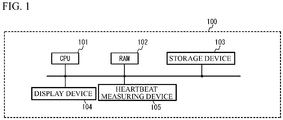
- FIG. 1 is a block diagram of a hardware configuration of an information processing device 100 in accordance with a first embodiment.
- the information processing device 100 includes a CPU 101, a RAM 102, a storage device 103, a display device 104, a heartbeat measuring device 105 and the like. These devices are interconnected through a bus or the like.
- the CPU (Central Processing Unit) 101 is a Central Processing Unit.
- the CPU 101 includes one or more cores.
- the RAM (Random Access Memory) 102 is a volatile memory that temporarily stores programs executed by the CPU 101 and data processed by the CPU 101.
- the storage device 103 is a nonvolatile storage device.
- a ROM Read Only Memory
- SSD solid state drive
- the information processing program of the present embodiment is stored in the storage device 103.
- the display device 104 is a liquid crystal display, an electroluminescence panel, or the like, and displays the result of a drink intake detection process described later.
- the heartbeat measuring device 105 is a device that measures the heartbeat (pulse) of an object such as a person or an animal taking a drink.
- the heartbeat measuring device 105 is not particularly limited as long as it can measure heartbeat (pulse).
- the heartbeat measuring device 105 may be an electrocardiograph or a pulsation sensor.
- the drink not particularly limited as long as it is a liquid drink. However, when an alcohol is taken, there may be a case where a heart rate may increase because of absorption or degradation of the alcohol after taking the alcohol. It is therefore preferable that a non-alcohol drink is used as the drink in the embodiment.
- FIG. 2A is a block diagram of functions implemented by the execution of the information processing program.
- the execution of the information processing program implements a heart rate acquisition unit 10, a heartbeat fluctuation calculation unit 20, a determination unit 30, a storage 40 and so on.
- the storage means a database.
- FIG. 2B is a functional block diagram of functions of the heartbeat fluctuation calculation unit 20.
- the heartbeat fluctuation calculation unit 20 functions as a speed feature calculation unit 21, a difference feature calculation unit 22, an intersection feature calculation unit 23, a baseline feature calculation unit 24, a fluctuation feature calculation unit 25, an amplitude feature calculation unit 26, an area feature calculation unit 27 and so on.
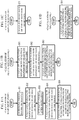
- FIG. 3 illustrates an example of a flowchart of a drink intake detection process.
- the heart rate acquisition unit 10 acquires heart rate fluctuation with respect to time by acquiring heartbeat from the heartbeat measuring device 105 (Step S1).
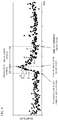
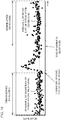
- FIG. 4 illustrates heart rate fluctuation with respect to time caused by a drink intake.
- a horizontal axis indicates an elapsed time
- a vertical axis indicates a heart rate.
- the heart rate is the number of beats per unit time, more specifically, the number of beats per minute.
- the heart rate means the number of beats per minute.
- the drink intake means that a drink is swallowed down one's throat once or more within a predetermined time range. When a new drink is swallowed after the predetermined time range, a second drink intake is performed.
- FIG. 4 illustrates heart rate fluctuation caused by a single drink intake.
- the heart rate fluctuation with respect to time caused by the drink intake has a tendency in which the heart rate rapidly increases at a start time of the drink intake and slowly decreases after an end of the drink intake.
- the fluctuation has a tendency in which the heart rate increases at a constant speed at the start time of the drink intake and decreases at a variable speed after the end of the drink intake.
- the fluctuation has a tendency in which the heart rate decreases just after rapid increasing of the heat rate at the start time of the drink intake.
- the Fluctuation has a tendency in which a baseline (average value) of the heart rate after the drink intake is larger than a baseline of the heart rate before the drink intake.
- the fluctuation has a tendency in which a variation (dispersion) of the heart rate after the drink intake is larger than the variation of the heart rate before the drink intake. And so, it is possible to determine whether an object takes a drink or not, by storing these tendencies in a database in advance and comparing measured heart rate fluctuation of the object with these tendencies.
- the database includes a text file and a binary file.
- the heartbeat fluctuation calculation unit 20 calculates a feature of the drink intake in the heart rate fluctuation acquired by the heart rate acquisition unit 10 (Step S2).
- FIG. 5 illustrates an example of a flowchart of a calculation process of a feature.
- the speed feature calculation unit 21 calculates a speed feature of the heart rate fluctuation because the heart rate fluctuation of the drink intake has a tendency in which the heart rate rapidly increases at a start time of the drink intake and slowly decreases after the drink intake (Step S11).
- the speed feature calculation unit 21 calculates a heart rate increasing speed (speed feature i) from a start time candidate of the drink intake, a heart rate decreasing speed (speed feature ii), and a ratio of the heart rate increasing speed and the heart rate decreasing speed (speed ratio of increasing and decreasing of the heart rate: speed feature iii).
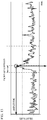
- FIG. 6 illustrates examples of calculation of the speed feature i to the speed feature iii.
- FIG. 7A illustrates an example of a flowchart of a calculation process of the speed feature i to the speed feature iii.
- the speed feature calculation unit 21 calculates a start time candidate of the drink intake (Step S21).
- the start time candidate of the drink intake is a start time of increasing during an increasing period of the heart rate for a predetermined time (for example, 5 seconds) or more.
- the start time candidate of the drink intake may be a time point at which a rising of the heart rate is detected.
- the speed feature calculation unit 21 calculates a time of a maximum heart rate (Step S22).
- the maximum heart rate is a maximum value of the heart rate during the increasing period of the heart rate.
- the increasing period of the heart rate may be considered as a constant multiplication of period from time when an object holds a drink in his mouth to time when the object swallows the drink down his throat (for example, from time when the object holds 20 ml of the drink in his mouth to time when the object swallows the drink at a time (for example, 3 seconds)).
- the multiplication of the time is a period in which water of 20 ml in 1 litter is continuously swallowed 50 times (for example, 150 seconds).
- the speed feature calculation unit 21 calculates the heart rate increasing speed by a function approximation (Step S23). For example, the speed feature calculation unit 21 calculates the heart rates from the start time candidate of the drink intake to the time of the maximum heart rate and calculates an inclination a u of an approximated line obtained by a function approximation of the calculated heart rates.
- the speed feature calculation unit 21 calculates time of a minimum heart rate (Step S24).
- the minimum heart rate is a minimum value of heart rates in a heart rate decreasing period.
- the heart rate decreasing period may be considered as a period from time when a drink is swallowed to time when the liquid reaches a stomach (a period until the swallowed drink reaches the stomach (for example, 10 seconds)).
- the speed feature calculation unit 21 calculates the heart rate decreasing speed by a function approximation (Step S24).
- the speed feature calculation unit 21 calculates the heart rates from the time of the maximum heart rate to the time of the minimum heart rate and calculates an inclination a d of an approximated line obtained by a function approximation of the calculated heart rates, as the heart rate decreasing speed.
- the speed feature calculation unit 21 calculates a ratio of the heart rate increasing speed and the heart rate decreasing speed (
- a value indicating a difference between the increasing and the decreasing may be used instead of the speed ratio.
- the speed feature calculation unit 21 may calculate a difference between the increasing speed and the decreasing speed (
- the speed feature calculation unit 21 calculates at least one of the speed feature i to the speed feature iii.
- the heart rate fluctuation of the drink intake with respect to time has the tendency in which the heart rate increases at a constant speed at the start time of the drink intake and decreases at a variable speed after the end of the drink intake. Therefore, as illustrated in FIG. 5 , the difference feature calculation unit 22 calculates the difference feature of the heart rate fluctuation (Step S12).
- the difference feature calculation unit 22 calculates a difference between a measured value and the approximated line within the increasing period (difference within the increasing period: difference feature iv), a difference between a measured value and the approximated line of the decreasing period (difference within the decreasing period: difference feature v), and a ratio of the difference of the increasing period and the difference of the decreasing period (ratio of the difference between the increasing period and the decreasing period: difference feature vi).
- the difference may be called an error between the measured value and the approximated line.
- FIG. 7B illustrates an example of a flowchart of a calculation process of the difference feature iv to the difference feature vi.
- FIG. 8 illustrates a calculation of the difference feature iv to the difference feature vi.
- the difference feature calculation unit 22 determines the heart rate increasing period (Step S31).
- the increasing period is a period from the start time candidate of the drink intake to the time of the maximum heart rate.
- the difference feature calculation unit 22 calculates the difference within the increasing period from the difference between the measured value and the approximated line (Step S32).
- the difference within the increasing period is a value corresponding to a coefficient of determination R u of the measured value and the approximated line of the increasing period.
- the coefficient of determination R u may be expressed by the following formula (1). [Formula 1]
- the difference feature calculation unit 22 determines the decreasing period (Step S33).
- the decreasing period is a period from the time of the maximum heart rate to the time of the minimum heart rate.
- the difference feature calculation unit 22 calculates the difference of the decreasing period from the difference between the measured value and the approximated line (Step S34).
- the difference of the decreasing period is a value corresponding to a coefficient of determination R d of the measured value and the approximated line of the decreasing period.
- R d may be expressed by the following formula (2). [Formula 2]
- the difference feature calculation unit 22 calculates a value corresponding to the ratio Ru/Rd of the difference of the increasing period and the difference of the decreasing period (Step S35).
- a value indicating a difference between the increasing and the decreasing may be used instead of the difference ratio.
- the difference feature calculation unit 22 may calculate a difference between the difference of the increasing period and difference of the decreasing period (
- the difference feature calculation unit 22 calculates at least one of the difference feature iv to the difference feature vi.
- the intersection feature calculation unit 23 calculates an intersection feature of the heart rate fluctuation (Step S13).
- the intersection feature calculates an intersection angle of feature (intersection feature vii) indicating decreasing just after the time of the maximum heart rate.
- FIG. 9 illustrates a calculation of the intersection feature vii.
- FIG. 7C illustrates an example of a flowchart of a calculation process of the intersection feature vii. As illustrated in FIG.
- the intersection feature calculation unit 23 calculates the intersection angle ⁇ as an intersection angle between the approximated line of the increasing period and the approximated line of the decreasing period (Step S41).
- the intersection angle ⁇ may be calculated by the following formula (3) and the following formula (4).
- ⁇ cos ⁇ 1 ⁇ ⁇
- the baseline feature calculation unit 24 calculates a baseline feature of the heart rate fluctuation (Step S14).
- the baseline feature calculates a baseline before the increasing period (baseline feature viii), a baseline feature after the decreasing period (baseline feature ix) and a ratio of the baseline before the increasing period and the baseline after the decreasing period (a baseline ratio between before the increasing and after the decreasing: baseline feature).
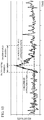
- FIG. 10 illustrates a calculation of the baseline feature viii to the baseline feature ix.
- FIG. 11A illustrates an example of a flowchart of a calculation process of the baseline feature viii to the baseline feature ix.
- the baseline feature calculation unit 24 determines the period before the increasing (Step S51).
- the period before the increasing is a period from a predetermined time before the start time candidate of the drink intake to the start time candidate of the drink intake.
- the predetermined time may be two minute or 30 minutes, for example.
- the predetermined time before the start time candidate of the drink intake is time just after a variation per a unit section before the start time of the drink intake exceeds a predetermined value (for example, 0.1 or 1).
- the baseline feature calculation unit 24 calculates the baseline of the period before the increasing, as a value corresponding to an average ⁇ u of the heart rate of the period before the increasing (Step S52).
- the baseline feature calculation unit 24 determines the period after the decreasing (Step S53).
- the period after the decreasing is a period from the time of the minimum heart rate to a predetermined time after the time of the minimum heart rate.
- the predetermined time may be two minutes or 30 minutes, for example.
- the predetermined time after the time of the minimum heart rate is time just before a variation per a unit section after the time of the minimum heart rate exceeds a predetermined value (for example, 0.1 or 1).
- the baseline feature calculation unit 24 calculates the baseline of the period after the decreasing, as a value corresponding to an average ⁇ d of the heart rate of the period after the decreasing (Step S54).
- the baseline feature calculation unit 24 calculates a ratio ⁇ d / ⁇ u between the baseline of the period before the increasing and the baseline of the period after the decreasing (Step S55).
- a value indicating a difference between before the increasing and after the decreasing may be used instead of the baseline ratio.
- the baseline feature calculation unit 24 may calculate a difference between the baseline of the period before the increasing and the baseline of the period after the decreasing (
- the baseline feature calculation unit 24 calculates at least one of the baseline feature viii to the baseline feature ix.
- the heart rate fluctuation has the tendency in which a variation (dispersion) of the heart rate after the drink intake is larger than the variation of the heart rate before the drink intake. Therefore, as illustrated in FIG. 5 , the fluctuation feature calculation unit 25 calculates a fluctuation feature of the heart rate fluctuation (Step S15).
- the fluctuation feature calculation unit 25 calculates a fluctuation of the period before the increasing (fluctuation feature xi), a fluctuation of the period after the decreasing (fluctuation feature xii) and a ratio between the fluctuation of the period before the increasing and the fluctuation of the period after the decreasing (fluctuation ratio between the period before the increasing and the period after the decreasing: fluctuation feature xiii).
- FIG. 11B illustrates an example of a flowchart of a calculation process of the fluctuation feature.
- FIG. 12 illustrates a calculation of the fluctuation feature.
- the fluctuation feature calculation unit 25 calculates the fluctuation of the period before the increasing as the dispersion of the heart rate before the increasing (Step S61).
- the fluctuation of the period before the increasing is a value corresponding to a dispersion V u from the average ⁇ u of the heart rate of the period before the increasing.
- the fluctuation feature calculation unit 25 calculates the fluctuation of the period after the decreasing as a dispersion of the heart rate of the period after the decreasing (Step S62).
- the fluctuation of the period after the decreasing is a value corresponding to a dispersion V d from the average ⁇ d of the heart rate of the period after the decreasing.
- the fluctuation feature calculation unit 25 calculates a ratio V u /V d between the period before the increasing and the period after the decreasing as the fluctuation ratio between the period before the increasing and the period after the decreasing (Step S63).
- a value indicating a difference between before the increasing and after the decreasing may be used instead of the ratio.
- the fluctuation feature calculation unit 25 may calculate a difference (
- the fluctuation feature calculation unit 25 calculates at least one of the fluctuation feature xi to the fluctuation feature xiii.
- an increasing width of the heart rate may be used as a feature.
- the amplitude feature calculation unit 26 calculates an amplitude feature (Step S16).
- the amplitude feature calculation unit 26 calculates an increasing width of the maximum heart rate of the increasing period.
- FIG. 11C illustrates an example of a flowchart of a calculation process of the amplitude feature xiv.
- the amplitude feature calculation unit 26 calculates a heart rate at the time of the maximum heart rate (Step S71).
- a value of the maximum heart rate may be used as the amplitude feature xiv.
- a difference between the maximum heart rate and the heart rate at the start time candidate of the drink intake may be used as the amplitude feature xiv.
- an area of the heart rate (integral value) may be used as a feature. And so, as illustrated in FIG. 5 , an area feature calculation unit 27 calculates an area feature (Step S17).
- an area feature xv a total (integral value) of the heart rate increasing width of the increasing period of the heart rate and the decreasing period of the heart or a time-averaged heart rate increasing width.
- the heart rate increasing width may be an increasing width from the average ⁇ u of the heart rate of the period before the increasing.
- FIG. 11D illustrates an example of a flowchart of a calculation process of the area feature xv. As illustrated in FIG. 11D , the area feature calculation unit 27 calculates the area feature xv by calculating a total value of increasing widths from the baseline of the period before the increasing from the start time candidate of the drink intake to the time of the minimum heart rate (Step S81).
- a collinear approximation is used for the calculation of the speed feature i to the speed feature iii and the difference feature iv to the difference feature vi.
- a curve approximation such as a quadratic curve may be used.
- the collinear approximation is used in the increasing period because the heart rate of the increasing period tends to rapidly increase.
- the curve approximation is used in the decreasing period because the heart rate of the decreasing period tends to slowly decrease.
- the collinear approximation may be used in the increasing period, and the curve approximation is used in the decreasing period.
- the storage 40 stores a model that is made in advance.
- the model includes a model of the drink intake and a model of a drink non-intake.
- the model of the drink intake includes the speed features i to iii, the difference features iv to vi, the intersection feature vii, the baseline features viii to x, the fluctuation feature xi to xiii, the amplitude feature xiv and the area feature xv, in the heart rate fluctuation caused by the drink intake.
- the model of the drink non-intake includes the speed features i to iii, the difference features iv to vi, the intersection feature vii, the baseline features viii to x, the fluctuation feature xi to xiii, the amplitude feature xiv and the area feature xv, in the heart rate fluctuation during a period in which a drink is not taken.
- These models may be made with use of measured values of a specific object using the drink intake detection process or with use of measured values of many and unspecified users. When a plurality of measured values are used, an average of the measured values may be used.
- an analyzer may optionally make the model of the drink intake and the mode of the drink non-intake.
- FIG. 16 illustrates an example of a flowchart for making a model stored in the storage 40.
- a model is made in advance with use of a measured value of a heart rate of an object using the drink intake detection process.
- the heart rate acquisition unit 10 reads, in order, heart rate data to which a label is added (Step S91).
- the label may be made by pushing a button at timing when the object takes a drink.
- the heartbeat fluctuation calculation unit 20 calculates a feature associated with increasing and decreasing of the heart rate fluctuation with respect to time (Step S92).
- the feature includes the speed features i to iii, the difference features iv to vi, the intersection feature iii, the baseline features viii to x, the fluctuation features xi to xiii, the amplitude feature xiv and the area feature xv.
- the heartbeat fluctuation calculation unit 20 stores the calculated feature in the storage 40 as a database for model making, together with the label (Step S93).
- the determination unit 30 determines whether the process is finished with respect to all data (Step S94). When it is determined as "No" in Step S94, Step S91 is executed again.
- Step S94 the determination unit 30 makes a model of the drink intake and a model of the drink non-intake, with use of the database for model making (Step S95). These models are stored in the storage 40 as a model used for the drink intake detection process.
- the determination unit 30 determines whether the fluctuation of the heart rate during the drink intake detection process is caused by a drink intake, with use of the feature calculated by the heartbeat fluctuation calculation unit 20 (Step S3).
- FIG. 17 illustrates an example of a flowchart of a determination process in this case.
- the determination unit 30 calculates a coincidence degree (divergence degree) between the feature calculated from the heart rate fluctuation measured during the drink intake detection process and the model of the drink intake stored in the storage 40 and between the feature and the model of the drink non-intake stored in the storage 40 (Step S101).
- the coincidence degree indicates a similarity degree between the feature calculated from the heart rate fluctuation measured during the drink intake detection process and the model of the drink intake or a similarity degree between the feature and the model of the drink non-intake. Therefore, the coincidence means a similarity degree or an analogous degree.
- a Mahalanobis distance is described as a coincidence calculation. However, any algorism such as a support vector machine, a boosting or a neural network may be applied to the coincidence calculation.
- the determination unit 30 uses the Mahalanobis distance for calculating the coincidence degree (divergence degree).
- the determination unit 30 uses an average vector and a covariance matrix as parameters when calculating the Mahalanobis distance.
- the average vector and the covariance matrix of the drink intake are ⁇ d and ⁇ d .
- the average vector and the covariance matrix of the drink non-intake are ⁇ n and ⁇ n .
- x 1 , x 2 , ⁇ indicate the feature i, the feature ii, ⁇ .
- the Mahalanobis distance may be expressed by the following formula (7) and the following formula (8).
- the determination unit 30 determines that the heart rate fluctuation measured during the drink intake detection process belongs to one of which the distance is smaller (Step S102). Therefore, when D d is larger than D n as illustrated in FIG. 18 , the determination unit 30 determines that the heart rate fluctuation measured during the drink intake detection process is the heart rate fluctuation of the drink non-intake.
- a distance using only the features i and ii is illustrated for simplification.
- Information associated with a viscosity of a liquid may be estimated with use of D d and D n , and the estimated information may be added to the determination result of the determination unit 30.
- the determination unit 30 determines that the heart rate fluctuation measured during the drink intake detection process is the heart rate fluctuation of the intake of a drink having a low viscosity.
- a distance from not the model of the drink non-intake but a plurality of models of the drink intake may be calculated, a component of the drink may be estimated, and the calculated distance and the estimated component may be added to the determination result of the determination unit 30.
- a distance from a model of pure water intake, a model of intake of a drink including salt, and a model of intake of a drink including sugar may be used, an including amount of the salt and the sugar may be estimated, and it may be determined that the heart rate fluctuation is that of the intake of the drink including 10 mg of salt and 10 mg of sugar.
- a heart rate fluctuation of an object with respect to time is caused by a drink intake, on a basis of a coincidence degree between a feature extracted from the heart rate fluctuation of the object and a feature of a drink intake stored in a database. It is therefore possible to detect a drink intake with high accuracy. It is possible to detect a drink intake by only acquiring heart rate fluctuation. The heart rate fluctuation is measured. Therefore, it is not necessary for the object to perform a specific action before and after a drink intake. When a wearable device put on an arm for measuring a heart rate is used, it is possible to easily detect a drink intake with low load.
- a coincidence degree with the feature of the drink intake stored in the database is higher than a coincidence degree with the feature of the drink non-intake stored in the database, it is determined that the heart rate fluctuation is caused by a drink intake. Therefore, the detection accuracy of the drink intake is improved. It may not be necessarily calculated the coincidence degree with the feature of the drink non-intake. For example, when the coincidence degree with the feature of the drink intake stored in the database is equal to or more than a threshold, it may be determined that the heart rate fluctuation is caused by a drink intake. For example, in Step S102 of FIG. 17 , the coincidence degree is compared with a threshold. At least one of the above-mentioned features is used. When the features i to iii, the difference features iv to vi and the intersection feature vii are used, the detection accuracy of a drink intake becomes specifically high.
- the determination result may include at least one of the number of drink intake, the start time of the drink intake, the end time of the drink intake, the viscosity of the liquid, the component of the drink, and the amount of taken drink.
- the number of drink intake corresponds to the number of the determination as drink intake for a day.
- the start time of the drink intake for example, corresponds to the start time candidate of the drink intake.
- the end tie of the drink intake for example, corresponds to the time of the maximum heart rate.
- the amount of taken drink for example, corresponds to a value obtained by dividing the period of the drink intake (difference between the end time of the drink intake and the start time of the drink intake) and a period for performing a single swallowing of the drink.
- the period for performing a single swallowing is stored in the database in advance, and may be made with respect to age groups, sex groups, or individuals.
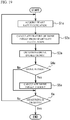
- FIG. 19 illustrates an example of a flowchart of a calculation of the amount of taken drink.
- the heart rate acquisition unit 10 acquires the heart rate fluctuation by acquiring the heartbeat from the heartbeat measuring device 105 (Step S1a).
- the heartbeat fluctuation calculation unit 20 calculates a feature of the drink intake in the heart rate fluctuation acquired by the heart rate acquisition unit 10 (Step S2a).
- the determination unit 30 determines whether the heart rate fluctuation during the drink intake detection process is caused by the drink intake, with use of the feature calculated by the heartbeat fluctuation calculation unit 20 (Step S3a).
- the determination unit 30 calculated the amount of taken drink (Step S5a).
- Step S6a determines whether the measuring is finished. When it is determined as "No” in Step S6a, Step S1a is executed again. When it is determined as "Yes” in Step S6a, the flowchart is terminated.
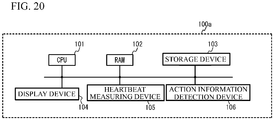
- FIG. 20 illustrates a block diagram of a hardware structure of an information processing device 100a in accordance with the second embodiment. As illustrated in FIG. 20 , the information processing device 100a further has an action information detection device 106.
- the action information detection device 106 is a device for detecting action information of the object.
- the action information detection device 106 detects an action having a low correlation with the drink intake. For example, the action information detection device 106 detects an action in which no drink is physically taken. In concrete, the action information detection device 106 detects such as sleep, phonation, chewing, or sigh. The action information detection device 106 detects an action in which the drink is not taken with high possibility. In concrete, the action information detection device 106 detects a general habit. For example, the action information detection device 106 detects an action in which the object is grounded and moves his legs, such as walking, running or stairs stepping. The action information detection device 106 detects an action in which the object moves his hand, such as dishwashing or cleaning.
- the action information detection device 106 detects an action for riding on a specific vehicle such as a motorcycle.
- the action information detection device 106 detects an action of excretion.
- the action information detection device 106 detects an action of bathing.
- the action information detection device 106 detects a habit of an individual. For example, the action information detection device 106 detects such as talking with a specific person, meeting, a case where the object doesn't desire to urinate (action of lining up).
- the action information detection device 106 detects an action having a high correlation with the drink intake.
- the action information device 106 detects an action unique to the drink intake (motion of a body part such as an arm or breast of which an inclination changes according the drink intake).
- the action information detection device 106 detects such as preliminary motion of putting liquid in a container, a rotation of hand of opening a cap of a PET bottle, a motion of front and behind or up and down for moving a container to a mouth, a stationary condition for a period of holding a container in his mouth and swallowing, a motion of behind and down of swallowing liquid in a container, or a motion front and behind or up and down of putting a container on a desk or the like.
- the action information detection device 106 detects an action in which the object takes a drink with high possibility.
- the action information detection device 106 detects a general habit.
- the action information detection device 106 detects such as an action of taking a drink after getting up and before sleeping, an action of taking a drink before or after bathing, or an action of taking a drink before or after exercise.
- the action information detection device 106 detects a habit of an individual.
- the action information detection device 106 detects an action of taking water at a specific time (for example, 15:00), or an action of taking water in a specific place (for example, kitchen).
- the action information detection device 106 may determine the action with use of a motion data or determine time and place with use of data associated with time or place, with use of a conventional technology or with use of a label that the object makes by pushing a button during each motion.
- FIG. 21 illustrates an example of a flowchart of the drink intake detection process of the embodiment.
- the heart rate acquisition unit 10 acquires a heartbeat from the heartbeat measuring device 105 and acquires the heart rate fluctuation with respect to time (Step S111).
- the heart rate acquisition unit 10 acquires action information of the object together with the heart rate fluctuation with respect to time when the action information detection device 106 detects an action of the object.
- the heartbeat fluctuation calculation unit 20 calculates a feature of the drink intake in the heart rate fluctuation acquired by the heart rate acquisition unit 10 (Step S112).
- the determination unit 30 calculates a Mahalanobis distance between the feature calculated by the heartbeat fluctuation calculation unit 20 and the model of the drink intake and between the feature and the model of the drink non-intake (Step S113).
- the determination unit 30 calculates a ratio of the distances (Step S114). The ratio may be a distance from the model of the drink intake / a distance from the model of the drink non-intake.
- Step S115 when the heart rate fluctuation acquired by the heart rate acquisition unit 10 includes a motion data of the object, the determination unit 30 determines an action associated with the motion data (Step S115).
- the determination unit 30 determines the time and the place (Step S116).
- the determination unit 30 refers to thresholds stored in the storage 40 in advance, and acquires a threshold associated with an action detected by the action information detection device 106.
- the determination unit 30 determines that a drink is not taken (Step S117).
- the determination unit 30 determines whether the measuring is finished (Step S118). When it is determined as "No” in Step S118, Step Sill is executed again. When it is determined as "Yes” in Step S118, the flowchart is terminated.
- the detection accuracy of the drink intake is improved because the action information of the object has an influence on the determination whether the heart rate fluctuation of the object is caused by the drink intake or not.
- the threshold of the distance ratio calculated in Step S114 in a case where the possibility of the drink intake is low, it is possible to suppress a false detection of the drink intake.
- the threshold of the distance ration calculated in Step S114 in a case where the possibility of the drink intake is high, it is possible to suppress a false detection of the drink intake.
- FIG. 22A illustrates a functional block diagram of an information processing device 100b in accordance with a third embodiment.
- the function is implemented by execution of the information processing program.
- a body function quantification unit 50 is further implemented.
- FIG. 22B illustrates a functional block diagram of each function of the heartbeat fluctuation calculation unit 20.
- Each function of the heartbeat fluctuation calculation unit 20 is the same as the first embodiment.
- the body function quantification unit 50 quantifies the body function by comparing the feature obtained from the heart rate fluctuation acquired in the drink intake detection process with the model of the drink intake. For example, the body function quantification unit 50 determines that the object is thirst twice as usual when an acquired increasing speed of the heart rate is twice as the increasing speed of the model. The body function quantification unit 50 determines that function of the body of the object becomes weak when an acquired decreasing speed of the heart rate is half of the decreasing speed of the model.
- FIG. 23 illustrates an example of a flowchart of a drink intake detection process in accordance with the embodiment.
- the heart rate acquisition unit 10 acquires the heart rate fluctuation by acquiring a heartbeat from the heartbeat measuring device 105 (Step S121).
- the heartbeat fluctuation calculation unit 20 calculates a feature of the drink intake in the heart rate fluctuation acquired by the heart rate acquisition unit 10 (Step S122).
- the determination unit 30 determines the drink intake or the drink non-intake, with use of the feature calculated in Step S122 (Step S123).
- the body function quantification unit 50 determines whether it is determined as "drink intake” in Step S123 (Step S124). When it is determined as "Yes” in Step S124, the body function quantification unit 50 refers to the storage 40 and acquires each feature of the model of the drink intake (Step S125). When the model of the drink intake includes a plurality of features, the body function quantification unit 50 may an average of the features.
- the body function quantification unit 50 calculates a ratio of each feature calculated in Step S122 and each feature acquired in Step S125 (Step S126).
- the body function quantification unit 50 quantifies the thirsty, in accordance with the increasing speed of the heart rate (Step S127).
- the body function quantification unit 50 quantifies the motion of the body, in accordance with the decreasing speed of the heart rate (Step S128).
- the body function quantification unit 50 determines whether the measuring is finished (Step S129). When it is determined as "Yes” in Step S129, the flowchart is terminated. When it is determined as "No” in Step S129, Step S121 is executed again. When it is determined as "No” in Step S124, Step S129 is executed again.
- the speed feature, the difference feature and so on of the heart rate fluctuation are used.
- the feature is not limited.
- a wave pattern of the heart rate fluctuation may be used as the feature.
- a coincidence degree (divergence degree) between a wave pattern of the heart rate of the object and a wave pattern of the drink intake that is stored in the storage 40 in advance is high, it may be determined that the case is the drink intake.
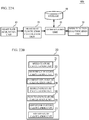
- a heart rate fluctuation signal with respect to time stored in the storage 40 is s(t).
- a heart rate fluctuation signal acquired in the drink intake detection process is x(t).
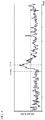
- FIG. 24A illustrates s(t).
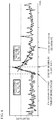
- FIG. 24B illustrates x(t).
- a coincidence between the patterns may be expressed by the following formula (9).
- a difference is calculated. And, the smaller the value is, the high the coincidence is.
- N is a total number of the signals. The number of the signals are the number of signals within seconds from the start time of the period before increasing to the end time of the period after the decreasing.
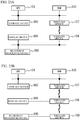
- FIG. 25A and FIG. 25B illustrate another device configuration of the information processing device 100.
- the information processing device 100 may have a structure in which a server wirelessly sends data to a wearable device and wirelessly receives data from the wearable device.
- the server has the CPU 101, the RAM 102, the storage device 103 and a wireless device 107.
- the wearable device has the display device 104, the heartbeat measuring device 105, and a wireless device 108.
- the information processing device may have a structure in which data is wirelessly sent or received among a server, a terminal and a wearable device.
- the server has the CPU 101, the RAM 102, the display device 103 and the wireless device 107.
- the terminal has the display device 104 and the wireless device 108.
- the wearable device has the heartbeat measuring device 105 and a wireless device 109.
- the wearable device may have the action information detection device 106.
- the heart rate acquisition unit 10 acts as an example of a heart rate acquisition unit configured to acquire a heart rate of an object.
- the heartbeat fluctuation calculation unit 20 acts as an example of a feature extraction unit configured to extract a feature from heart rate fluctuation with respect to time that is acquired by the heart rate acquisition unit.
- the storage 40 acts as an example of a storage configured to, in advance, store information associated with heart rate fluctuation of a drink intake.
- the determination unit 30 acts as an example of a determination unit configured to determine whether the heart rate fluctuation acquired by the heart rate acquisition unit is caused by a drink intake, on a basis of the feature extracted by the feature extraction unit and the information stored in the storage.
- the action information detection device 106 acts as an example of an action information measuring device configured to measure action information of the object.
- the body function quantification unit 50 acts as an example of a quantification unit configured to quantify a body function of the object on a basis of a relationship between the feature extracted by the feature extraction unit and the information stored in the storage when the determination unit determines that the heart rate fluctuation acquired by the heart rate acquisition unit is caused by the drink intake.
Landscapes
- Health & Medical Sciences (AREA)
- Engineering & Computer Science (AREA)
- Life Sciences & Earth Sciences (AREA)
- Medical Informatics (AREA)
- Public Health (AREA)
- General Health & Medical Sciences (AREA)
- Biomedical Technology (AREA)
- Pathology (AREA)
- Physics & Mathematics (AREA)
- Veterinary Medicine (AREA)
- Molecular Biology (AREA)
- Animal Behavior & Ethology (AREA)
- Surgery (AREA)
- Primary Health Care (AREA)
- Epidemiology (AREA)
- Biophysics (AREA)
- Heart & Thoracic Surgery (AREA)
- Data Mining & Analysis (AREA)
- Artificial Intelligence (AREA)
- Cardiology (AREA)
- Physiology (AREA)
- Signal Processing (AREA)
- Databases & Information Systems (AREA)
- Psychiatry (AREA)
- Computer Vision & Pattern Recognition (AREA)
- Medicinal Chemistry (AREA)
- Chemical & Material Sciences (AREA)
- Bioinformatics & Cheminformatics (AREA)
- Obesity (AREA)
- Nutrition Science (AREA)
- Evolutionary Computation (AREA)
- Fuzzy Systems (AREA)
- Mathematical Physics (AREA)
- Measuring Pulse, Heart Rate, Blood Pressure Or Blood Flow (AREA)
- Measurement And Recording Of Electrical Phenomena And Electrical Characteristics Of The Living Body (AREA)
Abstract
Description
- The present case relates to an information processing device, an information processing method and an information processing program.
- A technique for detecting a drink intake has been desired. For example, disclosed is a technique for determining a drink intake by detecting a motion of an arm during the drink intake (see
Patent Document 1, for example). - Patent Document 1: Japanese Patent Application Publication No.
2014-79506 - However, there are various motions of an arm during a drink intake. It is therefore difficult to accurately detect an action of the drink intake. For example, the motion of the arm assumed in the above-mentioned invention is only a part of motions during the drink intake. The drink intake may not be necessarily detected during other motions during the drink intake. There are various motions of an arm in a daily life. Therefore, a false detection may occur.
- According to an aspect of the present case, provided is an information processing device, an information processing method, and an information processing program capable of detecting a drink intake under various conditions, independently of a specific action.
- In a first aspect, an information processing device includes: a heart rate acquisition unit configured to acquire a heart rate of an object; a feature extraction unit configured to extract a feature from heart rate fluctuation with respect to time that is acquired by the heart rate acquisition unit; a storage configured to, in advance, store information associated with heart rate fluctuation of a drink intake; and a determination unit configured to determine whether the heart rate fluctuation acquired by the heart rate acquisition unit is caused by a drink intake, on a basis of the feature extracted by the feature extraction unit and the information stored in the storage.
- It is possible to detect a drink intake under various conditions, independently of a specific action.
-
-
FIG. 1 is a block diagram of a hardware configuration of an information processing device in accordance with a first embodiment; -
FIG. 2A is a block diagram of functions implemented by execution of an information processing program, andFIG. 2B is a functional block diagram of functions of a heartbeat fluctuation calculation unit; -
FIG. 3 illustrates an example of a flowchart of a drink intake detection process; -
FIG. 4 illustrates heart rate fluctuation caused by drink intake; -
FIG. 5 illustrates an example of a flowchart of a calculation process of a feature; -
FIG. 6 illustrates a calculation of a speed feature; -
FIG. 7A illustrates an example of a flowchart of a calculation process of a speed feature i to a speed feature iii,FIG. 7B illustrates an example of a flowchart of a calculation process of a difference feature iv to a difference feature vi,FIG. 7C illustrates an example of a flowchart of a calculation process of an intersection feature vii; -
FIG. 8 illustrates a calculation of a difference feature; -
FIG. 9 illustrates a calculation of an intersection feature; -
FIG. 10 illustrates a calculation of a baseline feature; -
FIG. 11A illustrates an example of a flowchart of a calculation process of a baseline feature,FIG. 11B illustrates an example of a flowchart of a calculation process of a fluctuation feature,FIG. 11C illustrates an example of a flowchart of a calculation process of an amplitude feature,FIG. 11D illustrates an example of a flowchart of a calculation process of an area feature; -
FIG. 12 illustrates a calculation of a fluctuation feature; -
FIG. 13 illustrates a calculation of a heartbeat feature; -
FIG. 14 illustrates a calculation of an area feature; -
FIG. 15 illustrates another example of approximation; -
FIG. 16 illustrates an example of a flowchart of making a model stored in a database; -
FIG. 17 illustrates an example of a flowchart of determining drink intake or drink non-intake; -
FIG. 18 illustrates a Mahalanobis distance; -
FIG. 19 illustrates an example of a flowchart of a calculation of amount of taken drink; -
FIG. 20 illustrates a block diagram of a hardware structure of an information processing device in accordance with a second embodiment; -
FIG. 21 illustrates an example of a flowchart of a drink intake detection process; -
FIG. 22A illustrates a functional block diagram of an information processing device in accordance with a third embodiment,FIG. 22B illustrates a functional block diagram of each function of a heartbeat fluctuation unit; -
FIG. 23 illustrates an example of a flowchart of a drink intake detection process; -
FIG. 24A illustrates a heart rate fluctuation signal s(t) with respect to time of a drink intake,FIG. 24B illustrates a heart rate fluctuation signal x(t) with respect to time of a drink intake detection process; and -
FIG. 25A and FIG. 25B illustrate another device configuration - Hereinafter, a description will be given of embodiments with reference to drawings.
-
FIG. 1 is a block diagram of a hardware configuration of aninformation processing device 100 in accordance with a first embodiment. As illustrated inFIG. 1 , theinformation processing device 100 includes aCPU 101, aRAM 102, astorage device 103, adisplay device 104, aheartbeat measuring device 105 and the like. These devices are interconnected through a bus or the like. - The CPU (Central Processing Unit) 101 is a Central Processing Unit. The
CPU 101 includes one or more cores. The RAM (Random Access Memory) 102 is a volatile memory that temporarily stores programs executed by theCPU 101 and data processed by theCPU 101. - The
storage device 103 is a nonvolatile storage device. For example, a ROM (Read Only Memory), a solid state drive (SSD) such as a flash memory, or a hard disk driven by a hard disk drive can be used as thestorage device 103. The information processing program of the present embodiment is stored in thestorage device 103. Thedisplay device 104 is a liquid crystal display, an electroluminescence panel, or the like, and displays the result of a drink intake detection process described later. - The
heartbeat measuring device 105 is a device that measures the heartbeat (pulse) of an object such as a person or an animal taking a drink. Theheartbeat measuring device 105 is not particularly limited as long as it can measure heartbeat (pulse). For example, theheartbeat measuring device 105 may be an electrocardiograph or a pulsation sensor. The drink not particularly limited as long as it is a liquid drink. However, when an alcohol is taken, there may be a case where a heart rate may increase because of absorption or degradation of the alcohol after taking the alcohol. It is therefore preferable that a non-alcohol drink is used as the drink in the embodiment. - The information processing program stored in the
storage device 103 is deployed in theRAM 102 in an executable manner. TheCPU 101 executes the information processing program deployed in theRAM 102. This causes theinformation processing device 100 to execute each process.FIG. 2A is a block diagram of functions implemented by the execution of the information processing program. The execution of the information processing program implements a heartrate acquisition unit 10, a heartbeatfluctuation calculation unit 20, adetermination unit 30, astorage 40 and so on. In the following, the storage means a database. -
FIG. 2B is a functional block diagram of functions of the heartbeatfluctuation calculation unit 20. As illustrated inFIG. 2B , the heartbeatfluctuation calculation unit 20 functions as a speedfeature calculation unit 21, a differencefeature calculation unit 22, an intersectionfeature calculation unit 23, a baselinefeature calculation unit 24, a fluctuationfeature calculation unit 25, an amplitudefeature calculation unit 26, an areafeature calculation unit 27 and so on. -
FIG. 3 illustrates an example of a flowchart of a drink intake detection process. As illustrated inFIG. 3 , the heartrate acquisition unit 10 acquires heart rate fluctuation with respect to time by acquiring heartbeat from the heartbeat measuring device 105 (Step S1).FIG. 4 illustrates heart rate fluctuation with respect to time caused by a drink intake. InFIG. 4 , a horizontal axis indicates an elapsed time, and a vertical axis indicates a heart rate. The heart rate is the number of beats per unit time, more specifically, the number of beats per minute. Hereinafter, unless otherwise specified, the heart rate means the number of beats per minute. The drink intake means that a drink is swallowed down one's throat once or more within a predetermined time range. When a new drink is swallowed after the predetermined time range, a second drink intake is performed.FIG. 4 illustrates heart rate fluctuation caused by a single drink intake. - As illustrated in
FIG. 4 , the heart rate fluctuation with respect to time caused by the drink intake has a tendency in which the heart rate rapidly increases at a start time of the drink intake and slowly decreases after an end of the drink intake. The fluctuation has a tendency in which the heart rate increases at a constant speed at the start time of the drink intake and decreases at a variable speed after the end of the drink intake. The fluctuation has a tendency in which the heart rate decreases just after rapid increasing of the heat rate at the start time of the drink intake. The Fluctuation has a tendency in which a baseline (average value) of the heart rate after the drink intake is larger than a baseline of the heart rate before the drink intake. The fluctuation has a tendency in which a variation (dispersion) of the heart rate after the drink intake is larger than the variation of the heart rate before the drink intake. And so, it is possible to determine whether an object takes a drink or not, by storing these tendencies in a database in advance and comparing measured heart rate fluctuation of the object with these tendencies. The database includes a text file and a binary file. - As illustrated in
FIG. 3 , the heartbeatfluctuation calculation unit 20 calculates a feature of the drink intake in the heart rate fluctuation acquired by the heart rate acquisition unit 10 (Step S2).FIG. 5 illustrates an example of a flowchart of a calculation process of a feature. The speedfeature calculation unit 21 calculates a speed feature of the heart rate fluctuation because the heart rate fluctuation of the drink intake has a tendency in which the heart rate rapidly increases at a start time of the drink intake and slowly decreases after the drink intake (Step S11). - As a speed feature, the speed
feature calculation unit 21 calculates a heart rate increasing speed (speed feature i) from a start time candidate of the drink intake, a heart rate decreasing speed (speed feature ii), and a ratio of the heart rate increasing speed and the heart rate decreasing speed (speed ratio of increasing and decreasing of the heart rate: speed feature iii).FIG. 6 illustrates examples of calculation of the speed feature i to the speed feature iii.FIG. 7A illustrates an example of a flowchart of a calculation process of the speed feature i to the speed feature iii. - As illustrated in
FIG. 7A , the speedfeature calculation unit 21 calculates a start time candidate of the drink intake (Step S21). For example, the start time candidate of the drink intake is a start time of increasing during an increasing period of the heart rate for a predetermined time (for example, 5 seconds) or more. The start time candidate of the drink intake may be a time point at which a rising of the heart rate is detected. Next, the speedfeature calculation unit 21 calculates a time of a maximum heart rate (Step S22). For example, the maximum heart rate is a maximum value of the heart rate during the increasing period of the heart rate. The increasing period of the heart rate may be considered as a constant multiplication of period from time when an object holds a drink in his mouth to time when the object swallows the drink down his throat (for example, from time when the object holds 20 ml of the drink in his mouth to time when the object swallows the drink at a time (for example, 3 seconds)). For example, the multiplication of the time is a period in which water of 20 ml in 1 litter is continuously swallowed 50 times (for example, 150 seconds). - Next, the speed
feature calculation unit 21 calculates the heart rate increasing speed by a function approximation (Step S23). For example, the speedfeature calculation unit 21 calculates the heart rates from the start time candidate of the drink intake to the time of the maximum heart rate and calculates an inclination au of an approximated line obtained by a function approximation of the calculated heart rates. - Next, the speed
feature calculation unit 21 calculates time of a minimum heart rate (Step S24). For example, the minimum heart rate is a minimum value of heart rates in a heart rate decreasing period. The heart rate decreasing period may be considered as a period from time when a drink is swallowed to time when the liquid reaches a stomach (a period until the swallowed drink reaches the stomach (for example, 10 seconds)). Next, the speedfeature calculation unit 21 calculates the heart rate decreasing speed by a function approximation (Step S24). For example, the speedfeature calculation unit 21 calculates the heart rates from the time of the maximum heart rate to the time of the minimum heart rate and calculates an inclination ad of an approximated line obtained by a function approximation of the calculated heart rates, as the heart rate decreasing speed. - Next, the speed
feature calculation unit 21 calculates a ratio of the heart rate increasing speed and the heart rate decreasing speed (|au|/|ad|) as the speed ratio of increasing and decreasing of the heart rate (Step S26). A value indicating a difference between the increasing and the decreasing may be used instead of the speed ratio. And so, the speedfeature calculation unit 21 may calculate a difference between the increasing speed and the decreasing speed (|au| - |ad|) as the speed feature iii. The speedfeature calculation unit 21 calculates at least one of the speed feature i to the speed feature iii. - Next, the heart rate fluctuation of the drink intake with respect to time has the tendency in which the heart rate increases at a constant speed at the start time of the drink intake and decreases at a variable speed after the end of the drink intake. Therefore, as illustrated in
FIG. 5 , the differencefeature calculation unit 22 calculates the difference feature of the heart rate fluctuation (Step S12). In concrete, as the difference feature, the differencefeature calculation unit 22 calculates a difference between a measured value and the approximated line within the increasing period (difference within the increasing period: difference feature iv), a difference between a measured value and the approximated line of the decreasing period (difference within the decreasing period: difference feature v), and a ratio of the difference of the increasing period and the difference of the decreasing period (ratio of the difference between the increasing period and the decreasing period: difference feature vi). The difference may be called an error between the measured value and the approximated line.FIG. 7B illustrates an example of a flowchart of a calculation process of the difference feature iv to the difference feature vi.FIG. 8 illustrates a calculation of the difference feature iv to the difference feature vi. - As illustrated in
FIG. 7B , the differencefeature calculation unit 22 determines the heart rate increasing period (Step S31). For example, the increasing period is a period from the start time candidate of the drink intake to the time of the maximum heart rate. Next, the differencefeature calculation unit 22 calculates the difference within the increasing period from the difference between the measured value and the approximated line (Step S32). For example, the difference within the increasing period is a value corresponding to a coefficient of determination Ru of the measured value and the approximated line of the increasing period. The coefficient of determination Ru may be expressed by the following formula (1).
[Formula 1]
- yi : measured value,
y : average, ŷi : predicted value - Mu : number of measured data
- Next, the difference
feature calculation unit 22 determines the decreasing period (Step S33). For example, the decreasing period is a period from the time of the maximum heart rate to the time of the minimum heart rate. Next, the differencefeature calculation unit 22 calculates the difference of the decreasing period from the difference between the measured value and the approximated line (Step S34). For example, the difference of the decreasing period is a value corresponding to a coefficient of determination Rd of the measured value and the approximated line of the decreasing period. Rd may be expressed by the following formula (2).
[Formula 2]
- yi : measured value,
y : average, ŷi : predicted value - Md : number measured data
- Next, as the difference ratio between the increasing period and the increasing period, the difference
feature calculation unit 22 calculates a value corresponding to the ratio Ru/Rd of the difference of the increasing period and the difference of the decreasing period (Step S35). A value indicating a difference between the increasing and the decreasing may be used instead of the difference ratio. And so, the differencefeature calculation unit 22 may calculate a difference between the difference of the increasing period and difference of the decreasing period (|Ru| - |Rd|) as the difference feature vi. The differencefeature calculation unit 22 calculates at least one of the difference feature iv to the difference feature vi. - Next, the heart rate fluctuation of the drink intake has a tendency in which the heart rate decreases just after rapid increasing of the heat rate at the star time of the drink intake. Therefore, as illustrated in
FIG. 5 , the intersectionfeature calculation unit 23 calculates an intersection feature of the heart rate fluctuation (Step S13). In concrete, as the intersection feature, the intersectionfeature calculation unit 23 calculates an intersection angle of feature (intersection feature vii) indicating decreasing just after the time of the maximum heart rate.FIG. 9 illustrates a calculation of the intersection feature vii.FIG. 7C illustrates an example of a flowchart of a calculation process of the intersection feature vii. As illustrated inFIG. 7C , the intersectionfeature calculation unit 23 calculates the intersection angle θ as an intersection angle between the approximated line of the increasing period and the approximated line of the decreasing period (Step S41). The intersection angle θ may be calculated by the following formula (3) and the following formula (4).
[Formula 3]
[Formula 4]
- Next, the heart rate fluctuation of the drink intake has the tendency in which a baseline of the heart rate after the drink intake is larger than a baseline of the heart rate before the drink intake. Therefore, as illustrated in
FIG. 5 , the baselinefeature calculation unit 24 calculates a baseline feature of the heart rate fluctuation (Step S14). In concrete, as the baseline feature, the baselinefeature calculation unit 24 calculates a baseline before the increasing period (baseline feature viii), a baseline feature after the decreasing period (baseline feature ix) and a ratio of the baseline before the increasing period and the baseline after the decreasing period (a baseline ratio between before the increasing and after the decreasing: baseline feature). -
FIG. 10 illustrates a calculation of the baseline feature viii to the baseline feature ix.FIG. 11A illustrates an example of a flowchart of a calculation process of the baseline feature viii to the baseline feature ix. As illustrated inFIG. 11A , the baselinefeature calculation unit 24 determines the period before the increasing (Step S51). For example, the period before the increasing is a period from a predetermined time before the start time candidate of the drink intake to the start time candidate of the drink intake. The predetermined time may be two minute or 30 minutes, for example. The predetermined time before the start time candidate of the drink intake is time just after a variation per a unit section before the start time of the drink intake exceeds a predetermined value (for example, 0.1 or 1). - Next, the baseline
feature calculation unit 24 calculates the baseline of the period before the increasing, as a value corresponding to an average µu of the heart rate of the period before the increasing (Step S52). Next, the baselinefeature calculation unit 24 determines the period after the decreasing (Step S53). For example, the period after the decreasing is a period from the time of the minimum heart rate to a predetermined time after the time of the minimum heart rate. The predetermined time may be two minutes or 30 minutes, for example. The predetermined time after the time of the minimum heart rate is time just before a variation per a unit section after the time of the minimum heart rate exceeds a predetermined value (for example, 0.1 or 1). Next, the baselinefeature calculation unit 24 calculates the baseline of the period after the decreasing, as a value corresponding to an average µd of the heart rate of the period after the decreasing (Step S54). - Next, as the baseline ratio between the period before the increasing and the period after the decreasing, the baseline
feature calculation unit 24 calculates a ratio µd/µu between the baseline of the period before the increasing and the baseline of the period after the decreasing (Step S55). A value indicating a difference between before the increasing and after the decreasing may be used instead of the baseline ratio. And so, the baselinefeature calculation unit 24 may calculate a difference between the baseline of the period before the increasing and the baseline of the period after the decreasing (|µu| - |µd|) as the baseline feature ix. The baselinefeature calculation unit 24 calculates at least one of the baseline feature viii to the baseline feature ix. - Next, the heart rate fluctuation has the tendency in which a variation (dispersion) of the heart rate after the drink intake is larger than the variation of the heart rate before the drink intake. Therefore, as illustrated in
FIG. 5 , the fluctuationfeature calculation unit 25 calculates a fluctuation feature of the heart rate fluctuation (Step S15). In concrete, as the fluctuation feature, the fluctuationfeature calculation unit 25 calculates a fluctuation of the period before the increasing (fluctuation feature xi), a fluctuation of the period after the decreasing (fluctuation feature xii) and a ratio between the fluctuation of the period before the increasing and the fluctuation of the period after the decreasing (fluctuation ratio between the period before the increasing and the period after the decreasing: fluctuation feature xiii).FIG. 11B illustrates an example of a flowchart of a calculation process of the fluctuation feature.FIG. 12 illustrates a calculation of the fluctuation feature. - As illustrated in
FIG. 11B , the fluctuationfeature calculation unit 25 calculates the fluctuation of the period before the increasing as the dispersion of the heart rate before the increasing (Step S61). For example, the fluctuation of the period before the increasing is a value corresponding to a dispersion Vu from the average µu of the heart rate of the period before the increasing. The dispersion Vu may be expressed by the following formula (5).
[Formula 5]
- Next, the fluctuation
feature calculation unit 25 calculates the fluctuation of the period after the decreasing as a dispersion of the heart rate of the period after the decreasing (Step S62). For example, the fluctuation of the period after the decreasing is a value corresponding to a dispersion Vd from the average µd of the heart rate of the period after the decreasing. The dispersion Vd may be expressed by the following formula (6).
[Formula (6)]
- Next, the fluctuation
feature calculation unit 25 calculates a ratio Vu/Vd between the period before the increasing and the period after the decreasing as the fluctuation ratio between the period before the increasing and the period after the decreasing (Step S63). A value indicating a difference between before the increasing and after the decreasing may be used instead of the ratio. And so, the fluctuationfeature calculation unit 25 may calculate a difference (|Vu|-|Vd|) between the fluctuation of the period before the increasing and the fluctuation of the period after the decreasing, as the fluctuation feature xiii. The fluctuationfeature calculation unit 25 calculates at least one of the fluctuation feature xi to the fluctuation feature xiii. - Next, in the heart rate fluctuation caused by the drink intake, an increasing width of the heart rate may be used as a feature. And so, as illustrated in
FIG. 5 , the amplitudefeature calculation unit 26 calculates an amplitude feature (Step S16). In concrete, as illustrated inFIG. 13 , as an amplitude feature xiv, the amplitudefeature calculation unit 26 calculates an increasing width of the maximum heart rate of the increasing period.FIG. 11C illustrates an example of a flowchart of a calculation process of the amplitude feature xiv. As illustrated inFIG. 11C , the amplitudefeature calculation unit 26 calculates a heart rate at the time of the maximum heart rate (Step S71). For example, when the heart rate = zero is a standard, a value of the maximum heart rate may be used as the amplitude feature xiv. Alternatively, when a heart rate at the start time candidate of the drink intake is a standard, a difference between the maximum heart rate and the heart rate at the start time candidate of the drink intake may be used as the amplitude feature xiv. - Next, in the heart rate fluctuation caused by the drink intake, an area of the heart rate (integral value) may be used as a feature. And so, as illustrated in
FIG. 5 , an areafeature calculation unit 27 calculates an area feature (Step S17). In concrete, as illustrated inFIG. 14 , as an area feature xv, a total (integral value) of the heart rate increasing width of the increasing period of the heart rate and the decreasing period of the heart or a time-averaged heart rate increasing width. The heart rate increasing width may be an increasing width from the average µu of the heart rate of the period before the increasing.FIG. 11D illustrates an example of a flowchart of a calculation process of the area feature xv. As illustrated inFIG. 11D , the areafeature calculation unit 27 calculates the area feature xv by calculating a total value of increasing widths from the baseline of the period before the increasing from the start time candidate of the drink intake to the time of the minimum heart rate (Step S81). - A collinear approximation is used for the calculation of the speed feature i to the speed feature iii and the difference feature iv to the difference feature vi. However, a curve approximation such as a quadratic curve may be used. However, it is preferable that the collinear approximation is used in the increasing period because the heart rate of the increasing period tends to rapidly increase. It is preferable that the curve approximation is used in the decreasing period because the heart rate of the decreasing period tends to slowly decrease. And so, as illustrated in
FIG. 15 , the collinear approximation may be used in the increasing period, and the curve approximation is used in the decreasing period. - The
storage 40 stores a model that is made in advance. The model includes a model of the drink intake and a model of a drink non-intake. The model of the drink intake includes the speed features i to iii, the difference features iv to vi, the intersection feature vii, the baseline features viii to x, the fluctuation feature xi to xiii, the amplitude feature xiv and the area feature xv, in the heart rate fluctuation caused by the drink intake. The model of the drink non-intake includes the speed features i to iii, the difference features iv to vi, the intersection feature vii, the baseline features viii to x, the fluctuation feature xi to xiii, the amplitude feature xiv and the area feature xv, in the heart rate fluctuation during a period in which a drink is not taken. These models may be made with use of measured values of a specific object using the drink intake detection process or with use of measured values of many and unspecified users. When a plurality of measured values are used, an average of the measured values may be used. Alternatively, an analyzer may optionally make the model of the drink intake and the mode of the drink non-intake. -
FIG. 16 illustrates an example of a flowchart for making a model stored in thestorage 40. In the example, a model is made in advance with use of a measured value of a heart rate of an object using the drink intake detection process. As illustrated inFIG. 16 , the heartrate acquisition unit 10 reads, in order, heart rate data to which a label is added (Step S91). For example, the label may be made by pushing a button at timing when the object takes a drink. - Next, the heartbeat
fluctuation calculation unit 20 calculates a feature associated with increasing and decreasing of the heart rate fluctuation with respect to time (Step S92). The feature includes the speed features i to iii, the difference features iv to vi, the intersection feature iii, the baseline features viii to x, the fluctuation features xi to xiii, the amplitude feature xiv and the area feature xv. Next, the heartbeatfluctuation calculation unit 20 stores the calculated feature in thestorage 40 as a database for model making, together with the label (Step S93). Next, thedetermination unit 30 determines whether the process is finished with respect to all data (Step S94). When it is determined as "No" in Step S94, Step S91 is executed again. When it is determined as "Yes" in Step S94, thedetermination unit 30 makes a model of the drink intake and a model of the drink non-intake, with use of the database for model making (Step S95). These models are stored in thestorage 40 as a model used for the drink intake detection process. - Next, as illustrated in
FIG. 3 , thedetermination unit 30 determines whether the fluctuation of the heart rate during the drink intake detection process is caused by a drink intake, with use of the feature calculated by the heartbeat fluctuation calculation unit 20 (Step S3).FIG. 17 illustrates an example of a flowchart of a determination process in this case. As illustrated inFIG. 17 , thedetermination unit 30 calculates a coincidence degree (divergence degree) between the feature calculated from the heart rate fluctuation measured during the drink intake detection process and the model of the drink intake stored in thestorage 40 and between the feature and the model of the drink non-intake stored in the storage 40 (Step S101). The coincidence degree indicates a similarity degree between the feature calculated from the heart rate fluctuation measured during the drink intake detection process and the model of the drink intake or a similarity degree between the feature and the model of the drink non-intake. Therefore, the coincidence means a similarity degree or an analogous degree. In the following, a Mahalanobis distance is described as a coincidence calculation. However, any algorism such as a support vector machine, a boosting or a neural network may be applied to the coincidence calculation. - For example, the
determination unit 30 uses the Mahalanobis distance for calculating the coincidence degree (divergence degree). Thedetermination unit 30 uses an average vector and a covariance matrix as parameters when calculating the Mahalanobis distance. The average vector and the covariance matrix of the drink intake are µd and ∑d. The average vector and the covariance matrix of the drink non-intake are µn and ∑n. Data to be determined is x=(x1, x2, ···)T. x1, x2, ··· indicate the feature i, the feature ii, ···. The Mahalanobis distance may be expressed by the following formula (7) and the following formula (8). When the covariance matrix is a diagonal matrix, a normalized Euclid distance (that is normalized so that dispersions of features are equal to each other) may be used. The covariance matrix is a unit matrix, an Euclid distance may be used.
[Formula 7]
[Formula 8]
- Next, the
determination unit 30 determines that the heart rate fluctuation measured during the drink intake detection process belongs to one of which the distance is smaller (Step S102). Therefore, when Dd is larger than Dn as illustrated inFIG. 18 , thedetermination unit 30 determines that the heart rate fluctuation measured during the drink intake detection process is the heart rate fluctuation of the drink non-intake. InFIG. 18 , a distance using only the features i and ii is illustrated for simplification. Information associated with a viscosity of a liquid may be estimated with use of Dd and Dn, and the estimated information may be added to the determination result of thedetermination unit 30. For example, when Dd is smaller than Dn and a ratio of Dd and Dn is equal to a predetermined value (for example, 2) or less, thedetermination unit 30 determines that the heart rate fluctuation measured during the drink intake detection process is the heart rate fluctuation of the intake of a drink having a low viscosity. Alternatively, a distance from not the model of the drink non-intake but a plurality of models of the drink intake may be calculated, a component of the drink may be estimated, and the calculated distance and the estimated component may be added to the determination result of thedetermination unit 30. For example, a distance from a model of pure water intake, a model of intake of a drink including salt, and a model of intake of a drink including sugar may be used, an including amount of the salt and the sugar may be estimated, and it may be determined that the heart rate fluctuation is that of the intake of the drink including 10 mg of salt and 10 mg of sugar. - In accordance with the embodiment, it is determined whether a heart rate fluctuation of an object with respect to time is caused by a drink intake, on a basis of a coincidence degree between a feature extracted from the heart rate fluctuation of the object and a feature of a drink intake stored in a database. It is therefore possible to detect a drink intake with high accuracy. It is possible to detect a drink intake by only acquiring heart rate fluctuation. The heart rate fluctuation is measured. Therefore, it is not necessary for the object to perform a specific action before and after a drink intake. When a wearable device put on an arm for measuring a heart rate is used, it is possible to easily detect a drink intake with low load.
- When a coincidence degree with the feature of the drink intake stored in the database is higher than a coincidence degree with the feature of the drink non-intake stored in the database, it is determined that the heart rate fluctuation is caused by a drink intake. Therefore, the detection accuracy of the drink intake is improved. It may not be necessarily calculated the coincidence degree with the feature of the drink non-intake. For example, when the coincidence degree with the feature of the drink intake stored in the database is equal to or more than a threshold, it may be determined that the heart rate fluctuation is caused by a drink intake. For example, in Step S102 of
FIG. 17 , the coincidence degree is compared with a threshold. At least one of the above-mentioned features is used. When the features i to iii, the difference features iv to vi and the intersection feature vii are used, the detection accuracy of a drink intake becomes specifically high. - It is possible to advice life style habit with the determination result of the
determination unit 30, by adding an action such as exercise and sleep. For example, when no drink is taken for a predetermined period after getting up, it is displayed "please take a drink after getting up". Alternatively, when no drink is taken at a predetermined time, it is displayed "You may forget taking a medicine". - The determination result may include at least one of the number of drink intake, the start time of the drink intake, the end time of the drink intake, the viscosity of the liquid, the component of the drink, and the amount of taken drink. The number of drink intake corresponds to the number of the determination as drink intake for a day. The start time of the drink intake, for example, corresponds to the start time candidate of the drink intake. The end tie of the drink intake, for example, corresponds to the time of the maximum heart rate. The amount of taken drink, for example, corresponds to a value obtained by dividing the period of the drink intake (difference between the end time of the drink intake and the start time of the drink intake) and a period for performing a single swallowing of the drink. The period for performing a single swallowing is stored in the database in advance, and may be made with respect to age groups, sex groups, or individuals.
-
FIG. 19 illustrates an example of a flowchart of a calculation of the amount of taken drink. The heartrate acquisition unit 10 acquires the heart rate fluctuation by acquiring the heartbeat from the heartbeat measuring device 105 (Step S1a). Next, the heartbeatfluctuation calculation unit 20 calculates a feature of the drink intake in the heart rate fluctuation acquired by the heart rate acquisition unit 10 (Step S2a). Next, thedetermination unit 30 determines whether the heart rate fluctuation during the drink intake detection process is caused by the drink intake, with use of the feature calculated by the heartbeat fluctuation calculation unit 20 (Step S3a). Next, when it is determined as the drink intake (Yes in Step S4a), thedetermination unit 30 calculated the amount of taken drink (Step S5a). After Step S5a or it is not determined as the drink intake in Step S3a (No in Step S4a), thedetermination unit 30 determines whether the measuring is finished (Step S6a). When it is determined as "No" in Step S6a, Step S1a is executed again. When it is determined as "Yes" in Step S6a, the flowchart is terminated. - A second embodiment is an example in which action information of an object has an influence on the drink intake detection process.
FIG. 20 illustrates a block diagram of a hardware structure of aninformation processing device 100a in accordance with the second embodiment. As illustrated inFIG. 20 , theinformation processing device 100a further has an actioninformation detection device 106. The actioninformation detection device 106 is a device for detecting action information of the object. - The action
information detection device 106 detects an action having a low correlation with the drink intake. For example, the actioninformation detection device 106 detects an action in which no drink is physically taken. In concrete, the actioninformation detection device 106 detects such as sleep, phonation, chewing, or sigh. The actioninformation detection device 106 detects an action in which the drink is not taken with high possibility. In concrete, the actioninformation detection device 106 detects a general habit. For example, the actioninformation detection device 106 detects an action in which the object is grounded and moves his legs, such as walking, running or stairs stepping. The actioninformation detection device 106 detects an action in which the object moves his hand, such as dishwashing or cleaning. The actioninformation detection device 106 detects an action for riding on a specific vehicle such as a motorcycle. The actioninformation detection device 106 detects an action of excretion. The actioninformation detection device 106 detects an action of bathing. The actioninformation detection device 106 detects a habit of an individual. For example, the actioninformation detection device 106 detects such as talking with a specific person, meeting, a case where the object doesn't desire to urinate (action of lining up). - Alternatively, the action
information detection device 106 detects an action having a high correlation with the drink intake. For example, theaction information device 106 detects an action unique to the drink intake (motion of a body part such as an arm or breast of which an inclination changes according the drink intake). In concrete, the actioninformation detection device 106 detects such as preliminary motion of putting liquid in a container, a rotation of hand of opening a cap of a PET bottle, a motion of front and behind or up and down for moving a container to a mouth, a stationary condition for a period of holding a container in his mouth and swallowing, a motion of behind and down of swallowing liquid in a container, or a motion front and behind or up and down of putting a container on a desk or the like. The actioninformation detection device 106 detects an action in which the object takes a drink with high possibility. For example, the actioninformation detection device 106 detects a general habit. For example, the actioninformation detection device 106 detects such as an action of taking a drink after getting up and before sleeping, an action of taking a drink before or after bathing, or an action of taking a drink before or after exercise. The actioninformation detection device 106 detects a habit of an individual. For example, the actioninformation detection device 106 detects an action of taking water at a specific time (for example, 15:00), or an action of taking water in a specific place (for example, kitchen). The actioninformation detection device 106 may determine the action with use of a motion data or determine time and place with use of data associated with time or place, with use of a conventional technology or with use of a label that the object makes by pushing a button during each motion. -
FIG. 21 illustrates an example of a flowchart of the drink intake detection process of the embodiment. As illustrated inFIG. 21 , the heartrate acquisition unit 10 acquires a heartbeat from theheartbeat measuring device 105 and acquires the heart rate fluctuation with respect to time (Step S111). The heartrate acquisition unit 10 acquires action information of the object together with the heart rate fluctuation with respect to time when the actioninformation detection device 106 detects an action of the object. Next, the heartbeatfluctuation calculation unit 20 calculates a feature of the drink intake in the heart rate fluctuation acquired by the heart rate acquisition unit 10 (Step S112). - Next, the
determination unit 30 calculates a Mahalanobis distance between the feature calculated by the heartbeatfluctuation calculation unit 20 and the model of the drink intake and between the feature and the model of the drink non-intake (Step S113). Next, thedetermination unit 30 calculates a ratio of the distances (Step S114). The ratio may be a distance from the model of the drink intake / a distance from the model of the drink non-intake. - Next, when the heart rate fluctuation acquired by the heart
rate acquisition unit 10 includes a motion data of the object, thedetermination unit 30 determines an action associated with the motion data (Step S115). Next, when the heart rate fluctuation acquired by the heartrate acquisition unit 10 includes a data associated with time or a place of the object, thedetermination unit 30 determines the time and the place (Step S116). - Next, the
determination unit 30 refers to thresholds stored in thestorage 40 in advance, and acquires a threshold associated with an action detected by the actioninformation detection device 106. When the distance ratio calculated in Step S114 is equal to or less than a threshold, thedetermination unit 30 determines that a drink is not taken (Step S117). Next, thedetermination unit 30 determines whether the measuring is finished (Step S118). When it is determined as "No" in Step S118, Step Sill is executed again. When it is determined as "Yes" in Step S118, the flowchart is terminated. - In accordance with the embodiment, the detection accuracy of the drink intake is improved because the action information of the object has an influence on the determination whether the heart rate fluctuation of the object is caused by the drink intake or not. For example, when the threshold of the distance ratio calculated in Step S114 in a case where the possibility of the drink intake is low, it is possible to suppress a false detection of the drink intake. When the threshold of the distance ration calculated in Step S114 in a case where the possibility of the drink intake is high, it is possible to suppress a false detection of the drink intake.
-
FIG. 22A illustrates a functional block diagram of aninformation processing device 100b in accordance with a third embodiment. The function is implemented by execution of the information processing program. As compared with the first embodiment, a bodyfunction quantification unit 50 is further implemented.FIG. 22B illustrates a functional block diagram of each function of the heartbeatfluctuation calculation unit 20. Each function of the heartbeatfluctuation calculation unit 20 is the same as the first embodiment. The bodyfunction quantification unit 50 quantifies the body function by comparing the feature obtained from the heart rate fluctuation acquired in the drink intake detection process with the model of the drink intake. For example, the bodyfunction quantification unit 50 determines that the object is thirst twice as usual when an acquired increasing speed of the heart rate is twice as the increasing speed of the model. The bodyfunction quantification unit 50 determines that function of the body of the object becomes weak when an acquired decreasing speed of the heart rate is half of the decreasing speed of the model. -
FIG. 23 illustrates an example of a flowchart of a drink intake detection process in accordance with the embodiment. As illustrated inFIG. 23 , the heartrate acquisition unit 10 acquires the heart rate fluctuation by acquiring a heartbeat from the heartbeat measuring device 105 (Step S121). Next, the heartbeatfluctuation calculation unit 20 calculates a feature of the drink intake in the heart rate fluctuation acquired by the heart rate acquisition unit 10 (Step S122). Next, thedetermination unit 30 determines the drink intake or the drink non-intake, with use of the feature calculated in Step S122 (Step S123). - Next, the body
function quantification unit 50 determines whether it is determined as "drink intake" in Step S123 (Step S124). When it is determined as "Yes" in Step S124, the bodyfunction quantification unit 50 refers to thestorage 40 and acquires each feature of the model of the drink intake (Step S125). When the model of the drink intake includes a plurality of features, the bodyfunction quantification unit 50 may an average of the features. - Next, the body
function quantification unit 50 calculates a ratio of each feature calculated in Step S122 and each feature acquired in Step S125 (Step S126). Next, the bodyfunction quantification unit 50 quantifies the thirsty, in accordance with the increasing speed of the heart rate (Step S127). Next, the bodyfunction quantification unit 50 quantifies the motion of the body, in accordance with the decreasing speed of the heart rate (Step S128). The bodyfunction quantification unit 50 determines whether the measuring is finished (Step S129). When it is determined as "Yes" in Step S129, the flowchart is terminated. When it is determined as "No" in Step S129, Step S121 is executed again. When it is determined as "No" in Step S124, Step S129 is executed again. - In accordance with the embodiment, it is possible to quantify the body function of the object by using a relationship between the feature of he heart rate fluctuation of the object and the feature stored in the database.
- In the above-mentioned embodiments, the speed feature, the difference feature and so on of the heart rate fluctuation are used. However, the feature is not limited. For example, a wave pattern of the heart rate fluctuation may be used as the feature. In concrete, when a coincidence degree (divergence degree) between a wave pattern of the heart rate of the object and a wave pattern of the drink intake that is stored in the
storage 40 in advance is high, it may be determined that the case is the drink intake. - A heart rate fluctuation signal with respect to time stored in the
storage 40 is s(t). A heart rate fluctuation signal acquired in the drink intake detection process is x(t).FIG. 24A illustrates s(t).FIG. 24B illustrates x(t). In this case, a coincidence between the patterns may be expressed by the following formula (9). In the following formula (9), a difference is calculated. And, the smaller the value is, the high the coincidence is. N is a total number of the signals. The number of the signals are the number of signals within seconds from the start time of the period before increasing to the end time of the period after the decreasing. When the coincidence is equal to or more than a threshold set in advance, it may be determined that the case is the drink intake. When the number of the signals is different from the total number N of the signals, the signals may be interpolated or thinned out.
[Formula 9]
-
FIG. 25A and FIG. 25B illustrate another device configuration of theinformation processing device 100. As illustrated inFIG. 25A , theinformation processing device 100 may have a structure in which a server wirelessly sends data to a wearable device and wirelessly receives data from the wearable device. The server has theCPU 101, theRAM 102, thestorage device 103 and awireless device 107. The wearable device has thedisplay device 104, theheartbeat measuring device 105, and awireless device 108. Alternatively, as illustrated inFIG. 25B , the information processing device may have a structure in which data is wirelessly sent or received among a server, a terminal and a wearable device. In this case, the server has theCPU 101, theRAM 102, thedisplay device 103 and thewireless device 107. The terminal has thedisplay device 104 and thewireless device 108. The wearable device has theheartbeat measuring device 105 and awireless device 109. When the actioninformation detection device 106 is provided, the wearable device may have the actioninformation detection device 106. - The heart
rate acquisition unit 10 acts as an example of a heart rate acquisition unit configured to acquire a heart rate of an object. The heartbeatfluctuation calculation unit 20 acts as an example of a feature extraction unit configured to extract a feature from heart rate fluctuation with respect to time that is acquired by the heart rate acquisition unit. Thestorage 40 acts as an example of a storage configured to, in advance, store information associated with heart rate fluctuation of a drink intake. Thedetermination unit 30 acts as an example of a determination unit configured to determine whether the heart rate fluctuation acquired by the heart rate acquisition unit is caused by a drink intake, on a basis of the feature extracted by the feature extraction unit and the information stored in the storage. The actioninformation detection device 106 acts as an example of an action information measuring device configured to measure action information of the object. The bodyfunction quantification unit 50 acts as an example of a quantification unit configured to quantify a body function of the object on a basis of a relationship between the feature extracted by the feature extraction unit and the information stored in the storage when the determination unit determines that the heart rate fluctuation acquired by the heart rate acquisition unit is caused by the drink intake. - Embodiments of the present invention have been described in detail. However, the present invention is not limited to the specific embodiments but may be varied or changed within the scope of the claimed invention.
Claims (20)
- An information processing device characterized by comprising:a heart rate acquisition unit configured to acquire a heart rate of an object;a feature extraction unit configured to extract a feature from heart rate fluctuation with respect to time that is acquired by the heart rate acquisition unit;a storage configured to, in advance, store information associated with heart rate fluctuation of a drink intake; anda determination unit configured to determine whether the heart rate fluctuation acquired by the heart rate acquisition unit is caused by a drink intake, on a basis of the feature extracted by the feature extraction unit and the information stored in the storage.
- The information processing device as claimed in claim 1, characterized in that
the determination unit is configured to determine that the heart rate fluctuation acquired by the heart rate acquisition unit is caused by the drink intake, when a coincidence between the feature extracted by the feature extraction unit and a feature extracted from the information stored in the storage is equal to a threshold or more. - The information processing device as claimed in claim 1, characterized in that:the storage is configured to, in advance, store information associated with heart rate fluctuation with respect to time of a drink non-intake; andthe determination unit is configured to determine that the heart rate fluctuation acquired by the heart rate acquisition unit is caused by the drink intake, when a coincidence between the feature extracted by the feature extraction unit and a feature extracted from the information stored in the storage is larger than a coincidence between the feature extracted by the feature extraction unit and a heart rate feature of the drink non-intake extracted from the information stored in the storage.
- The information processing device as claimed in any of claims 1 to 3, characterized in that
the coincidence is calculated on a basis of one of an Euclid distance, a normalized Euclid distance and a Mahalanobis distance. - The information processing device as claimed in any of claims 1 to 4, characterized by further comprising:an action information measuring device configured to measure action information of the object,wherein the determination unit is configured to use the action information measured by the action information measuring device when determining whether the heart rate fluctuation acquired by the heart rate acquisition unit is caused by the drink intake.
- The information processing device as claimed in any of claims 1 to 5, characterized by further comprising:
a quantification unit configured to quantify a body function of the object on a basis of a relationship between the feature extracted by the feature extraction unit and the information stored in the storage when the determination unit determines that the heart rate fluctuation acquired by the heart rate acquisition unit is caused by the drink intake. - The information processing device as claimed in any of claims 1 to 6, characterized by further comprising:
a drink intake amount estimation unit configured to estimate a drink intake amount with use of the feature extracted by the feature extraction unit and a period for one swallowing of a drink that is stored in the storage in advance, when the determination unit determines that the heart rate fluctuation acquired by the heart rate acquisition unit is caused by the drink intake. - The information processing device as claimed in any of claims 1 to 6, characterized in that
the feature includes at least one of an increasing speed of heart rates and a decreasing speed of heart rates. - The information processing device as claimed in any of claims 1 to 6, characterized in that the feature includes an error between heart rate fluctuation with respect to time and an approximated line of the heart rate fluctuation.
- The information processing device as claimed in any of claims 1 to 6, characterized in that the feature includes an intersection angle between an approximated line of heart rate fluctuation before a predetermined time and another approximated line of the heart rate fluctuation after a time of a maximum heart rate.
- The information processing device as claimed in claim 10, characterized in that the predetermined time is the time of the maximum heart rate.
- The information processing device as claimed in any of claims 1 to 6, characterized in that the feature includes an average before an increasing of the heart rate is detected and an average after the heart rate returns to a predetermined value after the increasing.
- The information processing device as claimed in any of claims 1 to 6, characterized in that the feature includes a variation before an increasing of the heart rate is detected and a variation after the heart rate returns to a predetermined value after the increasing.
- The information processing device as claimed in any of claims 1 to 6, characterized in that the feature includes a value based on a peak value of the heart rate.
- The information processing device as claimed in any of claims 1 to 6, wherein the feature includes an integral value from an increasing of the heart rate to returning to a predetermined value after the increasing.
- The information processing device as claimed any of claims 1 to 6, characterized in that the feature includes a wave pattern of the heart rate fluctuation.
- The information processing device as claimed in any of claims 1 to 6, characterized in that the feature includes one or more of an increasing speed of the heart rate, a decreasing speed of the heart rate, an error between heart rate fluctuation and an approximated line of the heart rate fluctuation, an intersection angle between an approximated line of the heart rate fluctuation before a time of the maximum heart rate and another approximated line of the heart rate fluctuation after the time of the maximum heart rate, an average before an increasing of the heart rate is detected and an average after the heart rate returns to a predetermined value after the increasing, a variation of the heart rate fluctuation before the increasing of the heart rate is detected and a variation of the heart rate fluctuation after the heart rate returns to a predetermined value after the increasing, a value based on a peak value of the heart rate, an integral value from the increasing of the heart rate to returning to a predetermined value after the increasing, and a wave pattern of the heart rate fluctuation.
- The information processing device as claimed in any of claims 1 to 6, characterized in that the feature includes an increasing speed of the heart rate, a decreasing speed of the heart rate, an error between the heart rate fluctuation and an approximated line of the heart rate fluctuation, and an intersection angle between an approximated line of the heart rate fluctuation before a time of a maximum heart rate and another approximated line of the heart rate fluctuation after the time of the maximum heart rate.
- An information processing method characterized by comprising:a heart rate acquisition unit acquires a heart rate of an object;a feature extraction unit extracts a feature from heart rate fluctuation with respect to time that is acquired by the heart rate acquisition unit;in advance, a storage stores information associated with heart rate fluctuation of a drink intake; anda determination unit determines whether the heart rate fluctuation acquired by the heart rate acquisition unit is caused by a drink intake, on a basis of the feature extracted by the feature extraction unit and the information stored in the storage.
- An information processing program causing a computer to execute a process, the process characterized by comprising:acquiring a heart rate of an object;extracting a feature from heart rate fluctuation with respect to time acquired in the acquiring;in advance, storing information associated with heart rate fluctuation of a drink intake, in a storage; anddetermining whether the acquired heart rate fluctuation is caused by a drink intake, on a basis of the feature extracted in the extracting and the information stored in the storage.
Applications Claiming Priority (1)
| Application Number | Priority Date | Filing Date | Title |
|---|---|---|---|
| PCT/JP2015/081192 WO2017077623A1 (en) | 2015-11-05 | 2015-11-05 | Data processing apparatus, data processing method and data processing program |
Publications (3)
| Publication Number | Publication Date |
|---|---|
| EP3372154A1 true EP3372154A1 (en) | 2018-09-12 |
| EP3372154A4 EP3372154A4 (en) | 2018-11-07 |
| EP3372154B1 EP3372154B1 (en) | 2019-12-04 |
Family
ID=58661786
Family Applications (1)
| Application Number | Title | Priority Date | Filing Date |
|---|---|---|---|
| EP15907809.6A Active EP3372154B1 (en) | 2015-11-05 | 2015-11-05 | Drinking detection by heart rate analysis |
Country Status (3)
| Country | Link |
|---|---|
| EP (1) | EP3372154B1 (en) |
| JP (1) | JP6504264B2 (en) |
| WO (1) | WO2017077623A1 (en) |
Cited By (1)
| Publication number | Priority date | Publication date | Assignee | Title |
|---|---|---|---|---|
| JPWO2017077623A1 (en) * | 2015-11-05 | 2018-08-30 | 富士通株式会社 | Information processing apparatus, information processing method, and information processing program |
Families Citing this family (2)
| Publication number | Priority date | Publication date | Assignee | Title |
|---|---|---|---|---|
| CN112955070A (en) * | 2018-08-17 | 2021-06-11 | Lvl科技股份有限公司 | System and method for contextual drink detection |
| CN112971720B (en) * | 2021-02-07 | 2023-02-03 | 中国人民解放军总医院 | Method for detecting falling asleep point |
Family Cites Families (9)
| Publication number | Priority date | Publication date | Assignee | Title |
|---|---|---|---|---|
| US5398688A (en) * | 1994-07-21 | 1995-03-21 | Aurora Dawn Ltd. | Method, system and instrument for monitoring food intake |
| JP2000245713A (en) * | 1999-02-26 | 2000-09-12 | Sanyo Electric Co Ltd | Behavior recognizing device |
| JP2003173375A (en) * | 2001-09-28 | 2003-06-20 | Toshiba Corp | Life management terminal device, life management method and life management system |
| JP4701039B2 (en) * | 2005-08-12 | 2011-06-15 | 順明 山井 | A device for navigating healthy food intake |
| US20080300641A1 (en) * | 2007-06-01 | 2008-12-04 | Brunekreeft Willie N | Cardiac information and activity information association systems, apparatus, and methods |
| JP2009219541A (en) * | 2008-03-13 | 2009-10-01 | Toyota Motor Corp | Drunk state detector |
| JP5365199B2 (en) * | 2009-01-06 | 2013-12-11 | ソニー株式会社 | Method, information processing apparatus, and program for evaluating lifestyle |
| JP5977938B2 (en) * | 2011-11-25 | 2016-08-24 | 株式会社デルタツーリング | Biological state estimation device and computer program |
| EP3372154B1 (en) * | 2015-11-05 | 2019-12-04 | Fujitsu Limited | Drinking detection by heart rate analysis |
-
2015
- 2015-11-05 EP EP15907809.6A patent/EP3372154B1/en active Active
- 2015-11-05 JP JP2017548579A patent/JP6504264B2/en not_active Expired - Fee Related
- 2015-11-05 WO PCT/JP2015/081192 patent/WO2017077623A1/en not_active Ceased
Cited By (1)
| Publication number | Priority date | Publication date | Assignee | Title |
|---|---|---|---|---|
| JPWO2017077623A1 (en) * | 2015-11-05 | 2018-08-30 | 富士通株式会社 | Information processing apparatus, information processing method, and information processing program |
Also Published As
| Publication number | Publication date |
|---|---|
| JP6504264B2 (en) | 2019-04-24 |
| EP3372154B1 (en) | 2019-12-04 |
| EP3372154A4 (en) | 2018-11-07 |
| WO2017077623A1 (en) | 2017-05-11 |
| JPWO2017077623A1 (en) | 2018-08-30 |
Similar Documents
| Publication | Publication Date | Title |
|---|---|---|
| US11642086B2 (en) | Apparatus and method for correcting error of bio-information sensor, and apparatus and method for estimating bio-information | |
| US10314520B2 (en) | System and method for characterizing biomechanical activity | |
| EP3231362A1 (en) | Meal intake estimation program, meal intake estimation method, and meal intake estimation device | |
| EP3205269A1 (en) | System and method for analyzing gait and postural balance of a person | |
| US10945675B2 (en) | Determining a health status for a user | |
| US11160499B2 (en) | Device, system and method for estimating the energy expenditure of a person | |
| US20190090756A1 (en) | Technologies for sensing a heart rate of a user | |
| JP2021524767A5 (en) | ||
| JP6638734B2 (en) | Meal time estimation method, meal time estimation program, and meal time estimation device | |
| JP6547837B2 (en) | INFORMATION PROCESSING APPARATUS, INFORMATION PROCESSING METHOD, AND INFORMATION PROCESSING PROGRAM | |
| EP3372154B1 (en) | Drinking detection by heart rate analysis | |
| US20180003547A1 (en) | Apparatus and method for monitoring changes in user weight | |
| WO2016207070A1 (en) | Sweat monitoring apparatus and monitoring method | |
| EP3417767B1 (en) | Meal detection method, meal detection system, and meal detection program | |
| EP3269300A1 (en) | Meal time estimation method, meal time estimation program, and meal time estimation device | |
| Shen et al. | Recognizing eating gestures using context dependent hidden Markov models | |
| US20230031995A1 (en) | Motion-Based Cardiopulmonary Function Index Measuring Device, and Senescence Degree Prediction Apparatus and Method | |
| US20230218185A1 (en) | Biological information processor, biological information processing method, and biological information processing program | |
| JP7730523B1 (en) | Health management system and health management method | |
| EP4511847A1 (en) | System, method and computer programs for assessment of body movement's conditions or disorders | |
| CN121587722A (en) | Fatigue monitoring method and system combining face with ultrasonic bracelet | |
| Hübner et al. | Comparative evaluation of physical activity parameters based on wrist-wearable devices |
Legal Events
| Date | Code | Title | Description |
|---|---|---|---|
| STAA | Information on the status of an ep patent application or granted ep patent |
Free format text: STATUS: THE INTERNATIONAL PUBLICATION HAS BEEN MADE |
|
| PUAI | Public reference made under article 153(3) epc to a published international application that has entered the european phase |
Free format text: ORIGINAL CODE: 0009012 |
|
| STAA | Information on the status of an ep patent application or granted ep patent |
Free format text: STATUS: REQUEST FOR EXAMINATION WAS MADE |
|
| 17P | Request for examination filed |
Effective date: 20180502 |
|
| AK | Designated contracting states |
Kind code of ref document: A1 Designated state(s): AL AT BE BG CH CY CZ DE DK EE ES FI FR GB GR HR HU IE IS IT LI LT LU LV MC MK MT NL NO PL PT RO RS SE SI SK SM TR |
|
| AX | Request for extension of the european patent |
Extension state: BA ME |
|
| RIC1 | Information provided on ipc code assigned before grant |
Ipc: G16H 20/60 20180101ALI20180927BHEP Ipc: A61B 5/00 20060101ALI20180927BHEP Ipc: A61B 5/024 20060101ALI20180927BHEP Ipc: A61B 5/0245 20060101AFI20180927BHEP |
|
| A4 | Supplementary search report drawn up and despatched |
Effective date: 20181005 |
|
| DAV | Request for validation of the european patent (deleted) | ||
| DAX | Request for extension of the european patent (deleted) | ||
| GRAP | Despatch of communication of intention to grant a patent |
Free format text: ORIGINAL CODE: EPIDOSNIGR1 |
|
| STAA | Information on the status of an ep patent application or granted ep patent |
Free format text: STATUS: GRANT OF PATENT IS INTENDED |
|
| INTG | Intention to grant announced |
Effective date: 20190627 |
|
| GRAS | Grant fee paid |
Free format text: ORIGINAL CODE: EPIDOSNIGR3 |
|
| GRAA | (expected) grant |
Free format text: ORIGINAL CODE: 0009210 |
|
| STAA | Information on the status of an ep patent application or granted ep patent |
Free format text: STATUS: THE PATENT HAS BEEN GRANTED |
|
| AK | Designated contracting states |
Kind code of ref document: B1 Designated state(s): AL AT BE BG CH CY CZ DE DK EE ES FI FR GB GR HR HU IE IS IT LI LT LU LV MC MK MT NL NO PL PT RO RS SE SI SK SM TR |
|
| REG | Reference to a national code |
Ref country code: GB Ref legal event code: FG4D |
|
| REG | Reference to a national code |
Ref country code: CH Ref legal event code: EP |
|
| REG | Reference to a national code |
Ref country code: AT Ref legal event code: REF Ref document number: 1208372 Country of ref document: AT Kind code of ref document: T Effective date: 20191215 |
|
| REG | Reference to a national code |
Ref country code: DE Ref legal event code: R096 Ref document number: 602015043287 Country of ref document: DE |
|
| REG | Reference to a national code |
Ref country code: IE Ref legal event code: FG4D |
|
| REG | Reference to a national code |
Ref country code: FI Ref legal event code: FGE |
|
| REG | Reference to a national code |
Ref country code: NL Ref legal event code: MP Effective date: 20191204 |
|
| REG | Reference to a national code |
Ref country code: LT Ref legal event code: MG4D |
|
| PG25 | Lapsed in a contracting state [announced via postgrant information from national office to epo] |
Ref country code: SE Free format text: LAPSE BECAUSE OF FAILURE TO SUBMIT A TRANSLATION OF THE DESCRIPTION OR TO PAY THE FEE WITHIN THE PRESCRIBED TIME-LIMIT Effective date: 20191204 Ref country code: LV Free format text: LAPSE BECAUSE OF FAILURE TO SUBMIT A TRANSLATION OF THE DESCRIPTION OR TO PAY THE FEE WITHIN THE PRESCRIBED TIME-LIMIT Effective date: 20191204 Ref country code: BG Free format text: LAPSE BECAUSE OF FAILURE TO SUBMIT A TRANSLATION OF THE DESCRIPTION OR TO PAY THE FEE WITHIN THE PRESCRIBED TIME-LIMIT Effective date: 20200304 Ref country code: NO Free format text: LAPSE BECAUSE OF FAILURE TO SUBMIT A TRANSLATION OF THE DESCRIPTION OR TO PAY THE FEE WITHIN THE PRESCRIBED TIME-LIMIT Effective date: 20200304 Ref country code: LT Free format text: LAPSE BECAUSE OF FAILURE TO SUBMIT A TRANSLATION OF THE DESCRIPTION OR TO PAY THE FEE WITHIN THE PRESCRIBED TIME-LIMIT Effective date: 20191204 Ref country code: GR Free format text: LAPSE BECAUSE OF FAILURE TO SUBMIT A TRANSLATION OF THE DESCRIPTION OR TO PAY THE FEE WITHIN THE PRESCRIBED TIME-LIMIT Effective date: 20200305 |
|
| PG25 | Lapsed in a contracting state [announced via postgrant information from national office to epo] |
Ref country code: RS Free format text: LAPSE BECAUSE OF FAILURE TO SUBMIT A TRANSLATION OF THE DESCRIPTION OR TO PAY THE FEE WITHIN THE PRESCRIBED TIME-LIMIT Effective date: 20191204 Ref country code: HR Free format text: LAPSE BECAUSE OF FAILURE TO SUBMIT A TRANSLATION OF THE DESCRIPTION OR TO PAY THE FEE WITHIN THE PRESCRIBED TIME-LIMIT Effective date: 20191204 |
|
| PG25 | Lapsed in a contracting state [announced via postgrant information from national office to epo] |
Ref country code: AL Free format text: LAPSE BECAUSE OF FAILURE TO SUBMIT A TRANSLATION OF THE DESCRIPTION OR TO PAY THE FEE WITHIN THE PRESCRIBED TIME-LIMIT Effective date: 20191204 |
|
| PG25 | Lapsed in a contracting state [announced via postgrant information from national office to epo] |
Ref country code: RO Free format text: LAPSE BECAUSE OF FAILURE TO SUBMIT A TRANSLATION OF THE DESCRIPTION OR TO PAY THE FEE WITHIN THE PRESCRIBED TIME-LIMIT Effective date: 20191204 Ref country code: CZ Free format text: LAPSE BECAUSE OF FAILURE TO SUBMIT A TRANSLATION OF THE DESCRIPTION OR TO PAY THE FEE WITHIN THE PRESCRIBED TIME-LIMIT Effective date: 20191204 Ref country code: NL Free format text: LAPSE BECAUSE OF FAILURE TO SUBMIT A TRANSLATION OF THE DESCRIPTION OR TO PAY THE FEE WITHIN THE PRESCRIBED TIME-LIMIT Effective date: 20191204 Ref country code: ES Free format text: LAPSE BECAUSE OF FAILURE TO SUBMIT A TRANSLATION OF THE DESCRIPTION OR TO PAY THE FEE WITHIN THE PRESCRIBED TIME-LIMIT Effective date: 20191204 Ref country code: EE Free format text: LAPSE BECAUSE OF FAILURE TO SUBMIT A TRANSLATION OF THE DESCRIPTION OR TO PAY THE FEE WITHIN THE PRESCRIBED TIME-LIMIT Effective date: 20191204 Ref country code: PT Free format text: LAPSE BECAUSE OF FAILURE TO SUBMIT A TRANSLATION OF THE DESCRIPTION OR TO PAY THE FEE WITHIN THE PRESCRIBED TIME-LIMIT Effective date: 20200429 |
|
| PG25 | Lapsed in a contracting state [announced via postgrant information from national office to epo] |
Ref country code: SK Free format text: LAPSE BECAUSE OF FAILURE TO SUBMIT A TRANSLATION OF THE DESCRIPTION OR TO PAY THE FEE WITHIN THE PRESCRIBED TIME-LIMIT Effective date: 20191204 Ref country code: SM Free format text: LAPSE BECAUSE OF FAILURE TO SUBMIT A TRANSLATION OF THE DESCRIPTION OR TO PAY THE FEE WITHIN THE PRESCRIBED TIME-LIMIT Effective date: 20191204 Ref country code: IS Free format text: LAPSE BECAUSE OF FAILURE TO SUBMIT A TRANSLATION OF THE DESCRIPTION OR TO PAY THE FEE WITHIN THE PRESCRIBED TIME-LIMIT Effective date: 20200404 |
|
| REG | Reference to a national code |
Ref country code: DE Ref legal event code: R097 Ref document number: 602015043287 Country of ref document: DE |
|
| REG | Reference to a national code |
Ref country code: AT Ref legal event code: MK05 Ref document number: 1208372 Country of ref document: AT Kind code of ref document: T Effective date: 20191204 |
|
| PLBE | No opposition filed within time limit |
Free format text: ORIGINAL CODE: 0009261 |
|
| STAA | Information on the status of an ep patent application or granted ep patent |
Free format text: STATUS: NO OPPOSITION FILED WITHIN TIME LIMIT |
|
| PG25 | Lapsed in a contracting state [announced via postgrant information from national office to epo] |
Ref country code: DK Free format text: LAPSE BECAUSE OF FAILURE TO SUBMIT A TRANSLATION OF THE DESCRIPTION OR TO PAY THE FEE WITHIN THE PRESCRIBED TIME-LIMIT Effective date: 20191204 |
|
| 26N | No opposition filed |
Effective date: 20200907 |
|
| PG25 | Lapsed in a contracting state [announced via postgrant information from national office to epo] |
Ref country code: SI Free format text: LAPSE BECAUSE OF FAILURE TO SUBMIT A TRANSLATION OF THE DESCRIPTION OR TO PAY THE FEE WITHIN THE PRESCRIBED TIME-LIMIT Effective date: 20191204 Ref country code: AT Free format text: LAPSE BECAUSE OF FAILURE TO SUBMIT A TRANSLATION OF THE DESCRIPTION OR TO PAY THE FEE WITHIN THE PRESCRIBED TIME-LIMIT Effective date: 20191204 Ref country code: PL Free format text: LAPSE BECAUSE OF FAILURE TO SUBMIT A TRANSLATION OF THE DESCRIPTION OR TO PAY THE FEE WITHIN THE PRESCRIBED TIME-LIMIT Effective date: 20191204 |
|
| PG25 | Lapsed in a contracting state [announced via postgrant information from national office to epo] |
Ref country code: IT Free format text: LAPSE BECAUSE OF FAILURE TO SUBMIT A TRANSLATION OF THE DESCRIPTION OR TO PAY THE FEE WITHIN THE PRESCRIBED TIME-LIMIT Effective date: 20191204 |
|
| REG | Reference to a national code |
Ref country code: DE Ref legal event code: R119 Ref document number: 602015043287 Country of ref document: DE |
|
| PG25 | Lapsed in a contracting state [announced via postgrant information from national office to epo] |
Ref country code: MC Free format text: LAPSE BECAUSE OF FAILURE TO SUBMIT A TRANSLATION OF THE DESCRIPTION OR TO PAY THE FEE WITHIN THE PRESCRIBED TIME-LIMIT Effective date: 20191204 |
|
| REG | Reference to a national code |
Ref country code: CH Ref legal event code: PL |
|
| PG25 | Lapsed in a contracting state [announced via postgrant information from national office to epo] |
Ref country code: LU Free format text: LAPSE BECAUSE OF NON-PAYMENT OF DUE FEES Effective date: 20201105 |
|
| REG | Reference to a national code |
Ref country code: BE Ref legal event code: MM Effective date: 20201130 |
|
| PG25 | Lapsed in a contracting state [announced via postgrant information from national office to epo] |
Ref country code: LI Free format text: LAPSE BECAUSE OF NON-PAYMENT OF DUE FEES Effective date: 20201130 Ref country code: CH Free format text: LAPSE BECAUSE OF NON-PAYMENT OF DUE FEES Effective date: 20201130 |
|
| PG25 | Lapsed in a contracting state [announced via postgrant information from national office to epo] |
Ref country code: IE Free format text: LAPSE BECAUSE OF NON-PAYMENT OF DUE FEES Effective date: 20201105 Ref country code: FR Free format text: LAPSE BECAUSE OF NON-PAYMENT OF DUE FEES Effective date: 20201130 |
|
| PG25 | Lapsed in a contracting state [announced via postgrant information from national office to epo] |
Ref country code: DE Free format text: LAPSE BECAUSE OF NON-PAYMENT OF DUE FEES Effective date: 20210601 |
|
| PG25 | Lapsed in a contracting state [announced via postgrant information from national office to epo] |
Ref country code: TR Free format text: LAPSE BECAUSE OF FAILURE TO SUBMIT A TRANSLATION OF THE DESCRIPTION OR TO PAY THE FEE WITHIN THE PRESCRIBED TIME-LIMIT Effective date: 20191204 Ref country code: MT Free format text: LAPSE BECAUSE OF FAILURE TO SUBMIT A TRANSLATION OF THE DESCRIPTION OR TO PAY THE FEE WITHIN THE PRESCRIBED TIME-LIMIT Effective date: 20191204 Ref country code: CY Free format text: LAPSE BECAUSE OF FAILURE TO SUBMIT A TRANSLATION OF THE DESCRIPTION OR TO PAY THE FEE WITHIN THE PRESCRIBED TIME-LIMIT Effective date: 20191204 |
|
| PG25 | Lapsed in a contracting state [announced via postgrant information from national office to epo] |
Ref country code: MK Free format text: LAPSE BECAUSE OF FAILURE TO SUBMIT A TRANSLATION OF THE DESCRIPTION OR TO PAY THE FEE WITHIN THE PRESCRIBED TIME-LIMIT Effective date: 20191204 |
|
| PG25 | Lapsed in a contracting state [announced via postgrant information from national office to epo] |
Ref country code: BE Free format text: LAPSE BECAUSE OF NON-PAYMENT OF DUE FEES Effective date: 20201130 |
|
| PGFP | Annual fee paid to national office [announced via postgrant information from national office to epo] |
Ref country code: GB Payment date: 20220930 Year of fee payment: 8 |
|
| PGFP | Annual fee paid to national office [announced via postgrant information from national office to epo] |
Ref country code: FI Payment date: 20221109 Year of fee payment: 8 |
|
| GBPC | Gb: european patent ceased through non-payment of renewal fee |
Effective date: 20231105 |
|
| PG25 | Lapsed in a contracting state [announced via postgrant information from national office to epo] |
Ref country code: FI Free format text: LAPSE BECAUSE OF NON-PAYMENT OF DUE FEES Effective date: 20231105 |
|
| PG25 | Lapsed in a contracting state [announced via postgrant information from national office to epo] |
Ref country code: GB Free format text: LAPSE BECAUSE OF NON-PAYMENT OF DUE FEES Effective date: 20231105 |
|
| PG25 | Lapsed in a contracting state [announced via postgrant information from national office to epo] |
Ref country code: GB Free format text: LAPSE BECAUSE OF NON-PAYMENT OF DUE FEES Effective date: 20231105 |