EP3370863B1 - Method for producing a chromatography medium - Google Patents
Method for producing a chromatography medium Download PDFInfo
- Publication number
- EP3370863B1 EP3370863B1 EP16794234.1A EP16794234A EP3370863B1 EP 3370863 B1 EP3370863 B1 EP 3370863B1 EP 16794234 A EP16794234 A EP 16794234A EP 3370863 B1 EP3370863 B1 EP 3370863B1
- Authority
- EP
- European Patent Office
- Prior art keywords
- dextranase
- chromatography
- dextran
- chromatography medium
- coupled
- Prior art date
- Legal status (The legal status is an assumption and is not a legal conclusion. Google has not performed a legal analysis and makes no representation as to the accuracy of the status listed.)
- Active
Links
Images


Classifications
-
- B—PERFORMING OPERATIONS; TRANSPORTING
- B01—PHYSICAL OR CHEMICAL PROCESSES OR APPARATUS IN GENERAL
- B01J—CHEMICAL OR PHYSICAL PROCESSES, e.g. CATALYSIS OR COLLOID CHEMISTRY; THEIR RELEVANT APPARATUS
- B01J20/00—Solid sorbent compositions or filter aid compositions; Sorbents for chromatography; Processes for preparing, regenerating or reactivating thereof
- B01J20/22—Solid sorbent compositions or filter aid compositions; Sorbents for chromatography; Processes for preparing, regenerating or reactivating thereof comprising organic material
- B01J20/24—Naturally occurring macromolecular compounds, e.g. humic acids or their derivatives
-
- B—PERFORMING OPERATIONS; TRANSPORTING
- B01—PHYSICAL OR CHEMICAL PROCESSES OR APPARATUS IN GENERAL
- B01J—CHEMICAL OR PHYSICAL PROCESSES, e.g. CATALYSIS OR COLLOID CHEMISTRY; THEIR RELEVANT APPARATUS
- B01J20/00—Solid sorbent compositions or filter aid compositions; Sorbents for chromatography; Processes for preparing, regenerating or reactivating thereof
- B01J20/22—Solid sorbent compositions or filter aid compositions; Sorbents for chromatography; Processes for preparing, regenerating or reactivating thereof comprising organic material
- B01J20/26—Synthetic macromolecular compounds
- B01J20/265—Synthetic macromolecular compounds modified or post-treated polymers
-
- B—PERFORMING OPERATIONS; TRANSPORTING
- B01—PHYSICAL OR CHEMICAL PROCESSES OR APPARATUS IN GENERAL
- B01J—CHEMICAL OR PHYSICAL PROCESSES, e.g. CATALYSIS OR COLLOID CHEMISTRY; THEIR RELEVANT APPARATUS
- B01J20/00—Solid sorbent compositions or filter aid compositions; Sorbents for chromatography; Processes for preparing, regenerating or reactivating thereof
- B01J20/22—Solid sorbent compositions or filter aid compositions; Sorbents for chromatography; Processes for preparing, regenerating or reactivating thereof comprising organic material
- B01J20/26—Synthetic macromolecular compounds
- B01J20/265—Synthetic macromolecular compounds modified or post-treated polymers
- B01J20/267—Cross-linked polymers
-
- B—PERFORMING OPERATIONS; TRANSPORTING
- B01—PHYSICAL OR CHEMICAL PROCESSES OR APPARATUS IN GENERAL
- B01J—CHEMICAL OR PHYSICAL PROCESSES, e.g. CATALYSIS OR COLLOID CHEMISTRY; THEIR RELEVANT APPARATUS
- B01J20/00—Solid sorbent compositions or filter aid compositions; Sorbents for chromatography; Processes for preparing, regenerating or reactivating thereof
- B01J20/28—Solid sorbent compositions or filter aid compositions; Sorbents for chromatography; Processes for preparing, regenerating or reactivating thereof characterised by their form or physical properties
- B01J20/28014—Solid sorbent compositions or filter aid compositions; Sorbents for chromatography; Processes for preparing, regenerating or reactivating thereof characterised by their form or physical properties characterised by their form
- B01J20/28016—Particle form
-
- B—PERFORMING OPERATIONS; TRANSPORTING
- B01—PHYSICAL OR CHEMICAL PROCESSES OR APPARATUS IN GENERAL
- B01J—CHEMICAL OR PHYSICAL PROCESSES, e.g. CATALYSIS OR COLLOID CHEMISTRY; THEIR RELEVANT APPARATUS
- B01J20/00—Solid sorbent compositions or filter aid compositions; Sorbents for chromatography; Processes for preparing, regenerating or reactivating thereof
- B01J20/281—Sorbents specially adapted for preparative, analytical or investigative chromatography
- B01J20/29—Chiral phases
-
- B—PERFORMING OPERATIONS; TRANSPORTING
- B01—PHYSICAL OR CHEMICAL PROCESSES OR APPARATUS IN GENERAL
- B01J—CHEMICAL OR PHYSICAL PROCESSES, e.g. CATALYSIS OR COLLOID CHEMISTRY; THEIR RELEVANT APPARATUS
- B01J20/00—Solid sorbent compositions or filter aid compositions; Sorbents for chromatography; Processes for preparing, regenerating or reactivating thereof
- B01J20/30—Processes for preparing, regenerating, or reactivating
- B01J20/305—Addition of material, later completely removed, e.g. as result of heat treatment, leaching or washing, e.g. for forming pores
-
- B—PERFORMING OPERATIONS; TRANSPORTING
- B01—PHYSICAL OR CHEMICAL PROCESSES OR APPARATUS IN GENERAL
- B01J—CHEMICAL OR PHYSICAL PROCESSES, e.g. CATALYSIS OR COLLOID CHEMISTRY; THEIR RELEVANT APPARATUS
- B01J20/00—Solid sorbent compositions or filter aid compositions; Sorbents for chromatography; Processes for preparing, regenerating or reactivating thereof
- B01J20/30—Processes for preparing, regenerating, or reactivating
- B01J20/32—Impregnating or coating ; Solid sorbent compositions obtained from processes involving impregnating or coating
- B01J20/3202—Impregnating or coating ; Solid sorbent compositions obtained from processes involving impregnating or coating characterised by the carrier, support or substrate used for impregnation or coating
- B01J20/3206—Organic carriers, supports or substrates
- B01J20/3208—Polymeric carriers, supports or substrates
-
- B—PERFORMING OPERATIONS; TRANSPORTING
- B01—PHYSICAL OR CHEMICAL PROCESSES OR APPARATUS IN GENERAL
- B01J—CHEMICAL OR PHYSICAL PROCESSES, e.g. CATALYSIS OR COLLOID CHEMISTRY; THEIR RELEVANT APPARATUS
- B01J20/00—Solid sorbent compositions or filter aid compositions; Sorbents for chromatography; Processes for preparing, regenerating or reactivating thereof
- B01J20/30—Processes for preparing, regenerating, or reactivating
- B01J20/32—Impregnating or coating ; Solid sorbent compositions obtained from processes involving impregnating or coating
- B01J20/3214—Impregnating or coating ; Solid sorbent compositions obtained from processes involving impregnating or coating characterised by the method for obtaining this coating or impregnating
-
- B—PERFORMING OPERATIONS; TRANSPORTING
- B01—PHYSICAL OR CHEMICAL PROCESSES OR APPARATUS IN GENERAL
- B01J—CHEMICAL OR PHYSICAL PROCESSES, e.g. CATALYSIS OR COLLOID CHEMISTRY; THEIR RELEVANT APPARATUS
- B01J20/00—Solid sorbent compositions or filter aid compositions; Sorbents for chromatography; Processes for preparing, regenerating or reactivating thereof
- B01J20/30—Processes for preparing, regenerating, or reactivating
- B01J20/32—Impregnating or coating ; Solid sorbent compositions obtained from processes involving impregnating or coating
- B01J20/3214—Impregnating or coating ; Solid sorbent compositions obtained from processes involving impregnating or coating characterised by the method for obtaining this coating or impregnating
- B01J20/3225—Impregnating or coating ; Solid sorbent compositions obtained from processes involving impregnating or coating characterised by the method for obtaining this coating or impregnating involving a post-treatment of the coated or impregnated product
-
- B—PERFORMING OPERATIONS; TRANSPORTING
- B01—PHYSICAL OR CHEMICAL PROCESSES OR APPARATUS IN GENERAL
- B01J—CHEMICAL OR PHYSICAL PROCESSES, e.g. CATALYSIS OR COLLOID CHEMISTRY; THEIR RELEVANT APPARATUS
- B01J20/00—Solid sorbent compositions or filter aid compositions; Sorbents for chromatography; Processes for preparing, regenerating or reactivating thereof
- B01J20/30—Processes for preparing, regenerating, or reactivating
- B01J20/32—Impregnating or coating ; Solid sorbent compositions obtained from processes involving impregnating or coating
- B01J20/3231—Impregnating or coating ; Solid sorbent compositions obtained from processes involving impregnating or coating characterised by the coating or impregnating layer
- B01J20/3242—Layers with a functional group, e.g. an affinity material, a ligand, a reactant or a complexing group
-
- B—PERFORMING OPERATIONS; TRANSPORTING
- B01—PHYSICAL OR CHEMICAL PROCESSES OR APPARATUS IN GENERAL
- B01J—CHEMICAL OR PHYSICAL PROCESSES, e.g. CATALYSIS OR COLLOID CHEMISTRY; THEIR RELEVANT APPARATUS
- B01J20/00—Solid sorbent compositions or filter aid compositions; Sorbents for chromatography; Processes for preparing, regenerating or reactivating thereof
- B01J20/30—Processes for preparing, regenerating, or reactivating
- B01J20/32—Impregnating or coating ; Solid sorbent compositions obtained from processes involving impregnating or coating
- B01J20/3291—Characterised by the shape of the carrier, the coating or the obtained coated product
- B01J20/3295—Coatings made of particles, nanoparticles, fibers, nanofibers
-
- B—PERFORMING OPERATIONS; TRANSPORTING
- B01—PHYSICAL OR CHEMICAL PROCESSES OR APPARATUS IN GENERAL
- B01D—SEPARATION
- B01D15/00—Separating processes involving the treatment of liquids with solid sorbents; Apparatus therefor
- B01D15/08—Selective adsorption, e.g. chromatography
- B01D15/26—Selective adsorption, e.g. chromatography characterised by the separation mechanism
- B01D15/36—Selective adsorption, e.g. chromatography characterised by the separation mechanism involving ionic interaction, e.g. ion-exchange, ion-pair, ion-suppression or ion-exclusion
- B01D15/361—Ion-exchange
-
- B—PERFORMING OPERATIONS; TRANSPORTING
- B01—PHYSICAL OR CHEMICAL PROCESSES OR APPARATUS IN GENERAL
- B01D—SEPARATION
- B01D15/00—Separating processes involving the treatment of liquids with solid sorbents; Apparatus therefor
- B01D15/08—Selective adsorption, e.g. chromatography
- B01D15/26—Selective adsorption, e.g. chromatography characterised by the separation mechanism
- B01D15/38—Selective adsorption, e.g. chromatography characterised by the separation mechanism involving specific interaction not covered by one or more of groups B01D15/265 and B01D15/30 - B01D15/36, e.g. affinity, ligand exchange or chiral chromatography
- B01D15/3804—Affinity chromatography
-
- B—PERFORMING OPERATIONS; TRANSPORTING
- B01—PHYSICAL OR CHEMICAL PROCESSES OR APPARATUS IN GENERAL
- B01D—SEPARATION
- B01D15/00—Separating processes involving the treatment of liquids with solid sorbents; Apparatus therefor
- B01D15/08—Selective adsorption, e.g. chromatography
- B01D15/26—Selective adsorption, e.g. chromatography characterised by the separation mechanism
- B01D15/38—Selective adsorption, e.g. chromatography characterised by the separation mechanism involving specific interaction not covered by one or more of groups B01D15/265 and B01D15/30 - B01D15/36, e.g. affinity, ligand exchange or chiral chromatography
- B01D15/3847—Multimodal interactions
Definitions
- the present invention relates to a method to improve chromatography beads. More closely, the invention relates to a novel method for production of dextran-containing porous chromatography media.
- the chromatography media is subjected to dextranase-treatment leading to improved pressure-flow properties of the media.
- chromatography Within biotechnology, one of the most widely used separation methods is chromatography.
- the term chromatography embraces a family of closely related separation methods. The feature distinguishing chromatography from most other physical and chemical methods of separation is that two mutually immiscible phases are brought into contact wherein one phase is stationary and the other mobile.
- the sample mixture introduced into the mobile phase, undergoes a series of interactions i.e. partitions between the stationary and mobile phases as it is being carried through the system by the mobile phase. Interactions exploit differences in the physical or chemical properties of the components in the sample. These differences govern the rate of migration of the individual components under the influence of a mobile phase moving through a column containing the stationary phase.
- Separated components emerge in a certain order, depending on their interaction with the stationary phase. The least retarded component elutes first, the most strongly retained material elutes last. Separation is obtained when one component is retarded sufficiently to prevent overlap with the zone of an adjacent solute as sample components elute from the column.
- SEC size exclusion chromatography
- WO 95/34674 A1 discloses a method to produce a chromatography medium, starting with a chromatography medium comprising porous diethylaminoethyl cellulose (DEAE cellulose) beads, and comprising a step of subjecting the DEAE cellulose beads to a cellulase treatment.
- a chromatography medium comprising porous diethylaminoethyl cellulose (DEAE cellulose) beads, and comprising a step of subjecting the DEAE cellulose beads to a cellulase treatment.
- DEAE cellulose porous diethylaminoethyl cellulose
- the aim of the present invention was to provide a method for production of a chromatography media providing a media with altered properties compared to prior art.
- the invention provides a method to produce a chromatography medium according to claim 1.
- the dextranase is coupled to a support particle.
- the support particle is larger than the pores of the chromatography media to be treated. In this case the dextranase cannot enter the pores and only dextran on the outside of the bead will be treated/removed.
- the support particle may be a natural or synthetic chromatography bead or PEG (poly ethylene glycol) or any other molecule or particle of suitable size.
- the support particle is magnetic, preferably magnetic chromatography beads.
- the dextranase-coupled support particle may enter the pores of the chromatography medium. In this case, not only the dextran on the surface but also the dextran inside the pores of the beads will be treated with the dextranase.
- the chromatography medium is preferably made of natural or synthetic resins.
- Some non-limiting examples are cellulose, agarose, chitosan, silica (porous glass), alumina, polystyrene, polyacrylates: i.e polymethacrylate, polyvinyleters, polyacrylamides, polyetyleneglygols, polyolefins: i.e polyethylenes, polypropylenes, polyesters: i.e polyglycol, polylactides.
- the chromatography medium is made of agarose, preferably the agarose is cross-linked.
- the dextran coupled to the chromatography medium is provided with a ligand, such as an ion exchange, affinity, hydrophobic interaction or multimodal ligand.
- a ligand such as an ion exchange, affinity, hydrophobic interaction or multimodal ligand.
- the dextran coupled ligands on the surface of the beads will be removed by the dextranase treatment but ligands attached to dextran inside the pores will remain intact if the support particle is large enough to not enter the pores. In this way a chromatography medium can be produced having an outer inactive surface and an inner core provided with active ligands.
- the disclosure relates to a chromatography medium produced according to the above method.
- the beads are made of cross-linked agarose and the dextran is not provided with any ligands. This is described in the examples and will provide a novel SEC media with improved flow properties.
- the present disclosure relates to porous chromatography beads provided with dextran inside the pores.
- Dextran is attached inside the pores of the beads during manufacture and defines the selectivity of the chromatography resin, and is thus required for obtaining the desired function of the chromatography resin.
- Dextran is covalently attached to cross-linked agarose, preferably highly cross-linked agarose.
- cross-linked agarose preferably highly cross-linked agarose.
- the present inventors have found that these types chromatography beads have a limitation in flow rate and discovered that this is due to the presence of dextran chains on the outer surface of these types of beads.
- the present invention relates to a method for removing outer surface bound dextran, while not affecting dextran that is attached inside the bead's pores, as illustrated in Fig 1 .
- the chromatography beads are treated with dextranase coupled to a support particle being larger than the pores of the chromatography media to be treated, as illustrated in Fig 2 .
- the treatment with particle bound dextranase as in this embodiment of the invention will only degrade dextran bound to the outer surface of the beads, but leave intact the dextran chains attached inside the pores.
- the result is a chromatography resin with improved flow properties and maintained selectivity.
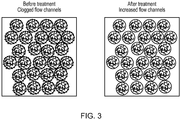
- the present inventors have found that dextran that is attached on the outer surface of the beads has no or negligible/ limited impact on selectivity but it has a negative impact on the flow properties of the resin, i.e. the flow of liquid between the chromatography beads in a packed column, as illustrated in Fig 3 .
- the degree of how much dextran that will be degraded can be controlled by the size of the support particle and its ability to enter the pores of the dextran containing chromatography bead.
- dextranase- treatment the amount of dextran inside as well as outside the pores may be altered by using a smaller support particle than the pores of the chromatography resin.
- various types of chromatography media can be designed for a variety of applications and selectivities, for example intended for target molecules of different size.
- Fig 1 and 2 it can be seen how the dextranase coupled to a support particle, larger than the pores of the dextran containing chromatography resin, degrades only the dextran on the surface of the chromatography resin. This treatment results in cleared flow channels between the particles.
- Fig 3 it can be seen how the dextranase treatment opens up the flow channels between the resins in a schematic packed chromatography column enabling better pressure and flow properties.
- dextran coupled media such as Superdex 200 Increase (GE Healthcare Bio-Sciences AB)
- dextranase treatment according to the invention can remove dextran on the surface of the chromatography beads as well as inside the pores of the beads.
- the method of the invention is a great improvement compared to using decantation to achieve better flow properties without impairing the resolution.
- Tris buffer - 50 mM Tris, 1 M NaCl, pH 8.0 Acetate buffer - 50 mM Acetate pH 5.0 Coupling buffer - 0,48M NaHCO 3 . 1,5M NaCl, pH 8,3 2% Dextran AB solution pH 5: 2g Dextran AB was dissolved in 100ml Acetate buffer pH 5 (see above).
- Dextranase is coupled to NHS activated magnetic beads according to the below reactions.
- Dextranase 400mg was added to 7ml coupling buffer in a 15ml Falcon tube. The dextranase were left to dissolve for 30 minutes on a shaking table.
- Tube 1 and 2 were left on a shaking table in RT for approximately 22 hours, while Tube 3 were left on a shaking table at RT for about 4 hours. Tube 4 were kept in a fridge.
- the pH in the flasks were measured to 5.4.
- the flasks were then mounted on a stirrer which were tilted and stirring was begun. An homogenous slurry were formed after a few minutes.
- Flask 7 9g Superdex 75 increase prototype A17-5S + 10mg Dextranase + 5ml Acetate buffer pH 5
- Flask 8 40 g Superdex 75 increase prototype A17-5S + 5g Dextranase- Mag sepharose (from example 1) + 25 ml Acetate buffer pH 5 were put in a 100ml duran flask and rotation stirring was begun (same as for flask 5&6).
- LO and HI indicates that the result is outside of the expected measurement area (higher or lower) for blood sugar measurements. It can be seen that the dextran and the resins in itself does not give a positive result in the analysis (see tube 1 & 4 and flask 5) but that the digested dextran (tube 2 & 3) gives a high glucose content.
- the results from flasks 6 and 8 shows that the dextranase coupled to the resins degrades dextran on the Superdex 75 Increase prototype producing glucose in the supernatant. The degradation however occurs to a lesser degree compared to the free dextranase used in flask 7 which also can enter the pores of the Superdex 75 Increase prototype. After the study the gel were subjected to column packing and gel filtration analysis. The pressure flow properties are shown in Fig 4 .
- a Superdex 75 Increase prototype has been used.
- the properties of this prototype is that it is an highly cross-linked agarose bead with a bead size of about 8-9 ⁇ m and a dextran content of approximately 20-30 mg/ml.
Landscapes
- Chemical & Material Sciences (AREA)
- Analytical Chemistry (AREA)
- Organic Chemistry (AREA)
- Chemical Kinetics & Catalysis (AREA)
- Physics & Mathematics (AREA)
- Thermal Sciences (AREA)
- Engineering & Computer Science (AREA)
- Nanotechnology (AREA)
- Enzymes And Modification Thereof (AREA)
- Treatment Of Liquids With Adsorbents In General (AREA)
- Life Sciences & Earth Sciences (AREA)
- Hydrology & Water Resources (AREA)
- Environmental & Geological Engineering (AREA)
- Water Supply & Treatment (AREA)
Description
- The present invention relates to a method to improve chromatography beads. More closely, the invention relates to a novel method for production of dextran-containing porous chromatography media.
- In the method, the chromatography media is subjected to dextranase-treatment leading to improved pressure-flow properties of the media.
- Within biotechnology, one of the most widely used separation methods is chromatography. The term chromatography embraces a family of closely related separation methods. The feature distinguishing chromatography from most other physical and chemical methods of separation is that two mutually immiscible phases are brought into contact wherein one phase is stationary and the other mobile. The sample mixture, introduced into the mobile phase, undergoes a series of interactions i.e. partitions between the stationary and mobile phases as it is being carried through the system by the mobile phase. Interactions exploit differences in the physical or chemical properties of the components in the sample. These differences govern the rate of migration of the individual components under the influence of a mobile phase moving through a column containing the stationary phase. Separated components emerge in a certain order, depending on their interaction with the stationary phase. The least retarded component elutes first, the most strongly retained material elutes last. Separation is obtained when one component is retarded sufficiently to prevent overlap with the zone of an adjacent solute as sample components elute from the column.
- One of the most common types of chromatography is size exclusion chromatography (SEC). Prepacked SEC columns are commonly used in the protein preparation and purification area. For many chromatography products there is however still a wish to improve the flow properties with maintained resolution. For SEC separations there is also the issue about these separations being generally rather slow in comparison to other liquid chromatography techniques like ion exchange or affinity chromatography
-
WO 95/34674 A1 - The aim of the present invention was to provide a method for production of a chromatography media providing a media with altered properties compared to prior art.
- The invention provides a method to produce a chromatography medium according to claim 1.
- According to the invention, the dextranase is coupled to a support particle. In one embodiment the support particle is larger than the pores of the chromatography media to be treated. In this case the dextranase cannot enter the pores and only dextran on the outside of the bead will be treated/removed.
- The support particle may be a natural or synthetic chromatography bead or PEG (poly ethylene glycol) or any other molecule or particle of suitable size.
- According to the invention, the support particle is magnetic, preferably magnetic chromatography beads.. In another embodiment of the invention the dextranase-coupled support particle may enter the pores of the chromatography medium. In this case, not only the dextran on the surface but also the dextran inside the pores of the beads will be treated with the dextranase.
- The chromatography medium is preferably made of natural or synthetic resins. Some non-limiting examples are cellulose, agarose, chitosan, silica (porous glass), alumina, polystyrene, polyacrylates: i.e polymethacrylate, polyvinyleters, polyacrylamides, polyetyleneglygols, polyolefins: i.e polyethylenes, polypropylenes, polyesters: i.e polyglycol, polylactides.
- In a preferred embodiment the chromatography medium is made of agarose, preferably the agarose is cross-linked.
- In a further embodiment the dextran coupled to the chromatography medium is provided with a ligand, such as an ion exchange, affinity, hydrophobic interaction or multimodal ligand. In this embodiment the dextran coupled ligands on the surface of the beads will be removed by the dextranase treatment but ligands attached to dextran inside the pores will remain intact if the support particle is large enough to not enter the pores. In this way a chromatography medium can be produced having an outer inactive surface and an inner core provided with active ligands.
- In a second unclaimed aspect, the disclosure relates to a chromatography medium produced according to the above method. In a preferred embodiment the beads are made of cross-linked agarose and the dextran is not provided with any ligands. This is described in the examples and will provide a novel SEC media with improved flow properties.
-
-
Fig 1 is a schematic view of treatment of dextran-containing chromatography beads with PEG-ylated dextranase; -
Fig 2 shows the chromatography beads before, during and after dextranase treatment; -
Fig 3 is a schematic view of a packed column with beads before treatment (untreated beads) and - after treatment; and
-
Fig 4 is a diagram showing the pressure-flow properties of untreated vs. dextranse-treated chromatography medium. - The present disclosure relates to porous chromatography beads provided with dextran inside the pores. Dextran is attached inside the pores of the beads during manufacture and defines the selectivity of the chromatography resin, and is thus required for obtaining the desired function of the chromatography resin. Dextran is covalently attached to cross-linked agarose, preferably highly cross-linked agarose. However, the present inventors have found that these types chromatography beads have a limitation in flow rate and discovered that this is due to the presence of dextran chains on the outer surface of these types of beads.
- In one embodiment the present invention relates to a method for removing outer surface bound dextran, while not affecting dextran that is attached inside the bead's pores, as illustrated in
Fig 1 . In this embodiment of the invention the chromatography beads are treated with dextranase coupled to a support particle being larger than the pores of the chromatography media to be treated, as illustrated inFig 2 . - The treatment with particle bound dextranase as in this embodiment of the invention will only degrade dextran bound to the outer surface of the beads, but leave intact the dextran chains attached inside the pores. The result is a chromatography resin with improved flow properties and maintained selectivity. The present inventors have found that dextran that is attached on the outer surface of the beads has no or negligible/ limited impact on selectivity but it has a negative impact on the flow properties of the resin, i.e. the flow of liquid between the chromatography beads in a packed column, as illustrated in
Fig 3 . - The degree of how much dextran that will be degraded can be controlled by the size of the support particle and its ability to enter the pores of the dextran containing chromatography bead. By dextranase- treatment the amount of dextran inside as well as outside the pores may be altered by using a smaller support particle than the pores of the chromatography resin. By controlling the size of the support particle and the pore size of the chromatography resin, various types of chromatography media can be designed for a variety of applications and selectivities, for example intended for target molecules of different size.
- In
Fig 1 and 2 it can be seen how the dextranase coupled to a support particle, larger than the pores of the dextran containing chromatography resin, degrades only the dextran on the surface of the chromatography resin. This treatment results in cleared flow channels between the particles. - In
Fig 3 it can be seen how the dextranase treatment opens up the flow channels between the resins in a schematic packed chromatography column enabling better pressure and flow properties. - The inventors have found that dextran coupled media, such as Superdex 200 Increase (GE Healthcare Bio-Sciences AB), can be treated with dextranase to increase the flow properties without loosing the resolution. Dextranase treatment according to the invention can remove dextran on the surface of the chromatography beads as well as inside the pores of the beads. The method of the invention is a great improvement compared to using decantation to achieve better flow properties without impairing the resolution.
-
Name Comment Dextranase from Penicillum sp. From Sigma Aldrich, Mw approximately 64kDa NHS Mag Sepharose GE Healthcare Bio-Sciences AB, 10.1 mmol NHS/ml gel TRIS Sodium chloride (NaCl) Acetic acid Sodium hydrogen carbonate (NaHCO3) Dextran AB GE Healthcare Biosciences AB Superdex 75 Increase Prototype A17-5S - Tris buffer - 50 mM Tris, 1 M NaCl, pH = 8.0
Acetate buffer - 50 mM Acetate pH 5.0
Coupling buffer - 0,48M NaHCO3. 1,5M NaCl, pH 8,3
2% Dextran AB solution pH 5: 2g Dextran AB was dissolved in 100ml Acetate buffer pH 5 (see above). - Dextranase is coupled to NHS activated magnetic beads according to the below reactions.

- Dextranase (400mg) was added to 7ml coupling buffer in a 15ml Falcon tube. The dextranase were left to dissolve for 30 minutes on a shaking table.
- Approximately 20ml NHS Mag Sepharose (10,1 µmol NHS/ml) was washed with ice cold 1mM HCl on a p4 glass filter (5x40ml). The gel was then drained on the filter and 17g was weighed into a 100ml DURAN flask along with 5ml 1mM HCl. The dextranase solution from above was added to the NHS Mag Sepharose gel and stirring was started. The slurry were then left stirring at RT for 2 hours. The NHS Mag Sepharose gel were then washed on a glass filter (p4) with Tris buffer pH 8 1GV (1
gel volume 0 20 ml) x3, Acetate buffer pH 5 1GVx3 and then again with Tris buffer 1GVx3. - 40 ml Tris buffer was then added to the gel on the filter and then left on the filter for 60 minutes (removal of remaining NHS groups).
- The gel was finally washed with water 1GVx5.
- The following tubes were prepared:
- Tube 1 (reference): 2g of non-coupled NHS Mag Sepharose media + 5ml 2% Dextran AB pH 5 solution
- Tube 2: 3g of dextranase coupled to Mag Sepharose media from example 1 + 5ml 2% Dextran AB pH 5 solution
- Tube 3: 46mg of dextranase + 5ml 2% Dextran AB pH 5 solution
- Tube 4: 2% Dextran AB pH 5 solution
- Tube 1 and 2 were left on a shaking table in RT for approximately 22 hours, while Tube 3 were left on a shaking table at RT for about 4 hours. Tube 4 were kept in a fridge.
- The supernatants from the tubes were analysed for glucose content to determine if any degradation of dextran had occurred, see Example 5.
- Approximately 100ml of a Superdex 75 increase prototype called A17-5S was washed with water on a glass filter (5x200ml). 40g of drained gel was then weighed into two duran flasks (100ml) with lids that could be mounted on an overhead stirrer. And magnetic beads added according to below:
- Flask 5 (ref): 40 g Superdex 75 increase prototype + 5g NHS-Mag sepharose (washed in water) + 25 ml Acetate buffer pH 5
- Flask 6: 40 g Superdex 75 increase prototype + 5g Dextranase- Mag sepharose (from example 1) + 25 ml Acetate buffer pH 5
- The pH in the flasks were measured to 5.4. The flasks were then mounted on a stirrer which were tilted and stirring was begun. An homogenous slurry were formed after a few minutes.
- Samples removed from supernatants after different time intervals, for glucose content analyses see table in example 5).
- An additional reference flask with gel and dextranase was also prepared to see how fast the free dextranase would degrade the dextran on the beads.
- Flask 7: 9g Superdex 75 increase prototype A17-5S + 10mg Dextranase + 5ml Acetate buffer pH 5
- Flask 8 : 40 g Superdex 75 increase prototype A17-5S + 5g Dextranase- Mag sepharose (from example 1) + 25 ml Acetate buffer pH 5 were put in a 100ml duran flask and rotation stirring was begun (same as for flask 5&6).
- Samples were removed from supernatants after different time intervals for glucose content analyses, see example 5.
- Analysis of dextran content was made with the Accu-Chek system from Roche (ordinarily used for Diabetes blood sugar measurements).
- A drop of each sample were placed on the test strip and the glucose content was measured by the instrument:
Table 1 Measurements of glucose content Sample Time (h) Result Comment Tube 1 24 LO No glucose should be present which the results indicates Tube 2 24 Hi Digested dextran solution, High value expected Tube 3 24 Hi Digested dextran solution, High value expected Tube 4 24 LO No glucose should be present which the result indicates Flask 5 24 LO Ref, No glucose should be present which the result indicates Flask 6 24 1.7mmol/L Sample after 24 hours, Lower value than for tube 2 which was expected. Flask 6 96 7.9 mmol/L Increased value after the weekend Flask 6 120 11.9 mmol/L Study stopped Flask 7 24 Hi Diluted 1 time with water gave 16.2mmol/L and further dilution 1 time gave a value of 7.8mmol/L Flask 8 48 1.0 mmol/L left for stirring for an additional 24 hours Flask 8 72 1.4 mmol/L Experiment stopped and evaluated. - LO and HI indicates that the result is outside of the expected measurement area (higher or lower) for blood sugar measurements. It can be seen that the dextran and the resins in itself does not give a positive result in the analysis (see tube 1 & 4 and flask 5) but that the digested dextran (tube 2 & 3) gives a high glucose content. The results from flasks 6 and 8 shows that the dextranase coupled to the resins degrades dextran on the Superdex 75 Increase prototype producing glucose in the supernatant. The degradation however occurs to a lesser degree compared to the free dextranase used in flask 7 which also can enter the pores of the Superdex 75 Increase prototype. After the study the gel were subjected to column packing and gel filtration analysis. The pressure flow properties are shown in
Fig 4 . - Pressure flow analyses (
Fig 4 ) shows that the dextranase treatment improves the properties of the resins (dextranase treated protoype from flask 8 compared to untreated reference resins), giving a lower pressure increase when increasing the flow and a higher collapse flow. The results are also shown numerically in Table 2.Table 2 Results from pressure flow analyses Prototype 0,5 ml/min (Mpα) Max flow stabil column (ml/min) Max flow stabil column (Mpa) Collapsflow (ml/min) Comment Superdex 75 Increase 1.05 2.2 4.4 3.0 Reference resin Superdex 75 Increase dextranase treated 0.94 2.7 4.7 3.5 Prototype resin from flask 8 in Example 4) - In the Examples, a Superdex 75 Increase prototype has been used. The properties of this prototype is that it is an highly cross-linked agarose bead with a bead size of about 8-9 µm and a dextran content of approximately 20-30 mg/ml.
- Any other bead containing dextran or modified dextran could also be treated according to the invention.
Claims (8)
- Method to produce a chromatography medium, starting with a chromatography medium comprising porous beads coupled with dextran inside the pores and on the bead surface, comprising a step of subjecting the chromatography medium to dextranase treatment, wherein the dextranase is coupled to a support particle, and wherein the support particle is magnetic.
- Method according to claim 1, wherein the dextranase-coupled support particle is larger than the pores of the chromatography media to be treated.
- Method according to claim 1, wherein the dextranase-coupled support particle comprises natural or synthetic chromatography beads or PEG (poly ethylene glycol).
- Method according to one or more of the above claims, wherein the dextranase-coupled support particle may enter the pores of the chromatography medium.
- Method according to one or more of the above claims, wherein the chromatography medium is made of natural or synthetic resins.
- Method according to claim 5, wherein the chromatography medium is made of agarose.
- Method according to claim 6, wherein the agarose is cross-linked.
- Method according to one or more of the above claims, wherein the dextran coupled to the chromatography medium is provided with an ion exchange, affinity, hydrophobic interaction or multimodal ligand.
Applications Claiming Priority (2)
| Application Number | Priority Date | Filing Date | Title |
|---|---|---|---|
| GBGB1519668.6A GB201519668D0 (en) | 2015-11-06 | 2015-11-06 | Method and chromatography media |
| PCT/EP2016/076019 WO2017076759A1 (en) | 2015-11-06 | 2016-10-28 | Method for producing a chromatography medium and chromatography medium |
Publications (2)
| Publication Number | Publication Date |
|---|---|
| EP3370863A1 EP3370863A1 (en) | 2018-09-12 |
| EP3370863B1 true EP3370863B1 (en) | 2021-03-17 |
Family
ID=55132443
Family Applications (1)
| Application Number | Title | Priority Date | Filing Date |
|---|---|---|---|
| EP16794234.1A Active EP3370863B1 (en) | 2015-11-06 | 2016-10-28 | Method for producing a chromatography medium |
Country Status (5)
| Country | Link |
|---|---|
| US (1) | US11014069B2 (en) |
| EP (1) | EP3370863B1 (en) |
| CN (1) | CN108348892B (en) |
| GB (1) | GB201519668D0 (en) |
| WO (1) | WO2017076759A1 (en) |
Family Cites Families (6)
| Publication number | Priority date | Publication date | Assignee | Title |
|---|---|---|---|---|
| US4217415A (en) * | 1978-03-14 | 1980-08-12 | Technicon Instruments Corporation | Immobilization of an enzyme substrate |
| CA2192586A1 (en) * | 1994-06-15 | 1995-12-21 | Michael R. Ladisch | Novel method for derivatization of cellulosic stationary phases |
| US6241894B1 (en) * | 1997-10-10 | 2001-06-05 | Systemix | High gradient magnetic device and method for cell separation or purification |
| US6509184B1 (en) | 1999-08-24 | 2003-01-21 | Midwest Research Institute | Alkaline tolerant dextranase from streptomyces anulatus |
| WO2007050017A1 (en) * | 2005-10-28 | 2007-05-03 | Ge Healthcare Bio-Sciences Ab | Separation medium with various functionalities |
| US20120156779A1 (en) * | 2009-08-27 | 2012-06-21 | Ge Healthcare Bio-Sciences Ab | Method for cell expansion |
-
2015
- 2015-11-06 GB GBGB1519668.6A patent/GB201519668D0/en not_active Ceased
-
2016
- 2016-10-28 CN CN201680064776.7A patent/CN108348892B/en active Active
- 2016-10-28 EP EP16794234.1A patent/EP3370863B1/en active Active
- 2016-10-28 WO PCT/EP2016/076019 patent/WO2017076759A1/en not_active Ceased
- 2016-10-28 US US15/769,400 patent/US11014069B2/en active Active
Non-Patent Citations (1)
| Title |
|---|
| None * |
Also Published As
| Publication number | Publication date |
|---|---|
| WO2017076759A1 (en) | 2017-05-11 |
| GB201519668D0 (en) | 2015-12-23 |
| CN108348892B (en) | 2022-01-04 |
| US11014069B2 (en) | 2021-05-25 |
| CN108348892A (en) | 2018-07-31 |
| US20180304231A1 (en) | 2018-10-25 |
| EP3370863A1 (en) | 2018-09-12 |
Similar Documents
| Publication | Publication Date | Title |
|---|---|---|
| EP0631597B1 (en) | Super porous polysaccharide gels | |
| EP3050902B1 (en) | Process for producing porous cellulose beads using alkali aqueous solution, and porous cellulose beads produced by this process | |
| EP1885488B1 (en) | Regeneration of a chromatography matrix | |
| Clausen et al. | Chromatographic characterization of phosphonate analog EDTA-modified zirconia support for biochromatographic applications | |
| Mansour et al. | Applications of poly (ethylene) glycol (PEG) in separation science | |
| JP7497891B2 (en) | Large pore agarose | |
| WO2018023005A1 (en) | Encapsulated pre-analytic workflows for flow-through devices, liquid chromatography and mass spectrometric analysis | |
| EP3276002A1 (en) | Immunoglobulin-binding protein and affinity carrier using same | |
| EP3347125B1 (en) | Adsorption medium, method for production thereof, and use thereof for purification of biomolecules | |
| EP4537933A1 (en) | Chromatography medium and chromatography device | |
| Isaksson et al. | Triacetylcellulose as a chiral stationary phase for high-performance liquid chromatography | |
| US20090008329A1 (en) | Separating agent for enantiomeric isomers | |
| US11014069B2 (en) | Method and chromatography medium | |
| CN101111765B (en) | Separating agent for optical isomer and separation column for optical isomers | |
| KR20040097129A (en) | Optical isomer separation packing for simulated moving bed chromatography | |
| KR100843406B1 (en) | Optical isomer separating filler, production method therefor and application method therefor | |
| JP2005017268A (en) | Separation agent for optical isomers, method for producing the same, and separation column for optical isomers | |
| EP2748181B1 (en) | Method for purification of cleaved pro-insulin | |
| EP3059251B1 (en) | Method for manufacturing porous cellulose beads | |
| EP4397386A1 (en) | Microfluidic device and method for manufacturing same | |
| JP5499270B2 (en) | Method for producing porous membrane having affinity function and method for separating and purifying protein | |
| WO2011002796A1 (en) | Monitoring a preparative chromatography column from the exterior during formation of the packed bed | |
| RU2352387C1 (en) | Nanodiamond sorbent and method of its obtaining | |
| JPWO2005075974A1 (en) | Method for separating optical isomers by supercritical fluid chromatography | |
| EP1405668B1 (en) | Novel separation agent for separating optical isomer and method for preparation thereof |
Legal Events
| Date | Code | Title | Description |
|---|---|---|---|
| STAA | Information on the status of an ep patent application or granted ep patent |
Free format text: STATUS: UNKNOWN |
|
| STAA | Information on the status of an ep patent application or granted ep patent |
Free format text: STATUS: THE INTERNATIONAL PUBLICATION HAS BEEN MADE |
|
| PUAI | Public reference made under article 153(3) epc to a published international application that has entered the european phase |
Free format text: ORIGINAL CODE: 0009012 |
|
| STAA | Information on the status of an ep patent application or granted ep patent |
Free format text: STATUS: REQUEST FOR EXAMINATION WAS MADE |
|
| 17P | Request for examination filed |
Effective date: 20180420 |
|
| AK | Designated contracting states |
Kind code of ref document: A1 Designated state(s): AL AT BE BG CH CY CZ DE DK EE ES FI FR GB GR HR HU IE IS IT LI LT LU LV MC MK MT NL NO PL PT RO RS SE SI SK SM TR |
|
| AX | Request for extension of the european patent |
Extension state: BA ME |
|
| DAV | Request for validation of the european patent (deleted) | ||
| DAX | Request for extension of the european patent (deleted) | ||
| STAA | Information on the status of an ep patent application or granted ep patent |
Free format text: STATUS: EXAMINATION IS IN PROGRESS |
|
| 17Q | First examination report despatched |
Effective date: 20190306 |
|
| RAP1 | Party data changed (applicant data changed or rights of an application transferred) |
Owner name: CYTIVA BIOPROCESS R&D AB |
|
| GRAP | Despatch of communication of intention to grant a patent |
Free format text: ORIGINAL CODE: EPIDOSNIGR1 |
|
| STAA | Information on the status of an ep patent application or granted ep patent |
Free format text: STATUS: GRANT OF PATENT IS INTENDED |
|
| INTG | Intention to grant announced |
Effective date: 20201009 |
|
| GRAS | Grant fee paid |
Free format text: ORIGINAL CODE: EPIDOSNIGR3 |
|
| GRAA | (expected) grant |
Free format text: ORIGINAL CODE: 0009210 |
|
| STAA | Information on the status of an ep patent application or granted ep patent |
Free format text: STATUS: THE PATENT HAS BEEN GRANTED |
|
| AK | Designated contracting states |
Kind code of ref document: B1 Designated state(s): AL AT BE BG CH CY CZ DE DK EE ES FI FR GB GR HR HU IE IS IT LI LT LU LV MC MK MT NL NO PL PT RO RS SE SI SK SM TR |
|
| REG | Reference to a national code |
Ref country code: GB Ref legal event code: FG4D |
|
| REG | Reference to a national code |
Ref country code: CH Ref legal event code: EP |
|
| REG | Reference to a national code |
Ref country code: DE Ref legal event code: R096 Ref document number: 602016054501 Country of ref document: DE |
|
| REG | Reference to a national code |
Ref country code: IE Ref legal event code: FG4D |
|
| REG | Reference to a national code |
Ref country code: AT Ref legal event code: REF Ref document number: 1371735 Country of ref document: AT Kind code of ref document: T Effective date: 20210415 |
|
| REG | Reference to a national code |
Ref country code: LT Ref legal event code: MG9D |
|
| PG25 | Lapsed in a contracting state [announced via postgrant information from national office to epo] |
Ref country code: NO Free format text: LAPSE BECAUSE OF FAILURE TO SUBMIT A TRANSLATION OF THE DESCRIPTION OR TO PAY THE FEE WITHIN THE PRESCRIBED TIME-LIMIT Effective date: 20210617 Ref country code: HR Free format text: LAPSE BECAUSE OF FAILURE TO SUBMIT A TRANSLATION OF THE DESCRIPTION OR TO PAY THE FEE WITHIN THE PRESCRIBED TIME-LIMIT Effective date: 20210317 Ref country code: FI Free format text: LAPSE BECAUSE OF FAILURE TO SUBMIT A TRANSLATION OF THE DESCRIPTION OR TO PAY THE FEE WITHIN THE PRESCRIBED TIME-LIMIT Effective date: 20210317 Ref country code: GR Free format text: LAPSE BECAUSE OF FAILURE TO SUBMIT A TRANSLATION OF THE DESCRIPTION OR TO PAY THE FEE WITHIN THE PRESCRIBED TIME-LIMIT Effective date: 20210618 Ref country code: BG Free format text: LAPSE BECAUSE OF FAILURE TO SUBMIT A TRANSLATION OF THE DESCRIPTION OR TO PAY THE FEE WITHIN THE PRESCRIBED TIME-LIMIT Effective date: 20210617 |
|
| REG | Reference to a national code |
Ref country code: AT Ref legal event code: MK05 Ref document number: 1371735 Country of ref document: AT Kind code of ref document: T Effective date: 20210317 |
|
| REG | Reference to a national code |
Ref country code: NL Ref legal event code: MP Effective date: 20210317 |
|
| PG25 | Lapsed in a contracting state [announced via postgrant information from national office to epo] |
Ref country code: LV Free format text: LAPSE BECAUSE OF FAILURE TO SUBMIT A TRANSLATION OF THE DESCRIPTION OR TO PAY THE FEE WITHIN THE PRESCRIBED TIME-LIMIT Effective date: 20210317 Ref country code: RS Free format text: LAPSE BECAUSE OF FAILURE TO SUBMIT A TRANSLATION OF THE DESCRIPTION OR TO PAY THE FEE WITHIN THE PRESCRIBED TIME-LIMIT Effective date: 20210317 Ref country code: SE Free format text: LAPSE BECAUSE OF FAILURE TO SUBMIT A TRANSLATION OF THE DESCRIPTION OR TO PAY THE FEE WITHIN THE PRESCRIBED TIME-LIMIT Effective date: 20210317 |
|
| PG25 | Lapsed in a contracting state [announced via postgrant information from national office to epo] |
Ref country code: NL Free format text: LAPSE BECAUSE OF FAILURE TO SUBMIT A TRANSLATION OF THE DESCRIPTION OR TO PAY THE FEE WITHIN THE PRESCRIBED TIME-LIMIT Effective date: 20210317 |
|
| PG25 | Lapsed in a contracting state [announced via postgrant information from national office to epo] |
Ref country code: AT Free format text: LAPSE BECAUSE OF FAILURE TO SUBMIT A TRANSLATION OF THE DESCRIPTION OR TO PAY THE FEE WITHIN THE PRESCRIBED TIME-LIMIT Effective date: 20210317 Ref country code: SM Free format text: LAPSE BECAUSE OF FAILURE TO SUBMIT A TRANSLATION OF THE DESCRIPTION OR TO PAY THE FEE WITHIN THE PRESCRIBED TIME-LIMIT Effective date: 20210317 Ref country code: EE Free format text: LAPSE BECAUSE OF FAILURE TO SUBMIT A TRANSLATION OF THE DESCRIPTION OR TO PAY THE FEE WITHIN THE PRESCRIBED TIME-LIMIT Effective date: 20210317 Ref country code: CZ Free format text: LAPSE BECAUSE OF FAILURE TO SUBMIT A TRANSLATION OF THE DESCRIPTION OR TO PAY THE FEE WITHIN THE PRESCRIBED TIME-LIMIT Effective date: 20210317 Ref country code: LT Free format text: LAPSE BECAUSE OF FAILURE TO SUBMIT A TRANSLATION OF THE DESCRIPTION OR TO PAY THE FEE WITHIN THE PRESCRIBED TIME-LIMIT Effective date: 20210317 |
|
| PG25 | Lapsed in a contracting state [announced via postgrant information from national office to epo] |
Ref country code: PT Free format text: LAPSE BECAUSE OF FAILURE TO SUBMIT A TRANSLATION OF THE DESCRIPTION OR TO PAY THE FEE WITHIN THE PRESCRIBED TIME-LIMIT Effective date: 20210719 Ref country code: PL Free format text: LAPSE BECAUSE OF FAILURE TO SUBMIT A TRANSLATION OF THE DESCRIPTION OR TO PAY THE FEE WITHIN THE PRESCRIBED TIME-LIMIT Effective date: 20210317 Ref country code: RO Free format text: LAPSE BECAUSE OF FAILURE TO SUBMIT A TRANSLATION OF THE DESCRIPTION OR TO PAY THE FEE WITHIN THE PRESCRIBED TIME-LIMIT Effective date: 20210317 Ref country code: SK Free format text: LAPSE BECAUSE OF FAILURE TO SUBMIT A TRANSLATION OF THE DESCRIPTION OR TO PAY THE FEE WITHIN THE PRESCRIBED TIME-LIMIT Effective date: 20210317 Ref country code: IS Free format text: LAPSE BECAUSE OF FAILURE TO SUBMIT A TRANSLATION OF THE DESCRIPTION OR TO PAY THE FEE WITHIN THE PRESCRIBED TIME-LIMIT Effective date: 20210717 |
|
| REG | Reference to a national code |
Ref country code: DE Ref legal event code: R097 Ref document number: 602016054501 Country of ref document: DE |
|
| PLBE | No opposition filed within time limit |
Free format text: ORIGINAL CODE: 0009261 |
|
| STAA | Information on the status of an ep patent application or granted ep patent |
Free format text: STATUS: NO OPPOSITION FILED WITHIN TIME LIMIT |
|
| PG25 | Lapsed in a contracting state [announced via postgrant information from national office to epo] |
Ref country code: DK Free format text: LAPSE BECAUSE OF FAILURE TO SUBMIT A TRANSLATION OF THE DESCRIPTION OR TO PAY THE FEE WITHIN THE PRESCRIBED TIME-LIMIT Effective date: 20210317 Ref country code: AL Free format text: LAPSE BECAUSE OF FAILURE TO SUBMIT A TRANSLATION OF THE DESCRIPTION OR TO PAY THE FEE WITHIN THE PRESCRIBED TIME-LIMIT Effective date: 20210317 Ref country code: ES Free format text: LAPSE BECAUSE OF FAILURE TO SUBMIT A TRANSLATION OF THE DESCRIPTION OR TO PAY THE FEE WITHIN THE PRESCRIBED TIME-LIMIT Effective date: 20210317 |
|
| 26N | No opposition filed |
Effective date: 20211220 |
|
| PG25 | Lapsed in a contracting state [announced via postgrant information from national office to epo] |
Ref country code: SI Free format text: LAPSE BECAUSE OF FAILURE TO SUBMIT A TRANSLATION OF THE DESCRIPTION OR TO PAY THE FEE WITHIN THE PRESCRIBED TIME-LIMIT Effective date: 20210317 |
|
| PG25 | Lapsed in a contracting state [announced via postgrant information from national office to epo] |
Ref country code: IT Free format text: LAPSE BECAUSE OF FAILURE TO SUBMIT A TRANSLATION OF THE DESCRIPTION OR TO PAY THE FEE WITHIN THE PRESCRIBED TIME-LIMIT Effective date: 20210317 |
|
| REG | Reference to a national code |
Ref country code: CH Ref legal event code: PL |
|
| PG25 | Lapsed in a contracting state [announced via postgrant information from national office to epo] |
Ref country code: IS Free format text: LAPSE BECAUSE OF FAILURE TO SUBMIT A TRANSLATION OF THE DESCRIPTION OR TO PAY THE FEE WITHIN THE PRESCRIBED TIME-LIMIT Effective date: 20210717 |
|
| REG | Reference to a national code |
Ref country code: BE Ref legal event code: MM Effective date: 20211031 |
|
| PG25 | Lapsed in a contracting state [announced via postgrant information from national office to epo] |
Ref country code: MC Free format text: LAPSE BECAUSE OF FAILURE TO SUBMIT A TRANSLATION OF THE DESCRIPTION OR TO PAY THE FEE WITHIN THE PRESCRIBED TIME-LIMIT Effective date: 20210317 |
|
| PG25 | Lapsed in a contracting state [announced via postgrant information from national office to epo] |
Ref country code: LU Free format text: LAPSE BECAUSE OF NON-PAYMENT OF DUE FEES Effective date: 20211028 Ref country code: BE Free format text: LAPSE BECAUSE OF NON-PAYMENT OF DUE FEES Effective date: 20211031 |
|
| PG25 | Lapsed in a contracting state [announced via postgrant information from national office to epo] |
Ref country code: LI Free format text: LAPSE BECAUSE OF NON-PAYMENT OF DUE FEES Effective date: 20211031 Ref country code: CH Free format text: LAPSE BECAUSE OF NON-PAYMENT OF DUE FEES Effective date: 20211031 |
|
| PG25 | Lapsed in a contracting state [announced via postgrant information from national office to epo] |
Ref country code: IE Free format text: LAPSE BECAUSE OF NON-PAYMENT OF DUE FEES Effective date: 20211028 |
|
| PG25 | Lapsed in a contracting state [announced via postgrant information from national office to epo] |
Ref country code: HU Free format text: LAPSE BECAUSE OF FAILURE TO SUBMIT A TRANSLATION OF THE DESCRIPTION OR TO PAY THE FEE WITHIN THE PRESCRIBED TIME-LIMIT; INVALID AB INITIO Effective date: 20161028 |
|
| PG25 | Lapsed in a contracting state [announced via postgrant information from national office to epo] |
Ref country code: CY Free format text: LAPSE BECAUSE OF FAILURE TO SUBMIT A TRANSLATION OF THE DESCRIPTION OR TO PAY THE FEE WITHIN THE PRESCRIBED TIME-LIMIT Effective date: 20210317 |
|
| P01 | Opt-out of the competence of the unified patent court (upc) registered |
Effective date: 20230526 |
|
| PG25 | Lapsed in a contracting state [announced via postgrant information from national office to epo] |
Ref country code: MK Free format text: LAPSE BECAUSE OF FAILURE TO SUBMIT A TRANSLATION OF THE DESCRIPTION OR TO PAY THE FEE WITHIN THE PRESCRIBED TIME-LIMIT Effective date: 20210317 |
|
| PG25 | Lapsed in a contracting state [announced via postgrant information from national office to epo] |
Ref country code: MT Free format text: LAPSE BECAUSE OF FAILURE TO SUBMIT A TRANSLATION OF THE DESCRIPTION OR TO PAY THE FEE WITHIN THE PRESCRIBED TIME-LIMIT Effective date: 20210317 |
|
| PG25 | Lapsed in a contracting state [announced via postgrant information from national office to epo] |
Ref country code: TR Free format text: LAPSE BECAUSE OF FAILURE TO SUBMIT A TRANSLATION OF THE DESCRIPTION OR TO PAY THE FEE WITHIN THE PRESCRIBED TIME-LIMIT Effective date: 20210317 |
|
| PGFP | Annual fee paid to national office [announced via postgrant information from national office to epo] |
Ref country code: DE Payment date: 20251028 Year of fee payment: 10 |
|
| PGFP | Annual fee paid to national office [announced via postgrant information from national office to epo] |
Ref country code: GB Payment date: 20251023 Year of fee payment: 10 |
|
| PGFP | Annual fee paid to national office [announced via postgrant information from national office to epo] |
Ref country code: FR Payment date: 20251027 Year of fee payment: 10 |