EP3370191A1 - Apparatus and method implementing an artificial neural network training algorithm using weight tying - Google Patents
Apparatus and method implementing an artificial neural network training algorithm using weight tying Download PDFInfo
- Publication number
- EP3370191A1 EP3370191A1 EP18159686.7A EP18159686A EP3370191A1 EP 3370191 A1 EP3370191 A1 EP 3370191A1 EP 18159686 A EP18159686 A EP 18159686A EP 3370191 A1 EP3370191 A1 EP 3370191A1
- Authority
- EP
- European Patent Office
- Prior art keywords
- neural network
- weight
- circuitry
- tying
- artificial neural
- Prior art date
- Legal status (The legal status is an assumption and is not a legal conclusion. Google has not performed a legal analysis and makes no representation as to the accuracy of the status listed.)
- Granted
Links
Images



Classifications
-
- G—PHYSICS
- G06—COMPUTING OR CALCULATING; COUNTING
- G06F—ELECTRIC DIGITAL DATA PROCESSING
- G06F17/00—Digital computing or data processing equipment or methods, specially adapted for specific functions
- G06F17/10—Complex mathematical operations
- G06F17/16—Matrix or vector computation, e.g. matrix-matrix or matrix-vector multiplication, matrix factorization
-
- G—PHYSICS
- G06—COMPUTING OR CALCULATING; COUNTING
- G06N—COMPUTING ARRANGEMENTS BASED ON SPECIFIC COMPUTATIONAL MODELS
- G06N3/00—Computing arrangements based on biological models
- G06N3/02—Neural networks
- G06N3/04—Architecture, e.g. interconnection topology
- G06N3/0464—Convolutional networks [CNN, ConvNet]
-
- G—PHYSICS
- G06—COMPUTING OR CALCULATING; COUNTING
- G06N—COMPUTING ARRANGEMENTS BASED ON SPECIFIC COMPUTATIONAL MODELS
- G06N3/00—Computing arrangements based on biological models
- G06N3/02—Neural networks
- G06N3/04—Architecture, e.g. interconnection topology
- G06N3/0495—Quantised networks; Sparse networks; Compressed networks
-
- G—PHYSICS
- G06—COMPUTING OR CALCULATING; COUNTING
- G06N—COMPUTING ARRANGEMENTS BASED ON SPECIFIC COMPUTATIONAL MODELS
- G06N3/00—Computing arrangements based on biological models
- G06N3/02—Neural networks
- G06N3/08—Learning methods
-
- G—PHYSICS
- G06—COMPUTING OR CALCULATING; COUNTING
- G06N—COMPUTING ARRANGEMENTS BASED ON SPECIFIC COMPUTATIONAL MODELS
- G06N3/00—Computing arrangements based on biological models
- G06N3/02—Neural networks
- G06N3/08—Learning methods
- G06N3/082—Learning methods modifying the architecture, e.g. adding, deleting or silencing nodes or connections
-
- G—PHYSICS
- G06—COMPUTING OR CALCULATING; COUNTING
- G06N—COMPUTING ARRANGEMENTS BASED ON SPECIFIC COMPUTATIONAL MODELS
- G06N3/00—Computing arrangements based on biological models
- G06N3/02—Neural networks
- G06N3/08—Learning methods
- G06N3/09—Supervised learning
-
- G—PHYSICS
- G06—COMPUTING OR CALCULATING; COUNTING
- G06N—COMPUTING ARRANGEMENTS BASED ON SPECIFIC COMPUTATIONAL MODELS
- G06N3/00—Computing arrangements based on biological models
- G06N3/02—Neural networks
- G06N3/04—Architecture, e.g. interconnection topology
- G06N3/045—Combinations of networks
-
- G—PHYSICS
- G06—COMPUTING OR CALCULATING; COUNTING
- G06N—COMPUTING ARRANGEMENTS BASED ON SPECIFIC COMPUTATIONAL MODELS
- G06N3/00—Computing arrangements based on biological models
- G06N3/02—Neural networks
- G06N3/06—Physical realisation, i.e. hardware implementation of neural networks, neurons or parts of neurons
- G06N3/063—Physical realisation, i.e. hardware implementation of neural networks, neurons or parts of neurons using electronic means
Definitions
- the present disclosure generally pertains to the field of machine learning, in particular to systems and methods that use artificial neural network learning algorithms to perform machine vision or machine control tasks.
- Machine learning is the subfield of computer science that gives computers the ability to learn certain aspects without being explicitly programmed.
- An artificial neural network (ANN) learning algorithm usually called “neural network”
- Neural network is a computer-implemented learning algorithm in which computations are structured in terms of an interconnected group of artificial neurons. Neural networks model complex relationships between inputs and outputs, to find patterns in data, or to capture the statistical structure in an unknown joint probability distribution between observed variables.
- DNN deep neural networks
- DNNs locally on devices presents a number of challenges, in particular the limited memory availability and the limited computation power of computer systems.
- implementing DNNs poses the challenges of reducing both their size and their computational complexity.
- the disclosure provides an apparatus comprising circuitry that implements an artificial neural network training algorithm that uses weight tying.
- the disclosure provides an apparatus comprising circuitry that implements an artificial neural network, the artificial neural network having been trained by a neural network training algorithm that uses weight tying.
- the disclosure provides a method of training an artificial neural network, the method comprising performing an artificial neural network training algorithm that uses weight tying.
- the disclosure provides an apparatus comprising a programming interface that is configured to receive weight-tying parameters for use in a neural network training or compression algorithm.
- the embodiments described below relate to an apparatus comprising circuitry that implements an artificial neural network training algorithm that uses weight tying.
- the artificial neural network may for example be a deep convolutional neural network.
- the training algorithm may for example be based on a stochastic gradient descent training algorithm.
- weight-tying also called weight-sharing
- units can share weights in the network or are working on similar types of data. Weight sharing is applied to increase learning efficiency as it may reduce the number of free parameters being learnt. Weight-tying thus is a technique which allows reducing the memory footprint of a neural network and possibly eliminating the need for multipliers.
- the training algorithm may for example be used to train an artificial neural network or to compress existing artificial neural networks before deploying them.
- the apparatus may be any device potentially performing recognition, classification or signal generation using an artificial neural network, such as a TV, a camera, a mobile phone, a game console, etc.
- the apparatus may also be any device that performs controlling functions based on input, such as a lane keeping assist system in semi-autonomous driving, or the like.
- the circuitry may be configured to update the weight tying using a predefined number of iterations of a clustering algorithm.
- a K-means clustering algorithm can be used.
- K-means clustering is a method of vector quantization, originally from signal processing.
- the K-means clustering can for example be done using the mean but also using median.
- alternative clustering algorithms can be used.
- the predefined number of K-means iterations used to update the weight tying may for example be one. That is, according to one embodiment, only one K-means iteration is performed. However, more iterations of K-means may be performed depending on the needs or design goals.
- the circuitry may be configured to compute a weight-tied weight matrix based on an index matrix and based on a value vector. Still further, the circuitry may be configured to update, in each iteration of K-means, the value vector and the index matrix based on a full-precision weight matrix.
- the circuitry is configured to quantize the values of the value vector.
- the circuitry may be configured to quantize the values of the value vector after updating the weight tying.
- the circuitry may be configured to quantize the values of the value vector to the nearest power-of-two.
- the value vector v may be fixed to specific values set by the user.
- the user may set predefined values for different value vector sizes.
- a value vector used with weight-sharing and quantization may comprise more than three values.
- the circuitry may be configured to update full precision weights based on gradients. These gradients may be based on a cost function and based on a weight-tied weight matrix.
- the circuitry may be configured to compute the cost function based on a loss function and based on a forward pass.
- the circuitry may be configured to compute the cost function also based on a backward pass function.
- the embodiments also disclose an apparatus comprising circuitry that implements an artificial neural network, the artificial neural network having been trained by a neural network training algorithm that uses weight tying.
- the circuitry may implement the artificial neural network in a multiplierless way.
- Such an apparatus may be any device potentially performing recognition, classification or signal generation using an artificial neural network, such as a TV, a camera, a mobile phone, a game console etc.
- the apparatus may also be any device that performs controlling functions based on input, such as a lane keeping assist system in semi-autonomous driving, or the like.
- the embodiments also disclose a method of training an artificial neural network, the method comprising performing an artificial neural network training algorithm that uses weight tying.
- the embodiments also disclose an apparatus comprising a programming interface that is configured to receive weight-tying parameters for use in a neural network training or compression algorithm.
- the programming interface may for example be configured to receive a number of quantization levels used for weight-tying, a parameter that indicates if the value vector is fix or updated, constraints to the value vectors, a parameter that indicates that the assignment matrix is fix or can be learnt (updated), an initial or fixed value vector; and/or an initial or fixed assignment matrix.
- the programming interface may be an application programming interface (API) or a user interface (UI).
- the methods as described herein are also implemented in some embodiments as a computer program causing a computer and/or a processor to perform the method, when being carried out on the computer and/or processor.
- a non-transitory computer-readable recording medium is provided that stores therein a computer program product, which, when executed by a processor, such as the processor described above, causes the methods described herein to be performed.
- Weight parameters usually account for most of the memory used by an artificial neural network. In order to reduce the footprint of the weights, weight-tying limits the number of possible values that the weights can take. Weight-tying as it is described in the embodiments below uses a special representation of neural networks weights. They are represented by an assignment matrix and a value vector for each layer. Both the assignment matrices and the value vectors are jointly optimized (learned) for the specific task of the neural network (e.g. image classification). With some specific constraints on the value vectors it becomes possible to train a network which does not require any multiplication when deployed (i.e. when it is used after training). For example, if the weights for a particular layer can only take two values, each weight can be encoded as a single bit.
- weights can take 8 different values, they can be encoded with only three bits.
- the Weight-tying (WT) approach described in the embodiments below is based on this basic idea that many weights of the same layers are "tied" together and can be assigned to a single value.
- Fig. 1 schematically shows the principle of weight-tying.
- the main idea of weight-tying is to decompose the weight matrix W ⁇ R O ⁇ I (or tensor for multidimensional input or output) of a particular layer into a value vector v ⁇ R K and an index matrix I ⁇ [1, ..., K ] O ⁇ I .
- the number of possible weight values that can be used in this layer is therefore limited to the size of the value vector v . Therefore, only the index matrix I which has O . I indices with each ⁇ log 2 K ⁇ Bits and the value vector v which contains K floats needs to be stored.
- the embodiments described below provide a training approach to train this special representation of ANN weights by learning both the index matrix and the value vector.
- three variables are internally kept for each layer: the float weights W , the value vector v and the index matrix I .
- the float weights W can be discarded and only v and I are used for deployement.
- the first step in training a weight-tying network is to initialize v and I .
- a K-means algorithm is applied to W init to find the initial v and I .
- Each value of value vector v corresponds to a centroid as obtained from the K-means algorithm and each index in I refers to a cluster as obtained from the K-means algorithm.
- a forward and a backward pass are iteratively applied. These two steps are applied as follows:
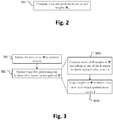
- Fig. 2 shows an embodiment of a forward pass that is iteratively applied for neural network training.
- Algorithm A more detailed embodiment of this computation is provided in section "Algorithm" below.
- Fig. 3 shows an embodiment of backward pass that is iteratively applied for neural network training.
- the soft values W are updated by gradient descent.
- v and I are updated by performing a default number of one iteration of K-means on the updated W.
- the value vector v is updated by computing the mean of all weights in W that belong to one of the K classes.
- the index matrix I is updated by assigning weights in W to a closest value in v .
- the value vector v is fixed to specific values set by the user.
- the K-means initialization is replaced by an assignment of each weight to its closest value and step 302a of the backward pass is omitted.
- step 302b of the backward pass is omitted.
- the value vector v is learnt such that elements are power-of-two numbers. If weights are restricted to powers of two, multiplications usually required when applying the artificial neural network can be avoided and turned into bit-shifts (fixed-point numbers) or additions (floating-point numbers). This avoids the necessity of performing multiplications so that multiplierless processors can be used for training an artificial neural network, which may be more cost efficient and which may provide higher processing speeds.
- the quantization threshold is at 1 2 2 ⁇ b ⁇ + 2 ⁇ b ⁇ .
- This first quantization scheme has the advantage that it minimizes the (squared) error.
- Fig. 4 shows a diagram in which these two quantization schemes are depicted. On the horizontal axis the float number x which is to be quantized is plotted. On the vertical axis the respective quantized value x q that corresponds to x is plotted for each of the quantization schemes.
- the embodiments disclosed here provide a "quantized" artificial neural network where the quantized values can be learnt by the algorithm. By optimizing the values during training, better results can be obtained than by setting the value arbitrarily. Some additional constraints can be imposed by the user, such as using only power of two values which allows to avoid multiplication and make the artificial neural network computationally efficient.
- This training approach may be used as a learning algorithm for training an artificial neural network.
- the training approach described in the embodiment may provide a more efficient artificial neural network, it may also be used to compress an existing artificial neural network. This can be achieved by using the weights of an existing artificial neural network as starting point of the training algorithm.
- SGD stochastic gradient descent
- C is the cost function that is to be minimized.
- Loss ( t , t ⁇ ) is the Loss function that computes the error of predicting t ⁇ whereas t is the ground truth.
- Forward ( x , W (1) , ..., W ( L ) ) is the function that describes the forward pass of the neural network with input data x and weights W (1) , ..., W ( L ) .
- the function returns the output node values.
- Backward ( x , t , W (1) , ..., W ( L ) ) is the function that describes the backward pass of the neural network with input data x , targets t and weights W (1) , ..., W ( L ) .
- the function returns the gradients of the weights.
- the value vectors v ( l ) are updated by computing the means of all weights in W ( l ) that belong to one of the K (l) classes.
- Each value of value vector [ v ( l ) ] k corresponds to a centroid as obtained from the K-means iteration.
- the index matrix I is updated by assigning weights in W to the closest value in v .
- Each index in [ I (l) ] ij refers to the cluster as obtained from the K-means algorithm.
- K ( l ) is the number of values in values vector v ( l ) and M is the number of K-means iterations done after each minibatch update.
- the values of the value vector are in addition rounded to the closest power-of-two number as it was described in the embodiments above.
- step four the update of I and v can also be done in the reverse order.
- SGD is used as deep neural network optimization strategy.
- other deep neural network optimization strategies could be used like Adam, RMSprop, or the like.
- Step 3 of the algorithmic description would be modified according to the needs of the applied deep neural network optimization strategy.
- weights leading to a single output map in a convolution network can also consider tying together weights from of only a part of a layer (e.g. weights leading to a single output map in a convolution network) or tying weights from different layers together.
- a computer 130 that implements an artificial neural network is described under reference of Fig. 5 .
- the computer 130 can be used to implement the training algorithms described above, and/or it may be used to implement an artificial neural network that has been generated by a training algorithm as described above.
- the computer has components 131 to 140, which can form circuitry to implement artificial neural networks and training algorithms.
- Embodiments which use software, firmware, programs or the like for performing the methods as described herein can be installed on computer 130, which is then configured to be suitable for the concrete embodiment.
- the computer 130 has a CPU 131 (Central Processing Unit), which can execute various types of procedures and methods as described herein, for example, in accordance with programs stored in a read-only memory (ROM) 132, stored in a storage 137 and loaded into a random access memory (RAM) 133, stored on a medium 140, which can be inserted in a respective drive 139, etc.
- ROM read-only memory
- RAM random access memory
- the CPU 131, the ROM 132 and the RAM 133 are connected with a bus 141, which in turn is connected to an input/output interface 134.
- the number of CPUs, memories and storages is only exemplary, and the skilled person will appreciate that the computer 130 can be adapted and configured accordingly for meeting specific requirements which arise when it functions as a base station, and user equipment.
- CPU 131 may comprise hardware that is specialized for implementation of artificial neural networks.
- Hardware that is specialized for implementation of artificial neural networks may for example be a parallel computing processor.
- CPU 131 may also use a GPU-accelerated deep neural network implementation.
- CPU 131 may comprise a multiplierless processor. Using a multiplierless processor may make the implementation more efficient in terms of processing speed and costs.
- a medium 140 compact disc, digital video disc, compact flash memory, or the like
- the input 135 can be a pointer device (mouse, graphic table, or the like), a keyboard, a microphone, a camera, a touchscreen, etc.
- the output 136 can have a display (liquid crystal display, cathode ray tube display, light emittance diode display, etc.), loudspeakers, etc.
- a display liquid crystal display, cathode ray tube display, light emittance diode display, etc.
- loudspeakers etc.
- the storage 137 can have a hard disk, a solid state drive and the like.
- the communication interface 138 can be adapted to communicate, for example, via a local area network (LAN), wireless local area network (WLAN), mobile telecommunications system (GSM, UMTS, LTE, etc.), Bluetooth, infrared, etc.
- LAN local area network
- WLAN wireless local area network
- GSM mobile telecommunications system
- UMTS Universal Mobile Telecommunications
- LTE Long Term Evolution
- Bluetooth infrared
- Fig. 6 shows an embodiment of a machine that uses a trained artificial neural network.
- the machine comprises a processor 141 that is specialized for implementing the artificial neural network.
- the processor 141 receives input from a CCD camera 142 and a TOF camera 142.
- the input is processed in the artificial neural network implemented in the processor 141 to provide output.
- the output of the artificial neural network controls an actuator 144 to perform a specific action.
- the artificial neural network may be trained for various functions in the context of autonomous or semi-autonomous driving such as lane keeping assistance, recognizing objects on the road, pedestrian recognition, solving traffic problems, mapping the raw pixels from a front-facing camera to the steering commands for a self-driving car, or the like.
- the artificial neural network may judge whether the driving direction needs a correction in order to keep the lane. According to the output of the artificial neural network, the system may act on the steering of the car by controlling actuator 144.
- Fig. 7 shows an embodiment of a software or computer device that is configured to train an artificial neural network or to compress an existing artificial neural network before deploying it.
- the device comprises a processor that is configured as an ANN training tool 147 and to implement an artificial neural network training algorithm.
- the device further comprises a memory 146 that is configured to store ANN data such as weights, value vectors, index matrices and the like.
- the device comprises a programming interface 145 by which a user can provide parameters to the ANN training tool 147.
- the programming interface may for example be configured to receive weight-tying parameters that are used to control the weight-tying aspects of a training or compression algorithm.
- Weight-tying parameters may for example be parameters such as a number of quantization levels used for weight-tying, a parameter that indicates if the value vector is fix or can be learnt (updated), constraints to the value vectors, a parameter that indicates that the assignment matrix is fix or updated, an initial or fixed value vector; and/or an initial or fixed assignment matrix.
Landscapes
- Engineering & Computer Science (AREA)
- Physics & Mathematics (AREA)
- Theoretical Computer Science (AREA)
- General Physics & Mathematics (AREA)
- Mathematical Physics (AREA)
- Data Mining & Analysis (AREA)
- Computing Systems (AREA)
- General Engineering & Computer Science (AREA)
- Software Systems (AREA)
- Biomedical Technology (AREA)
- Biophysics (AREA)
- Molecular Biology (AREA)
- General Health & Medical Sciences (AREA)
- Evolutionary Computation (AREA)
- Computational Linguistics (AREA)
- Health & Medical Sciences (AREA)
- Life Sciences & Earth Sciences (AREA)
- Artificial Intelligence (AREA)
- Mathematical Analysis (AREA)
- Computational Mathematics (AREA)
- Mathematical Optimization (AREA)
- Pure & Applied Mathematics (AREA)
- Algebra (AREA)
- Databases & Information Systems (AREA)
- Image Analysis (AREA)
- Complex Calculations (AREA)
Abstract
Description
- The present disclosure generally pertains to the field of machine learning, in particular to systems and methods that use artificial neural network learning algorithms to perform machine vision or machine control tasks.
- Machine learning is the subfield of computer science that gives computers the ability to learn certain aspects without being explicitly programmed. An artificial neural network (ANN) learning algorithm, usually called "neural network", is a computer-implemented learning algorithm in which computations are structured in terms of an interconnected group of artificial neurons. Neural networks model complex relationships between inputs and outputs, to find patterns in data, or to capture the statistical structure in an unknown joint probability distribution between observed variables.
- Systems that are based on deep neural networks (DNN) have achieved breakthrough performances in many machine learning applications ranging from speech recognition and natural language processing to computer vision. While DNNs have already made it into many commercial applications, the usage is usually limited to web/cloud based applications where computation can be performed on large servers. The main reason is that, by their nature, DNNs are large and computationally expensive. In fact, the success of DNNs has been driven by the increase in computational power (including the use of graphical processor units).
- Using DNNs locally on devices presents a number of challenges, in particular the limited memory availability and the limited computation power of computer systems. In order to leverage the power of DNNs for electronic devices (in contrast to web based applications), implementing DNNs poses the challenges of reducing both their size and their computational complexity.
- Although there exist techniques for training artificial networks using prior knowledge, it is generally desirable to provide more efficient techniques for training artificial networks.
- According to a first aspect, the disclosure provides an apparatus comprising circuitry that implements an artificial neural network training algorithm that uses weight tying.
- According to a further aspect, the disclosure provides an apparatus comprising circuitry that implements an artificial neural network, the artificial neural network having been trained by a neural network training algorithm that uses weight tying.
- According to a further aspect, the disclosure provides a method of training an artificial neural network, the method comprising performing an artificial neural network training algorithm that uses weight tying.
- According to a further aspect, the disclosure provides an apparatus comprising a programming interface that is configured to receive weight-tying parameters for use in a neural network training or compression algorithm.
- Further aspects are set forth in the dependent claims, the following description and the drawings.
- Embodiments are explained by way of example with respect to the accompanying drawings, in which:
-
Fig. 1 schematically shows the principle of weight-tying; -
Fig. 2 shows an embodiment of a forward pass that is iteratively applied for neural network training; -
Fig. 3 shows an embodiment of a backward pass that is iteratively applied for neural network training; -
Fig. 4 shows a diagram in which the result of two quantization schemes is depicted; -
Fig. 5 shows an embodiment of a computer that implements an artificial neural network; -
Fig. 6 shows an embodiment of a machine that uses a trained artificial neural network; and -
Fig. 7 shows an embodiment of a software or computer device that is configured to train an artificial neural network or to compress an existing artificial neural network before deploying it. - The embodiments described below relate to an apparatus comprising circuitry that implements an artificial neural network training algorithm that uses weight tying. The artificial neural network may for example be a deep convolutional neural network. The training algorithm may for example be based on a stochastic gradient descent training algorithm.
- Use of prior knowledge about the domain of application of a neural network helps to define the optimal layer type, layer size and number of layers and may also provide information that enables weight-tying. In weight-tying (also called weight-sharing), units can share weights in the network or are working on similar types of data. Weight sharing is applied to increase learning efficiency as it may reduce the number of free parameters being learnt. Weight-tying thus is a technique which allows reducing the memory footprint of a neural network and possibly eliminating the need for multipliers.
- The training algorithm may for example be used to train an artificial neural network or to compress existing artificial neural networks before deploying them.
- The apparatus may be any device potentially performing recognition, classification or signal generation using an artificial neural network, such as a TV, a camera, a mobile phone, a game console, etc. The apparatus may also be any device that performs controlling functions based on input, such as a lane keeping assist system in semi-autonomous driving, or the like.
- The circuitry may be configured to update the weight tying using a predefined number of iterations of a clustering algorithm. For example, a K-means clustering algorithm can be used. K-means clustering is a method of vector quantization, originally from signal processing. The K-means clustering can for example be done using the mean but also using median. According to other embodiments, alternative clustering algorithms can be used. The predefined number of K-means iterations used to update the weight tying may for example be one. That is, according to one embodiment, only one K-means iteration is performed. However, more iterations of K-means may be performed depending on the needs or design goals.
- The circuitry may be configured to compute a weight-tied weight matrix based on an index matrix and based on a value vector. Still further, the circuitry may be configured to update, in each iteration of K-means, the value vector and the index matrix based on a full-precision weight matrix.
- According to some embodiments, the circuitry is configured to quantize the values of the value vector. For example, the circuitry may be configured to quantize the values of the value vector after updating the weight tying. In particular, the circuitry may be configured to quantize the values of the value vector to the nearest power-of-two.
- The value vector v may be fixed to specific values set by the user. As an example, the user may set predefined values for different value vector sizes. According to some embodiments, a value vector used with weight-sharing and quantization may comprise more than three values.
- Still further, according to some embodiments, the circuitry may be configured to update full precision weights based on gradients. These gradients may be based on a cost function and based on a weight-tied weight matrix. In particular, the circuitry may be configured to compute the cost function based on a loss function and based on a forward pass. Still further, the circuitry may be configured to compute the cost function also based on a backward pass function.
- The embodiments also disclose an apparatus comprising circuitry that implements an artificial neural network, the artificial neural network having been trained by a neural network training algorithm that uses weight tying. In particular, the circuitry may implement the artificial neural network in a multiplierless way. Such an apparatus may be any device potentially performing recognition, classification or signal generation using an artificial neural network, such as a TV, a camera, a mobile phone, a game console etc. The apparatus may also be any device that performs controlling functions based on input, such as a lane keeping assist system in semi-autonomous driving, or the like.
- The embodiments also disclose a method of training an artificial neural network, the method comprising performing an artificial neural network training algorithm that uses weight tying.
- The embodiments also disclose an apparatus comprising a programming interface that is configured to receive weight-tying parameters for use in a neural network training or compression algorithm. The programming interface may for example be configured to receive a number of quantization levels used for weight-tying, a parameter that indicates if the value vector is fix or updated, constraints to the value vectors, a parameter that indicates that the assignment matrix is fix or can be learnt (updated), an initial or fixed value vector; and/or an initial or fixed assignment matrix. The programming interface may be an application programming interface (API) or a user interface (UI).
- The methods as described herein are also implemented in some embodiments as a computer program causing a computer and/or a processor to perform the method, when being carried out on the computer and/or processor. In some embodiments, also a non-transitory computer-readable recording medium is provided that stores therein a computer program product, which, when executed by a processor, such as the processor described above, causes the methods described herein to be performed.
- Weight parameters usually account for most of the memory used by an artificial neural network. In order to reduce the footprint of the weights, weight-tying limits the number of possible values that the weights can take. Weight-tying as it is described in the embodiments below uses a special representation of neural networks weights. They are represented by an assignment matrix and a value vector for each layer. Both the assignment matrices and the value vectors are jointly optimized (learned) for the specific task of the neural network (e.g. image classification). With some specific constraints on the value vectors it becomes possible to train a network which does not require any multiplication when deployed (i.e. when it is used after training). For example, if the weights for a particular layer can only take two values, each weight can be encoded as a single bit. Similarly, if the weights can take 8 different values, they can be encoded with only three bits. The Weight-tying (WT) approach described in the embodiments below is based on this basic idea that many weights of the same layers are "tied" together and can be assigned to a single value.
-
Fig. 1 schematically shows the principle of weight-tying. The main idea of weight-tying is to decompose the weight matrix

mn . The number of possible weight values that can be used in this layer is therefore limited to the size of the value vector v . Therefore, only the index matrix I which has O . I indices with each ┌log2 K┐ Bits and the value vector v which contains K floats needs to be stored. - The embodiments described below provide a training approach to train this special representation of ANN weights by learning both the index matrix and the value vector. During training of weight-tying networks three variables are internally kept for each layer: the float weights W, the value vector v and the index matrix I . When training is finished the float weights W can be discarded and only v and I are used for deployement.
- The first step in training a weight-tying network is to initialize v and I . Given some initial float weights W init (e.g. already learned using traditional ANN techniques or initialize randomly or using any other initialization technique), a K-means algorithm is applied to W init to find the initial v and I . Each value of value vector v corresponds to a centroid as obtained from the K-means algorithm and each index in I refers to a cluster as obtained from the K-means algorithm.
- Then as for traditional neural network training, a forward and a backward pass are iteratively applied. These two steps are applied as follows:
Fig. 2 shows an embodiment of a forward pass that is iteratively applied for neural network training. At 201, tied weights W q = v [ I ] are used to compute error and gradients. A more detailed embodiment of this computation is provided in section "Algorithm" below. -
Fig. 3 shows an embodiment of backward pass that is iteratively applied for neural network training. At 301, the soft values W are updated by gradient descent. At 302, v and I are updated by performing a default number of one iteration of K-means on the updatedW. At 302a, the value vector v is updated by computing the mean of all weights in W that belong to one of the K classes. At 302b, the index matrix I is updated by assigning weights in W to a closest value in v . A more detailed embodiment of these computations is provided in section "Algorithm" below. - With the above described approach of weight-tying also some constraints can be applied on the value vector or the index vector. In the embodiments described below, the specific cases of (1) fixed value vector, (2) fixed index matrix and (3) training a multiplier less network are considered.
- According to this embodiment, the value vector v is fixed to specific values set by the user. As an example the user can set the following values for different value vector sizes K:


step 302a of the backward pass is omitted. Besides the examples given above, it is for example also possible to put a "0" value into v in order to use the weight-tying for pruning the network. - In this case, the index assignment defined by K-means clustering at the initialization step is kept during the rest of the training, so step 302b of the backward pass is omitted.
- According to the embodiments described below, the value vector v is learnt such that elements are power-of-two numbers. If weights are restricted to powers of two, multiplications usually required when applying the artificial neural network can be avoided and turned into bit-shifts (fixed-point numbers) or additions (floating-point numbers). This avoids the necessity of performing multiplications so that multiplierless processors can be used for training an artificial neural network, which may be more cost efficient and which may provide higher processing speeds.
- To achieve this, after each K-means update (i.e. after the initial K-means and after
step 302a of the backward pass inFig. 3 ), the values are rounded to the nearest power-of-two. - To round to the nearest power of two the following algorithmic schemes is applied:
- Let x be a float number which is to be quantized to the nearest power-of-two xq = ±2 k .
- According to a first quantization scheme, the quantized value is given by

- According to this first quantization scheme, the quantization threshold is at

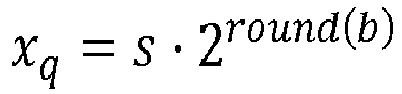
- According to an alternative embodiment, the quantized value is given by

-
Fig. 4 shows a diagram in which these two quantization schemes are depicted. On the horizontal axis the float number x which is to be quantized is plotted. On the vertical axis the respective quantized value xq that corresponds to x is plotted for each of the quantization schemes. - The embodiments disclosed here provide a "quantized" artificial neural network where the quantized values can be learnt by the algorithm. By optimizing the values during training, better results can be obtained than by setting the value arbitrarily. Some additional constraints can be imposed by the user, such as using only power of two values which allows to avoid multiplication and make the artificial neural network computationally efficient.
- In the embodiments described above a training approach to train ANN weights by learning both the index matrix and the value vector has been described. This training approach may be used as a learning algorithm for training an artificial neural network. As the training approach described in the embodiment may provide a more efficient artificial neural network, it may also be used to compress an existing artificial neural network. This can be achieved by using the weights of an existing artificial neural network as starting point of the training algorithm.
- In the following an embodiment of stochastic gradient descent (SGD) training with weight-tying is described in more detail. The algorithm is performed with minibatches of training data. Each minibatch is a subset of the training data containing inputs x and targets t. For the weight-tying scheme, the bias vectors are learned as in a traditional (full-precision) network and for simplicity they are ignored in the further discussion of the algorithm.
- With each minibatch { x,t }, the following calculations are performed:
- In a first step, the weight-tied weight matrix


- In a second step, the current cost C and gradients G (l) are computed:


- C is the cost function that is to be minimized.
- Loss( t , t̂ ) is the Loss function that computes the error of predicting t̂ whereas t is the ground truth.
- Forward( x , W (1) , ..., W (L)) is the function that describes the forward pass of the neural network with input data x and weights W (1), ..., W (L). The function returns the output node values.
- Backward( x, t, W (1) , ..., W (L)) is the function that describes the backward pass of the neural network with input data x, targets t and weights W (1), ..., W (L) . The function returns the gradients of the weights.
- In a third step, the full precision weights are updated:


- Here, W (l) is the full-precision weight matrix for layer l = 1, ..., L (of affine or convolutional layer) and η is the learning rate of SGD.
- In a fourth step, the weight tying is updated using M iterations of K-means:


- The value vectors v (l ) are updated by computing the means of all weights in W (l) that belong to one of the K(l) classes. Each value of value vector [v (l)] k corresponds to a centroid as obtained from the K-means iteration. The updated value at index k is the average of all weights in the corresponding cluster. Therefore it is the sum of the weights in the cluster divided by the number of weights in the cluster (i.e. number of weights with index corresponding to the value k: #{ I (l) = k}). The index matrix I is updated by assigning weights in W to the closest value in v . Each index in [ I (l) ] ij refers to the cluster as obtained from the K-means algorithm. [ v (l)] k is the value k of
layer 1 and arg
- Here, K (l) is the number of values in values vector v (l ) and M is the number of K-means iterations done after each minibatch update. The number M can be chosen arbitrarily. A default value is M = 1, but more iterations may be performed. Furthermore, it is also possible to perform the K-means update only after a certain number of minibatch updates in order to reduce the computational complexity of the weight-tying training.
- In this fourth step, in order to obtain a multiplierless network, the values of the value vector are in addition rounded to the closest power-of-two number as it was described in the embodiments above.
- It should also be noted that in step four the update of I and v can also be done in the reverse order.
- In the embodiment described here, SGD is used as deep neural network optimization strategy. However, instead of SGD, also other deep neural network optimization strategies could be used like Adam, RMSprop, or the like. In such a case, "Step 3" of the algorithmic description would be modified according to the needs of the applied deep neural network optimization strategy.
- It should also be noted that one can also consider tying together weights from of only a part of a layer (e.g. weights leading to a single output map in a convolution network) or tying weights from different layers together.
- In the following, an embodiment of a
computer 130 that implements an artificial neural network is described under reference ofFig. 5 . Thecomputer 130 can be used to implement the training algorithms described above, and/or it may be used to implement an artificial neural network that has been generated by a training algorithm as described above. - The computer has
components 131 to 140, which can form circuitry to implement artificial neural networks and training algorithms. - Embodiments, which use software, firmware, programs or the like for performing the methods as described herein can be installed on
computer 130, which is then configured to be suitable for the concrete embodiment. - The
computer 130 has a CPU 131 (Central Processing Unit), which can execute various types of procedures and methods as described herein, for example, in accordance with programs stored in a read-only memory (ROM) 132, stored in astorage 137 and loaded into a random access memory (RAM) 133, stored on a medium 140, which can be inserted in arespective drive 139, etc. - The
CPU 131, theROM 132 and theRAM 133 are connected with abus 141, which in turn is connected to an input/output interface 134. The number of CPUs, memories and storages is only exemplary, and the skilled person will appreciate that thecomputer 130 can be adapted and configured accordingly for meeting specific requirements which arise when it functions as a base station, and user equipment. -
CPU 131 may comprise hardware that is specialized for implementation of artificial neural networks. Hardware that is specialized for implementation of artificial neural networks may for example be a parallel computing processor.CPU 131 may also use a GPU-accelerated deep neural network implementation. In particular,CPU 131 may comprise a multiplierless processor. Using a multiplierless processor may make the implementation more efficient in terms of processing speed and costs. - At the input/
output interface 134, several components are connected: aninput 135, anoutput 136, thestorage 137, acommunication interface 138 and thedrive 139, into which a medium 140 (compact disc, digital video disc, compact flash memory, or the like) can be inserted. - The
input 135 can be a pointer device (mouse, graphic table, or the like), a keyboard, a microphone, a camera, a touchscreen, etc. - The
output 136 can have a display (liquid crystal display, cathode ray tube display, light emittance diode display, etc.), loudspeakers, etc. - The
storage 137 can have a hard disk, a solid state drive and the like. - The
communication interface 138 can be adapted to communicate, for example, via a local area network (LAN), wireless local area network (WLAN), mobile telecommunications system (GSM, UMTS, LTE, etc.), Bluetooth, infrared, etc. - It should be noted that the description above only pertains to an example configuration of
computer 130. Alternative configurations may be implemented with less, additional or other sensors, storage devices, interfaces or the like. -
Fig. 6 shows an embodiment of a machine that uses a trained artificial neural network. The machine comprises aprocessor 141 that is specialized for implementing the artificial neural network. Theprocessor 141 receives input from aCCD camera 142 and aTOF camera 142. The input is processed in the artificial neural network implemented in theprocessor 141 to provide output. The output of the artificial neural network controls anactuator 144 to perform a specific action. For example, the artificial neural network may be trained for various functions in the context of autonomous or semi-autonomous driving such as lane keeping assistance, recognizing objects on the road, pedestrian recognition, solving traffic problems, mapping the raw pixels from a front-facing camera to the steering commands for a self-driving car, or the like. Based on the input from theCCD camera 142 and theTOF camera 142 the artificial neural network may judge whether the driving direction needs a correction in order to keep the lane. According to the output of the artificial neural network, the system may act on the steering of the car by controllingactuator 144. -
Fig. 7 shows an embodiment of a software or computer device that is configured to train an artificial neural network or to compress an existing artificial neural network before deploying it. The device comprises a processor that is configured as anANN training tool 147 and to implement an artificial neural network training algorithm. The device further comprises a memory 146 that is configured to store ANN data such as weights, value vectors, index matrices and the like. Still further, the device comprises a programming interface 145 by which a user can provide parameters to theANN training tool 147. The programming interface may for example be configured to receive weight-tying parameters that are used to control the weight-tying aspects of a training or compression algorithm. Weight-tying parameters may for example be parameters such as a number of quantization levels used for weight-tying, a parameter that indicates if the value vector is fix or can be learnt (updated), constraints to the value vectors, a parameter that indicates that the assignment matrix is fix or updated, an initial or fixed value vector; and/or an initial or fixed assignment matrix. - It should be recognized that the embodiments describe methods with an exemplary ordering of method steps. The specific ordering of method steps is however given for illustrative purposes only and should not be construed as binding. For example,
steps Fig. 3 could be performed in reverse order without changing the result. - It should also be recognized that the division of the control or circuitry of
Fig. 7 intounits 131 to 140 is only made for illustration purposes and that the present disclosure is not limited to any specific division of functions in specific units. For instance, at least parts of the circuitry could be implemented by a respective programmed processor, field programmable gate array (FPGA), dedicated circuits, and the like. - All units and entities described in this specification and claimed in the appended claims can, if not stated otherwise, be implemented as integrated circuit logic, for example on a chip, and functionality provided by such units and entities can, if not stated otherwise, be implemented by software.
- In so far as the embodiments of the disclosure described above are implemented, at least in part, using software-controlled data processing apparatus, it will be appreciated that a computer program providing such software control and a transmission, storage or other medium by which such a computer program is provided are envisaged as aspects of the present disclosure.
- Note that the present technology can also be configured as described below:
- (1) An apparatus comprising circuitry that implements an artificial neural network training algorithm that uses weight tying.
- (2) The apparatus of (1), wherein the circuitry is configured to update the weight tying using a predefined number (M) of iterations of a clustering algorithm.
- (3) The apparatus of (1) or (2), wherein the circuitry is configured to compute a weight-tied weight matrix

- (4) The apparatus of (2), wherein the predefined number (M) of iterations of the clustering algorithm used to update the weight tying is one.
- (5) The apparatus of anyone of (2) to (4), wherein the circuitry is configured to, in each iteration of the clustering algorithm, update a value vector ( v (l)) according to

- (6) The apparatus of anyone of (2) to (5), wherein the circuitry is configured to update, in each iteration of the clustering algorithm, an index matrix ( I (l)) according to

- (7) The apparatus of anyone of (3) to (6) as far as dependent on (3), wherein the circuitry is configured to quantize the values of the value vector.
- (8) The apparatus of anyone of (3) to (7), wherein the circuitry is configured to quantize the values of the value vector after updating the weight tying.
- (9) The apparatus of (8), wherein the circuitry is configured to quantize the values of the value vector to the nearest power-of-two.
- (10) The apparatus of (8) or (9), wherein the circuitry is configured to quantize the values of the value vector according to the quantization scheme:

- (11) The apparatus of anyone of (3) to (10), wherein a value vector comprises more than three values.
- (12) The apparatus of anyone of (1) to (11), wherein the circuitry is configured to update full precision weights based on gradients ( G (l)).
- (13) The apparatus of (12), wherein the circuitry is configured to compute the gradients ( G (l)) based on a cost function (C) and based on the weight-tied weight matrix

- (14) The apparatus of (12) or (13), wherein the circuitry is configured to compute the cost function (C) based on a loss function and based on a forward pass function
(Forward ( x, W (1), ..., W (L))). - (15) The apparatus of anyone of (12) to (14), wherein the circuitry is configured to compute the gradients ( G (l)) based on a backward pass function (Backward ( x , t ,


- (16) The apparatus of anyone of (1) to (15), wherein the training algorithm is a stochastic gradient descent training algorithm.
- (17) The apparatus of anyone of (1) to (16), wherein the artificial neural network is a deep convolutional neural network.
- (18) An apparatus comprising circuitry that implements an artificial neural network, the artificial neural network having been trained by a neural network training algorithm that uses weight tying.
- (19) The apparatus of (17), wherein in the circuitry implements the artificial neural network multiplierless.
- (20) A method of training an artificial neural network, the method comprising performing an artificial neural network training algorithm that uses weight tying.
- (21) An apparatus comprising a programming interface that is configured to receive weight-tying parameters for use in a neural network training or compression algorithm.
- (22) The apparatus of (21) in which the programming interface is configured to receive:
- a number of quantization levels used for weight-tying;
- a parameter that indicates if the value vector is fix or updated;
- constraints to the value vectors;
- a parameter that indicates that the assignment matrix is fix or updated;
- an initial or fixed value vector; and/or
- an initial or fixed assignment matrix.
- (23) A computer program comprising program code causing a computer to perform the method according to (20) when being carried out on a computer.
- (24) A non-transitory computer-readable recording medium that stores therein a computer program product, which, when executed by a processor, causes the method according to (20) to be performed.
Claims (15)
- An apparatus comprising circuitry that implements an artificial neural network training algorithm that uses weight tying.
- The apparatus of claim 1, wherein the circuitry is configured to update the weight tying using a predefined number of iterations of a clustering algorithm.
- The apparatus of claim 1, wherein the circuitry is configured to compute a weight-tied weight matrix based on an index matrix and based on a value vector.
- The apparatus of claim 2, wherein the predefined number of iterations of the clustering algorithm used to update the weight tying is one.
- The apparatus of claim 2, wherein the circuitry is configured to, in each iteration of the clustering algorithm, update a value vector according to

- The apparatus of claim 2, wherein the circuitry is configured to update, in each iteration of the clustering algorithm, an index matrix according to

- The apparatus of claim 3, wherein the circuitry is configured to quantize the values of the value vector after updating the weight tying, e.g. to the nearest power-of-two, e.g. according to the quantization scheme:

- The apparatus of claim 1, wherein the circuitry is configured to update full precision weights based on gradients.
- The apparatus of claim 8, wherein the circuitry is configured to
compute the gradients based on a cost function and based on the weight-tied weight matrix; or to
compute the cost function based on a loss function and based on a forward pass function; or to compute the gradients based on a backward pass function. - The apparatus of claim 1, wherein the training algorithm is a stochastic gradient descent training algorithm.
- An apparatus comprising circuitry that implements an artificial neural network, the artificial neural network having been trained by a neural network training algorithm that uses weight tying.
- The apparatus of claim 11, wherein in the circuitry implements the artificial neural network multiplierless.
- A method of training an artificial neural network, the method comprising performing an artificial neural network training algorithm that uses weight tying.
- An apparatus comprising a programming interface that is configured to receive weight-tying parameters for use in a neural network training or compression algorithm.
- The apparatus of claim 14 in which the programming interface is configured to receive:a number of quantization levels used for weight-tying;a parameter that indicates if the value vector is fix or updated;constraints to the value vectors;a parameter that indicates that the assignment matrix is fix or updated;an initial or fixed value vector; and/oran initial or fixed assignment matrix.
Applications Claiming Priority (1)
| Application Number | Priority Date | Filing Date | Title |
|---|---|---|---|
| EP17158959 | 2017-03-02 |
Publications (2)
| Publication Number | Publication Date |
|---|---|
| EP3370191A1 true EP3370191A1 (en) | 2018-09-05 |
| EP3370191B1 EP3370191B1 (en) | 2023-09-06 |
Family
ID=58213027
Family Applications (1)
| Application Number | Title | Priority Date | Filing Date |
|---|---|---|---|
| EP18159686.7A Active EP3370191B1 (en) | 2017-03-02 | 2018-03-02 | Apparatus and method implementing an artificial neural network training algorithm using weight tying |
Country Status (2)
| Country | Link |
|---|---|
| US (1) | US12072951B2 (en) |
| EP (1) | EP3370191B1 (en) |
Cited By (2)
| Publication number | Priority date | Publication date | Assignee | Title |
|---|---|---|---|---|
| CN109525548A (en) * | 2018-09-25 | 2019-03-26 | 平安科技(深圳)有限公司 | A kind of white list updating method based on cost function, device and electronic equipment |
| CN111198714A (en) * | 2018-11-16 | 2020-05-26 | 上海寒武纪信息科技有限公司 | Retraining method and related product |
Families Citing this family (11)
| Publication number | Priority date | Publication date | Assignee | Title |
|---|---|---|---|---|
| CN109284826A (en) * | 2017-07-19 | 2019-01-29 | 阿里巴巴集团控股有限公司 | Neural network processing method, apparatus, device, and computer-readable storage medium |
| CN112771547B (en) * | 2018-09-25 | 2025-02-21 | 诺基亚技术有限公司 | End-to-end learning in communication systems |
| CN109492748B (en) * | 2018-09-26 | 2022-06-03 | 广东工业大学 | A method for establishing medium and long-term load forecasting model of power system based on convolutional neural network |
| US11475308B2 (en) | 2019-03-15 | 2022-10-18 | Samsung Electronics Co., Ltd. | Jointly pruning and quantizing deep neural networks |
| JP7370158B2 (en) * | 2019-04-03 | 2023-10-27 | 株式会社Preferred Networks | Information processing device and information processing method |
| WO2020226634A1 (en) * | 2019-05-07 | 2020-11-12 | Huawei Technologies Co., Ltd. | Distributed synchronous training architecture using stale weights |
| JP7114528B2 (en) * | 2019-07-08 | 2022-08-08 | 株式会社東芝 | Reasoning device, learning device, reasoning method and learning method |
| US11615301B2 (en) * | 2019-09-03 | 2023-03-28 | Microsoft Technology Licensing, Llc | Lossless exponent and lossy mantissa weight compression for training deep neural networks |
| US11935271B2 (en) * | 2020-01-10 | 2024-03-19 | Tencent America LLC | Neural network model compression with selective structured weight unification |
| KR20210106217A (en) | 2020-02-20 | 2021-08-30 | 삼성전자주식회사 | Processor reconstructing artificial neural network, electrical device having the same and operating mehod of processor |
| DE102020210328A1 (en) * | 2020-08-13 | 2022-02-17 | Robert Bosch Gesellschaft mit beschränkter Haftung | Method and device for training a quantized classifier |
Family Cites Families (12)
| Publication number | Priority date | Publication date | Assignee | Title |
|---|---|---|---|---|
| DE60140654D1 (en) | 2001-03-15 | 2010-01-14 | Honda Res Inst Europe Gmbh | Simulation of convolution network behavior and display of internal states of a network |
| US7218270B1 (en) * | 2003-02-10 | 2007-05-15 | The United States Of America As Represented By The Secretary Of The Air Force | ATR trajectory tracking system (A-Track) |
| WO2009038822A2 (en) * | 2007-05-25 | 2009-03-26 | The Research Foundation Of State University Of New York | Spectral clustering for multi-type relational data |
| US9324321B2 (en) | 2014-03-07 | 2016-04-26 | Microsoft Technology Licensing, Llc | Low-footprint adaptation and personalization for a deep neural network |
| US20150317557A1 (en) * | 2014-05-01 | 2015-11-05 | Qualcomm Incorporated | Temporal spike encoding for temporal learning |
| US10417525B2 (en) | 2014-09-22 | 2019-09-17 | Samsung Electronics Co., Ltd. | Object recognition with reduced neural network weight precision |
| US10664744B2 (en) * | 2015-10-13 | 2020-05-26 | Facebook, Inc. | End-to-end memory networks |
| US9971958B2 (en) * | 2016-06-01 | 2018-05-15 | Mitsubishi Electric Research Laboratories, Inc. | Method and system for generating multimodal digital images |
| US10614798B2 (en) * | 2016-07-29 | 2020-04-07 | Arizona Board Of Regents On Behalf Of Arizona State University | Memory compression in a deep neural network |
| DE112017004431T5 (en) * | 2016-09-02 | 2019-06-27 | Synopsys, Inc. | PARTITIONING USING A CORRELATION METAHEURISM |
| CN110832596B (en) * | 2017-10-16 | 2021-03-26 | 因美纳有限公司 | Deep Learning-Based Deep Convolutional Neural Network Training Method |
| US11783917B2 (en) * | 2019-03-21 | 2023-10-10 | Illumina, Inc. | Artificial intelligence-based base calling |
-
2018
- 2018-02-23 US US15/903,290 patent/US12072951B2/en active Active
- 2018-03-02 EP EP18159686.7A patent/EP3370191B1/en active Active
Non-Patent Citations (6)
| Title |
|---|
| ITAY HUBARA ET AL: "Quantized Neural Networks: Training Neural Networks with Low Precision Weights and Activations", ARXIV.ORG, CORNELL UNIVERSITY LIBRARY, 201 OLIN LIBRARY CORNELL UNIVERSITY ITHACA, NY 14853, 22 September 2016 (2016-09-22), XP080813052 * |
| JAMES GARLAND ET AL: "Low Complexity Multiply Accumulate Unit for Weight-Sharing Convolutional Neural Networks", 30 June 2016 (2016-06-30), pages 1 - 4, XP055450473, Retrieved from the Internet <URL:https://arxiv.org/pdf/1609.05132v1.pdf> [retrieved on 20180212], DOI: 10.1109/LCA.2017.2656880 * |
| SONG HAN ET AL: "Deep Compression: Compressing Deep Neural Networks with Pruning, Trained Quantization and Huffman Coding", 15 February 2016 (2016-02-15), XP055393078, Retrieved from the Internet <URL:https://arxiv.org/pdf/1510.00149v5.pdf> [retrieved on 20170721] * |
| SUN FANGXUAN ET AL: "Intra-layer nonuniform quantization of convolutional neural network", 2016 8TH INTERNATIONAL CONFERENCE ON WIRELESS COMMUNICATIONS & SIGNAL PROCESSING (WCSP), IEEE, 13 October 2016 (2016-10-13), pages 1 - 5, XP033002144, DOI: 10.1109/WCSP.2016.7752720 * |
| YOOJIN CHOI ET AL: "Towards the Limit of Network Quantization", ARXIV.ORG, CORNELL UNIVERSITY LIBRARY, 201 OLIN LIBRARY CORNELL UNIVERSITY ITHACA, NY 14853, 5 December 2016 (2016-12-05), XP080736980 * |
| YUNCHAO GONG ET AL: "Compressing Deep Convolutional Networks using Vector Quantization", 18 December 2014 (2014-12-18), pages 1 - 10, XP055262159, Retrieved from the Internet <URL:http://arxiv.org/pdf/1412.6115v1.pdf> [retrieved on 20160401] * |
Cited By (4)
| Publication number | Priority date | Publication date | Assignee | Title |
|---|---|---|---|---|
| CN109525548A (en) * | 2018-09-25 | 2019-03-26 | 平安科技(深圳)有限公司 | A kind of white list updating method based on cost function, device and electronic equipment |
| CN109525548B (en) * | 2018-09-25 | 2021-10-29 | 平安科技(深圳)有限公司 | White list updating method and device based on cost function and electronic equipment |
| CN111198714A (en) * | 2018-11-16 | 2020-05-26 | 上海寒武纪信息科技有限公司 | Retraining method and related product |
| CN111198714B (en) * | 2018-11-16 | 2022-11-18 | 寒武纪(西安)集成电路有限公司 | Retraining method and related product |
Also Published As
| Publication number | Publication date |
|---|---|
| EP3370191B1 (en) | 2023-09-06 |
| US20180253401A1 (en) | 2018-09-06 |
| US12072951B2 (en) | 2024-08-27 |
Similar Documents
| Publication | Publication Date | Title |
|---|---|---|
| EP3370191B1 (en) | Apparatus and method implementing an artificial neural network training algorithm using weight tying | |
| US12073309B2 (en) | Neural network device and method of quantizing parameters of neural network | |
| US20220414432A1 (en) | Method and system for splitting and bit-width assignment of deep learning models for inference on distributed systems | |
| US11816841B2 (en) | Method and system for graph-based panoptic segmentation | |
| US10922788B1 (en) | Method for performing continual learning on classifier in client capable of classifying images by using continual learning server and continual learning server using the same | |
| CN111797983B (en) | A method and device for constructing a neural network | |
| CN109754066B (en) | Method and apparatus for generating a fixed-point neural network | |
| US20190332944A1 (en) | Training Method, Apparatus, and Chip for Neural Network Model | |
| WO2021093794A1 (en) | Methods and systems for training convolutional neural network using built-in attention | |
| KR102152374B1 (en) | Method and system for bit quantization of artificial neural network | |
| CN111462129B (en) | Image segmentation method and device using weighted convolution filter according to grid unit | |
| US20210232922A1 (en) | Actor ensemble for continuous control | |
| CN112529150A (en) | Model structure, model training method, image enhancement method and device | |
| US11586903B2 (en) | Method and system of controlling computing operations based on early-stop in deep neural network | |
| US11960565B2 (en) | Add-mulitply-add convolution computation for a convolutional neural network | |
| WO2020088766A1 (en) | Methods for optical flow estimation | |
| CN116245142A (en) | Systems and methods for mixed precision quantization of deep neural networks | |
| CN114037882A (en) | Edge artificial intelligence device, electronic device and method thereof | |
| CN115018039A (en) | Neural network distillation method, target detection method and device | |
| US20250225405A1 (en) | Action prediction method and related device therefor | |
| EP3977359A1 (en) | Mixture distribution estimation for future prediction | |
| US20260112049A1 (en) | Object detection method and related device thereof | |
| CN112598062A (en) | Image identification method and device | |
| US12373954B2 (en) | Transformer for efficient image segmentation | |
| KR102505043B1 (en) | Device performing AI inference through quantization and batch folding |
Legal Events
| Date | Code | Title | Description |
|---|---|---|---|
| PUAI | Public reference made under article 153(3) epc to a published international application that has entered the european phase |
Free format text: ORIGINAL CODE: 0009012 |
|
| STAA | Information on the status of an ep patent application or granted ep patent |
Free format text: STATUS: REQUEST FOR EXAMINATION WAS MADE |
|
| 17P | Request for examination filed |
Effective date: 20180302 |
|
| AK | Designated contracting states |
Kind code of ref document: A1 Designated state(s): AL AT BE BG CH CY CZ DE DK EE ES FI FR GB GR HR HU IE IS IT LI LT LU LV MC MK MT NL NO PL PT RO RS SE SI SK SM TR |
|
| AX | Request for extension of the european patent |
Extension state: BA ME |
|
| RIN1 | Information on inventor provided before grant (corrected) |
Inventor name: UHLICH, STEFAN Inventor name: CARDINAUX, FABIEN Inventor name: KEMP, THOMAS Inventor name: YOSHIYAMA, KAZUKI Inventor name: ALONSO GARCIA, JAVIER |
|
| STAA | Information on the status of an ep patent application or granted ep patent |
Free format text: STATUS: EXAMINATION IS IN PROGRESS |
|
| 17Q | First examination report despatched |
Effective date: 20200108 |
|
| RAP3 | Party data changed (applicant data changed or rights of an application transferred) |
Owner name: SONY GROUP CORPORATION |
|
| RIC1 | Information provided on ipc code assigned before grant |
Ipc: G06N 3/04 20060101ALN20210903BHEP Ipc: G06N 3/063 20060101ALN20210903BHEP Ipc: G06N 3/08 20060101AFI20210903BHEP |
|
| GRAP | Despatch of communication of intention to grant a patent |
Free format text: ORIGINAL CODE: EPIDOSNIGR1 |
|
| STAA | Information on the status of an ep patent application or granted ep patent |
Free format text: STATUS: GRANT OF PATENT IS INTENDED |
|
| RIC1 | Information provided on ipc code assigned before grant |
Ipc: G06N 3/04 20060101ALN20230315BHEP Ipc: G06N 3/063 20060101ALN20230315BHEP Ipc: G06N 3/08 20060101AFI20230315BHEP |
|
| RIC1 | Information provided on ipc code assigned before grant |
Ipc: G06N 3/04 20060101ALN20230317BHEP Ipc: G06N 3/063 20060101ALN20230317BHEP Ipc: G06N 3/08 20060101AFI20230317BHEP |
|
| INTG | Intention to grant announced |
Effective date: 20230403 |
|
| GRAS | Grant fee paid |
Free format text: ORIGINAL CODE: EPIDOSNIGR3 |
|
| GRAA | (expected) grant |
Free format text: ORIGINAL CODE: 0009210 |
|
| STAA | Information on the status of an ep patent application or granted ep patent |
Free format text: STATUS: THE PATENT HAS BEEN GRANTED |
|
| AK | Designated contracting states |
Kind code of ref document: B1 Designated state(s): AL AT BE BG CH CY CZ DE DK EE ES FI FR GB GR HR HU IE IS IT LI LT LU LV MC MK MT NL NO PL PT RO RS SE SI SK SM TR |
|
| REG | Reference to a national code |
Ref country code: GB Ref legal event code: FG4D |
|
| REG | Reference to a national code |
Ref country code: CH Ref legal event code: EP |
|
| REG | Reference to a national code |
Ref country code: DE Ref legal event code: R096 Ref document number: 602018056822 Country of ref document: DE |
|
| REG | Reference to a national code |
Ref country code: IE Ref legal event code: FG4D |
|
| REG | Reference to a national code |
Ref country code: LT Ref legal event code: MG9D |
|
| REG | Reference to a national code |
Ref country code: NL Ref legal event code: MP Effective date: 20230906 |
|
| PG25 | Lapsed in a contracting state [announced via postgrant information from national office to epo] |
Ref country code: GR Free format text: LAPSE BECAUSE OF FAILURE TO SUBMIT A TRANSLATION OF THE DESCRIPTION OR TO PAY THE FEE WITHIN THE PRESCRIBED TIME-LIMIT Effective date: 20231207 |
|
| PG25 | Lapsed in a contracting state [announced via postgrant information from national office to epo] |
Ref country code: SE Free format text: LAPSE BECAUSE OF FAILURE TO SUBMIT A TRANSLATION OF THE DESCRIPTION OR TO PAY THE FEE WITHIN THE PRESCRIBED TIME-LIMIT Effective date: 20230906 Ref country code: RS Free format text: LAPSE BECAUSE OF FAILURE TO SUBMIT A TRANSLATION OF THE DESCRIPTION OR TO PAY THE FEE WITHIN THE PRESCRIBED TIME-LIMIT Effective date: 20230906 Ref country code: NO Free format text: LAPSE BECAUSE OF FAILURE TO SUBMIT A TRANSLATION OF THE DESCRIPTION OR TO PAY THE FEE WITHIN THE PRESCRIBED TIME-LIMIT Effective date: 20231206 Ref country code: LV Free format text: LAPSE BECAUSE OF FAILURE TO SUBMIT A TRANSLATION OF THE DESCRIPTION OR TO PAY THE FEE WITHIN THE PRESCRIBED TIME-LIMIT Effective date: 20230906 Ref country code: LT Free format text: LAPSE BECAUSE OF FAILURE TO SUBMIT A TRANSLATION OF THE DESCRIPTION OR TO PAY THE FEE WITHIN THE PRESCRIBED TIME-LIMIT Effective date: 20230906 Ref country code: HR Free format text: LAPSE BECAUSE OF FAILURE TO SUBMIT A TRANSLATION OF THE DESCRIPTION OR TO PAY THE FEE WITHIN THE PRESCRIBED TIME-LIMIT Effective date: 20230906 Ref country code: GR Free format text: LAPSE BECAUSE OF FAILURE TO SUBMIT A TRANSLATION OF THE DESCRIPTION OR TO PAY THE FEE WITHIN THE PRESCRIBED TIME-LIMIT Effective date: 20231207 Ref country code: FI Free format text: LAPSE BECAUSE OF FAILURE TO SUBMIT A TRANSLATION OF THE DESCRIPTION OR TO PAY THE FEE WITHIN THE PRESCRIBED TIME-LIMIT Effective date: 20230906 |
|
| REG | Reference to a national code |
Ref country code: AT Ref legal event code: MK05 Ref document number: 1609509 Country of ref document: AT Kind code of ref document: T Effective date: 20230906 |
|
| PG25 | Lapsed in a contracting state [announced via postgrant information from national office to epo] |
Ref country code: NL Free format text: LAPSE BECAUSE OF FAILURE TO SUBMIT A TRANSLATION OF THE DESCRIPTION OR TO PAY THE FEE WITHIN THE PRESCRIBED TIME-LIMIT Effective date: 20230906 |
|
| PG25 | Lapsed in a contracting state [announced via postgrant information from national office to epo] |
Ref country code: IS Free format text: LAPSE BECAUSE OF FAILURE TO SUBMIT A TRANSLATION OF THE DESCRIPTION OR TO PAY THE FEE WITHIN THE PRESCRIBED TIME-LIMIT Effective date: 20240106 |
|
| PG25 | Lapsed in a contracting state [announced via postgrant information from national office to epo] |
Ref country code: AT Free format text: LAPSE BECAUSE OF FAILURE TO SUBMIT A TRANSLATION OF THE DESCRIPTION OR TO PAY THE FEE WITHIN THE PRESCRIBED TIME-LIMIT Effective date: 20230906 |
|
| PG25 | Lapsed in a contracting state [announced via postgrant information from national office to epo] |
Ref country code: ES Free format text: LAPSE BECAUSE OF FAILURE TO SUBMIT A TRANSLATION OF THE DESCRIPTION OR TO PAY THE FEE WITHIN THE PRESCRIBED TIME-LIMIT Effective date: 20230906 |
|
| PG25 | Lapsed in a contracting state [announced via postgrant information from national office to epo] |
Ref country code: SM Free format text: LAPSE BECAUSE OF FAILURE TO SUBMIT A TRANSLATION OF THE DESCRIPTION OR TO PAY THE FEE WITHIN THE PRESCRIBED TIME-LIMIT Effective date: 20230906 Ref country code: RO Free format text: LAPSE BECAUSE OF FAILURE TO SUBMIT A TRANSLATION OF THE DESCRIPTION OR TO PAY THE FEE WITHIN THE PRESCRIBED TIME-LIMIT Effective date: 20230906 Ref country code: IS Free format text: LAPSE BECAUSE OF FAILURE TO SUBMIT A TRANSLATION OF THE DESCRIPTION OR TO PAY THE FEE WITHIN THE PRESCRIBED TIME-LIMIT Effective date: 20240106 Ref country code: ES Free format text: LAPSE BECAUSE OF FAILURE TO SUBMIT A TRANSLATION OF THE DESCRIPTION OR TO PAY THE FEE WITHIN THE PRESCRIBED TIME-LIMIT Effective date: 20230906 Ref country code: EE Free format text: LAPSE BECAUSE OF FAILURE TO SUBMIT A TRANSLATION OF THE DESCRIPTION OR TO PAY THE FEE WITHIN THE PRESCRIBED TIME-LIMIT Effective date: 20230906 Ref country code: CZ Free format text: LAPSE BECAUSE OF FAILURE TO SUBMIT A TRANSLATION OF THE DESCRIPTION OR TO PAY THE FEE WITHIN THE PRESCRIBED TIME-LIMIT Effective date: 20230906 Ref country code: AT Free format text: LAPSE BECAUSE OF FAILURE TO SUBMIT A TRANSLATION OF THE DESCRIPTION OR TO PAY THE FEE WITHIN THE PRESCRIBED TIME-LIMIT Effective date: 20230906 Ref country code: SK Free format text: LAPSE BECAUSE OF FAILURE TO SUBMIT A TRANSLATION OF THE DESCRIPTION OR TO PAY THE FEE WITHIN THE PRESCRIBED TIME-LIMIT Effective date: 20230906 Ref country code: PT Free format text: LAPSE BECAUSE OF FAILURE TO SUBMIT A TRANSLATION OF THE DESCRIPTION OR TO PAY THE FEE WITHIN THE PRESCRIBED TIME-LIMIT Effective date: 20240108 |
|
| PGFP | Annual fee paid to national office [announced via postgrant information from national office to epo] |
Ref country code: DE Payment date: 20240220 Year of fee payment: 7 Ref country code: GB Payment date: 20240220 Year of fee payment: 7 |
|
| PG25 | Lapsed in a contracting state [announced via postgrant information from national office to epo] |
Ref country code: PL Free format text: LAPSE BECAUSE OF FAILURE TO SUBMIT A TRANSLATION OF THE DESCRIPTION OR TO PAY THE FEE WITHIN THE PRESCRIBED TIME-LIMIT Effective date: 20230906 Ref country code: IT Free format text: LAPSE BECAUSE OF FAILURE TO SUBMIT A TRANSLATION OF THE DESCRIPTION OR TO PAY THE FEE WITHIN THE PRESCRIBED TIME-LIMIT Effective date: 20230906 |
|
| REG | Reference to a national code |
Ref country code: DE Ref legal event code: R097 Ref document number: 602018056822 Country of ref document: DE |
|
| PG25 | Lapsed in a contracting state [announced via postgrant information from national office to epo] |
Ref country code: DK Free format text: LAPSE BECAUSE OF FAILURE TO SUBMIT A TRANSLATION OF THE DESCRIPTION OR TO PAY THE FEE WITHIN THE PRESCRIBED TIME-LIMIT Effective date: 20230906 |
|
| PLBE | No opposition filed within time limit |
Free format text: ORIGINAL CODE: 0009261 |
|
| STAA | Information on the status of an ep patent application or granted ep patent |
Free format text: STATUS: NO OPPOSITION FILED WITHIN TIME LIMIT |
|
| PG25 | Lapsed in a contracting state [announced via postgrant information from national office to epo] |
Ref country code: DK Free format text: LAPSE BECAUSE OF FAILURE TO SUBMIT A TRANSLATION OF THE DESCRIPTION OR TO PAY THE FEE WITHIN THE PRESCRIBED TIME-LIMIT Effective date: 20230906 Ref country code: SI Free format text: LAPSE BECAUSE OF FAILURE TO SUBMIT A TRANSLATION OF THE DESCRIPTION OR TO PAY THE FEE WITHIN THE PRESCRIBED TIME-LIMIT Effective date: 20230906 |
|
| 26N | No opposition filed |
Effective date: 20240607 |
|
| REG | Reference to a national code |
Ref country code: CH Ref legal event code: PL |
|
| PG25 | Lapsed in a contracting state [announced via postgrant information from national office to epo] |
Ref country code: BG Free format text: LAPSE BECAUSE OF FAILURE TO SUBMIT A TRANSLATION OF THE DESCRIPTION OR TO PAY THE FEE WITHIN THE PRESCRIBED TIME-LIMIT Effective date: 20230906 |
|
| PG25 | Lapsed in a contracting state [announced via postgrant information from national office to epo] |
Ref country code: LU Free format text: LAPSE BECAUSE OF NON-PAYMENT OF DUE FEES Effective date: 20240302 |
|
| PG25 | Lapsed in a contracting state [announced via postgrant information from national office to epo] |
Ref country code: MC Free format text: LAPSE BECAUSE OF FAILURE TO SUBMIT A TRANSLATION OF THE DESCRIPTION OR TO PAY THE FEE WITHIN THE PRESCRIBED TIME-LIMIT Effective date: 20230906 |
|
| PG25 | Lapsed in a contracting state [announced via postgrant information from national office to epo] |
Ref country code: MC Free format text: LAPSE BECAUSE OF FAILURE TO SUBMIT A TRANSLATION OF THE DESCRIPTION OR TO PAY THE FEE WITHIN THE PRESCRIBED TIME-LIMIT Effective date: 20230906 Ref country code: LU Free format text: LAPSE BECAUSE OF NON-PAYMENT OF DUE FEES Effective date: 20240302 Ref country code: BG Free format text: LAPSE BECAUSE OF FAILURE TO SUBMIT A TRANSLATION OF THE DESCRIPTION OR TO PAY THE FEE WITHIN THE PRESCRIBED TIME-LIMIT Effective date: 20230906 |
|
| REG | Reference to a national code |
Ref country code: BE Ref legal event code: MM Effective date: 20240331 |
|
| PG25 | Lapsed in a contracting state [announced via postgrant information from national office to epo] |
Ref country code: BE Free format text: LAPSE BECAUSE OF NON-PAYMENT OF DUE FEES Effective date: 20240331 |
|
| PG25 | Lapsed in a contracting state [announced via postgrant information from national office to epo] |
Ref country code: FR Free format text: LAPSE BECAUSE OF NON-PAYMENT OF DUE FEES Effective date: 20240331 |
|
| PG25 | Lapsed in a contracting state [announced via postgrant information from national office to epo] |
Ref country code: IE Free format text: LAPSE BECAUSE OF NON-PAYMENT OF DUE FEES Effective date: 20240302 |
|
| PG25 | Lapsed in a contracting state [announced via postgrant information from national office to epo] |
Ref country code: IE Free format text: LAPSE BECAUSE OF NON-PAYMENT OF DUE FEES Effective date: 20240302 Ref country code: FR Free format text: LAPSE BECAUSE OF NON-PAYMENT OF DUE FEES Effective date: 20240331 Ref country code: BE Free format text: LAPSE BECAUSE OF NON-PAYMENT OF DUE FEES Effective date: 20240331 Ref country code: CH Free format text: LAPSE BECAUSE OF NON-PAYMENT OF DUE FEES Effective date: 20240331 |
|
| PG25 | Lapsed in a contracting state [announced via postgrant information from national office to epo] |
Ref country code: CY Free format text: LAPSE BECAUSE OF FAILURE TO SUBMIT A TRANSLATION OF THE DESCRIPTION OR TO PAY THE FEE WITHIN THE PRESCRIBED TIME-LIMIT; INVALID AB INITIO Effective date: 20180302 |
|
| PG25 | Lapsed in a contracting state [announced via postgrant information from national office to epo] |
Ref country code: HU Free format text: LAPSE BECAUSE OF FAILURE TO SUBMIT A TRANSLATION OF THE DESCRIPTION OR TO PAY THE FEE WITHIN THE PRESCRIBED TIME-LIMIT; INVALID AB INITIO Effective date: 20180302 |
|
| REG | Reference to a national code |
Ref country code: DE Ref legal event code: R119 Ref document number: 602018056822 Country of ref document: DE |
|
| GBPC | Gb: european patent ceased through non-payment of renewal fee |
Effective date: 20250302 |
|
| PG25 | Lapsed in a contracting state [announced via postgrant information from national office to epo] |
Ref country code: TR Free format text: LAPSE BECAUSE OF FAILURE TO SUBMIT A TRANSLATION OF THE DESCRIPTION OR TO PAY THE FEE WITHIN THE PRESCRIBED TIME-LIMIT Effective date: 20230906 |
|
| P01 | Opt-out of the competence of the unified patent court (upc) registered |
Free format text: CASE NUMBER: UPC_APP_0013362_3370191/2025 Effective date: 20251113 |
|
| PG25 | Lapsed in a contracting state [announced via postgrant information from national office to epo] |
Ref country code: DE Free format text: LAPSE BECAUSE OF NON-PAYMENT OF DUE FEES Effective date: 20251001 |
|
| PG25 | Lapsed in a contracting state [announced via postgrant information from national office to epo] |
Ref country code: GB Free format text: LAPSE BECAUSE OF NON-PAYMENT OF DUE FEES Effective date: 20250302 |