EP3369587A1 - Pneumatic tire - Google Patents
Pneumatic tire Download PDFInfo
- Publication number
- EP3369587A1 EP3369587A1 EP18156241.4A EP18156241A EP3369587A1 EP 3369587 A1 EP3369587 A1 EP 3369587A1 EP 18156241 A EP18156241 A EP 18156241A EP 3369587 A1 EP3369587 A1 EP 3369587A1
- Authority
- EP
- European Patent Office
- Prior art keywords
- tan
- mass
- rubber composition
- pneumatic tire
- parts
- Prior art date
- Legal status (The legal status is an assumption and is not a legal conclusion. Google has not performed a legal analysis and makes no representation as to the accuracy of the status listed.)
- Pending
Links
Images


Classifications
-
- B—PERFORMING OPERATIONS; TRANSPORTING
- B60—VEHICLES IN GENERAL
- B60C—VEHICLE TYRES; TYRE INFLATION; TYRE CHANGING; CONNECTING VALVES TO INFLATABLE ELASTIC BODIES IN GENERAL; DEVICES OR ARRANGEMENTS RELATED TO TYRES
- B60C1/00—Tyres characterised by the chemical composition or the physical arrangement or mixture of the composition
- B60C1/0016—Compositions of the tread
-
- C—CHEMISTRY; METALLURGY
- C08—ORGANIC MACROMOLECULAR COMPOUNDS; THEIR PREPARATION OR CHEMICAL WORKING-UP; COMPOSITIONS BASED THEREON
- C08L—COMPOSITIONS OF MACROMOLECULAR COMPOUNDS
- C08L9/00—Compositions of homopolymers or copolymers of conjugated diene hydrocarbons
- C08L9/06—Copolymers with styrene
-
- B—PERFORMING OPERATIONS; TRANSPORTING
- B60—VEHICLES IN GENERAL
- B60C—VEHICLE TYRES; TYRE INFLATION; TYRE CHANGING; CONNECTING VALVES TO INFLATABLE ELASTIC BODIES IN GENERAL; DEVICES OR ARRANGEMENTS RELATED TO TYRES
- B60C2200/00—Tyres specially adapted for particular applications
- B60C2200/04—Tyres specially adapted for particular applications for road vehicles, e.g. passenger cars
-
- B—PERFORMING OPERATIONS; TRANSPORTING
- B60—VEHICLES IN GENERAL
- B60C—VEHICLE TYRES; TYRE INFLATION; TYRE CHANGING; CONNECTING VALVES TO INFLATABLE ELASTIC BODIES IN GENERAL; DEVICES OR ARRANGEMENTS RELATED TO TYRES
- B60C2200/00—Tyres specially adapted for particular applications
- B60C2200/10—Tyres specially adapted for particular applications for motorcycles, scooters or the like
-
- C—CHEMISTRY; METALLURGY
- C08—ORGANIC MACROMOLECULAR COMPOUNDS; THEIR PREPARATION OR CHEMICAL WORKING-UP; COMPOSITIONS BASED THEREON
- C08L—COMPOSITIONS OF MACROMOLECULAR COMPOUNDS
- C08L2205/00—Polymer mixtures characterised by other features
- C08L2205/02—Polymer mixtures characterised by other features containing two or more polymers of the same C08L -group
- C08L2205/025—Polymer mixtures characterised by other features containing two or more polymers of the same C08L -group containing two or more polymers of the same hierarchy C08L, and differing only in parameters such as density, comonomer content, molecular weight, structure
-
- C—CHEMISTRY; METALLURGY
- C08—ORGANIC MACROMOLECULAR COMPOUNDS; THEIR PREPARATION OR CHEMICAL WORKING-UP; COMPOSITIONS BASED THEREON
- C08L—COMPOSITIONS OF MACROMOLECULAR COMPOUNDS
- C08L2205/00—Polymer mixtures characterised by other features
- C08L2205/03—Polymer mixtures characterised by other features containing three or more polymers in a blend
-
- C—CHEMISTRY; METALLURGY
- C08—ORGANIC MACROMOLECULAR COMPOUNDS; THEIR PREPARATION OR CHEMICAL WORKING-UP; COMPOSITIONS BASED THEREON
- C08L—COMPOSITIONS OF MACROMOLECULAR COMPOUNDS
- C08L2666/00—Composition of polymers characterized by a further compound in the blend, being organic macromolecular compounds, natural resins, waxes or and bituminous materials, non-macromolecular organic substances, inorganic substances or characterized by their function in the composition
- C08L2666/54—Inorganic substances
- C08L2666/55—Carbon
-
- Y—GENERAL TAGGING OF NEW TECHNOLOGICAL DEVELOPMENTS; GENERAL TAGGING OF CROSS-SECTIONAL TECHNOLOGIES SPANNING OVER SEVERAL SECTIONS OF THE IPC; TECHNICAL SUBJECTS COVERED BY FORMER USPC CROSS-REFERENCE ART COLLECTIONS [XRACs] AND DIGESTS
- Y02—TECHNOLOGIES OR APPLICATIONS FOR MITIGATION OR ADAPTATION AGAINST CLIMATE CHANGE
- Y02T—CLIMATE CHANGE MITIGATION TECHNOLOGIES RELATED TO TRANSPORTATION
- Y02T10/00—Road transport of goods or passengers
- Y02T10/80—Technologies aiming to reduce greenhouse gasses emissions common to all road transportation technologies
- Y02T10/86—Optimisation of rolling resistance, e.g. weight reduction
Definitions
- the present invention relates to a pneumatic tire.
- Patent Literature 1 discloses a technique using a resin. Lately, however, it has been desired to further improve wet grip performance.
- Patent Literature 1 JP 2005-350535 A
- the present invention aims to solve the above problem and provide a pneumatic tire having excellent wet grip performance.
- wet grip performance is considered to correlate with the tan ⁇ measured at about 0°C.
- the experiments conducted by the present inventor demonstrate that the tan ⁇ measured at 0°C has a higher correlation with wet grip performance than the E* or glass transition temperature does.
- the present inventor conducted extensive research and found that the value calculated using a special formula, i.e., by dividing tan ⁇ by E* 0.3 , strongly correlates with wet grip performance. As a result of further research, the inventor has found that good wet grip performance is ensured when the value of tan ⁇ /E* 0.3 is within a predetermined range. Thus, the present inventor arrived at the present invention.
- the present invention relates to a pneumatic tire, including a tread formed from a rubber composition, the rubber composition having a tan ⁇ and an E*, which at 0°C satisfy the following relationship: tan ⁇ / E ⁇ 0.3 ⁇ 0.18.
- the tan ⁇ and the E* satisfy the following relationship: tan ⁇ / E ⁇ 0.3 ⁇ 0.23.
- the tan ⁇ is 0.420 to 0.680, and the E* is 16.50 to 30.20 Mpa.
- the rubber composition has a glass transition temperature of -40°C or higher.
- the rubber composition contains a carbon black having a nitrogen adsorption specific surface area of 60 to 150 m 2 /g and a resin.
- the pneumatic tire of the present invention is a motorcycle tire.
- the pneumatic tire of the present invention includes a tread formed from a rubber composition having a tan ⁇ and an E*, which at 0°C satisfy the above relationship. Such a pneumatic tire provides excellent wet grip performance.
- the pneumatic tire of the present invention includes a tread formed from a rubber composition having a tan ⁇ and an E*, which at 0°C satisfy the following relationship: tan ⁇ / E ⁇ 0.3 ⁇ 0.18.
- the pneumatic tire provides excellent wet grip performance.
- the tan ⁇ /E* 0.3 is preferably 0.23 or higher.
- the upper limit of the tan ⁇ /E* 0.3 is not particularly critical, but is preferably 0.3 or lower.
- the tan ⁇ and E* are determined by performing viscoelastic testing on the vulcanized rubber composition at 0°C. Specifically, these property values are measured as described later in EXAMPLES.
- the tan ⁇ is preferably 0.420 to 0.680.
- the E* is preferably 16.50 to 30.20 Mpa.
- the tan ⁇ and E* of a rubber composition greatly depend on the rubber component, fillers, and resins (tackifying resins) incorporated in the rubber composition. Thus, it is important to select the type and amount of these components so as to adjust the tan ⁇ /E* 0.3 within a predetermined range.
- the rubber component, fillers, and resins suitable to adjust the tan ⁇ /E* 0.3 to 0.18 or higher are described below.
- the rubber component includes, for example, diene rubbers such as natural rubber (NR), epoxidized natural rubber (ENR), polyisoprene rubber (IR), polybutadiene rubber (BR), styrene-butadiene rubber (SBR), acrylonitrile-butadiene rubber (NBR), chloroprene rubber (CR), butyl rubber (IIR), and styrene-isoprene-butadiene copolymer rubber (SIBR).
- diene rubbers such as natural rubber (NR), epoxidized natural rubber (ENR), polyisoprene rubber (IR), polybutadiene rubber (BR), styrene-butadiene rubber (SBR), acrylonitrile-butadiene rubber (NBR), chloroprene rubber (CR), butyl rubber (IIR), and styrene-isoprene-butadiene copolymer rubber (SIBR).
- NR natural rubber
- the SBR preferably has a glass transition temperature (Tg) of -60°C or higher, more preferably -45°C or higher, still more preferably -40°C or higher.
- Tg glass transition temperature
- the upper limit of the Tg is not particularly critical, but is preferably -10°C or lower.
- the Tg of the SBR is measured with a differential scanning calorimeter (Q200, TA Instruments, Japan) at a rate of temperature increase of 10°C/min in accordance with JIS K 7121:1987.
- the SBR preferably has a styrene content of 20% by mass or more, more preferably 30% by mass or more, but preferably 50% by mass or less, more preferably 40% by mass or less.
- the styrene content is determined by 1 H-NMR.
- the SBR preferably has a vinyl content of 15% by mass or more, more preferably 30% by mass or more, but preferably 50% by mass or less, more preferably 40% by mass or less.
- the vinyl content is determined by infrared absorption spectrometry.
- the SBR preferably has a weight average molecular weight (Mw) of 500,000 or more, more preferably 600,000 or more, still more preferably 900,000 or more, but preferably 1,200,000 or less, more preferably 1,100,000 or less.
- Mw weight average molecular weight
- the Mw may be determined by gel permeation chromatography (GPC) (GPC-8000 series available from Tosoh Corporation, detector: differential refractometer, column: TSKGEL SUPERMULTIPORE HZ-M available from Tosoh Corporation) calibrated with polystyrene standards.
- GPC gel permeation chromatography
- the SBR content based on 100% by mass of the rubber component is preferably 70% by mass or more, more preferably 90% by mass or more, still more preferably 100% by mass.
- the filler may suitably be carbon black.
- the carbon black preferably has a nitrogen adsorption specific surface area (N 2 SA) of 60 m 2 /g or more, more preferably 100 m 2 /g or more, but preferably 150 m 2 /g or less, more preferably 120 m 2 /g or less.
- N 2 SA nitrogen adsorption specific surface area
- the N 2 SA of the carbon black is determined in accordance with ASTM D4820-93.
- the carbon black content per 100 parts by mass of the rubber component is preferably 60 parts by mass or more, more preferably 90 parts by mass or more, but is preferably 150 parts by mass or less, more preferably 120 parts by mass or less.
- the filler may be silica.
- the silica preferably has a nitrogen adsorption specific surface area (N 2 SA) of 100 m 2 /g or more, more preferably 150 m 2 /g or more, but preferably 300 m 2 /g or less, more preferably 200 m 2 /g or less.
- N 2 SA nitrogen adsorption specific surface area
- the N 2 SA of the silica is determined in accordance with ASTM D1993-03.
- the silica content per 100 parts by mass of the rubber component is preferably 10 parts by mass or more, more preferably 20 parts by mass or more, but is preferably 60 parts by mass or less, more preferably 50 parts by mass or less.
- the resin examples include coumarone resins, indene resins, coumarone-indene resins, and ⁇ -methylstyrene resins. Each of these resins may be used alone, or two or more of these may be used in combination. Preferred among these are coumarone-indene resins or ⁇ -methylstyrene resins.
- Coumarone-indene resins are mainly derived from coumarone and indene, and ⁇ -methylstyrene resins are mainly derived from ⁇ -methylstyrene. These resins may further contain other monomer components such as styrene.
- the resin preferably has a softening point of 60°C or higher, more preferably 80°C or higher, but preferably 180°C or lower, more preferably 150°C or lower.
- the softening point of the resin is determined as set forth in JIS K 6220-1:2001 using a ring and ball softening point measuring apparatus and is defined as the temperature at which the ball drops down.
- the resin content per 100 parts by mass of the rubber component is preferably 3 parts by mass or more, more preferably 5 parts by mass or more, but is preferably 20 parts by mass or less, more preferably 15 parts by mass or less.
- the rubber composition in the present invention may appropriately contain, in addition to the components described above, other compounding materials commonly used in the tire industry, such as waxes, zinc oxide, stearic acid, releasing agents, antioxidants, vulcanization accelerators, and sulfur.
- other compounding materials commonly used in the tire industry, such as waxes, zinc oxide, stearic acid, releasing agents, antioxidants, vulcanization accelerators, and sulfur.
- the rubber composition in the present invention preferably has a glass transition temperature (Tg) of -40°C or higher, more preferably -35°C or higher.
- Tg glass transition temperature
- the upper limit of the Tg is not particularly critical, but is preferably -10°C or lower.
- the pneumatic tire of the present invention may be produced using the rubber composition by conventional methods.
- the unvulcanized rubber composition incorporating the components may be extruded into the shape of a tire tread, and assembled with other tire components in a usual manner on a tire building machine to build an unvulcanized tire, which is then heated and pressurized in a vulcanizer, whereby the tire can be produced.
- the pneumatic tire of the present invention is suitable as a motorcycle tire that requires particularly excellent wet grip performance.
- the components were kneaded to obtain an unvulcanized rubber composition.
- the rubber component, fillers, and resins are listed in Table 1, but 25 parts by mass of an oil, 2 parts by mass of sulfur, 2 parts by mass of a vulcanization accelerator, 2 parts by mass of an antioxidant, 2 parts by mass of stearic acid, and 2 parts by mass of zinc oxide were also used as common components in addition to these components.
- the unvulcanized rubber composition was press-vulcanized at 160°C for 20 minutes to obtain a vulcanized rubber composition.
- the unvulcanized rubber composition was extruded into a tread shape, assembled with other tire components on a tire building machine, and vulcanized at 160°C for 20 minutes to prepare a test tire.
- the glass transition temperature (Tg) of the vulcanized rubber composition was measured with an automatic differential scanning calorimeter (DSC-60A, Shimadzu Corporation) at a rate of temperature increase of 10°C/min in accordance with JIS K 7121.
- the complex modulus (E*(MPa)) and loss tangent (tan ⁇ ) of the vulcanized rubber composition were measured using a viscoelastic spectrometer VES (Iwamoto Seisakusho Co., Ltd.) at a temperature of 0°C, a frequency of 10Hz, an initial strain of 10%, and a dynamic strain of 2%.
- VES viscoelastic spectrometer
- Each set of the test tires was mounted on a front-engine, front-wheel-drive car of 2,000 cc displacement made in Japan.
- the car was subjected to an on-vehicle test under the conditions below.
- the results are expressed as an index (WET index), with Example A set equal to 100.
- a higher index indicates better wet grip performance.
- An index of 95 or higher means good wet grip performance.
- Table 1 shows that good wet grip performance was obtained in the examples satisfying the relationship: tan ⁇ /E* 0.3 ⁇ 0.18.
- the R 2 for tan ⁇ is relatively high, while the R 2 for Tg or E* is not so high.
- the R 2 for tan ⁇ /E* or tan ⁇ /E* 3 is very low, and thus they have almost no correlation with wet grip performance.
- the R 2 for tan ⁇ /E* 0.3 is higher than that for tan ⁇ , and thus the tan ⁇ /E* 0.3 strongly correlates with wet grip performance.
- the present invention relates to a pneumatic tire including a tread formed from a rubber composition, the rubber composition having a tan ⁇ and an E*, which at 0°C satisfy the following relationship: tan ⁇ / E ⁇ 0.3 ⁇ 0.18.
Landscapes
- Chemical & Material Sciences (AREA)
- Health & Medical Sciences (AREA)
- Chemical Kinetics & Catalysis (AREA)
- Medicinal Chemistry (AREA)
- Polymers & Plastics (AREA)
- Organic Chemistry (AREA)
- Engineering & Computer Science (AREA)
- Mechanical Engineering (AREA)
- Compositions Of Macromolecular Compounds (AREA)
- Tires In General (AREA)
Abstract
Description
- The present invention relates to a pneumatic tire.
- Various techniques have been proposed for improving wet grip performance of pneumatic tires. For example,
Patent Literature 1 discloses a technique using a resin. Lately, however, it has been desired to further improve wet grip performance. - Patent Literature 1:
JP 2005-350535 A - The present invention aims to solve the above problem and provide a pneumatic tire having excellent wet grip performance.
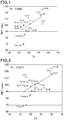
- In general, wet grip performance is considered to correlate with the tan δ measured at about 0°C. As shown in
Figs. 1 to 3 , which will be described later, the experiments conducted by the present inventor demonstrate that the tan δ measured at 0°C has a higher correlation with wet grip performance than the E* or glass transition temperature does. - Based on these results, the present inventor conducted extensive research and found that the value calculated using a special formula, i.e., by dividing tan δ by E*0.3, strongly correlates with wet grip performance. As a result of further research, the inventor has found that good wet grip performance is ensured when the value of tan δ/E*0.3 is within a predetermined range. Thus, the present inventor arrived at the present invention.
- Specifically, the present invention relates to a pneumatic tire, including a tread formed from a rubber composition, the rubber composition having a tan δ and an E*, which at 0°C satisfy the following relationship:

- Preferably, the tan δ and the E* satisfy the following relationship:

- Preferably, the tan δ is 0.420 to 0.680, and the E* is 16.50 to 30.20 Mpa.
- Preferably, the rubber composition has a glass transition temperature of -40°C or higher.
- Preferably, the rubber composition contains a carbon black having a nitrogen adsorption specific surface area of 60 to 150 m2/g and a resin.
- Preferably, the pneumatic tire of the present invention is a motorcycle tire.
- The pneumatic tire of the present invention includes a tread formed from a rubber composition having a tan δ and an E*, which at 0°C satisfy the above relationship. Such a pneumatic tire provides excellent wet grip performance.
-
-
Fig. 1 shows a scatter plot of the variables: Tg and WET index. -
Fig. 2 shows a scatter plot of the variables: E* and WET index. -
Fig. 3 shows a scatter plot of the variables: tan δ and WET index. -
Fig. 4 shows a scatter plot of the variables: tan δ/E* and WET index. -
Fig. 5 shows a scatter plot of the variables: tan δ/E*3 and WET index. -
Fig. 6 shows a scatter plot of the variables: tan δ/E*0.3 and WET index. - The pneumatic tire of the present invention includes a tread formed from a rubber composition having a tan δ and an E*, which at 0°C satisfy the following relationship:

- Owing to the use of a rubber composition having a value of tan δ/E*0.3 of 0.18 or higher as a tread, the pneumatic tire provides excellent wet grip performance. To obtain better wet grip performance, the tan δ/E*0.3 is preferably 0.23 or higher.
- The upper limit of the tan δ/E*0.3 is not particularly critical, but is preferably 0.3 or lower.
- Herein, the tan δ and E* are determined by performing viscoelastic testing on the vulcanized rubber composition at 0°C. Specifically, these property values are measured as described later in EXAMPLES.
- The tan δ is preferably 0.420 to 0.680. The E* is preferably 16.50 to 30.20 Mpa.
- The tan δ and E* of a rubber composition greatly depend on the rubber component, fillers, and resins (tackifying resins) incorporated in the rubber composition. Thus, it is important to select the type and amount of these components so as to adjust the tan δ/E*0.3 within a predetermined range.
- The rubber component, fillers, and resins suitable to adjust the tan δ/E*0.3 to 0.18 or higher are described below.
- The rubber component includes, for example, diene rubbers such as natural rubber (NR), epoxidized natural rubber (ENR), polyisoprene rubber (IR), polybutadiene rubber (BR), styrene-butadiene rubber (SBR), acrylonitrile-butadiene rubber (NBR), chloroprene rubber (CR), butyl rubber (IIR), and styrene-isoprene-butadiene copolymer rubber (SIBR). Each of these rubbers may be used alone, or two or more of these may be used in combination. Among these, SBR is preferred.
- The SBR preferably has a glass transition temperature (Tg) of -60°C or higher, more preferably -45°C or higher, still more preferably -40°C or higher. The upper limit of the Tg is not particularly critical, but is preferably -10°C or lower.
- Herein, the Tg of the SBR is measured with a differential scanning calorimeter (Q200, TA Instruments, Japan) at a rate of temperature increase of 10°C/min in accordance with JIS K 7121:1987.
- The SBR preferably has a styrene content of 20% by mass or more, more preferably 30% by mass or more, but preferably 50% by mass or less, more preferably 40% by mass or less.
- The styrene content is determined by 1H-NMR.
- The SBR preferably has a vinyl content of 15% by mass or more, more preferably 30% by mass or more, but preferably 50% by mass or less, more preferably 40% by mass or less.
- The vinyl content is determined by infrared absorption spectrometry.
- The SBR preferably has a weight average molecular weight (Mw) of 500,000 or more, more preferably 600,000 or more, still more preferably 900,000 or more, but preferably 1,200,000 or less, more preferably 1,100,000 or less.
- The Mw may be determined by gel permeation chromatography (GPC) (GPC-8000 series available from Tosoh Corporation, detector: differential refractometer, column: TSKGEL SUPERMULTIPORE HZ-M available from Tosoh Corporation) calibrated with polystyrene standards.
- The SBR content based on 100% by mass of the rubber component is preferably 70% by mass or more, more preferably 90% by mass or more, still more preferably 100% by mass.
- The filler may suitably be carbon black.
- The carbon black preferably has a nitrogen adsorption specific surface area (N2SA) of 60 m2/g or more, more preferably 100 m2/g or more, but preferably 150 m2/g or less, more preferably 120 m2/g or less.
- Herein, the N2SA of the carbon black is determined in accordance with ASTM D4820-93.
- The carbon black content per 100 parts by mass of the rubber component is preferably 60 parts by mass or more, more preferably 90 parts by mass or more, but is preferably 150 parts by mass or less, more preferably 120 parts by mass or less.
- The filler may be silica.
- The silica preferably has a nitrogen adsorption specific surface area (N2SA) of 100 m2/g or more, more preferably 150 m2/g or more, but preferably 300 m2/g or less, more preferably 200 m2/g or less.
- The N2SA of the silica is determined in accordance with ASTM D1993-03.
- In the case where the rubber composition in the present invention contains silica, the silica content per 100 parts by mass of the rubber component is preferably 10 parts by mass or more, more preferably 20 parts by mass or more, but is preferably 60 parts by mass or less, more preferably 50 parts by mass or less.
- Examples of the resin include coumarone resins, indene resins, coumarone-indene resins, and α-methylstyrene resins. Each of these resins may be used alone, or two or more of these may be used in combination. Preferred among these are coumarone-indene resins or α-methylstyrene resins.
- Coumarone-indene resins are mainly derived from coumarone and indene, and α-methylstyrene resins are mainly derived from α-methylstyrene. These resins may further contain other monomer components such as styrene.
- The resin preferably has a softening point of 60°C or higher, more preferably 80°C or higher, but preferably 180°C or lower, more preferably 150°C or lower.
- Herein, the softening point of the resin is determined as set forth in JIS K 6220-1:2001 using a ring and ball softening point measuring apparatus and is defined as the temperature at which the ball drops down.
- In the case where the rubber composition in the present invention contains a resin, the resin content per 100 parts by mass of the rubber component is preferably 3 parts by mass or more, more preferably 5 parts by mass or more, but is preferably 20 parts by mass or less, more preferably 15 parts by mass or less.
- The rubber composition in the present invention may appropriately contain, in addition to the components described above, other compounding materials commonly used in the tire industry, such as waxes, zinc oxide, stearic acid, releasing agents, antioxidants, vulcanization accelerators, and sulfur.
- The rubber composition in the present invention preferably has a glass transition temperature (Tg) of -40°C or higher, more preferably -35°C or higher. The upper limit of the Tg is not particularly critical, but is preferably -10°C or lower.
- The pneumatic tire of the present invention may be produced using the rubber composition by conventional methods.
- Specifically, the unvulcanized rubber composition incorporating the components may be extruded into the shape of a tire tread, and assembled with other tire components in a usual manner on a tire building machine to build an unvulcanized tire, which is then heated and pressurized in a vulcanizer, whereby the tire can be produced.
- The pneumatic tire of the present invention is suitable as a motorcycle tire that requires particularly excellent wet grip performance.
- The present invention will be specifically described with reference to, but not limited to, examples below.
- The chemicals used in the examples and comparative examples are listed below.
- SBR 1: oil extended SBR (Tg: -39°C, styrene content: 32% by mass, vinyl content: 34% by mass, Mw: 1, 060, 000, oil content per 100 parts by mass of rubber solids: 37.5 parts by mass)
- SBR 2: non-oil extended SBR (Tg: -56°C, styrene content: 23% by mass, vinyl content: 17% by mass, Mw: 510,000)
- SBR 3: oil extended SBR (Tg: -55°C, styrene content: 25% by mass, vinyl content: 15% by mass, Mw: 760,000, oil content per 100 parts by mass of rubber solids: 37.5 parts by mass)
- SBR 4: oil extended SBR (Tg: -43°C, styrene content: 37% by mass, vinyl content: 16% by mass, Mw: 640,000, oil content per 100 parts by mass of rubber solids: 34 parts by mass)
- Carbon black N351H: SHOBLACK N351H (N2SA: 69 m2/g) available from Cabot Japan K.K.
- Carbon black N330: SHOBLACK N330 (N2SA: 75 m2/g) available from Cabot Japan K.K.
- Carbon black N220: DIABLACK N220 (N2SA: 114 m2/g) available from Mitsubishi Chemical Corporation
- Silica: Ultrasil VN3 (N2SA: 175 m2/g) available from Evonik Degussa
- Resin SA85: SYLVARES SA85 (α-methylstyrene resin (copolymer of α-methylstyrene and styrene), softening point: 85°C) available from Arizona Chemical
- Resin V-120:Nittoresin coumarone V120 (coumarone-indene resin, softening point: 120°C) available from Nitto Chemical Co., Ltd.
- According to each of the formulations indicated in Table 1, the components were kneaded to obtain an unvulcanized rubber composition. Note that only the rubber component, fillers, and resins are listed in Table 1, but 25 parts by mass of an oil, 2 parts by mass of sulfur, 2 parts by mass of a vulcanization accelerator, 2 parts by mass of an antioxidant, 2 parts by mass of stearic acid, and 2 parts by mass of zinc oxide were also used as common components in addition to these components.
- The unvulcanized rubber composition was press-vulcanized at 160°C for 20 minutes to obtain a vulcanized rubber composition.
- Separately, the unvulcanized rubber composition was extruded into a tread shape, assembled with other tire components on a tire building machine, and vulcanized at 160°C for 20 minutes to prepare a test tire.
- The vulcanized rubber compositions and test tires prepared as above were evaluated for the following properties. Table 1 shows the results.
- The glass transition temperature (Tg) of the vulcanized rubber composition was measured with an automatic differential scanning calorimeter (DSC-60A, Shimadzu Corporation) at a rate of temperature increase of 10°C/min in accordance with JIS K 7121.
- The complex modulus (E*(MPa)) and loss tangent (tan δ) of the vulcanized rubber composition were measured using a viscoelastic spectrometer VES (Iwamoto Seisakusho Co., Ltd.) at a temperature of 0°C, a frequency of 10Hz, an initial strain of 10%, and a dynamic strain of 2%.
- Each set of the test tires was mounted on a front-engine, front-wheel-drive car of 2,000 cc displacement made in Japan. The car was subjected to an on-vehicle test under the conditions below. The results are expressed as an index (WET index), with Example A set equal to 100. A higher index indicates better wet grip performance. An index of 95 or higher means good wet grip performance.
-
- Road: the cobbled road on the Okayama Test Course
- Speed: After entry at 50 km/h, the braking distance required to reach 40 to 10 km/h was measured using GPS.
- Braking: Full ABS
- Tire size: 120/70ZR17 D222F
- Internal pressure: 250 kPa
- Scatter plots between the WET index and Tg, E* or tan δ (variables) measured as above were prepared. Then, fit curves were added to the scatter plots. The correlations between these variables were evaluated based on the obtained coefficients of determination (R2) (
Figs. 1 to 3 ). The correlations with tan δ/E*, tan δ/E*3, and tan δ/E*0.3 were also evaluated in the same manner as above (Figs. 4 to 6 ). An R2 value within the range of 0.7 to 1.0 indicates a high correlation between the two variables.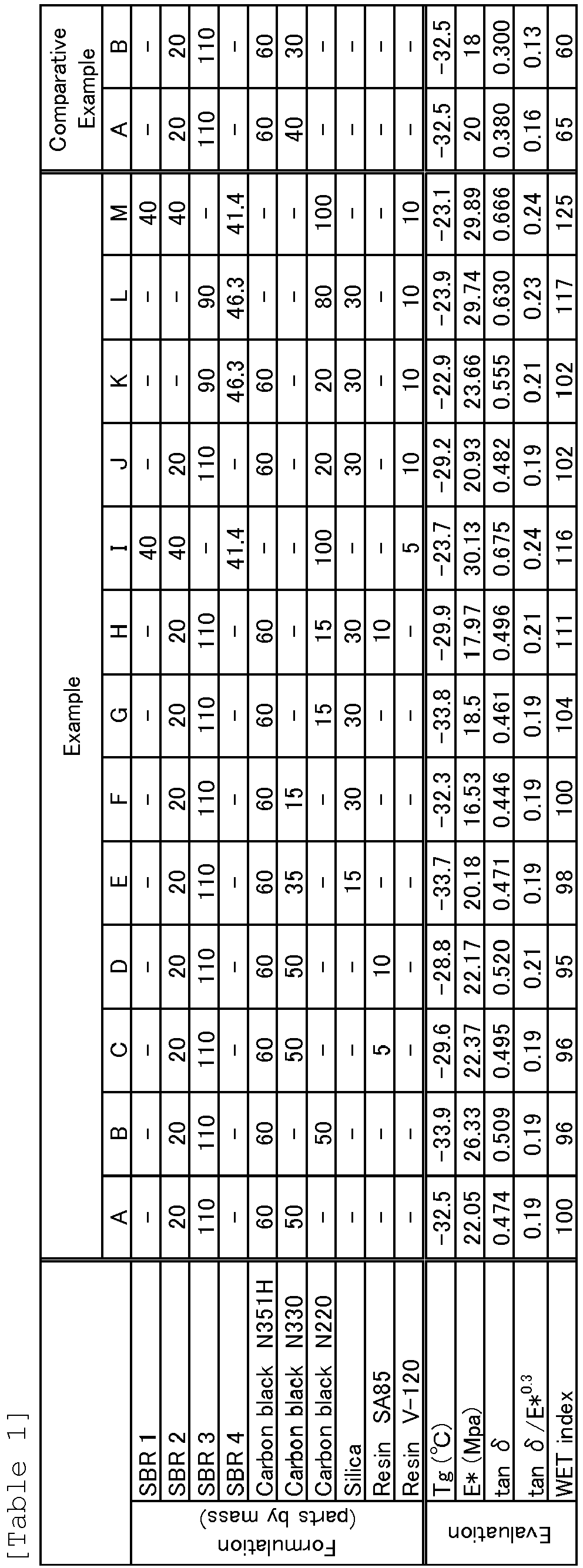
- Table 1 shows that good wet grip performance was obtained in the examples satisfying the relationship: tan δ/E*0.3 ≥ 0.18.
- As shown in
Figs. 1 to 3 , the R2 for tan δ is relatively high, while the R2 for Tg or E* is not so high. Moreover, as shown inFigs. 4 and5 , the R2 for tan δ/E* or tan δ/E*3 is very low, and thus they have almost no correlation with wet grip performance. In contrast, as shown inFig. 6 , the R2 for tan δ/E*0.3 is higher than that for tan δ, and thus the tan δ/E*0.3 strongly correlates with wet grip performance. - Provided is a pneumatic tire having excellent wet grip performance. The present invention relates to a pneumatic tire including a tread formed from a rubber composition, the rubber composition having a tan δ and an E*, which at 0°C satisfy the following relationship:

Claims (6)
- A pneumatic tire, comprising a tread formed from a rubber composition, the rubber composition having a tan δ and an E*, which at 0°C satisfy the following relationship:

- The pneumatic tire according to claim 1, wherein the tan δ and the E* satisfy the following relationship:

- The pneumatic tire according to claim 1 or 2,
wherein the tan δ is 0.420 to 0.680, and
the E* is 16.50 to 30.20 Mpa. - The pneumatic tire according to any one of claims 1 to 3,
wherein the rubber composition has a glass transition temperature of -40°C or higher. - The pneumatic tire according to any one of claims 1 to 4,
wherein the rubber composition comprises a carbon black having a nitrogen adsorption specific surface area of 60 to 150 m2/g and a resin. - The pneumatic tire according to any one of claims 1 to 5, which is a motorcycle tire.
Applications Claiming Priority (1)
| Application Number | Priority Date | Filing Date | Title |
|---|---|---|---|
| JP2017030106A JP7241455B2 (en) | 2017-02-21 | 2017-02-21 | pneumatic tire |
Publications (1)
| Publication Number | Publication Date |
|---|---|
| EP3369587A1 true EP3369587A1 (en) | 2018-09-05 |
Family
ID=61192764
Family Applications (1)
| Application Number | Title | Priority Date | Filing Date |
|---|---|---|---|
| EP18156241.4A Pending EP3369587A1 (en) | 2017-02-21 | 2018-02-12 | Pneumatic tire |
Country Status (3)
| Country | Link |
|---|---|
| US (1) | US10434822B2 (en) |
| EP (1) | EP3369587A1 (en) |
| JP (1) | JP7241455B2 (en) |
Families Citing this family (12)
| Publication number | Priority date | Publication date | Assignee | Title |
|---|---|---|---|---|
| US12365202B2 (en) | 2018-05-04 | 2025-07-22 | Bridgestone Americas Tire Operations, Llc | Tire tread rubber composition |
| JP2021523260A (en) | 2018-05-04 | 2021-09-02 | ブリヂストン アメリカズ タイヤ オペレーションズ、 エルエルシー | Tire tread rubber composition |
| US12103334B2 (en) | 2018-05-04 | 2024-10-01 | Bridgestone Americas Tire Operations, Llc | Tire tread rubber composition |
| WO2019213226A1 (en) | 2018-05-04 | 2019-11-07 | Bridgestone Americas Tire Operations, Llc | Tire tread rubber composition |
| JP7147272B2 (en) | 2018-05-29 | 2022-10-05 | 住友ゴム工業株式会社 | Tire rubber composition and pneumatic tire |
| JP7147271B2 (en) * | 2018-05-29 | 2022-10-05 | 住友ゴム工業株式会社 | Tire rubber composition and pneumatic tire |
| EP3976393A1 (en) | 2019-05-29 | 2022-04-06 | Bridgestone Americas Tire Operations, LLC | Tire tread rubber composition and related methods |
| JP2022535725A (en) | 2019-05-29 | 2022-08-10 | ブリヂストン アメリカズ タイヤ オペレーションズ、 エルエルシー | Tire tread rubber composition and related methods |
| JP2022534568A (en) | 2019-05-29 | 2022-08-02 | ブリヂストン アメリカズ タイヤ オペレーションズ、 エルエルシー | Tire tread rubber composition and related methods |
| JP7364874B2 (en) * | 2019-09-04 | 2023-10-19 | 横浜ゴム株式会社 | motorcycle tires |
| JP7793129B2 (en) | 2022-02-03 | 2026-01-05 | 住友ゴム工業株式会社 | pneumatic tires |
| JP2025122788A (en) | 2024-02-09 | 2025-08-22 | 住友ゴム工業株式会社 | tire |
Citations (11)
| Publication number | Priority date | Publication date | Assignee | Title |
|---|---|---|---|---|
| US5877249A (en) * | 1995-09-22 | 1999-03-02 | The Goodyear Tire & Rubber Company | Tire with tread having silica reinforcement field |
| JP2005525447A (en) * | 2002-05-14 | 2005-08-25 | ランクセス ドイチュラント ゲゼルシャフト ミット ベシュレンクテル ハフツング | Rubber mixture containing terpolymer |
| JP2005526893A (en) * | 2002-05-23 | 2005-09-08 | ランクセス ドイチュラント ゲゼルシャフト ミット ベシュレンクテル ハフツング | Rubber mixture containing quaterpolymer and polar plasticizer |
| JP2005534608A (en) * | 2002-08-03 | 2005-11-17 | デグサ アクチエンゲゼルシャフト | Highly dispersible precipitated silica |
| JP2005350535A (en) | 2004-06-09 | 2005-12-22 | Sumitomo Rubber Ind Ltd | Rubber composition for tire |
| EP1777260B1 (en) * | 2005-10-22 | 2009-04-22 | Continental Aktiengesellschaft | Rubber composition and tire comprising thereof |
| JP2011148952A (en) * | 2010-01-25 | 2011-08-04 | Sumitomo Rubber Ind Ltd | Rubber composition for tire and pneumatic tire |
| JP2012071722A (en) * | 2010-09-29 | 2012-04-12 | Honda Motor Co Ltd | Tire composition for motorcycle and tire for motorcycle |
| EP2674454A1 (en) * | 2012-06-13 | 2013-12-18 | The Goodyear Tire & Rubber Company | Pneumatic tire |
| EP3031621A1 (en) * | 2014-12-09 | 2016-06-15 | The Goodyear Tire & Rubber Company | Pneumatic tire |
| JP2016193687A (en) * | 2015-04-01 | 2016-11-17 | 株式会社ブリヂストン | tire |
Family Cites Families (6)
| Publication number | Priority date | Publication date | Assignee | Title |
|---|---|---|---|---|
| JP2003041045A (en) * | 2001-07-26 | 2003-02-13 | Yokohama Rubber Co Ltd:The | Material recovery method and material recovery from rubber molded products |
| CN1642988A (en) * | 2002-03-13 | 2005-07-20 | 埃克森美孚化学专利公司 | Abrasion resistant elastomeric compositions |
| JP4672410B2 (en) * | 2005-03-28 | 2011-04-20 | 住友ゴム工業株式会社 | Radial tire |
| JP2009057413A (en) * | 2007-08-30 | 2009-03-19 | Toyo Tire & Rubber Co Ltd | Rubber composition for tire tread and pneumatic tire |
| US7960463B2 (en) * | 2007-12-31 | 2011-06-14 | Bridgestone Corporation | Tire treads including aluminum hydroxycarbonate |
| JP6351495B2 (en) * | 2014-12-16 | 2018-07-04 | 住友ゴム工業株式会社 | Pneumatic tire |
-
2017
- 2017-02-21 JP JP2017030106A patent/JP7241455B2/en active Active
-
2018
- 2018-02-06 US US15/889,884 patent/US10434822B2/en active Active
- 2018-02-12 EP EP18156241.4A patent/EP3369587A1/en active Pending
Patent Citations (11)
| Publication number | Priority date | Publication date | Assignee | Title |
|---|---|---|---|---|
| US5877249A (en) * | 1995-09-22 | 1999-03-02 | The Goodyear Tire & Rubber Company | Tire with tread having silica reinforcement field |
| JP2005525447A (en) * | 2002-05-14 | 2005-08-25 | ランクセス ドイチュラント ゲゼルシャフト ミット ベシュレンクテル ハフツング | Rubber mixture containing terpolymer |
| JP2005526893A (en) * | 2002-05-23 | 2005-09-08 | ランクセス ドイチュラント ゲゼルシャフト ミット ベシュレンクテル ハフツング | Rubber mixture containing quaterpolymer and polar plasticizer |
| JP2005534608A (en) * | 2002-08-03 | 2005-11-17 | デグサ アクチエンゲゼルシャフト | Highly dispersible precipitated silica |
| JP2005350535A (en) | 2004-06-09 | 2005-12-22 | Sumitomo Rubber Ind Ltd | Rubber composition for tire |
| EP1777260B1 (en) * | 2005-10-22 | 2009-04-22 | Continental Aktiengesellschaft | Rubber composition and tire comprising thereof |
| JP2011148952A (en) * | 2010-01-25 | 2011-08-04 | Sumitomo Rubber Ind Ltd | Rubber composition for tire and pneumatic tire |
| JP2012071722A (en) * | 2010-09-29 | 2012-04-12 | Honda Motor Co Ltd | Tire composition for motorcycle and tire for motorcycle |
| EP2674454A1 (en) * | 2012-06-13 | 2013-12-18 | The Goodyear Tire & Rubber Company | Pneumatic tire |
| EP3031621A1 (en) * | 2014-12-09 | 2016-06-15 | The Goodyear Tire & Rubber Company | Pneumatic tire |
| JP2016193687A (en) * | 2015-04-01 | 2016-11-17 | 株式会社ブリヂストン | tire |
Also Published As
| Publication number | Publication date |
|---|---|
| US20180236816A1 (en) | 2018-08-23 |
| JP7241455B2 (en) | 2023-03-17 |
| US10434822B2 (en) | 2019-10-08 |
| JP2018135436A (en) | 2018-08-30 |
Similar Documents
| Publication | Publication Date | Title |
|---|---|---|
| EP3369587A1 (en) | Pneumatic tire | |
| EP1884376B1 (en) | Pneumatic tire | |
| KR101508964B1 (en) | Tire rubber composite and pneumatic tire | |
| EP3000616B1 (en) | Rubber composition for tire and tire | |
| EP4201705A1 (en) | Tire | |
| KR101516591B1 (en) | Rubber composition for tire, and pneumatic tire | |
| EP4166350B1 (en) | Tire | |
| EP3385091B1 (en) | Rubber composition and tire | |
| CN110234698A (en) | Rubber composition for tire and pneumatic tire | |
| EP4166351B1 (en) | Tire | |
| CN114450339A (en) | Rubber composition and tire | |
| JP2006188571A (en) | Rubber composition and tire comprising the same | |
| JP2011068911A (en) | Rubber composition, and tire comprising the same | |
| JP7821547B2 (en) | Rubber composition for tires and tires | |
| JP2025005831A (en) | Rubber composition for tires and tires | |
| JP2024140511A (en) | Rubber composition for tires and tires | |
| JP2025044546A (en) | Rubber composition for tires and tire | |
| JP2025002483A (en) | Rubber composition for tires and tires | |
| JP2025016034A (en) | Rubber composition for tires and tires | |
| JP2025053940A (en) | Rubber composition for tires and tires | |
| US20260035547A1 (en) | Rubber composition | |
| JP2024168127A (en) | Rubber composition for tires and tires | |
| JP2024092572A (en) | Rubber composition for tires and tires | |
| JP2024158465A (en) | Rubber composition for tires and tires | |
| JP2025027856A (en) | Rubber composition for tires and tires |
Legal Events
| Date | Code | Title | Description |
|---|---|---|---|
| PUAI | Public reference made under article 153(3) epc to a published international application that has entered the european phase |
Free format text: ORIGINAL CODE: 0009012 |
|
| STAA | Information on the status of an ep patent application or granted ep patent |
Free format text: STATUS: THE APPLICATION HAS BEEN PUBLISHED |
|
| AK | Designated contracting states |
Kind code of ref document: A1 Designated state(s): AL AT BE BG CH CY CZ DE DK EE ES FI FR GB GR HR HU IE IS IT LI LT LU LV MC MK MT NL NO PL PT RO RS SE SI SK SM TR |
|
| AX | Request for extension of the european patent |
Extension state: BA ME |
|
| STAA | Information on the status of an ep patent application or granted ep patent |
Free format text: STATUS: REQUEST FOR EXAMINATION WAS MADE |
|
| 17P | Request for examination filed |
Effective date: 20190301 |
|
| STAA | Information on the status of an ep patent application or granted ep patent |
Free format text: STATUS: EXAMINATION IS IN PROGRESS |
|
| 17Q | First examination report despatched |
Effective date: 20210507 |
|
| P01 | Opt-out of the competence of the unified patent court (upc) registered |
Free format text: CASE NUMBER: UPC_APP_110734/2023 Effective date: 20230510 |