EP3368043B1 - Furostan-3-ol derivatives as skeletal muscle hypertrophic agents - Google Patents
Furostan-3-ol derivatives as skeletal muscle hypertrophic agents Download PDFInfo
- Publication number
- EP3368043B1 EP3368043B1 EP16860856.0A EP16860856A EP3368043B1 EP 3368043 B1 EP3368043 B1 EP 3368043B1 EP 16860856 A EP16860856 A EP 16860856A EP 3368043 B1 EP3368043 B1 EP 3368043B1
- Authority
- EP
- European Patent Office
- Prior art keywords
- alkyl
- hydrocarbyl
- chosen
- substituted
- heteroaryl
- Prior art date
- Legal status (The legal status is an assumption and is not a legal conclusion. Google has not performed a legal analysis and makes no representation as to the accuracy of the status listed.)
- Active
Links
- 0 C[C@@](CC1)C[C@](*)CCC[C@@](CC2)[C@]1[C@@]1[C@@]2(C)[C@]2C(C)=C(*N(*)*)O[C@@]2C1 Chemical compound C[C@@](CC1)C[C@](*)CCC[C@@](CC2)[C@]1[C@@]1[C@@]2(C)[C@]2C(C)=C(*N(*)*)O[C@@]2C1 0.000 description 4
Classifications
-
- C—CHEMISTRY; METALLURGY
- C07—ORGANIC CHEMISTRY
- C07J—STEROIDS
- C07J71/00—Steroids in which the cyclopenta(a)hydrophenanthrene skeleton is condensed with a heterocyclic ring
- C07J71/0005—Oxygen-containing hetero ring
-
- A—HUMAN NECESSITIES
- A61—MEDICAL OR VETERINARY SCIENCE; HYGIENE
- A61P—SPECIFIC THERAPEUTIC ACTIVITY OF CHEMICAL COMPOUNDS OR MEDICINAL PREPARATIONS
- A61P21/00—Drugs for disorders of the muscular or neuromuscular system
-
- A—HUMAN NECESSITIES
- A61—MEDICAL OR VETERINARY SCIENCE; HYGIENE
- A61P—SPECIFIC THERAPEUTIC ACTIVITY OF CHEMICAL COMPOUNDS OR MEDICINAL PREPARATIONS
- A61P21/00—Drugs for disorders of the muscular or neuromuscular system
- A61P21/06—Anabolic agents
-
- C—CHEMISTRY; METALLURGY
- C07—ORGANIC CHEMISTRY
- C07D—HETEROCYCLIC COMPOUNDS
- C07D307/00—Heterocyclic compounds containing five-membered rings having one oxygen atom as the only ring hetero atom
- C07D307/77—Heterocyclic compounds containing five-membered rings having one oxygen atom as the only ring hetero atom ortho- or peri-condensed with carbocyclic rings or ring systems
-
- A—HUMAN NECESSITIES
- A61—MEDICAL OR VETERINARY SCIENCE; HYGIENE
- A61K—PREPARATIONS FOR MEDICAL, DENTAL OR TOILETRY PURPOSES
- A61K31/00—Medicinal preparations containing organic active ingredients
- A61K31/33—Heterocyclic compounds
- A61K31/335—Heterocyclic compounds having oxygen as the only ring hetero atom, e.g. fungichromin
- A61K31/34—Heterocyclic compounds having oxygen as the only ring hetero atom, e.g. fungichromin having five-membered rings with one oxygen as the only ring hetero atom, e.g. isosorbide
- A61K31/343—Heterocyclic compounds having oxygen as the only ring hetero atom, e.g. fungichromin having five-membered rings with one oxygen as the only ring hetero atom, e.g. isosorbide condensed with a carbocyclic ring, e.g. coumaran, bufuralol, befunolol, clobenfurol, amiodarone
Definitions
- the invention relates to furostan-3-ol derivatives described in systematic nomenclature as 10-substituted hexadecahydro-1 H -naphtho[2',1':4,5]indeno[2,1- b ]furan-4-ols and hexadecahydro-1 H -naphtho[2',1':4,5]indeno[2,1- b ]furan-4-amines.
- the compounds are useful for treating muscle atrophy and as muscle hypertrophic agents.
- Skeletal muscle atrophy is characteristic of starvation and a common effect of aging. It is also a nearly universal consequence of severe human illnesses, including cancer, chronic renal failure, congestive heart failure, chronic respiratory disease, insulin deficiency, acute critical illness, chronic infections such as HIV/AIDS, muscle denervation, and many other medical and surgical conditions.
- the hypertrophic and anti-atrophic effects of insulin/IGF1 signaling are mediated at least in part through increased activity of phosphoinositide 3-kinase (PI3K) and its downstream effectors, including Akt and mammalian target of rapamycin complex 1 (mTORCl) Sandri M (2008) Physiology (Bethesda) 23:160-170 ; Glass DJ (2005) The international journal of biochemistry & cell biology 37(10):1974-1984 ).
- PI3K phosphoinositide 3-kinase
- Atrophy-associated changes promote muscle atrophy in mice; these include induction of the mRNAs encoding atroginI/MAFbx and MuRF1 (two E3 ubiquitin ligases that catalyze proteolytic events), and repression of the mRNA encoding PGC-1 ⁇ (a transcriptional co-activator that inhibits muscle atrophy) ( Sandri M, et al. (2006) Proceedings of the National Academy of Sciences of the United States of America 103(44):16260-16265 ; Wenz T, et al. Proceedings of the National Academy of Sciences of the United States of America 106(48):20405-20410 ; Bodine SC, et al.
- the furostanol scaffold of the compounds described below is found primarily in the aglycone portion of plant saponins.
- the plant saponins are frequently associated in the literature with various biological activities, but therapeutic properties are not commonly ascribed to the unglycosylated furostanol sapogenins.
- US published application 2007/0254847 describes a class of saponins obtained from Dioscorea panthaica and Dioscorea nipponica which are said to possess utility in treating cerebrovascular and coronary heart diseases.
- the glycosides share a furostanol core, it is the glycoside saponin, not the furostanol aglycone to which the utility is ascribed.
- the invention relates to a compound for use in reducing skeletal muscle atrophy or for therapeutic use in promoting skeletal muscle hypertrophy in an animal, the compounds being of formula I wherein:
- the invention relates to the non-therapeutic use of a compound falling within formula I above in promoting skeletal muscle hypertrophy.
- the invention relates to pharmaceutical compositions comprising a pharmaceutically acceptable carrier and a compound falling within formula I above.
- the invention relates to compounds as defined in any one of claims 3 to 12 of the appended claim set.
- composition aspect the disclosure relates to compounds of formula I
- R 1 may be chosen from OR 2 and NHR 3 .
- R 1 is NHR 3 ; in another R 1 is OR 2 .
- the carbon to which R 1 is attached is preferably of the (S) absolute configuration, particularly when R 1 is OR 2 .
- R 3 is hydroxy(C 2 -C 6 )alkyl or hydroxy oxa(C 3 -C 18 )alkyl, preferably -CH 2 CH 2 OH.
- G may be (C 2 -C 10 )hydrocarbyl. In some embodiments, G may be linear or branched (C 4 -C 7 )alkyl. In one embodiment, G is branched (C 5 )alkyl. In a further embodiment G is - CH 2 CH 2 CH(CH 3 )CH 2 -.
- R 4 may be H or (C 1 -C 3 )hydrocarbyl. In some embodiments, R 4 is CH 3 ; in others R 4 is hydrogen.
- R 5 is chosen from H, (C 1 -C 6 )alkyl, and fluoro(C 1 -C 6 )alkyl.
- R 5 is H.
- R 5 may be methyl, ethyl, propyl, (including isopropyl), butyl (including n-butyl, sec-butyl, isobutyl, and t-butyl) or their fluorinated congeners, i.e.
- R 6 may be H, (C 1 -C 10 )hydrocarbyl, -O-(C 1 -C 10 )hydrocarbyl, -NH-(C 1 -C 10 )hydrocarbyl, substituted aryl, substituted arylalkyl, heterocyclyl, substituted heteroaryl, heteroarylalkyl, substituted heteroarylalkyl, -NH-(substituted aryl), -NH-(substituted arylalkyl), -NH-(heterocyclyl), or -NH-(substituted heteroaryl).
- R 6 is H, (C 1 -C 10 )hydrocarbyl, or -O-(C 1 -C 10 )hydrocarbyl. In further embodiments, R 6 is (C 1 -C 6 )alkyl or -O(C 1 -C 6 )alkyl.
- Hydrocarbon includes alkyl, cycloalkyl, polycycloalkyl, alkenyl, alkynyl, aryl and combinations thereof. Examples include benzyl, phenethyl, cyclohexylmethyl, adamantyl, camphoryl and naphthylethyl. Hydrocarbyl refers to any substituent comprised of hydrogen and carbon as the only elemental constituents.
- Aliphatic hydrocarbons are hydrocarbons that are not aromatic; they may be saturated or unsaturated, cyclic, linear or branched. Examples of aliphatic hydrocarbons include isopropyl, 2-butenyl, 2-butynyl, cyclopentyl, norbornyl, etc.
- Aromatic hydrocarbons include benzene (phenyl), naphthalene (naphthyl), anthracene, etc.
- alkyl (or alkylene) is intended to include linear or branched saturated hydrocarbon structures and combinations thereof.
- Alkyl refers to alkyl groups from 1 to 20 carbon atoms, preferably 1 to 10 carbon atoms, more preferably 1 to 6 carbon atoms.
- alkyl groups include methyl, ethyl, n -propyl, isopropyl, n -butyl, isobutyl, s -butyl, t -butyl, n -pentyl, isopentyl, s -pentyl, neopentyl, hexyl, heptyl, octyl, nonyl, decyl, dodecyl, and the like
- Cycloalkyl is a subset of hydrocarbon and includes cyclic hydrocarbon groups of from 3 to 8 carbon atoms. Examples of cycloalkyl groups include cy-propyl, cy-butyl, cy-pentyl, norbornyl and the like.
- Oxaalkyl refers to alkyl residues in which one or more carbons (and their associated hydrogens) have been replaced by oxygen. Examples include methoxypropoxy, 3,6,9-trioxadecyl and the like.
- oxaalkyl is intended as it is understood in the art [see Naming and Indexing of Chemical Substances for Chemical Abstracts, published by the American Chemical Society, 196 , but without the restriction of 127(a)], i.e. it refers to compounds in which the oxygen is bonded via a single bond to its adjacent atoms (forming ether bonds); it does not refer to doubly bonded oxygen, as would be found in carbonyl groups.
- Acyl refers to groups of 1, 2, 3, 4, 5, 6, 7 and 8 carbon atoms of a straight, branched, cyclic configuration, saturated, unsaturated and aromatic and combinations thereof, attached to the parent structure through a carbonyl functionality. Examples include formyl, acetyl, benzoyl, propionyl, isobutyryl and the like. Lower-acyl refers to groups containing one to four carbons.
- the double bonded oxygen, when referred to as a substituent itself is called "oxo".
- aryl as used herein is a group that contains any carbon-based aromatic group including, but not limited to, benzene, naphthalene, phenyl, biphenyl, phenoxybenzene, and the like.
- Heterocycle means an aliphatic or aromatic carbocycle residue in which from one to four carbons is replaced by a heteroatom selected from the group consisting of N, O, and S.
- the nitrogen and sulfur heteroatoms may optionally be oxidized, and the nitrogen heteroatom may optionally be quaternized.
- a heterocycle may be non-aromatic (heteroaliphatic) or aromatic (heteroaryl).
- heterocycles include pyrrolidine, pyrazole, pyrrole, indole, quinoline, isoquinoline, tetrahydroisoquinoline, benzofuran, benzodioxan, benzodioxole (commonly referred to as methylenedioxyphenyl, when occurring as a substituent), tetrazole, morpholine, thiazole, pyridine, pyridazine, pyrimidine, thiophene, furan, oxazole, oxazoline, isoxazole, dioxane, tetrahydrofuran and the like.
- heterocyclyl residues include piperazinyl, piperidinyl, pyrazolidinyl, imidazolyl, imidazolinyl, imidazolidinyl, pyrazinyl, oxazolidinyl, isoxazolidinyl, thiazolidinyl, isothiazolyl, quinuclidinyl, isothiazolidinyl, benzimidazolyl, thiadiazolyl, benzopyranyl, benzothiazolyl, tetrahydrofuryl, tetrahydropyranyl, thienyl (also historically called thiophenyl), benzothienyl, thiamorpholinyl, oxadiazolyl, triazolyl and tetrahydroquinolinyl.
- compounds of the invention may contain "optionally substituted” moieties.
- substituted whether preceded by the term “optionally” or not, means that one or more hydrogens of the designated moiety are replaced with a suitable substituent.
- an “optionally substituted” group may have a suitable substituent at each substitutable position of the group, and when more than one position in any given structure may be substituted with more than one substituent selected from a specified group, the substituent may be either the same or different at every position.
- Combinations of substituents envisioned by this invention are preferably those that result in the formation of stable or chemically feasible compounds.
- the invention relates to the compounds of formula I for use in therapy, as defined in the claims.
- the term "subject" refers to the target of administration, e.g. an animal.
- the subject of the herein disclosed methods can be a vertebrate, such as a mammal, a fish, a bird, a reptile, or an amphibian. More specifically, the subject of the herein disclosed methods can be a human, non-human primate, horse, pig, rabbit, dog, sheep, goat, cow, cat, guinea pig, fish, bird, or rodent.
- a patient refers to a subject afflicted with a disease or disorder, e.g. muscular atrophy.
- the term "patient” includes human and veterinary subjects.
- treatment refers to the medical management of a patient with the intent to cure, ameliorate, palliate, stabilize, or forestall a disease, pathological condition, or disorder.
- This term includes palliative treatment, that is, treatment designed for the relief of symptoms rather than the curing of the disease, pathological condition, or disorder; treatment directed to minimizing or partially or completely inhibiting the development of the associated disease and supportive treatment, that is, treatment employed to supplement another specific therapy directed toward the improvement of the associated disease.
- supportive treatment that is, treatment employed to supplement another specific therapy directed toward the improvement of the associated disease.
- use for asthetic and self-improvement purposes rather than for curing, ameliorating, or forestalling a disease.
- such uses include, but are not limited to, the administration of the disclosed compound in nutraceuticals, medicinal foods, functional foods, energy bars, energy drinks, sports drinks, protein bars, protein powders, tea, coffee, milk, milk products, cereal, oatmeal, infant formulas, supplements (such as multivitamins) or chewing gum.
- administering refers to any method of providing a pharmaceutical preparation to a subject.
- Such methods include, but are not limited to, oral administration, transdermal administration, administration by inhalation, nasal administration, topical administration, intravaginal administration, ophthalmic administration, intraaural administration, intracerebral administration, rectal administration, sublingual administration, buccal administration, and parenteral administration, including injectable such as intravenous administration, intra-arterial administration, intramuscular administration, and subcutaneous administration.
- the terms “effective amount” and “amount effective” refer to an amount that is sufficient to achieve the desired result or to have an effect on an undesired condition.
- a “therapeutically effective amount” refers to an amount that is sufficient to achieve the desired therapeutic result or to have an effect on undesired symptoms, but is generally insufficient to cause adverse side effects.
- the specific therapeutically effective dose level for any particular patient will depend upon a variety of factors including the disorder being treated and the severity of the disorder; the specific composition employed; the age, body weight, general health, sex and diet of the patient; the time of administration; the route of administration; the rate of excretion of the specific compound employed; the duration of the treatment; drugs used in combination or coincidental with the specific compound employed and like factors well known in the medical arts.
- the effective daily dose can be divided into multiple doses for purposes of administration. Consequently, single dose compositions can contain such amounts or submultiples thereof to make up the daily dose.
- the dosage can be adjusted by the individual physician in the event of any contraindications.
- the present invention provides a pharmaceutical composition comprising a compound of formula (I) or a pharmaceutically acceptable salt or solvate thereof, together with one or more pharmaceutically carriers thereof and optionally one or more other therapeutic ingredients.
- the carrier(s) must be "acceptable” in the sense of being compatible with the other ingredients of the formulation and not deleterious to the recipient thereof.
- the formulations include those suitable for oral, parenteral (including subcutaneous, intradermal, intramuscular, intravenous and intraarticular), rectal and topical (including dermal, buccal, sublingual and intraocular) administration.
- the most suitable route may depend upon the condition and disorder of the recipient.
- the formulations may conveniently be presented in unit dosage form and may be prepared by any of the methods well known in the art of pharmacy. All methods include the step of bringing into association a compound of formula (I) or a pharmaceutically acceptable salt or solvate thereof ("active ingredient”) with the carrier which constitutes one or more accessory ingredients.
- the formulations are prepared by uniformly and intimately bringing into association the active ingredient with liquid carriers or finely divided solid carriers or both and then, if necessary, shaping the product into the desired formulation.
- Formulations of the present invention suitable for oral administration may be presented as discrete units such as capsules, cachets or tablets each containing a predetermined amount of the active ingredient; as a powder or granules; as a solution or a suspension in an aqueous liquid or a non-aqueous liquid; or as an oil-in-water liquid emulsion or a water-in-oil liquid emulsion.
- the active ingredient may also be presented as a bolus, electuary or paste.
- a tablet may be made by compression or molding, optionally with one or more accessory ingredients.
- Compressed tablets may be prepared by compressing in a suitable machine the active ingredient in a free-flowing form such as a powder or granules, optionally mixed with a binder, lubricant, inert diluent, lubricating, surface active or dispersing agent.
- Molded tablets may be made by molding in a suitable machine a mixture of the powdered compound moistened with an inert liquid diluent.
- the tablets may optionally be coated or scored and may be formulated so as to provide sustained, delayed or controlled release of the active ingredient therein.
- Formulations for parenteral administration include aqueous and non-aqueous sterile injection solutions which may contain anti-oxidants, buffers, bacteriostats and solutes which render the formulation isotonic with the blood of the intended recipient.
- Formulations for parenteral administration also include aqueous and non-aqueous sterile suspensions, which may include suspending agents and thickening agents.
- the formulations may be presented in unit-dose of multi-dose containers, for example sealed ampoules and vials, and may be stored in a freeze-dried (lyophilized) condition requiring only the addition of a sterile liquid carrier, for example saline, phosphate-buffered saline (PBS) or the like, immediately prior to use.
- Extemporaneous injection solutions and suspensions may be prepared from sterile powders, granules and tablets of the kind previously described.
- Formulations for rectal administration may be presented as a suppository with the usual carriers such as cocoa butter or polyethylene glycol.
- Formulations for topical administration in the mouth include lozenges comprising the active ingredient in a flavoured basis such as sucrose and acacia or tragacanth, and pastilles comprising the active ingredient in a basis such as gelatin and glycerin or sucrose and acacia.
- Preferred unit dosage formulations are those containing an effective dose, as hereinbelow recited, or an appropriate fraction thereof, of the active ingredient. It should be understood that in addition to the ingredients particularly mentioned above, the formulations of this invention may include other agents conventional in the art having regard to the type of formulation in question, for example those suitable for oral administration may include flavoring agents.
- pharmaceutically acceptable salt refers to salts prepared from pharmaceutically acceptable non-toxic acids or bases including inorganic acids and bases and organic acids and bases.
- salts may be prepared from pharmaceutically acceptable non-toxic acids including inorganic and organic acids.
- Suitable pharmaceutically acceptable acid addition salts for the compounds of the present invention include acetic, adipic, alginic, ascorbic, aspartic, benzenesulfonic (besylate), benzoic, betulinic, boric, butyric, camphoric, camphorsulfonic, carbonic, citric, ethanedisulfonic, ethanesulfonic, ethylenediaminetetraacetic, formic, fumaric, glucoheptonic, gluconic, glutamic, hydrobromic, hydrochloric, hydroiodic, hydroxynaphthoic, isethionic, lactic, lactobionic, laurylsulfonic, maleic, malic, mandelic, methanesulfonic, mucic, naphthylenesulfonic, nitric, oleic, pamoic, pantothenic, phosphoric, pivalic, polygalacturonic, salicylic, ste
- suitable pharmaceutically acceptable base addition salts for the compounds of the present invention include, but are not limited to, metallic salts made from aluminum, calcium, lithium, magnesium, potassium, sodium and zinc or organic salts made from lysine, arginine, N,N'-dibenzylethylenediamine, chloroprocaine, choline, diethanolamine, ethylenediamine, meglumine (N-methylglucamine) and procaine.
- Further pharmaceutically acceptable salts include, when appropriate, nontoxic ammonium cations and carboxylate, sulfonate and phosphonate anions attached to alkyl having from 1 to 20 carbon atoms.
- an appropriate dosage level will generally be about 0.01 to 500 mg per kg patient body weight per day and can be administered in single or multiple doses.
- the dosage level will be about 0.1 to about 250 mg/kg per day; more preferably 0.5 to 100 mg/kg per day.
- a suitable dosage level can be about 0.01 to 250 mg/kg per day, about 0.05 to 100 mg/kg per day, or about 0.1 to 50 mg/kg per day. Within this range the dosage can be 0.05 to 0.5, 0.5 to 5.0, or 5.0 to 50 mg/kg per day.
- compositions are preferably provided in the form of tablets containing 1.0 to 1000 milligrams of the active ingredient, particularly 1.0, 5.0, 10, 15, 20, 25, 50, 75, 100, 150, 200, 250, 300, 400, 500, 600, 750, 800, 900, and 1000 milligrams of the active ingredient.
- Muscle hypertrophy is defined as the increase in muscle size or mass of the muscle, and can include an increase in individual fiber volume and/or an increase in the cross-sectional area of myofibers, and may also include an increase in the number of nuclei per muscle fiber. Muscle hypertrophy can also include an increase in the volume and mass of whole muscles; however, muscle hypertrophy can be differentiated from muscle hyperplasia, which is an increased number of muscle fibers. In one embodiment, muscular hypertrophy refers to an increase in the number of actin and myosin contractile proteins. Muscle hypertrophy leads to an increase in muscle strength. The muscle can be skeletal muscle.
- neutraceutical compositions comprising a neutraceutically acceptable carrier and a compound of formula I, wherein the compound is present in an effective amount.
- the compound may be present in an amount greater than 5 mg, 10 mg, 25 mg, 50 mg, 100 mg, 150 mg, 200 mg, 250 mg, 300 mg, 400, mg, 500 mg, 750 mg, 1000 mg, 1,500 mg, or 2,000 mg.
- Muscle atrophy is defined as a decrease in the mass of the muscle; it can be a partial or complete wasting away of muscle. When a muscle atrophies, this leads to muscle weakness, since the ability to exert force is related to mass. Muscle atrophy is a co-morbidity of several common diseases, and patients who have "cachexia" in these disease settings have a poor prognosis.
- muscle atrophy There are many diseases and conditions which cause muscle atrophy, including malnutrition, bed rest, neurologic disease (including multiple sclerosis, amyotrophic lateral sclerosis, spinal muscular atrophy, critical illness neuropathy, spinal cord injury or peripheral nerve injury), orthopedic injury, joint repair, joint replacement, casting, and other post-surgical forms of limb immobilization, osteoarthritis, chronic disease (including cancer, congestive heart failure, chronic pulmonary disease, chronic renal failure, chronic liver disease, diabetes mellitus, rheumatoid arthritis, Cushing syndrome, growth hormone deficiency, IGF-I deficiency, hypogonadism and chronic infections such as HIV/AIDS or tuberculosis), bums, sepsis, other illnesses requiring mechanical ventilation, drug-induced muscle disease (such as glucorticoid-induced myopathy, statin-induced myopathy, and muscle atrophy secondary to anti-androgen therapies or cancer chemotherapy), genetic diseases that primarily affect skeletal muscle (such as muscular dystrophy and myotonic
- Muscle atrophy is believed to occur by a change in the normal balance between protein synthesis and protein degradation. During atrophy, there is a down-regulation of protein synthesis pathways, and an activation of protein breakdown pathways. The particular protein degradation pathway which seems to be responsible for much of the muscle loss seen in a muscle undergoing atrophy is the ATP-dependent, ubiquitin/proteasome pathway.
- the compounds disclosed herein are useful for promoting or increasing muscle hypertrophy.
- the compounds are also useful for increasing muscle mass, increasing muscle hypertrophy, increasing muscle strength, increasing muscle endurance, increasing muscle quality, reducing muscle weakness and fatigue, increasing cellular protein, and promoting growth of muscle cells.
- the compounds may be used to increase muscle mass in domesticated animals, such as animals suitable for meat production.
- Animals suitable for meat production include, but are not limited to cows, bulls, bison, horses, sheep, goats, pigs, ducks, geese, lamas, camels, dromedary, boars, turkeys, and chickens.
- Vendors indicated below are as follows: “Pierce” is Pierce Biotechnology, Inc., Milwaukee, Wisconsin, USA, a division of Thermo Fisher Scientific, Inc.; “Roche Diagnostics” is Roche Diagnostics Corporation, Indianapolis, Indiana, USA; and, “Sigma” is Sigma-Aldrich Corporation, Saint Louis, Missouri, USA. Unless indicated otherwise, parts are parts by weight, temperature is in °C or is at ambient temperature, and pressure is at or near atmospheric.
- Example 7 (2a S ,4 S ,6a S ,6b S ,8a S ,8b S ,11a S ,12a S ,12b R )-10-(( S )-4-(Isopropylamino)-3-methylbutyl)-6a,8a,9-trimethyl-2,2a,3,4,5,6,6a,6b,7,8,8a,8b,11a,12,12a,12b-hexadecahydro-1 H -naphtho[2',1':4,5]indeno[2,1- b ]furan-4-ol
- Example 8 (2a S ,4 S ,6a S ,6b S ,8a S ,8b S ,11a S ,12a S ,12b R )-10-(( S )-4-(Dimethylamino)-3-methylbutyl)-6a,8a,9-trimethyl-2,2a,3,4,5,6,6a,6b,7,8,8a,8b,11a,12,12a,12b-hexadecahydro-1 H -naphtho[2',1':4,5]indeno[2,1- b ]furan-4-ol
- Example 9 (2a S ,4 S ,6a S ,6b S ,8a S ,8b S ,11a S ,12a S ,12b R )-10-((3 S )-4-((1,1-Difluoropropan-2-yl)amino)-3-methylbutyl)-6a,8a,9-trimethyl-2,2a,3,4,5,6,6a,6b,7,8,8a,8b,11a,12,12a,12b-hexadecahydro-1 H -naphtho[2',1':4,5]indeno[2,1- b ]furan-4-ol
- Step 1 tert -Butyl (( S )-4-((2a S ,4 S ,6a S ,6b S ,8a S ,8b S ,11a S ,12a S ,12b R )-4-hydroxy-6a,8a,9-trimethyl-2,2a,3,4,5,6,6a,6b,7,8,8a,8b,11a,12,12a,12b-hexadecahydro-1 H- naphtho[2',1':4,5]indeno[2,1- b ]furan-10-yl)-2-methylbutyl)carbamate, (Example 5) (75 mg, 0.15 mmol), N -methylmorpholine N -oxide hydrate (41 mg, 0.30 mmol), tetrapropylammonium perruthenate (1 mg, 0.3 mmol), and 60 mg of activated molecular seives were dissolved in 1 mL of dichloromethane.
- Step 2 tert -Butyl (( S )-2-methyl-4-((2a S ,6a S ,6b S ,8a S ,8b S ,11a S ,12a S ,12b R )-6a,8a,9-trimethyl-4-oxo-2,2a,3,4,5,6,6a,6b,7,8,8a,8b,11a,12,12a,12b-hexadecahydro-1 H- naphtho[2',1':4,5]indeno[2,1- b ]furan-10-yl)butyl)carbamate (100 mg, 0.195 mmol), ethanolamine (14.1 ⁇ L, 0.23 mmol), in 1.0 mL of methanol was treated with sodium cyanoborohydride (13.5 mg, 0.21 mmol) and allowed to stir at room temperature for 18 h.
- Mouse C2C12 myoblasts may be obtained from ATCC (CRL-1772) and maintained at 37°C and 5% CO 2 in Dulbecco's modified Eagle's medium (ATCC #30-2002) containing antibiotics (100 units/mL penicillin, 100 mg/mL streptomycin sulfate) and 10% (v/v) fetal bovine serum (FBS).
- Myoblasts were set up for experiments on day 0 in 6-well plates at a density of 2.5 X 10 5 cells / well.
- myoblasts were induced to differentiate into myotubes by replacing 10% FBS with 2% horse serum (HS).
- myotubes were rinsed once with PBS, and then 2% HS was replaced with 10% FBS.
- the vehicle (0.1% DMSO) or varying concentrations of test compound were added directly to the media. After 48h incubation, myotube protein content and size were measured.
- myotubes were washed with ice cold PBS, scraped into lysis buffer (10 mM Tris-HCl, pH 7.6, 100 mM NaCl, and 1% (w/v) SDS, complete Mini protease inhibitor cocktail (Roche), and a 1:100 dilution of phosphatase inhibitor cocktail 3 (Sigma)), and then lysed with 10 passes through a 22-gauge needle. An aliquot of each myotube lysate sample was then used to determine protein concentration by the BCA kit (Pierce). Compounds of the invention significantly increased total cellular protein in a dose-dependent manner, indicating myotube hypertrophy.
- lysis buffer 10 mM Tris-HCl, pH 7.6, 100 mM NaCl, and 1% (w/v) SDS, complete Mini protease inhibitor cocktail (Roche), and a 1:100 dilution of phosphatase inhibitor cocktail 3 (Sigma)
- myotubes were subjected to immunofluorescence staining with anti-troponin primary antibody and a fluorescent secondary antibody. Myotubes were then imaged on an Olympus IX-71 microscope equipped with a DP-70 camera and epifluorescence filters. Image analysis was performed using ImageJ software. Compounds of the invention increased myotube diameter in a dose-dependent manner, indicating myotube hypertrophy. Taken together, these data indicate that comounds of the invention stimulate skeletal myotube hypertrophy.
- mice Male C57BL/6 mice (8-10 weeks old) were administered i.p. injections of vehicle (corn oil) or 10 mg/kg test compound twice a day for 7 days. After 1 day of i.p. injections, one tibialis anterior (TA) muscle in each mouse was immobilized with a metal clip to induce skeletal muscle atrophy, as described previously ( Dyle et al., Journal of Biological Chemistry 289: 14913-14924, 2014 ). In each mouse, the contralateral TA muscle remained mobile and served as a non-atrophied intrasubject control.
- vehicle corn oil
- test compound twice a day for 7 days.
- TA tibialis anterior
Landscapes
- Health & Medical Sciences (AREA)
- Chemical & Material Sciences (AREA)
- Organic Chemistry (AREA)
- General Health & Medical Sciences (AREA)
- General Chemical & Material Sciences (AREA)
- Pharmacology & Pharmacy (AREA)
- Neurology (AREA)
- Orthopedic Medicine & Surgery (AREA)
- Physical Education & Sports Medicine (AREA)
- Chemical Kinetics & Catalysis (AREA)
- Engineering & Computer Science (AREA)
- Medicinal Chemistry (AREA)
- Nuclear Medicine, Radiotherapy & Molecular Imaging (AREA)
- Bioinformatics & Cheminformatics (AREA)
- Life Sciences & Earth Sciences (AREA)
- Animal Behavior & Ethology (AREA)
- Public Health (AREA)
- Veterinary Medicine (AREA)
- Endocrinology (AREA)
- Pharmaceuticals Containing Other Organic And Inorganic Compounds (AREA)
- Steroid Compounds (AREA)
Description
- The invention relates to furostan-3-ol derivatives described in systematic nomenclature as 10-substituted hexadecahydro-1H-naphtho[2',1':4,5]indeno[2,1-b]furan-4-ols and hexadecahydro-1H-naphtho[2',1':4,5]indeno[2,1-b]furan-4-amines. The compounds are useful for treating muscle atrophy and as muscle hypertrophic agents.
- Skeletal muscle atrophy is characteristic of starvation and a common effect of aging. It is also a nearly universal consequence of severe human illnesses, including cancer, chronic renal failure, congestive heart failure, chronic respiratory disease, insulin deficiency, acute critical illness, chronic infections such as HIV/AIDS, muscle denervation, and many other medical and surgical conditions.
- Prior to 2010, medical therapies to prevent or reverse skeletal muscle atrophy in human patients did not exist. As a result, millions of individuals suffered sequelae of muscle atrophy, including weakness, falls, fatigue, impaired recovery from illness and injury, fractures, and loss of independence. The burden that skeletal muscle atrophy places on individuals, their families, and society in general, is tremendous.
- The pathogenesis of skeletal muscle atrophy was not formerly well understood, but important advances have been made. For example, it has been described previously that insulin/IGF1 signaling promotes muscle hypertrophy and inhibits muscle atrophy, but is reduced by atrophy-inducing stresses such as fasting or muscle denervation (Bodine SC, et al. (2001) Nat Cell Biol 3(11):1014-1019; Sandri M, et al. (2004) Cell 117(3):399-4121; Stitt TN, et al. (2004) Mol Cell 14(3):395-403; Hu Z, et al. (2009) The Journal of clinical investigation 119(10):3059-3069; Dobrowolny G, et al. (2005) The Journal of cell biology 168(2):193-199; Kandarian SC & Jackman RW (2006) Muscle & nerve 33(2): 155-165; Hirose M, et al. (2001) Metabolism: clinical and experimental 50(2):216-222; Pallafacchina G, et al. (2002) Proceedings of the National Academy of Sciences of the United States of America 99(14):9213-9218). The hypertrophic and anti-atrophic effects of insulin/IGF1 signaling are mediated at least in part through increased activity of phosphoinositide 3-kinase (PI3K) and its downstream effectors, including Akt and mammalian target of rapamycin complex 1 (mTORCl) Sandri M (2008) Physiology (Bethesda) 23:160-170; Glass DJ (2005) The international journal of biochemistry & cell biology 37(10):1974-1984).
- Another important advance came from microarray studies of atrophying rodent muscle (Lecker SH, et al. (2004) Faseb J 18(1):39-51; Sacheck JM, et al. (2007) Faseb J 21(1): 140-155; Jagoe RT, et al. Faseb J 16(13):1697-1712). Those studies showed that several seemingly disparate atrophy-inducing stresses (including fasting, muscle denervation and severe systemic illness) generated many common changes in skeletal muscle mRNA expression. Some of those atrophy-associated changes promote muscle atrophy in mice; these include induction of the mRNAs encoding atroginI/MAFbx and MuRF1 (two E3 ubiquitin ligases that catalyze proteolytic events), and repression of the mRNA encoding PGC-1 α (a transcriptional co-activator that inhibits muscle atrophy) (Sandri M, et al. (2006) Proceedings of the National Academy of Sciences of the United States of America 103(44):16260-16265; Wenz T, et al. Proceedings of the National Academy of Sciences of the United States of America 106(48):20405-20410; Bodine SC, et al. (2001) Science (New York, N.Y 294(5547):1704-1708; Lagirand-Cantaloube J, et al. (2008) The EMBO journal 27(8):1266-1276; Cohen S, et al. (2009) The Journal of cell biology 185(6):1083-1095; Adams V, et al. (2008) Journal of molecular biology 384(1):48-59).
- However, the roles of many other mRNAs that are increased or decreased in atrophying rodent muscle are not yet defined. Data on the mechanisms of human muscle atrophy are even more limited, although atrogin-l and MuRF1 are likely to be involved (Leger B, et al. (2006) Faseb J 20(3):583-585; Doucet M, et al. (2007) American journal of respiratory and critical care medicine 176(3):261-269; Levine S, et al. (2008) The New England journal of medicine 358(13):1327-1335).
- In 2010 results began appearing from the laboratory of Christopher Adams at the Univeristy of Iowa; these are reflected in published
US applications 2013/0203712 ,2014/0228333 ,2014/0371188 and2015/0164918 . These breakthrough studies provided evidence that small molecule therapeutics, including tomatidine, were capable of increasing skeletal muscle mass and strength in vivo. - The furostanol scaffold of the compounds described below is found primarily in the aglycone portion of plant saponins. The plant saponins are frequently associated in the literature with various biological activities, but therapeutic properties are not commonly ascribed to the unglycosylated furostanol sapogenins. For example,
US published application 2007/0254847 describes a class of saponins obtained from Dioscorea panthaica and Dioscorea nipponica which are said to possess utility in treating cerebrovascular and coronary heart diseases. Although the glycosides share a furostanol core, it is the glycoside saponin, not the furostanol aglycone to which the utility is ascribed. - In one aspect, the invention relates to a compound for use in reducing skeletal muscle atrophy or for therapeutic use in promoting skeletal muscle hypertrophy in an animal, the compounds being of formula I

- R1 is chosen from OR2 and NHR3;
- R2 is H or acetyl;
- R3 is chosen from -(CH2)nOH and -(CH2CH2O)nH;
- G is (C2-C10)hydrocarbyl;
- R4 is H or (C1-C3)hydrocarbyl; and
- R5 is chosen from H, (C1-C10)hydrocarbyl, fluoro(C1-C6)alkyl, and -C(=O)R6,
- wherein R6 is chosen from H, (C1-C10)aliphatic hydrocarbyl, -O-(C1-C10)hydrocarbyl, -NH-(C1-C10)hydrocarbyl, substituted aryl, substituted arylalkyl, heterocyclyl, substituted heteroaryl, heteroarylalkyl, substituted heteroarylalkyl, -NH-(substituted aryl), -NH-(substituted arylalkyl), -NH-(heterocyclyl), and -NH-(substituted heteroaryl);
- wherein substituents on aryl and heteroaryl are chosen from halogen, halo(C1-C6)alkyl, (C1-C6)alkyl, (C1-C6)acyl, (C1-C6)alkoxy(C1-C6)alkyl, hydroxy(C1-C6)alkyl, phenyl, heteroaryl, benzenesulfonyl, hydroxy, halo(C1-C6)alkoxy, (C1-C6)oxaalkyl, carboxy, (C1-C6)alkoxycarbonyl [-C(=O)O-alkyl], (C1-C6)alkoxycarbonylamino [ HNC(=O)O-alkyl], carboxamido [-C(=O)NH2], (C1-C6)alkylaminocarbonyl [-C(=O)NH-alkyl], cyano, acetoxy, nitro, amino, (C1-C6)alkylamino, di(C1-C6)alkylamino, di(C1-C6)alkylamino(C1-C6)alkyl, mercapto, (C1-C6)alkylthio, (C1-C6)alkylsulfone, sulfonylamino, (C1-C6)alkylsulfinyl, (C1-C6)alkylsulfonyl, (C1-C6)acylamino(C1-C6)alkyl, (C1-C6)acylamino, amidino, heterocyclyl, phenoxy, benzyloxy, heteroaryloxy, hydroxyimino, alkoxyimino, aminosulfonyl, guanidino and ureido; and
- n is 2-6.
- In a second aspect, the invention relates to the non-therapeutic use of a compound falling within formula I above in promoting skeletal muscle hypertrophy.
- In a third aspect, the invention relates to pharmaceutical compositions comprising a pharmaceutically acceptable carrier and a compound falling within formula I above.
- In a fourth aspect, the invention relates to compounds as defined in any one of claims 3 to 12 of the appended claim set.
- In the first, composition aspect, the disclosure relates to compounds of formula I

- In these compounds, R1 may be chosen from OR2 and NHR3. In one embodiment, R1 is NHR3; in another R1 is OR2. The carbon to which R1 is attached is preferably of the (S) absolute configuration, particularly when R1 is OR2. R3 is hydroxy(C2-C6)alkyl or hydroxy oxa(C3-C18)alkyl, preferably -CH2CH2OH.
- G may be (C2-C10)hydrocarbyl. In some embodiments, G may be linear or branched (C4-C7)alkyl. In one embodiment, G is branched (C5)alkyl. In a further embodiment G is - CH2CH2CH(CH3)CH2-.
- R4 may be H or (C1-C3)hydrocarbyl. In some embodiments, R4 is CH3; in others R4 is hydrogen.
- R5 may be hydrogen, (C1-C10)hydrocarbyl, fluoro(C1-C6)alkyl, and -C(=O)R6. In some embodiments, R5 is chosen from H, (C1-C6)alkyl, and fluoro(C1-C6)alkyl. In some embodiments, R5 is H. In other embodiments, R5 may be methyl, ethyl, propyl, (including isopropyl), butyl (including n-butyl, sec-butyl, isobutyl, and t-butyl) or their fluorinated congeners, i.e. CF3, C2F5, C2H2F3, C3F7, C3H4F3, C3H5F2, C4F9, etc. In other embodiments, R5 may be -C(=O)R6. R6 may be H, (C1-C10)hydrocarbyl, -O-(C1-C10)hydrocarbyl, -NH-(C1-C10)hydrocarbyl, substituted aryl, substituted arylalkyl, heterocyclyl, substituted heteroaryl, heteroarylalkyl, substituted heteroarylalkyl, -NH-(substituted aryl), -NH-(substituted arylalkyl), -NH-(heterocyclyl), or -NH-(substituted heteroaryl). In some embodiments, R6 is H, (C1-C10)hydrocarbyl, or -O-(C1-C10)hydrocarbyl. In further embodiments, R6 is (C1-C6)alkyl or -O(C1-C6)alkyl.
- Hydrocarbon includes alkyl, cycloalkyl, polycycloalkyl, alkenyl, alkynyl, aryl and combinations thereof. Examples include benzyl, phenethyl, cyclohexylmethyl, adamantyl, camphoryl and naphthylethyl. Hydrocarbyl refers to any substituent comprised of hydrogen and carbon as the only elemental constituents. Aliphatic hydrocarbons are hydrocarbons that are not aromatic; they may be saturated or unsaturated, cyclic, linear or branched. Examples of aliphatic hydrocarbons include isopropyl, 2-butenyl, 2-butynyl, cyclopentyl, norbornyl, etc. Aromatic hydrocarbons include benzene (phenyl), naphthalene (naphthyl), anthracene, etc.
- Unless otherwise specified, alkyl (or alkylene) is intended to include linear or branched saturated hydrocarbon structures and combinations thereof. Alkyl refers to alkyl groups from 1 to 20 carbon atoms, preferably 1 to 10 carbon atoms, more preferably 1 to 6 carbon atoms. Examples of alkyl groups include methyl, ethyl, n-propyl, isopropyl, n-butyl, isobutyl, s-butyl, t-butyl, n-pentyl, isopentyl, s-pentyl, neopentyl, hexyl, heptyl, octyl, nonyl, decyl, dodecyl, and the like
- Cycloalkyl is a subset of hydrocarbon and includes cyclic hydrocarbon groups of from 3 to 8 carbon atoms. Examples of cycloalkyl groups include cy-propyl, cy-butyl, cy-pentyl, norbornyl and the like.
- The terms "alkoxy" and "alkoxyl" as used herein to refer to an alkyl or cycloalkyl group bonded through an ether linkage; that is, an "alkoxy" group can be defined as —OA1 where A1 is alkyl or cycloalkyl as defined above. Oxaalkyl refers to alkyl residues in which one or more carbons (and their associated hydrogens) have been replaced by oxygen. Examples include methoxypropoxy, 3,6,9-trioxadecyl and the like. The term oxaalkyl is intended as it is understood in the art [see Naming and Indexing of Chemical Substances for Chemical Abstracts, published by the American Chemical Society, 196, but without the restriction of 127(a)], i.e. it refers to compounds in which the oxygen is bonded via a single bond to its adjacent atoms (forming ether bonds); it does not refer to doubly bonded oxygen, as would be found in carbonyl groups.
- Acyl refers to groups of 1, 2, 3, 4, 5, 6, 7 and 8 carbon atoms of a straight, branched, cyclic configuration, saturated, unsaturated and aromatic and combinations thereof, attached to the parent structure through a carbonyl functionality. Examples include formyl, acetyl, benzoyl, propionyl, isobutyryl and the like. Lower-acyl refers to groups containing one to four carbons. The double bonded oxygen, when referred to as a substituent itself is called "oxo".
- The term "aryl" as used herein is a group that contains any carbon-based aromatic group including, but not limited to, benzene, naphthalene, phenyl, biphenyl, phenoxybenzene, and the like.
- Heterocycle means an aliphatic or aromatic carbocycle residue in which from one to four carbons is replaced by a heteroatom selected from the group consisting of N, O, and S. The nitrogen and sulfur heteroatoms may optionally be oxidized, and the nitrogen heteroatom may optionally be quaternized. Unless otherwise specified, a heterocycle may be non-aromatic (heteroaliphatic) or aromatic (heteroaryl). Examples of heterocycles include pyrrolidine, pyrazole, pyrrole, indole, quinoline, isoquinoline, tetrahydroisoquinoline, benzofuran, benzodioxan, benzodioxole (commonly referred to as methylenedioxyphenyl, when occurring as a substituent), tetrazole, morpholine, thiazole, pyridine, pyridazine, pyrimidine, thiophene, furan, oxazole, oxazoline, isoxazole, dioxane, tetrahydrofuran and the like. Examples of heterocyclyl residues include piperazinyl, piperidinyl, pyrazolidinyl, imidazolyl, imidazolinyl, imidazolidinyl, pyrazinyl, oxazolidinyl, isoxazolidinyl, thiazolidinyl, isothiazolyl, quinuclidinyl, isothiazolidinyl, benzimidazolyl, thiadiazolyl, benzopyranyl, benzothiazolyl, tetrahydrofuryl, tetrahydropyranyl, thienyl (also historically called thiophenyl), benzothienyl, thiamorpholinyl, oxadiazolyl, triazolyl and tetrahydroquinolinyl.
- As described herein, compounds of the invention may contain "optionally substituted" moieties. In general, the term "substituted," whether preceded by the term "optionally" or not, means that one or more hydrogens of the designated moiety are replaced with a suitable substituent. Unless otherwise indicated, an "optionally substituted" group may have a suitable substituent at each substitutable position of the group, and when more than one position in any given structure may be substituted with more than one substituent selected from a specified group, the substituent may be either the same or different at every position. Combinations of substituents envisioned by this invention are preferably those that result in the formation of stable or chemically feasible compounds.
- In another aspect, the invention relates to the compounds of formula I for use in therapy, as defined in the claims. In methods of the invention, the term "subject" refers to the target of administration, e.g. an animal. Thus the subject of the herein disclosed methods can be a vertebrate, such as a mammal, a fish, a bird, a reptile, or an amphibian. More specifically, the subject of the herein disclosed methods can be a human, non-human primate, horse, pig, rabbit, dog, sheep, goat, cow, cat, guinea pig, fish, bird, or rodent. A patient refers to a subject afflicted with a disease or disorder, e.g. muscular atrophy. The term "patient" includes human and veterinary subjects.
- As used herein, the term "treatment" refers to the medical management of a patient with the intent to cure, ameliorate, palliate, stabilize, or forestall a disease, pathological condition, or disorder. This term includes palliative treatment, that is, treatment designed for the relief of symptoms rather than the curing of the disease, pathological condition, or disorder; treatment directed to minimizing or partially or completely inhibiting the development of the associated disease and supportive treatment, that is, treatment employed to supplement another specific therapy directed toward the improvement of the associated disease. Also disclosed herein is the use for asthetic and self-improvement purposes rather than for curing, ameliorating, or forestalling a disease. For example, such uses include, but are not limited to, the administration of the disclosed compound in nutraceuticals, medicinal foods, functional foods, energy bars, energy drinks, sports drinks, protein bars, protein powders, tea, coffee, milk, milk products, cereal, oatmeal, infant formulas, supplements (such as multivitamins) or chewing gum.
- As used herein, the terms "administering" and "administration" refer to any method of providing a pharmaceutical preparation to a subject. Such methods are well known to those skilled in the art and include, but are not limited to, oral administration, transdermal administration, administration by inhalation, nasal administration, topical administration, intravaginal administration, ophthalmic administration, intraaural administration, intracerebral administration, rectal administration, sublingual administration, buccal administration, and parenteral administration, including injectable such as intravenous administration, intra-arterial administration, intramuscular administration, and subcutaneous administration.
- As used herein, the terms "effective amount" and "amount effective" refer to an amount that is sufficient to achieve the desired result or to have an effect on an undesired condition. For example, a "therapeutically effective amount" refers to an amount that is sufficient to achieve the desired therapeutic result or to have an effect on undesired symptoms, but is generally insufficient to cause adverse side effects. The specific therapeutically effective dose level for any particular patient will depend upon a variety of factors including the disorder being treated and the severity of the disorder; the specific composition employed; the age, body weight, general health, sex and diet of the patient; the time of administration; the route of administration; the rate of excretion of the specific compound employed; the duration of the treatment; drugs used in combination or coincidental with the specific compound employed and like factors well known in the medical arts. For example, it is well within the skill of the art to start doses of a compound at levels lower than those required to achieve the desired therapeutic effect and to gradually increase the dosage until the desired effect is achieved. If desired, the effective daily dose can be divided into multiple doses for purposes of administration. Consequently, single dose compositions can contain such amounts or submultiples thereof to make up the daily dose. The dosage can be adjusted by the individual physician in the event of any contraindications.
- While it may be possible for the compounds of formula (I) to be administered as the raw chemical, it is preferable to present them as a pharmaceutical composition. According to a further aspect, the present invention provides a pharmaceutical composition comprising a compound of formula (I) or a pharmaceutically acceptable salt or solvate thereof, together with one or more pharmaceutically carriers thereof and optionally one or more other therapeutic ingredients. The carrier(s) must be "acceptable" in the sense of being compatible with the other ingredients of the formulation and not deleterious to the recipient thereof.
- The formulations include those suitable for oral, parenteral (including subcutaneous, intradermal, intramuscular, intravenous and intraarticular), rectal and topical (including dermal, buccal, sublingual and intraocular) administration. The most suitable route may depend upon the condition and disorder of the recipient. The formulations may conveniently be presented in unit dosage form and may be prepared by any of the methods well known in the art of pharmacy. All methods include the step of bringing into association a compound of formula (I) or a pharmaceutically acceptable salt or solvate thereof ("active ingredient") with the carrier which constitutes one or more accessory ingredients. In general, the formulations are prepared by uniformly and intimately bringing into association the active ingredient with liquid carriers or finely divided solid carriers or both and then, if necessary, shaping the product into the desired formulation.
- Formulations of the present invention suitable for oral administration may be presented as discrete units such as capsules, cachets or tablets each containing a predetermined amount of the active ingredient; as a powder or granules; as a solution or a suspension in an aqueous liquid or a non-aqueous liquid; or as an oil-in-water liquid emulsion or a water-in-oil liquid emulsion. The active ingredient may also be presented as a bolus, electuary or paste.
- A tablet may be made by compression or molding, optionally with one or more accessory ingredients. Compressed tablets may be prepared by compressing in a suitable machine the active ingredient in a free-flowing form such as a powder or granules, optionally mixed with a binder, lubricant, inert diluent, lubricating, surface active or dispersing agent. Molded tablets may be made by molding in a suitable machine a mixture of the powdered compound moistened with an inert liquid diluent. The tablets may optionally be coated or scored and may be formulated so as to provide sustained, delayed or controlled release of the active ingredient therein.
- Formulations for parenteral administration include aqueous and non-aqueous sterile injection solutions which may contain anti-oxidants, buffers, bacteriostats and solutes which render the formulation isotonic with the blood of the intended recipient. Formulations for parenteral administration also include aqueous and non-aqueous sterile suspensions, which may include suspending agents and thickening agents. The formulations may be presented in unit-dose of multi-dose containers, for example sealed ampoules and vials, and may be stored in a freeze-dried (lyophilized) condition requiring only the addition of a sterile liquid carrier, for example saline, phosphate-buffered saline (PBS) or the like, immediately prior to use. Extemporaneous injection solutions and suspensions may be prepared from sterile powders, granules and tablets of the kind previously described.
- Formulations for rectal administration may be presented as a suppository with the usual carriers such as cocoa butter or polyethylene glycol.
- Formulations for topical administration in the mouth, for example buccally or sublingually, include lozenges comprising the active ingredient in a flavoured basis such as sucrose and acacia or tragacanth, and pastilles comprising the active ingredient in a basis such as gelatin and glycerin or sucrose and acacia.
- Preferred unit dosage formulations are those containing an effective dose, as hereinbelow recited, or an appropriate fraction thereof, of the active ingredient. It should be understood that in addition to the ingredients particularly mentioned above, the formulations of this invention may include other agents conventional in the art having regard to the type of formulation in question, for example those suitable for oral administration may include flavoring agents.
- The term "pharmaceutically acceptable salt" refers to salts prepared from pharmaceutically acceptable non-toxic acids or bases including inorganic acids and bases and organic acids and bases. When the compounds of the present invention are basic, salts may be prepared from pharmaceutically acceptable non-toxic acids including inorganic and organic acids. Suitable pharmaceutically acceptable acid addition salts for the compounds of the present invention include acetic, adipic, alginic, ascorbic, aspartic, benzenesulfonic (besylate), benzoic, betulinic, boric, butyric, camphoric, camphorsulfonic, carbonic, citric, ethanedisulfonic, ethanesulfonic, ethylenediaminetetraacetic, formic, fumaric, glucoheptonic, gluconic, glutamic, hydrobromic, hydrochloric, hydroiodic, hydroxynaphthoic, isethionic, lactic, lactobionic, laurylsulfonic, maleic, malic, mandelic, methanesulfonic, mucic, naphthylenesulfonic, nitric, oleic, pamoic, pantothenic, phosphoric, pivalic, polygalacturonic, salicylic, stearic, succinic, sulfuric, tannic, tartaric acid, teoclatic, p-toluenesulfonic, ursolic and the like. When the compounds contain an acidic side chain, suitable pharmaceutically acceptable base addition salts for the compounds of the present invention include, but are not limited to, metallic salts made from aluminum, calcium, lithium, magnesium, potassium, sodium and zinc or organic salts made from lysine, arginine, N,N'-dibenzylethylenediamine, chloroprocaine, choline, diethanolamine, ethylenediamine, meglumine (N-methylglucamine) and procaine. Further pharmaceutically acceptable salts include, when appropriate, nontoxic ammonium cations and carboxylate, sulfonate and phosphonate anions attached to alkyl having from 1 to 20 carbon atoms.
- In the treatment of conditions which require modulation of cellular function related to muscle health, muscle function and/or healthy muscle aging an appropriate dosage level will generally be about 0.01 to 500 mg per kg patient body weight per day and can be administered in single or multiple doses. Preferably, the dosage level will be about 0.1 to about 250 mg/kg per day; more preferably 0.5 to 100 mg/kg per day. A suitable dosage level can be about 0.01 to 250 mg/kg per day, about 0.05 to 100 mg/kg per day, or about 0.1 to 50 mg/kg per day. Within this range the dosage can be 0.05 to 0.5, 0.5 to 5.0, or 5.0 to 50 mg/kg per day. For oral administration, the compositions are preferably provided in the form of tablets containing 1.0 to 1000 milligrams of the active ingredient, particularly 1.0, 5.0, 10, 15, 20, 25, 50, 75, 100, 150, 200, 250, 300, 400, 500, 600, 750, 800, 900, and 1000 milligrams of the active ingredient.
- Muscle hypertrophy is defined as the increase in muscle size or mass of the muscle, and can include an increase in individual fiber volume and/or an increase in the cross-sectional area of myofibers, and may also include an increase in the number of nuclei per muscle fiber. Muscle hypertrophy can also include an increase in the volume and mass of whole muscles; however, muscle hypertrophy can be differentiated from muscle hyperplasia, which is an increased number of muscle fibers. In one embodiment, muscular hypertrophy refers to an increase in the number of actin and myosin contractile proteins. Muscle hypertrophy leads to an increase in muscle strength. The muscle can be skeletal muscle.
- Also disclosed herein are neutraceutical compositions comprising a neutraceutically acceptable carrier and a compound of formula I, wherein the compound is present in an effective amount. The compound may be present in an amount greater than 5 mg, 10 mg, 25 mg, 50 mg, 100 mg, 150 mg, 200 mg, 250 mg, 300 mg, 400, mg, 500 mg, 750 mg, 1000 mg, 1,500 mg, or 2,000 mg.
- Muscle atrophy is defined as a decrease in the mass of the muscle; it can be a partial or complete wasting away of muscle. When a muscle atrophies, this leads to muscle weakness, since the ability to exert force is related to mass. Muscle atrophy is a co-morbidity of several common diseases, and patients who have "cachexia" in these disease settings have a poor prognosis. There are many diseases and conditions which cause muscle atrophy, including malnutrition, bed rest, neurologic disease (including multiple sclerosis, amyotrophic lateral sclerosis, spinal muscular atrophy, critical illness neuropathy, spinal cord injury or peripheral nerve injury), orthopedic injury, joint repair, joint replacement, casting, and other post-surgical forms of limb immobilization, osteoarthritis, chronic disease (including cancer, congestive heart failure, chronic pulmonary disease, chronic renal failure, chronic liver disease, diabetes mellitus, rheumatoid arthritis, Cushing syndrome, growth hormone deficiency, IGF-I deficiency, hypogonadism and chronic infections such as HIV/AIDS or tuberculosis), bums, sepsis, other illnesses requiring mechanical ventilation, drug-induced muscle disease (such as glucorticoid-induced myopathy, statin-induced myopathy, and muscle atrophy secondary to anti-androgen therapies or cancer chemotherapy), genetic diseases that primarily affect skeletal muscle (such as muscular dystrophy and myotonic dystrophy), autoimmune diseases that affect skeletal muscle (such as polymyositis and dermatomyositis), other primary muscle diseases such as inclusion body myositis, spaceflight, and aging. Muscle atrophy is believed to occur by a change in the normal balance between protein synthesis and protein degradation. During atrophy, there is a down-regulation of protein synthesis pathways, and an activation of protein breakdown pathways. The particular protein degradation pathway which seems to be responsible for much of the muscle loss seen in a muscle undergoing atrophy is the ATP-dependent, ubiquitin/proteasome pathway.
- The compounds disclosed herein are useful for promoting or increasing muscle hypertrophy. The compounds are also useful for increasing muscle mass, increasing muscle hypertrophy, increasing muscle strength, increasing muscle endurance, increasing muscle quality, reducing muscle weakness and fatigue, increasing cellular protein, and promoting growth of muscle cells.
- In addition to their utility in human therapy, the compounds may be used to increase muscle mass in domesticated animals, such as animals suitable for meat production. Animals suitable for meat production include, but are not limited to cows, bulls, bison, horses, sheep, goats, pigs, ducks, geese, lamas, camels, dromedary, boars, turkeys, and chickens.
- Certain materials, reagents and kits were obtained from specific vendors as indicated below, and as appropriate the vendor catalog, part or other number specifying the item are indicated.
- Vendors indicated below are as follows: "Pierce" is Pierce Biotechnology, Inc., Milwaukee, Wisconsin, USA, a division of Thermo Fisher Scientific, Inc.; "Roche Diagnostics" is Roche Diagnostics Corporation, Indianapolis, Indiana, USA; and, "Sigma" is Sigma-Aldrich Corporation, Saint Louis, Missouri, USA. Unless indicated otherwise, parts are parts by weight, temperature is in °C or is at ambient temperature, and pressure is at or near atmospheric.
- Compounds of the invention were synthesized as follows:
Example 1. (2aS,4S,6aS,6bS,8aS,8bS,11aS,12aS,12bR)-10-((S)-4-acetamido-3-methylbutyl)-6a,8a,9-trimethyl-2,2a,3,4,5,6,6a,6b,7,8,8a,8b,11a,12,12a,12b-hexadecahydro-1H-naphtho[2',1':4,5]indeno[2,1-b]furan-4-yl acetate
- Example 2tert-Butyl ((S)-4-((2aS,4S,6aS,6bS,8aS,8bS,11aS,12aS,12bR)-4-hydroxy-6a,8a,9-trimethyl-2,2a,3,4,5,6,6a,6b,7,8,8a,8b,11a,12,12a,12b-hexadecahydro-1H-naphtho[2',1':4,5]indeno[2,1-b]furan-10-yl)-2-methylbutyl)carbamate

- A solution of tomatidine hydrochloride (250 mg, 0.55 mmol), di-tert-butyl dicarbonate (152 µL, 0.66 mmol), potassium carbonate (182 mg, 1.32 mmol) in 1 mL of 1,4-dioxane were stirred at 50 °C for 18 h. The solution was diluted with water and extracted with 3 times with ether; the combined extracts were washed with water, brine, dried over anhyd. MgSO4, concentrated in vacuo, and the residue purified by flash chromatography eluting with hexanes and ethyl acetate to afford 215 mg of the title compound as an white solid, 76%. 1H NMR (400 MHz, CDCl3) and 13C NMR (100 MHz, CDCl3) were consistent. LC tr=7.8 min (C-18 column, 5 to 95% acetonitrile/water over 6 min at 1.7 mL/min with detection 210 nm, at 23 °C). ES(pos)MS m/z 516 (M+H calcd for C32H54NO4 requires 516).
- Example 3. (2aS,4S,6aS,6bS,8aS,8bS,11aS,12aS,12bR)-10-((S)-4-Amino-3-methylbutyl)-6a,8a,9-trimethyl-2,2a,3,4,5,6,6a,6b,7,8,8a,8b,11a,12,12a,12b-hexadecahydro-1H-naphtho[2',1':4,5]indeno[2,1-b]furan-4-ol hydrochloride

- A solution of tert-butyl ((S)-4-((2aS,4S,6aS,6bS,8aS,8bS,11aS,12aS,12bR)-4-hydroxy-6a,8a,9-trimethyl-2,2a,3,4,5,6,6a,6b,7,8,8a,8b,11a,12,12a,12b-hexadecahydro-1H-naphtho[2',1':4,5]indeno[2,1-b]furan-10-yl)-2-methylbutyl)carbamate (50 mg, 0.10 mmol) and 1 mL of 4M HCl in 1,4-dioxane for 0.5 h. The solution was concentrated and the residue dissolved in acetonitrile whereupon a precipitate formed that was isolated by filtration and dried in vacuo to afford 33.7 mg of pure product 75%. 1H NMR (400 MHz, CDCl3) and 13C NMR (100 MHz, CD3OD) consistent. LC tr=3.7 min (C-18 column, 5 to 95% acetonitrile/water over 6 min at 1.7 mL/min with detection 210 nm, at 23 °C). ES(pos)MS m/z 416 (M+H calcd for C27H46NO2 requires 416).
- Example 4. (2aS,4S,6aS,6bS,8aS,8bS,11aS,12aS,12bR)-10-((S)-4-((tert-butoxycarbonyl)amino)-3-methylbutyl)-6a,8a,9-trimethyl-2,2a,3,4,5,6,6a,6b,7,8,8a,8b,11a,12,12a,12b-hexadecahydro-1H-naphtho[2',1':4,5]indeno[2,1-b]furan-4-yl acetate acetate

- A solution of (2aS,2'S,4S,5'R,6aS,6bS,8aS,8bR,9S,11aS,12aS,12bR)-tert-butyl 4-hydroxy-5',6a,8a,9-tetramethyloctadecahydrospiro[naphtho[2',1':4,5]indeno[2,1-b]furan-10,2'-piperidine]-1'-carboxylate (138 mg, 0.268 mmol), triethylamine (56 µL, 0.40 mmol), acetic anhydride (30 µL, 0.32 mmol) were diluted with 1 mL of tetrahydrofuran and allowed to stir for 18 h. The solution was poured into water and extracted with ethyl acetate, dried over anhyd. sodium sulfate, filtered, concentrated in vacuo and the residue subjected to flash chromatography eluting with hexanes and ethyl acetate. The appropriate factions were combined and concentrated in vacuo to afford 100 mg of the title compound as a white foam, 67%. The 1H NMR (400 MHz, CDCl3) and 13C NMR (100 MHz, CDCl3) were consistent. LC tr=8.2 min (C-18 column, 5 to 95% acetonitrile/water over 6 min at 1.7 mL/min with detection 210 nm, at 23 °C). ES(pos)MS m/z 558 (M+H calcd for C34H56NO5 requires 558).
- Example 5. Methyl ((S)-4-((2aS,4S,6aS,6bS,8aS,8bS,11aS,12aS,12bR)-4-hydroxy-6a,8a,9-trimethyl-2,2a,3,4,5,6,6a,6b,7,8,8a,8b,11a,12,12a,12b-hexadecahydro-1H-naphtho[2',1':4,5]indeno[2,1-b]furan-10-yl)-2-methylbutyl)carbamate

- Tomatidine hydrochloride (100 mg, 0.22 mmol), potassium carbonate (92 mg, 0.66 mmol), methyl chloroformate (26 µL, 0.33 mmol) in 450 µL of tetrahydrofuran were stirred at room temperature for 18 h. The solution was poured into water and extracted with ethyl acetate, dried over anhyd. sodium sulfate, filtered, concentrated in vacuo and the residue subjected to flash chromatography eluting with hexanes and ethyl acetate. The appropriate factions were combined and concentrated in vacuo to afford 77 mg of the title compound as a white foam, 73%. The 1H NMR (400 MHz, CDCl3) and 13C NMR (100 MHz, CDCl3) were consistent. LC tr=8.2 min (C-18 column, 5 to 95% acetonitrile/water over 5.98 min at 1.7 mL/min with detection 210 nm, at 23 °C). ES(pos)MS m/z 474 (M+H calcd for C29H48NO4 requires 474).
- Example 6. Isobutyl ((S)-4-((2aS,4S,6aS,6bS,8aS,8bS,11aS,12aS,12bR)-4-hydroxy-6a,8a,9-trimethyl-2,2a,3,4,5,6,6a,6b,7,8,8a,8b,11a,12,12a,12b-hexadecahydro-1H-naphtho[2',1':4,5]indeno[2,1-b]furan-10-yl)-2-methylbutyl)carbamate

- Tomatidine hydrochloride (100 mg, 0.22 mmol), potassium carbonate (92 mg, 0.66 mmol), isobutyl chloroformate (32 µL, 0.33 mmol) in 450 µL of tetrahydrofuran were stirred at room temperature for 18 h. The solution was poured into water and extracted with ethyl acetate, dried over anhyd. sodium sulfate, filtered, concentrated in vacuo and the residue subjected to flash chromatography eluting with hexanes and ethyl acetate. The appropriate factions were combined and concentrated in vacuo to afford 86 mg of the title compound as a white foam, 75%. The 1H NMR (400 MHz, CDCl3) and 13C NMR (100 MHz, CDCl3) were consistent. LC tr=7.1 min (C-18 column, 5 to 95% acetonitrile/water over 5.98 min at 1.7 mL/min with detection 210 nm, at 23 °C). ES(pos)MS m/z 516 (M+H calcd for C32H54NO4 requires 516).
- Example 7. (2aS,4S,6aS,6bS,8aS,8bS,11aS,12aS,12bR)-10-((S)-4-(Isopropylamino)-3-methylbutyl)-6a,8a,9-trimethyl-2,2a,3,4,5,6,6a,6b,7,8,8a,8b,11a,12,12a,12b-hexadecahydro-1H-naphtho[2',1':4,5]indeno[2,1-b]furan-4-ol

- (2aS,4S,6aS,6bS,8aS,8bS,11aS,12aS,12bR)-10-((S)-4-Amino-3-methylbutyl)-6a,8a,9-trimethyl-2,2a,3,4,5,6,6a,6b,7,8,8a,8b,11a,12,12a,12b-hexadecahydro-1H-naphtho[2',1':4,5]indeno[2,1-b]furan-4-ol hydrochloride (50 mg, 0.11 mmol) was dissolved in 0.5 mL of methanol and then treated sequentially with sodium cyanoborohydride (7.6 mg, 0.12 mmol), and acetone (9.7 µL, 0.13 mmol). The reaction was stirred overnight and then made basic with IN NaOH and extracted with ethyl acetate. The ethyl acetate extract was washed with water, brine, dried over anhy. MgSO4, filtered and concentrated in vacuo. The residue was purified by flash chromatography eluting with methanol and dichloromethane. The appropriate fractions were collected and concentrated in vacuo to provide 18.4 mg of the title compound as a white solid, 37%. 1H NMR (400 MHz, CDCl3) and 13C NMR (100 MHz, CDCl3) were consistent. LC tr=3.9 min (C-18 column, 5 to 95% acetonitrile/water over 6 min at 1.7 mL/min with detection 210 nm, at 23 °C). ES(pos)MS m/z 458 (M+H calcd for C30H52NO2 requires 458).
- Example 8. (2aS,4S,6aS,6bS,8aS,8bS,11aS,12aS,12bR)-10-((S)-4-(Dimethylamino)-3-methylbutyl)-6a,8a,9-trimethyl-2,2a,3,4,5,6,6a,6b,7,8,8a,8b,11a,12,12a,12b-hexadecahydro-1H-naphtho[2',1':4,5]indeno[2,1-b]furan-4-ol

- (2aS,4S,6aS,6bS,8aS,8bS,11aS,12aS,12bR)-10-((S)-4-Amino-3-methylbutyl)-6a,8a,9-trimethyl-2,2a,3,4,5,6,6a,6b,7,8,8a,8b,11a,12,12a,12b-hexadecahydro-1H-naphtho[2',1':4,5]indeno[2,1-b]furan-4-ol hydrochloride (100 mg, 0.22 mmol) was dissolved in 1.0 mL of methanol and then treated sequentially with sodium cyanoborohydride (15.2 mg, 0.24 mmol), and paraformaldehyde (50 mg, 1.67 mmol). The reaction was stirred overnight and then made basic with IN NaOH and extracted with ethyl acetate. The ethyl acetate extract was washed with water, brine, dried over anhy. MgSO4, filtered and concentrated in vacuo. The residue was purified by flash chromatography eluting with methanol and dichloromethane. The appropriate fractions were collected and concentrated in vacuo to provide 47.9 mg of the title compound as a white solid, 49%. 1H NMR (400 MHz, CDCl3) and 13C NMR (100 MHz, CDCl3) were consistent. LC tr=3.75 min (C-18 column, 5 to 95% acetonitrile/water over 6 min at 1.7 mL/min with detection 210 nm, at 23 °C). ES(pos)MS m/z 444 (M+H calcd for C29H50NO2 requires 444).
- Example 9. (2aS,4S,6aS,6bS,8aS,8bS,11aS,12aS,12bR)-10-((3S)-4-((1,1-Difluoropropan-2-yl)amino)-3-methylbutyl)-6a,8a,9-trimethyl-2,2a,3,4,5,6,6a,6b,7,8,8a,8b,11a,12,12a,12b-hexadecahydro-1H-naphtho[2',1':4,5]indeno[2,1-b]furan-4-ol

- (2aS,4S,6aS,6bS,8aS,8bS,11aS,12aS,12bR)-10-((S)-4-Amino-3-methylbutyl)-6a,8a,9-trimethyl-2,2a,3,4,5,6,6a,6b,7,8,8a,8b,11a,12,12a,12b-hexadecahydro-1H-naphtho[2',1':4,5]indeno[2,1-b]furan-4-ol hydrochloride (60 mg, 0.13 mmol) was dissolved in 0.5 mL of methanol and then treated sequentially with sodium cyanoborohydride (9 mg, 0.14 mmol), and 1,1-difluoro-propan-2-one (13 µL, 0.16 mmol). The reaction was stirred overnight and then made basic with IN NaOH and extracted with ethyl acetate. The ethyl acetate extract was washed with water, brine, dried over anhy. MgSO4, filtered and concentrated in vacuo. The residue was purified by flash chromatography eluting with methanol and dichloromethane. The appropriate fractions were collected and concentrated in vacuo to provide 32.7 mg of the title compound as a white solid, 51%. 1H NMR (400 MHz, CDCl3), 13C NMR (100 MHz, CDCl3) and 19F (376 MHz NMR, CDCl3) were consistent. LC tr=4.05 min (C-18 column, 5 to 95% acetonitrile/water over 6 min at 1.7 mL/min with detection 210 nm, at 23 °C). ES(pos)MS m/z 494 (M+H calcd for C30H50F2NO2 requires 494).
- Example 10. tert-Butyl ((2S)-4-((2aS,6aS,6bS,8aS,8bS,11aS,12aS,12bR)-4-((2-hydroxyethyl)amino)-6a,8a,9-trimethyl-2,2a,3,4,5,6,6a,6b,7,8,8a,8b,11a,12,12a,12b-hexadecahydro-1H-naphtho[2',1':4,5]indeno[2,1-b]furan-10-yl)-2-methylbutyl)carbamate

- Step 1: tert-Butyl ((S)-4-((2aS,4S,6aS,6bS,8aS,8bS,11aS,12aS,12bR)-4-hydroxy-6a,8a,9-trimethyl-2,2a,3,4,5,6,6a,6b,7,8,8a,8b,11a,12,12a,12b-hexadecahydro-1H-naphtho[2',1':4,5]indeno[2,1-b]furan-10-yl)-2-methylbutyl)carbamate, (Example 5) (75 mg, 0.15 mmol), N-methylmorpholine N-oxide hydrate (41 mg, 0.30 mmol), tetrapropylammonium perruthenate (1 mg, 0.3 mmol), and 60 mg of activated molecular seives were dissolved in 1 mL of dichloromethane. After stirring at room temperature for 2 h the solution was filtered and evaporated to give an oil that was purified by flash chromatography eluting with hexanes and ethyl acetate to provide 44 mg of tert-Butyl ((S)-2-methyl-4-((2aS,6aS,6bS,8aS,8bS,11aS,12aS,12bR)-6a,8a,9-trimethyl-4-oxo-2,2a,3,4,5,6,6a,6b,7,8,8a,8b,11a,12,12a,12b-hexadecahydro-1H-naphtho[2',1':4,5]indeno[2,1-b]furan-10-yl)butyl)carbamate 57%. 1H NMR (400 MHz, CDCl3) and 13C NMR (100 MHz, CDCl3) were consistent. LC tr=6.73 min (C-18 column, 5 to 95% acetonitrile/water over 6 min at 1.7 mL/min with detection 210 nm, at 23 °C). ES(pos)MS m/z 514 (M+H calcd for C32H52NO4 requires 514).
- Step 2: tert-Butyl ((S)-2-methyl-4-((2aS,6aS,6bS,8aS,8bS,11aS,12aS,12bR)-6a,8a,9-trimethyl-4-oxo-2,2a,3,4,5,6,6a,6b,7,8,8a,8b,11a,12,12a,12b-hexadecahydro-1H-naphtho[2',1':4,5]indeno[2,1-b]furan-10-yl)butyl)carbamate (100 mg, 0.195 mmol), ethanolamine (14.1 µL, 0.23 mmol), in 1.0 mL of methanol was treated with sodium cyanoborohydride (13.5 mg, 0.21 mmol) and allowed to stir at room temperature for 18 h. The reaction was then made basic with IN NaOH and extracted with ethyl acetate. The ethyl acetate extract was washed with water, brine, dried over anhy. MgSO4, filtered and concentrated in vacuo. The residue was purified by flash chromatography eluting with methanol and dichloromethane. The appropriate fractions were collected and concentrated in vacuo to provide 31.3 mg of the title compound as a white solid, 29%. 1H NMR (400 MHz, CDCl3) and 13C NMR (100 MHz, CDCl3) were consistent. LC tr=4.15 min (C-18 column, 5 to 95% acetonitrile/water over 6 min at 1.7 mL/min with detection 210 nm, at 23 °C). ES(pos)MS m/z 559 (M+H calcd for C34H59N2O4 requires 543).
- Example 11. 2-(((2aS,6aS,6bS,8aS,8bS,11aS,12aS,12bR)-10-((S)-4-amino-3-methylbutyl)-6a,8a,9-trimethyl-2,2a,3,4,5,6,6a,6b,7,8,8a,8b,11a,12,12a,12b-hexadecahydro-1H-naphtho[2',1':4,5]indeno[2,1-b]furan-4-yl)amino)ethanol dihydrochloride

- tert-Butyl ((2S)-4-((2aS,6aS,6bS,8aS,8bS,11aS,12aS,12bR)-4-((2-hydroxyethyl)amino)-6a,8a,9-trimethyl-2,2a,3,4,5,6,6a,6b,7,8,8a,8b,11a,12,12a,12b-hexadecahydro-1H-naphtho[2',1':4,5]indeno[2,1-b]furan-10-yl)-2-methylbutyl)carbamate (Example 10) (15 mg, 0.27 mmol) was dissolved in 0.5 mL of 4N HCl in dioxane and then stirred at room temperature for 0.5 h. The solvent was removed in vacuo and to afford 10.2 mg of the title compound as a white solid, 72%. LC tr=2.62 min (C-18 column, 5 to 95% acetonitrile/water over 6 min at 1.7 mL/min with detection 210 nm, at 23 °C). ES(pos)MS m/z 459 (M+H calcd for C29H51N2O4 requires 459).
- The compounds were tested in a well-established in vitro model of skeletal muscle, namely fully differentiated, post-mitotic C2C12 skeletal myotubes. Mouse C2C12 myoblasts may be obtained from ATCC (CRL-1772) and maintained at 37°C and 5% CO2 in Dulbecco's modified Eagle's medium (ATCC #30-2002) containing antibiotics (100 units/mL penicillin, 100 mg/mL streptomycin sulfate) and 10% (v/v) fetal bovine serum (FBS). Myoblasts were set up for experiments on day 0 in 6-well plates at a density of 2.5 X 10⁵ cells / well. On day 2, myoblasts were induced to differentiate into myotubes by replacing 10% FBS with 2% horse serum (HS). On day 7, myotubes were rinsed once with PBS, and then 2% HS was replaced with 10% FBS. The vehicle (0.1% DMSO) or varying concentrations of test compound were added directly to the media. After 48h incubation, myotube protein content and size were measured.
- To determine myotube protein content, myotubes were washed with ice cold PBS, scraped into lysis buffer (10 mM Tris-HCl, pH 7.6, 100 mM NaCl, and 1% (w/v) SDS, complete Mini protease inhibitor cocktail (Roche), and a 1:100 dilution of phosphatase inhibitor cocktail 3 (Sigma)), and then lysed with 10 passes through a 22-gauge needle. An aliquot of each myotube lysate sample was then used to determine protein concentration by the BCA kit (Pierce). Compounds of the invention significantly increased total cellular protein in a dose-dependent manner, indicating myotube hypertrophy. To determine myotube size, myotubes were subjected to immunofluorescence staining with anti-troponin primary antibody and a fluorescent secondary antibody. Myotubes were then imaged on an Olympus IX-71 microscope equipped with a DP-70 camera and epifluorescence filters. Image analysis was performed using ImageJ software. Compounds of the invention increased myotube diameter in a dose-dependent manner, indicating myotube hypertrophy. Taken together, these data indicate that comounds of the invention stimulate skeletal myotube hypertrophy. Data for individual compounds exemplary of the invention are shown in the following table:
Example ** P ≤ 0.01 *** P ≤ 0.001 Percent Change in Total Protein # 0.03 µM 0.1 µM 0.3 µM 1 µM 3 µM 1 1.0 ± 1.1 5.6 ± 3.3 10.7 ± 1.9 ** 16.7 ± 1.3 *** 18.1 ± 0.5 *** 2 3.2 ± 2.1 3.2 ± 3.0 4.9 ± 3.9 8.3 ± 3.8 * 10.8 ± 3.0 ** 3 3.8 ± 1.8 6.7 ± 2.4 * 9.2 ± 2.4 ** 16.4 ± 1.3 *** 17.9 ± 0.7 *** 4 4.3 ± 1.6 4.0 ± 2.1 11.2 ± 2.3 ** 13.4 ± 1.5 *** 11.4 ± 2.9 ** 5 2.4 ± 2.1 2.7 ± 2.0 3.2 ± 1.5 13.3 ± 3.3 ** 7.3 ± 2.6 * 6 1.1 ± 0.8 -0.1 ± 3.1 4.2 ± 3.2 10.9 ± 3.1 ** 9.0 ± 1.6 * 7 -0.9 ± 1.5 0.5 ± 1.9 11.6 ± 2.3 ** 11.0 ± 1.9 ** 12.2 ± 3.2 ** 8 0.5 ± 2.1 5.0 ± 1.9 9.7 ± 0.7 ** 10.7 ± 1.6 ** 9.1 ± 1.2 ** 9 -1.5 ± 2.3 1.2 ± 0.7 8.6 ± 2.5 ** 6.2 ± 2.1 ** 6.9 ± 2.6 ** 10 10.3 ± 2.7 ** 10.6 ± 2.2 ** 15.0 ± 2.2 *** 12.9 ± 1.6 *** 16.1 ± 1.6 *** 11 -1.8 ± 2.0 7.7 ± 1.5 ** 6.3 ± 1.9 * 8.8 ± 2.1 ** 4.9 ± 1.1 * - Compounds of the invention were also tested in vivo in an established mouse model for muscular atrophy. Male C57BL/6 mice (8-10 weeks old) were administered i.p. injections of vehicle (corn oil) or 10 mg/kg test compound twice a day for 7 days. After 1 day of i.p. injections, one tibialis anterior (TA) muscle in each mouse was immobilized with a metal clip to induce skeletal muscle atrophy, as described previously (Dyle et al., Journal of Biological Chemistry 289: 14913-14924, 2014). In each mouse, the contralateral TA muscle remained mobile and served as a non-atrophied intrasubject control. After 7 days of i.p injections (6 days of unilateral TA immobilization), bilateral TA muscles were harvested and weighed. In each mouse, the amount of skeletal muscle loss in the immobilized TA muscle was determined by normalizing the weight of the immobilized TA muscle to the weight of the contralateral mobile (control) TA muscle. The data below are means ± SEM from 12-13 mice per condition. table:
Example number % Muscle Loss (Mean ± SEM) Vehicle (Corn Oil) 12.5 ± 1.7 1. 4.8 ± 1.4 2. 8.6 ± 1.8 3. 8.3 ± 1.9
Claims (18)
- A compound for use in for reducing skeletal muscle atrophy or for therapeutic use in promoting skeletal muscle hypertrophy in an animal, the compound being of formula I
 R1 is chosen from OR2 and NHR3;R2 is H or acetyl;R3 is chosen from -(CH2)nOH and -(CH2CH2O)nH;G is (C2-C10)hydrocarbyl;R4 is H or (C1-C3)hydrocarbyl; andR5 is chosen from H, (C1-C10)hydrocarbyl, fluoro(C1-C6)alkyl, and -C(=O)R6,wherein R6 is chosen from H, (C1-C10)aliphatic hydrocarbyl, -O-(C1-C10)hydrocarbyl, -NH-(C1-C10)hydrocarbyl, substituted aryl, substituted arylalkyl, heterocyclyl, substituted heteroaryl, heteroarylalkyl, substituted heteroarylalkyl, -NH-(substituted aryl), -NH-(substituted arylalkyl), -NH-(heterocyclyl), and -NH-(substituted heteroaryl);wherein substituents on aryl and heteroaryl are chosen from halogen, halo(C1-C6)alkyl, (C1-C6)alkyl, (C1-C6)acyl, (C1-C6)alkoxy(C1-C6)alkyl, hydroxy(C1-C6)alkyl, phenyl, heteroaryl, benzenesulfonyl, hydroxy, halo(C1-C6)alkoxy, (C1-C6)oxaalkyl, carboxy, (C1-C6)alkoxycarbonyl [-C(=O)O-alkyl], (C1-C6)alkoxycarbonylamino [ HNC(=O)O-alkyl],carboxamido [-C(=O)NH2], (C1-C6)alkylaminocarbonyl [-C(=O)NH-alkyl], cyano, acetoxy, nitro, amino, (C1-C6)alkylamino, di(C1-C6)alkylamino, di(C1-C6)alkylamino(C1-C6)alkyl, mercapto, (C1-C6)alkylthio, (C1-C6)alkylsulfone, sulfonylamino, (C1-C6)alkylsulfinyl, (C1-C6)alkylsulfonyl, (C1-C6)acylamino(C1-C6)alkyl, (C1-C6)acylamino, amidino, heterocyclyl, phenoxy, benzyloxy, heteroaryloxy, hydroxyimino, alkoxyimino, aminosulfonyl, guanidino and ureido; andn is 2-6.
 - The non-therapeutic use of a compound in promoting skeletal muscle hypertrophy, the compound being of formula I:
 R1 is chosen from OR2 and NHR3;R2 is H or acetyl;R3 is chosen from -(CH2)nOH and -(CH2CH2O)nH;G is (C2-C10)hydrocarbyl;R4 is H or (C1-C3)hydrocarbyl; andR5 is chosen from H, (C1-C10)hydrocarbyl, fluoro(C1-C6)alkyl, and -C(=O)R6,wherein R6 is chosen from H, (C1-C10)aliphatic hydrocarbyl, -O-(C1-C10)hydrocarbyl, -NH-(C1-C10)hydrocarbyl, substituted aryl, substituted arylalkyl, heterocyclyl, substituted heteroaryl, heteroarylalkyl, substituted heteroarylalkyl, -NH-(substituted aryl), -NH-(substituted arylalkyl), -NH-(heterocyclyl), and -NH-(substituted heteroaryl);wherein substituents on aryl and heteroaryl are chosen from halogen, halo(C1-C6)alkyl, (C1-C6)alkyl, (C1-C6)acyl, (C1-C6)alkoxy(C1-C6)alkyl, hydroxy(C1-C6)alkyl, phenyl, heteroaryl, benzenesulfonyl, hydroxy, halo(C1-C6)alkoxy, (C1-C6)oxaalkyl, carboxy, (C1-C6)alkoxycarbonyl [-C(=O)O-alkyl], (C1-C6)alkoxycarbonylamino [ HNC(=O)O-alkyl],carboxamido [-C(=O)NH2], (C1-C6)alkylaminocarbonyl [-C(=O)NH-alkyl], cyano, acetoxy, nitro, amino, (C1-C6)alkylamino, di(C1-C6)alkylamino, di(C1-C6)alkylamino(C1-C6)alkyl, mercapto, (C1-C6)alkylthio, (C1-C6)alkylsulfone, sulfonylamino, (C1-C6)alkylsulfinyl, (C1-C6)alkylsulfonyl, (C1-C6)acylamino(C1-C6)alkyl, (C1-C6)acylamino, amidino, heterocyclyl, phenoxy, benzyloxy, heteroaryloxy, hydroxyimino, alkoxyimino, aminosulfonyl, guanidino and ureido; andn is 2-6.
 - The use of claim 2 wherein the use of the compound is for increasing the muscle mass in domesticated animals suitable for meat production.
- The use of claims 2 or 3 wherein the compound has the following formula:

- A pharmaceutical composition comprising a pharmaceutically active carrier and a compound of formula I
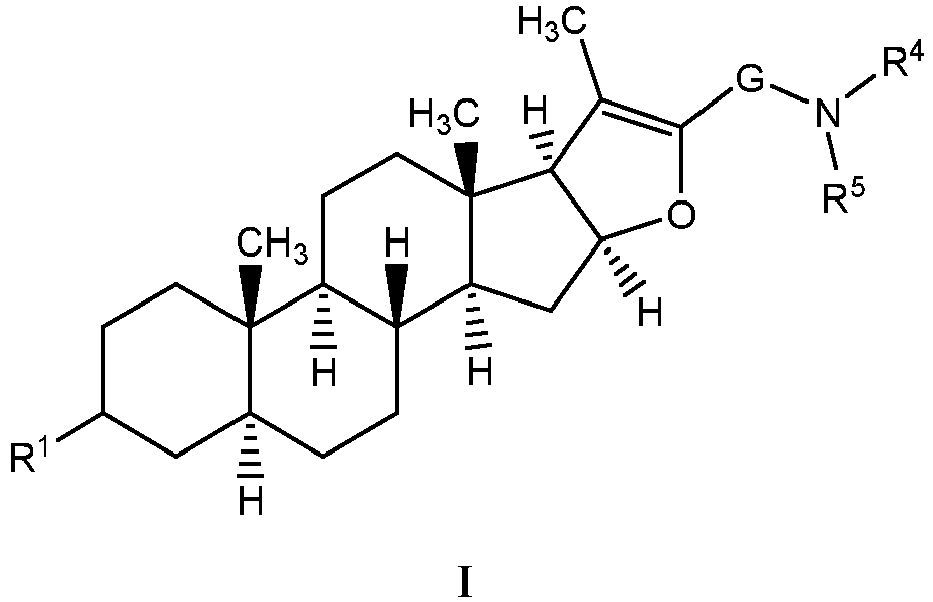 R1 is chosen from OR2 and NHR3;R2 is acetyl;R3 is chosen from -(CH2)nOH and -(CH2CH2O)nH;G is (C2-C10)hydrocarbyl;R4 is H or (C1-C3)hydrocarbyl; andR5 is chosen from H, (C1-C10)hydrocarbyl, fluoro(C1-C6)alkyl, and -C(=O)R6,wherein R6 is chosen from H, (C1-C10)aliphatic hydrocarbyl, -O-(C1-C10)hydrocarbyl, -NH-(C1-C10)hydrocarbyl, substituted aryl, substituted arylalkyl, heterocyclyl, substituted heteroaryl, heteroarylalkyl, substituted heteroarylalkyl, -NH-(substituted aryl), -NH-(substituted arylalkyl), -NH-(heterocyclyl), and -NH-(substituted heteroaryl);wherein substituents on aryl and heteroaryl are chosen from halogen, halo(C1-C6)alkyl, (C1-C6)alkyl, (C1-C6)acyl, (C1-C6)alkoxy(C1-C6)alkyl, hydroxy(C1-C6)alkyl, phenyl, heteroaryl, benzenesulfonyl, hydroxy, halo(C1-C6)alkoxy, (C1-C6)oxaalkyl, carboxy, (C1-C6)alkoxycarbonyl [-C(=O)O-alkyl], (C1-C6)alkoxycarbonylamino [ HNC(=O)O-alkyl],carboxamido [-C(=O)NH2], (C1-C6)alkylaminocarbonyl [-C(=O)NH-alkyl], cyano, acetoxy, nitro, amino, (C1-C6)alkylamino, di(C1-C6)alkylamino, di(C1-C6)alkylamino(C1-C6)alkyl, mercapto, (C1-C6)alkylthio, (C1-C6)alkylsulfone, sulfonylamino, (C1-C6)alkylsulfinyl, (C1-C6)alkylsulfonyl, (C1-C6)acylamino(C1-C6)alkyl, (C1-C6)acylamino, amidino, heterocyclyl, phenoxy, benzyloxy, heteroaryloxy, hydroxyimino, alkoxyimino, aminosulfonyl, guanidino and ureido; andn is 2-6.
 - A compound of formula I
 R1 is NHR3;R3 is chosen from -(CH2)nOH and -(CH2CH2O)nH;G is (C2-C10)hydrocarbyl;R4 is H or (C1-C3)hydrocarbyl; andR5 is chosen from H, (C1-C10)hydrocarbyl, fluoro(C1-C6)alkyl, and -C(=O)R6,wherein R6 is chosen from H, (C1-C10)aliphatic hydrocarbyl, -O-(C1-C10)hydrocarbyl, -NH-(C1-C10)hydrocarbyl, substituted aryl, substituted arylalkyl, heterocyclyl, substituted heteroaryl, heteroarylalkyl, substituted heteroarylalkyl, -NH-(substituted aryl), -NH-(substituted arylalkyl), -NH-(heterocyclyl), and -NH-(substituted heteroaryl);wherein substituents on aryl and heteroaryl are chosen from halogen, halo(C1-C6)alkyl, (C1-C6)alkyl, (C1-C6)acyl, (C1-C6)alkoxy(C1-C6)alkyl, hydroxy(C1-C6)alkyl, phenyl, heteroaryl, benzenesulfonyl, hydroxy, halo(C1-C6)alkoxy, (C1-C6)oxaalkyl, carboxy, (C1-C6)alkoxycarbonyl [-C(=O)O-alkyl], (C1-C6)alkoxycarbonylamino [ HNC(=O)O-alkyl],carboxamido [-C(=O)NH2], (C1-C6)alkylaminocarbonyl [-C(=O)NH-alkyl], cyano, acetoxy, nitro, amino, (C1-C6)alkylamino, di(C1-C6)alkylamino, di(C1-C6)alkylamino(C1-C6)alkyl, mercapto, (C1-C6)alkylthio, (C1-C6)alkylsulfone, sulfonylamino, (C1-C6)alkylsulfinyl, (C1-C6)alkylsulfonyl, (C1-C6)acylamino(C1-C6)alkyl, (C1-C6)acylamino, amidino, heterocyclyl, phenoxy, benzyloxy, heteroaryloxy, hydroxyimino, alkoxyimino, aminosulfonyl, guanidino and ureido; andn is 2-6.
 - A compound of formula I
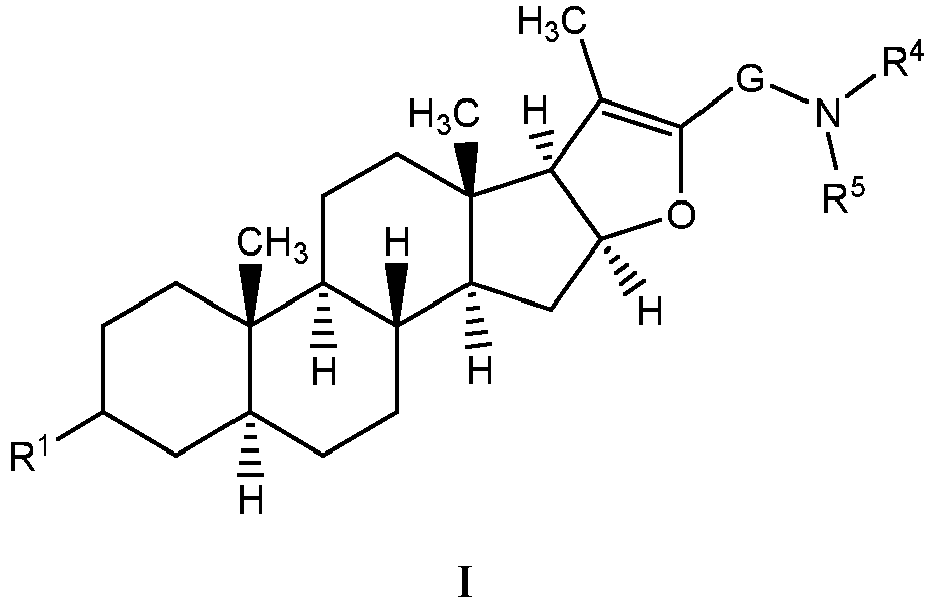 R1 is chosen from OR2 and NHR3;R2 is acetyl;R3 is chosen from -(CH2)nOH and -(CH2CH2O)nH;G is (C2-C10)hydrocarbyl;R4 is H or (C1-C3)hydrocarbyl; andR5 is chosen from H, (C1-C10)hydrocarbyl, fluoro(C1-C6)alkyl, and -C(=O)R6,wherein R6 is chosen from H, (C1-C10)aliphatic hydrocarbyl, -O-(C1-C10)hydrocarbyl, -NH-(C1-C10)hydrocarbyl, substituted aryl, substituted arylalkyl, heterocyclyl, substituted heteroaryl, heteroarylalkyl, substituted heteroarylalkyl, -NH-(substituted aryl), -NH-(substituted arylalkyl), -NH-(heterocyclyl), and -NH-(substituted heteroaryl);wherein substituents on aryl and heteroaryl are chosen from halogen, halo(C1-C6)alkyl, (C1-C6)alkyl, (C1-C6)acyl, (C1-C6)alkoxy(C1-C6)alkyl, hydroxy(C1-C6)alkyl, phenyl, heteroaryl, benzenesulfonyl, hydroxy, halo(C1-C6)alkoxy, (C1-C6)oxaalkyl, carboxy, (C1-C6)alkoxycarbonyl [-C(=O)O-alkyl], (C1-C6)alkoxycarbonylamino [ HNC(=O)O-alkyl],carboxamido [-C(=O)NH2], (C1-C6)alkylaminocarbonyl [-C(=O)NH-alkyl], cyano, acetoxy, nitro, amino, (C1-C6)alkylamino, di(C1-C6)alkylamino, di(C1-C6)alkylamino(C1-C6)alkyl, mercapto, (C1-C6)alkylthio, (C1-C6)alkylsulfone, sulfonylamino, (C1-C6)alkylsulfinyl, (C1-C6)alkylsulfonyl, (C1-C6)acylamino(C1-C6)alkyl, (C1-C6)acylamino, amidino, heterocyclyl, phenoxy, benzyloxy, heteroaryloxy, hydroxyimino, alkoxyimino, aminosulfonyl, guanidino and ureido; wherein the said (C1-C10)aliphatic hydrocarbyl is selected from alkyl, cycloalkyl, polycycloalkyl, alkenyl, alkynyl and combinations thereof, and the alkyl is selected from ethyl, n-propyl, isopropyl, n-butyl, isobutyl, s-butyl, t-butyl, n-pentyl, isopentyl, s-pentyl, neopentyl, hexyl, heptyl, octyl, nonyl and decyl; andn is 2-6.
 - A compound of formula I
 R1 is chosen from OR2 and NHR3;R2 is H or acetyl;R3 is chosen from -(CH2)nOH and -(CH2CH2O)nH;G is (C2-C10)hydrocarbyl;R4 is methyl; andR5 is chosen from fluoro(C1-C6)alkyl, and -C(=O)R6,wherein R6 is chosen from -O-(C1-C10)hydrocarbyl, -NH-(C1-C10)hydrocarbyl, -NH-(substituted aryl), -NH-(substituted arylalkyl), -NH-(heterocyclyl), and -NH-(substituted heteroaryl);wherein substituents on aryl and heteroaryl are chosen from halogen, halo(C1-C6)alkyl, (C1-C6)alkyl, (C1-C6)acyl, (C1-C6)alkoxy(C1-C6)alkyl, hydroxy(C1-C6)alkyl, phenyl, heteroaryl, benzenesulfonyl, hydroxy, halo(C1-C6)alkoxy, (C1-C6)oxaalkyl, carboxy, (C1-C6)alkoxycarbonyl [-C(=O)O-alkyl], (C1-C6)alkoxycarbonylamino [ HNC(=O)O-alkyl],carboxamido [-C(=O)NH2], (C1-C6)alkylaminocarbonyl [-C(=O)NH-alkyl], cyano, acetoxy, nitro, amino, (C1-C6)alkylamino, di(C1-C6)alkylamino, di(C1-C6)alkylamino(C1-C6)alkyl, mercapto, (C1-C6)alkylthio, (C1-C6)alkylsulfone, sulfonylamino, (C1-C6)alkylsulfinyl, (C1-C6)alkylsulfonyl, (C1-C6)acylamino(C1-C6)alkyl, (C1-C6)acylamino, amidino, heterocyclyl, phenoxy, benzyloxy, heteroaryloxy, hydroxyimino, alkoxyimino, aminosulfonyl, guanidino and ureido; andn is 2-6.
 - A compound according to any one of claims 7 and 8 wherein R1 is OR2; for example wherein the carbon to which R1 is attached is of the (S) absolute configuration.
- A compound according to any one of claims 6, 7 and 8 wherein G is linear or branched (C4-C7)alkyl; for example wherein G is branched (Cs)alkyl such as - CH2CH2CH(CH3)CH2-.
- A compound according to any one of claims 6, 7 and 8 wherein R4 is H.
- A compound according to any one of claims 6 and 7 wherein R5 is chosen from H, (C1-C6)alkyl, and fluoro(C1-C6)alkyl.
- A compound according to any one of claims 6, 7 and 8 wherein R5 is -C(=O)R6.
- A compound according to claim 13 wherein R6 is chosen from H, (C1-C10)hydrocarbyl, and -O-(C1-C10)hydrocarbyl.
- A compound selected from the compounds in the table below:


- A pharmaceutical composition comprising a pharmaceutically acceptable carrier and a compound according to any of claims 6 to 15.
- A compound according to any one of claims 6 to 15 for use in reducing skeletal muscle atrophy or for therapeutic use in promoting skeletal muscle hypertrophy.
- The non-therapeutic use of a compound according to any one of claims 6 to 15 in promoting skeletal muscle hypertrophy.
Applications Claiming Priority (2)
| Application Number | Priority Date | Filing Date | Title |
|---|---|---|---|
| US201562247968P | 2015-10-29 | 2015-10-29 | |
| PCT/US2016/059264 WO2017075313A1 (en) | 2015-10-29 | 2016-10-28 | Furostan-3-ol derivatives as skeletal muscle hypertrophic agents |
Publications (3)
| Publication Number | Publication Date |
|---|---|
| EP3368043A1 EP3368043A1 (en) | 2018-09-05 |
| EP3368043A4 EP3368043A4 (en) | 2019-07-10 |
| EP3368043B1 true EP3368043B1 (en) | 2021-12-01 |
Family
ID=58631184
Family Applications (1)
| Application Number | Title | Priority Date | Filing Date |
|---|---|---|---|
| EP16860856.0A Active EP3368043B1 (en) | 2015-10-29 | 2016-10-28 | Furostan-3-ol derivatives as skeletal muscle hypertrophic agents |
Country Status (5)
| Country | Link |
|---|---|
| US (2) | US10662219B2 (en) |
| EP (1) | EP3368043B1 (en) |
| JP (1) | JP6791977B2 (en) |
| CA (1) | CA3001510C (en) |
| WO (1) | WO2017075313A1 (en) |
Families Citing this family (2)
| Publication number | Priority date | Publication date | Assignee | Title |
|---|---|---|---|---|
| AU2024367314A1 (en) * | 2023-10-24 | 2026-04-09 | Emmyon, Inc. | Furostan-3-ol derivatives for the treatment of obesity and diabetes |
| WO2026090181A1 (en) | 2024-10-22 | 2026-04-30 | Emmyon, Inc. | Glp-1 receptor agonist combinations and use thereof for increasing weight loss while improving muscle mass and strength |
Family Cites Families (10)
| Publication number | Priority date | Publication date | Assignee | Title |
|---|---|---|---|---|
| GB9923076D0 (en) * | 1999-09-29 | 1999-12-01 | Phytopharm Plc | Sapogenin derivatives and their use |
| US8486374B2 (en) * | 2003-08-04 | 2013-07-16 | Foamix Ltd. | Hydrophilic, non-aqueous pharmaceutical carriers and compositions and uses |
| CN1754541A (en) | 2004-09-30 | 2006-04-05 | 成都地奥制药集团有限公司 | Steroid saponin pharmaceutical composition and its preparation method and uses |
| GB0513888D0 (en) * | 2005-07-06 | 2005-08-10 | Btg Int Ltd | Core 2 GLCNAC-T Inhibitors II |
| WO2011146768A1 (en) | 2010-05-20 | 2011-11-24 | University Of Iowa Research Foundation | Methods for inhibiting muscle atrophy |
| WO2014022772A1 (en) * | 2012-08-03 | 2014-02-06 | University Of Iowa Research Foundation | Tomatidine, analogs thereof, compositions comprising same, and uses for same |
| US9457033B2 (en) | 2011-02-15 | 2016-10-04 | Socpra Sciences Et Genie, S.E.C. | Steroid alkaloids and uses thereof as antimicrobial agents against electron transport-deficient microbes and as potentiators for antimicrobial agents against pathogenic bacteria |
| JP6001060B2 (en) * | 2011-06-06 | 2016-10-05 | ユニバーシティ オブ アイオワ リサーチ ファウンデーション | Methods for inhibiting muscle atrophy |
| WO2013078372A1 (en) | 2011-11-23 | 2013-05-30 | University Of Iowa Research Foundation | Compositions and methods for inhibiting muscle atrophy and inducing muscle hypertrophy |
| CN106905407B (en) * | 2015-01-27 | 2019-08-13 | 华东理工大学 | Derivatives modified by timogenin structure, pharmaceutical composition and application thereof |
-
2016
- 2016-10-28 JP JP2018542980A patent/JP6791977B2/en active Active
- 2016-10-28 US US15/769,428 patent/US10662219B2/en active Active
- 2016-10-28 WO PCT/US2016/059264 patent/WO2017075313A1/en not_active Ceased
- 2016-10-28 EP EP16860856.0A patent/EP3368043B1/en active Active
- 2016-10-28 CA CA3001510A patent/CA3001510C/en active Active
-
2020
- 2020-04-17 US US16/851,648 patent/US11136348B2/en active Active
Non-Patent Citations (1)
| Title |
|---|
| None * |
Also Published As
| Publication number | Publication date |
|---|---|
| JP2018534366A (en) | 2018-11-22 |
| EP3368043A4 (en) | 2019-07-10 |
| US20180305399A1 (en) | 2018-10-25 |
| US11136348B2 (en) | 2021-10-05 |
| WO2017075313A1 (en) | 2017-05-04 |
| CA3001510A1 (en) | 2017-05-04 |
| CA3001510C (en) | 2022-05-24 |
| US10662219B2 (en) | 2020-05-26 |
| EP3368043A1 (en) | 2018-09-05 |
| JP6791977B2 (en) | 2020-11-25 |
| US20200247840A1 (en) | 2020-08-06 |
Similar Documents
| Publication | Publication Date | Title |
|---|---|---|
| US10576091B2 (en) | Tomatidine, analogs thereof, compositions comprising same, and uses for same | |
| EP4114391B1 (en) | Compositions for use in a method of treating an estrogen receptor associated cancer | |
| JP7592140B2 (en) | Active agents for the treatment of metabolic disorders and non-alcoholic fatty liver disease and methods of use thereof - Patents.com | |
| TWI818828B (en) | Solid forms of a thienopyrimidinedione acc inhibitor and methods for production thereof | |
| CN103037692B (en) | Methods for inhibiting muscle atrophy | |
| US11136348B2 (en) | Furostan-3-ol derivatives as skeletal muscle hypertrophic agents | |
| HK1259520B (en) | Furostan-3-ol derivatives as skeletal muscle hypertrophic agents | |
| JP2001122871A (en) | Medicine with estrogen-like activity | |
| CN104224796B (en) | Application of oleanane triterpene ester derivative in preparation for anti-neurodegeneration medicine | |
| WO2023160702A1 (en) | Amino lipid compound, preparation method therefor, composition thereof and use thereof | |
| LU508492B1 (en) | Dihydroisoquinoline compound and applications in preparation of neuroprotective or antidepressant drugs thereof | |
| CN116813562B (en) | Small molecular compound and application thereof in preparation of anti-pancreatitis drugs | |
| HK40081119B (en) | Compositions for use in a method of treating an estrogen receptor associated cancer | |
| HK40081119A (en) | Compositions for use in a method of treating an estrogen receptor associated cancer | |
| US20170022215A1 (en) | Compounds for Eradicating or Inhibiting Proliferation of Cancer Stem Cells | |
| JP2017507969A (en) | Cancer stem cell target compound | |
| HK1203502A1 (en) | Antifibrotic compounds and uses thereof |
Legal Events
| Date | Code | Title | Description |
|---|---|---|---|
| STAA | Information on the status of an ep patent application or granted ep patent |
Free format text: STATUS: THE INTERNATIONAL PUBLICATION HAS BEEN MADE |
|
| PUAI | Public reference made under article 153(3) epc to a published international application that has entered the european phase |
Free format text: ORIGINAL CODE: 0009012 |
|
| STAA | Information on the status of an ep patent application or granted ep patent |
Free format text: STATUS: REQUEST FOR EXAMINATION WAS MADE |
|
| 17P | Request for examination filed |
Effective date: 20180524 |
|
| AK | Designated contracting states |
Kind code of ref document: A1 Designated state(s): AL AT BE BG CH CY CZ DE DK EE ES FI FR GB GR HR HU IE IS IT LI LT LU LV MC MK MT NL NO PL PT RO RS SE SI SK SM TR |
|
| AX | Request for extension of the european patent |
Extension state: BA ME |
|
| DAV | Request for validation of the european patent (deleted) | ||
| DAX | Request for extension of the european patent (deleted) | ||
| REG | Reference to a national code |
Ref country code: DE Ref legal event code: R079 Ref document number: 602016066971 Country of ref document: DE Free format text: PREVIOUS MAIN CLASS: A61K0031580000 Ipc: C07J0071000000 |
|
| A4 | Supplementary search report drawn up and despatched |
Effective date: 20190606 |
|
| RIC1 | Information provided on ipc code assigned before grant |
Ipc: A61K 31/58 20060101ALI20190531BHEP Ipc: C07J 71/00 20060101AFI20190531BHEP Ipc: A61P 21/06 20060101ALI20190531BHEP |
|
| REG | Reference to a national code |
Ref country code: HK Ref legal event code: DE Ref document number: 1259520 Country of ref document: HK |
|
| STAA | Information on the status of an ep patent application or granted ep patent |
Free format text: STATUS: EXAMINATION IS IN PROGRESS |
|
| 17Q | First examination report despatched |
Effective date: 20200825 |
|
| GRAP | Despatch of communication of intention to grant a patent |
Free format text: ORIGINAL CODE: EPIDOSNIGR1 |
|
| STAA | Information on the status of an ep patent application or granted ep patent |
Free format text: STATUS: GRANT OF PATENT IS INTENDED |
|
| INTG | Intention to grant announced |
Effective date: 20210413 |
|
| GRAJ | Information related to disapproval of communication of intention to grant by the applicant or resumption of examination proceedings by the epo deleted |
Free format text: ORIGINAL CODE: EPIDOSDIGR1 |
|
| STAA | Information on the status of an ep patent application or granted ep patent |
Free format text: STATUS: EXAMINATION IS IN PROGRESS |
|
| INTC | Intention to grant announced (deleted) | ||
| GRAP | Despatch of communication of intention to grant a patent |
Free format text: ORIGINAL CODE: EPIDOSNIGR1 |
|
| STAA | Information on the status of an ep patent application or granted ep patent |
Free format text: STATUS: GRANT OF PATENT IS INTENDED |
|
| INTG | Intention to grant announced |
Effective date: 20210720 |
|
| GRAS | Grant fee paid |
Free format text: ORIGINAL CODE: EPIDOSNIGR3 |
|
| RAP3 | Party data changed (applicant data changed or rights of an application transferred) |
Owner name: EMMYON, INC. |
|
| GRAA | (expected) grant |
Free format text: ORIGINAL CODE: 0009210 |
|
| STAA | Information on the status of an ep patent application or granted ep patent |
Free format text: STATUS: THE PATENT HAS BEEN GRANTED |
|
| AK | Designated contracting states |
Kind code of ref document: B1 Designated state(s): AL AT BE BG CH CY CZ DE DK EE ES FI FR GB GR HR HU IE IS IT LI LT LU LV MC MK MT NL NO PL PT RO RS SE SI SK SM TR |
|
| REG | Reference to a national code |
Ref country code: GB Ref legal event code: FG4D |
|
| REG | Reference to a national code |
Ref country code: AT Ref legal event code: REF Ref document number: 1451686 Country of ref document: AT Kind code of ref document: T Effective date: 20211215 Ref country code: CH Ref legal event code: EP |
|
| REG | Reference to a national code |
Ref country code: IE Ref legal event code: FG4D |
|
| REG | Reference to a national code |
Ref country code: DE Ref legal event code: R096 Ref document number: 602016066971 Country of ref document: DE |
|
| REG | Reference to a national code |
Ref country code: NL Ref legal event code: FP |
|
| REG | Reference to a national code |
Ref country code: LT Ref legal event code: MG9D |
|
| REG | Reference to a national code |
Ref country code: AT Ref legal event code: MK05 Ref document number: 1451686 Country of ref document: AT Kind code of ref document: T Effective date: 20211201 |
|
| PG25 | Lapsed in a contracting state [announced via postgrant information from national office to epo] |
Ref country code: RS Free format text: LAPSE BECAUSE OF FAILURE TO SUBMIT A TRANSLATION OF THE DESCRIPTION OR TO PAY THE FEE WITHIN THE PRESCRIBED TIME-LIMIT Effective date: 20211201 Ref country code: LT Free format text: LAPSE BECAUSE OF FAILURE TO SUBMIT A TRANSLATION OF THE DESCRIPTION OR TO PAY THE FEE WITHIN THE PRESCRIBED TIME-LIMIT Effective date: 20211201 Ref country code: FI Free format text: LAPSE BECAUSE OF FAILURE TO SUBMIT A TRANSLATION OF THE DESCRIPTION OR TO PAY THE FEE WITHIN THE PRESCRIBED TIME-LIMIT Effective date: 20211201 Ref country code: BG Free format text: LAPSE BECAUSE OF FAILURE TO SUBMIT A TRANSLATION OF THE DESCRIPTION OR TO PAY THE FEE WITHIN THE PRESCRIBED TIME-LIMIT Effective date: 20220301 Ref country code: AT Free format text: LAPSE BECAUSE OF FAILURE TO SUBMIT A TRANSLATION OF THE DESCRIPTION OR TO PAY THE FEE WITHIN THE PRESCRIBED TIME-LIMIT Effective date: 20211201 |
|
| PG25 | Lapsed in a contracting state [announced via postgrant information from national office to epo] |
Ref country code: SE Free format text: LAPSE BECAUSE OF FAILURE TO SUBMIT A TRANSLATION OF THE DESCRIPTION OR TO PAY THE FEE WITHIN THE PRESCRIBED TIME-LIMIT Effective date: 20211201 Ref country code: PL Free format text: LAPSE BECAUSE OF FAILURE TO SUBMIT A TRANSLATION OF THE DESCRIPTION OR TO PAY THE FEE WITHIN THE PRESCRIBED TIME-LIMIT Effective date: 20211201 Ref country code: NO Free format text: LAPSE BECAUSE OF FAILURE TO SUBMIT A TRANSLATION OF THE DESCRIPTION OR TO PAY THE FEE WITHIN THE PRESCRIBED TIME-LIMIT Effective date: 20220301 Ref country code: LV Free format text: LAPSE BECAUSE OF FAILURE TO SUBMIT A TRANSLATION OF THE DESCRIPTION OR TO PAY THE FEE WITHIN THE PRESCRIBED TIME-LIMIT Effective date: 20211201 Ref country code: HR Free format text: LAPSE BECAUSE OF FAILURE TO SUBMIT A TRANSLATION OF THE DESCRIPTION OR TO PAY THE FEE WITHIN THE PRESCRIBED TIME-LIMIT Effective date: 20211201 Ref country code: GR Free format text: LAPSE BECAUSE OF FAILURE TO SUBMIT A TRANSLATION OF THE DESCRIPTION OR TO PAY THE FEE WITHIN THE PRESCRIBED TIME-LIMIT Effective date: 20220302 Ref country code: ES Free format text: LAPSE BECAUSE OF FAILURE TO SUBMIT A TRANSLATION OF THE DESCRIPTION OR TO PAY THE FEE WITHIN THE PRESCRIBED TIME-LIMIT Effective date: 20211201 |
|
| PG25 | Lapsed in a contracting state [announced via postgrant information from national office to epo] |
Ref country code: SM Free format text: LAPSE BECAUSE OF FAILURE TO SUBMIT A TRANSLATION OF THE DESCRIPTION OR TO PAY THE FEE WITHIN THE PRESCRIBED TIME-LIMIT Effective date: 20211201 Ref country code: SK Free format text: LAPSE BECAUSE OF FAILURE TO SUBMIT A TRANSLATION OF THE DESCRIPTION OR TO PAY THE FEE WITHIN THE PRESCRIBED TIME-LIMIT Effective date: 20211201 Ref country code: RO Free format text: LAPSE BECAUSE OF FAILURE TO SUBMIT A TRANSLATION OF THE DESCRIPTION OR TO PAY THE FEE WITHIN THE PRESCRIBED TIME-LIMIT Effective date: 20211201 Ref country code: PT Free format text: LAPSE BECAUSE OF FAILURE TO SUBMIT A TRANSLATION OF THE DESCRIPTION OR TO PAY THE FEE WITHIN THE PRESCRIBED TIME-LIMIT Effective date: 20220401 Ref country code: EE Free format text: LAPSE BECAUSE OF FAILURE TO SUBMIT A TRANSLATION OF THE DESCRIPTION OR TO PAY THE FEE WITHIN THE PRESCRIBED TIME-LIMIT Effective date: 20211201 Ref country code: CZ Free format text: LAPSE BECAUSE OF FAILURE TO SUBMIT A TRANSLATION OF THE DESCRIPTION OR TO PAY THE FEE WITHIN THE PRESCRIBED TIME-LIMIT Effective date: 20211201 |
|
| REG | Reference to a national code |
Ref country code: DE Ref legal event code: R097 Ref document number: 602016066971 Country of ref document: DE |
|
| PG25 | Lapsed in a contracting state [announced via postgrant information from national office to epo] |
Ref country code: IS Free format text: LAPSE BECAUSE OF FAILURE TO SUBMIT A TRANSLATION OF THE DESCRIPTION OR TO PAY THE FEE WITHIN THE PRESCRIBED TIME-LIMIT Effective date: 20220401 |
|
| PLBE | No opposition filed within time limit |
Free format text: ORIGINAL CODE: 0009261 |
|
| STAA | Information on the status of an ep patent application or granted ep patent |
Free format text: STATUS: NO OPPOSITION FILED WITHIN TIME LIMIT |
|
| PG25 | Lapsed in a contracting state [announced via postgrant information from national office to epo] |
Ref country code: DK Free format text: LAPSE BECAUSE OF FAILURE TO SUBMIT A TRANSLATION OF THE DESCRIPTION OR TO PAY THE FEE WITHIN THE PRESCRIBED TIME-LIMIT Effective date: 20211201 Ref country code: AL Free format text: LAPSE BECAUSE OF FAILURE TO SUBMIT A TRANSLATION OF THE DESCRIPTION OR TO PAY THE FEE WITHIN THE PRESCRIBED TIME-LIMIT Effective date: 20211201 |
|
| 26N | No opposition filed |
Effective date: 20220902 |
|
| PG25 | Lapsed in a contracting state [announced via postgrant information from national office to epo] |
Ref country code: SI Free format text: LAPSE BECAUSE OF FAILURE TO SUBMIT A TRANSLATION OF THE DESCRIPTION OR TO PAY THE FEE WITHIN THE PRESCRIBED TIME-LIMIT Effective date: 20211201 |
|
| PG25 | Lapsed in a contracting state [announced via postgrant information from national office to epo] |
Ref country code: MC Free format text: LAPSE BECAUSE OF FAILURE TO SUBMIT A TRANSLATION OF THE DESCRIPTION OR TO PAY THE FEE WITHIN THE PRESCRIBED TIME-LIMIT Effective date: 20211201 Ref country code: IT Free format text: LAPSE BECAUSE OF FAILURE TO SUBMIT A TRANSLATION OF THE DESCRIPTION OR TO PAY THE FEE WITHIN THE PRESCRIBED TIME-LIMIT Effective date: 20211201 |
|
| REG | Reference to a national code |
Ref country code: CH Ref legal event code: PL |
|
| P01 | Opt-out of the competence of the unified patent court (upc) registered |
Effective date: 20230425 |
|
| PG25 | Lapsed in a contracting state [announced via postgrant information from national office to epo] |
Ref country code: LU Free format text: LAPSE BECAUSE OF NON-PAYMENT OF DUE FEES Effective date: 20221028 |
|
| PG25 | Lapsed in a contracting state [announced via postgrant information from national office to epo] |
Ref country code: LI Free format text: LAPSE BECAUSE OF NON-PAYMENT OF DUE FEES Effective date: 20221031 Ref country code: CH Free format text: LAPSE BECAUSE OF NON-PAYMENT OF DUE FEES Effective date: 20221031 |
|
| PG25 | Lapsed in a contracting state [announced via postgrant information from national office to epo] |
Ref country code: IE Free format text: LAPSE BECAUSE OF NON-PAYMENT OF DUE FEES Effective date: 20221028 |
|
| PG25 | Lapsed in a contracting state [announced via postgrant information from national office to epo] |
Ref country code: HU Free format text: LAPSE BECAUSE OF FAILURE TO SUBMIT A TRANSLATION OF THE DESCRIPTION OR TO PAY THE FEE WITHIN THE PRESCRIBED TIME-LIMIT; INVALID AB INITIO Effective date: 20161028 |
|
| PG25 | Lapsed in a contracting state [announced via postgrant information from national office to epo] |
Ref country code: CY Free format text: LAPSE BECAUSE OF FAILURE TO SUBMIT A TRANSLATION OF THE DESCRIPTION OR TO PAY THE FEE WITHIN THE PRESCRIBED TIME-LIMIT Effective date: 20211201 |
|
| PG25 | Lapsed in a contracting state [announced via postgrant information from national office to epo] |
Ref country code: MK Free format text: LAPSE BECAUSE OF FAILURE TO SUBMIT A TRANSLATION OF THE DESCRIPTION OR TO PAY THE FEE WITHIN THE PRESCRIBED TIME-LIMIT Effective date: 20211201 |
|
| PG25 | Lapsed in a contracting state [announced via postgrant information from national office to epo] |
Ref country code: MT Free format text: LAPSE BECAUSE OF FAILURE TO SUBMIT A TRANSLATION OF THE DESCRIPTION OR TO PAY THE FEE WITHIN THE PRESCRIBED TIME-LIMIT Effective date: 20211201 |
|
| PGFP | Annual fee paid to national office [announced via postgrant information from national office to epo] |
Ref country code: NL Payment date: 20250923 Year of fee payment: 10 |
|
| PGFP | Annual fee paid to national office [announced via postgrant information from national office to epo] |
Ref country code: BE Payment date: 20250923 Year of fee payment: 10 Ref country code: GB Payment date: 20250923 Year of fee payment: 10 |
|
| PGFP | Annual fee paid to national office [announced via postgrant information from national office to epo] |
Ref country code: FR Payment date: 20250924 Year of fee payment: 10 |
|
| PG25 | Lapsed in a contracting state [announced via postgrant information from national office to epo] |
Ref country code: TR Free format text: LAPSE BECAUSE OF FAILURE TO SUBMIT A TRANSLATION OF THE DESCRIPTION OR TO PAY THE FEE WITHIN THE PRESCRIBED TIME-LIMIT Effective date: 20211201 |
|
| PGFP | Annual fee paid to national office [announced via postgrant information from national office to epo] |
Ref country code: DE Payment date: 20250923 Year of fee payment: 10 |