EP3367131A1 - A higher pixel density histogram time of flight sensor - Google Patents
A higher pixel density histogram time of flight sensor Download PDFInfo
- Publication number
- EP3367131A1 EP3367131A1 EP17158194.5A EP17158194A EP3367131A1 EP 3367131 A1 EP3367131 A1 EP 3367131A1 EP 17158194 A EP17158194 A EP 17158194A EP 3367131 A1 EP3367131 A1 EP 3367131A1
- Authority
- EP
- European Patent Office
- Prior art keywords
- determined number
- signal
- phase
- time periods
- output
- Prior art date
- Legal status (The legal status is an assumption and is not a legal conclusion. Google has not performed a legal analysis and makes no representation as to the accuracy of the status listed.)
- Granted
Links
Images










Classifications
-
- G—PHYSICS
- G01—MEASURING; TESTING
- G01S—RADIO DIRECTION-FINDING; RADIO NAVIGATION; DETERMINING DISTANCE OR VELOCITY BY USE OF RADIO WAVES; LOCATING OR PRESENCE-DETECTING BY USE OF THE REFLECTION OR RERADIATION OF RADIO WAVES; ANALOGOUS ARRANGEMENTS USING OTHER WAVES
- G01S17/00—Systems using the reflection or reradiation of electromagnetic waves other than radio waves, e.g. lidar systems
- G01S17/02—Systems using the reflection of electromagnetic waves other than radio waves
- G01S17/06—Systems determining position data of a target
- G01S17/08—Systems determining position data of a target for measuring distance only
- G01S17/10—Systems determining position data of a target for measuring distance only using transmission of interrupted, pulse-modulated waves
- G01S17/26—Systems determining position data of a target for measuring distance only using transmission of interrupted, pulse-modulated waves wherein the transmitted pulses use a frequency-modulated or phase-modulated carrier wave, e.g. for pulse compression of received signals
-
- G—PHYSICS
- G01—MEASURING; TESTING
- G01C—MEASURING DISTANCES, LEVELS OR BEARINGS; SURVEYING; NAVIGATION; GYROSCOPIC INSTRUMENTS; PHOTOGRAMMETRY OR VIDEOGRAMMETRY
- G01C3/00—Measuring distances in line of sight; Optical rangefinders
- G01C3/02—Details
- G01C3/06—Use of electric means to obtain final indication
- G01C3/08—Use of electric radiation detectors
-
- G—PHYSICS
- G01—MEASURING; TESTING
- G01S—RADIO DIRECTION-FINDING; RADIO NAVIGATION; DETERMINING DISTANCE OR VELOCITY BY USE OF RADIO WAVES; LOCATING OR PRESENCE-DETECTING BY USE OF THE REFLECTION OR RERADIATION OF RADIO WAVES; ANALOGOUS ARRANGEMENTS USING OTHER WAVES
- G01S17/00—Systems using the reflection or reradiation of electromagnetic waves other than radio waves, e.g. lidar systems
- G01S17/02—Systems using the reflection of electromagnetic waves other than radio waves
- G01S17/06—Systems determining position data of a target
- G01S17/08—Systems determining position data of a target for measuring distance only
- G01S17/32—Systems determining position data of a target for measuring distance only using transmission of continuous waves, whether amplitude-, frequency-, or phase-modulated, or unmodulated
- G01S17/36—Systems determining position data of a target for measuring distance only using transmission of continuous waves, whether amplitude-, frequency-, or phase-modulated, or unmodulated with phase comparison between the received signal and the contemporaneously transmitted signal
-
- G—PHYSICS
- G01—MEASURING; TESTING
- G01S—RADIO DIRECTION-FINDING; RADIO NAVIGATION; DETERMINING DISTANCE OR VELOCITY BY USE OF RADIO WAVES; LOCATING OR PRESENCE-DETECTING BY USE OF THE REFLECTION OR RERADIATION OF RADIO WAVES; ANALOGOUS ARRANGEMENTS USING OTHER WAVES
- G01S17/00—Systems using the reflection or reradiation of electromagnetic waves other than radio waves, e.g. lidar systems
- G01S17/88—Lidar systems specially adapted for specific applications
- G01S17/89—Lidar systems specially adapted for specific applications for mapping or imaging
-
- G—PHYSICS
- G01—MEASURING; TESTING
- G01S—RADIO DIRECTION-FINDING; RADIO NAVIGATION; DETERMINING DISTANCE OR VELOCITY BY USE OF RADIO WAVES; LOCATING OR PRESENCE-DETECTING BY USE OF THE REFLECTION OR RERADIATION OF RADIO WAVES; ANALOGOUS ARRANGEMENTS USING OTHER WAVES
- G01S17/00—Systems using the reflection or reradiation of electromagnetic waves other than radio waves, e.g. lidar systems
- G01S17/88—Lidar systems specially adapted for specific applications
- G01S17/89—Lidar systems specially adapted for specific applications for mapping or imaging
- G01S17/894—Three-dimensional [3D] imaging with simultaneous measurement of time-of-flight at a two-dimensional [2D] array of receiver pixels, e.g. time-of-flight cameras or flash lidar
-
- G—PHYSICS
- G01—MEASURING; TESTING
- G01S—RADIO DIRECTION-FINDING; RADIO NAVIGATION; DETERMINING DISTANCE OR VELOCITY BY USE OF RADIO WAVES; LOCATING OR PRESENCE-DETECTING BY USE OF THE REFLECTION OR RERADIATION OF RADIO WAVES; ANALOGOUS ARRANGEMENTS USING OTHER WAVES
- G01S7/00—Details of systems according to groups G01S13/00, G01S15/00, G01S17/00
- G01S7/48—Details of systems according to groups G01S13/00, G01S15/00, G01S17/00 of systems according to group G01S17/00
- G01S7/483—Details of pulse systems
- G01S7/486—Receivers
- G01S7/4865—Time delay measurement, e.g. time-of-flight measurement, time of arrival measurement or determining the exact position of a peak
Definitions
- Some embodiments relate to an apparatus, and in particular but not exclusively, to an apparatus with a histogram time of flight sensors with higher pixel density.
- Time of Flight This method comprises sending a light signal towards the object and measuring the time taken by the signal to travel to the object and back. The calculation of the time taken by the signal for this travel may be obtained by measuring the phase shift between the signal coming out of the light source and the signal reflected from the object and detected by a light sensor. Knowing this phase shift and the speed of light enables the determination of the distance to the object.
- Single photon avalanche diodes may be used as a detector of reflected light.
- an array of SPADs are provided as a sensor in order to detect a reflected light pulse.
- a photon may generate a carrier in the SPAD through the photo electric effect.
- the photo generated carrier may trigger an avalanche current in one or more of the SPADs in an SPAD array.
- the avalanche current may signal an event, namely that a photon of light has been detected.
- Figure 1 illustrates the general principle of a "Time of Flight” method.
- a generator 10 (shown as box PULSE in Figure 1 ) provides a periodic electric signal (for example, square-shaped). This signal powers a light source 12.
- An example of a light source 12 may be a light-emitting diode, or any known lighting device, for example, a laser diode.
- the signal coming out of light source 12 is transmitted towards an object 16 and is reflected by this object.
- the reflected light signal is detected by a light sensor (shown as box CAPT in Figure 1 ) 18.
- the signal on sensor 18, is thus phase-shifted from the signal provided by the generator for an ideal system by a time period proportional to twice the distance to object 16 (In practice there is also electrical to optical delay time from the light source).
- Calculation block 20 receives the signals generated by generator 10 and by sensor 18 and calculates the phase shift between these signals to obtain the distance to object 16.
- SPADs have the advantage of picosecond time resolution so are ideal for the detector of a compact time of flight pixel.
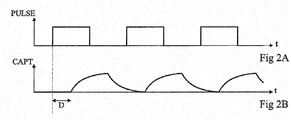
- Figures 2A and 2B are timing diagrams illustrating the operation of a circuit such as that in Figure 1 .
- Figure 2A illustrates a transmitted periodic signal "PULSE" capable of being provided by the generator 10 of Figure 1 .
- Figure 2B illustrates the signal CAPT received by a photo-diode based sensor 18. Due to interactions with the outside and to the components forming sensor 18, the signal received by this sensor has, in this example, variations in the form of capacitor charges and discharges. The signal on sensor 18 is phase-shifted from the signal coming out of generator 10 by a delay D.
- the sensor 18 may integrate one or several photo detection elements enabling the detection of the signal received after reflection from the object 16. Such elements may be rapid charge transfer photodiodes. Single-photon avalanche diodes, or "SPADs", also called Geiger mode avalanche photodiodes, may also be used. These devices have a reverse biased p-n junction in which a photo-generated carrier can trigger an avalanche current due to an impact ionization mechanism. SPADs may be designed to operate with a reverse bias voltage well above the breakdown voltage.
- SPADs may be designed to operate with a reverse bias voltage well above the breakdown voltage.
- SPADs may be operated as follows. At an initial time, the diode is biased to a voltage greater than its breakdown voltage. The reception of a photon in the diode junction area starts a current avalanche in the diode, which creates an electric voltage pulse on the anode. The diode is then biased back to the voltage greater than the breakdown voltage, so that the SPAD reacts again to the reception of a photon.
- SPADs can currently be used in cycles having reactivation periods shorter than 10 ns. Thereby, SPADs can be used at high frequency to detect objects at relatively short distances from the measurement device, for example, distances ranging from a few centimetres to a few tens of centimetres. In different embodiments, different ranges may be supported.
- SPAD sensors intended for histogram comparison, associated with SPAD sensors.
- SPAD sensors are relatively complex to implement and require a significant amount of silicon to implement and thus reduce the potential density of pixels in the silicon sensor.
- the SPAD sensor is a 'few pixels' sensor which has a poor lateral (X-Y dimension) resolution but fine distance (Z dimension) resolution.
- a method for determining a distance from an apparatus to at least one object comprising: generating a first signal; generating light modulated by the first signal from the apparatus; detecting light reflected by the at least one object using a Time-of-flight detector array, by determining by each array element of the Time-of-flight detector array an output signal generated from a series of photon counts over a number of consecutive non-overlapping time periods; comparing the output signals to the first signal to determine at least one signal phase difference; and determining a distance from the apparatus to the at least one object based on the at least one signal phase difference.
- Each array element determining an output signal generated from a series of photon counts over a number of consecutive non-overlapping time periods may comprise: sampling a determined number of overlapping clock signals using a photon detection output from the array element, wherein the sampling generates the determined number of sampling outputs; generating the determined number of non-overlapping time periods count increment detections based on outputs from consecutive sampling outputs; phase rotating the determined number of non-overlapping time periods count increment detections to generate phase rotated determined number of non-overlapping time periods count increment detections; and incrementing the series of photon counts from the phase rotated determined number of non-overlapping time periods count increment detections.
- Generating the determined number of non-overlapping time periods count increment detections using a gated edge detector based on outputs from consecutive sampling outputs may comprise generating for each determined number of non-overlapping time periods count increment detection by logic-AND combining a first of the determined number of sampling outputs, an inverted second of the determined number of sampling outputs, wherein the first of the determined number of sampling outputs and the second of the determined number of sampling outputs are consecutive sampling outputs generated based on overlapping clock signals.
- Generating the determined number of non-overlapping time periods count increment detections based on outputs from consecutive sampling outputs may comprise gating the determined number of non-overlapping time periods count increment detections based on a delayed detected photon output.
- Phase rotating the determined number of non-overlapping time periods count increment detections to generate phase rotated determined number of non-overlapping time periods count increment detections may comprise multiplexing each of the determined number of non-overlapping time periods count increment detections to a determined counter based on a phase determination input such that after all phases have been completed each determined counter has been coupled to each of the non-overlapping time periods count increment detections.
- the method may further comprise: generating at least one further signal, wherein the at least one further signal has a frequency component different to a first signal frequency component; generating light modulated by the at least one further signal from the apparatus; detecting light reflected by the at least one object using the Time-of-flight detector array, by determining by each array element of the Time-of-flight detector array an at least one further signal related output signal generated from a series of photon counts over a number of consecutive non-overlapping time periods; comparing the at least one further signal related output signal to the first signal to determine at least one further signal phase difference; determining a distance from the apparatus to the at least one object based on the at least one further signal phase difference; and determining an unambiguous distance from the apparatus to the at least one object based on the determined distance based on the at least one further signal phase difference and the determined distance based on the signal phase difference.
- the method may further comprise determining at least one array element co-ordinate associated with at least one of the Time-of-flight detector array elements which provided the output signal determining the distance.
- the method may further comprise determining a user input gesture from the at least one array element co-ordinate and the distance from the apparatus to the at least one object.
- an apparatus for determining a distance to at least one object comprising: a signal generator configured to generate a first signal; a light source configured to generate light modulated by the first signal; a time-of-flight detector array configured to detect light reflected by the at least one object, the time-of-flight detector comprising an array of detector elements configured to generate an output signal, the output signal generated from a series of photon detections over a determined number of consecutive non-overlapping time periods; a comparator configured to compare the output signals from each detector element to the first signal to determine at least one signal phase difference; and a distance determiner configured to determine at least one object distance based on the at least one signal phase difference.
- Each detector array element may comprise: a plurality of single-photon-avalanche-diodes configured to generate a photon detection output; and a histogram generator configured to generate the series of photon detections over the determined number of consecutive non-overlapping time periods.
- the plurality of single-photon-avalanche-diodes configured to generate a photon detection output and the histogram generator may be integrated.
- the histogram generator may comprise: the determined number of clock sampling flops configured to sample a determined number of overlapping clock signals using the photon detection output from the array element and generate the determined number of sampling outputs; the determined number of edge detectors configured to generate the determined number of non-overlapping time periods count increment detections based on outputs from consecutive clock sampling flops; the determined number of multiplexers configured to phase rotate the determined number of non-overlapping time periods count increment detections to generate phase rotated determined number of non-overlapping time periods count increment detections; and the determined number of counters configured to increment the series of photon counts based on the phase rotated determined number of non-overlapping time periods count increment detections.
- the determined number of edge detectors may comprise the determined number of AND-gates configured to combine a first of the determined number of sampling outputs and an inverted second of the determined number of sampling outputs, wherein the first of the determined number of sampling outputs and the second of the determined number of sampling outputs may be consecutive sampling outputs generated based on overlapping clock signals.
- the determined number of edge detectors may be further gated based on a delayed photon detection output.
- the determined number of multiplexers may be configured to multiplex each of the determined number of non-overlapping time periods count increment detections to each counter based on a phase determination input such that after all phases have been completed each counter has been coupled to each of the non-overlapping time periods count increment detections.
- the signal generator may furthermore be configured to generate at least one further signal, wherein the at least one further signal has a frequency component different to a first signal frequency component.
- the light source may furthermore be configured to generate light modulated by the at least one further signal from the apparatus.
- the time-of flight detector may furthermore be configured to detect light modulated by the at least one further signal from the apparatus and reflected by the at least one object using the Time-of-flight detector array by the array of detector elements configured to generate an further output signal.
- the comparator may be configured to compare the at least one further output signal to the further signal to determine at least one further signal phase difference.
- the distance determiner may be configured to determine at least one further distance based on the at least one further signal phase difference.
- the distance determiner may be configured to determine an unambiguous distance based on the determined distance based on the at least one further signal phase difference and the determined distance based on the signal phase difference.
- the apparatus may furthermore comprise a processor configured to determine at least one array element co-ordinate associated with at least one of the Time-of-flight detector array elements which provided the output signal determining the at least one distance.
- the processor may furthermore be configured to determine a user input gesture from the at least one array element co-ordinate and the distance from the apparatus to the at least one object.
- the light source may be a vertical cavity surface emitting laser.
- the apparatus may comprise a phase rotator configured to control the determined number of multiplexers.
- the first signal may be at least one of: a sine wave with a frequency component; a square wave; an irregular wave with at least one defined frequency component; a pulse wave; and a regular wave with at least one defined frequency component.
- the at least one further signal may be at least one of: a sine wave with a frequency component; a square wave; an irregular wave with at least one defined frequency component; a pulse wave; and a regular wave with at least one defined frequency component.
- the determined number is three or four.
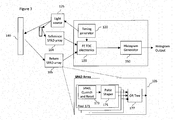
- FIG. 3 shows a block diagram of a few-pixel many-bin histogram generating time-of-flight range detector arrangement.
- a flash time to digital converter (TDC) is typically used. This typically comprises a multiple-phase timing generator and front end sampling elements. There are two input TDC channels, one input for reception of SPAD pulses (i.e. pulses generated by a SPAD on detection of a photon) and the other input for illumination device pulses (i.e. pulses generated by the system coincident with emission of an illumination pulse).
- the TDC converts the time difference between a received SPAD event and the multiple clock phase timing generator.
- the system shown in Figure 3 comprises a timing generator 120.
- the timing generator generates a timing signal which may be used to control a light source (and furthermore be used as a reference clock signal).
- the timing generator 120 may be configured to generate suitable timing pulses.
- the system may furthermore comprise a light source 125.
- the light source 125 may comprise any suitable fast light source, for example a vertical cavity surface emitting laser (VCSEL), a light emitting diode (LED), etc.
- the light source 125 may receive signals from the timing generator and be configured to generate light based on the signals.
- the light source 125 may be configured to receive timing signal pulses from the timing generator 120 and generate pulses of light which are emitted externally (and in some embodiments internally via an internal parasitic path not shown directly to a reference SPAD array 104).
- the system may further comprise a detector.
- the detector may comprise a first or reference SPAD array 104 and a second or return SPAD array 105.
- the return SPAD array 105 may configured to detect light reflected back from the object 140 whereas the reference SPAD array 104 may be configured to detect light passed via the internal parasitic path only.
- the output of the SPAD arrays (the reference SPAD array 104 and the return SPAD array 105) may be coupled to front end electronics (FE electronics) 100.
- SPAD array 105 An example of the SPAD array 105 architecture is further shown in Figure 3 .
- the SPAD array 105 comprises an array of pixels, of which one pixel 171 is shown in further detail.
- Each pixel 171 may as shown in Figure 3 comprise a single photon avalanche diode with quench and reset components 173.
- the output of the pixel single photon avalanche diode 173 may be passed to a pulse shaper.
- the system comprises a pulse shaper 175 per pixel, which receives the input SPAD pulse from each pixel and performs pulse shaping on the signal.
- the pulse shaper may be configured to shorten the pulse length and reduce the effect of pileup distortion in the OR tree network, for a given SPAD count rate.
- the pulse output from the SPAD array may be greater than 10ns in length. The longer the period or length of pulses entering the input of an OR tree (used in the histogram generator), the more likely it is for two or more SPAD outputs to be high together.
- One SPAD array output being high has the same effect at the output as two or more SPAD array outputs being high. In both cases the output of the OR tree sits high. Accordingly, timing information can be lost as output pulses increase in length. This effect is sometimes referred to as pile up distortion.
- the pulse shaping circuitry is used to overcome this.
- the output of the pulse shaper may be passed to the OR tree.
- reference SPAD array 104 may be similarly arranged.
- each pixel is configured to output to the OR tree 177, which receives the output from each pixel pulse shaper 175 and logical 'OR's the inputs to generate a pulse output.
- the output of the OR tree 177 and therefore the return SPAD array 105 may be passed to the Front End (FE) time-to-distance (TDC) electronics 100.
- FE Front End
- TDC time-to-distance
- the FE TDC electronics 100 may be configured to receive signals from the timing generator 120, the reference SPAD array 104 and the return SPAD array 105 and pass these signals to a histogram generator 150.
- the system in some embodiments comprises a histogram generator 150.
- the histogram generator 150 measures the time of flight of the illumination pulse over the return journey from light source 125 to object 140 and back to the return SPAD array 105.
- the histogram generator 150 in this type of arrangement may comprise clocked counters which output a large number of bins each of which comprise the number of detected events for a clocked period.
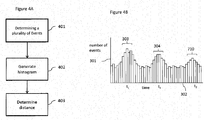
- Figure 4A shows a flow chart illustrating the method steps associated with the function of a conventional SPAD arrangement such as the one shown in Figure 3 .
- a plurality of events are determined and a time at which each event occurred is recorded.
- a histogram may be generated from the event information.
- the histogram may be generated during the detection period and based on all the time and event information for the detection period.
- the histogram is generated by the histogram generator. An illustrative example of such a histogram is shown in Figure 4B .
- Figure 4B shows an example histogram where the Y-axis 301 shows the number of events for each histogram bin 302.
- Figure 4B shows at time t 1 a first peak 303 corresponding to a first detected event, at time t 2 a second peak 304 corresponding to a second detected event, and at a time t 3 a third peak 710 corresponding to a third detected event.
- the first peak 303 may correspond to the internal parasitic path event detection
- the second peak 304 the external object detection
- the third peak a further distant reflected object detection.
- the time of the first peak 303 t 1 , the second peak 304 t 2 and the third peak 710 t 3 may be used to determine a time taken for light to travel to and from the respective remote objects.
- a drawback of the architecture described above with reference to Figures 3 and 4A is that the histogram generator circuitry configured to output multiple bin histograms requires a large amount of implementation physical space. As a histogram is required for each of the arrays (or pixels) the number of detector pixels (or arrays) which may be implemented on a suitable silicon device is therefore limited. Hence most practical implementations are typically only able to output a few pixels. Thus, although such devices are able to provide fine resolution in the Z dimension (in other words the plane perpendicular to the sensor), they offer coarse resolution in the X-Y plane (the plane parallel to the sensor).
- FIG. 5 shows a further example detector architecture 'many-pixel few-bin' implementation.
- the example shows where the complexity of the circuitry is reduced to enable an increase in the density of pixels.
- the sensor comprises a photodiode 510.
- the photodiode 510 may be reversely biased close to a breakdown voltage. Once the photodiode is triggered by few photons, a current may be generated.
- the photodiode 510 is connected to a pass circuit comprising several transistors, 515a, 515b, 515c and 515d, configured in a pass transistor configuration.
- Each transistor is clocked by at least one clock which is passed to a delay line and the taps from which are used to activate each transistor such that one terminal is connected to the photodiode and the other is connected to a charge collection region or 'bin' 520a, 520b, 520c and 520d respectively.
- the advantage of this example detector is that the reduction in complexity is such that the amount of silicon required per pixel is low and therefore a higher resolution can be achieved.
- the use of pass gate logic is disadvantageous because it introduces an inherent delay to the system which significantly limits the maximum frequency of the transmitted illumination. This results in a slow system which cannot take full advantage of the speed offered by the SPAD diodes and is more limited by any differences between pass-gate transistor to pass-gate transistor.
- the example implementation although suitable for producing a fine resolution in the X-Y dimension (due to the number of pixels), they offer limited resolution in the Z plane and furthermore limited resolution in the time domain.
- FIG. 6 shows for example an electronic device 600 with display, suitable for implementing a '3D mouse' application where the user's hand or other object is monitored and used to provide an input for the device.
- the device may be configured to detect objects (for example a finger of a hand) located over the device and the motion of the object (shown as the finger moving from the right to the left to attempt a 'swipe' gesture) is detected and used to control the device.
- a single point zoom effect input may be determined based on the 'input' object distance from the device where the closer the object to the device the higher the zoom magnification and vice versa.
- gestures require knowledge of not only x-y co-ordinates (as per optical mouse techniques), but also an array of z coordinates. Examples of this are diagonal gestures where there is motion or displacement of the object being detected in the x-y co-ordinates and the z distance. Other examples are circular gestures such as looping with a hand, turning a hand over or more complex gestures such as detecting a turning dial gesture. In all of these the change in z distance is to be detected.
- an object detection sensor is required to have both a fine spatial resolution (X-Y axes) 605 that is high enough for gesture recognition in two-dimensions, whilst also being able to accurately resolve in the Z axis 610.
- the device is required to distinguish between a motion of the 'target' object (within a height range 611) and a different object detected at a different height.
- the device is required to distinguish between a motion of the 'target' object (within a height range 611) and a different object detected at a different height.
- three dimension gesture detection can be implemented accurately.
- an optical mouse typically uses a 20x20 two-dimensional array of detectors operated at approximately 1000fps to detect movement direction and speed.
- FIG. 7 an example arrangement for both the few-pixel many-bin detector described above and the many-pixel few-bin detector according to some embodiments are shown.
- the left hand side of Figure 7 shows the few-pixel many-bin detector.
- conventional architectures 705 use an array of SPADs which are divided into sub-arrays of SPADs.
- the array of SPADs is divided into four sub-arrays 710a, 710b, 710c, 710d to achieve the required resolution.
- Each sub-array of SPADs 710a, 710b, 710c, 710d is associated with its own histogram logic 720a, 720b, 720c, 720d.
- this is not a practical solution as the silicon area required for this histogram logic is relatively large, thus the resulting circuits would require large areas of silicon and would be inefficient, expensive and difficult to make with a high yield.
- each macro pixel 740a, 740b, 740c, 740d, 740e is depicted by a bold square.
- the macro pixels are further shown on the right hand of Figure 7 wherein each macro pixel comprises a sub-array 750 of SPADs and associated sub-array of SPADs TDC component 751, which may comprise an OR tree, pulse shaper and 'few-bin' histogram generator.
- the example TDC component 751 and the 'few-bin' histogram generator is physically located on the integrated circuit adjacent the SPAD sub-array 750. In some embodiments the 'few-bin' histogram generator 751 is physically located adjacent to the SPAD sub-array 750 in the X or Y plane of the device (in other words within the same silicon layers as the SPAD detectors) or in the Z plane (in other words in different silicon layers as the SPAD detectors).
- Figure 8 shows a block diagram of a time-of-flight range determining device in accordance with some embodiments.
- the ToF range determining device comprises a timing generator 120'.
- the timing generator 120' is configured to control the timing of a light source 125' and furthermore in some embodiments to generate a known waveform for controlling the light source 125'.
- the following examples are described where the timing generator 120' is configured to generate a sine wave at a determined frequency f.
- the known waveform may be any arbitrary waveform, for example a pulse wave, triangle wave, square wave, saw tooth wave or other.
- the ToF range determining device comprises a light source 125'.
- the light source 125' may comprise any suitable fast switching light source, for example a vertical cavity surface emitting laser (VCSEL), a light emitting diode (LED), etc.
- the light source 125' for example may be configured to emit light which is amplitude modulated at a sine wave at the frequency f and time controlled by the timing generator 120'. The light is then reflected back from an object 140'.
- the ToF range determining device further comprises a first or reference SPAD array 104' and a second or return SPAD array 105'.
- the return SPAD array 105' may configured to detect light reflected back from the object 140' whereas the reference SPAD array 104' may be configured to detect light passed via the internal parasitic path only.
- the output of the SPAD arrays (the reference SPAD array 104' and the return SPAD array 105') may be coupled to histogram processor 181.
- FIG. 8 An example of the SPAD array 105' architecture and an example configuration of a macro pixel 740 is further shown in Figure 8 .
- the SPAD array 105' comprises an array of macro pixels 740.
- Each macro pixel 740 is shown comprising a NxN SPAD pixel arrangement of which one pixel 171' is shown in further detail and which outputs to the OR Tree 177'.
- Each pixel arrangement 171' as shown in Figure 8 may comprise a single photon avalanche diode with quench and reset components 173'.
- the output of the pixel single photon avalanche diode 173' (with quench and reset components) may be passed to a pulse shaper 175'.
- Each pixel arrangement 171' may further comprise a pulse shaper 175', which receives the SPAD pulse from each pixel and performs pulse shaping on the signal.
- the pulse shaper may, as described previously, be configured to shorten the pulse length and reduce the effect of pileup distortion in the OR tree network, for a given SPAD count rate.
- the output of the pulse shaper 175' may be passed to the OR tree 177'.
- the SPAD pixel arrangement 171' is configured to receive the reflected sine wave from the object 140' and generate detected event signal pulses.
- the macro pixel 740 may further comprise an OR tree 177', which is configured to receive the output from each pixel pulse shaper 175' for the macro pixel 740 and logical 'OR' the inputs to generate a pulse output.
- the output of the OR tree 177' and therefore the detected reflected sine wave may be passed to the Front End (FE) time-to-distance (TDC) electronics 179.
- FE Front End
- TDC time-to-distance
- the macro pixel 740 may further comprise FE TDC electronics 179 configured to receive signals from the timing generator 120 and the OR tree 177 and pass these signals to a 'few-bin' histogram generator 180.
- the macro pixel 740 may further comprise a 'few-bin' histogram generator 180, configured to receive the output of the FE TDC electronics 179 and output a histogram.
- the histogram generator 180 is configured to generate a histogram comprising a small number of bins.
- the histogram generator 180 described hereafter is configured to generate 3 bins or 4 bins. However it is understood that in some embodiments more than 4 bins may be generated.
- These histogram bin values may be passed to a histogram processor 181.
- reference SPAD array 104' may be similarly arranged.
- the ToF range determining device further comprises a histogram processor 181.
- the histogram processor 181 may be configured to receive the output of the histogram generator 180 from each macro pixel 740 of the Return SPAD array 105' and the output of the Reference SPAD array 104'.
- the histogram processor 181 may be configured to regenerate from the determined 'few-bin' histogram data a reconstructed sinewave. This reconstructed sinewave may then be compared with the sine waveform from the timing generator 120' and a phase difference between the two waveforms may be determined. From this phase difference (between the timing generator 120' sine wave and the reconstructed sinewave an estimate of the range may be determined.
- the timing generator 120' may be configured to generate further (and different) frequency waveforms. For example in some embodiments the timing generator 120' may be configured to generate a sine wave of frequency f- ⁇ f and a sine wave of frequency f+ ⁇ f and from these be able to calculate two further range determinations. From these further range determinations and the knowledge of the frequencies an unambiguous range (which does not have any potential wrap-round error) may then be output.
- FIG. 9A shows a more detailed view of a building block for components of the histogram generator 180 (or a histogram generator cell 180') as shown in Figure 8 .
- the histogram generator 180 is configured to receive the combination of SPAD pixels which are shaped, logical OR'ed and then timed based on the timing generator clock signals.
- Each generator cell 180' may be configured to generate a bin output for the histogram generator 180.
- a three bin histogram generator may comprise three histogram cells 180'
- a four bin histogram generator may comprise four histogram cells 180' and so on.
- the histogram generator 180 may thus comprise an input 900 receiving the processed SPAD pixel signals.
- the input 900 may be passed to a delay cell 905 and to a clock sampling flop cell 910.
- the histogram generator 180 may comprise a delay module 905.
- the delay module 905 may be configured to receive the input 900 and delay the input signal sufficiently such that a delayed version of the input signal may be used to 'clock' a gated edge detector cell 920.
- Each histogram generator cell 180' comprises a clock sampling flop cell 910.
- the clock sampling flop cell 910 is configured to sample the clock signal using as a clock as the input 900 (from the pulse shaper or OR tree).
- the clock sampling flop cell 910 is shown in Figure 9A as comprising a single D-latch 915 (D-flop) which has a data input coupled to one of the phase clock input signals C x and a clock input coupled to the input 900.
- the phase clock input signal may be one of three (or four or more) depending on the number of bins generated by the histogram generator. Each neighbouring phase clock is configured to overlap the previous and next phase clock.
- phase clocks C 1 , C 2 , C 3 , C 4 each of which overlaps the previous clock by 1/4 of a cycle and thus C 1 is substantially the inverse of C 3 and C 2 is substantially the inverse of C 4 .
- the output of the D-latch 915 is output to a gated edge detector cell 920.
- an output from the cell is generated where on the rising edge of an SPAD event pulse the phase clock signal is positive.
- the histogram generator cell further comprises a gated edge detector (or transition detector) cell 920.
- the gated edge detector cell 920 may comprise an inverter 931 which receives the output of the clock sampling flop cell 910 and outputs the inverted clock sampling flop cell signal 935 to an AND gate for a previous clock phase gated edge detector cell.
- the gated edge detector cell 920 further comprises an AND gate 925 which is configured to receive the next clock phase gated edge detector cell invertor signal 940, the current phase clock sampling flop cell signal 935, and the delay module output signal as a clock input signal 930.
- the AND gate 925 may generate an output 945 which is passed to a phase rotator multiplexer 950.
- the gated edge detector cell outputs a high state only when a SPAD event is detected between overlapping phase clock signals and therefore is defined only by positive edge triggering.
- An advantage of this type of edge detection is that only one type of logic is used to define the time periods, namely either PMOS or NMOS gate, making the definition of the time periods more consistent.
- the histogram generator cell 180' further comprises a phase rotator multiplexer cell 950.
- the phase rotator multiplexer cell 950 comprises a network 951 which receives the output of the current phase clock gated edge detector cell 920 and the output of every other phase clock gated edge detector cell and a multiplexer 953 which is configured to receive as inputs the network 951 (and therefore the current phase clock gated edge detector cell 920 and every other phase clock gated edge detector cell) and a selector input 954.
- the selector input 954 thus selects one of the current phase clock gated edge detector cell or other phase clock gated edge detector cell signals to be output by the multiplexer 953 to a phase bin ripple counter 955.
- the histogram generator cell 180' further comprises a phase bin (Bin X) ripple counter 955.
- the ripple counter 955 is shown receiving as an input the output from the multiplexer 953 and is configured to count the events detected.
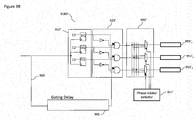
- Figure 9B shows a three bin histogram generator 3180 which comprises three phases (or rows) of the histogram generator cell 180' such as shown in Figure 9A .
- the histogram generator 3180 may thus comprise an input 900.
- the input 900 may be passed to a delay cell 905 and to a 3 phase clock sampling flop 910'.
- the three bin histogram generator 3810' may comprise a delay module 905.
- the delay module 905 may be configured to receive the input 900 signal and delay the signal sufficiently such that a delayed version of the input signal may be used to 'clock' a three phase gated edge detector 920'.
- the three bin histogram generator 3180 further comprises three clock sampling flop cells to form a three phase clock sampling flop 910'.
- the phase clock input signals are three overlapping phase clocks C 1 , C 2 , C 3 .
- the output of the three phase clock sampling flop 910' is output to a three phase clock edge detector cell 920'.
- the three bin histogram generator 3180 further comprises three clock gated edge detector (or transition detector) cells to form a three phase clock gated edge detector 920'.
- the three phase clock gated edge detector 920' may output to the three phase multiplexer 950'.
- the three bin histogram generator 3180 further comprises three rotation multiplexer cells to form a three phase clock rotation multiplexer 950'.
- the three phase rotation multiplexer 950' is configured to output one of the three clock gated edge detector cell outputs to one of the three bin ripple counters 955 1 ', 955 2 ', 955 3 '.
- the three bin histogram generator 3180 further shows a phase rotator/selector 957' configured to control the switching of the multiplexing.
- the histogram generator cell further comprises three bin ripple counters 955 1 ', 955 2 ', 955 3 ' configured to count the events detected for each of the clock phases.
- Figure 9C shows a four bin histogram generator 4180 which comprises four phases (or rows) of the histogram generator cell such as shown in Figure 9A .
- the histogram generator 4180 may thus comprise an input 900.
- the input 900 may be passed to a delay cell 905 and to a four phase clock sampling flop 910".
- the four bin histogram generator 4180 may comprise a delay module 905.
- the delay module 905 may be configured to receive the input 900 signal and delay this sufficiently such that a delayed version of the input signal may be used to 'clock' or activate a four phase gated edge detector 920'.
- the four bin histogram generator 4180 further comprises four clock sampling flop cells to form a four phase clock sampling flop 910".
- the phase clock input signals are four overlapping phase clocks C 1 , C 2 , C 3 , C 4 .
- the output of the four phase clock sampling flop 910" is output to a four phase clock edge detector cell 920". This for example is shown in Figure 10A where an example four overlapping phase clocks C 1 , C 2 , C 3 , C 4 are shown being used as data inputs for the four phase clock sampling flop 910".
- the four bin histogram generator 4180 further comprises four clock gated edge detector (or transition detector) cells to form a four phase clock gated edge detector 920".
- the four phase clock gated edge detector 920" may output to the four phase multiplexer 950".
- the four bin histogram generator 4180 further comprises four phase rotation multiplexer cells to form a four phase rotation multiplexer 950".
- the four phase rotation multiplexer 950" is configured to output one of the four clock gated edge detector cell outputs to one of the four bin ripple counters 955 1 ", 955 2 ", 955 3 ", 955 4 ".
- the four bin histogram generator 810 further shows a phase rotator/selector 957” configured to control the switching of the multiplexing.
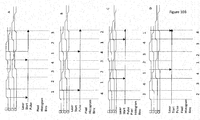
- the concept behind the four phase rotation multiplexer 950" is shown in further detail in Figure 10B .
- the first part A of Figure 10B shows a first phase rotation setting whereby the phase rotator/selector 957" is configured to couple the output of the first edge detector cell (defined by the period between C1 rising and C2 rising) to the first ripple counter, the second edge detector cell (defined by the period between C2 rising and C3 rising) to the second ripple counter, the third edge detector cell (defined by the period between C3 rising and C4 rising) to the third ripple counter and the fourth edge detector cell (defined by the period between C4 rising and C1 rising) to the fourth ripple counter.
- the phase marked 2 is shown to be slightly bigger than the other phases.
- phase rotator multiplexer 950 The phase rotator multiplexer 950 and shown in Figure 10B with respect to the four phase rotator multiplexer is to repeat the histogram generation starting with a different clock phase and as such when all of the clock phases have been rotated for a whole cycle then any inconsistency is averaged out.
- Figure 10B part B shows a second phase rotation setting wherein the phase rotator/selector 957" is configured to 'start' the light source cycle starting at the second phase and thus couple the output of the first edge detector cell (defined by the period between C1 rising and C2 rising) to the fourth ripple counter, the second edge detector cell (defined by the period between C2 rising and C3 rising) to the first ripple counter, the third edge detector cell (defined by the period between C3 rising and C4 rising) to the second ripple counter and the fourth edge detector cell (defined by the period between C4 rising and C1 rising) to the third ripple counter.
- the phase rotator/selector 957 is configured to 'start' the light source cycle starting at the second phase and thus couple the output of the first edge detector cell (defined by the period between C1 rising and C2 rising) to the fourth ripple counter, the second edge detector cell (defined by the period between C2 rising and C3 rising) to the first ripple counter, the third edge detector cell (defined by the period between C3 rising and C4 rising) to the
- FIG. 10B part C A further rotation to a third phase rotation setting is shown in Figure 10B part C wherein the phase rotator/selector 957" is configured to 'start' the light source cycle starting at the third phase and thus couple the output of the first edge detector cell (defined by the period between C1 rising and C2 rising) to the third ripple counter, the second edge detector cell (defined by the period between C2 rising and C3 rising) to the fourth ripple counter, the third edge detector cell (defined by the period between C3 rising and C4 rising) to the first ripple counter and the fourth edge detector cell (defined by the period between C4 rising and C1 rising) to the second ripple counter.
- the phase rotator/selector 957 is configured to 'start' the light source cycle starting at the third phase and thus couple the output of the first edge detector cell (defined by the period between C1 rising and C2 rising) to the third ripple counter, the second edge detector cell (defined by the period between C2 rising and C3 rising) to the fourth ripple counter, the third edge detector cell (defined by the
- the final rotation, the fourth phase rotation setting, is shown in Figure 10B part D.
- the phase rotator/selector 957" is configured to 'start' the light source cycle starting at the fourth phase and thus couple the output of the first edge detector cell (defined by the period between C1 rising and C2 rising) to the second ripple counter, the second edge detector cell (defined by the period between C2 rising and C3 rising) to the third ripple counter, the third edge detector cell (defined by the period between C3 rising and C4 rising) to the second ripple counter and the fourth edge detector cell (defined by the period between C4 rising and C1 rising) to the first ripple counter.
- FIG 11A a schematic illustration of an example embodiment of the delay module 905 is shown.
- the pulse shaper circuit 805 is shown to have an input from the SPAD array and an output 900 that feeds into the delay module 905, as discussed with reference to Fig. 8 above.
- the delay module 905 effectively comprises two delay elements, 1000 and 1005, which introduce time delays, T D2 and T D3 respectively.
- the pulse shaper 805 is also annotated with "T D1 ".
- T D1 indicates the length of the pulse created by the pulse shaper circuit.
- time periods T D1 , T D2 , and T D3 are shown in the timing diagram of Figure 11B , which illustrates the operation of the delay module 905.
- the signal output 900 of the pulse shaper is shown in the uppermost diagram.
- the signal is shown to have a length in time of TD 1 . It is noted that the change in state (from low to high) for the output signal 900 of the pulse shaper is not instantaneous. Rather, as illustrated there is a finite rise time between to and t 1 .
- sample flops diagram directly below the pulse diagram indicates the activation of a sampling module 910. It is noted that, as can be seen in the sample flop diagram, the sampling elements also do not change state instantaneously. However, the time required for the change of state of a sampling flop (t 2 -t 0 ) is smaller than the time required for the change in state of the output signal 900, (t 1 -t 0 ).
- T D2 represents the time required for a pulse 900 to be 'reach' the edge detector module 920 (or in other words for a pulse to pass through the clock sampling flops and therefore the difference in time between an initial sampling time 1105 and the logic settling time 1107).
- a further implemented time delay T D3 is defined from the time 1109 from which the gated edge detector is 'enabled' to enable any pulse to settle within the gated edge detector 920 and thus any pulse generated by the pulse shaper is able to be clocked out of the gate edge detector to the phase rotation multiplexer 950 within the time safety margin 1111 defined from the end of the delay T D3 and the PS pulse time.
- Figures 12A to 12D show various example implementations of the arrangements of four bin histogram generators which may differ from the implementations such as described in Figures 9A , 9B and 9C .
- the histogram generator 180A may thus comprise an input 900A.
- the input 900A may be passed to a delay cell 905A and to a clock sampling flop 910A.
- the histogram generator 180A may comprise a delay module 905A.
- the delay module 905A may be configured to receive the output of the shaper circuit 805 and delay these inputs sufficiently such that a delayed version of the input may be used to 'clock' the output of the phase rotator multiplexers 950A.
- the delay module 905A is configured to generate a delay which enables the detected events to pass through the clock sampling flops 910A, the edge detector decoder 920A and the phase rotator multiplexers 950A.
- the delay module 905A is shown in Figure 12A comprising an inverter 1305A configured to receive the input 900A.
- the delay module 905A uses the dead time of the SPAD or the OR tree as the delay time as the falling edge of the SPAD event or the OR tree network output may be used as the rising edge to clock the clock gating stage 1301 A and therefore increment the counters.
- the clock sampling flops 910A are configured to sample the four phase clock signals using the input 900A from the pulse shaper.
- the clock sampling flops 910A are shown as four D-latches 915Aa, 915Ab, 915Ac and 915Ad which has a data input coupled to one of the phase clock input signals C 1 , C 2 , C 3 , C 4 and a clock input coupled to the input 900A.
- the output of each D-latch 915Aa, 915Ab, 915Ac and 915Ad is output to the edge detector 920A.
- an output from the cell is generated where on the rising edge of an SPAD event pulse the phase clock signal is positive.
- the histogram generator 180A further comprises an edge detector (or transition detector) 920A.
- the edge detector 920A may be configured to identify or determine whether the event was detected between which pair of positive or rising phase clock edges.
- a difference between the edge detector 920A as shown in Figure 12A and the edge detector 920 shown in Figures 9A to 9C is that the edge detector 920A does not receive an output from the gating delay cell 905A.
- the edge detector 920A is configured to output on one of the four edge interval outputs to a phase rotator multiplexer 950A.
- the histogram generator 180A further comprises a phase rotation multiplexer 950A.
- the phase rotation multiplexer 950A may be similar to the phase rotation multiplexers described above in that it comprises a network which receives the outputs from the edge detector 920A.
- the multiplexer 950A may further comprise multiplexers configured to receive signals from the network and a selector input and thus selects one of the edge detector outputs to be output by the multiplexer to a clock gating stage 1301 A.
- the histogram generator 180A further comprises a clock gating stage 1301A which comprises a series of D-latches 1300Aa, 1300Ab, 1300Ac, 1300Ad each of which receives, as a data input, an output from the phase rotation multiplexer 950A and, as a clock input, the output from the delay module 905A and outputs the clock gated phase rotated samples to phase bin ripple counters 955Aa, 955Ab, 955Ac, 955Ad.
- a clock gating stage 1301A which comprises a series of D-latches 1300Aa, 1300Ab, 1300Ac, 1300Ad each of which receives, as a data input, an output from the phase rotation multiplexer 950A and, as a clock input, the output from the delay module 905A and outputs the clock gated phase rotated samples to phase bin ripple counters 955Aa, 955Ab, 955Ac, 955Ad.
- the histogram generator 180A further comprises phase bin ripple counters 955Aa, 955Ab, 955Ac, 955Ad.
- the ripple counters 955Aa, 955Ab, 955Ac, 955Ad are shown receiving, as an input, the outputs from the clock gating stage 1301 A and is configured to count the events detected for each bin.
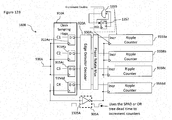
- FIG. 12B a further alternative example four bin histogram generator 180B is shown.
- the main difference between the histogram generator 180B as shown in Figure 12B and the histogram generator 180A shown in Figure 12A is that the functionality of the clock gating stage functionality is implemented within the ripple counters 955B.
- the histogram generator 180B may thus comprise an input 900A.
- the input 900A may be passed to a delay cell 905A and to a clock sampling flop 910A.
- the histogram generator may comprise a delay module 905A which may be implemented as an inverter 1305A and function as described previously.
- the histogram generator may further comprise clock sampling flops 910A configured to sample the four phase clock signals using the input 900A from the pulse shaper. As described above the output of each D-latch 915Aa, 915Ab, 915Ac and 915Ad is output to the edge detector 920A. Thus an output from the cell is generated where on the rising edge of an SPAD event pulse the phase clock signal is positive.
- the histogram generator 180B further comprises an edge detector (or transition detector) 920A which performs the same functionality as the edge detector of Figure 12A as described above.
- the histogram generator 180A further comprises a phase rotation multiplexer 950A which performs the same functionality as phase rotation multiplexer 950A of Figure 12A as described above. However rather than selecting one of the edge detector outputs to be output by the multiplexer to a clock gating stage 1301A the output is passed to a ripple counter 955Ba, 955Bb, 955Bc, 955Bd.
- the histogram generator 180B further comprises phase bin ripple counters 955Ba, 955Bb, 955Bc, 955Bd.
- the ripple counters 955Ba, 955Bb, 955Bc, 955Bd are shown receiving, as a clock input the output from the delay stage 905A and as an increment enable input the outputs from the phase rotation multiplexer 950A and is configured to count the events detected for each bin.
- Each bin ripple counter 955Ba, 955Bb, 955Bc, 955Bd comprises a flop 1357 which is the first bit of the ripple counter and which receives as the clock input the counter 'incr' input (the output of the phase rotator multiplexer 950A) and as a data input the output of a multiplexer 1355. Furthermore the bin ripple counter comprises a multiplexer 1355 which receives as a first input the positive output from the flop 1357, a second input the output of the multiplexer 1355 and a selection input of 'increment enable' signal from the output of the delay 905A. The output of the flop 1357 may furthermore be passed to the further bits of the ripple counter module.
- this example shows an implementation of a ripple counter that can be enabled or disabled by changing the select input "increment enable" on the multiplexer 1355.
- the output of the rotation multiplexer 950A connects to the clock input of the flop 1357 (marked 'incr').
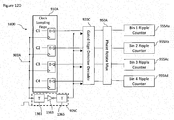
- FIG. 12C a further alternative four bin histogram generator 180C is shown.
- the main difference between the histogram generator 180C as shown in Figure 12C and the histogram generators 180A, 180B shown in Figure 12A and 12B is that the edge detector 920A, 920B is a gated edge detector 920C and thus the functionality of the clock gating stage functionality is implemented within the edge detector.
- Figure 12C shows an alternative delay cell 905C which comprises a pair of delay elements 1361 and 1365 and an inverter 1363 to generate the delay time implicitly using the delay time of the SPAD pulse (if no pulse shaper is used) or the pulse shaper pulse. The delay time is produced from using the negative edge of a pulse coming through the OR tree.
- the pulse shapers connected as inputs to the OR tree provide this delay "for free", the inverter is used to convert the negative edge to a positive edge.
- the output of the delay cell 905C furthermore is passed to the gated edge detector 920C as the clock input.
- the histogram generator 180C furthermore comprises a flop 1400C which is configured to receive the input 900A from the SPAD pixels as a clock input and has a data input which is set high and thus outputs a high value when an event is output from the SPAD.
- the positive output from the flop 1400C is sent as the input for the clock sampling flops 910A and to the delay cell 905C.
- the flop 1400C furthermore comprises a reset input which receives the output from the delay cell 905C and as such each detected event creates a pulse with a width defined by the delay cell time delay.
- the flop 1400C and the 2 delay cells function as the pulse shaper or "pulse extender".
- the flop latches high, then the delay cells are activated which reset the flop providing a guaranteed high time of the pulse (to latch the clock sampling flops) and a guaranteed low time (to reset the flop 1400C).
- the histogram generator 180C may further comprise clock sampling flops 910A configured to sample the four phase clock signals using the output from the flop 1400C. As described above the output of each D-latch 915Aa, 915Ab, 915Ac and 915Ad is output to a gated edge detector 920C. Thus an output from the cell is generated where on the rising edge of an SPAD event pulse, the phase clock signal is positive and the preceding phase clock signal is negative.
- the histogram generator 180C further comprises a gated edge detector (or transition detector) 920C which performs the same functionality as the edge detector 920A of Figure 12A as described above but is gated by the output of the delay cell 905C.
- the gated edge detector 920C is similar to the gated edge detector described in Figures 9A to 9C .
- the histogram generator 180C further comprises a phase rotation multiplexer 950A which performs the same functionality as phase rotation multiplexer 950A of Figure 12A and 12B as described above. However rather than selecting one of the gated edge detector outputs to be output by the multiplexer to a clock gating stage the output is passed to a ripple counter 955Aa, 955Ab, 955Ac, 955Ad.
- the histogram generator 180C further comprises phase bin ripple counters 955Aa, 955Ab, 955Ac, 955Ad.
- the ripple counters 955Aa, 955Ab, 955Ac, 955Ad are shown receiving the outputs from the phase rotation multiplexer 950A and are configured to count the events detected for each bin.
- Figure 12D shows a further alternative example of a four bin histogram generator 180D.
- the main difference between the histogram generator 180D as shown in Figure 12D and the histogram generator 180C shown in Figure 12C is that the resettable flop 1400C is not implemented in this example.
- Figure 12D shows the alternative delay cell 905C which comprises a pair of delay elements 1361 and 1365 and an inverter 1363 to generate the delay time.
- the output of the delay cell 905C furthermore is passed to the gated edge detector 920C as the clock input.
- the histogram generator 180D furthermore is configured to receive the input 900A from the pulse shaper and which is sent as the input for the clock sampling flops 910A and to the delay cell 905C.
- the histogram generator 180D may further comprise clock sampling flops 910A configured to sample the four phase clock signals using the input signal 900A. As described above the output of each D-latch is output to a gated edge detector 920C. Thus an output from the cell is generated where on the rising edge of an SPAD event pulse, the phase clock signal is positive and the preceding phase clock signal is negative.
- the histogram generator 180D further comprises a gated edge detector (or transition detector) 920C which performs the same functionality as the edge detector 920A of Figure 12A as described above but is gated by the output of the delay cell 905C.
- the gated edge detector 920C is similar to the gated edge detector described in Figures 9A to 9C .
- the histogram generator 180D further comprises a phase rotation multiplexer 950A which performs the same functionality as phase rotation multiplexer 950A of Figure 12A and 12B as described above. However rather than selecting one of the gated edge detector outputs to be output by the multiplexer to a clock gating stage the output is passed to a ripple counter 955Aa, 955Ab, 955Ac, 955Ad.
- the histogram generator 180D further comprises phase bin ripple counters 955Aa, 955Ab, 955Ac, 955Ad.
- the ripple counters 955Aa, 955Ab, 955Ac, 955Ad are shown receiving the outputs from the phase rotation multiplexer 950A and are configured to count the events detected for each bin.
- the histogram processor 181 comprises a signal or waveform regenerator 1701, which receives the bin count values and maps the values to an expected waveform.
- the timing generator 120' is configured to generate a sine wave to modulate the light source 125'
- the signal regenerator 1701 is configured to receive the three (or four or other number) bin values and map these to a sine wave. This regenerated waveform may then be passed to a phase comparator/range determiner 1703.
- the histogram processor 181 may further comprise a phase comparator/range determiner 1703 which receives the regenerated waveform and compares the regenerated waveform against the original waveform to determine a phase difference and from this comparison determine the time and range distance.
- phase comparator/range determination may be performed using any suitable method such as look up tables.
- Using a single waveform frequency may, in some circumstances, provide an ambiguous range result because of range overlap. This for example occurs because more than one range value may be mapped to a phase difference value.
- the timing generator may perform a range determination for more than one frequency waveform.
- Figure 13C for example shows an example wherein a first frequency integration (histogram determination) 1801 is performed for a first frequency, then a second frequency integration (histogram determination) 1803 is performed for a second frequency and finally in the cycle a third frequency integration (histogram determination) 1805 is performed for a third frequency. The cycle may then be repeated as shown in Figure 13C by a further first frequency integration 1801 following the third frequency integration 1805.
- the histogram values may be read out to memory and the pixel counters (ripple counters) reset. Furthermore the histogram values used to calculate the phase of the first frequency histogram values (in other words the phase difference for the first frequency) 1811. Following the end of the second frequency integration 1803, the histogram values may also be read out to memory and the pixel counters (ripple counters) reset. Furthermore the histogram values used to calculate the phase of the second frequency histogram values (in other words the phase difference for the second frequency) 1813. Following the end of the third frequency integration 1805, the histogram values may also be read out to memory and the pixel counters (ripple counters) reset. Furthermore the histogram values used to calculate the phase of the third frequency histogram values (in other words the phase difference for the third frequency) 1815.
- phase values for all three frequencies may then be used to determine an unambiguous range value 1821.
- Figure 13D furthermore shows a three frequency example where within each frequency a phase rotation operation is visible.
- a first frequency integration (histogram determination) 1901 is performed for a first frequency, but within the first frequency integration is a first phase 1901 1 , a second phase 1901 2 , a third phase 1901 3 , and a fourth phase 1901 4
- a second frequency integration (histogram determination) 1803 is performed for a second frequency, but within the second frequency integration is a first phase, a second phase, a third phase, and a fourth phase
- a third frequency integration (histogram determination) 1805 is performed for a third frequency but within the third frequency integration is a first phase, a second phase, a third phase, and a fourth phase.
- the cycle may then be repeated as shown in Figure 13D by a further first frequency integration 1901 following the third frequency integration 1905.
- the histogram values may be read out to memory and the pixel counters (ripple counters) reset. Furthermore the histogram values may be used to calculate the phase of the first frequency histogram values (in other words the phase difference for the first frequency) 1911. Following the end of the second frequency integration 1903, the histogram values may also be read out to memory and the pixel counters (ripple counters) reset. Furthermore the histogram values may be used to calculate the phase of the second frequency histogram values (in other words the phase difference for the second frequency) 1913. Following the end of the third frequency integration 1905, the histogram values may also be read out to memory and the pixel counters (ripple counters) reset. Furthermore the histogram values may be used to calculate the phase of the third frequency histogram values (in other words the phase difference for the third frequency) 1915.
- phase values for all three frequencies may then be used to determine an unambiguous range value 1921.
- the Timing generator generates a suitable waveform and passes it to the light source.
- the SPAD array generates detection pulses which are based on the object range and the waveform.
- the Front end electronics gather the detection pulses and pass them to a pulse shaper.
- the pulse shaper performs pulse shaping and passes the pulses to the few bin histogram generator to generate the histogram bins.
- the histogram generator generates the few histogram bins.
- the histogram processor reconstructs a waveform and determines the phase (difference) of the reconstructed waveform.
- the histogram processor then furthermore determines a range based on the phase (difference).
- Some embodiments may use other sensors, instead of SPADs.
Landscapes
- Physics & Mathematics (AREA)
- Engineering & Computer Science (AREA)
- Electromagnetism (AREA)
- General Physics & Mathematics (AREA)
- Radar, Positioning & Navigation (AREA)
- Remote Sensing (AREA)
- Computer Networks & Wireless Communication (AREA)
- Optical Radar Systems And Details Thereof (AREA)
Abstract
Description
- Some embodiments relate to an apparatus, and in particular but not exclusively, to an apparatus with a histogram time of flight sensors with higher pixel density.
- Devices for determining the distance to objects are known. One currently used method is called "Time of Flight" (ToF). This method comprises sending a light signal towards the object and measuring the time taken by the signal to travel to the object and back. The calculation of the time taken by the signal for this travel may be obtained by measuring the phase shift between the signal coming out of the light source and the signal reflected from the object and detected by a light sensor. Knowing this phase shift and the speed of light enables the determination of the distance to the object.
- Single photon avalanche diodes (SPAD) may be used as a detector of reflected light. In general an array of SPADs are provided as a sensor in order to detect a reflected light pulse. A photon may generate a carrier in the SPAD through the photo electric effect. The photo generated carrier may trigger an avalanche current in one or more of the SPADs in an SPAD array. The avalanche current may signal an event, namely that a photon of light has been detected.
-
Figure 1 illustrates the general principle of a "Time of Flight" method. - In
Figure 1 , a generator 10 (shown as box PULSE inFigure 1 ) provides a periodic electric signal (for example, square-shaped). This signal powers alight source 12. An example of alight source 12 may be a light-emitting diode, or any known lighting device, for example, a laser diode. The signal coming out oflight source 12 is transmitted towards anobject 16 and is reflected by this object. The reflected light signal is detected by a light sensor (shown as box CAPT inFigure 1 ) 18. The signal onsensor 18, is thus phase-shifted from the signal provided by the generator for an ideal system by a time period proportional to twice the distance to object 16 (In practice there is also electrical to optical delay time from the light source). Calculation block 20 (shown as box DIFF inFigure 1 ) receives the signals generated bygenerator 10 and bysensor 18 and calculates the phase shift between these signals to obtain the distance toobject 16. SPADs have the advantage of picosecond time resolution so are ideal for the detector of a compact time of flight pixel. -
Figures 2A and 2B are timing diagrams illustrating the operation of a circuit such as that inFigure 1 .Figure 2A illustrates a transmitted periodic signal "PULSE" capable of being provided by thegenerator 10 ofFigure 1 .Figure 2B illustrates the signal CAPT received by a photo-diode basedsensor 18. Due to interactions with the outside and to thecomponents forming sensor 18, the signal received by this sensor has, in this example, variations in the form of capacitor charges and discharges. The signal onsensor 18 is phase-shifted from the signal coming out ofgenerator 10 by a delay D. - The
sensor 18 may integrate one or several photo detection elements enabling the detection of the signal received after reflection from theobject 16. Such elements may be rapid charge transfer photodiodes. Single-photon avalanche diodes, or "SPADs", also called Geiger mode avalanche photodiodes, may also be used. These devices have a reverse biased p-n junction in which a photo-generated carrier can trigger an avalanche current due to an impact ionization mechanism. SPADs may be designed to operate with a reverse bias voltage well above the breakdown voltage. - SPADs may be operated as follows. At an initial time, the diode is biased to a voltage greater than its breakdown voltage. The reception of a photon in the diode junction area starts a current avalanche in the diode, which creates an electric voltage pulse on the anode. The diode is then biased back to the voltage greater than the breakdown voltage, so that the SPAD reacts again to the reception of a photon. SPADs can currently be used in cycles having reactivation periods shorter than 10 ns. Thereby, SPADs can be used at high frequency to detect objects at relatively short distances from the measurement device, for example, distances ranging from a few centimetres to a few tens of centimetres. In different embodiments, different ranges may be supported.
- Digital counter devices intended for histogram comparison, associated with SPAD sensors, are known. However, such devices are relatively complex to implement and require a significant amount of silicon to implement and thus reduce the potential density of pixels in the silicon sensor. Thus typically the SPAD sensor is a 'few pixels' sensor which has a poor lateral (X-Y dimension) resolution but fine distance (Z dimension) resolution.
- The use of high density pixel (or 'many pixel') sensors comprising photodiodes which can transfer charge on several nodes according to the phase of the signal transmitted by the reference generator is also known. These sensors however typically have a slow response time and thus are produce a poor quality distance resolution but has a good quality lateral resolution.
- There further is a need for apparatus and methods for sensors which produce both fine quality lateral and distance resolution which overcomes the disadvantages of known devices.
- According to a first aspect there is provided a method for determining a distance from an apparatus to at least one object comprising: generating a first signal; generating light modulated by the first signal from the apparatus; detecting light reflected by the at least one object using a Time-of-flight detector array, by determining by each array element of the Time-of-flight detector array an output signal generated from a series of photon counts over a number of consecutive non-overlapping time periods; comparing the output signals to the first signal to determine at least one signal phase difference; and determining a distance from the apparatus to the at least one object based on the at least one signal phase difference.
- Each array element determining an output signal generated from a series of photon counts over a number of consecutive non-overlapping time periods may comprise: sampling a determined number of overlapping clock signals using a photon detection output from the array element, wherein the sampling generates the determined number of sampling outputs; generating the determined number of non-overlapping time periods count increment detections based on outputs from consecutive sampling outputs; phase rotating the determined number of non-overlapping time periods count increment detections to generate phase rotated determined number of non-overlapping time periods count increment detections; and incrementing the series of photon counts from the phase rotated determined number of non-overlapping time periods count increment detections.
- Generating the determined number of non-overlapping time periods count increment detections using a gated edge detector based on outputs from consecutive sampling outputs may comprise generating for each determined number of non-overlapping time periods count increment detection by logic-AND combining a first of the determined number of sampling outputs, an inverted second of the determined number of sampling outputs, wherein the first of the determined number of sampling outputs and the second of the determined number of sampling outputs are consecutive sampling outputs generated based on overlapping clock signals.
- Generating the determined number of non-overlapping time periods count increment detections based on outputs from consecutive sampling outputs may comprise gating the determined number of non-overlapping time periods count increment detections based on a delayed detected photon output.
- Phase rotating the determined number of non-overlapping time periods count increment detections to generate phase rotated determined number of non-overlapping time periods count increment detections may comprise multiplexing each of the determined number of non-overlapping time periods count increment detections to a determined counter based on a phase determination input such that after all phases have been completed each determined counter has been coupled to each of the non-overlapping time periods count increment detections.
- The method may further comprise: generating at least one further signal, wherein the at least one further signal has a frequency component different to a first signal frequency component; generating light modulated by the at least one further signal from the apparatus; detecting light reflected by the at least one object using the Time-of-flight detector array, by determining by each array element of the Time-of-flight detector array an at least one further signal related output signal generated from a series of photon counts over a number of consecutive non-overlapping time periods; comparing the at least one further signal related output signal to the first signal to determine at least one further signal phase difference; determining a distance from the apparatus to the at least one object based on the at least one further signal phase difference; and determining an unambiguous distance from the apparatus to the at least one object based on the determined distance based on the at least one further signal phase difference and the determined distance based on the signal phase difference.
- The method may further comprise determining at least one array element co-ordinate associated with at least one of the Time-of-flight detector array elements which provided the output signal determining the distance.
- The method may further comprise determining a user input gesture from the at least one array element co-ordinate and the distance from the apparatus to the at least one object.
- According to a second aspect there is provided an apparatus for determining a distance to at least one object, the apparatus comprising: a signal generator configured to generate a first signal; a light source configured to generate light modulated by the first signal; a time-of-flight detector array configured to detect light reflected by the at least one object, the time-of-flight detector comprising an array of detector elements configured to generate an output signal, the output signal generated from a series of photon detections over a determined number of consecutive non-overlapping time periods; a comparator configured to compare the output signals from each detector element to the first signal to determine at least one signal phase difference; and a distance determiner configured to determine at least one object distance based on the at least one signal phase difference.
- Each detector array element may comprise: a plurality of single-photon-avalanche-diodes configured to generate a photon detection output; and a histogram generator configured to generate the series of photon detections over the determined number of consecutive non-overlapping time periods.
- The plurality of single-photon-avalanche-diodes configured to generate a photon detection output and the histogram generator may be integrated.
- The histogram generator may comprise: the determined number of clock sampling flops configured to sample a determined number of overlapping clock signals using the photon detection output from the array element and generate the determined number of sampling outputs; the determined number of edge detectors configured to generate the determined number of non-overlapping time periods count increment detections based on outputs from consecutive clock sampling flops; the determined number of multiplexers configured to phase rotate the determined number of non-overlapping time periods count increment detections to generate phase rotated determined number of non-overlapping time periods count increment detections; and the determined number of counters configured to increment the series of photon counts based on the phase rotated determined number of non-overlapping time periods count increment detections.
- The determined number of edge detectors may comprise the determined number of AND-gates configured to combine a first of the determined number of sampling outputs and an inverted second of the determined number of sampling outputs, wherein the first of the determined number of sampling outputs and the second of the determined number of sampling outputs may be consecutive sampling outputs generated based on overlapping clock signals.
- The determined number of edge detectors may be further gated based on a delayed photon detection output.
- The determined number of multiplexers may be configured to multiplex each of the determined number of non-overlapping time periods count increment detections to each counter based on a phase determination input such that after all phases have been completed each counter has been coupled to each of the non-overlapping time periods count increment detections.
- The signal generator may furthermore be configured to generate at least one further signal, wherein the at least one further signal has a frequency component different to a first signal frequency component.
- The light source may furthermore be configured to generate light modulated by the at least one further signal from the apparatus.
- The time-of flight detector may furthermore be configured to detect light modulated by the at least one further signal from the apparatus and reflected by the at least one object using the Time-of-flight detector array by the array of detector elements configured to generate an further output signal.
- The comparator may be configured to compare the at least one further output signal to the further signal to determine at least one further signal phase difference.
- The distance determiner may be configured to determine at least one further distance based on the at least one further signal phase difference.
- The distance determiner may be configured to determine an unambiguous distance based on the determined distance based on the at least one further signal phase difference and the determined distance based on the signal phase difference.
- The apparatus may furthermore comprise a processor configured to determine at least one array element co-ordinate associated with at least one of the Time-of-flight detector array elements which provided the output signal determining the at least one distance.
- The processor may furthermore be configured to determine a user input gesture from the at least one array element co-ordinate and the distance from the apparatus to the at least one object.
- The light source may be a vertical cavity surface emitting laser.
- The apparatus may comprise a phase rotator configured to control the determined number of multiplexers.
- The first signal may be at least one of: a sine wave with a frequency component; a square wave; an irregular wave with at least one defined frequency component; a pulse wave; and a regular wave with at least one defined frequency component.
- The at least one further signal may be at least one of: a sine wave with a frequency component; a square wave; an irregular wave with at least one defined frequency component; a pulse wave; and a regular wave with at least one defined frequency component.
- The determined number is three or four.
- Some embodiments will now be described by way of example only and with reference to the accompanying Figures in which:
-
Figure 1 illustrates principle of the "Time of Flight" method for determining the distance to an object; -
Figures 2A and 2B are timing diagrams illustrating results obtained by means of the device ofFigure 1 , as well the operation of "SPADs"; -
Figure 3 shows a block diagram of a few-pixel many-bin histogram generating detector arrangement; -
Figure 4A shows a flowchart illustrating the function of the many-bin histogram generating detector arrangement shown inFigure 3 ; -
Figure 4B shows an example many bin histogram output produced by the few-pixel many-bin histogram generating detector arrangement shown inFigure 3 ; -
Figure 5 shows a circuit of an example many-pixel few-bin histogram generating detector arrangement; -
Figure 6 shows suitable applications for time of flight detectors according to some embodiments; -
Figure 7 shows schematically an example arrangement for a few-pixel many-bin detector and the many-pixel few-bin detector according to some embodiments; -
Figure 8 shows schematically a block diagram of the many-pixel few-bin detector according to some embodiments; -
Figure 9A shows a schematic view of an example building block of the histogram generator shown inFigure 8 ; -
Figures 9B and9C show schematic views of three-bin and four-bin arrangements of the histogram generator shown inFigure 8 formed from the example building block shown inFigure 9A ; -
Figure 10A show example clock signals used in the clock sampling flops shown inFigures 9A to 9C ; -
Figure 10B shows the effect of the phase rotate multiplexes on the clock signals used in the clock sampling flops according to some embodiments; -
Figure 11A shows a schematic view of an example delay module shown inFigure 8 ; -
Figure 11B shows an example timing diagram illustrating the function of the delay module shown inFigure 8 ; -
Figures 12A ,12B ,12C and12D show schematic views of implementations of range detecting embodiments; -
Figure 13A shows an example histogram processor in further detail; -
Figure 13B shows example methods for signal reconstruction according to some embodiments; -
Figures 13C and13D shows example methods for implementing three and four different waveform frequencies to allow for range overlap according to some embodiments; and -
Figure 14 shows a flowchart illustrating the process implemented within the range detector as shown inFigure 8 . - The making and using of the present embodiments are discussed in detail below. It should be appreciated, however, that the present disclosure provides many applicable inventive concepts that can be embodied in a wide variety of specific contexts. The specific embodiments discussed are merely illustrative of specific ways to make and use the disclosed subject matter, and do not limit the scope of the different embodiments.
- Reference is now made to
Figure 3 which shows a block diagram of a few-pixel many-bin histogram generating time-of-flight range detector arrangement. To measure the time of flight at a resolution below a clock period, a flash time to digital converter (TDC) is typically used. This typically comprises a multiple-phase timing generator and front end sampling elements. There are two input TDC channels, one input for reception of SPAD pulses (i.e. pulses generated by a SPAD on detection of a photon) and the other input for illumination device pulses (i.e. pulses generated by the system coincident with emission of an illumination pulse). The TDC converts the time difference between a received SPAD event and the multiple clock phase timing generator. - The system shown in
Figure 3 comprises atiming generator 120. The timing generator generates a timing signal which may be used to control a light source (and furthermore be used as a reference clock signal). Thetiming generator 120 may be configured to generate suitable timing pulses. - The system may furthermore comprise a
light source 125. Thelight source 125 may comprise any suitable fast light source, for example a vertical cavity surface emitting laser (VCSEL), a light emitting diode (LED), etc. Thelight source 125 may receive signals from the timing generator and be configured to generate light based on the signals. For example thelight source 125 may be configured to receive timing signal pulses from thetiming generator 120 and generate pulses of light which are emitted externally (and in some embodiments internally via an internal parasitic path not shown directly to a reference SPAD array 104). - The system may further comprise a detector. In the example shown in
Figure 3 , the detector may comprise a first orreference SPAD array 104 and a second or returnSPAD array 105. Thereturn SPAD array 105 may configured to detect light reflected back from theobject 140 whereas thereference SPAD array 104 may be configured to detect light passed via the internal parasitic path only. The output of the SPAD arrays (thereference SPAD array 104 and the return SPAD array 105) may be coupled to front end electronics (FE electronics) 100. - An example of the
SPAD array 105 architecture is further shown inFigure 3 . In this example theSPAD array 105 comprises an array of pixels, of which onepixel 171 is shown in further detail. - Each
pixel 171 may as shown inFigure 3 comprise a single photon avalanche diode with quench and resetcomponents 173. The output of the pixel singlephoton avalanche diode 173 may be passed to a pulse shaper. - The system comprises a
pulse shaper 175 per pixel, which receives the input SPAD pulse from each pixel and performs pulse shaping on the signal. The pulse shaper may be configured to shorten the pulse length and reduce the effect of pileup distortion in the OR tree network, for a given SPAD count rate. The pulse output from the SPAD array may be greater than 10ns in length. The longer the period or length of pulses entering the input of an OR tree (used in the histogram generator), the more likely it is for two or more SPAD outputs to be high together. One SPAD array output being high has the same effect at the output as two or more SPAD array outputs being high. In both cases the output of the OR tree sits high. Accordingly, timing information can be lost as output pulses increase in length. This effect is sometimes referred to as pile up distortion. The pulse shaping circuitry is used to overcome this. The output of the pulse shaper may be passed to the OR tree. - Although not shown in detail the
reference SPAD array 104 may be similarly arranged. - As shown in
Figure 3 each pixel is configured to output to theOR tree 177, which receives the output from eachpixel pulse shaper 175 and logical 'OR's the inputs to generate a pulse output. The output of theOR tree 177 and therefore thereturn SPAD array 105 may be passed to the Front End (FE) time-to-distance (TDC)electronics 100. - The
FE TDC electronics 100 may be configured to receive signals from thetiming generator 120, thereference SPAD array 104 and thereturn SPAD array 105 and pass these signals to ahistogram generator 150. - The system in some embodiments comprises a
histogram generator 150. Thehistogram generator 150 measures the time of flight of the illumination pulse over the return journey fromlight source 125 to object 140 and back to thereturn SPAD array 105. Thehistogram generator 150 in this type of arrangement may comprise clocked counters which output a large number of bins each of which comprise the number of detected events for a clocked period. - Reference is now made to
Figure 4A which shows a flow chart illustrating the method steps associated with the function of a conventional SPAD arrangement such as the one shown inFigure 3 . - At
step 401, a plurality of events are determined and a time at which each event occurred is recorded. - At
step 402, a histogram may be generated from the event information. Typically, the histogram may be generated during the detection period and based on all the time and event information for the detection period. Typically, the histogram is generated by the histogram generator. An illustrative example of such a histogram is shown inFigure 4B . - Thus for example
Figure 4B shows an example histogram where the Y-axis 301 shows the number of events for eachhistogram bin 302.Figure 4B , for example, shows at time t1 afirst peak 303 corresponding to a first detected event, at time t2 asecond peak 304 corresponding to a second detected event, and at a time t3 athird peak 710 corresponding to a third detected event. In this example thefirst peak 303 may correspond to the internal parasitic path event detection, thesecond peak 304 the external object detection and the third peak a further distant reflected object detection. - At
step 403, the time of the first peak 303 t1, the second peak 304 t2 and the third peak 710 t3 may be used to determine a time taken for light to travel to and from the respective remote objects. - A drawback of the architecture described above with reference to
Figures 3 and4A is that the histogram generator circuitry configured to output multiple bin histograms requires a large amount of implementation physical space. As a histogram is required for each of the arrays (or pixels) the number of detector pixels (or arrays) which may be implemented on a suitable silicon device is therefore limited. Hence most practical implementations are typically only able to output a few pixels. Thus, although such devices are able to provide fine resolution in the Z dimension (in other words the plane perpendicular to the sensor), they offer coarse resolution in the X-Y plane (the plane parallel to the sensor). - Reference is now made to
Figure 5 which shows a further example detector architecture 'many-pixel few-bin' implementation. The example shows where the complexity of the circuitry is reduced to enable an increase in the density of pixels. In this example the sensor comprises aphotodiode 510. Thephotodiode 510 may be reversely biased close to a breakdown voltage. Once the photodiode is triggered by few photons, a current may be generated. Thephotodiode 510 is connected to a pass circuit comprising several transistors, 515a, 515b, 515c and 515d, configured in a pass transistor configuration. Each transistor is clocked by at least one clock which is passed to a delay line and the taps from which are used to activate each transistor such that one terminal is connected to the photodiode and the other is connected to a charge collection region or 'bin' 520a, 520b, 520c and 520d respectively. The advantage of this example detector is that the reduction in complexity is such that the amount of silicon required per pixel is low and therefore a higher resolution can be achieved. However, the use of pass gate logic is disadvantageous because it introduces an inherent delay to the system which significantly limits the maximum frequency of the transmitted illumination. This results in a slow system which cannot take full advantage of the speed offered by the SPAD diodes and is more limited by any differences between pass-gate transistor to pass-gate transistor. Hence the example implementation although suitable for producing a fine resolution in the X-Y dimension (due to the number of pixels), they offer limited resolution in the Z plane and furthermore limited resolution in the time domain. - There are certain applications for which a high degree of accuracy in distance measurements, without any loss of accuracy in the X-Y plane domain, is required. An example of these applications include gesture recognition. An example representation of a gesture recognition device is schematically shown in
Figure 6. Figure 6 shows for example anelectronic device 600 with display, suitable for implementing a '3D mouse' application where the user's hand or other object is monitored and used to provide an input for the device. For example in such an application the device may be configured to detect objects (for example a finger of a hand) located over the device and the motion of the object (shown as the finger moving from the right to the left to attempt a 'swipe' gesture) is detected and used to control the device. In such applications not only is it not necessary to contact the device to enable the user input but the distance from the device (Z-distance) may itself be detected and any change in the Z-distance be used to determine a suitable input to the device. For example a single point zoom effect input may be determined based on the 'input' object distance from the device where the closer the object to the device the higher the zoom magnification and vice versa. - In other words the recognition of some gestures requires knowledge of not only x-y co-ordinates (as per optical mouse techniques), but also an array of z coordinates. Examples of this are diagonal gestures where there is motion or displacement of the object being detected in the x-y co-ordinates and the z distance. Other examples are circular gestures such as looping with a hand, turning a hand over or more complex gestures such as detecting a turning dial gesture. In all of these the change in z distance is to be detected.
- Thus in order to be able to produce effective 3D gesture recognition an object detection sensor is required to have both a fine spatial resolution (X-Y axes) 605 that is high enough for gesture recognition in two-dimensions, whilst also being able to accurately resolve in the
Z axis 610. For example the device is required to distinguish between a motion of the 'target' object (within a height range 611) and a different object detected at a different height. In other words being able to be quick enough both to provide a high enough frame rate and to obtain the required precision in the Z axis. Furthermore by providing a device with a good Z axis resolution three dimension gesture detection can be implemented accurately. - By way of example, an optical mouse typically uses a 20x20 two-dimensional array of detectors operated at approximately 1000fps to detect movement direction and speed.
- With respect to
Figure 7 an example arrangement for both the few-pixel many-bin detector described above and the many-pixel few-bin detector according to some embodiments are shown. The left hand side ofFigure 7 shows the few-pixel many-bin detector. As can be seen,conventional architectures 705 use an array of SPADs which are divided into sub-arrays of SPADs. In this example the array of SPADs is divided into four sub-arrays 710a, 710b, 710c, 710d to achieve the required resolution. Each sub-array of SPADs 710a, 710b, 710c, 710d is associated with itsown histogram logic - By contrast the right hand side of
Figure 7 shows an example of the proposed solution. In this system theSPAD array 730 is divided intomacro pixels 740 which comprise smaller sub-arrays of SPADs. In theexample system 730 eachmacro pixel Figure 7 wherein each macro pixel comprises a sub-array 750 of SPADs and associated sub-array ofSPADs TDC component 751, which may comprise an OR tree, pulse shaper and 'few-bin' histogram generator. In some embodiments theexample TDC component 751 and the 'few-bin' histogram generator is physically located on the integrated circuit adjacent theSPAD sub-array 750. In some embodiments the 'few-bin'histogram generator 751 is physically located adjacent to the SPAD sub-array 750 in the X or Y plane of the device (in other words within the same silicon layers as the SPAD detectors) or in the Z plane (in other words in different silicon layers as the SPAD detectors). - Reference is now made to
Figure 8 which shows a block diagram of a time-of-flight range determining device in accordance with some embodiments. - The ToF range determining device comprises a timing generator 120'. The timing generator 120' is configured to control the timing of a light source 125' and furthermore in some embodiments to generate a known waveform for controlling the light source 125'. The following examples are described where the timing generator 120' is configured to generate a sine wave at a determined frequency f. In some other embodiments the known waveform may be any arbitrary waveform, for example a pulse wave, triangle wave, square wave, saw tooth wave or other.
- The ToF range determining device comprises a light source 125'. The light source 125' may comprise any suitable fast switching light source, for example a vertical cavity surface emitting laser (VCSEL), a light emitting diode (LED), etc. The light source 125' for example may be configured to emit light which is amplitude modulated at a sine wave at the frequency f and time controlled by the timing generator 120'. The light is then reflected back from an object 140'.
- The ToF range determining device further comprises a first or reference SPAD array 104' and a second or return SPAD array 105'. The return SPAD array 105' may configured to detect light reflected back from the object 140' whereas the reference SPAD array 104' may be configured to detect light passed via the internal parasitic path only. The output of the SPAD arrays (the reference SPAD array 104' and the return SPAD array 105') may be coupled to
histogram processor 181. - An example of the SPAD array 105' architecture and an example configuration of a
macro pixel 740 is further shown inFigure 8 . In this example the SPAD array 105' comprises an array ofmacro pixels 740. Eachmacro pixel 740 is shown comprising a NxN SPAD pixel arrangement of which one pixel 171' is shown in further detail and which outputs to the OR Tree 177'. - Each pixel arrangement 171' as shown in
Figure 8 may comprise a single photon avalanche diode with quench and reset components 173'. The output of the pixel single photon avalanche diode 173' (with quench and reset components) may be passed to a pulse shaper 175'. Each pixel arrangement 171' may further comprise a pulse shaper 175', which receives the SPAD pulse from each pixel and performs pulse shaping on the signal. The pulse shaper may, as described previously, be configured to shorten the pulse length and reduce the effect of pileup distortion in the OR tree network, for a given SPAD count rate. The output of the pulse shaper 175' may be passed to the OR tree 177'. - The SPAD pixel arrangement 171' is configured to receive the reflected sine wave from the object 140' and generate detected event signal pulses.
- The
macro pixel 740 may further comprise an OR tree 177', which is configured to receive the output from each pixel pulse shaper 175' for themacro pixel 740 and logical 'OR' the inputs to generate a pulse output. The output of the OR tree 177' and therefore the detected reflected sine wave may be passed to the Front End (FE) time-to-distance (TDC)electronics 179. - The
macro pixel 740 may further compriseFE TDC electronics 179 configured to receive signals from thetiming generator 120 and theOR tree 177 and pass these signals to a 'few-bin'histogram generator 180. - The
macro pixel 740 may further comprise a 'few-bin'histogram generator 180, configured to receive the output of theFE TDC electronics 179 and output a histogram. Thehistogram generator 180 is configured to generate a histogram comprising a small number of bins. For example, by way of non-limiting examples, thehistogram generator 180 described hereafter is configured to generate 3 bins or 4 bins. However it is understood that in some embodiments more than 4 bins may be generated. These histogram bin values may be passed to ahistogram processor 181. - Although not shown in detail the reference SPAD array 104' may be similarly arranged.
- The ToF range determining device further comprises a
histogram processor 181. Thehistogram processor 181 may be configured to receive the output of thehistogram generator 180 from eachmacro pixel 740 of the Return SPAD array 105' and the output of the Reference SPAD array 104'. Thehistogram processor 181 may be configured to regenerate from the determined 'few-bin' histogram data a reconstructed sinewave. This reconstructed sinewave may then be compared with the sine waveform from the timing generator 120' and a phase difference between the two waveforms may be determined. From this phase difference (between the timing generator 120' sine wave and the reconstructed sinewave an estimate of the range may be determined. - In some embodiments the timing generator 120' may be configured to generate further (and different) frequency waveforms. For example in some embodiments the timing generator 120' may be configured to generate a sine wave of frequency f-δf and a sine wave of frequency f+δδf and from these be able to calculate two further range determinations. From these further range determinations and the knowledge of the frequencies an unambiguous range (which does not have any potential wrap-round error) may then be output.
- Reference is now made to
Figure 9A which shows a more detailed view of a building block for components of the histogram generator 180 (or a histogram generator cell 180') as shown inFigure 8 . As discussed with reference toFigure 8 , thehistogram generator 180 is configured to receive the combination of SPAD pixels which are shaped, logical OR'ed and then timed based on the timing generator clock signals. Each generator cell 180' may be configured to generate a bin output for thehistogram generator 180. Thus a three bin histogram generator may comprise three histogram cells 180', a four bin histogram generator may comprise four histogram cells 180' and so on. - The
histogram generator 180 may thus comprise aninput 900 receiving the processed SPAD pixel signals. Theinput 900 may be passed to adelay cell 905 and to a clocksampling flop cell 910. - The
histogram generator 180 may comprise adelay module 905. Thedelay module 905 may be configured to receive theinput 900 and delay the input signal sufficiently such that a delayed version of the input signal may be used to 'clock' a gatededge detector cell 920. - Each histogram generator cell 180' comprises a clock
sampling flop cell 910. The clocksampling flop cell 910 is configured to sample the clock signal using as a clock as the input 900 (from the pulse shaper or OR tree). The clocksampling flop cell 910 is shown inFigure 9A as comprising a single D-latch 915 (D-flop) which has a data input coupled to one of the phase clock input signals Cx and a clock input coupled to theinput 900. The phase clock input signal may be one of three (or four or more) depending on the number of bins generated by the histogram generator. Each neighbouring phase clock is configured to overlap the previous and next phase clock. Thus for example in a four bin histogram generator there are four phase clocks C1, C2, C3, C4, each of which overlaps the previous clock by 1/4 of a cycle and thus C1 is substantially the inverse of C3 and C2 is substantially the inverse of C4. The output of the D-latch 915 is output to a gatededge detector cell 920. Thus an output from the cell is generated where on the rising edge of an SPAD event pulse the phase clock signal is positive. - The histogram generator cell further comprises a gated edge detector (or transition detector)
cell 920. The gatededge detector cell 920 may comprise aninverter 931 which receives the output of the clocksampling flop cell 910 and outputs the inverted clock samplingflop cell signal 935 to an AND gate for a previous clock phase gated edge detector cell. The gatededge detector cell 920 further comprises an ANDgate 925 which is configured to receive the next clock phase gated edge detectorcell invertor signal 940, the current phase clock samplingflop cell signal 935, and the delay module output signal as aclock input signal 930. The ANDgate 925 may generate anoutput 945 which is passed to aphase rotator multiplexer 950. In this way, the gated edge detector cell outputs a high state only when a SPAD event is detected between overlapping phase clock signals and therefore is defined only by positive edge triggering. An advantage of this type of edge detection is that only one type of logic is used to define the time periods, namely either PMOS or NMOS gate, making the definition of the time periods more consistent. - The histogram generator cell 180' further comprises a phase
rotator multiplexer cell 950. The phaserotator multiplexer cell 950 comprises anetwork 951 which receives the output of the current phase clock gatededge detector cell 920 and the output of every other phase clock gated edge detector cell and amultiplexer 953 which is configured to receive as inputs the network 951 (and therefore the current phase clock gatededge detector cell 920 and every other phase clock gated edge detector cell) and aselector input 954. Theselector input 954 thus selects one of the current phase clock gated edge detector cell or other phase clock gated edge detector cell signals to be output by themultiplexer 953 to a phasebin ripple counter 955. - The histogram generator cell 180' further comprises a phase bin (Bin X)
ripple counter 955. Theripple counter 955 is shown receiving as an input the output from themultiplexer 953 and is configured to count the events detected. - With respect to
Figures 9B and9C examples of the three and a four bin histogram generators are shown comprising the histogram generator cell 180' as shown inFigure 9A . -
Figure 9B shows a threebin histogram generator 3180 which comprises three phases (or rows) of the histogram generator cell 180' such as shown inFigure 9A . Thehistogram generator 3180 may thus comprise aninput 900. Theinput 900 may be passed to adelay cell 905 and to a 3 phase clock sampling flop 910'. - The three bin histogram generator 3810' may comprise a
delay module 905. Thedelay module 905 may be configured to receive theinput 900 signal and delay the signal sufficiently such that a delayed version of the input signal may be used to 'clock' a three phase gated edge detector 920'. - The three
bin histogram generator 3180 further comprises three clock sampling flop cells to form a three phase clock sampling flop 910'. The phase clock input signals are three overlapping phase clocks C1, C2, C3. The output of the three phase clock sampling flop 910' is output to a three phase clock edge detector cell 920'. - The three
bin histogram generator 3180 further comprises three clock gated edge detector (or transition detector) cells to form a three phase clock gated edge detector 920'. The three phase clock gated edge detector 920' may output to the three phase multiplexer 950'. - The three
bin histogram generator 3180 further comprises three rotation multiplexer cells to form a three phase clock rotation multiplexer 950'. The three phase rotation multiplexer 950' is configured to output one of the three clock gated edge detector cell outputs to one of the three bin ripple counters 9551', 9552', 9553'. The threebin histogram generator 3180 further shows a phase rotator/selector 957' configured to control the switching of the multiplexing. - The histogram generator cell further comprises three bin ripple counters 9551', 9552', 9553' configured to count the events detected for each of the clock phases.
-
Figure 9C shows a fourbin histogram generator 4180 which comprises four phases (or rows) of the histogram generator cell such as shown inFigure 9A . Thehistogram generator 4180 may thus comprise aninput 900. Theinput 900 may be passed to adelay cell 905 and to a four phaseclock sampling flop 910". - The four
bin histogram generator 4180 may comprise adelay module 905. Thedelay module 905 may be configured to receive theinput 900 signal and delay this sufficiently such that a delayed version of the input signal may be used to 'clock' or activate a four phase gated edge detector 920'. - The four
bin histogram generator 4180 further comprises four clock sampling flop cells to form a four phaseclock sampling flop 910". The phase clock input signals are four overlapping phase clocks C1, C2, C3, C4. The output of the four phaseclock sampling flop 910" is output to a four phase clockedge detector cell 920". This for example is shown inFigure 10A where an example four overlapping phase clocks C1, C2, C3, C4 are shown being used as data inputs for the four phaseclock sampling flop 910". - The four
bin histogram generator 4180 further comprises four clock gated edge detector (or transition detector) cells to form a four phase clock gatededge detector 920". The four phase clock gatededge detector 920" may output to the fourphase multiplexer 950". - The four
bin histogram generator 4180 further comprises four phase rotation multiplexer cells to form a fourphase rotation multiplexer 950". The fourphase rotation multiplexer 950" is configured to output one of the four clock gated edge detector cell outputs to one of the four bin ripple counters 9551", 9552", 9553", 9554". The four bin histogram generator 810" further shows a phase rotator/selector 957" configured to control the switching of the multiplexing. The concept behind the fourphase rotation multiplexer 950" is shown in further detail inFigure 10B . - The first part A of
Figure 10B shows a first phase rotation setting whereby the phase rotator/selector 957" is configured to couple the output of the first edge detector cell (defined by the period between C1 rising and C2 rising) to the first ripple counter, the second edge detector cell (defined by the period between C2 rising and C3 rising) to the second ripple counter, the third edge detector cell (defined by the period between C3 rising and C4 rising) to the third ripple counter and the fourth edge detector cell (defined by the period between C4 rising and C1 rising) to the fourth ripple counter. However as shown inFigure 10B part A not all of the periods are the same and thus for example the second phase, the phase marked 2, is shown to be slightly bigger than the other phases. This may cause errors as the probability of detecting an event is greater during the second phase. The solution to any phase clock inconsistency is to found in the application of thephase rotator multiplexer 950. Thephase rotator multiplexer 950 and shown inFigure 10B with respect to the four phase rotator multiplexer is to repeat the histogram generation starting with a different clock phase and as such when all of the clock phases have been rotated for a whole cycle then any inconsistency is averaged out. - Thus for example
Figure 10B part B shows a second phase rotation setting wherein the phase rotator/selector 957" is configured to 'start' the light source cycle starting at the second phase and thus couple the output of the first edge detector cell (defined by the period between C1 rising and C2 rising) to the fourth ripple counter, the second edge detector cell (defined by the period between C2 rising and C3 rising) to the first ripple counter, the third edge detector cell (defined by the period between C3 rising and C4 rising) to the second ripple counter and the fourth edge detector cell (defined by the period between C4 rising and C1 rising) to the third ripple counter. - A further rotation to a third phase rotation setting is shown in
Figure 10B part C wherein the phase rotator/selector 957" is configured to 'start' the light source cycle starting at the third phase and thus couple the output of the first edge detector cell (defined by the period between C1 rising and C2 rising) to the third ripple counter, the second edge detector cell (defined by the period between C2 rising and C3 rising) to the fourth ripple counter, the third edge detector cell (defined by the period between C3 rising and C4 rising) to the first ripple counter and the fourth edge detector cell (defined by the period between C4 rising and C1 rising) to the second ripple counter. - The final rotation, the fourth phase rotation setting, is shown in
Figure 10B part D. The phase rotator/selector 957" is configured to 'start' the light source cycle starting at the fourth phase and thus couple the output of the first edge detector cell (defined by the period between C1 rising and C2 rising) to the second ripple counter, the second edge detector cell (defined by the period between C2 rising and C3 rising) to the third ripple counter, the third edge detector cell (defined by the period between C3 rising and C4 rising) to the second ripple counter and the fourth edge detector cell (defined by the period between C4 rising and C1 rising) to the first ripple counter. - Turning to
Figure 11A a schematic illustration of an example embodiment of thedelay module 905 is shown. Thepulse shaper circuit 805 is shown to have an input from the SPAD array and anoutput 900 that feeds into thedelay module 905, as discussed with reference toFig. 8 above. Thedelay module 905 effectively comprises two delay elements, 1000 and 1005, which introduce time delays, TD2 and TD3 respectively. Thepulse shaper 805 is also annotated with "TD1". As will be discussed below, with reference to the timing diagram ofFig.11B , TD1 indicates the length of the pulse created by the pulse shaper circuit. - The significance of these time periods TD1, TD2, and TD3 are shown in the timing diagram of
Figure 11B , which illustrates the operation of thedelay module 905. Thesignal output 900 of the pulse shaper is shown in the uppermost diagram. The signal is shown to have a length in time of TD1. It is noted that the change in state (from low to high) for theoutput signal 900 of the pulse shaper is not instantaneous. Rather, as illustrated there is a finite rise time between to and t1. - The "sample flops" diagram directly below the pulse diagram indicates the activation of a
sampling module 910. It is noted that, as can be seen in the sample flop diagram, the sampling elements also do not change state instantaneously. However, the time required for the change of state of a sampling flop (t2-t0) is smaller than the time required for the change in state of theoutput signal 900, (t1-t0). - There is an implemented time delay TD2 introduced by the
first delay element 1000 of thedelay module 905, which represents the time required for apulse 900 to be 'reach' the edge detector module 920 (or in other words for a pulse to pass through the clock sampling flops and therefore the difference in time between aninitial sampling time 1105 and the logic settling time 1107). - A further implemented time delay TD3 is defined from the
time 1109 from which the gated edge detector is 'enabled' to enable any pulse to settle within thegated edge detector 920 and thus any pulse generated by the pulse shaper is able to be clocked out of the gate edge detector to thephase rotation multiplexer 950 within thetime safety margin 1111 defined from the end of the delay TD3 and the PS pulse time. -
Figures 12A to 12D show various example implementations of the arrangements of four bin histogram generators which may differ from the implementations such as described inFigures 9A ,9B and9C . - With respect to the example implementation in
Figure 12A a first alternative example fourbin histogram generator 180A is shown. - The
histogram generator 180A may thus comprise aninput 900A. Theinput 900A may be passed to adelay cell 905A and to aclock sampling flop 910A. - The
histogram generator 180A may comprise adelay module 905A. Thedelay module 905A may be configured to receive the output of theshaper circuit 805 and delay these inputs sufficiently such that a delayed version of the input may be used to 'clock' the output of thephase rotator multiplexers 950A. Thus thedelay module 905A is configured to generate a delay which enables the detected events to pass through the clock sampling flops 910A, theedge detector decoder 920A and thephase rotator multiplexers 950A. Thedelay module 905A is shown inFigure 12A comprising aninverter 1305A configured to receive theinput 900A. As such thedelay module 905A uses the dead time of the SPAD or the OR tree as the delay time as the falling edge of the SPAD event or the OR tree network output may be used as the rising edge to clock theclock gating stage 1301 A and therefore increment the counters. - In the example shown in
Figure 12A theclock sampling flops 910A are configured to sample the four phase clock signals using theinput 900A from the pulse shaper. Theclock sampling flops 910A are shown as four D-latches 915Aa, 915Ab, 915Ac and 915Ad which has a data input coupled to one of the phase clock input signals C1, C2, C3, C4 and a clock input coupled to theinput 900A. The output of each D-latch 915Aa, 915Ab, 915Ac and 915Ad is output to theedge detector 920A. Thus an output from the cell is generated where on the rising edge of an SPAD event pulse the phase clock signal is positive. - The
histogram generator 180A further comprises an edge detector (or transition detector) 920A. Theedge detector 920A may be configured to identify or determine whether the event was detected between which pair of positive or rising phase clock edges. A difference between theedge detector 920A as shown inFigure 12A and theedge detector 920 shown inFigures 9A to 9C is that theedge detector 920A does not receive an output from thegating delay cell 905A. Based on the determination of between which pair of positive or rising phase clock edges the event was detected theedge detector 920A is configured to output on one of the four edge interval outputs to aphase rotator multiplexer 950A. - The
histogram generator 180A further comprises aphase rotation multiplexer 950A. Thephase rotation multiplexer 950A may be similar to the phase rotation multiplexers described above in that it comprises a network which receives the outputs from theedge detector 920A. Themultiplexer 950A may further comprise multiplexers configured to receive signals from the network and a selector input and thus selects one of the edge detector outputs to be output by the multiplexer to aclock gating stage 1301 A. - The
histogram generator 180A further comprises aclock gating stage 1301A which comprises a series of D-latches 1300Aa, 1300Ab, 1300Ac, 1300Ad each of which receives, as a data input, an output from thephase rotation multiplexer 950A and, as a clock input, the output from thedelay module 905A and outputs the clock gated phase rotated samples to phase bin ripple counters 955Aa, 955Ab, 955Ac, 955Ad. - The
histogram generator 180A further comprises phase bin ripple counters 955Aa, 955Ab, 955Ac, 955Ad. The ripple counters 955Aa, 955Ab, 955Ac, 955Ad are shown receiving, as an input, the outputs from theclock gating stage 1301 A and is configured to count the events detected for each bin. - With respect to the example implementation in
Figure 12B a further alternative example fourbin histogram generator 180B is shown. The main difference between thehistogram generator 180B as shown inFigure 12B and thehistogram generator 180A shown inFigure 12A is that the functionality of the clock gating stage functionality is implemented within the ripple counters 955B. - The
histogram generator 180B may thus comprise aninput 900A. Theinput 900A may be passed to adelay cell 905A and to aclock sampling flop 910A. - The histogram generator may comprise a
delay module 905A which may be implemented as aninverter 1305A and function as described previously. - The histogram generator may further comprise
clock sampling flops 910A configured to sample the four phase clock signals using theinput 900A from the pulse shaper. As described above the output of each D-latch 915Aa, 915Ab, 915Ac and 915Ad is output to theedge detector 920A. Thus an output from the cell is generated where on the rising edge of an SPAD event pulse the phase clock signal is positive. - The
histogram generator 180B further comprises an edge detector (or transition detector) 920A which performs the same functionality as the edge detector ofFigure 12A as described above. - The
histogram generator 180A further comprises aphase rotation multiplexer 950A which performs the same functionality asphase rotation multiplexer 950A ofFigure 12A as described above. However rather than selecting one of the edge detector outputs to be output by the multiplexer to aclock gating stage 1301A the output is passed to a ripple counter 955Ba, 955Bb, 955Bc, 955Bd. - The
histogram generator 180B further comprises phase bin ripple counters 955Ba, 955Bb, 955Bc, 955Bd. The ripple counters 955Ba, 955Bb, 955Bc, 955Bd are shown receiving, as a clock input the output from thedelay stage 905A and as an increment enable input the outputs from thephase rotation multiplexer 950A and is configured to count the events detected for each bin. Each bin ripple counter 955Ba, 955Bb, 955Bc, 955Bd comprises a flop 1357 which is the first bit of the ripple counter and which receives as the clock input the counter 'incr' input (the output of thephase rotator multiplexer 950A) and as a data input the output of amultiplexer 1355. Furthermore the bin ripple counter comprises amultiplexer 1355 which receives as a first input the positive output from the flop 1357, a second input the output of themultiplexer 1355 and a selection input of 'increment enable' signal from the output of thedelay 905A. The output of the flop 1357 may furthermore be passed to the further bits of the ripple counter module. Combined with themultiplexer 1355, this example shows an implementation of a ripple counter that can be enabled or disabled by changing the select input "increment enable" on themultiplexer 1355. The output of therotation multiplexer 950A connects to the clock input of the flop 1357 (marked 'incr'). - With respect to the example implementation in
Figure 12C a further alternative fourbin histogram generator 180C is shown. The main difference between thehistogram generator 180C as shown inFigure 12C and thehistogram generators Figure 12A and12B is that theedge detector 920A, 920B is agated edge detector 920C and thus the functionality of the clock gating stage functionality is implemented within the edge detector. FurthermoreFigure 12C shows analternative delay cell 905C which comprises a pair ofdelay elements inverter 1363 to generate the delay time implicitly using the delay time of the SPAD pulse (if no pulse shaper is used) or the pulse shaper pulse. The delay time is produced from using the negative edge of a pulse coming through the OR tree. The pulse shapers connected as inputs to the OR tree provide this delay "for free", the inverter is used to convert the negative edge to a positive edge. The output of thedelay cell 905C furthermore is passed to thegated edge detector 920C as the clock input. - The
histogram generator 180C furthermore comprises aflop 1400C which is configured to receive theinput 900A from the SPAD pixels as a clock input and has a data input which is set high and thus outputs a high value when an event is output from the SPAD. The positive output from theflop 1400C is sent as the input for theclock sampling flops 910A and to thedelay cell 905C. Theflop 1400C furthermore comprises a reset input which receives the output from thedelay cell 905C and as such each detected event creates a pulse with a width defined by the delay cell time delay. In other words theflop 1400C and the 2 delay cells function as the pulse shaper or "pulse extender". The flop latches high, then the delay cells are activated which reset the flop providing a guaranteed high time of the pulse (to latch the clock sampling flops) and a guaranteed low time (to reset theflop 1400C). - The
histogram generator 180C may further compriseclock sampling flops 910A configured to sample the four phase clock signals using the output from theflop 1400C. As described above the output of each D-latch 915Aa, 915Ab, 915Ac and 915Ad is output to agated edge detector 920C. Thus an output from the cell is generated where on the rising edge of an SPAD event pulse, the phase clock signal is positive and the preceding phase clock signal is negative. - The
histogram generator 180C further comprises a gated edge detector (or transition detector) 920C which performs the same functionality as theedge detector 920A ofFigure 12A as described above but is gated by the output of thedelay cell 905C. In other words thegated edge detector 920C is similar to the gated edge detector described inFigures 9A to 9C . - The
histogram generator 180C further comprises aphase rotation multiplexer 950A which performs the same functionality asphase rotation multiplexer 950A ofFigure 12A and12B as described above. However rather than selecting one of the gated edge detector outputs to be output by the multiplexer to a clock gating stage the output is passed to a ripple counter 955Aa, 955Ab, 955Ac, 955Ad. - The
histogram generator 180C further comprises phase bin ripple counters 955Aa, 955Ab, 955Ac, 955Ad. The ripple counters 955Aa, 955Ab, 955Ac, 955Ad are shown receiving the outputs from thephase rotation multiplexer 950A and are configured to count the events detected for each bin. -
Figure 12D shows a further alternative example of a fourbin histogram generator 180D. The main difference between thehistogram generator 180D as shown inFigure 12D and thehistogram generator 180C shown inFigure 12C is that theresettable flop 1400C is not implemented in this example. ThusFigure 12D shows thealternative delay cell 905C which comprises a pair ofdelay elements inverter 1363 to generate the delay time. The output of thedelay cell 905C furthermore is passed to thegated edge detector 920C as the clock input. - The
histogram generator 180D furthermore is configured to receive theinput 900A from the pulse shaper and which is sent as the input for theclock sampling flops 910A and to thedelay cell 905C. - The
histogram generator 180D may further compriseclock sampling flops 910A configured to sample the four phase clock signals using theinput signal 900A. As described above the output of each D-latch is output to agated edge detector 920C. Thus an output from the cell is generated where on the rising edge of an SPAD event pulse, the phase clock signal is positive and the preceding phase clock signal is negative. - The
histogram generator 180D further comprises a gated edge detector (or transition detector) 920C which performs the same functionality as theedge detector 920A ofFigure 12A as described above but is gated by the output of thedelay cell 905C. In other words thegated edge detector 920C is similar to the gated edge detector described inFigures 9A to 9C . - The
histogram generator 180D further comprises aphase rotation multiplexer 950A which performs the same functionality asphase rotation multiplexer 950A ofFigure 12A and12B as described above. However rather than selecting one of the gated edge detector outputs to be output by the multiplexer to a clock gating stage the output is passed to a ripple counter 955Aa, 955Ab, 955Ac, 955Ad. - The
histogram generator 180D further comprises phase bin ripple counters 955Aa, 955Ab, 955Ac, 955Ad. The ripple counters 955Aa, 955Ab, 955Ac, 955Ad are shown receiving the outputs from thephase rotation multiplexer 950A and are configured to count the events detected for each bin. - With respect to
Figure 13A an example of ahistogram processor 181 is shown in further detail. In some embodiments thehistogram processor 181 comprises a signal orwaveform regenerator 1701, which receives the bin count values and maps the values to an expected waveform. For example in some embodiments where the timing generator 120' is configured to generate a sine wave to modulate the light source 125' then thesignal regenerator 1701 is configured to receive the three (or four or other number) bin values and map these to a sine wave. This regenerated waveform may then be passed to a phase comparator/range determiner 1703. - The
histogram processor 181 may further comprise a phase comparator/range determiner 1703 which receives the regenerated waveform and compares the regenerated waveform against the original waveform to determine a phase difference and from this comparison determine the time and range distance. - With respect to
Figure 13B an example 3 and 4 bin calculation is shown. The 4 bin example has bin values A, B, C, and D and the range value, Time offlight intensity 1705, andBaseline 1707 may be determined by


- The 3 bin example has bin values A, B, and C and the range value, Time of
flight intensity 1705, andBaseline 1707 may be determined by


- However the phase comparator/range determination may be performed using any suitable method such as look up tables.
- Using a single waveform frequency may, in some circumstances, provide an ambiguous range result because of range overlap. This for example occurs because more than one range value may be mapped to a phase difference value. To overcome this ambiguous range value in some embodiments the timing generator may perform a range determination for more than one frequency waveform.
-
Figure 13C for example shows an example wherein a first frequency integration (histogram determination) 1801 is performed for a first frequency, then a second frequency integration (histogram determination) 1803 is performed for a second frequency and finally in the cycle a third frequency integration (histogram determination) 1805 is performed for a third frequency. The cycle may then be repeated as shown inFigure 13C by a furtherfirst frequency integration 1801 following thethird frequency integration 1805. - Following the end of the
first frequency integration 1801, the histogram values may be read out to memory and the pixel counters (ripple counters) reset. Furthermore the histogram values used to calculate the phase of the first frequency histogram values (in other words the phase difference for the first frequency) 1811. Following the end of thesecond frequency integration 1803, the histogram values may also be read out to memory and the pixel counters (ripple counters) reset. Furthermore the histogram values used to calculate the phase of the second frequency histogram values (in other words the phase difference for the second frequency) 1813. Following the end of thethird frequency integration 1805, the histogram values may also be read out to memory and the pixel counters (ripple counters) reset. Furthermore the histogram values used to calculate the phase of the third frequency histogram values (in other words the phase difference for the third frequency) 1815. - Having determined phase values for all three frequencies these may then be used to determine an
unambiguous range value 1821. -
Figure 13D furthermore shows a three frequency example where within each frequency a phase rotation operation is visible. For example a first frequency integration (histogram determination) 1901 is performed for a first frequency, but within the first frequency integration is afirst phase 19011, asecond phase 19012, athird phase 19013, and afourth phase 19014, then a second frequency integration (histogram determination) 1803 is performed for a second frequency, but within the second frequency integration is a first phase, a second phase, a third phase, and a fourth phase, and finally in the cycle a third frequency integration (histogram determination) 1805 is performed for a third frequency but within the third frequency integration is a first phase, a second phase, a third phase, and a fourth phase. The cycle may then be repeated as shown inFigure 13D by a furtherfirst frequency integration 1901 following thethird frequency integration 1905. - Following the end of the
first frequency integration 1901, the histogram values may be read out to memory and the pixel counters (ripple counters) reset. Furthermore the histogram values may be used to calculate the phase of the first frequency histogram values (in other words the phase difference for the first frequency) 1911. Following the end of thesecond frequency integration 1903, the histogram values may also be read out to memory and the pixel counters (ripple counters) reset. Furthermore the histogram values may be used to calculate the phase of the second frequency histogram values (in other words the phase difference for the second frequency) 1913. Following the end of thethird frequency integration 1905, the histogram values may also be read out to memory and the pixel counters (ripple counters) reset. Furthermore the histogram values may be used to calculate the phase of the third frequency histogram values (in other words the phase difference for the third frequency) 1915. - Having determined phase values for all three frequencies these may then be used to determine an
unambiguous range value 1921. - Turning to
Figure 14 , a flowchart summarising the process implemented within the range detector in accordance with some of the previously described embodiments is shown. - At
step 1400, the Timing generator generates a suitable waveform and passes it to the light source. - At
step 1401, the SPAD array generates detection pulses which are based on the object range and the waveform. - At
step 1403, the Front end electronics gather the detection pulses and pass them to a pulse shaper. - At
step 1405, the pulse shaper performs pulse shaping and passes the pulses to the few bin histogram generator to generate the histogram bins. - At
step 1407, the histogram generator generates the few histogram bins. - At
step 1409, the histogram processor reconstructs a waveform and determines the phase (difference) of the reconstructed waveform. - At
step 1411, the histogram processor then furthermore determines a range based on the phase (difference). - Some embodiments may use other sensors, instead of SPADs.
- It should be appreciated that the above described arrangements may be implemented at least partially by an integrated circuit, a chip set, one or more dies packaged together or in different packages, discrete circuitry or any combination of these options.
- Various embodiments with different variations have been described here above. It should be noted that those skilled in the art may combine various elements of these various embodiments and variations.
- Such alterations, modifications, and improvements are intended to be part of this disclosure, and are intended to be within the scope of the present invention. Accordingly, the foregoing description is by way of example only and is not intended to be limiting. The present invention is limited only as defined in the following claims and the equivalents thereto.
Claims (15)
- A method for determining a distance from an apparatus to at least one object comprising:generating a first signal;generating light modulated by the first signal from the apparatus;detecting light reflected by the at least one object using a Time-of-flight detector array, by determining by each array element of the Time-of-flight detector array an output signal generated from a series of photon counts over a number of consecutive non-overlapping time periods;comparing the output signals to the first signal to determine at least one signal phase difference; anddetermining a distance from the apparatus to the at least one object based on the at least one signal phase difference.
- The method as claimed in claim 1, wherein each array element determining an output signal generated from a series of photon counts over a number of consecutive non-overlapping time periods comprises:sampling a determined number of overlapping clock signals using a photon detection output from the array element, wherein the sampling generates the determined number of sampling outputs;generating the determined number of non-overlapping time periods count increment detections based on outputs from consecutive sampling outputs;phase rotating the determined number of non-overlapping time periods count increment detections to generate phase rotated determined number of non-overlapping time periods count increment detections; andincrementing the series of photon counts from the phase rotated determined number of non-overlapping time periods count increment detections.
- The method as claimed in claim 2, wherein generating the determined number of non-overlapping time periods count increment detections using a gated edge detector based on outputs from consecutive sampling outputs comprises generating for each determined number of non-overlapping time periods count increment detection by logic-AND combining a first of the determined number of sampling outputs, an inverted second of the determined number of sampling outputs, wherein the first of the determined number of sampling outputs and the second of the determined number of sampling outputs are consecutive sampling outputs generated based on overlapping clock signals.
- The method as claimed in any of claims 2 and 3, wherein generating the determined number of non-overlapping time periods count increment detections based on outputs from consecutive sampling outputs comprises gating the determined number of non-overlapping time periods count increment detections based on a delayed detected photon output.
- The method as claimed in any of claims 2 to 4, wherein phase rotating the determined number of non-overlapping time periods count increment detections to generate phase rotated determined number of non-overlapping time periods count increment detections comprises multiplexing each of the determined number of non-overlapping time periods count increment detections to a determined counter based on a phase determination input such that after all phases have been completed each determined counter has been coupled to each of the non-overlapping time periods count increment detections.
- The method as claimed in any of claims 1 to 5, further comprising:generating at least one further signal, wherein the at least one further signal has a frequency component different to a first signal frequency component;generating light modulated by the at least one further signal from the apparatus;detecting light reflected by the at least one object using the Time-of-flight detector array, by determining by each array element of the Time-of-flight detector array an at least one further signal related output signal generated from a series of photon counts over a number of consecutive non-overlapping time periods;comparing the at least one further signal related output signal to the first signal to determine at least one further signal phase difference;determining a distance from the apparatus to the at least one object based on the at least one further signal phase difference; anddetermining an unambiguous distance from the apparatus to the at least one object based on the determined distance based on the at least one further signal phase difference and the determined distance based on the signal phase difference.
- The method as claimed in any of claims 1 to 6, further comprising determining at least one array element co-ordinate associated with at least one of the Time-of-flight detector array elements which provided the output signal determining the distance.
- The method as claimed in claim 7, further comprising determining a user input gesture from the at least one array element co-ordinate and the distance from the apparatus to the at least one object.
- An apparatus for determining a distance to at least one object, the apparatus comprising:a signal generator configured to generate a first signal;a light source configured to generate light modulated by the first signal;a time-of-flight detector array configured to detect light reflected by the at least one object, the time-of-flight detector comprising an array of detector elements configured to generate an output signal, the output signal generated from a series of photon detections over a determined number of consecutive non-overlapping time periods;a comparator configured to compare the output signals from each detector element to the first signal to determine at least one signal phase difference; anda distance determiner configured to determine at least one object distance based on the at least one signal phase difference.
- The apparatus as claimed in claim 9, wherein each detector array element comprises:a plurality of single-photon-avalanche-diodes configured to generate a photon detection output; anda histogram generator configured to generate the series of photon detections over the determined number of consecutive non-overlapping time periods.
- The apparatus as claimed in claim 10, wherein the plurality of single-photon-avalanche-diodes configured to generate a photon detection output and the histogram generator are integrated.
- The apparatus as claimed in any of claims 10 to 11, wherein the histogram generator comprises:the determined number of clock sampling flops configured to sample a determined number of overlapping clock signals using the photon detection output from the array element and generate the determined number of sampling outputs;the determined number of edge detectors configured to generate the determined number of non-overlapping time periods count increment detections based on outputs from consecutive clock sampling flops;the determined number of multiplexers configured to phase rotate the determined number of non-overlapping time periods count increment detections to generate phase rotated determined number of non-overlapping time periods count increment detections; andthe determined number of counters configured to increment the series of photon counts based on the phase rotated determined number of non-overlapping time periods count increment detections.
- The apparatus as claimed in claim 12, wherein the determined number of edge detectors comprises the determined number of AND-gates configured to combine a first of the determined number of sampling outputs and an inverted second of the determined number of sampling outputs, wherein the first of the determined number of sampling outputs and the second of the determined number of sampling outputs are consecutive sampling outputs generated based on overlapping clock signals.
- The apparatus as claimed in any of claims 12 and 13, wherein the determined number of edge detectors are further gated based on a delayed photon detection output.
- The method as claimed in any of claims 1 to 8 or the apparatus as claimed in claims 9 to 14, wherein the determined number is three or four.
Priority Applications (3)
| Application Number | Priority Date | Filing Date | Title |
|---|---|---|---|
| EP17158194.5A EP3367131B1 (en) | 2017-02-27 | 2017-02-27 | A higher pixel density histogram time of flight sensor |
| US15/786,855 US10890662B2 (en) | 2017-02-27 | 2017-10-18 | Higher pixel density histogram time of flight sensor with higher pixel density |
| US17/091,153 US11644573B2 (en) | 2017-02-27 | 2020-11-06 | Higher pixel density histogram time of flight sensor with higher pixel density |
Applications Claiming Priority (1)
| Application Number | Priority Date | Filing Date | Title |
|---|---|---|---|
| EP17158194.5A EP3367131B1 (en) | 2017-02-27 | 2017-02-27 | A higher pixel density histogram time of flight sensor |
Publications (2)
| Publication Number | Publication Date |
|---|---|
| EP3367131A1 true EP3367131A1 (en) | 2018-08-29 |
| EP3367131B1 EP3367131B1 (en) | 2025-08-20 |
Family
ID=58185432
Family Applications (1)
| Application Number | Title | Priority Date | Filing Date |
|---|---|---|---|
| EP17158194.5A Active EP3367131B1 (en) | 2017-02-27 | 2017-02-27 | A higher pixel density histogram time of flight sensor |
Country Status (2)
| Country | Link |
|---|---|
| US (2) | US10890662B2 (en) |
| EP (1) | EP3367131B1 (en) |
Cited By (3)
| Publication number | Priority date | Publication date | Assignee | Title |
|---|---|---|---|---|
| ES2746248A1 (en) * | 2018-09-05 | 2020-03-05 | Consejo Superior Investigacion | METHOD AND DEVICE DETECTION OF PICO DEL HISTOGRAMA COMPRESSED PIXEL VALUES IN FLIGHT TIME SENSORS HIGH RESOLUTION (Machine-translation by Google Translate, not legally binding) |
| EP3816662A1 (en) * | 2019-10-31 | 2021-05-05 | STMicroelectronics (Research & Development) Limited | Depth map sensor with bin rotation |
| CN113885036A (en) * | 2020-10-30 | 2022-01-04 | 台湾积体电路制造股份有限公司 | Device and method for measuring distance to object and signal processing device |
Families Citing this family (15)
| Publication number | Priority date | Publication date | Assignee | Title |
|---|---|---|---|---|
| WO2020163347A1 (en) * | 2019-02-04 | 2020-08-13 | Copious Imaging Llc | Advanced computational pixel imagers with multiple in-pixel counters |
| JP2020125998A (en) * | 2019-02-05 | 2020-08-20 | ソニーセミコンダクタソリューションズ株式会社 | Light receiving device and distance measurement system |
| JP2020134170A (en) * | 2019-02-13 | 2020-08-31 | ソニーセミコンダクタソリューションズ株式会社 | Light receiving device and distance measuring system |
| US11835659B2 (en) | 2019-02-15 | 2023-12-05 | Sony Semiconductor Solutions Corporation | Time-of-flight apparatus and method |
| US11448739B2 (en) * | 2019-03-08 | 2022-09-20 | Synaptics Incorporated | Derivation of depth information from time-of-flight (TOF) sensor data |
| EP3754367A1 (en) | 2019-06-18 | 2020-12-23 | STMicroelectronics (Research & Development) Limited | Circuit and method for combining spad outputs |
| JP2021001764A (en) * | 2019-06-20 | 2021-01-07 | ソニーセミコンダクタソリューションズ株式会社 | Distance measurement device, distance measurement method, and distance measurement system |
| CN110609293B (en) * | 2019-09-19 | 2022-05-27 | 深圳奥锐达科技有限公司 | Distance detection system and method based on flight time |
| US10976709B1 (en) | 2020-03-30 | 2021-04-13 | Stmicroelectronics (Research & Development) Limited | Latched gray code for ToF applications |
| US11885915B2 (en) | 2020-03-30 | 2024-01-30 | Stmicroelectronics (Research & Development) Limited | Time to digital converter |
| US11693116B2 (en) * | 2020-08-31 | 2023-07-04 | Pixart Imaging Inc. | Distance measurement device using two light modulation frequencies and operating method thereof |
| US11977186B2 (en) | 2021-06-07 | 2024-05-07 | Stmicroelectronics (Research & Development) Limited | ToF system |
| JP2023172507A (en) * | 2022-05-24 | 2023-12-06 | キヤノン株式会社 | distance measuring device |
| US12411244B2 (en) * | 2022-07-28 | 2025-09-09 | Stmicroelectronics, Inc. | Time of flight sensing |
| CN116540261B (en) * | 2023-05-08 | 2024-11-12 | 南京邮电大学 | An improved method for time-correlated single-photon three-dimensional imaging |
Citations (2)
| Publication number | Priority date | Publication date | Assignee | Title |
|---|---|---|---|---|
| US20070182949A1 (en) * | 2005-12-21 | 2007-08-09 | Cristiano Niclass | Method and arrangement for measuring the distance to an object |
| GB2485997A (en) * | 2010-11-30 | 2012-06-06 | St Microelectronics Res & Dev | Camera using a Single Photon Avalanche Diode (SPAD) array |
Family Cites Families (5)
| Publication number | Priority date | Publication date | Assignee | Title |
|---|---|---|---|---|
| GB2505705A (en) * | 2012-09-10 | 2014-03-12 | St Microelectronics Res & Dev | Circuit for combining signals comprising a plurality of edge detectors |
| US9502458B2 (en) * | 2015-03-10 | 2016-11-22 | Stmicroelectronics (Research & Development) Limited | Circuit for generating direct timing histogram data in response to photon detection |
| FR3038433A1 (en) * | 2015-07-02 | 2017-01-06 | Stmicroelectronics (Grenoble 2) Sas | METHOD FOR PRODUCING HISTOGRAMS OF A SIGNAL OF SENSORS FROM A SENSOR MATRIX, PARTICULARLY OF PROXIMITY, AND CORRESPONDING DEVICE |
| JP6698655B2 (en) * | 2015-07-22 | 2020-05-27 | パナソニック株式会社 | Ranging device |
| US10132921B2 (en) * | 2016-11-02 | 2018-11-20 | Stmicroelectronics (Research & Development) Ltd | Light communications receiver and decoder with time to digital converters |
-
2017
- 2017-02-27 EP EP17158194.5A patent/EP3367131B1/en active Active
- 2017-10-18 US US15/786,855 patent/US10890662B2/en active Active
-
2020
- 2020-11-06 US US17/091,153 patent/US11644573B2/en active Active
Patent Citations (2)
| Publication number | Priority date | Publication date | Assignee | Title |
|---|---|---|---|---|
| US20070182949A1 (en) * | 2005-12-21 | 2007-08-09 | Cristiano Niclass | Method and arrangement for measuring the distance to an object |
| GB2485997A (en) * | 2010-11-30 | 2012-06-06 | St Microelectronics Res & Dev | Camera using a Single Photon Avalanche Diode (SPAD) array |
Cited By (5)
| Publication number | Priority date | Publication date | Assignee | Title |
|---|---|---|---|---|
| ES2746248A1 (en) * | 2018-09-05 | 2020-03-05 | Consejo Superior Investigacion | METHOD AND DEVICE DETECTION OF PICO DEL HISTOGRAMA COMPRESSED PIXEL VALUES IN FLIGHT TIME SENSORS HIGH RESOLUTION (Machine-translation by Google Translate, not legally binding) |
| EP3816662A1 (en) * | 2019-10-31 | 2021-05-05 | STMicroelectronics (Research & Development) Limited | Depth map sensor with bin rotation |
| CN112816997A (en) * | 2019-10-31 | 2021-05-18 | 意法半导体(R&D)有限公司 | Depth map sensor with bin rotation |
| US11892568B2 (en) | 2019-10-31 | 2024-02-06 | Stmicroelectronics (Grenoble 2) Sas | Depth map sensor with bin rotation |
| CN113885036A (en) * | 2020-10-30 | 2022-01-04 | 台湾积体电路制造股份有限公司 | Device and method for measuring distance to object and signal processing device |
Also Published As
| Publication number | Publication date |
|---|---|
| EP3367131B1 (en) | 2025-08-20 |
| US20210080576A1 (en) | 2021-03-18 |
| US11644573B2 (en) | 2023-05-09 |
| US20180246212A1 (en) | 2018-08-30 |
| US10890662B2 (en) | 2021-01-12 |
Similar Documents
| Publication | Publication Date | Title |
|---|---|---|
| US11644573B2 (en) | Higher pixel density histogram time of flight sensor with higher pixel density | |
| Gyongy et al. | Direct time-of-flight single-photon imaging | |
| CN205826866U (en) | Distance Measuring Device and Its Integrated System | |
| US11579263B2 (en) | Method and apparatus for a hybrid time-of-flight sensor with high dynamic range | |
| US11119196B2 (en) | First photon correlated time-of-flight sensor | |
| US9639063B2 (en) | Time to digital converter and applications thereof | |
| US9786701B2 (en) | Circuit and method for controlling a SPAD array based on a measured count rate | |
| US11029397B2 (en) | Correlated time-of-flight sensor | |
| US9007118B2 (en) | Circuit for combining signals | |
| US20210231782A1 (en) | Dram-based lidar pixel | |
| EP3182156A1 (en) | Ranging apparatus | |
| US10241197B2 (en) | Method of preparing histograms of a sensor signal from an array of sensors, in particular proximity sensors, and corresponding device | |
| WO2018211801A1 (en) | Optical sensor and electronic device | |
| CN107272010B (en) | Distance sensor, distance measuring method thereof and 3D image sensor | |
| CN114096879B (en) | Event driven shared memory pixels | |
| Incoronato et al. | Single-shot pulsed-LiDAR SPAD sensor with on-chip peak detection for background rejection | |
| WO2023133281A2 (en) | Efficient fault detection for lidar sensors | |
| EP4390459A1 (en) | Optoelectronic device with time-of-flight sensor using dynamic time windows | |
| CN111521991B (en) | Proximity detection device and method | |
| US11175387B2 (en) | Optical sensor and electronic device | |
| US20250306205A1 (en) | Multi-channel distance measuring module for scanning an environment | |
| WO2025195816A1 (en) | Dual frequency direct time-of-flight measurement | |
| CN118233613A (en) | Optoelectronic device with time-of-flight sensor using dynamic time window |
Legal Events
| Date | Code | Title | Description |
|---|---|---|---|
| PUAI | Public reference made under article 153(3) epc to a published international application that has entered the european phase |
Free format text: ORIGINAL CODE: 0009012 |
|
| STAA | Information on the status of an ep patent application or granted ep patent |
Free format text: STATUS: THE APPLICATION HAS BEEN PUBLISHED |
|
| AK | Designated contracting states |
Kind code of ref document: A1 Designated state(s): AL AT BE BG CH CY CZ DE DK EE ES FI FR GB GR HR HU IE IS IT LI LT LU LV MC MK MT NL NO PL PT RO RS SE SI SK SM TR |
|
| AX | Request for extension of the european patent |
Extension state: BA ME |
|
| STAA | Information on the status of an ep patent application or granted ep patent |
Free format text: STATUS: REQUEST FOR EXAMINATION WAS MADE |
|
| 17P | Request for examination filed |
Effective date: 20190218 |
|
| RBV | Designated contracting states (corrected) |
Designated state(s): AL AT BE BG CH CY CZ DE DK EE ES FI FR GB GR HR HU IE IS IT LI LT LU LV MC MK MT NL NO PL PT RO RS SE SI SK SM TR |
|
| STAA | Information on the status of an ep patent application or granted ep patent |
Free format text: STATUS: EXAMINATION IS IN PROGRESS |
|
| 17Q | First examination report despatched |
Effective date: 20210325 |
|
| REG | Reference to a national code |
Ref country code: DE Ref legal event code: R079 Free format text: PREVIOUS MAIN CLASS: G01S0017890000 Ipc: G01S0007486500 Ref country code: DE Ref legal event code: R079 Ref document number: 602017091281 Country of ref document: DE Free format text: PREVIOUS MAIN CLASS: G01S0017890000 Ipc: G01S0007486500 |
|
| GRAP | Despatch of communication of intention to grant a patent |
Free format text: ORIGINAL CODE: EPIDOSNIGR1 |
|
| STAA | Information on the status of an ep patent application or granted ep patent |
Free format text: STATUS: GRANT OF PATENT IS INTENDED |
|
| RIC1 | Information provided on ipc code assigned before grant |
Ipc: G01S 17/894 20200101ALI20250306BHEP Ipc: G01S 7/4865 20200101AFI20250306BHEP |
|
| INTG | Intention to grant announced |
Effective date: 20250318 |
|
| GRAS | Grant fee paid |
Free format text: ORIGINAL CODE: EPIDOSNIGR3 |
|
| GRAA | (expected) grant |
Free format text: ORIGINAL CODE: 0009210 |
|
| STAA | Information on the status of an ep patent application or granted ep patent |
Free format text: STATUS: THE PATENT HAS BEEN GRANTED |
|
| AK | Designated contracting states |
Kind code of ref document: B1 Designated state(s): AL AT BE BG CH CY CZ DE DK EE ES FI FR GB GR HR HU IE IS IT LI LT LU LV MC MK MT NL NO PL PT RO RS SE SI SK SM TR |
|
| REG | Reference to a national code |
Ref country code: GB Ref legal event code: FG4D |
|
| REG | Reference to a national code |
Ref country code: CH Ref legal event code: EP |
|
| REG | Reference to a national code |
Ref country code: DE Ref legal event code: R096 Ref document number: 602017091281 Country of ref document: DE |
|
| REG | Reference to a national code |
Ref country code: IE Ref legal event code: FG4D |
|
| REG | Reference to a national code |
Ref country code: DE Ref legal event code: R082 Ref document number: 602017091281 Country of ref document: DE Representative=s name: CASALONGA & PARTNERS PATENTANWAELTE - AVOCATS, DE |
|
| REG | Reference to a national code |
Ref country code: NL Ref legal event code: MP Effective date: 20250820 |
|
| PG25 | Lapsed in a contracting state [announced via postgrant information from national office to epo] |
Ref country code: IS Free format text: LAPSE BECAUSE OF FAILURE TO SUBMIT A TRANSLATION OF THE DESCRIPTION OR TO PAY THE FEE WITHIN THE PRESCRIBED TIME-LIMIT Effective date: 20251220 |
|
| PG25 | Lapsed in a contracting state [announced via postgrant information from national office to epo] |
Ref country code: NO Free format text: LAPSE BECAUSE OF FAILURE TO SUBMIT A TRANSLATION OF THE DESCRIPTION OR TO PAY THE FEE WITHIN THE PRESCRIBED TIME-LIMIT Effective date: 20251120 |
|
| REG | Reference to a national code |
Ref country code: LT Ref legal event code: MG9D |
|
| PG25 | Lapsed in a contracting state [announced via postgrant information from national office to epo] |
Ref country code: PT Free format text: LAPSE BECAUSE OF FAILURE TO SUBMIT A TRANSLATION OF THE DESCRIPTION OR TO PAY THE FEE WITHIN THE PRESCRIBED TIME-LIMIT Effective date: 20251222 |
|
| PG25 | Lapsed in a contracting state [announced via postgrant information from national office to epo] |
Ref country code: FI Free format text: LAPSE BECAUSE OF FAILURE TO SUBMIT A TRANSLATION OF THE DESCRIPTION OR TO PAY THE FEE WITHIN THE PRESCRIBED TIME-LIMIT Effective date: 20250820 |
|
| PG25 | Lapsed in a contracting state [announced via postgrant information from national office to epo] |
Ref country code: NL Free format text: LAPSE BECAUSE OF FAILURE TO SUBMIT A TRANSLATION OF THE DESCRIPTION OR TO PAY THE FEE WITHIN THE PRESCRIBED TIME-LIMIT Effective date: 20250820 Ref country code: HR Free format text: LAPSE BECAUSE OF FAILURE TO SUBMIT A TRANSLATION OF THE DESCRIPTION OR TO PAY THE FEE WITHIN THE PRESCRIBED TIME-LIMIT Effective date: 20250820 |
|
| PG25 | Lapsed in a contracting state [announced via postgrant information from national office to epo] |
Ref country code: GR Free format text: LAPSE BECAUSE OF FAILURE TO SUBMIT A TRANSLATION OF THE DESCRIPTION OR TO PAY THE FEE WITHIN THE PRESCRIBED TIME-LIMIT Effective date: 20251121 |
|
| PG25 | Lapsed in a contracting state [announced via postgrant information from national office to epo] |
Ref country code: SE Free format text: LAPSE BECAUSE OF FAILURE TO SUBMIT A TRANSLATION OF THE DESCRIPTION OR TO PAY THE FEE WITHIN THE PRESCRIBED TIME-LIMIT Effective date: 20250820 |
|
| PG25 | Lapsed in a contracting state [announced via postgrant information from national office to epo] |
Ref country code: LV Free format text: LAPSE BECAUSE OF FAILURE TO SUBMIT A TRANSLATION OF THE DESCRIPTION OR TO PAY THE FEE WITHIN THE PRESCRIBED TIME-LIMIT Effective date: 20250820 |
|
| PG25 | Lapsed in a contracting state [announced via postgrant information from national office to epo] |
Ref country code: PL Free format text: LAPSE BECAUSE OF FAILURE TO SUBMIT A TRANSLATION OF THE DESCRIPTION OR TO PAY THE FEE WITHIN THE PRESCRIBED TIME-LIMIT Effective date: 20250820 Ref country code: BG Free format text: LAPSE BECAUSE OF FAILURE TO SUBMIT A TRANSLATION OF THE DESCRIPTION OR TO PAY THE FEE WITHIN THE PRESCRIBED TIME-LIMIT Effective date: 20250820 |
|
| PG25 | Lapsed in a contracting state [announced via postgrant information from national office to epo] |
Ref country code: RS Free format text: LAPSE BECAUSE OF FAILURE TO SUBMIT A TRANSLATION OF THE DESCRIPTION OR TO PAY THE FEE WITHIN THE PRESCRIBED TIME-LIMIT Effective date: 20251120 |
|
| PG25 | Lapsed in a contracting state [announced via postgrant information from national office to epo] |
Ref country code: ES Free format text: LAPSE BECAUSE OF FAILURE TO SUBMIT A TRANSLATION OF THE DESCRIPTION OR TO PAY THE FEE WITHIN THE PRESCRIBED TIME-LIMIT Effective date: 20250820 |
|
| REG | Reference to a national code |
Ref country code: AT Ref legal event code: MK05 Ref document number: 1827852 Country of ref document: AT Kind code of ref document: T Effective date: 20250820 |
|
| PG25 | Lapsed in a contracting state [announced via postgrant information from national office to epo] |
Ref country code: SM Free format text: LAPSE BECAUSE OF FAILURE TO SUBMIT A TRANSLATION OF THE DESCRIPTION OR TO PAY THE FEE WITHIN THE PRESCRIBED TIME-LIMIT Effective date: 20250820 |
|
| PG25 | Lapsed in a contracting state [announced via postgrant information from national office to epo] |
Ref country code: DK Free format text: LAPSE BECAUSE OF FAILURE TO SUBMIT A TRANSLATION OF THE DESCRIPTION OR TO PAY THE FEE WITHIN THE PRESCRIBED TIME-LIMIT Effective date: 20250820 |
|
| PGFP | Annual fee paid to national office [announced via postgrant information from national office to epo] |
Ref country code: DE Payment date: 20260121 Year of fee payment: 10 |
|
| PG25 | Lapsed in a contracting state [announced via postgrant information from national office to epo] |
Ref country code: AT Free format text: LAPSE BECAUSE OF FAILURE TO SUBMIT A TRANSLATION OF THE DESCRIPTION OR TO PAY THE FEE WITHIN THE PRESCRIBED TIME-LIMIT Effective date: 20250820 |
|
| PG25 | Lapsed in a contracting state [announced via postgrant information from national office to epo] |
Ref country code: IT Free format text: LAPSE BECAUSE OF FAILURE TO SUBMIT A TRANSLATION OF THE DESCRIPTION OR TO PAY THE FEE WITHIN THE PRESCRIBED TIME-LIMIT Effective date: 20250820 |
|
| PG25 | Lapsed in a contracting state [announced via postgrant information from national office to epo] |
Ref country code: CZ Free format text: LAPSE BECAUSE OF FAILURE TO SUBMIT A TRANSLATION OF THE DESCRIPTION OR TO PAY THE FEE WITHIN THE PRESCRIBED TIME-LIMIT Effective date: 20250820 |
|
| PG25 | Lapsed in a contracting state [announced via postgrant information from national office to epo] |
Ref country code: EE Free format text: LAPSE BECAUSE OF FAILURE TO SUBMIT A TRANSLATION OF THE DESCRIPTION OR TO PAY THE FEE WITHIN THE PRESCRIBED TIME-LIMIT Effective date: 20250820 Ref country code: SK Free format text: LAPSE BECAUSE OF FAILURE TO SUBMIT A TRANSLATION OF THE DESCRIPTION OR TO PAY THE FEE WITHIN THE PRESCRIBED TIME-LIMIT Effective date: 20250820 |