EP3365420B2 - Packaged composition - Google Patents
Packaged composition Download PDFInfo
- Publication number
- EP3365420B2 EP3365420B2 EP16790824.3A EP16790824A EP3365420B2 EP 3365420 B2 EP3365420 B2 EP 3365420B2 EP 16790824 A EP16790824 A EP 16790824A EP 3365420 B2 EP3365420 B2 EP 3365420B2
- Authority
- EP
- European Patent Office
- Prior art keywords
- particles
- precursor material
- dye
- gas
- packaged composition
- Prior art date
- Legal status (The legal status is an assumption and is not a legal conclusion. Google has not performed a legal analysis and makes no representation as to the accuracy of the status listed.)
- Active
Links
Images


Classifications
-
- C—CHEMISTRY; METALLURGY
- C11—ANIMAL OR VEGETABLE OILS, FATS, FATTY SUBSTANCES OR WAXES; FATTY ACIDS THEREFROM; DETERGENTS; CANDLES
- C11D—DETERGENT COMPOSITIONS; USE OF SINGLE SUBSTANCES AS DETERGENTS; SOAP OR SOAP-MAKING; RESIN SOAPS; RECOVERY OF GLYCEROL
- C11D3/00—Other compounding ingredients of detergent compositions covered in group C11D1/00
- C11D3/40—Dyes ; Pigments
-
- B—PERFORMING OPERATIONS; TRANSPORTING
- B65—CONVEYING; PACKING; STORING; HANDLING THIN OR FILAMENTARY MATERIAL
- B65D—CONTAINERS FOR STORAGE OR TRANSPORT OF ARTICLES OR MATERIALS, e.g. BAGS, BARRELS, BOTTLES, BOXES, CANS, CARTONS, CRATES, DRUMS, JARS, TANKS, HOPPERS, FORWARDING CONTAINERS; ACCESSORIES, CLOSURES, OR FITTINGS THEREFOR; PACKAGING ELEMENTS; PACKAGES
- B65D85/00—Containers, packaging elements or packages, specially adapted for particular articles or materials
- B65D85/70—Containers, packaging elements or packages, specially adapted for particular articles or materials for materials not otherwise provided for
-
- C—CHEMISTRY; METALLURGY
- C11—ANIMAL OR VEGETABLE OILS, FATS, FATTY SUBSTANCES OR WAXES; FATTY ACIDS THEREFROM; DETERGENTS; CANDLES
- C11D—DETERGENT COMPOSITIONS; USE OF SINGLE SUBSTANCES AS DETERGENTS; SOAP OR SOAP-MAKING; RESIN SOAPS; RECOVERY OF GLYCEROL
- C11D17/00—Detergent materials or soaps characterised by their shape or physical properties
- C11D17/04—Detergent materials or soaps characterised by their shape or physical properties combined with or containing other objects
- C11D17/041—Compositions releasably affixed on a substrate or incorporated into a dispensing means
-
- C—CHEMISTRY; METALLURGY
- C11—ANIMAL OR VEGETABLE OILS, FATS, FATTY SUBSTANCES OR WAXES; FATTY ACIDS THEREFROM; DETERGENTS; CANDLES
- C11D—DETERGENT COMPOSITIONS; USE OF SINGLE SUBSTANCES AS DETERGENTS; SOAP OR SOAP-MAKING; RESIN SOAPS; RECOVERY OF GLYCEROL
- C11D17/00—Detergent materials or soaps characterised by their shape or physical properties
- C11D17/06—Powder; Flakes; Free-flowing mixtures; Sheets
-
- C—CHEMISTRY; METALLURGY
- C11—ANIMAL OR VEGETABLE OILS, FATS, FATTY SUBSTANCES OR WAXES; FATTY ACIDS THEREFROM; DETERGENTS; CANDLES
- C11D—DETERGENT COMPOSITIONS; USE OF SINGLE SUBSTANCES AS DETERGENTS; SOAP OR SOAP-MAKING; RESIN SOAPS; RECOVERY OF GLYCEROL
- C11D3/00—Other compounding ingredients of detergent compositions covered in group C11D1/00
- C11D3/16—Organic compounds
- C11D3/34—Organic compounds containing sulfur
- C11D3/3481—Organic compounds containing sulfur containing sulfur in a heterocyclic ring, e.g. sultones or sulfolanes
-
- C—CHEMISTRY; METALLURGY
- C11—ANIMAL OR VEGETABLE OILS, FATS, FATTY SUBSTANCES OR WAXES; FATTY ACIDS THEREFROM; DETERGENTS; CANDLES
- C11D—DETERGENT COMPOSITIONS; USE OF SINGLE SUBSTANCES AS DETERGENTS; SOAP OR SOAP-MAKING; RESIN SOAPS; RECOVERY OF GLYCEROL
- C11D3/00—Other compounding ingredients of detergent compositions covered in group C11D1/00
- C11D3/16—Organic compounds
- C11D3/37—Polymers
- C11D3/3703—Macromolecular compounds obtained otherwise than by reactions only involving carbon-to-carbon unsaturated bonds
- C11D3/3707—Polyethers, e.g. polyalkyleneoxides
-
- C—CHEMISTRY; METALLURGY
- C11—ANIMAL OR VEGETABLE OILS, FATS, FATTY SUBSTANCES OR WAXES; FATTY ACIDS THEREFROM; DETERGENTS; CANDLES
- C11D—DETERGENT COMPOSITIONS; USE OF SINGLE SUBSTANCES AS DETERGENTS; SOAP OR SOAP-MAKING; RESIN SOAPS; RECOVERY OF GLYCEROL
- C11D3/00—Other compounding ingredients of detergent compositions covered in group C11D1/00
- C11D3/43—Solvents
-
- C—CHEMISTRY; METALLURGY
- C11—ANIMAL OR VEGETABLE OILS, FATS, FATTY SUBSTANCES OR WAXES; FATTY ACIDS THEREFROM; DETERGENTS; CANDLES
- C11D—DETERGENT COMPOSITIONS; USE OF SINGLE SUBSTANCES AS DETERGENTS; SOAP OR SOAP-MAKING; RESIN SOAPS; RECOVERY OF GLYCEROL
- C11D3/00—Other compounding ingredients of detergent compositions covered in group C11D1/00
- C11D3/50—Perfumes
- C11D3/502—Protected perfumes
- C11D3/505—Protected perfumes encapsulated or adsorbed on a carrier, e.g. zeolite or clay
Definitions
- shading dyes As textile substrates age, their color tends to fade or yellow due to exposure to light, air, soil, and natural degradation of the fibers that comprise the substrates. Thus, the purpose of shading dyes is generally to visually whiten these textile substrates and counteract the fading and yellowing of the substrates.
- shading dyes may be found in laundry detergents and are therefore applied to textile substrates during the laundering process. However, the color of the shading dyes typically dominates the overall appearance of the composition in which it resides. Further, it is also known that shading dyes may interact negatively with certain adjunct material in the composition in which it resides. Moreover when the shading dye is in a laundry detergent, the consumer does not have the flexibility to customize their desired experience.
- Extra whitening can be achieved only by adding additional detergent, which necessitates increased and potentially wasteful levels of cleaning ingredients and may also result in deposition of too much fragrance.
- additional detergent which necessitates increased and potentially wasteful levels of cleaning ingredients and may also result in deposition of too much fragrance.
- the consumer cannot balance their desire for efficient usage of cleaning ingredients, adjusting for the right amount of scent, and yet also be able to deliver variable amounts of whitening according to the needs of the particular fabrics being treated.
- EP 2 166 077A1 relates to a particle for use in a composition comprising:
- WO 2011/020991A1 relates to a granular hueing ingredient suitable for incorporation into a granular fabric washing composition
- a hueing agent water
- inorganic carrier particles comprise or consist of particles of a porous sodium carbonate, so that the ingredient comprises 60 % or more by weight of the particles of porous sodium carbonate, with at least 20 % by weight of the sodium carbonate in a monohydrate state.
- a process for preparing the granular ingredient involves blending the hueing agent, water and the inorganic carrier particles to form a premix and forming the premix into granules, wherein the inorganic carrier particles comprise particles of a porous sodium carbonate, and wherein at least 60 % by weight, preferably at least 80 % by weight of the porous sodium carbonate, is in the anhydrate state immediately prior to forming the premix.
- the granular hueing ingredient may be formed in a simple process without the need for binding agents, leading to rapid process changeover times and reduced risk of undesired spotting from the hueing agent on washed fabrics.
- WO 2016/073400 A1 relates to a packaged composition including a plurality of particles in a package, wherein the particles include: more than about 40% by weight of the particles of polyethylene glycol, wherein the polyethylene glycol has a weight average molecular weight from about 5000 to about 11000; and from about 0.1% to about 20% by weight of the particles of perfume; wherein substantially all of the particles in the package have a substantially flat base and a height measured orthogonal to the base and together the particles have a distribution of heights, wherein the distribution of heights has a mean height between about 1 mm and about 5 mm and a height standard deviation less than about 0.3.
- WO 2016/205587 A1 relates to a packaged particulate composition having a carrier, perfume, and occlusions of gas.
- the packaged compositions of the present disclosure which incorporate the shading dyes are not only effective in the whitening of textile substrates, but also provide a clean and convenient means to add the desired amount of a whitening agent to a laundry treatment without resulting in staining of fabrics that can occur on direct contact of detergents that contain shading agents.
- a process for treating laundry according to the claims comprises the steps of dosing to a laundry washing machine or a laundry wash basin from 5 g to 60 g of the packaged composition comprising the particles according to claim 1 comprising: a carrier; and shading dye; and wherein at least 80% of the particles have a density less than 1.25 g/cm3; wherein at least 80% of the particles have a mass between 0.1 mg to 5 g; and wherein each of said particles have a maximum dimension of less than 10 mm; said dosing may provide an aqueous solution comprising shading dye from 1 ppb to 5000 ppm, preferably 10 ppb to 50 ppm, even more preferably 25 ppb to 2 ppm or even 50 ppb to 1 ppm; and optionally rinsing and drying the textile.
- the raw material or raw materials can be provided to a batch mixer 10.
- the batch mixer 10 can have sufficient capacity to retain the volume of raw materials provided thereto for a sufficient residence time to permit the desired level of mixing and or reaction of the raw materials.
- the material leaving the batch mixer 10 can be the precursor material 20.
- the precursor material can be provided to the feed pipe 40 from some other upstream mixing process, for example in-line mixing, in-line static mixing, and the like.
- the precursor material 20 can be a molten product.
- the batch mixer 10 can be a dynamic mixer.
- a dynamic mixer is a mixer to which energy is applied to mix the contents in the mixer.
- the batch mixer 10 can comprise one or more impellers to mix the contents in the batch mixer 10.
- the feed pipe 40 can be in fluid communication with the batch mixer 10.
- a gas feed line 155 can be provided in fluid communication with the feed pipe 40 downstream of the batch mixer 10.
- a gas feed line 155 can be provided in fluid communication with the feed pipe 40 between the batch mixer 10 and the distributor 30.
- a mill 200 can be provided downstream of the gas feed line 155 and in line with the feed pipe 40. The mill 200 can be provided in line with the feed pipe 40 downstream of the gas feed line 155 and upstream of the distributor 30.
- the precursor material 20 can be provided to the feed pipe 40.
- the feed pipe 40 is the conveyance by which the precursor material 20 is carried.
- the feed pipe 40 includes the conveyance between elements of the apparatus 1 and the conveyance through which the precursor material is carried within components of the apparatus 1.
- the mill 200 may be provided in a unit with a portion of the conveyance approaching the mill 200 and a portion of the conveyance exiting the mill 200. Each of these portions is part of the feed pipe 40. So, the feed pipe 40 can be viewed the entire conveyance between the batch mixer 10 and the distributor 30 and the feed pipe 40 is interrupted by various elements such as the gas feed line 155, the mill 200, intermediate mixer 50, and feed pump 140.
- the feed pipe 40 can be viewed the entire conveyance upstream of the distributor 30 and the feed pipe 40 is interrupted by various elements such as the gas feed line 155, the mill 200, intermediate mixer 50, and feed pump 140.
- An intermediate mixer 55 can be provided downstream of the mill 200 and in line with feed pipe 40.
- the intermediate mixer 55 can be in fluid communication with the feed pipe 40 between the mill 200 and the distributor 30.
- the intermediate mixer 55 which can be a static mixer 50, can be downstream of the batch mixer 10. Stated otherwise, the batch mixer 10 can be upstream of the intermediate mixer 55 or static mixer 50 if employed.
- the intermediate mixer 55 can be in-line with the feed pipe 40.
- the intermediate mixer 55 can be a rotor-stator mixer.
- the intermediate mixer 55 can be a colloid mill.
- the intermediate mixer 55 can be a driven in-line fluid disperser.
- the intermediate mixer 55 can be an Ultra Turrax disperser, Dispax-reactor disperser, Colloid Mil MK, or Cone Mill MKO, available from IKA, Wilmington, North Carolina, United States of America.
- the intermediate mixer 55 can be a perforated disc mill, toothed colloid mill, or DIL Inline Homogenizer, available from FrymaKoruma, Rheinfelden, Switzerland.
- the static mixer 50 can be a helical static mixer.
- the static mixer 50 can be a Kenics 1.905 cm inside diameter KMS 6, available from Chemineer, Dayton, OH, USA.
- an intermediate mixer 55 such as the static mixer 50
- the temperature of the precursor material 20 within the feed pipe 40 across a cross section of the feed pipe 40 can vary by less than about 10 °C, or less than about 5 °C, or less than about 1 °C, or less than about 0.5 °C.
- the temperature across a cross section of the feed pipe 40 may be non-uniform.
- the temperature of the precursor material 20 at the center line of the feed pipe 40 may be higher than the temperature of the precursor feed material 20 at the peripheral wall of the feed pipe 40.
- the temperature of the precursor material 20 may vary at different positions within the distributor or stator 100. Without being bound by theory, it is thought that by providing for a uniform temperature across the cross section of the feed pipe 40 by employing a static mixer 40 as described herein, more uniform particles 90 can be produced as compared to an apparatus 1 that does not have a static mixer 40.
- the distributor 30 can be provided with a plurality of apertures 60.
- the precursor material 20 can be passed through the apertures 60. After passing through the apertures 60, the precursor material 20 can be deposited on a moving conveyor 80 that is provided beneath the distributor 30. The precursor material 20 can be deposited on the moving conveyor 80 when the conveyor 80 is in motion.
- the conveyor 80 can be moveable in translation relative to the distributor 30.
- the conveyor 80 can be a continuously moving conveyor 80.
- the conveyor 80 can be an intermittently moving conveyor 80. A continuously moving conveyor 80 may provide for higher processing speeds. An intermittently moving conveyor 80 can provide for improved control of the shape of the particles 90 that are produced.
- the precursor material 20 can be cooled on the moving conveyor 80 to form a plurality of solid particles 90.
- the cooling can be provided by ambient cooling.
- the cooling can be provided by spraying the under-side of the conveyor 80 with ambient temperature water or chilled water.
- the particles 90 can be transferred from the conveyor 80 to processing equipment downstream of the conveyor 80 for further processing and or packaging.
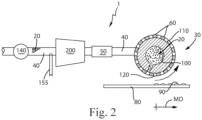
- the distributor 30 can be a cylinder 110 rotationally mounted about a stator 100 with the stator being in fluid communication with the feed pipe 40 and the cylinder 110 can have a periphery 120 and there can be a plurality of apertures 60 in the periphery 120, as shown in Fig. 2 .
- the apparatus 1 can comprise a stator 100 in fluid communication with the feed pipe 40.
- the feed pipe 40 can feed the precursor material 20 to the stator 100 after the precursor material 20 has passed through the mill 200.
- the apparatus 1 can comprise a cylinder 110 rotationally mounted about the stator 100.
- the stator 100 is fed precursor material through one or both ends 130 of the cylinder 110.
- the cylinder 110 can have a longitudinal axis L passing through the cylinder 110 about which the cylinder 110 rotates.
- the cylinder 110 has a periphery 120. There can be a plurality of apertures 60 in the periphery 120 of the cylinder 110.
- the apertures 60 can be intermittently in fluid communication with the stator 100 as the cylinder 110 rotates about the stator 100.
- the cylinder 110 can be considered to have a machine direction MD in a direction of movement of the periphery 120 across the stator 100 and a cross machine direction on the periphery 120 orthogonal to the machine direction MD.
- the stator 100 can similarly be considered to have a cross machine direction CD parallel to the longitudinal axis L.
- the cross machine direction of the stator 100 can be aligned with the cross machine direction of the cylinder 110.
- the stator 100 can have a plurality of distribution ports 120 arranged in a cross machine direction CD of the stator 100.
- the distribution ports 120 are portions or zones of the stator 100 supplied with precursor material 20.
- precursor material 20 can be fed past the gas feed line 155 through the mill 200 and feed pipe 40 to the stator 100.
- the stator 100 distributes the precursor feed material 20 across the operating width of the cylinder 110.
- precursor material 20 is fed through the apertures 60 as the apertures 60 pass by the stator 100.
- a discrete mass of precursor material 20 is fed through each aperture 60 as each aperture 60 encounters the stator 100.
- the mass of precursor material 20 fed through each aperture 60 as each aperture 60 passes by the stator 100 can be controlled by controlling one or both of the pressure of the precursor material within the stator 100 and the rotational velocity of the cylinder 110.
- Drops of the precursor material 20 are deposited on the conveyor 80 across the operating width of the cylinder 110.
- the conveyor 80 can be moveable in translation relative to the longitudinal axis of the cylinder 110.
- the velocity of the conveyor 80 can be set relative to the tangential velocity of the cylinder 110 to control the shape that the precursor material 20 has once it is deposited on the conveyor 80.
- the velocity of the conveyor 80 can be the about the same as the tangential velocity of the cylinder 110.
- flow of the precursor material 20 through the feed pipe 40 can be provided by gravity driven flow from a batch mixer 10 and the distributor 30.
- the apparatus 1 can be provided with a feed pump 140, as shown in Fig. 2 .
- the feed pump 140 can be in line with the feed pipe 40, with in line meaning in the line of flow of the precursor material 20.
- the feed pump 140 can between the batch mixer 10 and the distributor 30.
- the feed pump 140 can be upstream of the distributor 30.
- the feed pump 140 can be in line with the feed pipe 40, with in line meaning in the line of flow of the precursor material 20.
- the feed pump 140 can be between the batch mixer 10 and the stator 100.
- the feed pump 140 can be upstream of the stator 100. In describing the position of the feed pump 140, between is used to describe the feed pump 140 being in-line downstream of the batch mixer 10 and upstream of the distributor 30 or if used, upstream of the stator 100.
- the gas feed line 155 and the mill 200 can be positioned in line between the feed pump 140 and the distributor 30 or stator 100, if employed in the apparatus 1.
- the gas feed line 155 can comprise a flow regulator 158.
- the flow regulator 158 can regulate the flow of gas into the feed line 40.
- the volume of gas added per unit volume of precursor material 20 can be controlled by setting the flow regulator 158 to the desired flow. The more gas fed into the precursor material 20 within the feed line 40, the more gas that will be contained in the particles 90.
- the gas feed line 155 can provide for entraining gas into the precursor material 20.
- the flow regulator 158 can be Key Instruments Flo-Rite Series GS 65mm flowmeter, part number 60410-R5.
- the feed line 40 can be a 1 1 ⁇ 2" (38.1 mm) stainless steel sanitary pipe.
- the gas feed line 155 can be 1 ⁇ 4" (31.75 mm) inside diameter polyethylene tubing. Gas can be provided in the gas feed line 155 at a pressure of about 85 psi (586 kPa).
- the flow rate of the precursor material 20 can be about 3 L/min.
- the precursor material 20 can be a molten material comprising any of the compositions described herein for the precursor material 20 or particles 90.
- the gas provided in the gas feed line 155 can be air. Air can be practical in that it is readily available, low cost, and the chemical interactions with constituents of the particles 90 are well understood.
- the gas provided in the gas feed line 155 can be an inert gas.
- An inert gas can be practical in that particles 90 entrained with an inert gas may be less susceptible to degradation as compared to particles 90 entrained with air.
- the gas provided in the gas feed line 155 can be selected from the group consisting of air, oxygen, nitrogen, carbon dioxide, argon, and mixtures thereof.
- Such gasses are widely available and commonly used in commercial applications. Without being bound by theory, such gasses might improve the stability of the product.
- the gas can be provided at a temperature such that when the gas reaches ambient temperature the desired volume of gas is present in the particles 90.
- the Ideal Gas Law can be used to determine the desired temperature of delivery.
- the gas can also comprise water.
- the water can be in gaseous or liquid form. The quantity of water in the gas can be selected to be at the desired level.
- gas can be entrained in the precursor material by mixing a gas generating material in the precursor material 20.
- the mill 200 can be a rotor-stator type mill.
- the mill can be a Quadro Z1 in-line mixer with a single stage of medium rotor stators, operated at about 400 RPM.
- the mill 200 and gas feed line 155 can be combined in a single unit.
- An Oakes Foamer (E.T. Oakes Corporation, 686 Old Willets Path, Hauppauge, NY 11788) 2MT1A continuous foamer) can be used to provide the gas feed line 155, flow regulator 158 and mill 200 in a single unit.
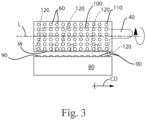
- FIG. 3 A view of an apparatus 1 in the machine direction MD is shown in Fig. 3 .
- the apparatus 1 can have an operating width W and the cylinder 110 can rotate about longitudinal axis L.
- the apparatus 1 for forming particles 90 can comprise: a feed pipe; a gas feed line 155 mounted in fluid communication with the feed pipe 40 downstream of the batch mixer 10; a mill 200 downstream of the gas feed line 155 and in line with the feed pipe 40; and a distributor 30 downstream of the mill 200 and fluid communication with said feed pipe 40, wherein said distributor 30 comprises a plurality of apertures 60.
- the apparatus 1 can comprise a conveyor beneath the distributor 30 and movable in translation relative to the distributor 30.
- the distributor 30 can comprise a stator 100 in fluid communication with the feed pipe 40.
- the distributor 30 can comprise a cylinder 110 rotationally mounted about the stator 100 and rotatable about a longitudinal axis L of the cylinder 110.
- the cylinder 110 can have a periphery 120 and the cylinder 110 can have a plurality of apertures 60 disposed about the periphery 120.
- the apertures 60 can be intermittently in fluid communication with the stator 100 as the cylinder 110 rotates about the stator 100.
- the apparatus can comprise a conveyor 80 beneath the cylinder 110 and the conveyor 80 can be movable in translation relative to the longitudinal axis L.
- the apparatus 1 for forming particles 90 can comprise a batch mixer 10.
- the feed pipe 40 can be in fluid communication with the batch mixer 10.
- the process for forming particles 90 can comprise the steps of: providing a precursor material 20 to a feed pipe 40; providing the precursor material 20 to the feed pipe 40; entraining gas into the precursor material 20, providing a stator 100 in fluid communication with the feed pipe 40; distributing the precursor material 20 to the stator 100; providing a cylinder 110 rotating about the stator 100 and rotatable about a longitudinal axis L of the cylinder 110, wherein the cylinder 110 has a periphery 120 and a plurality of apertures 60 disposed about the periphery 120; passing the precursor material 120 through the apertures 60; providing a moving conveyor 80 beneath the cylinder 110; depositing the precursor material 20 onto the moving conveyor 80; and cooling the precursor material 20 to form a plurality of particles 90.
- the process can be implemented using any of the apparatuses disclosed herein.
- the process can employ any of the precursor materials 20 disclosed herein to form any of the particles 90 disclosed herein.
- the process can comprise the step of providing a precursor material 20 in a batch mixer 10 in fluid communication with the feed pipe.
- the process for forming particles 90 can comprise the steps of: providing a precursor material 20 to a feed pipe 40; providing the precursor material 20 to the feed pipe 40; entraining gas into the precursor material 20; providing a distributor 30 having a plurality of apertures 60; transporting the precursor material 20 from the feed pipe 40 to the distributor 30; passing the precursor material 20 through the apertures 60; providing a moving conveyor 80 beneath the distributor 30; depositing the precursor material 20 on to the moving conveyor 80; and cooling the precursor material 20 to form a plurality of particles 90.
- the precursor material 20 can comprise more than about 40% by weight polyethylene glycol having a weight average molecular weight from about 2000 to about 13000 and from about 0.0001% to about 50% by weight shading dye, or, preferably, from 0.001% to about 25% by weight shading dye as disclosed herein.
- the process can be implemented using any of the apparatuses disclosed herein.
- the process can employ any of the additional precursor materials 20 disclosed herein to form any of the particles 90 disclosed herein.
- the process can comprise the step of providing a precursor material 20 in a batch mixer 10 in fluid communication with the feed pipe.
- the precursor material 20 can be any composition that can be processed as a molten material that can be formed into the particles 90 using the apparatus 1 and method described herein.
- the composition of the precursor material 20 is governed by what benefits will be provided with the particles 90.
- the precursor material 20 can be a raw material composition, industrial composition, consumer composition, or any other composition that can advantageously be provided in a particulate form.
- any typical fabric care adjuncts may be co-incorporated along with the shading dye into the precursor material 20 and particles 90 according to the desired benefits to be delivered.
- any typical fabric care adjuncts may be co-incorporated along with the shading dye into the precursor material 20 and particles 90 according to the desired benefits to be delivered.
- anti-oxidants in order to protect the dye from degradation, anti-oxidants, UV absorbing compounds and the like may be co-incorporated.
- other dyes may be incorporated both in particles that comprise shading dye and in particles that do not comprise shading dye. As will be understood by those skilled in the art, these are merely examples of the ways in which the ordinarily skilled artisan may construct the packaged composition in order to maximize the intended benefit and are not meant to be limiting.
- the precursor material 20 and particles 90 can comprise a carrier and any combination of shading dye, aesthetic dye, and occlusions of gas.
- the occlusions of gas can be spherical occlusions of gas.
- the particles 90 comprise from 20% by weight to 99.9% by weight of the particles 90 of the carrier.
- the carrier is polyethylene glycol having a weight average molecular weight from about 2000 to about 13000.
- the precursor material 20, and thereby the particles 90 can comprise more than 20% by weight polyethylene glycol having a weight average molecular weight from 2000 to 13000.
- Polyethylene glycol (PEG) has a relatively low cost, may be formed into many different shapes and sizes, minimizes diffusion of small molecules such as some shading dyes or unencapsulated perfumes, and dissolves well in water.
- PEG comes in various weight average molecular weights.
- the weight average molecular weight range of PEG includes from 2,000 to 13,000, from 4,000 to 12,000, alternatively from 5,000 to 11,000, alternatively from 6,000 to 10,000, alternatively from 7,000 to 9,000, alternatively combinations thereof.
- PEG is available from BASF, for example PLURIOL E 8000.
- the precursor material 20, and thereby the particles 90 can comprise more than 20% by weight of the particles of PEG.
- the precursor material 20, and thereby the particles 90 can comprise more than 40% by weight of the particles of PEG.
- the precursor material 20, and thereby the particles 90 can comprise more than 60% by weight of the particles of PEG.
- the precursor material 20, and thereby the particles 90 may comprise from 65% to 99.9% by weight of the composition of PEG.
- the precursor material 20, and thereby the particles 90 comprise from 20% to 99.9% by weight of the composition of PEG.
- the precursor material 20, and thereby the particles 90 can comprise from 20% to less than 99.9%, alternatively from 45% to 90%, alternatively from 60% to 80%, alternatively combinations thereof and any whole percentages or ranges of whole percentages within any of the aforementioned ranges, of PEG by weight of the precursor material 20, and thereby the particles 90.
- the precursor material 20, and thereby the particles 90 can comprise from about 0.5% to about 5% by weight of the particles of a balancing agent selected from the group consisting of glycerin, polypropylene glycol, isopropyl myristate, dipropylene glycol, 1,2-propanediol, and PEG having a weight average molecular weight less than 2,000, and mixtures thereof.
- a balancing agent selected from the group consisting of glycerin, polypropylene glycol, isopropyl myristate, dipropylene glycol, 1,2-propanediol, and PEG having a weight average molecular weight less than 2,000, and mixtures thereof.
- the precursor material 20, and thereby the particles 90 can comprise an antioxidant.
- the antioxidant can help to promote stability of the color and or odor of the particles over time between production and use.
- the precursor material 20, and thereby particles 90 can comprise between about 0.01% to about 1% by weight antioxidant.
- the precursor material 20, and thereby particles 90 can comprise between about 0.001% to about 2% by weight antioxidant.
- the precursor material 20, and thereby particles 90 can comprise between about 0.01% to about 0.1% by weight antioxidant.
- the antioxidant can be butylated hydroxytoluene.
- the precursor material 20 and particles 90 comprise a shading dye.
- a shading dye Preferably, at least about 0.0001%, 0.01%, 0.1%, 1%, 10%, 30%, 50%, 70%, 90%, or even about 95% of the particles 90 comprises shading dye.
- the shading dye typically provides a blue or violet shade to fabric.
- Shading dyes can be used either alone or in combination to create a specific shade of hueing and/or to shade different fabric types. This may be provided for example by mixing a red and green-blue dye to yield a blue or violet shade.
- the hueing dye is a blue or violet hueing dye, providing a blue or violet color to a white cloth or fabric.
- Such a white cloth treated with the composition will have a hue angle of 210 to 345, more preferably 240 to 345, more preferably 260 to 325, even more preferably 270 to 310.
- a hueing dye suitable for use in the present invention has, in the wavelength range of about 400 nm to about 750 nm, in methanol solution, a maximum extinction coefficient greater than about 1000 liter/mol/cm. In one aspect, a hueing dye suitable for use in the present invention has, in the wavelength range of about 540 nm to about 630 nm, a maximum extinction coefficient from about 10,000 to about 100,000 liter/mol/cm. In one aspect, a hueing dye suitable for use in the present invention has, in the wavelength range of about 560 nm to about 610 nm, a maximum extinction coefficient from about 20,000 to about 70,000 liter/mol/cm or even about 90,000 liter/mol/cm.
- Test Methods provided below can be used to determine if a dye, or a mixture of dyes, is a shading dye for the purposes of the present invention.
- a dye, or mixture of dyes is considered a shading dye (also known as a hueing dye) for the purposes of the present invention if (a) either the HD cotton or the HD polyester is greater than or equal to 2.0 DE* units or preferably greater than or equal to 3.0, or 4.0 or even 5.0, according to the formula above, and (b) the relative hue angle (see Method III. below) on the fabric that meets the DE* criterion in (a) is within 210 to 345, more preferably 240 to 345, more preferably 260 to 325, even more preferably 270 to 310. If the value of HD for both fabric types is less than 2.0 DE* units, or if the relative hue angle is not within the prescribed range on each fabric for which the DE* meets the criteria the dye is not a shading dye for the purposes of the present invention.
- the shading dye has the following structure: Dye - G a - NR 1 R 2 , wherein the -(G) a -NR 1 R 2 group is attached to an aromatic ring of the dye, G is independently -SO 2 - or -C(O)-, the index a is an integer with a value of 0 or land
- R 1 and R 2 are independently selected from H, a polyoxyalkylene chain, a C 1-8 alkyl, optionally the alkyl chains comprise ether (C-O-C), ester and/or amide links, optionally the alkyl chains are substituted with -Cl, -Br, -CN, -NO 2 , -SO 2 CH 3 , -OH and mixtures thereof, C 6-10 aryl, optionally substituted with a polyoxyalkylene chain, C 7-16 alkaryl optionally substituted with ether (C-O-C), ester and/or amide links, optionally substituted with -Cl, -Br
- the shading dye may have the structure of Formula A:
- the fabric shading dye may have the general structure below: wherein moiety A shown above is attached via the distal nitrogen atom to one of the three sites on the aromatic ring of moiety B indicated by the dashed arrows shown above; preferably said A moiety is attached at the position on the aryl ring para to the N substituent on moiety B, however the A moiety may be attached at either of the other two indicated positions that are located ortho to the N substituent on moiety B; wherein the index values x and y are independently selected from 1 to 10.
- the average degree of ethoxylation, x + y sometimes also referred to as the average number of ethoxylate groups, is from about 3 to about12, preferably from about 4 to about 8.
- the average degree of ethoxylation, x + y can be from about 5 to about 6.
- the range of ethoxylation present in the mixture varies depending on the average number of ethoxylates incorporated. Typical distributions for ethoxylation of toluidine with either 5 or 8 ethoxylates are shown in Table II on page 42 in the Journal of Chromatography A 1989, volume 462, pp. 39 -47 .
- the whitening agents are synthesized according to the procedures disclosed in U.S. Pat. No. 4,912,203 to Kluger et al. ; a primary aromatic amine is reacted with an appropriate amount of ethylene oxide, according to procedures well known in the art.
- the polyethyleneoxy substituted m-toluidine useful in the preparation of the colorant can be prepared by a number of well known methods. It is preferred, however, that the polyethyleneoxy groups be introduced into the m-toluidine molecule by reaction of the m-toluidine with ethylene oxide. Generally the reaction proceeds in two steps, the first being the formation of the corresponding N,N-dihydroxyethyl substituted m-toluidine. In some aspects, no catalyst is utilized in this first step (for example as disclosed at Column 4, lines 16-25 of U.S. Pat. No. 3,927,044 to Foster et al. ).
- the dihydroxyethyl substituted m-toluidine is then reacted with additional ethylene oxide in the presence of a catalyst such as sodium (described in Preparation II of U.S. Pat. No. 3,157,633 to Kuhn ), or it may be reacted with additional ethylene oxide in the presence of sodium or potassium hydroxide (described in Example 5 of U.S. Pat. No. 5,071,440 to Hines et al. ).
- the amount of ethylene oxide added to the reaction mixture determines the number of ethyleneoxy groups which ultimately attach to the nitrogen atom.
- an excess of the polyethyleneoxy substituted m-toluidine coupler may be employed in the formation of the whitening agent and remain as a component in the final colorant mixture.
- the presence of excess coupler may confer advantageous properties to a mixture in which it is incorporated such as the raw material, a pre-mix, a finished product or even the wash solution prepared from the finished product.
- the shading dye may preferably have the following structure: wherein:
- the hueing dye may be a thiophene dye such as a thiophene azo dye, preferably alkoxylated.
- the dye may be substituted with at least one solubilising group selected from sulphonic, carboxylic or quaternary ammonium groups.
- Non-limiting examples of suitable shading dyes are:
- the particles 90, the precursor material 20, and thereby the particles 90, are substantially free or free of perfume.
- the precursor material 20 can be prepared by providing molten PEG into a batch mixer 10.
- the batch mixer 10 can be heated so as to help prepare the precursor material 20 at the desired temperature.
- Shading dye if present, may be added to the molten PEG.
- Aesthetic dye if present, can also be added to the batch mixer 10.
- Other adjunct materials can be added to the precursor material 20 if desired.
- the precursor material 20 can optionally be prepared by in-line mixing or other known approaches for mixing materials.
- the precursor material 20 and particles 90 may comprise aesthetic dye.
- the precursor material 20, and thereby particles 90 may comprise less than about 0.1%, alternatively about 0.001% to about 0.1%, alternatively about 0.01% to about 0.02%, alternatively combinations thereof and any hundredths of percent or ranges of hundredths of percent within any of the aforementioned ranges, of aesthetic dye by weight of the precursor material 20 or particles 90.
- suitable aesthetic dyes include, but are not limited to, LIQUITINT PINK AM, AQUA AS, CYAN 15, and VIOLET FL, available from Milliken Chemical.
- the particles 90 may have a variety of shapes.
- the particles 90 may be formed into different shapes include tablets, pills, spheres, and the like.
- a particle 90 can have a shape selected from the group consisting of spherical, hemispherical, compressed hemispherical, lentil shaped, and oblong.
- Lentil shaped refers to the shape of a lentil bean.
- Compressed hemispherical refers to a shape corresponding to a hemisphere that is at least partially flattened such that the curvature of the curved surface is less, on average, than the curvature of a hemisphere having the same radius.
- a compressed hemispherical particle 90 can have a ratio of height to maximum based dimension of from about 0.01 to about 0.4, alternatively from about 0.1 to about 0.4, alternatively from about 0.2 to about 0.3.
- Oblong shaped refers to a shape having a maximum dimension and a maximum secondary dimension orthogonal to the maximum dimension, wherein the ratio of maximum dimension to the maximum secondary dimension is greater than about 1.2.
- An oblong shape can have a ratio of maximum base dimension to maximum secondary base dimension greater than about 1.5.
- An oblong shape can have a ratio of maximum base dimension to maximum secondary base dimension greater than about 2.
- Oblong shaped particles can have a maximum base dimension from about 2 mm to about 6 mm, a maximum secondary base dimension of from about 2 mm to about 6 mm.
- Individual particles 90 can have a mass from about 0.1 mg to about 5 g, alternatively from about 10 mg to about 1 g, alternatively from about 10 mg to about 500 mg, alternatively from about 10 mg to about 250 mg, alternatively from about 0.95 mg to about 125 mg, alternatively combinations thereof and any whole numbers or ranges of whole numbers of mg within any of the aforementioned ranges.
- individual particles can have a shape selected from the group consisting of spherical, hemispherical, compressed hemispherical, lentil shaped, and oblong.
- An individual particle may have a volume from 0.003 cm 3 to 0.15 cm 3 .
- a number of particles 90 may collectively comprise a dose for dosing to a laundry washing machine or laundry wash basin.
- a single dose of particles 90 may comprise, per 3 kg of fabric being laundered, from 0.1 g to 200 g, or from 0.5 g to 100 g, or from 2.0 g to 60 g, or from 5 g to 25 g of particles.
- a single dose of the particles 90 may comprise from 1 g to 27 g.
- a single dose of the particles 90 may comprise from 5 g to 27 g, alternatively from 13 g to 27 g, alternatively from 14 g to 20 g, alternatively from 15 g to 19 g, alternatively from 18 g to 19 g, alternatively combinations thereof and any whole numbers of grams or ranges of whole numbers of grams within any of the aforementioned ranges.
- the individual particles 90 forming the dose of particles 90 that can make up the dose can have a mass from 0.95 mg to 2 g.
- the plurality of particles 90 can be made up of particles having different size, shape, and/or mass.
- the particles 90 in a dose can have a maximum dimension less than 1 centimeter.
- a particle 90 that can be manufactured as provided herein is shown in Fig. 4.
- Figure 4 is a profile view of a single particle 90.
- the particle 90 can have a substantially flat base 150 and a height H.
- the height H of a particle 90 is measured as the maximum extent of the particle 90 in a direction orthogonal to the substantially flat base 150.
- the height H can be measured conveniently using image analysis software to analyze a profile view of the particle 90.
- the process for forming particles 90 in which gas is entrained into the precursor material 20 thereby forming particles 90 have gas entrained therein can be practical for providing particles 90 that float in a liquid.
- Particles 90 that float in certain liquids can be practical in a variety of industrial processes and processes in the home in which particles can be used.
- Particles 90 that have gas entrained therein are comprised of gas inclusions and solid and or liquid materials. Since the particles 90 in these embodiments have gas entrained therein, the particles 90 have a density that is less than the density of the constitutive solid and or liquid materials forming the particle 90. For instance if the particle 90 is formed of a constitutive material having a density of 1 g/cm 3 , and the particle 90 is 10% by volume air, the density of the particle 90 is 0.90 g/cm 3 .
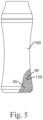
- the particles 90 can be packaged together as a packaged composition 160 comprising a plurality of particles 90, as shown in Fig. 5 .
- the particles can comprise a carrier, shading dye, and occlusions of gas.
- spherical occlusions of gas are thought to provide for improved strength of the particles 90 as compared to particles 90 having occlusions of gas having other shapes.
- Spherical occlusions of gas might provide for improved strength over non-spherical occlusions of gas.
- substantially all of the particles 90 can have a density greater than about 1 g/cm 3 and less than about 1.25 g/cm 3 . In embodiments that do include occlusions of air, at least 80%, 90%, 95%, substantially all of the particles 90 can have a density less than about 0.95 g/cm 3 . Since the density of a typical washing solution is about 1 g/cm 3 , it can be desirable to provide particles 90 that have a density greater than about 1 g/cm 3 or, in some embodiments, less than about 0.95 g/cm 3 .
- Having nearly all of the particles 90 have a density greater than about 1 g/cm 3 can be desirable for providing for particles 90 that sink in a wash liquor. Having nearly all of the particles 90 have a density less than about 1 g/cm 3 can be desirable for providing for particles 90 that float in a wash liquor.
- substantially all of the particles 90 have a mass between about 0.1 mg to about 5 g.
- Particles 90 can have a maximum dimension of less than about 20 mm.
- Particles 90 have a maximum dimension of less than about 10 mm. Particles 90 having such a mass and maximum dimension are thought to be readily dissolvable in solutions such a wash solutions used in laundering clothing.
- Each of the particles 90 can have a volume and the occlusions of gas within the particles 90 can comprise between about 0.5% to about 50% by volume of the particle 90, or even between about 1% to about 20% by volume of the particle, or even between about 2% to about 15% by volume of the particle, or even between about 4% to about 12% by volume of the particle. Without being bound by theory, it is thought that if the volume of the occlusions of gas is too great, the particles 90 may not be sufficiently strong to be packaged, shipped, stored, and used without breaking apart in an undesirable manner.
- the occlusions can have an effective diameter between about 1 micron to about 2000 microns, or even between about 5 microns to about 1000 microns, or even between about 5 microns to about 200 microns, or even between about 25 to about 50 microns. In general, it is thought that smaller occlusions of gas are more desirable than larger occlusions of gas. If the effective diameter of the occlusions of gas are too large, it is thought that the particles might not be sufficiently strong to be to be packaged, shipped, stored, and used without breaking apart in an undesirable manner. The effective diameter is diameter of a sphere having the same volume as the occlusion of gas.
- the occlusions of gas can be spherical occlusions of gas.
- Particles 90 can be produced as follows.
- a 50 kg batch of precursor material 20 can be prepared in a mixer.
- Molten PEG8000 can be added to a jacketed mixer held at 70 °C and agitated with a pitch blade agitator at 125 rpm.
- Butylated hydroxytoluene can be added to the mixer at a level of 0.01% by weight of the precursor material 20.
- Dipropylene glycol can be added to the mixer at a level of 1.08% by weight of the precursor material 20.
- Shading dye can be added to the mixer at a level of 0.0095% by weight of the precursor material 20.
- the PEG can account for 87.36% by weight of the precursor material 20.
- the precursor material 20 can be mixed for 30 minutes.
- the precursor material 20 can be formed into particles 90 on a SANDVIK ROTOFORM 3000 having a 750 mm wide 10 m long belt.
- the cylinder 110 can have 2 mm diameter apertures 60 set at a 10 mm pitch in the cross machine direction CD and 9.35 mm pitch in the machine direction MD.
- the cylinder can be set at approximately 3 mm above the belt.
- the belt speed and rotational speed of the cylinder 110 can be set at 10 m/min.
- the precursor material 20 can be pumped at a constant 3.1 kg/min rate from the mixer 10 through a plate and frame heat exchanger set to control the outlet temperature to 50 °C.
- Air or another gas can be entrained in the precursor material 20 at a level of about 0.5% to about 50% by volume.
- the precursor material 20 having air or another gas entrained therein can be passed through a Quadro Z1 mill with medium rotor/stator elements. After milling, the precursor material can optionally be passed through a Kenics 1.905 cm KMS 6 static mixer 50 installed 91.44 cm upstream of the stator 100.
- Table 1 lists formulations for particles 90 that could be made. Table 1. Potential formulations for particles (not covered by the claims). %Wt F1 F2 F3 F4 F5 F6 PEG 8000 82.8 82.8 86.9 88.9 95.5 82.0 BHT 0.0135 0.0135 0.0173 0.0167 0 - 0.02 0.0213 Perfume Microcapsule 1.28 1.28 0.815 3.80 1.62 - Neat Perfume Oil 6.65 6.65 5.80 3.84 - 8.58 Dipropylene Glycol 5.82 5.82 4.87 1.58 - 7.44 Shading Dye 0.0203 0.0203 0.0304 0.0288 0.0252 0.0355 Water and Minors Balance Balance Balance Balance Balance Balance Balance Balance Balance Balance Balance Balance Balance Balance % Air by Volume of Particle 0- 5% 15 21.5 30.5 5.5 44.9
Landscapes
- Chemical & Material Sciences (AREA)
- Engineering & Computer Science (AREA)
- Life Sciences & Earth Sciences (AREA)
- Chemical Kinetics & Catalysis (AREA)
- Oil, Petroleum & Natural Gas (AREA)
- Wood Science & Technology (AREA)
- Organic Chemistry (AREA)
- Dispersion Chemistry (AREA)
- Mechanical Engineering (AREA)
- Detergent Compositions (AREA)
- Disinfection, Sterilisation Or Deodorisation Of Air (AREA)
Description
- Packaged composition.
- As textile substrates age, their color tends to fade or yellow due to exposure to light, air, soil, and natural degradation of the fibers that comprise the substrates. Thus, the purpose of shading dyes is generally to visually whiten these textile substrates and counteract the fading and yellowing of the substrates. Typically, shading dyes may be found in laundry detergents and are therefore applied to textile substrates during the laundering process. However, the color of the shading dyes typically dominates the overall appearance of the composition in which it resides. Further, it is also known that shading dyes may interact negatively with certain adjunct material in the composition in which it resides. Moreover when the shading dye is in a laundry detergent, the consumer does not have the flexibility to customize their desired experience. Extra whitening can be achieved only by adding additional detergent, which necessitates increased and potentially wasteful levels of cleaning ingredients and may also result in deposition of too much fragrance. Thus the consumer cannot balance their desire for efficient usage of cleaning ingredients, adjusting for the right amount of scent, and yet also be able to deliver variable amounts of whitening according to the needs of the particular fabrics being treated.
- As a result, there exists a need for a packaged composition that includes a shading dye that may be used independently as an additive to satisfy the consumer desire for adjustable dose, on demand whitening or may be incorporated into a laundry detergent, but also provides ease of use and flexibility in the laundry detergents' appearance and components.
EP 2 166 077A1 relates to a particle for use in a composition comprising: - a first coating layer comprising a coating material selected from surfactant, surfactant precursor, builder, film-forming polymer and mixtures thereof, and
- a core, at least a portion of said core being coated by said coating; wherein
- the particle additionally comprises a hueing dye.
-
WO 2011/020991A1 relates to a granular hueing ingredient suitable for incorporation into a granular fabric washing composition comprises a hueing agent, water, and inorganic carrier particles. The inorganic carrier particles comprise or consist of particles of a porous sodium carbonate, so that the ingredient comprises 60 % or more by weight of the particles of porous sodium carbonate, with at least 20 % by weight of the sodium carbonate in a monohydrate state. A process for preparing the granular ingredient involves blending the hueing agent, water and the inorganic carrier particles to form a premix and forming the premix into granules, wherein the inorganic carrier particles comprise particles of a porous sodium carbonate, and wherein at least 60 % by weight, preferably at least 80 % by weight of the porous sodium carbonate, is in the anhydrate state immediately prior to forming the premix. The granular hueing ingredient may be formed in a simple process without the need for binding agents, leading to rapid process changeover times and reduced risk of undesired spotting from the hueing agent on washed fabrics. -
WO 2016/073400 A1 relates to a packaged composition including a plurality of particles in a package, wherein the particles include: more than about 40% by weight of the particles of polyethylene glycol, wherein the polyethylene glycol has a weight average molecular weight from about 5000 to about 11000; and from about 0.1% to about 20% by weight of the particles of perfume; wherein substantially all of the particles in the package have a substantially flat base and a height measured orthogonal to the base and together the particles have a distribution of heights, wherein the distribution of heights has a mean height between about 1 mm and about 5 mm and a height standard deviation less than about 0.3. -
WO 2016/205587 A1 relates to a packaged particulate composition having a carrier, perfume, and occlusions of gas. - It has surprisingly been found that the packaged compositions of the present disclosure which incorporate the shading dyes are not only effective in the whitening of textile substrates, but also provide a clean and convenient means to add the desired amount of a whitening agent to a laundry treatment without resulting in staining of fabrics that can occur on direct contact of detergents that contain shading agents.
- A packaged composition according to
claim 1; and preferably at least 30% of the particles also comprise a shading dye. - A process for treating laundry according to the claims. The process comprises the steps of dosing to a laundry washing machine or a laundry wash basin from 5 g to 60 g of the packaged composition comprising the particles according to
claim 1 comprising: a carrier; and shading dye; and wherein at least 80% of the particles have a density less than 1.25 g/cm3; wherein at least 80% of the particles have a mass between 0.1 mg to 5 g; and wherein each of said particles have a maximum dimension of less than 10 mm; said dosing may provide an aqueous solution comprising shading dye from 1 ppb to 5000 ppm, preferably 10 ppb to 50 ppm, even more preferably 25 ppb to 2 ppm or even 50 ppb to 1 ppm; and optionally rinsing and drying the textile. -
-
Fig. 1 is an apparatus for forming particles. -
Fig. 2 is a portion of an apparatus. -
Fig. 3 is an end view an apparatus. -
Fig. 4 is a profile view of a particle. -
Fig. 5 is a packaged composition comprising a plurality of particles. - An
apparatus 1 for forming particles is shown inFig. 1 . The raw material or raw materials can be provided to abatch mixer 10. Thebatch mixer 10 can have sufficient capacity to retain the volume of raw materials provided thereto for a sufficient residence time to permit the desired level of mixing and or reaction of the raw materials. The material leaving thebatch mixer 10 can be theprecursor material 20. Optionally, the precursor material can be provided to thefeed pipe 40 from some other upstream mixing process, for example in-line mixing, in-line static mixing, and the like. Theprecursor material 20 can be a molten product. Thebatch mixer 10 can be a dynamic mixer. A dynamic mixer is a mixer to which energy is applied to mix the contents in the mixer. Thebatch mixer 10 can comprise one or more impellers to mix the contents in thebatch mixer 10. - Between the
batch mixer 10, which is optionally present, and thedistributor 30, theprecursor material 20 can be transported through thefeed pipe 40. Thefeed pipe 40 can be in fluid communication with thebatch mixer 10. Agas feed line 155 can be provided in fluid communication with thefeed pipe 40 downstream of thebatch mixer 10. Agas feed line 155 can be provided in fluid communication with thefeed pipe 40 between thebatch mixer 10 and thedistributor 30. Amill 200 can be provided downstream of thegas feed line 155 and in line with thefeed pipe 40. Themill 200 can be provided in line with thefeed pipe 40 downstream of thegas feed line 155 and upstream of thedistributor 30. - The
precursor material 20 can be provided to thefeed pipe 40. Thefeed pipe 40 is the conveyance by which theprecursor material 20 is carried. Thefeed pipe 40 includes the conveyance between elements of theapparatus 1 and the conveyance through which the precursor material is carried within components of theapparatus 1. For instance, themill 200 may be provided in a unit with a portion of the conveyance approaching themill 200 and a portion of the conveyance exiting themill 200. Each of these portions is part of thefeed pipe 40. So, thefeed pipe 40 can be viewed the entire conveyance between thebatch mixer 10 and thedistributor 30 and thefeed pipe 40 is interrupted by various elements such as thegas feed line 155, themill 200,intermediate mixer 50, andfeed pump 140. In absence of abatch mixer 10 upstream of thefeed pipe 40, thefeed pipe 40 can be viewed the entire conveyance upstream of thedistributor 30 and thefeed pipe 40 is interrupted by various elements such as thegas feed line 155, themill 200,intermediate mixer 50, andfeed pump 140. - An
intermediate mixer 55 can be provided downstream of themill 200 and in line withfeed pipe 40. Theintermediate mixer 55 can be in fluid communication with thefeed pipe 40 between themill 200 and thedistributor 30. Theintermediate mixer 55, which can be astatic mixer 50, can be downstream of thebatch mixer 10. Stated otherwise, thebatch mixer 10 can be upstream of theintermediate mixer 55 orstatic mixer 50 if employed. Theintermediate mixer 55 can be in-line with thefeed pipe 40. Theintermediate mixer 55 can be a rotor-stator mixer. Theintermediate mixer 55 can be a colloid mill. Theintermediate mixer 55 can be a driven in-line fluid disperser. Theintermediate mixer 55 can be an Ultra Turrax disperser, Dispax-reactor disperser, Colloid Mil MK, or Cone Mill MKO, available from IKA, Wilmington, North Carolina, United States of America. Theintermediate mixer 55 can be a perforated disc mill, toothed colloid mill, or DIL Inline Homogenizer, available from FrymaKoruma, Rheinfelden, Switzerland. Thestatic mixer 50 can be a helical static mixer. Thestatic mixer 50 can be a Kenics 1.905 cm inside diameter KMS 6, available from Chemineer, Dayton, OH, USA. - Without being bound by theory, it is believed that an
intermediate mixer 55, such as thestatic mixer 50, can provide for a more uniform temperature of theprecursor material 20 within thedistributor 30 orstator 100. At the downstream end of theintermediate mixer 55, orstatic mixer 50 if used, the temperature of theprecursor material 20 within thefeed pipe 40 across a cross section of thefeed pipe 40 can vary by less than about 10 °C, or less than about 5 °C, or less than about 1 °C, or less than about 0.5 °C. - In absence of a
static mixer 50, the temperature across a cross section of thefeed pipe 40 may be non-uniform. The temperature of theprecursor material 20 at the center line of thefeed pipe 40 may be higher than the temperature of theprecursor feed material 20 at the peripheral wall of thefeed pipe 40. When theprecursor material 20 is discharged to thedistributor 30 orstator 100, the temperature of theprecursor material 20 may vary at different positions within the distributor orstator 100. Without being bound by theory, it is thought that by providing for a uniform temperature across the cross section of thefeed pipe 40 by employing astatic mixer 40 as described herein, moreuniform particles 90 can be produced as compared to anapparatus 1 that does not have astatic mixer 40. - The
distributor 30 can be provided with a plurality ofapertures 60. Theprecursor material 20 can be passed through theapertures 60. After passing through theapertures 60, theprecursor material 20 can be deposited on a movingconveyor 80 that is provided beneath thedistributor 30. Theprecursor material 20 can be deposited on the movingconveyor 80 when theconveyor 80 is in motion. Theconveyor 80 can be moveable in translation relative to thedistributor 30. Theconveyor 80 can be a continuously movingconveyor 80. Theconveyor 80 can be an intermittently movingconveyor 80. A continuously movingconveyor 80 may provide for higher processing speeds. An intermittently movingconveyor 80 can provide for improved control of the shape of theparticles 90 that are produced. - The
precursor material 20 can be cooled on the movingconveyor 80 to form a plurality ofsolid particles 90. The cooling can be provided by ambient cooling. Optionally the cooling can be provided by spraying the under-side of theconveyor 80 with ambient temperature water or chilled water. - Once the
particles 90 are sufficiently coherent, theparticles 90 can be transferred from theconveyor 80 to processing equipment downstream of theconveyor 80 for further processing and or packaging. - The
distributor 30 can be acylinder 110 rotationally mounted about astator 100 with the stator being in fluid communication with thefeed pipe 40 and thecylinder 110 can have aperiphery 120 and there can be a plurality ofapertures 60 in theperiphery 120, as shown inFig. 2 . So, theapparatus 1 can comprise astator 100 in fluid communication with thefeed pipe 40. Thefeed pipe 40 can feed theprecursor material 20 to thestator 100 after theprecursor material 20 has passed through themill 200. - The
apparatus 1 can comprise acylinder 110 rotationally mounted about thestator 100. Thestator 100 is fed precursor material through one or both ends 130 of thecylinder 110. Thecylinder 110 can have a longitudinal axis L passing through thecylinder 110 about which thecylinder 110 rotates. Thecylinder 110 has aperiphery 120. There can be a plurality ofapertures 60 in theperiphery 120 of thecylinder 110. - As the
cylinder 110 is driven to rotate about its longitudinal axis L, theapertures 60 can be intermittently in fluid communication with thestator 100 as thecylinder 110 rotates about thestator 100. Thecylinder 110 can be considered to have a machine direction MD in a direction of movement of theperiphery 120 across thestator 100 and a cross machine direction on theperiphery 120 orthogonal to the machine direction MD. Thestator 100 can similarly be considered to have a cross machine direction CD parallel to the longitudinal axis L. The cross machine direction of thestator 100 can be aligned with the cross machine direction of thecylinder 110. Thestator 100 can have a plurality ofdistribution ports 120 arranged in a cross machine direction CD of thestator 100. Thedistribution ports 120 are portions or zones of thestator 100 supplied withprecursor material 20. - In general,
precursor material 20 can be fed past thegas feed line 155 through themill 200 andfeed pipe 40 to thestator 100. Thestator 100 distributes theprecursor feed material 20 across the operating width of thecylinder 110. As thecylinder 110 rotates about its longitudinal axis,precursor material 20 is fed through theapertures 60 as theapertures 60 pass by thestator 100. A discrete mass ofprecursor material 20 is fed through eachaperture 60 as eachaperture 60 encounters thestator 100. The mass ofprecursor material 20 fed through eachaperture 60 as eachaperture 60 passes by thestator 100 can be controlled by controlling one or both of the pressure of the precursor material within thestator 100 and the rotational velocity of thecylinder 110. - Drops of the
precursor material 20 are deposited on theconveyor 80 across the operating width of thecylinder 110. Theconveyor 80 can be moveable in translation relative to the longitudinal axis of thecylinder 110. The velocity of theconveyor 80 can be set relative to the tangential velocity of thecylinder 110 to control the shape that theprecursor material 20 has once it is deposited on theconveyor 80. The velocity of theconveyor 80 can be the about the same as the tangential velocity of thecylinder 110. - As shown in
Fig. 1 , flow of theprecursor material 20 through thefeed pipe 40 can be provided by gravity driven flow from abatch mixer 10 and thedistributor 30. To provide for more controllable manufacturing, theapparatus 1 can be provided with afeed pump 140, as shown inFig. 2 . Thefeed pump 140 can be in line with thefeed pipe 40, with in line meaning in the line of flow of theprecursor material 20. Thefeed pump 140 can between thebatch mixer 10 and thedistributor 30. Thefeed pump 140 can be upstream of thedistributor 30. If astator 100 is employed, thefeed pump 140 can be in line with thefeed pipe 40, with in line meaning in the line of flow of theprecursor material 20. If astator 100 is employed, thefeed pump 140 can be between thebatch mixer 10 and thestator 100. Thefeed pump 140 can be upstream of thestator 100. In describing the position of thefeed pump 140, between is used to describe thefeed pump 140 being in-line downstream of thebatch mixer 10 and upstream of thedistributor 30 or if used, upstream of thestator 100. - The
gas feed line 155 and themill 200 can be positioned in line between thefeed pump 140 and thedistributor 30 orstator 100, if employed in theapparatus 1. - The
gas feed line 155 can comprise a flow regulator 158. The flow regulator 158 can regulate the flow of gas into thefeed line 40. The volume of gas added per unit volume ofprecursor material 20 can be controlled by setting the flow regulator 158 to the desired flow. The more gas fed into theprecursor material 20 within thefeed line 40, the more gas that will be contained in theparticles 90. Thegas feed line 155 can provide for entraining gas into theprecursor material 20. - The flow regulator 158 can be Key Instruments Flo-Rite Series GS 65mm flowmeter, part number 60410-R5. The
feed line 40 can be a 1 ½" (38.1 mm) stainless steel sanitary pipe. Thegas feed line 155 can be ¼" (31.75 mm) inside diameter polyethylene tubing. Gas can be provided in thegas feed line 155 at a pressure of about 85 psi (586 kPa). - The flow rate of the
precursor material 20 can be about 3 L/min. Theprecursor material 20 can be a molten material comprising any of the compositions described herein for theprecursor material 20 orparticles 90. - The gas provided in the
gas feed line 155 can be air. Air can be practical in that it is readily available, low cost, and the chemical interactions with constituents of theparticles 90 are well understood. - The gas provided in the
gas feed line 155 can be an inert gas. An inert gas can be practical in thatparticles 90 entrained with an inert gas may be less susceptible to degradation as compared toparticles 90 entrained with air. - The gas provided in the
gas feed line 155 can be selected from the group consisting of air, oxygen, nitrogen, carbon dioxide, argon, and mixtures thereof. Such gasses are widely available and commonly used in commercial applications. Without being bound by theory, such gasses might improve the stability of the product. - The gas can be provided at a temperature such that when the gas reaches ambient temperature the desired volume of gas is present in the
particles 90. The Ideal Gas Law can be used to determine the desired temperature of delivery. The gas can also comprise water. The water can be in gaseous or liquid form. The quantity of water in the gas can be selected to be at the desired level. - Optionally gas can be entrained in the precursor material by mixing a gas generating material in the
precursor material 20. - The
mill 200 can be a rotor-stator type mill. The mill can be a Quadro Z1 in-line mixer with a single stage of medium rotor stators, operated at about 400 RPM. - The
mill 200 andgas feed line 155 can be combined in a single unit. - An Oakes Foamer (E.T. Oakes Corporation, 686 Old Willets Path, Hauppauge, NY 11788) 2MT1A continuous foamer) can be used to provide the
gas feed line 155, flow regulator 158 andmill 200 in a single unit. - A view of an
apparatus 1 in the machine direction MD is shown inFig. 3 . As shown inFig. 3 , theapparatus 1 can have an operating width W and thecylinder 110 can rotate about longitudinal axis L. - The
apparatus 1 for formingparticles 90 can comprise: a feed pipe; agas feed line 155 mounted in fluid communication with thefeed pipe 40 downstream of thebatch mixer 10; amill 200 downstream of thegas feed line 155 and in line with thefeed pipe 40; and adistributor 30 downstream of themill 200 and fluid communication with saidfeed pipe 40, wherein saiddistributor 30 comprises a plurality ofapertures 60. Theapparatus 1 can comprise a conveyor beneath thedistributor 30 and movable in translation relative to thedistributor 30. Thedistributor 30 can comprise astator 100 in fluid communication with thefeed pipe 40. Thedistributor 30 can comprise acylinder 110 rotationally mounted about thestator 100 and rotatable about a longitudinal axis L of thecylinder 110. Thecylinder 110 can have aperiphery 120 and thecylinder 110 can have a plurality ofapertures 60 disposed about theperiphery 120. Theapertures 60 can be intermittently in fluid communication with thestator 100 as thecylinder 110 rotates about thestator 100. The apparatus can comprise aconveyor 80 beneath thecylinder 110 and theconveyor 80 can be movable in translation relative to the longitudinal axis L. Theapparatus 1 for formingparticles 90 can comprise abatch mixer 10. Thefeed pipe 40 can be in fluid communication with thebatch mixer 10. - The process for forming
particles 90 can comprise the steps of: providing aprecursor material 20 to afeed pipe 40; providing theprecursor material 20 to thefeed pipe 40; entraining gas into theprecursor material 20, providing astator 100 in fluid communication with thefeed pipe 40; distributing theprecursor material 20 to thestator 100; providing acylinder 110 rotating about thestator 100 and rotatable about a longitudinal axis L of thecylinder 110, wherein thecylinder 110 has aperiphery 120 and a plurality ofapertures 60 disposed about theperiphery 120; passing theprecursor material 120 through theapertures 60; providing a movingconveyor 80 beneath thecylinder 110; depositing theprecursor material 20 onto the movingconveyor 80; and cooling theprecursor material 20 to form a plurality ofparticles 90. The process can be implemented using any of the apparatuses disclosed herein. The process can employ any of theprecursor materials 20 disclosed herein to form any of theparticles 90 disclosed herein. The process can comprise the step of providing aprecursor material 20 in abatch mixer 10 in fluid communication with the feed pipe. - The process for forming
particles 90 can comprise the steps of: providing aprecursor material 20 to afeed pipe 40; providing theprecursor material 20 to thefeed pipe 40; entraining gas into theprecursor material 20; providing adistributor 30 having a plurality ofapertures 60; transporting theprecursor material 20 from thefeed pipe 40 to thedistributor 30; passing theprecursor material 20 through theapertures 60; providing a movingconveyor 80 beneath thedistributor 30; depositing theprecursor material 20 on to the movingconveyor 80; and cooling theprecursor material 20 to form a plurality ofparticles 90. Theprecursor material 20 can comprise more than about 40% by weight polyethylene glycol having a weight average molecular weight from about 2000 to about 13000 and from about 0.0001% to about 50% by weight shading dye, or, preferably, from 0.001% to about 25% by weight shading dye as disclosed herein. The process can be implemented using any of the apparatuses disclosed herein. The process can employ any of theadditional precursor materials 20 disclosed herein to form any of theparticles 90 disclosed herein. The process can comprise the step of providing aprecursor material 20 in abatch mixer 10 in fluid communication with the feed pipe. - The
precursor material 20 can be any composition that can be processed as a molten material that can be formed into theparticles 90 using theapparatus 1 and method described herein. The composition of theprecursor material 20 is governed by what benefits will be provided with theparticles 90. Theprecursor material 20 can be a raw material composition, industrial composition, consumer composition, or any other composition that can advantageously be provided in a particulate form. - When the
precursor material 20 andparticles 90 are not incorporated into a fabric detergent composition, any typical fabric care adjuncts, as known in the art, may be co-incorporated along with the shading dye into theprecursor material 20 andparticles 90 according to the desired benefits to be delivered. For example, in order to protect the dye from degradation, anti-oxidants, UV absorbing compounds and the like may be co-incorporated. Moreover, for aesthetic purposes, other dyes may be incorporated both in particles that comprise shading dye and in particles that do not comprise shading dye. As will be understood by those skilled in the art, these are merely examples of the ways in which the ordinarily skilled artisan may construct the packaged composition in order to maximize the intended benefit and are not meant to be limiting. - The
precursor material 20 andparticles 90 can comprise a carrier and any combination of shading dye, aesthetic dye, and occlusions of gas. The occlusions of gas can be spherical occlusions of gas. - The
particles 90 comprise from 20% by weight to 99.9% by weight of theparticles 90 of the carrier. The carrier is polyethylene glycol having a weight average molecular weight from about 2000 to about 13000. - The
precursor material 20, and thereby theparticles 90, can comprise more than 20% by weight polyethylene glycol having a weight average molecular weight from 2000 to 13000. Polyethylene glycol (PEG) has a relatively low cost, may be formed into many different shapes and sizes, minimizes diffusion of small molecules such as some shading dyes or unencapsulated perfumes, and dissolves well in water. PEG comes in various weight average molecular weights. The weight average molecular weight range of PEG includes from 2,000 to 13,000, from 4,000 to 12,000, alternatively from 5,000 to 11,000, alternatively from 6,000 to 10,000, alternatively from 7,000 to 9,000, alternatively combinations thereof. PEG is available from BASF, for example PLURIOL E 8000. - The
precursor material 20, and thereby theparticles 90, can comprise more than 20% by weight of the particles of PEG. Theprecursor material 20, and thereby theparticles 90, can comprise more than 40% by weight of the particles of PEG. Theprecursor material 20, and thereby theparticles 90, can comprise more than 60% by weight of the particles of PEG. Theprecursor material 20, and thereby theparticles 90, may comprise from 65% to 99.9% by weight of the composition of PEG. Theprecursor material 20, and thereby theparticles 90, comprise from 20% to 99.9% by weight of the composition of PEG. - Alternatively, the
precursor material 20, and thereby theparticles 90, can comprise from 20% to less than 99.9%, alternatively from 45% to 90%, alternatively from 60% to 80%, alternatively combinations thereof and any whole percentages or ranges of whole percentages within any of the aforementioned ranges, of PEG by weight of theprecursor material 20, and thereby theparticles 90. - Depending on the application, the
precursor material 20, and thereby theparticles 90, can comprise from about 0.5% to about 5% by weight of the particles of a balancing agent selected from the group consisting of glycerin, polypropylene glycol, isopropyl myristate, dipropylene glycol, 1,2-propanediol, and PEG having a weight average molecular weight less than 2,000, and mixtures thereof. - The
precursor material 20, and thereby theparticles 90, can comprise an antioxidant. The antioxidant can help to promote stability of the color and or odor of the particles over time between production and use. Theprecursor material 20, and therebyparticles 90, can comprise between about 0.01% to about 1% by weight antioxidant. Theprecursor material 20, and therebyparticles 90, can comprise between about 0.001% to about 2% by weight antioxidant. Theprecursor material 20, and therebyparticles 90, can comprise between about 0.01% to about 0.1% by weight antioxidant. The antioxidant can be butylated hydroxytoluene. - The
precursor material 20 andparticles 90 comprise a shading dye. Preferably, at least about 0.0001%, 0.01%, 0.1%, 1%, 10%, 30%, 50%, 70%, 90%, or even about 95% of theparticles 90 comprises shading dye. - The shading dye (sometimes referred to as hueing, bluing or whitening agents) typically provides a blue or violet shade to fabric. Shading dyes can be used either alone or in combination to create a specific shade of hueing and/or to shade different fabric types. This may be provided for example by mixing a red and green-blue dye to yield a blue or violet shade. Preferably the hueing dye is a blue or violet hueing dye, providing a blue or violet color to a white cloth or fabric. Such a white cloth treated with the composition will have a hue angle of 210 to 345, more preferably 240 to 345, more preferably 260 to 325, even more preferably 270 to 310.
- In one aspect, a hueing dye suitable for use in the present invention has, in the wavelength range of about 400 nm to about 750 nm, in methanol solution, a maximum extinction coefficient greater than about 1000 liter/mol/cm. In one aspect, a hueing dye suitable for use in the present invention has, in the wavelength range of about 540 nm to about 630 nm, a maximum extinction coefficient from about 10,000 to about 100,000 liter/mol/cm. In one aspect, a hueing dye suitable for use in the present invention has, in the wavelength range of about 560 nm to about 610 nm, a maximum extinction coefficient from about 20,000 to about 70,000 liter/mol/cm or even about 90,000 liter/mol/cm.
- The Test Methods provided below can be used to determine if a dye, or a mixture of dyes, is a shading dye for the purposes of the present invention.
-
- a.) Unbrightened Multifiber Fabric Style 41 swatches (MFF41, 5cm x 10cm, average weight 1.46g) serged with unbrightened thread are purchased from Testfabrics, Inc. (West Pittston, PA). MFF41 swatches are stripped prior to use by washing two full cycles in AATCC heavy duty liquid laundry detergent (HDL) nil brightener at 49°C and washing 3 additional full cycles at 49°C without detergent. Four replicate swatches are placed into each flask.
- b.) A sufficient volume of AATCC standard nil brightener HDL detergent solution is prepared by dissolving the detergent in 0 gpg water at room temperature at a concentration of 1.55 g per liter.
- c.) A concentrated stock solution of dye is prepared in an appropriate solvent selected from dimethyl sulfoxide (DMSO), ethanol or 50:50 ethanol:water. Ethanol is preferred. The dye stock is added to a beaker containing 400mL detergent solution (prepared in step I.b. above) in an amount sufficient to produce an aqueous solution absorbance at the λmax of 0.1 AU (± 0.01AU) in a cuvette of path length 1.0 cm. For a mixture of dyes, the dyes are to be tested in the same relative proportions as found in the packaged composition comprising a plurality of particles, and the sum of the aqueous solution absorbance at the λmax of the individual dyes is 0.1 AU (± 0.01AU) in a cuvette of path length 1.0 cm. Total organic solvent concentration in a wash solution from the concentrated stock solution is less than 0.5%. A 125mL aliquot of the wash solution is placed into 3 separate disposable 250mL Erlenmeyer flasks (Thermo Fisher Scientific, Rochester, NY).
- d.) Four MFF41 swatches are placed into each flask, flasks are capped and manually shaken to wet the swatches. Flasks are placed onto a Model 75 wrist action shaker from Burrell Scientific, Inc. (Pittsburg, PA) and agitated on the highest setting of 10 (390 oscillations per minute with an arc of 14.6°). After 12 minutes, the wash solution is removed by vacuum aspiration, 125mL of Ogpg water is added for a rinse, and the flasks agitated for 4 additional minutes. Rinse solution is removed by vacuum aspiration and swatches are spun in a Mini Countertop Spin Dryer (The Laundry Alternative Inc., Nashua, NH) for 5 minutes, after which they are allowed to air dry in the dark.
- e.) L*, a*, and b* values for the 3 most consumer relevant fabric types, cotton and polyester, are measured on the dry swatches using a LabScan XE reflectance spectrophotometer (HunterLabs, Reston, VA; D65 illumination, 10° observer, UV light excluded). The L*, a*, and b* values of the 12 swatches (3 flasks each containing 4 swatches) are averaged and the hueing deposition (HD) of the dye is calculated for each fabric type using the following equation:

-
- a) The a* and b* values of the 12 swatches from each solution are averaged and the following formulas are used to determine Δa* and Δb*:

- b) If the absolute value of both Δa* and Δb* < 0.25, no Relative Hue Angle (RHA) is calculated. If the absolute value of either Δa* or Δb* are ≥ 0.25, the RHA is determined using one of the following formulas:
When

- A dye, or mixture of dyes, is considered a shading dye (also known as a hueing dye) for the purposes of the present invention if (a) either the HDcotton or the HDpolyester is greater than or equal to 2.0 DE* units or preferably greater than or equal to 3.0, or 4.0 or even 5.0, according to the formula above, and (b) the relative hue angle (see Method III. below) on the fabric that meets the DE* criterion in (a) is within 210 to 345, more preferably 240 to 345, more preferably 260 to 325, even more preferably 270 to 310. If the value of HD for both fabric types is less than 2.0 DE* units, or if the relative hue angle is not within the prescribed range on each fabric for which the DE* meets the criteria the dye is not a shading dye for the purposes of the present invention.
- The shading dye has the following structure:

- Preferably, the shading dye may have the structure of Formula A:

- wherein each R5 is independently selected from the group consisting of alkyl, oxyalkyl, oxyaryl, sulfonamidoalkyl, sulfonamidoaryl, amidoalkyl, amidodialkyl, amidoaryl, amidodiaryl, halogen, thioalkyl and thioaryl;
- wherein the index a is an integer from about 0 to about 4;
- wherein D is an aromatic or heteroaromatic group;
- wherein R1 and R2 are independently selected from the group consisting of:
- (a) R1 and R2 = [(CH2CR'HO)x(CH2CR"HO)yH]
wherein R' is selected from the group consisting of H, CH3, CH2O(CH2CH2O)zH, and mixtures thereof; wherein R" is selected from the group consisting of H, CH2O(CH2CH2O)zH, and mixtures thereof; wherein said x (CH2CR'HO) groups and said y (CH2CR"HO) groups may be arranged in any order; wherein x + y ≤ 10; wherein y ≥ 1; and wherein independently each z = 0 to 5; - (b) R1 = H, alkyl, aryl or aryl alkyl and R2 = [(CH2CR'HO)x(CH2CR"HO)yH]
wherein R' is selected from the group consisting of H, CH3, CH2O(CH2CH2O)zH, and mixtures thereof; wherein R" is selected from the group consisting of H, CH2O(CH2CH2O)zH, and mixtures thereof; wherein said (CH2CR'HO)x groups and said (CH2CR"HO)y groups may be arranged in any order; wherein x + y ≤ 20; wherein y ≥ 1; and wherein z = 0 to 5; - (c) R1 = [CH2CH(OR3)CH2OR4] and R2 = [CH2CH(OR3)CH2OR4]
- wherein R3 is selected from the group consisting of H, (CH2CH2O)zH, and mixtures thereof; and wherein z = 0 to 10;
- wherein R4 is selected from the group consisting of (C1-C16)alkyl, aryl groups, and mixtures thereof; and
- (d) R1 and R2 can independently be selected from the amino addition product of styrene oxide, glycidyl methyl ether, isobutyl glycidyl ether, isopropylglycidyl ether, t-butyl glycidyl ether, 2-ethylhexylgycidyl ether, and glycidylhexadecyl ether, followed by the addition of from 1 to 10 alkylene oxide units.
- (a) R1 and R2 = [(CH2CR'HO)x(CH2CR"HO)yH]
- Preferably, the fabric shading dye may have the general structure below:

U.S. Pat. No. 4,912,203 to Kluger et al. ; a primary aromatic amine is reacted with an appropriate amount of ethylene oxide, according to procedures well known in the art. The polyethyleneoxy substituted m-toluidine useful in the preparation of the colorant can be prepared by a number of well known methods. It is preferred, however, that the polyethyleneoxy groups be introduced into the m-toluidine molecule by reaction of the m-toluidine with ethylene oxide. Generally the reaction proceeds in two steps, the first being the formation of the corresponding N,N-dihydroxyethyl substituted m-toluidine. In some aspects, no catalyst is utilized in this first step (for example as disclosed at Column 4, lines 16-25 ofU.S. Pat. No. 3,927,044 to Foster et al. ). The dihydroxyethyl substituted m-toluidine is then reacted with additional ethylene oxide in the presence of a catalyst such as sodium (described in Preparation II ofU.S. Pat. No. 3,157,633 to Kuhn ), or it may be reacted with additional ethylene oxide in the presence of sodium or potassium hydroxide (described in Example 5 ofU.S. Pat. No. 5,071,440 to Hines et al. ). The amount of ethylene oxide added to the reaction mixture determines the number of ethyleneoxy groups which ultimately attach to the nitrogen atom. In some aspects, an excess of the polyethyleneoxy substituted m-toluidine coupler may be employed in the formation of the whitening agent and remain as a component in the final colorant mixture. In certain aspects, the presence of excess coupler may confer advantageous properties to a mixture in which it is incorporated such as the raw material, a pre-mix, a finished product or even the wash solution prepared from the finished product. - The shading dye may preferably have the following structure:

- R1 and R2 are independently selected from the group consisting of: H; alkyl; alkoxy; alkyleneoxy; alkyl capped alkyleneoxy; urea; and amido;
- R3 is a substituted aryl group;
- X is a substituted group comprising sulfonamide moiety and optionally an alkyl and/or aryl moiety, and wherein the substituent group comprises at least one alkyleneoxy chain.
- The hueing dye may be a thiophene dye such as a thiophene azo dye, preferably alkoxylated. Optionally the dye may be substituted with at least one solubilising group selected from sulphonic, carboxylic or quaternary ammonium groups.
- Non-limiting examples of suitable shading dyes are:


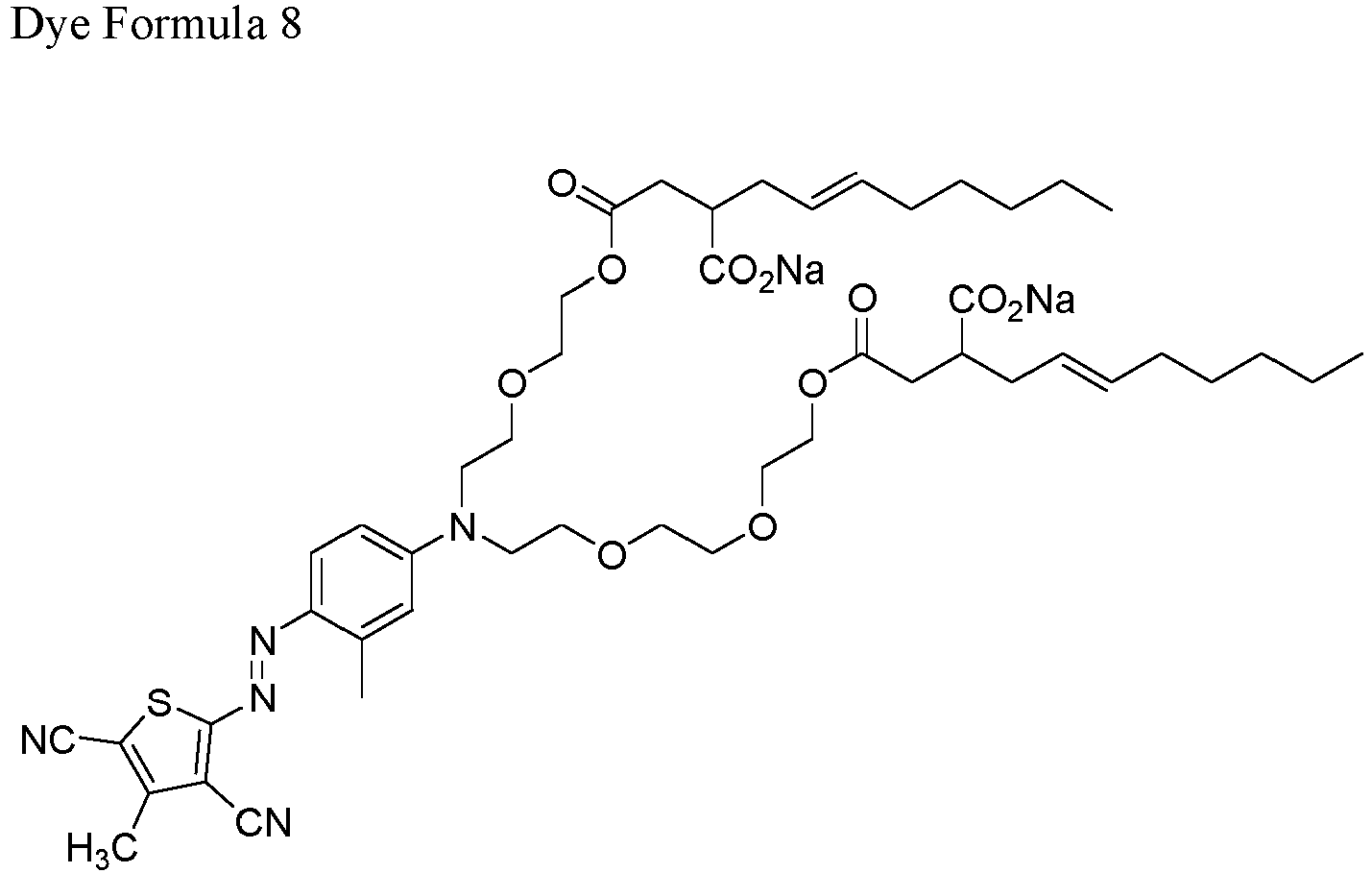


- The
particles 90, theprecursor material 20, and thereby theparticles 90, are substantially free or free of perfume. - The
precursor material 20 can be prepared by providing molten PEG into abatch mixer 10. Thebatch mixer 10 can be heated so as to help prepare theprecursor material 20 at the desired temperature. Shading dye, if present, may be added to the molten PEG. Aesthetic dye, if present, can also be added to thebatch mixer 10. Other adjunct materials can be added to theprecursor material 20 if desired. Theprecursor material 20 can optionally be prepared by in-line mixing or other known approaches for mixing materials. - If an aesthetic dye is employed, the
precursor material 20 andparticles 90 may comprise aesthetic dye. Theprecursor material 20, and therebyparticles 90, may comprise less than about 0.1%, alternatively about 0.001% to about 0.1%, alternatively about 0.01% to about 0.02%, alternatively combinations thereof and any hundredths of percent or ranges of hundredths of percent within any of the aforementioned ranges, of aesthetic dye by weight of theprecursor material 20 orparticles 90. Examples of suitable aesthetic dyes include, but are not limited to, LIQUITINT PINK AM, AQUA AS, CYAN 15, and VIOLET FL, available from Milliken Chemical. - The
particles 90 may have a variety of shapes. Theparticles 90 may be formed into different shapes include tablets, pills, spheres, and the like. Aparticle 90 can have a shape selected from the group consisting of spherical, hemispherical, compressed hemispherical, lentil shaped, and oblong. Lentil shaped refers to the shape of a lentil bean. Compressed hemispherical refers to a shape corresponding to a hemisphere that is at least partially flattened such that the curvature of the curved surface is less, on average, than the curvature of a hemisphere having the same radius. A compressedhemispherical particle 90 can have a ratio of height to maximum based dimension of from about 0.01 to about 0.4, alternatively from about 0.1 to about 0.4, alternatively from about 0.2 to about 0.3. Oblong shaped refers to a shape having a maximum dimension and a maximum secondary dimension orthogonal to the maximum dimension, wherein the ratio of maximum dimension to the maximum secondary dimension is greater than about 1.2. An oblong shape can have a ratio of maximum base dimension to maximum secondary base dimension greater than about 1.5. An oblong shape can have a ratio of maximum base dimension to maximum secondary base dimension greater than about 2. Oblong shaped particles can have a maximum base dimension from about 2 mm to about 6 mm, a maximum secondary base dimension of from about 2 mm to about 6 mm. -
Individual particles 90 can have a mass from about 0.1 mg to about 5 g, alternatively from about 10 mg to about 1 g, alternatively from about 10 mg to about 500 mg, alternatively from about 10 mg to about 250 mg, alternatively from about 0.95 mg to about 125 mg, alternatively combinations thereof and any whole numbers or ranges of whole numbers of mg within any of the aforementioned ranges. In a plurality ofparticles 90, individual particles can have a shape selected from the group consisting of spherical, hemispherical, compressed hemispherical, lentil shaped, and oblong. - An individual particle may have a volume from 0.003 cm3 to 0.15 cm3. A number of
particles 90 may collectively comprise a dose for dosing to a laundry washing machine or laundry wash basin. A single dose ofparticles 90 may comprise, per 3 kg of fabric being laundered, from 0.1 g to 200 g, or from 0.5 g to 100 g, or from 2.0 g to 60 g, or from 5 g to 25 g of particles. A single dose of theparticles 90 may comprise from 1 g to 27 g. A single dose of theparticles 90 may comprise from 5 g to 27 g, alternatively from 13 g to 27 g, alternatively from 14 g to 20 g, alternatively from 15 g to 19 g, alternatively from 18 g to 19 g, alternatively combinations thereof and any whole numbers of grams or ranges of whole numbers of grams within any of the aforementioned ranges. Theindividual particles 90 forming the dose ofparticles 90 that can make up the dose can have a mass from 0.95 mg to 2 g. The plurality ofparticles 90 can be made up of particles having different size, shape, and/or mass. Theparticles 90 in a dose can have a maximum dimension less than 1 centimeter. - A
particle 90 that can be manufactured as provided herein is shown inFig. 4. Figure 4 is a profile view of asingle particle 90. Theparticle 90 can have a substantiallyflat base 150 and a height H. The height H of aparticle 90 is measured as the maximum extent of theparticle 90 in a direction orthogonal to the substantiallyflat base 150. The height H can be measured conveniently using image analysis software to analyze a profile view of theparticle 90. - The process for forming
particles 90 in which gas is entrained into theprecursor material 20 thereby formingparticles 90 have gas entrained therein can be practical for providingparticles 90 that float in a liquid.Particles 90 that float in certain liquids can be practical in a variety of industrial processes and processes in the home in which particles can be used. -
Particles 90 that have gas entrained therein are comprised of gas inclusions and solid and or liquid materials. Since theparticles 90 in these embodiments have gas entrained therein, theparticles 90 have a density that is less than the density of the constitutive solid and or liquid materials forming theparticle 90. For instance if theparticle 90 is formed of a constitutive material having a density of 1 g/cm3, and theparticle 90 is 10% by volume air, the density of theparticle 90 is 0.90 g/cm3. - The
particles 90 can be packaged together as a packaged composition 160 comprising a plurality ofparticles 90, as shown inFig. 5 . The particles can comprise a carrier, shading dye, and occlusions of gas. Without being bound by theory, spherical occlusions of gas are thought to provide for improved strength of theparticles 90 as compared toparticles 90 having occlusions of gas having other shapes. Spherical occlusions of gas might provide for improved strength over non-spherical occlusions of gas. - In embodiments that do not include occlusions of air, at least 80%, 90%, 95%, substantially all of the
particles 90 can have a density greater than about 1 g/cm3 and less than about 1.25 g/cm3. In embodiments that do include occlusions of air, at least 80%, 90%, 95%, substantially all of theparticles 90 can have a density less than about 0.95 g/cm3. Since the density of a typical washing solution is about 1 g/cm3, it can be desirable to provideparticles 90 that have a density greater than about 1 g/cm3 or, in some embodiments, less than about 0.95 g/cm3. Having nearly all of theparticles 90 have a density greater than about 1 g/cm3 can be desirable for providing forparticles 90 that sink in a wash liquor. Having nearly all of theparticles 90 have a density less than about 1 g/cm3 can be desirable for providing forparticles 90 that float in a wash liquor. - At least 80%, 90%, 95%, substantially all of the
particles 90 have a mass between about 0.1 mg to about 5 g.Particles 90 can have a maximum dimension of less than about 20 mm.Particles 90 have a maximum dimension of less than about 10 mm.Particles 90 having such a mass and maximum dimension are thought to be readily dissolvable in solutions such a wash solutions used in laundering clothing. - Each of the
particles 90 can have a volume and the occlusions of gas within theparticles 90 can comprise between about 0.5% to about 50% by volume of theparticle 90, or even between about 1% to about 20% by volume of the particle, or even between about 2% to about 15% by volume of the particle, or even between about 4% to about 12% by volume of the particle. Without being bound by theory, it is thought that if the volume of the occlusions of gas is too great, theparticles 90 may not be sufficiently strong to be packaged, shipped, stored, and used without breaking apart in an undesirable manner. - The occlusions can have an effective diameter between about 1 micron to about 2000 microns, or even between about 5 microns to about 1000 microns, or even between about 5 microns to about 200 microns, or even between about 25 to about 50 microns. In general, it is thought that smaller occlusions of gas are more desirable than larger occlusions of gas. If the effective diameter of the occlusions of gas are too large, it is thought that the particles might not be sufficiently strong to be to be packaged, shipped, stored, and used without breaking apart in an undesirable manner. The effective diameter is diameter of a sphere having the same volume as the occlusion of gas. The occlusions of gas can be spherical occlusions of gas.
-
Particles 90 can be produced as follows. A 50 kg batch ofprecursor material 20 can be prepared in a mixer. Molten PEG8000 can be added to a jacketed mixer held at 70 °C and agitated with a pitch blade agitator at 125 rpm. Butylated hydroxytoluene can be added to the mixer at a level of 0.01% by weight of theprecursor material 20. Dipropylene glycol can be added to the mixer at a level of 1.08% by weight of theprecursor material 20. Shading dye can be added to the mixer at a level of 0.0095% by weight of theprecursor material 20. The PEG can account for 87.36% by weight of theprecursor material 20. Theprecursor material 20 can be mixed for 30 minutes. - The
precursor material 20 can be formed intoparticles 90 on a SANDVIK ROTOFORM 3000 having a 750 mm wide 10 m long belt. Thecylinder 110 can have 2mm diameter apertures 60 set at a 10 mm pitch in the cross machine direction CD and 9.35 mm pitch in the machine direction MD. The cylinder can be set at approximately 3 mm above the belt. The belt speed and rotational speed of thecylinder 110 can be set at 10 m/min. - After mixing the
precursor material 20, theprecursor material 20 can be pumped at a constant 3.1 kg/min rate from themixer 10 through a plate and frame heat exchanger set to control the outlet temperature to 50 °C. - Air or another gas can be entrained in the
precursor material 20 at a level of about 0.5% to about 50% by volume. Theprecursor material 20 having air or another gas entrained therein can be passed through a Quadro Z1 mill with medium rotor/stator elements. After milling, the precursor material can optionally be passed through a Kenics 1.905 cm KMS 6static mixer 50 installed 91.44 cm upstream of thestator 100. - Table 1 lists formulations for
particles 90 that could be made.Table 1. Potential formulations for particles (not covered by the claims). %Wt F1 F2 F3 F4 F5 F6 PEG 8000 82.8 82.8 86.9 88.9 95.5 82.0 BHT 0.0135 0.0135 0.0173 0.0167 0 - 0.02 0.0213 Perfume Microcapsule 1.28 1.28 0.815 3.80 1.62 - Neat Perfume Oil 6.65 6.65 5.80 3.84 - 8.58 Dipropylene Glycol 5.82 5.82 4.87 1.58 - 7.44 Shading Dye 0.0203 0.0203 0.0304 0.0288 0.0252 0.0355 Water and Minors Balance Balance Balance Balance Balance Balance % Air by Volume of Particle 0- 5% 15 21.5 30.5 5.5 44.9
Claims (7)
- A packaged composition comprising a plurality of particles (90), wherein at least one of said particles comprises:a carrier; anda shading dye;wherein at least 80% of said particles have a density less than 1.25 g/cm3;wherein at least 80% of said particles have a mass between 0.1 mg to 5 g;wherein each of said particles has a maximum dimension of less than 10 mm;wherein said particles comprise from about 20% to about 99.9% by weight of said particles of said carrier and wherein said carrier is polyethylene glycol having a weight average molecular weight from about 2000 to about 13000; andwherein the shading dye has the following structure:
Dye-(G)a-NR1R2,
wherein the -(G)a-NR1R2 group is attached to an aromatic ring of the dye, G is independently -SO2- or -C(O)-, the index a is an integer with a value of 0 or 1, and R1 and R2 are independently selected from the group consisting of H, a polyoxyalkylene chain, C1-8 alkyl, C6-10 aryl, C7-16 alkaryl, polyoxyalkylene chain substituted C1-8 alkyl, polyoxyalkylene chain substituted C6-10 aryl, polyoxyalkylene chain substituted C7-16 alkaryl and mixtures thereof; said polyoxyalkylene chains independently having from about 2 to about 100 repeating units;wherein said particles are substantially free of perfume. - The packaged composition according to Claim 1, wherein the shading dye is a polymeric dye and at least one of R1 and R2 comprises a polyalkyleneoxy chain.
- The packaged composition according to Claim 2, wherein the polyalkyleneoxy chain comprises from about 2 to about 50 repeating units, wherein the repeating units are essentially ethylene oxide.
- The packaged composition according to Claim 1, wherein said particles comprise occlusions of gas.
- The packaged composition according to Claim 4, wherein each of said particles has a volume and said occlusions of gas within said particle comprise between 0.5% to 50% by volume of said particle.
- The packaged composition according to Claim 1, further comprising from 0.001% to less than 90% of a fabric care adjunct.
- A process for treating laundry comprising the step of dosing to a laundry washing machine or a laundry wash basin from 5 g to 60 g of the packaged composition according to Claim 1.
Applications Claiming Priority (2)
| Application Number | Priority Date | Filing Date | Title |
|---|---|---|---|
| US201562245456P | 2015-10-23 | 2015-10-23 | |
| PCT/US2016/057783 WO2017070265A1 (en) | 2015-10-23 | 2016-10-20 | Packaged composition |
Publications (3)
| Publication Number | Publication Date |
|---|---|
| EP3365420A1 EP3365420A1 (en) | 2018-08-29 |
| EP3365420B1 EP3365420B1 (en) | 2021-06-23 |
| EP3365420B2 true EP3365420B2 (en) | 2025-06-04 |
Family
ID=57227133
Family Applications (1)
| Application Number | Title | Priority Date | Filing Date |
|---|---|---|---|
| EP16790824.3A Active EP3365420B2 (en) | 2015-10-23 | 2016-10-20 | Packaged composition |
Country Status (6)
| Country | Link |
|---|---|
| US (1) | US10377975B2 (en) |
| EP (1) | EP3365420B2 (en) |
| JP (1) | JP2018534399A (en) |
| CN (2) | CN108138092A (en) |
| CA (1) | CA3000226A1 (en) |
| WO (1) | WO2017070265A1 (en) |
Families Citing this family (9)
| Publication number | Priority date | Publication date | Assignee | Title |
|---|---|---|---|---|
| DE102017222994A1 (en) * | 2017-12-18 | 2019-06-19 | Henkel Ag & Co. Kgaa | Production of fragrance-containing enamel body |
| US10696929B2 (en) * | 2018-03-21 | 2020-06-30 | The Procter & Gamble Company | Laundry care composition comprising polyethylene glycol-based particles comprising a leuco colorant |
| EP3733826B1 (en) * | 2019-05-03 | 2024-07-17 | The Procter & Gamble Company | Particle treatment compositions comprising an antioxidant |
| CN110643220A (en) * | 2019-09-26 | 2020-01-03 | 安徽集友纸业包装有限公司 | Printing ink, tipping paper for cigarettes and cigarettes |
| CN111267099B (en) * | 2020-02-24 | 2023-02-28 | 东南大学 | Escort machine control system based on virtual reality |
| BR112022023329A2 (en) * | 2020-06-23 | 2023-10-31 | Unilever Ip Holdings B V | COMPOSITION FOR WASHING CLOTHES, METHOD FOR DELIVERING ACTIVE AGENT FOR WASHING CLOTHES TO WASHED FABRICS AND USE OF A COMPOSITION |
| BR112022022718A2 (en) * | 2020-06-23 | 2023-02-23 | Unilever Ip Holdings B V | COMPOSITION FOR LAUNDRY WASHING, METHOD OF PARTICLE FORMATION AND USE OF A COMPOSITION |
| CA3201046A1 (en) * | 2020-12-15 | 2022-06-23 | Ke-Ming Quan | Process for forming particles |
| US12428527B2 (en) | 2022-06-03 | 2025-09-30 | The Procter & Gamble Company | Process for forming particles |
Citations (5)
| Publication number | Priority date | Publication date | Assignee | Title |
|---|---|---|---|---|
| US20090286709A1 (en) † | 2007-01-19 | 2009-11-19 | Eugene Steven Sadlowski | Novel whitening agents for cellulosic substrates |
| US20100069283A1 (en) † | 2008-09-12 | 2010-03-18 | Manasvini Prabhat | Laundry composition |
| US20110196137A1 (en) † | 2006-01-23 | 2011-08-11 | Eduardo Torres | Laundry Care Compositions With Thiazolium Dye |
| WO2012054058A1 (en) † | 2010-10-22 | 2012-04-26 | The Procter & Gamble Company | Bis-azo colorants for use as bluing agents |
| WO2014099879A1 (en) † | 2012-12-20 | 2014-06-26 | The Procter & Gamble Company | Laundry scent additive |
Family Cites Families (15)
| Publication number | Priority date | Publication date | Assignee | Title |
|---|---|---|---|---|
| US3157633A (en) | 1960-11-28 | 1964-11-17 | Deering Milliken Res Corp | Polyethyleneoxy fugitive tints |
| US3927044A (en) | 1970-06-18 | 1975-12-16 | Deering Milliken Res Corp | Alkaline stable fugitive tints |
| CA1243669A (en) | 1984-06-25 | 1988-10-25 | Edward W. Kluger | Reactive colorants |
| US5040313A (en) * | 1990-01-30 | 1991-08-20 | Simjian Luther G | Athletic shoe with impact sensing means |
| US5071440A (en) | 1990-10-01 | 1991-12-10 | Hines John B | Method for temporarily coloring article with acid labile colorant |
| US20030104969A1 (en) | 2000-05-11 | 2003-06-05 | Caswell Debra Sue | Laundry system having unitized dosing |
| US6875811B2 (en) * | 2002-05-07 | 2005-04-05 | Milliken & Company | Single compound toners for use in polyesters |
| BR0313108B1 (en) * | 2002-08-27 | 2013-11-26 | Process for the preparation of perfume film chips, perfume film chip, granular cleaning composition, and methods for improving the storage stability of perfume particles and for depositing perfume on a surface. | |
| BRPI0812337A2 (en) | 2007-06-11 | 2015-01-27 | Appleton Paper Inc | BENEFIT AGENT CONTAINING RELEASE PARTICIPLE |
| ATE531787T1 (en) * | 2007-10-12 | 2011-11-15 | Unilever Nv | DETERGENT WITH PRETREATMENT ADDITIVE AND USE THEREOF |
| CN101821373A (en) * | 2007-10-12 | 2010-09-01 | 荷兰联合利华有限公司 | Granular detergent composition containing contrasting flake-like visual cues |
| EP2166077A1 (en) * | 2008-09-12 | 2010-03-24 | The Procter and Gamble Company | Particles comprising a hueing dye |
| GB0914437D0 (en) * | 2009-08-18 | 2009-09-30 | Brunner Mond Uk Ltd | Granular hueing ingredient for fabric washing compositions |
| US10000727B2 (en) * | 2014-11-04 | 2018-06-19 | The Procter & Gamble Company | Packaged composition |
| US10301579B2 (en) * | 2015-06-19 | 2019-05-28 | The Procter & Gamble Company | Packaged composition |
-
2016
- 2016-10-20 EP EP16790824.3A patent/EP3365420B2/en active Active
- 2016-10-20 CN CN201680059551.2A patent/CN108138092A/en active Pending
- 2016-10-20 JP JP2018520495A patent/JP2018534399A/en not_active Withdrawn
- 2016-10-20 WO PCT/US2016/057783 patent/WO2017070265A1/en not_active Ceased
- 2016-10-20 CA CA3000226A patent/CA3000226A1/en not_active Abandoned
- 2016-10-20 CN CN202511529709.5A patent/CN121471984A/en active Pending
- 2016-10-20 US US15/298,260 patent/US10377975B2/en active Active
Patent Citations (5)
| Publication number | Priority date | Publication date | Assignee | Title |
|---|---|---|---|---|
| US20110196137A1 (en) † | 2006-01-23 | 2011-08-11 | Eduardo Torres | Laundry Care Compositions With Thiazolium Dye |
| US20090286709A1 (en) † | 2007-01-19 | 2009-11-19 | Eugene Steven Sadlowski | Novel whitening agents for cellulosic substrates |
| US20100069283A1 (en) † | 2008-09-12 | 2010-03-18 | Manasvini Prabhat | Laundry composition |
| WO2012054058A1 (en) † | 2010-10-22 | 2012-04-26 | The Procter & Gamble Company | Bis-azo colorants for use as bluing agents |
| WO2014099879A1 (en) † | 2012-12-20 | 2014-06-26 | The Procter & Gamble Company | Laundry scent additive |
Also Published As
| Publication number | Publication date |
|---|---|
| CN121471984A (en) | 2026-02-06 |
| WO2017070265A1 (en) | 2017-04-27 |
| EP3365420B1 (en) | 2021-06-23 |
| JP2018534399A (en) | 2018-11-22 |
| EP3365420A1 (en) | 2018-08-29 |
| US10377975B2 (en) | 2019-08-13 |
| CA3000226A1 (en) | 2017-04-27 |
| US20170114304A1 (en) | 2017-04-27 |
| CN108138092A (en) | 2018-06-08 |
Similar Documents
| Publication | Publication Date | Title |
|---|---|---|
| EP3365420B2 (en) | Packaged composition | |
| US10696929B2 (en) | Laundry care composition comprising polyethylene glycol-based particles comprising a leuco colorant | |
| CN102037114B (en) | masking composition | |
| EP3215594B1 (en) | Packaged composition | |
| CN102918119A (en) | Color granules for granular detergents | |
| US20180195028A1 (en) | Laundry scent particles | |
| ES2519343T3 (en) | Dirt-release polymers with thickening inhibitory effect and high dissolution stability | |
| CA2289712C (en) | Sprayed granule | |
| CN101243172A (en) | Solid laundry detergent composition comprising anionic detersive surfactant and calcium-enhanced process | |
| US11299591B2 (en) | Polyethyleneimine compounds containing N-halamine and derivatives thereof | |
| RU2119000C1 (en) | Method of preparing spray-dried freely flowing cloth-softening composition | |
| CN113167016B (en) | Clothes care composition comprising N-halamine-containing polyethyleneimine compounds and derivatives thereof | |
| CN113195824A (en) | N-halamine-containing polyethyleneimine compounds and derivatives thereof | |
| US20220073844A1 (en) | Polyethyleneimine compounds containing n-halamine and derivatives thereof | |
| US11732218B2 (en) | Polyethyleneimine compounds containing N-halamine and derivatives thereof | |
| US11466122B2 (en) | Polyethyleneimine compounds containing N-halamine and derivatives thereof | |
| WO2018029201A1 (en) | Detergents and cleaning agents having anionic surfactants consisting of renewable raw materials | |
| EP3097171B1 (en) | Fluorescent brightener premix | |
| CN105940092A (en) | Process for manufacturing liquid detergent formulations | |
| JP5785747B2 (en) | Granular detergent composition | |
| JP2017036374A (en) | Powder detergent | |
| WO2004020564A1 (en) | Dry bleach compositions |
Legal Events
| Date | Code | Title | Description |
|---|---|---|---|
| STAA | Information on the status of an ep patent application or granted ep patent |
Free format text: STATUS: UNKNOWN |
|
| STAA | Information on the status of an ep patent application or granted ep patent |
Free format text: STATUS: THE INTERNATIONAL PUBLICATION HAS BEEN MADE |
|
| PUAI | Public reference made under article 153(3) epc to a published international application that has entered the european phase |
Free format text: ORIGINAL CODE: 0009012 |
|
| STAA | Information on the status of an ep patent application or granted ep patent |
Free format text: STATUS: REQUEST FOR EXAMINATION WAS MADE |
|
| 17P | Request for examination filed |
Effective date: 20180313 |
|
| AK | Designated contracting states |
Kind code of ref document: A1 Designated state(s): AL AT BE BG CH CY CZ DE DK EE ES FI FR GB GR HR HU IE IS IT LI LT LU LV MC MK MT NL NO PL PT RO RS SE SI SK SM TR |
|
| AX | Request for extension of the european patent |
Extension state: BA ME |
|
| DAV | Request for validation of the european patent (deleted) | ||
| DAX | Request for extension of the european patent (deleted) | ||
| STAA | Information on the status of an ep patent application or granted ep patent |
Free format text: STATUS: EXAMINATION IS IN PROGRESS |
|
| 17Q | First examination report despatched |
Effective date: 20200120 |
|
| GRAP | Despatch of communication of intention to grant a patent |
Free format text: ORIGINAL CODE: EPIDOSNIGR1 |
|
| STAA | Information on the status of an ep patent application or granted ep patent |
Free format text: STATUS: GRANT OF PATENT IS INTENDED |
|
| INTG | Intention to grant announced |
Effective date: 20210122 |
|
| RIN1 | Information on inventor provided before grant (corrected) |
Inventor name: MIRACLE, GREGORY, SCOT Inventor name: DITULLIO, DANIEL, DALE, JR. Inventor name: SIVIK, MARK, ROBERT |
|
| GRAS | Grant fee paid |
Free format text: ORIGINAL CODE: EPIDOSNIGR3 |
|
| GRAA | (expected) grant |
Free format text: ORIGINAL CODE: 0009210 |
|
| STAA | Information on the status of an ep patent application or granted ep patent |
Free format text: STATUS: THE PATENT HAS BEEN GRANTED |
|
| AK | Designated contracting states |
Kind code of ref document: B1 Designated state(s): AL AT BE BG CH CY CZ DE DK EE ES FI FR GB GR HR HU IE IS IT LI LT LU LV MC MK MT NL NO PL PT RO RS SE SI SK SM TR |
|
| REG | Reference to a national code |
Ref country code: GB Ref legal event code: FG4D |
|
| REG | Reference to a national code |
Ref country code: CH Ref legal event code: EP |
|
| REG | Reference to a national code |
Ref country code: DE Ref legal event code: R096 Ref document number: 602016059703 Country of ref document: DE Ref country code: AT Ref legal event code: REF Ref document number: 1404327 Country of ref document: AT Kind code of ref document: T Effective date: 20210715 |
|
| REG | Reference to a national code |
Ref country code: IE Ref legal event code: FG4D |
|
| REG | Reference to a national code |
Ref country code: NL Ref legal event code: FP |
|
| REG | Reference to a national code |
Ref country code: LT Ref legal event code: MG9D |
|
| PG25 | Lapsed in a contracting state [announced via postgrant information from national office to epo] |
Ref country code: BG Free format text: LAPSE BECAUSE OF FAILURE TO SUBMIT A TRANSLATION OF THE DESCRIPTION OR TO PAY THE FEE WITHIN THE PRESCRIBED TIME-LIMIT Effective date: 20210923 Ref country code: HR Free format text: LAPSE BECAUSE OF FAILURE TO SUBMIT A TRANSLATION OF THE DESCRIPTION OR TO PAY THE FEE WITHIN THE PRESCRIBED TIME-LIMIT Effective date: 20210623 Ref country code: FI Free format text: LAPSE BECAUSE OF FAILURE TO SUBMIT A TRANSLATION OF THE DESCRIPTION OR TO PAY THE FEE WITHIN THE PRESCRIBED TIME-LIMIT Effective date: 20210623 Ref country code: LT Free format text: LAPSE BECAUSE OF FAILURE TO SUBMIT A TRANSLATION OF THE DESCRIPTION OR TO PAY THE FEE WITHIN THE PRESCRIBED TIME-LIMIT Effective date: 20210623 |
|
| REG | Reference to a national code |
Ref country code: AT Ref legal event code: MK05 Ref document number: 1404327 Country of ref document: AT Kind code of ref document: T Effective date: 20210623 |
|
| PG25 | Lapsed in a contracting state [announced via postgrant information from national office to epo] |
Ref country code: GR Free format text: LAPSE BECAUSE OF FAILURE TO SUBMIT A TRANSLATION OF THE DESCRIPTION OR TO PAY THE FEE WITHIN THE PRESCRIBED TIME-LIMIT Effective date: 20210924 Ref country code: LV Free format text: LAPSE BECAUSE OF FAILURE TO SUBMIT A TRANSLATION OF THE DESCRIPTION OR TO PAY THE FEE WITHIN THE PRESCRIBED TIME-LIMIT Effective date: 20210623 Ref country code: NO Free format text: LAPSE BECAUSE OF FAILURE TO SUBMIT A TRANSLATION OF THE DESCRIPTION OR TO PAY THE FEE WITHIN THE PRESCRIBED TIME-LIMIT Effective date: 20210923 Ref country code: SE Free format text: LAPSE BECAUSE OF FAILURE TO SUBMIT A TRANSLATION OF THE DESCRIPTION OR TO PAY THE FEE WITHIN THE PRESCRIBED TIME-LIMIT Effective date: 20210623 Ref country code: RS Free format text: LAPSE BECAUSE OF FAILURE TO SUBMIT A TRANSLATION OF THE DESCRIPTION OR TO PAY THE FEE WITHIN THE PRESCRIBED TIME-LIMIT Effective date: 20210623 |
|
| PG25 | Lapsed in a contracting state [announced via postgrant information from national office to epo] |
Ref country code: PT Free format text: LAPSE BECAUSE OF FAILURE TO SUBMIT A TRANSLATION OF THE DESCRIPTION OR TO PAY THE FEE WITHIN THE PRESCRIBED TIME-LIMIT Effective date: 20211025 Ref country code: RO Free format text: LAPSE BECAUSE OF FAILURE TO SUBMIT A TRANSLATION OF THE DESCRIPTION OR TO PAY THE FEE WITHIN THE PRESCRIBED TIME-LIMIT Effective date: 20210623 Ref country code: ES Free format text: LAPSE BECAUSE OF FAILURE TO SUBMIT A TRANSLATION OF THE DESCRIPTION OR TO PAY THE FEE WITHIN THE PRESCRIBED TIME-LIMIT Effective date: 20210623 Ref country code: AT Free format text: LAPSE BECAUSE OF FAILURE TO SUBMIT A TRANSLATION OF THE DESCRIPTION OR TO PAY THE FEE WITHIN THE PRESCRIBED TIME-LIMIT Effective date: 20210623 Ref country code: SK Free format text: LAPSE BECAUSE OF FAILURE TO SUBMIT A TRANSLATION OF THE DESCRIPTION OR TO PAY THE FEE WITHIN THE PRESCRIBED TIME-LIMIT Effective date: 20210623 Ref country code: SM Free format text: LAPSE BECAUSE OF FAILURE TO SUBMIT A TRANSLATION OF THE DESCRIPTION OR TO PAY THE FEE WITHIN THE PRESCRIBED TIME-LIMIT Effective date: 20210623 Ref country code: EE Free format text: LAPSE BECAUSE OF FAILURE TO SUBMIT A TRANSLATION OF THE DESCRIPTION OR TO PAY THE FEE WITHIN THE PRESCRIBED TIME-LIMIT Effective date: 20210623 Ref country code: CZ Free format text: LAPSE BECAUSE OF FAILURE TO SUBMIT A TRANSLATION OF THE DESCRIPTION OR TO PAY THE FEE WITHIN THE PRESCRIBED TIME-LIMIT Effective date: 20210623 |
|
| PG25 | Lapsed in a contracting state [announced via postgrant information from national office to epo] |
Ref country code: PL Free format text: LAPSE BECAUSE OF FAILURE TO SUBMIT A TRANSLATION OF THE DESCRIPTION OR TO PAY THE FEE WITHIN THE PRESCRIBED TIME-LIMIT Effective date: 20210623 |
|
| REG | Reference to a national code |
Ref country code: DE Ref legal event code: R026 Ref document number: 602016059703 Country of ref document: DE |
|
| PLBI | Opposition filed |
Free format text: ORIGINAL CODE: 0009260 |
|
| PLAX | Notice of opposition and request to file observation + time limit sent |
Free format text: ORIGINAL CODE: EPIDOSNOBS2 |
|
| 26 | Opposition filed |
Opponent name: UNILEVER IP HOLDINGS B.V./ UNILEVER GLOBAL IP LIMITED Effective date: 20220322 |
|
| PG25 | Lapsed in a contracting state [announced via postgrant information from national office to epo] |
Ref country code: DK Free format text: LAPSE BECAUSE OF FAILURE TO SUBMIT A TRANSLATION OF THE DESCRIPTION OR TO PAY THE FEE WITHIN THE PRESCRIBED TIME-LIMIT Effective date: 20210623 |
|
| REG | Reference to a national code |
Ref country code: CH Ref legal event code: PL |
|
| PG25 | Lapsed in a contracting state [announced via postgrant information from national office to epo] |
Ref country code: AL Free format text: LAPSE BECAUSE OF FAILURE TO SUBMIT A TRANSLATION OF THE DESCRIPTION OR TO PAY THE FEE WITHIN THE PRESCRIBED TIME-LIMIT Effective date: 20210623 |
|
| REG | Reference to a national code |
Ref country code: BE Ref legal event code: MM Effective date: 20211031 |
|
| PG25 | Lapsed in a contracting state [announced via postgrant information from national office to epo] |
Ref country code: MC Free format text: LAPSE BECAUSE OF FAILURE TO SUBMIT A TRANSLATION OF THE DESCRIPTION OR TO PAY THE FEE WITHIN THE PRESCRIBED TIME-LIMIT Effective date: 20210623 |
|
| PG25 | Lapsed in a contracting state [announced via postgrant information from national office to epo] |
Ref country code: LU Free format text: LAPSE BECAUSE OF NON-PAYMENT OF DUE FEES Effective date: 20211020 Ref country code: IT Free format text: LAPSE BECAUSE OF FAILURE TO SUBMIT A TRANSLATION OF THE DESCRIPTION OR TO PAY THE FEE WITHIN THE PRESCRIBED TIME-LIMIT Effective date: 20210623 Ref country code: BE Free format text: LAPSE BECAUSE OF NON-PAYMENT OF DUE FEES Effective date: 20211031 |
|
| PG25 | Lapsed in a contracting state [announced via postgrant information from national office to epo] |
Ref country code: LI Free format text: LAPSE BECAUSE OF NON-PAYMENT OF DUE FEES Effective date: 20211031 Ref country code: CH Free format text: LAPSE BECAUSE OF NON-PAYMENT OF DUE FEES Effective date: 20211031 |
|
| PLBB | Reply of patent proprietor to notice(s) of opposition received |
Free format text: ORIGINAL CODE: EPIDOSNOBS3 |
|
| PG25 | Lapsed in a contracting state [announced via postgrant information from national office to epo] |
Ref country code: IE Free format text: LAPSE BECAUSE OF NON-PAYMENT OF DUE FEES Effective date: 20211020 |
|
| PLAB | Opposition data, opponent's data or that of the opponent's representative modified |
Free format text: ORIGINAL CODE: 0009299OPPO |
|
| R26 | Opposition filed (corrected) |
Opponent name: UNILEVER IP HOLDINGS B.V./ UNILEVER GLOBAL IP LIMITED Effective date: 20220322 |
|
| PG25 | Lapsed in a contracting state [announced via postgrant information from national office to epo] |
Ref country code: HU Free format text: LAPSE BECAUSE OF FAILURE TO SUBMIT A TRANSLATION OF THE DESCRIPTION OR TO PAY THE FEE WITHIN THE PRESCRIBED TIME-LIMIT; INVALID AB INITIO Effective date: 20161020 |
|
| P01 | Opt-out of the competence of the unified patent court (upc) registered |
Effective date: 20230429 |
|
| PG25 | Lapsed in a contracting state [announced via postgrant information from national office to epo] |
Ref country code: CY Free format text: LAPSE BECAUSE OF FAILURE TO SUBMIT A TRANSLATION OF THE DESCRIPTION OR TO PAY THE FEE WITHIN THE PRESCRIBED TIME-LIMIT Effective date: 20210623 |
|
| PG25 | Lapsed in a contracting state [announced via postgrant information from national office to epo] |
Ref country code: MK Free format text: LAPSE BECAUSE OF FAILURE TO SUBMIT A TRANSLATION OF THE DESCRIPTION OR TO PAY THE FEE WITHIN THE PRESCRIBED TIME-LIMIT Effective date: 20210623 |
|
| PG25 | Lapsed in a contracting state [announced via postgrant information from national office to epo] |
Ref country code: MT Free format text: LAPSE BECAUSE OF FAILURE TO SUBMIT A TRANSLATION OF THE DESCRIPTION OR TO PAY THE FEE WITHIN THE PRESCRIBED TIME-LIMIT Effective date: 20210623 |
|
| PLAB | Opposition data, opponent's data or that of the opponent's representative modified |
Free format text: ORIGINAL CODE: 0009299OPPO |
|
| R26 | Opposition filed (corrected) |
Opponent name: UNILEVER IP HOLDINGS B.V./ UNILEVERGLOBAL IP LIMITED Effective date: 20220322 |
|
| APBP | Date of receipt of notice of appeal recorded |
Free format text: ORIGINAL CODE: EPIDOSNNOA2O |
|
| APAH | Appeal reference modified |
Free format text: ORIGINAL CODE: EPIDOSCREFNO |
|
| APAW | Appeal reference deleted |
Free format text: ORIGINAL CODE: EPIDOSDREFNO |
|
| APBU | Appeal procedure closed |
Free format text: ORIGINAL CODE: EPIDOSNNOA9O |
|
| PUAH | Patent maintained in amended form |
Free format text: ORIGINAL CODE: 0009272 |
|
| STAA | Information on the status of an ep patent application or granted ep patent |
Free format text: STATUS: PATENT MAINTAINED AS AMENDED |
|
| 27A | Patent maintained in amended form |
Effective date: 20250604 |
|
| AK | Designated contracting states |
Kind code of ref document: B2 Designated state(s): AL AT BE BG CH CY CZ DE DK EE ES FI FR GB GR HR HU IE IS IT LI LT LU LV MC MK MT NL NO PL PT RO RS SE SI SK SM TR |
|
| REG | Reference to a national code |
Ref country code: DE Ref legal event code: R102 Ref document number: 602016059703 Country of ref document: DE |
|
| REG | Reference to a national code |
Ref country code: NL Ref legal event code: FP |
|
| PGFP | Annual fee paid to national office [announced via postgrant information from national office to epo] |
Ref country code: NL Payment date: 20250912 Year of fee payment: 10 |
|
| PGFP | Annual fee paid to national office [announced via postgrant information from national office to epo] |
Ref country code: GB Payment date: 20250904 Year of fee payment: 10 |
|
| PGFP | Annual fee paid to national office [announced via postgrant information from national office to epo] |
Ref country code: FR Payment date: 20250908 Year of fee payment: 10 |
|
| PG25 | Lapsed in a contracting state [announced via postgrant information from national office to epo] |
Ref country code: TR Free format text: LAPSE BECAUSE OF FAILURE TO SUBMIT A TRANSLATION OF THE DESCRIPTION OR TO PAY THE FEE WITHIN THE PRESCRIBED TIME-LIMIT Effective date: 20210623 |
|
| PGFP | Annual fee paid to national office [announced via postgrant information from national office to epo] |
Ref country code: DE Payment date: 20250902 Year of fee payment: 10 |