EP3364754B1 - Method and system for automatic sea lice monitoring in fish aquaculture - Google Patents
Method and system for automatic sea lice monitoring in fish aquaculture Download PDFInfo
- Publication number
- EP3364754B1 EP3364754B1 EP16785148.4A EP16785148A EP3364754B1 EP 3364754 B1 EP3364754 B1 EP 3364754B1 EP 16785148 A EP16785148 A EP 16785148A EP 3364754 B1 EP3364754 B1 EP 3364754B1
- Authority
- EP
- European Patent Office
- Prior art keywords
- fish
- enclosure
- track
- camera
- sea lice
- Prior art date
- Legal status (The legal status is an assumption and is not a legal conclusion. Google has not performed a legal analysis and makes no representation as to the accuracy of the status listed.)
- Active
Links
Images


Classifications
-
- A—HUMAN NECESSITIES
- A01—AGRICULTURE; FORESTRY; ANIMAL HUSBANDRY; HUNTING; TRAPPING; FISHING
- A01K—ANIMAL HUSBANDRY; AVICULTURE; APICULTURE; PISCICULTURE; FISHING; REARING OR BREEDING ANIMALS, NOT OTHERWISE PROVIDED FOR; NEW BREEDS OF ANIMALS
- A01K61/00—Culture of aquatic animals
- A01K61/60—Floating cultivation devices, e.g. rafts or floating fish-farms
-
- A—HUMAN NECESSITIES
- A01—AGRICULTURE; FORESTRY; ANIMAL HUSBANDRY; HUNTING; TRAPPING; FISHING
- A01K—ANIMAL HUSBANDRY; AVICULTURE; APICULTURE; PISCICULTURE; FISHING; REARING OR BREEDING ANIMALS, NOT OTHERWISE PROVIDED FOR; NEW BREEDS OF ANIMALS
- A01K61/00—Culture of aquatic animals
- A01K61/10—Culture of aquatic animals of fish
- A01K61/13—Prevention or treatment of fish diseases
-
- A—HUMAN NECESSITIES
- A01—AGRICULTURE; FORESTRY; ANIMAL HUSBANDRY; HUNTING; TRAPPING; FISHING
- A01K—ANIMAL HUSBANDRY; AVICULTURE; APICULTURE; PISCICULTURE; FISHING; REARING OR BREEDING ANIMALS, NOT OTHERWISE PROVIDED FOR; NEW BREEDS OF ANIMALS
- A01K61/00—Culture of aquatic animals
- A01K61/90—Sorting, grading, counting or marking live aquatic animals, e.g. sex determination
-
- Y—GENERAL TAGGING OF NEW TECHNOLOGICAL DEVELOPMENTS; GENERAL TAGGING OF CROSS-SECTIONAL TECHNOLOGIES SPANNING OVER SEVERAL SECTIONS OF THE IPC; TECHNICAL SUBJECTS COVERED BY FORMER USPC CROSS-REFERENCE ART COLLECTIONS [XRACs] AND DIGESTS
- Y02—TECHNOLOGIES OR APPLICATIONS FOR MITIGATION OR ADAPTATION AGAINST CLIMATE CHANGE
- Y02A—TECHNOLOGIES FOR ADAPTATION TO CLIMATE CHANGE
- Y02A40/00—Adaptation technologies in agriculture, forestry, livestock or agroalimentary production
- Y02A40/80—Adaptation technologies in agriculture, forestry, livestock or agroalimentary production in fisheries management
- Y02A40/81—Aquaculture, e.g. of fish
Definitions
- the present invention pertains to a method for automatic sea lice monitoring in fish aquaculture, such as salmon aquaculture, the method comprising submerging a camera in a sea pen comprising fish, using the camera to make an image of at least one of said fish, analysing the image to differentiate between individual sea lice present on the fish, such as salmon and the fish itself, and assessing the number of sea lice present on the fish.
- the invention also pertains to a system for use in fish aquaculture to automatically monitor and report sea lice presence on fish.
- sea lice mainly Lepeophtheirus salmonis and various Caligus species
- sea lice continue to be one of the most important fish health concerns. Even in regions where significant infestations tend not to be experienced, such as British Columbia or the far north of Norway, it is important to monitor sea lice levels to mitigate any potential negative impacts for wild salmon.
- Document WO 2013/053597 A1 discloses a method and a system for automatic sea lice monitoring in fish aquaculture, wherein a camera is used to make an image of a fish, wherein the image is analysed to differentiate between individual sea lice present on the fish and the fish itself, wherein an assessment of the number of lice present on the fish is performed, and wherein an assessment of the lice size is also performed to obtain information about the life stage of sea lice present on the fish.
- the camera holds a predetermined position with respect to an imaging track (i.e. a path or line along which a fish or salmon may swim, to which path or line the camera is directed to be able and image the fish or salmon when actually passing).
- an imaging track i.e. a path or line along which a fish or salmon may swim, to which path or line the camera is directed to be able and image the fish or salmon when actually passing.
- the track may be wider than the width of just one fish such as salmon, this way the imaging of the fish may take place with substantially improved reliability.
- the distance and orientation of the fish with respect to the camera is better controlled when compared to a method wherein a camera is simply submerged in the sea, without being spatially positioned with respect to an imaging track and thus, with respect to a fish such as salmon to be imaged.
- the chance that an image of fish overlapping each other is decreased, which also contributes to an improved reliability of the automatic monitoring method.
- Automatic means without requiring operator intervention to perform the action. This does not exclude that an automatic action may be initiated (for example requested), intervened or terminated by an operator.
- Radial means heaving walls or borders arranged around a centre.
- Assessing a number of items means to create a parameter that corresponds to that number of items, for example by explicitly counting the number of items or by establishing the total weight of the items.
- a central processing unit is a hardware system, programmed to process data.
- the hardware does not need to be one single unit, but may comprise several distributed units operatively connected via for example wireless connections.
- An enclosure of a track means that the items that should pass the track cannot freely cross the enclosure. This does not include that other material (for example units smaller than the items, or a liquid or gas) can cross the enclosure.
- a camera being directed to an item means that the camera is positioned to be able and make an image of that item or a second item positioned in a straight line between the camera and the said first item.
- the enclosure of the device that confines the track is radial. It was found that a very convenient and reliable way of guiding a fish, such as salmon along an imaging track is to use a device that radially confines the track.
- the width of the opening should be chosen such that the salmon is typically not hindered in swimming along the track, but also, not too big to prevent improper guidance.
- the actual measures to allow a fish or salmon to swim through the device, and still give adequate guidance is believed to depend mainly on the age (size) of the fish or salmons and the density of the fish or salmons in the pen. Good results were obtained when the radial enclosure has a diameter or diagonal that is about 90-150% of the girth of the fish.
- the girth of the fish is the distance of the circumference of the fish going round the fish from the back to belly and back to the back of the fish and is the distance around the fattest, thickest or biggest part of the fish, which is usually the midsection.
- Girth may be measured with a fabric ruler, or using a string, and then measuring the length of the string.
- the diameter or diagonal of the enclosure is 90-150% of the girth of the fish.
- the diameter or diagonal of the enclosure is 100-140% of the girth of the fish, more preferably, the diameter or diagonal of the enclosure is 105-130% of the girth of the fish, more preferably, the diameter or diagonal of the enclosure is 110-125% of the girth of the fish, more preferably, the diameter or diagonal of the enclosure is 115-120% of the girth of the fish.
- the above measures ensure the free movement of the fish, and the fish will swim freely along track, without needing any force. It is important for the fish to swim freely, into the device to avoid any stress. If no force is needed for the fish to swim into the device and along the track, then the fish will experience less stress, which is beneficial and no additional devices are needed to force the fish into the device and along the track.
- the above measures also ensure that the fish swim through the enclosure one by one, thereby avoiding overlap of fish that will compromise the counting.
- the above measures have the benefit that the fish will swim through the enclosure in an uniform way. This has the advantage that the cameras may be aligned in the most beneficial way to count the sea lice and that for each fish the sea lice are counted at the same part of the fish for each fish, thus ensuring uniform and thus reliable counting.
- the enclosure is circular enclosure.
- a circular enclosure is easier to position evenly around a longitudinal imaging track, increasing the reliability of the method.
- the enclosure is endless along its circumference, i.e. not having an opening to interrupt the circumference. This provides for an improved stability of the device.
- the device is a circular frame. Such a frame has been found ideally suitable to guide a fish such a salmon over a track corresponding to the axis of the frame.
- the diameter of the circular enclosure is 90-150% of the girth of the fish.
- the diameter of the circular enclosure is 100-140% of the girth of the fish, more preferably, the diameter of the circular enclosure is 105-130% of the girth of the fish, more preferably, the diameter of the circular enclosure is 110-125% of the girth of the fish, more preferably, the diameter of the circular enclosure is 115-120% of the girth of the fish.
- the device is spatially fixed with regard to one or more walls of the sea pen.
- the device would be mechanically connected to a float, the submerged device would bounce with the amplitude of the waves. It is foreseen that this creates too much disturbance around the device, possibly keeping the salmons away from taking the imaging track (depending on the amplitude of the waves).
- spatially fixing the device with respect to one or more walls of the pen for example with respect to the bottom of the pen using an anchor that grasps this bottom, this potential problem may not arise.
- the device comprises at least two cameras directed to the track.
- Using two or more cameras enables a greater surface of the salmon to be images, thereby increasing the reliability of the assessment of the number of sea lice present on the salmon.
- the device is provided with a thermometer to record the sea water temperature at the time the image is made.
- the seat water temperature is an important factor in sea lice infestations. By recording the sea water temperature, the relation between temperature and sea lice infestations can be better assessed.
- the size of these lice is assessed. This way, information about the stage of life of the sea lice can be obtained. This can be important information to optimize combatting an infestation of sea lice in a pen.
- Another aspect of the invention is directed to a system for use in fish aquaculture to automatically monitor and report sea lice presence on fish, the system comprising the features of independent claim 10.
- the enclosure is a radial enclosure (11, 101) to confine the track.
- the enclosure has a diameter or a diagonal having a length that is 90-150% of the girth of the fish.
- the enclosure is a circular enclosure.
- the enclosure is endless along its circumference.
- the enclosure is a circular frame (101).
- the method and system of the present invention are especially well-suited for aquaculture where the fish are cultured in open water such as salmon and trout, and especially for salmon.
- Embodiments and/or features as indicated for the method are expressly envisioned as embodiments for the system.
- Figure 1 shows three devices for use in the present method.
- a simple open triangle 1 is depicted, comprising two legs 2 and 3, having a length of about 50 cm, said open triangle not forming part of the present invention.
- imaging track 5 (which is viewed from the back in this figure) is depicted. Cameras 4 and 4' are directed to this track.
- the triangle legs will typically prevent that salmons will swim very close to the legs, they will keep a certain distance. This distance is such that it coincides with the distance between the track and the two legs. This way, occasionally a salmon will swim along the imaging track. Upon passing the cameras, one or more pictures (or a short film) will be taken for image analysis.
- FIG. 1B A device according to the invention is depicted in figure 1B .
- This device 10 has as a core part a cylindrical tube 11, which tube represents a radial enclosure to confine the imaging track 5.
- the tube 11 At its distal end, the tube 11 is provided with a funnel 12 to guide a salmon towards the tube 11.
- the diameter of the core is such that a salmon will not enter the core at the non-funnel side, since the salmon will notice the walls of the tube (for a salmon of 3-4 kg this may be a diameter of about 20-25 cm).
- the funnel side once entered the device, a salmon will not turn when reaching the tube 11 and will swim through, in essence following the imaging track 5.
- Two cameras 4 and 4' are directed towards this track.
- the device is also equipped with a thermometer 6 to measure the temperature of the sea water at the time of taking pictures (images) of the salmon.
- FIG. 1C Another device according to the invention is depicted in figure 1C .
- This device 100 comprises an endless circular frame enclosing an imaging track 5.
- To the frame are connected two cameras 4 and 4', and a thermometer 6, corresponding to the same elements as depicted in figure 1B .
- the diameter of the frame is chosen such that a salmon will swim through the device from either side and be guided in essence along (i.e. coinciding with or at least adjacent) the imaging track.
- a typical diameter is 40-60 cm (depending also on the density of salmons in the pen).
- the frame is provided with means to adapt the circular width to the size of the salmons in a pen.
- indications of length 7 are provided to serve as a ruler.
- FIG 2 schematically shows a system according to the invention.
- the system comprises a central processing unit (CPU) 200 and via data line 207 (which may be a wireless connection) connected to the CPU the device 100 (see Figure 1C ) submerged in a sea pen comprising the salmons (not shown; see Figure 3 ).
- the cameras of the device 100 are devised to make images of the salmons when they swim along the corresponding imaging track.
- the CPU comprises imaging software running on the CPU to analyse images of the salmons made by the camera, to differentiate between individual sea lice present on each of the said salmons and the salmons themselves, and to assess the number of sea lice present on the salmons.
- the CPU makes use of a memory 202 which via line 201 forms a part of the CPU as a whole. Data is reported via lines 203 and 205 to the regulating authorities 204 and/or farmer 206 respectively.
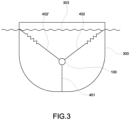
- Figure 3 shows a device 100 according to the invention, spatially fixed with regard to the walls of a sea pen 300 submerged in the sea 301.
- the device 100 is coupled to an anchor 401 that is attached to the bottom of the sea pen 300.
- the device is coupled via two damped lines 402 and 402' to sites of the wall of the pen near the surface of the sea. This makes sure that the device will not bounce with respect to the pens itself, thereby increasing the chance that salmons will be guided along the imaging track.
Landscapes
- Life Sciences & Earth Sciences (AREA)
- Environmental Sciences (AREA)
- Zoology (AREA)
- Marine Sciences & Fisheries (AREA)
- Animal Husbandry (AREA)
- Biodiversity & Conservation Biology (AREA)
- Farming Of Fish And Shellfish (AREA)
- Image Processing (AREA)
Description
- The present invention pertains to a method for automatic sea lice monitoring in fish aquaculture, such as salmon aquaculture, the method comprising submerging a camera in a sea pen comprising fish, using the camera to make an image of at least one of said fish, analysing the image to differentiate between individual sea lice present on the fish, such as salmon and the fish itself, and assessing the number of sea lice present on the fish. The invention also pertains to a system for use in fish aquaculture to automatically monitor and report sea lice presence on fish.
- Regular and accurate sea lice monitoring is a vital component to any effective integrated pest management regime targeted against one of the most costly ectoparasitic pathogens associated with modern fish aquaculture such as salmon aquaculture. In most regions with substantial cultured salmon production, sea lice (mainly Lepeophtheirus salmonis and various Caligus species) continue to be one of the most important fish health concerns. Even in regions where significant infestations tend not to be experienced, such as British Columbia or the far north of Norway, it is important to monitor sea lice levels to mitigate any potential negative impacts for wild salmon. In addition to regular monitoring, the recent emergence in a number of regions of tolerance to certain chemotherapeutants has emphasised the importance of methods to obtain accurate sea lice estimates before and after treatment to properly assess the efficacy of any medication being used so as to gain early warning of tolerance issues. However, to date, this involves a manual process which is time consuming and dependent for its accuracy on the skill of the individual carrying out the count and their ability to access a range of sea pens. Crowding fish within pens to select a representative sample also imposes stress on these fish. Because of the time required only a small number of fish can be sampled. However as lice numbers have been driven down over the past decade, increasingly large samples are required to maintain the statistical reliability of any population-level estimates.
- The use of underwater imaging has therefore been proposed as an automated and passive counting system. Creating an image of a fish such as salmon covered by sea lice (which image may be part of a video, which video technically is a series of images) provides the possibility of automatically monitoring the number of sea lice on fish. It is possible to differentiate between individual sea lice present on a fish such as salmon and the (skin of the) fish or salmon itself, thus to distinguish between individual sea lice present on the skin of a fish or salmon and the skin of the fish or salmon itself. This way, the number of sea lice present on one fish or salmon can be assessed. One of the key projects to practically develop such an imaging method was the Eurostars VisuaLice project, which was a follow up innovation of a pilot study by Scottish researchers in 2005-2007. As stated in the Executive Summary of the 2013 report of VisuaLice (Population Interpretation of Passive Sea Lice Monitoring, authors Cox and Revie) to the Havbruksinstituttet and FHF Norway, such a system can offer the benefits of enhanced repeatability and accuracy, larger sample sizes, continuous monitoring, lower costs and lower levels of disturbance to the fish. It was therefore proposed in the project to develop such a system to assess the relative value of this novel approach in comparison to traditional manual counting. However, although it appeared to be possible to distinguish individual sea lice present on the skin of a fish or salmon using commonly known imaging techniques, results from experiments and field trials of the underwater imaging system were largely unsuccessful.
- Document
WO 2013/053597 A1 discloses a method and a system for automatic sea lice monitoring in fish aquaculture, wherein a camera is used to make an image of a fish, wherein the image is analysed to differentiate between individual sea lice present on the fish and the fish itself, wherein an assessment of the number of lice present on the fish is performed, and wherein an assessment of the lice size is also performed to obtain information about the life stage of sea lice present on the fish. - It is an object of the invention to devise a method for automatic sea lice monitoring that can successfully be used to assess the number of sea lice present on fish such as salmons present in sea pen. It is another object of the invention to devise a system for use in fish aquaculture such as salmon aquaculture to automatically monitor and report sea lice presence on salmons.
- In order to meet the first object of the invention, a method as outlined in the GENERAL FIELD OF THE INVENTION section here above has been devised according to
independent claim 1. Using a prior art method, the principal problem is not that sea lice cannot be distinguished on a fish such as salmon for accurate counting, the problem is that the fish do not appear on the images in a standardised way, for example, the angle and distance may vary considerably depending on the spatial relationship between the camera and the fish at the time of making an image. Also, in many instances far too many fish appear on an image, partly overlapping each other. This on the one hand makes the automatic sea lice monitoring less easy, but more importantly, may prevent that a complete side surface of a fish such as a salmon can be assessed. All of this contributes to less reliability. - By using the device as specified, the camera holds a predetermined position with respect to an imaging track (i.e. a path or line along which a fish or salmon may swim, to which path or line the camera is directed to be able and image the fish or salmon when actually passing). Even though the track may be wider than the width of just one fish such as salmon, this way the imaging of the fish may take place with substantially improved reliability. This is because the distance and orientation of the fish with respect to the camera is better controlled when compared to a method wherein a camera is simply submerged in the sea, without being spatially positioned with respect to an imaging track and thus, with respect to a fish such as salmon to be imaged. Also, the chance that an image of fish overlapping each other is decreased, which also contributes to an improved reliability of the automatic monitoring method.
- In order to meet the second object of the invention a system is devised comprising the features of
independent claim 10. This system makes use of the same advantages of the imaging device as described here above. - Automatic means without requiring operator intervention to perform the action. This does not exclude that an automatic action may be initiated (for example requested), intervened or terminated by an operator.
- Radial means heaving walls or borders arranged around a centre.
- Assessing a number of items means to create a parameter that corresponds to that number of items, for example by explicitly counting the number of items or by establishing the total weight of the items.
- A central processing unit is a hardware system, programmed to process data. The hardware does not need to be one single unit, but may comprise several distributed units operatively connected via for example wireless connections.
- An enclosure of a track means that the items that should pass the track cannot freely cross the enclosure. This does not include that other material (for example units smaller than the items, or a liquid or gas) can cross the enclosure.
- A camera being directed to an item means that the camera is positioned to be able and make an image of that item or a second item positioned in a straight line between the camera and the said first item.
- In an embodiment of the invention the enclosure of the device that confines the track is radial. It was found that a very convenient and reliable way of guiding a fish, such as salmon along an imaging track is to use a device that radially confines the track. The width of the opening should be chosen such that the salmon is typically not hindered in swimming along the track, but also, not too big to prevent improper guidance. The actual measures to allow a fish or salmon to swim through the device, and still give adequate guidance is believed to depend mainly on the age (size) of the fish or salmons and the density of the fish or salmons in the pen. Good results were obtained when the radial enclosure has a diameter or diagonal that is about 90-150% of the girth of the fish. The girth of the fish is the distance of the circumference of the fish going round the fish from the back to belly and back to the back of the fish and is the distance around the fattest, thickest or biggest part of the fish, which is usually the midsection. Girth may be measured with a fabric ruler, or using a string, and then measuring the length of the string. Preferably, the diameter or diagonal of the enclosure is 90-150% of the girth of the fish. More preferably, the diameter or diagonal of the enclosure is 100-140% of the girth of the fish, more preferably, the diameter or diagonal of the enclosure is 105-130% of the girth of the fish, more preferably, the diameter or diagonal of the enclosure is 110-125% of the girth of the fish, more preferably, the diameter or diagonal of the enclosure is 115-120% of the girth of the fish. The above measures ensure the free movement of the fish, and the fish will swim freely along track, without needing any force. It is important for the fish to swim freely, into the device to avoid any stress. If no force is needed for the fish to swim into the device and along the track, then the fish will experience less stress, which is beneficial and no additional devices are needed to force the fish into the device and along the track. The above measures also ensure that the fish swim through the enclosure one by one, thereby avoiding overlap of fish that will compromise the counting. In addition, the above measures have the benefit that the fish will swim through the enclosure in an uniform way. This has the advantage that the cameras may be aligned in the most beneficial way to count the sea lice and that for each fish the sea lice are counted at the same part of the fish for each fish, thus ensuring uniform and thus reliable counting.
- In another embodiment the enclosure is circular enclosure. A circular enclosure is easier to position evenly around a longitudinal imaging track, increasing the reliability of the method. In yet another embodiment the enclosure is endless along its circumference, i.e. not having an opening to interrupt the circumference. This provides for an improved stability of the device. In still another embodiment the device is a circular frame. Such a frame has been found ideally suitable to guide a fish such a salmon over a track corresponding to the axis of the frame. For a circular enclosure preferably, the diameter of the circular enclosure is 90-150% of the girth of the fish. More preferably, the diameter of the circular enclosure is 100-140% of the girth of the fish, more preferably, the diameter of the circular enclosure is 105-130% of the girth of the fish, more preferably, the diameter of the circular enclosure is 110-125% of the girth of the fish, more preferably, the diameter of the circular enclosure is 115-120% of the girth of the fish.
- In an embodiment the device is spatially fixed with regard to one or more walls of the sea pen. Would the device be mechanically connected to a float, the submerged device would bounce with the amplitude of the waves. It is foreseen that this creates too much disturbance around the device, possibly keeping the salmons away from taking the imaging track (depending on the amplitude of the waves). By spatially fixing the device with respect to one or more walls of the pen, for example with respect to the bottom of the pen using an anchor that grasps this bottom, this potential problem may not arise.
- In another embodiment the device comprises at least two cameras directed to the track.
- Using two or more cameras enables a greater surface of the salmon to be images, thereby increasing the reliability of the assessment of the number of sea lice present on the salmon.
- In still another embodiment the device is provided with a thermometer to record the sea water temperature at the time the image is made. The seat water temperature is an important factor in sea lice infestations. By recording the sea water temperature, the relation between temperature and sea lice infestations can be better assessed.
- According to the invention, in addition to the number of sea lice present on the fish such as salmon, the size of these lice is assessed. This way, information about the stage of life of the sea lice can be obtained. This can be important information to optimize combatting an infestation of sea lice in a pen.
- Another aspect of the invention is directed to a system for use in fish aquaculture to automatically monitor and report sea lice presence on fish, the system comprising the features of
independent claim 10. - Optionally the enclosure is a radial enclosure (11, 101) to confine the track. Optionally the enclosure has a diameter or a diagonal having a length that is 90-150% of the girth of the fish. Optionally the enclosure is a circular enclosure. Optionally the enclosure is endless along its circumference. Optionally the enclosure is a circular frame (101).
- The method and system of the present invention are especially well-suited for aquaculture where the fish are cultured in open water such as salmon and trout, and especially for salmon.
- Embodiments and/or features as indicated for the method are expressly envisioned as embodiments for the system.
- For the sake of conciseness not every combination of embodiments and/or optional features are described herein, however each combination of embodiments and/or described features are expressly envisioned in the present invention.
- The invention will now be further explained using the following examples.
-
-
Figure 1 shows devices for use in the present method. -
Figure 2 schematically shows a system according to the invention. -
Figure 3 shows a device according to the invention, spatially fixed with regard to the walls of a sea pen for cultivating salmons. -
Figure 1 shows three devices for use in the present method. Infigure 1A a simpleopen triangle 1 is depicted, comprising twolegs - Within the try square of the triangle, imaging track 5 (which is viewed from the back in this figure) is depicted.
Cameras 4 and 4' are directed to this track. The triangle legs will typically prevent that salmons will swim very close to the legs, they will keep a certain distance. This distance is such that it coincides with the distance between the track and the two legs. This way, occasionally a salmon will swim along the imaging track. Upon passing the cameras, one or more pictures (or a short film) will be taken for image analysis. - A device according to the invention is depicted in
figure 1B . Thisdevice 10 has as a core part acylindrical tube 11, which tube represents a radial enclosure to confine theimaging track 5. At its distal end, thetube 11 is provided with afunnel 12 to guide a salmon towards thetube 11. The diameter of the core is such that a salmon will not enter the core at the non-funnel side, since the salmon will notice the walls of the tube (for a salmon of 3-4 kg this may be a diameter of about 20-25 cm). However, at the funnel side, once entered the device, a salmon will not turn when reaching thetube 11 and will swim through, in essence following theimaging track 5. Twocameras 4 and 4' are directed towards this track. The device is also equipped with athermometer 6 to measure the temperature of the sea water at the time of taking pictures (images) of the salmon. - Another device according to the invention is depicted in
figure 1C . Thisdevice 100 comprises an endless circular frame enclosing animaging track 5. To the frame are connected twocameras 4 and 4', and athermometer 6, corresponding to the same elements as depicted infigure 1B . The diameter of the frame is chosen such that a salmon will swim through the device from either side and be guided in essence along (i.e. coinciding with or at least adjacent) the imaging track. For a salmon having a weight of 3-4 kg, a typical diameter is 40-60 cm (depending also on the density of salmons in the pen). In an embodiment (not shown), the frame is provided with means to adapt the circular width to the size of the salmons in a pen. At the bottom of the frame, indications oflength 7 are provided to serve as a ruler. - In particular for the devices having a radially enclosure for the imaging track, smaller versions may be made to learn young salmons in hatcheries to get comfortable with swimming through the device. This may lead to an ultimate device (i.e. a device for use in the actual sea pen to grow the salmons) having minimum radial dimensions, thereby increasing the intrinsic reliability of the method.
-
Figure 2 schematically shows a system according to the invention. The system comprises a central processing unit (CPU) 200 and via data line 207 (which may be a wireless connection) connected to the CPU the device 100 (seeFigure 1C ) submerged in a sea pen comprising the salmons (not shown; seeFigure 3 ). The cameras of thedevice 100 are devised to make images of the salmons when they swim along the corresponding imaging track. The CPU comprises imaging software running on the CPU to analyse images of the salmons made by the camera, to differentiate between individual sea lice present on each of the said salmons and the salmons themselves, and to assess the number of sea lice present on the salmons. For this, the CPU makes use of amemory 202 which vialine 201 forms a part of the CPU as a whole. Data is reported vialines authorities 204 and/orfarmer 206 respectively. -
Figure 3 shows adevice 100 according to the invention, spatially fixed with regard to the walls of asea pen 300 submerged in the sea 301. Thedevice 100 is coupled to ananchor 401 that is attached to the bottom of thesea pen 300. Next to this, the device is coupled via twodamped lines 402 and 402' to sites of the wall of the pen near the surface of the sea. This makes sure that the device will not bounce with respect to the pens itself, thereby increasing the chance that salmons will be guided along the imaging track.
Claims (14)
- Method for automatic sea lice monitoring in fish aquaculture, the method comprising:- submerging a camera (4) in a sea pen (300) comprising fish,- using the camera to make an image of at least one of said fish,- analysing the image to differentiate between individual sea lice present on the fish and the fish itself,- assessing the number and the size of sea lice present on the fish, and thereby obtaining information about the stage of life of sea lice present on the fish,characterised in that the camera is attached to a device (10, 100) for guiding the fish along an imaging track (5), the camera being directed to the track, wherein the device comprising an enclosure that confines the track, and wherein the camera is attached to the enclosure.
- A method according to claim 1, characterised in that the device comprises a radial enclosure (11, 101) to confine the track.
- A method according to claim 2, wherein the enclosure has a diameter or a diagonal having a length that is 90-150% of the girth of the fish.
- A method according to claim 2 or 3, characterised in that the enclosure is a circular enclosure.
- A method according to any of the claims 2 to 4, characterised in that the enclosure is endless along its circumference, preferably the enclosure is a circular frame (101).
- A method according to any of the preceding claims, characterised in that the device is spatially fixed with regard to one or more walls of the sea pen.
- A method according to any of the preceding claims, characterised in that the device comprises at least two cameras directed to the track.
- A method according to any of the preceding claims, characterised in that the device is provided with a thermometer (6) to record sea water temperature at the time the image is made.
- A method according to any of the preceding claims, wherein the fish is salmon.
- A system for use in fish aquaculture to automatically monitor and report the number and stage of life of sea lice presence on fish, the system comprising- a central processing unit (CPU; 200)- connected to the CPU a camera (4) suitable to be submerged in a sea pen (300) comprising the fish,- a device (10, 100) for guiding the fish along an imaging track (5) of this device, the device comprising an enclosure that confines the track,
the camera being devised to make images of said fish, wherein the camera is attached to the enclosure of the device and is directed to the track,- imaging software running on the CPU and configured to analyse images of the fish made by the camera, to differentiate between individual sea lice present on each of the said fish and the fish themselves, and to assess the number and the size of sea lice present on the fish, and thereby to obtain information about the stage of life of sea lice present on the fish,- a reporting unit (204, 206) connected to the CPU, configured to display results corresponding to said assessing. - A system according to claim 10, wherein the enclosure is a radial enclosure (11, 101) to confine the track, preferably the enclosure is a circular enclosure.
- A system according to claim 11, wherein the enclosure has a diameter or a diagonal having a length that is 90-150% of the girth of the fish.
- A system according to any of claims 11 to 12, wherein the enclosure is endless along its circumference, preferably the enclosure is a circular frame (101).
- A system according to any of the claims 10 to 13 wherein the fish is salmon.
Priority Applications (1)
| Application Number | Priority Date | Filing Date | Title |
|---|---|---|---|
| EP24220187.9A EP4555858A3 (en) | 2015-10-22 | 2016-10-21 | Method and system for automatic sea lice monitoring in fish aquaculture |
Applications Claiming Priority (2)
| Application Number | Priority Date | Filing Date | Title |
|---|---|---|---|
| EP15191108 | 2015-10-22 | ||
| PCT/EP2016/075385 WO2017068127A1 (en) | 2015-10-22 | 2016-10-21 | A method for automatic sea lice monitoring in salmon aquaculture |
Related Child Applications (1)
| Application Number | Title | Priority Date | Filing Date |
|---|---|---|---|
| EP24220187.9A Division EP4555858A3 (en) | 2015-10-22 | 2016-10-21 | Method and system for automatic sea lice monitoring in fish aquaculture |
Publications (2)
| Publication Number | Publication Date |
|---|---|
| EP3364754A1 EP3364754A1 (en) | 2018-08-29 |
| EP3364754B1 true EP3364754B1 (en) | 2025-01-01 |
Family
ID=54360893
Family Applications (2)
| Application Number | Title | Priority Date | Filing Date |
|---|---|---|---|
| EP16785148.4A Active EP3364754B1 (en) | 2015-10-22 | 2016-10-21 | Method and system for automatic sea lice monitoring in fish aquaculture |
| EP24220187.9A Pending EP4555858A3 (en) | 2015-10-22 | 2016-10-21 | Method and system for automatic sea lice monitoring in fish aquaculture |
Family Applications After (1)
| Application Number | Title | Priority Date | Filing Date |
|---|---|---|---|
| EP24220187.9A Pending EP4555858A3 (en) | 2015-10-22 | 2016-10-21 | Method and system for automatic sea lice monitoring in fish aquaculture |
Country Status (6)
| Country | Link |
|---|---|
| US (3) | US10863727B2 (en) |
| EP (2) | EP3364754B1 (en) |
| CA (1) | CA3000789C (en) |
| CL (1) | CL2016002664A1 (en) |
| DK (2) | DK3364754T3 (en) |
| WO (1) | WO2017068127A1 (en) |
Families Citing this family (19)
| Publication number | Priority date | Publication date | Assignee | Title |
|---|---|---|---|---|
| CL2016002664A1 (en) | 2015-10-22 | 2018-01-05 | Intervet Int Bv | A method for automatic monitoring of sea lice in salmon aquaculture |
| EP3726972A1 (en) | 2017-12-20 | 2020-10-28 | Intervet International B.V. | Method and system for external fish parasite monitoring in aquaculture |
| CN111511201A (en) | 2017-12-20 | 2020-08-07 | 英特维特国际股份有限公司 | System for fish external parasite monitoring in aquaculture |
| US11825814B2 (en) * | 2017-12-20 | 2023-11-28 | Intervet Inc. | System for external fish parasite monitoring in aquaculture |
| CN111491508B (en) * | 2017-12-20 | 2022-05-24 | 英特维特国际股份有限公司 | System for fish ectoparasite monitoring in aquaculture |
| US11533893B2 (en) | 2017-12-20 | 2022-12-27 | Intervet Inc. | Method and system for external fish parasite monitoring in aquaculture |
| US10534967B2 (en) | 2018-05-03 | 2020-01-14 | X Development Llc | Fish measurement station keeping |
| WO2019245722A1 (en) | 2018-06-19 | 2019-12-26 | Aquabyte, Inc. | Sea lice detection and classification in an aquaculture environment |
| US20200296925A1 (en) * | 2018-11-30 | 2020-09-24 | Andrew Bennett | Device for, system for, method of identifying and capturing information about items (fish tagging) |
| NO347348B1 (en) * | 2019-06-19 | 2023-09-25 | Subc3D As | System and procedure for imaging and counting external structures on a fish |
| US11297806B2 (en) * | 2020-01-15 | 2022-04-12 | X Development Llc | Lighting controller for sea lice detection |
| US11659820B2 (en) * | 2020-03-20 | 2023-05-30 | X Development Llc | Sea lice mitigation based on historical observations |
| US11657498B2 (en) | 2020-04-10 | 2023-05-23 | X Development Llc | Multi-chamber lighting controller for aquaculture |
| US11611685B2 (en) | 2021-05-10 | 2023-03-21 | X Development Llc | Enhanced synchronization framework |
| US11582397B2 (en) | 2021-05-18 | 2023-02-14 | X Development Llc | Enhanced controller synchronization verification |
| US12078533B2 (en) | 2021-06-02 | 2024-09-03 | Tidalx Ai Inc. | Underwater camera as light sensor |
| US12077263B2 (en) | 2021-06-14 | 2024-09-03 | Tidalx Ai Inc. | Framework for controlling devices |
| EP4608137A1 (en) * | 2022-10-28 | 2025-09-03 | Can Technologies, Inc. | Pest control device and methods for managing pests in aquaculture systems |
| KR102726462B1 (en) * | 2023-12-27 | 2024-11-05 | 익투스에이아이 주식회사 | Modular Closed Aquaculture Devices and Aquaculture Systems |
Citations (1)
| Publication number | Priority date | Publication date | Assignee | Title |
|---|---|---|---|---|
| EP2962556B1 (en) * | 2014-06-30 | 2018-10-24 | Ardeo Technology AS | A system and method for monitoring and control of ectoparasites of fish |
Family Cites Families (24)
| Publication number | Priority date | Publication date | Assignee | Title |
|---|---|---|---|---|
| US7496228B2 (en) * | 2003-06-13 | 2009-02-24 | Landwehr Val R | Method and system for detecting and classifying objects in images, such as insects and other arthropods |
| NO20033537D0 (en) | 2003-08-11 | 2003-08-11 | Kristian Lillerud | Method and apparatus for counting and calculating weight in fish |
| WO2009008733A1 (en) | 2007-07-09 | 2009-01-15 | Feed Control Norway As | Means and method for average weight determination and appetite feeding |
| NO331345B1 (en) | 2010-02-05 | 2011-12-05 | Esben Beck | Device and method for damaging parasites on fish |
| NO332103B1 (en) | 2010-12-13 | 2012-06-25 | Ocea As | System and method for calculating the size of marine organisms in water |
| NO333499B1 (en) * | 2011-10-12 | 2013-06-24 | Salvision As | Method and system for detecting a lice on fish |
| NO337305B1 (en) * | 2012-12-20 | 2016-03-07 | Ebtech As | System and method for calculating physical sizes for freely moving objects in water |
| WO2014198556A1 (en) * | 2013-06-12 | 2014-12-18 | Ardeo Technology As | System and method for systematic evaluation of fish in an aquaculture facility |
| NO336807B1 (en) * | 2013-06-18 | 2015-11-02 | Reidar Aksnes | Apparatus and method of fish farming |
| NO20140640A1 (en) * | 2013-07-18 | 2015-01-19 | Maritime Vision Bergen As | System and device for damaging parasites |
| ES2552405B1 (en) | 2014-05-27 | 2016-09-14 | Tecnología Marina Ximo, S.L. | System and method of detection of Anisakis parasites in fish fillets |
| WO2016048851A1 (en) | 2014-09-22 | 2016-03-31 | Gallager Scott M | Continuous particle imaging and classification system |
| WO2016116533A1 (en) | 2015-01-22 | 2016-07-28 | Philips Lighting Holding B.V. | Light unit for counting sea lice |
| CL2016002664A1 (en) | 2015-10-22 | 2018-01-05 | Intervet Int Bv | A method for automatic monitoring of sea lice in salmon aquaculture |
| NO342604B1 (en) | 2015-12-02 | 2018-06-18 | Intervet Int Bv | A method for automatic sea lice monitoring in salmon aquaculture |
| NO20160880A1 (en) | 2016-05-24 | 2017-11-27 | Itecsolutions Systems & Services As | Arrangement and method for measuring the biological mass of fish and use of the arrangement |
| WO2018078166A1 (en) * | 2016-10-31 | 2018-05-03 | Faunaphotonics Aps | An optical remote sensing system for detection of aerial and aquatic fauna |
| EP3629717A4 (en) | 2017-05-29 | 2021-03-03 | Ecotone AS | Method and system for underwater hyperspectral imaging of fish |
| US11533893B2 (en) | 2017-12-20 | 2022-12-27 | Intervet Inc. | Method and system for external fish parasite monitoring in aquaculture |
| EP3726972A1 (en) | 2017-12-20 | 2020-10-28 | Intervet International B.V. | Method and system for external fish parasite monitoring in aquaculture |
| CN111491508B (en) | 2017-12-20 | 2022-05-24 | 英特维特国际股份有限公司 | System for fish ectoparasite monitoring in aquaculture |
| US11825814B2 (en) | 2017-12-20 | 2023-11-28 | Intervet Inc. | System for external fish parasite monitoring in aquaculture |
| CN111511201A (en) | 2017-12-20 | 2020-08-07 | 英特维特国际股份有限公司 | System for fish external parasite monitoring in aquaculture |
| US11297806B2 (en) * | 2020-01-15 | 2022-04-12 | X Development Llc | Lighting controller for sea lice detection |
-
2016
- 2016-10-20 CL CL2016002664A patent/CL2016002664A1/en unknown
- 2016-10-21 EP EP16785148.4A patent/EP3364754B1/en active Active
- 2016-10-21 WO PCT/EP2016/075385 patent/WO2017068127A1/en not_active Ceased
- 2016-10-21 EP EP24220187.9A patent/EP4555858A3/en active Pending
- 2016-10-21 DK DK16785148.4T patent/DK3364754T3/en active
- 2016-10-21 CA CA3000789A patent/CA3000789C/en active Active
- 2016-10-21 US US15/767,888 patent/US10863727B2/en active Active
-
2020
- 2020-11-18 US US16/951,338 patent/US11659821B2/en active Active
-
2023
- 2023-04-19 US US18/303,243 patent/US20230363359A1/en not_active Abandoned
-
2024
- 2024-12-02 DK DKBA202400078U patent/DK202400078Y3/en active IP Right Grant
Patent Citations (1)
| Publication number | Priority date | Publication date | Assignee | Title |
|---|---|---|---|---|
| EP2962556B1 (en) * | 2014-06-30 | 2018-10-24 | Ardeo Technology AS | A system and method for monitoring and control of ectoparasites of fish |
Non-Patent Citations (1)
| Title |
|---|
| COX RUTH ET AL: "VisuaLice Population Interpretation of Passive Sea Lice Monitoring", 1 March 2013 (2013-03-01), Norway, XP093104715, Retrieved from the Internet <URL:https://www.fhf.no/prosjekter/prosjektbasen/900594/> [retrieved on 20231122] * |
Also Published As
| Publication number | Publication date |
|---|---|
| DK3364754T3 (en) | 2025-03-03 |
| US11659821B2 (en) | 2023-05-30 |
| DK202400078U1 (en) | 2025-02-12 |
| US10863727B2 (en) | 2020-12-15 |
| DK202400078Y3 (en) | 2025-02-12 |
| CA3000789C (en) | 2024-07-02 |
| CL2016002664A1 (en) | 2018-01-05 |
| WO2017068127A1 (en) | 2017-04-27 |
| US20230363359A1 (en) | 2023-11-16 |
| US20210068375A1 (en) | 2021-03-11 |
| US20180303073A1 (en) | 2018-10-25 |
| EP4555858A3 (en) | 2025-06-11 |
| EP3364754A1 (en) | 2018-08-29 |
| CA3000789A1 (en) | 2017-04-27 |
| EP4555858A2 (en) | 2025-05-21 |
Similar Documents
| Publication | Publication Date | Title |
|---|---|---|
| US20230363359A1 (en) | Method for automatic sea lice monitoring in salmon aquaculture | |
| NO342604B1 (en) | A method for automatic sea lice monitoring in salmon aquaculture | |
| DK181217B1 (en) | Method and system for external fish parasite monitoring in aquaculture | |
| DK181803B1 (en) | System for external fish parasite monitoring in aquaculture | |
| AU2018387713B2 (en) | System for external fish parasite monitoring in aquaculture | |
| EP3484282B1 (en) | Method and system for sorting live fish | |
| NO343899B1 (en) | Device and method for monitoring physical development of fish in a farmed fish | |
| WO2014198556A1 (en) | System and method for systematic evaluation of fish in an aquaculture facility | |
| Helgesen et al. | Single‐dose field bioassay for sensitivity testing in sea lice, L epeophtheirus salmonis: development of a rapid diagnostic tool | |
| Sbragaglia et al. | Evolutionary impact of size-selective harvesting on shoaling behavior: individual-level mechanisms and possible consequences for natural and fishing mortality | |
| Pullen et al. | Consequences of oral lure retention on the physiology and behaviour of adult northern pike (Esox lucius L.) | |
| Marçalo et al. | Behavioural responses of sardines Sardina pilchardus to simulated purse‐seine capture and slipping | |
| Breen et al. | ICES guidelines on methods for estimating discard survival | |
| Wei et al. | Review on quantitative methods of fish school behaviors | |
| Tomiyasu et al. | The relationship between body angle and target strength of ribbonfish (Trichiurus japonicus) displaying a vertical swimming motion | |
| WO2023027647A1 (en) | System and process in monitoring aquatic animals' growth and health status | |
| Ramasamy et al. | Maturation and reproductive biology of Reba Carp Cirrhinus Reba (Hamilton) in Lower Anicut Reservoir, Tamil Nadu, India | |
| Uhlmann et al. | Explanatory variables | |
| Kamran et al. | Behavioural indices as means of assessing buffalo fly numbers on cattle | |
| Stavrakidis-Zachou et al. | D6. 3 Sampling in cages | |
| Nilsson et al. | English and Norwegian) | |
| MICHAELS et al. | Initial field data for the Critically Endangered Alchichica salamander Ambystoma taylori from Lago Alchichica, Mexico | |
| Fuller et al. | Cownose Stingrays (Rhinoptera bonasus) enrichment preference and spatial distribution patterns before, during, and after enrichment | |
| Louison | Physiological and behavioral drivers of angling vulnerability in freshwater sportfish | |
| RU2450512C2 (en) | Trapped method for evaluating stocks of water biological resources |
Legal Events
| Date | Code | Title | Description |
|---|---|---|---|
| STAA | Information on the status of an ep patent application or granted ep patent |
Free format text: STATUS: UNKNOWN |
|
| STAA | Information on the status of an ep patent application or granted ep patent |
Free format text: STATUS: THE INTERNATIONAL PUBLICATION HAS BEEN MADE |
|
| PUAI | Public reference made under article 153(3) epc to a published international application that has entered the european phase |
Free format text: ORIGINAL CODE: 0009012 |
|
| STAA | Information on the status of an ep patent application or granted ep patent |
Free format text: STATUS: REQUEST FOR EXAMINATION WAS MADE |
|
| 17P | Request for examination filed |
Effective date: 20180522 |
|
| AK | Designated contracting states |
Kind code of ref document: A1 Designated state(s): AL AT BE BG CH CY CZ DE DK EE ES FI FR GB GR HR HU IE IS IT LI LT LU LV MC MK MT NL NO PL PT RO RS SE SI SK SM TR |
|
| AX | Request for extension of the european patent |
Extension state: BA ME |
|
| DAV | Request for validation of the european patent (deleted) | ||
| DAX | Request for extension of the european patent (deleted) | ||
| STAA | Information on the status of an ep patent application or granted ep patent |
Free format text: STATUS: EXAMINATION IS IN PROGRESS |
|
| 17Q | First examination report despatched |
Effective date: 20210401 |
|
| REG | Reference to a national code |
Ref country code: NO Ref legal event code: TC |
|
| GRAP | Despatch of communication of intention to grant a patent |
Free format text: ORIGINAL CODE: EPIDOSNIGR1 |
|
| STAA | Information on the status of an ep patent application or granted ep patent |
Free format text: STATUS: GRANT OF PATENT IS INTENDED |
|
| INTG | Intention to grant announced |
Effective date: 20240725 |
|
| GRAS | Grant fee paid |
Free format text: ORIGINAL CODE: EPIDOSNIGR3 |
|
| GRAA | (expected) grant |
Free format text: ORIGINAL CODE: 0009210 |
|
| STAA | Information on the status of an ep patent application or granted ep patent |
Free format text: STATUS: THE PATENT HAS BEEN GRANTED |
|
| AK | Designated contracting states |
Kind code of ref document: B1 Designated state(s): AL AT BE BG CH CY CZ DE DK EE ES FI FR GB GR HR HU IE IS IT LI LT LU LV MC MK MT NL NO PL PT RO RS SE SI SK SM TR |
|
| REG | Reference to a national code |
Ref country code: GB Ref legal event code: FG4D |
|
| REG | Reference to a national code |
Ref country code: DE Ref legal event code: R096 Ref document number: 602016090809 Country of ref document: DE |
|
| REG | Reference to a national code |
Ref country code: CH Ref legal event code: EP |
|
| P01 | Opt-out of the competence of the unified patent court (upc) registered |
Free format text: CASE NUMBER: APP_65553/2024 Effective date: 20241212 |
|
| REG | Reference to a national code |
Ref country code: IE Ref legal event code: FG4D |
|
| REG | Reference to a national code |
Ref country code: DK Ref legal event code: T3 Effective date: 20250227 |
|
| REG | Reference to a national code |
Ref country code: LT Ref legal event code: MG9D |
|
| REG | Reference to a national code |
Ref country code: NL Ref legal event code: MP Effective date: 20250101 |
|
| REG | Reference to a national code |
Ref country code: AT Ref legal event code: MK05 Ref document number: 1755284 Country of ref document: AT Kind code of ref document: T Effective date: 20250101 |
|
| PG25 | Lapsed in a contracting state [announced via postgrant information from national office to epo] |
Ref country code: NL Free format text: LAPSE BECAUSE OF FAILURE TO SUBMIT A TRANSLATION OF THE DESCRIPTION OR TO PAY THE FEE WITHIN THE PRESCRIBED TIME-LIMIT Effective date: 20250101 |
|
| PG25 | Lapsed in a contracting state [announced via postgrant information from national office to epo] |
Ref country code: FI Free format text: LAPSE BECAUSE OF FAILURE TO SUBMIT A TRANSLATION OF THE DESCRIPTION OR TO PAY THE FEE WITHIN THE PRESCRIBED TIME-LIMIT Effective date: 20250101 |
|
| PG25 | Lapsed in a contracting state [announced via postgrant information from national office to epo] |
Ref country code: PL Free format text: LAPSE BECAUSE OF FAILURE TO SUBMIT A TRANSLATION OF THE DESCRIPTION OR TO PAY THE FEE WITHIN THE PRESCRIBED TIME-LIMIT Effective date: 20250101 |
|
| PG25 | Lapsed in a contracting state [announced via postgrant information from national office to epo] |
Ref country code: ES Free format text: LAPSE BECAUSE OF FAILURE TO SUBMIT A TRANSLATION OF THE DESCRIPTION OR TO PAY THE FEE WITHIN THE PRESCRIBED TIME-LIMIT Effective date: 20250101 |
|
| PG25 | Lapsed in a contracting state [announced via postgrant information from national office to epo] |
Ref country code: HR Free format text: LAPSE BECAUSE OF FAILURE TO SUBMIT A TRANSLATION OF THE DESCRIPTION OR TO PAY THE FEE WITHIN THE PRESCRIBED TIME-LIMIT Effective date: 20250101 |
|
| PG25 | Lapsed in a contracting state [announced via postgrant information from national office to epo] |
Ref country code: PT Free format text: LAPSE BECAUSE OF FAILURE TO SUBMIT A TRANSLATION OF THE DESCRIPTION OR TO PAY THE FEE WITHIN THE PRESCRIBED TIME-LIMIT Effective date: 20250502 Ref country code: LV Free format text: LAPSE BECAUSE OF FAILURE TO SUBMIT A TRANSLATION OF THE DESCRIPTION OR TO PAY THE FEE WITHIN THE PRESCRIBED TIME-LIMIT Effective date: 20250101 |
|
| PG25 | Lapsed in a contracting state [announced via postgrant information from national office to epo] |
Ref country code: BG Free format text: LAPSE BECAUSE OF FAILURE TO SUBMIT A TRANSLATION OF THE DESCRIPTION OR TO PAY THE FEE WITHIN THE PRESCRIBED TIME-LIMIT Effective date: 20250101 Ref country code: GR Free format text: LAPSE BECAUSE OF FAILURE TO SUBMIT A TRANSLATION OF THE DESCRIPTION OR TO PAY THE FEE WITHIN THE PRESCRIBED TIME-LIMIT Effective date: 20250402 |
|
| PG25 | Lapsed in a contracting state [announced via postgrant information from national office to epo] |
Ref country code: AT Free format text: LAPSE BECAUSE OF FAILURE TO SUBMIT A TRANSLATION OF THE DESCRIPTION OR TO PAY THE FEE WITHIN THE PRESCRIBED TIME-LIMIT Effective date: 20250101 |
|
| PG25 | Lapsed in a contracting state [announced via postgrant information from national office to epo] |
Ref country code: CZ Free format text: LAPSE BECAUSE OF FAILURE TO SUBMIT A TRANSLATION OF THE DESCRIPTION OR TO PAY THE FEE WITHIN THE PRESCRIBED TIME-LIMIT Effective date: 20250101 |
|
| PG25 | Lapsed in a contracting state [announced via postgrant information from national office to epo] |
Ref country code: SE Free format text: LAPSE BECAUSE OF FAILURE TO SUBMIT A TRANSLATION OF THE DESCRIPTION OR TO PAY THE FEE WITHIN THE PRESCRIBED TIME-LIMIT Effective date: 20250101 |
|
| REG | Reference to a national code |
Ref country code: DE Ref legal event code: R097 Ref document number: 602016090809 Country of ref document: DE |
|
| PG25 | Lapsed in a contracting state [announced via postgrant information from national office to epo] |
Ref country code: SM Free format text: LAPSE BECAUSE OF FAILURE TO SUBMIT A TRANSLATION OF THE DESCRIPTION OR TO PAY THE FEE WITHIN THE PRESCRIBED TIME-LIMIT Effective date: 20250101 |
|
| PGFP | Annual fee paid to national office [announced via postgrant information from national office to epo] |
Ref country code: DK Payment date: 20250926 Year of fee payment: 10 |
|
| PGFP | Annual fee paid to national office [announced via postgrant information from national office to epo] |
Ref country code: NO Payment date: 20250912 Year of fee payment: 10 |
|
| PG25 | Lapsed in a contracting state [announced via postgrant information from national office to epo] |
Ref country code: IT Free format text: LAPSE BECAUSE OF FAILURE TO SUBMIT A TRANSLATION OF THE DESCRIPTION OR TO PAY THE FEE WITHIN THE PRESCRIBED TIME-LIMIT Effective date: 20250101 |
|
| PGFP | Annual fee paid to national office [announced via postgrant information from national office to epo] |
Ref country code: GB Payment date: 20250911 Year of fee payment: 10 |
|
| PG25 | Lapsed in a contracting state [announced via postgrant information from national office to epo] |
Ref country code: EE Free format text: LAPSE BECAUSE OF FAILURE TO SUBMIT A TRANSLATION OF THE DESCRIPTION OR TO PAY THE FEE WITHIN THE PRESCRIBED TIME-LIMIT Effective date: 20250101 |
|
| PGFP | Annual fee paid to national office [announced via postgrant information from national office to epo] |
Ref country code: IE Payment date: 20250912 Year of fee payment: 10 |
|
| PG25 | Lapsed in a contracting state [announced via postgrant information from national office to epo] |
Ref country code: RO Free format text: LAPSE BECAUSE OF FAILURE TO SUBMIT A TRANSLATION OF THE DESCRIPTION OR TO PAY THE FEE WITHIN THE PRESCRIBED TIME-LIMIT Effective date: 20250101 |
|
| PG25 | Lapsed in a contracting state [announced via postgrant information from national office to epo] |
Ref country code: SK Free format text: LAPSE BECAUSE OF FAILURE TO SUBMIT A TRANSLATION OF THE DESCRIPTION OR TO PAY THE FEE WITHIN THE PRESCRIBED TIME-LIMIT Effective date: 20250101 |
|
| PLBE | No opposition filed within time limit |
Free format text: ORIGINAL CODE: 0009261 |
|
| STAA | Information on the status of an ep patent application or granted ep patent |
Free format text: STATUS: NO OPPOSITION FILED WITHIN TIME LIMIT |
|
| 26N | No opposition filed |
Effective date: 20251002 |
|
| PGFP | Annual fee paid to national office [announced via postgrant information from national office to epo] |
Ref country code: IS Payment date: 20251008 Year of fee payment: 10 |