EP3364593A1 - Masking storage transfer to protect against attacks - Google Patents
Masking storage transfer to protect against attacks Download PDFInfo
- Publication number
- EP3364593A1 EP3364593A1 EP18154211.9A EP18154211A EP3364593A1 EP 3364593 A1 EP3364593 A1 EP 3364593A1 EP 18154211 A EP18154211 A EP 18154211A EP 3364593 A1 EP3364593 A1 EP 3364593A1
- Authority
- EP
- European Patent Office
- Prior art keywords
- share
- mst
- memory
- shares
- secure
- Prior art date
- Legal status (The legal status is an assumption and is not a legal conclusion. Google has not performed a legal analysis and makes no representation as to the accuracy of the status listed.)
- Granted
Links
Images


Classifications
-
- H—ELECTRICITY
- H04—ELECTRIC COMMUNICATION TECHNIQUE
- H04L—TRANSMISSION OF DIGITAL INFORMATION, e.g. TELEGRAPHIC COMMUNICATION
- H04L9/00—Cryptographic mechanisms or cryptographic arrangements for secret or secure communications; Network security protocols
- H04L9/002—Countermeasures against attacks on cryptographic mechanisms
- H04L9/004—Countermeasures against attacks on cryptographic mechanisms for fault attacks
-
- G—PHYSICS
- G06—COMPUTING OR CALCULATING; COUNTING
- G06F—ELECTRIC DIGITAL DATA PROCESSING
- G06F21/00—Security arrangements for protecting computers, components thereof, programs or data against unauthorised activity
- G06F21/70—Protecting specific internal or peripheral components, in which the protection of a component leads to protection of the entire computer
- G06F21/78—Protecting specific internal or peripheral components, in which the protection of a component leads to protection of the entire computer to assure secure storage of data
-
- H—ELECTRICITY
- H04—ELECTRIC COMMUNICATION TECHNIQUE
- H04L—TRANSMISSION OF DIGITAL INFORMATION, e.g. TELEGRAPHIC COMMUNICATION
- H04L9/00—Cryptographic mechanisms or cryptographic arrangements for secret or secure communications; Network security protocols
- H04L9/06—Cryptographic mechanisms or cryptographic arrangements for secret or secure communications; Network security protocols the encryption apparatus using shift registers or memories for block-wise or stream coding, e.g. DES systems or RC4; Hash functions; Pseudorandom sequence generators
- H04L9/0618—Block ciphers, i.e. encrypting groups of characters of a plain text message using fixed encryption transformation
- H04L9/0631—Substitution permutation network [SPN], i.e. cipher composed of a number of stages or rounds each involving linear and nonlinear transformations, e.g. AES algorithms
-
- H—ELECTRICITY
- H04—ELECTRIC COMMUNICATION TECHNIQUE
- H04L—TRANSMISSION OF DIGITAL INFORMATION, e.g. TELEGRAPHIC COMMUNICATION
- H04L9/00—Cryptographic mechanisms or cryptographic arrangements for secret or secure communications; Network security protocols
- H04L9/08—Key distribution or management, e.g. generation, sharing or updating, of cryptographic keys or passwords
- H04L9/0816—Key establishment, i.e. cryptographic processes or cryptographic protocols whereby a shared secret becomes available to two or more parties, for subsequent use
- H04L9/085—Secret sharing or secret splitting, e.g. threshold schemes
-
- H—ELECTRICITY
- H04—ELECTRIC COMMUNICATION TECHNIQUE
- H04L—TRANSMISSION OF DIGITAL INFORMATION, e.g. TELEGRAPHIC COMMUNICATION
- H04L9/00—Cryptographic mechanisms or cryptographic arrangements for secret or secure communications; Network security protocols
- H04L9/08—Key distribution or management, e.g. generation, sharing or updating, of cryptographic keys or passwords
- H04L9/0894—Escrow, recovery or storing of secret information, e.g. secret key escrow or cryptographic key storage
-
- H—ELECTRICITY
- H04—ELECTRIC COMMUNICATION TECHNIQUE
- H04L—TRANSMISSION OF DIGITAL INFORMATION, e.g. TELEGRAPHIC COMMUNICATION
- H04L2209/00—Additional information or applications relating to cryptographic mechanisms or cryptographic arrangements for secret or secure communication H04L9/00
- H04L2209/04—Masking or blinding
-
- H—ELECTRICITY
- H04—ELECTRIC COMMUNICATION TECHNIQUE
- H04L—TRANSMISSION OF DIGITAL INFORMATION, e.g. TELEGRAPHIC COMMUNICATION
- H04L2209/00—Additional information or applications relating to cryptographic mechanisms or cryptographic arrangements for secret or secure communication H04L9/00
- H04L2209/04—Masking or blinding
- H04L2209/046—Masking or blinding of operations, operands or results of the operations
Definitions
- Various exemplary embodiments disclosed herein relate generally to a masking storage transform that protects against safe error attacks, differential fault attacks, and higher-order side channel attacks.
- c ENC( p , k ), where c is a ciphertext, p is a plaintext, and k is a secret key.
- the secret key is stored in memory and the attacker has means to learn the physical location of the individual bits of the key. Assume further that the attacker is capable of forcing individual memory bits to zero (the same discussion holds for setting the bits to one).
- the attacker runs an encryption and observes the result, i.e., ciphertext c .
- the attacker locates the most significant bit of the secret key, denoted as k [MSB], forces this bit to zero, and observes the new result.
- the attacker learns that k [MSB] has been holding a value of logical one before the change. If the result stays unchanged, the attacker learns that the logical bit was zero before the fault attempt. In either case, only with a single trial, the attacker learns one bit of information about the secret key. The same procedure is then applied for all the other key bits until the whole key is revealed.
- a secure computing device including: a processor configured to carry out a secure operation; a memory in communication with the processer configured to store secure data; and a memory controller configured control storage of data in the memory and reading data from the memory, wherein the secure data is split into shares before being stored in the memory and wherein the memory controller is configured to: apply a masking storage transform (MST) to one of the shares to produce a masked share before storing the shares in the memory, wherein the MST is a permutation without a fixed point; apply an inverse MST to the masked share when reading the shares from the memory; and combine the read shares to reconstruct the secure data.
- MST masking storage transform
- applying the MST to one of the shares includes splitting the share into a plurality of portions and the applying substitution functions to the portions of the share to be masked.
- applying the inverse MST to the masked shares includes applying the inverse substitution functions to the portions of the masked share.
- substitution functions are non-linear functions including quadratic and cubic transformations.
- the MST is configured such that when a single bit of the masked share is changed then at least two bits of the reconstructed secure data are different from the secure data.
- secure data is also split into a third share and the MST is applied to the first share and the third share.
- applying the MST to the first share includes applying substitution functions to portions of the first share.
- applying the inverse MST to the first masked share includes applying the inverse substitution functions to the portions of the first masked share.
- substitution functions are non-linear functions including one of a quadratic transformation and a cubic transformation.
- a different MST is also applied to the second share to produce a second masked share that replaces the second masked share and wherein an inverse of the different MST is applied to the second masked share to reproduce the second share.
- the secure operation is part of a white-box operation implementation, wherein the MST is combined with a lookup table (LUT) resulting in a single LUT.
- LUT lookup table
- the MST is configured such that when a single bit of the masked share is changed then at least two bits of the reconstructed secure data are different from the secure data.
- a non-transitory machine-readable storage medium encoded with instructions for storing secure data in a memory, including: instructions for splitting the secure data into a first share and a second share; instructions for applying a masking storage transform (MST) to the first shares to produce a first masked share, wherein the MST is a permutation without a fixed point; instructions for storing the first masked share and the second share in the memory; instructions for reading the first masked share and the second share from the memory; instructions for applying an inverse MST to the first masked share to produce an unmasked first share; instructions for combining the unmasked first share and the second share to reconstruct the secure data.
- MST masking storage transform
- the MST is configured such that when a single bit of the masked share is changed then at least two bits of the reconstructed secure data are different from the secure data.
- DFA Differential fault attacks
- SCA higher order side channel attacks
- MST Masking Storage Transform
- MST should possess special properties.
- the MST may be a permutation (bijection) without a fixed point ( i.e., meaning there is no input m for which the output will be m again).
- the MST may be a permutation such that any single bit change of m' causes multiple bit changes in m when m is calculated using the inverse MST on the altered m'.
- the MST may satisfy when one changes a single bit of m, then multiple bits of m' changes as well.
- the MST may be a linear transform, but a non-linear transform provides even stronger protection especially against SCA.
- MST may be a linear transform, but a non-linear transform provides even stronger protection especially against SCA.
- MST MST -1 (m')
- the attacker needs to force a single bit of mk as before, but then he needs to control multiple bits of m' in order to affect a single bit of m.
- the attacker has no knowledge of the content of m' (the data is in shared form, hence its shares appear purely random) and is therefore not able to deduce which bits need to be affected such that the corresponding bits of both m and mk are affected.
- the MST may be a transform known to the attacker and may also be linear.
- any single bit force of m ' will affect multiple bits of m, so the attacker will not be able to learn the actual logical plain value of k.
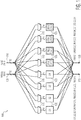
- FIG. 1 describes an embodiment of the MST.
- the MST100 has a write path 105 where a share of the key data is written to memory.
- the MST 100 also has a read path 110 where the share of the key data is read from memory.
- the MST 100 includes multiplexers 115 that select between the read path 105 and the write path 110. The output of the multiplexers 115 may then be input into S-boxes 120 and 125.
- the MST 100 is implemented such that the first four 4-bit nibbles are transformed using 4-bit S-boxes 120 (denoted as S1, S2, S3, S4), and the second four 4-bit nibbles are transformed using 4-bit inverse S-boxes 125 (denoted as INV(S1), INV(S2), INV(S3), INV(S4)).
- the outputs of the S-boxes 120 and 125 (S1, S2, S3, S4, INV(S1), INV(S2), INV(S3), INV(S4)) are then concatenated to produce the output of the MST 100.
- the input value is transformed using the MST 100 by inputting 4-bit nibbles into the S-boxes 120 and 125, and the result is stored in memory.
- the transformed data is processed by the inverse MST 100 which is constructed as concatenation of the outputs of S-boxes INV(S1), INV(S2), INV(S3), INV(S4), S1, S2, S3, S4 where the inputs are arranged so that the output of S-box S1 from the write operation is input to S-box INV(S1), ... , and the output of the S-box INV(S4) is input to S-box S4.
- the data when stored and read goes through an S-box transform followed by its inverse, or an inverse S-box transform followed by the S-box. In either case the data is restored to its original value.
- S 1 16 C , 8 , 5 , D , B , 2 , 7 , F , 3 , E , 4 , 0 , 9 , A , 1 , 6 ;
- S 2 16 3 , 4 , 6 , D , A , C , F , E , 5 , 1 , 7 , 9 , 2 , 0 , 8 , B ;
- S 3 16 B , 9 , 3 , 7 , 0 , D , A , F , 6 , 8 , 1 , E , 5 , C , 2 , 4 ;
- S 4 16 F , 7 , E , 8 , B , 0 , A , 4 , 6 , 2 , 5 , C , 9 , 3 , D , 1 ;
- InvS 1 16 B , E , 5 , 8 , B , 2 , 7 , F , 3 , E , 4 ,
- these S-boxes should have some properties to be used as MST. For example, in order to counter SEA the chosen S-boxes should not have a fixed point. While in order to, protect against DFA at least two bits of the S-box output have to change when a single bit of the input is changed. The same property should hold also for the inverse S-box. As a result, this makes it harder for an attacker to determine the value of the key share stored in memory.
- the MST gives additional protection against higher order side channel attacks when at least one share is altered using the MST.
- This will be illustrated by computing the Pearson correlation of univariate standardized central moments of 1 st, 2nd, 3rd and 4th order in the standard Hamming Weight Model (HWM).
- HWM Hamming Weight Model
- examples are given where a byte stored in two shares and in three shares where no transformation over the shares is performed, then different combinations of MST are applied to the shares, and the results are compared.
- the MST described above is used in the comparisons. It is noted that S1 and S2 are quadratic transformations, and S3 and S4 are cubic transformations.
- Table 1 below provides various examples for comparison.
- the table includes two columns. One for two shares and the other for three shares. Then the correlation values for shares store in plain and various combinations of applying the MST to the different shares are shown.
- S2) over 1 share p_q 0.000000 Using (S1
- S2) over 1 share p_q 0.000000 Using (S1
- S2) over 1 share p_q 0.000000 Using (S1
- S2) over 1 share p_q 0.000000 Using (S1
- the first row of Table 1 shows the calculated correlation values when the shares are stored in plain. When the shares are stored in plain, the number of shares where the correlation is zero against SCA match the security order, e.g., 1 st order for the 2 share variant or 2 nd order for the 3 share variant.
- the second row of Table 1 shows the calculated correlation values when (S1
- the third row of Table 1 shows the calculated correlation values when (S3
- the fourth row of Table 1 shows the calculated correlation values when (S1
- the fifth row of Table 1 shows the calculated correlation values when the MST is applied to all shares. The leads to the best result, i.e., one order higher security (i.e., the correlation coefficient become zero on the next higher order) and the correlation is 100 times smaller for higher orders.
- the MST provides stronger security against Differential Fault Analysis.
- the actual implementation differs from case to case, but its effectiveness on the well-known example of DFA against AES will now be demonstrated.
- FIGs. 2A-2D illustrate the propagation of a fault through state of AES at different steps of a round when MST is not applied
- FIG. 2A shows the state after the ShiftRows operation.
- An attacker attacks an AES implementation using DFA by targeting one byte of its state for fault injection after the ShiftRows operation in round 8, in particular byte s00.
- FIG. 2B shows the fault injection at byte s00.
- the operations that follow the injection of the fault which are MixColumns, AddRoundKey, SubBytes will cause the fault to propagate to bytes s00, s10, s20, and s30 as shown in FIG. 2C.
- FIG. 1 shows the state after the ShiftRows operation.
- An attacker attacks an AES implementation using DFA by targeting one byte of its state for fault injection after the ShiftRows operation in round 8, in particular byte s00.
- FIG. 2B shows the fault injection at byte s00.
- 2D shows the state after the ShiftRows step which results in four faulty bytes, in particular bytes s00, s13, s22, s31. Then after the AddRoundKey step the same four faulty bytes will be in the state resulting in a faulty cyphertext. This faulty ciphertext is then used to obtain the information about the last round key of AES, which then trivially yields the information about the whole AES secret key.
- s (s00, s10, s20, s30,s01, s11, s21, s31, s02, s12, s22, s32, s03, s13, s23, s33).
- the MST will ensure that changing at least one bit of s00' will cause at least one bit change in s00, s01, s02, and s03.
- FIGs 3A-3C illustrate the spreading of a fault across the whole AES state when the MST is applied to the AES state. It is noted that MST may be applied to contiguous bits of the share or non-contiguous bits of the share ( e.g., as described above)
- FIG. 3A illustrates a fault injected in by s00' of the AES state.
- FIG. 3C illustrates how the fault has now propagated throughout the whole AES state. This makes it very difficult for the attacker to obtain any information about the last round key as was possible before.
- the MST can be a transform known to the attacker and it can be a linear transformation. This knowledge will not help the attacker be successful.
- a linear MST is as good as non-linear one. The only difference comes when the MST is used as countermeasure against SCA, and in that case the MST must be non-linear since it is well known that linear one will not improve the resistance against some types of SCA.
- FIG. 4 illustrates a secure device 400 that implements the MST.
- the secure device 400 includes a memory 405, a memory controller 410, and a processor 415.
- the memory may include various types of memory 405 such as, for example L1, L2, or L3 cache or system memory.
- the memory 405 may include static random access memory (SRAM), dynamic RAM (DRAM), flash memory, read only memory (ROM), or other similar memory devices.
- SRAM static random access memory
- DRAM dynamic RAM
- ROM read only memory
- the memory 405 may also be secure memory that resists tampering or access by an attacker.
- the memory controller 410 controls access to the memory 405.
- the memory controller 405 may receive read and write requests from the processor 415.
- the memory controller 410 may implement share splitting of the data stored in the memory. Also, the memory controller 410 may apply the MST to the store data shares as described above.
- the memory controller 410 may be separate from the memory 405 and the processor 410, but may also be integrated with the memory 405 or the processor 410.
- the processor 415 may be any type of processor used to implement a cryptographic function.
- the processor 415 may be any hardware device capable of executing instructions stored in memory 405 or other storage (not shown) or otherwise processing data.
- the processor 415 may include a microprocessor, field programmable gate array (FPGA), application-specific integrated circuit (ASIC), or other similar devices.
- the processor 415 may also be a secure processor that resists tampering or access by an attacker. Further, the processor may be a specific hardware implementation of the cryptographic function.
- the memory controller 410 may have a first interface 420 for communicating with the memory 405 and for controlling the memory 405.
- the memory controller 410 may have a second interface 425 for communicating with the processor 405.
- the processor 415 When the processor 415 needs to store secure information in the memory 405, for example a cryptographic key, the information may be split into shares by either the processor 415 or the memory controller 410.
- the memory controller 410 (which may be implemented in or integrated with the processor 415) may then use the MST to modify the share(s) before they are stored in the memory 405. Then when the processor 415 seeks to read the secure information from the memory 405, the memory controller 410 reverses the MST before providing the secure data to the processor 415.
- either the memory controller 410 or the processor 415 may control the splitting/combining of the data into/from shares. If the splitting of the data and application of the MST to the data is completely implemented in the memory controller 410, then the secure storage of the data using shares and the MST is completely transparent to the processor 415.
- the MST may be applied to black box implementation where the secure device is not open to the attacker. This is the case where the device is implemented using only secure hardware or using software implemented on secure hardware, i.e., the memory 405, memory controller 410, and processor 415 are all secure implementations.
- the MST may also be applied in white-box implementations.
- a white-box implementation is an implementation of the cryptographic function using software, lookup tables, or finite state machines where the attacker can completely control the operation of the white-box implementation.
- Various techniques have been developed to add security to white-box implementations such as using code obfuscation and using look up table (LUT) implementations to hide cryptographic keys or other secret information.
- LUT look up table
- the MST may be used in these white-box implementations because a) the various side channel attacks described above have also been used to attack white-box (WB) implementation of cryptographic functions and b) Differential Computation Analysis (DCA) which is analog of SCA specifically designed against white-box implementations. Because WB implementations use LUTs to protect the computations, MST combined with LUT will increase the resistance of WB against the above mentioned 3 physical attacks + DCA.
- a method according to the embodiments of the invention may be implemented on a computer as a computer implemented method.
- Executable code for a method according to the invention may be stored on a computer program medium.
- Examples of computer program media include memory devices, optical storage devices, integrated circuits, servers, online software, etc.
- key delivery systems described herein may include a computer implementing a computer program. Such system, may also include other hardware elements including storage, network interface for transmission of data with external systems as well as among elements of the key delivery systems.
- the computer program may include computer program code adapted to perform all the steps of a method according to the invention when the computer program is run on a computer.
- the computer program is embodied on a non-transitory computer readable medium.
- a secure computing device including: a processor configured to carry out a secure operation; a memory in communication with the processer configured to store secure data; and a memory controller configured control storage of data in the memory and reading data from the memory, wherein the secure data is split into shares before being stored in the memory and wherein the memory controller is configured to: apply a masking storage transform (MST) to one of the shares to produce a masked share before storing the shares in the memory, wherein the MST is a permutation without a fixed point; apply an inverse MST to the masked share when reading the shares from the memory; and combine the read shares to reconstruct the secure data.
- MST masking storage transform
- non-transitory machine-readable storage medium will be understood to exclude a transitory propagation signal but to include all forms of volatile and nonvolatile memory.
- processor will be understood to encompass a variety of devices such as microprocessors, field-programmable gate arrays (FPGAs), application-specific integrated circuits (ASICs), and other similar processing devices. When software is implemented on the processor, the combination becomes a single specific machine.
Landscapes
- Engineering & Computer Science (AREA)
- Computer Security & Cryptography (AREA)
- Computer Networks & Wireless Communication (AREA)
- Signal Processing (AREA)
- Computer Hardware Design (AREA)
- Theoretical Computer Science (AREA)
- Software Systems (AREA)
- Physics & Mathematics (AREA)
- General Engineering & Computer Science (AREA)
- General Physics & Mathematics (AREA)
- Storage Device Security (AREA)
Abstract
Description
- Various exemplary embodiments disclosed herein relate generally to a masking storage transform that protects against safe error attacks, differential fault attacks, and higher-order side channel attacks.
- Safe error attacks (SEA) are one of the most powerful fault injection mechanisms used to gain the knowledge of secret data stored inside hardware. Its simplicity makes the attack very effective, the whole procedure can be summarized as follows.
- Assume the implementation of a block cipher is under attack. The implementation executes an encryption operation, producing the result c = ENC(p,k), where c is a ciphertext, p is a plaintext, and k is a secret key. Assume the secret key is stored in memory and the attacker has means to learn the physical location of the individual bits of the key. Assume further that the attacker is capable of forcing individual memory bits to zero (the same discussion holds for setting the bits to one). Next, the attacker runs an encryption and observes the result, i.e., ciphertext c. The attacker then locates the most significant bit of the secret key, denoted as k[MSB], forces this bit to zero, and observes the new result. If the result changes, the attacker learns that k[MSB] has been holding a value of logical one before the change. If the result stays unchanged, the attacker learns that the logical bit was zero before the fault attempt. In either case, only with a single trial, the attacker learns one bit of information about the secret key. The same procedure is then applied for all the other key bits until the whole key is revealed.
- A brief summary of various exemplary embodiments is presented below. Some simplifications and omissions may be made in the following summary, which is intended to highlight and introduce some aspects of the various exemplary embodiments, but not to limit the scope of the invention. Detailed descriptions of an exemplary embodiment adequate to allow those of ordinary skill in the art to make and use the inventive concepts will follow in later sections.
- Various exemplary embodiments relate to a secure computing device, including: a processor configured to carry out a secure operation; a memory in communication with the processer configured to store secure data; and a memory controller configured control storage of data in the memory and reading data from the memory, wherein the secure data is split into shares before being stored in the memory and wherein the memory controller is configured to: apply a masking storage transform (MST) to one of the shares to produce a masked share before storing the shares in the memory, wherein the MST is a permutation without a fixed point; apply an inverse MST to the masked share when reading the shares from the memory; and combine the read shares to reconstruct the secure data.
- Various embodiments are described wherein secure data is split into two shares and the MST is applied to the two shares.
- Various embodiments are described wherein secure data is split into three shares and the MST is applied to two shares.
- Various embodiments are described wherein the memory controller is integrated into the secure memory.
- Various embodiments are described wherein the memory controller is integrated into the secure processor.
- Various embodiments are described wherein applying the MST to one of the shares includes splitting the share into a plurality of portions and the applying substitution functions to the portions of the share to be masked.
- Various embodiments are described wherein applying the inverse MST to the masked shares includes applying the inverse substitution functions to the portions of the masked share.
- Various embodiments are described wherein the substitution functions are non-linear functions including quadratic and cubic transformations.
- Various embodiments are described wherein the MST is configured such that when a single bit of the masked share is changed then at least two bits of the reconstructed secure data are different from the secure data.
- Various embodiments are described wherein secure data is split into two shares and the MST is applied to one of the two shares and a different MST is applied to the other share.
- Further various exemplary embodiments relate to a method of storing secure data in a memory, including: splitting the secure data into a first share and a second share; applying a masking storage transform (MST) to the first share to produce at a first masked share, wherein the MST is a permutation without a fixed point; storing the first masked share and the second share in the memory; reading the first masked share and the second share from the memory; applying an inverse MST to the first masked share to produce an unmasked first share; and combining the unmasked first share and the second share to reconstruct the secure data.
- Various embodiments are described wherein the MST is also applied to the first share.
- Various embodiments are described wherein secure data is also split into a third share and the MST is applied to the first share and the third share.
- Various embodiments are described wherein applying the MST to the first share includes applying substitution functions to portions of the first share.
- Various embodiments are described wherein applying the inverse MST to the first masked share includes applying the inverse substitution functions to the portions of the first masked share.
- Various embodiments are described wherein the substitution functions are non-linear functions including one of a quadratic transformation and a cubic transformation.
- Various embodiments are described wherein a different MST is also applied to the second share to produce a second masked share that replaces the second masked share and wherein an inverse of the different MST is applied to the second masked share to reproduce the second share.
- Various embodiments are described wherein the secure operation is part of a white-box operation implementation, wherein the MST is combined with a lookup table (LUT) resulting in a single LUT.
- Various embodiments are described wherein the MST is configured such that when a single bit of the masked share is changed then at least two bits of the reconstructed secure data are different from the secure data.
- Further various exemplary embodiments relate to a non-transitory machine-readable storage medium encoded with instructions for storing secure data in a memory, including: instructions for splitting the secure data into a first share and a second share; instructions for applying a masking storage transform (MST) to the first shares to produce a first masked share, wherein the MST is a permutation without a fixed point; instructions for storing the first masked share and the second share in the memory; instructions for reading the first masked share and the second share from the memory; instructions for applying an inverse MST to the first masked share to produce an unmasked first share; instructions for combining the unmasked first share and the second share to reconstruct the secure data.
- Various embodiments are described wherein the MST is configured such that when a single bit of the masked share is changed then at least two bits of the reconstructed secure data are different from the secure data.
- In order to better understand various exemplary embodiments, reference is made to the accompanying drawings, wherein:
-
FIG. 1 describes an embodiment of the MST; -
FIGs. 2A-2D illustrate the propagation of a fault through state of AES at different steps of a round when a MST is not applied; -
FIG. 3A illustrates a fault injected in by s00' of the AES state with applied MST protection; -
FIG. 3B illustrates the AES state after the application of the inverse MST; -
FIG. 3C illustrates how the fault has propagated throughout the whole AES state after the MixColumns operation; and -
FIG. 4 illustrates a secure device that implements the MST. - To facilitate understanding, identical reference numerals have been used to designate elements having substantially the same or similar structure and/or substantially the same or similar function.
- The description and drawings illustrate the principles of the invention. It will thus be appreciated that those skilled in the art will be able to devise various arrangements that, although not explicitly described or shown herein, embody the principles of the invention and are included within its scope. Furthermore, all examples recited herein are principally intended expressly to be for pedagogical purposes to aid the reader in understanding the principles of the invention and the concepts contributed by the inventor(s) to furthering the art, and are to be construed as being without limitation to such specifically recited examples and conditions. Additionally, the term, "or," as used herein, refers to a non-exclusive or (i.e., and/or), unless otherwise indicated (e.g., "or else" or "or in the alternative"). Also, the various embodiments described herein are not necessarily mutually exclusive, as some embodiments can be combined with one or more other embodiments to form new embodiments.
- There are several known mechanisms which decrease probability of successful SEA over physical implementation. Masking the secret value is one of them. Assume the key is masked (i.e., shared across two or more shares) such that k = mk ⊕ m, where mk is a masked key value and m is a mask. To mount a successful SEA, the attacker now needs to locate both mk[MSB] and m[MSB] and force them to zero. Similar to the case described above, depending on the outcome (the result has changed or not), the attacker will learn the plain value of the key bit k[MSB]. There are other countermeasures such as Error Detection Codes and Error Correction Codes if they are applied along with masking; and also physical memory shuffling, which all increase the complexity of mounting a successful SEA.
- Differential fault attacks (DFA) are a type of fault injection attack in which the attacker aims at injecting faults which may help in cryptanalyzing the erroneous output.
- Finally, the higher order side channel attacks (SCA) assume that the attacker can combine the information of multiple shares in order to successfully retrieve the information about the plain value. To achieve this, the attacker typically collects many power traces and then uses statistical methods like higher orders of univariate standardized central moments to distinguish the correct key byte guess against the incorrect guesses.
- Embodiments of a Masking Storage Transform (MST) are described below. The MST protects data at rest (i.e. when data is stored) against the three types of physical attacks described above (DFA, SEA and SCA). It is noted that the efficiency of the MST is much higher than any of the previously mentioned countermeasures, considering both the level of protection it offers as well as the implementation costs. What is particularly interesting about MST is that the whole scheme may remain public without compromising its protection level.
- The MST will now be described. Assume a secret key k is to be stored in memory in two shares: one share being a masked key value mk, and another share being its mask m. Before storing the actual values, one of the key shares is processed using a function denoted as MST. Hence, the value that finally gets stored in memory is mk unaltered and m' = MST(m). Assume m is divided into words of fixed size, for simplicity here of 4 bits, denoted by m_i, then one way to apply MST is m_i' = MST(m_i). However MST may be also applied by first forming from each four m_i four words n_j of same size by taking j-th bit from m_i and then obtaining n_j' = MST(n_j). In order to provide protection MST should possess special properties. The MST may be a permutation (bijection) without a fixed point (i.e., meaning there is no input m for which the output will be m again). Alternatively or in addition, the MST may be a permutation such that any single bit change of m' causes multiple bit changes in m when m is calculated using the inverse MST on the altered m'. The MST may satisfy when one changes a single bit of m, then multiple bits of m' changes as well. The MST may be a linear transform, but a non-linear transform provides even stronger protection especially against SCA. In the embodiment described below, one possible practical realization of MST is illustrated. When the value of m' is read from memory, the inverse function is then applied first to obtain the plain value of m, i.e., m = MST-1(m') and then the data is processed as intended.
- Note that the provided description can be naturally extended and applied to a case where two but different MSTs are applied simultaneously to each of the shares and to data having more than two shares.
- To mount a Safe Error Attack, the attacker needs to force a single bit of mk as before, but then he needs to control multiple bits of m' in order to affect a single bit of m. In addition, the attacker has no knowledge of the content of m' (the data is in shared form, hence its shares appear purely random) and is therefore not able to deduce which bits need to be affected such that the corresponding bits of both m and mk are affected. Note that the MST may be a transform known to the attacker and may also be linear. Finally, any single bit force of m' will affect multiple bits of m, so the attacker will not be able to learn the actual logical plain value of k.
- An embodiment of the MST will now be described. Assume the secret value to be protected is split in two shares (masked value and its mask) and stored in two different register banks. For simplicity, assume further that the register bank we apply the protection to has a 32-bit read/write interface. In order to protect against the Safe Error Attacks, a MST is applied to one of the shares.
FIG. 1 describes an embodiment of the MST. - The MST100 has a
write path 105 where a share of the key data is written to memory. TheMST 100 also has a readpath 110 where the share of the key data is read from memory. TheMST 100 includesmultiplexers 115 that select between the readpath 105 and thewrite path 110. The output of themultiplexers 115 may then be input into S-boxes MST 100 is implemented such that the first four 4-bit nibbles are transformed using 4-bit S-boxes 120 (denoted as S1, S2, S3, S4), and the second four 4-bit nibbles are transformed using 4-bit inverse S-boxes 125 (denoted as INV(S1), INV(S2), INV(S3), INV(S4)). The outputs of the S-boxes 120 and 125 (S1, S2, S3, S4, INV(S1), INV(S2), INV(S3), INV(S4)) are then concatenated to produce the output of theMST 100. During the writing cycle, the input value is transformed using theMST 100 by inputting 4-bit nibbles into the S-boxes inverse MST 100 which is constructed as concatenation of the outputs of S-boxes INV(S1), INV(S2), INV(S3), INV(S4), S1, S2, S3, S4 where the inputs are arranged so that the output of S-box S1 from the write operation is input to S-box INV(S1), ... , and the output of the S-box INV(S4) is input to S-box S4. As a result the data when stored and read goes through an S-box transform followed by its inverse, or an inverse S-box transform followed by the S-box. In either case the data is restored to its original value. As an example one can use the following S-boxes defined for the PRINCE family of ciphers:


- It is noted that these S-boxes should have some properties to be used as MST. For example, in order to counter SEA the chosen S-boxes should not have a fixed point. While in order to, protect against DFA at least two bits of the S-box output have to change when a single bit of the input is changed. The same property should hold also for the inverse S-box. As a result, this makes it harder for an attacker to determine the value of the key share stored in memory.
- It is also noted that instead of using INV(S1), INV(S2), INV(S3), INV(S4) for the last four S-boxes, four other completely different S-boxes may be used that have the properties described above. Then the read path would implement the inverse of each of the eight S-boxes. The implementation described above allows for using the same basic structure for both the read and write path.
- It will now be shown that the MST gives additional protection against higher order side channel attacks when at least one share is altered using the MST. This will be illustrated by computing the Pearson correlation of univariate standardized central moments of 1 st, 2nd, 3rd and 4th order in the standard Hamming Weight Model (HWM). Thus, the correlation of the plain (unshared) value p with the stored shared value q (or its powers) is computed using HWM. For that purpose, examples are given where a byte stored in two shares and in three shares where no transformation over the shares is performed, then different combinations of MST are applied to the shares, and the results are compared. The MST described above is used in the comparisons. It is noted that S1 and S2 are quadratic transformations, and S3 and S4 are cubic transformations.
- Table 1 below provides various examples for comparison. The table includes two columns. One for two shares and the other for three shares. Then the correlation values for shares store in plain and various combinations of applying the MST to the different shares are shown.
Table 1 2 shares 3 shares Shares storage Correlation value Shares storage Correlation value shares stored in plain p_q = 0.000000 shares stored in plain p_q = 0.000000 p_q^2 = -0.043561 p_q^2 = 0.000000 p_q^3 = -0.079289 p_q^3 = 0.001858 p_q^4 = -0.107326 p_q^4 = 0.004975 Using (S1 | | S2) over 1 share p_q = 0.000000 Using (S1 | | S2) over 1 share p_q = 0.000000 p_q^2 = -0.005445 p_q^2 = 0.000000 p_q^3 = -0.009601 p_q^3 = 0.000232 p_q^4 = -0.012920 p_q^4 = 0.000609 Using (S3 | | S4) over 1 share p_q = 0.000000 Using (S3 | | S4) over 1 share p_q = 0.000000 p_q^2 = 0.013613 p_q^2 = 0.000000 p_q^3 = 0.023539 p_q^3 = -0.000581 p_q^4 = 0.030318 p_q^4 = -0.001503 Using (S1 | | S2) over 2nd share p_q = 0.000000 p_q^2 = 0.000000 Using (S3 | | S4) over 3rd share p_q^3 = -0.000174 p_q^4 = -0.000466 Using (InvS1 | | InvS2) over 1st share p_q = 0.000000 Using (InvS1 | | InvS2) over 1st share p_q = 0.000000 p_q^2 = 0.000000 p_q^2 = 0.000000 p_q^3 = 0.000929 p_q^3 = 0.000000 Using (S1 | | S2) over 2nd share p_q^4 = 0.001883 Using (S1 | | S2) over 2nd share p_q^4 = 0.000016 Using (S3 | | S4) over 3rd share - The first row of Table 1 shows the calculated correlation values when the shares are stored in plain. When the shares are stored in plain, the number of shares where the correlation is zero against SCA match the security order, e.g., 1st order for the 2 share variant or 2nd order for the 3 share variant. The second row of Table 1 shows the calculated correlation values when (S1 | | S2) is used in the MST. Using (S1 | | S2) in MST results in 10 times smaller correlation for the higher orders. The third row of Table 1 shows the calculated correlation values when (S3 | | S4) is used in the MST. Using (S3 | | S4) in the MST results only in 3 times smaller correlation for the higher orders. This is expected because (S1 | | S2) are quadratic while (S3 | | S4) are cubic transformations, and it is well known that a higher algebraic degree of a transform results in a higher leakage against SCA. The fourth row of Table 1 shows the calculated correlation values when (S1 | | S2) is used for the first share, and (S3 | | S4) is used for the second share when applying the MST. When one applies the MST to 2 out of the 3 shares we observe even 20 times smaller correlation. The fifth row of Table 1 shows the calculated correlation values when the MST is applied to all shares. The leads to the best result, i.e., one order higher security (i.e., the correlation coefficient become zero on the next higher order) and the correlation is 100 times smaller for higher orders.
- If applied to both shares mk and m, the MST provides stronger security against Differential Fault Analysis. The actual implementation differs from case to case, but its effectiveness on the well-known example of DFA against AES will now be demonstrated.
-
FIGs. 2A-2D illustrate the propagation of a fault through state of AES at different steps of a round when MST is not appliedFIG. 2A shows the state after the ShiftRows operation. An attacker attacks an AES implementation using DFA by targeting one byte of its state for fault injection after the ShiftRows operation in round 8, in particular byte s00.FIG. 2B shows the fault injection at byte s00. The operations that follow the injection of the fault, which are MixColumns, AddRoundKey, SubBytes will cause the fault to propagate to bytes s00, s10, s20, and s30 as shown inFIG. 2C. FIG. 2D shows the state after the ShiftRows step which results in four faulty bytes, in particular bytes s00, s13, s22, s31. Then after the AddRoundKey step the same four faulty bytes will be in the state resulting in a faulty cyphertext. This faulty ciphertext is then used to obtain the information about the last round key of AES, which then trivially yields the information about the whole AES secret key. - Assume now that the AES state is split into two shares and that the MST has been applied to protect one share of a masked AES state s, which is defined as s = (s00, s10, s20, s30,s01, s11, s21, s31, s02, s12, s22, s32, s03, s13, s23, s33). In other words, assume that s' = MST(s) = (s00', s10' s20', s30', s01', s11', s21' s31', s02', s12' s22', s32', s03', s13', s23', s33'). To make sure the injected error is later spread to all the bytes of the AES state, and hence to prevent the attack, the MST will ensure that changing at least one bit of s00' will cause at least one bit change in s00, s01, s02, and s03. This can be achieved for example if the MST is not applied separately to s00, s01, s02 and s03 but instead the MST is applied to the first bit of each byte s00, s01, s02 and s03 and similarly applying the MST over the 2nd, 3rd and 4th bits. If this property is satisfied, injecting a fault on s00' will quickly spread on all the bytes of the AES state after the following MixColumns operation.
FIGs 3A-3C illustrate the spreading of a fault across the whole AES state when the MST is applied to the AES state. It is noted that MST may be applied to contiguous bits of the share or non-contiguous bits of the share (e.g., as described above) -
FIG. 3A illustrates a fault injected in by s00' of the AES state.FIG. 3B illustrates the AES state after the application of the inverse MST, which is illustrated with a dashed matrix because its value does not actually get stored in any register. Instead, this value of the AES state is only present on the read path when the data is inverted with MST-1 such that the MixColumns operation can be properly applied to s = (s00, s10, s20, s30, s01, s11, s21, s31, s02, s12, s22, s32, s03, s13, s23, s33) = MST-1(s').FIG. 3C illustrates how the fault has now propagated throughout the whole AES state. This makes it very difficult for the attacker to obtain any information about the last round key as was possible before. - It is noted that the MST can be a transform known to the attacker and it can be a linear transformation. This knowledge will not help the attacker be successful. As countermeasure against DFA and SEA, a linear MST is as good as non-linear one. The only difference comes when the MST is used as countermeasure against SCA, and in that case the MST must be non-linear since it is well known that linear one will not improve the resistance against some types of SCA.
-
FIG. 4 illustrates asecure device 400 that implements the MST. Thesecure device 400 includes amemory 405, amemory controller 410, and aprocessor 415. The memory may include various types ofmemory 405 such as, for example L1, L2, or L3 cache or system memory. As such, thememory 405 may include static random access memory (SRAM), dynamic RAM (DRAM), flash memory, read only memory (ROM), or other similar memory devices. Thememory 405 may also be secure memory that resists tampering or access by an attacker. - The
memory controller 410 controls access to thememory 405. Thememory controller 405 may receive read and write requests from theprocessor 415. Thememory controller 410 may implement share splitting of the data stored in the memory. Also, thememory controller 410 may apply the MST to the store data shares as described above. Thememory controller 410 may be separate from thememory 405 and theprocessor 410, but may also be integrated with thememory 405 or theprocessor 410. - The
processor 415 may be any type of processor used to implement a cryptographic function. Theprocessor 415 may be any hardware device capable of executing instructions stored inmemory 405 or other storage (not shown) or otherwise processing data. As such, theprocessor 415 may include a microprocessor, field programmable gate array (FPGA), application-specific integrated circuit (ASIC), or other similar devices. Theprocessor 415 may also be a secure processor that resists tampering or access by an attacker. Further, the processor may be a specific hardware implementation of the cryptographic function. - The
memory controller 410 may have afirst interface 420 for communicating with thememory 405 and for controlling thememory 405. Thememory controller 410 may have asecond interface 425 for communicating with theprocessor 405. - When the
processor 415 needs to store secure information in thememory 405, for example a cryptographic key, the information may be split into shares by either theprocessor 415 or thememory controller 410. The memory controller 410 (which may be implemented in or integrated with the processor 415) may then use the MST to modify the share(s) before they are stored in thememory 405. Then when theprocessor 415 seeks to read the secure information from thememory 405, thememory controller 410 reverses the MST before providing the secure data to theprocessor 415. As noted above, either thememory controller 410 or theprocessor 415 may control the splitting/combining of the data into/from shares. If the splitting of the data and application of the MST to the data is completely implemented in thememory controller 410, then the secure storage of the data using shares and the MST is completely transparent to theprocessor 415. - The MST may be applied to black box implementation where the secure device is not open to the attacker. This is the case where the device is implemented using only secure hardware or using software implemented on secure hardware, i.e., the
memory 405,memory controller 410, andprocessor 415 are all secure implementations. - The MST may also be applied in white-box implementations. A white-box implementation is an implementation of the cryptographic function using software, lookup tables, or finite state machines where the attacker can completely control the operation of the white-box implementation. Various techniques have been developed to add security to white-box implementations such as using code obfuscation and using look up table (LUT) implementations to hide cryptographic keys or other secret information. The MST may be used in these white-box implementations because a) the various side channel attacks described above have also been used to attack white-box (WB) implementation of cryptographic functions and b) Differential Computation Analysis (DCA) which is analog of SCA specifically designed against white-box implementations. Because WB implementations use LUTs to protect the computations, MST combined with LUT will increase the resistance of WB against the above mentioned 3 physical attacks + DCA.
- Physical attacks are serious threat against any implementation, and it is very difficult and costly to provide adequate defense against them. In particular Safe Error Attacks are one the most powerful fault injection mechanisms, and the embodiments described above circumvent this attack. In addition, the MST provides stronger protection against Differential Fault Attacks as well as against higher order Side Channel Attacks.
- A method according to the embodiments of the invention may be implemented on a computer as a computer implemented method. Executable code for a method according to the invention may be stored on a computer program medium. Examples of computer program media include memory devices, optical storage devices, integrated circuits, servers, online software, etc. Accordingly, key delivery systems described herein may include a computer implementing a computer program. Such system, may also include other hardware elements including storage, network interface for transmission of data with external systems as well as among elements of the key delivery systems.
- In an embodiment of the invention, the computer program may include computer program code adapted to perform all the steps of a method according to the invention when the computer program is run on a computer. Preferably, the computer program is embodied on a non-transitory computer readable medium.
- Any combination of specific software running on a processor to implement the embodiments of the invention, constitute a specific dedicated machine.
- A secure computing device is described, including: a processor configured to carry out a secure operation; a memory in communication with the processer configured to store secure data; and a memory controller configured control storage of data in the memory and reading data from the memory, wherein the secure data is split into shares before being stored in the memory and wherein the memory controller is configured to: apply a masking storage transform (MST) to one of the shares to produce a masked share before storing the shares in the memory, wherein the MST is a permutation without a fixed point; apply an inverse MST to the masked share when reading the shares from the memory; and combine the read shares to reconstruct the secure data.
- As used herein, the term "non-transitory machine-readable storage medium" will be understood to exclude a transitory propagation signal but to include all forms of volatile and nonvolatile memory. Further, as used herein, the term "processor" will be understood to encompass a variety of devices such as microprocessors, field-programmable gate arrays (FPGAs), application-specific integrated circuits (ASICs), and other similar processing devices. When software is implemented on the processor, the combination becomes a single specific machine.
- It should be appreciated by those skilled in the art that any block diagrams herein represent conceptual views of illustrative circuitry embodying the principles of the invention.
- Although the various exemplary embodiments have been described in detail with particular reference to certain exemplary aspects thereof, it should be understood that the invention is capable of other embodiments and its details are capable of modifications in various obvious respects. As is readily apparent to those skilled in the art, variations and modifications can be effected while remaining within the spirit and scope of the invention. Accordingly, the foregoing disclosure, description, and figures are for illustrative purposes only and do not in any way limit the invention, which is defined only by the claims.
Claims (15)
- A secure computing device, comprising:a processor configured to carry out a secure operation;a memory in communication with the processer configured to store secure data; anda memory controller configured control storage of data in the memory and reading data from the memory, wherein the secure data is split into shares before being stored in the memory and wherein the memory controller is configured to:apply a masking storage transform (MST) to one of the shares to produce a masked share before storing the shares in the memory, wherein the MST is a permutation without a fixed point;apply an inverse MST to the masked share when reading the shares from the memory; andcombine the read shares to reconstruct the secure data.
- The secure device of claim 1, wherein secure data is split into two shares and the MST is applied to the two shares.
- The secure device of claim 1 or 2, wherein secure data is split into three shares and the MST is applied to two shares.
- The secure device of any preceding claim, wherein the memory controller is integrated into the secure memory.
- The secure device of any preceding claim, wherein the memory controller is integrated into the secure processor.
- The secure device of any preceding claim, wherein applying the MST to one of the shares includes splitting the share into a plurality of portions and applying substitution functions to the portions of the share to be masked.
- The secure device of any claim 6, wherein applying the inverse MST to the masked shares includes applying the inverse substitution functions to the portions of the masked share.
- The secure device of claim 6 or 7, wherein the substitution functions are non-linear functions including quadratic and cubic transformations.
- The secure device of any preceding claim, wherein the MST is configured such that when a single bit of the masked share is changed then at least two bits of the reconstructed secure data are different from the secure data.
- The secure device of any preceding claim, wherein secure data is split into two shares and the MST is applied to one of the two shares and a different MST is applied to the other share.
- A method of storing secure data in a memory, comprising:splitting the secure data into a first share and a second share;applying a masking storage transform (MST) to the first share to produce at a first masked share, wherein the MST is a permutation without a fixed point;storing the first masked share and the second share in the memory;reading the first masked share and the second share from the memory;applying an inverse MST to the first masked share to produce an unmasked first share; andcombining the unmasked first share and the second share to reconstruct the secure data.
- The method of claim 11, wherein the MST is also applied to the first share.
- The method of claim 11 or 12, wherein secure data is also split into a third share and the MST is applied to the first share and the third share.
- The method of any of claims 11 to 13, wherein applying the MST to the first share includes applying substitution functions to portions of the first share.
- The method of any of claims 11 to 14, wherein applying the inverse MST to the first masked share includes applying the inverse substitution functions to the portions of the first masked share.
Applications Claiming Priority (1)
| Application Number | Priority Date | Filing Date | Title |
|---|---|---|---|
| US15/433,556 US10680798B2 (en) | 2017-02-15 | 2017-02-15 | Masking storage transfer to protect against attacks |
Publications (2)
| Publication Number | Publication Date |
|---|---|
| EP3364593A1 true EP3364593A1 (en) | 2018-08-22 |
| EP3364593B1 EP3364593B1 (en) | 2022-01-19 |
Family
ID=61167878
Family Applications (1)
| Application Number | Title | Priority Date | Filing Date |
|---|---|---|---|
| EP18154211.9A Active EP3364593B1 (en) | 2017-02-15 | 2018-01-30 | Masking storage transfer to protect against attacks |
Country Status (2)
| Country | Link |
|---|---|
| US (1) | US10680798B2 (en) |
| EP (1) | EP3364593B1 (en) |
Families Citing this family (3)
| Publication number | Priority date | Publication date | Assignee | Title |
|---|---|---|---|---|
| US10601793B2 (en) * | 2016-03-11 | 2020-03-24 | Pss, Llc | Systems and methods for securing electronic data with embedded security engines |
| DE102018107114A1 (en) * | 2018-03-26 | 2019-09-26 | Infineon Technologies Ag | Side channel hardened operation |
| US12160506B2 (en) * | 2019-11-28 | 2024-12-03 | Nec Corporation | Shuffling shares among nodes to detect incorrectness or frauds |
Citations (4)
| Publication number | Priority date | Publication date | Assignee | Title |
|---|---|---|---|---|
| US20090094251A1 (en) * | 2007-10-09 | 2009-04-09 | Gladwin S Christopher | Virtualized data storage vaults on a dispersed data storage network |
| US20100268877A1 (en) * | 2009-04-20 | 2010-10-21 | Cleversafe, Inc. | Securing data in a dispersed storage network using shared secret slices |
| US20140074719A1 (en) * | 2011-01-18 | 2014-03-13 | Fortress Gb Ltd. | System and method for computerized negotiations based on coded integrity |
| US9411524B2 (en) * | 2010-05-28 | 2016-08-09 | Security First Corp. | Accelerator system for use with secure data storage |
Family Cites Families (6)
| Publication number | Priority date | Publication date | Assignee | Title |
|---|---|---|---|---|
| US6278783B1 (en) * | 1998-06-03 | 2001-08-21 | Cryptography Research, Inc. | Des and other cryptographic, processes with leak minimization for smartcards and other cryptosystems |
| US8266438B2 (en) * | 2004-10-25 | 2012-09-11 | Security First Corp. | Secure data parser method and system |
| US8661263B2 (en) * | 2006-09-29 | 2014-02-25 | Protegrity Corporation | Meta-complete data storage |
| EP2553904A2 (en) * | 2010-03-31 | 2013-02-06 | Rick L. Orsini | Systems and methods for securing data in motion |
| US8861727B2 (en) * | 2010-05-19 | 2014-10-14 | Cleversafe, Inc. | Storage of sensitive data in a dispersed storage network |
| CN107547193A (en) * | 2016-06-28 | 2018-01-05 | 埃沙尔公司 | Make replacement operation from the method for side Multiple Channel Analysis |
-
2017
- 2017-02-15 US US15/433,556 patent/US10680798B2/en active Active
-
2018
- 2018-01-30 EP EP18154211.9A patent/EP3364593B1/en active Active
Patent Citations (4)
| Publication number | Priority date | Publication date | Assignee | Title |
|---|---|---|---|---|
| US20090094251A1 (en) * | 2007-10-09 | 2009-04-09 | Gladwin S Christopher | Virtualized data storage vaults on a dispersed data storage network |
| US20100268877A1 (en) * | 2009-04-20 | 2010-10-21 | Cleversafe, Inc. | Securing data in a dispersed storage network using shared secret slices |
| US9411524B2 (en) * | 2010-05-28 | 2016-08-09 | Security First Corp. | Accelerator system for use with secure data storage |
| US20140074719A1 (en) * | 2011-01-18 | 2014-03-13 | Fortress Gb Ltd. | System and method for computerized negotiations based on coded integrity |
Also Published As
| Publication number | Publication date |
|---|---|
| US20180234233A1 (en) | 2018-08-16 |
| EP3364593B1 (en) | 2022-01-19 |
| US10680798B2 (en) | 2020-06-09 |
Similar Documents
| Publication | Publication Date | Title |
|---|---|---|
| US11362802B2 (en) | Cryptographic device arranged to compute a target block cipher | |
| US8553877B2 (en) | Substitution table masking for cryptographic processes | |
| EP3469762B1 (en) | Device and method to compute a block cipher | |
| Ramezanpour et al. | A statistical fault analysis methodology for the ascon authenticated cipher | |
| US20150222423A1 (en) | Protection against side channels | |
| US11700111B2 (en) | Platform neutral data encryption standard (DES) cryptographic operation | |
| Sasdrich et al. | White-Box Cryptography in the Gray Box: –A Hardware Implementation and its Side Channels– | |
| Pan et al. | One fault is all it needs: Breaking higher-order masking with persistent fault analysis | |
| US20200097256A1 (en) | A calculation device for encoded addition | |
| CN109726565B (en) | Using white-box in leak-resistant primitives | |
| EP3364593B1 (en) | Masking storage transfer to protect against attacks | |
| Kermani et al. | Lightweight hardware architectures for fault diagnosis schemes of efficiently-maskable cryptographic substitution boxes | |
| US10461922B2 (en) | Method and system for protecting a cryptographic operation | |
| CN113014377B (en) | Persistent fault attack protection method and device by utilizing bijection characteristic of block cipher S box | |
| AlTawy et al. | Fault analysis of Kuznyechik | |
| Tezcan et al. | Differential attacks on lightweight block ciphers PRESENT, PRIDE, and RECTANGLE revisited | |
| Dassance et al. | Combined attacks on the AES key schedule | |
| Boscher et al. | Masking does not protect against differential fault attacks | |
| Liao et al. | A high-efficient fault attack on AES S-box | |
| US11070358B2 (en) | Computation device and method | |
| Tang et al. | Power analysis attacks against FPGA implementation of KLEIN | |
| Das et al. | Security analysis of ASCON cipher under persistent faults | |
| US20260005834A1 (en) | Redundancy aes masking basis for attack mitigation using lookup tables | |
| Rivain | Differential fault analysis of DES | |
| Won et al. | Novel Leakage Against Realistic Masking and Shuffling Countermeasures: Case Study on PRINCE and SEED |
Legal Events
| Date | Code | Title | Description |
|---|---|---|---|
| PUAI | Public reference made under article 153(3) epc to a published international application that has entered the european phase |
Free format text: ORIGINAL CODE: 0009012 |
|
| STAA | Information on the status of an ep patent application or granted ep patent |
Free format text: STATUS: THE APPLICATION HAS BEEN PUBLISHED |
|
| AK | Designated contracting states |
Kind code of ref document: A1 Designated state(s): AL AT BE BG CH CY CZ DE DK EE ES FI FR GB GR HR HU IE IS IT LI LT LU LV MC MK MT NL NO PL PT RO RS SE SI SK SM TR |
|
| AX | Request for extension of the european patent |
Extension state: BA ME |
|
| STAA | Information on the status of an ep patent application or granted ep patent |
Free format text: STATUS: REQUEST FOR EXAMINATION WAS MADE |
|
| 17P | Request for examination filed |
Effective date: 20190222 |
|
| RBV | Designated contracting states (corrected) |
Designated state(s): AL AT BE BG CH CY CZ DE DK EE ES FI FR GB GR HR HU IE IS IT LI LT LU LV MC MK MT NL NO PL PT RO RS SE SI SK SM TR |
|
| STAA | Information on the status of an ep patent application or granted ep patent |
Free format text: STATUS: EXAMINATION IS IN PROGRESS |
|
| 17Q | First examination report despatched |
Effective date: 20190712 |
|
| GRAP | Despatch of communication of intention to grant a patent |
Free format text: ORIGINAL CODE: EPIDOSNIGR1 |
|
| STAA | Information on the status of an ep patent application or granted ep patent |
Free format text: STATUS: GRANT OF PATENT IS INTENDED |
|
| INTG | Intention to grant announced |
Effective date: 20210916 |
|
| GRAS | Grant fee paid |
Free format text: ORIGINAL CODE: EPIDOSNIGR3 |
|
| GRAA | (expected) grant |
Free format text: ORIGINAL CODE: 0009210 |
|
| STAA | Information on the status of an ep patent application or granted ep patent |
Free format text: STATUS: THE PATENT HAS BEEN GRANTED |
|
| AK | Designated contracting states |
Kind code of ref document: B1 Designated state(s): AL AT BE BG CH CY CZ DE DK EE ES FI FR GB GR HR HU IE IS IT LI LT LU LV MC MK MT NL NO PL PT RO RS SE SI SK SM TR |
|
| REG | Reference to a national code |
Ref country code: GB Ref legal event code: FG4D |
|
| REG | Reference to a national code |
Ref country code: CH Ref legal event code: EP |
|
| REG | Reference to a national code |
Ref country code: DE Ref legal event code: R096 Ref document number: 602018029683 Country of ref document: DE |
|
| REG | Reference to a national code |
Ref country code: AT Ref legal event code: REF Ref document number: 1464402 Country of ref document: AT Kind code of ref document: T Effective date: 20220215 |
|
| REG | Reference to a national code |
Ref country code: IE Ref legal event code: FG4D |
|
| REG | Reference to a national code |
Ref country code: LT Ref legal event code: MG9D |
|
| REG | Reference to a national code |
Ref country code: NL Ref legal event code: MP Effective date: 20220119 |
|
| REG | Reference to a national code |
Ref country code: AT Ref legal event code: MK05 Ref document number: 1464402 Country of ref document: AT Kind code of ref document: T Effective date: 20220119 |
|
| PG25 | Lapsed in a contracting state [announced via postgrant information from national office to epo] |
Ref country code: NL Free format text: LAPSE BECAUSE OF FAILURE TO SUBMIT A TRANSLATION OF THE DESCRIPTION OR TO PAY THE FEE WITHIN THE PRESCRIBED TIME-LIMIT Effective date: 20220119 |
|
| PG25 | Lapsed in a contracting state [announced via postgrant information from national office to epo] |
Ref country code: SE Free format text: LAPSE BECAUSE OF FAILURE TO SUBMIT A TRANSLATION OF THE DESCRIPTION OR TO PAY THE FEE WITHIN THE PRESCRIBED TIME-LIMIT Effective date: 20220119 Ref country code: RS Free format text: LAPSE BECAUSE OF FAILURE TO SUBMIT A TRANSLATION OF THE DESCRIPTION OR TO PAY THE FEE WITHIN THE PRESCRIBED TIME-LIMIT Effective date: 20220119 Ref country code: PT Free format text: LAPSE BECAUSE OF FAILURE TO SUBMIT A TRANSLATION OF THE DESCRIPTION OR TO PAY THE FEE WITHIN THE PRESCRIBED TIME-LIMIT Effective date: 20220519 Ref country code: NO Free format text: LAPSE BECAUSE OF FAILURE TO SUBMIT A TRANSLATION OF THE DESCRIPTION OR TO PAY THE FEE WITHIN THE PRESCRIBED TIME-LIMIT Effective date: 20220419 Ref country code: LT Free format text: LAPSE BECAUSE OF FAILURE TO SUBMIT A TRANSLATION OF THE DESCRIPTION OR TO PAY THE FEE WITHIN THE PRESCRIBED TIME-LIMIT Effective date: 20220119 Ref country code: HR Free format text: LAPSE BECAUSE OF FAILURE TO SUBMIT A TRANSLATION OF THE DESCRIPTION OR TO PAY THE FEE WITHIN THE PRESCRIBED TIME-LIMIT Effective date: 20220119 Ref country code: ES Free format text: LAPSE BECAUSE OF FAILURE TO SUBMIT A TRANSLATION OF THE DESCRIPTION OR TO PAY THE FEE WITHIN THE PRESCRIBED TIME-LIMIT Effective date: 20220119 Ref country code: BG Free format text: LAPSE BECAUSE OF FAILURE TO SUBMIT A TRANSLATION OF THE DESCRIPTION OR TO PAY THE FEE WITHIN THE PRESCRIBED TIME-LIMIT Effective date: 20220419 |
|
| PG25 | Lapsed in a contracting state [announced via postgrant information from national office to epo] |
Ref country code: PL Free format text: LAPSE BECAUSE OF FAILURE TO SUBMIT A TRANSLATION OF THE DESCRIPTION OR TO PAY THE FEE WITHIN THE PRESCRIBED TIME-LIMIT Effective date: 20220119 Ref country code: LV Free format text: LAPSE BECAUSE OF FAILURE TO SUBMIT A TRANSLATION OF THE DESCRIPTION OR TO PAY THE FEE WITHIN THE PRESCRIBED TIME-LIMIT Effective date: 20220119 Ref country code: GR Free format text: LAPSE BECAUSE OF FAILURE TO SUBMIT A TRANSLATION OF THE DESCRIPTION OR TO PAY THE FEE WITHIN THE PRESCRIBED TIME-LIMIT Effective date: 20220420 Ref country code: FI Free format text: LAPSE BECAUSE OF FAILURE TO SUBMIT A TRANSLATION OF THE DESCRIPTION OR TO PAY THE FEE WITHIN THE PRESCRIBED TIME-LIMIT Effective date: 20220119 Ref country code: AT Free format text: LAPSE BECAUSE OF FAILURE TO SUBMIT A TRANSLATION OF THE DESCRIPTION OR TO PAY THE FEE WITHIN THE PRESCRIBED TIME-LIMIT Effective date: 20220119 |
|
| REG | Reference to a national code |
Ref country code: CH Ref legal event code: PL |
|
| PG25 | Lapsed in a contracting state [announced via postgrant information from national office to epo] |
Ref country code: IS Free format text: LAPSE BECAUSE OF FAILURE TO SUBMIT A TRANSLATION OF THE DESCRIPTION OR TO PAY THE FEE WITHIN THE PRESCRIBED TIME-LIMIT Effective date: 20220519 |
|
| REG | Reference to a national code |
Ref country code: BE Ref legal event code: MM Effective date: 20220131 |
|
| REG | Reference to a national code |
Ref country code: DE Ref legal event code: R097 Ref document number: 602018029683 Country of ref document: DE |
|
| PG25 | Lapsed in a contracting state [announced via postgrant information from national office to epo] |
Ref country code: SM Free format text: LAPSE BECAUSE OF FAILURE TO SUBMIT A TRANSLATION OF THE DESCRIPTION OR TO PAY THE FEE WITHIN THE PRESCRIBED TIME-LIMIT Effective date: 20220119 Ref country code: SK Free format text: LAPSE BECAUSE OF FAILURE TO SUBMIT A TRANSLATION OF THE DESCRIPTION OR TO PAY THE FEE WITHIN THE PRESCRIBED TIME-LIMIT Effective date: 20220119 Ref country code: RO Free format text: LAPSE BECAUSE OF FAILURE TO SUBMIT A TRANSLATION OF THE DESCRIPTION OR TO PAY THE FEE WITHIN THE PRESCRIBED TIME-LIMIT Effective date: 20220119 Ref country code: LU Free format text: LAPSE BECAUSE OF NON-PAYMENT OF DUE FEES Effective date: 20220130 Ref country code: EE Free format text: LAPSE BECAUSE OF FAILURE TO SUBMIT A TRANSLATION OF THE DESCRIPTION OR TO PAY THE FEE WITHIN THE PRESCRIBED TIME-LIMIT Effective date: 20220119 Ref country code: DK Free format text: LAPSE BECAUSE OF FAILURE TO SUBMIT A TRANSLATION OF THE DESCRIPTION OR TO PAY THE FEE WITHIN THE PRESCRIBED TIME-LIMIT Effective date: 20220119 Ref country code: CZ Free format text: LAPSE BECAUSE OF FAILURE TO SUBMIT A TRANSLATION OF THE DESCRIPTION OR TO PAY THE FEE WITHIN THE PRESCRIBED TIME-LIMIT Effective date: 20220119 |
|
| PLBE | No opposition filed within time limit |
Free format text: ORIGINAL CODE: 0009261 |
|
| STAA | Information on the status of an ep patent application or granted ep patent |
Free format text: STATUS: NO OPPOSITION FILED WITHIN TIME LIMIT |
|
| PG25 | Lapsed in a contracting state [announced via postgrant information from national office to epo] |
Ref country code: BE Free format text: LAPSE BECAUSE OF NON-PAYMENT OF DUE FEES Effective date: 20220131 Ref country code: AL Free format text: LAPSE BECAUSE OF FAILURE TO SUBMIT A TRANSLATION OF THE DESCRIPTION OR TO PAY THE FEE WITHIN THE PRESCRIBED TIME-LIMIT Effective date: 20220119 |
|
| 26N | No opposition filed |
Effective date: 20221020 |
|
| GBPC | Gb: european patent ceased through non-payment of renewal fee |
Effective date: 20220419 |
|
| PG25 | Lapsed in a contracting state [announced via postgrant information from national office to epo] |
Ref country code: LI Free format text: LAPSE BECAUSE OF NON-PAYMENT OF DUE FEES Effective date: 20220131 Ref country code: CH Free format text: LAPSE BECAUSE OF NON-PAYMENT OF DUE FEES Effective date: 20220131 |
|
| PG25 | Lapsed in a contracting state [announced via postgrant information from national office to epo] |
Ref country code: IE Free format text: LAPSE BECAUSE OF NON-PAYMENT OF DUE FEES Effective date: 20220130 Ref country code: GB Free format text: LAPSE BECAUSE OF NON-PAYMENT OF DUE FEES Effective date: 20220419 |
|
| PG25 | Lapsed in a contracting state [announced via postgrant information from national office to epo] |
Ref country code: SI Free format text: LAPSE BECAUSE OF FAILURE TO SUBMIT A TRANSLATION OF THE DESCRIPTION OR TO PAY THE FEE WITHIN THE PRESCRIBED TIME-LIMIT Effective date: 20220119 |
|
| PG25 | Lapsed in a contracting state [announced via postgrant information from national office to epo] |
Ref country code: IT Free format text: LAPSE BECAUSE OF FAILURE TO SUBMIT A TRANSLATION OF THE DESCRIPTION OR TO PAY THE FEE WITHIN THE PRESCRIBED TIME-LIMIT Effective date: 20220119 |
|
| P01 | Opt-out of the competence of the unified patent court (upc) registered |
Effective date: 20230725 |
|
| PG25 | Lapsed in a contracting state [announced via postgrant information from national office to epo] |
Ref country code: HU Free format text: LAPSE BECAUSE OF FAILURE TO SUBMIT A TRANSLATION OF THE DESCRIPTION OR TO PAY THE FEE WITHIN THE PRESCRIBED TIME-LIMIT; INVALID AB INITIO Effective date: 20180130 |
|
| PG25 | Lapsed in a contracting state [announced via postgrant information from national office to epo] |
Ref country code: MK Free format text: LAPSE BECAUSE OF FAILURE TO SUBMIT A TRANSLATION OF THE DESCRIPTION OR TO PAY THE FEE WITHIN THE PRESCRIBED TIME-LIMIT Effective date: 20220119 Ref country code: CY Free format text: LAPSE BECAUSE OF FAILURE TO SUBMIT A TRANSLATION OF THE DESCRIPTION OR TO PAY THE FEE WITHIN THE PRESCRIBED TIME-LIMIT Effective date: 20220119 |
|
| PG25 | Lapsed in a contracting state [announced via postgrant information from national office to epo] |
Ref country code: MC Free format text: LAPSE BECAUSE OF FAILURE TO SUBMIT A TRANSLATION OF THE DESCRIPTION OR TO PAY THE FEE WITHIN THE PRESCRIBED TIME-LIMIT Effective date: 20220321 |
|
| PG25 | Lapsed in a contracting state [announced via postgrant information from national office to epo] |
Ref country code: TR Free format text: LAPSE BECAUSE OF FAILURE TO SUBMIT A TRANSLATION OF THE DESCRIPTION OR TO PAY THE FEE WITHIN THE PRESCRIBED TIME-LIMIT Effective date: 20220119 Ref country code: MC Free format text: LAPSE BECAUSE OF FAILURE TO SUBMIT A TRANSLATION OF THE DESCRIPTION OR TO PAY THE FEE WITHIN THE PRESCRIBED TIME-LIMIT Effective date: 20220321 |
|
| PG25 | Lapsed in a contracting state [announced via postgrant information from national office to epo] |
Ref country code: MT Free format text: LAPSE BECAUSE OF FAILURE TO SUBMIT A TRANSLATION OF THE DESCRIPTION OR TO PAY THE FEE WITHIN THE PRESCRIBED TIME-LIMIT Effective date: 20220119 |
|
| PGFP | Annual fee paid to national office [announced via postgrant information from national office to epo] |
Ref country code: FR Payment date: 20251217 Year of fee payment: 9 |
|
| PGFP | Annual fee paid to national office [announced via postgrant information from national office to epo] |
Ref country code: DE Payment date: 20251217 Year of fee payment: 9 |