EP3364337A2 - Persistent feature descriptors for video - Google Patents
Persistent feature descriptors for video Download PDFInfo
- Publication number
- EP3364337A2 EP3364337A2 EP18153243.3A EP18153243A EP3364337A2 EP 3364337 A2 EP3364337 A2 EP 3364337A2 EP 18153243 A EP18153243 A EP 18153243A EP 3364337 A2 EP3364337 A2 EP 3364337A2
- Authority
- EP
- European Patent Office
- Prior art keywords
- descriptor
- descriptors
- feature
- video
- key picture
- Prior art date
- Legal status (The legal status is an assumption and is not a legal conclusion. Google has not performed a legal analysis and makes no representation as to the accuracy of the status listed.)
- Granted
Links
Images


Classifications
-
- G—PHYSICS
- G06—COMPUTING OR CALCULATING; COUNTING
- G06T—IMAGE DATA PROCESSING OR GENERATION, IN GENERAL
- G06T7/00—Image analysis
- G06T7/20—Analysis of motion
- G06T7/246—Analysis of motion using feature-based methods, e.g. the tracking of corners or segments
-
- G—PHYSICS
- G06—COMPUTING OR CALCULATING; COUNTING
- G06V—IMAGE OR VIDEO RECOGNITION OR UNDERSTANDING
- G06V10/00—Arrangements for image or video recognition or understanding
- G06V10/40—Extraction of image or video features
- G06V10/46—Descriptors for shape, contour or point-related descriptors, e.g. scale invariant feature transform [SIFT] or bags of words [BoW]; Salient regional features
- G06V10/462—Salient features, e.g. scale invariant feature transforms [SIFT]
-
- G—PHYSICS
- G06—COMPUTING OR CALCULATING; COUNTING
- G06V—IMAGE OR VIDEO RECOGNITION OR UNDERSTANDING
- G06V10/00—Arrangements for image or video recognition or understanding
- G06V10/70—Arrangements for image or video recognition or understanding using pattern recognition or machine learning
- G06V10/77—Processing image or video features in feature spaces; using data integration or data reduction, e.g. principal component analysis [PCA] or independent component analysis [ICA] or self-organising maps [SOM]; Blind source separation
- G06V10/771—Feature selection, e.g. selecting representative features from a multi-dimensional feature space
-
- G—PHYSICS
- G06—COMPUTING OR CALCULATING; COUNTING
- G06V—IMAGE OR VIDEO RECOGNITION OR UNDERSTANDING
- G06V20/00—Scenes; Scene-specific elements
- G06V20/40—Scenes; Scene-specific elements in video content
- G06V20/41—Higher-level, semantic clustering, classification or understanding of video scenes, e.g. detection, labelling or Markovian modelling of sport events or news items
-
- G—PHYSICS
- G06—COMPUTING OR CALCULATING; COUNTING
- G06V—IMAGE OR VIDEO RECOGNITION OR UNDERSTANDING
- G06V20/00—Scenes; Scene-specific elements
- G06V20/40—Scenes; Scene-specific elements in video content
- G06V20/46—Extracting features or characteristics from the video content, e.g. video fingerprints, representative shots or key frames
-
- G—PHYSICS
- G06—COMPUTING OR CALCULATING; COUNTING
- G06V—IMAGE OR VIDEO RECOGNITION OR UNDERSTANDING
- G06V20/00—Scenes; Scene-specific elements
- G06V20/40—Scenes; Scene-specific elements in video content
- G06V20/48—Matching video sequences
-
- G—PHYSICS
- G06—COMPUTING OR CALCULATING; COUNTING
- G06V—IMAGE OR VIDEO RECOGNITION OR UNDERSTANDING
- G06V20/00—Scenes; Scene-specific elements
- G06V20/40—Scenes; Scene-specific elements in video content
- G06V20/49—Segmenting video sequences, i.e. computational techniques such as parsing or cutting the sequence, low-level clustering or determining units such as shots or scenes
-
- H—ELECTRICITY
- H04—ELECTRIC COMMUNICATION TECHNIQUE
- H04N—PICTORIAL COMMUNICATION, e.g. TELEVISION
- H04N21/00—Selective content distribution, e.g. interactive television or video on demand [VOD]
- H04N21/80—Generation or processing of content or additional data by content creator independently of the distribution process; Content per se
- H04N21/83—Generation or processing of protective or descriptive data associated with content; Content structuring
- H04N21/845—Structuring of content, e.g. decomposing content into time segments
- H04N21/8456—Structuring of content, e.g. decomposing content into time segments by decomposing the content in the time domain, e.g. in time segments
-
- G—PHYSICS
- G06—COMPUTING OR CALCULATING; COUNTING
- G06T—IMAGE DATA PROCESSING OR GENERATION, IN GENERAL
- G06T2207/00—Indexing scheme for image analysis or image enhancement
- G06T2207/10—Image acquisition modality
- G06T2207/10016—Video; Image sequence
-
- G—PHYSICS
- G06—COMPUTING OR CALCULATING; COUNTING
- G06T—IMAGE DATA PROCESSING OR GENERATION, IN GENERAL
- G06T2207/00—Indexing scheme for image analysis or image enhancement
- G06T2207/30—Subject of image; Context of image processing
- G06T2207/30248—Vehicle exterior or interior
- G06T2207/30252—Vehicle exterior; Vicinity of vehicle
- G06T2207/30256—Lane; Road marking
Definitions
- the present application generally relates to feature descriptors for video, such as may be used in object recognition or analysis and, in particular, methods and systems for extracting and identifying persistent feature descriptors.
- Feature detection and extraction was developed for image processing to identify objects (features) within an image. This may be useful as a part of computer vision, image search, object recognition, and other such image-analysis systems.
- the act of feature detection involves identifying points or areas of potential interest in an image (e.g. edges, corners, etc.), often using gradient analysis.
- the act of feature extraction involves generating a multi-dimensional vector representation of a small patch of the image containing the feature of interest. The resulting output of feature extraction is a feature descriptor.
- Feature descriptors are then used, for example, in object recognition or image matching processes.
- the set of feature descriptors from an image may be stored in a query database containing sets of feature descriptors for a large number of images. This can enable such functions such as facial recognition, for example.
- MPEG Motion Picture Experts Group
- CDVA Compact Descriptors for Video Analysis
- the present application describes methods and devices for extracting feature descriptors from a video.
- the methods and devices rely on temporal redundancy to identify "persistent descriptors", where a persistent descriptor is a feature descriptor of a feature that appears in multiple consecutive frames.
- a persistent descriptor is a feature descriptor of a feature that appears in multiple consecutive frames.
- Such a feature may be identified by determining that extracted feature descriptors from multiple consecutive frames are a sufficient match to each other that they likely relate to the same feature.
- Motion consistency checks may be used to ensure that persistent descriptors are consistent with the motion of the objects in the video.
- persistent descriptors may be identified by matching extracted descriptors for two keyframes relating to a segment of video, where the keyframes are pictures at either end of the segment.
- the present application describes a method of extracting feature descriptors for a video, in a video feature descriptor extractor, the video including a sequence of pictures.
- the method includes identifying a first key picture and a second key picture later in the sequence than the first key picture; extracting a first set of feature descriptors from the first key picture and a second set of feature descriptors from the second key picture; identifying a set of pairs of feature descriptors, where each pair includes one descriptor from the first set and one descriptor from the second set; generating motion information describing the motion field between the first key picture and the second key picture; and filtering the set of pairs of feature descriptors based on correlation with the motion information to produce and output a subset of persistent descriptors.
- the present application describes a video feature extractor configured to implement such methods of video feature descriptor extraction.
- the present application describes non-transitory computer-readable media storing computer-executable program instructions which, when executed, cause one or more processors to perform the described methods of video feature descriptor extraction.
- some example embodiments may make reference to various feature extraction processes, i.e. algorithms for detecting and/or representing a localized feature in an image.
- a common example of such processes include the Scale-Invariant Feature Transform (SIFT).
- Other examples include Speeded-Up Robust Features (SURF), Gradient Location and Orientation Histogram (GLOH), Local Energy-based Shape Histogram (LESH), Histogram of Oriented Gradients (HOG).
- SURF Speeded-Up Robust Features
- GLOH Gradient Location and Orientation Histogram
- LESH Local Energy-based Shape Histogram
- HOG Histogram of Oriented Gradients
- a feature extractor or feature extraction process produces a feature descriptor, which is a multi-dimensional representation of the image data around a certain local feature.
- Determining which features to extract or describe by way of feature descriptors may rely on any one or more of a number of feature detection processes or algorithms.
- Example feature detection processes include edge detection, corner detection (sometime termed "interest” detection), blob detection, ridge detection, or other algorithms designed to identify areas of potential interest in an image that may be significance in recognizing a particular object in that image. Many such algorithms may use gradient analysis to identify points or areas of potential interest or significance.
- feature extraction that is analyzing an image or picture to extract one or more feature descriptors, it is not intended to refer only to extraction (determining the descriptor) and may include feature detection as a part of the extraction process.
- a SIFT descriptor for example, is a region around a detected potential point of interest.
- the region is divided into sixteen rectangles from which 16 histograms of the orientation and magnitude of the gradients inside each rectangle are constructed.
- the descriptor is then formed as the concatenation of those sixteen histograms in a prescribed scan order of the rectangles.
- Figure 8 shows an example of a picture 800 and a portion of an example SIFT descriptor extracted from that picture 800.
- a feature is identified and the region around it is divided into sixteen rectangles b1, b2, ..., b16.
- a portion of the concatenated histograms (specifically, the example histograms for b1 and b2) is illustrated.
- a picture or frame may contain one or more slices or segments.
- a consecutive series of frames/pictures may be called a "sequence" in some cases.
- Other terms may be used in other video implementations.
- the phrase "at least one of ... or" is intended to cover any one or more of the listed elements, including any one of the listed elements alone, any sub-combination, or all of the elements, without necessarily excluding any additional elements, and without necessarily requiring all of the elements.
- Feature detection and extraction was developed for image processing to identify objects (features) within an image. This may be useful as a part of computer vision, image search, object recognition, and other such image-analysis systems.
- the act of feature detection involves identifying points or areas of potential interest in an image (e.g. edges, corners, etc.), often using gradient analysis.
- the act of feature extraction involves generating a multi-dimensional vector representation of a small patch of the image containing the feature of interest. The resulting output of feature extraction is a feature descriptor.
- SIFT is one example of a feature extractor.
- SIFT uses the following steps:
- SIFT Given an image as input, SIFT might generate a large number of key descriptors. For example, hundreds of key descriptors may be extracted from an image of size 384x512 (196,608 pixels).
- the set of feature descriptors from an image may be stored in a query database containing set of feature descriptors for a large number of images.
- a new image may undergo feature extraction and a query system may attempt to find a match for those features in the query database by comparing the newly extracted feature descriptors from the new image to the stored sets of feature descriptors in the database. This can enable such functions as facial recognition, for example.
- MPEG intends to standardize the descriptors for video as Compact Descriptors for Video Analysis (CDVA).
- CDVA Compact Descriptors for Video Analysis
- MPEG is exploring tools for video processing and analysis with the goal of reducing "the data amount for the resulting video descriptors transmission or storage” and achieving "interoperability of implementations, applications and databases".
- descriptors for a video sequence are extracted in a picture by picture (or frame by frame) manner, and then compressed. That is, each picture in the video sequence is treated as a single image from which descriptors are located and extracted by using methods similar to SIFT. Inter-picture correlation is used in compression of descriptors after they are extracted from individual pictures.
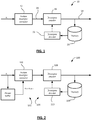
- FIG. 1 shows, in block diagram form, an example of a CDVA system 10.
- the CDVA system 10 uses SIFT-like feature descriptor extractor 12 and treat the video as a series of video frames or pictures.
- the output from the feature descriptor extractor 12 is a set of descriptors 14 for each frame/picture.
- Each set of descriptors is then, in this example, encoded by a descriptor encoder 16 to produce a bitstream of compact descriptors 18, which may then be stored in a database or other memory 20.
- the system 10 may include a feedback loop in the encoding process to improve the compression of the descriptors through predictive coding.
- the system 10 includes a descriptor decoder 22 that decodes the compact descriptors of previous pictures in the sequence.
- the dashed line indicates that it is optional to use descriptors from previous picture x i -1 in coding of descriptors extracted from the current picture x i .
- coding of descriptors may be lossy and involve quantization in some examples.
- the present application proposes methods and systems aimed at improving the discriminative accuracy of feature descriptors for video and potentially reducing the quantity of such feature descriptors in characterizing a video sequence. To this end, the present application proposes to exploit the temporal nature of video in the feature extraction process in order to identify and extract more robust and discriminative feature descriptors.
- a persistent feature descriptor (also termed “persistent descriptor” herein) is one which persists through two or more consecutive pictures in a video sequence. That is, a sequence of descriptors from successive video frames are collectively called a persistent descriptor for these video frames if the descriptors in the sequence match each other ( i.e. they are within a prescribed distance of each other).
- the persistent feature descriptors may further be tested against the motion field of the image and those that deviate from the motion field may be excluded as persistent descriptors. Experimental results on typical CDVA test video sequences show that a substantial portion of descriptors extracted from a video sequence are persistent.
- FIG. 2 shows, in block diagram form, one example of a video feature extractor 100 for producing a set of persistent descriptors characterizing a video sequence.
- the video feature extractor 100 includes an extraction component 101 and an encoding component 105.
- the extractor 100 may exclude the encoding component 105 and may simply output unencoded sets of descriptors for storage, locally or remotely, or for generating one or more queries.
- the encoding component 105 includes a descriptor encoder 106, a local storage or memory 108, and a descriptor decoder 110.
- the feedback loop containing the descriptor decoder 110 enables the encoding process to encode the descriptors predictively. That is the descriptor encoder 106 may encode current descriptors from a current image, based on decoded descriptors from an earlier image in the sequence. Note that this predictive coding operation relates to exploiting the temporal nature of the video pictures so as to improve the coding and compression of the descriptors themselves after they have been identified and extracted.
- the extraction component 101 includes a descriptor extractor 102 and a picture buffer 104.
- the picture buffer 104 makes multiple pictures available to the descriptor extractor 102, thereby enabling the descriptor extractor 102 to perform descriptor matching across multiple successive pictures so as to identify persistent descriptors.
- a direct method of finding persistent descriptors in a video sequence is implemented by the descriptor extractor 102:
- This two-step method represents a simple and accurate approach to obtaining a set of persistent descriptors for a given video sequence. It locates and identifies descriptors based on spatiotemporal features and relevance to the content; however, it is computationally expensive. The complexity comes as a result of the need to process every frame independently to extract all feature descriptors and to search through the extracted descriptors for matches.
- the sequence is first analyzed to identify keyframes.
- the sequence may be divided into segments exhibiting high frame correlation among the frames of the segment.
- the keyframes may be the first and last of the pictures in the segment.
- the keyframes are the first of the pictures in a segment, such that for any one segment, the keyframes for that segment are its first picture and the first picture from the next segment in the sequence.
- High frame correlation suggests that two frames could produce a set that encompasses the majority of the persistent descriptors. This has been shown experimentally to be true.
- this solution extracts descriptors from two frames in a segment (referred to as the keyframes), not all of them.
- the search for persistent descriptors may then be carried out between the descriptors of these two keyframes.
- the search may employ both geometric and motion information in some embodiments.
- the terms "keyframes", “key frames” and "key pictures” are used interchangeably herein.
- Persistent descriptors are usually detected on different objects in the scene, some of which are moving and others are stationary. Descriptor-tracking experiments have shown that, in both cases, persistent descriptors exhibit the same motion field as that of their objects, e.g., if a descriptor is detected on a stationary object appearing in few consecutive frames, it will not exhibit any location change throughout these frames. Such motion compliance helps detect and preserve descriptors pertaining to salient objects - salient objects are those existing in multiple frames and conveying the main information of the scene.
- Figure 9 illustrates an example of a persistent descriptor.
- Figure 9 features two pictures: a first picture 902 and a second picture 904.
- the first picture 902 and the second picture 904 are consecutive pictures in the video.
- the first picture 902 may be a first keyframe and the second picture may be a second keyframe 904 for a given segment of the video.
- the identified feature and its regions in the two respective pictures 902, 904 are shown below the pictures.
- the beginning portion of the feature descriptors e.g. SIFT
- Descriptor 1 and Descriptor 2 The beginning portion of the feature descriptors (e.g. SIFT) extracted from the respective pictures 902, 904 is shown as Descriptor 1 and Descriptor 2.
- Descriptor 2 is matched (paired) to Descriptor 1 on the basis of its similarity to Descriptor 1 (non-identical, but within a certain Euclidean distance).
- the pairing of the two descriptors as relating to the same feature may be tested for consistency with the motion field to validate the pairing.
- the process of feature extraction implemented by the feature extractor 102 may be given by:
- Step S1 the selection of x k 1 and x k 2 might depend upon motion information to make sure motion field is not interrupted between the selected pair of keyframes.
- S1 might include scene change detection to select keyframes.
- motion information from x k 1 to x k 2 may be generated by using traditional block-based motion estimation methods typically used in video coding, where a picture is partitioned into blocks and a motion vector is identified for each block.
- optic flow algorithms may be used to determine motion information to be used in S4.
- a motion field is a 2D vector field for describing the motion of objects in a video sequence or segment.
- the motion field may be determined or estimated using an optical flow algorithm in some cases.
- the set of persistent descriptors output by the video feature extractor 100 may be used in a query system.
- FIG 3 shows, in block diagram form, one example embodiment of a query system 200 for recognition in video.
- the system 200 includes a video database 202 containing sets of persistent feature descriptors for a number of video segments.
- the system 200 may be for determining whether a video segment has a match in the database 202; that is, whether there is a video segment that shows the same features. This can be used for object recognition in some implementations.
- the system 200 includes a query processor 204 that receives the query data, which in this case includes the persistent descriptors for the video segment that is the subject of the query.
- the system 200 may include a decoder 206 if the persistent descriptors are encoded.
- the query processor 204 compares the received (and decoded, if need be) persistent descriptors that form the query with persistent descriptors in the database to determine whether there is a sufficiently close match to declare a match between to two video segments.
- the process of comparing may include identifying pairs of persistent descriptors between the query segment and the database segment, determining Euclidean distance between paired descriptors, and assessing whether the differences between persistent descriptors is lower than a threshold level. That threshold level may be set based on the degree of concordance demanded by a particular application.
- each element in a global descriptor for a picture may indicate the number of local descriptors from the picture that are quantized to a member in a known set of descriptors, i.e. a vocabulary.
- the global descriptor is constructed as a histogram of the local descriptors given a vocabulary.
- the global descriptor is formed using difference vectors obtained from every local descriptor and its match in the vocabulary set. The global descriptor is the final matrix reshaped to a long vector.
- the benefit of having global descriptors for pictures is to allow a two-stage process in searching for a match in a large database, where simpler, shorter global descriptors are used exclusively in the first stage and local descriptors are used only if a match is found in the first stage.
- a global descriptor for a picture may be extended to a global descriptor for a video segment. For example, given a vocabulary for a video segment, a histogram of the persistent descriptors in the segment may be constructed and used as the global descriptor for the video segment. Correspondingly, the following process may be used to search for a match:
- FIG. 4 shows, in block diagram form, one example embodiment of a video feature extractor 300.
- This example embodiment relies on SIFT-based feature identification and extraction and optical flow-based motion estimation, but it will be appreciated that other implementations may use other feature extraction techniques and other motion estimation techniques.
- the example video feature extractor 300 receives the video sequence as an input.
- a segmentation process 302 divides the video sequence into segments and identifies keyframes within each segment.
- a feature extractor such as a SIFT extractor 304, then identifies features in the keyframes and extracts their descriptors.
- a matching process 306 is used to pair feature descriptors from the two keyframes of a segment.
- a motion estimation process 308 determines the motion field between the two keyframes identified by the segmentation process 302. The motion field is then used to evaluate the pairs of feature descriptors for consistency with the motion field in a motion-consistency check process 310.
- the motion-consistency check process 310 filters the set of pairs of feature descriptors generated by the matching process 306 to output a subset of pairs of feature descriptors that is consistent with the motion field of the segment.
- the output subset of feature descriptors may then be stored in memory such as a local database or other data structure, or, as indicated in this example, may be encoded by a descriptor encoder 312 to produce an encoded bitstream of feature descriptors for the video.
- FIG. 5 shows, in flowchart form, one example process 400 of extracting feature descriptors for a video.
- the video sequence is first divided into segments, as indicated by operation 402.
- scene change detection and other such analysis may be used to partition the sequence into segments.
- the segments each contain a predetermined number of pictures/frames per segment.
- keyframes are identified for each segment.
- the keyframes (or "key pictures") are the first frame/picture of the segment and the last frame/picture of the segment.
- the keyframes for a segment are the first frame/picture of the segment and the first frame/picture of the next segment in the sequence (the consecutive segment).
- the two keyframes of a segment may be designated KF 1 and KF 2 respectively, in the following description.
- features descriptors are extracted from the keyframes.
- the extraction process may include SIFT or any other such image feature descriptor extracting process.
- pairs of matching descriptors are found.
- the system finds whether a matching descriptor appears in the second keyframe.
- the matching may include testing descriptors in the second keyframe to determine whether there is a descriptor in that keyframe within a particular search window and that is sufficiently similar to the descriptor in the first keyframe. Similarity, in the case of a descriptor that is a multi-dimensional vector, may be measured in terms of Euclidean distance, in some cases.
- pairs of descriptors are found by, for each descriptor extracted from the first keyframe, identifying a descriptor from the second key frame based on a minimizing Euclidean distance between them.
- a ratio test is applied to determine if a match exists.
- the ratio test may involve:
- sensitivity of the determination of whether there is a match may be adjusted by adjusting the ratio outcome that is designated as a match.
- a matching descriptor is identified if the ratio is ⁇ 0.8, but other preset maximums may be used, such as 0.6 or 0.7, depending on how selective the system is intended to be in identifying matches.
- the maximum ratio may be selected through empirical testing in some cases.
- the example matching process in which a matching descriptor in the second keyframe is sought for every descriptor in the first keyframe results in the possibility that more than one descriptor in the first keyframe may be matched to the same descriptor in the second keyframe, as indicated by operation 410.
- the system determines the best match involving the same descriptor from the second keyframe and discards the other pairings.
- the best match may be evaluated in a number of ways. In one example, the quality of each of the matches is determined and the best of them is kept.
- the best match may rely on a comparison of Euclidean differences between the descriptors of the first keyframe and the descriptor in the second keyframe.
- the descriptor from KF 1 that has the highest score ⁇ with the descriptor from KF 2 is declared as the best match.
- unique pairs of descriptors are generated, i.e ., a descriptor from KF 2 matches only one descriptor from KF 1 .
- a geometric consistency test may be applied to validate the pairs of descriptors. Those that do not pass the geometric consistency test are eliminated from the set of pairs of descriptors for the segment.
- x i and y i are the coordinates of the i th matching pair in S initial matches
- x j and y j are the coordinates of the j th matching pair in the same set S initial_matches
- a histogram of the values in the matrix Z may be constructed and checked against a known-outlier probability distribution using, for example, Pearson's goodness-of-fit test.
- the system may determine the motion field from the first keyframe to the second keyframe and may evaluate each pair in the set of pairs of descriptors for consistency with the determined motion field. Pairs that are too inconsistent with the motion field are discarded, resulting in a subset of pairs of descriptors that may be designated as the persistent descriptors for that segment of the video. That subset of persistent descriptors, in particular the first descriptor in each pair, is then output in operation 418. It will be appreciated that it is the descriptors of the first keyframe that are output as the persistent descriptors for a particular segment.
- Figure 6 shows, in flowchart form, one example implementation of operation 416 relating to motion-consistency testing.
- motion-consistency testing involves assessing whether individual pairs of descriptors generally conform (in terms of their relative locations in the frames) to the motion field between the frames.
- the system uses an optical flow algorithm to determine the motion field of the segment, as indicated by operation 416-1.
- An optical flow algorithm is described in B. D. Lucas and T. Kanade, "An Iterative Image Registration Technique with an Application to Stereo Vision," in International Joint Conference on Artificial Intelligence, 1981 , but other such algorithms may be used.
- the system starts with a descriptor in the first keyframe and uses the motion field to pinpoint an estimated location for that feature location in the second keyframe.
- a search window is established around that estimated location in the second keyframe, as indicated by operation 416-3.
- the system determines whether the matching descriptor from the pair falls inside of the search window. If so, then it generally conforms to the motion field. If not, then it deviates too far from the motion field and, in operation 416-5, it is discarded. This may be thought of as filtering the set of pairs of descriptors to remove those that are too inconsistent with the motion field.
- the operation is performed for each pair of descriptors identified for the segment.
- An embodiment of the presently-described solution achieves good TPR and FNR without imposing any restrictions on the average descriptor lengths per second at the output of the video feature extractor (no upper bound on the output bit rate).
- the experiments were implemented with the assumption that the approximate persistent set is perfectly recoverable at the decoder, i.e., a lossless encoding scheme is used.
- the recorded TPR and FPR were 99% and less than 1%, respectively, in testing.
- the encoder 500 includes a processor 502, memory 504, and a video feature descriptor extraction application 506.
- the application 506 may include a computer program or application stored in memory 504 and containing instructions that, when executed, cause the processor 502 to perform operations such as those described herein. For example, the application 506 may identify and extract sets of persistent feature descriptors in accordance with the processes described herein. In some implementations, the application 506 may encode the sets of persistent feature descriptors and output them as an encoded bitstream.
- the application 506 may be stored in on a non-transitory computer-readable medium, such as a compact disc, flash memory device, random access memory, hard drive, etc.
- the processor 502 carries out the operations and functions specified in the instructions so as to operate as a special-purpose processor that implements the described process(es).
- a processor may be referred to as a "processor circuit” or “processor circuitry” in some examples.
- the video feature extractor may be implemented in a number of computing devices, including, without limitation, servers, suitably-programmed general purpose computers, audio/video encoding devices, and mobile devices.
- the video feature extractor may be implemented by way of software containing instructions for configuring a processor or processors to carry out the functions described herein.
- the software instructions may be stored on any suitable non-transitory computer-readable memory, including CDs, RAM, ROM, Flash memory, etc.
- video feature extractor described herein and the module, routine, process, thread, or other software component implementing the described method/process for configuring the video feature extractor may be realized using standard computer programming techniques and languages.
- the present application is not limited to particular processors, computer languages, computer programming conventions, data structures, other such implementation details.
- Those skilled in the art will recognize that the described processes may be implemented as a part of computer-executable code stored in volatile or non-volatile memory, as part of an application-specific integrated chip (ASIC), etc.
- ASIC application-specific integrated chip
Landscapes
- Engineering & Computer Science (AREA)
- Theoretical Computer Science (AREA)
- Multimedia (AREA)
- General Physics & Mathematics (AREA)
- Physics & Mathematics (AREA)
- Computer Vision & Pattern Recognition (AREA)
- Software Systems (AREA)
- Computing Systems (AREA)
- Computational Linguistics (AREA)
- Medical Informatics (AREA)
- General Health & Medical Sciences (AREA)
- Evolutionary Computation (AREA)
- Databases & Information Systems (AREA)
- Artificial Intelligence (AREA)
- Health & Medical Sciences (AREA)
- Signal Processing (AREA)
- Image Analysis (AREA)
- Information Retrieval, Db Structures And Fs Structures Therefor (AREA)
Abstract
Description
- The present application generally relates to feature descriptors for video, such as may be used in object recognition or analysis and, in particular, methods and systems for extracting and identifying persistent feature descriptors.
- Feature detection and extraction was developed for image processing to identify objects (features) within an image. This may be useful as a part of computer vision, image search, object recognition, and other such image-analysis systems. The act of feature detection involves identifying points or areas of potential interest in an image (e.g. edges, corners, etc.), often using gradient analysis. The act of feature extraction involves generating a multi-dimensional vector representation of a small patch of the image containing the feature of interest. The resulting output of feature extraction is a feature descriptor.
- Feature descriptors are then used, for example, in object recognition or image matching processes. For instance, the set of feature descriptors from an image may be stored in a query database containing sets of feature descriptors for a large number of images. This can enable such functions such as facial recognition, for example.
- The concept of feature detection and extraction may also be extended to video, which may be considered a series of pictures. The Motion Picture Experts Group (MPEG) intends to standardize the descriptors for video as Compact Descriptors for Video Analysis (CDVA). MPEG is exploring tools for video processing and analysis with the goal of reducing "the data amount for the resulting video descriptors transmission or storage" and achieving "interoperability of implementations, applications and databases". Note that in MPEG CDVA, descriptors for a video sequence are extracted in a picture by picture (or frame by frame) manner, and then compressed.
- The large number of feature descriptors that may be extracted from each picture of a video leads to a large data burden in identifying and storing and transmitting feature descriptors, even when compressed. It would be advantageous to provide for a system and method of feature descriptor extraction that maintains or improves the discriminative power (i.e. accuracy) of the feature descriptors while reducing or maintaining the number and complexity of the descriptors.
- Reference will now be made, by way of example, to the accompanying drawings which show example embodiments of the present application, and in which:
-
Figure 1 shows a simplified Compact Descriptors for Video Analysis system; -
Figure 2 shows, in block diagram form, an example of a video feature descriptor extractor system; -
Figure 3 shows, in block diagram form, an example of a query system for object recognition in video; -
Figure 4 shows, in block diagram form, an example embodiment of a video feature descriptor extractor; -
Figure 5 shows a flowchart illustrating an example process for video feature descriptor extraction; -
Figure 6 shows a flowchart illustrating an example process for motion-consistency assessment of pairs of video feature descriptors; -
Figure 7 shows an example simplified block diagram of a video feature descriptor extractor; -
Figure 8 illustrates an example extraction of a SIFT descriptor from a picture; and -
Figure 9 illustrates an example of a persistent descriptor. - Similar reference numerals may have been used in different figures to denote similar components.
- The present application describes methods and devices for extracting feature descriptors from a video. The methods and devices rely on temporal redundancy to identify "persistent descriptors", where a persistent descriptor is a feature descriptor of a feature that appears in multiple consecutive frames. Such a feature may be identified by determining that extracted feature descriptors from multiple consecutive frames are a sufficient match to each other that they likely relate to the same feature. Motion consistency checks may be used to ensure that persistent descriptors are consistent with the motion of the objects in the video. In some cases, persistent descriptors may be identified by matching extracted descriptors for two keyframes relating to a segment of video, where the keyframes are pictures at either end of the segment.
- In a first aspect, the present application describes a method of extracting feature descriptors for a video, in a video feature descriptor extractor, the video including a sequence of pictures. The method includes identifying a first key picture and a second key picture later in the sequence than the first key picture; extracting a first set of feature descriptors from the first key picture and a second set of feature descriptors from the second key picture; identifying a set of pairs of feature descriptors, where each pair includes one descriptor from the first set and one descriptor from the second set; generating motion information describing the motion field between the first key picture and the second key picture; and filtering the set of pairs of feature descriptors based on correlation with the motion information to produce and output a subset of persistent descriptors.
- In a further aspect, the present application describes a video feature extractor configured to implement such methods of video feature descriptor extraction.
- In yet a further aspect, the present application describes non-transitory computer-readable media storing computer-executable program instructions which, when executed, cause one or more processors to perform the described methods of video feature descriptor extraction.
- Other aspects and features of the present application will be understood by those of ordinary skill in the art from a review of the following description of examples in conjunction with the accompanying figures.
- In the description that follows, some example embodiments may make reference to various feature extraction processes, i.e. algorithms for detecting and/or representing a localized feature in an image. A common example of such processes include the Scale-Invariant Feature Transform (SIFT). Other examples include Speeded-Up Robust Features (SURF), Gradient Location and Orientation Histogram (GLOH), Local Energy-based Shape Histogram (LESH), Histogram of Oriented Gradients (HOG). In general, a feature extractor or feature extraction process produces a feature descriptor, which is a multi-dimensional representation of the image data around a certain local feature. Determining which features to extract or describe by way of feature descriptors may rely on any one or more of a number of feature detection processes or algorithms. Example feature detection processes include edge detection, corner detection (sometime termed "interest" detection), blob detection, ridge detection, or other algorithms designed to identify areas of potential interest in an image that may be significance in recognizing a particular object in that image. Many such algorithms may use gradient analysis to identify points or areas of potential interest or significance. When the present application makes reference to "feature extraction", that is analyzing an image or picture to extract one or more feature descriptors, it is not intended to refer only to extraction (determining the descriptor) and may include feature detection as a part of the extraction process.
- A SIFT descriptor, for example, is a region around a detected potential point of interest. The region is divided into sixteen rectangles from which 16 histograms of the orientation and magnitude of the gradients inside each rectangle are constructed. The descriptor is then formed as the concatenation of those sixteen histograms in a prescribed scan order of the rectangles.
-
Figure 8 shows an example of apicture 800 and a portion of an example SIFT descriptor extracted from thatpicture 800. A feature is identified and the region around it is divided into sixteen rectangles b1, b2, ..., b16. A portion of the concatenated histograms (specifically, the example histograms for b1 and b2) is illustrated. - In the description that follows, when referring to video the terms frame, picture, slice, tile, quantization group, and rectangular slice group may be used somewhat interchangeably. Those of skill in the art will appreciate that a picture or frame may contain one or more slices or segments. A consecutive series of frames/pictures may be called a "sequence" in some cases. Other terms may be used in other video implementations.
- In the present application, the term "and/or" is intended to cover all possible combinations and sub-combinations of the listed elements, including any one of the listed elements alone, any sub-combination, or all of the elements, and without necessarily excluding additional elements.
- In the present application, the phrase "at least one of ... or..." is intended to cover any one or more of the listed elements, including any one of the listed elements alone, any sub-combination, or all of the elements, without necessarily excluding any additional elements, and without necessarily requiring all of the elements.
- Feature detection and extraction was developed for image processing to identify objects (features) within an image. This may be useful as a part of computer vision, image search, object recognition, and other such image-analysis systems. The act of feature detection involves identifying points or areas of potential interest in an image (e.g. edges, corners, etc.), often using gradient analysis. The act of feature extraction involves generating a multi-dimensional vector representation of a small patch of the image containing the feature of interest. The resulting output of feature extraction is a feature descriptor. As noted above, SIFT is one example of a feature extractor.
- To locate and extract descriptors from a picture, SIFT uses the following steps:
- 1. Identify and locate key points at regions and scales according to local variation.
- 2. At each key point, represent the local image region by using multiple images representing each of a number of orientations. Such representations are robust to local geometric distortion. Note that sampling might be performed to accommodate the scale level of the key point.
- 3. At each key point, a descriptor is extracted from the samples of the multiple images representing the local image region at the scale of the key point.
- Given an image as input, SIFT might generate a large number of key descriptors. For example, hundreds of key descriptors may be extracted from an image of size 384x512 (196,608 pixels).
- Those feature descriptors are then used, for example, in object recognition or image matching processes. For instance, the set of feature descriptors from an image may be stored in a query database containing set of feature descriptors for a large number of images. A new image may undergo feature extraction and a query system may attempt to find a match for those features in the query database by comparing the newly extracted feature descriptors from the new image to the stored sets of feature descriptors in the database. This can enable such functions as facial recognition, for example.
- The concept of feature detection and extraction may also be extended to video, which is typically a series of pictures. However, as will be appreciated, video includes a large number of pictures, resulting in a large number of feature descriptors. MPEG intends to standardize the descriptors for video as Compact Descriptors for Video Analysis (CDVA). MPEG is exploring tools for video processing and analysis with the goal of reducing "the data amount for the resulting video descriptors transmission or storage" and achieving "interoperability of implementations, applications and databases". Note that in MPEG CDVA, descriptors for a video sequence are extracted in a picture by picture (or frame by frame) manner, and then compressed. That is, each picture in the video sequence is treated as a single image from which descriptors are located and extracted by using methods similar to SIFT. Inter-picture correlation is used in compression of descriptors after they are extracted from individual pictures.
-
Figure 1 shows, in block diagram form, an example of aCDVA system 10. TheCDVA system 10 uses SIFT-likefeature descriptor extractor 12 and treat the video as a series of video frames or pictures. The output from thefeature descriptor extractor 12 is a set ofdescriptors 14 for each frame/picture. Each set of descriptors is then, in this example, encoded by adescriptor encoder 16 to produce a bitstream ofcompact descriptors 18, which may then be stored in a database orother memory 20. - The
system 10 may include a feedback loop in the encoding process to improve the compression of the descriptors through predictive coding. In such an example implementation thesystem 10 includes adescriptor decoder 22 that decodes the compact descriptors of previous pictures in the sequence. InFigure 1 , the dashed line indicates that it is optional to use descriptors from previous picture x i-1 in coding of descriptors extracted from the current picture xi. Further note that inFigure 1 coding of descriptors may be lossy and involve quantization in some examples. - It could be advantageous to improve the balance of accuracy (discriminative power) and compression of feature descriptors. Accuracy of feature descriptors can be measured by an evaluation framework. For example, MPEG released a unified evaluation framework for video descriptors in 2015. In MPEG's example framework, discriminative accuracy (i.e. performance) may be evaluated by comparing two ratios. One ratio assesses true positives to false negatives. The other ratio assesses false positives to true negatives. An improved accuracy leads to improved query response accuracy. In addition, to the extent that accuracy may be maintained or improved while reducing the number of feature descriptors per image or per video results in greater performance and savings in bandwidth (for transmitting feature descriptors), computational resources (for processing queries), and storage requirements (for a query database or local image representations), as examples.
- The present application proposes methods and systems aimed at improving the discriminative accuracy of feature descriptors for video and potentially reducing the quantity of such feature descriptors in characterizing a video sequence. To this end, the present application proposes to exploit the temporal nature of video in the feature extraction process in order to identify and extract more robust and discriminative feature descriptors.
- The present application introduces the concept of "persistent" feature descriptors. A persistent feature descriptor (also termed "persistent descriptor" herein) is one which persists through two or more consecutive pictures in a video sequence. That is, a sequence of descriptors from successive video frames are collectively called a persistent descriptor for these video frames if the descriptors in the sequence match each other (i.e. they are within a prescribed distance of each other). In some embodiments, the persistent feature descriptors may further be tested against the motion field of the image and those that deviate from the motion field may be excluded as persistent descriptors. Experimental results on typical CDVA test video sequences show that a substantial portion of descriptors extracted from a video sequence are persistent.
-
Figure 2 shows, in block diagram form, one example of avideo feature extractor 100 for producing a set of persistent descriptors characterizing a video sequence. Thevideo feature extractor 100 includes anextraction component 101 and anencoding component 105. In some embodiments, theextractor 100 may exclude theencoding component 105 and may simply output unencoded sets of descriptors for storage, locally or remotely, or for generating one or more queries. - The
encoding component 105 includes adescriptor encoder 106, a local storage ormemory 108, and adescriptor decoder 110. The feedback loop containing thedescriptor decoder 110 enables the encoding process to encode the descriptors predictively. That is thedescriptor encoder 106 may encode current descriptors from a current image, based on decoded descriptors from an earlier image in the sequence. Note that this predictive coding operation relates to exploiting the temporal nature of the video pictures so as to improve the coding and compression of the descriptors themselves after they have been identified and extracted. - The
extraction component 101 includes adescriptor extractor 102 and a picture buffer 104. The picture buffer 104 makes multiple pictures available to thedescriptor extractor 102, thereby enabling thedescriptor extractor 102 to perform descriptor matching across multiple successive pictures so as to identify persistent descriptors. - In one embodiment, a direct method of finding persistent descriptors in a video sequence is implemented by the descriptor extractor 102:
- 1. Extract all feature descriptors from every frame of the sequence.
- 2. Match the feature descriptors to identify the persisting ones that span the sequence (if any).
- This two-step method represents a simple and accurate approach to obtaining a set of persistent descriptors for a given video sequence. It locates and identifies descriptors based on spatiotemporal features and relevance to the content; however, it is computationally expensive. The complexity comes as a result of the need to process every frame independently to extract all feature descriptors and to search through the extracted descriptors for matches.
- In another embodiment, rather than searching every frame or picture of a video sequence, the sequence is first analyzed to identify keyframes. By analyzing frame correlation, the sequence may be divided into segments exhibiting high frame correlation among the frames of the segment. The keyframes may be the first and last of the pictures in the segment. In another embodiment, the keyframes are the first of the pictures in a segment, such that for any one segment, the keyframes for that segment are its first picture and the first picture from the next segment in the sequence. High frame correlation suggests that two frames could produce a set that encompasses the majority of the persistent descriptors. This has been shown experimentally to be true. Hence, this solution extracts descriptors from two frames in a segment (referred to as the keyframes), not all of them. The search for persistent descriptors may then be carried out between the descriptors of these two keyframes. The search may employ both geometric and motion information in some embodiments. The terms "keyframes", "key frames" and "key pictures" are used interchangeably herein.
- Persistent descriptors are usually detected on different objects in the scene, some of which are moving and others are stationary. Descriptor-tracking experiments have shown that, in both cases, persistent descriptors exhibit the same motion field as that of their objects, e.g., if a descriptor is detected on a stationary object appearing in few consecutive frames, it will not exhibit any location change throughout these frames. Such motion compliance helps detect and preserve descriptors pertaining to salient objects - salient objects are those existing in multiple frames and conveying the main information of the scene.
- Reference is now briefly made to
Figure 9 , which illustrates an example of a persistent descriptor.Figure 9 features two pictures: afirst picture 902 and asecond picture 904. In some examples, thefirst picture 902 and thesecond picture 904 are consecutive pictures in the video. In some examples, thefirst picture 902 may be a first keyframe and the second picture may be asecond keyframe 904 for a given segment of the video. The identified feature and its regions in the tworespective pictures respective pictures Descriptor 1 andDescriptor 2.Descriptor 2 is matched (paired) toDescriptor 1 on the basis of its similarity to Descriptor 1 (non-identical, but within a certain Euclidean distance). The pairing of the two descriptors as relating to the same feature may be tested for consistency with the motion field to validate the pairing. - In this example embodiment, the process of feature extraction implemented by the
feature extractor 102, may be given by: - S1. Select a pair of frames x k
1 and x k2 from a video sequence as keyframes, where k 2 > k 1 are indices of the two video frames. - S2. Extract feature descriptors from x k
1 and x k2 (e.g. by using SIFT). - S3. Generate motion information from x k
1 to x k2 (e.g. by using motion estimation). - S4. Match descriptors extracted in Step S2 above according to the motion information generated in Step S3 above. The matched descriptors are labelled as persistent descriptors for video frames x k
1 x k1 +1···x k2 . - Note that in Step S1 above, the selection of x k
1 and x k2 might depend upon motion information to make sure motion field is not interrupted between the selected pair of keyframes. In other words, S1 might include scene change detection to select keyframes. - In S3 above, motion information from x k
1 to x k2 may be generated by using traditional block-based motion estimation methods typically used in video coding, where a picture is partitioned into blocks and a motion vector is identified for each block. In some embodiments, optic flow algorithms may be used to determine motion information to be used in S4. - The above-described solution analyses the motion field and defines descriptors with respect to both spatial and temporal features by following the motion field. As such, the solution enables extraction of generalized descriptors that capture temporal structures. By using generalized descriptors the solution allows for locating and identifying key regions, e.g., flat areas with temporal fluctuations, that otherwise may not be located by using image-based descriptor extraction schemes. A motion field is a 2D vector field for describing the motion of objects in a video sequence or segment. The motion field may be determined or estimated using an optical flow algorithm in some cases.
- As noted above, the set of persistent descriptors output by the
video feature extractor 100 may be used in a query system. Reference is now made toFigure 3 , which shows, in block diagram form, one example embodiment of a query system 200 for recognition in video. The system 200, in this example, includes avideo database 202 containing sets of persistent feature descriptors for a number of video segments. The system 200 may be for determining whether a video segment has a match in thedatabase 202; that is, whether there is a video segment that shows the same features. This can be used for object recognition in some implementations. - The system 200 includes a
query processor 204 that receives the query data, which in this case includes the persistent descriptors for the video segment that is the subject of the query. The system 200 may include adecoder 206 if the persistent descriptors are encoded. Thequery processor 204 compares the received (and decoded, if need be) persistent descriptors that form the query with persistent descriptors in the database to determine whether there is a sufficiently close match to declare a match between to two video segments. The process of comparing may include identifying pairs of persistent descriptors between the query segment and the database segment, determining Euclidean distance between paired descriptors, and assessing whether the differences between persistent descriptors is lower than a threshold level. That threshold level may be set based on the degree of concordance demanded by a particular application. - It will be appreciated that local descriptors extracted from a picture may be summarily represented as a single vector called the global descriptor for the picture. For example, each element in a global descriptor for a picture may indicate the number of local descriptors from the picture that are quantized to a member in a known set of descriptors, i.e. a vocabulary. In that case, the global descriptor is constructed as a histogram of the local descriptors given a vocabulary. For example, in some implementations, the global descriptor is formed using difference vectors obtained from every local descriptor and its match in the vocabulary set. The global descriptor is the final matrix reshaped to a long vector.
- The benefit of having global descriptors for pictures is to allow a two-stage process in searching for a match in a large database, where simpler, shorter global descriptors are used exclusively in the first stage and local descriptors are used only if a match is found in the first stage.
- The concept of a global descriptor for a picture may be extended to a global descriptor for a video segment. For example, given a vocabulary for a video segment, a histogram of the persistent descriptors in the segment may be constructed and used as the global descriptor for the video segment. Correspondingly, the following process may be used to search for a match:
- 1. In the first stage, the global descriptors from the query are compared against the stored global descriptors in the database, resulting in a set of video sequences as candidates that match the query.
- 2. In the second stage, the persistent descriptors are then used to perform a pairwise-matching process with the decoded descriptors of a reference video from the database
- Reference is now made to
Figure 4 , which shows, in block diagram form, one example embodiment of avideo feature extractor 300. This example embodiment relies on SIFT-based feature identification and extraction and optical flow-based motion estimation, but it will be appreciated that other implementations may use other feature extraction techniques and other motion estimation techniques. - The example
video feature extractor 300 receives the video sequence as an input. Asegmentation process 302 divides the video sequence into segments and identifies keyframes within each segment. A feature extractor, such as aSIFT extractor 304, then identifies features in the keyframes and extracts their descriptors. Amatching process 306 is used to pair feature descriptors from the two keyframes of a segment. Meanwhile, amotion estimation process 308 determines the motion field between the two keyframes identified by thesegmentation process 302. The motion field is then used to evaluate the pairs of feature descriptors for consistency with the motion field in a motion-consistency check process 310. If a pair of feature descriptors deviates from the motion field, then the pair may be discarded as a valid feature descriptor pair. In that sense, the motion-consistency check process 310 filters the set of pairs of feature descriptors generated by thematching process 306 to output a subset of pairs of feature descriptors that is consistent with the motion field of the segment. - The output subset of feature descriptors may then be stored in memory such as a local database or other data structure, or, as indicated in this example, may be encoded by a
descriptor encoder 312 to produce an encoded bitstream of feature descriptors for the video. - Reference will now be made to
Figure 5 , which shows, in flowchart form, oneexample process 400 of extracting feature descriptors for a video. In this example process 200, the video sequence is first divided into segments, as indicated byoperation 402. As noted above, scene change detection and other such analysis may be used to partition the sequence into segments. In some embodiments, the segments each contain a predetermined number of pictures/frames per segment. - In
operation 404, keyframes are identified for each segment. In one example implementation, the keyframes (or "key pictures") are the first frame/picture of the segment and the last frame/picture of the segment. In another example implementation, the keyframes for a segment are the first frame/picture of the segment and the first frame/picture of the next segment in the sequence (the consecutive segment). The two keyframes of a segment may be designated KF1 and KF2 respectively, in the following description. - In
operation 406, features descriptors are extracted from the keyframes. The extraction process may include SIFT or any other such image feature descriptor extracting process. Then, inoperation 408, pairs of matching descriptors are found. In this example, for each descriptor in the first keyframe, the system finds whether a matching descriptor appears in the second keyframe. The matching may include testing descriptors in the second keyframe to determine whether there is a descriptor in that keyframe within a particular search window and that is sufficiently similar to the descriptor in the first keyframe. Similarity, in the case of a descriptor that is a multi-dimensional vector, may be measured in terms of Euclidean distance, in some cases. In an example implementation, pairs of descriptors are found by, for each descriptor extracted from the first keyframe, identifying a descriptor from the second key frame based on a minimizing Euclidean distance between them. In another example implementation, a ratio test is applied to determine if a match exists. For example, the ratio test may involve: - 1. For each descriptor (di ) from KF1 , find the Euclidean distances between this descriptor (di ) and all descriptors in KF2, and keep only the smallest two distances.
- 2. The ratio of the first smallest distance (first nearest descriptor to di ) to the second smallest distance (second nearest descriptor to di ) is computed:

where dist1 and dist2 are the first smallest and second smallest distances, respectively. - 3. If r < 0.8, descriptor di from KF1 is a match to the first nearest descriptor in KF2 (found in the previous step). Otherwise, di has no match in KF2. In other words, for a candidate descriptor in the second keyframe to be matched to a descriptor from the first keyframe, it must be at least a 20% better match (in terms of Euclidean distance) than then next closest candidate descriptor in the second keyframe.
- It will be appreciated that sensitivity of the determination of whether there is a match may be adjusted by adjusting the ratio outcome that is designated as a match. In the above example, a matching descriptor is identified if the ratio is < 0.8, but other preset maximums may be used, such as 0.6 or 0.7, depending on how selective the system is intended to be in identifying matches. The maximum ratio may be selected through empirical testing in some cases.
- The example matching process in which a matching descriptor in the second keyframe is sought for every descriptor in the first keyframe results in the possibility that more than one descriptor in the first keyframe may be matched to the same descriptor in the second keyframe, as indicated by
operation 410. In the event that there are multiple pairs involving a match to the same descriptor from the second keyframe, inoperation 412 the system determines the best match involving the same descriptor from the second keyframe and discards the other pairings. The best match may be evaluated in a number of ways. In one example, the quality of each of the matches is determined and the best of them is kept. The best match may rely on a comparison of Euclidean differences between the descriptors of the first keyframe and the descriptor in the second keyframe. In one example, the pairs are each given a score based on the ratio test ofoperation 408. For instance, each pair may be scored based on the following expression in which r is the result of the ratio test in operation 408:
- The descriptor from KF1 that has the highest score β with the descriptor from KF2 is declared as the best match. Thus, unique pairs of descriptors are generated, i.e., a descriptor from KF2 matches only one descriptor from KF1.
- In
operation 414, a geometric consistency test may be applied to validate the pairs of descriptors. Those that do not pass the geometric consistency test are eliminated from the set of pairs of descriptors for the segment. An example of a geometric consistency test is provided in N14961, "Test Model 12: compact descriptors for visual search," 2014, the contents of which are hereby incorporated by reference. This test checks whether the pair of descriptors likely represent the same regions in two frames. After finding the initial set of M matching pairs, Sinitial_matches ={(dKF1, dKF2)1, ... , (dKF1, dKF2)M }, a matrix of Log Distance Ratios (LDR) called Z may be constructed. Every entry in Z represents the following ratio:
- In the above expression, xi and yi are the coordinates of the ith matching pair in Sinitial matches, and xj and yj are the coordinates of the jth matching pair in the same set Sinitial_matches. A histogram of the values in the matrix Z may be constructed and checked against a known-outlier probability distribution using, for example, Pearson's goodness-of-fit test.
- In
operation 416, the system may determine the motion field from the first keyframe to the second keyframe and may evaluate each pair in the set of pairs of descriptors for consistency with the determined motion field. Pairs that are too inconsistent with the motion field are discarded, resulting in a subset of pairs of descriptors that may be designated as the persistent descriptors for that segment of the video. That subset of persistent descriptors, in particular the first descriptor in each pair, is then output inoperation 418. It will be appreciated that it is the descriptors of the first keyframe that are output as the persistent descriptors for a particular segment. -
Figure 6 shows, in flowchart form, one example implementation ofoperation 416 relating to motion-consistency testing. In general, motion-consistency testing involves assessing whether individual pairs of descriptors generally conform (in terms of their relative locations in the frames) to the motion field between the frames. In this example, the system uses an optical flow algorithm to determine the motion field of the segment, as indicated by operation 416-1. One example of an optical flow algorithm is described in B. D. Lucas and T. Kanade, "An Iterative Image Registration Technique with an Application to Stereo Vision," in International Joint Conference on Artificial Intelligence, 1981, but other such algorithms may be used. - In operation 416-2, the system starts with a descriptor in the first keyframe and uses the motion field to pinpoint an estimated location for that feature location in the second keyframe. A search window is established around that estimated location in the second keyframe, as indicated by operation 416-3. Then, in operation 416-4, the system determines whether the matching descriptor from the pair falls inside of the search window. If so, then it generally conforms to the motion field. If not, then it deviates too far from the motion field and, in operation 416-5, it is discarded. This may be thought of as filtering the set of pairs of descriptors to remove those that are too inconsistent with the motion field. As indicated by operation 416-6, the operation is performed for each pair of descriptors identified for the segment.
- As noted above, criteria may be set for evaluating the pairwise matching capability of a feature descriptor extraction scheme. One example uses True Positive (TP) and False Positive (FP) Rates. They are given by the following two equations:


where: - TP is the number of true positives. A true positive occurs when the tested two segments are declared a match while they, in fact, match each other.
- FN is the number of false negatives. A false negative occurs when the tested two segments are declared a non-matching pair while they match each other.
- FP is the number of false positives. A false positive occurs when the tested two segments are declared a match while they are not.
- TN is the number of true negatives. A true negative occurs when the tested two segments are declared a non-matching pair while they are not matching each other.
- An embodiment of the presently-described solution achieves good TPR and FNR without imposing any restrictions on the average descriptor lengths per second at the output of the video feature extractor (no upper bound on the output bit rate). The experiments were implemented with the assumption that the approximate persistent set is perfectly recoverable at the decoder, i.e., a lossless encoding scheme is used. The recorded TPR and FPR were 99% and less than 1%, respectively, in testing.
- Reference is now made to
Figure 7 , which shows a simplified block diagram of an example embodiment of avideo feature extractor 500. Theencoder 500 includes aprocessor 502,memory 504, and a video featuredescriptor extraction application 506. Theapplication 506 may include a computer program or application stored inmemory 504 and containing instructions that, when executed, cause theprocessor 502 to perform operations such as those described herein. For example, theapplication 506 may identify and extract sets of persistent feature descriptors in accordance with the processes described herein. In some implementations, theapplication 506 may encode the sets of persistent feature descriptors and output them as an encoded bitstream. It will be understood that theapplication 506 may be stored in on a non-transitory computer-readable medium, such as a compact disc, flash memory device, random access memory, hard drive, etc. When the instructions are executed, theprocessor 502 carries out the operations and functions specified in the instructions so as to operate as a special-purpose processor that implements the described process(es). Such a processor may be referred to as a "processor circuit" or "processor circuitry" in some examples. - It will be appreciated that the video feature extractor according to the present application may be implemented in a number of computing devices, including, without limitation, servers, suitably-programmed general purpose computers, audio/video encoding devices, and mobile devices. The video feature extractor may be implemented by way of software containing instructions for configuring a processor or processors to carry out the functions described herein. The software instructions may be stored on any suitable non-transitory computer-readable memory, including CDs, RAM, ROM, Flash memory, etc.
- It will be understood that the video feature extractor described herein and the module, routine, process, thread, or other software component implementing the described method/process for configuring the video feature extractor may be realized using standard computer programming techniques and languages. The present application is not limited to particular processors, computer languages, computer programming conventions, data structures, other such implementation details. Those skilled in the art will recognize that the described processes may be implemented as a part of computer-executable code stored in volatile or non-volatile memory, as part of an application-specific integrated chip (ASIC), etc.
- Certain adaptations and modifications of the described embodiments can be made. Therefore, the above discussed embodiments are considered to be illustrative and not restrictive.
Claims (14)
- A method of extracting feature descriptors for a video, in a video feature descriptor extractor, the video including a sequence of pictures, the method comprising:identifying a first key picture and a second key picture later in the sequence than the first key picture;extracting a first set of feature descriptors from the first key picture and a second set of feature descriptors from the second key picture;identifying a set of pairs of feature descriptors, where each pair includes one descriptor from the first set and one descriptor from the second set;generating motion information describing the motion field between the first key picture and the second key picture; andfiltering the set of pairs of feature descriptors based on correlation with the motion information to produce and output a subset of persistent descriptors.
- The method claimed in claim 1, wherein identifying the set of pairs of feature descriptors comprises, for each descriptor in the first set, identifying a descriptor in the second set based on minimizing Euclidean distance between the descriptor from the first set and the descriptor from the second set, and designating them as one of the pairs in the set of pairs of feature descriptors.
- The method claimed in claim 1, wherein identifying the set of pairs of feature descriptors comprises, for each descriptor in the first set, determining whether there is a matching descriptor in the second sent and, if so, designating them as one of the pairs of feature descriptors.
- The method claimed in claim 3, wherein determining whether there is a matching descriptor comprises, for a descriptor in the first set, identifying the closest descriptor in the second set based on a first Euclidean distance from the descriptor in the first set, identifying the second closest descriptor in the second set based on a second Euclidean distance from the descriptor in the first set, and designating the closest descriptor as the matching descriptor if the ratio of the first Euclidean distance to the second Euclidean distance is less than a preset maximum.
- The method claimed in claim 4, wherein the preset maximum is about 0.8.
- The method claimed in claim 4, wherein the preset maximum is less than 0.8.
- The method claimed in claim 1, wherein identifying the set of pairs of feature descriptors includes determining that two or more pairs of feature descriptors include the same descriptor in the second key picture and, based on that determination, scoring the quality of each of said two or more pairs of feature descriptors, retaining the highest quality pair, and discarding the remaining pairs of the two or more pairs of feature descriptors.
- The method claimed in claim 1, wherein generating motion field information includes using an optical flow algorithm to determine relative movement between areas of the first key picture and areas of the second key picture.
- The method claimed in claim 1, wherein filtering the set of pairs of feature descriptors includes, for each pair,determining, based on the motion information and a location of pair's descriptor from the first key picture, an estimated location in the second key picture;determining whether the pair's descriptor from the second key picture is located within a search window centered on the estimated location; and
if so, retaining the pair in the subset of persistent descriptors, and if not, excluding the pair from the subset of persistent descriptors. - The method claimed in claim 1, wherein extracting comprises applying a Scale-Invariant Feature Transform (SIFT) algorithm to the first key picture and to the second key picture.
- The method claimed in claim 1, wherein identifying comprises dividing the sequence of pictures into segments, each segment having a respective first key picture and a respective second key picture.
- The method claimed in claim 11, wherein each segment contains a respective series of pictures, the respective first key picture of each segment is a first picture in its series, and the respective second key picture for each segment is a first picture in the subsequent segment in the sequence.
- A video feature descriptor extractor for extracting feature descriptors for a video, the video including a sequence of pictures, the video feature descriptor extractor comprising:a processor;memory; andan encoding application containing instructions executable by the processor that, when executed, cause the processor to perform the method claimed in any of claims 1 to 12.
- A non-transitory processor-readable medium storing processor-executable instructions for extracting feature descriptors for a video, the video including a sequence of pictures, wherein the processor-executable instructions, when executed by a processor in a video feature descriptor extractor, cause the processor to perform the method claimed in any of claims 1 to 12.
Priority Applications (1)
| Application Number | Priority Date | Filing Date | Title |
|---|---|---|---|
| EP25152967.3A EP4567730A3 (en) | 2017-01-30 | 2018-01-24 | Persistent feature descriptors for video |
Applications Claiming Priority (1)
| Application Number | Priority Date | Filing Date | Title |
|---|---|---|---|
| US15/419,281 US10534964B2 (en) | 2017-01-30 | 2017-01-30 | Persistent feature descriptors for video |
Related Child Applications (1)
| Application Number | Title | Priority Date | Filing Date |
|---|---|---|---|
| EP25152967.3A Division EP4567730A3 (en) | 2017-01-30 | 2018-01-24 | Persistent feature descriptors for video |
Publications (4)
| Publication Number | Publication Date |
|---|---|
| EP3364337A2 true EP3364337A2 (en) | 2018-08-22 |
| EP3364337A3 EP3364337A3 (en) | 2018-12-19 |
| EP3364337C0 EP3364337C0 (en) | 2025-01-22 |
| EP3364337B1 EP3364337B1 (en) | 2025-01-22 |
Family
ID=61131967
Family Applications (2)
| Application Number | Title | Priority Date | Filing Date |
|---|---|---|---|
| EP25152967.3A Pending EP4567730A3 (en) | 2017-01-30 | 2018-01-24 | Persistent feature descriptors for video |
| EP18153243.3A Active EP3364337B1 (en) | 2017-01-30 | 2018-01-24 | Persistent feature descriptors for video |
Family Applications Before (1)
| Application Number | Title | Priority Date | Filing Date |
|---|---|---|---|
| EP25152967.3A Pending EP4567730A3 (en) | 2017-01-30 | 2018-01-24 | Persistent feature descriptors for video |
Country Status (3)
| Country | Link |
|---|---|
| US (1) | US10534964B2 (en) |
| EP (2) | EP4567730A3 (en) |
| CN (1) | CN108376242B (en) |
Families Citing this family (17)
| Publication number | Priority date | Publication date | Assignee | Title |
|---|---|---|---|---|
| US11210573B2 (en) * | 2018-03-20 | 2021-12-28 | Nant Holdings Ip, Llc | Volumetric descriptors |
| US11227435B2 (en) | 2018-08-13 | 2022-01-18 | Magic Leap, Inc. | Cross reality system |
| JP7503542B2 (en) | 2018-10-05 | 2024-06-20 | マジック リープ, インコーポレイテッド | Rendering location-specific virtual content anywhere |
| CN114600064B (en) | 2019-10-15 | 2026-04-24 | 奇跃公司 | Cross-reality system with location services |
| US11632679B2 (en) | 2019-10-15 | 2023-04-18 | Magic Leap, Inc. | Cross reality system with wireless fingerprints |
| CN114586071B (en) | 2019-10-15 | 2026-03-03 | 奇跃公司 | Cross-reality system supporting multiple device types |
| CN114616509B (en) | 2019-10-31 | 2024-12-27 | 奇跃公司 | Cross-reality system with quality information about persistent coordinate frames |
| US11386627B2 (en) | 2019-11-12 | 2022-07-12 | Magic Leap, Inc. | Cross reality system with localization service and shared location-based content |
| WO2021118962A1 (en) | 2019-12-09 | 2021-06-17 | Magic Leap, Inc. | Cross reality system with simplified programming of virtual content |
| WO2021163300A1 (en) * | 2020-02-13 | 2021-08-19 | Magic Leap, Inc. | Cross reality system with map processing using multi-resolution frame descriptors |
| US11410395B2 (en) | 2020-02-13 | 2022-08-09 | Magic Leap, Inc. | Cross reality system with accurate shared maps |
| WO2021163295A1 (en) | 2020-02-13 | 2021-08-19 | Magic Leap, Inc. | Cross reality system with prioritization of geolocation information for localization |
| EP4111425B1 (en) | 2020-02-26 | 2026-04-01 | Magic Leap, Inc. | Cross reality system with fast localization |
| CN111476171B (en) * | 2020-04-09 | 2021-03-26 | 腾讯科技(深圳)有限公司 | Distributed object recognition system and method and edge computing equipment |
| CN113298819B (en) * | 2020-06-09 | 2025-02-28 | 阿里巴巴集团控股有限公司 | Video processing method, device and electronic equipment |
| CN114697702B (en) * | 2022-03-23 | 2024-01-30 | 咪咕文化科技有限公司 | Audio and video marking method, device, equipment and storage medium |
| US20250182460A1 (en) * | 2023-12-05 | 2025-06-05 | Qualcomm Incorporated | Refining image features and/or descriptors |
Family Cites Families (15)
| Publication number | Priority date | Publication date | Assignee | Title |
|---|---|---|---|---|
| US9214030B2 (en) * | 2007-05-07 | 2015-12-15 | Thomson Licensing | Method and apparatus for processing video sequences |
| US8417037B2 (en) * | 2007-07-16 | 2013-04-09 | Alexander Bronstein | Methods and systems for representation and matching of video content |
| US7961952B2 (en) * | 2007-09-27 | 2011-06-14 | Mitsubishi Electric Research Laboratories, Inc. | Method and system for detecting and tracking objects in images |
| WO2012068154A1 (en) | 2010-11-15 | 2012-05-24 | Huawei Technologies Co., Ltd. | Method and system for video summarization |
| CN103415860B (en) * | 2011-01-27 | 2019-07-12 | 苹果公司 | The method for determining the method for the corresponding relationship between the first and second images and determining video camera posture |
| JPWO2012137493A1 (en) * | 2011-04-07 | 2014-07-28 | パナソニック株式会社 | Image processing apparatus, image processing method, image processing program, and integrated circuit |
| WO2012142756A1 (en) * | 2011-04-20 | 2012-10-26 | 中国科学院自动化研究所 | Human eyes images based multi-feature fusion identification method |
| US8885887B1 (en) * | 2012-01-23 | 2014-11-11 | Hrl Laboratories, Llc | System for object detection and recognition in videos using stabilization |
| US9258564B2 (en) * | 2012-02-07 | 2016-02-09 | Stmicroelectronics S.R.L. | Visual search system architectures based on compressed or compact feature descriptors |
| US9361730B2 (en) * | 2012-07-26 | 2016-06-07 | Qualcomm Incorporated | Interactions of tangible and augmented reality objects |
| US9177404B2 (en) * | 2012-10-31 | 2015-11-03 | Qualcomm Incorporated | Systems and methods of merging multiple maps for computer vision based tracking |
| US9330471B2 (en) * | 2013-02-14 | 2016-05-03 | Qualcomm Incorporated | Camera aided motion direction and speed estimation |
| CN103559504B (en) * | 2013-11-04 | 2016-08-31 | 北京京东尚科信息技术有限公司 | Image target category identification method and device |
| CN105022982B (en) * | 2014-04-22 | 2019-03-29 | 北京邮电大学 | Hand motion recognition method and device |
| US9860553B2 (en) * | 2015-03-18 | 2018-01-02 | Intel Corporation | Local change detection in video |
-
2017
- 2017-01-30 US US15/419,281 patent/US10534964B2/en active Active
-
2018
- 2018-01-24 EP EP25152967.3A patent/EP4567730A3/en active Pending
- 2018-01-24 EP EP18153243.3A patent/EP3364337B1/en active Active
- 2018-01-30 CN CN201810089779.7A patent/CN108376242B/en active Active
Non-Patent Citations (1)
| Title |
|---|
| B. D. LUCAS; T. KANADE: "An Iterative Image Registration Technique with an Application to Stereo Vision", INTERNATIONAL JOINT CONFERENCE ON ARTIFICIAL INTELLIGENCE, 1981 |
Also Published As
| Publication number | Publication date |
|---|---|
| EP4567730A2 (en) | 2025-06-11 |
| US20180218222A1 (en) | 2018-08-02 |
| EP3364337C0 (en) | 2025-01-22 |
| CN108376242A (en) | 2018-08-07 |
| EP4567730A3 (en) | 2025-10-22 |
| US10534964B2 (en) | 2020-01-14 |
| CN108376242B (en) | 2023-11-14 |
| EP3364337A3 (en) | 2018-12-19 |
| EP3364337B1 (en) | 2025-01-22 |
Similar Documents
| Publication | Publication Date | Title |
|---|---|---|
| EP3364337B1 (en) | Persistent feature descriptors for video | |
| CN110427807B (en) | Time sequence event action detection method | |
| Chen et al. | Joint cascade face detection and alignment | |
| US8358837B2 (en) | Apparatus and methods for detecting adult videos | |
| US11017215B2 (en) | Two-stage person searching method combining face and appearance features | |
| US7489803B2 (en) | Object detection | |
| US7421149B2 (en) | Object detection | |
| US7522772B2 (en) | Object detection | |
| US20070286497A1 (en) | System and Method for Comparing Images using an Edit Distance | |
| US10387731B2 (en) | Systems and methods for extracting and matching descriptors from data structures describing an image sequence | |
| US11281922B2 (en) | Face recognition system, method for establishing data of face recognition, and face recognizing method thereof | |
| US20160070988A1 (en) | Method of image analysis | |
| US20050128306A1 (en) | Object detection | |
| WO2019136897A1 (en) | Image processing method, apparatus, electronic device and storage medium | |
| US20050129277A1 (en) | Object detection | |
| Bisogni et al. | PIFS scheme for head pose estimation aimed at faster face recognition | |
| Sahbi et al. | Robust face recognition using dynamic space warping | |
| Alavi et al. | Multi-shot person re-identification via relational stein divergence | |
| US20140270541A1 (en) | Apparatus and method for processing image based on feature point | |
| CN110825916A (en) | Person searching method based on body shape recognition technology | |
| RU2541918C2 (en) | Apparatus for automated facial recognition when processing group photograph | |
| CN116343088A (en) | Video segmentation method, video segmentation device, electronic equipment and storage medium | |
| Xu | Online robust principal component analysis for background subtraction: A system evaluation on toyota car data | |
| CN112862802A (en) | Location identification method based on edge appearance sequence matching | |
| KR20170082797A (en) | Method and apparatus for encoding a keypoint descriptor for contents-based image search |
Legal Events
| Date | Code | Title | Description |
|---|---|---|---|
| PUAI | Public reference made under article 153(3) epc to a published international application that has entered the european phase |
Free format text: ORIGINAL CODE: 0009012 |
|
| STAA | Information on the status of an ep patent application or granted ep patent |
Free format text: STATUS: THE APPLICATION HAS BEEN PUBLISHED |
|
| AK | Designated contracting states |
Kind code of ref document: A2 Designated state(s): AL AT BE BG CH CY CZ DE DK EE ES FI FR GB GR HR HU IE IS IT LI LT LU LV MC MK MT NL NO PL PT RO RS SE SI SK SM TR |
|
| AX | Request for extension of the european patent |
Extension state: BA ME |
|
| PUAL | Search report despatched |
Free format text: ORIGINAL CODE: 0009013 |
|
| AK | Designated contracting states |
Kind code of ref document: A3 Designated state(s): AL AT BE BG CH CY CZ DE DK EE ES FI FR GB GR HR HU IE IS IT LI LT LU LV MC MK MT NL NO PL PT RO RS SE SI SK SM TR |
|
| AX | Request for extension of the european patent |
Extension state: BA ME |
|
| RIC1 | Information provided on ipc code assigned before grant |
Ipc: G06T 7/20 20170101ALI20181114BHEP Ipc: G06K 9/46 20060101ALI20181114BHEP Ipc: G06K 9/00 20060101AFI20181114BHEP |
|
| STAA | Information on the status of an ep patent application or granted ep patent |
Free format text: STATUS: REQUEST FOR EXAMINATION WAS MADE |
|
| 17P | Request for examination filed |
Effective date: 20190618 |
|
| RBV | Designated contracting states (corrected) |
Designated state(s): AL AT BE BG CH CY CZ DE DK EE ES FI FR GB GR HR HU IE IS IT LI LT LU LV MC MK MT NL NO PL PT RO RS SE SI SK SM TR |
|
| STAA | Information on the status of an ep patent application or granted ep patent |
Free format text: STATUS: EXAMINATION IS IN PROGRESS |
|
| 17Q | First examination report despatched |
Effective date: 20210420 |
|
| REG | Reference to a national code |
Ref country code: DE Free format text: PREVIOUS MAIN CLASS: G06K0009000000 Ipc: G06V0020400000 Ref country code: DE Ref legal event code: R079 Ref document number: 602018078628 Country of ref document: DE Free format text: PREVIOUS MAIN CLASS: G06K0009000000 Ipc: G06V0020400000 |
|
| GRAP | Despatch of communication of intention to grant a patent |
Free format text: ORIGINAL CODE: EPIDOSNIGR1 |
|
| STAA | Information on the status of an ep patent application or granted ep patent |
Free format text: STATUS: GRANT OF PATENT IS INTENDED |
|
| INTG | Intention to grant announced |
Effective date: 20240812 |
|
| RIC1 | Information provided on ipc code assigned before grant |
Ipc: G06T 7/246 20170101ALI20240802BHEP Ipc: G06V 10/46 20220101ALI20240802BHEP Ipc: G06V 20/40 20220101AFI20240802BHEP |
|
| RAP1 | Party data changed (applicant data changed or rights of an application transferred) |
Owner name: MALIKIE INNOVATIONS LIMITED |
|
| GRAS | Grant fee paid |
Free format text: ORIGINAL CODE: EPIDOSNIGR3 |
|
| GRAA | (expected) grant |
Free format text: ORIGINAL CODE: 0009210 |
|
| STAA | Information on the status of an ep patent application or granted ep patent |
Free format text: STATUS: THE PATENT HAS BEEN GRANTED |
|
| AK | Designated contracting states |
Kind code of ref document: B1 Designated state(s): AL AT BE BG CH CY CZ DE DK EE ES FI FR GB GR HR HU IE IS IT LI LT LU LV MC MK MT NL NO PL PT RO RS SE SI SK SM TR |
|
| REG | Reference to a national code |
Ref country code: GB Ref legal event code: FG4D |
|
| REG | Reference to a national code |
Ref country code: CH Ref legal event code: EP |
|
| REG | Reference to a national code |
Ref country code: IE Ref legal event code: FG4D |
|
| REG | Reference to a national code |
Ref country code: DE Ref legal event code: R096 Ref document number: 602018078628 Country of ref document: DE |
|
| U01 | Request for unitary effect filed |
Effective date: 20250217 |
|
| U07 | Unitary effect registered |
Designated state(s): AT BE BG DE DK EE FI FR IT LT LU LV MT NL PT RO SE SI Effective date: 20250221 |
|
| U20 | Renewal fee for the european patent with unitary effect paid |
Year of fee payment: 8 Effective date: 20250224 |
|
| PG25 | Lapsed in a contracting state [announced via postgrant information from national office to epo] |
Ref country code: RS Free format text: LAPSE BECAUSE OF FAILURE TO SUBMIT A TRANSLATION OF THE DESCRIPTION OR TO PAY THE FEE WITHIN THE PRESCRIBED TIME-LIMIT Effective date: 20250422 |
|
| PG25 | Lapsed in a contracting state [announced via postgrant information from national office to epo] |
Ref country code: PL Free format text: LAPSE BECAUSE OF FAILURE TO SUBMIT A TRANSLATION OF THE DESCRIPTION OR TO PAY THE FEE WITHIN THE PRESCRIBED TIME-LIMIT Effective date: 20250122 |
|
| PG25 | Lapsed in a contracting state [announced via postgrant information from national office to epo] |
Ref country code: ES Free format text: LAPSE BECAUSE OF FAILURE TO SUBMIT A TRANSLATION OF THE DESCRIPTION OR TO PAY THE FEE WITHIN THE PRESCRIBED TIME-LIMIT Effective date: 20250122 |
|
| PG25 | Lapsed in a contracting state [announced via postgrant information from national office to epo] |
Ref country code: IS Free format text: LAPSE BECAUSE OF FAILURE TO SUBMIT A TRANSLATION OF THE DESCRIPTION OR TO PAY THE FEE WITHIN THE PRESCRIBED TIME-LIMIT Effective date: 20250522 Ref country code: NO Free format text: LAPSE BECAUSE OF FAILURE TO SUBMIT A TRANSLATION OF THE DESCRIPTION OR TO PAY THE FEE WITHIN THE PRESCRIBED TIME-LIMIT Effective date: 20250422 |
|
| PG25 | Lapsed in a contracting state [announced via postgrant information from national office to epo] |
Ref country code: HR Free format text: LAPSE BECAUSE OF FAILURE TO SUBMIT A TRANSLATION OF THE DESCRIPTION OR TO PAY THE FEE WITHIN THE PRESCRIBED TIME-LIMIT Effective date: 20250122 |
|
| PG25 | Lapsed in a contracting state [announced via postgrant information from national office to epo] |
Ref country code: GR Free format text: LAPSE BECAUSE OF FAILURE TO SUBMIT A TRANSLATION OF THE DESCRIPTION OR TO PAY THE FEE WITHIN THE PRESCRIBED TIME-LIMIT Effective date: 20250423 |
|
| REG | Reference to a national code |
Ref country code: CH Ref legal event code: PL |
|
| PG25 | Lapsed in a contracting state [announced via postgrant information from national office to epo] |
Ref country code: SM Free format text: LAPSE BECAUSE OF FAILURE TO SUBMIT A TRANSLATION OF THE DESCRIPTION OR TO PAY THE FEE WITHIN THE PRESCRIBED TIME-LIMIT Effective date: 20250122 |
|
| PG25 | Lapsed in a contracting state [announced via postgrant information from national office to epo] |
Ref country code: MC Free format text: LAPSE BECAUSE OF FAILURE TO SUBMIT A TRANSLATION OF THE DESCRIPTION OR TO PAY THE FEE WITHIN THE PRESCRIBED TIME-LIMIT Effective date: 20250122 |
|
| PG25 | Lapsed in a contracting state [announced via postgrant information from national office to epo] |
Ref country code: CH Free format text: LAPSE BECAUSE OF NON-PAYMENT OF DUE FEES Effective date: 20250131 |
|
| PG25 | Lapsed in a contracting state [announced via postgrant information from national office to epo] |
Ref country code: CZ Free format text: LAPSE BECAUSE OF FAILURE TO SUBMIT A TRANSLATION OF THE DESCRIPTION OR TO PAY THE FEE WITHIN THE PRESCRIBED TIME-LIMIT Effective date: 20250122 |
|
| PG25 | Lapsed in a contracting state [announced via postgrant information from national office to epo] |
Ref country code: SK Free format text: LAPSE BECAUSE OF FAILURE TO SUBMIT A TRANSLATION OF THE DESCRIPTION OR TO PAY THE FEE WITHIN THE PRESCRIBED TIME-LIMIT Effective date: 20250122 |
|
| PLBE | No opposition filed within time limit |
Free format text: ORIGINAL CODE: 0009261 |
|
| STAA | Information on the status of an ep patent application or granted ep patent |
Free format text: STATUS: NO OPPOSITION FILED WITHIN TIME LIMIT |
|
| 26N | No opposition filed |
Effective date: 20251023 |
|
| PG25 | Lapsed in a contracting state [announced via postgrant information from national office to epo] |
Ref country code: IE Free format text: LAPSE BECAUSE OF NON-PAYMENT OF DUE FEES Effective date: 20250124 |
|
| U20 | Renewal fee for the european patent with unitary effect paid |
Year of fee payment: 9 Effective date: 20260126 |
|
| PGFP | Annual fee paid to national office [announced via postgrant information from national office to epo] |
Ref country code: GB Payment date: 20260126 Year of fee payment: 9 |