EP3363835A1 - Article comprising a polymer layer - Google Patents
Article comprising a polymer layer Download PDFInfo
- Publication number
- EP3363835A1 EP3363835A1 EP17156808.2A EP17156808A EP3363835A1 EP 3363835 A1 EP3363835 A1 EP 3363835A1 EP 17156808 A EP17156808 A EP 17156808A EP 3363835 A1 EP3363835 A1 EP 3363835A1
- Authority
- EP
- European Patent Office
- Prior art keywords
- article
- polymer
- charged
- monomers
- crosslinked
- Prior art date
- Legal status (The legal status is an assumption and is not a legal conclusion. Google has not performed a legal analysis and makes no representation as to the accuracy of the status listed.)
- Granted
Links
Images



Classifications
-
- C—CHEMISTRY; METALLURGY
- C08—ORGANIC MACROMOLECULAR COMPOUNDS; THEIR PREPARATION OR CHEMICAL WORKING-UP; COMPOSITIONS BASED THEREON
- C08K—Use of inorganic or non-macromolecular organic substances as compounding ingredients
- C08K5/00—Use of organic ingredients
- C08K5/16—Nitrogen-containing compounds
- C08K5/17—Amines; Quaternary ammonium compounds
- C08K5/19—Quaternary ammonium compounds
-
- C—CHEMISTRY; METALLURGY
- C08—ORGANIC MACROMOLECULAR COMPOUNDS; THEIR PREPARATION OR CHEMICAL WORKING-UP; COMPOSITIONS BASED THEREON
- C08J—WORKING-UP; GENERAL PROCESSES OF COMPOUNDING; AFTER-TREATMENT NOT COVERED BY SUBCLASSES C08B, C08C, C08F, C08G or C08H
- C08J7/00—Chemical treatment or coating of shaped articles made of macromolecular substances
- C08J7/12—Chemical modification
- C08J7/16—Chemical modification with polymerisable compounds
-
- B—PERFORMING OPERATIONS; TRANSPORTING
- B05—SPRAYING OR ATOMISING IN GENERAL; APPLYING FLUENT MATERIALS TO SURFACES, IN GENERAL
- B05D—PROCESSES FOR APPLYING FLUENT MATERIALS TO SURFACES, IN GENERAL
- B05D1/00—Processes for applying liquids or other fluent materials
- B05D1/36—Successively applying liquids or other fluent materials, e.g. without intermediate treatment
-
- B—PERFORMING OPERATIONS; TRANSPORTING
- B05—SPRAYING OR ATOMISING IN GENERAL; APPLYING FLUENT MATERIALS TO SURFACES, IN GENERAL
- B05D—PROCESSES FOR APPLYING FLUENT MATERIALS TO SURFACES, IN GENERAL
- B05D5/00—Processes for applying liquids or other fluent materials to surfaces to obtain special surface effects, finishes or structures
-
- B—PERFORMING OPERATIONS; TRANSPORTING
- B26—HAND CUTTING TOOLS; CUTTING; SEVERING
- B26B—HAND-HELD CUTTING TOOLS NOT OTHERWISE PROVIDED FOR
- B26B21/00—Razors of the open or knife type; Safety razors or other shaving implements of the planing type; Hair-trimming devices involving a razor-blade; Equipment therefor
- B26B21/40—Details or accessories
- B26B21/52—Handles, e.g. tiltable, flexible
-
- B—PERFORMING OPERATIONS; TRANSPORTING
- B32—LAYERED PRODUCTS
- B32B—LAYERED PRODUCTS, i.e. PRODUCTS BUILT-UP OF STRATA OF FLAT OR NON-FLAT, e.g. CELLULAR OR HONEYCOMB, FORM
- B32B33/00—Layered products characterised by particular properties or particular surface features, e.g. particular surface coatings; Layered products designed for particular purposes not covered by another single class
-
- C—CHEMISTRY; METALLURGY
- C08—ORGANIC MACROMOLECULAR COMPOUNDS; THEIR PREPARATION OR CHEMICAL WORKING-UP; COMPOSITIONS BASED THEREON
- C08F—MACROMOLECULAR COMPOUNDS OBTAINED BY REACTIONS ONLY INVOLVING CARBON-TO-CARBON UNSATURATED BONDS
- C08F14/00—Homopolymers and copolymers of compounds having one or more unsaturated aliphatic radicals, each having only one carbon-to-carbon double bond, and at least one being terminated by a halogen
- C08F14/18—Monomers containing fluorine
-
- C—CHEMISTRY; METALLURGY
- C08—ORGANIC MACROMOLECULAR COMPOUNDS; THEIR PREPARATION OR CHEMICAL WORKING-UP; COMPOSITIONS BASED THEREON
- C08F—MACROMOLECULAR COMPOUNDS OBTAINED BY REACTIONS ONLY INVOLVING CARBON-TO-CARBON UNSATURATED BONDS
- C08F293/00—Macromolecular compounds obtained by polymerisation on to a macromolecule having groups capable of inducing the formation of new polymer chains bound exclusively at one or both ends of the starting macromolecule
- C08F293/005—Macromolecular compounds obtained by polymerisation on to a macromolecule having groups capable of inducing the formation of new polymer chains bound exclusively at one or both ends of the starting macromolecule using free radical "living" or "controlled" polymerisation, e.g. using a complexing agent
-
- C—CHEMISTRY; METALLURGY
- C08—ORGANIC MACROMOLECULAR COMPOUNDS; THEIR PREPARATION OR CHEMICAL WORKING-UP; COMPOSITIONS BASED THEREON
- C08K—Use of inorganic or non-macromolecular organic substances as compounding ingredients
- C08K5/00—Use of organic ingredients
- C08K5/0008—Organic ingredients according to more than one of the "one dot" groups of C08K5/01 - C08K5/59
- C08K5/0025—Crosslinking or vulcanising agents; including accelerators
-
- B—PERFORMING OPERATIONS; TRANSPORTING
- B05—SPRAYING OR ATOMISING IN GENERAL; APPLYING FLUENT MATERIALS TO SURFACES, IN GENERAL
- B05D—PROCESSES FOR APPLYING FLUENT MATERIALS TO SURFACES, IN GENERAL
- B05D1/00—Processes for applying liquids or other fluent materials
- B05D1/18—Processes for applying liquids or other fluent materials performed by dipping
-
- B—PERFORMING OPERATIONS; TRANSPORTING
- B26—HAND CUTTING TOOLS; CUTTING; SEVERING
- B26B—HAND-HELD CUTTING TOOLS NOT OTHERWISE PROVIDED FOR
- B26B21/00—Razors of the open or knife type; Safety razors or other shaving implements of the planing type; Hair-trimming devices involving a razor-blade; Equipment therefor
- B26B21/40—Details or accessories
- B26B21/4012—Housing details, e.g. for cartridges
-
- B—PERFORMING OPERATIONS; TRANSPORTING
- B26—HAND CUTTING TOOLS; CUTTING; SEVERING
- B26B—HAND-HELD CUTTING TOOLS NOT OTHERWISE PROVIDED FOR
- B26B21/00—Razors of the open or knife type; Safety razors or other shaving implements of the planing type; Hair-trimming devices involving a razor-blade; Equipment therefor
- B26B21/40—Details or accessories
- B26B21/52—Handles, e.g. tiltable, flexible
- B26B21/522—Ergonomic details, e.g. shape, ribs or rubber parts
-
- B—PERFORMING OPERATIONS; TRANSPORTING
- B32—LAYERED PRODUCTS
- B32B—LAYERED PRODUCTS, i.e. PRODUCTS BUILT-UP OF STRATA OF FLAT OR NON-FLAT, e.g. CELLULAR OR HONEYCOMB, FORM
- B32B2307/00—Properties of the layers or laminate
- B32B2307/20—Properties of the layers or laminate having particular electrical or magnetic properties, e.g. piezoelectric
-
- B—PERFORMING OPERATIONS; TRANSPORTING
- B32—LAYERED PRODUCTS
- B32B—LAYERED PRODUCTS, i.e. PRODUCTS BUILT-UP OF STRATA OF FLAT OR NON-FLAT, e.g. CELLULAR OR HONEYCOMB, FORM
- B32B2439/00—Containers; Receptacles
- B32B2439/40—Closed containers
-
- B—PERFORMING OPERATIONS; TRANSPORTING
- B32—LAYERED PRODUCTS
- B32B—LAYERED PRODUCTS, i.e. PRODUCTS BUILT-UP OF STRATA OF FLAT OR NON-FLAT, e.g. CELLULAR OR HONEYCOMB, FORM
- B32B27/00—Layered products comprising a layer of synthetic resin
- B32B27/32—Layered products comprising a layer of synthetic resin comprising polyolefins
- B32B27/322—Layered products comprising a layer of synthetic resin comprising polyolefins comprising halogenated polyolefins, e.g. PTFE
-
- C—CHEMISTRY; METALLURGY
- C08—ORGANIC MACROMOLECULAR COMPOUNDS; THEIR PREPARATION OR CHEMICAL WORKING-UP; COMPOSITIONS BASED THEREON
- C08F—MACROMOLECULAR COMPOUNDS OBTAINED BY REACTIONS ONLY INVOLVING CARBON-TO-CARBON UNSATURATED BONDS
- C08F2438/00—Living radical polymerisation
- C08F2438/01—Atom Transfer Radical Polymerization [ATRP] or reverse ATRP
-
- C—CHEMISTRY; METALLURGY
- C08—ORGANIC MACROMOLECULAR COMPOUNDS; THEIR PREPARATION OR CHEMICAL WORKING-UP; COMPOSITIONS BASED THEREON
- C08F—MACROMOLECULAR COMPOUNDS OBTAINED BY REACTIONS ONLY INVOLVING CARBON-TO-CARBON UNSATURATED BONDS
- C08F2500/00—Characteristics or properties of obtained polyolefins; Use thereof
- C08F2500/01—High molecular weight, e.g. >800,000 Da.
-
- C—CHEMISTRY; METALLURGY
- C08—ORGANIC MACROMOLECULAR COMPOUNDS; THEIR PREPARATION OR CHEMICAL WORKING-UP; COMPOSITIONS BASED THEREON
- C08F—MACROMOLECULAR COMPOUNDS OBTAINED BY REACTIONS ONLY INVOLVING CARBON-TO-CARBON UNSATURATED BONDS
- C08F2810/00—Chemical modification of a polymer
- C08F2810/20—Chemical modification of a polymer leading to a crosslinking, either explicitly or inherently
-
- C—CHEMISTRY; METALLURGY
- C08—ORGANIC MACROMOLECULAR COMPOUNDS; THEIR PREPARATION OR CHEMICAL WORKING-UP; COMPOSITIONS BASED THEREON
- C08G—MACROMOLECULAR COMPOUNDS OBTAINED OTHERWISE THAN BY REACTIONS ONLY INVOLVING UNSATURATED CARBON-TO-CARBON BONDS
- C08G2261/00—Macromolecular compounds obtained by reactions forming a carbon-to-carbon link in the main chain of the macromolecule
- C08G2261/10—Definition of the polymer structure
- C08G2261/13—Morphological aspects
- C08G2261/136—Comb-like structures
-
- C—CHEMISTRY; METALLURGY
- C08—ORGANIC MACROMOLECULAR COMPOUNDS; THEIR PREPARATION OR CHEMICAL WORKING-UP; COMPOSITIONS BASED THEREON
- C08K—Use of inorganic or non-macromolecular organic substances as compounding ingredients
- C08K5/00—Use of organic ingredients
- C08K5/04—Oxygen-containing compounds
- C08K5/10—Esters; Ether-esters
- C08K5/11—Esters; Ether-esters of acyclic polycarboxylic acids
Definitions
- the invention relates generally to the field of applying polymer layers to substrates, in particular to applying polymer layers to consumer articles.
- the bulk substrate of an article may be formed of a common or inexpensive material or from a material having particular physical characteristics. Since the inherent interfacial characteristics of the substrate material may be less than optimal (e.g. the article surface interface with human skin), a layer, coating or film of polymer can be applied to improve upon these. This is, for example, well known in the field of paints, in which a coating of paint masks the properties of the underlying substrate's surface, thus improving functionality and/or appearance.
- the bulk material from which an article is formed is commonly available, inexpensive, readily workable/formable, of environmentally low impact, recyclable, biodegradable, and/or afforded with any of a plethora of other desirable characteristics.
- the interfacial properties associated with such substrate materials are often sub-optimal. For example, they may provide a less than desirable consumer touch experience, may be susceptible to corrosion or other degradation, and/or may be susceptible to microbe growth, etc.
- An advantage of the invention can relate to the provision of a polymer layer on a substrate, the polymer layer being attached via a versatile and effective technique that has the potential to allow ready surface modification of substrates of various materials and various surface shapes, e.g. planar, contoured or curved etc.
- the polymer layer of the present invention comprises a crosslinked sublayer having charged moieties with a charge opposite to that of the charged substrate surface.
- the provision of a crosslinked sublayer with a plurality of charged moieties forming ionic attraction, attachment points to the substrate surface is believed to provide a robust attachment to the surface because of the accumulated attractive force of a plurality of charged groups in the crosslinked sublayer.
- this robust attachment can be achieved without a need to resort to covalent bonding by chemical reaction with a substrate surface.
- the crosslinked sublayer is a two-dimensional polymer mat provided with a plurality of charged moieties and polymerization initiation moieties such as a halide.
- the charged groups facilitate ready anchorage of the mat to the substrate surface by simple adsorption to the charged interface, whilst the exemplary halide groups can facilitate grafting of polymer chains from the mat using ATRP.
- the crosslinked sublayer forms an anchoring layer to the substrate surface for the polymer layer
- a modification of the article's interfacial properties is provided by the polymer chains that are grafted from the crosslinked sublayer. That is, polymer chains are anchored by one end to the crosslinked sublayer (that is, they terminally attach to the crosslinked sublayer at a point of polymerization initiation) and then grown by polymerization.
- the polymer chains are polymer brushes. That is, the grafted polymer chains are in a brush conformation.
- Polymer brushes are polymer chains that are anchored at one end to the crosslinked sublayer (that is, terminally attached to the crosslinked sublayer) and that extend generally perpendicularly away from the substrate surface. The polymer chains become polymer brushes when grafted upon a surface at a sufficiently high density to take a brush conformation. The brush-like conformation of the polymer brushes emerges due to repulsive interactions between neighbouring chains.
- the relationship between the spacing between the chains, s, and the chain length expressed as the 'radius of gyration', rg (the radius of gyration refers to the square root of the extended chain length).
- the 'brush' conformation is described as a regime where the spacing between the chains is less than twice the polymer rg , when the chains extend away from the surface.
- an individual polymer chain within a multitude of polymer chains in the brush configuration is referred to as a polymer brush.
- polymer chains such as polymer brushes
- the polymer chains may impart any one or more of a range of differing modified characteristics such as modifying roughness, wetting, surface charge, surface energy, adhesion, reactivity, and friction properties of the substrate.
- the polymer chains may be lubricious, hydrophilic, hydrophobic, lypophilic, lypophobic, amphiphilic, nonionic, anionic, cationic, zwitterionic or amphoteric.
- an article comprising, a substrate having a charged surface; and a crosslinked polymer layer on said substrate surface, said crosslinked polymer comprising charged moieties having a charge opposite to that of said charged surface, and polymerization initiation moieties.
- Such article can be an intermediate in the method described above, and a precursor to the article as described above.
- the articles of the present invention are preferably consumer articles and/or packaging for consumer goods.
- the layer is provided on at least a portion of a surface of the substrate, and may be a continuous or non-continuous layer. It may be provided on the entire surface area of an article, or on only selected surfaces of an article.
- Examples of preferred consumer articles in accordance with the invention include shaving articles and hair removal devices.
- “Hair removal devices” comprise any apparatus or device intended to remove hair, such as a razor (manual or powered) for dry or wet shaving, epilator, electric shaver, and combinations thereof.
- Shaving articles include articles that are associated with the act of shaving a body part, and include hair removal devices and components of hair removal devices.
- “Shaving articles” may be non-cutting elements or cutting elements. Non-cutting elements can be cartridge or handle components, such as blade clips in a wet shaver or outer or inner surfaces of a foil disposed in an electric dry shaver.
- Cutting elements include cutter elements in an electric dry shaver or razor blades in a wet shaver product, including wet shave razors.
- the article of the invention is a wet shave razor or a component thereof.
- Wet shave razors typically include a razor cartridge and a razor handle.
- Razor cartridge components typically include some of the following elements: one or more razor blades having a blade edge to perform the cutting of hair, a blade clip, a lubricating body/strip/ring, a cap, a housing, a frame, a guard, a handle connecting structure, or any number of each or combination thereof.
- the razor blades have a stainless steel substrate that is optionally coated.
- Blade clips are typically formed of a metal, such as aluminium.
- the lubricating body/strip/ring, cap, housing, frame, guard, and handle connecting structure comprise some combination of elastomeric and hard plastic materials.
- the cap, housing, frame, guard, and/or handle connecting structure may be formed from semi-rigid polymeric materials, preferably by injection molding.
- Exemplary materials include polystyrene, and blends of polystyrene with other polymers.
- polystyrene polystyrene, and blends of polystyrene with other polymers.
- polyphenylene oxide blends with polystyrene an example of which is commercially available as NorylTM.
- Other semi-rigid polymers that are suitable include, but are not limited to, acrylonitrile butadiene styrene (ABS), acetal, polypropylene, high impact polystyrene, or any combinations thereof.
- ABS acrylonitrile butadiene styrene
- acetal polypropylene
- the guard may be molded from softer materials, for example, from materials having a shore A hardness of about 20 to about 70, such as thermoplastic elastomers (TPEs) or rubbers.
- TPEs thermoplastic elastomers
- razor blades especially their sharp edges
- frame surfaces e.g. a low coefficient of friction
- clip(s) e.g. a low cutter-force
- skin manipulation e.g. manipulation of skin bulge
- a razor blade with a low coefficient of friction can exhibit reduced cutting forces for beard hairs or other types of hair fibers.
- a reduced cutting force can significantly improve shaving attributes including sensory perceptions (safety, closeness and comfort).
- the concept of cutting force can be generally understood as how readily a blade passes through a hair stem during cutting.
- non-cutting elements of a cartridge especially those to the rear or adjacent the blades (e.g. blade clips, frame, housing, cap, etc.), with skin contact surfaces having a lower coefficient of friction can aid the shaving performance of a razor.
- blade retention clips, housings, caps etc. with lower coefficients of friction can glide more comfortably across a user's skin, reducing skin pull or improving skin manipulation.
- the polymer layer is applied to at least a portion of the cap of a razor cartridge.
- a ready glide of the cap across the skin of a user may aid in avoiding excessive skin bulge into the line of the foregoing razor blades, helping to reduce cuts, nicks and irritation, and improving user comfort.
- non-cutting elements of a cartridge especially those forward of the blades (e.g. the guard) with skin contact surfaces having a higher coefficient of friction can aid the shaving performance of a razor.
- an increased coefficient of friction for components forward of the blades can aid in 'gripping' the skin as a user shaves, thereby manipulating the skin and skin bulge during a shaving stroke.
- an aspect of the invention concerns the desire to improve or enhance the shaving performance of wet shave razor cartridges, preferably by provision of new and preferably optimized surface enhancing coatings and/or methods of applying such coatings.
- Wet shave razor handles are also provided with multiple surfaces that are contacted by a user's skin (e.g. hands on a grip) during use, and in one aspect, the invention is also concerned with the improvement of the interfacial surface properties of razor handles.
- Razor handles may comprise buttons, a handle grip, a cartridge connecting structure, or any combination thereof.
- the handle components may be formed of some combination of elastomeric and hard plastic materials.
- the handle may be formed from, semi-rigid polymeric materials, preferably by injection molding. Exemplary materials include polystyrene, and blends of polystyrene with other polymers. For example polyphenylene oxide blends with polystyrene, an example of which is commercially available as NorylTM. Other semi-rigid polymers that are suitable include, but are not limited to, acrylonitrile butadiene styrene (ABS), acetal, polypropylene, high impact polystyrene, or any combinations thereof. Plastics having a Shore A hardness of about 60 to 140 are preferred.
- Razor handles may also comprise metallic parts, for example, stainless steel parts.
- Razor handle surfaces may comprise polymer components including anti-slip, rubber or elastomer type materials or coatings for better gripping, they may also comprise stainless steel surfaces, the inherent surface properties of which can also be optimized. It may be desirable to provide alternatives to the rubber or elastomer type materials in order to achieve anti-slip characteristics for the handle surfaces, to improve the feel of metal handle components, and or to impart further properties to the handle surfaces, such as anti-fouling and/or biocidal properties.
- an aspect of the invention concerns the desire to improve or enhance the shaving performance of wet shave razor handles, preferably by provision of new and preferably optimized surface enhancing coatings and/or methods of applying such coatings.
- the invention may generally be applied to any type of packaging.
- packaging for consumer goods include packaging in the form of containers for bulk and/or fluid consumer goods (e.g. liquid, gel, emulsion, dispersion and/or particulate/powder), and packaging for consumer goods in the form of consumer articles, such as hair removal devices and their components.
- the invention may also be applied to packaging of consumer goods products in fields such as fabric and home care including for example fabric and hard surface cleaners, baby care such as disposable absorbent articles, beauty care for example hair and skin products, family care for example tissue products, feminine care including for example catamenial products , health and oral care for example dentifrices and over the counter cold treatment and painkillers, and shave care and grooming such as wet and dry razors.
- baby care such as disposable absorbent articles
- beauty care for example hair and skin products
- family care for example tissue products
- feminine care including for example catamenial products
- health and oral care for example dentifrices and over the counter cold treatment and painkillers
- shave care and grooming such as wet and dry razors.
- consumer goods that are typically provided in product containers, in particular blow molded containers, include laundry and household cleaning products, shaving compositions such as creams, lotions, gels, foams, aftershaves, etc.; shampoo and hair care products; oral care products; skin care products; make-up; and other personal care products.
- Such containers may be inherently slippery and difficult to grip because of the material from which they are formed.
- product containers may typically be used in wet or aqueous environments (e.g. shampoo bottles are often used in the shower, or shaving composition containers are used at a sink) this may exacerbate slippage and/or poor engagement of the container by a user.
- aqueous environments e.g. shampoo bottles are often used in the shower, or shaving composition containers are used at a sink
- a component of a consumer goods package that has one or more surface areas for interfacing with user skin is a body of a product container.
- Common product container bodies for consumer goods may be formed from polymers such as polyolefins, polyethylene, acrylonitrile butadiene styrene (ABS), and polypropylene; a common particular example is polyethylene terephthalate (PET). These materials are often inherently slippery, which may result in slippage and/or poor engagement of the blow molded article with the skin of a user. Moreover, thermoplastic polymers often have a small thickness when blow molded, which also may result in slippage and/or poor engagement of the blow molded article with a skin surface of a user.
- Different surfaces of the body of a product container may benefit from addition of a polymer layer in accordance with the invention to modify or enhance the interfacial characteristics imparted to them. For example, some areas may require high coefficients of friction to aid in gripping (e.g. a handle or grip area of a container), while other areas may require a low coefficient of friction for ease of skin glide.
- the inner surfaces of the body of a product container may benefit from addition of a polymer layer in accordance with the invention to modify or enhance the interfacial characteristics imparted to them.
- the inner surfaces of a body can for example be modified to show less affinity to a selected product.
- a reduction in hydrophilicity compared to the bulk material for aqueous products; or a reduction in lipophilicity compared to the bulk material for fatty products may in aid a fuller expulsion of the contained product, or in otherwise a lower product residue in the container.
- closures e.g., cap, lids, or screw tops
- Such closures are often comprised of hard plastics. These closures are required to have a certain level of mechanical and skin interfacial performance, for example to give a good touch experience for a user while maintaining a high coefficient of friction for ease of handling e.g. in wet environments as discussed above.
- Closures for product containers are intended to be grasped or handled by users.
- Such closures are typically made from a hard plastic such as thermoplastic polymers, e.g., polyethylene, polypropylene, and acrylonitrile butadiene styrene.
- the bulk materials for closures may be inherently slippery, and may be enhanced by surface modification with the polymer layer of the present invention, to increase a coefficient of friction.
- Examples of packaging for consumer articles such as hair removal devices and their components include Blister-type packages.
- the two primary components of a blister pack are the cavity or pocket made from a formable material, (e.g., plastic) and a lid (e.g., paperboard or plastic).
- the formed cavity or pocket contains the product and the lid seals the product within the cavity.
- Other types of blister packs may consist of carded packages where the products are contained between a paperboard card and clear pre-formed plastic (e.g., polyvinylchloride). The consumer can easily examine the product through the transparent plastic.
- a more secure package is known as a clamshell. It consists of either two pre-formed plastic sheets or one sheet folded over onto itself and fused at the edges.
- the inherent character of the bulk material of the consumer articles packaging may be less than optimal in terms of its skin interfacial properties.
- the bulk materials maybe slippery, especially in wet or aqueous environments, leading to difficulty in opening or gripping the packaging. This is especially the case for packages of hair removal devices, especially wet shave razors and wet shave razor components, which may be typically handled in a shower room, bathroom or wet room.
- surfaces of consumer article packages may benefit from addition of a polymer layer.
- the polymer layer is preferably applied to areas of the package intended to be contacted or gripped by a user during holding or opening actions.
- the surface modification may then impart at least a higher coefficient of friction than the underlying substrate (e.g. to a grip area or an opening element of a container).
- Application of the polymer layer to other areas of the package may include imparting a lower coefficient of friction, antifouling properties, and/or biocidal properties.
- the polymer layer of the invention may be applied directly to the bulk component of an article (e.g. consumer article or packaging for consumer goods), or alternatively may be provided on a further element that is applied to the bulk component, such as a foil wrap (e.g. labels or stickers).
- a foil wrap e.g. labels or stickers
- the polymer layer is applied directly to the bulk component of the consumer article or packaging for consumer goods.
- the crosslinked sublayer comprising charged moieties with a charge opposite to that of the charged surface preferably comprises a two dimensionally extended network of linked polymer chains.
- the sublayer may also be referred to as a polymer mat.
- the sublayer is provided with charged moieties that are ionically attracted to the surface of the substrate, said surface substrate carrying a charge opposite to the charged moieties of the crosslinked sublayer.
- the charged moieties of the crosslinked sublayer are cationic moieties or precursors thereof, and provide attraction to substrate surfaces that are negatively charged.
- useful cationic moieties include quaternary ammonium moieties or precursors thereof.
- Specific exemplary monomers carrying cationic moieties and suitable for polymerization into a crosslinked sublayer are (meth)acrylate monomers carrying quaternary ammonium moieties. Polyethylene glycol (meth)acrylate monomers may be preferred for dispersibility in water.
- a suitable monomer is PEG-N + , described in the examples section of this document.
- the substrate surface carries a negative charge
- substrate surfaces may carry a positive charge.
- the charged moieties of the crosslinked sublayer are negatively charged.
- anionic moieties can be incorporated into the crosslinked sublayer during polymerization of the sublayer.
- useful anionic moieties include phosphonates and sulphates, or precursors thereof.
- Exemplary monomers carrying anionic moieties and suitable for polymerization into a crosslinked sublayer include: vinylphosphonic acid, foscarnet coupled to PEGMA; and PEG sulphonates such as mPEG-Mesylate.
- the crosslinked sublayer comprises a plurality of charged moieties. This provides multiple points of attraction of the crosslinked sublayer to the charged surface.
- increasing the concentration of charged moieties, or monomers carrying them, in the polymer improves anchorage of the crosslinked sublayer on the surface. This may beneficially increase adhesion to substrate surfaces, especially those that have only weak charge.
- the crosslinked sublayer comprises from 10 to 95 wt% of monomers carrying at least one charged moiety or precursor thereof, based on the weight of the crosslinked sublayer, more preferably from 15 to 95 wt%, still more preferably from 25wt% to 90 wt%, more preferably from 45 to 85 wt%, most preferably from 50 to 85 wt%.
- the crosslinked sublayer comprises about 75wt% of monomers carrying at least one charged moiety or precursor thereof, based on the weight of the crosslinked sublayer.
- the crosslinked sublayer also comprises polymerization initiation groups or moieties, forming grafting points for polymer chains to be grafted therefrom.
- a variety of polymerization reaction mechanisms can be used to graft polymer brushes from the crosslinked polymer sublayer. Examples include ring opening metathesis polymerization (ROMP); reversible addition fragmentation chain transfer polymerisation (RAFT); Nitroxide-mediated polymerization (NMP); and atom transfer radical polymerisation (ATRP).
- RAFT reversible addition fragmentation chain transfer polymerisation
- NMP Nitroxide-mediated polymerization
- ATRP atom transfer radical polymerisation
- the pool of available initiation moieties is expansive and the initiator moieties can be selected as appropriate for a selected polymerization reaction.
- the preferred polymerization technique is ATRP, and may be ARGET (activators regenerated by electron transfer) ATRP.
- Preferred polymerization initiation groups for ATRP include alkyl halides, particularly wherein the halide is selected from the group consisting of Br and Cl.
- the halide can act as a leaving group enabling the polymerization to proceed.
- Specific exemplary monomers carrying free-radical polymerization initiation moieties and suitable for polymerization into a crosslinked sublayer are (meth)acrylate monomers carrying halides.
- Polyethylene glycol (meth)acrylate monomers may be preferred for dispersibility in water.
- a suitable monomer is PEG-Cl, described in the examples section of this document.
- increasing the concentration of polymerization initiation moieties, or monomers carrying such moieties, within the crosslinked sublayer may increase the grafting density of polymer chains subsequently grafted therefrom.
- the crosslinked sublayer comprises from 5 to 90 wt% of monomers carrying at least one polymerization initiation moiety, based on the weight of the crosslinked sublayer, more preferably from 10 to 80 wt%, still more preferably from 10 wt% to 80 wt%, more preferably from 15 to 55 wt%, most preferably from 20 to 55 wt%.
- the crosslinked sublayer comprises about 25 wt% of monomers carrying at least one polymerization initiation moiety, based on the weight of the crosslinked sublayer.
- Control and/or optimization of the ionic anchorage and polymer grafting density can also be achieved through variation of the molar ratio between the charge carrying monomers and the polymerization initiation monomers making up the crosslinked sublayer. It has been found that a good performance of the crosslinked sublayer in terms of substrate surface binding and polymer chain growth is achieved when the crosslinked sublayer has a molar ratio of charged moieties to polymerization initiation moieties in a preferred range.
- Useful molar ratios charged moieties to polymerization initiation moieties in the crosslinked sublayer are from about 1:10 to about 10:1, more preferably from about 1:5 to about 8:1, still more preferably from about 1:1 to about 5:1, still more preferably about 2:1 to about 4:1 and most preferably about 3:1.
- Crosslinked sublayers with the latter molar ratio demonstrate uniform surface coatings with a suitable number of polymerization initiation points for polymer chain grafting, preferably polymer brush grafting.
- the crosslinked sublayer also comprises a cross-linker.
- the cross-linker links between polymer chains to form a polymer network that is two-dimensional.
- Suitable cross-linkers are poly-functional monomers, preferably bifunctional monomers.
- the cross-linker is preferably a di(meth)acrylate.
- crosslinkers include ethylene glycol diacrylate, di(ethylene glycol) diacrylate, tetra(ethylene glycol) diacrylate, ethylene glycol dimethacrylate, di(ethylene glycol) dimethacrylate, tri(ethylene glycol) dimethacrylate, N,N.- Methylenebisacrylamide, N,N .-Methylenebisacrylamide, N,N. -(1,2-Dihydroxyethylene)bisacrylamide, N -(1-Hydroxy-2,2-dimethoxyethyl)acrylamide, divinylbenzene, and mixtures thereof.
- a particularly preferred crosslinker is ethyleneglycol dimethacrylate, present as a crosslinking agent, which has been found to produce a cross-linked network with a tunable molecular weight, using 1-dodecanethiol as a chain transfer agent.
- the sublayer preferably comprises from 0.5 to 5 wt % of crosslinker, more preferably from 0.7 to 4 wt%, more preferably from 1 to 3 wt% and most preferably from 1.0 to 2.5 wt%, based on the weight of the crosslinked sublayer. Most preferably the crosslinked sublayer comprises about 2 wt% crosslinker.
- the crosslinked sublayer preferably has a Mw in the range from 5000 to 400,000 Da, more preferably from 10,000 to 200,000 Da, still more preferably 15,000 to 100,000 Da.
- the surface to which the crosslinked polymer sublayer is ionically bound comprises a charged surface.
- the substrate surface may carry either a net negative or net positive charge.
- a negative charge is preferred, since a large number of materials are naturally negatively charged at the surface.
- the charge may be imparted by the presence of surface groups upon the substrate surface.
- a substrate surface may be occupied by charged or dissociable moieties.
- a surface charge may be generated by incorporation of charged groups within the polymer of the substrate.
- Such charged groups may be anionic or cationic.
- anionic groups include carboxylic acid, sulfonic acid, and organic acid groups.
- cationic groups include amines, ammonium ions, and organic basic groups.
- Examples of charged polymer substrate materials include (co)polymers incorporating monomers as mentioned above.
- the charge is negative, and the substrate comprises anionic groups on its surface.
- the substrate surface may comprise hydroxy groups.
- Non-limiting examples of substrates that have such groups on their surface or which form such groups by subsequent treatments such as exposure to the environment, UV, ozone or plasma treatment include iron, steels, including stainless steel and metals which acquire an oxide coating upon exposure to the ambient environment, for example, aluminum, and aluminum alloys. Additional examples of materials that can acquire an oxide layer upon exposure to the ambient conditions are ceramic materials, for example, silicon nitride. Other materials may have an oxide coating imparted to them, for example, a hard metal oxide such as aluminum oxide applied to a substrate by sputtering.
- the surface to be coated can be treated prior to addition of the crosslinked polymer sublayer.
- This pretreatment can increase the surface attractiveness to the ionic moieties of the crosslinked polymer sublayer.
- Such pretreatments may include UV, ozone, and plasma treatments, which can provide surface activation.
- substrate surfaces can be provided with, or further supplemented with, hydroxy groups by exposing them to UV light in the presence of ozone, for example in a UVO cleaner.
- UV treatment in the presence of ozone can increase the surface area density of hydroxy groups.
- Substrates having a surface charge density in the range of negative 0.001 to 0.2 Cm -2 or a surface potential in the range of negative 20 to 150 mV are useful in the present invention, and achieve good ionic attraction of the sublayer to the substrate.
- the crosslinked sublayer can be bound to the substrate surface by dip-coating of the substrate in solutions comprising the crosslinked sublayer.
- the solution is preferably aqueous, that is, it comprises water as the majority component of the dip-coating solution.
- the crosslinked sublayer is dissolved or dispersed into the aqueous solution.
- the crosslinked polymer is not readily dispersible or soluble in water, either because of its Mw or chemical make-up (e.g. hydrophobicity) organic solvents may be used instead of, or added to the solution, or surfactants may be used, as is well known in the art.
- the crosslinked sublayer adsorbs to the substrate surface attracted by the opposed charges it carries, and so becomes immobilized on the substrate surface by ionic attraction.
- the dip-coating solution may be aqueous or non-aqueous as appropriate to the initiating species. Dip-coating in an aqueous medium is generally preferred because a reduced use of volatile organic compounds. For this reason the preferred method of deposition is dip-coating in water and the crossedlinked sublayer polymer is comprised of generally water compatible monomers to maintain reasonable solubility or dispersibility in water.
- initiating species from emulsions, dispersions, gels, and similar may also be contemplated.
- polymer chains preferably in the form of polymer brushes, are grafted from the sublayer's polymerization initiation sites.
- one or more monomers are provided and a step of polymerization of those monomers is initiated from the polymerization initiating moieties of the crosslinked polymer sublayer.
- the monomers build into polymer chains grafted in situ from the initiating moieties of the crosslinked polymer sublayer.
- ATRP Atom transfer radical polymerisation
- RRP ring opening metathesis polymerization
- RAFT reversible addition fragmentation chain transfer polymerisation
- NMP Nitroxide-mediated polymerization
- ARGET ATRP Atom transfer radical polymerisation
- ATRP is the preferred method in the present application since it is compatible with a range of monomer types, is reasonably tolerant of impurities, involves mild reaction conditions and associated catalysts may be reusable.
- the polymerization initiation group in the crosslinked polymer sublayer comprises an alkyl halide as the initiator, preferably the halide is selected to be Br or Cl. The halide forms a leaving group for the ATRP mechanism.
- This method generates a dense polymer chain coverage.
- a dense chain coverage aids in forcing the polymer chains into their extended conformation, i.e. brush conformation.
- the length and molecular weight of the polymer chains can be controlled by controlling the quantity of monomer in the polymerization reaction, and the termination point of the reaction.
- Polymer chain layer thicknesses may be from up to 25 nm, more preferably from 1 to 20 nm and most preferably from 4-12 nm.
- the preferred grafting density of the polymer chains is related to the length of the polymer chains that are grafted from the surface.
- the spacing between the chains is less than twice the polymer radius of gyration (rg).
- the grafting density is preferably at least 1 brush per 10 nm 2 , or 10 11 brushes mm -2 .
- the grafting density is in the range from 0.05 to 1 chains per nm -2 .
- homopolymers can be generated by providing a single monomer; copolymers can be generated by polymerizing mixtures of monomers; block copolymers can be generated by polymerizing a first monomer or first monomer mix followed by polymerization of a second monomer or monomer mix, followed by repetition to provide further blocks if desired.
- Gradient copolymers can be achieved by polymerizing a monomer mix and gradually adjusting the monomer mix during polymerization.
- the polymer layer may impart any one or more of a range of differing modified characteristics to the substrate.
- the polymer may modify roughness, wetting, surface charge, surface energy, adhesion, reactivity, and friction properties of the substrate.
- the coating may be lubricious, hydrophilic, hydrophobic, lypophilic, lypophobic, amphiphilic, nonionic, anionic, cationic, zwitterionic or amphoteric.
- the characteristic or functionality that is provided by the polymer layer can be adjusted or fine-tuned, for example, by selection of the monomers making up the polymer chains.
- the polymer chains may comprise homopolymers, copolymers, block-copolymers, gradient copolymers.
- poly(ethylene glycol) based polymers typically have good solvency or compatibility with water.
- Hydrophilicity of the polymeric chains can be achieved by inclusion of nonionic or ionic hydrophilic groups, or a mixture of nonionic and ionic hydrophilic groups in the polymer chains.
- Anionic groups include carboxylic acid groups, sulphonic acid groups or phosphoric acid groups.
- Cationic groups include, for example, amine groups, pyridinium groups, sulfonium groups and cationic tertiary amine groups.
- Nonionic hydrophilic groups include, for example, polyoxyalkylene (meth-)acrylates, especially 2-(2'-methoxyethoxy)ethyl methacrylate ("MEO 2 MA"), 2-(2'-methoxyethoxy)ethyl acrylate, 2-(2-(2-methoxyethoxy)ethoxy)ethyl methacrylate (“MEO 3 MA").
- MEO 2 MA 2-(2'-methoxyethoxy)ethyl methacrylate
- MEO 3 MA 2-(2-(2-methoxyethoxy)ethoxy)ethyl methacrylate
- Hydrophobicity may be incorporated by the use of lipophilic/hydrophobic groups.
- fluorinated monomers such as pentafluorostyrene, pentafluoropropyl (meth-)acrylate, trifluoroethyl (meth-)acrylate, heptadecafluorodecyl (meth-)acrylate.
- amphiphilic copolymers both hydrophilic and hydrophobic groups are included.
- polymer chains When the polymer chains are amphiphilic, they may be embodied as block polymers comprising a hydrophilic block and a hydrophobic block.
- Multi-block polymer chains are preferably di-, tri-, or tetra-block polymers; most preferably di-block polymers.
- the polymer blocks may be sharply defined blocks of monomers or may be gradient blocks with an overlapping transition zone between monomer blocks.
- ethylenically unsaturated monomers for use in the polymerization are (meth-)acrylic monomers.
- suitable monomers include styrenic monomers, for example styrene, vinyltoluene and alpha-methylstyrene.
- Still further examples include acetate monomers.
- monomers suitable for the polymer chains include, but are not limited to, styrene, vinyl toluene, alpha-methylstyrene, vinyl acetate, vinyl esters, vinyl chloride, halogen-substituted ethylene or alkylene, methacrylonitrile, acrylonitrile, methyl (meth-)acrylate, ethyl (meth-)acrylate, propyl (meth-)acrylate, isomers of propyl (meth-)acrylate, butyl (meth-)acrylate, isomers of butyl (meth-)acrylate, hexyl (meth-)acrylate, 2-ethylbutyl (meth-)acrylate, crotyl (meth-)acrylate, 2-ethylhexyl (meth-)acrylate, isobornyl (meth-)acrylate, isoamyl (meth-)acrylate, benzyl (meth-)acrylate,
- a particular example of surface modification can include friction mediation. As discussed above in relation to the consumer articles and packaging for consumer goods, it may be desirable to mediate the friction of an article to optimize the skin to article interface.
- Examples of useful monomers for friction reduction are fluorinated monomers. These produce polymers with hydrocarbon back bones and fluorinated side groups, which may offer low coefficients of friction.
- friction reducing monomers include fluorinated polymers, such as pentafluorostyrene (PFS), pentafluoropropyl acrylate (PFA), trifluoroethyl acrylate (TFA), heptadecafluorodecyl acrylate (HFA), pentafluoropropyl methacrylate (PFA), trifluoroethyl methacrylate (TFA), heptadecafluorodecyl methacrylate (HFA), and mixtures thereof.
- the friction reducing monomers may be used in combination with other monomers, including those other monomers listed in this document.
- the polymer chains comprise a copolymer comprising a hydrophobic block adjacent to the substrate surface, and a hydrophilic block outer to the hydrophobic block. That is, in a preferred example, the copolymer comprises a proximal hydrophobic block and a distal hydrophilic block.
- the presence of a hydrophobic block adjacent the substrate may act as water barrier when the substrate is used in an in aqueous environment, urging water away from the surface and reducing possible corrosion.
- the hydrophilic polymer block may act for aqueous lubrication along a user's skin. This may be of particular use for wet shave articles, especially razor cartridges, which, as discussed earlier may benefit from a lower coefficients on some components to give better skin-glide and or reduced cutting force.
- proximal hydrophobic block comprises monomers fluorinated polymers.
- distal hydrophilic block comprises monomers having alkoxy groups.
- the polymer chains comprise a proximal hydrophobic block comprising fluorinated (meth)acrylate monomers, and a distal hydrophilic block comprising alkoxy (meth)acrylate monomers.
- Preferred diblock copolymer chain structures include block copolymers of PFA with MEO 2 MA and HFA with MEO 2 MA.
- some articles associated with the present invention may benefit from an increased coefficient of friction.
- the guard of a razor, or a handle or gripping portion of a razor or package for consumer goods may benefit from an increased coefficient of friction.
- the polymer chains are adapted to give a high coefficient of friction when wetted, e.g., a higher coefficient of friction when wet compared to the known thermoplastic elastomers.
- the polymer chains may be composed to be hydrophilic, and preferably polar. Additionally or alternatively, the polymer chains are composed to give a high surface energy. These adaptations may beneficially increase wettability of the surface so that water beads are minimized or non-existent when the wet friction material is wet with water.
- preventing water (or other lubricious materials) from beading and improving wettability may each or both serve to thin the amount of water that a user must penetrate to engage the skin to the wet friction material.
- the polymer chains may be made hydrophilic, preferably polar, by inclusion of monomers comprising hydrophilic, preferably polar groups.
- Suitable groups include anionic groups such as carboxylic acid groups, sulphonic acid groups or phosphoric acid groups and/or cationic groups such as amine groups, pyridinium groups, sulfonium groups and cationic tertiary amine groups.
- a further example of surface modification can include the provision of anti-fouling properties that can combat microbe habituation of the modified surfaces.
- Anti-fouling may be achieved by provision of protein anti-adhesive polymer chains that aid in preventing adhesion of microbes and/or detritus (that might form nourishment for microbes) to a surface.
- anti-bacterial chains may be provided that are imparted with microbe damaging or destructive properties.
- hydrophilic chains may generally resist adherence of biomolecules as there can be a tendency for these to bind more preferably with hydrophobic surfaces.
- exemplary polymers having good anti-adhesion toward proteins when formed into chains include poly(methyl methacrylate) (PMMA) and poly(ethylene glycol) (PEG).
- exemplary polymer chains offering anti-bacterial properties include tBAEMA, and PDMAEMA.
- the polymer chains may comprise copolymers with both anti-adhesion and anti-bacterial monomers, to give the benefits of both resistance to protein adherence and anti-bacterial activity.
- a further example of surface modification can include the provision of Anti-corrosion properties.
- the use of hydrophobic polymer chains applied to metals may aid in reducing oxidative corrosion by urging water away from the surface.
- inclusion of non-polar monomers within the polymer chains can aid in obstructing contact with polar liquids that may contribute to corrosion of the surface.
- a further example of surface modification can include the provision of stimuli responsive surfaces.
- polymer brushes may be constructed to offer stimuli alterable characteristics.
- exemplary stimuli may include temperature, pH, electric potential and/or immersion in a polar or non-polar solvent system. Such stimuli responsive changes are typically reversible.
- thermoresponsive brushes are polymer brushes that have temperature dependent conformations in the range of use.
- a shaving article my typically be stored at room temperature (25°C) or below, while the shaving article may be raised to temperatures above room temperature during shaving use.
- a thermoresponsive polymer brush may shift from a cold conformation to a hot conformation to give different characteristics in the different temperature ranges.
- a polymer brush may transition to a hot conformation at temperatures above 25°C, preferably at temperatures at or above 30°C, more preferably at temperatures at or above 35°C.
- thermoresonsive polymers that can be included in the polymer brushes include Poly(N-isopropylacrylamide) (PNIPAM).
- PNIPAM Poly(N-isopropylacrylamide)
- PNIPAM is a temperature responsive polymer. Below 32°C it is in an extended conformation taking on a brush form, which presents a hydrophilic surface. At temperatures above 32°C it collapses to a globular form (its lower critical solution temperature (LCST)), and presents a more hydrophobic surface. This is believed to be due to the chains preferring hydrogen bonding with external water molecules below this temperature, with a preference for the side groups to form intramolecular hydrogen bonds above it.
- LCST lower critical solution temperature
- Multi-block stimuli responsive polymer brushes include multi-block stimuli responsive polymer brushes.
- Multi-block co-polymers comprise two or more layers of polymer brush chains, with each individual chain of each layer being tethered at one end to the previous layer.
- monomer blocks having dissimilar properties the polymer brushes can be manipulated to behave differently under varying conditions.
- monomer blocks can be solvent responsive.
- diblock copolymer involves the use of a semi fluorinated monomer distal block and a hydrocarbon monomer proximal block. Application of various fluorinated and organic solvents can then be used to induce rearrangement between ultrahydrophobic when the fluoropolymers are extended to much less hydrophobic when collapsed.
- the characteristics of the polymer chains may be influenced by the surface area density of the polymer chains on the surface (grafting density), which is related to the inter-chain spacing. Furthermore, the chain length and molecular weight of the polymer chains may be a relevant factor.
- Chain length which contributes to supra-layer thickness, can be controlled by the initial amount of monomer when the reaction is allowed to go to completion. Alternatively a large excess of monomer can be added and the reaction time controlled by active reaction termination.
- Useful properties are achieved, for example, when the chain length (also named height), L, and the inter-chain spacing, s, (distance between adjacent brushes) grafted on a surface, are in optimized ranges.
- the chain length is preferably at least 5 nm, more preferably at least 10 nm, and most preferably at least 20 nm.
- a minimum chain length can help to ensure that sufficient polymer functionality is provided, for example that a good amount of functional monomer is included with the polymer chains to achieve the above-mentioned functionalities or characteristics, e.g. hydrophilic, hydrophobic etc.
- the chain length is preferably at most 200 nm, more preferably at most 150 nm, more still more preferably 100 nm, and most preferably at most 50 nm.
- a maximum chain length may be associated with efficient application of polymer chains, especially brushes.
- the thickness of the polymer layer is preferably from 5 to 200 nm, more preferably from 20 to 100 nm.
- the layer thickness can be determined using Scanning Electron Microscopy (SEM) or Transmission electron microscopy (TEM) to examine the cross-section of a coated substrate as compared to an uncoated substrate.
- the inter-chain spacing is preferably relatively low, such that polymer chains are crowded and force one another into extended conformations of the a polymer brush.
- the average inter-chain spacing is preferably at least 1 nm, more preferably at least 2 nm, more preferably at least 3 nm.
- the average inter-brush spacing is preferably at most 7 nm, more preferably at most 6 nm, more preferably at most 5 nm.
- the average inter-brush spacing is more preferably from 1 to 7 nm, more preferably from 2 to 6 nm and more preferably from 3 to 5 nm.
- the inter-brush spacing can be determined from the average density of initiation moieties at the surface (e.g. halides), and can be measured using X-ray photoelectron spectroscopy.
- the inter-brush spacing may also be described in the inverse by the grafting density, i.e. the number of polymer brushes nm -2 .
- a lower inter-brush spacing gives a higher grafting density.
- the grafting density is preferably at least 1 brush per 10 nm 2 , preferably at least 1 brush per 4 nm 2 ; or 10 11 brushes mm -2 . More preferably the grafting density is in the range from 0.05 to 2 chains per nm -2 , more preferably in the range of 0.05 to 1 chains per nm -2 .
- the inter-chain spacing can be determined as the average density of initiation moieties at the surface (e.g. halides), and can be measured using X-ray photoelectron spectroscopy.
- the shaving article may be adapted for combination with a personal care composition.
- the polymer chains may be provided with charged monomers having charged side groups, preferably being polyelectrolyte chains.
- a particularly good friction mediation may be achieved. This is believed to be due to the counter ions supporting some of the load when the surfaces are pushed together and also hindering interdigitation due to the ionic repulsions.
- kit of parts comprising:
- This aspect of the invention may also comprise a method of shaving comprising:
- the charged side groups may comprise anionic groups such as carboxylic acid groups, sulphonic acid groups or phosphoric acid groups and/or cationic groups such as amine groups, pyridinium groups, sulfonium groups and cationic tertiary amine groups.
- the dermatologically acceptable shaving composition is any of a shaving solution, emulsion (water in oil or oil in water emulsion etc.), gel, foam, or similar.
- the shaving composition may comprise detersive surfactants, water, pH modifier, humectants, personal care benefit agents, propellant, and commonly used ingredients.
- the polymer chains are zwitterionic, comprising zwitterionic side groups.
- friction mediation can be achieved with just water because counterions may not be needed, as may be the case with anionic or cationic brush poymers, in order to aid the friction mediation.
- the water layer between the chains and the skin and/or hair aids lubrication.
- PEG-Cl was synthesized as follows. PEGMA360 (10.0 mL, 11.1 g, 30.8 mmol), 2-chloropropionyl chloride (3.0 mL, 3.9 g, 31.4 mmol) and tetrahydrofuran (40 mL) were placed into a round bottom flask cooled in an ice bath. TEA (4.2 mL, 3.1 g, 30.7 mmol) was added dropwise to the reaction mixture over a period of a half an hour and left to stir overnight. Diethyl ether (40 mL) was added subsequently before filtering the mixture in vacuo .
- PEG-N + was synthesized as follows. PEGMA360 (10.0 mL, 11.0 g, 30.6 mmol), 2-chloropropionyl chloride (3.0 mL, 3.8 g, 29.9 mmol) and tetrahydrofuran (40 mL) were placed into a round bottom flask cooled in an ice bath. TEA (4.2 mL, 3.1 g, 30.7 mmol) was added dropwise to the reaction mixture over a period of a half an hour and left to stir overnight. Diethyl ether (40 mL) was added subsequently before filtering the mixture in vacuo .
- the liquid filtrate was then washed with 2 % sodium hydrogen carbonate solution, three times, each time separating with a separating funnel.
- the resulting cloudy yellow liquid was then dried over anyhdrous magnesium sulphate and filtered in vacuo .
- the solution was then dried in vacuo , giving a yellow oil as a product (PEG-Cl, 8.0 g, 17.7 mmol, 58.0 %).
- crosslinked sublayer polymer Three variants of the crosslinked sublayer polymer were prepared with weight ratios of 25/75 (A), 50/50 (B) and 75/25 (C) of PEG-Cl/PEG-N + , 5 parts of the cross-linker (EGDMA) and 5 parts of the chain transfer agent (DDT), according to the following reaction:
- Polymer layer thicknesses of 2 to 5 nm were observed. Polymers A and B were more readily soluble in water and yielded a more uniform coating on the surface than polymer C. Furthermore, the coating of polymer A remained more uniform than the coating of polymer B when subjected to soaking in water.
- Polymer brush grafting was done with P(DMAEMA), P(MEO 2 MA), P(OEGMA300) and P(SBMA) polymers on the two anionic surfaces.
- DMAEMA refers to 2-(dimethylamino)ethyl methacrylate.
- MEO 2 MA refers to the general structure for poly(ethylene glycol) methyl ether methacrylate: when n is equal to 2.
- OEGMA 300 refers to the same structure when a mixture of two monomers, where n is equal to either 4 or 5, are combined to produce an average molecular weight of 300.
- P(SBMA) refers to 2-(methacryloyloxy)ethyl]dimethyl-(3-sulfopropyl)-ammonium hydroxide.
- 2,2'-Bipyridyl (BiPy, ⁇ 99 %), Cu(I)Cl ( ⁇ 99.995 %), Cu(II)Cl2 ( ⁇ 99.999 %), (+)-sodium L-ascorbate (NaAsc, ⁇ 98 %), di(ethylene glycol) methyl ether methacrylate (MEO2MA, 95 %), poly(ethylene glycol) methyl ether methacry- late (OEGMA300, Average Mn 300), 2-(dimethylamino)ethyl methacrylate (DMAEMA, 98 %) and 2-(methacryloyloxy)ethyl]dimethyl-(3-sulfopropyl)- ammonium hydroxide (SBMA, 97 %), pressurised argon and nitrogen, ultrapure water (resistivity: 18.2 M ⁇ cm, total organic content: 3-4 ppb), P-type, boron-doped, single
- 1 ⁇ 1 cm substrates of silicon were cut from larger silicon wafers using a diamond cutter and placed into a 50:50 acetone:ethanol bath and sonicated for 15 minutes. After sonication the silicon substrates were dried under nitrogen before being UV-Ozone treated (Jelight 42-200) for a further 15 minutes to remove hydrocarbon contamination and to increase the total concentration of hydroxyl groups present on the surface. Pieces of mica were cleaved on both sides to a thickness of around 50 ⁇ m before being cut into 3 ⁇ 1 cm pieces using scissors, no further cleaning was undertaken.
- a 0.02 wt% solution of the crosslinked sublayer polymer was prepared, into which mica and/or silicon substrates were placed and left for 2 hours to incubate at room temperature. Following incubation the substrates were rinsed with water followed by soaking in an aqueous environment for 30 minutes before a final rinsing under water and then drying under nitrogen to ensure removal of any excess polymer.
- Atomic-force microscopy (AFM) and X-ray reflectometry (XRR) results showed that the crosslinked sublayer, polymer mat adsorbed as a thin layer, in the region of 1 nm thick, with X-ray photoelectron spectroscopy (XPS) indicating a high density of chlorine groups on the surface, in the region of 3.1 sites per square nanometer.
- XPS X-ray photoelectron spectroscopy
- Silicon substrates coated in accordance with the above was subjected to ATRP polymerization to graft polymer brushes therefrom.
- a total volume of 3 mL was used, to ensure coverage of the substrate, with a ratio between monomer, BiPy, Cu(I)Cl and Cu(II)Cl 2 of 80:2.2:0.9:0.1.
- 1.5 mL constituted the monomer and the remaining 1.5 mL contained the ATRP reaction chemicals.
- MEO 2 MA, OEGMA300 and DMAEMA were liquids and thus were used neat.
- SBMA a 50 vol/wt% solution was prepared.
- the substrates were placed in flat bottomed containers which were sealed and purged with nitrogen. 3 mL aliquots of reaction mixtures of the monomers, BiPy, Cu(I)Cl and Cu(II)Cl 2 as set forth in table 1 were injected into each of the purged containers and left to react for two hours (additionally 24 hours for MEO 2 MA), after which the reaction was quenched with oxygenated water before removing the substrates and rinsing them under water. The substrates were then placed in an aqueous environment for 30 minutes before a further rinsing and finally being dried under nitrogen.
- Silicon and mica substrates coated in accordance with the above were subjected to ATRP polymerization to graft polymer brushes therefrom.
- a total volume of 10 mL was used, with a ratio between monomer, BiPy, NaAsc and Cu(II)Cl 2 of 1000:10:10:1.
- 5 mL constituted monomer and the remaining 5 mL contained the ATRP reaction chemicals.
- the quantities set forth in table 2 were used.
- the initiated mica or silicon substrates were placed in flat bottomed containers. 10 mL aliquots of the ATRP reaction mixture of monomer, BiPy, NaAsc and Cu(II)Cl 2 were injected into each of the containers and left to react, after which the reaction was quenched with oxygenated water before removing the substrates and rinsing them under water. The substrates were then placed in an aqueous environment for 30 minutes before a further rinsing and finally being dried under nitrogen.
- FIG. 1 there is shown an article 2 in the form of packaging for a consumer article 4.
- the first and second frames 6 and 8 may be made of plastic providing the necessary structural integrity to support and display a consumer article, in this case a wet shave razor 4.
- other objects such as toothbrushes, lipstick, brushes, and other solid objects may be provided.
- the outer container 10 holds frames 6 and 8.
- the outer container 10 may be made of plastic providing the necessary structural integrity to support and display the object 4. When the first and second frames 6 and 8 respectively, are inserted into outer container 100, the alignment of openings allow for viewing of the object 4.
- any one or more of the surfaces of the packaging may be fully or partially coated with a polymer layer as discussed.
- the polymer brushes of the added polymer layer are composed to impart an increased coefficient of friction, especially under wet conditions.
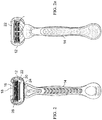
- a consumer article in the form of a wet shave razor 4 generally includes a shaving or cartridge unit 12 attached to a handle 14 with the shaving unit 12 having one or more blades 16 (e.g. 5 blades shown) each with a sharpened edge and comprising stainless steel.
- the blades 16 are at least partially retained by blade clips 28.
- a cap 18 and guard 20 may also be included in the shaving unit 12, the cap 18 preferably including a lubricating strip or shaving aid composite affixed thereon.
- the shaving unit 12 also includes a frame or housing 22, preferably made of hard plastic. In this particular shaving unit 12, there is also present a lubricating ring 24 disposed around the periphery of the shaving unit.
- the cartridge unit 12 may be adapted for coupling and uncoupling from the razor handle 14 such that a new cartridge unit 12 may be coupled to the handle when the blades become dull or may be integral with a handle 14 so that the complete razor 4 is discarded when the blades become dull.
- FIG. 2a depicts the opposite or rear side of the razor 4 showing the back side of the frame 22 and the cartridge unit 12.
- any one or more of the surfaces of the wet shave razor 20 may be fully or partially coated with a polymer layer as discussed.
- the polymer brushes of the added polymer layer are composed to impart an increased coefficient of friction, especially under wet conditions.
- the polymer brushes of the added polymer layer are composed to impart an reduced coefficient of friction, especially under wet conditions.
- FIGs. 2 and 2a While a specific embodiment of a razor is depicted in FIGs. 2 and 2a , any razor construction type is contemplated in the present invention.
- an article in the form of a blow molded consumer goods package 32 comprises a body 34 and a handle 36.
- the blow molded article 32 may additionally include a substrate, such as a film substrate, for decorative purposes, e.g., for labels, instructions, information, etc.
- a portion of the blow molded article, such as the body 34, the handle 36, and/or the substrate, may have low surface energy and/or hydrophobic properties such that water on the portion beads up when the blow molded article 32 is wet with water.
- a polymer layer is disposed on the handle 36 of the blow molded article 32.
- the polymer layer are composed to impart hydrophilic, polar, properties. This is believed to improve gripping in aqueous environments by minimizing water beads when the handle 36 is wet with water. Without intending to be bound by any theory, it is believed that preventing water (or other lubricious materials) from beading and improving wettability (e.g., promoting surfacing wetting) may each or both serve to thin the amount of water that a user must penetrate to engage the skin to the article's external surface.
- the polymer layer can be included on or with any skin- engaging portion of the blow molded article 32 in addition to, or alternatively to the handle 36.
- a product container 42 comprises a body 44 defining a hollow interior and a closure 46.
- the closure 46 is coupled to the body 44 such that the closure covers, either directly or indirectly, the hollow interior.
- the closure 46 can be coupled to the body 44 via a screw-type arrangement, snap-fit connection, friction-fit connection, lock- and-key connection, male-female engagement, etc.
- a polymer layer is disposed on the closure 46.
- the polymer layer is composed to impart hydrophilic, polar, properties. This is believed to improve gripping in aqueous environments by minimizing water beads when the closure 46 is wet with water
- the polymer layer can be included on any skin-engaging portion of the closure 30.
Landscapes
- Chemical & Material Sciences (AREA)
- Organic Chemistry (AREA)
- Health & Medical Sciences (AREA)
- Chemical Kinetics & Catalysis (AREA)
- Medicinal Chemistry (AREA)
- Polymers & Plastics (AREA)
- Life Sciences & Earth Sciences (AREA)
- Forests & Forestry (AREA)
- Engineering & Computer Science (AREA)
- Mechanical Engineering (AREA)
- General Chemical & Material Sciences (AREA)
- Laminated Bodies (AREA)
- Graft Or Block Polymers (AREA)
- Coating Of Shaped Articles Made Of Macromolecular Substances (AREA)
Abstract
Description
- The invention relates generally to the field of applying polymer layers to substrates, in particular to applying polymer layers to consumer articles.
- It is well known to apply exterior layers, coatings, or films of polymer to the surface of articles in order to improve upon the interfacial properties of an underlying bulk substrate. That is, typically, the bulk substrate of an article may be formed of a common or inexpensive material or from a material having particular physical characteristics. Since the inherent interfacial characteristics of the substrate material may be less than optimal (e.g. the article surface interface with human skin), a layer, coating or film of polymer can be applied to improve upon these. This is, for example, well known in the field of paints, in which a coating of paint masks the properties of the underlying substrate's surface, thus improving functionality and/or appearance.
- It is often desirable in the field of consumer items (such as consumer articles and packaging for consumer articles) that the bulk material from which an article is formed is commonly available, inexpensive, readily workable/formable, of environmentally low impact, recyclable, biodegradable, and/or afforded with any of a plethora of other desirable characteristics. However, the interfacial properties associated with such substrate materials are often sub-optimal. For example, they may provide a less than desirable consumer touch experience, may be susceptible to corrosion or other degradation, and/or may be susceptible to microbe growth, etc.
- While much progress has been made in the art of providing surface modification to substrates, there remains a need for new and preferably improved modification layers and techniques to apply them.
- According to the present invention, there is provided an article comprising,
- a substrate having a charged surface; and
- a polymer layer on said substrate surface; wherein
- An advantage of the invention can relate to the provision of a polymer layer on a substrate, the polymer layer being attached via a versatile and effective technique that has the potential to allow ready surface modification of substrates of various materials and various surface shapes, e.g. planar, contoured or curved etc.
- While it may be understood that use of ionic attraction to constrain a coating to a substrate surface may be generally a less robust route to fixation than the use of covalent bonding, the present inventors have succeeded in improving the versatility of an ionic attachment route.
- As mentioned above, the polymer layer of the present invention comprises a crosslinked sublayer having charged moieties with a charge opposite to that of the charged substrate surface. The provision of a crosslinked sublayer with a plurality of charged moieties forming ionic attraction, attachment points to the substrate surface is believed to provide a robust attachment to the surface because of the accumulated attractive force of a plurality of charged groups in the crosslinked sublayer. Advantageously, this robust attachment can be achieved without a need to resort to covalent bonding by chemical reaction with a substrate surface.
- In a preferred embodiment the crosslinked sublayer is a two-dimensional polymer mat provided with a plurality of charged moieties and polymerization initiation moieties such as a halide. The charged groups facilitate ready anchorage of the mat to the substrate surface by simple adsorption to the charged interface, whilst the exemplary halide groups can facilitate grafting of polymer chains from the mat using ATRP.
- While the crosslinked sublayer forms an anchoring layer to the substrate surface for the polymer layer, a modification of the article's interfacial properties is provided by the polymer chains that are grafted from the crosslinked sublayer. That is, polymer chains are anchored by one end to the crosslinked sublayer (that is, they terminally attach to the crosslinked sublayer at a point of polymerization initiation) and then grown by polymerization.
- In preferred embodiments of the invention, the polymer chains are polymer brushes. That is, the grafted polymer chains are in a brush conformation. Polymer brushes are polymer chains that are anchored at one end to the crosslinked sublayer (that is, terminally attached to the crosslinked sublayer) and that extend generally perpendicularly away from the substrate surface. The polymer chains become polymer brushes when grafted upon a surface at a sufficiently high density to take a brush conformation. The brush-like conformation of the polymer brushes emerges due to repulsive interactions between neighbouring chains. That is, the relationship between the spacing between the chains, s, and the chain length expressed as the 'radius of gyration', rg (the radius of gyration refers to the square root of the extended chain length). The 'brush' conformation is described as a regime where the spacing between the chains is less than twice the polymer rg, when the chains extend away from the surface. In the present application, an individual polymer chain within a multitude of polymer chains in the brush configuration, is referred to as a polymer brush.
- Addition of polymer brushes chemically grafted from a substrate have been found by the inventors to be an effective method of surface modification.
- The nature of the available modifications that may be imparted to a substrate by polymer chains, such as polymer brushes, is expansive, as is further expanded upon in this document. For example, the polymer chains may impart any one or more of a range of differing modified characteristics such as modifying roughness, wetting, surface charge, surface energy, adhesion, reactivity, and friction properties of the substrate. In particular, the polymer chains may be lubricious, hydrophilic, hydrophobic, lypophilic, lypophobic, amphiphilic, nonionic, anionic, cationic, zwitterionic or amphoteric.
- In a further aspect of the invention there is provided a method of making an article comprising a substrate with an external polymer coating comprising polymer chains, the method comprising the steps of:
- a) providing a substrate comprising a charged surface;
- b) providing a crosslinked polymer comprising polymerization initiation moieties and charged moieties having a charge opposite to that of said charged surface;
- c) applying said crosslinked polymer to said substrate surface;
- d) providing monomers reactive for polymerization with the polymerization initiation moieties; and
- e) polymerizing the monomers with the polymerization initiation moieties.
- In a further aspect of the invention there are provided articles obtainable by the method discussed above.
- In a still further aspect of the invention there is provided an article comprising,
a substrate having a charged surface; and
a crosslinked polymer layer on said substrate surface, said crosslinked polymer comprising charged moieties having a charge opposite to that of said charged surface, and polymerization initiation moieties. Such article can be an intermediate in the method described above, and a precursor to the article as described above. - The articles of the present invention are preferably consumer articles and/or packaging for consumer goods.
- The layer is provided on at least a portion of a surface of the substrate, and may be a continuous or non-continuous layer. It may be provided on the entire surface area of an article, or on only selected surfaces of an article.
- Examples of preferred consumer articles in accordance with the invention include shaving articles and hair removal devices. "Hair removal devices" comprise any apparatus or device intended to remove hair, such as a razor (manual or powered) for dry or wet shaving, epilator, electric shaver, and combinations thereof. Shaving articles include articles that are associated with the act of shaving a body part, and include hair removal devices and components of hair removal devices. "Shaving articles" may be non-cutting elements or cutting elements. Non-cutting elements can be cartridge or handle components, such as blade clips in a wet shaver or outer or inner surfaces of a foil disposed in an electric dry shaver. Cutting elements include cutter elements in an electric dry shaver or razor blades in a wet shaver product, including wet shave razors.
- In preferred embodiments the article of the invention is a wet shave razor or a component thereof. Wet shave razors typically include a razor cartridge and a razor handle.
- Razor cartridge components typically include some of the following elements: one or more razor blades having a blade edge to perform the cutting of hair, a blade clip, a lubricating body/strip/ring, a cap, a housing, a frame, a guard, a handle connecting structure, or any number of each or combination thereof.
- Typically the razor blades have a stainless steel substrate that is optionally coated. Blade clips are typically formed of a metal, such as aluminium.
- The lubricating body/strip/ring, cap, housing, frame, guard, and handle connecting structure comprise some combination of elastomeric and hard plastic materials. In particular the cap, housing, frame, guard, and/or handle connecting structure may be formed from semi-rigid polymeric materials, preferably by injection molding. Exemplary materials include polystyrene, and blends of polystyrene with other polymers. For example polyphenylene oxide blends with polystyrene, an example of which is commercially available as Noryl™. Other semi-rigid polymers that are suitable include, but are not limited to, acrylonitrile butadiene styrene (ABS), acetal, polypropylene, high impact polystyrene, or any combinations thereof. Plastics having a Shore A hardness of about 60 to 140 are preferred.
- In some preferred examples, the guard may be molded from softer materials, for example, from materials having a shore A hardness of about 20 to about 70, such as thermoplastic elastomers (TPEs) or rubbers.
- Razor cartridge components have exterior surfaces, many of which contact a user's skin during shaving. The interaction of these contacting surfaces with skin may generally play a significant role in the performance of the razor.
- For example, it may be desirable that razor blades (especially their sharp edges), frame surfaces, clip(s), and the cap have a low coefficient of friction with a user's skin or hair for comfort of use, ease of hair cutting (e.g. a low cutter-force) and skin manipulation (e.g. manipulation of skin bulge).
- For example, a razor blade with a low coefficient of friction can exhibit reduced cutting forces for beard hairs or other types of hair fibers. A reduced cutting force can significantly improve shaving attributes including sensory perceptions (safety, closeness and comfort). The concept of cutting force can be generally understood as how readily a blade passes through a hair stem during cutting.
- Providing non-cutting elements of a cartridge, especially those to the rear or adjacent the blades (e.g. blade clips, frame, housing, cap, etc.), with skin contact surfaces having a lower coefficient of friction can aid the shaving performance of a razor. For example blade retention clips, housings, caps etc. with lower coefficients of friction can glide more comfortably across a user's skin, reducing skin pull or improving skin manipulation.
- In a particularly preferred embodiment of the invention, the polymer layer is applied to at least a portion of the cap of a razor cartridge. A ready glide of the cap across the skin of a user may aid in avoiding excessive skin bulge into the line of the foregoing razor blades, helping to reduce cuts, nicks and irritation, and improving user comfort.
- Additionally, providing non-cutting elements of a cartridge, especially those forward of the blades (e.g. the guard) with skin contact surfaces having a higher coefficient of friction can aid the shaving performance of a razor. For example, an increased coefficient of friction for components forward of the blades can aid in 'gripping' the skin as a user shaves, thereby manipulating the skin and skin bulge during a shaving stroke.
- In line with the above discussion, an aspect of the invention concerns the desire to improve or enhance the shaving performance of wet shave razor cartridges, preferably by provision of new and preferably optimized surface enhancing coatings and/or methods of applying such coatings.
- Wet shave razor handles are also provided with multiple surfaces that are contacted by a user's skin (e.g. hands on a grip) during use, and in one aspect, the invention is also concerned with the improvement of the interfacial surface properties of razor handles.
- Razor handles may comprise buttons, a handle grip, a cartridge connecting structure, or any combination thereof. Typically the handle components may be formed of some combination of elastomeric and hard plastic materials. The handle may be formed from, semi-rigid polymeric materials, preferably by injection molding. Exemplary materials include polystyrene, and blends of polystyrene with other polymers. For example polyphenylene oxide blends with polystyrene, an example of which is commercially available as Noryl™. Other semi-rigid polymers that are suitable include, but are not limited to, acrylonitrile butadiene styrene (ABS), acetal, polypropylene, high impact polystyrene, or any combinations thereof. Plastics having a Shore A hardness of about 60 to 140 are preferred.
- Razor handles may also comprise metallic parts, for example, stainless steel parts. Razor handle surfaces may comprise polymer components including anti-slip, rubber or elastomer type materials or coatings for better gripping, they may also comprise stainless steel surfaces, the inherent surface properties of which can also be optimized. It may be desirable to provide alternatives to the rubber or elastomer type materials in order to achieve anti-slip characteristics for the handle surfaces, to improve the feel of metal handle components, and or to impart further properties to the handle surfaces, such as anti-fouling and/or biocidal properties.
- In line with the above discussion, an aspect of the invention concerns the desire to improve or enhance the shaving performance of wet shave razor handles, preferably by provision of new and preferably optimized surface enhancing coatings and/or methods of applying such coatings.
- The invention may generally be applied to any type of packaging. Particular examples of packaging for consumer goods include packaging in the form of containers for bulk and/or fluid consumer goods (e.g. liquid, gel, emulsion, dispersion and/or particulate/powder), and packaging for consumer goods in the form of consumer articles, such as hair removal devices and their components.
- The invention may also be applied to packaging of consumer goods products in fields such as fabric and home care including for example fabric and hard surface cleaners, baby care such as disposable absorbent articles, beauty care for example hair and skin products, family care for example tissue products, feminine care including for example catamenial products , health and oral care for example dentifrices and over the counter cold treatment and painkillers, and shave care and grooming such as wet and dry razors.
- Examples of consumer goods that are typically provided in product containers, in particular blow molded containers, include laundry and household cleaning products, shaving compositions such as creams, lotions, gels, foams, aftershaves, etc.; shampoo and hair care products; oral care products; skin care products; make-up; and other personal care products.
- Such containers may be inherently slippery and difficult to grip because of the material from which they are formed.
- Furthermore, since such product containers may typically be used in wet or aqueous environments (e.g. shampoo bottles are often used in the shower, or shaving composition containers are used at a sink) this may exacerbate slippage and/or poor engagement of the container by a user.
- For example, a component of a consumer goods package that has one or more surface areas for interfacing with user skin, is a body of a product container.
- Common product container bodies for consumer goods may be formed from polymers such as polyolefins, polyethylene, acrylonitrile butadiene styrene (ABS), and polypropylene; a common particular example is polyethylene terephthalate (PET). These materials are often inherently slippery, which may result in slippage and/or poor engagement of the blow molded article with the skin of a user. Moreover, thermoplastic polymers often have a small thickness when blow molded, which also may result in slippage and/or poor engagement of the blow molded article with a skin surface of a user.
- Different surfaces of the body of a product container may benefit from addition of a polymer layer in accordance with the invention to modify or enhance the interfacial characteristics imparted to them. For example, some areas may require high coefficients of friction to aid in gripping (e.g. a handle or grip area of a container), while other areas may require a low coefficient of friction for ease of skin glide.
- It may also be the case that bulk material of a product container body and the product carried by the container, are inherently attracted to one another. This can cause difficulty in the ease and/or full removal of product from a container. The inner surfaces of the body of a product container (i.e. those contacting the container product) may benefit from addition of a polymer layer in accordance with the invention to modify or enhance the interfacial characteristics imparted to them. The inner surfaces of a body can for example be modified to show less affinity to a selected product. For example, a reduction in hydrophilicity compared to the bulk material for aqueous products; or a reduction in lipophilicity compared to the bulk material for fatty products, may in aid a fuller expulsion of the contained product, or in otherwise a lower product residue in the container.
- Another area of relevance for containers includes closures (e.g., cap, lids, or screw tops) for the above mentioned consumer goods containers. Such closures are often comprised of hard plastics. These closures are required to have a certain level of mechanical and skin interfacial performance, for example to give a good touch experience for a user while maintaining a high coefficient of friction for ease of handling e.g. in wet environments as discussed above.
- Closures for product containers are intended to be grasped or handled by users. Such closures are typically made from a hard plastic such as thermoplastic polymers, e.g., polyethylene, polypropylene, and acrylonitrile butadiene styrene. The bulk materials for closures may be inherently slippery, and may be enhanced by surface modification with the polymer layer of the present invention, to increase a coefficient of friction.
- Examples of packaging for consumer articles such as hair removal devices and their components (e.g. handles and razor cartridges), include Blister-type packages. The two primary components of a blister pack are the cavity or pocket made from a formable material, (e.g., plastic) and a lid (e.g., paperboard or plastic). The formed cavity or pocket contains the product and the lid seals the product within the cavity. Other types of blister packs may consist of carded packages where the products are contained between a paperboard card and clear pre-formed plastic (e.g., polyvinylchloride). The consumer can easily examine the product through the transparent plastic. A more secure package is known as a clamshell. It consists of either two pre-formed plastic sheets or one sheet folded over onto itself and fused at the edges.
- As for the consumer goods packaging discussed above, the inherent character of the bulk material of the consumer articles packaging may be less than optimal in terms of its skin interfacial properties. For example, the bulk materials maybe slippery, especially in wet or aqueous environments, leading to difficulty in opening or gripping the packaging. This is especially the case for packages of hair removal devices, especially wet shave razors and wet shave razor components, which may be typically handled in a shower room, bathroom or wet room.
- In accordance with the invention, surfaces of consumer article packages may benefit from addition of a polymer layer.
- The polymer layer is preferably applied to areas of the package intended to be contacted or gripped by a user during holding or opening actions. The surface modification may then impart at least a higher coefficient of friction than the underlying substrate (e.g. to a grip area or an opening element of a container).
- Application of the polymer layer to other areas of the package may include imparting a lower coefficient of friction, antifouling properties, and/or biocidal properties.
- The polymer layer of the invention may be applied directly to the bulk component of an article (e.g. consumer article or packaging for consumer goods), or alternatively may be provided on a further element that is applied to the bulk component, such as a foil wrap (e.g. labels or stickers). Preferably the polymer layer is applied directly to the bulk component of the consumer article or packaging for consumer goods.
- The crosslinked sublayer comprising charged moieties with a charge opposite to that of the charged surface preferably comprises a two dimensionally extended network of linked polymer chains. The sublayer may also be referred to as a polymer mat.
- As mentioned, the sublayer is provided with charged moieties that are ionically attracted to the surface of the substrate, said surface substrate carrying a charge opposite to the charged moieties of the crosslinked sublayer.
- Preferably the charged moieties of the crosslinked sublayer are cationic moieties or precursors thereof, and provide attraction to substrate surfaces that are negatively charged. Examples of useful cationic moieties include quaternary ammonium moieties or precursors thereof. Specific exemplary monomers carrying cationic moieties and suitable for polymerization into a crosslinked sublayer are (meth)acrylate monomers carrying quaternary ammonium moieties. Polyethylene glycol (meth)acrylate monomers may be preferred for dispersibility in water. One specific example of a suitable monomer is PEG-N+, described in the examples section of this document.
- While it is preferred that the substrate surface carries a negative charge, it is also possible that substrate surfaces may carry a positive charge. In the case of a positively charged substrate surface, the charged moieties of the crosslinked sublayer are negatively charged. To achieve this, anionic moieties can be incorporated into the crosslinked sublayer during polymerization of the sublayer. Examples of useful anionic moieties include phosphonates and sulphates, or precursors thereof. Exemplary monomers carrying anionic moieties and suitable for polymerization into a crosslinked sublayer include: vinylphosphonic acid, foscarnet coupled to PEGMA; and PEG sulphonates such as mPEG-Mesylate.
- The crosslinked sublayer comprises a plurality of charged moieties. This provides multiple points of attraction of the crosslinked sublayer to the charged surface. In general terms, increasing the concentration of charged moieties, or monomers carrying them, in the polymer improves anchorage of the crosslinked sublayer on the surface. This may beneficially increase adhesion to substrate surfaces, especially those that have only weak charge.
- Preferably the crosslinked sublayer comprises from 10 to 95 wt% of monomers carrying at least one charged moiety or precursor thereof, based on the weight of the crosslinked sublayer, more preferably from 15 to 95 wt%, still more preferably from 25wt% to 90 wt%, more preferably from 45 to 85 wt%, most preferably from 50 to 85 wt%. Preferably the crosslinked sublayer comprises about 75wt% of monomers carrying at least one charged moiety or precursor thereof, based on the weight of the crosslinked sublayer.
- In addition to the charged moieties for attraction to the oppositely charged substrate surface, the crosslinked sublayer also comprises polymerization initiation groups or moieties, forming grafting points for polymer chains to be grafted therefrom.
- A variety of polymerization reaction mechanisms can be used to graft polymer brushes from the crosslinked polymer sublayer. Examples include ring opening metathesis polymerization (ROMP); reversible addition fragmentation chain transfer polymerisation (RAFT); Nitroxide-mediated polymerization (NMP); and atom transfer radical polymerisation (ATRP). The pool of available initiation moieties is expansive and the initiator moieties can be selected as appropriate for a selected polymerization reaction.
- In the present invention, the preferred polymerization technique is ATRP, and may be ARGET (activators regenerated by electron transfer) ATRP.
- Preferred polymerization initiation groups for ATRP include alkyl halides, particularly wherein the halide is selected from the group consisting of Br and Cl. The halide can act as a leaving group enabling the polymerization to proceed.
- Specific exemplary monomers carrying free-radical polymerization initiation moieties and suitable for polymerization into a crosslinked sublayer are (meth)acrylate monomers carrying halides. Polyethylene glycol (meth)acrylate monomers may be preferred for dispersibility in water. One specific example of a suitable monomer is PEG-Cl, described in the examples section of this document.
- In general, increasing the concentration of polymerization initiation moieties, or monomers carrying such moieties, within the crosslinked sublayer may increase the grafting density of polymer chains subsequently grafted therefrom.
- Preferably the crosslinked sublayer comprises from 5 to 90 wt% of monomers carrying at least one polymerization initiation moiety, based on the weight of the crosslinked sublayer, more preferably from 10 to 80 wt%, still more preferably from 10 wt% to 80 wt%, more preferably from 15 to 55 wt%, most preferably from 20 to 55 wt%. Preferably the crosslinked sublayer comprises about 25 wt% of monomers carrying at least one polymerization initiation moiety, based on the weight of the crosslinked sublayer.
- Control and/or optimization of the ionic anchorage and polymer grafting density can also be achieved through variation of the molar ratio between the charge carrying monomers and the polymerization initiation monomers making up the crosslinked sublayer. It has been found that a good performance of the crosslinked sublayer in terms of substrate surface binding and polymer chain growth is achieved when the crosslinked sublayer has a molar ratio of charged moieties to polymerization initiation moieties in a preferred range. Useful molar ratios charged moieties to polymerization initiation moieties in the crosslinked sublayer are from about 1:10 to about 10:1, more preferably from about 1:5 to about 8:1, still more preferably from about 1:1 to about 5:1, still more preferably about 2:1 to about 4:1 and most preferably about 3:1. Crosslinked sublayers with the latter molar ratio demonstrate uniform surface coatings with a suitable number of polymerization initiation points for polymer chain grafting, preferably polymer brush grafting.
- The crosslinked sublayer also comprises a cross-linker. The cross-linker links between polymer chains to form a polymer network that is two-dimensional. Suitable cross-linkers are poly-functional monomers, preferably bifunctional monomers.
- Where the crosslinked sublayer is formed from (meth)acrylate monomers, the cross-linker is preferably a di(meth)acrylate.
- Examples of crosslinkers include ethylene glycol diacrylate, di(ethylene glycol) diacrylate, tetra(ethylene glycol) diacrylate, ethylene glycol dimethacrylate, di(ethylene glycol) dimethacrylate, tri(ethylene glycol) dimethacrylate, N,N.- Methylenebisacrylamide, N,N.-Methylenebisacrylamide, N,N.-(1,2-Dihydroxyethylene)bisacrylamide, N-(1-Hydroxy-2,2-dimethoxyethyl)acrylamide, divinylbenzene, and mixtures thereof.
- A particularly preferred crosslinker is ethyleneglycol dimethacrylate, present as a crosslinking agent, which has been found to produce a cross-linked network with a tunable molecular weight, using 1-dodecanethiol as a chain transfer agent.
- The sublayer preferably comprises from 0.5 to 5 wt % of crosslinker, more preferably from 0.7 to 4 wt%, more preferably from 1 to 3 wt% and most preferably from 1.0 to 2.5 wt%, based on the weight of the crosslinked sublayer. Most preferably the crosslinked sublayer comprises about 2 wt% crosslinker.
- The crosslinked sublayer preferably has a Mw in the range from 5000 to 400,000 Da, more preferably from 10,000 to 200,000 Da, still more preferably 15,000 to 100,000 Da.
- The surface to which the crosslinked polymer sublayer is ionically bound comprises a charged surface. The substrate surface may carry either a net negative or net positive charge. A negative charge is preferred, since a large number of materials are naturally negatively charged at the surface.
- The charge may be imparted by the presence of surface groups upon the substrate surface. For example, for inorganic substrates, a substrate surface may be occupied by charged or dissociable moieties.
- For example, for polymer substrates, a surface charge may be generated by incorporation of charged groups within the polymer of the substrate. Such charged groups may be anionic or cationic. Examples of anionic groups include carboxylic acid, sulfonic acid, and organic acid groups. Examples of cationic groups include amines, ammonium ions, and organic basic groups.
- Examples of charged polymer substrate materials include (co)polymers incorporating monomers as mentioned above.
- Preferably the charge is negative, and the substrate comprises anionic groups on its surface.
- In some embodiments, the substrate surface may comprise hydroxy groups.
- Non-limiting examples of substrates that have such groups on their surface or which form such groups by subsequent treatments such as exposure to the environment, UV, ozone or plasma treatment, include iron, steels, including stainless steel and metals which acquire an oxide coating upon exposure to the ambient environment, for example, aluminum, and aluminum alloys. Additional examples of materials that can acquire an oxide layer upon exposure to the ambient conditions are ceramic materials, for example, silicon nitride. Other materials may have an oxide coating imparted to them, for example, a hard metal oxide such as aluminum oxide applied to a substrate by sputtering.
- In a preferred embodiment, the surface to be coated can be treated prior to addition of the crosslinked polymer sublayer. This pretreatment can increase the surface attractiveness to the ionic moieties of the crosslinked polymer sublayer. Such pretreatments may include UV, ozone, and plasma treatments, which can provide surface activation. For example, substrate surfaces can be provided with, or further supplemented with, hydroxy groups by exposing them to UV light in the presence of ozone, for example in a UVO cleaner.
- In particular, UV treatment in the presence of ozone can increase the surface area density of hydroxy groups.
- Substrates having a surface charge density in the range of negative 0.001 to 0.2 Cm-2 or a surface potential in the range of negative 20 to 150 mV are useful in the present invention, and achieve good ionic attraction of the sublayer to the substrate.
- The crosslinked sublayer can be bound to the substrate surface by dip-coating of the substrate in solutions comprising the crosslinked sublayer. For environmental, cost and convenience reasons, the solution is preferably aqueous, that is, it comprises water as the majority component of the dip-coating solution.
- The crosslinked sublayer is dissolved or dispersed into the aqueous solution. Where the crosslinked polymer is not readily dispersible or soluble in water, either because of its Mw or chemical make-up (e.g. hydrophobicity) organic solvents may be used instead of, or added to the solution, or surfactants may be used, as is well known in the art.
- The crosslinked sublayer adsorbs to the substrate surface attracted by the opposed charges it carries, and so becomes immobilized on the substrate surface by ionic attraction.
- The dip-coating solution may be aqueous or non-aqueous as appropriate to the initiating species. Dip-coating in an aqueous medium is generally preferred because a reduced use of volatile organic compounds. For this reason the preferred method of deposition is dip-coating in water and the crossedlinked sublayer polymer is comprised of generally water compatible monomers to maintain reasonable solubility or dispersibility in water.
- Application of initiating species from emulsions, dispersions, gels, and similar may also be contemplated.
- In accordance with an aspect of the invention, polymer chains, preferably in the form of polymer brushes, are grafted from the sublayer's polymerization initiation sites. Following coating of the substrate surface with the crosslinked sublayer, one or more monomers are provided and a step of polymerization of those monomers is initiated from the polymerization initiating moieties of the crosslinked polymer sublayer.
- In the polymerization the monomers build into polymer chains grafted in situ from the initiating moieties of the crosslinked polymer sublayer.
- As discussed above, a variety of polymerization reaction mechanisms can be used, including ring opening metathesis polymerization (ROMP); reversible addition fragmentation chain transfer polymerisation (RAFT); Nitroxide-mediated polymerization (NMP); and Atom transfer radical polymerisation (ATRP), including ARGET ATRP. ATRP is the preferred method in the present application since it is compatible with a range of monomer types, is reasonably tolerant of impurities, involves mild reaction conditions and associated catalysts may be reusable. In the case of ATRP the polymerization initiation group in the crosslinked polymer sublayer comprises an alkyl halide as the initiator, preferably the halide is selected to be Br or Cl. The halide forms a leaving group for the ATRP mechanism.
- This method generates a dense polymer chain coverage. A dense chain coverage aids in forcing the polymer chains into their extended conformation, i.e. brush conformation.
- The length and molecular weight of the polymer chains can be controlled by controlling the quantity of monomer in the polymerization reaction, and the termination point of the reaction.
- Polymer chain layer thicknesses may be from up to 25 nm, more preferably from 1 to 20 nm and most preferably from 4-12 nm.
- The preferred grafting density of the polymer chains is related to the length of the polymer chains that are grafted from the surface. To achieve preferred stabilities for a polymer brush conformation, the spacing between the chains is less than twice the polymer radius of gyration (rg). In the present invention, the grafting density is preferably at least 1 brush per 10 nm2, or 1011 brushes mm-2. Preferably the grafting density is in the range from 0.05 to 1 chains per nm-2.
- In the polymerization, homopolymers can be generated by providing a single monomer; copolymers can be generated by polymerizing mixtures of monomers; block copolymers can be generated by polymerizing a first monomer or first monomer mix followed by polymerization of a second monomer or monomer mix, followed by repetition to provide further blocks if desired. Gradient copolymers can be achieved by polymerizing a monomer mix and gradually adjusting the monomer mix during polymerization.
- The nature of the available modifications that may be imparted by polymer chains to a substrate is expansive, whereby the surface can be tailored to give a range of advantageous properties over the native substrate surface.
- In line with this, the polymer layer may impart any one or more of a range of differing modified characteristics to the substrate. For example to the wear and wetting properties, and/or general functionality of the substrate. For example the polymer may modify roughness, wetting, surface charge, surface energy, adhesion, reactivity, and friction properties of the substrate. In particular, the coating may be lubricious, hydrophilic, hydrophobic, lypophilic, lypophobic, amphiphilic, nonionic, anionic, cationic, zwitterionic or amphoteric.
- The characteristic or functionality that is provided by the polymer layer can be adjusted or fine-tuned, for example, by selection of the monomers making up the polymer chains. For example, the polymer chains may comprise homopolymers, copolymers, block-copolymers, gradient copolymers. For example, poly(ethylene glycol) based polymers typically have good solvency or compatibility with water.
- Hydrophilicity of the polymeric chains can be achieved by inclusion of nonionic or ionic hydrophilic groups, or a mixture of nonionic and ionic hydrophilic groups in the polymer chains.
- Anionic groups include carboxylic acid groups, sulphonic acid groups or phosphoric acid groups.
- Cationic groups include, for example, amine groups, pyridinium groups, sulfonium groups and cationic tertiary amine groups.
- Nonionic hydrophilic groups include, for example, polyoxyalkylene (meth-)acrylates, especially 2-(2'-methoxyethoxy)ethyl methacrylate ("MEO2MA"), 2-(2'-methoxyethoxy)ethyl acrylate, 2-(2-(2-methoxyethoxy)ethoxy)ethyl methacrylate ("MEO3MA").
- Hydrophobicity may be incorporated by the use of lipophilic/hydrophobic groups. For example fluorinated monomers may be used, such as pentafluorostyrene, pentafluoropropyl (meth-)acrylate, trifluoroethyl (meth-)acrylate, heptadecafluorodecyl (meth-)acrylate.
- In amphiphilic copolymers, both hydrophilic and hydrophobic groups are included. When the polymer chains are amphiphilic, they may be embodied as block polymers comprising a hydrophilic block and a hydrophobic block.
- Multi-block polymer chains are preferably di-, tri-, or tetra-block polymers; most preferably di-block polymers. The polymer blocks may be sharply defined blocks of monomers or may be gradient blocks with an overlapping transition zone between monomer blocks.
- In general, examples of suitable ethylenically unsaturated monomers for use in the polymerization are (meth-)acrylic monomers. Another example of suitable monomers include styrenic monomers, for example styrene, vinyltoluene and alpha-methylstyrene. Still further examples include acetate monomers.
- Specific examples of monomers suitable for the polymer chains include, but are not limited to, styrene, vinyl toluene, alpha-methylstyrene, vinyl acetate, vinyl esters, vinyl chloride, halogen-substituted ethylene or alkylene, methacrylonitrile, acrylonitrile, methyl (meth-)acrylate, ethyl (meth-)acrylate, propyl (meth-)acrylate, isomers of propyl (meth-)acrylate, butyl (meth-)acrylate, isomers of butyl (meth-)acrylate, hexyl (meth-)acrylate, 2-ethylbutyl (meth-)acrylate, crotyl (meth-)acrylate, 2-ethylhexyl (meth-)acrylate, isobornyl (meth-)acrylate, isoamyl (meth-)acrylate, benzyl (meth-)acrylate, phenyl (meth-)acrylate, tetrahydrofurfuryl (meth-)acrylate, 3,3,5-trimethylcyclohexyl (meth-)acrylate, alpha-methylstyrene, cyclohexyl (meth-)acrylate, stearyl (meth-)acrylate, lauryl (meth-)acrylate, isodecyl (meth-)acrylate, glycidyl (meth-)acrylate, 2-hydroxyethyl(meth-)acrylate, hydroxypropyl (meth-)acrylate, isomers of hydroxypropyl (meth-)acrylate, 4-hydroxybutyl (meth-)acrylate, isomers of hydroxybutyl(meth-)acrylate, glycerolmono(meth-)acrylate, (meth-)acrylic acid, dimethylaminoethyl (meth-)acrylate , diethylaminoethyl (meth-)acrylate, dimethylaminopropyl methacrylamide, 2-tert-butyl aminoethyl(meth-)acrylate, triethyleneglycol (meth-)acrylate, methacrylamide, N,N-dimethyl methacrylamide, N-tert-butyl methacrylamide, N-methylol methacrylamide, N-ethylol methacrylamide, alpha-methylvinyl benzoic acid (all isomers), diethylamino alpha-methylstyrene, 2-isocyanatoethyl (meth-)acrylate, isomers of diethylamino alpha-methylstyrene, trimethoxysilylpropyl (meth-)acrylate, triethoxysilylpropyl (meth-)acrylate, (meth-)acrylic acid, tributoxysilyl propyl (meth-)acrylate, dimethoxymethylsilyl propyl (meth-)acrylate, diisopropoxymethylsilylpropyl (meth-)acrylate, dimethoxysilylpropyl (meth-)acrylate, diethoxysilylpropyl (meth-)acrylate, dibutoxysilylpropyl (meth-)acrylate, diisopropoxysilyol propyl (meth-)acrylate, isobutylene, methoxy polyethyleneglycol (meth-)acrylates, poly(ethylene glycol) (meth-)acrylates, di(ethylene glycol) (meth-)acrylate, tri(ethylene glycol) (meth-)acrylate, 2- methoxyethyl (meth-)acrylate, 2-(2'-methoxyethoxy)ethyl acrylate, 2-(2'-methoxyethoxy)ethyl methacrylate ("MEO2MA"), 2-(2'-methoxyethoxy)ethyl acrylate, 2-(2'-methoxyethoxy)ethyl methacrylate ("MEO3MA"), DMAEMA (2-(dimethylamino)ethyl methacrylate), OEGMA300, MPC (2-(methacryloyloxy)ethyl phosphorylcholine) and SBMA (2-(methacryloyloxy)ethyl)dimethyl-(3-sulfopropyl)-ammonium hydroxide), and mixtures thereof.
- A particular example of surface modification can include friction mediation. As discussed above in relation to the consumer articles and packaging for consumer goods, it may be desirable to mediate the friction of an article to optimize the skin to article interface.
- Examples of useful monomers for friction reduction are fluorinated monomers. These produce polymers with hydrocarbon back bones and fluorinated side groups, which may offer low coefficients of friction.
- Particular examples of friction reducing monomers include fluorinated polymers, such as pentafluorostyrene (PFS), pentafluoropropyl acrylate (PFA), trifluoroethyl acrylate (TFA), heptadecafluorodecyl acrylate (HFA), pentafluoropropyl methacrylate (PFA), trifluoroethyl methacrylate (TFA), heptadecafluorodecyl methacrylate (HFA), and mixtures thereof. The friction reducing monomers may be used in combination with other monomers, including those other monomers listed in this document.
- In a preferred example, the polymer chains comprise a copolymer comprising a hydrophobic block adjacent to the substrate surface, and a hydrophilic block outer to the hydrophobic block. That is, in a preferred example, the copolymer comprises a proximal hydrophobic block and a distal hydrophilic block.
- In such an example, the presence of a hydrophobic block adjacent the substrate may act as water barrier when the substrate is used in an in aqueous environment, urging water away from the surface and reducing possible corrosion.
- The hydrophilic polymer block may act for aqueous lubrication along a user's skin. This may be of particular use for wet shave articles, especially razor cartridges, which, as discussed earlier may benefit from a lower coefficients on some components to give better skin-glide and or reduced cutting force.
- In an example the proximal hydrophobic block comprises monomers fluorinated polymers.
- In an example the distal hydrophilic block comprises monomers having alkoxy groups.
- In a preferred example, the polymer chains comprise a proximal hydrophobic block comprising fluorinated (meth)acrylate monomers, and a distal hydrophilic block comprising alkoxy (meth)acrylate monomers.
- Preferred diblock copolymer chain structures include block copolymers of PFA with MEO2MA and HFA with MEO2MA.
- As discussed above some articles associated with the present invention, may benefit from an increased coefficient of friction. For example, the guard of a razor, or a handle or gripping portion of a razor or package for consumer goods.
- Preferably, the polymer chains are adapted to give a high coefficient of friction when wetted, e.g., a higher coefficient of friction when wet compared to the known thermoplastic elastomers. To achieve this, the polymer chains may be composed to be hydrophilic, and preferably polar. Additionally or alternatively, the polymer chains are composed to give a high surface energy. These adaptations may beneficially increase wettability of the surface so that water beads are minimized or non-existent when the wet friction material is wet with water. Without intending to be bound by any theory, it is believed that preventing water (or other lubricious materials) from beading and improving wettability (e.g., promoting surfacing wetting) may each or both serve to thin the amount of water that a user must penetrate to engage the skin to the wet friction material.
- The polymer chains may be made hydrophilic, preferably polar, by inclusion of monomers comprising hydrophilic, preferably polar groups. Suitable groups include anionic groups such as carboxylic acid groups, sulphonic acid groups or phosphoric acid groups and/or cationic groups such as amine groups, pyridinium groups, sulfonium groups and cationic tertiary amine groups.
- A further example of surface modification can include the provision of anti-fouling properties that can combat microbe habituation of the modified surfaces.
- Anti-fouling may be achieved by provision of protein anti-adhesive polymer chains that aid in preventing adhesion of microbes and/or detritus (that might form nourishment for microbes) to a surface. Alternatively, anti-bacterial chains may be provided that are imparted with microbe damaging or destructive properties.
- In terms of anti-adhesive polymer chains, hydrophilic chains may generally resist adherence of biomolecules as there can be a tendency for these to bind more preferably with hydrophobic surfaces. Exemplary polymers having good anti-adhesion toward proteins when formed into chains include poly(methyl methacrylate) (PMMA) and poly(ethylene glycol) (PEG).
- In terms of anti-bacterial properties, exemplary polymer chains offering anti-bacterial properties include tBAEMA, and PDMAEMA.
- In a further embodiment, the polymer chains may comprise copolymers with both anti-adhesion and anti-bacterial monomers, to give the benefits of both resistance to protein adherence and anti-bacterial activity.
- A further example of surface modification can include the provision of Anti-corrosion properties. For example, the use of hydrophobic polymer chains applied to metals may aid in reducing oxidative corrosion by urging water away from the surface. For example, inclusion of non-polar monomers within the polymer chains can aid in obstructing contact with polar liquids that may contribute to corrosion of the surface.
- A further example of surface modification can include the provision of stimuli responsive surfaces. For example, polymer brushes may be constructed to offer stimuli alterable characteristics. Exemplary stimuli may include temperature, pH, electric potential and/or immersion in a polar or non-polar solvent system. Such stimuli responsive changes are typically reversible.
- An example of stimuli response includes thermoresponsive brushes. These are polymer brushes that have temperature dependent conformations in the range of use. For example, a shaving article my typically be stored at room temperature (25°C) or below, while the shaving article may be raised to temperatures above room temperature during shaving use. A thermoresponsive polymer brush may shift from a cold conformation to a hot conformation to give different characteristics in the different temperature ranges. For example a polymer brush may transition to a hot conformation at temperatures above 25°C, preferably at temperatures at or above 30°C, more preferably at temperatures at or above 35°C.
- Examples of thermoresonsive polymers that can be included in the polymer brushes include Poly(N-isopropylacrylamide) (PNIPAM). PNIPAM is a temperature responsive polymer. Below 32°C it is in an extended conformation taking on a brush form, which presents a hydrophilic surface. At temperatures above 32°C it collapses to a globular form (its lower critical solution temperature (LCST)), and presents a more hydrophobic surface. This is believed to be due to the chains preferring hydrogen bonding with external water molecules below this temperature, with a preference for the side groups to form intramolecular hydrogen bonds above it.
- Another example of stimuli responsive polymer brushes includes multi-block stimuli responsive polymer brushes. Multi-block co-polymers comprise two or more layers of polymer brush chains, with each individual chain of each layer being tethered at one end to the previous layer. By use of monomer blocks having dissimilar properties, the polymer brushes can be manipulated to behave differently under varying conditions. For example, monomer blocks can be solvent responsive.
- An example of a diblock copolymer involves the use of a semi fluorinated monomer distal block and a hydrocarbon monomer proximal block. Application of various fluorinated and organic solvents can then be used to induce rearrangement between ultrahydrophobic when the fluoropolymers are extended to much less hydrophobic when collapsed.
- In addition to the monomer makeup of the polymer chains, the characteristics of the polymer chains may be influenced by the surface area density of the polymer chains on the surface (grafting density), which is related to the inter-chain spacing. Furthermore, the chain length and molecular weight of the polymer chains may be a relevant factor.
- Chain length, which contributes to supra-layer thickness, can be controlled by the initial amount of monomer when the reaction is allowed to go to completion. Alternatively a large excess of monomer can be added and the reaction time controlled by active reaction termination.
- Useful properties are achieved, for example, when the chain length (also named height), L, and the inter-chain spacing, s, (distance between adjacent brushes) grafted on a surface, are in optimized ranges.
- The chain length is preferably at least 5 nm, more preferably at least 10 nm, and most preferably at least 20 nm. A minimum chain length can help to ensure that sufficient polymer functionality is provided, for example that a good amount of functional monomer is included with the polymer chains to achieve the above-mentioned functionalities or characteristics, e.g. hydrophilic, hydrophobic etc.
- The chain length is preferably at most 200 nm, more preferably at most 150 nm, more still more preferably 100 nm, and most preferably at most 50 nm. A maximum chain length may be associated with efficient application of polymer chains, especially brushes.
- The thickness of the polymer layer is preferably from 5 to 200 nm, more preferably from 20 to 100 nm. The layer thickness can be determined using Scanning Electron Microscopy (SEM) or Transmission electron microscopy (TEM) to examine the cross-section of a coated substrate as compared to an uncoated substrate.
- The inter-chain spacing is preferably relatively low, such that polymer chains are crowded and force one another into extended conformations of the a polymer brush.
- The average inter-chain spacing is preferably at least 1 nm, more preferably at least 2 nm, more preferably at least 3 nm. The average inter-brush spacing is preferably at most 7 nm, more preferably at most 6 nm, more preferably at most 5 nm. The average inter-brush spacing is more preferably from 1 to 7 nm, more preferably from 2 to 6 nm and more preferably from 3 to 5 nm. The inter-brush spacing can be determined from the average density of initiation moieties at the surface (e.g. halides), and can be measured using X-ray photoelectron spectroscopy.
- The inter-brush spacing may also be described in the inverse by the grafting density, i.e. the number of polymer brushes nm-2. A lower inter-brush spacing gives a higher grafting density. The grafting density is preferably at least 1 brush per 10 nm2, preferably at least 1 brush per 4 nm2; or 1011 brushes mm-2. More preferably the grafting density is in the range from 0.05 to 2 chains per nm-2, more preferably in the range of 0.05 to 1 chains per nm-2.
- The inter-chain spacing can be determined as the average density of initiation moieties at the surface (e.g. halides), and can be measured using X-ray photoelectron spectroscopy.
- In a further aspect of the invention, the shaving article may be adapted for combination with a personal care composition.
- In this aspect the polymer chains may be provided with charged monomers having charged side groups, preferably being polyelectrolyte chains. When provided in combination with a personal care composition comprising counter ions, a particularly good friction mediation may be achieved. This is believed to be due to the counter ions supporting some of the load when the surfaces are pushed together and also hindering interdigitation due to the ionic repulsions.
- In line with this, an aspect of the present invention there may be provided a kit of parts comprising:
- a shaving cartridge in accordance with the invention, wherein the polymer chains comprise charged groups; and
- a dermatologically acceptable (topically applicable) shaving composition comprising counter ions to the charged groups of the polymer chains.
- This aspect of the invention may also comprise a method of shaving comprising:
- i) providing a shaving article in accordance with the invention, wherein said polymer chains comprise charged groups; and
- ii) applying a dermatologically acceptable (topically applicable) shaving composition comprising counter ions to the charged groups of the polymer chains to an area of skin; and
- iii) shaving said skin area with the shaving cartridge.
- The charged side groups may comprise anionic groups such as carboxylic acid groups, sulphonic acid groups or phosphoric acid groups and/or cationic groups such as amine groups, pyridinium groups, sulfonium groups and cationic tertiary amine groups.
- The dermatologically acceptable shaving composition is any of a shaving solution, emulsion (water in oil or oil in water emulsion etc.), gel, foam, or similar. The shaving composition may comprise detersive surfactants, water, pH modifier, humectants, personal care benefit agents, propellant, and commonly used ingredients.
- In one embodiment the polymer chains are zwitterionic, comprising zwitterionic side groups. In such an embodiment friction mediation can be achieved with just water because counterions may not be needed, as may be the case with anionic or cationic brush poymers, in order to aid the friction mediation. The water layer between the chains and the skin and/or hair aids lubrication.
- Features and advantages of the invention will be appreciated upon reference to the following drawings, in which:
-
FIG. 1 is a view of a consumer article package. -
FIG. 2 is a front view of a wet razor having a cartridge unit and a handle. -
FIG. 2a is a rear view of the wet razor offigure 2 . -
FIG. 3 is a view of a blow molded consumer goods package. -
FIG. 4 is a view of a consumer goods package comprising a closure. - The following is a description of aspects and features of the invention, given by way of example only and with reference to the drawings.
- The following examples demonstrate, by way of illustration only, application of a polymer layer to a charged substrate, in accordance with the invention.
- Firstly there is described the synthesis of a crosslinked polymer sublayer carrying charges moieties and polymerization initiation groups, in the form or cationic groups. Secondly there is described a dip-coating technique for a substrate with the crosslinked polymer sublayer, in the case of the example the substrate is silicon. Thirdly, grafting of polymer brushes from the coated substrate is carried out, in the example by ATRP polymerization.
- The following materials were used. Poly(ethylene glycol) methacrylate (PEGMA360, Average Mn 360), 2-chloro-propionyl chloride (97 %), 1-dodecanethiol (DDT, ≥98 %), ethylene glycol dimethacrylate (EGDMA, 98 %), 2,2'-azobis(2-methylpropionitrile) (AIBN, 98 %), diethyl ether (≥99.8 %) and tetrahydrofuran (THF, 99.9 %), triethylamine (TEA, ≥99 %), sodium hydrogen carbonate (>95 %), magnesium sulphate (>95 %), ethanol (≥99.5 %), pressurised argon and nitrogen, ultrapure water (resistivity: 18.2 MΩ cm, total organic content (TOC): 3-4 ppb), P-type, boron-doped, single side polished, 10 cm diameter and 500 µm thick test-grade silicon wafers.
- PEG-Cl was synthesized as follows. PEGMA360 (10.0 mL, 11.1 g, 30.8 mmol), 2-chloropropionyl chloride (3.0 mL, 3.9 g, 31.4 mmol) and tetrahydrofuran (40 mL) were placed into a round bottom flask cooled in an ice bath. TEA (4.2 mL, 3.1 g, 30.7 mmol) was added dropwise to the reaction mixture over a period of a half an hour and left to stir overnight. Diethyl ether (40 mL) was added subsequently before filtering the mixture in vacuo. The liquid filtrate was then washed three times with 2 % sodium hydrogen carbonate solution, using a separating funnel. The resulting cloudy yellow liquid was then dried over anyhdrous magnesium sulphate and filtered in vacuo. The solution was then dried in vacuo, giving a yellow oil as a product (PEG-Cl, 8.7 g, 19.3 mmol, 62.5 %).
- PEG-N+ was synthesized as follows. PEGMA360 (10.0 mL, 11.0 g, 30.6 mmol), 2-chloropropionyl chloride (3.0 mL, 3.8 g, 29.9 mmol) and tetrahydrofuran (40 mL) were placed into a round bottom flask cooled in an ice bath. TEA (4.2 mL, 3.1 g, 30.7 mmol) was added dropwise to the reaction mixture over a period of a half an hour and left to stir overnight. Diethyl ether (40 mL) was added subsequently before filtering the mixture in vacuo. The liquid filtrate was then washed with 2 % sodium hydrogen carbonate solution, three times, each time separating with a separating funnel. The resulting cloudy yellow liquid was then dried over anyhdrous magnesium sulphate and filtered in vacuo. The solution was then dried in vacuo, giving a yellow oil as a product (PEG-Cl, 8.0 g, 17.7 mmol, 58.0 %).
- A portion of that product (5.0 mL, 5.7 g, 12.7 mmol) was mixed with water (20 mL) in a round bottom flask in an ice bath. To this triethylamine (3.0 mL, 2.2 g, 22.0 mmol) was added dropwise over a period of 20 minutes. This was left to for 24 hours, after which the solution was dried in vacuo for 48 hours, leaving behind a yellow liquid product (PEG-N+, 5.9 g, 10.6 mmol, 83.7 %).
- Three variants of the crosslinked sublayer polymer were prepared with weight ratios of 25/75 (A), 50/50 (B) and 75/25 (C) of PEG-Cl/PEG-N+, 5 parts of the cross-linker (EGDMA) and 5 parts of the chain transfer agent (DDT), according to the following reaction:
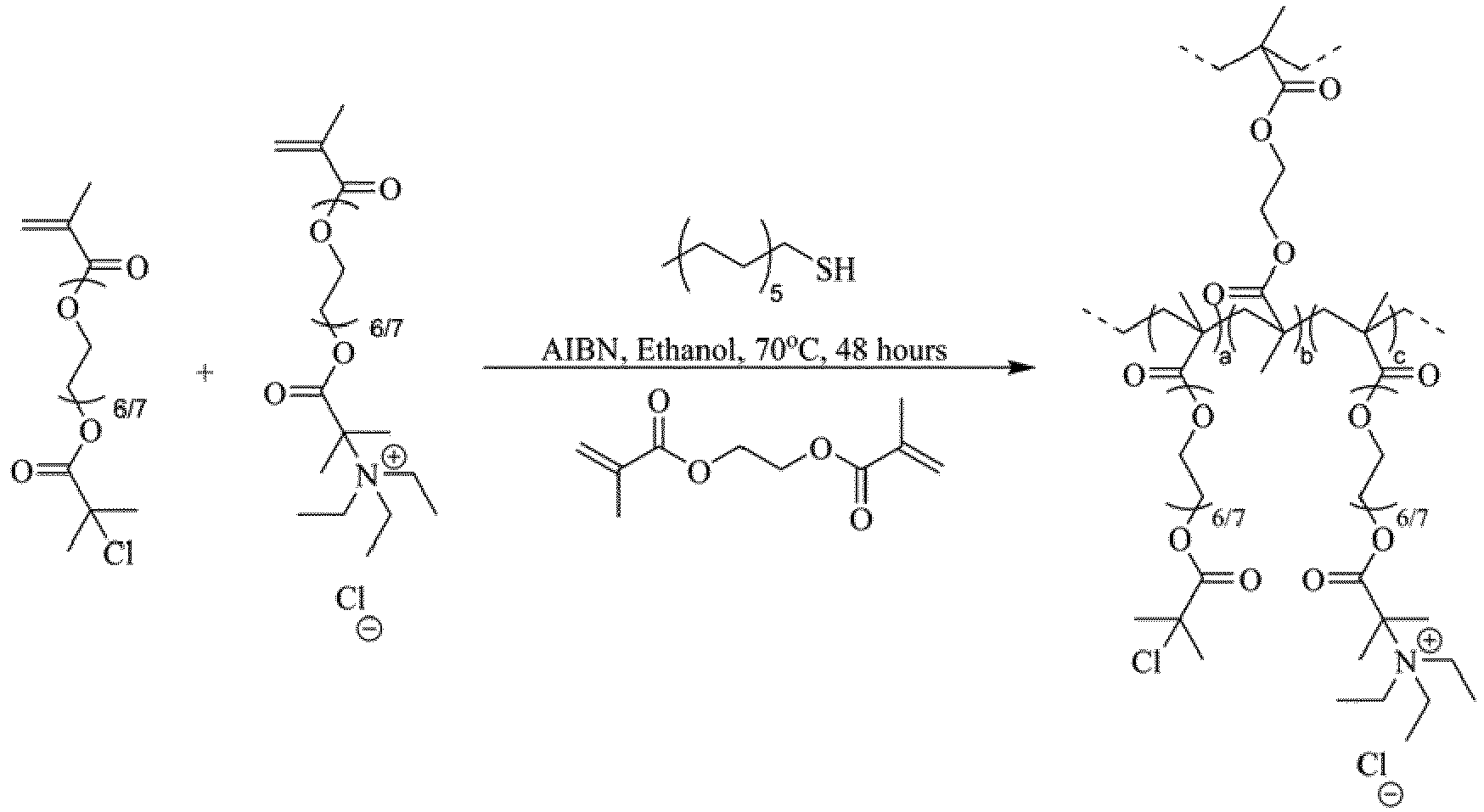
- Three round bottom flasks were prepared in a Radley 6-reaction carousel, each equipped with a stirrer bar and heated to 70 °C.
- Into flask 1 was placed ethanol (39 mL), DDT (60 µL, 50 mg, 0.3 mmol), EGDMA (50 µL, 53 mg, 0.3 mmol; as crosslinker), PEG-N+ (1800 µL, 2068 mg, 3.8 mmol; as charge carrying monomer), PEG-Cl (494 µL, 563 mg, 1.3 mmol; as polymer brush polymerization initiator carrying monomer) and AIBN (20 mg, 0.1 mmol) pre-dissolved in ethanol (1 mL).
- Into
flask 2 was placed ethanol (37 mL), DDT (60 µL, 50 mg, 0.3 mmol), EGDMA (50 µL, 53 mg, 0.3 mmol), PEG-N+ (1200 µL, 1380 mg, 2.5 mmol), PEG-Cl (988 µL, 1126 mg, 2.5 mmol) and AIBN (20 mg, 0.1 mmol) pre- dissolved in ethanol (1 mL). - Into
flask 3 was placed ethanol (39 mL), DDT (60 µL, 50 mg, 0.3 mmol), EGDMA (50 µL, 53 mg, 0.3 mmol), PEG-N+ (600 µL, 690 mg, 1.3 mmol), PEG-Cl (1422 µL, 1621 mg, 3.6 mmol) and AIBN (20 mg, 0.1 mmol) pre- dissolved in ethanol (1 mL). - The reaction proceeded at 70 °C for 48 hours after which the products were separately precipitated in diethyl ether (15 mL), rinsed using ethanol and dried in vacuo. This produced three products, each of which were viscous yellow liquids.
- 1 × 1 cm substrates of silicon were cut from larger silicon wafers using a diamond cutter and placed into a 50:50 acetone:ethanol bath and sonicated for 15 minutes. After sonication the silicon substrates were dried under a stream of nitrogen before being UV-Ozone treated (Jelight 42-200) for a further 15 minutes to remove hydrocarbon contamination and increase the total concentration of hydroxyl groups present on the surface.
- Concomitantly 0.02 wt% solutions of each of the three crosslinked sublayer polymers A to C were prepared to which the silicon substrates were then added to incubate at room temperature for about 2 hours. Following incubation, the substrates were rinsed using water to remove excess crosslinked sublayer polymer solution, and dried under a stream of nitrogen.
- Polymer layer thicknesses of 2 to 5 nm were observed. Polymers A and B were more readily soluble in water and yielded a more uniform coating on the surface than polymer C. Furthermore, the coating of polymer A remained more uniform than the coating of polymer B when subjected to soaking in water.
- Demonstrating the versatility of the crosslinked sublayer with charges and initiation groups, a range of polymers were grafted from model anionic substrates illustrating results for both strongly and weakly charged anionic substrates, i.e. mica and silicon respectively.
- Polymer brush grafting was done with P(DMAEMA), P(MEO2MA), P(OEGMA300) and P(SBMA) polymers on the two anionic surfaces.
- DMAEMA refers to 2-(dimethylamino)ethyl methacrylate.

- MEO2MA refers to the general structure for poly(ethylene glycol) methyl ether methacrylate:

- OEGMA300 refers to the same structure when a mixture of two monomers, where n is equal to either 4 or 5, are combined to produce an average molecular weight of 300.
- P(SBMA) refers to 2-(methacryloyloxy)ethyl]dimethyl-(3-sulfopropyl)-ammonium hydroxide.

- 2,2'-Bipyridyl (BiPy, ≥99 %), Cu(I)Cl (≥99.995 %), Cu(II)Cl2 (≥99.999 %), (+)-sodium L-ascorbate (NaAsc, ≥98 %), di(ethylene glycol) methyl ether methacrylate (MEO2MA, 95 %), poly(ethylene glycol) methyl ether methacry- late (OEGMA300, Average Mn 300), 2-(dimethylamino)ethyl methacrylate (DMAEMA, 98 %) and 2-(methacryloyloxy)ethyl]dimethyl-(3-sulfopropyl)- ammonium hydroxide (SBMA, 97 %), pressurised argon and nitrogen, ultrapure water (resistivity: 18.2 MΩcm, total organic content: 3-4 ppb), P-type, boron-doped, single side polished, 10 cm diameter and 500 µm thick, <100> test-grade silicon wafers, natural muscovite mica, composition KAl2(Si3Al)O10(OH)2, Al special grade.
- 1 × 1 cm substrates of silicon were cut from larger silicon wafers using a diamond cutter and placed into a 50:50 acetone:ethanol bath and sonicated for 15 minutes. After sonication the silicon substrates were dried under nitrogen before being UV-Ozone treated (Jelight 42-200) for a further 15 minutes to remove hydrocarbon contamination and to increase the total concentration of hydroxyl groups present on the surface. Pieces of mica were cleaved on both sides to a thickness of around 50 µm before being cut into 3 × 1 cm pieces using scissors, no further cleaning was undertaken.
- Concomitantly a 0.02 wt% solution of the crosslinked sublayer polymer was prepared, into which mica and/or silicon substrates were placed and left for 2 hours to incubate at room temperature. Following incubation the substrates were rinsed with water followed by soaking in an aqueous environment for 30 minutes before a final rinsing under water and then drying under nitrogen to ensure removal of any excess polymer.
- Atomic-force microscopy (AFM) and X-ray reflectometry (XRR) results showed that the crosslinked sublayer, polymer mat adsorbed as a thin layer, in the region of 1 nm thick, with X-ray photoelectron spectroscopy (XPS) indicating a high density of chlorine groups on the surface, in the region of 3.1 sites per square nanometer.
- Silicon substrates coated in accordance with the above was subjected to ATRP polymerization to graft polymer brushes therefrom. For each reaction a total volume of 3 mL was used, to ensure coverage of the substrate, with a ratio between monomer, BiPy, Cu(I)Cl and Cu(II)Cl2 of 80:2.2:0.9:0.1. Of each 3 mL preparation, 1.5 mL constituted the monomer and the remaining 1.5 mL contained the ATRP reaction chemicals. MEO2MA, OEGMA300 and DMAEMA were liquids and thus were used neat. For SBMA a 50 vol/wt% solution was prepared.
- The substrates were placed in flat bottomed containers which were sealed and purged with nitrogen. 3 mL aliquots of reaction mixtures of the monomers, BiPy, Cu(I)Cl and Cu(II)Cl2 as set forth in table 1 were injected into each of the purged containers and left to react for two hours (additionally 24 hours for MEO2MA), after which the reaction was quenched with oxygenated water before removing the substrates and rinsing them under water. The substrates were then placed in an aqueous environment for 30 minutes before a further rinsing and finally being dried under nitrogen.
Table 1 MEO2MA OEGMA300 DMAEMA SBMA Monomer (mmol) 8.13 5.25 8.91 2064 Monomer (mg) 1530 1580 1400 750 BiPy (mmol) 0.224 0.144 0.245 0.0738 BiPy (mg) 34.9 25.6 38.3 11.5 Cu(I)Cl (mmol) 0.0914 0.0591 0.100 0.0302 Cu(I)Cl (mg) 9.05 5.85 9.92 2.99 Cu(II)Cl2 (mmol) 0.0102 0.00656 0.0111 0.00336 Cu(II)Cl2 (mg) 1.36 0.882 1.50 0.451 - Silicon and mica substrates coated in accordance with the above were subjected to ATRP polymerization to graft polymer brushes therefrom. For each reaction a total volume of 10 mL was used, with a ratio between monomer, BiPy, NaAsc and Cu(II)Cl2 of 1000:10:10:1. Of each 10 mL preparation, 5 mL constituted monomer and the remaining 5 mL contained the ATRP reaction chemicals. For each surface to be coated the quantities set forth in table 2 were used.
Table 2 DMAEMA SBMA Monomer (mmol) 29.7 8.95 Monomer (mg) 4670 2500 BiPy (mmol) 0.297 0.0895 BiPy (mg) 46.3 14.0 NaAsc (mmol) 0.297 0.0895 NaAsc (mg) 58.8 17.7 Cu(II)Cl2 (mmol) 0.0297 0.00895 Cu(II)Cl2 (mg) 3.99 1.20 - The initiated mica or silicon substrates were placed in flat bottomed containers. 10 mL aliquots of the ATRP reaction mixture of monomer, BiPy, NaAsc and Cu(II)Cl2 were injected into each of the containers and left to react, after which the reaction was quenched with oxygenated water before removing the substrates and rinsing them under water. The substrates were then placed in an aqueous environment for 30 minutes before a further rinsing and finally being dried under nitrogen.
- Referring now to
FIG. 1 there is shown anarticle 2 in the form of packaging for aconsumer article 4. The first andsecond frames wet shave razor 4. However, other objects such as toothbrushes, lipstick, brushes, and other solid objects may be provided. - An
outer container 10 is also provided. Theouter container 10 holdsframes outer container 10 may be made of plastic providing the necessary structural integrity to support and display theobject 4. When the first andsecond frames object 4. - In accordance with the present invention, any one or more of the surfaces of the packaging may be fully or partially coated with a polymer layer as discussed. Desirably the polymer brushes of the added polymer layer are composed to impart an increased coefficient of friction, especially under wet conditions.
- Referring to
fig. 2 , a consumer article in the form of awet shave razor 4 generally includes a shaving orcartridge unit 12 attached to ahandle 14 with theshaving unit 12 having one or more blades 16 (e.g. 5 blades shown) each with a sharpened edge and comprising stainless steel. Theblades 16 are at least partially retained by blade clips 28. Acap 18 andguard 20 may also be included in theshaving unit 12, thecap 18 preferably including a lubricating strip or shaving aid composite affixed thereon. Theshaving unit 12 also includes a frame orhousing 22, preferably made of hard plastic. In thisparticular shaving unit 12, there is also present alubricating ring 24 disposed around the periphery of the shaving unit. Thecartridge unit 12 may be adapted for coupling and uncoupling from the razor handle 14 such that anew cartridge unit 12 may be coupled to the handle when the blades become dull or may be integral with ahandle 14 so that thecomplete razor 4 is discarded when the blades become dull. -
FIG. 2a depicts the opposite or rear side of therazor 4 showing the back side of theframe 22 and thecartridge unit 12. - In accordance with the present invention, any one or more of the surfaces of the
wet shave razor 20 may be fully or partially coated with a polymer layer as discussed. - Preferably, for a modifying polymer layer added to portions of the
handle 24, or the guard 25, the polymer brushes of the added polymer layer are composed to impart an increased coefficient of friction, especially under wet conditions. - Preferably, for a modifying polymer layer added to a razor blade or cartridge unit components to the rear or adjacent the blades (e.g. blade clips, frame, housing, cap, etc.) the polymer brushes of the added polymer layer are composed to impart an reduced coefficient of friction, especially under wet conditions.
- While a specific embodiment of a razor is depicted in
FIGs. 2 and 2a , any razor construction type is contemplated in the present invention. - Referring to
FIG. 3 , an article in the form of a blow moldedconsumer goods package 32 comprises abody 34 and ahandle 36. The blow moldedarticle 32 may additionally include a substrate, such as a film substrate, for decorative purposes, e.g., for labels, instructions, information, etc. A portion of the blow molded article, such as thebody 34, thehandle 36, and/or the substrate, may have low surface energy and/or hydrophobic properties such that water on the portion beads up when the blow moldedarticle 32 is wet with water. - In accordance with the invention, a polymer layer is disposed on the
handle 36 of the blow moldedarticle 32. In order to counter beading of water on the handle, the polymer layer are composed to impart hydrophilic, polar, properties. This is believed to improve gripping in aqueous environments by minimizing water beads when thehandle 36 is wet with water. Without intending to be bound by any theory, it is believed that preventing water (or other lubricious materials) from beading and improving wettability (e.g., promoting surfacing wetting) may each or both serve to thin the amount of water that a user must penetrate to engage the skin to the article's external surface. - The polymer layer can be included on or with any skin- engaging portion of the blow molded
article 32 in addition to, or alternatively to thehandle 36. - Referring to
FIG. 4 , aproduct container 42 comprises abody 44 defining a hollow interior and aclosure 46. Theclosure 46 is coupled to thebody 44 such that the closure covers, either directly or indirectly, the hollow interior. For example, theclosure 46 can be coupled to thebody 44 via a screw-type arrangement, snap-fit connection, friction-fit connection, lock- and-key connection, male-female engagement, etc. - In accordance with the invention a polymer layer is disposed on the
closure 46. Similarly to the example ofFIG. 3 , the polymer layer is composed to impart hydrophilic, polar, properties. This is believed to improve gripping in aqueous environments by minimizing water beads when theclosure 46 is wet with water - The polymer layer can be included on any skin-engaging portion of the closure 30.
- The dimensions and values disclosed herein are not to be understood as being strictly limited to the exact numerical values recited. Instead, unless otherwise specified, each such dimension is intended to mean both the recited value and a functionally equivalent range surrounding that value. For example, a dimension disclosed as "40 mm" is intended to mean "about 40 mm."
- All documents cited in the Detailed Description of the Invention are, in relevant part, incorporated herein by reference; the citation of any document is not to be construed as an admission that it is prior art with respect to the present invention. To the extent that any meaning or definition of a term in this document conflicts with any meaning or definition of the same term in a document incorporated by reference, the meaning or definition assigned to that term in this document shall govern.
- While particular embodiments of the present invention have been illustrated and described, it would be obvious to those skilled in the art that various other changes and modifications can be made without departing from the spirit and scope of the invention. It is therefore intended to cover in the appended claims all such changes and modifications that are within the scope of this invention.
Claims (21)
- An article comprising,a substrate having a charged surface; anda polymer layer on said substrate surface; whereinsaid polymer layer comprises,a crosslinked sublayer comprising charged moieties having a charge opposite to that of said charged surface; anda supra-layer comprising polymer chains grafted from the sublayer and extending away from said substrate surface, preferably wherein the polymer chains are polymer brushes.
- The article of claim 1, wherein the crosslinked sublayer comprises:from 5 to 94.5 wt% of monomers carrying at least one charged moiety or precursor thereof, preferably a cationic moiety or precursor thereof, more preferably a quaternary ammonium moiety or precursor thereof;from 5 to 90 wt% of monomers carrying at least one polymerization initiation moiety or at least one polymer chain grafted therefrom; andfrom 0.5 to 5 wt% of a cross-linker.
- The article of any preceding claim, wherein a molar ratio of charged moiety carrying monomers to the sum of monomers carrying at least one polymerization initiation moiety and the monomers carrying at least one polymer chain grafted therefrom, in the crosslinked sublayer, is from 1:4 to 4:1, preferably about 3:1,
- The article of any preceding claim, wherein the cross-linker comprises a bifunctional cross-linker.
- The article of any preceding claim, wherein the crosslinked sublayer has a Mw in the range from 5000 to 400,000 Da, more preferably from 10,000 to 200,000 Da.
- The article of any preceding claim, wherein the substrate surface has a surface charge density in the range from negative 0.001 to 0.2 C m-2.
- The article of any preceding claim, wherein the substrate surface has a surface potential in the range of negative 20 to 150 mV.
- The article of any preceding claim, wherein the substrate surface is negatively charged, and the crosslinked sublayer comprises cationic moieties.
- The article of any preceding claim, wherein the crosslinked sublayer comprises quaternary ammonium moieties.
- The article of any preceding claim, wherein the polymer chains comprise fluorinated monomers, alkoxylated monomers, and/or mixtures thereof.
- The article of any preceding claim, wherein the article is a consumer article, preferably selected from the group consisting of shaving articles and hair removal devices.
- The article of any preceding claim, wherein the article is packaging for consumer goods, preferably a blow molded container.
- A method of making an article comprising a substrate with an external polymer coating comprising polymer chains, the method comprising the steps of:a. providing a substrate comprising a charged surface;b. providing a crosslinked polymer comprising charged moieties having a charge opposite to that of said charged surface, and polymerization initiation moieties;c. applying said crosslinked polymer to said substrate surface;d. providing monomers reactive for polymerization with the polymerization initiation moieties; ande. polymerizing the monomers with the polymerization initiation moieties.
- The method of claim 13, wherein the substrate in step a. comprises a negative surface charge and the charged moieties of the crosslinked polymer comprise quaternary ammonium moieties.
- The method of any of claims 13 to 14, wherein step c. involves dip-coating the substrate surface in a solution, emulsion or dispersion of comprising the crosslinked polymer.
- The method of any of claims 13 to 15, wherein polymerization step e. involves atom transfer radical polymerization.
- The method of any of claims 13 to 16, wherein the monomers comprise fluorinated polymers, preferably pentafluorostyrene, pentafluoropropyl (meth-)acrylate, trifluoroethyl (meth-)acrylate, heptadecafluorodecyl (meth-)acrylate and/or mixtures thereof.
- An article obtainable by the method of any of claims 13 to 17.
- An article comprising,a substrate having a charged surface; anda crosslinked polymer layer on said substrate surface, said crosslinked polymer comprising charged moieties having a charge opposite to that of said charged surface, and polymerization initiation moieties.
- The article of claim 19, wherein the crosslinked polymer layer comprises:from 5 to 94.5 wt% of monomers carrying at least one charged moiety or precursor thereof, preferably a cationic moiety or precursor thereof, more preferably a quaternary ammonium moiety or precursor thereof;from 5 to 90 wt% of monomers carrying at least one polymerization initiation moiety, preferably a free-radical polymerization initiation moiety, more preferably a halide, and most preferably Cl; andfrom 0.5 to 5 wt% of a cross-linker.
- The article of claim 19 or 20, wherein the molar ratio of charged moiety carrying monomers to polymerization initiation moiety carrying monomers in the crosslinked polymer layer is from 1:4 to 4:1, preferably about 3:1.
Priority Applications (6)
| Application Number | Priority Date | Filing Date | Title |
|---|---|---|---|
| EP17156808.2A EP3363835B1 (en) | 2017-02-20 | 2017-02-20 | Article comprising a polymer layer |
| US15/878,534 US20180237615A1 (en) | 2017-02-20 | 2018-01-24 | Article comprising a polymer layer |
| CN201880009079.0A CN110234670A (en) | 2017-02-20 | 2018-02-05 | Articles comprising polymer layers |
| PCT/US2018/016849 WO2018151963A1 (en) | 2017-02-20 | 2018-02-05 | Article comprising a polymer layer |
| JP2019542619A JP6923661B2 (en) | 2017-02-20 | 2018-02-05 | Articles containing a polymer layer |
| KR1020197024123A KR20190104061A (en) | 2017-02-20 | 2018-02-05 | Articles Including Polymeric Layers |
Applications Claiming Priority (1)
| Application Number | Priority Date | Filing Date | Title |
|---|---|---|---|
| EP17156808.2A EP3363835B1 (en) | 2017-02-20 | 2017-02-20 | Article comprising a polymer layer |
Publications (2)
| Publication Number | Publication Date |
|---|---|
| EP3363835A1 true EP3363835A1 (en) | 2018-08-22 |
| EP3363835B1 EP3363835B1 (en) | 2023-10-11 |
Family
ID=58266824
Family Applications (1)
| Application Number | Title | Priority Date | Filing Date |
|---|---|---|---|
| EP17156808.2A Active EP3363835B1 (en) | 2017-02-20 | 2017-02-20 | Article comprising a polymer layer |
Country Status (6)
| Country | Link |
|---|---|
| US (1) | US20180237615A1 (en) |
| EP (1) | EP3363835B1 (en) |
| JP (1) | JP6923661B2 (en) |
| KR (1) | KR20190104061A (en) |
| CN (1) | CN110234670A (en) |
| WO (1) | WO2018151963A1 (en) |
Cited By (1)
| Publication number | Priority date | Publication date | Assignee | Title |
|---|---|---|---|---|
| US20230348654A1 (en) * | 2020-08-06 | 2023-11-02 | Dainichiseika Color & Chemicals Mfg. Co., Ltd. | Surface treatment film, manufacturing method therefor, and article |
Families Citing this family (2)
| Publication number | Priority date | Publication date | Assignee | Title |
|---|---|---|---|---|
| PL3912772T3 (en) | 2020-05-20 | 2024-05-13 | BIC Violex Single Member S.A. | Razor head with improved spring fingers |
| EP3912773B1 (en) | 2020-05-20 | 2024-03-06 | BIC Violex Single Member S.A. | Razor head with improved spring fingers |
Citations (4)
| Publication number | Priority date | Publication date | Assignee | Title |
|---|---|---|---|---|
| EP1754731A1 (en) * | 2005-08-16 | 2007-02-21 | Nederlandse Organisatie voor Toegepast-Natuuurwetenschappelijk Onderzoek TNO | Method of modifying materials surfaces |
| US7303821B1 (en) * | 2003-07-24 | 2007-12-04 | Sepax Technologies, Inc. | Material and process for precisely controlled polymeric coatings |
| US20140235755A1 (en) * | 2013-02-20 | 2014-08-21 | Wisconsin Alumni Research Foundation | Inimer-containing random copolymers and crosslinked copolymer films for dense polymer brush growth |
| CN106366182A (en) * | 2016-08-29 | 2017-02-01 | 四川大学 | PH-responsive type magnetic composite nanosphere as well as preparation method and application thereof |
Family Cites Families (9)
| Publication number | Priority date | Publication date | Assignee | Title |
|---|---|---|---|---|
| US3551241A (en) * | 1967-08-23 | 1970-12-29 | Formica Corp | Process for producing a decorative laminate comprising transferring a film of a transparent noble thermosetting resin to a decorative sheet from a flexible release transfer sheet and removing the flexible release sheet after the heat and pressure consolidation step |
| US6306965B1 (en) * | 1998-08-31 | 2001-10-23 | Ppg Industries Ohio, Inc. | Thermosetting compositions containing carbamate-functional polylmers prepared using atom transfer radical polymerization |
| FR2871162B1 (en) * | 2004-06-02 | 2007-06-29 | Univ Paris 7 Denis Diderot | MODIFIED SURFACE MATERIAL, PROCESS FOR PREPARING THE SAME AND USES THEREOF |
| US9234059B2 (en) * | 2008-07-16 | 2016-01-12 | Outlast Technologies, LLC | Articles containing functional polymeric phase change materials and methods of manufacturing the same |
| JP5130446B2 (en) * | 2009-05-11 | 2013-01-30 | 独立行政法人科学技術振興機構 | Surface modified substrate and polymer coated substrate |
| WO2014185361A1 (en) * | 2013-05-13 | 2014-11-20 | 独立行政法人科学技術振興機構 | Novel composite material, and polymer coating material precursor produced using same |
| EP3134237B1 (en) * | 2014-04-24 | 2018-06-13 | Koninklijke Philips N.V. | Personal care device with sliding surface |
| WO2015170724A1 (en) * | 2014-05-08 | 2015-11-12 | 国立研究開発法人科学技術振興機構 | Polymer brush |
| CN109415643A (en) * | 2016-03-31 | 2019-03-01 | 国立大学法人京都大学 | Lubriation material and SRT material |
-
2017
- 2017-02-20 EP EP17156808.2A patent/EP3363835B1/en active Active
-
2018
- 2018-01-24 US US15/878,534 patent/US20180237615A1/en not_active Abandoned
- 2018-02-05 KR KR1020197024123A patent/KR20190104061A/en not_active Ceased
- 2018-02-05 WO PCT/US2018/016849 patent/WO2018151963A1/en not_active Ceased
- 2018-02-05 JP JP2019542619A patent/JP6923661B2/en active Active
- 2018-02-05 CN CN201880009079.0A patent/CN110234670A/en active Pending
Patent Citations (4)
| Publication number | Priority date | Publication date | Assignee | Title |
|---|---|---|---|---|
| US7303821B1 (en) * | 2003-07-24 | 2007-12-04 | Sepax Technologies, Inc. | Material and process for precisely controlled polymeric coatings |
| EP1754731A1 (en) * | 2005-08-16 | 2007-02-21 | Nederlandse Organisatie voor Toegepast-Natuuurwetenschappelijk Onderzoek TNO | Method of modifying materials surfaces |
| US20140235755A1 (en) * | 2013-02-20 | 2014-08-21 | Wisconsin Alumni Research Foundation | Inimer-containing random copolymers and crosslinked copolymer films for dense polymer brush growth |
| CN106366182A (en) * | 2016-08-29 | 2017-02-01 | 四川大学 | PH-responsive type magnetic composite nanosphere as well as preparation method and application thereof |
Cited By (2)
| Publication number | Priority date | Publication date | Assignee | Title |
|---|---|---|---|---|
| US20230348654A1 (en) * | 2020-08-06 | 2023-11-02 | Dainichiseika Color & Chemicals Mfg. Co., Ltd. | Surface treatment film, manufacturing method therefor, and article |
| US12264217B2 (en) * | 2020-08-06 | 2025-04-01 | Dainichiseika Color & Chemicals Mfg. Co., Ltd. | Surface treatment film, manufacturing method therefor, and article |
Also Published As
| Publication number | Publication date |
|---|---|
| JP6923661B2 (en) | 2021-08-25 |
| US20180237615A1 (en) | 2018-08-23 |
| EP3363835B1 (en) | 2023-10-11 |
| WO2018151963A1 (en) | 2018-08-23 |
| KR20190104061A (en) | 2019-09-05 |
| JP2020507495A (en) | 2020-03-12 |
| CN110234670A (en) | 2019-09-13 |
Similar Documents
| Publication | Publication Date | Title |
|---|---|---|
| EP3363836A1 (en) | Shaving article with surface modification | |
| US20180237615A1 (en) | Article comprising a polymer layer | |
| US8272801B2 (en) | Multi-function surface treatment tool | |
| US20080114128A1 (en) | Synthesis of Copolymers in the Form of a Mikto Star by Controlled Radical Polymerization | |
| MX2012009624A (en) | Flexible personal care article. | |
| RU2015145621A (en) | Consumer Products Containing Silane-Modified Oils | |
| RU2010149892A (en) | ANTI-MICROBIAL AND ANTI-STATIC POLYMERS AND METHODS FOR USING SUCH POLYMERS ON VARIOUS SUBSTANCES | |
| Kuliasha et al. | Engineered chemical nanotopographies: reversible addition–fragmentation chain-transfer mediated grafting of anisotropic poly (acrylamide) patterns on poly (dimethylsiloxane) to modulate marine biofouling | |
| MX2012009626A (en) | Adherent depilatory article. | |
| EP2356964B1 (en) | Tensionable depilatory article | |
| WO2011103230A2 (en) | Facial depilatory article | |
| EP2559417B1 (en) | Depilatory article with substrate | |
| EP2356967B1 (en) | Durable depilatory article | |
| US20250135670A1 (en) | Surface-treated cutting blades demonstrating extended blade edge retention and decreased friction, and methods of reducing deposition of a contaminant on a surface of a metal cutting blade | |
| EP2356965B1 (en) | Method of depilation | |
| MX2012009638A (en) | Stable personal care article. | |
| EP2356962B1 (en) | Efficient depilatory article | |
| MX2012009629A (en) | Depilatory article. | |
| MX2012009633A (en) | FLEXIBLE WATERPROOF DEPILATORY ARTICLE. | |
| MX2012009630A (en) | Conformable depilatory article. | |
| EP2356968A1 (en) | Substrate-based depilatory article | |
| MX2012009637A (en) | Efficacious depilatory article. | |
| WO2013072379A1 (en) | End piece for scraping off a cosmetic product |
Legal Events
| Date | Code | Title | Description |
|---|---|---|---|
| PUAI | Public reference made under article 153(3) epc to a published international application that has entered the european phase |
Free format text: ORIGINAL CODE: 0009012 |
|
| STAA | Information on the status of an ep patent application or granted ep patent |
Free format text: STATUS: THE APPLICATION HAS BEEN PUBLISHED |
|
| AK | Designated contracting states |
Kind code of ref document: A1 Designated state(s): AL AT BE BG CH CY CZ DE DK EE ES FI FR GB GR HR HU IE IS IT LI LT LU LV MC MK MT NL NO PL PT RO RS SE SI SK SM TR |
|
| AX | Request for extension of the european patent |
Extension state: BA ME |
|
| STAA | Information on the status of an ep patent application or granted ep patent |
Free format text: STATUS: REQUEST FOR EXAMINATION WAS MADE |
|
| 17P | Request for examination filed |
Effective date: 20190222 |
|
| RBV | Designated contracting states (corrected) |
Designated state(s): AL AT BE BG CH CY CZ DE DK EE ES FI FR GB GR HR HU IE IS IT LI LT LU LV MC MK MT NL NO PL PT RO RS SE SI SK SM TR |
|
| STAA | Information on the status of an ep patent application or granted ep patent |
Free format text: STATUS: EXAMINATION IS IN PROGRESS |
|
| 17Q | First examination report despatched |
Effective date: 20191018 |
|
| GRAP | Despatch of communication of intention to grant a patent |
Free format text: ORIGINAL CODE: EPIDOSNIGR1 |
|
| STAA | Information on the status of an ep patent application or granted ep patent |
Free format text: STATUS: GRANT OF PATENT IS INTENDED |
|
| RIC1 | Information provided on ipc code assigned before grant |
Ipc: C08J 7/16 20060101ALN20230306BHEP Ipc: B26B 21/52 20060101ALN20230306BHEP Ipc: B26B 21/40 20060101ALI20230306BHEP Ipc: B05D 1/36 20060101ALI20230306BHEP Ipc: B05D 1/18 20060101ALI20230306BHEP Ipc: B05D 5/00 20060101ALI20230306BHEP Ipc: C08F 293/00 20060101AFI20230306BHEP |
|
| RIC1 | Information provided on ipc code assigned before grant |
Ipc: C08J 7/16 20060101ALN20230315BHEP Ipc: B26B 21/52 20060101ALN20230315BHEP Ipc: B26B 21/40 20060101ALI20230315BHEP Ipc: B05D 1/36 20060101ALI20230315BHEP Ipc: B05D 1/18 20060101ALI20230315BHEP Ipc: B05D 5/00 20060101ALI20230315BHEP Ipc: C08F 293/00 20060101AFI20230315BHEP |
|
| INTG | Intention to grant announced |
Effective date: 20230329 |
|
| P01 | Opt-out of the competence of the unified patent court (upc) registered |
Effective date: 20230430 |
|
| GRAJ | Information related to disapproval of communication of intention to grant by the applicant or resumption of examination proceedings by the epo deleted |
Free format text: ORIGINAL CODE: EPIDOSDIGR1 |
|
| STAA | Information on the status of an ep patent application or granted ep patent |
Free format text: STATUS: EXAMINATION IS IN PROGRESS |
|
| GRAS | Grant fee paid |
Free format text: ORIGINAL CODE: EPIDOSNIGR3 |
|
| STAA | Information on the status of an ep patent application or granted ep patent |
Free format text: STATUS: GRANT OF PATENT IS INTENDED |
|
| GRAP | Despatch of communication of intention to grant a patent |
Free format text: ORIGINAL CODE: EPIDOSNIGR1 |
|
| INTC | Intention to grant announced (deleted) | ||
| RIC1 | Information provided on ipc code assigned before grant |
Ipc: C08J 7/16 20060101ALN20230724BHEP Ipc: B26B 21/52 20060101ALN20230724BHEP Ipc: B26B 21/40 20060101ALI20230724BHEP Ipc: B05D 1/36 20060101ALI20230724BHEP Ipc: B05D 1/18 20060101ALI20230724BHEP Ipc: B05D 5/00 20060101ALI20230724BHEP Ipc: C08F 293/00 20060101AFI20230724BHEP |
|
| GRAA | (expected) grant |
Free format text: ORIGINAL CODE: 0009210 |
|
| STAA | Information on the status of an ep patent application or granted ep patent |
Free format text: STATUS: THE PATENT HAS BEEN GRANTED |
|
| INTG | Intention to grant announced |
Effective date: 20230816 |
|
| AK | Designated contracting states |
Kind code of ref document: B1 Designated state(s): AL AT BE BG CH CY CZ DE DK EE ES FI FR GB GR HR HU IE IS IT LI LT LU LV MC MK MT NL NO PL PT RO RS SE SI SK SM TR |
|
| REG | Reference to a national code |
Ref country code: GB Ref legal event code: FG4D |
|
| REG | Reference to a national code |
Ref country code: CH Ref legal event code: EP |
|
| REG | Reference to a national code |
Ref country code: DE Ref legal event code: R096 Ref document number: 602017075116 Country of ref document: DE |
|
| REG | Reference to a national code |
Ref country code: IE Ref legal event code: FG4D |
|
| REG | Reference to a national code |
Ref country code: LT Ref legal event code: MG9D |
|
| REG | Reference to a national code |
Ref country code: NL Ref legal event code: MP Effective date: 20231011 |
|
| REG | Reference to a national code |
Ref country code: AT Ref legal event code: MK05 Ref document number: 1620186 Country of ref document: AT Kind code of ref document: T Effective date: 20231011 |
|
| PG25 | Lapsed in a contracting state [announced via postgrant information from national office to epo] |
Ref country code: NL Free format text: LAPSE BECAUSE OF FAILURE TO SUBMIT A TRANSLATION OF THE DESCRIPTION OR TO PAY THE FEE WITHIN THE PRESCRIBED TIME-LIMIT Effective date: 20231011 |
|
| PG25 | Lapsed in a contracting state [announced via postgrant information from national office to epo] |
Ref country code: GR Free format text: LAPSE BECAUSE OF FAILURE TO SUBMIT A TRANSLATION OF THE DESCRIPTION OR TO PAY THE FEE WITHIN THE PRESCRIBED TIME-LIMIT Effective date: 20240112 |
|
| PG25 | Lapsed in a contracting state [announced via postgrant information from national office to epo] |
Ref country code: IS Free format text: LAPSE BECAUSE OF FAILURE TO SUBMIT A TRANSLATION OF THE DESCRIPTION OR TO PAY THE FEE WITHIN THE PRESCRIBED TIME-LIMIT Effective date: 20240211 |
|
| PG25 | Lapsed in a contracting state [announced via postgrant information from national office to epo] |
Ref country code: LT Free format text: LAPSE BECAUSE OF FAILURE TO SUBMIT A TRANSLATION OF THE DESCRIPTION OR TO PAY THE FEE WITHIN THE PRESCRIBED TIME-LIMIT Effective date: 20231011 |
|
| PG25 | Lapsed in a contracting state [announced via postgrant information from national office to epo] |
Ref country code: AT Free format text: LAPSE BECAUSE OF FAILURE TO SUBMIT A TRANSLATION OF THE DESCRIPTION OR TO PAY THE FEE WITHIN THE PRESCRIBED TIME-LIMIT Effective date: 20231011 |
|
| PG25 | Lapsed in a contracting state [announced via postgrant information from national office to epo] |
Ref country code: ES Free format text: LAPSE BECAUSE OF FAILURE TO SUBMIT A TRANSLATION OF THE DESCRIPTION OR TO PAY THE FEE WITHIN THE PRESCRIBED TIME-LIMIT Effective date: 20231011 |
|
| PG25 | Lapsed in a contracting state [announced via postgrant information from national office to epo] |
Ref country code: LT Free format text: LAPSE BECAUSE OF FAILURE TO SUBMIT A TRANSLATION OF THE DESCRIPTION OR TO PAY THE FEE WITHIN THE PRESCRIBED TIME-LIMIT Effective date: 20231011 Ref country code: IS Free format text: LAPSE BECAUSE OF FAILURE TO SUBMIT A TRANSLATION OF THE DESCRIPTION OR TO PAY THE FEE WITHIN THE PRESCRIBED TIME-LIMIT Effective date: 20240211 Ref country code: GR Free format text: LAPSE BECAUSE OF FAILURE TO SUBMIT A TRANSLATION OF THE DESCRIPTION OR TO PAY THE FEE WITHIN THE PRESCRIBED TIME-LIMIT Effective date: 20240112 Ref country code: ES Free format text: LAPSE BECAUSE OF FAILURE TO SUBMIT A TRANSLATION OF THE DESCRIPTION OR TO PAY THE FEE WITHIN THE PRESCRIBED TIME-LIMIT Effective date: 20231011 Ref country code: BG Free format text: LAPSE BECAUSE OF FAILURE TO SUBMIT A TRANSLATION OF THE DESCRIPTION OR TO PAY THE FEE WITHIN THE PRESCRIBED TIME-LIMIT Effective date: 20240111 Ref country code: AT Free format text: LAPSE BECAUSE OF FAILURE TO SUBMIT A TRANSLATION OF THE DESCRIPTION OR TO PAY THE FEE WITHIN THE PRESCRIBED TIME-LIMIT Effective date: 20231011 Ref country code: PT Free format text: LAPSE BECAUSE OF FAILURE TO SUBMIT A TRANSLATION OF THE DESCRIPTION OR TO PAY THE FEE WITHIN THE PRESCRIBED TIME-LIMIT Effective date: 20240212 |
|
| PG25 | Lapsed in a contracting state [announced via postgrant information from national office to epo] |
Ref country code: SE Free format text: LAPSE BECAUSE OF FAILURE TO SUBMIT A TRANSLATION OF THE DESCRIPTION OR TO PAY THE FEE WITHIN THE PRESCRIBED TIME-LIMIT Effective date: 20231011 Ref country code: RS Free format text: LAPSE BECAUSE OF FAILURE TO SUBMIT A TRANSLATION OF THE DESCRIPTION OR TO PAY THE FEE WITHIN THE PRESCRIBED TIME-LIMIT Effective date: 20231011 Ref country code: PL Free format text: LAPSE BECAUSE OF FAILURE TO SUBMIT A TRANSLATION OF THE DESCRIPTION OR TO PAY THE FEE WITHIN THE PRESCRIBED TIME-LIMIT Effective date: 20231011 Ref country code: NO Free format text: LAPSE BECAUSE OF FAILURE TO SUBMIT A TRANSLATION OF THE DESCRIPTION OR TO PAY THE FEE WITHIN THE PRESCRIBED TIME-LIMIT Effective date: 20240111 Ref country code: LV Free format text: LAPSE BECAUSE OF FAILURE TO SUBMIT A TRANSLATION OF THE DESCRIPTION OR TO PAY THE FEE WITHIN THE PRESCRIBED TIME-LIMIT Effective date: 20231011 Ref country code: HR Free format text: LAPSE BECAUSE OF FAILURE TO SUBMIT A TRANSLATION OF THE DESCRIPTION OR TO PAY THE FEE WITHIN THE PRESCRIBED TIME-LIMIT Effective date: 20231011 |
|
| PG25 | Lapsed in a contracting state [announced via postgrant information from national office to epo] |
Ref country code: DK Free format text: LAPSE BECAUSE OF FAILURE TO SUBMIT A TRANSLATION OF THE DESCRIPTION OR TO PAY THE FEE WITHIN THE PRESCRIBED TIME-LIMIT Effective date: 20231011 |
|
| REG | Reference to a national code |
Ref country code: DE Ref legal event code: R097 Ref document number: 602017075116 Country of ref document: DE |
|
| PG25 | Lapsed in a contracting state [announced via postgrant information from national office to epo] |
Ref country code: CZ Free format text: LAPSE BECAUSE OF FAILURE TO SUBMIT A TRANSLATION OF THE DESCRIPTION OR TO PAY THE FEE WITHIN THE PRESCRIBED TIME-LIMIT Effective date: 20231011 |
|
| PG25 | Lapsed in a contracting state [announced via postgrant information from national office to epo] |
Ref country code: SK Free format text: LAPSE BECAUSE OF FAILURE TO SUBMIT A TRANSLATION OF THE DESCRIPTION OR TO PAY THE FEE WITHIN THE PRESCRIBED TIME-LIMIT Effective date: 20231011 |
|
| PG25 | Lapsed in a contracting state [announced via postgrant information from national office to epo] |
Ref country code: SM Free format text: LAPSE BECAUSE OF FAILURE TO SUBMIT A TRANSLATION OF THE DESCRIPTION OR TO PAY THE FEE WITHIN THE PRESCRIBED TIME-LIMIT Effective date: 20231011 Ref country code: SK Free format text: LAPSE BECAUSE OF FAILURE TO SUBMIT A TRANSLATION OF THE DESCRIPTION OR TO PAY THE FEE WITHIN THE PRESCRIBED TIME-LIMIT Effective date: 20231011 Ref country code: RO Free format text: LAPSE BECAUSE OF FAILURE TO SUBMIT A TRANSLATION OF THE DESCRIPTION OR TO PAY THE FEE WITHIN THE PRESCRIBED TIME-LIMIT Effective date: 20231011 Ref country code: IT Free format text: LAPSE BECAUSE OF FAILURE TO SUBMIT A TRANSLATION OF THE DESCRIPTION OR TO PAY THE FEE WITHIN THE PRESCRIBED TIME-LIMIT Effective date: 20231011 Ref country code: EE Free format text: LAPSE BECAUSE OF FAILURE TO SUBMIT A TRANSLATION OF THE DESCRIPTION OR TO PAY THE FEE WITHIN THE PRESCRIBED TIME-LIMIT Effective date: 20231011 Ref country code: DK Free format text: LAPSE BECAUSE OF FAILURE TO SUBMIT A TRANSLATION OF THE DESCRIPTION OR TO PAY THE FEE WITHIN THE PRESCRIBED TIME-LIMIT Effective date: 20231011 Ref country code: CZ Free format text: LAPSE BECAUSE OF FAILURE TO SUBMIT A TRANSLATION OF THE DESCRIPTION OR TO PAY THE FEE WITHIN THE PRESCRIBED TIME-LIMIT Effective date: 20231011 |
|
| PLBE | No opposition filed within time limit |
Free format text: ORIGINAL CODE: 0009261 |
|
| STAA | Information on the status of an ep patent application or granted ep patent |
Free format text: STATUS: NO OPPOSITION FILED WITHIN TIME LIMIT |
|
| 26N | No opposition filed |
Effective date: 20240712 |
|
| PG25 | Lapsed in a contracting state [announced via postgrant information from national office to epo] |
Ref country code: MC Free format text: LAPSE BECAUSE OF FAILURE TO SUBMIT A TRANSLATION OF THE DESCRIPTION OR TO PAY THE FEE WITHIN THE PRESCRIBED TIME-LIMIT Effective date: 20231011 |
|
| REG | Reference to a national code |
Ref country code: CH Ref legal event code: PL |
|
| PG25 | Lapsed in a contracting state [announced via postgrant information from national office to epo] |
Ref country code: LU Free format text: LAPSE BECAUSE OF NON-PAYMENT OF DUE FEES Effective date: 20240220 |
|
| PG25 | Lapsed in a contracting state [announced via postgrant information from national office to epo] |
Ref country code: CH Free format text: LAPSE BECAUSE OF NON-PAYMENT OF DUE FEES Effective date: 20240229 |
|
| PG25 | Lapsed in a contracting state [announced via postgrant information from national office to epo] |
Ref country code: SI Free format text: LAPSE BECAUSE OF FAILURE TO SUBMIT A TRANSLATION OF THE DESCRIPTION OR TO PAY THE FEE WITHIN THE PRESCRIBED TIME-LIMIT Effective date: 20231011 |
|
| PG25 | Lapsed in a contracting state [announced via postgrant information from national office to epo] |
Ref country code: SI Free format text: LAPSE BECAUSE OF FAILURE TO SUBMIT A TRANSLATION OF THE DESCRIPTION OR TO PAY THE FEE WITHIN THE PRESCRIBED TIME-LIMIT Effective date: 20231011 Ref country code: LU Free format text: LAPSE BECAUSE OF NON-PAYMENT OF DUE FEES Effective date: 20240220 Ref country code: CH Free format text: LAPSE BECAUSE OF NON-PAYMENT OF DUE FEES Effective date: 20240229 |
|
| REG | Reference to a national code |
Ref country code: BE Ref legal event code: MM Effective date: 20240229 |
|
| PG25 | Lapsed in a contracting state [announced via postgrant information from national office to epo] |
Ref country code: BE Free format text: LAPSE BECAUSE OF NON-PAYMENT OF DUE FEES Effective date: 20240229 |
|
| PG25 | Lapsed in a contracting state [announced via postgrant information from national office to epo] |
Ref country code: FR Free format text: LAPSE BECAUSE OF NON-PAYMENT OF DUE FEES Effective date: 20240229 |
|
| PG25 | Lapsed in a contracting state [announced via postgrant information from national office to epo] |
Ref country code: IE Free format text: LAPSE BECAUSE OF NON-PAYMENT OF DUE FEES Effective date: 20240220 |
|
| PG25 | Lapsed in a contracting state [announced via postgrant information from national office to epo] |
Ref country code: IE Free format text: LAPSE BECAUSE OF NON-PAYMENT OF DUE FEES Effective date: 20240220 Ref country code: FR Free format text: LAPSE BECAUSE OF NON-PAYMENT OF DUE FEES Effective date: 20240229 Ref country code: BE Free format text: LAPSE BECAUSE OF NON-PAYMENT OF DUE FEES Effective date: 20240229 |
|
| PG25 | Lapsed in a contracting state [announced via postgrant information from national office to epo] |
Ref country code: CY Free format text: LAPSE BECAUSE OF FAILURE TO SUBMIT A TRANSLATION OF THE DESCRIPTION OR TO PAY THE FEE WITHIN THE PRESCRIBED TIME-LIMIT; INVALID AB INITIO Effective date: 20170220 |
|
| PG25 | Lapsed in a contracting state [announced via postgrant information from national office to epo] |
Ref country code: HU Free format text: LAPSE BECAUSE OF FAILURE TO SUBMIT A TRANSLATION OF THE DESCRIPTION OR TO PAY THE FEE WITHIN THE PRESCRIBED TIME-LIMIT; INVALID AB INITIO Effective date: 20170220 |
|
| PG25 | Lapsed in a contracting state [announced via postgrant information from national office to epo] |
Ref country code: FI Free format text: LAPSE BECAUSE OF FAILURE TO SUBMIT A TRANSLATION OF THE DESCRIPTION OR TO PAY THE FEE WITHIN THE PRESCRIBED TIME-LIMIT Effective date: 20231011 |
|
| PG25 | Lapsed in a contracting state [announced via postgrant information from national office to epo] |
Ref country code: TR Free format text: LAPSE BECAUSE OF FAILURE TO SUBMIT A TRANSLATION OF THE DESCRIPTION OR TO PAY THE FEE WITHIN THE PRESCRIBED TIME-LIMIT Effective date: 20231011 |
|
| PGFP | Annual fee paid to national office [announced via postgrant information from national office to epo] |
Ref country code: GB Payment date: 20260106 Year of fee payment: 10 |
|
| PGFP | Annual fee paid to national office [announced via postgrant information from national office to epo] |
Ref country code: DE Payment date: 20251230 Year of fee payment: 10 |