EP3363464A1 - Pharmaceutical composition for treating cancer comprising rna oligonucleotide - Google Patents
Pharmaceutical composition for treating cancer comprising rna oligonucleotide Download PDFInfo
- Publication number
- EP3363464A1 EP3363464A1 EP16855780.9A EP16855780A EP3363464A1 EP 3363464 A1 EP3363464 A1 EP 3363464A1 EP 16855780 A EP16855780 A EP 16855780A EP 3363464 A1 EP3363464 A1 EP 3363464A1
- Authority
- EP
- European Patent Office
- Prior art keywords
- cancer
- seq
- pharmaceutical composition
- sequence represented
- base sequence
- Prior art date
- Legal status (The legal status is an assumption and is not a legal conclusion. Google has not performed a legal analysis and makes no representation as to the accuracy of the status listed.)
- Granted
Links
Images




Classifications
-
- A—HUMAN NECESSITIES
- A61—MEDICAL OR VETERINARY SCIENCE; HYGIENE
- A61K—PREPARATIONS FOR MEDICAL, DENTAL OR TOILETRY PURPOSES
- A61K48/00—Medicinal preparations containing genetic material which is inserted into cells of the living body to treat genetic diseases; Gene therapy
-
- C—CHEMISTRY; METALLURGY
- C12—BIOCHEMISTRY; BEER; SPIRITS; WINE; VINEGAR; MICROBIOLOGY; ENZYMOLOGY; MUTATION OR GENETIC ENGINEERING
- C12N—MICROORGANISMS OR ENZYMES; COMPOSITIONS THEREOF; PROPAGATING, PRESERVING, OR MAINTAINING MICROORGANISMS; MUTATION OR GENETIC ENGINEERING; CULTURE MEDIA
- C12N15/00—Mutation or genetic engineering; DNA or RNA concerning genetic engineering, vectors, e.g. plasmids, or their isolation, preparation or purification; Use of hosts therefor
- C12N15/09—Recombinant DNA-technology
- C12N15/11—DNA or RNA fragments; Modified forms thereof; Non-coding nucleic acids having a biological activity
- C12N15/117—Nucleic acids having immunomodulatory properties, e.g. containing CpG-motifs
-
- A—HUMAN NECESSITIES
- A61—MEDICAL OR VETERINARY SCIENCE; HYGIENE
- A61K—PREPARATIONS FOR MEDICAL, DENTAL OR TOILETRY PURPOSES
- A61K31/00—Medicinal preparations containing organic active ingredients
- A61K31/70—Carbohydrates; Sugars; Derivatives thereof
- A61K31/7088—Compounds having three or more nucleosides or nucleotides
- A61K31/713—Double-stranded nucleic acids or oligonucleotides
-
- A—HUMAN NECESSITIES
- A61—MEDICAL OR VETERINARY SCIENCE; HYGIENE
- A61P—SPECIFIC THERAPEUTIC ACTIVITY OF CHEMICAL COMPOUNDS OR MEDICINAL PREPARATIONS
- A61P31/00—Antiinfectives, i.e. antibiotics, antiseptics, chemotherapeutics
- A61P31/12—Antivirals
-
- A—HUMAN NECESSITIES
- A61—MEDICAL OR VETERINARY SCIENCE; HYGIENE
- A61P—SPECIFIC THERAPEUTIC ACTIVITY OF CHEMICAL COMPOUNDS OR MEDICINAL PREPARATIONS
- A61P31/00—Antiinfectives, i.e. antibiotics, antiseptics, chemotherapeutics
- A61P31/12—Antivirals
- A61P31/14—Antivirals for RNA viruses
-
- A—HUMAN NECESSITIES
- A61—MEDICAL OR VETERINARY SCIENCE; HYGIENE
- A61P—SPECIFIC THERAPEUTIC ACTIVITY OF CHEMICAL COMPOUNDS OR MEDICINAL PREPARATIONS
- A61P35/00—Antineoplastic agents
-
- C—CHEMISTRY; METALLURGY
- C12—BIOCHEMISTRY; BEER; SPIRITS; WINE; VINEGAR; MICROBIOLOGY; ENZYMOLOGY; MUTATION OR GENETIC ENGINEERING
- C12N—MICROORGANISMS OR ENZYMES; COMPOSITIONS THEREOF; PROPAGATING, PRESERVING, OR MAINTAINING MICROORGANISMS; MUTATION OR GENETIC ENGINEERING; CULTURE MEDIA
- C12N15/00—Mutation or genetic engineering; DNA or RNA concerning genetic engineering, vectors, e.g. plasmids, or their isolation, preparation or purification; Use of hosts therefor
- C12N15/09—Recombinant DNA-technology
- C12N15/11—DNA or RNA fragments; Modified forms thereof; Non-coding nucleic acids having a biological activity
- C12N15/113—Non-coding nucleic acids modulating the expression of genes, e.g. antisense oligonucleotides; Antisense DNA or RNA; Triplex- forming oligonucleotides; Catalytic nucleic acids, e.g. ribozymes; Nucleic acids used in co-suppression or gene silencing
-
- C—CHEMISTRY; METALLURGY
- C12—BIOCHEMISTRY; BEER; SPIRITS; WINE; VINEGAR; MICROBIOLOGY; ENZYMOLOGY; MUTATION OR GENETIC ENGINEERING
- C12N—MICROORGANISMS OR ENZYMES; COMPOSITIONS THEREOF; PROPAGATING, PRESERVING, OR MAINTAINING MICROORGANISMS; MUTATION OR GENETIC ENGINEERING; CULTURE MEDIA
- C12N15/00—Mutation or genetic engineering; DNA or RNA concerning genetic engineering, vectors, e.g. plasmids, or their isolation, preparation or purification; Use of hosts therefor
- C12N15/09—Recombinant DNA-technology
- C12N15/11—DNA or RNA fragments; Modified forms thereof; Non-coding nucleic acids having a biological activity
- C12N15/113—Non-coding nucleic acids modulating the expression of genes, e.g. antisense oligonucleotides; Antisense DNA or RNA; Triplex- forming oligonucleotides; Catalytic nucleic acids, e.g. ribozymes; Nucleic acids used in co-suppression or gene silencing
- C12N15/1131—Non-coding nucleic acids modulating the expression of genes, e.g. antisense oligonucleotides; Antisense DNA or RNA; Triplex- forming oligonucleotides; Catalytic nucleic acids, e.g. ribozymes; Nucleic acids used in co-suppression or gene silencing against viruses
-
- C—CHEMISTRY; METALLURGY
- C12—BIOCHEMISTRY; BEER; SPIRITS; WINE; VINEGAR; MICROBIOLOGY; ENZYMOLOGY; MUTATION OR GENETIC ENGINEERING
- C12N—MICROORGANISMS OR ENZYMES; COMPOSITIONS THEREOF; PROPAGATING, PRESERVING, OR MAINTAINING MICROORGANISMS; MUTATION OR GENETIC ENGINEERING; CULTURE MEDIA
- C12N2310/00—Structure or type of the nucleic acid
- C12N2310/10—Type of nucleic acid
- C12N2310/17—Immunomodulatory nucleic acids
-
- C—CHEMISTRY; METALLURGY
- C12—BIOCHEMISTRY; BEER; SPIRITS; WINE; VINEGAR; MICROBIOLOGY; ENZYMOLOGY; MUTATION OR GENETIC ENGINEERING
- C12N—MICROORGANISMS OR ENZYMES; COMPOSITIONS THEREOF; PROPAGATING, PRESERVING, OR MAINTAINING MICROORGANISMS; MUTATION OR GENETIC ENGINEERING; CULTURE MEDIA
- C12N2310/00—Structure or type of the nucleic acid
- C12N2310/30—Chemical structure
- C12N2310/31—Chemical structure of the backbone
-
- C—CHEMISTRY; METALLURGY
- C12—BIOCHEMISTRY; BEER; SPIRITS; WINE; VINEGAR; MICROBIOLOGY; ENZYMOLOGY; MUTATION OR GENETIC ENGINEERING
- C12N—MICROORGANISMS OR ENZYMES; COMPOSITIONS THEREOF; PROPAGATING, PRESERVING, OR MAINTAINING MICROORGANISMS; MUTATION OR GENETIC ENGINEERING; CULTURE MEDIA
- C12N2310/00—Structure or type of the nucleic acid
- C12N2310/30—Chemical structure
- C12N2310/31—Chemical structure of the backbone
- C12N2310/312—Phosphonates
- C12N2310/3125—Methylphosphonates
-
- C—CHEMISTRY; METALLURGY
- C12—BIOCHEMISTRY; BEER; SPIRITS; WINE; VINEGAR; MICROBIOLOGY; ENZYMOLOGY; MUTATION OR GENETIC ENGINEERING
- C12N—MICROORGANISMS OR ENZYMES; COMPOSITIONS THEREOF; PROPAGATING, PRESERVING, OR MAINTAINING MICROORGANISMS; MUTATION OR GENETIC ENGINEERING; CULTURE MEDIA
- C12N2310/00—Structure or type of the nucleic acid
- C12N2310/30—Chemical structure
- C12N2310/31—Chemical structure of the backbone
- C12N2310/313—Phosphorodithioates
-
- C—CHEMISTRY; METALLURGY
- C12—BIOCHEMISTRY; BEER; SPIRITS; WINE; VINEGAR; MICROBIOLOGY; ENZYMOLOGY; MUTATION OR GENETIC ENGINEERING
- C12N—MICROORGANISMS OR ENZYMES; COMPOSITIONS THEREOF; PROPAGATING, PRESERVING, OR MAINTAINING MICROORGANISMS; MUTATION OR GENETIC ENGINEERING; CULTURE MEDIA
- C12N2310/00—Structure or type of the nucleic acid
- C12N2310/30—Chemical structure
- C12N2310/31—Chemical structure of the backbone
- C12N2310/315—Phosphorothioates
-
- C—CHEMISTRY; METALLURGY
- C12—BIOCHEMISTRY; BEER; SPIRITS; WINE; VINEGAR; MICROBIOLOGY; ENZYMOLOGY; MUTATION OR GENETIC ENGINEERING
- C12N—MICROORGANISMS OR ENZYMES; COMPOSITIONS THEREOF; PROPAGATING, PRESERVING, OR MAINTAINING MICROORGANISMS; MUTATION OR GENETIC ENGINEERING; CULTURE MEDIA
- C12N2310/00—Structure or type of the nucleic acid
- C12N2310/30—Chemical structure
- C12N2310/33—Chemical structure of the base
-
- C—CHEMISTRY; METALLURGY
- C12—BIOCHEMISTRY; BEER; SPIRITS; WINE; VINEGAR; MICROBIOLOGY; ENZYMOLOGY; MUTATION OR GENETIC ENGINEERING
- C12N—MICROORGANISMS OR ENZYMES; COMPOSITIONS THEREOF; PROPAGATING, PRESERVING, OR MAINTAINING MICROORGANISMS; MUTATION OR GENETIC ENGINEERING; CULTURE MEDIA
- C12N2310/00—Structure or type of the nucleic acid
- C12N2310/50—Physical structure
-
- C—CHEMISTRY; METALLURGY
- C12—BIOCHEMISTRY; BEER; SPIRITS; WINE; VINEGAR; MICROBIOLOGY; ENZYMOLOGY; MUTATION OR GENETIC ENGINEERING
- C12N—MICROORGANISMS OR ENZYMES; COMPOSITIONS THEREOF; PROPAGATING, PRESERVING, OR MAINTAINING MICROORGANISMS; MUTATION OR GENETIC ENGINEERING; CULTURE MEDIA
- C12N2310/00—Structure or type of the nucleic acid
- C12N2310/50—Physical structure
- C12N2310/53—Physical structure partially self-complementary or closed
- C12N2310/531—Stem-loop; Hairpin
-
- Y—GENERAL TAGGING OF NEW TECHNOLOGICAL DEVELOPMENTS; GENERAL TAGGING OF CROSS-SECTIONAL TECHNOLOGIES SPANNING OVER SEVERAL SECTIONS OF THE IPC; TECHNICAL SUBJECTS COVERED BY FORMER USPC CROSS-REFERENCE ART COLLECTIONS [XRACs] AND DIGESTS
- Y02—TECHNOLOGIES OR APPLICATIONS FOR MITIGATION OR ADAPTATION AGAINST CLIMATE CHANGE
- Y02A—TECHNOLOGIES FOR ADAPTATION TO CLIMATE CHANGE
- Y02A50/00—TECHNOLOGIES FOR ADAPTATION TO CLIMATE CHANGE in human health protection, e.g. against extreme weather
- Y02A50/30—Against vector-borne diseases, e.g. mosquito-borne, fly-borne, tick-borne or waterborne diseases whose impact is exacerbated by climate change
Definitions
- the present disclosure relates to a pharmaceutical composition for treating cancer comprising an RNA oligonucleotide having a particular sequence and structure.
- Cancer therapies include surgery, radiotherapy, chemotherapy, and so on, but, several problems such as low cure rates and many side effects, etc. have been reported. Thus, a development of new anticancer drug that can reduce the side effects and increase the cure rates is required.
- pancreatic cancer It is known that the incidence of pancreatic cancer is low compared with other cancers, but it has the highest mortality among cancer patients. The mortality of the pancreatic cancer is increasing because of difficulty in early diagnosis and easy metastasis to the surrounding organs or lymph nodes.
- Chemotherapy and radiotherapy are used to treat the pancreatic cancer.
- Gemcitabine which is most widely used anti-pancreatic cancer drug, is used with other drugs such as oxalate, 5-FU (5-fluorouracil), and so on. However, it does not have much effect on significant increase of the survival rate of pancreatic cancer patients.
- U.S. Patent Application Publication No. 2012/0288476 discloses that an uncapped oligonucleotide having a phosphate group at the 5'-end can increase the expression of type 1 interferon, interleukin-18, and interleukin-1 ⁇ , etc.
- RNA consisting of four nucleotides can promote immune responses by inducing the activation of interferon- ⁇ .
- RNAs mentioned above have a common feature that they all have a triphosphate group at the 5'-end. It has been known in the art that an uncapped RNA which has a triphosphate group at the 5'-end can activate the expression of interferon by binding to intracellular retinoic acid-inducible gene-I (RIG-I) protein.
- RAG-I retinoic acid-inducible gene-I
- Interferon is a glycoprotein derived from most of the cells having a nucleus. Interferon was known as an important factor in suppressing tumor growth since it was reported that interferon- ⁇ and interferon- ⁇ genes of type 1 interferon gene cluster were deleted in tumor cells. Recombinant interferon- ⁇ has been used as an anticancer drug from the 1980s ( Jun Yoshida et al., Cancer Sci., 2004, Vol.95, No.11, 858-865 ).
- RNA oligonucleotide which does not have a triphosphate group at the 5'-end can also increase the expression of interferon stimulated gene 56 (ISG56) expressed by interferon- ⁇ if the RNA oligonucleotide has a specific sequence and structure, and induce apoptosis of cancer cells.
- ISG56 interferon stimulated gene 56
- an object of the present disclosure is to provide a pharmaceutical composition for treating cancer comprising an RNA oligonucleotide having a particular sequence and structure.
- the present disclosure provides a pharmaceutical composition for treating cancer comprising an RNA oligonucleotide as an active ingredient, wherein the RNA oligonucleotide comprises the base sequence represented by SEQ ID NO:1 (5'-N 1 GUAGAN 2 N 3 -3') and the base sequence represented by SEQ ID NO:2 (5'-N 4 N 5 UUUGCN 6 -3') wherein the base sequences are bound to each other by a complementary binding to form double strands having a helical bend structure; the 3'-end of the base sequence represented by SEQ ID NO:1 and the 5'-end of the base sequence represented by SEQ ID NO:2 are connected into a loop to form a hairpin structure; and the base sequence represented by SEQ ID NO:1 has a hydroxy (OH) group at the 5'-end thereof.
- SEQ ID NO:1 5'-N 1 GUAGAN 2 N 3 -3'
- SEQ ID NO:2 5'-N 4 N 5 UUUGCN 6 -3'
- RNA oligonucleotide having a particular sequence and helical bend structure When a cell line is treated with an RNA oligonucleotide having a particular sequence and helical bend structure according to the present disclosure, the expression of ISG56 is increased and apoptosis of cancer cells is induced.
- a composition comprising such RNA oligonucleotide can be used as an anticancer agent.
- the present disclosure provides a pharmaceutical composition for treating cancer comprising an RNA oligonucleotide as an active ingredient, wherein the RNA oligonucleotide comprises the base sequence represented by SEQ ID NO:1 (5'-N 1 GUAGAN 2 N 3 -3') and the base sequence represented by SEQ ID NO:2 (5'-N 4 N 5 UUUGCN 6 -3') wherein the base sequences are bound to each other by a complementary binding to form double strands having a helical bend structure; the 3'-end of the base sequence represented by SEQ ID NO:1 and the 5'-end of the base sequence represented by SEQ ID NO:2 are connected into a loop to form a hairpin structure; and the base sequence represented by SEQ ID NO:1 has a hydroxy (OH) group at the 5'-end thereof.
- SEQ ID NO:1 5'-N 1 GUAGAN 2 N 3 -3'
- SEQ ID NO:2 5'-N 4 N 5 UUUGCN 6 -3'
- RNA oligonucleotide according to the present disclosure may have 8 to 100, 8 to 50, 8 to 30, 8 to 20, 10 to 100, 10 to 50, 10 to 30, 20 to 500, 20 to 300, 10 to 200, 10 to 100, 20 to 100, 20 to 90, or 20 to 50 bases.
- N 1 to N 6 may be one selected from the group consisting of A, G, C and U. Specifically, N 1 to N 6 may be G or C. In one example of the present disclosure, N 1 may be G, N 2 may be C, and N 3 may be G in the base sequence represented by SEQ ID NO:1 (corresponding to SEQ ID NO:3); and N 4 may be C, N 5 may be G, and N 6 may be C in the base sequence represented by SEQ ID NO:2 (corresponding to SEQ ID NO:4).
- RNA oligonucleotide of the present disclosure may form a helical bend structure between the fourth base (A) of the base sequence represented by SEQ ID NO:1 and the fifth base (U) of the base sequence represented by SEQ ID NO:2.
- the helical bend structure is formed between the fourth base (A) of the base sequence represented by SEQ ID NO:1 and the fifth base (U) of the base sequence represented by SEQ ID NO:2 when the third base (U) and the fifth base (G) of the base sequence represented by SEQ ID NO:1 and the sixth base (G) and the fourth base (U) of the base sequence represented by SEQ ID NO:2 respectively form wobble base pairs.
- the helical bend structure may have a shape bent in 10 to 90 degrees relative to the plane formed by the double-stranded RNA, particularly 30 to 70 degrees, and more particularly 40 to 50 degrees.
- the loop may be composed of at least 4 bases, for instance, 4 to 80, 4 to 75, 4 to 70, 4 to 65, 4 to 60, 4 to 55, 4 to 50, 4 to 45, 4 to 40, 4 to 35, 4 to 30, 4 to 25, 4 to 20, 4 to 15, or 4 to 10 bases.
- the loop may be composed of 4 or 73 bases.
- the four bases constituting the loop may be UUCG.
- the base sequences constituting the loop may form a stem structure by Watson-Crick base pairing.
- the stem structure may include AU motif in which A and U forms a Watson-Crick base pair.
- the AU motif may be composed of 10 to 50, 15 to 40, 20 to 35, or 25 to 30 AU base pairs. In an example of the present disclosure, the AU motif may be composed of 26 consecutive AU base pairs.
- the RNA oligonucleotide having the hairpin structure may be the base sequence represented by SEQ ID NO:7 or SEQ ID NO:8.
- At least one of the phosphodiester bonds in the RNA oligonucleotide may be changed to at least one selected from the group consisting of a phosphorothioate bond, a boranophosphate bond and a methylphosphonate bond, in order to inhibit degradation by endonuclease and improve in vivo stability.
- at least one of the phosphodiester bonds may be changed to the phosphorothioate bond.
- RNA oligonucleotides having hairpin RNA structure Fig. 1
- 5'-OH-iav or 5'-PPP-iav were found to have a helical bend structure ( Fig. 2 ) and to increase the expression of ISG56 ( Figs. 3 and 4 ).
- RNA oligonucleotide having the helical bend structure was found to induce apoptosis of pancreatic cancer, liver cancer, and stomach cancer cell lines without inducing apoptosis of normal cells ( Figs. 5 to 8B ).
- an RNA oligonucleotide having a helical bend structure of the present disclosure increases the expression of ISG56 and induces apoptosis of cancer cells
- a composition comprising the RNA oligonucleotide can be used for cancer treatment.
- the pharmaceutical composition for treating cancer of the present disclosure can be used to treat various cancers such as pancreatic cancer, liver cancer, stomach cancer, lung cancer, colorectal cancer, rectal cancer, thyroid cancer, esophageal cancer, renal caner, bladder cancer, prostate cancer, cervical cancer, breast cancer, hematologic malignancy, skin cancer, epithelial cancer, brain cancer, central nerves cancer, or ovarian cancer, etc.
- various cancers such as pancreatic cancer, liver cancer, stomach cancer, lung cancer, colorectal cancer, rectal cancer, thyroid cancer, esophageal cancer, renal caner, bladder cancer, prostate cancer, cervical cancer, breast cancer, hematologic malignancy, skin cancer, epithelial cancer, brain cancer, central nerves cancer, or ovarian cancer, etc.
- the aforementioned pharmaceutical composition for treating cancer may comprise an RNA oligonucleotide of the present disclosure as an active ingredient in an amount of 10 to 95 weight% based on the total weight of the pharmaceutical composition.
- the pharmaceutical composition of the present disclosure may comprise one or more other active ingredients with the same or similar function in addition to the aforementioned active ingredient.
- composition of the present disclosure may comprise one or more pharmaceutically acceptable additives, for example, excipients, carriers, diluents, and other adjuvants, etc. for the administration.
- pharmaceutically acceptable additives for example, excipients, carriers, diluents, and other adjuvants, etc. for the administration.
- the dosage of the pharmaceutical composition of the present disclosure may be adjusted based on various factors such as type and severity of a disease, type and amount of an active ingredient and other ingredients comprised in the composition, type of a formulation, and age, weight, general health condition, sex and diet of the patient, time of administration, route of administration, treatment period, and drugs simultaneously used, etc.
- the effective amount of an RNA oligonucleotide comprised in the pharmaceutical composition of the present disclosure is adjusted to reach the intracellular concentration of 1 to 1,000 nM, specifically 100 to 500 nM. It may be administered in a single dose or divided doses per day.
- composition of the present disclosure may be administered to a subject by various methods known in the art.
- the route of administration can be appropriately selected by taking into consideration the factors such as administration method, volume of body fluid and viscosity, etc.
- RNA oligonucleotides which can increase the expression of interferon- ⁇ or ISG56 were prepared.
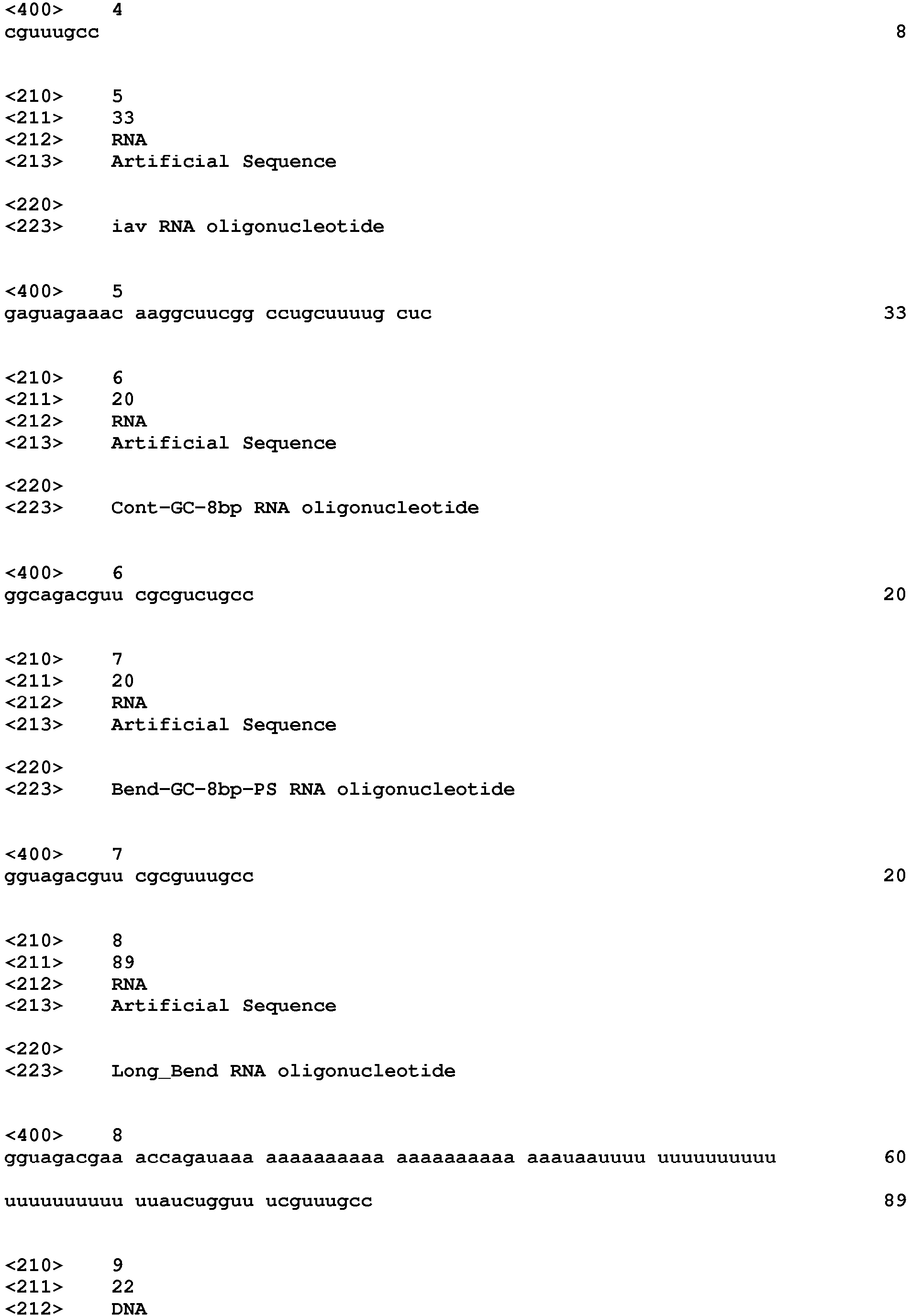
- RNA oligonucleotides composed of the base sequence represented by SEQ ID NO:5 which have a triphosphate group at the 5'-end were prepared by the techniques known in the art.
- RNA oligonucleotides composed of one of the base sequences represented by SEQ ID NOS:5 to 8 which have a hydroxy (OH) group at the 5'-end, or RNA oligonucleotides wherein a phosphodiester bond is substituted with a phosphorothioate bond were custom-made at Integrated DNA Technologies or Dharmacon.
- 5'-OH-iav and 5'-PPP-iav RNA oligonucleotides were prepared, which are composed of the base sequence represented by SEQ ID NO:5. They have a hydroxy group and a triphosphate group at the 5'-ends, respectively.
- 5'-OH-Cont-GC-8bp RNA oligonucleotide was prepared, which is composed of the base sequence represented by SEQ ID NO:6 and has a hydroxy group at the 5'-end.
- 5'-OH-Bend-GC-8bp-PS RNA oligonucleotide was prepared, which is composed of the base sequence represented by SEQ ID NO:7, and has a hydroxy group at the 5'-end, and wherein a phosphodiester bond forming the RNA oligonucleotide is substituted with a phosphorothioate bond.
- 5'-OH-Long_Bend RNA oligonucleotide was prepared, which is composed of the base sequence represented by SEQ ID NO:8 and has a hydroxy group at the 5'-end.
- RNA oligonucleotides prepared in Example 1 were dissolved in a buffer solution containing 10 mM sodium phosphate (pH 6.5), 0.01 mM EDTA, 10 (v/v)% D 2 O to prepare a sample, and various spectroscopic experiments were carried out by the methods known in the art. More particularly, two-dimensional NOE spectroscopy (NOESY) was carried out by a nuclear magnetic resonance (NMR) spectroscope (Bruker, USA) of 400, 600 and 800 MHz with the mixing time of 100 and 200 ms.
- NMR nuclear magnetic resonance
- the NMR peaks of hydrogens of bases of the RNA oligonucleotides and H1', H2', H3', H4', and H5'/H5" were determined.
- approximately 563 NOE distance constraints were obtained, which were divided into 3 to 4 groups according to the distance (e.g., 1.8 to 3.4 ⁇ , 1.8 to 5.0 ⁇ and 3.8 to 7.0 ⁇ ; or 1.8 to 3.4 ⁇ , 2.5 ⁇ to 4.5, 3.5 to 6.0 ⁇ and 4.0 to 7.0 ⁇ ).
- the distance e.g., 1.8 to 3.4 ⁇ , 1.8 to 5.0 ⁇ and 3.8 to 7.0 ⁇ ; or 1.8 to 3.4 ⁇ , 2.5 ⁇ to 4.5, 3.5 to 6.0 ⁇ and 4.0 to 7.0 ⁇ .
- non-Watson-Crick bonds no constraints on the hydrogen bonds were used.
- ⁇ dihedral angle was obtained, and every ⁇ dihedral angle was fixed at -158 ⁇ 15 degrees.
- Other dihedral angles (for example, ⁇ , ⁇ , ⁇ , ⁇ , and ⁇ ) were confined to the A-type helical structure of RNA.
- bulge parts no constraints on the dihedral angles were used except for several ⁇ and ⁇ dihedral angles. Residual dipolar coupling values were measured by HSQC experiment whose sensitivity was increased to reach the accuracy of ⁇ 1 Hz.
- the anisotropy value of -8.0 Hz and the rhombicity value of 0.32 were obtained.
- Calculation of every structure was carried out by X-PLOR 3.1 and CNS. 100 structures were generated according to the distance constraints, and simulated annealing process was carried out in which the structures were simulated at 3,000 K for 10 ps, and then cooled at 300 K for 50 ps. The distance force constant was kept at 50 kcal/mol/ ⁇ , and the dihedral angle constant was changed from 20 kcal/mol/ ⁇ to 400 kcal/mol/ ⁇ .
- the structures with the lowest energy state were purified at 300 K for 20 ps, and the last 5 ps were used for a restrained energy minimization.
- a total of 220 structures obtained from the above procedure were purified by adding 22 residual dipolar coupling values, with the force constant of the residual dipolar coupling value being kept to 3.0 kcal/mol.
- 32 structures were obtained, which were analyzed by Insight II (Biosym Technologies, USA) and CURVES 5.2 software.
- 5'-PPP-iav and 5'-OH-iav RNA oligonucleotides form a helical bend structure.
- Such a helical bend structure was found to be generated by the formation of double strands through non-Watson-Crick base pairing between two single strands which are respectively composed of the sequences represented by 5'-GUAGA-3' and 5'-UUUGC-3' in the 5'-PPP-iav and 5'-OH-iav RNA oligonucleotides.
- RNA oligonucleotides of the present disclosure comprising the sequences represented by 5'-GUAGA-3' and 5'-UUUGC-3', such as 5'-OH-Bend-GC-8bp-PS and 5'-OH-Long_Bend RNA oligonucleotides also form a helical bend structure.
- RNA oligonucleotide (5'-OH-Bend-GC-8bp-PS) containing phosphorothioate bonds among the RNA oligonucleotides having a bend structure prepared in the present disclosure increases the expression of interferon- ⁇ .
- HEK293T cells 3 ⁇ 10 6 of HEK293T cells (ATCC, USA) were aliquoted into 7 ml of Dulbecco's modified Eagle's medium (DMEM) supplemented with 10% fetal bovine serum (FBS, Gibco, USA) in 100 mm tissue culture plates, and cultured for 24 hours under the condition of 37°C and 5% CO 2 to prepare a cell line.
- DMEM Dulbecco's modified Eagle's medium
- FBS fetal bovine serum
- the cell line prepared in Experimental Example 1.1. was treated with 5'-OH-Bend-GC-8bp-PS RNA oligonucleotide.
- the cultured cells were detached by treatment with trypsin-EDTA (Gibco, USA) and the detached cells were counted and aliquoted into 6-well plates at 1 ⁇ 10 3 cells/well. Then, the cells were cultured for 42 hours under the condition of 37°C and 5% CO 2 . After removing the medium, the cells were treated with 400 ⁇ l of OPTI-MEM (Gibco, USA) without FBS, and the RNA oligonucleotide.
- RNA oligonucleotide treatment was as follows: each 1 ⁇ M of 5'-OH-Cont-GC-8bp and 5'-OH-Bend-GC-8bp-PS was mixed with 4 ⁇ l of lipofectamine LTX (Invitrogen, USA) and 1.6 ⁇ l of plus-reagent (Invitrogen, USA), and 200 ⁇ l of resulting mixtures were added to the cells, respectively. Thereafter the cells were incubated for 4 hours under the condition of 37°C and 5% CO 2 . The cells for positive control were treated with poly (I:C), known as RIG-I ligand, and those for negative control were treated with culture medium only. After 4 hours, culture medium was removed, and 2 ml of DMEM containing 10% FBS was added to the cells, which were then further incubated for 2 hours under the condition of 37°C and 5% CO 2 .
- poly (I:C) known as RIG-I ligand
- RNA was isolated according to the following method.
- RNAs were treated with DNase (Promega, USA) for 30 minutes at room temperature to remove contaminated DNAs, and DNase was inactivated by a stop solution. Then, the resultant was treated with Superscript III Reverse Transcriptase (Invitrogen, USA) for 1 hour at 50°C to synthesize cDNAs from the RNAs.
- real-time PCR was carried out. Specifically, real-time PCR was carried out by mixing h-tag DNA polymerase (solgent, Republic of Korea), dNTP, tetraethylammonium chloride, evagreen dye (Biotium, USA), and primers for interferon- ⁇ target gene and GAPDH reference gene. Real-time PCR was performed as follows: fixation for 15 minutes at 95°C, then, repeating a set of reactions (20 seconds at 95°C, 40 seconds at 60°C, and 20 seconds at 72°C) for 40 cycles. The primers for ISG56 and GAPDH are shown in Table 1 below.
- RNA oligonucleotides having a bend structure prepared in the present disclosure it was examined whether the RNA oligonucleotide (5'-OH-Long_Bend) having a long-length hairpin structure can increase the interferon- ⁇ expression by assessing changes in the ISG56 expression.
- RNA oligonucleotide 5'-OH-Bend-GC-8bp-PS or 5'-OH-Long_Bend
- poly(I:C) Invivogen, USA
- 40 ⁇ l of OPTI-MEM 1 ⁇ g/mL
- 1 ⁇ l of lipofectamine LTX Invitrogen, USA
- 0.6 ⁇ l of plus-reagent Invitrogen, USA
- 40 ⁇ l of OPTI-MEM was added to the mixture, and then the mixture was incubated for 5 minutes at room temperature.
- each 40 ⁇ l of RNA oligonucleotides prepared and poly(I:C) mixture was mixed with 40 ⁇ l mixture of lipofectamine and plus reagent, respectively.
- the mixture was incubated for 20 minutes at room temperature to combine RNA oligonucleotides or Poly I:C with lipofectamine.
- RNA oligonucleotide and lipofectamine was injected into wells containing Panc02 cells and the cells were cultured for 24 hours under the condition of 37°C and 5% CO 2 .
- the cells for positive control were treated with poly(I:C), known as RIG-I ligand, and those for negative control were treated with culture medium and 5'-OH-Cont-GC-8bp only.
- a cell line treated with an RNA oligonucleotide or poly(I:C) was collected into a 5 mL round-bottom tube using 0.25% trypsin-EDTA (Gibco, USA), and then the supernatant was removed by spinning down for 5 minutes at 4°C under the speed of 1500 rpm. Then, the cells were dyed with 100 ⁇ l of 1x combined buffer (10 mM HEPES, 140 mM NaCl, 2.5 mM CaCl 2 ) containing Annexin V combined with FITC (Biolegend, USA) and 7-aminoactinomycin D (7-AAD; BD Bioscience, USA) for 15 minutes in the darkroom. After that, the dyed cells were measured with LSRFortessa flow cytometry (BD Bioscience, USA) and the result was analyzed using FlowJo software (Treestar, USA).
- the rate of apoptotic cells is shown in the graph of Fig. 5 .
- the rate of apoptotic cells is shown in the graph of Fig. 6 .
- 5'-OH-Bend-GC-8bp-PS RNA oligonucleotide and 5'-OH-Long_Bend RNA oligonucleotide having a bend structure with a hydroxy group at the 5'-end did not induce apoptosis of HEK293 cell line to a significant level, while poly (I:C) induced apoptosis of HEK293 cell line.
- liver cancer cell line (SNU886; Korean Cell Line Bank, Republic of Korea) was aliquoted in DMEM (WELGENE, USA) and 5'-OH-Bend-GC-8bp-PS oligonucleotide was treated thereto. Then, the apoptosis effect was investigated using FACS as Experimental Example 3.2.
- the rate of apoptotic cells is shown in the graph of Fig. 7 .
- stomach cancer cell lines (SNU216 and MKN74; Korean Cell Line Bank, Republic of Korea) were aliquoted in DMEM (WELGENE, USA) and 5'-OH-Bend-GC-8bp-PS oligonucleotide was treated thereto. Then, the apoptosis effect was found using FACS as Experimental Example 3.2.
- the rate of apoptotic cells is shown in the graph of Figs. 8A and 8B , respectively.
Landscapes
- Health & Medical Sciences (AREA)
- Life Sciences & Earth Sciences (AREA)
- Genetics & Genomics (AREA)
- Engineering & Computer Science (AREA)
- Chemical & Material Sciences (AREA)
- Biomedical Technology (AREA)
- Molecular Biology (AREA)
- Organic Chemistry (AREA)
- Biotechnology (AREA)
- General Health & Medical Sciences (AREA)
- Zoology (AREA)
- Wood Science & Technology (AREA)
- Bioinformatics & Cheminformatics (AREA)
- General Engineering & Computer Science (AREA)
- Biochemistry (AREA)
- Medicinal Chemistry (AREA)
- Animal Behavior & Ethology (AREA)
- Pharmacology & Pharmacy (AREA)
- Public Health (AREA)
- Veterinary Medicine (AREA)
- Plant Pathology (AREA)
- Microbiology (AREA)
- Physics & Mathematics (AREA)
- Biophysics (AREA)
- Epidemiology (AREA)
- Virology (AREA)
- General Chemical & Material Sciences (AREA)
- Chemical Kinetics & Catalysis (AREA)
- Nuclear Medicine, Radiotherapy & Molecular Imaging (AREA)
- Immunology (AREA)
- Communicable Diseases (AREA)
- Oncology (AREA)
- Pharmaceuticals Containing Other Organic And Inorganic Compounds (AREA)
- Medicines That Contain Protein Lipid Enzymes And Other Medicines (AREA)
Abstract
Description
- The present disclosure relates to a pharmaceutical composition for treating cancer comprising an RNA oligonucleotide having a particular sequence and structure.
- Cells divide and grow by their own regulation system, and they maintain balance of the overall number in a body by apoptosis, which occurs when cells reach their lifespan or get damaged. However, uncontrolled proliferation of cells due to failure of cells' own regulation system may cause an invasion of the cells into adjacent normal tissues and organs to form a tumor, thereby destroying or distorting the normal tissues and organs. This state is called cancer. Cancer therapies include surgery, radiotherapy, chemotherapy, and so on, but, several problems such as low cure rates and many side effects, etc. have been reported. Thus, a development of new anticancer drug that can reduce the side effects and increase the cure rates is required.
- It is known that the incidence of pancreatic cancer is low compared with other cancers, but it has the highest mortality among cancer patients. The mortality of the pancreatic cancer is increasing because of difficulty in early diagnosis and easy metastasis to the surrounding organs or lymph nodes.
- Chemotherapy and radiotherapy are used to treat the pancreatic cancer. Gemcitabine, which is most widely used anti-pancreatic cancer drug, is used with other drugs such as oxalate, 5-FU (5-fluorouracil), and so on. However, it does not have much effect on significant increase of the survival rate of pancreatic cancer patients.
- Recently, research is being carried out to treat various disorders by using an RNA oligonucleotide.
U.S. Patent Application Publication No. 2012/0288476 discloses that an uncapped oligonucleotide having a phosphate group at the 5'-end can increase the expression oftype 1 interferon, interleukin-18, and interleukin-1β, etc. - In addition,
U.S. Patent Application Publication No. 2012/0121551 discloses that an RNA consisting of four nucleotides can promote immune responses by inducing the activation of interferon-α. - The RNAs mentioned above have a common feature that they all have a triphosphate group at the 5'-end. It has been known in the art that an uncapped RNA which has a triphosphate group at the 5'-end can activate the expression of interferon by binding to intracellular retinoic acid-inducible gene-I (RIG-I) protein.
- Interferon is a glycoprotein derived from most of the cells having a nucleus. Interferon was known as an important factor in suppressing tumor growth since it was reported that interferon-α and interferon-β genes of
type 1 interferon gene cluster were deleted in tumor cells. Recombinant interferon-β has been used as an anticancer drug from the 1980s (Jun Yoshida et al., Cancer Sci., 2004, Vol.95, No.11, 858-865). - The present inventors have endeavored diligently to find a substance applicable to treat cancer, and surprisingly and unexpectedly discovered that an RNA oligonucleotide which does not have a triphosphate group at the 5'-end can also increase the expression of interferon stimulated gene 56 (ISG56) expressed by interferon-β if the RNA oligonucleotide has a specific sequence and structure, and induce apoptosis of cancer cells.
- Accordingly, an object of the present disclosure is to provide a pharmaceutical composition for treating cancer comprising an RNA oligonucleotide having a particular sequence and structure.
- The present disclosure provides a pharmaceutical composition for treating cancer comprising an RNA oligonucleotide as an active ingredient, wherein the RNA oligonucleotide comprises the base sequence represented by SEQ ID NO:1 (5'-N1GUAGAN2N3-3') and the base sequence represented by SEQ ID NO:2 (5'-N4N5UUUGCN6-3') wherein the base sequences are bound to each other by a complementary binding to form double strands having a helical bend structure; the 3'-end of the base sequence represented by SEQ ID NO:1 and the 5'-end of the base sequence represented by SEQ ID NO:2 are connected into a loop to form a hairpin structure; and the base sequence represented by SEQ ID NO:1 has a hydroxy (OH) group at the 5'-end thereof.
- When a cell line is treated with an RNA oligonucleotide having a particular sequence and helical bend structure according to the present disclosure, the expression of ISG56 is increased and apoptosis of cancer cells is induced. Thus, a composition comprising such RNA oligonucleotide can be used as an anticancer agent.
-
-
Fig. 1 shows the sequences and structures of RNA oligonucleotides prepared according to an example of the present disclosure. -
Fig. 2 shows the structure of 5'-OH-iav or 5'-PPP-iav, an RNA oligonucleotide prepared according to an example of the present disclosure. -
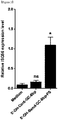
Fig. 3 is a graph showing the increase of ISG56 expression level by 5'-OH-Bend-GC-8bp-PS, an RNA oligonucleotide prepared according to an example of the present disclosure. -
Fig. 4 is a graph showing the increase of ISG56 expression level by 5'-OH-Long_Bend, an RNA oligonucleotide prepared according to an example of the present disclosure. -
Fig. 5 is a graph showing the apoptosis inducement effect of pancreatic cancer cell line (Panc02) using FACS by 5'-OH-Bend-GC-8bp-PS and 5'-OH-Long_Bend, RNA oligonucleotides prepared according to an example of the present disclosure. -
Fig. 6 is a graph showing the apoptosis inducement effect of normal cell line (HEK293) using FACS by 5'-OH-Bend-GC-8bp-PS and 5'-OH-Long_Bend, RNA oligonucleotides prepared according to an example of the present disclosure. -
Fig. 7 is a graph showing the apoptosis inducement effect of liver cancer cell line (SNU886) using FACS by 5'-OH-Bend-GC-8bp-PS, an RNA oligonucleotide prepared according to an example of the present disclosure. -
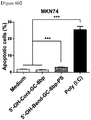
Figs. 8A and8B are each graph showing the apoptosis inducement effect of stomach cancer cell lines(SNU216 and MKN74) using FACS by 5'-OH-Bend-GC-8bp-PS, an RNA oligonucleotide prepared according to an example of the present disclosure. - Hereinafter, the present disclosure will be described in detail.
- The present disclosure provides a pharmaceutical composition for treating cancer comprising an RNA oligonucleotide as an active ingredient, wherein the RNA oligonucleotide comprises the base sequence represented by SEQ ID NO:1 (5'-N1GUAGAN2N3-3') and the base sequence represented by SEQ ID NO:2 (5'-N4N5UUUGCN6-3') wherein the base sequences are bound to each other by a complementary binding to form double strands having a helical bend structure; the 3'-end of the base sequence represented by SEQ ID NO:1 and the 5'-end of the base sequence represented by SEQ ID NO:2 are connected into a loop to form a hairpin structure; and the base sequence represented by SEQ ID NO:1 has a hydroxy (OH) group at the 5'-end thereof.
- An RNA oligonucleotide according to the present disclosure may have 8 to 100, 8 to 50, 8 to 30, 8 to 20, 10 to 100, 10 to 50, 10 to 30, 20 to 500, 20 to 300, 10 to 200, 10 to 100, 20 to 100, 20 to 90, or 20 to 50 bases.
- In the base sequence represented by SEQ ID NO:1 or SEQ ID NO:2 which forms the RNA oligonucleotide, N1 to N6 may be one selected from the group consisting of A, G, C and U. Specifically, N1 to N6 may be G or C. In one example of the present disclosure, N1 may be G, N2 may be C, and N3 may be G in the base sequence represented by SEQ ID NO:1 (corresponding to SEQ ID NO:3); and N4 may be C, N5 may be G, and N6 may be C in the base sequence represented by SEQ ID NO:2 (corresponding to SEQ ID NO:4).
- An RNA oligonucleotide of the present disclosure may form a helical bend structure between the fourth base (A) of the base sequence represented by SEQ ID NO:1 and the fifth base (U) of the base sequence represented by SEQ ID NO:2.
- In one example of the present disclosure, the helical bend structure is formed between the fourth base (A) of the base sequence represented by SEQ ID NO:1 and the fifth base (U) of the base sequence represented by SEQ ID NO:2 when the third base (U) and the fifth base (G) of the base sequence represented by SEQ ID NO:1 and the sixth base (G) and the fourth base (U) of the base sequence represented by SEQ ID NO:2 respectively form wobble base pairs.
- The helical bend structure may have a shape bent in 10 to 90 degrees relative to the plane formed by the double-stranded RNA, particularly 30 to 70 degrees, and more particularly 40 to 50 degrees.
- In the hairpin structure, the loop may be composed of at least 4 bases, for instance, 4 to 80, 4 to 75, 4 to 70, 4 to 65, 4 to 60, 4 to 55, 4 to 50, 4 to 45, 4 to 40, 4 to 35, 4 to 30, 4 to 25, 4 to 20, 4 to 15, or 4 to 10 bases. In one example of the present disclosure, the loop may be composed of 4 or 73 bases. In one example of the present disclosure, the four bases constituting the loop may be UUCG.
- Also, if some of the base sequences constituting the loop are complementary to each other, they may form a stem structure by Watson-Crick base pairing. The stem structure may include AU motif in which A and U forms a Watson-Crick base pair.
- Herein, the AU motif may be composed of 10 to 50, 15 to 40, 20 to 35, or 25 to 30 AU base pairs. In an example of the present disclosure, the AU motif may be composed of 26 consecutive AU base pairs.
- In one example of the present disclosure, the RNA oligonucleotide having the hairpin structure may be the base sequence represented by SEQ ID NO:7 or SEQ ID NO:8.
- In the RNA oligonucleotide according to the present disclosure, at least one of the phosphodiester bonds in the RNA oligonucleotide may be changed to at least one selected from the group consisting of a phosphorothioate bond, a boranophosphate bond and a methylphosphonate bond, in order to inhibit degradation by endonuclease and improve in vivo stability. In a specific example of the present disclosure, at least one of the phosphodiester bonds may be changed to the phosphorothioate bond.
- The present inventors have prepared RNA oligonucleotides having hairpin RNA structure (
Fig. 1 ). Among them, 5'-OH-iav or 5'-PPP-iav were found to have a helical bend structure (Fig. 2 ) and to increase the expression of ISG56 (Figs. 3 and4 ). - Also, an RNA oligonucleotide having the helical bend structure was found to induce apoptosis of pancreatic cancer, liver cancer, and stomach cancer cell lines without inducing apoptosis of normal cells (
Figs. 5 to 8B ). - Accordingly, since an RNA oligonucleotide having a helical bend structure of the present disclosure increases the expression of ISG56 and induces apoptosis of cancer cells, a composition comprising the RNA oligonucleotide can be used for cancer treatment.
- The pharmaceutical composition for treating cancer of the present disclosure can be used to treat various cancers such as pancreatic cancer, liver cancer, stomach cancer, lung cancer, colorectal cancer, rectal cancer, thyroid cancer, esophageal cancer, renal caner, bladder cancer, prostate cancer, cervical cancer, breast cancer, hematologic malignancy, skin cancer, epithelial cancer, brain cancer, central nerves cancer, or ovarian cancer, etc.
- The aforementioned pharmaceutical composition for treating cancer may comprise an RNA oligonucleotide of the present disclosure as an active ingredient in an amount of 10 to 95 weight% based on the total weight of the pharmaceutical composition. In addition, the pharmaceutical composition of the present disclosure may comprise one or more other active ingredients with the same or similar function in addition to the aforementioned active ingredient.
- The pharmaceutical composition of the present disclosure may comprise one or more pharmaceutically acceptable additives, for example, excipients, carriers, diluents, and other adjuvants, etc. for the administration.
- The dosage of the pharmaceutical composition of the present disclosure may be adjusted based on various factors such as type and severity of a disease, type and amount of an active ingredient and other ingredients comprised in the composition, type of a formulation, and age, weight, general health condition, sex and diet of the patient, time of administration, route of administration, treatment period, and drugs simultaneously used, etc. However, to achieve a desired effect, the effective amount of an RNA oligonucleotide comprised in the pharmaceutical composition of the present disclosure is adjusted to reach the intracellular concentration of 1 to 1,000 nM, specifically 100 to 500 nM. It may be administered in a single dose or divided doses per day.
- In addition, the pharmaceutical composition of the present disclosure may be administered to a subject by various methods known in the art. The route of administration can be appropriately selected by taking into consideration the factors such as administration method, volume of body fluid and viscosity, etc.
- Hereinafter, the present disclosure is explained in detail by Examples. The following Examples are intended to further illustrate the present disclosure without limiting its scope.
- RNA oligonucleotides which can increase the expression of interferon-β or ISG56 were prepared.
- First, RNA oligonucleotides composed of the base sequence represented by SEQ ID NO:5 which have a triphosphate group at the 5'-end were prepared by the techniques known in the art. On the other hand, RNA oligonucleotides composed of one of the base sequences represented by SEQ ID NOS:5 to 8 which have a hydroxy (OH) group at the 5'-end, or RNA oligonucleotides wherein a phosphodiester bond is substituted with a phosphorothioate bond were custom-made at Integrated DNA Technologies or Dharmacon.
- As shown in
Fig. 1 , 5'-OH-iav and 5'-PPP-iav RNA oligonucleotides were prepared, which are composed of the base sequence represented by SEQ ID NO:5. They have a hydroxy group and a triphosphate group at the 5'-ends, respectively. In addition, 5'-OH-Cont-GC-8bp RNA oligonucleotide was prepared, which is composed of the base sequence represented by SEQ ID NO:6 and has a hydroxy group at the 5'-end. In addition, 5'-OH-Bend-GC-8bp-PS RNA oligonucleotide was prepared, which is composed of the base sequence represented by SEQ ID NO:7, and has a hydroxy group at the 5'-end, and wherein a phosphodiester bond forming the RNA oligonucleotide is substituted with a phosphorothioate bond. In addition, 5'-OH-Long_Bend RNA oligonucleotide was prepared, which is composed of the base sequence represented by SEQ ID NO:8 and has a hydroxy group at the 5'-end. - To verify the structures of the 5'-OH-iav and 5'-PPP-iav RNA oligonucleotides prepared in Example 1, the following experiments were carried out.
- First, the RNA oligonucleotides prepared in Example 1 were dissolved in a buffer solution containing 10 mM sodium phosphate (pH 6.5), 0.01 mM EDTA, 10 (v/v)% D2O to prepare a sample, and various spectroscopic experiments were carried out by the methods known in the art. More particularly, two-dimensional NOE spectroscopy (NOESY) was carried out by a nuclear magnetic resonance (NMR) spectroscope (Bruker, USA) of 400, 600 and 800 MHz with the mixing time of 100 and 200 ms. Also, the following experiments were performed: 1H-15H heteronuclear single quantum coherence (HSQC) spectroscopic experiment at the temperature of 278 K, double quantum filtered correlated (DQF-COSY) and homonuclear total correlation (TOCSY) spectroscopic experiments with the mixing time of 125 ms, 1H-31P heteronuclear correlation (HETCOR) and 1H-31p Hetero-TOCSY spectroscopic experiments with the mixing time of 30 ms, and NOESY spectroscopic experiment with the mixing time of 80, 150 and 250 ms. In addition, 1H-13C CT-HSQC, HCCH-COSY, 2D HCCH-relayed COSY, 2D HCCH-TOCSY and 3D HCCH-TOCSY spectroscopic experiments were carried out.
- As a result of the NMR spectroscopic experiments, the NMR peaks of hydrogens of bases of the RNA oligonucleotides and H1', H2', H3', H4', and H5'/H5" were determined. From the NOESY spectroscopic experiment, approximately 563 NOE distance constraints were obtained, which were divided into 3 to 4 groups according to the distance (e.g., 1.8 to 3.4 Å, 1.8 to 5.0 Å and 3.8 to 7.0 Å; or 1.8 to 3.4 Å, 2.5 Å to 4.5, 3.5 to 6.0 Å and 4.0 to 7.0Å). As for non-Watson-Crick bonds, no constraints on the hydrogen bonds were used. From the 3JH1',H2' value obtained in DQF-COSY, δ dihedral angle was obtained, and every χ dihedral angle was fixed at -158±15 degrees. Other dihedral angles (for example, α, β, γ, ε, and ζ) were confined to the A-type helical structure of RNA. As for bulge parts, no constraints on the dihedral angles were used except for several β and ε dihedral angles. Residual dipolar coupling values were measured by HSQC experiment whose sensitivity was increased to reach the accuracy of ±1 Hz. In addition, by analyzing the result of the alignment tensor by singular value decomposition, the anisotropy value of -8.0 Hz and the rhombicity value of 0.32 were obtained. Calculation of every structure was carried out by X-PLOR 3.1 and CNS. 100 structures were generated according to the distance constraints, and simulated annealing process was carried out in which the structures were simulated at 3,000 K for 10 ps, and then cooled at 300 K for 50 ps. The distance force constant was kept at 50 kcal/mol/Å, and the dihedral angle constant was changed from 20 kcal/mol/Å to 400 kcal/mol/Å. The structures with the lowest energy state were purified at 300 K for 20 ps, and the last 5 ps were used for a restrained energy minimization. A total of 220 structures obtained from the above procedure were purified by adding 22 residual dipolar coupling values, with the force constant of the residual dipolar coupling value being kept to 3.0 kcal/mol. Ultimately, 32 structures were obtained, which were analyzed by Insight II (Biosym Technologies, USA) and CURVES 5.2 software.
- As a result, as shown in
Fig. 2 , it was found that 5'-PPP-iav and 5'-OH-iav RNA oligonucleotides form a helical bend structure. Such a helical bend structure was found to be generated by the formation of double strands through non-Watson-Crick base pairing between two single strands which are respectively composed of the sequences represented by 5'-GUAGA-3' and 5'-UUUGC-3' in the 5'-PPP-iav and 5'-OH-iav RNA oligonucleotides. Thus, it was understood that the RNA oligonucleotides of the present disclosure comprising the sequences represented by 5'-GUAGA-3' and 5'-UUUGC-3', such as 5'-OH-Bend-GC-8bp-PS and 5'-OH-Long_Bend RNA oligonucleotides also form a helical bend structure. - Expression level of ISG56 induced by the expression of interferon-β was examined to confirm whether the RNA oligonucleotide (5'-OH-Bend-GC-8bp-PS) containing phosphorothioate bonds among the RNA oligonucleotides having a bend structure prepared in the present disclosure increases the expression of interferon-β.
- First, 3×10⁶ of HEK293T cells (ATCC, USA) were aliquoted into 7 ml of Dulbecco's modified Eagle's medium (DMEM) supplemented with 10% fetal bovine serum (FBS, Gibco, USA) in 100 mm tissue culture plates, and cultured for 24 hours under the condition of 37°C and 5% CO2 to prepare a cell line.
- The cell line prepared in Experimental Example 1.1. was treated with 5'-OH-Bend-GC-8bp-PS RNA oligonucleotide.
- First, the cultured cells were detached by treatment with trypsin-EDTA (Gibco, USA) and the detached cells were counted and aliquoted into 6-well plates at 1×10³ cells/well. Then, the cells were cultured for 42 hours under the condition of 37°C and 5% CO2. After removing the medium, the cells were treated with 400 µl of OPTI-MEM (Gibco, USA) without FBS, and the RNA oligonucleotide.
- RNA oligonucleotide treatment was as follows: each 1 µM of 5'-OH-Cont-GC-8bp and 5'-OH-Bend-GC-8bp-PS was mixed with 4 µl of lipofectamine LTX (Invitrogen, USA) and 1.6 µl of plus-reagent (Invitrogen, USA), and 200 µl of resulting mixtures were added to the cells, respectively. Thereafter the cells were incubated for 4 hours under the condition of 37°C and 5% CO2. The cells for positive control were treated with poly (I:C), known as RIG-I ligand, and those for negative control were treated with culture medium only. After 4 hours, culture medium was removed, and 2 ml of DMEM containing 10% FBS was added to the cells, which were then further incubated for 2 hours under the condition of 37°C and 5% CO2.
- To verify the expression of ISG56 in the cells treated with RNA oligonucleotides described above, RNA was isolated according to the following method.
- After removing the culture medium, the cells were recovered with 500 µl of TRI-reagent (Ambion, USA), and chloroform was added to the collected cells to separate the RNA layer. Isopropanol was added thereto to make a pellet, and the pellet was washed with 75% ethanol, dried, and dissolved in sterilized distilled water. The separated RNAs were treated with DNase (Promega, USA) for 30 minutes at room temperature to remove contaminated DNAs, and DNase was inactivated by a stop solution. Then, the resultant was treated with Superscript III Reverse Transcriptase (Invitrogen, USA) for 1 hour at 50°C to synthesize cDNAs from the RNAs.
- Using the synthesized cDNA as a template, real-time PCR was carried out. Specifically, real-time PCR was carried out by mixing h-tag DNA polymerase (solgent, Republic of Korea), dNTP, tetraethylammonium chloride, evagreen dye (Biotium, USA), and primers for interferon-β target gene and GAPDH reference gene. Real-time PCR was performed as follows: fixation for 15 minutes at 95°C, then, repeating a set of reactions (20 seconds at 95°C, 40 seconds at 60°C, and 20 seconds at 72°C) for 40 cycles. The primers for ISG56 and GAPDH are shown in Table 1 below.
[Table 1] SEQ ID NO Name Sequence SEQ ID NO: 9 ISG56 forward 5'-gcctccttgggttcgtctacaa-3' SEQ ID NO: 10 ISG56 reverse 5'-tcaaagtcagcagccagtctca-3' SEQ ID NO: 11 GAPDH forward 5'-gcattgccctcaacgaccac-3' SEQ ID NO: 12 GAPDH reverse 5'-gaggccatgtgggccatgag-3' - The changes in the ISG56 expression level are shown in the graph of
Fig. 3 . - As shown in
Fig. 3 , it was found that 5'-OH-Bend-GC-8bp-PS RNA oligonucleotide having a helical bend structure with a hydroxy group at the 5'-end increased the ISG56 expression to a significant level. - Among the RNA oligonucleotides having a bend structure prepared in the present disclosure, it was examined whether the RNA oligonucleotide (5'-OH-Long_Bend) having a long-length hairpin structure can increase the interferon-β expression by assessing changes in the ISG56 expression.
- All experiments were performed by the same method as Experimental Example 1. The cells for negative control were treated with the culture medium only, while those for positive control were treated with 5'-PPP-iav. The cells of experimental groups were treated with 5'-OH-Long_Bend RNA oligonucleotide.
- The changes in the ISG56 expression are shown in the graph of
Fig. 4 . - As shown in
Fig. 4 , it was found that 5'-OH-Long_Bend RNA oligonucleotide, which has a hydroxy group at the 5'-end, a helical bend structure and a long-length hairpin, increased the ISG56 expression to a significant level. - First, 0.5×10⁵ of Panc02 cells (Prof. Dr. med. Christiane Bruns, Universittsklinikum Magdeburg), 2X vitamin (Gibco, USA) that was 50-fold diluted, and 300µℓ of DMEM(Dulbecco's modified Eagle's medium; WELGENE, USA) containing 2X NEAA (Non-essential Amino Acid solution; Sigma, USA) were aliquoted into each well of 24-well plates.
- 1 µg/mL of RNA oligonucleotide (5'-OH-Bend-GC-8bp-PS or 5'-OH-Long_Bend) and poly(I:C) (Invivogen, USA) were mixed with 40 µℓ of OPTI-MEM (Gibco, USA), respectively. 1 µℓ of lipofectamine LTX (Invitrogen, USA) and 0.6 µℓ of plus-reagent (Invitrogen, USA) were mixed and 40 µℓ of OPTI-MEM (Gibco, USA) was added to the mixture, and then the mixture was incubated for 5 minutes at room temperature. After that, each 40 µℓ of RNA oligonucleotides prepared and poly(I:C) mixture was mixed with 40 µℓ mixture of lipofectamine and plus reagent, respectively. The mixture was incubated for 20 minutes at room temperature to combine RNA oligonucleotides or Poly I:C with lipofectamine.
- Then, 80 µℓ of the combined RNA oligonucleotide and lipofectamine was injected into wells containing Panc02 cells and the cells were cultured for 24 hours under the condition of 37°C and 5% CO2. The cells for positive control were treated with poly(I:C), known as RIG-I ligand, and those for negative control were treated with culture medium and 5'-OH-Cont-GC-8bp only.
- As Experimental Example 3.1, a cell line treated with an RNA oligonucleotide or poly(I:C) was collected into a 5 mL round-bottom tube using 0.25% trypsin-EDTA (Gibco, USA), and then the supernatant was removed by spinning down for 5 minutes at 4°C under the speed of 1500 rpm. Then, the cells were dyed with 100 µℓ of 1x combined buffer (10 mM HEPES, 140 mM NaCl, 2.5 mM CaCl2) containing Annexin V combined with FITC (Biolegend, USA) and 7-aminoactinomycin D (7-AAD; BD Bioscience, USA) for 15 minutes in the darkroom. After that, the dyed cells were measured with LSRFortessa flow cytometry (BD Bioscience, USA) and the result was analyzed using FlowJo software (Treestar, USA).
- The rate of apoptotic cells is shown in the graph of
Fig. 5 . - As shown in
Fig. 5 , it was found that 5'-OH-Bend-GC-8bp-PS RNA oligonucleotide and 5'-OH-Long_Bend RNA oligonucleotide having a bend structure with a hydroxy group at the 5'-end induced apoptosis of pancreatic cancer cell line to a significant level. - In accordance with the procedure of Experimental Example 3.1, normal cell line (HEK293; ATCC, USA) was aliquoted in DMEM (WELGENE, USA) and RNA oligonucleotides were treated thereto. Then, the apoptosis inducement effect was investigated using FACS as Experimental Example 3.2.
- The rate of apoptotic cells is shown in the graph of
Fig. 6 . - As shown in
Fig. 6 , 5'-OH-Bend-GC-8bp-PS RNA oligonucleotide and 5'-OH-Long_Bend RNA oligonucleotide having a bend structure with a hydroxy group at the 5'-end did not induce apoptosis of HEK293 cell line to a significant level, while poly (I:C) induced apoptosis of HEK293 cell line. - In summary, the results of Experimental Examples 3 and 4 showed that 5'-OH-Bend-GC-8bp-PS RNA oligonucleotide and 5'-OH-Long_Bend RNA oligonucleotide selectively induced apoptosis of cancer cells between normal cells (HEK293) and cancer cells (pancreatic cancer cell; Panc02).
- In accordance with the procedure of Experimental Example 3.1, liver cancer cell line (SNU886; Korean Cell Line Bank, Republic of Korea) was aliquoted in DMEM (WELGENE, USA) and 5'-OH-Bend-GC-8bp-PS oligonucleotide was treated thereto. Then, the apoptosis effect was investigated using FACS as Experimental Example 3.2.
- The rate of apoptotic cells is shown in the graph of
Fig. 7 . - As shown in
Fig. 7 , it was found that 5'-OH-Bend-GC-8bp-PS RNA oligonucleotide having a bend structure with a hydroxy group at the 5'-end induced apoptosis of liver cancer cell line to a significant level. - In accordance with the procedure of Experimental Example 3.1, stomach cancer cell lines (SNU216 and MKN74; Korean Cell Line Bank, Republic of Korea) were aliquoted in DMEM (WELGENE, USA) and 5'-OH-Bend-GC-8bp-PS oligonucleotide was treated thereto. Then, the apoptosis effect was found using FACS as Experimental Example 3.2.
- The rate of apoptotic cells is shown in the graph of
Figs. 8A and8B , respectively. - As shown in
Figs. 8A and8B , it was found that 5'-OH-Bend-GC-8bp-PS RNA oligonucleotide having a bend structure with a hydroxy group at the 5'-end induced apoptosis of stomach cancer cell lines to a significant level.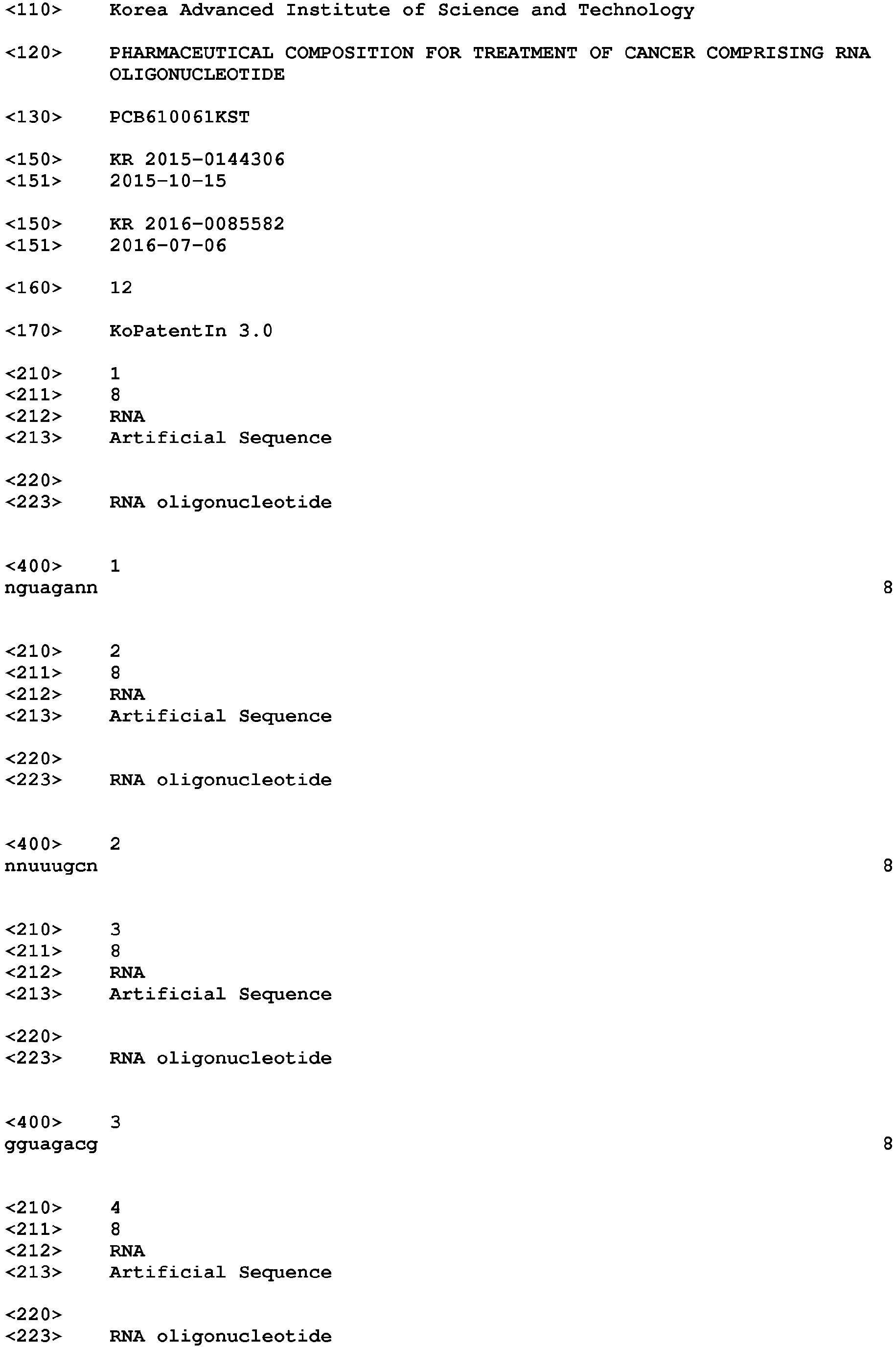

Claims (11)
- A pharmaceutical composition for treating cancer comprising an RNA oligonucleotide as an active ingredient, wherein the RNA oligonucleotide comprises the base sequence represented by SEQ ID NO:1 (5'-N1GUAGAN2N3-3') and the base sequence represented by SEQ ID NO:2 (5'-N4N5UUUGCN6-3'),
wherein, the base sequences are bound to each other by a complementary binding to form double strands having a helical bend structure;
the 3'-end of the base sequence represented by SEQ ID NO:1 and the 5'-end of the base sequence represented by SEQ ID NO:2 are connected into a loop to form a hairpin structure; and
the base sequence represented by SEQ ID NO:1 has a hydroxy (OH) group at the 5'-end thereof. - The pharmaceutical composition of claim 1, wherein N1 to N6 are G or C in the base sequence represented by SEQ ID NO:1 or SEQ ID NO:2.
- The pharmaceutical composition of claim 2, wherein N1 is G, N2 is C, and N3 is G in the base sequence represented by SEQ ID NO:1 (corresponding to SEQ ID NO:3); and N4 is C, N5 is G, and N6 is C in the base sequence represented by SEQ ID NO:2 (corresponding to SEQ ID NO:4).
- The pharmaceutical composition of claim 1, wherein the loop is composed of at least 4 bases.
- The pharmaceutical composition of claim 4, wherein the loop is composed of UUCG bases.
- The pharmaceutical composition of claim 1, wherein the loop is composed of 4 to 80 bases.
- The pharmaceutical composition of claim 6, wherein the loop has a stem structure formed by Watson-Crick base pairing, and the stem structure comprises AU motif composed of AU base pairs.
- The pharmaceutical composition of claim 7, wherein the AU motif is composed of 10 to 50 AU base pairs.
- The pharmaceutical composition of claim 1, wherein the RNA oligonucleotide has a base sequence represented by SEQ ID NO:7 or SEQ ID NO:8.
- The pharmaceutical composition of any one of claims 1 to 9, wherein at least the phosphodiester bonds one of in the RNA oligonucleotide is changed to at least one selected from the group consisting of a phosphorothioate bond, a boranophosphate bond and a methylphosphonate bond.
- The pharmaceutical composition of claim 1, wherein the cancer is selected from the group consisting of pancreatic cancer, liver cancer, stomach cancer, lung cancer, colorectal cancer, rectal cancer, thyroid cancer, esophageal cancer, renal caner, bladder cancer, prostate cancer, cervical cancer, breast cancer, hematologic malignancy, skin cancer, epithelial cancer, brain cancer, central nerves cancer, and ovarian cancer.
Applications Claiming Priority (3)
| Application Number | Priority Date | Filing Date | Title |
|---|---|---|---|
| KR20150144306 | 2015-10-15 | ||
| KR1020160085582A KR20170044574A (en) | 2015-10-15 | 2016-07-06 | Pharmaceutical composition for treatment of pancreatic cancer comprising rna oligonucleotide |
| PCT/KR2016/011571 WO2017065563A1 (en) | 2015-10-15 | 2016-10-14 | Pharmaceutical composition for treating cancer comprising rna oligonucleotide |
Publications (3)
| Publication Number | Publication Date |
|---|---|
| EP3363464A1 true EP3363464A1 (en) | 2018-08-22 |
| EP3363464A4 EP3363464A4 (en) | 2019-04-10 |
| EP3363464B1 EP3363464B1 (en) | 2020-03-18 |
Family
ID=58703629
Family Applications (2)
| Application Number | Title | Priority Date | Filing Date |
|---|---|---|---|
| EP16798376.6A Not-in-force EP3195882B1 (en) | 2015-10-15 | 2016-08-29 | Antiviral agent comprising rna oligonucleotide |
| EP16855780.9A Active EP3363464B1 (en) | 2015-10-15 | 2016-10-14 | Pharmaceutical composition for treating cancer comprising rna oligonucleotide |
Family Applications Before (1)
| Application Number | Title | Priority Date | Filing Date |
|---|---|---|---|
| EP16798376.6A Not-in-force EP3195882B1 (en) | 2015-10-15 | 2016-08-29 | Antiviral agent comprising rna oligonucleotide |
Country Status (5)
| Country | Link |
|---|---|
| US (2) | US10519452B2 (en) |
| EP (2) | EP3195882B1 (en) |
| JP (1) | JP6630824B2 (en) |
| KR (3) | KR101842679B1 (en) |
| CN (1) | CN108472388B (en) |
Families Citing this family (2)
| Publication number | Priority date | Publication date | Assignee | Title |
|---|---|---|---|---|
| KR102223069B1 (en) * | 2019-01-22 | 2021-03-05 | 한국과학기술원 | Composition for anticancer immune vaccine using rna oligonucleotide |
| EP4382110A4 (en) * | 2021-08-04 | 2025-10-29 | Univ Tokyo | HAIRPIN NUCLEIC ACID COMPOSITION |
Family Cites Families (15)
| Publication number | Priority date | Publication date | Assignee | Title |
|---|---|---|---|---|
| US9181551B2 (en) * | 2002-02-20 | 2015-11-10 | Sirna Therapeutics, Inc. | RNA interference mediated inhibition of gene expression using chemically modified short interfering nucleic acid (siNA) |
| JP2005538186A (en) | 2002-09-13 | 2005-12-15 | レプリコール インコーポレーティッド | Non-sequence complementary antiviral oligonucleotides |
| JP2006507841A (en) * | 2002-11-14 | 2006-03-09 | ダーマコン, インコーポレイテッド | Functional and ultrafunctional siRNA |
| US20040170963A1 (en) | 2002-12-03 | 2004-09-02 | Ih-Jen Su | Antivirus RNA |
| US20060178334A1 (en) * | 2005-02-04 | 2006-08-10 | City Of Hope | Double-stranded and single-stranded RNA molecules with 5 ' triphosphates and their use for inducing interferon |
| EP1924284A1 (en) | 2005-09-14 | 2008-05-28 | Hartmann, Gunther | Compositions comprising immunostimulatory rna oligonucleotides and methods for producing said rna oligonucleotides |
| SI2056845T1 (en) * | 2006-08-08 | 2018-02-28 | Rheinische Friedrich-Wilhelms-Universitaet Bonn | Structure and use of 5' phosphate oligonucleotides |
| EP2297323A1 (en) * | 2008-05-21 | 2011-03-23 | Hartmann, Gunther | 5' triphosphate oligonucleotide with blunt end and uses thereof |
| EP4015636B1 (en) * | 2008-05-21 | 2024-11-20 | Rheinische Friedrich-Wilhelms-Universität Bonn | 5' triphosphate oligonucleotide with blunt end and uses thereof |
| US20120251571A1 (en) * | 2010-09-28 | 2012-10-04 | The Cleveland Clinic Foundation | Rnase l-mediated cleavage products and uses thereof |
| WO2013162350A2 (en) | 2012-04-25 | 2013-10-31 | Universiti Putra Malaysia | Circular antiviral rna |
| US10947543B2 (en) * | 2013-03-13 | 2021-03-16 | Yale University | Interferon production using short RNA duplexes |
| EP3088001B1 (en) * | 2013-12-27 | 2020-02-12 | National University Corporation Kochi University | Anti-lipolysis stimulated liporotein receptor antibodies for treatment of ovarian cancer |
| EP3172324A4 (en) * | 2014-07-18 | 2018-04-25 | Oregon Health & Science University | 5'-triphosphate oligoribonucleotides |
| WO2016179034A2 (en) * | 2015-05-01 | 2016-11-10 | The Trustees Of The University Of Pennsylvania | Methods and compositions for stimulating immune response using potent immunostimulatory rna motifs |
-
2016
- 2016-03-16 KR KR1020160031309A patent/KR101842679B1/en active Active
- 2016-04-11 KR KR1020160044080A patent/KR20170044570A/en active Pending
- 2016-07-06 KR KR1020160085582A patent/KR20170044574A/en active Pending
- 2016-08-29 US US15/310,559 patent/US10519452B2/en active Active
- 2016-08-29 EP EP16798376.6A patent/EP3195882B1/en not_active Not-in-force
- 2016-10-14 JP JP2018519475A patent/JP6630824B2/en active Active
- 2016-10-14 EP EP16855780.9A patent/EP3363464B1/en active Active
- 2016-10-14 US US15/327,596 patent/US10337016B2/en active Active
- 2016-10-14 CN CN201680060637.7A patent/CN108472388B/en not_active Expired - Fee Related
Also Published As
| Publication number | Publication date |
|---|---|
| US10519452B2 (en) | 2019-12-31 |
| KR20170044574A (en) | 2017-04-25 |
| JP6630824B2 (en) | 2020-01-15 |
| JP2018530343A (en) | 2018-10-18 |
| KR101842679B1 (en) | 2018-03-28 |
| EP3195882B1 (en) | 2019-07-03 |
| KR20170044570A (en) | 2017-04-25 |
| US10337016B2 (en) | 2019-07-02 |
| US20170240897A1 (en) | 2017-08-24 |
| US20170306330A1 (en) | 2017-10-26 |
| CN108472388A (en) | 2018-08-31 |
| EP3363464A4 (en) | 2019-04-10 |
| EP3195882A4 (en) | 2018-03-14 |
| KR20170044569A (en) | 2017-04-25 |
| CN108472388B (en) | 2021-07-16 |
| EP3195882A1 (en) | 2017-07-26 |
| EP3363464B1 (en) | 2020-03-18 |
Similar Documents
| Publication | Publication Date | Title |
|---|---|---|
| JP5563455B2 (en) | Novel synthetic agonist of TLR9 | |
| JP2021050214A (en) | Structure and use of 5' phosphate oligonucleotides | |
| CA3024917A1 (en) | Combinations of mrnas encoding immune modulating polypeptides and uses thereof | |
| JP6640916B2 (en) | Peptides having anti-inflammatory, bone formation and hair growth promoting activities and uses thereof | |
| CN102300990A (en) | Synthetic agonists of TLR9 | |
| EP3363464B1 (en) | Pharmaceutical composition for treating cancer comprising rna oligonucleotide | |
| CN110087731A (en) | Pd-1 specific aptamer | |
| KR101899057B1 (en) | Pharmaceutical composition for treatment of cancer comprising rna oligonucleotide | |
| KR101853731B1 (en) | Composition for inducing cell senescence comprising Linc-ASEN gene expression inhibitor | |
| JP2007520474A (en) | Antisense oligonucleotides directed to ribonucleotide reductase R2 and its use in combination therapy for the treatment of cancer | |
| US10174327B2 (en) | RNA oligonucleotide and immune system enhancer comprising same | |
| KR102223069B1 (en) | Composition for anticancer immune vaccine using rna oligonucleotide | |
| US20160319286A1 (en) | Composition for preventing or treating osteoporosis, containing progranulin inhibitor as active ingredient | |
| JP2022025073A (en) | RNA molecule that repairs DNA damage | |
| WO2024123799A9 (en) | Inhibitory nucleic acids and methods of use thereof | |
| JP2025524664A (en) | Dinucleotides and their use in the treatment of cancer | |
| KR101658593B1 (en) | Composition for enhancing radiation sensitivity comprising PI4K isozyme inhibitor | |
| EP3459967A1 (en) | Use of an hspbp1 fragment as antitumor agent and for sensitization of tumour cells to chemotherapeutic drugs | |
| HK1216430B (en) | Synthetic agonists of tlr9 |
Legal Events
| Date | Code | Title | Description |
|---|---|---|---|
| STAA | Information on the status of an ep patent application or granted ep patent |
Free format text: STATUS: THE INTERNATIONAL PUBLICATION HAS BEEN MADE |
|
| PUAI | Public reference made under article 153(3) epc to a published international application that has entered the european phase |
Free format text: ORIGINAL CODE: 0009012 |
|
| STAA | Information on the status of an ep patent application or granted ep patent |
Free format text: STATUS: REQUEST FOR EXAMINATION WAS MADE |
|
| 17P | Request for examination filed |
Effective date: 20180412 |
|
| AK | Designated contracting states |
Kind code of ref document: A1 Designated state(s): AL AT BE BG CH CY CZ DE DK EE ES FI FR GB GR HR HU IE IS IT LI LT LU LV MC MK MT NL NO PL PT RO RS SE SI SK SM TR |
|
| AX | Request for extension of the european patent |
Extension state: BA ME |
|
| RIN1 | Information on inventor provided before grant (corrected) |
Inventor name: LEE, JANGHYUN Inventor name: CHOI, BYONG-SEOK Inventor name: MIN, JI YOUN Inventor name: KANG, SUK-JO |
|
| DAV | Request for validation of the european patent (deleted) | ||
| DAX | Request for extension of the european patent (deleted) | ||
| A4 | Supplementary search report drawn up and despatched |
Effective date: 20190314 |
|
| RIC1 | Information provided on ipc code assigned before grant |
Ipc: A61K 48/00 20060101AFI20190307BHEP Ipc: A61P 31/12 20060101ALI20190307BHEP Ipc: A61K 31/713 20060101ALI20190307BHEP Ipc: A61P 31/14 20060101ALI20190307BHEP Ipc: C12N 15/113 20100101ALI20190307BHEP |
|
| RIN1 | Information on inventor provided before grant (corrected) |
Inventor name: KANG, SUK-JO Inventor name: MIN, JI YOUN Inventor name: SUNG, SI-EUN Inventor name: CHUN, DONGMIN Inventor name: CHOI, BYONG-SEOK Inventor name: LEE, JANGHYUN |
|
| REG | Reference to a national code |
Ref country code: DE Ref legal event code: R079 Ref document number: 602016032290 Country of ref document: DE Free format text: PREVIOUS MAIN CLASS: A61K0048000000 Ipc: A61K0031713000 |
|
| RIC1 | Information provided on ipc code assigned before grant |
Ipc: C12N 15/113 20100101ALI20190711BHEP Ipc: A61P 35/00 20060101ALI20190711BHEP Ipc: A61K 31/713 20060101AFI20190711BHEP |
|
| GRAP | Despatch of communication of intention to grant a patent |
Free format text: ORIGINAL CODE: EPIDOSNIGR1 |
|
| STAA | Information on the status of an ep patent application or granted ep patent |
Free format text: STATUS: GRANT OF PATENT IS INTENDED |
|
| INTG | Intention to grant announced |
Effective date: 20191014 |
|
| GRAS | Grant fee paid |
Free format text: ORIGINAL CODE: EPIDOSNIGR3 |
|
| GRAA | (expected) grant |
Free format text: ORIGINAL CODE: 0009210 |
|
| STAA | Information on the status of an ep patent application or granted ep patent |
Free format text: STATUS: THE PATENT HAS BEEN GRANTED |
|
| AK | Designated contracting states |
Kind code of ref document: B1 Designated state(s): AL AT BE BG CH CY CZ DE DK EE ES FI FR GB GR HR HU IE IS IT LI LT LU LV MC MK MT NL NO PL PT RO RS SE SI SK SM TR |
|
| REG | Reference to a national code |
Ref country code: GB Ref legal event code: FG4D |
|
| REG | Reference to a national code |
Ref country code: DE Ref legal event code: R096 Ref document number: 602016032290 Country of ref document: DE |
|
| REG | Reference to a national code |
Ref country code: AT Ref legal event code: REF Ref document number: 1245145 Country of ref document: AT Kind code of ref document: T Effective date: 20200415 Ref country code: IE Ref legal event code: FG4D |
|
| REG | Reference to a national code |
Ref country code: CH Ref legal event code: NV Representative=s name: E. BLUM AND CO. AG PATENT- UND MARKENANWAELTE , CH |
|
| PG25 | Lapsed in a contracting state [announced via postgrant information from national office to epo] |
Ref country code: FI Free format text: LAPSE BECAUSE OF FAILURE TO SUBMIT A TRANSLATION OF THE DESCRIPTION OR TO PAY THE FEE WITHIN THE PRESCRIBED TIME-LIMIT Effective date: 20200318 Ref country code: NO Free format text: LAPSE BECAUSE OF FAILURE TO SUBMIT A TRANSLATION OF THE DESCRIPTION OR TO PAY THE FEE WITHIN THE PRESCRIBED TIME-LIMIT Effective date: 20200618 Ref country code: RS Free format text: LAPSE BECAUSE OF FAILURE TO SUBMIT A TRANSLATION OF THE DESCRIPTION OR TO PAY THE FEE WITHIN THE PRESCRIBED TIME-LIMIT Effective date: 20200318 |
|
| REG | Reference to a national code |
Ref country code: NL Ref legal event code: MP Effective date: 20200318 |
|
| PG25 | Lapsed in a contracting state [announced via postgrant information from national office to epo] |
Ref country code: BG Free format text: LAPSE BECAUSE OF FAILURE TO SUBMIT A TRANSLATION OF THE DESCRIPTION OR TO PAY THE FEE WITHIN THE PRESCRIBED TIME-LIMIT Effective date: 20200618 Ref country code: GR Free format text: LAPSE BECAUSE OF FAILURE TO SUBMIT A TRANSLATION OF THE DESCRIPTION OR TO PAY THE FEE WITHIN THE PRESCRIBED TIME-LIMIT Effective date: 20200619 Ref country code: LV Free format text: LAPSE BECAUSE OF FAILURE TO SUBMIT A TRANSLATION OF THE DESCRIPTION OR TO PAY THE FEE WITHIN THE PRESCRIBED TIME-LIMIT Effective date: 20200318 Ref country code: SE Free format text: LAPSE BECAUSE OF FAILURE TO SUBMIT A TRANSLATION OF THE DESCRIPTION OR TO PAY THE FEE WITHIN THE PRESCRIBED TIME-LIMIT Effective date: 20200318 Ref country code: HR Free format text: LAPSE BECAUSE OF FAILURE TO SUBMIT A TRANSLATION OF THE DESCRIPTION OR TO PAY THE FEE WITHIN THE PRESCRIBED TIME-LIMIT Effective date: 20200318 |
|
| REG | Reference to a national code |
Ref country code: LT Ref legal event code: MG4D |
|
| PG25 | Lapsed in a contracting state [announced via postgrant information from national office to epo] |
Ref country code: NL Free format text: LAPSE BECAUSE OF FAILURE TO SUBMIT A TRANSLATION OF THE DESCRIPTION OR TO PAY THE FEE WITHIN THE PRESCRIBED TIME-LIMIT Effective date: 20200318 |
|
| PG25 | Lapsed in a contracting state [announced via postgrant information from national office to epo] |
Ref country code: PT Free format text: LAPSE BECAUSE OF FAILURE TO SUBMIT A TRANSLATION OF THE DESCRIPTION OR TO PAY THE FEE WITHIN THE PRESCRIBED TIME-LIMIT Effective date: 20200812 Ref country code: LT Free format text: LAPSE BECAUSE OF FAILURE TO SUBMIT A TRANSLATION OF THE DESCRIPTION OR TO PAY THE FEE WITHIN THE PRESCRIBED TIME-LIMIT Effective date: 20200318 Ref country code: IS Free format text: LAPSE BECAUSE OF FAILURE TO SUBMIT A TRANSLATION OF THE DESCRIPTION OR TO PAY THE FEE WITHIN THE PRESCRIBED TIME-LIMIT Effective date: 20200718 Ref country code: CZ Free format text: LAPSE BECAUSE OF FAILURE TO SUBMIT A TRANSLATION OF THE DESCRIPTION OR TO PAY THE FEE WITHIN THE PRESCRIBED TIME-LIMIT Effective date: 20200318 Ref country code: SK Free format text: LAPSE BECAUSE OF FAILURE TO SUBMIT A TRANSLATION OF THE DESCRIPTION OR TO PAY THE FEE WITHIN THE PRESCRIBED TIME-LIMIT Effective date: 20200318 Ref country code: RO Free format text: LAPSE BECAUSE OF FAILURE TO SUBMIT A TRANSLATION OF THE DESCRIPTION OR TO PAY THE FEE WITHIN THE PRESCRIBED TIME-LIMIT Effective date: 20200318 Ref country code: EE Free format text: LAPSE BECAUSE OF FAILURE TO SUBMIT A TRANSLATION OF THE DESCRIPTION OR TO PAY THE FEE WITHIN THE PRESCRIBED TIME-LIMIT Effective date: 20200318 Ref country code: SM Free format text: LAPSE BECAUSE OF FAILURE TO SUBMIT A TRANSLATION OF THE DESCRIPTION OR TO PAY THE FEE WITHIN THE PRESCRIBED TIME-LIMIT Effective date: 20200318 |
|
| REG | Reference to a national code |
Ref country code: AT Ref legal event code: MK05 Ref document number: 1245145 Country of ref document: AT Kind code of ref document: T Effective date: 20200318 |
|
| REG | Reference to a national code |
Ref country code: DE Ref legal event code: R097 Ref document number: 602016032290 Country of ref document: DE |
|
| PLBE | No opposition filed within time limit |
Free format text: ORIGINAL CODE: 0009261 |
|
| STAA | Information on the status of an ep patent application or granted ep patent |
Free format text: STATUS: NO OPPOSITION FILED WITHIN TIME LIMIT |
|
| PG25 | Lapsed in a contracting state [announced via postgrant information from national office to epo] |
Ref country code: DK Free format text: LAPSE BECAUSE OF FAILURE TO SUBMIT A TRANSLATION OF THE DESCRIPTION OR TO PAY THE FEE WITHIN THE PRESCRIBED TIME-LIMIT Effective date: 20200318 Ref country code: ES Free format text: LAPSE BECAUSE OF FAILURE TO SUBMIT A TRANSLATION OF THE DESCRIPTION OR TO PAY THE FEE WITHIN THE PRESCRIBED TIME-LIMIT Effective date: 20200318 Ref country code: AT Free format text: LAPSE BECAUSE OF FAILURE TO SUBMIT A TRANSLATION OF THE DESCRIPTION OR TO PAY THE FEE WITHIN THE PRESCRIBED TIME-LIMIT Effective date: 20200318 |
|
| 26N | No opposition filed |
Effective date: 20201221 |
|
| PG25 | Lapsed in a contracting state [announced via postgrant information from national office to epo] |
Ref country code: PL Free format text: LAPSE BECAUSE OF FAILURE TO SUBMIT A TRANSLATION OF THE DESCRIPTION OR TO PAY THE FEE WITHIN THE PRESCRIBED TIME-LIMIT Effective date: 20200318 |
|
| PG25 | Lapsed in a contracting state [announced via postgrant information from national office to epo] |
Ref country code: SI Free format text: LAPSE BECAUSE OF FAILURE TO SUBMIT A TRANSLATION OF THE DESCRIPTION OR TO PAY THE FEE WITHIN THE PRESCRIBED TIME-LIMIT Effective date: 20200318 |
|
| PG25 | Lapsed in a contracting state [announced via postgrant information from national office to epo] |
Ref country code: MC Free format text: LAPSE BECAUSE OF FAILURE TO SUBMIT A TRANSLATION OF THE DESCRIPTION OR TO PAY THE FEE WITHIN THE PRESCRIBED TIME-LIMIT Effective date: 20200318 Ref country code: LU Free format text: LAPSE BECAUSE OF NON-PAYMENT OF DUE FEES Effective date: 20201014 |
|
| REG | Reference to a national code |
Ref country code: BE Ref legal event code: MM Effective date: 20201031 |
|
| PG25 | Lapsed in a contracting state [announced via postgrant information from national office to epo] |
Ref country code: BE Free format text: LAPSE BECAUSE OF NON-PAYMENT OF DUE FEES Effective date: 20201031 |
|
| PG25 | Lapsed in a contracting state [announced via postgrant information from national office to epo] |
Ref country code: IE Free format text: LAPSE BECAUSE OF NON-PAYMENT OF DUE FEES Effective date: 20201014 |
|
| PG25 | Lapsed in a contracting state [announced via postgrant information from national office to epo] |
Ref country code: TR Free format text: LAPSE BECAUSE OF FAILURE TO SUBMIT A TRANSLATION OF THE DESCRIPTION OR TO PAY THE FEE WITHIN THE PRESCRIBED TIME-LIMIT Effective date: 20200318 Ref country code: MT Free format text: LAPSE BECAUSE OF FAILURE TO SUBMIT A TRANSLATION OF THE DESCRIPTION OR TO PAY THE FEE WITHIN THE PRESCRIBED TIME-LIMIT Effective date: 20200318 Ref country code: CY Free format text: LAPSE BECAUSE OF FAILURE TO SUBMIT A TRANSLATION OF THE DESCRIPTION OR TO PAY THE FEE WITHIN THE PRESCRIBED TIME-LIMIT Effective date: 20200318 |
|
| PG25 | Lapsed in a contracting state [announced via postgrant information from national office to epo] |
Ref country code: MK Free format text: LAPSE BECAUSE OF FAILURE TO SUBMIT A TRANSLATION OF THE DESCRIPTION OR TO PAY THE FEE WITHIN THE PRESCRIBED TIME-LIMIT Effective date: 20200318 Ref country code: AL Free format text: LAPSE BECAUSE OF FAILURE TO SUBMIT A TRANSLATION OF THE DESCRIPTION OR TO PAY THE FEE WITHIN THE PRESCRIBED TIME-LIMIT Effective date: 20200318 |
|
| REG | Reference to a national code |
Ref country code: CH Ref legal event code: U11 Free format text: ST27 STATUS EVENT CODE: U-0-0-U10-U11 (AS PROVIDED BY THE NATIONAL OFFICE) Effective date: 20251101 |
|
| PGFP | Annual fee paid to national office [announced via postgrant information from national office to epo] |
Ref country code: DE Payment date: 20251002 Year of fee payment: 10 |
|
| PGFP | Annual fee paid to national office [announced via postgrant information from national office to epo] |
Ref country code: GB Payment date: 20251001 Year of fee payment: 10 |
|
| PGFP | Annual fee paid to national office [announced via postgrant information from national office to epo] |
Ref country code: IT Payment date: 20251002 Year of fee payment: 10 |
|
| PGFP | Annual fee paid to national office [announced via postgrant information from national office to epo] |
Ref country code: FR Payment date: 20251001 Year of fee payment: 10 |
|
| PGFP | Annual fee paid to national office [announced via postgrant information from national office to epo] |
Ref country code: CH Payment date: 20251101 Year of fee payment: 10 |