EP3360554B1 - Anti-hepatitis b virus agent - Google Patents
Anti-hepatitis b virus agent Download PDFInfo
- Publication number
- EP3360554B1 EP3360554B1 EP16853620.9A EP16853620A EP3360554B1 EP 3360554 B1 EP3360554 B1 EP 3360554B1 EP 16853620 A EP16853620 A EP 16853620A EP 3360554 B1 EP3360554 B1 EP 3360554B1
- Authority
- EP
- European Patent Office
- Prior art keywords
- group
- containing heterocyclic
- substituted
- compound
- alkyl
- Prior art date
- Legal status (The legal status is an assumption and is not a legal conclusion. Google has not performed a legal analysis and makes no representation as to the accuracy of the status listed.)
- Active
Links
Classifications
-
- C—CHEMISTRY; METALLURGY
- C07—ORGANIC CHEMISTRY
- C07D—HETEROCYCLIC COMPOUNDS
- C07D409/00—Heterocyclic compounds containing two or more hetero rings, at least one ring having sulfur atoms as the only ring hetero atoms
- C07D409/02—Heterocyclic compounds containing two or more hetero rings, at least one ring having sulfur atoms as the only ring hetero atoms containing two hetero rings
- C07D409/04—Heterocyclic compounds containing two or more hetero rings, at least one ring having sulfur atoms as the only ring hetero atoms containing two hetero rings directly linked by a ring-member-to-ring-member bond
-
- A—HUMAN NECESSITIES
- A61—MEDICAL OR VETERINARY SCIENCE; HYGIENE
- A61K—PREPARATIONS FOR MEDICAL, DENTAL OR TOILETRY PURPOSES
- A61K31/00—Medicinal preparations containing organic active ingredients
- A61K31/33—Heterocyclic compounds
- A61K31/395—Heterocyclic compounds having nitrogen as a ring hetero atom, e.g. guanethidine or rifamycins
- A61K31/435—Heterocyclic compounds having nitrogen as a ring hetero atom, e.g. guanethidine or rifamycins having six-membered rings with one nitrogen as the only ring hetero atom
- A61K31/44—Non condensed pyridines; Hydrogenated derivatives thereof
- A61K31/4422—1,4-Dihydropyridines, e.g. nifedipine, nicardipine
-
- A—HUMAN NECESSITIES
- A61—MEDICAL OR VETERINARY SCIENCE; HYGIENE
- A61K—PREPARATIONS FOR MEDICAL, DENTAL OR TOILETRY PURPOSES
- A61K31/00—Medicinal preparations containing organic active ingredients
- A61K31/33—Heterocyclic compounds
- A61K31/395—Heterocyclic compounds having nitrogen as a ring hetero atom, e.g. guanethidine or rifamycins
- A61K31/435—Heterocyclic compounds having nitrogen as a ring hetero atom, e.g. guanethidine or rifamycins having six-membered rings with one nitrogen as the only ring hetero atom
- A61K31/44—Non condensed pyridines; Hydrogenated derivatives thereof
- A61K31/4427—Non condensed pyridines; Hydrogenated derivatives thereof containing further heterocyclic ring systems
- A61K31/443—Non condensed pyridines; Hydrogenated derivatives thereof containing further heterocyclic ring systems containing a five-membered ring with oxygen as a ring hetero atom
-
- A—HUMAN NECESSITIES
- A61—MEDICAL OR VETERINARY SCIENCE; HYGIENE
- A61K—PREPARATIONS FOR MEDICAL, DENTAL OR TOILETRY PURPOSES
- A61K31/00—Medicinal preparations containing organic active ingredients
- A61K31/33—Heterocyclic compounds
- A61K31/395—Heterocyclic compounds having nitrogen as a ring hetero atom, e.g. guanethidine or rifamycins
- A61K31/435—Heterocyclic compounds having nitrogen as a ring hetero atom, e.g. guanethidine or rifamycins having six-membered rings with one nitrogen as the only ring hetero atom
- A61K31/44—Non condensed pyridines; Hydrogenated derivatives thereof
- A61K31/4427—Non condensed pyridines; Hydrogenated derivatives thereof containing further heterocyclic ring systems
- A61K31/4436—Non condensed pyridines; Hydrogenated derivatives thereof containing further heterocyclic ring systems containing a heterocyclic ring having sulfur as a ring hetero atom
-
- A—HUMAN NECESSITIES
- A61—MEDICAL OR VETERINARY SCIENCE; HYGIENE
- A61K—PREPARATIONS FOR MEDICAL, DENTAL OR TOILETRY PURPOSES
- A61K31/00—Medicinal preparations containing organic active ingredients
- A61K31/33—Heterocyclic compounds
- A61K31/395—Heterocyclic compounds having nitrogen as a ring hetero atom, e.g. guanethidine or rifamycins
- A61K31/435—Heterocyclic compounds having nitrogen as a ring hetero atom, e.g. guanethidine or rifamycins having six-membered rings with one nitrogen as the only ring hetero atom
- A61K31/44—Non condensed pyridines; Hydrogenated derivatives thereof
- A61K31/4427—Non condensed pyridines; Hydrogenated derivatives thereof containing further heterocyclic ring systems
- A61K31/4439—Non condensed pyridines; Hydrogenated derivatives thereof containing further heterocyclic ring systems containing a five-membered ring with nitrogen as a ring hetero atom, e.g. omeprazole
-
- A—HUMAN NECESSITIES
- A61—MEDICAL OR VETERINARY SCIENCE; HYGIENE
- A61P—SPECIFIC THERAPEUTIC ACTIVITY OF CHEMICAL COMPOUNDS OR MEDICINAL PREPARATIONS
- A61P31/00—Antiinfectives, i.e. antibiotics, antiseptics, chemotherapeutics
- A61P31/12—Antivirals
- A61P31/20—Antivirals for DNA viruses
-
- C—CHEMISTRY; METALLURGY
- C07—ORGANIC CHEMISTRY
- C07D—HETEROCYCLIC COMPOUNDS
- C07D213/00—Heterocyclic compounds containing six-membered rings, not condensed with other rings, with one nitrogen atom as the only ring hetero atom and three or more double bonds between ring members or between ring members and non-ring members
- C07D213/02—Heterocyclic compounds containing six-membered rings, not condensed with other rings, with one nitrogen atom as the only ring hetero atom and three or more double bonds between ring members or between ring members and non-ring members having three double bonds between ring members or between ring members and non-ring members
- C07D213/04—Heterocyclic compounds containing six-membered rings, not condensed with other rings, with one nitrogen atom as the only ring hetero atom and three or more double bonds between ring members or between ring members and non-ring members having three double bonds between ring members or between ring members and non-ring members having no bond between the ring nitrogen atom and a non-ring member or having only hydrogen or carbon atoms directly attached to the ring nitrogen atom
- C07D213/60—Heterocyclic compounds containing six-membered rings, not condensed with other rings, with one nitrogen atom as the only ring hetero atom and three or more double bonds between ring members or between ring members and non-ring members having three double bonds between ring members or between ring members and non-ring members having no bond between the ring nitrogen atom and a non-ring member or having only hydrogen or carbon atoms directly attached to the ring nitrogen atom with hetero atoms or with carbon atoms having three bonds to hetero atoms with at the most one bond to halogen, e.g. ester or nitrile radicals, directly attached to ring carbon atoms
- C07D213/78—Carbon atoms having three bonds to hetero atoms, with at the most one bond to halogen, e.g. ester or nitrile radicals
- C07D213/79—Acids; Esters
- C07D213/80—Acids; Esters in position 3
-
- C—CHEMISTRY; METALLURGY
- C07—ORGANIC CHEMISTRY
- C07D—HETEROCYCLIC COMPOUNDS
- C07D405/00—Heterocyclic compounds containing both one or more hetero rings having oxygen atoms as the only ring hetero atoms, and one or more rings having nitrogen as the only ring hetero atom
- C07D405/02—Heterocyclic compounds containing both one or more hetero rings having oxygen atoms as the only ring hetero atoms, and one or more rings having nitrogen as the only ring hetero atom containing two hetero rings
- C07D405/10—Heterocyclic compounds containing both one or more hetero rings having oxygen atoms as the only ring hetero atoms, and one or more rings having nitrogen as the only ring hetero atom containing two hetero rings linked by a carbon chain containing aromatic rings
-
- C—CHEMISTRY; METALLURGY
- C07—ORGANIC CHEMISTRY
- C07D—HETEROCYCLIC COMPOUNDS
- C07D409/00—Heterocyclic compounds containing two or more hetero rings, at least one ring having sulfur atoms as the only ring hetero atoms
- C07D409/02—Heterocyclic compounds containing two or more hetero rings, at least one ring having sulfur atoms as the only ring hetero atoms containing two hetero rings
- C07D409/10—Heterocyclic compounds containing two or more hetero rings, at least one ring having sulfur atoms as the only ring hetero atoms containing two hetero rings linked by a carbon chain containing aromatic rings
Definitions
- the present invention relates to an anti-hepatitis B virus agent.
- Hepatitis B which is one of the viral hepatitides resulting from infection by the hepatitis B virus (HBV). It has been estimated that there are 350 million HBV infected people worldwide.
- an agent such as interferon or a nucleic acid analogue is used, but these treatments are not sufficiently effective.
- Patent Document 1 Pyridone carboxylic acid derivatives having antibacterial activity are known (Patent Document 1). It is, however, not known that the pyridone carboxylic acid derivatives described in Patent Document 1 have antiviral activity.
- US 4 698 352 A relates to a 4-oxo-1,4-dihydronicotinic acid derivative or a salt thereof, wherein R 1 is hydrogen or carboxyl-protecting group; R 2 is substituted phenyl and naphthyl, or a substituted or unsubstituted heterocyclic group; and R 3 is haloalkyl, aminoalkyl, or substituted or unsubstituted alkenyl, phenylalkenyl, naphthylalkenyl, phenylalkyl, naphthylalkyl, phenylalkynyl, naphthylalkynyl, heterocyclic alkyl, heterocyclic alkenyl, phenyl, naphthyl, cycloalkyl, cycloalkenyl, carboxylic acyl, iminoalkyl, heterocyclic or bridged hydrocarbon.
- the compound is said to have a broad antibacterial spectrum and a low
- JP S59 80665 A relates to a compound of formula I wherein R 1 is H or a protecting group of the carboxyl group; R 2 is a substituted aryl or (substituted) heterocyclic group; R 3 is an aralkenyl, aralkadienyl, aralkynyl, aryl, heterocyclic ring-alkenyl or heterocyclic group which may have a substituent group] and a salt thereof.
- the compound is said to be an antimicrobial agent capable of acting effectively on Gram-positive and Gram-negative bacteria.
- CN 1 465 567 A relates to a dihydropyridone derivative that is characterized by containing a group R formed from the connection of two aromatic heterocyclic radicals.
- the compound is said to have the action of inhibiting bacterial growth or killing bacteria.
- Patent Document 1 JP H2-61947 B
- An object of the present invention is to provide a novel anti-HBV agent.
- the present invention provides the followingis defined as follows:
- a compound represented by general formula [1] or a salt thereof according to the present invention has excellent anti-HBV activity, and hence is useful as an anti-hepatitis B virus agent.
- a halogen atom means a fluorine atom, a chlorine atom, a bromine atom, or an iodine atom.
- a C 1-3 alkyl group means a methyl group, an ethyl group, a propyl group, or an isopropyl group.
- a C 1-6 alkyl group means a straight chain or branched chain C 1-6 alkyl group, such as a methyl group, an ethyl group, a propyl group, an isopropyl group, a butyl group, a sec-butyl group, an isobutyl group, a tert-butyl group, a pentyl group, an isopentyl group, and a hexyl group.
- a C 3-8 cycloalkyl group means a C 3-8 cycloalkyl group such as a cyclopropyl group, a cyclobutyl group, a cyclopentyl group, and a cyclohexyl group.
- An aryl group means a phenyl group or a naphthyl group.
- n ar-C 1-6 alkyl group means an ar-C 1-6 alkyl group such as a benzyl group, a diphenylmethyl group, a trityl group, a phenethyl group, and a naphthylmethyl group.
- a C 1-3 alkoxy group means a methoxy group, an ethoxy group, a propoxy group, or an isopropoxy group.
- a C 1-6 alkoxy group means a straight chain or branched chain C 1-6 alkoxy group, such as a methoxy group, an ethoxy group, a propoxy group, an isopropoxy group, a butoxy group, an isobutoxy group, a sec-butoxy group, a tert-butoxy group, a pentyloxy group, and a hexyloxy group.
- a C 1-6 alkoxy C 1-6 alkyl group means a C 1-6 alkoxy C 1-6 alkyl group such as a methoxymethyl group and a 1-ethoxyethyl group.
- An ar-C 1-6 alkoxy C 1-6 alkyl group means an ar-C 1-6 alkoxy C 1-6 alkyl group such as a benzyloxymethyl group and a phenethyloxymethyl group.
- a C 2-6 alkanoyl group means a straight chain or branched chain C 2-6 alkanoyl group, such as an acetyl group, a propionyl group, a valeryl group, an isovaleryl group, and a pivaloyl group.
- An aroyl group means a benzoyl group or a naphthoyl group.
- An acyl group means a formyl group, a C 2-6 alkanoyl group, or an aroyl group.
- a C 1-6 alkoxycarbonyl group means a straight chain or branched chain C 1-6 alkoxycarbonyl group, such as a methoxycarbonyl group, an ethoxycarbonyl group, a propoxycarbonyl group, an isopropoxycarbonyl group, a tert-butoxycarbonyl group, and a 1,1-dimethylpropoxycarbonyl group.
- An ar-C 1-6 alkoxycarbonyl group means an ar-C 1-6 alkoxycarbonyl group such as a benzyloxycarbonyl group and a phenethyloxycarbonyl group.
- a C 1-6 alkylsulfonyl group means a C 1-6 alkylsulfonyl group such as a methylsulfonyl group, an ethylsulfonyl group, and a propylsulfonyl group.
- An arylsulfonyl group means a benzenesulfonyl group, a p-toluenesulfonyl group, or a naphthalenesulfonyl group.
- a C 1-6 alkylsulfonyloxy group means a C 1-6 alkylsulfonyloxy group such as a methylsulfonyloxy group, an ethylsulfonyloxy group, and a propylsulfonyloxy group.
- An arylsulfonyloxy group means a benzenesulfonyloxy group, a p-toluenesulfonyloxy group, or a naphthalenesulfonyloxy group.
- a C 1-3 alkylamino group means a methylamino group, an ethylamino group, a propylamino group, or an isopropylamino group.
- a C 1-6 alkylamino group means a straight chain or branched chain C 1-6 alkylamino group, such as a methylamino group, an ethylamino group, a propylamino group, an isopropylamino group, a butylamino group, a sec-butylamino group, a tert-butylamino group, a pentylamino group, and a hexylamino group.
- a di(C 1-3 alkyl)amino group means a straight chain or branched chain di(C 1-3 alkyl)amino group, such as a dimethylamino group, a diethylamino group, a dipropylamino group, a diisopropylamino group, an (ethyl)(methyl)amino group, and a (methyl)(propyl)amino group.
- a di(C 1-6 alkyl)amino group means a straight chain or branched chain di(C 1-6 alkyl)amino group, such as a dimethylamino group, a diethylamino group, a dipropylamino group, a diisopropylamino group, a dibutylamino group, a di(tert-butyl)amino group, a dipentylamino group, a dihexylamino group, an (ethyl)(methyl)amino group, and a (methyl)(propyl)amino group.
- a cyclic amino group means a cyclic amino group that contains one or more nitrogen atoms as a heteroatom forming the ring, and further may contain one or more oxygen atoms or sulfur atoms, such as azetidinyl, pyrrolidinyl, piperidinyl, homopiperidinyl, piperazinyl, homopiperazinyl, morpholinyl, homomorpholinyl, and thiomorpholinyl.
- a monocyclic nitrogen-containing heterocyclic group means a monocyclic nitrogen-containing heterocyclic group containing a nitrogen atom alone as a heteroatom forming the ring, such as an azetidinyl group, a pyrrolidinyl group, a pyrrolinyl group, a pyrrolyl group, a piperidyl group, a tetrahydropyridyl group, a pyridyl group, a homopiperidinyl group, an octahydroazocinyl group, an imidazolidinyl group, an imidazolinyl group, an imidazolyl group, a pyrazolidinyl group, a pyrazolinyl group, a pyrazolyl group, a piperazinyl group, a pyrazinyl group, a pyridazinyl group, a pyrimidinyl group, a homopiperazinyl group,
- a monocyclic oxygen-containing heterocyclic group means a tetrahydrofuranyl group, a furanyl group, a tetrahydropyranyl group, a dihydropyranyl group, or a pyranyl group.
- a monocyclic sulfur-containing heterocyclic group means a thienyl group.
- a monocyclic nitrogen- and oxygen-containing heterocyclic group means a monocyclic nitrogen- and oxygen-containing heterocyclic group containing a nitrogen atom and an oxygen atom alone as a heteroatom forming the ring, such as an oxazolyl group, an isooxazolyl group, an oxadiazolyl group, and a morpholinyl group.
- a monocyclic nitrogen- and sulfur-containing heterocyclic group means a monocyclic nitrogen- and sulfur-containing heterocyclic group containing a nitrogen atom and a sulfur atom alone as a heteroatom forming the ring, such as a thiazolyl group, an isothiazolyl group, a thiadiazolyl group, a thiomorpholinyl group, a 1-oxidethiomorpholinyl group, and a 1,1-dioxidethiomorpholinyl group.
- a monocyclic heterocyclic group means a monocyclic nitrogen-containing heterocyclic group, a monocyclic oxygen-containing heterocyclic group, a monocyclic sulfur-containing heterocyclic group, a monocyclic nitrogen- and oxygen-containing heterocyclic group, or a monocyclic nitrogen- and sulfur-containing heterocyclic group.
- a bicyclic nitrogen-containing heterocyclic group means a bicyclic nitrogen-containing heterocyclic group containing a nitrogen atom alone as a heteroatom forming the ring, such as an indolinyl group, an indolyl group, an isoindolinyl group, an isoindolyl group, a pyrrolopyridinyl group, an indazolyl group, a benzimidazolyl group, a benzotriazolyl group, a tetrahydroquinolyl group, a dihydroquinolyl group, a quinolinyl group, a dihydroquinolinyl group, a tetrahydroisoquinolinyl group, a decahydroisoquinolinyl group, an isoquinolinyl group, a dihydroquinazolinyl group, a cinnolinyl group, a phthalazinyl group, a quinazolinyl group
- a bicyclic oxygen-containing heterocyclic group means a bicyclic oxygen-containing heterocyclic group containing an oxygen atom alone as a heteroatom forming the ring, such as a 2,3-dihydrobenzofuranyl group, a benzofuranyl group, an isobenzofuranyl group, a chromanyl group, a chromenyl group, an isochromanyl group, a 1,3-benzodioxolyl group, a 1,3-benzodioxanyl group, and a 1,4-benzodioxanyl group.
- a 2,3-dihydrobenzofuranyl group such as a 2,3-dihydrobenzofuranyl group, a benzofuranyl group, an isobenzofuranyl group, a chromanyl group, a chromenyl group, an isochromanyl group, a 1,3-benzodioxolyl group, a 1,3-benz
- a bicyclic sulfur-containing heterocyclic group means a bicyclic sulfur-containing heterocyclic group containing a sulfur atom alone as a heteroatom forming the ring, such as a 2,3-dihydrobenzothienyl group and a benzothienyl group.
- a bicyclic nitrogen- and oxygen-containing heterocyclic group means a bicyclic nitrogen- and oxygen-containing heterocyclic group containing a nitrogen atom and an oxygen atom alone as a heteroatom forming the ring, such as a dihydrobenzoxazolyl group, a benzoxazolyl group, a benzisooxazolyl group, a benzoxadiazolyl group, a benzomorpholinyl group, a dihydropyranopyridyl group, a dihydrodioxinopyridyl group, and a dihydropyridoxadinyl group.
- a bicyclic nitrogen- and sulfur-containing heterocyclic group means a bicyclic nitrogen- and sulfur-containing heterocyclic group containing a nitrogen atom and a sulfur atom as a heterogroup forming the ring, such as a dihydrobenzothiazolyl group, a benzothiazolyl group, a benzoisothiazolyl group, and a benzothiadiazolyl group.
- a bicyclic heterocyclic group means a bicyclic nitrogen-containing heterocyclic group, a bicyclic oxygen-containing heterocyclic group, a bicyclic sulfur-containing heterocyclic group, a bicyclic nitrogen- and oxygen-containing heterocyclic group, or a bicyclic nitrogen-sulfur-containing heterocyclic group.
- a heterocyclic group means a monocyclic heterocyclic group or a bicyclic heterocyclic group.
- Substituent group A A halogen atom, a nitro group, a cyano group, a hydroxyl group which may be protected, a C 1-6 alkyl group which may be substituted with one or more groups selected from a substituent group B, an aryl group which may be substituted with one or more groups selected from substituent group B, a C 1-6 alkoxy group which may be substituted with one or more groups selected from substituent group B, a C 1-6 alkylamino group, a di(C 1-6 alkyl)amino group, a heterocyclic group which may be substituted with one or more groups selected from substituent group B, and an oxo group.
- Substituent group A1 A halogen atom, a hydroxyl group which may be protected, a C 1-3 alkyl group, and a C 1-3 alkoxy group.
- Substituent group A2 A halogen atom, a phenyl group which may be substituted with one or more groups selected from a substituent group B1, a C 1-3 alkylamino group, a di(C 1-3 alkyl)amino group, a cyclic amino group, and a monocyclic heterocyclic group.
- Substituent group B A halogen atom, a nitro group, a cyano group, a C 1-6 alkyl group, an aryl group, a C 1-6 alkoxy group, a C 1-6 alkylamino group, a di(C 1-6 alkyl)amino group, a heterocyclic group, and an oxo group.
- Substituent group B1 A halogen atom, a nitro group, and a cyano group.
- a carboxyl protecting group includes all groups usable as a usual protecting group for a carboxyl group; examples include groups described in Greene's Protective Groups in Organic Synthesis, fifth edition, pp. 686-836, 2014, published by John Wiley & Sons, INC . Specific examples include a C 1-6 alkyl group, an arC 1-6 alkyl group, a C 1-6 alkoxy C 1-6 alkyl group, and an ar-C 1-6 alkoxy C 1-6 alkyl group. Such a group may be substituted with one or more groups selected from substituent group A.
- a hydroxyl protecting group includes all groups usable as a usual protecting group for a hydroxyl group; examples include groups described in Greene's Protective Groups in Organic Synthesis, fifth edition, pp. 17-471, 2014, published by John Wiley & Sons, INC .
- Specific examples include a C 1-6 alkyl group, an arC 1-6 alkyl group, a C 1-6 alkoxy C 1-6 alkyl group, an acyl group, a C 1-6 alkoxycarbonyl group, an ar-C 1-6 alkoxycarbonyl group, a C 1-6 alkylsulfonyl group, an arylsulfonyl group, a tetrahydrofuranyl group, and a tetrahydropyranyl group.
- Such a group may be substituted with one or more groups selected from substituent group A.
- Examples of a leaving group include a halogen atom, a C 1-6 alkyl sulfonyloxy group or an aryl sulfonyloxy group.
- Each of the C 1-6 alkyl sulfonyloxy group and the aryl sulfonyloxy group may be substituted with one or more groups selected from substituent group A.
- a compound represented by general formula [1], as used in the present invention, is preferably a compound defined as follows:
- R 1 represents a phenyl group or a naphthyl group, both of which may be substituted or a bicyclic oxygen-containing heterocyclic group which may be substituted.
- the phenyl group, the naphthyl group and the bicyclic oxygen-containing heterocyclic group of R 1 may be substituted with one or more groups selected from the group comprising a halogen atom, a hydroxyl group, a C 1-6 alkyl group, and a C 1-6 alkoxy group.
- a compound in which R 1 represents a phenyl group or a naphthyl group, both of which may be substituted is preferable; a compound in which R 1 represents a phenyl group which may be substituted, more preferable; and a compound in which R 1 represents a phenyl group which may be substituted with one or more groups selected from the group comprising a halogen atom, a hydroxyl group, a C 1-6 alkyl group, and a C 1-6 alkoxy group, further preferable.
- a compound in which R 1 represents a bicyclic oxygen-containing heterocyclic group which may be substituted is preferable; and a compound in which R 1 represents a bicyclic oxygen-containing heterocyclic group, more preferable.
- R 2 represents a substituted C 3-8 cycloalkyl group which may be substituted, a phenyl group or a naphthyl group, both of which may be substituted, or a monocyclic sulfur-containing heterocyclic group or a bicyclic sulfur-containing heterocyclic group, both of which may be substituted.
- the C 3-8 cycloalkyl group, the phenyl group, the naphthyl group, and the heterocyclic group of R 2 may be substituted with one or more groups selected from the group comprising a halogen atom, a C 1-6 alkylamino group, a di(C 1-6 alkyl)amino group, a monocyclic nitrogen-containing heterocyclic group, a monocyclic sulfur-containing heterocyclic group, and a phenyl group or a naphthyl group, both of which may be substituted with one or more nitro groups.
- a compound in which R 2 represents a phenyl group or a naphthyl group, both of which may be substituted is preferable; a compound in which R 2 represents a phenyl group which may be substituted, more preferable; and a compound in which R 2 represents a phenyl group which may be substituted with one or more groups selected from the group comprising a C 1-6 alkylamino group, a di(C 1-6 alkyl)amino group, a monocyclic nitrogen-containing heterocyclic group, and a monocyclic sulfur-containing heterocyclic group, further preferable.
- a compound in which R 2 represents a monocyclic sulfur-containing heterocyclic group or a bicyclic sulfur-containing heterocyclic group, both of which may be substituted is preferable; a compound in which R 2 represents a monocyclic sulfur-containing heterocyclic group which may be substituted, more preferable; and a compound in which R 2 represents a monocyclic sulfur-containing heterocyclic group which may be substituted with one or more groups selected from the group comprising a phenyl group and a naphthyl group, both of which may be substituted with one or more nitro groups.
- R 3 represents a hydrogen atom.
- An example of a salt of the compound represented by general formula [1] includes a generally known salt of a basic group, such as an amino group; or of an acidic group, such as a hydroxyl group or a carboxyl group.
- Examples of a salt of the basic group include a salt with a mineral acid, such as hydrochloric acid, hydrobromic acid, nitric acid, and sulfuric acid; a salt with an organic carboxylic acid, such as formic acid, acetic acid, citric acid, oxalic acid, fumaric acid, maleic acid, succinic acid, malic acid, tartaric acid, aspartic acid, trichloroacetic acid, and trifluoroacetic acid; and a salt with a sulfonic acid, such as methanesulfonic acid, benzenesulfonic acid, p-toluenesulfonic acid, mesitylenesulfonic acid, and naphthalenesulfonic acid.
- a mineral acid such as hydrochloric acid, hydrobromic acid, nitric acid, and sulfuric acid
- an organic carboxylic acid such as formic acid, acetic acid, citric acid, oxalic acid, fum
- Examples of a salt of the acidic group include a salt with an alkali metal, such as sodium and potassium; a salt with an alkali earth metal, such as calcium and magnesium; an ammonium salt; and a salt with a nitrogen-containing organic base, such as trimethylamine, triethylamine, tributylamine, pyridine, N,N-dimethylaniline, N-methylpiperidine, 4-methylmorpholine, diethylamine, dicyclohexylamine, procaine, dibenzylamine, N-benzyl- ⁇ -phenethylamine, 1-ephenamine and N,N'-dibenzylethylenediamine.
- an alkali metal such as sodium and potassium
- a salt with an alkali earth metal such as calcium and magnesium
- an ammonium salt such as sodium and potassium
- a salt with a nitrogen-containing organic base such as trimethylamine, triethylamine, tributylamine, pyridine, N,N-di
- a pharmacologically acceptable salt is preferable.
- the present invention embraces the isomer and also a solvate, a hydrate, and crystals in various shapes.
- the present invention embraces a prodrug of the compound represented by general formula 1.
- a formulation adjuvant usually used in formulation such as an excipient, a carrier, and a diluent, may be appropriately admixed.
- the compound or salt thereof may be administered orally or parenterally in the form of a tablet, a capsule, a powder, a syrup, a granule, a pill, a suspension, an emulsion, a liquid, a powder formulation, a suppository, an eye drop, a nasal drop, an ear drop, a patch, an ointment, a lotion, a cream, or an injection.
- the method of administration, dosage, and number of doses may be appropriately selected in accordance with the age, weight, and symptoms of the patient.
- an adult may be administered a dose of 0.01 to 1000 mg/kg at a time or in several portions a day orally or parenterally (for example, administration by injection, by drip, and to a rectal region).
- the compound represented by general formula [1] is produced by a combination of known methods, and can be produced by, for example, the following production method:
- R 3a represents a carboxyl protecting group
- R 1 and R 2 have the same meanings defined above.
- a compound represented by general formula [S2] can be produced by reacting a compound represented by general formula [S1] with an acetal, such as N,N-dimethylformamide dimethyl acetal, and then reacting the resultant with a compound represented by the general formula, R 1 NH 2 .
- This reaction may be performed in accordance with a method described in Patent Document 1.
- a compound represented by general formula [S3] can be produced by subjecting the compound represented by general formula [S2] to a ring-closing reaction.
- This reaction may be performed in accordance with the method described in Patent Document 1.
- a compound represented by general formula [1a] can be produced by subjecting the compound represented by general formula [S3] to a dehydrogenation reaction.
- This reaction may be performed in accordance with the method described in Patent Document 1.
- a compound represented by general formula [1b] can be produced by subjecting the compound represented by general formula [1a] to a deprotection reaction.
- This reaction may be performed in accordance with the method described in Patent Document 1.
- the anti-HBV activity of compounds 1 to 16 was evaluated as follows by using HepG2.2.15 cells ( Proc. Natl. Acad. Sci. USA, 84, 1005-1009, 1987 ), which are obtained by introducing the HBV genome into hepatoblastoma cell line, HepG2, and persistently produce the virus.
- Table 1 Compound No. Structural formula IC50 ( ⁇ M) HBV-DNA HBsAg 1 0.051 1.1 2 0.16 0.79 3 0.86 5.7 4 0.088 2.1 5 0.33 4.6 6 1.1 5.8 7 1.1 4.6 8 0.25 1.2 9 0.23 3.6 10 2.1 6.9 11 0.80 3.7 12 1.4 4.9 13 0.49 1.8 14 0.91 4.2 15 4.5 11 16 7.9 35
- Test Example 2 Anti-HBV Assay in PXB-cells
- the anti-HBV activity of compound 8 was evaluated as follows by using fresh human hepatocyte (The PXB-cells were produced by PhenixBio Co., Ltd.) derived from a PXB mouse (a chimeric mouse with human hepatocyte).
- the relative viral load was 16% with respect to the amount of HBV DNA, and 29% with respect to the amount of HBsAg.
- compound 8 exhibited excellent anti-HBV activity.
- a compound represented by general formula [1] or a salt thereof shows excellent anti-HBV activity and is useful as an anti-hepatitis B virus agent.
Landscapes
- Chemical & Material Sciences (AREA)
- Health & Medical Sciences (AREA)
- Organic Chemistry (AREA)
- Life Sciences & Earth Sciences (AREA)
- Medicinal Chemistry (AREA)
- Veterinary Medicine (AREA)
- Public Health (AREA)
- General Health & Medical Sciences (AREA)
- Animal Behavior & Ethology (AREA)
- Pharmacology & Pharmacy (AREA)
- Epidemiology (AREA)
- Virology (AREA)
- Biotechnology (AREA)
- Nuclear Medicine, Radiotherapy & Molecular Imaging (AREA)
- General Chemical & Material Sciences (AREA)
- Chemical Kinetics & Catalysis (AREA)
- Oncology (AREA)
- Communicable Diseases (AREA)
- Molecular Biology (AREA)
- Engineering & Computer Science (AREA)
- Pharmaceuticals Containing Other Organic And Inorganic Compounds (AREA)
Description
- The present invention relates to an anti-hepatitis B virus agent.
- Hepatitis B, which is one of the viral hepatitides resulting from infection by the hepatitis B virus (HBV). It has been estimated that there are 350 million HBV infected people worldwide.
- For the treatment of hepatitis B, an agent such as interferon or a nucleic acid analogue is used, but these treatments are not sufficiently effective.
- Pyridone carboxylic acid derivatives having antibacterial activity are known (Patent Document 1). It is, however, not known that the pyridone carboxylic acid derivatives described in Patent Document 1 have antiviral activity.
-
US 4 698 352 A relates to a 4-oxo-1,4-dihydronicotinic acid derivative
-
JP S59 80665 A 
-
CN 1 465 567 A relates to a dihydropyridone derivative that is characterized by containing a group R formed from the connection of two aromatic heterocyclic radicals. The compound is said to have the action of inhibiting bacterial growth or killing bacteria.
- Patent Document 1:
JP H2-61947 B - An object of the present invention is to provide a novel anti-HBV agent.
- Under these circumstances, the present inventors have found, through earnest studies, that a compound represented by general formula [1] or a salt thereof has excellent anti-HBV activity, thereby accomplishing the present invention.
- Specifically, the present invention provides the followingis defined as follows:
- <1> A compound represented by general formula [1] for use as an anti-hepatitis B virus agent:

- wherein R1 represents an a phenyl group, a naphthyl group or a bicyclic oxygen-containing heterocyclic group, each of which may be substituted with one or more groups selected from the group comprising a halogen atom, a hydroxyl group, a C1-6 alkyl group, and a C1-6 alkoxy group;
- R2 represents a C3-8 cycloalkyl group, a phenyl group, a naphthyl group, a monocyclic sulfur-containing heterocyclic group, or a bicyclic sulfur-containing heterocyclic group, each of which may be substituted with one or more groups selected from the group comprising a halogen atom, a C1-6 alkylamino group, a di(C1-6 alkyl)amino group, a monocyclic nitrogen-containing heterocyclic group, a monocyclic sulfur-containing heterocyclic group, and a phenyl group or a naphthyl group, both of which may be substituted with one or more nitro groups; and
- R3 represents a hydrogen atom,
or a salt thereof.
- <2> The compound for use according to <1>, wherein R1 in general formula [1] represents a phenyl group or a naphthyl group, both of which may be substituted with one or more groups selected from the group comprising a halogen atom, a hydroxyl group, a C1-6 alkyl group, and a C1-6 alkoxy group.
- <3> The compound for use according to <1>, wherein R1 in general formula [1] represents a phenyl group which may be substituted with one or more groups selected from the group comprising a halogen atom, a hydroxyl group, a C1-6 alkyl group, and a C1-6 alkoxy group.
- <4> The compound for use according to <1>, wherein R1 in general formula [1] represents a bicyclic oxygen-containing heterocyclic group.
- <5> The compound for use according to any one of <1> to <4>, wherein R2 in general formula [1] represents a phenyl group or a naphthyl group, both of which may be substituted with one or more groups selected from the group comprising a C1-6 alkylamino group, a di(C1-6 alkyl)amino group, a monocyclic nitrogen-containing heterocyclic group, and a monocyclic sulfur-containing heterocyclic group.
- <6> The compound for use according to any one of <1> to <4>, wherein R2 in general formula [1] represents a phenyl group which may be substituted with one or more groups selected from the group comprising a C1-6 alkylamino group, a di(C1-6 alkyl)amino group, a monocyclic nitrogen-containing heterocyclic group, and a monocyclic sulfur-containing heterocyclic group.
- <7> The compound for use according to any one of <1> to <4>, wherein R2 in general formula [1] represents a monocyclic sulfur-containing heterocyclic group or a bicyclic sulfur-containing heterocyclic group, both of which may be substituted with one or more groups selected from the group comprising a phenyl group and a naphthyl group, both of which may be substituted with one or more nitro groups.
- A compound represented by general formula [1] or a salt thereof according to the present invention has excellent anti-HBV activity, and hence is useful as an anti-hepatitis B virus agent.
- The present invention will now be described in detail.
- Herein, the symbol "%" means "% by mass" unless otherwise defined.
- Herein, the following terms respectively have the following meanings unless otherwise defined.
- A halogen atom means a fluorine atom, a chlorine atom, a bromine atom, or an iodine atom.
- A C1-3 alkyl group means a methyl group, an ethyl group, a propyl group, or an isopropyl group.
- A C1-6 alkyl group means a straight chain or branched chain C1-6 alkyl group, such as a methyl group, an ethyl group, a propyl group, an isopropyl group, a butyl group, a sec-butyl group, an isobutyl group, a tert-butyl group, a pentyl group, an isopentyl group, and a hexyl group.
- A C3-8 cycloalkyl group means a C3-8 cycloalkyl group such as a cyclopropyl group, a cyclobutyl group, a cyclopentyl group, and a cyclohexyl group.
- An aryl group means a phenyl group or a naphthyl group.
- n ar-C1-6 alkyl group means an ar-C1-6 alkyl group such as a benzyl group, a diphenylmethyl group, a trityl group, a phenethyl group, and a naphthylmethyl group.
- A C1-3 alkoxy group means a methoxy group, an ethoxy group, a propoxy group, or an isopropoxy group.
- A C1-6 alkoxy group means a straight chain or branched chain C1-6 alkoxy group, such as a methoxy group, an ethoxy group, a propoxy group, an isopropoxy group, a butoxy group, an isobutoxy group, a sec-butoxy group, a tert-butoxy group, a pentyloxy group, and a hexyloxy group.
- A C1-6 alkoxy C1-6 alkyl group means a C1-6 alkoxy C1-6 alkyl group such as a methoxymethyl group and a 1-ethoxyethyl group.
- An ar-C1-6 alkoxy C1-6 alkyl group means an ar-C1-6 alkoxy C1-6 alkyl group such as a benzyloxymethyl group and a phenethyloxymethyl group.
- A C2-6 alkanoyl group means a straight chain or branched chain C2-6 alkanoyl group, such as an acetyl group, a propionyl group, a valeryl group, an isovaleryl group, and a pivaloyl group.
- An aroyl group means a benzoyl group or a naphthoyl group.
- An acyl group means a formyl group, a C2-6 alkanoyl group, or an aroyl group.
- A C1-6 alkoxycarbonyl group means a straight chain or branched chain C1-6 alkoxycarbonyl group, such as a methoxycarbonyl group, an ethoxycarbonyl group, a propoxycarbonyl group, an isopropoxycarbonyl group, a tert-butoxycarbonyl group, and a 1,1-dimethylpropoxycarbonyl group.
- An ar-C1-6 alkoxycarbonyl group means an ar-C1-6 alkoxycarbonyl group such as a benzyloxycarbonyl group and a phenethyloxycarbonyl group.
- A C1-6 alkylsulfonyl group means a C1-6 alkylsulfonyl group such as a methylsulfonyl group, an ethylsulfonyl group, and a propylsulfonyl group.
- An arylsulfonyl group means a benzenesulfonyl group, a p-toluenesulfonyl group, or a naphthalenesulfonyl group.
- A C1-6 alkylsulfonyloxy group means a C1-6 alkylsulfonyloxy group such as a methylsulfonyloxy group, an ethylsulfonyloxy group, and a propylsulfonyloxy group.
- An arylsulfonyloxy group means a benzenesulfonyloxy group, a p-toluenesulfonyloxy group, or a naphthalenesulfonyloxy group.
- A C1-3 alkylamino group means a methylamino group, an ethylamino group, a propylamino group, or an isopropylamino group.
- A C1-6 alkylamino group means a straight chain or branched chain C1-6 alkylamino group, such as a methylamino group, an ethylamino group, a propylamino group, an isopropylamino group, a butylamino group, a sec-butylamino group, a tert-butylamino group, a pentylamino group, and a hexylamino group.
- A di(C1-3 alkyl)amino group means a straight chain or branched chain di(C1-3 alkyl)amino group, such as a dimethylamino group, a diethylamino group, a dipropylamino group, a diisopropylamino group, an (ethyl)(methyl)amino group, and a (methyl)(propyl)amino group.
- A di(C1-6 alkyl)amino group means a straight chain or branched chain di(C1-6 alkyl)amino group, such as a dimethylamino group, a diethylamino group, a dipropylamino group, a diisopropylamino group, a dibutylamino group, a di(tert-butyl)amino group, a dipentylamino group, a dihexylamino group, an (ethyl)(methyl)amino group, and a (methyl)(propyl)amino group.
- A cyclic amino group means a cyclic amino group that contains one or more nitrogen atoms as a heteroatom forming the ring, and further may contain one or more oxygen atoms or sulfur atoms, such as azetidinyl, pyrrolidinyl, piperidinyl, homopiperidinyl, piperazinyl, homopiperazinyl, morpholinyl, homomorpholinyl, and thiomorpholinyl.
- A monocyclic nitrogen-containing heterocyclic group means a monocyclic nitrogen-containing heterocyclic group containing a nitrogen atom alone as a heteroatom forming the ring, such as an azetidinyl group, a pyrrolidinyl group, a pyrrolinyl group, a pyrrolyl group, a piperidyl group, a tetrahydropyridyl group, a pyridyl group, a homopiperidinyl group, an octahydroazocinyl group, an imidazolidinyl group, an imidazolinyl group, an imidazolyl group, a pyrazolidinyl group, a pyrazolinyl group, a pyrazolyl group, a piperazinyl group, a pyrazinyl group, a pyridazinyl group, a pyrimidinyl group, a homopiperazinyl group, a triazolyl group, and a tetrazolyl group.
- A monocyclic oxygen-containing heterocyclic group means a tetrahydrofuranyl group, a furanyl group, a tetrahydropyranyl group, a dihydropyranyl group, or a pyranyl group.
- A monocyclic sulfur-containing heterocyclic group means a thienyl group.
- A monocyclic nitrogen- and oxygen-containing heterocyclic group means a monocyclic nitrogen- and oxygen-containing heterocyclic group containing a nitrogen atom and an oxygen atom alone as a heteroatom forming the ring, such as an oxazolyl group, an isooxazolyl group, an oxadiazolyl group, and a morpholinyl group.
- A monocyclic nitrogen- and sulfur-containing heterocyclic group means a monocyclic nitrogen- and sulfur-containing heterocyclic group containing a nitrogen atom and a sulfur atom alone as a heteroatom forming the ring, such as a thiazolyl group, an isothiazolyl group, a thiadiazolyl group, a thiomorpholinyl group, a 1-oxidethiomorpholinyl group, and a 1,1-dioxidethiomorpholinyl group.
- A monocyclic heterocyclic group means a monocyclic nitrogen-containing heterocyclic group, a monocyclic oxygen-containing heterocyclic group, a monocyclic sulfur-containing heterocyclic group, a monocyclic nitrogen- and oxygen-containing heterocyclic group, or a monocyclic nitrogen- and sulfur-containing heterocyclic group.
- A bicyclic nitrogen-containing heterocyclic group means a bicyclic nitrogen-containing heterocyclic group containing a nitrogen atom alone as a heteroatom forming the ring, such as an indolinyl group, an indolyl group, an isoindolinyl group, an isoindolyl group, a pyrrolopyridinyl group, an indazolyl group, a benzimidazolyl group, a benzotriazolyl group, a tetrahydroquinolyl group, a dihydroquinolyl group, a quinolinyl group, a dihydroquinolinyl group, a tetrahydroisoquinolinyl group, a decahydroisoquinolinyl group, an isoquinolinyl group, a dihydroquinazolinyl group, a cinnolinyl group, a phthalazinyl group, a quinazolinyl group, a dihydroquinoxalinyl group, a quinoxalinyl group, a naphthylidinyl group, a purinyl group, a pteridinyl group, and a quinuclidinyl group.
- A bicyclic oxygen-containing heterocyclic group means a bicyclic oxygen-containing heterocyclic group containing an oxygen atom alone as a heteroatom forming the ring, such as a 2,3-dihydrobenzofuranyl group, a benzofuranyl group, an isobenzofuranyl group, a chromanyl group, a chromenyl group, an isochromanyl group, a 1,3-benzodioxolyl group, a 1,3-benzodioxanyl group, and a 1,4-benzodioxanyl group.
- A bicyclic sulfur-containing heterocyclic group means a bicyclic sulfur-containing heterocyclic group containing a sulfur atom alone as a heteroatom forming the ring, such as a 2,3-dihydrobenzothienyl group and a benzothienyl group.
- A bicyclic nitrogen- and oxygen-containing heterocyclic group means a bicyclic nitrogen- and oxygen-containing heterocyclic group containing a nitrogen atom and an oxygen atom alone as a heteroatom forming the ring, such as a dihydrobenzoxazolyl group, a benzoxazolyl group, a benzisooxazolyl group, a benzoxadiazolyl group, a benzomorpholinyl group, a dihydropyranopyridyl group, a dihydrodioxinopyridyl group, and a dihydropyridoxadinyl group.
- A bicyclic nitrogen- and sulfur-containing heterocyclic group means a bicyclic nitrogen- and sulfur-containing heterocyclic group containing a nitrogen atom and a sulfur atom as a heterogroup forming the ring, such as a dihydrobenzothiazolyl group, a benzothiazolyl group, a benzoisothiazolyl group, and a benzothiadiazolyl group.
- A bicyclic heterocyclic group means a bicyclic nitrogen-containing heterocyclic group, a bicyclic oxygen-containing heterocyclic group, a bicyclic sulfur-containing heterocyclic group, a bicyclic nitrogen- and oxygen-containing heterocyclic group, or a bicyclic nitrogen-sulfur-containing heterocyclic group.
- A heterocyclic group means a monocyclic heterocyclic group or a bicyclic heterocyclic group.
- Substituent group A: A halogen atom, a nitro group, a cyano group, a hydroxyl group which may be protected, a C1-6 alkyl group which may be substituted with one or more groups selected from a substituent group B, an aryl group which may be substituted with one or more groups selected from substituent group B, a C1-6 alkoxy group which may be substituted with one or more groups selected from substituent group B, a C1-6 alkylamino group, a di(C1-6 alkyl)amino group, a heterocyclic group which may be substituted with one or more groups selected from substituent group B, and an oxo group.
- Substituent group A1: A halogen atom, a hydroxyl group which may be protected, a C1-3 alkyl group, and a C1-3 alkoxy group.
- Substituent group A2: A halogen atom, a phenyl group which may be substituted with one or more groups selected from a substituent group B1, a C1-3 alkylamino group, a di(C1-3 alkyl)amino group, a cyclic amino group, and a monocyclic heterocyclic group.
- Substituent group B: A halogen atom, a nitro group, a cyano group, a C1-6 alkyl group, an aryl group, a C1-6 alkoxy group, a C1-6 alkylamino group, a di(C1-6 alkyl)amino group, a heterocyclic group, and an oxo group.
- Substituent group B1: A halogen atom, a nitro group, and a cyano group.
- A carboxyl protecting group includes all groups usable as a usual protecting group for a carboxyl group; examples include groups described in Greene's Protective Groups in Organic Synthesis, fifth edition, pp. 686-836, 2014, published by John Wiley & Sons, INC. Specific examples include a C1-6 alkyl group, an arC1-6 alkyl group, a C1-6 alkoxy C1-6 alkyl group, and an ar-C1-6 alkoxy C1-6 alkyl group. Such a group may be substituted with one or more groups selected from substituent group A.
- A hydroxyl protecting group includes all groups usable as a usual protecting group for a hydroxyl group; examples include groups described in Greene's Protective Groups in Organic Synthesis, fifth edition, pp. 17-471, 2014, published by John Wiley & Sons, INC. Specific examples include a C1-6 alkyl group, an arC1-6 alkyl group, a C1-6 alkoxy C1-6 alkyl group, an acyl group, a C1-6 alkoxycarbonyl group, an ar-C1-6 alkoxycarbonyl group, a C1-6 alkylsulfonyl group, an arylsulfonyl group, a tetrahydrofuranyl group, and a tetrahydropyranyl group. Such a group may be substituted with one or more groups selected from substituent group A.
- Examples of a leaving group include a halogen atom, a C1-6 alkyl sulfonyloxy group or an aryl sulfonyloxy group. Each of the C1-6 alkyl sulfonyloxy group and the aryl sulfonyloxy group may be substituted with one or more groups selected from substituent group A.
- A compound represented by general formula [1], as used in the present invention, is preferably a compound defined as follows:
- R1 represents a phenyl group or a naphthyl group, both of which may be substituted or a bicyclic oxygen-containing heterocyclic group which may be substituted.
- The phenyl group, the naphthyl group and the bicyclic oxygen-containing heterocyclic group of R1 may be substituted with one or more groups selected from the group comprising a halogen atom, a hydroxyl group, a C1-6 alkyl group, and a C1-6 alkoxy group.
- A compound in which R1 represents a phenyl group or a naphthyl group, both of which may be substituted is preferable; a compound in which R1 represents a phenyl group which may be substituted, more preferable; and a compound in which R1 represents a phenyl group which may be substituted with one or more groups selected from the group comprising a halogen atom, a hydroxyl group, a C1-6 alkyl group, and a C1-6 alkoxy group, further preferable.
- In another aspect, a compound in which R1 represents a bicyclic oxygen-containing heterocyclic group which may be substituted is preferable; and a compound in which R1 represents a bicyclic oxygen-containing heterocyclic group, more preferable.
- R2 represents a substituted C3-8 cycloalkyl group which may be substituted, a phenyl group or a naphthyl group, both of which may be substituted, or a monocyclic sulfur-containing heterocyclic group or a bicyclic sulfur-containing heterocyclic group, both of which may be substituted.
- The C3-8 cycloalkyl group, the phenyl group, the naphthyl group, and the heterocyclic group of R2 may be substituted with one or more groups selected from the group comprising a halogen atom, a C1-6 alkylamino group, a di(C1-6 alkyl)amino group, a monocyclic nitrogen-containing heterocyclic group, a monocyclic sulfur-containing heterocyclic group, and a phenyl group or a naphthyl group, both of which may be substituted with one or more nitro groups.
- A compound in which R2 represents a phenyl group or a naphthyl group, both of which may be substituted is preferable; a compound in which R2 represents a phenyl group which may be substituted, more preferable; and a compound in which R2 represents a phenyl group which may be substituted with one or more groups selected from the group comprising a C1-6 alkylamino group, a di(C1-6 alkyl)amino group, a monocyclic nitrogen-containing heterocyclic group, and a monocyclic sulfur-containing heterocyclic group, further preferable.
- In another aspect, a compound in which R2 represents a monocyclic sulfur-containing heterocyclic group or a bicyclic sulfur-containing heterocyclic group, both of which may be substituted is preferable; a compound in which R2 represents a monocyclic sulfur-containing heterocyclic group which may be substituted, more preferable; and a compound in which R2 represents a monocyclic sulfur-containing heterocyclic group which may be substituted with one or more groups selected from the group comprising a phenyl group and a naphthyl group, both of which may be substituted with one or more nitro groups.
- R3 represents a hydrogen atom.
- An example of a salt of the compound represented by general formula [1] includes a generally known salt of a basic group, such as an amino group; or of an acidic group, such as a hydroxyl group or a carboxyl group.
- Examples of a salt of the basic group include a salt with a mineral acid, such as hydrochloric acid, hydrobromic acid, nitric acid, and sulfuric acid; a salt with an organic carboxylic acid, such as formic acid, acetic acid, citric acid, oxalic acid, fumaric acid, maleic acid, succinic acid, malic acid, tartaric acid, aspartic acid, trichloroacetic acid, and trifluoroacetic acid; and a salt with a sulfonic acid, such as methanesulfonic acid, benzenesulfonic acid, p-toluenesulfonic acid, mesitylenesulfonic acid, and naphthalenesulfonic acid.
- Examples of a salt of the acidic group include a salt with an alkali metal, such as sodium and potassium; a salt with an alkali earth metal, such as calcium and magnesium; an ammonium salt; and a salt with a nitrogen-containing organic base, such as trimethylamine, triethylamine, tributylamine, pyridine, N,N-dimethylaniline, N-methylpiperidine, 4-methylmorpholine, diethylamine, dicyclohexylamine, procaine, dibenzylamine, N-benzyl-β-phenethylamine, 1-ephenamine and N,N'-dibenzylethylenediamine.
- Among the salts described above, a pharmacologically acceptable salt is preferable.
- If the compound represented by general formula 1 has an isomer (such as an optical isomer, a geometric isomer, and a tautomer), the present invention embraces the isomer and also a solvate, a hydrate, and crystals in various shapes.
- In addition, the present invention embraces a prodrug of the compound represented by general formula 1.
- If the compound represented by general formula 1, or a salt thereof, is used as a pharmaceutical, a formulation adjuvant usually used in formulation, such as an excipient, a carrier, and a diluent, may be appropriately admixed.
- The compound or salt thereof may be administered orally or parenterally in the form of a tablet, a capsule, a powder, a syrup, a granule, a pill, a suspension, an emulsion, a liquid, a powder formulation, a suppository, an eye drop, a nasal drop, an ear drop, a patch, an ointment, a lotion, a cream, or an injection. In addition, the method of administration, dosage, and number of doses may be appropriately selected in accordance with the age, weight, and symptoms of the patient. Usually, an adult may be administered a dose of 0.01 to 1000 mg/kg at a time or in several portions a day orally or parenterally (for example, administration by injection, by drip, and to a rectal region).
- Next, a method for producing the compound represented by general formula 1 will be described.
- The compound represented by general formula [1] is produced by a combination of known methods, and can be produced by, for example, the following production method:
-

- A compound represented by general formula [S2] can be produced by reacting a compound represented by general formula [S1] with an acetal, such as N,N-dimethylformamide dimethyl acetal, and then reacting the resultant with a compound represented by the general formula, R1NH2.
- This reaction may be performed in accordance with a method described in Patent Document 1.
- A compound represented by general formula [S3] can be produced by subjecting the compound represented by general formula [S2] to a ring-closing reaction.
- This reaction may be performed in accordance with the method described in Patent Document 1.
- A compound represented by general formula [1a] can be produced by subjecting the compound represented by general formula [S3] to a dehydrogenation reaction.
- This reaction may be performed in accordance with the method described in Patent Document 1.
- A compound represented by general formula [1b] can be produced by subjecting the compound represented by general formula [1a] to a deprotection reaction.
- This reaction may be performed in accordance with the method described in Patent Document 1.
- Next, the present invention will be described with reference to test examples. It should be noted that the present invention is not limited to the examples given.
- Compounds 1 to 16 were used as test compounds.
- The anti-HBV activity of compounds 1 to 16 was evaluated as follows by using HepG2.2.15 cells (Proc. Natl. Acad. Sci. USA, 84, 1005-1009, 1987), which are obtained by introducing the HBV genome into hepatoblastoma cell line, HepG2, and persistently produce the virus.
- The following was used as a medium:
- DMEM/F-12, GlutaMAX (manufactured by Invitrogen) + 5 pg/mL insulin (manufactured by Wako) + 1% penicillin/streptomycin (manufactured by Sigma) + 10 mmol/L HEPES (manufactured by Sigma) + 50 µmol/L hydrocortisone (manufactured by Sigma) + 10% FBS
- A mixture of each test compound with dimethyl sulfoxide (DMSO) was added to the medium to obtain a final concentration of DMSO of 1% (v/v), and thus, test solutions containing the test compound in various concentrations were prepared. In addition, a test solution obtained by adding DMSO alone to the medium to obtain a final concentration of 1% (v/v) was prepared as a control without drug.
- (1) The HepG2.2.15 cells were suspended in the medium and prepared a cell suspension at 1.5 × 10⁵ cells/mL. The suspension was seeded in a 96-well microtiter plate (100 µL/well) and the plate was incubated in a 5% CO2 incubator at 37°C for 1 day.
- (2) After removing the culture supernatant, the cells were washed twice with PBS(-) (100 µL/well) and then once with the medium (100 µL/well).
- (3) Each test solution was added to the plate (100 µL/well), and the plate was incubated in a 5% CO2 incubator at 37°C for 3 days.
- (4) After removing the culture supernatant, the test solution was added to the plate again (100 µL/well) and the plate was incubated in a 5% CO2 incubator at 37°C for 3 days.
- (5) The culture supernatant was collected and treated with a mixture of Buffer AL (manufactured by QIAGEN) and Proteinase K (manufactured by Invitrogen). The amount of HBV DNA in the solution was quantified by real-time PCR. In addition, the amount of HBsAg (hepatitis B surface antigen) in the culture supernatant was quantified by chemiluminescent enzyme immunoassay using a Lumipulse HBsAg-HQ (manufactured by Fujirebio Inc.). The relative viral load (%) of a well with the compound to a well without the compound was calculated. An IC50 of each compound was calculated using the FORECAST function (linear regression method) of Microsoft Excel 2007 by plotting the logarithm of the concentration against the relative viral load as a real number.
- The results are shown in Table 1.
Table 1 Compound No. Structural formula IC50 (µM) HBV-DNA HBsAg 1 
0.051 1.1 2 
0.16 0.79 3 
0.86 5.7 4 
0.088 2.1 5 
0.33 4.6 6 
1.1 5.8 7 
1.1 4.6 8 
0.25 1.2 9 
0.23 3.6 10 
2.1 6.9 11 
0.80 3.7 12 
1.4 4.9 13 
0.49 1.8 14 
0.91 4.2 15 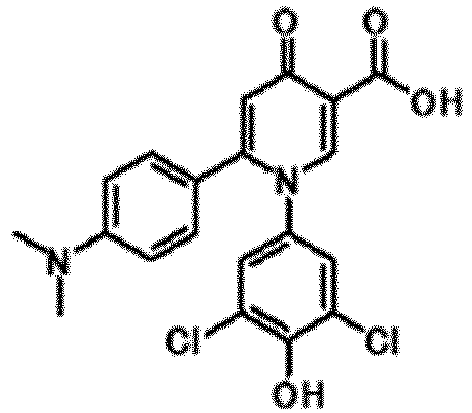
4.5 11 16 
7.9 35 - Compounds 1 to 16 exhibited an excellent anti-HBV activity.
- The anti-HBV activity of compound 8 was evaluated as follows by using fresh human hepatocyte (The PXB-cells were produced by PhenixBio Co., Ltd.) derived from a PXB mouse (a chimeric mouse with human hepatocyte).
- The following was used as a medium:
- 500 mL DMEM (manufactured by Sigma) + 0.25 µg/mL insulin (manufactured by Wako) + 1% penicillin/streptomycin (manufactured by Sigma) + 20 mmol/L HEPES (manufactured by Sigma) + 15 pg/mL L-proline (manufactured by Sigma) + 50 nmol/L dexamethasone (manufactured by Sigma) + 5 ng/mL EGF (manufactured by Peprotech) + 0.1 mmol/L ascorbic acid 2-phosphate (manufactured by Wako) + 10% FBS + 2% DMSO
- Compound 8 was further added to the medium to prepare a 10 µmol/L test solution.
- (1) The PXB-cells seeded at a 2.1 × 10⁵ cells/cm2 in a 48-well microtiter plate were incubated in a 5% CO2 incubator at 37°C for 5 days.
- (2) HBV derived from PXB mouse serum (genotype AeUS) was added to the medium supplemented with 4% PEG-8000. The PXB cells were infected with this solution at about 10 copies/cell (250 µL/well) and the plate was incubated in a 5% CO2 incubator at 37°C for 1 day.
- (3) After the culture supernatant had been removed, the cells were washed three times with DMEM supplemented with 10% FBS and 1% penicillin/streptomycin. The medium was added to the plate (250 µL/well) and the plate was incubated in a 5% CO2 incubator at 37°C for 1 day.
- (4) After removing the culture supernatant, the cells were washed three times with DMEM supplemented with 10% FBS and 1% penicillin/streptomycin. The medium was added to the plate (250 µL/well) and the plate was incubated in a 5% CO2 incubator at 37°C for 5 days.
- (5) After the culture supernatant had been removed, the medium was added to the plate (250 µL/well) and the plate was incubated in a 5% CO2 incubator at 37°C for 5 days.
- (6) After the culture supernatant on day 12 post infection was removed, the medium was added to the plate (250 µL/well), and the plate was incubated in a 5% CO2 incubator at 37°C for 5 days.
- (7) After the culture supernatant on day 17 post infection was removed, the test solution was added to the plate (250 µL/well) and as a control without drug, the medium was added to the plate (250 µL/well). The plate was incubated in a 5% CO2 incubator at 37°C for 5 days.
- (8) After the culture supernatant on day 22 post infection was removed, the test solution added to the plate (250 µL/well) and as a control without drug, the medium was added to the plate (250 µL/well). The plate was incubated in a 5% CO2 incubator at 37°C for 5 days.
- (9) After the culture supernatant on day 27 post infection was removed, the test solution added to the plate (250 µL/well) and as a control without drug, the medium was added to the plate (250 µL/well). The plate was incubated in a 5% CO2 incubator at 37°C for 5 days.
- (10) The culture supernatant on day 32 post infection was collected.
- (11) The collected culture supernatant on day 32 post infection was purified using a QIAamp DNA Blood Mini Kit (manufactured by QIAGEN) and the amount of HVB DNA was quantified by real-time PCR. In addition, the amount of HBsAg (hepatitis B surface antigen) in the culture supernatant was quantified by chemiluminescent enzyme immunoassay using a Lumipulse HBsAg-HQ (manufactured by Fujirebio Inc.). The relative viral load (%) of a well with the compound to a well without the compound was calculated.
- The relative viral load was 16% with respect to the amount of HBV DNA, and 29% with respect to the amount of HBsAg. Thus, compound 8 exhibited excellent anti-HBV activity.
- A compound represented by general formula [1] or a salt thereof shows excellent anti-HBV activity and is useful as an anti-hepatitis B virus agent.
Claims (7)
- A compound represented by general formula [1] for use as an anti-hepatitis B virus agent:
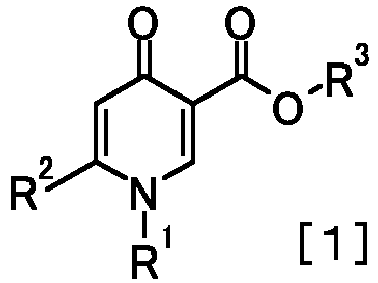 wherein R1 represents an a phenyl group, a naphthyl group or a bicyclic oxygen-containing heterocyclic group, each of which may be substituted with one or more groups selected from the group comprising a halogen atom, a hydroxyl group, a C1-6 alkyl group, and a C1-6 alkoxy group;R2 represents a C3-8 cycloalkyl, a phenyl group, a naphthyl group, a monocyclic sulfur-containing heterocyclic group, or a bicyclic sulfur-containing heterocyclic group, each of which may be substituted with one or more groups selected from the group comprising a halogen atom, a C1-6 alkylamino group, a di(C1-6 alkyl)amino group, a monocyclic nitrogen-containing heterocyclic group, a monocyclic sulfur-containing heterocyclic group, and a phenyl group or a naphthyl group, both of which may be substituted with one or more nitro groups; andR3 represents a hydrogen atom, or a salt thereof.
 - The compound for use according to claim 1, wherein R1 in general formula [1] represents an a phenyl group, a naphthyl group, both of which may be substituted with one or more groups selected from the group comprising a halogen atom, a hydroxyl group, a C1-6 alkyl group, and a C1-6 alkoxy group.
- The compound for use according to claim 1, wherein R1 in general formula [1] represents a phenyl group which may be substituted with one or more groups selected from the group comprising a halogen atom, a hydroxyl group, a C1-6 alkyl group, and a C1-6 alkoxy group.
- The compound for use according to claim 1, wherein R1 in general formula [1] represents a bicyclic oxygen-containing heterocyclic group.
- The compound for use according to any one of claims 1 to 4, wherein R2 in general formula [1] represents an a phenyl group or a naphthyl group, both of which may be substituted with one or more groups selected from the group comprising a C1-6 alkylamino group, a di(C1-6 alkyl)amino group, a monocyclic nitrogen-containing heterocyclic group, and a monocyclic sulfur-containing heterocyclic group.
- The compound for use according to any one of claims 1 to 4, wherein R2 in general formula [1] represents a phenyl group which may be substituted with one or more groups selected from the group comprising a C1-6 alkylamino group, a di(C1-6 alkyl)amino group, a monocyclic nitrogen-containing heterocyclic group, and a monocyclic sulfur-containing heterocyclic group.
- The compound for use according to any one of claims 1 to 4, wherein R2 in general formula [1] represents a monocyclic sulfur-containing heterocyclic group or a bicyclic sulfur-containing heterocyclic group, both of which may be substituted with one or more groups selected from the group comprising a phenyl group and a naphthyl group, both of which may be substituted with one or more nitro groups.
Applications Claiming Priority (2)
| Application Number | Priority Date | Filing Date | Title |
|---|---|---|---|
| JP2015197725 | 2015-10-05 | ||
| PCT/JP2016/079614 WO2017061466A1 (en) | 2015-10-05 | 2016-10-05 | Anti-hepatitis b virus agent |
Publications (3)
| Publication Number | Publication Date |
|---|---|
| EP3360554A1 EP3360554A1 (en) | 2018-08-15 |
| EP3360554A4 EP3360554A4 (en) | 2019-05-22 |
| EP3360554B1 true EP3360554B1 (en) | 2021-07-28 |
Family
ID=58487791
Family Applications (1)
| Application Number | Title | Priority Date | Filing Date |
|---|---|---|---|
| EP16853620.9A Active EP3360554B1 (en) | 2015-10-05 | 2016-10-05 | Anti-hepatitis b virus agent |
Country Status (5)
| Country | Link |
|---|---|
| US (1) | US10308642B2 (en) |
| EP (1) | EP3360554B1 (en) |
| JP (1) | JP6723254B2 (en) |
| CN (1) | CN108135891B (en) |
| WO (1) | WO2017061466A1 (en) |
Families Citing this family (52)
| Publication number | Priority date | Publication date | Assignee | Title |
|---|---|---|---|---|
| WO2016183266A1 (en) | 2015-05-13 | 2016-11-17 | Enanta Pharmaceuticals, Inc. | Ehpatitis b antiviral agents |
| KR102398439B1 (en) | 2016-03-07 | 2022-05-16 | 이난타 파마슈티칼스, 인코포레이티드 | Hepatitis B antiviral drugs |
| FI3526323T3 (en) | 2016-10-14 | 2023-06-06 | Prec Biosciences Inc | Engineered meganucleases specific for recognition sequences in the hepatitis b virus genome |
| KR20190122762A (en) * | 2017-03-31 | 2019-10-30 | 후지필름 가부시키가이샤 | 4-pyridone compound or salt thereof, pharmaceutical composition comprising the same and agent |
| EA202090514A1 (en) | 2017-08-28 | 2020-06-24 | Энанта Фармасьютикалс, Инк. | ANTI-VIRAL AGAINST HEPATITIS IN |
| KR102492187B1 (en) | 2017-12-20 | 2023-01-27 | 인스티튜트 오브 오가닉 케미스트리 앤드 바이오케미스트리 에이에스 씨알 브이.브이.아이. | 3'3' cyclic dinucleotides with phosphonate linkages that activate STING adapter proteins |
| JP7098748B2 (en) | 2017-12-20 | 2022-07-11 | インスティチュート オブ オーガニック ケミストリー アンド バイオケミストリー エーエスシーアール,ヴイ.ヴイ.アイ. | 2'3'cyclic dinucleotide with phosphonate binding that activates the STING adapter protein |
| WO2019143902A2 (en) | 2018-01-22 | 2019-07-25 | Enanta Pharmaceuticals, Inc. | Substituted heterocycles as antiviral agents |
| KR102526964B1 (en) | 2018-02-26 | 2023-04-28 | 길리애드 사이언시즈, 인코포레이티드 | Substituted pyrrolizine compounds as HBV replication inhibitors |
| US10729688B2 (en) | 2018-03-29 | 2020-08-04 | Enanta Pharmaceuticals, Inc. | Hepatitis B antiviral agents |
| US10870691B2 (en) | 2018-04-05 | 2020-12-22 | Gilead Sciences, Inc. | Antibodies and fragments thereof that bind hepatitis B virus protein X |
| TWI833744B (en) | 2018-04-06 | 2024-03-01 | 捷克科學院有機化學與生物化學研究所 | 3'3'-cyclic dinucleotides |
| TWI818007B (en) | 2018-04-06 | 2023-10-11 | 捷克科學院有機化學與生物化學研究所 | 2'3'-cyclic dinucleotides |
| TW202005654A (en) | 2018-04-06 | 2020-02-01 | 捷克科學院有機化學與生物化學研究所 | 2'2'-cyclic dinucleotides |
| TW201945388A (en) | 2018-04-12 | 2019-12-01 | 美商精密生物科學公司 | Optimized engineered meganucleases having specificity for a recognition sequence in the hepatitis B virus genome |
| US20190359645A1 (en) | 2018-05-03 | 2019-11-28 | Institute Of Organic Chemistry And Biochemistry Ascr, V.V.I. | 2'3'-cyclic dinucleotides comprising carbocyclic nucleotide |
| WO2020028097A1 (en) | 2018-08-01 | 2020-02-06 | Gilead Sciences, Inc. | Solid forms of (r)-11-(methoxymethyl)-12-(3-methoxypropoxy)-3,3-dimethyl-8-0x0-2,3,8,13b-tetrahydro-1h-pyrido[2,1-a]pyrrolo[1,2-c] phthalazine-7-c arboxylic acid |
| CA3113235A1 (en) | 2018-09-21 | 2020-03-26 | Enanta Pharmaceuticals, Inc. | Functionalized heterocycles as antiviral agents |
| WO2020092528A1 (en) | 2018-10-31 | 2020-05-07 | Gilead Sciences, Inc. | Substituted 6-azabenzimidazole compounds having hpk1 inhibitory activity |
| PE20211655A1 (en) | 2018-10-31 | 2021-08-24 | Gilead Sciences Inc | 6-AZABENZIMIDAZOLE COMPOUNDS SUBSTITUTED AS HPK1 INHIBITORS |
| IL283190B2 (en) | 2018-11-21 | 2025-08-01 | Enanta Pharm Inc | Heterocyclics that function as antibiotic agents |
| WO2020178768A1 (en) | 2019-03-07 | 2020-09-10 | Institute Of Organic Chemistry And Biochemistry Ascr, V.V.I. | 3'3'-cyclic dinucleotide analogue comprising a cyclopentanyl modified nucleotide as sting modulator |
| CN113543851B (en) | 2019-03-07 | 2025-03-18 | 捷克共和国有机化学与生物化学研究所 | 2'3'-Cyclic dinucleotides and prodrugs thereof |
| WO2020178770A1 (en) | 2019-03-07 | 2020-09-10 | Institute Of Organic Chemistry And Biochemistry Ascr, V.V.I. | 3'3'-cyclic dinucleotides and prodrugs thereof |
| JP7662512B2 (en) * | 2019-03-29 | 2025-04-15 | 三井化学株式会社 | Photocurable composition, cured product, and dental product |
| TW202212339A (en) | 2019-04-17 | 2022-04-01 | 美商基利科學股份有限公司 | Solid forms of a toll-like receptor modulator |
| TW202210480A (en) | 2019-04-17 | 2022-03-16 | 美商基利科學股份有限公司 | Solid forms of a toll-like receptor modulator |
| TWI826690B (en) | 2019-05-23 | 2023-12-21 | 美商基利科學股份有限公司 | Substituted eneoxindoles and uses thereof |
| US11236111B2 (en) | 2019-06-03 | 2022-02-01 | Enanta Pharmaceuticals, Inc. | Hepatitis B antiviral agents |
| WO2020247575A1 (en) | 2019-06-04 | 2020-12-10 | Enanta Pharmaceuticals, Inc. | Hepatitis b antiviral agents |
| WO2020247561A1 (en) | 2019-06-04 | 2020-12-10 | Enanta Pharmaceuticals, Inc, | Hepatitis b antiviral agents |
| AU2020301161B2 (en) | 2019-06-25 | 2023-10-26 | Gilead Sciences, Inc. | FLT3L-Fc fusion proteins and methods of use |
| WO2021007488A1 (en) | 2019-07-11 | 2021-01-14 | Enanta Pharmaceuticals, Inc. | Substituted heterocycles as antiviral agents |
| WO2021034804A1 (en) | 2019-08-19 | 2021-02-25 | Gilead Sciences, Inc. | Pharmaceutical formulations of tenofovir alafenamide |
| JP7039045B2 (en) * | 2019-08-26 | 2022-03-22 | 株式会社フェニックスバイオ | Human fatty liver model cells |
| US11236108B2 (en) | 2019-09-17 | 2022-02-01 | Enanta Pharmaceuticals, Inc. | Functionalized heterocycles as antiviral agents |
| EP4458975A3 (en) | 2019-09-30 | 2025-02-12 | Gilead Sciences, Inc. | Hbv vaccines and methods treating hbv |
| ES3022990T3 (en) | 2019-12-06 | 2025-05-29 | Prec Biosciences Inc | Optimized engineered meganucleases having specificity for a recognition sequence in the hepatitis b virus genome |
| US11802125B2 (en) | 2020-03-16 | 2023-10-31 | Enanta Pharmaceuticals, Inc. | Functionalized heterocyclic compounds as antiviral agents |
| CA3169348A1 (en) | 2020-03-20 | 2021-09-23 | Gilead Sciences, Inc. | Prodrugs of 4'-c-substituted-2-halo-2'-deoxyadenosine nucleosides and methods of making and using the same |
| ES3054072T3 (en) | 2020-08-07 | 2026-01-29 | Gilead Sciences Inc | Prodrugs of phosphonamide nucleotide analogues and their pharmaceutical use |
| TW202406932A (en) | 2020-10-22 | 2024-02-16 | 美商基利科學股份有限公司 | Interleukin-2-fc fusion proteins and methods of use |
| AU2022274607A1 (en) | 2021-05-13 | 2023-11-16 | Gilead Sciences, Inc. | COMBINATION OF A TLR8 MODULATING COMPOUND AND ANTI-HBV siRNA THERAPEUTICS |
| WO2022271659A1 (en) | 2021-06-23 | 2022-12-29 | Gilead Sciences, Inc. | Diacylglyercol kinase modulating compounds |
| EP4359415A1 (en) | 2021-06-23 | 2024-05-01 | Gilead Sciences, Inc. | Diacylglyercol kinase modulating compounds |
| US11932634B2 (en) | 2021-06-23 | 2024-03-19 | Gilead Sciences, Inc. | Diacylglycerol kinase modulating compounds |
| WO2022271650A1 (en) | 2021-06-23 | 2022-12-29 | Gilead Sciences, Inc. | Diacylglyercol kinase modulating compounds |
| CN117136187A (en) * | 2021-06-24 | 2023-11-28 | 上海齐鲁制药研究中心有限公司 | Novel anti-hepatitis B compounds |
| WO2025240246A1 (en) | 2024-05-13 | 2025-11-20 | Gilead Sciences, Inc. | Combination therapies with ribavirin |
| WO2025240242A1 (en) | 2024-05-13 | 2025-11-20 | Gilead Sciences, Inc. | Combination therapies with ribavirin |
| WO2025240243A1 (en) | 2024-05-13 | 2025-11-20 | Gilead Sciences, Inc. | Combination therapies with bulevirtide and an inhibitory nucleic acid targeting hepatitis b virus |
| WO2025240244A1 (en) | 2024-05-13 | 2025-11-20 | Gilead Sciences, Inc. | Combination therapies comprising bulevirtide and lonafarnib for use in the treatment of hepatitis d virus infection |
Family Cites Families (6)
| Publication number | Priority date | Publication date | Assignee | Title |
|---|---|---|---|---|
| JPS5980665A (en) | 1982-10-29 | 1984-05-10 | Toyama Chem Co Ltd | 4-oxo-1,4-dihydronicotinic acid derivative |
| DE3338846A1 (en) * | 1982-10-29 | 1984-05-03 | Toyama Chemical Co. Ltd., Tokyo | NEW 4-OXO-1,4-DIHYDRONICOTINE ACID DERIVATIVES AND SALTS THEREOF, METHOD FOR THEIR PREPARATION AND ANTIBACTERIAL AGENTS WITH A CONTENT THEREOF |
| GB8509086D0 (en) | 1985-04-09 | 1985-05-15 | Fujisawa Pharmaceutical Co | Dihydronicotinic acid derivatives |
| CN1465567A (en) * | 2002-06-21 | 2004-01-07 | 陈依军 | Dihydropyridone derivative and use thereof |
| WO2010110231A1 (en) * | 2009-03-26 | 2010-09-30 | 塩野義製薬株式会社 | Substituted 3-hydroxy-4-pyridone derivative |
| CN103992290B (en) * | 2013-05-14 | 2016-07-06 | 中国医学科学院医药生物技术研究所 | Diarylethene structurally similar compounds and its preparation method and application |
-
2016
- 2016-10-05 EP EP16853620.9A patent/EP3360554B1/en active Active
- 2016-10-05 CN CN201680058238.7A patent/CN108135891B/en active Active
- 2016-10-05 WO PCT/JP2016/079614 patent/WO2017061466A1/en not_active Ceased
- 2016-10-05 JP JP2017544524A patent/JP6723254B2/en active Active
- 2016-10-05 US US15/765,011 patent/US10308642B2/en active Active
Non-Patent Citations (1)
| Title |
|---|
| None * |
Also Published As
| Publication number | Publication date |
|---|---|
| US20180291011A1 (en) | 2018-10-11 |
| WO2017061466A1 (en) | 2017-04-13 |
| CN108135891B (en) | 2021-07-20 |
| JP6723254B2 (en) | 2020-07-15 |
| EP3360554A4 (en) | 2019-05-22 |
| JPWO2017061466A1 (en) | 2018-07-26 |
| US10308642B2 (en) | 2019-06-04 |
| CN108135891A (en) | 2018-06-08 |
| EP3360554A1 (en) | 2018-08-15 |
Similar Documents
| Publication | Publication Date | Title |
|---|---|---|
| US10308642B2 (en) | Anti-hepatitis B virus agent | |
| JP6813665B2 (en) | 4-Pyridone compound or salt thereof, pharmaceutical composition and agent containing it | |
| CN109476659B (en) | Novel tetrahydropyrazolopyridine compounds for the treatment of infectious diseases | |
| US10407409B2 (en) | 6-(5-hydroxy-1H-pyrazol-1-yl)nicotinamide inhibitors of PHD | |
| EP2097419B1 (en) | Benzofuropyrimidinones as protein kinase inhibitors | |
| AU2002220195B2 (en) | Anilinopyrimidine derivatives as IKK inhibitors and compositions and methods related thereto | |
| CN115785074A (en) | PARP7 inhibitors and uses thereof | |
| WO2022162034A1 (en) | Pyrazoleamide derivatives | |
| HK40083035A (en) | Parp7 inhibitor and use thereof | |
| HK40083035B (en) | Parp7 inhibitor and use thereof | |
| KR20120048223A (en) | 2-phenyl-4-[3-(substituted-sulfonyl)arylino]quinazoline derivatives, phamaceutically acceptable salt thereof preparation method thereof and phamaceutical composition for prevention or treatment of the hepatitis c as an active ingredient | |
| HK40010596A (en) | 4-pyridone compound or salt thereof, and pharmaceutical composition and formulation including the same | |
| HK1217701B (en) | 6-(5-hydroxy-1h-pyrazol-1-yl)nicotinamide derivatives and their use as phd inhibitors |
Legal Events
| Date | Code | Title | Description |
|---|---|---|---|
| STAA | Information on the status of an ep patent application or granted ep patent |
Free format text: STATUS: THE INTERNATIONAL PUBLICATION HAS BEEN MADE |
|
| PUAI | Public reference made under article 153(3) epc to a published international application that has entered the european phase |
Free format text: ORIGINAL CODE: 0009012 |
|
| STAA | Information on the status of an ep patent application or granted ep patent |
Free format text: STATUS: REQUEST FOR EXAMINATION WAS MADE |
|
| 17P | Request for examination filed |
Effective date: 20180403 |
|
| AK | Designated contracting states |
Kind code of ref document: A1 Designated state(s): AL AT BE BG CH CY CZ DE DK EE ES FI FR GB GR HR HU IE IS IT LI LT LU LV MC MK MT NL NO PL PT RO RS SE SI SK SM TR |
|
| AX | Request for extension of the european patent |
Extension state: BA ME |
|
| DAV | Request for validation of the european patent (deleted) | ||
| DAX | Request for extension of the european patent (deleted) | ||
| RAP1 | Party data changed (applicant data changed or rights of an application transferred) |
Owner name: PUBLIC UNIVERSITY CORPORATION NAGOYA CITY UNIVERSI Owner name: FUJIFILM TOYAMA CHEMICAL CO., LTD. |
|
| A4 | Supplementary search report drawn up and despatched |
Effective date: 20190423 |
|
| RIC1 | Information provided on ipc code assigned before grant |
Ipc: C07D 409/04 20060101ALI20190415BHEP Ipc: C07D 405/10 20060101ALI20190415BHEP Ipc: A61K 31/4422 20060101ALI20190415BHEP Ipc: A61K 31/443 20060101ALI20190415BHEP Ipc: A61K 31/4439 20060101AFI20190415BHEP Ipc: C07D 409/10 20060101ALI20190415BHEP Ipc: C07D 213/80 20060101ALI20190415BHEP Ipc: A61K 31/4436 20060101ALI20190415BHEP Ipc: A61P 31/20 20060101ALI20190415BHEP Ipc: A61P 1/16 20060101ALI20190415BHEP |
|
| STAA | Information on the status of an ep patent application or granted ep patent |
Free format text: STATUS: EXAMINATION IS IN PROGRESS |
|
| 17Q | First examination report despatched |
Effective date: 20200527 |
|
| GRAP | Despatch of communication of intention to grant a patent |
Free format text: ORIGINAL CODE: EPIDOSNIGR1 |
|
| STAA | Information on the status of an ep patent application or granted ep patent |
Free format text: STATUS: GRANT OF PATENT IS INTENDED |
|
| RIN1 | Information on inventor provided before grant (corrected) |
Inventor name: SHIMANE, KAZUKI Inventor name: TANAKA, YASUHITO |
|
| INTG | Intention to grant announced |
Effective date: 20210319 |
|
| GRAS | Grant fee paid |
Free format text: ORIGINAL CODE: EPIDOSNIGR3 |
|
| GRAA | (expected) grant |
Free format text: ORIGINAL CODE: 0009210 |
|
| STAA | Information on the status of an ep patent application or granted ep patent |
Free format text: STATUS: THE PATENT HAS BEEN GRANTED |
|
| AK | Designated contracting states |
Kind code of ref document: B1 Designated state(s): AL AT BE BG CH CY CZ DE DK EE ES FI FR GB GR HR HU IE IS IT LI LT LU LV MC MK MT NL NO PL PT RO RS SE SI SK SM TR |
|
| RAP3 | Party data changed (applicant data changed or rights of an application transferred) |
Owner name: FUJIFILM TOYAMA CHEMICAL CO., LTD. Owner name: PUBLIC UNIVERSITY CORPORATION NAGOYA CITY UNIVERSITY |
|
| REG | Reference to a national code |
Ref country code: GB Ref legal event code: FG4D |
|
| REG | Reference to a national code |
Ref country code: CH Ref legal event code: EP |
|
| REG | Reference to a national code |
Ref country code: AT Ref legal event code: REF Ref document number: 1414078 Country of ref document: AT Kind code of ref document: T Effective date: 20210815 |
|
| REG | Reference to a national code |
Ref country code: IE Ref legal event code: FG4D |
|
| REG | Reference to a national code |
Ref country code: DE Ref legal event code: R096 Ref document number: 602016061373 Country of ref document: DE |
|
| REG | Reference to a national code |
Ref country code: LT Ref legal event code: MG9D |
|
| REG | Reference to a national code |
Ref country code: NL Ref legal event code: MP Effective date: 20210728 |
|
| REG | Reference to a national code |
Ref country code: AT Ref legal event code: MK05 Ref document number: 1414078 Country of ref document: AT Kind code of ref document: T Effective date: 20210728 |
|
| PG25 | Lapsed in a contracting state [announced via postgrant information from national office to epo] |
Ref country code: LT Free format text: LAPSE BECAUSE OF FAILURE TO SUBMIT A TRANSLATION OF THE DESCRIPTION OR TO PAY THE FEE WITHIN THE PRESCRIBED TIME-LIMIT Effective date: 20210728 Ref country code: BG Free format text: LAPSE BECAUSE OF FAILURE TO SUBMIT A TRANSLATION OF THE DESCRIPTION OR TO PAY THE FEE WITHIN THE PRESCRIBED TIME-LIMIT Effective date: 20211028 Ref country code: AT Free format text: LAPSE BECAUSE OF FAILURE TO SUBMIT A TRANSLATION OF THE DESCRIPTION OR TO PAY THE FEE WITHIN THE PRESCRIBED TIME-LIMIT Effective date: 20210728 Ref country code: HR Free format text: LAPSE BECAUSE OF FAILURE TO SUBMIT A TRANSLATION OF THE DESCRIPTION OR TO PAY THE FEE WITHIN THE PRESCRIBED TIME-LIMIT Effective date: 20210728 Ref country code: FI Free format text: LAPSE BECAUSE OF FAILURE TO SUBMIT A TRANSLATION OF THE DESCRIPTION OR TO PAY THE FEE WITHIN THE PRESCRIBED TIME-LIMIT Effective date: 20210728 Ref country code: ES Free format text: LAPSE BECAUSE OF FAILURE TO SUBMIT A TRANSLATION OF THE DESCRIPTION OR TO PAY THE FEE WITHIN THE PRESCRIBED TIME-LIMIT Effective date: 20210728 Ref country code: PT Free format text: LAPSE BECAUSE OF FAILURE TO SUBMIT A TRANSLATION OF THE DESCRIPTION OR TO PAY THE FEE WITHIN THE PRESCRIBED TIME-LIMIT Effective date: 20211129 Ref country code: NO Free format text: LAPSE BECAUSE OF FAILURE TO SUBMIT A TRANSLATION OF THE DESCRIPTION OR TO PAY THE FEE WITHIN THE PRESCRIBED TIME-LIMIT Effective date: 20211028 Ref country code: NL Free format text: LAPSE BECAUSE OF FAILURE TO SUBMIT A TRANSLATION OF THE DESCRIPTION OR TO PAY THE FEE WITHIN THE PRESCRIBED TIME-LIMIT Effective date: 20210728 Ref country code: RS Free format text: LAPSE BECAUSE OF FAILURE TO SUBMIT A TRANSLATION OF THE DESCRIPTION OR TO PAY THE FEE WITHIN THE PRESCRIBED TIME-LIMIT Effective date: 20210728 Ref country code: SE Free format text: LAPSE BECAUSE OF FAILURE TO SUBMIT A TRANSLATION OF THE DESCRIPTION OR TO PAY THE FEE WITHIN THE PRESCRIBED TIME-LIMIT Effective date: 20210728 |
|
| PG25 | Lapsed in a contracting state [announced via postgrant information from national office to epo] |
Ref country code: PL Free format text: LAPSE BECAUSE OF FAILURE TO SUBMIT A TRANSLATION OF THE DESCRIPTION OR TO PAY THE FEE WITHIN THE PRESCRIBED TIME-LIMIT Effective date: 20210728 Ref country code: LV Free format text: LAPSE BECAUSE OF FAILURE TO SUBMIT A TRANSLATION OF THE DESCRIPTION OR TO PAY THE FEE WITHIN THE PRESCRIBED TIME-LIMIT Effective date: 20210728 Ref country code: GR Free format text: LAPSE BECAUSE OF FAILURE TO SUBMIT A TRANSLATION OF THE DESCRIPTION OR TO PAY THE FEE WITHIN THE PRESCRIBED TIME-LIMIT Effective date: 20211029 |
|
| PG25 | Lapsed in a contracting state [announced via postgrant information from national office to epo] |
Ref country code: DK Free format text: LAPSE BECAUSE OF FAILURE TO SUBMIT A TRANSLATION OF THE DESCRIPTION OR TO PAY THE FEE WITHIN THE PRESCRIBED TIME-LIMIT Effective date: 20210728 |
|
| REG | Reference to a national code |
Ref country code: DE Ref legal event code: R097 Ref document number: 602016061373 Country of ref document: DE |
|
| REG | Reference to a national code |
Ref country code: CH Ref legal event code: PL |
|
| PG25 | Lapsed in a contracting state [announced via postgrant information from national office to epo] |
Ref country code: SM Free format text: LAPSE BECAUSE OF FAILURE TO SUBMIT A TRANSLATION OF THE DESCRIPTION OR TO PAY THE FEE WITHIN THE PRESCRIBED TIME-LIMIT Effective date: 20210728 Ref country code: SK Free format text: LAPSE BECAUSE OF FAILURE TO SUBMIT A TRANSLATION OF THE DESCRIPTION OR TO PAY THE FEE WITHIN THE PRESCRIBED TIME-LIMIT Effective date: 20210728 Ref country code: RO Free format text: LAPSE BECAUSE OF FAILURE TO SUBMIT A TRANSLATION OF THE DESCRIPTION OR TO PAY THE FEE WITHIN THE PRESCRIBED TIME-LIMIT Effective date: 20210728 Ref country code: EE Free format text: LAPSE BECAUSE OF FAILURE TO SUBMIT A TRANSLATION OF THE DESCRIPTION OR TO PAY THE FEE WITHIN THE PRESCRIBED TIME-LIMIT Effective date: 20210728 Ref country code: CZ Free format text: LAPSE BECAUSE OF FAILURE TO SUBMIT A TRANSLATION OF THE DESCRIPTION OR TO PAY THE FEE WITHIN THE PRESCRIBED TIME-LIMIT Effective date: 20210728 Ref country code: AL Free format text: LAPSE BECAUSE OF FAILURE TO SUBMIT A TRANSLATION OF THE DESCRIPTION OR TO PAY THE FEE WITHIN THE PRESCRIBED TIME-LIMIT Effective date: 20210728 |
|
| PLBE | No opposition filed within time limit |
Free format text: ORIGINAL CODE: 0009261 |
|
| STAA | Information on the status of an ep patent application or granted ep patent |
Free format text: STATUS: NO OPPOSITION FILED WITHIN TIME LIMIT |
|
| REG | Reference to a national code |
Ref country code: BE Ref legal event code: MM Effective date: 20211031 |
|
| PG25 | Lapsed in a contracting state [announced via postgrant information from national office to epo] |
Ref country code: MC Free format text: LAPSE BECAUSE OF FAILURE TO SUBMIT A TRANSLATION OF THE DESCRIPTION OR TO PAY THE FEE WITHIN THE PRESCRIBED TIME-LIMIT Effective date: 20210728 |
|
| 26N | No opposition filed |
Effective date: 20220429 |
|
| PG25 | Lapsed in a contracting state [announced via postgrant information from national office to epo] |
Ref country code: LU Free format text: LAPSE BECAUSE OF NON-PAYMENT OF DUE FEES Effective date: 20211005 Ref country code: IT Free format text: LAPSE BECAUSE OF FAILURE TO SUBMIT A TRANSLATION OF THE DESCRIPTION OR TO PAY THE FEE WITHIN THE PRESCRIBED TIME-LIMIT Effective date: 20210728 Ref country code: BE Free format text: LAPSE BECAUSE OF NON-PAYMENT OF DUE FEES Effective date: 20211031 |
|
| PG25 | Lapsed in a contracting state [announced via postgrant information from national office to epo] |
Ref country code: LI Free format text: LAPSE BECAUSE OF NON-PAYMENT OF DUE FEES Effective date: 20211031 Ref country code: CH Free format text: LAPSE BECAUSE OF NON-PAYMENT OF DUE FEES Effective date: 20211031 |
|
| PG25 | Lapsed in a contracting state [announced via postgrant information from national office to epo] |
Ref country code: IE Free format text: LAPSE BECAUSE OF NON-PAYMENT OF DUE FEES Effective date: 20211005 |
|
| PG25 | Lapsed in a contracting state [announced via postgrant information from national office to epo] |
Ref country code: HU Free format text: LAPSE BECAUSE OF FAILURE TO SUBMIT A TRANSLATION OF THE DESCRIPTION OR TO PAY THE FEE WITHIN THE PRESCRIBED TIME-LIMIT; INVALID AB INITIO Effective date: 20161005 |
|
| PG25 | Lapsed in a contracting state [announced via postgrant information from national office to epo] |
Ref country code: CY Free format text: LAPSE BECAUSE OF FAILURE TO SUBMIT A TRANSLATION OF THE DESCRIPTION OR TO PAY THE FEE WITHIN THE PRESCRIBED TIME-LIMIT Effective date: 20210728 |
|
| PG25 | Lapsed in a contracting state [announced via postgrant information from national office to epo] |
Ref country code: MK Free format text: LAPSE BECAUSE OF FAILURE TO SUBMIT A TRANSLATION OF THE DESCRIPTION OR TO PAY THE FEE WITHIN THE PRESCRIBED TIME-LIMIT Effective date: 20210728 |
|
| PG25 | Lapsed in a contracting state [announced via postgrant information from national office to epo] |
Ref country code: TR Free format text: LAPSE BECAUSE OF FAILURE TO SUBMIT A TRANSLATION OF THE DESCRIPTION OR TO PAY THE FEE WITHIN THE PRESCRIBED TIME-LIMIT Effective date: 20210728 |
|
| PG25 | Lapsed in a contracting state [announced via postgrant information from national office to epo] |
Ref country code: MT Free format text: LAPSE BECAUSE OF FAILURE TO SUBMIT A TRANSLATION OF THE DESCRIPTION OR TO PAY THE FEE WITHIN THE PRESCRIBED TIME-LIMIT Effective date: 20210728 |
|
| PGFP | Annual fee paid to national office [announced via postgrant information from national office to epo] |
Ref country code: GB Payment date: 20250828 Year of fee payment: 10 |
|
| PGFP | Annual fee paid to national office [announced via postgrant information from national office to epo] |
Ref country code: FR Payment date: 20250908 Year of fee payment: 10 |
|
| PGFP | Annual fee paid to national office [announced via postgrant information from national office to epo] |
Ref country code: DE Payment date: 20250902 Year of fee payment: 10 |