EP3359596B1 - Phosphate ester composition and use - Google Patents
Phosphate ester composition and use Download PDFInfo
- Publication number
- EP3359596B1 EP3359596B1 EP16782375.6A EP16782375A EP3359596B1 EP 3359596 B1 EP3359596 B1 EP 3359596B1 EP 16782375 A EP16782375 A EP 16782375A EP 3359596 B1 EP3359596 B1 EP 3359596B1
- Authority
- EP
- European Patent Office
- Prior art keywords
- methyl
- dimethyl
- phosphate ester
- carbon atoms
- phenol
- Prior art date
- Legal status (The legal status is an assumption and is not a legal conclusion. Google has not performed a legal analysis and makes no representation as to the accuracy of the status listed.)
- Active
Links
Classifications
-
- C—CHEMISTRY; METALLURGY
- C07—ORGANIC CHEMISTRY
- C07F—ACYCLIC, CARBOCYCLIC OR HETEROCYCLIC COMPOUNDS CONTAINING ELEMENTS OTHER THAN CARBON, HYDROGEN, HALOGEN, OXYGEN, NITROGEN, SULFUR, SELENIUM OR TELLURIUM
- C07F9/00—Compounds containing elements of Groups 5 or 15 of the Periodic Table
- C07F9/02—Phosphorus compounds
- C07F9/06—Phosphorus compounds without P—C bonds
- C07F9/08—Esters of oxyacids of phosphorus
- C07F9/09—Esters of phosphoric acids
- C07F9/12—Esters of phosphoric acids with hydroxyaryl compounds
-
- C—CHEMISTRY; METALLURGY
- C08—ORGANIC MACROMOLECULAR COMPOUNDS; THEIR PREPARATION OR CHEMICAL WORKING-UP; COMPOSITIONS BASED THEREON
- C08K—Use of inorganic or non-macromolecular organic substances as compounding ingredients
- C08K5/00—Use of organic ingredients
- C08K5/49—Phosphorus-containing compounds
- C08K5/51—Phosphorus bound to oxygen
- C08K5/52—Phosphorus bound to oxygen only
- C08K5/521—Esters of phosphoric acids, e.g. of H3PO4
- C08K5/523—Esters of phosphoric acids, e.g. of H3PO4 with hydroxyaryl compounds
-
- C—CHEMISTRY; METALLURGY
- C09—DYES; PAINTS; POLISHES; NATURAL RESINS; ADHESIVES; COMPOSITIONS NOT OTHERWISE PROVIDED FOR; APPLICATIONS OF MATERIALS NOT OTHERWISE PROVIDED FOR
- C09K—MATERIALS FOR MISCELLANEOUS APPLICATIONS, NOT PROVIDED FOR ELSEWHERE
- C09K21/00—Fireproofing materials
- C09K21/06—Organic materials
- C09K21/12—Organic materials containing phosphorus
-
- C—CHEMISTRY; METALLURGY
- C10—PETROLEUM, GAS OR COKE INDUSTRIES; TECHNICAL GASES CONTAINING CARBON MONOXIDE; FUELS; LUBRICANTS; PEAT
- C10M—LUBRICATING COMPOSITIONS; USE OF CHEMICAL SUBSTANCES EITHER ALONE OR AS LUBRICATING INGREDIENTS IN A LUBRICATING COMPOSITION
- C10M137/00—Lubricating compositions characterised by the additive being an organic non-macromolecular compound containing phosphorus
- C10M137/02—Lubricating compositions characterised by the additive being an organic non-macromolecular compound containing phosphorus having no phosphorus-to-carbon bond
- C10M137/04—Phosphate esters
-
- C—CHEMISTRY; METALLURGY
- C10—PETROLEUM, GAS OR COKE INDUSTRIES; TECHNICAL GASES CONTAINING CARBON MONOXIDE; FUELS; LUBRICANTS; PEAT
- C10M—LUBRICATING COMPOSITIONS; USE OF CHEMICAL SUBSTANCES EITHER ALONE OR AS LUBRICATING INGREDIENTS IN A LUBRICATING COMPOSITION
- C10M2223/00—Organic non-macromolecular compounds containing phosphorus as ingredients in lubricant compositions
- C10M2223/02—Organic non-macromolecular compounds containing phosphorus as ingredients in lubricant compositions having no phosphorus-to-carbon bonds
- C10M2223/04—Phosphate esters
-
- C—CHEMISTRY; METALLURGY
- C10—PETROLEUM, GAS OR COKE INDUSTRIES; TECHNICAL GASES CONTAINING CARBON MONOXIDE; FUELS; LUBRICANTS; PEAT
- C10M—LUBRICATING COMPOSITIONS; USE OF CHEMICAL SUBSTANCES EITHER ALONE OR AS LUBRICATING INGREDIENTS IN A LUBRICATING COMPOSITION
- C10M2223/00—Organic non-macromolecular compounds containing phosphorus as ingredients in lubricant compositions
- C10M2223/02—Organic non-macromolecular compounds containing phosphorus as ingredients in lubricant compositions having no phosphorus-to-carbon bonds
- C10M2223/04—Phosphate esters
- C10M2223/041—Triaryl phosphates
-
- C—CHEMISTRY; METALLURGY
- C10—PETROLEUM, GAS OR COKE INDUSTRIES; TECHNICAL GASES CONTAINING CARBON MONOXIDE; FUELS; LUBRICANTS; PEAT
- C10N—INDEXING SCHEME ASSOCIATED WITH SUBCLASS C10M RELATING TO LUBRICATING COMPOSITIONS
- C10N2030/00—Specified physical or chemical properties which is improved by the additive characterising the lubricating composition, e.g. multifunctional additives
- C10N2030/06—Oiliness; Film-strength; Anti-wear; Resistance to extreme pressure
-
- C—CHEMISTRY; METALLURGY
- C10—PETROLEUM, GAS OR COKE INDUSTRIES; TECHNICAL GASES CONTAINING CARBON MONOXIDE; FUELS; LUBRICANTS; PEAT
- C10N—INDEXING SCHEME ASSOCIATED WITH SUBCLASS C10M RELATING TO LUBRICATING COMPOSITIONS
- C10N2040/00—Specified use or application for which the lubricating composition is intended
- C10N2040/08—Hydraulic fluids, e.g. brake-fluids
Definitions
- THIS INVENTION relates to a phosphate ester composition and its use.
- phosphate esters of the above general formula (Formula A) as lubricants and flame retardants are well known in the art.
- Tri-aryl Phosphate esters ( see Formula B below) have been used for many years and are well known in the art as additives for flame retardant plasticizers, flame retardants, anti-wear agents, boundary lubricants, antioxidants as well as functional fluids (self-extinguishing hydraulic fluids).
- the first generation tri-aryl phosphates were based on phenol or refined cresols/xylenols from coal tar. These tri-aryl phosphate esters can be ortho [2, 6], meta [3, 5], or para [4] substituted (see Formula C below).
- a drawback of para (mono) substituted synthetic aryl groups is that the resulting tris aryl phosphate ester is a high melt point solid or a high viscosity fluid. This has a deleterious effect on critical properties like liquidity, polymer miscibility, air entrainment, and pour point..
- Performance requirements like volatility, exudation, toxicity (acute and neuro-) hydrolytic/oxidative/thermal stability and hazard classification are important properties of phosphate esters when used as flame retardants and lubricants. It is therefore a desire to improve the properties like volatility, exudation, neurotoxicity, without sacrificing pour point, viscosity or fluid life (hydrolytic, thermal, and oxidative stability).
- WO2010/149690 discloses the use of triaryl phosphate esters as anti-wear agents with reduced neurotoxicity. Some or all of the aryl groups are mono-substituted with the same alkyl group, which may be located at the ortho-, meta-, or para- position of the ring structure.
- WO2013/085724 discloses a phosphate ester composition comprising tri(2,4,6-trimethylphenyl)phosphate and/or tri(2,4-di-tert-butylphenyl)phosphate.
- WO2012/067685 discloses a flame retardant thermoplastic polyurethane composition comprising organic phosphate compounds which list comprises trixylyl phosphate, tris(2,4-di-tert-butylphenyl)phosphate, tris(2,4-di-butylphenyl)phosphate, (3,4-diisopropylphenyl)-diphenylphosphate.
- WO2008/030792 discloses a flame-retardant composition comprising a major portion of an isoproylated triphenyl phosphate ester.
- JP H08 283473 discloses bis[bis(2,4-di-tertiary butyl-5-methylphenoxy-phosphino]biphenyl.”
- the first aspect of the invention provides for a phosphate ester composition
- a phosphate ester composition comprising more than 50 mass% of a phosphate ester represented by Formula 1 below, wherein X, Y, and Z are independently selected from the group consisting of alkyl, heteroalkyl, heteroaryl or aryl, with at least one of X, Y and Z being aryl, represented by Formula 2 below, and wherein two or more of R3, R4 and R5 have from 1 to 10 carbon atoms, and the total number of carbon atoms in R3, R4 and R5 is from 3 to 30 and wherein more than 90 mass% of the phosphate esters in the composition has R2 and R6 being H on all of the aryl groups present.
- Formula 1 a phosphate ester represented by Formula 1 below, wherein X, Y, and Z are independently selected from the group consisting of alkyl, heteroalkyl, heteroaryl or aryl, with at least one of X, Y and Z being
- X,Y and Z are aryl, represented by Formula 2.
- the substituents R3, R4 and R5 of Formula 2 may be the same or different and may have different numbers of carbon atoms and structure.
- Substituents R3, R4 and R5 of Formula 2 may have from 1 to 6 or from 1 to 4 carbon atoms.
- the total number of carbon atoms in R3, R4 and R5 may be from 3 to 18, or from 3 to 12.
- the aryl group of Formula 2 is selected from the group consisting of 3-methyl-4-ethylphenol, 3-methyl-4-propylphenol, 3-methyl-4-isopropylphenol 3-methyl-4-butylphenol, 3-methyl-4-tert-butylphenol, 3-methyl-4-sec-butylphenol, 3-methyl-4-isobutylphenol, 3-methyl-4-pentylphenol, 3-methyl-4-hexylphenol, 3-methyl-4-sec-hexylphenol, 3-methyl-4-heptylphenol, 3-methyl-4-octylphenol, 3-methyl-4-sec-octylphenol, 3-methyl-4-nonylphenol 3-methyl-4-decylphenol, 3-methyl-5-isopropyl phenol, 3-isopropyl-4-methylphenol, 3,4,5-trimethylphenol, 3-ethyl-4-methylphenol, 3,5-dimethyl-4-ethylphenol, 3,5-dimethyl-4-propylphenol, 3,5-dimethyl-4-isopropyl phenol, 3,5
- the aryl group of Formula 2 is selected form the group consisting of 3,4,5-trimethylphenol, 3-methyl-4-ethylphenol, 3-methyl-4-isopropylphenol, 3-methyl-5-isopropylphenol, 3-methyl-4-tert-butylphenol, 3,5-dimethyl-4-ethyl phenol, 3,5-dimethyl-4-isopropylphenol, 3,5-dimethyl-4-propylphenol, 3,5-dimethyl-4-butylphenol 3,4-dimethyl-5-ethyl phenol, 4-methyl-3-isopropylphenol, 3-isopropyl-4-methylphenol, 3-methyl-4-(1,1-dimethylpropyl)-phenol, 3-methyl-4-(1,1-dimethylbutyl)-phenol, 3-methyl-4-(1-ethyl,1-methylpropyl)-phenol.
- the aryl group of Formula 2 is selected from the group consisting of 3,4,5-trimethylphenol, 3-methyl-4-ethylphenol, 3-methyl-4-isopropylphenol, 3-methyl-5-isopropylphenol, 3-methyl-4-tert-butylphenol, 3,5-dimethyl-4-ethyl phenol, 3,5-dimethyl-5-isopropylphenol, 3,5-dimethyl-4-butylphenol.
- X, Y or Z is aryl
- more than 90 mass%, more than 95 mass% or even more than 99 mass% of the phosphate esters in the composition has R2 and R6 being H (hydrogen) on all of the aryl groups present.
- R2 and R6 are hydrocarbyl groups with an active ⁇ -carbon hydrogen, this leads to an increase in toxicity of the phosphate ester.
- the phosphate ester composition may comprise more than 60 mass%, or more than 70 mass%, or more than 80 mass% or even more than 90 mass% of the phosphate ester represented by Formula 1.
- the phosphate ester of the present invention is according to Formula 3 below, wherein R3, R4 and R5 are as described with respect to Formula 2. It will be understood that R'3, R'4, and R'5, as well as R"3, R"4, and R"5, are also as described with respect to R3, R4, and R5 in Formula 2. It will further be understood that each set of R3, R4, and R5; R'3, R'4, and R'5; and R"3, R"4, and R"5 may be the same as or differ from the other such sets in a particular phosphate ester.
- a phosphate ester composition as described herein which comprises more than 50 mass% of a phosphate ester represented by Formula 4 below, wherein Z is a hydrocarbyl or heterohydrocarbyl group having from 1 to 100 carbon atoms, X, Y, W and U are independently selected from the group consisting of alkyl, heteroalkyl, heteroaryl or aryl, with at least one of X, Y, U and W being aryl, represented by Formula 2 below, and wherein two or more of R3, R4 and R5 have from 1 to 10 carbon atoms, and the total number of carbon atoms in R3, R4 and R5 is from 3 to 30.
- Formula 4 wherein Z is a hydrocarbyl or heterohydrocarbyl group having from 1 to 100 carbon atoms
- X, Y, W and U are independently selected from the group consisting of alkyl, heteroalkyl, heteroaryl or aryl, with at least one of X, Y, U and W being aryl
- phosphate ester composition as described herein as a flame retardant, a lubricant, an anti-wear additive, a hydraulic fluid, a self-extinguishing functional fluid, or an additive therefore.
- alkyl group as defined herein and by IUPAC is a univalent groups derived from alkanes by removal of a hydrogen atom from any carbon atom -C n H 2 n +1 .
- heteroalkyl as defined herein is an alkyl group in which at least one atom is an element other than carbon or hydrogen.
- an "aryl group” as defined herein and by Hawley's Condensed Chemical Dictionary (13 th Ed.) is a compound whose molecules have the ring structure characteristic of benzene, naphthalene, phenanthrene, anthracene, etc., (i.e., either the 6-carbon ring of benzene or the condensed 6-carbon rings of the other aromatic derivatives).
- an aryl group may be phenyl C 6 H 5 or naphthyl C 10 H 9 .
- heteroaryl group as defined herein is an aryl group in which one or more of the atoms in the ring is an element other than carbon, e.g. sulphur, nitrogen, etc.
- hydrocarbyl group as defined herein and by IUPAC is a univalent groups formed by removing a hydrogen atom from a hydrocarbon.
- heterohydrocarbyl group as defined herein is a univalent group formed by removing one hydrogen atom from a carbon atom of a heterohydrocarbon, that is a hydrocarbon compound which includes at least one hetero atom (that is, not being H or C), and which group bonds with one other moiety through the resultant free valency on that carbon atom.
- the phosphate esters of the present invention are produced by methods which are well known in the art. Firstly, an alkylated phenol (cresol, xylenol, ethylphenol) is produced by alkylation of phenol (cresol, xylenol, ethylphenol) and/or by isomerisation of an alkylated phenol (cresol, xylenol, ethylphenol).
- US 3,576,923 discloses the alkylation of phenol with propylene to produce alkylated phenol. Those versed in the art will recognize that alkylating phenols can be accomplished via catalysed reaction of phenolic compounds with olefins and/or alcohols.
- substituents are directed by the orientation to the phenoxy group. Direct alkylation is limited to substituting the 2, 4, and/or 6 positions (Formula C) of the phenolic ring. It is commonly known that by adjusting the catalyst and conditions, the 2, 4, and /or 6 position can be favoured or disfavoured for alkyl substitution. Additionally the selection of olefin and/or alcohol reactant can have similar affect on the location (2, 4, and/or 6) of the alkyl substituent.
- the positional isomers (ortho, para) can be separated via distillation, crystallisation, and/or extraction.
- GC means gas chromatography, Hewlett-Packer (HP) 7890 GC System with G4513A series injector (1.0 ⁇ L @ 250°C (100:1 split), Open Lab control software, 50M x 0.20mm ID x 0.50 ⁇ m HP-PONA (100% dimethylpolysiloxane), 1.0 L/min (constant flow mode) Helium, 40°C (5 min hold) 10°C/min ramp rate to 310°C (28 min hold), detection via flame ionization detector (FID) with air@ 450 mL/min, Hydrogen@ 35 mL/min, makeup Nitrogen@ 30 mL/min.
- LCMS means liquid chromatography mass spectrometry, Thermo Ultimate-3000 Ultra High Performance Liquid Chromatography (UHPLC), Thermo Accucore RP-MS 50mm (length) x 2.1mm (diameter) x 2.6micron column with water/acetonitrile as the mobile phase gradient programmed to 100% acetonitrile, flow rate of 0.3cc/min, Advion CMS Expression single quadrapole, time of flight (tof), atmospheric pressure chemical ionization (APCI), positive ion (+) mode, mass scan range from 250 - 600 atomic mass units (amu).
- HPLC means high performance liquid chromatography, Thermo U-3000 Ultra High Performance Liquid Chromatography (UHPLC), UV detection at 254 nm, 5 ⁇ L sample volume, ACE C18-PFP (ACE C18-PFP is a C18 bonded HPLC column with a pentafluorophenyl (PFP) phase), 150 mm (length) x 4.6 mm (diameter) x 3 micron, mobile phase 100% methanol at 0.2 ml/min, UV detection at 254 nm, 5 ⁇ L sample volume.
- UHPLC Thermo U-3000 Ultra High Performance Liquid Chromatography
- the melting point was measured via differential scanning calorimetry (DSC, TA instrument DSC Q20), standard cell, 10°C ramp rate to 100°C, -1°C/min ramp rate to - 90°C, 10°C/min ramp rate to 140°C.
- the kinematic viscosity was measured using an Anton Paar SVM 3000 Viscometer following American Society for Testing and Materials (ASTM) test method D7042 - "Standard Test Method for Dynamic Viscosity and Density of Liquids by Stabinger Viscometer (and the Calculation of Kinematic Viscosity)".
- the pour point was measured via an iSL CPP 5Gs, following ASTM test methos D97 - "Standard Test Method for Pour Point of Petroleum Products".
- the reaction product was allowed to cool to at least 150°C before proceeding to the purification step.
- the reaction product was purified by vacuum distillation. Fractions collected during the distillation were analysed by LCMS and HPLC to determine composition. Fractions of acceptable triaryl phosphate ester quality were recombined (290 g, 80 % yield) and used for evaluation.
- Example 1 by eliminating substituents at the 2, and/or 6 position that regulatory neurotoxicity concerns are addressed, and that by varying the i) number (at least two), ii) location (3, 4, and/or 5) and iii) size of substituents that improvements in physical properties (like viscosity and pour point, Table 1) can be realized versus mono-substituted aryl phosphate esters. Otherwise solid 4-monoalkyl aryl(phenyl) phosphate esters can be redesigned into room temperature liquids of less than 0°C pour point while maintaining equivalent molecular weight.
- the improvement in certain physical properties does not come at the expense of properties like volatility, boiling point, or acute toxicity (GHS Classification). Additionally, the improved viscosity reduces the need to add phenyl groups, which are prone to hydrolysis and have acute toxicity (marine pollutant) issues.
Landscapes
- Chemical & Material Sciences (AREA)
- Organic Chemistry (AREA)
- Chemical Kinetics & Catalysis (AREA)
- Health & Medical Sciences (AREA)
- Engineering & Computer Science (AREA)
- Polymers & Plastics (AREA)
- Medicinal Chemistry (AREA)
- Materials Engineering (AREA)
- Life Sciences & Earth Sciences (AREA)
- Biochemistry (AREA)
- General Health & Medical Sciences (AREA)
- Molecular Biology (AREA)
- General Chemical & Material Sciences (AREA)
- Oil, Petroleum & Natural Gas (AREA)
- Lubricants (AREA)
Description
- This application claims priority to
U.S. Application No. 62/239,319 filed on October 9, 2015 - THIS INVENTION relates to a phosphate ester composition and its use.

- The use of phosphate esters of the above general formula (Formula A) as lubricants and flame retardants are well known in the art.
- Tri-aryl Phosphate esters ( see Formula B below) have been used for many years and are well known in the art as additives for flame retardant plasticizers, flame retardants, anti-wear agents, boundary lubricants, antioxidants as well as functional fluids (self-extinguishing hydraulic fluids).

- The first generation tri-aryl phosphates were based on phenol or refined cresols/xylenols from coal tar. These tri-aryl phosphate esters can be ortho [2, 6], meta [3, 5], or para [4] substituted (see Formula C below).

- These "natural" materials have been slowly replaced with "synthetic" alkyl phenols (isopropyl, t-butyl, amyl, octyl, nonyl, etc.) as the performance (technical and regulatory) requirements have become more stringent. Unfortunately, in many applications the narrowing of technical performance requirements results in a trade-off with other attributes like regulatory performance and vice versa. Those versed in the art will recognize that for synthetic materials, alkyl substituent(s) is(are) most easily and directly connected at the 2, 4, and 6 positions of the phenol, as per Formula C. Commonly used synthetic alkyl phenols for phosphate esters are mostly substituted at the para (4) position. A drawback of para (mono) substituted synthetic aryl groups is that the resulting tris aryl phosphate ester is a high melt point solid or a high viscosity fluid. This has a deleterious effect on critical properties like liquidity, polymer miscibility, air entrainment, and pour point..
- Combinations of triaryl, alkyl-diaryl, and di-alkyl-monoaryl phosphate esters have also been developed to meet specific requirements.
- Performance requirements like volatility, exudation, toxicity (acute and neuro-) hydrolytic/oxidative/thermal stability and hazard classification are important properties of phosphate esters when used as flame retardants and lubricants. It is therefore a desire to improve the properties like volatility, exudation, neurotoxicity, without sacrificing pour point, viscosity or fluid life (hydrolytic, thermal, and oxidative stability).
-
US2003/0078325 , incorporated herein by reference for all purposes, teaches the use of triaryl phosphate esters as flame retardants. The aryl ring has a single hydrocarbyl substituent on any carbon atom of the ring structure, with the total carbon number of the substituents being from 3 to 11. The phosphate esters are incorporated into polymer compositions alone or in combination with other flame retardants. -
WO2010/149690 discloses the use of triaryl phosphate esters as anti-wear agents with reduced neurotoxicity. Some or all of the aryl groups are mono-substituted with the same alkyl group, which may be located at the ortho-, meta-, or para- position of the ring structure. -
WO2013/085724 discloses a phosphate ester composition comprising tri(2,4,6-trimethylphenyl)phosphate and/or tri(2,4-di-tert-butylphenyl)phosphate.WO2012/067685 discloses a flame retardant thermoplastic polyurethane composition comprising organic phosphate compounds which list comprises trixylyl phosphate, tris(2,4-di-tert-butylphenyl)phosphate, tris(2,4-di-butylphenyl)phosphate, (3,4-diisopropylphenyl)-diphenylphosphate.WO2008/030792 discloses a flame-retardant composition comprising a major portion of an isoproylated triphenyl phosphate ester.JP H08 283473 - The first aspect of the invention provides for a phosphate ester composition comprising more than 50 mass% of a phosphate ester represented by Formula 1 below,


- Preferably at least two or all of X,Y and Z are aryl, represented by Formula 2. The substituents R3, R4 and R5 of Formula 2 may be the same or different and may have different numbers of carbon atoms and structure. Substituents R3, R4 and R5 of Formula 2 may have from 1 to 6 or from 1 to 4 carbon atoms. The total number of carbon atoms in R3, R4 and R5 may be from 3 to 18, or from 3 to 12.
- The Applicant has found that multiple short chain substituents on the aryl group leads to improved physical properties like melt point, viscosity and pour point of the phosphate esters.
- Preferably the aryl group of Formula 2 is selected from the group consisting of 3-methyl-4-ethylphenol, 3-methyl-4-propylphenol, 3-methyl-4-isopropylphenol 3-methyl-4-butylphenol, 3-methyl-4-tert-butylphenol, 3-methyl-4-sec-butylphenol, 3-methyl-4-isobutylphenol, 3-methyl-4-pentylphenol, 3-methyl-4-hexylphenol, 3-methyl-4-sec-hexylphenol, 3-methyl-4-heptylphenol, 3-methyl-4-octylphenol, 3-methyl-4-sec-octylphenol, 3-methyl-4-nonylphenol 3-methyl-4-decylphenol, 3-methyl-5-isopropyl phenol, 3-isopropyl-4-methylphenol, 3,4,5-trimethylphenol, 3-ethyl-4-methylphenol, 3,5-dimethyl-4-ethylphenol, 3,5-dimethyl-4-propylphenol, 3,5-dimethyl-4-isopropyl phenol, 3,5-dimethyl-4-butylphenol, 3,5-dimethyl-4-sec-butylphenol, 3,5-dimethyl-4-iso-butylphenol, 3,5-dimethyl-4-pentylphenol, 3,5-dimethyl-4-hexylphenol, 3,5-dimethyl-4-(1,1-dimethylpropyl)-phenol, 3,5-dimethyl-4-(1,1-dimethylbutyl)-phenol, 3,5-dimethyl-4-(1-ethyl, 1-methylpropyl)-phenol, 3,5-dimethyl-4-heptylphenol, 3,5-dimethyl-4-octylphenol, 3,5-dimethyl-4-nonylphenol, 3,5-dimethyl-4-decylphenol, 3,4-diethylphenol, 3,5-diethylphenol, 3,4-dimethyl-5-ethylphenol, 4-methyl-3-isopropylphenol, 3-isopropyl-4-methylphenol, 3-methyl-4-(1,1-dimethylpropyl)-phenol, 3-methyl-4-(1,1-dimethylbutyl)-phenol, 3-methyl-4-(1-ethyl,1-methylpropyl)-phenol.
- More preferably the aryl group of Formula 2 is selected form the group consisting of 3,4,5-trimethylphenol, 3-methyl-4-ethylphenol, 3-methyl-4-isopropylphenol, 3-methyl-5-isopropylphenol, 3-methyl-4-tert-butylphenol, 3,5-dimethyl-4-ethyl phenol, 3,5-dimethyl-4-isopropylphenol, 3,5-dimethyl-4-propylphenol, 3,5-dimethyl-4-butylphenol 3,4-dimethyl-5-ethyl phenol, 4-methyl-3-isopropylphenol, 3-isopropyl-4-methylphenol, 3-methyl-4-(1,1-dimethylpropyl)-phenol, 3-methyl-4-(1,1-dimethylbutyl)-phenol, 3-methyl-4-(1-ethyl,1-methylpropyl)-phenol.
- Most preferably the aryl group of Formula 2 is selected from the group consisting of 3,4,5-trimethylphenol, 3-methyl-4-ethylphenol, 3-methyl-4-isopropylphenol, 3-methyl-5-isopropylphenol, 3-methyl-4-tert-butylphenol, 3,5-dimethyl-4-ethyl phenol, 3,5-dimethyl-5-isopropylphenol, 3,5-dimethyl-4-butylphenol.
- When X, Y or Z is aryl, more than 90 mass%, more than 95 mass% or even more than 99 mass% of the phosphate esters in the composition has R2 and R6 being H (hydrogen) on all of the aryl groups present. The applicant has found that when R2 and R6 are hydrocarbyl groups with an active α-carbon hydrogen, this leads to an increase in toxicity of the phosphate ester.
- The phosphate ester composition may comprise more than 60 mass%, or more than 70 mass%, or more than 80 mass% or even more than 90 mass% of the phosphate ester represented by Formula 1.
- Preferably the phosphate ester of the present invention is according to Formula 3 below,

- According to a second aspect of the invention there is provided a phosphate ester composition as described herein, which comprises more than 50 mass% of a phosphate ester represented by Formula 4 below,


- According to a third aspect of the invention, there is provided the use of the phosphate ester composition as described herein as a flame retardant, a lubricant, an anti-wear additive, a hydraulic fluid, a self-extinguishing functional fluid, or an additive therefore.
- The applicant has found that multiple substituents located on the 3, 4, and/or 5 positions of the aryl group leads to improved physical properties like melt point, viscosity and pour point of phosphate (phosphite) esters, while avoiding neurotoxicity and GHS classification concerns.
- As per the invention the following terms are defined as hereunder:
An "alkyl group" as defined herein and by IUPAC is a univalent groups derived from alkanes by removal of a hydrogen atom from any carbon atom -C n H2n+1. - A "heteroalkyl" as defined herein is an alkyl group in which at least one atom is an element other than carbon or hydrogen.
- An "aryl group" as defined herein and by Hawley's Condensed Chemical Dictionary (13th Ed.) is a compound whose molecules have the ring structure characteristic of benzene, naphthalene, phenanthrene, anthracene, etc., (i.e., either the 6-carbon ring of benzene or the condensed 6-carbon rings of the other aromatic derivatives). For example, an aryl group may be phenyl C6H5 or naphthyl C10H9.
- A "heteroaryl group" as defined herein is an aryl group in which one or more of the atoms in the ring is an element other than carbon, e.g. sulphur, nitrogen, etc.
- A "hydrocarbyl group" as defined herein and by IUPAC is a univalent groups formed by removing a hydrogen atom from a hydrocarbon.
- A "heterohydrocarbyl group" as defined herein is a univalent group formed by removing one hydrogen atom from a carbon atom of a heterohydrocarbon, that is a hydrocarbon compound which includes at least one hetero atom (that is, not being H or C), and which group bonds with one other moiety through the resultant free valency on that carbon atom.
- The phosphate esters of the present invention are produced by methods which are well known in the art. Firstly, an alkylated phenol (cresol, xylenol, ethylphenol) is produced by alkylation of phenol (cresol, xylenol, ethylphenol) and/or by isomerisation of an alkylated phenol (cresol, xylenol, ethylphenol).
US 3,576,923 , discloses the alkylation of phenol with propylene to produce alkylated phenol. Those versed in the art will recognize that alkylating phenols can be accomplished via catalysed reaction of phenolic compounds with olefins and/or alcohols. The placement of substituents is directed by the orientation to the phenoxy group. Direct alkylation is limited to substituting the 2, 4, and/or 6 positions (Formula C) of the phenolic ring. It is commonly known that by adjusting the catalyst and conditions, the 2, 4, and /or 6 position can be favoured or disfavoured for alkyl substitution. Additionally the selection of olefin and/or alcohol reactant can have similar affect on the location (2, 4, and/or 6) of the alkyl substituent. Once prepared, the positional isomers (ortho, para) can be separated via distillation, crystallisation, and/or extraction. - Substituents at the meta (3, and/or 5) positions are not produced as a normal course of alkylation, but rather as the product of isomerisation. Isomerisation catalysts are known e.g. as disclosed in
US 3,936,41 0 , and some have the ability to both alkylate and isomerise. The alkylated phenol is then subjected to phosphorylation to yield the phosphate ester. - The Invention will now be described with reference to the following examples.
- GC means gas chromatography, Hewlett-Packer (HP) 7890 GC System with G4513A series injector (1.0 µL @ 250°C (100:1 split), Open Lab control software, 50M x 0.20mm ID x 0.50µm HP-PONA (100% dimethylpolysiloxane), 1.0 L/min (constant flow mode) Helium, 40°C (5 min hold) 10°C/min ramp rate to 310°C (28 min hold), detection via flame ionization detector (FID) with air@ 450 mL/min, Hydrogen@ 35 mL/min, makeup Nitrogen@ 30 mL/min.
- LCMS means liquid chromatography mass spectrometry, Thermo Ultimate-3000 Ultra High Performance Liquid Chromatography (UHPLC), Thermo Accucore RP-MS 50mm (length) x 2.1mm (diameter) x 2.6micron column with water/acetonitrile as the mobile phase gradient programmed to 100% acetonitrile, flow rate of 0.3cc/min, Advion CMS Expression single quadrapole, time of flight (tof), atmospheric pressure chemical ionization (APCI), positive ion (+) mode, mass scan range from 250 - 600 atomic mass units (amu).
- HPLC means high performance liquid chromatography, Thermo U-3000 Ultra High Performance Liquid Chromatography (UHPLC), UV detection at 254 nm, 5 µL sample volume, ACE C18-PFP (ACE C18-PFP is a C18 bonded HPLC column with a pentafluorophenyl (PFP) phase), 150 mm (length) x 4.6 mm (diameter) x 3 micron, mobile phase 100% methanol at 0.2 ml/min, UV detection at 254 nm, 5 µL sample volume.
- The melting point was measured via differential scanning calorimetry (DSC, TA instrument DSC Q20), standard cell, 10°C ramp rate to 100°C, -1°C/min ramp rate to - 90°C, 10°C/min ramp rate to 140°C.
- The kinematic viscosity was measured using an Anton Paar SVM 3000 Viscometer following American Society for Testing and Materials (ASTM) test method D7042 - "Standard Test Method for Dynamic Viscosity and Density of Liquids by Stabinger Viscometer (and the Calculation of Kinematic Viscosity)".
- The pour point was measured via an iSL CPP 5Gs, following ASTM test methos D97 - "Standard Test Method for Pour Point of Petroleum Products".
-

- A commercial sample of mixed m-,p-cresol (46% m-cresol, 53 % p-cresol) was obtained and confirmed to be 99% m-,p-cresol (GC). This material was used as is without further purification. In a 1 litre reaction flask, 324g of m-,p-cresol (MW-108, 3 moles), 93ml of phosphorus oxychloride (MW-153.33, 1 mole), 3.838g magnesium chloride and 6.1g boiling chips were introduced. The reaction mixture was stirred and heated to 200°C for over 4 hours. Once at this temperature the mixture was held at 200°C for an additional 1 to 2 hours until there were no signs of ongoing reaction (i.e. no bubbling observed in the reaction flask). The reaction product was allowed to cool to at least 150°C before proceeding to the purification step. The reaction product was purified by vacuum distillation. Fractions collected during the distillation were analysed by LCMS and HPLC to determine composition. Fractions of acceptable triaryl phosphate ester quality were recombined (290 g, 80 % yield) and used for evaluation.
- Using a method similar to that outlined in Comparative Example 1 but with a different feedstock as shown in Table 1, the phosphate ester:(Tri-xylyl phosphate ester [TXP]) was synthesized.

- Using a method similar to that outlined in Comparative Example 1, but with a different feedstock as shown in Table 1, the phosphate ester (Tri-p-tert-butylphenol phosphate ester [TBPP]), was synthesized
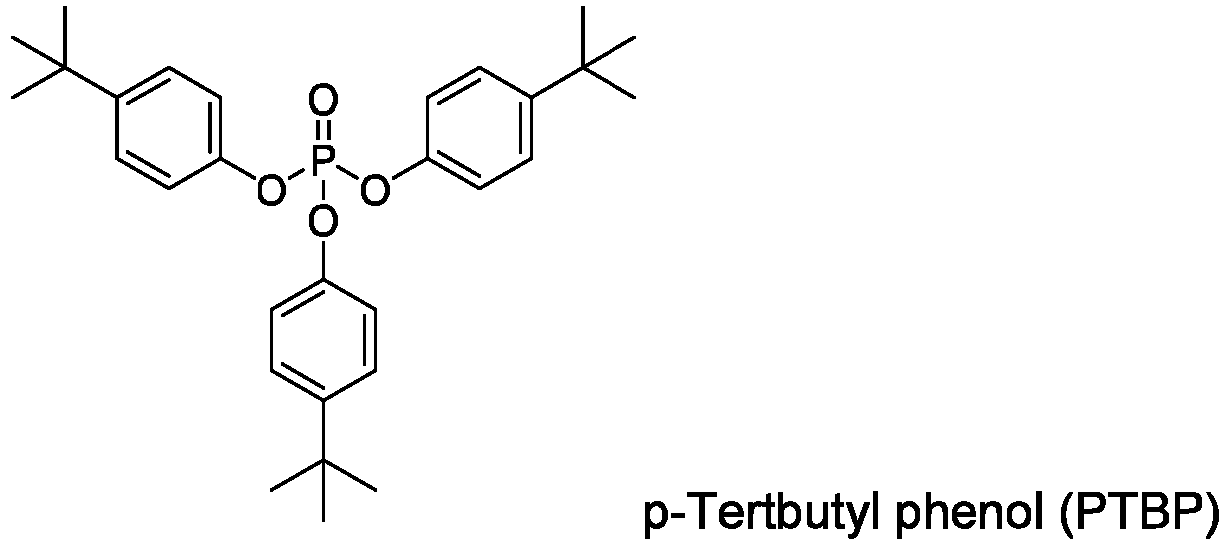
- Using a method similar to that outlined in Comparative Example 1, but with a different feedstock as shown in Table 1, the phosphate ester 4 (Tri-3-methyl-4-propylphenol phosphate ester was synthesized.

- The Properties of the phosphate esters made as per the Examples are summarised in Table 1.
Table 1. Phosphate Ester Examples Comparative Example 1 Comparative Example 2 Comparative Example 3 Example 1 TCP TXP TBPP Novel Phosphate Ester R2 Substituent None None None None R3 Substituent Methyl (53%) Methyl None Methyl R4 Substituent Methyl (47%) Methyl t-Butyl i-Propyl R5 Substituent None Methyl None None R6 Substituent None None None None Total number of carbon atoms in R3, R4 and R5 1 2 4 4 Feedstock m-,p-cresol Xylenols p-tert-butyl phenol 3-methyl-4-isopropyl phenol Phenol Co-feed, % 0 0 0 0 Purity, % >98 >98 Yield, % Form @ Ambient Temperature, =25 C Liquid Liquid Solid Liquid Melt Point1, C - - 104 - Kinematic Viscosity2 @ 40 C, cSt 22 42 - 332 Kinematic Viscosity2 @ 100 C, cSt 4 5 - 13 Pour Point3, C -33 -25 - -7 1 melting point measured via differential scanning calorimetry (DSC, TA Instruments DSC Q20)
2 kinematic viscosity measured using an Anton Paar SVM 3000 Viscometer
3 pour point measured via an iSL CPP 5Gs, following ASTM D97 - The applicant has found (Example 1) that by eliminating substituents at the 2, and/or 6 position that regulatory neurotoxicity concerns are addressed, and that by varying the i) number (at least two), ii) location (3, 4, and/or 5) and iii) size of substituents that improvements in physical properties (like viscosity and pour point, Table 1) can be realized versus mono-substituted aryl phosphate esters. Otherwise solid 4-monoalkyl aryl(phenyl) phosphate esters can be redesigned into room temperature liquids of less than 0°C pour point while maintaining equivalent molecular weight.
- Furthermore, the improvement in certain physical properties does not come at the expense of properties like volatility, boiling point, or acute toxicity (GHS Classification). Additionally, the improved viscosity reduces the need to add phenyl groups, which are prone to hydrolysis and have acute toxicity (marine pollutant) issues.
- The effect of multiply substituted 3, 4, and/or 5 aryl groups on the finished phosphate ester is not discernible from the physical characteristics of the starting materials, (see Table 2).
Table 2. Physical Properties of Alkyl Phenols. Alkyl Phenol M.W. Melt Point, °C Boiling Point, °C C4 4-Tert-Butyl Phenol 150 98 237 4-Isopropyl-3-MethylPhenol 150 110 238
Claims (15)
- A phosphate ester composition comprising more than 50 mass% of a phosphate ester represented by Formula 1,


- The phosphate ester composition of claim 1, wherein at least two of X, Y and Z are aryl, represented by formula 2.
- The phosphate ester composition of claim 1 or claim 2, wherein R3, R4 and R5 of Formula 2 have from 1 to 6 carbon atoms.
- The phosphate ester composition of claim 1 or claim 2, wherein R3, R4 and R5 of Formula 2 have from 1 to 4 carbon atoms.
- The phosphate ester composition of any of the preceding claims wherein the total number of carbon atoms in R3, R4 and R5 is from 3 to 18.
- The phosphate ester composition of any of the preceding claims wherein the total number of carbon atoms in R3, R4 and R5 is from 3 to 12.
- The phosphate ester composition of any of the preceding claims wherein the aryl group of Formula 2 is selected from the group consisting of 3-methyl-4-ethylphenol, 3-methyl-4-propylphenol, 3-methyl-4-isopropylphenol 3-methyl-4-butylphenol, 3-methyl-4-tert-butylphenol, 3-methyl-4-sec-butylphenol, 3-methyl-4-iso-butylphenol, 3-methyl-4-pentylphenol, 3-methyl-4-hexylphenol, 3-methyl-4-sec-hexylphenol, 3-methyl-4-heptylphenol, 3-methyl-4-octylphenol, 3-methyl-4-sec-octylphenol, 3-methyl-4-nonylphenol 3-methyl-4-decylphenol, 3-methyl-5-isopropylphenol, 3-isopropyl-4-methylphenol, 3,4,5-trimethylphenol, 3-ethyl-4-methylphenol, 3,5-dimethyl-4-ethylphenol, 3,5-dimethyl-4-propylphenol, 3,5-dimethyl-4-isopropylphenol, 3,5-dimethyl-4-butylphenol, 3,5-dimethyl-4-sec-butylphenol, 3,5-dimethyl-4-iso-butylphenol, 3,5-dimethyl-4-pentylphenol, 3,5-dimethyl-4-hexylphenol, 3,5-dimethyl-4-(1,1-dimethylpropyl)-phenol, 3,5-dimethyl-4-(1,1-dimethylbutyl)-phenol, 3,5-dimethyl-4-(1-ethyl,1-methylpropyl)-phenol, 3,5-dimethyl-4-heptylphenol, 3,5-dimethyl-4-octylphenol, 3,5-dimethyl-4-nonylphenol, 3,5-dimethyl-4-decylphenol, 3,4-diethylphenol, 3,5-diethylphenol, 3,4-dimethyl-5-ethylphenol, 4-methyl-3-isopropylphenol, 3-isopropyl-4-methylphenol, 3-methyl-4-(1,1-dimethylpropyl)-phenol, 3-methyl-4-(1,1-dimethylbutyl)-phenol, 3-methyl-4-(1-ethyl, 1-methylpropyl)-phenol.
- The phosphate ester composition of claim 1 wherein the phosphate ester is represented by Formula 3:
 wherein two or more of R3, R4 and R5 have from 1 to 10 carbon atoms, and the total number of carbon atoms in R3, R4 and R5 is from 3 to 30,two or more of R'3, R'4 and R'5 have from 1 to 10 carbon atoms, and the total number of carbon atoms in R'3, R'4 and R'5 is from 3 to 30,two or more of R"3, R"4 and R"5 have from 1 to 10 carbon atoms, and the total number of carbon atoms in R"3, R"4 and R"5 is from 3 to 30.
 - A phosphate ester composition comprising more than 50 mass% of a phosphate ester represented by Formula 4,


- The phosphate ester composition of claim 9 wherein the substituents R3, R4 and R5 of Formula 2 have from 1 to 6 carbon atoms.
- The phosphate ester composition of claim 9 wherein the substituents R3, R4 and R5 of Formula 2 have from 1 to 4 carbon atoms.
- The phosphate ester composition of any of claims 9 to 11 wherein the total number of carbon atoms in R3, R4 and R5 is from 3 to 18.
- The phosphate ester composition of any of claims 9 to 11 wherein the total number of carbon atoms in R3, R4 and R5isfrom 3 to 12.
- The phosphate ester composition of any of claims 9 to 13 wherein the aryl group of Formula 2 is selected from the group consisting of 3-methyl-4-ethylphenol, 3-methyl-4-propylphenol, 3-methyl-4-isopropylphenol 3-methyl-4-butylphenol, 3-methyl-4-tert-butylphenol, 3-methyl-4-sec-butylphenol, 3-methyl-4-iso-butylphenol, 3-methyl-4-pentylphenol, 3-methyl-4-hexylphenol, 3-methyl-4-sec-hexylphenol, 3-methyl-4-heptylphenol, 3-methyl-4-octylphenol, 3-methyl-4-sec-octylphenol, 3-methyl-4-nonylphenol 3-methyl-4-decylphenol, 3-methyl-5-isopropylphenol, 3-isopropyl-4-methylphenol, 3,4,5-trimethylphenol, 3-ethyl-4-methylphenol, 3,5-dimethyl-4-ethylphenol, 3,5-dimethyl-4-propylphenol, 3,5-dimethyl-4-isopropylphenol, 3,5-dimethyl-4-butylphenol, 3,5-dimethyl-4-sec-butylphenol, 3,5-dimethyl-4-iso-butylphenol, 3,5-dimethyl-4-pentylphenol, 3,5-dimethyl-4-hexylphenol, 3,5-dimethyl-4-(1,1-dimethylpropyl)-phenol, 3,5-dimethyl-4-(1,1-dimethylbutyl)-phenol, 3,5-dimethyl-4-(1-ethyl, 1-methylpropyl)-phenol, 3,5-dimethyl-4-heptylphenol, 3,5-dimethyl-4-octylphenol, 3,5-dimethyl-4-nonylphenol, 3,5-dimethyl-4-decylphenol, 3,4-diethylphenol, 3,5-diethylphenol, 3,4-dimethyl-5-ethylphenol, 4-methyl-3-isopropylphenol, 3-isopropyl-4-methylphenol, 3-methyl-4-(1,1-dimethylpropyl)-phenol, 3-methyl-4-(1,1-dimethylbutyl)-phenol, 3-methyl-4-(1-ethyl, 1-methylpropyl)-phenol.
- Use of the phosphate ester composition as defined in any of claims 1 to 14 as a flame retardant, a lubricant, an anti-wear additive, a hydraulic fluid, a self-extinguishing functional fluid, or an additive therefore.
Applications Claiming Priority (2)
| Application Number | Priority Date | Filing Date | Title |
|---|---|---|---|
| US201562239319P | 2015-10-09 | 2015-10-09 | |
| PCT/US2016/055657 WO2017062557A1 (en) | 2015-10-09 | 2016-10-06 | Phosphate ester composition and use |
Publications (2)
| Publication Number | Publication Date |
|---|---|
| EP3359596A1 EP3359596A1 (en) | 2018-08-15 |
| EP3359596B1 true EP3359596B1 (en) | 2025-05-07 |
Family
ID=57145065
Family Applications (1)
| Application Number | Title | Priority Date | Filing Date |
|---|---|---|---|
| EP16782375.6A Active EP3359596B1 (en) | 2015-10-09 | 2016-10-06 | Phosphate ester composition and use |
Country Status (5)
| Country | Link |
|---|---|
| US (1) | US10544173B2 (en) |
| EP (1) | EP3359596B1 (en) |
| CN (1) | CN108291053B (en) |
| ES (1) | ES3035953T3 (en) |
| WO (1) | WO2017062557A1 (en) |
Families Citing this family (2)
| Publication number | Priority date | Publication date | Assignee | Title |
|---|---|---|---|---|
| CN112226265A (en) * | 2020-10-23 | 2021-01-15 | 中国石油化工股份有限公司 | Phosphate hydraulic fluid composition and preparation method thereof |
| CN113219091B (en) * | 2021-04-28 | 2022-07-22 | 广东省中鼎检测技术有限公司 | Detection method for rapidly determining content of five persistent biological accumulated toxic substances in consumer product |
Family Cites Families (11)
| Publication number | Priority date | Publication date | Assignee | Title |
|---|---|---|---|---|
| GB1146173A (en) | 1966-06-18 | 1969-03-19 | Geigy Uk Ltd | Production of triaryl phosphates |
| US3816311A (en) * | 1971-02-19 | 1974-06-11 | Ethyl Corp | Stable phosphate esters |
| US3936410A (en) | 1973-10-09 | 1976-02-03 | Fmc Corporation | Triaryl phosphate ester plasticizers for polyvinyl chloride compositions |
| JP3521538B2 (en) | 1995-04-17 | 2004-04-19 | 株式会社エーピーアイ コーポレーション | Polyolefin resin composition |
| DE19983009B4 (en) * | 1998-02-28 | 2011-03-03 | Great Lakes Chemical Corp., West Lafayette | Metalworking lubricant composition |
| US6667355B2 (en) | 2001-08-30 | 2003-12-23 | Pabu Services, Inc. | Higher alkylated triaryl phosphate ester flame retardants |
| BRPI0719901A2 (en) | 2006-09-08 | 2014-06-10 | Albemarle Corp | ANTI-FLAME TEXTILE PRODUCTS; AND A METHOD OF MANUFACTURING THE SAME. |
| FR2946983B1 (en) | 2009-06-23 | 2011-12-23 | Nyco | ANTI-WEAR AGENTS WITH REDUCED NEUROTOXICITY |
| ES2629849T3 (en) | 2010-11-16 | 2017-08-16 | Lubrizol Advanced Materials, Inc. | Non-halogenated flame retardant thermoplastic polyurethane |
| CN103146152A (en) * | 2011-12-07 | 2013-06-12 | 杜邦公司 | Flame retardant copolyether ester composition and product comprising same |
| EP2788365A1 (en) | 2012-11-24 | 2014-10-15 | E. I. Du Pont de Nemours and Company | Flame-retardant copolyetherester composition and articles comprising the same |
-
2016
- 2016-10-06 CN CN201680058153.9A patent/CN108291053B/en active Active
- 2016-10-06 EP EP16782375.6A patent/EP3359596B1/en active Active
- 2016-10-06 WO PCT/US2016/055657 patent/WO2017062557A1/en not_active Ceased
- 2016-10-06 US US15/762,487 patent/US10544173B2/en active Active
- 2016-10-06 ES ES16782375T patent/ES3035953T3/en active Active
Also Published As
| Publication number | Publication date |
|---|---|
| CN108291053B (en) | 2020-10-16 |
| US10544173B2 (en) | 2020-01-28 |
| US20180273556A1 (en) | 2018-09-27 |
| ES3035953T3 (en) | 2025-09-11 |
| WO2017062557A1 (en) | 2017-04-13 |
| CN108291053A (en) | 2018-07-17 |
| EP3359596A1 (en) | 2018-08-15 |
Similar Documents
| Publication | Publication Date | Title |
|---|---|---|
| KR102096325B1 (en) | Tritylated alkyl aryl ethers | |
| CN103635562B (en) | Tritylation ether | |
| US9587187B2 (en) | Alkyl trityl phenyl ethers | |
| US10544173B2 (en) | Phosphate ester composition and use | |
| CN104245652B (en) | Tritylated ethers | |
| EP3140271B1 (en) | Tetrarylmethane ethers for use as fuel and oil markers | |
| EP3140381B1 (en) | Tetrarylmethane ethers as fuel markers | |
| RU2670105C1 (en) | Method for obtaining mixed triaryl phosphates | |
| US20190002373A1 (en) | Method of separating hexene | |
| JP7761142B2 (en) | Dihydroxybiphenyl compound, bisphosphite compound, catalyst, catalyst composition, method for producing aldehyde, and method for producing alcohol | |
| EP1638910A4 (en) | Color stabilization of hydroquinone hydroxyethyl ether products |
Legal Events
| Date | Code | Title | Description |
|---|---|---|---|
| STAA | Information on the status of an ep patent application or granted ep patent |
Free format text: STATUS: THE INTERNATIONAL PUBLICATION HAS BEEN MADE |
|
| PUAI | Public reference made under article 153(3) epc to a published international application that has entered the european phase |
Free format text: ORIGINAL CODE: 0009012 |
|
| STAA | Information on the status of an ep patent application or granted ep patent |
Free format text: STATUS: REQUEST FOR EXAMINATION WAS MADE |
|
| 17P | Request for examination filed |
Effective date: 20180504 |
|
| AK | Designated contracting states |
Kind code of ref document: A1 Designated state(s): AL AT BE BG CH CY CZ DE DK EE ES FI FR GB GR HR HU IE IS IT LI LT LU LV MC MK MT NL NO PL PT RO RS SE SI SK SM TR |
|
| AX | Request for extension of the european patent |
Extension state: BA ME |
|
| DAV | Request for validation of the european patent (deleted) | ||
| DAX | Request for extension of the european patent (deleted) | ||
| GRAP | Despatch of communication of intention to grant a patent |
Free format text: ORIGINAL CODE: EPIDOSNIGR1 |
|
| STAA | Information on the status of an ep patent application or granted ep patent |
Free format text: STATUS: GRANT OF PATENT IS INTENDED |
|
| P01 | Opt-out of the competence of the unified patent court (upc) registered |
Effective date: 20230502 |
|
| INTG | Intention to grant announced |
Effective date: 20230525 |
|
| GRAJ | Information related to disapproval of communication of intention to grant by the applicant or resumption of examination proceedings by the epo deleted |
Free format text: ORIGINAL CODE: EPIDOSDIGR1 |
|
| STAA | Information on the status of an ep patent application or granted ep patent |
Free format text: STATUS: REQUEST FOR EXAMINATION WAS MADE |
|
| STAA | Information on the status of an ep patent application or granted ep patent |
Free format text: STATUS: EXAMINATION IS IN PROGRESS |
|
| INTC | Intention to grant announced (deleted) | ||
| 17Q | First examination report despatched |
Effective date: 20231027 |
|
| GRAP | Despatch of communication of intention to grant a patent |
Free format text: ORIGINAL CODE: EPIDOSNIGR1 |
|
| STAA | Information on the status of an ep patent application or granted ep patent |
Free format text: STATUS: GRANT OF PATENT IS INTENDED |
|
| INTG | Intention to grant announced |
Effective date: 20241128 |
|
| GRAS | Grant fee paid |
Free format text: ORIGINAL CODE: EPIDOSNIGR3 |
|
| GRAA | (expected) grant |
Free format text: ORIGINAL CODE: 0009210 |
|
| STAA | Information on the status of an ep patent application or granted ep patent |
Free format text: STATUS: THE PATENT HAS BEEN GRANTED |
|
| AK | Designated contracting states |
Kind code of ref document: B1 Designated state(s): AL AT BE BG CH CY CZ DE DK EE ES FI FR GB GR HR HU IE IS IT LI LT LU LV MC MK MT NL NO PL PT RO RS SE SI SK SM TR |
|
| REG | Reference to a national code |
Ref country code: GB Ref legal event code: FG4D |
|
| REG | Reference to a national code |
Ref country code: CH Ref legal event code: EP |
|
| REG | Reference to a national code |
Ref country code: DE Ref legal event code: R096 Ref document number: 602016092172 Country of ref document: DE |
|
| REG | Reference to a national code |
Ref country code: IE Ref legal event code: FG4D |
|
| REG | Reference to a national code |
Ref country code: NL Ref legal event code: MP Effective date: 20250507 |
|
| REG | Reference to a national code |
Ref country code: ES Ref legal event code: FG2A Ref document number: 3035953 Country of ref document: ES Kind code of ref document: T3 Effective date: 20250911 |
|
| PG25 | Lapsed in a contracting state [announced via postgrant information from national office to epo] |
Ref country code: FI Free format text: LAPSE BECAUSE OF FAILURE TO SUBMIT A TRANSLATION OF THE DESCRIPTION OR TO PAY THE FEE WITHIN THE PRESCRIBED TIME-LIMIT Effective date: 20250507 Ref country code: PT Free format text: LAPSE BECAUSE OF FAILURE TO SUBMIT A TRANSLATION OF THE DESCRIPTION OR TO PAY THE FEE WITHIN THE PRESCRIBED TIME-LIMIT Effective date: 20250908 |
|
| REG | Reference to a national code |
Ref country code: LT Ref legal event code: MG9D |
|
| PG25 | Lapsed in a contracting state [announced via postgrant information from national office to epo] |
Ref country code: NO Free format text: LAPSE BECAUSE OF FAILURE TO SUBMIT A TRANSLATION OF THE DESCRIPTION OR TO PAY THE FEE WITHIN THE PRESCRIBED TIME-LIMIT Effective date: 20250807 Ref country code: GR Free format text: LAPSE BECAUSE OF FAILURE TO SUBMIT A TRANSLATION OF THE DESCRIPTION OR TO PAY THE FEE WITHIN THE PRESCRIBED TIME-LIMIT Effective date: 20250808 |
|
| PG25 | Lapsed in a contracting state [announced via postgrant information from national office to epo] |
Ref country code: NL Free format text: LAPSE BECAUSE OF FAILURE TO SUBMIT A TRANSLATION OF THE DESCRIPTION OR TO PAY THE FEE WITHIN THE PRESCRIBED TIME-LIMIT Effective date: 20250507 Ref country code: PL Free format text: LAPSE BECAUSE OF FAILURE TO SUBMIT A TRANSLATION OF THE DESCRIPTION OR TO PAY THE FEE WITHIN THE PRESCRIBED TIME-LIMIT Effective date: 20250507 |
|
| REG | Reference to a national code |
Ref country code: AT Ref legal event code: MK05 Ref document number: 1792456 Country of ref document: AT Kind code of ref document: T Effective date: 20250507 |
|
| PG25 | Lapsed in a contracting state [announced via postgrant information from national office to epo] |
Ref country code: BG Free format text: LAPSE BECAUSE OF FAILURE TO SUBMIT A TRANSLATION OF THE DESCRIPTION OR TO PAY THE FEE WITHIN THE PRESCRIBED TIME-LIMIT Effective date: 20250507 |
|
| PG25 | Lapsed in a contracting state [announced via postgrant information from national office to epo] |
Ref country code: HR Free format text: LAPSE BECAUSE OF FAILURE TO SUBMIT A TRANSLATION OF THE DESCRIPTION OR TO PAY THE FEE WITHIN THE PRESCRIBED TIME-LIMIT Effective date: 20250507 |
|
| PG25 | Lapsed in a contracting state [announced via postgrant information from national office to epo] |
Ref country code: AT Free format text: LAPSE BECAUSE OF FAILURE TO SUBMIT A TRANSLATION OF THE DESCRIPTION OR TO PAY THE FEE WITHIN THE PRESCRIBED TIME-LIMIT Effective date: 20250507 |
|
| PG25 | Lapsed in a contracting state [announced via postgrant information from national office to epo] |
Ref country code: RS Free format text: LAPSE BECAUSE OF FAILURE TO SUBMIT A TRANSLATION OF THE DESCRIPTION OR TO PAY THE FEE WITHIN THE PRESCRIBED TIME-LIMIT Effective date: 20250807 |
|
| PG25 | Lapsed in a contracting state [announced via postgrant information from national office to epo] |
Ref country code: IS Free format text: LAPSE BECAUSE OF FAILURE TO SUBMIT A TRANSLATION OF THE DESCRIPTION OR TO PAY THE FEE WITHIN THE PRESCRIBED TIME-LIMIT Effective date: 20250907 |
|
| PG25 | Lapsed in a contracting state [announced via postgrant information from national office to epo] |
Ref country code: LV Free format text: LAPSE BECAUSE OF FAILURE TO SUBMIT A TRANSLATION OF THE DESCRIPTION OR TO PAY THE FEE WITHIN THE PRESCRIBED TIME-LIMIT Effective date: 20250507 |
|
| PGFP | Annual fee paid to national office [announced via postgrant information from national office to epo] |
Ref country code: DE Payment date: 20251029 Year of fee payment: 10 |
|
| PGFP | Annual fee paid to national office [announced via postgrant information from national office to epo] |
Ref country code: GB Payment date: 20251027 Year of fee payment: 10 |
|
| PG25 | Lapsed in a contracting state [announced via postgrant information from national office to epo] |
Ref country code: DK Free format text: LAPSE BECAUSE OF FAILURE TO SUBMIT A TRANSLATION OF THE DESCRIPTION OR TO PAY THE FEE WITHIN THE PRESCRIBED TIME-LIMIT Effective date: 20250507 Ref country code: SM Free format text: LAPSE BECAUSE OF FAILURE TO SUBMIT A TRANSLATION OF THE DESCRIPTION OR TO PAY THE FEE WITHIN THE PRESCRIBED TIME-LIMIT Effective date: 20250507 |
|
| PGFP | Annual fee paid to national office [announced via postgrant information from national office to epo] |
Ref country code: IT Payment date: 20251021 Year of fee payment: 10 |
|
| PGFP | Annual fee paid to national office [announced via postgrant information from national office to epo] |
Ref country code: FR Payment date: 20251027 Year of fee payment: 10 |
|
| PG25 | Lapsed in a contracting state [announced via postgrant information from national office to epo] |
Ref country code: CZ Free format text: LAPSE BECAUSE OF FAILURE TO SUBMIT A TRANSLATION OF THE DESCRIPTION OR TO PAY THE FEE WITHIN THE PRESCRIBED TIME-LIMIT Effective date: 20250507 |
|
| PG25 | Lapsed in a contracting state [announced via postgrant information from national office to epo] |
Ref country code: EE Free format text: LAPSE BECAUSE OF FAILURE TO SUBMIT A TRANSLATION OF THE DESCRIPTION OR TO PAY THE FEE WITHIN THE PRESCRIBED TIME-LIMIT Effective date: 20250507 |
|
| PG25 | Lapsed in a contracting state [announced via postgrant information from national office to epo] |
Ref country code: SK Free format text: LAPSE BECAUSE OF FAILURE TO SUBMIT A TRANSLATION OF THE DESCRIPTION OR TO PAY THE FEE WITHIN THE PRESCRIBED TIME-LIMIT Effective date: 20250507 Ref country code: RO Free format text: LAPSE BECAUSE OF FAILURE TO SUBMIT A TRANSLATION OF THE DESCRIPTION OR TO PAY THE FEE WITHIN THE PRESCRIBED TIME-LIMIT Effective date: 20250507 |
|
| PGFP | Annual fee paid to national office [announced via postgrant information from national office to epo] |
Ref country code: ES Payment date: 20251103 Year of fee payment: 10 |
|
| REG | Reference to a national code |
Ref country code: DE Ref legal event code: R097 Ref document number: 602016092172 Country of ref document: DE |
|
| PLBE | No opposition filed within time limit |
Free format text: ORIGINAL CODE: 0009261 |
|
| STAA | Information on the status of an ep patent application or granted ep patent |
Free format text: STATUS: NO OPPOSITION FILED WITHIN TIME LIMIT |
|
| REG | Reference to a national code |
Ref country code: CH Ref legal event code: L10 Free format text: ST27 STATUS EVENT CODE: U-0-0-L10-L00 (AS PROVIDED BY THE NATIONAL OFFICE) Effective date: 20260318 |
|
| 26N | No opposition filed |
Effective date: 20260210 |