EP3359154B1 - Wnt signaling pathway inhibitors and therapeutic applications thereof - Google Patents
Wnt signaling pathway inhibitors and therapeutic applications thereof Download PDFInfo
- Publication number
- EP3359154B1 EP3359154B1 EP16854369.2A EP16854369A EP3359154B1 EP 3359154 B1 EP3359154 B1 EP 3359154B1 EP 16854369 A EP16854369 A EP 16854369A EP 3359154 B1 EP3359154 B1 EP 3359154B1
- Authority
- EP
- European Patent Office
- Prior art keywords
- mmol
- cdcl
- mhz
- nmr
- alkyl
- Prior art date
- Legal status (The legal status is an assumption and is not a legal conclusion. Google has not performed a legal analysis and makes no representation as to the accuracy of the status listed.)
- Active
Links
- 0 Cc(nc(*)nc1C)c1F Chemical compound Cc(nc(*)nc1C)c1F 0.000 description 9
- ZZNHXGHHAHACQX-UHFFFAOYSA-N Cc1cc(-c2ccc(CNc3cc(-c4ccc(cccc5)c5c4)nc(N)n3)cc2)ccn1 Chemical compound Cc1cc(-c2ccc(CNc3cc(-c4ccc(cccc5)c5c4)nc(N)n3)cc2)ccn1 ZZNHXGHHAHACQX-UHFFFAOYSA-N 0.000 description 2
- MBTJRXNRBHSYGR-UHFFFAOYSA-N Cc1cc(-c2ccc(CNc3ncnc(N(CCc4c5cccc4)C5=O)c3)cc2)ccn1 Chemical compound Cc1cc(-c2ccc(CNc3ncnc(N(CCc4c5cccc4)C5=O)c3)cc2)ccn1 MBTJRXNRBHSYGR-UHFFFAOYSA-N 0.000 description 2
- AVOXSRPMVKEWOX-UHFFFAOYSA-N Cc1cc(-c2ccnc(NCc3cc(C#N)c(-c4ccnc(C)c4)nc3)c2F)cnc1 Chemical compound Cc1cc(-c2ccnc(NCc3cc(C#N)c(-c4ccnc(C)c4)nc3)c2F)cnc1 AVOXSRPMVKEWOX-UHFFFAOYSA-N 0.000 description 2
- OZGGZUJZNCGVTF-UHFFFAOYSA-N Cc1nccc(-c(ncc(CNc(nccc2-c(cc3)nc4c3nccc4)c2O)c2)c2F)c1 Chemical compound Cc1nccc(-c(ncc(CNc(nccc2-c(cc3)nc4c3nccc4)c2O)c2)c2F)c1 OZGGZUJZNCGVTF-UHFFFAOYSA-N 0.000 description 2
- MLYPGSFNNCHCRC-UHFFFAOYSA-N Cc1nccc(-c(ncc(CNc(nccc2-c3cncc(OC)c3)c2F)c2)c2C#N)c1 Chemical compound Cc1nccc(-c(ncc(CNc(nccc2-c3cncc(OC)c3)c2F)c2)c2C#N)c1 MLYPGSFNNCHCRC-UHFFFAOYSA-N 0.000 description 2
- PIDLPQJKBCMOEI-UHFFFAOYSA-N Cc1nccc(-c(ncc(CNc(ncnc2N(CC3)Cc4c3nc[s]4)c2F)c2)c2F)c1 Chemical compound Cc1nccc(-c(ncc(CNc(ncnc2N(CC3)Cc4c3nc[s]4)c2F)c2)c2F)c1 PIDLPQJKBCMOEI-UHFFFAOYSA-N 0.000 description 2
- MBUZDMVZWUBVFB-UHFFFAOYSA-N Cc1nccc(-c2ccc(CNc3cc(N4CCCC4)nc(N(CC4)Cc5c4cccc5)n3)cc2)c1 Chemical compound Cc1nccc(-c2ccc(CNc3cc(N4CCCC4)nc(N(CC4)Cc5c4cccc5)n3)cc2)c1 MBUZDMVZWUBVFB-UHFFFAOYSA-N 0.000 description 2
- JXABAYOWOVRPOR-UHFFFAOYSA-N Cc1nccc(-c2ccc(CNc3ncnc(N(CC4)Cc5c4ccc(F)c5)c3F)cc2)c1 Chemical compound Cc1nccc(-c2ccc(CNc3ncnc(N(CC4)Cc5c4ccc(F)c5)c3F)cc2)c1 JXABAYOWOVRPOR-UHFFFAOYSA-N 0.000 description 2
- QWBPNFSFWCATIH-UHFFFAOYSA-N Cc1nccc(-c2ccc(CNc3ncnc(N(CC4)Cc5c4nccc5)c3F)cn2)c1 Chemical compound Cc1nccc(-c2ccc(CNc3ncnc(N(CC4)Cc5c4nccc5)c3F)cn2)c1 QWBPNFSFWCATIH-UHFFFAOYSA-N 0.000 description 2
- XRIDOQKIWZPHIS-UHFFFAOYSA-N C(c(cc1)ccc1-[n]1cncc1)Nc1nc(-c(cc2)cc3c2nccc3)ccn1 Chemical compound C(c(cc1)ccc1-[n]1cncc1)Nc1nc(-c(cc2)cc3c2nccc3)ccn1 XRIDOQKIWZPHIS-UHFFFAOYSA-N 0.000 description 1
- TVAJEMZOGPLUDM-UHFFFAOYSA-N C(c(cc1)ccc1C1=CC(C2)C2C=C1)Nc1cc(-c2cc(cccc3)c3cc2)ncn1 Chemical compound C(c(cc1)ccc1C1=CC(C2)C2C=C1)Nc1cc(-c2cc(cccc3)c3cc2)ncn1 TVAJEMZOGPLUDM-UHFFFAOYSA-N 0.000 description 1
- HGQDPDBAAACDSO-UHFFFAOYSA-N C=SCCNc1ccc(CNc(ncnc2-c(cc3)cc4c3nccc4)c2F)cn1 Chemical compound C=SCCNc1ccc(CNc(ncnc2-c(cc3)cc4c3nccc4)c2F)cn1 HGQDPDBAAACDSO-UHFFFAOYSA-N 0.000 description 1
- UFQZZBMOFCFRDA-UHFFFAOYSA-N CC(C=C(C=C1)c2ccc(CNc3nc(-c4ccc5ncccc5c4)ccn3)cc2)C1=C Chemical compound CC(C=C(C=C1)c2ccc(CNc3nc(-c4ccc5ncccc5c4)ccn3)cc2)C1=C UFQZZBMOFCFRDA-UHFFFAOYSA-N 0.000 description 1
- DAUSGHZJGXLDEP-UHFFFAOYSA-N CC(c(cc1)ccc1-c1cc(C)ncc1)Nc1ncnc(-c2cc3ccccc3cc2)c1 Chemical compound CC(c(cc1)ccc1-c1cc(C)ncc1)Nc1ncnc(-c2cc3ccccc3cc2)c1 DAUSGHZJGXLDEP-UHFFFAOYSA-N 0.000 description 1
- MLDXRSBXKDIDKA-UHFFFAOYSA-N CC(c(cc1)ccc1-c1ccnc(C)c1)Nc(nccc1-c2ccc3ncccc3c2)c1F Chemical compound CC(c(cc1)ccc1-c1ccnc(C)c1)Nc(nccc1-c2ccc3ncccc3c2)c1F MLDXRSBXKDIDKA-UHFFFAOYSA-N 0.000 description 1
- MBZRZWNPHRPJHX-YVLHZVERSA-N CC/N=C\C(C)(C)Nc1n[s]c(-c(nc2)cc3c2nccc3)n1 Chemical compound CC/N=C\C(C)(C)Nc1n[s]c(-c(nc2)cc3c2nccc3)n1 MBZRZWNPHRPJHX-YVLHZVERSA-N 0.000 description 1
- MGNXRUDFFDYNKI-UHFFFAOYSA-N CC1C=CC(c2cnc(CNC3N=CC=C(c4ccc5ncccc5c4)N3)cn2)=CC1C Chemical compound CC1C=CC(c2cnc(CNC3N=CC=C(c4ccc5ncccc5c4)N3)cn2)=CC1C MGNXRUDFFDYNKI-UHFFFAOYSA-N 0.000 description 1
- BRFQYGAOCPYRON-DQTBXEFESA-N CCC(/N=C\C(C)([C@@H](C)Br)C#N)=C Chemical compound CCC(/N=C\C(C)([C@@H](C)Br)C#N)=C BRFQYGAOCPYRON-DQTBXEFESA-N 0.000 description 1
- CXWIUKGRURUNQS-UHFFFAOYSA-N CCC(CC1)=C(C)C=C1c1ccc(CNc2c(C)c(-c3cc4ccccc4cc3)ncn2)cc1 Chemical compound CCC(CC1)=C(C)C=C1c1ccc(CNc2c(C)c(-c3cc4ccccc4cc3)ncn2)cc1 CXWIUKGRURUNQS-UHFFFAOYSA-N 0.000 description 1
- MBVQWQPNWUOJFD-UHFFFAOYSA-N CCNC(C=N)=C Chemical compound CCNC(C=N)=C MBVQWQPNWUOJFD-UHFFFAOYSA-N 0.000 description 1
- SZWUAGOEMFRDGS-UHFFFAOYSA-N CCc(c(C)c1)ccc1-c1ncc(CNC2=NC(c3ccc4ncccc4c3)=CCN2C)cn1 Chemical compound CCc(c(C)c1)ccc1-c1ncc(CNC2=NC(c3ccc4ncccc4c3)=CCN2C)cn1 SZWUAGOEMFRDGS-UHFFFAOYSA-N 0.000 description 1
- VERFDMBEXVNXQK-UHFFFAOYSA-N CCc1c(NCc2ccc(C3=CC(C)(C4C)C4C=C3)[s]2)ncnc1-c1cc2ccccc2cc1 Chemical compound CCc1c(NCc2ccc(C3=CC(C)(C4C)C4C=C3)[s]2)ncnc1-c1cc2ccccc2cc1 VERFDMBEXVNXQK-UHFFFAOYSA-N 0.000 description 1
- XJOKUYAVZTYJHM-UHFFFAOYSA-N CNc1cc2ccc(CNc3nc(-c4ccc5ncccc5c4)ccn3)nc2cc1 Chemical compound CNc1cc2ccc(CNc3nc(-c4ccc5ncccc5c4)ccn3)nc2cc1 XJOKUYAVZTYJHM-UHFFFAOYSA-N 0.000 description 1
- RGOUMCCQGQALBH-UHFFFAOYSA-N COc1ncnc(-c2ncc3ncccc3c2)c1F Chemical compound COc1ncnc(-c2ncc3ncccc3c2)c1F RGOUMCCQGQALBH-UHFFFAOYSA-N 0.000 description 1
- DCEPKDWPFCCSHJ-UHFFFAOYSA-N CS(CCNc1ccc(CNc(nccc2-c3ccc4ncccc4c3)c2F)cn1)(=O)=O Chemical compound CS(CCNc1ccc(CNc(nccc2-c3ccc4ncccc4c3)c2F)cn1)(=O)=O DCEPKDWPFCCSHJ-UHFFFAOYSA-N 0.000 description 1
- MFLAMKPSJISRDY-UHFFFAOYSA-N CS(CCNc1ccc(CNc2nc(-c3ccc4ncccc4c3)ccn2)cn1)(=O)=O Chemical compound CS(CCNc1ccc(CNc2nc(-c3ccc4ncccc4c3)ccn2)cn1)(=O)=O MFLAMKPSJISRDY-UHFFFAOYSA-N 0.000 description 1
- RXJHHFRTUHUYDP-CMPYXILNSA-N C[C@@H](/C(/C)=C/NC)Nc(nccc1N(CC2)Cc3c2nccc3)c1F Chemical compound C[C@@H](/C(/C)=C/NC)Nc(nccc1N(CC2)Cc3c2nccc3)c1F RXJHHFRTUHUYDP-CMPYXILNSA-N 0.000 description 1
- PYBBXKXFHWVCIE-UHFFFAOYSA-N Cc(nc1)c[n]1-c1ccc(CNc(nccc2-c3ccc4ncccc4c3)c2F)cc1 Chemical compound Cc(nc1)c[n]1-c1ccc(CNc(nccc2-c3ccc4ncccc4c3)c2F)cc1 PYBBXKXFHWVCIE-UHFFFAOYSA-N 0.000 description 1
- ABHDFEJTVPJGJS-UHFFFAOYSA-N Cc1c(-c2cc(C)ncc2)ncc(CNc2n[s]c(-c3ccc4ncccc4c3)n2)c1 Chemical compound Cc1c(-c2cc(C)ncc2)ncc(CNc2n[s]c(-c3ccc4ncccc4c3)n2)c1 ABHDFEJTVPJGJS-UHFFFAOYSA-N 0.000 description 1
- KBXIUMXGWPDZCB-UHFFFAOYSA-N Cc1c(-c2ccnc(C)c2)ncc(CNc(ncnc2-c3ccc4ncccc4c3)c2F)c1 Chemical compound Cc1c(-c2ccnc(C)c2)ncc(CNc(ncnc2-c3ccc4ncccc4c3)c2F)c1 KBXIUMXGWPDZCB-UHFFFAOYSA-N 0.000 description 1
- RXBHRCKYXBAOMK-UHFFFAOYSA-N Cc1c(-c2ccnc(C)c2)ncc(CNc(ncnc2N(CC3)Cc4c3nccc4)c2F)c1 Chemical compound Cc1c(-c2ccnc(C)c2)ncc(CNc(ncnc2N(CC3)Cc4c3nccc4)c2F)c1 RXBHRCKYXBAOMK-UHFFFAOYSA-N 0.000 description 1
- XMRGFPOZUHBEAT-UHFFFAOYSA-N Cc1c(NCc(ccc2c3)cc2ncc3C#N)ncnc1-c1ccc2ncccc2c1 Chemical compound Cc1c(NCc(ccc2c3)cc2ncc3C#N)ncnc1-c1ccc2ncccc2c1 XMRGFPOZUHBEAT-UHFFFAOYSA-N 0.000 description 1
- UUTAXHOOKHFVFB-UHFFFAOYSA-N Cc1c(NCc2cc(C#N)c(C3=CC(C)=C[IH]C=C3)nc2)nccc1-c1cc(Cl)cnc1 Chemical compound Cc1c(NCc2cc(C#N)c(C3=CC(C)=C[IH]C=C3)nc2)nccc1-c1cc(Cl)cnc1 UUTAXHOOKHFVFB-UHFFFAOYSA-N 0.000 description 1
- JOCMWNXMJVXFQV-UHFFFAOYSA-N Cc1c(NCc2cc(C#N)c(C3=CC(C)=C[IH]C=C3)nc2)nccc1-c1cc(OC)cnc1 Chemical compound Cc1c(NCc2cc(C#N)c(C3=CC(C)=C[IH]C=C3)nc2)nccc1-c1cc(OC)cnc1 JOCMWNXMJVXFQV-UHFFFAOYSA-N 0.000 description 1
- MDJWJHIAURKRBS-UHFFFAOYSA-N Cc1c(NCc2ccc(N(CC3)CCS3(=O)=O)nc2)ncnc1-c(cc1)cc2c1nccc2 Chemical compound Cc1c(NCc2ccc(N(CC3)CCS3(=O)=O)nc2)ncnc1-c(cc1)cc2c1nccc2 MDJWJHIAURKRBS-UHFFFAOYSA-N 0.000 description 1
- VIRJBIOTEVONSS-UHFFFAOYSA-N Cc1c(NCc2ccc(cc(cc3)C#N)c3n2)ncnc1N(CC1)Cc2c1nccc2 Chemical compound Cc1c(NCc2ccc(cc(cc3)C#N)c3n2)ncnc1N(CC1)Cc2c1nccc2 VIRJBIOTEVONSS-UHFFFAOYSA-N 0.000 description 1
- YPKZULZOQHGSOU-UHFFFAOYSA-N Cc1c(NCc2cnc(cc(cc3)C#N)c3c2)ncnc1-c1ccc2ncccc2c1 Chemical compound Cc1c(NCc2cnc(cc(cc3)C#N)c3c2)ncnc1-c1ccc2ncccc2c1 YPKZULZOQHGSOU-UHFFFAOYSA-N 0.000 description 1
- IMRLQPSUKZVRMF-UHFFFAOYSA-N Cc1cc(-c(ncc(CNc(nccc2-c3ncc4ncccc4c3)c2F)c2)c2C#N)ccn1 Chemical compound Cc1cc(-c(ncc(CNc(nccc2-c3ncc4ncccc4c3)c2F)c2)c2C#N)ccn1 IMRLQPSUKZVRMF-UHFFFAOYSA-N 0.000 description 1
- CDMWLFMSIIDXJZ-UHFFFAOYSA-N Cc1cc(-c(ncc(CNc(nccc2-c3ncc4ncccc4c3)c2F)c2)c2F)ccn1 Chemical compound Cc1cc(-c(ncc(CNc(nccc2-c3ncc4ncccc4c3)c2F)c2)c2F)ccn1 CDMWLFMSIIDXJZ-UHFFFAOYSA-N 0.000 description 1
- NDZAEIVPEPHOTA-UHFFFAOYSA-N Cc1cc(-c(ncc(CNc(ncnc2N3Cc4ncccc4C3)c2F)c2)c2F)ccn1 Chemical compound Cc1cc(-c(ncc(CNc(ncnc2N3Cc4ncccc4C3)c2F)c2)c2F)ccn1 NDZAEIVPEPHOTA-UHFFFAOYSA-N 0.000 description 1
- IEQVLZFIFZAHDN-UHFFFAOYSA-N Cc1cc(-c(ncc(CNc(ncnc2NCC3CC3)c2F)c2)c2F)ccn1 Chemical compound Cc1cc(-c(ncc(CNc(ncnc2NCC3CC3)c2F)c2)c2F)ccn1 IEQVLZFIFZAHDN-UHFFFAOYSA-N 0.000 description 1
- RIYMALQOHRXRRB-UHFFFAOYSA-N Cc1cc(-c(ncc(CNc2nc(-c(cc3)cc4c3nccc4)ccn2)c2)c2F)ccn1 Chemical compound Cc1cc(-c(ncc(CNc2nc(-c(cc3)cc4c3nccc4)ccn2)c2)c2F)ccn1 RIYMALQOHRXRRB-UHFFFAOYSA-N 0.000 description 1
- CNNAPPGTLPLXEX-UHFFFAOYSA-N Cc1cc(-c2ccc(CN/C(/NN)=N/C(c3ccc(cccc4)c4c3)=N)cc2)ccn1 Chemical compound Cc1cc(-c2ccc(CN/C(/NN)=N/C(c3ccc(cccc4)c4c3)=N)cc2)ccn1 CNNAPPGTLPLXEX-UHFFFAOYSA-N 0.000 description 1
- BPMJZSVIGFMQBK-UHFFFAOYSA-N Cc1cc(-c2ccc(CNc(nc(N(CC3)Cc4c3nccc4)nc3)c3F)cc2)ccn1 Chemical compound Cc1cc(-c2ccc(CNc(nc(N(CC3)Cc4c3nccc4)nc3)c3F)cc2)ccn1 BPMJZSVIGFMQBK-UHFFFAOYSA-N 0.000 description 1
- DEEAZGHECBMYSP-UHFFFAOYSA-N Cc1cc(-c2ccc(CNc(ncnc3-c4cc5c[n](C)nc5cc4)c3F)cc2)ccn1 Chemical compound Cc1cc(-c2ccc(CNc(ncnc3-c4cc5c[n](C)nc5cc4)c3F)cc2)ccn1 DEEAZGHECBMYSP-UHFFFAOYSA-N 0.000 description 1
- FILPLPCFCSLCNP-UHFFFAOYSA-N Cc1cc(-c2ccc(CNc(ncnc3-c4cc5ccccc5cc4)c3F)cn2)ccn1 Chemical compound Cc1cc(-c2ccc(CNc(ncnc3-c4cc5ccccc5cc4)c3F)cn2)ccn1 FILPLPCFCSLCNP-UHFFFAOYSA-N 0.000 description 1
- VGNMDTKFWYEYFO-UHFFFAOYSA-N Cc1cc(-c2ccc(CNc(ncnc3-c4ccccc4Cl)c3F)cc2)ccn1 Chemical compound Cc1cc(-c2ccc(CNc(ncnc3-c4ccccc4Cl)c3F)cc2)ccn1 VGNMDTKFWYEYFO-UHFFFAOYSA-N 0.000 description 1
- JAROEOCUWDRSOX-UHFFFAOYSA-N Cc1cc(-c2ccc(CNc3cc(Cl)nc(N(CC4)Cc5c4cccc5)n3)cc2)ccn1 Chemical compound Cc1cc(-c2ccc(CNc3cc(Cl)nc(N(CC4)Cc5c4cccc5)n3)cc2)ccn1 JAROEOCUWDRSOX-UHFFFAOYSA-N 0.000 description 1
- RFTUXKCGULRGMX-UHFFFAOYSA-N Cc1cc(-c2ccnc(NCc3cc(C#N)c(-c4cc(C)ncc4)nc3)c2F)ccn1 Chemical compound Cc1cc(-c2ccnc(NCc3cc(C#N)c(-c4cc(C)ncc4)nc3)c2F)ccn1 RFTUXKCGULRGMX-UHFFFAOYSA-N 0.000 description 1
- DSVLZSOLOYMTAY-UHFFFAOYSA-N Cc1cc(-c2cnc(CNc3nc(-c4cc5cccnc5cc4)ccn3)cn2)ccn1 Chemical compound Cc1cc(-c2cnc(CNc3nc(-c4cc5cccnc5cc4)ccn3)cn2)ccn1 DSVLZSOLOYMTAY-UHFFFAOYSA-N 0.000 description 1
- VJISYXSHMPQVPM-UHFFFAOYSA-N Cc1cc(-c2ncc(CNc(nccc3-c4ccc5ncccc5c4)c3F)cn2)ccn1 Chemical compound Cc1cc(-c2ncc(CNc(nccc3-c4ccc5ncccc5c4)c3F)cn2)ccn1 VJISYXSHMPQVPM-UHFFFAOYSA-N 0.000 description 1
- XQBRZPOJKUYHLB-UHFFFAOYSA-N Cc1cc(-c2ncc(CNc3ncnc(N(CC4)Cc5c4nccc5)c3F)cn2)ccn1 Chemical compound Cc1cc(-c2ncc(CNc3ncnc(N(CC4)Cc5c4nccc5)c3F)cn2)ccn1 XQBRZPOJKUYHLB-UHFFFAOYSA-N 0.000 description 1
- VNZGBZBOVGIRHR-PVOLAYEOSA-N Cc1nccc(-c(ncc(CN/C(/NN)=C(/C(C#Cc2cccnc2)=N)\F)c2)c2F)c1 Chemical compound Cc1nccc(-c(ncc(CN/C(/NN)=C(/C(C#Cc2cccnc2)=N)\F)c2)c2F)c1 VNZGBZBOVGIRHR-PVOLAYEOSA-N 0.000 description 1
- HHLFDWKPKJMBDR-UHFFFAOYSA-N Cc1nccc(-c(ncc(CNc(nccc2-c(cc3)cc4c3nncc4)c2F)c2)c2F)c1 Chemical compound Cc1nccc(-c(ncc(CNc(nccc2-c(cc3)cc4c3nncc4)c2F)c2)c2F)c1 HHLFDWKPKJMBDR-UHFFFAOYSA-N 0.000 description 1
- PGGUINJHKQXRJU-UHFFFAOYSA-N Cc1nccc(-c(ncc(CNc(nccc2-c(cc3)nc4c3nccc4)c2F)c2)c2C#N)c1 Chemical compound Cc1nccc(-c(ncc(CNc(nccc2-c(cc3)nc4c3nccc4)c2F)c2)c2C#N)c1 PGGUINJHKQXRJU-UHFFFAOYSA-N 0.000 description 1
- FAWIKFMWUAGKDX-UHFFFAOYSA-N Cc1nccc(-c(ncc(CNc(ncnc2-c3cc(cccc4)c4cc3)c2F)c2)c2F)c1 Chemical compound Cc1nccc(-c(ncc(CNc(ncnc2-c3cc(cccc4)c4cc3)c2F)c2)c2F)c1 FAWIKFMWUAGKDX-UHFFFAOYSA-N 0.000 description 1
- HPVFSBUBBHCLLE-UHFFFAOYSA-N Cc1nccc(-c(ncc(CNc(ncnc2N(CC3)Cc4c3nccc4)c2F)c2)c2F)c1 Chemical compound Cc1nccc(-c(ncc(CNc(ncnc2N(CC3)Cc4c3nccc4)c2F)c2)c2F)c1 HPVFSBUBBHCLLE-UHFFFAOYSA-N 0.000 description 1
- CYXDHZYTVCGBTR-UHFFFAOYSA-N Cc1nccc(-c(ncc(CNc(ncnc2N(CCN3)CC3=O)c2F)c2)c2F)c1 Chemical compound Cc1nccc(-c(ncc(CNc(ncnc2N(CCN3)CC3=O)c2F)c2)c2F)c1 CYXDHZYTVCGBTR-UHFFFAOYSA-N 0.000 description 1
- SFCQHKRMNFAVBL-UHFFFAOYSA-N Cc1nccc(-c(ncc(CNc(ncnc2N3Cc4ccn[n]4CC3)c2F)c2)c2OC)c1 Chemical compound Cc1nccc(-c(ncc(CNc(ncnc2N3Cc4ccn[n]4CC3)c2F)c2)c2OC)c1 SFCQHKRMNFAVBL-UHFFFAOYSA-N 0.000 description 1
- DEZXIFVPJAEXJB-UHFFFAOYSA-N Cc1nccc(-c(ncc(CNc(ncnc2NCc3cnccc3)c2F)c2)c2F)c1 Chemical compound Cc1nccc(-c(ncc(CNc(ncnc2NCc3cnccc3)c2F)c2)c2F)c1 DEZXIFVPJAEXJB-UHFFFAOYSA-N 0.000 description 1
- AMUIWYCJJKEUHY-UHFFFAOYSA-N Cc1nccc(-c(ncc(CNc2n[s]c(-c3ccc4ncccc4c3)n2)c2)c2OC)c1 Chemical compound Cc1nccc(-c(ncc(CNc2n[s]c(-c3ccc4ncccc4c3)n2)c2)c2OC)c1 AMUIWYCJJKEUHY-UHFFFAOYSA-N 0.000 description 1
- MDVWEWSBXBXAOT-UHFFFAOYSA-N Cc1nccc(-c(ncc(CNc2n[s]c(-c3ncc4ncccc4c3)n2)c2)c2OC)c1 Chemical compound Cc1nccc(-c(ncc(CNc2n[s]c(-c3ncc4ncccc4c3)n2)c2)c2OC)c1 MDVWEWSBXBXAOT-UHFFFAOYSA-N 0.000 description 1
- SRZKWINCNLFWEE-UHFFFAOYSA-N Cc1nccc(-c(ncc(CNc2nc(-c3ncc4ncccc4c3)ccn2)c2)c2OC)c1 Chemical compound Cc1nccc(-c(ncc(CNc2nc(-c3ncc4ncccc4c3)ccn2)c2)c2OC)c1 SRZKWINCNLFWEE-UHFFFAOYSA-N 0.000 description 1
- OXZKYECAINWQBY-UHFFFAOYSA-N Cc1nccc(-c(ncc(CNc2nccc(N(CC3)Cc4c3nccc4)c2F)c2)c2F)c1 Chemical compound Cc1nccc(-c(ncc(CNc2nccc(N(CC3)Cc4c3nccc4)c2F)c2)c2F)c1 OXZKYECAINWQBY-UHFFFAOYSA-N 0.000 description 1
- KZFHIIDUIQNBGC-UHFFFAOYSA-N Cc1nccc(-c(ncc(CNc2ncnc(N(CC3)Cc4c3nccc4)c2F)c2)c2C#N)c1 Chemical compound Cc1nccc(-c(ncc(CNc2ncnc(N(CC3)Cc4c3nccc4)c2F)c2)c2C#N)c1 KZFHIIDUIQNBGC-UHFFFAOYSA-N 0.000 description 1
- UZKQROLTKUZJRJ-UHFFFAOYSA-N Cc1nccc(-c(ncc(CNc2ncnc(N3Cc4cnn[n]4CC3)c2F)c2)c2F)c1 Chemical compound Cc1nccc(-c(ncc(CNc2ncnc(N3Cc4cnn[n]4CC3)c2F)c2)c2F)c1 UZKQROLTKUZJRJ-UHFFFAOYSA-N 0.000 description 1
- LBPURGIIEPFEDZ-UHFFFAOYSA-N Cc1nccc(-c2ccc(CN(C)c(ncnc3-c4cc(cccc5)c5cc4)c3F)cc2)c1 Chemical compound Cc1nccc(-c2ccc(CN(C)c(ncnc3-c4cc(cccc5)c5cc4)c3F)cc2)c1 LBPURGIIEPFEDZ-UHFFFAOYSA-N 0.000 description 1
- VZXAOUQVRLIICJ-UHFFFAOYSA-N Cc1nccc(-c2ccc(CNc(ncnc3-c4c[n]5ncnc5cc4)c3F)cc2)c1 Chemical compound Cc1nccc(-c2ccc(CNc(ncnc3-c4c[n]5ncnc5cc4)c3F)cc2)c1 VZXAOUQVRLIICJ-UHFFFAOYSA-N 0.000 description 1
- YSMNUGKULQAQJF-UHFFFAOYSA-N Cc1nccc(-c2ccc(CNc(ncnc3-c4cc(nccc5)c5cc4)c3F)cc2)c1 Chemical compound Cc1nccc(-c2ccc(CNc(ncnc3-c4cc(nccc5)c5cc4)c3F)cc2)c1 YSMNUGKULQAQJF-UHFFFAOYSA-N 0.000 description 1
- XRGJIQGBQBYHLH-UHFFFAOYSA-N Cc1nccc(-c2ccc(CNc(ncnc3-c4cc5cccnc5cc4)c3F)cn2)c1 Chemical compound Cc1nccc(-c2ccc(CNc(ncnc3-c4cc5cccnc5cc4)c3F)cn2)c1 XRGJIQGBQBYHLH-UHFFFAOYSA-N 0.000 description 1
- PZQKWTWYIPIHKJ-UHFFFAOYSA-N Cc1nccc(-c2ccc(CNc(ncnc3-c4ccc5[nH]ncc5c4)c3F)cc2)c1 Chemical compound Cc1nccc(-c2ccc(CNc(ncnc3-c4ccc5[nH]ncc5c4)c3F)cc2)c1 PZQKWTWYIPIHKJ-UHFFFAOYSA-N 0.000 description 1
- BJOKDODAJJIWRF-UHFFFAOYSA-N Cc1nccc(-c2ccc(CNc(ncnc3-c4ccc5nc[s]c5c4)c3F)cn2)c1 Chemical compound Cc1nccc(-c2ccc(CNc(ncnc3-c4ccc5nc[s]c5c4)c3F)cn2)c1 BJOKDODAJJIWRF-UHFFFAOYSA-N 0.000 description 1
- VOBXDIPKECUZTA-UHFFFAOYSA-N Cc1nccc(-c2ccc(CNc(ncnc3N(C4)Cc5c4cccc5)c3F)cc2)c1 Chemical compound Cc1nccc(-c2ccc(CNc(ncnc3N(C4)Cc5c4cccc5)c3F)cc2)c1 VOBXDIPKECUZTA-UHFFFAOYSA-N 0.000 description 1
- FAHNTXLQRAFENJ-UHFFFAOYSA-N Cc1nccc(-c2ccc(CNc(ncnc3N4Cc5cccc(Br)c5CC4)c3F)cc2)c1 Chemical compound Cc1nccc(-c2ccc(CNc(ncnc3N4Cc5cccc(Br)c5CC4)c3F)cc2)c1 FAHNTXLQRAFENJ-UHFFFAOYSA-N 0.000 description 1
- WZHBGULYDGAKOC-UHFFFAOYSA-N Cc1nccc(-c2ccc(CNc(ncnc3N4Cc5cccc(F)c5CC4)c3F)cc2)c1 Chemical compound Cc1nccc(-c2ccc(CNc(ncnc3N4Cc5cccc(F)c5CC4)c3F)cc2)c1 WZHBGULYDGAKOC-UHFFFAOYSA-N 0.000 description 1
- IQKNZNCBDFRULJ-UHFFFAOYSA-N Cc1nccc(-c2ccc(CNc3cc(-c4cc(cccc5)c5cc4)nc(SC)n3)cc2)c1 Chemical compound Cc1nccc(-c2ccc(CNc3cc(-c4cc(cccc5)c5cc4)nc(SC)n3)cc2)c1 IQKNZNCBDFRULJ-UHFFFAOYSA-N 0.000 description 1
- BYSUWZLWJRDTGS-UHFFFAOYSA-N Cc1nccc(-c2ccc(CNc3cc(-c4ccc(cccc5)c5c4)ccn3)cc2)c1 Chemical compound Cc1nccc(-c2ccc(CNc3cc(-c4ccc(cccc5)c5c4)ccn3)cc2)c1 BYSUWZLWJRDTGS-UHFFFAOYSA-N 0.000 description 1
- IRYZAALZEHELAA-UHFFFAOYSA-N Cc1nccc(-c2ccc(CNc3cc(-c4ccc(cncc5)c5c4)ncn3)cc2)c1 Chemical compound Cc1nccc(-c2ccc(CNc3cc(-c4ccc(cncc5)c5c4)ncn3)cc2)c1 IRYZAALZEHELAA-UHFFFAOYSA-N 0.000 description 1
- FTHHPKXHYMAWQH-UHFFFAOYSA-N Cc1nccc(-c2ccc(CNc3nc(-c(cc4)cc5c4nccc5)ncn3)cc2)c1 Chemical compound Cc1nccc(-c2ccc(CNc3nc(-c(cc4)cc5c4nccc5)ncn3)cc2)c1 FTHHPKXHYMAWQH-UHFFFAOYSA-N 0.000 description 1
- ZQEULYRNZOEODQ-UHFFFAOYSA-N Cc1nccc(-c2ccc(CNc3nc(-c4ccc5ncccc5c4)ccn3)cc2)c1 Chemical compound Cc1nccc(-c2ccc(CNc3nc(-c4ccc5ncccc5c4)ccn3)cc2)c1 ZQEULYRNZOEODQ-UHFFFAOYSA-N 0.000 description 1
- HTDBGIKCSYGYQT-UHFFFAOYSA-N Cc1nccc(-c2ccc(CNc3ncnc(N(CC4)Cc5c4nccc5)c3F)cc2)c1 Chemical compound Cc1nccc(-c2ccc(CNc3ncnc(N(CC4)Cc5c4nccc5)c3F)cc2)c1 HTDBGIKCSYGYQT-UHFFFAOYSA-N 0.000 description 1
- OETBVLCSPLXDGL-UHFFFAOYSA-N Cc1nccc(-c2ccc(CNc3ncnc(N(CCc4c5cnc(SC)n4)C5=O)c3)cc2)c1 Chemical compound Cc1nccc(-c2ccc(CNc3ncnc(N(CCc4c5cnc(SC)n4)C5=O)c3)cc2)c1 OETBVLCSPLXDGL-UHFFFAOYSA-N 0.000 description 1
- KNZPGAODPHNLNG-UHFFFAOYSA-N Cc1nccc(-c2ncc(CNc3nc(-c4ccc5ncccc5c4)ccn3)cn2)c1 Chemical compound Cc1nccc(-c2ncc(CNc3nc(-c4ccc5ncccc5c4)ccn3)cn2)c1 KNZPGAODPHNLNG-UHFFFAOYSA-N 0.000 description 1
- MCRRTVHMHIPALK-UHFFFAOYSA-N Fc(c(F)ncc1)c1N(CC1)Cc2c1nccc2 Chemical compound Fc(c(F)ncc1)c1N(CC1)Cc2c1nccc2 MCRRTVHMHIPALK-UHFFFAOYSA-N 0.000 description 1
- ISJMQPOEYMLOLJ-UHFFFAOYSA-N Fc1c(NCc(cc2)ccc2-[n]2cncc2)ncnc1-c1cc2ccccc2cc1 Chemical compound Fc1c(NCc(cc2)ccc2-[n]2cncc2)ncnc1-c1cc2ccccc2cc1 ISJMQPOEYMLOLJ-UHFFFAOYSA-N 0.000 description 1
- KEWQOEQVFSBVLX-UHFFFAOYSA-N N#Cc(cc1)cc2c1cc(CNc1n[s]c(-c(cc3)cc4c3nccc4)n1)cn2 Chemical compound N#Cc(cc1)cc2c1cc(CNc1n[s]c(-c(cc3)cc4c3nccc4)n1)cn2 KEWQOEQVFSBVLX-UHFFFAOYSA-N 0.000 description 1
- BONHDUAMECREQU-UHFFFAOYSA-N N#Cc1cc2ccc(CNc(ncnc3-c(cc4)cc5c4nccc5)c3F)nc2cc1 Chemical compound N#Cc1cc2ccc(CNc(ncnc3-c(cc4)cc5c4nccc5)c3F)nc2cc1 BONHDUAMECREQU-UHFFFAOYSA-N 0.000 description 1
- KUIDLHTVPYZOLG-UHFFFAOYSA-N N#Cc1cc2ccc(CNc(ncnc3N(CC4)Cc5c4nccc5)c3F)cc2nc1 Chemical compound N#Cc1cc2ccc(CNc(ncnc3N(CC4)Cc5c4nccc5)c3F)cc2nc1 KUIDLHTVPYZOLG-UHFFFAOYSA-N 0.000 description 1
- ANDVMUOKDBZZNI-UHFFFAOYSA-N N#Cc1cc2ccc(CNc3nc(-c(cc4)cc5c4nccc5)ccn3)nc2cc1 Chemical compound N#Cc1cc2ccc(CNc3nc(-c(cc4)cc5c4nccc5)ccn3)nc2cc1 ANDVMUOKDBZZNI-UHFFFAOYSA-N 0.000 description 1
- UDCZPACSNXZLQV-UHFFFAOYSA-N O=S(CC1)(CCN1c1ccc(CNc2nc(-c3ccc4ncccc4c3)ccn2)cn1)=O Chemical compound O=S(CC1)(CCN1c1ccc(CNc2nc(-c3ccc4ncccc4c3)ccn2)cn1)=O UDCZPACSNXZLQV-UHFFFAOYSA-N 0.000 description 1
- FFBVBZPIQJQLEF-UHFFFAOYSA-N Oc1ncnc(-c(nc2)cc3c2nccc3)c1F Chemical compound Oc1ncnc(-c(nc2)cc3c2nccc3)c1F FFBVBZPIQJQLEF-UHFFFAOYSA-N 0.000 description 1
Images

Classifications
-
- C—CHEMISTRY; METALLURGY
- C07—ORGANIC CHEMISTRY
- C07D—HETEROCYCLIC COMPOUNDS
- C07D401/00—Heterocyclic compounds containing two or more hetero rings, having nitrogen atoms as the only ring hetero atoms, at least one ring being a six-membered ring with only one nitrogen atom
- C07D401/14—Heterocyclic compounds containing two or more hetero rings, having nitrogen atoms as the only ring hetero atoms, at least one ring being a six-membered ring with only one nitrogen atom containing three or more hetero rings
-
- C—CHEMISTRY; METALLURGY
- C07—ORGANIC CHEMISTRY
- C07D—HETEROCYCLIC COMPOUNDS
- C07D401/00—Heterocyclic compounds containing two or more hetero rings, having nitrogen atoms as the only ring hetero atoms, at least one ring being a six-membered ring with only one nitrogen atom
- C07D401/02—Heterocyclic compounds containing two or more hetero rings, having nitrogen atoms as the only ring hetero atoms, at least one ring being a six-membered ring with only one nitrogen atom containing two hetero rings
- C07D401/12—Heterocyclic compounds containing two or more hetero rings, having nitrogen atoms as the only ring hetero atoms, at least one ring being a six-membered ring with only one nitrogen atom containing two hetero rings linked by a chain containing hetero atoms as chain links
-
- A—HUMAN NECESSITIES
- A61—MEDICAL OR VETERINARY SCIENCE; HYGIENE
- A61K—PREPARATIONS FOR MEDICAL, DENTAL OR TOILETRY PURPOSES
- A61K31/00—Medicinal preparations containing organic active ingredients
- A61K31/33—Heterocyclic compounds
- A61K31/395—Heterocyclic compounds having nitrogen as a ring hetero atom, e.g. guanethidine or rifamycins
- A61K31/435—Heterocyclic compounds having nitrogen as a ring hetero atom, e.g. guanethidine or rifamycins having six-membered rings with one nitrogen as the only ring hetero atom
- A61K31/44—Non condensed pyridines; Hydrogenated derivatives thereof
- A61K31/4427—Non condensed pyridines; Hydrogenated derivatives thereof containing further heterocyclic ring systems
- A61K31/444—Non condensed pyridines; Hydrogenated derivatives thereof containing further heterocyclic ring systems containing a six-membered ring with nitrogen as a ring heteroatom, e.g. amrinone
-
- A—HUMAN NECESSITIES
- A61—MEDICAL OR VETERINARY SCIENCE; HYGIENE
- A61K—PREPARATIONS FOR MEDICAL, DENTAL OR TOILETRY PURPOSES
- A61K31/00—Medicinal preparations containing organic active ingredients
- A61K31/33—Heterocyclic compounds
- A61K31/395—Heterocyclic compounds having nitrogen as a ring hetero atom, e.g. guanethidine or rifamycins
- A61K31/435—Heterocyclic compounds having nitrogen as a ring hetero atom, e.g. guanethidine or rifamycins having six-membered rings with one nitrogen as the only ring hetero atom
- A61K31/47—Quinolines; Isoquinolines
- A61K31/4709—Non-condensed quinolines and containing further heterocyclic rings
-
- A—HUMAN NECESSITIES
- A61—MEDICAL OR VETERINARY SCIENCE; HYGIENE
- A61K—PREPARATIONS FOR MEDICAL, DENTAL OR TOILETRY PURPOSES
- A61K31/00—Medicinal preparations containing organic active ingredients
- A61K31/33—Heterocyclic compounds
- A61K31/395—Heterocyclic compounds having nitrogen as a ring hetero atom, e.g. guanethidine or rifamycins
- A61K31/435—Heterocyclic compounds having nitrogen as a ring hetero atom, e.g. guanethidine or rifamycins having six-membered rings with one nitrogen as the only ring hetero atom
- A61K31/47—Quinolines; Isoquinolines
- A61K31/472—Non-condensed isoquinolines, e.g. papaverine
- A61K31/4725—Non-condensed isoquinolines, e.g. papaverine containing further heterocyclic rings
-
- A—HUMAN NECESSITIES
- A61—MEDICAL OR VETERINARY SCIENCE; HYGIENE
- A61K—PREPARATIONS FOR MEDICAL, DENTAL OR TOILETRY PURPOSES
- A61K31/00—Medicinal preparations containing organic active ingredients
- A61K31/33—Heterocyclic compounds
- A61K31/395—Heterocyclic compounds having nitrogen as a ring hetero atom, e.g. guanethidine or rifamycins
- A61K31/495—Heterocyclic compounds having nitrogen as a ring hetero atom, e.g. guanethidine or rifamycins having six-membered rings with two or more nitrogen atoms as the only ring heteroatoms, e.g. piperazine or tetrazines
- A61K31/505—Pyrimidines; Hydrogenated pyrimidines, e.g. trimethoprim
- A61K31/506—Pyrimidines; Hydrogenated pyrimidines, e.g. trimethoprim not condensed and containing further heterocyclic rings
-
- A—HUMAN NECESSITIES
- A61—MEDICAL OR VETERINARY SCIENCE; HYGIENE
- A61K—PREPARATIONS FOR MEDICAL, DENTAL OR TOILETRY PURPOSES
- A61K31/00—Medicinal preparations containing organic active ingredients
- A61K31/33—Heterocyclic compounds
- A61K31/395—Heterocyclic compounds having nitrogen as a ring hetero atom, e.g. guanethidine or rifamycins
- A61K31/495—Heterocyclic compounds having nitrogen as a ring hetero atom, e.g. guanethidine or rifamycins having six-membered rings with two or more nitrogen atoms as the only ring heteroatoms, e.g. piperazine or tetrazines
- A61K31/505—Pyrimidines; Hydrogenated pyrimidines, e.g. trimethoprim
- A61K31/517—Pyrimidines; Hydrogenated pyrimidines, e.g. trimethoprim ortho- or peri-condensed with carbocyclic ring systems, e.g. quinazoline, perimidine
-
- A—HUMAN NECESSITIES
- A61—MEDICAL OR VETERINARY SCIENCE; HYGIENE
- A61K—PREPARATIONS FOR MEDICAL, DENTAL OR TOILETRY PURPOSES
- A61K31/00—Medicinal preparations containing organic active ingredients
- A61K31/33—Heterocyclic compounds
- A61K31/395—Heterocyclic compounds having nitrogen as a ring hetero atom, e.g. guanethidine or rifamycins
- A61K31/53—Heterocyclic compounds having nitrogen as a ring hetero atom, e.g. guanethidine or rifamycins having six-membered rings with three nitrogens as the only ring hetero atoms, e.g. chlorazanil, melamine
-
- A—HUMAN NECESSITIES
- A61—MEDICAL OR VETERINARY SCIENCE; HYGIENE
- A61K—PREPARATIONS FOR MEDICAL, DENTAL OR TOILETRY PURPOSES
- A61K31/00—Medicinal preparations containing organic active ingredients
- A61K31/33—Heterocyclic compounds
- A61K31/395—Heterocyclic compounds having nitrogen as a ring hetero atom, e.g. guanethidine or rifamycins
- A61K31/54—Heterocyclic compounds having nitrogen as a ring hetero atom, e.g. guanethidine or rifamycins having six-membered rings with at least one nitrogen and one sulfur as the ring hetero atoms, e.g. sulthiame
- A61K31/541—Non-condensed thiazines containing further heterocyclic rings
-
- A—HUMAN NECESSITIES
- A61—MEDICAL OR VETERINARY SCIENCE; HYGIENE
- A61K—PREPARATIONS FOR MEDICAL, DENTAL OR TOILETRY PURPOSES
- A61K45/00—Medicinal preparations containing active ingredients not provided for in groups A61K31/00 - A61K41/00
- A61K45/06—Mixtures of active ingredients without chemical characterisation, e.g. antiphlogistics and cardiaca
-
- A—HUMAN NECESSITIES
- A61—MEDICAL OR VETERINARY SCIENCE; HYGIENE
- A61P—SPECIFIC THERAPEUTIC ACTIVITY OF CHEMICAL COMPOUNDS OR MEDICINAL PREPARATIONS
- A61P35/00—Antineoplastic agents
-
- A—HUMAN NECESSITIES
- A61—MEDICAL OR VETERINARY SCIENCE; HYGIENE
- A61P—SPECIFIC THERAPEUTIC ACTIVITY OF CHEMICAL COMPOUNDS OR MEDICINAL PREPARATIONS
- A61P35/00—Antineoplastic agents
- A61P35/02—Antineoplastic agents specific for leukemia
-
- A—HUMAN NECESSITIES
- A61—MEDICAL OR VETERINARY SCIENCE; HYGIENE
- A61P—SPECIFIC THERAPEUTIC ACTIVITY OF CHEMICAL COMPOUNDS OR MEDICINAL PREPARATIONS
- A61P43/00—Drugs for specific purposes, not provided for in groups A61P1/00-A61P41/00
-
- C—CHEMISTRY; METALLURGY
- C07—ORGANIC CHEMISTRY
- C07D—HETEROCYCLIC COMPOUNDS
- C07D401/00—Heterocyclic compounds containing two or more hetero rings, having nitrogen atoms as the only ring hetero atoms, at least one ring being a six-membered ring with only one nitrogen atom
- C07D401/02—Heterocyclic compounds containing two or more hetero rings, having nitrogen atoms as the only ring hetero atoms, at least one ring being a six-membered ring with only one nitrogen atom containing two hetero rings
- C07D401/04—Heterocyclic compounds containing two or more hetero rings, having nitrogen atoms as the only ring hetero atoms, at least one ring being a six-membered ring with only one nitrogen atom containing two hetero rings directly linked by a ring-member-to-ring-member bond
-
- C—CHEMISTRY; METALLURGY
- C07—ORGANIC CHEMISTRY
- C07D—HETEROCYCLIC COMPOUNDS
- C07D403/00—Heterocyclic compounds containing two or more hetero rings, having nitrogen atoms as the only ring hetero atoms, not provided for by group C07D401/00
- C07D403/02—Heterocyclic compounds containing two or more hetero rings, having nitrogen atoms as the only ring hetero atoms, not provided for by group C07D401/00 containing two hetero rings
- C07D403/12—Heterocyclic compounds containing two or more hetero rings, having nitrogen atoms as the only ring hetero atoms, not provided for by group C07D401/00 containing two hetero rings linked by a chain containing hetero atoms as chain links
-
- C—CHEMISTRY; METALLURGY
- C07—ORGANIC CHEMISTRY
- C07D—HETEROCYCLIC COMPOUNDS
- C07D409/00—Heterocyclic compounds containing two or more hetero rings, at least one ring having sulfur atoms as the only ring hetero atoms
- C07D409/14—Heterocyclic compounds containing two or more hetero rings, at least one ring having sulfur atoms as the only ring hetero atoms containing three or more hetero rings
-
- C—CHEMISTRY; METALLURGY
- C07—ORGANIC CHEMISTRY
- C07D—HETEROCYCLIC COMPOUNDS
- C07D417/00—Heterocyclic compounds containing two or more hetero rings, at least one ring having nitrogen and sulfur atoms as the only ring hetero atoms, not provided for by group C07D415/00
- C07D417/14—Heterocyclic compounds containing two or more hetero rings, at least one ring having nitrogen and sulfur atoms as the only ring hetero atoms, not provided for by group C07D415/00 containing three or more hetero rings
-
- C—CHEMISTRY; METALLURGY
- C07—ORGANIC CHEMISTRY
- C07D—HETEROCYCLIC COMPOUNDS
- C07D471/00—Heterocyclic compounds containing nitrogen atoms as the only ring hetero atoms in the condensed system, at least one ring being a six-membered ring with one nitrogen atom, not provided for by groups C07D451/00 - C07D463/00
- C07D471/02—Heterocyclic compounds containing nitrogen atoms as the only ring hetero atoms in the condensed system, at least one ring being a six-membered ring with one nitrogen atom, not provided for by groups C07D451/00 - C07D463/00 in which the condensed system contains two hetero rings
- C07D471/04—Ortho-condensed systems
-
- C—CHEMISTRY; METALLURGY
- C07—ORGANIC CHEMISTRY
- C07D—HETEROCYCLIC COMPOUNDS
- C07D487/00—Heterocyclic compounds containing nitrogen atoms as the only ring hetero atoms in the condensed system, not provided for by groups C07D451/00 - C07D477/00
- C07D487/02—Heterocyclic compounds containing nitrogen atoms as the only ring hetero atoms in the condensed system, not provided for by groups C07D451/00 - C07D477/00 in which the condensed system contains two hetero rings
- C07D487/04—Ortho-condensed systems
-
- C—CHEMISTRY; METALLURGY
- C07—ORGANIC CHEMISTRY
- C07D—HETEROCYCLIC COMPOUNDS
- C07D498/00—Heterocyclic compounds containing in the condensed system at least one hetero ring having nitrogen and oxygen atoms as the only ring hetero atoms
- C07D498/02—Heterocyclic compounds containing in the condensed system at least one hetero ring having nitrogen and oxygen atoms as the only ring hetero atoms in which the condensed system contains two hetero rings
- C07D498/04—Ortho-condensed systems
-
- C—CHEMISTRY; METALLURGY
- C07—ORGANIC CHEMISTRY
- C07D—HETEROCYCLIC COMPOUNDS
- C07D513/00—Heterocyclic compounds containing in the condensed system at least one hetero ring having nitrogen and sulfur atoms as the only ring hetero atoms, not provided for in groups C07D463/00, C07D477/00 or C07D499/00 - C07D507/00
- C07D513/02—Heterocyclic compounds containing in the condensed system at least one hetero ring having nitrogen and sulfur atoms as the only ring hetero atoms, not provided for in groups C07D463/00, C07D477/00 or C07D499/00 - C07D507/00 in which the condensed system contains two hetero rings
- C07D513/04—Ortho-condensed systems
Definitions
- the present invention generally relates to heterocyclic compounds and, more particularly, relates to novel heterocyclic compounds that are useful in therapies targeting the Wnt signaling pathway mediated diseases, such as cancer, in mammals.
- the Wnt signaling pathway has critical roles in developmental pathways, including regulatory roles in cell proliferation, tissue patterning, and cell fate, migration, morphogenesis and function, as well as cell survival and degeneration ( Logan and Nusse, Annu. Rev. Cell Dev. Biol. (2004) 20:781-810 ). Recently during research on stem cells, Wnt signaling pathway has been found to regulate the maintenance of epidermal stem cells, intestinal stem cells, hematopoietic stem cells, neural stem cells, embryonic stem cells and tumor stem cells ( Reya and Clevers, Nature (2005) 434:843-850 ).
- the canonical Wnt signaling pathway is activated by Wnt proteins that interact with seven-pass transmembrane receptors of the Frizzled (Fzd) family and single-pass transmembrane co-receptors, such as lipoprotein receptor-related protein 5/6 (LRP5/6).
- Wnt proteins that interact with seven-pass transmembrane receptors of the Frizzled (Fzd) family and single-pass transmembrane co-receptors, such as lipoprotein receptor-related protein 5/6 (LRP5/6).
- Such interaction activates the Wnt signaling pathway by recruiting and activating the Dishevelled (Dvl) protein, which, in turn, silences glycogen synthase kinase 3 ⁇ (GSK3 ⁇ ) within a destructive complex formed by adenomatous polyposis coli (APC) protein, GSK3 ⁇ , Axin, and a priming kinase for ⁇ -catenin called casein kinase 1 ⁇ (CK1 ⁇ ).
- the destructive complex can phosphorylate ⁇ -catenin for its degradation.
- cytoplasmic ⁇ -catenin By inhibiting the destructive complex, cytoplasmic ⁇ -catenin can be stabilized and accumulated in the presence of lymphoid enhancing factor/T-cell factor (LEF/TCF) transcription factors so that ⁇ -catenin can be translocated into the nucleus to activate ⁇ -catenin mediated gene expressions of disease-causing products, including c-Myc, cyclin-D1, survivin, gastrin, VEGF, ASEF, etc., to increase cell proliferation ( Boutros and Mlodzik, Mech. Dev. (1999) 83:27-37 ; and Perrimon, Cell (1994) 76:781-4 ).
- LEF/TCF lymphoid enhancing factor/T-cell factor
- Mutations or deregulated expression of components of the Wnt signaling pathway have been linked to the formation and metastasis of numerous tumors.
- gene mutations have been observed in regulators of the Wnt cascade, including APC, ⁇ -catenin, Axin and TCF, leading to over-expression of genes associated with cell proliferation ( Klaus and Birchmeier, Nat. Rev. Cancer (2008) 8:387-98 ).
- Aberrant activation of the Wnt signaling pathway is associated with a variety of diseases including various cancers ( Hoang et al., Int. J.
- WO 2013/110433 A1 discloses substituted azaheterocyclic compounds as WNT pathway inhibitors useful in the treatment of inflammatory or hyperproliferative diseases.
- the cyc 1 ring has to be linked to the azaheterocyclic ring via a linker such as O or CH 2 .
- the present invention is directed to compounds as set out in the appended claims, including pharmaceutically acceptable salts, solvates, stereoisomers and tautomers thereof, as well as pharmaceutical compositions comprising the same, and therapeutic uses thereof.
- the present invention provides a compound of Formula I: or a pharmaceutically acceptable salt, solvate, stereoisomer or a tautomer thereof, wherein
- U is wherein X 20 to X 23 are independently N or C-R 15 . In other embodiments, U is selected from: unsubstituted or substituted with 1 to 3 R 15 groups. In yet other embodiments, U is selected from: unsubstituted or substituted with 1-6 R 13c groups, wherein each R 13c is independently selected from H, C 1 -C 6 alkyl and -CF 3 .
- the compound is selected from the compounds: A-1, A-2, A-3, A-4, A-5, A-6, A-7, A-8, A-9, A-10, A-11, A-12, A-13, A-14, A-15, A-27, A-28, A-30, A-31, A-33, A-34, A-35, A-36, A-37, A-38, A-48, A-49, A-50, A-51, A-55, A-57, A-65, A-84, A-85, A-86, A-96, A-97, A-98, A-99, A-101, A-102, A-103, A-104, A-106, A-108, A-110, A-114, A-121, A-122, A-123, A-124, A-125, and A-126, or a pharmaceutically acceptable salt, solvate, stereoisomer or a tautomer thereof, as defined in the appended claims.
- the compound is selected from the compounds: A-36, A-57, A-34, A-65, A-31, A-85, A-86, A-84, A-50, A-49, A-51, and A-96, or a pharmaceutically acceptable salt, solvate, stereoisomer or a tautomer thereof, as defined in the appended claims.
- the present invention provides a compound selected from: A-16 A-17 A-18 A-19 A-20 A-21 A-22 A-23 A-24 A-25 A-26 A-29 A-32 A-39 A-40 A-41 A-42 A-43 A-44 A-45 A-46 A-47 A-52 A-53 A-54 A-56 A-58 A-59 A-60 A-61 A-62 A-63 A-64 A-66 A-67 A-68 A-69 A-70 A-71 A-72 A-73 A-74 A-75 A-76 A-77 A-78 A-79 A-80 A-81 A-82 A-83 A-87 A-88 A-89 A-90 A-91 A-92 A-93 A-94 A-95 A-100 A-105 A-107 A-109 A-111 A-112 A-113 A-115 A-116 A-117 A-118 A-119 A-120 A-127 A-128 A-129 A-130 A-131 A-132 A-133 A-134 A-135 A-136 A-137
- the present invention also provides a pharmaceutical composition
- a pharmaceutical composition comprising a therapeutically effective amount of a compound of the invention and a pharmaceutically acceptable carrier.
- the present invention further provides a compound of the invention, or a pharmaceutically acceptable salt, solvate, stereoisomer or tautomer thereof, for use in treating a Wnt- mediated disorder in a mammal suffering therefrom.
- the disorder is a cell proliferative disorder selected from the group consisting of systemic sclerosis, skin fibrosis, idiopathic pulmonary fibrosis, renal fibrosis, liver fibrosis, drug-induced fibrosis, radiation-induced fibrosis, colorectal cancer, breast cancer, head and neck squamous cell carcinoma, esophageal squamous cell carcinoma, non-small cell lung cancer, gastric cancer, pancreatic cancer, leukemia, lymphoma, neuroblastoma, retinoblastoma, sarcoma, osteosarcoma, chondosarcoma, Ewing's sarcoma, rhabdomysarcoma, brain tumor, Wilms' tumor,
- the present disclosure provides compounds of Formula I: or a pharmaceutically acceptable salt, solvate , stereoisomer or a tautomer thereof, wherein
- the compound comprises Q which is wherein Q 1 to Q 10 are independently N or C-R 17 .
- the compound comprises A which is
- the compound comprises U which is wherein X 20 to X 23 are independently N or C-R 15 .
- the compound comprises U which is selected from: unsubstituted or substituted with 1 to 3 R 15 groups.
- the compound comprises Q which is selected from unsubstituted or substituted with 1 to 3 R 4a groups.
- the compound comprises Z which is selected from H--- NC--- F--- CI--- Br--- I---- HO--- H 2 N--- H 3 C--- F 3 C--- unsubstituted or substituted with 1 to 3 R 5a groups.
- the compound comprises Q which is selected from: ,unsubstituted or substituted with 1 to 6 R 6b groups.
- the compound comprises Z which is selected from: H--- NC--- F--- Cl--- Br--- I---- HO--- H 2 N--- H 3 C--- F 3 C--- unsubstituted or substituted with 1-2 R 10b groups.
- the compound comprises U which is selected from: unsubstituted or substituted with 1-6 R 13c groups.
- the compound comprises Z which is or Z is selected from: unsubstituted or substituted with 1-3 R 6c groups.
- the compound comprises A which is selected from
- the disclosure provides a pharmaceutical composition
- a pharmaceutical composition comprising a therapeutically effective amount of a compound of said first aspect and a pharmaceutically acceptable carrier.
- the disclosure provides a method for regulating the Wnt signaling pathway and/or treating a Wnt- mediated disorder in a mammal suffering therefrom.
- the method comprises administrating to a mammalian subject a therapeutically effective amount of at least one compound of formula I, or a pharmaceutical composition thereof, and optionally in combination with a second therapeutic agent.
- the method can treat a cell proliferative disorder selected from the group consisting of systemic sclerosis, skin fibrosis, idiopathic pulmonary fibrosis, renal fibrosis, liver fibrosis, drug-induced fibrosis, radiation-induced fibrosis, colorectal cancer, breast cancer, head and neck squamous cell carcinoma, esophageal squamous cell carcinoma, non-small cell lung cancer, gastric cancer, pancreatic cancer, leukemia, lymphoma, neuroblastoma, retinoblastoma, sarcoma, osteosarcoma, chondosarcoma, Ewing's sarcoma, rhabdomysarcoma, brain tumor, Wilms' tumor, basal cell carcinoma, melanoma, head and neck cancer, cervical cancer and prostate cancer.
- a cell proliferative disorder selected from the group consisting of systemic sclerosis, skin fibrosis, idiopathic pulmonary fibro
- the disclosure provides compounds of formula I, wherein the compounds are the molecules shown in Table 1: Table 1: Compounds of Formula I A-1 A-2 A-3 A-4 A-5 A-6 A-7 A-8 A-9 A-10 A-11 A-12 A-13 A-14 A-15 A-16 A-17 A-18 A-19 A-20 A-21 A-22 A-23 A-24 A-25 A-26 A-27 A-28 A-29 A-30 A-31 A-32 A-33 A-34 A-35 A-36 A-37 A-38 A-39 A-40 A-41 A-42 A-43 A-44 A-45 A-46 A-47 A-48 A-49 A-50 A-51 A-52 A-53 A-54 A-55 A-56 A-57 A-58 A-59 A-60 A-61 A-62 A-63 A-64 A-65 A-66 A-67 A-68 A-69 A-70 A-71 A-72 A-73 A-74 A-75 A-76 A-77 A-78 A-79 A-80 A-81 A-82 A-83 A
- alkyl refers to a straight or branched chain saturated aliphatic hydrocarbon.
- Alkyl groups include groups having from 1 to 8 carbon atoms (C 1-8 alkyl), from 1 to 6 carbon atoms (C 1-6 alkyl) and from 1 to 4 carbon atoms (C 1-4 alkyl), including, for example, methyl, ethyl, propyl, isopropyl, n-butyl, sec -butyl, tert -butyl, pentyl, 2-pentyl, isopentyl, neopentyl, hexyl, 2-hexyl, 3-hexyl and 3-methylpentyl.
- a substituent of an alkyl group is specifically indicated.
- cyanoalkyl refers to an alkyl group substituted with at least one cyano substituent.
- Alkenyl refers to straight or branched chain alkene groups, which comprise at least one unsaturated carbon-carbon double bond. Alkenyl groups include C 2-8 alkenyl, C 2-6 alkenyl and C 2-4 alkenyl groups, which have from 2 to 8, 2 to 6 or 2 to 4 carbon atoms, respectively, including, for example, ethenyl, allyl or isopropenyl. "Alkynyl” refers to straight or branched chain alkyne groups, which have one or more unsaturated carbon-carbon bonds, at least one of which is a triple bond. Alkynyl groups include C 2-8 alkynyl, C 2-6 alkynyl and C 2-4 alkynyl groups, which have from 2 to 8, 2 to 6 or 2 to 4 carbon atoms, respectively.
- a “cycloalkyl” is a group that comprises one or more saturated rings in which all ring members are carbon, including, for example, cyclopropyl, cyclobutyl, cyclopentyl, cyclohexyl, cycloheptyl, cyclooctyl, adamantyl. Cycloalkyl groups do not comprise an aromatic ring or a heterocyclic ring. Certain cycloalkyl groups are C 3-7 cycloalkyl, in which the cycloalkyl group contains a single ring having from 3 to 7 ring members, all of which are carbon.
- a "cycloalkenyl” is a group that comprises one or more unsaturated rings in which all ring members are carbon.
- Alkoxy is meant an alkyl group as described above attached via an oxygen bridge.
- Alkoxy groups include C 1-6 alkoxy and C 1-4 groups, which have from 1 to 6 or from 1 to 4 carbon atoms, respectively.
- Methoxy, ethoxy, propoxy, isopropoxy, n-butoxy, sec-butoxy, tert-butoxy, n-pentoxy, 2-pentoxy, 3-pentoxy, isopentoxy, neopentoxy, hexoxy, 2-hexoxy, 3-hexoxy, and 3-methylpentoxy are representative alkoxy groups.
- Alkylamino refers to a secondary or tertiary amine that has the general structure -NH-alkyl or -N(alkyl)(alkyl), wherein each alkyl is selected independently from alkyl, cycloalkyl and (cycloalkyl)alkyl groups.
- groups include, for example, mono- and di- (C 1-6 alkyl)amino groups, in which each C 1-6 alkyl may be the same or different. It will be apparent that the definition of "alkyl” as used in the term “alkylamino” differs from the definition of "alkyl” used for all other alkyl-containing groups, in the inclusion of cycloalkyl and (cycloalkyl)alkyl groups.
- Halogen means fluorine, chlorine, bromine, and iodine.
- a “haloalkyl” is an alkyl group that is substituted with 1 or more independently chosen halogens (e.g., "C 1-6 haloalkyl” groups have from 1 to 6 carbon atoms and at least one halogen).
- haloalkyl groups include, but are not limited to, mono-, di- or tri-fluoromethyl; mono-, di- or trichloromethyl; mono-, di-, tri-, tetra- or penta-fluoroethyl; mono-, di-, tri-, tetra- or pentachloroethyl; and 1,2,2,2-tetrafluoro-1-trifluoromethyl-ethyl.
- heteroaryl is an aromatic group in which at least one aromatic ring comprises at least one heteroatom selected from N, O and S.
- Heteroaryls include, for example, 5-12 membered heteroaryls. Examples included but are not limited to imidazole, furan, furazan, isothiazole, isoxazole, oxadiazole, oxazole, pyrazine, pyrazole, pyridazine, pyridine, pyrimidine, tetrazole, thiazole and thiophene.
- heterocyclic refers to a ring structure containing 3-12 ring atoms, in which at least one ring atom is carbon and at least one ring atom is heteroatom selected from N, O, and S.
- a heterocyclic group may be aromatic or non-aromatic.
- Piperidine and oxetane are non-limiting examples of non-aromatic heterocycles.
- Thiazole and pyridine are non-limiting examples of aromatic heterocycles.
- a ring substituent may be a moiety such as a halogen, alkyl group, haloalkyl group or other group that is covalently bonded to an atom (preferably a carbon or nitrogen atom) that is a ring member.
- Substituents of aromatic groups are generally covalently bonded to a ring carbon atom.
- a pharmaceutically acceptable when used with reference to a compound of formula I is intended to refer to a form of the compound that is safe for administration to a subject.
- a free base, a salt form, a solvate, a hydrate form of a compound of formula I which has been approved for mammalian use, via oral ingestion or any other route of administration, by a governing authority or regulatory agency, such as the Food and Drug Administration (FDA) of the United States, is pharmaceutically acceptable.
- FDA Food and Drug Administration
- salts include salts, commonly used to form alkali metal salts and to form addition salts of free acids or free bases, which have been approved by a regulatory agency. Salts are formed from ionic associations, charge-charge interactions, covalent bonding, complexation, coordination, etc. The nature of the salt is not critical, provided that it is pharmaceutically acceptable.
- the compound(s) of formula I is used to treat a subject by administering the compound(s) as a pharmaceutical composition.
- the compound(s) in one instance, is combined with one or more pharmaceutically acceptable excipients, including carriers, diluents or adjuvants, to form a suitable composition, which is described in more detail herein.
- excipient denotes any pharmaceutically acceptable additive, carrier, adjuvant, or other suitable ingredient, other than the active pharmaceutical ingredient (API), which is typically included for formulation and/or administration purposes.
- API active pharmaceutical ingredient
- treat refers to therapy, including without limitation, curative therapy, prophylactic therapy, and preventative therapy.
- Prophylactic treatment generally constitutes either preventing the onset of disorders altogether or delaying the onset of a pre-clinically evident stage of disorders in individuals.
- the phrase "effective amount" is intended to quantify the amount of each agent, which will achieve the goal of improvement in disorder severity and the frequency of incidence over treatment of each agent by itself, while avoiding adverse side effects typically associated with alternative therapies.
- the effective amount in one instance, is administered in a single dosage form or in multiple dosage forms.
- the compounds of the present disclosure which may be used in a suitable hydrated form, and/or the pharmaceutical compositions of the present disclosure, are formulated into pharmaceutically acceptable dosage forms or by other conventional methods known to those of skill in the art.
- Actual dosage levels of the active ingredients in the pharmaceutical compositions of the present disclosure may be varied so as to obtain an effective amount of the active ingredient to achieve the desired therapeutic response for a particular patient, composition, and mode of administration, without being toxic to the patient.
- the selected dosage level will depend upon a variety of factors including the activity of the particular compound of the present disclosure employed, the route of administration, the time of administration, the rate of excretion of the particular compound being employed, the duration of the treatment, other drugs, compounds and/or materials used in combination with the particular hedgehog inhibitor employed, the age, sex, weight, condition, general health and prior medical history of the patient being treated, and like factors well known in the medical arts.
- a physician or veterinarian having ordinary skill in the art can readily determine and prescribe the effective amount of the pharmaceutical composition required.
- the physician or veterinarian could start doses of the compounds of the disclosure employed in the pharmaceutical composition at levels lower than that required in order to achieve the desired therapeutic effect and gradually increase the dosage until the desired effect is achieved.
- a suitable daily dose of a compound of the disclosure will be that amount of the compound which is the lowest dose effective to produce a therapeutic effect. Such an effective dose will generally depend upon the factors described above. Generally, intravenous, intracerebroventricular and subcutaneous doses of the compounds of this disclosure for a patient will range from about 0.0001 to about 100 mg per kilogram of body weight per day. The mode of administration can have a large effect on dosage. Higher doses may be used for localized routes of delivery.
- the effective daily dose of the active compound may be administered as two, three, four, five, six or more sub-doses administered separately at appropriate intervals throughout the day, optionally, in unit dosage forms.
- dose levels can vary as a function of the specific compound, the severity of the symptoms and the susceptibility of the subject to side effects. Dosages for a given compound disclosed herein are readily determinable by those of skill in the art by a variety of means.
- One instance provides a pharmaceutical composition
- a pharmaceutical composition comprising a compound of formula I, or a stereoisomer, tautomer, hydrate, solvate or pharmaceutically acceptable salt thereof, and at least one pharmaceutically acceptable excipient.
- the present disclosure provides methods for regulating the Wnt signaling pathway and/or treating a Wnt- mediated disorder in a mammal suffering therefrom.
- the method comprises administrating to a mammalian subject a therapeutically effective amount of at least one compound of formula I, or a pharmaceutical composition thereof, and optionally in combination with a second therapeutic agent.
- the method comprises treating or preventing disorder is a cell proliferative disorder selected from the group consisting of systemic sclerosis, skin fibrosis, idiopathic pulmonary fibrosis, renal fibrosis, liver fibrosis, drug-induced fibrosis, radiation-induced fibrosis, colorectal cancer, breast cancer, head and neck squamous cell carcinoma, esophageal squamous cell carcinoma, non- small cell lung cancer, gastric cancer, pancreatic cancer, leukemia, lymphoma, neuroblastoma, retinoblastoma, sarcoma, osteosarcoma, chondosarcoma, Ewing's sarcoma, rhabdomysarcoma, brain tumor, WiIm' s tumor, basal cell carcinoma, melanoma, head and neck cancer, cervical cancer and prostate cancer.
- a cell proliferative disorder selected from the group consisting of systemic sclerosis, skin fibrosis, i
- the compounds described herein are formulated into pharmaceutical compositions.
- Pharmaceutical compositions are formulated in a conventional manner using one or more pharmaceutically acceptable inactive ingredients that facilitate processing of the active compounds into preparations that can be used pharmaceutically. Proper formulation is dependent upon the route of administration chosen.
- a summary of pharmaceutical compositions described herein can be found, for example, in Remington: The Science and Practice of Pharmacy, Nineteenth Ed., Easton, Pa.: Mack Publishing Company (1995 ); Hoover, John E., Remington's Pharmaceutical Sciences, Mack Publishing Co., Easton, Pennsylvania (1975); Liberman, H.A. and Lachman, L., Eds., Pharmaceutical Dosage Forms, Marcel Decker, New York, N.Y. (1980 ); and Pharmaceutical Dosage Forms and Drug Delivery Systems, Seventh Ed., Lippincott Williams & Wilkins (1999 ).
- a pharmaceutical composition refers to a mixture of a compound of formula I with other chemical components (i.e. pharmaceutically acceptable inactive ingredients), such as carriers, excipients, binders, filling agents, suspending agents, flavoring agents, sweetening agents, disintegrating agents, dispersing agents, surfactants, lubricants, colorants, diluents, solubilizers, moistening agents, plasticizers, stabilizers, penetration enhancers, wetting agents, anti-foaming agents, antioxidants, preservatives, or one or more combination thereof.
- the pharmaceutical composition facilitates administration of the compound to an organism.
- therapeutically effective amounts of compounds described herein are administered in a pharmaceutical composition to a mammal having a disease, disorder, or condition to be treated.
- the mammal is a human.
- a therapeutically effective amount can vary widely depending on the severity of the disease, the age and relative health of the subject, the potency of the compound used and other factors.
- the compounds can be used singly or in combination with one or more therapeutic agents as components of mixtures.
- the pharmaceutical formulations described herein are administered to a subject by appropriate administration routes, including but not limited to, oral, parenteral (e.g., intravenous, subcutaneous, intramuscular), intranasal, buccal, topical, rectal, or transdermal administration routes.
- the pharmaceutical formulations described herein include, but are not limited to, aqueous liquid dispersions, self-emulsifying dispersions, solid solutions, liposomal dispersions, aerosols, solid dosage forms, powders, immediate release formulations, controlled release formulations, fast melt formulations, tablets, capsules, pills, delayed release formulations, extended release formulations, pulsatile release formulations, multiparticulate formulations, and mixed immediate and controlled release formulations.
- All formulations for oral administration are in dosages suitable for such administration.
- dosage units are tablets or capsules.
- these contain an amount of active ingredient from about 1 to 2000 mg, advantageously from about 1 to 500 mg, and typically from about 5 to 150 mg.
- a suitable daily dose for a human or other mammal vary widely depending on the condition of the patient and other factors, but, once again, can be determined using routine methods and practices.
- Conventional formulation techniques include, e.g., one or a combination of methods: (1) dry mixing, (2) direct compression, (3) milling, (4) dry or non-aqueous granulation, (5) wet granulation, or (6) fusion.
- Other methods include, e.g., spray drying, pan coating, melt granulation, granulation, fluidized bed spray drying or coating (e.g., wurster coating), tangential coating, top spraying, tableting, extruding and the like.
- Methods of the present disclosure include the use of at least one compound of formula I, which inhibits hedgehog signaling in the regulation of repair and/or functional performance of a wide range of cells, tissues and organs, and have therapeutic and cosmetic applications ranging from regulation of neural tissues, bone and cartilage formation and repair, regulation of spermatogenesis, regulation of smooth muscle, regulation of lung, liver and other organs arising from the primitive gut, regulation of hematopoietic function, regulation of skin and hair growth, etc. Accordingly, the methods and compositions of the present disclosure include the use of the subject inhibitors for all such uses as inhibitors of hedgehog proteins may be implicated. Moreover, the subject methods can be performed on cells which are provided in culture ( in vitro ), or on cells in a whole animal ( in vivo ).
- the compounds of the present disclosure can be prepared using various synthetic routes, including those described below, starting from commercially available materials.
- Starting materials of the disclosure are either known, commercially available, or can be synthesized in analogy to or according to methods that are known in the art. Many starting materials may be prepared according to known processes and, in particular, can be prepared using processes described in the examples. In synthesizing starting materials, functional groups in some cases are protected with suitable protecting groups when necessary. Functional groups may be removed according to known procedures in the art.
- the disclosure further encompasses "intermediate" compounds, including structures produced from the synthetic procedures described, whether isolated or not, prior to obtaining the finally desired compound. Structures resulting from carrying out steps from a transient starting material, structures resulting from divergence from the described method(s) at any stage, and structures forming starting materials under the reaction conditions are all "intermediates" included in the disclosure. Further, structures produced by using starting materials in the form of a reactive derivative or salt, or produced by a compound obtainable by means of the process according to the disclosure and structures resulting from processing the compounds of the disclosure in situ are also within the scope of the disclosure.
- New starting materials and/or intermediates, as well as processes for the preparation thereof, are likewise the subject of this disclosure. In select instances, such starting materials are used and reaction conditions so selected as to obtain the desired compound(s).
- Starting materials of the disclosure are either known, commercially available, or can be synthesized in analogy to or according to methods that are known in the art. Many starting materials may be prepared according to known processes and, in particular, can be prepared using processes described in the examples. In synthesizing starting materials, functional groups in some cases are protected with suitable protecting groups when necessary. Protecting groups, their introduction and removal are described above.
- Scheme 1 depicts a general synthetic route leading to the synthesis of compounds of Formula I.
- Components of Formula I can be assembled from three components: M1, M2, and M4.
- Component M1 can be formed from other precursors, as shown in examples vide infra.
- Component M2 has two leaving groups (LG 1 and LG 2 ) which can undergo reactions with an amino group in component M1 and a chemical group (CG 1 ) in component M4 to form compounds of Formula I.
- LG 1 and LG 2 can be selected from halide, CH 3 S(O) 2 -, triflate, tosylate, and mesylate.
- CG 1 can be selected from borate, organotin, alkyne, amino, and amide groups.
- Palladium catalyzed reactions of borate, organotin, alkyne, amide, or amino in CG 1 , or treating amino group in CG 1 with a base can form a covalent bond between A and U in M. Further modifications of A or U may be needed to complete the syntheses of compounds of Formula I. Alternatively, LG 2 can be converted to borate and CG 1 can be selected from Br, I, and triflate so that a palladium catalyzed reaction may form the covalent bond between A and U. Further, M1 may only contains shorter tails, such as Q-L- or L- to start with, and Z or Z-Q may be added later to complete the synthesis of compounds of Formula I.
- Conditions for steps a and d can be: DIPEA, t-BuOH, 50-60 °C, overnight; DIPEA, i-PrOH, 60-80 °C overnight; Et 3 N, THF, rt, overnight; DIPEA, cyclohexanol, ZnCl 2 , 120 °C, 40 h; K 2 CO 3 , DMSO, 120-135 °C, 10 h; Pd(AcO) 2 , BINAP, t-BuONa, dioxane, 100 °C, 12h; and DIPEA, THF, 50 °C, overnight.
- Conditions for steps b and c can be: DIPEA, NMP, 120-130°C, overnight; DIPEA, THF, reflux, overnight; DIPEA, t-BuOH, 50 °C; NMP, 130 °C, 24 h; Pd(PPh 3 ) 4 , K 2 CO 3 , dioxane/H 2 O, 100-120 °C, overnight; Cs 2 CO 3 , Pd(PPh 3 ) 4 , dioxane/H 2 O, 100 °C, 12h; Pd(dppf)Cl 2 , dppf, K 3 PO 4 , dioxane, H 2 O, 100 °C, 12 h; Pd(dppf)Cl 2 , dioxane/H 2 O, 100 °C, 10h; and Pd(PPh 3 ) 4 , xantphos, Cs 2 CO 3 , dioxane, reflux, overnight.
- Scheme 2 illustrates another general synthetic route leading the synthesis of compounds of Formula I.
- LG 3 can be selected from halide, triflate, tosylate, and mesylate, while CG 2 can be a borate group.
- LG 3 can be selected from halide, triflate, tosylate, and mesylate; and CG 2 can be a borate group.
- Palladium catalyzed reaction can lead to the covalent bond formation between A and U in M8.
- An ensuing reductive amination between M8 and M9 form the covalent bond between L and the amino group on A. Further alkylation of the amino group, if needed, may lead to compounds of Formula I.
- Step e can be Na 2 CO 3 , Pd(PPh 3 ) 4 , EtOH, toluene, H 2 O, 90 °C, 12h; and K 2 CO 3 , Pd(PPh 3 ) 4 , dioxane/H 2 O, 80 °C, 10-12h.
- Step f can be 1) EtOH, 90 °C, 12 h, 2) NaBH 4 ; and TFA, Et 3 SiH, MeCN, 80 °C.
- Scheme 3 depicts a general synthetic route leading to the synthesis of compounds of Formula I.
- Component M10 can be formed from other precursors, as shown in examples vide infra.
- the OH group of M13 was converted to hydrogen in two steps to give M14.
- the CG 3 group of M14 was converted to leaving group (LG 4 ) which can undergo reactions with an amino group in component M1 to form compounds of Formula I.
- CG 3 can be selected from CH 3 S- and CH 3 O- groups.
- LG 4 can be selected from CH 3 S(O) 2 - and HO-groups.
- Conditions for steps 1 can be: LDA, THF, -60 °C, 1 h.
- Conditions for steps m can be: NH 4 OAc, AcOH, 108 °C, 8 h.
- Conditions for steps n can be: POCl 3 , 100 °C, 1 h.
- Conditions for steps o can be: Pd(PPh 3 ) 4 , HCOOH, Et 3 N, DMSO, 100 °C, 1-3 h.
- Conditions for steps p can be: HBr, H 2 O, 100 °C, 1 h; and Oxone, THF, H 2 O, r.t., 10 h.
- Conditions for steps q can be: PyBOP, DIPEA, DMF, r.t., 12 h; and DIPEA, NMP, 135 °C, 16 h.
- LC-MS was run using an Agilent 1100 system using an Agela Durashell C18 3.5 ⁇ m 4.6 ⁇ 50 mm column. Gradients were run using 0.1 NH 4 HCO 3 aqueous solution and acetonitrile with gradient 5/95 to 95/5 in the run time indicated (for example, 5 min), flow rate at 1.8 mL/min.
- Method A-Step a 6-chloro-5-fluoro-N-((2-(2-methylpyridin-4-yl)pyrimidin-5-yl)methyl) pyrimidin-4-amine
- EXAMPLE 17 Preparation of N -((3-methoxy-2'-methyl-2,4'-bipyridin-5-yl)methyl)-5-(1,7-naphthyridin-6-yl)-1,2,4-thiadiazol-3-amine (A-196)
- EXAMPLE 18 Preparation of 5-((5-(7,8-dihydro-1,6-naphthyridin-6(5H)-yl)-1,2,4-thiadiazol-3-ylamino)methyl)-2'-methyl-2,4'-bipyridine-3-carbonitrile (A-198)
- Table 2 shows a selection of compounds prepared according to the methods discussed above in detail and indicated in the Third column of the table: Table 2.
- Selected compounds (A-1 to A-202) of the present disclosure.
- the primary assay is based on Wnt pathway Super-top flash (STF) reporter gene assay:
- HEK293 STF stable clones (HEK293 cells stably transfected with "Super-Top Flash" TCF-luciferase reporter plasmid) were kept in complete culture medium (DMEM with 4 mM L-Gln, 1.5 g/L sodium bicarbonate and 4.5 g/L glucose containing 6 ⁇ g/mL Blasticidin and 10% FBS).
- L Wnt3A cells (CRL-2647, ATCC) were kept in DMEM (Gibico) containing 10% FBS (Hyclone).
- HEK293 STF and L Wnt3A cells were harvested when 90% confluence and cell suspension was mixed with a fixed ratio of 1:1 (HEK293 STF: L Wnt3A). 100 ⁇ L/well of mixed cells suspension was added to the 96-well-plate with final cell concentration of 12,000 cells/well and then cultured for an additional 24 hours before adding compounds.
- luciferase solution 50 ⁇ L luciferase solution (Bright-Glo, Promega) was added to each well during the 48 h incubation. The plates were incubated at room temperature for 5 min under gentle shaking. Luminescence signaling was measured with a plate reader (PHERAstar FS, BMG). The IC 50 (potency) of compounds was calculated based on the inhibition of luminescence signaling.
Landscapes
- Chemical & Material Sciences (AREA)
- Health & Medical Sciences (AREA)
- Organic Chemistry (AREA)
- Life Sciences & Earth Sciences (AREA)
- Pharmacology & Pharmacy (AREA)
- Animal Behavior & Ethology (AREA)
- General Health & Medical Sciences (AREA)
- Public Health (AREA)
- Veterinary Medicine (AREA)
- Medicinal Chemistry (AREA)
- Epidemiology (AREA)
- General Chemical & Material Sciences (AREA)
- Nuclear Medicine, Radiotherapy & Molecular Imaging (AREA)
- Chemical Kinetics & Catalysis (AREA)
- Oncology (AREA)
- Hematology (AREA)
- Engineering & Computer Science (AREA)
- Bioinformatics & Cheminformatics (AREA)
- Pharmaceuticals Containing Other Organic And Inorganic Compounds (AREA)
- Nitrogen Condensed Heterocyclic Rings (AREA)
- Pyridine Compounds (AREA)
- Plural Heterocyclic Compounds (AREA)
- Nitrogen And Oxygen Or Sulfur-Condensed Heterocyclic Ring Systems (AREA)
Description
- The present invention generally relates to heterocyclic compounds and, more particularly, relates to novel heterocyclic compounds that are useful in therapies targeting the Wnt signaling pathway mediated diseases, such as cancer, in mammals.
- The Wnt signaling pathway has critical roles in developmental pathways, including regulatory roles in cell proliferation, tissue patterning, and cell fate, migration, morphogenesis and function, as well as cell survival and degeneration (Logan and Nusse, Annu. Rev. Cell Dev. Biol. (2004) 20:781-810). Recently during research on stem cells, Wnt signaling pathway has been found to regulate the maintenance of epidermal stem cells, intestinal stem cells, hematopoietic stem cells, neural stem cells, embryonic stem cells and tumor stem cells (Reya and Clevers, Nature (2005) 434:843-850).
- The canonical Wnt signaling pathway is activated by Wnt proteins that interact with seven-pass transmembrane receptors of the Frizzled (Fzd) family and single-pass transmembrane co-receptors, such as lipoprotein receptor-related protein 5/6 (LRP5/6). Such interaction activates the Wnt signaling pathway by recruiting and activating the Dishevelled (Dvl) protein, which, in turn, silences glycogen synthase kinase 3β (GSK3β) within a destructive complex formed by adenomatous polyposis coli (APC) protein, GSK3β, Axin, and a priming kinase for β-catenin called casein kinase 1α (CK1α). The destructive complex can phosphorylate β-catenin for its degradation. By inhibiting the destructive complex, cytoplasmic β-catenin can be stabilized and accumulated in the presence of lymphoid enhancing factor/T-cell factor (LEF/TCF) transcription factors so that β-catenin can be translocated into the nucleus to activate β-catenin mediated gene expressions of disease-causing products, including c-Myc, cyclin-D1, survivin, gastrin, VEGF, ASEF, etc., to increase cell proliferation (Boutros and Mlodzik, Mech. Dev. (1999) 83:27-37; and Perrimon, Cell (1994) 76:781-4).
- Mutations or deregulated expression of components of the Wnt signaling pathway have been linked to the formation and metastasis of numerous tumors. For example, in patients with colon cancer, gene mutations have been observed in regulators of the Wnt cascade, including APC, β-catenin, Axin and TCF, leading to over-expression of genes associated with cell proliferation (Klaus and Birchmeier, Nat. Rev. Cancer (2008) 8:387-98). Aberrant activation of the Wnt signaling pathway is associated with a variety of diseases including various cancers (Hoang et al., Int. J. Cancer (2004) 109:106-111), decrease of neural precursor cells (Chenn and Walsh, Science (2002) 297:365-9), pathogenesis of sporadic medulloblastoma (Dahmen et al., Cancer Res. (2001) 61:7039-43), malignant proliferation of cancer cells due to disruption of Wnt signaling pathway in stem and progenitor cells (Reya and Clevers, Nature (2005) 434:843-850).
WO 2013/110433 A1 (published on August 1, 2013 ) discloses substituted azaheterocyclic compounds as WNT pathway inhibitors useful in the treatment of inflammatory or hyperproliferative diseases. In the compounds ofWO 2013/110433 A1 , the cyc1 ring has to be linked to the azaheterocyclic ring via a linker such as O or CH2. - Thus, there is a need for agents and methods that modulate the Wnt signaling pathway, thereby treating, and/or ameliorating Wnt signaling-related disorders.
- The present invention is directed to compounds as set out in the appended claims, including pharmaceutically acceptable salts, solvates, stereoisomers and tautomers thereof, as well as pharmaceutical compositions comprising the same, and therapeutic uses thereof. In particular, the present invention provides a compound of Formula I:

- A is

- U is
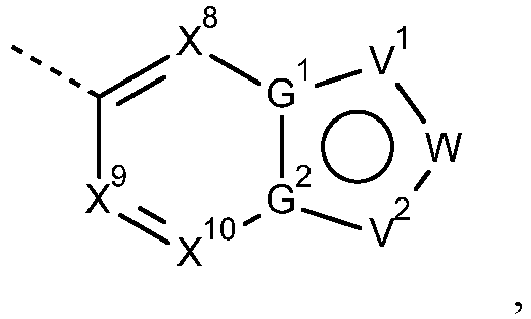
- X8 to X10 are independently selected from C-R14 and N;
- G1 and G2 are independently selected from C and N;
- V1 is selected from C-R15, N, O and S;
- V2 is selected from N, O, S and C-R15; and
- W is V4 - V5, V4 = V5 or V3, wherein V3 to V5 are independently selected from C-R16, N, O and S, wherein V4 connects with V1; and V5 connects with V2;
- L is

- Q is

- Z is

- R1 to R3 are independently selected from H and C1-C6 alkyl, wherein C1-C6 alkyl is unsubstituted or substituted with 1 to 3 halide, -CN, -OH, C1-C3 alkyl, C3-C5 cycloalkyl, or C1-C3 alkoxy groups;
- R14 to R16 are independently selected from H, halide, -CN, -OH, amino, C1-C6 alkyl, C3-C6 cycloalkyl, C1-C6 alkoxy and C1-C6 alkylthio, wherein amino, C1-C6 alkyl and C1-C6 alkoxy are unsubstituted or substituted with 1 to 3 halide, C1-C3 alkyl or C3-C6 cycloalkyl groups;
- R4a and R5a are independently selected from halide, -CN, and -OH, or R4a and R5a are independently selected from C1-C8 alkyl, C3-C8 cycloalkyl, C1-C8 alkoxy, C2-C8 alkenyl, C2-C8 alkynyl, C1-C8 alkylsulfonyl, C1-C8 acyl, aminoacyl, C1-C8 acylamino, C1-C8 alkylcarbamoylamino, C1-C8 alkoxycarbamoyl, C1-C8 alkylsulfonamido, C1-C8 alkylaminosulphonyl, C2-C8 alkoxyacyl, and 3-8 membered heterocycle, all of which are unsubstituted or substituted with 1-3 halide, -OH, -CN, C1-C3 alkyl, C1-C3 alkoxyl or C3-C8 cycloalkyl groups, wherein 3-8 membered heterocycle comprises one or more hetero atoms from N, O or S;
- R2m is H, deuterium, tritium, halide, -OH, -CN, C3-C8 cycloalkyl or C1-C8 alkoxy; and
- R4b and R5b are independently selected from H, halide, -CN, amino, C1-C8 alkyl, C3-C8 cycloalkyl, C1-C8 alkoxy, and C1-C3 alkylamino.
- In embodiments, U is


- In embodiments, the compound is selected from the compounds: A-1, A-2, A-3, A-4, A-5, A-6, A-7, A-8, A-9, A-10, A-11, A-12, A-13, A-14, A-15, A-27, A-28, A-30, A-31, A-33, A-34, A-35, A-36, A-37, A-38, A-48, A-49, A-50, A-51, A-55, A-57, A-65, A-84, A-85, A-86, A-96, A-97, A-98, A-99, A-101, A-102, A-103, A-104, A-106, A-108, A-110, A-114, A-121, A-122, A-123, A-124, A-125, and A-126, or a pharmaceutically acceptable salt, solvate, stereoisomer or a tautomer thereof, as defined in the appended claims. In other embodiments, the compound is selected from the compounds: A-36, A-57, A-34, A-65, A-31, A-85, A-86, A-84, A-50, A-49, A-51, and A-96, or a pharmaceutically acceptable salt, solvate, stereoisomer or a tautomer thereof, as defined in the appended claims.
- In another aspect, the present invention provides a compound selected from:
A-16 
A-17 
A-18 
A-19 
A-20 
A-21 
A-22 
A-23 
A-24 
A-25 
A-26 
A-29 
A-32 
A-39 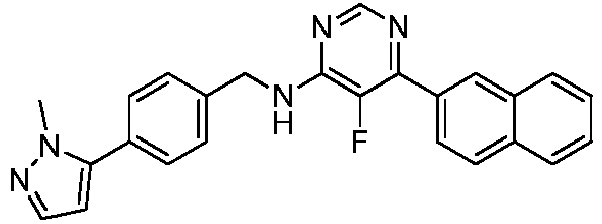
A-40 
A-41 
A-42 
A-43 
A-44 
A-45 
A-46 
A-47 
A-52 
A-53 
A-54 
A-56 
A-58 
A-59 
A-60 
A-61 
A-62 
A-63 
A-64 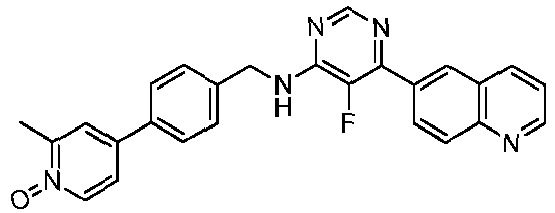
A-66 
A-67 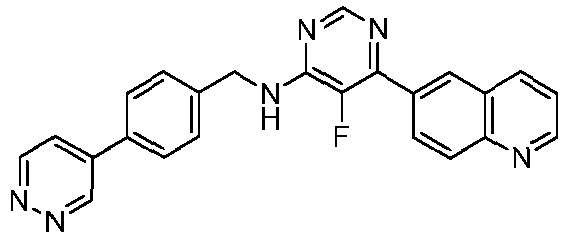
A-68 
A-69 
A-70 
A-71 
A-72 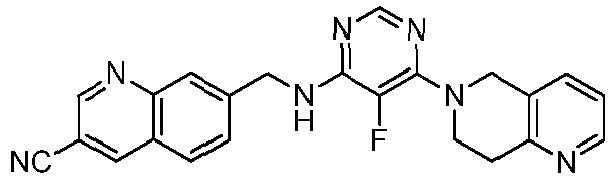
A-73 
A-74 
A-75 
A-76 
A-77 
A-78 
A-79 
A-80 
A-81 
A-82 
A-83 
A-87 
A-88 
A-89 
A-90 
A-91 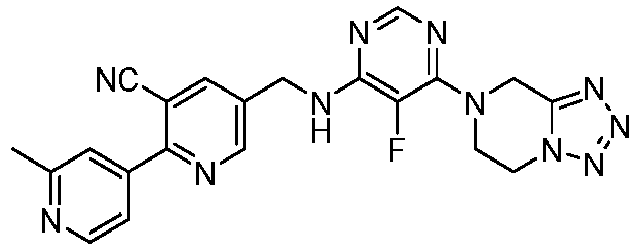
A-92 
A-93 
A-94 
A-95 
A-100 
A-105 
A-107 
A-109 
A-111 
A-112 
A-113 
A-115 
A-116 
A-117 
A-118 
A-119 
A-120 
A-127 
A-128 
A-129 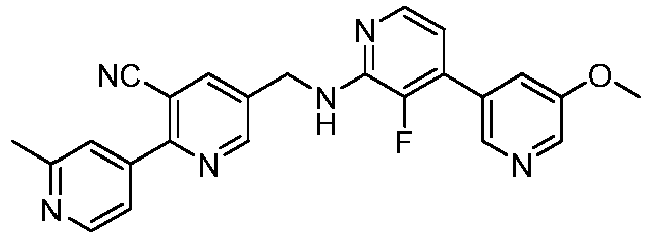
A-130 
A-131 
A-132 
A-133 
A-134 
A-135 
A-136 
A-137 
A-138 
A-139 
A-140 
A-141 
A-142 
A-143 
A-144 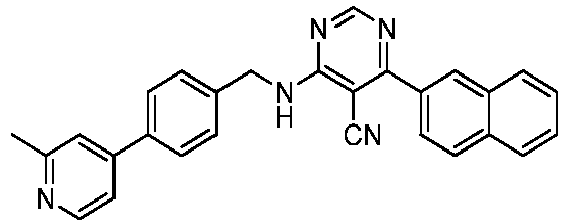
A-145 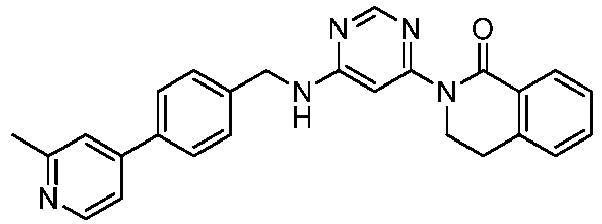
A-146 
A-147 
A-148 
A-149 
A-150 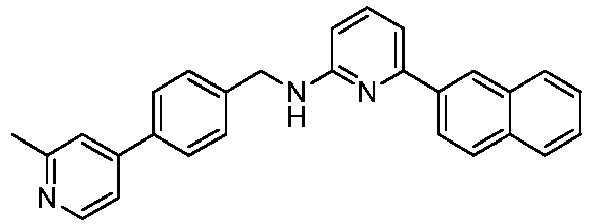
A-151 
A-152 
A-153 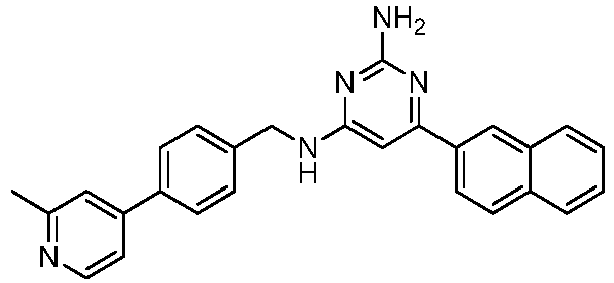
A-154 
A-155 
A-156 
A-157 
A-158 
A-159 
A-160 
A-161 
A-162 
A-163 
A-164 
A-165 
A-166 
A-167 
A-168 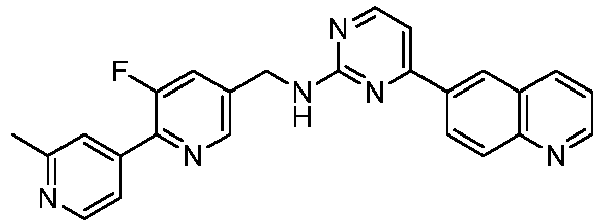
A-169 
A-170 
A-171 
A-172 
A-173 
A-174 
A-175 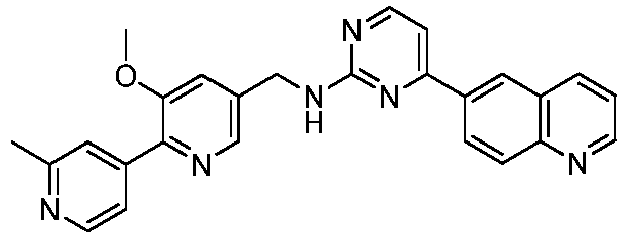
A-176 
A-177 
A-178 
A-179 
A-180 
A-181 
A-182 
A-183 
A-184 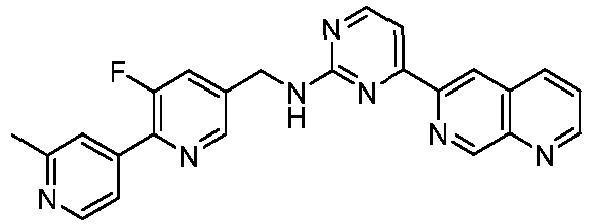
A-185 
A-186 
A-187 
A-188 
A-189 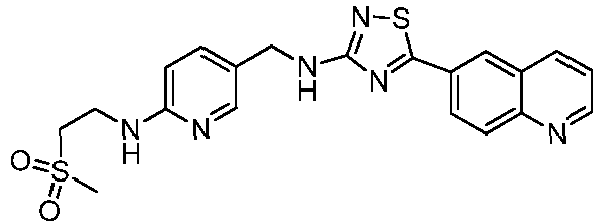
A-190 
A-191 
A-192 
A-193 
A-194 
A-195 
A-196 
A-197 
A-198 
A-199 
A-200 
A-201 
A-202 
and - The present invention also provides a pharmaceutical composition comprising a therapeutically effective amount of a compound of the invention and a pharmaceutically acceptable carrier.
- The present invention further provides a compound of the invention, or a pharmaceutically acceptable salt, solvate, stereoisomer or tautomer thereof, for use in treating a Wnt- mediated disorder in a mammal suffering therefrom. In embodiments, the disorder is a cell proliferative disorder selected from the group consisting of systemic sclerosis, skin fibrosis, idiopathic pulmonary fibrosis, renal fibrosis, liver fibrosis, drug-induced fibrosis, radiation-induced fibrosis, colorectal cancer, breast cancer, head and neck squamous cell carcinoma, esophageal squamous cell carcinoma, non-small cell lung cancer, gastric cancer, pancreatic cancer, leukemia, lymphoma, neuroblastoma, retinoblastoma, sarcoma, osteosarcoma, chondosarcoma, Ewing's sarcoma, rhabdomysarcoma, brain tumor, Wilms' tumor, basal cell carcinoma, melanoma, head and neck cancer, cervical cancer and prostate cancer.
- More generally, in a first aspect, the present disclosure provides compounds of Formula I:

- A is A1, A2, A3 or A4;
- U is U1, U2, U3 or U4;
- L is L1, L2, or L3;
- Q is Q1, Q2, Q3 or Q4;
- Z is Z1, Z2, Z3 or Z4
- A1 is

- A2 is

- A3 is

- A4 is

- U1 is

- G1 and G2 are independently selected from N and C;
- V1 and V2 are independently selected from N, O, S and C-R15;
- W is V3, V4 - V5 or V4 = V5, wherein V3 to V5 are independently selected from N, O, S and C-R16, wherein V4 connects with V1; and
- V5 connects with V2;
- U2 is C6-C10 aryl, 5-12 membered heteroaryl, 11-13 membered heterocyclophenyl or 10-13 membered heterocycloheteroaryl, wherein heterocyclo and heteroaryl comprises 1 to 4 heteroatoms independently selected from N, O and S; and C6-C10 aryl, 5-12 membered heteroaryl, 11-13 membered heterocyclophenyl and 10-13 membered heterocycloheteroaryl are unsubstituted or substituted with 1 to 4 R6a groups;
- U3 is -OR14b, -NR14bR15b, C6-C12 aryl unsubstituted or substituted with 1-6 R13b group, 5-14 membered heteroaryl unsubstituted or substituted with 1-6 R13b group, 11-13 membered heterocyclophenyl unsubstituted or substituted with 1-6 R13b group, 10-13 membered heterocycloheteroaryl unsubstituted or substituted with 1-6 R13b group, C2-C8 alkenyl substituted with 5-6 membered aryl or heteroaryl, C2-C8 alkynyl substituted with 5-6 membered aryl or heteroaryl, or

X11 is Nor C-R13b;
- U3 is -OR14b, -NR14bR15b, C6-C12 aryl unsubstituted or substituted with 1-6 R13b group, 5-14 membered heteroaryl unsubstituted or substituted with 1-6 R13b group, 11-13 membered heterocyclophenyl unsubstituted or substituted with 1-6 R13b group, 10-13 membered heterocycloheteroaryl unsubstituted or substituted with 1-6 R13b group, C2-C8 alkenyl substituted with 5-6 membered aryl or heteroaryl, C2-C8 alkynyl substituted with 5-6 membered aryl or heteroaryl, or
- U4 is

- G1 and G2 are independently selected from N and C;
- V1 and V2 are independently selected from N, O, S and C-R16c;
- W is V3, V4 - V5 or V4 = V5, wherein V3 to V5 are independently selected from N, O, S and C-R17c, wherein V4 connects with V1; and
- V5 connects with V2;
- L1 is
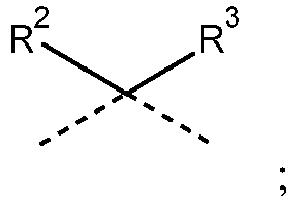
- L2 is
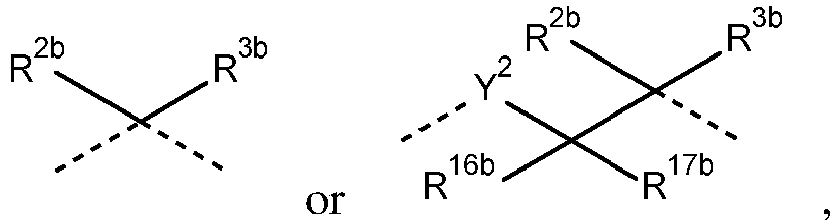
- L3 is -C(R2c)(R3c)- or -NHCH2CH2-;
- Q1 is C6-C10 arylene or 5-12 membered heteroarylene, wherein 5-12 membered heteroarylene comprises 1 to 4 heteroatoms independently selected from N, O and S; and
C6-C10 aryl and 5-12 membered heteroarylene are unsubstituted or substituted with 1 to 4 R17 groups; - Q2 is C6-C10 arylene or 5-10 membered heteroarylene, wherein 5-10 membered heteroarylene comprises 1 to 4 heteroatoms independently selected from N, O and S; and
C6-C10 arylene and 5-10 membered heteroarylene are unsubstituted or substituted with 1 to 4 R4a groups; - Q3 is C6-C12 arylene unsubstituted or substituted with 1-6 R6b group, 5-14 membered heteroarylene unsubstituted or substituted with 1-6 R6b group, C3-C6 cycloalkylene unsubstituted or substituted with 1-6 R6b group, C3-C6 heterocylene unsubstituted or substituted with 1-6 R6b group, or

X12 is N or C-R6b; - Q4 is C6-C10 arylene or 5-12 membered heteroarylene, wherein 5-12 membered heteroarylene comprises 1 to 4 heteroatoms independently selected from N, O and S; and
C6-C10 arylene and 5-12 membered heteroarylene are unsubstituted or substituted with 1 to 4 R5c groups; - Z1 is -CN, C6 aryl, 5-6 membered heteroaryl, or

- C6 aryl and 5-6 membered heteroaryl are unsubstituted or substituted with 1 to 3 R18 groups;
- Y1 is O or NR20; and
- q is 0, 1, 2, or 3;
- Z2 is H, -CN, halide, -OH, C1-C8 alkyl, C3-C8 cycloalkyl, C2-C8 alkenyl, C2-C8 alkynyl, C1-C8 alkylsulfonyl, C1-C8 acyl, aminoacyl, C1-C8 acylamino, C1-C8 alkylcarbamoylamino, C1-C8 alkoxycarbamoyl, C1-C8 alkylsulfonamido, C1-C8 alkylaminosulphonyl, C1-C8 alkoxy, C2-C8 alkoxyacyl, phenyl, 5-6 membered heteroaryl, or 5-7 membered heterocyclo, wherein 5-6 membered heteroaryl and 5-7 membered heterocyclo comprise one or more hetero atoms independently selected from N, O and S; and
phenyl, 5-6 membered heteroaryl and 5-7 membered heterocycle are unsubstituted or substituted with 1 to 3 R5a groups; - Z3 is H, -CN, halide, -OH, C1-C8 alkyl unsubstituted or substituted with 1 to 3 R12b groups, C3-C8 cycloalkyl, C2-C8 alkenyl, C2-C8 alkynyl, C1-C8 alkylsulfonyl, C1-C8 acyl, aminoacyl, C1-C8 acylamino, C1-C8 alkylcarbamoylamino, C1-C8 alkoxycarbamoyl, C1-C8 alkylsulfonamido, C1-C8 alkylaminosulphonyl, C1-C8 alkoxy, C2-C8 alkoxyacyl, -N(R7b)(R8b) unsubstituted or substituted with 1 to 3 R12b groups, phenyl unsubstituted or substituted with 1 to 3 R9b groups, 5-6 membered heteroaryl unsubstituted or substituted with 1 to 3 R10b groups, or 5-7 membered heterocyclo unsubstituted or substituted with 1 to 3 R11b groups, wherein 5-6 membered heteroaryl and 5-7 membered heterocyclo comprises 1-3 hetero atoms independently selected from N, O and S;
- Z4 is -CN, C6 aryl, 5-6 membered heteroaryl, or

- C6 aryl and 5-6 membered heteroaryl are unsubstituted or substituted with 1 to 3 R6c groups;
- Y3 is O or NR8c; and
- q is 0, 1, 2, or 3;
- R1 to R3 are independently selected from H and C1-C6 alkyl, wherein C1-C6 alkyl is unsubstituted or substituted with 1 to 3 halide, -CN, -OH, C1-C3 alkyl, C3-C5 cycloalkyl, or C1-C3 alkoxy groups;
- R4 is H, halide, -CN, -OH, -NO2, C1-C6 alkyl, C3-C8 cycloalkyl, or C1-C6 alkoxy, wherein C1-C6 alkyl, C3-C8 cycloalkyl and C1-C6 alkoxy are unsubstituted or substituted with 1 to 3 halide;
- RS and R6 are independently selected from H, halide, -CN, -OH, amino, C1-C6 alkyl, C3-C6 cycloalkyl and C1-C6 alkoxy, wherein C1-C6 alkyl, C3-C6 cycloalkyl and C1-C6 alkoxy are unsubstituted or substituted with 1 to 3 halide;
- R7 and R8 are independently selected from H and C1-C6 alkyl, or R7 and R8 together are oxo (=O);
- R9 to R12 are independently selected from H, C1-C6 alkyl;
- R13 is H, halide, -CN, -OH, amino, -NO2, C1-C6 alkyl, C3-C6 cycloalkyl, C1-C6 alkoxy, C1-C6 alkylthio or 1-pyrrolidino, wherein amino, C1-C6 alkyl and C1-C6 alkoxy are unsubstituted or substituted with 1 to 3 halide, C1-C3 alkyl or C3-C6 cycloalkyl groups;
- R14 to R17 are independently selected from H, halide, -CN, -OH, amino, C1-C6 alkyl, C3-C6 cycloalkyl, C1-C6 alkoxy and C1-C6 alkylthio, wherein amino, C1-C6 alkyl and C1-C6 alkoxy are unsubstituted or substituted with 1 to 3 halide, C1-C3 alkyl or C3-C6 cycloalkyl groups;
- R18 is H, halide, -CN, -OH, amino, C1-C6 alkyl, C3-C6 cycloalkyl or C1-C6 alkoxy, wherein amino, C1-C6 alkyl and C1-C6 alkoxy are unsubstituted or substituted with 1 to 3 halide, C1-C3 alkyl or C3-C6 cycloalkyl groups;
- R19 and R20 are independently selected from H and C1-C3 alkyl, or R19 and R20 together, with adjacent atoms they attached to, form a cyclic structure;
- R4a, R5a and R6a are independently selected from halide, -CN, and -OH, or R4a, R5a and R6a are independently selected from C1-C8 alkyl, C3-C8 cycloalkyl, C1-C8 alkoxy, C2-C8 alkenyl, C2-C8 alkynyl, C1-C8 alkylsulfonyl, C1-C8 acyl, aminoacyl, C1-C8 acylamino, C1-C8 alkylcarbamoylamino, C1-C8 alkoxycarbamoyl, C1-C8 alkylsulfonamido, C1-C8 alkylaminosulphonyl, C2-C8 alkoxyacyl, and 3-8 membered heterocycle, all of which are unsubstituted or substituted with 1-3 halide, -OH, -CN, C1-C3 alkyl, C1-C3 alkoxyl or C3-C8 cycloalkyl groups, wherein 3-8 membered heterocycle comprises one or more hetero atoms from N, O or S;
- R2m is H, deuterium, tritium, halide, -OH, -CN, C1-C8 alkyl, C3-C8 cycloalkyl or C1-C8 alkoxy;
- R2b and R3b are independently selected from H, C1-C6 alkyl unsubstituted or substituted with 1-3 groups selected from halide, -CN, -OH, C1-C6 alkyl, C3-C5 cycloalkyl and C1-C3 alkoxy;
- R4b and R5b are independently selected from H, halide, -CN, amino, C1-C8 alkyl, C3-C8 cycloalkyl, C1-C8 alkoxy, and C1-C3 alkylamino;
- R6b is H, halide, -CN or -OH, or R6b is selected from amino, C1-C6 alkyl, C3-C6 cycloalkyl, C1-C6 alkoxy, and C1-C3 alkylamino, all of which are unsubstituted or substituted with 1-3 halide, C1-C3 alkyl, or C3-C6 cycloalkyl groups;
- R7b and R8b are independently selected from H, C1-C8 alkyl and C3-C8 cycloalkyl, the latter two of which are unsubstituted or substituted with 1-3 R12b, or R7 and R8 together, with adjacent atoms they attached to, form a cyclic structure;
- R9b and R10b are independently selected from H, halide, -CN and -OH, or R9b and R10b are independently selected from amino, C1-C6 alkyl, C3-C6 cycloalkyl, and C1-C6 alkoxy, all of which are unsubstituted or substituted with 1-3 halide, C1-C3 alkyl, or C3-C6 cycloalkyl groups;
- R11b is H, halide, -CN, -OH, amino, C1-C6 alkyl unsubstituted or substituted with halide, C3-C6 cycloalkyl, oxo, or C1-C6 alkoxy;
- R12b is H, -CN, -OH, amino, C1-C6 alkyl unsubstituted or substituted with halide, C3-C6 cycloalkyl, oxo, or C1-C6 alkoxy;
- R13b is H, halide, -CN, -OH, amino, C1-C6 alkyl, C3-C6 cycloalkyl, C1-C6 alkoxy, C2-C6 alkylcarbamoylamino, C2-C6 alkoxycarbamoyl, C1-C3 alkylsulphonyl, -N(R16b)S(O)2-C1-C3 alkyl, or -N(R16b)C(O)-C1-C3 alkyl;
- R14b and R15b are independently selected from H, C3-C6 cycloalkyl unsubstituted or substituted with 1 to 3 R20b groups, C1-C6 alkyl unsubstituted or substituted with 1 to 3 R20b groups, 5-6 membered aryl unsubstituted or substituted with 1 to 3 R20b groups, 5-6 membered heteroaryl unsubstituted or substituted with 1 to 3 R20b groups, and 5-6 membered heterocyclo unsubstituted or substituted with 1 to 3 R20b groups, wherein 5-6 membered heteroaryl and 5-7 membered heterocyclo comprise 1 to 3 hetero atoms independently selected from N, O and S, or R14b and R15b together, with adjacent atoms they attached to, form a cyclic structure;
- R16b to R19b are independently selected from H and C1-C6 alkyl unsubstituted or substituted with halide;
- R20b is H, -CN, -OH, amino, C1-C6 alkyl, C3-C6 cycloalkyl, C1-C6 alkoxy, 5-6 membered aryl, or 5-6 membered heteroaryl, wherein 5-6 membered heteroaryl comprises 1 to 3 hetero atoms independently selected from N, O and S;
- R21b is H or C1-C6 alkyl;
- R2c and R3c are independently selected from H and C1-C6 alkyl unsubstituted or substituted with 1-3 halide;
- R4c is H, halide, C1-C3 alkyl, C3-C5 cycloalkyl, or C1-C3 alkoxy;
- R5c and R6c are independently selected from H, halide, -CN, -OH, amino, C1-C6 alkyl unsubstituted or substituted with 1-3 halide, C3-C5 cycloalkyl, and C1-C6 alkoxy;
- R7c and R8c are independently selected from H and C1-C6 alkyl, or R7c and R8c together, with adjacent atoms they attached to, form a cyclic structure;
- R9c to R14c are independently selected from H, C1-C6 alkyl and -CF3;
- R15c to R17c are independently selected from H, halide, -CN, -OH, amino, C1-C6 alkyl unsubstituted or substituted with 1-3 halide, C3-C5 cycloalkyl, and C1-C6 alkoxy.
- In one instance, the compound comprises Q which is

- In another instance, the compound comprises A which is

- In one instance, the compound comprises U which is

- In another instance, the compound comprises U which is selected from:





- In one instance, the compound comprises Q which is selected from


- In one instance, the compound comprises Z which is selected from H--- NC--- F--- CI--- Br--- I---- HO---




- In another instance, the compound comprises Q which is selected from:



- In one instance, the compound comprises Z which is selected from: H--- NC--- F--- Cl--- Br--- I---- HO---


- In another instance, the compound comprises U which is selected from:


- In another instance, the compound comprises Z which is


- In one instance, the compound comprises A which is selected from




- In another aspect, the disclosure provides a pharmaceutical composition comprising a therapeutically effective amount of a compound of said first aspect and a pharmaceutically acceptable carrier.
- In another aspect, the disclosure provides a method for regulating the Wnt signaling pathway and/or treating a Wnt- mediated disorder in a mammal suffering therefrom. The method comprises administrating to a mammalian subject a therapeutically effective amount of at least one compound of formula I, or a pharmaceutical composition thereof, and optionally in combination with a second therapeutic agent.
- In one instance, the method can treat a cell proliferative disorder selected from the group consisting of systemic sclerosis, skin fibrosis, idiopathic pulmonary fibrosis, renal fibrosis, liver fibrosis, drug-induced fibrosis, radiation-induced fibrosis, colorectal cancer, breast cancer, head and neck squamous cell carcinoma, esophageal squamous cell carcinoma, non-small cell lung cancer, gastric cancer, pancreatic cancer, leukemia, lymphoma, neuroblastoma, retinoblastoma, sarcoma, osteosarcoma, chondosarcoma, Ewing's sarcoma, rhabdomysarcoma, brain tumor, Wilms' tumor, basal cell carcinoma, melanoma, head and neck cancer, cervical cancer and prostate cancer.
- In another aspect, the disclosure provides compounds of formula I, wherein the compounds are the molecules shown in Table 1:
Table 1: Compounds of Formula I A-1 
A-2 
A-3 
A-4 
A-5 
A-6 
A-7 
A-8 
A-9 
A-10 
A-11 
A-12 
A-13 
A-14 
A-15 
A-16 
A-17 
A-18 
A-19 
A-20 
A-21 
A-22 
A-23 
A-24 
A-25 
A-26 
A-27 
A-28 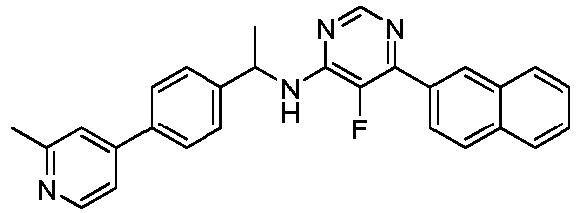
A-29 
A-30 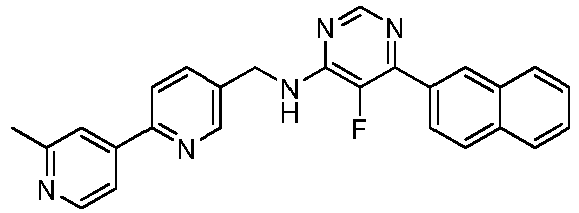
A-31 
A-32 
A-33 
A-34 
A-35 
A-36 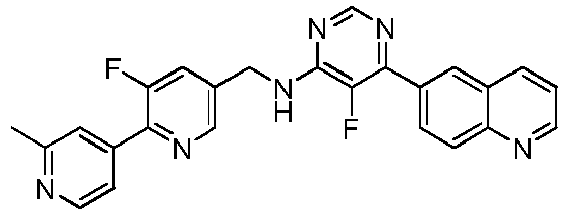
A-37 
A-38 
A-39 
A-40 
A-41 
A-42 
A-43 
A-44 
A-45 
A-46 
A-47 
A-48 
A-49 
A-50 
A-51 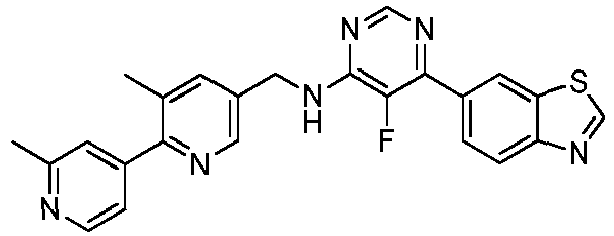
A-52 
A-53 
A-54 
A-55 
A-56 
A-57 
A-58 
A-59 
A-60 
A-61 
A-62 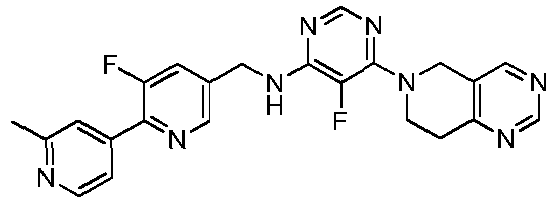
A-63 
A-64 
A-65 
A-66 
A-67 
A-68 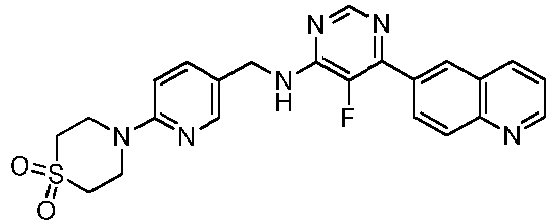
A-69 
A-70 
A-71 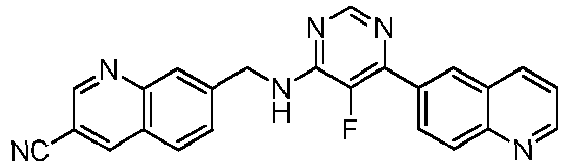
A-72 
A-73 
A-74 
A-75 
A-76 
A-77 
A-78 
A-79 
A-80 
A-81 
A-82 
A-83 
A-84 
A-85 
A-86 
A-87 
A-88 
A-89 
A-90 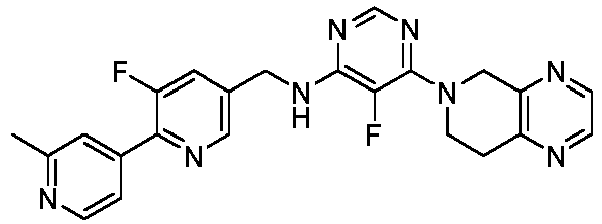
A-91 
A-92 
A-93 
A-94 
A-95 
A-96 
A-97 
A-98 
A-99 
A-100 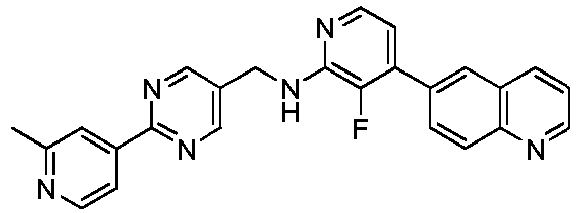
A-101 
A-102 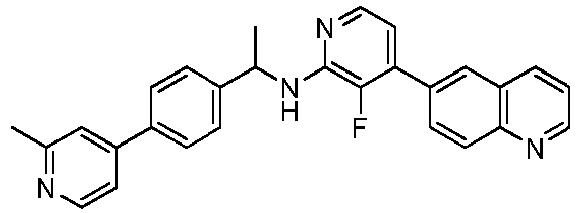
A-103 
A-104 
A-105 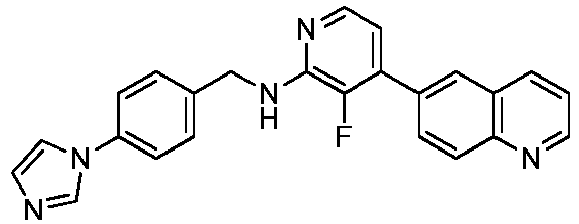
A-106 
A-107 
A-108 
A-109 
A-110 
A-111 
A-112 
A-113 
A-114 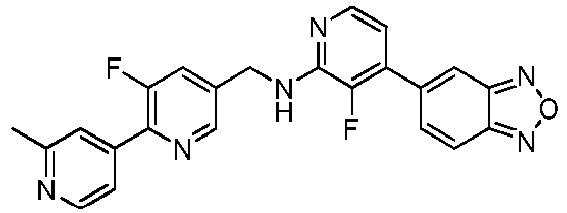
A-115 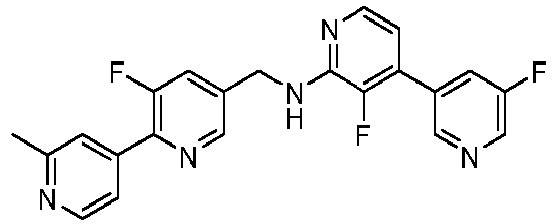
A-116 
A-117 
A-118 
A-119 
A-120 
A-121 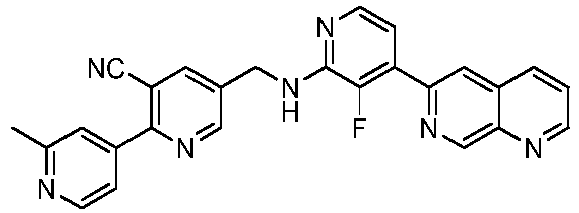
A-122 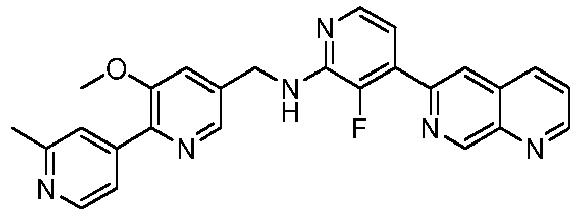
A-123 
A-124 
A-125 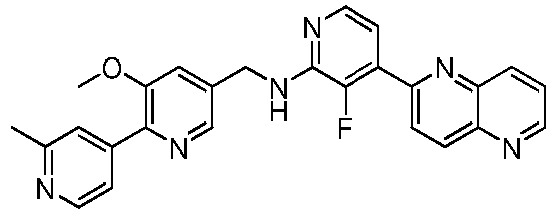
A-126 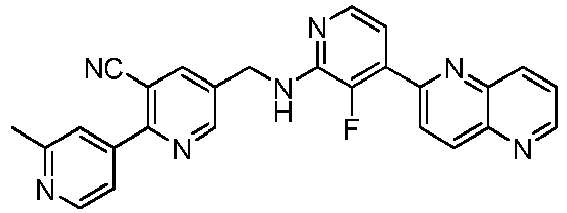
A-127 
A-128 
A-129 
A-130 
A-131 
A-132 
A-133 
A-134 
A-135 
A-136 
A-137 
A-138 
A-139 
A-140 
A-141 
A-142 
A-143 
A-144 
A-145 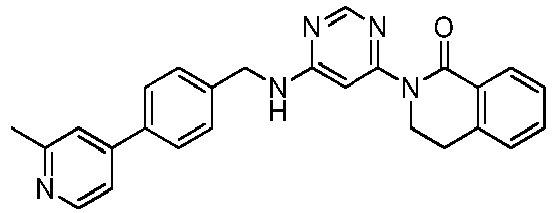
A-146 
A-147 
A-148 
A-149 
A-150 
A-151 
A-152 
A-153 
A-154 
A-155 
A-156 
A-157 
A-158 
A-159 
A-160 
A-161 
A-162 
A-163 
A-164 
A-165 
A-166 
A-167 
A-168 
A-169 
A-170 
A-171 
A-172 
A-173 
A-174 
A-175 
A-176 
A-177 
A-178 
A-179 
A-180 
A-181 
A-182 
A-183 
A-184 
A-185 
A-186 
A-187 
A-188 
A-189 
A-190 
A-191 
A-192 
A-193 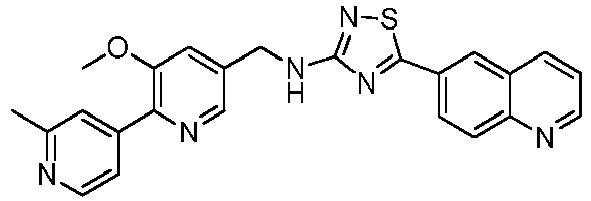
A-194 
A-195 
A-196 
A-197 
A-198 
A-199 
A-200 
A-201 
A-202 
-
-
FIG. 1 depicts the IC50 curve of compound A-12 of the present invention in the primary assay; -
FIG. 2 depicts the IC50 curve of compound A-36 of the present invention in the primary assay; -
FIG. 3 depicts the IC50 curve of compound A-100 of the present invention in the primary assay; -
FIG. 4 depicts the IC50 curve of compound A-103 of the present invention in the primary assay; -
FIG. 5 depicts the IC50 curve of compound A-166 of the present invention in the primary assay; -
FIG. 6 depicts the IC50 curve of compound A-168 of the present invention in the primary assay; -
FIG. 7 depicts the IC50 curve of compound A-194 of the present invention in the primary assay; and -
FIG. 8 depicts the IC50 curve of compound A-198 of the present invention in the primary assay. - Before proceeding with the detailed description, it is to be appreciated that the following detailed description is merely exemplary in nature and is not intended to limit the invention or the application and uses thereof. Hence, although the present disclosure is, for convenience of explanation, depicted and described as shown in certain illustrative instances, it will be appreciated that it can be implemented in various other types of instances and equivalents, and in various other systems and environments. Furthermore, there is no intention to be bound by any theory presented in the preceding background or the following detailed description.
- Compounds are generally described herein using standard nomenclature. For compounds having asymmetric centers, it should be understood that (unless otherwise specified) all of the optical isomers and mixtures thereof are encompassed. In addition, compounds with carbon-carbon double bonds may occur in Z- and E- forms, with all isomeric forms of the compounds being included in the present disclosure unless otherwise specified. Where a compound exists in various tautomeric forms, a recited compound is not limited to any one specific tautomer, but rather is intended to encompass all tautomeric forms.
- As used herein, the term "alkyl" refers to a straight or branched chain saturated aliphatic hydrocarbon. Alkyl groups include groups having from 1 to 8 carbon atoms (C1-8 alkyl), from 1 to 6 carbon atoms (C1-6 alkyl) and from 1 to 4 carbon atoms (C1-4 alkyl), including, for example, methyl, ethyl, propyl, isopropyl, n-butyl, sec-butyl, tert-butyl, pentyl, 2-pentyl, isopentyl, neopentyl, hexyl, 2-hexyl, 3-hexyl and 3-methylpentyl. In some instances, a substituent of an alkyl group is specifically indicated. For example, "cyanoalkyl" refers to an alkyl group substituted with at least one cyano substituent.
- "Alkenyl" refers to straight or branched chain alkene groups, which comprise at least one unsaturated carbon-carbon double bond. Alkenyl groups include C2-8 alkenyl, C2-6 alkenyl and C2-4 alkenyl groups, which have from 2 to 8, 2 to 6 or 2 to 4 carbon atoms, respectively, including, for example, ethenyl, allyl or isopropenyl. "Alkynyl" refers to straight or branched chain alkyne groups, which have one or more unsaturated carbon-carbon bonds, at least one of which is a triple bond. Alkynyl groups include C2-8 alkynyl, C2-6 alkynyl and C2-4 alkynyl groups, which have from 2 to 8, 2 to 6 or 2 to 4 carbon atoms, respectively.
- A "cycloalkyl" is a group that comprises one or more saturated rings in which all ring members are carbon, including, for example, cyclopropyl, cyclobutyl, cyclopentyl, cyclohexyl, cycloheptyl, cyclooctyl, adamantyl. Cycloalkyl groups do not comprise an aromatic ring or a heterocyclic ring. Certain cycloalkyl groups are C3-7 cycloalkyl, in which the cycloalkyl group contains a single ring having from 3 to 7 ring members, all of which are carbon. A "cycloalkenyl" is a group that comprises one or more unsaturated rings in which all ring members are carbon.
- "Alkoxy" is meant an alkyl group as described above attached via an oxygen bridge. Alkoxy groups include C1-6 alkoxy and C1-4 groups, which have from 1 to 6 or from 1 to 4 carbon atoms, respectively. Methoxy, ethoxy, propoxy, isopropoxy, n-butoxy, sec-butoxy, tert-butoxy, n-pentoxy, 2-pentoxy, 3-pentoxy, isopentoxy, neopentoxy, hexoxy, 2-hexoxy, 3-hexoxy, and 3-methylpentoxy are representative alkoxy groups.
- "Alkylamino" refers to a secondary or tertiary amine that has the general structure -NH-alkyl or -N(alkyl)(alkyl), wherein each alkyl is selected independently from alkyl, cycloalkyl and (cycloalkyl)alkyl groups. Such groups include, for example, mono- and di- (C1-6 alkyl)amino groups, in which each C1-6 alkyl may be the same or different. It will be apparent that the definition of "alkyl" as used in the term "alkylamino" differs from the definition of "alkyl" used for all other alkyl-containing groups, in the inclusion of cycloalkyl and (cycloalkyl)alkyl groups.
- "Halogen" means fluorine, chlorine, bromine, and iodine. A "haloalkyl" is an alkyl group that is substituted with 1 or more independently chosen halogens (e.g., "C1-6 haloalkyl" groups have from 1 to 6 carbon atoms and at least one halogen). Examples of haloalkyl groups include, but are not limited to, mono-, di- or tri-fluoromethyl; mono-, di- or trichloromethyl; mono-, di-, tri-, tetra- or penta-fluoroethyl; mono-, di-, tri-, tetra- or pentachloroethyl; and 1,2,2,2-tetrafluoro-1-trifluoromethyl-ethyl.
- A "heteroaryl" is an aromatic group in which at least one aromatic ring comprises at least one heteroatom selected from N, O and S. Heteroaryls include, for example, 5-12 membered heteroaryls. Examples included but are not limited to imidazole, furan, furazan, isothiazole, isoxazole, oxadiazole, oxazole, pyrazine, pyrazole, pyridazine, pyridine, pyrimidine, tetrazole, thiazole and thiophene.
- The term "heterocyclic" refers to a ring structure containing 3-12 ring atoms, in which at least one ring atom is carbon and at least one ring atom is heteroatom selected from N, O, and S. A heterocyclic group may be aromatic or non-aromatic. Piperidine and oxetane are non-limiting examples of non-aromatic heterocycles. Thiazole and pyridine are non-limiting examples of aromatic heterocycles.
- A "substituent" and "substituted," as used herein, denote that a molecular moiety is covalently bonded to an atom within a molecule of interest. For example, a ring substituent may be a moiety such as a halogen, alkyl group, haloalkyl group or other group that is covalently bonded to an atom (preferably a carbon or nitrogen atom) that is a ring member. Substituents of aromatic groups are generally covalently bonded to a ring carbon atom.
- The term "pharmaceutically acceptable" when used with reference to a compound of formula I is intended to refer to a form of the compound that is safe for administration to a subject. For example, a free base, a salt form, a solvate, a hydrate form of a compound of formula I, which has been approved for mammalian use, via oral ingestion or any other route of administration, by a governing authority or regulatory agency, such as the Food and Drug Administration (FDA) of the United States, is pharmaceutically acceptable.
- Included in the compounds of formula I are the pharmaceutically acceptable salt forms of the free-base compounds. The term "pharmaceutically-acceptable salts" embraces salts, commonly used to form alkali metal salts and to form addition salts of free acids or free bases, which have been approved by a regulatory agency. Salts are formed from ionic associations, charge-charge interactions, covalent bonding, complexation, coordination, etc. The nature of the salt is not critical, provided that it is pharmaceutically acceptable.
- In some instances, the compound(s) of formula I is used to treat a subject by administering the compound(s) as a pharmaceutical composition. To this end, the compound(s), in one instance, is combined with one or more pharmaceutically acceptable excipients, including carriers, diluents or adjuvants, to form a suitable composition, which is described in more detail herein.
- The term "excipient", as used herein, denotes any pharmaceutically acceptable additive, carrier, adjuvant, or other suitable ingredient, other than the active pharmaceutical ingredient (API), which is typically included for formulation and/or administration purposes. "Diluent" and "adjuvant" are defined hereinafter.
- The terms "treat", "treating," "treatment," and "therapy" as used herein refer to therapy, including without limitation, curative therapy, prophylactic therapy, and preventative therapy. Prophylactic treatment generally constitutes either preventing the onset of disorders altogether or delaying the onset of a pre-clinically evident stage of disorders in individuals.
- The phrase "effective amount" is intended to quantify the amount of each agent, which will achieve the goal of improvement in disorder severity and the frequency of incidence over treatment of each agent by itself, while avoiding adverse side effects typically associated with alternative therapies. The effective amount, in one instance, is administered in a single dosage form or in multiple dosage forms.
- Regardless of the route of administration selected, the compounds of the present disclosure, which may be used in a suitable hydrated form, and/or the pharmaceutical compositions of the present disclosure, are formulated into pharmaceutically acceptable dosage forms or by other conventional methods known to those of skill in the art.
- Actual dosage levels of the active ingredients in the pharmaceutical compositions of the present disclosure may be varied so as to obtain an effective amount of the active ingredient to achieve the desired therapeutic response for a particular patient, composition, and mode of administration, without being toxic to the patient.
- The selected dosage level will depend upon a variety of factors including the activity of the particular compound of the present disclosure employed, the route of administration, the time of administration, the rate of excretion of the particular compound being employed, the duration of the treatment, other drugs, compounds and/or materials used in combination with the particular hedgehog inhibitor employed, the age, sex, weight, condition, general health and prior medical history of the patient being treated, and like factors well known in the medical arts.
- A physician or veterinarian having ordinary skill in the art can readily determine and prescribe the effective amount of the pharmaceutical composition required. For example, the physician or veterinarian could start doses of the compounds of the disclosure employed in the pharmaceutical composition at levels lower than that required in order to achieve the desired therapeutic effect and gradually increase the dosage until the desired effect is achieved.
- In general, a suitable daily dose of a compound of the disclosure will be that amount of the compound which is the lowest dose effective to produce a therapeutic effect. Such an effective dose will generally depend upon the factors described above. Generally, intravenous, intracerebroventricular and subcutaneous doses of the compounds of this disclosure for a patient will range from about 0.0001 to about 100 mg per kilogram of body weight per day. The mode of administration can have a large effect on dosage. Higher doses may be used for localized routes of delivery.
- If desired, the effective daily dose of the active compound may be administered as two, three, four, five, six or more sub-doses administered separately at appropriate intervals throughout the day, optionally, in unit dosage forms. Those of skill in the art will readily appreciate that dose levels can vary as a function of the specific compound, the severity of the symptoms and the susceptibility of the subject to side effects. Dosages for a given compound disclosed herein are readily determinable by those of skill in the art by a variety of means.
- One instance provides a pharmaceutical composition comprising a compound of formula I, or a stereoisomer, tautomer, hydrate, solvate or pharmaceutically acceptable salt thereof, and at least one pharmaceutically acceptable excipient.
- In some instances, the present disclosure provides methods for regulating the Wnt signaling pathway and/or treating a Wnt- mediated disorder in a mammal suffering therefrom. The method comprises administrating to a mammalian subject a therapeutically effective amount of at least one compound of formula I, or a pharmaceutical composition thereof, and optionally in combination with a second therapeutic agent. The method comprises treating or preventing disorder is a cell proliferative disorder selected from the group consisting of systemic sclerosis, skin fibrosis, idiopathic pulmonary fibrosis, renal fibrosis, liver fibrosis, drug-induced fibrosis, radiation-induced fibrosis, colorectal cancer, breast cancer, head and neck squamous cell carcinoma, esophageal squamous cell carcinoma, non- small cell lung cancer, gastric cancer, pancreatic cancer, leukemia, lymphoma, neuroblastoma, retinoblastoma, sarcoma, osteosarcoma, chondosarcoma, Ewing's sarcoma, rhabdomysarcoma, brain tumor, WiIm' s tumor, basal cell carcinoma, melanoma, head and neck cancer, cervical cancer and prostate cancer.
- In some instances, the compounds described herein are formulated into pharmaceutical compositions. Pharmaceutical compositions are formulated in a conventional manner using one or more pharmaceutically acceptable inactive ingredients that facilitate processing of the active compounds into preparations that can be used pharmaceutically. Proper formulation is dependent upon the route of administration chosen. A summary of pharmaceutical compositions described herein can be found, for example, in Remington: The Science and Practice of Pharmacy, Nineteenth Ed., Easton, Pa.: Mack Publishing Company (1995); Hoover, John E., Remington's Pharmaceutical Sciences, Mack Publishing Co., Easton, Pennsylvania (1975); Liberman, H.A. and Lachman, L., Eds., Pharmaceutical Dosage Forms, Marcel Decker, New York, N.Y. (1980); and Pharmaceutical Dosage Forms and Drug Delivery Systems, Seventh Ed., Lippincott Williams & Wilkins (1999).
- A pharmaceutical composition, as used herein, refers to a mixture of a compound of formula I with other chemical components (i.e. pharmaceutically acceptable inactive ingredients), such as carriers, excipients, binders, filling agents, suspending agents, flavoring agents, sweetening agents, disintegrating agents, dispersing agents, surfactants, lubricants, colorants, diluents, solubilizers, moistening agents, plasticizers, stabilizers, penetration enhancers, wetting agents, anti-foaming agents, antioxidants, preservatives, or one or more combination thereof. The pharmaceutical composition facilitates administration of the compound to an organism. In practicing the methods of treatment or use described herein, therapeutically effective amounts of compounds described herein are administered in a pharmaceutical composition to a mammal having a disease, disorder, or condition to be treated. In some instances, the mammal is a human. A therapeutically effective amount can vary widely depending on the severity of the disease, the age and relative health of the subject, the potency of the compound used and other factors. The compounds can be used singly or in combination with one or more therapeutic agents as components of mixtures.
- The pharmaceutical formulations described herein are administered to a subject by appropriate administration routes, including but not limited to, oral, parenteral (e.g., intravenous, subcutaneous, intramuscular), intranasal, buccal, topical, rectal, or transdermal administration routes. The pharmaceutical formulations described herein include, but are not limited to, aqueous liquid dispersions, self-emulsifying dispersions, solid solutions, liposomal dispersions, aerosols, solid dosage forms, powders, immediate release formulations, controlled release formulations, fast melt formulations, tablets, capsules, pills, delayed release formulations, extended release formulations, pulsatile release formulations, multiparticulate formulations, and mixed immediate and controlled release formulations.
- All formulations for oral administration are in dosages suitable for such administration. Examples of such dosage units are tablets or capsules. In some instances, these contain an amount of active ingredient from about 1 to 2000 mg, advantageously from about 1 to 500 mg, and typically from about 5 to 150 mg. A suitable daily dose for a human or other mammal vary widely depending on the condition of the patient and other factors, but, once again, can be determined using routine methods and practices.
- Conventional formulation techniques include, e.g., one or a combination of methods: (1) dry mixing, (2) direct compression, (3) milling, (4) dry or non-aqueous granulation, (5) wet granulation, or (6) fusion. Other methods include, e.g., spray drying, pan coating, melt granulation, granulation, fluidized bed spray drying or coating (e.g., wurster coating), tangential coating, top spraying, tableting, extruding and the like.
- Methods of the present disclosure include the use of at least one compound of formula I, which inhibits hedgehog signaling in the regulation of repair and/or functional performance of a wide range of cells, tissues and organs, and have therapeutic and cosmetic applications ranging from regulation of neural tissues, bone and cartilage formation and repair, regulation of spermatogenesis, regulation of smooth muscle, regulation of lung, liver and other organs arising from the primitive gut, regulation of hematopoietic function, regulation of skin and hair growth, etc. Accordingly, the methods and compositions of the present disclosure include the use of the subject inhibitors for all such uses as inhibitors of hedgehog proteins may be implicated. Moreover, the subject methods can be performed on cells which are provided in culture (in vitro), or on cells in a whole animal (in vivo).
- The examples and preparations provided below illustrated and exemplify the compounds described herein and methods of preparing such compounds. In general, the compounds described herein may be prepared by processes known in the general chemical arts.
- The compounds of the present disclosure can be prepared using various synthetic routes, including those described below, starting from commercially available materials. Starting materials of the disclosure, are either known, commercially available, or can be synthesized in analogy to or according to methods that are known in the art. Many starting materials may be prepared according to known processes and, in particular, can be prepared using processes described in the examples. In synthesizing starting materials, functional groups in some cases are protected with suitable protecting groups when necessary. Functional groups may be removed according to known procedures in the art.
- The protection of functional groups by protecting groups, the protecting groups themselves, and their removal reactions (commonly referred to as "deprotection") are described, for example, in standard reference works, such as J.F.W. McOmie, Protective Groups in Organic Chemistry, Plenum Press, London and New York (1973), in T.W. Greene, Protective Groups in Organic Synthesis, Wiley, New York (1981), in The Peptides, Volume 3, E. Gross and J. Meienhofer editors, Academic Press, London and New York (1981).
- All synthetic procedures described herein can be carried out under known reaction conditions, advantageously under those described herein, either in the absence or in the presence (usually) of solvents or diluents.
- The disclosure further encompasses "intermediate" compounds, including structures produced from the synthetic procedures described, whether isolated or not, prior to obtaining the finally desired compound. Structures resulting from carrying out steps from a transient starting material, structures resulting from divergence from the described method(s) at any stage, and structures forming starting materials under the reaction conditions are all "intermediates" included in the disclosure. Further, structures produced by using starting materials in the form of a reactive derivative or salt, or produced by a compound obtainable by means of the process according to the disclosure and structures resulting from processing the compounds of the disclosure in situ are also within the scope of the disclosure.
- New starting materials and/or intermediates, as well as processes for the preparation thereof, are likewise the subject of this disclosure. In select instances, such starting materials are used and reaction conditions so selected as to obtain the desired compound(s).
- Starting materials of the disclosure, are either known, commercially available, or can be synthesized in analogy to or according to methods that are known in the art. Many starting materials may be prepared according to known processes and, in particular, can be prepared using processes described in the examples. In synthesizing starting materials, functional groups in some cases are protected with suitable protecting groups when necessary. Protecting groups, their introduction and removal are described above.
- General Method A:

- Scheme 1 depicts a general synthetic route leading to the synthesis of compounds of Formula I. Compounds of Formula I can be assembled from three components: M1, M2, and M4. Component M1 can be formed from other precursors, as shown in examples vide infra. Component M2 has two leaving groups (LG1 and LG2) which can undergo reactions with an amino group in component M1 and a chemical group (CG1) in component M4 to form compounds of Formula I. LG1 and LG2 can be selected from halide, CH3S(O)2-, triflate, tosylate, and mesylate. CG1 can be selected from borate, organotin, alkyne, amino, and amide groups. Palladium catalyzed reactions of borate, organotin, alkyne, amide, or amino in CG1, or treating amino group in CG1 with a base can form a covalent bond between A and U in M. Further modifications of A or U may be needed to complete the syntheses of compounds of Formula I. Alternatively, LG2 can be converted to borate and CG1 can be selected from Br, I, and triflate so that a palladium catalyzed reaction may form the covalent bond between A and U. Further, M1 may only contains shorter tails, such as Q-L- or L- to start with, and Z or Z-Q may be added later to complete the synthesis of compounds of Formula I. Conditions for steps a and d can be: DIPEA, t-BuOH, 50-60 °C, overnight; DIPEA, i-PrOH, 60-80 °C overnight; Et3N, THF, rt, overnight; DIPEA, cyclohexanol, ZnCl2, 120 °C, 40 h; K2CO3, DMSO, 120-135 °C, 10 h; Pd(AcO)2, BINAP, t-BuONa, dioxane, 100 °C, 12h; and DIPEA, THF, 50 °C, overnight. Conditions for steps b and c can be: DIPEA, NMP, 120-130°C, overnight; DIPEA, THF, reflux, overnight; DIPEA, t-BuOH, 50 °C; NMP, 130 °C, 24 h; Pd(PPh3)4, K2CO3, dioxane/H2O, 100-120 °C, overnight; Cs2CO3, Pd(PPh3)4, dioxane/H2O, 100 °C, 12h; Pd(dppf)Cl2, dppf, K3PO4, dioxane, H2O, 100 °C, 12 h; Pd(dppf)Cl2, dioxane/H2O, 100 °C, 10h; and Pd(PPh3)4, xantphos, Cs2CO3, dioxane, reflux, overnight..
- General Method B:

- Scheme 2 illustrates another general synthetic route leading the synthesis of compounds of Formula I. LG3 can be selected from halide, triflate, tosylate, and mesylate, while CG2 can be a borate group. Alternatively, LG3 can be selected from halide, triflate, tosylate, and mesylate; and CG2 can be a borate group. Palladium catalyzed reaction can lead to the covalent bond formation between A and U in M8. An ensuing reductive amination between M8 and M9 form the covalent bond between L and the amino group on A. Further alkylation of the amino group, if needed, may lead to compounds of Formula I. Step e can be Na2CO3, Pd(PPh3)4, EtOH, toluene, H2O, 90 °C, 12h; and K2CO3, Pd(PPh3)4, dioxane/H2O, 80 °C, 10-12h. Step f can be 1) EtOH, 90 °C, 12 h, 2) NaBH4; and TFA, Et3SiH, MeCN, 80 °C.
- Method C:

- Method D:

- Method E:

- Method F:

- Scheme 3 depicts a general synthetic route leading to the synthesis of compounds of Formula I. Compounds of Formula I can be assembled from three components: M1, M10, and M11. Component M10 can be formed from other precursors, as shown in examples vide infra. Component M10 has a ester group (R = Me or Et) which can undergo reaction with the methyl group in component M11 to afford M12. Ring closure of M12 with loss of tert-butylamine afforded M13. The OH group of M13 was converted to hydrogen in two steps to give M14. The CG3 group of M14 was converted to leaving group (LG4) which can undergo reactions with an amino group in component M1 to form compounds of Formula I. CG3 can be selected from CH3S- and CH3O- groups. LG4 can be selected from CH3S(O)2- and HO-groups. Conditions for steps 1 can be: LDA, THF, -60 °C, 1 h. Conditions for steps m can be: NH4OAc, AcOH, 108 °C, 8 h. Conditions for steps n can be: POCl3, 100 °C, 1 h. Conditions for steps o can be: Pd(PPh3)4, HCOOH, Et3N, DMSO, 100 °C, 1-3 h. Conditions for steps p can be: HBr, H2O, 100 °C, 1 h; and Oxone, THF, H2O, r.t., 10 h. Conditions for steps q can be: PyBOP, DIPEA, DMF, r.t., 12 h; and DIPEA, NMP, 135 °C, 16 h.
- Method G:

- All reagents and solvents were obtained commercially. When required, all reagents and solvents were purified by standard techniques: tetrahydrofuran was purified by distillation from sodium. All thin-layer chromatography (TLC, GF254) analyses and column purification (100-200 mesh) were performed on silica gel (Qingdao Haiyang Chemical Co.Ltd. or Yantai Chemical Co. Ltd.) and spots revealed by UV visualization at 254 nm and I2 vapor or phosphomolybdic acid. All nuclear magnetic resonance spectra were recorded using a Varian unity INOVA 400NB spectrometer at 400 MHz or a Varian Vnmrs spectrometer at 300 MHz as indicated. LC-MS was run using an Agilent 1100 system using an Agela Durashell C18 3.5 µm 4.6×50 mm column. Gradients were run using 0.1 NH4HCO3 aqueous solution and acetonitrile with gradient 5/95 to 95/5 in the run time indicated (for example, 5 min), flow rate at 1.8 mL/min.
-

-

- To a solution of (4-(2-methylpyridin-4-yl)phenyl)methanamine (100 mg, 0.51 mmol) in THF (10 mL), was added 4,6-dichloro-5-fluoropyrimidine (101 mg, 0.61 mmol) and N,N-diisopropylethylamine (260 mg, 2.0 mmol), and the reaction mixture was stirred at 50°C overnight. After cooling to room temperature, the mixture was concentrated and the resulting residue was purified by silica gel column chromatography (CH2Cl2:MeOH = 100:1) to give the title compound (140 mg, 84%) as a white solid. 1H NMR (400 MHz, CDCl3) δ 8.54 (d, J = 5.2 Hz, 1H), 8.23 (s, 1H), 7.62 (d, J = 8.4 Hz, 2H), 7.45 (d, J = 8.4 Hz, 2H), 7.36 (s, 1H), 7.30 (d, J = 5.2 Hz, 1H), 5.60 (s, 1H), 4.79 (d, J = 6.0 Hz, 2H), 2.62 (s, 3H).
-

- To a solution of 6-chloro-5-fluoro-N-(4-(2-methylpyridin-4-yl)benzyl)pyrimidin-4-amine (66 mg, 0.20 mmol), naphthalen-2-ylboronic acid (52 mg, 0.30 mmol) in dioxane (5 mL) and H2O (1 mL), was added K2CO3 (116 mg, 0.84 mmol) and Pd(PPh3)4 (12 mg, 0.01 mmol). The mixture was stirred at 100 °C overnight under N2 atmosphere. After cooling to room temperature, the mixture was filtered through Celite. The filtrate was diluted with EtOAc (15 mL), dried over Na2SO4, and concentrated. The resulting residue was purified by silica gel column chromatography (CH2Cl2:MeOH = 200:1-50:1) to give the title compound (45 mg, 54%) as a white solid.
-

-

- To a solution of 5-fluoro-N-(4-(2-methylpyridin-4-yl)benzyl)-6-(naphthalen-2-yl)pyrimidin-4- amine (30 mg, 0.07 mmol) in THF (3 mL) at 0°C, was added NaH (6 mg, 80%, 0.20 mmol). The mixture was stirred for 30 min before MeI (20 mg, 0.14 mmol) was added. After stirring for further 6 h, the mixture was concentrated and the resulting residue was purified by silica gel column chromatography (CH2Cl2:MeOH = 100:1) to give the title compound (30 mg, 97%) as a pale yellow oil.
-

-

- A mixture of 6-cyanonaphthalen-2-yl trifluoromethanesulfonate (1.35 g, 4.49 mmol), K3PO4 (1.27 g, 5.99 mmol), Pd(dba)2 (114 mg, 0.20 mmol), and XPhos (143 mg, 0.30 mmol) in MeNO2 (4 mL) and 1,4-dioxane (25 mL) was heated to 80°C under N2 atmosphere for 18 h. After cooling to room temperature, AcOH (8 mL) was added, followed by Zn power (2.93 g, 45 mmol). The mixture was stirred at 35°C for another 3 h. After filtration, the filtrate was diluted with H2O (30 mL) and washed with EtOAc (20 mL x 2). The aqueous phase was treated with 1 N NaOH to adjust PH = 10, and extracted with EtOAc (50 mL x 3). The combined organic layers was washed with brine, dried over Na2SO4, and concentrated. The resulting residue was purified by silica gel column chromatography (petroleum ether:EtOAc = 3:1-0:1) to give the title compound (280 mg, 34%) as a yellow solid.
-

- To a solution of 6-(aminomethyl)-2-naphthonitrile (182 mg, 1.0 mmol) in THF (1 mL), was added 4,6-dichloro-5-fluoropyrimidine (167 mg, 1.0 mmol) and N,N-diisopropylethylamine (260 mg, 2.0 mmol), and the reaction mixture was stirred at 50°C overnight. After cooling to room temperature, the mixture was concentrated and the resulting residue was purified by silica gel column chromatography (petroleum ether:EtOAc = 5:1-3:1) to give the title compound (120 mg, 38%) as a pale yellow solid.
-

- To a solution of 6-((6-chloro-5-fluoropyrimidin-4-ylamino)methyl)-2-naphthonitrile (53 mg, 0.17 mmol), 6-(4,4,5,5-tetramethyl-1,3,2-dioxaborolan-2-yl)quinoline (66 mg, 0.26 mmol) in dioxane (5 mL) and H2O (1 mL), was added K2CO3 (96 mg, 0.69 mmol) and Pd(PPh3)4 (20 mg, 0.017 mmol). The mixture was stirred at 100 °C overnight under N2 atmosphere. After cooling to room temperature, the mixture was filtered through Celite. The filtrate was diluted with EtOAc (15 mL), dried over Na2SO4, and concentrated. The resulting residue was purified by silica gel column chromatography (CH2Cl2:MeOH = 100:1-50:1) to give the title compound (35 mg, 66%) as a pale yellow solid.
-

-

- To a suspension of 6-((5-fluoro-6-(quinolin-6-yl)pyrimidin-4-ylamino)methyl)-2-naphthonitrile (17 mg, 0.04 mmol) and K2CO3 (2.8 mg, 0.02 mmol) in DMSO (1 mL), was added 30% H2O2 (6 mg, 0.05 mmol). The mixture was stirred at room temperature for 3 h, and then poured into H2O (5 mL). The resulting precipitate was filtered, washed with water followed by hexane, and dried in vacuum to give the title compound (14 mg, 83%) as a pale yellow solid.
-

-

- To a solution of (2-chloropyrimidin-5-yl)methanamine (1.0 g, 7.0 mmol) in dioxane (30 mL) and H2O (6 mL) was added 2-methyl-4-(4,4,5,5-tetramethyl-1,3,2-dioxaborolan-2-yl)pyridine (45%, 3.7 g, 7.7 mmol), K2CO3 (2.9 g, 21 mmol) and Pd(PPh3)4 (809 mg, 0.7 mmol). The mixture was stirred at 100°C under N2 atmosphere for 8 h. After cooling to room temperature, the mixture was filtered through Celite. The filtrate was diluted with H2O (10 mL), and extracted with EtOAc (50 mL x 3). The combined organic layers was washed with brine (15 mL x 3), dried over Na2SO4, and concentrated. The resulting residue was purified by silica gel column chromatography (petroleum ether:EtOAc = 2:1-1:1) to give the title compound (1.3 g, 93%) as a gray solid.
-

- To a solution of (2-(2-methylpyridin-4-yl)pyrimidin-5-yl)methanamine (300 mg, 1.51 mmol) in THF (6 mL) was added 4,6-dichloro-5-fluoropyrimidine (278 mg, 1.51 mmol) and N,N-diisopropylethylamine (580 mg, 4.53 mmol), and the reaction mixture was stirred at 50°C overnight. After cooling to room temperature, the mixture was concentrated and the resulting residue was purified by silica gel column chromatography (petroleum ether:EtOAc = 1:1-0:1) to give the title compound (200 mg, 40%) as a yellow solid.
-

- A mixture of 6-chloro-5-fluoro-N-((2-(2-methylpyridin-4-yl)pyrimidin-5-yl)methyl)pyrimidin-4-amine (80 mg, 0.24 mmol), 5,6,7,8-tetrahydro-1,6-naphthyridine (129 mg, 0.97 mmol) and N,N-diisopropylethylamine (467 mg, 3.6 mmol) in NMP (2 mL) was stirred at 135°C for 8 h. After cooling to room temperature, the mixture was diluted with H2O (5 mL), and extracted with EtOAc (5 mL x 3). The combined organic layers was washed with brine (5 mL x 3), dried over Na2SO4, and concentrated. The resulting residue was purified by silica gel column chromatography (petroleum ether:EtOAc = 5:1-1:1) to give the title compound (30 mg, 50%) as a brown solid.
-
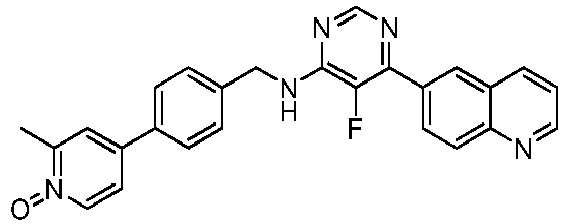
-

- To a solution of 6-chloro-5-fluoro-N-(4-(2-methylpyridin-4-yl)benzyl)pyrimidin-4-amine (133 mg, 0.404 mmol) in CH2Cl2 (5 mL) at room temperature, was added m-CPBA (174 mg, 1.01 mmol). The mixture was stirred at room temperature overnight, and then diluted with CH2Cl2 (15 mL). A mixture of sat. Na2S2O3 (5 mL) and sat. NaHCO3 (5 mL) was added, and the mixture was stirred for another 30 min. The organic layer was separated, washed with brine (5 mL), dried over Na2SO4, and concentrated. The resulting residue was purified by silica gel column chromatography (CH2Cl2:MeOH = 100:1-50:1) to give the title compound (130 mg, 96%) as a white solid. 1H NMR (400 MHz, CDCl3) δ 8.25 (d, J = 6.8 Hz, 1H), 8.22 (s, 1H), 7.54 (d, J = 8.0 Hz, 2H), 7.43 (d, J = 8.0 Hz, 3H), 7.35 - 7.29 (m, 1H), 5.91 (s, 1H), 4.79 (d, J = 6.0 Hz, 2H), 2.57 (s, 3H).
-

- To a solution of 4-(4-((6-chloro-5-fluoropyrimidin-4-ylamino)methyl)phenyl)-2-methylpyridine 1-oxide (67 mg, 0.19 mmol), 6-(4,4,5,5-tetramethyl-1,3,2-dioxaborolan-2-yl)quinoline (74 mg, 0.29 mmol) in dioxane (5 mL) and H2O (1 mL), was added K2CO3 (107 mg, 0.78 mmol) and Pd(PPh3)4 (22 mg, 0.02 mmol). The mixture was stirred at reflux overnight under N2 atmosphere. After cooling to room temperature, the mixture was filtered through Celite. The filtrate was diluted with EtOAc (15 mL), dried over Na2SO4, and concentrated. The resulting residue was purified by silica gel column chromatography (CH2Cl2:MeOH = 50:1-30:1) to give the title compound (65 mg, 77%) as a white solid.
-

-

- To a solution of (6-chloro-5-fluoropyridin-3-yl)methanamine (2.36 g, 14.6 mmol) in dioxane (50 mL) and H2O (10 mL) was added 2-methyl-4-(4,4,5,5-tetramethyl-1,3,2-dioxaborolan-2-yl)pyridine (1.7 g, 16.1 mmol), K2CO3 (8.09 g, 58.6 mmol) and Pd(PPh3)4 (847 mg, 0.73 mmol). The mixture was stirred at 100°C under N2 atmosphere for 8 h. After cooling to room temperature, the mixture was filtered through Celite. The filtrate was diluted with H2O (100 mL), and extracted with CH2Cl2 (100 mL x 6). The combined organic layers was dried over Na2SO4 and concentrated. The resulting residue was purified by silica gel column chromatography (CH2Cl2:MeOH:NH4OH = 50:1:0.1-20:1:0.1) to give the title compound (2.5 g, 79%) as a brown solid. 1H NMR (400 MHz, CDCl3) δ 8.61 (d, J = 4.8 Hz, 1H), 8.50 (s, 1H), 7.77 (s, 1H), 7.69 (d, J = 4.0 Hz, 1H), 7.58 (d, J = 12.0 Hz, 1H), 4.01 (s, 2H), 2.65 (s, 3H).
-

- To a solution of (3-fluoro-2'-methyl-2,4'-bipyridin-5-yl)methanamine (200 mg, 0.92 mmol) in THF (10 mL), was added 4,6-dichloro-5-fluoropyrimidine (154 mg, 0.92 mmol) and N,N-diisopropylethylamine (357 mg, 2.77 mmol), and the reaction mixture was stirred at 50°C overnight. After cooling to room temperature, the mixture was concentrated and the resulting residue was purified by silica gel column chromatography (CH2Cl2:MeOH = 50:1) to give the title compound (200 mg, 62%) as a gray solid. 1HNMR (400 MHz, CDCl3) δ 8.61 (d, J = 4.8 Hz, 1H), 8.56 (s, 1H), 8.24 (s, 1H), 7.76 (s, 1H), 7.69 (s, 1H), 7.55 (d, J = 11.6 Hz, 1H), 5.78 (s, 1H), 4.84 (d, J = 6.0 Hz, 2H), 2.65 (s, 3H).
-

- A mixture of 6-chloro-5-fluoro-N-((3-fluoro-2'-methyl-2,4'-bipyridin-5-yl)methyl)pyrimidin -4-amine (100 mg, 0.29 mmol), 3-ethynylpyridine (92 mg, 0.87 mmol), Pd(PPh3)2Cl2 (9 mg, 0.012 mmol), PPh3 (6.1 mg, 0.023 mmol), and CuI (0.55 mg, 0.023 mmol) in diisopropylanmine (2 mL) and NMP (2 mL) was heated at 100°C under N2 atmosphere for 24 h. After cooling to room temperature, the mixture was filtered through Celite. The filtrate was diluted with H2O (10 mL), and extracted with EtOAc (10 mL x 3). The combined organic layers was washed with brine (5 mL x 2), dried over Na2SO4, and concentrated. The resulting residue was purified by silica gel column chromatography (petroleum ether:EtOAc = 2:1-1:1) to give the title compound (17 mg, 14%) as a white solid.
-

-

- A solution of sodium (E)-1,4-diethoxy-3-fluoro-1,4-dioxobut-2-en-2-olate (45.6 g, 200 mmol), formamidine acetate (20.8 g, 200 mmol) and EtONa (13.6 g, 200 mmol) in anhydrous EtOH (200 mL) was heated at reflux overnight. After cooling to room temperature, the solvent was removed by vacuum. The residue was neutralized with 2 N HCl and extracted with ethyl acetate (100 mL x 3). The combined organic layers was dried over Na2SO4, and concentrated to give the title compound (22 g, 59%) as a brown solid, which was used directly in the next step without further purification.
-

- To a stirred solution of ethyl 5-fluoro-6-hydroxypyrimidine-4-carboxylate (21.0 g, 113 mmol) and DMF (0.5 mL) in CH2Cl2 (200 mL) at room temperature, was added (COCl)2 (43.0 g, 339 mmol) dropwise. The reaction was heated at reflux overnight. After cooling to room temperature, the solvent was removed by vacuum. The residue was dissolved in ethyl acetate (300 mL) and washed with sat. NaHCO3 and brine successively. The organic layer was dried over Na2SO4, and concentrated. The resulting residue was purified by column chromatography (petroleum ether:ethyl acetate = 10 :1) to give the title compound (17.8 g, 77%) as a colerless oil. 1H NMR (400 MHz, CDCl3) δ 8.90 (s, 1H), 4.52 (q, J = 7.1 Hz, 2H), 1.44 (t, J = 7.2 Hz, 3H).
-

- A mixture of ethyl 6-chloro-5-fluoropyrimidine-4-carboxylate (6.14 g, 30.0 mmol) and triethylamine (3.03 g, 30.0 mmol) in methanol (50 mL) was stirred at room temperature overnight. After concentration, the residue was purified by column chromatography (petroleum ether:ethyl acetate = 10 :1) to give the title compound (4.14 g, 74%) as a white solid. 1H NMR (400 MHz, CDCl3) δ 8.59 (s, 1H), 4.11 (s, 3H), 4.01 (s, 3H).
-

- To a stirred solution of N-(tert-butyl)-3-methylpicolinamide (2.69 g, 14 mmol) in anhydrous tetrahydrofuran (50 mL) at -40°C, was added lithium diisopropylamide (2 M in THF, 28 mL, 56 mmol) dropwise. The mixture was stirred at this temperature for 30 min and then cooled to -60°C. Ethyl 5-fluoro-6-methoxypyrimidine-4-carboxylate (2.60 g, 14.0 mmol) in 5 mL anhydrous tetrahydrofuran was added and the reaction mixture was stirred at -60°C for another 1 h. The reaction was quenched with sat. NH4Cl (50 mL) and extracted with ethyl acetate (50 mL x 3). The combined organic layers dried over Na2SO4, and concentrated. The resulting residue was purified by silica gel column chromatography (petroleum ether:ethyl acetate = 3:1) to give the title compound (1.36 g, 28%) as a yellow solid. 1H NMR (400 MHz, CDCl3) δ 8.61 (s, 1H), 8.48 (d, J = 4.4 Hz, 1H), 8.08 (s, 1H), 7.60 (d, J = 7.6 Hz, 1H), 7.41-7.37 (m, 1H), 4.86 (s, 2H), 4.13 (s, 3H), 1.40 (s, 9H).
-

- A mixture of N-(tert-butyl)-3-(2-(5-fluoro-6-methoxypyrimidin-4-yl)-2-oxoethyl)picolinamide (1.36 g, 3.93 mmol) and NH4OAc (3.03 g, 39.3 mmol) in HOAc (20 mL) was heated to 108°C for 8 h. After concentration, the resulting residue was dissolved in ethyl acetate (30 mL) and washed with sat. NaHCO3 (5 mL). The organic layer was dried over Na2SO4 and concentrated to give the title compound (880 mg, 82%) as a yellow solid without further purification.
-

- A mixture of 6-(5-fluoro-6-methoxypyrimidin-4-yl)-1,7-naphthyridin-8-ol (440 mg, 1.62 mmol) and triethylamine (327 mg, 3.24 mmol) in POCl3 (7.5 mL) and toluene (2.5 mL) was heated to 100°C for 1 h. After concentration, the residue was dissolved in ethyl acetate (20 mL) and washed with sat. NaHCO3 (5 mL). The organic layer was dried over Na2SO4 and concentrated. The resulting residue was purified by column chromatography (petroleum ether:ethyl acetate = 2:1) to give the title compound (440 mg, 100%) as a white solid. 1H NMR (400 MHz, CDCl3) δ 9.22 (s, 1H), 8.68 (s, 1H), 8.47 (s, 1H), 8.34 (d, J = 8.2 Hz, 1H), 7.78-7.74(m, 1H), 4.16 (s, 3H).
-

- A mixture of 8-chloro-6-(5-fluoro-6-methoxypyrimidin-4-yl)-1,7-naphthyridine (440 mg, 1.62 mmol), triethylamine (924 mg, 9.15 mmol), formic acid (253 mg, 5.50 mmol) and Pd(PPh3)4 (200 mg, 0.173 mmol) in DMSO (10 mL) was stirred at 100°C under N2 atmosphere for 1 h. After cooling to room temperature, the mixture was diluted with ethyl acetate (40 mL) and filtered. The filtrate was washed with brine (10 mL x 3), dried over Na2SO4, and concentrated. The residue was purified by column chromatography (petroleum ether: ethyl acetate = 3:1) to give the title compound (400 mg, 96%) as a white solid. 1H NMR(400 MHz, CDCl3) δ 9.70 (s, 1H), 9.12 (d, J = 3.6 Hz, 1H), 8.70 (s, 1H), 8.52 (s, 1H), 8.30 (d, J = 8.4 Hz, 1H), 7.56-7.53 (m, 1H), 4.16 (s, 3H).
-

- A mixture of 6-(5-fluoro-6-methoxypyrimidin-4-yl)-1,7-naphthyridine (400 mg, 1.56 mmol) in 37% HBr (10 mL) was heated at reflux for 1 h. After concentration, the resulting residue was suspended in isopropanol (10 mL). The precipitate was filtered and washed with ether (3 mL) to give the title compound (400 mg, quantitative) as a yellow solid.
-

- To a stirred solution of 5-fluoro-6-(1,7-naphthyridin-6-yl)pyrimidin-4-ol (25 mg, 0.1 mmol), (3-fluoro-2'-methyl-2,4'-bipyridin-5-yl)methanamine (22 mg, 0.1 mmol), and N,N-diisopropylethylamine (26 mg, 0.2 mmol) in N,N-Dimethylformamide (1 mL) at room temperature, was added PyBOP (78 mg, 0.15 mmol) in portions. The mixture was stirred at room temperature for 12 h and then diluted with ethyl acetate (5 mL). The organic phase was washed with brine (2 mL), dried over Na2SO4, and concentrated. The residue was purified by column chromatography (CH2Cl2:MeOH = 100:4) to give the title compound (30 mg, 68%) as a white solid.
-

-

- To a solution of 2-bromo-5-methylnicotinonitrile (5 g, 25.4 mmol) in MeCN (100 mL) was added NBS (6.8 g, 38 mmol) and BPO (100 mg, 0.41 mmol). The mixture was heated at reflux overnight, and then BPO (50 mg, 0.21 mmol) was added. The mixture was heated at reflux for another 12 h. After cooling to room temperature, the mixture was concentrated and purified by column chromatography (petroleum ether:ethyl acetate = 100:1-50:1) to give the title compound (4.3 g, 61%) as a brown solid.
-

- To a solution of 2-bromo-5-(bromomethyl)nicotinonitrile (2.3 g, 8.2 mmol) in DMSO (40 mL) in ice bath, was added NaN3 (637 mg, 9.8 mmol). The mixture was stirred at room temperature for 30 min before H2O (100 mL) was added. The mixture was extracted with EtOAc (100 mL x 3). The combined organic layers was washed with brine (50 mL x 3), dried over Na2SO4 and concentrated to give a white solid (940 mg). THF (15 mL) was added followed by PPh3 (1.14 g, 4.34 mmol) and H2O (3 mL) and the mixture was heated at reflux 10 h. After cooling to room temperature, the mixture was diluted with EtOAc (100 mL), and extracted with 0.2 N HCl (20 mL x 2). The combined aqueous layers was washed with EtOAc (20 mL) before sat. Na2CO3 was added to adjust PH = 9. The aqueous layer was extracted with CH2Cl2 (40 mL x 5). The combined organic layers was washed with brine (20 mL), dried over Na2SO4 and concentrated to give a yellow solid (570 mg, 33%).
-

- To a solution of (6-chloro-5-fluoropyridin-3-yl)methanamine (570 mg, 2.69 mmol) in dioxane (15 mL) and H2O (3 mL) was added 2-methyl-4-(4,4,5,5-tetramethyl-1,3,2-dioxaborolan-2-yl)pyridine (1.43 g, 45%, 2.96 mmol), K2CO3 (1.12 g, 8.07 mmol) and Pd(PPh3)4 (310 mg, 0.27 mmol). The mixture was stirred at 100°C under N2 atmosphere for 8 h. After cooling to room temperature, the mixture was filtered through Celite. The filtrate was diluted with H2O (10 mL), and extracted with EtOAc (50 mL x 6). The combined organic layers was dried over Na2SO4 and concentrated. The resulting residue was purified by silica gel column chromatography (petroleum ether:ethyl acetate = 2:1-1:1) to give the title compound (570 mg, 95%) as a gray solid.
-

- To a solution of 2,3-difluoropyridin-4-ylboronic acid (105 mg, 0.66 mmol) and 1,7-naphthyridin-6-yl trifluoromethanesulfonate (167 mg, 0.6 mmol) in dioxane (4 mL) and H2O (1 mL), was added Pd(dppf)Cl2 (39 mg, 0.048 mmol), dppf (26 mg, 0.048 mmol) and K3PO4 (254 mg, 1.2 mmol). The mixture was stirred at 100°C under N2 atmosphere for 8 h. After cooling to room temperature, the mixture was concentrated and purified by silica gel column chromatography (petroleum ether:EtOAc = 1:1) to give the title compound (80 mg, 47%) as a white solid.
-

- To a solution of 5-(aminomethyl)-2'-methyl-2,4'-bipyridine-3-carbonitrile (89 mg, 0.4 mmol) and N,N-diisopropylethylamine (206 mg, 1.6 mmol) in NMP (1 mL), was added 6-(2,3-difluoropyridin-4-yl)-1,7-naphthyridine (49 mg, 0.2 mmol). The mixture was stirred at 135°C under N2 atmosphere for 18 h. After cooling to room temperature, the mixture was diluted with H2O (10 mL), and extracted with EtOAc (20 mL x 3). The combined organic layers was washed with brine (10 mL x 3), dried over Na2SO4, and concentrated. The resulting residue was purified by silica gel column chromatography (CH2Cl2:MeOH = 50:1) to give the title compound (42 mg, 48%) as a yellow solid.
-

-

- To a solution of 6-chloro-N-(4-(2-methylpyridin-4-yl)benzyl)pyrimidin-4-amine (400 mg, 1.29 mmol) and 2-(methylthio)-7,8-dihydropyrido[4,3-d]pyrimidin-5(6H)-one (305 mg, 1.55 mmol) in dioxane (10 mL) was added Pd(PPh3)4 (60 mg, 0.05 mmol), Xantphos (60 mg, 0.11 mmol) and Cs2CO3 (1.0 g, 3.23 mmol). The mixture was stirred at reflux overnight. After cooling to room temperature, the mixture was diluted with EtOAc (20 mL), and washed with H2O (6 mL x 3). The organic layer was dried over Na2SO4, and concentrated. The resulting residue was purified by silica gel column chromatography (petroleum ether:EtOAc = 1:2) to give the title compound (180 mg, 31%) as a white solid.
-

-

- To a solution of 6-(6-(4-(2-methylpyridin-4-yl)benzylamino)pyrimidin-4-yl)-2-(methylthio)-7,8- dihydropyrido[4,3-d]pyrimidin-5(6H)-one (50 mg, 0.11 mmol) in THF (3 mL) and H2O (1 mL) was added oxone (69 mg, 0.22 mmol), and the mixture was stirred at room temperature for 4 h. After concentration, the title compound (120 mg, crude) was obtained as a yellow solid, which was used directly in the next step without further purification.
-

- A mixture of 6-(6-(4-(2-methylpyridin-4-yl)benzylamino)pyrimidin-4-yl)-2-(methylthio)-7,8- dihydropyrido[4,3-d]pyrimidin-5(6H)-one (50 mg, 0.1 mmol), methanamine hydrochloride (68 mg, 1.0 mmol), and N,N-diisopropylethylamine (194 mg, 1.5 mmol) in t-BuOH (3 mL) was stirred at 120°C overnight. After cooling to room temperature, the mixture was diluted with EtOAc (40 mL) and washed with H2O (8 mL x 3). The organic layer was dried over Na2SO4 and concentrated. The resulting residue was purified by silica gel column chromatography (CH2Cl2:MeOH = 60:1) to give the title compound (31 mg, 68%) as a white solid.
-

-

- To a solution of naphthalen-2-ylboronic acid (206 mg, 1.20 mmol) and 4-chloropyridin-2-amine (128 mg, 1.00 mmol) in dioxane (16 mL) and H2O (4 mL), was added Pd(PPh3)4 (115 mg, 0.10 mmol) and K2CO3 (276 mg, 2.00 mmol). The mixture was stirred at 80°C under N2 atmosphere for 12 h. After cooling to room temperature, the mixture was filtered through Celite. The filtrate was diluted with EtOAc (40 mL), washed with brine (20 mL), dried over Na2SO4, and concentrated. The resulting residue was purified by silica gel column chromatography (CH2Cl2:MeOH = 100:3) to give the title compound (120 mg, 55%) as a yellow solid.
-

- To a solution of 4-(naphthalen-2-yl)pyridin-2-amine (110 mg, 0.50 mmol) and 4-bromobenzaldehyde (95 mg, 0.50 mmol) in MeCN (10 mL), was added trifluoroacetic acid (574 mg, 5.00 mmol) and triethylsilane (580 mg, 5.00 mmol). The mixture was stirred at 80°C for 12 h. After cooling to room temperature, the mixture was diluted with EtOAc (40 mL), washed with sat. NaHCO3 (10 mL x 3), dried over Na2SO4, and concentrated. The resulting residue was purified by silica gel column chromatography (petroleum ether:EtOAc = 5:1) to give the title compound (80 mg, 41%) as a yellow solid.
-

- To a solution of N-(4-bromobenzyl)-4-(naphthalen-2-yl)pyridin-2-amine (130 mg, 0.33 mmol) and 2-methyl-4-(4,4,5,5-tetramethyl-1,3,2-dioxaborolan-2-yl)pyridine (27%, 406 mg, 0.50 mmol) in dioxane (20 mL), was added 1M aqueous Na2CO3 (1 mL) and Pd(dppf)Cl2 (28 mg, 0.034 mmol). The mixture was stirred at 100°C under N2 atmosphere for 12 h. After cooling to room temperature, the mixture was filtered through Celite. The filtrate was diluted with EtOAc (40 mL), washed with brine (10 mL x 3), dried over Na2SO4, and concentrated. The resulting residue was purified by silica gel column chromatography (CH2Cl2:MeOH = 100:3) to give the title compound (50 mg, 37%) as a yellow solid.
-

-

- To a solution of 7-methylquinoline-3-carbonitrile (1.5 g, 8.9 mmol) in MeCN (50 mL) was added NBS (2.1 g, 11.8 mmol) and BPO (216 mg, 0.9 mmol). The mixture was heated at reflux overnight. After cooling to room temperature, H2O (100 mL) and EtOAc (100 mL) was added. The aqueous layer was extracted with EtOAc (40 mL x 3). The combined organic layers was dried over Na2SO4, and concentrated. The resulting residue was purified by silica gel column chromatography (CH2Cl2:petroleum ether = 3:2) to give the title compound (743 g, 34%) as a white solid.
-

- To a solution of 7-(bromomethyl)quinoline-3-carbonitrile (743 mg, 3 mmol) in DMSO (15 mL), was added NaN3 (293 mg, 4.5 mmol). The mixture was stirred at 50°C for 1 h. After cooling to room temperature, H2O (75 mL) and EtOAc (75 mL) was added. The organic layer was dried over Na2SO4, and concentrated. The resulting residue was purified by silica gel column chromatography (petroleum ether:EtOAc = 10:1-5:1) to give the title compound (392 mg, 62%) as a white solid.
-

- To a solution of 7-(azidomethyl)quinoline-3-carbonitrile (392 mg, 1.87 mmol) in THF (10 mL) was added PPh3 (541 mg, 2.1 mmol). The mixture was heated at reflux for 5 min before H2O (1 mL) was added. The mixture was heated at reflux for another 1 h. After cooling to room temperature, the mixture was diluted with EtOAc (100 mL), and extracted with 1 N HCl (100 mL). To the aqueous layer was added NH4OH to adjust PH = 8. The mixture was extracted with EtOAc (100 mL). The organic layer was dried over Na2SO4 and concentrated to give the title compound (340 mg, 99%) as a pale yellow solid.
-

- To a solution of 4-chloro-2-(methylthio)pyrimidine (1.6 g, 10 mmol) and 6-(4,4,5,5-tetramethyl-1,3,2-dioxaborolan-2-yl)quinoline (3.06 g, 12 mmol) in dioxane (50 mL) and H2O (12.5 mL), was added Pd(dppf)Cl2 (653 mg, 0.80 mmol), dppf (443 mg, 0.80 mmol) and K3PO4 (4.24 g, 20 mmol). The mixture was stirred at 100°C under N2 atmosphere for 12 h. After cooling to room temperature, the mixture was concentrated and purified by silica gel column chromatography (CH2Cl2:MeOH = 25:1) to give the title compound (2.0 g, 80%) as a yellow solid.
-

- To a solution of 6-(2-(methylthio)pyrimidin-4-yl)quinoline (1.24 g, 4.9 mmol) in CH2Cl2 (50 mL) was added m-CPBA (1.79 g, 85%, 8.82 mmol). The mixture was stirred at room temperature for 2 h and sat. Na2S2O3 (15 mL) and sat. NaHCO3 (15 mL) was added to quench the reaction. The mixture was extacted with CH2Cl2 (100 mL x 3), dried over Na2SO4, and concentrated to give the title compound (1.1 g, 78%) as a yellow solid.
-

- To a solution of 7-(aminomethyl)quinoline-3-carbonitrile (39 mg, 0.21 mmol) in NMP (1.5 mL) was added 6-(2-(methylsulfonyl)pyrimidin-4-yl)quinoline (50 mg, 0.18 mmol) and N,N-diisopropylethylamine (190 mg, 1.4 mmol). The mixture was stirred at 130°C overnight. After cooling to room temperature, the mixture was diluted with H2O (50 mL) and EtOAc (50 mL). The aqueous layer was separated and extracted with EtOAc (30 mL x 3). The combined organic layers was dried over Na2SO4, and concentrated. The resulting residue was purified by silica gel column chromatography (CH2Cl2:MeOH = 100:1-20:1) to give the title compound (25 mg, 36%) as a yellow solid.
-

-

- To a solution of 2,3-difluoropyridin-4-ylboronic acid (175 mg, 1.1 mmol) and 2-chloro-1,5-naphthyridine (164 mg, 1.0 mmol) in dioxane (4 mL) and H2O (1 mL), was added Pd(dppf)Cl2 (65 mg, 0.08 mmol), dppf (44 mg, 0.08 mmol) and K3PO4 (424 mg, 2.0 mmol). The mixture was stirred at 100°C under N2 atmosphere for 12 h. After cooling to room temperature, the mixture was concentrated and purified by silica gel column chromatography (petroleum ether: EtOAc = 1:1) to give the title compound (130 mg, 53%) as a white solid.
-

- To a solution of 2-(2,3-difluoropyridin-4-yl)-1,5-naphthyridine (70 mg, 0.29 mmol) in DMSO (2 mL) was added (3-fluoro-2'-methyl-2,4'-bipyridin-5-yl)methanamine (93 mg, 0.43 mmol) and K2CO3 (80 mg, 0.58 mmol). The mixture was stirred at 135°C for 18 h. After cooling to room temperature, the mixture was diluted with H2O (30 mL), and extracted with EtOAc (30 mL x 3). The combined organic layers was washed with brine (30 mL x 3), dried over Na2SO4, and concentrated. The resulting residue was purified by silica gel column chromatography (CH2Cl2:MEOH = 30:1) to give the title compound (10 mg, 8%) as a yellow solid.
-

-

- To a stirred solution of N-(tert-butyl)-3-methylpicolinamide (2.0 g, 10 mmol) in anhydrous tetrahydrofuran (100 mL) at -40°C, was added lithium diisopropylamide (2 M in THF, 12.5 mL, 25 mmol) dropwise. The mixture was stirred at this temperature for 30 min and then cooled to -60°C. Ethyl 2-(methylthio)pyrimidine-4-carboxylate (2.0 g, 10 mmol) in anhydrous THF (10 mL) was added and the reaction mixture was stirred at -60°C for another 1 h. The reaction was quenched with sat. NH4Cl (50 mL) and extracted with ethyl acetate (80 mL x 3). The combined organic layers dried over Na2SO4, and concentrated. The resulting residue was purified by silica gel column chromatography (petroleum ether:ethyl acetate = 5:1) to give the title compound (1.2 g, 35%) as a yellow solid.
-

- A mixture of N-tert-butyl-3-(2-(2-(methylthio)pyrimidin-4-yl)-2-oxoethyl)picolinamide (500 mg, 1.45 mmol) and NH4OAc (1.11 g, 14.5 mmol) in HOAc (10 mL) was heated to 108°C for 8 h. After concentration, the resulting residue was dissolved in ethyl acetate (30 mL) and washed with sat. NaHCO3 (5 mL). The organic layer was dried over Na2SO4 and concentrated to give the title compound (350 mg, 89%) as a yellow solid without further purification.
-

- A solution of 6-(2-(methylthio)pyrimidin-4-yl)-1,7-naphthyridin-8-ol (350 mg, 1.3 mmol) in POCl3 (6 mL) was heated to 100°C for 1 h. After concentration, the residue was dissolved in ethyl acetate (20 mL) and washed with sat. NaHCO3 (5 mL). The organic layer was dried over Na2SO4 and concentrated. The resulting residue was purified by column chromatography (petroleum ether: ethyl acetate = 5:1) to give the title compound (350 mg, 93%) as a pale yellow solid.
-

- A mixture of 8-chloro-6-(2-(methylthio)pyrimidin-4-yl)-1,7-naphthyridine (350 mg, 1.2 mmol), triethylamine (924 mg, 9.15 mmol), formic acid (253 mg, 5.50 mmol) and Pd(PPh3)4 (138 mg, 0.12 mmol) in DMSO (5 mL) was stirred at 100°C under N2 atmosphere for 3 h. After cooling to room temperature, the mixture was diluted with ethyl acetate (40 mL) and filtered. The filtrate was washed with brine (10 mL x 3), dried over Na2SO4, and concentrated. The residue was purified by column chromatography (petroleum ether:ethyl acetate = 5:1) to give the title compound (180 mg, 59%) as a pale yellow solid.
-

- To a solution of 6-(2-(methylthio)pyrimidin-4-yl)-1,7-naphthyridine (180 mg, 0.71 mmol) in THF (5 mL) and H2O (0.5 mL) was added oxone (497 mg, 1.56 mmol), and the mixture was stirred at room temperature for 10 h. After concentration, the title compound (680 mg, crude) was obtained as a yellow solid, which was used directly in the next step without further purification.
-

- To a solution of 5-(aminomethyl)-2'-methyl-2,4'-bipyridine-3-carbonitrile (68 mg, 0.3 mmol) and N,N-diisopropylethylamine (194 mg, 1.5 mmol) in NMP (1 mL), was added 6-(2-(methylsulfonyl)pyrimidin-4-yl)-1,7-naphthyridine (140 mg, 30%, 0.15 mmol). The mixture was stirred at 135°C under N2 atmosphere for 16 h. After cooling to room temperature, the mixture was diluted with H2O (10 mL), and extracted with EtOAc (20 mL x 3). The combined organic layers was washed with brine (10 mL x 3), dried over Na2SO4, and concentrated. The resulting residue was purified by silica gel column chromatography (CH2Cl2:MeOH = 50:1) to give the title compound (12 mg, 19%) as a pale yellow solid.
-

-

- To a solution of 3-methylquinoline-7-carbonitrile (1.5 g, 8.9 mmol) in MeCN (80 mL) was added NBS (1.9 g, 10.7 mmol) and BPO (216 mg, 0.9 mmol). The mixture was heated at reflux overnight. After cooling to room temperature, H2O (100 mL) and EtOAc (100 mL) was added. The aqueous layer was extracted with EtOAc (40 mL x 3). The combined organic layers was dried over Na2SO4, and concentrated. The resulting residue was purified by silica gel column chromatography (CH2Cl2:petroleum ether = 8:1) to give the title compound (1.0 g, 45%) as a pale yellow solid.
-

- To a solution of 3-(bromomethyl)quinoline-7-carbonitrile (1 g, 4.1 mmol) in DMSO (20 mL), was added NaN3 (395 mg, 6.2 mmol). The mixture was stirred at 50°C for 1 h. After cooling to room temperature, H2O (100 mL) and EtOAc (100 mL) was added. The aqueous layer was extracted with EtOAc (40 mL x 3). The combined organic layers was dried over Na2SO4, and concentrated. The resulting residue was purified by silica gel column chromatography (petroleum ether:EtOAc = 10:1-5:1) to give the title compound (800 mg, 93%) as a yellow solid.
-

- To a solution of 3-(azidomethyl)quinoline-7-carbonitrile (800 mg, 3.8 mmol) in THF (20 mL) was added PPh3 (1.1 g, 4.2 mmol). The mixture was heated at reflux for 5 min before H2O (2 mL) was added. The mixture was heated at reflux for another 1 h. After cooling to room temperature, the mixture was diluted with EtOAc (100 mL), and extracted with 1 N HCl (100 mL). To the aqueous layer was added NH4OH to adjust PH = 8. The mixture was extracted with EtOAc (30 mL x 3). The combined organic layers was washed with brine (30 mL x 3), dried over Na2SO4 and concentrated to give the title compound (400 mg, 56%) as a pale yellow solid.
-

- To a solution of 6-(4,4,5,5-tetramethyl-1,3,2-dioxaborolan-2-yl)quinoline (280 mg, 1.1 mmol) and 3,5-dichloro-1,2,4-thiadiazole (155 mg, 1.0 mmol) in dioxane (6 mL) and H2O (1.5 mL), was added Pd(dppf)Cl2 (65 mg, 0.08 mmol), dppf (44 mg, 0.08 mmol) and K3PO4 (420 mg, 2.0 mmol). The mixture was stirred at 100°C under N2 atmosphere for 12 h. After cooling to room temperature, the mixture was concentrated and purified by silica gel column chromatography (petroleum ether:EtOAc = 3:1) to give the title compound (200 mg, 81%) as a gray solid. 1H NMR (400 MHz, CDCl3) δ 9.03 (d, J = 3.2 Hz, 1H), 8.53 (s, 1H), 8.29 (d, J = 8.0 Hz, 1H), 8.24 (d, J = 8.8 Hz, 1H), 8.18 (d, J = 8.8 Hz, 1H), 7.53 (dd, J = 8.0, 4.0 Hz, 1H).
-

- To a solution of 3-(aminomethyl)quinoline-7-carbonitrile (59 mg, 0.32 mmol) in NMP (1.5 mL) was added 3-chloro-5-(quinolin-6-yl)-1,2,4-thiadiazole (40 mg, 0.16 mmol) and N,N-diisopropylethylamine (165 mg, 1.28 mmol). The mixture was stirred at 135°C for 40 h. After cooling to room temperature, the mixture was diluted with H2O (30 mL), and extracted with EtOAc (30 mL x 3). The combined organic layers was washed with brine (30 mL x 3), dried over Na2SO4, and concentrated. The resulting residue was purified by silica gel column chromatography (CH2Cl2:MEOH = 30:1) to give the title compound (12 mg, 19%) as an orange solid.
-

-

- To a suspension of NaBH4 (1.65 g, 43.3 mmol) in EtOH (100 mL) at 0°C was added a solution of methyl 6-iodo-5-methoxynicotinate (2.54 g, 8.67 mmol) in EtOH (30 mL) dropwise. The mxiture was stirred at room temperature for 20 h. After concentration, H2O (100 mL) was added and the mixture was extracted with CH2Cl2 (100 mL x 3). The combined organic layers was dried over Na2SO4, and concentrated to give the title compound (2.0 g, 87%) as a colorless oil. 1HNMR (400 MHz, CDCl3) δ 8.18 (d, J = 2.0 Hz, 1H), 8.13 (s, 1H), 7.94 (s, 1H), 7.09 (s, 1H), 4.71 (s, 2H), 3.92 (s, 3H).
-

- To a solution of (6-iodo-5-methoxypyridin-3-yl)methanol (2.0 g, 7.55 mmol) and Et3N (3.05 g, 30.2 mmol), was added MsCl (1.72 g, 15.1 mmol). The mixture was stirred at room temperature overnight and then washed with brine (50 mL x 2). The combined organic layers was dried over Na2SO4, and concentrated. The resulting residue was dissolved in DMSO (40 mL), and NaN3 (873 mg, 13.4 mmol) was added. After stirring at room temperature for 8 h, H2O (50 mL) was added and the mixture was extracted with EtOAc (50 mL x 3). The combined organic layers was washed with brine (100 mL x 3), dried over Na2SO4, and concentrated. The resulting residue was purified by silica gel column chromatography (petroleum ether:EtOAc = 10:1) to give the title compound (1.35 g, 61%) as a yellow oil. 1H NMR (400 MHz, CDCl3) δ 7.96 (d, J = 1.6 Hz, 1H), 6.96 (d, J = 1.6 Hz, 1H), 4.38 (s, 2H), 3.94 (s, 3H).
-

- To a solution of 5-(azidomethyl)-2-iodo-3-methoxypyridine (1.35 g, 4.66 mmol) in THF (20 mL) was added PPh3 (1.14 g, 4.34 mmol). The mixture was heated at reflux and H2O (3 mL) was added. The mixture was heated at reflux for 8 h. After cooling to room temperature, the mixture was diluted with EtOAc (40 mL), and extracted with 0.2 N HCl (50 mL). The aqueous layer was washed with EtOAc (50 mL) before NaOH was added to adjust PH = 10. The aqueous layer was extracted with CH2Cl2 (50 mL x 6). The combined organic layers was dried over Na2SO4 and concentrated to give the title compound (1.18 g, 96%) as a yellow solid. 1H NMR (400 MHz, CDCl3) δ 7.95 (s, 1H), 7.07 (s, 1H), 3.92 (s, 3H), 3.89 (s, 2H).
-

- To a solution of (6-iodo-5-methoxypyridin-3-yl)methanamine (1.12 g, 4.24 mmol) in dioxane (20 mL) and H2O (4 mL) was added 2-methyl-4-(4,4,5,5-tetramethyl-1,3,2-dioxaborolan-2-yl)pyridine (1.51 g, 50%, 5.52 mmol), K2CO3 (2.34 g, 17.0 mmol) and Pd(PPh3)4 (245 mg, 0.21 mmol). The mixture was stirred at reflux under N2 atmosphere overnight. After cooling to room temperature, the mixture was filtered through Celite. The filtrate was diluted with EtOAc (100 mL). The organic layer was separated, dried over Na2SO4, and concentrated. The resulting residue was purified by silica gel column chromatography (CH2Cl2:MeOH = 100:1-50:1) to give the title compound (730 mg, 75%) as a brown oil. 1H NMR (400 MHz, CDCl3) δ 8.55 (d, J = 5.2 Hz, 1H), 8.27 (s, 1H), 7.71 (s, 1H), 7.67 (d, J = 5.2 Hz, 1H), 7.38 (s, 1H), 3.99 (s, 2H), 3.93 (s, 3H), 2.62 (s, 3H).
-

- A mixture of 1,7-naphthyridin-6-yl trifluoromethanesulfonate (1.3 g, 4.76 mmol), 1,1,1,2,2,2-hexamethyldistannane (2.3 g, 7.0 mmol), LiCl (590 mg, 14.0 mmol), and Pd(PPh3)4 (270 mg, 0.23 mmol) in dioxane (20 mL) was heated at reflux under N2 atmosphere for 3 h. After cooling to room temperature, the mixture was concentrated. The residue was dissolved in EtOAc (30 mL) and washed with brine (30 mL). The organic layer was dried over Na2SO4, and concentrated. The resulting residue was purified by silica gel column chromatography (petroleum ether:EtOAc = 10:1) to give the title compound (600 mg, 43%) as an colorless oil.
-

- To a solution of 6-(trimethylstannyl)-1,7-naphthyridine (29 mg, 0.1 mmol) and 3,5-dichloro-1,2,4-thiadiazole (21 mg, 0.17 mmol) in toluene (1 mL) was added Pd(PPh3)4 (12 mg, 0.01 mmol) and CuI (2 mg, 0.01 mmol). The mixture was stirred at 110°C under N2 atmosphere overnight. After cooling to room temperature, the mixture was concentrated and purified by silica gel column chromatography (CH2Cl2:MeOH = 80:1) to give the title compound (17 mg, 70%) as a white solid. 1H NMR (400 MHz, CDCl3) δ 9.52 (s, 1H), 9.14 (d, J = 3.6 Hz, 1H), 8.60 (s, 1H), 8.33 (d, J = 8.4 Hz, 1H), 7.73 (dd, J = 8.0, 4.0 Hz, 1H).
-

- To a solution of (3-methoxy-2'-methyl-2,4'-bipyridin-5-yl)methanamine (37 mg, 0.16 mmol) in NMP (1.5 mL) was added 3-chloro-5-(1,7-naphthyridin-6-yl)-1,2,4-thiadiazole (20 mg, 0.08 mmol) and N,N-diisopropylethylamine (83 mg, 0.64 mmol). The mixture was stirred at 135°C for 40 h. After cooling to room temperature, the mixture was diluted with H2O (30 mL), and extracted with EtOAc (30 mL x 3). The combined organic layers was washed with brine (30 mL x 3), dried over Na2SO4, and concentrated. The resulting residue was purified by silica gel column chromatography (CH2Cl2:MeOH = 30:1) to give the title compound (8 mg, 23%) as a pale yellow solid.
-

-

- To a solution of 3,5-dichloro-1,2,4-thiadiazole (155 mg, 1.0 mmol) in i-PrOH (10 mL) was added 5,6,7,8-tetrahydro-1,6-naphthyridine (134 mg, 1.0 mmol) and N,N-diisopropylethylamine (645 mg, 5.0 mmol), and the mixture was stirred at room temperature overnight. The mixture was diluted with H2O (30 mL), and extracted with EtOAc (30 mL x 3). The combined organic layers was washed with brine (30 mL x 3), dried over Na2SO4, and concentrated. The resulting residue was purified by silica gel column chromatography (petroleum ether:EtOAc = 2:1) to give the title compound (180 mg, 71%) as a gray solid.
-

- To a solution of 5-(aminomethyl)-2'-methyl-2,4'-bipyridine-3-carbonitrile (185 mg, 0.83 mmol) and N,N-diisopropylethylamine (213 mg, 1.65 mmol) in cyclohexanol (3 mL) in sealed tube was added 3-chloro-5-(7,8-dihydro-1,6-naphthyridin-6(5H)-yl)-1,2,4-thiadiazole (140 mg, 0.55 mmol) and ZnCl2 (83 mg, 0.61 mmol). The mixture was stirred at 120°C for 40 h. After cooling to room temperature, the mixture was purified by silica gel column chromatography (petroleum ether:EtOAc = 5:1-CH2Cl2:MeOH = 30:1) to give the title compound (12 mg, 5%) as a yellow solid.
-

-

- A mixture of 5,6,7,8-tetrahydro-1,6-naphthyridine hydrochloride (1.7 g, 10 mmol), 2,3-difluoro-4-iodopyridine (4.8 g, 20 mmol), Cs2CO3 (16.3 g, 50 mmol), Pd2(dba)3 (460 mg, 0.5 mmol) in toluene (20 mL) was heated at reflux under N2 atmosphere for 12 h. After cooling to room temperature, the mixture was filtered through Celite and concentrated. The resulting residue was purified by silica gel column chromatography (petroleum ether:EtOAc = 4:1-1:1) to give the title compound (2.3 g, 88%) as a yellow solid. 1HNMR (400 MHz, CDCl3) δ 8.48 (d, J = 4.2 Hz, 1H), 7.72 (d, J = 5.6 Hz, 1H), 7.45 (d, J = 7.6 Hz, 1H), 7.17 (m, 1H), 6.69 (m, 1H), 4.57 (s, 2H), 3.81 (m, 2H), 3.18 (m, 2H).
-
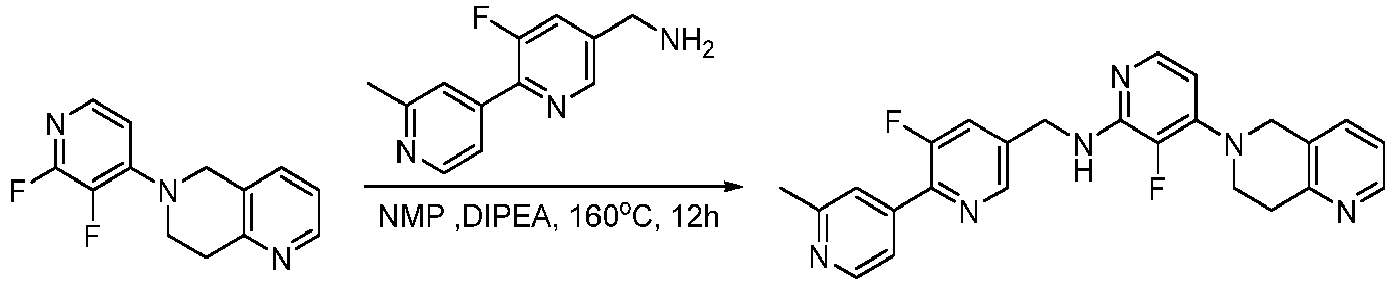
- To a solution of 6-(2,3-difluoropyridin-4-yl)-5,6,7,8-tetrahydro-1,6-naphthyridine (50 mg, 0.21 mmol) and (3-fluoro-2'-methyl-2,4'-bipyridin-5-yl)methanamine (66 mg, 0.3 mmol) in NMP (1 mL), was added K2CO3 (131 mg, 1.0 mmol). The mixture was stirred at 160°C for 12 h. After cooling to room temperature, the mixture was diluted with H2O (5 mL), and extracted with EtOAc (10 mL x 3). The combined organic layers was washed with brine (10 mL x 3), dried over Na2SO4, and concentrated. The resulting residue was purified by silica gel column chromatography (petroleum ether:EtOAc = 1:1-0:1) to give the title compound (4 mg, 5%) as a yellow solid.
- Table 2 shows a selection of compounds prepared according to the methods discussed above in detail and indicated in the Third column of the table:
Table 2. Selected compounds (A-1 to A-202) of the present disclosure. Compd NO. Structure Method 1HNMR ESI-MS (m/z): [M+1]+ A-1 
A 1H NMR (400MHz, CDCl3) δ 8.55 (d, J = 5.0 Hz, 3H), 8.13 (d, J = 8.8 Hz, 1H), 7.95 (d, J=8.8Hz, 2H), 7.89(d, J=7.2Hz, 1H), 7.64(d, J=8.0Hz, 2H), 7.58-7.51(m, 4H), 7.38(s, 1H), 7.32(d, J=4.0Hz, 1H), 5.59(s, 1H), 4.86(d, J=6.0Hz, 2H), 2.63(s, 3H). 421.0 A-2 
A 1HNMR(400MHz, CDCl3)δ9.55(s, 1H), 8.86(s, 1H), 8.57(d, J = 2.0Hz, 1H), 8.55(d, J =5.2Hz, 1H), 8.17(d, J = 8.8Hz, 1H), 7.95(d, J=8.0Hz, 1H), 7.80(t, J=7.8Hz, 1H), 7.66-7.60(m, 3H), 7.52(d, J=8.4Hz, 2H), 7.37(s, 1H), 7.31(d, J = 4.0Hz, 1H), 5.68(s, 1H), 4.87(d, J = 6.0Hz, 2H), 2.63(s, 3H). 422.0 A-3 
A 1HNMR(400MHz, CDCl3)δ8.99-8.98(m, 1H), 8.78(s, 1H), 8.59-8.51(m, 2H), 8.26(d, J=8.4Hz, 1H), 8.21(d, J=8.4Hz, 1H), 7.95(d, J=8.4Hz, 1H), 7.64(d, J=8.4Hz, 2H), 7.52(d, J=8.4Hz, 2H), 7.48-7.45(m, 1H), 7.37(s, 1H), 7.32(d, J=4.8Hz, 1H), 5.70(s, 1H), 4.86(d, J=6.0Hz, 2H), 2.63(s, 3H). 422.0 A-4 
A 1HNMR (400MHz, CDCl3)δ8.99-8.98(m, 1H), 8.55-8.54(m, 3H), 8.38(d, J=9.2Hz, 1H), 8.27(d, J=8.0Hz, 1H), 8.21(d, J=8.8Hz, 1H), 7.65(d, J=8.0Hz, 2H), 7.52(d, J=8.0Hz, 2H), 7.48-7.45(m, 1H), 7.37(s, 1H), 7.31(d, J=5.2Hz, 1H), 5.65(s, 1H), 4.87(d, J=5.6Hz, 2H), 2.63(s, 3H). 422.0 A-5 
A 1HNMR(400MHz, CDCl3)δ8.55-8.54(m, 2H), 8.51(s, 1H), 8.34(d, J=9.2Hz, 1H), 8.15(d, J=8.8Hz, 1H), 8.11(d, J=8.8Hz, 1H), 7.64(d, J=8.0Hz, 2H), 7.51(d, J=7.6Hz, 2H), 7.37(s, 1H), 7.34(d, J=8.4Hz, 1H), 7.31(d, J=4.8Hz, 1H), 5.62(s, 1H), 4.86(d, J=6.0Hz, 2H). 2.78(s, 3H), 2.63(s, 3H). 436.0 A-6 
A 1HNMR(400MHz, CDCl3)δ9.32(s, 1H), 8.60(d, J=5.6Hz, 1H), 8.57(d, J=2.0Hz, 1H), 8.55(d, J=5.6Hz, 1H), 8.52(s, 1H), 8.25(d, J=8.4Hz, 1H), 8.10(d, J=8.8Hz, 1H), 7.76(d, J=5.6Hz, 1H), 7.65(d, J=8.0Hz, 2H), 7.52(d, J=8.0Hz, 2H), 7.37(s, 1H), 7.32(d, J=5.2Hz, 1H), 5.65(s, 1H), 4.87(d, J=6.0Hz, 2H), 2.63(s, 3H). 422.0 A-7 
A 1HNMR(400MHz, CDCl3)δ9.37(s, 1H), 8.70(s, 1H), 8.60(d, J=5.6Hz, 1H), 8.56(s, 2H), 8.38(d, J=8.8Hz, 1H), 7.95(d, J=8.4Hz, 1H), 7.71(d, J=5.6Hz, 1H), 7.66(d, J=8.0Hz, 2H), 7.53(d, J=8.0Hz, 2H), 7.41(s, 1H), 7.36(d, J=5.6Hz, 1H), 5.64(s, 1H), 4.88(d, J=6.0Hz, 2H), 2.66(s, 3H). 422.0 A-8 
A 1HNMR(400MHz, CDCl3)δ8.91(d, J=2.8Hz, 2H), 8.79(s, 1H), 8.57(s, 1H), 8.55(d, J=5.2Hz, 1H), 8.49(d, J=8.4Hz, 1H), 8.23(d, J=8.8Hz, 1H), 7.65(d, J=8.0Hz, 2H), 7.52(d, J=8.0Hz, 2H), 7.37(s, 1H), 7.31(d, J=4.8Hz, 1H), 5.68(s, 1H), 4.87(d, J=5.6Hz, 2H), 2.63(s. 3H). 423.0 A-9 
A 1HNMR(400MHz, CDCl3)δ9.51(s, 1H), 9.40(s, 1H), 8.67(s, 1H), 8.62(d, J=8.4Hz, 1H), 8.56-8.54(m, 2H), 8.17(d, J=8.4Hz, 1H), 7.65(d, J=8.0Hz, 2H), 7.52(d, J=8.0Hz, 2H), 7.38(s, 1H), 7.32(d, J=5.2Hz, 1H), 5.69(s, 1H), 4.88(d, J=5.6Hz, 2H), 2.64(s, 3H). 423.0 A-10 
A 1HNMR(400MHz, DMSO)δ8.49(d, J=5.2Hz, 1H), 8.42-8.34(m, 2H), 8.33(s, 1H), 8.23(s, 1H), 7.88(d, J=9.2Hz, 1H), 7.76(d, J=8.4Hz, 2H), 7.71(d, J=8.4Hz, 1H), 7.59(s, 1H), 7.50(d, J=7.6Hz, 3H), 4.71(d, J=6.0Hz, 2H), 2.53(s, 3H). A-11 
A 1HNMR(400MHz, CDCl3)δ9.00(s, 1H), 8.55(d, J=4.8Hz, 1H), 8.46(s, 1H), 7.97(s, 2H), 7.76(s, 1H), 7.69(s, 1H), 7.63(d, J=7.6Hz, 2H), 7.51(d, J=8.0Hz, 2H), 7.36(s, 1H), 7.31(d, J=4.8Hz, 1H), 5.77(s, 1H), 4.85(d, J=5.6Hz, 2H), 2.63(s, 3H). 411.0 A-12 
A 1HNMR(400MHz, CDCl3) δ 9.10 (s, 1H), 8.70 (s, 1H), 8.55-8.52 (m, 2H), 8.27-8.17 (m, 2H), 7.64 (d, J=8.4Hz, 2H), 7.51(d, J=8.0Hz, 2H), 7.37(s, 1H), 7.31(d, J=5.2Hz, 1H), 5.63(s, 1H), 4.86(d, J=5.6Hz. 2H), 2.63(s, 3H). 427.9 A-13 
A 1HNMR(400MHz, DMSO)δ13.28(s, 1H), 8.47(d, J=5.2Hz, 1H), 8.43(s, 1H), 8.39(t, J=6.0Hz, 1H), 8.33(d, J=2.0Hz, 1H), 8.22(s, 1H), 8.01(d, J=9.2Hz, 1H), 7.75(d, J=8.0Hz, 2H), 7.66(d, J=8.8Hz, 1H), 7.56(s, 1H), 7.50-7.47(m, 3H), 4.71(d, J=6.0Hz, 2H), 2.52(s, 3H). 411.0 A-14 
A 1HNMR(400MHz, CDCl3)δ8.54(d, J=5.2Hz, 1H), 8.50(s, 1H), 8.40(s, 1H), 8.01(s, 1H), 7.96(d, J=9.2Hz, 1H), 7.78(d, J=9.2Hz, 1H), 7.63(d, J=8.0Hz, 2H), 7.50(d, J=8.0Hz, 2H), 7.36(s, 1H), 7.31(d, J=5.2Hz, 1H), 5.56(s, 1H), 4.84(d, J=5.6Hz, 2H), 4.25(s. 3H), 2.62(s, 3H). 425.0 A-15 
A 1HNMR(400MHz, CDCl3)δ8.55(d, J=5.2Hz, 1H), 8.51(d, J=1.6Hz, 1H), 8.46(s, 1H), 8.12(d, J=9.2Hz, 1H), 8.08(s, 1H), 7.64(d, J=8.4Hz, 2H), 7.54-7.47(m, 3H), 7.37(s, 1H), 7.31(d, J=5.2Hz, 1H), 5.57(s, 1H), 4.85(d, J=6.0Hz, 2H), 4.12(s, 3H), 2.63(s, 3H). 425.0 A-16 
A 1HNMR(400MHz, CDCl3)δ8.54(d, J=4.8Hz, 1H), 8.45(s, 1H), 7.63(d, J=8.0Hz, 3H), 7.58(d, J=8.8Hz, 1H), 7.49(d, J=8.0Hz, 2H), 7.37(s, 1H), 7.31(d, J=5.2Hz, 1H), 6.96(d, J=8.8Hz, 1H), 5.52(s, 1H), 4.82(d, J=5.8Hz, 2H), 4.31(d, J=2.4Hz, 4H), 2.62(s, 3H). 429.0 A-17 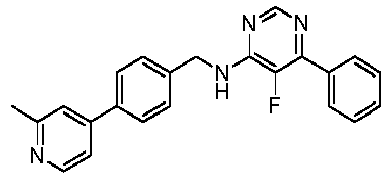
A 1HNMR(400MHz, CDCl3)δ8.54(d, J=5.2Hz, 1H), 8.50(d, J=1.6Hz, 1H), 8.01(d, J=7.6Hz, 2H), 7.63(d, J=8.0Hz, 2H), 7.51-7.48(m, 5H), 7.36(s, 1H), 7.31(d, J=4.8Hz, 1H), 5.54(s, 1H), 4.84(d, J=5.8Hz, 2H), 2.62(s, 3H). 371.0 A-18 
A 1HNMR(400MHz, CDCl3)δ8.54(d, J=5.2Hz, 1H), 8.50(d, J=1.6Hz, 1H), 8.01(d, J=7.6Hz, 2H), 7.63(d, J=8.4Hz, 2H), 7.51-7.48(m, 4H), 7.36(s, 1H), 7.31(d, J=5.2Hz, 1H), 5.55(s, 1H), 4.84(d, J=5.6Hz, 2H). 2.63(s, 3H). A-19 
A 1HNMR(400MHz, CDCl3)δ8.54(d, J=4.8Hz, 1H), 8.49(d, J=1.6Hz, 1H), 8.04(s, 1H), 7.91(d, J=7.2Hz, 1H), 7.63(d, J=8.0Hz, 2H), 7.49(d, J=8.0Hz, 2H), 7.47-7.39(m, 2H), 7.36(s, 1H), 7.30(d, J=5.2Hz, 1H), 5.59(s, 1H), 4.83(d, J=6.0Hz, 2H), 2.62(s, 3H). 405.0 A-20 
A 1HNMR(400MHz, CDCl3)δ8.54(d, J=5.2Hz, 1H), 8.48(d, J=1.6Hz, 1H), 7.99(d, J=8.0Hz, 2H), 7.63(d, J=8.0Hz, 2H), 7.50-7.45(m, 4H), 7.36(s, 1H), 7.30(d, J=4.4Hz, 1H), 5.54(s, 1H), 4.83(d, J=6.0Hz, 2H), 2.62(s, 3H). 405.0 A-21 
A 1HNMR(400MHz, CDCl3)δ8.55(d, J=4.8Hz, 1H), 8.48(s, 1H), 8.18(s, 1H), 7.90(d, J=8.4Hz, 1H), 7.63(d, J=8.4Hz, 2H), 7.56(d, J=8.4Hz, 1H), 7.49(d, J=8.0Hz, 2H), 7.36(s, 1H), 7.30(d, J=4.8Hz, 1H), 5.58(s, 1H), 4.83(d, J=5.6Hz, 2H), 2.63(s, 3H). 438.9 A-22 
A 1HNMR(400MHz, CDCl3)δ8.53(d, J=5.2Hz, 1H), 8.06(s, 1H), 7.60(d, J=8.0Hz, 2H), 7.45(d, J=8.0Hz, 2H), 7.35(s, 1H), 7.29(d, J=5.2Hz, 1H), 7.22-7.12(m, 4H), 5.10(s, 1H), 4.85(s, 2H), 4.74(d, J=6.0Hz, 2H), 3.94(t, J=5.8Hz, 2H), 2.97(t, J=5.8Hz, 2H), 2.62(s, 3H). A-23 
A 1HNMR(400MHz, CDCl3)δ8.53(d, J=4.8Hz, 1H), 8.05(s, 1H), 7.60(d, J=7.6Hz, 2H), 7.45(d, J=7.6Hz, 2H), 7.35(s, 1H), 7.30(d, J=4.8Hz, 1H), 7.20-7.08(m, 1H), 6.91(m, 2H), 5.10(s, 1H), 4.85(s, 2H), 4.74(d, J=8Hz, 2H), 3.94(m, 2H), 2.93(m, 2H), 2.62(s, 3H). 444.0 A-24 
A 1HNMR(400MHz, CDCl3)δ8.53(d, J=4.8Hz, 1H), 8.04(s, 1H), 7.60(d, J=8Hz, 2H), 7.45(d, J=8Hz, 2H), 7.36(s, 1H), 7.31(d, J=4.8Hz, 1H), 7.12-7.07(m, 1H), 6.87(m, 2H), 5.09(s, 1H), 4.81(s, 2H), 4.74(d, J=6Hz, 2H), 3.92(m, 2H), 2.92(m, 2H), 2.62(s, 3H). 444.0 A-25 
A 1HNMR(400MHz, CDCl3)δ8.53(d, J=4.8Hz, 1H), 8.05(s, 1H), 7.60(d, J=8.0Hz, 2H), 7.45(d, J=8.0Hz, 3H), 7.36(s, 1H), 7.30(d, J=4.8Hz, 1H), 7.09(m, 2H), 5.09(s, 1H), 4.83(s, 2H), 4.74(d, J=6Hz, 2H), 3.95(m, 2H), 2.96(m, 2H), 2.62(s, 3H). 503.9 A-26 
A 1HNMR(400MHz, CDCl3)δ8.53(d, J=5.2Hz, 1H), 8.44(d, J=4.4Hz, 1H), 8.06(s, 1H), 7.60(d, J=8.0Hz, 2H), 7.46(d, J=7.6Hz, 3H), 7.36(s, 1H), 7.30(d, J=5.2Hz, 1H), 7.16-7.13(m, 1H), 5.13(s, 1H), 4.85(s, 2H), 4.75(d, J=5.6Hz, 2H), 4.03(t, J=6.0Hz, 2H), 3.14(t, J=5.8Hz, 2H), 2.62(s, 3H). 427.0 A-27 
C 1HNMR(400MHz, CDCl3)δ8.54-8.53(m, 2H), 8.48(s, 1H), 8.06(d, J=8.4Hz, 1H), 7.93(d, J=8.4Hz, 2H), 7.87(d, J=7.6Hz, 1H), 7.62(d, J=8.0Hz, 2H), 7.58-7.48(m, 2H), 7.43(d, J=8.0Hz, 2H), 7.36(s, 1H), 7.30(d, J=4.8Hz, 1H), 4.98(s, 2H), 3.32(d, J=3.6Hz, 3H), 2.62(s, 3H). 435.0 A-28 
A 1HNMR(400MHz, DMSO)δ8.54(s, 1H), 8.48(d, J=5.2Hz, 1H), 8.37-8.28(m, 2H), 8.08-8.06(m, 3H), 7.98(d, J=8.0Hz, 1H), 7.75(d, J=8.4Hz, 2H), 7.64-7.55(m, 5H), 7.48(d, J=5.2Hz, 1H), 5.46-5.39(m, 1H), 2.52(s, 3H), 1.59(d, J=6.8Hz, 3H). 435.0 A-29 
A 1HNMR(400MHz, CDCl3)δ8.59(s, 1H), 8.55(s, 1H), 8.46(d, J=5.2Hz, 1H), 8.12(d, J=8.8Hz, 1H), 7.95(d, J=8.8Hz, 2H), 7.88(d, J=8.0Hz, 1H), 7.59-7.50(m, 2H), 7.36(d, J=3.6Hz, 1H), 7.30(s, 1H), 7.25(d, J=3.6Hz, 1H), 7.10(d, J=3.6Hz, 1H), 5.63(s, 1H), 4.98(d, J=6.0Hz, 2H), 2.58(s, 3H). 427.0 A-30 
A 1HNMR(400MHz, CDCl3)δ8.79(s, 1H), 8.60(d, J=5.2Hz, 1H), 8.55(s, 2H), 8.12(d, J=8.4Hz, 1H), 7.95(d, J=8.8Hz, 2H), 7.89-7.86(m, 2H), 7.82-7.76(m, 2H), 7.66(d, J=4.8Hz, 1H), 7.58-7.51(m, 2H), 5.69(s, 1H), 4.88(d, J=6.0Hz, 2H), 2.65(s, 3H). 422.0 A-31 
A 1HNMR(400MHz, CDCl3)δ8.99-8.98(m, 1H), 8.80(d, J=1.6Hz, 1H), 8.61(d, J=5.2Hz, 1H), 8.55(d, J=1.6Hz, 2H), 8.37(d, J=8.8Hz, 1H), 8.28(d, J=7.6Hz, 1H), 8.21(d, J=8.8Hz, 1H), 7.90-7.87(m, 1H), 7.80(d, J=8.0Hz, 2H), 7.66(d, J=4.4Hz, 1H), 7.49-7.46(m, 1H), 5.73(s, 1H), 4.89(d, J=6.0Hz, 2H), 2.65(s, 3H). A-32 
A 1HNMR(400MHz, CDCl3)δ8.72(s, 1H), 8.59(d, J=5.2Hz, 1H), 8.44(d, J=4.4Hz, 1H), 8.04(s, 1H), 7.84-7.71(m, 3H), 7.65(d, J=5.2Hz, 1H), 7.46(d, J=7.6Hz, 1H), 7.16-7.13(m, 1H), 5.19(s, 1H), 4.85(s, 2H), 4.78(d, J=6.0Hz, 2H), 4.03(t, J=5.8Hz, 2H), 3.14(t, J=5.6Hz, 2H), 2.65(s, 3H). 428.0 A-33 
A 1HNMR(400MHz, CDCl3)δ8.60-8.58(m, 2H), 8.56(s, 2H), 8.13(d, J=8.4Hz, 1H), 7.96(d, J=8.0Hz, 2H), 7.89(d, J=7.6Hz, 1H), 7.67(s, 1H), 7.59-7.50(m, 2H), 7.34(s, 1H), 7.24(d, J=8.4Hz, 1H), 5.63(s, 1H), 4.85(d, J=5.6Hz, 2H), 2.63(s, 3H), 2.38(s, 3H). 436.0 A-34 
A 1HNMR (400MHz, CDCl3) δ 8.99(d, J=3.6Hz, 1H), 8.63-8.57(m, 2H), 8.56(s, 2H), 8.38(d, J=8.8Hz, 1H), 8.28(d, J=8.4Hz, 1H), 8.22(d, J=9.2Hz, 1H), 7.68(s, 1H), 7.49-7.46(m, 1H), 7.33(s, 1H), 7.25(d, J=5.2Hz, 1H), 5.69(s, 1H), 4.86(d, J=6.0Hz, 2H), 2.63(s. 3H), 2.39(s, 3H). 437.0 A-35 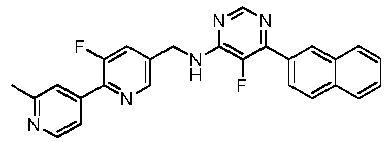
A 1HNMR (400MHz, CDCl3) δ 8.61(s, 2H), 8.58-8.52 (m, 2H), 8.12 (d, J=8.4Hz, 1H), 7.96(d, J=8.4Hz, 2H), 7.89(d, J=7.2Hz, 1H), 7.77(s, 1H), 7.69(s, 1H), 7.61(d, J=11.2Hz, 1H), 7.59-7.51(m, 2H), 5.73(s, 1H), 4.90(d, J=6.0Hz, 2H), 2.65(s, 3H). 440.0 A-36 
A 1HNMR(400MHz, DMSO)δ8.98(d, J=4.0Hz, 1H), 8.63(d, J=4.4Hz, 2H), 8.58-8.53(m, 3H), 8.42(s, 1H), 8.33(d, J=8.8Hz, 1H), 8.15(d, J=8.8Hz, 1H), 7.87(d, J=12.4Hz, 1H), 7.74(s, 1H), 7.67(d, J=5.2Hz, 1H), 7.63-7.60(m, 1H), 4.79(d, J=6.0Hz, 2H), 2.55(s, 3H). A-37 
A 1HNMR(400MHz, CDCl3)δ8.87(s, 1H), 8.61(d, J=5.2Hz, 1H), 8.58(s, 1H), 8.54(s, 1H), 8.15(d, J=8.8Hz, 1H), 7.97-7.93(m, 3H), 7.89(d, J=7.6Hz, 1H), 7.59-7.51(m, 2H), 7.49(d, J=8.4Hz, 1H), 7.38(s, 1H), 7.33(d, J=5.2Hz, 1H), 6.60(s, 1H), 4.95(d, J=5.2Hz, 2H). 2.66(s, 3H). 422.0 A-38 
A 1HNMR(400MHz, CDCl3)δ8.68(brs, 2H), 8.55(s, 2H), 8.13(d, J=8.8Hz, 1H), 7.95(d, J=8.8Hz, 2H), 7.88(d, J=7.2Hz, 1H), 7.66(d, J=8.4Hz, 2H), 7.57-7.53(m, 6H), 5.63(s, 1H), 4.87(d, J=5.6Hz, 2H). 407.0 A-39 
A 1HNMR(400MHz, CDCl3)δ8.55(s, 2H), 8.13(d, J=8.8Hz, 1H), 7.95(d, J=8.4Hz, 2H), 7.88(d, J=7.2Hz, 1H), 7.59-7.46(m, 5H), 7.43(d, J=8.0Hz, 2H), 6.31(s, 1H), 5.60(s, 1H), 4.86(d, J=6.0Hz, 2H), 3.90(s. 3H). 410.0 A-40 
A 1HNMR(400MHz, CDCl3)δ8.55(s, 1H), 8.54(s, 1H), 8.12(d, J=8.8Hz, 1H), 7.95(d, J=8.4Hz, 2H), 7.89(d, J=7.6Hz, 1H), 7.86(s, 1H), 7.56-7.52(m, 4H), 7.40(d, J=8.0Hz, 2H), 7.29(s, 1H), 7.22(s, 1H), 5.64(s, 1H), 4.85(d, J=6.0Hz, 2H). 396.0 A-41 
A 1HNMR(400MHz, CDCl3)δ9.26(s, 1H), 8.99(d, J=4.0Hz, 1H), 8.57-8.54(m, 3H), 8.39(d, J=8.8Hz, 1H), 8.28(d, J=8.4Hz, 1H), 8.22(d, J=8.8Hz, 1H), 8.00(d, J=8.4Hz, 1H), 7.82(s, 1H), 7.65(d, J=6.8Hz, 2H), 7.49-7.46(m, 1H), 5.77(s, 1H), 5.02(d, J=6.0Hz, 2H). 382.0 A-42 
A 1HNMR(400MHz, CDCl3)δ8.99(d, J = 4.4Hz, 1H), 8.67-8.59(m, 2H), 8.58-8.53(m, 2H), 8.39(s, 1H), 8.34(d, J=8.8Hz, 1H), 8.16(d, J=8.8Hz, 1H), 8.10(d, J=8.8Hz, 1H), 8.05(d, J=8.8Hz, 1H), 7.98(s, 1H), 7.77(d, J=8.4Hz, 1H), 7.72(d, J=8.4Hz, 1H), 7.62(dd, J=8.4, 4.4Hz, 1H), 4.89(d, J=6.0Hz, 2H). A-43 
D 1HNMR(400MHz, CDCl3)δ8.96(d, J=2.8Hz, 1H), 8.63-8.55(m, 2H), 8.53(d, J=8.4Hz, 1H), 8.43(s, 1H), 8.37(s, 1H), 8.32(d, J=8.8Hz, 1H), 8.18-8.12(m, 2H), 7.98(d, J=8.4Hz, 1H), 7.97-7.91(m, 2H), 7.89(s, 1H), 7.65-7.58(m, 1H), 7.42(s, 1H), 4.86(d, J=6.0Hz, 2H). 424.0 A-44 
A 1H NMR (400 MHz, CDCl3) δ 8.45 (d, J = 3.6 Hz, 1H), 8.22 (s, 1H), 8.05 (s, 1H), 7.88 (d. J = 8.4 Hz, 2H), 7.82 (s, 1H), 7.60 (m, 2H), 7.47 (d, J = 7.6 Hz, 1H), 7.20 (m, 1H), 5.24 (s, 1H), 4.91 (d, J = 6.0 Hz, 2H), 4.87 (s, 2H), 4.05 (m, 2H), 3.15 (m, 2H). A-45 
A 1H NMR (400 MHz, CDCl3) δ 8.59 (s, 1H), 8.53 (s, 1H), 8.44 (s, 1H), 8.02 (s, 1H), 7.75 (s, 1H), 7.67 (s, 1H), 7.54 (d, J = 11.6 Hz, 1H), 7.46 (d, J = 7.6 Hz, 1H), 7.14 (s, 1H), 5.27 (s, 1H), 4.85 (s, 2H), 4.79 (d, J = 5.6 Hz, 2H), 4.03 (d, J = 5.6 Hz, 2H), 3.14 (s, 2H), 2.88 (s, 1H), 2.64 (s, 3H). A-46 
A 1H NMR (400 MHz, CDCl3) δ 8.53 (s, 2H), 8.45 (s, 1H), 8.05 (s, 1H), 7.61 (s, 1H), 7.46 (d. J = 7.6 Hz, 1H), 7.33 (s, 1H), 7.24 (s, 1H), 7.15 (s, 1H), 5.24 (s, 1H), 4.86 (s, 2H), 4.74 (d, J = 5.6 Hz, 2H), 4.04 (t, J = 5.2 Hz, 2H), 3.14 (s, 2H), 2.62 (s, 3H), 2.35 (s, 3H). A-47 
A 1H NMR (400 MHz, CDCl3) δ 8.68 (s, 1H), 8.53 (d, J = 5.2 Hz, 1H), 8.04 (s, 1H), 7.60 (d, J = 7.8Hz, 2H), 7.45 (d, J = 7.2 Hz, 2H), 7.36 (s, 1H), 7.30 (d, J = 4.8 Hz, 1H), 5.13 (s, 1H), 4.94 (s, 2H), 4.75 (d, J = 5.6Hz, 2H), 4.02 (d, J = 5.2 Hz, 2H), 3.07 (s, 2H), 2.62 (s, 3H). 433.0 A-48 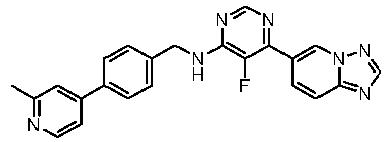
A 1H NMR (400 MHz, CDCl3) δ 9.39 (s, 1H), 8.53 (d, J = 15.6 Hz, 2H), 8.42 (s, 1H), 8.33 (d, J = 9.4 Hz, 1H), 7.86 (d, J = 9.4 Hz, 1H), 7.64 (d, J = 6.4 Hz, 2H), 7.51 (d, J = 7.6 Hz, 2H), 7.37 (s, 1H), 7.31 (s, 1H), 5.67 (s, 1H), 4.86 (s, 2H), 2.63 (s, 3H). 451.0 A-49 
A 1H NMR (400 MHz, CDCl3) δ 9.11 (s, 1H), 8.70 (s, 1H), 8.62 (d, J = 5.2 Hz, 2H), 8.52 (s, 1H), 8.22 (m 2H), 7.77 (s, 1H), 7.69 (d, J = 4.8 Hz, 1H), 7.61 (d, J = 11.2 Hz, 1H), 5.74 (s, 1H), 4.90 (d, J = 6.0 Hz, 2H), 2.65 (s, 3H). A-50 
A 1H NMR (400 MHz, CDCl3) δ 9.10 (s, 1H), 8.79 (s, 1H), 8.70 (s, 1H), 8.60 (d, J = 5.2 Hz, 1H), 8.52 (s, 1H), 8.22 (m, 2H), 7.90 (m, 1H), 7.79 (d, J = 7.8 Hz, 2H), 7.66 (d, J = 4.8 Hz, 1H), 5.69 (s, 1H), 4.88 (d, J = 6.0 Hz, 2H), 2.65 (s, 3H). A-51 
A 1H NMR (400 MHz, CDCl3) δ 9.10 (s, 1H), 8.70 (s, 1H), 8.59 (d, J = 5.6 Hz, 2H), 8.53 (s, 1H), 8.22 (q, J = 8.4 Hz, 2H), 7.67 (s, 1H), 7.33 (s, 1H), 7.23 (s, 1H), 5.64 (s, 1H), 4.85 (d, J = 5.6 Hz, 2H), 2.63 (s, 3H), 2.38 (s, 3H). A-52 
A 1H NMR (400 MHz, CDCl3) δ 8.53 (d, J = 5.2 Hz, 1H), 8.08 (s, 1H), 7.61 (d, J = 7.9 Hz, 2H), 7.48 (d, J = 8 Hz, 2H), 7.36 (s, 1H), 7.31 (s, 5H), 5.03 (d, J = 2.4 Hz, 5H), 4.85 (m, 1H), 4.77 (d, J = 6 Hz, 2H), 4.60 (m, 1H), 2.62 (s, 3H). 412.0 A-53 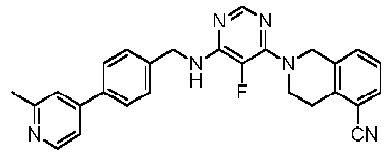
A 1H NMR (400 MHz, CDCl3) δ 8.53 (d, J = 5.2 Hz, 1H), 8.05 (s, 1H), 7.60 (d, J = 8.0 Hz, 2H), 7.53 (d, J = 7.6 Hz, 1H), 7.45 (d, J = 8.0 Hz, 2H), 7.40 (m, 2H), 7.30 (d, J = 6.8 Hz, 2H), 5.13 (s, 1H), 4.86 (s, 2H), 4.75 (d, J = 6 Hz, 2H), 3.99 (t, J = 5.8 Hz, 2H), 3.16 (t, J = 5.8Hz, 2H), 2.62 (s, 3H). A-54 
A 1H NMR (400 MHz, CDCl3) δ 8.68 (s, 1H), 8.60 (d, J = 5.2 Hz, 1H), 8.54 (s, 1H), 8.02 (s, 1H), 7.76 (s, 1H), 7.67 (d, J = 4.8 Hz. 1H), 7.54 (d, J = 11.6 Hz, 1H), 5.23 (s, 1H), 4.95 (s, 2H), 4.79 (d, J = 6Hz, 2H), 4.03 (t, J = 5.6 Hz, 2H), 3.07 (s, 2H), 2.64 (s, 3H). A-55 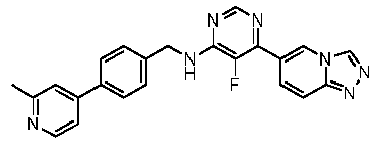
A 1H NMR (400 MHz, CDCl3) δ 8.96 (s, 1H), 8.91 (s, 1H), 8.55 (d, J = 5.2 Hz, 1H), 8.49 (s, 1H), 8.03 (d, J = 9.6 Hz, 1H), 7.87 (d, J = 9.6 Hz, 1H), 7.64 (d, J = 8.0 Hz, 2H), 7.50 (d, J = 8.0 Hz, 2H), 7.36 (s, 1H), 7.31 (d, J = 5.2 Hz, 1H), 5.69 (s, 1H), 4.85 (d, J = 5.8 Hz, 2H), 2.63 (s, 3H). 412.0 A-56 
A 1H NMR (400 MHz, CDCl3) δ 8.89 (s, 1H), 8.67 (d, J = 5.2 Hz, 1H), 8.45 (d, J = 4.4Hz, 1H), 8.10 (s, 1H), 8.02 (s, 1H), 7.67 (s, 1H), 7.62 (d, J = 5.0 Hz, 1H), 7.46 (d, J = 8Hz, 1H), 7.15 (m, 1H), 5.28 (s, 1H), 4.87 (s, 2H), 4.81 (d, J = 6.2 Hz, 2H), 4.06 (t, J = 5.8 Hz, 2H), 3.15 (m, 2H), 2.67 (s, 3H). A-57 
A 1H NMR (400 MHz, CDCl3) δ 9.0 (m, 2H), 8.69 (d, J = 5.2 Hz, 1H), 8.55 (d, J = 11.2 Hz, 2H), 8.38 (d, J = 9.0 Hz, 1H), 8.29 (d, J = 8.2 Hz, 1H), 8.23 (d, J = 9 Hz, 1H), 8.18 (s, 1H), 7.70 (s, 1H), 7.66 (d, J = 4.6 Hz, 1H), 7.48 (dd, J = 8.2, 4.2 Hz, 1H), 5.86 (s, 1H), 5.3 (m, 1H), 4.93 (d, J = 6 Hz, 2H), 2.68 (s, 3H). A-58 
A 1H NMR (400 MHz, CDCl3) δ 8.61 (d, J = 5.2 Hz, 1H), 8.54 (s, 1H), 8.05 (s, 1H), 7.92 (s, 1H), 7.75 (s, 1H), 7.67 (d, J = 4.8 Hz, 1H), 7.54 (d, J = 12.0 Hz, 1H), 5.35 (s, 1H), 5.01 (s, 2H), 4.80 (d, J = 6.2 Hz, 2H), 4.33 (m, 2H), 4.21 (m, 2H), 2.64 (s, 3H). 436.0 A-59 
A 1H NMR (400 MHz, CDCl3) δ 8.53 (d, J = 4.6 Hz, 1H), 8.07 (s, 1H), 7.9 (m, 1H), 7.61 (d, J = 7.6 Hz, 2H), 7.45 (d, J = 7.8 Hz, 2H), 7.35 (s, 1H), 7.28 (s, 1H), 5.24 (s, 1H), 5.12 (s, 2H), 4.76 (d, J = 5.6 Hz, 2H), 4.28 (s, 2H), 4.15 (s, 2H), 2.62 (s, 3H). 485.0 A-60 
A 1H NMR (400 MHz, CDCl3) δ 9.0 (m, 3H), 8.61 (d, J = 5.2 Hz, 2H), 8.54 (d, J = 7.8 Hz, 2H), 8.43 (s, 1H), 8.32 (d, J = 8.6 Hz, 1H), 8.15 (m, 2H), 8.04 (d, J = 5.2 Hz, 1H), 7.61 (m, 1H), 4.76 (d, J = 5.6Hz, 2H), 2.57 (s, 3H). 424.0 A-61 
A 1H NMR (400 MHz, CDCl3) δ 8.87 (s, 2H), 8.64 (d, J = 5.2 Hz, 1H), 8.44 (d, J = 4 Hz, 1H), 8.14 (s, 1H), 8.06 (d, J = 4.8 Hz, 1H), 8.03 (s, 1H), 7.45 (d, J = 7.6 Hz, 1H), 7.16 (m, 1H), 5.23 (s, 1H), 4.85 (s, 2H), 4.76 (d, J = 6 Hz, 2H), 4.03 (m, 2H), 3.13 (m, 2H), 2.66 (s, 3H). 430.9 A-62 
A 1H NMR (400 MHz, CDCl3) δ 9.02 (s, 1H), 8.61 (d, J = 5.2 Hz, 1H), 8.53 (d, J = 7.8 Hz, 2H), 8.04 (s, 1H), 7.76 (s, 1H), 7.68 (d, J = 4.8 Hz, 1H), 7.54 (d, J = 11.0 Hz, 1H), 5.26 (s, 1H), 4.87 (s, 2H), 4.80 (d, J = 6.2 Hz, 2H), 4.04 (t, J = 5.9 Hz, 2H), 3.10 (t, J = 5.8 Hz, 2H), 2.64 (s, 3H) 447.0 A-63 
A 1H NMR (400 MHz, CDCl3) δ 9.05 (s, 1H), 8.99 (d, J = 3.6 Hz, 1H), 8.82 (s, 1H), 8.66 (d, J = 5.2 Hz, 1H), 8.56 (d, J = 9.6 Hz, 2H), 8.39 (d, J = 8.8 Hz, 1H), 8.28 (d, J = 8.0 Hz, 1H), 8.22 (d, J = 9.2 Hz, 1H), 7.81 (s, 1H), 7.71 (d, J = 5.2 Hz, 1H), 7.47 (dd, J = 8.2, 4.2 Hz, 1H), 6.39 (s, 1H), 5.01 (d, J = 5.2 Hz, 2H), 2.68 (s, 3H). A-64 
E 1H NMR (400 MHz, CDCl3) δ 8.25 (d, J = 6.8 Hz, 1H), 8.22 (s, 1H), 7.54 (d, J = 8.0 Hz, 2H), 7.43 (d, J = 8.0 Hz, 3H), 7.35 - 7.29 (m, 1H), 5.91 (s, 1H), 4.79 (d, J = 6.0 Hz, 2H), 2.57 (s, 3H). A-65 
A 1H NMR (400 MHz, CDCl3) δ 8.99 (d, J = 4.0 Hz, 1H), 8.57 (s, 1H), 8.56 (s, 2H), 8.38 (d, J = 9.6 Hz, 2H), 8.28 (d, J = 8.4 Hz, 1H), 8.22 (d, J = 8.8 Hz, 1H), 7.73 (s, 1H), 7.68 (d, J = 5.2 Hz, 1H), 7.47 (dd, J = 8.2, 4.2 Hz, 1H), 7.43 (s, 1H), 5.74 (s, 1H), 4.88 (d, J = 6.0 Hz, 2H), 3.92 (s, 3H), 2.63 (s, 3H). 452.9 A-66 
A 1H NMR (400 MHz, CDCl3) δ 8.98 (d, J = 3.2 Hz, 1H), 8.53 (s, 2H), 8.35 (d, J = 8.8 Hz, 1H), 8.27 (d, J = 8.4 Hz, 1H), 8.20 (d, J = 8.8 Hz, 1H), 8.16 (s, 1H), 7.52 (d, J = 8.4 Hz, 1H), 7.46 (dd, J = 8.2, 4.2 Hz. 1H), 6.49 (d, J = 8.4 Hz, 1H), 5.46 (s, 1H), 5.04 (s, 1H), 4.65 (d, J = 5.6 Hz, 2H), 3.98-3.94 (m, 2H), 3.39 (t, J = 5.8 Hz, 2H), 2.96 (s, 3H). A-67 
A 1H NMR (400 MHz, CDCl3) δ 9.47 (s, 1H), 9.24 (d, J = 5.2 Hz, 1H), 8.99 (d, J = 3.2 Hz, 1H), 8.56 (d, J = 4.0 Hz, 2H), 8.38 (d, J = 8.8 Hz, 1H), 8.28 (d, J = 8.0 Hz, 1H), 8.22 (d, J = 8.8 Hz, 1H), 7.70 (d, J = 8.0 Hz, 2H), 7.65 (d, J = 5.2 Hz, 1H), 7.59 (d, J = 7.6 Hz, 2H), 7.48 (dd, J = 8.2, 4.2 Hz, 1H), 5.70 (s, 1H), 4.90 (d, J = 6.0 Hz, 2H). 409.0 A-68 
A 1H NMR (400 MHz, CDCl3) δ 8.98 (d, J = 3.2 Hz, 1H), 8.54 (d, J = 3.2 Hz, 2H), 8.35 (d, J = 8.8 Hz, 1H), 8.27 (d, J = 7.8 Hz, 2H), 8.20 (d, J = 8.8 Hz, 1H), 7.66 (d, J = 8.8 Hz, 1H), 7.47 (dd, J = 8.2, 4.2 Hz, 1H), 6.76 (d, J = 8.4 Hz, 1H), 5.51 (s, 1H), 4.70 (d, J = 5.6 Hz, 2H), 4.18 (s, 4H), 3.05 (s, 4H). A-69 
A 1H NMR (400 MHz, DMSO) δ 8.83 (s, 1H), 8.67 (m, 2H), 8.60(m, 2H), 8.29 (s, 1H), 8.08 (d, J = 7.8 Hz, 1H), 7.85 (d, J = 12.2 Hz, 1H), 7.76 (s, 1H), 7.68 (d, J = 4.6 Hz, 1H), 7.53 (m, 1H), 4.75 (d, J = 5.6 Hz, 2H), 2.56 (s, 3H). 414.9 A-70 
A 1H NMR (400 MHz, CDCl3) δ 8.53 (d, J = 5.2 Hz, 1H), 8.23 (s, 1H), 8.04 (s, 1H), 7.60 (d, J = 8.2 Hz, 2H), 7.52 (m, 1H), 7.45 (d, J = 8.0 Hz, 2H), 7.35 (s, 1H), 7.30 (d, J = 4.8 Hz, 1H), 7.17 (m, 4H), 5.54 (m, 1H), 5.04 (s, 1H), 4.74 (d, J = 5.6 Hz, 2H), 4.48 (d, J = 10.2 Hz, 1H), 3.48 (m, 1H), 3.16 (m, 1H), 2.80 (d, J = 16.2 Hz, 1H), 2.62 (s, 3H), 1.58 (s, 3H). A-71 
A 1H NMR (400 MHz, DMSO-d6 ) δ 9.14 (d, J = 2.0 Hz, 1H), 9.06 (s, 1H), 8.99 (d, J = 2.8 Hz, 1H), 8.68 (t, J = 5.4 Hz, 1H), 8.65 (s, 1H), 8.55 (d, J = 8.4 Hz, 1H), 8.39 (s, 1H), 8.34 (d, J = 9.2 Hz, 1H), 8.16 (d, J = 8.8 Hz, 1H), 8.09 (d, J = 8.8 Hz, 1H), 8.04 (s, 1H), 7.81 (d, J = 8.4 Hz, 1H), 7.62 (dd, J = 8.4, 4.4 Hz, 1H), 4.94 (d, J = 6.0 Hz, 2H). A-72 
A 1H NMR (400 MHz, CDCl3) δ 9.02 (d, J = 2.0 Hz, 1H), 8.52 (s, 1H), 8.45 (d, J = 4.8 Hz, 1H), 8.08 (s, 1H), 8.02 (s, 1H), 7.87 (d, J = 8.4 Hz, 1H), 7.68 (d, J = 8.4 Hz, 1H), 7.47 (d, J = 7.6 Hz, 1H), 7.15 (dd, J = 8.0, 4.8 Hz, 1H), 5.30 (s, 1H), 4.98 (d, J = 6.0 Hz, 2H), 4.87 (s, 2H), 4.05 (t, J = 5.8 Hz, 2H), 3.15 (t, J = 6.0 Hz, 2H). A-73 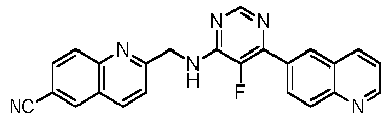
A 1H NMR (400 MHz, DMSO-d 6) δ 8.99 (d, J = 2.4 Hz, 1H), 8.68 - 8.62 (m, 3H), 8.56 (d, J = 8.4 Hz, 1H), 8.46 (d, J = 8.8 Hz, 1H), 8.36 (s, 1H), 8.34 (s, 1H), 8.15 (dd, J = 14.8, 8.8 Hz, 2H), 8.05 (d, J = 8.8 Hz, 1H), 7.72 (d, J = 8.8 Hz, 1H), 7.62 (dd, J = 8.4, 4.0 Hz, 1H), 4.98 (d, J = 6.0 Hz, 2H). 447.0 A-74 
A 1H NMR (400 MHz, CDCl3) δ 8.45 (d, J = 4.8 Hz, 1H), 8.24 (s, 1H), 8.19 (d, J = 8.8 Hz, 2H), 8.06 (s, 1H), 7.90 (d, J = 2.0 Hz, 1H), 7.54 (d, J = 8.8 Hz, 1H), 7.47 (d, J = 7.6 Hz, 1H), 7.19-7.12 (m, 1H), 6.38 (s, 1H), 4.99 (d, J = 4.8 Hz, 2H), 4.88 (s, 2H), 4.07 (t, J = 5.8 Hz, 2H), 3.16 (t, J = 6.0 Hz, 2H). A-75 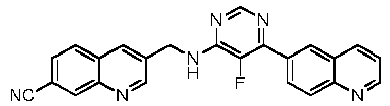
A 1H NMR (400 MHz, CDCl3) δ 9.11 (d, J = 2.2 Hz, 1H), 8.99 (d, J = 4.2 Hz, 1H), 8.55 (d, J = 8.6 Hz, 2H), 8.49 (s, 1H), 8.38 (d, J = 9.0 Hz, 1H), 8.28 (d, J = 8.3 Hz, 1H), 8.23 (m, 2H), 7.93 (d, J = 8.4 Hz, 1H), 7.72 (d, J = 8.4 Hz, 1H), 7.48 (m, 1H), 5.81 (s, 1H), 5.05 (d, J = 6.1 Hz, -2H). A-76 
A 1H NMR (400 MHz, CDCl3) δ 9.04 (s, 1H), 8.45 (d, J = 6.8 Hz, 2H), 8.14 (s, 1H), 8.02 (s, 1H), 7.88 (s, 1H), 7.69 (d, J = 8.2 Hz, 1H), 7.46 (d, J = 7.2 Hz, 1H), 7.15 (s, 1H), 5.30 (s, 2H), 4.94 (d, J = 6.2 Hz, 2H), 4.86 (s, 2H), 4.05 (m, 2H), 3.14 (m, 2H). 412.0 A-77 
A 1H NMR (400 MHz, CDCl3) δ 9.28 (s, 1H), 8.99 (d, J = 3.2 Hz, 1H), 8.78 (d, J = 5.2 Hz, 1H), 8.56 (s, 2H), 8.38 (d, J = 8.8 Hz, 1H), 8.28 (d, J = 8.4 Hz, 1H), 8.22 (d, J = 8.8 Hz, 1H), 8.12 (d, J = 8.0 Hz, 2H), 7.73 (d, J = 5.2 Hz, 1H), 7.56 (d, J = 8.0 Hz, 2H), 7.50-7.44 (m, 1H), 5.67 (s, 1H), 4.89 (d, J = 5.6 Hz, 2H). 409.0 A-78 
A 1H NMR (400 MHz, CDCl3) δ 8.61 (d, J = 5.2 Hz, 1H), 8.54 (s, 1H), 8.00 (s, 1H), 7.76 (s, 1H), 7.68 (d, J = 4.8 Hz, 1H), 7.55 (d, J = 11.6 Hz, 1H), 5.18 (s, 1H), 4.79 (d, J = 6.0 Hz, 2H), 4.18-4.10 (m, 2H), 3.99-3.90 (m, 1H), 3.34-3.24 (m, 2H), 2.64 (s, 3H), 2.02-1.94 (m, 2H), 1.66 - 1.58 (m, 2H). A-79 
A 1H NMR (400 MHz, CDCl3) δ 8.62 (d, J = 5.2 Hz, 1H), 8.55 (s, 1H), 8.04 (s, 1H), 7.76 (s, 1H), 7.68 (d, J = 4.4 Hz, 1H), 7.55 (d, J = 11.2 Hz, 1H), 5.34 (s, 1H), 4.81 (d, J = 6.0 Hz, 2H), 4.20 (s, 4H), 3.12 (s, 4H), 2.65 (s, 3H). A-80 
A 1H NMR (400 MHz, DMSO) δ 8.59-8.54 (m, 2H), 8.07 (s, 1H), 7.90 (s, 1H), 7.80-7.72 (m, 3H), 7.65 (d, J = 4.4 Hz, 1H), 4.66 (d, J = 5.6 Hz, 2H), 4.10 (s, 2H), 3.76 (s, 2H), 3.26 (s, 2H), 2.55 (s, 3H). A-81 
A 1H NMR (400 MHz, CDCl3) δ 8.61 (d, J = 5.2 Hz, 1H), 8.54 (s, 1H), 8.01 (s, 1H), 7.76 (s, 1H), 7.68 (d, J = 4.8 Hz, 1H), 7.55 (d, J = 11.6 Hz, 1H), 5.01 (s, 1H), 4.79 (d, J = 6.0 Hz, 2H), 4.76 (s, 1H), 3.33 (t, J = 6.2 Hz, 2H), 2.65 (s, 3H), 1.13 - 1.02 (m, 1H), 0.56 (d, J = 7.6 Hz, 2H), 0.27 (d, J = 4.8 Hz, 2H). A-82 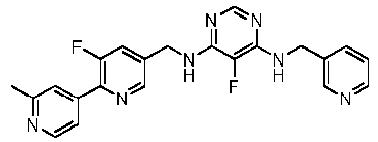
A 1H NMR (400 MHz, DMSO) δ 8.56 (d, J = 5.2 Hz, 1H), 8.54 (s, 1H), 8.51 (s, 1H), 8.41 (d. J = 4.0 Hz, 1H), 7.80 (s, 1H), 7.78-7.71 (m, 2H), 7.69 (d, J = 8.0 Hz, 1H), 7.65 (d, J = 4.8 Hz, 1H), 7.58-7.51 (m, 2H), 7.34-7.29 (m, 1H), 4.62 (d, J = 6.0 Hz, 2H), 4.54 (d, J = 6.0 Hz, 2H), 2.54 (s, 3H). 420.0 A-83 
A 1H NMR (400 MHz, DMSO) δ 8.98 (d, J = 3.2 Hz, 1H), 8.63 (s, 1H), 8.55 (d, J = 8.0 Hz, 1H), 8.43 (s, 2H), 8.32 (d, J = 8.8 Hz, 1H), 8.15 (d, J = 8.8 Hz, 1H), 7.64-7.59 (m, 1H), 7.49 (d, J = 9.6 Hz, 1H), 6.93 (d, J = 9.6 Hz, 1H), 4.58 (d, J = 6.0 Hz, 2H), 3.63 (s, 3H). A-84 
F 1H NMR (400 MHz, DMSO-d6 ) δ 9.52 (s, 1H), 9.14 (d, J = 2.8 Hz, 1H), 8.67 (s, 1H), 8.63 (d, J = 8.4 Hz, 1H), 8.54 (s, 1H), 8.50 (d, J = 5.2 Hz, 1H), 8.43 (s, 1H), 8.36 (s, 1H), 7.87-7.84 (m, 1H), 7.75 (s, 1H), 7.69 (d, J = 4.9 Hz, 1H), 7.67 (s, 1H), 4.77 (d, J = 5.6 Hz, 2H), 3.89 (s, 3H), 2.52 (s, 3H). 454.0 A-85 
F 1H NMR (400 MHz, CDCl3) δ 9.68 (s, 1H), 9.12 (d, J = 3.2 Hz, 1H), 8.63-8.61 (m, 2H), 8.56 (d, J = 9.6 Hz, 2H), 8.30 (d, J = 8.4 Hz, 1H), 7.78 (s, 1H), 7.71-7.67 (m, 2H), 7.61 (d, J = 11.6Hz, 1H), 5.87 (br s, 1H), 4.93 (d, J = 6.0 Hz, 2H), 2.66 (s, 3H). 441.9 A-86 
F 1H NMR (400 MHz, CDCl3) δ 9.67 (s, 1H), 9.12 (d, J = 2.8 Hz, 1H), 8.97 (s, 1H), 8.68 (d, J = 5.2 Hz, 1H), 8.56 (s, 2H), 8.30 (d, J = 8.4 Hz, 1H), 8.17 (s, 1H), 7.71-7.67 (m, 2H), 7.64 (d, J = 4.8 Hz, 1H), 5.94 (br s, 1H), 4.94 (d, J = 6.0 Hz, 2H), 2.67 (s, 3H). 449.0 A-87 
A 1H NMR (400 MHz, CDCl3) δ 8.60 (d, J = 5.2 Hz, 1H), 8.54 (s, 1H), 8.04 (s, 1H), 7.75 (s, 1H), 7.67 (d, J = 4.8Hz, 1H), 7.54 (d, J = 11.6 Hz, 1H), 7.49 (s, 1H), 6.09 (s, 1H), 5.27 (s, 1H), 4.92 (s, 2H), 4.80 (d, J = 6.2 Hz, 2H), 4.31 (t, J = 5.2 Hz, 2H), 4.16 (t, J = 5.2 Hz, 2H), 2.64 (s, 3H). 435.0 A-88 
A 1H NMR (400 MHz, CDCl3) δ 8.61 (d, J = 5.2 Hz, 1H), 8.58 - 8.50 (m, 2H), 8.07 (s, 1H), 7.76 (s, 1H), 7.66 (dd, J = 12.4, 6.0 Hz, 2H), 7.57 (d, J = 11.6 Hz, 1H), 7.22 (s, 1H), 5.19 (s, 1H), 5.06 (d, J = 8.2 Hz, 4H), 4.82 (d, J = 6.0 Hz, 2H), 2.64 (s, 3H). A-89 
A 1H NMR (400 MHz, CDCl3) δ 8.60 (d, J = 5.2 Hz, 1H), 8.51 (s, 1H), 8.18 (d, J = 3.8 Hz, 1H), 7.95 (s, 1H), 7.74 (s, 1H), 7.68 (d, J = 9.0 Hz, 2H), 7.52 (d, J = 11.6 Hz, 1H), 7.08 - 6.92 (m, 1H), 5.15 (s, 1H), 4.79 (s, 2H), 4.75 (d, J = 6.2 Hz, 2H), 4.32 (d, J = 4.0 Hz, 2H), 4.21 (d, J = 3.8 Hz, 2H), 2.64 (s, 3H). A-90 
A 1H NMR (400 MHz, CDCl3) δ 8.59 (d, J = 5.2 Hz, 1H), 8.53 (s, 1H), 8.41 (s, 2H), 8.21 (s, 1H), 8.04 (s, 1H), 7.75 (s, 1H), 7.67 (d, J = 4.8 Hz, 1H), 7.54 (d, J = 11.6Hz, 1H), 5.30 (s, 1H), 4.98 (s, 2H), 4.79 (d, J = 6.2 Hz, 2H), 4.09 (t, J = 5.6 Hz, 2H), 3.17 (t, J = 5.6 Hz, 2H), 2.63 (s, 3H). A-91 
A 1H NMR (400 MHz, DMSO) δ 8.92 (s, 1H), 8.63 (d, J = 5.0 Hz, 1H), 8.34 (s, 1H), 7.95 (s, 2H), 7.67 (s, 1H), 7.61 (d, J = 4.8 Hz, 1H), 5.10 (s, 2H), 4.69 (d, J = 5.8 Hz, 2H), 4.53 (s, 2H), 4.15 (d, J = 4.8 Hz, 2H), 2.56 (s, 3H). A-92 
A 1H NMR (400 MHz, DMSO) δ 8.92 (s, 1H), 8.63 (d, J = 4.6 Hz, 1H), 8.35 (s, 1H), 7.94 (s, 1H), 7.88 (s, 1H), 7.64 (m, 3H), 4.93 (s, 2H), 4.69 (d, J = 5.6 Hz, 2H), 4.47 (s, 2H), 4.10 (s, 2H), 2.56 (s, 3H) A-93 
A 1H NMR (400 MHz, CDCl3) δ 8.60 (d, J = 5.2 Hz, 1H), 8.55 (s, 1H), 8.06 (s, 1H), 7.75 (s, 1H), 7.67 (d, J = 4.6 Hz, 1H), 7.54 (d, J = 11.6 Hz, 1H), 5.52 (s, 1H), 5.18 (s, 2H), 4.81 (d, J = 6.2 Hz, 2H), 4.58 (m, 2H), 4.22 (m, 2H), 2.64 (s, 3H). A-94 
A 1H NMR (400 MHz, CDCl3) δ 8.55 (d, J = 5.2 Hz, 1H), 8.31 (s, 1H), 8.06 (s, 1H), 7.70 (s, 1H), 7.65 (d, J = 4.8 Hz, 1H), 7.49 (s, 1H), 7.36 (s, 1H), 6.09 (s, 1H), 5.21 (s, 1H), 4.92 (s, 2H), 4.77 (d, J = 6.0 Hz, 2H), 4.31 (m, 2H), 4.16 (m, 2H), 3.88 (s, 3H), 2.62 (s, 3H). A-95 
A 1H NMR (400 MHz, DMSO) δ 8.92 (s, 1H), 8.63 (d, J = 4.8 Hz, 1H), 8.35 (s, 1H), 7.94 (s, 1H), 7.88 (s, 1H), 7.64 (m, 3H), 4.93 (s, 2H), 4.69 (d, J = 5.6 Hz, 2H), 4.47 (s, 2H), 4.10 (s, 2H), 2.56 (s, 3H). A-96 
A 1H NMR (400 MHz, DMSO) δ 9.25 (d, J = 7.2 Hz, 1H), 8.85 (s, 1H), 8.63 (d, J = 5.0 Hz, 1H), 8.42 - 8.20 (m, 3H), 7.65 (m,, 4H), 7.53 (d, J = 7.2 Hz, 1H), 6.81 (s, 1H), 4.68 (s, 2H), 2.57 (s, 3H). A-97 
A 1H NMR (400 MHz, CDCl3) δ 8.98 (s, 1H), 8.54 (s, 1H), 8.22 (m, 2H), 8.06 (s, 1H), 8.02 (d, J = 5.2 Hz, 1H), 7.94 (d, J = 8.8 Hz, 1H), 7.63 (d, J = 7.8 Hz, 2H), 7.53 (d, J = 7.8 Hz, 2H), 7.47 (m, 4.0 Hz, 1H), 7.38 (s, 1H), 7.32 (s, 1H), 6.79 (m, 1H), 5.14 (s, 1H), 4.83 (d, J = 5.6 Hz, 2H), 2.63 (s, 3H). A-98 
A 1H NMR (400 MHz, CDCl3) δ 8.98 (d, J = 3.2 Hz, 1H), 8.62 (s, 2H), 8.22 (m, 2H), 8.06 (s, 1H), 8.00 (d, J = 5.2 Hz, 1H), 7.93 (d, J = 8.8 Hz, 1H), 7.78 (s, 1H), 7.70 (d, J = 5.0 Hz, 1H), 7.62 (d, J = 12 Hz, 1H), 7.48 (m, 4.2 Hz, 1H), 6.83 (m, 1H), 5.28 (s, 1H), 4.88 (d, J = 6.0 Hz, 2H), 2.65 (s, 3H). 429.9 A-99 
A 1H NMR (400 MHz, CDCl3) δ 8.97 (d, J = 9.6 Hz, 2H), 8.68 (d, J = 5.2 Hz, 1H), 8.22 (m, 3H), 8.07 (s, 1H), 7.98 (d, J = 5.2 Hz, 1H), 7.93 (d, J = 8.4 Hz, 1H), 7.69 (s, 1H), 7.64 (d, J = 4 Hz, 1H), 7.48 (m, 1H), 6.86 (m, 1H), 5.35 (s, 1H), 4.89 (d, J = 6.2 Hz, 2H), 2.67 (s, 3H). A-100 
A 1H NMR (400 MHz, CDCl3) δ 8.98 (d, J = 2.6 Hz, 1H), 8.94 (s, 2H), 8.65 (d, J = 5.2 Hz, 1H), 8.20 (m, 3H), 8.07 (d, J = 17.8 Hz, 2H), 7.99 (d, J = 5.2 Hz, 1H), 7.92 (d, J = 8.4 Hz, 1H), 7.47 (m, 1H), 6.83 (m, 1H), 5.28 (s, 1H), 4.84 (d, J = 6.0 Hz, 2H), 2.68 (s, 3H). A-101 
A 1H NMR (400 MHz, CDCl3) δ 8.98 (d, J = 4 Hz, 1H), 8.80 (s, 1H), 8.60 (d, J = 5.2Hz, 1H), 8.22 (m, 2H), 8.06 (s, 1H), 8.00 (d, J = 5.2 Hz, 1H), 7.91 (m, 2H), 7.84 - 7.74 (m, 2H), 7.68 (d, J = 5.0 Hz, 1H), 7.47 (m, 1H), 6.81 (m, 1H), 5.21 (s, 1H), 4.86 (m, 2H), 2.66 (s, 3H). A-102 
A 1H NMR (400 MHz, CDCl3) δ 8.97 (d, J = 2.8 Hz, 1H), 8.53 (d, J = 5.2 Hz, 1H), 8.27-8.15 (m, 2H), 8.04 (s, 1H), 7.95-7.89 (m, 2H), 7.62 (d, J = 8.0 Hz, 2H), 7.55 (d, J = 8.0 Hz, 2H), 7.47 (dd, J = 8.4, 4.4 Hz, 1H), 7.37 (s, 1H), 7.31 (d, J = 4.4 Hz, 1H), 6.76-6.70 (m, 1H), 5.48-5.39 (m, 1H), 5.06 (d, J = 5.6 Hz, 1H), 2.62 (s, 3H), 1.67 (d, J = 6.8 Hz, 3H). 435.0 A-103 
A 1H NMR (400 MHz, CDCl3) δ 9.64 (s, 1H), 9.09 (d, J = 2.4 Hz, 1H), 8.61 (d, J = 4.8 Hz, 2H), 8.26 (d, J = 9.2 Hz, 2H), 8.05 (d, J = 5.2 Hz, 1H), 7.78 (s, 1H), 7.72-7.65 (m, 2H), 7.62 (d, J = 11.6 Hz, 1H), 7.41 (t, J = 5.2 Hz, 1H), 5.28 (s, 1H), 4.89 (d, J = 6.0 Hz, 2H), 2.65 (s, 3H). 441.0 A-104 
A 1H NMR (400 MHz, CDCl3) δ 8.98 (d, J = 2.8 Hz, 1H), 8.66 (d, J = 6.0 Hz, 2H), 8.26-8.17 (m, 2H), 8.06 (s, 1H), 8.02 (d, J = 5.2 Hz, 1H),7.94 (d, J = 8.8 Hz, 1H), 7.65 (d, J = 8.0 Hz, 2H), 7.58-7.50 (m, 4H), 7.47 (dd, J = 8.4, 4.4 Hz, 1H), 6.81-6.77 (m, 1H), 5.15 (s, 1H), 4.83 (d, J = 6.0 Hz, 2H). 407.0 A-105 
A 1H NMR (400 MHz, CDCl3) δ 8.98 (d, J = 3.2 Hz, 1H), 8.26-8.18 (m, 2H), 8.06 (s, 2H), 8.00 (d, J = 5.2 Hz, 1H), 7.93 (d, J = 8.8 Hz, 1H), 7.55 (d, J = 8.0 Hz, 2H), 7.47 (dd, J = 8.0, 4.0 Hz, 1H), 7.39 (d, J = 8.4 Hz, 2H), 7.29 (d, J = 10.0 Hz, 2H), 6.83-6.77 (m, 1H), 5.19 (s, 1H), 4.83 (d, J = 6.0 Hz, 2H). A-106 
A 1H NMR (400 MHz, CDCl3) δ 8.98 (d, J = 3.6 Hz, 1H), 8.56 (d, J = 4.8 Hz, 1H), 8.39 (s, 1H), 8.26-8.18 (m, 2H), 8.06 (s, 1H), 8.02 (d, J = 5.2 Hz, 1H), 7.93 (d, J = 8.8 Hz, 1H), 7.72 (s, 1H), 7.67 (d, J = 4.8 Hz, 1H), 7.50-7.43 (m, 2H), 6.85-6.80 (m, 1H), 5.20 (s, 1H), 4.84 (d, J = 6.0 Hz, 2H), 3.90 (s, 3H), 2.62 (s, 3H). 452.0 A-107 
A 1H NMR (400 MHz, DMSO) δ 8.97 (d, J = 3.2 Hz, 1H), 8.48 (d, J = 8.0 Hz, 1H), 8.27 (s, 1H), 8.17-8.07 (m, 2H), 7.98 (d, J = 8.8 Hz, 1H), 7.90 (d, J = 5.2 Hz, 1H), 7.61 (dd, J = 8.0, 4.0 Hz, 1H), 7.53 (d, J = 8.4 Hz, 3H), 7.47 (d, J = 8.4 Hz, 2H), 7.41 (s, 1H), 6.83-6.77 (m, 1H), 4.65 (d, J = 5.6 Hz, 2H), 2.16 (s, 3H). A-108 
A 1H NMR (400 MHz, CDCl3) δ 9.04 (s, 1H), 8.61 (s, 2H), 8.50 (dd, J = 13.2, 8.8 Hz, 2H), 8.13 (d, J = 8.4 Hz, 1H), 8.06 (d, J = 5.2 Hz, 1H), 7.81-7.67 (m, 3H), 7.61 (d, J = 11.6 Hz, 1H), 7.32-7.29 (m, 1H), 5.31 (s, 1H), 4.88 (d, J = 5.6 Hz, 2H), 2.64 (s, 3H). 441.0 A-109 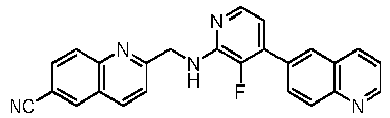
A 1H NMR (400 MHz, CDCl3) δ 8.99 (d, J = 4.4 Hz, 1H), 8.19-8.25 (m, 5H), 8.11 (s, 1H), 8.02 (d, J = 5.2 Hz, 1H), 7.97 (d, J = 8.8 Hz, 1H), 7.88 (d, J = 8.8 Hz, 1H), 7.61 (d, J = 8.4 Hz, 1H), 7.52 - 7.45 (m, 1H), 6.82 (d, J = 5.2 Hz, 1H), 6.38 (s, 1H), 5.08 (d, J = 4.8 Hz, 2H). A-110 
A 1H NMR (400 MHz, CDCl3) δ 9.39 (d, J = 5.6 Hz, 1H), 8.65 (d, J = 8.8 Hz, 1H), 8.62 (s, 2H), 8.08-8.01 (m, 3H), 7.93 (d, J = 6.0 Hz, 1H), 7.78 (s, 1H), 7.70 (d, J = 4.0 Hz, 1H), 7.62 (d, J = 11.6 Hz, 1H), 6.84-6.79 (m, 1H), 5.33 (s, 1H), 4.88 (d, J = 6.0 Hz, 2H), 2.66 (s, 3H). 441.0 A-111 
A 1H NMR (400 MHz, CDCl3) δ 8.97 (d, J = 3.2 Hz, 1H), 8.28 (s, 1H), 8.24-8.16 (m, 2H), 8.04 (s, 1H), 8.01 (d, J = 5.2 Hz, 1H), 7.92 (d, J = 8.8 Hz, 1H), 7.66 (d, J = 7.2 Hz, 1H), 7.47 (dd, J = 8.4, 4.4 Hz, 1H), 6.82-6.72 (m, 2H), 5.01 (s, 1H), 4.66 (d, J = 5.6 Hz, 2H), 4.17 (s, 4H), 3.05 (s, 4H). A-112 
A 1H NMR (400 MHz, CDCl3) δ 8.97 (d, J = 3.2 Hz, 1H), 8.24-8.14 (m, 3H), 8.04 (s, 1H), 8.01 (d, J = 5.2 Hz, 1H), 7.91 (d, J = 8.8 Hz, 1H), 7.52 (d, J = 6.8 Hz, 1H), 7.46 (dd, J = 8.4,4.0 Hz, 1H), 6.80-6.74 (m, 1H), 6.47 (d, J = 8.4 Hz, 1H), 4.94 (d, J = 6.0 Hz, 2H), 4.60 (d, J = 5.6 Hz, 2H), 3.95 (q, J = 6.0 Hz, 2H), 3.39 (t, J = 5.6 Hz, 2H), 2.95 (s, 3H). 452.0 A-113 
A 1H NMR (400 MHz, CDCl3) δ 8.98 (d, J = 3.2 Hz, 1H), 8.26-8.18 (m, 2H), 8.06 (s, 1H), 8.02 (d, J = 5.2 Hz, 1H), 7.94 (d, J = 8.8 Hz, 1H), 7.51 (d, J = 6.4 Hz, 3H), 7.47 (dd, J = 8.0,4.0 Hz, 1H), 7.42 (d, J = 8.0 Hz, 2H), 6.82-6.77 (m, 1H), 6.31 (s, 1H), 5.15 (s, 1H), 4.83 (d, J = 5.6 Hz, 2H), 3.90 (s, 3H). A-114 
A 1H NMR (400 MHz, CDCl3) δ 8.61 (d, J = 5.2 Hz, 2H), 8.06 (s, 1H), 8.02 (d, J = 5.2 Hz, 1H), 7.96 (d, J = 9.2 Hz, 1H), 7.77 (s, 1H), 7.69 (d, J = 4.8 Hz, 1H), 7.61 (d, J = 10.8 Hz, 2H), 6.77-6.72 (m, 1H), 5.32 (s, 1H), 4.87 (d, J = 6.0 Hz, 2H), 2.65 (s, 3H). A-115 
A 1H NMR (400 MHz, CDCl3) δ 8.67 (s, 1H), 8.61 (d, J = 6.0 Hz, 2H), 8.55 (s, 1H), 8.00 (d, J = 5.2 Hz, 1H), 7.77 (s, 1H), 7.69 (d, J = 4.0 Hz, 1H), 7.65 (d, J = 9.2 Hz, 1H), 7.60 (d, J = 11.6 Hz, 1H), 6.73-6.68 (m, 1H), 5.30 (s, 1H), 4.85 (d, J = 6.0 Hz, 2H), 2.65 (s, 3H). A-116 
A 1H NMR (400 MHz, CDCl3) δ 8.71 (s, 1H), 8.65-8.57 (m, 3H), 7.99 (d, J = 5.2 Hz, 1H), 7.90 (s, 1H), 7.77 (s, 1H), 7.69 (d, J = 4.4 Hz, 1H), 7.59 (d, J = 11.6 Hz, 1H), 6.71-6.65 (m, 1H), 5.28 (s, 1H), 4.85 (d, J = 6.0 Hz, 2H), 2.65 (s, 3H). A-117 
A 1H NMR (400 MHz, CDCl3) δ 8.61 (d, J = 5.2 Hz, 1H), 8.58 (s, 1H), 7.91 (d, J = 5.2 Hz, 1H), 7.77 (s, 1H), 7.68 (s, 2H), 7.62-7.55 (m, 2H), 6.68 (d, J = 9.6 Hz, 1H), 6.62-6.58 (m, 1H), 5.20 (s, 1H), 4.83 (d, J = 6.0 Hz, 2H), 3.63 (s, 3H), 2.65 (s, 3H). A--118 
A 1H NMR (400 MHz, CDCl3) δ 9.27 (d, J = 2.0 Hz, 1H), 8.98 (d, J = 4.0 Hz, 1H), 8.65 (d, J = 2.0 Hz, 1H), 8.21-8.26 (m, 2H), 8.16 (s, 1H), 8.08 (s, 1H), 7.99 (d, J = 5.2 Hz, 1H), 7.97-7.89 (m, 2H), 7.70 (d, J = 4.8 Hz, 1H), 7.46-7.49 (m, 1H), 6.80 (t, J = 6.8 Hz, 1H), 5.34 (s, 1H), 5.05 (d, J = 6.0 Hz, 2H). A-119 
A 1H NMR (400 MHz, CDCl3) δ 9.12 (s, 1H), 8.99 (d, J = 2.0 Hz 1H), 8.48 (s, 1H), 8.27 - 8.18 (m, 3H), 8.07 (s, 1H), 7.99 (d, J = 5.2 Hz, 1H), 7.92 (t, J = 8.6 Hz, 2H), 7.70 (d, J = 8.4 Hz, 1H), 7.5-7.46 (m, 1H), 6.83 (t, J = 5.2 Hz, 1H), 5.34 (s, 1H), 5.01 (d, J = 6.0 Hz, 3H). A-120 
A 1H NMR (400 MHz, CDCl3) δ 8.98 (d, J = 2.8 Hz, 1H), 8.39 (s, 1H), 8.24 (d, J = 8.4 Hz, 1H), 8.20 (d, J = 8.8 Hz, 1H), 8.04 (s, 1H), 8.00 (d, J = 5.2 Hz, 1H), 7.90 (d, J = 8.8 Hz, 1H), 7.53 (d, J = 8.8 Hz, 1H), 7.48 (dd, J = 8.2, 4.2 Hz, 1H), 6.79 (t, J = 5.2 Hz, 1H), 6.41 (d, J = 9.2 Hz, 1H), 6.30 (s, 1H), 5.35 (s, 1H), 3.84 (m, 2H), 3.69 (m, 2H). A-121 
A 1H NMR (400 MHz, DMSO) δ 9.54 (s, 1H), 9.13 (d, J = 3.2 Hz, 1H), 8.99 (s, 1H), 8.64 (d, J = 4.8 Hz, 1H), 8.60 (d, J = 8.4 Hz, 1H), 8.47 (s, 1H), 8.43 (s, 1H), 7.95 (d, J = 5.2 Hz, 1H), 7.86 (dd, J = 8.4, 4.4 Hz, 1H), 7.69 (s, 1H), 7.64 (d, J = 5.2 Hz, 2H), 7.26-7.20 (m, 1H), 4.77 (d, J = 5.6 Hz, 2H), 2.57 (s, 3H). 448.0 A-122 
A 1H NMR (400 MHz, DMSO) δ 9.54 (s, 1H), 9.13 (d, J = 3.6 Hz, 1H), 8.60 (d, J = 8.0 Hz, 1H), 8.47 (d, J = 7.2 Hz, 2H), 8.32 (s, 1H), 7.96 (d, J = 5.2 Hz, 1H), 7.86 (dd, J = 8.0, 4.0 Hz, 1H), 7.73 (s, 1H), 7.66 (s, 2H), 7.60-7.54 (m, 1H), 7.23-7.19 (m, 1H), 4.72 (d, J = 5.6 Hz, 2H), 3.88 (s, 3H), 2.51 (s, 3H). 452.9 A--123 
A 1H NMR (400 MHz, DMSO) δ 9.30 (s, 1H), 8.61 (d, J = 6.0 Hz, 2H), 8.57 (d, J = 5.2 Hz, 1H), 7.99 (d, J = 9.2 Hz, 1H), 7.95 - 7.87 (m, 2H), 7.82 (d, J = 12.2 Hz, 1H), 7.74 (s, 1H), 7.66 (d, J = 5.2 Hz, 2H), 6.87 (t, J = 5.0 Hz, 1H), 4.72 (d, J = 5.8 Hz, 2H), 2.55 (s, 3H). 430.0 A124 
A 1H NMR (400 MHz, CDCl3) δ 8.91 (s, 2H), 8.61 (d, J = 5.2 Hz, 2H), 8.36 (s, 1H), 8.22 (d, J = 8.8 Hz, 1H), 8.01 (t, J = 7.6 Hz, 2H), 7.77 (s, 1H), 7.69 (d, J = 4.8 Hz, 1H), 7.63 (d, J = 11.6 Hz, 1H), 6.85 (t, J = 5.2 Hz, 1H), 5.31 (s, 1H), 4.88 (d, J = 5.8 Hz, 2H), 2.65 (s, 3H). 440.9 A-125 
A 1H NMR (400 MHz, CDCl3) δ 9.02 (s, 1H), 8.51 (d, J = 10.3 Hz, 3H), 8.38 (s, 1H), 8.09 (d, J = 9.2 Hz, 2H), 7.69 (s, 3H), 7.44 (s, 1H), 7.26 (s, 1H), 5.28 (s, 1H), 4.83 (s, 2H), 3.88 (s, 3H), 2.62 (s, 3H). 453.0 A-126 
A 1H NMR (400 MHz, CDCl3) δ 8.98 (d, J = 3.4 Hz, 1H), 8.91 (s, 1H), 8.62 (d, J = 5.2 Hz, 1H), 8.45 (m, 2H), 8.12 (s, 1H), 8.08 (d, J = 8.6 Hz, 1H), 7.99 (d, J = 5.2 Hz, 1H), 7.65 (m, 2H), 7.58 (d, J = 4.8Hz, 1H), 7.28 (m, 1H), 5.33 (s, 1H), 4.84 (d, J = 6.0 Hz, 2H), 2.62 (s, 3H). 447.9 A-127 
A 1H NMR (400 MHz, CDCl3) δ 8.94 (s, 1H), 8.68 (s, 1H), 8.61 (s, 1H), 8.16 (s, 1H), 7.96 (s, 1H), 7.68 (s, 1H), 7.64 (s, 1H), 7.35 (s, 1H), 7.29 (s, 1H), 6.73 (s, 1H), 5.34 (s, 1H), 4.87 (d, J = 4.4 Hz, 2H), 2.66 (d, J = 10.6 Hz, 6H). 411.0 A-128 
A 1H NMR (400 MHz, CDCl3) δ 8.93 (s, 1H), 8.67 (d, J = 5.2 Hz, 1H), 8.15 (s, 1H), 7.90 (s, 1H), 7.83 (d, J = 5.6 Hz, 2H), 7.67 (s, 1H), 7.63 (d, J = 4.8 Hz, 1H), 7.52 (s, 1H), 6.81 (t, J = 5.2 Hz, 1H), 5.23 (s, 1H), 4.84 (d, J = 6.0 Hz, 2H), 3.96 (d, J = 17.6 Hz, 3H), 2.66 (s, 3H). A-129 
A 1H NMR (400 MHz, CDCl3) δ 8.94 (s, 1H), 8.67 (d, J = 5.2 Hz, 1H), 8.44 (s, 1H), 8.38 (s, 1H), 8.16 (s, 1H), 7.96 (d, J = 5.2 Hz, 1H), 7.68 (s, 1H), 7.63 (d, J = 4.8 Hz, 1H), 7.40 (s, 1H), 6.74 (t, J = 5.0 Hz, 1H), 5.34 (s, 1H), 4.87 (d, J = 6 Hz, 2H), 3.93 (s, 3H), 2.67 (s, 3H). 427.0 A-130 
A 1H NMR (400 MHz, CDCl3) δ 8.94 (s, 1H), 8.72 (s, 1H), 8.68 (d, J = 4.8 Hz, 1H), 8.64 (s, 1H), 8.15 (s, 1H), 7.98 (d, J = 5.0 Hz, 1H), 7.91 (s, 1H), 7.68 (s, 1H), 7.63 (d, J = 4.6 Hz, 1H), 6.72 (d, J = 4.8 Hz, 1H), 5.37 (s, 1H), 4.87 (d, J = 5.8 Hz, 2H), 2.67 (s, 3H). A-131 
A 1H NMR (400 MHz, CDCl3) δ 9.03 (s, 1H), 8.95 (s, 2H), 8.68 (d, J = 4.6 Hz, 1H), 8.17 (d, J = 14.4 Hz, 2H), 8.02 (d, J = 4.8 Hz, 1H), 7.69 (s, 1H), 7.64 (s, 1H), 6.72 (s, 1H), 5.41 (s, 1H), 4.88 (d, J = 5.8 Hz, 2H), 2.68 (s, 3H). A-132 
A 1H NMR (400 MHz, CDCl3) δ 8.94 (s, 1H), 8.81 - 8.59 (m, 2H), 8.51 (s, 1H), 8.16 (s, 1H), 7.95 (d, J = 5.2 Hz, 1H), 7.69 (d, J = 10.2 Hz, 2H), 7.63 (d, J = 4.8 Hz, 1H), 6.73 (t, J = 5.2 Hz, 1H), 5.33 (s, 1H), 4.86 (d, J = 6.0 Hz, 2H), 2.67 (s, 3H), 2.43 (s, 3H). 411.0 A-133 
A 1H NMR (400 MHz, CDCl3) δ 8.53 (s, 1H), 8.22 (s, 1H), 7.61 (d, J = 7.2 Hz, 2H), 7.45 (d, J = 7.2 Hz, 2H), 7.36 (s, 1H), 7.30 (s, 1H), 7.17 (s, 4H), 5.44 (s, 1H), 5.20 (s, 1H), 4.64 (s, 2H), 4.56 (s, 2H), 3.77 (s, 2H), 2.91 (s, 2H), 2.61 (s, 3H). 408.0 A-134 
A 1H NMR (400 MHz, CDCl3) δ 8.76 (s, 1H), 8.54 (d, J = 5.2 Hz, 1H), 8.51 (s, 1H), 8.02 (d, J = 8.8 Hz, 1H), 7.93 (t, J = 8.0 Hz, 2H), 7.90-7.85 (m, 1H), 7.65 (s, 1H), 7.63 (s, 1H), 7.54 (t, J = 5.0 Hz, 1H), 7.51 (s, 2H), 7.49 (s, 1H), 7.37 (s, 1H), 7.31 (d, J = 5.2 Hz, 1H), 6.89 (s, 1H), 5.45 (s, 1H), 4.74 (d, J = 5.6 Hz, 2H), 2.62 (s, 3H). 403.0 A-135 
A 1H NMR (400 MHz, CDCl3) δ 8.54 (d, J = 5.2 Hz, 1H), 7.61 (d, J = 8.0 Hz, 2H), 7.44 (d, J = 8.0 Hz, 2H), 7.36 (s, 1H), 7.30 (d, J = 5.2 Hz, 1H), 7.16 (brs, 4H), 5.74 (s, 1H), 5.12 (brs, 1H), 4.85 (s, 2H), 4.61 (brs, 2H), 3.99 (t, J = 5.8 Hz, 2H), 2.88 (t, J = 5.4 Hz, 2H), 2.62 (s, 3H). 442.0 A-136 
A 1H NMR (400 MHz, CDCl3) δ 8.53 (d, J = 5.2 Hz, 1H), 7.58 (d, J = 8.0 Hz, 2H), 7.46 (d, J = 8.0 Hz, 2H), 7.36 (s, 1H), 7.30 (d, J = 5.2 Hz, 1H), 7.18-7.10 (m, 4H), 4.88 (s, 2H), 4.76 (s, 2H), 4.53 (d, J = 5.6 Hz, 2H), 4.01 (t, J = 5.6 Hz, 2H), 3.41 (s, 4H), 2.87 (t, J = 5.6 Hz, 2H), 2.62 (s, 3H), 1.92 (s, 4H). 477.1 A-137 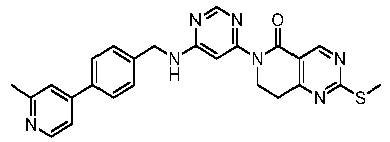
A 1H NMR (400 MHz, CDCl3) δ 9.09 (s, 1H), 8.54 (d, J = 5.2 Hz, 1H), 8.49 (s, 1H), 7.63 (d, J = 8.0 Hz, 2H), 7.47 (d, J = 8.0 Hz, 2H), 7.39 (s, 1H), 7.38 (s, 1H), 7.32 (d, J = 4.8 Hz, 1H), 5.36 (br s, 1H), 4.68 (s, 2H), 4.44 (t, J = 6.0 Hz, 2H), 3.15 (t, J = 6.8 Hz, 2H), 2.64 (s, 6H). 470.0 A-138 
A 1H NMR (400 MHz, CDCl3) δ 8.98 (s, 0.4H), 8.84 (s, 0.6H), 8.60-8.55 (m, 1H), 8.46 (s, 1H), 7.61 (d, J = 8.0 Hz, 2H), 7.45 (d, J = 8.0 Hz, 2H), 7.40-7.30 (m, 2H), 7.27 (s, 1H), 5.73-5.51 (m, 1H), 5.38 (br s, 1H), 4.65 (s, 2H), 4.37 (s, 2H), 3.09 (s, 3H), 3.09-2.88 (m, 2H), 2.62 (s, 3H). 453.0 A-139 
A 1H NMR (400 MHz, CDCl3) δ 8.53 (d, J = 5.2 Hz, 1H), 8.47 (s, 1H), 8.00 (m, 1H), 7.89 (m, 3H), 7.63 (d, J = 8.4 Hz, 2H), 7.54 - 7.47 (m, 4H), 7.36 (s, 1H), 7.30 (d, J = 4.0 Hz, 1H), 6.67 (s, 1H), 5.49 (s, 1H), 4.70 (d, J = 6.0 Hz, 2H), 2.66 (s, 3H), 2.62 (s, 3H). 417.0 A-140 
A 1H NMR (400 MHz, CDCl3) δ 8.54 (d, J = 5.2 Hz, 1H), 8.50 (s, 1H), 8.05-8.03 (m, 1H), 7.96 - 7.82 (m, 3H), 7.62 (d, J = 8.4 Hz, 2H), 7.55 - 7.49 (m, 2H), 7.47 (d, J = 8.4 Hz, 2H), 7.36 (s, 1H), 7.30 (d, J = 4.0 Hz, 1H), 6.58 (s, 1H), 5.38 (s, 1H), 4.72 (d, J = 4.4 Hz, 2H), 2.63 (s, 3H), 2.62 (s, 3H). 449.0 A-141 
A 1H NMR (400 MHz, CDCl3) δ 8.53 (d, J = 5.2 Hz, 1H), 8.48 (s, 1H), 8.09 (d, J = 8.4 Hz, 1H), 7.94 - 7.81 (m, 3H), 7.61 (d, J = 8.0 Hz, 2H), 7.51-7.47 (m, 4H), 7.36 (s, 1H), 7.30 (d, J = 5.2 Hz, 1H), 6.27 (s, 1H), 5.08 (s, 1H), 4.71 (d, J = 6.0 Hz, 2H), 3.69 (s, 4H), 2.62 (s, 3H), 1.99 (t, J = 6.5 Hz, 4H). 472.0 A-142 
A 1H NMR (400 MHz, CDCl3) δ 8.54 (d, J = 4.8 Hz, 1H), 8.45 (s, 1H), 8.01 (d, J = 8.0 Hz, 1H), 7.95 - 7.82 (m, 3H), 7.62 (d, J = 8.4 Hz, 2H), 7.49 (d, J = 7.6 Hz, 4H), 7.37 (s, 1H), 7.31 (d, J = 5.2 Hz, 1H), 6.29 (s, 1H), 5.10 (s, 1H), 4.95 (s, 1H), 4.70 (d, J = 5.2 Hz, 2H), 3.54 (s, 2H), 2.62 (s, 3H), 1.26 (t, J = 7.0 Hz, 3H). 446.1 A-143 
A 1H NMR (400 MHz, CDCl3) δ 8.68 (s, 1H), 8.55 (d, J = 5.2 Hz, 1H), 7.99 (s, 1H), 7.96 - 7.86 (m, 3H), 7.64 (d, J = 8.0 Hz, 3H), 7.52 (t, J = 6.8 Hz, 4H), 7.37 (s, 1H), 7.31 (d, J = 4.8 Hz, 1H), 5.10 (s, 1H), 4.87 (d, J = 5.2 Hz, 2H), 2.63 (s, 3H), 2.18 (s, 3H). 417.0 A-144 
A 1H NMR (400 MHz, CDCl3) δ 8.84 (s, 1H), 8.56 (d, J = 5.2 Hz, 1H), 8.54 (s, 1H), 8.06 (d, J = 8.8 Hz, 1H), 7.99 (d, J = 8.8 Hz, 2H), 7.91 (d, J = 7.6 Hz, 1H), 7.65 (d, J = 8.0 Hz, 2H), 7.62-7.55 (m, 2H), 7.50 (d, J = 8.0 Hz, 2H), 7.37 (s, 1H), 7.31 (d, J = 4.0 Hz, 1H), 6.14 (s, 1H), 4.90 (d, J = 5.6 Hz, 2H), 2.63 (s, 3H). 428.0 A-145 
A 1H NMR (400 MHz, CDCl3) δ 8.54 (d, J = 5.2 Hz, 1H), 8.48 (s, 1H), 8.14 (d, J = 7.6 Hz, 1H), 7.55-7.42 (m, 4H), 7.40 (d, J = 8.0 Hz, 1H), 7.36 (s, 1H), 7.31 (d, J = 9.2 Hz, 1H), 7.25 (s, 1H), 5.43 (br s, 1H), 4.66 (d, J = 5.6 Hz, 2H), 4.36 (d, J = 6.4 Hz, 2H), 3.07 (d, J = 6.4 Hz, 2H), 2.62 (s, 3H). A-146 
A 1H NMR (400 MHz, CDCl3) δ 8.65-8.58 (m, 3H), 8.57 (s, 1H), 8.20-7.95 (m, 5H), 7.79 (d, J = 8.0 Hz, 2H), 7.70 (d, J = 5.2 Hz, 2H), 7.57 (d, J = 9.2 Hz, 2H), 7.52 (d, J = 6.4 Hz, 1H), 7.19 (s, 1H), 4.69 (d, J = 6.0 Hz, 2H). 389.0 A-147 
A 1H NMR (400 MHz, CDCl3) δ 8.71 (s, 1H), 8.53 (d, J = 5.2 Hz, 1H), 8.42 (s, 1H), 7.95-7.80 (m, 4H), 7.64 (d, J = 8.4 Hz, 2H), 7.54-7.50 (m, 4H), 7.35 (s, 1H), 7.29 (d, J = 5.2 Hz, 2H), 6.73 (s, 1H), 5.39 (br s, 1H), 5.08 (m, 1H) 2.61 (s, 3H), 1.67 (d, J = 6.8 Hz, 3H). 417.0 A-148 
A 1H NMR (400 MHz, CDCl3) δ 9.30 (s, 1H), 8.77 (s, 1H), 8.57 (d, J = 6.0 Hz, 1H), 8.54 (d, J = 6.0 Hz, 1H), 8.47 (s, 1H), 8.13 (d, J = 8.0 Hz, 1H), 8.07 (d, J = 8.0 Hz, 1H), 7.75 (d, J = 6.0 Hz, 1H), 7.64 (d, J = 8.0 Hz, 2H), 7.50 (d, J = 8.0 Hz, 2H), 7.37 (s, 1H), 7.31 (d, J = 4.8 Hz, 1H), 6.90 (s, 1H), 5.30 (br s, 1H), 4.75 (s, 2H) 2.62 (s, 3H). 404.0 A-149 
B 1H NMR (400 MHz, CDCl3) δ 8.55 (d, J = 5.2 Hz, 1H), 7.99 (s, 1H), 7.91 - 7.83 (m, 3H), 7.71 (m, 1H), 7.64 (d, J = 8.0 Hz, 2H), 7.54 (d, J = 8.4 Hz, 2H), 7.51 - 7.44 (m, 2H), 7.39 (s, 1H), 7.31 (m, 2H), 7.10 (d, J = 7.6 Hz, 1H), 7.00 (s, 1H), 6.68 (m, 1H), 4.50 (s, 2H), 4.30 (s, 1H), 2.65 (s, 3H). 401.1 A-150 
A 1H NMR (400 MHz, CDCl3) δ 8.54 (d, J = 5.2 Hz, 1H), 8.46 (s, 1H), 8.12 (d, J = 8.4 Hz, 1H), 7.90 (d, J = 8.4 Hz, 2H), 7.84 (s, 1H), 7.63 (d, J = 8.4 Hz, 2H), 7.55 (m, 3H), 7.51 - 7.45 (m, 2H), 7.38 (s, 1H), 7.33 (s, 1H), 7.24 (d, J = 8.0 Hz, 1H), 6.40 (d, J = 8.0 Hz, 1H), 4.72 (d, J = 5.6 Hz, 2H), 2.62 (s, 3H). 402.0 A-151 
A 1H NMR (400 MHz, CDCl3) δ 8.91 (s, 1H), 8.55 (s, 1H), 8.49 (d, J = 8.2Hz, 1H), 8.37 (s, 1H), 7.97 (d, J = 6.4 Hz, 1H), 7.89 (dd, J = 16.2, 7.8 Hz, 2H), 7.63 (d, J = 7.2 Hz, 2H), 7.52 (d, J = 6.2 Hz, 4H), 7.37 (s, 1H), 7.31 (s, 1H), 6.31 (d, J = 5.2 Hz, 1H), 5.43 (s, 1H), 4.78 (s, 2H), 2.62 (s, 3H), 1.74 (s, 1H), 1.24 (s, 1H). 403.0 A-152 
A 1H NMR (400 MHz, CDCl3) δ 8.53 (s, 2H), 8.41 (s, 1H), 8.13 (d, J= 7.8 Hz, 1H), 7.94 (s, 2H), 7.87 (s, 1H), 7.62 (d, J = 6.4 Hz, 2H), 7.55 (d, J = 4.2 Hz, 4H), 7.37 (s, 1H), 7.31 (s, 1H), 7.18 (s, 1H), 5.67 (s, 1H), 4.85 (s, 2H), 2.62 (s, 3H). 403.0 A-153 
A 1H NMR (400 MHz, CDCl3) δ 8.53 (d, J = 5.2 Hz, 1H), 8.42 (s, 1H), 7.96 (d, J = 8.8 Hz, 1H), 7.93-7.82 (m, 3H), 7.61 (d, J = 8.4 Hz, 2H), 7.53-7.48 (m, 2H), 7.46 (d, J = 8.4 Hz, 2H), 7.35 (s, 1H), 7.29 (d, J = 5.2 Hz, 1H), 6.34 (s, 1H), 5.25 (s, 1H), 4.94 (s, 2H), 4.67 (d, J = 5.6 Hz, 2H), 2.61 (s, 3H). 418.0 A-154 
A 1H NMR (400 MHz, CDCl3) δ 8.96 (s, 1H), 8.52 (d, J = 8.8 Hz, 2H), 8.44 (d, J = 4.0 Hz, 1H), 8.36 (d, J = 8.8 Hz, 1H), 8.25 (d, J = 8.0 Hz, 1H), 8.19 (d, J = 8.8 Hz, 1H), 7.62 (d, J = 7.6 Hz, 2H), 7.54 (d, J = 7.6 Hz, 2H), 7.46 (dd, J = 7.6, 4.4 Hz, 1H), 7.36 (s, 1H), 7.30 (d, J = 4.4 Hz, 1H), 7.18 (d, J = 5.2 Hz, 1H), 5.65 (s, 1H), 4.84 (d, J = 5.2 Hz, 2H), 2.61 (s, 3H). 404.0 A-155 
A 1H NMR (400 MHz, CDCl3) δ 8.52 (d, J = 5.2 Hz, 1H), 7.81 (d, J = 5.6 Hz, 1H), 7.59 (d, J = 8.0 Hz, 2H), 7.49 (d, J = 8.0 Hz, 2H), 7.35 (s, 1H), 7.30 (d, J = 4.8 Hz, 1H), 7.26 (s, 1H), 7.22-7.10 (m, 4H), 5.98 (d, J = 6.4 Hz, 1H), 4.69 (s, 2H), 4.68 (s, 2H), 3.80 (s, 2H), 2.91 (t, J = 5.6 Hz, 2H), 2.61 (s, 3H). 408.1 A156 
A 1H NMR (400 MHz, CDCl3) δ 8.53 (d, J = 5.2 Hz, 1H), 8.44 (d, J = 4.4 Hz, 1H), 7.89 (d, J = 4.4 Hz, 1H), 7.59 (d, J = 7.6 Hz, 2H), 7.48 (d, J = 8.0 Hz, 2H), 7.42 (d, J = 7.2 Hz, 1H), 7.35 (s, 1H), 7.29 (d, J = 4.8 Hz, 1H), 7.16-7.10 (m, 1H), 6.02 (d, J = 6.0 Hz, 1H), 4.72 (s, 2H), 4.68 (d, J = 5.6 Hz, 2H), 3.92 (t, J = 5.6 Hz, 2H), 3.09 (t, J = 5.6 Hz, 2H), 2.61 (s, 3H). 409.0 A-157 
A 1H NMR (400 MHz, CDCl3) δ 8.94 (d, J = 4.0 Hz, 1H), 8.89 (s, 1H), 8.74 (d, J = 8.8 Hz, 1H), 8.54 (d, J = 4.8 Hz, 1H), 8.37 (d, J = 5.6 Hz, 1H), 8.27 (d, J = 8.0 Hz, 1H), 8.16 (d, J = 8.8 Hz, 1H), 7.64 (d, J = 7.6 Hz, 2H), 7.52 (d, J = 8.0 Hz, 2H), 7.43 (dd, J = 8.0, 4.4 Hz, 1H), 7.37 (s, 1H), 7.31 (d, J = 4.8 Hz, 1H), 6.34 (d, J = 5.6 Hz, 1H), 5.45 (s, 1H), 4.79 (s, 2H), 2.62 (s, 3H). 404.0 A-158 
A 1H NMR (400 MHz, CDCl3) δ 8.53 (d, J = 5.2 Hz, 1H), 8.41 (d, J = 4.0 Hz, 1H), 7.94 (d, J = 5.6 Hz, 1H), 7.60 (d, J = 8.0 Hz, 2H), 7.45 (d, J = 7.6 Hz, 3H), 7.36 (s, 1H), 7.30 (d, J = 5.2 Hz, 1H), 7.11 (dd, J = 7.2, 4.8 Hz, 1H), 5.76 (d, J = 6.0 Hz, 1H), 5.11 (s, 1H), 4.90 (s, 2H), 4.64 (d, J = 4.4 Hz, 2H), 4.13 (t, J = 6.0 Hz, 2H), 3.06 (t, J = 6.0 Hz, 2H), 2.62 (s, 3H). 409.0 A-159 
A 1H NMR (400 MHz, CDCl3) δ 9.50 (s, 1H), 9.37 (s, 1H), 8.61 (s, 1H), 8.58 (d, J = 8.8 Hz, 1H), 8.53 (d, J = 4.8 Hz, 1H), 8.48 (d, J = 5.2 Hz, 1H), 8.14 (d, J = 8.8 Hz, 1H), 7.63 (d, J = 7.6 Hz, 2H), 7.54 (d, J = 8.0 Hz, 2H), 7.37 (s, 1H), 7.31 (d, J = 4.8 Hz, 1H), 7.18 (d, J = 4.8 Hz, 1H), 5.70 (s, 1H), 4.85 (d, J = 5.2 Hz, 2H), 2.62 (s, 3H). 405.0 A-160 
A 1H NMR (400 MHz, CDCl3) δ 8.99 (s, 2H), 8.79 (s, 1H), 8.74 (d, J = 8.6 Hz, 1H), 8.67 (s, 1H), 8.55 (s, 1H), 8.30 (d, J = 6.8 Hz, 1H), 8.19 (d, J = 8.6 Hz, 1H), 7.63 (d, J = 6.4 Hz, 2H), 7.51 (dd, J = 15.4, 8.5 Hz, 3H), 7.37 (s, 1H), 7.32 (s, 1H), 6.18 (s, 1H), 6.05 (s, 1H), 4.92 (s, 1H), 4.83 (s, 1H), 2.62 (s, 3H). 405.0 A-161 
A 1H NMR (400 MHz, CDCl3) δ 8.55 (d, J = 4.8 Hz, 1H), 8.41 (d, J = 4.0 Hz, 1H), 7.82 (d, J = 2.8 Hz, 1H), 7.62 (d, J = 8.4 Hz, 2H), 7.48 (d, J = 8.4 Hz, 2H), 7.45 (d, J = 8.0 Hz, 1H), 7.38 (s, 1H), 7.33 (d, J = 4.8 Hz, 1H), 7.11 (dd, J = 7.2, 4.4 Hz, 1H), 5.30 (s, 1H), 4.84 (s, 2H), 4.76 (d, J = 5.2 Hz, 2H), 4.08 (t, J = 5.6 Hz, 2H), 3.06 (t, J = 6.0 Hz, 2H), 2.64 (s, 3H). 427.0 A-162 
B 1H NMR (400 MHz, DMSO) δ 8.46 (d, J = 5.2 Hz, 1H), 8.18 (d, J = 15.6 Hz, 2H), 8.07 - 7.89 (m, 5H), 7.77 (d, J = 8.0 Hz, 3H), 7.55 (m, 5H), 7.48 (d, J = 4.8 Hz, 1H), 7.30 (s, 1H), 6.74 (s, 1H), 4.50 (d, J = 5.6 Hz, 2H). 402.0 A-163 
B 1H NMR (400 MHz, CDCl3) δ 8.53 (d, J = 4.8 Hz, 1H), 8.18 (d, J = 4.8 Hz, 1H), 8.02 (s, 1H), 7.96 - 7.82 (m, 3H), 7.68 - 7.56 (m, 4H), 7.52 (d, J = 8.0 Hz, 5H), 7.37 (s, 1H), 7.31 (d, J = 4.4 Hz, 1H), 6.75 (s, 1H), 4.68 (d, J = 5.2 Hz, 2H), 2.62 (s, 3H). A-164 
B 1H NMR (400 MHz, CDCl3) δ 8.54 (d, J = 5.2 Hz, 1H), 8.39 (s, 1H), 8.23 (d, J = 5.6 Hz, 1H), 7.97-7.78 (m, 4H), 7.63 (d, J = 8.0 Hz, 2H), 7.49 (d, J = 5.6 Hz, 4H), 7.35 (s, 1H), 7.29 (d, J = 5.6 Hz, 1H), 7.09 (s, 1H), 6.53 (s, 1H), 4.54 (d, J = 5.2 Hz, 2H), 2.62 (s, 3H). 402.0 A-165 
A 1H NMR (400 MHz, CDCl3) δ 8.99 (s, 1H), 8.62 (s, 2H), 8.23 (t, J = 7.8 Hz, 2H), 8.16 (s, 1H), 8.03 (s, 1H), 7.90 (d, J = 9.2 Hz, 1H), 7.83 (s, 1H), 7.76 (s, 1H), 7.66 (d, J = 11.6 Hz, 1H), 7.50 (d, J = 4.2 Hz, 1H), 7.08 (s, 1H), 6.83 (s, 1H), 6.64 (s, 1H), 4.79 (s, 2H), 2.68 (s, 3H). 454.0 A-166 
A 1H NMR (400 MHz, CDCl3) δ 9.00 (s, 1H), 8.55 (s, 1H), 8.21 (d, J = 8.4Hz, 2H), 7.99 (s, 2H), 7.82 (d, J = 8.8 Hz, 1H), 7.66 (d, J = 7.6 Hz, 2H), 7.55 (d, J = 7.8 Hz, 2H), 7.52 - 7.46 (m, 1H), 7.40 (d, J = 15.8 Hz, 2H), 7.09 (s, 1H), 6.89 (s, 1H), 4.72 (s, 2H), 2.68 (s, 3H). A-167 
A 1H NMR (400 MHz, CDCl3) δ 8.99 (d, J = 10 Hz, 1H), 8.79 (s, 1H), 8.69 (s, 1H), 8.53 (s, 1H), 8.49 (d, J = 8.4 Hz, 1H), 8.44 (d, J = 8.8 Hz, 1H), 7.99 (d, J = 7.6 Hz, 1H), 7.91 (m, 2H), 7.64 (d, J = 7.6 Hz, 2H), 7.5 (m, 4H), 7.37 (s, 1H), 7.31 (d, J = 4.8 Hz, 1H), 5.91 (s, 1H), 4.93 (d, J = 5.6 Hz, 1H), 4.82 (d, J = 6 Hz, 1H), 2.62 (s, 3H). 404.0 A-168 
A 1H NMR (400 MHz, DMSO) δ 8.96 (d, J = 2.8 Hz, 1H), 8.75 (s, 1H), 8.68 (s, 1H), 8.56 (d, J = 5.2 Hz, 1H), 8.50-8.44 (m, 3H), 8.11 (d, J = 8.8 Hz, 1H), 8.07-8.01 (m, 1H), 7.88 (s, 1H), 7.74 (s, 1H), 7.66 (d, J = 4.4 Hz, 1H), 7.61 (dd, J = 8.4, 4.0 Hz, 1H), 7.40 (d, J = 5.2 Hz, 1H), 4.74 (s, 2H), 2.53 (s, 3H). 423.0 A-169 
A 1H NMR (400 MHz, CDCl3) δ 8.96 (d, J = 4.0 Hz, 1H), 8.79 (s, 1H), 8.73 (s, 1H), 8.52 (d, J = 5.2 Hz, 1H), 8.50-8.43 (m, 3H), 8.11 (d, J = 8.8 Hz, 1H), 8.08-7.89 (m, 4H), 7.82 (d, J = 4.8 Hz, 1H), 7.60 (dd, J = 8.4, 4.4 Hz, 1H), 7.37 (d, J = 5.2 Hz, 1H), 4.70 (s, 2H), 2.53 (s, 3H). 405.0 A-170 
A 1H NMR (400 MHz, DMSO) δ 8.96 (d, J = 2.4 Hz, 1H), 8.76 (s, 1H), 8.59 (s, 1H), 8.52-8.43 (m, 4H), 8.12 (d, J = 8.8 Hz, 1H), 8.04-7.97 (m, 1H), 7.79 (s, 1H), 7.61 (dd, J = 8.4, 4.4 Hz, 1H), 7.42 (s, 1H), 7.39-7.32 (m, 2H), 4.66 (s, 2H), 2.51 (s, 3H), 2.32 (s, 3H). 419.0 A-171 
A 1H NMR (400 MHz, DMSO) δ 9.04 (s, 1H), 8.96 (d, J = 3.6 Hz, 1H), 8.76 (s, 1H), 8.62 (d, J = 4.8 Hz, 1H), 8.56-8.39 (m, 4H), 8.12 (d, J = 8.8 Hz, 1H), 8.08-8.02 (m, 1H), 7.68 (s, 1H), 7.65-7.59 (m, 2H), 7.41 (d, J = 4.8 Hz, 1H), 4.75 (s, 2H), 2.55 (s, 3H). 430.0 A-172 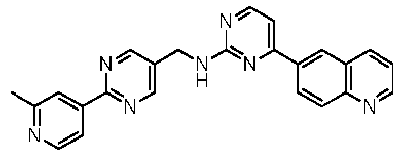
A 1H NMR (400 MHz, DMSO) δ 9.03 (s, 2H), 8.96 (d, J = 2.8 Hz, 1H), 8.76 (s, 1H), 8.60 (d, J = 5.2 Hz, 1H), 8.51-8.44 (m, 3H), 8.12 (d, J = 8.0 Hz, 2H), 8.06-8.00 (m, 2H), 7.61 (dd, J = 8.4, 4.4 Hz, 1H), 7.40 (d, J = 5.2 Hz, 1H), 4.71 (s, 2H), 2.56 (s, 3H). 406.0 A-173 
A 1H NMR (400 MHz, CDCl3) δ 8.97 (s, 1H), 8.51 (s, 1H), 8.44 (s, 1H), 8.36 (d, J = 8.8 Hz, 1H), 8.26 (d, J = 7.6 Hz, 1H), 8.19 (d, J = 8.8 Hz, 1H), 7.85 (s, 1H), 7.55 (d, J = 7.6 Hz, 2H), 7.46 (s, 1H), 7.38 (d, J = 7.2 Hz, 2H), 7.27 (s, 1H), 7.22-7.18 (m, 2H), 5.67 (s, 1H), 4.83 (d, J = 4.4 Hz, 2H). 379.0 A-174 
A 1H NMR (400 MHz, CDCl3) δ 9.04 (s, 1H), 8.97 (d, J = 2.8 Hz, 1H), 8.83 (s, 1H), 8.64 (d, J = 5.2 Hz, 1H), 8.50 (s, 1H), 8.45 (d, J = 4.8 Hz, 1H), 8.35 (dd, J = 8.8, 1.6 Hz, 1H), 8.27 (d, J = 8.4 Hz, 1H), 8.19 (d, J = 8.8 Hz, 1H), 7.79 (s, 1H), 7.70 (d, J = 4.8 Hz, 1H), 7.46 (dd, J = 8.0, 4.0 Hz, 1H), 7.21 (d, J = 5.2 Hz, 1H), 6.17 (t, J = 5.2 Hz, 1H), 5.00 (d, J = 5.6 Hz, 2H), 2.67 (s, 3H). 406.0 A-175 
A 1H NMR (400 MHz, CDCl3) δ 8.97 (d, J = 2.8 Hz, 1H), 8.55 (d, J = 4.4 Hz, 1H), 8.50 (s, 1H), 8.47-8.41 (m, 2H), 8.36 (d, J = 8.4 Hz, 1H), 8.26 (d, J = 8.4 Hz, 1H), 8.19 (d, J = 8.8 Hz, 1H), 7.82 (d, J = 10.8 Hz, 2H), 7.49-7.43 (m, 2H), 7.22 (d, J = 4.4 Hz, 1H), 5.73 (s, 1H), 4.86 (d, J = 4.8 Hz, 2H), 3.87 (s, 3H), 2.68 (s, 3H). 435.0 A-176 
G 1H NMR (400 MHz, CDCl3) δ 9.04 (d, J = 3.2 Hz, 1H), 8.65-8.55 (m, 3H), 8.38 (d, J = 8.4 Hz, 1H), 8.30 (d, J = 9.2 Hz, 1H), 7.79 (d, J = 6.0 Hz, 2H), 7.74 (dd, J = 8.4, 4.0 Hz, 1H), 7.69 (d, J = 4.4 Hz, 1H), 7.62 (d, J = 11.6 Hz, 1H), 7.14 (d, J = 5.6 Hz, 1H), 5.77 (t, J = 5.2 Hz, 1H), 4.89 (d, J = 6.0 Hz, 2H), 2.65 (s, 3H). A-177 
A 1H NMR (400 MHz, CDCl3) δ 9.14 (s, 1H), 8.97 (d, J = 4.0 Hz, 1H), 8.48 (s, 1H), 8.45 (s, 1H), 8.44 (s, 1H) 8.32 (d, J = 9.2 Hz, 1H), 8.24 (d, J = 6.8 Hz, 2H), 8.18 (d, J = 8.8 Hz, 1H), 7.89 (d, J = 8.4 Hz, 1H), 7.68 (d, J = 8.4 Hz, 1H), 7.47 (m, 1H), 7.22 (d, J = 5.2 Hz, 1H), 5.85 (s, 1H), 5.02 (d, J = 6.4 Hz, 2H). 389.1 A-178 
A 1H NMR (400 MHz, CDCl3) δ 8.97 (d, J = 3.2 Hz, 1H), 8.52 (s, 1H), 8.48 (d, J = 5.2 Hz, 1H), 8.39 (d, J = 8.8 Hz, 1H), 8.18-8.25 (m, 5H), 7.89 (d, J = 8.8 Hz, 1H), 7.63 (d, J = 8.4 Hz, 1H), 7.47 (dd, J = 8.0, 4.0 Hz, 1H), 7.21 (d, J = 4.8 Hz, 1H), 6.67 (s, 1H), 5.10 (d, J = 4.0 Hz, 2H). 389.0 A-179 
A 1H NMR (400 MHz, CDCl3) δ 9.03 (s, 1H), 8.96 (d, J = 2.8 Hz, 1H), 8.52 (s, 1H), 8.48 (s, 1H), 8.44 (d, J = 5.2 Hz, 1H), 8.32 (d, J = 8.8 Hz, 1H), 8.24 (d, J = 8.0 Hz, 1H), 8.21 (s, 1H), 8.16 (d, J = 8.8 Hz, 1H), 7.89 (d, J = 8.4 Hz, 1H), 7.78 (d, J = 8.4 Hz, 1H), 7.47-7.44 (m, 1H), 7.20 (d, J = 4.8 Hz, 1H), 5.86 (s, 1H), 5.05 (d, J = 6.0 Hz, 2H). 389.1 A-180 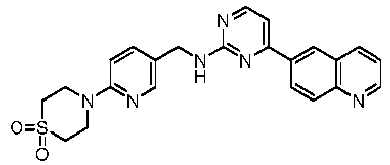
A 1H NMR (400 MHz, DMSO) δ 8.96 (d, J = 3.2 Hz, 1H), 8.76 (s, 1H), 8.50 (d, J = 7.6 Hz, 2H), 8.43 (d, J = 4.4 Hz, 1H), 8.23 (s, 1H), 8.13 (d, J = 8.8 Hz, 1H), 7.86-7.78 (m, 1H), 7.67 (s, 1H), 7.61 (dd, J = 8.0, 4.0 Hz, 1H), 7.34 (d, J = 5.2 Hz, 1H), 6.99 (d, J = 8.8 Hz, 1H), 4.51 (s, 2H), 4.01 (s, 4H), 3.05 (s, 4H). 447.0 A-181 
A 1H NMR (400 MHz, CDCl3) δ 8.97 (d, J = 3.6 Hz, 1H), 8.52 (s, 1H), 8.43 (d, J = 5.2 Hz, 1H), 8.37 (d, J = 8.8 Hz, 1H), 8.28 (d, J = 8.0 Hz, 1H), 8.21-8.16 (m ,2H), 7.53 (d, J = 8.0 Hz, 1H), 7.47 (dd, J = 8.2, 4.2 Hz, 1H), 7.17 (d, J = 5.2 Hz, 1H), 6.46 (d, J = 8.8 Hz, 1H), 5.48 (s, 1H), 4.93 (s, 1H), 4.63 (d, J = 5.6 Hz, 2H), 3.97-3.91 (m, 2H), 3.38 (t, J = 5.8 Hz, 2H), 2.94 (s, 3H). A182 
F 1H NMR (400 MHz, CDCl3) δ 9.58 (s, 1H), 9.07 (s, 1H), 8.72 (s, 1H), 8.55 (d, J = 4.8 Hz, 2H), 8.44 (s, 1H), 8.28 (s, 1H), 7.83 (d, J = 3.6 Hz, 1H), 7.71 (s, 1H), 7.68-7.63 (m, 2H), 7.44 (s, 1H), 5.66 (s, 1H), 4.87 (d, J = 5.6 Hz, 2H), 3.86 (s, 3H), 2.62 (s, 3H). 436.0 A-183 
F 1H NMR (400 MHz, CDCl3) δ 9.57 (s, 1H), 9.07 (s, 1H), 8.67 (d, J = 8.4 Hz, 2H), 8.61 (d, J = 5.2 Hz, 1H), 8.54 (d, J = 5.2 Hz, 1H), 8.27 (d, J = 8.4 Hz, 1H), 7.85 (d, J = 5.2 Hz, 1H), 7.76 (s, 1H), 7.71-7.63 (m, 3H), 5.71 (s, 1H), 4.89 (d, J = 5.6 Hz, 2H), 2.64 (s, 3H). A184 
F 1H NMR (400 MHz, CDCl3) δ 9.58 (s, 1H), 9.09 (d, J = 3.2 Hz, 1H), 9.01 (s, 1H), 8.69-8.64 (m, 2H), 8.54 (d, J = 4.8 Hz, 1H), 8.29 (d, J = 8.4 Hz, 1H), 8.22 (s, 1H), 7.88 (d, J = 4.8 Hz, 1H), 7.70-7.60 (m, 3H), 5.77 (m, 1H), 4.90 (d, J = 6.0 Hz, 2H), 2.86 (s, 3H). A185 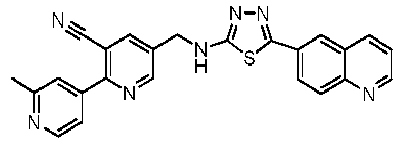
A 1H NMR (400 MHz, CDCl3) δ 8.99 (s, 1H), 8.95 (d, J = 3.2 Hz, 1H), 8.68 (d, J = 5.2 Hz, 1H), 8.26 (s, 1H), 8.22-8.13 (m, 4H), 7.68 (s, 1H), 7.64 (d, J = 5.2 Hz, 1H), 7.46 (dd, J = 8.0, 4.4 Hz, 1H), 7.26 (s, 1H), 4.84 (s, 2H), 2.66 (s, 3H). 436.0 A-186 
A 1H NMR (400 MHz, DMSO) δ 9.00 (d, J = 2.8 Hz, 1H), 8.62 (s, 1H), 8.57 (d, J = 8.4 Hz, 1H), 8.47 (d, J = 5.2 Hz, 1H), 8.30-8.25 (m, 1H), 8.22 (d, J = 8.4 Hz, 1H), 8.16 (d, J = 8.8 Hz, 1H), 7.76 (d, J = 8.0 Hz, 2H), 7.64 (dd, J = 8.4, 4.4 Hz, 1H), 7.57 (s, 1H), 7.52 (d, J = 8.0 Hz, 2H), 7.48 (d, J = 4.8 Hz, 1H), 4.61 (d, J = 6.0 Hz, 2H), 2.51 (s, 3H). 410.0 A-187 
A 1H NMR (400 MHz, DMSO) δ 9.00 (d, J = 3.2 Hz, 1H), 8.61 (s, 1H), 8.56 (d, J = 8.0 Hz, 1H), 8.29-8.24 (m, 1H), 8.23-8.14 (m, 3H), 7.64 (dd, J = 8.0, 4.0 Hz, 1H), 7.58 (d, J = 8.4 Hz, 2H), 7.51 (d, J = 8.8 Hz, 3H), 4.57 (d, J = 6.0 Hz, 2H), 2.19 (s, 3H). A-188 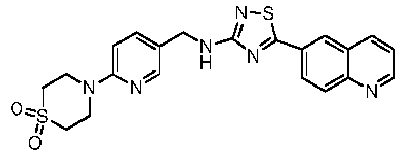
A 1H NMR (400 MHz, DMSO) δ 9.00 (d, J = 2.8 Hz, 1H), 8.61 (s, 1H), 8.56 (d, J = 8.4 Hz, 1H), 8.23-8.07 (m, 4H), 7.68-7.61 (m, 2H), 7.00 (d, J = 8.8 Hz, 1H), 4.42 (d, J = 6.0 Hz, 2H), 4.03 (s, 4H), 3.06 (s, 4H). A-189 
A 1H NMR (400 MHz, DMSO) δ 9.00 (d, J = 3.2 Hz, 1H), 8.60 (s, 1H), 8.56 (d, J = 8.4 Hz, 1H), 8.21 (d, J = 9.6 Hz, 1H), 8.15 (d, J = 8.8 Hz, 1H), 8.04 (s, 2H), 7.64 (dd, J = 8.4, 4.4 Hz, 1H), 7.48 (d, J = 8.0 Hz, 1H), 6.74 (s, 1H), 6.50 (d, J = 8.4 Hz, 1H), 4.35 (d, J = 6.0 Hz, 2H), 3.69-3.61 (m, 2H), 3.32-3.30 (m, 2H), 2.99 (s, 3H). A-190 
A 1H NMR (400 MHz, DMSO) δ 9.00 (d, J = 2.8 Hz, 1H), 8.76 (s, 1H), 8.62 (s, 1H), 8.59-8.51 (m, 2H), 8.34-8.29 (m, 1H), 8.22 (d, J = 8.8 Hz, 1H), 8.16 (d, J = 8.8 Hz, 1H), 8.07 (d, J = 8.0 Hz, 1H), 7.95 (d, J = 8.0 Hz, 1H), 7.92 (s, 1H), 7.82 (d, J = 5.2 Hz, 1H), 7.64 (dd, J = 8.0, 4.0 Hz, 1H), 4.63 (d, J = 6.0 Hz, 2H), 2.54 (s, 3H). 411.0 A-191 
A 1H NMR (400 MHz, CDCl3) δ 9.00 (d, J = 2.8 Hz, 1H), 8.61 (s, 1H), 8.58 (d, J = 4.8 Hz, 1H), 8.40 (s, 1H), 8.26 (d, J = 8.0 Hz, 1H), 8.22-8.14 (m, 2H), 7.69 (s, 1H), 7.49 (dd, J = 8.0, 4.0 Hz, 1H), 7.33 (s, 1H), 7.24 (d, J = 5.6 Hz, 1H), 5.66 (s, 1H), 4.76 (d, J = 6.0 Hz, 2H), 2.62 (s, 3H), 2.37 (s, 3H). 425.0 A-192 
A 1H NMR (400 MHz, DMSO) δ 9.00 (d, J = 2.8 Hz, 1H), 8.64 (d, J = 9.2 Hz, 2H), 8.60-8.54 (m, 2H), 8.38-8.32 (m, 1H), 8.22 (d, J = 8.8 Hz, 1H), 8.16 (d, J = 8.8 Hz, 1H), 7.88 (d, J = 12.0 Hz, 1H), 7.77 (s, 1H), 7.69 (d, J = 4.4 Hz, 1H), 7.64 (dd, J = 8.0, 4.0 Hz, 1H), 4.67 (d, J = 6.0 Hz, 2H), 2.55 (s, 3H). 429.0 A-193 
A 1H NMR (400 MHz, CDCl3) δ 9.00 (d, J = 2.8 Hz, 1H), 8.55 (d, J = 4.8 Hz, 1H), 8.40 (s, 2H), 8.26 (d, J = 8.0 Hz, 1H), 8.22-8.14 (m, 2H), 7.73 (s, 1H), 7.69 (d, J = 4.4 Hz, 1H), 7.49 (dd, J = 8.0, 4.0 Hz, 1H), 7.45 (s, 1H), 5.70 (t, J = 5.6 Hz, 1H), 4.79 (d, J = 6.0 Hz, 2H), 3.90 (s, 3H), 2.63 (s, 3H). 440.9 A-194 
A 1H NMR (400 MHz, CDCl3) δ 9.00 (d, J = 3.2 Hz, 1H), 8.98 (s, 1H), 8.68 (d, J = 4.8 Hz, 1H), 8.39 (s, 1H), 8.27 (d, J = 8.4 Hz, 1H), 8.21 (d, J = 7.2 Hz, 2H), 8.15 (d, J = 8.8 Hz, 1H), 7.69 (s, 1H), 7.64 (d, J = 4.8 Hz, 1H), 7.50 (dd, J = 8.0, 4.0 Hz, 1H), 5.83 (t, J = 5.6 Hz, 1H), 4.83 (d, J = 6.0 Hz, 2H), 2.67 (s, 3H). 435.9 A-195 
A 1H NMR (400 MHz, DMSO) δ 9.47 (s, 1H), 9.15 (d, J = 3.2 Hz, 1H), 8.71 (d, J = 8.4 Hz, 1H), 8.64 (d, J = 8.4 Hz, 2H), 8.57 (d, J = 5.2 Hz, 1H), 8.28-8.22 (m, 1H), 7.92-7.84 (m, 2H), 7.75 (s, 1H), 7.67 (d, J = 4.4 Hz, 1H), 4.68 (d, J = 6.0 Hz, 2H), 2.55 (s, 3H). 429.9 A-196 
A 1H NMR (400 MHz, DMSO) δ 9.47 (s, 1H), 9.15 (d, J = 3.2 Hz, 1H), 8.70 (d, J = 8.4 Hz, 1H), 8.64 (s, 1H), 8.48 (d, J = 4.8 Hz, 1H), 8.35 (s, 1H), 8.23-8.17 (m, 1H), 7.90 (dd, J = 8.4, 4.0 Hz, 1H), 7.73 (s, 1H), 7.68 (s, 1H), 7.67 (d, J = 6.0 Hz, 1H), 4.65 (d, J = 6.0 Hz, 2H), 3.89 (s, 3H), 2.51 (s, 3H). 441.9 A-197 
A 1H NMR (400 MHz, DMSO) δ 9.47 (s, 1H), 9.16 (d, J = 3.2 Hz, 1H), 9.01 (s, 1H), 8.71 (d, J = 8.4 Hz, 1H), 8.64 (s, 2H), 8.46 (s, 1H), 8.29-8.23 (m, 1H), 7.90 (dd, J = 8.4, 4.0 Hz, 1H), 7.69 (s, 1H), 7.64 (d, J = 4.8 Hz, 1H), 4.69 (d, J = 6.0 Hz, 2H), 2.57 (s, 3H). 437.0 A-198 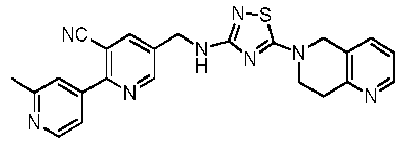
A 1H NMR (400 MHz, CDCl3) δ 8.89 (s, 1H), 8.67 (d, J = 4.8 Hz, 1H), 8.48 (d, J = 4.4 Hz, 1H), 8.15 (s, 1H), 7.67 (s, 1H), 7.62 (d, J = 4.8 Hz, 1H), 7.48 (d, J = 7.6 Hz, 1H), 7.20 (dd, J = 6.8, 4.8 Hz, 1H), 5.33 (t, J = 5.6 Hz, 1H), 4.68 (d, J = 6.4 Hz, 2H), 4.65 (s, 2H), 3.80 (t, J = 4.8 Hz, 2H), 3.19 (t, J = 6.0 Hz, 2H), 2.67 (s, 3H). 441.0 A-199 
A 1H NMR (400 MHz, DMSO) δ 9.12 (s, 1H), 9.00 (d, J = 3.2 Hz, 1H), 8.62 (s, 1H), 8.56 (d, J = 10.8 Hz, 2H), 8.45-8.39 (m, 2H), 8.21 (d, J = 8.0 Hz, 2H), 8.15 (d, J = 8.8 Hz, 1H), 7.90 (d, J = 8.4 Hz, 1H), 7.64 (dd, J = 8.0, 4.0 Hz, 1H), 4.79 (d, J = 5.6 Hz, 2H). A-200 
A 1H NMR (400 MHz, DMSO) δ 9.00 (d, J = 2.8 Hz, 1H), 8.59 (s, 1H), 8.56 (d, J = 8.0 Hz. 1H), 8.41 (s, 1H), 8.21-8.12 (m, 2H), 7.78-7.60 (m, 4H), 6.57 (d, J = 8.8 Hz, 1H), 3.57 (s, 2H), 3.52 (t, J = 5.2 Hz, 2H). A-201 
A 1H NMR (400 MHz, CDCl3) δ 8.89 (s, 1H), 8.67 (d, J = 5.0 Hz, 1H), 8.10 (s, 1H), 8.02 (s, 1H), 7.67 (s, 1H), 7.62 (d, J = 4.8 Hz. 1H), 7.50 (s, 1H), 6.10 (s, 1H), 5.34 (s, 1H), 4.94 (s, 2H), 4.81 (d, J = 6.2 Hz, 2H), 4.32 (m, 2H), 4.18 (m, 2H), 2.67 (s, 3H). A-202 
A 1H NMR (400 MHz, CDCl3) δ 8.59 (d, J = 5.0 Hz, 1H), 8.54 (s, 1H), 8.45 (d, J = 3.2 Hz, 1H), 7.75 (s, 1H), 7.71 (d, J = 5.6 Hz, 1H), 7.67 (d, J = 4.6 Hz, 1H), 7.55 (d, J = 11.8 Hz, 1H), 7.43 (d, J = 7.6 Hz, 1H), 7.18 (m, 1H), 6.30 (m, 1H), 5.02 (s, 1H), 4.78 (d, J = 5.8 Hz, 2H), 4.48 (s, 2H), 3.71 (m, 2H), 3.15 (m, 2H), 2.63 (s, 3H). 445.0 - The primary assay is based on Wnt pathway Super-top flash (STF) reporter gene assay:
- HEK293 STF stable clones (HEK293 cells stably transfected with "Super-Top Flash" TCF-luciferase reporter plasmid) were kept in complete culture medium (DMEM with 4 mM L-Gln, 1.5 g/L sodium bicarbonate and 4.5 g/L glucose containing 6 µg/mL Blasticidin and 10% FBS). L Wnt3A cells (CRL-2647, ATCC) were kept in DMEM (Gibico) containing 10% FBS (Hyclone). HEK293 STF and L Wnt3A cells were harvested when 90% confluence and cell suspension was mixed with a fixed ratio of 1:1 (HEK293 STF: L Wnt3A). 100 µL/well of mixed cells suspension was added to the 96-well-plate with final cell concentration of 12,000 cells/well and then cultured for an additional 24 hours before adding compounds.
- Compounds were diluted in DMSO in sequence and then diluted with DMEM medium. 20 µL medium containing compound was added to the cells according to the presetting dose. Cell plates were incubated at 37°C for an additional 48 hours.
- 50 µL luciferase solution (Bright-Glo, Promega) was added to each well during the 48 h incubation. The plates were incubated at room temperature for 5 min under gentle shaking. Luminescence signaling was measured with a plate reader (PHERAstar FS, BMG). The IC50 (potency) of compounds was calculated based on the inhibition of luminescence signaling.
- The above mentioned compounds were tested in the primary assay described above and the data were summarized in Table 3. In particular, IC50 curves for compounds A-12, A-36, A-100, A-103, A-166, A-168, A-194, and A-198 are shown in
FIGs. 1-8 , respectively.Table 3. Results of selected compounds (A-1 to A-202) of the present disclosure when tested in the primary assay. Compound number IC50 (nM) Compound number IC50 (nM) Compound number IC50 (nM) A-1 1.4 A-2 2.9 A-3 36 A-4 0.3 A-5 2.1 A-6 4.7 A-7 7.4 A-8 1.5 A-9 2.8 A-10 285 A-11 1.6 A-12 0.3 A-13 99 A-14 5.9 A-15 19 A-16 27 A-17 >1000 A-18 480 A-19 14 A-20 211 A-21 14 A-22 14 A-23 15 A-24 37 A-25 >1000 A-26 1.5 A-27 937 A-28 17 A-29 577 A-30 23 A-31 1 A-32 2 A-33 1.4 A-34 3 A-35 4 A-36 0.5 A-37 2.4 A-38 5 A-39 129 A-40 >1000 A-41 55 A-42 0.7 A-43 75 A-44 1 A-45 0.4 A-46 4.9 A-47 0.94 A-48 2.1 A-49 0.39 A-50 1.0 A-51 1.0 A-52 17 A-53 89 A-54 0.67 A-55 3000 A-56 1 A-57 0.39 A-58 34 A-59 230 A-60 0.81 A-61 1.3 A-62 6.2 A-63 2 A-64 16 A-65 0.44 A-66 58 A-67 10 A-68 16 A-69 73 A-70 147 A-71 0.29 A-72 0.64 A-73 1.3 A-74 1.6 A-75 0.52 A-76 1.3 A-77 1.6 A-78 777 A-79 416 A-80 768 A-81 625 A-82 338 A-83 3000 A-84 0.26 A-85 0.14 A-86 0.34 A-87 0.51 A-88 7.7 A-89 14 A-90 1.2 A-91 53 A-92 10 A-93 40 A-94 0.8 A-95 15 A-96 0.2 A-97 0.18 A-98 0.06 A-99 0.11 A-100 0.27 A-101 0.31 A-102 0.54 A-103 0.12 A-104 0.11 A-105 5.2 A-106 0.24 A-107 16 A-108 1 A-109 10 A-110 1 A-111 10 A-112 10 A-113 16 A-114 8 A-115 7 A-116 8 A-117 2 A-118 318 A-119 10 A-120 12 A-121 0.06 A-122 0.13 A-123 0.12 A-124 0.12 A-125 0.06 A-126 0.04 A-127 0.34 A-128 1.8 A-129 0.4 A-130 0.11 A-131 1.0 A-132 0.25 A-133 34 A-134 24 A-135 3000 A-136 4000 A-137 3000 A-138 712 A-139 3000 A-140 3000 A-141 3000 A-142 3000 A-143 2000 A-144 40 A-145 1131 A-146 68 A-147 40 A-148 10 A-149 603 A-150 250 A-151 2000 A-152 4.9 A-153 3000 A-154 1.2 A-155 229 A-156 12 A-157 3000 A-158 3000 A-159 17 A-160 6.7 A-161 3000 A-162 2000 A-162 3.2 A-164 3000 A-165 0.71 A-166 3.6 A-167 120 A-168 0.85 A-169 4.9 A-170 3.7 A-171 0.31 A-172 1.7 A-173 106 A-174 2.7 A-175 0.74 A-176 18 A-177 100 A-178 200 A-179 500 A-180 300 A-181 350 A-182 0.64 A-183 2.1 A-184 1 A-185 4.3 A-186 0.27 A-187 51 A-188 4.6 A-189 3000 A-190 0.4 A-191 0.38 A-192 0.1 A-193 0.07 A-194 0.09 A-195 0.84 A-196 0.78 A-197 0.31 A-198 0.42 A-199 0.17 A-200 25 A-201 0.8 A-202 0.5
Claims (10)
- A compound of Formula I:
 A is
A is U is
U is X8 to X10 are independently selected from C-R14 and N;G1 and G2 are independently selected from C and N;V1 is selected from C-R15, N, O and S;V2 is selected from N, O, S and C-R15; andW is V4 - V5, V4 = V5 or V3, wherein V3 to V5 are independently selected from C-R16, N, O and S, wherein V4 connects with V1; and V5 connects with V2;L is
 Q is
Q is Z is
Z is R1 to R3 are independently selected from H and C1-C6 alkyl, wherein C1-C6 alkyl is unsubstituted or substituted with 1 to 3 halide, -CN, -OH, C1-C3 alkyl, C3-C5 cycloalkyl, or C1-C3 alkoxy groups;R14 to R16 are independently selected from H, halide, -CN, -OH, amino, C1-C6 alkyl, C3-C6 cycloalkyl, C1-C6 alkoxy and C1-C6 alkylthio, wherein amino, C1-C6 alkyl and C1-C6 alkoxy are unsubstituted or substituted with 1 to 3 halide, C1-C3 alkyl or C3-C6 cycloalkyl groups;R4a and R5a are independently selected from halide, -CN, and -OH, or R4a and R5a are independently selected from C1-C8 alkyl, C3-C8 cycloalkyl, C1-C8 alkoxy, C2-C8 alkenyl, C2-C8 alkynyl, C1-C8 alkylsulfonyl, C1-C8 acyl, aminoacyl, C1-C8 acylamino, C1-C8 alkylcarbamoylamino, C1-C8 alkoxycarbamoyl, C1-C8 alkylsulfonamido, C1-C8 alkylaminosulphonyl, C2-C8 alkoxyacyl, and 3-8 membered heterocycle, all of which are unsubstituted or substituted with 1-3 halide, -OH, -CN, C1-C3 alkyl, C1-C3 alkoxyl or C3-C8 cycloalkyl groups, wherein 3-8 membered heterocycle comprises one or more hetero atoms from N, O or S;R2m is H, deuterium, tritium, halide, -OH, -CN, C3-C8 cycloalkyl or C1-C8 alkoxy; andR4b and R5b are independently selected from H, halide, -CN, amino, C1-C8 alkyl, C3-C8 cycloalkyl, C1-C8 alkoxy, and C1-C3 alkylamino.
 - The compound of claim 1, wherein U is

- The compound of claim 1, wherein U is selected from:


- The compound of claim 1, wherein U is selected from:





- The compound of claim 1, wherein the compound is selected from:





- A compound according to claim 1, selected from:
A-36 
A-57 
A-34 
A-65 
A-31 
A-85 
A-86 
A-84 
A-50 
A-49 
A-51 
and A-96 
- A compound selected from:
A-16 
A-17 
A-18 
A-19 
A-20 
A-21 
A-22 
A-23 
A-24 
A-25 
A-26 
A-29 
A-32 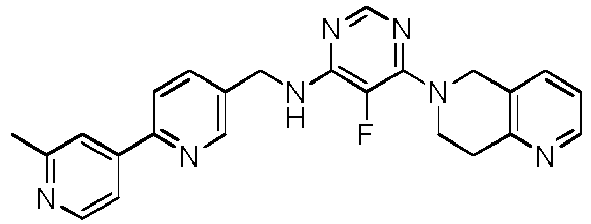
A-39 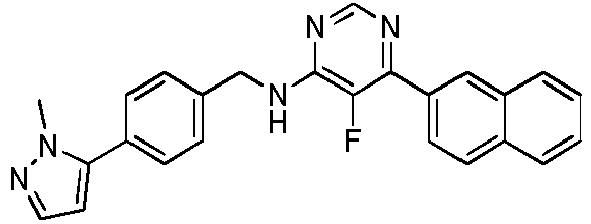
A-40 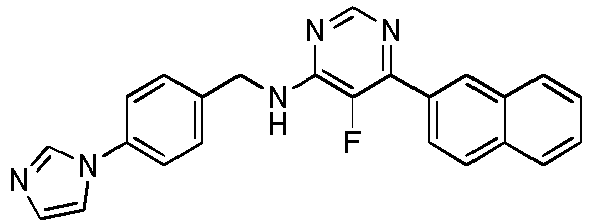
A-41 
A-42 
A-43 
A-44 
A-45 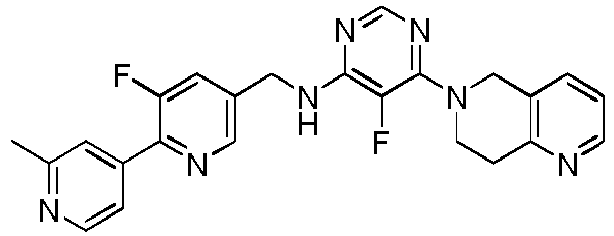
A-46 
A-47 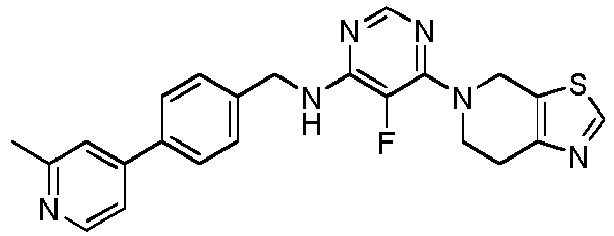
A-52 
A-53 
A-54 
A-56 
A-58 
A-59 
A-60 
A-61 
A-62 
A-63 
A-64 
A-66 
A-67 
A-68 
A-69 
A-70 
A-71 
A-72 
A-73 
A-74 
A-75 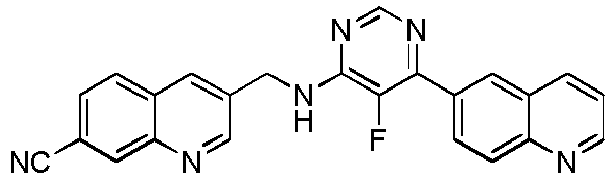
A-76 
A-77 
A-78 
A-79 
A-80 
A-81 
A-82 
A-83 
A-87 
A-88 
A-89 
A-90 
A-91 
A-92 
A-93 
A-94 
A-95 
A-100 
A-105 
A-107 
A-109 
A-111 
A-112 
A-113 
A-115 
A-116 
A-117 
A-118 
A-119 
A-120 
A-127 
A-128 
A-129 
A-130 
A-131 
A-132 
A-133 
A-134 
A-135 
A-136 
A-137 
A-138 
A-139 
A-140 
A-141 
A-142 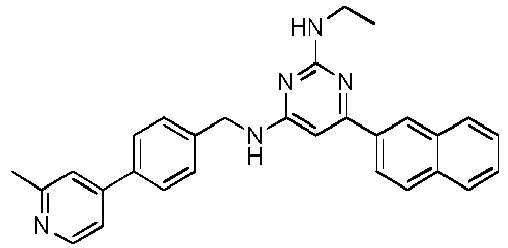
A-143 
A-144 
A-145 
A-146 
A-147 
A-148 
A-149 
A-150 
A-151 
A-152 
A-153 
A-154 
A-155 
A-156 
A-157 
A-158 
A-159 
A-160 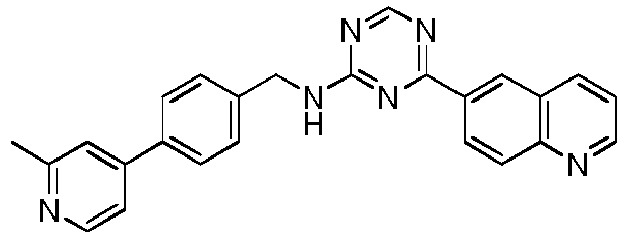
A-161 
A-162 
A-163 
A-164 
A-165 
A-166 
A-167 
A-168 
A-169 
A-170 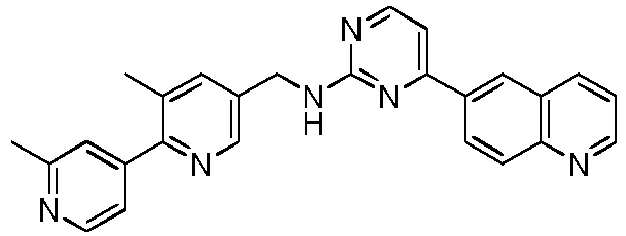
A-171 
A-172 
A-173 
A-174 
A-175 
A-176 
A-177 
A-178 
A-179 
A-180 
A-181 
A-182 
A-183 
A-184 
A-185 
A-186 
A-187 
A-188 
A-189 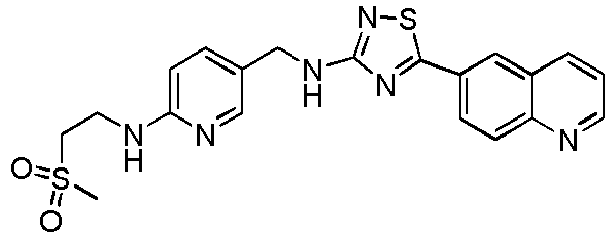
A-190 
A-191 
A-192 
A-193 
A-194 
A-195 
A-196 
A-197 
A-198 
A-199 
A-200 
A-201 
A-202 
and - A pharmaceutical composition comprising a therapeutically effective amount of a compound of any one of claims 1-7 and a pharmaceutically acceptable carrier.
- The compound according to any one of claims 1-7, or a pharmaceutically acceptable salt, solvate, stereoisomer or a tautomer thereof for use in treating a Wnt- mediated disorder in a mammal suffering therefrom.
- The compound for use according to claim 9, wherein the disorder is a cell proliferative disorder selected from the group consisting of systemic sclerosis, skin fibrosis, idiopathic pulmonary fibrosis, renal fibrosis, liver fibrosis, drug-induced fibrosis, radiation-induced fibrosis, colorectal cancer, breast cancer, head and neck squamous cell carcinoma, esophageal squamous cell carcinoma, non-small cell lung cancer, gastric cancer, pancreatic cancer, leukemia, lymphoma, neuroblastoma, retinoblastoma, sarcoma, osteosarcoma, chondosarcoma, Ewing's sarcoma, rhabdomysarcoma, brain tumor, Wilms' tumor, basal cell carcinoma, melanoma, head and neck cancer, cervical cancer and prostate cancer.
Applications Claiming Priority (8)
| Application Number | Priority Date | Filing Date | Title |
|---|---|---|---|
| CN201510645986.2A CN105254613A (en) | 2015-10-08 | 2015-10-08 | Heterocyclic compound with Wnt signal path inhibitory activity and application thereof |
| CN201610195733 | 2016-03-31 | ||
| CN201610195731 | 2016-03-31 | ||
| CN201610670828.7A CN107759584B (en) | 2016-08-16 | 2016-08-16 | Amino five-membered heterocyclic compound with Wnt signal channel inhibition activity and application thereof |
| CN201610850358.2A CN107286136B (en) | 2016-03-31 | 2016-09-26 | 3-fluoropyridine heterocyclic compound and application thereof |
| CN201610850357.8A CN107286135B (en) | 2016-03-31 | 2016-09-26 | Heterocyclic compound with Wnt signal channel inhibition activity and application thereof |
| CN201610850360.XA CN106565673B (en) | 2015-10-08 | 2016-09-26 | 5-fluoropyrimidine heterocyclic compound with Wnt signal channel inhibition activity and application thereof |
| PCT/US2016/055851 WO2017062688A1 (en) | 2015-10-08 | 2016-10-06 | Wnt signaling pathway inhibitors and therapeutic applications thereof |
Publications (3)
| Publication Number | Publication Date |
|---|---|
| EP3359154A1 EP3359154A1 (en) | 2018-08-15 |
| EP3359154A4 EP3359154A4 (en) | 2019-05-15 |
| EP3359154B1 true EP3359154B1 (en) | 2021-05-26 |
Family
ID=62621830
Family Applications (1)
| Application Number | Title | Priority Date | Filing Date |
|---|---|---|---|
| EP16854369.2A Active EP3359154B1 (en) | 2015-10-08 | 2016-10-06 | Wnt signaling pathway inhibitors and therapeutic applications thereof |
Country Status (4)
| Country | Link |
|---|---|
| US (2) | US10450300B2 (en) |
| EP (1) | EP3359154B1 (en) |
| JP (1) | JP6853819B2 (en) |
| KR (1) | KR102698411B1 (en) |
Families Citing this family (5)
| Publication number | Priority date | Publication date | Assignee | Title |
|---|---|---|---|---|
| JP7421655B2 (en) * | 2020-01-02 | 2024-01-24 | へルムホルツ-ツェントルム・フューア・インフェクツィオーンスフォルシュング・ゲゼルシャフト・ミット・ベシュレンクテル・ハフツング | Novel PqsR inverse agonists |
| EP4085054B1 (en) | 2020-01-02 | 2025-02-19 | Helmholtz-Zentrum für Infektionsforschung GmbH | New pqsr inverse agonists |
| CN112612873B (en) * | 2020-12-25 | 2023-07-07 | 上海德拓信息技术股份有限公司 | Centralized event mining method based on NLP technology |
| WO2023025225A1 (en) * | 2021-08-27 | 2023-03-02 | 杭州阿诺生物医药科技有限公司 | Cyclin k degradation agent |
| KR20250100559A (en) * | 2023-12-26 | 2025-07-03 | (주)아이젠사이언스 | Novel Inhibitors of Ubiquitin-Specific Peptidase 1 |
Family Cites Families (16)
| Publication number | Priority date | Publication date | Assignee | Title |
|---|---|---|---|---|
| JPS61205261A (en) | 1985-03-08 | 1986-09-11 | Sagami Chem Res Center | 6-substituted-5-fluorouracil derivative and production thereof |
| US4617393A (en) * | 1985-07-19 | 1986-10-14 | American Home Products Corporation | 5-substituted-6-aminopyrimidines, composition and uses as cardiotonic agents for increasing cardiac contractility |
| US7135575B2 (en) * | 2003-03-03 | 2006-11-14 | Array Biopharma, Inc. | P38 inhibitors and methods of use thereof |
| WO2008132502A1 (en) | 2007-04-25 | 2008-11-06 | Astrazeneca Ab | Pyrazolyl-amino-substituted pyrimidines and their use for the treatment of cancer |
| US20090054392A1 (en) * | 2007-08-20 | 2009-02-26 | Wyeth | Naphthylpyrimidine, naphthylpyrazine and naphthylpyridazine analogs and their use as agonists of the wnt-beta-catenin cellular messaging system |
| WO2010020810A1 (en) | 2008-08-19 | 2010-02-25 | Astrazeneca Ab | 2-(imidaz0lylamin0)-pyridine derivatives and their use as jak kinase inhibitors |
| GB0818241D0 (en) | 2008-10-06 | 2008-11-12 | Cancer Res Technology | Compounds and their use |
| US20110189097A1 (en) * | 2009-11-09 | 2011-08-04 | Dritan Agalliu | Use of WNT inhibitor to inhibit angiogenesis in the CNS |
| WO2012149528A1 (en) * | 2011-04-29 | 2012-11-01 | Exelixis, Inc. | Inhibitors of inducible form of 6-phosphofructose-2-kinase |
| CN104080773B (en) * | 2012-01-28 | 2016-12-28 | 默克专利股份公司 | Nitrogen heterocyclic |
| PH12017500997A1 (en) * | 2012-04-04 | 2018-02-19 | Samumed Llc | Indazole inhibitors of the wnt signal pathway and therapeutic uses thereof |
| CA2905830C (en) * | 2013-03-12 | 2022-01-18 | Curegenix Inc. | Quinazoline and naphthyridine derivatives useful in the treatment of cancer |
| WO2014159733A1 (en) * | 2013-03-14 | 2014-10-02 | Curegenix, Inc. | Compounds for treatment of fibrosis diseases |
| CR20170076A (en) | 2014-08-04 | 2017-06-26 | Nuevolution As | PIRIMIDIMA DERIVATIVES REPLACED WITH OPTIONALLY CONDENSED HETEROCICLYL USEFUL FOR THE TREATMENT OF INFLAMMATORY, METABOLIC, ONCOLOGICAL AND SELF-IMMUNITY DISEASES |
| EP3201185B1 (en) | 2014-09-19 | 2018-11-21 | Forma Therapeutics, Inc. | Pyridinyl quinolinone derivatives as mutant-isocitrate dehydrogenase inhibitors |
| CN107001358A (en) * | 2014-10-29 | 2017-08-01 | 东亚St株式会社 | Adjust the new pyridine hepyramine compound of istone lysine demethylase (KDM) catalytic activity |
-
2016
- 2016-10-06 US US15/766,799 patent/US10450300B2/en active Active
- 2016-10-06 JP JP2018518629A patent/JP6853819B2/en active Active
- 2016-10-06 EP EP16854369.2A patent/EP3359154B1/en active Active
- 2016-10-06 KR KR1020187013073A patent/KR102698411B1/en active Active
-
2019
- 2019-10-15 US US16/653,217 patent/US20200048223A1/en not_active Abandoned
Non-Patent Citations (1)
| Title |
|---|
| None * |
Also Published As
| Publication number | Publication date |
|---|---|
| EP3359154A4 (en) | 2019-05-15 |
| US10450300B2 (en) | 2019-10-22 |
| US20200048223A1 (en) | 2020-02-13 |
| US20180244651A1 (en) | 2018-08-30 |
| KR102698411B1 (en) | 2024-08-26 |
| JP6853819B2 (en) | 2021-03-31 |
| EP3359154A1 (en) | 2018-08-15 |
| KR20180061363A (en) | 2018-06-07 |
| JP2018535949A (en) | 2018-12-06 |
Similar Documents
| Publication | Publication Date | Title |
|---|---|---|
| US20200048223A1 (en) | Wnt signaling pathway inhibitors and therapeutic applications thereof | |
| EP2623493B1 (en) | N-(hetero)aryl,2-(hetero)aryl-substituted acetamides for use as wnt signaling modulators | |
| JP7654643B2 (en) | Phosphodiesterase Inhibitors and Uses | |
| EP2861590B1 (en) | Compound as wnt signaling inhibitor, composition, and use thereof | |
| JP2023002840A (en) | Heterocyclic compounds useful as PDK1 inhibitors | |
| RU2741000C2 (en) | 1,4-disubstituted imidazole derivative | |
| CN108473434A (en) | Substituted quinolone analog derivative or its pharmaceutically acceptable salt or stereoisomer and its Pharmaceutical composition and application | |
| US9221814B2 (en) | Heterocyclic guanidine F1F0-atpase inhibitors and therapeutic uses thereof | |
| JP7025359B2 (en) | Heteroaryl compounds that are necrosis inhibitors, their compositions and uses | |
| CA3196676A1 (en) | Pyrimidine compounds, compositions, and medicinal applications thereof | |
| AU2015357596A1 (en) | Heterocyclic compounds as biogenic amine transport modulators | |
| EP3080087B1 (en) | N-substituted pyrazolyl guanidine f1f0-atpase inhibitors and therapeutic uses thereof | |
| WO2017062688A1 (en) | Wnt signaling pathway inhibitors and therapeutic applications thereof | |
| AU2012203023C1 (en) | N-(hetero)aryl, 2- (hetero)aryl-substituted acetamides for use as Wnt signaling modulators | |
| JP2025510205A (en) | Thiazole derivative compounds and their uses | |
| KR20250043288A (en) | Composition for treating pulmonary fibrosis comprising thiazole derivative compound | |
| WO2025087295A1 (en) | Pi3k inhibitor, and preparation method therefor and use thereof | |
| JP2024505258A (en) | Novel compounds as protein kinase inhibitors | |
| HK1182392A (en) | N-(hetero)aryl,2-(hetero)aryl-substituted acetamides for use as wnt signaling modulators | |
| HK1160464B (en) | N-(hetero)aryl, 2-(hetero)aryl-substituted acetamides for use as wnt signaling modulators |
Legal Events
| Date | Code | Title | Description |
|---|---|---|---|
| STAA | Information on the status of an ep patent application or granted ep patent |
Free format text: STATUS: THE INTERNATIONAL PUBLICATION HAS BEEN MADE |
|
| PUAI | Public reference made under article 153(3) epc to a published international application that has entered the european phase |
Free format text: ORIGINAL CODE: 0009012 |
|
| STAA | Information on the status of an ep patent application or granted ep patent |
Free format text: STATUS: REQUEST FOR EXAMINATION WAS MADE |
|
| 17P | Request for examination filed |
Effective date: 20180502 |
|
| AK | Designated contracting states |
Kind code of ref document: A1 Designated state(s): AL AT BE BG CH CY CZ DE DK EE ES FI FR GB GR HR HU IE IS IT LI LT LU LV MC MK MT NL NO PL PT RO RS SE SI SK SM TR |
|
| AX | Request for extension of the european patent |
Extension state: BA ME |
|
| DAV | Request for validation of the european patent (deleted) | ||
| DAX | Request for extension of the european patent (deleted) | ||
| A4 | Supplementary search report drawn up and despatched |
Effective date: 20190411 |
|
| RIC1 | Information provided on ipc code assigned before grant |
Ipc: C07D 403/12 20060101ALI20190405BHEP Ipc: A61P 43/00 20060101ALI20190405BHEP Ipc: A61K 31/444 20060101ALI20190405BHEP Ipc: A61K 31/4725 20060101AFI20190405BHEP |
|
| STAA | Information on the status of an ep patent application or granted ep patent |
Free format text: STATUS: EXAMINATION IS IN PROGRESS |
|
| 17Q | First examination report despatched |
Effective date: 20200414 |
|
| GRAP | Despatch of communication of intention to grant a patent |
Free format text: ORIGINAL CODE: EPIDOSNIGR1 |
|
| STAA | Information on the status of an ep patent application or granted ep patent |
Free format text: STATUS: GRANT OF PATENT IS INTENDED |
|
| INTG | Intention to grant announced |
Effective date: 20201215 |
|
| GRAS | Grant fee paid |
Free format text: ORIGINAL CODE: EPIDOSNIGR3 |
|
| GRAA | (expected) grant |
Free format text: ORIGINAL CODE: 0009210 |
|
| STAA | Information on the status of an ep patent application or granted ep patent |
Free format text: STATUS: THE PATENT HAS BEEN GRANTED |
|
| AK | Designated contracting states |
Kind code of ref document: B1 Designated state(s): AL AT BE BG CH CY CZ DE DK EE ES FI FR GB GR HR HU IE IS IT LI LT LU LV MC MK MT NL NO PL PT RO RS SE SI SK SM TR |
|
| REG | Reference to a national code |
Ref country code: GB Ref legal event code: FG4D |
|
| REG | Reference to a national code |
Ref country code: CH Ref legal event code: EP |
|
| REG | Reference to a national code |
Ref country code: AT Ref legal event code: REF Ref document number: 1395527 Country of ref document: AT Kind code of ref document: T Effective date: 20210615 |
|
| REG | Reference to a national code |
Ref country code: DE Ref legal event code: R096 Ref document number: 602016058578 Country of ref document: DE |
|
| REG | Reference to a national code |
Ref country code: IE Ref legal event code: FG4D |
|
| REG | Reference to a national code |
Ref country code: LT Ref legal event code: MG9D |
|
| REG | Reference to a national code |
Ref country code: AT Ref legal event code: MK05 Ref document number: 1395527 Country of ref document: AT Kind code of ref document: T Effective date: 20210526 |
|
| PG25 | Lapsed in a contracting state [announced via postgrant information from national office to epo] |
Ref country code: FI Free format text: LAPSE BECAUSE OF FAILURE TO SUBMIT A TRANSLATION OF THE DESCRIPTION OR TO PAY THE FEE WITHIN THE PRESCRIBED TIME-LIMIT Effective date: 20210526 Ref country code: LT Free format text: LAPSE BECAUSE OF FAILURE TO SUBMIT A TRANSLATION OF THE DESCRIPTION OR TO PAY THE FEE WITHIN THE PRESCRIBED TIME-LIMIT Effective date: 20210526 Ref country code: BG Free format text: LAPSE BECAUSE OF FAILURE TO SUBMIT A TRANSLATION OF THE DESCRIPTION OR TO PAY THE FEE WITHIN THE PRESCRIBED TIME-LIMIT Effective date: 20210826 Ref country code: AT Free format text: LAPSE BECAUSE OF FAILURE TO SUBMIT A TRANSLATION OF THE DESCRIPTION OR TO PAY THE FEE WITHIN THE PRESCRIBED TIME-LIMIT Effective date: 20210526 Ref country code: HR Free format text: LAPSE BECAUSE OF FAILURE TO SUBMIT A TRANSLATION OF THE DESCRIPTION OR TO PAY THE FEE WITHIN THE PRESCRIBED TIME-LIMIT Effective date: 20210526 |
|
| REG | Reference to a national code |
Ref country code: NL Ref legal event code: MP Effective date: 20210526 |
|
| PG25 | Lapsed in a contracting state [announced via postgrant information from national office to epo] |
Ref country code: PT Free format text: LAPSE BECAUSE OF FAILURE TO SUBMIT A TRANSLATION OF THE DESCRIPTION OR TO PAY THE FEE WITHIN THE PRESCRIBED TIME-LIMIT Effective date: 20210927 Ref country code: NO Free format text: LAPSE BECAUSE OF FAILURE TO SUBMIT A TRANSLATION OF THE DESCRIPTION OR TO PAY THE FEE WITHIN THE PRESCRIBED TIME-LIMIT Effective date: 20210826 Ref country code: PL Free format text: LAPSE BECAUSE OF FAILURE TO SUBMIT A TRANSLATION OF THE DESCRIPTION OR TO PAY THE FEE WITHIN THE PRESCRIBED TIME-LIMIT Effective date: 20210526 Ref country code: SE Free format text: LAPSE BECAUSE OF FAILURE TO SUBMIT A TRANSLATION OF THE DESCRIPTION OR TO PAY THE FEE WITHIN THE PRESCRIBED TIME-LIMIT Effective date: 20210526 Ref country code: RS Free format text: LAPSE BECAUSE OF FAILURE TO SUBMIT A TRANSLATION OF THE DESCRIPTION OR TO PAY THE FEE WITHIN THE PRESCRIBED TIME-LIMIT Effective date: 20210526 Ref country code: GR Free format text: LAPSE BECAUSE OF FAILURE TO SUBMIT A TRANSLATION OF THE DESCRIPTION OR TO PAY THE FEE WITHIN THE PRESCRIBED TIME-LIMIT Effective date: 20210827 Ref country code: LV Free format text: LAPSE BECAUSE OF FAILURE TO SUBMIT A TRANSLATION OF THE DESCRIPTION OR TO PAY THE FEE WITHIN THE PRESCRIBED TIME-LIMIT Effective date: 20210526 Ref country code: IS Free format text: LAPSE BECAUSE OF FAILURE TO SUBMIT A TRANSLATION OF THE DESCRIPTION OR TO PAY THE FEE WITHIN THE PRESCRIBED TIME-LIMIT Effective date: 20210926 |
|
| PG25 | Lapsed in a contracting state [announced via postgrant information from national office to epo] |
Ref country code: NL Free format text: LAPSE BECAUSE OF FAILURE TO SUBMIT A TRANSLATION OF THE DESCRIPTION OR TO PAY THE FEE WITHIN THE PRESCRIBED TIME-LIMIT Effective date: 20210526 |
|
| PG25 | Lapsed in a contracting state [announced via postgrant information from national office to epo] |
Ref country code: CZ Free format text: LAPSE BECAUSE OF FAILURE TO SUBMIT A TRANSLATION OF THE DESCRIPTION OR TO PAY THE FEE WITHIN THE PRESCRIBED TIME-LIMIT Effective date: 20210526 Ref country code: DK Free format text: LAPSE BECAUSE OF FAILURE TO SUBMIT A TRANSLATION OF THE DESCRIPTION OR TO PAY THE FEE WITHIN THE PRESCRIBED TIME-LIMIT Effective date: 20210526 Ref country code: EE Free format text: LAPSE BECAUSE OF FAILURE TO SUBMIT A TRANSLATION OF THE DESCRIPTION OR TO PAY THE FEE WITHIN THE PRESCRIBED TIME-LIMIT Effective date: 20210526 Ref country code: ES Free format text: LAPSE BECAUSE OF FAILURE TO SUBMIT A TRANSLATION OF THE DESCRIPTION OR TO PAY THE FEE WITHIN THE PRESCRIBED TIME-LIMIT Effective date: 20210526 Ref country code: RO Free format text: LAPSE BECAUSE OF FAILURE TO SUBMIT A TRANSLATION OF THE DESCRIPTION OR TO PAY THE FEE WITHIN THE PRESCRIBED TIME-LIMIT Effective date: 20210526 Ref country code: SK Free format text: LAPSE BECAUSE OF FAILURE TO SUBMIT A TRANSLATION OF THE DESCRIPTION OR TO PAY THE FEE WITHIN THE PRESCRIBED TIME-LIMIT Effective date: 20210526 Ref country code: SM Free format text: LAPSE BECAUSE OF FAILURE TO SUBMIT A TRANSLATION OF THE DESCRIPTION OR TO PAY THE FEE WITHIN THE PRESCRIBED TIME-LIMIT Effective date: 20210526 |
|
| REG | Reference to a national code |
Ref country code: DE Ref legal event code: R097 Ref document number: 602016058578 Country of ref document: DE |
|
| PLBE | No opposition filed within time limit |
Free format text: ORIGINAL CODE: 0009261 |
|
| STAA | Information on the status of an ep patent application or granted ep patent |
Free format text: STATUS: NO OPPOSITION FILED WITHIN TIME LIMIT |
|
| 26N | No opposition filed |
Effective date: 20220301 |
|
| REG | Reference to a national code |
Ref country code: CH Ref legal event code: PL |
|
| PG25 | Lapsed in a contracting state [announced via postgrant information from national office to epo] |
Ref country code: IS Free format text: LAPSE BECAUSE OF FAILURE TO SUBMIT A TRANSLATION OF THE DESCRIPTION OR TO PAY THE FEE WITHIN THE PRESCRIBED TIME-LIMIT Effective date: 20210926 Ref country code: AL Free format text: LAPSE BECAUSE OF FAILURE TO SUBMIT A TRANSLATION OF THE DESCRIPTION OR TO PAY THE FEE WITHIN THE PRESCRIBED TIME-LIMIT Effective date: 20210526 |
|
| REG | Reference to a national code |
Ref country code: BE Ref legal event code: MM Effective date: 20211031 |
|
| PG25 | Lapsed in a contracting state [announced via postgrant information from national office to epo] |
Ref country code: MC Free format text: LAPSE BECAUSE OF FAILURE TO SUBMIT A TRANSLATION OF THE DESCRIPTION OR TO PAY THE FEE WITHIN THE PRESCRIBED TIME-LIMIT Effective date: 20210526 |
|
| PG25 | Lapsed in a contracting state [announced via postgrant information from national office to epo] |
Ref country code: LU Free format text: LAPSE BECAUSE OF NON-PAYMENT OF DUE FEES Effective date: 20211006 Ref country code: IT Free format text: LAPSE BECAUSE OF FAILURE TO SUBMIT A TRANSLATION OF THE DESCRIPTION OR TO PAY THE FEE WITHIN THE PRESCRIBED TIME-LIMIT Effective date: 20210526 Ref country code: BE Free format text: LAPSE BECAUSE OF NON-PAYMENT OF DUE FEES Effective date: 20211031 |
|
| PG25 | Lapsed in a contracting state [announced via postgrant information from national office to epo] |
Ref country code: LI Free format text: LAPSE BECAUSE OF NON-PAYMENT OF DUE FEES Effective date: 20211031 Ref country code: CH Free format text: LAPSE BECAUSE OF NON-PAYMENT OF DUE FEES Effective date: 20211031 |
|
| PG25 | Lapsed in a contracting state [announced via postgrant information from national office to epo] |
Ref country code: IE Free format text: LAPSE BECAUSE OF NON-PAYMENT OF DUE FEES Effective date: 20211006 |
|
| PG25 | Lapsed in a contracting state [announced via postgrant information from national office to epo] |
Ref country code: HU Free format text: LAPSE BECAUSE OF FAILURE TO SUBMIT A TRANSLATION OF THE DESCRIPTION OR TO PAY THE FEE WITHIN THE PRESCRIBED TIME-LIMIT; INVALID AB INITIO Effective date: 20161006 |
|
| PG25 | Lapsed in a contracting state [announced via postgrant information from national office to epo] |
Ref country code: CY Free format text: LAPSE BECAUSE OF FAILURE TO SUBMIT A TRANSLATION OF THE DESCRIPTION OR TO PAY THE FEE WITHIN THE PRESCRIBED TIME-LIMIT Effective date: 20210526 |
|
| PG25 | Lapsed in a contracting state [announced via postgrant information from national office to epo] |
Ref country code: MK Free format text: LAPSE BECAUSE OF FAILURE TO SUBMIT A TRANSLATION OF THE DESCRIPTION OR TO PAY THE FEE WITHIN THE PRESCRIBED TIME-LIMIT Effective date: 20210526 |
|
| PG25 | Lapsed in a contracting state [announced via postgrant information from national office to epo] |
Ref country code: TR Free format text: LAPSE BECAUSE OF FAILURE TO SUBMIT A TRANSLATION OF THE DESCRIPTION OR TO PAY THE FEE WITHIN THE PRESCRIBED TIME-LIMIT Effective date: 20210526 |
|
| PG25 | Lapsed in a contracting state [announced via postgrant information from national office to epo] |
Ref country code: MT Free format text: LAPSE BECAUSE OF FAILURE TO SUBMIT A TRANSLATION OF THE DESCRIPTION OR TO PAY THE FEE WITHIN THE PRESCRIBED TIME-LIMIT Effective date: 20210526 |
|
| PGFP | Annual fee paid to national office [announced via postgrant information from national office to epo] |
Ref country code: FR Payment date: 20250827 Year of fee payment: 10 |
|
| PGFP | Annual fee paid to national office [announced via postgrant information from national office to epo] |
Ref country code: DE Payment date: 20250826 Year of fee payment: 10 |
|
| PGFP | Annual fee paid to national office [announced via postgrant information from national office to epo] |
Ref country code: GB Payment date: 20251016 Year of fee payment: 10 |