EP3357930A1 - Method for producing ruthenium complex - Google Patents
Method for producing ruthenium complex Download PDFInfo
- Publication number
- EP3357930A1 EP3357930A1 EP16851090.7A EP16851090A EP3357930A1 EP 3357930 A1 EP3357930 A1 EP 3357930A1 EP 16851090 A EP16851090 A EP 16851090A EP 3357930 A1 EP3357930 A1 EP 3357930A1
- Authority
- EP
- European Patent Office
- Prior art keywords
- group
- substituent
- atom
- ruthenium
- hydrogen atom
- Prior art date
- Legal status (The legal status is an assumption and is not a legal conclusion. Google has not performed a legal analysis and makes no representation as to the accuracy of the status listed.)
- Granted
Links
- RNRYVHUOQODQHG-UHFFFAOYSA-N C(CP(c1ccccc1)c1ccccc1)NCCP(c1ccccc1)c1ccccc1 Chemical compound C(CP(c1ccccc1)c1ccccc1)NCCP(c1ccccc1)c1ccccc1 RNRYVHUOQODQHG-UHFFFAOYSA-N 0.000 description 1
- RIOQSEWOXXDEQQ-UHFFFAOYSA-N c(cc1)ccc1P(c1ccccc1)c1ccccc1 Chemical compound c(cc1)ccc1P(c1ccccc1)c1ccccc1 RIOQSEWOXXDEQQ-UHFFFAOYSA-N 0.000 description 1
Classifications
-
- C—CHEMISTRY; METALLURGY
- C07—ORGANIC CHEMISTRY
- C07F—ACYCLIC, CARBOCYCLIC OR HETEROCYCLIC COMPOUNDS CONTAINING ELEMENTS OTHER THAN CARBON, HYDROGEN, HALOGEN, OXYGEN, NITROGEN, SULFUR, SELENIUM OR TELLURIUM
- C07F15/00—Compounds containing elements of Groups 8, 9, 10 or 18 of the Periodic Table
- C07F15/0006—Compounds containing elements of Groups 8, 9, 10 or 18 of the Periodic Table compounds of the platinum group
- C07F15/0046—Ruthenium compounds
-
- B—PERFORMING OPERATIONS; TRANSPORTING
- B01—PHYSICAL OR CHEMICAL PROCESSES OR APPARATUS IN GENERAL
- B01J—CHEMICAL OR PHYSICAL PROCESSES, e.g. CATALYSIS OR COLLOID CHEMISTRY; THEIR RELEVANT APPARATUS
- B01J31/00—Catalysts comprising hydrides, coordination complexes or organic compounds
- B01J31/16—Catalysts comprising hydrides, coordination complexes or organic compounds containing coordination complexes
- B01J31/18—Catalysts comprising hydrides, coordination complexes or organic compounds containing coordination complexes containing nitrogen, phosphorus, arsenic or antimony as complexing atoms, e.g. in pyridine ligands, or in resonance therewith, e.g. in isocyanide ligands C=N-R or as complexed central atoms
- B01J31/189—Catalysts comprising hydrides, coordination complexes or organic compounds containing coordination complexes containing nitrogen, phosphorus, arsenic or antimony as complexing atoms, e.g. in pyridine ligands, or in resonance therewith, e.g. in isocyanide ligands C=N-R or as complexed central atoms containing both nitrogen and phosphorus as complexing atoms, including e.g. phosphino moieties, in one at least bidentate or bridging ligand
-
- B—PERFORMING OPERATIONS; TRANSPORTING
- B01—PHYSICAL OR CHEMICAL PROCESSES OR APPARATUS IN GENERAL
- B01J—CHEMICAL OR PHYSICAL PROCESSES, e.g. CATALYSIS OR COLLOID CHEMISTRY; THEIR RELEVANT APPARATUS
- B01J31/00—Catalysts comprising hydrides, coordination complexes or organic compounds
- B01J31/16—Catalysts comprising hydrides, coordination complexes or organic compounds containing coordination complexes
- B01J31/20—Carbonyls
-
- B—PERFORMING OPERATIONS; TRANSPORTING
- B01—PHYSICAL OR CHEMICAL PROCESSES OR APPARATUS IN GENERAL
- B01J—CHEMICAL OR PHYSICAL PROCESSES, e.g. CATALYSIS OR COLLOID CHEMISTRY; THEIR RELEVANT APPARATUS
- B01J31/00—Catalysts comprising hydrides, coordination complexes or organic compounds
- B01J31/16—Catalysts comprising hydrides, coordination complexes or organic compounds containing coordination complexes
- B01J31/24—Phosphines, i.e. phosphorus bonded to only carbon atoms, or to both carbon and hydrogen atoms, including e.g. sp2-hybridised phosphorus compounds such as phosphabenzene, phosphole or anionic phospholide ligands
- B01J31/2404—Cyclic ligands, including e.g. non-condensed polycyclic ligands, the phosphine-P atom being a ring member or a substituent on the ring
- B01J31/2419—Cyclic ligands, including e.g. non-condensed polycyclic ligands, the phosphine-P atom being a ring member or a substituent on the ring comprising P as ring member
- B01J31/2428—Cyclic ligands, including e.g. non-condensed polycyclic ligands, the phosphine-P atom being a ring member or a substituent on the ring comprising P as ring member with more than one complexing phosphine-P atom
-
- B—PERFORMING OPERATIONS; TRANSPORTING
- B01—PHYSICAL OR CHEMICAL PROCESSES OR APPARATUS IN GENERAL
- B01J—CHEMICAL OR PHYSICAL PROCESSES, e.g. CATALYSIS OR COLLOID CHEMISTRY; THEIR RELEVANT APPARATUS
- B01J31/00—Catalysts comprising hydrides, coordination complexes or organic compounds
- B01J31/16—Catalysts comprising hydrides, coordination complexes or organic compounds containing coordination complexes
- B01J31/24—Phosphines, i.e. phosphorus bonded to only carbon atoms, or to both carbon and hydrogen atoms, including e.g. sp2-hybridised phosphorus compounds such as phosphabenzene, phosphole or anionic phospholide ligands
- B01J31/2404—Cyclic ligands, including e.g. non-condensed polycyclic ligands, the phosphine-P atom being a ring member or a substituent on the ring
- B01J31/2419—Cyclic ligands, including e.g. non-condensed polycyclic ligands, the phosphine-P atom being a ring member or a substituent on the ring comprising P as ring member
- B01J31/2428—Cyclic ligands, including e.g. non-condensed polycyclic ligands, the phosphine-P atom being a ring member or a substituent on the ring comprising P as ring member with more than one complexing phosphine-P atom
- B01J31/2433—Cyclic ligands, including e.g. non-condensed polycyclic ligands, the phosphine-P atom being a ring member or a substituent on the ring comprising P as ring member with more than one complexing phosphine-P atom comprising aliphatic or saturated rings
-
- C—CHEMISTRY; METALLURGY
- C07—ORGANIC CHEMISTRY
- C07F—ACYCLIC, CARBOCYCLIC OR HETEROCYCLIC COMPOUNDS CONTAINING ELEMENTS OTHER THAN CARBON, HYDROGEN, HALOGEN, OXYGEN, NITROGEN, SULFUR, SELENIUM OR TELLURIUM
- C07F19/00—Metal compounds according to more than one of main groups C07F1/00 - C07F17/00
-
- B—PERFORMING OPERATIONS; TRANSPORTING
- B01—PHYSICAL OR CHEMICAL PROCESSES OR APPARATUS IN GENERAL
- B01J—CHEMICAL OR PHYSICAL PROCESSES, e.g. CATALYSIS OR COLLOID CHEMISTRY; THEIR RELEVANT APPARATUS
- B01J2231/00—Catalytic reactions performed with catalysts classified in B01J31/00
- B01J2231/60—Reduction reactions, e.g. hydrogenation
- B01J2231/64—Reductions in general of organic substrates, e.g. hydride reductions or hydrogenations
- B01J2231/641—Hydrogenation of organic substrates, i.e. H2 or H-transfer hydrogenations, e.g. Fischer-Tropsch processes
- B01J2231/643—Hydrogenation of organic substrates, i.e. H2 or H-transfer hydrogenations, e.g. Fischer-Tropsch processes of R2C=O or R2C=NR (R= C, H)
-
- B—PERFORMING OPERATIONS; TRANSPORTING
- B01—PHYSICAL OR CHEMICAL PROCESSES OR APPARATUS IN GENERAL
- B01J—CHEMICAL OR PHYSICAL PROCESSES, e.g. CATALYSIS OR COLLOID CHEMISTRY; THEIR RELEVANT APPARATUS
- B01J2531/00—Additional information regarding catalytic systems classified in B01J31/00
- B01J2531/80—Complexes comprising metals of Group VIII as the central metal
- B01J2531/82—Metals of the platinum group
- B01J2531/821—Ruthenium
-
- C—CHEMISTRY; METALLURGY
- C07—ORGANIC CHEMISTRY
- C07B—GENERAL METHODS OF ORGANIC CHEMISTRY; APPARATUS THEREFOR
- C07B2200/00—Indexing scheme relating to specific properties of organic compounds
- C07B2200/07—Optical isomers
-
- C—CHEMISTRY; METALLURGY
- C07—ORGANIC CHEMISTRY
- C07B—GENERAL METHODS OF ORGANIC CHEMISTRY; APPARATUS THEREFOR
- C07B2200/00—Indexing scheme relating to specific properties of organic compounds
- C07B2200/09—Geometrical isomers
-
- C—CHEMISTRY; METALLURGY
- C07—ORGANIC CHEMISTRY
- C07B—GENERAL METHODS OF ORGANIC CHEMISTRY; APPARATUS THEREFOR
- C07B61/00—Other general methods
-
- C—CHEMISTRY; METALLURGY
- C07—ORGANIC CHEMISTRY
- C07F—ACYCLIC, CARBOCYCLIC OR HETEROCYCLIC COMPOUNDS CONTAINING ELEMENTS OTHER THAN CARBON, HYDROGEN, HALOGEN, OXYGEN, NITROGEN, SULFUR, SELENIUM OR TELLURIUM
- C07F15/00—Compounds containing elements of Groups 8, 9, 10 or 18 of the Periodic Table
-
- C—CHEMISTRY; METALLURGY
- C07—ORGANIC CHEMISTRY
- C07F—ACYCLIC, CARBOCYCLIC OR HETEROCYCLIC COMPOUNDS CONTAINING ELEMENTS OTHER THAN CARBON, HYDROGEN, HALOGEN, OXYGEN, NITROGEN, SULFUR, SELENIUM OR TELLURIUM
- C07F9/00—Compounds containing elements of Groups 5 or 15 of the Periodic Table
- C07F9/02—Phosphorus compounds
- C07F9/28—Phosphorus compounds with one or more P—C bonds
- C07F9/50—Organo-phosphines
Definitions
- the present invention relates to a method for producing [bis(2-phosphinoethyl)amine]carbonylhalohydridoruthenium(II) which is a kind of ruthenium complex exhibiting excellent catalytic activity in a hydrogenation reaction.
- Non-Patent Document 1 the production method above has a number of problems, for example, that the atom efficiency of the ruthenium source is very low (17.3 mass%) and not only 3 equivalents of difficultly-removable triphenylphosphine (PPh 3 ) are produced as a by-product after the reaction but also the obtained Ru-MACHO is a mixture of isomers (Non-Patent Document 1).
- Ru-MACHO can be isolated as a single isomer by washing the mixture of isomers with n-hexane and ethanol, this is associated with a problem that the yield decreases from 85% to 55% (Patent Document 1).
- Patent Document 1 WO 2011/048727 A1
- Non-Patent Document 1 Wataru Kuriyama, Takaji Matsumoto, Osamu Ogata, Yasunori Ino, Kunimori Aoki, Shigeru Tanaka, Kenya Ishida, Tohru Kobayashi, Noboru Sayo, and Takao Saito, Org. Proc. Res. Dev. 2012, 16, 166-171 .
- an object of the present invention is to provide a method for simply producing Ru-MACHO and an analogue thereof, which are an excellent catalyst for hydrogenation reaction, as a single isomer in a high yield by using a ruthenium source having excellent atom efficiency without causing production of a difficultly-removable impurity as a by-product.
- Ru-MACHO is obtained efficiently by reacting dichloro(p-cymene)ruthenium(II) dimer having excellent atom efficiency, as a ruthenium source, with bis[2-(diphenylphosphino)ethyl]amine as a ligand in the presence of a primary alcohol and a base, as shown in the following Eq. 2.
- Ru-MACHO is similarly obtained by treating dichloro ⁇ [2-(diphenylphosphino)ethyl]amine ⁇ ruthenium(II) dimer, which is easily obtained by reacting dichloro(p-cymene)ruthenium(II) dimer with bis[2-(diphenylphosphino)ethyl]amine, with a primary alcohol and a base, as shown in the following Eq. 3.
- the present invention includes the following [1] to [11].
- [bis(2-phosphinoethyl)amine]carbonylhalohydridoruthenium(II) represented by the formula (1 A ) [hereinafter, referred to as the ruthenium complex (1 A ) of the present invention] can be simply produced as a single isomer in a high yield from a ruthenium dinuclear complex represented by the formula (2 A ) [hereinafter, referred to as ruthenium dinuclear complex (2 A )] as a ruthenium source having excellent atom efficiency and a compound represented by the formula (3 A ) [hereinafter, referred to as compound (3 A )] without causing production of a difficultly-removable impurity as a by-product.
- the ruthenium complex (1 A ) of the present invention can be efficiently produced from a ruthenium dinuclear complex represented by the formula (4 A ) [hereinafter, referred to as ruthenium dinuclear complex (4 A )] which is easily obtained from the ruthenium dinuclear complex (2 A ) and the compound (3 A ).
- the production method of the present invention is described in detail below.
- the ruthenium complex (1 A ) of the present invention is described.
- the solid line represents a single bond
- the triple line represents a triple bond
- the broken line represents a coordinate bond
- C represents a carbon atom
- H represents a hydrogen atom
- N represents a nitrogen atom
- O represents an oxygen atom
- P represents a phosphorus atom
- Ru represents a divalent ruthenium ion
- X represents a halide ion.
- Specific examples of the halide ion include a fluoride ion, a chloride ion, a bromide ion, and an iodide ion, and preferable specific examples thereof include a chloride ion.
- Each of R 1 , R 2 , R 3 and R 4 independently represents a group selected from the group consisting of an alkyl group, a cycloalkyl group, an alkenyl group which may have a substituent, an aryl group which may have a substituent, a heteroaryl group which may have a substituent, and an aralkyl group which may have a substituent, and preferably represents an alkyl group, a cycloalkyl group, or an aryl group which may have a substituent.
- the alkyl group may be linear or branched, and is, for example, an alkyl group having 1 to 30 carbon atoms, preferably an alkyl group having 1 to 20 carbon atoms, and more preferably an alkyl group having 1 to 10 carbon atoms.
- the cycloalkyl group may be monocyclic or polycyclic, and is, for example, a cycloalkyl group having 3 to 30 carbon atoms, preferably a cycloalkyl group having 3 to 20 carbon atoms, and more preferably a cycloalkyl group having 3 to 10 carbon atoms.
- a cyclopropyl group, a cyclobutyl group, a cyclopentyl group, a cyclohexyl group, a 1-adamantyl group, and a 2-adamantyl group and preferable specific examples thereof include a cyclohexyl group.
- the alkenyl group may be linear, branched or cyclic, and is, for example, an alkenyl group having 2 to 20 carbon atoms, preferably an alkenyl group having 2 to 14 carbon atoms, and more preferably an alkenyl group having 2 to 8 carbon atoms.
- Specific examples thereof include a vinyl group, a 1-propenyl group, a 2-propenyl group, an allyl group, a 1-cyclohexenyl group, a 1-styryl group, and a 2-styryl group.
- the aryl group is, for example, an aryl group having 6 to 18 carbon atoms, preferably an aryl group having 6 to 14 carbon atoms, and more preferably an aryl group having 6 to 10 carbon atoms. Specific examples thereof include a phenyl group, a 1-naphthyl group, and a 2-naphthyl group, and preferable specific examples thereof include a phenyl group.
- the heteroaryl group is, for example, a heteroaryl group derived from a 5- to 6-membered aromatic heterocycle having 1 or 2 heteroatoms selected from the group consisting of an oxygen atom and a sulfur atom, and a heteroaryl group derived from a polycyclic aromatic heterocycle produced by fusion of the aromatic heterocycle with the aryl group above.
- Specific examples thereof include a 2-furyl group, a 3-furyl group, a 2-thienyl group, a 3-thienyl group, a 2-benzofuryl group, a 3-benzofuryl group, a 2-benzothienyl group, and a 3-benzothienyl group.
- the aralkyl group is, for example, a linear or branched aralkyl group formed by substituting at least one hydrogen atom of the alkyl group above with the aryl group above, and a polycyclic aralkyl group formed by fusing the cycloalkyl group above with the aryl group above.
- benzyl group examples thereof include a benzyl group, a 1-phenylethyl group, a 2-phenylethyl group, a 1-phenylpropyl group, a 2-phenylpropyl group, a 3-phenylpropyl group, a 1-phenyl-2-propyl group, a 2-phenyl-2-propyl group, a 1-indanyl group, a 2-indanyl group, and a 9-fluorenyl group.
- R 1 and R 2 may be bonded to each other to form a ring which may have a substituent
- R 3 and R 4 may be bonded to each other to form a ring which may have a substituent.
- Specific examples of such a ring include a phosphorane ring, a phosphole ring, a phosphinane ring, and a phosphinine ring.
- the alkenyl group, aryl group, heteroaryl group and aralkyl group in R 1 to R 4 and the ring formed by bonding R 1 and R 2 or bonding R 3 and R 4 may have, examples thereof include an alkyl group, a cycloalkyl group, a halogenoalkyl group, an alkenyl group, an aryl group, a heteroaryl group, an aralkyl group, an alkoxy group, and a halogeno group.
- the alkyl group, cycloalkyl group, alkenyl group, aryl group, heteroaryl group and aralkyl group are the same as the groups described in detail in the description of R 1 to R 4 above.
- the halogenoalkyl group is, for example, a group in which at least one hydrogen atom on the alkyl group above is substituted with a halogen atom.
- Specific examples thereof include a trifluoromethyl group and an n-nonafluorobutyl group.
- the alkoxy group may be linear or branched, and is, for example, an alkoxy group having 1 to 10 carbon atoms, and preferably an alkoxy group having 1 to 4 carbon atoms. Specific examples thereof include a methoxy group, an ethoxy group, a 1-propoxy group, a 2-propoxy group, a 1-butoxy group, a 2-butoxy group, and a tert-butoxy group.
- the halogeno group is, for example, a fluoro group, a chloro group, a bromo group, and an iodo group, and the fluoro group is preferred.
- Each of R 5 , R 6 , R 7 , R 8 , R 9 , R 10 , R 11 and R 12 independently represents a hydrogen atom or a group selected from the group consisting of an alkyl group, a cycloalkyl group, an alkenyl group, an aryl group, and an aralkyl group, and preferably represents a hydrogen atom.
- the alkyl group, cycloalkyl group, alkenyl group, aryl group and aralkyl group in R 5 to R 12 are the same as the groups described in detail in the description of R 1 to R 4 above.
- Each of R 5 to R 12 may be bonded to each other to form a ring.
- the preferable form of the ruthenium complex (1 A ) of the present invention includes a ruthenium complex represented by the following formula (1 B ):
- the solid line represents a single bond
- the triple line represents a triple bond
- the broken line represents a coordinate bond.
- C represents a carbon atom
- H represents a hydrogen atom
- N represents a nitrogen atom
- O represents an oxygen atom
- P represents a phosphorus atom.
- Ru represents a divalent ruthenium ion
- Cl represents a chloride ion.
- Each of R 1 , R 2 , R 3 and R 4 independently represents a group selected from the group consisting of an alkyl group, a cycloalkyl group, an alkenyl group which may have a substituent, an aryl group which may have a substituent, a heteroaryl group which may have a substituent, and an aralkyl group which may have a substituent.
- R 1 and R 2 may be bonded to each other to form a ring which may have a substituent.
- R 3 and R 4 may be bonded to each other to form a ring which may have a substituent.
- the ruthenium complex (1 A ) of the present invention include ⁇ bis[2-(diphenyl-phosphino)ethyl]amine ⁇ carbonylchlorohydridoruthenium(II) (Ru-MACHO) (1 B -1), ⁇ bis[2-(dicyclohexylphosphino)ethyl]amine ⁇ carbonylchlorohydridoruthenium(II) (1 B -2), ⁇ bis[2-(diisopropylphosphino)ethyl]amine ⁇ carbonylchlorohydridoruthenium(II) (1 B -3), ⁇ bis[2-(di-tert-butylphosphino)ethyl]amine ⁇ carbonylchlorohydridoruthenium(II) (1 B -4), and ⁇ bis[2-(di-1-adamantylphosphino)ethyl]amine ⁇ carbonylchlorohydridoruthenium(II)
- Particularly preferable specific examples thereof include ⁇ bis[2-(diphenylphosphino)ethyl]amine ⁇ carbonyl-chlorohydridoruthenium(II) (Ru-MACHO) (1 B -1) and ⁇ bis[2-(dicyclohexylphosphino)ethyl]amine ⁇ carbonylchlorohydridoruthenium(II) (1 B -2).
- the ruthenium dinuclear complex (2 A ) serving as a ruthenium source of the ruthenium complex (1 A ) of the present invention is described below.
- the solid line represents a single bond, and the broken line represents a coordinate bond
- Ru represents a divalent ruthenium ion
- X represents a halide ion.
- Specific examples of the halide ion include a fluoride ion, a chloride ion, a bromide ion, and an iodide ion, and preferable specific examples thereof include a chloride ion.
- AH represents an aromatic hydrocarbon which may have a substituent.
- the aromatic hydrocarbon is, for example, an aryl group having 6 to 18 carbon atoms, and preferably an aryl group having 6 to 14 carbon atoms. Specific examples thereof include benzene, naphthalene, anthracene, and phenanthrene, and preferable specific examples thereof include benzene.
- the alkyl group may be linear or branched, and is, for example, an alkyl group having 1 to 10 carbon atoms, preferably an alkyl group having 1 to 8 carbon atoms, and more preferably an alkyl group having 1 to 6 carbon atoms.
- the preferable form of the ruthenium dinuclear complex (2 A ) includes a ruthenium binuclear complex represented by the following formula (2 B ):
- the solid line represents a single bond
- the double line represents a double bond
- the broken line represents a coordinate bond
- C represents a carbon atom
- Cl represents a chloride ion
- Ru represents a divalent ruthenium ion.
- R 14 , R 15 , R 16 , R 17 , R 18 and R 19 independently represents a hydrogen atom or an alkyl group.
- the alkyl group in R 14 to R 19 is the same as the alkyl group described in detail as the substituent that the aromatic hydrocarbon above may have.
- ruthenium dinuclear complex (2 A ) examples include dichloro(p-cymene)ruthenium(II) dimer (2 B -1), dichloro(benzene)ruthenium(II) dimer (2 B -2), dichloro(mesitylene)ruthenium(II) dimer (2 B -3), dichloro(hexamethylbenzene)ruthenium(II) dimer (2 B -4), and diiodo(p-cymene)ruthenium(II) dimer (2 A -1), of which structural formulae are shown below. From a production aspect, particularly preferable specific examples thereof include dichloro(p-cymene)ruthenium(II) dimer (2 B -1).
- the compound (3 A ) serving as a ligand of the ruthenium complex (1 A ) of the present invention is described.
- the solid line represents a single bond.
- C represents a carbon atom
- H represents a hydrogen atom
- N represents a nitrogen atom
- P represents a phosphorus atom.
- R 1 , R 2 , R 3 , R 4 , R 5 , R 6 , R 7 , R 8 , R 9 , R 10 , R 11 and R 12 are exactly the same as those described in detail in the description of the ruthenium complex (1 A ) of the present invention.
- the preferable form of the compound (3 A ) includes a compound represented by the following formula (3 B ).
- the solid line represents a single bond.
- C represents a carbon atom
- H represents a hydrogen atom
- N represents a nitrogen atom
- P represents a phosphorus atom.
- R 1 , R 2 , R 3 and R 4 independently represents a group selected from the group consisting of an alkyl group, a cycloalkyl group, an alkenyl group which may have a substituent, an aryl group which may have a substituent, a heteroaryl group which may have a substituent, and an aralkyl group which may have a substituent.
- R 1 and R 2 may be bonded to each other to form a ring which may have a substituent.
- R 3 and R 4 may be bonded to each other to form a ring which may have a substituent.
- the compound (3 A ) include bis[2-(diphenylphosphino)ethyl]amine (3 B -1), bis[2-(dicyclohexylphosphino)ethyl]amine (3 B -2), bis[2-(diisopropylphosphino)ethyl]amine (3 B -3), bis[2-(di-tert-butylphosphino)ethyl]amine (3 B -4), and bis[2-(di-1-adamantylphosphino)ethyl]amine (3 B -5), of which structural formulae are shown below.
- ruthenium complex (1 A ) of the present invention particularly preferable specific examples thereof include bis[(2-diphenylphosphino)ethyl]amine (3 B -1) and bis[(2-dicyclohexylphosphino)ethyl]amine (3 B -2).
- the compounds (3 A ) may be transformed into the corresponding salt by treating with a Bronsted acid for improving their stability or crystallinity.
- the Bronsted acid is not particularly limited as long as it is an acid capable of giving the salt of the compound (3 A ), but examples thereof include perchloric acid, nitric acid, tetrafluoroboric acid, hexafluorophosphoric acid, hexafluoroantimonic acid, hydrohalic acid, and sulfonic acid, and hydrohalic acid is preferred.
- hydrohalic acid examples include hydrofluoric acid, hydrochloric acid, hydrobromic acid, and hydroiodic acid, and preferable specific examples thereof include hydrochloric acid.
- sulfonic acid examples include methanesulfonic acid, trifluoromethanesulfonic acid, p-toluenesulfonic acid, and 10-camphorsulfonic acid.
- Particularly preferable specific example of the salt of the compound (3 A ) includes bis[2-(diphenylphosphino)ethyl]amine hydrochloride (3 B -1_HCl), of which structural formula is shown below.
- the compound (3 A ) may be liberated by treating the salt of the compound (3 A ) with the later-described base outside of the reaction system and then allowed to react with the ruthenium dinuclear complex (2 A ), or the compound (3 A ) may be allowed to react with the ruthenium dinuclear complex (2 A ) while liberating the compound (3 A ) by treating the salt of the compound (3 A ) with the later-described base in the reaction system.
- the ruthenium dinuclear complex (4 A ) serving as a synthetic intermediate of the ruthenium complex (1 A ) of the present invention is described.
- the solid line represents a single bond and the broken line represents a coordinate bond.
- C represents a carbon atom
- H represents a hydrogen atom
- N represents a nitrogen atom
- P represents a phosphorus atom
- Ru represents a divalent ruthenium ion
- X represents a halide ion.
- halide ion examples include a fluoride ion, a chloride ion, a bromide ion, and an iodide ion, and preferable specific examples thereof include a chloride ion.
- R 1 , R 2 , R 3 , R 4 , R 5 , R 6 , R 7 , R 8 , R 9 , R 10 , R 11 and R 12 are exactly the same as those described in detail in the description of the ruthenium complex (1 A ) of the present invention.
- Examples of the preferable form of the ruthenium dinuclear complex (4 A ) include a ruthenium dinuclear complex represented by the following formula (4 B ).
- R 1 , R 2 , R 3 and R 4 independently represents a group selected from the group consisting of an alkyl group, a cycloalkyl group, an alkenyl group which may have a substituent, an aryl group which may have a substituent, a heteroaryl group which may have a substituent, and an aralkyl group which may have a substituent.
- R 1 and R 2 may be bonded to each other to form a ring which may have a substituent.
- R 3 and R 4 may be bonded to each other to form a ring which may have a substituent.
- ruthenium dinuclear complex (4 A ) examples include dichloro ⁇ bis[2-(diphenylphosphino)ethyl]amine ⁇ ruthenium(II) dimer (4 B -1) and dichloro ⁇ bis[2-(dicyclohexylphosphino)ethyl]amine ⁇ ruthenium(II) dimer (4 B -2), of which structural formulae are shown below.
- This ruthenium dinuclear complex (4 A ) can be easily produced by reacting the ruthenium dinuclear complex (2 A ) with the compound (3 A ) in a solvent.
- the thus-obtained ruthenium dinuclear complex (4 A ) may be subjected to isolation and purification or may not be subjected to isolation and purification, and converted to the ruthenium complex (1 A ) of the present invention by treating with a primary alcohol and a base.
- the primary alcohol in the production method of the present invention represents a compound having at least one hydroxymethyl group, represented by the formula: R-CH 2 -OH (wherein the solid line represents a single bond, CH 2 represents a methylene group, OH represents a hydroxyl group, and R represents a hydrogen atom or a substituent).
- the ruthenium complex (1 A ) of the present invention can be easily produced by reacting the ruthenium dinuclear complex (2 A ) with the compound (3 A ) in the presence of a primary alcohol and a base.
- the ruthenium complex (1 A ) of the present invention can also be easily produced by treating the ruthenium dinuclear complex (4 A ) with a primary alcohol and a base.
- Both the primary alcohol and the base are essential compounds for introducing a hydride ligand (H) and a carbonyl ligand (C ⁇ O) into the divalent ruthenium ion (Ru) in the ruthenium complex (1 A ) of the present invention.
- H hydride ligand
- C ⁇ O carbonyl ligand
- Eq. 4 an outline of a putative reaction mechanism for introducing the hydride ligand and the carbonyl ligand into the divalent ruthenium ion is shown in the following Eq. 4.
- a ruthenium alkoxide intermediate (Int-1) is thought to be produced firstly by reacting the ruthenium dinuclear complex (2 A ) with the compound (3 A ) in the presence of a primary alcohol and a base (Step 1).
- Int-1 is also thought to be produced as an intermediate by treating the ruthenium dinuclear complex (4 A ) with a primary alcohol and a base.
- a ruthenium hydride intermediate (Int-2) is then produced by ⁇ -hydride elimination from Int-1 (Step 2) and subsequently, a decarbonylation reaction from Int-2 (Step 3) occurs to produce the ruthenium complex (1 A ) of the present invention.
- the present invention is not limited by this outline.
- any primary alcohol can be used for the introduction of a hydride ligand and a carbonyl ligand into the divalent ruthenium ion.
- a compound represented by the formula: R-H (wherein the solid line represents a single bond, H represents a hydrogen atom, and R represents a hydrogen atom or a substituent) is produced as a by-product from the primary alcohol, and the by-product may adversely affect the yield and purity of the ruthenium complex (1 A ) of the present invention if the by-product has high coordination ability to the divalent ruthenium ion or low stability to base.
- examples of the preferable form of the primary alcohol include an alcohol represented by the formula (5) [hereinafter, referred to as alcohol (5)].
- the solid line represents a single bond.
- C represents a carbon atom
- H represents a hydrogen atom
- O represents an oxygen atom.
- R 13 represents a hydrogen atom or a group selected from the group consisting of an alkyl group which may have a substituent, a cycloalkyl group which may have a substituent, an alkenyl group which may have a substituent, an aryl group which may have a substituent, an oxygen-containing aliphatic heterocyclic group which may have a substituent, and an oxygen-containing heteroaryl group which may have a substituent, and preferably represents a hydrogen atom or an alkyl group which may have a substituent.
- the alkyl group may be linear or branched, and is, for example, an alkyl group having 1 to 19 carbon atoms, preferably an alkyl group having 1 to 14 carbon atoms, and more preferably an alkyl group having 1 to 9 carbon atoms.
- the cycloalkyl group may be monocyclic or polycyclic, and is, for example, a cyclohexyl group having 3 to 19 carbon atoms, preferably a cycloalkyl group having 3 to 14 carbon atoms, and more preferably a cycloalkyl group having 3 to 6 carbon atoms. Specific examples thereof include a cyclopropyl group, a cyclobutyl group, a cyclopentyl group, and a cyclohexyl group.
- the alkenyl group may be linear, branched or cyclic, and is, for example, an alkenyl group having 2 to 14 carbon atoms, preferably an alkenyl group having 2 to 8 carbon atoms, and more preferably an alkenyl group having 2 to 6 carbon atoms. Specific examples thereof include a vinyl group, a 1-propenyl group, a 2-propenyl group, an allyl group, and a 1-cyclohexenyl group.
- the aryl group is, for example, an aryl group having 6 to 18 carbon atoms, preferably an aryl group having 6 to 14 carbon atoms, and more preferably an aryl group having 6 to 10 carbon atoms. Specific examples thereof include a phenyl group, a 1-naphthyl group, and a 2-naphthyl group.
- the oxygen-containing aliphatic heterocyclic group is, for example, a 5- or 6-membered aliphatic heterocyclic group containing 1 or 2 oxygen atoms as a heteroatom.
- Specific examples thereof include a tetrahydrofuran-2-yl group, a tetrahydrofuran-3-yl group, a tetrahydropyran-2-yl group, a tetrahydropyran-3-yl group, a tetrahydropyran-4-yl group, a 1,3-dioxan-2-yl group, and a 1,4-dioxan-2-yl group.
- the oxygen-containing heteroaryl group is, for example, heteroaryl groups derived from furan and benzofuran. Specific examples thereof include a 2-furyl group, a 3-furyl group, a 2-benzofuryl group, and a 3-benzofuryl group.
- the alkyl group and cycloalkyl group in R 13 may have, examples thereof include an alkenyl group, an aryl group, an oxygen-containing aliphatic heterocyclic group, an oxygen-containing heteroaryl group, a hydroxyl group, an alkoxy group, and an aryloxy group, and an alkoxy group is preferred.
- the alkenyl group, aryl group, oxygen-containing aliphatic heterocyclic group and oxygen-containing heteroaryl group are the same as the groups described in detail in the description of R 13 above.
- the alkoxy group may be linear or branched, and is, for example, an alkoxy group having 1 to 10 carbon atoms, and preferably an alkoxy group having 1 to 4 carbon atoms. Specific examples thereof include a methoxy group, an ethoxy group, a 1-propoxy group, a 2-propoxy group, a 1-butoxy group, a 2-butoxy group, and a tert-butoxy group, and preferable specific examples thereof include a methoxy group.
- the aryloxy group is, for example, an aryloxy group having 6 to 18 carbon atoms, preferably an aryloxy group having 6 to 14 carbon atoms, and more preferably an aryloxy group having 6 to 10 carbon atoms. Specific examples thereof include a phenoxy group, a 1-naphthyloxy group, and a 2-naphthyloxy group.
- the alkenyl group, aryl group and oxygen-containing heteroaryl group in R 13 may have, examples thereof include an alkyl group, a cycloalkyl group, an alkenyl group, an aryl group, an oxygen-containing aliphatic heterocyclic group, an oxygen-containing heteroaryl group, an alkoxy group, and an aryloxy group.
- the alkyl group, cycloalkyl group, alkenyl group, aryl group, oxygen-containing aliphatic heterocyclic group and oxygen-containing heteroaryl group are the same as the groups described in detail in the description of R 13 above.
- the alkoxy group and aryloxy group are the same as the groups described in detail in the description of the substituent that the alkyl group and cycloalkyl group in R 13 above may have.
- the oxygen-containing aliphatic heterocyclic group in R 13 may have, examples thereof include an alkyl group, a cycloalkyl group, an alkenyl group, an aryl group, an oxygen-containing aliphatic heterocyclic group, an oxygen-containing heteroaryl group, a hydroxyl group, an alkoxy group, and an aryloxy group.
- the alkyl group, cycloalkyl group, alkenyl group, aryl group, oxygen-containing aliphatic heterocyclic group and oxygen-containing heteroaryl group are the same as the groups described in detail in the description of R 13 above.
- the alkoxy group and aryloxy group are the same as the groups described in detail in the description of the substituent that the alkyl group and cycloalkyl group in R 13 above may have.
- Particularly preferable specific examples of the alcohol (5) include 1-butanol and 3-methoxy-1-butanol.
- the base is not particularly limited as long as it is a base capable of giving the ruthenium alkoxide intermediate (Int-1) in the outline of the putative reaction mechanism (Eq. 4) in the co-presence of the primary alcohol
- examples of the base include an alkali metal hydroxide, an alkaline earth metal hydroxide, an alkali metal carbonate, an alkali metal phosphate, an alkali metal alkoxide, and amidines, and preferable examples thereof include an alkali metal hydroxide, an alkali metal alkoxide, and amidines.
- alkali metal hydroxide examples include lithium hydroxide, sodium hydroxide, and potassium hydroxide, and preferable specific examples thereof include sodium hydroxide.
- alkaline earth metal hydroxide examples include calcium hydroxide, strontium hydroxide, and barium hydroxide.
- alkali metal carbonate examples include lithium carbonate, sodium carbonate, and potassium carbonate.
- alkali metal phosphate examples include trisodium phosphate and tripotassium phosphate.
- alkali metal alkoxide examples include an alkali metal primary alkoxide, an alkali metal secondary alkoxide, and an alkali metal tertiary alkoxide.
- Specific examples thereof include lithium methoxide, lithium ethoxide, lithium 2-propoxide, lithium tert-butoxide, lithium tert-pentoxide, sodium methoxide, sodium ethoxide, sodium 2-propoxide, sodium tert-butoxide, sodium tert-pentoxide, potassium methoxide, potassium ethoxide, potassium tert-butoxide, and potassium tert-pentoxide, and preferable specific examples thereof include sodium methoxide, sodium ethoxide, and sodium tert-butoxide.
- amidines include 1,5-diazabicyclo[4.3.0]-5-nonene and 1,8-diazabicyclo[5.4.0]-7-undecene, and preferable specific examples thereof include 1,8-diazabicyclo[5.4.0]-7-undecene.
- a compound capable of reacting with the primary alcohol above to give a corresponding alkali metal primary alkoxide can also be used as a base equivalent.
- the base equivalent include, for example, an alkali metal, an alkali metal oxide, an alkali metal hydride, an organolithium compound, and an alkali metal amide, and preferable examples thereof include an alkali metal hydride.
- alkali metal examples include lithium, sodium, and potassium.
- alkali metal oxide examples include lithium oxide, sodium oxide, and potassium oxide.
- alkali metal hydride examples include lithium hydride, sodium hydride, and potassium hydride, and preferable specific examples thereof include sodium hydride.
- organolithium compound examples include methyllithium, ethyllithium, 2-propyllithium, n-butyllithium, isobutyllithium, sec-butyllithium, and tert-butyllithium.
- alkali metal amide examples include lithium amide, lithium diisopropylamide, lithium bis(trimethylsilyl)amide, sodium amide, sodium bis(trimethylsilyl)amide, and potassium bis(trimethylsilyl)amide.
- the used amount of the base or base equivalent is not particularly limited but is appropriately selected in a range of usually from 1 to 15 equivalents, preferably from 1.2 to 10 equivalents, more preferably from 1.5 to 5 equivalents, relative to the ruthenium dinuclear complex (2 A ) and the ruthenium dinuclear complex (4 A ).
- the base or base equivalent may be used for liberating the compound (3 A ) from the above-described salt of the compound (3 A ).
- the production method of the present invention is preferably conducted in the presence of a solvent.
- the solvent is not particularly limited as long as it is a solvent not inhibiting the reaction, but examples of the solvent include an aliphatic hydrocarbon, an aromatic hydrocarbon, a secondary alcohol, a tertiary alcohol, ethers, amides, sulfoxides, and water.
- aliphatic hydrocarbon examples include n-pentane, n-hexane, n-heptane, n-octane, n-decane, cyclohexane, and decalin.
- aromatic hydrocarbon examples include benzene, toluene, xylene, mesitylene, hexamethylbenzene, p-cymene, and 1,4-diisopropylbenzene.
- secondary alcohol examples include 2-propanol and cyclohexanol.
- tertiary alcohols include tert-butanol and 2-methyl-2-butanol.
- ethers include diethyl ether, diisopropyl ether, tert-butyl methyl ether, cyclopentyl methyl ether, dimethoxyethane, ethylene glycol diethyl ether, tetrahydrofuran, and 1,4-dioxane.
- amides include N,N-dimethylformamide and N,N-dimethylacetamide.
- sulfoxides include dimethylsulfoxide.
- Each of these solvents may be used alone, or two or more thereof may be used in appropriate combination.
- the primary alcohol above is preferably used not only as a reactant but also as a solvent.
- the preferable form of the primary alcohol used as a solvent include, among the above-described alcohols (5), an alcohol that is liquid at normal temperature and normal pressure. Preferable specific examples thereof include 1-butanol and 3-methoxy-1-butanol.
- the production method of the present invention is preferably conducted in an inert gas atmosphere.
- the inert gas include argon gas and nitrogen gas, and preferable specific examples thereof include nitrogen gas.
- the reaction temperature is appropriately selected in a range of usually from 0 to 300°C, preferably from 25 to 250°C, and more preferably from 50 to 200°C.
- the production method of the present invention is preferably conducted at atmospheric pressure but may be conducted under a condition of pressure or a condition of reduced pressure so as to adjust the reaction temperature.
- the reaction time is appropriately selected in a range of usually from 1 minute to 24 hours, preferably from 5 minutes to 12 hours, more preferably from 10 minutes to 6 hours.
- a ruthenium complex represented by the formula (1 B ) can be produced in the same manner as the ruthenium complex (1 A ) of the present invention, by reacting a ruthenium dinuclear complex represented by the formula (2 B ) with a compound represented by the formula (3 B ) in the presence of a primary alcohol and a base according to the production method above.
- a ruthenium complex represented by the formula (1 B ) can be produced in the same manner as the ruthenium complex (1 A ) of the present invention, by treating a ruthenium dinuclear complex represented by the formula (4 B ) with a primary alcohol and a base according to the production method above.
- the ruthenium complex (1 A ) of the present invention obtained in this way can be, if desired, subjected to post-treatment, isolation and purification.
- Examples of the method for post-treatment include concentration, solvent replacement, water washing, extraction, filtration and crystallization. These methods may be performed independently or in combination.
- Examples of the method for isolation and purification include decolorization with an adsorbent, column chromatography, and recrystallization. These methods may be performed independently or in combination.
- the ruthenium complex (1 A ) of the present invention obtained by the production method of the present invention has excellent purity and therefore can be suitably used for various organic chemical catalytic conversion reactions including a hydrogenation reaction.
- Examples 1-1 to 1-4 are related to the method for producing the ruthenium complex (1 A ) of the present invention by reacting the ruthenium dinuclear complex (2 A ) with the compound (3 A ) in the presence of a primary alcohol and a base.
- Examples 2-1 to 2-6 are related to the method for producing the ruthenium complex (1 A ) of the present invention by treating, and the ruthenium dinuclear complex (4 A ) with a primary alcohol and a base.
- Examples 3-1 to 3-3 and Example 4 are related to the method for producing the ruthenium complex (1 A ) of the present invention by treating the crude product of the ruthenium dinuclear complex (4 A ) with a primary alcohol and a base.
- substrates and a solvent were charged under nitrogen flow, the reaction was conducted under nitrogen atmosphere, and post-treatment, isolation and purification were conducted in air.
- Example 1-1 Production of ⁇ bis[2-(diphenylphosphino)-ethyl]amine ⁇ carbonylchlorohydridoruthenium(II) (Ru-MACHO) (1 B -1) by reacting dichloro(p-cymene)ruthenium(II) dimer (2 B -1) with bis[2-(diphenylphosphino)ethyl]amine (3 B -1) in the presence of a primary alcohol and a base:
- Ru-MACHO (1 B -1) as a kind of ruthenium complex (1 A ) of the present invention was obtained as a single isomer in good yield by reacting 2 B -1 as a kind of ruthenium dinuclear complex (2 A ) with 3 B -1 as a kind of compound (3 A ) in the presence of a primary alcohol and a base.
- all of by-products of this reaction could be easily removed by filtration of the reaction mixture and washing with methanol and water.
- a 200 mL four-necked round-bottomed flask equipped with a magnetic stirring bar, condenser, thermometer, and a three-way stopcock was evacuated and filled with nitrogen gas. Then, 3-methoxy-1-butanol (boiling point: 157°C, 100 mL), NaOMe (purity: 99.1 mass%, 2.4 g, 43.6 mmol, 2.15 equivalents), and bis[2-(diphenylphosphino)ethyl]amine hydrochloride (3 B -1_HCl) (21.3 g, 44.6 mmol, 2.2 equivalents) were charged into the flask successively.
- a 50 mL four-necked round-bottomed flask equipped with a magnetic stirring bar, condenser, Claisen distillation apparatus, thermometer, and a three-way stopcock was evacuated and filled with nitrogen gas. Then, 3-methoxy-1-butanol (boiling point: 157°C, 30 mL), NaOMe (purity: 99.1 mass%, 391 mg, 7.17 mmol, 2.2 equivalents), and dichloro ⁇ bis[2-(diphenylphosphino)ethyl]amine ⁇ ruthenium(II) dimer (4 B -1) (4.0 g, 3.26 mmol, 1.0 equivalent) obtained in the first step were charged into the flask successively. The resulting orange suspension was stirred under reflux for 1 hour while distilling off low-boiling-point compounds by means of the Claisen distillation apparatus.
- Ru-MACHO (1 B -1) as a kind of ruthenium complex (1 A ) of the present invention was obtained as a single isomer in good yield by treating 4 B -1 as a kind of ruthenium dinuclear complex (4 A ) with a primary alcohol and a base.
- all of by-products of this reaction could be easily removed by filtration of the reaction mixture and washing with methanol and water.
- a 100 mL four-necked round-bottomed flask equipped with a magnetic stirring bar, condenser, Claisen distillation apparatus, thermometer, and a three-way stopcock was evacuated and filled with nitrogen gas. Then, 3-methoxy-1-butanol (boiling point: 157°C, 60 mL), NaOMe (purity: 99.1 mass%, 730 mg, 13.39 mmol, 2.05 equivalents), and bis[2-(diphenylphosphino)ethyl]amine hydrochloride (3 B -1_HCl) (6.56 g, 13.71 mmol, 2.1 equivalents) were charged into the flask successively.
- Dichloro(p-cymene)ruthenium(II) dimer (2 B -1) (4.0 g, 6.53 mmol, 1.0 equivalent) was added to the suspension above, and the resulting red suspension was stirred under reflux for 1 hour and then cooled to room temperature to give a crude product of dichloro ⁇ bis[2-(diphenylphosphino)ethyl]amine ⁇ ruthenium(II) dimer (4 B -1) as an orange suspension.
- NaOMe purity: 99.1 mass%, 801 mg, 14.69 mmol, 2.25 equivalents
- Ru-MACHO (1 B -1) as a kind of ruthenium complex (1 A ) of the present invention was obtained as a single isomer in good yield by treating 4 B -1 as a kind of ruthenium dinuclear complex (4 A ), which was not purified and isolated, with a primary alcohol and a base.
- all of by-products of this reaction could be easily removed by filtration of the reaction mixture and washing with methanol and water.
- a 50 mL four-necked round-bottomed flask equipped with a magnetic stirring bar, condenser, Claisen distillation apparatus, thermometer, and a three-way stopcock was evacuated and filled with nitrogen gas. Then, 3-methoxy-1-butanol (boiling point: 157°C, 20 mL), dichloro(p-cymene)ruthenium(II) dimer (2 B -1) (1.0 g, 1.63 mmol, 1.0 equivalent), and bis[(2-dicyclohexylphosphino)ethyl]amine (3 B -2) (1.59 g, 3.42 mmol, 2.1 equivalents) were charged into the flask successively.
- the obtained red suspension was stirred under reflux for 1 hour and then cooled to room temperature to obtain a crude product of dichloro ⁇ bis[2-(dicyclohexylphosphino)ethyl]amine ⁇ ruthenium(II) dimer (4 B -2) as a red-orange suspension.
- NaOEt (249 mg, 3.59 mmol, 2.2 equivalents) was added to the suspension above, and the resulting suspension was stirred under reflux for 1 hour while distilling off low-boiling-point compounds by means of the Claisen distillation apparatus.
- the ruthenium complex (1 A ) of the present invention useful as a catalyst for hydrogenation reaction can be produced with great efficiency, compared with the conventional production method. Accordingly, production of alcohols by hydrogenation reaction of ketones, esters and lactones, using the ruthenium complex (1 A ) of the present invention, can also be efficiently conducted.
Landscapes
- Chemical & Material Sciences (AREA)
- Organic Chemistry (AREA)
- Inorganic Chemistry (AREA)
- Engineering & Computer Science (AREA)
- Materials Engineering (AREA)
- Chemical Kinetics & Catalysis (AREA)
- Organic Low-Molecular-Weight Compounds And Preparation Thereof (AREA)
- Catalysts (AREA)
Abstract
Description
- The present invention relates to a method for producing [bis(2-phosphinoethyl)amine]carbonylhalohydridoruthenium(II) which is a kind of ruthenium complex exhibiting excellent catalytic activity in a hydrogenation reaction.
- It has been reported that {bis[2-(diphenylphosphino)-ethyl]amine}carbonylchlorohydridoruthenium(II) [Ru-MACHO (registered trademark), hereinafter the same] which is a kind of ruthenium complex exhibits excellent catalytic activity in a hydrogenation reaction of various carbonyl compounds such as ketones, esters and lactones and gives alcohols efficiently (Patent Document 1).
- In the production method of this ruthenium complex, as shown in the following reaction formula (Eq. 1), carbonylchlorohydridotris(triphenylphosphine) ruthenium(II) [RuHCl(CO)(PPh3)3] as a ruthenium source and bis[2-(diphenylphosphino)ethyl]amine as a ligand are allowed to react in toluene.


- However, the production method above has a number of problems, for example, that the atom efficiency of the ruthenium source is very low (17.3 mass%) and not only 3 equivalents of difficultly-removable triphenylphosphine (PPh3) are produced as a by-product after the reaction but also the obtained Ru-MACHO is a mixture of isomers (Non-Patent Document 1).
- Although Ru-MACHO can be isolated as a single isomer by washing the mixture of isomers with n-hexane and ethanol, this is associated with a problem that the yield decreases from 85% to 55% (Patent Document 1).
- Patent Document 1:
WO 2011/048727 A1 - Non-Patent Document 1: Wataru Kuriyama, Takaji Matsumoto, Osamu Ogata, Yasunori Ino, Kunimori Aoki, Shigeru Tanaka, Kenya Ishida, Tohru Kobayashi, Noboru Sayo, and Takao Saito, Org. Proc. Res. Dev. 2012, 16, 166-171.
- Taking into account these circumstances, the present invention has been made. That is, an object of the present invention is to provide a method for simply producing Ru-MACHO and an analogue thereof, which are an excellent catalyst for hydrogenation reaction, as a single isomer in a high yield by using a ruthenium source having excellent atom efficiency without causing production of a difficultly-removable impurity as a by-product.
- As a result of many intensive studies to attain the above-described object, the present inventors have found that Ru-MACHO is obtained efficiently by reacting dichloro(p-cymene)ruthenium(II) dimer having excellent atom efficiency, as a ruthenium source, with bis[2-(diphenylphosphino)ethyl]amine as a ligand in the presence of a primary alcohol and a base, as shown in the following Eq. 2.
- It has also been found that Ru-MACHO is similarly obtained by treating dichloro{[2-(diphenylphosphino)ethyl]amine}ruthenium(II) dimer, which is easily obtained by reacting dichloro(p-cymene)ruthenium(II) dimer with bis[2-(diphenylphosphino)ethyl]amine, with a primary alcohol and a base, as shown in the following Eq. 3.
- Simplified outlines of the reactions above are described below using Eq. 2 and Eq. 3, but the present invention is not limited by these outlines.


- In the reactions shown in Eq. 2 and Eq. 3, the atom efficiency of the ruthenium source is high (≥44.6 mass%) and not only the by-products are merely hydrocarbons and salt which are easily removable by filtration or water washing, but also Ru-MACHO is obtained as a single isomer without deteriorating the yield, so that a number of problems found in the conventional method can be solved. The present invention has been accomplished based on this finding.
- That is, the present invention includes the following [1] to [11].
- [1] A method for producing [bis(2-phosphinoethyl)amine]-carbonylhalohydridoruthenium (II) represented by the following formula (1A),
the method comprising reacting a ruthenium dinuclear complex represented by the following formula (2A) with a compound represented by the following formula (3A) in the presence of a primary alcohol and a base:


- [2] The production method according to [1], wherein the primary alcohol is an alcohol represented by the following formula (5):

- [3] The production method according to [1] or [2], wherein AH is a benzene which may have an alkyl group.
- [4] The production method according to any one of [1] to [3], wherein X is a chloride ion.
- [5] The production method according to any one of [1] to [4], wherein all of R5, R6, R7, R8, R9, R10, R11 and R12 are a hydrogen atom.
- [6] The production method according to any one of [1] to [5], wherein each of R1, R2, R3 and R4 is independently a group selected from the group consisting of an alkyl group, a cycloalkyl group, and an aryl group which may have a substituent.
- [7] A method for producing [bis(2-phosphinoethyl)amine]-carbonylhalohydridoruthenium (II) represented by the following formula (1A),
the method comprising treating a ruthenium dinuclear complex represented by the following formula (4A) with a primary alcohol and a base:

- [8] The production method according to [7], wherein the primary alcohol is an alcohol represented by the following formula (5):


- [9] The production method according to [7] or [8], wherein X is a chloride ion.
- [10] The production method according to any one of [7] to [9], wherein all of R5, R6, R7, R8, R9, R10, R11 and R12 are a hydrogen atom.
- [11] The production method according to any one of [7] to [10], wherein each of R1, R2, R3 and R4 is independently a group selected from the group consisting of an alkyl group, a cycloalkyl group, and an aryl group which may have a substituent.
- According to the production method of the present invention, [bis(2-phosphinoethyl)amine]carbonylhalohydridoruthenium(II) represented by the formula (1A) [hereinafter, referred to as the ruthenium complex (1A) of the present invention], examples of which include Ru-MACHO as an excellent catalyst for hydrogenation reaction, can be simply produced as a single isomer in a high yield from a ruthenium dinuclear complex represented by the formula (2A) [hereinafter, referred to as ruthenium dinuclear complex (2A)] as a ruthenium source having excellent atom efficiency and a compound represented by the formula (3A) [hereinafter, referred to as compound (3A)] without causing production of a difficultly-removable impurity as a by-product.
- Furthermore, according to the production method of the present invention, similarly, the ruthenium complex (1A) of the present invention can be efficiently produced from a ruthenium dinuclear complex represented by the formula (4A) [hereinafter, referred to as ruthenium dinuclear complex (4A)] which is easily obtained from the ruthenium dinuclear complex (2A) and the compound (3A).
- The production method of the present invention is described in detail below. First, the ruthenium complex (1A) of the present invention is described. In the formula (1A), the solid line represents a single bond, the triple line represents a triple bond, and the broken line represents a coordinate bond, C represents a carbon atom, H represents a hydrogen atom, N represents a nitrogen atom, O represents an oxygen atom, P represents a phosphorus atom, Ru represents a divalent ruthenium ion, and X represents a halide ion. Specific examples of the halide ion include a fluoride ion, a chloride ion, a bromide ion, and an iodide ion, and preferable specific examples thereof include a chloride ion.
- Each of R1, R2, R3 and R4 independently represents a group selected from the group consisting of an alkyl group, a cycloalkyl group, an alkenyl group which may have a substituent, an aryl group which may have a substituent, a heteroaryl group which may have a substituent, and an aralkyl group which may have a substituent, and preferably represents an alkyl group, a cycloalkyl group, or an aryl group which may have a substituent.
- The alkyl group may be linear or branched, and is, for example, an alkyl group having 1 to 30 carbon atoms, preferably an alkyl group having 1 to 20 carbon atoms, and more preferably an alkyl group having 1 to 10 carbon atoms. Specific examples thereof include a methyl group, an ethyl group, an n-propyl group, a 2-propyl group, an n-butyl group, a 2-butyl group, an isobutyl group, a tert-butyl group, an n-pentyl group, a 2-pentyl group, a 3-pentyl group, a tert-pentyl group, a 2-methylbutyl group, a 3-methylbutyl group, a 2-methylbutan-3-yl group, a 2,2-dimethylpropyl group, an n-hexyl group, a 2-hexyl group, a 3-hexyl group, a tert-hexyl group, a 2-methylpentyl group, a 3-methylpentyl group, a 4-methylpentyl group, a 2-methylpentan-3-yl group, a 2-methylpentan-4-yl group, a 3-methylpentan-2-yl group, a 3-methylpentan-3-yl group, a 2,2-dimethylbutyl group, a 3,3-dimethylbutyl group, a 2,2-dimethylbutan-3-yl group, an n-heptyl group, an n-octyl group, an n-nonyl group, and an n-decyl group.
- The cycloalkyl group may be monocyclic or polycyclic, and is, for example, a cycloalkyl group having 3 to 30 carbon atoms, preferably a cycloalkyl group having 3 to 20 carbon atoms, and more preferably a cycloalkyl group having 3 to 10 carbon atoms. Specific examples thereof include a cyclopropyl group, a cyclobutyl group, a cyclopentyl group, a cyclohexyl group, a 1-adamantyl group, and a 2-adamantyl group, and preferable specific examples thereof include a cyclohexyl group.
- The alkenyl group may be linear, branched or cyclic, and is, for example, an alkenyl group having 2 to 20 carbon atoms, preferably an alkenyl group having 2 to 14 carbon atoms, and more preferably an alkenyl group having 2 to 8 carbon atoms. Specific examples thereof include a vinyl group, a 1-propenyl group, a 2-propenyl group, an allyl group, a 1-cyclohexenyl group, a 1-styryl group, and a 2-styryl group.
- The aryl group is, for example, an aryl group having 6 to 18 carbon atoms, preferably an aryl group having 6 to 14 carbon atoms, and more preferably an aryl group having 6 to 10 carbon atoms. Specific examples thereof include a phenyl group, a 1-naphthyl group, and a 2-naphthyl group, and preferable specific examples thereof include a phenyl group.
- The heteroaryl group is, for example, a heteroaryl group derived from a 5- to 6-membered aromatic heterocycle having 1 or 2 heteroatoms selected from the group consisting of an oxygen atom and a sulfur atom, and a heteroaryl group derived from a polycyclic aromatic heterocycle produced by fusion of the aromatic heterocycle with the aryl group above. Specific examples thereof include a 2-furyl group, a 3-furyl group, a 2-thienyl group, a 3-thienyl group, a 2-benzofuryl group, a 3-benzofuryl group, a 2-benzothienyl group, and a 3-benzothienyl group.
- The aralkyl group is, for example, a linear or branched aralkyl group formed by substituting at least one hydrogen atom of the alkyl group above with the aryl group above, and a polycyclic aralkyl group formed by fusing the cycloalkyl group above with the aryl group above. Specific examples thereof include a benzyl group, a 1-phenylethyl group, a 2-phenylethyl group, a 1-phenylpropyl group, a 2-phenylpropyl group, a 3-phenylpropyl group, a 1-phenyl-2-propyl group, a 2-phenyl-2-propyl group, a 1-indanyl group, a 2-indanyl group, and a 9-fluorenyl group.
- R1 and R2 may be bonded to each other to form a ring which may have a substituent, and R3 and R4 may be bonded to each other to form a ring which may have a substituent. Specific examples of such a ring include a phosphorane ring, a phosphole ring, a phosphinane ring, and a phosphinine ring.
- As the substituent that the alkenyl group, aryl group, heteroaryl group and aralkyl group in R1 to R4 and the ring formed by bonding R1 and R2 or bonding R3 and R4 may have, examples thereof include an alkyl group, a cycloalkyl group, a halogenoalkyl group, an alkenyl group, an aryl group, a heteroaryl group, an aralkyl group, an alkoxy group, and a halogeno group. Of these substituents, the alkyl group, cycloalkyl group, alkenyl group, aryl group, heteroaryl group and aralkyl group are the same as the groups described in detail in the description of R1 to R4 above.
- The halogenoalkyl group is, for example, a group in which at least one hydrogen atom on the alkyl group above is substituted with a halogen atom. Specific examples thereof include a trifluoromethyl group and an n-nonafluorobutyl group.
- The alkoxy group may be linear or branched, and is, for example, an alkoxy group having 1 to 10 carbon atoms, and preferably an alkoxy group having 1 to 4 carbon atoms. Specific examples thereof include a methoxy group, an ethoxy group, a 1-propoxy group, a 2-propoxy group, a 1-butoxy group, a 2-butoxy group, and a tert-butoxy group.
- The halogeno group is, for example, a fluoro group, a chloro group, a bromo group, and an iodo group, and the fluoro group is preferred.
- Each of R5, R6, R7, R8, R9, R10, R11 and R12 independently represents a hydrogen atom or a group selected from the group consisting of an alkyl group, a cycloalkyl group, an alkenyl group, an aryl group, and an aralkyl group, and preferably represents a hydrogen atom. The alkyl group, cycloalkyl group, alkenyl group, aryl group and aralkyl group in R5 to R12 are the same as the groups described in detail in the description of R1 to R4 above. Each of R5 to R12 may be bonded to each other to form a ring.
- The preferable form of the ruthenium complex (1A) of the present invention includes a ruthenium complex represented by the following formula (1B):

- In the formula (1B), the solid line represents a single bond, the triple line represents a triple bond, and the broken line represents a coordinate bond. C represents a carbon atom, H represents a hydrogen atom, N represents a nitrogen atom, O represents an oxygen atom, and P represents a phosphorus atom. Ru represents a divalent ruthenium ion, and Cl represents a chloride ion. Each of R1, R2, R3 and R4 independently represents a group selected from the group consisting of an alkyl group, a cycloalkyl group, an alkenyl group which may have a substituent, an aryl group which may have a substituent, a heteroaryl group which may have a substituent, and an aralkyl group which may have a substituent. R1 and R2 may be bonded to each other to form a ring which may have a substituent. R3 and R4 may be bonded to each other to form a ring which may have a substituent.
- Preferable specific examples of the ruthenium complex (1A) of the present invention include {bis[2-(diphenyl-phosphino)ethyl]amine}carbonylchlorohydridoruthenium(II) (Ru-MACHO) (1B-1), {bis[2-(dicyclohexylphosphino)ethyl]amine}carbonylchlorohydridoruthenium(II) (1B-2), {bis[2-(diisopropylphosphino)ethyl]amine}carbonylchlorohydridoruthenium(II) (1B-3), {bis[2-(di-tert-butylphosphino)ethyl]amine} carbonylchlorohydridoruthenium(II) (1B-4), and {bis[2-(di-1-adamantylphosphino)ethyl]amine}carbonylchlorohydridoruthenium(II) (1B-5), of which structural formulae are shown below. Particularly preferable specific examples thereof include {bis[2-(diphenylphosphino)ethyl]amine}carbonyl-chlorohydridoruthenium(II) (Ru-MACHO) (1B-1) and {bis[2-(dicyclohexylphosphino)ethyl]amine}carbonylchlorohydridoruthenium(II) (1B-2).

- The ruthenium dinuclear complex (2A) serving as a ruthenium source of the ruthenium complex (1A) of the present invention is described below. In the formula (2A), the solid line represents a single bond, and the broken line represents a coordinate bond, Ru represents a divalent ruthenium ion, and X represents a halide ion. Specific examples of the halide ion include a fluoride ion, a chloride ion, a bromide ion, and an iodide ion, and preferable specific examples thereof include a chloride ion.
- AH represents an aromatic hydrocarbon which may have a substituent. The aromatic hydrocarbon is, for example, an aryl group having 6 to 18 carbon atoms, and preferably an aryl group having 6 to 14 carbon atoms. Specific examples thereof include benzene, naphthalene, anthracene, and phenanthrene, and preferable specific examples thereof include benzene.
- As the substituent that the aromatic hydrocarbon may have, preferable examples thereof include an alkyl group. The alkyl group may be linear or branched, and is, for example, an alkyl group having 1 to 10 carbon atoms, preferably an alkyl group having 1 to 8 carbon atoms, and more preferably an alkyl group having 1 to 6 carbon atoms. Specific examples thereof include a methyl group, an ethyl group, an n-propyl group, a 2-propyl group, an n-butyl group, a 2-butyl group, an isobutyl group, a tert-butyl group, an n-pentyl group, a 2-pentyl group, a 3-pentyl group, a tert-pentyl group, a 2-methylbutyl group, a 3-methylbutyl group, a 2-methylbutan-3-yl group, a 2,2-dimethylpropyl group, an n-hexyl group, a 2-hexyl group, a 3-hexyl group, a tert-hexyl group, a 2-methylpentyl group, a 3-methylpentyl group, a 4-methylpentyl group, a 2-methylpentan-3-yl group, a 2-methylpentan-4-yl group, a 3-methylpentan-2-yl group, a 3-methylpentan-3-yl group, a 2,2-dimethylbutyl group, a 3,3-dimethylbutyl group, and a 2,2-dimethylbutan-3-yl group, and preferable specific examples thereof include a methyl group and a 2-propyl group.
- The preferable form of the ruthenium dinuclear complex (2A) includes a ruthenium binuclear complex represented by the following formula (2B):

- In the formula (2B), the solid line represents a single bond, the double line represents a double bond, and the broken line represents a coordinate bond. C represents a carbon atom, Cl represents a chloride ion, and Ru represents a divalent ruthenium ion. Each of R14, R15, R16, R17, R18 and R19 independently represents a hydrogen atom or an alkyl group. The alkyl group in R14 to R19 is the same as the alkyl group described in detail as the substituent that the aromatic hydrocarbon above may have.
- Preferable specific examples of the ruthenium dinuclear complex (2A) include dichloro(p-cymene)ruthenium(II) dimer (2B-1), dichloro(benzene)ruthenium(II) dimer (2B-2), dichloro(mesitylene)ruthenium(II) dimer (2B-3), dichloro(hexamethylbenzene)ruthenium(II) dimer (2B-4), and diiodo(p-cymene)ruthenium(II) dimer (2A-1), of which structural formulae are shown below. From a production aspect, particularly preferable specific examples thereof include dichloro(p-cymene)ruthenium(II) dimer (2B-1).

- Next, the compound (3A) serving as a ligand of the ruthenium complex (1A) of the present invention is described. In the formula (3A), the solid line represents a single bond. C represents a carbon atom, H represents a hydrogen atom, N represents a nitrogen atom, and P represents a phosphorus atom. R1, R2, R3, R4, R5, R6, R7, R8, R9, R10, R11 and R12 are exactly the same as those described in detail in the description of the ruthenium complex (1A) of the present invention.
- The preferable form of the compound (3A) includes a compound represented by the following formula (3B).


- In the formula (3B), the solid line represents a single bond. C represents a carbon atom, H represents a hydrogen atom, N represents a nitrogen atom, and P represents a phosphorus atom. Each of R1, R2, R3 and R4 independently represents a group selected from the group consisting of an alkyl group, a cycloalkyl group, an alkenyl group which may have a substituent, an aryl group which may have a substituent, a heteroaryl group which may have a substituent, and an aralkyl group which may have a substituent. R1 and R2 may be bonded to each other to form a ring which may have a substituent. R3 and R4 may be bonded to each other to form a ring which may have a substituent.
- Preferable specific examples of the compound (3A) include bis[2-(diphenylphosphino)ethyl]amine (3B-1), bis[2-(dicyclohexylphosphino)ethyl]amine (3B-2), bis[2-(diisopropylphosphino)ethyl]amine (3B-3), bis[2-(di-tert-butylphosphino)ethyl]amine (3B-4), and bis[2-(di-1-adamantylphosphino)ethyl]amine (3B-5), of which structural formulae are shown below. In view of catalytic activity of the ruthenium complex (1A) of the present invention, particularly preferable specific examples thereof include bis[(2-diphenylphosphino)ethyl]amine (3B-1) and bis[(2-dicyclohexylphosphino)ethyl]amine (3B-2).

- Some of the compounds (3A) are difficult to weigh in usual way because of their unstability in air and/or their high-viscosity. Therefore, the compounds (3A) may be transformed into the corresponding salt by treating with a Bronsted acid for improving their stability or crystallinity. The Bronsted acid is not particularly limited as long as it is an acid capable of giving the salt of the compound (3A), but examples thereof include perchloric acid, nitric acid, tetrafluoroboric acid, hexafluorophosphoric acid, hexafluoroantimonic acid, hydrohalic acid, and sulfonic acid, and hydrohalic acid is preferred.
- Specific examples of the hydrohalic acid include hydrofluoric acid, hydrochloric acid, hydrobromic acid, and hydroiodic acid, and preferable specific examples thereof include hydrochloric acid.
- Specific examples of the sulfonic acid include methanesulfonic acid, trifluoromethanesulfonic acid, p-toluenesulfonic acid, and 10-camphorsulfonic acid.
- Particularly preferable specific example of the salt of the compound (3A) includes bis[2-(diphenylphosphino)ethyl]amine hydrochloride (3B-1_HCl), of which structural formula is shown below.

- In the case of using a salt of the compound (3A) for the production of the ruthenium complex (1A), the compound (3A) may be liberated by treating the salt of the compound (3A) with the later-described base outside of the reaction system and then allowed to react with the ruthenium dinuclear complex (2A), or the compound (3A) may be allowed to react with the ruthenium dinuclear complex (2A) while liberating the compound (3A) by treating the salt of the compound (3A) with the later-described base in the reaction system.
- Next, the ruthenium dinuclear complex (4A) serving as a synthetic intermediate of the ruthenium complex (1A) of the present invention is described. In the formula (4A), the solid line represents a single bond and the broken line represents a coordinate bond. C represents a carbon atom, H represents a hydrogen atom, N represents a nitrogen atom, P represents a phosphorus atom, Ru represents a divalent ruthenium ion, and X represents a halide ion.
- Specific examples of the halide ion include a fluoride ion, a chloride ion, a bromide ion, and an iodide ion, and preferable specific examples thereof include a chloride ion. R1, R2, R3, R4, R5, R6, R7, R8, R9, R10, R11 and R12 are exactly the same as those described in detail in the description of the ruthenium complex (1A) of the present invention.
- Examples of the preferable form of the ruthenium dinuclear complex (4A) include a ruthenium dinuclear complex represented by the following formula (4B).

- In the formula (4B), the solid line represents a single bond and the broken line represents a coordinate bond. C represents a carbon atom, H represents a hydrogen atom, N represents a nitrogen atom, and P represents a phosphorus atom. Ru represents a divalent ruthenium ion, and Cl represents a chloride ion. Each of R1, R2, R3 and R4 independently represents a group selected from the group consisting of an alkyl group, a cycloalkyl group, an alkenyl group which may have a substituent, an aryl group which may have a substituent, a heteroaryl group which may have a substituent, and an aralkyl group which may have a substituent. R1 and R2 may be bonded to each other to form a ring which may have a substituent. R3 and R4 may be bonded to each other to form a ring which may have a substituent.
- Particularly preferable specific examples of the ruthenium dinuclear complex (4A) include dichloro{bis[2-(diphenylphosphino)ethyl]amine}ruthenium(II) dimer (4B-1) and dichloro{bis[2-(dicyclohexylphosphino)ethyl]amine}ruthenium(II) dimer (4B-2), of which structural formulae are shown below.

- This ruthenium dinuclear complex (4A) can be easily produced by reacting the ruthenium dinuclear complex (2A) with the compound (3A) in a solvent. The thus-obtained ruthenium dinuclear complex (4A) may be subjected to isolation and purification or may not be subjected to isolation and purification, and converted to the ruthenium complex (1A) of the present invention by treating with a primary alcohol and a base.
- Next, the primary alcohol in the production method of the present invention is described in detail. First of all, the primary alcohol in the production method of the present invention represents a compound having at least one hydroxymethyl group, represented by the formula: R-CH2-OH (wherein the solid line represents a single bond, CH2 represents a methylene group, OH represents a hydroxyl group, and R represents a hydrogen atom or a substituent).
- The ruthenium complex (1A) of the present invention can be easily produced by reacting the ruthenium dinuclear complex (2A) with the compound (3A) in the presence of a primary alcohol and a base. In addition, the ruthenium complex (1A) of the present invention can also be easily produced by treating the ruthenium dinuclear complex (4A) with a primary alcohol and a base.
- Both the primary alcohol and the base are essential compounds for introducing a hydride ligand (H) and a carbonyl ligand (C≡O) into the divalent ruthenium ion (Ru) in the ruthenium complex (1A) of the present invention. In order to describe the essentials of the primary alcohol and the base in the production method of the present invention, an outline of a putative reaction mechanism for introducing the hydride ligand and the carbonyl ligand into the divalent ruthenium ion is shown in the following Eq. 4.
- That is, a ruthenium alkoxide intermediate (Int-1) is thought to be produced firstly by reacting the ruthenium dinuclear complex (2A) with the compound (3A) in the presence of a primary alcohol and a base (Step 1). Int-1 is also thought to be produced as an intermediate by treating the ruthenium dinuclear complex (4A) with a primary alcohol and a base. It is presumed that a ruthenium hydride intermediate (Int-2) is then produced by β-hydride elimination from Int-1 (Step 2) and subsequently, a decarbonylation reaction from Int-2 (Step 3) occurs to produce the ruthenium complex (1A) of the present invention. The present invention is not limited by this outline.

- As seen from the outline of the putative reaction mechanism (Eq. 4), any primary alcohol can be used for the introduction of a hydride ligand and a carbonyl ligand into the divalent ruthenium ion. However, in this reaction, a compound represented by the formula: R-H (wherein the solid line represents a single bond, H represents a hydrogen atom, and R represents a hydrogen atom or a substituent) is produced as a by-product from the primary alcohol, and the by-product may adversely affect the yield and purity of the ruthenium complex (1A) of the present invention if the by-product has high coordination ability to the divalent ruthenium ion or low stability to base. From such a viewpoint, examples of the preferable form of the primary alcohol include an alcohol represented by the formula (5) [hereinafter, referred to as alcohol (5)].
- In the formula (5), the solid line represents a single bond. C represents a carbon atom, H represents a hydrogen atom, and O represents an oxygen atom. R13 represents a hydrogen atom or a group selected from the group consisting of an alkyl group which may have a substituent, a cycloalkyl group which may have a substituent, an alkenyl group which may have a substituent, an aryl group which may have a substituent, an oxygen-containing aliphatic heterocyclic group which may have a substituent, and an oxygen-containing heteroaryl group which may have a substituent, and preferably represents a hydrogen atom or an alkyl group which may have a substituent.
- The alkyl group may be linear or branched, and is, for example, an alkyl group having 1 to 19 carbon atoms, preferably an alkyl group having 1 to 14 carbon atoms, and more preferably an alkyl group having 1 to 9 carbon atoms. Specific examples thereof include a methyl group, an ethyl group, an n-propyl group, a 2-propyl group, an n-butyl group, a 2-butyl group, an isobutyl group, a tert-butyl group, an n-pentyl group, a 2-pentyl group, a 3-pentyl group, a tert-pentyl group, a 2-methylbutyl group, a 3-methylbutyl group, a 2-methylbutan-3-yl group, a 2,2-dimethylpropyl group, an n-hexyl group, a 2-hexyl group, a 3-hexyl group, a tert-hexyl group, a 2-methylpentyl group, a 3-methylpentyl group, a 4-methylpentyl group, a 2-methylpentan-3-yl group, a 2-methylpentan-4-yl group, a 3-methylpentan-2-yl group, a 3-methylpentan-3-yl group, a 2,2-dimethylbutyl group, a 3,3-dimethylbutyl group, a 2,2-dimethylbutan-3-yl group, an n-heptyl group, an n-octyl group, and an n-nonyl group, and preferable specific examples thereof include an n-propyl group.
- The cycloalkyl group may be monocyclic or polycyclic, and is, for example, a cyclohexyl group having 3 to 19 carbon atoms, preferably a cycloalkyl group having 3 to 14 carbon atoms, and more preferably a cycloalkyl group having 3 to 6 carbon atoms. Specific examples thereof include a cyclopropyl group, a cyclobutyl group, a cyclopentyl group, and a cyclohexyl group.
- The alkenyl group may be linear, branched or cyclic, and is, for example, an alkenyl group having 2 to 14 carbon atoms, preferably an alkenyl group having 2 to 8 carbon atoms, and more preferably an alkenyl group having 2 to 6 carbon atoms. Specific examples thereof include a vinyl group, a 1-propenyl group, a 2-propenyl group, an allyl group, and a 1-cyclohexenyl group.
- The aryl group is, for example, an aryl group having 6 to 18 carbon atoms, preferably an aryl group having 6 to 14 carbon atoms, and more preferably an aryl group having 6 to 10 carbon atoms. Specific examples thereof include a phenyl group, a 1-naphthyl group, and a 2-naphthyl group.
- The oxygen-containing aliphatic heterocyclic group is, for example, a 5- or 6-membered aliphatic heterocyclic group containing 1 or 2 oxygen atoms as a heteroatom. Specific examples thereof include a tetrahydrofuran-2-yl group, a tetrahydrofuran-3-yl group, a tetrahydropyran-2-yl group, a tetrahydropyran-3-yl group, a tetrahydropyran-4-yl group, a 1,3-dioxan-2-yl group, and a 1,4-dioxan-2-yl group.
- The oxygen-containing heteroaryl group is, for example, heteroaryl groups derived from furan and benzofuran. Specific examples thereof include a 2-furyl group, a 3-furyl group, a 2-benzofuryl group, and a 3-benzofuryl group.
- As the substituent that the alkyl group and cycloalkyl group in R13 may have, examples thereof include an alkenyl group, an aryl group, an oxygen-containing aliphatic heterocyclic group, an oxygen-containing heteroaryl group, a hydroxyl group, an alkoxy group, and an aryloxy group, and an alkoxy group is preferred. Of these groups, the alkenyl group, aryl group, oxygen-containing aliphatic heterocyclic group and oxygen-containing heteroaryl group are the same as the groups described in detail in the description of R13 above.
- The alkoxy group may be linear or branched, and is, for example, an alkoxy group having 1 to 10 carbon atoms, and preferably an alkoxy group having 1 to 4 carbon atoms. Specific examples thereof include a methoxy group, an ethoxy group, a 1-propoxy group, a 2-propoxy group, a 1-butoxy group, a 2-butoxy group, and a tert-butoxy group, and preferable specific examples thereof include a methoxy group.
- The aryloxy group is, for example, an aryloxy group having 6 to 18 carbon atoms, preferably an aryloxy group having 6 to 14 carbon atoms, and more preferably an aryloxy group having 6 to 10 carbon atoms. Specific examples thereof include a phenoxy group, a 1-naphthyloxy group, and a 2-naphthyloxy group.
- As the substituent that the alkenyl group, aryl group and oxygen-containing heteroaryl group in R13 may have, examples thereof include an alkyl group, a cycloalkyl group, an alkenyl group, an aryl group, an oxygen-containing aliphatic heterocyclic group, an oxygen-containing heteroaryl group, an alkoxy group, and an aryloxy group. Of these groups, the alkyl group, cycloalkyl group, alkenyl group, aryl group, oxygen-containing aliphatic heterocyclic group and oxygen-containing heteroaryl group are the same as the groups described in detail in the description of R13 above. In addition, the alkoxy group and aryloxy group are the same as the groups described in detail in the description of the substituent that the alkyl group and cycloalkyl group in R13 above may have.
- As the substituent that the oxygen-containing aliphatic heterocyclic group in R13 may have, examples thereof include an alkyl group, a cycloalkyl group, an alkenyl group, an aryl group, an oxygen-containing aliphatic heterocyclic group, an oxygen-containing heteroaryl group, a hydroxyl group, an alkoxy group, and an aryloxy group. Of these groups, the alkyl group, cycloalkyl group, alkenyl group, aryl group, oxygen-containing aliphatic heterocyclic group and oxygen-containing heteroaryl group are the same as the groups described in detail in the description of R13 above. In addition, the alkoxy group and aryloxy group are the same as the groups described in detail in the description of the substituent that the alkyl group and cycloalkyl group in R13 above may have.
- Particularly preferable specific examples of the alcohol (5) include 1-butanol and 3-methoxy-1-butanol.
- Next, the base used together with the primary alcohol above in the production method of the present invention is described in detail. The base is not particularly limited as long as it is a base capable of giving the ruthenium alkoxide intermediate (Int-1) in the outline of the putative reaction mechanism (Eq. 4) in the co-presence of the primary alcohol, and examples of the base include an alkali metal hydroxide, an alkaline earth metal hydroxide, an alkali metal carbonate, an alkali metal phosphate, an alkali metal alkoxide, and amidines, and preferable examples thereof include an alkali metal hydroxide, an alkali metal alkoxide, and amidines.
- Specific examples of the alkali metal hydroxide include lithium hydroxide, sodium hydroxide, and potassium hydroxide, and preferable specific examples thereof include sodium hydroxide.
- Specific examples of the alkaline earth metal hydroxide include calcium hydroxide, strontium hydroxide, and barium hydroxide.
- Specific examples of the alkali metal carbonate include lithium carbonate, sodium carbonate, and potassium carbonate.
- Specific examples of the alkali metal phosphate include trisodium phosphate and tripotassium phosphate.
- Examples of the alkali metal alkoxide include an alkali metal primary alkoxide, an alkali metal secondary alkoxide, and an alkali metal tertiary alkoxide. Specific examples thereof include lithium methoxide, lithium ethoxide, lithium 2-propoxide, lithium tert-butoxide, lithium tert-pentoxide, sodium methoxide, sodium ethoxide, sodium 2-propoxide, sodium tert-butoxide, sodium tert-pentoxide, potassium methoxide, potassium ethoxide, potassium tert-butoxide, and potassium tert-pentoxide, and preferable specific examples thereof include sodium methoxide, sodium ethoxide, and sodium tert-butoxide.
- Specific examples of the amidines include 1,5-diazabicyclo[4.3.0]-5-nonene and 1,8-diazabicyclo[5.4.0]-7-undecene, and preferable specific examples thereof include 1,8-diazabicyclo[5.4.0]-7-undecene.
- In addition, a compound capable of reacting with the primary alcohol above to give a corresponding alkali metal primary alkoxide can also be used as a base equivalent. Examples of the base equivalent include, for example, an alkali metal, an alkali metal oxide, an alkali metal hydride, an organolithium compound, and an alkali metal amide, and preferable examples thereof include an alkali metal hydride.
- Specific examples of the alkali metal include lithium, sodium, and potassium.
- Specific examples of the alkali metal oxide include lithium oxide, sodium oxide, and potassium oxide.
- Specific examples of the alkali metal hydride include lithium hydride, sodium hydride, and potassium hydride, and preferable specific examples thereof include sodium hydride.
- Specific examples of the organolithium compound include methyllithium, ethyllithium, 2-propyllithium, n-butyllithium, isobutyllithium, sec-butyllithium, and tert-butyllithium.
- Specific examples of the alkali metal amide include lithium amide, lithium diisopropylamide, lithium bis(trimethylsilyl)amide, sodium amide, sodium bis(trimethylsilyl)amide, and potassium bis(trimethylsilyl)amide.
- The used amount of the base or base equivalent is not particularly limited but is appropriately selected in a range of usually from 1 to 15 equivalents, preferably from 1.2 to 10 equivalents, more preferably from 1.5 to 5 equivalents, relative to the ruthenium dinuclear complex (2A) and the ruthenium dinuclear complex (4A). The base or base equivalent may be used for liberating the compound (3A) from the above-described salt of the compound (3A).
- The production method of the present invention is preferably conducted in the presence of a solvent. The solvent is not particularly limited as long as it is a solvent not inhibiting the reaction, but examples of the solvent include an aliphatic hydrocarbon, an aromatic hydrocarbon, a secondary alcohol, a tertiary alcohol, ethers, amides, sulfoxides, and water.
- Specific examples of the aliphatic hydrocarbon include n-pentane, n-hexane, n-heptane, n-octane, n-decane, cyclohexane, and decalin.
- Specific examples of the aromatic hydrocarbon include benzene, toluene, xylene, mesitylene, hexamethylbenzene, p-cymene, and 1,4-diisopropylbenzene.
- Specific examples of the secondary alcohol include 2-propanol and cyclohexanol.
- Specific examples of the tertiary alcohols include tert-butanol and 2-methyl-2-butanol.
- Specific examples of the ethers include diethyl ether, diisopropyl ether, tert-butyl methyl ether, cyclopentyl methyl ether, dimethoxyethane, ethylene glycol diethyl ether, tetrahydrofuran, and 1,4-dioxane.
- Specific examples of the amides include N,N-dimethylformamide and N,N-dimethylacetamide.
- Specific examples of the sulfoxides include dimethylsulfoxide.
- Each of these solvents may be used alone, or two or more thereof may be used in appropriate combination.
- In the production method of the present invention, the primary alcohol above is preferably used not only as a reactant but also as a solvent. Examples of the preferable form of the primary alcohol used as a solvent include, among the above-described alcohols (5), an alcohol that is liquid at normal temperature and normal pressure. Preferable specific examples thereof include 1-butanol and 3-methoxy-1-butanol.
- The production method of the present invention is preferably conducted in an inert gas atmosphere. Specific examples of the inert gas include argon gas and nitrogen gas, and preferable specific examples thereof include nitrogen gas.
- The reaction temperature is appropriately selected in a range of usually from 0 to 300°C, preferably from 25 to 250°C, and more preferably from 50 to 200°C. The production method of the present invention is preferably conducted at atmospheric pressure but may be conducted under a condition of pressure or a condition of reduced pressure so as to adjust the reaction temperature. The reaction time is appropriately selected in a range of usually from 1 minute to 24 hours, preferably from 5 minutes to 12 hours, more preferably from 10 minutes to 6 hours.
- As shown in the following Eq. 5, a ruthenium complex represented by the formula (1B) can be produced in the same manner as the ruthenium complex (1A) of the present invention, by reacting a ruthenium dinuclear complex represented by the formula (2B) with a compound represented by the formula (3B) in the presence of a primary alcohol and a base according to the production method above.
- In addition, a ruthenium complex represented by the formula (1B) can be produced in the same manner as the ruthenium complex (1A) of the present invention, by treating a ruthenium dinuclear complex represented by the formula (4B) with a primary alcohol and a base according to the production method above.


- The ruthenium complex (1A) of the present invention obtained in this way can be, if desired, subjected to post-treatment, isolation and purification. Examples of the method for post-treatment include concentration, solvent replacement, water washing, extraction, filtration and crystallization. These methods may be performed independently or in combination. Examples of the method for isolation and purification include decolorization with an adsorbent, column chromatography, and recrystallization. These methods may be performed independently or in combination.
- The ruthenium complex (1A) of the present invention obtained by the production method of the present invention has excellent purity and therefore can be suitably used for various organic chemical catalytic conversion reactions including a hydrogenation reaction.
- The production method of the present invention is described in detail below by referring to Examples, but the present invention is not limited by these Examples. The apparatuses and conditions used for the measurements of physical properties in Examples are as follows.
- 1) Proton nuclear magnetic resonance spectroscopy (1H NMR): Model 400MR DD2 spectrometer (resonance frequency: 400 MHz, manufactured by Agilent Technologies, Inc.), deuterated solvent: deuterated methylene chloride (CD2Cl2), internal standard substance: residual dichloromethane (5.32 ppm, triplet peak);
- 2) Phosphorus 31 nuclear magnetic resonance spectroscopy (31P NMR): Model 400MR DD2 spectrometer (resonance frequency: 161 MHz, manufactured by Agilent Technologies, Inc.), external standard substance: phosphoric acid (0 ppm, singlet peak) in heavy water
- Examples 1-1 to 1-4 are related to the method for producing the ruthenium complex (1A) of the present invention by reacting the ruthenium dinuclear complex (2A) with the compound (3A) in the presence of a primary alcohol and a base. Examples 2-1 to 2-6 are related to the method for producing the ruthenium complex (1A) of the present invention by treating, and the ruthenium dinuclear complex (4A) with a primary alcohol and a base. Examples 3-1 to 3-3 and Example 4 are related to the method for producing the ruthenium complex (1A) of the present invention by treating the crude product of the ruthenium dinuclear complex (4A) with a primary alcohol and a base. In each of Examples, substrates and a solvent were charged under nitrogen flow, the reaction was conducted under nitrogen atmosphere, and post-treatment, isolation and purification were conducted in air.
- The reaction formula is shown in the following Eq. 6.


- A 100 mL four-necked round-bottomed flask equipped with a magnetic stirring bar, condenser, Claisen distillation apparatus, thermometer, and a three-way stopcock was evacuated and filled with nitrogen gas. Then, 3-methoxy-1-butanol (boiling point: 157°C, 60 mL), sodium methoxide (NaOMe) (purity: 99.1 mass%, 1.53 g, 28.08 mmol, 4.3 equivalents), and bis[2-(diphenylphosphino)ethyl]amine hydrochloride (3B-1_HCl) (6.56 g, 13.71 mmol, 2.1 equivalents) were charged into the flask successively.
- The obtained white suspension was stirred at room temperature for 30 minutes, and a neutralization reaction thereby proceeded while precipitating sodium chloride, and as a result, a mixture of bis[2-(diphenylphosphino)ethyl]amine (3B-1) (2.1 equivalents) and NaOMe (2.2 equivalents) was obtained as a white suspension.
- Dichloro(p-cymene)ruthenium(II) dimer (2B-1) (4.0 g, 6.53 mmol, 1.0 equivalent) was added to the suspension above, and the resulting orange suspension was stirred under reflux for 1 hour while distilling off low-boiling-point compounds by means of the Claisen distillation apparatus.
- The light brown suspension obtained after the reaction was cooled to 5°C by using an ice-water bath and filtered by suction, and the obtained crystal was washed with methanol, water and methanol successively and dried by heating under reduced pressure to give 6.07 g of the title compound (1B-1) as a light yellow powder. Isolated yield: 76.6%.
- 1H NMR (400 MHz, CD2Cl2): δ=7.86-7.75 (m, 8H), 7.45-7.38 (m, 12H), 3.89 (br t, 1H), 3.53-3.36 (m, 2H), 3.05-2.95 (m, 2H), 2.62-2.44 (m, 4H), -15.2 (t, J=19.6 Hz, 1H).
- 31P NMR (161 MHz, CD2Cl2): δ=52.8 (d, J=6.0 Hz, 2P).
- A coordination isomer [δ=55.4 (d, J=6.1 Hz, 2P)] produced as a by-product in the conventional production method was not observed at all.
- 5.15 g of the title compound (1B-1) was obtained as a light yellow powder by carrying out the same operation as in Example 1-1 except that sodium ethoxide (NaOEt) (purity: 98.0 mass%, 1.95 g, 28.08 mmol, 4.3 equivalents) was used in place of NaOMe. Isolated yield: 65.0%.
- 5.94 g of the title compound (1B-1) was obtained as a light yellow powder by carrying out the same operation as in Example 1-1 except that sodium tert-butoxide (NaOtBu) (purity: 99.1 mass%, 2.72 g, 28.08 mmol, 4.3 equivalents) was used in place of NaOMe. Isolated yield: 74.9%.
- 5.94 g of the title compound (1B-1) was obtained as a light yellow powder by carrying out the same operation as in Example 1-1 except that 1-butanol (boiling point: 117°C, 60 mL) was used in place of 3-methoxy-1-butanol. Isolated yield: 74.9%.
- The results of Examples 1-1 to 1-4 are summarized in Table 1 below.
Table 1 Example Primary Alcohol Base Isolated Yield 1-1 3 -methoxy-1-butanol NaOMe 76.6% 1-2 3-methoxy-1-butanol NaOEt 65.0% 1-3 3-methoxy-1-butanol NaOtBu 74.9% 1-4 1-butanol NaOMe 74.9% - As seen from Table 1, Ru-MACHO (1B-1) as a kind of ruthenium complex (1A) of the present invention was obtained as a single isomer in good yield by reacting 2B-1 as a kind of ruthenium dinuclear complex (2A) with 3B-1 as a kind of compound (3A) in the presence of a primary alcohol and a base. In addition, all of by-products of this reaction could be easily removed by filtration of the reaction mixture and washing with methanol and water.
- The reaction formula is shown in the following Eq. 7.

- A 200 mL four-necked round-bottomed flask equipped with a magnetic stirring bar, condenser, thermometer, and a three-way stopcock was evacuated and filled with nitrogen gas. Then, 3-methoxy-1-butanol (boiling point: 157°C, 100 mL), NaOMe (purity: 99.1 mass%, 2.4 g, 43.6 mmol, 2.15 equivalents), and bis[2-(diphenylphosphino)ethyl]amine hydrochloride (3B-1_HCl) (21.3 g, 44.6 mmol, 2.2 equivalents) were charged into the flask successively.
- The obtained white suspension was stirred at room temperature for 30 minutes, and a neutralization reaction thereby proceeded while precipitating sodium chloride, and as a result, a 3-methoxy-1-butanol solution of bis[2-(diphenylphosphino)ethyl]amine (3B-1) (2.15 equivalents) was obtained as a white suspension.
- Dichloro(p-cymene)ruthenium(II) dimer (2B-1) (4.0 g, 6.53 mmol, 1.0 equivalent) was added to the suspension above, and the resulting red suspension was stirred under reflux for 1 hour.
- The orange suspension obtained after the reaction was cooled to 5°C by using an ice-water bath and filtered by suction, and the obtained crystal was washed with methanol, water and methanol successively and dried by heating under reduced pressure to give 24.1 g of the title compound (4B-1) as an orange powder. Isolated yield: 96.8%.
- 1H NMR (400 MHz, CD2Cl2): 7.82-7.73 (m, 8H), 7.12-7.02 (m, 20H), 6.87 (t, J=7.2 Hz, 4H), 6.78-6.69 (m, 10H), 3.48-3.32 (m, 4H), 2.98-2.81 (m, 4H), 2.79-2.66 (m, 4H), 2.22-2.08 (m, 4H).
- 31P NMR (161 MHz, CD2Cl2): δ=64.2 (s, 4P).
- A 50 mL four-necked round-bottomed flask equipped with a magnetic stirring bar, condenser, Claisen distillation apparatus, thermometer, and a three-way stopcock was evacuated and filled with nitrogen gas. Then, 3-methoxy-1-butanol (boiling point: 157°C, 30 mL), NaOMe (purity: 99.1 mass%, 391 mg, 7.17 mmol, 2.2 equivalents), and dichloro{bis[2-(diphenylphosphino)ethyl]amine}ruthenium(II) dimer (4B-1) (4.0 g, 3.26 mmol, 1.0 equivalent) obtained in the first step were charged into the flask successively. The resulting orange suspension was stirred under reflux for 1 hour while distilling off low-boiling-point compounds by means of the Claisen distillation apparatus.
- The light brown suspension obtained after the reaction was cooled to 5°C by using an ice-water bath and filtered by suction, and the obtained crystal was washed with methanol, water and methanol successively and dried by heating under reduced pressure to give 3.35 g of the title compound (1B-1) as a light yellow powder. Isolated yield: 84.6%. The NMR measurement results of this compound were consistent with those obtained in Example 1-1.
- 3.46 g of the title compound (1B-1) was obtained as a light yellow powder by carrying out the same operation as in Example 2-1 except that 1,8-diazabicyclo[5.4.0]-7-undecene (DBU) (1.07 mL, 7.17 mmol, 2.2 equivalents) was used in place of NaOMe. Isolated yield: 87.4%.
- 2.60 g of the title compound (1B-1) was obtained as a light yellow powder by carrying out the same operation as in Example 2-1 except that sodium hydroxide (NaOH) (287 mg, 7.17 mmol, 2.2 equivalents) was used in place of NaOMe. Isolated yield: 65.7%.
- 3.39 g of the title compound (1B-1) was obtained as a light yellow powder by carrying out the same operation as in Example 2-1 except that NaOEt (purity: 98.0 mass%, 498 mg, 7.17 mmol, 2.2 equivalents) was used in place of NaOMe. Isolated yield: 85.6%.
- 3.24 g of the title compound (1B-1) was obtained as a light yellow powder by carrying out the same operation as in Example 2-1 except that NaOtBu (purity: 99.1 mass%, 695 mg, 7.17 mmol, 2.2 equivalents) was used in place of NaOMe. Isolated yield: 81.9%.
- 3.40 g of the title compound (1B-1) was obtained as a light yellow powder by carrying out the same operation as in Example 2-1 except that sodium hydride (NaH) (purity: 60.2 mass%, 286 mg, 7.17 mmol, 2.2 equivalents) was used in place of NaOMe. Isolated yield: 85.9%.
- The results of Examples 2-1 to 2-6 are summarized in Table 2 below.
Table 2 Example Primary Alcohol Base/Base Equivalent Isolated Yield 2-1 3-methoxy-1-butanol NaOMe 84.6% 2-2 3-methoxy-1-butanol DBU 87.4% 2-3 3-methoxy-1-butanol NaOH 65.7% 2-4 3-methoxy-1-butanol NaOEt 85.6% 2-5 3-methoxy-1-butanol NaOtBu 81.9% 2-6 3-methoxy-1-butanol NaH 85.9% - As seen from Table 2, Ru-MACHO (1B-1) as a kind of ruthenium complex (1A) of the present invention was obtained as a single isomer in good yield by treating 4B-1 as a kind of ruthenium dinuclear complex (4A) with a primary alcohol and a base. In addition, all of by-products of this reaction could be easily removed by filtration of the reaction mixture and washing with methanol and water.
- The reaction formula is shown in the following Eq. 8.

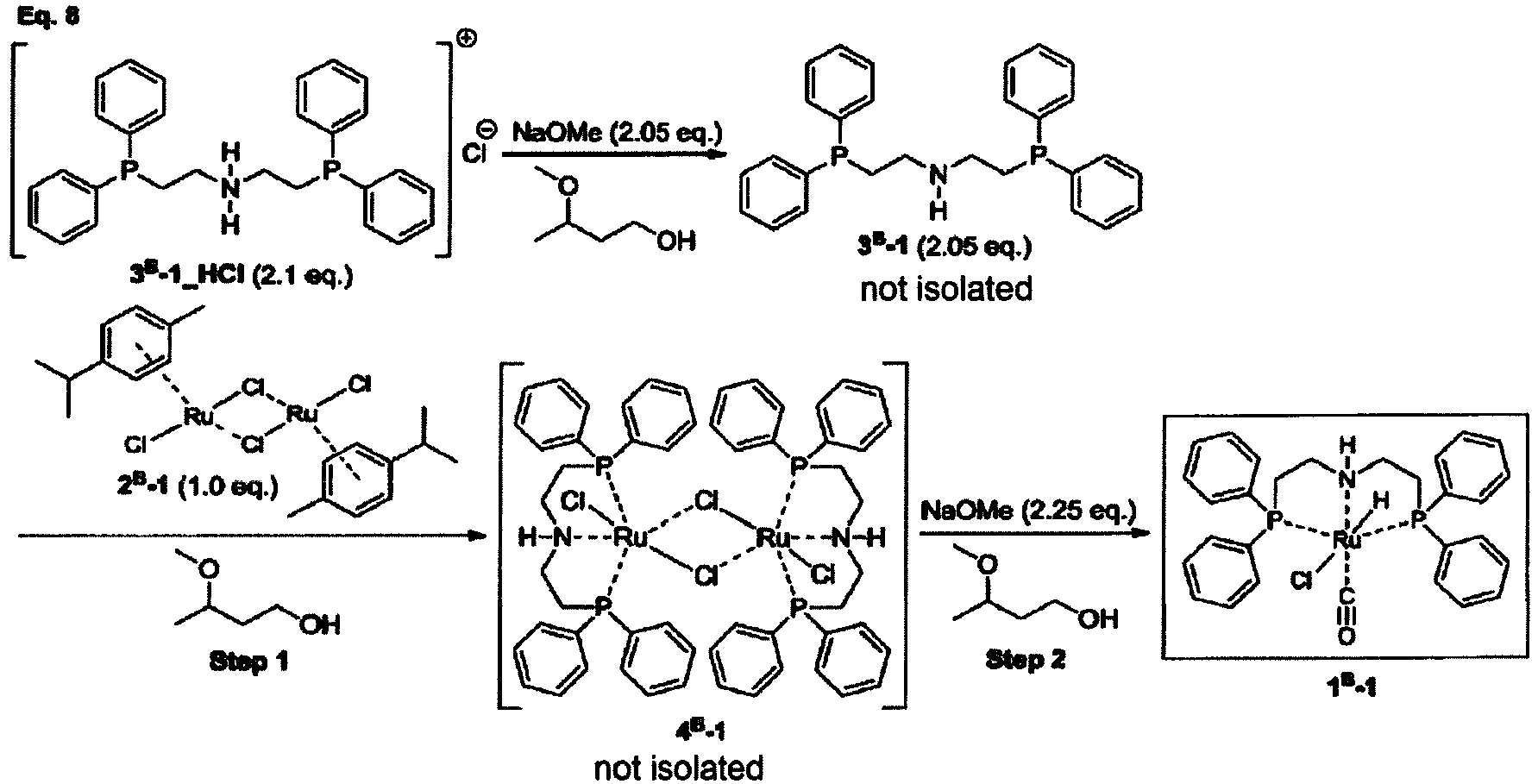
- A 100 mL four-necked round-bottomed flask equipped with a magnetic stirring bar, condenser, Claisen distillation apparatus, thermometer, and a three-way stopcock was evacuated and filled with nitrogen gas. Then, 3-methoxy-1-butanol (boiling point: 157°C, 60 mL), NaOMe (purity: 99.1 mass%, 730 mg, 13.39 mmol, 2.05 equivalents), and bis[2-(diphenylphosphino)ethyl]amine hydrochloride (3B-1_HCl) (6.56 g, 13.71 mmol, 2.1 equivalents) were charged into the flask successively.
- The obtained white suspension was stirred at room temperature for 30 minutes, and a neutralization reaction thereby proceeded while precipitating sodium chloride, and as a result, a 3-methoxy-1-butanol solution ofbis[2-(diphenylphosphino)ethyl]amine (3B-1) (2.05 equivalents) was obtained as a white suspension.
- Dichloro(p-cymene)ruthenium(II) dimer (2B-1) (4.0 g, 6.53 mmol, 1.0 equivalent) was added to the suspension above, and the resulting red suspension was stirred under reflux for 1 hour and then cooled to room temperature to give a crude product of dichloro{bis[2-(diphenylphosphino)ethyl]amine}ruthenium(II) dimer (4B-1) as an orange suspension.
- NaOMe (purity: 99.1 mass%, 801 mg, 14.69 mmol, 2.25 equivalents) was added to the suspension above, and the resulting suspension was stirred under reflux for 1 hour while distilling off low-boiling-point compounds by means of the Claisen distillation apparatus.
- The light brown suspension obtained after the reaction was cooled to 5°C by using an ice-water bath and filtered by suction, and the obtained crystal was washed with methanol, water and methanol successively and dried by heating under reduced pressure to give 6.38 g of the title compound (1B-1) as a light yellow powder. Isolated yield: 80.5%. The NMR measurement results of this compound were consistent with those obtained in Example 1-1.
- 6.42 g of the title compound (1B-1) was obtained as a light yellow powder by carrying out the same operation as in Example 3-1 except that NaOEt (purity: 98.0 mass%, 930 mg, 13.39 mmol, 2.05 equivalents (for neutralization of 3B-1_HCl)/1.02 g, 14.69 mmol, 2.25 equivalents (for production of 1B-1)) was used in place of NaOMe. Isolated yield: 81.0%.
- 6.56 g of the title compound (1B-1) was obtained as a light yellow powder by carrying out the same operation as in Example 3-1 except that NaOtBu (purity: 99.1 mass%, 1.30 g, 13.39 mmol, 2.05 equivalents (for neutralization of 3B-1_HCl))/1.42 g, 14.69 mmol, 2.25 equivalents (for production of 1B-1)) was used in place of NaOMe. Isolated yield: 82.7%.
- The results of Examples 3-1 to 3-3 are summarized in Table 3 below.
Table 3 Example Primary Alcohol Base Isolated Yield 3-1 3-methoxy-1-butanol NaOMe 80.5% 3-2 3-methoxy-1-butanol NaOEt 81.0% 3-3 3-methoxy-1-butanol NaOtBu 82.7% - As seen from Table 3, Ru-MACHO (1B-1) as a kind of ruthenium complex (1A) of the present invention was obtained as a single isomer in good yield by treating 4B-1 as a kind of ruthenium dinuclear complex (4A), which was not purified and isolated, with a primary alcohol and a base. In addition, all of by-products of this reaction could be easily removed by filtration of the reaction mixture and washing with methanol and water.
- The reaction formula is shown in the following Eq. 9.

- A 50 mL four-necked round-bottomed flask equipped with a magnetic stirring bar, condenser, Claisen distillation apparatus, thermometer, and a three-way stopcock was evacuated and filled with nitrogen gas. Then, 3-methoxy-1-butanol (boiling point: 157°C, 20 mL), dichloro(p-cymene)ruthenium(II) dimer (2B-1) (1.0 g, 1.63 mmol, 1.0 equivalent), and bis[(2-dicyclohexylphosphino)ethyl]amine (3B-2) (1.59 g, 3.42 mmol, 2.1 equivalents) were charged into the flask successively.
- The obtained red suspension was stirred under reflux for 1 hour and then cooled to room temperature to obtain a crude product of dichloro {bis[2-(dicyclohexylphosphino)ethyl]amine}ruthenium(II) dimer (4B-2) as a red-orange suspension. NaOEt (249 mg, 3.59 mmol, 2.2 equivalents) was added to the suspension above, and the resulting suspension was stirred under reflux for 1 hour while distilling off low-boiling-point compounds by means of the Claisen distillation apparatus.
- The light brown suspension obtained after the reaction was cooled to 5°C by using an ice-water bath and filtered by suction, and the obtained crystal was washed with methanol, water and methanol successively and dried by heating under reduced pressure to give 1.60 g of the title compound (1B-2) as an off-white powder. Isolated yield: 77.8%.
- 1H NMR (400 MHz, CD2Cl2): δ-3.42 (t, J=12.0 Hz, 1H), 3.28-3.12 (m, 2H), 2.42-2.16 (m, 8H), 2.04-1.18 (m, 42H), -16.38 (t, J=18.4 Hz, 1H).
- 31P NMR (161 MHz, CD2Cl2): δ=65.2 (d, J=15.9 Hz, 2P).
- Also in this case, a corresponding coordination isomer was not observed at all in the NMR analysis.
- It was found from the results of Example 4 that even when bis[(2-dicyclohexylphosphino)ethyl]amine (3B-2) is used in place of bis[2-(diphenylphosphino)ethyl]amine (3B-1), corresponding {bis[2-(dicyclohexylphosphino)ethyl]amine}carbonylchlorohydridoruthenium(II) (1B-2) is obtained as a single isomer in good yield.
- While the present invention has been described in detail and with reference to specific embodiments thereof, it will be apparent to one skilled in the art that various changes and modifications can be made therein without departing from the spirit and scope of the invention. This application is based on Japanese Patent Application No.
2015-193552 filed on September 30, 2015 - By the production method of the present invention, in terms of atom efficiency, by-product removal and purity, the ruthenium complex (1A) of the present invention useful as a catalyst for hydrogenation reaction can be produced with great efficiency, compared with the conventional production method. Accordingly, production of alcohols by hydrogenation reaction of ketones, esters and lactones, using the ruthenium complex (1A) of the present invention, can also be efficiently conducted.
Claims (11)
- A method for producing [bis(2-phosphinoethyl)amine]-carbonylhalohydridoruthenium (II) represented by the following formula (1A),
the method comprising reacting a ruthenium dinuclear complex represented by the following formula (2A) with a compound represented by the following formula (3A) in the presence of a primary alcohol and a base:


- The production method according to claim 1, wherein the primary alcohol is an alcohol represented by the following formula (5):

- The production method according to claim 1 or 2, wherein AH is a benzene which may have an alkyl group.
- The production method according to any one of claims 1 to 3, wherein X is a chloride ion.
- The production method according to any one of claims 1 to 4, wherein all of R5, R6, R7, R8, R9, R10, R11 and R12 are a hydrogen atom.
- The production method according to any one of claims 1 to 5, wherein each of R1, R2, R3 and R4 is independently a group selected from the group consisting of an alkyl group, a cycloalkyl group, and an aryl group which may have a substituent.
- A method for producing [bis(2-phosphinoethyl)amine]-carbonylhalohydridoruthenium (II) represented by the following formula (1A),
the method comprising treating a ruthenium dinuclear complex represented by the following formula (4A) with a primary alcohol and a base:

- The production method according to claim 7, wherein the primary alcohol is an alcohol represented by the following formula (5):


- The production method according to claim 7 or 8, wherein X is a chloride ion.
- The production method according to any one of claims 7 to 9, wherein all of R5, R6, R7, R8, R9, R10, R11 and R12 are a hydrogen atom.
- The production method according to any one of claims 7 to 10, wherein each of R1, R2, R3 and R4 is independently a group selected from the group consisting of an alkyl group, a cycloalkyl group, and an aryl group which may have a substituent.
Applications Claiming Priority (2)
| Application Number | Priority Date | Filing Date | Title |
|---|---|---|---|
| JP2015193552 | 2015-09-30 | ||
| PCT/JP2016/076564 WO2017056916A1 (en) | 2015-09-30 | 2016-09-09 | Method for producing ruthenium complex |
Publications (3)
| Publication Number | Publication Date |
|---|---|
| EP3357930A1 true EP3357930A1 (en) | 2018-08-08 |
| EP3357930A4 EP3357930A4 (en) | 2019-04-10 |
| EP3357930B1 EP3357930B1 (en) | 2020-07-01 |
Family
ID=58423386
Family Applications (1)
| Application Number | Title | Priority Date | Filing Date |
|---|---|---|---|
| EP16851090.7A Active EP3357930B1 (en) | 2015-09-30 | 2016-09-09 | Method for producing ruthenium complex |
Country Status (6)
| Country | Link |
|---|---|
| US (1) | US10584140B2 (en) |
| EP (1) | EP3357930B1 (en) |
| JP (1) | JP6765378B2 (en) |
| CN (1) | CN108137637B (en) |
| CA (1) | CA3000609C (en) |
| WO (1) | WO2017056916A1 (en) |
Family Cites Families (7)
| Publication number | Priority date | Publication date | Assignee | Title |
|---|---|---|---|---|
| WO2004096735A2 (en) | 2003-05-02 | 2004-11-11 | Kamaluddin Abdur-Rashid | Transfer hydrogenation processes and catalysts |
| EP2158154A4 (en) * | 2007-05-18 | 2012-06-13 | Kanata Chemical Technologies Inc | Method for the production of hydrogen from ammonia borane |
| WO2011048727A1 (en) | 2009-10-23 | 2011-04-28 | 高砂香料工業株式会社 | Novel ruthenium carbonyl complex having a tridentate ligand and manufacturing method and usage therefor |
| CN103772142B (en) | 2012-10-19 | 2018-04-27 | 中国科学院上海有机化学研究所 | Ruthenium complex and the method for preparing methanol and glycol |
| JP2014114257A (en) | 2012-12-12 | 2014-06-26 | Takasago Internatl Corp | Method for reducing halogen-substituted benzoate ester using ruthenium carbonyl complex |
| FR3013046B1 (en) | 2013-11-08 | 2015-11-06 | Pivert | METHOD FOR SYNTHESIZING ESTERS AND CATALYST OF SAID SYNTHESIS |
| JP6456364B2 (en) * | 2014-04-25 | 2019-01-23 | 高砂香料工業株式会社 | Ruthenium complex, production method thereof and use thereof |
-
2016
- 2016-09-09 EP EP16851090.7A patent/EP3357930B1/en active Active
- 2016-09-09 CN CN201680057618.9A patent/CN108137637B/en active Active
- 2016-09-09 US US15/764,940 patent/US10584140B2/en active Active
- 2016-09-09 JP JP2017543074A patent/JP6765378B2/en active Active
- 2016-09-09 WO PCT/JP2016/076564 patent/WO2017056916A1/en not_active Ceased
- 2016-09-09 CA CA3000609A patent/CA3000609C/en active Active
Also Published As
| Publication number | Publication date |
|---|---|
| CN108137637A (en) | 2018-06-08 |
| US10584140B2 (en) | 2020-03-10 |
| CA3000609A1 (en) | 2017-04-06 |
| EP3357930A4 (en) | 2019-04-10 |
| JP6765378B2 (en) | 2020-10-07 |
| CN108137637B (en) | 2020-05-08 |
| US20180273565A1 (en) | 2018-09-27 |
| EP3357930B1 (en) | 2020-07-01 |
| CA3000609C (en) | 2022-08-23 |
| WO2017056916A1 (en) | 2017-04-06 |
| JPWO2017056916A1 (en) | 2018-07-19 |
Similar Documents
| Publication | Publication Date | Title |
|---|---|---|
| EP3135681B1 (en) | Ruthenium complex, method for producing same, and use of same | |
| US20160060195A1 (en) | Novel ruthenium complex and method for preparing methanol and diol | |
| WO2021195751A1 (en) | Catalytic cannabigerol processes and precursors | |
| WO2008015977A1 (en) | PROCESS FOR PRODUCTION OF (±)-3a,6,6,9a– TETRAMETHYLDECAHYDRONAPHTHO[2,1-b]FURAN-2(1H)-ONE | |
| JP2012504596A (en) | Hydrogenation of ester or carbonyl groups with phosphinooxide-based ruthenium complexes | |
| EP3357930B1 (en) | Method for producing ruthenium complex | |
| EP4305027A1 (en) | Catalytic cannabinol synthesis and precursors | |
| JP2013519519A (en) | A novel phosphine-based catalyst useful for short-chain polymerization of butadiene | |
| EP3239127A1 (en) | Method for producing aldehyde compound, and acetal compound | |
| WO2014114615A1 (en) | Process for the preparation of 4-methylpent-3-en-1-ol derivatives | |
| CN109134547A (en) | A kind of ruthenium complex, preparation method and application | |
| JP7085532B2 (en) | Cationic ruthenium complex, its manufacturing method, and its uses | |
| KR20240016334A (en) | Process for preparing alkylated metallocenes having at least one tetrahydropentalenyl group | |
| EP3409681B1 (en) | N,n-bis(2-dialkylphosphinoethyl)amine-borane complex and production method therefor, and method for producing ruthenium complex containing n,n-bis(2-dialkylphosphinoethyl)amine as ligand | |
| CN117720396B (en) | Preparation method of cis-bicyclo [3.1.0] hex-3-ol | |
| JP7109000B2 (en) | Method for producing prenyl carboxylates and prenols | |
| CA2946705C (en) | Ruthenium complex, method for producing same, and use of same | |
| KR20160110966A (en) | METHOD FOR PRODUCING 5-NORBORNENE-2-SPIRO-α-CYCLOALKANONE-α'-SPIRO-2"-5"-NORBORNENE | |
| EA042793B1 (en) | SYNTHESIS OF ALKYL 2-ACETYL-5,9,13-TRIMETHYLTETRADECA-4,8,12-TRIENOATES AND THEIR DERIVATIVES IN A PERIODIC METHOD | |
| EP2483258A1 (en) | Process for preparing 1,2,6,7-tetrahydro-8h-indeno[5,4-b]furan-8-one | |
| JPWO2008059862A1 (en) | Process for producing optically active 2- (2'-piperidinyl) acetate |
Legal Events
| Date | Code | Title | Description |
|---|---|---|---|
| STAA | Information on the status of an ep patent application or granted ep patent |
Free format text: STATUS: THE INTERNATIONAL PUBLICATION HAS BEEN MADE |
|
| PUAI | Public reference made under article 153(3) epc to a published international application that has entered the european phase |
Free format text: ORIGINAL CODE: 0009012 |
|
| STAA | Information on the status of an ep patent application or granted ep patent |
Free format text: STATUS: REQUEST FOR EXAMINATION WAS MADE |
|
| 17P | Request for examination filed |
Effective date: 20180329 |
|
| AK | Designated contracting states |
Kind code of ref document: A1 Designated state(s): AL AT BE BG CH CY CZ DE DK EE ES FI FR GB GR HR HU IE IS IT LI LT LU LV MC MK MT NL NO PL PT RO RS SE SI SK SM TR |
|
| AX | Request for extension of the european patent |
Extension state: BA ME |
|
| DAV | Request for validation of the european patent (deleted) | ||
| DAX | Request for extension of the european patent (deleted) | ||
| A4 | Supplementary search report drawn up and despatched |
Effective date: 20190311 |
|
| RIC1 | Information provided on ipc code assigned before grant |
Ipc: C07B 61/00 20060101ALI20190305BHEP Ipc: C07F 15/00 20060101ALI20190305BHEP Ipc: C07F 9/50 20060101ALI20190305BHEP Ipc: B01J 31/00 20060101ALI20190305BHEP Ipc: C07F 19/00 20060101AFI20190305BHEP |
|
| GRAP | Despatch of communication of intention to grant a patent |
Free format text: ORIGINAL CODE: EPIDOSNIGR1 |
|
| STAA | Information on the status of an ep patent application or granted ep patent |
Free format text: STATUS: GRANT OF PATENT IS INTENDED |
|
| RIC1 | Information provided on ipc code assigned before grant |
Ipc: C07F 19/00 20060101AFI20200124BHEP Ipc: B01J 31/00 20060101ALI20200124BHEP Ipc: C07B 61/00 20060101ALI20200124BHEP Ipc: C07F 15/00 20060101ALI20200124BHEP Ipc: C07F 9/50 20060101ALI20200124BHEP |
|
| INTG | Intention to grant announced |
Effective date: 20200212 |
|
| GRAS | Grant fee paid |
Free format text: ORIGINAL CODE: EPIDOSNIGR3 |
|
| GRAA | (expected) grant |
Free format text: ORIGINAL CODE: 0009210 |
|
| STAA | Information on the status of an ep patent application or granted ep patent |
Free format text: STATUS: THE PATENT HAS BEEN GRANTED |
|
| AK | Designated contracting states |
Kind code of ref document: B1 Designated state(s): AL AT BE BG CH CY CZ DE DK EE ES FI FR GB GR HR HU IE IS IT LI LT LU LV MC MK MT NL NO PL PT RO RS SE SI SK SM TR |
|
| REG | Reference to a national code |
Ref country code: CH Ref legal event code: EP Ref country code: CH Ref legal event code: NV Representative=s name: VALIPAT S.A. C/O BOVARD SA NEUCHATEL, CH Ref country code: AT Ref legal event code: REF Ref document number: 1286109 Country of ref document: AT Kind code of ref document: T Effective date: 20200715 |
|
| REG | Reference to a national code |
Ref country code: IE Ref legal event code: FG4D |
|
| REG | Reference to a national code |
Ref country code: DE Ref legal event code: R096 Ref document number: 602016039298 Country of ref document: DE |
|
| REG | Reference to a national code |
Ref country code: LT Ref legal event code: MG4D |
|
| PG25 | Lapsed in a contracting state [announced via postgrant information from national office to epo] |
Ref country code: BG Free format text: LAPSE BECAUSE OF FAILURE TO SUBMIT A TRANSLATION OF THE DESCRIPTION OR TO PAY THE FEE WITHIN THE PRESCRIBED TIME-LIMIT Effective date: 20201001 |
|
| REG | Reference to a national code |
Ref country code: NL Ref legal event code: MP Effective date: 20200701 |
|
| REG | Reference to a national code |
Ref country code: AT Ref legal event code: MK05 Ref document number: 1286109 Country of ref document: AT Kind code of ref document: T Effective date: 20200701 |
|
| PG25 | Lapsed in a contracting state [announced via postgrant information from national office to epo] |
Ref country code: SE Free format text: LAPSE BECAUSE OF FAILURE TO SUBMIT A TRANSLATION OF THE DESCRIPTION OR TO PAY THE FEE WITHIN THE PRESCRIBED TIME-LIMIT Effective date: 20200701 Ref country code: NO Free format text: LAPSE BECAUSE OF FAILURE TO SUBMIT A TRANSLATION OF THE DESCRIPTION OR TO PAY THE FEE WITHIN THE PRESCRIBED TIME-LIMIT Effective date: 20201001 Ref country code: AT Free format text: LAPSE BECAUSE OF FAILURE TO SUBMIT A TRANSLATION OF THE DESCRIPTION OR TO PAY THE FEE WITHIN THE PRESCRIBED TIME-LIMIT Effective date: 20200701 Ref country code: HR Free format text: LAPSE BECAUSE OF FAILURE TO SUBMIT A TRANSLATION OF THE DESCRIPTION OR TO PAY THE FEE WITHIN THE PRESCRIBED TIME-LIMIT Effective date: 20200701 Ref country code: GR Free format text: LAPSE BECAUSE OF FAILURE TO SUBMIT A TRANSLATION OF THE DESCRIPTION OR TO PAY THE FEE WITHIN THE PRESCRIBED TIME-LIMIT Effective date: 20201002 Ref country code: FI Free format text: LAPSE BECAUSE OF FAILURE TO SUBMIT A TRANSLATION OF THE DESCRIPTION OR TO PAY THE FEE WITHIN THE PRESCRIBED TIME-LIMIT Effective date: 20200701 Ref country code: LT Free format text: LAPSE BECAUSE OF FAILURE TO SUBMIT A TRANSLATION OF THE DESCRIPTION OR TO PAY THE FEE WITHIN THE PRESCRIBED TIME-LIMIT Effective date: 20200701 Ref country code: ES Free format text: LAPSE BECAUSE OF FAILURE TO SUBMIT A TRANSLATION OF THE DESCRIPTION OR TO PAY THE FEE WITHIN THE PRESCRIBED TIME-LIMIT Effective date: 20200701 Ref country code: PT Free format text: LAPSE BECAUSE OF FAILURE TO SUBMIT A TRANSLATION OF THE DESCRIPTION OR TO PAY THE FEE WITHIN THE PRESCRIBED TIME-LIMIT Effective date: 20201102 Ref country code: CZ Free format text: LAPSE BECAUSE OF FAILURE TO SUBMIT A TRANSLATION OF THE DESCRIPTION OR TO PAY THE FEE WITHIN THE PRESCRIBED TIME-LIMIT Effective date: 20200701 |
|
| PG25 | Lapsed in a contracting state [announced via postgrant information from national office to epo] |
Ref country code: LV Free format text: LAPSE BECAUSE OF FAILURE TO SUBMIT A TRANSLATION OF THE DESCRIPTION OR TO PAY THE FEE WITHIN THE PRESCRIBED TIME-LIMIT Effective date: 20200701 Ref country code: PL Free format text: LAPSE BECAUSE OF FAILURE TO SUBMIT A TRANSLATION OF THE DESCRIPTION OR TO PAY THE FEE WITHIN THE PRESCRIBED TIME-LIMIT Effective date: 20200701 Ref country code: RS Free format text: LAPSE BECAUSE OF FAILURE TO SUBMIT A TRANSLATION OF THE DESCRIPTION OR TO PAY THE FEE WITHIN THE PRESCRIBED TIME-LIMIT Effective date: 20200701 Ref country code: IS Free format text: LAPSE BECAUSE OF FAILURE TO SUBMIT A TRANSLATION OF THE DESCRIPTION OR TO PAY THE FEE WITHIN THE PRESCRIBED TIME-LIMIT Effective date: 20201101 |
|
| PG25 | Lapsed in a contracting state [announced via postgrant information from national office to epo] |
Ref country code: NL Free format text: LAPSE BECAUSE OF FAILURE TO SUBMIT A TRANSLATION OF THE DESCRIPTION OR TO PAY THE FEE WITHIN THE PRESCRIBED TIME-LIMIT Effective date: 20200701 |
|
| REG | Reference to a national code |
Ref country code: DE Ref legal event code: R097 Ref document number: 602016039298 Country of ref document: DE |
|
| PG25 | Lapsed in a contracting state [announced via postgrant information from national office to epo] |
Ref country code: IT Free format text: LAPSE BECAUSE OF FAILURE TO SUBMIT A TRANSLATION OF THE DESCRIPTION OR TO PAY THE FEE WITHIN THE PRESCRIBED TIME-LIMIT Effective date: 20200701 Ref country code: EE Free format text: LAPSE BECAUSE OF FAILURE TO SUBMIT A TRANSLATION OF THE DESCRIPTION OR TO PAY THE FEE WITHIN THE PRESCRIBED TIME-LIMIT Effective date: 20200701 Ref country code: SM Free format text: LAPSE BECAUSE OF FAILURE TO SUBMIT A TRANSLATION OF THE DESCRIPTION OR TO PAY THE FEE WITHIN THE PRESCRIBED TIME-LIMIT Effective date: 20200701 Ref country code: RO Free format text: LAPSE BECAUSE OF FAILURE TO SUBMIT A TRANSLATION OF THE DESCRIPTION OR TO PAY THE FEE WITHIN THE PRESCRIBED TIME-LIMIT Effective date: 20200701 Ref country code: DK Free format text: LAPSE BECAUSE OF FAILURE TO SUBMIT A TRANSLATION OF THE DESCRIPTION OR TO PAY THE FEE WITHIN THE PRESCRIBED TIME-LIMIT Effective date: 20200701 |
|
| PLBE | No opposition filed within time limit |
Free format text: ORIGINAL CODE: 0009261 |
|
| STAA | Information on the status of an ep patent application or granted ep patent |
Free format text: STATUS: NO OPPOSITION FILED WITHIN TIME LIMIT |
|
| PG25 | Lapsed in a contracting state [announced via postgrant information from national office to epo] |
Ref country code: AL Free format text: LAPSE BECAUSE OF FAILURE TO SUBMIT A TRANSLATION OF THE DESCRIPTION OR TO PAY THE FEE WITHIN THE PRESCRIBED TIME-LIMIT Effective date: 20200701 |
|
| 26N | No opposition filed |
Effective date: 20210406 |
|
| REG | Reference to a national code |
Ref country code: BE Ref legal event code: MM Effective date: 20200930 |
|
| PG25 | Lapsed in a contracting state [announced via postgrant information from national office to epo] |
Ref country code: LU Free format text: LAPSE BECAUSE OF NON-PAYMENT OF DUE FEES Effective date: 20200909 Ref country code: SK Free format text: LAPSE BECAUSE OF FAILURE TO SUBMIT A TRANSLATION OF THE DESCRIPTION OR TO PAY THE FEE WITHIN THE PRESCRIBED TIME-LIMIT Effective date: 20200701 |
|
| PG25 | Lapsed in a contracting state [announced via postgrant information from national office to epo] |
Ref country code: SI Free format text: LAPSE BECAUSE OF FAILURE TO SUBMIT A TRANSLATION OF THE DESCRIPTION OR TO PAY THE FEE WITHIN THE PRESCRIBED TIME-LIMIT Effective date: 20200701 Ref country code: IE Free format text: LAPSE BECAUSE OF NON-PAYMENT OF DUE FEES Effective date: 20200909 Ref country code: BE Free format text: LAPSE BECAUSE OF NON-PAYMENT OF DUE FEES Effective date: 20200930 |
|
| PG25 | Lapsed in a contracting state [announced via postgrant information from national office to epo] |
Ref country code: TR Free format text: LAPSE BECAUSE OF FAILURE TO SUBMIT A TRANSLATION OF THE DESCRIPTION OR TO PAY THE FEE WITHIN THE PRESCRIBED TIME-LIMIT Effective date: 20200701 Ref country code: MT Free format text: LAPSE BECAUSE OF FAILURE TO SUBMIT A TRANSLATION OF THE DESCRIPTION OR TO PAY THE FEE WITHIN THE PRESCRIBED TIME-LIMIT Effective date: 20200701 Ref country code: CY Free format text: LAPSE BECAUSE OF FAILURE TO SUBMIT A TRANSLATION OF THE DESCRIPTION OR TO PAY THE FEE WITHIN THE PRESCRIBED TIME-LIMIT Effective date: 20200701 |
|
| PG25 | Lapsed in a contracting state [announced via postgrant information from national office to epo] |
Ref country code: MK Free format text: LAPSE BECAUSE OF FAILURE TO SUBMIT A TRANSLATION OF THE DESCRIPTION OR TO PAY THE FEE WITHIN THE PRESCRIBED TIME-LIMIT Effective date: 20200701 Ref country code: MC Free format text: LAPSE BECAUSE OF FAILURE TO SUBMIT A TRANSLATION OF THE DESCRIPTION OR TO PAY THE FEE WITHIN THE PRESCRIBED TIME-LIMIT Effective date: 20200701 |
|
| REG | Reference to a national code |
Ref country code: CH Ref legal event code: U11 Free format text: ST27 STATUS EVENT CODE: U-0-0-U10-U11 (AS PROVIDED BY THE NATIONAL OFFICE) Effective date: 20251001 |
|
| PGFP | Annual fee paid to national office [announced via postgrant information from national office to epo] |
Ref country code: DE Payment date: 20250820 Year of fee payment: 10 |
|
| PGFP | Annual fee paid to national office [announced via postgrant information from national office to epo] |
Ref country code: GB Payment date: 20250820 Year of fee payment: 10 |
|
| PGFP | Annual fee paid to national office [announced via postgrant information from national office to epo] |
Ref country code: FR Payment date: 20250820 Year of fee payment: 10 |
|
| PGFP | Annual fee paid to national office [announced via postgrant information from national office to epo] |
Ref country code: CH Payment date: 20251001 Year of fee payment: 10 |