EP3357574A1 - Catalyst composition for hydroformylation reaction, and hydroformylation method using same - Google Patents
Catalyst composition for hydroformylation reaction, and hydroformylation method using same Download PDFInfo
- Publication number
- EP3357574A1 EP3357574A1 EP16831807.9A EP16831807A EP3357574A1 EP 3357574 A1 EP3357574 A1 EP 3357574A1 EP 16831807 A EP16831807 A EP 16831807A EP 3357574 A1 EP3357574 A1 EP 3357574A1
- Authority
- EP
- European Patent Office
- Prior art keywords
- group
- catalyst composition
- hydroformylation
- aldehyde
- catalyst
- Prior art date
- Legal status (The legal status is an assumption and is not a legal conclusion. Google has not performed a legal analysis and makes no representation as to the accuracy of the status listed.)
- Granted
Links
Images

Classifications
-
- B—PERFORMING OPERATIONS; TRANSPORTING
- B01—PHYSICAL OR CHEMICAL PROCESSES OR APPARATUS IN GENERAL
- B01J—CHEMICAL OR PHYSICAL PROCESSES, e.g. CATALYSIS OR COLLOID CHEMISTRY; THEIR RELEVANT APPARATUS
- B01J31/00—Catalysts comprising hydrides, coordination complexes or organic compounds
- B01J31/02—Catalysts comprising hydrides, coordination complexes or organic compounds containing organic compounds or metal hydrides
- B01J31/0234—Nitrogen-, phosphorus-, arsenic- or antimony-containing compounds
- B01J31/0255—Phosphorus containing compounds
- B01J31/0264—Phosphorus acid amides
-
- B—PERFORMING OPERATIONS; TRANSPORTING
- B01—PHYSICAL OR CHEMICAL PROCESSES OR APPARATUS IN GENERAL
- B01J—CHEMICAL OR PHYSICAL PROCESSES, e.g. CATALYSIS OR COLLOID CHEMISTRY; THEIR RELEVANT APPARATUS
- B01J31/00—Catalysts comprising hydrides, coordination complexes or organic compounds
- B01J31/16—Catalysts comprising hydrides, coordination complexes or organic compounds containing coordination complexes
- B01J31/18—Catalysts comprising hydrides, coordination complexes or organic compounds containing coordination complexes containing nitrogen, phosphorus, arsenic or antimony as complexing atoms, e.g. in pyridine ligands, or in resonance therewith, e.g. in isocyanide ligands C=N-R or as complexed central atoms
-
- B—PERFORMING OPERATIONS; TRANSPORTING
- B01—PHYSICAL OR CHEMICAL PROCESSES OR APPARATUS IN GENERAL
- B01J—CHEMICAL OR PHYSICAL PROCESSES, e.g. CATALYSIS OR COLLOID CHEMISTRY; THEIR RELEVANT APPARATUS
- B01J31/00—Catalysts comprising hydrides, coordination complexes or organic compounds
- B01J31/16—Catalysts comprising hydrides, coordination complexes or organic compounds containing coordination complexes
- B01J31/18—Catalysts comprising hydrides, coordination complexes or organic compounds containing coordination complexes containing nitrogen, phosphorus, arsenic or antimony as complexing atoms, e.g. in pyridine ligands, or in resonance therewith, e.g. in isocyanide ligands C=N-R or as complexed central atoms
- B01J31/1845—Catalysts comprising hydrides, coordination complexes or organic compounds containing coordination complexes containing nitrogen, phosphorus, arsenic or antimony as complexing atoms, e.g. in pyridine ligands, or in resonance therewith, e.g. in isocyanide ligands C=N-R or as complexed central atoms the ligands containing phosphorus
- B01J31/185—Phosphites ((RO)3P), their isomeric phosphonates (R(RO)2P=O) and RO-substitution derivatives thereof
- B01J31/186—Mono- or diamide derivatives thereof
-
- C—CHEMISTRY; METALLURGY
- C07—ORGANIC CHEMISTRY
- C07C—ACYCLIC OR CARBOCYCLIC COMPOUNDS
- C07C45/00—Preparation of compounds having >C = O groups bound only to carbon or hydrogen atoms; Preparation of chelates of such compounds
- C07C45/49—Preparation of compounds having >C = O groups bound only to carbon or hydrogen atoms; Preparation of chelates of such compounds by reaction with carbon monoxide
- C07C45/50—Preparation of compounds having >C = O groups bound only to carbon or hydrogen atoms; Preparation of chelates of such compounds by reaction with carbon monoxide by oxo-reactions
-
- B—PERFORMING OPERATIONS; TRANSPORTING
- B01—PHYSICAL OR CHEMICAL PROCESSES OR APPARATUS IN GENERAL
- B01J—CHEMICAL OR PHYSICAL PROCESSES, e.g. CATALYSIS OR COLLOID CHEMISTRY; THEIR RELEVANT APPARATUS
- B01J2231/00—Catalytic reactions performed with catalysts classified in B01J31/00
- B01J2231/30—Addition reactions at carbon centres, i.e. to either C-C or C-X multiple bonds
- B01J2231/32—Addition reactions to C=C or C-C triple bonds
- B01J2231/321—Hydroformylation, metalformylation, carbonylation or hydroaminomethylation
-
- B—PERFORMING OPERATIONS; TRANSPORTING
- B01—PHYSICAL OR CHEMICAL PROCESSES OR APPARATUS IN GENERAL
- B01J—CHEMICAL OR PHYSICAL PROCESSES, e.g. CATALYSIS OR COLLOID CHEMISTRY; THEIR RELEVANT APPARATUS
- B01J2531/00—Additional information regarding catalytic systems classified in B01J31/00
- B01J2531/80—Complexes comprising metals of Group VIII as the central metal
- B01J2531/82—Metals of the platinum group
-
- B—PERFORMING OPERATIONS; TRANSPORTING
- B01—PHYSICAL OR CHEMICAL PROCESSES OR APPARATUS IN GENERAL
- B01J—CHEMICAL OR PHYSICAL PROCESSES, e.g. CATALYSIS OR COLLOID CHEMISTRY; THEIR RELEVANT APPARATUS
- B01J2531/00—Additional information regarding catalytic systems classified in B01J31/00
- B01J2531/80—Complexes comprising metals of Group VIII as the central metal
- B01J2531/82—Metals of the platinum group
- B01J2531/821—Ruthenium
-
- B—PERFORMING OPERATIONS; TRANSPORTING
- B01—PHYSICAL OR CHEMICAL PROCESSES OR APPARATUS IN GENERAL
- B01J—CHEMICAL OR PHYSICAL PROCESSES, e.g. CATALYSIS OR COLLOID CHEMISTRY; THEIR RELEVANT APPARATUS
- B01J2531/00—Additional information regarding catalytic systems classified in B01J31/00
- B01J2531/80—Complexes comprising metals of Group VIII as the central metal
- B01J2531/82—Metals of the platinum group
- B01J2531/822—Rhodium
-
- B—PERFORMING OPERATIONS; TRANSPORTING
- B01—PHYSICAL OR CHEMICAL PROCESSES OR APPARATUS IN GENERAL
- B01J—CHEMICAL OR PHYSICAL PROCESSES, e.g. CATALYSIS OR COLLOID CHEMISTRY; THEIR RELEVANT APPARATUS
- B01J2531/00—Additional information regarding catalytic systems classified in B01J31/00
- B01J2531/80—Complexes comprising metals of Group VIII as the central metal
- B01J2531/82—Metals of the platinum group
- B01J2531/825—Osmium
-
- B—PERFORMING OPERATIONS; TRANSPORTING
- B01—PHYSICAL OR CHEMICAL PROCESSES OR APPARATUS IN GENERAL
- B01J—CHEMICAL OR PHYSICAL PROCESSES, e.g. CATALYSIS OR COLLOID CHEMISTRY; THEIR RELEVANT APPARATUS
- B01J2531/00—Additional information regarding catalytic systems classified in B01J31/00
- B01J2531/80—Complexes comprising metals of Group VIII as the central metal
- B01J2531/82—Metals of the platinum group
- B01J2531/827—Iridium
-
- B—PERFORMING OPERATIONS; TRANSPORTING
- B01—PHYSICAL OR CHEMICAL PROCESSES OR APPARATUS IN GENERAL
- B01J—CHEMICAL OR PHYSICAL PROCESSES, e.g. CATALYSIS OR COLLOID CHEMISTRY; THEIR RELEVANT APPARATUS
- B01J2531/00—Additional information regarding catalytic systems classified in B01J31/00
- B01J2531/80—Complexes comprising metals of Group VIII as the central metal
- B01J2531/82—Metals of the platinum group
- B01J2531/828—Platinum
-
- B—PERFORMING OPERATIONS; TRANSPORTING
- B01—PHYSICAL OR CHEMICAL PROCESSES OR APPARATUS IN GENERAL
- B01J—CHEMICAL OR PHYSICAL PROCESSES, e.g. CATALYSIS OR COLLOID CHEMISTRY; THEIR RELEVANT APPARATUS
- B01J2531/00—Additional information regarding catalytic systems classified in B01J31/00
- B01J2531/80—Complexes comprising metals of Group VIII as the central metal
- B01J2531/84—Metals of the iron group
-
- B—PERFORMING OPERATIONS; TRANSPORTING
- B01—PHYSICAL OR CHEMICAL PROCESSES OR APPARATUS IN GENERAL
- B01J—CHEMICAL OR PHYSICAL PROCESSES, e.g. CATALYSIS OR COLLOID CHEMISTRY; THEIR RELEVANT APPARATUS
- B01J2531/00—Additional information regarding catalytic systems classified in B01J31/00
- B01J2531/80—Complexes comprising metals of Group VIII as the central metal
- B01J2531/84—Metals of the iron group
- B01J2531/842—Iron
-
- B—PERFORMING OPERATIONS; TRANSPORTING
- B01—PHYSICAL OR CHEMICAL PROCESSES OR APPARATUS IN GENERAL
- B01J—CHEMICAL OR PHYSICAL PROCESSES, e.g. CATALYSIS OR COLLOID CHEMISTRY; THEIR RELEVANT APPARATUS
- B01J2531/00—Additional information regarding catalytic systems classified in B01J31/00
- B01J2531/80—Complexes comprising metals of Group VIII as the central metal
- B01J2531/84—Metals of the iron group
- B01J2531/847—Nickel
-
- B—PERFORMING OPERATIONS; TRANSPORTING
- B01—PHYSICAL OR CHEMICAL PROCESSES OR APPARATUS IN GENERAL
- B01J—CHEMICAL OR PHYSICAL PROCESSES, e.g. CATALYSIS OR COLLOID CHEMISTRY; THEIR RELEVANT APPARATUS
- B01J31/00—Catalysts comprising hydrides, coordination complexes or organic compounds
- B01J31/40—Regeneration or reactivation
- B01J31/4015—Regeneration or reactivation of catalysts containing metals
- B01J31/4023—Regeneration or reactivation of catalysts containing metals containing iron group metals, noble metals or copper
- B01J31/4038—Regeneration or reactivation of catalysts containing metals containing iron group metals, noble metals or copper containing noble metals
-
- C—CHEMISTRY; METALLURGY
- C07—ORGANIC CHEMISTRY
- C07C—ACYCLIC OR CARBOCYCLIC COMPOUNDS
- C07C47/00—Compounds having —CHO groups
- C07C47/02—Saturated compounds having —CHO groups bound to acyclic carbon atoms or to hydrogen
Definitions
- the present invention relates to a catalyst composition for hydroformylation and a hydroformylation method using the same, and more particularly to a catalyst composition for hydroformylation which increases productivity and provides superior catalytic activity and stability while lowering an n/i ratio in generated aldehyde upon hydroformylation of an olefinic compound, and a method of hydroformylating an olefinic compound using the catalyst composition.
- Hydroformylation which was discovered by Otto Roelen in Germany in 1938, generates linear (normal) and branched (iso) aldehydes, a carbon number of which is increased by one, by reacting various olefins with carbon monoxide (CO) and hydrogen (H 2 ), which are often referred to as synthesis gases, in the presence of a homogeneous organometallic catalyst and ligand.
- CO carbon monoxide
- H 2 hydrogen
- Hydroformylation reaction commonly known as oxo reaction
- oxo reaction is an industrially important homogeneous catalytic reaction. Through such oxo reaction, various aldehydes including alcohol derivatives are produced throughout the world.
- oxo reaction Various aldehydes synthesized by oxo reaction may be oxidized or hydrogenated after aldol condensation and the like to be transformed into various acids and alcohols containing long alkyl groups. Particularly, hydrogenated alcohols of aldehydes produced by such oxo reaction are called oxo alcohols.
- oxo alcohol is industrially, widely used as a solvent, an additive, a raw material of various plasticizers, a synthetic lubricating oil, and the like.
- Patent Document 1 (Patent Document 1) US4215077 A
- the present invention has been made in view of the above problems, and it is one object of the present invention to provide a catalyst composition for hydroformylation which increases productivity and provides superior catalytic activity and stability while lowering an n/i ratio in generated aldehyde upon hydroformylation of an olefinic compound.
- a catalyst composition for hydroformylation including a phosphoramidite ligand represented by Formula 1 below and a transition metal catalyst:
- R 1 , R 2 and R 4 are connected to each other; one group selected from among R 1 , R 2 , and R 4 is a C 1 to C 3 substituted hydrocarbon group (CH) or tertiary amine group (N); the remaining two groups, except for the group selected from among R 1 , R 2 , and R 4 , are each independently a C 1 to C 20 alkylene group, C 5 to C 20 cycloalkylene group, C 6 to C 20 arylene group, or C 6 to C 20 alkylarylene group; and R 3 is hydrogen, a primary amine group (NH 2 ), a C 1 to C 20 alkyl group, a C 5 to C 20 cyclo alkyl group, a C 6 to C 20 aryl group or a C 6 to C 20 alkylaryl group.
- NH 2 primary amine group
- a method of hydroformylating an olefinic compound including a step of preparing aldehyde by reacting an olefinic compound with a syngas of carbon monoxide and hydrogen (CO/H 2 ) in the presence of the catalyst composition for hydroformylation.
- the present invention provides a catalyst composition for hydroformylation which increases productivity and provides superior catalytic activity and stability while lowering an n/i ratio in generated aldehyde upon hydroformylation of an olefinic compound, and a method of hydroformylating an olefinic compound using the catalyst composition.
- FIG. 1 illustrates comparative results of catalyst stability and productivity of Examples 2 and 7 according to the present invention and Comparative Examples 1 and 2.
- the present inventors confirmed that, when a phosphoramidite ligand, which is electronically enriched and has high steric hindrance, is applied to a catalyst composition used in hydroformylation of olefin, an n/i ratio in aldehyde is lowered, productivity increases, and superior catalytic activity and stability are provided, compared to conventional catalyst compositions to which a phosphine or phosphite ligand is applied, thus completing the present invention.
- the catalyst composition for hydroformylation according to the present invention includes a phosphoramidite ligand and a transition metal catalyst.
- the phosphoramidite may be, for example, a phosphoramidite represented by Formula 1 below:
- R 1 , R 2 and R 4 may be connected to each other; one group selected from among R 1 , R 2 , and R 4 may be a C 1 to C 3 substituted hydrocarbon group (CH) or tertiary amine group (N); the remaining two groups, except for the group selected from among R 1 , R 2 , and R 4 , may be each independently a C 1 to C 20 alkylene group, C 5 to C 20 cycloalkylene group, C 6 to C 20 arylene group, or C 6 to C 20 alkylarylene group; and R 3 may be hydrogen, a primary amine group (NH 2 ), a C 1 to C 20 alkyl group, a C 5 to C 20 cyclo alkyl group, a C 6 to C 20 aryl group or a C 6 to C 20 alkylaryl group.
- NH 2 primary amine group
- R 1 , R 2 and R 4 may be connected to each other; one group selected from among R 1 , R 2 , and R 4 may be a C 1 to C 3 substituted hydrocarbon group (CH) ; the remaining two groups, except for the group selected from among R 1 , R 2 , and R 4 , may be each independently a C 1 to C 10 alkylene group, C 5 to C 15 cycloalkylene group, C 6 to C 15 arylene group, or C 6 to C 15 alkylarylene group; and R 3 may be hydrogen, a primary amine group (NH 2 ), a C 1 to C 10 alkyl group, a C 5 to C 15 cyclo alkyl group, a C 6 to C 15 aryl group or a C 6 to C 15 alkylaryl group.
- NH 2 primary amine group
- the phosphoramidite represented by Formula 1 may be a bicyclic phosphoramidite represented by Formula 2 below:
- R 1 and R 2 may be each independently a C 1 to C 20 alkylene group, C 5 to C 20 cycloalkylene group, C 6 to C 20 arylene group, or C 6 to C 20 alkylarylene group;
- R 3 may be a C 1 to C 20 alkyl group, C 5 to C 20 cyclo alkyl group, C 6 to C 20 aryl group, or C 6 to C 20 alkylaryl group;
- R 4 may be a C 1 to C 3 substituted hydrocarbon group (CH) or tertiary amine group (N).
- R 1 and R 2 may be each independently a C 1 to C 10 alkylene group, C 5 to C 15 cycloalkylene group, C 6 to C 15 arylene group, or C 6 to C 15 alkylarylene group;
- R 3 may be a C 1 to C 15 alkyl group, C 5 to C 15 cyclo alkyl group, C 6 to C 15 aryl group, or C 6 to C 15 alkylaryl group;
- R 4 may be a C 1 to C 3 substituted hydrocarbon group (CH).
- superior catalytic activity and stability are exhibited and superior productivity is provided.
- the phosphoramidite ligand may be, for example, a mono-coordinate ligand.
- the phosphoramidite ligand may be included in an amount of, for example, 0.1 to 10 % by weight, 0.1 to 6 % by weight, 0.1 to 3 % by weight, or 0.1 to 1.5 % by weight based on the weight of the catalyst composition. Within this range, superior catalytic activity and stability are exhibited and a normal/iso (n/i) ratio in aldehyde is lowered.
- the phosphoramidite ligand may be included in a mole fraction of, for example, 1 to 500, 5 to 100, or 10 to 100 based on 1 mole of a transition metal of the transition metal catalyst. Within this range, superior catalytic activity and stability are provided.
- the transition metal catalyst may be, for example, a transition metal catalyst represented by Formula 3 below: [Formula 3] M(L 1 ) x (L 2 ) y (L 3 ) z
- M may be one selected from the group consisting of cobalt (Co), rhodium (Rh), iridium (Ir), ruthenium (Ru), iron (Fe), nickel (Ni), palladium (Pd), platinum (Pt), and osmium (Os); each of L 1 , L 2 and L 3 may be independently one selected from the group consisting of hydrogen, carbonyl (CO), cyclooctadiene, norbornene, chlorine, triphenylphosphine (TPP) and acetylacetonato (AcAc); and x, y and z may be each independently 0 to 5, but x, y and z might not all be 0.
- the transition metal catalyst may be one or more selected from the group consisting of cobaltcarbonyl[Co 2 (CO) 8 ], acetylacetonatodicarbonylrhodium [Rh(AcAc)(CO) 2 ], rhodium acetylacetonato carbonyl triphenylphosphine[Rh(AcAc)(CO)(TPP)], hydridocarbonyltri(triphenylphosphine)rhodium[HRh(CO)(TPP) 3 ], acetylacetonatodicarbonyliridium[Ir(AcAc)(CO) 2 ], and hydridocarbonyltri(triphenylphosphine)iridium[HIr(CO)(TPP) 3 ].
- superior catalytic activity is provided.
- the content of the transition metal catalyst may be, for example, 1 to 1, 000 ppm, 10 to 800 ppm, or 10 to 300 ppm based on the catalyst composition. Within this range, the rate of hydroformylation is excellent.
- the catalyst composition for hydroformylation may further include one or more solvents selected from the group consisting of propane aldehyde, butyl aldehyde, pentyl aldehyde, valer aldehyde, acetone, methyl ethyl ketone, methyl isobutyl ketone, acetophenone, cyclohexanone, ethanol, pentanol, octanol, texanol, benzene, toluene, xylene, orthodichlorobenzene, tetrahydrofuran, dimethoxyethane, dioxane, methylene chloride, and heptane.
- solvents selected from the group consisting of propane aldehyde, butyl aldehyde, pentyl aldehyde, valer aldehyde, acetone, methyl ethyl ketone, methyl isobutyl ketone, ace
- a hydroformylation method includes a step of preparing aldehyde by reacting an olefinic compound with a syngas of carbon monoxide and hydrogen (CO/H 2 ) in the presence of the catalyst composition for hydroformylation.
- the olefinic compound may be, for example, a compound represented by Formula 4 below:
- R 5 and R 6 may be each independently hydrogen, a C 1 to C 20 alkyl group, fluorine (F), chlorine (Cl), bromine (Br), trifluoromethyl (-CF 3 ), or a C 6 to C 20 aryl group having 0 to 5 substituents, and the substituents of the C 6 to C 20 aryl group may be nitro (-NO 2 ), fluorine (F), chlorine (Cl), bromine (Br), methyl, ethyl, propyl, or butyl.
- the olefinic compound may be one or more selected from the group consisting of ethene, propene, 1-butene, 1-pentene, 1-hexene, 1-octene and styrene.
- a mix ratio of hydrogen to carbon monoxide in the syngas may be, for example, 5:95 to 70:30, 40:60 to 60:40, or 45:55 to 55:45 in a mole ratio. Within this range, gases used for the reaction do not accumulate in a reactor, whereby the reactivity of the catalyst is excellent.
- a reaction temperature between the olefinic compound and the syngas (CO/H 2 ) in the presence of the catalyst composition may be, for example, 20 to 180°C, 50 to 150°C, or 60 to 100°C. Within this range, the stability and activity of the catalyst are maintained during the hydroformylation.
- a reaction pressure in a reactor may be 1 to 100 bar, 1 to 50 bar, or 5 to 30 bar. Within this range, superior catalytic activity is provided.
- the method of hydroformylating an olefinic compound may be represented by, for example, Reaction Formula 1 below:
- the transition metal catalyst represented by Formula 3 and the phosphoramidite ligand represented by Formula 1 are dissolved in the solvent to prepare a mixture including the transition metal catalyst and the phosphoramidite ligand. Subsequently, the mixture is fed into a general reactor along with the olefinic compound represented by Formula 4 and the syngas (CO/H 2 ). While stirring a resultant mixture, temperature and pressure are elevated such that hydroformylation is performed. As a result, aldehyde may be prepared.
- An n/i ratio in aldehyde prepared by the method of hydroformylating an olefinic compound may be, for example, 6.5 or less, 1.0 to 6.5, 1.5 to 4.0, or 1.5 to 3.0.
- n/i ratio in aldehyde Obtained by dividing the amount of generated n-butyraldehyde by the amount of isobutyraldehyde. A generation amount of each aldehyde was determined by gas chromatography (GC) analysis after reaction.
- GC gas chromatography
- Phosphoramidite-2 12 H- Dibenzo[d,g][1,3,2]dioxaphosphocin-6,12-imine, 13-(3,5-dimethylphenyl)- ( Cas. No. 1630816-46-4 )
- TPP triphenylphosphine
- TPTP tri-p-tolylphosphine
- DPPB 1,4-Bis(diphenylphosphino)butane
- DPPH 1,6-Bis(diphenylphosphino)hexane
- CDTP Cyclohexyl-di-p-tolylphosphine
- Catalyst stability (normal stability, aging) and productivity (%):
- the rhodium acetylacetonato carbonyl triphenylphosphine (Rh(AcAc)(CO)(TPP), ROPAC) and ligand of each of Examples 2 and 7 and Comparative Examples 1 to 4 were included in the same amounts as in Example 1, and dissolved in n-butyraldehyde, as a solvent, such that a total weight of resultant solution was 100 g (Rh 250 ppm).
- the resultant solution was fed into a 600 ml autoclave reactor.
- Resultant productivity was expressed as a consumed amount of the mixed gas in which propylene (C 3 H 6 ) and the syngas (CO/H 2 ) were mixed in a mole ratio of 1:1:1 (C 3 H 6 :CO:H 2 ). Improved catalyst stability results in improved productivity.
- the present inventors confirmed that, when the phosphoramidite ligand of the present invention is applied, the activity and stability of the catalyst may be maintained by the ligand which is electronically enriched and has high steric hindrance.
- the catalyst composition an n/i ratio in generated aldehyde upon hydroformylation of an olefinic compound may be remarkably reduced.
Landscapes
- Chemical & Material Sciences (AREA)
- Organic Chemistry (AREA)
- Chemical Kinetics & Catalysis (AREA)
- Engineering & Computer Science (AREA)
- Materials Engineering (AREA)
- Inorganic Chemistry (AREA)
- Organic Low-Molecular-Weight Compounds And Preparation Thereof (AREA)
- Low-Molecular Organic Synthesis Reactions Using Catalysts (AREA)
- Catalysts (AREA)
Abstract
Description
- This application claims the priority benefit of Korean Patent Application No.
10-2015-0137632, filed on September 30, 2015 - The present invention relates to a catalyst composition for hydroformylation and a hydroformylation method using the same, and more particularly to a catalyst composition for hydroformylation which increases productivity and provides superior catalytic activity and stability while lowering an n/i ratio in generated aldehyde upon hydroformylation of an olefinic compound, and a method of hydroformylating an olefinic compound using the catalyst composition.
- Hydroformylation, which was discovered by Otto Roelen in Germany in 1938, generates linear (normal) and branched (iso) aldehydes, a carbon number of which is increased by one, by reacting various olefins with carbon monoxide (CO) and hydrogen (H2), which are often referred to as synthesis gases, in the presence of a homogeneous organometallic catalyst and ligand.
- Hydroformylation reaction, commonly known as oxo reaction, is an industrially important homogeneous catalytic reaction. Through such oxo reaction, various aldehydes including alcohol derivatives are produced throughout the world.
- Various aldehydes synthesized by oxo reaction may be oxidized or hydrogenated after aldol condensation and the like to be transformed into various acids and alcohols containing long alkyl groups. Particularly, hydrogenated alcohols of aldehydes produced by such oxo reaction are called oxo alcohols. Such oxo alcohol is industrially, widely used as a solvent, an additive, a raw material of various plasticizers, a synthetic lubricating oil, and the like.
- In this regard, since the ratio of linear aldehyde (normal-aldehyde) derivatives among aldehydes produced by the oxo reaction is high, most research into catalysts has focused on increasing the proportion of the linear aldehyde derivatives. However, in recent years, demand for iso-aldehydes has increased due to development of, for example, isobutyric acid, neopentyl glycol (NPG), 2,2,4-trimethyl-1,3-pentanediol, isovaleric acid, and the like, which use a branched aldehyde derivative (iso-aldehyde) as a raw material, and thus, research to increase selectivity for branched aldehyde derivatives is underway. Accordingly, there is a need for development of a catalyst having superior stability and activity while lowering an n/i ratio in aldehyde.
- [Patent Document](Patent Document 1)
US4215077 A - Therefore, the present invention has been made in view of the above problems, and it is one object of the present invention to provide a catalyst composition for hydroformylation which increases productivity and provides superior catalytic activity and stability while lowering an n/i ratio in generated aldehyde upon hydroformylation of an olefinic compound.
- It is another object of the present invention to provide a method of hydroformylating an olefinic compound using the catalyst composition.
- The above and other objects can be accomplished by the present invention described below.
- In accordance with an aspect of the present invention, the above and other objects can be accomplished by the provision of a catalyst composition for hydroformylation, including a phosphoramidite ligand represented by Formula 1 below and a transition metal catalyst:
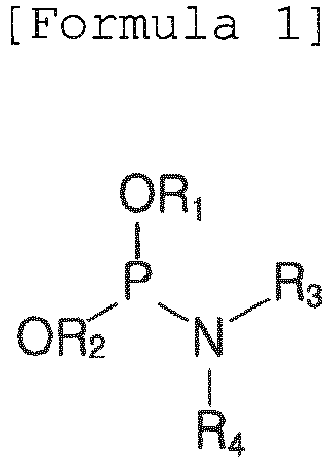
- wherein R1, R2 and R4 are connected to each other; one group selected from among R1, R2, and R4 is a C1 to C3 substituted hydrocarbon group (CH) or tertiary amine group (N); the remaining two groups, except for the group selected from among R1, R2, and R4, are each independently a C1 to C20 alkylene group, C5 to C20 cycloalkylene group, C6 to C20 arylene group, or C6 to C20 alkylarylene group; and R3 is hydrogen, a primary amine group (NH2), a C1 to C20 alkyl group, a C5 to C20 cyclo alkyl group, a C6 to C20 aryl group or a C6 to C20 alkylaryl group.
- In accordance with another aspect of the present invention, there is provided a method of hydroformylating an olefinic compound, the method including a step of preparing aldehyde by reacting an olefinic compound with a syngas of carbon monoxide and hydrogen (CO/H2) in the presence of the catalyst composition for hydroformylation.
- As apparent from the above description, the present invention provides a catalyst composition for hydroformylation which increases productivity and provides superior catalytic activity and stability while lowering an n/i ratio in generated aldehyde upon hydroformylation of an olefinic compound, and a method of hydroformylating an olefinic compound using the catalyst composition.
-
FIG. 1 illustrates comparative results of catalyst stability and productivity of Examples 2 and 7 according to the present invention and Comparative Examples 1 and 2. - Hereinafter, the present invention is described in detail.
- The present inventors confirmed that, when a phosphoramidite ligand, which is electronically enriched and has high steric hindrance, is applied to a catalyst composition used in hydroformylation of olefin, an n/i ratio in aldehyde is lowered, productivity increases, and superior catalytic activity and stability are provided, compared to conventional catalyst compositions to which a phosphine or phosphite ligand is applied, thus completing the present invention.
- The catalyst composition for hydroformylation according to the present invention includes a phosphoramidite ligand and a transition metal catalyst.
- Hereinafter, each constituent of the catalyst composition is described in detail.
- The phosphoramidite may be, for example, a phosphoramidite represented by Formula 1 below:
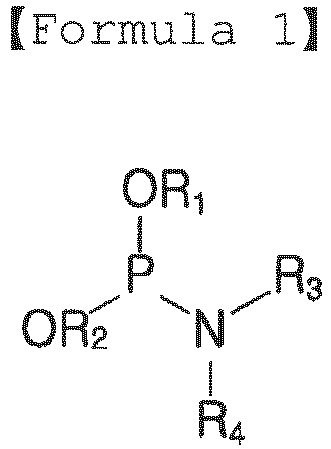
- In Formula 1, R1, R2 and R4 may be connected to each other; one group selected from among R1, R2, and R4 may be a C1 to C3 substituted hydrocarbon group (CH) or tertiary amine group (N); the remaining two groups, except for the group selected from among R1, R2, and R4, may be each independently a C1 to C20 alkylene group, C5 to C20 cycloalkylene group, C6 to C20 arylene group, or C6 to C20 alkylarylene group; and R3 may be hydrogen, a primary amine group (NH2), a C1 to C20 alkyl group, a C5 to C20 cyclo alkyl group, a C6 to C20 aryl group or a C6 to C20 alkylaryl group. Alternatively, R1, R2 and R4 may be connected to each other; one group selected from among R1, R2, and R4 may be a C1 to C3 substituted hydrocarbon group (CH) ; the remaining two groups, except for the group selected from among R1, R2, and R4, may be each independently a C1 to C10 alkylene group, C5 to C15 cycloalkylene group, C6 to C15 arylene group, or C6 to C15 alkylarylene group; and R3 may be hydrogen, a primary amine group (NH2), a C1 to C10 alkyl group, a C5 to C15 cyclo alkyl group, a C6 to C15 aryl group or a C6 to C15 alkylaryl group.
- As a specific example, the phosphoramidite represented by Formula 1 may be a bicyclic phosphoramidite represented by Formula 2 below:

- In
Formula 2, R1 and R2 may be each independently a C1 to C20 alkylene group, C5 to C20 cycloalkylene group, C6 to C20 arylene group, or C6 to C20 alkylarylene group; R3 may be a C1 to C20 alkyl group, C5 to C20 cyclo alkyl group, C6 to C20 aryl group, or C6 to C20 alkylaryl group; and R4 may be a C1 to C3 substituted hydrocarbon group (CH) or tertiary amine group (N). Alternatively, R1 and R2 may be each independently a C1 to C10 alkylene group, C5 to C15 cycloalkylene group, C6 to C15 arylene group, or C6 to C15 alkylarylene group; R3 may be a C1 to C15 alkyl group, C5 to C15 cyclo alkyl group, C6 to C15 aryl group, or C6 to C15 alkylaryl group; and R4 may be a C1 to C3 substituted hydrocarbon group (CH). In this case, superior catalytic activity and stability are exhibited and superior productivity is provided. - The phosphoramidite ligand may be, for example, a mono-coordinate ligand.
- The phosphoramidite ligand may be included in an amount of, for example, 0.1 to 10 % by weight, 0.1 to 6 % by weight, 0.1 to 3 % by weight, or 0.1 to 1.5 % by weight based on the weight of the catalyst composition. Within this range, superior catalytic activity and stability are exhibited and a normal/iso (n/i) ratio in aldehyde is lowered.
- The phosphoramidite ligand may be included in a mole fraction of, for example, 1 to 500, 5 to 100, or 10 to 100 based on 1 mole of a transition metal of the transition metal catalyst. Within this range, superior catalytic activity and stability are provided.
- The transition metal catalyst may be, for example, a transition metal catalyst represented by Formula 3 below:
[Formula 3] M(L1)x(L2)y(L3)z
- In Formula 3, M may be one selected from the group consisting of cobalt (Co), rhodium (Rh), iridium (Ir), ruthenium (Ru), iron (Fe), nickel (Ni), palladium (Pd), platinum (Pt), and osmium (Os); each of L1, L2 and L3 may be independently one selected from the group consisting of hydrogen, carbonyl (CO), cyclooctadiene, norbornene, chlorine, triphenylphosphine (TPP) and acetylacetonato (AcAc); and x, y and z may be each independently 0 to 5, but x, y and z might not all be 0.
- As a specific example, the transition metal catalyst may be one or more selected from the group consisting of cobaltcarbonyl[Co2(CO)8], acetylacetonatodicarbonylrhodium [Rh(AcAc)(CO)2], rhodium acetylacetonato carbonyl triphenylphosphine[Rh(AcAc)(CO)(TPP)], hydridocarbonyltri(triphenylphosphine)rhodium[HRh(CO)(TPP)3], acetylacetonatodicarbonyliridium[Ir(AcAc)(CO)2], and hydridocarbonyltri(triphenylphosphine)iridium[HIr(CO)(TPP)3]. In this case, superior catalytic activity is provided.
- The content of the transition metal catalyst may be, for example, 1 to 1, 000 ppm, 10 to 800 ppm, or 10 to 300 ppm based on the catalyst composition. Within this range, the rate of hydroformylation is excellent.
- The catalyst composition for hydroformylation may further include one or more solvents selected from the group consisting of propane aldehyde, butyl aldehyde, pentyl aldehyde, valer aldehyde, acetone, methyl ethyl ketone, methyl isobutyl ketone, acetophenone, cyclohexanone, ethanol, pentanol, octanol, texanol, benzene, toluene, xylene, orthodichlorobenzene, tetrahydrofuran, dimethoxyethane, dioxane, methylene chloride, and heptane. In this case, suerior catalyst stability is exhibited.
- A hydroformylation method according to the present invention includes a step of preparing aldehyde by reacting an olefinic compound with a syngas of carbon monoxide and hydrogen (CO/H2) in the presence of the catalyst composition for hydroformylation.
- The olefinic compound may be, for example, a compound represented by Formula 4 below:

- In Formula 4, R5 and R6 may be each independently hydrogen, a C1 to C20 alkyl group, fluorine (F), chlorine (Cl), bromine (Br), trifluoromethyl (-CF3), or a C6 to C20 aryl group having 0 to 5 substituents, and the substituents of the C6 to C20 aryl group may be nitro (-NO2), fluorine (F), chlorine (Cl), bromine (Br), methyl, ethyl, propyl, or butyl.
- As a specific example, the olefinic compound may be one or more selected from the group consisting of ethene, propene, 1-butene, 1-pentene, 1-hexene, 1-octene and styrene.
- A mix ratio of hydrogen to carbon monoxide in the syngas (CO/H2) may be, for example, 5:95 to 70:30, 40:60 to 60:40, or 45:55 to 55:45 in a mole ratio. Within this range, gases used for the reaction do not accumulate in a reactor, whereby the reactivity of the catalyst is excellent.
- In the hydroformylation, a reaction temperature between the olefinic compound and the syngas (CO/H2) in the presence of the catalyst composition may be, for example, 20 to 180°C, 50 to 150°C, or 60 to 100°C. Within this range, the stability and activity of the catalyst are maintained during the hydroformylation.
- In another embodiment, in the hydroformylation, a reaction pressure in a reactor may be 1 to 100 bar, 1 to 50 bar, or 5 to 30 bar. Within this range, superior catalytic activity is provided.
- The method of hydroformylating an olefinic compound may be represented by, for example, Reaction Formula 1 below:

- As a specific example, the transition metal catalyst represented by Formula 3 and the phosphoramidite ligand represented by Formula 1 are dissolved in the solvent to prepare a mixture including the transition metal catalyst and the phosphoramidite ligand. Subsequently, the mixture is fed into a general reactor along with the olefinic compound represented by Formula 4 and the syngas (CO/H2). While stirring a resultant mixture, temperature and pressure are elevated such that hydroformylation is performed. As a result, aldehyde may be prepared.
- An n/i ratio in aldehyde prepared by the method of hydroformylating an olefinic compound may be, for example, 6.5 or less, 1.0 to 6.5, 1.5 to 4.0, or 1.5 to 3.0.
- Now, the present invention will be described in more detail with reference to the following preferred examples. However, these examples are provided for illustrative purposes only. Those skilled in the art will appreciate that various modifications, additions and substitutions are possible, without departing from the scope and spirit of the invention. Therefore, it is obvious that the modifications, additions and substitutions are within the scope of the present invention.
- 24.37 µmol of rhodium acetylacetonato carbonyl triphenylphosphine (Rh(AcAc)(CO)(TPP), ROPAC), as a catalyst, was dissolved with a ligand in an amount of % by weight summarized in Table 1 below in valeraldehyde as a solvent such that a total amount of resultant solution became 10 ml (Rh 250 ppm). Subsequently, the resultant solution was fed into a 20 ml autoclave reactor in High Throughput Screen apparatus (HTS, manufactured by Autoclave, US, 10 reactions can be simultaneously performed in this multi-clave apparatus). To this reaction solution, a mix gas in which propylene (C3H6) and a syngas (CO/H2) were mixed in a mole ratio of 1:1:1 (C3H6:CO:H2) was injected, the pressure in the reactor was maintained at 8 bar, and reaction was performed at 90°C for 4 hours and 15 minutes while stirring.
- With regard to the catalyst composition prepared according to each of Examples 1 to 10 and Comparative Examples 1 to 7, an n/i ratio in aldehyde, catalytic activity and stability, and productivity were measured according to the following methods. Results are summarized in Tables 1 and 2 below.
-
n/i ratio in aldehyde: Obtained by dividing the amount of generated n-butyraldehyde by the amount of isobutyraldehyde. A generation amount of each aldehyde was determined by gas chromatography (GC) analysis after reaction.
Catalytic activity (normal activity, %): With respect to 100 % by weight of normal and isobutyl aldehyde generated by adding a mixed gas, which included propylene (C3H6) and a syngas (CO/H2) in a mole ratio of 1:1:1 (C3H6:CO:H2), to a reaction solution prepared according to Comparative Example 1, by maintaining the pressure in a reactor at 8 bar, and reacting at 90°C for one hour while stirring, a total weight of normal and isobutyl aldehyde generated by reacting, under the same conditions, a reaction solution of each of the examples and comparative examples was compared and expressed as a percentage according to Equation 1 below:
Color after reaction: the color of the catalyst solution of each of the examples and the comparative examples after reaction was observed with the naked eye.[Table 1] Classification Catalyst (Rh) Ligand Ligand content Ration of n/i Catalytic activity Color after reaction Example 1 ROPAC Phosphoramidite-1 0.5 % by weight 1.8 422 Brown Example 2 ROPAC Phosphoramidite-1 1 % by weig ht 2.8 503 Light yellow Example 3 ROPAC Phosphoramidite-1 3 % by weight 5.7 167 Light yellow Example 4 ROPAC Phosphoramidite-1 5 % by weig ht 6.2 130 Yellow Example 5 ROPAC Phosphoramidite-1 6 % by weig ht 6.5 126 Yellow Example 6 ROPAC Phosphoramidite-2 0.5 % by weig ht 1.6 474 Brown Example 7 ROPAC Phosphoramidite-2 1 % by weig ht 2.5 196 Light yellow Example 8 ROPAC Phosphoramidite-2 3 % by weig ht 3.7 140 Yellow Example 9 ROPAC Phosphoramidite-2 5 % by weig ht 5.1 110 Yellow Example 10 ROPAC Phosphoramidite-2 6 % by weig ht 5.5 90 Yellow Comparative Examples 1 ROPAC TPP 6 % by weig ht 10 100 Dark yellow Comparative Examples 2 ROPAC TPP 3 % by weig ht 6.7 135 Yellow Comparative Examples 3 ROPAC TPTP 2 % by weig ht 3.7 120 Yellow Comparative Examples 4 ROPAC TPTP 3 % by weig ht 4.2 100 Dark yellow Comparative Examples 5 ROPAC DPPB 2 % by weig ht 2.5 47 Brown Comparative Examples 6 ROPAC DPPH 2 % by weig ht 6.4 31 Dark Brown Comparative Examples 7 ROPAC CDTP 2 % by weig ht 1.7 37 Dark Brown
Phosphoramidite-1: 12H-Dibenzo[d,g][1,3,2]dioxaphosphocin-6,12-imine, 13-phenyl- (Cas. No. 1630816-45-3)
Phosphoramidite-2: 12H-Dibenzo[d,g][1,3,2]dioxaphosphocin-6,12-imine, 13-(3,5-dimethylphenyl)- (Cas. No. 1630816-46-4)
TPP: triphenylphosphine
TPTP: tri-p-tolylphosphine
DPPB: 1,4-Bis(diphenylphosphino)butane
DPPH: 1,6-Bis(diphenylphosphino)hexane
CDTP: Cyclohexyl-di-p-tolylphosphine - Catalyst stability (normal stability, aging) and productivity (%): The rhodium acetylacetonato carbonyl triphenylphosphine (Rh(AcAc)(CO)(TPP), ROPAC) and ligand of each of Examples 2 and 7 and Comparative Examples 1 to 4 were included in the same amounts as in Example 1, and dissolved in n-butyraldehyde, as a solvent, such that a total weight of resultant solution was 100 g (Rh 250 ppm). The resultant solution was fed into a 600 ml autoclave reactor. A syngas (CO/H2), which included CO and H2 in a mole ratio of 1:1, was injected into the resultant solution such that the pressure inside the reactor became 6 bar, and stirring was performed for 0, 2.5 hours, 5 hours, or 15 hours at 120°C, followed by cooling up to 20°C. Subsequently, the syngas was replaced with a mixed gas in which propylene (C3H6) and the syngas (CO/H2) were mixed in a mole ratio of 1:1:1 (C3H6:CO:H2). Subsequently, the pressure inside the reactor was maintained at 8 bar and reaction was allowed to proceed at 90°C for one hour. Resultant productivity was expressed as a consumed amount of the mixed gas in which propylene (C3H6) and the syngas (CO/H2) were mixed in a mole ratio of 1:1:1 (C3H6:CO:H2). Improved catalyst stability results in improved productivity.
[Table 2] Classification Productivity (catalyst stability) Elapsed time 0 hr 2.5 hr 5 hr 15 hr Example 2 (Phosphoramidite - 11 % by weight) 510 465 423 370 Example 7 (Phosphoramidite - 21 % by weight) 667 616 573 526 Comparative Examples 1 (TPP - 6 % by weight) 100 52 48 37 Comparative Examples 2 (TPP - 3 % by weight) 142 52 44 26 Comparative Examples 3 (TPTP - 2 % by weight) 137 80 68 39 Comparative Examples 4 (TPTP - 3 % by weight) 173 68 57 23 - As summarized in Table 1, it can be confirmed that the catalyst compositions of Examples 1 to 10 prepared according to the present invention exhibit superior catalytic activity while maintaining an n/i ratio in aldehyde within a proper range. In addition, as shown in Table 2, it can be confirmed that productivity decrease over time of the catalyst compositions of the present invention is very small, which indicates superior catalyst stability (see the comparative graph of
FIG. 1 ). Further, from the color results after reaction, it can be confirmed that, when the ligands of the present invention are included in a predetermined amount or more, deactivation degrees of the catalyst solutions after reaction are small. - On the other hand, it can be confirmed that, in Comparative Examples 1 and 2 including triphenylphosphine as a ligand and Comparative Examples 3 and 4 including tri-p-tolylphosphine as a ligand, an n/i ratio in aldehyde is high and productivity and catalyst stability are poor (see the comparative graph of
FIG. 1 ). In addition, it can be confirmed that, in Comparative Examples 5 including 1,4-bis(diphenylphosphino)butane as a ligand, Comparative Examples 6 including 1,6-bis(diphenylphosphino)hexane as a ligand, and Comparative Examples 7 including cyclohexyl-di-para-tolylphosphine as a ligand, catalytic activity is very poor. - In conclusion, the present inventors confirmed that, when the phosphoramidite ligand of the present invention is applied, the activity and stability of the catalyst may be maintained by the ligand which is electronically enriched and has high steric hindrance. In addition, by using the catalyst composition, an n/i ratio in generated aldehyde upon hydroformylation of an olefinic compound may be remarkably reduced.
Claims (13)
- A catalyst composition for hydroformylation, comprising a phosphoramidite ligand represented by Formula 1 below and a transition metal catalyst:

- The catalyst composition according to claim 1, wherein the phosphoramidite represented by Formula 1 is a bicyclic phosphoramidite represented by Formula 2 below:

- The catalyst composition according to claim 1, wherein the phosphoramidite ligand is comprised in an amount of 0.1 to 10 % by weight based on a weight of the catalyst composition.
- The catalyst composition according to claim 1, wherein a molar fraction of the phosphoramidite ligand is 1 to 500 based on 1 mole of a transition metal of the transition metal catalyst.
- The catalyst composition according to claim 1, wherein the transition metal catalyst is a transition metal catalyst represented by Formula 3 below:
[Formula 3] M(L1)x(L2)y(L3)z
wherein M is one selected from the group consisting of cobalt (Co), rhodium (Rh), iridium (Ir), ruthenium (Ru), iron (Fe), nickel (Ni), palladium (Pd), platinum (Pt), and osmium (Os),each of L1, L2 and L3 is independently one selected from the group consisting of hydrogen, carbonyl (CO), cyclooctadiene, norbornene, chlorine, triphenylphosphine (TPP) and acetylacetonato (AcAc), andx, y and z are each independently 0 to 5, but x, y and z are not simultaneouosly 0. - The catalyst composition according to claim 1, wherein the transition metal catalyst is one or more selected from the group consisting of cobaltcarbonyl [Co2(CO)8], acetylacetonatodicarbonylrhodium [Rh(AcAc)(CO)2], rhodium acetylacetonato carbonyl triphenylphosphine [Rh(AcAc)(CO)(TPP)], hydridocarbonyltri(triphenylphosphine)rhodium [HRh(CO)(TPP)3], acetylacetonatodicarbonyliridium [Ir(AcAc)(CO)2], and hydridocarbonyltri(triphenylphosphine)iridium [HIr(CO)(TPP)3].
- The catalyst composition according to claim 1, wherein a content of the transition metal catalyst is 1 to 1,000 ppm based on the catalyst composition for hydroformylation.
- The catalyst composition according to claim 1, wherein the catalyst composition for hydroformylation further comprises one or more solvents selected from the group consisting of propane aldehyde, butyl aldehyde, pentyl aldehyde, valer aldehyde, acetone, methyl ethyl ketone, methyl isobutyl ketone, acetophenone, cyclohexanone, ethanol, pentanol, octanol, texanol, benzene, toluene, xylene, orthodichlorobenzene, tetrahydrofuran, dimethoxyethane, dioxane, methylene chloride, and heptane.
- A method of hydroformylating an olefinic compound, the method comprising a step of preparing aldehyde by reacting an olefinic compound with a syngas of carbon monoxide and hydrogen (CO/H2) in the presence of the catalyst composition for hydroformylation according to any one of claims 1 to 8.
- The method according to claim 9, wherein the olefinic compound is a compound represented by Formula 4 below:

 wherein R5 and R6 are each independently hydrogen, a C1 to C20 alkyl group, fluorine (F), chlorine (Cl), bromine (Br), trifluoromethyl (-CF3), or a C6 to C20 aryl group having 0 to 5 substituents, andthe substituents of the C6 to C20 aryl group are nitro (-NO2), fluorine (F), chlorine (Cl), bromine (Br), methyl, ethyl, propyl, or butyl.
 - The method according to claim 9, wherein the olefinic compound is one or more selected from the group consisting of ethene, propene, 1-butene, 1-pentene, 1-hexene, 1-octene and styrene.
- The method according to claim 9, wherein a normal/iso (n/i) ratio in the prepared aldehyde is 6.5 or less.
- The method according to claim 9, wherein a mix ratio of hydrogen to carbon monoxide in the syngas (CO/H2) is 5:95 to 70:30 in a mole ratio.
Applications Claiming Priority (2)
| Application Number | Priority Date | Filing Date | Title |
|---|---|---|---|
| KR1020150137632A KR101962094B1 (en) | 2015-09-30 | 2015-09-30 | Catalyst composition for hydroformylation and hydroformylation process using the same |
| PCT/KR2016/009519 WO2017057849A1 (en) | 2015-09-30 | 2016-08-26 | Catalyst composition for hydroformylation reaction, and hydroformylation method using same |
Publications (3)
| Publication Number | Publication Date |
|---|---|
| EP3357574A1 true EP3357574A1 (en) | 2018-08-08 |
| EP3357574A4 EP3357574A4 (en) | 2019-05-15 |
| EP3357574B1 EP3357574B1 (en) | 2021-09-29 |
Family
ID=58427797
Family Applications (1)
| Application Number | Title | Priority Date | Filing Date |
|---|---|---|---|
| EP16831807.9A Active EP3357574B1 (en) | 2015-09-30 | 2016-08-26 | Hydroformylation method |
Country Status (5)
| Country | Link |
|---|---|
| US (1) | US10625248B2 (en) |
| EP (1) | EP3357574B1 (en) |
| KR (1) | KR101962094B1 (en) |
| CN (1) | CN107073461B (en) |
| WO (1) | WO2017057849A1 (en) |
Families Citing this family (3)
| Publication number | Priority date | Publication date | Assignee | Title |
|---|---|---|---|---|
| KR102000754B1 (en) * | 2017-11-03 | 2019-07-17 | 한국과학기술원 | Bicyclic Bridgehead Phosphoramidite Derivatives, Preparation Method and Uses Thereof |
| CN114539319B (en) * | 2020-11-24 | 2024-04-12 | 中国科学院大连化学物理研究所 | Chiral phosphine-dicyclophosphoramidite ligand and preparation method and application thereof |
| CN114931961B (en) * | 2022-06-10 | 2024-02-27 | 万华化学集团股份有限公司 | A kind of hydroformylation catalyst and its application |
Family Cites Families (11)
| Publication number | Priority date | Publication date | Assignee | Title |
|---|---|---|---|---|
| US4215077A (en) | 1978-02-09 | 1980-07-29 | Kuraray Co., Ltd. | Hydroformylation of olefins |
| GB8334359D0 (en) * | 1983-12-23 | 1984-02-01 | Davy Mckee Ltd | Process |
| BE1014966A3 (en) | 2001-02-13 | 2004-07-06 | Basf Ag | Process hydroformylation ethylenically unsaturated compounds and catalysts used for that purpose. |
| CN100412046C (en) * | 2003-10-21 | 2008-08-20 | 巴斯福股份公司 | Process for the continuous preparation of aldehydes |
| KR20100019058A (en) * | 2008-08-08 | 2010-02-18 | 주식회사 엘지화학 | Method of hydroformylating diene composition and the composition manufactured by using the method |
| EP2942343B1 (en) * | 2009-12-22 | 2019-09-04 | Dow Technology Investments LLC | Controlling the normal : iso aldehyde ratio in a mixed ligand hydroformylation process |
| KR101095775B1 (en) | 2010-09-02 | 2011-12-21 | 주식회사 엘지화학 | Catalyst composition for hydroformylation reaction of olefinic compound and hydroformylation method of olefinic compound using same |
| US9174907B2 (en) * | 2012-06-04 | 2015-11-03 | Dow Technology Investments Llc | Hydroformylation process |
| KR102098429B1 (en) * | 2012-12-06 | 2020-04-07 | 다우 테크놀로지 인베스트먼츠 엘엘씨. | Hydroformylation process |
| SG11201600438VA (en) * | 2013-07-23 | 2016-02-26 | Evonik Degussa Gmbh | Phosphoramidite derivatives in the hydroformylation of unsaturated compounds |
| KR101574071B1 (en) * | 2014-08-26 | 2015-12-03 | 기초과학연구원 | Bicyclic Bridgehead Phosphoramidite and Method of Preparation Thereof |
-
2015
- 2015-09-30 KR KR1020150137632A patent/KR101962094B1/en active Active
-
2016
- 2016-08-26 US US15/504,477 patent/US10625248B2/en active Active
- 2016-08-26 CN CN201680002637.1A patent/CN107073461B/en active Active
- 2016-08-26 WO PCT/KR2016/009519 patent/WO2017057849A1/en not_active Ceased
- 2016-08-26 EP EP16831807.9A patent/EP3357574B1/en active Active
Also Published As
| Publication number | Publication date |
|---|---|
| KR20170038356A (en) | 2017-04-07 |
| CN107073461B (en) | 2021-08-27 |
| US10625248B2 (en) | 2020-04-21 |
| KR101962094B1 (en) | 2019-03-26 |
| CN107073461A (en) | 2017-08-18 |
| EP3357574B1 (en) | 2021-09-29 |
| US20190111416A1 (en) | 2019-04-18 |
| WO2017057849A1 (en) | 2017-04-06 |
| EP3357574A4 (en) | 2019-05-15 |
Similar Documents
| Publication | Publication Date | Title |
|---|---|---|
| US11534744B2 (en) | Composition including hydroformylation catalyst | |
| KR101150557B1 (en) | Catalyst composition for hydroformylation and methods of producing aldehyde using the same | |
| KR101095775B1 (en) | Catalyst composition for hydroformylation reaction of olefinic compound and hydroformylation method of olefinic compound using same | |
| EP3156127B1 (en) | Catalytic composition containing phosphorus-based ligand and method for hydroformylation using same | |
| KR101411040B1 (en) | Catalyst compositions for hydroformylation reaction and hydroformylation process using the same | |
| US10300472B2 (en) | Catalyst composition containing phosphorous-based ligand and method for hydroformylation using same | |
| EP3466540B1 (en) | Catalyst composition for hydroformylation reaction and method for preparing aldehyde using same | |
| KR20050118023A (en) | Phosphorus-containing catalyst composition and hydroformylation process using the same | |
| KR101615028B1 (en) | Catalyst compositions for hydroformylation reaction and hydroformylation process of olefins using the same | |
| EP3357574A1 (en) | Catalyst composition for hydroformylation reaction, and hydroformylation method using same | |
| KR102092803B1 (en) | Hydroformylation process using catalyst composition comprising phosphorus-based ligands | |
| KR101309918B1 (en) | Hydroformylation Method Having Improved Catalyst Stability In Reaction | |
| US11185852B2 (en) | Catalyst composition for hydroformylation and method of preparing aldehyde using the same | |
| KR102768893B1 (en) | Catalyst composition comprising phosphorus-based ligands for hydroformylation and hydroformylation process using same | |
| KR100885609B1 (en) | Catalyst composition comprising phosphorus compound and hydroformylation reaction using same |
Legal Events
| Date | Code | Title | Description |
|---|---|---|---|
| STAA | Information on the status of an ep patent application or granted ep patent |
Free format text: STATUS: UNKNOWN |
|
| STAA | Information on the status of an ep patent application or granted ep patent |
Free format text: STATUS: THE INTERNATIONAL PUBLICATION HAS BEEN MADE |
|
| PUAI | Public reference made under article 153(3) epc to a published international application that has entered the european phase |
Free format text: ORIGINAL CODE: 0009012 |
|
| STAA | Information on the status of an ep patent application or granted ep patent |
Free format text: STATUS: REQUEST FOR EXAMINATION WAS MADE |
|
| 17P | Request for examination filed |
Effective date: 20170209 |
|
| AK | Designated contracting states |
Kind code of ref document: A1 Designated state(s): AL AT BE BG CH CY CZ DE DK EE ES FI FR GB GR HR HU IE IS IT LI LT LU LV MC MK MT NL NO PL PT RO RS SE SI SK SM TR |
|
| AX | Request for extension of the european patent |
Extension state: BA ME |
|
| DAV | Request for validation of the european patent (deleted) | ||
| DAX | Request for extension of the european patent (deleted) | ||
| A4 | Supplementary search report drawn up and despatched |
Effective date: 20190416 |
|
| RIC1 | Information provided on ipc code assigned before grant |
Ipc: C07C 47/02 20060101ALI20190410BHEP Ipc: C07C 45/50 20060101ALI20190410BHEP Ipc: B01J 31/18 20060101AFI20190410BHEP |
|
| STAA | Information on the status of an ep patent application or granted ep patent |
Free format text: STATUS: EXAMINATION IS IN PROGRESS |
|
| 17Q | First examination report despatched |
Effective date: 20210205 |
|
| GRAP | Despatch of communication of intention to grant a patent |
Free format text: ORIGINAL CODE: EPIDOSNIGR1 |
|
| STAA | Information on the status of an ep patent application or granted ep patent |
Free format text: STATUS: GRANT OF PATENT IS INTENDED |
|
| GRAS | Grant fee paid |
Free format text: ORIGINAL CODE: EPIDOSNIGR3 |
|
| INTG | Intention to grant announced |
Effective date: 20210712 |
|
| RIN1 | Information on inventor provided before grant (corrected) |
Inventor name: CHOI, MIN JI Inventor name: KIM, MI YOUNG Inventor name: KO, DONG HYUN Inventor name: JUNG, DA WON Inventor name: EOM, SUNG SHIK Inventor name: KIM, TAE YUN |
|
| GRAA | (expected) grant |
Free format text: ORIGINAL CODE: 0009210 |
|
| STAA | Information on the status of an ep patent application or granted ep patent |
Free format text: STATUS: THE PATENT HAS BEEN GRANTED |
|
| AK | Designated contracting states |
Kind code of ref document: B1 Designated state(s): AL AT BE BG CH CY CZ DE DK EE ES FI FR GB GR HR HU IE IS IT LI LT LU LV MC MK MT NL NO PL PT RO RS SE SI SK SM TR |
|
| REG | Reference to a national code |
Ref country code: GB Ref legal event code: FG4D |
|
| REG | Reference to a national code |
Ref country code: DE Ref legal event code: R096 Ref document number: 602016064422 Country of ref document: DE |
|
| REG | Reference to a national code |
Ref country code: CH Ref legal event code: EP Ref country code: AT Ref legal event code: REF Ref document number: 1433730 Country of ref document: AT Kind code of ref document: T Effective date: 20211015 |
|
| REG | Reference to a national code |
Ref country code: IE Ref legal event code: FG4D |
|
| REG | Reference to a national code |
Ref country code: LT Ref legal event code: MG9D |
|
| PG25 | Lapsed in a contracting state [announced via postgrant information from national office to epo] |
Ref country code: BG Free format text: LAPSE BECAUSE OF FAILURE TO SUBMIT A TRANSLATION OF THE DESCRIPTION OR TO PAY THE FEE WITHIN THE PRESCRIBED TIME-LIMIT Effective date: 20211229 Ref country code: LT Free format text: LAPSE BECAUSE OF FAILURE TO SUBMIT A TRANSLATION OF THE DESCRIPTION OR TO PAY THE FEE WITHIN THE PRESCRIBED TIME-LIMIT Effective date: 20210929 Ref country code: FI Free format text: LAPSE BECAUSE OF FAILURE TO SUBMIT A TRANSLATION OF THE DESCRIPTION OR TO PAY THE FEE WITHIN THE PRESCRIBED TIME-LIMIT Effective date: 20210929 Ref country code: HR Free format text: LAPSE BECAUSE OF FAILURE TO SUBMIT A TRANSLATION OF THE DESCRIPTION OR TO PAY THE FEE WITHIN THE PRESCRIBED TIME-LIMIT Effective date: 20210929 Ref country code: NO Free format text: LAPSE BECAUSE OF FAILURE TO SUBMIT A TRANSLATION OF THE DESCRIPTION OR TO PAY THE FEE WITHIN THE PRESCRIBED TIME-LIMIT Effective date: 20211229 Ref country code: RS Free format text: LAPSE BECAUSE OF FAILURE TO SUBMIT A TRANSLATION OF THE DESCRIPTION OR TO PAY THE FEE WITHIN THE PRESCRIBED TIME-LIMIT Effective date: 20210929 Ref country code: SE Free format text: LAPSE BECAUSE OF FAILURE TO SUBMIT A TRANSLATION OF THE DESCRIPTION OR TO PAY THE FEE WITHIN THE PRESCRIBED TIME-LIMIT Effective date: 20210929 |
|
| REG | Reference to a national code |
Ref country code: NL Ref legal event code: MP Effective date: 20210929 |
|
| REG | Reference to a national code |
Ref country code: AT Ref legal event code: MK05 Ref document number: 1433730 Country of ref document: AT Kind code of ref document: T Effective date: 20210929 |
|
| PG25 | Lapsed in a contracting state [announced via postgrant information from national office to epo] |
Ref country code: LV Free format text: LAPSE BECAUSE OF FAILURE TO SUBMIT A TRANSLATION OF THE DESCRIPTION OR TO PAY THE FEE WITHIN THE PRESCRIBED TIME-LIMIT Effective date: 20210929 Ref country code: GR Free format text: LAPSE BECAUSE OF FAILURE TO SUBMIT A TRANSLATION OF THE DESCRIPTION OR TO PAY THE FEE WITHIN THE PRESCRIBED TIME-LIMIT Effective date: 20211230 |
|
| PG25 | Lapsed in a contracting state [announced via postgrant information from national office to epo] |
Ref country code: AT Free format text: LAPSE BECAUSE OF FAILURE TO SUBMIT A TRANSLATION OF THE DESCRIPTION OR TO PAY THE FEE WITHIN THE PRESCRIBED TIME-LIMIT Effective date: 20210929 |
|
| PG25 | Lapsed in a contracting state [announced via postgrant information from national office to epo] |
Ref country code: IS Free format text: LAPSE BECAUSE OF FAILURE TO SUBMIT A TRANSLATION OF THE DESCRIPTION OR TO PAY THE FEE WITHIN THE PRESCRIBED TIME-LIMIT Effective date: 20220129 Ref country code: SK Free format text: LAPSE BECAUSE OF FAILURE TO SUBMIT A TRANSLATION OF THE DESCRIPTION OR TO PAY THE FEE WITHIN THE PRESCRIBED TIME-LIMIT Effective date: 20210929 Ref country code: RO Free format text: LAPSE BECAUSE OF FAILURE TO SUBMIT A TRANSLATION OF THE DESCRIPTION OR TO PAY THE FEE WITHIN THE PRESCRIBED TIME-LIMIT Effective date: 20210929 Ref country code: PT Free format text: LAPSE BECAUSE OF FAILURE TO SUBMIT A TRANSLATION OF THE DESCRIPTION OR TO PAY THE FEE WITHIN THE PRESCRIBED TIME-LIMIT Effective date: 20220131 Ref country code: PL Free format text: LAPSE BECAUSE OF FAILURE TO SUBMIT A TRANSLATION OF THE DESCRIPTION OR TO PAY THE FEE WITHIN THE PRESCRIBED TIME-LIMIT Effective date: 20210929 Ref country code: NL Free format text: LAPSE BECAUSE OF FAILURE TO SUBMIT A TRANSLATION OF THE DESCRIPTION OR TO PAY THE FEE WITHIN THE PRESCRIBED TIME-LIMIT Effective date: 20210929 Ref country code: ES Free format text: LAPSE BECAUSE OF FAILURE TO SUBMIT A TRANSLATION OF THE DESCRIPTION OR TO PAY THE FEE WITHIN THE PRESCRIBED TIME-LIMIT Effective date: 20210929 Ref country code: EE Free format text: LAPSE BECAUSE OF FAILURE TO SUBMIT A TRANSLATION OF THE DESCRIPTION OR TO PAY THE FEE WITHIN THE PRESCRIBED TIME-LIMIT Effective date: 20210929 Ref country code: CZ Free format text: LAPSE BECAUSE OF FAILURE TO SUBMIT A TRANSLATION OF THE DESCRIPTION OR TO PAY THE FEE WITHIN THE PRESCRIBED TIME-LIMIT Effective date: 20210929 Ref country code: AL Free format text: LAPSE BECAUSE OF FAILURE TO SUBMIT A TRANSLATION OF THE DESCRIPTION OR TO PAY THE FEE WITHIN THE PRESCRIBED TIME-LIMIT Effective date: 20210929 |
|
| REG | Reference to a national code |
Ref country code: DE Ref legal event code: R097 Ref document number: 602016064422 Country of ref document: DE |
|
| PG25 | Lapsed in a contracting state [announced via postgrant information from national office to epo] |
Ref country code: DK Free format text: LAPSE BECAUSE OF FAILURE TO SUBMIT A TRANSLATION OF THE DESCRIPTION OR TO PAY THE FEE WITHIN THE PRESCRIBED TIME-LIMIT Effective date: 20210929 |
|
| PLBE | No opposition filed within time limit |
Free format text: ORIGINAL CODE: 0009261 |
|
| STAA | Information on the status of an ep patent application or granted ep patent |
Free format text: STATUS: NO OPPOSITION FILED WITHIN TIME LIMIT |
|
| 26N | No opposition filed |
Effective date: 20220630 |
|
| PG25 | Lapsed in a contracting state [announced via postgrant information from national office to epo] |
Ref country code: SI Free format text: LAPSE BECAUSE OF FAILURE TO SUBMIT A TRANSLATION OF THE DESCRIPTION OR TO PAY THE FEE WITHIN THE PRESCRIBED TIME-LIMIT Effective date: 20210929 |
|
| PG25 | Lapsed in a contracting state [announced via postgrant information from national office to epo] |
Ref country code: IT Free format text: LAPSE BECAUSE OF FAILURE TO SUBMIT A TRANSLATION OF THE DESCRIPTION OR TO PAY THE FEE WITHIN THE PRESCRIBED TIME-LIMIT Effective date: 20210929 |
|
| PG25 | Lapsed in a contracting state [announced via postgrant information from national office to epo] |
Ref country code: MC Free format text: LAPSE BECAUSE OF FAILURE TO SUBMIT A TRANSLATION OF THE DESCRIPTION OR TO PAY THE FEE WITHIN THE PRESCRIBED TIME-LIMIT Effective date: 20210929 |
|
| REG | Reference to a national code |
Ref country code: CH Ref legal event code: PL |
|
| PG25 | Lapsed in a contracting state [announced via postgrant information from national office to epo] |
Ref country code: LU Free format text: LAPSE BECAUSE OF NON-PAYMENT OF DUE FEES Effective date: 20220826 Ref country code: LI Free format text: LAPSE BECAUSE OF NON-PAYMENT OF DUE FEES Effective date: 20220831 Ref country code: CH Free format text: LAPSE BECAUSE OF NON-PAYMENT OF DUE FEES Effective date: 20220831 |
|
| REG | Reference to a national code |
Ref country code: BE Ref legal event code: MM Effective date: 20220831 |
|
| PG25 | Lapsed in a contracting state [announced via postgrant information from national office to epo] |
Ref country code: IE Free format text: LAPSE BECAUSE OF NON-PAYMENT OF DUE FEES Effective date: 20220826 |
|
| PG25 | Lapsed in a contracting state [announced via postgrant information from national office to epo] |
Ref country code: BE Free format text: LAPSE BECAUSE OF NON-PAYMENT OF DUE FEES Effective date: 20220831 |
|
| PG25 | Lapsed in a contracting state [announced via postgrant information from national office to epo] |
Ref country code: HU Free format text: LAPSE BECAUSE OF FAILURE TO SUBMIT A TRANSLATION OF THE DESCRIPTION OR TO PAY THE FEE WITHIN THE PRESCRIBED TIME-LIMIT; INVALID AB INITIO Effective date: 20160826 |
|
| PG25 | Lapsed in a contracting state [announced via postgrant information from national office to epo] |
Ref country code: SM Free format text: LAPSE BECAUSE OF FAILURE TO SUBMIT A TRANSLATION OF THE DESCRIPTION OR TO PAY THE FEE WITHIN THE PRESCRIBED TIME-LIMIT Effective date: 20210929 Ref country code: CY Free format text: LAPSE BECAUSE OF FAILURE TO SUBMIT A TRANSLATION OF THE DESCRIPTION OR TO PAY THE FEE WITHIN THE PRESCRIBED TIME-LIMIT Effective date: 20210929 |
|
| PG25 | Lapsed in a contracting state [announced via postgrant information from national office to epo] |
Ref country code: MK Free format text: LAPSE BECAUSE OF FAILURE TO SUBMIT A TRANSLATION OF THE DESCRIPTION OR TO PAY THE FEE WITHIN THE PRESCRIBED TIME-LIMIT Effective date: 20210929 |
|
| PG25 | Lapsed in a contracting state [announced via postgrant information from national office to epo] |
Ref country code: MT Free format text: LAPSE BECAUSE OF FAILURE TO SUBMIT A TRANSLATION OF THE DESCRIPTION OR TO PAY THE FEE WITHIN THE PRESCRIBED TIME-LIMIT Effective date: 20210929 |
|
| PGFP | Annual fee paid to national office [announced via postgrant information from national office to epo] |
Ref country code: DE Payment date: 20250721 Year of fee payment: 10 |
|
| PGFP | Annual fee paid to national office [announced via postgrant information from national office to epo] |
Ref country code: GB Payment date: 20250722 Year of fee payment: 10 |
|
| PGFP | Annual fee paid to national office [announced via postgrant information from national office to epo] |
Ref country code: FR Payment date: 20250725 Year of fee payment: 10 |
|
| PG25 | Lapsed in a contracting state [announced via postgrant information from national office to epo] |
Ref country code: TR Free format text: LAPSE BECAUSE OF FAILURE TO SUBMIT A TRANSLATION OF THE DESCRIPTION OR TO PAY THE FEE WITHIN THE PRESCRIBED TIME-LIMIT Effective date: 20210929 |