EP3357480A1 - Microemulsion-type cosmetic and method for manufacturing same - Google Patents
Microemulsion-type cosmetic and method for manufacturing same Download PDFInfo
- Publication number
- EP3357480A1 EP3357480A1 EP16851047.7A EP16851047A EP3357480A1 EP 3357480 A1 EP3357480 A1 EP 3357480A1 EP 16851047 A EP16851047 A EP 16851047A EP 3357480 A1 EP3357480 A1 EP 3357480A1
- Authority
- EP
- European Patent Office
- Prior art keywords
- oil
- phase
- aqueous phase
- carboxy
- silicone
- Prior art date
- Legal status (The legal status is an assumption and is not a legal conclusion. Google has not performed a legal analysis and makes no representation as to the accuracy of the status listed.)
- Granted
Links
- 0 C*(C)(N*)[S@](*)=** Chemical compound C*(C)(N*)[S@](*)=** 0.000 description 1
Classifications
-
- A—HUMAN NECESSITIES
- A61—MEDICAL OR VETERINARY SCIENCE; HYGIENE
- A61K—PREPARATIONS FOR MEDICAL, DENTAL OR TOILETRY PURPOSES
- A61K8/00—Cosmetics or similar toiletry preparations
- A61K8/18—Cosmetics or similar toiletry preparations characterised by the composition
- A61K8/30—Cosmetics or similar toiletry preparations characterised by the composition containing organic compounds
- A61K8/58—Cosmetics or similar toiletry preparations characterised by the composition containing organic compounds containing atoms other than carbon, hydrogen, halogen, oxygen, nitrogen, sulfur or phosphorus
- A61K8/585—Organosilicon compounds
-
- A—HUMAN NECESSITIES
- A61—MEDICAL OR VETERINARY SCIENCE; HYGIENE
- A61K—PREPARATIONS FOR MEDICAL, DENTAL OR TOILETRY PURPOSES
- A61K8/00—Cosmetics or similar toiletry preparations
- A61K8/02—Cosmetics or similar toiletry preparations characterised by special physical form
- A61K8/04—Dispersions; Emulsions
- A61K8/06—Emulsions
-
- A—HUMAN NECESSITIES
- A61—MEDICAL OR VETERINARY SCIENCE; HYGIENE
- A61K—PREPARATIONS FOR MEDICAL, DENTAL OR TOILETRY PURPOSES
- A61K8/00—Cosmetics or similar toiletry preparations
- A61K8/02—Cosmetics or similar toiletry preparations characterised by special physical form
- A61K8/04—Dispersions; Emulsions
- A61K8/06—Emulsions
- A61K8/068—Microemulsions
-
- A—HUMAN NECESSITIES
- A61—MEDICAL OR VETERINARY SCIENCE; HYGIENE
- A61K—PREPARATIONS FOR MEDICAL, DENTAL OR TOILETRY PURPOSES
- A61K8/00—Cosmetics or similar toiletry preparations
- A61K8/18—Cosmetics or similar toiletry preparations characterised by the composition
- A61K8/30—Cosmetics or similar toiletry preparations characterised by the composition containing organic compounds
- A61K8/31—Hydrocarbons
-
- A—HUMAN NECESSITIES
- A61—MEDICAL OR VETERINARY SCIENCE; HYGIENE
- A61K—PREPARATIONS FOR MEDICAL, DENTAL OR TOILETRY PURPOSES
- A61K8/00—Cosmetics or similar toiletry preparations
- A61K8/18—Cosmetics or similar toiletry preparations characterised by the composition
- A61K8/30—Cosmetics or similar toiletry preparations characterised by the composition containing organic compounds
- A61K8/33—Cosmetics or similar toiletry preparations characterised by the composition containing organic compounds containing oxygen
- A61K8/34—Alcohols
-
- A—HUMAN NECESSITIES
- A61—MEDICAL OR VETERINARY SCIENCE; HYGIENE
- A61K—PREPARATIONS FOR MEDICAL, DENTAL OR TOILETRY PURPOSES
- A61K8/00—Cosmetics or similar toiletry preparations
- A61K8/18—Cosmetics or similar toiletry preparations characterised by the composition
- A61K8/30—Cosmetics or similar toiletry preparations characterised by the composition containing organic compounds
- A61K8/33—Cosmetics or similar toiletry preparations characterised by the composition containing organic compounds containing oxygen
- A61K8/34—Alcohols
- A61K8/342—Alcohols having more than seven atoms in an unbroken chain
-
- A—HUMAN NECESSITIES
- A61—MEDICAL OR VETERINARY SCIENCE; HYGIENE
- A61K—PREPARATIONS FOR MEDICAL, DENTAL OR TOILETRY PURPOSES
- A61K8/00—Cosmetics or similar toiletry preparations
- A61K8/18—Cosmetics or similar toiletry preparations characterised by the composition
- A61K8/30—Cosmetics or similar toiletry preparations characterised by the composition containing organic compounds
- A61K8/33—Cosmetics or similar toiletry preparations characterised by the composition containing organic compounds containing oxygen
- A61K8/34—Alcohols
- A61K8/345—Alcohols containing more than one hydroxy group
-
- A—HUMAN NECESSITIES
- A61—MEDICAL OR VETERINARY SCIENCE; HYGIENE
- A61K—PREPARATIONS FOR MEDICAL, DENTAL OR TOILETRY PURPOSES
- A61K8/00—Cosmetics or similar toiletry preparations
- A61K8/18—Cosmetics or similar toiletry preparations characterised by the composition
- A61K8/30—Cosmetics or similar toiletry preparations characterised by the composition containing organic compounds
- A61K8/33—Cosmetics or similar toiletry preparations characterised by the composition containing organic compounds containing oxygen
- A61K8/39—Derivatives containing from 2 to 10 oxyalkylene groups
-
- A—HUMAN NECESSITIES
- A61—MEDICAL OR VETERINARY SCIENCE; HYGIENE
- A61K—PREPARATIONS FOR MEDICAL, DENTAL OR TOILETRY PURPOSES
- A61K8/00—Cosmetics or similar toiletry preparations
- A61K8/18—Cosmetics or similar toiletry preparations characterised by the composition
- A61K8/72—Cosmetics or similar toiletry preparations characterised by the composition containing organic macromolecular compounds
- A61K8/84—Cosmetics or similar toiletry preparations characterised by the composition containing organic macromolecular compounds obtained by reactions otherwise than those involving only carbon-carbon unsaturated bonds
- A61K8/86—Polyethers
-
- A—HUMAN NECESSITIES
- A61—MEDICAL OR VETERINARY SCIENCE; HYGIENE
- A61K—PREPARATIONS FOR MEDICAL, DENTAL OR TOILETRY PURPOSES
- A61K8/00—Cosmetics or similar toiletry preparations
- A61K8/18—Cosmetics or similar toiletry preparations characterised by the composition
- A61K8/72—Cosmetics or similar toiletry preparations characterised by the composition containing organic macromolecular compounds
- A61K8/84—Cosmetics or similar toiletry preparations characterised by the composition containing organic macromolecular compounds obtained by reactions otherwise than those involving only carbon-carbon unsaturated bonds
- A61K8/89—Polysiloxanes
-
- A—HUMAN NECESSITIES
- A61—MEDICAL OR VETERINARY SCIENCE; HYGIENE
- A61K—PREPARATIONS FOR MEDICAL, DENTAL OR TOILETRY PURPOSES
- A61K8/00—Cosmetics or similar toiletry preparations
- A61K8/18—Cosmetics or similar toiletry preparations characterised by the composition
- A61K8/72—Cosmetics or similar toiletry preparations characterised by the composition containing organic macromolecular compounds
- A61K8/84—Cosmetics or similar toiletry preparations characterised by the composition containing organic macromolecular compounds obtained by reactions otherwise than those involving only carbon-carbon unsaturated bonds
- A61K8/89—Polysiloxanes
- A61K8/891—Polysiloxanes saturated, e.g. dimethicone, phenyl trimethicone, C24-C28 methicone or stearyl dimethicone
-
- A—HUMAN NECESSITIES
- A61—MEDICAL OR VETERINARY SCIENCE; HYGIENE
- A61Q—SPECIFIC USE OF COSMETICS OR SIMILAR TOILETRY PREPARATIONS
- A61Q19/00—Preparations for care of the skin
-
- A—HUMAN NECESSITIES
- A61—MEDICAL OR VETERINARY SCIENCE; HYGIENE
- A61Q—SPECIFIC USE OF COSMETICS OR SIMILAR TOILETRY PREPARATIONS
- A61Q19/00—Preparations for care of the skin
- A61Q19/007—Preparations for dry skin
-
- A—HUMAN NECESSITIES
- A61—MEDICAL OR VETERINARY SCIENCE; HYGIENE
- A61Q—SPECIFIC USE OF COSMETICS OR SIMILAR TOILETRY PREPARATIONS
- A61Q5/00—Preparations for care of the hair
Definitions
- the present invention relates to a fine emulsion-type cosmetic and a production method thereof, particularly to the preparation of surfactants therefor.
- oil-in-water emulsion compositions particularly, those having small-size oil droplets as the inner phase and exhibiting a transparent appearance are referred to as fine emulsions.
- fine emulsions When an oil agent is blended to a luxurious lotion or the like, the appearance of a cosmetic comprising such emulsion does not degrade, and thus, a commercially valuable cosmetic that combines an appearance having excellent transparency and the functionality and feeling in use of the oil agent can be provided.
- These fine emulsions are generally produced by pulverizing emulsified particles of an emulsion with high shearing force using an emulsifying apparatus capable of applying high shearing force, such as high-pressure emulsifying apparatuses.
- fine emulsion preparation by means of such a high-pressure emulsifying apparatus leads to an increase in the production cost, and treatment with high shearing force may causes deterioration in various functional raw materials.
- microemulsion a fine emulsion in thermodynamic equilibrium is referred to as a microemulsion.
- the present invention has been made in view of the conventional art, and the problem to be solved is to provide a fine emulsion-type cosmetic comprising a finely-emulsified oil phase mainly based on a silicone oil or hydrocarbon oil without use of a high-pressure emulsifying apparatus.
- the present inventors have made investigations to solve the problem and, as a result, found that use of a specific carboxy-modified silicone can easily provide a fine emulsion-type cosmetic, via a microemulsion phase in course of the process, having completed the present invention.
- the mass ratio of the silicone: hydrocarbon oil in the oil phase is preferably 1:9 to 9:1.
- the mass ratio of (oil agent)/(carboxy-modified silicone + higher alcohol + nonionic surfactant) is preferably 1.5 or less.
- a method of producing a fine emulsion-type cosmetic according to the present invention comprising the steps of; preparing a microemulsion by mixing an acid moiety of a carboxy-modified silicone represented by the formula (1), a higher alcohol, a nonionic surfactant, an oil phase, an organic amine and/or alkali metal, a portion of an aqueous phase, and dihydric glycol; and adding the rest of the aqueous phase to the microemulsion and diluting the microemulsion.
- the cosmetic according to the present invention which contains a specific carboxy-modified silicone, a higher alcohol, and a nonionic surfactant, can easily become a fine emulsion composition without being carried out high-pressure emulsification or the like.
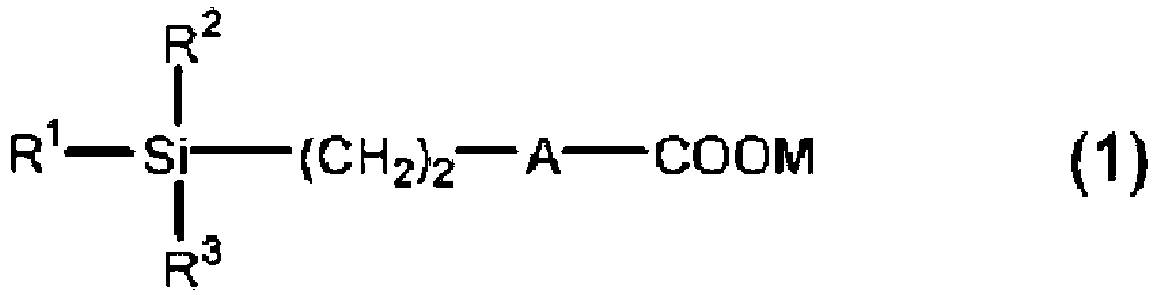
- the carboxy-modified silicone used in the present invention is a compound represented by the formula (1):
- the carboxy-modified silicone represented by the formula (1) is a carboxy-modified silicone modified with an alkylcarboxyl group, characterized by containing a total of 2 to 20 silicon atoms on average per molecule.
- R 1 to R 3 is a functional group represented by -O-Si(R 4 ) 3 in which R 4 is either an alkyl group having 1 to 6 carbon atoms or a phenyl group. All of R 1 to R 3 may be either of the above functional groups. Alternatively, when at least one of R 1 to R 3 is the above functional group, the rest of R 1 to R 3 may be either substituted or unsubstituted monovalent hydrocarbon groups, which may be the same or different.
- R 4 is either an alkyl group having 1 to 6 carbon atoms or a phenyl group.
- alkyl group having 1 to 6 carbon atoms include linear-chain, branched, or cyclic alkyl groups such as methyl, ethyl, n-propyl, i-propyl, n-butyl, i-butyl, s-butyl, t-butyl, pentyl, neopentyl, cyclopentyl, and hexyl.
- Examples of the functional group represented by -O-Si(R 4 ) 3 include -O-Si(CH 3 ) 3 , -O-Si(CH 3 ) 2 (C 2 H 5 ), -O-Si(CH 3 ) 2 (C 3 H 7 ), -O-Si(CH 3 ) 2 (C 4 H 9 ), -O-Si(CH 3 ) 2 (C 5 H 11 ), -O-Si(CH 3 ) 2 (C 6 H 13 ), and -O-Si(CH 3 ) 2 (C 6 H 5 ).
- the functional group is preferably a trialkylsiloxy group, most preferably a trimethylsiloxy group.
- R 1 to R 3 in the formula (1) is the functional group represented by -O-Si(R 4 ) 3
- the others of R 1 to R 3 may be either substituted or unsubstituted monovalent hydrocarbon groups, which may be the same or different.
- Examples of the unsubstituted monovalent hydrocarbon group as R 1 to R 3 include linear-chain, branched, or cyclic alkyl groups such as methyl, ethyl, n-propyl, i-propyl, n-butyl, i-butyl, s-butyl, pentyl, neopentyl, cyclopentyl, and hexyl; aryl groups such as phenyl, tolyl, and xylyl groups: and aralkyl groups.
- Examples of the substituted monovalent hydrocarbon group as R 1 to R 3 include perfluoroalkyl groups such as 3,3,3-trifluoropropyl and 3,3,4,4,4-pentafluorobutyl groups; aminoalkyl groups such as 3-aminopropyl and 3-(aminoethyl)aminopropyl groups; and amidoalkyl groups such as acetylaminoalkyl groups.
- a portion of the hydrocarbon group of R 1 to R 3 may be substituted with a hydroxyl group, alkoxy group, polyether group, or perfluoropolyether group.
- Examples of the alkoxy group include methoxy, ethoxy, and propoxy groups.
- R 1 to R 3 in the formula (1) is/are the functional group(s) represented by -O-Si(R 4 ) 3
- the other(s) of R 1 to R 3 is/are preferably a linear-chain or branched alkyl group(s) having 1 to 6 carbon atoms, particularly preferably a methyl group(s) or ethyl group(s).
- all or two of R 1 to R 3 in the formula (1) are preferably the functional groups represented by -O-Si(R 4 ) 3
- the other of R 1 to R 3 is preferably a methyl or ethyl group.
- M is a hydrogen atom, metal atom, or organic cation.
- the metal atom include monovalent alkali metals, divalent alkali metals, and di- or higher valent metal atoms.
- the monovalent alkali metal include, Li, Na, and K
- examples of the divalent alkali metal include Mg, Ca, and Ba
- other examples include Mn, Fe, Co, Al, Ni, Cu, V, Mo, Nb, Zn, and Ti.
- the organic cation include ammonium, monoethanolammonium, triethanolammonium, arginine-neutralized, and amino methyl propanol (AMP)-neutralized ions.
- M is particularly preferably a hydrogen atom or monovalent alkali metal or may be a mixture thereof.
- A is a linear-chain or branched-chain alkylene group represented by C q H2 q , and q is an integer of 0 to 20.
- the carboxy-modified silicone represented by the formula (1) is a compound represented by the following formula (1'), and the carboxyl-modified group is bonded with silicon via an ethylene group.
- q is preferably 2 to 15, more preferably 6 to 12.
- the feeling in use may be poor.
- the carboxy-modified silicone represented by the formula (1) is characterized by containing a total of 2 to 20 silicon atoms on average per molecule.
- the carboxy-modified silicone contains preferably a total of 3 to 18 silicon atoms, particularly preferably a total of 3 to 7 silicon atoms on average.
- the carboxy-modified silicone represented by the formula (1) that can be used preferably is more specifically a carboxy-modified silicone wherein R 1 and R 2 each are a functional group represented by -O-Si(R 4 ) 3 in which R 4 is an alkyl group having 1 to 6 carbon atoms; R 3 is a linear-chain or branched alkyl group having 1 to 6 carbon atoms; and q has a value of 6 to 12.
- the monohydric aliphatic alcohol having 16 to 22 carbon atoms used in the present invention (hereinafter it is also referred to as a higher alcohol simply) is a saturated or unsaturated monohydric aliphatic alcohol.
- the alcohol can be either linear-chain or branched, more preferably linear-chain. Additionally, the alcohol is preferably a higher alcohol having a melting point of 40°C or more.
- Examples of the higher alcohol having 16 to 22 carbon atoms used in the present invention include stearyl alcohol, isostearyl alcohol, oleyl alcohol, octyl dodecanol, chimyl alcohol, cetanol, cetostearyl alcohol, hexyl decanol, and behenyl alcohol.
- it is preferred that a higher alcohol having a melting point of 40 to 80°C is singly used or a combination of a plurality of higher alcohols is used so as to achieve a melting point of 40 to 70°C.
- An amount of the higher alcohol added is preferably 2 to 10% by mass, more preferably 3 to 8% by mass in the composition, in the stage of preparing the fine emulsion.
- a preferable nonionic surfactant used in the present invention has an HLB of 5 to 10, preferably an HLB of 6 to 9 and has a POE group.
- PEG-5 glyceryl stearate PEG-5 glyceryl stearate
- POE (6) stearyl ether POE (10) hydrogenated castor oil
- POE (20) hydrogenated castor oil PEG-5 glyceryl stearate
- An amount of the nonionic surfactant added is preferably 2 to 15% by mass, more preferably 5 to 10% by mass in the composition in the stage of preparing the fine emulsion.
- dihydric glycol used in the present invention examples include dipropylene glycol, ethylene glycol, diethylene glycol, propylene glycol, and 1,3-butylene glycol.
- the dihydric glycol is present preferably in an amount of 10 to 30% by mass, more preferably 15 to 25% by mass in the composition, in the stage of preparing the fine emulsion.
- the oil agent used as the oil phase of the present invention contains a silicone oil and a hydrocarbon oil.
- silicone oil examples include linear silicones such as dimethylpolysiloxane, methylphenylpolysiloxane, and methylhydrogenpolysiloxane; and cyclic silicones such as octamethylcyclotetrasiloxane, decamethylcyclopentasiloxane, and dodecamethylcyclohexasiloxane.
- hydrocarbon oil examples include liquid paraffin, squalane, squalene, paraffin, isoparaffin, and ceresin.
- the silicone oil and the hydrocarbon oil constitute 82% by mass or more of the oil phase.
- the oil phase contains 18% by mass or more of an oil other than silicone or hydrocarbon oils, such as an ester oil, it is difficult to prepare the fine emulsion.
- the formulation amount of the oil phase blended in the step of preparing the fine emulsion preferably provides the ratio, oil agent/(carboxy-modified silicone + higher alcohol + nonionic surfactant) is 1.5 or less.
- the ratio exceeds 1.5, it may be difficult to prepare the fine emulsion.
- the amount of the oil agent blended is no particular lower limit on the amount of the oil agent blended.
- the amount thereof is preferably 10% by mass or more in the composition, in the stage of preparing the fine emulsion.
- oils, waxes, moisturizers, emulsifiers, surfactants, thickeners, gelling agents, metal soaps, water-soluble polymers, oil-soluble polymers, drugs, antioxidants, pigments, dyes, pearlescent agents, lame agents, organic/inorganic powders, and fragrances can be blended as needed, within a qualitative/quantitative range that does not impair the effects of the present invention.
- the use application of the cosmetic of the present invention is not particularly limited, and the cosmetic is particularly preferably used in lotions with respect to its properties.
- the cosmetic can be also used in various cosmetics, for example, skin care cosmetics such as moisture cream, moisture milky lotion, moisture lotion, massage cream, massage lotion, and essence; hair care cosmetics such as hair cream, hair lotion, and hair dressing; body care cosmetics such as sun screen, body cream, and body lotion; make-up cosmetics such as lipstick, mascara, eye liner, nail enamel, liquid foundation, and gel foundation; and cleansers such as makeup remover, shampoo, rinse, and two-in-one shampoo.
- skin care cosmetics such as moisture cream, moisture milky lotion, moisture lotion, massage cream, massage lotion, and essence
- hair care cosmetics such as hair cream, hair lotion, and hair dressing
- body care cosmetics such as sun screen, body cream, and body lotion
- make-up cosmetics such as lipstick, mascara, eye liner, nail enamel, liquid foundation, and gel foundation
- cleansers such as makeup remover, shampoo, rinse
- the present inventors attempted to prepare the fine emulsion using various compositions.
- Test examples 1 - 1 1 - 2 1 - 3 1 - 4 Surfactant Carboxy silicone 1 Stearic acid 1 1 Oleicacid 1 Stabilizer Behenyl alcohol 1.5 1.5 1.5 1.5 PEG-5 glyceryl stearate 2.13 2.13 2.13 2.13 Oil phase Silicone oil 2 2 2 2 Hydrocarbon oil 2 2 2 Aqueous phase Ion-exchanged water 7.8 7.8 7.8 7.8 Triethanolamine 0.44 0.63 0.63 0.63 Dipropyleneglycol 6 6 6 6 6 Production method Emulsifier Henschel Henschel Henschel high-pressure emulsifier Evaluation Appearance one-phase two-phase two-phase one-phase
- an attempt to emulsify an oil phase was made using an anionic surfactant as the major surfactant, and additionally, a higher alcohol, a nonionic surfactant, and dihydric glycol.
- an oil agent together with the surfactant (acid moiety), higher alcohol, nonionic surfactant and dihydric glycol were dissolved and mixed at 80°C.
- an aqueous phase (at room temperature) in which an equivalent of triethanolamine as the counter ions of the surfactant was dissolved was added and mixed thereto, and the mixture was cooled. Then, the state of the phases was checked at 55 to 65°C.
- test example 1-1 in which a carboxy-modified silicone is used, provides a substantially transparent one-phase system.
- silicone oil polydimethylsiloxane 6CS
- hydrocarbon oil olefin oligomer
- test examples 1-2 and 1-3 an attempt to prepare an emulsion using a fatty acid (stearic acid or oleic acid) was made, but a white turbid two-phase system was obtained.
- a fatty acid stearic acid or oleic acid
- test example 1-4 when an attempt to prepare the fine emulsion of test example 1-2 (system in which stearic acid is used as the surfactant) using high-pressure emulsification, it was possible to prepare the emulsion.
- the amount of the oil agent blended closely relates to the amounts of the higher alcohol (behenyl alcohol), nonionic surfactant (PEG-5 glyceryl stearate), and carboxy-modified silicone and that an amount of the oil agent blended/(carboxy-modified silicone + higher alcohol + nonionic surfactant) of 1.5 or less enables a good microemulsion to be prepared.
- the higher alcohol behenyl alcohol
- nonionic surfactant PEG-5 glyceryl stearate
- carboxy-modified silicone an amount of the oil agent blended/(carboxy-modified silicone + higher alcohol + nonionic surfactant) of 1.5 or less enables a good microemulsion to be prepared.
- the microemulsion obtained as the similar manner, a second aqueous phase, and a third aqueous phase was added for dilution to prepare a lotion-type composition.
- nonionic surfactants having a POE chain and having an HLB of 5 to 10, preferably 6 to 9 enables good microemulsions to be prepared.
- blending of dihydric glycol is useful for preparing a good microemulsion, but it is not possible to obtain a microemulsion in a range such that the content of dihydric glycol exceeds 30% by mass in the step of microemulsion preparation.
- the second aqueous phase and the third aqueous phase are intended to dilute and disperse the microemulsion.
- addition of dihydric glycol or the like to the second aqueous phase or the third aqueous phase would not adversely affect the state of the microemulsion.
- an organic amine triethanolamine
- alkali metal potassium
- the degree of neutralization is not required to be 100%. Accordingly, the pH required for the product can be prioritized upon preparation.
- the obtained lotion contains emulsified particles of 71 nm and provides a pH of 8.07 and an L value of 66.
- the obtained lotion contains emulsified particles of 71 nm and provides a pH of 8.07 and an L value of 66.
Landscapes
- Health & Medical Sciences (AREA)
- Life Sciences & Earth Sciences (AREA)
- General Health & Medical Sciences (AREA)
- Veterinary Medicine (AREA)
- Public Health (AREA)
- Animal Behavior & Ethology (AREA)
- Birds (AREA)
- Epidemiology (AREA)
- Emergency Medicine (AREA)
- Chemical & Material Sciences (AREA)
- Dispersion Chemistry (AREA)
- Dermatology (AREA)
- Cosmetics (AREA)
- Compositions Of Macromolecular Compounds (AREA)
Abstract
an aqueous phase that is a continuous layer;
an oil phase that is dispersed in the aqueous phase and comprises at least 82% by mass of a silicone oil and a hydrocarbon oil therein;
a carboxy-modified silicone represented by the following formula (1);
a C16 to 22 higher alcohol;
a nonionic surfactant having a POE chain and an HLB of 5 to 10; and
a dihydric glycol;

Description
- This application claims the priority of Japanese Patent Application No.
2015-191487 filed on September 29, 2015 - The present invention relates to a fine emulsion-type cosmetic and a production method thereof, particularly to the preparation of surfactants therefor.
- Of oil-in-water emulsion compositions, particularly, those having small-size oil droplets as the inner phase and exhibiting a transparent appearance are referred to as fine emulsions. When an oil agent is blended to a luxurious lotion or the like, the appearance of a cosmetic comprising such emulsion does not degrade, and thus, a commercially valuable cosmetic that combines an appearance having excellent transparency and the functionality and feeling in use of the oil agent can be provided.
- These fine emulsions are generally produced by pulverizing emulsified particles of an emulsion with high shearing force using an emulsifying apparatus capable of applying high shearing force, such as high-pressure emulsifying apparatuses.
- However, fine emulsion preparation by means of such a high-pressure emulsifying apparatus leads to an increase in the production cost, and treatment with high shearing force may causes deterioration in various functional raw materials.
- Of such fine emulsions, a fine emulsion in thermodynamic equilibrium is referred to as a microemulsion.
- [PTL 1] Japanese Unexamined Patent Publication No.
2014-74058 - The present invention has been made in view of the conventional art, and the problem to be solved is to provide a fine emulsion-type cosmetic comprising a finely-emulsified oil phase mainly based on a silicone oil or hydrocarbon oil without use of a high-pressure emulsifying apparatus.
- The present inventors have made investigations to solve the problem and, as a result, found that use of a specific carboxy-modified silicone can easily provide a fine emulsion-type cosmetic, via a microemulsion phase in course of the process, having completed the present invention.
- That is, a cosmetic, according to the present invention that is a fine emulsion-type cosmetic having an average emulsion particle size of 150 nm or less comprises: an aqueous phase that is a continuous layer; an oil phase dispersed in the aqueous phase that comprises at least 82% by mass of an oil consisting of a silicone oil and a hydrocarbon oil therein; a carboxy-modified silicone represented by the following formula (1); a C16 to 22 higher alcohol; a nonionic surfactant having a POE chain and an HLB of 5 to 10; and a dihydric glycol;
- The mass ratio of the silicone: hydrocarbon oil in the oil phase is preferably 1:9 to 9:1.
- In the cosmetic according to the present invention, the mass ratio of (oil agent)/(carboxy-modified silicone + higher alcohol + nonionic surfactant) is preferably 1.5 or less.
- A method of producing a fine emulsion-type cosmetic according to the present invention comprising the steps of; preparing a microemulsion by mixing an acid moiety of a carboxy-modified silicone represented by the formula (1), a higher alcohol, a nonionic surfactant, an oil phase, an organic amine and/or alkali metal, a portion of an aqueous phase, and dihydric glycol; and adding the rest of the aqueous phase to the microemulsion and diluting the microemulsion.
- The cosmetic according to the present invention, which contains a specific carboxy-modified silicone, a higher alcohol, and a nonionic surfactant, can easily become a fine emulsion composition without being carried out high-pressure emulsification or the like.
- Hereinafter, an examples of the present invention will be described.
In the present invention, - The carboxy-modified silicone used in the present invention is a compound represented by the formula (1):

- The carboxy-modified silicone represented by the formula (1) is a carboxy-modified silicone modified with an alkylcarboxyl group, characterized by containing a total of 2 to 20 silicon atoms on average per molecule.
- In the formula (1), at least one of R1 to R3 is a functional group represented by -O-Si(R4)3 in which R4 is either an alkyl group having 1 to 6 carbon atoms or a phenyl group. All of R1 to R3 may be either of the above functional groups. Alternatively, when at least one of R1 to R3 is the above functional group, the rest of R1 to R3 may be either substituted or unsubstituted monovalent hydrocarbon groups, which may be the same or different.
- In the functional group represented by -O-Si(R4)3, R4 is either an alkyl group having 1 to 6 carbon atoms or a phenyl group. Examples of the alkyl group having 1 to 6 carbon atoms include linear-chain, branched, or cyclic alkyl groups such as methyl, ethyl, n-propyl, i-propyl, n-butyl, i-butyl, s-butyl, t-butyl, pentyl, neopentyl, cyclopentyl, and hexyl. Examples of the functional group represented by -O-Si(R4)3 include -O-Si(CH3)3, -O-Si(CH3)2(C2H5), -O-Si(CH3)2(C3H7), -O-Si(CH3)2(C4H9), -O-Si(CH3)2(C5H11), -O-Si(CH3)2(C6H13), and -O-Si(CH3)2(C6H5). The functional group is preferably a trialkylsiloxy group, most preferably a trimethylsiloxy group.
- When at least one of R1 to R3 in the formula (1) is the functional group represented by -O-Si(R4)3, the others of R1 to R3 may be either substituted or unsubstituted monovalent hydrocarbon groups, which may be the same or different. Examples of the unsubstituted monovalent hydrocarbon group as R1 to R3 include linear-chain, branched, or cyclic alkyl groups such as methyl, ethyl, n-propyl, i-propyl, n-butyl, i-butyl, s-butyl, pentyl, neopentyl, cyclopentyl, and hexyl; aryl groups such as phenyl, tolyl, and xylyl groups: and aralkyl groups. Examples of the substituted monovalent hydrocarbon group as R1 to R3 include perfluoroalkyl groups such as 3,3,3-trifluoropropyl and 3,3,4,4,4-pentafluorobutyl groups; aminoalkyl groups such as 3-aminopropyl and 3-(aminoethyl)aminopropyl groups; and amidoalkyl groups such as acetylaminoalkyl groups. A portion of the hydrocarbon group of R1 to R3 may be substituted with a hydroxyl group, alkoxy group, polyether group, or perfluoropolyether group. Examples of the alkoxy group include methoxy, ethoxy, and propoxy groups.
- When one or two of R1 to R3 in the formula (1) is/are the functional group(s) represented by -O-Si(R4)3, the other(s) of R1 to R3 is/are preferably a linear-chain or branched alkyl group(s) having 1 to 6 carbon atoms, particularly preferably a methyl group(s) or ethyl group(s). Particularly, all or two of R1 to R3 in the formula (1) are preferably the functional groups represented by -O-Si(R4)3, and the other of R1 to R3 is preferably a methyl or ethyl group.
- M is a hydrogen atom, metal atom, or organic cation. Examples of the metal atom include monovalent alkali metals, divalent alkali metals, and di- or higher valent metal atoms. Examples of the monovalent alkali metal include, Li, Na, and K, examples of the divalent alkali metal include Mg, Ca, and Ba, and other examples include Mn, Fe, Co, Al, Ni, Cu, V, Mo, Nb, Zn, and Ti. Examples of the organic cation include ammonium, monoethanolammonium, triethanolammonium, arginine-neutralized, and amino methyl propanol (AMP)-neutralized ions. M is particularly preferably a hydrogen atom or monovalent alkali metal or may be a mixture thereof.
- A is a linear-chain or branched-chain alkylene group represented by CqH2q, and q is an integer of 0 to 20. When q = 0, the carboxy-modified silicone represented by the formula (1) is a compound represented by the following formula (1'), and the carboxyl-modified group is bonded with silicon via an ethylene group. In the present invention, q is preferably 2 to 15, more preferably 6 to 12. In contrast, when the value of q exceeds the upper limit, the feeling in use may be poor.
R1R2R3Si-(CH2)2-COOM (1')
- The carboxy-modified silicone represented by the formula (1) is characterized by containing a total of 2 to 20 silicon atoms on average per molecule. The carboxy-modified silicone contains preferably a total of 3 to 18 silicon atoms, particularly preferably a total of 3 to 7 silicon atoms on average.
- The carboxy-modified silicone represented by the formula (1) that can be used preferably is more specifically a carboxy-modified silicone wherein R1 and R2 each are a functional group represented by -O-Si(R4)3 in which R4 is an alkyl group having 1 to 6 carbon atoms; R3 is a linear-chain or branched alkyl group having 1 to 6 carbon atoms; and q has a value of 6 to 12.
- The monohydric aliphatic alcohol having 16 to 22 carbon atoms used in the present invention (hereinafter it is also referred to as a higher alcohol simply) is a saturated or unsaturated monohydric aliphatic alcohol. The alcohol can be either linear-chain or branched, more preferably linear-chain. Additionally, the alcohol is preferably a higher alcohol having a melting point of 40°C or more. Examples of the higher alcohol having 16 to 22 carbon atoms used in the present invention include stearyl alcohol, isostearyl alcohol, oleyl alcohol, octyl dodecanol, chimyl alcohol, cetanol, cetostearyl alcohol, hexyl decanol, and behenyl alcohol. In the present invention, it is preferred that a higher alcohol having a melting point of 40 to 80°C is singly used or a combination of a plurality of higher alcohols is used so as to achieve a melting point of 40 to 70°C.
- An amount of the higher alcohol added is preferably 2 to 10% by mass, more preferably 3 to 8% by mass in the composition, in the stage of preparing the fine emulsion.
- A preferable nonionic surfactant used in the present invention has an HLB of 5 to 10, preferably an HLB of 6 to 9 and has a POE group.
- Specific examples thereof include PEG-5 glyceryl stearate, POE (6) stearyl ether, POE (10) hydrogenated castor oil, and POE (20) hydrogenated castor oil.
- An amount of the nonionic surfactant added is preferably 2 to 15% by mass, more preferably 5 to 10% by mass in the composition in the stage of preparing the fine emulsion.
- Examples of the dihydric glycol used in the present invention include dipropylene glycol, ethylene glycol, diethylene glycol, propylene glycol, and 1,3-butylene glycol. The dihydric glycol is present preferably in an amount of 10 to 30% by mass, more preferably 15 to 25% by mass in the composition, in the stage of preparing the fine emulsion.
- The oil agent used as the oil phase of the present invention contains a silicone oil and a hydrocarbon oil.
- Examples of the silicone oil include linear silicones such as dimethylpolysiloxane, methylphenylpolysiloxane, and methylhydrogenpolysiloxane; and cyclic silicones such as octamethylcyclotetrasiloxane, decamethylcyclopentasiloxane, and dodecamethylcyclohexasiloxane.
- Examples of the hydrocarbon oil include liquid paraffin, squalane, squalene, paraffin, isoparaffin, and ceresin.
- In the present invention, the silicone oil and the hydrocarbon oil constitute 82% by mass or more of the oil phase. When the oil phase contains 18% by mass or more of an oil other than silicone or hydrocarbon oils, such as an ester oil, it is difficult to prepare the fine emulsion.
- The formulation amount of the oil phase blended in the step of preparing the fine emulsion preferably provides the ratio, oil agent/(carboxy-modified silicone + higher alcohol + nonionic surfactant) is 1.5 or less.
- When the ratio exceeds 1.5, it may be difficult to prepare the fine emulsion. There is no particular lower limit on the amount of the oil agent blended. However, with respect to the properties of the fine emulsion, the amount thereof is preferably 10% by mass or more in the composition, in the stage of preparing the fine emulsion.
- To the cosmetic of the present invention, in addition to the above essential components, other components usually used in the cosmetic or pharmaceutical field, for example, oils, waxes, moisturizers, emulsifiers, surfactants, thickeners, gelling agents, metal soaps, water-soluble polymers, oil-soluble polymers, drugs, antioxidants, pigments, dyes, pearlescent agents, lame agents, organic/inorganic powders, and fragrances can be blended as needed, within a qualitative/quantitative range that does not impair the effects of the present invention.
- The use application of the cosmetic of the present invention is not particularly limited, and the cosmetic is particularly preferably used in lotions with respect to its properties. In addition, the cosmetic can be also used in various cosmetics, for example, skin care cosmetics such as moisture cream, moisture milky lotion, moisture lotion, massage cream, massage lotion, and essence; hair care cosmetics such as hair cream, hair lotion, and hair dressing; body care cosmetics such as sun screen, body cream, and body lotion; make-up cosmetics such as lipstick, mascara, eye liner, nail enamel, liquid foundation, and gel foundation; and cleansers such as makeup remover, shampoo, rinse, and two-in-one shampoo.
- The embodiment of the present invention will be described in detail hereinbelow.
- First, the present inventors attempted to prepare the fine emulsion using various compositions.
- Results are shown in Table 1.
[Table 1] Test examples 1 - 1 1 - 2 1 - 3 1 - 4 Surfactant Carboxy silicone 1 Stearic acid 1 1 Oleicacid 1 Stabilizer Behenyl alcohol 1.5 1.5 1.5 1.5 PEG-5 glyceryl stearate 2.13 2.13 2.13 2.13 Oil phase Silicone oil 2 2 2 2 Hydrocarbon oil 2 2 2 2 Aqueous phase Ion-exchanged water 7.8 7.8 7.8 7.8 Triethanolamine 0.44 0.63 0.63 0.63 Dipropyleneglycol 6 6 6 6 Production method Emulsifier Henschel Henschel Henschel high-pressure emulsifier Evaluation Appearance one-phase two-phase two-phase one-phase - As shown in Table 1, an attempt to emulsify an oil phase was made using an anionic surfactant as the major surfactant, and additionally, a higher alcohol, a nonionic surfactant, and dihydric glycol.
- That is, an oil agent together with the surfactant (acid moiety), higher alcohol, nonionic surfactant and dihydric glycol were dissolved and mixed at 80°C.
- Then, an aqueous phase (at room temperature) in which an equivalent of triethanolamine as the counter ions of the surfactant was dissolved was added and mixed thereto, and the mixture was cooled. Then, the state of the phases was checked at 55 to 65°C.
- As a result, test example 1-1 (present invention), in which a carboxy-modified silicone is used, provides a substantially transparent one-phase system. In the system when water is added, even though it is difficult to dissolve the silicone oil (polydimethylsiloxane 6CS) and hydrocarbon oil (olefin oligomer) therein, it is confirmed that a microemulsion is formed because a transparent one-phase system is provided.
- In contrast, in test examples 1-2 and 1-3, an attempt to prepare an emulsion using a fatty acid (stearic acid or oleic acid) was made, but a white turbid two-phase system was obtained.
- Meanwhile, in test example 1-4, when an attempt to prepare the fine emulsion of test example 1-2 (system in which stearic acid is used as the surfactant) using high-pressure emulsification, it was possible to prepare the emulsion.
- In the system in which a carboxy-modified silicone is used as described above, it is understood that use of a specific higher alcohol, a nonionic surfactant, and dihydric glycol enables a microemulsion to be prepared by use of a usual mixing apparatus.
- Additionally, the present inventors investigated the relation between the amount of the oil agent blended and other components. Results are shown in Table 2.

- As clearly seen from Table 2, it is understood that the amount of the oil agent blended closely relates to the amounts of the higher alcohol (behenyl alcohol), nonionic surfactant (PEG-5 glyceryl stearate), and carboxy-modified silicone and that an amount of the oil agent blended/(carboxy-modified silicone + higher alcohol + nonionic surfactant) of 1.5 or less enables a good microemulsion to be prepared.
- Then, the present inventors made an investigation into the relation between the type of the oil agent and microemulsion preparation. Results are shown in Table 3.
[Table 3] Test examples 2 - 2 3 - 1 3 - 2 3 - 3 3 - 4 3 - 5 3 - 6 3 - 7 3 - 8 Surfactant Carboxy silicone 1 1 1 1 1 1 1 1 1 Stabilizer Behenyl alcohol 1.5 1.5 1.5 1.5 1.5 1.5 1.5 1.5 1.5 PEG-5 glyceryl stearate 2.13 2.13 2.13 2.13 2.13 2.13 2.13 2.13 2.13 Oil phase Silicone oil 3 2 3 2 3 6 - 3 3 Octyl methoxycinnamate - 1 1 - - - - - - Bis-ethylhexyloxyphenol methoxyphenyl triazine - - - 1 1 - - - - Hydrocarbon oil 3 3 2 3 2 - 6 1.8 2 isohexadecyl isooctadecanoate - - - - - - - 1.2 1 Aqueous phase Ion-exchanged water 7.8 7.8 7.8 7.8 7.8 7.8 7.8 7.8 7.8 Triethanolamine 0.44 0.44 0.44 0.44 0.44 0.44 0.44 0.44 0.44 Dipropyleneglycol 6 6 6 6 6 6 6 6 6 Evaluation Appearance one-phase two-phase two-phase two-phase two-phase two-phase two-phase two-phase one-phase - As clearly seen from Table 3, coexistent of a polar oil such as a so-called ester oil makes it extremely difficult to prepare a microemulsion, and a detailed investigation has revealed that the upper limit of such an oil in the oil agent is about 18% (see test examples 3-7 and 3-8).
- Both the silicone oil and the hydrocarbon oil are required. In the case in which only one of them was used (test examples 3-5 and 3-6), it was difficult to prepare a good microemulsion.
- Then, the present inventors made an investigation into the higher alcohol. Results are shown in Table 4.
[Table 4] Test examples 4 - 1 4 - 2 4 - 3 4 - 4 4 - 5 4 - 6 4 - 7 Surfactant Carboxy silicone 1 1 1 1 1 1 1 Stabilizer Behenyl alcohol 1.5 - - - - - - Deodorized cetanol - - 1.5 1.3 1.2 1.1 1 PEG-5 glyceryl stearate 2.13 2.13 2.13 2.13 2.13 2.13 2.13 Oil phase Silicone oil 3 3 3 3 3 3 3 Hydrocarbon oil 3 3 3 3 3 3 3 Aqueous phase Ion-exchanged water 7.8 7.8 7.8 7.8 7.8 7.8 7.8 Triethanolamine 0.3 0.3 0.3 0.3 0.3 0.3 0.3 Dipropyleneglycol 6 6 6 6 6 6 6 Evaluation Appearance one-phase two-phase one-phase one-phase one-phase one-phase one-phase Second aqueous phase Ion-exchanged water 5 5 5 5 5 5 5 1,3-butyleneglycol 5 5 5 5 5 5 5 Ion-exchanged water 15 15 15 15 15 15 15 Third aqueous phase Ion-exchanged water to 100 to 100 to 100 to 100 to 100 to 100 to 100 Glycerin 1 1 1 1 1 1 1 Ethanol(95%) 3 3 3 3 3 3 3 Phenoxyethanol 0.5 0.5 0.5 0.5 0.5 0.5 0.5 EDTA-2Na•2H2O 0.03 0.03 0.03 0.03 0.03 0.03 0.03 Evaluation Particle size (nm) 106 ∼5pm 109 103 98 93 87 PDI 0.102 - 0.077 0.1 0.122 0.117 0.133 pH 8.24 8.23 8.17 8.26 8.26 8.25 8.2 - In the present test, the microemulsion obtained as the similar manner, a second aqueous phase, and a third aqueous phase was added for dilution to prepare a lotion-type composition.
- As clearly seen from Table 4, behenyl alcohol and deodorized cetanol exhibited substantially similar behavior. It is understood that the amount of the higher alcohol blended is variable unless the relation with the amount of the oil agent blended fails. When the particle size of oil droplets in the final lotion-type composition was measured, the average particle size was around 100 nm. Thus, the composition was confirmed to be a fine emulsion.
- Subsequently, the present inventors prepared lotion-type compositions using various nonionic surfactants and evaluated the compositions. Results are shown in Table 5.
[Table 5] Test examples 5 - 1 5 - 2 5 - 3 5 - 4 5 - 5 5 - 6 5 - 7 5 - 8 Surfactant Carboxy silicone 1 1 1 1 1 1 1 1 Stabilizer Behenyl alcohol 1.5 1.5 1.5 1.5 1.5 1.5 1.5 1.5 PEG-5 glyceryl stearate (HLB8) - 2.13 - - - - - - Glyceryl monostearate (HLB5) - - 2.13 - - - - - Batyl alcohol (HLB5) - - - 2.13 - - - - POE (6)stearyl ether (HLB8) - - - - 2.13 - - - POE(10)behenyl ether (HLB10) - - - - - 2.13 - - POE(10)hydrogenated castor oil (HLB7) - - - - - - 2.13 - POE(20)hydrogenated castor oil (HLB9) - - - - - - - 2.13 Oil phase Silicone oil 3 3 3 3 3 3 3 3 Hydrocarbon oil 3 3 3 3 3 3 3 3 Aqueous phase Ion-exchanged water 7.8 7.8 7.8 7.8 7.8 7.8 5 5 Triethanolamine 0.37 0.37 0.37 0.37 037 0.37 0.37 0.37 Dipropyleneglycol 6 6 6 6 6 6 6 5 Evaluation Appearance two -phase one -phase two -phase two -phase one -phase two -phase one -phase one -phase Second aqueous phase Ion-exchanged water 20 20 20 20 20 20 20 20 1,3-butylene glycol 5 5 5 5 5 5 5 5 Third aqueous phase Ion-exchanged water to 100 to 100 to 100 to 100 to 100 to 100 to 100 to 100 Glycerin 3 3 3 3 3 3 3 3 Ethanol (95%) 5 5 5 5 5 5 5 5 Phenoxyethanol 0.5 0.5 0.5 0.5 0.5 0.5 0.5 0.5 Evaluation Particle size(nm) ∼10µm 92 ∼ 1µm ∼1µm 101 ∼ 1µm 112 135 - As seen from Table 5, use of nonionic surfactants having a POE chain and having an HLB of 5 to 10, preferably 6 to 9 enables good microemulsions to be prepared.
- Then, the present inventors made an investigation into dihydric glycol. Results are shown in Table 6.
[Table 6] Test examples 6 - 1 6 - 2 6 - 3 6 - 4 6 - 5 6 - 6 Surfactant Carboxy silicone 1 1 1 1 1 1 Stabilizer Behenyl alcohol 1.5 1.5 1.5 1.5 1.5 1.5 PEG-5 glyceryl stearate (HLB8) 2.13 2.13 2.13 2.13 2.13 2.13 Oil phase Silicone oil 3 3 3 3 3 3 Hydrocarbon oil 3 3 3 3 3 3 Aqueous phase Ion-exchanged water 7.8 7·8 7.8 5.6 6.6 7.8 Triethanolamine 0.37 0.37 0.37 0.37 0.37 0.37 Dipropylene glycol - 1 6 - - 10 Propylene glycol - - - 5 - - 1,3-butylene glycol - - - - 5 - Evaluation Appearance two-phase two-phase one-phase one-phase one-phase two-phase Second aqueous phase Ion-exchanged water 20 20 20 20 20 20 1,3-butylene glycol 5 5 5 5 5 5 Third aqueous phase Ion-exchanged water to 100 to 100 to 100 to 100 to 100 to 100 Glycerin 3 3 3 3 3 3 Ethanol (95%) 5 5 5 5 5 5 Phenoxyethanol 0.5 0.5 0.5 0.5 0.5 0.5 Evaluation Particle size (nm) - ∼3µm 92nm 98nm 93nm ∼3µm - As clearly seen from Table 6, blending of dihydric glycol is useful for preparing a good microemulsion, but it is not possible to obtain a microemulsion in a range such that the content of dihydric glycol exceeds 30% by mass in the step of microemulsion preparation.
- However, the second aqueous phase and the third aqueous phase are intended to dilute and disperse the microemulsion. Thus, addition of dihydric glycol or the like to the second aqueous phase or the third aqueous phase would not adversely affect the state of the microemulsion.
- Subsequently, the present inventors made an investigation into the counter ions and degree of neutralization of the carboxy-modified silicone. Results are shown in Tables 7 and 8.
[Table 7] Test examples 7 - 1 7 - 2 7 - 3 7 - 4 7 - 5 Surfactant Carboxy silicone 1 1 1 1 1 Stabilizer Behenyl alcohol 1.5 1.5 1.5 1.5 1.5 PEG-5 glyceryl stearate 2.13 2.13 2.13 2.13 2.13 Oil phase Silicone oil 3 3 3 3 3 Hydrocarbon oil 3 3 3 3 3 Aqueous phase Ion-exchanged water 7.8 7.8 7.8 7.8 7.8 Triethanolamine 0.44 0.4 0.37 0.33 0.29 Dipropyleneglycol 6 6 6 6 6 Second aqueous phase Ion-exchanged water 25 25 25 25 25 Third aqueous phase Ion-exchanged water to 100 to 100 to 100 to 100 to 100 Glycerin 3 3 3 3 3 Ethanol (95%) 5 5 5 5 5 Phenoxyethanol 0.5 0.5 0.51 0.5 0.5 Evaluation Degree of neutralization 120 110 100 90 80 Particle size (nm) 92 90 96 94 86 pH 92 8.4 8.23 8.12 8.11 8.1 [Table 8] Test examples 8 - 1 8 - 2 8 - 3 8 - 4 8 - 5 Surfactant Carboxy silicone 1 1 1 1 1 Stabilizer Behenyl alcohol 1.5 1.5 1.5 1.5 1.5 PEG-5 glyceryl stearate 2.13 2.13 2.13 2.13 2.13 Oil phase Silicone oil 3 3 3 3 3 Hydrocarbon oil 3 3 3 3 3 Aqueous phase Ion-exchanged water 7.8 7.8 7.8 7.8 7.8 Potassium hydroxide 0.16 0.15 0.14 0.12 0.11 Dipropyleneglycol 6 6 6 6 6 Evaluation Appearance one-phase one-phase one-phase one-phase one-phase Second aqueous phase Ion-exchanged water 25 25 25 25 25 Third aqueous phase Ion-exchanged water to 100 to 100 to 100 to 100 to 100 Glycerin 3 3 3 3 3 Ethanol (95%) 5 5 5 5 5 Phenoxyethanol 0.5 0.5 0.5 0.5 0.5 Evaluation Degree of neutralization 120 110 100 90 80 Particle size (nm) 83 87 96 111 145 pH 9.52 9.47 9.46 9.43 9.38 - As clearly seen from Tables 7 and 8, as the counter ions of the carboxy-modified silicone, an organic amine (triethanolamine), alkali metal (potassium), or the like can be employed as similar to common fatty acid soaps. The degree of neutralization is not required to be 100%. Accordingly, the pH required for the product can be prioritized upon preparation.
- Specific Examples of the present invention will be described hereinbelow.
-
Components to be blended % by mass 1. Purified water balance 2. EDTA-2Na•2H2O 0.03 3. Glycerin 1.0 4. Ethanol 3.0 5. Phenoxyethanol 0.5 6. Carboxydecyl trisiloxane 0.6 7. Cetanol 0.66 8. PEG-5 glyceryl stearate 1.28 9. Dipropylene glycol 3.6 10. Polydimethylsiloxane 6CS 1.8 11. Hydrogenated polydecene 1.8 12. Triethanolamine 0.18 13. Buthylene glycol 5.0 14. Dipropylene glycol 2.4 -
- (1): Components 1 to 5 are mixed at 25°C for dissolution.
- (2): Components 6 to 11 are dissolved and mixed at 70°C.
- (3): A portion of component 1 together with component 12 is added to (2), and the mixture is mixed under stirring.
- (4): A portion of component 1 together with component 13 and component 14 is mixed at 25°C for dissolution.
- (5): (4) is added to (3), and the mixture is mixed under stirring.
- (6): (5) is added to (1), and the mixture is mixed under stirring.
- The obtained lotion contains emulsified particles of 71 nm and provides a pH of 8.07 and an L value of 66.
-
Components to be blended % by mass 1. Purified water balance 2. EDTA-2Na•2H2O 0.03 3. Glycerin 1.0 4. Ethanol 3.0 5. Phenoxyethanol 0.5 6. Carboxydecyl trisiloxane 0.6 7. Cetanol 0.66 8. PEG-5 glyceryl stearate 1.28 9. Dipropylene glycol 3.6 10. Polydimethylsiloxane 6CS 1.8 11. Hydrogenated polydecene 1.8 12. Triethanolamine 0.18 13. Buthylene glycol 5.0 14. Dipropylene glycol 2.4 -
- (1): Components 1 to 5 are mixed at 25°C for dissolution.
- (2): Components 6 to 11 are dissolved and mixed at 70°C.
- (3): A portion of component 1 together with component 12 is added to (2), and the mixture is mixed under stirring.
- (4): A portion of component 1 together with component 13 and component 14 is mixed at 25°C for dissolution.
- (5): (4) is added to (3), and the mixture is mixed under stirring.
- (6): (5) is added to (1), and the mixture is mixed under stirring.
- The obtained lotion contains emulsified particles of 71 nm and provides a pH of 8.07 and an L value of 66.
Claims (4)
- A fine emulsion-type cosmetic having an average emulsion particle size of 150 nm or less comprising:an aqueous phase that is a continuous layer;an oil phase that is dispersed in the aqueous phase and comprises at least 82% by mass of a silicone oil and a hydrocarbon oil therein;a carboxy-modified silicone represented by the following formula (1);a C16 to 22 higher alcohol;a nonionic surfactant having a POE chain and an HLB of 5 to 10; anda dihydric glycol;

- The cosmetic according to claim 1, wherein a mass ratio of the silicone: hydrocarbon oil in the oil phase is 1:9 to 9:1.
- The cosmetic according to claim 1, wherein a mass ratio of (oil agent)/(carboxy-modified silicone + higher alcohol + nonionic surfactant) is 1.5 or less.
- A method of producing a fine emulsion-type cosmetic comprising the steps of:preparing a microemulsion by mixing an acid moiety of a carboxy-modified silicone represented by the formula (1), a higher alcohol, a nonionic surfactant, an oil phase, an organic amine and/or alkali metal, a portion of an aqueous phase, and dihydric glycol; andadding the rest of the aqueous phase to the microemulsion and diluting the microemulsion.
Applications Claiming Priority (2)
| Application Number | Priority Date | Filing Date | Title |
|---|---|---|---|
| JP2015191487A JP6110450B1 (en) | 2015-09-29 | 2015-09-29 | Fine emulsion type cosmetic and method for producing the same |
| PCT/JP2016/076128 WO2017056871A1 (en) | 2015-09-29 | 2016-09-06 | Microemulsion-type cosmetic and method for manufacturing same |
Publications (3)
| Publication Number | Publication Date |
|---|---|
| EP3357480A1 true EP3357480A1 (en) | 2018-08-08 |
| EP3357480A4 EP3357480A4 (en) | 2019-05-22 |
| EP3357480B1 EP3357480B1 (en) | 2020-11-04 |
Family
ID=58423346
Family Applications (1)
| Application Number | Title | Priority Date | Filing Date |
|---|---|---|---|
| EP16851047.7A Active EP3357480B1 (en) | 2015-09-29 | 2016-09-06 | Microemulsion-type cosmetic and method for manufacturing same |
Country Status (8)
| Country | Link |
|---|---|
| US (2) | US20180263883A1 (en) |
| EP (1) | EP3357480B1 (en) |
| JP (1) | JP6110450B1 (en) |
| KR (1) | KR20180054641A (en) |
| CN (1) | CN108348405B (en) |
| HK (1) | HK1253387A1 (en) |
| TW (1) | TW201729790A (en) |
| WO (1) | WO2017056871A1 (en) |
Cited By (1)
| Publication number | Priority date | Publication date | Assignee | Title |
|---|---|---|---|---|
| CN117015365A (en) * | 2021-03-03 | 2023-11-07 | 莱雅公司 | two-phase composition |
Families Citing this family (10)
| Publication number | Priority date | Publication date | Assignee | Title |
|---|---|---|---|---|
| CN111801091B (en) * | 2018-03-30 | 2023-05-05 | 株式会社资生堂 | Oil-in-water droplet microemulsion cosmetics |
| JP7348189B2 (en) | 2018-08-15 | 2023-09-20 | ダウ・東レ株式会社 | Oil-in-water emulsion cosmetics |
| US12502345B2 (en) | 2018-08-15 | 2025-12-23 | Dow Toray Co., Ltd. | Cosmetic |
| JP7048480B2 (en) * | 2018-12-19 | 2022-04-05 | 信越化学工業株式会社 | Microemulsion composition and its cured product, and cosmetics containing it |
| JP7429221B2 (en) * | 2019-03-29 | 2024-02-07 | 株式会社 資生堂 | Oil-in-water emulsion cosmetics |
| KR102848443B1 (en) * | 2019-04-10 | 2025-08-21 | 다우 도레이 캄파니 리미티드 | Water-based cleansing cosmetics |
| WO2020217556A1 (en) | 2019-04-24 | 2020-10-29 | ダウ・東レ株式会社 | Cosmetic preparation |
| KR102981596B1 (en) * | 2021-03-03 | 2026-06-23 | 로레알 | Two-phase composition |
| FR3121041B1 (en) * | 2021-03-26 | 2023-12-01 | Oreal | Two-phase composition |
| JP2026075485A (en) * | 2024-10-22 | 2026-05-08 | 株式会社ミルボン | Method for producing an emulsified composition |
Family Cites Families (11)
| Publication number | Priority date | Publication date | Assignee | Title |
|---|---|---|---|---|
| FR2676921B1 (en) * | 1991-05-27 | 1995-04-14 | Oreal | STABLE OIL-IN-WATER EMULSION BASED ON SILICONE OIL AND ITS USE IN COSMETICS AND DERMATOLOGY. |
| FR2730932B1 (en) * | 1995-02-27 | 1997-04-04 | Oreal | TRANSPARENT NANOEMULSION BASED ON FLUID NON-IONIC AMPHIPHILIC LIPIDS AND USE IN COSMETICS OR DERMOPHARMACY |
| US6391290B1 (en) * | 2001-03-21 | 2002-05-21 | Schering-Plough Healthcare Products, Inc. | Skin care compositions |
| US6858200B2 (en) * | 2001-06-06 | 2005-02-22 | Schering-Plough Healthcare Healthcare Products Inc. | Sunscreen formulations |
| GB0214805D0 (en) * | 2002-06-26 | 2002-08-07 | Unilever Plc | Cosmetic compositions |
| EP2174985B1 (en) * | 2007-07-26 | 2017-02-15 | Shiseido Company, Ltd. | Gel composition and cosmetic preparation |
| US20090252771A1 (en) * | 2008-04-02 | 2009-10-08 | Maria Gabriella Coccia | Method for obtaining o/w cosmetic emulsions with high water resistance |
| JP2012036165A (en) * | 2010-07-16 | 2012-02-23 | Sanyo Chem Ind Ltd | Hair treatment agent composition |
| JP5203537B1 (en) * | 2011-11-11 | 2013-06-05 | 株式会社 資生堂 | Oil-in-water emulsified sunscreen cosmetics |
| FR2991171B1 (en) * | 2012-06-01 | 2014-05-23 | Galderma Res & Dev | PROCESS FOR THE PREPARATION OF A DERMATOLOGICAL COMPOSITION COMPRISING OLEOSOMES |
| JP5797618B2 (en) * | 2012-08-22 | 2015-10-21 | 東レ・ダウコーニング株式会社 | Copolymer having carbosiloxane dendrimer structure, and composition and cosmetic containing the same |
-
2015
- 2015-09-29 JP JP2015191487A patent/JP6110450B1/en active Active
-
2016
- 2016-09-06 CN CN201680057018.2A patent/CN108348405B/en active Active
- 2016-09-06 US US15/762,813 patent/US20180263883A1/en not_active Abandoned
- 2016-09-06 KR KR1020187008312A patent/KR20180054641A/en not_active Withdrawn
- 2016-09-06 HK HK18112684.6A patent/HK1253387A1/en unknown
- 2016-09-06 WO PCT/JP2016/076128 patent/WO2017056871A1/en not_active Ceased
- 2016-09-06 EP EP16851047.7A patent/EP3357480B1/en active Active
- 2016-09-29 TW TW105131266A patent/TW201729790A/en unknown
-
2019
- 2019-09-19 US US16/576,229 patent/US11052030B2/en active Active
Cited By (1)
| Publication number | Priority date | Publication date | Assignee | Title |
|---|---|---|---|---|
| CN117015365A (en) * | 2021-03-03 | 2023-11-07 | 莱雅公司 | two-phase composition |
Also Published As
| Publication number | Publication date |
|---|---|
| US20180263883A1 (en) | 2018-09-20 |
| US20200009036A1 (en) | 2020-01-09 |
| KR20180054641A (en) | 2018-05-24 |
| TW201729790A (en) | 2017-09-01 |
| EP3357480B1 (en) | 2020-11-04 |
| JP2017066068A (en) | 2017-04-06 |
| HK1253387A1 (en) | 2019-06-14 |
| JP6110450B1 (en) | 2017-04-05 |
| US11052030B2 (en) | 2021-07-06 |
| CN108348405A (en) | 2018-07-31 |
| CN108348405B (en) | 2021-04-13 |
| EP3357480A4 (en) | 2019-05-22 |
| WO2017056871A1 (en) | 2017-04-06 |
Similar Documents
| Publication | Publication Date | Title |
|---|---|---|
| EP3357480B1 (en) | Microemulsion-type cosmetic and method for manufacturing same | |
| KR101270330B1 (en) | Single-phase microemulsion composition, O / X ultra-fine emulsion external preparation and its manufacturing method | |
| JP5383035B2 (en) | Process for producing amino acid-modified organopolysiloxane emulsion | |
| KR102120789B1 (en) | Nano-emulsion cosmetic composition stabilized oil of high content | |
| JP6105920B2 (en) | Co-modified organopolysiloxane, emulsifier for water-in-oil emulsion containing the same, external preparation and cosmetic | |
| EP2174985A1 (en) | Gel composition and cosmetic preparation | |
| EP1792609A1 (en) | Organomodified block-type polysiloxanes, method for production and use | |
| JP2013010934A (en) | Novel organopolysiloxane elastomer and use therefor | |
| EP3492064B1 (en) | Bicontinuous microemulsion composition and cosmetic | |
| JP2013525452A (en) | Cosmetic ingredients | |
| CN1942167B (en) | Low Molecular Weight Silicone Oil-in-Water Emulsion | |
| EP3233049B1 (en) | Personal care composition comprising silicone network | |
| JP2009242294A (en) | High internal water phase water-in-oil emulsion cosmetic | |
| KR20150088194A (en) | Cosmetics | |
| WO2017188309A1 (en) | Novel organopolysiloxane or acid neutralization salt thereof, and uses of these | |
| CN111801091B (en) | Oil-in-water droplet microemulsion cosmetics | |
| EP3233050B1 (en) | Personal care compositions containing crosslinked silicone polymer networks and their method of preparation | |
| JP5129458B2 (en) | Oil-in-water emulsion composition | |
| JP7048480B2 (en) | Microemulsion composition and its cured product, and cosmetics containing it | |
| WO2021215084A1 (en) | Microemulsion composition and cosmetic containing same | |
| JPH06211622A (en) | Cosmetic |
Legal Events
| Date | Code | Title | Description |
|---|---|---|---|
| STAA | Information on the status of an ep patent application or granted ep patent |
Free format text: STATUS: THE INTERNATIONAL PUBLICATION HAS BEEN MADE |
|
| PUAI | Public reference made under article 153(3) epc to a published international application that has entered the european phase |
Free format text: ORIGINAL CODE: 0009012 |
|
| STAA | Information on the status of an ep patent application or granted ep patent |
Free format text: STATUS: REQUEST FOR EXAMINATION WAS MADE |
|
| 17P | Request for examination filed |
Effective date: 20180404 |
|
| AK | Designated contracting states |
Kind code of ref document: A1 Designated state(s): AL AT BE BG CH CY CZ DE DK EE ES FI FR GB GR HR HU IE IS IT LI LT LU LV MC MK MT NL NO PL PT RO RS SE SI SK SM TR |
|
| AX | Request for extension of the european patent |
Extension state: BA ME |
|
| DAV | Request for validation of the european patent (deleted) | ||
| DAX | Request for extension of the european patent (deleted) | ||
| A4 | Supplementary search report drawn up and despatched |
Effective date: 20190418 |
|
| RIC1 | Information provided on ipc code assigned before grant |
Ipc: A61K 8/39 20060101ALI20190412BHEP Ipc: A61Q 19/00 20060101ALI20190412BHEP Ipc: A61K 8/891 20060101ALI20190412BHEP Ipc: A61K 8/58 20060101ALI20190412BHEP Ipc: A61K 8/31 20060101ALI20190412BHEP Ipc: A61K 8/89 20060101ALI20190412BHEP Ipc: A61Q 5/00 20060101ALI20190412BHEP Ipc: A61K 8/06 20060101AFI20190412BHEP Ipc: A61K 8/86 20060101ALI20190412BHEP Ipc: A61K 8/34 20060101ALI20190412BHEP |
|
| GRAP | Despatch of communication of intention to grant a patent |
Free format text: ORIGINAL CODE: EPIDOSNIGR1 |
|
| STAA | Information on the status of an ep patent application or granted ep patent |
Free format text: STATUS: GRANT OF PATENT IS INTENDED |
|
| INTG | Intention to grant announced |
Effective date: 20200420 |
|
| RIC1 | Information provided on ipc code assigned before grant |
Ipc: A61K 8/58 20060101ALI20200403BHEP Ipc: A61K 8/31 20060101ALI20200403BHEP Ipc: A61Q 19/00 20060101ALI20200403BHEP Ipc: A61K 8/34 20060101ALI20200403BHEP Ipc: A61K 8/86 20060101ALI20200403BHEP Ipc: A61Q 5/00 20060101ALI20200403BHEP Ipc: A61K 8/06 20060101AFI20200403BHEP Ipc: A61K 8/891 20060101ALI20200403BHEP Ipc: A61K 8/39 20060101ALI20200403BHEP Ipc: A61K 8/89 20060101ALI20200403BHEP |
|
| GRAS | Grant fee paid |
Free format text: ORIGINAL CODE: EPIDOSNIGR3 |
|
| GRAA | (expected) grant |
Free format text: ORIGINAL CODE: 0009210 |
|
| STAA | Information on the status of an ep patent application or granted ep patent |
Free format text: STATUS: THE PATENT HAS BEEN GRANTED |
|
| AK | Designated contracting states |
Kind code of ref document: B1 Designated state(s): AL AT BE BG CH CY CZ DE DK EE ES FI FR GB GR HR HU IE IS IT LI LT LU LV MC MK MT NL NO PL PT RO RS SE SI SK SM TR |
|
| REG | Reference to a national code |
Ref country code: GB Ref legal event code: FG4D |
|
| REG | Reference to a national code |
Ref country code: CH Ref legal event code: EP |
|
| REG | Reference to a national code |
Ref country code: AT Ref legal event code: REF Ref document number: 1329890 Country of ref document: AT Kind code of ref document: T Effective date: 20201115 |
|
| REG | Reference to a national code |
Ref country code: IE Ref legal event code: FG4D |
|
| REG | Reference to a national code |
Ref country code: DE Ref legal event code: R096 Ref document number: 602016047427 Country of ref document: DE |
|
| REG | Reference to a national code |
Ref country code: NL Ref legal event code: MP Effective date: 20201104 |
|
| REG | Reference to a national code |
Ref country code: AT Ref legal event code: MK05 Ref document number: 1329890 Country of ref document: AT Kind code of ref document: T Effective date: 20201104 |
|
| PG25 | Lapsed in a contracting state [announced via postgrant information from national office to epo] |
Ref country code: GR Free format text: LAPSE BECAUSE OF FAILURE TO SUBMIT A TRANSLATION OF THE DESCRIPTION OR TO PAY THE FEE WITHIN THE PRESCRIBED TIME-LIMIT Effective date: 20210205 Ref country code: FI Free format text: LAPSE BECAUSE OF FAILURE TO SUBMIT A TRANSLATION OF THE DESCRIPTION OR TO PAY THE FEE WITHIN THE PRESCRIBED TIME-LIMIT Effective date: 20201104 Ref country code: NO Free format text: LAPSE BECAUSE OF FAILURE TO SUBMIT A TRANSLATION OF THE DESCRIPTION OR TO PAY THE FEE WITHIN THE PRESCRIBED TIME-LIMIT Effective date: 20210204 Ref country code: RS Free format text: LAPSE BECAUSE OF FAILURE TO SUBMIT A TRANSLATION OF THE DESCRIPTION OR TO PAY THE FEE WITHIN THE PRESCRIBED TIME-LIMIT Effective date: 20201104 Ref country code: PT Free format text: LAPSE BECAUSE OF FAILURE TO SUBMIT A TRANSLATION OF THE DESCRIPTION OR TO PAY THE FEE WITHIN THE PRESCRIBED TIME-LIMIT Effective date: 20210304 |
|
| PG25 | Lapsed in a contracting state [announced via postgrant information from national office to epo] |
Ref country code: SE Free format text: LAPSE BECAUSE OF FAILURE TO SUBMIT A TRANSLATION OF THE DESCRIPTION OR TO PAY THE FEE WITHIN THE PRESCRIBED TIME-LIMIT Effective date: 20201104 Ref country code: BG Free format text: LAPSE BECAUSE OF FAILURE TO SUBMIT A TRANSLATION OF THE DESCRIPTION OR TO PAY THE FEE WITHIN THE PRESCRIBED TIME-LIMIT Effective date: 20210204 Ref country code: LV Free format text: LAPSE BECAUSE OF FAILURE TO SUBMIT A TRANSLATION OF THE DESCRIPTION OR TO PAY THE FEE WITHIN THE PRESCRIBED TIME-LIMIT Effective date: 20201104 Ref country code: IS Free format text: LAPSE BECAUSE OF FAILURE TO SUBMIT A TRANSLATION OF THE DESCRIPTION OR TO PAY THE FEE WITHIN THE PRESCRIBED TIME-LIMIT Effective date: 20210304 Ref country code: PL Free format text: LAPSE BECAUSE OF FAILURE TO SUBMIT A TRANSLATION OF THE DESCRIPTION OR TO PAY THE FEE WITHIN THE PRESCRIBED TIME-LIMIT Effective date: 20201104 Ref country code: AT Free format text: LAPSE BECAUSE OF FAILURE TO SUBMIT A TRANSLATION OF THE DESCRIPTION OR TO PAY THE FEE WITHIN THE PRESCRIBED TIME-LIMIT Effective date: 20201104 Ref country code: ES Free format text: LAPSE BECAUSE OF FAILURE TO SUBMIT A TRANSLATION OF THE DESCRIPTION OR TO PAY THE FEE WITHIN THE PRESCRIBED TIME-LIMIT Effective date: 20201104 |
|
| REG | Reference to a national code |
Ref country code: LT Ref legal event code: MG9D |
|
| PG25 | Lapsed in a contracting state [announced via postgrant information from national office to epo] |
Ref country code: HR Free format text: LAPSE BECAUSE OF FAILURE TO SUBMIT A TRANSLATION OF THE DESCRIPTION OR TO PAY THE FEE WITHIN THE PRESCRIBED TIME-LIMIT Effective date: 20201104 |
|
| PG25 | Lapsed in a contracting state [announced via postgrant information from national office to epo] |
Ref country code: SK Free format text: LAPSE BECAUSE OF FAILURE TO SUBMIT A TRANSLATION OF THE DESCRIPTION OR TO PAY THE FEE WITHIN THE PRESCRIBED TIME-LIMIT Effective date: 20201104 Ref country code: RO Free format text: LAPSE BECAUSE OF FAILURE TO SUBMIT A TRANSLATION OF THE DESCRIPTION OR TO PAY THE FEE WITHIN THE PRESCRIBED TIME-LIMIT Effective date: 20201104 Ref country code: SM Free format text: LAPSE BECAUSE OF FAILURE TO SUBMIT A TRANSLATION OF THE DESCRIPTION OR TO PAY THE FEE WITHIN THE PRESCRIBED TIME-LIMIT Effective date: 20201104 Ref country code: LT Free format text: LAPSE BECAUSE OF FAILURE TO SUBMIT A TRANSLATION OF THE DESCRIPTION OR TO PAY THE FEE WITHIN THE PRESCRIBED TIME-LIMIT Effective date: 20201104 Ref country code: EE Free format text: LAPSE BECAUSE OF FAILURE TO SUBMIT A TRANSLATION OF THE DESCRIPTION OR TO PAY THE FEE WITHIN THE PRESCRIBED TIME-LIMIT Effective date: 20201104 Ref country code: CZ Free format text: LAPSE BECAUSE OF FAILURE TO SUBMIT A TRANSLATION OF THE DESCRIPTION OR TO PAY THE FEE WITHIN THE PRESCRIBED TIME-LIMIT Effective date: 20201104 |
|
| REG | Reference to a national code |
Ref country code: DE Ref legal event code: R097 Ref document number: 602016047427 Country of ref document: DE |
|
| PG25 | Lapsed in a contracting state [announced via postgrant information from national office to epo] |
Ref country code: DK Free format text: LAPSE BECAUSE OF FAILURE TO SUBMIT A TRANSLATION OF THE DESCRIPTION OR TO PAY THE FEE WITHIN THE PRESCRIBED TIME-LIMIT Effective date: 20201104 |
|
| PLBE | No opposition filed within time limit |
Free format text: ORIGINAL CODE: 0009261 |
|
| STAA | Information on the status of an ep patent application or granted ep patent |
Free format text: STATUS: NO OPPOSITION FILED WITHIN TIME LIMIT |
|
| 26N | No opposition filed |
Effective date: 20210805 |
|
| PG25 | Lapsed in a contracting state [announced via postgrant information from national office to epo] |
Ref country code: IT Free format text: LAPSE BECAUSE OF FAILURE TO SUBMIT A TRANSLATION OF THE DESCRIPTION OR TO PAY THE FEE WITHIN THE PRESCRIBED TIME-LIMIT Effective date: 20201104 Ref country code: AL Free format text: LAPSE BECAUSE OF FAILURE TO SUBMIT A TRANSLATION OF THE DESCRIPTION OR TO PAY THE FEE WITHIN THE PRESCRIBED TIME-LIMIT Effective date: 20201104 Ref country code: NL Free format text: LAPSE BECAUSE OF FAILURE TO SUBMIT A TRANSLATION OF THE DESCRIPTION OR TO PAY THE FEE WITHIN THE PRESCRIBED TIME-LIMIT Effective date: 20201104 |
|
| PG25 | Lapsed in a contracting state [announced via postgrant information from national office to epo] |
Ref country code: SI Free format text: LAPSE BECAUSE OF FAILURE TO SUBMIT A TRANSLATION OF THE DESCRIPTION OR TO PAY THE FEE WITHIN THE PRESCRIBED TIME-LIMIT Effective date: 20201104 |
|
| REG | Reference to a national code |
Ref country code: DE Ref legal event code: R119 Ref document number: 602016047427 Country of ref document: DE |
|
| REG | Reference to a national code |
Ref country code: CH Ref legal event code: PL |
|
| REG | Reference to a national code |
Ref country code: BE Ref legal event code: MM Effective date: 20210930 |
|
| GBPC | Gb: european patent ceased through non-payment of renewal fee |
Effective date: 20210906 |
|
| PG25 | Lapsed in a contracting state [announced via postgrant information from national office to epo] |
Ref country code: IS Free format text: LAPSE BECAUSE OF FAILURE TO SUBMIT A TRANSLATION OF THE DESCRIPTION OR TO PAY THE FEE WITHIN THE PRESCRIBED TIME-LIMIT Effective date: 20210304 Ref country code: MC Free format text: LAPSE BECAUSE OF FAILURE TO SUBMIT A TRANSLATION OF THE DESCRIPTION OR TO PAY THE FEE WITHIN THE PRESCRIBED TIME-LIMIT Effective date: 20201104 |
|
| PG25 | Lapsed in a contracting state [announced via postgrant information from national office to epo] |
Ref country code: LU Free format text: LAPSE BECAUSE OF NON-PAYMENT OF DUE FEES Effective date: 20210906 Ref country code: IE Free format text: LAPSE BECAUSE OF NON-PAYMENT OF DUE FEES Effective date: 20210906 Ref country code: GB Free format text: LAPSE BECAUSE OF NON-PAYMENT OF DUE FEES Effective date: 20210906 Ref country code: DE Free format text: LAPSE BECAUSE OF NON-PAYMENT OF DUE FEES Effective date: 20220401 Ref country code: BE Free format text: LAPSE BECAUSE OF NON-PAYMENT OF DUE FEES Effective date: 20210930 |
|
| PG25 | Lapsed in a contracting state [announced via postgrant information from national office to epo] |
Ref country code: LI Free format text: LAPSE BECAUSE OF NON-PAYMENT OF DUE FEES Effective date: 20210930 Ref country code: CH Free format text: LAPSE BECAUSE OF NON-PAYMENT OF DUE FEES Effective date: 20210930 |
|
| P01 | Opt-out of the competence of the unified patent court (upc) registered |
Effective date: 20230516 |
|
| PG25 | Lapsed in a contracting state [announced via postgrant information from national office to epo] |
Ref country code: CY Free format text: LAPSE BECAUSE OF FAILURE TO SUBMIT A TRANSLATION OF THE DESCRIPTION OR TO PAY THE FEE WITHIN THE PRESCRIBED TIME-LIMIT Effective date: 20201104 |
|
| PG25 | Lapsed in a contracting state [announced via postgrant information from national office to epo] |
Ref country code: HU Free format text: LAPSE BECAUSE OF FAILURE TO SUBMIT A TRANSLATION OF THE DESCRIPTION OR TO PAY THE FEE WITHIN THE PRESCRIBED TIME-LIMIT; INVALID AB INITIO Effective date: 20160906 |
|
| PG25 | Lapsed in a contracting state [announced via postgrant information from national office to epo] |
Ref country code: MK Free format text: LAPSE BECAUSE OF FAILURE TO SUBMIT A TRANSLATION OF THE DESCRIPTION OR TO PAY THE FEE WITHIN THE PRESCRIBED TIME-LIMIT Effective date: 20201104 |
|
| PG25 | Lapsed in a contracting state [announced via postgrant information from national office to epo] |
Ref country code: TR Free format text: LAPSE BECAUSE OF FAILURE TO SUBMIT A TRANSLATION OF THE DESCRIPTION OR TO PAY THE FEE WITHIN THE PRESCRIBED TIME-LIMIT Effective date: 20201104 |
|
| PG25 | Lapsed in a contracting state [announced via postgrant information from national office to epo] |
Ref country code: MT Free format text: LAPSE BECAUSE OF FAILURE TO SUBMIT A TRANSLATION OF THE DESCRIPTION OR TO PAY THE FEE WITHIN THE PRESCRIBED TIME-LIMIT Effective date: 20201104 |
|
| PGFP | Annual fee paid to national office [announced via postgrant information from national office to epo] |
Ref country code: FR Payment date: 20250821 Year of fee payment: 10 |