EP3355888B1 - Hemi-synthetic trilobine analogs for use as a drug - Google Patents
Hemi-synthetic trilobine analogs for use as a drug Download PDFInfo
- Publication number
- EP3355888B1 EP3355888B1 EP16778323.2A EP16778323A EP3355888B1 EP 3355888 B1 EP3355888 B1 EP 3355888B1 EP 16778323 A EP16778323 A EP 16778323A EP 3355888 B1 EP3355888 B1 EP 3355888B1
- Authority
- EP
- European Patent Office
- Prior art keywords
- alkyl
- cancer
- membered
- heterocycle
- aryl
- Prior art date
- Legal status (The legal status is an assumption and is not a legal conclusion. Google has not performed a legal analysis and makes no representation as to the accuracy of the status listed.)
- Active
Links
- 0 COc1c(*)c(CCN(*)C2Cc(cc3)ccc3Oc3cc(CC4N(*)CC5)ccc3O*)c2c2c1Oc1cc5c4cc1O2 Chemical compound COc1c(*)c(CCN(*)C2Cc(cc3)ccc3Oc3cc(CC4N(*)CC5)ccc3O*)c2c2c1Oc1cc5c4cc1O2 0.000 description 13
- QJCWIUQVZGRAII-HEVIKAOCSA-N CCN(CC)CCCNC(N(CCc1c2)[C@@H](Cc(cc3)cc(Oc4ccc(C[C@@H](c5c6O7)N(C)CCc5c5)cc4)c3OC)c1cc7c2Oc6c5OC)=S Chemical compound CCN(CC)CCCNC(N(CCc1c2)[C@@H](Cc(cc3)cc(Oc4ccc(C[C@@H](c5c6O7)N(C)CCc5c5)cc4)c3OC)c1cc7c2Oc6c5OC)=S QJCWIUQVZGRAII-HEVIKAOCSA-N 0.000 description 3
- BIFXLXFTLNXPLI-LQJZCPKCSA-N CN(CC1)[C@@H](Cc(cc2)ccc2Oc(cc(C[C@@H](c2c3)N(CCCC[n]4c5ncnc(N)c5nc4)CCc2cc2c3Oc3c4O2)cc2)c2OC)c3c1cc4OC Chemical compound CN(CC1)[C@@H](Cc(cc2)ccc2Oc(cc(C[C@@H](c2c3)N(CCCC[n]4c5ncnc(N)c5nc4)CCc2cc2c3Oc3c4O2)cc2)c2OC)c3c1cc4OC BIFXLXFTLNXPLI-LQJZCPKCSA-N 0.000 description 2
- GUBCMAFWWBKZBI-ACHIHNKUSA-N CN(CCc1c2)[C@@H](Cc(cc3)ccc3Oc3cc(C[C@@H](c4c5)N(CCC[n]6c(ncnc7N)c7nc6)CCc4c4)ccc3OC)c1c1Oc5c4Oc1c2OC Chemical compound CN(CCc1c2)[C@@H](Cc(cc3)ccc3Oc3cc(C[C@@H](c4c5)N(CCC[n]6c(ncnc7N)c7nc6)CCc4c4)ccc3OC)c1c1Oc5c4Oc1c2OC GUBCMAFWWBKZBI-ACHIHNKUSA-N 0.000 description 2
- AEHKUGVKKFHDQS-NSOVKSMOSA-N CNC(N(CC1)[C@@H](Cc(cc2)ccc2Oc(cc(C[C@@H]2N(C)CCc3c2cc2Oc4c5Oc2c3)cc2)c2OC)c4c1cc5OC)=S Chemical compound CNC(N(CC1)[C@@H](Cc(cc2)ccc2Oc(cc(C[C@@H]2N(C)CCc3c2cc2Oc4c5Oc2c3)cc2)c2OC)c4c1cc5OC)=S AEHKUGVKKFHDQS-NSOVKSMOSA-N 0.000 description 2
- PFKFTWBEEFSNDU-UHFFFAOYSA-N O=C([n]1cncc1)[n]1cncc1 Chemical compound O=C([n]1cncc1)[n]1cncc1 PFKFTWBEEFSNDU-UHFFFAOYSA-N 0.000 description 2
- FYCSXDFZGUMUOT-JWDZXVFXSA-N CC(Cc(cc1Oc2ccc(C[C@@H]3N(CC4)C(C5CCC(CN(C(C=C6)=O)C6=O)CC5)=O)cc2)ccc1OC)(c1c2)N(C)CCc1cc1c2Oc2c3c4cc(OC)c2O1 Chemical compound CC(Cc(cc1Oc2ccc(C[C@@H]3N(CC4)C(C5CCC(CN(C(C=C6)=O)C6=O)CC5)=O)cc2)ccc1OC)(c1c2)N(C)CCc1cc1c2Oc2c3c4cc(OC)c2O1 FYCSXDFZGUMUOT-JWDZXVFXSA-N 0.000 description 1
- QHXYZCURYKRXHB-UHFFFAOYSA-N CCCC(N(CC)CCO)=S Chemical compound CCCC(N(CC)CCO)=S QHXYZCURYKRXHB-UHFFFAOYSA-N 0.000 description 1
- QOHMWDJIBGVPIF-UHFFFAOYSA-N CCN(CC)CCCN Chemical compound CCN(CC)CCCN QOHMWDJIBGVPIF-UHFFFAOYSA-N 0.000 description 1
- BYKIZNZXBQZMOU-HEVIKAOCSA-N CCN(CC)CCCNC(N(CC1)[C@@H](Cc(cc2)ccc2Oc(cc(C[C@@H]2N(C)CCc3c2cc2Oc4c5Oc2c3)cc2)c2OC)c4c1cc5OC)=O Chemical compound CCN(CC)CCCNC(N(CC1)[C@@H](Cc(cc2)ccc2Oc(cc(C[C@@H]2N(C)CCc3c2cc2Oc4c5Oc2c3)cc2)c2OC)c4c1cc5OC)=O BYKIZNZXBQZMOU-HEVIKAOCSA-N 0.000 description 1
- MIXLDFMOCMRINF-HEVIKAOCSA-N CCN(CC)CCCNC(N(CCc1c2)[C@@H](Cc(cc3)ccc3Oc3cc(C[C@@H](c4c5)N(C)CCc4c4)ccc3OC)c1c1Oc5c4Oc1c2OC)=S Chemical compound CCN(CC)CCCNC(N(CCc1c2)[C@@H](Cc(cc3)ccc3Oc3cc(C[C@@H](c4c5)N(C)CCc4c4)ccc3OC)c1c1Oc5c4Oc1c2OC)=S MIXLDFMOCMRINF-HEVIKAOCSA-N 0.000 description 1
- AGZJICJLTADUSX-ZAQUEYBZSA-N CCN(CC)CCCNC(N(CCc1c2)[C@@H](Cc(cc3Oc4ccc(C[C@@H](c(c(CC5)c6)c7O8)N5C(NCCCN(CC)CC)=O)cc4)ccc3OC)c1cc8c2Oc7c6OC)=O Chemical compound CCN(CC)CCCNC(N(CCc1c2)[C@@H](Cc(cc3Oc4ccc(C[C@@H](c(c(CC5)c6)c7O8)N5C(NCCCN(CC)CC)=O)cc4)ccc3OC)c1cc8c2Oc7c6OC)=O AGZJICJLTADUSX-ZAQUEYBZSA-N 0.000 description 1
- NUNUCSKIOQXBPI-ZAQUEYBZSA-N CCN(CC)CCCNC(N(CCc1c2)[C@@H](Cc(cc3Oc4ccc(C[C@@H](c(c(CC5)c6)c7O8)N5C(NCCCN(CC)CC)=S)cc4)ccc3OC)c1cc8c2Oc7c6OC)=S Chemical compound CCN(CC)CCCNC(N(CCc1c2)[C@@H](Cc(cc3Oc4ccc(C[C@@H](c(c(CC5)c6)c7O8)N5C(NCCCN(CC)CC)=S)cc4)ccc3OC)c1cc8c2Oc7c6OC)=S NUNUCSKIOQXBPI-ZAQUEYBZSA-N 0.000 description 1
- YPPBBFYXLAHWRV-UHFFFAOYSA-N CCN(CC)CCCNC([n]1cncc1)=O Chemical compound CCN(CC)CCCNC([n]1cncc1)=O YPPBBFYXLAHWRV-UHFFFAOYSA-N 0.000 description 1
- FBVLPFNMLQHFHL-DKLJWOLMSA-N CN(C)C/C=C/C(N(CC1)[C@@H](Cc(cc2)ccc2Oc(cc(C[C@@H]2N(C)CCc3c2cc2Oc4c5Oc2c3)cc2)c2OC)c4c1cc5OC)=O Chemical compound CN(C)C/C=C/C(N(CC1)[C@@H](Cc(cc2)ccc2Oc(cc(C[C@@H]2N(C)CCc3c2cc2Oc4c5Oc2c3)cc2)c2OC)c4c1cc5OC)=O FBVLPFNMLQHFHL-DKLJWOLMSA-N 0.000 description 1
- VSVBWSUFTRWQLB-XPYZTZSYSA-N CN(CC1)[C@@H](Cc(cc2)cc(Oc3ccc(C[C@@H](c4c(CC5)cc6OC)N5C(C5CCC(CN(C(C=C7)=O)C7=O)CC5)=O)cc3)c2OC)c2c1cc1Oc6c4Oc1c2 Chemical compound CN(CC1)[C@@H](Cc(cc2)cc(Oc3ccc(C[C@@H](c4c(CC5)cc6OC)N5C(C5CCC(CN(C(C=C7)=O)C7=O)CC5)=O)cc3)c2OC)c2c1cc1Oc6c4Oc1c2 VSVBWSUFTRWQLB-XPYZTZSYSA-N 0.000 description 1
- CCBPHAINWAUXFJ-NSOVKSMOSA-N CN(CC1)[C@@H](Cc(cc2)cc(Oc3ccc(C[C@@H](c4c(CC5)cc6OC)N5C=O)cc3)c2OC)c2c1cc1Oc6c4Oc1c2 Chemical compound CN(CC1)[C@@H](Cc(cc2)cc(Oc3ccc(C[C@@H](c4c(CC5)cc6OC)N5C=O)cc3)c2OC)c2c1cc1Oc6c4Oc1c2 CCBPHAINWAUXFJ-NSOVKSMOSA-N 0.000 description 1
- FVWMWPGHCBNCPS-KPIZYXFESA-N CN(CC1)[C@@H](Cc(cc2)cc(Oc3ccc(C[C@@]4(N5CCc(cc6OC)c44)[O]=S5(C)=O)cc3)c2OC)c2c1cc1Oc6c4Oc1c2 Chemical compound CN(CC1)[C@@H](Cc(cc2)cc(Oc3ccc(C[C@@]4(N5CCc(cc6OC)c44)[O]=S5(C)=O)cc3)c2OC)c2c1cc1Oc6c4Oc1c2 FVWMWPGHCBNCPS-KPIZYXFESA-N 0.000 description 1
- NGIPDSVSWWJQHK-ACHIHNKUSA-N CN(CCc1c2)[C@@H](Cc(cc3)cc(Oc4ccc(C[C@@H](c5c(CC6)cc7OC)N6C(OCCC[n]6c8ncnc(N)c8nc6)=O)cc4)c3OC)c1cc1c2Oc7c5O1 Chemical compound CN(CCc1c2)[C@@H](Cc(cc3)cc(Oc4ccc(C[C@@H](c5c(CC6)cc7OC)N6C(OCCC[n]6c8ncnc(N)c8nc6)=O)cc4)c3OC)c1cc1c2Oc7c5O1 NGIPDSVSWWJQHK-ACHIHNKUSA-N 0.000 description 1
- XZAXGQMTBGFTFE-SVBPBHIXSA-N CN(CCc1c2)[C@@H](Cc(cc3)cc(Oc4ccc(C[C@@H](c5c6O7)NCCc5c5)cc4)c3OC)c1cc7c2Oc6c5OC Chemical compound CN(CCc1c2)[C@@H](Cc(cc3)cc(Oc4ccc(C[C@@H](c5c6O7)NCCc5c5)cc4)c3OC)c1cc7c2Oc6c5OC XZAXGQMTBGFTFE-SVBPBHIXSA-N 0.000 description 1
- DJAWTLHBPPQMPV-SVBPBHIXSA-N CN(CCc1c2)[C@@H](Cc(cc3)ccc3Oc(cc(C[C@@H](c3c4)NCCc3c3)cc5)c5OC)c1c1Oc4c3Oc1c2OC Chemical compound CN(CCc1c2)[C@@H](Cc(cc3)ccc3Oc(cc(C[C@@H](c3c4)NCCc3c3)cc5)c5OC)c1c1Oc4c3Oc1c2OC DJAWTLHBPPQMPV-SVBPBHIXSA-N 0.000 description 1
- OMUWGJATAFEVNA-SVBPBHIXSA-N CN(CCc1c2)[C@@H](Cc(cc3Oc4ccc(C[C@@H](c(c(CC5)c6)c7O8)N5C(N)=O)cc4)ccc3OC)c1cc8c2Oc7c6OC Chemical compound CN(CCc1c2)[C@@H](Cc(cc3Oc4ccc(C[C@@H](c(c(CC5)c6)c7O8)N5C(N)=O)cc4)ccc3OC)c1cc8c2Oc7c6OC OMUWGJATAFEVNA-SVBPBHIXSA-N 0.000 description 1
- YHTPILLKJGQARH-NSOVKSMOSA-N CNC(N(CC1)[C@@H](Cc(cc2)cc(Oc3ccc(C[C@@H](c4c(CC5)cc6OC)N5C(NC)=O)cc3)c2OC)c2c1cc1Oc6c4Oc1c2)=O Chemical compound CNC(N(CC1)[C@@H](Cc(cc2)cc(Oc3ccc(C[C@@H](c4c(CC5)cc6OC)N5C(NC)=O)cc3)c2OC)c2c1cc1Oc6c4Oc1c2)=O YHTPILLKJGQARH-NSOVKSMOSA-N 0.000 description 1
- GZKPYHVLFKHDRG-SVBPBHIXSA-N CNC(N(CC1)[C@@H](Cc(cc2)ccc2Oc(cc(C[C@@H]2NCCc3c2cc2Oc4c5Oc2c3)cc2)c2OC)c4c1cc5OC)=O Chemical compound CNC(N(CC1)[C@@H](Cc(cc2)ccc2Oc(cc(C[C@@H]2NCCc3c2cc2Oc4c5Oc2c3)cc2)c2OC)c4c1cc5OC)=O GZKPYHVLFKHDRG-SVBPBHIXSA-N 0.000 description 1
- LVGNDMABRLLVJW-NSOVKSMOSA-N CNC(N(CCc1c2)[C@@H](Cc(cc3)cc(Oc4ccc(C[C@@H]5N(C)CCc(cc6OC)c55)cc4)c3OC)c1cc1c2Oc6c5O1)=O Chemical compound CNC(N(CCc1c2)[C@@H](Cc(cc3)cc(Oc4ccc(C[C@@H]5N(C)CCc(cc6OC)c55)cc4)c3OC)c1cc1c2Oc6c5O1)=O LVGNDMABRLLVJW-NSOVKSMOSA-N 0.000 description 1
- CWUCFKUUTSQSSZ-UHFFFAOYSA-N CNC([n]1cncc1)=O Chemical compound CNC([n]1cncc1)=O CWUCFKUUTSQSSZ-UHFFFAOYSA-N 0.000 description 1
- DVZIGMZNUGKMHQ-KYJUHHDHSA-N COc(ccc(C[C@@H]1N(CC#N)CCc2c1cc1Oc(c([C@H](C3)N(CC#N)CC4)c4cc4OC)c4Oc1c2)c1)c1Oc1ccc3cc1 Chemical compound COc(ccc(C[C@@H]1N(CC#N)CCc2c1cc1Oc(c([C@H](C3)N(CC#N)CC4)c4cc4OC)c4Oc1c2)c1)c1Oc1ccc3cc1 DVZIGMZNUGKMHQ-KYJUHHDHSA-N 0.000 description 1
- VMUNCPTZVMPLCO-GSVGVPEKSA-N C[C@](Cc(cc1)cc(Oc2ccc(C[C@@H]3N(C)CCc(cc4OC)c33)cc2)c1OC)(c1c(CC2)cc5Oc4c3Oc5c1)N2C(N(C)C)=S Chemical compound C[C@](Cc(cc1)cc(Oc2ccc(C[C@@H]3N(C)CCc(cc4OC)c33)cc2)c1OC)(c1c(CC2)cc5Oc4c3Oc5c1)N2C(N(C)C)=S VMUNCPTZVMPLCO-GSVGVPEKSA-N 0.000 description 1
- JOSMPXYVHRJDAU-UHFFFAOYSA-N Nc1ncnc2c1nc[n]2CCCCCl Chemical compound Nc1ncnc2c1nc[n]2CCCCCl JOSMPXYVHRJDAU-UHFFFAOYSA-N 0.000 description 1
- KOHPHILWKWZSJR-UHFFFAOYSA-N Nc1ncnc2c1nc[n]2CCCCl Chemical compound Nc1ncnc2c1nc[n]2CCCCl KOHPHILWKWZSJR-UHFFFAOYSA-N 0.000 description 1
Images
Classifications
-
- C—CHEMISTRY; METALLURGY
- C07—ORGANIC CHEMISTRY
- C07D—HETEROCYCLIC COMPOUNDS
- C07D491/00—Heterocyclic compounds containing in the condensed ring system both one or more rings having oxygen atoms as the only ring hetero atoms and one or more rings having nitrogen atoms as the only ring hetero atoms, not provided for by groups C07D451/00 - C07D459/00, C07D463/00, C07D477/00 or C07D489/00
- C07D491/22—Heterocyclic compounds containing in the condensed ring system both one or more rings having oxygen atoms as the only ring hetero atoms and one or more rings having nitrogen atoms as the only ring hetero atoms, not provided for by groups C07D451/00 - C07D459/00, C07D463/00, C07D477/00 or C07D489/00 in which the condensed system contains four or more hetero rings
-
- A—HUMAN NECESSITIES
- A61—MEDICAL OR VETERINARY SCIENCE; HYGIENE
- A61P—SPECIFIC THERAPEUTIC ACTIVITY OF CHEMICAL COMPOUNDS OR MEDICINAL PREPARATIONS
- A61P35/00—Antineoplastic agents
-
- C—CHEMISTRY; METALLURGY
- C07—ORGANIC CHEMISTRY
- C07D—HETEROCYCLIC COMPOUNDS
- C07D491/00—Heterocyclic compounds containing in the condensed ring system both one or more rings having oxygen atoms as the only ring hetero atoms and one or more rings having nitrogen atoms as the only ring hetero atoms, not provided for by groups C07D451/00 - C07D459/00, C07D463/00, C07D477/00 or C07D489/00
- C07D491/12—Heterocyclic compounds containing in the condensed ring system both one or more rings having oxygen atoms as the only ring hetero atoms and one or more rings having nitrogen atoms as the only ring hetero atoms, not provided for by groups C07D451/00 - C07D459/00, C07D463/00, C07D477/00 or C07D489/00 in which the condensed system contains three hetero rings
-
- C—CHEMISTRY; METALLURGY
- C07—ORGANIC CHEMISTRY
- C07D—HETEROCYCLIC COMPOUNDS
- C07D519/00—Heterocyclic compounds containing more than one system of two or more relevant hetero rings condensed among themselves or condensed with a common carbocyclic ring system not provided for in groups C07D453/00 or C07D455/00
Definitions
- the present invention relates to hemi-synthetic trilobine analogues useful as DNA methyltransferase (DNMT) inhibitors, notably in the treatment of cancer and in neurological diseases.
- DNMT DNA methyltransferase
- C5 methylation of deoxycytidines (dC) in the DNA was shown to play a key role in the epigenetic regulation in mammals. It is the most stable epigenetic mark and occurs at position 5 of the cytosine ring within mainly CpG dinucleotides.
- the CpG sites are not distributed randomly across the human genome : they can be regrouped in islands, which are essentially located in promoters, present as repeated sequences, or located in CpG island shores. Hypermethylation of CpG islands located in promoters induces gene silencing while hypomethylation induces gene expression.
- CpG sites in the repetitive sequences are methylated, thus preventing chromosomal instability by silencing transposable DNA elements. Furthermore, some CpG islands located in promoters become methylated in a sustainable manner during development, which results in turning gene expression off, a phenomenon observed in X-chromosome inactivation, imprinted genes and developmental genes. Methylation status of the promoters regulates dynamically gene expression through modification of the recognition by transcription factors and the proteins involved in chromatin remodeling.
- DNMTs DNA methyltransferases
- SAM S -adenosyl-L-methionine
- DNMT3A and 3B Two families of catalytically active DNMTs have been identified: DNMT1, responsible for DNA methylation maintenance during replication, and DNMT3A and 3B, responsible for de novo DNA methylation.
- DNA methylation patterns lead to various diseases such as cancer and neurological diseases.
- Cancerous cells present aberrant DNA methylation.
- a specific hypermethylation of tumour suppressor genes is observed, inducing their silencing.
- Restoring their expression by specific inhibition of DNA methylation represents an attractive therapeutic strategy.
- demethylating agents prime cancer cells towards immunotherapy and sensitize them towards chemotherapy.
- DNMT inhibitors can be divided into two families: nucleoside analogues and non-nucleosides. The first are the most active ones. Two of them are FDA approved: 5-azacytidine (Vidaza ® ) and 5-aza-2'-deoxycytidine (Dacogene TM ). Despite their efficiency, poor bioavailability, instability in physiologic media and little selectivity restrict their use. Non-nucleoside analogues present various structures and mechanisms of action. Many of them were shown to target the catalytic site but suffer from lack of specificity and weak activity.
- hemisynthetic bisbenzylisoquinoline alkaloids can be used as DNMT inhibitors. Indeed, in their search of new DNMT inhibitors, they discovered that in the natural extracts of Cocculus hirsutus were present potent inhibitors of DNA methylation able to express, in leukaemia KG-1 cells, the luciferase gene under the control of a methylated CMV promoter upon demethylation of the promoter and chromatin decompaction. By a phytochemical approach, the natural bisbenzylisoquinoline alkaloid trilobine and natural analogues were thus identified. The trilobine scaffold was chemically modulated, and the ability of the derivatives to inhibit the DNMTs, to demethylate gene promoters and to induce chromatin opening and gene reexpression, such as of tumour suppressor gene in cancer cells, was characterized.
- the present invention concerns thus a compound of the following formula (I), preferably of the following formula (Ia), or a pharmaceutically acceptable salt or solvate thereof:
- a compound according to the invention thus verifies the proviso that X 1 is not H or methyl when X 2 is H or methyl and R1 is H or methyl.
- stereoisomers used in this invention refers to configurational stereoisomers and includes geometric isomers and optical isomers.
- optical isomers result from the different position in space of substituents on an atom (such as a carbon atom) comprising four different substituents. This atom thus represents a chiral or asymmetric center.
- Optical isomers which are not mirror images of one another are thus designated as “diastereoisomers,” and optical isomers which are non-superimposable mirror images are designated as "enantiomers”.
- racemate An equimolar mixture of two enantiomers of a chiral compound is designated as racemate or racemic mixture.
- (C 1 -C 10 )-alkyl in the present invention means a linear or branched saturated hydrocarbon chain comprising from 1 to 10 carbon atoms.
- alkyl groups covered by the scope of the present invention are methyl, ethyl, propyl, butyl, tert-butyl, isopropyl and decyl groups.
- (C 1 -C 6 )-alkyl in the present invention means a linear or branched saturated hydrocarbon chain comprising from 1 to 6 carbon atoms.
- alkyl groups covered by the scope of the present invention are methyl, ethyl, propyl, butyl, tert-butyl and isopropyl groups.
- (C 3 -C 12 )-cycloalkyl means a saturated hydrocarbon ring comprising from 3 to 12 carbon atoms.
- Examples of cycloalkyl groups covered by the scope of the present invention are cyclopropyl, cyclobutyl, cyclopentyl and cyclohexyl.
- (C 2 -C 10 )-alkenyl in the present invention means a linear or branched hydrocarbon chain comprising from 2 to 10 carbon atoms containing at least one double bond, like vinyl and allyl groups.
- (C 1 -C 6 )alkylamino refers to an -NHAlk group with Alk representing a (C 1 -C 6 )alkyl group as defined above, including methylamino, ethylamino, n-propylamino, iso-propylamino, n-butylamino, iso-butylamino, sec-butylamino, t-butylamino, n-pentylamino and n-hexylamino.
- di(C 1 -C 6 )alkylamino refers to an - NAlk 1 Alk 2 group with Alk 1 and Alk 2 representing, independently of one another, a (C 1 -C 6 )alkyl group as defined above, including dimethylamino, diethylamino and ethylmethylamino.
- aryl in the present invention means a cyclic (mono- or polycyclic) aromatic hydrocarbon group comprising between 5 and 12 carbon atoms, preferably between 6 and 10 carbon atoms.
- Examples of aryl groups covered by the scope of the present invention are phenyl and naphtyl.
- (C 1 -C 10 )-alkyl-(C 5 -C 10 )-aryl refers to a (C 1 -C 10 )-alkyl group as defined above bound to the molecule via an aryl group as defined above. In particular, it can be a tolyl group (CH 3 Ph).
- (5-12)-membered-heterocycle group in the present invention means saturated, unsaturated or aromatic hydrocarbon monocycle or bicycle (comprising fused, bridged or spiro rings, notably fused rings) each cycle having 5 or 6 members and 1 to 4, notably 1 or 2, carbon atoms which have been replaced with heteroatoms, such as nitrogen, oxygen or sulphur.
- heteroaryl groups covered by the scope of the present invention are pyridine, thiazole, imidazole, pyrazole, quinoline, indole, pyridazine, quinoxaline, dihydrobenzofuran, purine, furan, pyrrole, pyrroline (such as 3-pyrroline), thiophene, isothiazole, oxadiazole, imidazole, oxazole, isoxazole, pyridine, pyrimidine, pyridazine, pyrazine, triazine, quinoline, isoquinoline, quinoxaline, quinazoline, piperidine, piperazine, triazinane, morpholine, pyrrolidine, dihydropyridines, dihydropyrimidines (notably 1,2-dihydropyrimidine), dihydropyridazines, dihydropyrazines, dihydrotriazines, tetrahydropyridines
- heteroaryl refers to an aromatic heterocycle as defined above. It can be more particularly an aromatic monocyclic or bicyclic heterocycle, each cycle comprising 5 or 6 members, such as a pyrrole, a furan, a thiophene, a thiazole, an isothiazole, an oxazole, an isoxazole, an imidazole, a pyrazole, a pyridine, a pyrimidine, a pyridazine, a pyrazine, an indole, a benzofurane, a benzothiophene, a benzothiazole, a benzoxazole, a benzimidazole, a purine, a quinoline, an isoquinoline, a quinazoline or a quinoxaline.
- (C 1 -C 10 )-alkyl-(5-12)-membered-heterocycle refers to a (C 1 -C 10 )-alkyl group as defined above bound to the molecule via a (5-12)-membered-heterocycle as defined above.
- halogen in the present invention means one of the following atoms: fluorine, chlorine, bromine or iodine.
- the term "pharmaceutically acceptable” is intended to mean what is useful to the preparation of a pharmaceutical composition, and what is generally safe and non toxic, for a pharmaceutical use.
- pharmaceutically acceptable salt or solvate is intended to mean, in the framework of the present invention, a salt or solvate of a compound which is pharmaceutically acceptable, as defined above, and which possesses the pharmacological activity of the corresponding compound.
- pharmaceutically acceptable salts in the present invention, means all the pharmaceutically acceptable salts of the compounds according to the invention are included within the scope of the invention, in particular the salts of weak acids and of weak bases.
- the pharmaceutically acceptable salts comprise:
- hydrochloride hydrobromide and trifluoroacetate salts.
- Acceptable solvates for the therapeutic use of the compounds of the present invention include conventional solvates such as those formed during the last step of the preparation of the compounds of the invention due to the presence of solvents.
- It can be for example an hydrate or an alcoholate such as an ethanolate.
- composition in the present invention means any composition comprising an effective dose of a compound of the invention and at least one pharmaceutically acceptable excipient. Said excipients are selected, depending on the pharmaceutical form and the desired method of administration, from the usual excipients known by a person skilled in the art.
- the present invention concerns a compound of formula (Ia) or a pharmaceutically acceptable salt or solvate thereof, wherein:
- a compound according to the invention thus verifies the proviso that X 1 cannot be H or methyl when X 2 is H or methyl and R1 is H or methyl and that X 2 cannot be H or methyl when X 1 is H or methyl and R1 is H or methyl.
- a compound according to the invention further verifies the proviso that:
- Document JP S63 179826 A discloses a carcinogenis promoter inhibiting agent containing a bisbenzylisoquinoline type alkamoie as an active agent, which is not a compound according to the invention.
- R 1 is hydrogen, (C 1 -C 6 )-alkyl, or SOOR 9 .
- R 1 is hydrogen, methyl, or SOOCF 3 .
- R 1 is (C 1 -C 6 )-alkyl, preferably methyl.
- X 1 and X 2 are, independently of each other, H, (C 1 -C 10 )-alkyl, (C 1 -C 10 )-alkyl-R 2 , CONR 3 R 4 , CSNR 3 R 4 , COR 3 , COOR 6 , CN or SOOR 7 .
- X 1 and X 2 are, independently of each other, H, (C 1 -C 6 )-alkyl, (C 1 -C 6 )-alkyl-R 2 , CONR 3 R 4 , CSNR 3 R 4 , COR 3 , COOR 6 , CN or SOOR 7 .
- At least one of X 1 and X 2 is not H or (C 1 -C 10 )-alkyl, notably X 2 is not H or (C 1 -C 10 )-alkyl.
- X 1 and X 2 are, independently of each other, H, (C 1 -C 10 )-alkyl, (C 1 -C 10 )-alkyl-R 2 , CONR 3 R 4 , CSNR 3 R 4 , COR 3 , COOR 6 , CN or SOOR 7 , preferably H, (C 1 -C 6 )-alkyl, (C 1 -C 6 )-alkyl-R 2 , CONR 3 R 4 , CSNR 3 R 4 , COR 3 , COOR 6 , CN or SOOR 7 , with the proviso that at least one of X 1 and X 2 is not H or (C 1 -C 10 )-alkyl, notably X 2 is not H or (C 1 -C 10 )-alkyl.
- At least one of X 1 and X 2 is CONR 3 R 4 or CSNR 3 R 4 , preferably CONR 3 R 4 .
- the (5-12)-membered-heterocycle can be more particularly a monocyclic or bicyclic heteroaryl containing 1 to 5, notably 1 to 4 nitrogen atoms, each cycle comprising 5 or 6 members, such as a pyrrole, an imidazole, a pyrazole, a pyridine, a pyrimidine, a pyridazine, a pyrazine, an indole, a benzimidazole, a purine, a quinoline, an isoquinoline, a cinnoline, a quinazoline or a quinoxaline.
- R 2 is CN or a purine optionally substituted by at least one group selected from NR 4 R 5 , OR 5 , (C 1 -C 10 )-alkyl and halogen, preferably by NR 4 R 5 , such as by NH 2 .
- R 3 is H, or a group chosen among (C 1 -C 10 )-alkyl, (C 3 -C 12 )-cycloalkyl, (C 2 -C 10 )-alkenyl and (C 6 -C 10 )-aryl, said group being optionally substituted by at least one group selected from halogen, NR 4 R 5 , mono-(C 1 -C 6 )-alkyl-amino, di-(C 1 -C 6 )-alkyl-amino, OR 4 and (C 1 -C 10 )-alkyl-R 8 , such as selected from NR 4 R 5 , di-(C 1 -C 6 )-alkyl-amino and (C 1 -C 6 )-alkyl-R 8 .
- R 3 is H, or a group chosen among (C 1 -C 6 )-alkyl, (C 3 -C 12 )-cycloalkyl, and (C 2 -C 10 )-alkenyl, said group being optionally substituted by at least one group selected from halogen, NR 4 R 5 , mono-(C 1 -C 6 )-alkyl-amino, di-(C 1 -C 6 )-alkylamino, OR 4 and (C 1 -C 6 )-alkyl-R 8 , such as selected from NR 4 R 5 , di-(C 1 -C 6 )-alkyl-amino and (C 1 -C 6 )-alkyl-R 8 .
- R 3 is H, or a group chosen among methyl, ethyl, propyl, cyclohexyl, vinyl and propenyl, said group being optionally substituted by at least one group selected from halogen, NR 4 R 5 , mono-(C 1 -C 6 )-alkyl-amino, di-(C 1 -C 6 )-alkylamino, OR 4 and (C 1 -C 6 )-alkyl-R 8 , such as selected from NR 4 R 5 , di-(C 1 -C 6 )-alkyl-amino and (C 1 -C 6 )-alkyl-R 8 .
- R 3 is H, methyl, chloro-ethyl, diethylaminopropyl, ( 2,5-dioxo-3-pyrroline)-methyl-cyclohexyl, vinyl or dimethylaminopropenyl.
- R 4 can be H or (C 1 -C 6 )-alkyl, in particular R 4 is H, methyl or ethyl, preferably R 4 is H.
- R 5 is H or (C 1 -C 10 )-alkyl, in particular, R 5 is H or (C 1 -C 6 )-alkyl, and can be H, methyl, or ethyl.
- R 7 is (C 1 -C 10 )-alkyl, such as (C 1 -C 6 )-alkyl, and can be methyl.
- R 8 is a (5-12)-membered-heterocycle, optionally substituted by at least one group selected from NR 4 R 5 , OR 5 , (C 1 -C 10 )-alkyl, halogen and oxo, such as by at least one oxo.
- the (5-12)-membered-heterocycle can be a saturated, unsaturated or aromatic hydrocarbon monocycle or bicycle, each cycle having 5 or 6 members and 1 to 4, notably 1 or 2, carbon atoms which have been replaced with heteroatoms selected from nitrogen, oxygen and sulfur atoms, such as nitrogen atom.
- the heterocycle can be a pyrroline, such as a 3-pyrroline.
- R 8 can be 2,5-dioxo-3-pyrroline.
- X 1 and X 2 are, independently of each other, H, (C 1 -C 10 )-alkyl, (C 1 -C 10 )-alkyl-R 2 , CONR 3 R 4 , CSNR 3 R 4 , COR 3 , COOR 6 , CN, or SOOR 7 , wherein:
- X 1 and X 2 are, independently of each other, H, (C 1 -C 10 )-alkyl, (C 1 -C 10 )-alkyl-R 2 , CONR 3 R 4 , CSNR 3 R 4 , COR 3 , COOR 6 , CN, or SOOR 7 , and at least one of X 1 and X 2 is not H or (C 1 -C 10 )-alkyl, preferably X 2 is not H or (C 1 -C 10 )-alkyl, wherein:
- X 1 is H, (C 1 -C 10 )-alkyl, (C 1 -C 10 )-alkyl-R 2 , CONR 3 R 4 , CSNR 3 R 4 , COR 3 , COOR 6 , CN, or SOOR 7 , and X 2 , is CONR 3 R 4 or CSNR 3 R 4 , preferably CONR 3 R 4 , wherein:
- the (5-12)-membered-heterocycle is preferably:
- the new hemi-synthetic bis(benzylisoquinoline) analogues of formula I correspond to those of formula I wherein:
- the new hemi-synthetic bis(benzylisoquinoline) analogues of formula I correspond to those of formula I wherein:
- the compounds of the present invention may be selected from the compounds 10-22, 24-28, 30-33, 41-51 and 53-54 and the pharmaceutically acceptable salts and solvates thereof.
- the present invention relates also to a compound of formula (I) such as defined above, for use as a drug, notably intented for the treatment of cancer and of neurological diseases, in particular cancer, or intented for cell reprogramming, notably for the treatment of cancer.
- the compounds of formula (I) such as defined above are DNA methyl transferase (DNMT) inhibitors.
- DNMT DNA methyl transferase
- the present invention relates also to a compound of formula (I) such as defined above, for use as a DNMT inhibitor.
- the present invention relates also to a compound of formula (I) such as defined above, for use as a drug intented for inhibiting DNMT.
- the expression "DNMT inhibitor” refers to molecules that are able to reduce the DNMT activity.
- a DNMT inhibitor according to the invention makes it possible to inhibit the activity of said DNMT.
- the compounds showed also their properties of inhibitors of DNA methylation in cells.
- the DNMT inhibitory activity can be tested by measuring the expression of a CMV-Luc gene, notably as described in example II.3 of the present application, or by measuring the inhibition of hDNMT3A or hDNMT1 enzymes, notably as described in example II.1 and 11.2 of the present application.
- DNMT inhibitors according to the invention are thus able to reprogramming cells towards less aggressive state.
- the present invention relates to a compound of formula (I) such as defined above, for use as a drug, as a DNMT inhibitor for use in a drug for treatment of cancer and neurological diseases, and cell reprogramming, notably intended for the treatment of cancer.
- the present invention also relates to the use of a compound of formula (I) such as defined above, for the manufacture of a drug, notably intended for the treatment of cancer.
- the present invention also relates to the use of a compound of formula (I) such as defined above, for the manufacture of a drug intended for inhibiting DNMT.
- the present invention also relates to a method for the treatment of cancer, comprising the administration to a person in need thereof of an effective dose of a compound of formula (I) such as defined above.
- the compound relates to its use in combination to prime cells towards chemotherapy or immunotherapy.
- the present invention also relates to a method for inhibiting DNMT, comprising the administration to a person in need thereof of an effective dose of a compound of formula (I) such as defined above.
- the neurological disease according to the invention may be more particularly schizophrenia and neurodegenerative diseases.
- the cancer according to the invention may be colon cancer; hepatocarcinoma; melanoma; breast cancer; ovarian cancer; kidney cancer; liver cancer; pancreatic cancer; prostate cancer; glioblastoma; lung cancer, such as non-small cell lung cancer; neuroblastoma; myofibroblastic tumor; lymphoma, such as B- and T-cell lymphoma or anaplastic large-cell lymphoma; leukemia, such as AML (acute myeloid leukemia), MDS (myelodysplastic syndrome), CMML (chronic myelomonocytic leukemia) and CML (chronic myeloid leukemia); and multiple myeloma.
- AML acute myeloid leukemia
- MDS myelodysplastic syndrome
- CMML chronic myelomonocytic leukemia
- CML chronic myeloid leukemia
- the cancer may be more particularly colon cancer, hepatocarcinoma, melanoma, breast cancer, ovarian cancer, kidney cancer, liver cancer, pancreatic cancer, prostate cancer, glioblastoma, non-small cell lung cancer, neuroblastoma, myofibroblastic tumor, B- and T-cell lymphoma or anaplastic large-cell lymphoma, leukemia (AML, MDS, CMML, CML), multiple myeloma.
- the cancer can be in particular a DNMT-overexpressing cancer.
- the present invention also relates to a pharmaceutical composition
- a pharmaceutical composition comprising at least one compound of formula (I) such as defined above, and at least one pharmaceutically acceptable excipient.
- compositions according to the invention may be formulated notably for oral administration, topical administration or for injection, wherein said compositions are intended for mammals, including humans.
- the active ingredient may be administered in unit dosage forms of administration, in mixture with standard pharmaceutical carriers, to animals or to humans.
- the compounds of the invention as active ingredients may be used in doses ranging between 0.01 mg and 1000 mg per day, given in a single dose once per day or administered in several doses throughout the day, for example twice a day in equal doses. It may be necessary to use doses outside these ranges as determined by the person skilled in the art.
- the active ingredient may be administered for several cycles to keep the reprogramming of the cell.
- compositions according to the invention may further comprise at least one other active ingredient, such as an anticancer agent.
- the present invention relates also to a pharmaceutical composition
- a pharmaceutical composition comprising:
- This combined active ingredient can be selected from the group consisting of:
- the present invention also relates to a pharmaceutical composition such as defined above for use as a drug, notably intended for the treatment of cancer.
- the present invention also relates to methods for the preparation of the compounds of formula (I) according to the invention.
- the compounds according to the present invention can be obtained by chemical synthesis as by one of the methods described below.
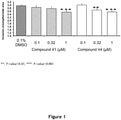
- Fig.1 Fluorescent invasion area for spheroids in presence of DMSO or of 0.1, 0.32 or 1 ⁇ M of compound 41 or 44.
- reaction mixture was concentrated under reduced pressure and the residue was purified by HPLC semi-preparative X-Terra RP-18, eluting with a linear gradient H 2 O/MeCN with 1% formic acid (80.20 to 0:100), to give 18 as a mixture of two rotamers in proportion 60/40 (1.8mg, 2.26 ⁇ mol, 21%).
- reaction mixture was concentrated under reduced pressure and the residue was purified by HPLC semi-preparative X-Terra RP-18, eluting with a linear gradient H 2 O/MeCN with 1% formic acid (80.20 to 0:100), to give 19 as a mixture of two rotamers in proportion 80/20 (1.8mg, 2.30 ⁇ mol, 22%).
- reaction mixture was concentrated under reduced pressure and the residue was purified by HPLC semi-preparative X-Terra RP-18, eluting with a linear gradient H 2 O/MeCN with 0.02% triethylamine (95:5 to 0:100), to give 20 (0.2mg, 0.33 ⁇ mol, 3.1%) and 21(1.4mg, 2.08 ⁇ mol, 19%).
- reaction mixture was concentrated under reduced pressure and the residue was purified by HPLC semi-preparative X-Terra RP-18, eluting with a linear gradient H 2 O/MeCN with 1% formic acid (95.5 to 50:50), to give 30 (2.1mg, 2.69 ⁇ m ⁇ l, 50%).
- N -dicyclohexylcarbodiimide 100 ⁇ L - 460 ⁇ mol
- N- hydroxysuccinimide 12 mg - 107.97 ⁇ mol
- trilobine 1 3 mg - 5.34 ⁇ mol
- triethylamine 10 ⁇ L - 74.10 ⁇ mol
- the reaction mixture was concentrated under reduced pressure and the residue was purified by HPLC semi-preparative X-Terra RP-18, eluting with a linear gradient H 2 O/MeCN with 1% formic acid (95.5 to 50:50), to give 33 (0.4mg, 0.59 ⁇ mol, 11%).
- reaction mixture was concentrated under reduced pressure and the residue was purified by HPLC semi-preparative X-Terra RP-18, eluting with a linear gradient H 2 O/MeCN with 1% formic acid (80:20 to 0:100), to give 41 (6.2mg, 6.95 ⁇ mol, 51%).
- Step 1 synthesis of N -methyl-carbamoylimidazole:
- Step 2 addition of N -methyl-carbamoylimidazole to nortrilobine (Product 7):
- Step 1 synthesis of N -(3-(diethylamino)propyl)-1H-imidazole-1-carboxamide :
- Step 2 addition of N -(3-(diethylamino)propyl)-1H-imidazole-1-carboxamide to nortrilobine 7:
- Step 1 Treatment of product 44 with hydrogen peroxide
- Step 2 Treatment with iron sulphate heptahydrate:
- hDNMT3A enzyme inhibition was adapted from the restriction-based fluorescence assay protocol as described in the literature ( Ceccaldi et al. ChemBioChem 2011, 12, 1337-1345 ). Briefly, a 5'-labelled biotin oligonucleotide is hybridized to its complementary strand labelled with 6-carboxyfluorescein at the 3'-end into a 384 well microplate (black Optiplates; Perkin Elmer) pre-coated with avidin. The duplex contains a unique CpG site overlapping with a restriction site of a methylation sensitive restriction enzyme. The human C-terminal DNMT3A (623-908a.a.), produced as described in ( Gros et al. Nucl. Acids Res.
- the formula used to calculate the percentage of inhibition is [(X-Y)/ X] ⁇ 100, where X is the signal determined in the absence of the inhibitor and Y is the signal obtained in the presence of the inhibitor.
- concentration at which 50% of efficacy of inhibition is observed was determined by analysis of a concentration range of the tested compound in triplicates.
- the non-linear regression fittings with sigmoidal dose-response (variable slope) were performed with GraphPad Prism 4.03 (GraphPad Software).
- His-DNMT1 (182kDa, human) was cloned, expressed and purified as described ( Halby et al. ChemBioChem 2012, 13, 157-165 ). The reaction was performed in a 10 ⁇ L total reaction volume in low volume NBS TM 384-well microplates (Corning), containing the tested compound (up to 1% DMSO), 1 ⁇ M of a SAM/[methyl- 3 H] SAM (3TBq/mmol, PerkinElmer) mix in a ratio of 3-to-1 (isotopic dilution 1 ⁇ :3), 0.3 ⁇ M of biotinylated hemimethylated DNA duplex (5'-GAT mC GC mC GATG mC G mC GAAT mC G mC GAT mC GATG mC GAT-3' and BIOT-5'-ATCGCATCGATCGCGATTCGCGCATCGGCGATC-3'), and 90 nM of DNMT1 in methylation buffer (20
- the reaction was incubated at 37°C for 2 hours. 8 ⁇ L are then transferred into a streptavidin 96-well scintillant coated Flashplate TM (PerkinElmer) containing 190 ⁇ L of 20 ⁇ M SAH in 50mM Tris-HCl pH 7.4.
- the Flashplate TM was agitated at room temperature for 1 hour and read in 200 ⁇ L of 50mM Tris-HCl pH 7.4 on TopCount NXT (PerkinElmer). The percentage of inhibition is reported.
- the formula used to calculate the percentage of inhibition is [(X-Y)/ X] ⁇ 100, where X is the signal determined in the absence of the inhibitor and Y is the signal obtained in the presence of the inhibitor.
- the compounds are inhibitors of DNMTs, their ability to induce the luciferase expression under the control of a methylated CMV promoter was evaluated.
- KG-1 cells were stably transfected with the firefly luciferase reporter gene (luc+ from pGL3; Promega) under the control of the cytomegalovirus (CMV) promoter (from pEGFP-N1; Clontech Laboratories Inc.) partially methylated (50 %).
- CMV cytomegalovirus
- 20,000 cells per well were seeded in a 96-well plate.
- the induction of the promoter was measured by quantification of the luciferase signal with the Brite-lite assay system (PerkinElmer) according to the manufacturer's protocol. The luminescence was measured on an EnVision multilabel plate reader (PerkinElmer), and the data are expressed as the fold induction as compared with the DMSO control. The mean of three experiments and the standard error is reported.
- NOMe-seq is a modified version of the methylation-dependent single promoter assay described by Miranda et al. (Curr Protoc Mol Biol. 2010 21.17.1-16 ) and the methylase-based DNA assay was performed as previously described with minor modifications.
- GpC DNA methyltransferase M.CviPI New England Biolabs
- GpC methyltransferase treatment was followed by DNA extraction, sodium bisulfite conversion, PCR amplification of the region of interest, cloning, and sequencing of individual clones to reveal the structure of single replicas as functional units.
- KG-1-Luc cells were centrifuged for 5min at 500 ⁇ g.
- Cell pellets were washed in ice-cold PBS, resuspended in 1mL of ice-cold nuclei buffer [10 mM Tris (pH 7.4), 10 mM NaCl, 3 mM MgCl 2 , 0.1mM EDTA, and 0.5% Nonidet P-40, plus protease inhibitors] per 2 ⁇ 10 6 cells, and incubated on ice for 10min.
- ice-cold nuclei buffer 10 mM Tris (pH 7.4), 10 mM NaCl, 3 mM MgCl 2 , 0.1mM EDTA, and 0.5% Nonidet P-40, plus protease inhibitors
- Nuclei were recovered by centrifugation at 900 ⁇ g for 5 min, washed twice in nuclei wash buffer [10 mM Tris (pH 7.4), 10 mM NaCl, mM MgCl 2 , and 0.1 mM EDTA containing protease inhibitors], and resuspended with 200 ⁇ L in 1 ⁇ M.CviPI reaction buffer supplemented with 0.3 M sucrose, 160 ⁇ M SAM (New England Biolabs). 100 ⁇ L of purified genomic DNA were treated with 100 U of M.CviPI for 15 min at 37°C in 200 ⁇ L final volume.
- the CMV promoter DNA amplification was carried on 8.3 ⁇ L eluted bisulfited DNA in 20 ⁇ L PCR reaction containing 1 ⁇ KAPA2G Buffer A, 2.0 mM MgCl 2 , 200 ⁇ M dNTPs, 125 nM each primer and 1.0 units KAPA2G TM Robust HotStart DNA Polymerase (KapaBiosystems) on C1000 Touch TM thermal cycler 95°C 3min following by 95°C for 20 sec, 55°C for 30 sec, 72°C for 30 sec ⁇ 40 cycles and final extension at 72°C 1 min. PCR fragments were quality controlled by agarose gel electrophoresis. Oligonucleotides used are listed in table below.
- Steps of cloning and sequencing were as those described previously except that M13 PCR was used to amplify the cloned sequence in 20 ⁇ L PCR reaction volume containing 1 ⁇ KAPA2G Buffer B, 2.0 mM MgCl 2 , 200 ⁇ M dNTPs, 125 nM each primer and 1.0 U KAPA2G TM Robust HotStart DNA Polymerase (KapaBiosystems) on C1000 Touch TM thermal cycler 95°C 3 min following by 95°C for 20 sec, 55°C for 30 sec, 72°C for 30 sec ⁇ 40 cycles and final extension at 72°C 1 min.
- KapaBiosystems Robust HotStart DNA Polymerase
- Genomic alignment and bisulfite sequence analysis was performed largely as previously described ( Berman et al. Nat Genet 2012, 44, 40-6 ).
- BISMA Bisulfite Sequencing DNA Methylation A nalysis
- Methyl Viewer Pardo et al. Nucleic Acids Res 2011, 39, e5
- the ratio of methylation is representative of the chromatin accessibility by M.CviPI and nucleosome occupancy.
- the combined methylation status for each clone by CpG (BISMA) or GpC (Methyl Viewer) site has been assembled.
- the chromatin accessibility is represented in the table 5 as ration of GpC methylation.
- the DNA demethylation is reported as percentage of methylated cytosine in the treated sample compared the non treated sample (Table 5).
- Cancer cell lines (colon HCT116 or leukaemia KG1) were treated with the compounds as indicated in the Data Tables and then analysed as following.
- DNA was isolated from cultured cells using the DNeasy Blood and Tissue Kit according to the manufacturer's specifications (Qiagen). DNA bisulphite conversion was performed on 2 ⁇ g of DNA using the EZ DNA Methylation-Gold Kit according to the manufacturer's specifications (Zymo Research) and bisulfited DNA was eluted with 10 ⁇ L of water.
- CDKN2B (P15) and P73 promoter PCR amplification of bisulfite-treated DNA
- Bisulfite-specific primers with a minimum length of 18bp were designed using Primer 3 program.
- the target sequence of the designed primers contained no CpGs allowing amplification of both un- and hypermethylated DNAs. All primers were tested for their ability to yield high quality sequences and primers that gave rise to an amplicon of the expected size using non-bisulfite treated DNA as a template were discarded, thus ensuring the specificity for bisulfite-converted DNAs.
- Primers used in this study are listed in the table above.
- the targeted DNA amplification was set up with 2.5 ⁇ L eluted bisulfited DNA in 50 ⁇ L PCR reaction volume containing 1 ⁇ PCR buffer, 1.5 mM MgCl 2 , 200 ⁇ M dNTPs, 200 nM each primer and 1.0 units Platinum ® Taq DNA Polymerase (Invitrogen) on C1000 Touch TM thermal cycler 94°C 2 min following by 94°C for 30 sec, 55°C for 30 sec, 72°C for 1 min ⁇ 35 cycles and final extension at 72°C 6 min.
- PCR fragments were quality controlled by agarose gel electrophoresis.
- PCR amplicons were cloned with the StrataClone Ultra Blunt PCR Cloning Kit (Agilent Technologies), according to the manufacturers' instructions and up to 24 clones were picked for sequencing.
- M13 PCR was performed to amplify cloned sequence: each colony was resuspended in 50 ⁇ L water and 1 ⁇ L of each bacterial suspension was used to a 20 ⁇ L PCR reaction volume containing 1 ⁇ PCR buffer, 2.5 mM MgCl 2 , 2 mM dNTPs, 3.2 ⁇ M each primer that anneals to sites flanking the insertion/ligation plasmid site, and 1.25 units AmpliTaq Gold DNA polymerase (Applied Biosystems) on C1000 Touch TM thermal cycler 95°C 10 min following by 95°C for 45 sec, 55°C for 45 sec, 72°C for 1 min ⁇ 35 cycles and final extension at 72°C 10 min.
- PCR amplicons were cleaned up using Bio-Gel-P100 (BioRad Laboratories) to remove any excess nucleotides and primers.
- Final sequencing was performed using a M13 primer on ABI 3100 capillary sequencers using 1/8 dilution of ABI Prism BigDye terminator V3.1 sequencing chemistry after hotstart 96°C for 60 sec and thermocycling 96°C for 10 sec, 50°C for 10 sec, 60°C for 4 min ⁇ 25 cycles.
- Sequencing reactions were cleaned up using Sephadex ® G-50 (GE Healthcare) to remove any excess nucleotides and dyes. Electrophoregram files and methylation signals at a given CpG site were quantified using the BISMA software as described above.
- This technique is a variation of bisulfite sequencing and combines bisulfite conversion based polymerase chain reaction with restriction digestion. DNA methylation levels are easily and quickly measured at fewer CpG sites than bisulfite-cloning-sequencing.
- CDKN2A (P16) promoter PCR amplification of bisulfite-treated DNA
- DNA amplification was set up with 100 ng eluted bisulfited DNA in 50 ⁇ L PCR reaction containing 1 ⁇ PCR buffer, 2.5 mM MgCl 2 , 0.3 mM dNTPs, 400 nM each primer and 1.25 units EpiTaq HS (Takara) on C1000 Touch TM thermal cycler by 98°C for 10 sec, 55°C for 30 sec, 72°C for 30 sec ⁇ 40 cycles. 20 ⁇ L of PCR amplicons were digested in 30 ⁇ L by 2 units of BsiEI at 60°C for 90 min. DNA fragments were migrated by 2% agarose gel electrophoresis and each band was quantified by Image Lab Software v2.0 (BioRad Laboratories).
- Compounds of the invention are able to demethylate the promoter of several tumor suppressor genes in several cancer cells (data reported in the table here below) and to demethyate the CMV promoter, open the chromatin on such promoter and reactivate the luciferase signal (as reported in table 5).
- tumour suppressor genes promoters in cancer cells such as P16 in colon cancer cell line HCT116 and P15 in leukemia KG1.
- Human cancer cells were obtained from the ATCC (USA) and cultivated in medium suggested by the supplier supplemented with foetal calf serum (Lonza, France), at 37°C and under 5% CO 2 .
- 2 ⁇ 10 4 cells are seeded at day 0 in a 96 wells plate.
- the compounds to be tested stored at -20°C as 10 -2 M stock solution in 100% DMSO, are freshly diluted on day 1 in the cell medium, before adding a dose range of 3.2 nM to 10 ⁇ M to the cells.
- Cells are treated everyday and cell viability assessed after 3 days or 7 days of treatment.
- the cell viability is assessed using the ATPLite kit from Perkin (ATPlite 1 Step Luminescence Assay System, ref 3016739), following the provider instructions.
- the raw data are analyzed with GraphPad Prism software (v4.03) to generate IC50 values corresponding to the compound concentrations giving 50% reduction in cell viability.
- the values presented are the mean results of at least two independent experiments. The standard errors are indicated.
- Compounds of the invention present a potential anti-cancer activity on a panel of cancer cell lines (table 6).
- metastatic melanoma cells WM-266-4 GFP (3000 cells/condition) were allowed to form spheroids for 2 days on agarose 1% (Sigma-Aldrich, #A95-39) coated in 96-well plates, leading to ⁇ 300 ⁇ m diameter spheroids. Then six different spheroids for each condition were individually embedded in EMEM media (Lonza, #BE12-684F) containing 1% of Bovin Collagen I (BD, #354231) and 2% SVF.
- the initial spheroid size and the 24h invasion area were measured by fluorescent microscopy, using an Axiovert 200M device (5X Plan-Neofluor objective, Carl Zeiss, Germany). Fluorescent invasion areas were quantified using Image J (NIH) software on the sum of six Z-stacks images (20 ⁇ m interval) for each spheroid. Invasion Index was obtained by normalising the invasion area at 24 h by the initial spheroid area. Six individual spheroids were quantified for each condition and three independent experiments were performed. The results are illustrated in annexed figure 1 .
- Compounds of the invention decreased the invasion index in metastatic melanoma cells.
- the compounds inhibit DNA methylation, in vitro and in cancer cells.
- the compounds are able to reprogram the cancer cells towards less aggressive state and could be used to sensitize towards immunotherapies and chemotherapies.
Landscapes
- Chemical & Material Sciences (AREA)
- Organic Chemistry (AREA)
- Health & Medical Sciences (AREA)
- General Chemical & Material Sciences (AREA)
- Medicinal Chemistry (AREA)
- Nuclear Medicine, Radiotherapy & Molecular Imaging (AREA)
- Chemical Kinetics & Catalysis (AREA)
- Pharmacology & Pharmacy (AREA)
- Life Sciences & Earth Sciences (AREA)
- Animal Behavior & Ethology (AREA)
- General Health & Medical Sciences (AREA)
- Public Health (AREA)
- Veterinary Medicine (AREA)
- Pharmaceuticals Containing Other Organic And Inorganic Compounds (AREA)
Description
- The present invention relates to hemi-synthetic trilobine analogues useful as DNA methyltransferase (DNMT) inhibitors, notably in the treatment of cancer and in neurological diseases.
- Epigenetic modifications play an essential role in the establishment and regulation of differentiation programs that define when and where genes are expressed. Among these modifications, C5 methylation of deoxycytidines (dC) in the DNA was shown to play a key role in the epigenetic regulation in mammals. It is the most stable epigenetic mark and occurs at position 5 of the cytosine ring within mainly CpG dinucleotides. The CpG sites are not distributed randomly across the human genome : they can be regrouped in islands, which are essentially located in promoters, present as repeated sequences, or located in CpG island shores. Hypermethylation of CpG islands located in promoters induces gene silencing while hypomethylation induces gene expression. Most of the CpG sites in the repetitive sequences are methylated, thus preventing chromosomal instability by silencing transposable DNA elements. Furthermore, some CpG islands located in promoters become methylated in a sustainable manner during development, which results in turning gene expression off, a phenomenon observed in X-chromosome inactivation, imprinted genes and developmental genes. Methylation status of the promoters regulates dynamically gene expression through modification of the recognition by transcription factors and the proteins involved in chromatin remodeling.
- DNA methyltransferases (DNMTs) catalyse the transfer of a methyl group from S-adenosyl-L-methionine (SAM) to position 5 of the cytosine at the CpG site. Two families of catalytically active DNMTs have been identified: DNMT1, responsible for DNA methylation maintenance during replication, and DNMT3A and 3B, responsible for de novo DNA methylation.
- Alterations of DNA methylation patterns lead to various diseases such as cancer and neurological diseases. Cancerous cells present aberrant DNA methylation. In particular, a specific hypermethylation of tumour suppressor genes is observed, inducing their silencing. Restoring their expression by specific inhibition of DNA methylation represents an attractive therapeutic strategy. In addition, it has been shown that demethylating agents prime cancer cells towards immunotherapy and sensitize them towards chemotherapy.
- DNMT inhibitors can be divided into two families: nucleoside analogues and non-nucleosides. The first are the most active ones. Two of them are FDA approved: 5-azacytidine (Vidaza®) and 5-aza-2'-deoxycytidine (Dacogene™). Despite their efficiency, poor bioavailability, instability in physiologic media and little selectivity restrict their use. Non-nucleoside analogues present various structures and mechanisms of action. Many of them were shown to target the catalytic site but suffer from lack of specificity and weak activity.
- There exists thus a need for novel DNMT inhibitors.
- The inventors of the present invention have thus discovered that hemisynthetic bisbenzylisoquinoline alkaloids can be used as DNMT inhibitors. Indeed, in their search of new DNMT inhibitors, they discovered that in the natural extracts of Cocculus hirsutus were present potent inhibitors of DNA methylation able to express, in leukaemia KG-1 cells, the luciferase gene under the control of a methylated CMV promoter upon demethylation of the promoter and chromatin decompaction. By a phytochemical approach, the natural bisbenzylisoquinoline alkaloid trilobine and natural analogues were thus identified. The trilobine scaffold was chemically modulated, and the ability of the derivatives to inhibit the DNMTs, to demethylate gene promoters and to induce chromatin opening and gene reexpression, such as of tumour suppressor gene in cancer cells, was characterized.
- The present invention concerns thus a compound of the following formula (I), preferably of the following formula (Ia), or a pharmaceutically acceptable salt or solvate thereof:

- Wherein:
- W is H,
- X1 and X2 are, independently of each other, H, (C1-C10)-alkyl, (C1-C10)-alkyl-R2, (C2-C10)-alkenyl, (C2-C10)-alkenyl-R2 (such as (C3-C10)-alkenyl-R2), CONR3R4, CSNR3R4, COR3, COOR6, CN, SOOR7, C(NH)NHR3, (C1-C10)-alkyl-(C5-C10)-aryl or (C1-C10)-alkyl-(5-12)-membered-heterocycle,
wherein:- at least one of X1 and X2 is CONR3R4 or CSNR3R4, preferably CONR3R4,R2 is OH, O-(C1-C10)-alkyl, O-(C5-C10)-aryl, NO2, CN, NR4R5, (5-12)-membered-heterocycle, (C5-C10)-aryl, O-((CH2)2O)n-OH with n=1-3, CONR3R4, halogen, COOR4, CF3, or
- (C3-C12)-cycloalkyl, in which (C5-C10)-aryl and (5-12)-membered-heterocycle are optionally substituted by at least one group selected from NR4R5, OR5, (C1-C10)-alkyl, halogen and oxo (=O),
- R3 is H, or a group chosen among (C1-C10)-alkyl, (C3-C12)-cycloalkyl, (C2-C10)-alkenyl, (C5-C10)-aryl and a (5-12)-membered-heteroaryl, said group being optionally substituted by at least one group selected from halogen, CN, NR4R5, mono(C1-C6)alkyl-amino, di-(C1-C6)-alkyl-amino, NO2, CONR4R5, COOR4, CF3, OR4 and (C1-C10)-alkyl-R8,
- R4 is H or (C1-C10)-alkyl,
- R5 is H, (C1-C10)-alkyl, (C5-C10)-aryl or (5-12)-membered-heterocycle, preferably H or (C1-C10)-alkyl,
- R6 is H, (C1-C10)-alkyl, (C5-C10)-aryl or (C1-C10)-alkyl-R2,
- R7 is (C1-C10)-alkyl, (C2-C10)-alkenyl, (C5-C10)-aryl or a (5-12)-membered-heterocycle, in which the fragments (C5-C10)-aryl and (5-12)-membered-heterocycle are optionally substituted by at least one group selected from halogen, CN, NR4R5, mono(C1-C6)alkyl-amino, di-(C1-C6)-alkyl-amino, NO2, CONR3R4, COOR4, CF3 and OR4, and is preferably (C1-C10)-alkyl,
- R8 is H, (C1-C10)-alkyl, (C5-C10)-aryl or (5-12)-membered-heterocycle, in which (C5-C10)-aryl and (5-12)-membered-heterocycle are optionally substituted by at least one group selected from NR4R5, OR5, (C1-C10)-alkyl, halogen and oxo,
- R1 is hydrogen, (C1-C6)-alkyl, COR6 or SOOR9 with R9 being a (C1-C6)-alkyl group optionally substituted by at least one halogen,
or wherein it is selected from the group consisting of compounds (10), (13), (15)-(22), (24)-(25), (27)-(28) and (30)-(33) as described in the examples. - A compound according to the invention thus verifies the proviso that X1 is not H or methyl when X2 is H or methyl and R1 is H or methyl.
- All stereoisomers, including optical isomers, of formula (I) belong to the invention, as well as the racemic forms.
- The term "stereoisomers" used in this invention refers to configurational stereoisomers and includes geometric isomers and optical isomers.
- The geometric isomers, also called E/Z isomers or cis-trans isomers, result from the different position of substituents on a double C=C bond which can have a Z or E configuration, also called cis or trans configuration.
- The optical isomers result from the different position in space of substituents on an atom (such as a carbon atom) comprising four different substituents. This atom thus represents a chiral or asymmetric center. Optical isomers which are not mirror images of one another are thus designated as "diastereoisomers," and optical isomers which are non-superimposable mirror images are designated as "enantiomers".
- An equimolar mixture of two enantiomers of a chiral compound is designated as racemate or racemic mixture.
- The expression "(C1-C10)-alkyl" in the present invention means a linear or branched saturated hydrocarbon chain comprising from 1 to 10 carbon atoms. Examples of alkyl groups covered by the scope of the present invention are methyl, ethyl, propyl, butyl, tert-butyl, isopropyl and decyl groups.
- The expression "(C1-C6)-alkyl" in the present invention means a linear or branched saturated hydrocarbon chain comprising from 1 to 6 carbon atoms. Examples of alkyl groups covered by the scope of the present invention are methyl, ethyl, propyl, butyl, tert-butyl and isopropyl groups.
- The expression "(C3-C12)-cycloalkyl" means a saturated hydrocarbon ring comprising from 3 to 12 carbon atoms. Examples of cycloalkyl groups covered by the scope of the present invention are cyclopropyl, cyclobutyl, cyclopentyl and cyclohexyl.
- The expression "(C2-C10)-alkenyl" in the present invention means a linear or branched hydrocarbon chain comprising from 2 to 10 carbon atoms containing at least one double bond, like vinyl and allyl groups.
- The term "(C1-C6)alkylamino", as used in the present invention, refers to an -NHAlk group with Alk representing a (C1-C6)alkyl group as defined above, including methylamino, ethylamino, n-propylamino, iso-propylamino, n-butylamino, iso-butylamino, sec-butylamino, t-butylamino, n-pentylamino and n-hexylamino.
- The term "di(C1-C6)alkylamino", as used in the present invention, refers to an - NAlk1Alk2 group with Alk1 and Alk2 representing, independently of one another, a (C1-C6)alkyl group as defined above, including dimethylamino, diethylamino and ethylmethylamino.
- The expression "aryl" in the present invention means a cyclic (mono- or polycyclic) aromatic hydrocarbon group comprising between 5 and 12 carbon atoms, preferably between 6 and 10 carbon atoms. Examples of aryl groups covered by the scope of the present invention are phenyl and naphtyl.
- The term "(C1-C10)-alkyl-(C5-C10)-aryl", as used in the present invention, refers to a (C1-C10)-alkyl group as defined above bound to the molecule via an aryl group as defined above. In particular, it can be a tolyl group (CH3Ph).
- The expression "(5-12)-membered-heterocycle group" in the present invention means saturated, unsaturated or aromatic hydrocarbon monocycle or bicycle (comprising fused, bridged or spiro rings, notably fused rings) each cycle having 5 or 6 members and 1 to 4, notably 1 or 2, carbon atoms which have been replaced with heteroatoms, such as nitrogen, oxygen or sulphur. Examples of heteroaryl groups covered by the scope of the present invention are pyridine, thiazole, imidazole, pyrazole, quinoline, indole, pyridazine, quinoxaline, dihydrobenzofuran, purine, furan, pyrrole, pyrroline (such as 3-pyrroline), thiophene, isothiazole, oxadiazole, imidazole, oxazole, isoxazole, pyridine, pyrimidine, pyridazine, pyrazine, triazine, quinoline, isoquinoline, quinoxaline, quinazoline, piperidine, piperazine, triazinane, morpholine, pyrrolidine, dihydropyridines, dihydropyrimidines (notably 1,2-dihydropyrimidine), dihydropyridazines, dihydropyrazines, dihydrotriazines, tetrahydropyridines, tetrahydropyrimidines, tetrahydropyridazines, tetrahydropyrazines, tetrahydrotriazines, benzofurane, benzothiophène, indoline, indolizine, benzothiazole, benzothionyle, benzopyranne, benzoxazole, benzo[1,3]dioxole, benzoisoxazole, benzimidazole, chromane, chromene, dihydrobenzofurane, dihydrobenzothiényle, dihydroisoxazole, isoquinoline, dihydrobenzo[1,4]dioxine, imidazo[1,2-a]pyridine, furo[2,3-c]pyridine, 2,3-dihydro-1H-indene, [1,3]dioxolo[4,5-c]pyridine, pyrrolo[1,2-c]pyrimidine, pyrrolo[1,2-a]pyrimidine, tetrahydronaphtalène and benzo[b][1,4]oxazine.
- The term "heteroaryl" as used in the present invention refers to an aromatic heterocycle as defined above. It can be more particularly an aromatic monocyclic or bicyclic heterocycle, each cycle comprising 5 or 6 members, such as a pyrrole, a furan, a thiophene, a thiazole, an isothiazole, an oxazole, an isoxazole, an imidazole, a pyrazole, a pyridine, a pyrimidine, a pyridazine, a pyrazine, an indole, a benzofurane, a benzothiophene, a benzothiazole, a benzoxazole, a benzimidazole, a purine, a quinoline, an isoquinoline, a quinazoline or a quinoxaline.
- The term "(C1-C10)-alkyl-(5-12)-membered-heterocycle", as used in the present invention, refers to a (C1-C10)-alkyl group as defined above bound to the molecule via a (5-12)-membered-heterocycle as defined above.
- The expression "halogen" in the present invention means one of the following atoms: fluorine, chlorine, bromine or iodine.
- For the purpose of the invention, the term "pharmaceutically acceptable" is intended to mean what is useful to the preparation of a pharmaceutical composition, and what is generally safe and non toxic, for a pharmaceutical use.
- The term "pharmaceutically acceptable salt or solvate" is intended to mean, in the framework of the present invention, a salt or solvate of a compound which is pharmaceutically acceptable, as defined above, and which possesses the pharmacological activity of the corresponding compound.
- The expression "pharmaceutically acceptable salts" in the present invention, means all the pharmaceutically acceptable salts of the compounds according to the invention are included within the scope of the invention, in particular the salts of weak acids and of weak bases.
- The pharmaceutically acceptable salts comprise:
- (1) acid addition salts formed with inorganic acids such as hydrochloric, hydrobromic, sulfuric, nitric and phosphoric acid; or formed with organic acids such as acetic, benzenesulfonic, fumaric, glucoheptonic, gluconic, glutamic, glycolic, hydroxynaphtoic, 2-hydroxyethanesulfonic, lactic, maleic, malic, mandelic, methanesulfonic, muconic, 2-naphtalenesulfonic, propionic, succinic, dibenzoyl-L-tartaric, tartaric, p-toluenesulfonic, trimethylacetic and trifluoroacetic acid, and
- (2) salts formed when an acid proton present in the compound is either replaced by a metal ion, such as an alkali metal ion, an alkaline-earth metal ion, or an aluminium ion; or coordinated with an organic or inorganic base. Acceptable organic bases comprise diethanolamine, ethanolamine, N-methylglucamine, triethanolamine and tromethamine. Acceptable inorganic bases comprise aluminium hydroxide, calcium hydroxide, potassium hydroxide, sodium carbonate and sodium hydroxide.
- In particular, it can be the hydrochloride, hydrobromide and trifluoroacetate salts.
- Acceptable solvates for the therapeutic use of the compounds of the present invention include conventional solvates such as those formed during the last step of the preparation of the compounds of the invention due to the presence of solvents.
- It can be for example an hydrate or an alcoholate such as an ethanolate.
- The expression "pharmaceutical composition" in the present invention means any composition comprising an effective dose of a compound of the invention and at least one pharmaceutically acceptable excipient. Said excipients are selected, depending on the pharmaceutical form and the desired method of administration, from the usual excipients known by a person skilled in the art.
- In one embodiment, the present invention concerns a compound of formula (Ia) or a pharmaceutically acceptable salt or solvate thereof, wherein:
- W = H,
- X1 and X2 are independently of each other H, (C1-C10)-alkyl, (C1-C10)-alkyl-R2, (C2-C10)-alkenyl, (C3-C10)-alkenyl-R2, CONR3R4, CSNR3R4, COR3, COOR6, CN, SOOR7, C(NH)NHR3, (C1-C10)-alkyl-(C5-C10)-aryl or (C1-C10)-alkyl-(5-12)-membered-heterocycle,
wherein:- at least one of X1 and X2 is CONR3R4 or CSNR3R4, preferably CONR3R4,R2 is OH, O-(C1-C10)-alkyl, O-(C5-C10)-aryl, NO2, CN, NR4R5, (5-12)-membered-heterocycle, -(C5-C10)-aryl, -O-((CH2)2O)n-OH with n=1-3, CONR3R4, halogen, COOR4, CF3 or cycloalkyl,
- R3 is H, (C1-C10)-alkyl, (C2-C10)-alkenyl, (C5-C10)-aryl or a (5-12)-membered-heteroaryl, in which the fragments (C5-C10)-aryl and (5-12)-membered-heterocycle can be substituted by at least one group selected from halogen, CN, NR4R5, mono(C1-C6)alkyl-amino, di-(C1-C6)-alkyl-amino, NO2, CONR3R4, COOR4, CF3 and OR4,
- R4 is H or (C1-C10)-alkyl,
- R5 is H, (C1-C10)-alkyl, (C5-C10)-aryl or (5-12)-membered-heterocycle,
- R6 is H, (C1-C10)-alkyl, (C5-C10)-aryl or (C1-C10)-alkyl-R2,
- R7 is (C1-C10)-alkyl, (C2-C10)-alkenyl, (C5-C10)-aryl or a (5-12)-membered-heterocycle, in which the fragments (C5-C10)-aryl and (5-12)-membered-heterocycle can be substituted by at least one group selected from halogen, CN, NR4R5, mono(C1-C6)alkyl-amino, di-(C1-C6)-alkyl-amino, NO2, CONR3R4, COOR4, CF3 and OR4,
- R1 is hydrogen, (C1-C6)-alkyl, COR6 or SOOR9 with R9 being a (C1-C6)-alkyl group possibly substituted by at least one halogen.
- A compound according to the invention thus verifies the proviso that X1 cannot be H or methyl when X2 is H or methyl and R1 is H or methyl and that X2 cannot be H or methyl when X1 is H or methyl and R1 is H or methyl.
- A compound according to the invention further verifies the proviso that:
- when X1 and R1 are methyl groups, X2 is not ethyl, benzyl, or acetyl, and
- when X1 and X2 are methyl groups, R1 is not ethyl or acetyl.
- The compounds deleted with the above mentioned provisos are disclosed in the following documents:
- Kuroda et al. Chem. Pharm. Bull. 1976, 24(10), 2413-2420,
- Inubushi et al. Tet. Lett. 1976, 17(33), 2857-2860,
- Tomita et al. J. Pharm. Soc. Japan 1963, 83(8), 760-763,
- Inubushi et al. J. Pharm. Soc. Japan 1963, 83(3), 288-292,
- Tacki et al. Phytochem. 1973, 12(10), 2509-2511, and
- Inubushi et al. Chem. Pharm. Bull. 1977, 25(7), 1636-1644,
- Document
JP S63 179826 A - According to a particular embodiment, R1 is hydrogen, (C1-C6)-alkyl, or SOOR9.
- According to another particular embodiment, R1 is hydrogen, methyl, or SOOCF3.
- According to yet another particular embodiment, R1 is (C1-C6)-alkyl, preferably methyl.
- According to a particular embodiment, X1 and X2 are, independently of each other, H, (C1-C10)-alkyl, (C1-C10)-alkyl-R2, CONR3R4, CSNR3R4, COR3, COOR6, CN or SOOR7.
- According to another particular embodiment, X1 and X2 are, independently of each other, H, (C1-C6)-alkyl, (C1-C6)-alkyl-R2, CONR3R4, CSNR3R4, COR3, COOR6, CN or SOOR7.
- According to yet another particular embodiment, at least one of X1 and X2 is not H or (C1-C10)-alkyl, notably X2 is not H or (C1-C10)-alkyl.
- According to still another particular embodiment, X1 and X2 are, independently of each other, H, (C1-C10)-alkyl, (C1-C10)-alkyl-R2, CONR3R4, CSNR3R4, COR3, COOR6, CN or SOOR7, preferably H, (C1-C6)-alkyl, (C1-C6)-alkyl-R2, CONR3R4, CSNR3R4, COR3, COOR6, CN or SOOR7, with the proviso that at least one of X1 and X2 is not H or (C1-C10)-alkyl, notably X2 is not H or (C1-C10)-alkyl.
- In the above embodiments, at least one of X1 and X2, preferably X2, is CONR3R4 or CSNR3R4, preferably CONR3R4.
- Advantageously, R2 is CN, NR4R5 or a (5-12)-membered-heterocycle optionally substituted by at least one group selected from NR4R5, OR5, (C1-C10)-alkyl, halogen and oxo (=O), preferably by NR4R5.
- More advantageously, R2 is CN or a (5-12)-membered-heterocycle optionally substituted by at least one group selected from NR4R5, OR5, (C1-C6)-alkyl, halogen and oxo (=O), preferably by NR4R5. In this case, the (5-12)-membered-heterocycle can be more particularly a monocyclic or bicyclic heteroaryl containing 1 to 5, notably 1 to 4 nitrogen atoms, each cycle comprising 5 or 6 members, such as a pyrrole, an imidazole, a pyrazole, a pyridine, a pyrimidine, a pyridazine, a pyrazine, an indole, a benzimidazole, a purine, a quinoline, an isoquinoline, a cinnoline, a quinazoline or a quinoxaline.
- Even more particularly, R2 is CN or a purine optionally substituted by at least one group selected from NR4R5, OR5, (C1-C10)-alkyl and halogen, preferably by NR4R5, such as by NH2.
- In particular, R3 is H, or a group chosen among (C1-C10)-alkyl, (C3-C12)-cycloalkyl, (C2-C10)-alkenyl and (C6-C10)-aryl, said group being optionally substituted by at least one group selected from halogen, NR4R5, mono-(C1-C6)-alkyl-amino, di-(C1-C6)-alkyl-amino, OR4 and (C1-C10)-alkyl-R8, such as selected from NR4R5, di-(C1-C6)-alkyl-amino and (C1-C6)-alkyl-R8.
- More particularly, R3 is H, or a group chosen among (C1-C6)-alkyl, (C3-C12)-cycloalkyl, and (C2-C10)-alkenyl, said group being optionally substituted by at least one group selected from halogen, NR4R5, mono-(C1-C6)-alkyl-amino, di-(C1-C6)-alkylamino, OR4 and (C1-C6)-alkyl-R8, such as selected from NR4R5, di-(C1-C6)-alkyl-amino and (C1-C6)-alkyl-R8.
- Even more particularly, R3 is H, or a group chosen among methyl, ethyl, propyl, cyclohexyl, vinyl and propenyl, said group being optionally substituted by at least one group selected from halogen, NR4R5, mono-(C1-C6)-alkyl-amino, di-(C1-C6)-alkylamino, OR4 and (C1-C6)-alkyl-R8, such as selected from NR4R5, di-(C1-C6)-alkyl-amino and (C1-C6)-alkyl-R8.
- Yet even more particularly, R3 is H, methyl, chloro-ethyl, diethylaminopropyl, (2,5-dioxo-3-pyrroline)-methyl-cyclohexyl, vinyl or dimethylaminopropenyl.
- R4 can be H or (C1-C6)-alkyl, in particular R4 is H, methyl or ethyl, preferably R4 is H.
- Preferably, R5 is H or (C1-C10)-alkyl, in particular, R5 is H or (C1-C6)-alkyl, and can be H, methyl, or ethyl.
- In particular, R6 is (C1-C10)-alkyl-R2, such as (C1-C6)-alkyl-R2, for example (CH2)m-R2 with m = 1-4, such as propyl-R2 or butyl-R2.
- Advantageously, R7 is (C1-C10)-alkyl, such as (C1-C6)-alkyl, and can be methyl.
- Preferably, R8 is a (5-12)-membered-heterocycle, optionally substituted by at least one group selected from NR4R5, OR5, (C1-C10)-alkyl, halogen and oxo, such as by at least one oxo.
- In this case, the (5-12)-membered-heterocycle can be a saturated, unsaturated or aromatic hydrocarbon monocycle or bicycle, each cycle having 5 or 6 members and 1 to 4, notably 1 or 2, carbon atoms which have been replaced with heteroatoms selected from nitrogen, oxygen and sulfur atoms, such as nitrogen atom. In particular, the heterocycle can be a pyrroline, such as a 3-pyrroline. For example, R8 can be 2,5-dioxo-3-pyrroline.
- In a first embodiment, X1 and X2 are, independently of each other, H, (C1-C10)-alkyl, (C1-C10)-alkyl-R2, CONR3R4, CSNR3R4, COR3, COOR6, CN, or SOOR7, wherein:
- at least one of X1 and X2 is CONR3R4 or CSNR3R4, preferably CONR3R4,
- R2 is CN or a (5-12)-membered-heterocycle, optionally substituted by at least one NR4R5, OR5, (C1-C10)-alkyl and halogen, preferably by NR4R5,
- R3 is H, or a group chosen among (C1-C10)-alkyl, (C3-C12)-cycloalkyl and (C2-C10)-alkenyl, said group being optionally substituted by at least one group selected from halogen, NR4R5, mono-(C1-C6)-alkyl-amino, di-(C1-C6)-alkyl-amino, OR4 and (C1-C10)-alkyl-Rs, preferably by halogen, NR4R5, di-(C1-C6)-alkyl-amino and (C1-C10)-alkyl-R8,
- R4 is H or (C1-C10)-alkyl,
- R5 is H or (C1-C10)-alkyl,
- R6 is (C1-C10)-alkyl-R2,
- R7 is (C1-C10)-alkyl, and
- R8 is a (5-12)-membered-heterocycle, substituted by at least one group selected from NR4R5, OR5, (C1-C10)-alkyl, halogen and oxo, preferably by at least one oxo group.
- In a second embodiment, X1 and X2 are, independently of each other, H, (C1-C10)-alkyl, (C1-C10)-alkyl-R2, CONR3R4, CSNR3R4, COR3, COOR6, CN, or SOOR7, and at least one of X1 and X2 is not H or (C1-C10)-alkyl, preferably X2 is not H or (C1-C10)-alkyl, wherein:
- at least one of X1 and X2 is CONR3R4 or CSNR3R4, preferably CONR3R4,R2 is CN or a (5-12)-membered-heterocycle, optionally substituted by at least one NR4R5, OR5, (C1-C10)-alkyl and halogen, preferably by NR4R5,
- R3 is H, or a group chosen among (C1-C10)-alkyl, (C3-C12)-cycloalkyl and (C2-C10)-alkenyl, said group being optionally substituted by at least one group selected from halogen, NR4R5, mono-(C1-C6)-alkyl-amino, di-(C1-C6)-alkyl-amino, OR4 and (C1-C10)-alkyl-Rs, preferably by halogen, NR4R5, di-(C1-C6)-alkyl-amino and (C1-C10)-alkyl-R8,
- R4 is H or (C1-C10)-alkyl,
- R5 is H or (C1-C10)-alkyl,
- R6 is (C1-C10)-alkyl-R2,
- R7 is (C1-C10)-alkyl, and
- R8 is a (5-12)-membered-heterocycle, substituted by at least one group selected from NR4R5, OR5, (C1-C10)-alkyl, halogen and oxo, preferably by at least one oxo group, with the proviso that X2 is not H or (C1-C10)-alkyl.
- In a third embodiment, X1 is H, (C1-C10)-alkyl, (C1-C10)-alkyl-R2, CONR3R4, CSNR3R4, COR3, COOR6, CN, or SOOR7, and X2, is CONR3R4 or CSNR3R4, preferably CONR3R4,
wherein: - R2 is CN or a (5-12)-membered-heterocycle, optionally substituted by at least one NR4R5, OR5, (C1-C10)-alkyl and halogen, preferably by NR4R5,
- R3 is H, or a group chosen among (C1-C10)-alkyl, (C3-C12)-cycloalkyl and (C2-C10)-alkenyl, said group being optionally substituted by at least one group selected from halogen, NR4R5, mono-(C1-C6)-alkyl-amino, di-(C1-C6)-alkyl-amino, OR4 and (C1-C10)-alkyl-R8, preferably by halogen, NR4R5, di-(C1-C6)-alkyl-amino and (C1-C10)-alkyl-R8,
- R4 is H or (C1-C10)-alkyl,
- R5 is H or (C1-C10)-alkyl,
- R6 is (C1-C10)-alkyl-R2,
- R7 is (C1-C10)-alkyl, and
- R8 is a (5-12)-membered-heterocycle, substituted by at least one group selected from NR4R5, OR5, (C1-C10)-alkyl, halogen and oxo, preferably by at least one oxo group.
- In the above first, second and third above mentioned embodiments, the (5-12)-membered-heterocycle is preferably:
- in the definition of R2, a monocyclic or bicyclic heteroaryl containing 1 to 5, notably 1 to 4 nitrogen atoms, each cycle comprising 5 or 6 members, such as a pyrrole, an imidazole, a pyrazole, a pyridine, a pyrimidine, a pyridazine, a pyrazine, an indole, a benzimidazole, a purine, a quinoline, an isoquinoline, a cinnoline, a quinazoline or a quinoxaline, preferably a purine;
- in the definition of R8, a saturated, unsaturated or aromatic hydrocarbon monocycle or bicycle, each cycle having 5 or 6 members and 1 to 4, notably 1 or 2, carbon atoms which have been replaced with heteroatoms selected from nitrogen, oxygen and sulfur atoms, such as nitrogen atom, preferably a pyrroline, such as a 3-pyrroline.
- According to another aspect of the present invention, the new hemi-synthetic bis(benzylisoquinoline) analogues of formula I correspond to those of formula I wherein:
- X1 is methyl, a 9-membered heteroaryl (C1-C6)-alkyl possibly substituted by an amino group, CSNHR3 with R3 being a (C1-C6)-alkyl group possibly substituted by a di-(C1-C6)alkyl-amino group, CONHR3 with R3 being a (C1-C6)-alkyl group possibly substituted by a di-(C1-C6)alkyl-amino group, and
- R1 is a methyl group, in particular R1 and R2 are methyl groups.
- According to yet another aspect of the present invention, the new hemi-synthetic bis(benzylisoquinoline) analogues of formula I correspond to those of formula I wherein:
- X1 and R1 are methyl groups, in particular X1, R1 and R2 are methyl groups, and
- X2 is CSNHR3 with R3 being a (C1-C6)-alkyl group possibly substituted by a di-(C1-C6)-alkyl-amino group.
- The compounds of the present invention may be selected from the compounds 10-22, 24-28, 30-33, 41-51 and 53-54 and the pharmaceutically acceptable salts and solvates thereof.
- The present invention relates also to a compound of formula (I) such as defined above, for use as a drug, notably intented for the treatment of cancer and of neurological diseases, in particular cancer, or intented for cell reprogramming, notably for the treatment of cancer.
- In one embodiment, the compounds of formula (I) such as defined above are DNA methyl transferase (DNMT) inhibitors.
- Consequently, the present invention relates also to a compound of formula (I) such as defined above, for use as a DNMT inhibitor.
- The present invention relates also to a compound of formula (I) such as defined above, for use as a drug intented for inhibiting DNMT.
- According to the invention, the expression "DNMT inhibitor" refers to molecules that are able to reduce the DNMT activity. Preferentially, the use of a DNMT inhibitor according to the invention makes it possible to inhibit the activity of said DNMT. The compounds showed also their properties of inhibitors of DNA methylation in cells. The DNMT inhibitory activity can be tested by measuring the expression of a CMV-Luc gene, notably as described in example II.3 of the present application, or by measuring the inhibition of hDNMT3A or hDNMT1 enzymes, notably as described in example II.1 and 11.2 of the present application. DNMT inhibitors according to the invention are thus able to reprogramming cells towards less aggressive state.
- Also, the present invention relates to a compound of formula (I) such as defined above, for use as a drug, as a DNMT inhibitor for use in a drug for treatment of cancer and neurological diseases, and cell reprogramming, notably intended for the treatment of cancer.
- The present invention also relates to the use of a compound of formula (I) such as defined above, for the manufacture of a drug, notably intended for the treatment of cancer.
- The present invention also relates to the use of a compound of formula (I) such as defined above, for the manufacture of a drug intended for inhibiting DNMT.
- The present invention also relates to a method for the treatment of cancer, comprising the administration to a person in need thereof of an effective dose of a compound of formula (I) such as defined above.
- In particular the compound relates to its use in combination to prime cells towards chemotherapy or immunotherapy.
- The present invention also relates to a method for inhibiting DNMT, comprising the administration to a person in need thereof of an effective dose of a compound of formula (I) such as defined above.
- The neurological disease according to the invention may be more particularly schizophrenia and neurodegenerative diseases.
- The cancer according to the invention may be colon cancer; hepatocarcinoma; melanoma; breast cancer; ovarian cancer; kidney cancer; liver cancer; pancreatic cancer; prostate cancer; glioblastoma; lung cancer, such as non-small cell lung cancer; neuroblastoma; myofibroblastic tumor; lymphoma, such as B- and T-cell lymphoma or anaplastic large-cell lymphoma; leukemia, such as AML (acute myeloid leukemia), MDS (myelodysplastic syndrome), CMML (chronic myelomonocytic leukemia) and CML (chronic myeloid leukemia); and multiple myeloma.
- The cancer may be more particularly colon cancer, hepatocarcinoma, melanoma, breast cancer, ovarian cancer, kidney cancer, liver cancer, pancreatic cancer, prostate cancer, glioblastoma, non-small cell lung cancer, neuroblastoma, myofibroblastic tumor, B- and T-cell lymphoma or anaplastic large-cell lymphoma, leukemia (AML, MDS, CMML, CML), multiple myeloma.The cancer can be in particular a DNMT-overexpressing cancer.
- The present invention also relates to a pharmaceutical composition comprising at least one compound of formula (I) such as defined above, and at least one pharmaceutically acceptable excipient.
- The pharmaceutical compositions according to the invention may be formulated notably for oral administration, topical administration or for injection, wherein said compositions are intended for mammals, including humans.
- The active ingredient may be administered in unit dosage forms of administration, in mixture with standard pharmaceutical carriers, to animals or to humans. The compounds of the invention as active ingredients may be used in doses ranging between 0.01 mg and 1000 mg per day, given in a single dose once per day or administered in several doses throughout the day, for example twice a day in equal doses. It may be necessary to use doses outside these ranges as determined by the person skilled in the art.
- The active ingredient may be administered for several cycles to keep the reprogramming of the cell.
- The pharmaceutical compositions according to the invention may further comprise at least one other active ingredient, such as an anticancer agent.
- The present invention relates also to a pharmaceutical composition comprising:
- (i) at least one compound of formula (I) such as defined above, and
- (ii) at least one other active ingredient, such as an anticancer agent,
- This combined active ingredient can be selected from the group consisting of:
- Cytotoxic agents such as doxorubicin, R-CHOP (Rituximab, Cyclophosphamide, Hydroxydaunorubicin, Oncovin, Prednisone or Prednisolone), PARP (Poly ADP Ribose Polymerase) inhibitors, etoposide, cisplatin, vinorelbine, vinflunine, bortezomib;
- Other epigenetics drugs such as:
- ∘ Inhibitors histone deacetylase (HDACi, such as inhibitors of
HDAC 1 & 2), - ∘ Inhibitors of chromatin remodeler (such as CHD4),
- ∘ Inhibitors of histone modifiers (such as demethylases JARDI1A/B or methylases EZH2);
- ∘ Inhibitors histone deacetylase (HDACi, such as inhibitors of
- Immunotherapies such as antiCTL4 or antiPD1.
- The present invention also relates to a pharmaceutical composition such as defined above for use as a drug, notably intended for the treatment of cancer.
- The present invention also relates to methods for the preparation of the compounds of formula (I) according to the invention.
- The compounds according to the present invention can be obtained by chemical synthesis as by one of the methods described below.
-
Fig.1 : Fluorescent invasion area for spheroids in presence of DMSO or of 0.1, 0.32 or 1 µM of compound 41 or 44. - The examples, which follow, illustrate the invention.
- The following abbreviations have been used in the following examples.
- BSA
- : bovine serum albumin
- CMV
- : cytomegalovirus
- CpG
- : deoxycytidine-phosphate-deoxyguanosine
- DMF
- : Dimethylformamide
- DMSO
- : Dimethylsulfoxide
- DNMT
- : C5 DNA methyltransferase
- EMEM
- : Eagle's Minimum Essential Medium
- EDTA
- : Ethylenediaminetetraacetic acid
- HEPES
- : 4-(2-Hydroxyethyl)-1-piperazineethanesulfonic acid
- HPLC
- : High Performance Liquid Chromatography
- HRMS
- : High Resolution Mass Spectrometry
- luc
- : luciferase
- NMR
- : Nuclear Magnetic Resonance
- PBS
- : Phosphate buffered saline
- PCR
- : Polymerase Chain Reaction
- PBST
- : Phosphate buffered saline + Tween-20
- RT
- : Room temperature
- SAH
- : S-adenosyl-L-homocysteine
- SAM
- : S-adenosyl-L-methionine
- THF
- : Tetrahydrofuran
- TLC
- : Thin Layer Chromatography
- To a solution of trilobine (1) (6mg - 10.68µmol) in 300 µL of tetrahydrofuran (THF) was added ethyl formate (46µL - 570µmol) and 1 drop of acetic acid. The mixture was stirred 24 h at RT in inert argon atmosphere. The reaction mixture was concentrated under reduced pressure and the residue was purified by semi-preparative X-Terra RP-18 HPLC, eluting with a linear gradient H2O/MeCN with 1% formic acid (95:5 to 50:50), to give 10 as a mixture of two rotamers in proportion 50/50 (0.4mg, 0.678µmol, 6%).

- 1H NMR (500MHz, CDCl3) δ 8.51/8.24 (1H, s, H-1"), 8.00/7.43 (1H, dd, J = 8.3 Hz, J = 2.2 Hz, H-14'), 7.27/7.02 (1H, m, H-13'), 7.09 (m, , H-10'), 6.97-6.87 (3H, dd, H-11', H-13, H-14), 6.71/6.67 (1H, s, H-5), 6.62/6.55 (1H, d, J = 1.9 Hz, H-10), 6.42/6.36 (1H, s, H-5'), 6.39-6.24 (1H, s, H-8), 5.76/4.95 (1H, br d, J = 5.5 Hz, H-1'), 4.23 (1H, m, H-3'), 3.96/3.95 (3H, s, 12-OMe), 3.89/3.88 (3H, s, 6'-OMe), 3.74 (2H, m, H-3'), 3.69/3.61 (1H, br, H-1), 3.44 (1H, m, H-3'), 3.28-2.96 (4H, m, H-α,H-α'), 2.95/2.73 (6H, m, H-3, H-4, H-4'), 2.43/2.42 (3H, s, N2-Me).
- 13C NMR (125MHz, CDCl3) δ 161.2/160.9 (C-1"), 154.6 (C-12'), 150.2 (C-11), 147.6 (C-12), 146.9(C-6'), 139.7 (C-6 or C-7 or C-8'), 139.6 (C-6 or C-7 or C-8'), 139.2 (C-6 or C-7 or C-8'), 137.3 (C-9'), 133.2 (C-9), 132.2 (C-8a), 131.4 (C-10'), 130.9/129.2 (C-14'), 130.2 (C-7'), 130.0 (C-4a), 127.7 (C-4a'), 123.5/123.1 (C-13'), 121.7/121.9 (C-11' and C-14), 118.0/118.9 (C-8a'), 117.8/117.4 (C-10), 116.2/116.0 (C-5), 114.7/114.5 (C-8), 113.0/112.5 (C-13), 107.3/107.0 (C-5'), 65.2/65.7 (C-1), 56.6 (C-6'-OMe), 56.4 (C-12-OMe), 55.5/49.2 (C-1'), 50.4/49.9 (C-3), 46.2/45.6 (C-α'), 41.1/36.4 (C-3'), 40.2 (C-N2-Me), 38.0/38.5 (C-α), 29.2/27.1 (C-4'), 26.4/26.2 (C-4).
- HRMS-ESI (m/z) calculated for C36H35N2O6 [M+H]+: 591.2490; Found: 591.2431.
- To a solution of trilobine (1) (6mg - 10.68µmol) in 200 µL of dichloromethane (CH2Cl2) and 200 µL of propan-2-ol, was added isocyanatotrimethylsilane (2mg - 17.36µmol). The mixture was stirred 16h at RT in inert argon atmosphere. The reaction mixture was concentrated under reduced pressure and the residue was purified by semi-preparative X-Terra RP-18 HPLC, eluting with a linear gradient H2O /MeCN with 0.02% trimethylamine (80:20 to 0:100). The collected fractions were evaporated under reduced pressure, to give 11 (4.7mg, 7.77µmol, 73%).

- 1H NMR (500MHz, CDCl3) δ 7.96 (1H, br d, J = 7.7 Hz, H-14'), 7.19 (1H, dd, J = 8.5 Hz, J = 2.6 Hz, H-13'), 7.05 (1H, br dd, J = 8.1 Hz, J = 1.8 Hz, H-10'), 6.96 (1H, dd, J = 8.1 Hz, J = 2.6 Hz, H-11'), 6.90 (2H, s, H-13, H-14), 6.64 (1H, s, H-10), 6.62 (1H, s, H-5), 6.39 (1H, s, H-5'), 6.25 (1H, s, H-8), 5.57 (1H, br, H-1'), 4.60 (2H, s, 1"-NH 2 ), 3.96 (3H, s, 12-OMe), 3.88 (3H, s, 6'-OMe), 3.71-3.57 (2H, m, H-3'), 3.32 (1H, d, J = 14.2 Hz, H-α'), 3.27 (1H, br, H-1), 2.96-2.81 (6H, m, H-3, H-4', H-α, H-α'), 2.78-2.71 (3H, m, H-3, H-4), 2.61-2.54 (1H, m, H-4), 2.34 (3H, s, N2-Me).
- 13C NMR (125MHz, CDCl3) δ 157.4 (C-1"), 154.9 (C-12'), 150.1 (C-11), 147.5 (C-12), 146.7 (C-6'), 139.7 (C-6 or C-7), 139.3 (C-6 or C-7), 139.1 (C-8'), 137.6 (C-9'), 135.1 (C-9), 134.9 (C-8a), 130.9 (C-14'), 130.8 (C-4a), 130.6 (C-10'), 130.2 (C-7'), 128.5 (C-4a'), 123.1 (C-13'), 122.2 (C-14), 121.5 (C-11'), 120.1 (C-8a'), 117.7 (C-10), 115.9 (C-5), 114.5 (C-8), 112.3 (C-13), 106.6 (C-5'), 67.1 (C-1), 56.6 (C-6'-OMe), 56.4 (C-12-OMe), 52.2 (C-1'), 51.2 (C-3), 46.1 (C-α'), 41.8 (C-N2-Me), 41.1 (C-3'), 40.3 (C-α), 28.0 (C-4'), 27.4 (C-4).
- HRMS-ESI (m/z) calculated for C36H33N3O6 [M+H]+: 606.2599; Found: 606.2598.
- To a solution of trilobine (1) (6mg - 10.68µmol) in 300 µL of THF was added N,N-diisopropylethylamine (2µL - 11.78µmol) and N,N-diethyl-3-isothiocyanatopropan-1-amine (2µL - 11.07µmol). The mixture was stirred 16h at RT in inert argon atmosphere. The reaction mixture was concentrated under reduced pressure and the residue was purified by semi-preparative X-Terra RP-18 HPLC, eluting with a linear gradient H2O /MeCN with 1% formic acid (80:20 to 0:100), to give 12 (2mg, 2.72µmol, 26%).

- 1H NMR (500MHz, CDCl3) δ 8.16 (1H, br, H-14'), 7.92 (1H, br, 2"-NH), 7.13 (1H, dd, J = 8.3 Hz, J = 2.3 Hz, H-13'), 6.96 (1H, dd, J = 8.4 Hz, J = 2.0 Hz, H-11'), 6.90-6.84 (3H, m, H-10', H-13, H-14), 6.68 (1H, s, H-5), 6.66 (1H, d, J = 1.9 Hz, H-10), 6.63 (1H, br, H-1'), 6.47 (1H, s, H-5'), 6.44 (1H, s, H-8), 3.93 (3H, s, 12-OMe), 3.90 (3H, s, 6'-OMe), 3.89-3.82 (6H, m, H-3', H-3", H-5"), 3.63 (1H, br, H-1), 3.43 (1H, d, J = 12.7 Hz, H-α'), 3.17-2.85 (9H, m, H-4', H-8", H-9", H-α, H-α'), 2.66-2.74 (2H, m, H-4), 2.65-2.58 (2H, m, H-3), 2.28 (3H, s, N2-Me), 2.15-2.02 (2H, br, H-4"), 1.20 (6H, br t, J = 6.5 Hz, H-7", H-10").
- 13C NMR (125MHz, CDCl3) δ 180.9 (C-1"), 154.8 (C-12'), 149.5 (C-11), 147.9 (C-12), 146.8 (C-6'), 140.7 (C-6 or C-7), 139.5 (C-6 or C-7), 139.2 (C-8'), 136.0 (C-9), 132.7 (C-9), 132.3 (C-14'), 131.7 (C-4a), 130.6 (C-8a), 130.4 (C-10'), 130.0 (C-4a' and C-7'), 132.1 (C-11'), 122.7 (C-13'), 121.1 (C-14), 119.4 (C-8a'), 117.7 (C-10), 115.7 (C-5), 115.0 (C-8), 112.6 (C-13), 106.7 (C-5'), 64.3 (C-1), 56.6 (C-6'-OMe), 56.3 (C-12-OMe), 56.1 (C-1'), 51.4 (C-3), 45.9 (C-8" and C-9"), 44.6 (C-α'), 44.2 (C-3' and C-3" and C-5"), 39.2 (C-N2-Me), 36.3 (C-α), 28.2 (C-4'), 26.4 (C-4), 23.9 (C-4"), 9.0 (C7" and C-10").
- HRMS-ESI (m/z) calculated for C43H51N4O5S [M+H]+: 735.3575; Found: 735.3572.
- To a solution of trilobine (1) (6mg - 10.68µmol) in 400µL of CH2Cl2 was added methanesulfonyl chlorure (2µL - 25.84µmol) and N,N-diisopropylethylamine (4.5µL-26.46µmol). The mixture was stirred 12h at RT in inert argon atmosphere. The reaction mixture was concentrated under reduced pressure and the residue was purified by HPLC semi-preparative X-Terra RP-18, eluting with a linear gradient H2O /MeCN with 0.02% triethylamine (75:25 to 20:80), to give 13 (1.2 mg, 1.88 µmol, 18%).

- 1H NMR (500MHz, CDCl3) δ 8.00 (1H, dd, J = 8.5 Hz, J = 2.2 Hz, H-14'), 7.27-7.25 (1H, br, H-13'), 7.12 (1H, dd, J = 7.9 Hz, J = 1.9 Hz, H-10'), 7.02 (1H, dd, J = 8.3 Hz, J = 2.6 Hz, H-11'), 6.87-6.90 (2H, m, H-13, H-14), 6.65 (1H, s, H-5), 6.60 (1H, d, J = 1.7 Hz, H-10), 6.39 (1H, s, H-5'), 6.19 (1H, s, H-8), 5.29 (1H, br, H-1'), 4.04 (1H, m, H-3'), 3.99 (3H, s, 12-OMe), 3.90 (3H, s, 6'-OMe), 3.57-3.63 (1H, m, H-3'), 3.50 (1H, br d, J = 14.9 Hz, H-α'), 3.27 (1H, br t, J = 3.3 Hz, H-1), 3.04-2.75 (7H, m, H-3, H-4, H-4', H-α, H-α'), 2.78 (3H, s, 1"-S-Me), 2.67-2.60 (2H, m, H-3, H-4), 2.41 (3H, s, N2-Me).
- 13C NMR (125MHz, CDCl3) δ 154.8 (C-12'), 150.3 (C-11), 147.4 (C-12), 147.1 (C-6'), 139.5 (C-6 or C-7), 139.2 (C-6 or C-7), 139.1 (C-8'), 137.6 (C-9'), 137.8 (C-8a), 135.2 (C-9), 130.9 (C-10'), 130.8 (C-4a), 130.3 (C-7'), 129.8 (C-14'), 126.8 (C-4a'), 123.4 (13'), 122.0 (C-14), 121.8 (C-11'), 119.0 (C-8a'), 117.5 (C-10), 116.0 (C-5), 114.5 (C-8), 112.2 (C-13), 107.0 (C-5'), 67.6 (C-1), 56.6 (C-6'-OMe), 56.4 (C-12-OMe), 54.1 (C-1'), 50.7 (C-3), 45.8 (C-α'), 42.7 (C-N2-Me), 41.1 (C-α), 40.3 (C-3'), 39.7 (C1"-S-Me), 27.8 (C-4), 26.3 (C-4').
- HRMS-ESI (m/z) calculated for C36H37N2O7S [M+H]+: 641.2316; Found: 641.2332.
- To a solution of trilobine (1) (6 mg - 10.68 µmol) in 300 µL of THF was added methyl isothiocyanate (1 µL - 14.62 µmol) and N,N-diisopropylethylamine (2 µL - 11.76 µmol). The mixture was stirred 12 h at RT in inert argon atmosphere. The reaction mixture was concentrated under reduced pressure and the residue was purified by semi-preparative X-Terra RP-18 HPLC, eluting with a linear gradient H2O /MeCN with 0.02% triethylamine (50:50 to 0:100), to give 14 (3.8 mg, 5.98 µmol, 56%).

- 1H NMR (500MHz, CDCl3) δ 8.04 (1H, br, H-14'), 7.14 (1H, dd, J = 8.6 Hz, J = 2.2 Hz, H-13'), 6.97-6.90 (4H, m, H-10', H-11', H-13, H-14), 6.74 (1H, d, J = 1.8 Hz, H-10), 6.66 (1H, s, H-5), 6.46 (1H, s, H-5'), 6.39 (1H, s, H-8), 5.29 (1H, br, H-1'), 6.37 (1H, m, H-3'), 5.70 (1H, br, 2"-NH), 3.96 (3H, s, 12-OMe), 3.91 (3H, s, 6'-OMe), 3.84-3.89 (1H, m, H-3'), 3.50 (1H, br d, J = 13.7 Hz, H-α'), 3.37 (1H, br d, J = 5.5 Hz, H-1), 3.26 (3H, d, J = 4.5 Hz, 3"-NH-Me), 3.10 (1H, m, H-4'), 3.06-2.92 (5H, m, H-3, H-4', H-α, H-α'), 2.79-2.72 (2H, m, H-3, H-4), 2.56 (1H, m, H-4),□ 2.26 (3H, s, N2-Me).
- 13C NMR (125MHz, CDCl3) δ 182.0 (C-1"), 155.6 (C-12'), 149.6 (C-11), 147.9 (C-12), 147.0 (C-6'), 139.9 (C-6 or C-7 or C-8'), 139.4 (C-6 or C-7 or C-8'), 139.1 (C-6 or C-7 or C-8'), 135.8 (C-9'), 134.7 (C-9), 134.0 (C-8a), 131.8 (C-4a), 131.6 (C-14), 130.4 (C-10'), 130.3 (C-7'), 129.2 (C-4a'), 122.8 (C-13'), 122.5 (C-14), 121.2 (C-11'), 119.1 (C-8a'), 118.3 (C-10), 115.8 (C-5), 114.5 (C-8), 112.5 (C-13), 106.6 (C-5'), 66.0 (C-1), 56.7 (C-6'-OMe), 56.4 (C-12-OMe), 56.1 (C-1'), 51.8 (C-3), 44.9 (C-α'), 44.2 (C-3'), 40.4 (C-N2-Me), 38.9 (C-α), 33.4 (C3"-NH-Me), 28.0 (C-4'), 26.7 (C-4).
- HRMS-ESI (m/z) calculated for C37H38N3O5S [M+H]+: 636.2527; Found: 636.2540.
- To a solution of trilobine (1) (6mg - 10.68µmol) in 300µL of THF was added cyanogen bromide (7µL - 15.42µmol) and N,N-diisopropylethylamine (3µL - 17.64µmol). The mixture was stirred 24h at RT in inert argon atmosphere. The reaction mixture was concentrated under reduced pressure and the residue was purified by semi-preparative X-Terra RP-18 HPLC, eluting with a linear gradient H2O /MeCN with 0.02% triethylamine (50:50 to 0:100), to give 15 (0.8mg, 1.36µmol, 13%).

- 1H NMR (500MHz, CDCl3) δ 7.73 (1H, dd, J = 8.4 Hz, J = 1.9 Hz, H-14'), 7.30 (1H, dd, J = 8.3 Hz, J = 2.6 Hz, H-13'), 7.17 (1H, dd, J = 8.2 Hz, J = 1.9 Hz, H-10'), 7.03 (1H, dd, J = 8.3 Hz, J = 2.3 Hz, H-11'), 6.90-6.86 (2H, m, H-13, H-14), 6.64 (1H, s, H-5), 6.56 (1H, d, J = 1.5 Hz, H-10), 6.35 (1H, s, H-5'), 6.17 (1H, s, H-8), 4.78 (1H, t, J = 3.5 Hz, H-1'), 3.98 (3H, s, 12-OMe), 3.88 (3H, s, 6'-OMe), 3.57 (2H, m, H-3'), 3.48 (1H, dd, J = 15.7 Hz, J = 2.7 Hz, H-α'), 3.28 (1H, br, H-1), 3.07 (1H, m, H-4'), 3.06-2.92 (2H, m, H-α, H-α'), 2.86 (1H, m, H-3), 2.78-2.70 (3H, m, H-4, H-4', H-α), 2.67-2.61 (2H, m, H-3, H-4), 2.43 (3H, s, N2-Me).
- 13C NMR (125MHz, CDCl3) δ 154.9 (C-12'), 150.2 (C-11), 147.4 (C-12), 147.2 (C-6'), 139.2 (C-6 or C-7), 139.1 (C-6 or C-7), 137.3 (C-9'), 135.9 (C-8'), 135.4 (C-9), 134.1 (C-8a), 131.3 (C-10'), 130.6 (C-4a and C-7'), 129.3 (C-14'), 126.3 (C-4a'), 123.3 (C-13'), , 122.1 (C-11' and C-14), 117.8 (C-1" and C-8a'), 117.4 (C-10), 116.1 (C-5), 114.4 (C-8), 112.4 (C-13), 106.8 (C-5'), 67.7 (C-1), 58.9 (C-1'), 56.6 (C-6'-OMe), 56.4 (C-12-OMe), 50.0 (C-3), 45.1 (C-α'), 42.7 (C-3'), 42.9 (C-N2-Me), 41.2 (C-α), 27.8 (C-4), 27.0 (C-4').
- HRMS-ESI (m/z) calculated for C36H34N3O5 [M+H]+: 588.2500; Found: 588.2493.
- To a solution of trilobine 1 (6mg -10.68µmol) in 300µL of ethanol was added 2µL acrylonitrile (133.17µmol) and 3µL of N-ethyl-N-isopropylpropan-2-amine (11.78µmol). The mixture was stirred 24h at RT in inert argon atmosphere. The reaction mixture was concentrated under reduced pressure and the residue was purified by semi-preparative X-Terra RP-18 HPLC, eluting with a linear gradient H2O/MeCN with 1% formic acid (95:5 to 50:50), to give 16 (1. mg, 1.95µmol, 18%).

- 1H NMR (500MHz, MeOD) δ 7.66 (1H, dd, J = 8.5 Hz, J = 2.1 Hz, H-14'), 7.18 (1H, dd, J = 8.3 Hz, J = 2.6 Hz, H-13'), 7.14 (1H, dd, J = 8.3 Hz, J = 2.4 Hz, H-10'), 7.02 (1H, d, J = 8.3 Hz, H-13), 6.96 (1H, dd, J = 8.3 Hz, J = 2.1 Hz, H-14), 6.88 (1H, dd, J = 8.3 Hz, J = 2.6 Hz, H-11'), 6.67 (1H, s, H-5), 6.65 (1H, d, J = 2.0 Hz, H-10), 6.50 (1H, s, H-5'), 6.32 (1H, s, H-8), 4.06 (1H, br, H-1'), 3.93 (3H, s, 12-OMe), 3.83 (3H, s, 6'-OMe), 3.61 (1H, br, H-1), 3.38 (2H, m, H-3', H-α'), 3.11 (1H, m, H-3'), 3.05-2.72 (12H, m, H-1", H-2", H-3, H-4, H-4', H-α, H-α'), 2.57 (1H, m, H-4'), 2.53 (3H, s, N2-Me).
- 13C NMR (125MHz, MeOD) δ 156.3 (C-12'), 151.6 (C-11), 149.6 (C-12), 148.1 (C-6'), 142.3 (C-6 or C-7), 141.5 (C-6 or C-7), 140.9 (C-9'), 138.2 (C-8'), 134.4 (C-9), 132.7 (C-8a), 132.5 (C-10'), 131.5 (C-4a), 130.8 (C-7'), 130.4 (C-14'), 129.7 (C-4a'), 123.6 (C-13'), 123.5 (C-14), 122.4 (C-11'), 121.0 (C-8a'), 120.7 (C-3"), 118.9 (C-10), 116.9 (C-5), 115.6 (C-8), 114.5 (C-13), 108.9 (C-5'), 67.8 (C-1), 61.3 (C-1'), 57.7 (C-6'-OMe and C-12-OMe), 52.0 (C-3), 50.2 (C-1"), 44.9 (C-α'), 43.6 (C-3'), 41.3 (C-N2-Me), 39.8 (C-α), 27.0 (C-4), 23.6 (C-4'), 18.1 (C-2").
- HRMS-ESI (m/z) calculated for C38H38N3O5 [M+H]+: 616.2806; Found: 616.2799.
- To a solution of trilobine 1 (6mg, 10.68µmol) in 2 mL of DMF was added 2-bromoacetonitrile (1µL - 14.35µmol), potassium iodide (0.5mg - 3.01µmol) and potassium carbonate (2mg - 14.47µmol). The mixture was stirred 24h at RT. The reaction mixture was concentrated under reduced pressure and the residue was purified by semi-preparative X-Terra RP-18 HPLC, eluting with a linear gradient H2O/MeCN with 1% formic acid (80:20 to 0:100), to give 17 (2.3mg, 3.82µmol, 36%).

- 1H NMR (500MHz, MeOD) δ 7.68 (1H, dd, J = 8.6 Hz, J = 2.2 Hz, H-14'), 7.20 (1H, dd, J = 8.3 Hz, J = 2.5 Hz, H-13'), 7.13 (1H, dd, J = 8.3 Hz, J = 2.2 Hz, H-10'), 7.01 (1H, d, J = 8.2 Hz, H-13), 6.95 (1H, dd, J = 8.2 Hz, J = 2.2 Hz, H-14), 6.88 (1H, dd, J = 8.3 Hz, J = 2.6 Hz, H-11'), 6.67 (1H, s, H-5), 6.60 (1H, d, J = 2.0 Hz, H-10), 6.51 (1H, s, H-5'), 6.25 (1H, s, H-8), 4.06 (1H, br, H-1'), 3.92 (3H, s, 12-OMe), 3.86 (1H, m, H-1"), 3.84 (3H, s, 6'-OMe), 3.86 (1H, d, J = 17.0 Hz, H-1"), 3.62 (1H, br, H-1), 3.35 (2H, m, H-3', H-α'), 3.09 (1H, br m, H-3'), 3.05-2.98 (3H, m, H-3, H-α), 2.94-2.71 (5H, m, H-4, H-4', H-α, H-α'), 2.66 (1H, m, H-4'), 2.52 (3H, s, N2-Me).
- 13C NMR (125MHz, MeOD) δ 156.3 (C-12'), 151.7 (C-11), 149.4 (C-12), 148.2 (C-6'), 142.3 (C-7), 141.3 (C-6), 140.5 (C-8'), 140.3 (C-9'), 134.4 (C-9), 133.2 (C-8a), 132.5 (C-10'), 131.9 (C-4a), 131.0 (C-7'), 130.3 (C-14'), 129.4 (C-4a'), 123.7 (C-11'), 123.6 (C-14), 122.7 (C-13'), 120.0 (C-8a'), 118.8 (C-2" and C-10), 117.0 (C-5), 115.6 (C-8), 114.5 (C-13), 108.7 (C-5'), 67.7 (C-1), 60.3 (C-1'), 56.9 (C-6'-OMe and C-12-OMe), 51.7 (C-3), 45.1 (C-3'), 44.8 (C-α'), 42.6 (C-1"), 41.3 (C-N2-Me), 39.6 (C-α), 27.0 (C-4), 24.5 (C-4').
- HRMS-ESI (m/z) calculated for C37H36N3O5 [M+H]+: 602.2649; Found: 602.2647.
-

- To a solution of trilobine 1 (6mg - 10.68µmol) in 2 mL of DMF was added 9-(4-chlorobutyl)-9H-purin-6-amine (3mg - 13.29µmol), potassium iodide (0.5mg - 3.01µmol) and potassium carbonate (5mg - 36.18µmol). The mixture was stirred 24 hours at 70°C. The reaction mixture was concentrated under reduced pressure and the residue was purified by HPLC semi-preparative X-Terra RP-18, eluting with a linear gradient H2O/MeCN with 1% formic acid (80.20 to 0:100), to give 18 as a mixture of two rotamers in proportion 60/40 (1.8mg, 2.26µmol, 21%).

- 1H NMR (500MHz, MeOD) δ 8.19/8.02 (1H, s, H-14"), 8.15/8.00 (1H, s, H-8"), 7.79/7.58 (1H, br d, J = 7.7 Hz, H-14'), 7.08 (1H, m, H-13'), 7.03 (1H, d, J = 8.2 Hz, H-13), 6.97 (2H, m, H-10', H-14), 6.81 (1H, br d, J = 7.3 Hz, H-11'), 6.74 (1H, s, H-5), 6.66/6.54 (1H, br, H-10), 6.63 (1H, s, H-5'), 6.44/6.21 (1H, s, H-8), (1H, br d, J = 7.3 Hz, H-1'), 4.37-4.20 (4H, H-3", H-6"), 3.91 (3H, s, 12-OMe), 3.87 (3H, s, 6'-OMe), 3.80 (1H, br, H-1), 3.68-3.56 (2H, m, H-3'), 3.33 (1H, m, H-3), 3.18 (1H, m, H-α'), 3.02-2.80 (8H, H-3, H-4, H-4', H-α, H-α'), 2.52 (3H, s, N2-Me), 2.04 (2H, m, H-5"), 1.73 (2H, m, H-4").
- 13C NMR (125MHz, MeOD) δ 157.5 (C-1" or C-11"), 157.3 (C-1" or C-11"), 156.7/156.5 (C-12'), 153.7/153.8 (C-14"), 151.3/150.8 (C-11), 150.8/150.7 (C-16"), 149.8/149.7 (C-12), 148.4/148.5 (C-6'), 142.9/142.6 (C-8"), 142.4 (C-6 or C-7), 141.1 (C-6 or C-7), 139.6 (C-8'), 138.5/138.3 (C-9'), 133.2 (C-9), 132.5 (C-4a), 132.3/131.5 (C-14'), 132.0/131.8 (C-10'), 131.7 (C-4a'), 130.8 (C-7' and C-8a), , 124.1/124.0 (C-14), 123.6/123.4 (C-13'), 122.3/122.2 (C-11'), 120.3 (C-10"), 119.9 (C-8a'), 119.0/118.9 (C-10), 117.0/117.1 (C-5), 115.9/115.4 (C-8), 114.6/114.5 (C-13), 108.9/108.7 (C-5'), 66.4 (C-1), 67.0/66.2 (C-3"), 57.0 (C-6'-OMe and C-12-OMe), 53.8/53.9 (C-1'), 52.6/52.1 (C-3), 46.9/46.7 (C-α'), 44.8/44.9 ( C-6"), 42.0/42.1 (C-3'), 40.0 (C-N2-Me), 37.5 (C-α), 29.1 (C-4'), 27.8 (C-5"), 27.5 (C-4"), 26.4 (C-4). HRMS-ESI (m/z) calculated for C45H46N7O7 [M+H]+: 796.3453; Found: 796.3442.
-

- To a solution of trilobine 1 (6mg -10.68µmol) in 2 mL of DMF was added 9-(3-chloropropyl)-9H-purin-6-amine (3mg - 14.17µmol), potassium iodide (0.5mg - 3.01µmol) and potassium carbonate (5mg - 36.18µmol). The mixture was stirred 24 hours at 70°C. The reaction mixture was concentrated under reduced pressure and the residue was purified by HPLC semi-preparative X-Terra RP-18, eluting with a linear gradient H2O/MeCN with 1% formic acid (80.20 to 0:100), to give 19 as a mixture of two rotamers in proportion 80/20 (1.8mg, 2.30µmol, 22%).

- 1H NMR (500MHz, MeOD) δ 8.19/8.07 (1H, s, H-7"), 8.14/7.98 (1H, s, H-13"), 7.79/7.64 (1H, br d, J = 8.3 Hz, H-14'), 7.09 (1H, dd, J = 8.1 Hz, J = 2.3 Hz, H-13'), 7.02 (1H, d, J = 8.3 Hz, H-13), 6.98 (2H, m, H-10', H-14), 6.83 (1H, dd, J = 8.2 Hz, J = 2.1 Hz, H-11'), 6.72 (1H, s, H-5), 6.65 (1H, br, H-10), 6.62 (1H, s, H-5'), 6.42/6.35 (1H, s, H-8), 5.34 (1H, br d, J = 7.3 Hz, H-1'), 4.44-4.36 (2H, m, H-5"), 4.32-4.17 (2H, m, H-3"), 3.91 (3H, s, 12-OMe), 3.87 (3H, s, 6'-OMe), 3.74 (1H, br, H-1), 3.66 (1H, m, H-3'), 3.45 (1H, m, H-3'), 3.17-2.77 (10H, H-3, H-4, H-4', H-α, H-α'), 2.50/2.45 (3H, s, N2-Me), 2.35 (2H, m, H-4").
- 13C NMR (125MHz, MeOD) δ 157.4 (C-1" or C-10"), 156.9 (C-1" or C-10"), 156.5 (C-12'), 153.9 (C-13"), 151.4 (C-11), 151.1 (C-15"), 149.7 (C-12), 148.4 (C-6'), 143.0 (C-7"), 142.5 (C-6 or C-7), 141.1 (C-6 or C-7), 139.6 (C-8'), 138.5 (C-9'), 133.5 (C-9), 132.5 (C-4a), 132.3 (C-14'), 131.9 (C-10'), 131.6 (C-4a'), 130.8 (C-7' and C-8a), 124.0 (C-14), 123.6 (C-13'), 122.2 (C-11'), 120.2 (C-9"), 119.1 (C-10), 119.0 (C-8a'), 117.0 (C-5) , 115.7/115.9 (C-8), 114.5/114.6 (C-13), 108.8/108.6 (C-5'), 66.7 (C-1), 64.7/64.4 (C-3"), 57.0 (C-6'-OMe and C-12-OMe), 53.7 (C-1'), 52.6 (C-3), 47.0 (C-α'), 42.9 (C-5"), 41.8 (C-3'), 40.2 (C-N2-Me), 37.5 (C-α), 30.6/30.4 (C-4"), 29.1/28.7 (C-4'), 26.5 (C-4).
- HRMS-ESI (m/z) calculated for C44H44N7O7 [M+H]+: 782.3297; Found: 782.3296.
- To a solution of O-methylcocsoline 3 (6mg - 10.68µmol) in 2 mL of DMF was added 2-bromoacetonitrile (3mg - 25.01µmol), potassium iodide (0.5mg - 3.01µmol) and potassium carbonate (5mg - 36.18µmol). The mixture was stirred 24 hours at RT. The reaction mixture was concentrated under reduced pressure and the residue was purified by HPLC semi-preparative X-Terra RP-18, eluting with a linear gradient H2O/MeCN with 0.02% triethylamine (95:5 to 0:100), to give 20 (0.2mg, 0.33µmol, 3.1%) and 21(1.4mg, 2.08µmol, 19%).

- 1H NMR (500MHz, MeOD) δ 7.66 (1H, dd, J = 8.2 Hz, J = 2.4 Hz, H-14'), 7.22 (1H, dd, J = 8.0 Hz, J = 2.2 Hz, H-10'), 7.17 (1H, dd, J = 8.5 Hz, J = 2.6 Hz, H-13'), 7.02-7.05 (2H, m, H-11', H-13), 6.96 (1H, dd, J = 8.3 Hz, J = 2.2 Hz, H-14), 6.62 (1H, s, H-5), 6.58 (1H, d, J= 2.1 Hz, H-10), 6.53 (1H, s, H-5'), 6.16 (1H, s, H-8), 4.13 (1H, br t, J = 3.3 Hz, H-1'), 4.00 (1H, d, J = 17.4 Hz, H-1"), 3.97 (3H, s, 12-OMe), 3.87 (3H, s, 6'-OMe), 3.78 (1H, d, J = 17.4 Hz, H-1"), 3.46 (1H, br t, H-1), 3.41- 3.19 (2H, m, H-3'), 3.00-2.61 (10H, m, H-3, H-4, H-4', H-α, H-α'), 2.58 (3H, s, N2'-Me).
- 13C NMR (125MHz, MeOD) δ 155.7 (C-12'), 152.0 (C-11), 149.0 (C-12), 148.1 (C-6'), 141.4 (C-6 or C-7 or C-8' or C-9'), 141.2(C-6 or C-7 or C-8' or C-9'), 141.0 (C-6 or C-7 or C-8' or C-9'), 140.5 (C-6 or C-7 or C-8' or C-9'), 135.6 (C-8a), 135.4 (C-9), 132.6 (C-10'), 131.6 (C-4a), 131.1 (C-7'), 129.9 (C-14'), 128.8 (C-4a'), 123.8 (C-13'), 123.2 (C-11'), 122.8 (C-14), 121.1 (C-8a'), 118.0 (C-10), 116.8 (C-5) , 116.7 (C-2"), 115.3 (C-8), 114.2 (C-13), 108.5 (C-5'), 66.2 (C-1), 61.4 (C-1'), 56.9 (C-6'-OMe and C-12-OMe), 50.3 (C-3), 46.0 (C-3'), 43.5 (C-α), 43.2 (C-α'), 42.5 (C-1"), 42.0 (C-N2'-Me), 28.9 (C-4), 24.6 (C-4').
- HRMS-ESI (m/z) calculated for C37H36N3O5 [M+H]+: 602.2649; Found: 602.2647.

- 1H NMR (500MHz, MeOD) δ 7.75 (1H, dd, J = 8.5 Hz, J = 2.2 Hz, H-14'), 7.21 (1H, dd, J = 8.2 Hz, J = 2.4 Hz, H-10'), 7.17 (1H, dd, J = 8.4 Hz, J = 2.7 Hz, H-13'), 7.00-6.98 (2H, m, H-11', H-13), 6.92 (1H, dd, J = 8.2 Hz, J = 2.2 Hz, H-14), 6.57 (1H, s, H-5), 6.54 (1H, d, J = 2.2 Hz, H-10), 6.47 (1H, s, H-5'), 6.12 (1H, s, H-8), 4.24 (1H, br, J = 3.3 Hz, H-1'), 3.98 (1H, d, J = 17.5 Hz, H-1"), 3.94 (3H, s, 12-OMe), 3.88 (1H, m, H-1‴), 3.84 (3H, s, 6'-OMe), 3.76 (2H, m, H-1" and H-1‴), 3.44 (1H, br, H-1), 3.18-2.56 (12H, m, H-3, H-3', H-4, H-4', H-α, H-α').
- 13C NMR (125MHz, MeOD) δ 155.7 (C-12'), 152.0 (C-11), 149.0 (C-12), 148.2 (C-6'), 141.3 (C-6 or C-7 or C-8' or C-9'), 141.0(C-6 or C-7 or C-8' or C-9'), 140.7 (C-6 or C-7 or C-8' or C-9'), 135.8 (C-8a), 135.5 (C-9), 132.5 (C-10'), 131.5 (C-4a), 131.1 (C-7'), 129.7 (C-14'), 129.0 (C-4a'), 123.8 (C-13'), 123.2 (C-11'), 122.8 (C-14), 119.9 (C-8a'), 119.0 ( C-2‴), 118.1 (C-10), 116.8 (C-5) , 116.7 (C-2"), 115.3 (C-8), 114.3 (C-13), 108.4 (C-5'), 66.3 (C-1), 60.3 (C-1'), 56.9 (C-6'-OMe and C-12-OMe), 49.6 (C-3), 45.2 (C-1‴ or C-3'), 44.9 (C-1‴ or C-3'), 43.6 (C-α or C-α'), 43.5 (C-α or C-α'), 42.5 (C-1"), 28.9 (C-4), 24.0 (C-4').
- HRMS-ESI (m/z) calculated for C38H34N4NaO5 [M+Na]+: 649.2421; Found: 649.2415.
- To a solution of O-methylcocsoline 3 (6mg - 10.68µmol) in 2 mL of ethanol was added acrylonitrile (3mg - 56.60µmol) and N-ethyl-N-isopropylpropan-2-amine (0.5mg - 3.87µmol) .The mixture was stirred 24 hours in inert argon atmosphere at RT. The reaction mixture was concentrated under reduced pressure and the residue was purified by HPLC semi-preparative X-Terra RP-18, eluting with a linear gradient H2O/MeCN with 0.1% formic acid (95:5 to 0:100), to give 22 (2.2mg, 3.58µmol, 33%).

- 1H NMR (500MHz, MeOD) δ 7.65 (1H, dd, J = 8.5 Hz, J = 2.1 Hz, H-14'), 7.20 (2H, m, H-10', H-13'), 6.98 (2H, m, H-11', H-13), 6.90 (1H, dd, J = 8.1 Hz, J = 2.0 Hz, H-14), 6.58 (1H, s, H-5), 6.56 (1H, d, J = 2.0 Hz, H-10), 6.54 (1H, s, H-5'), 6.08 (1H, s, H-8), 4.29 (1H, br, H-1'), 3.93 (3H, s, 12-OMe), 3.84 (3H, s, 6'-OMe), 3.46 (1H, br t, J = 3.4 Hz, H-1), 3.42- 3.34 (2H, m, H-3', H-α'), 3.14 (1H, m, H-3'), 3.05 (1H, m, H-4'), 2.97-2.92 (2H, m, H-3, H-α), 2.87-2.81 (2H, m, H-3, H-α'), 2.75-2.70 (5H, m, H-3, H-4', H-1", H-α), 2.74 (3H, s, N2'-Me), 2.67-2.57 (2H, m, H-4), 2.48 (2H, m, H-2").
- 13C NMR (125MHz, MeOD) δ 156.3 (C-12'), 151.8 (C-11), 149.0 (C-12), 148.6 (C-6'), 141.3 (C-8'), 140.8 (C-6 or C-7), 140.6 (C-6 or C-7), 139.4 (C-9'), 136.6 (C-9), 136.3 (C-8a), 132.8 (C-10'), 132.2 (C-4a), 131.4 (C-7'), 129.9 (C-14'), 127.8 (C-4a'), 123.9 (C-13'), 123.1 (C-11' or C-14), 123.0 (C-11' or C-14), 120.6 (C-3"), 118.6 (C-8a'), 118.4 (C-10), 116.9 (C-5), 115.3 (C-8), 114.3 (C-13), 108.4 (C-5'), 66.4 (C-1), 61.9 (C-1'), 57.0 (C-6'-OMe and C-12-OMe), 49.4 (C-1"), 47.0 (C-3), 46.3 (C-3'), 42.7 (C-α), 42.2 (C-α'), 41.4 (C-N2'-Me), 27.3 (C-4), 24.0 (C-4'), 17.4 (C-2").
- HRMS-ESI (m/z) calculated for C38H38N3O5 [M+H]+: 616.2806; Found: 616.2807.
-

- To a solution of O-methylcocsoline 3 (3mg -5.34µmol) in 200 µL of DMF was added 9-(3-chloropropyl)-9H-purin-6-amine (13mg - 61.42µmol), potassium iodide (0.5mg - 3.01µmol) and potassium carbonate (8.5mg - 36.18µmol). The mixture was stirred 24 hours at 70°C. The reaction mixture was concentrated under reduced pressure and the residue was purified by HPLC semi-preparative X-Terra RP-18, eluting with a linear gradient H2O/MeCN with 1% formic acid (95.5 to 50:50), to give 24 (1.2mg, 1.63 µmol, 30%).

- 1H NMR (500MHz, MeOD) δ 8.19 (1H, s, H-11"), 8.05 (1H, s, H-5"), 7.66 (1H, dd, J = 8.5 Hz, J = 2.1 Hz, H-14'), 7.25 (1H, dd, J = 8.4 Hz, J = 2.3 Hz, H-10'), 7.18 (1H, dd, J = 8.5 Hz, J = 2.6 Hz, H-13'), 7.00 (1H, dd, J = 8.2 Hz, J = 2.5 Hz, H-11'), 6.80 (1H, d, J = 8.3 Hz, H-13), 6.56-6.52 (3H, m, H-5, H-5', H-14), 6.49 (1H, d, J = 2.1 Hz, H-10), 6.00 (1H, s, H-8), 4.24-4.28 (3H, m, H-1', H-3"), 3.95 (3H, s, 12-OMe), 3.88 (3H, s, 6'-OMe), 3.44 (1H, br d, J = 16.4 Hz, H-α'), 3.38- 3.34 (2H, m, H-1, H-3'), 3.09 (1H, m, H-3'), 2.96-2.75 (6H, m, H-3, H-4', H-α, H-α'), 2.74 (3H, s, N2'-Me), 2.67-2.58 (4H, m, H-1", H-4, H-α), 2.49 (1H, m, H-1"), 2.02 (2H, m, H-2").
- 13C NMR (125MHz, MeOD) δ 157.4 (C-8"), 156.0 (C-12'), 153.8 (C-11"), 151.8 (C-11), 150.9 (C-13"), 148.8 (C-12), 148.6 (C-6'), 143.0 (C-5"), 141.3 (C-6 or C-7 or C-8'), 140.8 (C-6 or C-7 or C-8'), 140.7 (C-6 or C-7 or C-8'), 139.8 (C-9'), 136.4 (C-8a and C-9), 132.8 (C-10'), 131.9 (C-4a), 131.3 (C-7'), 129.8 (C-14'), 128.0 (C-4a'), 123.9 (C-13'), 123.1 (C-11'), 122.9 (C-14), 120.2 (C-7"), 119.0 (C-8a'), 118.1 (C-10), 116.8 (C-5) , 115.2 (C-8), 113.9 (C-13), 108.3 (C-5'), 66.6 (C-1), 61.8 (C-1'), 57.0 (C-6'-OMe or C-12-OMe), 56.9 (C-6'-OMe or C-12-OMe), 51.3 (C-1"), 46.8 (C-3), 46.4 (C-3'), 43.2 (C-3"), 42.2 (C-α'), 41.5 (C-N2'-Me), 41.3 (C-α), 28.2 (C-2"), 27.9 (C-4), 24.2 (C-4').
- HRMS-ESI (m/z) calculated for C43H44N7O5 [M+H]+: 738.3398; Found: 738.3383.
-

- To a solution of O-methylcocsoline 3 (3mg -5.34µmol) in 200 µL of DMF was added 9-(4-chlorobutyl)-9H-purin-6-amine (14mg - 62.04µmol), potassium iodide (0.5mg - 3.01µmol) and potassium carbonate (8.5mg - 36.18µmol). The mixture was stirred 24 hours at 70°C. The reaction mixture was concentrated under reduced pressure and the residue was purified by HPLC semi-preparative X-Terra RP-18, eluting with a linear gradient H2O/MeCN with 1% formic acid (95.5 to 50:50), to give 25 (2.1mg, 2.80µmol, 52%).

- 1H NMR (500MHz, MeOD) δ 8.18 (1H, s, H-12"), 8.08 (1H, s, H-6"), 7.63 (1H, dd, J = 8.2 Hz, J = 2.4 Hz, H-14'), 7.19 (2H, m, H-10', H-13'), 6.96 (1H, d, J = 8.4 Hz, H-13), 6.90 (2H, m, H-11', H-14), 6.65 (1H, s, H-5), 6.57 (2H, m, H-5', H-10), 6.17 (1H, s, H-8), 4.28 (1H, br d, J = 4.1 Hz, H-1'), 4.21 (2H, t, J = 7.0 Hz, H-4"), 3.92 (3H, s, 12-OMe), 3.85 (3H, s, 6'-OMe), 3.66 (1H, br, H-1), 3.40 (2H, m, H-3', H-α'), 3.12 (1H, m, H-3'), 3.09-2.95 (3H, m, H-3, H-α), 2.87-2.79 (4H, m, H-4', H-α, H-α'), 2.73 (3H, s, N2'-Me), 2.69 (2H, m, H-4), 2.59 (2H, m, H-1"), 1.87 (2H, m, H-3"), 1.48 (2H, m, H-2").
- 13C NMR (125MHz, MeOD) δ 157.4 (C-9"), 156.4 (C-12'), 153.8 (C-12"), 151.6 (C-11), 150.9 (C-14"), 149.3 (C-12), 148.7 (C-6'), 142.8 (C-6"), 141.9 (C-6 or C-7 or C-8'), 140.9 (C-6 or C-7 or C-8'), 140.5 (C-6 or C-7 or C-8'), 139.0 (C-9'), 134.9 (C-9), 133.8 (C8a), 132.7 (C-10'), 132.2 (C-4a), 131.2 (C-7'), 130.3 (C-14'), 128.1 (C-4a'), 123.9 (C-13'), 123.5 (C-14), 122.8 (C-11'), 120.1 (C-8"), 118.6 (C-8a' and C-10), 117.0 (C-5) , 115.4 (C-8), 114.3 (C-13), 108.7 (C-5'), 66.0 (C-1), 61.7 (C-1'), 56.9 (C-6'-OMe and C-12-OMe), 52.6 (C-1"), 47.7 (C-3), 46.2 (C-3'), 44.6 (C-4"), 41.8 (C-α'), 41.5 (C-N2'-Me), 39.8 (C-α), 28.9 (C-3"), 26.6 (C-4), 24.5 (C-2"), 24.2 (C-4').
- HRMS-ESI (m/z) calculated for C44H46N7O5 [M+H]+: 752.3555; Found: 752.3544.
-

- To a solution of trilobine 1 (3mg -5.34µmol) in 200 µL of MeCN was added 9-(4-chlorobutyl)-9H-purin-6-amine (10mg - 44.31µmol), potassium iodide (0.5mg - 3.01µmol) and potassium carbonate (8.5mg - 36.18µmol). The mixture was stirred 24 hours at 70°C. The reaction mixture was concentrated under reduced pressure and the residue was purified by HPLC semi-preparative X-Terra RP-18, eluting with a linear gradient H2O/MeCN with 1% formic acid (95.5 to 50:50), to give 27 (1.1mg, 1.46µmol, 27%).

- 1H NMR (500MHz, MeOD) δ 8.16 (1H, s, H-12"), 8.13 (1H, s, H-6"), 7.42 (1H, dd, J = 8.3 Hz, J = 2.1 Hz, H-14'), 7.12 (1H, dd, J = 8.3 Hz, J = 2.7 Hz, H-13'), 7.09 (1H, dd, J = 8.3 Hz, J = 2.2 Hz, H-10'), 7.04 (1H, d, J = 8.4 Hz, H-13), 6.99 (1H, dd, J = 8.2 Hz, J = 2.1 Hz, H-14), 6.85 (1H, dd, J = 8.3 Hz, J = 2.7 Hz, H-11'), 6.71 (1H, s, H-5), 6.64 (1H, d, J = 1.9 Hz, H-10), 6.52 (1H, s, H-5'), 6.33 (1H, s, H-8), 4.30 (2H, t, J = 6.8 Hz, H-4"), 4.12 (1H, d, J = 5.9 Hz, H-1'), 3.93 (3H, s, 12-OMe), 3.85 (3H, s, 6'-OMe), 3.72 (1H, br, H-1), 3.31-3.27 (2H, m, H-3', H-α'), 3.21 (1H, m, H-3), 3.12-2.99 (3H, m, H-3, H-α, H-α'), 2.94-2.86 (2H, m, H-4, H-4'), 2.82-2.65 (5H, m, H-1", H-3, H-4, H-4'), 2.54 (3H, s, N2-Me), 2.00 (2H, m, H-3"), 1.70 (2H, br, H-2").
- 13C NMR (125MHz, MeOD) δ 157.5 (C-9"), 156.4 (C-12'), 153.8 (C-12"), 151.5 (C-11), 150.9 (C-14"), 149.6 (C-12), 148.3 (C-6'), 142.9 (C-6"), 142.4 (C-6 or C-7 or C-8'), 141.2 (C-6 or C-7 or C-8'), 140.3 (C-6 or C-7 or C-8'), 139.6 (C-9'), 133.8 (C-9), 132.5 (C-10'), 131.9 (C-4a), 131.4 (C-8a), 130.7 (C-7'), 130.5 (C-14'), 129.3 (C-4a'), 123.9 (C-14), 123.7 (C-13'), 122.6 (C-11'), 120.1 (C-8"), 119.8 (C-8a'), 119.1 (C-10), 117.0 (C-5) , 115.6 (C-8), 114.6 (C-13), 109.0 (C-5'), 67.2 (C-1), 59.8 (C-1'), 57.0 (C-6'-OMe and C-12-OMe), 53.6 (C-1"), 52.4 (C-3), 44.7 (C-4"), 44.1 (C-α'), 43.0 (C-3'), 40.6 (C-N2-Me), 38.6 (C-α), 29.1 (C-3"), 26.7 (C-4), 25.5 (C-2"), 23.9 (C-4').
- HRMS-ESI (m/z) calculated for C44H46N7O5 [M+H]+: 752.3555; Found: 752.3541.
-

- To a solution of trilobine 1 (3mg - 5.34µmol) in 200 µL of DMF was added 9-(3-chloropropyl)-9H-purin-6-amine (10mg - 47.25µmol), potassium iodide (0.5mg - 3.01µmol) and triethylamine (10µL - 74.10µmol). The mixture was stirred 24 hours at 70°C. The reaction mixture was concentrated under reduced pressure and the residue was purified by HPLC semi-preparative X-Terra RP-18, eluting with a linear gradient H2O/MeCN with 1% formic acid (95.5 to 50:50), to give 28 (1.7mg, 2.31 µmol, 43%).

- 1H NMR (500MHz, MeOD) δ 8.11 (1H, s, H-5"), 8.09 (1H, s, H-11"), 7.38 (1H, dd, J = 8.3 Hz, J = 2.1 Hz, H-14'), 7.10 (1H, dd, J = 8.3 Hz, J = 2.7 Hz, H-13'), 7.06 (1H, dd, J = 8.3, J = 2.1 Hz, H-10'), 7.03 (1H, d, J = 8.7 Hz, H-13), 6.99 (1H, dd, J = 8.3 Hz, J = 2.0 Hz, H-14), 6.81 (1H, dd, J = 8.2 Hz, J = 2.5 Hz, H-11'), 6.71 (1H, s, H-5), 6.64 (1H, d, J = 2.1 Hz, H-10), 6.46 (1H, s, H-5'), 6.30 (1H, s, H-8), 4.37 (2H, m, H-3"), 3.94 (1H, br, H-1'), 3.92 (3H, s, 12-OMe), 3.83 (3H, s, 6'-OMe), 3.77 (1H, br, H-1), 3.28-2.95 (7H, m, H-3, H-3', H-α, H-α'), 2.94-2.60 (7H, m, H-1", H-3', H-4, H-4'), 2.57 (3H, s, N2-Me), 2.22 (2H, m, H-2").
- 13C NMR (125MHz, MeOD) δ 157.4 (C-8"), 156.3 (C-12'), 153.8 (C-11"), 151.5 (C-11), 150.9 (C-13"), 149.6 (C-12), 148.0 (C-6'), 142.6 (C-5"), 142.6 (C-6 or C-7 or C-8'), 141.4 (C-6 or C-7 or C-8'), 140.0 (C-6 or C-7 or C-8' and C-9'), 133.5 (C-9), 132.5 (C-10'), 131.7 (C-4a), 130.6 (C-8a and C-14'), 130.4 (C-7'), 129.7 (C-4a'), 123.9 (C-14), 123.6 (C-13'), 122.4 (C-11'), 120.9 (C-8a'), 120.2 (C-7"), 119.2 (C-10), 117.0 (C-5), 115.7 (C-8), 114.6 (C-13), 108.9 (C-5'), 67.0 (C-1), 59.7 (C-1'), 57.0 (C-6'-OMe or C-12-OMe), 56.9 (C-6'-OMe or C-12-OMe), 52.5 (C-3), 51.7 (C-1"), 43.8 (C-3'), 43.5 (C-3"), 42.5 (C-α'), 40.6 (C-N2-Me), 38.1(C-α), 28.4 (C-2"), 26.5 (C-4), 24.8 (C-4').
- HRMS-ESI (m/z) calculated for C43H44N7O5 [M+H]+: 738.3398; Found: 738.3387.
- To a solution of trilobine 1 (3mg - 5.34µmol) in 250 µL of DMF was added 2,5-dimethylenepyrrolidin-1-yl-4-((2,5-dioxo-2,5-dihydro-1H-pyrrol-1-yl)methyl) cyclohexanecarboxylate (6mg - 18.16µmol) and triethylamine (10µL - 74.10µmol). The reaction mixture was stirred 18 hours at RT. The reaction mixture was concentrated under reduced pressure and the residue was purified by HPLC semi-preparative X-Terra RP-18, eluting with a linear gradient H2O/MeCN with 1% formic acid (95.5 to 50:50), to give 30 (2.1mg, 2.69µmοl, 50%).

- 1H NMR (500MHz, MeOD) δ 7.87 (1H, dd, J = 8.6 Hz, J = 2.0 Hz, H-14'), 7.07 (1H, dd, J = 8.6 Hz, J = 2.5 Hz, H-13'), 7.00 (1H, d, J = 8.1 Hz, H-13), 6.97 (2H, m, H-10', H-14), 6.82 (1H, m, H-11'), 6.80 (2H, s, H-11", H-12"), 6.71 (1H, s, H-5), 6.65 (1H, d, J = 2.2 Hz, H-10), 6.64 (1H, s, H-5'), 6.38 (1H, s, H-8), 5.79 (1H, br d, J = 7.2 Hz, H-1'), 3.91 (3H, s, 12-OMe), 3.87 (3H, s, 6'-OMe), 3.87-3.73 (2H, m, H-3'), 3.69 (1H, br, H-1), 3.38 (2H, m, H-8"), 3.14 (1H, d, J = 13.7 Hz, H-α'), 3.10-2.85 (7H, m, H-3, H-4', H-α, H-α'), 2.82-2.77 (2H, m, H-4), 2.67 (1H, m, H-2"), 2.48 (3H, s, N2-Me), 1.98-1.93 (2H, m, H-3" or H-4", or H-6" or H-7"), 1.82-1.71 (3H, m, H-3" or H-4", or H-6" or H-7" and H-5"), 1.59-1.50 (2H, m, (2H, m, H-3" or H-4", or H-6" or H-7"), 1.19-1.05 (2H, m, H-3" or H-4", or H-6" or H-7").
- 13C NMR (125MHz, MeOD) δ 177.1 (C-1"), 173.0 (C-10" and C-13"), 156.5 (C-12'), 151.4 (C-11), 149.6 (C-12), 148.4 (C-6'), 142.4 (C-6 or C-7 or C-8'), 141.1 (C-6 or C-7 or C-8'), 140.0 (C-6 or C-7 or C-8'), 138.5 (C-9'), 135.5 (C-11" and C-12"), 133.8 (C-9), 132.4 (C-4a and C-10'), 131.8 (C-14'), 131.5 (C-4a' and C-8a), 131.0 (C-7'), 123.9 (C-14), 123.6 (C-13'), 122.1 (C-11'), 120.0 (C-8a'), 119.0 (C-10), 116.9 (C-5) , 115.8 (C-8), 114.5 (C-13), 108.5 (C-5'), 66.7 (C-1), 57.0 (C-6'-OMe or C-12-OMe), 56.9 (C-6'-OMe or C-12-OMe), 52.5 (C-3), 51.8 (C-1'), 47.1 (C-α'), 44.7 (C-8"), 43.2 (C-3'), 42.2 (C-2"), 40.4 (C-N2-Me), 38.2 (C-5"), 37.7 (C-α), 31.1 (C-4" or C-6"), 31.0 (C-4" or C-6"), 30.0 (C-4' or C-3" or C-7"), 29.9 (C-4' or C-3" or C-7"), 26.6 (C-4).
- HRMS-ESI (m/z) calculated for C47H48N3O8 [M+H]+: 782.3436; Found: 782.3436.
- To a solution of acryloyl chloride (150µL - 1.85mmol) and de N-hydroxysuccinimide (212mg -1.85mmol) in 250 µL of DMF was added trilobine 1 (3mg - 5.34µmol) and triethylamine (10µL - 74.10µmol). The mixture was stirred 18 hours at RT. The reaction mixture was concentrated under reduced pressure and the residue was purified by HPLC semi-preparative X-Terra RP-18, eluting with a linear gradient H2O/MeCN with 1% formic acid (95.5 to 50:50), to give 31 (2.6mg, 4.22µmol, 79%).

- 1H NMR (500MHz, DMSO-d6) δ 8.04 (1H, dd, J = 8.6 Hz, 1.7 Hz, H-14'), 7.16 (2H, m, H-10', H-13'), 7.02 (1H, dd, J = 8.0 Hz, J = 2.5 Hz, H-11'), 6.99 (1H, d, J = 8.3 Hz, H-13), 6.94-6.88 (2H, m, H-2", H-14), 6.66 (1H, s, H-5), 6.63 (1H, s, H-5'), 6.47 (1H, d, J = 1.9 Hz, H-10), 6.25 (1H, dd, J = 16.6 Hz, J = 2.2 Hz, H-3"), 6.06 (1H, s, H-8), 5.88 (1H, br, H-1'), 5.77 (1H, dd, J = 10.5 Hz, J = 2.2 Hz, H-3"), 4.09 (1H, m, H-3'), 3.86 (3H, s, 12-OMe), 3.79 (3H, s, 6'-OMe), 3.66 (1H, m, H-3'), 3.32 (1H, br d, J = 16.0 Hz, H-α'), 3.07 (1H, br, H-1), 2.96 (1H, dd, J = 15.7 Hz, J = 5.5 Hz, H-α'), 2.88-2.70 (5H, m, H-3, H-4', H-α), 2.63-2.56 (2H, m, H-4), 2.46 (1H, m, H-3), 2.25 (3H, s, N2-Me).
- 13C NMR (125MHz, DMSO-d6) δ 164.1 (C-1"), 153.7 (C12'), 149.7 (C-11), 146.7 (C-12), 146.2 (C-6'), 138.8 (C-6 or C-7 or C-8'), 138.6 (C-6 or C-7 or C-8'), 138.2 (C-6 or C-7 or C-8'), 137.9 (C-9'), 135.5 (C-8a), 134.7 (C-9), 130.7 (C-4a and C-10'), 130.3 (C-14'), 128.9 (C-7'), 128.5 (C2" and C-4a'), 128.1 (C-3"), 122.3 (C-13'), 121.8 (C-14), 121.4 (C-11'), 119.1 (C-8a'), 116.4 (C-10), 115.4 (C-5), 113.5 (C-8), 112.6 (C-13), 107.2 (C-5'), 67.2 (C-1), 56.0 (C-6'-OMe or C-12-OMe), 55.7 (C-6'-OMe or C-12-OMe), 49.9 (C-3), 49.7 (C-1'), 45.1 (C-α'), 42.4 (C-N2-Me), 40.4 (C-α or C-3'), 40.3 (C-α or C-3'), 28.2 (C-4'), 27.3 (C-4).
- HRMS-ESI (m/z) calculated for C38H37N2O6 [M+H]+: 617.2646; Found: 617.2654.
- To a solution of 3-chloropropanoyl chloride (100µL - 1.04mmol) and N-hydroxysuccinimide (12mg - 107.97µmol) in 250 µL of DMF was added trilobine 1 (3mg - 5.34µmol) and trimethylamine (10µL - 74.10µmol). The mixture was stirred 48 hours at RT. The reaction mixture was concentrated under reduced pressure and the residue was purified by HPLC semi-preparative X-Terra RP-18, eluting with a linear gradient H2O/MeCN with 1% formic acid (95.5 to 50:50), to give 32 (0.7mg, 1.07µmol, 20%).

- 1H NMR (500MHz, MeOD) δ 7.91 (1H, dd, J = 8.2 Hz, 2.0 Hz, H-14'), 7.10 (H, dd, J = 8.4 Hz, J = 2.6 Hz, H-13'), 7.02 (2H, m, H-10', H-13), 6.97 (1H, dd, J = 8.1 Hz, J = 2.0 Hz, H-14), 6.86 (1H, dd, J = 8.1 Hz, J = 2.5 Hz, H-11'), 6.70 (1H, s, H-5), 6.66 (1H, d, J = 2.1 Hz, H-10), 6.65 (1H, s, H-5'), 6.38 (1H, s, H-8), 5.83 (1H, br dd, J = 7.6 Hz, J = 1.7 Hz, H-1'), 3.92 (3H, s, 12-OMe), 3.91-3.88 (2H, m, H-3' or H-3"), 3.87 (3H, s, 6'-OMe), 3.72 (2H, m, H-3' or H-3"), 3.60 (1H, br, H-1), 3.22 (1H, br d, J = 14.1 Hz, H-α'), 3.11-2.71 (11H, m, H-2", H-3, H-4, H-4', H-α, H-α'), 2.43 (3H, s, N2-Me).
- 13C NMR (125MHz, MeOD) δ 171.1 (C-1"), 156.6 (C12'), 151.4 (C-11), 149.5 (C-12), 148.5 (C-6'), 142.2 (C-6 or C-7 or C-8'), 141.0 (C-6 or C-7 or C-8'), 140.0 (C-6 or C-7 or C-8'), 138.5 (C-9'), 134.1 (C-9), 132.5 (C-4a and C-14'), 132.2 (C-8a), 131.8 (C-7' and C-10'), 131.4 (C-4a'), 123.9 (C-14), 123.6 (C-13'), 122.2 (C-11'), 119.9 (C-8a'), 119.0 (C-10), 116.9 (C-5), 115.7 (C-8), 114.4 (C-13), 108.5 (C-5'), 66.9 (C-1), 57.0 (C-6'-OMe and C-12-OMe), 52.5 (C-3), 52.0 (C-1'), 46.9 (C-α'), 43.4 (C-3' or C-3"), 41.0 (C-3' or C-3"), 40.6 (C-N2-Me), 38.3 (C-α), 37.7 (C-2"), 29.5 (C-4'), 26.9 (C-4).
- HRMS-ESI (m/z) calculated for C38H38ClN2O6 [M+H]+: 653.2398; Found: 653.2413.
- To a solution of N,N-dicyclohexylcarbodiimide (100 µL - 460 µmol) and N-hydroxysuccinimide (12 mg - 107.97 µmol) in 250 µL of DMF was added trilobine 1 (3 mg - 5.34 µmol) and triethylamine (10 µL - 74.10 µmol). The mixture was stirred 48 hours at RT. The reaction mixture was concentrated under reduced pressure and the residue was purified by HPLC semi-preparative X-Terra RP-18, eluting with a linear gradient H2O/MeCN with 1% formic acid (95.5 to 50:50), to give 33 (0.4mg, 0.59µmol, 11%).

- 1H NMR (500MHz, MeOD) δ 8.01 (1H, dd, J = 8.6 Hz, J = 2.2 Hz, H-14'), 7.95 (2H, m, H-10'), 7.00 (1H, d, J = 8.3 Hz), 6.95-6.86 (3H, m), 6.72 (1H, m), 6.64 (1H, s), 6.61 (1H, s), 6.27 (1H, s, H-8), 5.92 (1H, dd, J = 6.6 Hz, J = 1.8 Hz, H-1'), 3.93 (3H, s, 12-OMe), 3.86 (3H, s, 6'-OMe), 3.26 (2H, m), 3.02-2.64, 10H, m), 2.35-6-2.34 (9H, m, N2-Me, N5"-Me).
- 13C NMR (125MHz, MeOD) δ 167.0, 156.6, 149.3, 148.5, 142.7, 140.9, 140.2, 132.3 (C-14'), 131.8 (C-10'), 125.6, 123.6, 122.5, 119.0, 116.8, 115.4 (C-8), 114.3, 108.4 (C-5'), 68.0, 61.4, 57.0 (C-6'-OMe and C-12-O-Me), 52.3 (C-1'), 52.2, 49.9, 45.4 (C-N5"-Me), 43.3, 41.4 (C-N2-Me), 33.3, 29.7, 27.6.
- HRMS-ESI (m/z) calculated for C41H44N3O6 [M+H]+: 674.3225; Found: 674.3204.
-


- To an ice-cooled solution of product 34 (48.5mg - 79.77µmol) in 800 µL of methanol was added iron sulphate heptahydrate (82mg - 294.95µmol). The reaction was stirred 48 hours at RT. Then, the reaction mixture was concentrated under reduced pressure. The residue was dissolved with EDTA (10mL - 0.1M) and adjusted at pH=10 with ammoniac. The solution was extracted by a liquid-liquid extraction with dichloromethane. The organic phase was dried with sulfate magnesium and concentrated under reduced pressure. The residue was purified by silica gel column with a linear gradient of dichloromethane-
methanol 1% NH3 (100:0 to 90:10), to give nortrilobine 7 (6.4mg, 19.08µmol, 15%), trilobine 1 (5.6mg, 9.96µmol, 12%), isotrilobine 2 (3.9mg, 6.77µmol, 9%) and O-methylcocsoline 3 (4mg, 7.12µmol, 9%).
- 1H NMR (500MHz, MeOD) δ 7.64 (1H, dd, J = 8.3 Hz, J = 1.9 Hz, H-14'), 7.15 (2H, m, H-10', H-13'), 6.96 (1H, d, J = 8.3 Hz, H-13), 6.93 (1H, dd, J = 8.3 Hz, J = 2.7 Hz, H-11'), 6.87 (1H, dd, J = 8.1 Hz, J = 2.0 Hz, H-14), 6.52 (1H, s, H-5), 6.49 (1H, d, J = 2.0, H-10), 6.43 (1H, s, H-5'), 6.07 (1H, s, H-8), 4.27 (1H, t, J = 3.3 Hz, H-1'), 3.92 (3H, s, 12-OMe), 3.78 (3H, s, 6'-OMe), 3.27 (1H, m, H-α'), 3.22 (1H, m, H-1), 3.15-3.10 (2H, m, H-3'), 2.92-2.56 (9H, m, H-3, H-4, H-4', H-α, H-α'), 2.39 (3H, s, N2-Me ).
- 13C NMR (125MHz, MeOD) δ 155.7 (C-12'), 151.8 (C-11), 148.8 (C-12), 147.8 (C-6'), 141.2 (C-6 or C-7 or C-9'), 141.0 (C-6 or C-7 or C-9'), 140.1 (C-8'), 136.4 (C-9), 136.2 (C-8a), 132.5 (C-10'), 131.0 (C-4a), 130.8 (C-7'), 129.8 (C-4a'), 129.6 (C-14'), 123.5 (C-13'), 123.2 (C-14), 122.8 (C-11'), 122.4 (C-8a'), 118.3 (C-10), 116.7 (C-5), 115.3 (C-8), 114.1 (C-13), 108.4 (C-5'), 68.8 (C-1), 56.9 (C-6'-OMe), 56.8 (C-12-OMe), 54.7 (C-1'), 50.5 (C-3), 45.6 (C-α'), 42.9 (C-N2-Me), 41.9 (C-α'), 39.3 (C-3'), 28.7 (C-4'), 28.1 (C-4).
- HRMS-ESI (m/z) calculated for C35H35N2O5 [M+H]+: 563.2540; Found: 563.2541.

- 1H NMR (500MHz, MeOD) δ 7.63 (1H, dd, J = 8.4 Hz, J = 2.0 Hz, H-14'), 7.18 (1H, dd, J= 7.8 Hz, J = 2.0 Hz, H-10'), 7.16 (1H, dd, J= 8.2 Hz, J = 2.5 Hz, H-13'), 6.98 (1H, d, J = 8.3 Hz, H-13), 6.95 (1H, dd, J = 8.2 Hz, J = 2.8 Hz, H-11'), 6.91 (1H, dd, J = 8.3 Hz, J = 2.0 Hz, H-14), 6.58 (1H, s, H-5), 6.56 (1H, d, J = 1.9, H-10), 6.49 (1H, s, H-5'), 6.13 (1H, s, H-8), 4.10 (1H, m, H-1'), 3.93 (3H, s, 12-OMe), 3.83 (3H, s, 6'-OMe), 3.35 (1H, m, H-α'), 3.21 (1H, m, H-1), 3.17 (H, m, H-3'), 3.00-2.88 (4H, m, H-3, H-3', H-4', H-α), 2.81-2.60 (5H, H-3, H-4, H-4', H-α, H-α'), 2.57 (3H, s, N2'-Me ), 2.37 (3H, s, N2-Me ).
- 13C NMR (125MHz, MeOD) δ 156.0 (C-12'), 151.9 (C-11), 148.9 (C-12), 148.0 (C-6'), 141.4 (C-6 or C-7 or C-8' or C-9'), 141.0 (C-6 or C-7 or C-8' or C-9'), 140.8 (C-6 or C-7 or C-8' or C-9'), 140.5 (C-6 or C-7 or C-8' or C-9'),136.2 (C-9), 135.8 (C-8a), 132.6 (C-10'), 131.5 (C-4a) 130.9 (C-7'), 130.0 (C-14'), 128.8 (C-4a'), 123.8 (C-13'), 123.3 (C-13), 122.9 (C-11'), 121.1 (C-8a'), 118.4 (C-1), 116.8 (C-5), 115.2 (C-8), 114.2, C-13), 108.4 (C-5'), 68.9 (C-1), 61.5 (C-1'), 56.9 (C-6'-OMe and C-12-OMe), 51.8 (C-3), 46.0 (C-3'), 42.6 (C-N2-Me), 42.4 (C-α'), 42.0 (C-N2'-Me), 41.6 (C-α), 28.1 (C-4), 24.6 (C-4').
- HRMS-ESI (m/z) calculated for C36H37N2O5 [M+H]+: 577.2697; Found: 577.2698.

- 1H NMR (500MHz, CDCl3) δ 7.55 (1H, dd, J = 8.3 Hz, J = 2.1 Hz, H-14'), 7.25 (1H, dd, J = 8.3 Hz, J = 2.7 Hz, H-13'), 7.14 (1H, dd, J = 8.3 Hz, J = 2.1 Hz, H-10'), 6.91 (3H, m, H-11', H-13, H-14), 6.65 (1H, s, H-5), 6.64 (1H, d, J = 1.9 Hz, H-10), 6.35 (H, s, H-5'), 6.21 (1H, s, H-8), 4.00 (1H, m, H-1'), 3.99 (3H, s, 12-OMe), 3.88 (3H, s, 6'-OMe), 3.62 (1H, d, J = 4.6 Hz, H-1), 3.34 (1H, d, J = 14.5 Hz, H-α'), 3.20-3.11 (2H, m, H-3, H-3'), 3.03-2.90 (4H, H-3, H-3', H-4', H-α), 2.78-2.72 (2H, m, H-4, H-α), 2.66 (1H, m, H-α'), 2.63 (3H, s, N2-Me ), 2.59-2.50 (2H, m, H-4, H-4').
- 13C NMR (125MHz, CDCl3) δ 154.9 (C-12'), 150.2 (C-6), 147.7 (C-11), 146.2 (C-6'), 139.9 (C-6 or C-7 or C-8' or C-9'), 139.6 (C-6 or C-7 or C-8' or C-9'), 139.5 (C-6 or C-7 or C-8' or C-9'), 139.3 (C-6 or C-7 or C-8' or C-9'), 136.4 (C-8a), 134.7 (C-9), 131.7 (C-10'), 131.2 (C-4a), 129.7 (C-7'), 128.9 (C-14'), 127.6 (C4a'), 122.6 (C-13'), 122.1 (C-14), 121.5 (C-11'), 121.1 (C-8a'), 117.9 (C-10), 116.5 (C-5), 113.2 (C-8), 112.7 (C-13), 106.9 (C-5'), 60.7 (C-1 and C-1'), 56.5 (C-6'-OMe and C-12-OMe), 45.1 (C-3'), 44.1 (C-α), 43.2 (C-3), 42.4 (C-N2-Me), 41.7 (C-α'), 29.0 (C-4), 24.3 (C-4').
- HRMS-ESI (m/z) calculated for C35H35N2O5 [M+H]+: 563.2540; Found: 563.2544.

- 1H NMR (500MHz, MeOD) δ 7.58 (1H, dd, J = 8.4 Hz, J = 2.2 Hz, H-14'), 7.20 (1H, dd, J = 8.3 Hz, J = 2.6 Hz, H-13'), 7.07 (1H, dd, J = 8.3 Hz, J = 2.2 Hz, H-10'), 7.04 (1H, d, J = 8.4 Hz, H-13), 7.02 (1H, dd, J = 8.3 Hz, J = 2.0 Hz, H-14), 6.74 (1H, dd, J = 8.4 Hz, J = 2.5 Hz, H-11'), 6.62 (1H, s, H-5), 6.61 (1H, d, J = 1.8 Hz, H-10), 6.57 (1H, s, H-5'), 6.27 (1H, s, H-8), 4.37 (1H, dd, J = 5.8 Hz, J = 1.5 Hz, H-1'), 3.91 (3H, s, 12-OMe), 3.80 (1H, m, H-1), 3.79 (3H, s, 6'-OMe), 3.45- 3.34 (3H, m, H3', H-α'), 3.19 (1H, m, H-3), 3.12-2.98 (H-3, H-4', Hα), 2.93-2.88 (3H, m, H-4', H-α, H-α'), 2.83 (1H, m, H-4), 2.71 (1H, m, H-4).
- 13C NMR (125MHz, MeOD) δ 157.3 (C-12'), 151.3 (C-11), 149.8 (C-12), 148.7 (C-6'), 142.0 (C-6 or C-7), 141.0 (C6 or C-7), 139.9 (C-8'), 138.4 (C-9'), 133.8 (C-9), 133.5 (C-8a), 132.7 (C-4a and C-10'), 130.9 (C-7'), 130.5 (C-14'), 128.6 (C-4a'), 124.2 (C-14), 123.6 (C-13'), 122.3 (C-11'), 119.6 (C-10), 119.2 (C-8a'), 117.2 (C-5), 114.8 (C-13), 114.6 (C-8), 108.9 (C-5'), 59.7 (C-1), 57.0 (C-6'-OMe or C-12-OMe), 56.9 (C-6'-OMe or C-12-OMe), 54.3 (C-1'), 44.2 (C-α'), 42.6 (C-3), 40.8 (C-α), 38.2 (C-3'), 27.6 (C-4), 26.9 (C-4').
- HRMS-ESI (m/z) calculated for C34H33N2O5 [M+H]+: 549.2384; Found: 549.2388
- To a solution of nortrilobine 7 (7.5mg - 13.69µmol) in 500 µL of tetrahydrofuran was added 3-(diethylamino)propylisothiocyanate (5µL - 29.02µmol) and N-ethyl-N-isopropylpropan-2-amine (5µL - 29.40µmol). The mixture was stirred 24 hours at RT in inert argon atmosphere. The reaction mixture was concentrated under reduced pressure and the residue was purified by HPLC semi-preparative X-Terra RP-18, eluting with a linear gradient H2O/MeCN with 1% formic acid (80:20 to 0:100), to give 41 (6.2mg, 6.95µmol, 51%).

- 1H NMR (500MHz, MeOD) δ 8.35 (1H, br, H-14'), 7.12 (1H, br, H-10'), 7.07 (1H, br, H-13'), 7.00 (1H, br, H-11'), 6.97 (1H, d, J = 8.2 Hz, H-13), 6.80 (1H, br d, J = 8.3 Hz, H-14), 6.75 (1H, br, H-10), 6.60 (1H, br s, H-5), 6.50 (1H, br s, H-5'), 6.03 (1H, br s, H-8), 3.94 (3H, s, 12-OMe), 3.84 (3H, s, 6'-OMe), 3.80 (2H, m, H-3" or H-3‴), 3.71-3.60 (4H, m, H-3', H-3" or H-3‴), 3.47 (1H, br d, J = 15.9 Hz, H-α'), 3.14-3.05 (8H, m, H-7", H-7‴, H-9", H-9‴), 3.03-2.87 (8H, m, H-4', H-5", H-5‴, H-α, H-α'), 2.79-2.68 (2H, m, H-4, H-4'), 2.58 (1H, br d, J = 16.3 Hz, H-4), 2.06 (2H, br, H-4" or H-4‴), 1.91 (2H, br, H-4" or H-4‴), 1.24 (12H, br t, J = 7.1 Hz, H-8", H-10").
- 13C NMR (125MHz, MeOD) δ 182.1 (C-1" or C-1‴), 182.0 (C-1" or C-1‴), 156.7 (C12'), 151.7 (C-11), 149.5 (C-12), 148.2 (C-6'), 141.6 (C-6 or C-7), 141.1 (C-6 or C-7), 140.4 (C-8'), 139.4 (C-9'), 135.7 (C-4a), 135.2 (C-9), 132.2 (C-10' and C-14'), 131.4 (C-8a), 130.9 (C-7'), 129.9 (C-4a'), 124.2 (C-14), 123.3 (C-13'), 122.5 (C-11'), 121.4 (C-8a'), 118.7 (C-10), 117.1 (C-5), 115.0 (C-8), 114.1 (C-13), 108.5 (C-5'), 62.7 (C-1), 59.1 (C-1'), 57.0 (C-6'-OMe and C-12-OMe), 50.6 (C-5" or C-5‴), 50.5 (C-5" or C-5‴), 48.2 (C-7" or C-7‴ or C-9" or C-9‴), 48.0 (C-7" or C-7‴ or C-9" or C-9‴), 46.2 (C-α'), 45.9 (C-α), 44.1 (C3" or C3""), 43.9 (C3" or C3""), 42.8 (C-3'), 28.7 (C-4), 27.9 (C-4'), 25.7 (C-4" and C-4‴), 9.6 (C-8" or C-8‴ or C-10" or C-10‴), 9.5 (C-8" or C-8‴ or C-10" or C-10‴).
- HRMS-ESI (m/z) calculated for C50H64N6O5S2 [M+H]+: 893.4452; Found: 893.4450.
- To a solution of O-methylcosoline 3 (6.3mg - 11.21µmol) in 300 µL of tetrahydrofuran was added N,N-diethyl-3-isothiocyanatopropan-1-amine (3µL - 11.07µmol) and triethylamine (3µL - 22.22µmol). The mixture was stirred 20 hours at RT. The reaction mixture was concentrated under reduced pressure and the residue was purified by HPLC semi-preparative X-Terra RP-18, eluting with a linear gradient H2O/MeCN with 1% formic acid (80:20 to 0:100), to give 42 (6mg, 8.17µmol, 73%).
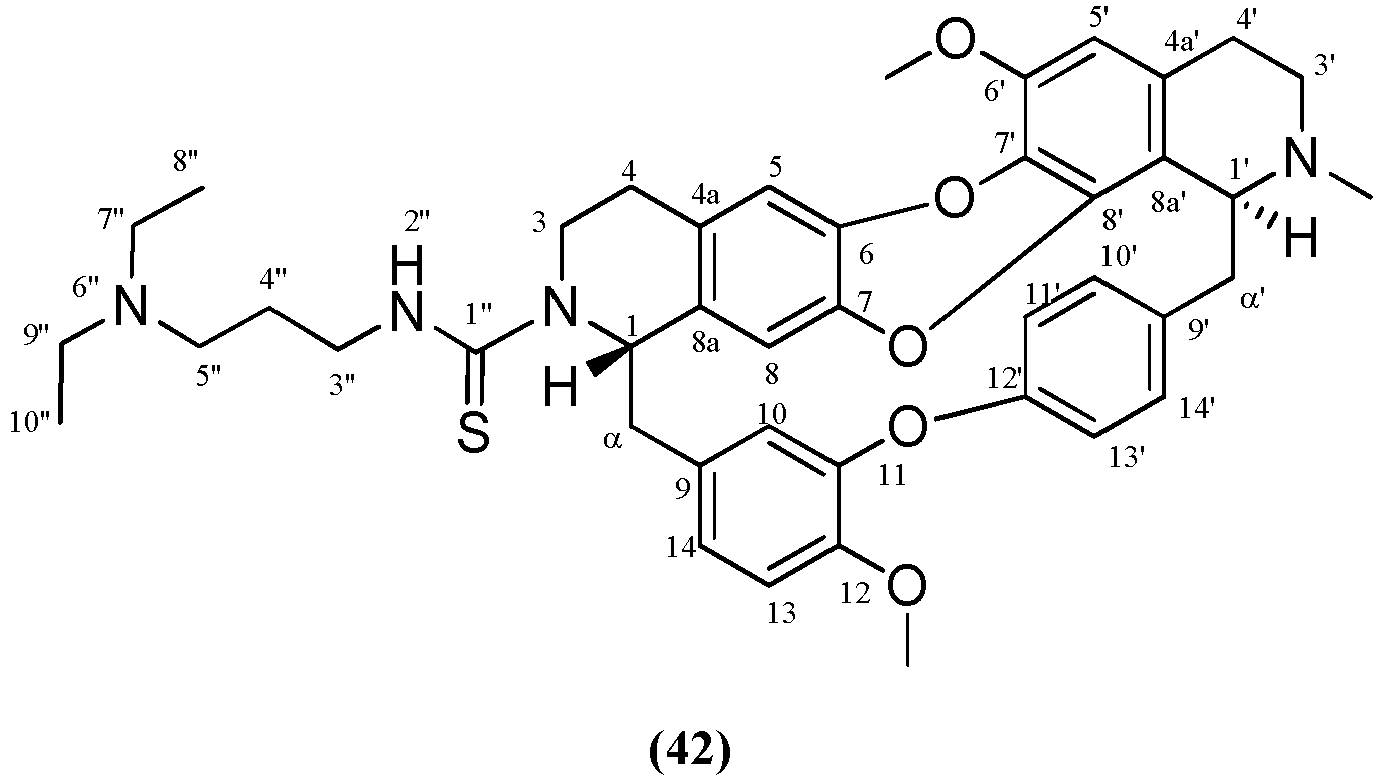
- 1H NMR (500MHz, MeOD) δ 7.66 (1H, br dd, J = 8.4 Hz, J = 1.6 Hz, H-14'), 7.21 (2H, dd, J = 8.5 Hz, J = 2.3 Hz, H-10', H-13'), 7.09 (1H, br dd, J = 8.3 Hz, J = 2.5 Hz, H-11'), 6.94 (1H, d, J = 8.1 Hz, H-13), 6.78-6.74 (2H, m, H-10, H14), 6.60 (1H, s, H-5), 6.50 (1H, s, H-5'), 5.98 (1H, s, H-8), 4.20 (1H, br t, J = 3.2 Hz, H-1'), 3.94 (3H, s, 12-OMe), 3.82 (3H, s, 6'-OMe), 3.69 (2H, m, H-3"), 3.39 (1H, br d, J = 15.6 Hz, H-α'), 3.28 (1H, m, H-3'), 3.20 (4H, q, J = 7.3 Hz, H-7", H-9"), 3.12-3.06 (3H, m, H-3', H-α), 3.12-3.06 (3H, m, H-3', H-5"), 2.99 (1H, m, H-4'), 2.92-2.87 (2H, m, H-α), 2.86-2.74 (3H, m, H-4, H-4', H-α'), 2.67 (3H, s, N2'-Me), 2.63 (1H, m, H-4), 1.97 (2H, br, H-4"), 1.28 (6H, br t, J = 7.5 Hz, H-8", H-10").
- 13C NMR (125MHz, MeOD) δ 182.3 (C-1"), 156.7 (C12'), 151.7 (C-11), 149.5 (C-12), 148.4 (C-6'), 141.6 (C-6 or C-7 or C-8'), 141.2 (C-6 or C-7 or C-8'), 140.8 (C-6 or C-7 or C-8'), 140.2 (C-9'), 135.8 (C-8a), 135.1 (C-9), 132.6 (C-10'), 131.4 (C-4a or C-7'), 131.2 (C-4a or C-7'), 129.5 (C-14'), 128.3 (C-4a'), 124.2 (C-14), 123.8 (C-13'), 122.9 (C-11'), 119.0 (C-8a'), 118.5 (C-10), 117.0 (C-5), 115.0 (C-8), 114.0 (C-13), 108.2 (C-5'), 62.8 (C-1), 62.0 (C-1'), 57.0 (C-6'-OMe or C-12-OMe), 56.9 (C-6'-OMe or C-12-OMe), 50.3 (C-5"), 48.1 (C-7" and C-9"), 46.5 (C-3'), 46.1 (C-α), 43.6 (C-3"), 42.5 (C-α'), 41.5 (C-N2'-Me), 28.6 (C-4), 25.5 (C-4"), 24.0 (C-4'), 9.2 (C-8" and C-10").
- HRMS-ESI (m/z) calculated for C43H51N4O5S [M+H]+: 735.3575; Found: 735.3559.
-

- To a solution of 1,1-carbonyldiimidazole (2g - 12.33mmol) in a mixture of DMF-MeCN (8mL, (2 : 6)) was added MeNH3Cl (0.690g -10.30mmol). The reaction mixture was stirred 2 hours at RT. The reaction mixture was concentrated under reduced pressure and the residue was purified by silica gel column with a linear gradient of dichloromethane-methanol (100:0 to 96:4), to give N-methyl-carbamoylimidazole (808mg, 6.46mmol, 68%)
- To a solution of nortrilobine 7 (5mg - 9.12µmol) in 500 µL of dicholoromethane was added N-methyl-carbamoylimidazole (3mg -23.98µmol) and triethylamine (4µL - 29.63µmol). The mixture was stirred 24 hours at RT. The reaction mixture was concentrated under reduced pressure and the residue was purified by HPLC semi-preparative X-Terra RP-18, eluting with a linear gradient H2O/MeCN with 0.02% triethylamine (80:20 to 0:100), to give 43 (3.3mg, 4.98µmol, 55%).

- 1H NMR (500MHz, CDCl3) δ 8.13 (1H, br dd, J = 8.5 Hz, J = 1.6 Hz, H-14'), 7.30 (1H, dd, J = 8.5 Hz, J = 2.7 Hz, H-13'), 7.16 (1H, dd, J = 8.2 Hz, J = 2.2 Hz, H-10'), 7.06 (1H, dd, J = 8.2 Hz, J = 2.7 Hz, H-11'), 6.91 (1H, d, J = 8.1 Hz, H-13), 6.80 (1H, dd, J = 8.2 Hz, J = 2.2 Hz, H-14), 6.65 (1H, d, J = 2.1 Hz, H-10), 6.64 (1H, s, H-5), 6.33 (1H, s, H-5'), 6.13 (1H, s, H-8), 5.73 (1H, br d, H-1'), 4.58 (1H, q, J = 4.5 Hz, 2"-NH), 4.43 (1H, dd, J = 13.8 Hz, J = 5.0 Hz, H-3), 4.34 (1H, br d, H-1), 4.06 (1H, q, J = 4.6 Hz, 2‴-NH), 4.00 (3H, s, 12-OMe), 3.86 (3H, s, 6'-OMe), 3.77 (1H, br, H-3'), 3.49 (1H, m, H-3'), 3.65 (1H, br d, J = 15.0 Hz, H-α'), 3.11 (1H, dd, J = 14.9 Hz, J = 3.4 Hz, H-α), 2.97-2.91 (3H, m, H-3, H-4', H-α'), 2.90 (3H, d, J = 4.7 Hz, 3µ-NHMe), 2.82 (1H, dd, J = 14.9 Hz, J = 3.2 Hz, H-α), 2.77-2.68 (2H, m, H-4, H-4'), 2.65 (3H, d, J = 4.6 Hz, 3"-NHMe), 2.50 (1H, br d, J = 15.4 Hz, H-4).
- 13C NMR (125MHz, CDCl3) δ 157.7 (C-1"), 157.5 (C-1‴), 154.0 (C12'), 151.0 (C-11), 147.9 (C-12), 146.6 (C-6'), 140.1 (C-6 or C-7), 139.8 (C-6 or C-7), 139.2 (C-8' or C-9'), 139.1 (C-8' or C-9'), 134.5 (C-9), 133.6 (C-8a), 131.1 (C-10'), 130.8 (C-4a), 130.4 (C-14'), 130.0 (C-7'), 128.2 (C-4a'), 123.4 (C-13'), 121.5 (C-11' and C-14), 120.8 (C-8a'), 116.6 (C-10), 116.2 (C-5), 114.0 (C-8), 112.1 (C-13), 106.7 (C-5'), 59.3 (C-1), 56.6 (C-6'-OMe ), 56.4 C-12-OMe), 52.5 (C-1'), 46.4 (C-α), 45.7 (C-α'), 39.7 (C-3'), 37.6 (C-3), 28.4 (C-4), 28.0 (C-3"), 27.6 (C-3‴), 27.3 (C-4').
- HRMS-ESI (m/z) calculated for C38H38N4NaO7 [M+Na]+: 685.2633; Found: 685.2616.
- To a solution of trilobine 1 (12mg - 21.35µmol) in 500 µL of dicholoromethane was added N-methyl-carbamoylimidazole (2.7mg -21.58µmol) and triethylamine (4µL - 29.63µmol). The mixture was stirred 24 hours at RT. The reaction mixture was concentrated under reduced pressure and the residue was purified by HPLC semi-preparative X-Terra RP-18, eluting with a linear gradient H2O/MeCN with 0.02% triethylamine (55:45 to 40:60), to give 44 (4.7mg, 7.59µmol, 36%).

- 1H NMR (500MHz, MeOD) δ 7.96 (1H, br dd, J = 8.5 Hz, J = 1.7 Hz, H-14'), 7.06 (1H, dd, J = 8.4 Hz, J = 2.5 Hz, H-13'), 7.00 (1H, m, H-10'), 6.99 (1H, d, J = 8.3 Hz, H-13), 6.92 (1H, dd, J = 8.3 Hz, J = 2.0 Hz, H-14), 6.87 (1H, dd, J = 8.1 Hz, J = 2.4 Hz, H-11'), 6.62 (1H, d, J = 1.8 Hz, H-10), 6.58 (1H, s, H-5), 6.56 (1H, s, H-5'), 6.22 (1H, s, H-8), 5.66 (1H, br d, J = 6.3 Hz, H-1'), 3.91 (3H, s, 12-OMe), 3.84 (3H, s, 6'-OMe), 3.56 (2H, m, H-3'), 3.25 (2H, m, H-1, H-α'), 2.94-2.82 (6H, m, H-3, H-4', H-α, H-α'), 2.80 (3H, s, 3"-NHMe), 2.76 (2H, m, H-3, H-4), 2.62 (1H, m, H-4), 2.31 (3H, s, N2-Me).
- 13C NMR (125MHz, MeOD) δ 160.3 (C-1"), 156.6 (C12'), 151.6 (C-11), 149.3 (C-12), 148.2 (C-6'), 141.4 (C-6 or C-7), 140.8 (C-6 or C-7), 140.0 (C-8'), 139.3 (C-9'), 136.0 (C-9), 135.1 (C-8a), 132.1 (C-4a and C-14'), 131.7 (C-10'), 131.1 (C-4a' or C-7'), 131.0 (C-4a' or C-7'), 123.6 (C-14), 123.4 (C-13'), 122.2 (C-11'), 121.2 (C-8a'), 119.0 (C-10), 116.8 (C-5), 115.3 (C-8), 114.3 (C-13), 108.3 (C-5'), 68.1 (C-1), 57.0 (C-6'-OMe and C-12-OMe), 53.0 (C-1'), 52.2 (C-3), 47.1 (C-α'), 41.5 (C-N2-Me and C-3'), 40.3 (C-α), 28.7 (C-4'), 28.0 (C-3"), 27.6 (C-4).
- HRMS-ESI (m/z) calculated for C37H38N3O6 [M+H]+: 685.2755; Found: 620.2753.
- To a solution of O-methylcocsoline 3 (12mg - 21.35µmol) in 500 µL of dicholoromethane was added N-methyl-carbamoylimidazole (2.7mg -21.58µmol) and triethylamine (4µL - 29.63µmol). The mixture was stirred 24 hours at RT. The reaction mixture was concentrated under reduced pressure and the residue was purified by HPLC semi-preparative X-Terra RP-18, eluting with a linear gradient H2O/MeCN with 0.02% triethylamine (55:45 to 40:60), to give 45 (3.8mg, 6.14µmol, 29%).

- 1H NMR (500MHz, MeOD) δ 7.63 (1H, br dd, J = 8.7 Hz, J = 1.3 Hz, H-14'), 7.18 (2H, m, H-10', H-13'), 7.01 (1H, dd, J = 8.3 Hz, J = 2.5 Hz, H-11'), 6.95 (1H, d, J = 8.3 Hz, H-13), 6.75 (1H, dd, J = 8.0 Hz, J = 1.7 Hz, H-14), 6.61 (1H, d, J = 1.7 Hz, H-10), 6.53 (1H, s, H-5), 6.45 (1H, s, H-5'), 6.05 (1H, s, H-8), 4.84 (1H, br, H-1), 4.0 (2H, m, H-1', H-3), 3.93 (3H, s, 12-OMe), 3.81 (3H, s, 6'-OMe), 3.29 (1H, m, H-α'), 3.14 (1H, m, H-3'), 3.05 (1H, m, H-3), 2.94-2.88 (2H, m, H-3', H-4'), 2.82 (1H, m, H-α), 2.76-2.66 (3H, m, H-4, H-α, H-α'), 2.64 (3H, s, 3"-NHMe), 2.55 (3H, s, N2'-Me), 2.49 (1H, m, H-4).
- 13C NMR (125MHz, MeOD) δ 160.3 (C-1"), 156.6 (C12'), 152.0 (C-11), 149.5 (C-12), 148.3 (C-6'), 141.8 (C-6 or C-7 or C-8' or C-9'), 141.6 (C-6 or C-7 or C-8' or C-9'), 141.5 (C-6 or C-7 or C-8' or C-9'), 141.2 (C-6 or C-7 or C-8' or C-9'), 136.5 (C-8a or C-9), 136.4 (C-8a or C-9), 133.2 (C-10'), 131.7 (C-4a), 131.3 (C-7'), 129.7 (C-14'), 129.3 (C-4a'), 123.9 (C-13' and C-14), 123.1 (C-11'), 121.0 (C-8a'), 118.5 (C-10), 117.4 (C-5), 115.3 (C-8), 114.6 (C-13), 108.5 (C-5'), 62.4 (C-1'), 59.1 (C-1), 57.3 (C-6'-OMe or C-12-OMe), 57.2 (C-6'-OMe or C-12-OMe), 47.7 (C-α), 46.7 (C-3'), 43.5 (C-α'), 42.2 (C-N2'-Me), 39.7 (C-3), 29.2 (C-4), 28.2 (C-3"), 24.5 (C-4').
- HRMS-ESI (m/z) calculated for C37H38N3O6 [M+H]+: 685.2755; Found: 620.2749.
- To a solution of O-methylcocsoline 3 (10mg - 17.79µmol) in 500 µL of THF was added methyl isothiocyanate (2.5µL -36.55µmol) and N,N-diisopropylethylamine (5µL - 29.40µmol). The mixture was stirred 24 hours at RT. The reaction mixture was concentrated under reduced pressure and the residue was purified by HPLC semi-preparative X-Terra RP-18, eluting with a linear gradient H2O/MeCN with 0.02% triethylamine (80:20 to 0:100), to give 46 (7.2mg, 11.34µmol, 64%).

- 1H NMR (500MHz, CDCl3) δ 7.66 (1H, dd, J = 8.3 Hz, J = 2.0 Hz, H-14'), 7.26 (1H, dd, J = 8.3 Hz, J = 2.7 Hz, H-13'), 7.21 (1H, dd, J = 8.3 Hz, J = 2.1 Hz, H-10'), 7.08 (1H, dd, J = 8.4 Hz, J = 2.7 Hz, H-11'), 6.91 (1H, d, J = 8.3 Hz, H-13), 6.78 (1H, dd, J = 8.0 Hz, J = 2.1 Hz, H-14), 6.67 (2H, m, H-5, H-10), 6.34 (1H, s, H-5'), 6.04 (1H, s, H-8), 5.42 (1H, br d, J = 11.3 Hz, H-3), 5.24 (1H, q, J = 4.2 Hz, 2"-NH), 4.54 (1H, br, H-1), 4.07 (1H, br t, J = 3.0 Hz, H-1'), 4.01 (3H, s, 12-OMe), 3.87 (3H, s, 6'-OMe), 3.36 (1H, br dd, J = 15.9 Hz, J = 2.6 Hz, H-α'), 3.19-3.12 (3H, m, H-3, H-3',H-α), 2.94 (3H, d, J = 4.3 Hz, 3"-NHMe), 2.92-2.86 (3H, m, H-3', H-4, H-4'), 2.82 (1H, dd, J = 15.2 Hz, J = 3.6 Hz, H-α), 2.74 (1H, dd, J = 16.0 Hz, J = 3.7 Hz, H-α'), 2.62 (3H, s, N2'-Me), 2.57-2.49 (2H, m, H-4, H-4').
- 13C NMR (125MHz, CDCl3) δ 182.2 (C-1"), 153.4 (C12'), 151.4 (C-11), 148.2 (C-12), 146.3 (C-6'), 140.9 (C-9'), 140.5 (C-6 or C-7), 140.2 (C-6 or C-7), 139.3 (C-8'), 133.4 (C-9), 132.4 (C-8a), 131.6 (C-10'), 133.7 (C-4a), 129.6 (C-7'), 128.7 (C-14'), 128.13 (C-4a'), 123.0 (C-13'), 121.8 (C-11'), 121.5 (C-14), 120.7 (C-8a'), 116.3 (C-5 and C-10), 113.6 (C-8), 112.1 (C-13), 106.8 (C-5'), 61.7 (C-1), 60.5 (C-1'), 56.5 (C-6'-OMe), 56.4 (C-12-OMe), 45.6 (C-3' or C-α), 45.5 (C-3' or C-α), 44.1 (C-3), 42.2 (C-α' and C-N2'-Me), 32.8 (C-3"), 27.8 (C-4), 24.0 (C-4').
- HRMS-ESI (m/z) calculated for C37H38N3O5S [M+H]+: 636.2527; Found: 636.2524.
- To a solution of nortrilobine 7 (5mg - 9.12µmol) in 500 µL of THF was added methyl isothiocyanate (2µL -29.24µmol) and N,N-diisopropylethylamine (3µL - 17.64µmol). The mixture was stirred 24 hours at RT. The reaction mixture was concentrated under reduced pressure and the residue was purified by HPLC semi-preparative X-Terra RP-18, eluting with a linear gradient H2O/MeCN with 0.02% triethylamine (80:20 to 0:100), to give 47 (3.2mg, 4.61µmol, 51%).

- 1H NMR (500MHz, CDCl3) δ 8.31 (1H, br, H-14'), 7.25 (1H, dd, J = 8.3 Hz, J = 2.4 Hz, H-13'), 7.14 (1H, br dd, J = 8.3 Hz, J = 2.3 Hz, H-10'), 7.05 (1H, dd, J = 8.1 Hz, J = 2.6 Hz, H-11'), 6.93 (1H, d, J = 8.3 Hz, H-13), 6.81 (1H, dd, J = 8.3 Hz, J = 1.8 Hz, H-14), 6.77 (1H, d, J = 1.9 Hz, H-10), 6.69 (1H, s, H-5), 6.57 (1H, br, H-1'), 6.37 (1H, s, H-5'), 6.17 (1H, s, H-8), 5.80 (1H, q, J = 4.4 Hz, 2"-NH), 5.45 (1H, br d, J = 12.0 Hz, H-3), 5.20 (1H, q, J = 4.3 Hz, 2‴-NH), 4.53 (1H, br, H-1), 4.26 (1H, br, H-3'), 4.01 (3H, s, 12-OMe), 3.87 (3H, s, 6'-OMe), 3.70 (1H, m, H-3'), 3.42 (1H, br d, J = 14.5 Hz, H-α'), 3.28 (1H, m, H-α), 3.24 (3H, d, J = 4.4 Hz, 3"-NHMe), 3.15 (1H, td, J = 12.8 Hz, J = 2.6 Hz, H-3), 3.05 (1H, dd, J = 14.9 Hz, J = 5,3 Hz, H-α'), 2.99 (1H, m, H-4'), 2.93 (3H, d, J = 4.5 Hz, 3"'-NHMe), 2.90 (1H, m, H-4), 2.87-2.79 (2H, m, H-4', H-α), 2.57 (1H, br d, J = 16.4 Hz, H-4).
- 13C NMR (125MHz, CDCl3) δ 182.2 (C-1‴), 182.0 (C-1"), 154.3 (C12'), 151.1 (C-11), 148.4 (C-12), 146.9 (C-6'), 140.5 (C-6 or C-7), 140.0 (C-6 or C-7), 139.2 (C-8'), 137.8 (C-9'), 133.3 (C-9), 132.5 (C-8a), 131.5 (C-14'), 133.3 (C-4a), 130.9 (C-10'), 130.1 (C-7'), 128.3 (C-4a'), 123.0 (C-13'), 121.8 (C-14), 121.5 (C-11'), 120.0 (C-8a'), 116.9 (C-10), 116.3 (C-5), 113.8 (C-8), 112.2 (C-13), 106.9 (C-5'), 61.8 (C-1), 57.0 (C-1'), 56.6 (C-6'-OMe), 56.4 (C-12-OMe), 45.6 (C-α'), 44.8 (C-α), 44.1 (C-3), 44.2 (C-3), 42.5 (C-3'), 33.4 (C-3"), 32.8 (C-3‴), 28.2 (C-4), 27.2 (C-4').
- HRMS-ESI (m/z) calculated for C38H38N4NaO5S [M+Na]+: 717.2156; Found: 717.2156.
-

- To a solution of 1,1-carbonyldimidazole (200mg - 1.23mmol) in a mixture of DMF-MeCN (8mL, (2 : 6)) was added 3-(diethylamino)propylamine (194µL -1.23mmol). The reaction mixture was stirred 2 hours at RT. The reaction mixture was concentrated under reduced pressure and the residue was purified by silica gel column with a linear gradient of dichloromethane-methanol (100:0 to 85:15), to give N-(3-(diethylamino)propyl)-1H-imidazole-1-carboxamide (60mg, 0.267mmol, 22%).
- To a solution of nortrilobine 7 (6.3mg - 11.49µmol) in 500 µL of dicholoromethane was added N-(3-(diethylamino)propyl)-1H-imidazole-1-carboxamide (10.32mg - 46.00µmol) and triethylamine (6µL - 44.44µmol). The mixture was stirred 24 hours at RT. The reaction mixture was concentrated under reduced pressure and the residue was purified by HPLC semi-preparative X-Terra RP-18, eluting with a linear gradient H2O/MeCN with 0.02% triethylamine (80:20 to 0:100), to give 48 (3.1mg, 3.60µmol, 31%).

- 1H NMR (500MHz, CDCl3) δ 8.16 (1H, br d, J = 8.5 Hz, H-14'), 7.30 (1H, dd, J = 8.4 Hz, J = 2.7 Hz, H-13'), 7.16 (1H, br dd, J = 8.2 Hz, J = 1.9 Hz, H-10'), 7.05 (1H, dd, J = 8.2 Hz, J = 2.5 Hz, H-11'), 6.90 (1H, d, J = 8.3 Hz, H-13), 6.79 (1H, dd, J = 8.3 Hz, J = 1.8 Hz, H-14), 6.62 (1H, d, J = 2.0 Hz, H-10), 6.61 (1H, s, H-5), 6.32 (1H, s, H-5'), 6.11 (1H, s, H-8), 5.80 (1H, br, H-1'), 4.65 (1H, br, H-1), 4.26 (1H, br d, J = 12.0 Hz, H-3), 4.01 (1H, m, H-3'), 3.98 (3H, s, 12-OMe), 3.85 (3H, s, 6'-OMe), 3.44 (4H, m, H-3", H-3‴), 3.33 (1H, br d, J = 15.5 Hz, H-α'), 3.19 (1H, m, H-3'), 3.06-2.92 (5H, m, H-3, H-4', H-α, H-α'), 2.89-2.76 (8H, m, H-7", H-7‴, H-9", H-9‴), 2.73 (1H, m, H-4), 2.69-2.61 (5H, m, H-4', H-5", H-5‴), 2.51 (1H, br d, J = 16.3 Hz, H-4), 1.92 (2H, m, H-4" or H-4‴), 1.73 (2H, m, H-4" or H-4‴), 1.16 (12H, m, H-8", H-8‴, H-10", H-10‴).
- 13C NMR (125MHz, CDCl3) δ 157.3 (C-1" or C-1‴), 157.2 (C-1" or C-1‴), 154.2 (C12'), 150.8 (C-11), 147.7 (C-12), 146.4 (C-6'), 139.9 (C-6 and C-7), 139.3 (C-8' or C-9'), 139.2 (C-8' or C-9'), 134.6 (C8a and C-9), 131.1 (C-10'), 130.2 (C-4a and C-14'), 129.8 (C-7'), 128.5 (C-4a'), 123.2 (C-13'), 121.8 (C-14), 121.5 (C-11'), 121.2 (C-8a'), 116.8 (C-10), 116.1 (C-5), 114.2 (C-8), 112.3 (C-13), 106.7 (C-5'), 58.4 (C-1), 56.6 (C-6'-OMe), 56.3 (C-12-OMe), 52.2 (C-1'), 50.0 (C-5" and C-5‴), 46.5 (C-α), 46.0 (C7" and C7‴ and C-9" and C-9‴), 45.4 (C-α'), 39.2 (C-3' and C-3" and C-3‴), 38.1 (C-3), 28.2 (C-4), 27.4 (C-4'), 25.5 (C-4" or C-4‴), 24.8 (C-4" or C-4‴), 9.8 (C-8" or C-8‴ or C-10" or C-10‴), 9.4 (C-8" or C-8‴ or C-10" or C-10‴).
- HRMS-ESI (m/z) calculated for C50M5N6O7 [M+H]+: 861.4909; Found: 861.4892.
- To a solution of trilobine 1 (10.5mg - 18.68µmol) in 500 µL of dicholoromethane was added N-(3-(diethylamino)propyl)-1H-imidazole-1-carboxamide (8.4mg -37.44µmol) and 65trimethylamine (5µL - 37.03µmol). The mixture was stirred 24 hours at RT. The reaction mixture was concentrated under reduced pressure and the residue was purified by HPLC semi-preparative X-Terra RP-18, eluting with a linear gradient H2O/MeCN with 0.1% formic acid (85:15 to 70:30), to give 49 (8mg, 11.14µmol, 59%).

- 1H NMR (500MHz, CDCl3) δ 7.96 (1H, br d, J = 7.4 Hz, H-14'), 7.19 (1H, br d, J = 7.4 Hz, H-13'), 6.97 (2H, br m, H-10', H-14), 6.88 (2H, br m, H-11', H-13), 6.67 (1H, s, H-5), 6.60 (1H, br, H-10), 6.43 (1H, s, H-5'), 6.35 (1H, s, H-8), 5.67 (1H, br d, J = 5.8 Hz, H-1'), 3.94 (3H, s, 12-OMe), 3.88 (3H, s, 6'-OMe), 3.69-3.59 (3H, m, H-1, H-3'), 3.49-3.40 (2H, m, H-3"), 3.28 (2H, m, H-3, H-α'), 3.11 (1H, br d, J = 14.4 Hz, H-α), 3.04-2.97 (6H, m, H-5", H-7", H-9"), 2.94-2.83 (4H, m, H-4', H-α, H-α'), 2.74-2.66 (3H, m, H-3, H-4), 2.35 (3H, s, N2-Me), 2.01 (2H, m, H-4"), 1.25 (6H, t, J = 7.0 Hz, H-8", H-10").
- 13C NMR (125MHz, CDCl3) δ 157.8 (C-1"), 154.4 (C12'), 149.8 (C-11), 147.7 (C-12), 146.5 (C-6'), 140.6 (C-6 or C-7), 139.7 (C-6 or C-7), 138.7 (C-8'), 137.6 (C-9'), 132.7 (C-9), 131.3 (C-14'), 131.0 (C-8a), 130.8 (C-4a), 130.6 (C-10'), 129.9 (C-4a'), 129.7 (C-7'), 123.1 (C-13'), 122.8 (C-14), 121.3 (C-11'), 120.3 (C-8a'), 117.4 (C-10), 115.8 (C-5), 114.8 (C-8), 112.5 (C-13), 106.8 (C-5'), 64.8 (C-1), 56.6 (C-6'-OMe), 56.3 (C-12-OMe), 51.4 (C-1'), 50.9 (C-3), 49.1 (C-5"), 49.2 (C-α'), 45.6 (C-7" and C-9"), 40.9 (C-3'), 39.5 (C-N2-Me), 38.1 (C-3"), 37.3 (C-α), 28.3 (C-4'), 26.3 (C-4), 24.6 (C-4"), 8.6 (C-8" and C-10").
- HRMS-ESI (m/z) calculated for C43H51N4O6 [M+H]+: 719.3803; Found: 719.3794.
- To a solution of O-methylcocsoline 3 (10.5mg - 18.68µmol) in 500 µl of THF was added N-(3-(diethylamino)propyl)-1H-imidazole-1-carboxamide (2.5µL -36.55µmol) and triethylamine (5µL - 37.03µmol). The mixture was stirred 24 hours at RT. The reaction mixture was concentrated under reduced pressure and the residue was purified by HPLC semi-preparative X-Terra RP-18, eluting with a linear gradient H2O/MeCN with 0.02% triethylamine (85:15 to 70:30), to give 50 (12mg, 16.71µmol, 89%).

- 1H NMR (500MHz, CDCl3) δ 7.66 (1H, br d, J = 7.8 Hz, H-14'), 7.28 (1H, br, H-13'), 7.17 (1H, br d, J = 7.9 Hz, H-10'), 7.11 (1H, br d, J = 7.9 Hz, H-11'), 6.91 (1H, d, J = 8.1 Hz, H-13), 6.78 (1H, br d, J = 7.9 Hz, H-14), 6.67 (1H, br, H-10), 6.63 (1H, s, H-5), 6.33 (1H, s, H-5'), 6.12 (1H, s, H-8), 4.77 (1H, br, H-1), 4.26 (1H, br d, J = 11.6 Hz, H-3), 4.09 (1H, br, H-1'), 3.98 (3H, s, 12-OMe), 3.87 (3H, s, 6'-OMe), 3.41 (1H, br d, J = 15.3 Hz, H-α'), 3.29-3.18 (3H, m, H-3', H-3"), 3.08-2.94 (8H, m, H-3, H-3', H-4', H-7", H-9", H-α), 2.88 (2H, m, H-5"), 2.82-2.73 (3H, m, H-4, H-α, H-α'), 2.63 (3H, s, N2'-Me), 2.54 (2H, m, H-4, H-4'), 1.87 (2H, m, H-4"), 1.24 (6H, t, J = 7.1 Hz, H-8", H-10").
- 13C NMR (125MHz, CDCl3) δ 157.2 (C-1"), 154.4 (C12'), 150.5 (C-11), 147.8 (C-12), 146.5 (C-6'), 140.0 (C-6 or C-7 or C-8' or C-9'), 139.8 (C-6 or C-7 or C-8' or C-9'), 139.7 (C-6 or C-7 or C-8' or C-9'), 134.6 (C-8a and C-9), 131.5 (C-10'), 130.2 (C-4a), 129.8 (C-7'), 128.4 (C-14'), 127.3 (C-4a'), 122.8 (C-13'), 122.0 (C-14), 121.8 (C-11'), 119.5 (C-8a'), 116.9 (C-10), 116.2 (C-5), 114.1 (C-8), 112.5 (C-13), 106.6 (C-5'), 61.0 (C-1'), 58.0 (C-1), 56.5 (C-6'-OMe), 56.4 (C-12-OMe), 48.9 (C-5"), 46.5 (C-α), 45.6 (C-7" and C-9"), 45.2 (C-3'), 42.1 (C-α'), 41.5 (C-N2'-Me), 38.2 (C-3 or C-3"), 38.1 (C-3 or C-3"), 28.2 (C-4), 24.7 (C-4"), 23.3 (C-4'), 8.5 (C-8" and C-10").
- HRMS-ESI (m/z) calculated for C43H51N4O6 [M+H]+: 719.3803; Found: 719.37940.
- To an ice-cooled mixture of product 44 (8.6mg - 13.89µmol) in H2O / 1,4-dioxane (1:2, 450µL) and sodium tungstate (2.5mg - 7.58µmol) was added drop-wise hydrogen peroxide (18µL - 332.3µmol). The reaction was stirred 1.5 hours at RT. Then manganese dioxide was added until a black precipitate. The reaction mixture was concentrated under reduced pressure and the residue was purified by silica gel column with an isocratic dichloromethane-
methanol 1% NH3 (70:30). - To an ice-cooled solution of product of step 1 (6.8mg - 10.71µmol) in 400 µl of methanol was added iron sulphate heptahydrate (13mg - 46.76µmol). The reaction was stirred 24 hours at RT. Then, the reaction mixture was concentrated under reduced pressure. The residue was dissolved with EDTA (10mL - 0.1M) and adjusted at pH=10 with ammoniac. The solution was extracted by a liquid/liquid extraction with dichloromethane. The organic phase was dried with sulfate magnesium and concentrated under reduced pressure. The residue was purified by HPLC semi-preparative X-Terra RP-18, eluting with a linear gradient H2O/MeCN with 0.02% triethylamine (60:40 to 30:70), to give 51 (1.2mg, 1.98µmol, 14%).

- 1H NMR (500MHz, MeOD) δ 7.83 (1H, dd, J = 8.6 Hz, J = 2.0 Hz, H-14'), 7.05 (1H, br dd, J = 8.3 Hz, J = 2.3 Hz, H-13'), 7.01 (1H, br d, J = 8.5 Hz, H-13), 6.97 (1H, br, H-14), 6.93 (1H, br, H-10'), 6.80 (1H, br, H-11'), 6.70 (1H, br, H-10), 6.63 (2H, br s, H-5, H-5'), 6.32 (1H, br s, H-8), 5.57 (1H, br d, J = 8.6 Hz, , H-1'), 3.91 (3H, s, 12-OMe), 3.86 (3H, s, 6'-OMe), 3.66 (1H, m, H-3'), 3.48 (1H, br, H-1), 3.38 (1H, m, H-3'), 3.22 (1H, br d, J = 13.3 Hz, H-α'), 3.07-2.83 (6H, m, H-3, H-4 or H-4', H-α, H-α'), 2.81 (3H, br, NH-3"Me), 2.76 (2H, m, H-4 or H4', H-α), 2.64 (1H, m, H-4 or H-4').
- 13C NMR (125MHz, MeOD) δ 160.5 (C-1"), 157.5 (C12'), 151.1 (C-11), 149.7 (C-12), 148.3 (C-6'), 141.4 (C-6 or C-7 or C-8'), 140.4 (C-6 or C-7 or C-8'), 139.8 (C-6 or C-7 or C-8'), 138.3 (C-9'), 137.0 (C-8a), 135.4 (C-9), 134.0 (C-4a), 132.5 (C-14'), 131.6 (C-10'), 131.5 (C-4a'), 131.2 (C-7'), 124.4 (C-14), 123.1 (C-13'), 121.6 (C-11'), 120.9 (C-8a'), 119.8 (C-10), 116.8 (C-5), 114.5 (C-8), 114.0 (C-13), 108.3 (C-5'), 60.2 (C-1), 57.0 (C-6'-OMe and C-12-OMe), 52.9 (C-1'), 47.3 (C-α'), 43.6 (C-3), 42.2 (C-3'), 41.1 (C-α), 29.0 (C-4 or C-4'), 28.9 (C-4 or C-4'), 28.0 (C-3").
- HRMS-ESI (m/z) calculated for C36H36N3O6 [M+H]+: 606.2599; Found: 606.2602.
- To a solution of 2'-norcocsuline 5 (6mg - 10.95µmol) in 250 µL of dicholoromethane was added N-methylcarbamoylimidazole_(5.5mg - 44µmol) and triethylamine (2µL - 14.84µmol). The mixture was stirred 16 hours at RT. The reaction mixture was concentrated under reduced pressure and the residue was purified by HPLC semi-preparative X-Terra RP-18, eluting with a linear gradient H2O/MeCN with 0.02% triethylamine (70:30 to 35:65), to give 53 (2.1mg, 3.47µmol, 32%).

- 1H NMR (500MHz, DMSO-d6) δ 7.99 (1H, dd, J = 8.5 Hz, J = 1.8 Hz, H-14'), 7.12 (2H, m, H-10', H-13'), 6.99 (1H, dd, J = 8.2 Hz, J = 2.6 Hz, H-11'), 6.79 (1H, d, J = 8.0 Hz, H-13), 6.74 (1H, dd, J = 8.2 Hz, J = 1.9 Hz, H-14), 6.65 (1H, s, H-5), 6.60 (1H, s, H-5'), 6.54 (1H, q, J = 4.2 Hz, 2"-NH), 6.42 (1H, d, J = 1.9 Hz, H-10), 6.07 (1H, s, H-8), 5.64 (1H, m, H-1'), 3.79 (3H, s, 6'-OMe), 3.72 (1H, m, H-3'), 3.41 (1H, m, H-3'), 3.18 (1H, br, H-α'), 3.07 (1H, br t, J = 3.4 Hz, H-1), 2.85-2.65 (7H, m, H-3, H-4, H-4', H-α, H-α'), 2.64 (3H, d, J = 4.4 Hz, NH-3"Me) 2.55 (1H, m, H-4), 2.46 (1H, m, H-3), 2.24 (3H, s, N2-Me).
- 13C NMR (125MHz, DMSO-d6) δ 157.2 (C-1"), 154.1 (C12'), 148.7 (C-11), 145.8 (C-6'), 144.8 (C-12), 138.8 (C-6 or C-7), 138.7 (C-6 or C-7), 138.2 (C-9'), 138.0 (C-8'), 135.5 (C-8a), 132.9 (C-9), 130.6 (C-4a), 130.5 (C-10'), 130.1 (C-14'), 129.0 (C-4a'), 128.7 (C-7'), 122.2 (C-13' or C-14), 122.1 (C-13' or C-14), 121.2 (C-11'), 120.2 (C-8a'), 116.9 (C-10), 116.5 (C-13), 115.4 (C-5), 113.5 (C-8), 107.2 (C-5'), 67.2 (C-1), 55.9 (C-6'-OMe), 50.7 (C-1'), 50.1 (C-3), 45.1 (C-α'), 42.3 (C-N2-Me), 40.3 (C-α), 38.9 (C-3'), 27.3 (C-3"), 27.2 (C-4), 26.7 (C-4').
- HRMS-ESI (m/z) calculated for C36H36N3O6 [M+H]+: 606.2599; Found: 606.2596.
- To an ice-cooled (-50°C) mixture of cocsuline 4 (6mg - 10.68µmol) in 600 µL of dichloromethane (600µL) and triethylamine (2µL - 14.84µmol) was added trifluoromethanesulfonic anhydride (2µL - 12.2µmol). The mixture was stirred 2 hours at -50°C and then 16 hours at RT. The reaction mixture was concentrated under reduced pressure and the residue was purified by HPLC semi-preparative X-Terra RP-18, eluting with a linear gradient H2O/MeCN with 0.02% triethylamine (80:20 to 0:100), to give 54 (4.9mg, 7.06µmol, 66%).

- 1H NMR (500MHz, CDCl3) δ 7.63 (1H, dd, J = 8.4 Hz, J = 2.1, H-14'), 7.23 (1H, dd, J = 8.5 Hz, J = 2.6 Hz, H-13'), 7.21 (2H, m, H-10', H-13), 7.00 (1H, dd, J = 8.4 Hz, J = 2.7 Hz, H-11'), 6.93 (1H, dd, J = 8.3 Hz, J = 1.9 Hz, H-14), 6.73 (1H, d, J = 1.9 Hz, H-10), 6.63 (1H, s, H-5), 6.33 (1H, s, H-5'), 6.03 (1H, s, H-8), 4.02 (1H, br t, J = 3.2 Hz, H-1'), 3.87 (3H, s, 6'-OMe), 3.36 (1H, br dd, J = 15.4 Hz, J = 2.5 Hz, H-α'), 3.23 (1H, br t, J = 3.1 Hz, H-1), 3.17 (1H, m, H-3'), 3.00-2.81 (5H, m, H-3, H-3', H-4', H-α), 2.76-2.69 (2H, m, H-4, H-α'), 2.64-2.61 (2H, m, H-3, H-4), 2.60 (3H, s, N2'-Me), 2.52 (1H, m, H-4'), 2.39 (3H, s, N2-Me).
- 13C NMR (125MHz, CDCl3) δ 153.3 (C12'), 152.5 (C-11), 146.3 (C-6'), 144.3 (C-12), 141.1 (C-9'), 140.0 (C-6 or C-7 or C-8'), 139.7 (C-6 or C-7 or C-8'), 139.5 (C-6 or C-7 or C-8'), 136.9 (C-9), 134.9 (C-8a), 131.6 (C-10'), 130.2 (C-4a), 129.7 (C-7'), 128.9 (C-14'), 127.8 (C-4a'), 123.0 (C-13), 122.5 (C-13'), 122.4 (C-14), 121.5 (C-11'), 120.6 (C-8a'), 119.0 (d, J = 2.6 Hz, C-2"), 118.8 (C-10), 116.1 (C-5), 113.9 (C-8), 106.8 (C-5'), 67.3 (C-1), 60.6 (C-1'), 56.5 (C-6'-OMe), 50.3 (C-3), 45.3 (C-3'), 42.8 (C-N2-Me), 42.3 (C-α'), 42.1 (C-N2'-Me), 41.9 (C-α), 27.6 (C-4), 23.7 (C-4').
- HRMS-ESI (m/z) calculated for C36H34F3N2O7S [M+H]+: 695.2033; Found: 695.2117.
- hDNMT3A enzyme inhibition was adapted from the restriction-based fluorescence assay protocol as described in the literature (Ceccaldi et al. ChemBioChem 2011, 12, 1337-1345). Briefly, a 5'-labelled biotin oligonucleotide is hybridized to its complementary strand labelled with 6-carboxyfluorescein at the 3'-end into a 384 well microplate (black Optiplates; Perkin Elmer) pre-coated with avidin. The duplex contains a unique CpG site overlapping with a restriction site of a methylation sensitive restriction enzyme. The human C-terminal DNMT3A (623-908a.a.), produced as described in (Gros et al. Nucl. Acids Res. 2013, 41(19):e185), was added in each well (200ng/well) and mixed with the chemical compounds at desired concentrations and freshly prepared SAM (20µM final concentration) to start the reaction in a total volume of 50µL. After 1 hour incubation at 37°C each well were washed three times with PBS, Tween-20 0.05%, NaCl (500mM) and three more times with PBST. Specific fluorescent signals were detected with the methylation-sensitive restriction enzyme HpyCH4IV (NEB) as described and measured on a Perkin Elmer Envision detector. The percentage of inhibition is reported. The formula used to calculate the percentage of inhibition is [(X-Y)/ X] × 100, where X is the signal determined in the absence of the inhibitor and Y is the signal obtained in the presence of the inhibitor. The concentration at which 50% of efficacy of inhibition is observed (EC50) was determined by analysis of a concentration range of the tested compound in triplicates. The non-linear regression fittings with sigmoidal dose-response (variable slope) were performed with GraphPad Prism 4.03 (GraphPad Software).
- Compounds of the invention inhibit human DNMT3A enzyme as reported in the table 1.
Table 1. Percentage of inhibition of catalytic human DNMT3A by the compounds at 32 and 10 µM and concentration in µM at which 50% of efficacy of inhibition is observed (EC50). N° hDNMT 3A inhibition EC50 (µM) Inhibition (%) 32 µM 10 µM Trilobine (1) 3.80 3.21 to 4.49 96 88 (10) n.d. 72 17 (11) n.d. 77 43 (12) 2.67 to 3.80 93 78 (13) n.d. 45 39 (14) 1.91 1.15 to 3.18 96 93 (15) n.d. 50 46 (16) n.d. 77 56 (17) n.d. 79 69 (18) n.d. 66 66 (19) n.d. 71 67 (20) n.d. 66 50 (21) n.d. 82 32 (22) n.d. 64 60 (24) n.d. 77 42 (25) n.d. 72 46 (27) n.d. 67 21 (28) n.d. 60 18 (30) 4.19 to 9.36 88 66 (31) n.d. 79 43 (32) 5.34 to 6.87 82 57 (33) n.d. 87 32 (41) 0.557 to 0.910 95 94 (42) 0.64 0.47 to 0.86 98 98 (43) n.d. 49 24 (44) 3.96 3.04 to 5.17 96 82 (45) n.d. 73 31 (46) n.d. 52 7 (47) n.d. 40 10 (48) 1.93 1.00 to 3.72 98 82 (49) 6.10 3.72 to 10.0 75 60 (50) 2.06 1.28 to3.31 91 69 (51) n.d. 69 2 (54) n.d. 32 0 - His-DNMT1 (182kDa, human) was cloned, expressed and purified as described (Halby et al. ChemBioChem 2012, 13, 157-165). The reaction was performed in a 10 µL total reaction volume in low volume NBS™ 384-well microplates (Corning), containing the tested compound (up to 1% DMSO), 1 µM of a SAM/[methyl-3H] SAM (3TBq/mmol, PerkinElmer) mix in a ratio of 3-to-1 (isotopic dilution 1∗:3), 0.3 µM of biotinylated hemimethylated DNA duplex (5'-GATmCGCmCGATGmCGmCGAATmCGmCGATmCGATGmCGAT-3' and BIOT-5'-ATCGCATCGATCGCGATTCGCGCATCGGCGATC-3'), and 90 nM of DNMT1 in methylation buffer (20 mM HEPES pH 7.2, 1mM EDTA, 50 mM KCl, 25 µg/mL BSA). The reaction was incubated at 37°C for 2 hours. 8µL are then transferred into a streptavidin 96-well scintillant coated Flashplate™ (PerkinElmer) containing 190µL of 20µM SAH in 50mM Tris-HCl pH 7.4. The Flashplate™ was agitated at room temperature for 1 hour and read in 200µL of 50mM Tris-HCl pH 7.4 on TopCount NXT (PerkinElmer). The percentage of inhibition is reported. The formula used to calculate the percentage of inhibition is [(X-Y)/ X] × 100, where X is the signal determined in the absence of the inhibitor and Y is the signal obtained in the presence of the inhibitor.
- Compounds of the invention inhibit human DNMT1 enzyme as reported in the table 2.
Table 2: Table 1. Percentage of inhibition of full-length human DNMT3A by the compounds at 32 and 10 µM and concentration in µM at which 50% of efficacy of inhibition is observed (EC50). ∗ n.d.: not determined N° hDNMT 1 inhibition EC50 (µM) Inhibition (%) 32 µM 10 µM Trilobine (1) n.d.∗ 50% 4% (41) 11.0 ± 0.7 99% 60% (42) 10.6 ± 2.8 100% 38% (44) n.d.∗ 15% 0% (48) 14.6 ± 1.3 98% 32% - Since the compounds are inhibitors of DNMTs, their ability to induce the luciferase expression under the control of a methylated CMV promoter was evaluated.
- KG-1 cells were stably transfected with the firefly luciferase reporter gene (luc+ from pGL3; Promega) under the control of the cytomegalovirus (CMV) promoter (from pEGFP-N1; Clontech Laboratories Inc.) partially methylated (50 %). 20,000 cells per well were seeded in a 96-well plate. After 24 h incubation in the presence of the test compound or solvant (DMSO), the induction of the promoter was measured by quantification of the luciferase signal with the Brite-lite assay system (PerkinElmer) according to the manufacturer's protocol. The luminescence was measured on an EnVision multilabel plate reader (PerkinElmer), and the data are expressed as the fold induction as compared with the DMSO control. The mean of three experiments and the standard error is reported.
- Compounds of the invention induced expression of the luciferase gene under the control of the methylated CMV promoter (table 3).
Table 3. Induction fold in the luciferase expression induced by the compounds compared to cells treated with DMSO. N° Induction Fold (IF) of luciferase gene reporter in KG-1 CMV-Luc Concentration (µM) 10 5 3.2 1 0.32 0.1 Trilobine (1) too cytotoxic 6.4 ±0.1 3.5 ±1.1 2.6 ±1.4 1.9 ±1.2 1.1 ±0.1 (41) 3.1 ±0.4 2.8 ±0.2 2.0 ±0.3 1.3 ±0.1 1.1 ±0.1 1.1 ±0.1 (42) too cytotoxic 2.3 ±0.1 2.0 ±0.2 1.5 ±0.1 1.3 ±0.1 1.2 ±0.1 (44) 9.0 ±1.3 2.5 ±0.9 2.0 ±0.1 1.3 ±0.1 1.1 ±0.1 1.1 ±0.1 (48) 2.3 ±1.3 1.3 ±0.1 1.2 ±0.1 1.2 ±0.1 1.2 ±0.3 1.1 ±0.1 - Their ability to demethylate the CMV promoter in the cancer cells and to open the chromatin on such promoter was also measured.
- Using the Nucleosome Occupancy and Methylome Sequencing (NOMe-Seq) technique, the methylation status of the CMV promoter and the position of the nucleosomes on such promoter were both analysed.
- NOMe-seq is a modified version of the methylation-dependent single promoter assay described by Miranda et al. (Curr Protoc Mol Biol. 2010 21.17.1-16) and the methylase-based DNA assay was performed as previously described with minor modifications. After nuclei extraction, GpC DNA methyltransferase M.CviPI (New England Biolabs) reactions were done in M.CviPI reaction buffer. GpC methyltransferase treatment was followed by DNA extraction, sodium bisulfite conversion, PCR amplification of the region of interest, cloning, and sequencing of individual clones to reveal the structure of single replicas as functional units. After treatment with the compounds or with DMSO, KG-1-Luc cells were centrifuged for 5min at 500 × g. Cell pellets were washed in ice-cold PBS, resuspended in 1mL of ice-cold nuclei buffer [10 mM Tris (pH 7.4), 10 mM NaCl, 3 mM MgCl2, 0.1mM EDTA, and 0.5% Nonidet P-40, plus protease inhibitors] per 2 × 10⁶ cells, and incubated on ice for 10min. Nuclei were recovered by centrifugation at 900 × g for 5 min, washed twice in nuclei wash buffer [10 mM Tris (pH 7.4), 10 mM NaCl, mM MgCl2, and 0.1 mM EDTA containing protease inhibitors], and resuspended with 200 µL in 1× M.CviPI reaction buffer supplemented with 0.3 M sucrose, 160 µM SAM (New England Biolabs). 100 µL of purified genomic DNA were treated with 100 U of M.CviPI for 15 min at 37°C in 200 µL final volume. The other part of 100 µL of purified genomic DNA were not treated with 100 U of M.CviPI but just incubated for 15 min at 37°C to obtain CpG methylation profile. Reactions were stopped by the addition of an equal volume of stop solution [20 mM Tris HCl (pH 7.9), 600 mM NaCl, 1% SDS, 10mM EDTA, and 400 µg/mL Proteinase K] and incubated at 55°C overnight. DNA was purified by phenol/chloroform extraction and ethanol precipitation. Bisulfite conversion was performed with the EZ DNA Methylation-Gold Kit (Zymo Research). Bisulfited DNA was eluted with 12 µL of water and 8 µL were used for CMV amplification.
- The CMV promoter DNA amplification was carried on 8.3 µL eluted bisulfited DNA in 20 µL PCR reaction containing 1× KAPA2G Buffer A, 2.0 mM MgCl2, 200 µM dNTPs, 125 nM each primer and 1.0 units KAPA2G™ Robust HotStart DNA Polymerase (KapaBiosystems) on C1000 Touch™ thermal cycler 95°C 3min following by 95°C for 20 sec, 55°C for 30 sec, 72°C for 30 sec × 40 cycles and final extension at 72°
C 1 min. PCR fragments were quality controlled by agarose gel electrophoresis. Oligonucleotides used are listed in table below. - Steps of cloning and sequencing were as those described previously except that M13 PCR was used to amplify the cloned sequence in 20 µL PCR reaction volume containing 1× KAPA2G Buffer B, 2.0 mM MgCl2, 200 µM dNTPs, 125 nM each primer and 1.0 U KAPA2G™ Robust HotStart DNA Polymerase (KapaBiosystems) on C1000 Touch™ thermal cycler 95°C 3 min following by 95°C for 20 sec, 55°C for 30 sec, 72°C for 30 sec × 40 cycles and final extension at 72°
C 1 min.Table 4: Oligonucleotides used in this study Targets Sequences Analysis CMV F : GGGGTTATTAGTTTATAGTTTATATATGGA NOMeSeq R : AATACCAAAACAAACTCCCATTAAC M13 forward 5' TGTAAAACGACGGCCAGT 3' NOMeSeq P16 CDKN2A F : GGTTTTTTTAGAGGATTTGAGGGATAGG COBRA R : CTACCTAATTCCAATTCCCCTACAAACTTC P15 CDKN2B F : TGAGATGGTAGAATAAAAATTATTAAAAA Bisulfite PCR Cloning - Sequencing R : AAACAAAAACATACCCAATAAAAAC - Genomic alignment and bisulfite sequence analysis was performed largely as previously described (Berman et al. Nat Genet 2012, 44, 40-6).
- BISMA (Bisulfite Sequencing DNA Methylation Analysis) software was used for CpG methylation analysis of primary bisulfite sequencing data from subcloned individual molecules (Rohde et al. BMC Bioinformatics 2010, 11, 230). Methyl Viewer (Pardo et al. Nucleic Acids Res 2011, 39, e5) was used to obtain GC methylation results and nucleosome occupancy. The ratio of methylation is representative of the chromatin accessibility by M.CviPI and nucleosome occupancy. The combined methylation status for each clone by CpG (BISMA) or GpC (Methyl Viewer) site has been assembled. The methylation status of cytosines in CpG and GpC contexts at a given position within the sequence, given as ratio of methylation, can be calculated as follows: R =[MCT/MCNT], where MCT is the percentage of Methylated Cytosines analysed DNA sequence in the Treated sample, and MCNT is the percentage of Methylated Cytosines on the same DNA sequence in a Not Treated sample. The chromatin accessibility is represented in the table 5 as ration of GpC methylation. The DNA demethylation is reported as percentage of methylated cytosine in the treated sample compared the non treated sample (Table 5).
- Cancer cell lines (colon HCT116 or leukaemia KG1) were treated with the compounds as indicated in the Data Tables and then analysed as following.
- DNA was isolated from cultured cells using the DNeasy Blood and Tissue Kit according to the manufacturer's specifications (Qiagen). DNA bisulphite conversion was performed on 2 µg of DNA using the EZ DNA Methylation-Gold Kit according to the manufacturer's specifications (Zymo Research) and bisulfited DNA was eluted with 10 µL of water.
- Two different techniques were used to analyse the DNA methylation profile after bisulfite conversion od genomic DNA: (A) cloning and sequencing or (B) COBRA. The primers for each promoter are specified in Table 4.
- Sequencing of bisulfite-treated DNA allowing resolution of the methylation state of every cytosine in the target sequence, at single molecule resolution, is considered as the "gold standard" for DNA methylation analysis.
- Bisulfite-specific primers with a minimum length of 18bp were designed using Primer 3 program. The target sequence of the designed primers contained no CpGs allowing amplification of both un- and hypermethylated DNAs. All primers were tested for their ability to yield high quality sequences and primers that gave rise to an amplicon of the expected size using non-bisulfite treated DNA as a template were discarded, thus ensuring the specificity for bisulfite-converted DNAs. Primers used in this study are listed in the table above. The targeted DNA amplification was set up with 2.5 µL eluted bisulfited DNA in 50 µL PCR reaction volume containing 1 × PCR buffer, 1.5 mM MgCl2, 200 µM dNTPs, 200 nM each primer and 1.0 units Platinum® Taq DNA Polymerase (Invitrogen) on C1000 Touch™ thermal cycler 94°C 2 min following by 94°C for 30 sec, 55°C for 30 sec, 72°C for 1 min × 35 cycles and final extension at 72°C 6 min. PCR fragments were quality controlled by agarose gel electrophoresis.
- PCR amplicons were cloned with the StrataClone Ultra Blunt PCR Cloning Kit (Agilent Technologies), according to the manufacturers' instructions and up to 24 clones were picked for sequencing. First, M13 PCR was performed to amplify cloned sequence: each colony was resuspended in 50 µL water and 1 µL of each bacterial suspension was used to a 20 µL PCR reaction volume containing 1× PCR buffer, 2.5 mM MgCl2, 2 mM dNTPs, 3.2 µM each primer that anneals to sites flanking the insertion/ligation plasmid site, and 1.25 units AmpliTaq Gold DNA polymerase (Applied Biosystems) on C1000 Touch™ thermal cycler 95°C 10 min following by 95°C for 45 sec, 55°C for 45 sec, 72°C for 1 min × 35 cycles and final extension at 72°C 10 min. PCR amplicons were cleaned up using Bio-Gel-P100 (BioRad Laboratories) to remove any excess nucleotides and primers. Final sequencing was performed using a M13 primer on ABI 3100 capillary sequencers using 1/8 dilution of ABI Prism BigDye terminator V3.1 sequencing chemistry after hotstart 96°C for 60 sec and thermocycling 96°C for 10 sec, 50°C for 10 sec, 60°C for 4 min × 25 cycles. Sequencing reactions were cleaned up using Sephadex® G-50 (GE Healthcare) to remove any excess nucleotides and dyes. Electrophoregram files and methylation signals at a given CpG site were quantified using the BISMA software as described above.
- This technique is a variation of bisulfite sequencing and combines bisulfite conversion based polymerase chain reaction with restriction digestion. DNA methylation levels are easily and quickly measured at fewer CpG sites than bisulfite-cloning-sequencing.
- DNA amplification was set up with 100 ng eluted bisulfited DNA in 50 µL PCR reaction containing 1× PCR buffer, 2.5 mM MgCl2, 0.3 mM dNTPs, 400 nM each primer and 1.25 units EpiTaq HS (Takara) on C1000 Touch™ thermal cycler by 98°C for 10 sec, 55°C for 30 sec, 72°C for 30 sec × 40 cycles. 20 µL of PCR amplicons were digested in 30 µL by 2 units of BsiEI at 60°C for 90 min. DNA fragments were migrated by 2% agarose gel electrophoresis and each band was quantified by Image Lab Software v2.0 (BioRad Laboratories).
- Compounds of the invention are able to demethylate the promoter of several tumor suppressor genes in several cancer cells (data reported in the table here below) and to demethyate the CMV promoter, open the chromatin on such promoter and reactivate the luciferase signal (as reported in table 5).
Table 5: activity of the compounds on the CMV promoter and P15 promoter in leukaemia KG1 cells and on P16 promoter in colon cancer cells HTC116, n.d.= not determined KG1 CMV-Luc model (24h) at 5 µM Demethylation (COBRA) IF-24h DNA demethylati on Chromatin accessibilit y P16 or P73 ∗/ HCT116 P15/KG1 Trilobine (1) 5.8± 0.6 -37 ± 8% 1.9 ± 0.1 -37% after 3 days (at 0.1 µM) -25% after 3 days (at 0.32µM) -52% after 7 days (at 0.1 µM) -53% after 21 days (at 0.1 µM) (41) 3.3 ± 0.1 0% 2.1 ± 0.1 0% after 7 days (at 0.1 µM) n.d. ∗-24% after 7 days (at 0.32µM) (42) 1.1 ± 0.6 n.d. n.d. n.d. n.d. (44) 5.9 ± 0.2 -53 ± 6% 2.3 ± 0.2 0% after 7 days (at 0.1 µM) n.d. ∗-17% after 7 days (at 0.32µM) (48) 1.1 n.d. n.d. ND n.d. - In addition the compounds were able to demethylate tumour suppressor genes promoters in cancer cells such as P16 in colon cancer cell line HCT116 and P15 in leukemia KG1.
- Human cancer cells were obtained from the ATCC (USA) and cultivated in medium suggested by the supplier supplemented with foetal calf serum (Lonza, France), at 37°C and under 5% CO2. To measure the anti-proliferative properties of tested molecules, 2×10⁴ cells are seeded at day 0 in a 96 wells plate. The compounds to be tested, stored at -20°C as 10-2 M stock solution in 100% DMSO, are freshly diluted on
day 1 in the cell medium, before adding a dose range of 3.2 nM to 10 µM to the cells. Cells are treated everyday and cell viability assessed after 3 days or 7 days of treatment. The cell viability is assessed using the ATPLite kit from Perkin (ATPlite 1 Step Luminescence Assay System, ref 3016739), following the provider instructions. The raw data are analyzed with GraphPad Prism software (v4.03) to generate IC50 values corresponding to the compound concentrations giving 50% reduction in cell viability. The values presented are the mean results of at least two independent experiments. The standard errors are indicated. - Compounds of the invention present a potential anti-cancer activity on a panel of cancer cell lines (table 6).
Table 6: ∗ two treatments instead of three. n.d.= not determined Antiproliferative activity: IC50 (µM)∗ HCT116 (colorectal cancer) KG-1 (leukemia) WM266-4 (melanoma) ∗ Trilobine (1) 1.19 ± 0.02 2.1 ± 0.8 3.2 ± 0.8 (41) 0.96 ± 0.02 5.3 ± 0.4 4.4 ± 1.5 (42) 0.50 ± 0.01 3.57 ± 0.04 n.d. (44) 1.88 ± 0.03 4.20 ± 0.05 12± 3 - To further test the effect of compounds on DNA methylation and gene reexpression we analysed its effect on the invasiveness capacity of metastatic melanoma WM266 cell line in a 3D model.
- After treatment with
compound 1 or 42 at concentrations at which the compound is not cytotoxic, metastatic melanoma cells WM-266-4 GFP (3000 cells/condition) were allowed to form spheroids for 2 days onagarose 1% (Sigma-Aldrich, #A95-39) coated in 96-well plates, leading to ~300µm diameter spheroids. Then six different spheroids for each condition were individually embedded in EMEM media (Lonza, #BE12-684F) containing 1% of Bovin Collagen I (BD, #354231) and 2% SVF. The initial spheroid size and the 24h invasion area were measured by fluorescent microscopy, using an Axiovert 200M device (5X Plan-Neofluor objective, Carl Zeiss, Germany). Fluorescent invasion areas were quantified using Image J (NIH) software on the sum of six Z-stacks images (20 µm interval) for each spheroid. Invasion Index was obtained by normalising the invasion area at 24 h by the initial spheroid area. Six individual spheroids were quantified for each condition and three independent experiments were performed. The results are illustrated in annexedfigure 1 . - Compounds of the invention decreased the invasion index in metastatic melanoma cells.
- In conclusion, the compounds inhibit DNA methylation, in vitro and in cancer cells. By their action, the compounds are able to reprogram the cancer cells towards less aggressive state and could be used to sensitize towards immunotherapies and chemotherapies.
-
- <110> PIERRE FABRE MEDICAMENT CENTRE NATIONAL DE LA RECHERCHE SCIENTIFIQUE (CNRS)
- <120> HEMI-SYNTHETIC TRILOBINE ANALOGS FOR USE AS A DRUG
- <130> B371001D34998
- <150>
EP15306556.0
<151> 2015-10-02 - <160> 9
- <170> PatentIn version 3.5
- <210> 1
<211> 33
<212> DNA
<213> Artificial Sequence - <220>
<223> Biotinylated hemimethylated DNA duplex - <220>
<221> modified_base
<222> (4)..(4)
<223> methylCytosine - <220>
<221> modified_base
<222> (7)..(7)
<223> methylCytosine - <220>
<221> modified_base
<222> (12)..(12)
<223> methylCytosine - <220>
<221> modified_base
<222> (14)..(14)
<223> methylCytosine - <220>
<221> modified_base
<222> (19)..(19)
<223> methylCytosine - <220>
<221> modified_base
<222> (21)..(21)
<223> methylCytosine - <220>
<221> modified_base
<222> (25)..(25)
<223> methylCytosine - <220>
<221> modified_base
<222> (30)..(30)
<223> methylCytosine - <400> 1
gatcgccgat gcgcgaatcg cgatcgatgc gat 33 - <210> 2
<211> 33
<212> DNA
<213> Artificial Sequence - <220>
<223> Biotinylated hemimethylated DNA duplex - <220>
<221> misc_binding
<222> (1)..(1)
<223> Biotinylation - <400> 2
atcgcatcga tcgcgattcg cgcatcggcg atc 33 - <210> 3
<211> 30
<212> DNA
<213> Artificial Sequence - <220>
<223> CMV forward primer - <400> 3
ggggttatta gtttatagtt tatatatgga 30 - <210> 4
<211> 25
<212> DNA
<213> Artificial Sequence - <220>
<223> CMV reverse primer - <400> 4
aataccaaaa caaactccca ttaac 25 - <210> 5
<211> 18
<212> DNA
<213> Artificial Sequence - <220>
<223> M13 forward primer - <400> 5
tgtaaaacga cggccagt 18 - <210> 6
<211> 28
<212> DNA
<213> Artificial Sequence - <220>
<223> P16 CDKN2A forward primer - <400> 6
ggttttttta gaggatttga gggatagg 28 - <210> 7
<211> 30
<212> DNA
<213> Artificial Sequence - <220>
<223> P16 CDKN2A reverse primer - <400> 7
ctacctaatt ccaattcccc tacaaacttc 30 - <210> 8
<211> 29
<212> DNA
<213> Artificial Sequence - <220>
<223> P15 CDKN2B forward primer - <400> 8
tgagatggta gaataaaaat tattaaaaa 29 - <210> 9
<211> 25
<212> DNA
<213> Artificial Sequence - <220>
<223> P15 CDKN2B reverse primer - <400> 9
aaacaaaaac atacccaata aaaac 25
Claims (17)
- A compound of the following formula (I), preferably of the following formula (Ia), or a pharmaceutically acceptable salt or solvate thereof:
 • W is H,• X1 and X2 are, independently of each other, H, (C1-C10)-alkyl, (C1-C10)-alkyl-R2, (C2-C10)-alkenyl, (C2-C10)-alkenyl-R2, CONR3R4, CSNR3R4, COR3, COOR6, CN, SOOR7, C(NH)NHR3, (C1-C10)-alkyl-(C5-C10)-aryl or (C1-C10)-alkyl-(5-12)-membered-heterocycle,
wherein:at least one of X1 and X2 is CONR3R4 or CSNR3R4, preferably CONR3R4,R2 is OH, O-(C1-C10)-alkyl, O-(C5-C10)-aryl, NO2, CN, NR4R5, (5-12)-membered-heterocycle, (C5-C10)-aryl, O-((CH2)2O)n-OH with n=1-3, CONR3R4, halogen, COOR4, CF3, or (C3-C12)-cycloalkyl, in which (C5-C10)-aryl and (5-12)-membered-heterocycle are optionally substituted by at least one group selected from NR4R5, OR5, (C1-C10)-alkyl, halogen and oxo (=O),R3 is H, or a group chosen among (C1-C10)-alkyl, (C3-C12)-cycloalkyl, (C2-C10)-alkenyl, (C5-C10)-aryl and a (5-12)-membered-heteroaryl, said group being optionally substituted by at least one group selected from halogen, CN, NR4R5,mono(C1-C6)alkyl-amino, di-(C1-C6)-alkyl-amino, NO2, CONR4R5, COOR4, CF3,OR4 and (C1-C10)-alkyl-R8,R4 is H or (C1-C10)-alkyl,R5 is H, (C1-C10)-alkyl, (C5-C10)-aryl or (5-12)-membered-heterocycle, preferably H or (C1-C10)-alkyl,R6 is H, (C1-C10)-alkyl, (C5-C10)-aryl or (C1-C10)-alkyl-R2,R7 is (C1-C10)-alkyl, (C2-C10)-alkenyl, (C5-C10)-aryl or a (5-12)-membered-heterocycle, in which the fragments (C5-C10)-aryl and (5-12)-membered-heterocycle are optionally substituted by at least one group selected from halogen, CN, NR4R5, mono(C1-C6)alkyl-amino, di-(C1-C6)-alkyl-amino, NO2, CONR3R4, COOR4, CF3 and OR4, and is preferably (C1-C10)-alkyl,R8 is H, (C1-C10)-alkyl, (C5-C10)-aryl or (5-12)-membered-heterocycle, in which (C5-C10)-aryl and (5-12)-membered-heterocycle are optionally substituted by at least one group selected from NR4R5, OR5, (C1-C10)-alkyl, halogen and oxo,• R1 is hydrogen, (C1-C6)-alkyl, COR6 or SOOR9 with R9 being a (C1-C6)-alkyl group optionally substituted by at least one halogen,with the proviso that at least one of X1 and X2 is not H or (C1-C10)-alkyl. - The compound according to claim 1, wherein X2 is not H or (C1-C10)-alkyl.
- The compound according to claim 1 or claim 2, wherein X2 is CONR3R4 or CSNR3R4, preferably CONR3R4.
- The compound according to any one of claims 1 to 3, wherein R2 is CN, NR4R5 or a (5-12)-membered-heterocycle optionally substituted by at least one group selected from NR4R5, OR5, (C1-C10)-alkyl, halogen and oxo (=O), preferably by NR4R5.
- The compound according to any one of claims 1 to 4, wherein R3 is H, or a group chosen among (C1-C10)-alkyl, (C3-C12)-cycloalkyl, (C2-C10)-alkenyl and (C6-C10)-aryl, said group being optionally substituted by at least one group selected from halogen, NR4R5, mono-(C1-C6)-alkyl-amino, di-(C1-C6)-alkyl-amino, OR4 and (C1-C10)-alkyl-R8, such as selected from NR4R5, di-(C1-C6)-alkyl-amino and (C1-C6)-alkyl-R8.
- The compound according to any one of claims 1 to 5, wherein:- R4 is H or (C1-C6)-alkyl,- R8 is H or (C1-C6)-alkyl,- R6 is (C1-C6)-alkyl-R2, such as (CH2)m-R2 with m = 1-4,- R7 is (C1-C6)-alkyl,- R8 is a (5-12)-membered-heterocycle, optionally substituted by at least one group selected from NR4R5, OR5, (C1-C10)-alkyl, halogen and oxo, such as by at least one oxo.
- The compound according to any one of claims 1 to 6, wherein the (5-12)-membered-heterocycle is:- in the definition of R2, a monocyclic or bicyclic heteroaryl containing 1 to 5, notably 1 to 4 nitrogen atoms, each cycle comprising 5 or 6 members, such as a pyrrole, an imidazole, a pyrazole, a pyridine, a pyrimidine, a pyridazine, a pyrazine, an indole, a benzimidazole, a purine, a quinoline, an isoquinoline, a cinnoline, a quinazoline or a quinoxaline, preferably a purine;- in the definition of R8, a saturated, unsaturated or aromatic hydrocarbon monocycle or bicycle, each cycle having 5 or 6 members and 1 to 4, notably 1 or 2, carbon atoms which have been replaced with heteroatoms selected from nitrogen, oxygen and sulfur atoms, such as nitrogen atom, preferably a pyrroline, such as a 3-pyrroline.
- The compound according to any one of claims 1 to 7, selected from the group consisting of compounds of the following formulas:


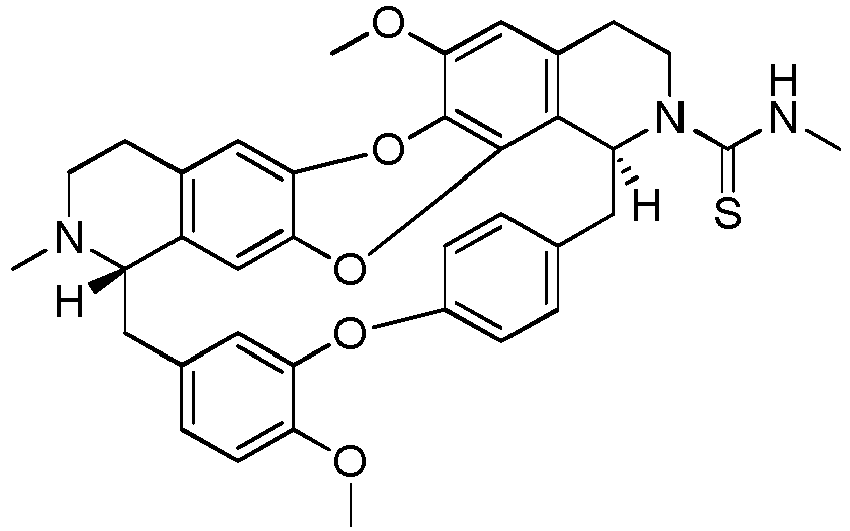

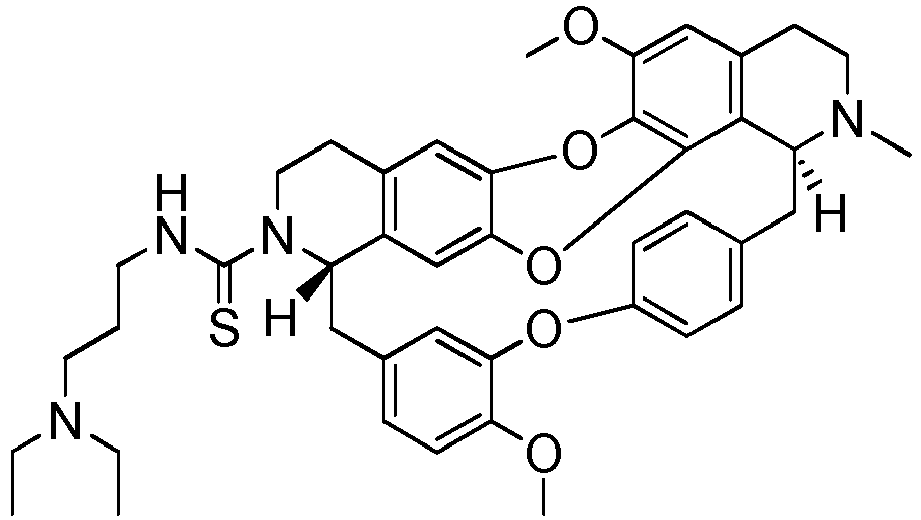


- A compound selected from the group consisting of compounds of the following formulas:


- The compound according to any one of claims 1 to 9, for use as a drug.
- The compound according to any one of claims 1 to 9, as a DNA methyltransferase (DNMT) inhibitor, notably for use as a drug intented for the treatment of cancer and neurological diseases, and cell reprogramming.
- The compound according to any one of claims 1 to 9, for use in the treatment of cancer.
- The compound of formula I for use according to claim 11 or 12, wherein the cancer is selected from colon cancer; hepatocarcinoma; melanoma; breast cancer; ovarian cancer; kidney cancer; liver cancer; pancreatic cancer; prostate cancer; glioblastoma; lung cancer, such as non-small cell lung cancer; neuroblastoma; myofibroblastic tumor; lymphoma, such as B- and T-cell lymphoma or anaplastic large-cell lymphoma; leukemia, such as AML (acute myeloid leukemia), MDS (myelodysplastic syndrome), CMML (chronic myelomonocytic leukemia) and CML (chronic myeloid leukemia); and multiple myeloma.
- A pharmaceutical composition comprising at least one compound according to any one of claims 1 to 9, and at least one pharmaceutically acceptable excipient.
- The pharmaceutical composition according to claim 14, further comprising at least one other active ingredient, such as an anticancer agent.
- A pharmaceutical product comprising:i. at least one compound according to any one of claims 1 to 9, andii. at least one other active ingredient such as an anticancer agent, as a combination product for simultaneous, separate or sequential use in the treatment of cancer.
- The pharmaceutical composition according to claim 15 or the pharmaceutical product according to claim 16, wherein said other anticancer agent is selected from the group consisting of:• Cytotoxic agents such as doxorubicin, R-CHOP, PARP inhibitors, etoposide, cisplatin,vinerolbine, vinflunine, bortezomib,• Other epigenetics drugs such as:o HDACi, such as inhibitors of HDAC 1 & 2,o Inhibitors of chromatin remodeler, such as CHD4,o Inhibitors of histone modifiers, such as demethylases JARDI1A/B or methylases EZH2, and• Immunotherapies such as antiCTL4 or antiPD1.
Applications Claiming Priority (2)
| Application Number | Priority Date | Filing Date | Title |
|---|---|---|---|
| EP15306556 | 2015-10-02 | ||
| PCT/EP2016/073581 WO2017055633A1 (en) | 2015-10-02 | 2016-10-03 | Hemi-synthetic trilobine analogs for use as a drug |
Publications (3)
| Publication Number | Publication Date |
|---|---|
| EP3355888A1 EP3355888A1 (en) | 2018-08-08 |
| EP3355888B1 true EP3355888B1 (en) | 2022-03-09 |
| EP3355888B8 EP3355888B8 (en) | 2022-04-13 |
Family
ID=54266506
Family Applications (1)
| Application Number | Title | Priority Date | Filing Date |
|---|---|---|---|
| EP16778323.2A Active EP3355888B8 (en) | 2015-10-02 | 2016-10-03 | Hemi-synthetic trilobine analogs for use as a drug |
Country Status (3)
| Country | Link |
|---|---|
| US (1) | US10544156B2 (en) |
| EP (1) | EP3355888B8 (en) |
| WO (1) | WO2017055633A1 (en) |
Families Citing this family (4)
| Publication number | Priority date | Publication date | Assignee | Title |
|---|---|---|---|---|
| EP3355883A1 (en) * | 2015-10-02 | 2018-08-08 | Pierre Fabre Medicament | Trilobine and its natural analogs for use as a drug |
| TWI808055B (en) | 2016-05-11 | 2023-07-11 | 美商滬亞生物國際有限公司 | Combination therapies of hdac inhibitors and pd-1 inhibitors |
| TWI794171B (en) | 2016-05-11 | 2023-03-01 | 美商滬亞生物國際有限公司 | Combination therapies of hdac inhibitors and pd-l1 inhibitors |
| EP3907227A1 (en) | 2020-05-07 | 2021-11-10 | Institut Pasteur | Trilobine derivatives and their use thereof in the treatment of malaria |
Family Cites Families (1)
| Publication number | Priority date | Publication date | Assignee | Title |
|---|---|---|---|---|
| JP2520620B2 (en) | 1987-01-20 | 1996-07-31 | 化研生薬株式会社 | Carcinogenic promoter inhibitor |
-
2016
- 2016-10-03 US US15/765,048 patent/US10544156B2/en active Active
- 2016-10-03 WO PCT/EP2016/073581 patent/WO2017055633A1/en not_active Ceased
- 2016-10-03 EP EP16778323.2A patent/EP3355888B8/en active Active
Also Published As
| Publication number | Publication date |
|---|---|
| EP3355888A1 (en) | 2018-08-08 |
| US10544156B2 (en) | 2020-01-28 |
| EP3355888B8 (en) | 2022-04-13 |
| WO2017055633A1 (en) | 2017-04-06 |
| US20190062339A1 (en) | 2019-02-28 |
Similar Documents
| Publication | Publication Date | Title |
|---|---|---|
| CA2867282C (en) | Inhibitors of human ezh2, and methods of use thereof | |
| CA3130456C (en) | Heterotricyclic derivative compound and use of same | |
| CN117624170A (en) | Compounds with activity against KRAS mutated tumors | |
| US20200016162A1 (en) | Inhibitors of human ezh2, and methods of use thereof | |
| CN115996907B (en) | Inhibitors of MLH1 and/or PMS2 for cancer treatment | |
| US10544156B2 (en) | Hemi-synthetic trilobine analogs for use as a drug | |
| CN114929698B (en) | A kind of benzene compound and its application | |
| EP3066099B1 (en) | Pyrido[2,3-d]pyrimidin-4-one compounds as tankyrase inhibitors | |
| CN104768948A (en) | 4-carboxamido-isoindolinone derivatives as selective PARP-1 inhibitors | |
| KR20200092987A (en) | Pyrazolopyridinone compounds | |
| CN117321056A (en) | An aromatic ring compound and its use | |
| CN113646007B (en) | Novel artificial nucleic acid, method for producing same, and use thereof | |
| US10517863B2 (en) | Trilobine and its natural analogs for use as a drug | |
| WO2022218247A1 (en) | Deuterated compound as cdk4/6 inhibitor | |
| WO2025119326A1 (en) | Novel prmt5 inhibitor and use thereof | |
| JP2019505495A (en) | Substituted naphthalene diimide and use thereof | |
| CN120752227A (en) | α,β-unsaturated amide compounds and their applications | |
| WO2024067445A1 (en) | Novel prmt5 inhibitor and use thereof | |
| EP4574817A1 (en) | Inhibitory compounds | |
| TW201625565A (en) | Compounds for the treatment of cancer | |
| HK40064708A (en) | Novel heterotricyclic derivative compound and use of same | |
| KR20250056969A (en) | Macrocyclic imidazo[1,2-b]pyridazine derivatives and their preparation methods and uses | |
| HK40014372A (en) | Inhibitors of human ezh2, and methods of use thereof | |
| BR112021016448B1 (en) | INNOVATIVE HETEROCYCLIC DERIVATIVE COMPOUND AND ITS USE | |
| HK40103815A (en) | Benzene ring compound and use thereof |
Legal Events
| Date | Code | Title | Description |
|---|---|---|---|
| STAA | Information on the status of an ep patent application or granted ep patent |
Free format text: STATUS: UNKNOWN |
|
| STAA | Information on the status of an ep patent application or granted ep patent |
Free format text: STATUS: THE INTERNATIONAL PUBLICATION HAS BEEN MADE |
|
| PUAI | Public reference made under article 153(3) epc to a published international application that has entered the european phase |
Free format text: ORIGINAL CODE: 0009012 |
|
| STAA | Information on the status of an ep patent application or granted ep patent |
Free format text: STATUS: REQUEST FOR EXAMINATION WAS MADE |
|
| 17P | Request for examination filed |
Effective date: 20180424 |
|
| AK | Designated contracting states |
Kind code of ref document: A1 Designated state(s): AL AT BE BG CH CY CZ DE DK EE ES FI FR GB GR HR HU IE IS IT LI LT LU LV MC MK MT NL NO PL PT RO RS SE SI SK SM TR |
|
| AX | Request for extension of the european patent |
Extension state: BA ME |
|
| DAV | Request for validation of the european patent (deleted) | ||
| DAX | Request for extension of the european patent (deleted) | ||
| STAA | Information on the status of an ep patent application or granted ep patent |
Free format text: STATUS: EXAMINATION IS IN PROGRESS |
|
| 17Q | First examination report despatched |
Effective date: 20210202 |
|
| REG | Reference to a national code |
Ref country code: DE Ref legal event code: R079 Ref document number: 602016069860 Country of ref document: DE Free format text: PREVIOUS MAIN CLASS: A61K0031474100 Ipc: A61P0035000000 |
|
| RIC1 | Information provided on ipc code assigned before grant |
Ipc: C07D 519/00 20060101ALI20210906BHEP Ipc: A61P 35/00 20060101AFI20210906BHEP |
|
| GRAP | Despatch of communication of intention to grant a patent |
Free format text: ORIGINAL CODE: EPIDOSNIGR1 |
|
| STAA | Information on the status of an ep patent application or granted ep patent |
Free format text: STATUS: GRANT OF PATENT IS INTENDED |
|
| INTG | Intention to grant announced |
Effective date: 20211021 |
|
| GRAS | Grant fee paid |
Free format text: ORIGINAL CODE: EPIDOSNIGR3 |
|
| GRAA | (expected) grant |
Free format text: ORIGINAL CODE: 0009210 |
|
| STAA | Information on the status of an ep patent application or granted ep patent |
Free format text: STATUS: THE PATENT HAS BEEN GRANTED |
|
| REG | Reference to a national code |
Ref country code: DE Ref legal event code: R081 Ref document number: 602016069860 Country of ref document: DE Owner name: PIERRE FABRE MEDICAMENT, FR Free format text: FORMER OWNERS: CENTRE NATIONAL DE LA RECHERCHE SCIENTIFIQUE (CNRS), PARIS, FR; PIERRE FABRE MEDICAMENT, BOULOGNE-BILLANCOURT, FR Ref country code: DE Ref legal event code: R081 Ref document number: 602016069860 Country of ref document: DE Owner name: CENTRE NATIONAL DE LA RECHERCHE SCIENTIFIQUE (, FR Free format text: FORMER OWNERS: CENTRE NATIONAL DE LA RECHERCHE SCIENTIFIQUE (CNRS), PARIS, FR; PIERRE FABRE MEDICAMENT, BOULOGNE-BILLANCOURT, FR |
|
| AK | Designated contracting states |
Kind code of ref document: B1 Designated state(s): AL AT BE BG CH CY CZ DE DK EE ES FI FR GB GR HR HU IE IS IT LI LT LU LV MC MK MT NL NO PL PT RO RS SE SI SK SM TR |
|
| REG | Reference to a national code |
Ref country code: GB Ref legal event code: FG4D |
|
| REG | Reference to a national code |
Ref country code: CH Ref legal event code: EP Ref country code: AT Ref legal event code: REF Ref document number: 1473634 Country of ref document: AT Kind code of ref document: T Effective date: 20220315 |
|
| RAP4 | Party data changed (patent owner data changed or rights of a patent transferred) |
Owner name: CENTRE NATIONAL DE LA RECHERCHE SCIENTIFIQUE (CNRS) Owner name: PIERRE FABRE MEDICAMENT |
|
| REG | Reference to a national code |
Ref country code: DE Ref legal event code: R096 Ref document number: 602016069860 Country of ref document: DE |
|
| REG | Reference to a national code |
Ref country code: IE Ref legal event code: FG4D |
|
| REG | Reference to a national code |
Ref country code: CH Ref legal event code: PK Free format text: BERICHTIGUNG B8 |
|
| REG | Reference to a national code |
Ref country code: LT Ref legal event code: MG9D |
|
| REG | Reference to a national code |
Ref country code: NL Ref legal event code: MP Effective date: 20220309 |
|
| PG25 | Lapsed in a contracting state [announced via postgrant information from national office to epo] |
Ref country code: SE Free format text: LAPSE BECAUSE OF FAILURE TO SUBMIT A TRANSLATION OF THE DESCRIPTION OR TO PAY THE FEE WITHIN THE PRESCRIBED TIME-LIMIT Effective date: 20220309 Ref country code: RS Free format text: LAPSE BECAUSE OF FAILURE TO SUBMIT A TRANSLATION OF THE DESCRIPTION OR TO PAY THE FEE WITHIN THE PRESCRIBED TIME-LIMIT Effective date: 20220309 Ref country code: NO Free format text: LAPSE BECAUSE OF FAILURE TO SUBMIT A TRANSLATION OF THE DESCRIPTION OR TO PAY THE FEE WITHIN THE PRESCRIBED TIME-LIMIT Effective date: 20220609 Ref country code: LT Free format text: LAPSE BECAUSE OF FAILURE TO SUBMIT A TRANSLATION OF THE DESCRIPTION OR TO PAY THE FEE WITHIN THE PRESCRIBED TIME-LIMIT Effective date: 20220309 Ref country code: HR Free format text: LAPSE BECAUSE OF FAILURE TO SUBMIT A TRANSLATION OF THE DESCRIPTION OR TO PAY THE FEE WITHIN THE PRESCRIBED TIME-LIMIT Effective date: 20220309 Ref country code: BG Free format text: LAPSE BECAUSE OF FAILURE TO SUBMIT A TRANSLATION OF THE DESCRIPTION OR TO PAY THE FEE WITHIN THE PRESCRIBED TIME-LIMIT Effective date: 20220609 |
|
| REG | Reference to a national code |
Ref country code: AT Ref legal event code: MK05 Ref document number: 1473634 Country of ref document: AT Kind code of ref document: T Effective date: 20220309 |
|
| PG25 | Lapsed in a contracting state [announced via postgrant information from national office to epo] |
Ref country code: LV Free format text: LAPSE BECAUSE OF FAILURE TO SUBMIT A TRANSLATION OF THE DESCRIPTION OR TO PAY THE FEE WITHIN THE PRESCRIBED TIME-LIMIT Effective date: 20220309 Ref country code: GR Free format text: LAPSE BECAUSE OF FAILURE TO SUBMIT A TRANSLATION OF THE DESCRIPTION OR TO PAY THE FEE WITHIN THE PRESCRIBED TIME-LIMIT Effective date: 20220610 Ref country code: FI Free format text: LAPSE BECAUSE OF FAILURE TO SUBMIT A TRANSLATION OF THE DESCRIPTION OR TO PAY THE FEE WITHIN THE PRESCRIBED TIME-LIMIT Effective date: 20220309 |
|
| PG25 | Lapsed in a contracting state [announced via postgrant information from national office to epo] |
Ref country code: NL Free format text: LAPSE BECAUSE OF FAILURE TO SUBMIT A TRANSLATION OF THE DESCRIPTION OR TO PAY THE FEE WITHIN THE PRESCRIBED TIME-LIMIT Effective date: 20220309 |
|
| PG25 | Lapsed in a contracting state [announced via postgrant information from national office to epo] |
Ref country code: SM Free format text: LAPSE BECAUSE OF FAILURE TO SUBMIT A TRANSLATION OF THE DESCRIPTION OR TO PAY THE FEE WITHIN THE PRESCRIBED TIME-LIMIT Effective date: 20220309 Ref country code: SK Free format text: LAPSE BECAUSE OF FAILURE TO SUBMIT A TRANSLATION OF THE DESCRIPTION OR TO PAY THE FEE WITHIN THE PRESCRIBED TIME-LIMIT Effective date: 20220309 Ref country code: RO Free format text: LAPSE BECAUSE OF FAILURE TO SUBMIT A TRANSLATION OF THE DESCRIPTION OR TO PAY THE FEE WITHIN THE PRESCRIBED TIME-LIMIT Effective date: 20220309 Ref country code: PT Free format text: LAPSE BECAUSE OF FAILURE TO SUBMIT A TRANSLATION OF THE DESCRIPTION OR TO PAY THE FEE WITHIN THE PRESCRIBED TIME-LIMIT Effective date: 20220711 Ref country code: ES Free format text: LAPSE BECAUSE OF FAILURE TO SUBMIT A TRANSLATION OF THE DESCRIPTION OR TO PAY THE FEE WITHIN THE PRESCRIBED TIME-LIMIT Effective date: 20220309 Ref country code: EE Free format text: LAPSE BECAUSE OF FAILURE TO SUBMIT A TRANSLATION OF THE DESCRIPTION OR TO PAY THE FEE WITHIN THE PRESCRIBED TIME-LIMIT Effective date: 20220309 Ref country code: CZ Free format text: LAPSE BECAUSE OF FAILURE TO SUBMIT A TRANSLATION OF THE DESCRIPTION OR TO PAY THE FEE WITHIN THE PRESCRIBED TIME-LIMIT Effective date: 20220309 Ref country code: AT Free format text: LAPSE BECAUSE OF FAILURE TO SUBMIT A TRANSLATION OF THE DESCRIPTION OR TO PAY THE FEE WITHIN THE PRESCRIBED TIME-LIMIT Effective date: 20220309 |
|
| PG25 | Lapsed in a contracting state [announced via postgrant information from national office to epo] |
Ref country code: PL Free format text: LAPSE BECAUSE OF FAILURE TO SUBMIT A TRANSLATION OF THE DESCRIPTION OR TO PAY THE FEE WITHIN THE PRESCRIBED TIME-LIMIT Effective date: 20220309 Ref country code: IS Free format text: LAPSE BECAUSE OF FAILURE TO SUBMIT A TRANSLATION OF THE DESCRIPTION OR TO PAY THE FEE WITHIN THE PRESCRIBED TIME-LIMIT Effective date: 20220709 Ref country code: AL Free format text: LAPSE BECAUSE OF FAILURE TO SUBMIT A TRANSLATION OF THE DESCRIPTION OR TO PAY THE FEE WITHIN THE PRESCRIBED TIME-LIMIT Effective date: 20220309 |
|
| REG | Reference to a national code |
Ref country code: DE Ref legal event code: R097 Ref document number: 602016069860 Country of ref document: DE |
|
| PLBE | No opposition filed within time limit |
Free format text: ORIGINAL CODE: 0009261 |
|
| STAA | Information on the status of an ep patent application or granted ep patent |
Free format text: STATUS: NO OPPOSITION FILED WITHIN TIME LIMIT |
|
| PG25 | Lapsed in a contracting state [announced via postgrant information from national office to epo] |
Ref country code: DK Free format text: LAPSE BECAUSE OF FAILURE TO SUBMIT A TRANSLATION OF THE DESCRIPTION OR TO PAY THE FEE WITHIN THE PRESCRIBED TIME-LIMIT Effective date: 20220309 |
|
| 26N | No opposition filed |
Effective date: 20221212 |
|
| PG25 | Lapsed in a contracting state [announced via postgrant information from national office to epo] |
Ref country code: SI Free format text: LAPSE BECAUSE OF FAILURE TO SUBMIT A TRANSLATION OF THE DESCRIPTION OR TO PAY THE FEE WITHIN THE PRESCRIBED TIME-LIMIT Effective date: 20220309 |
|
| PG25 | Lapsed in a contracting state [announced via postgrant information from national office to epo] |
Ref country code: MC Free format text: LAPSE BECAUSE OF FAILURE TO SUBMIT A TRANSLATION OF THE DESCRIPTION OR TO PAY THE FEE WITHIN THE PRESCRIBED TIME-LIMIT Effective date: 20220309 |
|
| REG | Reference to a national code |
Ref country code: CH Ref legal event code: PL |
|
| REG | Reference to a national code |
Ref country code: BE Ref legal event code: MM Effective date: 20221031 |
|
| PG25 | Lapsed in a contracting state [announced via postgrant information from national office to epo] |
Ref country code: LU Free format text: LAPSE BECAUSE OF NON-PAYMENT OF DUE FEES Effective date: 20221003 |
|
| PG25 | Lapsed in a contracting state [announced via postgrant information from national office to epo] |
Ref country code: LI Free format text: LAPSE BECAUSE OF NON-PAYMENT OF DUE FEES Effective date: 20221031 Ref country code: IT Free format text: LAPSE BECAUSE OF FAILURE TO SUBMIT A TRANSLATION OF THE DESCRIPTION OR TO PAY THE FEE WITHIN THE PRESCRIBED TIME-LIMIT Effective date: 20220309 Ref country code: CH Free format text: LAPSE BECAUSE OF NON-PAYMENT OF DUE FEES Effective date: 20221031 |
|
| PG25 | Lapsed in a contracting state [announced via postgrant information from national office to epo] |
Ref country code: BE Free format text: LAPSE BECAUSE OF NON-PAYMENT OF DUE FEES Effective date: 20221031 |
|
| PG25 | Lapsed in a contracting state [announced via postgrant information from national office to epo] |
Ref country code: IE Free format text: LAPSE BECAUSE OF NON-PAYMENT OF DUE FEES Effective date: 20221003 |
|
| PG25 | Lapsed in a contracting state [announced via postgrant information from national office to epo] |
Ref country code: HU Free format text: LAPSE BECAUSE OF FAILURE TO SUBMIT A TRANSLATION OF THE DESCRIPTION OR TO PAY THE FEE WITHIN THE PRESCRIBED TIME-LIMIT; INVALID AB INITIO Effective date: 20161003 |
|
| PG25 | Lapsed in a contracting state [announced via postgrant information from national office to epo] |
Ref country code: CY Free format text: LAPSE BECAUSE OF FAILURE TO SUBMIT A TRANSLATION OF THE DESCRIPTION OR TO PAY THE FEE WITHIN THE PRESCRIBED TIME-LIMIT Effective date: 20220309 |
|
| PG25 | Lapsed in a contracting state [announced via postgrant information from national office to epo] |
Ref country code: MK Free format text: LAPSE BECAUSE OF FAILURE TO SUBMIT A TRANSLATION OF THE DESCRIPTION OR TO PAY THE FEE WITHIN THE PRESCRIBED TIME-LIMIT Effective date: 20220309 |
|
| PG25 | Lapsed in a contracting state [announced via postgrant information from national office to epo] |
Ref country code: TR Free format text: LAPSE BECAUSE OF FAILURE TO SUBMIT A TRANSLATION OF THE DESCRIPTION OR TO PAY THE FEE WITHIN THE PRESCRIBED TIME-LIMIT Effective date: 20220309 |
|
| PG25 | Lapsed in a contracting state [announced via postgrant information from national office to epo] |
Ref country code: MT Free format text: LAPSE BECAUSE OF FAILURE TO SUBMIT A TRANSLATION OF THE DESCRIPTION OR TO PAY THE FEE WITHIN THE PRESCRIBED TIME-LIMIT Effective date: 20220309 |
|
| PGFP | Annual fee paid to national office [announced via postgrant information from national office to epo] |
Ref country code: DE Payment date: 20251015 Year of fee payment: 10 |
|
| PGFP | Annual fee paid to national office [announced via postgrant information from national office to epo] |
Ref country code: GB Payment date: 20251023 Year of fee payment: 10 |
|
| PGFP | Annual fee paid to national office [announced via postgrant information from national office to epo] |
Ref country code: FR Payment date: 20251027 Year of fee payment: 10 |