EP3355498A1 - Method and tool for service provisioning with improved spectral efficiency in grid-less optical networks - Google Patents
Method and tool for service provisioning with improved spectral efficiency in grid-less optical networks Download PDFInfo
- Publication number
- EP3355498A1 EP3355498A1 EP17153753.3A EP17153753A EP3355498A1 EP 3355498 A1 EP3355498 A1 EP 3355498A1 EP 17153753 A EP17153753 A EP 17153753A EP 3355498 A1 EP3355498 A1 EP 3355498A1
- Authority
- EP
- European Patent Office
- Prior art keywords
- cost
- cost values
- service
- implementation
- frequency band
- Prior art date
- Legal status (The legal status is an assumption and is not a legal conclusion. Google has not performed a legal analysis and makes no representation as to the accuracy of the status listed.)
- Withdrawn
Links
- 230000003287 optical effect Effects 0.000 title claims abstract description 50
- 230000003595 spectral effect Effects 0.000 title claims abstract description 38
- 238000000034 method Methods 0.000 title claims abstract description 28
- 230000002349 favourable effect Effects 0.000 claims abstract description 14
- 239000000969 carrier Substances 0.000 claims description 22
- 238000009434 installation Methods 0.000 claims description 8
- 238000001228 spectrum Methods 0.000 description 16
- 230000008859 change Effects 0.000 description 8
- 238000004364 calculation method Methods 0.000 description 7
- 230000005540 biological transmission Effects 0.000 description 6
- 230000008901 benefit Effects 0.000 description 4
- 239000000835 fiber Substances 0.000 description 4
- 238000013467 fragmentation Methods 0.000 description 4
- 238000006062 fragmentation reaction Methods 0.000 description 4
- 238000013459 approach Methods 0.000 description 3
- 238000010586 diagram Methods 0.000 description 3
- 230000000694 effects Effects 0.000 description 3
- 238000001914 filtration Methods 0.000 description 3
- 230000006870 function Effects 0.000 description 3
- 230000008569 process Effects 0.000 description 3
- 230000007423 decrease Effects 0.000 description 2
- 230000003247 decreasing effect Effects 0.000 description 2
- 238000012986 modification Methods 0.000 description 2
- 230000004048 modification Effects 0.000 description 2
- 238000005457 optimization Methods 0.000 description 2
- 230000006978 adaptation Effects 0.000 description 1
- 230000004075 alteration Effects 0.000 description 1
- 230000009286 beneficial effect Effects 0.000 description 1
- 230000015556 catabolic process Effects 0.000 description 1
- 238000012937 correction Methods 0.000 description 1
- 238000006731 degradation reaction Methods 0.000 description 1
- 230000001419 dependent effect Effects 0.000 description 1
- 238000013461 design Methods 0.000 description 1
- 238000005516 engineering process Methods 0.000 description 1
- 238000012886 linear function Methods 0.000 description 1
- 238000012423 maintenance Methods 0.000 description 1
- 238000007726 management method Methods 0.000 description 1
- 238000012856 packing Methods 0.000 description 1
- 230000001737 promoting effect Effects 0.000 description 1
- 230000003068 static effect Effects 0.000 description 1
- 230000001052 transient effect Effects 0.000 description 1
- 208000010119 wrinkly skin syndrome Diseases 0.000 description 1
Images




Classifications
-
- H—ELECTRICITY
- H04—ELECTRIC COMMUNICATION TECHNIQUE
- H04J—MULTIPLEX COMMUNICATION
- H04J14/00—Optical multiplex systems
- H04J14/02—Wavelength-division multiplex systems
- H04J14/0227—Operation, administration, maintenance or provisioning [OAMP] of WDM networks, e.g. media access, routing or wavelength allocation
- H04J14/0254—Optical medium access
- H04J14/0256—Optical medium access at the optical channel layer
- H04J14/0257—Wavelength assignment algorithms
-
- H—ELECTRICITY
- H04—ELECTRIC COMMUNICATION TECHNIQUE
- H04Q—SELECTING
- H04Q11/00—Selecting arrangements for multiplex systems
- H04Q11/0001—Selecting arrangements for multiplex systems using optical switching
- H04Q11/0062—Network aspects
-
- H—ELECTRICITY
- H04—ELECTRIC COMMUNICATION TECHNIQUE
- H04Q—SELECTING
- H04Q11/00—Selecting arrangements for multiplex systems
Definitions
- the present invention is in the field of optical network management and operation. More particularly, the present invention relates to a method and tool for service provisioning with improved spectral efficiency in grid-less optical networks.
- Fig. 1 In addition to the frequency slots and carriers, in Fig. 1 the pass bands of corresponding filters used for the wavelength selective switching of the channels is shown. Due to a limited steepness of the flanks of optical filters, a signal that is spectrally close to the filter flank experiences considerable attenuation and disturbance. This effect adds up if a plurality of filters are successively passed, as is generally the case for optical signals transmitted in an optical network. As a result, the effective 3dB bandwidth for example typically reduces to 30GHz after a cascade of about 15 filters provided by wavelength selective switches (WSS).
- WSS wavelength selective switches
- the carrier frequencies must be spectrally separated from the filter flanks by a certain amount or "safety margin", which is referred to as a "guard-band” in the art.
- the reach of the optical signals can be significantly affected by penalties due to optical filtering, the degree of such penalties depending on the baud rate of the optical signal (for a given filter band width), filter shape and the number of cascaded filters in the light path.
- the available bandwidth in view of the filter effects is smaller than the actual band width of the optical signals, such that components from both spectral edges of the signal are cut off, leading to a significant degradation of the optical signal upon transmission.
- FEC forward error correction
- flex-grid optical networks or “flex-networks”, which is also referred to as “flexible DWDM grids” .
- channel bandwidth and spectral grid allocation can be freely chosen within some granularity.
- a network providing this possibility to selectively choose channel bandwidths and spectral location of a channel is referred to as a "grid-less optical network” in the present disclosure, of which the "flex-grid optical network” or “flexible DWDM grid” is an example.
- flex-grid WSSs ITU-T recommendation G.694.1
- the technology of flex-grid WSSs allows for adjustment of the bandwidth at fine granularity (typically below 6.25GHz) without introducing any amplitude dips in the spectrum of the frequency slot.
- the frequency of a carrier can be freely positioned within the frequency slot, exact bandwidth adjustment optimized for the optical channel requirements becomes technically feasible.
- flex-grid networks are not only flexible with regard to the spectral location and bandwidth of channels, but also with regard to modulation formats, data rates and symbol rates.
- Flex-grid networks allow for simultaneous transmission of mixed bit rates, e.g. 100Gb/s, 200Gb/s, 400Gb/s, 1Tb/s, etc, and mixed modulation formats. Accordingly, in flex-grid networks, switchable transponders addressing the best possible combination of data rate, spectral efficiency, etc. can increase the efficiency and hence enable significant cost advantages to the network.
- the flex-grid concept in optical networks provides ways for ameliorating limitations due to optical filtering by densely packing two or more carriers in a single reserved wavelength range or "frequency slot” (FS).
- FS frequency slot
- this frequency slot includes a plurality of carriers, it is treated by the network as a single channel, meaning that all the carriers within this frequency slot are commonly switched at each network node passed under way. Accordingly, this frequency slot is also referred to as "media channel” in the art.
- An example of a media channel including four carriers is shown in Fig. 3 , together with the filter passband of a filter used to switch this media channel.
- the advantage of this approach is readily apparent from Fig. 3 : Since guard bands only needed for the outermost carriers ("edge carriers”), but not in between adjacent carriers, the carriers can be packed closer to each other as compared to the arrangement of Fig. 1 , with the minimum spacing being generally limited by inter-carrier crosstalk.
- flex-grid networks with regard to spectral distribution of channels as well as choice of data rates, symbol rate and modulation formats bears the potential to derive an optimum use of resources for each individual path inside the network.
- the large number of possibilities makes the planning of networks and provisioning of a service particularly difficult.
- Different approaches have been suggested for network planning of flex-grid networks in Multi-objective Design of Survivable Flexible-Grid DWDM Networks, António Eira, Jo ⁇ o Santos, Jo ⁇ o Pedro, and Jo ⁇ o Pires J. OPT. COMMUN. NETW./VOL. 6, NO.
- An object underlying the invention is to provide a tool and a method for service provisioning for determining favorable implementations of a service in a grid-less optical network comprising transponders allowing to selectively adjust bandwidths and data rates for individual optical signals.
- the service provisioning tool of the invention allows for determining favorable implementations of a service in a grid-less optical network.
- the service provisioning tool of the invention allows for determining the favorable implementations "online", i.e. during the operation of the network, typically provisioning one service after the other on demand. This is different from so-called "off-line” network planning tools which always work on knowledge of the complete traffic pattern.
- the optical network comprises transponders allowing for selectively adjusting bandwidths and data rates for individual optical signals.
- the service provisioning tool is configured to
- the phrase "under otherwise same conditions" indicates that the cost value regarding selectable frequency bands, and hence the cost value per band width, may dynamically change due to other reasons, such as the utilization of the given link or the like. However, in addition to these dynamical change, i.e. under otherwise same conditions, the cost value per band width may vary as indicated above.
- the most favorable implementation is found based on the combination of three cost factors, one related to data rates, one related to the necessity of installing additional equipment, and one related to the bandwidth.
- the service provisioning tool may find a route without need to install a further 3R regenerator, which works only with 4 x 100G QPSK. If the routing is done based on spectrum costs, the service provisioning tool may come up with a spectrally more favourable 64QAM route, which however eventually requires the installation of two additional 3R regenerators because the reach of an optical signal decreases with bitrate/number of symbols in the constellation diagram. However, if one combines costs for both aspects at the same time, it may be possible to find what may turn out as the truly most favourable implementation, e.g. 2x200G 8QAM with adding one 3R regenerator. Note that all three routes can theoretically use different optical links i.e. be completely different from each other. Moreover, none of the documents referenced above allows for defining cost for spectrum - the algorithms just optimize the use of the spectrum - which can be in conflict with needs and/or the network topology.
- one or more of the cost values are dynamically changing as a function of one or more of the degree of utilization of the respective link, the lifetime of the service, the time available for establishing the service, a modulation format on individual links employed in said implementation, and a signal power employed in said implementation.
- This dynamical change in the cost values proves to be very powerful for making the proper choices in the implementation under an online provisioning of services, where established techniques for off-line provisioning based on a full traffic pattern may not give the desired results.
- the cost values for signal frequency bands on the corresponding link can be dynamically raised, to thereby steer the service provisioning tool towards the use of other links, to avoid a future congestion of the given link.
- the cost values may depend on the lifetime of the service in question. If a service is established only for a limited period of time, for example during the Olympic Games where there is a significant increase in data traffic to and from the hosting city for limited period of time, it would be favorable to dynamically reduce the cost values regarding selectable frequency bands as compared to the cost values for equipment, because it can already be foreseen that occupied frequencies will be released again soon, while installing additional equipment may be unnecessary in view of the fact that the traffic will decrease again once the service is terminated.
- the cost values could depend on the time available for establishing the service. Namely, if the service would need to be established very quickly, it could be difficult or even impossible to install additional equipment in the given time, which would be a reason to dynamically raise the costs regarding necessity to install additional equipment with respect to the cost values for data rates or selectable signal frequency bands. Note that this is a typical example for a dynamically varying cost value that is of particular importance in online service provisioning, and that would not be considered in off-line network planning.
- the service provisioning tool of the invention does not simply assign a uniform cost value per bandwidth to any selected signal frequency band.
- the cost value per bandwidth varies depending on the size of the selected frequency band, and/or depending on to what extent the selected frequency band fills gaps between occupied spectral ranges and/or creates gaps remaining between occupied spectral ranges.
- this way not only the suitability of a given service is evaluated, but also the extent to which the given service will be likely to allow a resource-efficient establishing of future services. Again, this is characteristic for an online service provisioning, where no complete traffic pattern is known, but where the proper decisions have to be made such that future services can be provisioned with a highest possible efficiency of use of resources in the long run.
- the service provisioning tool assigns, under otherwise same conditions, a lower cost value per bandwidth when assigning a frequency band to one or more carriers that is sufficiently large to accommodate at least one further carrier in a possible future implementation, as compared to the cost value per bandwidth for a narrower frequency band that does not permit accommodating a further carrier.
- the service provisioning tool may select an implementation that allocates more bandwidth than currently necessary, taking the likelihood into account that an additional channel may be introduced to this frequency band at a later stage, thereby making optimal use of the resources in the long run.
- the service provisioning tool assigns, under otherwise same conditions, a lower cost per bandwidth to a frequency band that fills a gap existing between occupied spectral ranges as compared to the cost per bandwidth of a frequency band of the same size that does not fill such gap.
- the service provisioning tool may be caused to choose an implementation in which a gap existing between occupied spectral ranges is filled, which otherwise may not find use in future services. In other words, this way a fragmentation of the spectrum can be avoided. This is of particular importance, because spectral fragmentation is a particular problem observed by the inventors in grid-less optical networks, that makes the establishment of future services difficult.
- the service provisioning tool assigns, under otherwise same conditions, a higher cost per bandwidth to a frequency band that creates an unusable gap between occupied spectral ranges as compared to the cost per bandwidth of a frequency band of the same size the does not create such unusable gap, wherein an unusable gap is a gap having a spectral width below a predetermined threshold.
- an unusable gap is a gap having a spectral width below a predetermined threshold.
- the term "unusable gap” is a relative term, because whether a certain gap in the spectrum can be used or not will depend on other further parameters than the size of the gap itself but also on other parameters, such as the required data rate, path length and the like. Accordingly, in this embodiment of the invention, the "unusable gap” means a gap having a spectral width below a predetermined threshold applied by the service provisioning tool.
- the total cost value corresponds to a sum of the individual cost values for all links employed in a given implementation.
- the sum may be a weighted sum, in which the relative weight of at least two of the cost values regarding data rate, equipment installation and bandwidth are adjustable.
- the service provisioning tool is further configured to calculate the performance of the implementation. This way, one can be sure that any implementation under consideration does in fact provide the required performance, such as a predetermined optical signal-to-noise ratio (OSNR), residual margin and bit error rate (BER).
- OSNR optical signal-to-noise ratio
- BER bit error rate
- some or all of the cost values are stored in configuration files and are used for routing requests.
- some or all of said cost values, or weighting factors between different types of cost values are dynamically specified as an input to the routing request.
- the service provisioning tool further comprises a user interface allowing a user to adjust the relative weight between two or more of the cost values regarding data rate, equipment installation and bandwidth.
- a user interface allowing a user to adjust the relative weight between two or more of the cost values regarding data rate, equipment installation and bandwidth.
- the tool provides different cost values regarding necessity to install additional equipment based on one or both of the scheduled start of the service and information regarding availability of the equipment. For example, if the service is scheduled to start very soon, but it is known that additional equipment possibly needed would not be available in time, the cost value relating to the necessity to install additional equipment will be raised, because implementations requiring such equipment should be avoided under these circumstances.
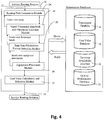
- a routing engine 10 for use by a service provisioning tool is shown.
- the routing engine 10 has an input interface 12 for receiving a service routing request, and an output interface 14 for outputting a service routing solution.
- the routing engine 10 is communicatively coupled with various information databases for retrieving information on the network needed in establishing the service routing solution.
- These database include a topological database 16 containing information about the network topology, a cost value database 18, in which cost values for the links of the network are stored, a resource availability database 20 containing information about the availability of resources, for example which wavelengths are occupied and which wavelengths are free for use on respective links, and an optical performance database 22.
- the optical performance database 22 includes information allowing to estimate the performance of a given path, such as penalties due to linear and nonlinear distortions, signal OSNR, and signal residual margin at actual and end of life system conditions.
- the routing engine 10 comprises a routing path generation module 24 for determining all possible paths between the start and end nodes of the service. This routing path generation is based on network topology information retrieved from the topology database 16, possibly taking into account a set of routing restrictions specified in the request, and the current resource availability inferred from the resource availability database 20.
- the routing engine 10 further comprises a signal frequency bandwidth and placement selection module 26 which selects, for every path, tentative frequency bands both with regard to the bandwidth and the location of the band in the spectrum. Since the network employed in the present invention is a grid-less network, there is a large freedom to make this choice.
- the routing engine 10 comprises a data rate/modulation format selection module 28, which suggests tentative data rates and modulation formats to each frequency band suggested by module 26.
- the routing engine 10 further comprises an equipment placement module 30, which for every path established by the routing path generation module 24, selection of width and location of the frequency band and data rate/modulation format, determines possibilities for adding additional equipment, in particular 3R regenerators, that may be necessary to achieve a desired performance with regard to the transmission quality and capacity for said path.
- an equipment placement module 30 which for every path established by the routing path generation module 24, selection of width and location of the frequency band and data rate/modulation format, determines possibilities for adding additional equipment, in particular 3R regenerators, that may be necessary to achieve a desired performance with regard to the transmission quality and capacity for said path.
- the combination of routing path, equipment placement, selection of width and location of the frequency band, and data rate/modulation format amounts to a possible implementation of the service.
- a total cost value is calculated by a cost value calculation and selection module 32, and an implementation or a group of implementations having the lowest cost is and outputted, via the output interface 14 as the service routing solution.
- the cost value calculation and selection module 32 retrieves information from the cost value database 18.
- the information retrieved from the cost value database 18 is generally not stationary, but is, at least in part, dynamically changing, to reflect the current condition of the network that itself is dynamically changing upon provisioning services one after the other online, as will become more apparent with reference to Fig. 5 below.
- step 34 the cost value calculation and selection module 32 receives a tentative implementation.
- step 36 the module 32 calculates the performance of the implementation and checks, in step 38 whether this performance is acceptable with regard to data transmission quality, possibly depending on the service level agreement specified in the service routing request. The performance can again be estimated based on information retrieved from the optical performance database 22. If the performance is found to be insufficient in step 38, the process returns to step 34 and starts anew with a new implementation.
- step 40 cost values regarding selectable data rates on individual links employed in the implementation, cost values regarding necessity to install additional equipment, in particular a 3R regenerator, for the implementation, and cost values regarding selectable signal frequency bands on individual links employed in the implementation, are retrieved from a configuration file stored in the cost value database 18.
- the cost values stored in the database 18 for each link are dynamically updated such as to reflect the current status of the network, utilization of specific links, current or future demands and the like.
- one or more of said cost values, and in particular the cost values regarding selectable signal frequency bands are dynamically changing as a function of one or more of the degree of utilization of the respective link, the lifetime of the service to be provisioned, the time available for establishing the service to be provisioned, a modulation format on individual links employed in said implementation, and a signal power employed in the implementation.
- This dynamic change can be reflected by dynamically updating the cost values as stored in the database 18.
- dynamically updating cost values stored in the database 18 they can also be calculated on the fly based on information retrieved from the cost value database 18, and possibly additional information regarding the status.
- step 42 it is checked whether additional cost value input is available. Namely, in addition to the cost values or related information stored in the cost value database 18, in various embodiments of the invention it is also possible to provide further cost value input. Irrespectively of the fact that the cost values or related information stored in the cost value database 18 can in the preferred embodiments be dynamically updated in the way described above, it is possible to provide alternatively or in addition further dynamic cost value information, for example together with the service request.
- a typical cost value input would be a weighting factor to be applied to the cost values stored in the cost value database 18.
- a user interface for inputting weighting factors to the three aforementioned types of cost values (data rate, equipment, frequency band) is shown in Fig. 7 . If such additional cost value input is available, the cost values are updated in step 44 accounting for such input. For example, the stored cost values can be simply multiplied with the weighting factors provided as cost value input.
- step 46 it is checked whether further implementations are possible. If this is the case, the procedure returns to step 34, where the next implementation is received, and the procedure is repeated. If no further implementations are available, in step 50, the implementation or group of implementations with the lowest cost value are selected.
- the user or administrator of the system can define and respectively change the cost values stored in the cost value database 18 and employed by the cost value calculation and selection module 32, or change the rules according to which they are dynamically changed.
- the user or administrator can define cost values for optical spectrum occupation in steps of 125 MHz.
- the costs are not in all cases a linear function of the occupied bandwidth, or in other words, the cost value per bandwidth may vary.
- the cost value per bandwidth may vary depending on the size of the selected frequency band, or to what extent the selected frequency band fills gaps between occupied spectral ranges or creates gaps remaining between occupied spectral ranges.
- the cost value per bandwidth can be comparatively low (e.g. lower than average) when assigning a frequency band to one or more carriers that is sufficiently large to accommodate at least one further carrier in a possible future implementation.
- the cost value calculation and selection module 32 may come up with frequency band selections that are larger than needed, but provide good chances that the excessive bandwidth is used at a later time by one or more additional carriers, such that overall, i.e. in the long run, the spectrum is used more efficiently.
- particularly low cost value per bandwidth can be assigned to media channel bands, i.e. bands which are meant to accommodate a number of closely packed carriers, and which possibly can be supplemented, with a certain degree of likelihood, by one or more carriers that fit in the same media channel.
- comparatively low cost values per bandwidth may be assigned to a frequency band that fills a gap existing between occupied spectral ranges.
- the fragmentation of the frequency band is one of the most severe problems in flex-grid networks, and if there is a chance to make productive use of a gap, because a certain service request could be implemented using such gap, then the routing engine 10 should be incited to take this opportunity, even though the gap could for example be a little wider than necessary.
- the gap would not have been used, because a slightly smaller frequency band in a free part of the spectrum would have appeared to be more favorable, thereby possibly missing a good chance, may be the only chance to make productive use of the gap.
- the cost value per bandwidth may be only 50% if the required bandwidth just uses a gap in the spectrum. Assuming that normally 75 GHz would have the cost 1.5 for an optical multiplex section (OMS), if there is just a gap available with 75 GHz, the cost is only 0.75.
- OMS optical multiplex section
- All cost factors may be mapped onto a directed graph model of the network, which is used by the routing path generation module 24 to calculate routes for the services to be provisioned.
- the total cost value for a link in the network can be the sum, and more generally the weighted sum of the individual cost values associated with this link.
- Dijkstra's algorithm for simple routes or Surballe's algorithm for calculating a pair of edge- and vertex-disjoint paths in a graph for protected services can be used (known as shortest path algorithm).
- the routing engine 10 will use the algorithm to find the best path by using the cost attributes as the optimum between the vertices.
- the cost values can be different for new and already existing configurations, and they may also be changed over time
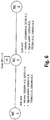
- a very simple example of a network with only three network elements (NEs) is shown.
- the customer may define in the provisioning/planning system cost values for R adding 3R regenerators, the cost for bitrate and the cost for optical bandwidth per link. Note that for simplicity, only these cost factors are shown, but of course, more (already known) cost factors can and will typically be considered.
- the cost value for the signal bandwidth depends also on the number of carriers that can be transmitted in a frequency band or frequency slot FS, assuming that the same frequency slot can be reused for a second service between same add/drop nodes.
- the provisioning system's routing engine 10 calculates the overall cost of the possibilities to configure the demand, defines the sequence based on the end to end cost and checks the optical performance for the different options listed below, where "+ 3R” indicates that one 3R regenerator needs to be provided at the intermediate network element and "e2e” stands for "end-to-end”:
- the assumed optical performance for 200G 16QAM (third variant listed above) is not sufficient unless a 3R regenerator is provided at the intermediate network element.
- the routing engine 10 would hence propose to the user in this example either to configure
- additional rules can be considered, e.g. bitrate has priority over bandwidth or the like. Additional route properties and requirements can be evaluated automatically during routing. For example, a shortest route might be discarded, if it exceeds the maximum allowed signal latency.
- the second 100G demand between the same add/drop nodes and structures can be configured "for free".
- the cost factor for the optical bandwidth (cost value per bandwidth) will change dynamically in dependence on pre-configured connections and the network utilization.
- Using the provisioning tool and method of the invention allows for early bandwidth reservation by considering future evolution of the traffic demands even at higher equipment costs for the single carrier used in the first step. In other words, unlike the state of the art optimization algorithm, a solution leading to higher equipment costs and larger bandwidth usage at the time of first service provisioning can be identified as beneficial for the future network evolution.
Landscapes
- Engineering & Computer Science (AREA)
- Computer Networks & Wireless Communication (AREA)
- Signal Processing (AREA)
- Data Exchanges In Wide-Area Networks (AREA)
- Optical Communication System (AREA)
Abstract
Disclosed is a service provisioning tool and method for determining favorable implementations of a service in a grid-less optical network, wherein said service provisioning tool is configured to assign total cost values to a given implementations, select the implementation or a group of implementations having the lowest cost, wherein said total cost values are based on
- cost values regarding selectable data rates on individual links,
- cost values regarding necessity to install additional equipment,
- cost values regarding selectable signal frequency bands.
- cost values regarding selectable data rates on individual links,
- cost values regarding necessity to install additional equipment,
- cost values regarding selectable signal frequency bands.
One or more of said cost values are dynamically changing as a function of one or more of the degree of utilization, the lifetime of the service, the time available for establishing the service, a modulation format and a signal power. The cost value per band width varies, depending on one or more of the size of the selected frequency band, and to what extent the selected frequency band fills gaps between occupied spectral ranges or creates gaps remaining between occupied spectral ranges.
Description
- The present invention is in the field of optical network management and operation. More particularly, the present invention relates to a method and tool for service provisioning with improved spectral efficiency in grid-less optical networks.
- In legacy 50GHz fixed-grid dense wavelength division multiplex (DWDM) networks, all optical signals are allocated and transported in frequency slots having a width of 50 GHz periodically spaced next to each other in a grid -like manner, as is shown in
Fig. 1 . Since the frequency slots are fixed, the corresponding network is sometimes referred to as "fixed-grid network" in the art. - In addition to the frequency slots and carriers, in
Fig. 1 the pass bands of corresponding filters used for the wavelength selective switching of the channels is shown. Due to a limited steepness of the flanks of optical filters, a signal that is spectrally close to the filter flank experiences considerable attenuation and disturbance. This effect adds up if a plurality of filters are successively passed, as is generally the case for optical signals transmitted in an optical network. As a result, the effective 3dB bandwidth for example typically reduces to 30GHz after a cascade of about 15 filters provided by wavelength selective switches (WSS). Accordingly, not the full width of the frequency slot is available for the optical signals, so that the carrier frequencies must be spectrally separated from the filter flanks by a certain amount or "safety margin", which is referred to as a "guard-band" in the art. In practice, the reach of the optical signals can be significantly affected by penalties due to optical filtering, the degree of such penalties depending on the baud rate of the optical signal (for a given filter band width), filter shape and the number of cascaded filters in the light path. For the state of the art modulation formats (100G QPSK, 150G 8QAM, 200G 16QAM) and a Baud rate of more than 34Gbaud/s (with a 25% forward error correction (FEC)), the available bandwidth in view of the filter effects is smaller than the actual band width of the optical signals, such that components from both spectral edges of the signal are cut off, leading to a significant degradation of the optical signal upon transmission. Of course, one way of decreasing filter penalties would be to enlarge the guard bands associated with a channel, as is schematically shown inFig. 2 . However, this is only possible at the expense of decreasing the spectral efficiency, and hence sacrificing transmission capacity of the network. - Recent growth in dynamic and bandwidth intense user-applications, cloud services, etc. has invoked high interest in so-called "flex-grid optical networks" or "flex-networks", which is also referred to as "flexible DWDM grids" . In the flexible DWDM grid optical networks, channel bandwidth and spectral grid allocation can be freely chosen within some granularity. A network providing this possibility to selectively choose channel bandwidths and spectral location of a channel is referred to as a "grid-less optical network" in the present disclosure, of which the "flex-grid optical network" or "flexible DWDM grid" is an example. The technology of flex-grid WSSs (ITU-T recommendation G.694.1) allows for adjustment of the bandwidth at fine granularity (typically below 6.25GHz) without introducing any amplitude dips in the spectrum of the frequency slot. As the frequency of a carrier can be freely positioned within the frequency slot, exact bandwidth adjustment optimized for the optical channel requirements becomes technically feasible. However, flex-grid networks are not only flexible with regard to the spectral location and bandwidth of channels, but also with regard to modulation formats, data rates and symbol rates. Flex-grid networks allow for simultaneous transmission of mixed bit rates, e.g. 100Gb/s, 200Gb/s, 400Gb/s, 1Tb/s, etc, and mixed modulation formats. Accordingly, in flex-grid networks, switchable transponders addressing the best possible combination of data rate, spectral efficiency, etc. can increase the efficiency and hence enable significant cost advantages to the network.
- Importantly, the flex-grid concept in optical networks provides ways for ameliorating limitations due to optical filtering by densely packing two or more carriers in a single reserved wavelength range or "frequency slot" (FS). Although this frequency slot includes a plurality of carriers, it is treated by the network as a single channel, meaning that all the carriers within this frequency slot are commonly switched at each network node passed under way. Accordingly, this frequency slot is also referred to as "media channel" in the art. An example of a media channel including four carriers is shown in
Fig. 3 , together with the filter passband of a filter used to switch this media channel. The advantage of this approach is readily apparent fromFig. 3 : Since guard bands only needed for the outermost carriers ("edge carriers"), but not in between adjacent carriers, the carriers can be packed closer to each other as compared to the arrangement ofFig. 1 , with the minimum spacing being generally limited by inter-carrier crosstalk. - The limitation of the use of media channels is that all carriers of the same FS or media channel have to be added (Tx site) and dropped (Rx site) in the same node and have to be transmitted over the same optical path. In practical applications, one has to find a compromise between improved transmission characteristics and/or increased spectral efficiency on the one hand and the routing granularity on the other hand. Thus, in practical applications, both, multi-carrier configurations such as media channels and single-carrier scenarios will coexist in the same network.
- The multitude of options provided by flex-grid networks with regard to spectral distribution of channels as well as choice of data rates, symbol rate and modulation formats bears the potential to derive an optimum use of resources for each individual path inside the network. However, the large number of possibilities makes the planning of networks and provisioning of a service particularly difficult. Different approaches have been suggested for network planning of flex-grid networks in Multi-objective Design of Survivable Flexible-Grid DWDM Networks, António Eira, João Santos, João Pedro, and João Pires J. OPT. COMMUN. NETW./VOL. 6, NO. 3/MARCH 2014, pp 326-339, Fragmentation-Aware Routing and Spectrum Allocation Scheme Based on Distribution of Traffic Bandwidth in Elastic Dptical Network, Xin Chen, Juhao Li, Paikun Zhu, Ruizhi Tang, Zhangyuan Chen, and Yongqi He, J. OPT. COMMUN. NETW./VOL. 7, NO. 11/NOVEMBER 2015, pp 1064-1074.
- However, the task of provisioning a service making optimum use of the degrees of freedom of grid-less optical network remains complex and difficult, and the prior art methods and tools have been found to fail to provide the most favorable solutions in many instances.
- An object underlying the invention is to provide a tool and a method for service provisioning for determining favorable implementations of a service in a grid-less optical network comprising transponders allowing to selectively adjust bandwidths and data rates for individual optical signals.
- This problem is solved by a service provisioning tool according to
claim 1 and a method according to claim 9. Preferable embodiments are disclosed in the dependent claims. - The service provisioning tool of the invention allows for determining favorable implementations of a service in a grid-less optical network. In particular, the service provisioning tool of the invention allows for determining the favorable implementations "online", i.e. during the operation of the network, typically provisioning one service after the other on demand. This is different from so-called "off-line" network planning tools which always work on knowledge of the complete traffic pattern. The optical network comprises transponders allowing for selectively adjusting bandwidths and data rates for individual optical signals. The service provisioning tool is configured to
- determine a plurality of possible implementations of said service,
- for each given implementation among said determined possible implementations, assign a total cost value to said given implementation, and
- select the implementation or a group of implementations having the lowest cost,
- cost values regarding selectable data rates on individual links employed in said implementation,
- cost values regarding necessity to install additional equipment, in particular a 3R regenerator, for said implementation, and
- cost values regarding selectable signal frequency bands on individual links employed in said implementation, wherein one or more of said cost values, and in particular the cost values regarding selectable signal frequency bands, are dynamically changing as a function of one or more of the degree of utilization of the respective link, the lifetime of the service, the time available for establishing the service, a modulation format on individual links employed in said implementation, and a signal power employed in said implementation, wherein the cost value per bandwidth varies, under otherwise same conditions, depending on one or more of
- the size of the selected frequency band, and
- to what extent the selected frequency band fills gaps between occupied spectral ranges or creates gaps remaining between occupied spectral ranges.
- Herein, the phrase "under otherwise same conditions" indicates that the cost value regarding selectable frequency bands, and hence the cost value per band width, may dynamically change due to other reasons, such as the utilization of the given link or the like. However, in addition to these dynamical change, i.e. under otherwise same conditions, the cost value per band width may vary as indicated above.
- According to the present invention, the most favorable implementation is found based on the combination of three cost factors, one related to data rates, one related to the necessity of installing additional equipment, and one related to the bandwidth.
- This is different from the prior art referred to above, where a service is established to yield the least equipment cost in a first step, where in a second step it is checked which carrier format for the route works and needs least spectrum - or vice versa ("cost/spectrum comparison"). In other words, the bandwidth is used as optimization factor in order to identify a best fit to the modulation type and its bandwidth requirements for the current traffic demand. Such an approach is more static as that of the invention and based on pre-calculated modulation/bandwidth combinations in a network optimized for predefined system conditions (e.g. end of lifetime fully loaded). However, this does not necessarily lead to the truly most favorable implementation. For example, consider a service request for a 400G client signal between first and second locations. If the routing is done based on equipment costs, the service provisioning tool may find a route without need to install a further 3R regenerator, which works only with 4 x 100G QPSK. If the routing is done based on spectrum costs, the service provisioning tool may come up with a spectrally more favourable 64QAM route, which however eventually requires the installation of two additional 3R regenerators because the reach of an optical signal decreases with bitrate/number of symbols in the constellation diagram. However, if one combines costs for both aspects at the same time, it may be possible to find what may turn out as the truly most favourable implementation, e.g. 2x200G 8QAM with adding one 3R regenerator. Note that all three routes can theoretically use different optical links i.e. be completely different from each other. Moreover, none of the documents referenced above allows for defining cost for spectrum - the algorithms just optimize the use of the spectrum - which can be in conflict with needs and/or the network topology.
- According to the present invention, however, one or more of the cost values, and in particular the cost values regarding selectable signal frequency bands, are dynamically changing as a function of one or more of the degree of utilization of the respective link, the lifetime of the service, the time available for establishing the service, a modulation format on individual links employed in said implementation, and a signal power employed in said implementation. This dynamical change in the cost values proves to be very powerful for making the proper choices in the implementation under an online provisioning of services, where established techniques for off-line provisioning based on a full traffic pattern may not give the desired results.
- For example, as the degree of utilization of a given link increases dynamically upon the successive provisioning of services, according to embodiments of the invention the cost values for signal frequency bands on the corresponding link can be dynamically raised, to thereby steer the service provisioning tool towards the use of other links, to avoid a future congestion of the given link.
- As another example, the cost values may depend on the lifetime of the service in question. If a service is established only for a limited period of time, for example during the Olympic Games where there is a significant increase in data traffic to and from the hosting city for limited period of time, it would be favorable to dynamically reduce the cost values regarding selectable frequency bands as compared to the cost values for equipment, because it can already be foreseen that occupied frequencies will be released again soon, while installing additional equipment may be unnecessary in view of the fact that the traffic will decrease again once the service is terminated.
- As yet another example, the cost values could depend on the time available for establishing the service. Namely, if the service would need to be established very quickly, it could be difficult or even impossible to install additional equipment in the given time, which would be a reason to dynamically raise the costs regarding necessity to install additional equipment with respect to the cost values for data rates or selectable signal frequency bands. Note that this is a typical example for a dynamically varying cost value that is of particular importance in online service provisioning, and that would not be considered in off-line network planning.
- Moreover, the service provisioning tool of the invention does not simply assign a uniform cost value per bandwidth to any selected signal frequency band. Instead, the cost value per bandwidth varies depending on the size of the selected frequency band, and/or depending on to what extent the selected frequency band fills gaps between occupied spectral ranges and/or creates gaps remaining between occupied spectral ranges. As will become more apparent from the description below, this way not only the suitability of a given service is evaluated, but also the extent to which the given service will be likely to allow a resource-efficient establishing of future services. Again, this is characteristic for an online service provisioning, where no complete traffic pattern is known, but where the proper decisions have to be made such that future services can be provisioned with a highest possible efficiency of use of resources in the long run.
- In a preferred embodiment, the service provisioning tool assigns, under otherwise same conditions, a lower cost value per bandwidth when assigning a frequency band to one or more carriers that is sufficiently large to accommodate at least one further carrier in a possible future implementation, as compared to the cost value per bandwidth for a narrower frequency band that does not permit accommodating a further carrier. This way, the service provisioning tool may select an implementation that allocates more bandwidth than currently necessary, taking the likelihood into account that an additional channel may be introduced to this frequency band at a later stage, thereby making optimal use of the resources in the long run.
- In a preferred embodiment, the service provisioning tool assigns, under otherwise same conditions, a lower cost per bandwidth to a frequency band that fills a gap existing between occupied spectral ranges as compared to the cost per bandwidth of a frequency band of the same size that does not fill such gap. This way, the service provisioning tool may be caused to choose an implementation in which a gap existing between occupied spectral ranges is filled, which otherwise may not find use in future services. In other words, this way a fragmentation of the spectrum can be avoided. This is of particular importance, because spectral fragmentation is a particular problem observed by the inventors in grid-less optical networks, that makes the establishment of future services difficult.
- In a preferred embodiment, the service provisioning tool assigns, under otherwise same conditions, a higher cost per bandwidth to a frequency band that creates an unusable gap between occupied spectral ranges as compared to the cost per bandwidth of a frequency band of the same size the does not create such unusable gap, wherein an unusable gap is a gap having a spectral width below a predetermined threshold. According to this embodiment, the likelihood of the creation of "unusable gaps" can be reduced, which again serves to avoid a spectral fragmentation in the network. Herein, the term "unusable gap" is a relative term, because whether a certain gap in the spectrum can be used or not will depend on other further parameters than the size of the gap itself but also on other parameters, such as the required data rate, path length and the like. Accordingly, in this embodiment of the invention, the "unusable gap" means a gap having a spectral width below a predetermined threshold applied by the service provisioning tool.
- In a preferred embodiment, the total cost value corresponds to a sum of the individual cost values for all links employed in a given implementation. Herein, the sum may be a weighted sum, in which the relative weight of at least two of the cost values regarding data rate, equipment installation and bandwidth are adjustable.
- Preferably, the service provisioning tool is further configured to calculate the performance of the implementation. This way, one can be sure that any implementation under consideration does in fact provide the required performance, such as a predetermined optical signal-to-noise ratio (OSNR), residual margin and bit error rate (BER).
- In a preferred embodiment, some or all of the cost values are stored in configuration files and are used for routing requests.
- In a preferred embodiment, some or all of said cost values, or weighting factors between different types of cost values, are dynamically specified as an input to the routing request.
- In a preferred embodiment, the service provisioning tool further comprises a user interface allowing a user to adjust the relative weight between two or more of the cost values regarding data rate, equipment installation and bandwidth. This way, the priorities of the operator, which can change over time, can be easily introduced into the operation of the service provisioning tool. For example, if there should be a high demand for traffic, but only for a limited time, for example during Olympic Games or when other parts of the network are subjected to maintenance, the relative weight of the cost values regarding selectable frequency can be reduced as compared to the cost values regarding necessity to install additional equipment, because a transient exhaustion of the available frequencies is tolerable, knowing that after the event leading to temporarily increased traffic, a good part of the frequencies will be released again. Under these circumstances, it would not be favorable to meet the demands by installing a large amount of additional equipment that will not be necessary anymore after the event is over.
- In a preferred embodiment, the tool provides different cost values regarding necessity to install additional equipment based on one or both of the scheduled start of the service and information regarding availability of the equipment. For example, if the service is scheduled to start very soon, but it is known that additional equipment possibly needed would not be available in time, the cost value relating to the necessity to install additional equipment will be raised, because implementations requiring such equipment should be avoided under these circumstances.
-
- Fig. 1
- shows a distribution of carriers allocated and transported in frequency slots having a fixed width of 50 GHz periodically spaced next to each other in a fixed-grid network, together with the passbands of corresponding filters.
- Fig. 2
- shows a carrier in a frequency slot exceeding 50 GHz to thereby provide enlarged guard bands, together with the passband of a corresponding filter.
- Fig. 3
- is a schematic representation of a media channel including four densely packed carriers in a predetermined frequency range, together with the passband of a corresponding filter.
- Fig. 4
- shows a schematic representation of a routing engine employed by a service provisioning tool according to an embodiment of the invention.
- Fig. 5
- is a flow diagram showing the operation of the cost value calculation selection module of the routing engine of
Fig. 4 . - Fig. 6
- schematically illustrates a simple path comprising three nodes and a summary of cost values associated with the intermediate links.
- Fig. 7
- shows an interface allowing an operator to adjust the relative weight between two or more of the cost values regarding data rate, equipment installation and bandwidth.
- For the purposes of promoting an understanding of the principles of the invention, reference will now be made to preferred embodiments illustrated in the drawings, and specific language will be used to describe the same. It will nevertheless be understood that no limitation of the scope of the invention is thereby intended, such alterations and further modifications in the illustrated method and apparatus and such further applications of the principles of the invention as illustrated therein being contemplated as would normally occur now or in the future to one skilled in the art to which the invention relates.
- In
Fig. 4 , arouting engine 10 for use by a service provisioning tool according to an embodiment of the invention is shown. Therouting engine 10 has aninput interface 12 for receiving a service routing request, and anoutput interface 14 for outputting a service routing solution. Moreover, therouting engine 10 is communicatively coupled with various information databases for retrieving information on the network needed in establishing the service routing solution. These database include atopological database 16 containing information about the network topology, acost value database 18, in which cost values for the links of the network are stored, aresource availability database 20 containing information about the availability of resources, for example which wavelengths are occupied and which wavelengths are free for use on respective links, and anoptical performance database 22. Theoptical performance database 22 includes information allowing to estimate the performance of a given path, such as penalties due to linear and nonlinear distortions, signal OSNR, and signal residual margin at actual and end of life system conditions. - The
routing engine 10 comprises a routingpath generation module 24 for determining all possible paths between the start and end nodes of the service. This routing path generation is based on network topology information retrieved from thetopology database 16, possibly taking into account a set of routing restrictions specified in the request, and the current resource availability inferred from theresource availability database 20. - The
routing engine 10 further comprises a signal frequency bandwidth andplacement selection module 26 which selects, for every path, tentative frequency bands both with regard to the bandwidth and the location of the band in the spectrum. Since the network employed in the present invention is a grid-less network, there is a large freedom to make this choice. - Moreover, the
routing engine 10 comprises a data rate/modulationformat selection module 28, which suggests tentative data rates and modulation formats to each frequency band suggested bymodule 26. - The
routing engine 10 further comprises anequipment placement module 30, which for every path established by the routingpath generation module 24, selection of width and location of the frequency band and data rate/modulation format, determines possibilities for adding additional equipment, in particular 3R regenerators, that may be necessary to achieve a desired performance with regard to the transmission quality and capacity for said path. - The combination of routing path, equipment placement, selection of width and location of the frequency band, and data rate/modulation format amounts to a possible implementation of the service. For each of the implementations established by the
modules 24 to 30, a total cost value is calculated by a cost value calculation andselection module 32, and an implementation or a group of implementations having the lowest cost is and outputted, via theoutput interface 14 as the service routing solution. For calculating the total cost value, the cost value calculation andselection module 32 retrieves information from thecost value database 18. However, as described above, the information retrieved from thecost value database 18 is generally not stationary, but is, at least in part, dynamically changing, to reflect the current condition of the network that itself is dynamically changing upon provisioning services one after the other online, as will become more apparent with reference toFig. 5 below. - The operation of the cost value calculation and
selection module 32 is described in more detail in with reference to the flow diagram shown inFig. 5 . Instep 34, the cost value calculation andselection module 32 receives a tentative implementation. Instep 36, themodule 32 calculates the performance of the implementation and checks, instep 38 whether this performance is acceptable with regard to data transmission quality, possibly depending on the service level agreement specified in the service routing request. The performance can again be estimated based on information retrieved from theoptical performance database 22. If the performance is found to be insufficient instep 38, the process returns to step 34 and starts anew with a new implementation. In the alternative, the process proceeds to step 40 in which cost values regarding selectable data rates on individual links employed in the implementation, cost values regarding necessity to install additional equipment, in particular a 3R regenerator, for the implementation, and cost values regarding selectable signal frequency bands on individual links employed in the implementation, are retrieved from a configuration file stored in thecost value database 18. - Note that according to various embodiments of the invention, the cost values stored in the
database 18 for each link are dynamically updated such as to reflect the current status of the network, utilization of specific links, current or future demands and the like. For example, even for a given link, one or more of said cost values, and in particular the cost values regarding selectable signal frequency bands, are dynamically changing as a function of one or more of the degree of utilization of the respective link, the lifetime of the service to be provisioned, the time available for establishing the service to be provisioned, a modulation format on individual links employed in said implementation, and a signal power employed in the implementation. This dynamic change can be reflected by dynamically updating the cost values as stored in thedatabase 18. Instead of dynamically updating cost values stored in thedatabase 18, they can also be calculated on the fly based on information retrieved from thecost value database 18, and possibly additional information regarding the status. - In the following
step 42, it is checked whether additional cost value input is available. Namely, in addition to the cost values or related information stored in thecost value database 18, in various embodiments of the invention it is also possible to provide further cost value input. Irrespectively of the fact that the cost values or related information stored in thecost value database 18 can in the preferred embodiments be dynamically updated in the way described above, it is possible to provide alternatively or in addition further dynamic cost value information, for example together with the service request. A typical cost value input would be a weighting factor to be applied to the cost values stored in thecost value database 18. A user interface for inputting weighting factors to the three aforementioned types of cost values (data rate, equipment, frequency band) is shown inFig. 7 . If such additional cost value input is available, the cost values are updated instep 44 accounting for such input. For example, the stored cost values can be simply multiplied with the weighting factors provided as cost value input. - In the following
step 46, it is checked whether further implementations are possible. If this is the case, the procedure returns to step 34, where the next implementation is received, and the procedure is repeated. If no further implementations are available, instep 50, the implementation or group of implementations with the lowest cost value are selected. - The user or administrator of the system can define and respectively change the cost values stored in the
cost value database 18 and employed by the cost value calculation andselection module 32, or change the rules according to which they are dynamically changed. For example, the user or administrator can define cost values for optical spectrum occupation in steps of 125 MHz. Importantly, according to the invention, the costs are not in all cases a linear function of the occupied bandwidth, or in other words, the cost value per bandwidth may vary. In particular, the cost value per bandwidth may vary depending on the size of the selected frequency band, or to what extent the selected frequency band fills gaps between occupied spectral ranges or creates gaps remaining between occupied spectral ranges. - For example, the cost value per bandwidth can be comparatively low (e.g. lower than average) when assigning a frequency band to one or more carriers that is sufficiently large to accommodate at least one further carrier in a possible future implementation. This way, the cost value calculation and
selection module 32 may come up with frequency band selections that are larger than needed, but provide good chances that the excessive bandwidth is used at a later time by one or more additional carriers, such that overall, i.e. in the long run, the spectrum is used more efficiently. In some embodiments, particularly low cost value per bandwidth can be assigned to media channel bands, i.e. bands which are meant to accommodate a number of closely packed carriers, and which possibly can be supplemented, with a certain degree of likelihood, by one or more carriers that fit in the same media channel. - Moreover, comparatively low cost values per bandwidth may be assigned to a frequency band that fills a gap existing between occupied spectral ranges. As mentioned before, the fragmentation of the frequency band is one of the most severe problems in flex-grid networks, and if there is a chance to make productive use of a gap, because a certain service request could be implemented using such gap, then the
routing engine 10 should be incited to take this opportunity, even though the gap could for example be a little wider than necessary. In this situation, in a method based on constant cost value per bandwidth, the gap would not have been used, because a slightly smaller frequency band in a free part of the spectrum would have appeared to be more favorable, thereby possibly missing a good chance, may be the only chance to make productive use of the gap. By assigning lower cost values per bandwidth to such gaps, the filling of gaps is rewarded. For example, the cost value per bandwidth may be only 50% if the required bandwidth just uses a gap in the spectrum. Assuming that normally 75 GHz would have the cost 1.5 for an optical multiplex section (OMS), if there is just a gap available with 75 GHz, the cost is only 0.75. - Moreover, there may be cases where a chosen bandwidth leads to a gap that is so small that it is questionable that it can be productively used in the future. This situation may occur if there is initially a comparatively large range between occupied frequencies, but by allocating a new band within this range, the remainder of this range is so small that the probability that any future service request can make productive use of it is likewise small. To avoid such situations, if a gap that would be created by allocating a certain frequency band falls below a predetermined threshold (for example 35 or 25 GHz), indicating that the use of the gap so created can most likely not be used in future services, the cost value of the frequency band that would lead to such "unusable gap" is increased. This could for example have the consequence that a frequency band at some other place in the spectrum is chosen, or that the entire range is chosen, although wider than necessary, giving the justified expectation that the excessive bandwidth can be used productively at a later stage by adding one or more carriers to this range, possibly in the form of a media channel.
- All cost factors (optionally after some weighting) may be mapped onto a directed graph model of the network, which is used by the routing
path generation module 24 to calculate routes for the services to be provisioned. Note that the total cost value for a link in the network can be the sum, and more generally the weighted sum of the individual cost values associated with this link. - To calculate the path, Dijkstra's algorithm for simple routes or Surballe's algorithm for calculating a pair of edge- and vertex-disjoint paths in a graph for protected services, can be used (known as shortest path algorithm). The
routing engine 10 will use the algorithm to find the best path by using the cost attributes as the optimum between the vertices. - The cost values can be different for new and already existing configurations, and they may also be changed over time
- In
Fig. 5 , a very simple example of a network with only three network elements (NEs) is shown. For this network, the customer may define in the provisioning/planning system cost values for R adding 3R regenerators, the cost for bitrate and the cost for optical bandwidth per link. Note that for simplicity, only these cost factors are shown, but of course, more (already known) cost factors can and will typically be considered. - Moreover, the cost value for the signal bandwidth depends also on the number of carriers that can be transmitted in a frequency band or frequency slot FS, assuming that the same frequency slot can be reused for a second service between same add/drop nodes.
- Let it be assumed that the user wants to create a 100G demand in the network. Based on the defined cost values and weighting factor, the provisioning system's
routing engine 10 calculates the overall cost of the possibilities to configure the demand, defines the sequence based on the end to end cost and checks the optical performance for the different options listed below, where "+ 3R" indicates that one 3R regenerator needs to be provided at the intermediate network element and "e2e" stands for "end-to-end": - 1. 200G 16QAM in 50 GHz FS e2e: overall cost: 3.0
- 2.
200G 16 QAM in 100 GHz FS e2e: overall cost: 3.9 - 3. 200G 16QAM in 50 GHz FS +3R: overall cost: 4.0
- 4. 100G QPSK in 50 GHz FS e2e: overall cost: 4.0
- 5. 200G 16QAM in 62.5 GHz FS e2e: overall cost: 4.1
- 6.
200G 16 QAM in 100 GHz FS +3R: overall cost: 4.9 - 7. 100G QPSK in 100 GHz FS e2e: overall cost: 5.0
- 8. 100G QPSK in 50 GHz FS +3R: overall cost: 5.0
- 9. 200G 16QAM in 62.5 GHz FS +3R: overall cost: 5.1
- 10. 100G QPSK in 62.5 GHz FS e2e: overall cost: 5.2
- 11. 100G QPSK in 100 GHz FS +3R: overall cost: 6.0
- 12. 100G QPSK in 62.5 GHz FS +3R: overall cost: 6.3
- Herein, the assumed optical performance for 200G 16QAM (third variant listed above) is not sufficient unless a 3R regenerator is provided at the intermediate network element. The
routing engine 10 would hence propose to the user in this example either to configure - a. 200G 16QAM in 50 GHz FS + 3R (overall cost: 4.0) or
- b. 100G QPSK in 50 GHz FS (no 3R, overall cost: 4.0).
- If the service needs to be configured automatically, i.e. without user intervention, additional rules can be considered, e.g. bitrate has priority over bandwidth or the like. Additional route properties and requirements can be evaluated automatically during routing. For example, a shortest route might be discarded, if it exceeds the maximum allowed signal latency.
- In case 200G 16QAM in 50 GHz FS +3R is configured (option a), the second 100G demand between the same add/drop nodes and structures can be configured "for free". In other words, the cost factor for the optical bandwidth (cost value per bandwidth) will change dynamically in dependence on pre-configured connections and the network utilization.
- Let it be assumed that the user wants to create another 100G demand in the network between the same network elements. In case a frequency slot is configured for the first demand which allows to be used for a second demand (option a), the bandwidth cost need not to be considered for the second demand. In the example shown above this means that the cost for e.g. 100G QPSK in 100 GHz FS e2e which is already available is 2.1.
- The service provisioning tool and method of the invention has a number of important advantages:
- It allows for obtaining the lowest cost per bit and the flexible adaptation to the customers' business model, e.g. own vs rented fiber, available fiber capacity, additional equipment vs new cabling.
- After a user has defined the cost values, the provisioning system can do the rest and identify lowest cost per bit. The user himself, however, does not have to take care about supported different bitrates and the complexity of grid-less optical networks. Instead, the user just needs to enter the demand.
- By choosing the cost values, the user can optimize cost for service provisioning according the customer's specific business model (operational process, available fiber capacity, country specific laws and rules, cost and possibility to supply new fibers, ...)
- The cost values can be changed dynamically in dependence on service requirements.
- The modulation type and number of carriers best fitting to the capacity of the service to be provisioned can be determined.
- The frequency slot bandwidth best fitting to the modulation type and number of filters in the optical path can be determined.
- The spectral location from available bandwidth in the C-band best fitting to the bandwidth of the frequency slot can be selected.
- The invention allows weighting spectrum cost versus equipment costs.
- Note that with higher order of the modulation type, higher spectral efficiency can be achieved (lower costs per bit). However, higher order modulation types are less tolerant to the optical filtering effects in the path. In this case, a multi-carrier frequency slot (super-channel) may be of higher benefit. Using the provisioning tool and method of the invention allows for early bandwidth reservation by considering future evolution of the traffic demands even at higher equipment costs for the single carrier used in the first step. In other words, unlike the state of the art optimization algorithm, a solution leading to higher equipment costs and larger bandwidth usage at the time of first service provisioning can be identified as beneficial for the future network evolution.
- Although preferred exemplary embodiments are shown and specified in detail in the drawings and the preceding specification, these should be viewed as purely exemplary and not as limiting the invention. It is noted in this regard that only the preferred exemplary embodiments are shown and specified, and all variations and modifications should be protected that presently or in the future lie within the scope of protection of the invention as defined in the appended claims.
Claims (15)
- A service provisioning tool for determining favorable implementations of a service in a grid-less optical network, said optical network comprising transponders allowing to selectively adjust bandwidths and data rates for individual optical signals,
wherein said service provisioning tool is configured to- determine a plurality of possible implementations of said service,- for each given implementation among said determined possible implementations, assign a total cost value to said given implementation, and- select the implementation or a group of implementations having the lowest cost,wherein said total cost values are based on- cost values regarding selectable data rates on individual links employed in said implementation,- cost values regarding necessity to install additional equipment, in particular a 3R regenerator, for said implementation, and- cost values regarding selectable signal frequency bands on individual links employed in said implementation,wherein the cost value per band width varies, under otherwise same conditions, depending on one or more of
wherein one or more of said cost values, and in particular the cost values regarding selectable signal frequency bands, are dynamically changing as a function of one or more of the degree of utilization of the respective link, the lifetime of the service, the time available for establishing the service, a modulation format on individual links employed in said implementation, and a signal power employed in said implementation,- the size of the selected frequency band, and- to what extent the selected frequency band fills gaps between occupied spectral ranges or creates gaps remaining between occupied spectral ranges. - The service provisioning tool of claim 1, wherein said service provisioning tool assigns, under otherwise same conditions, a lower cost value per band width when assigning a frequency band to one or more carriers that is sufficiently large to accommodate at least one further carrier in a possible future implementation, as compared to the cost value per band width for a narrower frequency band that does not permit accommodating a further carrier.
- The service provisioning tool of claim 1 or 2, wherein said service provisioning tool assigns, under otherwise same conditions, a lower cost per band width to a frequency band that fills a gap existing between occupied spectral ranges as compared to the cost per band width of a frequency band of the same size that does not fill such gap.
- The service provisioning tool of one of the preceding claims, wherein said service provisioning tool assigns, under otherwise same conditions, a higher cost per band width to a frequency band that creates an unusable gap between occupied spectral ranges as compared to the cost per band width of a frequency band of the same size that does not create such unusable gap, wherein an unusable gap is a gap having a spectral width below a predetermined threshold.
- The service provisioning tool of one of the preceding claims, wherein the total cost value corresponds to a sum of the individual cost values for all links employed in a given implementation,
wherein the sum is preferably a weighted sum, in which the relative weight of at least two of the cost values regarding data rate, equipment installation and bandwidth are adjustable. - The service provisioning tool of one of the preceding claims, which is further configured to calculate the performance of the implementation, and/or
wherein some or all of said cost values, or weighting factors between different types of cost values, are stored in configuration files and are used for routing requests, wherein said service provisioning tool is configured for dynamically updating at least some of said cost values or weighting factors stored in said configuration files, and/or
wherein some or all of said cost values are dynamically specified as an input to the routing request. - The service provisioning tool of one of the preceding claims, further comprising a user interface allowing a user to adjust the relative weight between two or more of the cost values regarding data rate, equipment installation and band width.
- The service provisioning tool of one of the preceding claims, wherein the tool provides different cost values regarding necessity to install additional equipment based on one or both of the scheduled start of the service and information regarding availability of the equipment.
- A method for service provisioning, said method comprising determining favorable implementations of a service in a grid-less optical network, said optical network comprising transponders allowing to selectively adjust bandwidths and data rates for individual optical signals,
wherein said method comprises the steps of- determining a plurality of possible implementations of said service,- for each given implementation among said determined possible implementations, assigning a total cost value to said given implementation, and- selecting the implementation or a group of implementations having the lowest cost,wherein said total cost values are based on- cost values regarding selectable data rates on individual links employed in said implementation,- cost values regarding necessity to install additional equipment, in particular a 3R regenerator, for said implementation, and- cost values regarding selectable signal frequency bands on individual links employed in said implementation,wherein the cost value per band width varies, under otherwise same conditions, depending on one or more of
wherein one or more of said cost values, and in particular the cost values regarding selectable signal frequency bands, are dynamically changing as a function of one or more of the degree of utilization of the respective link, the lifetime of the service, the time available for establishing the service, a modulation format on individual links employed in said implementation, and a signal power employed in said implementation,- the size of the selected frequency band, and- to what extent the selected frequency band fills gaps between occupied spectral ranges or creates gaps remaining between occupied spectral ranges. - The method of claim 9, further comprising a step of assigning, under otherwise same conditions, a lower cost value per band width when assigning a frequency band to one or more carriers that is sufficiently large to accommodate at least one further carrier in a possible future implementation, as compared to the cost value per band width for a narrower frequency band that does not permit accommodating a further carrier.
- The method of claim 9 or 10, further comprising a step of assigning, under otherwise same conditions, a lower cost per band width to a frequency band that fills a gap existing between occupied spectral ranges as compared to the cost per band width of a frequency band of the same size that does not fill such gap.
- The method of one of claims 9 to 11, further comprising a step of assigning, under otherwise same conditions, a higher cost per band width to a frequency band that creates an unusable gap between occupied spectral ranges as compared to the cost per band width of a frequency band of the same size that does not create such unusable gap, wherein an unusable gap is a gap having a spectral width below a predetermined threshold.
- The method of one of claims 9 to 12, wherein the total cost value corresponds to a sum of the individual cost values for all links employed in a given implementation, wherein the sum is preferably a weighted sum, in which the relative weight of at least two of the cost values regarding data rate, equipment installation and bandwidth are adjustable, and/or wherein the method further comprises a step of calculating the performance of the implementation.
- The method of one of claims 9 to 13, wherein some or all of said cost values, or weighting factors between different types of cost values, are stored in configuration files and are used for routing requests, wherein at least some of said cost values or weighting factors are dynamically updated during use of the method, and/or
wherein some or all of said cost values are dynamically specified as an input to the routing request. - The method of one of claims 9 to 14, further comprising a a step of receiving input from a user interface and adjusting, in response to said input, the relative weight between two or more of the cost values regarding data rate, equipment installation and band width, and/or wherein the method utilizes different cost values regarding necessity to install additional equipment based on one or both of the scheduled start of the service and information regarding availability of the equipment.
Priority Applications (5)
| Application Number | Priority Date | Filing Date | Title |
|---|---|---|---|
| EP17153753.3A EP3355498A1 (en) | 2017-01-30 | 2017-01-30 | Method and tool for service provisioning with improved spectral efficiency in grid-less optical networks |
| US16/482,235 US10972208B2 (en) | 2017-01-30 | 2017-12-05 | Method and tool for service provisioning with improved spectral efficiency in grid-less optical networks |
| EP17805238.7A EP3574594A1 (en) | 2017-01-30 | 2017-12-05 | Method and tool for service provisioning with improved spectral efficiency in grid-less optical networks |
| CN201780085005.0A CN110249556A (en) | 2017-01-30 | 2017-12-05 | Methods and tools for service provisioning with improved spectral efficiency in gridless networks |
| PCT/EP2017/081554 WO2018137818A1 (en) | 2017-01-30 | 2017-12-05 | Method and tool for service provisioning with improved spectral efficiency in grid-less optical networks |
Applications Claiming Priority (1)
| Application Number | Priority Date | Filing Date | Title |
|---|---|---|---|
| EP17153753.3A EP3355498A1 (en) | 2017-01-30 | 2017-01-30 | Method and tool for service provisioning with improved spectral efficiency in grid-less optical networks |
Publications (1)
| Publication Number | Publication Date |
|---|---|
| EP3355498A1 true EP3355498A1 (en) | 2018-08-01 |
Family
ID=57965676
Family Applications (2)
| Application Number | Title | Priority Date | Filing Date |
|---|---|---|---|
| EP17153753.3A Withdrawn EP3355498A1 (en) | 2017-01-30 | 2017-01-30 | Method and tool for service provisioning with improved spectral efficiency in grid-less optical networks |
| EP17805238.7A Withdrawn EP3574594A1 (en) | 2017-01-30 | 2017-12-05 | Method and tool for service provisioning with improved spectral efficiency in grid-less optical networks |
Family Applications After (1)
| Application Number | Title | Priority Date | Filing Date |
|---|---|---|---|
| EP17805238.7A Withdrawn EP3574594A1 (en) | 2017-01-30 | 2017-12-05 | Method and tool for service provisioning with improved spectral efficiency in grid-less optical networks |
Country Status (4)
| Country | Link |
|---|---|
| US (1) | US10972208B2 (en) |
| EP (2) | EP3355498A1 (en) |
| CN (1) | CN110249556A (en) |
| WO (1) | WO2018137818A1 (en) |
Cited By (2)
| Publication number | Priority date | Publication date | Assignee | Title |
|---|---|---|---|---|
| CN109450807A (en) * | 2018-11-28 | 2019-03-08 | 迈普通信技术股份有限公司 | A kind of interface selection method and communication equipment |
| CN116707698A (en) * | 2023-06-27 | 2023-09-05 | 重庆邮电大学 | A Resource Allocation Method Based on Deep Reinforcement Learning in Space-Division Multiplexed Elastic Optical Networks |
Families Citing this family (2)
| Publication number | Priority date | Publication date | Assignee | Title |
|---|---|---|---|---|
| US10397672B2 (en) * | 2016-06-20 | 2019-08-27 | Cable Television Laboratories, Inc. | Systems and methods for intelligent edge to edge optical system and wavelength provisioning |
| US10200123B2 (en) | 2016-06-20 | 2019-02-05 | Cable Television Laboratories, Inc. | System and methods for distribution of heterogeneous wavelength multiplexed signals over optical access network |
Citations (2)
| Publication number | Priority date | Publication date | Assignee | Title |
|---|---|---|---|---|
| US20040220886A1 (en) * | 2003-04-30 | 2004-11-04 | Lucent Technologies, Inc. | Communication signal resource chain assignment for optical networks subject to reach constraints |
| US8515280B1 (en) * | 2010-12-13 | 2013-08-20 | At&T Intellectual Property I, L.P. | Physically-diverse routing in heterogeneous optical networks |
Family Cites Families (29)
| Publication number | Priority date | Publication date | Assignee | Title |
|---|---|---|---|---|
| US6256309B1 (en) * | 1998-04-28 | 2001-07-03 | Cisco Technology, Inc. | Quality of service sensitive routes precomputed in bandwidth brackets |
| US7171124B2 (en) * | 2001-07-19 | 2007-01-30 | Lucent Technologies Inc. | Wavelength routing and switching mechanism for a photonic transport network |
| US7599621B2 (en) * | 2001-07-19 | 2009-10-06 | Alcatel-Lucent Usa Inc. | Trail engineering in agile photonic networks |
| US7113481B2 (en) * | 2001-10-10 | 2006-09-26 | Alcatel | Informed dynamic path protection for optical networks |
| WO2007062670A1 (en) * | 2005-11-29 | 2007-06-07 | Telecom Italia S.P.A. | Optimized dynamic routing in an optical network |
| JP2009153029A (en) * | 2007-12-21 | 2009-07-09 | Fujitsu Ltd | Transmission system |
| US8873956B2 (en) * | 2008-08-15 | 2014-10-28 | Tellabs Operations, Inc. | Method and apparatus for planning network configuration in an optical network |
| US9490894B2 (en) * | 2008-12-08 | 2016-11-08 | Ciena Corporation | Coherent probe and optical service channel systems and methods for optical networks |
| JP5429292B2 (en) * | 2009-09-18 | 2014-02-26 | 富士通株式会社 | Route search method and node device |
| EP2514126A1 (en) * | 2009-12-14 | 2012-10-24 | Telefonaktiebolaget L M Ericsson (PUBL) | Routing and validation of paths in a wavelength switched optical network |
| US8452176B2 (en) * | 2011-02-18 | 2013-05-28 | At&T Intellectual Property I, Lp | Reachability matrices spanning multiple domains in an optical network |
| EP2571184B1 (en) * | 2011-09-16 | 2017-02-22 | Alcatel Lucent | Allocation of spectral capacity in a wavelength-division multiplexing optical network |
| US8879906B2 (en) * | 2011-10-05 | 2014-11-04 | Nec Laboratories America, Inc. | Optimal combined 2R/3R regenerators placement method for line network topologies in optical WDM networks |
| EP2615756B1 (en) * | 2012-01-16 | 2014-03-19 | Alcatel Lucent | Method of allocating bandwidth in an optical network |
| US9083484B2 (en) * | 2012-02-13 | 2015-07-14 | Ciena Corporation | Software defined networking photonic routing systems and methods |
| EP2701324A1 (en) * | 2012-08-22 | 2014-02-26 | Xieon Networks S.à.r.l. | Method and device for conveying optical data |
| US9350481B2 (en) * | 2012-10-08 | 2016-05-24 | Futurewei Technologies, Inc. | Transport functions virtualization for wavelength division multiplexing (WDM)-based optical networks |
| US9160477B2 (en) * | 2013-02-14 | 2015-10-13 | Nec Laboratories America, Inc. | Virtual networking embedding procedure in an optical wavelength division multiplexing (WDM) network |
| US9060215B2 (en) * | 2013-05-10 | 2015-06-16 | Ciena Corporation | Network specific routing and wavelength assignment for optical communications networks |
| US9654247B2 (en) * | 2014-02-04 | 2017-05-16 | Nec Corporation | Grooming multicast traffic in flexible optical wavelength division multiplexing WDM networks |
| US9497521B2 (en) * | 2014-04-30 | 2016-11-15 | Ciena Corporation | Opportunity based path computation systems and methods in constraint-based routing |
| US9438370B2 (en) * | 2014-05-19 | 2016-09-06 | Ciena Corporation | Margin-based optimization systems and methods in optical networks to unblock superchannels |
| CN104901764A (en) * | 2015-06-30 | 2015-09-09 | 苏州大学张家港工业技术研究院 | Quasi coarse wavelength division multiplexing optical network design method |
| US10205523B2 (en) * | 2015-08-14 | 2019-02-12 | Futurewei Technologies, Inc. | Designing and configuring packet optical networks |
| US9686599B2 (en) * | 2015-11-18 | 2017-06-20 | Ciena Corporation | Minimal spectrum occupancy systems and methods for routing and wavelength or spectrum assignment in optical networks |
| US10411806B2 (en) * | 2016-06-29 | 2019-09-10 | Ciena Corporation | Gridless optical routing and spectrum assignment |
| US10250351B2 (en) * | 2016-10-11 | 2019-04-02 | Futurewei Technologies, Inc. | Efficient network utilization using optically switched superchannels |
| US10348439B1 (en) * | 2018-05-14 | 2019-07-09 | Fujitsu Limited | Spectral slot assignment and placement of wavelength shifters in flexible grid optical networks |
| US10516482B1 (en) * | 2019-02-08 | 2019-12-24 | Google Llc | Physical layer routing and monitoring |
-
2017
- 2017-01-30 EP EP17153753.3A patent/EP3355498A1/en not_active Withdrawn
- 2017-12-05 US US16/482,235 patent/US10972208B2/en active Active
- 2017-12-05 CN CN201780085005.0A patent/CN110249556A/en active Pending
- 2017-12-05 EP EP17805238.7A patent/EP3574594A1/en not_active Withdrawn
- 2017-12-05 WO PCT/EP2017/081554 patent/WO2018137818A1/en not_active Ceased
Patent Citations (2)
| Publication number | Priority date | Publication date | Assignee | Title |
|---|---|---|---|---|
| US20040220886A1 (en) * | 2003-04-30 | 2004-11-04 | Lucent Technologies, Inc. | Communication signal resource chain assignment for optical networks subject to reach constraints |
| US8515280B1 (en) * | 2010-12-13 | 2013-08-20 | At&T Intellectual Property I, L.P. | Physically-diverse routing in heterogeneous optical networks |
Non-Patent Citations (3)
| Title |
|---|
| ANTONIO EIRA; JOAO SANTOS; JOAO PEDRO; JOAO PIRES J: "Multi-objective Design of Survivable Flexible-Grid DWDM Networks", OPT. COMMUN. NETW.NOL, vol. 6, no. 3, March 2014 (2014-03-01), pages 326 - 339, XP011544547, DOI: doi:10.1364/JOCN.6.000326 |
| EIRA ANTONIO ET AL: "Multi-objective design of survivable flexible-grid DWDM networks", JOURNAL OF OPTICAL COMMUNICATIONS AND NETWORKING, INSTITUTE OF ELECTRICAL AND ELECTRONICS ENGINEERS, US, vol. 6, no. 3, 1 March 2014 (2014-03-01), pages 326 - 339, XP011544547, ISSN: 1943-0620, [retrieved on 20140403], DOI: 10.1364/JOCN.6.000326 * |
| XIN CHEN; JUHAO LI; PAIKUN ZHU; RUIZHI TANG; ZHANGYUAN CHEN; YONGQI HE: "Fragmentation-Aware Routing and Spectrum Allocation Scheme Based on Distribution of Traffic Bandwidth in Elastic Optical Networks", J. OPT. COMMUN. NETW, vol. 7, no. 11, November 2015 (2015-11-01), pages 1064 - 1074, XP011590799, DOI: doi:10.1364/JOCN.7.001064 |
Cited By (3)
| Publication number | Priority date | Publication date | Assignee | Title |
|---|---|---|---|---|
| CN109450807A (en) * | 2018-11-28 | 2019-03-08 | 迈普通信技术股份有限公司 | A kind of interface selection method and communication equipment |
| CN109450807B (en) * | 2018-11-28 | 2022-02-22 | 迈普通信技术股份有限公司 | Interface selection method and communication equipment |
| CN116707698A (en) * | 2023-06-27 | 2023-09-05 | 重庆邮电大学 | A Resource Allocation Method Based on Deep Reinforcement Learning in Space-Division Multiplexed Elastic Optical Networks |
Also Published As
| Publication number | Publication date |
|---|---|
| EP3574594A1 (en) | 2019-12-04 |
| US20190349114A1 (en) | 2019-11-14 |
| US10972208B2 (en) | 2021-04-06 |
| WO2018137818A1 (en) | 2018-08-02 |
| CN110249556A (en) | 2019-09-17 |
Similar Documents
| Publication | Publication Date | Title |
|---|---|---|
| EP2571184B1 (en) | Allocation of spectral capacity in a wavelength-division multiplexing optical network | |
| Wang et al. | Spectrum management in heterogeneous bandwidth networks | |
| US9654248B2 (en) | Optical data transmission method and apparatus | |
| Lord et al. | Core networks in the flexgrid era | |
| EP2748957B1 (en) | Routing and bandwidth assignment for flexible grid wavelength switched optical networks | |
| US10972208B2 (en) | Method and tool for service provisioning with improved spectral efficiency in grid-less optical networks | |
| US11190269B2 (en) | Method and system for assigning spectral resources | |
| JP6677166B2 (en) | Optical network system, optical node device, and optical path setting method | |
| JP2020078092A (en) | Optical network system, optical node device, and optical network control method | |
| Sócrates-Dantas et al. | Challenges and requirements of a control plane for elastic optical networks | |
| EP2745443B1 (en) | A method and apparatus for allocating slots for transmission of data | |
| WO2018065038A1 (en) | Physical path control in hierarchical networks | |
| US10574381B2 (en) | Optical network design and routing | |
| JP5713446B2 (en) | Pass accommodation control method | |
| JP7081482B2 (en) | Optical network management device and optical frequency band allocation method | |
| JP7077949B2 (en) | Optical path design device and optical path design method | |
| CN112913164B (en) | Time and wave division multiplexing | |
| CN104054287B (en) | Method for allocating bandwidth in an optical network | |
| Regis et al. | Differentiated restoration based multipath re-provisioning for disaster recovery in EONs | |
| Giorgetti et al. | ONOS MetroApp for filtering effect assessment in metro optical networks | |
| Hasegawa et al. | Resilient grouped routing optical networks with finely granular protection | |
| Hadi et al. | Improved routing and spectrum assignment formulations for optical OFDM networks | |
| Soumplis et al. | Model Predictive Control Scheduling for Extended Access Metro P2MP Optical Networks | |
| Terada et al. | Highly spectral efficient elastic optical network employing grouped optical path routing | |
| Song et al. | A Two-Phase ILP Formulation for Partial Upgrade From Fixed-Grid to Mixed-Grid Optical Networks with Multi-Band |
Legal Events
| Date | Code | Title | Description |
|---|---|---|---|
| PUAI | Public reference made under article 153(3) epc to a published international application that has entered the european phase |
Free format text: ORIGINAL CODE: 0009012 |
|
| AK | Designated contracting states |
Kind code of ref document: A1 Designated state(s): AL AT BE BG CH CY CZ DE DK EE ES FI FR GB GR HR HU IE IS IT LI LT LU LV MC MK MT NL NO PL PT RO RS SE SI SK SM TR |
|
| AX | Request for extension of the european patent |
Extension state: BA ME |
|
| STAA | Information on the status of an ep patent application or granted ep patent |
Free format text: STATUS: THE APPLICATION IS DEEMED TO BE WITHDRAWN |
|
| 18D | Application deemed to be withdrawn |
Effective date: 20190202 |