EP3355266A1 - Systems and methods for contextualizing data obtained from barcode images - Google Patents
Systems and methods for contextualizing data obtained from barcode images Download PDFInfo
- Publication number
- EP3355266A1 EP3355266A1 EP18152752.4A EP18152752A EP3355266A1 EP 3355266 A1 EP3355266 A1 EP 3355266A1 EP 18152752 A EP18152752 A EP 18152752A EP 3355266 A1 EP3355266 A1 EP 3355266A1
- Authority
- EP
- European Patent Office
- Prior art keywords
- barcode
- contextual
- barcodes
- distance
- mobile computing
- Prior art date
- Legal status (The legal status is an assumption and is not a legal conclusion. Google has not performed a legal analysis and makes no representation as to the accuracy of the status listed.)
- Withdrawn
Links
Images




Classifications
-
- G—PHYSICS
- G06—COMPUTING OR CALCULATING; COUNTING
- G06Q—INFORMATION AND COMMUNICATION TECHNOLOGY [ICT] SPECIALLY ADAPTED FOR ADMINISTRATIVE, COMMERCIAL, FINANCIAL, MANAGERIAL OR SUPERVISORY PURPOSES; SYSTEMS OR METHODS SPECIALLY ADAPTED FOR ADMINISTRATIVE, COMMERCIAL, FINANCIAL, MANAGERIAL OR SUPERVISORY PURPOSES, NOT OTHERWISE PROVIDED FOR
- G06Q90/00—Systems or methods specially adapted for administrative, commercial, financial, managerial or supervisory purposes, not involving significant data processing
- G06Q90/20—Destination assistance within a business structure or complex
-
- G—PHYSICS
- G06—COMPUTING OR CALCULATING; COUNTING
- G06K—GRAPHICAL DATA READING; PRESENTATION OF DATA; RECORD CARRIERS; HANDLING RECORD CARRIERS
- G06K7/00—Methods or arrangements for sensing record carriers, e.g. for reading patterns
- G06K7/10—Methods or arrangements for sensing record carriers, e.g. for reading patterns by electromagnetic radiation, e.g. optical sensing; by corpuscular radiation
- G06K7/10544—Methods or arrangements for sensing record carriers, e.g. for reading patterns by electromagnetic radiation, e.g. optical sensing; by corpuscular radiation by scanning of the records by radiation in the optical part of the electromagnetic spectrum
- G06K7/10712—Fixed beam scanning
- G06K7/10722—Photodetector array or CCD scanning
-
- G—PHYSICS
- G06—COMPUTING OR CALCULATING; COUNTING
- G06K—GRAPHICAL DATA READING; PRESENTATION OF DATA; RECORD CARRIERS; HANDLING RECORD CARRIERS
- G06K19/00—Record carriers for use with machines and with at least a part designed to carry digital markings
- G06K19/06—Record carriers for use with machines and with at least a part designed to carry digital markings characterised by the kind of the digital marking, e.g. shape, nature, code
- G06K19/06009—Record carriers for use with machines and with at least a part designed to carry digital markings characterised by the kind of the digital marking, e.g. shape, nature, code with optically detectable marking
- G06K19/06037—Record carriers for use with machines and with at least a part designed to carry digital markings characterised by the kind of the digital marking, e.g. shape, nature, code with optically detectable marking multi-dimensional coding
-
- G—PHYSICS
- G06—COMPUTING OR CALCULATING; COUNTING
- G06K—GRAPHICAL DATA READING; PRESENTATION OF DATA; RECORD CARRIERS; HANDLING RECORD CARRIERS
- G06K7/00—Methods or arrangements for sensing record carriers, e.g. for reading patterns
- G06K7/10—Methods or arrangements for sensing record carriers, e.g. for reading patterns by electromagnetic radiation, e.g. optical sensing; by corpuscular radiation
- G06K7/10544—Methods or arrangements for sensing record carriers, e.g. for reading patterns by electromagnetic radiation, e.g. optical sensing; by corpuscular radiation by scanning of the records by radiation in the optical part of the electromagnetic spectrum
- G06K7/10821—Methods or arrangements for sensing record carriers, e.g. for reading patterns by electromagnetic radiation, e.g. optical sensing; by corpuscular radiation by scanning of the records by radiation in the optical part of the electromagnetic spectrum further details of bar or optical code scanning devices
- G06K7/10881—Methods or arrangements for sensing record carriers, e.g. for reading patterns by electromagnetic radiation, e.g. optical sensing; by corpuscular radiation by scanning of the records by radiation in the optical part of the electromagnetic spectrum further details of bar or optical code scanning devices constructional details of hand-held scanners
-
- G—PHYSICS
- G06—COMPUTING OR CALCULATING; COUNTING
- G06K—GRAPHICAL DATA READING; PRESENTATION OF DATA; RECORD CARRIERS; HANDLING RECORD CARRIERS
- G06K7/00—Methods or arrangements for sensing record carriers, e.g. for reading patterns
- G06K7/10—Methods or arrangements for sensing record carriers, e.g. for reading patterns by electromagnetic radiation, e.g. optical sensing; by corpuscular radiation
- G06K7/14—Methods or arrangements for sensing record carriers, e.g. for reading patterns by electromagnetic radiation, e.g. optical sensing; by corpuscular radiation using light without selection of wavelength, e.g. sensing reflected white light
- G06K7/1404—Methods for optical code recognition
- G06K7/1408—Methods for optical code recognition the method being specifically adapted for the type of code
- G06K7/1417—2D bar codes
-
- G—PHYSICS
- G06—COMPUTING OR CALCULATING; COUNTING
- G06K—GRAPHICAL DATA READING; PRESENTATION OF DATA; RECORD CARRIERS; HANDLING RECORD CARRIERS
- G06K7/00—Methods or arrangements for sensing record carriers, e.g. for reading patterns
- G06K7/10—Methods or arrangements for sensing record carriers, e.g. for reading patterns by electromagnetic radiation, e.g. optical sensing; by corpuscular radiation
- G06K7/14—Methods or arrangements for sensing record carriers, e.g. for reading patterns by electromagnetic radiation, e.g. optical sensing; by corpuscular radiation using light without selection of wavelength, e.g. sensing reflected white light
- G06K7/1404—Methods for optical code recognition
- G06K7/1439—Methods for optical code recognition including a method step for retrieval of the optical code
- G06K7/1447—Methods for optical code recognition including a method step for retrieval of the optical code extracting optical codes from image or text carrying said optical code
Definitions
- Barcodes are ubiquitous elements appearing on many items to identify, track, or provide information.
- Barcode can be single-dimensional (1D), for example a UPC package code, or two-dimensional (2D), for example, a QR code.
- Barcode reader applications are well-known and well-deployed. Conventional barcode reader applications read a single code at one time as their purpose is to utilize the barcode to obtain information about an object.
- Embodying systems and methods can capture one, two or more barcodes in the same image or a frame in video streams and decode the captured barcodes using a barcode reader application installed on a mobile computing device (e.g., smartphone, tablet, wearable computing device (watch, eyeglasses, head mounted devices), etc.).
- Embodying systems can provide contextual instruction and/or information based on the content of the barcodes captured in the same image.
- the proximity, distance, orientation, and/or angle between the captured barcodes can be analyzed by embodying systems and methods to develop the contextual instructions.
- embodying systems and methods can decode barcodes on multiple components captured in the same image, and provide assembly instruction(s) to a user (e.g., factory assembly, electronic system interconnection, etc.).
- a current location of a user can be obtained by interpolating, and/or triangulating, between positions indicated by decoding barcodes captured in the same image.
- supplemental information, instruction, and/or guidance can be provided by accessing datastore records associated with the barcodes.
- embodiments are not limited to these specific use examples, and other implementations are within the scope of this disclosure.
- Figure 1 depicts system 100 for decoding barcodes and providing contextual instruction and/or information in accordance with embodiments.
- the contextual instruction and/or information can be provided in via multi-modal communication (e.g., visual display, audio notification, tactile stimulus, etc.) to a mobile computing device.
- An embodying system includes mobile computing device 110, which can include control processor 111 that communicates with other components over internal data/control bus 112. Control processor 111 accesses computer executable instructions 113, which can be stored in memory 114 to implement barcode reader application 115.
- the mobile computing device can include input/output (I/O) unit 119 that communicates across electronic communication network 120.
- I/O unit 119 can support one or more hardwire and/or wireless communication protocols including, but not limited to, cellular telephone protocol, Bluetooth, low energy Bluetooth, iBeacon, near field communication, Airplay, etc.
- Mobile computing device 110 can include imaging device 117 (e.g., a camera or other image capture device). An image captured by imaging device 117 can be displayed on display screen 118. The captured image can be a still photograph or a video (including video of a moving object). Imaging device 117 can have a field-or-view wide enough so that two or more barcodes 136, 137, 138 located on respective devices 130, 132, 134 can be captured in the same image.
- the mobility afforded to users by mobile computing device 110 allows the user to move about and perform tasks between barcode scanning.
- Barcodes are ubiquitous and can appear on just about any type of item. Accordingly, embodying systems and methods are not limited by the nature and/or type of devices 130, 132, 134.
- barcodes 136, 137, 138 can each be an applique appearing on a surface of a structure (e.g., ceiling, wall, pillar, etc.).
- Barcode reader application 115 can interpret captured images (still photograph or video) to extract the barcode from the image and obtain data represented by the barcode.
- Electronic communication network 120 can be, can comprise, or can be part of, a private internet protocol (IP) network, the Internet, an integrated services digital network (ISDN), integrated services digital network (ISDN), a modem connected to a phone line, a public switched telephone network (PSTN), a public or private data network, a local area network (LAN), a metropolitan area network (MAN), a wide area network (WAN), a wireline or wireless network, a local, regional, or global communication network, an enterprise intranet, any combination of the preceding, and/or any other suitable communication infrastructure.
- IP internet protocol
- ISDN integrated services digital network
- ISDN integrated services digital network
- PSTN public switched telephone network
- LAN local area network
- MAN metropolitan area network
- WAN wide area network
- wireline or wireless network a local, regional, or global communication network
- enterprise intranet any combination of the preceding, and/or any other suitable communication infrastructure.
- remote server 140 which can include server control processor 142. Operation, communication and other functions of the remote server can be performed under the control of server control processor 142.
- Communicatively coupled to the remote server is datastore 150 where computer executable instructions 152 can be stored.
- the server control processor can access computer executable instructions 152 to perform its operations.
- Datastore 150 can include a repository of data records including indoor positioning system (IPS) map 154 and barcode specific information 156. The barcode specific information can be used to provide supplemental information, instruction, and/or guidance based on the decoded content of a barcode. Communication with datastore 150 can be across electronic communication network 120.
- IPS indoor positioning system
- IPS map 154 can be accessed by mobile computing device 110 and displayed on mobile computing device screen 118.
- IPS map 154 can include a coordinate system to locate positions within the structure represented by the map.
- IPS map 154 can include a layout of a floorplan for the structure.
- an IPS map of a retail establishment can include shelving units, aisles, counters, open spaces, etc.
- a map can be provided for each floor of a multi-floor structure.
- mobile computing device 110 can capture an image containing one or more barcodes.
- the image can be provided to a remote computing device (e.g., remote server 140).
- the remote server can decode the barcode image, and perform other tasks described herein. This implementation can be implemented when mobile computing device 110 lacks sufficient processing power.
- Figure 2 depicts barcode image 200 captured by imaging device 112 in accordance with embodiments.
- Barcode image 200 is exemplary of a barcode image captured when the barcode is not normal to a longitudinal axis of the imaging device - i.e., the barcode is slanted off the longitudinal axis. This slant can result in distortion of the barcode image - e.g., the foreground is wider and there are nonlinearities within the image itself.
- barcode reader application 115 is capable of identifying the location of barcode labels 136, 137, 138 on respective devices 130, 132, 134.
- Figure 3 depicts the capture of two barcodes 136, 305 by imaging device 112 within mobile computing device 110 in accordance with embodiments.
- FIG. 3 depicts barcode 305 positioned on a vertical wall (or other surface) and barcode 136 is depicted on the surface of device 130.
- Barcode 136 is positioned about perpendicular to a longitudinal optical axis of the imaging device.
- Barcode 305 is positioned at an angle off the longitudinal axis, but still within the field-of-view of imaging device 112.
- both barcode 136 and barcode 305 can be captured by imaging device 112.
- Embodying systems and methods are not limited to the capture of only two barcodes; the capture of one, two or more barcodes is within the contemplation of this disclosure.
- the barcodes of the captured image can be decoded by barcode reader application 115.
- the perspective view of barcode 305 resulting from its off-axis positioning can improve its readability by the barcode reader application because the barcode will appear as expected (i.e., square) to the barcode reader application.
- selection and decoding of a barcode (or multiple barcodes) in an image can be based on a magnitude of a metric that quantifies a relationship.
- a metric can be the distance between the barcode and the imaging device, and the condition can be if the distance is less than a predetermined threshold. If the magnitude of the metric satisfies a predetermined condition, then a contextual user interaction can be triggered.
- an attempt to decode the barcode can be made, and then the metric evaluated. If the metric satisfies a predetermined condition, a contextual user interaction can be triggered. In accordance with another implementation, when a barcode is captured, the metric can be evaluated. If the metric satisfies a predetermined condition, the barcode can be decoded and then trigger a contextual user interaction.
- the metric can be an angle between barcodes in the same image and/or camera frame view, and the condition can be if the distance of one barcode to the imaging device is within a predetermined threshold.
- the metric can be the quantity of barcodes within the image, and the condition can be trigger a first action or a second action based on if the quantity is above/below a predetermined threshold.
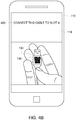
- FIG. 4A-4D depict display screen 118 of mobile computing device 110 during an exemplary sequence of actions in accordance with embodiments.
- FIG. 4A depicts a first portion of the sequence where a user presents to imaging device 117 a cable plug (e.g., device 130) having barcode label 136. In accordance with embodiments, this is a single barcode interaction.
- the single barcode is decoded.
- Information about the actual size of the barcode can be stored in barcode specific information 156.
- the barcode specific information can be stored in mobile computing device memory 114.
- the barcode specific information can be obtained by decoding the barcode itself.
- the specific information can include the actual size of the barcode.
- the size of the barcode can be calculated from the obtained image based on the imaging device optical resolution and other optical properties of the imaging device and/or obtained image. For example, the barcode size can be determined by using the known size of the barcode as a reference scale in the obtained image.
- the distance estimation between the imaging device and the barcode needs to be calibrated by several factors (e.g., imaging device pixel resolution, focal length, and angle-of-view; also the appearance of a square unit area in terms of pixels).
- an estimate of the distance between the imaging device and the barcode can be determined from the barcode actual size (which can be coded into the barcode itself) and its appearance in the image. If this estimated distance is greater than or equal to a predetermined threshold, no action is taken with regard to that particular barcode. However, if the estimated distance is less than the predetermined threshold, further action is taken with regard to the barcode. In accordance with embodiments, this action can include accessing barcode specific information, and displaying a message on the mobile computing device display screen.
- FIG. 4B depicts the image of FIG. 4A now with message 405 displayed on the display screen. Because the distance (i.e., the metric) separating the mobile computing device and device 130 is less than (i.e., the condition) the predetermined threshold, the display screen includes message 405, which states "CONNECT THIS CABLE TO SLOT 4."
- a user of a wearable eyeglass computing device can pick up a specific tool or part and bring it to a distance less than the predetermined threshold. This proximity to the wearable computing device can trigger access to barcode specific information that can then be presented to the user - for example, information on the item itself, information on a task to be performed with the item, confirmation of whether the item is for the task, etc.
- FIG. 4C depicts device 130 in proximity to equipment chassis 420.
- Equipment chassis 420 can include multiple connection points 422, 424, 426, 428. Also on the equipment chassis, and near respective connection points, are corresponding barcodes 432, 434, 436, 438.
- Barcode specific information is accessed for each barcode in the image that is a distance less than the predetermined threshold.
- the actual sizes of the barcodes can be predefined or can be obtained from the barcodes themselves.
- the barcode specific information can be accessed from datastore 150, from mobile computing device memory 114, or decoded from the barcode itself.
- the relative positions and angles between the multiple barcodes can be estimated from their position and angles in the image.
- specific interactions can be launched based on predefined rules. For example, when there are two barcodes along the same line with the same angle, at a certain distance, an interaction can be launched. As depicted in FIG. 4C , barcode 136 on device 130 and barcode 434 associated with connection point 424 meet a predefined rule. Message 410 is displayed indicating that the cable is near to an incorrect connection point. This interaction, and resulting message, can be monitored by calculating, and periodically recalculating, the distance and the angle between the cable and the connection point.
- FIG. 4D illustrates device 130 in proximity to connection point 428.
- Barcode 136 and barcode 438 can each be decoded, and their associated barcode specific information obtained. Analysis of the barcode specific information results in a determination that device 130 is in proximity with the correct connection point. Message 415 is displayed indicating that device 130 is positioned at the correct connection point.
- Figure 5 depicts the capture of multiple barcodes to determine positioning information in accordance with embodiments.
- Multiple barcodes 500 can be located on an interior surface of a structure.
- FIG. 5 illustrates multiple barcodes 500 distributed on a ceiling.
- Barcodes 500 can be an applique adhered to the ceiling, on a luminaire, other fixture, etc.
- the multiple barcodes can be on any surface of the structure (e.g., ceiling, wall, pillar, etc.).
- not all the barcodes need to be on the same surface - for example, one or more of barcodes 500 can be on a ceiling and others can be on a wall.
- the multiple barcodes 500 can be at a certain density spacing.
- the position of the barcode placement can be logged in IPS map 154, resident in mobile computing device memory 114, or decoded from the barcode itself.
- Imaging device 117 can capture barcodes 502, 504, 506, 508 within its field-of-view 520.
- the mobile computing device can be handheld and positioned by the user; in implementations the mobile computing device can be a wearable headgear device.
- the position of each barcode 502, 504, 506, 508 within field-of-view 520 can be obtained.
- Embodying systems and methods can analyze the captured images periodically and obtain the barcode positions as the mobile computing device moves about the structure.
- the relative position of the barcodes within the captured image can be compared with their actual positions based on the IPS map. This comparison can result in a determination of mobile computing device location 530.
- triangulation can be performed to determine location 530.
- position can be estimated with two barcodes in the field-of view.
- accuracy of such distance estimation varies dependent on the distribution of the two barcodes within the field-of-view, with higher accuracy obtained when the barcodes are disposed across from the center point of the field-of-view. If not, then the size of each barcode, and the distance between them is needed to be known.
- Figure 6 depicts process 600 for capturing barcodes and providing contextual information in accordance with embodiments.
- Imaging device 117 obtains an image, step 605, of one or more barcodes placed on respective devices. At least one barcode in the image is decoded, step 610. The magnitude of a metric quantifying a measureable relationship between the decoded barcode(s) and the imaging device is determined, step 615.
- the metric can be distance, where the distance between the imaging device and the barcode can be determined from the barcode actual size and its appearance in the image.
- the barcode actual size can be coded into the barcode itself, or by accessing barcode specific information records in memory 114, or datastore 150.
- the size of the barcode can be calculated from the obtained image based on the imaging device optical resolution and other optical related details.
- the metric magnitude is compared to a predetermined condition, step 620.
- the predetermined condition can be varied depending on the particular implementation. For example, when viewing device interconnections ( FIGS. 4A-4D ), a predetermined distance threshold could be less than the predetermined distance threshold applied when implementing position determination in a structure ( FIG. 5 ). If the predetermined condition is not satisfied, process 600 returns to step 605. If the predetermined condition is satisfied, barcode specific information can be accessed for each decoded barcode in the image, step 625.
- Contextual instruction and/or information based on the content of the barcode specific information is provided, step 630.
- the proximity, distance, orientation, and/or angle between the barcodes can be analyzed by embodying systems and methods to develop the contextual instructions.
- Process 600 continues to obtain images (step 605).
- a computer program application stored in non-volatile memory or computer-readable medium may include program code and/or computer executable instructions that when executed may instruct and/or cause a controller or processor to perform methods discussed herein such as a method for decoding one, two or more barcodes captured in the same image and providing contextual instruction and/or information, as described above.
- the computer-readable medium may be a non-transitory computer-readable media including all forms and types of memory and all computer-readable media except for a transitory, propagating signal.
- the non-volatile memory or computer-readable medium may be external memory.
Landscapes
- Physics & Mathematics (AREA)
- Engineering & Computer Science (AREA)
- Electromagnetism (AREA)
- Theoretical Computer Science (AREA)
- General Physics & Mathematics (AREA)
- General Health & Medical Sciences (AREA)
- Artificial Intelligence (AREA)
- Computer Vision & Pattern Recognition (AREA)
- Toxicology (AREA)
- Health & Medical Sciences (AREA)
- Business, Economics & Management (AREA)
- Tourism & Hospitality (AREA)
- Economics (AREA)
- General Business, Economics & Management (AREA)
- User Interface Of Digital Computer (AREA)
Abstract
Description
- Barcodes are ubiquitous elements appearing on many items to identify, track, or provide information. Barcode can be single-dimensional (1D), for example a UPC package code, or two-dimensional (2D), for example, a QR code. Barcode reader applications are well-known and well-deployed. Conventional barcode reader applications read a single code at one time as their purpose is to utilize the barcode to obtain information about an object.
- What is missing from the art is the ability to recognize one, two or more barcodes captured in the same image or a frame in a video stream in real-time manner, and provide contextual interaction to a user, or a device, based on information obtained after decoding the one, two or more barcodes.
-
-
FIG. 1 depicts a system in accordance with embodiments; -
FIG. 2 depicts a barcode image captured by the system ofFIG. 1 in accordance with embodiments; -
FIG. 3 depicts the capture of two barcodes by the system ofFIG. 1 in accordance with embodiments; -
FIGS. 4A-4D depict a mobile computing device display screen during an exemplary sequence of actions in accordance with embodiments; -
FIG. 5 depicts the capture of multiple barcodes in accordance with embodiments; and -
FIG. 6 depicts a flowchart of a process for capturing barcodes and providing contextual information in accordance with embodiments. - Embodying systems and methods can capture one, two or more barcodes in the same image or a frame in video streams and decode the captured barcodes using a barcode reader application installed on a mobile computing device (e.g., smartphone, tablet, wearable computing device (watch, eyeglasses, head mounted devices), etc.). Embodying systems can provide contextual instruction and/or information based on the content of the barcodes captured in the same image. In accordance with embodiments, the proximity, distance, orientation, and/or angle between the captured barcodes can be analyzed by embodying systems and methods to develop the contextual instructions.
- For example, embodying systems and methods can decode barcodes on multiple components captured in the same image, and provide assembly instruction(s) to a user (e.g., factory assembly, electronic system interconnection, etc.). In other implementations, a current location of a user can be obtained by interpolating, and/or triangulating, between positions indicated by decoding barcodes captured in the same image. In other implementations, supplemental information, instruction, and/or guidance can be provided by accessing datastore records associated with the barcodes. However, embodiments are not limited to these specific use examples, and other implementations are within the scope of this disclosure.
-
Figure 1 depictssystem 100 for decoding barcodes and providing contextual instruction and/or information in accordance with embodiments. The contextual instruction and/or information can be provided in via multi-modal communication (e.g., visual display, audio notification, tactile stimulus, etc.) to a mobile computing device. An embodying system includesmobile computing device 110, which can includecontrol processor 111 that communicates with other components over internal data/control bus 112.Control processor 111 accessescomputer executable instructions 113, which can be stored inmemory 114 to implementbarcode reader application 115. The mobile computing device can include input/output (I/O)unit 119 that communicates acrosselectronic communication network 120. I/O unit 119 can support one or more hardwire and/or wireless communication protocols including, but not limited to, cellular telephone protocol, Bluetooth, low energy Bluetooth, iBeacon, near field communication, Airplay, etc. -
Mobile computing device 110 can include imaging device 117 (e.g., a camera or other image capture device). An image captured byimaging device 117 can be displayed ondisplay screen 118. The captured image can be a still photograph or a video (including video of a moving object).Imaging device 117 can have a field-or-view wide enough so that two ormore barcodes respective devices mobile computing device 110 allows the user to move about and perform tasks between barcode scanning. - Barcodes are ubiquitous and can appear on just about any type of item. Accordingly, embodying systems and methods are not limited by the nature and/or type of
devices barcodes Barcode reader application 115 can interpret captured images (still photograph or video) to extract the barcode from the image and obtain data represented by the barcode. -
Electronic communication network 120 can be, can comprise, or can be part of, a private internet protocol (IP) network, the Internet, an integrated services digital network (ISDN), integrated services digital network (ISDN), a modem connected to a phone line, a public switched telephone network (PSTN), a public or private data network, a local area network (LAN), a metropolitan area network (MAN), a wide area network (WAN), a wireline or wireless network, a local, regional, or global communication network, an enterprise intranet, any combination of the preceding, and/or any other suitable communication infrastructure. It should be recognized that techniques and systems disclosed herein are not limited by the nature ofelectronic communication network 120. - Coupled to
electronic communication network 120 can beremote server 140, which can includeserver control processor 142. Operation, communication and other functions of the remote server can be performed under the control ofserver control processor 142. Communicatively coupled to the remote server isdatastore 150 wherecomputer executable instructions 152 can be stored. The server control processor can accesscomputer executable instructions 152 to perform its operations.Datastore 150 can include a repository of data records including indoor positioning system (IPS)map 154 and barcodespecific information 156. The barcode specific information can be used to provide supplemental information, instruction, and/or guidance based on the decoded content of a barcode. Communication withdatastore 150 can be acrosselectronic communication network 120. - In implementations, IPS
map 154 can be accessed bymobile computing device 110 and displayed on mobilecomputing device screen 118. IPSmap 154 can include a coordinate system to locate positions within the structure represented by the map. In implementations, IPSmap 154 can include a layout of a floorplan for the structure. For example, an IPS map of a retail establishment can include shelving units, aisles, counters, open spaces, etc. A map can be provided for each floor of a multi-floor structure. - In accordance with embodiments,
mobile computing device 110 can capture an image containing one or more barcodes. The image can be provided to a remote computing device (e.g., remote server 140). The remote server can decode the barcode image, and perform other tasks described herein. This implementation can be implemented whenmobile computing device 110 lacks sufficient processing power. -
Figure 2 depictsbarcode image 200 captured byimaging device 112 in accordance with embodiments.Barcode image 200 is exemplary of a barcode image captured when the barcode is not normal to a longitudinal axis of the imaging device - i.e., the barcode is slanted off the longitudinal axis. This slant can result in distortion of the barcode image - e.g., the foreground is wider and there are nonlinearities within the image itself. In accordance with embodiments,barcode reader application 115 is capable of identifying the location ofbarcode labels respective devices -
Figure 3 depicts the capture of twobarcodes imaging device 112 withinmobile computing device 110 in accordance with embodiments.FIG. 3 depictsbarcode 305 positioned on a vertical wall (or other surface) andbarcode 136 is depicted on the surface ofdevice 130. -
Barcode 136 is positioned about perpendicular to a longitudinal optical axis of the imaging device.Barcode 305 is positioned at an angle off the longitudinal axis, but still within the field-of-view ofimaging device 112. In accordance with embodiments, bothbarcode 136 andbarcode 305 can be captured byimaging device 112. Embodying systems and methods are not limited to the capture of only two barcodes; the capture of one, two or more barcodes is within the contemplation of this disclosure. The barcodes of the captured image can be decoded bybarcode reader application 115. In implementations, the perspective view ofbarcode 305 resulting from its off-axis positioning can improve its readability by the barcode reader application because the barcode will appear as expected (i.e., square) to the barcode reader application. - In accordance with embodiments, selection and decoding of a barcode (or multiple barcodes) in an image can be based on a magnitude of a metric that quantifies a relationship. As a first non-limiting example, a metric can be the distance between the barcode and the imaging device, and the condition can be if the distance is less than a predetermined threshold. If the magnitude of the metric satisfies a predetermined condition, then a contextual user interaction can be triggered.
- In accordance with an implementation, an attempt to decode the barcode can be made, and then the metric evaluated. If the metric satisfies a predetermined condition, a contextual user interaction can be triggered. In accordance with another implementation, when a barcode is captured, the metric can be evaluated. If the metric satisfies a predetermined condition, the barcode can be decoded and then trigger a contextual user interaction.
- In another non-limiting example, the metric can be an angle between barcodes in the same image and/or camera frame view, and the condition can be if the distance of one barcode to the imaging device is within a predetermined threshold. As another example, the metric can be the quantity of barcodes within the image, and the condition can be trigger a first action or a second action based on if the quantity is above/below a predetermined threshold.
-
Figures 4A-4D depictdisplay screen 118 ofmobile computing device 110 during an exemplary sequence of actions in accordance with embodiments.FIG. 4A depicts a first portion of the sequence where a user presents to imaging device 117 a cable plug (e.g., device 130) havingbarcode label 136. In accordance with embodiments, this is a single barcode interaction. - In a single barcode interaction, the single barcode is decoded. Information about the actual size of the barcode can be stored in barcode
specific information 156. In implementations, the barcode specific information can be stored in mobilecomputing device memory 114. In implementations, the barcode specific information can be obtained by decoding the barcode itself. - The specific information can include the actual size of the barcode. In implementations, the size of the barcode can be calculated from the obtained image based on the imaging device optical resolution and other optical properties of the imaging device and/or obtained image. For example, the barcode size can be determined by using the known size of the barcode as a reference scale in the obtained image. The distance estimation between the imaging device and the barcode needs to be calibrated by several factors (e.g., imaging device pixel resolution, focal length, and angle-of-view; also the appearance of a square unit area in terms of pixels).
- In accordance with embodiments, an estimate of the distance between the imaging device and the barcode can be determined from the barcode actual size (which can be coded into the barcode itself) and its appearance in the image. If this estimated distance is greater than or equal to a predetermined threshold, no action is taken with regard to that particular barcode. However, if the estimated distance is less than the predetermined threshold, further action is taken with regard to the barcode. In accordance with embodiments, this action can include accessing barcode specific information, and displaying a message on the mobile computing device display screen.
-
FIG. 4B depicts the image ofFIG. 4A now withmessage 405 displayed on the display screen. Because the distance (i.e., the metric) separating the mobile computing device anddevice 130 is less than (i.e., the condition) the predetermined threshold, the display screen includesmessage 405, which states "CONNECT THIS CABLE TOSLOT 4." In another example, a user of a wearable eyeglass computing device can pick up a specific tool or part and bring it to a distance less than the predetermined threshold. This proximity to the wearable computing device can trigger access to barcode specific information that can then be presented to the user - for example, information on the item itself, information on a task to be performed with the item, confirmation of whether the item is for the task, etc. -
FIG. 4C depictsdevice 130 in proximity toequipment chassis 420.Equipment chassis 420 can include multiple connection points 422, 424, 426, 428. Also on the equipment chassis, and near respective connection points, are correspondingbarcodes - In the implementation illustrated in
FIG. 4C there is interaction between multiple barcodes. Barcode specific information is accessed for each barcode in the image that is a distance less than the predetermined threshold. As with the single barcode interaction, the actual sizes of the barcodes can be predefined or can be obtained from the barcodes themselves. The barcode specific information can be accessed fromdatastore 150, from mobilecomputing device memory 114, or decoded from the barcode itself. - The relative positions and angles between the multiple barcodes can be estimated from their position and angles in the image. In accordance with embodiments, specific interactions can be launched based on predefined rules. For example, when there are two barcodes along the same line with the same angle, at a certain distance, an interaction can be launched. As depicted in
FIG. 4C ,barcode 136 ondevice 130 andbarcode 434 associated withconnection point 424 meet a predefined rule.Message 410 is displayed indicating that the cable is near to an incorrect connection point. This interaction, and resulting message, can be monitored by calculating, and periodically recalculating, the distance and the angle between the cable and the connection point. -
FIG. 4D illustratesdevice 130 in proximity toconnection point 428.Barcode 136 andbarcode 438 can each be decoded, and their associated barcode specific information obtained. Analysis of the barcode specific information results in a determination thatdevice 130 is in proximity with the correct connection point.Message 415 is displayed indicating thatdevice 130 is positioned at the correct connection point. -
Figure 5 depicts the capture of multiple barcodes to determine positioning information in accordance with embodiments.Multiple barcodes 500 can be located on an interior surface of a structure. For example,FIG. 5 illustratesmultiple barcodes 500 distributed on a ceiling.Barcodes 500 can be an applique adhered to the ceiling, on a luminaire, other fixture, etc. However, the multiple barcodes can be on any surface of the structure (e.g., ceiling, wall, pillar, etc.). Additionally, not all the barcodes need to be on the same surface - for example, one or more ofbarcodes 500 can be on a ceiling and others can be on a wall. - In the illustrated example, the
multiple barcodes 500 can be at a certain density spacing. The position of the barcode placement can be logged inIPS map 154, resident in mobilecomputing device memory 114, or decoded from the barcode itself. -
Imaging device 117 can capturebarcodes view 520. The mobile computing device can be handheld and positioned by the user; in implementations the mobile computing device can be a wearable headgear device. - In accordance with embodiments, the position of each
barcode view 520 can be obtained. Embodying systems and methods can analyze the captured images periodically and obtain the barcode positions as the mobile computing device moves about the structure. The relative position of the barcodes within the captured image can be compared with their actual positions based on the IPS map. This comparison can result in a determination of mobilecomputing device location 530. With more than two barcodes in the field-of-view, triangulation can be performed to determinelocation 530. - In some implementations, position can be estimated with two barcodes in the field-of view. The accuracy of such distance estimation varies dependent on the distribution of the two barcodes within the field-of-view, with higher accuracy obtained when the barcodes are disposed across from the center point of the field-of-view. If not, then the size of each barcode, and the distance between them is needed to be known.
-
Figure 6 depictsprocess 600 for capturing barcodes and providing contextual information in accordance with embodiments.Imaging device 117 obtains an image,step 605, of one or more barcodes placed on respective devices. At least one barcode in the image is decoded,step 610. The magnitude of a metric quantifying a measureable relationship between the decoded barcode(s) and the imaging device is determined,step 615. In one implementation, the metric can be distance, where the distance between the imaging device and the barcode can be determined from the barcode actual size and its appearance in the image. The barcode actual size can be coded into the barcode itself, or by accessing barcode specific information records inmemory 114, ordatastore 150. In implementations, the size of the barcode can be calculated from the obtained image based on the imaging device optical resolution and other optical related details. - The metric magnitude is compared to a predetermined condition,
step 620. The predetermined condition can be varied depending on the particular implementation. For example, when viewing device interconnections (FIGS. 4A-4D ), a predetermined distance threshold could be less than the predetermined distance threshold applied when implementing position determination in a structure (FIG. 5 ). If the predetermined condition is not satisfied,process 600 returns to step 605. If the predetermined condition is satisfied, barcode specific information can be accessed for each decoded barcode in the image,step 625. - Contextual instruction and/or information based on the content of the barcode specific information is provided,
step 630. In accordance with embodiments, in addition to barcode specific information the proximity, distance, orientation, and/or angle between the barcodes can be analyzed by embodying systems and methods to develop the contextual instructions.Process 600 continues to obtain images (step 605). - In accordance with embodiments, a computer program application stored in non-volatile memory or computer-readable medium (e.g., register memory, processor cache, RAM, ROM, hard drive, flash memory, CD ROM, magnetic media, etc.) may include program code and/or computer executable instructions that when executed may instruct and/or cause a controller or processor to perform methods discussed herein such as a method for decoding one, two or more barcodes captured in the same image and providing contextual instruction and/or information, as described above.
- The computer-readable medium may be a non-transitory computer-readable media including all forms and types of memory and all computer-readable media except for a transitory, propagating signal. In one implementation, the non-volatile memory or computer-readable medium may be external memory.
- Although specific hardware and methods have been described herein, note that any number of other configurations may be provided in accordance with embodiments of the invention. Thus, while there have been shown, described, and pointed out fundamental novel features of the invention, it will be understood that various omissions, substitutions, and changes in the form and details of the illustrated embodiments, and in their operation, may be made by those skilled in the art without departing from the spirit and scope of the invention. Substitutions of elements from one embodiment to another are also fully intended and contemplated. The invention is defined solely with regard to the claims appended hereto, and equivalents of the recitations therein.
- Various aspects and embodiments of the present invention are defined by the following numbered clauses:
- 1. A method for contextualizing data obtained from barcode images, the method comprising:
- an imaging device obtaining images containing one or more barcodes, the imaging device in communication with a mobile computing device;
- decoding at least one of the one or more barcode to determine content of the barcode;
- determining a metric magnitude quantifying a measureable relationship between at least one decoded barcode and the imaging device;
- comparing the metric magnitude to a predetermined condition;
- if the predetermined condition is satisfied, then accessing a respective barcode specific information data record based on respective barcode content; and
- providing at least one of contextual information and contextual instruction to the mobile computing device.
- 2. The method of clause 1, the determining metric magnitude step including accessing a respective barcode specific information data record to obtain an actual size of the respective barcode.
- 3. The method of clause 1 or clause 2, the determining metric magnitude step including obtaining an actual size of the respective barcode from the decoded content.
- 4. The method of any preceding clause, the determining metric magnitude step including optical properties of the imaging device in the determination.
- 5. The method of any preceding clause, respective barcodes of the one or more barcodes affixed to a respective device, and the at least one of the contextual information and the contextual instruction related to an activity incorporating at least one of the respective devices.
- 6. The method of any preceding clause, including analyzing at least one of a proximity, a distance, an orientation, and an angle between two or more of the at least one barcodes to develop the contextual instructions and contextual information.
- 7. The method of any preceding clause, including analyzing at least one of a proximity, a distance, an orientation, and an angle between two or more of the at least one barcodes to develop the contextual instructions and contextual information.
- 8. The method of any preceding clause, respective barcodes of the one or more barcodes affixed to a respective device, the method including:
- determining a distance between at least two of the respective devices; and
- providing to the mobile computing device a first contextual message selected based on the determined distance.
- 9. The method of any preceding clause, including:
- repeating determining the distance between the respective devices; and
- providing to the mobile computing device a second contextual message based on the result of the repeated distance, wherein the first contextual message and the second contextual message are one of the same and different content.
- 10. A non-transitory computer readable medium containing computer-readable instructions stored therein for causing a control processor to perform a method for contextualizing data obtained from barcode images, the method comprising:
- an imaging device obtaining images containing one or more barcodes, the imaging device in communication with a mobile computing device;
- decoding at least one of the one or more barcode to determine content of the barcode;
- determining a metric magnitude quantifying a measureable relationship between at least one decoded barcode and the imaging device;
- comparing the metric magnitude to a predetermined condition;
- if the predetermined condition is satisfied, then accessing a respective barcode specific information data record based on respective barcode content; and
- providing at least one of contextual information and contextual instruction to the mobile computing device.
- 11. The non-transitory computer readable medium of any preceding clause, containing computer-readable instructions stored therein to cause the control processor to perform the determining metric magnitude step by including accessing a respective barcode specific information data record to obtain an actual size of the respective barcode.
- 12. The non-transitory computer readable medium of any preceding clause, containing computer-readable instructions stored therein to cause the control processor to perform the determining metric magnitude step by including obtaining an actual size of the respective barcode from the decoded content.
- 13. The non-transitory computer readable medium of any preceding clause, containing computer-readable instructions stored therein to cause the control processor to perform the method, including analyzing at least one of a proximity, a distance, an orientation, and an angle between two or more of the at least one barcodes to develop the contextual instructions and contextual information.
- 14. The non-transitory computer readable medium of any preceding clause, containing computer-readable instructions stored therein to cause the control processor to perform the method, including:
- determining a distance between at least two respective devices of the obtained image, each of the two respective devices having a respective barcode affixed thereto; and
- providing to the mobile computing device a first contextual message selected based on the determined distance.
- 15. The non-transitory computer readable medium of any preceding clause, containing computer-readable instructions stored therein to cause the control processor to perform the method, including:
- repeating determining the distance between the respective devices; and
- providing to the mobile computing device a second contextual message based on the result of the repeated distance, wherein the first contextual message and the second contextual message are one of the same and different content.
- 16. A system for contextualizing data obtained from barcode images, the system comprising:
- a mobile computing device including a control processor, a barcode reader application and an imaging device in communication across an internal data/control bus;
- the control processor configured to access non-transitory computer executable instructions that cause the control processor to perform a method, the method including:
- the imaging device obtaining images containing one or more barcodes;
- decoding at least one of the one or more barcode to determine content of the barcode;
- determining a metric magnitude quantifying a relationship between at least one decoded barcode and the imaging device;
- comparing the metric magnitude to a predetermined condition;
- if the predetermined condition is satisfied, then accessing a respective barcode specific information data record based on respective barcode content; and
- providing at least one of contextual information and contextual instruction to the mobile computing device.
- 17. The system of any preceding clause, the non-transitory computer executable instructions including instructions that cause the control processor to perform the determining metric magnitude step by including one of: accessing a respective barcode specific information data record to obtain an actual size of the respective barcode, and obtaining an actual size of the respective barcode from the decoded content.
- 18. The system of any preceding clause, the non-transitory computer executable instructions including instructions that cause the control processor to:
- determining a distance between at least two respective devices of the obtained image, each of the two respective devices having a respective barcode affixed thereto;
- providing to the mobile computing device a first contextual message selected based on the determined distance;
- repeating determining the distance between the respective devices; and
- providing to the mobile computing device a second contextual message based on the result of the repeated distance, wherein the first contextual message and the second contextual message are one of the same and different content.
Claims (13)
- A method for contextualizing data obtained from barcode images, the method comprising:an imaging device obtaining images containing one or more barcodes, the imaging device in communication with a mobile computing device;decoding at least one of the one or more barcode to determine content of the barcode;determining a metric magnitude quantifying a measureable relationship between at least one decoded barcode and the imaging device;comparing the metric magnitude to a predetermined condition;if the predetermined condition is satisfied, then accessing a respective barcode specific information data record based on respective barcode content; andproviding at least one of contextual information and contextual instruction to the mobile computing device.
- The method of claim 1, the determining metric magnitude step including accessing a respective barcode specific information data record to obtain an actual size of the respective barcode.
- The method of claim 1 or claim 2, the determining metric magnitude step including obtaining an actual size of the respective barcode from the decoded content.
- The method of any preceding claim, the determining metric magnitude step including optical properties of the imaging device in the determination.
- The method of any preceding claim, respective barcodes of the one or more barcodes affixed to a respective device, and the at least one of the contextual information and the contextual instruction related to an activity incorporating at least one of the respective devices.
- The method of any preceding claim, including analyzing at least one of a proximity, a distance, an orientation, and an angle between two or more of the at least one barcodes to develop the contextual instructions and contextual information.
- The method of any preceding claim, including analyzing at least one of a proximity, a distance, an orientation, and an angle between two or more of the at least one barcodes to develop the contextual instructions and contextual information.
- The method of any preceding claim, respective barcodes of the one or more barcodes affixed to a respective device, the method including:determining a distance between at least two of the respective devices; andproviding to the mobile computing device a first contextual message selected based on the determined distance.
- The method of any preceding claim, including:repeating determining the distance between the respective devices; andproviding to the mobile computing device a second contextual message based on the result of the repeated distance, wherein the first contextual message and the second contextual message are one of the same and different content.
- A non-transitory computer readable medium containing computer-readable instructions stored therein for causing a control processor to perform the method for contextualizing data obtained from barcode images of any one of the preceding claims.
- A system for contextualizing data obtained from barcode images, the system comprising:a mobile computing device (110) including a control processor (111), a barcode reader application (115) and an imaging device (117) in communication across an internal data/control bus;the control processor (111) configured to access non-transitory computer executable instructions that cause the control processor to perform a method, the method including:the imaging device (117) obtaining images containing one or more barcodes; decoding at least one of the one or more barcode to determine content of the barcode;determining a metric magnitude quantifying a relationship between at least one decoded barcode and the imaging device;comparing the metric magnitude to a predetermined condition;if the predetermined condition is satisfied, then accessing a respective barcode specific information data record based on respective barcode content; andproviding at least one of contextual information and contextual instruction to the mobile computing device.
- The system of claim 11, the non-transitory computer executable instructions including instructions that cause the control processor to perform the determining metric magnitude step by including one of: accessing a respective barcode specific information data record to obtain an actual size of the respective barcode, and obtaining an actual size of the respective barcode from the decoded content.
- The system of claim 11 or claim 12, the non-transitory computer executable instructions including instructions that cause the control processor to:determining a distance between at least two respective devices of the obtained image, each of the two respective devices having a respective barcode affixed thereto;providing to the mobile computing device a first contextual message selected based on the determined distance;repeating determining the distance between the respective devices; andproviding to the mobile computing device a second contextual message based on the result of the repeated distance, wherein the first contextual message and the second contextual message are one of the same and different content.
Applications Claiming Priority (1)
| Application Number | Priority Date | Filing Date | Title |
|---|---|---|---|
| US15/415,163 US9864890B1 (en) | 2017-01-25 | 2017-01-25 | Systems and methods for contextualizing data obtained from barcode images |
Publications (1)
| Publication Number | Publication Date |
|---|---|
| EP3355266A1 true EP3355266A1 (en) | 2018-08-01 |
Family
ID=60812846
Family Applications (1)
| Application Number | Title | Priority Date | Filing Date |
|---|---|---|---|
| EP18152752.4A Withdrawn EP3355266A1 (en) | 2017-01-25 | 2018-01-22 | Systems and methods for contextualizing data obtained from barcode images |
Country Status (3)
| Country | Link |
|---|---|
| US (1) | US9864890B1 (en) |
| EP (1) | EP3355266A1 (en) |
| CN (1) | CN108345813A (en) |
Families Citing this family (1)
| Publication number | Priority date | Publication date | Assignee | Title |
|---|---|---|---|---|
| CN111639506B (en) * | 2020-05-29 | 2023-07-04 | 天津维创微智能科技有限公司 | Positioning method and device for bar codes in image and code scanning equipment |
Citations (1)
| Publication number | Priority date | Publication date | Assignee | Title |
|---|---|---|---|---|
| WO2006065563A2 (en) * | 2004-12-14 | 2006-06-22 | Sky-Trax Incorporated | Method and apparatus for determining position and rotational orientation of an object |
Family Cites Families (12)
| Publication number | Priority date | Publication date | Assignee | Title |
|---|---|---|---|---|
| US6845912B2 (en) | 2002-12-12 | 2005-01-25 | Thomas Whittier Scannell | Bar code for measuring distance and position |
| US20090300106A1 (en) * | 2008-04-24 | 2009-12-03 | Semacode Corporation | Mobile book-marking and transaction system and method |
| CN101474020B (en) * | 2009-01-08 | 2010-07-21 | 上海交通大学 | Shopping guide method and device for blind supermarket based on barcode identification |
| KR101103970B1 (en) | 2009-09-16 | 2012-01-06 | 기아자동차주식회사 | How to teach TC |
| US8315673B2 (en) * | 2010-01-12 | 2012-11-20 | Qualcomm Incorporated | Using a display to select a target object for communication |
| US8282002B2 (en) | 2010-03-08 | 2012-10-09 | Apple Inc. | Multi-barcode scan process |
| US8792141B2 (en) * | 2011-06-09 | 2014-07-29 | Xerox Corporation | Embedded form extraction definition to enable automatic workflow configuration |
| US8526922B1 (en) * | 2012-05-01 | 2013-09-03 | Noble Systems Corporation | Integrating two-dimensional barcodes and embedded links with call center operation |
| US8864036B2 (en) | 2012-07-09 | 2014-10-21 | Symbol Technologies, Inc. | Apparatus and method for finding target distance from barode imaging scanner |
| TWI475494B (en) | 2012-08-13 | 2015-03-01 | Univ Nat Cheng Kung | Method of read multiple two dimensional barcodes |
| US9286323B2 (en) * | 2013-02-25 | 2016-03-15 | International Business Machines Corporation | Context-aware tagging for augmented reality environments |
| US9454687B2 (en) | 2013-12-10 | 2016-09-27 | Honeywell International Inc. | Barcode imaging |
-
2017
- 2017-01-25 US US15/415,163 patent/US9864890B1/en active Active
-
2018
- 2018-01-22 EP EP18152752.4A patent/EP3355266A1/en not_active Withdrawn
- 2018-01-25 CN CN201810072630.8A patent/CN108345813A/en active Pending
Patent Citations (1)
| Publication number | Priority date | Publication date | Assignee | Title |
|---|---|---|---|---|
| WO2006065563A2 (en) * | 2004-12-14 | 2006-06-22 | Sky-Trax Incorporated | Method and apparatus for determining position and rotational orientation of an object |
Also Published As
| Publication number | Publication date |
|---|---|
| CN108345813A (en) | 2018-07-31 |
| US9864890B1 (en) | 2018-01-09 |
Similar Documents
| Publication | Publication Date | Title |
|---|---|---|
| KR102812010B1 (en) | On-device classification of fingertip motion patterns into gestures in real-time | |
| CA3016921C (en) | System and method for deep learning based hand gesture recognition in first person view | |
| CN108897777B (en) | Target object tracking method and device, electronic equipment and storage medium | |
| US9077891B1 (en) | Depth determination using camera focus | |
| CN108604378B (en) | Image segmentation and modification of video streams | |
| US9613274B2 (en) | Identifying an obstacle in a route | |
| CN105493154B (en) | System and method for determining the extent of a plane in an augmented reality environment | |
| US10896346B1 (en) | Image segmentation for object modeling | |
| JP2023508590A (en) | Granular Level Visual Perception in Mobile Augmented Reality | |
| US20190086214A1 (en) | Image processing device, image processing method, and program | |
| JP6323202B2 (en) | System, method and program for acquiring video | |
| CN107302658A (en) | Realize face clearly focusing method, device and computer equipment | |
| WO2018210047A1 (en) | Data processing method, data processing apparatus, electronic device and storage medium | |
| KR20140090078A (en) | Method for processing an image and an electronic device thereof | |
| CN110794955A (en) | Positioning tracking method, device, terminal device and computer-readable storage medium | |
| KR20190025659A (en) | Processing and formatting video for interactive presentations | |
| CN111601013B (en) | Method and apparatus for processing video frames | |
| CN114550086B (en) | A crowd positioning method and device, electronic device and storage medium | |
| US7286725B2 (en) | Information presentation apparatus for suggesting a presentation accuracy of related information and information presentation method | |
| CN113378834A (en) | Object detection method, device, apparatus, storage medium, and program product | |
| CN109816628B (en) | Face evaluation method and related product | |
| US9864890B1 (en) | Systems and methods for contextualizing data obtained from barcode images | |
| JP6289027B2 (en) | Person detection device and program | |
| CN114550085B (en) | Crowd positioning method and device, electronic equipment and storage medium | |
| CN113792569B (en) | Object recognition method, device, electronic equipment and readable medium |
Legal Events
| Date | Code | Title | Description |
|---|---|---|---|
| PUAI | Public reference made under article 153(3) epc to a published international application that has entered the european phase |
Free format text: ORIGINAL CODE: 0009012 |
|
| STAA | Information on the status of an ep patent application or granted ep patent |
Free format text: STATUS: THE APPLICATION HAS BEEN PUBLISHED |
|
| AK | Designated contracting states |
Kind code of ref document: A1 Designated state(s): AL AT BE BG CH CY CZ DE DK EE ES FI FR GB GR HR HU IE IS IT LI LT LU LV MC MK MT NL NO PL PT RO RS SE SI SK SM TR |
|
| AX | Request for extension of the european patent |
Extension state: BA ME |
|
| STAA | Information on the status of an ep patent application or granted ep patent |
Free format text: STATUS: REQUEST FOR EXAMINATION WAS MADE |
|
| STAA | Information on the status of an ep patent application or granted ep patent |
Free format text: STATUS: EXAMINATION IS IN PROGRESS |
|
| 17P | Request for examination filed |
Effective date: 20190201 |
|
| RBV | Designated contracting states (corrected) |
Designated state(s): AL AT BE BG CH CY CZ DE DK EE ES FI FR GB GR HR HU IE IS IT LI LT LU LV MC MK MT NL NO PL PT RO RS SE SI SK SM TR |
|
| 17Q | First examination report despatched |
Effective date: 20190313 |
|
| STAA | Information on the status of an ep patent application or granted ep patent |
Free format text: STATUS: THE APPLICATION IS DEEMED TO BE WITHDRAWN |
|
| 18D | Application deemed to be withdrawn |
Effective date: 20190724 |